EP3766356B1 - Method to enhance the proteolysis efficiency of pepsin or trypsin - Google Patents
Method to enhance the proteolysis efficiency of pepsin or trypsin Download PDFInfo
- Publication number
- EP3766356B1 EP3766356B1 EP18803855.8A EP18803855A EP3766356B1 EP 3766356 B1 EP3766356 B1 EP 3766356B1 EP 18803855 A EP18803855 A EP 18803855A EP 3766356 B1 EP3766356 B1 EP 3766356B1
- Authority
- EP
- European Patent Office
- Prior art keywords
- test tubes
- minutes
- ppm
- acid
- ascorbic acid
- Prior art date
- Legal status (The legal status is an assumption and is not a legal conclusion. Google has not performed a legal analysis and makes no representation as to the accuracy of the status listed.)
- Active
Links
Images



Classifications
-
- A—HUMAN NECESSITIES
- A23—FOODS OR FOODSTUFFS; TREATMENT THEREOF, NOT COVERED BY OTHER CLASSES
- A23K—FODDER
- A23K20/00—Accessory food factors for animal feeding-stuffs
- A23K20/10—Organic substances
- A23K20/105—Aliphatic or alicyclic compounds
-
- A—HUMAN NECESSITIES
- A23—FOODS OR FOODSTUFFS; TREATMENT THEREOF, NOT COVERED BY OTHER CLASSES
- A23K—FODDER
- A23K10/00—Animal feeding-stuffs
- A23K10/20—Animal feeding-stuffs from material of animal origin
- A23K10/26—Animal feeding-stuffs from material of animal origin from waste material, e.g. feathers, bones or skin
- A23K10/28—Animal feeding-stuffs from material of animal origin from waste material, e.g. feathers, bones or skin from waste dairy products
-
- A—HUMAN NECESSITIES
- A23—FOODS OR FOODSTUFFS; TREATMENT THEREOF, NOT COVERED BY OTHER CLASSES
- A23C—DAIRY PRODUCTS, e.g. MILK, BUTTER OR CHEESE; MILK OR CHEESE SUBSTITUTES; PREPARATION THEREOF
- A23C9/00—Milk preparations; Milk powder or milk powder preparations
- A23C9/12—Fermented milk preparations; Treatment using microorganisms or enzymes
- A23C9/13—Fermented milk preparations; Treatment using microorganisms or enzymes using additives
- A23C9/1322—Inorganic compounds; Minerals, including organic salts thereof, oligo-elements; Amino-acids, peptides, protein-hydrolysates or derivatives; Nucleic acids or derivatives; Yeast extract or autolysate; Vitamins; Antibiotics; Bacteriocins
-
- A—HUMAN NECESSITIES
- A23—FOODS OR FOODSTUFFS; TREATMENT THEREOF, NOT COVERED BY OTHER CLASSES
- A23J—PROTEIN COMPOSITIONS FOR FOODSTUFFS; WORKING-UP PROTEINS FOR FOODSTUFFS; PHOSPHATIDE COMPOSITIONS FOR FOODSTUFFS
- A23J3/00—Working-up of proteins for foodstuffs
- A23J3/30—Working-up of proteins for foodstuffs by hydrolysis
- A23J3/32—Working-up of proteins for foodstuffs by hydrolysis using chemical agents
-
- A—HUMAN NECESSITIES
- A23—FOODS OR FOODSTUFFS; TREATMENT THEREOF, NOT COVERED BY OTHER CLASSES
- A23J—PROTEIN COMPOSITIONS FOR FOODSTUFFS; WORKING-UP PROTEINS FOR FOODSTUFFS; PHOSPHATIDE COMPOSITIONS FOR FOODSTUFFS
- A23J3/00—Working-up of proteins for foodstuffs
- A23J3/30—Working-up of proteins for foodstuffs by hydrolysis
- A23J3/32—Working-up of proteins for foodstuffs by hydrolysis using chemical agents
- A23J3/325—Working-up of proteins for foodstuffs by hydrolysis using chemical agents of casein
-
- A—HUMAN NECESSITIES
- A23—FOODS OR FOODSTUFFS; TREATMENT THEREOF, NOT COVERED BY OTHER CLASSES
- A23K—FODDER
- A23K20/00—Accessory food factors for animal feeding-stuffs
- A23K20/10—Organic substances
- A23K20/174—Vitamins
-
- A—HUMAN NECESSITIES
- A23—FOODS OR FOODSTUFFS; TREATMENT THEREOF, NOT COVERED BY OTHER CLASSES
- A23L—FOODS, FOODSTUFFS OR NON-ALCOHOLIC BEVERAGES, NOT OTHERWISE PROVIDED FOR; PREPARATION OR TREATMENT THEREOF
- A23L29/00—Foods or foodstuffs containing additives; Preparation or treatment thereof
- A23L29/03—Organic compounds
-
- A—HUMAN NECESSITIES
- A23—FOODS OR FOODSTUFFS; TREATMENT THEREOF, NOT COVERED BY OTHER CLASSES
- A23L—FOODS, FOODSTUFFS OR NON-ALCOHOLIC BEVERAGES, NOT OTHERWISE PROVIDED FOR; PREPARATION OR TREATMENT THEREOF
- A23L29/00—Foods or foodstuffs containing additives; Preparation or treatment thereof
- A23L29/03—Organic compounds
- A23L29/035—Organic compounds containing oxygen as heteroatom
-
- A—HUMAN NECESSITIES
- A23—FOODS OR FOODSTUFFS; TREATMENT THEREOF, NOT COVERED BY OTHER CLASSES
- A23L—FOODS, FOODSTUFFS OR NON-ALCOHOLIC BEVERAGES, NOT OTHERWISE PROVIDED FOR; PREPARATION OR TREATMENT THEREOF
- A23L33/00—Modifying nutritive qualities of foods; Dietetic products; Preparation or treatment thereof
- A23L33/10—Modifying nutritive qualities of foods; Dietetic products; Preparation or treatment thereof using additives
-
- A—HUMAN NECESSITIES
- A23—FOODS OR FOODSTUFFS; TREATMENT THEREOF, NOT COVERED BY OTHER CLASSES
- A23L—FOODS, FOODSTUFFS OR NON-ALCOHOLIC BEVERAGES, NOT OTHERWISE PROVIDED FOR; PREPARATION OR TREATMENT THEREOF
- A23L33/00—Modifying nutritive qualities of foods; Dietetic products; Preparation or treatment thereof
- A23L33/10—Modifying nutritive qualities of foods; Dietetic products; Preparation or treatment thereof using additives
- A23L33/15—Vitamins
Definitions
- the present invention relates to a method for enhancing the rate of proteolysis of pepsin and trypsin in a broad pH range across acid and base.
- proteins enter the digestive tract of a mammal they are hydrolyzed to polypeptides and amino acids by pepsin of the stomach and trypsin, chymotrypsin, carboxypeptidase in the intestinal fluid, and then, the polypeptides and amino acids are absorbed by the intestinal epithelium.
- Gastric juice contains gastric acid and pepsinogen secreted by the stomach wall is activated into pepsin by gastric acid.
- the pancreas secretes pancreatic juice through the pancreatic duct to the duodenum, upstream of the small intestine.
- Trypsinogen of the pancreatic juice is secreted into the duodenum, wherein the trypsinogen is activated into trypsin by enterokinase for hydrolysing proteins to oligopeptides. Trypsin also directly or indirectly activates zymogens including trypsinogen and other inactive digestion enzymes into active enzymes in the intestine.
- antibiotic growth promoters have been widely used in animal feeds in the animal husbandry industry since the 1950s.
- animal health concerns such as drug resistance and drug residue
- the European Union has completely banned the use of antibiotics as a feed additive since 2006, and the management of drug-containing feed additives is also becoming increasingly stringent in all countries.
- non-drug additives such as acidulants have been well developed in order to replace antibiotics. Acidulants can only decrease the pH of the feed in the gastrointestinal tract in order to extra activate pepsinogen into pepsin in the beginning stage of gastric juice secretion as the secretion has not yet reached the full operation, thereby the digestion of proteins can become more efficient.
- the acidulant does rapidly reduce the pH of the feed and also the pH of stomach contents, on the other hand, it gradually retards normal secretion of the gastric acid, and is going to have a negative effect of a declination in digestion capability and a growth slowdown of the animals during a long-term use.
- the Document EP 2 545 939 A2 discloses treatment methods of administering tetrahydrobiopterin, including in oral dosage forms, in intravenous formulations, and with food. Also disclosed are biopterin assays for measuring the amount of biopterin and metabolites of biopterin in a sample.
- the document WO 2017 / 046314 A2 relates to a CD-RAP precursor protein comprising a pre-sequence and CD-RAP, and its use in manufacturing of native CD-RAP.
- the document further relates to a composition comprising CD-RAP and at least one positively charged amino acid and a buffer, pharmaceuticals comprising said composition, their use in methods of treating and/or preventing cartilage disease or injury in patients suffering from aggrecan degradation, and/or increased influx of water into the cartilage, and/or decreased CD-RAP expression, as well as methods of producing said composition and methods of storing CD-RAP in said composition.
- the document further relates to a composition comprising liposomes comprising encapsulated CD-RAP or a variant thereof, its use in methods of treating joint disease or injury, and methods of producing such liposomal composition as well as storing CD-RAP therein.
- the Applicant of the present application has developed a non-drug additive for increasing digestion and/or absorption efficacies in humans or animals, and the non-drug additive compensates for the defects of the existing products.
- the summary of the present invention is described below.
- the object of the present invention is a method to enhance a proteolysis efficiency of pepsin or trypsin, as defined in the appended claims.
- a multiple pHs buffer formulation composition that operates optimally under different pH conditions of the digestive tract is used in the method of the present invention, and thereby the overall protein digestion and absorption is naturally enhanced.
- a method to enhance a proteolysis efficiency of a pepsin at a pH of 2 to 6 or a trypsin at a pH of 5 to 7.5 characterized by comprising:
- the multiple pHs buffer formulation composition used in the method of the present invention can adapt to various pH environments in the gastrointestinal tract, and significantly improve the proteolysis efficiency of the major proteases in the digestive tract under an environment across acid and base (pH 2-7.5).
- the acid component and the base component form a buffer formulation so as to steadily sustain the activity of the protein digestion enhancer in the buffer formulation.
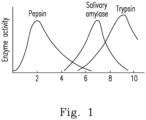
- each of the three main digestive enzymes in the gastrointestinal tract has its own optimal pH environment.
- pepsin has the optimal activity at pH around 2
- trypsin has the optimal activity at pH around 8.
- the pH of the food varies rather than being constant.
- the pH of the various parts of the small intestine are also different.
- the pH is about 7.0 to 8.5 in the duodenum, and the pH is about 4.0 to 7.0 in the other sections of the small intestine.
- the overall digestion and absorption function of the protein can be enhanced if the proteolytic efficiency of pepsin and trypsin in the digestive tract can be improved across acid and base (pH 2-7.5), especially at the pH 5-6 when the optimal pH environment has not yet been achieved or in individuals who have insufficient secretion of gastric acid (such as newborn babies, the elderly and weaned piglets).
- the buffer formulation composition provided in the present disclosure includes at least one acid component, at least one base component, and a protein digestion enhancer. Because the buffer formulation composition of the present disclosure can be applied to protein nutritional supplements for humans or animals, the components used in the buffer formulation must be non-toxic to the organism. Therefore, the acid component is preferably an organic acid, the base component is preferably an organic base, and the protein digestion enhancer is ascorbic acid, the salts of the ascorbic acid, or combinations thereof. In addition, as phosphoric acid and phosphates are widely used as food additives, therefore, they are also encompassed by the scope of the acid component and base component of the present disclosure.
- the acid component has a conjugate relationship with the base component to form a buffer formulation, e.g., the buffer formulation may be formulated in an organic acid and its conjugate base, or an organic base and its conjugate acid.
- the pH value of the buffer formulation is determined by the dissociation constant (pKa) of the acid component and the ratio of the acid component to the base component. In general, the pH value is in the range of ⁇ 1 pKa.
- the pKa values of common organic acids, phosphoric acid, and ascorbic acid are shown in Table 1 (see Lab Manual for Zumdahl/Zumdahl's Chemistry 6th Edition).
- citric acid has three different pKa values and is an organic acid, and therefore it is the best choice for the acid component in the buffer formulation of the present disclosure.
- Table 1 Organic acids Number of carbon pKa1 pKa2 pKa3 (1) formic acid 1 carbon atom 3.75 -- -- (2) acetic acid 2 carbon atoms 4.76 -- -- (3) propionic acid 3 carbon atoms 4.88 -- -- (4) butyric acid 4 carbon atoms 4.82 -- -- (5) malic acid 4 carbon atoms 3.4 5.1 -- (6) fumaric acid 4 carbon atoms 3.02 4.38 -- (7) lactic acid 3 carbon atoms 3.83 -- -- (8) citric acid 6 carbon atoms 3.13 4.76 6.4 (9) ascorbic acid 6 carbon atoms 4.1 11.8 -- (10) phosphoric acid 0 carbon atom 2.12 7.21 12.32/12.66
- the buffer formulation formed by the appropriate acid component and base component can have multiple pHs, so it can adapt to the changes in the gastrointestinal environment to have the protein digestion enhancer better perform in the gastrointestinal tract.
- the acid component used in the present disclosure includes formic acid, acetic acid, propionic acid, butyric acid, malic acid, fumaric acid, lactic acid, citric acid and phosphoric acid.
- the acid component is an organic acid.
- the organic acid is the citric acid.
- the base component used in the present disclosure is an organic base or phosphate, preferably, the organic base or the phosphate refers to an alkali metal salt or an alkaline earth metal salt.
- the organic base is sodium citrate or potassium citrate.
- the buffer formulation of the present disclosure may also include a plurality of organic acids and their conjugated bases, or a plurality of organic bases and their conjugated acids.
- the organic acid may also be combined with the phosphoric acid as the acid component in the buffer formulation of the present disclosure
- the organic base may also be combined with the phosphate as the base component in the buffer formulation of the present disclosure.
- Any buffer formulation that can be formulated as being suitable for gastrointestinal pH conditions is within the scope of the present disclosure.
- the protein digestion enhancer used in the present disclosure is an ascorbic acid, a salt of the ascorbic acid or a combination thereof.
- the salt of the ascorbic acid is one of a sodium salt, a potassium salt, a calcium salt, a magnesium salt or a combination thereof.
- the ascorbic acid also known as vitamin C, is a water-soluble and easily absorbed compound.
- the ascorbic acid is easily degraded in an environment where the pH is greater than 4.
- the buffer formulation of the present disclosure can steadily maintain the activity of ascorbic acid, the salts of the ascorbic acid, or a combination thereof in the environment at pH greater than 4, so as to achieve the goal of enhancing the proteolytic efficiencies of pepsin and trypsin in the environment across acid and base.
- the composition of the present disclosure can be used as a composition for enhancing protein digestion, e.g., an additive of the protein nutritional supplement such as a formulated milk powder or an animal feed, which enhances the proteolytic efficiencies of pepsin and trypsin in the environment with a pH of 2-7.5, and preferably, significantly enhances the proteolytic efficiencies of pepsin and trypsin in the environment at pH of 5-6.
- the above-mentioned composition includes at least one acid component, at least one base component and a protein digestion enhancer, wherein the at least one acid component and the at least one base component form a buffer formulation, and the buffer formulation enables the protein digestion enhancer to maintain high activity in an environment across acid and base.
- the protein digestion enhancer is distributed in the buffer formulation.
- the buffer formulation is evenly mixed with the protein digestion enhancer.
- the protein digestion enhancer is ascorbic acid, its sodium salt, potassium salt, calcium salt, magnesium salt or a combination thereof.
- the protein digestion enhancer is ascorbic acid, especially L-ascorbic acid, which has a concentration ranges from 60 ppm to 1000 ppm.
- the concentration of the ascorbic acid ranges from 60 ppm to 240 ppm, and more preferably 240 ppm.
- the concentration of the ascorbic acid of the present disclosure may be higher as long as it meets the recommended daily intake for the human body (up to about 2 g per day).
- the dosage form of the above-mentioned composition includes powder, particle, tablet, micron-particle, liquid or capsule.
- the composition is manufactured as a delayed or extended-release formula.
- Control groups Prepare four control solutions containing casein (3.85 mg/mL) and pepsin (385 ppm) in pH 2.0 citric acid buffer solution and put them into four test tubes.
- the four test tubes were respectively incubated at 37 °C for 10 minutes, 1 hour, 2 hours and 3 hours, an equal amount of 10% trichloroacetic acid (TCA) solution was added into each test tube and mixed with the control solution uniformly, and the test tubes were held at room temperature for 10 minutes and then centrifuged at 3000 rpm for 10 minutes. 20 ⁇ L of the supernatants taken from the above-mentioned test tubes at four time points were put into four new test tubes.
- TCA trichloroacetic acid
- o-phthalaldehyde (OPA) reagent was added into each new test tube and held for 2 minutes, and the fluorescence intensity was measured at EX. 340 nm and EM. 455 nm by a fluorescence spectrometer. The obtained fluorescence intensity was calculated as the amount of tyrosine according to a tyrosine calibration line established in advance at the same pH value, and represented as total amino acid equivalent (TAAE, ⁇ g/mL).
- Experimental groups 120 ppm ascorbic acid: Prepare four experimental solutions containing casein (3.85 mg/mL), 120 ppm ascorbic acid and pepsin (385 ppm) in pH 2.0 citric acid buffer solution and put them into four test tubes. The four test tubes were respectively incubated at 37 °C for 10 minutes, 1 hour, 2 hours and 3 hours, an equal amount of 10% TCA solution was added into each test tube and mixed with the experimental solution uniformly, and the test tubes were held at room temperature for 10 minutes and then centrifuged at 3000 rpm for 10 minutes. 20 ⁇ L of the supernatants taken from the above-mentioned test tubes at four time points were put into four new test tubes.
- Control groups Prepare four control solutions containing casein (3.85 mg/mL) and pepsin (385 ppm) in pH 5.0 citric acid buffer solution and put them into four test tubes.
- the four test tubes were respectively incubated at 37 °C for 10 minutes, 1 hour, 2 hours and 3 hours, an equal amount of 10% TCA solution was added into each test tube and mixed with the control solution uniformly, and the test tubes were held at room temperature for 10 minutes and then centrifuged at 3000 rpm for 10 minutes. 20 ⁇ L of the supernatants taken from the above-mentioned test tubes at four time points were put into four new test tubes.
- mice 60 ppm ascorbic acid: Prepare four experimental solutions containing casein (3.85 mg/mL), 60 ppm ascorbic acid and pepsin (385 ppm) in pH 5.0 citric acid buffer solution and put them into four test tubes. The four test tubes were respectively incubated at 37 °C for 10 minutes, 1 hour, 2 hours and 3 hours, an equal amount of 10% TCA solution was added into each test tube and mixed with the experimental solution uniformly, and the test tubes were held at room temperature for 10 minutes and then centrifuged at 3000 rpm for 10 minutes. 20 ⁇ L of the supernatants taken from the above-mentioned test tubes at four time points were put into four new test tubes.
- Experimental groups 120 ppm ascorbic acid: Prepare four experimental solutions containing casein (3.85 mg/mL), 120 ppm ascorbic acid and pepsin (385 ppm) in pH 5.0 citric acid buffer solution and put them into four test tubes. The four test tubes were respectively incubated at 37 °C for 10 minutes, 1 hour, 2 hours and 3 hours, an equal amount of 10% TCA solution was added into each test tube and mixed with the experimental solution uniformly, and the test tubes were held at room temperature for 10 minutes and then centrifuged at 3000 rpm for 10 minutes. 20 ⁇ L of the supernatants taken from the above-mentioned test tubes at four time points were put into four new test tubes.
- Experimental groups (240 ppm ascorbic acid): Prepare four experimental solutions containing casein (3.85 mg/mL), 240 ppm ascorbic acid and pepsin (385 ppm) in pH 5.0 citric acid buffer solution and put them into four test tubes. The four test tubes were respectively incubated at 37 °C for 10 minutes, 1 hour, 2 hours and 3 hours, an equal amount of 10% TCA solution was added into each test tube and mixed with the experimental solution uniformly, and the test tubes were held at room temperature for 10 minutes and then centrifuged at 3000 rpm for 10 minutes. 20 ⁇ L of the supernatants taken from the above-mentioned test tubes at four time points were put into four new test tubes.
- Control groups Prepare four control solutions containing casein (3.85 mg/mL) and pepsin (385 ppm) in pH 6.0 citric acid buffer solution and put them into four test tubes.
- the four test tubes were respectively incubated at 37 °C for 10 minutes, 1 hour, 2 hours and 3 hours, an equal amount of 10% TCA solution was added into each test tube and mixed with the control solution uniformly, and the test tubes were held at room temperature for 10 minutes and then centrifuged at 3000 rpm for 10 minutes. 20 ⁇ L of the supernatants taken from the above-mentioned test tubes at four time points were put into four new test tubes.
- Experimental groups (240 ppm ascorbic acid): Prepare four experimental solutions containing casein (3.85 mg/mL), 240 ppm ascorbic acid and pepsin (385 ppm) in pH 6.0 citric acid buffer solution and put them into four test tubes. The four test tubes were respectively incubated at 37 °C for 10 minutes, 1 hour, 2 hours and 3 hours, an equal amount of 10% TCA solution was added into each test tube and mixed with the experimental solution uniformly, and the test tubes were held at room temperature for 10 minutes and then centrifuged at 3000 rpm for 10 minutes. 20 ⁇ L of the supernatants taken from the above-mentioned test tubes at four time points were put into four new test tubes.
- Control groups Prepare four control solutions containing casein (3.85 mg/mL) and trypsin (385 ppm) in pH 5.0 citric acid buffer solution and put them into four test tubes.
- the four test tubes were respectively incubated at 37 °C for 10 minutes, 1 hour, 2 hours and 3 hours, an equal amount of 10% TCA solution was added into each test tube and mixed with the control solution uniformly, and the test tubes were held at room temperature for 10 minutes and then centrifuged at 3000 rpm for 10 minutes. 20 ⁇ L of the supernatants taken from the above-mentioned test tubes at four time points were put into four new test tubes.
- Experimental groups 120 ppm ascorbic acid: Prepare four experimental solutions containing casein (3.85 mg/mL), 120 ppm ascorbic acid and trypsin (385 ppm) in pH 5.0 citric acid buffer solution and put them into four test tubes. The four test tubes were respectively incubated at 37 °C for 10 minutes, 1 hour, 2 hours and 3 hours, an equal amount of 10% TCA solution was added into each test tube and mixed with the experimental solution uniformly, and the test tubes were held at room temperature for 10 minutes and then centrifuged at 3000 rpm for 10 minutes. 20 ⁇ L of the supernatants taken from the above-mentioned test tubes at four time points were put into four new test tubes.
- Experimental groups (240 ppm ascorbic acid): Prepare four experimental solutions containing casein (3.85 mg/mL), 240 ppm ascorbic acid and trypsin (385 ppm) in pH 5.0 citric acid buffer solution and put them into four test tubes. The four test tubes were respectively incubated at 37 °C for 10 minutes, 1 hour, 2 hours and 3 hours, an equal amount of 10% TCA solution was added into each test tube and mixed with the experimental solution uniformly, and the test tubes were held at room temperature for 10 minutes and then centrifuged at 3000 rpm for 10 minutes. 20 ⁇ L of the supernatants taken from the above-mentioned test tubes at four time points were put into four new test tubes.
- Control groups Prepare four control solutions containing casein (3.85 mg/mL) and trypsin (385 ppm) in pH 6.0 citric acid buffer solution and put them into four test tubes.
- the four test tubes were respectively incubated at 37 °C for 10 minutes, 1 hour, 2 hours and 3 hours, an equal amount of 10% TCA solution was added into each test tube and mixed with the control solution uniformly, and the test tubes were held at room temperature for 10 minutes and then centrifuged at 3000 rpm for 10 minutes. 20 ⁇ L of the supernatants taken from the above-mentioned test tubes at four time points were put into four new test tubes.
- Experimental groups 120 ppm ascorbic acid: Prepare four experimental solutions containing casein (3.85 mg/mL), 120 ppm ascorbic acid and trypsin (385 ppm) in pH 6.0 citric acid buffer solution and put them into four test tubes. The four test tubes were respectively incubated at 37 °C for 10 minutes, 1 hour, 2 hours and 3 hours, an equal amount of 10% TCA solution was added into each test tube and mixed with the experimental solution uniformly, and the test tubes were held at room temperature for 10 minutes and then centrifuged at 3000 rpm for 10 minutes. 20 ⁇ L of the supernatants taken from the above-mentioned test tubes at four time points were put into four new test tubes.
- Experimental groups (240 ppm ascorbic acid): Prepare four experimental solutions containing casein (3.85 mg/mL), 240 ppm ascorbic acid and trypsin (385 ppm) in pH 6.0 citric acid buffer solution and put them into four test tubes. The four test tubes were respectively incubated at 37 °C for 10 minutes, 1 hour, 2 hours and 3 hours, an equal amount of 10% TCA solution was added into each test tube and mixed with the experimental solution uniformly, and the test tubes were held at room temperature for 10 minutes and then centrifuged at 3000 rpm for 10 minutes. 20 ⁇ L of the supernatants taken from the above-mentioned test tubes at four time points were put into four new test tubes.
- Control groups Prepare four control solutions containing casein (3.85 mg/mL) and trypsin (385 ppm) in pH 7.5 citric acid buffer solution and put them into four test tubes.
- the four test tubes were respectively incubated at 37 °C for 10 minutes, 1 hour, 2 hours and 3 hours, an equal amount of 10% TCA solution was added into each test tube and mixed with the control solution uniformly, and the test tubes were held at room temperature for 10 minutes and then centrifuged at 3000 rpm for 10 minutes. 20 ⁇ L of the supernatants taken from the above-mentioned test tubes at four time points were put into four new test tubes.
- Experimental groups 120 ppm ascorbic acid: Prepare four experimental solutions containing casein (3.85 mg/mL), 120 ppm ascorbic acid and trypsin (385 ppm) in pH 7.5 citric acid buffer solution and put them into four test tubes. The four test tubes were respectively incubated at 37 °C for 10 minutes, 1 hour, 2 hours and 3 hours, an equal amount of 10% TCA solution was added into each test tube and mixed with the experimental solution uniformly, and the test tubes were held at room temperature for 10 minutes and then centrifuged at 3000 rpm for 10 minutes. 20 ⁇ L of the supernatants taken from the above-mentioned test tubes at four time points were put into four new test tubes.
- Experimental groups (240 ppm ascorbic acid): Prepare four experimental solutions containing casein (3.85 mg/mL), 240 ppm ascorbic acid and trypsin (385 ppm) in pH 7.5 citric acid buffer solution and put them into four test tubes. The four test tubes were respectively incubated at 37 °C for 10 minutes, 1 hour, 2 hours and 3 hours, an equal amount of 10% TCA solution was added into each test tube and mixed with the experimental solution uniformly, and the test tubes were held at room temperature for 10 minutes and then centrifuged at 3000 rpm for 10 minutes. 20 ⁇ L of the supernatants taken from the above-mentioned test tubes at four time points were put into four new test tubes.
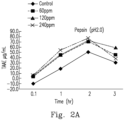
- Table 2 and Fig. 2A show the proteolytic efficiencies of pepsin (control group) and experimental groups containing different concentrations of ascorbic acid at pH 2.0. Because the optimal environment for the pepsin is at pH 2.0, there is no significant difference in the hydrolysis efficiencies among every group, but it can still be seen that the groups containing ascorbic acid have better hydrolysis efficiencies than the control group.
- the numbers shown in the above table are represented as total amino acid equivalent (TAAE) ⁇ g/mL
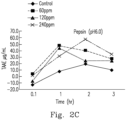
- Table 4 and Fig. 2C show the proteolytic efficiencies of pepsin (control group) and experimental groups containing different concentrations of ascorbic acid at pH 6.0.
- the pepsin is also not in the optimal environment as at pH 6.0, but it can be seen that the experimental groups containing the ascorbic acid have better proteolytic efficiencies than the control group.
- Table 4 Time (hr) pH 6.0 Group 0.1 1 2 3 Pepsin control -12.8 a 7.8 19.3 10.1 Pepsin+ascorbic acid 60 ppm 4.2 47.9 40.4 27.5 120 ppm -6.7 43.9 24.4 24.2 240 ppm 1.8 31.5 57.4 34.5 a.
- the numbers shown in the above table are represented as TAAE ( ⁇ g/mL)
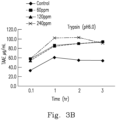
- Table 6 and Fig. 3B show the proteolytic efficiencies of trypsin (control group) and experimental groups containing different concentrations of ascorbic acid at pH 6.0.
- the trypsin is also not in the optimal environment as at pH 6.0, but it can be seen that the experimental groups containing the ascorbic acid have better proteolytic efficiencies than the control group.
- Table 6 Time (hr) pH 6.0 Group 0.1 1 2 3 Trypsin Control 33.1 a 60.9 55.0 54.0 Trypsin+ ascorbic acid 60 ppm 57.7 86.6 90.4 93.7 120 ppm 54.2 85.6 91.3 94.8 240 ppm 57.9 102.4 103.1 91.5 a.
- the numbers shown in the above table are represented as TAAE ( ⁇ g/mL)
- composition of the present disclosure does not contain any drug component, it can be used without the doubt in drug resistance, drug-residue and the concern for food safety.
Landscapes
- Life Sciences & Earth Sciences (AREA)
- Chemical & Material Sciences (AREA)
- Polymers & Plastics (AREA)
- Engineering & Computer Science (AREA)
- Food Science & Technology (AREA)
- Health & Medical Sciences (AREA)
- Nutrition Science (AREA)
- Biochemistry (AREA)
- Animal Husbandry (AREA)
- Zoology (AREA)
- Molecular Biology (AREA)
- General Chemical & Material Sciences (AREA)
- Mycology (AREA)
- Chemical Kinetics & Catalysis (AREA)
- Physiology (AREA)
- Biotechnology (AREA)
- Proteomics, Peptides & Aminoacids (AREA)
- Microbiology (AREA)
- Biomedical Technology (AREA)
- Peptides Or Proteins (AREA)
- Medicinal Preparation (AREA)
- Preparation Of Compounds By Using Micro-Organisms (AREA)
- Medicines That Contain Protein Lipid Enzymes And Other Medicines (AREA)
- Coloring Foods And Improving Nutritive Qualities (AREA)
Description
- The present invention relates to a method for enhancing the rate of proteolysis of pepsin and trypsin in a broad pH range across acid and base.
- After proteins enter the digestive tract of a mammal, they are hydrolyzed to polypeptides and amino acids by pepsin of the stomach and trypsin, chymotrypsin, carboxypeptidase in the intestinal fluid, and then, the polypeptides and amino acids are absorbed by the intestinal epithelium.
- Gastric juice contains gastric acid and pepsinogen secreted by the stomach wall is activated into pepsin by gastric acid. As food passes through the stomach to the duodenum, in the meantime, the pancreas secretes pancreatic juice through the pancreatic duct to the duodenum, upstream of the small intestine. Trypsinogen of the pancreatic juice is secreted into the duodenum, wherein the trypsinogen is activated into trypsin by enterokinase for hydrolysing proteins to oligopeptides. Trypsin also directly or indirectly activates zymogens including trypsinogen and other inactive digestion enzymes into active enzymes in the intestine.
- To enhance the digestion and absorption in the digestive tract and promote the growth of animals, antibiotic growth promoters have been widely used in animal feeds in the animal husbandry industry since the 1950s. However, with the rise of animal health concerns such as drug resistance and drug residue, the European Union has completely banned the use of antibiotics as a feed additive since 2006, and the management of drug-containing feed additives is also becoming increasingly stringent in all countries. In recent years, non-drug additives such as acidulants have been well developed in order to replace antibiotics. Acidulants can only decrease the pH of the feed in the gastrointestinal tract in order to extra activate pepsinogen into pepsin in the beginning stage of gastric juice secretion as the secretion has not yet reached the full operation, thereby the digestion of proteins can become more efficient. However, the acidulant does rapidly reduce the pH of the feed and also the pH of stomach contents, on the other hand, it gradually retards normal secretion of the gastric acid, and is going to have a negative effect of a declination in digestion capability and a growth slowdown of the animals during a long-term use.
- The
Document EP 2 545 939 A2 discloses treatment methods of administering tetrahydrobiopterin, including in oral dosage forms, in intravenous formulations, and with food. Also disclosed are biopterin assays for measuring the amount of biopterin and metabolites of biopterin in a sample. - The document
WO 2017 / 046314 A2 relates to a CD-RAP precursor protein comprising a pre-sequence and CD-RAP, and its use in manufacturing of native CD-RAP. The document further relates to a composition comprising CD-RAP and at least one positively charged amino acid and a buffer, pharmaceuticals comprising said composition, their use in methods of treating and/or preventing cartilage disease or injury in patients suffering from aggrecan degradation, and/or increased influx of water into the cartilage, and/or decreased CD-RAP expression, as well as methods of producing said composition and methods of storing CD-RAP in said composition. The document further relates to a composition comprising liposomes comprising encapsulated CD-RAP or a variant thereof, its use in methods of treating joint disease or injury, and methods of producing such liposomal composition as well as storing CD-RAP therein. - The techniques disclosed in the document
US 9,017,667 B2 - In view of the above-mentioned drawbacks of the existing antibiotic growth promoters and acidulants, the Applicant of the present application has developed a non-drug additive for increasing digestion and/or absorption efficacies in humans or animals, and the non-drug additive compensates for the defects of the existing products. The summary of the present invention is described below.
- The object of the present invention is a method to enhance a proteolysis efficiency of pepsin or trypsin, as defined in the appended claims.
- In order not to disturb the normal physiology of the gastrointestinal tract, a multiple pHs buffer formulation composition that operates optimally under different pH conditions of the digestive tract is used in the method of the present invention, and thereby the overall protein digestion and absorption is naturally enhanced.
- According to the invention, a method to enhance a proteolysis efficiency of a pepsin at a pH of 2 to 6 or a trypsin at a pH of 5 to 7.5, characterized by comprising:
- using a composition, comprising
- an acid component being a citric acid;
- a base component being sodium citrate or potassium citrate, characterized in that the acid component and the base component conjugate with each other to form a buffer formulation; and
- a protein digestion enhancer being an ascorbic acid,
- Embodiments are the subject matter of dependent claims in the appended set of claims.
- Different from the existing feed additives, the multiple pHs buffer formulation composition used in the method of the present invention can adapt to various pH environments in the gastrointestinal tract, and significantly improve the proteolysis efficiency of the major proteases in the digestive tract under an environment across acid and base (pH 2-7.5). The acid component and the base component form a buffer formulation so as to steadily sustain the activity of the protein digestion enhancer in the buffer formulation.
- Other objectives advantages and efficacies of the present disclosure will be described in detail below taken from the preferred embodiments with reference to the accompanying drawings. Herein, examples not falling within the scope of the attached claims are provided for illustrative purposes.
-
Fig. 1 shows the effect of pH on the activities of three digestive enzymes in the gastrointestinal tract. -
Fig. 2A is a curve diagram showing the proteolytic efficiencies of pepsin (control group) and experimental groups containing different concentrations of ascorbic acid measured at 10 minutes, 1 hour, 2 hours, and 3 hours at pH 2.0. -
Fig. 2B is a curve diagram showing the proteolytic efficiencies of pepsin (control group) and experimental groups containing different concentrations of ascorbic acid measured at 10 minutes, 1 hour, 2 hours, and 3 hours at pH 5.0. -
Fig. 2C is a curve diagram showing the proteolytic efficiencies of pepsin (control group) and experimental groups containing different concentrations of ascorbic acid measured at 10 minutes, 1 hour, 2 hours, and 3 hours at pH 6.0. -
Fig. 3A is a curve diagram showing the proteolytic efficiencies of trypsin (control group) and experimental groups containing different concentrations of ascorbic acid measured at 10 minutes, 1 hour, 2 hours, and 3 hours at pH 5.0. -
Fig. 3B is a curve diagram showing the proteolytic efficiencies of trypsin (control group) and experimental groups containing different concentrations of ascorbic acid measured at 10 minutes, 1 hour, 2 hours, and 3 hours at pH 6.0. -
Fig. 3C is a curve diagram showing the proteolytic efficiencies of trypsin (control group) and experimental groups containing different concentrations of ascorbic acid measured at 10 minutes, 1 hour, 2 hours, and 3 hours at pH 7.5. - When the multiple pHs buffer formulation composition of the present disclosure is designed, the pH environment of the gastrointestinal tract should be taken into consideration. Please refer to
Fig. 1 , which is described in Essentials of Human Physiology (2017). As shown inFig. 1 , each of the three main digestive enzymes in the gastrointestinal tract has its own optimal pH environment. For example, pepsin has the optimal activity at pH around 2 , and trypsin has the optimal activity at pH around 8. In fact, in the digestion process of the gastrointestinal tract, the pH of the food varies rather than being constant. When the food enters the upper part of the stomach, its pH is about 4.0 to 6.5, and when it enters the lower part of the stomach, its pH is about 1.5 to 4.0. Similarly, the pH of the various parts of the small intestine are also different. The pH is about 7.0 to 8.5 in the duodenum, and the pH is about 4.0 to 7.0 in the other sections of the small intestine. Although there is a better proteolysis efficiency in the optimum pH environment of pepsin and trypsin, the overall digestion and absorption function of the protein can be enhanced if the proteolytic efficiency of pepsin and trypsin in the digestive tract can be improved across acid and base (pH 2-7.5), especially at the pH 5-6 when the optimal pH environment has not yet been achieved or in individuals who have insufficient secretion of gastric acid (such as newborn babies, the elderly and weaned piglets). - The buffer formulation composition provided in the present disclosure includes at least one acid component, at least one base component, and a protein digestion enhancer. Because the buffer formulation composition of the present disclosure can be applied to protein nutritional supplements for humans or animals, the components used in the buffer formulation must be non-toxic to the organism. Therefore, the acid component is preferably an organic acid, the base component is preferably an organic base, and the protein digestion enhancer is ascorbic acid, the salts of the ascorbic acid, or combinations thereof. In addition, as phosphoric acid and phosphates are widely used as food additives, therefore, they are also encompassed by the scope of the acid component and base component of the present disclosure.
- The acid component has a conjugate relationship with the base component to form a buffer formulation, e.g., the buffer formulation may be formulated in an organic acid and its conjugate base, or an organic base and its conjugate acid. The pH value of the buffer formulation is determined by the dissociation constant (pKa) of the acid component and the ratio of the acid component to the base component. In general, the pH value is in the range of ±1 pKa. The pKa values of common organic acids, phosphoric acid, and ascorbic acid are shown in Table 1 (see Lab Manual for Zumdahl/Zumdahl's Chemistry 6th Edition). Among these acid components, citric acid has three different pKa values and is an organic acid, and therefore it is the best choice for the acid component in the buffer formulation of the present disclosure.
Table 1 Organic acids Number of carbon pKa1 pKa2 pKa3 (1) formic acid 1 carbon atom 3.75 -- -- (2) acetic acid 2 carbon atoms 4.76 -- -- (3) propionic acid 3 carbon atoms 4.88 -- -- (4) butyric acid 4 carbon atoms 4.82 -- -- (5) malic acid 4 carbon atoms 3.4 5.1 -- (6) fumaric acid 4 carbon atoms 3.02 4.38 -- (7) lactic acid 3 carbon atoms 3.83 -- -- (8) citric acid 6 carbon atoms 3.13 4.76 6.4 (9) ascorbic acid 6 carbon atoms 4.1 11.8 -- (10) phosphoric acid 0 carbon atom 2.12 7.21 12.32/12.66 - The buffer formulation formed by the appropriate acid component and base component can have multiple pHs, so it can adapt to the changes in the gastrointestinal environment to have the protein digestion enhancer better perform in the gastrointestinal tract.
- The acid component used in the present disclosure includes formic acid, acetic acid, propionic acid, butyric acid, malic acid, fumaric acid, lactic acid, citric acid and phosphoric acid. Preferably, the acid component is an organic acid. In a preferred embodiment, the organic acid is the citric acid. The base component used in the present disclosure is an organic base or phosphate, preferably, the organic base or the phosphate refers to an alkali metal salt or an alkaline earth metal salt. In a preferred embodiment, the organic base is sodium citrate or potassium citrate.
- The buffer formulation of the present disclosure may also include a plurality of organic acids and their conjugated bases, or a plurality of organic bases and their conjugated acids. The organic acid may also be combined with the phosphoric acid as the acid component in the buffer formulation of the present disclosure, and the organic base may also be combined with the phosphate as the base component in the buffer formulation of the present disclosure.
- Any buffer formulation that can be formulated as being suitable for gastrointestinal pH conditions is within the scope of the present disclosure.
- The protein digestion enhancer used in the present disclosure is an ascorbic acid, a salt of the ascorbic acid or a combination thereof. Preferably, the salt of the ascorbic acid is one of a sodium salt, a potassium salt, a calcium salt, a magnesium salt or a combination thereof.
- The ascorbic acid (L-ascorbic acid), also known as vitamin C, is a water-soluble and easily absorbed compound. The ascorbic acid is easily degraded in an environment where the pH is greater than 4. The buffer formulation of the present disclosure can steadily maintain the activity of ascorbic acid, the salts of the ascorbic acid, or a combination thereof in the environment at pH greater than 4, so as to achieve the goal of enhancing the proteolytic efficiencies of pepsin and trypsin in the environment across acid and base.
- In another aspect, the composition of the present disclosure can be used as a composition for enhancing protein digestion, e.g., an additive of the protein nutritional supplement such as a formulated milk powder or an animal feed, which enhances the proteolytic efficiencies of pepsin and trypsin in the environment with a pH of 2-7.5, and preferably, significantly enhances the proteolytic efficiencies of pepsin and trypsin in the environment at pH of 5-6. According to the present disclosure, the above-mentioned composition includes at least one acid component, at least one base component and a protein digestion enhancer, wherein the at least one acid component and the at least one base component form a buffer formulation, and the buffer formulation enables the protein digestion enhancer to maintain high activity in an environment across acid and base. In one embodiment, the protein digestion enhancer is distributed in the buffer formulation. In another embodiment, the buffer formulation is evenly mixed with the protein digestion enhancer.
- In the present disclosure, the protein digestion enhancer is ascorbic acid, its sodium salt, potassium salt, calcium salt, magnesium salt or a combination thereof. In a preferred embodiment, the protein digestion enhancer is ascorbic acid, especially L-ascorbic acid, which has a concentration ranges from 60 ppm to 1000 ppm. Preferably, the concentration of the ascorbic acid ranges from 60 ppm to 240 ppm, and more preferably 240 ppm. Of course, the concentration of the ascorbic acid of the present disclosure may be higher as long as it meets the recommended daily intake for the human body (up to about 2 g per day).
- According to the present disclosure, the dosage form of the above-mentioned composition includes powder, particle, tablet, micron-particle, liquid or capsule. Preferably, the composition is manufactured as a delayed or extended-release formula.
- 1.1 Control groups: Prepare four control solutions containing casein (3.85 mg/mL) and pepsin (385 ppm) in pH 2.0 citric acid buffer solution and put them into four test tubes. The four test tubes were respectively incubated at 37 °C for 10 minutes, 1 hour, 2 hours and 3 hours, an equal amount of 10% trichloroacetic acid (TCA) solution was added into each test tube and mixed with the control solution uniformly, and the test tubes were held at room temperature for 10 minutes and then centrifuged at 3000 rpm for 10 minutes. 20 µL of the supernatants taken from the above-mentioned test tubes at four time points were put into four new test tubes. 2.4 mL o-phthalaldehyde (OPA) reagent was added into each new test tube and held for 2 minutes, and the fluorescence intensity was measured at EX. 340 nm and EM. 455 nm by a fluorescence spectrometer. The obtained fluorescence intensity was calculated as the amount of tyrosine according to a tyrosine calibration line established in advance at the same pH value, and represented as total amino acid equivalent (TAAE, µg/mL).
- 1.2 Experimental groups (60 ppm ascorbic acid): Prepare four experimental solutions containing casein (3.85 mg/mL), 60 ppm ascorbic acid and pepsin (385 ppm) in pH 2.0 citric acid buffer solution and put them into four test tubes. The four test tubes were respectively incubated at 37 °C for 10 minutes, 1 hour, 2 hours and 3 hours, an equal amount of 10% TCA solution was added into each test tube and mixed with the experimental solution uniformly, and the test tubes were held at room temperature for 10 minutes and then centrifuged at 3000 rpm for 10 minutes. 20 µL of the supernatants taken from the above-mentioned test tubes at four time points were put into four new test tubes. 2.4 mL OPA reagent was added into each new test tube and held for 2 minutes, and the fluorescence intensity was measured at EX. 340 nm and EM. 455 nm by the fluorescence spectrometer. The obtained fluorescence intensity was calculated as the amount of tyrosine according to the tyrosine calibration line established in advance at the same pH value, and represented as TAAE (µg/mL).
- 1.3 Experimental groups (120 ppm ascorbic acid): Prepare four experimental solutions containing casein (3.85 mg/mL), 120 ppm ascorbic acid and pepsin (385 ppm) in pH 2.0 citric acid buffer solution and put them into four test tubes. The four test tubes were respectively incubated at 37 °C for 10 minutes, 1 hour, 2 hours and 3 hours, an equal amount of 10% TCA solution was added into each test tube and mixed with the experimental solution uniformly, and the test tubes were held at room temperature for 10 minutes and then centrifuged at 3000 rpm for 10 minutes. 20 µL of the supernatants taken from the above-mentioned test tubes at four time points were put into four new test tubes. 2.4 mL OPA reagent was added into each new test tube and held for 2 minutes, and the fluorescence intensity was measured at EX. 340 nm and EM. 455 nm by the fluorescence spectrometer. The obtained fluorescence intensity was calculated as the amount of tyrosine according to the tyrosine calibration line established in advance at the same pH value, and represented as TAAE (µg/mL).
- 1.4 Experimental groups (240 ppm ascorbic acid): Prepare four experimental solutions containing casein (3.85 mg/mL), 240 ppm ascorbic acid and pepsin (385 ppm) in pH 2.0 citric acid buffer solution and put them into four test tubes. The four test tubes were respectively incubated at 37 °C for 10 minutes, 1 hour, 2 hours and 3 hours, an equal amount of 10% TCA solution was added into each test tube and mixed with the experimental solution uniformly, and the test tubes were held at room temperature for 10 minutes and then centrifuged at 3000 rpm for 10 minutes. 20 µL of the supernatants taken from the above-mentioned test tubes at four time points were put into four new test tubes. 2.4 mL OPA reagent was added into each new test tube and held for 2 minutes, and the fluorescence intensity was measured at EX. 340 nm and EM. 455 nm by the fluorescence spectrometer. The obtained fluorescence intensity was calculated as the amount of tyrosine according to the tyrosine calibration line established in advance at the same pH value, and represented as TAAE (µg/mL).
- 2.1 Control groups: Prepare four control solutions containing casein (3.85 mg/mL) and pepsin (385 ppm) in pH 5.0 citric acid buffer solution and put them into four test tubes. The four test tubes were respectively incubated at 37 °C for 10 minutes, 1 hour, 2 hours and 3 hours, an equal amount of 10% TCA solution was added into each test tube and mixed with the control solution uniformly, and the test tubes were held at room temperature for 10 minutes and then centrifuged at 3000 rpm for 10 minutes. 20 µL of the supernatants taken from the above-mentioned test tubes at four time points were put into four new test tubes. 2.4 mL OPA reagent was added into each new test tube and held for 2 minutes, and the fluorescence intensity was measured at EX. 340 nm and EM. 455 nm by the fluorescence spectrometer. The obtained fluorescence intensity was calculated as the amount of tyrosine according to a tyrosine calibration line established in advance at the same pH value, and represented as TAAE (µg/mL).
- 2.2 Experimental groups (60 ppm ascorbic acid): Prepare four experimental solutions containing casein (3.85 mg/mL), 60 ppm ascorbic acid and pepsin (385 ppm) in pH 5.0 citric acid buffer solution and put them into four test tubes. The four test tubes were respectively incubated at 37 °C for 10 minutes, 1 hour, 2 hours and 3 hours, an equal amount of 10% TCA solution was added into each test tube and mixed with the experimental solution uniformly, and the test tubes were held at room temperature for 10 minutes and then centrifuged at 3000 rpm for 10 minutes. 20 µL of the supernatants taken from the above-mentioned test tubes at four time points were put into four new test tubes. 2.4 mL OPA reagent was added into each new test tube and held for 2 minutes, and the fluorescence intensity was measured at EX. 340 nm and EM. 455 nm by the fluorescence spectrometer. The obtained fluorescence intensity was calculated as the amount of tyrosine according to the tyrosine calibration line established in advance at the same pH value, and represented as TAAE (µg/mL).
- 2.3 Experimental groups (120 ppm ascorbic acid): Prepare four experimental solutions containing casein (3.85 mg/mL), 120 ppm ascorbic acid and pepsin (385 ppm) in pH 5.0 citric acid buffer solution and put them into four test tubes. The four test tubes were respectively incubated at 37 °C for 10 minutes, 1 hour, 2 hours and 3 hours, an equal amount of 10% TCA solution was added into each test tube and mixed with the experimental solution uniformly, and the test tubes were held at room temperature for 10 minutes and then centrifuged at 3000 rpm for 10 minutes. 20 µL of the supernatants taken from the above-mentioned test tubes at four time points were put into four new test tubes. 2.4 mL OPA reagent was added into each new test tube and held for 2 minutes, and the fluorescence intensity was measured at EX. 340 nm and EM. 455 nm by the fluorescence spectrometer. The obtained fluorescence intensity was calculated as the amount of tyrosine according to the tyrosine calibration line established in advance at the same pH value, and represented as TAAE (µg/mL).
- 2.4 Experimental groups (240 ppm ascorbic acid): Prepare four experimental solutions containing casein (3.85 mg/mL), 240 ppm ascorbic acid and pepsin (385 ppm) in pH 5.0 citric acid buffer solution and put them into four test tubes. The four test tubes were respectively incubated at 37 °C for 10 minutes, 1 hour, 2 hours and 3 hours, an equal amount of 10% TCA solution was added into each test tube and mixed with the experimental solution uniformly, and the test tubes were held at room temperature for 10 minutes and then centrifuged at 3000 rpm for 10 minutes. 20 µL of the supernatants taken from the above-mentioned test tubes at four time points were put into four new test tubes. 2.4 mL OPA reagent was added into each new test tube and held for 2 minutes, and the fluorescence intensity was measured at EX. 340 nm and EM. 455 nm by the fluorescence spectrometer. The obtained fluorescence intensity was calculated as the amount of tyrosine according to the tyrosine calibration line established in advance at the same pH value, and represented as TAAE (µg/mL).
- 3.1 Control groups: Prepare four control solutions containing casein (3.85 mg/mL) and pepsin (385 ppm) in pH 6.0 citric acid buffer solution and put them into four test tubes. The four test tubes were respectively incubated at 37 °C for 10 minutes, 1 hour, 2 hours and 3 hours, an equal amount of 10% TCA solution was added into each test tube and mixed with the control solution uniformly, and the test tubes were held at room temperature for 10 minutes and then centrifuged at 3000 rpm for 10 minutes. 20 µL of the supernatants taken from the above-mentioned test tubes at four time points were put into four new test tubes. 2.4 mL OPA reagent was added into each new test tube and held for 2 minutes, and the fluorescence intensity was measured at EX. 340 nm and EM. 455 nm by the fluorescence spectrometer. The obtained fluorescence intensity was calculated as the amount of tyrosine according to a tyrosine calibration line established in advance at the same pH value, and represented as TAAE (µg/mL).
- 3.2 Experimental groups (60 ppm ascorbic acid): Prepare four experimental solutions containing casein (3.85 mg/mL), 60 ppm ascorbic acid and pepsin (385 ppm) in pH 6.0 citric acid buffer solution and put them into four test tubes. The four test tubes were respectively incubated at 37 °C for 10 minutes, 1 hour, 2 hours and 3 hours, an equal amount of 10% TCA solution was added into each test tube and mixed with the experimental solution uniformly, and the test tubes were held at room temperature for 10 minutes and then centrifuged at 3000 rpm for 10 minutes. 20 µL of the supernatants taken from the above-mentioned test tubes at four time points were put into four new test tubes. 2.4 mL OPA reagent was added into each new test tube and held for 2 minutes, and the fluorescence intensity was measured at EX. 340 nm and EM. 455 nm by the fluorescence spectrometer. The obtained fluorescence intensity was calculated as the amount of tyrosine according to the tyrosine calibration line established in advance at the same pH value, and represented as TAAE (µg/mL).
- 3.3 Experimental groups (120 ppm ascorbic acid): Prepare four experimental solutions containing casein (3.85 mg/mL), 120 ppm ascorbic acid and pepsin (385 ppm) in pH 6.0 citric acid buffer solution and put them into four test tubes. The four test tubes were respectively incubated at 37 °C for 10 minutes, 1 hour, 2 hours and 3 hours, an equal amount of 10% TCA solution was added into each test tube and mixed with the experimental solution uniformly, and the test tubes were held at room temperature for 10 minutes and then centrifuged at 3000 rpm for 10 minutes. 20 µL of the supernatants taken from the above-mentioned test tubes at four time points were put into four new test tubes. 2.4 mL OPA reagent was added into each new test tube and held for 2 minutes, and the fluorescence intensity was measured at EX. 340 nm and EM. 455 nm by the fluorescence spectrometer. The obtained fluorescence intensity was calculated as the amount of tyrosine according to the tyrosine calibration line established in advance at the same pH value, and represented as TAAE (µg/mL).
- 3.4 Experimental groups (240 ppm ascorbic acid): Prepare four experimental solutions containing casein (3.85 mg/mL), 240 ppm ascorbic acid and pepsin (385 ppm) in pH 6.0 citric acid buffer solution and put them into four test tubes. The four test tubes were respectively incubated at 37 °C for 10 minutes, 1 hour, 2 hours and 3 hours, an equal amount of 10% TCA solution was added into each test tube and mixed with the experimental solution uniformly, and the test tubes were held at room temperature for 10 minutes and then centrifuged at 3000 rpm for 10 minutes. 20 µL of the supernatants taken from the above-mentioned test tubes at four time points were put into four new test tubes. 2.4 mL OPA reagent was added into each new test tube and held for 2 minutes, and the fluorescence intensity was measured at EX. 340 nm and EM. 455 nm by the fluorescence spectrometer. The obtained fluorescence intensity was calculated as the amount of tyrosine according to the tyrosine calibration line established in advance at the same pH value, and represented as TAAE (µg/mL).
- 4.1 Control groups: Prepare four control solutions containing casein (3.85 mg/mL) and trypsin (385 ppm) in pH 5.0 citric acid buffer solution and put them into four test tubes. The four test tubes were respectively incubated at 37 °C for 10 minutes, 1 hour, 2 hours and 3 hours, an equal amount of 10% TCA solution was added into each test tube and mixed with the control solution uniformly, and the test tubes were held at room temperature for 10 minutes and then centrifuged at 3000 rpm for 10 minutes. 20 µL of the supernatants taken from the above-mentioned test tubes at four time points were put into four new test tubes. 2.4 mL OPA reagent was added into each new test tube and held for 2 minutes, and the fluorescence intensity was measured at EX. 340 nm and EM. 455 nm by the fluorescence spectrometer. The obtained fluorescence intensity was calculated as the amount of tyrosine according to the tyrosine calibration line established in advance at the same pH value, and represented as TAAE (µg/mL).
- 4.2 Experimental groups (60 ppm ascorbic acid): Prepare four control solutions containing casein (3.85 mg/mL), 60 ppm ascorbic acid and trypsin (385 ppm) in pH 5.0 citric acid buffer solution and put them into four test tubes. The four test tubes were respectively incubated at 37 °C for 10 minutes, 1 hour, 2 hours and 3 hours, an equal amount of 10% TCA solution was added into each test tube and mixed with the control solution uniformly, and the test tubes were held at room temperature for 10 minutes and then centrifuged at 3000 rpm for 10 minutes. 20 µL of the supernatants taken from the above-mentioned test tubes at four time points were put into four new test tubes. 2.4 mL OPA reagent was added into each new test tube and held for 2 minutes, and the fluorescence intensity was measured at EX. 340 nm and EM. 455 nm by the fluorescence spectrometer. The obtained fluorescence intensity was calculated as the amount of tyrosine according to the tyrosine calibration line established in advance at the same pH value, and represented as TAAE (µg/mL).
- 4.3 Experimental groups (120 ppm ascorbic acid): Prepare four experimental solutions containing casein (3.85 mg/mL), 120 ppm ascorbic acid and trypsin (385 ppm) in pH 5.0 citric acid buffer solution and put them into four test tubes. The four test tubes were respectively incubated at 37 °C for 10 minutes, 1 hour, 2 hours and 3 hours, an equal amount of 10% TCA solution was added into each test tube and mixed with the experimental solution uniformly, and the test tubes were held at room temperature for 10 minutes and then centrifuged at 3000 rpm for 10 minutes. 20 µL of the supernatants taken from the above-mentioned test tubes at four time points were put into four new test tubes. 2.4 mL OPA reagent was added into each new test tube and held for 2 minutes, and the fluorescence intensity was measured at EX. 340 nm and EM. 455 nm by the fluorescence spectrometer. The obtained fluorescence intensity was calculated as the amount of tyrosine according to the tyrosine calibration line established in advance at the same pH value, and represented as TAAE (µg/mL).
- 4.4 Experimental groups (240 ppm ascorbic acid): Prepare four experimental solutions containing casein (3.85 mg/mL), 240 ppm ascorbic acid and trypsin (385 ppm) in pH 5.0 citric acid buffer solution and put them into four test tubes. The four test tubes were respectively incubated at 37 °C for 10 minutes, 1 hour, 2 hours and 3 hours, an equal amount of 10% TCA solution was added into each test tube and mixed with the experimental solution uniformly, and the test tubes were held at room temperature for 10 minutes and then centrifuged at 3000 rpm for 10 minutes. 20 µL of the supernatants taken from the above-mentioned test tubes at four time points were put into four new test tubes. 2.4 mL OPA reagent was added into each new test tube and held for 2 minutes, and the fluorescence intensity was measured at EX. 340 nm and EM. 455 nm by the fluorescence spectrometer. The obtained fluorescence intensity was calculated as the amount of tyrosine according to the tyrosine calibration line established in advance at the same pH value, and represented as TAAE (µg/mL).
- 5.1 Control groups: Prepare four control solutions containing casein (3.85 mg/mL) and trypsin (385 ppm) in pH 6.0 citric acid buffer solution and put them into four test tubes. The four test tubes were respectively incubated at 37 °C for 10 minutes, 1 hour, 2 hours and 3 hours, an equal amount of 10% TCA solution was added into each test tube and mixed with the control solution uniformly, and the test tubes were held at room temperature for 10 minutes and then centrifuged at 3000 rpm for 10 minutes. 20 µL of the supernatants taken from the above-mentioned test tubes at four time points were put into four new test tubes. 2.4 mL OPA reagent was added into each new test tube and held for 2 minutes, and the fluorescence intensity was measured at EX. 340 nm and EM. 455 nm by the fluorescence spectrometer. The obtained fluorescence intensity was calculated as the amount of tyrosine according to the tyrosine calibration line established in advance at the same pH value, and represented as TAAE (µg/mL).
- 5.2 Experimental groups (60 ppm ascorbic acid): Prepare four control solutions containing casein (3.85 mg/mL), 60 ppm ascorbic acid and trypsin (385 ppm) in pH 6.0 citric acid buffer solution and put them into four test tubes. The four test tubes were respectively incubated at 37 °C for 10 minutes, 1 hour, 2 hours and 3 hours, an equal amount of 10% TCA solution was added into each test tube and mixed with the control solution uniformly, and the test tubes were held at room temperature for 10 minutes and then centrifuged at 3000 rpm for 10 minutes. 20 µL of the supernatants taken from the above-mentioned test tubes at four time points were put into four new test tubes. 2.4 mL OPA reagent was added into each new test tube and held for 2 minutes, and the fluorescence intensity was measured at EX. 340 nm and EM. 455 nm by the fluorescence spectrometer. The obtained fluorescence intensity was calculated as the amount of tyrosine according to the tyrosine calibration line established in advance at the same pH value, and represented as TAAE (µg/mL).
- 5.3 Experimental groups (120 ppm ascorbic acid): Prepare four experimental solutions containing casein (3.85 mg/mL), 120 ppm ascorbic acid and trypsin (385 ppm) in pH 6.0 citric acid buffer solution and put them into four test tubes. The four test tubes were respectively incubated at 37 °C for 10 minutes, 1 hour, 2 hours and 3 hours, an equal amount of 10% TCA solution was added into each test tube and mixed with the experimental solution uniformly, and the test tubes were held at room temperature for 10 minutes and then centrifuged at 3000 rpm for 10 minutes. 20 µL of the supernatants taken from the above-mentioned test tubes at four time points were put into four new test tubes. 2.4 mL OPA reagent was added into each new test tube and held for 2 minutes, and the fluorescence intensity was measured at EX. 340 nm and EM. 455 nm by the fluorescence spectrometer. The obtained fluorescence intensity was calculated as the amount of tyrosine according to the tyrosine calibration line established in advance at the same pH value, and represented as TAAE (µg/mL).
- 5.4 Experimental groups (240 ppm ascorbic acid): Prepare four experimental solutions containing casein (3.85 mg/mL), 240 ppm ascorbic acid and trypsin (385 ppm) in pH 6.0 citric acid buffer solution and put them into four test tubes. The four test tubes were respectively incubated at 37 °C for 10 minutes, 1 hour, 2 hours and 3 hours, an equal amount of 10% TCA solution was added into each test tube and mixed with the experimental solution uniformly, and the test tubes were held at room temperature for 10 minutes and then centrifuged at 3000 rpm for 10 minutes. 20 µL of the supernatants taken from the above-mentioned test tubes at four time points were put into four new test tubes. 2.4 mL OPA reagent was added into each new test tube and held for 2 minutes, and the fluorescence intensity was measured at EX. 340 nm and EM. 455 nm by the fluorescence spectrometer. The obtained fluorescence intensity was calculated as the amount of tyrosine according to the tyrosine calibration line established in advance at the same pH value, and represented as TAAE (µg/mL).
- 6.1 Control groups: Prepare four control solutions containing casein (3.85 mg/mL) and trypsin (385 ppm) in pH 7.5 citric acid buffer solution and put them into four test tubes. The four test tubes were respectively incubated at 37 °C for 10 minutes, 1 hour, 2 hours and 3 hours, an equal amount of 10% TCA solution was added into each test tube and mixed with the control solution uniformly, and the test tubes were held at room temperature for 10 minutes and then centrifuged at 3000 rpm for 10 minutes. 20 µL of the supernatants taken from the above-mentioned test tubes at four time points were put into four new test tubes. 2.4 mL OPA reagent was added into each new test tube and held for 2 minutes, and the fluorescence intensity was measured at EX. 340 nm and EM. 455 nm by the fluorescence spectrometer. The obtained fluorescence intensity was calculated as the amount of tyrosine according to the tyrosine calibration line established in advance at the same pH value, and represented as TAAE (µg/mL).
- 6.2 Experimental groups (60 ppm ascorbic acid): Prepare four control solutions containing casein (3.85 mg/mL), 60 ppm ascorbic acid and trypsin (385 ppm) in pH 7.5 citric acid buffer solution and put them into four test tubes. The four test tubes were respectively incubated at 37 °C for 10 minutes, 1 hour, 2 hours and 3 hours, an equal amount of 10% TCA solution was added into each test tube and mixed with the control solution uniformly, and the test tubes were held at room temperature for 10 minutes and then centrifuged at 3000 rpm for 10 minutes. 20 µL of the supernatants taken from the above-mentioned test tubes at four time points were put into four new test tubes. 2.4 mL OPA reagent was added into each new test tube and held for 2 minutes, and the fluorescence intensity was measured at EX. 340 nm and EM. 455 nm by the fluorescence spectrometer. The obtained fluorescence intensity was calculated as the amount of tyrosine according to the tyrosine calibration line established in advance at the same pH value, and represented as TAAE (µg/mL).
- 6.3 Experimental groups (120 ppm ascorbic acid): Prepare four experimental solutions containing casein (3.85 mg/mL), 120 ppm ascorbic acid and trypsin (385 ppm) in pH 7.5 citric acid buffer solution and put them into four test tubes. The four test tubes were respectively incubated at 37 °C for 10 minutes, 1 hour, 2 hours and 3 hours, an equal amount of 10% TCA solution was added into each test tube and mixed with the experimental solution uniformly, and the test tubes were held at room temperature for 10 minutes and then centrifuged at 3000 rpm for 10 minutes. 20 µL of the supernatants taken from the above-mentioned test tubes at four time points were put into four new test tubes. 2.4 mL OPA reagent was added into each new test tube and held for 2 minutes, and the fluorescence intensity was measured at EX. 340 nm and EM. 455 nm by the fluorescence spectrometer. The obtained fluorescence intensity was calculated as the amount of tyrosine according to the tyrosine calibration line established in advance at the same pH value, and represented as TAAE (µg/mL).
- 6.4 Experimental groups (240 ppm ascorbic acid): Prepare four experimental solutions containing casein (3.85 mg/mL), 240 ppm ascorbic acid and trypsin (385 ppm) in pH 7.5 citric acid buffer solution and put them into four test tubes. The four test tubes were respectively incubated at 37 °C for 10 minutes, 1 hour, 2 hours and 3 hours, an equal amount of 10% TCA solution was added into each test tube and mixed with the experimental solution uniformly, and the test tubes were held at room temperature for 10 minutes and then centrifuged at 3000 rpm for 10 minutes. 20 µL of the supernatants taken from the above-mentioned test tubes at four time points were put into four new test tubes. 2.4 mL OPA reagent was added into each new test tube and held for 2 minutes, and the fluorescence intensity was measured at EX. 340 nm and EM. 455 nm by the fluorescence spectrometer. The obtained fluorescence intensity was calculated as the amount of tyrosine according to the tyrosine calibration line established in advance at the same pH value, and represented as TAAE (µg/mL).
- Please refer to Table 2 and
Fig. 2A , which show the proteolytic efficiencies of pepsin (control group) and experimental groups containing different concentrations of ascorbic acid at pH 2.0. Because the optimal environment for the pepsin is at pH 2.0, there is no significant difference in the hydrolysis efficiencies among every group, but it can still be seen that the groups containing ascorbic acid have better hydrolysis efficiencies than the control group.Table 2 Time (hr) pH 2.0 Group 0.1 1 2 3 Pepsin Control -9.8a 19.3 50.6 30.7 Pepsin+ascorbic acid 60 ppm 3.8 44.9 70.9 44.9 120 ppm 6.7 45.1 73.0 58.7 240 ppm 5.6 54.6 76.4 38.2 a. the numbers shown in the above table are represented as total amino acid equivalent (TAAE) µg/mL - Please refer to Table 3 and
Fig. 2B , which show the proteolytic efficiencies of pepsin (control group) and experimental groups containing different concentrations of ascorbic acid at pH 5.0. Because the pepsin is not in the optimal environment as at pH 5.0, the proteolytic efficiency of the pepsin is lower under this environment, but it can be seen that 240 ppm of the ascorbic acid improves the proteolytic efficiency of the pepsin significantly.Table 3 Time (hr) pH 5.0 Group 0.1 1 2 3 Pepsin Control -3.6a 31.1 31.5 38.9 Pepsin+ascorbic acid 60 ppm 6.4 32.7 58.6 42.0 120 ppm 19.5 22.1 55.4 38.1 240 ppm 49.5 81.1 92.2 72.6 a. the numbers shown in the above table are represented as TAAE (µg/mL) - Please refer to Table 4 and
Fig. 2C , which show the proteolytic efficiencies of pepsin (control group) and experimental groups containing different concentrations of ascorbic acid at pH 6.0. The pepsin is also not in the optimal environment as at pH 6.0, but it can be seen that the experimental groups containing the ascorbic acid have better proteolytic efficiencies than the control group.Table 4 Time (hr) pH 6.0 Group 0.1 1 2 3 Pepsin control -12.8a 7.8 19.3 10.1 Pepsin+ascorbic acid 60 ppm 4.2 47.9 40.4 27.5 120 ppm -6.7 43.9 24.4 24.2 240 ppm 1.8 31.5 57.4 34.5 a. the numbers shown in the above table are represented as TAAE (µg/mL) - Please refer to Table 5 and
Fig. 3A , which show the proteolytic efficiencies of trypsin (control group) and experimental groups containing different concentrations of ascorbic acid at pH 5.0. Because the trypsin is not in the optimal environment as at pH 5.0, the proteolytic efficiency of the trypsin is lower under this environment, but it can be seen that 240 ppm of the ascorbic acid improves the proteolytic efficiency of the trypsin significantly.Table 5 Time (hr) pH 5.0 Group 0.1 1 2 3 Trypsin Control -2.2a 22.3 34.3 29.0 Trypsin+ ascorbic acid 60 ppm 11.5 30.4 37.8 45.2 120 ppm 15.3 38.0 39.0 49.1 240 ppm 38.9 37.5 87.9 89.3 a. the numbers shown in the above table are represented as TAAE (µg/mL) - Please refer to Table 6 and
Fig. 3B , which show the proteolytic efficiencies of trypsin (control group) and experimental groups containing different concentrations of ascorbic acid at pH 6.0. The trypsin is also not in the optimal environment as at pH 6.0, but it can be seen that the experimental groups containing the ascorbic acid have better proteolytic efficiencies than the control group.Table 6 Time (hr) pH 6.0 Group 0.1 1 2 3 Trypsin Control 33.1a 60.9 55.0 54.0 Trypsin+ ascorbic acid 60 ppm 57.7 86.6 90.4 93.7 120 ppm 54.2 85.6 91.3 94.8 240 ppm 57.9 102.4 103.1 91.5 a. the numbers shown in the above table are represented as TAAE (µg/mL) - Please refer to Table 7 and
Fig. 3C , which show the proteolytic efficiencies of trypsin (control group) and experimental groups containing different concentrations of ascorbic acid at pH 7.5. Because the optimal environment for the trypsin is at pH 7.5, there is no significant difference in the hydrolysis efficiencies among every group, but it can still be seen that the groups containing ascorbic acid have better hydrolysis efficiencies than the control group.Table 7 Time (hr) pH 7.5 Group 0.1 1 2 3 Trypsin Control 61.5a 79.1 90.4 69.0 Trypsin+ ascorbic acid 60 ppm 82.6 107.0 103.8 105.1 120 ppm 78.4 116.3 107.3 99.0 240 ppm 60.4 91.1 100.5 86.8 a. the numbers shown in the above table are represented as TAAE (µg/mL) - While comparing the relative concentrations of the environment of various pH values, it is found that the measured concentration of amino acid is the highest in the optimal environment, and the concentration gradually decreases with the worsening of the environmental conditions, whether the pepsin or the trypsin. Under the environment of pH 2-6, it was observed that the ascorbic acid has a significant effect on the proteolysis efficiency of the pepsin under the environments of pH 5, pH 6 and
pH 2, where the control group with the optimum pH (pH 2) was used as a comparison indicator. Under the environments of pH 5-7.5, it was observed that the ascorbic acid has a significant effect on the proteolysis efficiency of the trypsin at the environments of pH 5, pH 6 and pH 7.5, where of the control group with the optimum pH (pH 7.5) was used as a comparison indicator. - Because the composition of the present disclosure does not contain any drug component, it can be used without the doubt in drug resistance, drug-residue and the concern for food safety.
Claims (3)
- A method to enhance a proteolysis efficiency of a pepsin at a pH of 2 to 6 or a trypsin at a pH of 5 to 7.5, characterized by comprising:- using a composition, comprisingwherein the ascorbic acid has a concentration in a range of 60 ppm to 240 ppm, the composition enhances the proteolysis efficiency of the pepsin at a pH of 2 to 6, and the composition enhances the proteolysis efficiency of the trypsin at a pH of 5 to 7.5.- an acid component being a citric acid;- a base component being sodium citrate or potassium citrate, characterized in that the acid component and the base component conjugate with each other to form a buffer formulation; and- a protein digestion enhancer being an ascorbic acid,
- A method as claimed in Claim 1, characterized in that the base component is sodium citrate.
- A method as claimed in Claim 1, characterized in that the ascorbic acid is an L-ascorbic acid.
Applications Claiming Priority (1)
| Application Number | Priority Date | Filing Date | Title |
|---|---|---|---|
| PCT/CN2018/079343 WO2019024509A1 (en) | 2018-03-16 | 2018-03-16 | Multi-ph buffer formulation and protein digestion aid composition, and use thereof |
Publications (4)
| Publication Number | Publication Date |
|---|---|
| EP3766356A1 EP3766356A1 (en) | 2021-01-20 |
| EP3766356A4 EP3766356A4 (en) | 2021-11-24 |
| EP3766356C0 EP3766356C0 (en) | 2025-01-15 |
| EP3766356B1 true EP3766356B1 (en) | 2025-01-15 |
Family
ID=65232272
Family Applications (1)
| Application Number | Title | Priority Date | Filing Date |
|---|---|---|---|
| EP18803855.8A Active EP3766356B1 (en) | 2018-03-16 | 2018-03-16 | Method to enhance the proteolysis efficiency of pepsin or trypsin |
Country Status (3)
| Country | Link |
|---|---|
| US (2) | US20210219569A1 (en) |
| EP (1) | EP3766356B1 (en) |
| WO (1) | WO2019024509A1 (en) |
Families Citing this family (2)
| Publication number | Priority date | Publication date | Assignee | Title |
|---|---|---|---|---|
| TW201944987A (en) * | 2018-04-30 | 2019-12-01 | 共生地球生物科技有限公司 | Use and composition of buffer formulation having multiple pH values and urease activity inhibitor |
| WO2021056431A1 (en) * | 2019-09-27 | 2021-04-01 | 共生地球生物科技有限公司 | Non-drug helicobacter pylori bactericidal composition |
Family Cites Families (11)
| Publication number | Priority date | Publication date | Assignee | Title |
|---|---|---|---|---|
| TW200626570A (en) | 2004-11-29 | 2006-08-01 | Suntory Ltd | Intraoral pungent substance |
| SI3461503T1 (en) * | 2007-04-11 | 2022-04-29 | Biomarin Pharmaceutical Inc. | Methods of administering tetrahydrobiopterin, associated compositions, and methods of measuring |
| CA2739403A1 (en) * | 2008-10-10 | 2010-04-15 | Alvine Pharmaceuticals, Inc. | Dosage forms that facilitate rapid activation of zymogen |
| US8158183B2 (en) | 2008-12-15 | 2012-04-17 | Pepsico, Inc. | Unsaturated acids for fading protection of colors derived from natural sources used in beverage products |
| CN102655768A (en) | 2009-07-31 | 2012-09-05 | 阳光喜悦饮料公司 | Microbiologically stable vitamin E solution |
| CN102048027A (en) * | 2009-11-04 | 2011-05-11 | 天津瑞普生物技术股份有限公司 | Food yeast-containing nutritional composition for animals and preparation method thereof |
| CN102640870B (en) * | 2012-05-09 | 2013-07-03 | 中国水产科学研究院淡水渔业研究中心 | Artificial feed recipe of wild Yangtze river coilia ectenes for forming feeding habit and feeding habit forming method |
| KR101546802B1 (en) | 2013-06-12 | 2015-08-24 | 박래옥 | Antiviral Composition comprising Citric acid, Zinc Boric acid, Albumin and Vitamin C against Papilloma virus |
| CN103960724A (en) * | 2014-04-30 | 2014-08-06 | 贵州北极熊实业有限公司 | Haw juice and preparation method thereof |
| US10660852B2 (en) * | 2015-09-18 | 2020-05-26 | Bionet Pharma Gmbh | Expression and folding in the manufacturing process of CD-RAP by using a CD-RAP precursor protein |
| CN106562349A (en) * | 2016-11-09 | 2017-04-19 | 佛山科学技术学院 | Stachyose-containing jelly and making method thereof |
-
2018
- 2018-03-16 US US16/306,754 patent/US20210219569A1/en not_active Abandoned
- 2018-03-16 WO PCT/CN2018/079343 patent/WO2019024509A1/en not_active Ceased
- 2018-03-16 EP EP18803855.8A patent/EP3766356B1/en active Active
-
2022
- 2022-08-17 US US17/820,414 patent/US11968999B2/en active Active
Also Published As
| Publication number | Publication date |
|---|---|
| US20210219569A1 (en) | 2021-07-22 |
| EP3766356C0 (en) | 2025-01-15 |
| WO2019024509A1 (en) | 2019-02-07 |
| US11968999B2 (en) | 2024-04-30 |
| EP3766356A1 (en) | 2021-01-20 |
| US20220386648A1 (en) | 2022-12-08 |
| EP3766356A4 (en) | 2021-11-24 |
Similar Documents
| Publication | Publication Date | Title |
|---|---|---|
| JP5970189B2 (en) | Pharmaceutical preparation | |
| TW581663B (en) | Feed compositions comprising protease and betaine for use in treatment or prophylaxis of coccidiosis, bacterial infections and necrotic enteritis in poultry | |
| US20220386648A1 (en) | Use and composition of buffer formulation with multiple ph values and protein digestion enhancer | |
| EA029869B1 (en) | Method for producing tryptophan-enriched lysozyme hydrolyzate and composition comprising hydrolyzate | |
| Bhutta et al. | Protein digestion and bioavailability | |
| KR20210036293A (en) | Composition for improving, protecting or treating sarcopenia comprising whey protein hydrolysate | |
| WO2006112012A1 (en) | Nutrient composition | |
| EP3714885A2 (en) | Composition for preventing, alleviating, or treating bone loss diseases, comprising cyclo(his-pro) (chp) | |
| JP2009013143A (en) | Sleep improvement composition | |
| EP2967117B1 (en) | Phosphorus-sparing nutritional composition | |
| CN1195544C (en) | Liver function ameliorating agents | |
| JP3691685B2 (en) | Blood sugar level rise inhibitor | |
| KR20100100845A (en) | Food material for inhibiting the formation of osteoclast | |
| JP6994001B2 (en) | Multiple pH Value Buffer Formulations and Protein Hydrolysis Efficiency Enhancer Buffer Compositions for Both Pepsin and Trypsin and Their Use | |
| EP3417872B1 (en) | Intestinal flora improvement agent | |
| WO1994003203A1 (en) | Alimentary canal cell activator | |
| CN119212574B (en) | Hydrolyzed collagen for lowering blood sugar | |
| JPWO2009057281A1 (en) | Food material for promoting osteoblast differentiation and inhibiting osteoclast differentiation | |
| CN110269099B (en) | Composition of multiple pH buffer formula and protein digestive aid and application thereof | |
| JP2000050793A (en) | Artificial milk composition | |
| KR101441728B1 (en) | Food material for inhibiting bone resorption | |
| JP2005139084A (en) | Cysteine protease inhibitor | |
| JP3556757B2 (en) | Absorption-promoting saccharide composition | |
| JP2555356B2 (en) | Iron preparation without lipid oxidation and vitamin A deterioration | |
| JP3212364B2 (en) | New royal jelly formulation |
Legal Events
| Date | Code | Title | Description |
|---|---|---|---|
| STAA | Information on the status of an ep patent application or granted ep patent |
Free format text: STATUS: UNKNOWN |
|
| STAA | Information on the status of an ep patent application or granted ep patent |
Free format text: STATUS: THE INTERNATIONAL PUBLICATION HAS BEEN MADE |
|
| PUAI | Public reference made under article 153(3) epc to a published international application that has entered the european phase |
Free format text: ORIGINAL CODE: 0009012 |
|
| STAA | Information on the status of an ep patent application or granted ep patent |
Free format text: STATUS: REQUEST FOR EXAMINATION WAS MADE |
|
| 17P | Request for examination filed |
Effective date: 20181128 |
|
| AK | Designated contracting states |
Kind code of ref document: A1 Designated state(s): AL AT BE BG CH CY CZ DE DK EE ES FI FR GB GR HR HU IE IS IT LI LT LU LV MC MK MT NL NO PL PT RO RS SE SI SK SM TR |
|
| AX | Request for extension of the european patent |
Extension state: BA ME |
|
| DAV | Request for validation of the european patent (deleted) | ||
| DAX | Request for extension of the european patent (deleted) | ||
| A4 | Supplementary search report drawn up and despatched |
Effective date: 20211025 |
|
| RIC1 | Information provided on ipc code assigned before grant |
Ipc: A23L 33/15 20160101ALI20211019BHEP Ipc: A23L 33/10 20160101ALI20211019BHEP Ipc: A23L 29/00 20160101ALI20211019BHEP Ipc: A23K 20/174 20160101ALI20211019BHEP Ipc: A23K 20/105 20160101ALI20211019BHEP Ipc: A23J 3/32 20060101ALI20211019BHEP Ipc: A61K 31/375 20060101ALI20211019BHEP Ipc: A23C 9/00 20060101ALI20211019BHEP Ipc: A23K 10/00 20160101AFI20211019BHEP |
|
| GRAP | Despatch of communication of intention to grant a patent |
Free format text: ORIGINAL CODE: EPIDOSNIGR1 |
|
| STAA | Information on the status of an ep patent application or granted ep patent |
Free format text: STATUS: GRANT OF PATENT IS INTENDED |
|
| RIC1 | Information provided on ipc code assigned before grant |
Ipc: A23L 33/15 20160101ALI20240830BHEP Ipc: A23L 33/10 20160101ALI20240830BHEP Ipc: A23L 29/00 20160101ALI20240830BHEP Ipc: A23K 20/174 20160101ALI20240830BHEP Ipc: A23K 20/105 20160101ALI20240830BHEP Ipc: A23J 3/32 20060101ALI20240830BHEP Ipc: A61K 31/375 20060101ALI20240830BHEP Ipc: A23C 9/00 20060101ALI20240830BHEP Ipc: A23K 10/00 20160101AFI20240830BHEP |
|
| INTG | Intention to grant announced |
Effective date: 20240913 |
|
| GRAS | Grant fee paid |
Free format text: ORIGINAL CODE: EPIDOSNIGR3 |
|
| GRAA | (expected) grant |
Free format text: ORIGINAL CODE: 0009210 |
|
| STAA | Information on the status of an ep patent application or granted ep patent |
Free format text: STATUS: THE PATENT HAS BEEN GRANTED |
|
| AK | Designated contracting states |
Kind code of ref document: B1 Designated state(s): AL AT BE BG CH CY CZ DE DK EE ES FI FR GB GR HR HU IE IS IT LI LT LU LV MC MK MT NL NO PL PT RO RS SE SI SK SM TR |
|
| REG | Reference to a national code |
Ref country code: CH Ref legal event code: EP Ref country code: GB Ref legal event code: FG4D |
|
| REG | Reference to a national code |
Ref country code: DE Ref legal event code: R096 Ref document number: 602018078543 Country of ref document: DE |
|
| REG | Reference to a national code |
Ref country code: IE Ref legal event code: FG4D |
|
| U01 | Request for unitary effect filed |
Effective date: 20250115 |
|
| U07 | Unitary effect registered |
Designated state(s): AT BE BG DE DK EE FI FR IT LT LU LV MT NL PT RO SE SI Effective date: 20250121 |
|
| U20 | Renewal fee for the european patent with unitary effect paid |
Year of fee payment: 8 Effective date: 20250327 |
|
| PG25 | Lapsed in a contracting state [announced via postgrant information from national office to epo] |
Ref country code: RS Free format text: LAPSE BECAUSE OF FAILURE TO SUBMIT A TRANSLATION OF THE DESCRIPTION OR TO PAY THE FEE WITHIN THE PRESCRIBED TIME-LIMIT Effective date: 20250415 |
|
| PG25 | Lapsed in a contracting state [announced via postgrant information from national office to epo] |
Ref country code: PL Free format text: LAPSE BECAUSE OF FAILURE TO SUBMIT A TRANSLATION OF THE DESCRIPTION OR TO PAY THE FEE WITHIN THE PRESCRIBED TIME-LIMIT Effective date: 20250115 |
|
| PG25 | Lapsed in a contracting state [announced via postgrant information from national office to epo] |
Ref country code: ES Free format text: LAPSE BECAUSE OF FAILURE TO SUBMIT A TRANSLATION OF THE DESCRIPTION OR TO PAY THE FEE WITHIN THE PRESCRIBED TIME-LIMIT Effective date: 20250115 |
|
| PG25 | Lapsed in a contracting state [announced via postgrant information from national office to epo] |
Ref country code: NO Free format text: LAPSE BECAUSE OF FAILURE TO SUBMIT A TRANSLATION OF THE DESCRIPTION OR TO PAY THE FEE WITHIN THE PRESCRIBED TIME-LIMIT Effective date: 20250415 Ref country code: IS Free format text: LAPSE BECAUSE OF FAILURE TO SUBMIT A TRANSLATION OF THE DESCRIPTION OR TO PAY THE FEE WITHIN THE PRESCRIBED TIME-LIMIT Effective date: 20250515 |
|
| PG25 | Lapsed in a contracting state [announced via postgrant information from national office to epo] |
Ref country code: HR Free format text: LAPSE BECAUSE OF FAILURE TO SUBMIT A TRANSLATION OF THE DESCRIPTION OR TO PAY THE FEE WITHIN THE PRESCRIBED TIME-LIMIT Effective date: 20250115 |
|
| PG25 | Lapsed in a contracting state [announced via postgrant information from national office to epo] |
Ref country code: GR Free format text: LAPSE BECAUSE OF FAILURE TO SUBMIT A TRANSLATION OF THE DESCRIPTION OR TO PAY THE FEE WITHIN THE PRESCRIBED TIME-LIMIT Effective date: 20250416 |
|
| PG25 | Lapsed in a contracting state [announced via postgrant information from national office to epo] |
Ref country code: SM Free format text: LAPSE BECAUSE OF FAILURE TO SUBMIT A TRANSLATION OF THE DESCRIPTION OR TO PAY THE FEE WITHIN THE PRESCRIBED TIME-LIMIT Effective date: 20250115 |
|
| PG25 | Lapsed in a contracting state [announced via postgrant information from national office to epo] |
Ref country code: MC Free format text: LAPSE BECAUSE OF FAILURE TO SUBMIT A TRANSLATION OF THE DESCRIPTION OR TO PAY THE FEE WITHIN THE PRESCRIBED TIME-LIMIT Effective date: 20250115 |
|
| PG25 | Lapsed in a contracting state [announced via postgrant information from national office to epo] |
Ref country code: CZ Free format text: LAPSE BECAUSE OF FAILURE TO SUBMIT A TRANSLATION OF THE DESCRIPTION OR TO PAY THE FEE WITHIN THE PRESCRIBED TIME-LIMIT Effective date: 20250115 |
|
| REG | Reference to a national code |
Ref country code: CH Ref legal event code: H13 Free format text: ST27 STATUS EVENT CODE: U-0-0-H10-H13 (AS PROVIDED BY THE NATIONAL OFFICE) Effective date: 20251023 |
|
| PG25 | Lapsed in a contracting state [announced via postgrant information from national office to epo] |
Ref country code: SK Free format text: LAPSE BECAUSE OF FAILURE TO SUBMIT A TRANSLATION OF THE DESCRIPTION OR TO PAY THE FEE WITHIN THE PRESCRIBED TIME-LIMIT Effective date: 20250115 |
|
| PLBE | No opposition filed within time limit |
Free format text: ORIGINAL CODE: 0009261 |
|
| STAA | Information on the status of an ep patent application or granted ep patent |
Free format text: STATUS: NO OPPOSITION FILED WITHIN TIME LIMIT |
|
| 26N | No opposition filed |
Effective date: 20251016 |
|
| GBPC | Gb: european patent ceased through non-payment of renewal fee |
Effective date: 20250415 |
|
| PG25 | Lapsed in a contracting state [announced via postgrant information from national office to epo] |
Ref country code: GB Free format text: LAPSE BECAUSE OF NON-PAYMENT OF DUE FEES Effective date: 20250415 |
|
| PG25 | Lapsed in a contracting state [announced via postgrant information from national office to epo] |
Ref country code: CH Free format text: LAPSE BECAUSE OF NON-PAYMENT OF DUE FEES Effective date: 20250331 |
|
| PG25 | Lapsed in a contracting state [announced via postgrant information from national office to epo] |
Ref country code: IE Free format text: LAPSE BECAUSE OF NON-PAYMENT OF DUE FEES Effective date: 20250316 |
|
| U20 | Renewal fee for the european patent with unitary effect paid |
Year of fee payment: 9 Effective date: 20260327 |