EP3765144B1 - Gangkorrigierende systeme zur verhinderung von degenerativen erkrankungen der gelenke und bänder bei hunden - Google Patents
Gangkorrigierende systeme zur verhinderung von degenerativen erkrankungen der gelenke und bänder bei hunden Download PDFInfo
- Publication number
- EP3765144B1 EP3765144B1 EP19708580.6A EP19708580A EP3765144B1 EP 3765144 B1 EP3765144 B1 EP 3765144B1 EP 19708580 A EP19708580 A EP 19708580A EP 3765144 B1 EP3765144 B1 EP 3765144B1
- Authority
- EP
- European Patent Office
- Prior art keywords
- gait
- dog
- stimulator
- computing device
- dogs
- Prior art date
- Legal status (The legal status is an assumption and is not a legal conclusion. Google has not performed a legal analysis and makes no representation as to the accuracy of the status listed.)
- Active
Links
Images


Classifications
-
- A—HUMAN NECESSITIES
- A61—MEDICAL OR VETERINARY SCIENCE; HYGIENE
- A61N—ELECTROTHERAPY; MAGNETOTHERAPY; RADIATION THERAPY; ULTRASOUND THERAPY
- A61N1/00—Electrotherapy; Circuits therefor
- A61N1/18—Applying electric currents by contact electrodes
- A61N1/32—Applying electric currents by contact electrodes alternating or intermittent currents
- A61N1/36—Applying electric currents by contact electrodes alternating or intermittent currents for stimulation
- A61N1/36003—Applying electric currents by contact electrodes alternating or intermittent currents for stimulation of motor muscles, e.g. for walking assistance
-
- A—HUMAN NECESSITIES
- A61—MEDICAL OR VETERINARY SCIENCE; HYGIENE
- A61B—DIAGNOSIS; SURGERY; IDENTIFICATION
- A61B5/00—Measuring for diagnostic purposes; Identification of persons
- A61B5/103—Measuring devices for testing the shape, pattern, colour, size or movement of the body or parts thereof, for diagnostic purposes
- A61B5/11—Measuring movement of the entire body or parts thereof, e.g. head or hand tremor or mobility of a limb
- A61B5/1116—Determining posture transitions
-
- A—HUMAN NECESSITIES
- A61—MEDICAL OR VETERINARY SCIENCE; HYGIENE
- A61B—DIAGNOSIS; SURGERY; IDENTIFICATION
- A61B5/00—Measuring for diagnostic purposes; Identification of persons
- A61B5/103—Measuring devices for testing the shape, pattern, colour, size or movement of the body or parts thereof, for diagnostic purposes
- A61B5/11—Measuring movement of the entire body or parts thereof, e.g. head or hand tremor or mobility of a limb
- A61B5/112—Gait analysis
-
- A—HUMAN NECESSITIES
- A61—MEDICAL OR VETERINARY SCIENCE; HYGIENE
- A61B—DIAGNOSIS; SURGERY; IDENTIFICATION
- A61B5/00—Measuring for diagnostic purposes; Identification of persons
- A61B5/103—Measuring devices for testing the shape, pattern, colour, size or movement of the body or parts thereof, for diagnostic purposes
- A61B5/11—Measuring movement of the entire body or parts thereof, e.g. head or hand tremor or mobility of a limb
- A61B5/1121—Determining geometric values, e.g. centre of rotation or angular range of movement
-
- A—HUMAN NECESSITIES
- A61—MEDICAL OR VETERINARY SCIENCE; HYGIENE
- A61N—ELECTROTHERAPY; MAGNETOTHERAPY; RADIATION THERAPY; ULTRASOUND THERAPY
- A61N1/00—Electrotherapy; Circuits therefor
- A61N1/02—Details
- A61N1/08—Arrangements or circuits for monitoring, protecting, controlling or indicating
-
- A—HUMAN NECESSITIES
- A61—MEDICAL OR VETERINARY SCIENCE; HYGIENE
- A61N—ELECTROTHERAPY; MAGNETOTHERAPY; RADIATION THERAPY; ULTRASOUND THERAPY
- A61N1/00—Electrotherapy; Circuits therefor
- A61N1/18—Applying electric currents by contact electrodes
- A61N1/32—Applying electric currents by contact electrodes alternating or intermittent currents
- A61N1/36—Applying electric currents by contact electrodes alternating or intermittent currents for stimulation
- A61N1/36014—External stimulators, e.g. with patch electrodes
- A61N1/3603—Control systems
- A61N1/36031—Control systems using physiological parameters for adjustment
-
- A—HUMAN NECESSITIES
- A61—MEDICAL OR VETERINARY SCIENCE; HYGIENE
- A61B—DIAGNOSIS; SURGERY; IDENTIFICATION
- A61B2503/00—Evaluating a particular growth phase or type of persons or animals
- A61B2503/40—Animals
-
- A—HUMAN NECESSITIES
- A61—MEDICAL OR VETERINARY SCIENCE; HYGIENE
- A61B—DIAGNOSIS; SURGERY; IDENTIFICATION
- A61B5/00—Measuring for diagnostic purposes; Identification of persons
- A61B5/0002—Remote monitoring of patients using telemetry, e.g. transmission of vital signals via a communication network
- A61B5/0015—Remote monitoring of patients using telemetry, e.g. transmission of vital signals via a communication network characterised by features of the telemetry system
- A61B5/0024—Remote monitoring of patients using telemetry, e.g. transmission of vital signals via a communication network characterised by features of the telemetry system for multiple sensor units attached to the patient, e.g. using a body or personal area network
-
- A—HUMAN NECESSITIES
- A61—MEDICAL OR VETERINARY SCIENCE; HYGIENE
- A61B—DIAGNOSIS; SURGERY; IDENTIFICATION
- A61B5/00—Measuring for diagnostic purposes; Identification of persons
- A61B5/68—Arrangements of detecting, measuring or recording means, e.g. sensors, in relation to patient
- A61B5/6801—Arrangements of detecting, measuring or recording means, e.g. sensors, in relation to patient specially adapted to be attached to or worn on the body surface
- A61B5/6813—Specially adapted to be attached to a specific body part
- A61B5/6828—Leg
-
- A—HUMAN NECESSITIES
- A61—MEDICAL OR VETERINARY SCIENCE; HYGIENE
- A61N—ELECTROTHERAPY; MAGNETOTHERAPY; RADIATION THERAPY; ULTRASOUND THERAPY
- A61N1/00—Electrotherapy; Circuits therefor
- A61N1/18—Applying electric currents by contact electrodes
- A61N1/32—Applying electric currents by contact electrodes alternating or intermittent currents
- A61N1/36—Applying electric currents by contact electrodes alternating or intermittent currents for stimulation
- A61N1/36014—External stimulators, e.g. with patch electrodes
- A61N1/3603—Control systems
-
- G—PHYSICS
- G16—INFORMATION AND COMMUNICATION TECHNOLOGY [ICT] SPECIALLY ADAPTED FOR SPECIFIC APPLICATION FIELDS
- G16H—HEALTHCARE INFORMATICS, i.e. INFORMATION AND COMMUNICATION TECHNOLOGY [ICT] SPECIALLY ADAPTED FOR THE HANDLING OR PROCESSING OF MEDICAL OR HEALTHCARE DATA
- G16H40/00—ICT specially adapted for the management or administration of healthcare resources or facilities; ICT specially adapted for the management or operation of medical equipment or devices
- G16H40/60—ICT specially adapted for the management or administration of healthcare resources or facilities; ICT specially adapted for the management or operation of medical equipment or devices for the operation of medical equipment or devices
- G16H40/67—ICT specially adapted for the management or administration of healthcare resources or facilities; ICT specially adapted for the management or operation of medical equipment or devices for the operation of medical equipment or devices for remote operation
Definitions
- the present invention relates to devices and methods useful in training dogs how to control the muscles involved in rotation of the tibia in order to reduce the risk of cranial cruciate rupture.
- the invention has further applications in training dogs to increase abduction of the hind limbs to avoid hip dysplasia, as well as abduction of the front limbs to avoid elbow dysplasia.
- the anterior cruciate ligament (ACL) in the human knee joint commonly called the cranial cruciate ligament (CrCL) in the canine stifle, is frequently torn in trauma.
- CrCL cranial cruciate ligament
- the standard procedure involves either placement of an extra-capsular suture or performing one of several geometry-modifying surgical techniques.
- a suture is placed outside of the joint, usually on the lateral side, to approximate the function of the CrCL.
- the intention of the suture application is to provide stability of the joint for several weeks while waiting for fibrosis to occur around the joint. This fibrosis should then provide for long-term stability.
- the extra-capsular suture technique regularly results in failure. Degenerative arthritis of the joint, after a year or so, is the rule rather than an exception.
- intra-articular artificial ligament Attempts to replace the CrCL in the dog by an anatomically placed, intra-articular artificial ligament have also generally failed in spite of years of research and development of materials, anchor designs, and surgical techniques.
- tibial plateau leveling osteotomy (TPLO; see US Patent No. 4,677,973 and Slocum and Slocum, Vet. Clin. North Am. 23:777-795, 1993 ), cranial closing wedge osteotomy (CWO; Slocum and Devine, J. Am. Vet. Med. Assoc.
- TTA tibial tuberosity advancement
- EP 3 154 627 A1 and US 2017/202 724 A1 each show a system for correcting human gait comprising:
- the present invention which is defined in claim 1, provides devices useful in training dogs to control the muscles involved in rotation of the tibia in order to reduce the risk of cranial cruciate rupture. Any methods disclosed hereinafter do not form part of the scope of the invention, and are mentioned for illustrative purposes only.
- the present invention features a system for preventive, non-surgical treatment of the dogs at risk for cruciate rupture, aiming at reducing the internal rotation of the tibia, by modifying the balance of the external and internal rotators of the tibia.
- the muscles targeted for intervention by training are the caudal portion of the biceps femoris, which is the only external rotator, acting against the internal rotators group of: sartorius, gracilis, semitendinosus, semimembranosus, and popliteus.
- the present invention provides devices and methods for the non-surgical treatment of a disordered knee in a dog, wherein the disorder may encompass a partially ruptured cranial cruciate ligament (CrCL), a fully ruptured CrCL, or a displaced patella.
- the disorder may encompass a partially ruptured cranial cruciate ligament (CrCL), a fully ruptured CrCL, or a displaced patella.
- a first aspect of the invention relates to a system for correcting dog gait comprising:
- the device comprises at least one orientation sensor strapped to the hind limbs, preferably to the tarsal bones, communicating with the computing device, such as a smart phone, preferably via a wireless link.
- the computing device such as a smart phone
- an orientation sensor and a stimulator may be combined in a single device.
- an orientation sensors detects excessive rotations, in particular excessive internal rotation of the tibia
- a weak electrical and/or mechanical stimulus is delivered as a signal to the dog by the stimulator to attempt correcting the gait - in case of cruciate ligaments at risk, the signal may be delivered to the medial aspect of the foot.
- the invention has other similar applications where there are known gait patterns predisposing damage to the joints and/or ligaments, e.g. excessive front limb adduction that can lead to medial elbow disease.
- the limb placement in gait on a treadmill is controlled by a barrier.
- the barrier is placed between the (hind) limbs and its width gradually increased until the intoeing is sufficiently reduced and/or eliminated.
- This invention is based, at least in part, on in vitro experiments and clinical observations that have helped us identify the fundamental causes of the slow process of degradation of the CrCL in the dog.
- Our experimental work with dog cadavers has shown a surprisingly strong effect of the torque imposed on the stifle by the ground reaction at the paw on the tensile force in the CrCL, as well as on its surrogate, a lateral extra-capsular suture.
- the tension on the CrCL and its extra-capsular surrogate was increased greatly - by up to six times - if the torsion was accounted for by applying the load to the paw.
- all of the stifle spanning muscles inserting to the medial side of the proximal tibia are not only flexors, involved in controlling the stifle angle in the sagittal plane together with the quadriceps that act as stifle extensors, but also internal rotators of the tibia.
- the task of the caudal portion of the biceps femoris is further complicated because it also functions as a stifle flexor.
- this invention advocates a preventive, non-invasive intervention aimed at training still healthy dogs to tune their muscle control mechanisms used in gait in order to avoid undesirable, high loading of the ligaments, but also of the joints, that may eventually lead to serious consequences of a chronic, gradual functional degradation.
- Hip dysplasia in dogs is perhaps the best-known condition of dysplasia that frequently leads to arthrosis of the hip. Drawing a parallel to well established problems and treatment solutions in humans, training dogs to increase abduction of their femurs in gait at very young age could prevent progression, or possibly even reverse degradation of their hip joints.
- the present invention can also be used post surgically to reduce the tension in the implants aiming to restore the function of the cranial cruciate ligament, both of intra-articular and extra-articular type.
- TPLO and TTA geometry modifying procedures are currently performed for both total and partial ruptures of the ligament with about 30% of all cases being partial ruptures.
- Clinical signs are present and the experience suggests that most of the partial ruptures will progress to total ruptures. Performing the surgery at this earlier stage may have an important advantage in that meniscal damage is much less likely to develop until the complete rupture.
- Some surgeons will remove the remnants of the partially torn ligament at the time of performing TPLO or TTA, but others will leave it. There are some indications that a partially ruptured ligament will not progress to a full rupture and may even partially heal.
- the prospects are good that a further, much more invasive procedure, such as TPLO or TTA, will not be necessary.
- the cruciate ligaments may not keep wrapping on each other to limit the internal rotation of the tibia and may instead go on to heal.
- treatments based on this invention may be deployed alone and can alone prevent or resolve the clinical problem being addressed, while in other situations, they are performed as an adjunct intervention to improve the prospects of conventional surgeries.
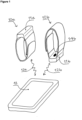
- Shown in Figure 1 is a preferred embodiment of the invention comprising at least one, but preferably two devices, 10a and 10b - one to be strapped to the left and one to the right limb of the dog - provided with orientation sensors 11a and 11b.
- sensors are ubiquitous in modern electronic devices, e.g. smart phones, robots, drones, devices for gaming, augmented and virtual reality, etc.
- a triaxial accelerometer With the dog moving along with a standard gait, the orientation data from the left and the right limb, are wirelessly transmitted, 12a and 12b, to a computing device, e.g. a smartphone 13, which uses an algorithm to calculate deviations from what is considered a safe pattern of orientations. If the deviation is larger than a threshold, a stimulating electrical device, preferably contained in the same package with the sensor, delivers a small electrical signal to the deviating limb via a stimulator, e.g. an electrode 14b (or 14a, not shown). Alternatively, the stimulator can be electro-mechanical. Using bilateral sensors allows the algorithm to establish the main axis of forward gait after a several steps - orientations are then referenced to this axis and the gravity.
- a stimulator e.g. an electrode 14b (or 14a, not shown).
- the stimulator can be electro-mechanical.
- the sensors/stimulators are strapped to the tarsal bones of the dog, just distally to the ankle joints, Figure 2 .
- the ankle joint is almost a perfect hinge with the axis of rotation, ⁇
- the sensor data on rotation, ⁇ , around the vertical can also be used to approximate the internal rotation of the tibia, ⁇ .
- excessive internal rotation of the tibia is the prime risk for cranial cruciate rupture.
- This training can be best carried out by the dog owner during regular leash-walks. Walking along with the dog on a straight path, the owner activates the circuitry via e.g. a smart phone app and leaves it on as long as the dog responds appropriately. It is relatively easy to observe intoeing of the hind limbs - if the dog learns how to avoid it and gets a small award for its performance, the training could be accomplished in weeks or even perhaps in only several days, with occasional re-training to maintain the proper gait for life.
- the dog is trained to walk on a treadmill, 20, as is frequently done these days for a variety of protocols in physiotherapy.
- the goal of the training is to get the dog to avoid intoeing at the hind limbs. This can be accomplished by placing a barrier along the long axis of the treadmill, between the legs of the dog.
- the barrier can comprise two boards, 21 and 22, that can be gradually spread apart - as shown by arrows a, b, c and d - from each other, either in parallel, or in a wedge-shaped fashion so that the barrier is wider either between the hind limbs, when targeting tibia internal rotation to prevent cruciate disease, or between the front limbs, when targeting adduction to prevent elbow medial compartment disease.
- the input to the control of the gait is the width of the barrier; the feedback is the contact of the paws to the barrier, which the dog will try to avoid.
- the feedback could simply be mechanical contact to the barrier, or, alternatively an electrical signal - a weak electrical stimulus - when the barrier is touched.
Landscapes
- Health & Medical Sciences (AREA)
- Life Sciences & Earth Sciences (AREA)
- Engineering & Computer Science (AREA)
- Biomedical Technology (AREA)
- General Health & Medical Sciences (AREA)
- Public Health (AREA)
- Animal Behavior & Ethology (AREA)
- Veterinary Medicine (AREA)
- Heart & Thoracic Surgery (AREA)
- Biophysics (AREA)
- Physics & Mathematics (AREA)
- Medical Informatics (AREA)
- Pathology (AREA)
- Molecular Biology (AREA)
- Surgery (AREA)
- Physiology (AREA)
- Radiology & Medical Imaging (AREA)
- Nuclear Medicine, Radiotherapy & Molecular Imaging (AREA)
- Oral & Maxillofacial Surgery (AREA)
- Dentistry (AREA)
- Physical Education & Sports Medicine (AREA)
- Geometry (AREA)
- Neurology (AREA)
- Prostheses (AREA)
- Surgical Instruments (AREA)
- Electrotherapy Devices (AREA)
- Measurement Of The Respiration, Hearing Ability, Form, And Blood Characteristics Of Living Organisms (AREA)
- Computer Networks & Wireless Communication (AREA)
- Business, Economics & Management (AREA)
- General Business, Economics & Management (AREA)
- Epidemiology (AREA)
- Primary Health Care (AREA)
Claims (11)
- System zum Korrigieren des Gangs, umfassend:- mindestens einen Orientierungssensor (11, 11b) und mindestens einen Stimulator und- eine Computervorrichtung (13), welche Orientierungssensordaten empfängt,wobei der mindestens eine Stimulator (14b) dazu eingerichtet ist, durch die Computervorrichtung aktiviert zu werden, wenn die Sensordaten akzeptable Schwellenwerte überschreiten, dadurch gekennzeichnet, dass das System zum Korrigieren des Hundegangs dient, wobei der Orientierungssensor und der Stimulator dazu eingerichtet sind, an einem Körperglied des Hundes angebracht zu werden.
- System nach Anspruch 1, wobei zwei Orientierungssensoren (11a, 11b) dazu eingerichtet sind, an kontralateralen Körpergliedern des Hundes angebracht zu werden.
- System nach Anspruch 1 oder 2, wobei die Computervorrichtung (13) dazu eingerichtet ist, mit den Orientierungssensoren und den Stimulatoren drahtlos zu kommunizieren.
- System nach einem der Ansprüche 1 - 3, wobei der Stimulator (14b) dazu eingerichtet ist, elektrische Signale an den Hund zu übermitteln.
- System nach einem der Ansprüche 1 - 4, wobei der Stimulator (14b) dazu eingerichtet ist, mechanische Signale an den Hund zu übermitteln.
- System nach einem der Ansprüche 1 - 5, wobei der Orientierungssensor (11a, 11b) einen triaxialen Beschleunigungsmesser, ein triaxiales Gyroskop und einen triaxialen geomagnetischen Sensor umfasst und integriert.
- System nach einem der Ansprüche 1 - 6, wobei der Orientierungssensor (11a, 11b) dazu eingerichtet ist, am Fußwurzelknochen angebracht zu werden, z. B. an jedem der Fußwurzelknochen der kontralateralen Körperglieder.
- System nach Anspruch 7, wobei die Computervorrichtung (13) dazu eingerichtet ist, die Rotation der Tibiae im Gang zu schätzen und den Stimulator (14b) zu aktivieren, um Signale an den medialen Aspekt des Fußes zu übermitteln.
- System nach einem der Ansprüche 1 - 6, wobei der Orientierungssensor (11a, 11b) dazu eingerichtet ist, am Handwurzelknochen angebracht zu werden, z. B. an jedem der Handwurzelknochen der kontralateralen Körperglieder.
- System nach Anspruch 9, wobei die Computervorrichtung (13) dazu eingerichtet ist, die Adduktion der vorderen Körperglieder im Gang zu schätzen und den Stimulator (14b) zu aktivieren, welcher Signale an den medialen Aspekt der vorderen Körperglieder übermittelt.
- System nach einem der Ansprüche 1 - 10, wobei die Computervorrichtung ein Smartphone (13) umfasst.
Applications Claiming Priority (2)
| Application Number | Priority Date | Filing Date | Title |
|---|---|---|---|
| EP18161528 | 2018-03-13 | ||
| PCT/EP2019/056045 WO2019175115A1 (en) | 2018-03-13 | 2019-03-11 | Gait-correcting systems to prevent degenerative diseases of joints and ligaments in dogs |
Publications (3)
| Publication Number | Publication Date |
|---|---|
| EP3765144A1 EP3765144A1 (de) | 2021-01-20 |
| EP3765144C0 EP3765144C0 (de) | 2025-02-19 |
| EP3765144B1 true EP3765144B1 (de) | 2025-02-19 |
Family
ID=61628237
Family Applications (1)
| Application Number | Title | Priority Date | Filing Date |
|---|---|---|---|
| EP19708580.6A Active EP3765144B1 (de) | 2018-03-13 | 2019-03-11 | Gangkorrigierende systeme zur verhinderung von degenerativen erkrankungen der gelenke und bänder bei hunden |
Country Status (7)
| Country | Link |
|---|---|
| US (1) | US11896822B2 (de) |
| EP (1) | EP3765144B1 (de) |
| JP (1) | JP7405759B2 (de) |
| KR (1) | KR102726883B1 (de) |
| CN (1) | CN111629779B (de) |
| AU (1) | AU2019236404A1 (de) |
| WO (1) | WO2019175115A1 (de) |
Families Citing this family (3)
| Publication number | Priority date | Publication date | Assignee | Title |
|---|---|---|---|---|
| EP3765144B1 (de) * | 2018-03-13 | 2025-02-19 | Kyon AG | Gangkorrigierende systeme zur verhinderung von degenerativen erkrankungen der gelenke und bänder bei hunden |
| CA3192815A1 (en) | 2020-10-01 | 2022-04-07 | Hill's Pet Nutrition, Inc. | System and method for associating a signature of an animal movement and an animal activity |
| EP4391797A2 (de) | 2021-11-11 | 2024-07-03 | Hill's Pet Nutrition, Inc. | Systeme und verfahren zur bestimmung der bewegung oder position eines tieres |
Family Cites Families (31)
| Publication number | Priority date | Publication date | Assignee | Title |
|---|---|---|---|---|
| US4677973A (en) | 1985-05-28 | 1987-07-07 | Barclay Slocum | Proximal, tibial osteotomy for leveling a tibial plateau |
| US5476441A (en) * | 1993-09-30 | 1995-12-19 | Massachusetts Institute Of Technology | Controlled-brake orthosis |
| US5643332A (en) * | 1995-09-20 | 1997-07-01 | Neuromotion Inc. | Assembly for functional electrical stimulation during movement |
| US7359750B2 (en) * | 2003-02-22 | 2008-04-15 | Chul Gyu Song | Apparatus and method for analyzing motions using bio-impedance |
| US7666156B2 (en) * | 2006-02-07 | 2010-02-23 | Brown Alice M | Knee brace and methods of use and modification thereof |
| US8626472B2 (en) * | 2006-07-21 | 2014-01-07 | James C. Solinsky | System and method for measuring balance and track motion in mammals |
| US8636627B2 (en) * | 2007-03-22 | 2014-01-28 | Rehabtek Llc | System and method for training human subjects to improve off-axis neuromuscular control of the lower limbs |
| JP2008264114A (ja) | 2007-04-18 | 2008-11-06 | National Agriculture & Food Research Organization | 移動運動状態の診断プログラム,移動運動状態の診断装置及び移動運動状態の診断方法 |
| EP2180920A1 (de) * | 2007-07-20 | 2010-05-05 | Össur HF | Prothese bzw. orthopädische vorrichtung mit rückmeldung |
| US8301258B2 (en) * | 2008-08-14 | 2012-10-30 | The Chinese University Of Hong Kong | Methods and devices for preventing ankle sprain injuries |
| WO2011026257A1 (zh) * | 2009-09-03 | 2011-03-10 | Yang Changming | 利用织品感测器的步态分析系统及方法 |
| US20110137375A1 (en) * | 2009-12-03 | 2011-06-09 | Mcbride Keith | System and method for detection of inversion and eversion of the foot using a multi-chamber insole |
| EP2514392A4 (de) * | 2009-12-15 | 2014-10-29 | Zakrytoe Aktsionernoe Obschestvo N Proizv Ts Ogonek | Verfahren zur korrektur von pathologischen konfigurationen von segmenten der unteren extremitäten und vorrichtung zur durchführung des verfahrens |
| US8452410B2 (en) * | 2010-09-07 | 2013-05-28 | Aalborg Universitet | Method and device for reflex-based functional gait training |
| JP2014533183A (ja) | 2011-11-11 | 2014-12-11 | ニューロイネイブリング テクノロジーズ インコーポレイテッド | 運動神経、感覚、自律、性的、血管運動および認知機能の回復を可能にするための非侵襲性神経調節装置 |
| US9622671B2 (en) * | 2012-03-20 | 2017-04-18 | University of Pittsburgh—of the Commonwealth System of Higher Education | Monitoring and regulating physiological states and functions via sensory neural inputs to the spinal cord |
| US10921886B2 (en) * | 2012-06-14 | 2021-02-16 | Medibotics Llc | Circumferential array of electromyographic (EMG) sensors |
| CA2866027A1 (en) | 2013-10-03 | 2015-04-03 | Farsad Kiani | Controller unit for a functional electrical stimulation (fes) orthotic system |
| WO2015088863A2 (en) * | 2013-12-09 | 2015-06-18 | President And Fellows Of Harvard College | Assistive flexible suits, flexible suit systems, and methods for making and control thereof to assist human mobility |
| US9867985B2 (en) * | 2014-03-24 | 2018-01-16 | Bioness Inc. | Systems and apparatus for gait modulation and methods of use |
| WO2015164706A1 (en) * | 2014-04-25 | 2015-10-29 | Massachusetts Institute Of Technology | Feedback method and wearable device to monitor and modulate knee adduction moment |
| JP2017517370A (ja) * | 2014-06-13 | 2017-06-29 | フンダシオン テクナリア リサーチ アンド イノヴェイション | 機能的電気刺激のためのシステム及び方法 |
| US10383550B2 (en) * | 2014-07-17 | 2019-08-20 | Elwha Llc | Monitoring body movement or condition according to motion regimen with conformal electronics |
| US10390755B2 (en) * | 2014-07-17 | 2019-08-27 | Elwha Llc | Monitoring body movement or condition according to motion regimen with conformal electronics |
| US9974478B1 (en) * | 2014-12-19 | 2018-05-22 | Great Lakes Neurotechnologies Inc. | Discreet movement measurement and cueing system for improvement of safety and efficacy of movement |
| US10959666B2 (en) * | 2015-01-12 | 2021-03-30 | Enbiomedic | Wearable hip joint-action detectors |
| US10792139B2 (en) | 2017-08-30 | 2020-10-06 | Kyon Ag | Treatment of knee disorders in the dog |
| EP3765144B1 (de) * | 2018-03-13 | 2025-02-19 | Kyon AG | Gangkorrigierende systeme zur verhinderung von degenerativen erkrankungen der gelenke und bänder bei hunden |
| US11571146B2 (en) * | 2018-07-03 | 2023-02-07 | Cleveland State University | Rotation monitoring system and method |
| US11672480B2 (en) * | 2018-07-09 | 2023-06-13 | V Reuben F. Burch | Wearable flexible sensor motion capture system |
| DE18205817T1 (de) * | 2018-11-13 | 2020-12-24 | Gtx Medical B.V. | Sensor in bekleidung von gliedmassen oder schuhwerk |
-
2019
- 2019-03-11 EP EP19708580.6A patent/EP3765144B1/de active Active
- 2019-03-11 JP JP2020548632A patent/JP7405759B2/ja active Active
- 2019-03-11 KR KR1020207020897A patent/KR102726883B1/ko active Active
- 2019-03-11 CN CN201980009402.9A patent/CN111629779B/zh active Active
- 2019-03-11 WO PCT/EP2019/056045 patent/WO2019175115A1/en not_active Ceased
- 2019-03-11 US US16/967,812 patent/US11896822B2/en active Active
- 2019-03-11 AU AU2019236404A patent/AU2019236404A1/en not_active Abandoned
Also Published As
| Publication number | Publication date |
|---|---|
| EP3765144A1 (de) | 2021-01-20 |
| JP2021517481A (ja) | 2021-07-26 |
| CN111629779A (zh) | 2020-09-04 |
| CN111629779B (zh) | 2024-05-10 |
| EP3765144C0 (de) | 2025-02-19 |
| WO2019175115A1 (en) | 2019-09-19 |
| US20210038886A1 (en) | 2021-02-11 |
| KR102726883B1 (ko) | 2024-11-07 |
| KR20200131217A (ko) | 2020-11-23 |
| US11896822B2 (en) | 2024-02-13 |
| AU2019236404A1 (en) | 2020-06-11 |
| JP7405759B2 (ja) | 2023-12-26 |
Similar Documents
| Publication | Publication Date | Title |
|---|---|---|
| Yanagawa et al. | Effect of hamstrings muscle action on stability of the ACL-deficient knee in isokinetic extension exercise | |
| EP3765144B1 (de) | Gangkorrigierende systeme zur verhinderung von degenerativen erkrankungen der gelenke und bänder bei hunden | |
| Lewis et al. | Chronic patellar tendon rupture–surgical reconstruction technique using 2 achilles tendon allografts | |
| US20240016594A1 (en) | Treatment of knee disorders in veterinary medicine | |
| Hofmann et al. | Knee stability in orthotic knee braces | |
| Woo | Spasticity: orthopedic perspective | |
| Trudel | Differentiating the myogenic and arthrogenic components of joint contractures. An experimental study on the rat knee joint | |
| Sherbondy et al. | Soleus and gastrocnemius muscle loading decreases anterior tibial translation in anterior cruciate ligament intact and deficient knees. | |
| US10792139B2 (en) | Treatment of knee disorders in the dog | |
| Sohn et al. | Transitioning to anatomic anterior cruciate ligament graft placement | |
| Menzer et al. | Surgical treatment of medial instability of the knee | |
| Zhang et al. | Single-bundle posterior cruciate ligament reconstruction and mini-open popliteofibular ligament reconstruction in knees with severe posterior and posterolateral rotation instability: clinical results of minimum 2-year follow-up | |
| Fanelli et al. | How i treat the multiple-ligament injured knee | |
| Boudrieau | Tibial tuberosity advancement | |
| Perez et al. | Medial Collateral Ligament Repair With Internal Suture Brace Augmentation in Total Knee Arthroplasty | |
| Stålman et al. | An Anatomic Single-Tendon Posterolateral Corner Reconstruction Technique With Suspensory Fixation and Internal Brace | |
| US20240099821A1 (en) | Tibia-calcaneus truss | |
| Vezzoni | TTA (Tibial Tuberosity Advancement) in the treatment of cranial cruciate ligament injuries. | |
| Gahring | Management of cranial cruciate ligament deficient in large dog utilizing Tibial Plateau Leveling Osteotomy (TPLO) | |
| Fanelli | Fibular Head–Based Posterolateral Reconstruction of the Knee | |
| Fanelli et al. | Management of Lateral-Sided Ligamentous Laxity and Posterolateral Corner | |
| Westberry et al. | Orthopedic Leg and Knee Surgery for Patients with Cerebral Palsy | |
| Müller | Posterior Instability of the Knee. Surgical Treatment, Rehabilitation, and Results | |
| Adamczyk | Kolano bez wiæzadÆa krzyºowego przedniego | |
| Bernstein et al. | Extensor mechanism deficiency in total knee arthroplasty |
Legal Events
| Date | Code | Title | Description |
|---|---|---|---|
| STAA | Information on the status of an ep patent application or granted ep patent |
Free format text: STATUS: UNKNOWN |
|
| STAA | Information on the status of an ep patent application or granted ep patent |
Free format text: STATUS: THE INTERNATIONAL PUBLICATION HAS BEEN MADE |
|
| PUAI | Public reference made under article 153(3) epc to a published international application that has entered the european phase |
Free format text: ORIGINAL CODE: 0009012 |
|
| STAA | Information on the status of an ep patent application or granted ep patent |
Free format text: STATUS: REQUEST FOR EXAMINATION WAS MADE |
|
| 17P | Request for examination filed |
Effective date: 20200903 |
|
| AK | Designated contracting states |
Kind code of ref document: A1 Designated state(s): AL AT BE BG CH CY CZ DE DK EE ES FI FR GB GR HR HU IE IS IT LI LT LU LV MC MK MT NL NO PL PT RO RS SE SI SK SM TR |
|
| AX | Request for extension of the european patent |
Extension state: BA ME |
|
| DAV | Request for validation of the european patent (deleted) | ||
| DAX | Request for extension of the european patent (deleted) | ||
| GRAP | Despatch of communication of intention to grant a patent |
Free format text: ORIGINAL CODE: EPIDOSNIGR1 |
|
| STAA | Information on the status of an ep patent application or granted ep patent |
Free format text: STATUS: GRANT OF PATENT IS INTENDED |
|
| INTG | Intention to grant announced |
Effective date: 20240918 |
|
| GRAS | Grant fee paid |
Free format text: ORIGINAL CODE: EPIDOSNIGR3 |
|
| GRAA | (expected) grant |
Free format text: ORIGINAL CODE: 0009210 |
|
| STAA | Information on the status of an ep patent application or granted ep patent |
Free format text: STATUS: THE PATENT HAS BEEN GRANTED |
|
| AK | Designated contracting states |
Kind code of ref document: B1 Designated state(s): AL AT BE BG CH CY CZ DE DK EE ES FI FR GB GR HR HU IE IS IT LI LT LU LV MC MK MT NL NO PL PT RO RS SE SI SK SM TR |
|
| REG | Reference to a national code |
Ref country code: GB Ref legal event code: FG4D |
|
| REG | Reference to a national code |
Ref country code: CH Ref legal event code: EP |
|
| REG | Reference to a national code |
Ref country code: DE Ref legal event code: R096 Ref document number: 602019066117 Country of ref document: DE |
|
| REG | Reference to a national code |
Ref country code: IE Ref legal event code: FG4D |
|
| U01 | Request for unitary effect filed |
Effective date: 20250303 |
|
| U07 | Unitary effect registered |
Designated state(s): AT BE BG DE DK EE FI FR IT LT LU LV MT NL PT RO SE SI Effective date: 20250313 |
|
| U20 | Renewal fee for the european patent with unitary effect paid |
Year of fee payment: 7 Effective date: 20250327 |
|
| PG25 | Lapsed in a contracting state [announced via postgrant information from national office to epo] |
Ref country code: RS Free format text: LAPSE BECAUSE OF FAILURE TO SUBMIT A TRANSLATION OF THE DESCRIPTION OR TO PAY THE FEE WITHIN THE PRESCRIBED TIME-LIMIT Effective date: 20250519 |
|
| PG25 | Lapsed in a contracting state [announced via postgrant information from national office to epo] |
Ref country code: PL Free format text: LAPSE BECAUSE OF FAILURE TO SUBMIT A TRANSLATION OF THE DESCRIPTION OR TO PAY THE FEE WITHIN THE PRESCRIBED TIME-LIMIT Effective date: 20250219 |
|
| PG25 | Lapsed in a contracting state [announced via postgrant information from national office to epo] |
Ref country code: ES Free format text: LAPSE BECAUSE OF FAILURE TO SUBMIT A TRANSLATION OF THE DESCRIPTION OR TO PAY THE FEE WITHIN THE PRESCRIBED TIME-LIMIT Effective date: 20250219 |
|
| PG25 | Lapsed in a contracting state [announced via postgrant information from national office to epo] |
Ref country code: IS Free format text: LAPSE BECAUSE OF FAILURE TO SUBMIT A TRANSLATION OF THE DESCRIPTION OR TO PAY THE FEE WITHIN THE PRESCRIBED TIME-LIMIT Effective date: 20250619 Ref country code: NO Free format text: LAPSE BECAUSE OF FAILURE TO SUBMIT A TRANSLATION OF THE DESCRIPTION OR TO PAY THE FEE WITHIN THE PRESCRIBED TIME-LIMIT Effective date: 20250519 |
|
| PG25 | Lapsed in a contracting state [announced via postgrant information from national office to epo] |
Ref country code: HR Free format text: LAPSE BECAUSE OF FAILURE TO SUBMIT A TRANSLATION OF THE DESCRIPTION OR TO PAY THE FEE WITHIN THE PRESCRIBED TIME-LIMIT Effective date: 20250219 |
|
| PG25 | Lapsed in a contracting state [announced via postgrant information from national office to epo] |
Ref country code: GR Free format text: LAPSE BECAUSE OF FAILURE TO SUBMIT A TRANSLATION OF THE DESCRIPTION OR TO PAY THE FEE WITHIN THE PRESCRIBED TIME-LIMIT Effective date: 20250520 |
|
| PGFP | Annual fee paid to national office [announced via postgrant information from national office to epo] |
Ref country code: CH Payment date: 20250401 Year of fee payment: 7 |
|
| PG25 | Lapsed in a contracting state [announced via postgrant information from national office to epo] |
Ref country code: SM Free format text: LAPSE BECAUSE OF FAILURE TO SUBMIT A TRANSLATION OF THE DESCRIPTION OR TO PAY THE FEE WITHIN THE PRESCRIBED TIME-LIMIT Effective date: 20250219 |
|
| PG25 | Lapsed in a contracting state [announced via postgrant information from national office to epo] |
Ref country code: CZ Free format text: LAPSE BECAUSE OF FAILURE TO SUBMIT A TRANSLATION OF THE DESCRIPTION OR TO PAY THE FEE WITHIN THE PRESCRIBED TIME-LIMIT Effective date: 20250219 |
|
| PG25 | Lapsed in a contracting state [announced via postgrant information from national office to epo] |
Ref country code: SK Free format text: LAPSE BECAUSE OF FAILURE TO SUBMIT A TRANSLATION OF THE DESCRIPTION OR TO PAY THE FEE WITHIN THE PRESCRIBED TIME-LIMIT Effective date: 20250219 |
|
| PG25 | Lapsed in a contracting state [announced via postgrant information from national office to epo] |
Ref country code: MC Free format text: LAPSE BECAUSE OF FAILURE TO SUBMIT A TRANSLATION OF THE DESCRIPTION OR TO PAY THE FEE WITHIN THE PRESCRIBED TIME-LIMIT Effective date: 20250219 |
|
| PLBE | No opposition filed within time limit |
Free format text: ORIGINAL CODE: 0009261 |
|
| STAA | Information on the status of an ep patent application or granted ep patent |
Free format text: STATUS: NO OPPOSITION FILED WITHIN TIME LIMIT |
|
| REG | Reference to a national code |
Ref country code: CH Ref legal event code: L10 Free format text: ST27 STATUS EVENT CODE: U-0-0-L10-L00 (AS PROVIDED BY THE NATIONAL OFFICE) Effective date: 20251231 |
|
| PG25 | Lapsed in a contracting state [announced via postgrant information from national office to epo] |
Ref country code: IE Free format text: LAPSE BECAUSE OF NON-PAYMENT OF DUE FEES Effective date: 20250311 |
|
| 26N | No opposition filed |
Effective date: 20251120 |
|
| U20 | Renewal fee for the european patent with unitary effect paid |
Year of fee payment: 8 Effective date: 20260218 |
|
| REG | Reference to a national code |
Ref country code: CH Ref legal event code: U11 Free format text: ST27 STATUS EVENT CODE: U-0-0-U10-U11 (AS PROVIDED BY THE NATIONAL OFFICE) Effective date: 20260401 |
|
| PGFP | Annual fee paid to national office [announced via postgrant information from national office to epo] |
Ref country code: GB Payment date: 20260216 Year of fee payment: 8 |