EP3761784B1 - Novel methods for rearing and controlled release of biological control agents - Google Patents
Novel methods for rearing and controlled release of biological control agents Download PDFInfo
- Publication number
- EP3761784B1 EP3761784B1 EP19763587.3A EP19763587A EP3761784B1 EP 3761784 B1 EP3761784 B1 EP 3761784B1 EP 19763587 A EP19763587 A EP 19763587A EP 3761784 B1 EP3761784 B1 EP 3761784B1
- Authority
- EP
- European Patent Office
- Prior art keywords
- mites
- mite
- phytoseiulus
- persimilis
- species
- Prior art date
- Legal status (The legal status is an assumption and is not a legal conclusion. Google has not performed a legal analysis and makes no representation as to the accuracy of the status listed.)
- Active
Links
Images




Classifications
-
- A—HUMAN NECESSITIES
- A01—AGRICULTURE; FORESTRY; ANIMAL HUSBANDRY; HUNTING; TRAPPING; FISHING
- A01N—PRESERVATION OF BODIES OF HUMANS OR ANIMALS OR PLANTS OR PARTS THEREOF; BIOCIDES, e.g. AS DISINFECTANTS, AS PESTICIDES OR AS HERBICIDES; PEST REPELLANTS OR ATTRACTANTS; PLANT GROWTH REGULATORS
- A01N63/00—Biocides, pest repellants or attractants, or plant growth regulators containing microorganisms, viruses, microbial fungi, animals or substances produced by, or obtained from, microorganisms, viruses, microbial fungi or animals, e.g. enzymes or fermentates
- A01N63/10—Animals; Substances produced thereby or obtained therefrom
-
- A—HUMAN NECESSITIES
- A01—AGRICULTURE; FORESTRY; ANIMAL HUSBANDRY; HUNTING; TRAPPING; FISHING
- A01K—ANIMAL HUSBANDRY; AVICULTURE; APICULTURE; PISCICULTURE; FISHING; REARING OR BREEDING ANIMALS, NOT OTHERWISE PROVIDED FOR; NEW BREEDS OF ANIMALS
- A01K67/00—Rearing or breeding animals, not otherwise provided for; New or modified breeds of animals
- A01K67/30—Rearing or breeding invertebrates
- A01K67/34—Insects
-
- A—HUMAN NECESSITIES
- A01—AGRICULTURE; FORESTRY; ANIMAL HUSBANDRY; HUNTING; TRAPPING; FISHING
- A01N—PRESERVATION OF BODIES OF HUMANS OR ANIMALS OR PLANTS OR PARTS THEREOF; BIOCIDES, e.g. AS DISINFECTANTS, AS PESTICIDES OR AS HERBICIDES; PEST REPELLANTS OR ATTRACTANTS; PLANT GROWTH REGULATORS
- A01N63/00—Biocides, pest repellants or attractants, or plant growth regulators containing microorganisms, viruses, microbial fungi, animals or substances produced by, or obtained from, microorganisms, viruses, microbial fungi or animals, e.g. enzymes or fermentates
- A01N63/10—Animals; Substances produced thereby or obtained therefrom
- A01N63/16—Arachnids
-
- A—HUMAN NECESSITIES
- A23—FOODS OR FOODSTUFFS; TREATMENT THEREOF, NOT COVERED BY OTHER CLASSES
- A23K—FODDER
- A23K10/00—Animal feeding-stuffs
- A23K10/20—Animal feeding-stuffs from material of animal origin
-
- A—HUMAN NECESSITIES
- A23—FOODS OR FOODSTUFFS; TREATMENT THEREOF, NOT COVERED BY OTHER CLASSES
- A23K—FODDER
- A23K50/00—Feeding-stuffs specially adapted for particular animals
- A23K50/90—Feeding-stuffs specially adapted for particular animals for insects, e.g. bees or silkworms
Definitions
- the present invention relates to the field of biological control agents for crop protection, and more particularly to novel compositions for rearing biological control agents against plant pests.
- arthropods insects and mites
- Bacts and mites Biological Control Agents
- Arthropod BCA's are able to naturally control other arthropod species that act as pests on the crop.
- Phytoseiulus is a genus of mites in the Phytoseiidae family. This predatory mite is the most frequently used to control two-spotted spider mites in greenhouses and outdoor crops grown in mild environments.
- a Phytoseiulus mite can consume up to seven adult spider mites or several dozens of their eggs in a day.
- a well-fed female lays about 50 eggs in her lifetime.
- the genus Phytoseiulus contains four known species, namely: P. persimilis, P. longipes, P. macropilis and P. fragariae (Chant and McMurtry 2006). All species of the genus Phytoseiulus are considered type 1 predators, i.e. highly specific to a diet consisting of spider mites, preferably of the genus Tetranychus (McMurtry and Croft 1997). The most frequently used species of this genus for biological control of spider mites is Phytoseiulus persimilis. Phytoseiulus persimilis (P. persimilis) adults are bright reddish-orange in color, with long legs and pear-shaped bodies (about 0.5mm long).
- P. persimilis is considered as a specialist for spider mites (mites of the family Tetranychidae) which are phytophagous mites (Helle and Sabelis 1985, Gerson et al. 2003). Gerson et al. 2003 specifically indicate that "members of the genus Phytoseiulus live and place their eggs almost exclusively within the webbed colonies of Tetranychus spp". It is further noted in Gerson et al. 2003 that "the specificity of P. persimilis for spider mite prey can be a disadvantage if other predators are present on the same plants".
- P. persimilis might also develop in a cannibalistic manner, feeding on younger stages of its own. When feeding this way, there were rare cases of oviposition (Walzer and Schausberger, 1999; Yao and Chant, 1989). In all cases where the Phytoseiidae mites were used as prey, the latter was fed with spider mites, which are grown on plants and therefore involves high costs.
- US patent 9,781,937 and EP patent 2612551 disclose a mite composition comprising predatory mite species selected from Mesostigmatid mite species or Prostigmatid mite species and a food source for the predatory mite species comprising Astigmatid mite species. It is further disclosed in these publications that at least a fraction of the Astigmatid individuals is immobilized and that the immobilized Astigmatid individuals are contacted with a fungus reducing agent comprising a fungus reducing mite population selected from a mycophagous mite species or an antifungal exudates producing mite species.
- US patent 7,947,269 teaches a mite composition comprising a rearing population of a phytoseiid predatory mite species and a factitious host population comprising at least one species selected from the family of the Carpoglyphidae.
- US patent 8,097,248 discloses a mite composition comprising a rearing population of the phytoseiid predatory mite species Amblyseius swirskii, a factitious host population comprising at least one Astigmatid mite species selected from the group consisting of: i) Carpoglyphidae, ii) Pyroglyphidae, and iii) Glyciophagidae.
- US patent 8,733,283 discloses a method for rearing predatory mites by providing a food source for prey mites that comprises dextrose; rearing Thyreophagus entomophagus prey mites on said food source; providing predatory mites that feed on Thyreophagus entomophagus in a starting ratio of predatory mites to prey mites from 1:10 to 1:100, and rearing the predatory mites on said prey mites, to create a breeding population.
- EP2380436 published as WO 2011/131791 A1 , discloses a mite composition comprising a rearing population of a phytoseiid predatory mite species and a population of at least one species from the order Astigmata characterized in that the population of the species from the order Astigmata is not alive.
- WO2007075081 discloses mite composition
- mite composition comprising a rearing population of a phytoseiid predatory mite species and a factitious host population characterised in that the factitious host population comprises at least one species selected from the family of the Glyciphagidae.
- the phytoseiid mite Phytoseiulus persimilis it is indicated that spider mites ( Tetranychus urticae ) is the best prey.
- the present invention relates to the field of insect control and more specifically to a system and method for rearing biological control agents against plant pests.
- the species from the order Astigmata comprises members from the family Carpoglyphidae, such as the genus Carpoglyphus, e.g. Carpoglyphus lactis, Carpoglyphus munroi; from the family Glycyphagidae such as the genus Glycyphagus, e.g. Glycyphagus domesticus, from the genus Lepidoglyphus, e.g. Lepidoglyphus destructor; from the family Pyroglyphidae such as the genus Dermatophagoides, e.g. Dermatophagoides farinae, Dermatophagoides pteronisinus, form the family Acaridae, such as the genus Tyrophagus, e.g. Tyrophagus putrescentiae.
- the family Carpoglyphidae such as the genus Carpoglyphus, e.g. Carpoglyphus lactis, Carpoglyphus munr
- composition as defined in any of the above, wherein said composition further comprises a carrier such as sawdust, bran or another carrier material.
- BCA biological control agent
- a biological control agent for controlling crop pests comprising a mixture of (a) at least one predatory mite species of the genus Phytoseiulus raised by the composition according to any one of claims 1 to 31, (b) optionally, prey mite individuals comprising at least one species from the order Astigmata, said Astigmata individuals are selected from the group consisting of non-viable mites, non-living eggs and a combination thereof; and (c) a carrier material.
- the twospotted spider mite Tetranychus urticae Koch, is the major spider mite pest of ornamental plants and vegetable crops grown in greenhouses. Furthermore, this ubiquitous spider mite is a serious pest of numerous ornamental plants in home landscapes and is of considerable importance as a pest of food and fiber crops throughout the world (van de Vrie et al,. 1972).
- the predacious phytoseiid mite Phytoseiulus persimilis is the major species used to control twospotted spider mites in greenhouse as well as open field crops.
- Phytoseiulus persimilis is a predatory mite which specializes on a diet of spider mites. Spider mites are vegetarian mites (phytophagous mites) and therefore require rearing on plants, which is undesirable since it involves complex operations and high rearing costs.
- the present invention provides for the first time alternative method for rearing P . persimilis and other mite species of the genus Phytoseiulus.
- the current invention shows, against the conventional thinking, that mite species of the genus Phytoseiulus, e.g. P. persimilis, could broaden its dietary range, and could be reared on other preys, which are cheaper to produce and therefore much more desirable.
- the alternative prey mites are mostly Astigmatic mites that feed on stored products and are therefore significantly cheaper to produce.
- the present invention provides a system and method for using mites (especially dead mites) of the species Carpoglyphus lactis (Cl) or other Astigmatic mite as an alternative food for mite species of the Phytoseiulus genus, such as Phytoseiulus persimilis.
- mite species of the genus Phytoseiulus can complete its life cycle and reproduce when feeding on dead mites belonging to the order Astigmata (within the Arachnida class).
- the present invention is aimed at developing a system for the production of mite species of the genus Phytoseiulus, e.g. Phytoseiulus persimilis, on a diet comprising Astigmatic mites.
- the system is based on the following components:
- the prey mite could be either the above mentioned Astigmatic mites, or other species.
- the present invention provides a rearing composition
- a predatory mite population comprising at least one mite species of the genus Phytoseiulus, and a prey mite population comprising individuals of at least one mite species from the order Astigmata, wherein said predatory mite population is capable of oviposition for at least 2 generations, further wherein said Astigmata prey is selected from the group consisting of non-viable mites, non-viable eggs and a combination thereof.
- the predatory mite is capable of oviposition for at least 10 generations and preferably more, having the Astigmata individuals as a prey.
- the predatory mite population exhibits an increased reproduction rate trait as compared to a control predatory mite population, of the same species, lacking the aforementioned trait.
- the predatory mite population of the present invention exhibits a daily reproduction rate in the range of about 1.15 -1.2.
- the predatory mite population is characterized by a beige-white color, when said Phytoseiulus predatory mite is reared upon said Astigmata prey as a food source.
- the predators would have a different appearance than that of the common product containing P. persimilis mites reared on spider mites (white mites in the case of the present invention instead of the usual orange).
- the present invention shows for the first time that a population of P. persimilis successfully developed and reproduced on dead Carpoglyphus lactis for at least six months (about 25 generations).
- P. persimilis is herein surprisingly reported to complete its life cycle and reproduce on either non-phytophagous prey (prey that doesn't require to feed on living plants), or prey that doesn't consume phytophagous mites.
- the present invention provides a mite composition which contains a Phytoseiulus persimilis rearing mite population, and a factitious host mite population comprising at least one species from the order Astigmata or from the family Phytoseiidae.
- mite species of the genus Phytoseiulus such as the important predator mite Phytoseiulus persimilis, were reared on their natural phytophagous mite diet which involves high costs and resources (such as providing appropriate plants in sufficient abundance, under greenhouse conditions).
- the present invention solves the serious problem of rearing the main spider-mite controlling predator, Phytoseiulus persimilis, by rearing it in a cost effective and efficient way on a non-phytophagous alternative diet.
- the invention provides a mite composition
- a mite composition comprising: a rearing population of mite species of the genus Phytoseiulus, for example Phytoseiulus persimilis predatory mite species, a population of at least one species from the order Astigmata or from the family Phytoseiidae, and optionally a carrier.
- the present invention provides a rearing composition comprising: predatory mite population comprising at least one mite species of the genus Phytoseiulus, and a prey mite population comprising at least one species from the order Astigmata.
- the present invention provides a method for rearing predatory mite population comprising at least one mite species of the genus Phytoseiulus, the method comprising: (a) providing a composition comprising a predatory mite population comprising at least one mite species of the genus Phytoseiulus, and a prey mite population comprising at least one species from the order Astigmata; and (b) allowing individuals of the predatory mite population to prey on individuals of the Astigmatid population.
- the present invention provides a rearing composition comprising: predatory mite population comprising at least one mite species of the genus Phytoseiulus, and a prey mite population comprising at least one species from the Phytoseiidae family.
- the present invention provides a method for rearing predatory mite population comprising at least one mite species of the genus Phytoseiulus, the method comprising: (a) providing a composition comprising: predatory mite population comprising at least one mite species of the genus Phytoseiulus, and a prey mite population comprising at least one species from the Phytoseiidae family; and (b) allowing individuals of the predatory mite population to prey on individuals of the Phytoseiidae family population.
- the prey population i.e. species from the order Astigmata or species from the Phytoseiidae family, is immobilized and/or not alive.
- the Phytoseiulus persimilis predatory mite is capable of reproducing for at least 2 generations, preferably at least 10 generations, more preferably for at least 15 generations or more generations, feeding on the aforementioned Astigmata population.
- composition of the present invention provides a considerable number of advantages over previous combinations.
- the food material used to feed the prey during predator production will no longer be plants or phytophagous mites, but mites that live upon stored products, therefore providing a substantial cost saving.
- the present invention provides a rearing composition comprising: predatory mite population comprising at least one mite species of the genus Phytoseiulus, and a prey mite population comprising at least one species from the Phytoseiidae family.
- the predatory mite species is selected from the group consisting of Phytoseiulus fragariae, Phytoseiulus longipes, Phytoseiulus macropilis, Phytoseiulus persimilis and Phytoseiulus robertsi.
- the predatory mite species is Phytoseiulus persimilis.
- the prey mite species is of the genus Amblyseius, e.g. Amblyseius swirskii.
- the rearing composition comprises immobilized prey mites.
- the prey mites are immobilized or dead mites.
- the present invention provides a method for controlling a crop pest, the method comprising applying a composition as defined in any of the above to a field crop.
- the present invention provides use of the composition as defined in any of the above for controlling a crop pest.
- the present invention provides a biological control product for controlling crop pests comprising a mixture of (a) Phytoseiulus persimilis predatory mite individuals raised by the composition as defined in any of the above, (b) prey mite individuals comprising at least one species from the order Astigmata, and (c) optionally a carrier material.
- the present invention provides a biological control product for controlling crop pests comprising a mixture of (a) Phytoseiulus persimilis predatory mite individuals raised by the composition according to any one of claims 26 to 31, and (b) prey mite individuals comprising at least one species from the Phytoseiidae family, and (c) optionally a carrier material.
- the present invention further provides a slow release system (e.g. sachet) for mites, especially for mite species of the genus Phytoseiulus, particularly Phytoseiulus persimilis (P. persimilis) configured to be applied on a crop.
- a slow release system e.g. sachet
- mites especially for mite species of the genus Phytoseiulus, particularly Phytoseiulus persimilis (P. persimilis) configured to be applied on a crop.
- a core aspect of the innovative solution is that the predatory mites can reproduce within the system for several generations, while a certain proportion of the predatory mites continuously leaves the system and reaches the crop to control pests. This provides a continuous supply of mites to the crop without the need to apply them repeatedly by the farmer.
- the present invention provides an unexpected technological solution for the above problem, which was not shown to be successful up until now.
- the solution is based upon using frozen eggs of C. lactis or other astigmatid mite species as a factitious host for P. persimilis. Contrary to spider mites, frozen eggs of C. lactis maintain their nutritional value for about three weeks.
- This innovative solution enables the prolonged release of P. persimilis predatory mites from a container or a mixture combining the predatory mite with its factitious host, applied directly on the crop plant for controlling pests.
- controlled release refers hereinafter to slow release, sustained-release, rapid release, designed to release in a prolonged controlled mode or fashion. In the context of the present invention, it refers to predatory mite release to the crop plant gradually over a specified period of time, e.g. throughout the day or over a week.
- slow release system or a “container” refers herein after to a sachet- type release system, e.g. a sachet, packet, pouch, pocket, sack, a bottle or a bag which contains the composition or formulation of the present invention of Phytoseiulus predatory mites, a factitious host (dead astigmatid mites) and optionally a carrier. It is further included within the scope of the present invention that such a system or container refers to an apparatus, a unit, a device, a compartment, a member, strip or housing for slow release of beneficial insects or predatory mites available or known in the art.
- the Phytoseiulus predatory mite releasing system may be of any suitable type.
- the mite releasing system may comprise a container suitable for holding the individuals of the Phytoseiulus predatory mite (e.g. P. persimilis ) and individuals of the factitious host mite (e.g. dead C. lactis eggs).
- the container comprises an opening and/or means for generating an exit opening for mobile stages of the Phytoseiulus predatory mite.
- Releasing systems of this type are known to the skilled person and various products are commercially available on the market, e.g. sachet-type releasing systems and other suitable types of releasing systems which are included within the scope of the present invention.
- the term "rearing composition” as used herein generally refers to a composition suitable for breeding, bringing up, raising, upbringing or propagating a mite species. More specifically, it refers to a composition suitable for the commercial rearing of mites. It is herein acknowledged that mass rearing systems for predatory mites heavily depend on the availability of suitable prey for the predators. Therefore, there is a continuing need to improve rearing systems of both predatory mites and mites suitable as rearing prey.
- the present invention provides a composition or system specifically adapted for effectively and efficiently rearing mite species of the genus Phytoseiulus, especially Phytoseiulus persimilis, a highly important predatory mite used for crop pest (spider mites) biological control.
- Phytoseiulus persimilis is shown to complete its life cycle and reproduce, i.e. for at least 2 generations, by being reared on Astigmatid mite species or on Phytoseiidae prey mite species, e.g. Amblyseius swirskii.
- carrier refers hereinafter to an inactive or inert substance or particles or vehicle.
- the rearing composition of the present invention comprises a carrier for the individuals of the mite species.
- the carrier can be any solid material which is suitable to provide a carrier surface to the mite individuals.
- suitable carriers are plant materials such as bran (e.g. wheat), sawdust (e.g. fine sawdust), corn cob grits, vermiculite, etc.
- the term "Phytoseiulus” as used hereinafter refers to a genus of mites in the Phytoseiidae family. This genus of predatory mites is most frequently used to control two-spotted spider mites in greenhouses and outdoor crops. It is within the scope of the present invention that the genus Phytoseiulus contains the following species: Phytoseiulus fragariae, Phytoseiulus longipes, Phytoseiulus macropilis, Phytoseiulus persimilis and Phytoseiulus robertsi.
- the Phytoseiulus predetoy mites are known as specialists for spider mites (mites of the family Tetranychidae) which are phytophagous mites.
- Phytoseiulus persimilis or "P. persimilis” as used hereinafter refers to a predatory mite population comprising the Phytoseiulus persimilis (P. persimilis).
- Phytoseiulus is a genus of mites in the Phytoseiidae family. This predatory mite is the mite predator most frequently used to control two-spotted spider mites in greenhouses and outdoor crops grown in mild environments.
- P. persimilis is generally used for spider mite control and management. They are voracious predators of most of the spider mite pests (Tetranychus spp). Some of the species they impact include: the two-spotted mite Tetranychus urticae, the carmine red mite T. cinnabarinus, and the Pacific mite T. pacificus. Unlike Neoseiulus californicus (Order: Mesostigmata, Family: Phytoseiidae, Subfamily: Amblyseiinae) which may not eat for relatively long periods, Phytoseiulus persimilis must have fresh feed. Furthermore, Phytoseiulus persimilis are not flexible by their diet as other available predatory mite species for spider mite control, since they are known to only feed upon specific Tetranychus species, but not all of them.
- the present invention solves these problems by providing for the first time a composition for mass rearing P. persimilis which contains mite species of the order Astigmata.
- the rearing system of the present invention is much more cost effective than rearing P. persimilis on its conventional diet which consists of phytophagous mites.
- factitious host generally refers hereinafter to an unnatural host or host other than the target host for the predatory mite, one that biocontrol practitioners may more readily rear than the target host in a laboratory.
- factitious host or prey refers to organisms unlikely to be attacked by a natural enemy or predatory mite in its natural habitat, but that is artificially used to support its development and/or reproduction. Usually it is a species that is easier and less expensive to rear. Examples within the scope of the present invention include storage mites (such as astigmatid mites) for predatory mites (such as Phytoseiulus mite species), mite eggs for predatory insects and mites.
- the term factitious host is used when a biological control agent is forced to feed on an insect or mite that it would not feed on it in nature. This can allow higher production levels.
- the present invention shows for the first time that species of commercially available Phytoseiulus mites can be mass reared using astigmatid mites (Acari: Astigmata) as factitious prey.
- juvenile mite or "juvenile mites” refers hereinafter to mite developmental life stages or mite developmental phases or instar including egg, larva, protonymph and deutonymph (third instar) individuals.
- individual or “individuals” or “mite individuals” refers in the context of the present invention to mite developmental stages including, but not limited to eggs, juvenile mite stages such as larva, protonymph and deutonymph (third instar) individuals.
- mobile stages refers hereinafter to mite developmental stages including larva, protonymph, deutonymph (third instar) and adult stages.
- non-viable used hereinafter generally means not capable of living, growing, developing, or functioning. According to main aspects of the present invention it refers to dead or not alive or non-living or immobilized mites (i.e. any mite developmental stage or phase) or mite eggs. In a specific embodiment of the present invention, non-viable Astigmata mites and/or eggs are used as a prey for predatory mites of the Phytoseiulus genus.
- the non viable mites or eggs are produced by or exposed to a treatment including, but not limited to, thermal treatment, such as freezing, freeze-drying, heating, cold-shock or heat-shock treatment; chemical treatment, such as gas or fume treatment; radiation treatment, such as UV, microwave, gamma irradiation or X-ray treatment; mechanical treatment, such as vigorous shaking, or stirring, subjecting to shear forces, collision; gas pressure treatment, such as ultrasound treatment, pressure changes, pressure drops; electrical treatment, such as electrocution; immobilizing with an adhesive; immobilization by starvation, such as induced by water or food deprivation; immobilization by suffocation or anoxia treatment, such as by temporarily eliminating oxygen from the atmosphere or replacing oxygen by another gas and any combination thereof.
- thermal treatment such as freezing, freeze-drying, heating, cold-shock or heat-shock treatment
- chemical treatment such as gas or fume treatment
- radiation treatment such as UV, microwave, gamma irradiation or X-ray treatment
- the composition of the present invention comprises dead frozen C. lactis eggs used as a prey for predatory mites of the Phytoseiulus genus.
- the term "Astigmatid” or “Astigmata” or “Astigmatic mites” or “Astigmatina” as used herein refers to mites order within the Subclass: Acari.
- the Astigmatina are a "cohort" of mites.
- Astigmatina belongs to the Sarcoptiformes, which contains the "biting" Acariformes.
- the Astigmata order contains superfamilies with over thousands of genera. Non limiting examples of such superfamilies and families, within the scope of the present invention may include:
- a preferable Astigmatid mite species used by the biological control system of the present invention as a factitious host population for the Phytoseiulus predatory mite, e.g. P. persimilis, is a mite species of the Carpoglyphidae family, more preferably Carpoglyphus lactis (C. lactis).
- Carpoglyphidae is a mite family in the order Astigmatina, containing four genera: Carpoglyphus, Coproglyphus, Dichotomiopus and Pullea.
- Carpoglyphus lactis (Acarus lactis), preferably used by the present invention as a diet for rearing P. persimilis, belongs to the Carpoglyphus genera.
- Carpoglyphus lactis is acknowledged herein as a stored product mite, infesting saccharide-rich stored commodities including dried fruits, wine, beer, milk products, jams and honey. Since C. lactis is capable of feeding on stored products, it is highly desirable and cost effective to raise P. persimilis on this mite species, as shown for the first time by the present invention.
- the Phytoseiulus predatory mite e.g. P. persimilis
- the Phytoseiulus predatory mite can complete its life cycle and reproduce when feeding on dead mites of the species Carpoglyphus lactis and/or Dermatophagoides farinae both belonging to the Astigmata order.
- trait refers hereinafter to characteristic or phenotype.
- a phenotypic trait may refer to the appearance or other detectable characteristic of an individual, resulting from the interaction of its genome, proteome and/or metabolome with the environment.
- an increased reproduction rate as described herein is a phonotypical trait characterizing the predatory mites of the composition of the present invention.
- a trait may also arise from interaction between the mite and its associated microorganisms.
- a trait may be inherited in a dominant or recessive manner, or in a partial or incomplete-dominant manner.
- a trait may be monogenic (i.e.
- a dominant trait results in a complete phenotypic manifestation at heterozygous or homozygous state; conventionally, a recessive trait manifests itself only when present at homozygous state.
- genetic linkage is understood within the scope of the invention to refer to an association of characters in inheritance due to location of genes in proximity on the same chromosome, measured by percent recombination between loci (centi-Morgan, cM).
- population means a genetically heterogeneous collection of mites sharing a common genetic derivation.
- the phrase "genetic marker” or “molecular marker” or “biomarker” refers to a feature in an individual's genome e.g., a nucleotide or a polynucleotide sequence that is associated with one or more loci or trait of interest
- a genetic marker is polymorphic in a population of interest, or the locus occupied by the polymorphism, depending on context.
- Genetic markers or molecular markers include, for example, single nucleotide polymorphisms (SNPs), indels (i.e.
- DNA sequence per se can, for example, be used to locate genetic loci containing alleles on a chromosome that contribute to variability of phenotypic traits.
- genetic marker or “molecular marker” or “biomarker” can also refer to a polynucleotide sequence complementary or corresponding to a genomic sequence, such as a sequence of a nucleic acid used as a probe or primer.
- a genetic marker can be physically located in a position on a chromosome that is within or outside of the genetic locus with which it is associated (i.e., is intragenic or extragenic, respectively).
- the term "germplasm” refers to the totality of the genotypes of a population or other group of individuals (e.g., a species).
- hybrid and “hybrid progeny” used herein refers to an individual produced from genetically different parents (e.g., a genetically heterozygous or mostly heterozygous individual).
- allele(s) used herein means any of one or more alternative or variant forms of a gene or a genetic unit at a particular locus, all of which alleles relate to one trait or characteristic at a specific locus.
- alleles of a given gene are located at a specific location, or locus (loci in plural) on a chromosome.
- loci locus in plural
- One allele is present on each chromosome of the pair of homologous chromosomes.
- a diploid plant species may comprise a large number of different alleles at a particular locus.
- Such alternative or variant forms of alleles may be the result of single nucleotide polymorphisms, insertions, indels, inversions, translocations or deletions, or the consequence of gene regulation caused by, for example, by chemical or structural modification, transcription regulation or post-translational modification/regulation.
- An allele associated with a qualitative trait may comprise alternative or variant forms of various genetic units including those that are identical or associated with a single gene or multiple genes or their products or even a gene disrupting or controlled by a genetic factor contributing to the phenotype represented by the locus.
- locus loci in plural
- loci means a specific place or places or region or a site on a chromosome where for example a gene or genetic marker element or factor is found. In specific embodiments, such a genetic element is contributing to a trait.
- breeding and grammatical variants thereof, refer to any process that generates a progeny individual. Breeding can be sexual or asexual, or any combination thereof. Exemplary non-limiting types of breeding include crossing, introgressing, selfing, backcrossing, doubled haploid derivative generation, and combinations thereof.
- genetic determinant refers to genetic determinants such as genes, alleles, QTLs or traits.
- Introgression of a genetic determinant means the incorporation of genes, alleles, QTLs or traits into a line wherein essentially all of the desired morphological and physiological characteristics of the line are recovered, in addition to the genetically introgressed determinant.
- Such a process is often used in cultivar development, in which one or a few genetic determinants are transferred to a desired genetic background, preferably by using backcrossing.
- genotype refers to the genetic constitution of a cell or organism.
- An individual's genotype includes the specific alleles, for one or more genetic marker loci, present in the individual's haplotype.
- a genotype can relate to a single locus or to multiple loci, whether the loci are related or unrelated and/or are linked or unlinked.
- an individual's genotype relates to one or more genes that are related in that the one or more of the genes are involved in the expression of a phenotype of interest.
- a genotype comprises a summary of one or more alleles present within an individual at one or more genetic loci.
- a genotype is expressed in terms of a haplotype.
- the Phytoseiulus predatory mite e.g. P. persimilis
- the Phytoseiulus predatory mite can complete its life cycle and reproduce (i.e. including development and oviposition) for at least 3 generations, when feeding on living juvenile mites of the species Amblyseius swirskii that belongs to the Phytoseiidae family.
- Phytoseiulus predatory mites e.g. the mite species P. persimilis, reared by feeding on dead or immobilized mite species selected from the group comprising Carpoglyphus lactis, Dermatophagoides farinae, Lepidogyphus destructor, Glyciphagus domesticus, Dermatophagoidespteronisinus, Amblyseius swirskii, and any combination thereof.
- the predatory mite fed on the above prey mites developed and reproduced for at least two generations.
- P. persimilis or other Phytoseiulus predatory mite can develop on dead individuals of the following species belonging to the Astigmata order: Carpoglyphus lactis, Lepidoglyphus destructor, Glycifagus domesticus and Dermatophagoides pteronisinus.
- the mites used as prey are immobilized by immobilization treatment selected from the group consisting of: thermal treatment, such as freezing, heating, cold-shock or heat-shock treatment; chemical treatment, such as gas or fume treatment; radiation treatment, such as Gamma irradiation, UV, microwave or X-ray treatment; mechanical treatment, such as vigorous shaking, or stirring, subjecting to shear forces, collision; gas pressure treatment, such as ultrasound treatment, pressure changes, pressure drops; electrical treatment, such as electrocution; immobilizing with an adhesive; immobilization by starvation, such as induced by water or food deprivation; immobilization by suffocation or anoxia treatment, such as by temporarily eliminating oxygen from the atmosphere or replacing oxygen by another gas.
- immobilization treatment selected from the group consisting of: thermal treatment, such as freezing, heating, cold-shock or heat-shock treatment; chemical treatment, such as gas or fume treatment; radiation treatment, such as Gamma irradiation, UV, microwave or X-ray treatment; mechanical
- immobilized mites may also mean dead or non-living mites.
- FIG. 1 photographically presenting different developmental stages of P. persimilis reared on dead or immobilized C. lactis.
- the figure presents an adult female ( Fig. 1A ) and a juvenile that had just hatched from the egg ( Fig. 1B ).
- all stages are characterized by a pale whitish color, typical to this diet, in contrast to the normal orange color obtained when feeding P. persimilis by spider mites, their conventional diet.
- the predators of the present invention fed on C . lactis, turn to beige-white instead of the typical orange color.
- the dorsal shield of the predator is darker than the cuticle around it.
- C . lactis mites Astigmata
- Fig. 2 photographically presenting P. persimilis reared on dead or immobilized C . lactis.
- the predator has a unique appearance, where it turns to beige-white instead of the typical orange (when fed on conventional spider mite diet) and the dorsal shield of the predator is darker than the cuticle around it.
- compositions for controlling mite pests particularly members of the Acari class, family Tetranychidae such as twospotted spider mite, more particularly spider mite species, especially the genera Tetranychus, Panonychus and various other mite species.
- the crop is selected from the group consisting of greenhouse grown crops and open field crops.
- crop types within the scope of the present invention include vegetables, ornamentals, fruit trees, hops, cotton and strawberries.
- mite pests- host plant species within the scope of the present invention include the following:
- fungus reducing agent or "fungal reducing agent” refers hereinafter to chemical fungus reducing agents such as a natural or synthetic fungicide, or to a biological fungus reducing agent such as a population of a mite species producing antifungal exudates, or a population of mycophagous mites.
- the rearing composition as defined in any of the above is absent of or is lacking a fungus reducing agent.
- the claimed Phytoseiulus mites of the present invention are capable of completing their life cycle and reproducing for at least 2 generations when reared upon Astigmata non-living individuals including mites at any developmental stage and/or eggs. It is noted that the non-viable Astigmata mite developmental stages are incapable of producing or secreting a fungus reducing agent.
- rearing is done by feeding P. persimilis with a mixture comprising dead frozen developmental stages of C . lactis and sawdust or another carrier material (e.g. bran).
- the prey mites were immobilized by an immobilization treatment, e.g. by freezing them or by a gamma irradiation treatment, prior to using them as food.
- P. persimilis population was increased by an average of about 15%, per day.
- Fig. 3 graphically describes the daily multiplication rate of P. persimilis, feeding on a mixture of dead C. lactis eggs and mobile stages (killed by freezing) during a 14 weeks period. As can be seen, an average increase of between about 10% and about 20% in multiplication rate of P. persimilis was recorded per day.
- N(0) is the number of mites left in the rearing in the former count (1500 in this case)
- N(t) is the number of mites found at the current count
- t 7.
- Fig. 4 graphically presenting the percentage of P. persimilis showing feeding signs, as appeared by their body's shape and color, after given food for 3 consecutive days from each of the following prey species:
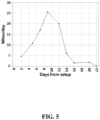
- Fig. 5 graphically illustrating mites release rate from the container as a function of the number of days since the setup of the experiment.
- mites are continuously released from the container for a period of 20 days, with a release peak occurring around day 9 (between days 8 and 10).
- the predatory mite release rate is between about 2 to 25 mites per day.
- This experiment shows successful breeding and selection for a P. persimilis population adapted for rearing on C . lactis as prey.
- the selected P. persimilis population is characterized by advantageous and desirable properties of significantly increased reproduction rate when reared on Astigmatid mite individuals.
- P. persimilis were reared using dead C . lactis as prey at 22 degrees Celsius and 85% relative humidity in a mixture with sawdust. Every week the mixture was weighed, and four samples containing about 50 mg each were taken, placed on a black adhesive tape and counted. Total population size was calculated according to these counts and 1500 individuals were left for rearing each week. The multiplication rate was calculated by dividing the total number of the individuals found, by 1500, giving the factor by which the population multiplied during this week.
- Fig. 6 demonstrating the observed differences in the daily reproduction rate (represented by ⁇ , the finite rate of increase) between the P. persimilis population bred and selected for adaptation for C . lactis as a factitious host prey (marked as P + in Fig. 6 ), as compared to the conventional or commercially available P. persimilis population (reared upon its natural host, i.e. spider mites) used as a control (marked as P - in Fig.6 ).
- the figure represents the means and the standard error found in the ⁇ values during the trial.
- the present invention provides for the first time a P. persimilis population characterized by increased reproduction rate trait when reared upon Astigmatid mites such as C.lactis individuals as a prey.
- This enables the highly desirable, revolutionary, indoor production of improved P. persimilis predatory mites exhibiting increased yield when reared upon Astigmata species, as compred to non-selected currently available P. persimilis mites, which demonstrate significantly reduced reproduction rate and yield when reared upon the same Astigmata species prey.
- This example shows the performance of a slow release system of the current invention (e.g. as described in Example 4 above) in greenhouse conditions.
- Sweet pepper plants were planted in the greenhouse, and exposed to three different treatments in 5 replicates:
- the sachet was located on the lower parts of 1 meter tall plants. Infestation was carried out by stapling an infested leaf with spider mites to one of the top leaves of the plant. The mite population on each plant was sampled 3 days after the plants were infested. The spider mites and P. persimilis mites found on the infested leaf or above it were counted.
- Fig. 7 graphically illustrating P. persimilis (Pp) and spider mite counts of plants exposed to the slow release system of the present invention as compared to control plants.
- Pp P. persimilis
- the predatory mites were found on plants exposed to both of the P. persimilis treatments.
- the amounts of spider mites in the P. persimilis treated plants were rapidly reduced compared to the control plants. More particularly, an inverse correlation was observed between the P. persimilis counts and the spider mites counts, namely, the more P. persimilis mites were found on the plants, the less spider mites were counted. This experiment clearly demonstrates that P.
- persimilis mites and more specifically, the composition of the present invention, are effective against spider mite infestation.
- the P. persimilis slow release system of the present invention reduced the spider mites population on the plant, despite the relatively long time (about 6 to 13 days) elapsing between the P. persimilis application and the spider mites arrival to the plant. This shows the effectiveness of the P. persimilis composition and slow release system as herein described in controlling spider mite infestations.
Landscapes
- Life Sciences & Earth Sciences (AREA)
- Zoology (AREA)
- Engineering & Computer Science (AREA)
- Chemical & Material Sciences (AREA)
- Polymers & Plastics (AREA)
- Environmental Sciences (AREA)
- Health & Medical Sciences (AREA)
- Animal Husbandry (AREA)
- General Health & Medical Sciences (AREA)
- Biotechnology (AREA)
- Food Science & Technology (AREA)
- Insects & Arthropods (AREA)
- Plant Pathology (AREA)
- Agronomy & Crop Science (AREA)
- Virology (AREA)
- Dentistry (AREA)
- Wood Science & Technology (AREA)
- Microbiology (AREA)
- Pest Control & Pesticides (AREA)
- Animal Behavior & Ethology (AREA)
- Biodiversity & Conservation Biology (AREA)
- Molecular Biology (AREA)
- Physiology (AREA)
- Biomedical Technology (AREA)
- Birds (AREA)
- Agricultural Chemicals And Associated Chemicals (AREA)
- Catching Or Destruction (AREA)
- Heterocyclic Carbon Compounds Containing A Hetero Ring Having Nitrogen And Oxygen As The Only Ring Hetero Atoms (AREA)
Description
- The present invention relates to the field of biological control agents for crop protection, and more particularly to novel compositions for rearing biological control agents against plant pests.
- The use of arthropods (insects and mites) as Biological Control Agents (BCA) is an expanding field with many advantages over chemical pest control. Arthropod BCA's are able to naturally control other arthropod species that act as pests on the crop. Phytoseiulus is a genus of mites in the Phytoseiidae family. This predatory mite is the most frequently used to control two-spotted spider mites in greenhouses and outdoor crops grown in mild environments. A Phytoseiulus mite can consume up to seven adult spider mites or several dozens of their eggs in a day. A well-fed female lays about 50 eggs in her lifetime. The genus Phytoseiulus contains four known species, namely: P. persimilis, P. longipes, P. macropilis and P. fragariae (Chant and McMurtry 2006). All species of the genus Phytoseiulus are considered
type 1 predators, i.e. highly specific to a diet consisting of spider mites, preferably of the genus Tetranychus (McMurtry and Croft 1997). The most frequently used species of this genus for biological control of spider mites is Phytoseiulus persimilis. Phytoseiulus persimilis (P. persimilis) adults are bright reddish-orange in color, with long legs and pear-shaped bodies (about 0.5mm long). - P. persimilis is considered as a specialist for spider mites (mites of the family Tetranychidae) which are phytophagous mites (Helle and Sabelis 1985, Gerson et al. 2003). Gerson et al. 2003 specifically indicate that "members of the genus Phytoseiulus live and place their eggs almost exclusively within the webbed colonies of Tetranychus spp". It is further noted in Gerson et al. 2003 that "the specificity of P. persimilis for spider mite prey can be a disadvantage if other predators are present on the same plants".
- It was found that P. persimilis might develop and possibly reproduce on another phytophagous (plant feeding) mite, Steneotarsonemus pallidus of the family Tarsonemidae (Simmonds, S.P., 1970)
- From a commercial point of view, a significant disadvantage of producing a predatory mite that exclusively feeds on phytophagous mites, such as spider mites, is that it requires rearing prey mites on plants, which has a high cost.
- Walzer and Schausberger, 1999, examined intra- and interspecific predation of adult females and immature stages of the more generalist Neoseiulus californicus and the specialist Phytoseiuluspersimilis. It was reported that adult females and immatures of both predators exhibited higher predation rates on larvae than on eggs and protonymphs. It was found that predation on P. persimilis by N. californicus was more severe than vice versa. P. persimilis was reported to have higher predation rates on conspecifics than heterospecifics and was more prone to cannibalism than N. californicus. In addition, it was reported that when provided with phytoseiid prey, P. persimilis suffered higher mortality than N. californicus.
- Walzer and Schausberger, 1999 further teach that females of P. persimilis were not able to sustain oviposition, irrespective of con- or heterospecific prey. Furthermore, mortality of P. persimilis immatures was less when feeding on conspecific vs. heterospecific larvae. These authors concluded that for P. persimilis, neither hetero-nor conspecific prey provides sufficient nourishment for sustained reproduction. This is supported by Yao and Chant (1989), reporting that P. persimilis did not produce eggs when either cannibalizing or preying upon immatures of Iphyseius degenerans. There were only two females in this study that laid a single egg when cannibalizing conspecific.
- In summary, it was found that P. persimilis was able to develop on juvenile predatory mites Neoseiulus californicus and Iphyseius degenerans of the family Phytoseiidae. However, it did not lay eggs when feeding on these prey mites. On the other hand, when the predatory mite N. californicus and I. degenerans fed on P. persimilis, they did lay eggs (Yao and Chant, 1989). This demonstrates the narrow dietary range of P. persimilis in contrast to other mites of the same family.
- P. persimilis might also develop in a cannibalistic manner, feeding on younger stages of its own. When feeding this way, there were rare cases of oviposition (Walzer and Schausberger, 1999; Yao and Chant, 1989). In all cases where the Phytoseiidae mites were used as prey, the latter was fed with spider mites, which are grown on plants and therefore involves high costs.
- P. persimilis was further found to develop on thrips (a phytophagous insect) larvae, but it did not lay eggs on this diet (Walzer 2004). This is in contrast to the predatory mite N. califonicus that was able to reproduce on this prey (Walzer 2004). It should be emphasized that in this study, a high rate of mortality was reported during juvenile development.
-
US patent 9,781,937 EP patent 2612551 , as well asUS patent application 20150128864A1 , disclose a mite composition comprising predatory mite species selected from Mesostigmatid mite species or Prostigmatid mite species and a food source for the predatory mite species comprising Astigmatid mite species. It is further disclosed in these publications that at least a fraction of the Astigmatid individuals is immobilized and that the immobilized Astigmatid individuals are contacted with a fungus reducing agent comprising a fungus reducing mite population selected from a mycophagous mite species or an antifungal exudates producing mite species. These publications mention the Phytoseiulus genus in a list of optional Phytoseiidae members as part of mite species belonging to Mesostigmata order. However, these publications do not show, disclose or even suggest rearing predatory mite species belonging to the Phytoseiulus genus, known as specialist for spider mites (e.g. McMurtry and Croft 1997), with Astigmatid mite species as a factitious host for the predatory mites. In addition, these publications teach that when immobilized Astigmatid individuals are used as a prey, they should necessarily be contacted with a fungus reducing agent selected from a mycophagous mite species or an antifungal exudates producing mite species. It is noted in these publications that both optional fungus reducing mite populations should be in a viable form to provide the fungus reducing activity, a factor which might negatively affect mass rearing efficiency. -
US patent 7,947,269 teaches a mite composition comprising a rearing population of a phytoseiid predatory mite species and a factitious host population comprising at least one species selected from the family of the Carpoglyphidae. -
US patent 8,097,248 discloses a mite composition comprising a rearing population of the phytoseiid predatory mite species Amblyseius swirskii, a factitious host population comprising at least one Astigmatid mite species selected from the group consisting of: i) Carpoglyphidae, ii) Pyroglyphidae, and iii) Glyciophagidae. -
US patent 8,733,283 discloses a method for rearing predatory mites by providing a food source for prey mites that comprises dextrose; rearing Thyreophagus entomophagus prey mites on said food source; providing predatory mites that feed on Thyreophagus entomophagus in a starting ratio of predatory mites to prey mites from 1:10 to 1:100, and rearing the predatory mites on said prey mites, to create a breeding population. -
US 8,733,283 andEP2048941 patents teach that Phytoseiulus persimilis can be only raised on spider mite diet. They report that P. persimilis is an obligate spider mite predator and cannot survive on alternate food sources such as pollen. It is emphasized in these publications that survival tends to be poor if prey is in short supply. -
EP2380436 , published asWO 2011/131791 A1 , discloses a mite composition comprising a rearing population of a phytoseiid predatory mite species and a population of at least one species from the order Astigmata characterized in that the population of the species from the order Astigmata is not alive. -
WO2007075081 discloses mite composition comprising a rearing population of a phytoseiid predatory mite species and a factitious host population characterised in that the factitious host population comprises at least one species selected from the family of the Glyciphagidae. When referring to the phytoseiid mite Phytoseiulus persimilis, it is indicated that spider mites (Tetranychus urticae) is the best prey. - None of the above patent documents discloses or teaches successfully rearing the important predatory mite Phytoseiulus persimilis on mites of the order Astigmata, in any form or developmental stage. On the contrary, all the above patent documents and scientific publications report that P. persimilis is an obligate spider mite predator and it cannot survive on alternate food sources. Therefore, an entomologist/acarologist would not consider P. persimilis as a typical generalist species of the Phytoseiidae family or the Amblyseiinae subfamily but rather a highly specific species.
- In view of the above, there is a long felt need for effective and efficient mass rearing of Phytoseiulus persimilis for biological control of crop pests.
- The present invention relates to the field of insect control and more specifically to a system and method for rearing biological control agents against plant pests.
- It is one object of the present invention to disclose a rearing composition according to
claim 1. - It is a further object of the present invention to disclose the rearing composition as defined in any of the above, wherein said predatory mite species is selected from the group consisting of Phytoseiulus fragariae, Phytoseiulus longipes, Phytoseiulus macropilis, Phytoseiulus persimilis and Phytoseiulus robertsi.
- It is a further object of the present invention to disclose the rearing composition as defined in any of the above, wherein the species from the order Astigmata comprises members from the family Carpoglyphidae, such as the genus Carpoglyphus, e.g. Carpoglyphus lactis, Carpoglyphus munroi; from the family Glycyphagidae such as the genus Glycyphagus, e.g. Glycyphagus domesticus, from the genus Lepidoglyphus, e.g. Lepidoglyphus destructor; from the family Pyroglyphidae such as the genus Dermatophagoides, e.g. Dermatophagoides farinae, Dermatophagoides pteronisinus, form the family Acaridae, such as the genus Tyrophagus, e.g. Tyrophagus putrescentiae.
- It is a further object of the present invention to disclose the rearing composition as defined in any of the above, wherein said Astigmata prey population comprises a mixture comprising non-viable frozen developmental stages of juvenile mites.
- It is a further object of the present invention to disclose the rearing composition as defined in any of the above, wherein said composition further comprises a carrier such as sawdust, bran or another carrier material.
- It is a further object of the present invention to disclose a method for controlling a crop pest, the method comprising applying a composition as defined in any of the above to a field crop.
- It is a further object of the present invention to disclose the use of the composition as defined in any of the above for controlling a crop pest.
- It is a further object of the present invention to disclose a biological control agent (BCA) for controlling crop pests comprising a mixture of (a) at least one predatory mite species of the genus Phytoseiulus raised by the composition according to any one of
claims 1 to 31, (b) optionally, prey mite individuals comprising at least one species from the order Astigmata, said Astigmata individuals are selected from the group consisting of non-viable mites, non-living eggs and a combination thereof; and (c) a carrier material. - It is a further object of the present invention to disclose a container containing the composition according to any one of the above, said container configured to be hung on a crop plant, said container comprises an exit hole from which said predatory mites are slowly and continuously released to said crop during a period of about three weeks.
- In order to understand the invention and to see how it may be implemented in practice, a plurality of embodiments is adapted to now be described, by way of non-limiting example only, with reference to the accompanying drawings; wherein:
-
Fig. 1 is a photographic illustration of different developmental stages of P. persimilis reared on dead or immobilized Carpoglyphus lactis (C. lactis) mites; -
Fig. 2 is a photographic illustration of P. persimilis reared on dead or immobilized Carpoglyphus lactis (C. lactis) mites, as an embodiment of the present invention; -
Fig. 3 is a graphic representation describing the daily multiplication rate of a P. persimilis population, feeding on a mixture of dead C. lactis eggs and dead mobile stages during a 14 weeks period; -
Fig. 4 is a graphic representation of the percentage of P. persimilis showing feeding signs, as appeared by their body's shape and color; -
Fig. 5 graphically illustrates mites release rate as a function of number of days from experimental setup; -
Fig. 6 graphically illustrates differences between daily reproduction rate of P. persimilis population sources (P+ and P-) reared upon C. lactis as a prey; the P+ population was bred and selected for improved adaptation for C. lactis as a prey; the P- population is the commercially available control P. persimilis population; and -
Fig. 7 graphically illustrates P. persimilis (Pp) and spider mite counts of plants exposed to the slow release system of the present invention, as compared to control plants. - The twospotted spider mite, Tetranychus urticae Koch, is the major spider mite pest of ornamental plants and vegetable crops grown in greenhouses. Furthermore, this ubiquitous spider mite is a serious pest of numerous ornamental plants in home landscapes and is of considerable importance as a pest of food and fiber crops throughout the world (van de Vrie et al,. 1972). The predacious phytoseiid mite Phytoseiulus persimilis is the major species used to control twospotted spider mites in greenhouse as well as open field crops.
- Phytoseiulus persimilis is a predatory mite which specializes on a diet of spider mites. Spider mites are vegetarian mites (phytophagous mites) and therefore require rearing on plants, which is undesirable since it involves complex operations and high rearing costs.
- The present invention provides for the first time alternative method for rearing P. persimilis and other mite species of the genus Phytoseiulus. The current invention shows, against the conventional thinking, that mite species of the genus Phytoseiulus, e.g. P. persimilis, could broaden its dietary range, and could be reared on other preys, which are cheaper to produce and therefore much more desirable. The alternative prey mites are mostly Astigmatic mites that feed on stored products and are therefore significantly cheaper to produce.
- According to one embodiment, the present invention provides a system and method for using mites (especially dead mites) of the species Carpoglyphus lactis (Cl) or other Astigmatic mite as an alternative food for mite species of the Phytoseiulus genus, such as Phytoseiulus persimilis.
- It is shown by the present invention that mite species of the genus Phytoseiulus, especially Phytoseiulus persimilis, can complete its life cycle and reproduce when feeding on dead mites belonging to the order Astigmata (within the Arachnida class).
- The present invention is aimed at developing a system for the production of mite species of the genus Phytoseiulus, e.g. Phytoseiulus persimilis, on a diet comprising Astigmatic mites. The system is based on the following components:
- 1. The predator - specifically Phytoseiulus persimilis and more generally mites of the genus Phytoseiulus.
- 2. The prey - a mite species, possibly Carpoglyphus lactis, Glyciphagus domesticus, Lepidoglyphus destructor, Dermatophagoides farinae, Dermatophagoides pteronisinus or other Astigmatic mite, or other mite species such as Amblyseius swirskii.
- 3. The rearing system - the specific setup in which the mites are reared, comprising the rearing media, the way the prey mite is presented to the predator, the prey developmental stage and other factors.
- The following rearing methods are within the scope of the present invention:
- 1. The predator is reared on a living mixture of prey mites.
- 2. The predator receives a mixture of immobilized prey mites by means of freezing or by other means such as irradiation.
- 3. A certain developmental stage of the prey mite is extracted from the prey mite's population, and then served alive or dead as food to the predator.
- It is noted that in all of the above optional rearing methods, the prey mite could be either the above mentioned Astigmatic mites, or other species.
- With respect to the final biological control product, the following is within the scope of the present invention:
- 1. A mixture which contains both the predator and the prey mites, or the predator and specific stages of the prey mites used for feeding the predator.
- 2. A further option is extracting only the predators, so that the final product contains only the predators.
- According to one embodiment, the present invention provides a rearing composition comprising: a predatory mite population comprising at least one mite species of the genus Phytoseiulus, and a prey mite population comprising individuals of at least one mite species from the order Astigmata, wherein said predatory mite population is capable of oviposition for at least 2 generations, further wherein said Astigmata prey is selected from the group consisting of non-viable mites, non-viable eggs and a combination thereof.
- It is within the scope of the present invention that the predatory mite is capable of oviposition for at least 10 generations and preferably more, having the Astigmata individuals as a prey.
- It is further within the scope that the predatory mite population exhibits an increased reproduction rate trait as compared to a control predatory mite population, of the same species, lacking the aforementioned trait.
- It is further within the scope that the predatory mite population of the present invention exhibits a daily reproduction rate in the range of about 1.15 -1.2.
- It is further within the scope of the present invention that the predatory mite population is characterized by a beige-white color, when said Phytoseiulus predatory mite is reared upon said Astigmata prey as a food source.
- It is within the scope of the present invention that the predators would have a different appearance than that of the common product containing P. persimilis mites reared on spider mites (white mites in the case of the present invention instead of the usual orange).
- According to a further embodiment, the present invention shows for the first time that a population of P. persimilis successfully developed and reproduced on dead Carpoglyphus lactis for at least six months (about 25 generations).
- It is emphasized that P. persimilis is herein surprisingly reported to complete its life cycle and reproduce on either non-phytophagous prey (prey that doesn't require to feed on living plants), or prey that doesn't consume phytophagous mites.
- The present invention provides a mite composition which contains a Phytoseiulus persimilis rearing mite population, and a factitious host mite population comprising at least one species from the order Astigmata or from the family Phytoseiidae. Up until now, mite species of the genus Phytoseiulus, such as the important predator mite Phytoseiulus persimilis, were reared on their natural phytophagous mite diet which involves high costs and resources (such as providing appropriate plants in sufficient abundance, under greenhouse conditions).
- The present invention solves the serious problem of rearing the main spider-mite controlling predator, Phytoseiulus persimilis, by rearing it in a cost effective and efficient way on a non-phytophagous alternative diet.
- Accordingly, the invention provides a mite composition comprising: a rearing population of mite species of the genus Phytoseiulus, for example Phytoseiulus persimilis predatory mite species, a population of at least one species from the order Astigmata or from the family Phytoseiidae, and optionally a carrier.
- According to one embodiment, the present invention provides a rearing composition comprising: predatory mite population comprising at least one mite species of the genus Phytoseiulus, and a prey mite population comprising at least one species from the order Astigmata.
- According to a further embodiment, the present invention provides a method for rearing predatory mite population comprising at least one mite species of the genus Phytoseiulus, the method comprising: (a) providing a composition comprising a predatory mite population comprising at least one mite species of the genus Phytoseiulus, and a prey mite population comprising at least one species from the order Astigmata; and (b) allowing individuals of the predatory mite population to prey on individuals of the Astigmatid population.
- According to a further embodiment, the present invention provides a rearing composition comprising: predatory mite population comprising at least one mite species of the genus Phytoseiulus, and a prey mite population comprising at least one species from the Phytoseiidae family.
- According to a further embodiment, the present invention provides a method for rearing predatory mite population comprising at least one mite species of the genus Phytoseiulus, the method comprising: (a) providing a composition comprising: predatory mite population comprising at least one mite species of the genus Phytoseiulus, and a prey mite population comprising at least one species from the Phytoseiidae family; and (b) allowing individuals of the predatory mite population to prey on individuals of the Phytoseiidae family population.
- In some embodiments, the prey population i.e. species from the order Astigmata or species from the Phytoseiidae family, is immobilized and/or not alive.
- It is further within the scope that the Phytoseiulus persimilis predatory mite is capable of reproducing for at least 2 generations, preferably at least 10 generations, more preferably for at least 15 generations or more generations, feeding on the aforementioned Astigmata population.
- The composition of the present invention provides a considerable number of advantages over previous combinations. In one aspect, the food material used to feed the prey during predator production will no longer be plants or phytophagous mites, but mites that live upon stored products, therefore providing a substantial cost saving.
- In another aspect, the present invention provides a rearing composition comprising: predatory mite population comprising at least one mite species of the genus Phytoseiulus, and a prey mite population comprising at least one species from the Phytoseiidae family.
- According to some further embodiments of the present invention, the predatory mite species is selected from the group consisting of Phytoseiulus fragariae, Phytoseiulus longipes, Phytoseiulus macropilis, Phytoseiulus persimilis and Phytoseiulus robertsi.
- According to further embodiments of the present invention, the predatory mite species is Phytoseiulus persimilis.
- According to yet further embodiments of the present invention, the prey mite species is of the genus Amblyseius, e.g. Amblyseius swirskii.
- According to further embodiments of the present invention, the rearing composition comprises immobilized prey mites.
- According to further aspects of the present invention, the prey mites are immobilized or dead mites.
- According to further aspects, the present invention provides a method for controlling a crop pest, the method comprising applying a composition as defined in any of the above to a field crop.
- According to further aspects, the present invention provides use of the composition as defined in any of the above for controlling a crop pest.
- According to further aspects, the present invention provides a biological control product for controlling crop pests comprising a mixture of (a) Phytoseiulus persimilis predatory mite individuals raised by the composition as defined in any of the above, (b) prey mite individuals comprising at least one species from the order Astigmata, and (c) optionally a carrier material.
- According to further aspects, the present invention provides a biological control product for controlling crop pests comprising a mixture of (a) Phytoseiulus persimilis predatory mite individuals raised by the composition according to any one of claims 26 to 31, and (b) prey mite individuals comprising at least one species from the Phytoseiidae family, and (c) optionally a carrier material.
- The present invention further provides a slow release system (e.g. sachet) for mites, especially for mite species of the genus Phytoseiulus, particularly Phytoseiulus persimilis (P. persimilis) configured to be applied on a crop.
- A core aspect of the innovative solution is that the predatory mites can reproduce within the system for several generations, while a certain proportion of the predatory mites continuously leaves the system and reaches the crop to control pests. This provides a continuous supply of mites to the crop without the need to apply them repeatedly by the farmer.
- Embodiments of the slow release system provided by the present invention are based upon the following features:
- 1. Predatory mite individuals - P. persimilis or other mite species of the Phytoseiulus genus.
- 2. Food source for the predatory mites - a factitious prey or host for example, frozen eggs of Carpoglyphus lactis (C. lactis) or another astigmatic mite.
- 3. The predatory mites are combined with their factitious host at the same physical location. This is done by the following alternative approaches:
- a. Providing the predatory mites with their factitious host in a container such as a sachet, packet, pouch, pocket, sack or a bag configured to be hung on the crop plant, from which the mites would slowly and continuously be released to the crop during a period of about three weeks.
- b. Applying a mixture containing the predatory mites, a carrier and the factitious host as a food source, directly on the crop leaves. From this mixture, the predatory mites would slowly be released to the crop during a period of about three weeks.
- It is noted that such slow release systems for predatory mites are highly desirable for P. persimilis since up until now, P. persimilis was known as a specialist (natural enemy) of spider mites and therefore reared upon spider mites diet. However, spider mites are not suitable to be used in this kind of mite release systems for crop protection for the following reasons:
- Spider mites are pests themselves, and if applied alive, they may damage the crop.
- Spider mites cannot reproduce without being supplied with plant material, therefore can't reproduce in a sachet.
- Without being supplied with a food source, living spider mites die rapidly and shrivel (e.g. within few days).
- If served dead, spider mites quickly shrivel and loose their nutritional value.
- Spider mites are expensive to produce.
- The present invention provides an unexpected technological solution for the above problem, which was not shown to be successful up until now. The solution is based upon using frozen eggs of C. lactis or other astigmatid mite species as a factitious host for P. persimilis. Contrary to spider mites, frozen eggs of C. lactis maintain their nutritional value for about three weeks. This innovative solution enables the prolonged release of P. persimilis predatory mites from a container or a mixture combining the predatory mite with its factitious host, applied directly on the crop plant for controlling pests.
- As used herein the term "about" denotes ± 10% of the defined amount or measure or value.
- The term "controlled release" refers hereinafter to slow release, sustained-release, rapid release, designed to release in a prolonged controlled mode or fashion. In the context of the present invention, it refers to predatory mite release to the crop plant gradually over a specified period of time, e.g. throughout the day or over a week.
- The term "slow release system" or a "container" refers herein after to a sachet- type release system, e.g. a sachet, packet, pouch, pocket, sack, a bottle or a bag which contains the composition or formulation of the present invention of Phytoseiulus predatory mites, a factitious host (dead astigmatid mites) and optionally a carrier. It is further included within the scope of the present invention that such a system or container refers to an apparatus, a unit, a device, a compartment, a member, strip or housing for slow release of beneficial insects or predatory mites available or known in the art.
- It is also within the scope of the present invention that the Phytoseiulus predatory mite releasing system may be of any suitable type. In general the mite releasing system may comprise a container suitable for holding the individuals of the Phytoseiulus predatory mite (e.g. P. persimilis) and individuals of the factitious host mite (e.g. dead C. lactis eggs). The container comprises an opening and/or means for generating an exit opening for mobile stages of the Phytoseiulus predatory mite. Releasing systems of this type are known to the skilled person and various products are commercially available on the market, e.g. sachet-type releasing systems and other suitable types of releasing systems which are included within the scope of the present invention.
- The term "rearing composition" as used herein generally refers to a composition suitable for breeding, bringing up, raising, upbringing or propagating a mite species. More specifically, it refers to a composition suitable for the commercial rearing of mites. It is herein acknowledged that mass rearing systems for predatory mites heavily depend on the availability of suitable prey for the predators. Therefore, there is a continuing need to improve rearing systems of both predatory mites and mites suitable as rearing prey. To solve this problem, the present invention provides a composition or system specifically adapted for effectively and efficiently rearing mite species of the genus Phytoseiulus, especially Phytoseiulus persimilis, a highly important predatory mite used for crop pest (spider mites) biological control. For the first time, Phytoseiulus persimilis is shown to complete its life cycle and reproduce, i.e. for at least 2 generations, by being reared on Astigmatid mite species or on Phytoseiidae prey mite species, e.g. Amblyseius swirskii.
- The term "carrier" refers hereinafter to an inactive or inert substance or particles or vehicle. In a preferred embodiment the rearing composition of the present invention comprises a carrier for the individuals of the mite species. The carrier can be any solid material which is suitable to provide a carrier surface to the mite individuals. Examples of suitable carriers are plant materials such as bran (e.g. wheat), sawdust (e.g. fine sawdust), corn cob grits, vermiculite, etc.
- The term "Phytoseiulus" as used hereinafter refers to a genus of mites in the Phytoseiidae family. This genus of predatory mites is most frequently used to control two-spotted spider mites in greenhouses and outdoor crops. It is within the scope of the present invention that the genus Phytoseiulus contains the following species: Phytoseiulus fragariae, Phytoseiulus longipes, Phytoseiulus macropilis, Phytoseiulus persimilis and Phytoseiulus robertsi. The Phytoseiulus predetoy mites are known as specialists for spider mites (mites of the family Tetranychidae) which are phytophagous mites.
- The term "Phytoseiulus persimilis" or "P. persimilis" as used hereinafter refers to a predatory mite population comprising the Phytoseiulus persimilis (P. persimilis). Phytoseiulus is a genus of mites in the Phytoseiidae family. This predatory mite is the mite predator most frequently used to control two-spotted spider mites in greenhouses and outdoor crops grown in mild environments.
- P. persimilis is generally used for spider mite control and management. They are voracious predators of most of the spider mite pests (Tetranychus spp). Some of the species they impact include: the two-spotted mite Tetranychus urticae, the carmine red mite T. cinnabarinus, and the Pacific mite T. pacificus. Unlike Neoseiulus californicus (Order: Mesostigmata, Family: Phytoseiidae, Subfamily: Amblyseiinae) which may not eat for relatively long periods, Phytoseiulus persimilis must have fresh feed. Furthermore, Phytoseiulus persimilis are not flexible by their diet as other available predatory mite species for spider mite control, since they are known to only feed upon specific Tetranychus species, but not all of them.
- The present invention solves these problems by providing for the first time a composition for mass rearing P. persimilis which contains mite species of the order Astigmata. The rearing system of the present invention is much more cost effective than rearing P. persimilis on its conventional diet which consists of phytophagous mites.
- The term "factitious host" generally refers hereinafter to an unnatural host or host other than the target host for the predatory mite, one that biocontrol practitioners may more readily rear than the target host in a laboratory. In the context of the present invention, factitious host or prey refers to organisms unlikely to be attacked by a natural enemy or predatory mite in its natural habitat, but that is artificially used to support its development and/or reproduction. Usually it is a species that is easier and less expensive to rear. Examples within the scope of the present invention include storage mites (such as astigmatid mites) for predatory mites (such as Phytoseiulus mite species), mite eggs for predatory insects and mites. According to further aspects, the term factitious host is used when a biological control agent is forced to feed on an insect or mite that it would not feed on it in nature. This can allow higher production levels. The present invention shows for the first time that species of commercially available Phytoseiulus mites can be mass reared using astigmatid mites (Acari: Astigmata) as factitious prey.
- The term "juvenile mite" or "juvenile mites" refers hereinafter to mite developmental life stages or mite developmental phases or instar including egg, larva, protonymph and deutonymph (third instar) individuals.
- The term "individual" or "individuals" or "mite individuals" refers in the context of the present invention to mite developmental stages including, but not limited to eggs, juvenile mite stages such as larva, protonymph and deutonymph (third instar) individuals.
- The term "mobile stages" refers hereinafter to mite developmental stages including larva, protonymph, deutonymph (third instar) and adult stages.
- The term "non-viable" used hereinafter generally means not capable of living, growing, developing, or functioning. According to main aspects of the present invention it refers to dead or not alive or non-living or immobilized mites (i.e. any mite developmental stage or phase) or mite eggs. In a specific embodiment of the present invention, non-viable Astigmata mites and/or eggs are used as a prey for predatory mites of the Phytoseiulus genus.
- According to some embodiments of the present invention the non viable mites or eggs are produced by or exposed to a treatment including, but not limited to, thermal treatment, such as freezing, freeze-drying, heating, cold-shock or heat-shock treatment; chemical treatment, such as gas or fume treatment; radiation treatment, such as UV, microwave, gamma irradiation or X-ray treatment; mechanical treatment, such as vigorous shaking, or stirring, subjecting to shear forces, collision; gas pressure treatment, such as ultrasound treatment, pressure changes, pressure drops; electrical treatment, such as electrocution; immobilizing with an adhesive; immobilization by starvation, such as induced by water or food deprivation; immobilization by suffocation or anoxia treatment, such as by temporarily eliminating oxygen from the atmosphere or replacing oxygen by another gas and any combination thereof.
- According to a specific embodiment, the composition of the present invention comprises dead frozen C. lactis eggs used as a prey for predatory mites of the Phytoseiulus genus. The term "Astigmatid" or "Astigmata" or "Astigmatic mites" or "Astigmatina" as used herein refers to mites order within the Subclass: Acari. The Astigmatina are a "cohort" of mites. Astigmatina belongs to the Sarcoptiformes, which contains the "biting" Acariformes. The Astigmata order contains superfamilies with over thousands of genera. Non limiting examples of such superfamilies and families, within the scope of the present invention may include:
-
- Schizoglyphoidea: examples of families include: Schizoglyphidae
- Histiostomatoidea: examples of families include: Histiostomatidae, Guanolichidae
- Canestrinioidea: examples of families include: Chetochelacaridae, Lophonotacaridae, Canestriniidae, Heterocoptidae
- Hemisarcoptoidea: examples of families include: Chaetodactylidae, Hyadesiidae, Carpoglyphidae, Algophagidae, Hemisarcoptidae, Winterschmidtiidae
- Glycyphagoidea: examples of families include: Euglycyphagidae, Chortoglyphidae, Pedetropodidae, Echimyopodidae, Aeroglyphidae, Rosensteiniidae, Glycyphagidae
- Acaroidea: examples of families include: Sapracaridae, Suidasiidae, Lardoglyphidae, Glycacaridae, Gaudiellidae
- Acaridae: examples of families include: Hypoderoidea, Hypoderidae
-
- Pterolichoidea: examples of families include: Oconnoriidae, Ptiloxenidae
- Pterolichidae: examples of families include: Cheylabididae, Ochrolichidae, Gabuciniidae, Falculiferidae, Eustathiidae, Crypturoptidae, Thoracosathesidae, Rectijanuidae, Ascouracaridae, Syringobiidae, Kiwilichidae, Kramerellidae
- Freyanoidea: examples of families include: Freyanidae, Vexillariidae, Caudiferidae
- Analgoidea: examples of families include: Heteropsoridae, Analgidae, Xolalgidae, Avenzoariidae, Pteronyssidae, Proctophyllodidae, Psoroptoididae, Trouessartiidae, Alloptidae, Thysanocercidae, Dermationidae, Epidermoptidae, Apionacaridae, Dermoglyphidae, Laminosioptidae, Knemidokoptidae, Cytoditidae
- Pyroglyphoidea: examples of families include: Pyroglyphidae, Turbinoptidae
- Psoroptoidea: examples of families include: Psoroptidae, Galagalgidae, Lobalgidae, Myocoptidae, Rhyncoptidae, Audycoptidae, Listrophoridae, Chirodiscidae, Atopomelidae, Chirorhynchobiidae, Gastronyssidae, Lemumyssidae, Pneumocoptidae, Sarcoptidae
- A preferable Astigmatid mite species used by the biological control system of the present invention as a factitious host population for the Phytoseiulus predatory mite, e.g. P. persimilis, is a mite species of the Carpoglyphidae family, more preferably Carpoglyphus lactis (C. lactis).
- Carpoglyphidae is a mite family in the order Astigmatina, containing four genera: Carpoglyphus, Coproglyphus, Dichotomiopus and Pullea.
- Carpoglyphus lactis (Acarus lactis), preferably used by the present invention as a diet for rearing P. persimilis, belongs to the Carpoglyphus genera. Carpoglyphus lactis is acknowledged herein as a stored product mite, infesting saccharide-rich stored commodities including dried fruits, wine, beer, milk products, jams and honey. Since C. lactis is capable of feeding on stored products, it is highly desirable and cost effective to raise P. persimilis on this mite species, as shown for the first time by the present invention.
- In a further embodiment of the present invention, the Phytoseiulus predatory mite, e.g. P. persimilis, can complete its life cycle and reproduce when feeding on dead mites of the species Carpoglyphus lactis and/or Dermatophagoides farinae both belonging to the Astigmata order.
- The term "trait" refers hereinafter to characteristic or phenotype. A phenotypic trait may refer to the appearance or other detectable characteristic of an individual, resulting from the interaction of its genome, proteome and/or metabolome with the environment. For example, in the context of the present invention an increased reproduction rate as described herein is a phonotypical trait characterizing the predatory mites of the composition of the present invention. According tp a further embodiment of the present invention, a trait may also arise from interaction between the mite and its associated microorganisms. A trait may be inherited in a dominant or recessive manner, or in a partial or incomplete-dominant manner. A trait may be monogenic (i.e. determined by a single locus) or polygenic (i.e. determined by more than one locus) or may also result from the interaction of one or more genes with the environment. A dominant trait results in a complete phenotypic manifestation at heterozygous or homozygous state; conventionally, a recessive trait manifests itself only when present at homozygous state.
- The term "genetic linkage" is understood within the scope of the invention to refer to an association of characters in inheritance due to location of genes in proximity on the same chromosome, measured by percent recombination between loci (centi-Morgan, cM).
- As used herein, the term "population" means a genetically heterogeneous collection of mites sharing a common genetic derivation.
- As used herein, the phrase "genetic marker" or "molecular marker" or "biomarker" refers to a feature in an individual's genome e.g., a nucleotide or a polynucleotide sequence that is associated with one or more loci or trait of interest In some embodiments, a genetic marker is polymorphic in a population of interest, or the locus occupied by the polymorphism, depending on context. Genetic markers or molecular markers include, for example, single nucleotide polymorphisms (SNPs), indels (i.e. insertions deletions), simple sequence repeats (SSRs), restriction fragment length polymorphisms (RFLPs), random amplified polymorphic DNAs (RAFDs), cleaved amplified polymorphic sequence (CAPS) markers, Diversity Arrays Technology (DArT) markers, and amplified fragment length polymorphisms (AFLPs) or combinations thereof, among many other examples such as the DNA sequence per se. Genetic markers can, for example, be used to locate genetic loci containing alleles on a chromosome that contribute to variability of phenotypic traits. The phrase "genetic marker" or "molecular marker" or "biomarker" can also refer to a polynucleotide sequence complementary or corresponding to a genomic sequence, such as a sequence of a nucleic acid used as a probe or primer.
- A genetic marker can be physically located in a position on a chromosome that is within or outside of the genetic locus with which it is associated (i.e., is intragenic or extragenic, respectively).
- As used herein, the term "germplasm" refers to the totality of the genotypes of a population or other group of individuals (e.g., a species).
- The terms "hybrid" and "hybrid progeny" used herein refers to an individual produced from genetically different parents (e.g., a genetically heterozygous or mostly heterozygous individual).
- The term "allele(s)" used herein means any of one or more alternative or variant forms of a gene or a genetic unit at a particular locus, all of which alleles relate to one trait or characteristic at a specific locus. In a diploid cell of an organism, alleles of a given gene are located at a specific location, or locus (loci in plural) on a chromosome. One allele is present on each chromosome of the pair of homologous chromosomes. A diploid plant species may comprise a large number of different alleles at a particular locus. Such alternative or variant forms of alleles may be the result of single nucleotide polymorphisms, insertions, indels, inversions, translocations or deletions, or the consequence of gene regulation caused by, for example, by chemical or structural modification, transcription regulation or post-translational modification/regulation. An allele associated with a qualitative trait may comprise alternative or variant forms of various genetic units including those that are identical or associated with a single gene or multiple genes or their products or even a gene disrupting or controlled by a genetic factor contributing to the phenotype represented by the locus. As used herein, the term "locus" (loci in plural) means a specific place or places or region or a site on a chromosome where for example a gene or genetic marker element or factor is found. In specific embodiments, such a genetic element is contributing to a trait.
- As used herein, the term "breeding" and grammatical variants thereof, refer to any process that generates a progeny individual. Breeding can be sexual or asexual, or any combination thereof. Exemplary non-limiting types of breeding include crossing, introgressing, selfing, backcrossing, doubled haploid derivative generation, and combinations thereof.
- The term "genetic determinant" as used herein refers to genetic determinants such as genes, alleles, QTLs or traits.
- Introgression of a genetic determinant means the incorporation of genes, alleles, QTLs or traits into a line wherein essentially all of the desired morphological and physiological characteristics of the line are recovered, in addition to the genetically introgressed determinant. Such a process is often used in cultivar development, in which one or a few genetic determinants are transferred to a desired genetic background, preferably by using backcrossing.
- The term "genotype" refers to the genetic constitution of a cell or organism. An individual's genotype includes the specific alleles, for one or more genetic marker loci, present in the individual's haplotype. As is known in the art, a genotype can relate to a single locus or to multiple loci, whether the loci are related or unrelated and/or are linked or unlinked. In some embodiments, an individual's genotype relates to one or more genes that are related in that the one or more of the genes are involved in the expression of a phenotype of interest. Thus, in some embodiments a genotype comprises a summary of one or more alleles present within an individual at one or more genetic loci. In some embodiments, a genotype is expressed in terms of a haplotype.
- According to a further embodiment of the present invention, the Phytoseiulus predatory mite, e.g. P. persimilis, can complete its life cycle and reproduce (i.e. including development and oviposition) for at least 3 generations, when feeding on living juvenile mites of the species Amblyseius swirskii that belongs to the Phytoseiidae family.
- It is further within the scope of the present invention to disclose a population of Phytoseiulus predatory mites, e.g. the mite species P. persimilis, reared by feeding on dead or immobilized mite species selected from the group comprising Carpoglyphus lactis, Dermatophagoides farinae, Lepidogyphus destructor, Glyciphagus domesticus, Dermatophagoidespteronisinus, Amblyseius swirskii, and any combination thereof.
- According to a further embodiment, the predatory mite fed on the above prey mites, developed and reproduced for at least two generations.
- According to a further embodiment of the present invention, P. persimilis or other Phytoseiulus predatory mite, can develop on dead individuals of the following species belonging to the Astigmata order: Carpoglyphus lactis, Lepidoglyphus destructor, Glycifagus domesticus and Dermatophagoides pteronisinus.
- It is further within the scope that the mites used as prey are immobilized by immobilization treatment selected from the group consisting of: thermal treatment, such as freezing, heating, cold-shock or heat-shock treatment; chemical treatment, such as gas or fume treatment; radiation treatment, such as Gamma irradiation, UV, microwave or X-ray treatment; mechanical treatment, such as vigorous shaking, or stirring, subjecting to shear forces, collision; gas pressure treatment, such as ultrasound treatment, pressure changes, pressure drops; electrical treatment, such as electrocution; immobilizing with an adhesive; immobilization by starvation, such as induced by water or food deprivation; immobilization by suffocation or anoxia treatment, such as by temporarily eliminating oxygen from the atmosphere or replacing oxygen by another gas.
- The skilled person will understand how these treatments may result in the immobilization of the Astigmatid individuals or other mites of the Phytoseiidae family and that the immobilization treatment should be such that the mite individuals remain a suitable prey (food source) for the predatory mite individuals.
- It is further within the scope that the term "immobilized mites" may also mean dead or non-living mites.
- Reference is now made to
Fig. 1 photographically presenting different developmental stages of P. persimilis reared on dead or immobilized C. lactis. The figure presents an adult female (Fig. 1A ) and a juvenile that had just hatched from the egg (Fig. 1B ). As can be seen in this figure, all stages are characterized by a pale whitish color, typical to this diet, in contrast to the normal orange color obtained when feeding P. persimilis by spider mites, their conventional diet. In other words, the predators of the present invention, fed on C. lactis, turn to beige-white instead of the typical orange color. In addition, the dorsal shield of the predator is darker than the cuticle around it. This figure demonstrates that P. persimilis can develop and reproduce on dead or immobilized C. lactis mites. As explained above, C. lactis (Acari: Astigmata) are significantly more cost effective to produce than the conventional P. persimilis diet, which is the phytophagous spider mite. - Reference is now made to
Fig. 2 photographically presenting P. persimilis reared on dead or immobilized C. lactis. As can be seen, the predator has a unique appearance, where it turns to beige-white instead of the typical orange (when fed on conventional spider mite diet) and the dorsal shield of the predator is darker than the cuticle around it. - It is herein acknowledged that twospotted spider mites feed on many species of plants and are a major pest of vegetables, ornamentals, fruit trees, hops, cotton, and strawberries (van de Vrie et al., 1972). At present, it can be assumed that most of the major spider mite problems in greenhouses will involve twospotted spider mite. The larva, protonymph, deutonymph, and adult feed mainly on the undersides of the leaves.
- It is within the scope of the present invention to provide a composition for controlling mite pests, particularly members of the Acari class, family Tetranychidae such as twospotted spider mite, more particularly spider mite species, especially the genera Tetranychus, Panonychus and various other mite species.
- According to some embodiments of the present invention, the crop is selected from the group consisting of greenhouse grown crops and open field crops. Non limiting examples of crop types within the scope of the present invention include vegetables, ornamentals, fruit trees, hops, cotton and strawberries.
- Specific examples of mite pests- host plant species within the scope of the present invention include the following:
- Acanthaceae: Acanthus mollis; Justicia adhatoda.
- Actinidiaceae: Actinidia chinensis; Actinidia deliciosa; Actinidia sp.
- Adoxaceae: Sambucus canadensis; Sambucus chinensis; Sambucus edulus; Sambucus nigra; Sambucus sieboldiana; Sambucus sp.; Viburnum lantana; Viburnum opulus; Viburnum rhytidophyllum; Viburnum sp.; Viburnum tinus.
- Aizoaceae: Mesembryanthemum crystallinum.
- Alstroemeriaceae: Alstroemeria sp.
- Amaranthaceae: Alternanthera sp.; Amaranthus blitum; Amaranthus caudatus; Amaranthus graecizans; Amaranthus hybridus; Amaranthus mangostanus; Amaranthus palmeri; Amaranthus retroflexus; Amaranthus sp.; Amaranthus spinosus; Amaranthus viridis; Atriplex canescens; Atriplex lentiformis; Atriplex semibaccata; Beta vulgaris; Celosia argentea; Chenopodium album; Chenopodium murale; Chenopodium sp.; Dysphania ambrosioides; Haloxylon ammodendron; Iresine herbstii; Salsola vermiculata; Spinacia oleracea.
- Amaryllidaceae: Allium ampeloprasum; Allium cepa; Allium fistulosum; Allium sativum; Allium sp.; Narcissus sp..
- Anacardiaceae: Mangifera indica; Pistacia terebinthus; Pistacia vera.
- Annonaceae: Annona muricata; Annona reticulata; Annona squamosa.
- Apiaceae: Aegopodium podagraria; Ammi majus; Apium graveolens; Apium nodiflorum; Arracacia xanthorrhiza; Athamanta macedonica; Bupleurum lancifolium; Coriandrum sativum; Cryptotaenia canadensis; Daucus carota; Eryngium sp.; Foeniculum vulgare; Pastinaca sativa; Petroselinum crispum; Peucedanum japonicum; Phellolophium madagascariense; Spananthe sp.
- Apocynaceae: Ampelamus laevis; Apocynum cannabinum; Asclepias sp.; Catharanthus roseus; Mandevilla sp.; Matelea carolinensis; Nerium oleander; Plumeria sp.; Raphionacme sp.; Rauvolfia serpentina; Vinca major; Vinca sp..
- Aquifoliaceae: Ilex crenata.
- Araceae: Alocasia macrorrhizos; Alocasia sp.; Anthurium sp.; Arum italicum; Arum sp.; Caladium bicolor; Caladium sp.; Calla sp.; Colocasia esculenta; Colocasia sp.; Dieffenbachia sp.; Epipremnum pinnatum; Philodendron sp.; Symplocarpus foetidus; Xanthosoma sp.; Zantedeschia aethiopica.
- Araliaceae: Aralia sp.; Hedera canariensis; Hedera helix; Hedera sp.; Hydrocotyle umbellata; Polyscias balfouriana; Schefflera actinophylla; Schefflera elegantissima; Schefflera sp.; Tetrapanax papyrifer.
- Araucariaceae: Agathis sp.; Araucaria sp.
- Arecaceae: Dypsis sp.; Phoenix dactylifera; Phoenix sp.; Veitchia sp..
- Aristolochiaceae: Aristolochia clematitis.
- Asparagaceae: Asparagus laricinus; Asparagus officinalis; Asparagus setaceus; Asparagus sp.; Aspidistra elatior; Cordyline fruticosa; Cordyline sp.; Dracaena braunii; Dracaena fragrans; Dracaena goldieana; Dracaena sp.; Hyacinthus orientalis; Lachenalia ensifolia; Maianthemum racemosum; Ornithogalum sp.; Polygonatum odoratum; Ruscus aculeatus; Yucca sp.
- Balsaminaceae: Impatiens balsamina; Impatiens sp.; Impatiens walleriana.
- Berberidaceae: Berberis cretica; Berberis thunbergii; Berberis vulgaris; Berberis wilsoniae; Nandina domestica.
- Betulaceae: Alnus incana; Betula maximowicziana; Betula papyrifera; Betula pendula; Carpinus sp.; Corylus avellana.
- Bignoniaceae: Campsis radicans; Pyrostegia venusta; Tecoma capensis; Tecoma stans.
- Boraginaceae: Borago officinalis; Cynoglossum columnae; Heliotropium arborescens; Heliotropium eichwaldii; Heliotropium europaeum; Nama hispidum; Omphalodes verna.
- Brassicaceae: Aethionema saxatile; Brassica juncea; Brassica napus; Brassica oleracea; Brassica rapa; Brassica sp.; Capsella bursa-pastoris; Diplotaxis erucoides; Diplotaxis viminea; Eruca vesicaria; Erysimum graecum; Erysimum sp.; Erysimum x cheiri; Hirschfeldia incana; Lepidium didymum; Malcolmia sp.; Matthiola fruticulosa; Matthiola incana; Matthiola odoratissima; Nasturtium sp.; Raphanus raphanistrum; Raphanus sp.; Rapistrum rugosum; Rorippa indica; Sinapis arvensis; Zilla spinosa .
- Bromeliaceae: Tillandsia sp.
- Buxaceae: Buxus sempervirens.
- Calophyllaceae: Mammea Americana.
- Campanulaceae: Campanula erinus; Lobelia sp.; Platycodon grandiflorus.
- Cannabaceae: Cannabis sativa; Celtis australis; Celtis occidentalis; Humulus lupulus; Humulus scandens; Trema micrantha.
- Cannaceae: Canna indica.
- Capparaceae: Capparis nummularia.
- Caprifoliaceae: Cephalaria gigantea; Diervilla sp.; Leycesteria formosa; Lonicera etrusca; Lonicera nigra; Lonicera periclymenum; Lonicera sp.; Lonicera tatarica; Lonicera xylosteum; Pterocephalus plumosus; Scabiosa sicula; Symphoria racemosa; Symphoricarpos albus; Symphoricarpos orbiculatus; Weigela hortensis.
- Caricaceae: Carica papaya.
- Caryophyllaceae: Dianthus armeria; Dianthus barbatus; Dianthus caryophyllus; Dianthus chinensis; Dianthus sp.; Dianthus tenuiflorms; Drymaria cordata; Gypsophila paniculata; Myosoton aquaticum; Silene chalcedonica; Silene vulgaris; Stellaria media.
- Celastraceae: Celastrus orbiculatus; Celastrus scandens; Euonymus europaeus; Euonymus japonicus; Euonymus sp.
- Cistaceae: Helianthemum salicifolium.
- Cleomaceae: Cleome sp.; Cleome viscosa.
- Clethraceae: Clethra arborea.
- Combretaceae: Terminalia catappa.
- Commelinaceae: Commelina benghalensis; Commelina communis; Commelina diffusa.
- Compositae: Acanthospermum hispidum; Achillea filipendulina; Achillea fraasii; Ageratum conyzoides; Ageratum houstonianum; Ambrosia trifida; Anthemis chia; Arctium lappa; Arctium minus; Arctotheca calendula; Arctotis sp.; Artemisia dracunculus; Bellis annua; Bidens bipinnata; Bidens biternata; Bidens pilosa; Bidens sp.; Boltonia sp.; Brachyscome sp.; Calendula arvensis; Calendula officinalis; Calendula sp.; Callistephus chinensis; Carduus crispus; Carthamus tinctorius; Centaurea cyanus; Centaurea hyalolepis; Centaurea iberica; Centaurea imperialis; Centaurea montana; Chaenactis stevioides; Chrysanthemum coronarium; Chrysanthemum indicum; Chrysanthemum morifolium; Chrysanthemum segetum; Chrysanthemum sp.; Chrysothamnus viscidiflorus; Cichorium endivia; Cichorium intybus; Cichorium pumilum; Cichorium spinosum; Conyza bonariensis; Conyza canadensis; Conyza sp.; Cosmos bipinnatus; Cosmos sp.; Crassocephalum crepidioides; Crepis neglecta; Crepis rubra; Cynara cardunculus; Cynara sp.; Dahlia coccinea; Dahlia sp.; Dahlia variabilis; Elephantopus mollis; Erigeron annuus; Erigeron sp.; Euryops sp.; Euthamia graminifolia; Galinsoga caracasana; Galinsoga ciliata; Galinsoga parvijlora; Gerbera jamesonii; Gerbera sp.; Helianthella quinquenervis; Helianthus annuus; Helichrysum luteoalbum; Helichrysum tenax; Helichrysum thianschanicum; Heliopsis sp.; Helminthotheca echioides; Lactuca saligna; Lactuca sativa; Lactuca serriola; Lapsana communis; Leontodon autumnalis; Leucanthemum vulgare; Melampodium perfoliatum; Melanthera aspera; Mikania micrantha; Montanoa bipinnatifida; Notobasis syriaca; Osteospermum sp.; Parthenium sp.; Pentzia globosa; Picris pauciflora; Picris sprengeriana; Pseudognaphalium obtusifolium; Rudbeckia amplexicaulis; Rudbeckia sp.; Schkuhria pinnata; Scolymus maculatus; Scorzonera sp.; Senecio lividus; Senecio sp.; Senecio vulgaris; Solidago gigantea; Sonchus arvensis; Sonchus asper; Sonchus oleraceus; Sonchus sp.; Tagetes erecta; Tagetes microglossa; Tagetes minuta; Tagetes patula; Tagetes sp.; Taraxacum officinale; Tithonia rotundifolia; Tragopogon dubius; Tragopogon pratensis; Tridax procumbens; Urospermum dalechampii; Vernonia sp.; Xanthium strumarium; Zinnia elegans; Zinnia sp.
- Convolvulaceae: Calystegia hederacea; Calystegia sepium; Convolvulaceae sp.; Convolvulus arvensis; Convolvulus hirsutus; Convolvulus scammonia; Convolvulus siculus; Convolvulus sp.; Convolvulus tricolor; Dinetus racemosus; Ipomoea aquatica; Ipomoea arachnosperma; Ipomoea batatas; Ipomoea biflora; Ipomoea cairica; Ipomoea hochstetteri; Ipomoea indica; Ipomoea lacunosa; Ipomoea lobata; Ipomoea nil; Ipomoea purpurea; Ipomoea sp.; Ipomoea tricolor; Ipomoea triloba.
- Cornaceae: Cornus alba; Cornus canadensis; Cornus nuttallii; Cornus sp.
- Cucurbitaceae: Benincasa hispida; Bryonia alba; Citrullus colocynthis; Citrullus lanatus; Cucumis melo; Cucumis sativus; Cucumis sp.; Cucurbita ficifolia; Cucurbita maxima; Cucurbita moschata; Cucurbita pepo; Cucurbita sp.; Cucurbitaceae sp.; Diplocyclos palmatus; Ecballium elaterium; Lagenaria siceraria; Luffa acutangula; Luffa cylindrica; Momordica charantia; Praecitrullus fistulosus; Sechium edule.
- Cupressaceae: Chamaecyparis thyoides; Cupressus sp.; Juniperus arizonica; Juniperus virginiana; Platycladus orientalis.
- Cyperaceae: Cyperus esculentus; Cyperus rotundus; Cyperus schimperianus.
- Dipterocarpaceae: Shorea robusta.
- Ebenaceae: Diospyros kaki; Diospyros scabrida.
- Elaeagnaceae: Elaeagnus angustifolia; Elaeagnus umbellata.
- Equisetaceae: Equisetum palustre.
- Ericaceae: Azalea nudiflora; Azalea sp.; Rhododendron sp.; Siphonandra sp..
- Euphorbiaceae: Acalypha australis; Acalypha havanensis; Acalypha sp.; Acalypha wilkesiana; Codiaeum sp.; Codiaeum variegatum; Croton niveus; Croton sp.; Euphorbia amygdaloides; Euphorbia burmanni; Euphorbia helenae; Euphorbia helioscopia; Euphorbia hirta; Euphorbia hypericifolia; Euphorbia parvijlora; Euphorbia pulcherrima; Euphorbia sp.; Hevea brasiliensis; Hura crepitans; Jatropha gossypiifolia; Jatropha hastata; Jatropha multifida; Jatropha sp.; Manihot esculenta; Manihot sp.; Mercurialis annua; Mercurialis sp.; Ricinus communis.
- Fagaceae: Quercus alba; Quercus robur; Quercus sp.
- Garryaceae: Aucuba japonica.
- Gentianaceae: Eustoma grandifiorum; Gentiana sp.
- Geraniaceae: Erodium alnifolium; Geranium carolinianum; Geranium dissectum; Geranium lucidum; Geranium molle; Geranium rotundifolium; Geranium sp.; Pelargonium inquinans; Pelargonium sp.
- Gesneriaceae: Saintpaulia ionantha.
- Goodeniaceae: Goodenia sp.; Scaevola sp.
- Grossulariaceae: Ribes americanum; Ribes nigrum; Ribes rubrum .
- Heliconiaceae: Heliconia bihai; Heliconia latispatha.
- Hydrangeaceae: Deutzia sp.; Hydrangea macrophylla; Hydrangea paniculata; Hydrangea sp.; Philadelphus coronarius; Philadelphus sericanthus.
- Iridaceae: Crocosmia x crocosmiiflora; Gladiolus hortulanus; Gladiolus italicus; Gladiolus sp.; Iris sanguinea; Iris x germanica; Ixia flexuosa.
- Juglandaceae: Carya illinoinensis; Juglans regia; Juglans sp.
- Lamiaceae: Ajuga sp.; Ballota africana; Clerodendrum chinense; Clerodendrum thomsoniae; Galeopsis speciosa; Galeopsis tetrahit; Glechoma hederacea; Glechoma sp.; Holmskioldia sanguinea; Holmskioldia sp.; Lamium album; Lamium amplexicaule; Lamium purpureum; Lamium sp.; Lavandula sp.; Leonotis ocymifolia; Leucas martinicensis; Marrubium vulgare; Melissa officinalis; Mentha arvensis; Mentha sp.; Mentha spicata; Mentha x piperita; Moluccella laevis; Monarda fistulosa; Nepeta cataria; Ocimum basilicum; Ocimum tenuiflorum; Perilla frutescens; Rosmarinus officinalis; Salvia argentea; Salvia officinalis; Salvia pratensis; Salvia sp.; Salvia splendens; Salvia verticillata; Salvia viridis; Stachys arvensis; Vitex negundo .
- Lauraceae: Cassytha sp.; Endlicheria paniculata; Laurus nobilis; Persea americana.
- Leguminosae: Acacia greggii; Acacia horrida; Acacia huarango; Acacia karroo; Acacia robusta; Acacia sp.; Alysicarpus longifolius; Amphicarpaea bracteata; Anthyllis vulneraria; Arachis hypogaea; Arachis sp.; Astragalus sinicus; Bauhinia forficata; Bauhinia monandra; Bauhinia sp.; Bauhinia variegata; Bituminaria bituminosa; Canavalia ensiformis; Caragana arborescens; Cassia artemisioides; Ceratonia siliqua; Cercis siliquastrum; Cicer arietinum; Clianthus sp.; Clitoria ternatea; Coronilla valentina; Crotalaria juncea; Crotalaria micans; Crotalaria sp.; Dalbergia sissoo; Dalea mollis; Desmodium khasianum; Dolichos sp.; Erythrina corallodendron; Erythrina poeppigiana; Erythrina sp.; Genista sp.; Gleditsia sp.; Glycine max; Indigofera arrecta; Indigofera holubii; Indigofera tinctoria; Inga sp.; Kennedia coccinea; Lablab purpureus; Laburnum anagyroides; Laburnum sp.; Lathyrus cicera; Lathyrus odoratus; Lathyrus sativus; Lens culinaris; Lespedeza maximowiczii; Lotus corniculatus; Lupinus arboreus; Lupinus argenteus; Lupinus sativus; Macroptilium atropurpureum; Macroptilium lathyroides; Medicago arabica; Medicago arborea; Medicago lupulina; Medicago orbicularis; Medicago polymorpha; Medicago sativa; Medicago sp.; Melilotus albus; Melilotus indicus; Melilotus sp.; Mucuna membranacea; Mucuna pruriens; Neonotonia wightii; Neorautanenia mitis; Onobrychis viciifolia; Ornithopus sp.; Phaseolus acutifolius; Phaseolus coccineus; Phaseolus lunatus; Phaseolus sp.; Phaseolus vulgaris; Pisum sativum; Psophocarpus tetragonolobus; Pueraria montana; Pueraria phaseoloides; Rhynchosia capitata; Rhynchosia caribaea; Robinia hispida; Robinia pseudoacacia; Sesbania cannabina; Sesbania herbacea; Spartium junceum; Styphnolobium japonicum; Teramnus uncinatus; Tipuana tipu; Trifolium alexandrinum; Trifolium aureum; Trifolium dasyurum; Trifolium dubium; Trifolium glomeratum; Trifolium hybridum; Trifolium incarnatum; Trifolium pratense; Trifolium purpureum; Trifolium repens; Trifolium sp.; Trifolium spumosum; Vicia angustifolia; Vicia faba; Vicia pulchella; Vicia sativa; Vicia sp.; Vicia villosa; Vigna aconitifolia; Vigna angularis; Vigna mungo; Vigna radiata; Vigna sp.; Vigna unguiculata; Wisteria floribunda; Wisteria polystachya; Wisteria sinensis.
- Liliaceae: Lilium sp.
- Linaceae: Reinwardtia tetragyna.
- Lythraceae: Cuphea sp.; Lagerstroemia speciosa; Punica granatum.
- Magnoliaceae: Magnolia liliiflora; Magnolia sp.; Magnolia stellata.
- Malvaceae: Abelmoschus esculentus; Abutilon pictum; Abutilon reflexum; Abutilon sp.; Abutilon theophrasti; Abutilon tubulosum; Alcea rosea; Althaea nudiflora; Byttneria australis; Ceiba pentandra; Corchorus capsularis; Corchorus olitorius; Gossypium barbadense; Gossypium herbaceum; Gossypium hirsutum; Gossypium sp.; Grewia asiatica; Grewia biloba; Helicteres guazumifolia; Hibiscus lunariifolius; Hibiscus mutabilis; Hibiscus rosa-sinensis; Hibiscus sp.; Hibiscus syriacus; Hibiscus trionum; Malva aegyptia; Malva moschata; Malva neglecta; Malva nicaeensis; Malva parviflora; Malva sp.; Malva sylvestris; Malva trimestris; Malvella leprosa; Sida rhombifolia; Sida sp.; Sterculia murex; Tilia americana; Tilia cordata; Tilia platyphyllos; Tilia rubra; Tilia sp.; Tilia tomentosa; Tilia x euchlora; Triumfetta semitriloba; Waltheria indica.
- Marantaceae: Calathea sp.; Maranta sp.
- Meliaceae: Azadirachta indica; Melia azedarach; Toona ciliata.
- Menispermaceae: Tinospora fragosa.
- Moraceae: Artocarpus altilis; Ficus carica; Ficus elastica; Ficus religiosa; Ficus sp.; Morus alba; Morus nigra; Morus rubra; Morus sp.
- Moringaceae: Moringa oleifera.
- Musaceae: Musa acuminata; Musa basjoo; Musa sp.; Musa x paradisiaca.
- Myrtaceae: Eucalyptus grandis; Psidium cattleianum; Psidium guajava; Syzygium cumini.
- Nothofagaceae: Nothofagus alpina.
- Nyctaginaceae: Bougainvillea spectabilis.
- Olacaceae: Ximenia americana.
- Oleaceae: Forsythia koreana; Forsythia suspensa; Forsythia x intermedia; Fraxinus angustifolia; Fraxinus excelsior; Fraxinus ornus; Fraxinus sp.; Jasminum humile; .Iasminum nudiflorum; .Iasminum officinale; Jasminum sambac; Jasminum sp.; Ligustrum lucidum; Ligustrum vulgare; Olea europaea; Osmanthus fragrans; Syringa oblata; Syringa vulgaris.
- Onagraceae: Chylismia claviformis; Epilobium angustifolium; Fuchsia magellanica; Fuchsia sp.; Fuchsia x hybrida; Gaura sp.; Oenothera biennis; Oenothera laciniata; Oenothera sp.; Oenothera tetraptera.
- Orchidaceae: Catasetum sp.; Cymbidium sp.; Orchidaceae sp.; Papilionanthe teres.
- Oxalidaceae: Oxalis corniculata; Oxalis debilis; Oxalis europaea; Oxalis floribunda; Oxalis sp..
- Papaveraceae: Argemone mexicana; Bocconia frutescens; Chelidonium majus; Chelidonium sp.; Dicentra sp.; Eschscholzia sp.; Fumaria officinalis; Papaver aculeatum; Papaver nudicaule; Papaver orientale; Papaver rhoeas; Papaver somniferum .
- Passifloraceae: Passiflora caerulea; Passijlora edulis; Passiflora foetida; Passiflora mollissima; Passiflora sp..
- Paulowniaceae: Paulownia fortunei .
- Pedaliaceae: Sesamum indicum.
- Phyllanthaceae: Phyllanthus amarus; Phyllanthus sp.
- Phytolaccaceae: Petiveria alliacea; Phytolacca americana; Phytolacca dioica; Phytolacca esculenta; Phytolacca icosandra .
- Pinaceae: Pinus sylvestris; Tsuga canadensis .
- Pittosporaceae: Pittosporum tobira .
- Plantaginaceae: Angelonia sp.; Antirrhinum majus; Digitalis purpurea; Hippuris vulgaris; Linaria genistifolia; Mecardonia procumbens; Plantago asiatica; Plantago lanceolata; Plantago major; Plantago sp.; Veronica persica; Veronica sp.; Veronica teucrium .
- Platanaceae: Platanus orientalis; Platanus sp.
- Plumbaginaceae: Limoniastru guyonianum; Limonium sinuatum; Plumbago auriculata; Plumbago sp.
- Poaceae: Aegilops sp.; Agropyron desertorum; Aira sp.; Avena fatua; Avena sativa; Avena sp.; Avena sterilis; Bambusa sp.; Bromus catharticus; Bromus sp.; Chondrosum barbatum; Cynodon dactylon; Dactyloctenium aegyptium; Digitaria argillacea; Digitaria ciliaris; Digitaria diversinervis; Digitaria sanguinalis; Eleusine coracana; Elymus hispidus; Elymus repens; Eragrostis sp.; Festuca arundinacea; Festuca sp.; Helictotrichon pratense; Hordeum sp.; Lolium multiflorum; Lolium sp.; Ophiuros exaltatus; Oryza glaberrima; Oryza sativa; Panicum miliaceum; Panicum sp.; Paspalum dilatatum; Pennisetum clandestinum; Pennisetum purpureum; Phleum pratense; Poa annua; Poa pratensis; Poa trivialis; Poaceae sp.; Rottboellia cochinchinensis; Saccharum officinarum; Setaria pumila; Setaria viridis; Sitanion hystrix; Sorghum bicolor; Sorghum halepense; Sorghum sp.; Stenotaphrum secundatum; Triticum sp.; Zea mays; Zeugites sp .
- Polemoniaceae: Phlox carolina; Phlox paniculata; Phlox sp.
- Polygonaceae: Emex australis; Fallopia baldschuanica; Fallopia convolvulus; Persicaria hydropiper; Persicaria longiseta; Persicaria maculosa; Persicaria pensylvanica; Polygonum argyrocoleon; Polygonum aviculare; Rumex acetosa; Rumex acetosella; Rumex crispus; Rumex japonicus; Rumex obtusifolius; Rumex sp..
- Pontederiaceae: Eichhornia crassipes.
- Portulacaceae: Portulaca oleracea.
- Primulaceae: Cyclamen graecum; Cyclamen hederifolium; Cyclamen persicum; Cyclamen sp.; Primula denticulata; Primula polyantha; Primula sp.; Primula veris.
- Ranunculaceae: Adonis aestivalis; Anemone coronaria; Anemone hortensis; Aquilegia sp.; Clematis paniculata; Clematis sp.; Delphinium sp.; Helleborus sp.; Ranunculus asiaticus; Thalictrum fendleri.
- Resedaceae: Reseda odorata .
- Rhamnaceae: Frangula dodonei; Helinus integrifolius; Rhamnus alpina; Rhamnus imeretina; Ziziphus jujuba; Ziziphus spina-christi.
- Rosaceae: Alchemilla vulgaris; Armeniaca mume; Cerasus lusitanica; Cerasus serrula; Cerasus vulgaris; Chaenomeles japonica; Chaenomeles sinensis; Cotoneaster horizontalis; Cotoneaster microphyllus; Cotoneaster tomentosa; Crataegus laevigata; Crataegus monogyna; Crataegus sanguinea; Cydonia oblonga; Eriobotrya japonica; Filipendula ulmaria; Fragaria moschata; Fragaria vesca; Fragaria virginiana; Fragaria x ananassa; Geum rivale; Malus domestica; Malus floribunda; Malus pumila; Malus sp.; Marcetella maderensis; Padus avium; Potentilla fragarioides; Potentilla fruticosa; Potentilla norvegica; Potentilla tanacetifolia; Prunus amygdalus; Prunus armeniaca; Prunus avium; Prunus cerasifera; Prunus cerasoides; Prunus cerasus; Prunus domestica; Prunus insititia; Prunus lusitanica; Prunus persica; Prunus salicina; Prunus serotina; Prunus sp.; Prunus spinosa; Pyracantha coccinea; Pyracantha koidzumii; Pyracantha sp.; Pyrus communis; Pyrus pyrifolia; Pyrus sp.; Rosa canina; Rosa cymosa; Rosa hybrida; Rosa multiflora; Rosa odorata; Rosa rugosa; Rosa sp.; Rosa x alba; Rosa x centifolia; Rosa x damascena; Rosa x rugosa; Rubus buergeri; Rubus chaerophyllus; Rubus chingii; Rubus fruticosus; Rubus idaeus; Rubus lloydianus; Rubus occidentalis; Rubus sp.; Rubus ulmifolius; Sorbus aucuparia; Sorbus sp.; Spiraea japonica.
- Rubiaceae: Coffea arabica; Coffea sp.; Galium aparine; Galium stellatum; Gardenia jasminoides; Gardenia sp.
- Rutaceae: Choisya ternata; Citrus aurantiifolia; Citrus aurantium; Citrus clementina; Citrus limon; Citrus maxima; Citrus medica; Citrus paradisi; Citrus reticulata; Citrus sinensis; Citrus sp.; Citrus trifoliata; Ruta graveolens; Zanthoxylum rhoifolium.
- Salicaceae: Dovyalis caffra; Populus alba; Populus nigra; Populus sp.; Populus tremula; Populus x canadensis; Salix aegyptiaca; Salix alba; Salix babylonica; Salix caprea; Salix chaenomeloides; Salix dephnoides; Salix fragilis; Salix sp.; Salix viminalis .
- Sapindaceae: Acer campestre; Acer negundo; Acer platanoides; Acer pseudoplatanus; Acer rubrum; Acer saccharum; Acer sp.; Aesculus glabra; Dodonaea viscosa; Koelreuteria paniculata; Litchi sinensis; Sapindus sp.
- Saxifragaceae: Rodgersia podophylla.
- Scrophulariaceae: Buddleja davidii; Buddleja madagascariensis; Diascia sp.; Myoporum sp.; Nemesia sp.; Verbascum blattaria .
- Simaroubaceae: Ailanthus altissima .
- Solanaceae: Acnistus arborescens; Brugmansia arborea; Brugmansia suaveolens; Brugmansia x candida; Calibrachoa sp.; Capsicum annuum; Capsicum sp.; Cestrum cyaneum; Cestrum elegans; Cestrum strigillatum; Cyphomandra sp.; Datura metel; Datura sp.; Datura stramonium; Lycium chinense; Nicandra physalodes; Nicotiana glauca; Nicotiana sp.; Nicotiana tabacum; Petunia sp.; Petunia x hybrid; Physalis acutifolia; Physalis alkekengi; Physalis angulata; Physalis lagascae; Physalis peruviana; Salpichroa origanifolia; Solanum aethiopicum; Solanum americanum; Solanum capsicoides; Solanum carolinense; Solanum delagoense; Solanum elaeagnifolium; Solanum grandifiorum; Solanum laciniatum; Solanum lycopersicum; Solanum macrocarpon; Solanum mammosum; Solanum melongena; Solanum muricatum; Solanum nigrum; Solanum panduraeforme; Solanum quitoense; Solanum sp.; Solanum tuberosum; Withania somnifera.
- Strelitziaceae: Strelitzia reginae.
- Theaceae: Camellia japonica; Camellia sinensis; Camellia sp.
- Thymelaeaceae: Dais cotinifolia .
- Tropaeolaceae: Tropaeolum majus; Tropaeolum sp.
- Ulmaceae: Ulmus americana; Ulmus glabra; Ulmus laevis; Ulmus pumila; Ulmus rubra; Ulmus sp.
- Urticaceae: Boehmeria nivea; Laportea aestuans; Parietaria judaica; Parietaria officinalis; Pipturus albidus; Urtica dioica; Urtica sp.; Urtica urens.
- Verbenaceae: Aloysia citriodora; Duranta erecta; Glandularia phlogiflora; Lantana camara; Lippia alba; Verbena bracteata; Verbena brasiliensis; Verbena hybrida; Verbena officinalis; Verbena sp.
- Violaceae: Viola odorata; Viola sp.; Viola tricolor; Viola x wittrockiana.
- Vitaceae: Ampelopsis sp.; Parthenocissus quinquefolia; Parthenocissus tricuspidata; Vitis sp.; Vitis vinifera.
- Xanthorrhoeaceae: Hemerocallis fulva; Hemerocallis minor .
- Zingiberaceae: Curcuma longa; Zingiber mioga.
- Zygophyllaceae: Tribulus terrestris.
- The term "fungus reducing agent" or "fungal reducing agent" refers hereinafter to chemical fungus reducing agents such as a natural or synthetic fungicide, or to a biological fungus reducing agent such as a population of a mite species producing antifungal exudates, or a population of mycophagous mites.
- It is within the scope of the current invention that the rearing composition as defined in any of the above is absent of or is lacking a fungus reducing agent. The claimed Phytoseiulus mites of the present invention are capable of completing their life cycle and reproducing for at least 2 generations when reared upon Astigmata non-living individuals including mites at any developmental stage and/or eggs. It is noted that the non-viable Astigmata mite developmental stages are incapable of producing or secreting a fungus reducing agent.
- In order to understand the invention and to see how it may be implemented in practice, a plurality of preferred embodiments will now be described, by way of non-limiting example only, with reference to the following examples.
- In this example, rearing is done by feeding P. persimilis with a mixture comprising dead frozen developmental stages of C. lactis and sawdust or another carrier material (e.g. bran). The prey mites were immobilized by an immobilization treatment, e.g. by freezing them or by a gamma irradiation treatment, prior to using them as food.
- Exemplified growth conditions:
- Temperature: in the range of 18 °C -30 °C, particularly about 22°C.
- Humidity: above 60%, particularly about 85%.
- By using the aforementioned feeding regime, P. persimilis population was increased by an average of about 15%, per day.
-
Fig. 3 graphically describes the daily multiplication rate of P. persimilis, feeding on a mixture of dead C. lactis eggs and mobile stages (killed by freezing) during a 14 weeks period. As can be seen, an average increase of between about 10% and about 20% in multiplication rate of P. persimilis was recorded per day. - A P. persimilis population was reared using dead C. lactis as prey at 22 degrees Celsius and 85% relative humidity in a mixture with sawdust. Every week the mixture was weighed, and four samples containing about 50 mg were taken, placed on a black adhesive tape and counted. Total population size was calculated according to these counts and 1500 individuals were left in the rearing each week. The multiplication rate was calculated by dividing the total number of the individuals found by 1500, giving the factor by which the population multiplied during this week. To switch to a daily multiplication rate, the 7th root of this number was taken according to the following formula:

- Where λ is the daily multiplication rate, N(0) is the number of mites left in the rearing in the former count (1500 in this case), N(t) is the number of mites found at the current count, and t=7.
- In this experiment, different mite species were tested as food for P. persimilis using the following protocol:
30 P. persimilis mites were isolated in modified Munger cells, and served with frozen astigmatic mites of the species that are listed below. Food was replaced daily, and the mites were checked for feeding signs. The signs used as indicators were a full roundish body (contrary to a flat body of non-feeding mites), and whitish coloration in contrast to the usual orange color when feeding on spider mites. - Reference is now made to
Fig. 4 graphically presenting the percentage of P. persimilis showing feeding signs, as appeared by their body's shape and color, after given food for 3 consecutive days from each of the following prey species: - GD = Glyciphagus domesticus (Glycyphagidae family)
- LD = Lepidogyphus destructor (Glycyphagidae family)
- DF = Dermatophagoides farinae (Pyroglyphidae family)
- DP = Dermatophagoidespteronisinus (Pyroglyphidae family)
- CL = Carpoglyphus lactis (Carpoglyphidae family)
- It can be seen that P. persimilis can feed on all of the above Astigmatic prey species, with varying efficiency.
- In this experiment, 50 predatory mites were given frozen mites of A. swirskii as food at 22 degrees Celsius, 85% RH, and checked daily. Mites were showing feeding signs by their large body shape and whitish coloration. When oviposition started, eggs were removed from the population, isolated, and hatchability was monitored. Hatching was noticed followed by maturation of the resulting larvae. When these mites matured, two were isolated to check for egg laying. These females did lay eggs, and hatching of the resulting eggs was observed. This demonstrates that P. persimilis can develop and reproduce on frozen A. swirskii as food for at least two generations, and that eggs laid at the third generation are viable.
- Reference is now made to a description of a controlled release system for P . persimilis according to some embodiments of the present invention. Mixture containing about 200 P. persimilis mites reared on dead C. lactis prey and sawdust as a carrier was inserted into a container (e.g. sachet or a small plastic bottle of about 100ml) with an exit hole in its lid. The container was placed on an adhesive tape or surface under controlled conditions (25 degrees Celsius and 75% humidity). The adhesive tape was replaced twice a week, and P. persimilis mites which appeared on it were counted to assess the release rate from the container.
- Reference is now made to
Fig. 5 graphically illustrating mites release rate from the container as a function of the number of days since the setup of the experiment. - As can be seen in
Fig. 5 , mites are continuously released from the container for a period of 20 days, with a release peak occurring around day 9 (betweendays 8 and 10). The predatory mite release rate is between about 2 to 25 mites per day. This example demonstrates that a slow or controlled release system for P. persimilis (for at least about 20 days) is constructed, based on the rearing composition and method of the present invention. - Reference is now made to an example in which rearing is done by feeding Phytoseiulus longipes (P. longipes), as a further representative example of the Phytoseiulus genus, with a mixture comprising dead C. lactis as a prey.
- Exemplified rearing protocol: A P. longipes population was reared using dead C. lactis as prey at 22 degrees Celsius and 85% relative humidity in a mixture with sawdust. Mites showed feeding signs by changing their color from typical redish to white, as shown above for P, perdimilis fed on C. lactis (see
Figs 1 and2 ). In addition, all of the different life stages of the P. longipes mites have been observed, indicating that this species completed its development cycle on this alternative diet. The rearing was maintained for three weeks, showing that the P. longipes population can be reared upon dead C. lactis diet for at least this period of time. - This experiment shows successful breeding and selection for a P. persimilis population adapted for rearing on C. lactis as prey. As shown in this example, the selected P. persimilis population is characterized by advantageous and desirable properties of significantly increased reproduction rate when reared on Astigmatid mite individuals.
- P. persimilis were reared using dead C. lactis as prey at 22 degrees Celsius and 85% relative humidity in a mixture with sawdust. Every week the mixture was weighed, and four samples containing about 50 mg each were taken, placed on a black adhesive tape and counted. Total population size was calculated according to these counts and 1500 individuals were left for rearing each week. The multiplication rate was calculated by dividing the total number of the individuals found, by 1500, giving the factor by which the population multiplied during this week. To calculate the daily multiplication rate, the 7th root of this calculated number was taken according to the following formula:

- It is noted that each population was maintained and measured for 4-10 weeks. The entire procedure was replicated for 3 times.
- Reference is now made to
Fig. 6 demonstrating the observed differences in the daily reproduction rate (represented by λ, the finite rate of increase) between the P. persimilis population bred and selected for adaptation for C. lactis as a factitious host prey (marked as P+ inFig. 6 ), as compared to the conventional or commercially available P. persimilis population (reared upon its natural host, i.e. spider mites) used as a control (marked as P- inFig.6 ). The figure represents the means and the standard error found in the λ values during the trial. - As can be seen in
Fig. 6 , the P. persimilis population subjected to selection for improved adaptation to rearing upon C. lactis individuals (P+) demonstrated a significant increased daily reproduction rate of about 3.6 fold (P+/P-: 0.18/0.05) on C. lactis as a prey, as compared to the control P. persimilis population, not subjected to the breeding and selection process as inter alia described (P-). - To conclude, the present invention provides for the first time a P. persimilis population characterized by increased reproduction rate trait when reared upon Astigmatid mites such as C.lactis individuals as a prey. This enables the highly desirable, revolutionary, indoor production of improved P. persimilis predatory mites exhibiting increased yield when reared upon Astigmata species, as compred to non-selected currently available P. persimilis mites, which demonstrate significantly reduced reproduction rate and yield when reared upon the same Astigmata species prey.
- This example shows the performance of a slow release system of the current invention (e.g. as described in Example 4 above) in greenhouse conditions.
- Sweet pepper plants were planted in the greenhouse, and exposed to three different treatments in 5 replicates:
- a) A slow release sachet containing 30 P. persimilis individuals was applied to the
plants 13 days before the plants were infested with spider mites. - b) A slow release sachet containing 30 P. persimilis individuals was applied to the
plants 6 days before the plants were infested with spider mites. - c) Control plants which were not exposed to P. persimilis.
- The sachet was located on the lower parts of 1 meter tall plants. Infestation was carried out by stapling an infested leaf with spider mites to one of the top leaves of the plant. The mite population on each plant was sampled 3 days after the plants were infested. The spider mites and P. persimilis mites found on the infested leaf or above it were counted.
- Reference is now made to
Fig. 7 graphically illustrating P. persimilis (Pp) and spider mite counts of plants exposed to the slow release system of the present invention as compared to control plants. As can be seen, the predatory mites were found on plants exposed to both of the P. persimilis treatments. Furthermore, the amounts of spider mites in the P. persimilis treated plants were rapidly reduced compared to the control plants. More particularly, an inverse correlation was observed between the P. persimilis counts and the spider mites counts, namely, the more P. persimilis mites were found on the plants, the less spider mites were counted. This experiment clearly demonstrates that P. persimilis mites, and more specifically, the composition of the present invention, are effective against spider mite infestation. The P. persimilis slow release system of the present invention reduced the spider mites population on the plant, despite the relatively long time (about 6 to 13 days) elapsing between the P. persimilis application and the spider mites arrival to the plant. This shows the effectiveness of the P. persimilis composition and slow release system as herein described in controlling spider mite infestations. -
- Chant, D. A. & McMurtry, J. A. (2006). A review of the subfamily Amblyseiinae Muma (Acari: Phytoseiidae): part VIII. The tribes Macroseiini Chant, Denmark and Baker, Phytoseiulini n. tribe, Africoseiulini n. tribe and Indoseiulini Ehara and Amano. International Journal of Acarology 32, 13-25.
- Simmonds, S.P. (1970). The Possible Control of Steneotarsonemus pallidus on Strawberries by Phytoseiuluspersimilis. Plant pathology 19, 106-107.
- McMurtry, J.A. & Croft, B.A. (1997). Life-styles of phytoseiid mites and their roles in biological control. Annual Review of Entomology, 42, 291-321.
- Helle, W. & Sabelis, M.W. (1985). Spider Mites. Their Biology, Natural Enemies and Control, Vol. 1B. Elsevier, Amstedam.
- Gerson, U., Smiley, R.L. & Ochoa, R. (2003). Mites (Acari) for Pest Control; Blackwell Science Ltd.: Oxford, UK.
- Walzer, A. & Schausberger, P. (1999). Cannibalism and interspecific predation in the phytoseiid mites Phytoseiulus persimilis and Neoseiulus californicus: predation rates and effects on reproduction and juvenile development BioControl 43: 457-468.
- Yao, D.S. & Chant, D.A. (1989). Population growth and predation interference between two species of predatory phytoseiid mites (Acarina: Phytoseiidae) in interactive systems. Oecologia 80: 443-455.
- Walzer, A., Paulus, W. & Schausberger, P. (2004) Ontogenetic shifts in intraguild predation on thrips by phytoseiid mites: the relevance of body size and diet specialization. Bulletin of Entomological Research, 94, 577-584.
- van de Vrie, M., McMurtry J. A. & Huffaker C. B. (1972) Ecology of tetranychid mites and their natural enemies: A review: III. Biology, ecology, and pest status, and host-plant relations of tetranychids. Hilgardia 41(13):343-432.
Claims (10)
- A rearing composition comprising:a predatory mite population of at least one mite species of the genus Phytoseiulus, and individuals of a prey mite population of at least one mite species from the order Astigmata as a food source for Phytoseiulus predatory mites, wherein said predatory mite population is capable of oviposition for at least two generations,wherein said Astigmata prey is selected from the group consisting of nonviable mites, non-viable eggs and a combination thereof.
- The rearing composition of claim 1, wherein said composition is absent of a fungus reducing agent.
- The rearing composition of claim 1, wherein said predatory mite species is selected from the group consisting of Phytoseiulus fragariae, Phytoseiulus longipes, Phytoseiulus macropilis, Phytoseiulus persimilis and Phytoseiulus robertsi.
- The rearing composition of claim 1, wherein the species from the order Astigmata comprises members from the family Carpoglyphidae, such as the genus Carpoglyphus, e.g. C'arpoglyphus lactis, Carpoglyphus munroi; from the family Glycyphagidae such as the genus Glycyphagus, e.g. Glycyphagus domesticus, from the genus Lepidoglyphus, e.g. Lepidoglyphus destructor, from the family Pyroglyphidae such as the genus Dermatophagoides, e.g. Dermatophagoides farinae, Dermatophagoides pteronisinus, from the family Acaridae, such as the genus Tyrophagus, e.g. Tyrophagus putrescentiae.
- The rearing composition of claim 1, wherein said Astigmata prey population comprises a mixture comprising non-viable frozen developmental stages of juvenile mites.
- The rearing composition of claim 1, wherein said composition further comprises a carrier such as sawdust or bran.
- A method for controlling a crop pest, the method comprising applying a composition according to any one of claims 1-6 to a field crop.
- Use of the composition according to any one of claims 1-6 for controlling a crop pest.
- A biological control agent (BCA) for controlling crop pests comprising a mixture ofa) at least one predatory mite species of the genus Phytoseiulus raised by the composition according to any one of claims 1 to 6,b) prey mite individuals comprising at least one species from the order Astigmata, said Astigmata individuals are selected from the group consisting of non-viable mites, non-living eggs and a combination thereof; andc) a carrier material.
- A container containing the composition according to any one of claims 1-6, said container configured to be hung on a crop plant, said container comprises an exit hole from which said predatory mites are slowly and continuously released to said crop during a period of about three weeks.
Applications Claiming Priority (2)
| Application Number | Priority Date | Filing Date | Title |
|---|---|---|---|
| IL257892A IL257892A (en) | 2018-03-05 | 2018-03-05 | New methods for cultivation, cultivation and controlled release of biological control agents |
| PCT/IL2019/050242 WO2019171374A1 (en) | 2018-03-05 | 2019-03-05 | Novel methods for rearing and controlled release of biological control agents |
Publications (3)
| Publication Number | Publication Date |
|---|---|
| EP3761784A1 EP3761784A1 (en) | 2021-01-13 |
| EP3761784A4 EP3761784A4 (en) | 2021-04-07 |
| EP3761784B1 true EP3761784B1 (en) | 2024-10-16 |
Family
ID=62454976
Family Applications (1)
| Application Number | Title | Priority Date | Filing Date |
|---|---|---|---|
| EP19763587.3A Active EP3761784B1 (en) | 2018-03-05 | 2019-03-05 | Novel methods for rearing and controlled release of biological control agents |
Country Status (18)
| Country | Link |
|---|---|
| US (1) | US12310370B2 (en) |
| EP (1) | EP3761784B1 (en) |
| JP (2) | JP7436395B2 (en) |
| KR (1) | KR20200128395A (en) |
| CN (2) | CN121970728A (en) |
| AU (1) | AU2019232660B2 (en) |
| CA (1) | CA3092594A1 (en) |
| CL (1) | CL2020002142A1 (en) |
| EA (1) | EA202091937A1 (en) |
| EC (1) | ECSP20049648A (en) |
| ES (1) | ES2992253T3 (en) |
| IL (2) | IL257892A (en) |
| MA (2) | MA58984B2 (en) |
| MX (1) | MX2020009205A (en) |
| PE (1) | PE20201446A1 (en) |
| UA (1) | UA129799C2 (en) |
| WO (1) | WO2019171374A1 (en) |
| ZA (1) | ZA202004639B (en) |
Families Citing this family (11)
| Publication number | Priority date | Publication date | Assignee | Title |
|---|---|---|---|---|
| KR20220053659A (en) * | 2019-09-03 | 2022-04-29 | 바이오-비 스데 엘리야후 리미티드 | Novel method for rearing and controlled release of predatory mites |
| CN110604091B (en) * | 2019-11-05 | 2024-07-23 | 中国水产科学研究院黄海水产研究所 | A sea cucumber pond culture pond and culture method for safe summer culture |
| CN110663555B (en) * | 2019-11-11 | 2022-08-26 | 绵阳师范学院 | Rapid propagation method of odorous jasminum grandiflorum |
| BE1027819B1 (en) * | 2019-12-04 | 2021-07-06 | Biobest Group N V | Mites composition and method for breeding mites |
| US12544329B2 (en) | 2019-12-23 | 2026-02-10 | The Regents Of The University Of Michigan | Compositions and methods for treating and preventing skin damage |
| WO2022185303A1 (en) * | 2021-03-01 | 2022-09-09 | Bio-Bee Sde Eliyahu Ltd | Food source for biological control agents and methods thereof |
| KR20240067062A (en) * | 2021-09-07 | 2024-05-16 | 바이오-비 스데 엘리야후 리미티드 | Predatory mites with improved traits |
| CN113711996B (en) * | 2021-09-29 | 2022-09-23 | 广东省科学院动物研究所 | Method for pairing feeding of termites |
| CN114317800B (en) * | 2021-12-27 | 2023-08-25 | 北京市农林科学院 | EST-SSR marker primer developed based on biota orientalis transcriptome sequence and application thereof |
| CN115281158B (en) * | 2022-08-15 | 2023-09-15 | 绵阳市农业科学研究院 | Method for large-scale propagation of phytoseiid chile |
| CN115812489B (en) * | 2022-11-28 | 2024-07-23 | 内蒙古农业大学 | Application of Seilis amblyseius in prevention and control of medlar psyllids |
Citations (8)
| Publication number | Priority date | Publication date | Assignee | Title |
|---|---|---|---|---|
| GB2168680A (en) | 1984-12-21 | 1986-06-25 | Bunting Peter Eric | Distribution of living arthropods or the like |
| EP1965634B1 (en) | 2005-12-29 | 2010-08-04 | Koppert B.V. | Mite composition comprising glycyphagidae and phytoseiid mites, use thereof, method for rearing a phytoseiid predatory mite, rearing system for rearing said phytoseiid predatory mite and methods for biological pest control on a crop |
| WO2011131791A1 (en) * | 2010-04-23 | 2011-10-27 | Agrobío S.L. | Mite composition, method for rearing a phytoseiid predatory mite species, and use of the composition for controlling crop pests |
| WO2013103294A1 (en) | 2012-01-04 | 2013-07-11 | Koppert B.V. | Mite composition comprising a predatory mite and immobilized prey contacted with a fungus reducing agent and methods and uses related to the use of said composition |
| WO2013190142A1 (en) * | 2012-06-22 | 2013-12-27 | Invivo Agrosolutions | Composition comprising arthropods and astigmatid mite eggs |
| ES2533918A1 (en) | 2013-10-11 | 2015-04-15 | Entomotech, S.L. | Procedure of production and release of predatory mites, useful composition for this and use in the biological control of pests (Machine-translation by Google Translate, not legally binding) |
| WO2016023957A1 (en) * | 2014-08-12 | 2016-02-18 | Invivo Agrosolutions | Composition comprising arthropod eggs |
| WO2023037365A1 (en) | 2021-09-07 | 2023-03-16 | Bio-Bee Sde Eliyahu Ltd | Predatory mites with improved traits |
Family Cites Families (16)
| Publication number | Priority date | Publication date | Assignee | Title |
|---|---|---|---|---|
| US4646683A (en) * | 1985-10-11 | 1987-03-03 | Biofac, Inc. | Method and apparatus for producing parasitic mites |
| US6129935A (en) * | 1998-05-15 | 2000-10-10 | Entomos, Llc | Methods for rearing insects, mites, and other beneficial organisms |
| US7051672B2 (en) * | 2004-02-17 | 2006-05-30 | Syngenta Participations Ag | System for providing beneficial insects or mites |
| DE602004017044D1 (en) * | 2004-12-31 | 2008-11-20 | Koppert Bv | MILBENPRODUKT, ITS USE, METHOD OF RESTORING THE PHYTOSEIID RARE MILBER AMBLYSEIUS SIRSKII, RESTORATION SYSTEM FOR THE FARMING OF THIS PHYTOSEIID MILK, AND BIOLOGICAL PESTICULAR FIGHTING PROCEDURES ON A CULTURE |
| AP2428A (en) | 2004-12-31 | 2012-08-31 | Koppert Bv | Mite composition, use thereof, method for rearing a phytoseiid predatory mite, rearing system for rearing said phytoseiid predatory mite and method for biological pest control on a crop |
| GB0615358D0 (en) | 2006-08-02 | 2006-09-13 | Syngenta Bioline Ltd | Improvements in or relating to organic compounds |
| GB0703672D0 (en) * | 2007-02-26 | 2007-04-04 | Biolog Crop Prot Ltd | Mite composition, use thereof, method for rearing a mite, rearing system, use of the composition in biological pest control, and method of biological pest |
| CN101268772B (en) * | 2008-05-23 | 2012-03-21 | 北京依科曼生物技术有限公司 | Predatory mites producing method |
| US11083203B2 (en) | 2011-05-11 | 2021-08-10 | Bio-Bee Sde Eliyahu Ltd | Mummified mealy bug product and method |
| NL1039058C2 (en) * | 2011-09-20 | 2013-03-21 | Koppert Bv | Phytoseiid predatory mite releasing system and method for production. |
| CN102511452B (en) * | 2011-12-31 | 2014-11-26 | 中国农业科学院植物保护研究所 | Novel method for artificial mass rearing of Amblyseius orientalis |
| JP2015508289A (en) | 2012-01-04 | 2015-03-19 | コッパート・ベスローテン・フェンノートシャップ | Mite composition, carrier, method and related uses for rearing mites |
| CN104335468B (en) | 2012-06-20 | 2016-09-14 | 皇家飞利浦有限公司 | Voltage multiplier |
| US9273651B2 (en) | 2013-11-14 | 2016-03-01 | Ford Global Technologies, Llc | Method and system for vacuum generation |
| WO2019017776A1 (en) | 2017-07-16 | 2019-01-24 | Koppert B.V. | System for releasing beneficial mites and uses thereof |
| EP3527072A1 (en) | 2018-02-14 | 2019-08-21 | Agrobio S.L. | Method and device for distributing beneficial mites |
-
2018
- 2018-03-05 IL IL257892A patent/IL257892A/en unknown
-
2019
- 2019-03-05 PE PE2020001247A patent/PE20201446A1/en unknown
- 2019-03-05 ES ES19763587T patent/ES2992253T3/en active Active
- 2019-03-05 US US16/976,009 patent/US12310370B2/en active Active
- 2019-03-05 CN CN202610210085.9A patent/CN121970728A/en active Pending
- 2019-03-05 EP EP19763587.3A patent/EP3761784B1/en active Active
- 2019-03-05 IL IL277031A patent/IL277031B2/en unknown
- 2019-03-05 MX MX2020009205A patent/MX2020009205A/en unknown
- 2019-03-05 CN CN201980016699.1A patent/CN111970922A/en active Pending
- 2019-03-05 AU AU2019232660A patent/AU2019232660B2/en active Active
- 2019-03-05 UA UAA202005859A patent/UA129799C2/en unknown
- 2019-03-05 WO PCT/IL2019/050242 patent/WO2019171374A1/en not_active Ceased
- 2019-03-05 EA EA202091937A patent/EA202091937A1/en unknown
- 2019-03-05 JP JP2020570662A patent/JP7436395B2/en active Active
- 2019-03-05 KR KR1020207025096A patent/KR20200128395A/en not_active Ceased
- 2019-03-05 MA MA58984A patent/MA58984B2/en unknown
- 2019-03-05 CA CA3092594A patent/CA3092594A1/en active Pending
-
2020
- 2020-07-27 ZA ZA2020/04639A patent/ZA202004639B/en unknown
- 2020-08-18 EC ECSENADI202049648A patent/ECSP20049648A/en unknown
- 2020-08-19 CL CL2020002142A patent/CL2020002142A1/en unknown
- 2020-09-21 MA MA51117A patent/MA51117B2/en unknown
-
2024
- 2024-02-07 JP JP2024016905A patent/JP2024054238A/en active Pending
Patent Citations (10)
| Publication number | Priority date | Publication date | Assignee | Title |
|---|---|---|---|---|
| GB2168680A (en) | 1984-12-21 | 1986-06-25 | Bunting Peter Eric | Distribution of living arthropods or the like |
| EP1965634B1 (en) | 2005-12-29 | 2010-08-04 | Koppert B.V. | Mite composition comprising glycyphagidae and phytoseiid mites, use thereof, method for rearing a phytoseiid predatory mite, rearing system for rearing said phytoseiid predatory mite and methods for biological pest control on a crop |
| WO2011131791A1 (en) * | 2010-04-23 | 2011-10-27 | Agrobío S.L. | Mite composition, method for rearing a phytoseiid predatory mite species, and use of the composition for controlling crop pests |
| WO2013103294A1 (en) | 2012-01-04 | 2013-07-11 | Koppert B.V. | Mite composition comprising a predatory mite and immobilized prey contacted with a fungus reducing agent and methods and uses related to the use of said composition |
| US20150128864A1 (en) | 2012-01-04 | 2015-05-14 | Koppert B.V. | Mite composition comprising a predatory mite and immobilized prey contacted with a fungus reducing agent and methods and uses related to the use of said composition |
| WO2013190142A1 (en) * | 2012-06-22 | 2013-12-27 | Invivo Agrosolutions | Composition comprising arthropods and astigmatid mite eggs |
| ES2533918A1 (en) | 2013-10-11 | 2015-04-15 | Entomotech, S.L. | Procedure of production and release of predatory mites, useful composition for this and use in the biological control of pests (Machine-translation by Google Translate, not legally binding) |
| WO2016023957A1 (en) * | 2014-08-12 | 2016-02-18 | Invivo Agrosolutions | Composition comprising arthropod eggs |
| US20170231255A1 (en) | 2014-08-12 | 2017-08-17 | Agrosolutions | Composition Comprising Arthropod Eggs |
| WO2023037365A1 (en) | 2021-09-07 | 2023-03-16 | Bio-Bee Sde Eliyahu Ltd | Predatory mites with improved traits |
Non-Patent Citations (14)
| Title |
|---|
| ANONYMOUS: "Himbeeren - Vorsicht Spinnmilben!", INFORAMA, 1 August 2017 (2017-08-01), XP093301051, Retrieved from the Internet <URL:https://www.inforama.ch/images/global/beratung/PflanzenbauTierhaltung/Beeren-und-Obst/Beerenbau/Himbeeren_Spinnmilben.pdf> |
| D11 - POWERPOINT PRESENTATION BY ARNON TABIC PRESENTED AT THE 8TH MEETING OF THE IOBC-WPRS WG "INTEGRATED CONTROL OF PLANT-FEEDING MITES", HELD IN BELGRADE, SERBIA, FROM 4–7 SEPTEMBER 2023. |
| D12 - EXPERIMENTAL REPORT SUBMITTED BY OPPONENT |
| D15 - VIDEO LECTURE GIVEN BY TOM GROOT DURING THE "OPTIMIZING BIOLOGICAL CONTROL" WORKSHOP ORGANIZED BY THE BREEDING INVERTEBRATES FOR NEXT GENERATION BIOCONTROL TRAINING NETWORK (BINGO). HTTPS://IVIA.GVA.ES/VA/BINGO |
| D17 - GROUND FOR THE DECISION REVOKING EP PATENT EP2612551 |
| KANOUH MOHAMAD, TIXIER MARIE-STÉPHANE, OKASSA MIREILLE, KREITER SERGE: "Phylogenetic and biogeographic analysis of the genus Phytoseiulus (Acari: Phytoseiidae) : Phylogeny of the genus Phytoseiulus", ZOOLOGICA SCRIPTA, JOHN WILEY & SONS, INC., HOBOKEN, USA, vol. 39, no. 5, 1 September 2010 (2010-09-01), Hoboken, USA, pages 450 - 461, XP093301036, ISSN: 0300-3256, DOI: 10.1111/j.1463-6409.2010.00439.x |
| LEE MING HUI, ZHANG ZHI-QIANG: "Habitat structure and its influence on populations of Amblydromalus limonicus (Acari: Phytoseiidae)", SYSTEMATIC AND APPLIED ACAROLOGY, vol. 21, no. 10, pages 1361, XP093301039, ISSN: 1362-1971, DOI: 10.11158/saa.21.10.7 |
| PATTARAWADEE SUMTHONG, NAKMEE, KHUNTONG SOONTREE, NUENGCHAMNONG NITRA: "Phytochemical Constituents with Antimicrobial and Antioxidant Activities from Xylia xylocarpa (Roxb.) Taub. Sawdust Extracts", CHIANG MAI J. SCI., vol. 43, no. 1, 21 January 2016 (2016-01-21), pages 11 - 21, XP093301043 |
| PILKINGTON, L.J. ; MESSELINK, G. ; VAN LENTEREN, J.C. ; LE MOTTEE, K.: "Protected Biological Control Biological pest management in the greenhouse industry", BIOLOGICAL CONTROL, SAN DIEGO, CA, US, vol. 52, no. 3, 1 March 2010 (2010-03-01), US , pages 216 - 220, XP026887190, ISSN: 1049-9644, DOI: 10.1016/j.biocontrol.2009.05.022 |
| SALEM MOHAMED Z, ELANSARY HOSAM O, ELKELISH AMR A, ZEIDLER ALEŠ, ALI HAYSSAM M, YESSOUFOU KOWIYOU: "In vitro Bioactivity and Antimicrobial Activity of Picea abies and Larix decidua Wood and Bark Extracts", BIORESSOURCES, vol. 11, no. 4, 21 September 2016 (2016-09-21), pages 9421 - 9437, XP093301041 |
| SASAI T ET AL: "Induction of allergic contact dermatitis by astigmatid mite-derived monoterpene, @a-acaridial", BIOCHEMICAL AND BIOPHYSICAL RESEARCH COMMUNICATIONS, ELSEVIER, AMSTERDAM NL, vol. 375, no. 3, 24 October 2008 (2008-10-24), pages 336 - 340, XP025398751, ISSN: 0006-291X, [retrieved on 20080809], DOI: 10.1016/J.BBRC.2008.07.148 * |
| SUMTHONG PATTARAWADEE, ROMERO-GONZÁLEZ ROMAN R., VERPOORTE ROBERT: "Identification of Anti-Wood Rot Compounds in Teak ( Tectona grandis L.f.) Sawdust Extract", JOURNAL OF WOOD CHEMISTRY AND TECHNOLOGY, MARCEL DEKKER, NEW YORK, NY, US, vol. 28, no. 4, 4 December 2008 (2008-12-04), US , pages 247 - 260, XP093301044, ISSN: 0277-3813, DOI: 10.1080/02773810802452592 |
| VALIMAA, A.L. HONKALAMPI-HAMALAINEN, U. PIETARINEN, S. WILLFOR, S. HOLMBOM, B. VON WRIGHT, A.: "Antimicrobial and cytotoxic knotwood extracts and related pure compounds and their effects on food-associated microorganisms", INTERNATIONAL JOURNAL OF FOOD MICROBIOLOGY, ELSEVIER BV, NL, vol. 115, no. 2, 12 March 2007 (2007-03-12), NL , pages 235 - 243, XP005921921, ISSN: 0168-1605, DOI: 10.1016/j.ijfoodmicro.2006.10.031 |
| VANGANSBEKE DOMINIEK: "Effects of temperature regime and food supplementation on the performance of phytoseiid mites as biological control agents", 9 December 2015 (2015-12-09), Ghent University, pages 1 - 212, XP093170952, Retrieved from the Internet <URL:https://biblio.ugent.be/publication/7006431/file/7006432.pdf> [retrieved on 20240605] * |
Also Published As
| Publication number | Publication date |
|---|---|
| MA58984B2 (en) | 2024-10-31 |
| CN121970728A (en) | 2026-05-05 |
| KR20200128395A (en) | 2020-11-12 |
| JP7436395B2 (en) | 2024-02-21 |
| ZA202004639B (en) | 2021-10-27 |
| CA3092594A1 (en) | 2019-09-12 |
| US12310370B2 (en) | 2025-05-27 |
| MA51117A1 (en) | 2021-04-30 |
| IL277031B1 (en) | 2024-01-01 |
| JP2021516994A (en) | 2021-07-15 |
| IL277031B2 (en) | 2024-05-01 |
| EP3761784A4 (en) | 2021-04-07 |
| CN111970922A (en) | 2020-11-20 |
| JP2024054238A (en) | 2024-04-16 |
| US20210100250A1 (en) | 2021-04-08 |
| EA202091937A1 (en) | 2020-11-03 |
| UA129799C2 (en) | 2025-08-06 |
| ES2992253T3 (en) | 2024-12-11 |
| AU2019232660A1 (en) | 2020-08-13 |
| EP3761784A1 (en) | 2021-01-13 |
| BR112020016640A2 (en) | 2020-12-15 |
| MA51117B2 (en) | 2026-06-30 |
| IL277031A (en) | 2020-10-29 |
| MA58984A1 (en) | 2023-08-31 |
| PE20201446A1 (en) | 2020-12-10 |
| IL257892A (en) | 2018-05-02 |
| MX2020009205A (en) | 2020-10-08 |
| CL2020002142A1 (en) | 2020-10-23 |
| WO2019171374A1 (en) | 2019-09-12 |
| ECSP20049648A (en) | 2020-09-30 |
| AU2019232660B2 (en) | 2024-10-03 |
Similar Documents
| Publication | Publication Date | Title |
|---|---|---|
| US12310370B2 (en) | Methods for rearing and controlled release of biological control agents | |
| US20220304291A1 (en) | Novel methods for rearing and controlled release of predatory mites | |
| Grant | The protection of the ovules in flowering plants | |
| JP4898703B2 (en) | Tick composition, use thereof, method for breeding predatory mite Amblyseiusswirskii, breeding system for breeding the predatory mite mite, and biological pest control method for crops | |
| JP4972559B2 (en) | Tick composition, use thereof, method for breeding predatory mites, breeding system for breeding the predatory mites, and biological pest control method for crops | |
| Argolo et al. | Potential of predatory mites for biological control of Brevipalpus yothersi (Acari: Tenuipalpidae) | |
| NL2023756B1 (en) | Novel methods for rearing and controlled release of predatory mites | |
| FR3100102A1 (en) | New methods of breeding and controlled release of predatory mites | |
| Armbruster | Evolvability of flowers: macroevolutionary indicators of adaptive paths of least resistance | |
| EA046116B1 (en) | NEW METHODS FOR DILUTATION AND CONTROLLED RELEASE OF BIOLOGICAL CONTROL AGENTS | |
| BR112020016640B1 (en) | BREEDING COMPOSITION, METHOD OF BREEDING PREDATORY MITE POPULATION, USE OF COMPOSITION AND BIOLOGICAL CONTROL AGENT (BCA) FOR CROP PESTS CONTROL | |
| BE1027502B1 (en) | New breeding and controlled release processes for predatory mites | |
| HK40073713A (en) | Novel methods for rearing and controlled release of predatory mites | |
| HK40038921A (en) | Novel methods for rearing and controlled release of biological control agents | |
| Islam et al. | Anther types of dicots within flora of Karachi, Pakistan | |
| Dalio | Bee flora and biology of honey production | |
| BE | Second supplement to seed germination theory and practice | |
| Penet | Impact of capitulum structure on reproductive success in the declining species Centaurea cyanus (Asteraceae): small to self and big to flirt? | |
| McCarthy | Their Youth, Our Future: investigating the impacts of climate, landscape, and diet on the fecundity of cavity-nesting bees and wasps across Canada | |
| Hassona | Natural Therapeutic Nutrition and its Effect on Honey Bee Apis mellifera L. Colonies | |
| Průšová | Effect of abiotic factors on plant-pollinator interactions | |
| BEE | NARINDERJIT SINGH (H-2015-09-M) |
Legal Events
| Date | Code | Title | Description |
|---|---|---|---|
| STAA | Information on the status of an ep patent application or granted ep patent |
Free format text: STATUS: THE INTERNATIONAL PUBLICATION HAS BEEN MADE |
|
| PUAI | Public reference made under article 153(3) epc to a published international application that has entered the european phase |
Free format text: ORIGINAL CODE: 0009012 |
|
| STAA | Information on the status of an ep patent application or granted ep patent |
Free format text: STATUS: REQUEST FOR EXAMINATION WAS MADE |
|
| 17P | Request for examination filed |
Effective date: 20200902 |
|
| AK | Designated contracting states |
Kind code of ref document: A1 Designated state(s): AL AT BE BG CH CY CZ DE DK EE ES FI FR GB GR HR HU IE IS IT LI LT LU LV MC MK MT NL NO PL PT RO RS SE SI SK SM TR |
|
| AX | Request for extension of the european patent |
Extension state: BA ME |
|
| RIN1 | Information on inventor provided before grant (corrected) |
Inventor name: STEINBERG, SHIMON Inventor name: TABIC, ARNON Inventor name: KATZ, TOM Inventor name: GROSMAN, AMIR |
|
| A4 | Supplementary search report drawn up and despatched |
Effective date: 20210305 |
|
| RIC1 | Information provided on ipc code assigned before grant |
Ipc: A01K 63/02 20060101ALI20210301BHEP Ipc: A01K 67/033 20060101AFI20210301BHEP |
|
| DAV | Request for validation of the european patent (deleted) | ||
| DAX | Request for extension of the european patent (deleted) | ||
| TPAC | Observations filed by third parties |
Free format text: ORIGINAL CODE: EPIDOSNTIPA |
|
| STAA | Information on the status of an ep patent application or granted ep patent |
Free format text: STATUS: EXAMINATION IS IN PROGRESS |
|
| 17Q | First examination report despatched |
Effective date: 20231128 |
|
| GRAP | Despatch of communication of intention to grant a patent |
Free format text: ORIGINAL CODE: EPIDOSNIGR1 |
|
| STAA | Information on the status of an ep patent application or granted ep patent |
Free format text: STATUS: GRANT OF PATENT IS INTENDED |
|
| INTG | Intention to grant announced |
Effective date: 20240624 |
|
| GRAS | Grant fee paid |
Free format text: ORIGINAL CODE: EPIDOSNIGR3 |
|
| GRAA | (expected) grant |
Free format text: ORIGINAL CODE: 0009210 |
|
| STAA | Information on the status of an ep patent application or granted ep patent |
Free format text: STATUS: THE PATENT HAS BEEN GRANTED |
|
| AK | Designated contracting states |
Kind code of ref document: B1 Designated state(s): AL AT BE BG CH CY CZ DE DK EE ES FI FR GB GR HR HU IE IS IT LI LT LU LV MC MK MT NL NO PL PT RO RS SE SI SK SM TR |
|
| REG | Reference to a national code |
Ref country code: GB Ref legal event code: FG4D |
|
| REG | Reference to a national code |
Ref country code: CH Ref legal event code: EP Ref country code: DE Ref legal event code: R096 Ref document number: 602019060514 Country of ref document: DE |
|
| REG | Reference to a national code |
Ref country code: IE Ref legal event code: FG4D Ref country code: NL Ref legal event code: FP |
|
| P01 | Opt-out of the competence of the unified patent court (upc) registered |
Free format text: CASE NUMBER: APP_56232/2024 Effective date: 20241015 |
|
| REG | Reference to a national code |
Ref country code: ES Ref legal event code: FG2A Ref document number: 2992253 Country of ref document: ES Kind code of ref document: T3 Effective date: 20241211 |
|
| REG | Reference to a national code |
Ref country code: LT Ref legal event code: MG9D |
|
| REG | Reference to a national code |
Ref country code: AT Ref legal event code: MK05 Ref document number: 1732124 Country of ref document: AT Kind code of ref document: T Effective date: 20241016 |
|
| PG25 | Lapsed in a contracting state [announced via postgrant information from national office to epo] |
Ref country code: HR Free format text: LAPSE BECAUSE OF FAILURE TO SUBMIT A TRANSLATION OF THE DESCRIPTION OR TO PAY THE FEE WITHIN THE PRESCRIBED TIME-LIMIT Effective date: 20241016 Ref country code: IS Free format text: LAPSE BECAUSE OF FAILURE TO SUBMIT A TRANSLATION OF THE DESCRIPTION OR TO PAY THE FEE WITHIN THE PRESCRIBED TIME-LIMIT Effective date: 20250216 Ref country code: PT Free format text: LAPSE BECAUSE OF FAILURE TO SUBMIT A TRANSLATION OF THE DESCRIPTION OR TO PAY THE FEE WITHIN THE PRESCRIBED TIME-LIMIT Effective date: 20250217 |
|
| PG25 | Lapsed in a contracting state [announced via postgrant information from national office to epo] |
Ref country code: FI Free format text: LAPSE BECAUSE OF FAILURE TO SUBMIT A TRANSLATION OF THE DESCRIPTION OR TO PAY THE FEE WITHIN THE PRESCRIBED TIME-LIMIT Effective date: 20241016 |
|
| PG25 | Lapsed in a contracting state [announced via postgrant information from national office to epo] |
Ref country code: BG Free format text: LAPSE BECAUSE OF FAILURE TO SUBMIT A TRANSLATION OF THE DESCRIPTION OR TO PAY THE FEE WITHIN THE PRESCRIBED TIME-LIMIT Effective date: 20241016 |
|
| PG25 | Lapsed in a contracting state [announced via postgrant information from national office to epo] |
Ref country code: NO Free format text: LAPSE BECAUSE OF FAILURE TO SUBMIT A TRANSLATION OF THE DESCRIPTION OR TO PAY THE FEE WITHIN THE PRESCRIBED TIME-LIMIT Effective date: 20250116 |
|
| PG25 | Lapsed in a contracting state [announced via postgrant information from national office to epo] |
Ref country code: GR Free format text: LAPSE BECAUSE OF FAILURE TO SUBMIT A TRANSLATION OF THE DESCRIPTION OR TO PAY THE FEE WITHIN THE PRESCRIBED TIME-LIMIT Effective date: 20250117 Ref country code: AT Free format text: LAPSE BECAUSE OF FAILURE TO SUBMIT A TRANSLATION OF THE DESCRIPTION OR TO PAY THE FEE WITHIN THE PRESCRIBED TIME-LIMIT Effective date: 20241016 Ref country code: LV Free format text: LAPSE BECAUSE OF FAILURE TO SUBMIT A TRANSLATION OF THE DESCRIPTION OR TO PAY THE FEE WITHIN THE PRESCRIBED TIME-LIMIT Effective date: 20241016 |
|
| PG25 | Lapsed in a contracting state [announced via postgrant information from national office to epo] |
Ref country code: PL Free format text: LAPSE BECAUSE OF FAILURE TO SUBMIT A TRANSLATION OF THE DESCRIPTION OR TO PAY THE FEE WITHIN THE PRESCRIBED TIME-LIMIT Effective date: 20241016 |
|
| PG25 | Lapsed in a contracting state [announced via postgrant information from national office to epo] |
Ref country code: RS Free format text: LAPSE BECAUSE OF FAILURE TO SUBMIT A TRANSLATION OF THE DESCRIPTION OR TO PAY THE FEE WITHIN THE PRESCRIBED TIME-LIMIT Effective date: 20250116 |
|
| PG25 | Lapsed in a contracting state [announced via postgrant information from national office to epo] |
Ref country code: SM Free format text: LAPSE BECAUSE OF FAILURE TO SUBMIT A TRANSLATION OF THE DESCRIPTION OR TO PAY THE FEE WITHIN THE PRESCRIBED TIME-LIMIT Effective date: 20241016 |
|
| PG25 | Lapsed in a contracting state [announced via postgrant information from national office to epo] |
Ref country code: DK Free format text: LAPSE BECAUSE OF FAILURE TO SUBMIT A TRANSLATION OF THE DESCRIPTION OR TO PAY THE FEE WITHIN THE PRESCRIBED TIME-LIMIT Effective date: 20241016 |
|
| REG | Reference to a national code |
Ref country code: DE Ref legal event code: R026 Ref document number: 602019060514 Country of ref document: DE |
|
| PG25 | Lapsed in a contracting state [announced via postgrant information from national office to epo] |
Ref country code: EE Free format text: LAPSE BECAUSE OF FAILURE TO SUBMIT A TRANSLATION OF THE DESCRIPTION OR TO PAY THE FEE WITHIN THE PRESCRIBED TIME-LIMIT Effective date: 20241016 |
|
| PLBI | Opposition filed |
Free format text: ORIGINAL CODE: 0009260 |
|
| PG25 | Lapsed in a contracting state [announced via postgrant information from national office to epo] |
Ref country code: RO Free format text: LAPSE BECAUSE OF FAILURE TO SUBMIT A TRANSLATION OF THE DESCRIPTION OR TO PAY THE FEE WITHIN THE PRESCRIBED TIME-LIMIT Effective date: 20241016 |
|
| PG25 | Lapsed in a contracting state [announced via postgrant information from national office to epo] |
Ref country code: SK Free format text: LAPSE BECAUSE OF FAILURE TO SUBMIT A TRANSLATION OF THE DESCRIPTION OR TO PAY THE FEE WITHIN THE PRESCRIBED TIME-LIMIT Effective date: 20241016 |
|
| PLAX | Notice of opposition and request to file observation + time limit sent |
Free format text: ORIGINAL CODE: EPIDOSNOBS2 |
|
| PG25 | Lapsed in a contracting state [announced via postgrant information from national office to epo] |
Ref country code: CZ Free format text: LAPSE BECAUSE OF FAILURE TO SUBMIT A TRANSLATION OF THE DESCRIPTION OR TO PAY THE FEE WITHIN THE PRESCRIBED TIME-LIMIT Effective date: 20241016 |
|
| 26 | Opposition filed |
Opponent name: BIOLINE AGROSCIENCES LTD Effective date: 20250711 Opponent name: BIOBEST GROUP N.V. Effective date: 20250716 |
|
| PG25 | Lapsed in a contracting state [announced via postgrant information from national office to epo] |
Ref country code: SE Free format text: LAPSE BECAUSE OF FAILURE TO SUBMIT A TRANSLATION OF THE DESCRIPTION OR TO PAY THE FEE WITHIN THE PRESCRIBED TIME-LIMIT Effective date: 20241016 |
|
| PG25 | Lapsed in a contracting state [announced via postgrant information from national office to epo] |
Ref country code: MC Free format text: LAPSE BECAUSE OF FAILURE TO SUBMIT A TRANSLATION OF THE DESCRIPTION OR TO PAY THE FEE WITHIN THE PRESCRIBED TIME-LIMIT Effective date: 20241016 |
|
| REG | Reference to a national code |
Ref country code: CH Ref legal event code: H13 Free format text: ST27 STATUS EVENT CODE: U-0-0-H10-H13 (AS PROVIDED BY THE NATIONAL OFFICE) Effective date: 20251024 |
|
| PG25 | Lapsed in a contracting state [announced via postgrant information from national office to epo] |
Ref country code: LU Free format text: LAPSE BECAUSE OF NON-PAYMENT OF DUE FEES Effective date: 20250305 |
|
| PLAF | Information modified related to communication of a notice of opposition and request to file observations + time limit |
Free format text: ORIGINAL CODE: EPIDOSCOBS2 |
|
| PG25 | Lapsed in a contracting state [announced via postgrant information from national office to epo] |
Ref country code: CH Free format text: LAPSE BECAUSE OF NON-PAYMENT OF DUE FEES Effective date: 20250331 |
|
| PG25 | Lapsed in a contracting state [announced via postgrant information from national office to epo] |
Ref country code: IE Free format text: LAPSE BECAUSE OF NON-PAYMENT OF DUE FEES Effective date: 20250305 |
|
| PLBB | Reply of patent proprietor to notice(s) of opposition received |
Free format text: ORIGINAL CODE: EPIDOSNOBS3 |
|
| PGFP | Annual fee paid to national office [announced via postgrant information from national office to epo] |
Ref country code: GB Payment date: 20260324 Year of fee payment: 8 |
|
| PGFP | Annual fee paid to national office [announced via postgrant information from national office to epo] |
Ref country code: DE Payment date: 20260319 Year of fee payment: 8 |
|
| PGFP | Annual fee paid to national office [announced via postgrant information from national office to epo] |
Ref country code: BE Payment date: 20260319 Year of fee payment: 8 Ref country code: IT Payment date: 20260324 Year of fee payment: 8 |
|
| PGFP | Annual fee paid to national office [announced via postgrant information from national office to epo] |
Ref country code: NL Payment date: 20260319 Year of fee payment: 8 |
|
| PGFP | Annual fee paid to national office [announced via postgrant information from national office to epo] |
Ref country code: FR Payment date: 20260323 Year of fee payment: 8 |
|
| PG25 | Lapsed in a contracting state [announced via postgrant information from national office to epo] |
Ref country code: CY Free format text: LAPSE BECAUSE OF FAILURE TO SUBMIT A TRANSLATION OF THE DESCRIPTION OR TO PAY THE FEE WITHIN THE PRESCRIBED TIME-LIMIT Effective date: 20241016 |
|
| PG25 | Lapsed in a contracting state [announced via postgrant information from national office to epo] |
Ref country code: LT Free format text: LAPSE BECAUSE OF FAILURE TO SUBMIT A TRANSLATION OF THE DESCRIPTION OR TO PAY THE FEE WITHIN THE PRESCRIBED TIME-LIMIT Effective date: 20241016 |
|
| PG25 | Lapsed in a contracting state [announced via postgrant information from national office to epo] |
Ref country code: TR Free format text: LAPSE BECAUSE OF FAILURE TO SUBMIT A TRANSLATION OF THE DESCRIPTION OR TO PAY THE FEE WITHIN THE PRESCRIBED TIME-LIMIT Effective date: 20241016 |
|
| PGFP | Annual fee paid to national office [announced via postgrant information from national office to epo] |
Ref country code: ES Payment date: 20260427 Year of fee payment: 8 |