EP3760077B1 - Dispositif de deéplacement et d'immobilisation d'un meuble - Google Patents
Dispositif de deéplacement et d'immobilisation d'un meuble Download PDFInfo
- Publication number
- EP3760077B1 EP3760077B1 EP20183247.4A EP20183247A EP3760077B1 EP 3760077 B1 EP3760077 B1 EP 3760077B1 EP 20183247 A EP20183247 A EP 20183247A EP 3760077 B1 EP3760077 B1 EP 3760077B1
- Authority
- EP
- European Patent Office
- Prior art keywords
- assembly
- furniture
- moving
- immobilizing
- tube
- Prior art date
- Legal status (The legal status is an assumption and is not a legal conclusion. Google has not performed a legal analysis and makes no representation as to the accuracy of the status listed.)
- Active
Links
Images
Classifications
-
- A—HUMAN NECESSITIES
- A47—FURNITURE; DOMESTIC ARTICLES OR APPLIANCES; COFFEE MILLS; SPICE MILLS; SUCTION CLEANERS IN GENERAL
- A47B—TABLES; DESKS; OFFICE FURNITURE; CABINETS; DRAWERS; GENERAL DETAILS OF FURNITURE
- A47B91/00—Feet for furniture in general
- A47B91/002—Mechanical means to move furniture easily, e.g. air cushioning means
-
- A—HUMAN NECESSITIES
- A47—FURNITURE; DOMESTIC ARTICLES OR APPLIANCES; COFFEE MILLS; SPICE MILLS; SUCTION CLEANERS IN GENERAL
- A47B—TABLES; DESKS; OFFICE FURNITURE; CABINETS; DRAWERS; GENERAL DETAILS OF FURNITURE
- A47B13/00—Details of tables or desks
- A47B13/02—Underframes
- A47B13/023—Underframes with a central column
-
- A—HUMAN NECESSITIES
- A47—FURNITURE; DOMESTIC ARTICLES OR APPLIANCES; COFFEE MILLS; SPICE MILLS; SUCTION CLEANERS IN GENERAL
- A47B—TABLES; DESKS; OFFICE FURNITURE; CABINETS; DRAWERS; GENERAL DETAILS OF FURNITURE
- A47B13/00—Details of tables or desks
- A47B13/02—Underframes
- A47B13/06—Underframes of metal
-
- B—PERFORMING OPERATIONS; TRANSPORTING
- B60—VEHICLES IN GENERAL
- B60B—VEHICLE WHEELS; CASTORS; AXLES FOR WHEELS OR CASTORS; INCREASING WHEEL ADHESION
- B60B33/00—Castors in general ; Anti-clogging castors
- B60B33/0078—Castors in general ; Anti-clogging castors characterised by details of the wheel braking mechanism
- B60B33/0089—Castors in general ; Anti-clogging castors characterised by details of the wheel braking mechanism acting on the floor
-
- B—PERFORMING OPERATIONS; TRANSPORTING
- B60—VEHICLES IN GENERAL
- B60B—VEHICLE WHEELS; CASTORS; AXLES FOR WHEELS OR CASTORS; INCREASING WHEEL ADHESION
- B60B33/00—Castors in general ; Anti-clogging castors
- B60B33/0078—Castors in general ; Anti-clogging castors characterised by details of the wheel braking mechanism
- B60B33/0092—Castors in general ; Anti-clogging castors characterised by details of the wheel braking mechanism actuated remotely, e.g. by cable or electrically
-
- A—HUMAN NECESSITIES
- A47—FURNITURE; DOMESTIC ARTICLES OR APPLIANCES; COFFEE MILLS; SPICE MILLS; SUCTION CLEANERS IN GENERAL
- A47B—TABLES; DESKS; OFFICE FURNITURE; CABINETS; DRAWERS; GENERAL DETAILS OF FURNITURE
- A47B13/00—Details of tables or desks
- A47B13/02—Underframes
- A47B13/023—Underframes with a central column
- A47B2013/024—Underframes with a central column being assembled to a base
-
- B—PERFORMING OPERATIONS; TRANSPORTING
- B60—VEHICLES IN GENERAL
- B60B—VEHICLE WHEELS; CASTORS; AXLES FOR WHEELS OR CASTORS; INCREASING WHEEL ADHESION
- B60B2200/00—Type of product being used or applied
- B60B2200/20—Furniture or medical appliances
Definitions
- the invention relates to a device for moving and immobilizing a piece of furniture.
- the pieces of furniture are commonly equipped with means of movement such as rollers or sliding pads placed under the piece of furniture, between said piece of furniture and the ground and which allow the easy movement of the pieces of furniture. equipped on the ground.
- means of movement such as rollers or sliding pads placed under the piece of furniture, between said piece of furniture and the ground and which allow the easy movement of the pieces of furniture. equipped on the ground.
- the piece of furniture no longer has to be moved, it is advisable to block any possibility of translation of this piece of furniture, for use but also for safety, thus avoiding any untimely movement under the action of a person who would take support for example.
- the use of a table for example, requires that this table does not slip or roll horizontally when it is used.
- This safety aspect is all the more important when the furniture is intended for a medical environment such as a hospital or a retirement home. Indeed, furniture in a medical environment, more than elsewhere, must ensure a certain stability and a certain guarantee of support, these being able to be used by a patient using the furniture to take support and using the furniture to certain movements.
- the documents ITUD20110203 A1 , DE1654631 A1 , CN206102019U and KR102077267 B1 form part of the state of the art relevant to this patent.
- the foot can be provided with wheels and a retractable pad intended to exert pressure downwards and on the ground in order to limit the translational movements of the table to be blocked.
- Wheel locking systems are also available and allow the rotational locking of the wheels, forming a brake. It is therefore necessary to block all the wheels one by one, which apart from the time-consuming aspect of this maneuver, proves not to be practical since it is generally necessary to use one's foot to activate the blocking means placed at the rollers.
- immobilization means it would be appropriate to be able to maneuver immobilization means, whether they are placed on the rollers or not, directly by hand and that said immobilization means should be easily accessible.
- the present solution proposes a table capable of assuming a displacement position and an immobilization position blocking any possibility of horizontal translation on the ground.
- the present invention describes a device for moving and immobilizing a piece of furniture, comprising means for moving, means for immobilizing, characterized in that it comprises means for rotation, means for vertical translation, and means rotational maneuver.
- the present invention comprises an assembly E1 and an assembly E2, the assembly E1 being movable in rotation relative to the assembly E2, the assembly E2 is movable in vertical translation relative to the assembly E1 and the rotation of the assembly E1 generates a vertical translation.
- the present invention also comprises means of rotation formed by a tube rotatably mounted around a foot via bearings, the tube receiving in the lower part immobilization means with respect to the ground.
- the vertical translation means of the present invention are formed by a curved cutout with convex and concave shapes, made at the lower end of the tube and at least one roller on which said tube rests.
- the displacement means of the present invention are formed by at least one wheel, fixed to a support, developed horizontally and supporting in addition, the rotation means formed by the foot.
- the immobilization means comprise a cup placed in a fixed manner around the tube, in the shape of a hemisphere, open at the bottom and developed around the displacement means.
- the moving means 14 are formed by at least three rollers 24, in this case three rollers 24, in contact with the ground S on which said rollers 24 rest and roll.
- the rollers 24 are fixed to a support 26 developed horizontally and supporting , in addition to the rollers 24, the means of rotation 16 formed by at least one bearing 28, here two bearings 28, with a vertical axis of rotation and positioned between a foot 30 and a round tube 32 inside which said foot 30 is placed.
- This round tube 32 is extended vertically and mounted on the bearings 28.
- the tube 32 is therefore rotatably mounted around the foot 30 and with respect to said foot 30, via the bearings 28.
- the round tube 32 receives at its upper end a plate of table 34 horizontal.
- the lower end, on its periphery, is provided with a curved cutout 36 of wave shape.
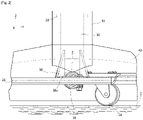
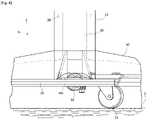
- the curved cutout 36 therefore comprises two convex parts 36v and two concave parts 36c, detailed on the figure 2 and 4 , and distributed, two by two, symmetrically with respect to the center of the tube 32.
- the curved cutout 36 of the tube 32 continuously forms two concave parts 36c and two convex parts 36v, distributed alternately and radially every 90° .
- the tube 32 also comprises, in the upper part, an oblique groove 37, visible on the figure 1 and 3 .
- the support 26 comprises at least one roller 38, here two rollers 38 rotating around an axis of rotation fixed horizontally on the support 26. can travel on these pebbles.
- the plane orthogonal to the axis of rotation of the rollers 38 and median to the rollers 38 is tangent to the walls of the tube 32.
- said tube 32 rests on the rollers 38 at a point of contact P , joined to the periphery rollers 38 and to the curved cutout 36 of the tube 32.
- the curved cutouts 36 convex 36v and concave 36c and the rollers 38 together form the vertical translation means 18.
- the tube 32 also receives in the lower part the immobilization means 20 formed by a cup 40 placed in a fixed manner around the tube 32.
- the cup 40 has a shape similar to a hemisphere, open at the bottom and developed around the three rollers 24.
- the cup 40 may comprise non-slip elements, not shown placed in the lower part, under said cup 40.
- the upper part of the foot 30 receives, in a fixed manner, a handle 42 developed radially to the longitudinal axis of the foot 30, extended along the Z axis.
- the handle 42 developed radially from the foot 30, passes through the tube 32, by an oblique groove 37.
- a first pivoting assembly E1 formed by the rollers 24 fixed to the support 26, the foot 30, comprising the handle 42 and a second assembly E2 comprising the tube 32 and the horizontal table top 34 and the cup 40, both fixed to said tube 32 .
- the two pivoting sets E1 and E2 are assembled so as to be able to move in rotation via bearings 28 with Z axis and so as to be able to move in vertical translation via rollers 38 with a horizontal axis of rotation, on which the tube 32 of the assembly rests. E2 .
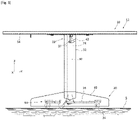
- the figure 1 represents the rolling table 12 in the unlocked position.
- the rollers 24 are therefore in contact with the ground S .
- the first pivoting assembly E1 of the rolling table 12 is therefore systematically in contact with the ground S , the first pivoting assembly E1 is rotatable relative to the assembly E2 .
- the vertical positioning of the assembly E2 is provided by the rollers 38 of the first pivoting assembly E1 , rollers 38 on which the tube 32 of the assembly E2 rests. In this mobile configuration of the roller table 12, it is the convex parts 36v of the curved cutout 36 of the tube 32 which rest on the rollers 38.
- the assembly E2 For the manipulation of the roller table 12, it is appropriate, after having moved the roller table 12 at the desired location, to lower the assembly E2 , movable in vertical translation along the foot 30, and comprising the cup 40.
- the lowering of the assembly E2 generates the support of the cup 40 on the ground S , thus blocking the possibility of horizontal translation of the rolling table 12.
- To lower the assembly E2 it is necessary to maintain the assembly E2 , and to pivot the first pivoting assembly E1 . Maintaining the assembly E2 can easily be done by maintaining the table top 34 and the pivoting of the first pivoting assembly E1 can easily be done by horizontally shifting the handle 42 in the X, Y plane.
- the horizontal offset of the handle 42 in the X, Y plane causes the rotation of the first pivoting assembly E1 .
- the support 26 rotates by rolling on the ground S via the rollers 24 and the rollers 38 roll against the curved cutout 36 of the tube 32.
- the rollers 38 are thus positioned at the level of the two concave parts 36c of the curved cutout 36 of the tube 32 which rests on the rollers 38.
- the tube 32 is thus positioned in the low position, that is to say that the assembly E2 is lowered along the vertical axis and that the cup 40 touches the ground S.
- the support of the cup 40 on the ground S thus avoids any horizontal movement of the rolling table 12 on the ground S.
- first pivoting assembly E1 which is pivoted about a vertical axis and the assembly E2 which is held in position during the pivoting of the pivoting assembly E1.
- the pivoting of the first swiveling assembly E1 is a 90° pivoting allowing the positioning of the two concave parts 36c or the two convex parts 36v on the rollers 38, to place the assembly E2 in the low position with the cup 40 in contact with the ground S or in the high position with the cup 40 spaced from the ground S.
- Pivoting of the assembly E1 is easily performed by the user using one hand to hold the table top 34 and the other hand to maneuver the handle 42 to pivot the first pivoting assembly E1 and therefore lower or raise the set E2 .
- the user can therefore, without significant effort, rotate the assembly E1 by 90°, via the handle 42, to position the rollers 38 under the convex parts 36v or the concave parts 36c of the tube 32.
- the handle 42 integral with the foot 30 passes through the tube 32 via the oblique groove 37 whose shape is adapted to follow the rotational movement of the assembly E1 and the vertical translational movement of the assembly E2.
- the piece of furniture 10 described here is a rolling table 12 but the device for moving and immobilizing a piece of furniture can be used on other types of furniture, such as a stool or a rolling step.
Landscapes
- Engineering & Computer Science (AREA)
- Mechanical Engineering (AREA)
- Legs For Furniture In General (AREA)
- Ventilation (AREA)
- Holders For Apparel And Elements Relating To Apparel (AREA)
Description
- L'invention concerne un dispositif de déplacement et d'immobilisation d'un meuble.
- Dans le secteur du meuble et du mobilier, il est couramment nécessaire de devoir déplacer certains meubles. Pour faciliter le déplacement d'un meuble sans avoir à le soulever, les meubles sont couramment équipés de moyens de déplacement tels que des roulettes ou des patins glissants placés sous le meuble, entre ledit meuble et le sol et qui permettent le déplacement aisé des meubles équipés sur le sol. Pour garantir un confort d'utilisation, si le meuble n'a plus à être déplacé, il convient de bloquer toute possibilité de translation de ces meubles, pour l'usage mais aussi pour la sécurité, évitant ainsi tout mouvement intempestif sous l'action d'une personne qui prendrait appui par exemple. En effet, l'utilisation d'une table par exemple, nécessite que cette table ne glisse pas ou ne roule horizontalement pas lorsqu'elle est utilisée. Hormis l'aspect pratique de l'immobilisation en translation du meuble, c'est également un aspect sécuritaire qui intervient. Cet aspect sécuritaire est d'autant plus important lorsque le mobilier est destiné à un milieu médical tel qu'un hôpital ou une maison de retraite. En effet, les meubles en milieu médical, plus qu'ailleurs, doivent assurer une certaine stabilité et une certaine garantie d'appui, ceux-ci pouvant être utilisés par un patient se servant des meubles pour prendre appui et s'aidant du meuble pour certains mouvements. Les documents
ITUD20110203 A1 DE1654631 A1 ,CN206102019 U etKR102077267 B1 - De nombreux systèmes d'immobilisation existent mais peuvent présenter des contraintes de fabrication, de fiabilité, de manœuvrabilité et d'efficacité. En effet, dans le cas d'une table, le pied peut être muni de roulettes et d'un patin escamotable destiné à exercer une pression vers le bas et sur le sol afin de limiter les mouvements de translation de la table à bloquer. Des systèmes de blocage des roues sont également existants et permettent le blocage en rotation des roues, formant un frein. Il est donc nécessaire de bloquer l'ensemble des roues une à une, qui outre l'aspect chronophage de cette manœuvre, s'avère ne pas être pratique puisqu'il est généralement nécessaire d'utiliser son pied pour activer les moyens de blocage placés au niveau des roulettes.
- Il conviendrait de pouvoir manœuvrer des moyens d'immobilisation, qu'ils soient placés sur les roulettes ou non, directement à la main et que lesdits moyens d'immobilisation soient aisément accessibles.
- La présente solution propose une table apte à prendre une position de déplacement et une position d'immobilisation bloquant toute possibilité de translation horizontale sur le sol. La présente invention décrit un dispositif de déplacement et d'immobilisation d'un meuble, comprenant des moyens de déplacement, des moyens d'immobilisation, caractérisé en ce qu'il comporte des moyens de rotation, des moyens de translation verticale, et des moyens de manœuvre en rotation.
- La présente invention comprend un ensemble E1 et un ensemble E2, l'ensemble E1 étant mobile en rotation par rapport à l'ensemble E2, l'ensemble E2 est mobile en translation verticale rapport à l'ensemble E1 et la rotation de l'ensemble E1 engendre une translation verticale.
- La présente invention comprend également des moyens de rotation formés par un tube monté de manière rotative autour d'un pied via des roulements, le tube recevant en partie basse des moyens d'immobilisation par rapport au sol.
- Les moyens de translation verticale de la présente invention sont formés par une découpe courbe avec des formes convexes et concaves, réalisées à l'extrémité inférieure du tube et au moins un galet sur lequel s'appuie ledit tube. Les moyens de déplacement de la présente invention sont formés par au moins une roulette, fixées à un support, développé horizontalement et supportant en plus, les moyens de rotation formés par le pied.
- Les moyens d'immobilisation comprennent une coupelle placée de manière fixe autour du tube, en forme de demi-sphère, ouverte vers le bas et développée autour des moyens de déplacement.
- La présente invention est maintenant décrite à l'aide d'exemples uniquement illustratifs et nullement limitatifs de la portée de l'invention, et à partir des illustrations jointes, dans lesquelles :
- [
Fig. 1 ] représente une vue de face d'une table munie du dispositif de déplacement et d'immobilisation, en position de déplacement, débloquée et mobile. - [
Fig. 2 ] représente une vue de côté du dispositif de déplacement et d'immobilisation verticale de la table de lafigure 1 , en position haute, de déplacement. - [
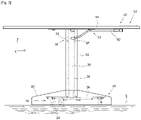
Fig. 3 ] représente une vue de face d'une table munie du dispositif de déplacement et d'immobilisation, en position basse, bloquée. - [
Fig. 4 ] représente une vue de côté du dispositif de translation verticale de la table de lafigure 3 , en position basse. - Les moyens de déplacement 14 sont formés par au moins trois roulettes 24, en l'occurrence trois roulettes 24, en contact avec le sol S sur lequel reposent et roulent lesdites roulettes 24. Les roulettes 24 sont fixées à un support 26 développé horizontalement et supportant, en plus des roulettes 24, les moyens de rotation 16 formés par au moins un roulement 28, ici deux roulements 28, d'axe de rotation vertical et positionnés entre un pied 30 et un tube 32 rond à l'intérieur duquel ledit pied 30 est placé. Ce tube 32 rond est étendu verticalement et monté sur les roulements 28. Le tube 32 est donc monté de manière rotative autour du pied 30 et par rapport audit pied 30, via les roulements 28. Le tube 32 rond reçoit à son extrémité supérieure un plateau de table 34 horizontal. L'extrémité inférieure, sur sa périphérie, est munie d'une découpe courbe 36 de forme ondulatoire. La découpe courbe 36 comporte donc deux parties convexes 36v et deux parties concaves 36c, détaillées sur les
figures 2 et4 , et réparties, deux à deux, de manière symétrique par rapport au centre du tube 32. Ainsi, la découpe courbe 36 du tube 32 forme de manière continue deux parties concaves 36c et deux parties convexes 36v, réparties alternativement et radialement tous les 90°. Le tube 32 comporte également, en partie haute, une rainure oblique 37, visible sur lesfigures 1 et3 . Le support 26 comporte au moins un galet 38, ici deux galets 38 rotatifs autour d'un axe de rotation fixé horizontalement sur le support 26. Les galets 38 placés verticalement sont également alignés au droit de la paroi du tube 32 donc la périphérie du tube peut circuler sur ces galets. De plus, le plan orthogonal à l'axe de rotation des galets 38 et médian aux galets 38, est tangent aux parois du tube 32. Ainsi, ledit tube 32 repose sur les galets 38 en un point de contact P, conjoint à la périphérie des galets 38 et à la découpe courbe 36 du tube 32. Les découpes courbes 36 convexes 36v et concaves 36c et les galets 38 forment ensemble les moyens de translation verticale 18. Le tube 32 reçoit également en partie basse les moyens d'immobilisation 20 formés par une coupelle 40 placée de manière fixe autour du tube 32. La coupelle 40 a une forme semblable à une demi-sphère, ouverte vers le bas et développée autour des trois roulettes 24. La coupelle 40 peut comporter des éléments antidérapants, non représentés placés en partie inférieure, sous ladite coupelle 40. - La partie haute du pied 30 reçoit, de manière fixe, une poignée 42 développée radialement à l'axe longitudinal du pied 30, étendu suivant l'axe Z. La poignée 42, développée radialement depuis le pied 30, traverse le tube 32, par une rainure oblique 37.
- Il apparaît ainsi deux ensembles distincts. Un premier ensemble E1 pivotant formé par les roulettes 24 fixées au support 26, le pied 30, comprenant la poignée 42 et un deuxième ensemble E2 comprenant le tube 32 et le plateau de table 34 horizontal et la coupelle 40, tous deux fixés audit tube 32.
- Les deux ensembles E1 pivotant et E2 sont assemblés de manière mobile en rotation via les roulements 28 d'axe Z et de manière mobile en translation verticale via les galets 38 d'axe de rotation horizontal, sur lesquels repose le tube 32 de l'ensemble E2.
- La
figure 1 représente la table roulante 12 en position débloquée. Les roulettes 24 sont donc en contact avec le sol S. Le premier ensemble E1 pivotant de la table roulante 12 est donc systématiquement en contact avec le sol S, le premier ensemble E1 pivotant est mobile en rotation par rapport à l'ensemble E2. Le positionnement vertical de l'ensemble E2 est assuré par les galets 38 du premier ensemble E1 pivotant, galets 38 sur lesquels repose le tube 32 de l'ensemble E2. Dans cette configuration mobile de la table roulante 12, ce sont les parties convexes 36v de la découpe courbe 36 du tube 32 qui reposent sur les galets 38. Pour la manipulation de la table roulante 12, il convient, après avoir déplacé la table roulante 12 à l'endroit souhaité, d'abaisser l'ensemble E2, mobile en translation verticale le long du pied 30, et comportant la coupelle 40. L'abaissement de l'ensemble E2 engendre l'appui de la coupelle 40 sur le sol S, bloquant ainsi la possibilité de translation horizontale de la table roulante 12.
Pour abaisser l'ensemble E2, il est nécessaire de maintenir l'ensemble E2, et de faire pivoter le premier ensemble E1 pivotant. Le maintien de l'ensemble E2 peut aisément s'effectuer en maintenant le plateau de table 34 et le pivotement du premier ensemble E1 pivotant peut aisément s'effectuer en décalant horizontalement la poignée 42 dans le plan X, Y. - Le décalage horizontal de la poignée 42 dans le plan X, Y, engendre la rotation du premier ensemble E1 pivotant. Lorsque le premier ensemble E1 pivotant tourne verticalement, le support 26 tourne en roulant sur le sol S via les roulettes 24 et les galets 38 roulent contre la découpe courbe 36 du tube 32. Les galets 38 viennent ainsi se positionner au niveau des deux parties concaves 36c de la découpe courbe 36 du tube 32 qui repose sur les galets 38. Le tube 32 se trouve ainsi positionné en position basse, c'est-à-dire que l'ensemble E2 est descendu suivant l'axe vertical et que la coupelle 40 touche le sol S. L'appui de la coupelle 40 sur le sol S évite ainsi tout mouvement horizontal de la table roulante 12 sur le sol S. Si les
figures 1 et2 représentent le bas de la coupelle 40 et les roulettes 24 appuyées sur le sol S, il peut également être envisagé que les roulettes 24 ne touchent plus le sol S et que seule la coupelle 40 soit en appui sur le sol S, ceci dépendant des courses. - C'est donc bien le premier ensemble E1 pivotant qui est pivoté autour d'un axe vertical et l'ensemble E2 qui est maintenu en position lors du pivotement de l'ensemble E1 pivotant. Le pivotement du premier ensemble E1 pivotant est un pivotement de 90° permettant le positionnement des deux parties concaves 36c ou des deux parties convexes 36v sur les galets 38, pour placer l'ensemble E2 en position basse avec la coupelle 40 en contact avec le sol S ou en position haute avec la coupelle 40 espacée du sol S.
- Le pivotement de l'ensemble E1 est aisément effectué par l'utilisateur en utilisant une main pour tenir le plateau de table 34 et l'autre main pour manœuvrer la poignée 42 pour faire pivoter le premier ensemble E1 pivotant et donc descendre ou monter l'ensemble E2. L'utilisateur peut donc, sans effort important, faire pivoter l'ensemble E1 de 90°, via la poignée 42, pour positionner les galets 38 sous les parties convexes 36v ou les parties concaves 36c du tube 32.
- Comme représenté sur les
figures 1 et3 , la poignée 42 solidaire du pied 30 traverse le tube 32 via la rainure oblique 37 dont la forme est adaptée pour suivre le mouvement de rotation de l'ensemble E1 et le mouvement de translation verticale de l'ensemble E2. Le meuble 10 décrit ici est une table roulante 12 mais le dispositif de déplacement et d'immobilisation d'un meuble peut être utilisé sur d'autres types de meuble, comme un tabouret ou un marchepied roulant .
Claims (7)
- Dispositif de déplacement et d'immobilisation d'un meuble (10), comprenant des moyens de déplacement (14), des moyens d'immobilisation (20), caractérisé en ce qu'il comporte des moyens de rotation (16), formés par un tube (32) monté de manière rotative autour d'un pied (30), des moyens de translation verticale (18), formés par une découpe courbe (36) avec des formes convexes (36v) et concaves (36c), réalisées à l'extrémité inférieure dudit tube (32) et au moins un galet (38) solidaire des moyens de déplacement (14), sur lequel s'appuie ledit tube (32) ainsi que des moyens de manœuvre en rotation (22).
- Dispositif selon la revendication 1 caractérisé en ce qu'il comprend un ensemble E1 et un ensemble E2, l'ensemble E1 étant mobile en rotation par rapport à l'ensemble E2 et en ce que l'ensemble E2 est mobile en translation verticale rapport à l'ensemble E1.
- Dispositif de déplacement et d'immobilisation d'un meuble (10), selon la revendication 1 ou 2, caractérisé en ce que la rotation de l'ensemble E1 engendre une translation verticale.
- Dispositif de déplacement et d'immobilisation d'un meuble (10), selon l'une quelconque des revendications précédentes, caractérisé en ce le tube (32) des moyens de rotation (16) est monté de manière rotative autour du pied (30) via des roulements (28).
- Dispositif de déplacement et d'immobilisation d'un meuble (10) selon l'une quelconque des revendications précédentes, caractérisé en ce que les moyens de déplacement (14) sont formés par au moins une roulette (24), fixées à un support (26), développé horizontalement et supportant en plus, les moyens de rotation (16) formés par le pied (30).
- Dispositif de déplacement et d'immobilisation d'un meuble (10), selon l'une quelconque des revendications précédentes, caractérisé en ce que le tube (32) reçoit en partie basse des moyens d'immobilisation (20) par rapport au sol
- Dispositif de déplacement et d'immobilisation d'un meuble (10), selon la revendication 6, caractérisé en ce que les moyens d'immobilisation (20) comprennent une coupelle (40) placée de manière fixe autour du tube (32), en forme de demi-sphère, ouverte vers le bas et développée autour des moyens de déplacement (14).
Applications Claiming Priority (1)
| Application Number | Priority Date | Filing Date | Title |
|---|---|---|---|
| FR1907470A FR3098099B1 (fr) | 2019-07-04 | 2019-07-04 | Dispositif de deplacement et d'immobilisation d'un meuble |
Publications (2)
| Publication Number | Publication Date |
|---|---|
| EP3760077A1 EP3760077A1 (fr) | 2021-01-06 |
| EP3760077B1 true EP3760077B1 (fr) | 2022-05-04 |
Family
ID=67957147
Family Applications (1)
| Application Number | Title | Priority Date | Filing Date |
|---|---|---|---|
| EP20183247.4A Active EP3760077B1 (fr) | 2019-07-04 | 2020-06-30 | Dispositif de deéplacement et d'immobilisation d'un meuble |
Country Status (3)
| Country | Link |
|---|---|
| EP (1) | EP3760077B1 (fr) |
| ES (1) | ES2924370T3 (fr) |
| FR (1) | FR3098099B1 (fr) |
Family Cites Families (4)
| Publication number | Priority date | Publication date | Assignee | Title |
|---|---|---|---|---|
| DE1654631C3 (de) * | 1967-06-19 | 1974-08-15 | Alois Dipl.-Ing. 4790 Paderborn Loedige | Tischbein mit einem am Tischbein angeordneten Standfuß |
| ITUD20110203A1 (it) * | 2011-12-19 | 2013-06-20 | Point S R L | "meccanismo di scorrimento a scomparsa" |
| CN206102019U (zh) * | 2016-07-26 | 2017-04-19 | 诏安县鑫瑞家具商行 | 一种多功能旋转餐桌 |
| KR102077267B1 (ko) * | 2019-06-14 | 2020-02-13 | (주)야흥금속 | 책걸상용 캐스터 장치 |
-
2019
- 2019-07-04 FR FR1907470A patent/FR3098099B1/fr active Active
-
2020
- 2020-06-30 EP EP20183247.4A patent/EP3760077B1/fr active Active
- 2020-06-30 ES ES20183247T patent/ES2924370T3/es active Active
Also Published As
| Publication number | Publication date |
|---|---|
| FR3098099A1 (fr) | 2021-01-08 |
| FR3098099B1 (fr) | 2021-07-16 |
| ES2924370T3 (es) | 2022-10-06 |
| EP3760077A1 (fr) | 2021-01-06 |
Similar Documents
| Publication | Publication Date | Title |
|---|---|---|
| EP3421658B1 (fr) | Appareil de repassage et/ou défroissage à la vapeur comportant une planche de repassage pouvant être immobilisée selon différentes inclinaisons | |
| EP3319497B1 (fr) | Poignée amovible | |
| FR2927027A1 (fr) | Mecanisme d'articulation a elements de verrouillage pivotant pour siege de vehicule et siege comportant un tel mecanisme | |
| EP3760077B1 (fr) | Dispositif de deéplacement et d'immobilisation d'un meuble | |
| BE559312A (fr) | ||
| EP3217842B1 (fr) | Mobilier comprenant un corps supporte par des pieds | |
| EP2915454B1 (fr) | Meuble équipé de moyens de déplacement | |
| EP2397367A1 (fr) | Dispositif d'aménagement d'un véhicule | |
| WO2017187066A1 (fr) | Dispositif de support pour écran. | |
| FR2928091A1 (fr) | Banc de developpe-couche securise a prise large | |
| CA1160944A (fr) | Appareil servant a enlever un pneu de sa jante | |
| CA2362988C (fr) | Plate-forme mobile surbaissee | |
| WO2018104595A1 (fr) | Dispositif d'appui antérieur pour les membres inférieurs | |
| FR2990847A1 (fr) | Brancard ambulatoire a barriere reglable | |
| EP3215691B1 (fr) | Mécanisme de fixation pivotante d'un porte-plaque sur un mât télescopique d'un appareil de levage de plaques, et appareil de levage de plaque muni d'un tel mécanisme | |
| WO2007028883A2 (fr) | Chariot brancard a manoeuvre facilitee | |
| EP2010400B1 (fr) | Dispositif de blocage/liberation d'une chape de roue orientable et chariot brancard equipe d'un tel dispositif | |
| JP6304642B2 (ja) | 車椅子 | |
| JP6343381B2 (ja) | 車椅子 | |
| WO2019192996A1 (fr) | Dispositif de surélévation pour un système de transport à roues et systèmes de transport associé | |
| FR3031161A1 (fr) | Tablette pour porter des objets au-dessus d'un support de type ecran de television ou d'ordinateur | |
| WO2025012540A1 (fr) | Poignée amovible munie d'un verrou mobile et d'un dispositif anti-recul de verrou | |
| FR2847137A1 (fr) | Meuble de chevet a caisson de rangement et plateau de table | |
| EP2666596A2 (fr) | Coffre à outils permettant de travailler en hauteur | |
| FR3057446A1 (fr) | Dispositif d'assise muni d'accoudoirs mobiles |
Legal Events
| Date | Code | Title | Description |
|---|---|---|---|
| PUAI | Public reference made under article 153(3) epc to a published international application that has entered the european phase |
Free format text: ORIGINAL CODE: 0009012 |
|
| STAA | Information on the status of an ep patent application or granted ep patent |
Free format text: STATUS: THE APPLICATION HAS BEEN PUBLISHED |
|
| AK | Designated contracting states |
Kind code of ref document: A1 Designated state(s): AL AT BE BG CH CY CZ DE DK EE ES FI FR GB GR HR HU IE IS IT LI LT LU LV MC MK MT NL NO PL PT RO RS SE SI SK SM TR |
|
| AX | Request for extension of the european patent |
Extension state: BA ME |
|
| STAA | Information on the status of an ep patent application or granted ep patent |
Free format text: STATUS: REQUEST FOR EXAMINATION WAS MADE |
|
| 17P | Request for examination filed |
Effective date: 20210607 |
|
| RBV | Designated contracting states (corrected) |
Designated state(s): AL AT BE BG CH CY CZ DE DK EE ES FI FR GB GR HR HU IE IS IT LI LT LU LV MC MK MT NL NO PL PT RO RS SE SI SK SM TR |
|
| GRAP | Despatch of communication of intention to grant a patent |
Free format text: ORIGINAL CODE: EPIDOSNIGR1 |
|
| STAA | Information on the status of an ep patent application or granted ep patent |
Free format text: STATUS: GRANT OF PATENT IS INTENDED |
|
| INTG | Intention to grant announced |
Effective date: 20211201 |
|
| GRAS | Grant fee paid |
Free format text: ORIGINAL CODE: EPIDOSNIGR3 |
|
| GRAA | (expected) grant |
Free format text: ORIGINAL CODE: 0009210 |
|
| STAA | Information on the status of an ep patent application or granted ep patent |
Free format text: STATUS: THE PATENT HAS BEEN GRANTED |
|
| AK | Designated contracting states |
Kind code of ref document: B1 Designated state(s): AL AT BE BG CH CY CZ DE DK EE ES FI FR GB GR HR HU IE IS IT LI LT LU LV MC MK MT NL NO PL PT RO RS SE SI SK SM TR |
|
| REG | Reference to a national code |
Ref country code: GB Ref legal event code: FG4D Free format text: NOT ENGLISH |
|
| REG | Reference to a national code |
Ref country code: CH Ref legal event code: EP |
|
| REG | Reference to a national code |
Ref country code: AT Ref legal event code: REF Ref document number: 1488107 Country of ref document: AT Kind code of ref document: T Effective date: 20220515 |
|
| REG | Reference to a national code |
Ref country code: IE Ref legal event code: FG4D Free format text: LANGUAGE OF EP DOCUMENT: FRENCH Ref country code: DE Ref legal event code: R096 Ref document number: 602020002975 Country of ref document: DE |
|
| REG | Reference to a national code |
Ref country code: LT Ref legal event code: MG9D |
|
| REG | Reference to a national code |
Ref country code: NL Ref legal event code: MP Effective date: 20220504 |
|
| REG | Reference to a national code |
Ref country code: ES Ref legal event code: FG2A Ref document number: 2924370 Country of ref document: ES Kind code of ref document: T3 Effective date: 20221006 |
|
| REG | Reference to a national code |
Ref country code: AT Ref legal event code: MK05 Ref document number: 1488107 Country of ref document: AT Kind code of ref document: T Effective date: 20220504 |
|
| PG25 | Lapsed in a contracting state [announced via postgrant information from national office to epo] |
Ref country code: SE Free format text: LAPSE BECAUSE OF FAILURE TO SUBMIT A TRANSLATION OF THE DESCRIPTION OR TO PAY THE FEE WITHIN THE PRESCRIBED TIME-LIMIT Effective date: 20220504 Ref country code: PT Free format text: LAPSE BECAUSE OF FAILURE TO SUBMIT A TRANSLATION OF THE DESCRIPTION OR TO PAY THE FEE WITHIN THE PRESCRIBED TIME-LIMIT Effective date: 20220905 Ref country code: NO Free format text: LAPSE BECAUSE OF FAILURE TO SUBMIT A TRANSLATION OF THE DESCRIPTION OR TO PAY THE FEE WITHIN THE PRESCRIBED TIME-LIMIT Effective date: 20220804 Ref country code: NL Free format text: LAPSE BECAUSE OF FAILURE TO SUBMIT A TRANSLATION OF THE DESCRIPTION OR TO PAY THE FEE WITHIN THE PRESCRIBED TIME-LIMIT Effective date: 20220504 Ref country code: LT Free format text: LAPSE BECAUSE OF FAILURE TO SUBMIT A TRANSLATION OF THE DESCRIPTION OR TO PAY THE FEE WITHIN THE PRESCRIBED TIME-LIMIT Effective date: 20220504 Ref country code: HR Free format text: LAPSE BECAUSE OF FAILURE TO SUBMIT A TRANSLATION OF THE DESCRIPTION OR TO PAY THE FEE WITHIN THE PRESCRIBED TIME-LIMIT Effective date: 20220504 Ref country code: GR Free format text: LAPSE BECAUSE OF FAILURE TO SUBMIT A TRANSLATION OF THE DESCRIPTION OR TO PAY THE FEE WITHIN THE PRESCRIBED TIME-LIMIT Effective date: 20220805 Ref country code: FI Free format text: LAPSE BECAUSE OF FAILURE TO SUBMIT A TRANSLATION OF THE DESCRIPTION OR TO PAY THE FEE WITHIN THE PRESCRIBED TIME-LIMIT Effective date: 20220504 Ref country code: BG Free format text: LAPSE BECAUSE OF FAILURE TO SUBMIT A TRANSLATION OF THE DESCRIPTION OR TO PAY THE FEE WITHIN THE PRESCRIBED TIME-LIMIT Effective date: 20220804 Ref country code: AT Free format text: LAPSE BECAUSE OF FAILURE TO SUBMIT A TRANSLATION OF THE DESCRIPTION OR TO PAY THE FEE WITHIN THE PRESCRIBED TIME-LIMIT Effective date: 20220504 |
|
| PG25 | Lapsed in a contracting state [announced via postgrant information from national office to epo] |
Ref country code: RS Free format text: LAPSE BECAUSE OF FAILURE TO SUBMIT A TRANSLATION OF THE DESCRIPTION OR TO PAY THE FEE WITHIN THE PRESCRIBED TIME-LIMIT Effective date: 20220504 Ref country code: PL Free format text: LAPSE BECAUSE OF FAILURE TO SUBMIT A TRANSLATION OF THE DESCRIPTION OR TO PAY THE FEE WITHIN THE PRESCRIBED TIME-LIMIT Effective date: 20220504 Ref country code: LV Free format text: LAPSE BECAUSE OF FAILURE TO SUBMIT A TRANSLATION OF THE DESCRIPTION OR TO PAY THE FEE WITHIN THE PRESCRIBED TIME-LIMIT Effective date: 20220504 Ref country code: IS Free format text: LAPSE BECAUSE OF FAILURE TO SUBMIT A TRANSLATION OF THE DESCRIPTION OR TO PAY THE FEE WITHIN THE PRESCRIBED TIME-LIMIT Effective date: 20220904 |
|
| PG25 | Lapsed in a contracting state [announced via postgrant information from national office to epo] |
Ref country code: SM Free format text: LAPSE BECAUSE OF FAILURE TO SUBMIT A TRANSLATION OF THE DESCRIPTION OR TO PAY THE FEE WITHIN THE PRESCRIBED TIME-LIMIT Effective date: 20220504 Ref country code: SK Free format text: LAPSE BECAUSE OF FAILURE TO SUBMIT A TRANSLATION OF THE DESCRIPTION OR TO PAY THE FEE WITHIN THE PRESCRIBED TIME-LIMIT Effective date: 20220504 Ref country code: RO Free format text: LAPSE BECAUSE OF FAILURE TO SUBMIT A TRANSLATION OF THE DESCRIPTION OR TO PAY THE FEE WITHIN THE PRESCRIBED TIME-LIMIT Effective date: 20220504 Ref country code: EE Free format text: LAPSE BECAUSE OF FAILURE TO SUBMIT A TRANSLATION OF THE DESCRIPTION OR TO PAY THE FEE WITHIN THE PRESCRIBED TIME-LIMIT Effective date: 20220504 Ref country code: DK Free format text: LAPSE BECAUSE OF FAILURE TO SUBMIT A TRANSLATION OF THE DESCRIPTION OR TO PAY THE FEE WITHIN THE PRESCRIBED TIME-LIMIT Effective date: 20220504 Ref country code: CZ Free format text: LAPSE BECAUSE OF FAILURE TO SUBMIT A TRANSLATION OF THE DESCRIPTION OR TO PAY THE FEE WITHIN THE PRESCRIBED TIME-LIMIT Effective date: 20220504 |
|
| REG | Reference to a national code |
Ref country code: DE Ref legal event code: R097 Ref document number: 602020002975 Country of ref document: DE |
|
| PG25 | Lapsed in a contracting state [announced via postgrant information from national office to epo] |
Ref country code: MC Free format text: LAPSE BECAUSE OF FAILURE TO SUBMIT A TRANSLATION OF THE DESCRIPTION OR TO PAY THE FEE WITHIN THE PRESCRIBED TIME-LIMIT Effective date: 20220504 |
|
| PLBE | No opposition filed within time limit |
Free format text: ORIGINAL CODE: 0009261 |
|
| STAA | Information on the status of an ep patent application or granted ep patent |
Free format text: STATUS: NO OPPOSITION FILED WITHIN TIME LIMIT |
|
| PG25 | Lapsed in a contracting state [announced via postgrant information from national office to epo] |
Ref country code: AL Free format text: LAPSE BECAUSE OF FAILURE TO SUBMIT A TRANSLATION OF THE DESCRIPTION OR TO PAY THE FEE WITHIN THE PRESCRIBED TIME-LIMIT Effective date: 20220504 |
|
| 26N | No opposition filed |
Effective date: 20230207 |
|
| PG25 | Lapsed in a contracting state [announced via postgrant information from national office to epo] |
Ref country code: LU Free format text: LAPSE BECAUSE OF NON-PAYMENT OF DUE FEES Effective date: 20220630 Ref country code: IE Free format text: LAPSE BECAUSE OF NON-PAYMENT OF DUE FEES Effective date: 20220630 |
|
| PG25 | Lapsed in a contracting state [announced via postgrant information from national office to epo] |
Ref country code: SI Free format text: LAPSE BECAUSE OF FAILURE TO SUBMIT A TRANSLATION OF THE DESCRIPTION OR TO PAY THE FEE WITHIN THE PRESCRIBED TIME-LIMIT Effective date: 20220504 |
|
| REG | Reference to a national code |
Ref country code: CH Ref legal event code: PL |
|
| PG25 | Lapsed in a contracting state [announced via postgrant information from national office to epo] |
Ref country code: MK Free format text: LAPSE BECAUSE OF FAILURE TO SUBMIT A TRANSLATION OF THE DESCRIPTION OR TO PAY THE FEE WITHIN THE PRESCRIBED TIME-LIMIT Effective date: 20220504 Ref country code: CY Free format text: LAPSE BECAUSE OF FAILURE TO SUBMIT A TRANSLATION OF THE DESCRIPTION OR TO PAY THE FEE WITHIN THE PRESCRIBED TIME-LIMIT Effective date: 20220504 Ref country code: CH Free format text: LAPSE BECAUSE OF NON-PAYMENT OF DUE FEES Effective date: 20230630 |
|
| PG25 | Lapsed in a contracting state [announced via postgrant information from national office to epo] |
Ref country code: HU Free format text: LAPSE BECAUSE OF FAILURE TO SUBMIT A TRANSLATION OF THE DESCRIPTION OR TO PAY THE FEE WITHIN THE PRESCRIBED TIME-LIMIT; INVALID AB INITIO Effective date: 20200630 |
|
| PG25 | Lapsed in a contracting state [announced via postgrant information from national office to epo] |
Ref country code: MT Free format text: LAPSE BECAUSE OF FAILURE TO SUBMIT A TRANSLATION OF THE DESCRIPTION OR TO PAY THE FEE WITHIN THE PRESCRIBED TIME-LIMIT Effective date: 20220504 |
|
| PG25 | Lapsed in a contracting state [announced via postgrant information from national office to epo] |
Ref country code: BG Free format text: LAPSE BECAUSE OF FAILURE TO SUBMIT A TRANSLATION OF THE DESCRIPTION OR TO PAY THE FEE WITHIN THE PRESCRIBED TIME-LIMIT Effective date: 20220504 |
|
| PG25 | Lapsed in a contracting state [announced via postgrant information from national office to epo] |
Ref country code: BG Free format text: LAPSE BECAUSE OF FAILURE TO SUBMIT A TRANSLATION OF THE DESCRIPTION OR TO PAY THE FEE WITHIN THE PRESCRIBED TIME-LIMIT Effective date: 20220504 |
|
| PGFP | Annual fee paid to national office [announced via postgrant information from national office to epo] |
Ref country code: DE Payment date: 20250618 Year of fee payment: 6 |
|
| PGFP | Annual fee paid to national office [announced via postgrant information from national office to epo] |
Ref country code: GB Payment date: 20250620 Year of fee payment: 6 |
|
| PGFP | Annual fee paid to national office [announced via postgrant information from national office to epo] |
Ref country code: BE Payment date: 20250617 Year of fee payment: 6 |
|
| PGFP | Annual fee paid to national office [announced via postgrant information from national office to epo] |
Ref country code: FR Payment date: 20250617 Year of fee payment: 6 |
|
| PGFP | Annual fee paid to national office [announced via postgrant information from national office to epo] |
Ref country code: ES Payment date: 20250718 Year of fee payment: 6 |
|
| PGFP | Annual fee paid to national office [announced via postgrant information from national office to epo] |
Ref country code: IT Payment date: 20250630 Year of fee payment: 6 |
|
| PG25 | Lapsed in a contracting state [announced via postgrant information from national office to epo] |
Ref country code: TR Free format text: LAPSE BECAUSE OF FAILURE TO SUBMIT A TRANSLATION OF THE DESCRIPTION OR TO PAY THE FEE WITHIN THE PRESCRIBED TIME-LIMIT Effective date: 20220504 |