EP3757902A1 - Information processing device, information processing program, and information processing method - Google Patents
Information processing device, information processing program, and information processing method Download PDFInfo
- Publication number
- EP3757902A1 EP3757902A1 EP20174274.9A EP20174274A EP3757902A1 EP 3757902 A1 EP3757902 A1 EP 3757902A1 EP 20174274 A EP20174274 A EP 20174274A EP 3757902 A1 EP3757902 A1 EP 3757902A1
- Authority
- EP
- European Patent Office
- Prior art keywords
- matrix
- matrices
- elements
- convolution
- cin
- Prior art date
- Legal status (The legal status is an assumption and is not a legal conclusion. Google has not performed a legal analysis and makes no representation as to the accuracy of the status listed.)
- Withdrawn
Links
Images












Classifications
-
- G—PHYSICS
- G06—COMPUTING OR CALCULATING; COUNTING
- G06N—COMPUTING ARRANGEMENTS BASED ON SPECIFIC COMPUTATIONAL MODELS
- G06N3/00—Computing arrangements based on biological models
- G06N3/02—Neural networks
- G06N3/04—Architecture, e.g. interconnection topology
- G06N3/045—Combinations of networks
-
- G—PHYSICS
- G06—COMPUTING OR CALCULATING; COUNTING
- G06F—ELECTRIC DIGITAL DATA PROCESSING
- G06F17/00—Digital computing or data processing equipment or methods, specially adapted for specific functions
- G06F17/10—Complex mathematical operations
- G06F17/15—Correlation function computation including computation of convolution operations
-
- G—PHYSICS
- G06—COMPUTING OR CALCULATING; COUNTING
- G06F—ELECTRIC DIGITAL DATA PROCESSING
- G06F17/00—Digital computing or data processing equipment or methods, specially adapted for specific functions
- G06F17/10—Complex mathematical operations
- G06F17/15—Correlation function computation including computation of convolution operations
- G06F17/153—Multidimensional correlation or convolution
-
- G—PHYSICS
- G06—COMPUTING OR CALCULATING; COUNTING
- G06F—ELECTRIC DIGITAL DATA PROCESSING
- G06F17/00—Digital computing or data processing equipment or methods, specially adapted for specific functions
- G06F17/10—Complex mathematical operations
- G06F17/16—Matrix or vector computation, e.g. matrix-matrix or matrix-vector multiplication, matrix factorization
-
- G—PHYSICS
- G06—COMPUTING OR CALCULATING; COUNTING
- G06N—COMPUTING ARRANGEMENTS BASED ON SPECIFIC COMPUTATIONAL MODELS
- G06N3/00—Computing arrangements based on biological models
- G06N3/02—Neural networks
- G06N3/04—Architecture, e.g. interconnection topology
- G06N3/0464—Convolutional networks [CNN, ConvNet]
-
- G—PHYSICS
- G06—COMPUTING OR CALCULATING; COUNTING
- G06N—COMPUTING ARRANGEMENTS BASED ON SPECIFIC COMPUTATIONAL MODELS
- G06N3/00—Computing arrangements based on biological models
- G06N3/02—Neural networks
- G06N3/06—Physical realisation, i.e. hardware implementation of neural networks, neurons or parts of neurons
- G06N3/063—Physical realisation, i.e. hardware implementation of neural networks, neurons or parts of neurons using electronic means
-
- G—PHYSICS
- G06—COMPUTING OR CALCULATING; COUNTING
- G06N—COMPUTING ARRANGEMENTS BASED ON SPECIFIC COMPUTATIONAL MODELS
- G06N3/00—Computing arrangements based on biological models
- G06N3/02—Neural networks
- G06N3/08—Learning methods
-
- G—PHYSICS
- G06—COMPUTING OR CALCULATING; COUNTING
- G06N—COMPUTING ARRANGEMENTS BASED ON SPECIFIC COMPUTATIONAL MODELS
- G06N3/00—Computing arrangements based on biological models
- G06N3/02—Neural networks
- G06N3/08—Learning methods
- G06N3/084—Backpropagation, e.g. using gradient descent
-
- G—PHYSICS
- G06—COMPUTING OR CALCULATING; COUNTING
- G06N—COMPUTING ARRANGEMENTS BASED ON SPECIFIC COMPUTATIONAL MODELS
- G06N3/00—Computing arrangements based on biological models
- G06N3/02—Neural networks
- G06N3/08—Learning methods
- G06N3/09—Supervised learning
Definitions
- a certain aspect of embodiments described herein relates to an information processing device, an information processing program, and an information processing method.
- Machine learning using a multi-layer neural network is called deep learning, and is applied to various fields.
- Various calculations are performed in each layer of the deep learning.
- convolution layer convolution between image data and a filter is performed, and the result thereof is output to a subsequent layer. Since the convolution is an operation between matrices, the calculation amount thereof is large, causing a delay in the processing speed of learning. Therefore, the Winograd algorithm has been proposed as an algorithm for reducing the calculation amount of the convolution.
- the techniques related to the present disclosure is also disclosed in " Fast Algorithms for Convolutional Neural Networks", Andrew Lavin et al., The IEEE Conference on Computer Vision and Pattern Recognition (CVPR), 2016, pp. 4013 - 4021 and " Deep Residual Learning for Image Recognition", Kaiming He et al., The IEEE Conference on Computer Vision and Pattern Recognition (CVPR), 2016, pp. 770 - 778 .
- Winograd algorithm has room for improvement in terms of a further increase in the processing speed of the convolution.
- the present invention has been made in view of those circumstances, and an object thereof is to increase the computational speed of convolution.
- an information processing device including: a calculation unit configured to calculate a combination of t and q that minimizes a computation time when q computation cores compute convolution between a plurality of first matrices and a plurality of second matrices of t-row t-column with Winograd algorithm in parallel, where a total number of elements of the plurality of first matrices and the plurality of second matrices does not exceed a number of sets of data that can be stored in each of q storage areas of a register, and the q computation cores respectively correspond to the q storage areas; and an output unit configured to output a program for causing a computing machine to execute a process including: storing the plurality of first matrices and the plurality of second matrices in each of the q storage areas with use of a calculated combination of t and q, and computing convolution between the first matrix and the second matrix with use of the Winograd algorithm by each of the q computation core
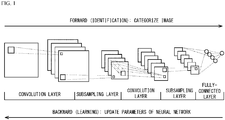
- FIG. 1 schematically illustrates a processing flow of deep learning.
- a neural network learns the feature of the identification target, such as an image, by supervised learning of the identification target.
- the use of the neural network after learning allows the identification target to be identified.
- the neural network is a network in which units that mimic neurons of a brain are hierarchically connected. Each unit receives data from another unit, and transfers the data to yet another unit. In the neural network, various identification targets can be identified by varying the parameters of the units by learning.
- CNN convolutional neural network
- This neural network has a multi-layer structure including convolution layers, subsampling layers, and a fully-connected layer.
- a multi-layer structure including convolution layers, subsampling layers, and a fully-connected layer.
- two convolution layers and two subsampling layers are alternately arranged, but three or more convolution layers and three or more subsampling layers may be provided.
- a plurality of fully-connected layers may be provided.
- the multi-layer structure of the neural network and the configuration of each layer can be determined in advance by the designer in accordance with the target to be identified.
- the process of identifying an image by the neural network is also called a forward process.
- a forward process as illustrated in FIG. 1 , convolution layers and pooling layers are alternately repeated from left to right. Then, at the end, an identification target included in the image is identified in the fully-connected layer.
- the process of learning images by the neural network is also called a backward process.
- the backward process the error between the identification result and the correct answer is obtained, and the obtained error is made to backpropagate through the neural network from right to left to change the parameters of each layer of the convolution neural network.
- FIG. 2 schematically illustrates convolution performed in the convolution layer.
- FIG. 2 illustrates convolution between a bottom matrix, in which pixel data of an input image is stored in each element, and a weight matrix, which represents a filter acting on the input image.
- a plurality of bottom matrices and a plurality of weight matrices are prepared, and the convolutions between them are performed.
- Each of the bottom matrices is identified by a batch number N and an input channel number Cin.
- each of the weight matrices is identified by an output channel number Cout and an input channel number Cin.
- top matrix The matrix obtained by this convolution is called a top matrix, hereinafter.
- output matrices of the total number of the batch numbers N ⁇ the total number of the output channel numbers Cout are obtained.
- 64 ⁇ 384 output matrices are obtained.
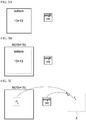
- FIG. 3A to FIG. 3C schematically illustrate the convolution between the bottom matrix and the weight matrix.
- the bottom matrix and the weight matrix to be subject to convolution are prepared.
- the bottom matrix is a 13 ⁇ 13 square matrix
- the weight matrix is a 3 ⁇ 3 square matrix.
- a 15 ⁇ 15 matrix M is obtained by padding zeros around the bottom matrix.
- a submatrix P ij having the same size as the weight matrix is extracted.
- the element in the k-th row, 1-th column of the submatrix P ij is represented by (P ij ) kl (0 ⁇ k, l ⁇ 2)
- the element in the k-th row, 1-th column of the weight matrix is represented by g kl (0 ⁇ k, l ⁇ 2).
- the Winograd algorithm has been known as an algorithm that increases the computational speed of the convolution. Thus, the following will describe the Winograd algorithm.
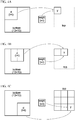
- FIG. 4A to FIG. 4C schematically illustrate the Winograd algorithm in the forward process.
- a t ⁇ t sub-bottom matrix d is segmented from the bottom matrix.
- t is a natural number.
- B, G, and A in the equation (2) are constant matrices.
- the elements and the sizes of these constant matrices B, G, and A vary in accordance with the size of each matrix g, d.
- the elements and the size of each constant matrix B, G, A are expressed by the following equation (3).
- a T 1 1 1 0 0 1 ⁇ 1 ⁇ 1 ⁇ 1 ⁇ 1
- ⁇ denotes element-wise multiplication of matrices.
- the position in which the sub-bottom matrix d is segmented from the bottom matrix is shifted by two columns from the position in the case of FIG. 4A , and the segmented sub-bottom matrix d undergoes the same calculation as above.
- the obtained sub-top matrix y forms the block next to the sub-top matrix y obtained in FIG. 4A in the top matrix.
- the top matrix formed from the sub-top matrices y is obtained as illustrated in FIG. 4C .
- the convolution can be computed at high-speed because the convolution can be performed only by calculating element-wise products of the matrix GgG T and the matrix B T dB.
- the inventor calculated the computation time for the case where the size of the weight matrix g was 3 ⁇ 3 and the size of the sub-bottom matrix d was 4 ⁇ 4 as in the above example.
- the calculated computation time was 1152 cycles in the examples of FIG. 3A to FIG. 3C that do not use the Winograd algorithm. Note that the number of "cycles" is equivalent to the number of times of writing data into a register.
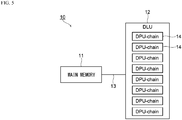
- FIG. 5 is a hardware configuration diagram of a computing machine for performing convolution in deep learning or the like.
- a computing machine 10 includes a main memory 11 and a processor 12 that are interconnected through a bus 13.
- the main memory 11 is a device, such as a dynamic random access memory (DRAM), that temporarily stores data, and executes various programs in cooperation with the processor 12.
- DRAM dynamic random access memory
- the processor 12 is a hardware device including a computing unit such as an arithmetic and logic unit (ALU).
- ALU arithmetic and logic unit
- DLU Deep Learning Unit
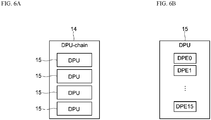
- the DLU is a processor having an architecture suitable for deep learning, and includes eight deep learning processing unit (DPU)-chains 14.
- FIG. 6A is a hardware configuration diagram of one DPU-chain 14.
- the DPU-chain 14 includes four DPUs 15. The parallel computation is performed in each of these DPUs 15, as described later.
- FIG. 6B is a hardware configuration diagram of one DPU 15.
- the DPU 15 includes 16 deep learning processing elements (DPEs) 0 to 15.
- FIG. 7 is a hardware configuration diagram of each DPE.
- each of DPE0 to DPE7 includes eight computation cores C#0 to C#7, and a register file 20 that is readable/writable by the computation cores C#0 to C#7.
- the computation cores C#0 to C#7 are individual single instruction multiple data (SIMD) computation units, and the parallel computation can be performed in the computation cores C#0 to C#7.
- SIMD single instruction multiple data
- the register file 20 is coupled to the main memory 11 via the bus 13 (see FIG. 5 ), stores data read from the main memory 11 therein, and stores results of computation by the computation cores C#0 to C#7 therein.
- the register file 20 is divided into four registers G#0 to G#3 configured to be readable/writable in parallel.
- the register G#0 reads data from the main memory 11
- the results of computation by the computation cores C#0 to C#7 can be stored in the register G#1 in parallel to the reading of data by the register G#0.
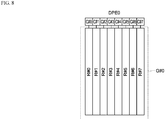
- FIG. 8 is a hardware configuration diagram of DPE0. Since DPE1 to DPE15 have the same hardware configuration as DPE0, the description thereof is omitted. FIG. 8 illustrates only the hardware configuration of the register G#0 among the registers G#0 to G#3 of the register file 20. Other registers G#1 to G#3 have the same hardware configuration as the register G#0.
- the register G#0 includes eight banks R#0 to R#7.
- Each of the banks R#0 to R#7 is an example of a storage area, and is provided so as to correspond to each of the computation cores C#0 to C#7.
- the bank R#0 is a storage area corresponding to the computation core C#0.
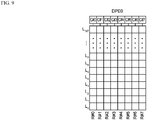
- FIG. 9 is a diagram for describing line numbers assigned to the banks R#0 to R#7.
- the line number is an identifier for identifying each entry of the banks R#0 to R#7.
- 128 line numbers: L 0 to L 127 are used.
- Data stored in each entry is not particularly limited.
- floating-point data is stored in one entry.
- 127 sets of floating-point data can be stored in the bank R#0. The same applies to the banks R#1 to R#7.
- the elements of the matrix to be subject to the convolution are stored in each entry.
- the elements of the matrix is stored in the main memory 11 as array elements.
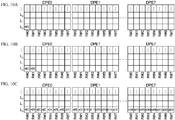
- FIG. 10A to FIG. 11C are schematic views for describing the sequential method.
- array elements a[0], a[1], a[2], ..., a[127] stored in the main memory 11 are expanded to DPE0 to DPE7.
- the first array element a[0] is stored in the entry identified by the line number L 0 in the bank R#0 of DPE0.
- next array element a[1] is stored in the bank R#1, which is next to the bank R#0, without changing the line number L 0 .
- the array elements are successively stored in the banks next to one another without changing the line number L 0 . Accordingly, the entries identified by the line number L 0 in the banks R#0 to R#7 of DPE0 to DPE7 are filled with the array elements a[0], a[1], a[2], ... a[63].
- next array element a[64] is stored in the entry identified by the line number L 1 in the bank R#0 of DPE0.
- next array element a[65] is stored in the next bank R#1 without changing the line number L 1 .
- the array elements are successively stored in the banks next to one another without changing the line number L 1 . Accordingly, as illustrated in FIG. 11C , the entries identified by the line number L 1 in the banks R#0 to R#7 of DPE0 to DPE7 are filled with the array elements a[64], a[65], a[66], ..., a[127].
- the array elements a[0], a[1], a[2], ..., a[127] are expanded to DPE0 to DPE7 by the sequential method.
- the entries having the same line number L i of DPE0 to DPE7 are sequentially filled, and when the last entry of the line number L i is filled, the array elements are stored in the entries with the next line number Li+i.
- FIG. 12 is a schematic view for describing the multicast method.
- the array elements a[0], a[1], a[2], ..., a[23] stored in the main memory 11 are expanded to DPE0 to DPE7.
- the array elements a[0], a[1], a[2], ..., a[23] are sequentially stored in the DPE0.
- the array elements a[0], a[1], a[2], ..., a[23] are stored in each of DPE1 to DPE7.
- the same array elements are stored in each of DPE0 to DPE7.
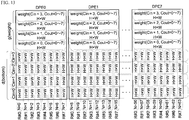
- FIG. 13 schematically illustrates the contents of the register G#0 of each DPE.
- the symbol identical to the symbol representing a matrix will be used to represent the array in which the elements of the matrix are stored.
- the array in which the elements of a t ⁇ t bottom matrix d are stored is represented by d
- the array in which the elements of a 3 ⁇ 3 weight matrix g are stored is represented by g.
- N is a batch number having a value of 0 to 63.
- Cin is an input channel number having a value of 0 to 255, and
- Cout is an output channel number having a value of 0 to 383.
- Each of H and W is a variable identifying an element in one bottom matrix.
- each of H' and W' is a variable identifying an element in one weight matrix.
- the array d is expanded to the registers G#0 of DPE0 to DPE7 by the sequential method.
- the array elements are stored in the register G#0 in sequence from the array element in the lowest level.
- the element in the lowest level of the array d is identified by the batch number N.
- the array elements of which the batch numbers N are 0, 1, ..., 7 are sequentially stored in the banks R#0, R#1, ..., R#7 of DPE0, respectively.
- the array elements of which the batch numbers N are 8, 9, ..., 15 are sequentially stored in the banks R#0, R#1, ..., R#7 of DPE1, respectively.
- the elements of which the batch numbers N are 0 to 63 are expanded to DPE0 to DPE7.
- the array g is expanded to the register G#0 of each of DPEO to DPE7 by the multicast method.
- the array elements of which the value of Cout is 0 to 7 are multicasted in the unit of the input channel number Cin.
- the elements of the array g are sorted as follows.
- FIG. 14 schematically illustrates the array elements of the array g in the main memory 11.
- the array g is an array representing the weight matrix, and corresponds to a 3 ⁇ 3 square matrix.
- numbers 0, 1, ..., 8 are assigned to respective elements of the 3 ⁇ 3 square matrix to identify each element by the assigned number.
- FIG. 15 illustrates the contents of the register G#0 of DPE0 immediately after the array elements are transferred by the multicast method described above.
- the first lines of the banks R#0 to R#7 are filled with the elements of g[Cout][Cin][H'][W'] in sequence from the element in the lower level of g[Cout][Cin][H'][W']. Then, the last bank R#7 of the first line is filled, the second lines are filled in sequence.
- each of the computation cores C#0 to C#7 of DPE0 uses one of the remaining registers G#1 to G#3 of DPE0 as a buffer to sort the elements of the array g in the register G#0.
- FIG. 16 illustrates the contents of the register G#0 of DPE0 after sorting.
- FIG. 17 illustrates the contents of the register G#0 of each of DPE0 to DPE7 after sorting as described above.
- Each of the banks R#0 to R#7 corresponds one-to-one with the batch number N, and the convolutions with respect to different batch numbers are performed in the banks R#0 to R#7. The same applies to other DPE1 to DPE7.
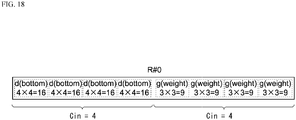
- FIG. 18 is a diagram for describing the problem, and is a schematic view of the bank R#0 of the register G#0 of DPE0.
- each bank R#0 to R#7 is made to correspond one-to-one with the batch number N, and the sub-bottom matrix d and the weight matrix g having the same input channel number Cin are stored in one bank.
- the sub-bottom matrix d and the weight matrix g having the same input channel number Cin are stored in one bank.
- the number of elements to be stored in the bank R#0 is 4 ⁇ t 2 + 4 ⁇ 3 2 .
- t needs to be 4 or less in order that the number of elements does not exceed 127.
- FIG. 19 is a hardware configuration diagram of an information processing device 31 in accordance with an embodiment.
- the information processing device 31 is a computer such as a personal computer (PC) for generating programs executable by the computing machine 10 (see FIG. 5 ), and includes a storage device 32, a main memory 33, a processor 34, an input device 35, and a display device 36. These components are connected to each other through a bus 37.
- PC personal computer
- the storage device 32 is a secondary storage device such as, but not limited to, a hard disk drive (HDD) or a solid state drive (SSD), and stores an information processing program 39 in accordance with the embodiment.
- HDD hard disk drive
- SSD solid state drive
- Execution of the information processing program 39 allows programs executable by the computing machine 10 (see FIG. 5 ) to be generated as described later.
- the information processing program 39 may be stored in a storage medium 38 that is readable by a computer and the processor 34 may be caused to read the information processing program 39 in the storage medium 38.
- Examples of the storage medium 38 include a physical portable storage medium such as, but not limited to, a compact disc-read only memory (CD-ROM), a digital versatile disc (DVD), and a universal serial bus (USB) memory.
- a semiconductor memory such as a flash memory or a hard disk drive may be used as the storage medium 38.
- These storage media 38 are not temporal storage media such as carrier waves that have no physical form.
- the information processing program 39 may be stored in a device connected to a public network, the Internet, or a local area network (LAN), and the processor 34 may read the information processing program 39 and execute it.
- a public network the Internet
- LAN local area network
- the main memory 33 is a hardware device, such as a Dynamic Random Access Memory (DRAM), that temporarily stores data, and the information processing program 39 is expanded on the main memory 33.
- DRAM Dynamic Random Access Memory
- the processor 34 is a hardware device that controls each component of the information processing device 31 and executes the information processing program 39 in cooperation with the main memory 33, such as a central processing unit (CPU).
- CPU central processing unit
- the input device 35 is an input device such as a keyboard and a mouse operated by a user.
- the display device 36 is a display device, such as a liquid crystal display, that displays various commands used by the user during execution of the information processing program 39.
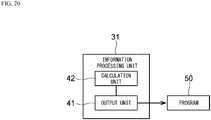
- FIG. 20 is a functional block diagram of the information processing device 31 in accordance with the embodiment. As illustrated in FIG. 20 , the information processing device 31 includes an output unit 41 and a calculation unit 42. Each unit is implemented by the execution of the aforementioned information processing program 39 in cooperation between the processor 34 and the main memory 33.
- the output unit 41 is a functional block that generates a program 50 executable by the computing machine 10 (see FIG. 5 ).
- the program may be a file in which an intermediate code is written or an executable binary file.
- the calculation unit 42 is a functional block that optimizes various parameters in the program 50.
- the parameter includes a size t of the sub-bottom matrix d to be segmented from the bottom matrix as illustrated in FIG. 4A to FIG. 4C .
- the number q of banks described later is an example of the parameter to be optimized.
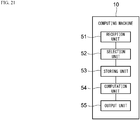
- FIG. 21 is a functional block diagram of the computing machine 10 implemented by execution of the program 50.
- the computing machine 10 includes a reception unit 51, a selection unit 52, a storing unit 53, a computation unit 54, and an output unit 55. These units are implemented by execution of the program 50 in cooperation between the main memory 11 and the DLU 12 in FIG. 5 .
- the reception unit 51 receives input of the bottom matrix and the weight matrix.
- the selection unit 52 selects the t ⁇ t sub-bottom matrix d from the bottom matrix as illustrated in FIG. 4A to FIG. 4C .
- the value of the size t is optimized by the calculation unit 42, and the selection unit 52 selects the sub-bottom matrix d by using the optimized size t.
- the storing unit 53 stores the elements of each of the sub-bottom matrix d and the weight matrix g in the banks R#0 to R#7 of DPE0 to DPE7.
- the computation unit 54 computes the convolution by using the elements stored in the banks R#0 to R#7.
- the output unit 55 outputs the sub-top matrix y (see FIG. 4A to FIG. 4C ) that is the computational result of the convolution.
- the storing unit 53 is a functional block that stores the elements of each array read from the main memory 11 into the banks R#0 to R#7, but uses different storing methods between the forward process and the backward process.
- the storing unit 53 sorts the elements of each array read from the main memory 11 as presented by the following expression (5), and stores each element to the banks R#0 to R#7 of DPE0 to DPE7.
- the array y is an array for storing the elements of the sub-top matrix obtained by convolution between the sub-bottom matrix d and the weight matrix g.
- the weight matrix g is an example of a first matrix
- the t ⁇ t sub-bottom matrix d is an example of a second matrix.
- (Cin major , Cin minor ) (the number of Cin major ) ⁇ (the number of Cin minor ).
- Cin major , Cin minor the input channel number Cin.
- (N major , N minor ) (the number of N major ) ⁇ (the number of N minor ), and the batch number N can be identified by the combination (N major , N minor ).
- the combination (N major , N minor ) is equated with the batch number N.
- one sub-bottom matrix d can be identified by identifying the input channel number Cin and the batch number N.
- the input channel number Cin in this example is an example of a first identifier that identifies the sub-bottom matrix d as described above.
- the batch number N in this example is an example of a second identifier that identifies the sub-bottom matrix d.
- the elements [H][W] in the array d correspond to the elements of the t ⁇ t sub-bottom matrix d.
- the elements [H'][W'] of the array g correspond to the elements of the 3 ⁇ 3 weight matrix g.
- the total number of the input channel numbers Cin of the array g is four, which is equal to the number of the input channel numbers of the array d.
- the total number of the output channel numbers Cout is eight.
- FIG. 22 illustrates the contents of the registers G#0 of DPE0 to DPE7 in which each array d, g is stored by the storing unit 53 when the forward process is performed.
- each of a plurality of computation cores computes the convolution between the matrices d and g stored in the corresponding bank of the banks R#0 to R#7. Since the convolution is computed in parallel in the plurality of computation cores, the computational speed of the convolution can be increased. This is also the case for the DPE1 to DPE7.
- the array d of the arrays d and g is stored in the banks R#0 to R#7 of DPE0 to DPE7 by the sequential method in the same manner as FIG. 13 .
- the arrays d with the same Cin major are stored in the banks R#0 to R#7 at one time.
- the arrays d with the different Cin major are stored in the banks R#0 to R#7.
- Cin minor is the lowest-level index of the array d and N minor is the one-level higher index as presented by the expression (5), each bank corresponds one-to-one with Cin minor within the range of the same N minor .
- q sub-bottom matrices d of which the input channel numbers (Cin major , Cin minor ) are different from each other and the batch numbers (N major , N minor ) are the same are stored in q banks in one DPE.
- q computation cores can compute the convolution of q sub-bottom matrices d having the same batch number N in parallel.
- the storing unit 53 stores the weight matrix g in each bank of DPE0 to DPE7 from the main memory 11 by the multicast method in the same manner as the example of FIG. 13 .
- the storing unit 53 stores the weight matrix g having the same input channel number Cin as the sub-bottom matrix d in each bank of each of DPE0 to DPE7.
- the computation unit 54 can compute convolution between the matrices d and g of which the input channel numbers Cin are equal to each other as illustrated in FIG. 2 .
- the computation unit 54 sorts the elements of the array g as follows.
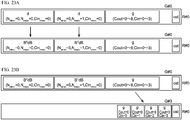
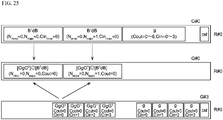
- FIG. 23A to FIG. 25 illustrate the contents of the registers G#0 to G#3 of DPE0 when the computation unit 54 computes the convolution with the Winograd algorithm.
- FIG. 23A to FIG. 25 only the banks R#0 of the registers G#0 to G#3 are illustrated to prevent the drawings from being complicating.
- the elements of the arrays d and g are stored in the bank R#0 of the register G#0.
- the array d is multiplied by the matrices B T and B from both sides of the array d, and the resulting matrix B T dB is stored in the line in which the array d is also stored.
- the elements of the matrices B T and B are stored in the constant area cst of the bank R#0.
- the array g representing the weight matrix has disordered regularity as illustrated in FIG. 15 .
- the elements of the array g stored in the bank R#0 of the register G#0 are sorted by transferring each element to the bank R#0 of the register G#3.
- the array g is multiplied by the matrices G and G T from both sides of the array d, and the resulting matrix GgG T is stored in a free space of the bank.
- the elements of the matrices G and G T are stored in the constant area cst of the bank R#0.
- the element-wise multiplication " ⁇ " of the equation (2) is performed on two matrices B T dB in the bank R#0 of the register G#0 and one matrix GdG T in the bank R#0 of the register G#3.
- the convolution is performed on two matrices having the same input channel number Cin as described with reference to FIG. 2 .
- [GgG T ] ⁇ [B T dB] is multiplied by the matrices A T and A from both sides of [GgG T ] ⁇ [B T dB] according to the equation (2) to obtain the sub-top matrix y.
- the bottom matrices with different batch numbers N are stored in the bank R#0 of the register G#0.
- the number of the sub-bottom matrices d stored in one bank is reduced compared to the example where a plurality of the sub-bottom matrices d with the same batch number N and different input channel numbers Cin are stored in the same bank as illustrated in FIG. 17 .
- the size t of the bottom matrix d can be increased, and the convolution can be computed at high speed with the Winograd algorithm.
- the value of t is to be made to be as large as possible.
- t is made to be too large, it becomes impossible to store the sub-bottom matrix d in each of the banks R#0 to R#7.
- the value of t is small, the sub-bottom matrix d can be reliably stored in each of the banks R#0 to R#7, but the computation time of the convolution becomes long.
- the optimal value of t is obtained as follows. First, the parameters are defined as follows.
- Cin' is the number of the input channel numbers Cin to be processed at one time in DPE0 as described above.
- Cout' is the number of the output channel numbers Cout to be processed at one time in DPE0 as described above.
- Cout' 8.
- N' is the number of the batch numbers N to be processed at one time in DPE0 as described above.
- the computation time of the convolution will be examined.
- the computation time when the matrix B T dB is obtained from the t ⁇ t sub-bottom matrix d as illustrated in FIG. 23A will be examined.
- B T d is computed first, and then, the computational result is multiplied by the matrix B from the right of the computational result.
- the t ⁇ t sub-bottom matrix d is decomposed into t column vectors, and the products of the column vectors and the matrix B T are calculated.
- the computation time required for calculating the product of one of the t column vectors, which constitute the t ⁇ t sub-bottom matrix d, and the matrix B T is represented by b(t).
- the computation time required for obtaining B T dB in one DPE is expressed by the following expression (6).
- the expression (6) includes "t" is because the computation time that is t times longer than the computation time expressed by the function b(t) is required because the matrix B T needs to be multiplied by the t column vectors of the sub-bottom matrix d to obtain B T d. Similarly, the matrix B T d needs to be multiplied by the t column vectors of the matrix B to obtain the product of the matrices B T d and B. Thus, the total computation time becomes (t + t) times the computation time expressed by the function b(t). Therefore, the expression (6) includes the factor "t + t".
- Cin' ⁇ N' sub-bottom matrices d are in one DPE, the number of the sub-bottom matrices d per bank becomes Cin' ⁇ N'/q. Since each of the computation cores C#0 to C#7 needs to calculate B T dB with respect to each of Cin' ⁇ N'/q sub-bottom matrices d in the corresponding bank, the expression (6) includes the factor Cin' ⁇ N'/q.
- GgG T For example, Gg is calculated first, and then, the computational result is multiplied by the matrix G T from the right of the computational result.
- the weight matrix g is decomposed into three column vectors, and the products of the column vectors and the matrix G are calculated.
- the computation time required for obtaining the product of one of the three column vectors, which constitute the 3 ⁇ 3 weight matrix g, and the matrix G is represented by w(t).
- the computation time required for obtaining GgG T in one DPE is expressed by the following expression (7). 3 + t ⁇ w t ⁇ Cin ⁇ ⁇ Cout ⁇ ⁇ 1 p
- the reason why the expression (7) includes "3" is because the computation time that is three times longer than computation time expressed by the function w(t) is required since the matrix G needs to be multiplied by the three column vectors of the weight matrix g to obtain the matrix Gg.
- the matrix Gg needs to be multiplied by the t column vectors of the matrix G T .
- the total computation time becomes (t + 3) times longer than the computation time expressed by the function w(t). Therefore, the expression (7) includes the factor "t + 3".
- Cin' ⁇ Cout' weight matrices g are in one DPE, the number of weight matrices g in one bank becomes Cin' ⁇ Cout'/p. Since each of the computation cores C#0 to C#7 needs to obtain GgG T with respect to each of Cin' ⁇ Cout'/p sub-bottom matrices d in the corresponding bank, the expression (7) includes the factor Cin' ⁇ Cout'/p.
- the number of sub-bottom matrices d stored in one DPE is N' ⁇ Cin' ⁇ Cout'/p. Moreover, the number of elements of the sub-bottom matrix d is t 2 . Therefore, the number of times of multiplication when element-wise multiplication between the matrices B T dB and GgG T is performed is expressed by the following expression (8). t 2 ⁇ N ⁇ ⁇ Cin ⁇ ⁇ Cout ⁇ ⁇ 1 p
- the expressions (6) to (8) are the computation time when N' batch numbers are selected from N batch numbers, Cout' output channel numbers are selected from Cout output channel numbers, and Cin' input channel numbers are selected from Cin input channel numbers. Therefore, to compute the convolution between all bottom matrices and all weight matrices in FIG. 2 , the computation needs to be performed as many times as the number of times expressed by the following expression (9). HW t ⁇ 2 2 ⁇ Cin Cin ⁇ ⁇ N N ⁇ ⁇ Cout p
- the factor HW/(t - 2) 2 in the expression (9) represents the total number of ways to segment the t ⁇ t submatrix from the H ⁇ W bottom matrix.
- the computation time depends on not only t but also q.
- the computation time when the convolution is computed in one DPE is expressed by a first function f(t, q).
- the first function f(t, q) is expressed by the following expression (10) by multiplying the sum of the expressions (6) and (7) by the expression (9).
- the combination of t and q that minimizes the value of the first function f(t, q) needs to be found under the condition that the number of elements of the weight matrices g and the sub-bottom matrices d does not exceed the number of elements that the register can store therein.
- the number of elements of the sub-bottom matrices d and the weight matrices g will be examined next.
- the number of elements of the sub-bottom matrices d will be described.
- E b t 2 ⁇ Cin ⁇ ⁇ N ⁇ q
- t 2 represents the number of elements of one sub-bottom matrix d.
- Cin' ⁇ N'/q represents the number of sub-bottom matrices d to be stored in one bank.
- 3 2 is the number of elements of one weight matrix g.
- Cin' ⁇ Cout'/p is the number of weight matrices g to be stored in one bank.
- a second function g(t, q) representing the total number of elements of the sub-bottom matrices d and the weight matrices g are expressed by the following equation (13).
- the computational speed of the convolution can be increased by finding the combination of t and q that minimizes the value of the first function f(t, q) expressed by the expression (10) from among the combinations of t and q that satisfy the constraint condition of the equation (14).
- the calculation unit 42 calculates the combination of t and q that minimizes the value of the first function f(t, q) expressed by the expression (10) from among the combinations of t and q that satisfy the constraint condition of the equation (14).
- the calculation unit 42 can find the combinations of t and q that satisfy the equation (14) by an exhaustive search, and can identify the combination that minimizes the value of the first function f(t, q) of the expression (10) from among the found combinations.
- b(t) and w(t) are treated as known functions.
- b(t) and w(t) can be obtained as follows.
- w(t) is the computation time required for obtaining the product of one of the three column vectors, which constitute the 3 ⁇ 3 weight matrix g, and the matrix G when Gg is calculated.
- t 6
- the elements of the matrix G are expressed by the following equation (15).
- G 1 4 0 0 ⁇ 1 6 ⁇ 1 6 ⁇ 1 6 ⁇ 1 6 1 6 ⁇ 1 6 1 24 1 12 1 6 1 24 ⁇ 1 12 1 6 0 0 1
- G'g is calculated first, and then, the calculated G'g is multiplied by G" from the left of G'g.
- G'g the method of calculating G'g will be described.
- G'g' can be expressed by the following equation (19).
- (x 0 , x 1 , x 2 , x 3 , x 4 , x 5 ) T is a variable that stores each element of G'g' therein.
- the equation (19) can be calculated by plugging in a value for each array element in the order of FIG. 26 .
- FIG. 26 is a schematic view illustrating the calculation of the equation (19) in the order of steps.
- "//" in FIG. 26 is a comment statement indicating the meaning of each step. The same applies to FIG. 27 described later.
- G'g' can be calculated in eight steps.
- w(6) 8.
- the value of w(t) can be obtained in the same manner as described above.
- b(t) is the computation time required for obtaining the product B T d of one of the t column vectors, which constitute the t ⁇ t sub-bottom matrix d, and the matrix B T .
- B T 4 0 ⁇ 5 0 1 0 0 ⁇ 4 ⁇ 4 1 1 0 0 4 ⁇ 4 ⁇ 1 1 0 0 ⁇ 2 ⁇ 1 2 1 0 0 2 ⁇ 1 ⁇ 2 1 0 0 4 0 ⁇ 5 0 1
- one column d' of the 6 ⁇ 6 sub-bottom matrix d is described as (d 0 , d 1 , d 2 , d 3 , d 4 , d 5 ) T .
- B T d' can be expressed by the following equation (21).
- (x 0 , x 1 , x 2 , x 3 , x 4 , x 5 ) T is a variable that stores the elements of B T d' therein.
- the equation (21) can be calculated by plugging in a value for each array element in the order of FIG. 27 .
- FIG. 27 is a schematic view illustrating the calculation of the equation (21) in the order of steps.
- (a[0], a[1], a[2], a[3], a[4], a[5]) (x 0 , x 1 , x 2 , x 3 , x 4 , x 5 ) eventually, and the computational result of B T d' can be stored in each of the array elements a[0], a[1], a[2], a[3], a[4], and a[5].
- the information processing device 31 in accordance with the present embodiment executes the following information processing method.
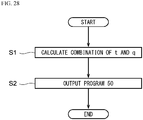
- FIG. 28 is a flowchart of an information processing method in accordance with the present embodiment.
- the calculation unit 42 calculates the combination of t and q.
- the calculation unit 42 calculates the combination that minimizes the value of the first function f(t, q) of the expression (10) among the combinations of t and q that satisfy the constraint condition of the equation (14). This allows the combination that minimizes the computation time to be obtained from among the combinations of t and q that allow the elements of the weight matrix g and the t ⁇ t sub-bottom matrix d to be stored in q banks.
- step S2 the output unit 41 (see FIG. 20 ) outputs the program 50 executable by the computing machine 10 (see FIG. 5 ).
- step S1 The combination of t and q calculated in step S1 is used in the program 50.
- the selection unit 52 selects the t ⁇ t sub-bottom matrix d from the bottom matrix.
- the storing unit 53 stores the t ⁇ t sub-bottom matrix d and the weight matrix g in q banks of the banks R#0 to R#7 of DPEO. Thereafter, the computation unit 54 computes the convolution between the sub-bottom matrix d and the weight matrix g with use of the Winograd algorithm according to the procedures of FIG. 23A to FIG. 25 .
- the calculation unit 42 calculates the combination of t and q that minimizes the first function f(t, q) that represents the computation time of the convolution under the constraint condition of the equation (14) that the sub-bottom matrix d and the weight matrix g can be stored in one bank.
- the convolution can be computed at high speed with use of the sub-bottom matrix d and the weight matrix g while the sub-bottom matrix d and the weight matrix g are stored in the bank of the register.
- the convolution in the forward process of deep learning is computed with the Winograd algorithm.
- the backward process includes a process of obtaining the bottom matrix by convolution between the top matrix and the weight matrix and a process of obtaining the weight matrix by convolution between the top matrix and the bottom matrix.
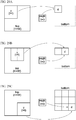
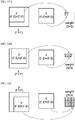
- FIG. 29A to FIG. 29C are schematic views when the convolution between the top matrix and the weight matrix is computed with the Winograd algorithm in the backward process.
- the selection unit 52 selects the t ⁇ t sub-top matrix y from the H-row W-column top matrix.
- the computation unit 54 obtains the sub-bottom matrix d by convolution between the weight matrix g and the sub-top matrix y.
- d A T GgG T ⁇ B T yB A
- the position in which the sub-top matrix y is segmented from the top matrix is shifted by two columns from the position of the case in FIG. 29A , and the segmented sub-top matrix y undergoes the same calculation as described above.
- the resulting sub-bottom matrix d forms a block next to the sub-bottom matrix d obtained in FIG. 29A in the bottom matrix.
- the bottom matrix formed from the sub-bottom matrices d is obtained as illustrated in FIG. 29C .
- the weight matrix g is an example of a first matrix
- a t ⁇ t sub-top matrix y is an example of the second matrix
- the storing unit 53 sorts the elements of each array as expressed by the following expression (23), and stores the elements in the banks R#0 to R#7 of DPEO to DPE7.
- N is a batch number
- (the number of N) (the number of N major ) ⁇ (the number of N minor )
- (the number of Cout) (the number of Cout major ) ⁇ (the number of Cout minor ).
- the batch number N is identified by the combination (N major , N minor ).
- the batch number N is an example of a second identifier for identifying the sub-top matrix y.
- the output channel number Cout is also identified by the combination (Cout major , Cout minor ).
- the output channel number Cout is a first identifier for identifying the sub-top matrix y.
- the elements [H"][W"] in the array y correspond to the elements of the t ⁇ t sub-top matrix y.
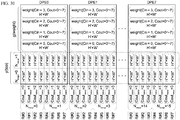
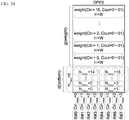
- FIG. 30 illustrates the contents of the registers G#0 of DPE0 to DPE7 in which the arrays y and g are stored by the storing unit 53.
- the array y is stored in the banks R#0 to R#7 of DPE0 to DPE7 by the sequential method by the storing unit 53.
- Cout minor is the lowest-level index of the array y and N minor is the next higher level index as presented in the expression (23).
- each bank corresponds one-to-one with Cout minor within the range of the same N minor .
- the q sub-top matrices y with different output channel numbers (Cout major , Cout minor ) and the same batch number (N major , N minor ) are stored in q banks in one DPE.
- the convolution of the q sub-top matrices y having the same batch number N can be computed in the q computation cores in parallel.
- the weight matrix g is transferred, by the storing unit 53, from the main memory 11 to DPE0 to DPE7 by the multicast method as in the example of FIG. 22 .
- the computation unit 54 sorts the array g as in FIG. 23A to FIG. 25 .
- the first function f(t, q) representing the computation time when the convolution is computed in one DPE can be expressed by the following equation (28) by multiplying the sum of the expressions (24) to (26) by the expression (27).
- f t q HW t ⁇ 2 2 ⁇ N N ⁇ ⁇ Cout ⁇ 1 p 2 tb t N ⁇ Cin ⁇ p q + 3 + t w t + t 2 N ⁇
- E y of elements of the sub-top matrices y in one bank of one DPE can be expressed by the following equation (29) by substituting Cin' in the equation (11) with Cout'.
- E y t 2 ⁇ Cout ⁇ ⁇ N ⁇ q
- the number E w of elements of the weight matrices g in one bank of one DPE can be expressed by the following equation (30) as with the equation (12).
- E w 3 2 ⁇ Cin ⁇ ⁇ Cout ⁇ p
- the second function g(t, q) representing the total number of elements of the sub-top matrices y and the weight matrices g can be expressed by the following equation (31).
- the computational speed of the convolution can be increased by finding the combination of t and q that minimizes the value of the first function f(t, q) of the equation (28) from among the combinations of t and q that satisfy the constraint condition of the equation (32).
- the calculation unit 42 identifies the combinations of t and q that satisfy the constraint condition of the equation (32). Then, the calculation unit 42 calculates the combination of t and q that minimizes the value of the first function f(t, q) of the equation (28) from among the identified combinations to increase the computational speed of the convolution.
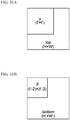
- FIG. 31A to FIG. 32C are schematic views when the convolution between the top matrix and the bottom matrix is computed with the Winograd algorithm in the backward process.
- the selection unit 52 selects the t' ⁇ t' sub-top matrix y from the H ⁇ W top matrix.
- the selection unit 52 selects the (t' - 2) ⁇ (t' - 2) sub-bottom matrix d from the H' ⁇ W' bottom matrix.
- the position in which the matrix y' is selected from the sub-top matrix y is shifted by one column from the position of the case of FIG. 32A , and the computation unit 54 performs the same calculation as described above on the selected matrix y' to obtain 12 components of the weight matrix g.
- each element of the 3 ⁇ 3 weight matrix g is obtained as illustrated in FIG. 32C .
- the computation of convolution between the top matrix and the bottom matrix in the backward process is completed.
- the (t' - 2) ⁇ (t' - 2) sub-bottom matrix d is an example of a first matrix
- the t' ⁇ t' sub-top matrix y is an example of a second matrix.
- the storing unit 53 sorts the elements of each array as expressed by the following expression (34), and then stores each element to the banks R#0 to R#7 of DPEO to DPE7.
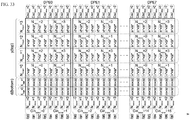
- FIG. 33 illustrates the contents of the registers G#0 of DPE0 to DPE7 in which the arrays y and d are stored by the storing unit 53.
- the array d is stored in the banks R#0 to R#7 of DPE0 to DPE7 by the sequential method by the storing unit 53.
- N minor is the lowest-level index of the array d and Cin minor is the next higher level index as presented in the expression (34).
- each bank corresponds one-to-one with N minor within the range of the same Cin minor .
- the q sub-bottom matrices d having different batch numbers (N major , N minor ) and the same input channel number (Cin major , Cin minor ) are stored in the q banks in one DPE.
- the convolution of q sub-bottom matrices d with the same input channel number Cin can be computed by q computation cores in parallel.
- the sub-top matrix y is transferred from the main memory 11 to DPE0 to DPE7 by the multicast method by the storing unit 53.
- Cout minor is the lowest-level index of the array y and N minor is the next higher level index as presented in the expression (34).
- the total number of Cout minor is 4 and the total number of N minor is 4.
- the elements of the array y with the same Cout minor value are stored in one bank.
- the computation time for obtaining B T dB expressed by the equation (33) in one DPE will be expressed by the following expression (36) by respectively substituting 3, t, and cout' in the expression (25) with t' - 2, t', and N'.
- the first function f(t, q) representing the computation time when the convolution is computed in one DPE can be expressed by the following equation (39) by multiplying the sum of the expressions (35) to (37) by the expression (38).
- f t q HW t ⁇ ⁇ 2 2 ⁇ Cin Cin ⁇ ⁇ N ⁇ Cout Cout ⁇ 2 t ⁇ b t Cout ⁇ q + 2 t ⁇ ⁇ 1 w t ⁇ Cin ⁇ p + t ⁇ 2 Cin ⁇ Cout ⁇ p
- the number of elements of the sub-top matrix y will be described.
- the number E y of elements of the sub-top matrices y in one bank of one DPE can be expressed by the following equation (40).
- E y t ⁇ 2 ⁇ N ⁇ ⁇ Cin ⁇ p
- t 2 is the number of elements of one sub-top matrix y.
- N' Cin'/p is the number of sub-top matrices y to be stored in one bank.
- E d t ⁇ ⁇ 2 2 ⁇ N ⁇ ⁇ Cout ⁇ p
- (t' - 2) 2 is the number of elements of one sub-bottom matrix d.
- N' Cout'/p is the number of sub-bottom matrices d to be stored in one bank.
- the second function g(t, q) representing the total number of elements of the sub-top matrices y and the weight matrices g can be expressed by the following equation (42).
- the computational speed of the convolution can be increased by finding the combination of t and q that minimizes the value of the first function f(t, q) of the equation (39) from among the combinations of t and q that satisfy the constraint condition of the equation (43).
- the calculation unit 42 identifies the combinations of t and q that satisfy the constraint condition of the equation (43). Then, the calculation unit 42 calculates the combination of t and q that minimizes the value of the first function f(t, q) of the equation (39) among the identified combinations to increase the computational speed of the convolution.
- 1 ⁇ 1 convolution may be performed.
- ResNet-50 or ResNet 101 uses 1 ⁇ 1 convolution.
- 1 ⁇ 1 convolution in the present embodiment will be described.
- the matrix to be subject to 1 ⁇ 1 convolution is not particularly limited, hereinafter, convolution between the sub-bottom matrix d and the weight matrix g will be described.
- the storing unit 53 stores the elements of each matrix in the corresponding array expressed by the expression (44), and stores the elements in the banks R#0 to R#7 of DPE0 to DPE7.
- FIG. 34 illustrates the contents of the register G#0 of DPE0 in which the arrays d and g are stored by the storing unit 53 when 1 ⁇ 1 convolution is performed.
- the array d is stored in DPE0 to DPE7 by the sequential method as illustrated in FIG. 22 , whereas, in this example, the array d is stored in DPE0 to DPE7 by the multicast method.
- the array g is stored in the bank R#0 by the multicast method.
- the computation unit 54 performs convolution according to the procedure illustrated in FIG. 3A to FIG. 3C by using the elements stored in the banks R#0 to R#7. Batch Normalization
- the performance may be increased by performing batch normalization.
- the batch normalization is a normalization method that makes the average value of pixel data of each image 0 and makes the distribution of the pixel data 1 when the values of pixel data greatly differs among a plurality of images. This method will be described hereinafter.
- the storing unit 53 sorts the elements of each array d, y as expressed by the following expression (45), and stores the elements in the banks R#0 to R#7 of DPE0 to DPE7 by the multicast method.
- the batch normalization is applicable to both the bottom matrix and the top matrix.
- the batch normalization is performed on the sub-bottom matrix d that is part of the bottom matrix.
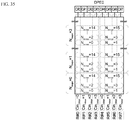
- FIG. 35 illustrates the contents of the register G#0 of DPE0 in which the sub-bottom matrix d is stored by the storing unit 53 when the batch normalization is performed.
- the storing unit 53 stores the sub-bottom matrix d in the bank R#0 by the multicast method.
- Cin minor is the lowest-level index of the sub-bottom matrix d.
- N minor is the higher level index than Cin minor .
- the elements with different batch numbers (N major , N minor ) are stored in the one bank.
- each of the computation cores C#0 to C#7 can calculate the average of a plurality of elements with the same Cin minor and different batch numbers (N major , N minor ) and the dispersion of these elements by using only the corresponding one bank.
- FIG. 36A and FIG. 36B illustrate the contents of the register G#0 of DPE0, and are diagrams for describing the calculation performed by the computation unit 54 when the batch normalization is performed.
- the computation core C#0 adds up the values of the elements of the sub-bottom matrix d in the bank R#0, and stores the obtained value x 0 in the line L sum_1 of the bank R#0. Also in other banks R#1 to R#7, each of the computation cores C#1 to C#7 adds up the values of the elements of the sub-bottom matrix d in the corresponding bank, and then stores the obtained values x 1 to x 7 to the line L sum_1 of the banks R#1 to R#7, respectively.
- the value x 0 becomes not the sum of the elements of all batch numbers (N major , N minor ) but the sum of the values of the elements of which N minor is an even number.
- the computation unit 54 adds up the values corresponding to the same Cin minor among the values x 0 to x 7 .
- the computation unit 54 adds up both values and write the result in the value x 0 .
- the computation unit 54 performs the following calculations.
- the computation core C#0 calculates the average value m 0 by dividing the value x 0 stored in the bank R#0 by the batch number, and stores the obtained average value m 0 in the line L mean of the bank R#0. Also in the banks R#1 to R#3, the computation cores C#1 to C#3 calculate the average values m 1 to m 3 of the values x 1 to x 3 , respectively, and stores these values in the lines L mean of the banks R#1 to R#3, respectively.
- the computation core C#0 squares the value of each element of the sub-bottom matrix d in the bank R#0, and stores the value y 0 obtained by summing the obtained values in the line L sum_2 of the bank R#0. Also in other banks R#1 to R#7, each of the computation cores C#1 to C#7 squares the value of each element in the corresponding bank, sums the obtained values, and stores the obtained value y 1 to y 7 to the line L sum_2 of the corresponding one of the banks R#1 to R#7.
- the value y 0 is not the sum of the squares of the values of the elements across all batch numbers (N major , N minor ) but the value obtained by summing only the values that are squares of the values of the elements of which N minor is an even number.
- the computation unit 54 performs the following calculation, and writes the sum of the squares of the elements of the sub-bottom matrix d across all batch numbers (N major , N minor ) in the values y 0 to y 3 .
- y 0 y 0 + y 4
- the computation core C#0 calculates the average value a 0 by dividing the value y 0 stored in the bank R#0 by the batch number, and stores the calculated average value a 0 in the line L mean _ 2 of the bank R#0. Also in the banks R#1 to R#3, the computation cores C#1 to C#3 calculate the average values a 1 to a 3 of the values y 1 to y 3 , and stores these values in the lines L mean_2 of the banks R#1 to R#3, respectively.
- the computation unit 54 performs the following calculation to calculate the dispersions v 1 to V3 of the elements of the banks R#1 to R#3, and stores the dispersions v 1 to v 3 in the lines L var of the banks R#1 to R#3, respectively.
- v 1 a 1 ⁇ m 1 2
- v 2 a 2 ⁇ m 2 2
- v 3 a 3 ⁇ m 3 2
- d N major Cin major H W N minor i 1 v i d N major Cin major H W N minor i ⁇ m i
Landscapes
- Engineering & Computer Science (AREA)
- Physics & Mathematics (AREA)
- Theoretical Computer Science (AREA)
- General Physics & Mathematics (AREA)
- Mathematical Physics (AREA)
- Data Mining & Analysis (AREA)
- General Engineering & Computer Science (AREA)
- Software Systems (AREA)
- Computing Systems (AREA)
- Mathematical Optimization (AREA)
- Pure & Applied Mathematics (AREA)
- Mathematical Analysis (AREA)
- Computational Mathematics (AREA)
- Biophysics (AREA)
- Biomedical Technology (AREA)
- Life Sciences & Earth Sciences (AREA)
- Health & Medical Sciences (AREA)
- Molecular Biology (AREA)
- General Health & Medical Sciences (AREA)
- Evolutionary Computation (AREA)
- Computational Linguistics (AREA)
- Artificial Intelligence (AREA)
- Algebra (AREA)
- Databases & Information Systems (AREA)
- Neurology (AREA)
- Complex Calculations (AREA)
Abstract
Description
- A certain aspect of embodiments described herein relates to an information processing device, an information processing program, and an information processing method.
- Machine learning using a multi-layer neural network is called deep learning, and is applied to various fields. Various calculations are performed in each layer of the deep learning. For example, in the convolution layer, convolution between image data and a filter is performed, and the result thereof is output to a subsequent layer. Since the convolution is an operation between matrices, the calculation amount thereof is large, causing a delay in the processing speed of learning. Therefore, the Winograd algorithm has been proposed as an algorithm for reducing the calculation amount of the convolution. Note that the techniques related to the present disclosure is also disclosed in "Fast Algorithms for Convolutional Neural Networks", Andrew Lavin et al., The IEEE Conference on Computer Vision and Pattern Recognition (CVPR), 2016, pp. 4013 - 4021 and "Deep Residual Learning for Image Recognition", Kaiming He et al., The IEEE Conference on Computer Vision and Pattern Recognition (CVPR), 2016, pp. 770 - 778.
- However, the Winograd algorithm has room for improvement in terms of a further increase in the processing speed of the convolution.
- The present invention has been made in view of those circumstances, and an object thereof is to increase the computational speed of convolution.
- According to an aspect of the embodiments, there is provided an information processing device including: a calculation unit configured to calculate a combination of t and q that minimizes a computation time when q computation cores compute convolution between a plurality of first matrices and a plurality of second matrices of t-row t-column with Winograd algorithm in parallel, where a total number of elements of the plurality of first matrices and the plurality of second matrices does not exceed a number of sets of data that can be stored in each of q storage areas of a register, and the q computation cores respectively correspond to the q storage areas; and an output unit configured to output a program for causing a computing machine to execute a process including: storing the plurality of first matrices and the plurality of second matrices in each of the q storage areas with use of a calculated combination of t and q, and computing convolution between the first matrix and the second matrix with use of the Winograd algorithm by each of the q computation cores, the computing machine including the q computation cores and the register.
-
-
FIG. 1 schematically illustrates a processing flow of deep learning; -
FIG. 2 schematically illustrates convolution performed in a convolution layer; -
FIG. 3A to FIG. 3C schematically illustrate convolution between a bottom matrix and a weight matrix; -
FIG. 4A to FIG. 4C schematically illustrate the Winograd algorithm in a forward process; -
FIG. 5 is a hardware configuration diagram of a computing machine for performing the convolution in deep learning; -
FIG. 6A is a hardware configuration diagram of one DPU-chain, andFIG. 6B is a hardware configuration diagram of one DPU; -
FIG. 7 is a hardware configuration diagram of each DPE; -
FIG. 8 is a hardware configuration diagram of DPE0; -
FIG. 9 is a diagram for describing line numbers assigned tobanks R# 0 toR# 7; -
FIG. 10A to FIG. 10C are schematic views (No. 1) for describing a sequential method; -
FIG. 11A to FIG. 11C are schematic views (No. 2) for describing the sequential method; -
FIG. 12 is a schematic view for describing a multicast method; -
FIG. 13 schematically illustrates the contents of aregister G# 0 of each DPE; -
FIG. 14 schematically illustrates array elements of an array g in a main memory; -
FIG. 15 illustrates the contents of theregister G# 0 of DPE0 immediately after the array elements are transferred by the multicast method; -
FIG. 16 illustrates the contents of theregister G# 0 of DPE0 after sorting; -
FIG. 17 illustrates the contents of theregisters G# 0 of DPE0 to DPE7 after sorting; -
FIG. 18 is a schematic view of thebank R# 0 of theregister G# 0 of DPE0; -
FIG. 19 is a hardware configuration diagram of an information processing device in accordance with an embodiment; -
FIG. 20 is a functional configuration diagram of the information processing device in accordance with the embodiment; -
FIG. 21 is a functional block diagram of a computing machine; -
FIG. 22 illustrates the contents of theregisters G# 0 of DPE0 to DPE7 in which arrays d and g are stored by a storing unit when the forward process is performed in the embodiment; -
FIG. 23A and FIG. 23B are diagrams (No. 1) illustrating the contents ofregisters G# 0 toG# 3 of DPE0 when a computation unit performs the convolution with the Winograd algorithm in the embodiment; -
FIG. 24 is a diagram (No. 2) illustrating the contents of theregisters G# 0 toG# 3 of DPE0 when the computation unit performs the convolution with the Winograd algorithm in the embodiment; -
FIG. 25 is a diagram (No. 3) illustrating the contents of theregisters G# 0 toG# 3 of DPE0 when the computation unit performs the convolution with the Winograd algorithm in the embodiment; -
FIG. 26 is a schematic view illustrating the calculation of the equation (19) of the embodiment in the order of steps; -
FIG. 27 is a schematic view illustrating the calculation of the equation (21) of the embodiment in the order of steps; -
FIG. 28 is a flowchart of an information processing method in accordance with the embodiment; -
FIG. 29A to FIG. 29C are schematic views when the convolution between a top matrix and a weight matrix is performed with the Winograd algorithm in a backward process in accordance with the embodiment; -
FIG. 30 illustrates the contents of theregisters G# 0 of DPE0 to DPE7 in which arrays y and g are stored by the storing unit in accordance with the embodiment; -
FIG. 31A and FIG. 31B are schematic views of the convolution between the top matrix and a bottom matrix performed with the Winograd algorithm in the backward process in accordance with the embodiment; -
FIG. 32A to FIG. 32C are schematic views of the convolution between the top matrix and the bottom matrix performed with the Winograd algorithm in the backward process in accordance with the embodiment; -
FIG. 33 is a diagram illustrating the contents of theregisters G# 0 of DPE0 to DPE7 in which arrays y and d are stored by the storing unit in accordance with the embodiment; -
FIG. 34 illustrates the contents of theregister G# 0 of DPE0 in which arrays d and g are stored by the storing unit when 1 × 1 convolutions is performed in the embodiment; -
FIG. 35 illustrates the contents of theregister G# 0 of DPE0 in which a sub-bottom matrix d is stored by the storing unit in accordance with the embodiment during batch normalization; and -
FIG. 36A and FIG. 36B illustrate the contents of theregister G# 0 of DPE0, and are diagrams for describing the computation performed by the computation unit in accordance with the embodiment during batch normalization. - Prior to describing an embodiment, items studied by the inventor will be described.
-
FIG. 1 schematically illustrates a processing flow of deep learning. In deep learning, a neural network learns the feature of the identification target, such as an image, by supervised learning of the identification target. The use of the neural network after learning allows the identification target to be identified. - The neural network is a network in which units that mimic neurons of a brain are hierarchically connected. Each unit receives data from another unit, and transfers the data to yet another unit. In the neural network, various identification targets can be identified by varying the parameters of the units by learning.
- Hereinafter, with reference to
FIG. 1 , a convolutional neural network (CNN) used for identification of an image will be described. - This neural network has a multi-layer structure including convolution layers, subsampling layers, and a fully-connected layer. In the example of
FIG. 1 , two convolution layers and two subsampling layers are alternately arranged, but three or more convolution layers and three or more subsampling layers may be provided. Furthermore, a plurality of fully-connected layers may be provided. The multi-layer structure of the neural network and the configuration of each layer can be determined in advance by the designer in accordance with the target to be identified. - The process of identifying an image by the neural network is also called a forward process. In the forward process, as illustrated in
FIG. 1 , convolution layers and pooling layers are alternately repeated from left to right. Then, at the end, an identification target included in the image is identified in the fully-connected layer. - Moreover, the process of learning images by the neural network is also called a backward process. In the backward process, the error between the identification result and the correct answer is obtained, and the obtained error is made to backpropagate through the neural network from right to left to change the parameters of each layer of the convolution neural network.
-
FIG. 2 schematically illustrates convolution performed in the convolution layer. -
FIG. 2 illustrates convolution between a bottom matrix, in which pixel data of an input image is stored in each element, and a weight matrix, which represents a filter acting on the input image. In this example, a plurality of bottom matrices and a plurality of weight matrices are prepared, and the convolutions between them are performed. - Each of the bottom matrices is identified by a batch number N and an input channel number Cin. On the other hand, each of the weight matrices is identified by an output channel number Cout and an input channel number Cin.
- In the example of
FIG. 2 , the convolution is performed as follows. First, one combination of the batch number N and the output channel number Cout is selected. For example, N = 0 and Cout = 0. - Then, from among the combinations of a plurality of bottom matrices having the selected batch number N and a plurality of weight matrices having the selected output channel number Cout, the combination of the bottom matrix and the weight matrix having the same input channel number Cin is selected. For example, when N = 0 and Cout = 0 as described above, the bottom matrix with N = 0 and Cin = 0 and the weight matrix with Cout = 0 and Cin = 0 are selected.
- Then, the convolution between the selected bottom matrix and the selected weight matrix is performed. The matrix obtained by this convolution is called a top matrix, hereinafter.
- By performing such convolution between the bottom matrices and the weight matrices with Cin = 0 to 255 while the batch number N and the output channel number Cout are fixed, 256 top matrices are obtained. Thereafter, by adding up these 256 top matrices, one output matrix identified by the batch number N and the output channel number Cout is obtained.
- Furthermore, by performing the above calculation while changing the batch number N and the output channel number Cout, output matrices of the total number of the batch numbers N × the total number of the output channel numbers Cout are obtained. In the example of
FIG. 2 , 64 × 384 output matrices are obtained. - In the aforementioned manner, the convolution between a plurality of bottom matrices and a plurality of weight matrices are performed.
- In such convolution, as described above, the convolution between the bottom matrix and the weight matrix having the same input channel number Cin is calculated. Thus, the convolution between these matrices will be described in detail.
-
FIG. 3A to FIG. 3C schematically illustrate the convolution between the bottom matrix and the weight matrix. - First, as illustrated in
FIG. 3A , the bottom matrix and the weight matrix to be subject to convolution are prepared. In this example, the bottom matrix is a 13 × 13 square matrix, and the weight matrix is a 3 × 3 square matrix. - Then, as illustrated in
FIG. 3B , a 15 × 15 matrix M is obtained by padding zeros around the bottom matrix. - Then, as illustrated in
FIG. 3C , in the matrix M, a submatrix Pij having the same size as the weight matrix is extracted. Hereinafter, the element in the k-th row, 1-th column of the submatrix Pij is represented by (Pij)kl (0 ≤ k, l ≤ 2), and the element in the k-th row, 1-th column of the weight matrix is represented by gkl (0 ≤ k, l ≤ 2). - Moreover, the matrix obtained by convolution between the matrix M and the weight matrix is called a top matrix as described above. In this case, each element rij of the top matrix can be calculated by the following equation (1).

- However, in this method, in order to obtain one element rij of the top matrix, multiplication needs to be performed as many times as the number of elements of the weight matrix (i.e., 3 × 3). Therefore, it is impossible to increase the computational speed of the convolution.
- The Winograd algorithm has been known as an algorithm that increases the computational speed of the convolution. Thus, the following will describe the Winograd algorithm.
- As described above, there are the forward process and the backward process in deep learning. Here, the Winograd algorithm in the forward process will be described.
-
FIG. 4A to FIG. 4C schematically illustrate the Winograd algorithm in the forward process. - First, as illustrated in
FIG. 4A , a t × t sub-bottom matrix d is segmented from the bottom matrix. Here, t is a natural number. Then, a sub-top matrix y is obtained in accordance with the following equation (2).
- B, G, and A in the equation (2) are constant matrices. The elements and the sizes of these constant matrices B, G, and A vary in accordance with the size of each matrix g, d. For example, when the size of the weight matrix g is 3 × 3 and the size of the sub-bottom matrix d is 4 × 4, the elements and the size of each constant matrix B, G, A are expressed by the following equation (3).

- The operator "⊚" in the equation (2) denotes element-wise multiplication of matrices. For example, when elements of each of arbitrary matrices U and V having the same dimensions are represented by uij and vij, respectively, and the ij element of U⊚V is represented by (U⊚V)ij, (U⊚V)ij = uijvij.
- Then, as illustrated in
FIG. 4B , the position in which the sub-bottom matrix d is segmented from the bottom matrix is shifted by two columns from the position in the case ofFIG. 4A , and the segmented sub-bottom matrix d undergoes the same calculation as above. The obtained sub-top matrix y forms the block next to the sub-top matrix y obtained inFIG. 4A in the top matrix. - As described above, by repeatedly shifting, by two in columns and rows, the position in which the sub-bottom matrix d is segmented from the bottom matrix, the top matrix formed from the sub-top matrices y is obtained as illustrated in
FIG. 4C . - Through the above process, the convolution between the bottom matrix and the top matrix with use of the Winograd algorithm is completed.
- In the Winograd algorithm of the equation (2), once the matrix GgGT and the matrix BTdB are made, the convolution can be computed at high-speed because the convolution can be performed only by calculating element-wise products of the matrix GgGT and the matrix BTdB.
- The inventor calculated the computation time for the case where the size of the weight matrix g was 3 × 3 and the size of the sub-bottom matrix d was 4 × 4 as in the above example. The calculated computation time was 1152 cycles in the examples of
FIG. 3A to FIG. 3C that do not use the Winograd algorithm. Note that the number of "cycles" is equivalent to the number of times of writing data into a register. - On the other hand, when the Winograd algorithm was used, the computation time was 940 cycles, and the result reveals that the computation speed is increased by 1.23 (= 1152/940) times from those in the examples of
FIG. 3A to FIG. 3C . - Next, a computing machine that performs the convolution with use of the Winograd algorithm will be described.
-
FIG. 5 is a hardware configuration diagram of a computing machine for performing convolution in deep learning or the like. - As illustrated in
FIG. 5 , acomputing machine 10 includes amain memory 11 and aprocessor 12 that are interconnected through abus 13. - The
main memory 11 is a device, such as a dynamic random access memory (DRAM), that temporarily stores data, and executes various programs in cooperation with theprocessor 12. - On the other hand, the
processor 12 is a hardware device including a computing unit such as an arithmetic and logic unit (ALU). In this example, a Deep Learning Unit (DLU: registered trade mark) is used as theprocessor 12. The DLU is a processor having an architecture suitable for deep learning, and includes eight deep learning processing unit (DPU)-chains 14. -
FIG. 6A is a hardware configuration diagram of one DPU-chain 14. - As illustrated in
FIG. 6A , the DPU-chain 14 includes fourDPUs 15. The parallel computation is performed in each of theseDPUs 15, as described later. -
FIG. 6B is a hardware configuration diagram of oneDPU 15. - As illustrated in
FIG. 6B , theDPU 15 includes 16 deep learning processing elements (DPEs) 0 to 15.FIG. 7 is a hardware configuration diagram of each DPE. - Although the total number of DPEs is 16 as illustrated in
FIG. 6B , hereinafter, only DPE0 to DPE7 will be described. - As illustrated in
FIG. 7 , each of DPE0 to DPE7 includes eight computationcores C# 0 toC# 7, and aregister file 20 that is readable/writable by the computationcores C# 0 toC# 7. - The computation
cores C# 0 toC# 7 are individual single instruction multiple data (SIMD) computation units, and the parallel computation can be performed in the computationcores C# 0 toC# 7. - On the other hand, the
register file 20 is coupled to themain memory 11 via the bus 13 (seeFIG. 5 ), stores data read from themain memory 11 therein, and stores results of computation by the computationcores C# 0 toC# 7 therein. - In this example, the
register file 20 is divided into fourregisters G# 0 toG# 3 configured to be readable/writable in parallel. For example, when theregister G# 0 reads data from themain memory 11, the results of computation by the computationcores C# 0 toC# 7 can be stored in theregister G# 1 in parallel to the reading of data by theregister G# 0. -
FIG. 8 is a hardware configuration diagram of DPE0. Since DPE1 to DPE15 have the same hardware configuration as DPE0, the description thereof is omitted.FIG. 8 illustrates only the hardware configuration of theregister G# 0 among theregisters G# 0 toG# 3 of theregister file 20. Otherregisters G# 1 toG# 3 have the same hardware configuration as theregister G# 0. - As illustrated in
FIG. 8 , theregister G# 0 includes eightbanks R# 0 toR# 7. Each of thebanks R# 0 toR# 7 is an example of a storage area, and is provided so as to correspond to each of the computationcores C# 0 toC# 7. For example, thebank R# 0 is a storage area corresponding to the computationcore C# 0. When the computationcore C# 0 performs computation, the computationcore C# 0 reads data in thebank R# 0, or the computationcore C# 0 writes the computational result in thebank R# 0. -
FIG. 9 is a diagram for describing line numbers assigned to thebanks R# 0 toR# 7. - The line number is an identifier for identifying each entry of the
banks R# 0 toR# 7. In this example, 128 line numbers: L0 to L127 are used. Data stored in each entry is not particularly limited. In this example, floating-point data is stored in one entry. Thus, 127 sets of floating-point data can be stored in thebank R# 0. The same applies to thebanks R# 1 toR# 7. - When convolution of deep learning is performed, the elements of the matrix to be subject to the convolution are stored in each entry. In this case, the elements of the matrix is stored in the
main memory 11 as array elements. - Here, a description will be given of an expansion method for expanding array elements stored in the
main memory 11 to DPE0 to DPE7. - There are a sequential method and a multicast method as the expansion method. First, the sequential method will be described.
-
FIG. 10A to FIG. 11C are schematic views for describing the sequential method. - In this example, array elements a[0], a[1], a[2], ..., a[127] stored in the
main memory 11 are expanded to DPE0 to DPE7. - In this case, as illustrated in
FIG. 10A , the first array element a[0] is stored in the entry identified by the line number L0 in thebank R# 0 of DPE0. - Then, as illustrated in
FIG. 10B , the next array element a[1] is stored in thebank R# 1, which is next to thebank R# 0, without changing the line number L0. - In the same manner, as illustrated in
FIG. 10C , the array elements are successively stored in the banks next to one another without changing the line number L0. Accordingly, the entries identified by the line number L0 in thebanks R# 0 toR# 7 of DPE0 to DPE7 are filled with the array elements a[0], a[1], a[2], ... a[63]. - Thereafter, as illustrated in
FIG. 11A , the next array element a[64] is stored in the entry identified by the line number L1 in thebank R# 0 of DPE0. - Then, as illustrated in
FIG. 11B , the next array element a[65] is stored in the nextbank R# 1 without changing the line number L1. - Furthermore, the array elements are successively stored in the banks next to one another without changing the line number L1. Accordingly, as illustrated in
FIG. 11C , the entries identified by the line number L1 in thebanks R# 0 toR# 7 of DPE0 to DPE7 are filled with the array elements a[64], a[65], a[66], ..., a[127]. - Through the above processes, the array elements a[0], a[1], a[2], ..., a[127] are expanded to DPE0 to DPE7 by the sequential method. According to the sequential method described above, the entries having the same line number Li of DPE0 to DPE7 are sequentially filled, and when the last entry of the line number Li is filled, the array elements are stored in the entries with the next line number Li+i.
- Next, the multicast method will be described.
FIG. 12 is a schematic view for describing the multicast method. - In this example, the array elements a[0], a[1], a[2], ..., a[23] stored in the
main memory 11 are expanded to DPE0 to DPE7. - In the multicast method, the array elements a[0], a[1], a[2], ..., a[23] are sequentially stored in the DPE0. In the same manner, the array elements a[0], a[1], a[2], ..., a[23] are stored in each of DPE1 to DPE7. In this method, the same array elements are stored in each of DPE0 to DPE7.
- Then, the contents of the register when the
computing machine 10 performs the convolution with the Winograd algorithm will be described. -
FIG. 13 schematically illustrates the contents of theregister G# 0 of each DPE. - Hereinafter, the symbol identical to the symbol representing a matrix will be used to represent the array in which the elements of the matrix are stored. For example, the array in which the elements of a t × t bottom matrix d are stored is represented by d, and the array in which the elements of a 3 × 3 weight matrix g are stored is represented by g.
- Moreover, these arrays d and g are expressed by the following expression (4).

- In the expression (4), N is a batch number having a value of 0 to 63. Cin is an input channel number having a value of 0 to 255, and Cout is an output channel number having a value of 0 to 383.
- Each of H and W is a variable identifying an element in one bottom matrix. Similarly, each of H' and W' is a variable identifying an element in one weight matrix.
- In this case, the array d is expanded to the
registers G# 0 of DPE0 to DPE7 by the sequential method. - In the case of a multi-dimensional array such as the array d, the array elements are stored in the
register G# 0 in sequence from the array element in the lowest level. The element in the lowest level of the array d is identified by the batch number N. Thus, the array elements of which the batch numbers N are 0, 1, ..., 7 are sequentially stored in thebanks R# 0,R# 1, ...,R# 7 of DPE0, respectively. Then, the array elements of which the batch numbers N are 8, 9, ..., 15 are sequentially stored in thebanks R# 0,R# 1, ...,R# 7 of DPE1, respectively. In this manner, the elements of which the batch numbers N are 0 to 63 are expanded to DPE0 to DPE7. - Moreover, in the array d[Cin][H][W][N], the elements in the higher-levels identified by Cin, H, and W are treated as follows.
- First, as illustrated in
FIG. 4A , the position in which the t × t sub-bottom matrix d is segmented from the bottom matrix is fixed, and then, t × t elements of the segmented sub-bottom matrix d are stored in [H][W]. In addition, for Cin, 0 to 4 of the values of 0 to 255 are selected. - Accordingly, t × t matrix elements corresponding to Cin = 0 are expanded to DPE0 to DPE7. Similarly, t × t matrix elements corresponding to each of Cin = 1, Cin = 2, and Cin = 3 are also expanded to DPE0 to DPE7.
- On the other hand, the array g is expanded to the
register G# 0 of each of DPEO to DPE7 by the multicast method. - In this example, the array elements of which the value of Cout is 0 to 7 are multicasted in the unit of the input channel number Cin. For example, the elements with Cin = 0 among the array elements of which the value of Cout is 0 to 7 are multicasted to each of DPE0 to DPE7. Similarly, the array elements with Cin = 0, Cin = 1, Cin = 2 are transferred to DPE0 to DPE7 by multicasting.
- However, when the array g is transferred by the multicast method as described above, the regularity between the values of the input channel number Cin and the output channel number Cout in the
bank R# 0 of DPE0 is lost. This makes it inconvenient for the computationcore C# 0 corresponding to thebank R# 0 to convolute the arrays g and d with the Winograd algorithm. The same applies to the computationcores C# 1 toC# 7 and DPE1 to DPE7. Thus, the elements of the array g are sorted as follows. -
FIG. 14 schematically illustrates the array elements of the array g in themain memory 11. - As described above, the array g is an array representing the weight matrix, and corresponds to a 3 × 3 square matrix. Thus, hereinafter,
numbers - Accordingly, when the array g is described as g[Cout][Cin][H'][W'] as with the expression (4), the
numbers -
FIG. 15 illustrates the contents of theregister G# 0 of DPE0 immediately after the array elements are transferred by the multicast method described above. - As illustrated in
FIG. 15 , when the array elements are transferred by the multicast method, the first lines of thebanks R# 0 toR# 7 are filled with the elements of g[Cout][Cin][H'][W'] in sequence from the element in the lower level of g[Cout][Cin][H'][W']. Then, the lastbank R# 7 of the first line is filled, the second lines are filled in sequence. - The number of elements of the weight matrix g is nine, whereas the number of the
banks R# 0 toR# 7 is eight. Thus, the numbers of both do not match. Therefore, when the matrix elements are transferred to the register by the multicast method as described above, nine elements with Cin = 0 and Cout = 0 are stored in the register across two lines. The same applies to other combinations of Cin and Cout. - Therefore, various array elements with different values of Cin and Cout are stored in the
bank R# 0, resulting in decrease in regularity between Cin and Cout in thebank R# 0. - Thus, in this example, each of the computation
cores C# 0 toC# 7 of DPE0 uses one of the remainingregisters G# 1 toG# 3 of DPE0 as a buffer to sort the elements of the array g in theregister G# 0. -
FIG. 16 illustrates the contents of theregister G# 0 of DPE0 after sorting. - As illustrated in
FIG. 16 , by sorting, the elements having the same value of Cout are stored in the same bank. For example, only the elements with Cout = 0 are stored in thebank R# 0. -
FIG. 17 illustrates the contents of theregister G# 0 of each of DPE0 to DPE7 after sorting as described above. - As illustrated in
FIG. 17 , for example, the elements with Cout = 0 and Cin = 0 to 3 of the array g are stored in thebank R# 0 of DPE0. Moreover, the elements with N = 0 and Cin = 0 to 3 of the array d are stored in thebank R# 0. - This makes the values of Cin of the arrays d and g in the
bank R# 0 the same, allowing the computationcore C# 0 to perform the convolution between the arrays d and g having the same value of Cin in accordance with the Winograd algorithm. - Each of the
banks R# 0 toR# 7 corresponds one-to-one with the batch number N, and the convolutions with respect to different batch numbers are performed in thebanks R# 0 toR# 7. The same applies to other DPE1 to DPE7. - Therefore, it is expected that the forward process and the backward process of deep learning are executed at high-speed by the parallel execution of the above-described convolution by the computation
cores C# 0 toC# 7 of each of DPE0 to DPE7. - However, studies conducted by the inventor have revealed that the method in which each of the
banks R# 0 toR# 7 is made to correspond one-to-one with the batch number N has the following problem. -
FIG. 18 is a diagram for describing the problem, and is a schematic view of thebank R# 0 of theregister G# 0 of DPE0. - In this example, each
bank R# 0 toR# 7 is made to correspond one-to-one with the batch number N, and the sub-bottom matrix d and the weight matrix g having the same input channel number Cin are stored in one bank. Thus, it becomes necessary to store the same number of sub-bottom matrices d and weight matrices in one bank, and if the size of the sub-bottom matrix d is increased, the elements of the sub-bottom matrix d overflows from the bank. - For example, consider a case where four sub-bottom matrices d and four weight matrices g are stored in the
bank R# 0 as illustrated inFIG. 18 . The size of the sub-bottom matrix d is t × t, and the size of the weight matrix g is 3 × 3. Thus, the number of elements to be stored in thebank R# 0 is 4 × t2 + 4 × 32. As described above, since the number of sets of data that can be stored in one bank is 127, t needs to be 4 or less in order that the number of elements does not exceed 127. - When t is small, the size of the sub-top matrix y obtained by the equation (2) becomes small. Thus, a large number of sub-top matrices y need to be computed to obtain the top matrix, resulting in increase in computation time required for convolution. As a result, the characteristic of the Winograd algorithm, which can increase the computational speed of convolution, is not sufficiently utilized.
- The following will describe embodiments that can compute convolution at high speed.
-
FIG. 19 is a hardware configuration diagram of aninformation processing device 31 in accordance with an embodiment. - The
information processing device 31 is a computer such as a personal computer (PC) for generating programs executable by the computing machine 10 (seeFIG. 5 ), and includes astorage device 32, amain memory 33, aprocessor 34, aninput device 35, and adisplay device 36. These components are connected to each other through abus 37. - The
storage device 32 is a secondary storage device such as, but not limited to, a hard disk drive (HDD) or a solid state drive (SSD), and stores aninformation processing program 39 in accordance with the embodiment. - Execution of the
information processing program 39 allows programs executable by the computing machine 10 (seeFIG. 5 ) to be generated as described later. - It should be noted that the
information processing program 39 may be stored in astorage medium 38 that is readable by a computer and theprocessor 34 may be caused to read theinformation processing program 39 in thestorage medium 38. - Examples of the
storage medium 38 include a physical portable storage medium such as, but not limited to, a compact disc-read only memory (CD-ROM), a digital versatile disc (DVD), and a universal serial bus (USB) memory. Alternatively, a semiconductor memory such as a flash memory or a hard disk drive may be used as thestorage medium 38. Thesestorage media 38 are not temporal storage media such as carrier waves that have no physical form. - Yet alternatively, the
information processing program 39 may be stored in a device connected to a public network, the Internet, or a local area network (LAN), and theprocessor 34 may read theinformation processing program 39 and execute it. - On the other hand, the
main memory 33 is a hardware device, such as a Dynamic Random Access Memory (DRAM), that temporarily stores data, and theinformation processing program 39 is expanded on themain memory 33. - The
processor 34 is a hardware device that controls each component of theinformation processing device 31 and executes theinformation processing program 39 in cooperation with themain memory 33, such as a central processing unit (CPU). - The
input device 35 is an input device such as a keyboard and a mouse operated by a user. Thedisplay device 36 is a display device, such as a liquid crystal display, that displays various commands used by the user during execution of theinformation processing program 39. -
FIG. 20 is a functional block diagram of theinformation processing device 31 in accordance with the embodiment. As illustrated inFIG. 20 , theinformation processing device 31 includes anoutput unit 41 and acalculation unit 42. Each unit is implemented by the execution of the aforementionedinformation processing program 39 in cooperation between theprocessor 34 and themain memory 33. - The
output unit 41 is a functional block that generates aprogram 50 executable by the computing machine 10 (seeFIG. 5 ). The program may be a file in which an intermediate code is written or an executable binary file. - The
calculation unit 42 is a functional block that optimizes various parameters in theprogram 50. Examples of the parameter includes a size t of the sub-bottom matrix d to be segmented from the bottom matrix as illustrated inFIG. 4A to FIG. 4C . In addition, the number q of banks described later is an example of the parameter to be optimized. -
FIG. 21 is a functional block diagram of thecomputing machine 10 implemented by execution of theprogram 50. - As illustrated in
FIG. 21 , the computingmachine 10 includes areception unit 51, aselection unit 52, a storingunit 53, acomputation unit 54, and anoutput unit 55. These units are implemented by execution of theprogram 50 in cooperation between themain memory 11 and theDLU 12 inFIG. 5 . - The
reception unit 51 receives input of the bottom matrix and the weight matrix. Theselection unit 52 selects the t × t sub-bottom matrix d from the bottom matrix as illustrated inFIG. 4A to FIG. 4C . As described above, the value of the size t is optimized by thecalculation unit 42, and theselection unit 52 selects the sub-bottom matrix d by using the optimized size t. - The storing
unit 53 stores the elements of each of the sub-bottom matrix d and the weight matrix g in thebanks R# 0 toR# 7 of DPE0 to DPE7. - The
computation unit 54 computes the convolution by using the elements stored in thebanks R# 0 toR# 7. Theoutput unit 55 outputs the sub-top matrix y (seeFIG. 4A to FIG. 4C ) that is the computational result of the convolution. - Next, the function of the storing
unit 53 will be described in detail. The storingunit 53 is a functional block that stores the elements of each array read from themain memory 11 into thebanks R# 0 toR# 7, but uses different storing methods between the forward process and the backward process. - Here, the forward process is described. In the case of the forward process, the storing
unit 53 sorts the elements of each array read from themain memory 11 as presented by the following expression (5), and stores each element to thebanks R# 0 toR# 7 of DPE0 to DPE7.
- The array y is an array for storing the elements of the sub-top matrix obtained by convolution between the sub-bottom matrix d and the weight matrix g. Note that in this example, the weight matrix g is an example of a first matrix, and the t × t sub-bottom matrix d is an example of a second matrix.
- In addition, (the number of Cin) = (the number of Cinmajor) × (the number of Cinminor). Thus, the input channel number Cin can be identified by the combination (Cinmajor, Cinminor). Therefore, hereinafter, the combination (Cinmajor, Cinminor) is equated with the input channel number Cin. For example, the array element with Cinmajor = 0, Cinminor = 0 corresponds to Cin = 0, and the array element with Cinmajor = 0, Cinminor = 1 corresponds to Cin = 1.
- In the same manner, (the number of N) = (the number of Nmajor) × (the number of Nminor), and the batch number N can be identified by the combination (Nmajor, Nminor). Thus, hereinafter, the combination (Nmajor, Nminor) is equated with the batch number N. For example, the array element with Nmajor = 0, Nminor = 0 corresponds to N = 0, and the array element with Nmajor = 0, Nminor = 1 corresponds to N = 1.
- According to the expression (5), one sub-bottom matrix d can be identified by identifying the input channel number Cin and the batch number N. The input channel number Cin in this example is an example of a first identifier that identifies the sub-bottom matrix d as described above. Similarly, the batch number N in this example is an example of a second identifier that identifies the sub-bottom matrix d.
- In addition, in this example, it is assumed that the total number of Cinminor is 4, and the total number of Nminor is 16. Furthermore, it is assumed that the total number of Cinmajor is 1, and the total number of Nmajor is 4. Accordingly, the convolution is performed on the bottom matrices identified by 4 (= 1 × 4) input channel numbers Cin of 256 input channel numbers Cin as illustrated in
FIG. 2 and each of 64 (= 4 × 16) batch numbers. - Furthermore, the elements [H][W] in the array d correspond to the elements of the t × t sub-bottom matrix d.
- On the other hand, the elements [H'][W'] of the array g correspond to the elements of the 3 × 3 weight matrix g. In addition, it is assumed that the total number of the input channel numbers Cin of the array g is four, which is equal to the number of the input channel numbers of the array d. Furthermore, it is assumed that the total number of the output channel numbers Cout is eight.
-
FIG. 22 illustrates the contents of theregisters G# 0 of DPE0 to DPE7 in which each array d, g is stored by the storingunit 53 when the forward process is performed. - In DPE0, each of a plurality of computation cores computes the convolution between the matrices d and g stored in the corresponding bank of the
banks R# 0 toR# 7. Since the convolution is computed in parallel in the plurality of computation cores, the computational speed of the convolution can be increased. This is also the case for the DPE1 to DPE7. - The array d of the arrays d and g is stored in the
banks R# 0 toR# 7 of DPE0 to DPE7 by the sequential method in the same manner asFIG. 13 . Here, only the arrays d with the same Cinmajor are stored in thebanks R# 0 toR# 7 at one time. Then, after the convolution of the arrays d is finished, the arrays d with the different Cinmajor are stored in thebanks R# 0 toR# 7.FIG. 22 assumes the case where the arrays d with Cinmajor = 0 are stored in thebanks R# 0 toR# 7. - In this case, in the present embodiment, since Cinminor is the lowest-level index of the array d and Nminor is the one-level higher index as presented by the expression (5), each bank corresponds one-to-one with Cinminor within the range of the same Nminor. Thus, when the total number of Cinminor is q (= 4), q sub-bottom matrices d of which the input channel numbers (Cinmajor, Cinminor) are different from each other and the batch numbers (Nmajor, Nminor) are the same are stored in q banks in one DPE.
- For example, in DPE0, four sub-bottom matrices d of which the batch numbers N are (0, 0) and the input channel numbers Cin are (0, 0), (0, 1), (0, 2), (0, 3) are stored in four (= q)
banks R# 0 toR# 3. - Thus, unlike the case where the batch number N is changed with respect to each of the
banks R# 0 toR# 7 as illustrated inFIG. 13 , q computation cores can compute the convolution of q sub-bottom matrices d having the same batch number N in parallel. - On the other hand, the storing
unit 53 stores the weight matrix g in each bank of DPE0 to DPE7 from themain memory 11 by the multicast method in the same manner as the example ofFIG. 13 . - Here, the storing
unit 53 stores the weight matrix g having the same input channel number Cin as the sub-bottom matrix d in each bank of each of DPE0 to DPE7. By storing the matrices d and g of which the input channel numbers Cin are equal to each other in the same bank, thecomputation unit 54 can compute convolution between the matrices d and g of which the input channel numbers Cin are equal to each other as illustrated inFIG. 2 . - However, when the array g is transferred to each bank by the multicast method, as described with reference to
FIG. 15 , the regularity between the input channel number Cin and the output channel Cout in one bank decreases. Thus, in the present embodiment, when the convolution is computed with the Winograd algorithm, thecomputation unit 54 sorts the elements of the array g as follows. -
FIG. 23A to FIG. 25 illustrate the contents of theregisters G# 0 toG# 3 of DPE0 when thecomputation unit 54 computes the convolution with the Winograd algorithm. InFIG. 23A to FIG. 25 , only thebanks R# 0 of theregisters G# 0 toG# 3 are illustrated to prevent the drawings from being complicating. - Before the convolution is computed, as illustrated in
FIG. 23A , the elements of the arrays d and g are stored in thebank R# 0 of theregister G# 0. A plurality of arrays d having different batch numbers N (= (Nmajor, Nminor)) as described above is stored, as the array d, in thebank R# 0. - Then, according to the equation (2), the array d is multiplied by the matrices BT and B from both sides of the array d, and the resulting matrix BTdB is stored in the line in which the array d is also stored. The elements of the matrices BT and B are stored in the constant area cst of the
bank R# 0. - At this point, the array g representing the weight matrix has disordered regularity as illustrated in
FIG. 15 . - Thus, in the next step, as illustrated in
FIG. 23B , the elements of the array g stored in thebank R# 0 of theregister G# 0 are sorted by transferring each element to thebank R# 0 of theregister G# 3. - In the register after sorting, as illustrated in
FIG. 16 , thebanks R# 0 toR# 7 correspond one-to-one with the output channel numbers Cout, and only the elements of Cout = 0 are stored in thebank R# 0. - Then, as illustrated in
FIG. 24 , according to the equation (2), the array g is multiplied by the matrices G and GT from both sides of the array d, and the resulting matrix GgGT is stored in a free space of the bank. The elements of the matrices G and GT are stored in the constant area cst of thebank R# 0. - Then, as illustrated in
FIG. 25 , the element-wise multiplication "⊚" of the equation (2) is performed on two matrices BTdB in thebank R# 0 of theregister G# 0 and one matrix GdGT in thebank R# 0 of theregister G# 3. - The convolution is performed on two matrices having the same input channel number Cin as described with reference to
FIG. 2 . Thus, element-wise multiplication "⊚" is perfomred using the matrix with Cin = 0 of four matrices GdGT in thebank R# 0 of theregister G# 3 and two matrices BTdB with Cinminor = 0 in thebank R# 0 of theregister G# 0. - Thereafter, [GgGT] ⊚[BTdB] is multiplied by the matrices AT and A from both sides of [GgGT] ⊚[BTdB] according to the equation (2) to obtain the sub-top matrix y.
- Through the above processes, the computation of the convolution using the Winograd algorithm performed by the
computation unit 54 is completed. - According to the aforementioned convolution computation, as illustrated in
FIG. 23A , the bottom matrices with different batch numbers N (= (Nminor, Nmajor)) are stored in thebank R# 0 of theregister G# 0. - Accordingly, the number of the sub-bottom matrices d stored in one bank is reduced compared to the example where a plurality of the sub-bottom matrices d with the same batch number N and different input channel numbers Cin are stored in the same bank as illustrated in
FIG. 17 . As a result, the size t of the bottom matrix d can be increased, and the convolution can be computed at high speed with the Winograd algorithm. - When the inventor made trial calculation for the case of t = 6, the time required for convolution was 2304 cycles in the example of
FIG. 3A to FIG. 3C that does not use the Winograd algorithm. In contrast, the computation time of the present embodiment was 1264 cycles, revealing that the computation speed is increased by 1.82 (= 2304/1264) times. - To further increase the computational speed of the convolution, the value of t is to be made to be as large as possible. However, when t is made to be too large, it becomes impossible to store the sub-bottom matrix d in each of the
banks R# 0 toR# 7. On the other hand, when the value of t is small, the sub-bottom matrix d can be reliably stored in each of thebanks R# 0 toR# 7, but the computation time of the convolution becomes long. - Thus, in the present embodiment, the optimal value of t is obtained as follows. First, the parameters are defined as follows.
- p: the number of banks in one DPE
- q: the number of banks in which the sub-bottom matrices d having the same Nminor are stored in one DPE
- R: the number of sets of data that one bank can store therein
- In the case of the example of
FIG. 22 , the tangible values of these parameters are as follows. - p: 8
- q: 4
- R: 128
- Furthermore, the following parameters are defined.
- Cin': the number of the input channel numbers Cin to be processed at one time in DPE0
- Cout': the number of the output channel numbers Cout to be processed at one time in DPE0
- N': the number of the batch numbers N to be processed at one time in DPE0 These parameters will be described with reference to the example of
FIG. 22 . - Cin' is the number of the input channel numbers Cin to be processed at one time in DPE0 as described above. The input channel number Cin is identified by the combination (Cinmajor, Cinminor). However, since only the arrays g and d of (Cinmajor, Cinminor) = (0, 0), (0, 1), (0, 2), and (0, 3) are processed in DPE0 in the example of
FIG. 22 , Cin' = 4. - On the other hand, Cout' is the number of the output channel numbers Cout to be processed at one time in DPE0 as described above. In the example of
FIG. 22 , since eight weight matrices g with a value of Cout of 0 to 7 are stored in DPE0, Cout' = 8. - Moreover, N' is the number of the batch numbers N to be processed at one time in DPE0 as described above. In the example of
FIG. 22 , since four sub-bottom matrices d of the combination (Nmajor, Nminor) = (0, 0), (0, 1), (1, 0), (1, 1) are processed in DPE0, N' = 4. Next, the computation time of the convolution will be examined. - First, the computation time when the matrix BTdB is obtained from the t × t sub-bottom matrix d as illustrated in
FIG. 23A will be examined. To obtain the matrix BTdB, for example, BTd is computed first, and then, the computational result is multiplied by the matrix B from the right of the computational result. To compute BTd, the t × t sub-bottom matrix d is decomposed into t column vectors, and the products of the column vectors and the matrix BT are calculated. - Thus, in this example, the computation time required for calculating the product of one of the t column vectors, which constitute the t × t sub-bottom matrix d, and the matrix BT is represented by b(t). By using the function b(t), the computation time required for obtaining BTdB in one DPE is expressed by the following expression (6).

- The reason why the expression (6) includes "t" is because the computation time that is t times longer than the computation time expressed by the function b(t) is required because the matrix BT needs to be multiplied by the t column vectors of the sub-bottom matrix d to obtain BTd. Similarly, the matrix BTd needs to be multiplied by the t column vectors of the matrix B to obtain the product of the matrices BTd and B. Thus, the total computation time becomes (t + t) times the computation time expressed by the function b(t). Therefore, the expression (6) includes the factor "t + t".
- Moreover, as illustrated in
FIG. 22 , since Cin'·N' sub-bottom matrices d are in one DPE, the number of the sub-bottom matrices d per bank becomes Cin'·N'/q. Since each of the computationcores C# 0 toC# 7 needs to calculate BTdB with respect to each of Cin'·N'/q sub-bottom matrices d in the corresponding bank, the expression (6) includes the factor Cin'·N'/q. - Next, the computation time when the matrix GgGT is obtained from the 3 × 3 weight matrix g as illustrated in
FIG. 24 will be examined. - To obtain the matrix GgGT, for example, Gg is calculated first, and then, the computational result is multiplied by the matrix GT from the right of the computational result. To calculate Gg, the weight matrix g is decomposed into three column vectors, and the products of the column vectors and the matrix G are calculated.
- Thus, in this example, the computation time required for obtaining the product of one of the three column vectors, which constitute the 3 × 3 weight matrix g, and the matrix G is represented by w(t). By using the function w(t), the computation time required for obtaining GgGT in one DPE is expressed by the following expression (7).

- The reason why the expression (7) includes "3" is because the computation time that is three times longer than computation time expressed by the function w(t) is required since the matrix G needs to be multiplied by the three column vectors of the weight matrix g to obtain the matrix Gg.
- In addition, to obtain the product of the matrix Gg and the matrix GT, the matrix Gg needs to be multiplied by the t column vectors of the matrix GT. Thus, the total computation time becomes (t + 3) times longer than the computation time expressed by the function w(t). Therefore, the expression (7) includes the factor "t + 3".
- In addition, as illustrated in
FIG. 22 , since Cin'·Cout' weight matrices g are in one DPE, the number of weight matrices g in one bank becomes Cin'·Cout'/p. Since each of the computationcores C# 0 toC# 7 needs to obtain GgGT with respect to each of Cin'·Cout'/p sub-bottom matrices d in the corresponding bank, the expression (7) includes the factor Cin'·Cout'/p. - Next, as illustrated in
FIG. 25 , the computation time required for performing element-wise multiplication between the matrices BTdB and GgGT will be examined. - As illustrated in
FIG. 22 , the number of sub-bottom matrices d stored in one DPE is N'·Cin'·Cout'/p. Moreover, the number of elements of the sub-bottom matrix d is t2. Therefore, the number of times of multiplication when element-wise multiplication between the matrices BTdB and GgGT is performed is expressed by the following expression (8).
- The expressions (6) to (8) are the computation time when N' batch numbers are selected from N batch numbers, Cout' output channel numbers are selected from Cout output channel numbers, and Cin' input channel numbers are selected from Cin input channel numbers. Therefore, to compute the convolution between all bottom matrices and all weight matrices in
FIG. 2 , the computation needs to be performed as many times as the number of times expressed by the following expression (9).
- The factor HW/(t - 2)2 in the expression (9) represents the total number of ways to segment the t × t submatrix from the H × W bottom matrix.
- According to the aforementioned expressions (6) to (9), the computation time depends on not only t but also q. Thus, in the present embodiment, the computation time when the convolution is computed in one DPE is expressed by a first function f(t, q). The first function f(t, q) is expressed by the following expression (10) by multiplying the sum of the expressions (6) and (7) by the expression (9).

- To reduce the computation time required for convolution, the combination of t and q that minimizes the value of the first function f(t, q) needs to be found under the condition that the number of elements of the weight matrices g and the sub-bottom matrices d does not exceed the number of elements that the register can store therein.
- Thus, the number of elements of the sub-bottom matrices d and the weight matrices g will be examined next. First, the number of elements of the sub-bottom matrices d will be described.
- The number Eb of elements of the sub-bottom matrices d in one bank of one DPE is expressed by the following equation (11).

- In the equation (11), t2 represents the number of elements of one sub-bottom matrix d. Cin'·N'/q represents the number of sub-bottom matrices d to be stored in one bank.
- On the other hand, the number Ew of elements of the weight matrices g in one bank of one DPE is expressed by the following equation (12).

- In the equation (12), 32 is the number of elements of one weight matrix g. In addition, Cin'·Cout'/p is the number of weight matrices g to be stored in one bank.
- Based on the equation (11) and the equation (12), a second function g(t, q) representing the total number of elements of the sub-bottom matrices d and the weight matrices g are expressed by the following equation (13).

- As described above, the constraint condition expressed by the following equation (14) is obtained when the number of sets of data that one bank can store therein is R as described above.

- Accordingly, the computational speed of the convolution can be increased by finding the combination of t and q that minimizes the value of the first function f(t, q) expressed by the expression (10) from among the combinations of t and q that satisfy the constraint condition of the equation (14).
- Thus, in the present embodiment, the
calculation unit 42 calculates the combination of t and q that minimizes the value of the first function f(t, q) expressed by the expression (10) from among the combinations of t and q that satisfy the constraint condition of the equation (14). - In the present embodiment, since R = 128, the candidate combinations of t and q that satisfy the equation (14) are not so many. Therefore, the
calculation unit 42 can find the combinations of t and q that satisfy the equation (14) by an exhaustive search, and can identify the combination that minimizes the value of the first function f(t, q) of the expression (10) from among the found combinations. - In the expression (10), b(t) and w(t) are treated as known functions. Here, b(t) and w(t) can be obtained as follows.
- First, the method of obtaining w(t) will be described. As described above, w(t) is the computation time required for obtaining the product of one of the three column vectors, which constitute the 3 × 3 weight matrix g, and the matrix G when Gg is calculated. When t = 6, the elements of the matrix G are expressed by the following equation (15).

- This matrix G can be transformed into the following equation (16).

- Two matrices in the right-hand side of the equation (16) are defined as the following equations (17) and (18).


- Thus, to calculate Gg, G'g is calculated first, and then, the calculated G'g is multiplied by G" from the left of G'g. Thus, the method of calculating G'g will be described.
- Hereinafter, one column g' of the 3 × 3 weight matrix g will be described as (g0, g1, g2)T. Thus, G'g' can be expressed by the following equation (19).

- Here, (x0, x1, x2, x3, x4, x5)T is a variable that stores each element of G'g' therein.
- Here, to perform the calculation of the equation (19), six array elements a[0], a[1], a[2], a[3], a[4], and a[5] are prepared. Then, g0, g1, and g2 are stored in a[0], a[1], and a[2], respectively. Then, two array elements b[0] and b[1] are prepared as buffers for calculation.
- In this case, the equation (19) can be calculated by plugging in a value for each array element in the order of
FIG. 26 . -
FIG. 26 is a schematic view illustrating the calculation of the equation (19) in the order of steps. Here, "//" inFIG. 26 is a comment statement indicating the meaning of each step. The same applies toFIG. 27 described later. - When the calculation is performed according to the sequence illustrated in
FIG. 26 , (a[0], a[1], a[2], a[3], a[4], a[5]) = (x0, x1, x5, x2, x4, x3) eventually, and the computational result of G'g' can be stored in each of the array elements a[0], a[1], a[2], a[3], a[4], and a[5]. - G'g' can be calculated in eight steps. Thus, w(6) = 8. Even when the value of t differs from 6, the value of w(t) can be obtained in the same manner as described above.
- Next, the method of obtaining b(t) will be described. As described above, b(t) is the computation time required for obtaining the product BTd of one of the t column vectors, which constitute the t × t sub-bottom matrix d, and the matrix BT. When t = 6, the elements of the matrix BT are expressed by the following equation (20).

- Moreover, hereinafter, one column d' of the 6 × 6 sub-bottom matrix d is described as (d0, d1, d2, d3, d4, d5)T. In this case, BTd' can be expressed by the following equation (21).

- Here, (x0, x1, x2, x3, x4, x5)T is a variable that stores the elements of BTd' therein.
- Here, to calculate the equation (21), six array elements a[0], a[1], a[2], a[3], a[4], and a[5] are prepared, and d0, d1, d2, d3, d4, and d5 are respectively stored in the array elements a[0], a[1], a[2], a[3], a[4], and a[5] in advance.
- In addition, four array elements b[0], b[1], b[2], and b[3] are prepared as buffers for calculation.
- In this case, the equation (21) can be calculated by plugging in a value for each array element in the order of
FIG. 27 . -
FIG. 27 is a schematic view illustrating the calculation of the equation (21) in the order of steps. When the calculation is performed in the sequence illustrated inFIG. 27 , (a[0], a[1], a[2], a[3], a[4], a[5]) = (x0, x1, x2, x3, x4, x5) eventually, and the computational result of BTd' can be stored in each of the array elements a[0], a[1], a[2], a[3], a[4], and a[5]. - Thus, BTd' can be calculated in 15 steps. Therefore, b(6) = 15. Even when the value of t differs from 6, the value of b(t) can be obtained in the same manner as described above.
- Based on the facts described above, the
information processing device 31 in accordance with the present embodiment executes the following information processing method. -
FIG. 28 is a flowchart of an information processing method in accordance with the present embodiment. First, in step S1, the calculation unit 42 (seeFIG. 20 ) calculates the combination of t and q. For example, thecalculation unit 42 calculates the combination that minimizes the value of the first function f(t, q) of the expression (10) among the combinations of t and q that satisfy the constraint condition of the equation (14). This allows the combination that minimizes the computation time to be obtained from among the combinations of t and q that allow the elements of the weight matrix g and the t × t sub-bottom matrix d to be stored in q banks. - Then, in step S2, the output unit 41 (see
FIG. 20 ) outputs theprogram 50 executable by the computing machine 10 (seeFIG. 5 ). - The combination of t and q calculated in step S1 is used in the
program 50. For example, when thecomputing machine 10 executes theprogram 50, the selection unit 52 (seeFIG. 21 ) selects the t × t sub-bottom matrix d from the bottom matrix. - Then, the storing
unit 53 stores the t × t sub-bottom matrix d and the weight matrix g in q banks of thebanks R# 0 toR# 7 of DPEO. Thereafter, thecomputation unit 54 computes the convolution between the sub-bottom matrix d and the weight matrix g with use of the Winograd algorithm according to the procedures ofFIG. 23A to FIG. 25 . - Through the above process, the basic steps of the information processing method in accordance with the present embodiment are completed.
- According to the embodiment described above, the
calculation unit 42 calculates the combination of t and q that minimizes the first function f(t, q) that represents the computation time of the convolution under the constraint condition of the equation (14) that the sub-bottom matrix d and the weight matrix g can be stored in one bank. - Therefore, the convolution can be computed at high speed with use of the sub-bottom matrix d and the weight matrix g while the sub-bottom matrix d and the weight matrix g are stored in the bank of the register.
- In the example of
FIG. 22 , the convolution in the forward process of deep learning is computed with the Winograd algorithm. - Hereinafter, the Winograd algorithm in the backward process of deep learning will be described. The backward process includes a process of obtaining the bottom matrix by convolution between the top matrix and the weight matrix and a process of obtaining the weight matrix by convolution between the top matrix and the bottom matrix.
- First, the process of obtaining the bottom matrix by convolution between the top matrix and the weight matrix will be described.
-
FIG. 29A to FIG. 29C are schematic views when the convolution between the top matrix and the weight matrix is computed with the Winograd algorithm in the backward process. - First, as illustrated in
FIG. 29A , the selection unit 52 (seeFIG. 21 ) selects the t × t sub-top matrix y from the H-row W-column top matrix. - Then, according to the following equation (22), the
computation unit 54 obtains the sub-bottom matrix d by convolution between the weight matrix g and the sub-top matrix y.
- Then, as illustrated in
FIG. 29B , the position in which the sub-top matrix y is segmented from the top matrix is shifted by two columns from the position of the case inFIG. 29A , and the segmented sub-top matrix y undergoes the same calculation as described above. The resulting sub-bottom matrix d forms a block next to the sub-bottom matrix d obtained inFIG. 29A in the bottom matrix. - As described above, by repeatedly shifting the position in which the sub-top matrix y is segmented from the matrix by two in columns and rows, the bottom matrix formed from the sub-bottom matrices d is obtained as illustrated in
FIG. 29C . - Through the above steps, the computation of convolution between the top matrix and the weight matrix in the backward process is completed. In this example, the weight matrix g is an example of a first matrix, and a t × t sub-top matrix y is an example of the second matrix.
- Next, the function of the storing
unit 53 when the backward process is performed in the aforementioned manner will be described in detail. - The storing
unit 53 sorts the elements of each array as expressed by the following expression (23), and stores the elements in thebanks R# 0 toR# 7 of DPEO to DPE7.
- Here, when N is a batch number, (the number of N) = (the number of Nmajor) × (the number of Nminor), (the number of Cout) = (the number of Coutmajor) × (the number of Coutminor). In this case, as with the expression (5), the batch number N is identified by the combination (Nmajor, Nminor). In the backward process, the batch number N is an example of a second identifier for identifying the sub-top matrix y.
- The output channel number Cout is also identified by the combination (Coutmajor, Coutminor). For example, the array element of Coutmajor = 0, Coutminor = 0 corresponds to Cout = 0, and the array element of Coutmajor = 0, Coutminor = 1 corresponds to Cout = 1. In addition, in the backward process, the output channel number Cout is a first identifier for identifying the sub-top matrix y.
- Furthermore, in this example, as in
FIG. 2 , it is assumed that the total number of the batch numbers N is 64 and the total number of the output channel numbers Cout is 384. It is also assumed that the total number of Nmajor is 16 and the total number of Coutminor is 4. - The elements [H"][W"] in the array y correspond to the elements of the t × t sub-top matrix y.
-
FIG. 30 illustrates the contents of theregisters G# 0 of DPE0 to DPE7 in which the arrays y and g are stored by the storingunit 53. - The array y is stored in the
banks R# 0 toR# 7 of DPE0 to DPE7 by the sequential method by the storingunit 53. - In this case, in the present embodiment, Coutminor is the lowest-level index of the array y and Nminor is the next higher level index as presented in the expression (23). Thus, each bank corresponds one-to-one with Coutminor within the range of the same Nminor. Thus, when the total number of Coutminor is q (= 4), the q sub-top matrices y with different output channel numbers (Coutmajor, Coutminor) and the same batch number (Nmajor, Nminor) are stored in q banks in one DPE.
- For example, in DPE0, four sub-top matrices y of which the batch number N is (0, 0) and the output channel number Cout is (0, 0), (0, 1), (0, 2), (0, 3) are stored in four
banks R# 0 toR# 3, respectively. - Thus, unlike the example where the batch number N is changed with respect to each
bank R# 0 toR# 7 as illustrated inFIG. 13 , the convolution of the q sub-top matrices y having the same batch number N can be computed in the q computation cores in parallel. - On the other hand, the weight matrix g is transferred, by the storing
unit 53, from themain memory 11 to DPE0 to DPE7 by the multicast method as in the example ofFIG. 22 . - As described with reference to
FIG. 15 , in the multicast method, there is no regularity between the values of the input channel number Cin and the output channel Cout. Thus, also in this example, thecomputation unit 54 sorts the array g as inFIG. 23A to FIG. 25 . - Next, the computation time of the convolution in this backward process will be examined.
- The computation time required for obtaining BTyB expressed by the equation (22) in one DPE can be expressed by the following expression (24) by substituting Cin' in the expression (6) with Cout'.

- In addition, the computation time required for obtaining GgGT expressed by the equation (22) in one DPE can be expressed by the expression (25) because of the same reason as the expression (7).

- Furthermore, the number of times of multiplication when element-wise multiplication between the matrices BTyB and GgGT is performed in the equation (22) is expressed by the following expression (26) as with the expression (8).

- To compute the convolution between all top matrices and all weight matrices, computation needs to be performed as many times as the number of times expressed by the following expression (27), in which p in the expression (9) is substituted with Cout'.

- The first function f(t, q) representing the computation time when the convolution is computed in one DPE can be expressed by the following equation (28) by multiplying the sum of the expressions (24) to (26) by the expression (27).

- Next, the condition that the number of elements of the sub-top matrices y and the weight matrices g does not exceed the number of elements that the register can store therein will be examined. First, the number of elements of the sub-top matrix y will be described.
- The number Ey of elements of the sub-top matrices y in one bank of one DPE can be expressed by the following equation (29) by substituting Cin' in the equation (11) with Cout'.

- On the other hand, the number Ew of elements of the weight matrices g in one bank of one DPE can be expressed by the following equation (30) as with the equation (12).

- Based on the equation (29) and the equation (30), the second function g(t, q) representing the total number of elements of the sub-top matrices y and the weight matrices g can be expressed by the following equation (31).

- Thus, when the number of sets of data stored in one bank is R, the constraint condition expressed by the following equation (32) is obtained.

- Accordingly, the computational speed of the convolution can be increased by finding the combination of t and q that minimizes the value of the first function f(t, q) of the equation (28) from among the combinations of t and q that satisfy the constraint condition of the equation (32).
- Thus, when the backward process for obtaining the sub-bottom matrix d by convolution between the top matrix and the weight matrix is performed, the
calculation unit 42 identifies the combinations of t and q that satisfy the constraint condition of the equation (32). Then, thecalculation unit 42 calculates the combination of t and q that minimizes the value of the first function f(t, q) of the equation (28) from among the identified combinations to increase the computational speed of the convolution. - Next, the backward process for obtaining the weight matrix by convolution between the top matrix and the bottom matrix will be described.
-
FIG. 31A to FIG. 32C are schematic views when the convolution between the top matrix and the bottom matrix is computed with the Winograd algorithm in the backward process. - First, as illustrated in
FIG. 31A , theselection unit 52 selects the t' × t' sub-top matrix y from the H × W top matrix. - Then, as illustrated in
FIG. 31B , theselection unit 52 selects the (t' - 2) × (t' - 2) sub-bottom matrix d from the H' × W' bottom matrix. - Then, as illustrated in
FIG. 32A , thecomputation unit 54 selects the (t' - 2) × (t' - 2) matrix y' from the sub-top matrix y. Then, thecomputation unit 54 obtains 11 components of the weight matrix g according to the following equation (33).
- Then, as illustrated in
FIG. 32B , the position in which the matrix y' is selected from the sub-top matrix y is shifted by one column from the position of the case ofFIG. 32A , and thecomputation unit 54 performs the same calculation as described above on the selected matrix y' to obtain 12 components of the weight matrix g. - As described above, by repeatedly shifting the position in which the matrix y' is segmented from the sub-top matrix y in a column direction and a row direction, each element of the 3 × 3 weight matrix g is obtained as illustrated in
FIG. 32C . - Through the above processes, the computation of convolution between the top matrix and the bottom matrix in the backward process is completed. In this example, the (t' - 2) × (t' - 2) sub-bottom matrix d is an example of a first matrix, and the t' × t' sub-top matrix y is an example of a second matrix.
- Next, the function of the storing
unit 53 when this backward process is performed will be described in detail. - The storing
unit 53 sorts the elements of each array as expressed by the following expression (34), and then stores each element to thebanks R# 0 toR# 7 of DPEO to DPE7.
- Also in this example, the sub-bottom matrix d is identified by the combination of the batch number N (= (Nmajor, Nminor)) and the input channel number Cin (=(Cinmajor, Cinminor)). The batch number N (= (Nmajor, Nminor)) is an example of a first identifier, and the input channel number Cin (= (Cinmajor, Cinminor)) is an example of a second identifier.
-
FIG. 33 illustrates the contents of theregisters G# 0 of DPE0 to DPE7 in which the arrays y and d are stored by the storingunit 53. - The array d is stored in the
banks R# 0 toR# 7 of DPE0 to DPE7 by the sequential method by the storingunit 53. - In this case, in the present embodiment, since Nminor is the lowest-level index of the array d and Cinminor is the next higher level index as presented in the expression (34). Thus, each bank corresponds one-to-one with Nminor within the range of the same Cinminor. Thus, when the total number of Nminor is q (= 4), the q sub-bottom matrices d having different batch numbers (Nmajor, Nminor) and the same input channel number (Cinmajor, Cinminor) are stored in the q banks in one DPE.
- For example, four sub-bottom matrices d of which the input channel number Cin is (0, 0) and the batch number N is (0, 0), (0, 1), (0, 2), (0, 3) are respectively stored in four
banks R# 0 toR# 3 in DPE0. - Thus, unlike the example where the batch number N is changed with respect to each of the
banks R# 0 toR# 7 as illustrated inFIG. 13 , the convolution of q sub-bottom matrices d with the same input channel number Cin can be computed by q computation cores in parallel. - The sub-top matrix y is transferred from the
main memory 11 to DPE0 to DPE7 by the multicast method by the storingunit 53. - Unlike the example of
FIG. 30 , in this example, Coutminor is the lowest-level index of the array y and Nminor is the next higher level index as presented in the expression (34). In addition, it is assumed that the total number of Coutminor is 4 and the total number of Nminor is 4. - Accordingly, for example, in DPE0, the elements are stored in the
banks R# 0 toR# 3 in ascending order of the value of Coutminor among the elements of the array y with Nmajor = 0 and Nminor = 0. Then, the elements of the array with Nmajor = 0 and Nminor = 1 are stored in thebanks R# 4 toR# 7 in ascending order of the value of Coutminor. - The elements with Nmajor = 1 of the array y are also stored in the
banks R# 0 toR# 3 in ascending order of the value of Coutminor, and the elements with Nminor greater by one are stored in thebanks R# 4 toR# 7. - Accordingly, the elements of the array y with the same Coutminor value are stored in one bank. Thus, it is not necessary to sort the elements of the array y to make the Coutminor value the same in the bank.
- Next, the computation time of the convolution in this backward process will be examined.
- The computation time required for obtaining Gy'GT expressed by the equation (33) in one DPE will be expressed by the following expression (35) by substituting t in the expression (24) with t'.

- Moreover, the computation time for obtaining BTdB expressed by the equation (33) in one DPE will be expressed by the following expression (36) by respectively substituting 3, t, and cout' in the expression (25) with t' - 2, t', and N'.

- Furthermore, in the equation (33), the number of times of multiplication when element-wise multiplication between the matrix Gy'GT and the matrix BTdB is performed is expressed by the following equation (37) as with the expression (8).

- To compute the convolution between all top matrices and all weight matrices, the computation needs to be performed as many times as the number of times expressed by the following expression (38) as with the expression (27).

- The first function f(t, q) representing the computation time when the convolution is computed in one DPE can be expressed by the following equation (39) by multiplying the sum of the expressions (35) to (37) by the expression (38).

- Next, the condition that the number of elements of the sub-bottom matrices d and the sub-top matrices y does not exceed the number of elements that the register can store therein will be examined.
- First, the number of elements of the sub-top matrix y will be described. The number Ey of elements of the sub-top matrices y in one bank of one DPE can be expressed by the following equation (40).

- In the equation (40), t2 is the number of elements of one sub-top matrix y. In addition, N' Cin'/p is the number of sub-top matrices y to be stored in one bank.
- On the other hand, the number Ed of elements of the sub-bottom matrices d in one bank of one DPE can be expressed by the following equation (41).

- In the equation (41), (t' - 2)2 is the number of elements of one sub-bottom matrix d. In addition, N' Cout'/p is the number of sub-bottom matrices d to be stored in one bank.
- Based on the equation (29) and the equation (30), the second function g(t, q) representing the total number of elements of the sub-top matrices y and the weight matrices g can be expressed by the following equation (42).

- Thus, when the number of sets of data that can be stored in one bank is R, the constraint condition expressed by the following equation (43) is obtained.

- Accordingly, the computational speed of the convolution can be increased by finding the combination of t and q that minimizes the value of the first function f(t, q) of the equation (39) from among the combinations of t and q that satisfy the constraint condition of the equation (43).
- Accordingly, when the backward process for obtaining the weight matrix by convolution between the bottom matrix and the top matrix as described in this example is performed, the
calculation unit 42 identifies the combinations of t and q that satisfy the constraint condition of the equation (43). Then, thecalculation unit 42 calculates the combination of t and q that minimizes the value of the first function f(t, q) of the equation (39) among the identified combinations to increase the computational speed of the convolution. - In deep learning, 1 × 1 convolution may be performed. For example, ResNet-50 or ResNet 101 uses 1 × 1 convolution. Thus, 1 × 1 convolution in the present embodiment will be described.
- Although the matrix to be subject to 1 × 1 convolution is not particularly limited, hereinafter, convolution between the sub-bottom matrix d and the weight matrix g will be described.
- When 1 × 1 convolution between matrices d and g is performed, the storing
unit 53 stores the elements of each matrix in the corresponding array expressed by the expression (44), and stores the elements in thebanks R# 0 toR# 7 of DPE0 to DPE7.
- The order of the elements of each array d, g in the expression (44) is the same as that of the expression (5). For example, in the array d, Cinminor is the lowest-level index, and Nminor is the next higher level index.
-
FIG. 34 illustrates the contents of theregister G# 0 of DPE0 in which the arrays d and g are stored by the storingunit 53 when 1 × 1 convolution is performed. - In the case of the expression (5), the array d is stored in DPE0 to DPE7 by the sequential method as illustrated in
FIG. 22 , whereas, in this example, the array d is stored in DPE0 to DPE7 by the multicast method. - Thus, for example, the elements with Nmajor = 0 and Nminor = 0 are stored in the
banks R# 0,R# 1,R# 2, andR# 3 in the order of Cinminor = 0, 1, 2, 3. When all the elements with Nmajor = 0 and Nminor = 0 are stored, then, the elements with Nmajor = 0 and Nminor = 1 are stored in thebanks R# 4,R# 5,R# 6, andR# 7 in the order of Cinminor = 0, 1, 2, 3. Accordingly, the first line of each of thebanks R# 0 toR# 7 is filled, and therefore, the elements with Nminor = 2 or greater are stored in the next line. - The elements of the array d with Nmajor = 1 is expanded to DPEO after convolution of the elements with Nmajor = 0 is finished. The same applies to the elements of the array d with Nmajor of 2 or greater.
- In addition, for the array g, the array g is stored in the
bank R# 0 by the multicast method. - There is no Winograd algorithm applicable to 1 × 1 convolution. Thus, in this example, the
computation unit 54 performs convolution according to the procedure illustrated inFIG. 3A to FIG. 3C by using the elements stored in thebanks R# 0 toR# 7. Batch Normalization - In deep learning, the performance may be increased by performing batch normalization. The batch normalization is a normalization method that makes the average value of pixel data of each
image 0 and makes the distribution of thepixel data 1 when the values of pixel data greatly differs among a plurality of images. This method will be described hereinafter. - When the batch normalization is performed, the storing
unit 53 sorts the elements of each array d, y as expressed by the following expression (45), and stores the elements in thebanks R# 0 toR# 7 of DPE0 to DPE7 by the multicast method.
- The batch normalization is applicable to both the bottom matrix and the top matrix. Hereinafter, a case where the batch normalization is performed on the sub-bottom matrix d that is part of the bottom matrix will be described.
-
FIG. 35 illustrates the contents of theregister G# 0 of DPE0 in which the sub-bottom matrix d is stored by the storingunit 53 when the batch normalization is performed. - In this example, as in
FIG. 34 , the storingunit 53 stores the sub-bottom matrix d in thebank R# 0 by the multicast method. As presented in the expression (45), Cinminor is the lowest-level index of the sub-bottom matrix d. Thus, when focusing on one of thebanks R# 0 toR# 7, the elements having the same Cinminor value are stored in the one bank. For example, only the elements with Cinminor = 0 are stored in thebank R# 0. - In addition, according to the expression (45), in the sub-bottom matrix d, Nminor is the higher level index than Cinminor. Thus, when focusing on one of the
banks R# 0 toR# 7, the elements with different batch numbers (Nmajor, Nminor) are stored in the one bank. For example, the elements with (Nmajor, Nminor) = (0, 0), (0, 2), ... (0, 14), (1, 0), (1, 2), ... (1, 14), ... (3, 0), (3, 2), ... (3, 14) are stored in thebank R# 0. - As described above, the elements with the same Cinminor and different batch numbers (Nmajor, Nminor) are stored in one bank. Thus, each of the computation
cores C# 0 toC# 7 can calculate the average of a plurality of elements with the same Cinminor and different batch numbers (Nmajor, Nminor) and the dispersion of these elements by using only the corresponding one bank. - The calculation is performed as follows by the
computation unit 54.FIG. 36A and FIG. 36B illustrate the contents of theregister G# 0 of DPE0, and are diagrams for describing the calculation performed by thecomputation unit 54 when the batch normalization is performed. - First, as illustrated in
FIG. 36A , the computationcore C# 0 adds up the values of the elements of the sub-bottom matrix d in thebank R# 0, and stores the obtained value x0 in the line Lsum_1 of thebank R# 0. Also in other banks R#1 toR# 7, each of the computationcores C# 1 toC# 7 adds up the values of the elements of the sub-bottom matrix d in the corresponding bank, and then stores the obtained values x1 to x7 to the line Lsum_1 of thebanks R# 1 toR# 7, respectively. - Here, as illustrated in
FIG. 35 , only the elements of which Nminor is an even number are stored in thebank R# 0. Thus, the value x0 becomes not the sum of the elements of all batch numbers (Nmajor, Nminor) but the sum of the values of the elements of which Nminor is an even number. - Thus, the
computation unit 54 adds up the values corresponding to the same Cinminor among the values x0 to x7. For example, both the value x0 and the value x4 correspond to Cinminor = 0. Thus, thecomputation unit 54 adds up both values and write the result in the value x0. The obtained value x0 is equal to the value obtained by summing the elements with Cinminor = 0 across the entire batch numbers (Nmajor, Nminor). Similarly, thecomputation unit 54 performs the following calculations.


- Then, the computation
core C# 0 calculates the average value m0 by dividing the value x0 stored in thebank R# 0 by the batch number, and stores the obtained average value m0 in the line Lmean of thebank R# 0. Also in thebanks R# 1 toR# 3, the computationcores C# 1 toC# 3 calculate the average values m1 to m3 of the values x1 to x3, respectively, and stores these values in the lines Lmean of thebanks R# 1 toR# 3, respectively. - Through the above process, the average values m0 to m3 of the elements of the sub-bottom matrix d are obtained with respect to the
banks R# 0 toR# 3, respectively. Next, the method of calculating the dispersion will be described. - First, as illustrated in
FIG. 36B , the computationcore C# 0 squares the value of each element of the sub-bottom matrix d in thebank R# 0, and stores the value y0 obtained by summing the obtained values in the line Lsum_2 of thebank R# 0. Also in other banks R#1 toR# 7, each of the computationcores C# 1 toC# 7 squares the value of each element in the corresponding bank, sums the obtained values, and stores the obtained value y1 to y7 to the line Lsum_2 of the corresponding one of thebanks R# 1 toR# 7. - As in the example of
FIG. 36A , the value y0 is not the sum of the squares of the values of the elements across all batch numbers (Nmajor, Nminor) but the value obtained by summing only the values that are squares of the values of the elements of which Nminor is an even number. Thus, thecomputation unit 54 performs the following calculation, and writes the sum of the squares of the elements of the sub-bottom matrix d across all batch numbers (Nmajor, Nminor) in the values y0 to y3.


- Then, the computation
core C# 0 calculates the average value a0 by dividing the value y0 stored in thebank R# 0 by the batch number, and stores the calculated average value a0 in the line Lmean_2 of thebank R# 0. Also in thebanks R# 1 toR# 3, the computationcores C# 1 toC# 3 calculate the average values a1 to a3 of the values y1 to y3, and stores these values in the lines Lmean_2 of thebanks R# 1 toR# 3, respectively. - Through the above process, the average values a0 to a3 of the squares of the elements of the sub-bottom matrix d are obtained with respect to the
banks R# 0 toR# 3. - Then, the
computation unit 54 calculates v0 = a0 - m0 2 to calculate the dispersion v0 of elements of the sub-bottom matrix d of thebank R# 0, and then stores the dispersion v0 in the line Lvar of thebank R# 0. In the same manner, thecomputation unit 54 performs the following calculation to calculate the dispersions v1 to V3 of the elements of thebanks R# 1 toR# 3, and stores the dispersions v1 to v3 in the lines Lvar of thebanks R# 1 toR# 3, respectively.


- Thereafter, the
computation unit 54 performs the batch normalization on Cinminor = i (i = 0, 1, 2, 3) by dividing the difference between the value (d[Nmajor][Cinmajor][H][W][Nminor][i]) of each element of the sub-bottom matrix d and the average value mi by the dispersion vi as presented in the following equation (46).
- Through the above process, the batch normalization is completed.
- By performing the batch normalization as described above, improvement in the learning performance in deep learning is expected.
- Although the exemplary embodiments of the present invention have been illustrated in detail, the present invention is not limited to the above-mentioned embodiments, and other embodiments, variations and modifications may be made without departing from the scope of the present invention.
Claims (9)
- An information processing device comprising:a calculation unit (42) configured to calculate a combination of t and q that minimizes a computation time when q computation cores (C#0 to C#3) compute convolution between a plurality of first matrices (g) of t-row t-column and a plurality of second matrices (d) with Winograd algorithm in parallel, where a total number of elements of the plurality of first matrices (g) and the plurality of second matrices (d) does not exceed a number of sets of data that can be stored in each of q storage areas (R#0 to R#3) of a register (G#0), and the q computation cores (C#0 to C#3) respectively correspond to the q storage areas (R#0 to R#3); andan output unit (41) configured to output a program (50) for causing a computing machine (10) to execute a process including: storing the plurality of first matrices (g) and the plurality of second matrices (d) in each of the q storage areas (R#0 to R#3) with use of a calculated combination of t and q, and computing convolution between the first matrix (g) and the second matrix (d) with use of the Winograd algorithm by each of the q computation cores (C#0 to C#3), the computing machine (10) including the q computation cores and the register.
- The information processing device according to claim 1, wherein
each of the first matrix (g) and the second matrix (d) is a matrix in a convolution layer of deep learning. - The information processing device according to claim 1, wherein
when the computation time is represented by a first function f(t, q) and the total number of the elements of the plurality of first matrices (g) and the plurality of second matrices (d) stored in one (R#0) of the storage area is represented by a second function g(t, q), the calculation unit (42) calculates the combination of q and t that minimizes a value of the first function f(t, q) within a range where a value of the second function g(t, q) does not exceed a number of sets of data that can be stored in the one storage area (R#0). - The information processing device according to claim 3, wherein
each of the first matrix (g) and the second matrix (d) is a matrix in a convolution layer of deep learning, and
the first function f(t, q) and the second function g(t, q) in a backward process of the deep learning respectively differ from the first function f(t, q) and the second function g(t, q) in a forward process of the deep learning. - The information processing device according to claim 1, wherein
each of the plurality of the second matrices (d) is identified by a combination of a first identifier (Cin) and a second identifier (N), and
the program (50) causes the computing machine (10) to execute a process of storing each of q second matrices (d) in each of the q storage areas (R#0 to R#3), where the first identifiers (Cin) of the q second matrices (d) differ from each other, and the second identifiers (N) of the q second matrices (d) are identical. - The information processing device according to claim 5, wherein
the program (50) causes the computing machine (10) to execute a process including:storing the first matrix (g) and the second matrix (d) of which the first identifiers (Cin) are equal to each other in a same storage area (R#0), andcomputing the convolution between the first matrix (g) and the second matrix (d) stored in the same storage area (R#0). - The information processing device according to claim 1, wherein
the program (50) causes the computing machine to execute a process including:calculating an average value (m0 to m3) and a dispersion (v0 to v3) of values of the elements with respect to each of the plurality of storage areas (R#0 to R#7), andnormalizing the values of the elements by dividing differences between the values of the elements and the average value by the dispersion with respect to each of the plurality of storage areas (R#0 to R#7). - An information processing program causing a computer to execute a process, the process comprising:calculating a combination of t and q that minimizes a computation time when q computation cores (C#0 to C#3) compute convolution between a plurality of first matrices (g) of t-row t-column and a plurality of second matrices (d) with Winograd algorithm in parallel, where a total number of elements of the plurality of first matrices (g) and the plurality of second matrices (d) does not exceed a number of sets of data that can be stored in each of q storage areas (R#0 to R#3) of a register (G#0), and the q computation cores (C#0 to C#3) respectively corresponding to the q storage areas (R#0 to R#3); andoutputting a program (50) for causing a computing machine (10) to execute a process including: storing the plurality of first matrices (g) and the plurality of second matrices (d) in each of the q storage areas (R#0 to R#3) with use of a calculated combination of t and q, and computing convolution between the first matrix (g) and the second matrix (d) with use of the Winograd algorithm by each of the q computation cores (C#0 to C#3), the computing machine (10) including the q computation cores and the register.
- An information processing method implemented by a computer, the information processing method comprising:calculating a combination of t and q that minimizes a computation time when q computation cores (C#0 to C#3) compute convolution between a plurality of first matrices (g) of t-row t-column and a plurality of second matrices (d) with Winograd algorithm in parallel, where a total number of elements of the plurality of first matrices (g) and the plurality of second matrices (d) does not exceed a number of sets of data that can be stored in each of q storage areas (R#0 to R#3) of a register (G#0), and the q computation cores (C#0 to C#3) respectively corresponding to the q storage areas (R#0 to R#3); andoutputting a program (50) for causing a computing machine (10) to execute a process including: storing the plurality of first matrices (g) and the plurality of second matrices (d) in each of the q storage areas (R#0 to R#3) with use of a calculated combination of t and q, and computing convolution between the first matrix (g) and the second matrix (d) with use of the Winograd algorithm by each of the q computation cores (C#0 to C#3), the computing machine (10) including the q computation cores and the register.
Applications Claiming Priority (1)
| Application Number | Priority Date | Filing Date | Title |
|---|---|---|---|
| JP2019119018A JP7251354B2 (en) | 2019-06-26 | 2019-06-26 | Information processing device, information processing program, and information processing method |
Publications (1)
| Publication Number | Publication Date |
|---|---|
| EP3757902A1 true EP3757902A1 (en) | 2020-12-30 |
Family
ID=70682683
Family Applications (1)
| Application Number | Title | Priority Date | Filing Date |
|---|---|---|---|
| EP20174274.9A Withdrawn EP3757902A1 (en) | 2019-06-26 | 2020-05-12 | Information processing device, information processing program, and information processing method |
Country Status (4)
| Country | Link |
|---|---|
| US (1) | US11631002B2 (en) |
| EP (1) | EP3757902A1 (en) |
| JP (1) | JP7251354B2 (en) |
| CN (1) | CN112149794A (en) |
Families Citing this family (3)
| Publication number | Priority date | Publication date | Assignee | Title |
|---|---|---|---|---|
| CN111583940A (en) * | 2020-04-20 | 2020-08-25 | 东南大学 | Very low power consumption keyword awakening neural network circuit |
| JP7622563B2 (en) | 2021-06-17 | 2025-01-28 | 富士通株式会社 | DATA PLACEMENT PROGRAM, PROCESSOR, AND DATA PLACEMENT METHOD |
| CN115357195A (en) * | 2022-08-31 | 2022-11-18 | 无锡江南计算技术研究所 | Software and hardware cooperative memory organization method and device supporting partition concurrent access |
Family Cites Families (9)
| Publication number | Priority date | Publication date | Assignee | Title |
|---|---|---|---|---|
| JP5368687B2 (en) | 2007-09-26 | 2013-12-18 | キヤノン株式会社 | Arithmetic processing apparatus and method |
| US9904874B2 (en) * | 2015-11-05 | 2018-02-27 | Microsoft Technology Licensing, Llc | Hardware-efficient deep convolutional neural networks |
| US20170344876A1 (en) * | 2016-05-31 | 2017-11-30 | Samsung Electronics Co., Ltd. | Efficient sparse parallel winograd-based convolution scheme |
| US10482155B2 (en) * | 2016-12-30 | 2019-11-19 | Intel Corporation | Winograd algorithm on a matrix processing architecture |
| US10824938B2 (en) * | 2017-04-24 | 2020-11-03 | Intel Corporation | Specialized fixed function hardware for efficient convolution |
| JP6879072B2 (en) | 2017-06-21 | 2021-06-02 | コニカミノルタ株式会社 | Processing methods, programs, information processing equipment, and image processing equipment |
| US10990648B2 (en) * | 2017-08-07 | 2021-04-27 | Intel Corporation | System and method for an optimized winograd convolution accelerator |
| CN107993186B (en) * | 2017-12-14 | 2021-05-25 | 中国人民解放军国防科技大学 | A 3D CNN acceleration method and system based on Winograd algorithm |
| CN108765247B (en) * | 2018-05-15 | 2023-01-10 | 腾讯科技(深圳)有限公司 | Image processing method, device, storage medium and equipment |
-
2019
- 2019-06-26 JP JP2019119018A patent/JP7251354B2/en active Active
-
2020
- 2020-05-12 EP EP20174274.9A patent/EP3757902A1/en not_active Withdrawn
- 2020-05-28 US US16/885,332 patent/US11631002B2/en active Active
- 2020-05-28 CN CN202010466951.3A patent/CN112149794A/en active Pending
Non-Patent Citations (5)
| Title |
|---|
| ANDREW LAVIN ET AL.: "Fast Algorithms for Convolutional Neural Networks", THE IEEE CONFERENCE ON COMPUTER VISION AND PATTERN RECOGNITION (CVPR, 2016, pages 4013 - 4021, XP033021587, DOI: 10.1109/CVPR.2016.435 |
| FENG SHI ET AL: "Sparse Winograd Convolutional neural networks on small-scale systolic arrays", ARXIV.ORG, CORNELL UNIVERSITY LIBRARY, 201 OLIN LIBRARY CORNELL UNIVERSITY ITHACA, NY 14853, 3 October 2018 (2018-10-03), XP081057244 * |
| HONG BYUNGCHUL ET AL: "Multi-dimensional Parallel Training of Winograd Layer on Memory-Centric Architecture", 2018 51ST ANNUAL IEEE/ACM INTERNATIONAL SYMPOSIUM ON MICROARCHITECTURE (MICRO), IEEE, 20 October 2018 (2018-10-20), pages 682 - 695, XP033473334, DOI: 10.1109/MICRO.2018.00061 * |
| KAIMING HE ET AL.: "Deep Residual Learning for Image Recognition", THE IEEE CONFERENCE ON COMPUTER VISION AND PATTERN RECOGNITION (CVPR, 2016, pages 770 - 778, XP055536240, DOI: 10.1109/CVPR.2016.90 |
| XYGKIS ATHANASIOS ET AL: "Efficient Winograd-based Convolution Kernel Implementation on Edge Devices", 2018 55TH ACM/ESDA/IEEE DESIGN AUTOMATION CONFERENCE (DAC), IEEE, 24 June 2018 (2018-06-24), pages 1 - 6, XP033405915, DOI: 10.1109/DAC.2018.8465825 * |
Also Published As
| Publication number | Publication date |
|---|---|
| JP2021005242A (en) | 2021-01-14 |
| CN112149794A (en) | 2020-12-29 |
| US11631002B2 (en) | 2023-04-18 |
| JP7251354B2 (en) | 2023-04-04 |
| US20200410340A1 (en) | 2020-12-31 |
Similar Documents
| Publication | Publication Date | Title |
|---|---|---|
| US20240412068A1 (en) | Integrating a memory layer in a neural network for one-shot learning | |
| US11580376B2 (en) | Electronic apparatus and method for optimizing trained model | |
| US11915119B2 (en) | Convolutional neural network (CNN) processing method and apparatus performing high speed and precision convolution operations | |
| KR102333638B1 (en) | Sparse matrix multiplication of associative memory devices | |
| US20230214652A1 (en) | Method and apparatus with bit-serial data processing of a neural network | |
| US12517977B2 (en) | Apparatus and method of performing matrix multiplication operation of neural network | |
| US10037457B2 (en) | Methods and systems for verifying face images based on canonical images | |
| US20190138896A1 (en) | Method for Optimizing Neural Networks | |
| JP7800288B2 (en) | Data summarization for training machine learning models | |
| US11631002B2 (en) | Information processing device and information processing method | |
| Ning et al. | Adaptive deep reuse: Accelerating CNN training on the fly | |
| WO2019053835A1 (en) | Calculation circuit, calculation method, and program | |
| US10514914B2 (en) | Method for min-max computation in associative memory | |
| EP3637327A1 (en) | Computing device and method | |
| Dong et al. | New Riemannian preconditioned algorithms for tensor completion via polyadic decomposition | |
| Yan | Coclustering of multidimensional big data: a useful tool for genomic, financial, and other data analysis | |
| Darnell et al. | Adaptive randomized dimension reduction on massive data | |
| CN117131376A (en) | A hyperspectral cross-domain robust anomaly detection method, system, equipment and medium based on visual transformation combined with generative adversarial network for continuous learning | |
| US11515995B2 (en) | Efficient computation of univariate statistical moments for side channel vulnerability evaluation | |
| US20230153580A1 (en) | Method for Optimizing Neural Networks | |
| US11687784B2 (en) | GPU-based artificial intelligence system using channel-level architecture search for deep neural network | |
| US20140223147A1 (en) | Systems and methods for virtual parallel computing using matrix product states | |
| CN114492797A (en) | Model pruning method, device, equipment and storage medium | |
| Atsawaraungsuk et al. | Identity activation structural tolerance online sequential circular extreme learning machine for highly dimensional data | |
| US20240046098A1 (en) | Computer implemented method for transforming a pre trained neural network and a device therefor |
Legal Events
| Date | Code | Title | Description |
|---|---|---|---|
| PUAI | Public reference made under article 153(3) epc to a published international application that has entered the european phase |
Free format text: ORIGINAL CODE: 0009012 |
|
| STAA | Information on the status of an ep patent application or granted ep patent |
Free format text: STATUS: THE APPLICATION HAS BEEN PUBLISHED |
|
| AK | Designated contracting states |
Kind code of ref document: A1 Designated state(s): AL AT BE BG CH CY CZ DE DK EE ES FI FR GB GR HR HU IE IS IT LI LT LU LV MC MK MT NL NO PL PT RO RS SE SI SK SM TR |
|
| AX | Request for extension of the european patent |
Extension state: BA ME |
|
| STAA | Information on the status of an ep patent application or granted ep patent |
Free format text: STATUS: REQUEST FOR EXAMINATION WAS MADE |
|
| 17P | Request for examination filed |
Effective date: 20210219 |
|
| RBV | Designated contracting states (corrected) |
Designated state(s): AL AT BE BG CH CY CZ DE DK EE ES FI FR GB GR HR HU IE IS IT LI LT LU LV MC MK MT NL NO PL PT RO RS SE SI SK SM TR |
|
| STAA | Information on the status of an ep patent application or granted ep patent |
Free format text: STATUS: EXAMINATION IS IN PROGRESS |
|
| 17Q | First examination report despatched |
Effective date: 20230512 |
|
| REG | Reference to a national code |
Ref country code: DE Ref legal event code: R079 Free format text: PREVIOUS MAIN CLASS: G06N0003063000 Ipc: G06N0003045000 |
|
| GRAP | Despatch of communication of intention to grant a patent |
Free format text: ORIGINAL CODE: EPIDOSNIGR1 |
|
| STAA | Information on the status of an ep patent application or granted ep patent |
Free format text: STATUS: GRANT OF PATENT IS INTENDED |
|
| RIC1 | Information provided on ipc code assigned before grant |
Ipc: G06F 17/16 20060101ALI20230901BHEP Ipc: G06F 17/15 20060101ALI20230901BHEP Ipc: G06N 3/063 20060101ALI20230901BHEP Ipc: G06N 3/084 20230101ALI20230901BHEP Ipc: G06N 3/045 20230101AFI20230901BHEP |
|
| RIC1 | Information provided on ipc code assigned before grant |
Ipc: G06F 17/16 20060101ALI20230908BHEP Ipc: G06F 17/15 20060101ALI20230908BHEP Ipc: G06N 3/063 20060101ALI20230908BHEP Ipc: G06N 3/0464 20230101ALI20230908BHEP Ipc: G06N 3/084 20230101ALI20230908BHEP Ipc: G06N 3/045 20230101AFI20230908BHEP |
|
| INTG | Intention to grant announced |
Effective date: 20230926 |
|
| STAA | Information on the status of an ep patent application or granted ep patent |
Free format text: STATUS: THE APPLICATION IS DEEMED TO BE WITHDRAWN |
|
| 18D | Application deemed to be withdrawn |
Effective date: 20240207 |