EP3757068A1 - Nickel hydroxide, positive electrode material, alkaline battery, and method of producing nickel hydroxide - Google Patents
Nickel hydroxide, positive electrode material, alkaline battery, and method of producing nickel hydroxide Download PDFInfo
- Publication number
- EP3757068A1 EP3757068A1 EP20181895.2A EP20181895A EP3757068A1 EP 3757068 A1 EP3757068 A1 EP 3757068A1 EP 20181895 A EP20181895 A EP 20181895A EP 3757068 A1 EP3757068 A1 EP 3757068A1
- Authority
- EP
- European Patent Office
- Prior art keywords
- nickel hydroxide
- ions
- anions
- nickel
- polyatomic
- Prior art date
- Legal status (The legal status is an assumption and is not a legal conclusion. Google has not performed a legal analysis and makes no representation as to the accuracy of the status listed.)
- Pending
Links
- BFDHFSHZJLFAMC-UHFFFAOYSA-L nickel(ii) hydroxide Chemical compound [OH-].[OH-].[Ni+2] BFDHFSHZJLFAMC-UHFFFAOYSA-L 0.000 title claims abstract description 210
- 238000000034 method Methods 0.000 title claims description 29
- 239000007774 positive electrode material Substances 0.000 title claims description 25
- 150000001450 anions Chemical class 0.000 claims abstract description 132
- 239000007864 aqueous solution Substances 0.000 claims description 65
- HEMHJVSKTPXQMS-UHFFFAOYSA-M Sodium hydroxide Chemical compound [OH-].[Na+] HEMHJVSKTPXQMS-UHFFFAOYSA-M 0.000 claims description 57
- 239000002994 raw material Substances 0.000 claims description 53
- -1 hydroxide ions Chemical class 0.000 claims description 51
- 239000007788 liquid Substances 0.000 claims description 51
- 238000010335 hydrothermal treatment Methods 0.000 claims description 36
- 150000002891 organic anions Chemical class 0.000 claims description 20
- VEQPNABPJHWNSG-UHFFFAOYSA-N Nickel(2+) Chemical compound [Ni+2] VEQPNABPJHWNSG-UHFFFAOYSA-N 0.000 claims description 18
- 150000001449 anionic compounds Chemical class 0.000 claims description 15
- 229910001412 inorganic anion Inorganic materials 0.000 claims description 15
- BVKZGUZCCUSVTD-UHFFFAOYSA-L Carbonate Chemical compound [O-]C([O-])=O BVKZGUZCCUSVTD-UHFFFAOYSA-L 0.000 claims description 12
- QAOWNCQODCNURD-UHFFFAOYSA-L Sulfate Chemical compound [O-]S([O-])(=O)=O QAOWNCQODCNURD-UHFFFAOYSA-L 0.000 claims description 12
- LGQLOGILCSXPEA-UHFFFAOYSA-L nickel sulfate Chemical compound [Ni+2].[O-]S([O-])(=O)=O LGQLOGILCSXPEA-UHFFFAOYSA-L 0.000 claims description 12
- 229910000363 nickel(II) sulfate Inorganic materials 0.000 claims description 12
- QTBSBXVTEAMEQO-UHFFFAOYSA-M Acetate Chemical compound CC([O-])=O QTBSBXVTEAMEQO-UHFFFAOYSA-M 0.000 claims description 11
- 150000003839 salts Chemical class 0.000 claims description 9
- 230000002194 synthesizing effect Effects 0.000 claims description 9
- 238000002156 mixing Methods 0.000 claims description 7
- 229910001453 nickel ion Inorganic materials 0.000 claims description 7
- 229910052782 aluminium Inorganic materials 0.000 claims description 5
- NBIIXXVUZAFLBC-UHFFFAOYSA-K phosphate Chemical compound [O-]P([O-])([O-])=O NBIIXXVUZAFLBC-UHFFFAOYSA-K 0.000 claims description 5
- 229910001415 sodium ion Inorganic materials 0.000 claims description 4
- PXHVJJICTQNCMI-UHFFFAOYSA-N nickel Substances [Ni] PXHVJJICTQNCMI-UHFFFAOYSA-N 0.000 abstract description 17
- 239000000523 sample Substances 0.000 description 52
- 230000004580 weight loss Effects 0.000 description 25
- 238000002474 experimental method Methods 0.000 description 20
- XLYOFNOQVPJJNP-UHFFFAOYSA-N water Substances O XLYOFNOQVPJJNP-UHFFFAOYSA-N 0.000 description 16
- 238000006243 chemical reaction Methods 0.000 description 14
- 238000002441 X-ray diffraction Methods 0.000 description 12
- 238000010348 incorporation Methods 0.000 description 11
- 230000003446 memory effect Effects 0.000 description 11
- 238000000003 thermogravimetry coupled to Fourier transform infrared spectroscopy Methods 0.000 description 11
- 238000005033 Fourier transform infrared spectroscopy Methods 0.000 description 10
- CDBYLPFSWZWCQE-UHFFFAOYSA-L Sodium Carbonate Chemical compound [Na+].[Na+].[O-]C([O-])=O CDBYLPFSWZWCQE-UHFFFAOYSA-L 0.000 description 10
- 238000001757 thermogravimetry curve Methods 0.000 description 10
- 229910045601 alloy Inorganic materials 0.000 description 8
- 239000000956 alloy Substances 0.000 description 8
- 229940039748 oxalate Drugs 0.000 description 8
- 239000002245 particle Substances 0.000 description 8
- 239000011230 binding agent Substances 0.000 description 7
- 230000008859 change Effects 0.000 description 7
- UFHFLCQGNIYNRP-UHFFFAOYSA-N Hydrogen Chemical compound [H][H] UFHFLCQGNIYNRP-UHFFFAOYSA-N 0.000 description 6
- 239000003513 alkali Substances 0.000 description 6
- 229910052739 hydrogen Inorganic materials 0.000 description 6
- 239000001257 hydrogen Substances 0.000 description 6
- 229910000029 sodium carbonate Inorganic materials 0.000 description 6
- 239000000243 solution Substances 0.000 description 6
- 229910002651 NO3 Inorganic materials 0.000 description 5
- 229910019142 PO4 Inorganic materials 0.000 description 5
- 229910052987 metal hydride Inorganic materials 0.000 description 5
- 239000001509 sodium citrate Substances 0.000 description 5
- NLJMYIDDQXHKNR-UHFFFAOYSA-K sodium citrate Chemical compound O.O.[Na+].[Na+].[Na+].[O-]C(=O)CC(O)(CC([O-])=O)C([O-])=O NLJMYIDDQXHKNR-UHFFFAOYSA-K 0.000 description 5
- 229910006650 β-Ni(OH)2 Inorganic materials 0.000 description 5
- 229910006630 β—Ni(OH)2 Inorganic materials 0.000 description 5
- VHUUQVKOLVNVRT-UHFFFAOYSA-N Ammonium hydroxide Chemical compound [NH4+].[OH-] VHUUQVKOLVNVRT-UHFFFAOYSA-N 0.000 description 4
- NHNBFGGVMKEFGY-UHFFFAOYSA-N Nitrate Chemical compound [O-][N+]([O-])=O NHNBFGGVMKEFGY-UHFFFAOYSA-N 0.000 description 4
- 230000015572 biosynthetic process Effects 0.000 description 4
- 150000001869 cobalt compounds Chemical class 0.000 description 4
- 239000007773 negative electrode material Substances 0.000 description 4
- KBJMLQFLOWQJNF-UHFFFAOYSA-N nickel(II) nitrate Inorganic materials [Ni+2].[O-][N+]([O-])=O.[O-][N+]([O-])=O KBJMLQFLOWQJNF-UHFFFAOYSA-N 0.000 description 4
- 239000002243 precursor Substances 0.000 description 4
- 238000003786 synthesis reaction Methods 0.000 description 4
- 238000002411 thermogravimetry Methods 0.000 description 4
- UGFAIRIUMAVXCW-UHFFFAOYSA-N Carbon monoxide Chemical compound [O+]#[C-] UGFAIRIUMAVXCW-UHFFFAOYSA-N 0.000 description 3
- WMFOQBRAJBCJND-UHFFFAOYSA-M Lithium hydroxide Chemical compound [Li+].[OH-] WMFOQBRAJBCJND-UHFFFAOYSA-M 0.000 description 3
- 229910004835 Na2B4O7 Inorganic materials 0.000 description 3
- KWYUFKZDYYNOTN-UHFFFAOYSA-M Potassium hydroxide Chemical compound [OH-].[K+] KWYUFKZDYYNOTN-UHFFFAOYSA-M 0.000 description 3
- DIZPMCHEQGEION-UHFFFAOYSA-H aluminium sulfate (anhydrous) Chemical compound [Al+3].[Al+3].[O-]S([O-])(=O)=O.[O-]S([O-])(=O)=O.[O-]S([O-])(=O)=O DIZPMCHEQGEION-UHFFFAOYSA-H 0.000 description 3
- 229910002091 carbon monoxide Inorganic materials 0.000 description 3
- 230000003247 decreasing effect Effects 0.000 description 3
- UQGFMSUEHSUPRD-UHFFFAOYSA-N disodium;3,7-dioxido-2,4,6,8,9-pentaoxa-1,3,5,7-tetraborabicyclo[3.3.1]nonane Chemical compound [Na+].[Na+].O1B([O-])OB2OB([O-])OB1O2 UQGFMSUEHSUPRD-UHFFFAOYSA-N 0.000 description 3
- 239000000203 mixture Substances 0.000 description 3
- 239000000126 substance Substances 0.000 description 3
- 238000012360 testing method Methods 0.000 description 3
- 229910006527 α-Ni(OH)2 Inorganic materials 0.000 description 3
- 229910000831 Steel Inorganic materials 0.000 description 2
- PTFCDOFLOPIGGS-UHFFFAOYSA-N Zinc dication Chemical compound [Zn+2] PTFCDOFLOPIGGS-UHFFFAOYSA-N 0.000 description 2
- 230000009471 action Effects 0.000 description 2
- 229910000329 aluminium sulfate Inorganic materials 0.000 description 2
- BFNBIHQBYMNNAN-UHFFFAOYSA-N ammonium sulfate Chemical compound N.N.OS(O)(=O)=O BFNBIHQBYMNNAN-UHFFFAOYSA-N 0.000 description 2
- 229910052921 ammonium sulfate Inorganic materials 0.000 description 2
- 229910052799 carbon Inorganic materials 0.000 description 2
- 125000004432 carbon atom Chemical group C* 0.000 description 2
- 150000001768 cations Chemical class 0.000 description 2
- XLJKHNWPARRRJB-UHFFFAOYSA-N cobalt(2+) Chemical compound [Co+2] XLJKHNWPARRRJB-UHFFFAOYSA-N 0.000 description 2
- 150000001875 compounds Chemical class 0.000 description 2
- 238000002425 crystallisation Methods 0.000 description 2
- 230000008025 crystallization Effects 0.000 description 2
- 238000001035 drying Methods 0.000 description 2
- 239000008151 electrolyte solution Substances 0.000 description 2
- 238000001914 filtration Methods 0.000 description 2
- 239000007789 gas Substances 0.000 description 2
- 238000010438 heat treatment Methods 0.000 description 2
- 238000002354 inductively-coupled plasma atomic emission spectroscopy Methods 0.000 description 2
- 230000007246 mechanism Effects 0.000 description 2
- AIBQNUOBCRIENU-UHFFFAOYSA-N nickel;dihydrate Chemical compound O.O.[Ni] AIBQNUOBCRIENU-UHFFFAOYSA-N 0.000 description 2
- 239000004745 nonwoven fabric Substances 0.000 description 2
- 238000010979 pH adjustment Methods 0.000 description 2
- ZNCPFRVNHGOPAG-UHFFFAOYSA-L sodium oxalate Chemical compound [Na+].[Na+].[O-]C(=O)C([O-])=O ZNCPFRVNHGOPAG-UHFFFAOYSA-L 0.000 description 2
- 229940039790 sodium oxalate Drugs 0.000 description 2
- 239000010959 steel Substances 0.000 description 2
- UPPLJLAHMKABPR-UHFFFAOYSA-H 2-hydroxypropane-1,2,3-tricarboxylate;nickel(2+) Chemical compound [Ni+2].[Ni+2].[Ni+2].[O-]C(=O)CC(O)(CC([O-])=O)C([O-])=O.[O-]C(=O)CC(O)(CC([O-])=O)C([O-])=O UPPLJLAHMKABPR-UHFFFAOYSA-H 0.000 description 1
- 229920002134 Carboxymethyl cellulose Polymers 0.000 description 1
- KRKNYBCHXYNGOX-UHFFFAOYSA-K Citrate Chemical compound [O-]C(=O)CC(O)(CC([O-])=O)C([O-])=O KRKNYBCHXYNGOX-UHFFFAOYSA-K 0.000 description 1
- YZCKVEUIGOORGS-UHFFFAOYSA-N Hydrogen atom Chemical compound [H] YZCKVEUIGOORGS-UHFFFAOYSA-N 0.000 description 1
- 229910001122 Mischmetal Inorganic materials 0.000 description 1
- 229910018561 MmNi5 Inorganic materials 0.000 description 1
- 239000007832 Na2SO4 Substances 0.000 description 1
- 239000004952 Polyamide Substances 0.000 description 1
- YZCKVEUIGOORGS-IGMARMGPSA-N Protium Chemical compound [1H] YZCKVEUIGOORGS-IGMARMGPSA-N 0.000 description 1
- 241000720974 Protium Species 0.000 description 1
- PMZURENOXWZQFD-UHFFFAOYSA-L Sodium Sulfate Chemical compound [Na+].[Na+].[O-]S([O-])(=O)=O PMZURENOXWZQFD-UHFFFAOYSA-L 0.000 description 1
- VMHLLURERBWHNL-UHFFFAOYSA-M Sodium acetate Chemical compound [Na+].CC([O-])=O VMHLLURERBWHNL-UHFFFAOYSA-M 0.000 description 1
- 159000000021 acetate salts Chemical class 0.000 description 1
- MQRWBMAEBQOWAF-UHFFFAOYSA-N acetic acid;nickel Chemical compound [Ni].CC(O)=O.CC(O)=O MQRWBMAEBQOWAF-UHFFFAOYSA-N 0.000 description 1
- 239000000908 ammonium hydroxide Substances 0.000 description 1
- 150000003863 ammonium salts Chemical class 0.000 description 1
- 235000011130 ammonium sulphate Nutrition 0.000 description 1
- 238000004458 analytical method Methods 0.000 description 1
- 125000004429 atom Chemical group 0.000 description 1
- OJIJEKBXJYRIBZ-UHFFFAOYSA-N cadmium nickel Chemical compound [Ni].[Cd] OJIJEKBXJYRIBZ-UHFFFAOYSA-N 0.000 description 1
- 239000001768 carboxy methyl cellulose Substances 0.000 description 1
- 235000010948 carboxy methyl cellulose Nutrition 0.000 description 1
- 239000008112 carboxymethyl-cellulose Substances 0.000 description 1
- 150000001793 charged compounds Polymers 0.000 description 1
- 229910001429 cobalt ion Inorganic materials 0.000 description 1
- 229910000428 cobalt oxide Inorganic materials 0.000 description 1
- IVMYJDGYRUAWML-UHFFFAOYSA-N cobalt(ii) oxide Chemical compound [Co]=O IVMYJDGYRUAWML-UHFFFAOYSA-N 0.000 description 1
- 239000013068 control sample Substances 0.000 description 1
- 239000013078 crystal Substances 0.000 description 1
- 230000001186 cumulative effect Effects 0.000 description 1
- 238000000354 decomposition reaction Methods 0.000 description 1
- 238000010494 dissociation reaction Methods 0.000 description 1
- 230000005593 dissociations Effects 0.000 description 1
- 230000000694 effects Effects 0.000 description 1
- 238000011049 filling Methods 0.000 description 1
- UGKDIUIOSMUOAW-UHFFFAOYSA-N iron nickel Chemical compound [Fe].[Ni] UGKDIUIOSMUOAW-UHFFFAOYSA-N 0.000 description 1
- 239000000463 material Substances 0.000 description 1
- 238000005259 measurement Methods 0.000 description 1
- 229910000474 mercury oxide Inorganic materials 0.000 description 1
- UKWHYYKOEPRTIC-UHFFFAOYSA-N mercury(ii) oxide Chemical compound [Hg]=O UKWHYYKOEPRTIC-UHFFFAOYSA-N 0.000 description 1
- 229910052751 metal Inorganic materials 0.000 description 1
- 239000002184 metal Substances 0.000 description 1
- 239000007769 metal material Substances 0.000 description 1
- 238000012986 modification Methods 0.000 description 1
- 230000004048 modification Effects 0.000 description 1
- 229910052759 nickel Inorganic materials 0.000 description 1
- 229940078494 nickel acetate Drugs 0.000 description 1
- QELJHCBNGDEXLD-UHFFFAOYSA-N nickel zinc Chemical compound [Ni].[Zn] QELJHCBNGDEXLD-UHFFFAOYSA-N 0.000 description 1
- 238000007747 plating Methods 0.000 description 1
- 229920002647 polyamide Polymers 0.000 description 1
- 239000002861 polymer material Substances 0.000 description 1
- 229920000098 polyolefin Polymers 0.000 description 1
- 229920001343 polytetrafluoroethylene Polymers 0.000 description 1
- 239000004810 polytetrafluoroethylene Substances 0.000 description 1
- 239000011148 porous material Substances 0.000 description 1
- 239000000843 powder Substances 0.000 description 1
- 239000001632 sodium acetate Substances 0.000 description 1
- 235000017281 sodium acetate Nutrition 0.000 description 1
- 229910052938 sodium sulfate Inorganic materials 0.000 description 1
- 230000007847 structural defect Effects 0.000 description 1
- 229920003048 styrene butadiene rubber Polymers 0.000 description 1
- 238000005979 thermal decomposition reaction Methods 0.000 description 1
- RYFMWSXOAZQYPI-UHFFFAOYSA-K trisodium phosphate Chemical compound [Na+].[Na+].[Na+].[O-]P([O-])([O-])=O RYFMWSXOAZQYPI-UHFFFAOYSA-K 0.000 description 1
- 229910000406 trisodium phosphate Inorganic materials 0.000 description 1
- 239000011701 zinc Substances 0.000 description 1
Images

Classifications
-
- C—CHEMISTRY; METALLURGY
- C01—INORGANIC CHEMISTRY
- C01G—COMPOUNDS CONTAINING METALS NOT COVERED BY SUBCLASSES C01D OR C01F
- C01G53/00—Compounds of nickel
- C01G53/04—Oxides
-
- C—CHEMISTRY; METALLURGY
- C01—INORGANIC CHEMISTRY
- C01B—NON-METALLIC ELEMENTS; COMPOUNDS THEREOF; METALLOIDS OR COMPOUNDS THEREOF NOT COVERED BY SUBCLASS C01C
- C01B25/00—Phosphorus; Compounds thereof
- C01B25/16—Oxyacids of phosphorus; Salts thereof
- C01B25/26—Phosphates
- C01B25/45—Phosphates containing plural metal, or metal and ammonium
-
- C—CHEMISTRY; METALLURGY
- C01—INORGANIC CHEMISTRY
- C01B—NON-METALLIC ELEMENTS; COMPOUNDS THEREOF; METALLOIDS OR COMPOUNDS THEREOF NOT COVERED BY SUBCLASS C01C
- C01B35/00—Boron; Compounds thereof
- C01B35/08—Compounds containing boron and nitrogen, phosphorus, oxygen, sulfur, selenium or tellurium
- C01B35/10—Compounds containing boron and oxygen
- C01B35/12—Borates
- C01B35/128—Borates containing plural metal or metal and ammonium
-
- C—CHEMISTRY; METALLURGY
- C07—ORGANIC CHEMISTRY
- C07C—ACYCLIC OR CARBOCYCLIC COMPOUNDS
- C07C55/00—Saturated compounds having more than one carboxyl group bound to acyclic carbon atoms
- C07C55/22—Tricarboxylic acids
-
- H—ELECTRICITY
- H01—ELECTRIC ELEMENTS
- H01B—CABLES; CONDUCTORS; INSULATORS; SELECTION OF MATERIALS FOR THEIR CONDUCTIVE, INSULATING OR DIELECTRIC PROPERTIES
- H01B1/00—Conductors or conductive bodies characterised by the conductive materials; Selection of materials as conductors
- H01B1/06—Conductors or conductive bodies characterised by the conductive materials; Selection of materials as conductors mainly consisting of other non-metallic substances
-
- H—ELECTRICITY
- H01—ELECTRIC ELEMENTS
- H01M—PROCESSES OR MEANS, e.g. BATTERIES, FOR THE DIRECT CONVERSION OF CHEMICAL ENERGY INTO ELECTRICAL ENERGY
- H01M10/00—Secondary cells; Manufacture thereof
- H01M10/24—Alkaline accumulators
- H01M10/30—Nickel accumulators
-
- H—ELECTRICITY
- H01—ELECTRIC ELEMENTS
- H01M—PROCESSES OR MEANS, e.g. BATTERIES, FOR THE DIRECT CONVERSION OF CHEMICAL ENERGY INTO ELECTRICAL ENERGY
- H01M4/00—Electrodes
- H01M4/02—Electrodes composed of, or comprising, active material
- H01M4/36—Selection of substances as active materials, active masses, active liquids
- H01M4/48—Selection of substances as active materials, active masses, active liquids of inorganic oxides or hydroxides
- H01M4/52—Selection of substances as active materials, active masses, active liquids of inorganic oxides or hydroxides of nickel, cobalt or iron
-
- H—ELECTRICITY
- H01—ELECTRIC ELEMENTS
- H01M—PROCESSES OR MEANS, e.g. BATTERIES, FOR THE DIRECT CONVERSION OF CHEMICAL ENERGY INTO ELECTRICAL ENERGY
- H01M4/00—Electrodes
- H01M4/02—Electrodes composed of, or comprising, active material
- H01M4/36—Selection of substances as active materials, active masses, active liquids
- H01M4/58—Selection of substances as active materials, active masses, active liquids of inorganic compounds other than oxides or hydroxides, e.g. sulfides, selenides, tellurides, halogenides or LiCoFy; of polyanionic structures, e.g. phosphates, silicates or borates
- H01M4/5825—Oxygenated metallic salts or polyanionic structures, e.g. borates, phosphates, silicates, olivines
-
- H—ELECTRICITY
- H01—ELECTRIC ELEMENTS
- H01M—PROCESSES OR MEANS, e.g. BATTERIES, FOR THE DIRECT CONVERSION OF CHEMICAL ENERGY INTO ELECTRICAL ENERGY
- H01M4/00—Electrodes
- H01M4/02—Electrodes composed of, or comprising, active material
- H01M4/36—Selection of substances as active materials, active masses, active liquids
- H01M4/60—Selection of substances as active materials, active masses, active liquids of organic compounds
-
- C—CHEMISTRY; METALLURGY
- C01—INORGANIC CHEMISTRY
- C01P—INDEXING SCHEME RELATING TO STRUCTURAL AND PHYSICAL ASPECTS OF SOLID INORGANIC COMPOUNDS
- C01P2002/00—Crystal-structural characteristics
- C01P2002/08—Intercalated structures, i.e. with atoms or molecules intercalated in their structure
-
- C—CHEMISTRY; METALLURGY
- C01—INORGANIC CHEMISTRY
- C01P—INDEXING SCHEME RELATING TO STRUCTURAL AND PHYSICAL ASPECTS OF SOLID INORGANIC COMPOUNDS
- C01P2002/00—Crystal-structural characteristics
- C01P2002/20—Two-dimensional structures
- C01P2002/22—Two-dimensional structures layered hydroxide-type, e.g. of the hydrotalcite-type
-
- C—CHEMISTRY; METALLURGY
- C01—INORGANIC CHEMISTRY
- C01P—INDEXING SCHEME RELATING TO STRUCTURAL AND PHYSICAL ASPECTS OF SOLID INORGANIC COMPOUNDS
- C01P2002/00—Crystal-structural characteristics
- C01P2002/80—Crystal-structural characteristics defined by measured data other than those specified in group C01P2002/70
- C01P2002/88—Crystal-structural characteristics defined by measured data other than those specified in group C01P2002/70 by thermal analysis data, e.g. TGA, DTA, DSC
-
- C—CHEMISTRY; METALLURGY
- C01—INORGANIC CHEMISTRY
- C01P—INDEXING SCHEME RELATING TO STRUCTURAL AND PHYSICAL ASPECTS OF SOLID INORGANIC COMPOUNDS
- C01P2006/00—Physical properties of inorganic compounds
- C01P2006/40—Electric properties
-
- H—ELECTRICITY
- H01—ELECTRIC ELEMENTS
- H01M—PROCESSES OR MEANS, e.g. BATTERIES, FOR THE DIRECT CONVERSION OF CHEMICAL ENERGY INTO ELECTRICAL ENERGY
- H01M4/00—Electrodes
- H01M4/02—Electrodes composed of, or comprising, active material
- H01M2004/026—Electrodes composed of, or comprising, active material characterised by the polarity
- H01M2004/028—Positive electrodes
-
- Y—GENERAL TAGGING OF NEW TECHNOLOGICAL DEVELOPMENTS; GENERAL TAGGING OF CROSS-SECTIONAL TECHNOLOGIES SPANNING OVER SEVERAL SECTIONS OF THE IPC; TECHNICAL SUBJECTS COVERED BY FORMER USPC CROSS-REFERENCE ART COLLECTIONS [XRACs] AND DIGESTS
- Y02—TECHNOLOGIES OR APPLICATIONS FOR MITIGATION OR ADAPTATION AGAINST CLIMATE CHANGE
- Y02E—REDUCTION OF GREENHOUSE GAS [GHG] EMISSIONS, RELATED TO ENERGY GENERATION, TRANSMISSION OR DISTRIBUTION
- Y02E60/00—Enabling technologies; Technologies with a potential or indirect contribution to GHG emissions mitigation
- Y02E60/10—Energy storage using batteries
Definitions
- the present disclosure relates to a nickel hydroxide, a positive electrode material, an alkaline battery, and a method of producing a nickel hydroxide.
- Japanese Patent Laying-Open No. 2010-153261 discloses a nickel-metal hydride battery.
- Operating voltage of a battery is the difference between the operating potential of positive electrode material and the operating potential of negative electrode material. According to the applications of the battery, for example, there is a demand for adjusting the operating voltage of the battery.
- nickel hydroxide [Ni(OH) 2 ] is used as a positive electrode material of alkaline batteries.
- An object of the present disclosure is to control the operating potential of nickel hydroxide.
- a nickel hydroxide according to the present embodiment may be typically used as a positive electrode material of an alkaline battery.
- applications of the nickel hydroxide according to the present embodiment are not limited to positive electrode material.
- the nickel hydroxide according to the present embodiment may also be used in applications other than positive electrode material.
- the nickel hydroxide according to the present embodiment is a group of particles (powder).
- the particle size of the nickel hydroxide is not particularly limited.
- the d50 of the nickel hydroxide may range from 1 ⁇ m to 30 ⁇ m, for example.
- the "d50" according to the present embodiment refers to a particle size in volume-based particle size distribution at which the cumulative particle volume (accumulated from the side of small sizes) reaches 50% of the total particle volume.
- the volume-based particle size distribution may be measured by laser diffraction and scattering, for example.
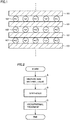
- Fig. 1 is a conceptual view of a structure of the nickel hydroxide according to the present embodiment.
- the nickel hydroxide may be a crystalline substance.
- the nickel hydroxide may have ⁇ -Ni(OH) 2 structure, for example.
- the nickel hydroxide may have ⁇ -Ni(OH) 2 structure, for example.
- a phase having ⁇ -Ni(OH) 2 structure and a phase having ⁇ -Ni(OH) 2 structure may coexist, for example.
- the nickel hydroxide may be amorphous.
- the nickel hydroxide is a layered compound.
- the nickel hydroxide includes stacked nickel hydroxide layers 101.
- Each of nickel hydroxide layers 101 includes Ni 2+ and OH - .
- Each of nickel hydroxide layers 101 may be positively charged.
- Intercalated anions 102 are present between nickel hydroxide layers 101.
- Intercalated anions 102 may be SO 4 2- and/or C0 3 2- , for example.
- Intercalated anions 102 may be responsible for charge compensation of the positive charge of nickel hydroxide layers 101.
- H 2 O and the like may further be present between nickel hydroxide layers 101.
- nickel hydroxide according to the present embodiment OH - in nickel hydroxide layers 101 is partially replaced by particular polyatomic anions. More specifically, at least one of nickel hydroxide layers 101 further includes particular polyatomic anions.
- the particular polyatomic anions according to the present embodiment are anions that are not SO 4 2- or CO 3 2- .
- substantially all the nickel hydroxide layers 101 may include the particular polyatomic anions.
- nickel hydroxide layers 101 including the particular polyatomic anions and nickel hydroxide layers 101 not including the particular polyatomic anions may coexist.
- nickel hydroxide layers 101 may further include SO 4 2- and CO 3 2- .
- the particular polyatomic anions according to the present embodiment may be incorporated in the structure of the nickel hydroxide layers.
- the particular polyatomic anions incorporated in the structure are differentiated from the intercalated anions responsible for charge compensation.
- y denotes the amount of replacement by the particular polyatomic anions.
- y may satisfy "0 ⁇ y ⁇ 0.20", for example.
- y may satisfy "0.05 ⁇ y ⁇ 0.20", for example.
- y may satisfy "0.05 ⁇ y ⁇ 0.10", for example, n may be 1, 2, or 3.
- x and y in the above formula (I) may be determined by TGA-FTIR, for example.
- the "TGA-FTIR” refers to an analysis technique that involves performing thermal gravimetric analysis (TGA) while identifying off-gas with a fourier transform infrared spectrometer (FTIR).
- the operating potential may change depending on the type of the particular polyatomic anions. Only one type of the particular polyatomic anions may be incorporated in the nickel hydroxide layers. Two or more types of the particular polyatomic anions may be incorporated in the nickel hydroxide layers.
- the particular polyatomic anions may include organic anions, for example.
- the "organic anion” according to the present embodiment refers to a polyatomic anion containing a carbon atom (C).
- the organic anions may include at least one type selected from the group consisting of citrate ions [C(OH)(CH 2 COO - ) 2 COO - ] and acetate ions (CH 3 COO - ), for example.
- Such organic anions may be incorporated in the structure of the nickel hydroxide layers. With such organic anions incorporated in the structure of the nickel hydroxide layers, the operating potential may be increased.
- Some organic anions are difficult to incorporate in the structure of the nickel hydroxide layers.
- oxalate ions [(COO - ) 2 ] are difficult to incorporate in the nickel hydroxide layers.
- the organic anions may be citrate ions. With citrate ions incorporated in the structure of the nickel hydroxide layers, the memory effect may be less likely to occur in the alkaline battery.
- the citrate ions may be monovalent anions [C(OH)(CH 2 COOH) 2 COO - ].
- the citrate ions may be divalent anions [C(OH)(CH 2 COO - ) 2 COOH].
- the citrate ions may be trivalent anions [C(OH)(CH 2 COO - ) 2 COO - ].
- the particular polyatomic anions may include inorganic anions, for example.
- the "inorganic anion” according to the present embodiment refers to a polyatomic anion containing no carbon atom.
- the inorganic anions may include at least one type selected from the group consisting of phosphate ions (PO 4 3- ) and tetraborate ions (B 4 O 7 2- ), for example.
- Such inorganic anions may be incorporated in the structure of the nickel hydroxide layers. With such inorganic anions incorporated in the structure of the nickel hydroxide layers, the operating potential may be decreased.
- Ni 3 - nitrate ions
- Ni 2+ in the nickel hydroxide layers may be partially replaced by Al 3+ . More specifically, at least one of the nickel hydroxide layers may further include Al 3+ . With Ni 2+ partially replaced by Al 3+ , the operating potential may change.
- substantially all the nickel hydroxide layers 101 may include Al 3+ .
- nickel hydroxide layers 101 including Al 3+ and nickel hydroxide layers 101 not including Al 3+ may coexist.
- y may satisfy "0 ⁇ y ⁇ 0.20", for example, as in the above formula (I).
- z may satisfy "0 ⁇ z ⁇ 0.25", for example.
- z may satisfy "0.05 ⁇ z ⁇ 0.25", for example.
- z may satisfy "0.05 ⁇ z ⁇ 0.15", for example.
- z may satisfy "0.05 ⁇ z ⁇ 0.10", for example.
- x and y in the above formula (II) may be determined by TGA-FTIR, for example, z in the above formula (II) may be determined by inductively coupled plasma atomic emission spectroscopy (ICP-AES), for example.
- cobalt ions Co 3+ , Co 2+
- zinc ions Zn + , Zn 2+
- the like may be used for replacing Ni 2+ .
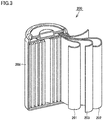
- Fig. 2 is a flowchart schematically illustrating a method of producing a nickel hydroxide according to the present embodiment.
- a method of producing a nickel hydroxide according to the present embodiment includes "(A) preparing a raw material liquid” and “(B) synthesizing”.
- the method of producing a nickel hydroxide according to the present embodiment may include performing "(C) hydrothermal treatment” depending on the type of the polyatomic anions.
- the method of producing a nickel hydroxide according to the present embodiment includes preparing a raw material liquid containing at least Ni 2+ , OH - , and polyatomic anions.
- the polyatomic anions include at least one type selected from the group consisting of the particular polyatomic anions, SO 4 2- , and CO 3 2- .
- the raw material liquid may be prepared by mixing various aqueous solutions, for example.
- a raw material liquid containing sulfate ions SO 4 2-
- the "raw material liquid containing SO 4 2- " is also called "first raw material liquid”.
- the first raw material liquid may be prepared by mixing an aqueous solution of nickel sulfate (NiSO 4 ), an aqueous solution of a salt of sodium ions (Na + ) and the particular polyatomic anions, and an aqueous solution of sodium hydroxide (NaOH), for example.
- a raw material liquid not containing SO 4 2- may also be used.
- the "raw material liquid not containing SO 4 2- " is also called “second raw material liquid”.
- the second raw material liquid may be prepared by mixing an aqueous solution of a salt of Ni 2+ and the particular polyatomic anions and an aqueous solution of NaOH, for example.
- the first raw material liquid and the second raw material liquid may further contain Al 3+ .
- an aqueous solution of aluminum sulfate [Al 2 (SO 4 ) 3 ] may be mixed in the first raw material liquid.
- the method of producing a nickel hydroxide according to the present embodiment includes synthesizing a nickel hydroxide by adjusting a pH of the raw material liquid.
- the pH of the raw material liquid may be adjusted by changing the concentrations and the amounts of various aqueous solutions added.
- a pH regulator may be used, for example.
- ammonium hydroxide (NH 4 OH), ammonium sulfate [(NH 4 ) 2 SO 4 ], sodium carbonate (Na 2 CO 3 ), and/or the like may further be added, for example.
- the final pH of the raw material liquid may be adjusted to about 11 to about 13, for example. By this, nickel hydroxide crystals may be formed.
- the polyatomic anions may be incorporated in the nickel hydroxide layers.
- the nickel hydroxide may have an operating potential that is different from the operating potential of an ordinary nickel hydroxide.
- the nickel hydroxide may be collected at this point by filtering. After collected, the nickel hydroxide may be rinsed with water. The nickel hydroxide may be dried. The drying may be carried out in air, for example.
- the method of producing a nickel hydroxide according to the present embodiment includes performing hydrothermal treatment on the nickel hydroxide when the polyatomic anions do not include the particular polyatomic anions.
- the method of producing a nickel hydroxide according to the present embodiment may further include performing hydrothermal treatment on the nickel hydroxide when the polyatomic anions include the particular polyatomic anions.
- the hydrothermal treatment may change the crystallinity of the nickel hydroxide. For example, an increase in the crystallinity may increase the operating potential. For example, a decrease in the crystallinity may decrease the operating potential.
- the hydrothermal treatment is performed in, for example, an autoclave.
- the resulting nickel hydroxide may be transferred into an autoclave together with the remaining raw material liquid.
- the treatment temperature may be about 100°C, for example.
- the treatment time may be about 24 hours, for example.
- the resulting nickel hydroxide is collected by filtering. After collected, the nickel hydroxide may be rinsed with water. The nickel hydroxide may be dried. The drying may be carried out in air, for example.
- a positive electrode material according to the present embodiment is a positive electrode material for an alkaline battery.
- the positive electrode material according to the present embodiment includes at least the above-described nickel hydroxide according to the present embodiment.
- the positive electrode material may consist essentially of the nickel hydroxide. However, as long as the positive electrode material includes the nickel hydroxide, the positive electrode material may further include other substances. For example, the positive electrode material may further include a cobalt compound and/or the like. For example, surfaces of particles consisting of the nickel hydroxide may be coated with a cobalt compound. The cobalt compound may be cobalt oxide, for example. The cobalt compound may improve electronic conductivity of the positive electrode material, for example.
- an “alkaline battery” refers to a battery including an aqueous alkali solution as electrolyte solution.
- the alkaline battery may be a primary battery.
- the alkaline battery may be a secondary battery (rechargeable battery).
- the alkaline battery As an example of the alkaline battery, a nickel-metal hydride battery is described in the present specification. However, the alkaline battery according to the present embodiment is not limited to a nickel-metal hydride battery.
- the alkaline battery may be a nickel-zinc battery, a nickel-cadmium battery, or a nickel-iron battery, for example.
- Fig. 3 is a schematic view illustrating an example configuration of the alkaline battery according to the present embodiment.
- a battery 200 is a nickel-metal hydride battery.
- Battery 200 includes at least the positive electrode material according to the present embodiment. Therefore, battery 200 may have an operating voltage that is different from the operating voltage of an ordinary nickel-metal hydride battery. Further, depending on the type of the particular polyatomic ions, the memory effect may be less likely to occur, for example. As long as battery 200 includes the positive electrode material according to the present embodiment, other structural details are not particularly limited. The structural details described below should be regarded as mere examples.
- Battery 200 includes a housing 205.
- Housing 205 may be made of a metal material and/or a polymer material, for example.
- Housing 205 is cylindrical.
- housing 205 may be prismatic.
- Housing 205 accommodates a positive electrode 201, a separator 203, a negative electrode 202, and an aqueous alkali solution.
- Positive electrode 201 is in sheet form.
- the positive electrode material according to the present embodiment is included.
- positive electrode 201 may further include a positive electrode current collector and a binder, for example.
- the positive electrode current collector may be a porous metal sheet (for example, a porous Ni sheet).
- positive electrode 201 may be formed by filling pores of porous Ni sheets with the positive electrode material, the binder, and the like.
- the binder may be styrene-butadiene rubber, carboxymethylcellulose, and/or polytetrafluoroethylene, for example.
- Negative electrode 202 is in sheet form. Negative electrode 202 includes at least a negative electrode material. Negative electrode 202 may further include a negative electrode current collector, a binder, and the like.
- the negative electrode current collector may be a perforated steel plate, for example.
- the perforated steel plate may have Ni plating and/or the like.
- negative electrode 202 may be formed by applying the negative electrode material, the binder, and the like to a surface of the negative electrode current collector.
- the binder may be, for example, a material described above as an example of the binder of positive electrode 201.
- the negative electrode material is a hydrogen storage alloy.
- a hydrogen storage alloy reversibly stores and releases protium (atomic hydrogen).
- the hydrogen storage alloy is not particularly limited.
- the hydrogen storage alloy may be an AB 5 alloy, for example.
- the AB 5 alloy may be LaNis and/or MmNi 5 ("Mm" represents misch metal), for example. Only one type of the hydrogen storage alloy may be used. Two or more types of the hydrogen storage alloy may be used in combination.
- Separator 203 is interposed between positive electrode 201 and negative electrode 202. Separator 203 is electrically insulating. Separator 203 is a porous sheet. Separator 203 may be a polyolefin nonwoven fabric and/or a polyamide nonwoven fabric, for example.
- the aqueous alkali solution is an electrolyte solution. Positive electrode 201, negative electrode 202, and separator 203 are impregnated with the aqueous alkali solution.
- the aqueous alkali solution may be an aqueous solution of potassium hydroxide, an aqueous solution of NaOH, and/or an aqueous solution of lithium hydroxide, for example.
- Sample No. 1 is a control (control sample).
- a reaction vessel was prepared. In the reaction vessel, 2 M aqueous solution of NaOH (25 mL) was added. “M” denotes "mol/L”. While the aqueous solution of NaOH was being swiftly stirred with a magnetic stirrer at room temperature, 1 M aqueous solution of NiSO 4 (20 mL) and 0.2 M aqueous solution of NaSO 4 (20 mL) were added into the reaction vessel. The rate of addition was 1.7 mL/min. Thus, the first raw material liquid was prepared. The final pH of the first raw material liquid was adjusted to the range of 11 to 11.5. By this pH adjustment, the nickel hydroxide of Sample No. 1 was synthesized.
- each of an aqueous solution of Na 2 CO 3 , an aqueous solution of Na 3 PO 4 , an aqueous solution of Na 2 B 4 O 7 , an aqueous solution of sodium oxalate, and an aqueous solution of sodium citrate was used to synthesize the nickel hydroxide of Samples Nos. 2 to 6.
- the amount of each aqueous solution added was as specified in Table 1 below. Because 2 M aqueous solution of Na 2 B 4 O 7 was difficult to prepare, the concentration of the aqueous solution of Na 2 B 4 O 7 was set to 0.02 M.
- the nickel hydroxide was transferred into an autoclave together with the remaining first raw material liquid.
- hydrothermal treatment was performed on the nickel hydroxide.
- the treatment temperature was 100°C.
- the treatment time was 24 hours.
- the resulting nickel hydroxide was collected. After collected, the nickel hydroxide was rinsed with water and dried in air.
- XRD x-ray diffraction
- the XRD patterns were checked before and after the hydrothermal treatment. All of the XRD patterns of Samples Nos. 1 to 6 show ⁇ -Ni(OH) 2 structure.
- the full width at half maximum (FWHM) of [011] peak was used to evaluate crystallinity. Results are shown in Table 1 below. The smaller the FWHM is, the higher the crystallinity may be. In Table 1, "n/a" indicates that the [011] peak was broad and FWHM could not be calculated.
- Fig. 4 illustrates TGA profiles of Samples Nos. 1 to 3, 5, and 6.
- TGA measurement was performed after heating the sample at 110°C for 80 minutes.
- the heating the sample at 110°C for 80 minutes may remove water, carbonate, and the like adsorbed to the surface of the sample.
- Sample No. 1 (SO 4 2- ) showed a weight loss in three steps. The first-step weight loss occurred at 120 to 220°C. The second-step weight loss occurred at 220 to 400°C. The third-step weight loss occurred at 600 to 750°C.
- the FTIR data suggests that the first-step and the second-step weight losses were accompanied by release of H 2 O and CO 2 .
- the FTIR data suggests that the third-step weight loss was accompanied by release of SO 2 . It is considered that SO 2 was generated by SO 4 2- splitting.
- the TGA profile of Sample No. 2 (C03 2- ) is similar to the TGA profile of Sample No. 1 (SO 4 2- ). It may be because the CO 3 2- content of the nickel hydroxide layers of Sample No. 2 was approximately the same as the SO 4 2- content of the nickel hydroxide layers of Sample No. 1. In other words, CO 3 2- may have been incorporated in the structure of the nickel hydroxide layers.
- Sample No. 4 (B 4 O 7 2- ) was not expected to undergo thermal decomposition. For this reason, TGA-FTIR was not performed for Sample No. 4 (B 4 O 7 2- ).
- the TGA profile of Sample No. 5 is similar to the TGA profile of Sample No. 1 (SO 4 2- ).
- the FTIR data suggests that the first-step and the second-step weight losses were accompanied by release of H 2 O and CO 2 . Further, the FTIR data suggests that the third-step weight loss was accompanied by release of SO 2 . Therefore, it is considered that oxalate ions were not incorporated in the structure of the nickel hydroxide layers.
- the weight loss of Sample No. 6 after hydrothermal treatment is smaller than the weight loss of Sample No. 6 before hydrothermal treatment. It is considered that the hydrothermal treatment caused dissociation of citrate ions from the nickel hydroxide layers.
- Positive electrodes including the nickel hydroxide of Samples Nos. 1 to 6 were prepared. These positive electrodes were for alkaline battery use. The operating potential (discharge potential) was measured, with a mercury oxide electrode (Hg/HgO) used as a reference electrode. Results are shown in Table 1 below. The values of potential listed under "Potential at 0.4 capacity" in Table 1 below were measured when the remaining capacity of the positive electrode was 0.4 relative to the full-discharged capacity of the positive electrode defined as 1.
- the positive electrode was stored at 50°C for 48 hours while being charged to maintain the potential of the positive electrode at 0.35 to 0.37 V (vs Hg/HgO). After storage, the positive electrode was discharged for voltage drop (V drop) measurement. Results are shown in Table 1 below. The smaller the voltage drop is, the less likely the memory effect may have been to occur. Table 1 Synthesis for the case of using precursor salt not free of SO 4 2- No.
- the operating potential of the sample with the particular polyatomic anions incorporated in the nickel hydroxide layers is different from the operating potential of the sample with SO 4 2- and CO 3 2- incorporated in the nickel hydroxide layers (Samples Nos. 1 and 2).
- the operating potential decreased.
- organic anions Sample No. 6
- the operating potential increased.
- Sample No. 6 (citrate ions)
- the memory effect tended not to occur.
- hydrothermal treatment tended to decrease FWHM; in other words, hydrothermal treatment tended to increase crystallinity. As the crystallinity increased, the operating potential tended to increase.
- oxalate ions may have not been incorporated in the nickel hydroxide layers. As for Sample No. 5, this may have caused an increase in crystallinity and thereby an increase in operating potential.
- the crystallinity of the sample in which polyatomic anions may have been incorporated in the nickel hydroxide layers (No. 1 to 4, 6) is lower than the crystallinity of Sample No. 5. It is considered that OH - in the nickel hydroxide layers was partially replaced by the polyatomic anions to cause a structural defect, leading to the decrease in crystallinity. Therefore, the above-mentioned change in operating potential may have been caused by incorporation of the polyatomic anions, independent of the level of crystallinity.
- a reaction vessel was prepared. In the reaction vessel, 1 M aqueous solution of Ni(NO 3 ) 2 (20 mL) was added. While the aqueous solution of Ni(NO 3 ) 2 was being swiftly stirred with a magnetic stirrer at room temperature, 2 M aqueous solution of NaOH (20 mL) was added into the reaction vessel. Thus, the second raw material liquid was prepared. The final pH of the second raw material liquid was adjusted to 11.5. By this pH adjustment, the nickel hydroxide of Sample No. 8 was synthesized. The nickel hydroxide was collected. After collected, the nickel hydroxide was rinsed with water and dried in air.
- each of an aqueous solution of NiSO 4 and an aqueous solution of nickel acetate was used to synthesize the nickel hydroxide of Samples Nos. 7 and 9.
- the amount of each aqueous solution added was as specified in Table 2 below.
- Sample No. 7 is a control. Although containing SO 4 2- , the raw material liquid of Sample No. 7 is regarded as the second raw material liquid for the sake of convenience.
- XRD patterns of the nickel hydroxide were checked.
- the XRD patterns of Samples Nos. 7 and 9 show ⁇ -Ni(OH) 2 structure.
- ⁇ -Ni(OH) 2 structure and ⁇ -Ni(OH) 2 structure coexist.
- the FWHM of [001] peak was used to evaluate crystallinity. Results are shown in Table 2 below. The smaller the FWHM is, the higher the crystallinity may be.
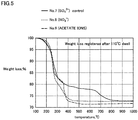
- Fig. 5 illustrates TGA profiles of Samples Nos. 7 to 9.
- the TGA profile of Sample No. 7 (SO 4 2- ) is substantially the same as the TGA profile of Sample No. 1 (SO 4 2- ).
- Sample No. 8 (N03 - ) showed a weight loss in two steps. The first-step weight loss occurred at 270 to 360°C. The second-step weight loss occurred at 360 to 400°C. The second-step weight loss is very small.
- the FTIR data indicates no gas generation attributed to NO 3 - .
- the FTIR data suggests that the weight loss at 400°C or lower was accompanied by release of H 2 O and CO 2 . These results suggest that NO 3 - was not incorporated in the structure of the nickel hydroxide layers.
- Sample No. 9 (acetate ions) showed a weight loss in two steps.
- the first-step weight loss occurred at 270 to 360°C.
- the second-step weight loss occurred at 360 to 400°C.
- the FTIR data suggests that the first-step weight loss was accompanied by release of H 2 O and CO 2 and the second-step weight loss was accompanied by release of a small amount of H 2 O and a great amount of CO 2 .
- the second-step weight loss may have been caused by splitting of acetate ions.
- the operating potential of the sample with the particular polyatomic anions incorporated in the nickel hydroxide layers is different from the operating potential of the sample with SO 4 2- incorporated in the nickel hydroxide layers (Sample No. 7).
- a reaction vessel was prepared. In the reaction vessel, 1 M aqueous solution of NH 4 OH (250 mL) was added. In the reaction vessel, 1 M aqueous solution of NiSO 4 (10 mL) was further added. The reaction vessel was left at 55°C for 4 hours or longer.
- the concentration of the aqueous solution of sodium citrate was changed to achieve the feed composition specified in Table 3 below, and thus the nickel hydroxides of Nos. 10, 12, and 13 were synthesized.
- Sample No. 10 is a control.
- a reaction vessel was prepared. In the reaction vessel, 2 M aqueous solution of NaOH (20 mL) was added. While the aqueous solution of NaOH was being swiftly stirred with a magnetic stirrer, 0.125 M aqueous solution of Al 2 (SO 4 ) 3 (20 mL), 0.75 M aqueous solution of NiSO 4 (20 mL), and 0.2 M aqueous solution of sodium citrate (20 mL) were added into the reaction vessel. Thus, the first raw material liquid was prepared. In order to adjust the pH of the first raw material liquid to the range of 11 to 12,2 M aqueous solution of NaOH was added thereto as appropriate. Thus, the nickel hydroxide of Sample No. 17 was synthesized.
- each of an aqueous solution of Na 2 SO 4 , an aqueous solution of sodium oxalate, and an aqueous solution of sodium acetate was used so that the polyatomic anions specified in Table 4 below were incorporated in the nickel hydroxide layers, and thus the nickel hydroxide of Nos. 14 to 16 was synthesized.
- samples with hydrothermal treatment were also synthesized.
- the treatment temperature was 100°C.
- the treatment time was 24 hours.
- TGA-IR was performed to check if polyatomic anions were incorporated. Results are shown in Table 4 below.
Landscapes
- Chemical & Material Sciences (AREA)
- Organic Chemistry (AREA)
- Inorganic Chemistry (AREA)
- Chemical Kinetics & Catalysis (AREA)
- Electrochemistry (AREA)
- General Chemical & Material Sciences (AREA)
- Engineering & Computer Science (AREA)
- Manufacturing & Machinery (AREA)
- Crystallography & Structural Chemistry (AREA)
- Inorganic Compounds Of Heavy Metals (AREA)
- Battery Electrode And Active Subsutance (AREA)
Abstract
A nickel hydroxide includes stacked nickel hydroxide layers (101). Each of the nickel hydroxide layers (101) includes Ni<sup>2+</sup> and OH<sup>-</sup>. At least one of the nickel hydroxide layers (101) further includes a type of polyatomic anions. The polyatomic anions include a type of anions that are not SO<sub>4</sub><sup>2-</sup> or CO<sub>3</sub><sup>2-</sup>.
Description
- This nonprovisional application is based on Japanese Patent Application No.
2019-121517 filed on June 28, 2019 - The present disclosure relates to a nickel hydroxide, a positive electrode material, an alkaline battery, and a method of producing a nickel hydroxide.
- Japanese Patent Laying-Open No.
2010-153261 - Operating voltage of a battery is the difference between the operating potential of positive electrode material and the operating potential of negative electrode material. According to the applications of the battery, for example, there is a demand for adjusting the operating voltage of the battery. Conventionally, as a positive electrode material of alkaline batteries, nickel hydroxide [Ni(OH)2] is used.
- An object of the present disclosure is to control the operating potential of nickel hydroxide.
- In the following, the technical structure and the effects according to the present disclosure are described. It should be noted that the action mechanism according to the present disclosure includes presumption. Therefore, the scope of claims should not be limited by whether or not the action mechanism is correct.
- [1] A nickel hydroxide according to the present disclosure includes stacked nickel hydroxide layers. Each of the nickel hydroxide layers includes nickel ions and hydroxide ions. At least one of the nickel hydroxide layers further includes a type of polyatomic anions. The polyatomic anions include a type of anions that are not sulfate ions or carbonate ions.
Typically, nickel hydroxide [Ni(OH)2] is synthesized via reactive crystallization. In reactive crystallization, an aqueous solution of nickel sulfate (NiSO4) and an aqueous solution of an ammonium salt are mixed to prepare an aqueous solution containing a nickel ammine complex, and to the resulting aqueous solution, an aqueous solution of sodium hydroxide (NaOH) is added to precipitate nickel hydroxide. In the synthesis, sodium carbonate (Na2C03) and the like may be used as a pH regulator.
The nickel hydroxide is a layered compound. The nickel hydroxide includes stacked nickel hydroxide layers that include nickel ions (Ni2+) and hydroxide ions (OH-). The nickel hydroxide layers may be positively charged. Between the nickel hydroxide layers, anions responsible for charge compensation (hereinafter, also called "intercalated anions") may be present. Between the layers, water (H2O) and the like having no charge may also be present.
The intercalated anions responsible for charge compensation may be polyatomic anions derived from a raw material and the like. The "polyatomic anion" according to the present disclosure refers to an anion consisting of two or more atoms (except OH-). The polyatomic anions derived from a raw material and the like may be sulfate ions (SO4 2-) and carbonate ions (CO3 2-). Part of the SO4 2- and C03 2- may not serve as intercalated anions but instead replace OH- in the nickel hydroxide layers. In other words, SO4 2- and CO3 2- may be incorporated in the structure of the nickel hydroxide layers.
In the nickel hydroxide according to the present disclosure, OH- in the nickel hydroxide layers is partially replaced by the polyatomic anions that are not SO4 2- or CO3 2-. Hereinafter, the "polyatomic anions that are not SO4 2- or CO3 2-" are also called "particular polyatomic anions".
With the particular polyatomic anions incorporated in the structure of the nickel hydroxide layers, the nickel hydroxide according to the present disclosure may have an operating potential that is different from the operating potential of an ordinary nickel hydroxide. According to a novel finding of the present disclosure, the operating potential changes depending on the type of the particular polyatomic anions. Therefore, changing the type of the particular polyatomic anions may achieve control over the operating potential. - [2] The polyatomic anions may include a type of organic anions.
- [3] The organic anions may include at least one type selected from the group consisting of citrate ions and acetate ions.
With such particular polyatomic anions incorporated in the structure of the nickel hydroxide layers, the operating potential may be increased. - [4] The organic anions may be citrate ions.
With citrate ions incorporated in the structure of the nickel hydroxide layers, the memory effect may be less likely to occur in the alkaline battery. With the memory effect being less likely to occur, control over the operating potential may be improved. - [5] The polyatomic anions may include a type of inorganic anions.
- [6] The inorganic anions may include at least one type selected from the group consisting of phosphate ions and tetraborate ions.
With such particular polyatomic anions incorporated in the structure of the nickel hydroxide layers, the operating potential may be decreased. - [7] At least one of the nickel hydroxide layers may further include aluminum ions.
With aluminum ions (Al3+) incorporated in the structure of the nickel hydroxide layers, the operating potential may change. Combining the particular polyatomic anions with Al3+ may achieve control over the operating potential. - [8] A positive electrode material according to the present disclosure includes at least the nickel hydroxide according to any one of [1] to [7] above.
- [9] An alkaline battery according to the present disclosure includes at least the positive electrode material according to [8] above.
- [10] A method of producing a nickel hydroxide according to the present disclosure includes the following (A) and (B):
- (A) preparing a raw material liquid containing at least nickel ions, hydroxide ions, and a type of polyatomic anions; and
- (B) synthesizing a nickel hydroxide by adjusting a pH of the raw material liquid.
The polyatomic anions include at least one type selected from the group consisting of:- a type of anions that are not sulfate ions or carbonate ions;
- sulfate ions; and
- carbonate ions.
The method of producing a nickel hydroxide according to the present disclosure further includes (C) performing hydrothermal treatment on the nickel hydroxide when the polyatomic anions do not include the anions that are not sulfate ions or carbonate ions.
In the method of producing a nickel hydroxide according to the present disclosure, the particular polyatomic anions may be incorporated in the structure of the nickel hydroxide layers. Changing the type of the particular polyatomic anions may achieve control over the operating potential.
In the method of producing a nickel hydroxide according to the present disclosure, even when the particular polyatomic anions are not incorporated in the structure of the nickel hydroxide layers, the operating potential may still be controlled. It is because when the polyatomic anions do not include the particular polyatomic anions, hydrothermal treatment is performed on the nickel hydroxide; the hydrothermal treatment may change crystallinity of the nickel hydroxide; and consequently an increase in the operating potential may occur, for example.
- [11] The method of producing a nickel hydroxide according to the present disclosure may further include performing hydrothermal treatment on the nickel hydroxide when the polyatomic anions include the anions that are not sulfate ions or carbonate ions.
Combining incorporation of the particular polyatomic anions with the hydrothermal treatment may achieve control over the operating potential. - [12] The raw material liquid may be prepared by mixing an aqueous solution of nickel sulfate, an aqueous solution of a salt of sodium ions and the polyatomic anions, and an aqueous solution of sodium hydroxide.
- [13] The raw material liquid may be prepared by mixing an aqueous solution of a salt of nickel ions and the polyatomic anions and an aqueous solution of sodium hydroxide.
- [14] The polyatomic anions may include a type of organic anions.
- [15] The organic anions may include at least one type selected from the group consisting of citrate ions and acetate ions.
- [16] The organic anions may be citrate ions.
- [17] The polyatomic anions may include a type of inorganic anions.
- [18] The inorganic anions may include at least one type selected from the group consisting of phosphate ions and tetraborate ions.
- [19] The raw material liquid may further contain aluminum ions.
- The foregoing and other objects, features, aspects and advantages of the present disclosure will become more apparent from the following detailed description of the present disclosure when taken in conjunction with the accompanying drawings.
-
-
Fig. 1 is a conceptual view of a structure of the nickel hydroxide according to the present embodiment. -
Fig. 2 is a flowchart schematically illustrating the method of producing a nickel hydroxide according to the present embodiment. -
Fig. 3 is a schematic view illustrating an example configuration of the alkaline battery according to the present embodiment. -
Fig. 4 illustrates TGA profiles of Samples Nos. 1 to 3, 5, and 6. -
Fig. 5 illustrates TGA profiles of Samples Nos. 7 to 9. - In the following, embodiments according to the present disclosure (herein called "present embodiment") are described. However, the description below does not limit the scope of claims.
- A nickel hydroxide according to the present embodiment may be typically used as a positive electrode material of an alkaline battery. However, applications of the nickel hydroxide according to the present embodiment are not limited to positive electrode material. The nickel hydroxide according to the present embodiment may also be used in applications other than positive electrode material.
- Typically, the nickel hydroxide according to the present embodiment is a group of particles (powder). The particle size of the nickel hydroxide is not particularly limited. The d50 of the nickel hydroxide may range from 1 µm to 30 µm, for example. The "d50" according to the present embodiment refers to a particle size in volume-based particle size distribution at which the cumulative particle volume (accumulated from the side of small sizes) reaches 50% of the total particle volume. The volume-based particle size distribution may be measured by laser diffraction and scattering, for example.
-
Fig. 1 is a conceptual view of a structure of the nickel hydroxide according to the present embodiment. - The nickel hydroxide may be a crystalline substance. The nickel hydroxide may have β-Ni(OH)2 structure, for example. The nickel hydroxide may have α-Ni(OH)2 structure, for example. In the nickel hydroxide, a phase having β-Ni(OH)2 structure and a phase having α-Ni(OH)2 structure may coexist, for example. The nickel hydroxide may be amorphous.
- The nickel hydroxide is a layered compound. The nickel hydroxide includes stacked nickel hydroxide layers 101. Each of nickel hydroxide layers 101 includes Ni2+ and OH-. Each of nickel hydroxide layers 101 may be positively charged.
- Between nickel hydroxide layers 101,
intercalated anions 102 are present.Intercalated anions 102 may be SO4 2- and/or C03 2-, for example.Intercalated anions 102 may be responsible for charge compensation of the positive charge of nickel hydroxide layers 101. In addition tointercalated anions 102, H2O and the like may further be present between nickel hydroxide layers 101. - In the nickel hydroxide according to the present embodiment, OH- in nickel hydroxide layers 101 is partially replaced by particular polyatomic anions. More specifically, at least one of nickel hydroxide layers 101 further includes particular polyatomic anions. The particular polyatomic anions according to the present embodiment are anions that are not SO4 2- or CO3 2-.
- In the nickel hydroxide according to the present embodiment, substantially all the nickel hydroxide layers 101 may include the particular polyatomic anions. In the nickel hydroxide according to the present embodiment, nickel hydroxide layers 101 including the particular polyatomic anions and nickel hydroxide layers 101 not including the particular polyatomic anions may coexist.
- In the nickel hydroxide according to the present embodiment, as long as at least one of nickel hydroxide layers 101 includes the particular polyatomic anions, nickel hydroxide layers 101 may further include SO4 2- and CO3 2-.
- The particular polyatomic anions according to the present embodiment may be incorporated in the structure of the nickel hydroxide layers. The particular polyatomic anions incorporated in the structure are differentiated from the intercalated anions responsible for charge compensation.
- The nickel hydroxide layers may be represented by, for example, the following formula (I):
Ni(OH)x(Anion)y ... (I)
[where Anion denotes the particular polyatomic anions; x and y satisfy the relation "x + ny = 2"; and n denotes the valence of the particular polyatomic anions]. - In the above formula (I), y denotes the amount of replacement by the particular polyatomic anions. y may satisfy "0 < y ≤ 0.20", for example. y may satisfy "0.05 ≤ y ≤ 0.20", for example. y may satisfy "0.05 ≤ y ≤ 0.10", for example, n may be 1, 2, or 3.
x and y in the above formula (I) may be determined by TGA-FTIR, for example. The "TGA-FTIR" refers to an analysis technique that involves performing thermal gravimetric analysis (TGA) while identifying off-gas with a fourier transform infrared spectrometer (FTIR). - According to a novel finding of the present disclosure, the operating potential may change depending on the type of the particular polyatomic anions. Only one type of the particular polyatomic anions may be incorporated in the nickel hydroxide layers. Two or more types of the particular polyatomic anions may be incorporated in the nickel hydroxide layers.
- The particular polyatomic anions may include organic anions, for example. The "organic anion" according to the present embodiment refers to a polyatomic anion containing a carbon atom (C). The organic anions may include at least one type selected from the group consisting of citrate ions [C(OH)(CH2COO-)2COO-] and acetate ions (CH3COO-), for example. Such organic anions may be incorporated in the structure of the nickel hydroxide layers. With such organic anions incorporated in the structure of the nickel hydroxide layers, the operating potential may be increased.
- Some organic anions are difficult to incorporate in the structure of the nickel hydroxide layers. For example, oxalate ions [(COO-)2] are difficult to incorporate in the nickel hydroxide layers.
- The organic anions may be citrate ions. With citrate ions incorporated in the structure of the nickel hydroxide layers, the memory effect may be less likely to occur in the alkaline battery.
- The citrate ions may be monovalent anions [C(OH)(CH2COOH)2COO-]. The citrate ions may be divalent anions [C(OH)(CH2COO-)2COOH]. The citrate ions may be trivalent anions [C(OH)(CH2COO-)2COO-].
- The particular polyatomic anions may include inorganic anions, for example. The "inorganic anion" according to the present embodiment refers to a polyatomic anion containing no carbon atom. The inorganic anions may include at least one type selected from the group consisting of phosphate ions (PO4 3-) and tetraborate ions (B4O7 2-), for example. Such inorganic anions may be incorporated in the structure of the nickel hydroxide layers. With such inorganic anions incorporated in the structure of the nickel hydroxide layers, the operating potential may be decreased.
- Some inorganic anions are difficult to incorporate in the structure of the nickel hydroxide layers. For example, nitrate ions (NO3 -) are difficult to incorporate in the nickel hydroxide layers.
- In the nickel hydroxide according to the present embodiment, Ni2+ in the nickel hydroxide layers may be partially replaced by Al3+. More specifically, at least one of the nickel hydroxide layers may further include Al3+. With Ni2+ partially replaced by Al3+, the operating potential may change.
- In the nickel hydroxide according to the present embodiment, substantially all the nickel hydroxide layers 101 may include Al3+. In the nickel hydroxide according to the present embodiment, nickel hydroxide layers 101 including Al3+ and nickel hydroxide layers 101 not including Al3+ may coexist.
- When Al3+ is incorporated in the nickel hydroxide layers, the nickel hydroxide layers may be represented by, for example, the following formula (II):
Ni1-zAlz(OH)x(Anion)y ... (II)
[where Anion denotes the particular polyatomic anions; x, y, and z satisfy the relation "2 + z = x + ny"; and n denotes the valence of the particular polyatomic anions]. - In the above formula (II), y may satisfy "0 < y ≤ 0.20", for example, as in the above formula (I). z may satisfy "0 < z ≤ 0.25", for example. z may satisfy "0.05 ≤ z ≤ 0.25", for example. z may satisfy "0.05 ≤ z ≤ 0.15", for example. z may satisfy "0.05 ≤ z ≤ 0.10", for example.
x and y in the above formula (II) may be determined by TGA-FTIR, for example, z in the above formula (II) may be determined by inductively coupled plasma atomic emission spectroscopy (ICP-AES), for example. - Instead of Al3+, cobalt ions (Co3+, Co2+), zinc ions (Zn+, Zn2+), and/or the like may be used for replacing Ni2+.
-
Fig. 2 is a flowchart schematically illustrating a method of producing a nickel hydroxide according to the present embodiment. - A method of producing a nickel hydroxide according to the present embodiment includes "(A) preparing a raw material liquid" and "(B) synthesizing". The method of producing a nickel hydroxide according to the present embodiment may include performing "(C) hydrothermal treatment" depending on the type of the polyatomic anions.
- The method of producing a nickel hydroxide according to the present embodiment includes preparing a raw material liquid containing at least Ni2+, OH-, and polyatomic anions. The polyatomic anions include at least one type selected from the group consisting of the particular polyatomic anions, SO4 2-, and CO3 2-.
- The raw material liquid may be prepared by mixing various aqueous solutions, for example. In the present embodiment, a raw material liquid containing sulfate ions (SO4 2-) may be used. In the present embodiment, the "raw material liquid containing SO4 2-" is also called "first raw material liquid". The first raw material liquid may be prepared by mixing an aqueous solution of nickel sulfate (NiSO4), an aqueous solution of a salt of sodium ions (Na+) and the particular polyatomic anions, and an aqueous solution of sodium hydroxide (NaOH), for example.
- In the present embodiment, a raw material liquid not containing SO4 2- may also be used. In the present embodiment, the "raw material liquid not containing SO4 2-" is also called "second raw material liquid". The second raw material liquid may be prepared by mixing an aqueous solution of a salt of Ni2+ and the particular polyatomic anions and an aqueous solution of NaOH, for example.
- The first raw material liquid and the second raw material liquid may further contain Al3+. For example, an aqueous solution of aluminum sulfate [Al2(SO4)3] may be mixed in the first raw material liquid.
- The method of producing a nickel hydroxide according to the present embodiment includes synthesizing a nickel hydroxide by adjusting a pH of the raw material liquid.
- The pH of the raw material liquid may be adjusted by changing the concentrations and the amounts of various aqueous solutions added. A pH regulator may be used, for example. To the raw material liquid, ammonium hydroxide (NH4OH), ammonium sulfate [(NH4)2SO4], sodium carbonate (Na2CO3), and/or the like may further be added, for example. The final pH of the raw material liquid may be adjusted to about 11 to about 13, for example. By this, nickel hydroxide crystals may be formed.
- In the resulting nickel hydroxide, the polyatomic anions may be incorporated in the nickel hydroxide layers. When the polyatomic anions include the particular polyatomic anions, the nickel hydroxide may have an operating potential that is different from the operating potential of an ordinary nickel hydroxide.
- When the polyatomic anions include the particular polyatomic anions, the nickel hydroxide may be collected at this point by filtering. After collected, the nickel hydroxide may be rinsed with water. The nickel hydroxide may be dried. The drying may be carried out in air, for example.
- The method of producing a nickel hydroxide according to the present embodiment includes performing hydrothermal treatment on the nickel hydroxide when the polyatomic anions do not include the particular polyatomic anions.
- The method of producing a nickel hydroxide according to the present embodiment may further include performing hydrothermal treatment on the nickel hydroxide when the polyatomic anions include the particular polyatomic anions.
- The hydrothermal treatment may change the crystallinity of the nickel hydroxide. For example, an increase in the crystallinity may increase the operating potential. For example, a decrease in the crystallinity may decrease the operating potential.
- The hydrothermal treatment is performed in, for example, an autoclave. For example, after the nickel hydroxide is produced, the resulting nickel hydroxide may be transferred into an autoclave together with the remaining raw material liquid. The treatment temperature may be about 100°C, for example. The treatment time may be about 24 hours, for example.
- After the hydrothermal treatment, the resulting nickel hydroxide is collected by filtering. After collected, the nickel hydroxide may be rinsed with water. The nickel hydroxide may be dried. The drying may be carried out in air, for example.
- A positive electrode material according to the present embodiment is a positive electrode material for an alkaline battery. The positive electrode material according to the present embodiment includes at least the above-described nickel hydroxide according to the present embodiment.
- The positive electrode material may consist essentially of the nickel hydroxide. However, as long as the positive electrode material includes the nickel hydroxide, the positive electrode material may further include other substances. For example, the positive electrode material may further include a cobalt compound and/or the like. For example, surfaces of particles consisting of the nickel hydroxide may be coated with a cobalt compound. The cobalt compound may be cobalt oxide, for example. The cobalt compound may improve electronic conductivity of the positive electrode material, for example.
- An "alkaline battery" according to the present embodiment refers to a battery including an aqueous alkali solution as electrolyte solution. The alkaline battery may be a primary battery. The alkaline battery may be a secondary battery (rechargeable battery).
- As an example of the alkaline battery, a nickel-metal hydride battery is described in the present specification. However, the alkaline battery according to the present embodiment is not limited to a nickel-metal hydride battery. The alkaline battery may be a nickel-zinc battery, a nickel-cadmium battery, or a nickel-iron battery, for example.
-
Fig. 3 is a schematic view illustrating an example configuration of the alkaline battery according to the present embodiment. - A
battery 200 is a nickel-metal hydride battery.Battery 200 includes at least the positive electrode material according to the present embodiment. Therefore,battery 200 may have an operating voltage that is different from the operating voltage of an ordinary nickel-metal hydride battery. Further, depending on the type of the particular polyatomic ions, the memory effect may be less likely to occur, for example. As long asbattery 200 includes the positive electrode material according to the present embodiment, other structural details are not particularly limited. The structural details described below should be regarded as mere examples. -
Battery 200 includes ahousing 205.Housing 205 may be made of a metal material and/or a polymer material, for example.Housing 205 is cylindrical. Alternatively,housing 205 may be prismatic.Housing 205 accommodates apositive electrode 201, aseparator 203, anegative electrode 202, and an aqueous alkali solution. -
Positive electrode 201 is in sheet form. Inpositive electrode 201, the positive electrode material according to the present embodiment is included. In addition to the positive electrode material,positive electrode 201 may further include a positive electrode current collector and a binder, for example. The positive electrode current collector may be a porous metal sheet (for example, a porous Ni sheet). For example,positive electrode 201 may be formed by filling pores of porous Ni sheets with the positive electrode material, the binder, and the like. The binder may be styrene-butadiene rubber, carboxymethylcellulose, and/or polytetrafluoroethylene, for example. -
Negative electrode 202 is in sheet form.Negative electrode 202 includes at least a negative electrode material.Negative electrode 202 may further include a negative electrode current collector, a binder, and the like. The negative electrode current collector may be a perforated steel plate, for example. The perforated steel plate may have Ni plating and/or the like. - For example,
negative electrode 202 may be formed by applying the negative electrode material, the binder, and the like to a surface of the negative electrode current collector. The binder may be, for example, a material described above as an example of the binder ofpositive electrode 201. - The negative electrode material is a hydrogen storage alloy. A hydrogen storage alloy reversibly stores and releases protium (atomic hydrogen). The hydrogen storage alloy is not particularly limited. The hydrogen storage alloy may be an AB5 alloy, for example. The AB5 alloy may be LaNis and/or MmNi5 ("Mm" represents misch metal), for example. Only one type of the hydrogen storage alloy may be used. Two or more types of the hydrogen storage alloy may be used in combination.
-
Separator 203 is interposed betweenpositive electrode 201 andnegative electrode 202.Separator 203 is electrically insulating.Separator 203 is a porous sheet.Separator 203 may be a polyolefin nonwoven fabric and/or a polyamide nonwoven fabric, for example. - The aqueous alkali solution is an electrolyte solution.
Positive electrode 201,negative electrode 202, andseparator 203 are impregnated with the aqueous alkali solution. The aqueous alkali solution may be an aqueous solution of potassium hydroxide, an aqueous solution of NaOH, and/or an aqueous solution of lithium hydroxide, for example. - Next, examples according to the present disclosure are described. However, the description below does not limit the scope of claims.
- In Experiment 1, incorporation of polyatomic anions in the nickel hydroxide layers as well as hydrothermal treatment on the nickel hydroxide were studied. In Experiment 1, the first raw material liquid (raw material liquid containing S04 2-) was studied.
- Sample No. 1 is a control (control sample). A reaction vessel was prepared. In the reaction vessel, 2 M aqueous solution of NaOH (25 mL) was added. "M" denotes "mol/L". While the aqueous solution of NaOH was being swiftly stirred with a magnetic stirrer at room temperature, 1 M aqueous solution of NiSO4 (20 mL) and 0.2 M aqueous solution of NaSO4 (20 mL) were added into the reaction vessel. The rate of addition was 1.7 mL/min. Thus, the first raw material liquid was prepared. The final pH of the first raw material liquid was adjusted to the range of 11 to 11.5. By this pH adjustment, the nickel hydroxide of Sample No. 1 was synthesized.
- Part of the nickel hydroxide was collected, whereas the rest of the nickel hydroxide was subjected to hydrothermal treatment described below. After collected, the part of the nickel hydroxide was rinsed with water and dried in air.
- As specified in Table 1 below, instead of the aqueous solution of NaSO4, each of an aqueous solution of Na2CO3, an aqueous solution of Na3PO4, an aqueous solution of Na2B4O7, an aqueous solution of sodium oxalate, and an aqueous solution of sodium citrate was used to synthesize the nickel hydroxide of Samples Nos. 2 to 6. The amount of each aqueous solution added was as specified in Table 1 below. Because 2 M aqueous solution of Na2B4O7 was difficult to prepare, the concentration of the aqueous solution of Na2B4O7 was set to 0.02 M.
- The nickel hydroxide was transferred into an autoclave together with the remaining first raw material liquid. In the autoclave, hydrothermal treatment was performed on the nickel hydroxide. The treatment temperature was 100°C. The treatment time was 24 hours. After the hydrothermal treatment, the resulting nickel hydroxide was collected. After collected, the nickel hydroxide was rinsed with water and dried in air.
- For Samples Nos. 1 to 6, x-ray diffraction (XRD) patterns of the nickel hydroxide were checked. The XRD patterns were checked before and after the hydrothermal treatment. All of the XRD patterns of Samples Nos. 1 to 6 show β-Ni(OH)2 structure. The full width at half maximum (FWHM) of [011] peak was used to evaluate crystallinity. Results are shown in Table 1 below. The smaller the FWHM is, the higher the crystallinity may be. In Table 1, "n/a" indicates that the [011] peak was broad and FWHM could not be calculated.
-
Fig. 4 illustrates TGA profiles of Samples Nos. 1 to 3, 5, and 6. - In this experiment, TGA measurement was performed after heating the sample at 110°C for 80 minutes. The heating the sample at 110°C for 80 minutes may remove water, carbonate, and the like adsorbed to the surface of the sample.
- Sample No. 1 (SO4 2-) showed a weight loss in three steps. The first-step weight loss occurred at 120 to 220°C. The second-step weight loss occurred at 220 to 400°C. The third-step weight loss occurred at 600 to 750°C. The FTIR data suggests that the first-step and the second-step weight losses were accompanied by release of H2O and CO2. The FTIR data suggests that the third-step weight loss was accompanied by release of SO2. It is considered that SO2 was generated by SO4 2- splitting. These results suggest that SO4 2- was incorporated in the structure of the nickel hydroxide layers; more specifically, in Sample No. 1, at least one of the nickel hydroxide layers further included SO4 2- in addition to Ni2+ and OH-.
- In Table 1 below, "positive" under "TGA-FTIR incorporation" indicates that the polyatomic anions may have been incorporated in the structure of the nickel hydroxide layers.
- The TGA profile of Sample No. 2 (C032-) is similar to the TGA profile of Sample No. 1 (SO4 2-). It may be because the CO3 2- content of the nickel hydroxide layers of Sample No. 2 was approximately the same as the SO4 2- content of the nickel hydroxide layers of Sample No. 1. In other words, CO3 2- may have been incorporated in the structure of the nickel hydroxide layers.
- Sample No. 3 (PO4 3-) showed the smallest weight loss. It is considered that PO4 3- did not readily split within the temperature range at which TGA was performed and PO4 3- was incorporated in the structure of the nickel hydroxide layers.
- Sample No. 4 (B4O7 2-) was not expected to undergo thermal decomposition. For this reason, TGA-FTIR was not performed for Sample No. 4 (B4O7 2-).
- The TGA profile of Sample No. 5 (oxalate ions) is similar to the TGA profile of Sample No. 1 (SO4 2-). The FTIR data suggests that the first-step and the second-step weight losses were accompanied by release of H2O and CO2. Further, the FTIR data suggests that the third-step weight loss was accompanied by release of SO2. Therefore, it is considered that oxalate ions were not incorporated in the structure of the nickel hydroxide layers.
- In Table 1 below, "negative" under "TGA-FTIR incorporation" indicates that the polyatomic anions may have not been incorporated in the structure of the nickel hydroxide layers. In Sample No. 5, SO4 2- instead of oxalate ions may have been incorporated in the nickel hydroxide layers.
- Sample No. 6 (citrate ions) before hydrothermal treatment showed the greatest weight loss among all the samples. 40% of the weight loss occurred at 100 to 400°C. The temperature range of 100 to 400°C agrees with the reported decomposition temperature of nickel citrate. Further, the FTIR data suggests that the weight loss at 100 to 400°C was accompanied by release of carbon monoxide (CO), H2O, and CO2. It is considered that the CO came from an organic substance. These results suggest that citrate ions were incorporated in the structure of the nickel hydroxide layers.
- The weight loss of Sample No. 6 after hydrothermal treatment is smaller than the weight loss of Sample No. 6 before hydrothermal treatment. It is considered that the hydrothermal treatment caused dissociation of citrate ions from the nickel hydroxide layers.
- Positive electrodes including the nickel hydroxide of Samples Nos. 1 to 6 were prepared. These positive electrodes were for alkaline battery use. The operating potential (discharge potential) was measured, with a mercury oxide electrode (Hg/HgO) used as a reference electrode. Results are shown in Table 1 below. The values of potential listed under "Potential at 0.4 capacity" in Table 1 below were measured when the remaining capacity of the positive electrode was 0.4 relative to the full-discharged capacity of the positive electrode defined as 1.
- The positive electrode was stored at 50°C for 48 hours while being charged to maintain the potential of the positive electrode at 0.35 to 0.37 V (vs Hg/HgO). After storage, the positive electrode was discharged for voltage drop (V drop) measurement. Results are shown in Table 1 below. The smaller the voltage drop is, the less likely the memory effect may have been to occur.
Table 1 Synthesis for the case of using precursor salt not free of SO4 2- No. First raw material liquid (Precursor) Before hydrothermal treatment After hydrothermal treatment 1M aq NiSO4 / mL 0.2M aq Na-Anion salt / mL 2M aq NaOH / mL Anion XRD TGA-FTIR incorporation Potential at 0.4 capacity / V Memory V drop / mV XRD Potential at 0.4 capacity / V Memory V drop / mV phase FWHM [011] /° phase FWHM [011] /° 1 20 20 25 SO4 2- β n/a *2 positive 0.323 13 β 2.6 0.339 16 2 20 20 22 CO3 2- β n/a positive 0.324 13 β 2.3 0.338 14 3 20 20 20 PO4 3_ β n/a positive 0.319 11 β 1.9 0.326 16 4 20 20*1 22 B4O7 2_ β n/a - 0.321 16 β 2.9 0.334 16 5 20 20 23 Oxalate ions β 4.1 negative 0.332 16 β 1.1 0.345 19 6 20 20 20 Citrate ions β n/a positive 0.331 12 β 2.7 0.333 13 *1 0.02M aq
*2 not applicable - As illustrated in Table 1 above, the operating potential of the sample with the particular polyatomic anions incorporated in the nickel hydroxide layers (Samples Nos. 3, 4, and 6) is different from the operating potential of the sample with SO4 2- and CO3 2- incorporated in the nickel hydroxide layers (Samples Nos. 1 and 2). With inorganic anions (Samples Nos. 3 and 4), the operating potential decreased. With organic anions (Sample No. 6), the operating potential increased. With Sample No. 6 (citrate ions), the memory effect tended not to occur.
- For all the samples, hydrothermal treatment tended to decrease FWHM; in other words, hydrothermal treatment tended to increase crystallinity. As the crystallinity increased, the operating potential tended to increase.
- As for Sample No. 5 (oxalate ions), oxalate ions may have not been incorporated in the nickel hydroxide layers. As for Sample No. 5, this may have caused an increase in crystallinity and thereby an increase in operating potential.
- The crystallinity of the sample in which polyatomic anions may have been incorporated in the nickel hydroxide layers (No. 1 to 4, 6) is lower than the crystallinity of Sample No. 5. It is considered that OH- in the nickel hydroxide layers was partially replaced by the polyatomic anions to cause a structural defect, leading to the decrease in crystallinity. Therefore, the above-mentioned change in operating potential may have been caused by incorporation of the polyatomic anions, independent of the level of crystallinity.
- The crystallinity of Sample No.4 (B4O7 2-) (for which TGA-FTIR was not performed) was low, like the other samples with incorporation (Samples Nos. 1 to 3, 6). Therefore, with Sample No. 4 (B4O7 2-), B4O7 2- may have been incorporated in the nickel hydroxide layers.
- In Experiment 2, incorporation of polyatomic anions in the nickel hydroxide layers was studied. In Experiment 2, the second raw material liquid (raw material liquid not containing SO4 2-) was studied.
- A reaction vessel was prepared. In the reaction vessel, 1 M aqueous solution of Ni(NO3)2 (20 mL) was added. While the aqueous solution of Ni(NO3)2 was being swiftly stirred with a magnetic stirrer at room temperature, 2 M aqueous solution of NaOH (20 mL) was added into the reaction vessel. Thus, the second raw material liquid was prepared. The final pH of the second raw material liquid was adjusted to 11.5. By this pH adjustment, the nickel hydroxide of Sample No. 8 was synthesized. The nickel hydroxide was collected. After collected, the nickel hydroxide was rinsed with water and dried in air.
- As specified in Table 2 below, instead of the aqueous solution of Ni(NO3)2, each of an aqueous solution of NiSO4 and an aqueous solution of nickel acetate was used to synthesize the nickel hydroxide of Samples Nos. 7 and 9. The amount of each aqueous solution added was as specified in Table 2 below.
- Sample No. 7 is a control. Although containing SO4 2-, the raw material liquid of Sample No. 7 is regarded as the second raw material liquid for the sake of convenience.
- For Samples Nos. 7 to 9, XRD patterns of the nickel hydroxide were checked. The XRD patterns of Samples Nos. 7 and 9 show β-Ni(OH)2 structure. In the XRD pattern of Sample No. 8, α-Ni(OH)2 structure and β-Ni(OH)2 structure coexist. The FWHM of [001] peak was used to evaluate crystallinity. Results are shown in Table 2 below. The smaller the FWHM is, the higher the crystallinity may be.
-
Fig. 5 illustrates TGA profiles of Samples Nos. 7 to 9. - Also in this experiment, the samples were subjected to pretreatment at 110°C for 80 minutes.
- The TGA profile of Sample No. 7 (SO4 2-) is substantially the same as the TGA profile of Sample No. 1 (SO4 2-).
- Sample No. 8 (N03-) showed a weight loss in two steps. The first-step weight loss occurred at 270 to 360°C. The second-step weight loss occurred at 360 to 400°C. The second-step weight loss is very small. The FTIR data indicates no gas generation attributed to NO3 -. The FTIR data suggests that the weight loss at 400°C or lower was accompanied by release of H2O and CO2. These results suggest that NO3 - was not incorporated in the structure of the nickel hydroxide layers.
- Sample No. 9 (acetate ions) showed a weight loss in two steps. The first-step weight loss occurred at 270 to 360°C. The second-step weight loss occurred at 360 to 400°C. The FTIR data suggests that the first-step weight loss was accompanied by release of H2O and CO2 and the second-step weight loss was accompanied by release of a small amount of H2O and a great amount of CO2. The second-step weight loss may have been caused by splitting of acetate ions. These results suggest that acetate ions were incorporated in the structure of the nickel hydroxide layers.
- In the same manner as in Experiment 1, positive electrodes including the nickel hydroxide of Samples Nos. 7 to 9 were prepared and the operating potential was measured. Results are shown in Table 2 below.
- In the same manner as in Experiment 1, voltage drop (V drop) was measured. Results are shown in Table 2 below.
Table 2 Synthesis for the case of using SO 4 2- -free precursor salt No. Second raw material liquid (Precursor) Before hydrothermal treatment Aqueous solution of salt 2M aq NaOH / mL Anion XRD TGA-FTIR incorporation Potential at 0.4 capacity / V Memory Voltage drop / mV Ni-Anion salt 1M aq / mL phase F WHM [001] / ° 7 NiSO4 20 25 SO4 2- β n/a positive 0.323 13 8 Ni(NO3)2 20 20 NO3 - α/β n/a negative 0.318 15 9 Ni(CH3COO)2 20 17 Acetate ions β 4 positive 0.330 12 - As illustrated in Table 2 above, the operating potential of the sample with the particular polyatomic anions incorporated in the nickel hydroxide layers (Sample No. 9) is different from the operating potential of the sample with SO4 2- incorporated in the nickel hydroxide layers (Sample No. 7).
- The XRD patterns and FWHM suggest that Sample No. 9 (acetate ions) has the highest crystallinity among the samples without hydrothermal treatment. One of the reasons may be that the acetate salt had a low acidity and therefore the pH tended to be maintained within the target range during synthesis.
- In Experiment 3, the relationship between the amount of replacement by citrate ions and the memory effect was investigated.
- A reaction vessel was prepared. In the reaction vessel, 1 M aqueous solution of NH4OH (250 mL) was added. In the reaction vessel, 1 M aqueous solution of NiSO4 (10 mL) was further added. The reaction vessel was left at 55°C for 4 hours or longer.
- Then, 0.05 M aqueous solution of sodium citrate, 2.4 M aqueous solution of NaOH, 0.0236 M aqueous solution of Na2CO3, and 1 M aqueous solution of NH4OH were added into the reaction vessel. These aqueous solutions were added simultaneously at a rate of 10 mL/h. Thus, the first raw material liquid was prepared. The final pH of the first raw material liquid was adjusted to 12 to 13. Thus, the nickel hydroxide of Sample No. 11 was synthesized. The nickel hydroxide was collected. After collected, the nickel hydroxide was rinsed with water and dried in air.
- The concentration of the aqueous solution of sodium citrate was changed to achieve the feed composition specified in Table 3 below, and thus the nickel hydroxides of Nos. 10, 12, and 13 were synthesized. Sample No. 10 is a control.
- In the same manner as in Experiment 1, positive electrodes including the nickel hydroxide of Samples Nos. 10 to 13 were prepared, and the initial operating potential was measured. Subsequently, each positive electrode was stored at 50°C while being charged to maintain the potential of the positive electrode at 0.35 to 0.37 V (vs Hg/HgO). At 48 hours and 120 hours of storage, the operating potential (Potential) and the voltage drop (V drop) were measured. Results are shown in Table 3 below.
Table 3 Memory test results of citrate samples No. Formula (feed composition) Anion Memory test condition Potential at 0.4 capacity / V Memory V drop / mV 10 Ni(OH)1.60(Anion)0.20 SO4 2- 50°C, 48h 0.322 12 50°C,120h 0.330 18 11 Ni(OH)1.85(Anion)0.05 Citrate ions 50°C, 48h 0.321 6 50°C,120h 0.327 13 12 Ni(OH)1.70(Anion)0.10 Citrate ions 50°C, 48h 0.320 6 50°C,120h 0.325 8 13 Ni(OH)1.40(Anion)0.20 Citrate ions 50°C, 48h 0.331 12 50°C,120h 0.334 12 - As illustrated in Table 3 above, when citrate ions were incorporated in the nickel hydroxide layers, the memory effect tended not to occur. Particularly when the amount of replacement in the nickel hydroxide is from 5 mol% to 10 mol% (Samples Nos. 11 and 12), the memory effect tended not to occur. It is considered that this tendency is noticeable at 120 hours of storage.
- Studied in Experiment 4 is a nickel hydroxide in which OH- in the nickel hydroxide layers was partially replaced by polyatomic anions and Ni2+ was partially replaced by Al3+.
- A reaction vessel was prepared. In the reaction vessel, 2 M aqueous solution of NaOH (20 mL) was added. While the aqueous solution of NaOH was being swiftly stirred with a magnetic stirrer, 0.125 M aqueous solution of Al2(SO4)3 (20 mL), 0.75 M aqueous solution of NiSO4 (20 mL), and 0.2 M aqueous solution of sodium citrate (20 mL) were added into the reaction vessel. Thus, the first raw material liquid was prepared. In order to adjust the pH of the first raw material liquid to the range of 11 to 12,2 M aqueous solution of NaOH was added thereto as appropriate. Thus, the nickel hydroxide of Sample No. 17 was synthesized.
- Instead of the aqueous solution of sodium citrate, each of an aqueous solution of Na2SO4, an aqueous solution of sodium oxalate, and an aqueous solution of sodium acetate was used so that the polyatomic anions specified in Table 4 below were incorporated in the nickel hydroxide layers, and thus the nickel hydroxide of Nos. 14 to 16 was synthesized.
- As for the nickel hydroxide of Nos. 14 and 17, samples with hydrothermal treatment were also synthesized. The treatment temperature was 100°C. The treatment time was 24 hours.
- TGA-IR was performed to check if polyatomic anions were incorporated. Results are shown in Table 4 below.
- In the same manner as in Experiment 1, the operating potential was measured. Results are shown in Table 4 below.
Table 4 Properties of anion and cation (Al3+) incorporated samples No. Formula (feed composition) Anion Before hydrothermal treatment After hydrothermal treatment TGA-FTIR incorporation Potential at 0.4 capacity / V Potential at 0.4 capacity / V 14 Ni0.75Al0.25(OH)1.60(Anion)0.20 SO4 2- positive 0.320 0.362 15 Ni0.75Al0.25(OH)1.80(Ani0n)0.20 Acetate ions positive 0.325 - 16 Ni0.75Al0.25(OH)1.60(Anion)0.20 Oxalate ions negative 0.337 - 17 Ni0.75Al0.25(OH)1.40(Ani0n)0.20 Citrate ions positive 0.328 0.344 - As illustrated in Table 4 above, for the sample with partial replacement of Ni2+ by Al3+, incorporation of polyatomic anions tended to change the operating potential.
- The hydrothermal treatment tended to cause an increase in operating potential. Comparison of Samples Nos. 1 and 6 (Table 1) with Samples Nos. 14 and 17 (Table 4) indicates that the sample with partial replacement of Ni2+ by Al3+ shows a marked increase in operating potential after hydrothermal treatment.
- The embodiments and examples disclosed herein are illustrative and non-restrictive in any respect. The technical scope indicated by the claims encompasses any modifications within the scope and meaning equivalent to the terms of the claims.
Claims (19)
- A nickel hydroxide comprising stacked nickel hydroxide layers (101), each of the nickel hydroxide layers (101) including nickel ions and hydroxide ions,
at least one of the nickel hydroxide layers (101) further including a type of polyatomic anions,
the polyatomic anions including a type of anions that are not sulfate ions or carbonate ions. - The nickel hydroxide according to claim 1, wherein the polyatomic anions include a type of organic anions.
- The nickel hydroxide according to claim 2, wherein the organic anions include at least one type selected from the group consisting of citrate ions and acetate ions.
- The nickel hydroxide according to claim 3, wherein the organic anions are citrate ions.
- The nickel hydroxide according to claim 1, wherein the polyatomic anions include a type of inorganic anions.
- The nickel hydroxide according to claim 5, wherein the inorganic anions include at least one type selected from the group consisting of phosphate ions and tetraborate ions.
- The nickel hydroxide according to any one of claims 1 to 6, wherein at least one of the nickel hydroxide layers (101) further includes aluminum ions.
- A positive electrode material comprising at least the nickel hydroxide according to any one of claims 1 to 7.
- An alkaline battery (200) comprising at least the positive electrode material according to claim 8.
- A method of producing a nickel hydroxide, comprising:(A) preparing a raw material liquid containing at least nickel ions, hydroxide ions, and a type of polyatomic anions; and(B) synthesizing a nickel hydroxide by adjusting a pH of the raw material liquid, the polyatomic anions including at least one type selected from the group consisting of:the method further comprising (C) performing hydrothermal treatment on the nickel hydroxide when the polyatomic anions do not include the anions that are not sulfate ions or carbonate ions.a type of anions that are not sulfate ions or carbonate ions;sulfate ions; andcarbonate ions,
- The method of producing a nickel hydroxide according to claim 10, wherein the method further comprises performing hydrothermal treatment on the nickel hydroxide when the polyatomic anions include the anions that are not sulfate ions or carbonate ions.
- The method of producing a nickel hydroxide according to claim 10 or 11, wherein the raw material liquid is prepared by mixing an aqueous solution of nickel sulfate, an aqueous solution of a salt of sodium ions and the polyatomic anions, and an aqueous solution of sodium hydroxide.
- The method of producing a nickel hydroxide according to claim 10 or 11, wherein the raw material liquid is prepared by mixing an aqueous solution of a salt of nickel ions and the polyatomic anions and an aqueous solution of sodium hydroxide.
- The method of producing a nickel hydroxide according to any one of claims 10 to 13, wherein the polyatomic anions include a type of organic anions.
- The method of producing a nickel hydroxide according to claim 14, wherein the organic anions include at least one type selected from the group consisting of citrate ions and acetate ions.
- The method of producing a nickel hydroxide according to claim 15, wherein the organic anions are citrate ions.
- The method of producing a nickel hydroxide according to any one of claims 10 to 13, wherein the polyatomic anions include a type of inorganic anions.
- The method of producing a nickel hydroxide according to claim 17, wherein the inorganic anions include at least one type selected from the group consisting of phosphate ions and tetraborate ions.
- The method of producing a nickel hydroxide according to any one of claims 10 to 18, wherein the raw material liquid further contains aluminum ions.
Applications Claiming Priority (1)
| Application Number | Priority Date | Filing Date | Title |
|---|---|---|---|
| JP2019121517A JP7109723B2 (en) | 2019-06-28 | 2019-06-28 | Nickel hydroxide, positive electrode material, alkaline battery, and method of making nickel hydroxide |
Publications (1)
| Publication Number | Publication Date |
|---|---|
| EP3757068A1 true EP3757068A1 (en) | 2020-12-30 |
Family
ID=71138686
Family Applications (1)
| Application Number | Title | Priority Date | Filing Date |
|---|---|---|---|
| EP20181895.2A Pending EP3757068A1 (en) | 2019-06-28 | 2020-06-24 | Nickel hydroxide, positive electrode material, alkaline battery, and method of producing nickel hydroxide |
Country Status (4)
| Country | Link |
|---|---|
| US (1) | US11682761B2 (en) |
| EP (1) | EP3757068A1 (en) |
| JP (1) | JP7109723B2 (en) |
| CN (1) | CN112142126A (en) |
Citations (4)
| Publication number | Priority date | Publication date | Assignee | Title |
|---|---|---|---|---|
| EP0388808A2 (en) * | 1989-03-20 | 1990-09-26 | Inco Limited | Nickel hydroxide |
| US6019955A (en) * | 1996-03-08 | 2000-02-01 | Energy Conversion Devices, Inc. | Active nickel hydroxide material having controlled water content |
| JP2010153261A (en) | 2008-12-25 | 2010-07-08 | Panasonic Ev Energy Co Ltd | Manufacturing method of nickel metal hydride storage battery |
| JP2019121517A (en) | 2018-01-05 | 2019-07-22 | パナソニックIpマネジメント株式会社 | Lighting device |
Family Cites Families (11)
| Publication number | Priority date | Publication date | Assignee | Title |
|---|---|---|---|---|
| US5905003A (en) * | 1995-06-26 | 1999-05-18 | Energy Conversion Devices, Inc. | Beta to gamma phase cycleable electrochemically active nickel hydroxide material |
| JP3223858B2 (en) * | 1996-12-24 | 2001-10-29 | 松下電器産業株式会社 | Alkaline storage battery, its positive electrode active material, and method for producing the same |
| JP3568408B2 (en) * | 1998-03-16 | 2004-09-22 | 三洋電機株式会社 | Positive electrode active material for alkaline secondary batteries and alkaline secondary batteries |
| JP2002524832A (en) * | 1998-09-04 | 2002-08-06 | エバーセル・インク | Nickel hydroxide active substance for electrochemical cell |
| DE19939025A1 (en) * | 1998-12-24 | 2000-06-29 | Starck H C Gmbh Co Kg | Nickel mixed hydroxide, process for its production and its use as cathode material in alkaline batteries |
| CN1111918C (en) * | 2000-08-25 | 2003-06-18 | 清华大学 | Preparation method of spherical α-nickel hydroxide as a nickel positive electrode active material |
| JP2009173495A (en) * | 2008-01-25 | 2009-08-06 | Univ Of Miyazaki | Nickel hydroxide nanosheet and method for producing the same |
| JP6024295B2 (en) | 2012-08-30 | 2016-11-16 | 三洋電機株式会社 | Alkaline storage battery |
| US9899676B2 (en) * | 2015-02-05 | 2018-02-20 | Basf Corporation | Nickel hydroxide positive electrode for alkaline rechargeable battery |
| JP2017033669A (en) | 2015-07-29 | 2017-02-09 | ニッポン高度紙工業株式会社 | Active material for battery cathode, battery, and manufacturing method of active material for battery cathode |
| CN108682902B (en) * | 2018-06-01 | 2020-06-09 | 河南省恒明新能源有限公司 | Large-capacity square nickel-hydrogen battery |
-
2019
- 2019-06-28 JP JP2019121517A patent/JP7109723B2/en active Active
-
2020
- 2020-06-24 EP EP20181895.2A patent/EP3757068A1/en active Pending
- 2020-06-26 US US16/913,655 patent/US11682761B2/en active Active
- 2020-06-28 CN CN202010594654.7A patent/CN112142126A/en active Pending
Patent Citations (4)
| Publication number | Priority date | Publication date | Assignee | Title |
|---|---|---|---|---|
| EP0388808A2 (en) * | 1989-03-20 | 1990-09-26 | Inco Limited | Nickel hydroxide |
| US6019955A (en) * | 1996-03-08 | 2000-02-01 | Energy Conversion Devices, Inc. | Active nickel hydroxide material having controlled water content |
| JP2010153261A (en) | 2008-12-25 | 2010-07-08 | Panasonic Ev Energy Co Ltd | Manufacturing method of nickel metal hydride storage battery |
| JP2019121517A (en) | 2018-01-05 | 2019-07-22 | パナソニックIpマネジメント株式会社 | Lighting device |
Non-Patent Citations (5)
| Title |
|---|
| DAS J ET AL: "Adsorption of phosphate by layered double hydroxides in aqueous solutions", APPLIED CLAY SCIENCE, ELSEVIER, AMSTERDAM, NL, vol. 32, no. 3-4, 1 May 2006 (2006-05-01), pages 252 - 260, XP028055207, ISSN: 0169-1317, [retrieved on 20060501], DOI: 10.1016/J.CLAY.2006.02.005 * |
| MAKI HIDESHI ET AL: "Anion-exchange properties of nickel-aluminum layered double hydroxide prepared by liquid phase deposi", MATERIALS CHEMISTRY AND PHYSICS, ELSEVIER SA, SWITZERLAND, TAIWAN, REPUBLIC OF CHINA, vol. 141, no. 1, 6 June 2013 (2013-06-06), pages 445 - 453, XP028576742, ISSN: 0254-0584, DOI: 10.1016/J.MATCHEMPHYS.2013.05.043 * |
| ROJAS R ET AL: "LAYERED NI(II)-ZN(II) HYDROXYACETATES. ANION EXCHANGE AND THERMAL DECOMPOSITION OF THE HYDROXYSALTS OBTAINED", JOURNAL OF MATERIALS CHEMISTRY, ROYAL SOCIETY OF CHEMISTRY, GB, vol. 12, no. 4, 1 January 2002 (2002-01-01), pages 1071 - 1078, XP008024986, ISSN: 0959-9428, DOI: 10.1039/B110145E * |
| TOMOHITO KAMEDA ET AL: "Ni Al layered double hydroxides modified with citrate, malate, and tartrate: Preparation by coprecipitation and uptake of Cufrom aqueous solution", JOURNAL OF PHYSICS AND CHEMISTRY OF SOLIDS, PERGAMON PRESS, LONDON, GB, vol. 72, no. 6, 2 March 2011 (2011-03-02), pages 846 - 851, XP028211423, ISSN: 0022-3697, [retrieved on 20110311], DOI: 10.1016/J.JPCS.2011.03.003 * |
| WANG ET AL: "Synthesis and characterization of a layered double hydroxide containing an intercalated nickel(II) citrate complex", MATERIALS CHEMISTRY AND PHYSICS, ELSEVIER SA, SWITZERLAND, TAIWAN, REPUBLIC OF CHINA, vol. 104, no. 1, 5 June 2007 (2007-06-05), pages 133 - 140, XP022104405, ISSN: 0254-0584, DOI: 10.1016/J.MATCHEMPHYS.2007.02.098 * |
Also Published As
| Publication number | Publication date |
|---|---|
| CN112142126A (en) | 2020-12-29 |
| US11682761B2 (en) | 2023-06-20 |
| JP7109723B2 (en) | 2022-08-01 |
| JP2021008368A (en) | 2021-01-28 |
| US20200411855A1 (en) | 2020-12-31 |
Similar Documents
| Publication | Publication Date | Title |
|---|---|---|
| EP4471893A1 (en) | Ternary positive electrode material precursor, preparation method therefor, ternary positive electrode material, lithium ion battery as well as positive electrode, and electric device | |
| US9419273B2 (en) | Alkaline storage battery, positive electrode material for alkaline storage battery, and method for manufacturing positive electrode material for alkaline storage battery | |
| US20110108759A1 (en) | Positive electrode active material for alkaline storage battery, positive electrode for alkaline storage battery, alkaline storage battery, and method for manufacturing positive electrode active material for alkaline storage battery | |
| KR100454542B1 (en) | Non-Sintered Nickel Electrode For Alkaline Battery | |
| EP0932211B1 (en) | Positive electrode active material for alkaline storage battery | |
| US8057934B2 (en) | Nickel electrode for alkaline secondary battery and alkaline secondary battery | |
| US6132639A (en) | Manganese-nickel mixed hydroxide for battery active material and process for manufacturing thereof | |
| EP4485573A1 (en) | Precursor of lithium-containing oxide positive electrode material, lithium-containing oxide positive electrode material, preparation methods therefor and use thereof, and positive electrode plate and use thereof | |
| WO2024114720A1 (en) | Positive electrode material, preparation method therefor and use thereof | |
| CN103109402B (en) | Alkaline storage battery | |
| EP3757068A1 (en) | Nickel hydroxide, positive electrode material, alkaline battery, and method of producing nickel hydroxide | |
| JP2011071125A (en) | Manufacturing method of positive electrode active material for alkaline storage battery | |
| EP1719195B1 (en) | Positive electrode active material for a nickel electrode | |
| JP4908716B2 (en) | Alkaline storage battery, nickel electrode for alkaline storage battery, active material powder for nickel electrode. | |
| EP3799166A1 (en) | Positive electrode active material, positive electrode, alkaline battery, and method for producing positive electrode active material | |
| EP4620918A1 (en) | Metal composite compound and method of producing positive electrode active material for lithium secondary battery | |
| EP4095943B1 (en) | Nickel metal hydride secondary battery | |
| EP2713428B1 (en) | Alkaline storage battery and positive electrode material for alkaline storage battery | |
| JPH11185746A (en) | Cathode material for alkaline storage batteries | |
| JPH11185747A (en) | Cathode material for alkaline storage batteries | |
| JPH0917427A (en) | Non-sintered nickel hydroxide positive electrode plate for alkaline storage battery | |
| JPH05151966A (en) | Paste form positive electrode plate for alkaline storage battery |
Legal Events
| Date | Code | Title | Description |
|---|---|---|---|
| PUAI | Public reference made under article 153(3) epc to a published international application that has entered the european phase |
Free format text: ORIGINAL CODE: 0009012 |
|
| STAA | Information on the status of an ep patent application or granted ep patent |
Free format text: STATUS: REQUEST FOR EXAMINATION WAS MADE |
|
| 17P | Request for examination filed |
Effective date: 20200624 |
|
| AK | Designated contracting states |
Kind code of ref document: A1 Designated state(s): AL AT BE BG CH CY CZ DE DK EE ES FI FR GB GR HR HU IE IS IT LI LT LU LV MC MK MT NL NO PL PT RO RS SE SI SK SM TR |
|
| AX | Request for extension of the european patent |
Extension state: BA ME |