EP3755562B1 - Reibkupplung für einen antriebsstrang eines kraftfahrzeugs mit einer durch zumindest ein verbindungsmittel gebildeten betätigungsfläche - Google Patents
Reibkupplung für einen antriebsstrang eines kraftfahrzeugs mit einer durch zumindest ein verbindungsmittel gebildeten betätigungsfläche Download PDFInfo
- Publication number
- EP3755562B1 EP3755562B1 EP19704723.6A EP19704723A EP3755562B1 EP 3755562 B1 EP3755562 B1 EP 3755562B1 EP 19704723 A EP19704723 A EP 19704723A EP 3755562 B1 EP3755562 B1 EP 3755562B1
- Authority
- EP
- European Patent Office
- Prior art keywords
- friction clutch
- connecting means
- carrier
- actuating surface
- plate
- Prior art date
- Legal status (The legal status is an assumption and is not a legal conclusion. Google has not performed a legal analysis and makes no representation as to the accuracy of the status listed.)
- Active
Links
Images
Classifications
-
- F—MECHANICAL ENGINEERING; LIGHTING; HEATING; WEAPONS; BLASTING
- F16—ENGINEERING ELEMENTS AND UNITS; GENERAL MEASURES FOR PRODUCING AND MAINTAINING EFFECTIVE FUNCTIONING OF MACHINES OR INSTALLATIONS; THERMAL INSULATION IN GENERAL
- F16D—COUPLINGS FOR TRANSMITTING ROTATION; CLUTCHES; BRAKES
- F16D13/00—Friction clutches
- F16D13/22—Friction clutches with axially-movable clutching members
- F16D13/38—Friction clutches with axially-movable clutching members with flat clutching surfaces, e.g. discs
- F16D13/52—Clutches with multiple lamellae ; Clutches in which three or more axially moveable members are fixed alternately to the shafts to be coupled and are pressed from one side towards an axially-located member
-
- F—MECHANICAL ENGINEERING; LIGHTING; HEATING; WEAPONS; BLASTING
- F16—ENGINEERING ELEMENTS AND UNITS; GENERAL MEASURES FOR PRODUCING AND MAINTAINING EFFECTIVE FUNCTIONING OF MACHINES OR INSTALLATIONS; THERMAL INSULATION IN GENERAL
- F16D—COUPLINGS FOR TRANSMITTING ROTATION; CLUTCHES; BRAKES
- F16D13/00—Friction clutches
- F16D13/58—Details
- F16D13/70—Pressure members, e.g. pressure plates, for clutch-plates or lamellae; Guiding arrangements for pressure members
-
- B—PERFORMING OPERATIONS; TRANSPORTING
- B60—VEHICLES IN GENERAL
- B60K—ARRANGEMENT OR MOUNTING OF PROPULSION UNITS OR OF TRANSMISSIONS IN VEHICLES; ARRANGEMENT OR MOUNTING OF PLURAL DIVERSE PRIME-MOVERS IN VEHICLES; AUXILIARY DRIVES FOR VEHICLES; INSTRUMENTATION OR DASHBOARDS FOR VEHICLES; ARRANGEMENTS IN CONNECTION WITH COOLING, AIR INTAKE, GAS EXHAUST OR FUEL SUPPLY OF PROPULSION UNITS IN VEHICLES
- B60K6/00—Arrangement or mounting of plural diverse prime-movers for mutual or common propulsion, e.g. hybrid propulsion systems comprising electric motors and internal combustion engines
- B60K6/20—Arrangement or mounting of plural diverse prime-movers for mutual or common propulsion, e.g. hybrid propulsion systems comprising electric motors and internal combustion engines the prime-movers consisting of electric motors and internal combustion engines, e.g. HEVs
- B60K6/22—Arrangement or mounting of plural diverse prime-movers for mutual or common propulsion, e.g. hybrid propulsion systems comprising electric motors and internal combustion engines the prime-movers consisting of electric motors and internal combustion engines, e.g. HEVs characterised by apparatus, components or means specially adapted for HEVs
- B60K6/38—Arrangement or mounting of plural diverse prime-movers for mutual or common propulsion, e.g. hybrid propulsion systems comprising electric motors and internal combustion engines the prime-movers consisting of electric motors and internal combustion engines, e.g. HEVs characterised by apparatus, components or means specially adapted for HEVs characterised by the driveline clutches
- B60K6/387—Actuated clutches, i.e. clutches engaged or disengaged by electric, hydraulic or mechanical actuating means
-
- F—MECHANICAL ENGINEERING; LIGHTING; HEATING; WEAPONS; BLASTING
- F16—ENGINEERING ELEMENTS AND UNITS; GENERAL MEASURES FOR PRODUCING AND MAINTAINING EFFECTIVE FUNCTIONING OF MACHINES OR INSTALLATIONS; THERMAL INSULATION IN GENERAL
- F16D—COUPLINGS FOR TRANSMITTING ROTATION; CLUTCHES; BRAKES
- F16D13/00—Friction clutches
- F16D13/22—Friction clutches with axially-movable clutching members
- F16D13/38—Friction clutches with axially-movable clutching members with flat clutching surfaces, e.g. discs
-
- F—MECHANICAL ENGINEERING; LIGHTING; HEATING; WEAPONS; BLASTING
- F16—ENGINEERING ELEMENTS AND UNITS; GENERAL MEASURES FOR PRODUCING AND MAINTAINING EFFECTIVE FUNCTIONING OF MACHINES OR INSTALLATIONS; THERMAL INSULATION IN GENERAL
- F16D—COUPLINGS FOR TRANSMITTING ROTATION; CLUTCHES; BRAKES
- F16D13/00—Friction clutches
- F16D13/22—Friction clutches with axially-movable clutching members
- F16D13/38—Friction clutches with axially-movable clutching members with flat clutching surfaces, e.g. discs
- F16D13/52—Clutches with multiple lamellae ; Clutches in which three or more axially moveable members are fixed alternately to the shafts to be coupled and are pressed from one side towards an axially-located member
- F16D13/54—Clutches with multiple lamellae ; Clutches in which three or more axially moveable members are fixed alternately to the shafts to be coupled and are pressed from one side towards an axially-located member with means for increasing the effective force between the actuating sleeve or equivalent member and the pressure member
- F16D13/56—Clutches with multiple lamellae ; Clutches in which three or more axially moveable members are fixed alternately to the shafts to be coupled and are pressed from one side towards an axially-located member with means for increasing the effective force between the actuating sleeve or equivalent member and the pressure member in which the clutching pressure is produced by springs only
-
- F—MECHANICAL ENGINEERING; LIGHTING; HEATING; WEAPONS; BLASTING
- F16—ENGINEERING ELEMENTS AND UNITS; GENERAL MEASURES FOR PRODUCING AND MAINTAINING EFFECTIVE FUNCTIONING OF MACHINES OR INSTALLATIONS; THERMAL INSULATION IN GENERAL
- F16D—COUPLINGS FOR TRANSMITTING ROTATION; CLUTCHES; BRAKES
- F16D13/00—Friction clutches
- F16D13/58—Details
- F16D13/60—Clutching elements
- F16D13/64—Clutch-plates; Clutch-lamellae
- F16D13/68—Attachments of plates or lamellae to their supports
-
- F—MECHANICAL ENGINEERING; LIGHTING; HEATING; WEAPONS; BLASTING
- F16—ENGINEERING ELEMENTS AND UNITS; GENERAL MEASURES FOR PRODUCING AND MAINTAINING EFFECTIVE FUNCTIONING OF MACHINES OR INSTALLATIONS; THERMAL INSULATION IN GENERAL
- F16D—COUPLINGS FOR TRANSMITTING ROTATION; CLUTCHES; BRAKES
- F16D13/00—Friction clutches
- F16D13/58—Details
- F16D13/70—Pressure members, e.g. pressure plates, for clutch-plates or lamellae; Guiding arrangements for pressure members
- F16D13/71—Pressure members, e.g. pressure plates, for clutch-plates or lamellae; Guiding arrangements for pressure members in which the clutching pressure is produced by springs only
-
- F—MECHANICAL ENGINEERING; LIGHTING; HEATING; WEAPONS; BLASTING
- F16—ENGINEERING ELEMENTS AND UNITS; GENERAL MEASURES FOR PRODUCING AND MAINTAINING EFFECTIVE FUNCTIONING OF MACHINES OR INSTALLATIONS; THERMAL INSULATION IN GENERAL
- F16D—COUPLINGS FOR TRANSMITTING ROTATION; CLUTCHES; BRAKES
- F16D13/00—Friction clutches
- F16D13/58—Details
- F16D13/75—Features relating to adjustment, e.g. slack adjusters
-
- F—MECHANICAL ENGINEERING; LIGHTING; HEATING; WEAPONS; BLASTING
- F16—ENGINEERING ELEMENTS AND UNITS; GENERAL MEASURES FOR PRODUCING AND MAINTAINING EFFECTIVE FUNCTIONING OF MACHINES OR INSTALLATIONS; THERMAL INSULATION IN GENERAL
- F16D—COUPLINGS FOR TRANSMITTING ROTATION; CLUTCHES; BRAKES
- F16D25/00—Fluid-actuated clutches
- F16D25/06—Fluid-actuated clutches in which the fluid actuates a piston incorporated in, i.e. rotating with the clutch
- F16D25/062—Fluid-actuated clutches in which the fluid actuates a piston incorporated in, i.e. rotating with the clutch the clutch having friction surfaces
- F16D25/063—Fluid-actuated clutches in which the fluid actuates a piston incorporated in, i.e. rotating with the clutch the clutch having friction surfaces with clutch members exclusively moving axially
- F16D25/0635—Fluid-actuated clutches in which the fluid actuates a piston incorporated in, i.e. rotating with the clutch the clutch having friction surfaces with clutch members exclusively moving axially with flat friction surfaces, e.g. discs
- F16D25/0638—Fluid-actuated clutches in which the fluid actuates a piston incorporated in, i.e. rotating with the clutch the clutch having friction surfaces with clutch members exclusively moving axially with flat friction surfaces, e.g. discs with more than two discs, e.g. multiple lamellae
-
- F—MECHANICAL ENGINEERING; LIGHTING; HEATING; WEAPONS; BLASTING
- F16—ENGINEERING ELEMENTS AND UNITS; GENERAL MEASURES FOR PRODUCING AND MAINTAINING EFFECTIVE FUNCTIONING OF MACHINES OR INSTALLATIONS; THERMAL INSULATION IN GENERAL
- F16D—COUPLINGS FOR TRANSMITTING ROTATION; CLUTCHES; BRAKES
- F16D28/00—Electrically-actuated clutches
-
- F—MECHANICAL ENGINEERING; LIGHTING; HEATING; WEAPONS; BLASTING
- F16—ENGINEERING ELEMENTS AND UNITS; GENERAL MEASURES FOR PRODUCING AND MAINTAINING EFFECTIVE FUNCTIONING OF MACHINES OR INSTALLATIONS; THERMAL INSULATION IN GENERAL
- F16D—COUPLINGS FOR TRANSMITTING ROTATION; CLUTCHES; BRAKES
- F16D13/00—Friction clutches
- F16D13/58—Details
- F16D13/70—Pressure members, e.g. pressure plates, for clutch-plates or lamellae; Guiding arrangements for pressure members
- F16D2013/706—Pressure members, e.g. pressure plates, for clutch-plates or lamellae; Guiding arrangements for pressure members the axially movable pressure plate is supported by leaf springs
-
- F—MECHANICAL ENGINEERING; LIGHTING; HEATING; WEAPONS; BLASTING
- F16—ENGINEERING ELEMENTS AND UNITS; GENERAL MEASURES FOR PRODUCING AND MAINTAINING EFFECTIVE FUNCTIONING OF MACHINES OR INSTALLATIONS; THERMAL INSULATION IN GENERAL
- F16D—COUPLINGS FOR TRANSMITTING ROTATION; CLUTCHES; BRAKES
- F16D2121/00—Type of actuator operation force
- F16D2121/18—Electric or magnetic
- F16D2121/24—Electric or magnetic using motors
-
- F—MECHANICAL ENGINEERING; LIGHTING; HEATING; WEAPONS; BLASTING
- F16—ENGINEERING ELEMENTS AND UNITS; GENERAL MEASURES FOR PRODUCING AND MAINTAINING EFFECTIVE FUNCTIONING OF MACHINES OR INSTALLATIONS; THERMAL INSULATION IN GENERAL
- F16D—COUPLINGS FOR TRANSMITTING ROTATION; CLUTCHES; BRAKES
- F16D2250/00—Manufacturing; Assembly
- F16D2250/0061—Joining
Definitions
- the present invention relates to a friction clutch for a drive train of a motor vehicle.
- Friction clutches are used in drive trains of motor vehicles, such as passenger cars, trucks or motorcycles, to compensate for a drive speed and a transmission speed, in particular when the motor vehicle is starting up.
- motor vehicles such as passenger cars, trucks or motorcycles
- Such friction clutches are known from the publications US 2012/111145 A1 and CN 105 422 679 A.
- Known friction clutches can be actuated, in particular disengaged and/or engaged, by an actuating device, such as a concentric slave cylinder.
- an actuating surface is formed in the friction clutch, via which the friction clutch can be actuated by the actuating device. Since friction clutches consist of a large number of components whose dimensions are subject to tolerances, the position of the actuating surface is subject to large fluctuations. In the most unfavorable cases, the actuating device can travel far more before it hits an end stop of the friction clutch when the friction clutch is actuated.
- the object of the invention is therefore to at least partially solve the problems described with reference to the prior art and in particular to specify a friction clutch for a drive train of a motor vehicle with in particular a hybrid drive which can be made particularly compact.
- a method for producing a corresponding friction clutch is also to be specified, with which the friction clutch can be produced in a particularly compact manner.
- the proposed (dry) friction clutch preferably the dry multi-plate clutch, is provided for a drive train of a motor vehicle, for example a passenger car, truck and/or motorcycle.
- a motor vehicle for example a passenger car, truck and/or motorcycle.
- Such motor vehicles regularly have at least one drive motor for driving the motor vehicle.
- the at least one drive motor can in particular be a hybrid motor which has both an internal combustion engine and at least one electric drive for driving the motor vehicle.
- the at least one electric motor can be operated with an operating voltage of 24 V (volts) or 48 V, for example.
- a transmission which can be designed, for example, as an automatic transmission or as a manual transmission shifted manually by a driver.
- the friction clutch includes a drive-side input part that is rotatable about an axis of rotation by means of the drive motor and that can be connected directly or indirectly, for example, to a crankshaft of the drive motor or the internal combustion engine of the hybrid drive. Furthermore, the friction clutch comprises an output part which is arranged coaxially with respect to the input part and can be rotated about the axis of rotation and which can be connected indirectly or directly, for example, to a transmission input shaft of the transmission.
- the output part also has a rotor carrier, which can be connected to a rotor of the electric motor of a hybrid drive and/or can be driven about the axis of rotation by the electric motor.
- the electric motor can be arranged coaxially to the axis of rotation of the friction clutch or to the axis of rotation of the rotor carrier, so that the rotor of the electric motor surrounds the rotor carrier.
- the rotor carrier can be connected to the rotor of the electric motor, for example, via teeth on a peripheral surface of the rotor carrier.
- the electric motor can be arranged parallel to the axis of rotation of the friction clutch or the axis of rotation of the rotor carrier. In this case, the electric motor can drive a pulley that at least partially surrounds the friction clutch.
- the friction clutch is integrated into a hybrid module for coupling an internal combustion engine to the drive train of the motor vehicle or for decoupling the internal combustion engine from the drive train of the motor vehicle, i.e. the friction clutch forms a K0 clutch.
- the hybrid module can be a hybrid module with a coaxial electric motor whose rotor surrounds the K0 clutch, or a hybrid module with an axially parallel electric motor that drives a pulley that surrounds the K0 clutch.
- this belt pulley is made in one piece from the rotor carrier and the rotor, or the belt pulley is carried by the rotor carrier, i.e. it is pulled onto the rotor carrier in its outer circumference.
- the friction unit is provided between the input part and the output part.
- the friction unit comprises at least one outer disk non-rotatably connected to an outer disk carrier of the input part and at least one inner disk non-rotatably connected to an inner disk carrier of the output part.
- the at least one outer disk can have teeth the outer disk carrier and/or the at least one inner disk can be connected to the inner disk carrier via teeth.
- the inner disk carrier is in particular ring-shaped, at least partially tubular, at least partially made of steel and/or has an L-shaped cross section. Furthermore, the inner disk carrier is separated from the rotor carrier.
- the inner disk carrier is not directly or directly coupled to the rotor carrier in a rotationally fixed manner in a circumferential direction about the axis of rotation.
- the inner disk carrier can be designed to be limitedly displaceable relative to the rotor carrier in an axial direction, ie parallel to the axis of rotation.
- the friction clutch has a pressure pot to which the inner disk carrier is firmly connected by means of at least one connecting means.
- the friction clutch can be actuated via the pressure pot.
- a contact pressure force generated by at least one spring device can be transmitted to the at least one outer disk and the at least one inner disk via the pressure pot.
- the at least one spring device presses on the pressure pot, in particular from an engine side of the friction clutch, so that the pressure pot transmits the contact pressure to the inner disk carrier.
- the friction clutch can be disengaged with an actuating device, for example in the manner of a central slave cylinder, in that the actuating device generates an actuating force counteracting the contact pressure via an actuating surface of the at least one connecting means on the pressure pot.
- the at least one connecting means can comprise a bolt. Due to the design of the actuating surface on the at least one connecting means, dimensional tolerances of the individual components of the friction clutch can be compensated by being compensated for by an adapted design of the at least one connecting means. In particular, a targeted adjustment of the at least one connecting means, for example by adjusting the length and/or position of the at least one connecting means, can be used to set an actuation surface height of the actuation surface (depending on the previously measured dimensional tolerances of the individual components of the friction clutch) to a defined target actuation surface height .
- the friction clutch can be designed in a particularly compact manner. It can be the height of the actuation surface for example, be a distance of the actuating surface from an end face of a hub of the friction clutch in the axial direction.
- the hub can serve to (directly or indirectly) connect the friction clutch to a transmission input shaft of the transmission or to an intermediate shaft and/or be part of the output part of the friction clutch.
- a modulation spring can be arranged between the inner disk carrier and the pressure pot. The modulation spring can have a fixed end and a free end, with the fixed end being connected in particular to the inner disk carrier.
- the at least one inner disk is not (directly) connected to the rotor carrier.
- the at least one outer disk and the at least one inner disk can be arranged in alternating layers in an axial direction, ie in particular parallel to the axis of rotation, to form a disk pack.
- the at least one outer disk and/or the at least one inner disk are in particular ring-shaped and/or at least partially made of steel.
- the at least one outer disk and/or the at least one inner disk can have friction linings.
- the at least one outer disk and the at least one inner disk can be braced or brought into frictional engagement by a contact pressure of at least one spring device in order to close or engage the friction clutch.
- the at least one spring device is in particular a cup spring.
- the friction clutch is in particular normally engaged by the at least one spring device.
- the spacer plate can be positively connected to the rotor arm. Due to the positive connection of the spacer plate to the rotor carrier, a torque of the drive motor applied to the spacer plate can be transmitted to the rotor carrier. Furthermore, the spacer plate can be secured against twisting relative to the rotor arm by the positive connection with the rotor arm. Furthermore, the at least one outer disk and the at least one inner disk are spaced apart from the rotor carrier in an axial direction by means of the spacer disk.
- the at least one leaf spring can be connected to the inner disk carrier and the rotor carrier in such a way that the at least one leaf spring increases the contact pressure with a boosting force when torque is introduced by the drive motor or the internal combustion engine of the hybrid drive.
- the at least one leaf spring is erected between the inner disk carrier and the rotor carrier or is arranged with an erection angle.
- the axial directional component of the force represents a boosting force, which acts in particular in the same direction as the pressing force of the at least one spring device and thus boosts it.
- the friction clutch can have a plurality of leaf springs stacked one on top of the other in the form of at least one leaf spring assembly.
- the inner disk carrier transmits this tensile torque via the at least one raised leaf spring to the rotor carrier.
- the reinforcing force is generated in the axial direction by the transmitted torque due to the angle at which the at least one leaf spring is set up.
- the boosting force acts on the inner disk carrier in particular in the direction of one side of the transmission. Since the contact pressure of the at least one spring device can also act on the inner disk carrier, the contact pressure force generated by the at least one spring device is reinforced by the reinforcing force of the at least one leaf spring acting in the direction of the transmission side. As a result, contact pressure losses can be compensated.
- the contact pressure can be supported by the spacer plate, in particular on the transmission side.
- the spacer plate serves both as an end plate in the friction clutch, which prevents the rotor carrier itself from serving as a friction surface, and as a spacer of the plate pack, i. H. the at least one outer disk and the at least one inner disk, to the rotor carrier, in order to be able to accommodate the at least one set up leaf spring between the disk pack and the rotor carrier.
- the at least one leaf spring is connected in particular to the rotor carrier on a transmission side of the friction clutch and to the inner disk carrier on an engine side of the friction clutch.
- the at least one leaf spring Due to the connection of the leaf springs to the rotor carrier on the transmission side and to the inner disk carrier on the motor side, the at least one leaf spring is subjected to a tensile load when the amplification function is used. This has considerable advantages for the at least one leaf spring in terms of its dimensioning compared to a load on shear to use the reinforcement function. Leaf springs that are subjected to tension can be dimensioned considerably smaller for the same load.
- the inner disk carrier is non-rotatably connected to a pressure pot, via which the friction clutch can be actuated.
- the spacer lamella can support the pressing force.
- the spacer lamella can form a receiving space for the at least one leaf spring.
- the at least one leaf spring is in particular arranged completely in the receiving space.
- the inner disk carrier can extend into the receiving space.
- the spacer lamella can have a tubular section and a flange-like section.
- the spacer lamella is in particular designed in one piece.
- the boosting force may be directed in an axial direction.
- the boosting force may be directed toward a transmission side of the friction clutch.
- the at least one leaf spring can be subjected to tensile stress when the pressing force is increased with the boosting force.
- the at least one leaf spring can be made smaller and therefore lighter in weight.
- the at least one leaf spring can be riveted to the inner disk carrier.
- the at least one leaf spring is riveted to the inner disk carrier in particular at a first longitudinal end.
- the at least one leaf spring is connected and/or riveted to the rotor carrier in particular at a second longitudinal end opposite the first longitudinal end in a rotationally fixed or torque-locking manner.
- the at least one leaf spring can be arranged next to the spacer lamella in an axial direction.
- the at least one leaf spring is not radial arranged within the inner disk carrier and/or the spacer disk.
- a cross section of the inner disk carrier can in particular be L-shaped.
- the spacer lamella can have at least one lug which engages in at least one recess of the rotor carrier.
- the spacer lamella preferably has a plurality of lugs which are distributed in a circumferential direction around the axis of rotation.
- the at least one lug can extend in the axial direction and/or be arranged on an underside of the spacer lamella.
- the at least one recess is in particular an opening in the rotor carrier.
- the at least one recess preferably extends completely through the rotor carrier.
- the at least one lug engages in the at least one recess in such a way that the spacer plate is positively connected to the rotor carrier and secured against twisting relative to the rotor carrier.
- the at least one lug can center the spacer plate in the friction clutch. This means in particular that the spacer plate can be aligned or arranged coaxially to the rotor carrier by the at least one lug.
- the at least one lug can extend in the axial direction.
- the at least one recess can extend in the axial direction.
- the outer disk carrier can be rotatably fastened to a hub with a bearing, with a bearing seat of the bearing being formed at least partially by a driver ring gear of the input part.
- the bearing is in particular a roller bearing or roller bearing.
- the hub can be at least partially tubular, serve to connect the friction clutch (directly or indirectly) to a transmission input shaft of the transmission or an intermediate shaft and/or be part of the output part of the friction clutch.
- the bearing may have an inner ring and an outer ring.
- the bearing sits in particular in the driver sprocket. This can mean that the bearing is in (direct) contact with the driving ring gear, particularly with the outer ring.
- the bearing can also be arranged on the hub, in particular with the inner ring.
- the driver ring gear can have internal or external teeth, via which a torque can be transmitted from the drive motor to the input part of the friction clutch.
- the bearing seat of the bearing can be formed at least partially by the driver ring gear and the outer disk carrier. This means that the bearing seat of the bearing can also be formed by the outer disk carrier.
- the driver ring gear and the outer disk carrier are preferably (directly) adjacent in the axial direction arranged.
- An inside diameter of the driver ring gear can correspond to an outside diameter of the bearing.
- An interference fit can be formed between the inner diameter of the driving ring gear and the outer diameter of the bearing.
- the bearing can be designed in two rows. In a double row bearing, rolling elements of the bearing can run in two adjacent (in the axial direction) annular rolling element tracks.
- the bearing can be supported in the axial direction by a central screw, by means of which a hub of the friction clutch can be fixed to a shaft.
- the shaft can in particular be an intermediate shaft, via which the torque can be conducted to the transmission input shaft of the transmission.
- the central screw can be screwed tightly to a face of the hub and/or coaxially to the hub on the friction clutch.
- the central screw supports the inner ring of the bearing in the axial direction. This means in particular that the central screw contacts the inner ring, so that the bearing cannot be moved in the axial direction relative to the hub. This means that the bearing does not have to be secured by a retaining ring.
- the at least one connecting means can be a rivet or a screw.
- the actuation surface can be orthogonal to the axis of rotation.
- the actuator surface may have an actuator surface height that is adjustable.
- the friction clutch can have a thread, for example, via which the at least one connecting means can be adjusted, in particular in the axial direction.
- a method for producing a friction clutch according to the invention is also proposed, wherein a pressure pot is connected to an inner disk carrier via at least one connecting means, wherein the at least one connecting means has an actuating surface, via which the friction clutch can be actuated with an actuating device, and wherein an operation surface height of the operation surface is set to a target operation surface height.
- the proposed method prevents the actuating surface height varies due to dimensional tolerances of the individual components of the friction clutch. By adjusting the height of the actuating surface to the desired height of the actuating surface, no additional installation space has to be provided in the friction clutch for the actuating device to travel multiple times, so that the friction clutch can be designed to be particularly compact.
- the height of the actuating surface can be, for example, a distance between the actuating surface and an end face of a hub of the friction clutch in the axial direction.
- the height of the actuating surface can be adjusted by selecting a coordinated length of the connecting means for the at least one connecting means.
- rivets as a connecting means
- rivets with different bolt collar lengths can be used.
- a bolt is used as a rivet in accordance with the desired target actuating surface height, the collar length of which is matched to the measured dimensional tolerances of the individual components of the friction clutch.
- the height of the actuating surface can be adjusted by placing at least one washer underneath the at least one connecting means.
- the at least one disk can, for example, be ring-shaped and/or designed in the manner of a washer.
- the at least one washer can be arranged between a rivet head or screw head of the at least one connecting means and a component of the friction clutch, in particular the inner disk carrier.
- the at least one connecting means can be underlaid with a plurality of disks and/or with disks of different disk thicknesses (in the axial direction) until the actuating surface height of the actuating surface of the at least one connecting means reaches the target actuating surface height.
- rivets can be used whose bolts have the same bolt collar length. The bolt collar length is always below the required length.
- the scatter of the actuating surface height is then compensated for by placing the at least one connecting means underneath the at least one disc.
- the height of the actuating surface can be adjusted by compressing the at least one connecting means.
- a bolt is plastically deformed by pressure, in particular with a punch, and/or shortened in the axial direction.
- a rivet or bolt is used whose bolt collar length is greater than required.
- the at least one connecting means can be compressed in a targeted manner in a second riveting process to the target actuating surface height.
- the at least one connecting means can have a compression area, which can be designed in the manner of a taper (in the radial direction), for example. As a result, the at least one connecting means can be compressed (in the axial direction) with a lower force.
- the height of the actuating surface can be adjusted by screwing the at least one connecting means into a thread.
- the at least one connecting means can be designed in particular in the manner of a screw.
- the height of the actuating surface can be adjusted to the desired height of the actuating surface by screwing the at least one connecting means into the thread, thereby compensating for fluctuations in the height of the actuating surface.
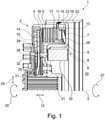
- the 1 shows a friction clutch 1 in longitudinal section.
- the friction clutch 1 is a dry multi-plate clutch.
- the friction clutch 1 has an input part 2 arranged on an engine side 19 and an output part 6 arranged on a transmission side 20 .
- the input part 2 comprises an outer disk carrier 4 which can be rotated about an axis of rotation 3 by means of a drive motor or internal combustion engine, not shown here, and on which four outer disks 5 are secured against rotation via a tooth system, not shown here.
- the output part 6 comprises a coaxially arranged to the outer disc carrier 4 and also around the Axis of rotation 3 rotatable inner disc carrier 8, on which four inner discs 9 are fixed against rotation via a toothing, also not shown here.
- the outer disks 5 and the inner disk carrier 9 can be braced by a spring device 10, which is a plate spring here, to close the friction clutch 1.
- a contact pressure of the spring device 10 can be transmitted to the inner disk carrier 8 via a pressure pot 14 and a modulation spring 18 .
- the contact pressure is supported by a spacer lamella 11.
- the spacer lamella 11 is ring-shaped and has a tubular section 16 and a flange-like section 17 .
- the spacer plate 11 spaces the outer plates 5 and the inner plates 9 in an axial direction 12, ie parallel to the axis of rotation 3, from a rotor carrier 7 of the output part 6.
- the spacer plate 11 forms a receiving space 15 for a plurality of leaf springs 13.
- leaf springs 13 are distributed in a circumferential direction 25 around the axis of rotation 3 and each extend from a collar 26 of the inner disk carrier 8, which is oriented in a radial direction 24 and is only partially shown here, in the circumferential direction 25 and the axial direction 12 to the Rotor carrier 7.
- the leaf springs 13 are riveted to the inner disk carrier 8 at a first longitudinal end of the leaf springs 13 and to the rotor carrier 7 at an opposite second longitudinal end of the leaf springs 13.
- the leaf springs 13 are erected between the inner disk carrier 8 and the rotor carrier 7 or arranged at an erection angle, so that the torque introduced as a tensile force into the leaf springs 13 via the inner disk carrier 8 generates a force with an axial directional component.
- the axial directional component of the force represents an amplification force that acts on the inner disk carrier 8 in the axial direction 12 in the direction of the transmission side 20, so that the contact pressure force of the spring device 10 is increased and contact force losses are compensated.
- the friction clutch 1 rotates counterclockwise in a direction of rotation 27 about the axis of rotation 3 , as a result of which the leaf springs 13 are subjected to tensile loading in order to use the reinforcing function of the leaf springs 13 .
- the pressure pot 14 is ring-shaped and connected radially on the inside to the inner disk carrier 8 in a rotationally fixed manner with a plurality of connecting means 28 which are distributed in the circumferential direction 25 and are designed here in the manner of rivets.
- the connecting means 28 have a connecting means length 32 in the axial direction 12 .
- an end face of the connecting means 28 forms an actuating surface 29 on a longitudinal end of the connecting means 28 in the axial direction 12, via which an actuating device 30, shown only schematically here, counteracts the pressing force of the spring device 10 for disengaging the friction clutch 1 in the direction of the engine side 19 Actuating force can be introduced.
- the actuating device 30 is arranged at least partially in the radial direction 24 within the rotor carrier 7 .
- the actuating device 30 contacts the actuating surface 29 directly.
- the actuating surface 29 has an actuating surface height 31 , which is a distance between the actuating surface 29 and a motor-side end face of a hub 21 of the friction clutch 1 in the axial direction 12 .
- the actuating surface height 31 was adjusted here to a target actuating surface height by compressing the connecting means 28 in the axial direction 12 .
- the rotor carrier 7 can be rotated about the axis of rotation 3 by a rotor 22 of an electric motor that is not shown in any more detail here.
- the rotor carrier 7 is connected to the rotor 22 in a rotationally fixed manner via its peripheral surface 23 .
- the rotor carrier 7 is also connected to the hub 21 in a rotationally fixed manner, so that the hub 21 can be rotated with the rotor carrier 7 about the axis of rotation 3 .
- the friction clutch 1 is formed into a hybrid module (not shown) for coupling and decoupling an internal combustion engine to and from the drive train of a motor vehicle, ie the friction clutch 1 forms a K0 clutch.
- the hybrid module can be a hybrid module with a coaxial electric motor whose rotor surrounds the K0 clutch, or a hybrid module with an axially parallel electric motor that drives a pulley that surrounds the K0 clutch. In the latter case, this belt pulley is made in one piece from the rotor carrier 7 and the rotor 22, or the belt pulley is carried by the rotor carrier 7, ie is pulled onto the rotor carrier 7 in its outer circumference.
Landscapes
- Engineering & Computer Science (AREA)
- General Engineering & Computer Science (AREA)
- Mechanical Engineering (AREA)
- Chemical & Material Sciences (AREA)
- Combustion & Propulsion (AREA)
- Transportation (AREA)
- Physics & Mathematics (AREA)
- Electromagnetism (AREA)
- Mechanical Operated Clutches (AREA)
Description
- Die vorliegende Erfindung betrifft eine Reibkupplung für einen Antriebsstrang eines Kraftfahrzeugs. Reibkupplungen dienen in Antriebssträngen von Kraftfahrzeugen, wie beispielsweise Personenkraftwagen, Lastkraftwagen oder Krafträdern, dem Ausgleich einer Antriebsdrehzahl und einer Getriebedrehzahl insbesondere während Anfahrvorgängen des Kraftfahrzeugs. Solche Reibungskupplungen sind aus den Druckschriften US 2012/111145 A1 und CN 105 422 679 A bekannt.
- Bekannte Reibkupplungen sind durch eine Betätigungsvorrichtung, wie zum Beispiel einen Zentralausrücker, betätigbar, insbesondere ausrückbar und/oder einrückbar. Hierzu ist in der Reibkupplung eine Betätigungsfläche ausgebildet, über die die Reibkupplung durch die die Betätigungsvorrichtung betätigbar ist. Da Reibkupplungen aus einer Vielzahl von Bauteilen bestehen, deren Maße Toleranzen unterliegen, unterliegt die Lage der Betätigungsfläche einer hohen Schwankung. In ungünstigsten Fällen kann es zu einem erheblichen Mehrweg der Betätigungsvorrichtung kommen, bevor diese bei der Betätigung der Reibkupplung gegen einen Endanschlag der Reibkupplung stößt. Dieser Mehrweg der Betätigungsvorrichtung resultiert in der Reibkupplung in einem Mehrweg der einzelnen Komponenten, der, um eine Kollision der einzelnen Komponenten untereinander zu verhindern, mit zusätzlichen Bauraum entsprechend vorgehalten werden muss. Hierdurch erhöht sich die Größe der Reibkupplung. Aufgabe der Erfindung ist es daher, die mit Bezug auf den Stand der Technik geschilderten Probleme zumindest teilweise zu lösen und insbesondere eine Reibkupplung für einen Antriebsstrang eines Kraftfahrzeugs mit insbesondere einem Hybridantrieb anzugeben, die besonders kompakt ausbildbar ist. Zudem soll auch ein Verfahren zur Herstellung einer entsprechenden Reibkupplung angegeben werden, mit dem die Reibkupplung besonders kompakt herstellbar ist.
- Diese Aufgaben werden gelöst mit einer Reibkupplung und einem Verfahren gemäß den Merkmalen der unabhängigen Ansprüche. Weitere vorteilhafte Ausgestaltungen der Erfindung sind in den abhängig formulierten Ansprüchen angegeben. Es ist darauf hinzuweisen, dass die in den abhängigen Ansprüchen einzeln aufgeführten Merkmale in beliebiger technologisch sinnvoller Weise miteinander kombiniert werden können und weitere Ausgestaltungen der Erfindung definieren. Darüber hinaus werden die in den Ansprüchen angegebenen Merkmale in der Beschreibung näher präzisiert und erläutert, wobei weitere bevorzugte Ausgestaltungen der Erfindung dargestellt werden.
- Hierzu trägt eine Reibkupplung für einen Antriebsstrang eines Kraftfahrzeugs bei, die zumindest die folgenden Komponenten aufweist:
- ein Eingangsteil mit einem durch zumindest einen Antriebsmotor um eine Drehachse drehbaren Außenlamellenträger, wobei an dem Außenlamellenträger zumindest eine Außenlamelle befestigt ist;
- ein Ausgangsteil mit einem Rotorträger und einem von dem Rotorträger getrennten Innenlamellenträger, wobei an dem Innenlamellenträger zumindest eine Innenlamelle befestigt ist;
- zumindest eine Federeinrichtung, mit der die zumindest eine Außenlamelle und die zumindest eine Innenlamelle zum Schließen der Reibkupplung mit einer Anpresskraft verspannbar sind; und
- einen Drucktopf, der mit zumindest einem Verbindungsmittel mit dem Innenlamellenträger verbunden ist, wobei das zumindest eine Verbindungsmittel eine Betätigungsfläche aufweist, über die die Reibkupplung mit einer Betätigungsvorrichtung betätigbar ist.
- Die vorgeschlagene (trockene) Reibkupplung, vorzugsweise die trockene Lamellenkupplung, ist für einen Antriebsstrang eines Kraftfahrzeugs, beispielsweise eines Personenkraftwagens, Lastkraftwagens und/oder Kraftrads, vorgesehen. Solche Kraftfahrzeuge weisen regelmäßig zumindest einen Antriebsmotor zum Antreiben des Kraftfahrzeugs auf. Bei dem zumindest einen Antriebsmotor kann es sich insbesondere um einen Hybridmotor handeln, der sowohl einen Verbrennungsmotor als auch zumindest einen Elektroantrieb zum Antrieb des Kraftfahrzeugs aufweist. Der zumindest eine Elektromotor kann beispielsweise mit einer Betriebsspannung von 24 V (Volt) oder 48 V betreibbar sein. Weiterhin weisen solche Kraftfahrzeuge regelmäßig ein Getriebe auf, das beispielsweise als Automatikgetriebe oder ein von einem Fahrer manuell geschaltetes Schaltgetriebe ausgebildet sein kann.
- Die Reibkupplung umfasst ein um eine Drehachse mittels des Antriebsmotors verdrehbar angeordnetes, antriebsseitiges Eingangsteil, das direkt oder indirekt beispielsweise mit einer Kurbelwelle des Antriebsmotors bzw. des Verbrennungsmotors des Hybridantriebs verbindbar ist. Weiterhin umfasst die Reibkupplung ein gegenüber dem Eingangsteil koaxial und um die Drehachse verdrehbar angeordnetes Ausgangsteil, das beispielsweise mit einer Getriebeeingangswelle des Getriebes indirekt oder direkt verbindbar ist. Das Ausgangsteil weist ferner einen Rotorträger auf, der mit einem Rotor des Elektromotors eines Hybridantriebs verbindbar ist und/oder durch den Elektromotor um die Drehachse antreibbar ist. Der Elektromotor kann koaxial zu der Drehachse der Reibkupplung bzw. zu der Drehachse des Rotorträgers angeordnet sein, sodass der Rotor des Elektromotors den Rotorträger umgibt. Der Rotorträger kann beispielsweise über eine Verzahnung an einer Umfangsfläche des Rotorträgers mit dem Rotor des Elektromotors verbunden sein. Weiterhin kann der Elektromotor parallel zu der Drehachse der Reibkupplung bzw. der Drehachse des Rotorträgers angeordnet sein. In diesem Fall kann der Elektromotor eine Riemenscheibe antreiben, die die Reibkupplung zumindest teilweise umgibt.
- Somit ist die Reibkupplung in ein Hybridmodul zum Ankoppeln eines Verbrennungsmotors an den Antriebsstrang des Kraftfahrzeugs bzw. zum Abkoppeln des Verbrennungsmotors von dem Antriebsstrang des Kraftfahrzeugs integriert, d.h. die Reibkupplung bildet eine K0-Kupplung. Bei dem Hybridmodul kann es sich um ein Hybridmodul mit koaxialem Elektromotor, dessen Rotor die K0-Kupplung umgibt, oder um ein Hybridmodul mit achsparallelem Elektromotor, der eine Riemenscheibe antreibt, die die K0-Kupplung umgibt, handeln. Im letztgenannten Fall ist diese Riemenscheibe aus dem Rotorträger und dem Rotor einteilig ausgebildet, oder die Riemenscheibe wird vom Rotorträger getragen, d.h. ist in dessen Außenumfang auf den Rotorträger aufgezogen.
- Zwischen dem Eingangsteil und dem Ausgangsteil ist eine in eine Umfangsrichtung um die Drehachse wirksame, zwischen einer Offenstellung und Schließstellung schaltbare Reibeinheit vorgesehen. Die Reibeinheit umfasst zumindest eine mit einem Außenlamellenträger des Eingangsteils verdrehfest verbundene Außenlamelle und zumindest eine mit einem Innenlamellenträger des Ausgangsteils verdrehfest verbundene Innenlamelle. Die zumindest eine Außenlamelle kann über eine Verzahnung mit dem Außenlamellenträger und/oder die zumindest eine Innenlamelle über eine Verzahnung mit dem Innenlamellenträger verbunden sein. Der Innenlamellenträger ist insbesondere ringförmig, zumindest teilweise rohrförmig, zumindest teilweise aus Stahl gefertigt und/oder weist einen L-förmigen Querschnitt auf. Weiterhin ist der Innenlamellenträger von dem Rotorträger getrennt. Dies bedeutet, dass der Innenlamellenträger in einer Umfangsrichtung um die Drehachse nicht direkt bzw. unmittelbar mit dem Rotorträger verdrehfest gekoppelt ist. Weiterhin kann der Innenlamellenträger in einer axialen Richtung, d. h. parallel zu der Drehachse, gegenüber dem Rotorträger begrenzt verlagerbar ausgebildet sein.
- Die Reibkupplung weist einen Drucktopf auf, mit dem der Innenlamellenträger mittels zumindest eines Verbindungsmittels fest verbunden ist. Über den Drucktopf ist die Reibkupplung betätigbar. Weiterhin kann über den Drucktopf eine von zumindest einer Federeinrichtung erzeugte Anpresskraft auf die zumindest eine Außenlamelle und die zumindest eine Innenlamelle übertragbar sein. Die zumindest eine Federeinrichtung drückt insbesondere von einer Motorseite der Reibkupplung auf den Drucktopf, sodass der Drucktopf die Anpresskraft auf den Innenlamellenträger überträgt. Die Reibkupplung ist mit einer Betätigungsvorrichtung, beispielsweise nach Art eines Zentralausrückers, ausrückbar, indem die Betätigungseinrichtung eine der Anpresskraft entgegenwirkende Betätigungskraft über eine Betätigungsfläche des zumindest einen Verbindungsmittels auf den Drucktopf erzeugt. Durch die Ausrückkraft ist der Drucktopf begrenzt in der axialen Richtung verlagerbar. Das zumindest eine Verbindungsmittel kann einen Bolzen umfassen. Durch die Ausbildung der Betätigungsfläche an das zumindest eine Verbindungsmittel können Maßtoleranzen der einzelnen Komponenten der Reibkupplung kompensiert werden, indem diese durch eine angepasste Ausgestaltung des zumindest einen Verbindungsmittels ausgeglichen werden. Insbesondere kann durch eine gezielte Anpassung des zumindest einen Verbindungsmittels, beispielsweise durch Anpassung der Länge und/oder Lage des zumindest einen Verbindungsmittels, eine Betätigungsflächenhöhe der Betätigungsfläche (in Abhängigkeit der zuvor gemessenen Maßtoleranzen der einzelnen Komponenten der Reibkupplung) auf eine definierte Soll-Betätigungsflächenhöhe eingestellt werden. Hierdurch muss in der Reibkupplung kein zusätzlicher Bauraum für einen Mehrweg der Betätigungsvorrichtung mehr vorgesehen werden, sodass die Reibkupplung besonders kompakt ausgestaltet werden kann. Bei der Betätigungsflächenhöhe kann es sich beispielsweise um einen Abstand der Betätigungsfläche von einer Stirnfläche einer Nabe der Reibkupplung in der axialen Richtung handeln. Die Nabe kann der (direkten oder indirekten) Verbindung der Reibkupplung mit einer Getriebeeingangswelle des Getriebes oder einer Zwischenwelle dienen und/oder Teil des Ausgangsteils der Reibkupplung sein. Zwischen dem Innenlamellenträger und dem Drucktopf kann eine Modulationsfeder angeordnet sein. Die Modulationsfeder kann ein festes Ende und ein freies Ende aufweisen, wobei das feste Ende insbesondere mit dem Innenlamellenträger verbunden ist. Das freie Ende ragt in der axialen Richtung von dem Innenlamellenträger insbesondere in Richtung des Drucktopfs. Auf diese Weise kann bei Bereitstellung der Anpresskraft das Einkuppeln der Reibkupplung sanfter ausgestaltet werden. Weiterhin ist die zumindest eine Innenlamelle nicht (direkt) mit dem Rotorträger verbunden. Die zumindest eine Außenlamelle und die zumindest eine Innenlamelle können in einer axialen Richtung, d. h. insbesondere parallel zu der Drehachse, zu einem Lamellenpaket abwechselnd geschichtet angeordnet sein. Weiterhin sind die zumindest eine Außenlamelle und/oder die zumindest eine Innenlamelle insbesondere ringförmig und/oder zumindest teilweise aus Stahl gefertigt. Zudem können die zumindest eine Außenlamelle und/oder die zumindest eine Innenlamelle Reibbeläge aufweisen.
- Die zumindest eine Außenlamelle und die zumindest eine Innenlamelle sind zum Schließen bzw. Einrücken der Reibkupplung durch eine Anpresskraft zumindest einer Federeinrichtung verspannbar bzw. in Reibeingriff bringbar. Bei der zumindest einen Federeinrichtung handelt es sich insbesondere um eine Tellerfeder. Die Reibkupplung ist durch die zumindest eine Federeinrichtung insbesondere normal-eingerückt.
- Ferner kann die Reibkupplung folgende Komponenten aufweisend:
- eine Abstandslamelle, mittels der die zumindest eine Außenlamelle und die zumindest eine Innenlamelle in einer axialen Richtung von dem Rotorträger beabstandet sind; und
- zumindest eine Blattfeder, die mit dem Innenlamellenträger und dem Rotorträger derart verbunden ist, dass die zumindest eine Blattfeder bei Einleitung eines Drehmoments durch den Antriebsmotor die Anpresskraft mit einer Verstärkungskraft verstärkt.
- Die Abstandslamelle kann formschlüssig mit dem Rotorträger verbunden sein. Durch die formschlüssige Verbindung der Abstandslamelle mit dem Rotorträger ist ein an der Abstandslamelle anliegendes Drehmoment des Antriebsmotors an den Rotorträger übertragbar. Weiterhin kann die Abstandslamelle durch die formschlüssige Verbindung mit dem Rotorträger gegen ein Verdrehen relativ zu dem Rotorträger gesichert sein. Weiterhin ist mittels der Abstandslamelle die zumindest eine Außenlamelle und die zumindest eine Innenlamelle in einer axialen Richtung von dem Rotorträger beabstandet. Die zumindest eine Blattfeder kann mit dem Innenlamellenträger und dem Rotorträger derart verbunden sein, dass die zumindest eine Blattfeder bei Einleitung eines Drehmoments durch den Antriebsmotor bzw. den Verbrennungsmotor des Hybridantriebs die Anpresskraft mit einer Verstärkungskraft verstärkt wird. Dies wird dadurch erreicht, dass die zumindest eine Blattfeder zwischen dem Innenlamellenträger und dem Rotorträger aufgestellt ist bzw. mit einem Aufstellwinkel angeordnet ist. Dies bedeutet insbesondere, dass die zumindest eine Blattfeder zumindest teilweise nicht parallel zu der axialen Richtung und/oder der radialen Richtung verläuft. Aufgrund des Aufstellwinkels resultiert das über den Innenlamellenträger in die zumindest eine Blattfeder eingeleitete Drehmoment in einer Kraft mit einer axialen Richtungskomponente. Die axiale Richtungskomponente der Kraft stellt eine Verstärkungskraft dar, die insbesondere in der gleichen Richtung wie die Anpresskraft der zumindest einen Federeinrichtung wirkt und diese somit verstärkt. Die Reibkupplung kann eine Mehrzahl von übereinandergeschichteten Blattfedern in Form zumindest eines Blattfederpakets aufweisen. Wird von dem Antriebsmotor ein Zugmoment über den Außenlamellenträger und die zumindest eine Außenlamelle an die zumindest eine Innenlamelle und den Innenlamellenträger übertragen, überträgt der Innenlamellenträger dieses Zugmoment über die zumindest eine aufgestellte Blattfeder an den Rotorträger. Durch den Aufstellwinkel der zumindest einen Blattfeder wird durch das übertragene Drehmoment die Verstärkungskraft in der axialen Richtung erzeugt. Die Verstärkungskraft wirkt insbesondere in Richtung einer Getriebeseite auf den Innenlamellenträger. Da die Anpresskraft der zumindest einen Federeinrichtung ebenfalls auf den Innenlamellenträger wirken kann, wird die durch die zumindest einer Federeinrichtung erzeugte Anpresskraft über die in Richtung Getriebeseite wirkende Verstärkungskraft der zumindest einen Blattfeder verstärkt. Hierdurch sind Anpresskraftverluste kompensierbar.
- Die Anpresskraft kann, insbesondere auf der Getriebeseite, durch die Abstandslamelle abgestützt sein. Die Abstandslamelle dient sowohl als Endlamelle in der Reibkupplung, die verhindert, dass der Rotorträger selbst als Reibfläche dient, als auch als Abstandshalter des Lamellenpakets, d. h. der zumindest einen Außenlamelle und der zumindest einen Innenlamelle, zum Rotorträger, um die zumindest eine aufgestellte Blattfedern zwischen dem Lamellenpaket und dem Rotorträger unterbringen zu können. Verbunden ist die zumindest eine Blattfeder insbesondere auf einer Getriebeseite der Reibkupplung mit dem Rotorträger und auf einer Motorseite der Reibkupplung mit dem Innenlamellenträger. Durch die Anbindung der Blattfedern getriebeseitig am Rotorträger und motorseitig am Innenlamellenträger wird die zumindest eine Blattfeder bei der Nutzung der Verstärkungsfunktion auf Zug belastet. Gegenüber einer Belastung auf Schub zur Nutzung der Verstärkungsfunktion hat dies für die zumindest eine Blattfeder erhebliche Vorteile hinsichtlich ihrer Dimensionierung. Auf Zug belastete Blattfedern können bei gleicher Belastung erheblich kleiner dimensioniert werden.
- Der Innenlamellenträger ist drehfest mit einem Drucktopf verbunden , über den die Reibkupplung betätigbar ist. Die Abstandslamelle kann die Anpresskraft abstützen. Weiterhin kann die Abstandslamelle einen Aufnahmeraum für die zumindest eine Blattfeder bilden. Die zumindest eine Blattfeder ist insbesondere vollständig in dem Aufnahmeraum angeordnet. Zudem kann sich der Innenlamellenträger in den Aufnahmeraum erstrecken. Die Abstandslamelle kann einen rohrförmigen Abschnitt und einen flanschartigen Abschnitt aufweisen. Die Abstandslamelle ist dabei insbesondere einstückig ausgebildet. Die Verstärkungskraft kann in eine axiale Richtung gerichtet sein. Die Verstärkungskraft kann in Richtung einer Getriebeseite der Reibkupplung gerichtet sein. Die zumindest eine Blattfeder kann beim Verstärken der Anpresskraft mit der Verstärkungskraft auf Zug beansprucht sein. Hierdurch kann die zumindest eine Blattfeder kleiner und damit mit einem geringeren Gewicht ausgebildet werden. Die zumindest eine Blattfeder kann mit dem Innenlamellenträger vernietet sein. Die zumindest eine Blattfeder ist insbesondere an einem ersten längsseitigen Ende mit dem Innenlamellenträger vernietet. Die zumindest eine Blattfeder ist insbesondere an einem dem ersten längsseitigen Ende gegenüberliegenden zweiten längsseitigen Ende mit dem Rotorträger verdrehfest bzw. momentenschlüssig verbunden und/oder vernietet. Die zumindest eine Blattfeder kann in einer axialen Richtung neben der Abstandslamelle angeordnet sein. Insbesondere ist die zumindest eine Blattfeder nicht radial innerhalb des Innenlamellenträgers und/oder der Abstandslamelle angeordnet. Ein Querschnitt des Innenlamellenträgers kann insbesondere L-förmig ausgebildet sein.
- Die Abstandslamelle kann zumindest eine Nase aufweisen, die in zumindest eine Aussparung des Rotorträgers eingreift. Die Abstandslamelle weist bevorzugt eine Mehrzahl von Nasen auf, die in einer Umfangsrichtung um die Drehachse verteilt angeordnet sind. Die zumindest eine Nase kann sich in die axiale Richtung erstrecken und/oder an einer Unterseite der Abstandslamelle angeordnet sein. Bei der zumindest einen Aussparung handelt es sich insbesondere um eine Öffnung des Rotorträgers. Die zumindest eine Aussparung erstreckt sich bevorzugt vollständig durch den Rotorträger. Die zumindest eine Nase greift derart in die zumindest eine Aussparung ein, dass die Abstandslamelle formschlüssig mit dem Rotorträger verbunden und gegen ein Verdrehen relativ zu dem Rotorträger gesichert ist. Die zumindest eine Nase kann die Abstandslamelle in der Reibkupplung zentrieren. Dies bedeutet insbesondere, dass die Abstandslamelle durch die zumindest eine Nase koaxial zu dem Rotorträger ausrichtbar bzw. anordenbar ist. Die zumindest eine Nase kann sich in die axiale Richtung erstrecken. Die zumindest eine Aussparung kann sich in die axiale Richtung erstrecken. Der Außenlamellenträger kann mit einem Lager verdrehbar an einer Nabe befestigt sein, wobei ein Lagersitz des Lagers zumindest teilweise durch einen Mitnehmerzahnkranz des Eingangsteils gebildet ist. Bei dem Lager handelt es sich insbesondere um ein Wälzlager oder Rollenlager. Die Nabe kann zumindest teilweise rohrförmig ausgebildet sein, der (direkten oder indirekten) Verbindung der Reibkupplung mit einer Getriebeeingangswelle des Getriebes oder einer Zwischenwelle dienen und/oder Teil des Ausgangsteils der Reibkupplung sein. Das Lager kann einen Innenring und Außenring aufweisen. Das Lager sitzt insbesondere in dem Mitnehmerzahnkranz. Dies kann bedeuten, dass das Lager den Mitnehmerzahnkranz (direkt), insbesondere mit dem Außenring, kontaktiert. Das Lager kann ferner, insbesondere mit dem Innenring, auf der Nabe angeordnet sein. Der Mitnehmerzahnkranz kann eine innere oder äußere Verzahnung aufweisen, über die ein Drehmoment von dem Antriebsmotor auf das Eingangsteil der Reibkupplung übertragbar ist. Der Lagersitz des Lagers kann zumindest teilweise durch den Mitnehmerzahnkranz und den Außenlamellenträger gebildet sein. Dies bedeutet, dass der Lagersitz des Lagers auch durch den Außenlamellenträger gebildet sein kann. Der Mitnehmerzahnkranz und der Außenlamellenträger sind hierzu bevorzugt in der axialen Richtung (unmittelbar) benachbart angeordnet. Ein Innendurchmesser des Mitnehmerzahnkranzes kann einem Außendurchmesser des Lagers entsprechen. Zwischen dem Innendurchmesser des Mitnehmerzahnkranzes und dem Außendurchmesser des Lagers kann eine Presspassung ausgebildet sein. Das Lager kann zweireihig ausgebildet sein. Bei einem zweireihigen Lager können Wälzkörper des Lagers in zwei (in der axialen Richtung) benachbarten ringförmigen Wälzkörperbahnen laufen. Das Lager kann in der axialen Richtung durch eine Zentralschraube abgestützt sein, mittels der eine Nabe der Reibkupplung an einer Welle fixierbar ist. Bei der Welle kann es sich insbesondere um eine Zwischenwelle handeln, über die das Drehmoment auf die Getriebeeingangswelle des Getriebes leitbar ist. Die Zentralschraube kann insbesondere auf einer Stirnseite der Nabe und/oder koaxial zur Nabe an der Reibkupplung festschraubbar sein. Die Zentralschraube stützt insbesondere den Innenring des Lagers in der axialen Richtung ab. Dies bedeutet insbesondere, dass die Zentralschraube den Innenring kontaktiert, sodass das Lager in der axialen Richtung relativ zu der Nabe nicht bewegbar ist. Hierdurch kann eine Sicherung des Lagers durch einen Sicherungsring entfallen.
- Bei dem zumindest einen Verbindungsmittel kann es sich um einen Niet oder eine Schraube handeln.
- Die Betätigungsfläche kann orthogonal zu der Drehachse verlaufen.
- Die Betätigungsfläche kann eine Betätigungsflächenhöhe aufweisen, die einstellbar ist. Hierzu kann die Reibkupplung beispielsweise ein Gewinde aufweisen, über das das zumindest eine Verbindungsmittel, insbesondere in der axialen Richtung, verstellbar ist.
- Einem weiteren Aspekt der Erfindung folgend wird auch ein Verfahren zur Herstellung einer erfindungsgemäßen Reibkupplung vorgeschlagen, wobei ein Drucktopf mit einem Innenlamellenträger über zumindest ein Verbindungsmittel verbunden ist, wobei das zumindest eine Verbindungsmittel eine Betätigungsfläche aufweist, über die die Reibkupplung mit einer Betätigungsvorrichtung betätigbar ist, und wobei eine Betätigungsflächenhöhe der Betätigungsfläche auf eine Soll-Betätigungsflächenhöhe eingestellt wird. Durch das vorgeschlagene Verfahren wird verhindert, dass die Betätigungsflächenhöhe aufgrund von Maßtoleranzen der einzelnen Komponenten der Reibkupplung schwankt. Durch die Einstellung der Betätigungsflächenhöhe auf die Soll-Betätigungsflächenhöhe muss in der Reibkupplung kein zusätzlicher Bauraum für einen Mehrweg der Betätigungsvorrichtung mehr vorgesehen werden, sodass die Reibkupplung besonders kompakt ausgestaltet werden kann. Bei der Betätigungsflächenhöhe kann es sich beispielsweise um einen Abstand der Betätigungsfläche von einer Stirnfläche einer Nabe der Reibkupplung in der axialen Richtung handeln. Für weitere Einzelheiten wird auf die Beschreibung der Reibkupplung verwiesen.
- Die Einstellung der Betätigungsflächenhöhe kann durch eine Wahl einer abgestimmten Verbindungsmittellänge des zumindest einen Verbindungsmittels erfolgen. Bei der Verwendung von Nieten als Verbindungsmittel können beispielsweise Niete mit unterschiedlichen Bolzenbundlängen verwendet werden. Hierbei wird vor der Vernietung des Bolzens die sich aus den toleranzbehafteten Einzelkomponenten der Reibkupplung ergebende Vernietungshöhe bzw. Betätigungsflächenhöhe gemessen. Entsprechend der gewünschten Soll-Betätigungsflächenhöhe wird ein Bolzen als Niet verwendet, dessen Bundlänge auf die gemessenen Maßtoleranzen der Einzelkomponenten der Reibkupplung abgestimmt ist.
- Die Einstellung der Betätigungsflächenhöhe kann durch Unterlegen des zumindest einen Verbindungsmittels mit zumindest einer Scheibe erfolgen. Die zumindest eine Scheibe kann beispielsweise ringförmig und/oder nach Art einer Unterlegscheibe ausgebildet sein. Weiterhin kann die zumindest eine Scheibe zwischen einen Nietkopf bzw. Schraubenkopf des zumindest einen Verbindungsmittels und einer Komponente der Reibkupplung, insbesondere dem Innenlamellenträger, angeordnet sein. Das zumindest eine Verbindungsmittel kann mit einer Mehrzahl von Scheiben und/oder mit Scheiben unterschiedlicher Scheibendicken (in der axialen Richtung) unterlegt werden, bis dass die Betätigungsflächenhöhe der Betätigungsfläche des zumindest einen Verbindungsmittel die Soll-Betätigungsflächenhöhe erreicht. Hierdurch können Niete verwendet werden, deren Bolzen die gleiche Bolzenbundlänge aufweisen. Die Bolzenbundlänge liegt dabei stets unter der erforderlichen Länge. Die Streuung der Betätigungsflächenhöhe wird dann durch das Unterlegen des zumindest ein Verbindungsmittels mit der zumindest einen Scheibe kompensiert.
- Die Einstellung der Betätigungsflächenhöhe kann durch ein Stauchen des zumindest einen Verbindungsmittels erfolgen. Beim Stauchen wird beispielsweise ein Bolzen, insbesondere mit einem Stempel, durch Druck plastisch verformt und/oder in der axialen Richtung verkürzt. Dabei wird insbesondere ein Niet bzw. Bolzen verwendet, dessen Bolzenbundlänge größer ist als erforderlich. Weiterhin kann nach dem Vernieten des zumindest einen Verbindungsmittels das zumindest eine Verbindungsmittel in einem zweiten Nietprozess gezielt auf die Soll-Betätigungsflächenhöhe gestaucht werden. Zudem kann das zumindest eine Verbindungsmittel einen Stauchbereich aufweisen, der beispielsweise nach Art einer Verjüngung (in der radialen Richtung) ausgebildet sein kann. Hierdurch kann das Stauchen des zumindest einen Verbindungsmittels (in der axialen Richtung) mit einer geringeren Kraft erfolgen.
- Die Einstellung der Betätigungsflächenhöhe kann durch ein Schrauben des zumindest einen Verbindungsmittels in ein Gewinde erfolgen. Hierzu kann das zumindest eine Verbindungsmittel insbesondere nach Art einer Schraube ausgebildet sein. Die Einstellung der Betätigungsflächenhöhe auf die Soll-Betätigungsflächenhöhe kann durch ein Schrauben des zumindest einen Verbindungsmittels in das Gewinde individuell eingestellt und so Schwankungen der Betätigungsflächenhöhe ausgeglichen werden.
- Die Erfindung sowie das technische Umfeld wird nachfolgend anhand der Figur näher erläutert. Es ist darauf hinzuweisen, dass die Figur eine besonders bevorzugte Variante der Erfindung zeigt, diese jedoch nicht darauf beschränkt ist. Es zeigt beispielhaft und schematisch:
Fig. 1 : eine Reibkupplung in einem Längsschnitt. - Die
Fig. 1 zeigt eine Reibkupplung 1 im Längsschnitt. Insbesondere handelt es sich bei der Reibkupplung 1 um eine trockene Lamellenkupplung. Die Reibkupplung 1 weist ein auf einer Motorseite 19 angeordnetes Eingangsteil 2 und ein auf einer Getriebeseite 20 angeordnetes Ausgangsteil 6 auf. Das Eingangsteil 2 umfasst einen um eine Drehachse 3 durch einen hier nicht gezeigten Antriebsmotor bzw. Verbrennungsmotor drehbaren Außenlamellenträger 4, an dem vier Außenlamellen 5 verdrehfest über eine hier nicht gezeigte Verzahnung befestigt sind. Das Ausgangsteil 6 umfasst einen koaxial zu dem Außenlamellenträger 4 angeordneten und ebenfalls um die Drehachse 3 drehbaren Innenlamellenträger 8 auf, an dem vier Innenlamellen 9 verdrehfest über eine hier ebenfalls nicht gezeigte Verzahnung befestigt sind. Die Außenlamellen 5 und der Innenlamellenträger 9 sind durch eine Federeinrichtung 10, bei der es sich hier um eine Tellerfeder handelt, zum Schließen der Reibkupplung 1 verspannbar. Hierzu ist eine Anpresskraft der Federeinrichtung 10 über einen Drucktopf 14 und eine Modulationsfeder 18 auf den Innenlamellenträger 8 leitbar. Die Anpresskraft wird durch eine Abstandslamelle 11 abgestützt. Die Abstandslamelle 11 ist ringförmig ausgebildet und weist einen rohrförmigen Abschnitt 16 und einen flanschartigen Abschnitt 17 auf. Weiterhin beabstandet die Abstandslamelle 11 die Außenlamellen 5 und die Innenlamellen 9 in einer axialen Richtung 12, d. h. parallel zu der Drehachse 3, von einem Rotorträger 7 des Ausgangsteils 6. Zudem bildet die Abstandslamelle 11 einen Aufnahmeraum 15 für eine Mehrzahl von Blattfedern 13. Die Mehrzahl von Blattfedern 13 sind in einer Umfangsrichtung 25 um die Drehachse 3 verteilt angeordnet und erstrecken sich jeweils von einem in eine radiale Richtung 24 orientierten Kragen 26 des Innenlamellenträgers 8, der hier nur teilweise dargestellt ist, in der Umfangsrichtung 25 und der axialen Richtung 12 zu dem Rotorträger 7. Die Blattfedern 13 sind an einem ersten längsseitigen Ende der Blattfedern 13 mit dem Innenlamellenträger 8 und mit einem gegenüberliegenden zweiten längsseitigen Ende der Blattfedern 13 mit dem Rotorträger 7 vernietet. Hierdurch ist bei geschlossener Reibkupplung 1 ein Drehmoment eines Antriebsmotors über den Außenlamellenträger 4, die Außenlamellen 5, die Innenlamellen 9, den Innenlamellenträger 8 und die Blattfedern 13 auf den Rotorträger 7 übertragbar. - Die Blattfedern 13 sind zwischen dem Innenlamellenträger 8 und dem Rotorträger 7 aufgestellt bzw. mit einem Aufstellwinkel angeordnet, sodass das über den Innenlamellenträger 8 in die Blattfedern 13 als Zugkraft eingeleitete Drehmoment eine Kraft mit einer axialen Richtungskomponente erzeugt. Die axiale Richtungskomponente der Kraft stellt eine Verstärkungskraft dar, die in der axialen Richtung 12 in Richtung der Getriebeseite 20 auf den Innenlamellenträger 8 wirkt, sodass die Anpresskraft der Federeinrichtung 10 verstärkt und Anpresskraftverluste kompensiert werden. Die Reibkupplung 1 dreht von der Getriebeseite 20 aus betrachtet in eine Drehrichtung 27 gegen den Uhrzeigersinn um die Drehachse 3, wodurch die Blattfedern 13 auf Zug belasten werden, um die Verstärkungsfunktion der Blattfedern 13 zu nutzen. Wenn ein Drehmoment in der Drehrichtung 27 durch den nicht dargestellten Verbrennungsmotor von der Motorseite 19 kommend über den Außenlamellenträger 4 und die Außenlamellen 5 bei eingerückter Reibkupplung 1 auf die Innenlamellen 9 und den Innenlamellenträger 8 eingeleitet wird, sorgt das Drehmoment in der Drehrichtung 27 dafür, dass der Reibschluss zwischen Außenlamellen 5 und Innenlamellen 9 durch die auf Zug beanspruchten, aufgestellten Blattfedern 13 verstärkt wird, da der Kragen 26 des in axialer Richtung 12 verlagerbaren Innenlamellenträgers 8 in Richtung des Rotorträgers 7 gezogen wird. Somit steigt die Drehmomentkapazität der Reibkupplung 1, wodurch die Reibkupplung 1 kleiner ausgelegt werden kann, als dies ohne Verstärkungsfunktion der Blattfedern 13 der Fall gewesen wäre. Anders ausgedrückt, sind durch die Verstärkungsfunktion der Blattfedern 13 Anpresskraftverluste kompensierbar.
- Der Drucktopf 14 ist ringförmig ausgebildet und radial innen mit einer Mehrzahl von in der Umfangsrichtung 25 verteilt angeordneten Verbindungsmittel 28, die hier nach Art von Nieten ausgebildet sind, mit dem Innenlamellenträger 8 verdrehfest verbunden. Die Verbindungsmittel 28 weisen in der axialen Richtung 12 eine Verbindungsmittellänge 32 auf. Weiterhin bildet eine Stirnfläche des Verbindungsmittels 28 an einem in der axialen Richtung 12 längsseitigen Ende des Verbindungsmittels 28 eine Betätigungsfläche 29, über die durch eine hier lediglich schematisch dargestellte Betätigungsvorrichtung 30 entgegen der Anpresskraft der Federeinrichtung 10 zum Ausrücken der Reibkupplung 1 in Richtung der Motorseite 19 eine Betätigungskraft einleitbar ist. Die Betätigungsvorrichtung 30 ist zumindest teilweise in der radialen Richtung 24 innerhalb des Rotorträgers 7 angeordnet. Die Betätigungsvorrichtung 30 kontaktiert die Betätigungsfläche 29 unmittelbar. Die Betätigungsfläche 29 weist eine Betätigungsflächenhöhe 31 auf, bei der es sich hier um einen Abstand der Betätigungsfläche 29 von einer motorseitigen Stirnfläche einer Nabe 21 der Reibkupplung 1 in der axialen Richtung 12 handelt. Die Betätigungsflächenhöhe 31 wurde hier durch ein Stauchen des Verbindungsmittels 28 in der axialen Richtung 12 auf eine Soll-Betätigungsflächenhöhe eingestellt. Alternativ oder kumulativ ist der Rotorträger 7 durch einen Rotor 22 eines hier nicht weiter gezeigten Elektromotors um die Drehachse 3 drehbar. Hierzu ist der Rotorträger 7 über seine Umfangsfläche 23 mit dem Rotor 22 verdrehfest verbunden. Der Rotorträger 7 ist zudem verdrehfest mit der Nabe 21 verbunden, sodass die Nabe 21 mit dem Rotorträger 7 um die Drehachse 3 drehbar ist.
- Insbesondere ist die Reibkupplung 1, genauer gesagt die trockene Lamellenkupplung, in ein nichtdargestelltes Hybridmodul zum An- und Abkoppeln eines Verbrennungsmotors an den und vom Antriebsstrang eines Kraftfahrzeugs ausgebildet, d.h. die Reibkupplung 1 bildet eine K0-Kupplung. Bei dem Hybridmodul kann es sich um ein Hybridmodul mit koaxialem Elektromotor, dessen Rotor die K0-Kupplung umgibt, oder um ein Hybridmodul mit achsparallelem Elektromotor, der eine Riemenscheibe antreibt, die die K0-Kupplung umgibt, handeln. Im letztgenannten Fall ist diese Riemenscheibe aus dem Rotorträger 7 und dem Rotor 22 einteilig ausgebildet, oder die Riemenscheibe wird vom Rotorträger 7 getragen, d.h. ist in dessen Außenumfang auf den Rotorträger 7 aufgezogen.
-
- 1
- Reibkupplung
- 2
- Eingangsteil
- 3
- Drehachse
- 4
- Außenlamellenträger
- 5
- Außenlamelle
- 6
- Ausgangsteil
- 7
- Rotorträger
- 8
- Innenlamellenträger
- 9
- Innenlamelle
- 10
- Federeinrichtung
- 11
- Abstandslamelle
- 12
- axiale Richtung
- 13
- Blattfeder
- 14
- Drucktopf
- 15
- Aufnahmeraum
- 16
- rohrförmige Abschnitt
- 17
- flanschartiger Abschnitt
- 18
- Modulationsfeder
- 19
- Motorseite
- 20
- Getriebeseite
- 21
- Nabe
- 22
- Rotor
- 23
- Umfangsfläche
- 24
- radiale Richtung
- 25
- Umfangsrichtung
- 26
- Kragen
- 27
- Drehrichtung
- 28
- Verbindungsmittel
- 29
- Betätigungsfläche
- 30
- Betätigungsvorrichtung
- 31
- Betätigungsflächenhöhe
- 32
- Verbindungsmittellänge
Claims (10)
- Reibkupplung (1) für einen Antriebsstrang eines Kraftfahrzeugs, aufweisend:- ein Eingangsteil (2) mit einem durch zumindest einen Antriebsmotor um eine Drehachse (3) drehbaren Außenlamellenträger (4), wobei an dem Außenlamellenträger (4) zumindest eine Außenlamelle (5) befestigt ist;- ein Ausgangsteil (6) mit einem Rotorträger (7) und einem von dem Rotorträger (7) getrennten Innenlamellenträger (8), wobei an dem Innenlamellenträger (8) zumindest eine Innenlamelle (9) befestigt ist;- zumindest eine Federeinrichtung (10), mit der die zumindest eine Außenlamelle (5) und die zumindest eine Innenlamelle (9) zum Schließen der Reibkupplung (1) mit einer Anpresskraft verspannbar sind; dadurch gekennzeichnet, dass die Reibungskupplung einen Drucktopf (14) aufweist, der mit zumindest einem Verbindungsmittel (28) mit dem Innenlamellenträger (8) verbunden ist, wobei das zumindest eine Verbindungsmittel (28) eine Betätigungsfläche (29) aufweist, über die die Reibkupplung (1) mit einer Betätigungsvorrichtung (30) betätigbar ist.
- Reibkupplung (1) nach Anspruch 1, ferner aufweisend:- eine Abstandslamelle (11), mittels der die zumindest eine Außenlamelle (5) und die zumindest eine Innenlamelle (9) in einer axialen Richtung (12) von dem Rotorträger (7) beabstandet sind; und- zumindest eine Blattfeder (13), die mit dem Innenlamellenträger (8) und dem Rotorträger (7) derart verbunden ist, dass die zumindest eine Blattfeder (13) bei Einleitung eines Drehmoments durch den Antriebsmotor die Anpresskraft mit einer Verstärkungskraft verstärkt.
- Reibkupplung (1) nach einem der vorhergehenden Ansprüche, wobei es sich bei dem zumindest einem Verbindungsmittel (28) um einen Niet oder eine Schraube handelt.
- Reibkupplung (1) nach einem der vorhergehenden Ansprüche, wobei die Betätigungsfläche (29) orthogonal zu der Drehachse (3) verläuft.
- Reibkupplung (1) nach einem der vorhergehenden Ansprüche, wobei die Betätigungsfläche (29) eine Betätigungsflächenhöhe (31) aufweist, die einstellbar ist.
- Verfahren zur Herstellung einer Reibkupplung (1) nach einem der vorhergehenden Ansprüche, wobei ein Drucktopf (14) mit einem Innenlamellenträger (8) über zumindest ein Verbindungsmittel (28) verbunden ist, wobei das zumindest eine Verbindungsmittel (28) eine Betätigungsfläche (29) aufweist, über die die Reibkupplung (1) mit einer Betätigungsvorrichtung (30) betätigbar ist, und wobei eine Betätigungsflächenhöhe (31) der Betätigungsfläche auf eine Soll-Betätigungsflächenhöhe eingestellt wird.
- Verfahren nach Anspruch 6, wobei die Einstellung der Betätigungsflächenhöhe (31) durch eine Wahl einer abgestimmten Verbindungsmittellänge (32) des zumindest einen Verbindungsmittels (28) erfolgt.
- Verfahren nach Anspruch 6 oder 7, wobei die Einstellung der Betätigungsflächenhöhe (31) durch Unterlegen des zumindest einen Verbindungsmittels (28) mit zumindest einer Scheibe erfolgt.
- Verfahren nach einem der Ansprüche 6 bis 8, wobei die Einstellung der Betätigungsflächenhöhe (31) durch ein Stauchen des zumindest einen Verbindungsmittels (28) erfolgt.
- Verfahren nach einem der Ansprüche 6 bis 9, wobei die Einstellung der Betätigungsflächenhöhe (31) durch ein Schrauben des zumindest einen Verbindungsmittels (28) in ein Gewinde erfolgt.
Applications Claiming Priority (3)
| Application Number | Priority Date | Filing Date | Title |
|---|---|---|---|
| DE102018103982 | 2018-02-22 | ||
| DE102018108046.8A DE102018108046A1 (de) | 2018-02-22 | 2018-04-05 | Reibkupplung für einen Antriebsstrang eines Kraftfahrzeugs mit einer durch zumindest ein Verbindungsmittel gebildeten Betätigungsfläche |
| PCT/DE2019/100066 WO2019161830A1 (de) | 2018-02-22 | 2019-01-22 | Reibkupplung für einen antriebsstrang eines kraftfahrzeugs mit einer durch zumindest ein verbindungsmittel gebildeten betätigungsfläche |
Publications (2)
| Publication Number | Publication Date |
|---|---|
| EP3755562A1 EP3755562A1 (de) | 2020-12-30 |
| EP3755562B1 true EP3755562B1 (de) | 2022-01-19 |
Family
ID=67481949
Family Applications (1)
| Application Number | Title | Priority Date | Filing Date |
|---|---|---|---|
| EP19704723.6A Active EP3755562B1 (de) | 2018-02-22 | 2019-01-22 | Reibkupplung für einen antriebsstrang eines kraftfahrzeugs mit einer durch zumindest ein verbindungsmittel gebildeten betätigungsfläche |
Country Status (5)
| Country | Link |
|---|---|
| US (1) | US11408469B2 (de) |
| EP (1) | EP3755562B1 (de) |
| CN (1) | CN111683833B (de) |
| DE (2) | DE102018108046A1 (de) |
| WO (1) | WO2019161830A1 (de) |
Family Cites Families (15)
| Publication number | Priority date | Publication date | Assignee | Title |
|---|---|---|---|---|
| EP1736345A1 (de) * | 2005-06-22 | 2006-12-27 | Zf Friedrichshafen Ag | Elektromotorisches Antriebsmodul |
| EP1966582B1 (de) * | 2005-12-23 | 2009-11-18 | BorgWarner, Inc. | Messung von momentengleichförmigkeit an mehrscheibenkupplungen |
| JP5605171B2 (ja) | 2010-11-04 | 2014-10-15 | アイシン精機株式会社 | 電動モータおよびその電動モータを用いた車両用駆動装置 |
| US9284882B2 (en) * | 2012-02-10 | 2016-03-15 | Aisin Aw Co., Ltd. | Hybrid drive device |
| DE102012021074B4 (de) * | 2012-10-19 | 2016-05-04 | Getrag Getriebe- Und Zahnradfabrik Hermann Hagenmeyer Gmbh & Cie Kg | Verfahren zum Betreiben eines Hybrid-Antriebsstranges |
| DE102014014236A1 (de) * | 2014-02-22 | 2015-08-27 | Borgwarner Inc. | Antriebsstrang für ein Kraftfahrzeug und Verfahren zum Betrieb eines solchen Antriebsstrangs |
| JP2016033003A (ja) * | 2014-07-29 | 2016-03-10 | アイシン・エィ・ダブリュ株式会社 | ハイブリッド駆動装置 |
| DE102014224374A1 (de) * | 2014-11-28 | 2016-06-02 | Schaeffler Technologies AG & Co. KG | Kupplungseinrichtung |
| CN105422679A (zh) * | 2015-12-30 | 2016-03-23 | 盛瑞传动股份有限公司 | 混合动力车用自动变速器 |
| ITUA20161890A1 (it) * | 2016-03-22 | 2017-09-22 | Dana Graziano Srl | Innesto a frizione per trasmissione di veicolo. |
| DE102017129269A1 (de) * | 2017-03-06 | 2018-09-06 | Schaeffler Technologies AG & Co. KG | Hybridmodul mit integrierter Sensoreinrichtung sowie Hybridantriebsstrang mit Hybridmodul |
| DE202018006174U1 (de) | 2018-02-16 | 2019-06-07 | Schaeffler Technologies AG & Co. KG | Hybridmodul mit einer Rotationsachse |
| DE102018103981A1 (de) | 2018-02-22 | 2019-08-22 | Schaeffler Technologies AG & Co. KG | Reibkupplung für einen Antriebsstrang eines Kraftfahrzeugs mit zumindest einer Blattfeder zur Verstärkung einer Anpresskraft einer Federeinrichtung |
| DE102018103984A1 (de) | 2018-02-22 | 2019-08-22 | Schaeffler Technologies AG & Co. KG | Reibkupplung für einen Antriebsstrang eines Kraftfahrzeugs mit zumindest einer Blattfeder zur Verstärkung einer Anpresskraft einer Federeinrichtung |
| DE102018108047A1 (de) | 2018-02-22 | 2019-08-22 | Schaeffler Technologies AG & Co. KG | Reibkupplung für einen Antriebsstrang eines Kraftfahrzeugs mit zumindest einer Blattfeder zur Verstärkung einer Anpresskraft einer Federeinrichtung |
-
2018
- 2018-04-05 DE DE102018108046.8A patent/DE102018108046A1/de not_active Withdrawn
-
2019
- 2019-01-22 CN CN201980011565.0A patent/CN111683833B/zh active Active
- 2019-01-22 DE DE112019000923.0T patent/DE112019000923A5/de not_active Withdrawn
- 2019-01-22 US US16/971,830 patent/US11408469B2/en active Active
- 2019-01-22 WO PCT/DE2019/100066 patent/WO2019161830A1/de not_active Ceased
- 2019-01-22 EP EP19704723.6A patent/EP3755562B1/de active Active
Also Published As
| Publication number | Publication date |
|---|---|
| DE112019000923A5 (de) | 2020-11-12 |
| US11408469B2 (en) | 2022-08-09 |
| CN111683833A (zh) | 2020-09-18 |
| US20200393005A1 (en) | 2020-12-17 |
| EP3755562A1 (de) | 2020-12-30 |
| DE102018108046A1 (de) | 2019-08-22 |
| CN111683833B (zh) | 2023-10-20 |
| WO2019161830A1 (de) | 2019-08-29 |
Similar Documents
| Publication | Publication Date | Title |
|---|---|---|
| EP3123045B2 (de) | Übersetzungssystem für eine mehrscheibenreibkupplung | |
| DE102015202334B4 (de) | Zweimassenschwungrad mit integriertem Freilauf | |
| EP3755915B1 (de) | Reibkupplung für einen antriebsstrang eines kraftfahrzeugs mit zumindest einer blattfeder zur verstärkung einer anpresskraft einer federeinrichtung | |
| EP3123050B1 (de) | Weggesteuerte nachstelleinrichtung | |
| EP3755914B1 (de) | Reibkupplung für einen antriebsstrang eines kraftfahrzeugs mit zumindest einer blattfeder zur verstärkung einer anpresskraft einer federeinrichtung | |
| EP3123051B1 (de) | Nachstelleinrichtung für eine reibkupplung | |
| EP3622190A1 (de) | Kupplungseinrichtung und antriebsstrang | |
| EP1862688B2 (de) | Drehmomentübertragungsanordnung für den Antriebsstrang eines Fahrzeugs | |
| EP2638306B1 (de) | Drehmomentübertragungseinrichtung | |
| EP3755912A1 (de) | Reibkupplung für einen antriebsstrang eines kraftfahrzeugs mit zumindest einer blattfeder zur verstärkung einer anpresskraft einer federeinrichtung | |
| EP3123053B1 (de) | Nachstelleinrichtung für eine reibkupplung | |
| EP3123048B1 (de) | Weggesteuerte nachstelleinrichtung für eine reibkupplung | |
| DE102013203343A1 (de) | Nachstelleinrichtung für eine Reibkupplung | |
| DE102012211706A1 (de) | Reibungskupplung | |
| WO2019161830A1 (de) | Reibkupplung für einen antriebsstrang eines kraftfahrzeugs mit einer durch zumindest ein verbindungsmittel gebildeten betätigungsfläche | |
| DE102013212429A1 (de) | Reibkupplung mit weggesteuerter Verschleißnachstelleinrichtung | |
| EP4051920B1 (de) | Drehmomentbegrenzer mit einer rotationsachse für einen antriebsstrang | |
| DE102018007853A1 (de) | Kegelkupplung und Antriebsstrang mit einer solchen Kegelkupplung | |
| DE102011103776A1 (de) | Kupplungsscheibe | |
| DE102015206026A1 (de) | Kupplungsdeckel mit einer Rotationsachse und Tellerfeder für eine Reibkupplung, sowie ein Montageverfahren und eine Verwendung von Hülsen zum Montieren und zum Zentrieren einer Tellerfeder in dem Kupplungsdeckel | |
| DE102013220624A1 (de) | Tellerfeder für eine Reibkupplung | |
| DE102016208824A1 (de) | Kupplungsaggregat und Antriebsstrang | |
| DE102015224065A1 (de) | Reibkupplung zum lösbaren Übertragen eines Drehmoments | |
| WO2015127932A1 (de) | Gegendruckplatte für eine kupplung | |
| WO2012155878A1 (de) | Kupplungsanordnung für traktoren mit pto |
Legal Events
| Date | Code | Title | Description |
|---|---|---|---|
| STAA | Information on the status of an ep patent application or granted ep patent |
Free format text: STATUS: UNKNOWN |
|
| STAA | Information on the status of an ep patent application or granted ep patent |
Free format text: STATUS: THE INTERNATIONAL PUBLICATION HAS BEEN MADE |
|
| PUAI | Public reference made under article 153(3) epc to a published international application that has entered the european phase |
Free format text: ORIGINAL CODE: 0009012 |
|
| STAA | Information on the status of an ep patent application or granted ep patent |
Free format text: STATUS: REQUEST FOR EXAMINATION WAS MADE |
|
| 17P | Request for examination filed |
Effective date: 20200922 |
|
| AK | Designated contracting states |
Kind code of ref document: A1 Designated state(s): AL AT BE BG CH CY CZ DE DK EE ES FI FR GB GR HR HU IE IS IT LI LT LU LV MC MK MT NL NO PL PT RO RS SE SI SK SM TR |
|
| AX | Request for extension of the european patent |
Extension state: BA ME |
|
| DAV | Request for validation of the european patent (deleted) | ||
| DAX | Request for extension of the european patent (deleted) | ||
| GRAP | Despatch of communication of intention to grant a patent |
Free format text: ORIGINAL CODE: EPIDOSNIGR1 |
|
| STAA | Information on the status of an ep patent application or granted ep patent |
Free format text: STATUS: GRANT OF PATENT IS INTENDED |
|
| INTG | Intention to grant announced |
Effective date: 20210910 |
|
| GRAS | Grant fee paid |
Free format text: ORIGINAL CODE: EPIDOSNIGR3 |
|
| GRAA | (expected) grant |
Free format text: ORIGINAL CODE: 0009210 |
|
| STAA | Information on the status of an ep patent application or granted ep patent |
Free format text: STATUS: THE PATENT HAS BEEN GRANTED |
|
| AK | Designated contracting states |
Kind code of ref document: B1 Designated state(s): AL AT BE BG CH CY CZ DE DK EE ES FI FR GB GR HR HU IE IS IT LI LT LU LV MC MK MT NL NO PL PT RO RS SE SI SK SM TR |
|
| REG | Reference to a national code |
Ref country code: GB Ref legal event code: FG4D Free format text: NOT ENGLISH |
|
| REG | Reference to a national code |
Ref country code: CH Ref legal event code: EP |
|
| REG | Reference to a national code |
Ref country code: DE Ref legal event code: R096 Ref document number: 502019003267 Country of ref document: DE |
|
| REG | Reference to a national code |
Ref country code: AT Ref legal event code: REF Ref document number: 1463602 Country of ref document: AT Kind code of ref document: T Effective date: 20220215 |
|
| REG | Reference to a national code |
Ref country code: IE Ref legal event code: FG4D Free format text: LANGUAGE OF EP DOCUMENT: GERMAN |
|
| REG | Reference to a national code |
Ref country code: LT Ref legal event code: MG9D |
|
| REG | Reference to a national code |
Ref country code: NL Ref legal event code: MP Effective date: 20220119 |
|
| PG25 | Lapsed in a contracting state [announced via postgrant information from national office to epo] |
Ref country code: NL Free format text: LAPSE BECAUSE OF FAILURE TO SUBMIT A TRANSLATION OF THE DESCRIPTION OR TO PAY THE FEE WITHIN THE PRESCRIBED TIME-LIMIT Effective date: 20220119 |
|
| PG25 | Lapsed in a contracting state [announced via postgrant information from national office to epo] |
Ref country code: SE Free format text: LAPSE BECAUSE OF FAILURE TO SUBMIT A TRANSLATION OF THE DESCRIPTION OR TO PAY THE FEE WITHIN THE PRESCRIBED TIME-LIMIT Effective date: 20220119 Ref country code: RS Free format text: LAPSE BECAUSE OF FAILURE TO SUBMIT A TRANSLATION OF THE DESCRIPTION OR TO PAY THE FEE WITHIN THE PRESCRIBED TIME-LIMIT Effective date: 20220119 Ref country code: PT Free format text: LAPSE BECAUSE OF FAILURE TO SUBMIT A TRANSLATION OF THE DESCRIPTION OR TO PAY THE FEE WITHIN THE PRESCRIBED TIME-LIMIT Effective date: 20220519 Ref country code: NO Free format text: LAPSE BECAUSE OF FAILURE TO SUBMIT A TRANSLATION OF THE DESCRIPTION OR TO PAY THE FEE WITHIN THE PRESCRIBED TIME-LIMIT Effective date: 20220419 Ref country code: LT Free format text: LAPSE BECAUSE OF FAILURE TO SUBMIT A TRANSLATION OF THE DESCRIPTION OR TO PAY THE FEE WITHIN THE PRESCRIBED TIME-LIMIT Effective date: 20220119 Ref country code: HR Free format text: LAPSE BECAUSE OF FAILURE TO SUBMIT A TRANSLATION OF THE DESCRIPTION OR TO PAY THE FEE WITHIN THE PRESCRIBED TIME-LIMIT Effective date: 20220119 Ref country code: ES Free format text: LAPSE BECAUSE OF FAILURE TO SUBMIT A TRANSLATION OF THE DESCRIPTION OR TO PAY THE FEE WITHIN THE PRESCRIBED TIME-LIMIT Effective date: 20220119 Ref country code: BG Free format text: LAPSE BECAUSE OF FAILURE TO SUBMIT A TRANSLATION OF THE DESCRIPTION OR TO PAY THE FEE WITHIN THE PRESCRIBED TIME-LIMIT Effective date: 20220419 |
|
| PG25 | Lapsed in a contracting state [announced via postgrant information from national office to epo] |
Ref country code: PL Free format text: LAPSE BECAUSE OF FAILURE TO SUBMIT A TRANSLATION OF THE DESCRIPTION OR TO PAY THE FEE WITHIN THE PRESCRIBED TIME-LIMIT Effective date: 20220119 Ref country code: LV Free format text: LAPSE BECAUSE OF FAILURE TO SUBMIT A TRANSLATION OF THE DESCRIPTION OR TO PAY THE FEE WITHIN THE PRESCRIBED TIME-LIMIT Effective date: 20220119 Ref country code: GR Free format text: LAPSE BECAUSE OF FAILURE TO SUBMIT A TRANSLATION OF THE DESCRIPTION OR TO PAY THE FEE WITHIN THE PRESCRIBED TIME-LIMIT Effective date: 20220420 Ref country code: FI Free format text: LAPSE BECAUSE OF FAILURE TO SUBMIT A TRANSLATION OF THE DESCRIPTION OR TO PAY THE FEE WITHIN THE PRESCRIBED TIME-LIMIT Effective date: 20220119 |
|
| REG | Reference to a national code |
Ref country code: CH Ref legal event code: PL |
|
| PG25 | Lapsed in a contracting state [announced via postgrant information from national office to epo] |
Ref country code: IS Free format text: LAPSE BECAUSE OF FAILURE TO SUBMIT A TRANSLATION OF THE DESCRIPTION OR TO PAY THE FEE WITHIN THE PRESCRIBED TIME-LIMIT Effective date: 20220519 |
|
| REG | Reference to a national code |
Ref country code: BE Ref legal event code: MM Effective date: 20220131 |
|
| REG | Reference to a national code |
Ref country code: DE Ref legal event code: R097 Ref document number: 502019003267 Country of ref document: DE |
|
| PG25 | Lapsed in a contracting state [announced via postgrant information from national office to epo] |
Ref country code: SM Free format text: LAPSE BECAUSE OF FAILURE TO SUBMIT A TRANSLATION OF THE DESCRIPTION OR TO PAY THE FEE WITHIN THE PRESCRIBED TIME-LIMIT Effective date: 20220119 Ref country code: SK Free format text: LAPSE BECAUSE OF FAILURE TO SUBMIT A TRANSLATION OF THE DESCRIPTION OR TO PAY THE FEE WITHIN THE PRESCRIBED TIME-LIMIT Effective date: 20220119 Ref country code: RO Free format text: LAPSE BECAUSE OF FAILURE TO SUBMIT A TRANSLATION OF THE DESCRIPTION OR TO PAY THE FEE WITHIN THE PRESCRIBED TIME-LIMIT Effective date: 20220119 Ref country code: MC Free format text: LAPSE BECAUSE OF FAILURE TO SUBMIT A TRANSLATION OF THE DESCRIPTION OR TO PAY THE FEE WITHIN THE PRESCRIBED TIME-LIMIT Effective date: 20220119 Ref country code: LU Free format text: LAPSE BECAUSE OF NON-PAYMENT OF DUE FEES Effective date: 20220122 Ref country code: EE Free format text: LAPSE BECAUSE OF FAILURE TO SUBMIT A TRANSLATION OF THE DESCRIPTION OR TO PAY THE FEE WITHIN THE PRESCRIBED TIME-LIMIT Effective date: 20220119 Ref country code: DK Free format text: LAPSE BECAUSE OF FAILURE TO SUBMIT A TRANSLATION OF THE DESCRIPTION OR TO PAY THE FEE WITHIN THE PRESCRIBED TIME-LIMIT Effective date: 20220119 Ref country code: CZ Free format text: LAPSE BECAUSE OF FAILURE TO SUBMIT A TRANSLATION OF THE DESCRIPTION OR TO PAY THE FEE WITHIN THE PRESCRIBED TIME-LIMIT Effective date: 20220119 |
|
| PLBE | No opposition filed within time limit |
Free format text: ORIGINAL CODE: 0009261 |
|
| STAA | Information on the status of an ep patent application or granted ep patent |
Free format text: STATUS: NO OPPOSITION FILED WITHIN TIME LIMIT |
|
| PG25 | Lapsed in a contracting state [announced via postgrant information from national office to epo] |
Ref country code: BE Free format text: LAPSE BECAUSE OF NON-PAYMENT OF DUE FEES Effective date: 20220131 Ref country code: AL Free format text: LAPSE BECAUSE OF FAILURE TO SUBMIT A TRANSLATION OF THE DESCRIPTION OR TO PAY THE FEE WITHIN THE PRESCRIBED TIME-LIMIT Effective date: 20220119 |
|
| 26N | No opposition filed |
Effective date: 20221020 |
|
| PG25 | Lapsed in a contracting state [announced via postgrant information from national office to epo] |
Ref country code: LI Free format text: LAPSE BECAUSE OF NON-PAYMENT OF DUE FEES Effective date: 20220131 Ref country code: CH Free format text: LAPSE BECAUSE OF NON-PAYMENT OF DUE FEES Effective date: 20220131 |
|
| PG25 | Lapsed in a contracting state [announced via postgrant information from national office to epo] |
Ref country code: IE Free format text: LAPSE BECAUSE OF NON-PAYMENT OF DUE FEES Effective date: 20220122 |
|
| PG25 | Lapsed in a contracting state [announced via postgrant information from national office to epo] |
Ref country code: SI Free format text: LAPSE BECAUSE OF FAILURE TO SUBMIT A TRANSLATION OF THE DESCRIPTION OR TO PAY THE FEE WITHIN THE PRESCRIBED TIME-LIMIT Effective date: 20220119 |
|
| P01 | Opt-out of the competence of the unified patent court (upc) registered |
Effective date: 20230523 |
|
| PG25 | Lapsed in a contracting state [announced via postgrant information from national office to epo] |
Ref country code: IT Free format text: LAPSE BECAUSE OF FAILURE TO SUBMIT A TRANSLATION OF THE DESCRIPTION OR TO PAY THE FEE WITHIN THE PRESCRIBED TIME-LIMIT Effective date: 20220119 |
|
| GBPC | Gb: european patent ceased through non-payment of renewal fee |
Effective date: 20230122 |
|
| PG25 | Lapsed in a contracting state [announced via postgrant information from national office to epo] |
Ref country code: GB Free format text: LAPSE BECAUSE OF NON-PAYMENT OF DUE FEES Effective date: 20230122 |
|
| PG25 | Lapsed in a contracting state [announced via postgrant information from national office to epo] |
Ref country code: MK Free format text: LAPSE BECAUSE OF FAILURE TO SUBMIT A TRANSLATION OF THE DESCRIPTION OR TO PAY THE FEE WITHIN THE PRESCRIBED TIME-LIMIT Effective date: 20220119 Ref country code: CY Free format text: LAPSE BECAUSE OF FAILURE TO SUBMIT A TRANSLATION OF THE DESCRIPTION OR TO PAY THE FEE WITHIN THE PRESCRIBED TIME-LIMIT Effective date: 20220119 |
|
| PG25 | Lapsed in a contracting state [announced via postgrant information from national office to epo] |
Ref country code: HU Free format text: LAPSE BECAUSE OF FAILURE TO SUBMIT A TRANSLATION OF THE DESCRIPTION OR TO PAY THE FEE WITHIN THE PRESCRIBED TIME-LIMIT; INVALID AB INITIO Effective date: 20190122 |
|
| PG25 | Lapsed in a contracting state [announced via postgrant information from national office to epo] |
Ref country code: MT Free format text: LAPSE BECAUSE OF FAILURE TO SUBMIT A TRANSLATION OF THE DESCRIPTION OR TO PAY THE FEE WITHIN THE PRESCRIBED TIME-LIMIT Effective date: 20220119 |
|
| REG | Reference to a national code |
Ref country code: AT Ref legal event code: MM01 Ref document number: 1463602 Country of ref document: AT Kind code of ref document: T Effective date: 20240122 |
|
| PGFP | Annual fee paid to national office [announced via postgrant information from national office to epo] |
Ref country code: DE Payment date: 20250319 Year of fee payment: 7 |
|
| PG25 | Lapsed in a contracting state [announced via postgrant information from national office to epo] |
Ref country code: AT Free format text: LAPSE BECAUSE OF NON-PAYMENT OF DUE FEES Effective date: 20240122 |
|
| PGFP | Annual fee paid to national office [announced via postgrant information from national office to epo] |
Ref country code: FR Payment date: 20250127 Year of fee payment: 7 |
|
| PG25 | Lapsed in a contracting state [announced via postgrant information from national office to epo] |
Ref country code: TR Free format text: LAPSE BECAUSE OF FAILURE TO SUBMIT A TRANSLATION OF THE DESCRIPTION OR TO PAY THE FEE WITHIN THE PRESCRIBED TIME-LIMIT Effective date: 20220119 |
|
| PGFP | Annual fee paid to national office [announced via postgrant information from national office to epo] |
Ref country code: AT Payment date: 20260410 Year of fee payment: 5 |