EP3754037B2 - Verfahren zur wärmebehandlung eines hochfesten kaltgewalzten stahlbandes - Google Patents
Verfahren zur wärmebehandlung eines hochfesten kaltgewalzten stahlbandes Download PDFInfo
- Publication number
- EP3754037B2 EP3754037B2 EP19180705.6A EP19180705A EP3754037B2 EP 3754037 B2 EP3754037 B2 EP 3754037B2 EP 19180705 A EP19180705 A EP 19180705A EP 3754037 B2 EP3754037 B2 EP 3754037B2
- Authority
- EP
- European Patent Office
- Prior art keywords
- temperature
- steel strip
- range
- ferrite
- cooling
- Prior art date
- Legal status (The legal status is an assumption and is not a legal conclusion. Google has not performed a legal analysis and makes no representation as to the accuracy of the status listed.)
- Active
Links
Images
Classifications
-
- C—CHEMISTRY; METALLURGY
- C21—METALLURGY OF IRON
- C21D—MODIFYING THE PHYSICAL STRUCTURE OF FERROUS METALS; GENERAL DEVICES FOR HEAT TREATMENT OF FERROUS OR NON-FERROUS METALS OR ALLOYS; MAKING METAL MALLEABLE, e.g. BY DECARBURISATION OR TEMPERING
- C21D8/00—Modifying the physical properties of ferrous metals or ferrous alloys by deformation combined with, or followed by, heat treatment
- C21D8/02—Modifying the physical properties of ferrous metals or ferrous alloys by deformation combined with, or followed by, heat treatment during manufacturing of plates or strips
- C21D8/0247—Modifying the physical properties of ferrous metals or ferrous alloys by deformation combined with, or followed by, heat treatment during manufacturing of plates or strips characterised by the heat treatment
-
- C—CHEMISTRY; METALLURGY
- C21—METALLURGY OF IRON
- C21D—MODIFYING THE PHYSICAL STRUCTURE OF FERROUS METALS; GENERAL DEVICES FOR HEAT TREATMENT OF FERROUS OR NON-FERROUS METALS OR ALLOYS; MAKING METAL MALLEABLE, e.g. BY DECARBURISATION OR TEMPERING
- C21D6/00—Heat treatment of ferrous alloys
- C21D6/002—Heat treatment of ferrous alloys containing Cr
-
- C—CHEMISTRY; METALLURGY
- C21—METALLURGY OF IRON
- C21D—MODIFYING THE PHYSICAL STRUCTURE OF FERROUS METALS; GENERAL DEVICES FOR HEAT TREATMENT OF FERROUS OR NON-FERROUS METALS OR ALLOYS; MAKING METAL MALLEABLE, e.g. BY DECARBURISATION OR TEMPERING
- C21D6/00—Heat treatment of ferrous alloys
- C21D6/005—Heat treatment of ferrous alloys containing Mn
-
- C—CHEMISTRY; METALLURGY
- C21—METALLURGY OF IRON
- C21D—MODIFYING THE PHYSICAL STRUCTURE OF FERROUS METALS; GENERAL DEVICES FOR HEAT TREATMENT OF FERROUS OR NON-FERROUS METALS OR ALLOYS; MAKING METAL MALLEABLE, e.g. BY DECARBURISATION OR TEMPERING
- C21D6/00—Heat treatment of ferrous alloys
- C21D6/008—Heat treatment of ferrous alloys containing Si
-
- C—CHEMISTRY; METALLURGY
- C21—METALLURGY OF IRON
- C21D—MODIFYING THE PHYSICAL STRUCTURE OF FERROUS METALS; GENERAL DEVICES FOR HEAT TREATMENT OF FERROUS OR NON-FERROUS METALS OR ALLOYS; MAKING METAL MALLEABLE, e.g. BY DECARBURISATION OR TEMPERING
- C21D8/00—Modifying the physical properties of ferrous metals or ferrous alloys by deformation combined with, or followed by, heat treatment
- C21D8/02—Modifying the physical properties of ferrous metals or ferrous alloys by deformation combined with, or followed by, heat treatment during manufacturing of plates or strips
-
- C—CHEMISTRY; METALLURGY
- C21—METALLURGY OF IRON
- C21D—MODIFYING THE PHYSICAL STRUCTURE OF FERROUS METALS; GENERAL DEVICES FOR HEAT TREATMENT OF FERROUS OR NON-FERROUS METALS OR ALLOYS; MAKING METAL MALLEABLE, e.g. BY DECARBURISATION OR TEMPERING
- C21D8/00—Modifying the physical properties of ferrous metals or ferrous alloys by deformation combined with, or followed by, heat treatment
- C21D8/02—Modifying the physical properties of ferrous metals or ferrous alloys by deformation combined with, or followed by, heat treatment during manufacturing of plates or strips
- C21D8/0221—Modifying the physical properties of ferrous metals or ferrous alloys by deformation combined with, or followed by, heat treatment during manufacturing of plates or strips characterised by the working steps
- C21D8/0236—Cold rolling
-
- C—CHEMISTRY; METALLURGY
- C21—METALLURGY OF IRON
- C21D—MODIFYING THE PHYSICAL STRUCTURE OF FERROUS METALS; GENERAL DEVICES FOR HEAT TREATMENT OF FERROUS OR NON-FERROUS METALS OR ALLOYS; MAKING METAL MALLEABLE, e.g. BY DECARBURISATION OR TEMPERING
- C21D8/00—Modifying the physical properties of ferrous metals or ferrous alloys by deformation combined with, or followed by, heat treatment
- C21D8/02—Modifying the physical properties of ferrous metals or ferrous alloys by deformation combined with, or followed by, heat treatment during manufacturing of plates or strips
- C21D8/0278—Modifying the physical properties of ferrous metals or ferrous alloys by deformation combined with, or followed by, heat treatment during manufacturing of plates or strips involving a particular surface treatment
-
- C—CHEMISTRY; METALLURGY
- C21—METALLURGY OF IRON
- C21D—MODIFYING THE PHYSICAL STRUCTURE OF FERROUS METALS; GENERAL DEVICES FOR HEAT TREATMENT OF FERROUS OR NON-FERROUS METALS OR ALLOYS; MAKING METAL MALLEABLE, e.g. BY DECARBURISATION OR TEMPERING
- C21D9/00—Heat treatment, e.g. annealing, hardening, quenching or tempering, adapted for particular articles; Furnaces therefor
- C21D9/52—Heat treatment, e.g. annealing, hardening, quenching or tempering, adapted for particular articles; Furnaces therefor for wires; for strips ; for rods of unlimited length
-
- C—CHEMISTRY; METALLURGY
- C22—METALLURGY; FERROUS OR NON-FERROUS ALLOYS; TREATMENT OF ALLOYS OR NON-FERROUS METALS
- C22C—ALLOYS
- C22C38/00—Ferrous alloys, e.g. steel alloys
- C22C38/001—Ferrous alloys, e.g. steel alloys containing N
-
- C—CHEMISTRY; METALLURGY
- C22—METALLURGY; FERROUS OR NON-FERROUS ALLOYS; TREATMENT OF ALLOYS OR NON-FERROUS METALS
- C22C—ALLOYS
- C22C38/00—Ferrous alloys, e.g. steel alloys
- C22C38/002—Ferrous alloys, e.g. steel alloys containing In, Mg, or other elements not provided for in one single group C22C38/001 - C22C38/60
-
- C—CHEMISTRY; METALLURGY
- C22—METALLURGY; FERROUS OR NON-FERROUS ALLOYS; TREATMENT OF ALLOYS OR NON-FERROUS METALS
- C22C—ALLOYS
- C22C38/00—Ferrous alloys, e.g. steel alloys
- C22C38/02—Ferrous alloys, e.g. steel alloys containing silicon
-
- C—CHEMISTRY; METALLURGY
- C22—METALLURGY; FERROUS OR NON-FERROUS ALLOYS; TREATMENT OF ALLOYS OR NON-FERROUS METALS
- C22C—ALLOYS
- C22C38/00—Ferrous alloys, e.g. steel alloys
- C22C38/04—Ferrous alloys, e.g. steel alloys containing manganese
-
- C—CHEMISTRY; METALLURGY
- C22—METALLURGY; FERROUS OR NON-FERROUS ALLOYS; TREATMENT OF ALLOYS OR NON-FERROUS METALS
- C22C—ALLOYS
- C22C38/00—Ferrous alloys, e.g. steel alloys
- C22C38/06—Ferrous alloys, e.g. steel alloys containing aluminium
-
- C—CHEMISTRY; METALLURGY
- C22—METALLURGY; FERROUS OR NON-FERROUS ALLOYS; TREATMENT OF ALLOYS OR NON-FERROUS METALS
- C22C—ALLOYS
- C22C38/00—Ferrous alloys, e.g. steel alloys
- C22C38/18—Ferrous alloys, e.g. steel alloys containing chromium
- C22C38/20—Ferrous alloys, e.g. steel alloys containing chromium with copper
-
- C—CHEMISTRY; METALLURGY
- C22—METALLURGY; FERROUS OR NON-FERROUS ALLOYS; TREATMENT OF ALLOYS OR NON-FERROUS METALS
- C22C—ALLOYS
- C22C38/00—Ferrous alloys, e.g. steel alloys
- C22C38/18—Ferrous alloys, e.g. steel alloys containing chromium
- C22C38/22—Ferrous alloys, e.g. steel alloys containing chromium with molybdenum or tungsten
-
- C—CHEMISTRY; METALLURGY
- C22—METALLURGY; FERROUS OR NON-FERROUS ALLOYS; TREATMENT OF ALLOYS OR NON-FERROUS METALS
- C22C—ALLOYS
- C22C38/00—Ferrous alloys, e.g. steel alloys
- C22C38/18—Ferrous alloys, e.g. steel alloys containing chromium
- C22C38/24—Ferrous alloys, e.g. steel alloys containing chromium with vanadium
-
- C—CHEMISTRY; METALLURGY
- C22—METALLURGY; FERROUS OR NON-FERROUS ALLOYS; TREATMENT OF ALLOYS OR NON-FERROUS METALS
- C22C—ALLOYS
- C22C38/00—Ferrous alloys, e.g. steel alloys
- C22C38/18—Ferrous alloys, e.g. steel alloys containing chromium
- C22C38/26—Ferrous alloys, e.g. steel alloys containing chromium with niobium or tantalum
-
- C—CHEMISTRY; METALLURGY
- C22—METALLURGY; FERROUS OR NON-FERROUS ALLOYS; TREATMENT OF ALLOYS OR NON-FERROUS METALS
- C22C—ALLOYS
- C22C38/00—Ferrous alloys, e.g. steel alloys
- C22C38/18—Ferrous alloys, e.g. steel alloys containing chromium
- C22C38/28—Ferrous alloys, e.g. steel alloys containing chromium with titanium or zirconium
-
- C—CHEMISTRY; METALLURGY
- C22—METALLURGY; FERROUS OR NON-FERROUS ALLOYS; TREATMENT OF ALLOYS OR NON-FERROUS METALS
- C22C—ALLOYS
- C22C38/00—Ferrous alloys, e.g. steel alloys
- C22C38/18—Ferrous alloys, e.g. steel alloys containing chromium
- C22C38/34—Ferrous alloys, e.g. steel alloys containing chromium with more than 1.5% by weight of silicon
-
- C—CHEMISTRY; METALLURGY
- C22—METALLURGY; FERROUS OR NON-FERROUS ALLOYS; TREATMENT OF ALLOYS OR NON-FERROUS METALS
- C22C—ALLOYS
- C22C38/00—Ferrous alloys, e.g. steel alloys
- C22C38/18—Ferrous alloys, e.g. steel alloys containing chromium
- C22C38/38—Ferrous alloys, e.g. steel alloys containing chromium with more than 1.5% by weight of manganese
-
- C—CHEMISTRY; METALLURGY
- C22—METALLURGY; FERROUS OR NON-FERROUS ALLOYS; TREATMENT OF ALLOYS OR NON-FERROUS METALS
- C22C—ALLOYS
- C22C38/00—Ferrous alloys, e.g. steel alloys
- C22C38/18—Ferrous alloys, e.g. steel alloys containing chromium
- C22C38/40—Ferrous alloys, e.g. steel alloys containing chromium with nickel
- C22C38/42—Ferrous alloys, e.g. steel alloys containing chromium with nickel with copper
-
- C—CHEMISTRY; METALLURGY
- C22—METALLURGY; FERROUS OR NON-FERROUS ALLOYS; TREATMENT OF ALLOYS OR NON-FERROUS METALS
- C22C—ALLOYS
- C22C38/00—Ferrous alloys, e.g. steel alloys
- C22C38/18—Ferrous alloys, e.g. steel alloys containing chromium
- C22C38/40—Ferrous alloys, e.g. steel alloys containing chromium with nickel
- C22C38/44—Ferrous alloys, e.g. steel alloys containing chromium with nickel with molybdenum or tungsten
-
- C—CHEMISTRY; METALLURGY
- C22—METALLURGY; FERROUS OR NON-FERROUS ALLOYS; TREATMENT OF ALLOYS OR NON-FERROUS METALS
- C22C—ALLOYS
- C22C38/00—Ferrous alloys, e.g. steel alloys
- C22C38/18—Ferrous alloys, e.g. steel alloys containing chromium
- C22C38/40—Ferrous alloys, e.g. steel alloys containing chromium with nickel
- C22C38/46—Ferrous alloys, e.g. steel alloys containing chromium with nickel with vanadium
-
- C—CHEMISTRY; METALLURGY
- C22—METALLURGY; FERROUS OR NON-FERROUS ALLOYS; TREATMENT OF ALLOYS OR NON-FERROUS METALS
- C22C—ALLOYS
- C22C38/00—Ferrous alloys, e.g. steel alloys
- C22C38/18—Ferrous alloys, e.g. steel alloys containing chromium
- C22C38/40—Ferrous alloys, e.g. steel alloys containing chromium with nickel
- C22C38/48—Ferrous alloys, e.g. steel alloys containing chromium with nickel with niobium or tantalum
-
- C—CHEMISTRY; METALLURGY
- C22—METALLURGY; FERROUS OR NON-FERROUS ALLOYS; TREATMENT OF ALLOYS OR NON-FERROUS METALS
- C22C—ALLOYS
- C22C38/00—Ferrous alloys, e.g. steel alloys
- C22C38/18—Ferrous alloys, e.g. steel alloys containing chromium
- C22C38/40—Ferrous alloys, e.g. steel alloys containing chromium with nickel
- C22C38/50—Ferrous alloys, e.g. steel alloys containing chromium with nickel with titanium or zirconium
-
- C—CHEMISTRY; METALLURGY
- C22—METALLURGY; FERROUS OR NON-FERROUS ALLOYS; TREATMENT OF ALLOYS OR NON-FERROUS METALS
- C22C—ALLOYS
- C22C38/00—Ferrous alloys, e.g. steel alloys
- C22C38/18—Ferrous alloys, e.g. steel alloys containing chromium
- C22C38/40—Ferrous alloys, e.g. steel alloys containing chromium with nickel
- C22C38/58—Ferrous alloys, e.g. steel alloys containing chromium with nickel with more than 1.5% by weight of manganese
-
- C—CHEMISTRY; METALLURGY
- C23—COATING METALLIC MATERIAL; COATING MATERIAL WITH METALLIC MATERIAL; CHEMICAL SURFACE TREATMENT; DIFFUSION TREATMENT OF METALLIC MATERIAL; COATING BY VACUUM EVAPORATION, BY SPUTTERING, BY ION IMPLANTATION OR BY CHEMICAL VAPOUR DEPOSITION, IN GENERAL; INHIBITING CORROSION OF METALLIC MATERIAL OR INCRUSTATION IN GENERAL
- C23C—COATING METALLIC MATERIAL; COATING MATERIAL WITH METALLIC MATERIAL; SURFACE TREATMENT OF METALLIC MATERIAL BY DIFFUSION INTO THE SURFACE, BY CHEMICAL CONVERSION OR SUBSTITUTION; COATING BY VACUUM EVAPORATION, BY SPUTTERING, BY ION IMPLANTATION OR BY CHEMICAL VAPOUR DEPOSITION, IN GENERAL
- C23C2/00—Hot-dipping or immersion processes for applying the coating material in the molten state without affecting the shape; Apparatus therefor
- C23C2/04—Hot-dipping or immersion processes for applying the coating material in the molten state without affecting the shape; Apparatus therefor characterised by the coating material
- C23C2/06—Zinc or cadmium or alloys based thereon
-
- C—CHEMISTRY; METALLURGY
- C23—COATING METALLIC MATERIAL; COATING MATERIAL WITH METALLIC MATERIAL; CHEMICAL SURFACE TREATMENT; DIFFUSION TREATMENT OF METALLIC MATERIAL; COATING BY VACUUM EVAPORATION, BY SPUTTERING, BY ION IMPLANTATION OR BY CHEMICAL VAPOUR DEPOSITION, IN GENERAL; INHIBITING CORROSION OF METALLIC MATERIAL OR INCRUSTATION IN GENERAL
- C23C—COATING METALLIC MATERIAL; COATING MATERIAL WITH METALLIC MATERIAL; SURFACE TREATMENT OF METALLIC MATERIAL BY DIFFUSION INTO THE SURFACE, BY CHEMICAL CONVERSION OR SUBSTITUTION; COATING BY VACUUM EVAPORATION, BY SPUTTERING, BY ION IMPLANTATION OR BY CHEMICAL VAPOUR DEPOSITION, IN GENERAL
- C23C2/00—Hot-dipping or immersion processes for applying the coating material in the molten state without affecting the shape; Apparatus therefor
- C23C2/34—Hot-dipping or immersion processes for applying the coating material in the molten state without affecting the shape; Apparatus therefor characterised by the shape of the material to be treated
- C23C2/36—Elongated material
- C23C2/40—Plates; Strips
-
- C—CHEMISTRY; METALLURGY
- C21—METALLURGY OF IRON
- C21D—MODIFYING THE PHYSICAL STRUCTURE OF FERROUS METALS; GENERAL DEVICES FOR HEAT TREATMENT OF FERROUS OR NON-FERROUS METALS OR ALLOYS; MAKING METAL MALLEABLE, e.g. BY DECARBURISATION OR TEMPERING
- C21D2211/00—Microstructure comprising significant phases
- C21D2211/001—Austenite
-
- C—CHEMISTRY; METALLURGY
- C21—METALLURGY OF IRON
- C21D—MODIFYING THE PHYSICAL STRUCTURE OF FERROUS METALS; GENERAL DEVICES FOR HEAT TREATMENT OF FERROUS OR NON-FERROUS METALS OR ALLOYS; MAKING METAL MALLEABLE, e.g. BY DECARBURISATION OR TEMPERING
- C21D2211/00—Microstructure comprising significant phases
- C21D2211/002—Bainite
-
- C—CHEMISTRY; METALLURGY
- C21—METALLURGY OF IRON
- C21D—MODIFYING THE PHYSICAL STRUCTURE OF FERROUS METALS; GENERAL DEVICES FOR HEAT TREATMENT OF FERROUS OR NON-FERROUS METALS OR ALLOYS; MAKING METAL MALLEABLE, e.g. BY DECARBURISATION OR TEMPERING
- C21D2211/00—Microstructure comprising significant phases
- C21D2211/005—Ferrite
-
- C—CHEMISTRY; METALLURGY
- C21—METALLURGY OF IRON
- C21D—MODIFYING THE PHYSICAL STRUCTURE OF FERROUS METALS; GENERAL DEVICES FOR HEAT TREATMENT OF FERROUS OR NON-FERROUS METALS OR ALLOYS; MAKING METAL MALLEABLE, e.g. BY DECARBURISATION OR TEMPERING
- C21D2211/00—Microstructure comprising significant phases
- C21D2211/008—Martensite
Definitions
- the present invention relates to a method of heat treating a high strength cold rolled steel strip.
- HSLA (high strength low alloy) steels contain microalloying elements. They are hardened by a combination of precipitation and grain refining.
- AHSS Advanced high strength steels
- DP dual phase
- TRIP transformation induced plasticity
- TRIP type tempered martensitic steel Q&P steel through quench and partitioning
- TRIP type bainitic ferrite steel TBF steel through austempering
- bainitic ferrite steel TBF steel through austempering
- carbide-free bainitic ferrite or tempered martensitic steels are expected to achieve good stretch flangeability due to their uniform fine lath structure.
- the heterogeneities of hardness due to the presence of only a small amount of martensite in these microstructures will allow these steel types to achieve good deep drawability.
- EP2831296B1 and EP2831299 have disclosed TBF steels, having a tensile strength of at least 980 MPa which could also be produced on a conventional production line.
- the preferred overageing/austempering times being 280-320 seconds, are too long to allow production on quite a number of conventional production lines.
- the bainitic transformation kinetics is too slow to complete the bainitic transformation in the limited time span in the overaging section to obtain the required microstructure in a conventional production line.
- WO 2018115936 discloses a steel for vehicle parts having 3-20% residual austenite, at least 15% ferrite, 40-85% bainite, and a minimum of 5% tempered martensite, wherein the cumulated amounts of tempered martensite and residual austenite is between 10% and 30%.
- a further object of the invention is to provide a method for heat treating a cold rolled steel strip for obtaining the desired combination of properties as mentioned above, in particular a heat treatment that can be carried out using existing production lines, or a suitable alternative.
- the invention provides a method of heat treating a cold rolled steel strip according to claim 1.
- the method of the invention allows producing a cold rolled steel strip having a specific composition and microstructure and a combination of properties desirable for automotive parts requiring high strength, formability and weldability.
- the invention solves the problem of the slow bainitic transformation kinetics by introducing a suitable amount of pro-eutectoid ferrite and controlling the morphology of it, by obtaining fine grains of the austenite through controlling the top annealing temperature and time, and by using a modified quenching and partitioning process in a production line.
- This method according to the invention can be performed using existing continuous annealing and galvanizing lines within the limitations regarding top temperature in the annealing section, cooling rate ranges and overageing time window at production speeds that are typical to these production lines.
- the cold rolled steel strip may be Zn coated e.g. by hot dip galvanizing or electrogalvanizing.
- a hot dip galvanizing step can be integrated easily in the heat treatment according to the invention.
- Ac3 Temperature at which, during heating, transformation of the ferrite into austenite ends. Ac3 is usually higher than Ae3, but tends towards Ae3 as the heating rate tends to zero. In this invention, Ac3 is measured at a heating rate of 3 °C/s.
- Ar3 Temperature at which austenite begins to transform to ferrite during cooling.
- Ms Temperature at which, during cooling, transformation of the austenite into martensite starts.
- Mf Temperature at which, during cooling, transformation of the austenite into martensite ends.
- a practical problem with Mf is that the martensite fraction during cooling approaches the maximum achievable amount only asymptotically, meaning that it takes very long for the last martensite to form.
- Mf is therefore taken as the temperature at which 90% of the maximum achievable amount of martensite has been formed.
- the component X of the steel composition is represented in wt.%.
- aluminium has a function similar to silicon to prevent the formation of carbides and to stabilize the retained austenite.
- Al is deemed to be less effective compared to Si. It has no significant effect on strengthening. Small amounts of Al can be used to partially replace Si and to adjust the transformation temperatures and the critical cooling rates to obtain acicular ferrite (AF) and to accelerate the bainitic transformation kinetics. Al is added for these purposes. Therefore, the Al content is preferably more than 0.03%.
- High levels of Al can increase the ferrite to austenite transformation point to levels that are not compatible with current facilities, so that it is difficult to obtain a microstructure wherein the main phase is a low-temperature transformation product.
- the risk of cracking during casting increases as the Al content is increased.
- the upper limit is 1.50%, preferably 1.00%, more preferably 0.70%.
- Manganese is required to obtain the microstructure in the steel strip according to the invention in view of hardenability and stabilisation of the retained austenite. Mn also has an effect on the formation of pro-eutectoid ferrite at higher temperatures and the bainitic ferrite transformation kinetics. A certain amount of Si and/or Al is necessary to suppress the carbide formation in the bainitic ferrite. The Ac3 temperature increases as the content of Si and Al is increased. Mn is also adjusted to balance the elevated phase transformation point Ac3 as a result of the presence of Si and Al. If the Mn content is 1.50% or less, the microstructure to be described is difficult to obtain. Therefore, Mn needs to be added at 1.50% or more.
- Phosphor is an impurity in steel. It segregates at the grain boundaries and decreases the workability. Its content is less than 0.050%, preferably less than 0.020%.
- Sulphur is also an impurity in the steel.
- S forms sulphide inclusions such as MnS that initiates cracks and deteriorates the stretch flange formability of the steel.
- the S content is preferably as low as possible, for example below 0.020%, preferably below 0.010% and more preferably less than 0.005%.
- Copper is not needed in embodiments of the steel composition, but may be present. In some embodiments, depending on the manufacturing process, the presence of Cu may be unavoidable. Copper below 0.05% is considered a residual element. Copper as alloying element may be added up to 0.20% to facilitate the removal of scales formed in the hot rolling stage of manufacturing the starting steel strip and to improve the corrosion resistance when the cold rolled steel strip is used as such without surface treatment or in case of a Zn coated strip to improve the wettability by molten zinc. Cu can promote bainitic structures, cause solid solution hardening and precipitate out of the ferrite matrix, as ⁇ -copper, thus contributing to precipitation hardening. Cu also reduces the amount of hydrogen penetrating into the steel and thus improve the delayed fracture characteristic. However, Cu causes hot shortness if an excess amount is added.. Therefore, when Cu is added, the Cu content is less than 0.20%.
- the amount of Cr is limited to a maximum of 1.00%.
- Ni is merely used to reduce the tendency of hot shortness when a relatively high amount of Cu is added. This effect of Ni is appreciable when the Ni content is > [Cu(%)/3].
- the amount of Ni and Mo, if present, is limited to a maximum of 0.50% for each.
- the upper limit is 0.050% or less for Nb and Ti and 0.100% of less for V, because if added excessively, carbide is precipitated too much resulting in deterioration of the workability.
- the sum of Ti + Nb + V preferably does not exceed 0.100% in view of workability and cost.
- the amount of Ca, if present, is controlled to a value below 0.0030%, more preferably below 0.0020%.
- the amount of REM, if present, is controlled to a value below 0.0080%, more preferably below 0.0050%.
- the remainder of the steel composition comprises iron and inevitable impurities.
- the cold rolled steel strip that has been heat treated according to the invention has a complex microstructure, comprising 20 - 55% of polygonal ferrite (PF), acicular ferrite (AF) and higher bainitic ferrite (HBF), wherein PF is at most 50%, as well as 25 - 70% of lower bainitic ferrite (LBF) and partitioned martensite (PM), 5 - 20% retained austenite (RA) and fresh martensite (M) in an amount of 0 - 15%.
- PF polygonal ferrite
- AF acicular ferrite
- HBF higher bainitic ferrite
- PM partitioned martensite
- RA retained austenite
- M fresh martensite
- the PM is obtained during quenching and partitioning when the quenching stop temperature is between Ms and Mf and the partition is conducted in the temperature range between the quenching stop temperature and Bn.
- the BF is obtained by transformation of the untransformed austenite during partitioning (overageing).
- the amount of PM depends on the quenching temperature.
- the amount of BF is a function of the partition temperature and time.
- partitioned martensite is used instead of tempered martensite. Generally in metallurgy tempered martensite contains some carbide precipitates resulting from tempering.
- the bainitic ferrite is divided into two kinds thereof: bainitic ferrite formed at a high temperature range between Bs and Bn, referred to as high bainitic ferrite (HBF) and bainitic ferrite formed at a low temperature range between Bn and Ms, referred to as low bainitic ferrite (LBF).
- HBF has an average aspect ratio (defined as the length of the minor axis divided by the length of the major axis) higher than 0.35
- LBF has an average aspect ratio lower than 0.35 when the cross section of the steel strip subjected to 3% Nital etching is observed by a scanning electron microscopy with EBSD analysis.
- bainitic ferrite formed at the higher temperature range above Bn is similar to AF in grain size and shape and it is difficult to distinguish HBF from AF using SEM.
- HBF has a larger grain size, lower dislocation density and is softer than LBF and it acts to increase the elongation of the steel.
- the LBF has a higher strength than that of the HBF due to finer plate size, contributing to strength of the steel strip and also enhancing the formability.
- PM has a similar microstructure to LBF except that the size of the ferrite lath and retained austenite is becoming smaller as the formation temperature is decreased. However, this change is gradual so that LBF and PM cannot be clearly distinguished by SEM observation.
- LBF and PM are grouped as a microstructure as their contributions to the steel properties are also similar.
- a feature of the high strength steel strip according to the present invention is that bainitic ferrite may have a composite microstructure including HBF and LBF + PM. Therefore a high strength cold rolled steel strip with a high elongation and good formability can be obtained.
- 25 - 70% LBF + PM is needed. If LBF + PM are present in excessively small amounts, the steel strip has insufficient strength. However, if LBF + PM are present in excessively large amounts, the effects of the other ferrites (PF, AF and HBF) and retained austenite regarding elongation may be compromised. Therefore the sum of LBF + PM is in the range of 25 - 70%, preferably 35 - 65%.
- ferrite This type of ferrite has proven to increase the elongation but to decrease the yield strength and formability in the presence of bainitic or martensitic phases.
- Ferrite formed at lower temperatures in the fast cooling section in a temperature between Bs and Ms has a near acicular shape and a smaller grain size than that of PF, and is referred to as acicular ferrite (AF). It is similar to HBF in morphology but has a relatively lower amount of dislocations. The presence of AF can increase the elongation without sacrificing strength and formability.
- the grain size, the morphology and the distribution of the PF should be controlled.
- the steel strip can have a further higher elongation by having a smaller grain size of PF and having a dispersed distribution of PF.
- the PF structure when observed with SEM or an optical microscope, the PF structure is equiaxially embedded among BF structures and dispersed as smaller grains uniformly, while the morphological structure of PF in a conventional TRIP steel strip elongates along a rolling direction. This morphological structure is considered allowing to evenly distribute stress during processing and allowing maximum use of the TRIP effect of the retained austenite.
- the residual austenite (also known as retained austenite) refers to a region that shows a FCC phase (face-centred cubic lattice) in the final microstructure. Retained austenite enhances ductility partly through the TRIP effect, which manifests itself in an increase in uniform elongation.
- the volume fraction of residual austenite is 5% or higher, preferably 7% or higher to exhibit the TRIP effect. Below 5% the desired level of ductility and uniform elongation will not be achieved.
- the upper limit is mainly determined by the composition and processing parameters in a production line. For a given composition, the carbon content in the retained austenite becomes too low if the amount of the retained austenite is too high. Then the retained austenite is insufficiently stable and the local ductility (stretch flange formability) might be reduced to an unacceptable level. Therefore, the upper limit of the volume fraction of retained austenite is 20%, preferably 15%.
- microstructural constituents classified in the steel according to the invention as described above can be quantitively determined by techniques described hereafter.
- the volume fraction of the constituents is measured by equating the volume fraction to the area fraction and measuring the area fraction from a polished surface using a commercially available image-processing program or a suitable other technique.
- PF, fresh M, RA and pearlite can be distinguished using optical microscopy (OM) and scanning electron microscopy (SEM).
- OM optical microscopy
- SEM scanning electron microscopy
- PF a sample etched with 10% aqueous sodium metabisulfite
- PF is observed as dark areas
- PF is observed as tinted grey areas
- fresh martensite is observed as light brown areas.
- SEM sample etched with 3% Nital solution
- PF is observed as grains with a smoother surface that do not include the retained austenite
- pearlite is observed as layered microstructure including both cementite and ferrite.
- the bainitic ferrite like microstructure is further separated into two distinct groups by means of Electron Back Scatter Diffraction (EBSD).
- the first group consists of PM and LBF and the second group consists of AF and HBF.
- the retained austenite can be first distinguished from the other microstructures by creating Fe( ⁇ ) partition from Fe( ⁇ ).
- the fresh martensite (M) is then separated from the bainitic ferrite like microstructure by splitting the Fe( ⁇ ) into a partition with a high average image quality (IQ) and a partition with a low average IQ.
- the low IQ partition is classified as martensite and the high IQ partition is classified as the bainitic ferrite like microstructure.
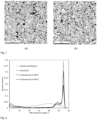
- Fig. 1 The method of distinguishing the types of two groups is described below with reference to Fig. 1 .
- regions having a difference in orientation not lower than 15° in the inclination angle between adjacent structures are identified.
- a region is regarded as having the same crystal orientation and is defined as a bainitic plate in the present invention.
- the diameter of a circle that has the same area as a bainitic plate is determined.
- the diameter of the equivalent circle of the bainitic plate is determined by using the photograph of EBSD analysis with magnification factor of 3000.
- the aspect ratio (defined as the length of the minor axis divided by the length of the major axis) is also determined.
- diameters of the equivalent circles of all bainitic plates and aspect ratios of the equivalent ellipses of all bainitic plates in the measured area are measured and the average values are defined as the mean grain size of bainitic plates and the mean aspect ratio of the bainitic plates in the present invention.
- the misorientation angle distribution in the steel according to the invention is shown in Fig. 2 .
- the peak at 60° is consistent with the misorientations between neighbouring grains, bearing Kurdjumov-Sachs (KS/KS) relationship, which is caused by the axe-angle relationship 60° ⁇ 111> and 60° ⁇ 110> and corresponds to martensite.
- the peak at 53° - 54° is due to the misorientations between grains obtained by phase transformations according to the relationship of Nishiyama-Wassermann and Kurdjumov-Sachs (NW/KS).
- the relative amounts of the HBF, AF group and the LBF, PM group can be determined by the ratio of the height of the two peaks.
- the fraction of the retained austenite determined by EBSD is always lower than the actual value. Therefore, an intensity measuring method based on XRD as a conventional technique of measuring content of retained austenite can be employed.
- the volume fraction of retained austenite is determined at 1 ⁇ 4 thickness of the steel strip.
- the amount of cementite is also measured from this XRD analysis.
- a sample prepared from the steel strip is mechanically and chemically polished and is then analyzed by measuring the integral intensity of each of the (200) plane, (220) plane, and (311) plane of fcc iron and that of the (200) plane, (211) plane, and (220) plane of bcc iron with an X-ray diffractometer using Co-Ka.
- the amount of retained austenite (RA) and the lattice parameter in the retained austenite were determined using Rietveld analysis.
- a cold rolled steel strip having the composition as explained above is heat treated to obtain the microstructure and properties.
- the cold rolled steel strip obtained through cold rolling is subjected to a thermal treatment as in a continuous annealing line.
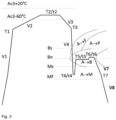
- a typical design of the process is diagrammatically shown in Fig. 3 .
- the cold rolled steel strip is heated above the temperature (Ac3 - 60), e.g.
- step c the steel strip is heated (step c), which optionally involves a heat treatment below Ms, typically in the range T4 - Ms, to above Ms and subsequently treated in the range of Ms - Bs for austempering for a time t5 (step d), typically at a temperature T5 in the range of T4 to Bn.
- step d the steel strip is then heated to a temperature T6 in the range of Bn to Bs for a period of time t6, which may be a temperature at which a hot dip galvanizing treatment is possible.
- step e room temperature
- a first step thereof the cold rolled steel is soaked above (Ac3 - 60), such as within a temperature range of (Ac3 - 60) - (Ac3 + 20) during a soaking time t2 of 1-150 seconds in order to achieve an at least partially austenitic microstructure.
- Annealing at a temperature above (Ac3 - 60) is necessary because the steel strip that is heat treated according to the invention, needs to have the required amounts of the low temperature transformed phases such as bainitic ferrite and retained austenite which are transformed from high temperature austenite, as well as a predetermined amount of ferrite.
- the uniformity of the austenite has a large effect on the formation of PF and AF in the cooling section. If T2 is lower than (Ac3 - 60), PF might be formed in an excessive amount more than 50%, thus the steel strip may obtain insufficient strength. On the other hand, the amount of austenite formed may be not enough for the formation of the LBF + PM and retained austenite. Accordingly, the annealing temperature needs to be higher than (Ac3 - 60), but is advantageously not to exceed (Ac3 + 20), preferably in the range of (Ac3 - 50) to (Ac3 + 10). If t2 is longer than 150 seconds, austenite and ferrite grain sizes become larger, which leads to a lower elongation.
- the annealing time t2 is 1 second to 150 seconds, such as 10 seconds to 120 seconds, preferably 1 - 100 seconds.
- the at least partially austenitic strip is cooled to a temperature T4 below Ms, typically in the range of Ms to Ms - 200.
- T4 below Ms, typically in the range of Ms to Ms - 200.
- the purpose of this cooling is to regulate the amounts of ferrites and partitioned martensite, but to prevent the formation of pearlite.
- the cooling rates V3 and V4 for a given line speed can be controlled by adjusting the T3 temperature.
- some PF may form in the slow cooling section, and some AF may form in the fast cooling section.
- the amount of PF formed in the slow cooling section mainly depends on T3 and the amount of AF mainly depends on V4. Therefore T3 is selected in a suitable range to adjust the amount of ferrite and to prevent the formation of pearlite. If T3 is too low, e.g.
- T3 should be in the range of 800 to 500 °C, preferably in the range of 750 to 550 °C/s.
- PF can be obtained in the soaking step a) and in the slow cooling section in step b), while AF is obtained in the fast cooling section in step b) in a conventionally designed annealing line or galvanizing line.
- the soaking temperature T2 and the intermediate temperature T3 between the slow cooling section and the fast cooling section can be used to regulate the amount of ferrite. If a higher T2 is used, less amount of PF is produced during soaking, a lower T3 can then be selected to obtain more PF in the slow cooling section and more AF in the fast cooling section. If a lower T2 is used, a sufficient amount of PF is produced during soaking , then a higher T3 is selected to limit the amount of PF formed in the slow cooling section and the amount of AF formed in the fast cooling section.
- T4 is preferably in the range of Ms - (Ms - 200), more preferably (Ms - 50) - (Ms - 150).
- the steel strip is heated as fast as possible to the partition temperature in the range of Ms - Bs in order to allow utilization of the remainder of the totally available time span in the overageing section for the bainitic transformation.
- the total duration t4 of step c) including any optional holding time is preferably less than 10s, more preferably less than 5s.
- heating step c) may involve a brief heat treatment in the temperature range below Ms, for example in the range of Ms - (Ms - 200), such as in the temperature range of (Ms - 50) - (Ms - 150).
- the cooled strip is heat treated at a temperature T5 above Ms and below Bs, preferably below Bn for a time t5 in the range of 30 - 120 seconds.
- T5 the untransformed austenite transforms into lower bainitic ferrite (LBF) and carbon partitioning occurs in the prior formed martensite.
- LLF lower bainitic ferrite
- T5 is too low, the bainitic transformation is too slow, the bainitic transformation is insufficient during overageing and fresh martensite may form during cooling after overageing in excessive amounts, which increases the strength but reduces the required elongation.
- carbon partitioning may be insufficient to stabilize the retained austenite.
- T5 is too high too much HBF is obtained in the overageing section, which cannot provide the required strength.
- the preferred range for T5 is (Bn - 50) to Bn in order to achieve the fast bainitic transformation kinetics. If the heat treatment time t5 is less than 30s, the bainitic transformation is incomplete and also the carbon partitioning in martensite and bainite is insufficient. If t5 is more than 120s, there is a risk that carbides start to form and therefore decrease the carbon content in the retained austenite.
- the maximum time for t5 is limited by inter alia the total available time at a given speed of the production line. Preferably, t5 is in the range of 40 to 100 seconds.
- the thus heat treated strip is cooled following the production line capacity to ambient temperature during which some fresh martensite may be formed.
- the steel strip is then cooled down to below 300 °C at a cooling rate V7 of at least 1 °C/s, preferably at least 5 °C/s, after which it is further cooled down to ambient temperature. Cooling down to ambient temperature may be forced cooling or uncontrolled natural cooling.
- the heat treated steel strip is cooled to a temperature T7 in the range of (Ms - 50) - Mf at a cooling rate V7 in the range of 5.0 - 10.0 °C/s. Further cooling from T7 to ambient temperature is preferably performed at a cooling rate V8 of 5.0 - 20.0 °C/s, more preferably 6.0 - 15.0 °C/s.
- the soaking step is performed within an intercritical annealing temperature range of (Ac3 - 50) - (Ac3 + 10), preferably for a soaking time t2 of 1 - 100 seconds in order to ensure that a partially austenitic cold rolled strip having a fine grain size is obtained.
- the fraction of PF formed at the soaking temperature is advantageously less than 40%.
- the heating step prior to the soaking step, is performed in two substeps, comprising heating a cold rolled strip to a temperature T1 in the range of 680 - 740 °C, preferably in the range of 700 - 720 °C, at a heating rate V1 of 10.0 - 30.0 °C/s, preferably 15.0 - 25.0 °C/s; and further heating the cold rolled strip from the temperature T1 to the soaking temperature range at a heating rate V2 of 0.5 - 4.0 °C/s,, preferably 1.0 - 3.0 °C/s.
- T1 and V2 affect the progress of these processes, which affect the austenite grain size and the homogeneity of the distribution of the alloying elements in the austenite phase.
- the soaking time t2 is controlled, depending on the heating rate V2, to ensure dissolution of all carbides and avoidance of a coarse austenitic grain size.
- the method according to the invention comprises a further heat treatment step between the heat treatment step d) and cooling step e), wherein the steel strip resulting from step d) is subjected to an additional heat treatment in the range of Bs - Bn, preferably (Bs - 50) - Bn, typically at a fixed temperature T6.
- the additional treatment time t6 is advantageously 5 - 30 seconds, preferably 10 - 20 seconds.
- This additional heat treatment increases the bainitic ferrite by formation of high temperature bainitic ferrite from remaining austenite to complete the bainitic transformation and therefore further reduces the amount of martensite formed in the following cooling section, enabling improvement of the strength and ductility properties. Carbon also further partitions into the retained austenite making it more stable.
- the time t5 is further reduced to meet the available time span, e.g. the sum of t4 + t5 + t6 is in the range of 30 - 120s.
- this additional heat treatment comprises an integrated hot dip galvanizing treatment, wherein the steel strip resulting from step c) is coated with a Zn or Zn alloy based coating.
- the steel strip that has been heat treated according to the invention can be provided with a coating, advantageously a zinc or zinc alloy based coating.
- the zinc based coating is a galvanized or galvannealed coating.
- the Zn based coating may comprise a Zn alloy containing Al as an alloying element.
- a preferred zinc bath composition contains 0.10-0.35% Al, the remainder being zinc and unavoidable impurities.
- Another preferred Zn bath comprising Mg and Al as main alloying elements has the composition: 0.5 - 3.8% Al, 0.5 - 3.0% Mg, optionally at most 0.2% of one or more additional elements; the balance being zinc and unavoidable impurities.
- the additional elements include Pb, Sb, Ti, Ca, Mn, Sn, La, Ce, Cr, Ni, Zr and Bi.
- the coating such as a protective coating of Zn or Zn alloy may be applied in a separate step.
- a hot dip galvanizing step is integrated in the method according to the invention as explained above.
- a temper rolling treatment may be performed with the annealed and zinc coated strip according to the invention in order to fine tune the tensile properties and to modify the surface appearance and roughness depending on the specific requirements resulting from the intended use.
- the cold rolling reduction is in the range of typically 30 to 80%.
- the coiled strip or half cold rolled strip may be subjected to hot batch annealing.
- the batch annealing temperature should be in the range of 500 - 700 °C.
- Thin slab casting, strip casting or the like can also be applied. In this case it is acceptable for the manufacturing method to skip at least a part of the hot rolling process.
- Dilatometry was done on the cold rolled samples of 10 mm x 5 mm x 1 mm dimensions (length along the rolling direction). Dilatation tests were conducted on a Bahr dilatometer type DIL 805. All measurements were carried out in accordance with SEP 1680. The critical phase transformation points Ac3, Ms and Mf were determined from the quenched dilatometry curves. Bs and Bn were predicted using available software JmatPro 10. The phase fractions during annealing for different process parameters were determined from dilatation curves simulating the annealing cycles.
- the microstructure was determined by optical microscopy (OM) and scanning electron microscopy (SEM) using a commercially available image-processing program. The microstructures were observed at 1 ⁇ 4 thickness in the cross section of rolling and normal directions of a steel strip.
- the Scanning Electron Microscope (SEM) used for the EBSD measurements is a Zeiss Ultra 55 machine equipped with a Field Emission Gun (FEG-SEM) and an EDAX PEGASUS XM 4 HIKARI EBSD system.
- the EBSD scans were captured using the TexSEM Laboratories (TSL) software OIM (Orientation Imaging Microscopy) Data Collection.
- TSL OIM Orientation Imaging Microscopy
- the retained austenite was determined by XRD according to DIN EN 13925 on a D8 Discover GADDS (Bruker AXS) with Co-K ⁇ radiation. Quantitative determination of phase proportions was performed by Rietveld analysis.
- Room temperature tensile tests were performed in a Schenk TREBEL testing machine following NEN-EN10002-1:2001 standard to determine tensile properties (yield strength YS (MPa), ultimate tensile strength UTS (MPa), total elongation TE (%)). For each condition, three tensile tests were performed and the average values of mechanical properties are reported.
- compositions in wt%) and the critical phase transformation points (in °C) of the steels Alloy code C Mn Si Al Cr Cu Nb Mo S P Ti V N Ac3 Ms Mf Bs Bn A16 0.210 2.210 1.170 0.016 0.010 0.005 0.002 0.002 0.003 0.002 0.002 0.004 855 372 178 521 449 A51 0.177 2.303 1.003 0.037 0.010 0.002 0.001 0.002 0.004 0.001 0.002 0.002 0.004 858 398 185 529 459 A52* 0.158 2.509 1.019 0.038 0.010 0.003 0.001 0.003 0.005 0.002 0.001 0.002 0.002 857 401 190 524 457 A53 0.176 2.013 1.003 0.040 0.010 0.005 0.001 0.002 0.005 0.003 0.001 0.002 0.003 862 410 198 539 460 A73 0.207
Landscapes
- Chemical & Material Sciences (AREA)
- Engineering & Computer Science (AREA)
- Mechanical Engineering (AREA)
- Materials Engineering (AREA)
- Metallurgy (AREA)
- Organic Chemistry (AREA)
- Physics & Mathematics (AREA)
- Thermal Sciences (AREA)
- Crystallography & Structural Chemistry (AREA)
- Chemical Kinetics & Catalysis (AREA)
- Heat Treatment Of Sheet Steel (AREA)
- Heat Treatment Of Strip Materials And Filament Materials (AREA)
Claims (12)
- Verfahren des Wärmebehandelns eines kaltgewalzten Stahlbandes, wobei das Verfahren folgende Schritte umfasst:a) Wärmeausgleichen eines kaltgewalzten Stahlbandes über (Ac3 - 60) über eine Wärmeausgleichszeit t2 von 1 - 150 Sekunden, wodurch ein kaltgewalztes Stahlband mit einer mindestens partiellen Mikrostruktur erhalten wird;b) Abkühlen des aus Schritt a) resultierenden ausgeglichenen Stahlbandes auf eine Temperatur T4 im Bereich von Ms - (Ms - 200), umfassend einen Teilschritt des Abkühlens des aus Schritt a) resultierenden wärmeausgeglichenen Stahlbandes auf eine Temperatur T3 im Bereich von 800 - 500 °C bei einer Abkühlgeschwindigkeit V3 von 2,0 - 15,0 °C/s, und einen Teilschritt des Abkühlens des wärmeausgeglichenen Stahlbandes von einer Temperatur T3 im Bereich von 800 - 500 °C auf T4 mit einer Abkühlgeschwindigkeit V4 von 20,0 - 70,0 °C/s;c) Erwärmen des abgekühlten Stahlbandes aus Schritt b) auf einen Temperaturbereich von Bs - Ms;d) Wärmebehandeln des erwärmten Stahlbandes in einem Temperaturbereich von Bs - Ms über eine Zeitspanne t5 von 30 - 120 Sekunden;e) Abkühlen des wärmebehandelten Stahlbandes auf Umgebungstemperatur, so dass das Stahlband eine Mikrostruktur (in Vol.-%) aufweist, umfassendpolygonalen Ferrit (PF) + nadelförmigen Ferrit (AF) + oberen bainitischen Ferrit (HBF): 20 - 55;mit polygonalem Ferrit (PF): 0 - 50;unteren bainitischen Ferrit (LBF) + partitionierten Martensit (PM): 25 - 70;Restaustenit (RA): 5 - 20;Martensit (M): 0 - 15;wobei das Stahlband eine Zusammensetzung (in Massen-%) aufweist, umfassend
C: 0,17 - 0,35; Mn: 1,50 - 4,00; Si: 0,80 - 1,80; Al: 0,01 - 1,50; P: weniger als 0,050; S: weniger als 0,020; N: weniger als 0,0080; wobei die Summe (Si + Al) ≥ 0,60 ist, undgegebenenfalls ein oder mehrere Elemente, ausgewählt aus





 0 < REM ≤ 0,0100, wobei REM ein oder mehrere Seltenerdmetalle ist und der Rest Eisen und unvermeidliche Verunreinigungen sind.
 - Verfahren nach Anspruch 1, wobei Schritt c) die Wärmebehandlung des gekühlten Bandes aus Schritt b) bei einer Temperatur T4 im Temperaturbereich von Ms - (Ms - 200), vorzugsweise im Temperaturbereich von (Ms - 50) - (Ms - 150), umfasst, wobei vorzugsweise die Gesamtdauer t4 von Schritt c) im Bereich von 1 - 10 Sekunden, stärker bevorzugt im Bereich von 1 - 5 Sekunden liegt.
- Verfahren nach Anspruch 1 oder Anspruch 2, wobei Schritt a) das Wärmeausgleichen eines kaltgewalzten Stahlbandes in einem Temperaturbereich von (Ac3 - 60) - (Ac3 + 20), vorzugsweise in einem Temperaturbereich von (Ac3 - 50) - (Ac3 + 10), vorzugsweise für eine Wärmeausgleichszeit t2 von 1 - 100 s, umfasst.
- Verfahren nach einem der vorhergehenden Ansprüche, wobei Schritt b) das Abkühlen des ausgeglichenen Stahlbandes aus Schritt a) auf die Temperatur T4 mit einer Abkühlgeschwindigkeit umfasst, die ausreicht, um Perlitbildung zu vermeiden.
- Verfahren nach einem der vorhergehenden Ansprüche, wobei Schritt b) einen Teilschritt des Abkühlens des aus Schritt a) resultierenden ausgeglichenen Stahlbandes auf eine Temperatur T3 im Bereich von 750 - 550 °C, vorzugsweise bei einer Abkühlgeschwindigkeit V3 von 3,0 - 10,0 °C/s, umfasst.
- Verfahren nach einem der vorhergehenden Ansprüche, das vor Schritt a) ferner das Erwärmen eines kaltgewalzten Bandes auf eine Temperatur über (Ac3 - 60) mit einer Erwärmungsgeschwindigkeit von mindestens 0,5 °C/s, vorzugsweise das Erwärmen des kaltgewalzten Bandes auf eine Temperatur T1 im Bereich von 680 - 740 °C, vorzugsweise im Bereich von 700 - 720 °C, mit einer Erwärmungsgeschwindigkeit V1 von 10,0 - 30,0 °C/s, vorzugsweise mit einer Erwärmungsgeschwindigkeit V1 von 15,0 - 25,0 °C/s, umfasst, und ferner Erwärmen des kaltgewalzten Bandes von der Temperatur T1 auf eine Temperatur oberhalb (Ac3 - 60), vorzugsweise auf den Temperaturbereich von (Ac3 - 60) - (Ac3 + 20), besonders bevorzugt (Ac3 - 50) - (Ac3 + 10), mit einer Erwärmungsgeschwindigkeit V2 von 0,5 - 4,0 °C/s, vorzugsweise 1,0 - 3,0 °C/s, umfasst.
- Verfahren nach einem der vorhergehenden Ansprüche, wobei in Schritt d) die der Wärmebehandlung im Bereich von Bn - (Ms + 50), vorzugsweise während einer Zeitspanne t5 von 40 - 100 Sekunden, durchgeführt wird.
- Verfahren nach einem der vorhergehenden Ansprüche, umfassend einen weiteren Wärmebehandlungsschritt zwischen den Schritten d) und e) der Wärmebehandlung des aus Schritt c) resultierenden Stahlbandes im Bereich von Bs - Bn, vorzugsweise (Bs-50) - Bn, vorzugsweise über eine Zeitdauer t6 von 5 - 30 Sekunden, stärker bevorzugt über eine Zeitdauer t6 von 10 - 20 Sekunden.
- Verfahren nach Anspruch 8, wobei der weitere Wärmebehandlungsschritt eine Feuerverzinkungsbehandlung umfasst.
- Verfahren nach einem der vorhergehenden Ansprüche 1 bis 8, das nach der Wärmebehandlung einen Beschichtungsschritt umfasst, bei dem das wärmebehandelte Stahlband mit einer Schutzschicht, vorzugsweise einer Zn-Schicht oder Zn-Legierungsschicht, beschichtet wird.
- Verfahren nach einem der vorhergehenden Ansprüche, wobei die Mikrostruktur in Vol.-% Folgendes umfasst:polygonalen Ferrit (PF) + nadelförmigen Ferrit (AF) + oberen bainitischen Ferrit (HBF): 25 - 50;mit polygonalem Ferrit (PF): 10 - 40;unteren bainitischen Ferrit (LBF) + partitionierten Martensit (PM): 35 - 65;Restaustenit (RA): 7 - 15;Martensit (M): 0 - 10;und/oder wobei der C-Gehalt im Restaustenit (RA) 0,90 Gew.-% oder mehr, vorzugsweise 0,95 Gew.-% oder mehr beträgt.
- Verfahren nach einem der vorhergehenden Ansprüche, wobei das resultierende Stahlband mindestens eine, vorzugsweise alle, der folgenden Eigenschaften aufweist:Streckgrenze (YS) ≥ 500 MPa, und/oderZugfestigkeit (TS) ≥ 850 MPa, und/oderGesamtdehnung (TE) ≥ 14 %.
Priority Applications (10)
| Application Number | Priority Date | Filing Date | Title |
|---|---|---|---|
| ES19180705T ES2911662T5 (en) | 2019-06-17 | 2019-06-17 | Method of heat treating a high strength cold rolled steel strip |
| EP19180705.6A EP3754037B2 (de) | 2019-06-17 | 2019-06-17 | Verfahren zur wärmebehandlung eines hochfesten kaltgewalzten stahlbandes |
| PT191807056T PT3754037T (pt) | 2019-06-17 | 2019-06-17 | Método de tratamento térmico de uma tira de aço laminada a frio de alta resistência |
| US17/596,685 US12553101B2 (en) | 2019-06-17 | 2020-06-11 | Method of heat treating a high strength cold rolled steel strip |
| PCT/EP2020/066216 WO2020254190A1 (en) | 2019-06-17 | 2020-06-11 | Method of heat treating a high strength cold rolled steel strip |
| CN202080044192.XA CN114080458B (zh) | 2019-06-17 | 2020-06-11 | 热处理高强度冷轧钢带材的方法 |
| KR1020227000203A KR102912177B1 (ko) | 2019-06-17 | 2020-06-11 | 고강도 냉간압연 강 스트립의 열처리 방법 |
| JP2021575078A JP7636354B2 (ja) | 2019-06-17 | 2020-06-11 | 高強度冷間圧延鋼ストリップを熱処理する方法 |
| BR112021023561-2A BR112021023561B1 (pt) | 2019-06-17 | 2020-06-11 | Método para tratamento térmico de uma tira de aço laminada a frio de alta resistência |
| MX2021015958A MX2021015958A (es) | 2019-06-17 | 2020-06-11 | Metodo de tratamiento termico de una banda o fleje de acero laminado en frio de alta resistencia. |
Applications Claiming Priority (1)
| Application Number | Priority Date | Filing Date | Title |
|---|---|---|---|
| EP19180705.6A EP3754037B2 (de) | 2019-06-17 | 2019-06-17 | Verfahren zur wärmebehandlung eines hochfesten kaltgewalzten stahlbandes |
Publications (3)
| Publication Number | Publication Date |
|---|---|
| EP3754037A1 EP3754037A1 (de) | 2020-12-23 |
| EP3754037B1 EP3754037B1 (de) | 2022-03-02 |
| EP3754037B2 true EP3754037B2 (de) | 2025-04-16 |
Family
ID=66951832
Family Applications (1)
| Application Number | Title | Priority Date | Filing Date |
|---|---|---|---|
| EP19180705.6A Active EP3754037B2 (de) | 2019-06-17 | 2019-06-17 | Verfahren zur wärmebehandlung eines hochfesten kaltgewalzten stahlbandes |
Country Status (9)
| Country | Link |
|---|---|
| US (1) | US12553101B2 (de) |
| EP (1) | EP3754037B2 (de) |
| JP (1) | JP7636354B2 (de) |
| KR (1) | KR102912177B1 (de) |
| CN (1) | CN114080458B (de) |
| ES (1) | ES2911662T5 (de) |
| MX (1) | MX2021015958A (de) |
| PT (1) | PT3754037T (de) |
| WO (1) | WO2020254190A1 (de) |
Families Citing this family (11)
| Publication number | Priority date | Publication date | Assignee | Title |
|---|---|---|---|---|
| WO2020221889A1 (en) | 2019-04-30 | 2020-11-05 | Tata Steel Nederland Technology B.V. | A high strength steel product and a process to produce a high strength steel product |
| ES2911655T3 (es) | 2019-06-17 | 2022-05-20 | Tata Steel Ijmuiden Bv | Tratamiento térmico de un fleje de acero laminado en frío |
| EP3754036B1 (de) | 2019-06-17 | 2022-03-02 | Tata Steel IJmuiden B.V. | Wärmebehandlung von hochfestem kaltgewalztem stahlband |
| EP3754035B2 (de) | 2019-06-17 | 2025-04-30 | Tata Steel IJmuiden B.V. | Verfahren zur wärmebehandlung eines kaltgewalzten stahlbandes |
| EP4490329A1 (de) * | 2022-03-10 | 2025-01-15 | Tata Steel Nederland Technology B.V. | Hochfestes stahlblech mit hervorragender lochdehnbarkeit und herstellungsverfahren dafür |
| KR102747793B1 (ko) * | 2022-05-31 | 2024-12-31 | 현대제철 주식회사 | 초고강도 냉연강판 및 그 제조방법 |
| WO2024121608A1 (en) * | 2022-12-09 | 2024-06-13 | Arcelormittal | Cold rolled and coated steel sheet and a method of manufacturing thereof |
| KR20240098907A (ko) * | 2022-12-21 | 2024-06-28 | 주식회사 포스코 | 성형성 및 파괴저항성이 우수한 강판 및 그 제조방법 |
| CN117867372B (zh) * | 2023-04-28 | 2024-12-03 | 鞍钢股份有限公司 | 新能源汽车用1500MPa电池包用钢及其制备方法 |
| CN116855685A (zh) * | 2023-06-27 | 2023-10-10 | 首钢集团有限公司 | 一种构件及其制备方法 |
| CN118910374B (zh) * | 2024-07-23 | 2026-05-29 | 北京科技大学 | 高强度低密度热成形钢及制备方法 |
Citations (13)
| Publication number | Priority date | Publication date | Assignee | Title |
|---|---|---|---|---|
| EP2267176A1 (de) † | 2008-02-08 | 2010-12-29 | JFE Steel Corporation | Hochfestes heissverzinktes stahlblech mit hervorragender verarbeitbarkeit und herstellungsverfahren dafür |
| EP2436794A1 (de) † | 2009-05-29 | 2012-04-04 | Kabushiki Kaisha Kobe Seiko Sho | Hochfestes stahlblech mit ausgezeichneter wasserstoff-versprödungsbeständigkeit |
| WO2012156428A1 (de) † | 2011-05-18 | 2012-11-22 | Thyssenkrupp Steel Europe Ag | Hochfestes stahlflachprodukt und verfahren zu dessen herstellung |
| EP2765212A1 (de) † | 2011-10-04 | 2014-08-13 | JFE Steel Corporation | Hochfestes stahlblech und herstellungsverfahren dafür |
| WO2016001898A2 (en) † | 2014-07-03 | 2016-01-07 | Arcelormittal | Method for producing a high strength steel sheet having improved strength, ductility and formability |
| US20160237520A1 (en) † | 2013-09-27 | 2016-08-18 | Kabushiki Kaisha Kobe Seiko Sho (Kobe Steel, Ltd.) | High-strength steel sheet having excellent formability and low-temperature toughness, and method for producing same |
| WO2017108959A1 (en) † | 2015-12-21 | 2017-06-29 | Arcelormittal | Method for producing a high strength coated steel sheet having improved ductility and formability, and obtained coated steel sheet |
| WO2018147400A1 (ja) † | 2017-02-13 | 2018-08-16 | Jfeスチール株式会社 | 高強度鋼板およびその製造方法 |
| WO2019063081A1 (de) † | 2017-09-28 | 2019-04-04 | Thyssenkrupp Steel Europe Ag | Stahlflachprodukt und verfahren zu seiner herstellung |
| WO2019097600A1 (ja) † | 2017-11-15 | 2019-05-23 | 日本製鉄株式会社 | 高強度冷延鋼板 |
| WO2019238741A1 (de) † | 2018-06-12 | 2019-12-19 | Thyssenkrupp Steel Europe Ag | Stahlflachprodukt und verfahren zu seiner herstellung |
| EP3754035B1 (de) † | 2019-06-17 | 2022-03-02 | Tata Steel IJmuiden B.V. | Verfahren zur wärmebehandlung eines kaltgewalzten stahlbandes |
| EP3963115A1 (de) † | 2019-04-30 | 2022-03-09 | Tata Steel Nederland Technology B.V. | Hochfestes stahlprodukt und verfahren zur herstellung eines hochfesten stahlprodukts |
Family Cites Families (42)
| Publication number | Priority date | Publication date | Assignee | Title |
|---|---|---|---|---|
| JP4716359B2 (ja) * | 2005-03-30 | 2011-07-06 | 株式会社神戸製鋼所 | 均一伸びに優れた高強度冷延鋼板およびその製造方法 |
| JP5365112B2 (ja) * | 2008-09-10 | 2013-12-11 | Jfeスチール株式会社 | 高強度鋼板およびその製造方法 |
| JP5418047B2 (ja) | 2008-09-10 | 2014-02-19 | Jfeスチール株式会社 | 高強度鋼板およびその製造方法 |
| JP5438302B2 (ja) * | 2008-10-30 | 2014-03-12 | 株式会社神戸製鋼所 | 加工性に優れた高降伏比高強度の溶融亜鉛めっき鋼板または合金化溶融亜鉛めっき鋼板とその製造方法 |
| JP5327106B2 (ja) | 2010-03-09 | 2013-10-30 | Jfeスチール株式会社 | プレス部材およびその製造方法 |
| JP5287770B2 (ja) | 2010-03-09 | 2013-09-11 | Jfeスチール株式会社 | 高強度鋼板およびその製造方法 |
| ES2535420T3 (es) * | 2011-03-07 | 2015-05-11 | Tata Steel Nederland Technology B.V. | Proceso para producir acero conformable de alta resistencia y acero conformable de alta resistencia producido con el mismo |
| JP5780086B2 (ja) | 2011-09-27 | 2015-09-16 | Jfeスチール株式会社 | 高強度鋼板およびその製造方法 |
| EP2762588B1 (de) * | 2011-09-30 | 2020-05-20 | Nippon Steel Corporation | Hochfestes schmelztauchgalvanisiertes stahlblech mit ausgezeichneter formbarkeit, schwacher materialanisotropie und reissfestigkeit von 980 mpa oder mehr, hochfestes legiertes schmelztauchgalvanisiertes stahlblech und herstellungsverfahren dafür |
| JP5639573B2 (ja) | 2011-12-15 | 2014-12-10 | 株式会社神戸製鋼所 | 強度および延性のばらつきの小さい高強度冷延鋼板およびその製造方法 |
| CN103987870B (zh) | 2011-12-15 | 2016-01-06 | 株式会社神户制钢所 | 强度和延展性的偏差小的高强度冷轧钢板及其制造方法 |
| JP5639572B2 (ja) | 2011-12-15 | 2014-12-10 | 株式会社神戸製鋼所 | 強度および延性のばらつきの小さい高強度冷延鋼板およびその製造方法 |
| JP5632904B2 (ja) | 2012-03-29 | 2014-11-26 | 株式会社神戸製鋼所 | 加工性に優れた高強度冷延鋼板の製造方法 |
| EP2831299B2 (de) | 2012-03-30 | 2020-04-29 | Voestalpine Stahl GmbH | Hochfestes kaltgewalztes stahlblech und verfahren zur herstellung eines solchen stahlblechs |
| WO2013144376A1 (en) | 2012-03-30 | 2013-10-03 | Voestalpine Stahl Gmbh | High strength cold rolled steel sheet and method of producing such steel sheet |
| ES2746285T5 (es) | 2012-03-30 | 2022-12-19 | Voestalpine Stahl Gmbh | Lámina de acero de alta resistencia laminada en frío y procedimiento para producir dicha lámina de acero |
| JP6290168B2 (ja) * | 2012-03-30 | 2018-03-07 | フォエスタルピネ スタール ゲゼルシャフト ミット ベシュレンクテル ハフツングVoestalpine Stahl Gmbh | 高強度冷間圧延鋼板およびそのような鋼板を作製する方法 |
| JP5860354B2 (ja) * | 2012-07-12 | 2016-02-16 | 株式会社神戸製鋼所 | 降伏強度と成形性に優れた高強度溶融亜鉛めっき鋼板およびその製造方法 |
| US20150203947A1 (en) * | 2012-07-31 | 2015-07-23 | Jfe Steel Corporation | High-strength galvanized steel sheet with excellent formability and shape fixability and method for manufacturing the same |
| JP5920118B2 (ja) | 2012-08-31 | 2016-05-18 | Jfeスチール株式会社 | 成形性に優れた高強度鋼板およびその製造方法 |
| JP5728115B1 (ja) | 2013-09-27 | 2015-06-03 | 株式会社神戸製鋼所 | 延性および低温靭性に優れた高強度鋼板、並びにその製造方法 |
| KR101594670B1 (ko) * | 2014-05-13 | 2016-02-17 | 주식회사 포스코 | 연성이 우수한 고강도 냉연강판, 용융아연도금강판 및 이들의 제조방법 |
| WO2016001699A1 (en) * | 2014-07-03 | 2016-01-07 | Arcelormittal | Method for manufacturing a high strength steel sheet having improved formability and sheet obtained |
| WO2016001704A1 (en) * | 2014-07-03 | 2016-01-07 | Arcelormittal | Method for manufacturing a high strength steel sheet and sheet obtained |
| US10378077B2 (en) | 2014-07-03 | 2019-08-13 | Arcelormittal | Method for producing an ultra high strength coated or not coated steel sheet and obtained sheet |
| ES2665798T3 (es) | 2014-07-07 | 2018-04-27 | Tata Steel Ijmuiden Bv | Banda de acero con alta resistencia y alta conformabilidad, la banda de acero tiene un recubrimiento a base de zinc por inmersión en caliente |
| JP6085348B2 (ja) | 2015-01-09 | 2017-02-22 | 株式会社神戸製鋼所 | 高強度めっき鋼板、並びにその製造方法 |
| WO2016177420A1 (de) * | 2015-05-06 | 2016-11-10 | Thyssenkrupp Steel Europe Ag | Stahlflachprodukt und verfahren zu seiner herstellung |
| WO2017109539A1 (en) * | 2015-12-21 | 2017-06-29 | Arcelormittal | Method for producing a high strength steel sheet having improved strength and formability, and obtained high strength steel sheet |
| KR101877787B1 (ko) | 2015-12-28 | 2018-07-16 | 한국기계연구원 | 연신율이 우수한 고강도 강판 및 그 제조 방법 |
| MX386813B (es) | 2015-12-29 | 2025-03-19 | Arcelormittal | Método para producir una hoja de acero galvano-recocido de ultra alta resistencia y hoja de acero galvano-recocido obtenida. |
| WO2017125773A1 (en) * | 2016-01-18 | 2017-07-27 | Arcelormittal | High strength steel sheet having excellent formability and a method of manufacturing the same |
| WO2017138503A1 (ja) | 2016-02-10 | 2017-08-17 | Jfeスチール株式会社 | 高強度鋼板およびその製造方法 |
| EP3415656B1 (de) | 2016-02-10 | 2020-12-23 | JFE Steel Corporation | Hochfestes stahlblech und verfahren zur herstellung davon |
| WO2018055425A1 (en) * | 2016-09-22 | 2018-03-29 | Arcelormittal | High strength and high formability steel sheet and manufacturing method |
| CA3067159A1 (en) * | 2016-11-29 | 2018-06-07 | Tata Steel Ijmuiden B.V. | Method for manufacturing a hot-formed article, and obtained article |
| KR101858852B1 (ko) | 2016-12-16 | 2018-06-28 | 주식회사 포스코 | 항복강도, 연성 및 구멍확장성이 우수한 고강도 냉연강판, 용융아연도금강판 및 이들의 제조방법 |
| WO2018115933A1 (en) * | 2016-12-21 | 2018-06-28 | Arcelormittal | High-strength cold rolled steel sheet having high formability and a method of manufacturing thereof |
| WO2018115936A1 (en) | 2016-12-21 | 2018-06-28 | Arcelormittal | Tempered and coated steel sheet having excellent formability and a method of manufacturing the same |
| CN109295389B (zh) | 2018-11-13 | 2020-09-01 | 江西理工大学 | 一种快速相变的纳米贝氏体钢及其制备方法 |
| EP3754036B1 (de) | 2019-06-17 | 2022-03-02 | Tata Steel IJmuiden B.V. | Wärmebehandlung von hochfestem kaltgewalztem stahlband |
| ES2911655T3 (es) | 2019-06-17 | 2022-05-20 | Tata Steel Ijmuiden Bv | Tratamiento térmico de un fleje de acero laminado en frío |
-
2019
- 2019-06-17 ES ES19180705T patent/ES2911662T5/es active Active
- 2019-06-17 EP EP19180705.6A patent/EP3754037B2/de active Active
- 2019-06-17 PT PT191807056T patent/PT3754037T/pt unknown
-
2020
- 2020-06-11 WO PCT/EP2020/066216 patent/WO2020254190A1/en not_active Ceased
- 2020-06-11 US US17/596,685 patent/US12553101B2/en active Active
- 2020-06-11 KR KR1020227000203A patent/KR102912177B1/ko active Active
- 2020-06-11 CN CN202080044192.XA patent/CN114080458B/zh active Active
- 2020-06-11 JP JP2021575078A patent/JP7636354B2/ja active Active
- 2020-06-11 MX MX2021015958A patent/MX2021015958A/es unknown
Patent Citations (15)
| Publication number | Priority date | Publication date | Assignee | Title |
|---|---|---|---|---|
| EP2267176A1 (de) † | 2008-02-08 | 2010-12-29 | JFE Steel Corporation | Hochfestes heissverzinktes stahlblech mit hervorragender verarbeitbarkeit und herstellungsverfahren dafür |
| EP2436794A1 (de) † | 2009-05-29 | 2012-04-04 | Kabushiki Kaisha Kobe Seiko Sho | Hochfestes stahlblech mit ausgezeichneter wasserstoff-versprödungsbeständigkeit |
| WO2012156428A1 (de) † | 2011-05-18 | 2012-11-22 | Thyssenkrupp Steel Europe Ag | Hochfestes stahlflachprodukt und verfahren zu dessen herstellung |
| EP2765212A1 (de) † | 2011-10-04 | 2014-08-13 | JFE Steel Corporation | Hochfestes stahlblech und herstellungsverfahren dafür |
| US20160237520A1 (en) † | 2013-09-27 | 2016-08-18 | Kabushiki Kaisha Kobe Seiko Sho (Kobe Steel, Ltd.) | High-strength steel sheet having excellent formability and low-temperature toughness, and method for producing same |
| WO2016001898A2 (en) † | 2014-07-03 | 2016-01-07 | Arcelormittal | Method for producing a high strength steel sheet having improved strength, ductility and formability |
| WO2017108959A1 (en) † | 2015-12-21 | 2017-06-29 | Arcelormittal | Method for producing a high strength coated steel sheet having improved ductility and formability, and obtained coated steel sheet |
| WO2018147400A1 (ja) † | 2017-02-13 | 2018-08-16 | Jfeスチール株式会社 | 高強度鋼板およびその製造方法 |
| EP3581670A1 (de) † | 2017-02-13 | 2019-12-18 | JFE Steel Corporation | Hochfeste stahlplatte und herstellungsverfahren dafür |
| WO2019063081A1 (de) † | 2017-09-28 | 2019-04-04 | Thyssenkrupp Steel Europe Ag | Stahlflachprodukt und verfahren zu seiner herstellung |
| WO2019097600A1 (ja) † | 2017-11-15 | 2019-05-23 | 日本製鉄株式会社 | 高強度冷延鋼板 |
| EP3712284A1 (de) † | 2017-11-15 | 2020-09-23 | Nippon Steel Corporation | Hochfestes kaltgewalztes stahlblech |
| WO2019238741A1 (de) † | 2018-06-12 | 2019-12-19 | Thyssenkrupp Steel Europe Ag | Stahlflachprodukt und verfahren zu seiner herstellung |
| EP3963115A1 (de) † | 2019-04-30 | 2022-03-09 | Tata Steel Nederland Technology B.V. | Hochfestes stahlprodukt und verfahren zur herstellung eines hochfesten stahlprodukts |
| EP3754035B1 (de) † | 2019-06-17 | 2022-03-02 | Tata Steel IJmuiden B.V. | Verfahren zur wärmebehandlung eines kaltgewalzten stahlbandes |
Non-Patent Citations (1)
| Title |
|---|
| J. Goldstein et al., Scanning Electron Microscopy and X-Ray Microanalysis, Springer, New York, S.147-164, 18.11.2017 † |
Also Published As
| Publication number | Publication date |
|---|---|
| PT3754037T (pt) | 2022-04-19 |
| ES2911662T3 (es) | 2022-05-20 |
| KR102912177B1 (ko) | 2026-01-14 |
| US12553101B2 (en) | 2026-02-17 |
| MX2021015958A (es) | 2022-02-03 |
| US20220316026A1 (en) | 2022-10-06 |
| WO2020254190A1 (en) | 2020-12-24 |
| CN114080458A (zh) | 2022-02-22 |
| JP2022537190A (ja) | 2022-08-24 |
| EP3754037A1 (de) | 2020-12-23 |
| BR112021023561A2 (pt) | 2022-01-04 |
| EP3754037B1 (de) | 2022-03-02 |
| KR20220024416A (ko) | 2022-03-03 |
| JP7636354B2 (ja) | 2025-02-26 |
| CN114080458B (zh) | 2024-05-28 |
| ES2911662T5 (en) | 2025-06-05 |
Similar Documents
| Publication | Publication Date | Title |
|---|---|---|
| EP3754035B2 (de) | Verfahren zur wärmebehandlung eines kaltgewalzten stahlbandes | |
| EP3754037B1 (de) | Verfahren zur wärmebehandlung eines hochfesten kaltgewalzten stahlbandes | |
| EP3754036B1 (de) | Wärmebehandlung von hochfestem kaltgewalztem stahlband | |
| US12522889B2 (en) | Heat treatment of cold rolled steel strip | |
| EP3963115A1 (de) | Hochfestes stahlprodukt und verfahren zur herstellung eines hochfesten stahlprodukts | |
| BR112021023561B1 (pt) | Método para tratamento térmico de uma tira de aço laminada a frio de alta resistência | |
| BR112021023527B1 (pt) | Tratamento térmico de tira de aço laminada à frio |
Legal Events
| Date | Code | Title | Description |
|---|---|---|---|
| PUAI | Public reference made under article 153(3) epc to a published international application that has entered the european phase |
Free format text: ORIGINAL CODE: 0009012 |
|
| STAA | Information on the status of an ep patent application or granted ep patent |
Free format text: STATUS: THE APPLICATION HAS BEEN PUBLISHED |
|
| AK | Designated contracting states |
Kind code of ref document: A1 Designated state(s): AL AT BE BG CH CY CZ DE DK EE ES FI FR GB GR HR HU IE IS IT LI LT LU LV MC MK MT NL NO PL PT RO RS SE SI SK SM TR |
|
| AX | Request for extension of the european patent |
Extension state: BA ME |
|
| STAA | Information on the status of an ep patent application or granted ep patent |
Free format text: STATUS: REQUEST FOR EXAMINATION WAS MADE |
|
| 17P | Request for examination filed |
Effective date: 20210623 |
|
| RBV | Designated contracting states (corrected) |
Designated state(s): AL AT BE BG CH CY CZ DE DK EE ES FI FR GB GR HR HU IE IS IT LI LT LU LV MC MK MT NL NO PL PT RO RS SE SI SK SM TR |
|
| GRAP | Despatch of communication of intention to grant a patent |
Free format text: ORIGINAL CODE: EPIDOSNIGR1 |
|
| STAA | Information on the status of an ep patent application or granted ep patent |
Free format text: STATUS: GRANT OF PATENT IS INTENDED |
|
| INTG | Intention to grant announced |
Effective date: 20210928 |
|
| GRAS | Grant fee paid |
Free format text: ORIGINAL CODE: EPIDOSNIGR3 |
|
| GRAA | (expected) grant |
Free format text: ORIGINAL CODE: 0009210 |
|
| STAA | Information on the status of an ep patent application or granted ep patent |
Free format text: STATUS: THE PATENT HAS BEEN GRANTED |
|
| AK | Designated contracting states |
Kind code of ref document: B1 Designated state(s): AL AT BE BG CH CY CZ DE DK EE ES FI FR GB GR HR HU IE IS IT LI LT LU LV MC MK MT NL NO PL PT RO RS SE SI SK SM TR |
|
| REG | Reference to a national code |
Ref country code: GB Ref legal event code: FG4D |
|
| REG | Reference to a national code |
Ref country code: CH Ref legal event code: EP Ref country code: AT Ref legal event code: REF Ref document number: 1472274 Country of ref document: AT Kind code of ref document: T Effective date: 20220315 |
|
| REG | Reference to a national code |
Ref country code: DE Ref legal event code: R096 Ref document number: 602019012023 Country of ref document: DE |
|
| REG | Reference to a national code |
Ref country code: IE Ref legal event code: FG4D |
|
| REG | Reference to a national code |
Ref country code: PT Ref legal event code: SC4A Ref document number: 3754037 Country of ref document: PT Date of ref document: 20220419 Kind code of ref document: T Free format text: AVAILABILITY OF NATIONAL TRANSLATION Effective date: 20220412 |
|
| REG | Reference to a national code |
Ref country code: NL Ref legal event code: FP |
|
| REG | Reference to a national code |
Ref country code: SE Ref legal event code: TRGR |
|
| REG | Reference to a national code |
Ref country code: ES Ref legal event code: FG2A Ref document number: 2911662 Country of ref document: ES Kind code of ref document: T3 Effective date: 20220520 |
|
| REG | Reference to a national code |
Ref country code: LT Ref legal event code: MG9D |
|
| PG25 | Lapsed in a contracting state [announced via postgrant information from national office to epo] |
Ref country code: RS Free format text: LAPSE BECAUSE OF FAILURE TO SUBMIT A TRANSLATION OF THE DESCRIPTION OR TO PAY THE FEE WITHIN THE PRESCRIBED TIME-LIMIT Effective date: 20220302 Ref country code: NO Free format text: LAPSE BECAUSE OF FAILURE TO SUBMIT A TRANSLATION OF THE DESCRIPTION OR TO PAY THE FEE WITHIN THE PRESCRIBED TIME-LIMIT Effective date: 20220602 Ref country code: LT Free format text: LAPSE BECAUSE OF FAILURE TO SUBMIT A TRANSLATION OF THE DESCRIPTION OR TO PAY THE FEE WITHIN THE PRESCRIBED TIME-LIMIT Effective date: 20220302 Ref country code: HR Free format text: LAPSE BECAUSE OF FAILURE TO SUBMIT A TRANSLATION OF THE DESCRIPTION OR TO PAY THE FEE WITHIN THE PRESCRIBED TIME-LIMIT Effective date: 20220302 Ref country code: BG Free format text: LAPSE BECAUSE OF FAILURE TO SUBMIT A TRANSLATION OF THE DESCRIPTION OR TO PAY THE FEE WITHIN THE PRESCRIBED TIME-LIMIT Effective date: 20220602 |
|
| REG | Reference to a national code |
Ref country code: AT Ref legal event code: MK05 Ref document number: 1472274 Country of ref document: AT Kind code of ref document: T Effective date: 20220302 |
|
| PG25 | Lapsed in a contracting state [announced via postgrant information from national office to epo] |
Ref country code: PL Free format text: LAPSE BECAUSE OF FAILURE TO SUBMIT A TRANSLATION OF THE DESCRIPTION OR TO PAY THE FEE WITHIN THE PRESCRIBED TIME-LIMIT Effective date: 20220302 Ref country code: LV Free format text: LAPSE BECAUSE OF FAILURE TO SUBMIT A TRANSLATION OF THE DESCRIPTION OR TO PAY THE FEE WITHIN THE PRESCRIBED TIME-LIMIT Effective date: 20220302 Ref country code: GR Free format text: LAPSE BECAUSE OF FAILURE TO SUBMIT A TRANSLATION OF THE DESCRIPTION OR TO PAY THE FEE WITHIN THE PRESCRIBED TIME-LIMIT Effective date: 20220603 Ref country code: FI Free format text: LAPSE BECAUSE OF FAILURE TO SUBMIT A TRANSLATION OF THE DESCRIPTION OR TO PAY THE FEE WITHIN THE PRESCRIBED TIME-LIMIT Effective date: 20220302 |
|
| PG25 | Lapsed in a contracting state [announced via postgrant information from national office to epo] |
Ref country code: SM Free format text: LAPSE BECAUSE OF FAILURE TO SUBMIT A TRANSLATION OF THE DESCRIPTION OR TO PAY THE FEE WITHIN THE PRESCRIBED TIME-LIMIT Effective date: 20220302 Ref country code: SK Free format text: LAPSE BECAUSE OF FAILURE TO SUBMIT A TRANSLATION OF THE DESCRIPTION OR TO PAY THE FEE WITHIN THE PRESCRIBED TIME-LIMIT Effective date: 20220302 Ref country code: RO Free format text: LAPSE BECAUSE OF FAILURE TO SUBMIT A TRANSLATION OF THE DESCRIPTION OR TO PAY THE FEE WITHIN THE PRESCRIBED TIME-LIMIT Effective date: 20220302 Ref country code: EE Free format text: LAPSE BECAUSE OF FAILURE TO SUBMIT A TRANSLATION OF THE DESCRIPTION OR TO PAY THE FEE WITHIN THE PRESCRIBED TIME-LIMIT Effective date: 20220302 Ref country code: CZ Free format text: LAPSE BECAUSE OF FAILURE TO SUBMIT A TRANSLATION OF THE DESCRIPTION OR TO PAY THE FEE WITHIN THE PRESCRIBED TIME-LIMIT Effective date: 20220302 Ref country code: AT Free format text: LAPSE BECAUSE OF FAILURE TO SUBMIT A TRANSLATION OF THE DESCRIPTION OR TO PAY THE FEE WITHIN THE PRESCRIBED TIME-LIMIT Effective date: 20220302 |
|
| PG25 | Lapsed in a contracting state [announced via postgrant information from national office to epo] |
Ref country code: IS Free format text: LAPSE BECAUSE OF FAILURE TO SUBMIT A TRANSLATION OF THE DESCRIPTION OR TO PAY THE FEE WITHIN THE PRESCRIBED TIME-LIMIT Effective date: 20220702 Ref country code: AL Free format text: LAPSE BECAUSE OF FAILURE TO SUBMIT A TRANSLATION OF THE DESCRIPTION OR TO PAY THE FEE WITHIN THE PRESCRIBED TIME-LIMIT Effective date: 20220302 |
|
| REG | Reference to a national code |
Ref country code: DE Ref legal event code: R026 Ref document number: 602019012023 Country of ref document: DE |
|
| PLBI | Opposition filed |
Free format text: ORIGINAL CODE: 0009260 |
|
| PLAX | Notice of opposition and request to file observation + time limit sent |
Free format text: ORIGINAL CODE: EPIDOSNOBS2 |
|
| 26 | Opposition filed |
Opponent name: THYSSENKRUPP STEEL EUROPE AG Effective date: 20221130 |
|
| PG25 | Lapsed in a contracting state [announced via postgrant information from national office to epo] |
Ref country code: MC Free format text: LAPSE BECAUSE OF FAILURE TO SUBMIT A TRANSLATION OF THE DESCRIPTION OR TO PAY THE FEE WITHIN THE PRESCRIBED TIME-LIMIT Effective date: 20220302 Ref country code: DK Free format text: LAPSE BECAUSE OF FAILURE TO SUBMIT A TRANSLATION OF THE DESCRIPTION OR TO PAY THE FEE WITHIN THE PRESCRIBED TIME-LIMIT Effective date: 20220302 |
|
| REG | Reference to a national code |
Ref country code: CH Ref legal event code: PL |
|
| PG25 | Lapsed in a contracting state [announced via postgrant information from national office to epo] |
Ref country code: SI Free format text: LAPSE BECAUSE OF FAILURE TO SUBMIT A TRANSLATION OF THE DESCRIPTION OR TO PAY THE FEE WITHIN THE PRESCRIBED TIME-LIMIT Effective date: 20220302 |
|
| PLBB | Reply of patent proprietor to notice(s) of opposition received |
Free format text: ORIGINAL CODE: EPIDOSNOBS3 |
|
| PG25 | Lapsed in a contracting state [announced via postgrant information from national office to epo] |
Ref country code: LU Free format text: LAPSE BECAUSE OF NON-PAYMENT OF DUE FEES Effective date: 20220617 Ref country code: LI Free format text: LAPSE BECAUSE OF NON-PAYMENT OF DUE FEES Effective date: 20220630 Ref country code: IE Free format text: LAPSE BECAUSE OF NON-PAYMENT OF DUE FEES Effective date: 20220617 Ref country code: CH Free format text: LAPSE BECAUSE OF NON-PAYMENT OF DUE FEES Effective date: 20220630 |
|
| P01 | Opt-out of the competence of the unified patent court (upc) registered |
Effective date: 20230517 |
|
| PG25 | Lapsed in a contracting state [announced via postgrant information from national office to epo] |
Ref country code: MK Free format text: LAPSE BECAUSE OF FAILURE TO SUBMIT A TRANSLATION OF THE DESCRIPTION OR TO PAY THE FEE WITHIN THE PRESCRIBED TIME-LIMIT Effective date: 20220302 Ref country code: CY Free format text: LAPSE BECAUSE OF FAILURE TO SUBMIT A TRANSLATION OF THE DESCRIPTION OR TO PAY THE FEE WITHIN THE PRESCRIBED TIME-LIMIT Effective date: 20220302 |
|
| PG25 | Lapsed in a contracting state [announced via postgrant information from national office to epo] |
Ref country code: HU Free format text: LAPSE BECAUSE OF FAILURE TO SUBMIT A TRANSLATION OF THE DESCRIPTION OR TO PAY THE FEE WITHIN THE PRESCRIBED TIME-LIMIT; INVALID AB INITIO Effective date: 20190617 |
|
| PG25 | Lapsed in a contracting state [announced via postgrant information from national office to epo] |
Ref country code: MT Free format text: LAPSE BECAUSE OF FAILURE TO SUBMIT A TRANSLATION OF THE DESCRIPTION OR TO PAY THE FEE WITHIN THE PRESCRIBED TIME-LIMIT Effective date: 20220302 |
|
| PUAH | Patent maintained in amended form |
Free format text: ORIGINAL CODE: 0009272 |
|
| STAA | Information on the status of an ep patent application or granted ep patent |
Free format text: STATUS: PATENT MAINTAINED AS AMENDED |
|
| 27A | Patent maintained in amended form |
Effective date: 20250416 |
|
| AK | Designated contracting states |
Kind code of ref document: B2 Designated state(s): AL AT BE BG CH CY CZ DE DK EE ES FI FR GB GR HR HU IE IS IT LI LT LU LV MC MK MT NL NO PL PT RO RS SE SI SK SM TR |
|
| REG | Reference to a national code |
Ref country code: DE Ref legal event code: R102 Ref document number: 602019012023 Country of ref document: DE |
|
| REG | Reference to a national code |
Ref country code: SE Ref legal event code: RPEO |
|
| REG | Reference to a national code |
Ref country code: NL Ref legal event code: FP |
|
| REG | Reference to a national code |
Ref country code: ES Ref legal event code: DC2A Ref document number: 2911662 Country of ref document: ES Kind code of ref document: T5 Effective date: 20250605 |
|
| PGFP | Annual fee paid to national office [announced via postgrant information from national office to epo] |
Ref country code: SE Payment date: 20250627 Year of fee payment: 7 |
|
| PGFP | Annual fee paid to national office [announced via postgrant information from national office to epo] |
Ref country code: ES Payment date: 20250701 Year of fee payment: 7 |
|
| PGFP | Annual fee paid to national office [announced via postgrant information from national office to epo] |
Ref country code: GB Payment date: 20260629 Year of fee payment: 8 |
|
| PGFP | Annual fee paid to national office [announced via postgrant information from national office to epo] |
Ref country code: IT Payment date: 20260622 Year of fee payment: 8 |
|
| PGFP | Annual fee paid to national office [announced via postgrant information from national office to epo] |
Ref country code: DE Payment date: 20260629 Year of fee payment: 8 |
|
| PGFP | Annual fee paid to national office [announced via postgrant information from national office to epo] |
Ref country code: BE Payment date: 20260629 Year of fee payment: 8 |
|
| PGFP | Annual fee paid to national office [announced via postgrant information from national office to epo] |
Ref country code: PT Payment date: 20260605 Year of fee payment: 8 |
|
| PGFP | Annual fee paid to national office [announced via postgrant information from national office to epo] |
Ref country code: NL Payment date: 20260627 Year of fee payment: 8 Ref country code: TR Payment date: 20260611 Year of fee payment: 8 |
|
| PGFP | Annual fee paid to national office [announced via postgrant information from national office to epo] |
Ref country code: FR Payment date: 20260625 Year of fee payment: 8 |