EP3751922B1 - Verfahren und vorrichtung zur ermittlung von detektionsinformationen im suchraum - Google Patents
Verfahren und vorrichtung zur ermittlung von detektionsinformationen im suchraum Download PDFInfo
- Publication number
- EP3751922B1 EP3751922B1 EP19751737.8A EP19751737A EP3751922B1 EP 3751922 B1 EP3751922 B1 EP 3751922B1 EP 19751737 A EP19751737 A EP 19751737A EP 3751922 B1 EP3751922 B1 EP 3751922B1
- Authority
- EP
- European Patent Office
- Prior art keywords
- search space
- detection information
- pieces
- search
- weight value
- Prior art date
- Legal status (The legal status is an assumption and is not a legal conclusion. Google has not performed a legal analysis and makes no representation as to the accuracy of the status listed.)
- Active
Links
Images

Classifications
-
- H—ELECTRICITY
- H04—ELECTRIC COMMUNICATION TECHNIQUE
- H04L—TRANSMISSION OF DIGITAL INFORMATION, e.g. TELEGRAPHIC COMMUNICATION
- H04L25/00—Baseband systems
- H04L25/02—Details ; arrangements for supplying electrical power along data transmission lines
- H04L25/0202—Channel estimation
- H04L25/0238—Channel estimation using blind estimation
-
- H—ELECTRICITY
- H04—ELECTRIC COMMUNICATION TECHNIQUE
- H04L—TRANSMISSION OF DIGITAL INFORMATION, e.g. TELEGRAPHIC COMMUNICATION
- H04L25/00—Baseband systems
- H04L25/02—Details ; arrangements for supplying electrical power along data transmission lines
- H04L25/0202—Channel estimation
- H04L25/0224—Channel estimation using sounding signals
- H04L25/0228—Channel estimation using sounding signals with direct estimation from sounding signals
-
- H—ELECTRICITY
- H04—ELECTRIC COMMUNICATION TECHNIQUE
- H04L—TRANSMISSION OF DIGITAL INFORMATION, e.g. TELEGRAPHIC COMMUNICATION
- H04L5/00—Arrangements affording multiple use of the transmission path
- H04L5/003—Arrangements for allocating sub-channels of the transmission path
- H04L5/0053—Allocation of signalling, i.e. of overhead other than pilot signals
-
- H—ELECTRICITY
- H04—ELECTRIC COMMUNICATION TECHNIQUE
- H04L—TRANSMISSION OF DIGITAL INFORMATION, e.g. TELEGRAPHIC COMMUNICATION
- H04L5/00—Arrangements affording multiple use of the transmission path
- H04L5/003—Arrangements for allocating sub-channels of the transmission path
- H04L5/0058—Allocation criteria
-
- H—ELECTRICITY
- H04—ELECTRIC COMMUNICATION TECHNIQUE
- H04L—TRANSMISSION OF DIGITAL INFORMATION, e.g. TELEGRAPHIC COMMUNICATION
- H04L5/00—Arrangements affording multiple use of the transmission path
- H04L5/0091—Signalling for the administration of the divided path, e.g. signalling of configuration information
- H04L5/0094—Indication of how sub-channels of the path are allocated
-
- H—ELECTRICITY
- H04—ELECTRIC COMMUNICATION TECHNIQUE
- H04W—WIRELESS COMMUNICATION NETWORKS
- H04W72/00—Local resource management
- H04W72/20—Control channels or signalling for resource management
- H04W72/23—Control channels or signalling for resource management in the downlink direction of a wireless link, i.e. towards a terminal
-
- H—ELECTRICITY
- H04—ELECTRIC COMMUNICATION TECHNIQUE
- H04W—WIRELESS COMMUNICATION NETWORKS
- H04W72/00—Local resource management
- H04W72/20—Control channels or signalling for resource management
- H04W72/23—Control channels or signalling for resource management in the downlink direction of a wireless link, i.e. towards a terminal
- H04W72/232—Control channels or signalling for resource management in the downlink direction of a wireless link, i.e. towards a terminal the control data signalling from the physical layer, e.g. DCI signalling
-
- H—ELECTRICITY
- H04—ELECTRIC COMMUNICATION TECHNIQUE
- H04W—WIRELESS COMMUNICATION NETWORKS
- H04W72/00—Local resource management
- H04W72/50—Allocation or scheduling criteria for wireless resources
- H04W72/535—Allocation or scheduling criteria for wireless resources based on resource usage policies
-
- H—ELECTRICITY
- H04—ELECTRIC COMMUNICATION TECHNIQUE
- H04W—WIRELESS COMMUNICATION NETWORKS
- H04W72/00—Local resource management
- H04W72/50—Allocation or scheduling criteria for wireless resources
- H04W72/56—Allocation or scheduling criteria for wireless resources based on priority criteria
-
- H—ELECTRICITY
- H04—ELECTRIC COMMUNICATION TECHNIQUE
- H04L—TRANSMISSION OF DIGITAL INFORMATION, e.g. TELEGRAPHIC COMMUNICATION
- H04L5/00—Arrangements affording multiple use of the transmission path
- H04L5/0001—Arrangements for dividing the transmission path
- H04L5/0014—Three-dimensional division
- H04L5/0016—Time-frequency-code
-
- H—ELECTRICITY
- H04—ELECTRIC COMMUNICATION TECHNIQUE
- H04L—TRANSMISSION OF DIGITAL INFORMATION, e.g. TELEGRAPHIC COMMUNICATION
- H04L5/00—Arrangements affording multiple use of the transmission path
- H04L5/0091—Signalling for the administration of the divided path, e.g. signalling of configuration information
Definitions
- the present disclosure relates to the field of communications technology, in particular to a method and a device for determining detection information about search spaces.
- a user equipment In a long term evolution (Long Term Evolution, LTE) system, a user equipment (User Equipment, UE, also called terminal) merely detects one physical downlink control channel (Physical Downlink Control Channel, PDCCH). Within the PDCCH, the UE detects PDCCH candidates in a fixed search space in a blind manner, and a total quantity of the PDCCH candidates to be detected in a blind manner is fixed.
- PDCCH Physical Downlink Control Channel
- a 5 th -Generation (5G) New Radio (NR) system supports to configure a plurality of control resource sets (Control Resource Sets, CORESETs) and a plurality of search spaces for the UE, and flexibly configure a quantity of blind detection operations for each search space.
- the CORESETs may be flexibly associated with the search spaces.
- a maximum quantity of blind detection operations and a maximum quantity of channel estimates for the UE in unit time have been speculated in the NR system, i.e., a sum of the quantities of blind detection operations for all the search spaces shall not exceed the maximum quantity of blind detection operations and a sum of the quantities of channel estimates shall not exceed the maximum quantity of channel estimates.
- Each search space has an independent detection periodicity, and in a case that the quantity of blind detection operations or the quantity of channel estimates is allocated on all configured CORESETs in accordance with the maximum quantity of blind detection operations or the maximum quantity of channel estimates supported by the UE, at some time points, the system may merely use the quantity of blind detection operations or the quantity of channel estimates that is far less than that supported by the UE.
- the maximum quantity of blind detection operations supported by the UE is 44, and two search spaces SS-1 and SS-2 are allocated.
- the search space SS-1 has a periodicity of 2 slots
- the search space SS-2 has a periodicity of 4 slots.
- the quantity of blind detection operations allocated for SS-1 is 24 and the quantity of blind detection operations allocated for SS-2 is 20
- SS-1 and SS-2 are detected by the UE simultaneously at slots 0, 4, 8, ...., and the total quantity of blind detection operations does not exceed the supported maximum quantity of blind detection operations (i.e., 44).
- the total quantity of blind detection operations is 24.
- EP 3740 012 A1 relate to a method for blind detection of a PDCCH and a terminal device.
- US 2015/296542 A1 relates to performing random access in carrier aggregation.
- WO 2016/169047 A1 relates to a method for PDCCH resource allocation for a plurality of Scheduling Entities in a control region.
- An object of the present disclosure is to provide a method and a device for determining detection information about search spaces, so as to solve the problem in the related art where it is impossible to make full use of the UE capability using the allocation mode of the quantity of blind detection operations or the quantity of channel estimates, and thereby the control resource utilization rate of the system decreases remarkably and the probability of the blocking of control channel allocation increases.
- the invention is set out in the appended set of claims.
- the present disclosure has the following beneficial effects.
- the first quantity of pieces of detection information about each of the at least two search spaces may be determined, and the sum of the first quantities of pieces of detection information about the at least two search spaces may be ensured to be smaller than or equal to the total quantity of pieces of detection information.
- An object of the present disclosure is to provide a method and a device for determining detection information about search spaces, so as to solve the problem in the related art where it is impossible to make full use of the UE capability using the allocation mode of the quantity of blind detection operations or the quantity of channel estimates, and thereby the control resource utilization rate of the system decreases remarkably and the probability of the blocking of control channel allocation increases.
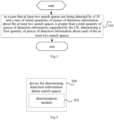
- the method includes Step 101 of, in a case that at least two search spaces are being detected by a UE and a sum of initial quantities of pieces of detection information about the at least two search spaces is greater than a total quantity of pieces of detection information supported by the UE, determining a first quantity of pieces of detection information about each of the at least two search spaces.
- a sum of the first quantities of pieces of detection information about the at least two search spaces is smaller than or equal to the total quantity of pieces of detection information.
- the at least two search spaces may refer to search spaces being detected by the UE simultaneously in any unit time.
- the total quantity of pieces of detection information may be a maximum quantity of pieces of detection information supported by the UE.
- a network may configure one or more search spaces for the UE and configure an initial quantity of pieces of detection information about each search space, and the initial quantity of pieces of detection information may not exceed the maximum quantity of pieces of detection information supported by the UE.
- the detection information may include PDCCH candidates or PDCCH channel estimates.
- each PDCCH candidate may refer to PDCCH blind detection.
- the network may configure one or more search spaces for the UE and configure the initial quantity of blind detection operations for each search space, and the initial quantity of blind detection operations shall be smaller than a maximum quantity of blind detection operations supported by the UE.
- the total quantity of pieces of detection information may be the maximum quantity of blind detection operations
- the total quantity of pieces of detection information may be the maximum quantity of PDCCH channel estimates
- the method for determining the detection information about the search spaces may be applied to a UE or a base station.
- Step 101 may be implemented in at least one of the following modes.
- First mode (not claimed by the invention): determining a first quantity of pieces of detection information about each search space in accordance with information about a type of a priority level of the search space.
- this mode relates to the allocation of the first quantity of pieces of detection information preferentially on the basis of the type, i.e., the quantity of pieces of detection information about the search spaces of some types is ensured preferentially.
- DCI Downlink Control Information
- DCI 1_0, DCI 2_1, etc. Downlink Control Information
- priority levels of the search spaces may be ranked in accordance with the above information.
- the quantity of pieces of detection information about a search space whose type is of a high priority level may be ensured preferentially, and the quantity of pieces of detection information whose type is of low priority level may be reduced, so as to ensure that the sum thereof does not exceed the supported total quantity of pieces of detection information.
- the common search space may have a priority level higher than the UE-specific search space, and some DCI formats (e.g., DCI 2_0) may have a priority level higher than the other DCI formats (e.g., DCI 2_2).
- Second mode (not claimed by the invention): determining the first quantity of pieces of detection information about each search space in accordance with a second quantity of pieces of detection information, the second quantity of pieces of detection information being a difference between the sum of the first quantities of pieces of detection information about the at least two search spaces and the total quantity of pieces of detection information supported by the UE.
- the second quantity may refer to an excessive quantity of pieces of detection information.
- This mode may refer to the determination of the first quantity of pieces of detection information on the basis of the deduction of a weight value, i.e., the excessive quantity may be deducted from the quantity of pieces of detection information about each search space.
- an allocation weight value of each search space may be determined in accordance with a predetermined configuration parameter, and the first quantity of pieces of detection information about each search space may be acquired in accordance with the second quantity of pieces of detection information which is greater than the total quantity of pieces of detection information supported by the UE as well as the allocation weight value.
- the predetermined configuration parameter may include at least one of a detection periodicity of the search space, the initial quantity of pieces of detection information, a priority level of the search space, a DCI format, a DCI length and a search space type.
- modes for determining the allocation weight value of each search space may be different from each other.
- the determining the allocation weight value of each search space in accordance with the predetermined configuration parameter will be described hereinafter with respect to different predetermined configuration parameters.
- the determining the allocation weight value of each search space in accordance with the predetermined configuration parameter may include: acquiring a search frequency for each search space within a predetermined time period in accordance with the predetermined configuration parameter; and acquiring the allocation weight value of each search space in accordance with the search frequency.
- the predetermined time period may refer to unit time.
- the modes of acquiring the allocation weight value of each search space in accordance with the search frequency may be different from each other too.
- the acquiring the allocation weight value of each search space in accordance with the search frequency will be described hereinafter with respect to different predetermined configuration parameters.
- P i L i a ⁇ B i b ⁇ F i c ⁇ i L i a ⁇ B i b ⁇ F i c .
- the scheme in the embodiments of the present disclosure may be further applied to various application scenarios.
- the initial quantity of pieces of detection information about a certain search space maybe smaller than the excessive configuration quantity.
- a first threshold which is a minimum quantity of pieces of detection information about the search space
- the quantity of pieces of detection information about the search space may not be smaller than the first threshold in any configuration. In this mode, it is able to ensure that the quantity of pieces of detection information actually allocated for each search space is not greater than the quantity of pieces of detection information previously allocated for the search space.
- the quantity of pieces of detection information is related to the quantity of resources in a CORESET associated with each search space, it is meaningless to allocate the quantity of pieces of detection information which is greater than the quantity of pieces of detection information allowed by the resources in the CORESET.
- the implementation mode may include: acquiring a third quantity of pieces of detection information about a first search space; and in a case that the third quantity is greater than zero, allocating the third quantity of pieces of detection information to a search space other than the first search space, and acquiring the first quantity of pieces of detection information about each search space.
- the third quantity may be allocated to a search space in the search spaces other than the first search space in accordance with the above-mentioned allocation weight value of the search space, or the third quantity may be allocated to a search space having sufficient remaining quantity of pieces of detection information in the search spaces other than the first search space.
- a specific allocation mode will not be particularly defined herein, as long as a sum of the quantities of pieces of detection information about the search spaces overlapping each other does not exceed the total quantity of pieces of detection information after the allocation of the third quantity has been completed.
- the quantity of blind detection operations for the search space may be reduced to C (C is an integer greater than or equal to 0).
- C is an integer greater than or equal to 0.
- a sum of a difference between the excessive quantity and the initial quantity of blind detection operations and C is an overdraft quantity, and the overdraft quantity may be re-allocated to the other search space in accordance with the allocation weight value.
- the initial quantity of blind detection operations for a search space M1 is 20
- the initial quantity of blind detection operations for a search space M2 is 15, and the initial quantity of blind detection operations for a search space M3 is 13.
- the quantity of blind detection operations for the search space M 1 may be 17, the quantity of blind detection operations for the search space M2 may be 13, and the quantity of blind detection operations for the search space M3 may be 13. At this time, there are still three excessive blind detection operations.
- the quantity of blind detection operations for each of the search space M2 and the search space M3 has reached the minimum quantity of blind detection operations, at this time the three excessive blind detection operations may be allocated to the search space M1, i.e., the quantity of blind detection operations for the search space M1 may be 14.
- the implementation mode will be illustratively described hereinafter in a case that the predetermined configuration parameter includes the detection periodicity of the search space and the quantity of blind detection operations for the UE is to be determined.
- a detection periodicity of a search space S 1 is 2
- a detection periodicity of a search space S2 is 5
- a detection periodicity of a search space S3 is 10
- the initial quantity of blind detection operations for each search space is configured as 20.
- an actual quantity of blind detection operations for each search space may be calculated.
- the excessive quantity may be calculated as 16.
- the allocation weight value of each search space may be calculated.
- An allocation weight value of S1 may be 5/8, an allocation weight value of S2 may be 1/4, and an allocation weight value of S3 may be 1/8.
- the actually allocated quantity of blind detection operations for each search space may be calculated.
- An actually allocated quantity of blind detection operations for S 1 may be 10, an actually allocated quantity of blind detection operations for S2 may be 16, and an actually allocated quantity of blind detection operations for S3 may be 18.
- the total quantity of blind detection operations may not exceed 44.
- a large quantity of blind detection operations may be reserved for the search space with a long periodicity and a large quantity of blind detection operations may be discarded for the search space with a short periodicity, so it is able to ensure the equity, and therefore prevent the quantity of blind detection operations from being not allocated for the search space with the long periodicity for a long term.
- Third mode (according to the claimed invention): determining the first quantity of pieces of detection information about each search space in accordance with the total quantity of pieces of detection information supported by the UE.
- this mode may refer to the reallocation of the total quantity of pieces of detection information in accordance with a ratio of each search space.
- an allocation weight value of each search space may be determined in accordance with a predetermined configuration parameter, the allocation ratio of each search space may be determined in accordance with the allocation weight value, and then the first quantity of pieces of detection information about each search space may be determined in accordance with the allocation ratio and the total quantity of pieces of detection information supported by the UE.
- the predetermined configuration parameter may include at least one of a detection periodicity of the search space, the initial quantity of pieces of detection information, a priority level of the search space, a DCI format, a DCI length and a search space type.
- modes for determining the allocation weight value of each search space in accordance with the predetermined configuration parameter may be different from each other.
- the determining the allocation weight value of each search space in accordance with the predetermined configuration parameter will be described hereinafter with respect to different predetermined configuration parameters.
- the determining the allocation weight value of each search space in accordance with the predetermined configuration parameter may include: acquiring a search frequency for each search space within a predetermined time period in accordance with the predetermined configuration parameter; and acquiring the allocation weight value of each search space in accordance with the search frequency.
- the predetermined time period may refer to unit time.
- the modes of acquiring the allocation weight value of each search space in accordance with the search frequency may be different from each other too.
- the acquiring the allocation weight value of each search space in accordance with the search frequency will be described hereinafter with respect to different predetermined configuration parameters.
- P i L i a ⁇ B i b ⁇ F i c ⁇ i L i a ⁇ B i b ⁇ F i c .
- the scheme in the embodiments of the present disclosure may be further applied to various application scenarios.
- the above description in the embodiments of the present disclosure may refer to the modes for re-determining the quantity of pieces of detection information about each search space in a case that at least two search spaces are being detected by the UE and the sum of the initial quantities of pieces of detection information about the at least two search spaces is greater than the total quantity of pieces of detection information supported by the UE.
- the UE may detect each search space respectively in accordance with the initial quantity of pieces of detection information configured by the network.
- the present disclosure is able to support overbooking the allocation of the quantity of blind detection operations and the quantity of channel estimates for the search spaces with different periodicities, i.e., the quantity of blind detection operations that does not exceed the maximum quantity of blind detection operations supported by the UE and the quantity of channel estimates that does not exceed the maximum quantity of channel estimated supported by the UE may be allocated individually for each search space, so as to make full use of a processing capability of the UE, improve a system resource utilization rate and reduce a probability of the allocation blocking.
- the quantity of blind detection operations or the quantity of channel estimates may be allocated for the search spaces using the method in the embodiments of the present disclosure, so as to ensure that a sum of the total quantity of blind detection operations or the total quantity of channel estimates for all the search spaces does not exceed a maximum support capability of the UE.
- the method in the embodiments of the present disclosure may also be applied to any other situation where limited resources are to be allocated in an excessive manner between resources with different periodicities, e.g., the power allocation in a case that a periodical signal is transmitted on a plurality of carriers simultaneously.
- the present disclosure further provides in an embodiment a device 200 for determining detection information about search spaces, which includes a determination module 202 used to, in a case that at least two search spaces are being detected by a UE and a sum of initial quantities of pieces of detection information about the at least two search spaces is greater than a total quantity of pieces of detection information supported by the UE, determine a first quantity of pieces of detection information about each of the at least two search spaces.
- a sum of the first quantities of pieces of detection information about the at least two search spaces is smaller than or equal to the total quantity of pieces of detection information.
- the detection information includes PDCCH candidates or PDCCH channel estimates.
- the determination module 202 may include at least one of: a first determination sub-module used to determine the first quantity of pieces of detection information about each search space in accordance with information about a type of a priority level of the search space; a second determination sub-module used to determine the first quantity of pieces of detection information about each search space in accordance with a second quantity of pieces of detection information, the second quantity of pieces of detection information being a difference between the sum of the first quantities of pieces of detection information about the at least two search spaces and the total quantity of pieces of detection information supported by the UE; and a third determination sub-module used to determine the first quantity of pieces of detection information about each search space in accordance with the total quantity of pieces of detection information supported by the UE.
- the second determination sub-module may include: a first determination unit used to determine an allocation weight value of each search space in accordance with a predetermined configuration parameter; and a first acquisition unit used to acquire the first quantity of pieces of detection information about each search space in accordance with the second quantity of pieces of detection information and the allocation weight value.
- the third determination sub-module may include: a second determination unit used to determine an allocation weight value about each search space in accordance with a predetermined configuration parameter; a third determination unit used to determine an allocation ratio of each search space in accordance with the allocation weight value; and a fourth determination unit used to determine the first quantity of pieces of detection information about each search space in accordance with the allocation ratio and the total quantity of pieces of detection information supported by the UE.
- the predetermined configuration parameter may include at least one of a detection periodicity of the search space, the initial quantity of pieces of detection information, a priority level of the search space, a DCI format, a DCI length and a search space type.
- the determining the allocation weight value of each search space in accordance with the predetermined configuration parameter may include: acquiring a search frequency for each search space within a predetermined time period in accordance with the predetermined configuration parameter; and acquiring the allocation weight value of each search space in accordance with the search frequency.
- the second determination sub-module may further include: a second acquisition unit used to acquire a third quantity of pieces of detection information about a first search space; and an allocation unit used to, in a case that the third quantity is greater than zero, allocate the third quantity to a search space other than the first search space, and acquire the first quantity of pieces of detection information about each search space.
- the in the embodiments of the present disclosure is capable of implementing the procedures of the method implemented by the device 200 for determining the detection information about the search spaces in Fig.1 , which will not be particularly defined herein.
- the device 200 for determining the detection information about the search spaces in the embodiments of the present disclosure in a case that at least two search spaces are being detected by the UE and the sum of the initial quantities of pieces of detection information about the at least two search spaces is greater than the total quantity of pieces of detection information supported by the UE, the first quantity of pieces of detection information about each of the at least two search spaces may be determined, and the sum of the first quantities of pieces of detection information about the at least two search spaces may be ensured to be smaller than or equal to the total quantity of pieces of detection information.
- it is able to improve a control resource utilization rate of a system and reduce a probability of the blocking of control channel allocation, thereby to ensure the reliability of network communication.
- Fig.3 shows a hardware structure of a device for determining detection information about search spaces.
- the device 30 for determining detection information about search spaces may include, but not limited to, a Radio Frequency (RF) unit 310, a network module 320, an audio output unit 330, an input unit 340, a sensor 350, a display unit 360, a user input unit 370, an interface unit 380, a memory 390, a processor 311, and a power source 312.
- RF Radio Frequency
- the device may include more or fewer members, or some members may be combined, or the members may be arranged in different modes.
- the device or determining detection information about search spaces may include, but not limited to, mobile phone, flat-panel computer, notebook computer, palm computer, vehicle-mounted terminal, wearable device or pedometer.
- the processor 311 is used to, in a case that at least two search spaces are being detected by a UE and a sum of initial quantities of pieces of detection information about the at least two search spaces is greater than a total quantity of pieces of detection information supported by the UE, determine a first quantity of pieces of detection information about each of the at least two search spaces. A sum of the first quantities of pieces of detection information about the at least two search spaces is smaller than or equal to the total quantity of pieces of detection information.
- the detection information includes PDCCH candidates or PDCCH channel estimates.
- the device for determining the detection information about the search spaces in a case that at least two search spaces are being detected by the UE and the sum of the initial quantities of pieces of detection information about the at least two search spaces is greater than the total quantity of pieces of detection information supported by the UE, the first quantity of pieces of detection information about each of the at least two search spaces may be determined, and the sum of the first quantities of pieces of detection information about the at least two search spaces may be ensured to be smaller than or equal to the total quantity of pieces of detection information.
- it is able to improve a control resource utilization rate of a system and reduce a probability of the blocking of control channel allocation, thereby to ensure the reliability of network communication.
- the radio frequency unit 310 is used to transmit and receive information, or transmit and receive signals during the phone call.
- the radio frequency unit 310 may, upon the receipt of downlink data from a network device, transmit the downlink data to the processor 311 for subsequent treatment.
- the radio frequency unit 310 may transmit uplink data to the network device.
- the radio frequency unit 310 may include, but not limited to, an antenna, at least one amplifier, a transceiver, a coupler, a low-noise amplifier and a duplexer.
- the radio frequency unit 310 may also communicate with a network and the other devices via a wireless communication system.
- the network module 320 of the device for determining the detection information about the search spaces is used to enable a user to access the broadband Internet in a wireless manner, e.g., help the user to receive and send an e-mail, browse a web or access a streaming media.
- the audio output unit 330 is used to convert audio data received by the radio frequency unit 310 or the network module 320, or audio data stored in the memory 390, into an audio signal and output the audio signal as a sound.
- the audio output unit 330 is further used to provide an audio output related to a specific function executed by the device 30 for determining the detection information about the search spaces (e.g., a sound occurring when a calling signal or a message has been received).
- the audio output unit 330 may include a loudspeaker, a buzzer, a receiver, and the like.
- the input unit 340 is used to receive an audio or video signal.
- the input unit 340 may include a Graphics Processing Unit (GPU) 341 and a microphone 342.
- the GPU 341 is used to process image data of a static image or video acquired by an image collection unit (e.g., a camera) in a video capturing mode or an image capturing mode, and a processed image frame may be displayed by the display unit 360.
- the image frame processed by the GPU 341 may be stored in the memory 390 (or another storage medium) or transmitted via the radio frequency unit 310 or network module 320.
- the microphone 342 is used to receive a sound, and convert the sound into voice data. In a call mode, the processed audio data may be converted into data in a format capable of being transmitted by the radio frequency unit 310 to a mobile communication network device, and then be outputted.
- the device for determining the detection information about the search spaces further includes at least one sensor 350, e.g., a light sensor, a movement sensor and the other sensors.
- the light sensor may include an ambient light sensor or a proximity sensor.
- the ambient light sensor is used to adjust a brightness value of a display panel 361 in accordance with ambient light.
- the proximity sensor is used to turn off the display panel 361 and/or a backlight source in a case that the device 30 for determining the detection information about the search spaces is near the ear of the user.
- an accelerometer may detect acceleration in various directions (usually a three-axis accelerometer), and detect a level and a direction of a gravity force in a case of being in a static state.
- the accelerometer it is able to identify a posture of the device for determining the detection information about the search spaces (e.g., perform a switching operation between portrait and landscape orientations, play relevant games, and calibrate a posture of a magnetometer), and perform vibration-recognition-related functions (e.g., count steps and strikes).
- the sensor 350 may further include a fingerprint sensor, a pressure sensor, an iris sensor, a molecule sensor, a gyroscope, a barometer, a hygrometer, a thermometer or an infrared sensor, which will not be particularly defined herein.
- the display unit 360 is used to display information inputted by the user or provided to the user.
- the display unit 360 may include the display panel 361, e.g., a Liquid Crystal Display (LCD) panel, or an Organic Light-Emitting Diode (OLED) panel.
- LCD Liquid Crystal Display
- OLED Organic Light-Emitting Diode
- the user input unit 370 is used to receive digital or character information inputted by the user, and generate a key signal input related to user settings and function control of the device for determining the detection information about the search spaces.
- the user input unit 370 may include a touch panel 371 and another input device 372.
- the touch panel 371 also called as touch screen, is used to collect a touch operation made by the user on or in proximity to the touch panel (e.g., an operation made by the user through any appropriate object or attachment (e.g., finger or stylus) on or in the proximity to the touch panel 371).
- the touch panel 371 may include a touch detection device and a touch controller.
- the touch detection device is used to detect a touch position of the user and a signal generated due to the touch operation, and transmit the signal to the touch controller.
- the touch controller is used to receive touch information from the touch detection device, convert it into coordinates of a touch point, transmit the coordinates to the processor 311, and receive and execute a command from the processor 311.
- the touch panel 371 may be of a resistive type, a capacitive type, an infrared type or a surface acoustic wave type.
- the other input device 372 may include, but not limited to, a physical keyboard, a functional button (e.g., a volume control button or an on/off button), a trackball, a mouse, and a joystick, which will not be particularly defined herein.
- the touch panel 371 may cover the display panel 361. In a case that the touch operation made on or in proximity to the touch panel 371 has been detected, the touch panel 371 may transmit the touch information to the processor 311, so as to determine a type of a touch event. Then, the processor 311 may control the display panel 361 to provide a corresponding visual output thereon in accordance with the type of the touch event.
- the touch panel 371 and the display panel 361 are configured as two separate members for implementing the input and output functions of the device for determining the detection information about the search spaces in Fig.3 , in some embodiments of the present disclosure, they may be integrated so as to achieve the input and output functions of the device for determining the detection information about the search spaces, which will not be particularly defined herein.
- the interface unit 380 is used to provide an interface between an external device and the device 30 for determining the detection information about the search spaces.
- the external device may include a wired or wireless headset port, an external power source port (or a charging port), a wired or wireless data port, a memory card port, a port for connecting a device having an identification module, an audio Input/Output (I/O) port, a video I/O port, and an earphone port.
- the interface unit 380 is used to receive an input from the external device (e.g., data information and electricity) and transmit the input to one or more elements of the device 30 for determining the detection information about the search spaces, or transmit data between the device 30 for determining the detection information about the search spaces and the external device.
- the memory 390 is used to store therein a software application and various data. It may mainly include an application storage area and a data storage area. An operating system and at least one application for the functions (e.g., an audio/image playing function) may be stored in the application storage area. Data created in accordance with the operation of the mobile phone (e.g., audio data and phone book) may be stored in the data storage area.
- the memory 390 may include a highspeed random access memory, or a non-volatile memory (e.g., at least one magnetic disk or flash memory), or any other volatile solid state memory.
- the processor 311 may be connected to various other members of the device for determining the detection information about the search spaces via various interfaces and circuits, and used to run or execute the software program and/or module stored in the memory 390, and call the data stored in the memory 390, so as to execute the functions of the device for determining the detection information about the search spaces and process the data, thereby to monitor the entire device.
- the processor 311 may include one or more processing units.
- an application processor and a modem may be integrated into the processor 311.
- the application processor is mainly used to process the operating system, a user interface and the application.
- the modem is mainly used to process wireless communication. It should be appreciated that, the modem may also not be integrated into the processor 311.
- the device 30 for determining the detection information about the search spaces may further includes a power source 312 (e.g., a battery), which is used to supply power to the members of the device 30.
- a power source 312 e.g., a battery
- the power source 312 is logically connected to the processor 311 via a power source management system, so as to achieve such functions as charging, discharging and power consumption management through the power source management system.
- the device 30 for determining the detection information about the search spaces may include some functional modules not shown in Fig.3 , which will not be particularly defined herein.
- Fig.4 also shows a hardware structure of a device for determining detection information about search spaces according to an embodiment of the present disclosure, and the device is capable of implementing the above-mentioned method for determining the detection information about the search spaces with a same technical effect.
- the device 400 for determining the detection information about the search spaces may include a processor 401, a transceiver 402, a memory 403 and a bus interface.
- the processor 401 is used to read a program stored in the memory 403, so as to, in a case that at least two search spaces are being detected by a UE and a sum of initial quantities of pieces of detection information about the at least two search spaces is greater than a total quantity of pieces of detection information supported by the UE, determine a first quantity of pieces of detection information about each of the at least two search spaces. A sum of the first quantities of pieces of detection information about the at least two search spaces is smaller than or equal to the total quantity of pieces of detection information.
- the detection information includes PDCCH candidates or PDCCH channel estimates.
- bus architecture may include a number of buses and bridges connected to each other, so as to connect various circuits for one or more processors such as the processor 401 and one or more memories such as the memory 403.
- the bus architecture may be used to connect various other circuits, such as a circuit for a peripheral device, a circuit for a voltage stabilizer and a power management circuit, which are not further explained herein.
- the bus interface may be provided, and the transceiver 402 may consist of a plurality of elements, i.e., a transmitter and a receiver for communication with various other devices over a transmission medium.
- the processor 401 may take charge of managing the bus architecture as well as general processings.
- the memory 403 may store therein data for the operation of the processor 401.
- the processor 401 is further used to read the program stored in the memory 403, so as to perform at least one of: determining the first quantity of pieces of detection information about each search space in accordance with information about a type of a priority level of the search space; determining the first quantity of pieces of detection information about each search space in accordance with a second quantity of pieces of detection information, the second quantity of pieces of detection information being a difference between the sum of the first quantities of pieces of detection information about the at least two search spaces and the total quantity of pieces of detection information supported by the UE; and determining the first quantity of pieces of detection information about each search space in accordance with the total quantity of pieces of detection information supported by the UE.
- the processor 401 is further used to read the program stored in the memory 403, so as to: determine an allocation weight value of each search space in accordance with a predetermined configuration parameter; and acquire the first quantity of pieces of detection information about each search space in accordance with the second quantity of pieces of detection information and the allocation weight value.
- the processor 401 is further used to read the program stored in the memory 403, so as to: determine an allocation weight value about each search space in accordance with a predetermined configuration parameter; determine an allocation ratio of each search space in accordance with the allocation weight value; and determine the first quantity of pieces of detection information about each search space in accordance with the allocation ratio and the total quantity of pieces of detection information supported by the UE.
- the predetermined configuration parameter may include at least one of a detection periodicity of the search space, the initial quantity of pieces of detection information, a priority level of the search space, a DCI format, a DCI length and a search space type.
- the processor 401 is further used to read the program stored in the memory 403, so as to: acquire a search frequency for each search space within a predetermined time period in accordance with the predetermined configuration parameter; and acquire the allocation weight value of each search space in accordance with the search frequency.
- the processor 401 is further used to read the program stored in the memory 403, so as to: acquire a third quantity of pieces of detection information about a first search space; and in a case that the third quantity is greater than zero, allocate the third quantity to a search space other than the first search space, and acquire the first quantity of pieces of detection information about each search space.
- the device for determining the detection information about the search spaces may be a Base Transceiver Station (BTS) in a Global System of Mobile Communication (GSM) system or a Code Division Multiple Access (CDMA) system, a Node B (NB) in a Wideband Code Division Multiple Access (WCDMA) system, an Evolved Node B (eNB, or eNodeB) in an LTE system, a relay or an access point, or a base station in a future 5G network, which will not be particularly defined herein.
- BTS Base Transceiver Station
- GSM Global System of Mobile Communication
- CDMA Code Division Multiple Access
- NB Node B
- WCDMA Wideband Code Division Multiple Access
- eNB Evolved Node B
- LTE Long Term Evolution
- relay or an access point or a base station in a future 5G network
- the present disclosure further provides in an embodiment a device for determining detection information about search spaces, which includes a processor, a memory, and a computer program stored in the memory and executed by the processor.
- the processor is used to execute the computer program so as to implement the above-mentioned method for determining the detection information about the search spaces with a same technical effect, which will not repeatedly defined herein.
- the present disclosure further provides in an embodiment a computer-readable storage medium storing therein a computer program.
- the computer program is executed by a processor so as to implement the above-mentioned method for determining the detection information about the search spaces with a same technical effect, which will not be repeatedly defined herein.
- the computer-readable storage medium may be a Read-Only Memory (ROM), a Random Access Memory (RAM), a magnetic disk or an optical disk.
- the present disclosure may be implemented by software as well as a necessary common hardware platform, or by hardware, and the former may be better in most cases.
- the technical solutions of the present disclosure essentially, or parts of the technical solutions of the present disclosure contributing to the prior art, may appear in the form of software products, which may be stored in a storage medium (e.g., ROM/RAM, magnetic disk or optical disk) and include instructions so as to enable a terminal device (e.g., mobile phone, computer, server, air conditioner or network device) to execute the method in the embodiments of the present disclosure.
- a storage medium e.g., ROM/RAM, magnetic disk or optical disk
- a terminal device e.g., mobile phone, computer, server, air conditioner or network device
Landscapes
- Engineering & Computer Science (AREA)
- Signal Processing (AREA)
- Computer Networks & Wireless Communication (AREA)
- Power Engineering (AREA)
- Mobile Radio Communication Systems (AREA)
- Information Retrieval, Db Structures And Fs Structures Therefor (AREA)
Claims (12)
- Verfahren zum Bestimmen von Erfassungsinformationen über Suchräume, umfassend:in einem Fall, in dem mindestens zwei Suchräume von einem Benutzergerät, UE, erfasst werden und eine Summe von anfänglichen Teilen von Erfassungsinformationen über die mindestens zwei Suchräume größer ist als eine Gesamtmenge von Teilen von Erfassungsinformationen, die von dem UE unterstützt werden, Bestimmen, durch eine Vorrichtung (200), einer ersten Menge von Teilen von Erfassungsinformationen über jeden der mindestens zwei Suchräume (101),wobei eine Summe der ersten Mengen von Teilen von Erfassungsinformationen über die mindestens zwei Suchräume kleiner als oder gleich wie die Gesamtmenge der Erfassungsinformationen ist;die Erfassungsinformationen eine Schätzung eines Kandidaten eines physikalischen Downlink-Steuerkanals, PDCCH, oder eines PDCCH umfassen,dadurch gekennzeichnet, dass das Bestimmen, durch die Vorrichtung (200), der ersten Menge von Teilen von Erfassungsinformationen über jeden der mindestens zwei Suchräume (101) Folgendes umfasst:Bestimmen, durch die Vorrichtung (200), der ersten Menge von Teilen von Erfassungsinformationen über jeden Suchraum gemäß der Gesamtmenge von Teilen von Erfassungsinformationen, die von dem UE unterstützt werden,wobei das Bestimmen, durch die Vorrichtung (200), der ersten Menge von Teilen von Erkennungsinformationen über jeden Suchraum gemäß der Gesamtmenge von Teilen von Erkennungsinformationen, die von dem UE unterstützt werden, Folgendes umfasst:bestimmen, durch die Vorrichtung (200), eines Zuweisungsgewichtungswerts von jedem Suchraum gemäß einem vorbestimmten Konfigurationsparameter;Bestimmen, durch die Vorrichtung (200), eines Zuweisungsverhältnisses von jedem Suchraum gemäß dem Zuweisungsgewichtungswert;Bestimmen, durch die Vorrichtung (200), der ersten Menge von Teilen von Erfassungsinformationen über jeden Suchraum gemäß dem Zuweisungsverhältnis und der Gesamtmenge von Teilen von Erfassungsinformationen, die von dem UE unterstützt werden.
- Verfahren nach Anspruch 1, wobei der vorbestimmte Konfigurationsparameter mindestens eines von Folgenden umfasst:
eine Erfassungshäufigkeit des Suchraums, die anfängliche Menge von Teilen von Erfassungsinformationen, eine Prioritätsstufe des Suchraums, Format von Downlink-Steuerinformationen, DCI, DCI-Länge und Suchraumtyp. - Verfahren nach Anspruch 1, wobei das Bestimmen, durch die Vorrichtung (200), des Zuweisungsgewichtungswerts von jedem Suchraum gemäß dem vorbestimmten Konfigurationsparameter Folgendes umfasst:Erhalten, durch die Vorrichtung (200), einer Suchfrequenz für jeden Suchraum innerhalb eines vorbestimmten Zeitraums gemäß dem vorbestimmten Konfigurationsparameter;Erhalten, durch die Vorrichtung (200), des Zuweisungsgewichtungswertes von jedem Suchraum gemäß der Suchfrequenz.
- Verfahren nach Anspruch 3, wobei in einem Fall, in dem der vorbestimmte Konfigurationsparameter die Erfassungshäufigkeit des Suchraums umfasst, das Erhalten, durch die Vorrichtung (200), der Suchfrequenz für jeden Suchraum innerhalb des vorbestimmten Zeitraums Folgendes umfasst:Erhalten, durch die Vorrichtung (200), der Suchhäufigkeit für jeden Suchraum innerhalb des vorbestimmten Zeitraums durch eine Formel
 Erhalten, durch die Vorrichtung (200), des Zuweisungsgewichtungswerts von jedem Suchraum durch eine Formel
 wobei Fi eine Suchhäufigkeit für einen i-ten Suchraum innerhalb des vorbestimmten Zeitraums darstellt, Ti eine Erfassungshäufigkeit des i-ten Suchraums darstellt, Pi einen Zuweisungsgewichtungswert des i-ten Suchraums darstellt, Σ eine Summationsfunktion darstellt und i einen Index des Suchraums darstellt.
 - Verfahren nach Anspruch 3, wobei in einem Fall, in dem der vorbestimmte Konfigurationsparameter die Erfassungshäufigkeit des Suchraums und die anfängliche Menge von Teilen von Erfassungsinformationen umfasst, das Erhalten, durch die Vorrichtung (200), der Suchfrequenz für jeden Suchraum innerhalb des vorbestimmten Zeitraums Folgendes umfasst:Erhalten, durch die Vorrichtung (200), der Suchhäufigkeit für jeden Suchraum innerhalb des vorbestimmten Zeitraums durch eine Formel
 wobei das Erhalten, durch die Vorrichtung (200), des Zuweisungsgewichtungswerts von jedem Suchraum gemäß der Suchfrequenz Folgendes umfasst:Erhalten, durch die Vorrichtung (200), des Zuweisungsgewichtungswerts von jedem Suchraum durch eine Formel
 wobei Fi eine Suchhäufigkeit für einen i-ten Suchraum innerhalb des vorbestimmten Zeitraums darstellt, Ti eine Erfassungshäufigkeit des i-ten Suchraums darstellt, Pi einen Zuweisungsgewichtungswert des i-ten Suchraums darstellt, Bi die anfängliche Menge von Teilen von Erfassungsinformationen über den i-ten Suchraum darstellt, Σ eine Summationsfunktion darstellt und i einen Index des Suchraums darstellt.
 - Verfahren nach Anspruch 1, wobei in einem Fall, in dem der vorbestimmte Konfigurationsparameter das Prioritätsniveau des Suchraums umfasst, das Bestimmen, durch die Vorrichtung (200), des Zuweisungsgewichtungswerts von jedem Suchraum gemäß dem vorbestimmten Konfigurationsparameter Folgendes umfasst:Erhalten, durch die Vorrichtung (200), des Zuweisungsgewichtungswerts von jedem Suchraum durch eine Formel
 wobei Pi den Wert des Zuweisungsgewichts des i-ten Suchraums darstellt, Li die Prioritätsstufe des i-ten Suchraums darstellt, Σ eine Summationsfunktion darstellt und i einen Index des Suchraums darstellt.
 - Verfahren nach Anspruch 1, wobei das Bestimmen, durch die Vorrichtung (200), des Zuweisungsverhältnisses von jedem Suchraum gemäß dem Zuweisungsgewichtwert Folgendes umfasst:Erhalten, durch die Vorrichtung (200), des Zuweisungsverhältnisses von jedem Suchraum durch eine Formel
 wobei Ui ein Zuweisungsverhältnis des i-ten Suchraums darstellt, Pi einen Zuweisungsgewichtungswert des i-ten Suchraums darstellt und i einen Index des Suchraums darstellt.
 - Verfahren nach Anspruch 1, wobei das Bestimmen, durch die Vorrichtung (200), der ersten Menge von Teilen von Erfassungsinformationen über jeden Suchraum gemäß dem Zuweisungsverhältnis und der Gesamtmenge an Erfassungsinformationen, die von dem UE unterstützt werden, Folgendes umfasst:Erhalten, durch die Vorrichtung (200), der ersten Menge von Teilen von Erfassungsinformationen über jeden Suchraum durch eine Formel
 wobei
wobei
- Vorrichtung (200) zum Bestimmen von Erfassungsinformationen über Suchräume, umfassend:ein Bestimmungsmodul (202), das verwendet wird, um in einem Fall, in dem mindestens zwei Suchräume von einem Benutzergerät, UE, erfasst werden und eine Summe von anfänglichen Teilen von Erfassungsinformationen über die mindestens zwei Suchräume größer ist als eine Gesamtmenge von Teilen von Erfassungsinformationen, die von dem UE unterstützt werden, eine erste Menge von Teilen von Erfassungsinformationen über jeden der mindestens zwei Suchräume zu bestimmen,wobei eine Summe der ersten Mengen von Teilen von Erfassungsinformationen über die mindestens zwei Suchräume kleiner als oder gleich wie die Gesamtmenge der Erfassungsinformationen ist;die Erfassungsinformationen eine Schätzung eines Kandidaten eines physikalischen Downlink-Steuerkanals, PDCCH, oder eines PDCCH umfassen,dadurch gekennzeichnet, dass das Bestimmungsmodul (202) Folgendes umfasst:ein drittes Bestimmungsuntermodul, das verwendet wird, um die erste Menge von Teilen von Erfassungsinformationen über jeden Suchraum gemäß der Gesamtmenge von Teilen von Erfassungsinformationen, die von dem UE unterstützt werden, zu bestimmen,wobei das dritte Bestimmungsuntermodul Folgendes umfasst: eine zweite Bestimmungseinheit, die verwendet wird, um einen Zuweisungsgewichtungswert von jedem Suchraum gemäß einem vorbestimmten Konfigurationsparameter zu bestimmen; eine dritte Bestimmungseinheit, die verwendet wird, um ein Zuweisungsverhältnis von jedem Suchraum gemäß einem Zuweisungsgewichtungswert zu bestimmen; eine vierte Bestimmungseinheit, die verwendet wird, um die erste Menge von Teilen von Erfassungsinformationen über jeden Suchraum gemäß dem Zuweisungsverhältnis und der Gesamtmenge von Teilen von Erfassungsinformationen, die von dem UE unterstützt werden, zu bestimmen.
- Vorrichtung (200) nach Anspruch 9, wobei der vorbestimmte Konfigurationsparameter mindestens eines von Folgenden umfasst:
eine Erfassungshäufigkeit des Suchraums, die anfängliche Menge von Teilen von Erfassungsinformationen, eine Prioritätsstufe des Suchraums, Format von Downlink-Steuerinformationen, DCI, DCI-Länge und Suchraumtyp. - Vorrichtung (200) nach Anspruch 9, wobei das Bestimmen des Zuweisungsgewichtungswerts von jedem Suchraum gemäß dem vorbestimmten Konfigurationsparameter Folgendes umfasst:Erhalten einer Suchfrequenz für jeden Suchraum innerhalb eines vorbestimmten Zeitraums gemäß dem vorbestimmten Konfigurationsparameter;Erhalten des Zuweisungsgewichtungswerts von jedem Suchraum gemäß der Suchfrequenz.
- Computerlesbares Speichermedium, in dem ein Computerprogramm gespeichert ist, wobei das Computerprogramm von einem Prozessor ausgeführt werden kann, um das Verfahren nach einem der Ansprüche 1 bis 8 zu implementieren.
Applications Claiming Priority (2)
| Application Number | Priority Date | Filing Date | Title |
|---|---|---|---|
| CN201810142644.2A CN110166191B (zh) | 2018-02-11 | 2018-02-11 | 一种搜索空间的监听信息的确定方法及装置 |
| PCT/CN2019/074408 WO2019154320A1 (zh) | 2018-02-11 | 2019-02-01 | 搜索空间的监听信息的确定方法及装置 |
Publications (3)
| Publication Number | Publication Date |
|---|---|
| EP3751922A1 EP3751922A1 (de) | 2020-12-16 |
| EP3751922A4 EP3751922A4 (de) | 2021-03-31 |
| EP3751922B1 true EP3751922B1 (de) | 2024-09-18 |
Family
ID=67548759
Family Applications (1)
| Application Number | Title | Priority Date | Filing Date |
|---|---|---|---|
| EP19751737.8A Active EP3751922B1 (de) | 2018-02-11 | 2019-02-01 | Verfahren und vorrichtung zur ermittlung von detektionsinformationen im suchraum |
Country Status (7)
| Country | Link |
|---|---|
| US (1) | US11146424B2 (de) |
| EP (1) | EP3751922B1 (de) |
| JP (1) | JP7228594B2 (de) |
| KR (1) | KR20200106178A (de) |
| CN (1) | CN110166191B (de) |
| ES (1) | ES2987791T3 (de) |
| WO (1) | WO2019154320A1 (de) |
Families Citing this family (4)
| Publication number | Priority date | Publication date | Assignee | Title |
|---|---|---|---|---|
| WO2018127802A1 (en) * | 2017-01-05 | 2018-07-12 | Nokia Technologies Oy | Downlink control channel monitoring optimizing for discontinuous reception mode and/or narrowband operation |
| CN113225751B (zh) | 2020-02-06 | 2023-05-05 | 维沃移动通信有限公司 | 搜索空间的监听方法和设备 |
| CN113301650B (zh) | 2020-02-21 | 2024-06-14 | 维沃移动通信有限公司 | 一种ss的监听方法及设备 |
| CN114501489B (zh) | 2020-11-12 | 2026-02-03 | 维沃移动通信有限公司 | 节能指示方法、装置、设备及可读存储介质 |
Family Cites Families (23)
| Publication number | Priority date | Publication date | Assignee | Title |
|---|---|---|---|---|
| CN101699901B (zh) * | 2009-09-28 | 2012-08-08 | 上海华为技术有限公司 | 优化用户设备搜索空间的方法及装置 |
| CN104901778B (zh) * | 2009-12-17 | 2018-07-24 | Lg电子株式会社 | 无线通信系统中的接收和发送方法及设备 |
| WO2011122852A2 (ko) * | 2010-03-30 | 2011-10-06 | 엘지전자 주식회사 | 무선통신 시스템에서 제어채널을 모니터링하기 위한 방법 및 장치 |
| US20110267948A1 (en) * | 2010-05-03 | 2011-11-03 | Koc Ali T | Techniques for communicating and managing congestion in a wireless network |
| WO2012011240A1 (ja) * | 2010-07-21 | 2012-01-26 | パナソニック株式会社 | 基地局、端末、送信方法、及び受信方法 |
| DE112011105429B4 (de) | 2011-07-12 | 2020-10-29 | Avago Technologies International Sales Pte. Ltd. | Suchraum für eine komponententrägerspezifische UL/DL Konfiguration |
| CN102291736B (zh) * | 2011-08-08 | 2017-11-24 | 中兴通讯股份有限公司 | 下行控制信道的检测方法、用户设备及基站 |
| US20150296542A1 (en) | 2011-08-11 | 2015-10-15 | Blackberry Limited | Performing random access in carrier aggregation |
| US9252918B2 (en) * | 2011-08-15 | 2016-02-02 | Google Technology Holdings LLC | Method and apparatus for control channel transmission and reception |
| EP2768255A4 (de) * | 2011-10-13 | 2015-08-05 | Fujitsu Ltd | Drahtloses kommunikationssystem, basisstation, mobilstation und drahtloses kommunikationsverfahren |
| US8606286B2 (en) * | 2012-01-16 | 2013-12-10 | Blackberry Limited | E-PDCCH design for reducing blind decoding |
| US9571241B2 (en) * | 2012-01-30 | 2017-02-14 | Alcatel Lucent | Methods for transmitting and receiving control information using time-frequency resources of decoding candidates |
| US9907071B2 (en) * | 2014-07-18 | 2018-02-27 | Qualcomm Incorporated | Resource management for UEs under coverage enhancement |
| EP3247061B1 (de) * | 2015-01-12 | 2023-03-01 | LG Electronics Inc. | Verfahren zum betrieb eines benutzergeräts in einem drahtloskommunikationssystem und vorrichtung dafür |
| WO2016169047A1 (en) | 2015-04-24 | 2016-10-27 | Telefonaktiebolaget Lm Ericsson (Publ) | Method and network node for pdcch resource allocation |
| US20180191454A1 (en) * | 2016-04-15 | 2018-07-05 | Telefonaktiebolaget Lm Ericsson (Publ) | Radio network node, wireless device and methods performed therein |
| EP3455985B1 (de) * | 2016-05-11 | 2022-03-09 | Convida Wireless, LLC | Neuer funk-downlink-steuerkanal |
| CN109121159B (zh) * | 2017-06-22 | 2021-04-23 | 维沃移动通信有限公司 | 盲检能力上报方法、盲检配置、盲检方法、终端及基站 |
| AU2017425066B2 (en) * | 2017-07-28 | 2022-09-15 | Ntt Docomo, Inc. | User terminal, base station apparatus, and radio communication method |
| ES2949065T3 (es) * | 2017-07-28 | 2023-09-25 | Ntt Docomo Inc | Terminal de usuario y método de comunicación por radio |
| PL4099607T3 (pl) * | 2017-10-02 | 2024-07-01 | Telefonaktiebolaget Lm Ericsson (Publ) | Okresowość monitorowania pdcch |
| US11191011B2 (en) * | 2017-11-16 | 2021-11-30 | Nokia Technologies Oy | Managing control channel blind searches between search spaces in new radio |
| WO2019157677A1 (zh) | 2018-02-13 | 2019-08-22 | Oppo广东移动通信有限公司 | 用于物理下行控制信道的盲检测的方法和终端设备 |
-
2018
- 2018-02-11 CN CN201810142644.2A patent/CN110166191B/zh active Active
-
2019
- 2019-02-01 WO PCT/CN2019/074408 patent/WO2019154320A1/zh not_active Ceased
- 2019-02-01 KR KR1020207022568A patent/KR20200106178A/ko not_active Ceased
- 2019-02-01 US US16/967,120 patent/US11146424B2/en active Active
- 2019-02-01 JP JP2020542834A patent/JP7228594B2/ja active Active
- 2019-02-01 ES ES19751737T patent/ES2987791T3/es active Active
- 2019-02-01 EP EP19751737.8A patent/EP3751922B1/de active Active
Also Published As
| Publication number | Publication date |
|---|---|
| US20200366533A1 (en) | 2020-11-19 |
| WO2019154320A1 (zh) | 2019-08-15 |
| EP3751922A4 (de) | 2021-03-31 |
| JP7228594B2 (ja) | 2023-02-24 |
| JP2021513281A (ja) | 2021-05-20 |
| CN110166191B (zh) | 2021-01-08 |
| EP3751922A1 (de) | 2020-12-16 |
| ES2987791T3 (es) | 2024-11-18 |
| CN110166191A (zh) | 2019-08-23 |
| KR20200106178A (ko) | 2020-09-11 |
| US11146424B2 (en) | 2021-10-12 |
Similar Documents
| Publication | Publication Date | Title |
|---|---|---|
| EP3826397B1 (de) | Überwachungsverfahren und endgerät | |
| EP4236566A2 (de) | Verfahren zur überwachung von pdcch sowie endgerät und netzwerkvorrichtung | |
| US11985712B2 (en) | Information transmission method, information detection method, terminal device, and network device | |
| US12133257B2 (en) | Uplink transmission method, user equipment, and network-side device | |
| EP3751922B1 (de) | Verfahren und vorrichtung zur ermittlung von detektionsinformationen im suchraum | |
| EP4061082B1 (de) | Verfahren zur bestimmung von uplink-ressourcen, anzeigeverfahren von uplink-ressourcen, endgerät und netzwerkvorrichtung | |
| US12250628B2 (en) | Uplink transmission control method and terminal | |
| EP4044726A1 (de) | Suchraumverteilungsverfahren, suchraumkonfigurationsverfahren und zugehörige vorrichtung | |
| EP3755041A1 (de) | Verfahren zur bestimmung des csi-ressourcentyps, endgerät und netzseitige vorrichtung | |
| US11412499B2 (en) | Method of allocating channel estimation number for search space and terminal device | |
| KR20220083749A (ko) | 정보 전송 방법, 정보 수신 방법, 단말기 및 네트워크측 기기 | |
| CN116744462A (zh) | 资源确定方法、指示方法及设备 | |
| US12075451B2 (en) | Method of receiving a physical downlink control channel (PDCCH) in a search space associated with a control resource sent (CORESET) | |
| EP3809776B1 (de) | Pdsch-zeitbereichsressourcenzuweisungsverfahren, endgerät und computerlesbares speichermedium | |
| US12483350B2 (en) | SS monitoring method and device | |
| HK40078822A (en) | Ss monitoring method and device | |
| HK40048537A (en) | Receiving method, transmission method, terminal, and network apparatus | |
| HK40043644A (en) | Method for monitoring pdcch, and terminal and network device | |
| HK40043644B (en) | Method for monitoring pdcch, and terminal and network device |
Legal Events
| Date | Code | Title | Description |
|---|---|---|---|
| STAA | Information on the status of an ep patent application or granted ep patent |
Free format text: STATUS: THE INTERNATIONAL PUBLICATION HAS BEEN MADE |
|
| PUAI | Public reference made under article 153(3) epc to a published international application that has entered the european phase |
Free format text: ORIGINAL CODE: 0009012 |
|
| STAA | Information on the status of an ep patent application or granted ep patent |
Free format text: STATUS: REQUEST FOR EXAMINATION WAS MADE |
|
| 17P | Request for examination filed |
Effective date: 20200805 |
|
| AK | Designated contracting states |
Kind code of ref document: A1 Designated state(s): AL AT BE BG CH CY CZ DE DK EE ES FI FR GB GR HR HU IE IS IT LI LT LU LV MC MK MT NL NO PL PT RO RS SE SI SK SM TR |
|
| AX | Request for extension of the european patent |
Extension state: BA ME |
|
| A4 | Supplementary search report drawn up and despatched |
Effective date: 20210225 |
|
| RIC1 | Information provided on ipc code assigned before grant |
Ipc: H04L 5/00 20060101ALI20210219BHEP Ipc: H04L 1/00 20060101ALI20210219BHEP Ipc: H04W 72/00 20090101AFI20210219BHEP |
|
| DAV | Request for validation of the european patent (deleted) | ||
| DAX | Request for extension of the european patent (deleted) | ||
| STAA | Information on the status of an ep patent application or granted ep patent |
Free format text: STATUS: EXAMINATION IS IN PROGRESS |
|
| 17Q | First examination report despatched |
Effective date: 20230602 |
|
| REG | Reference to a national code |
Ref country code: DE Ref legal event code: R079 Free format text: PREVIOUS MAIN CLASS: H04W0072000000 Ipc: H04W0072500000 Ref document number: 602019059102 Country of ref document: DE |
|
| GRAP | Despatch of communication of intention to grant a patent |
Free format text: ORIGINAL CODE: EPIDOSNIGR1 |
|
| STAA | Information on the status of an ep patent application or granted ep patent |
Free format text: STATUS: GRANT OF PATENT IS INTENDED |
|
| RIC1 | Information provided on ipc code assigned before grant |
Ipc: H04L 5/00 20060101ALN20240328BHEP Ipc: H04L 25/02 20060101ALI20240328BHEP Ipc: H04W 72/50 20230101AFI20240328BHEP |
|
| RIC1 | Information provided on ipc code assigned before grant |
Ipc: H04L 5/00 20060101ALN20240402BHEP Ipc: H04L 25/02 20060101ALI20240402BHEP Ipc: H04W 72/50 20230101AFI20240402BHEP |
|
| INTG | Intention to grant announced |
Effective date: 20240415 |
|
| GRAS | Grant fee paid |
Free format text: ORIGINAL CODE: EPIDOSNIGR3 |
|
| GRAA | (expected) grant |
Free format text: ORIGINAL CODE: 0009210 |
|
| STAA | Information on the status of an ep patent application or granted ep patent |
Free format text: STATUS: THE PATENT HAS BEEN GRANTED |
|
| AK | Designated contracting states |
Kind code of ref document: B1 Designated state(s): AL AT BE BG CH CY CZ DE DK EE ES FI FR GB GR HR HU IE IS IT LI LT LU LV MC MK MT NL NO PL PT RO RS SE SI SK SM TR |
|
| REG | Reference to a national code |
Ref country code: GB Ref legal event code: FG4D |
|
| REG | Reference to a national code |
Ref country code: CH Ref legal event code: EP |
|
| REG | Reference to a national code |
Ref country code: DE Ref legal event code: R096 Ref document number: 602019059102 Country of ref document: DE |
|
| REG | Reference to a national code |
Ref country code: IE Ref legal event code: FG4D |
|
| REG | Reference to a national code |
Ref country code: NL Ref legal event code: FP |
|
| REG | Reference to a national code |
Ref country code: ES Ref legal event code: FG2A Ref document number: 2987791 Country of ref document: ES Kind code of ref document: T3 Effective date: 20241118 |
|
| REG | Reference to a national code |
Ref country code: LT Ref legal event code: MG9D |
|
| PG25 | Lapsed in a contracting state [announced via postgrant information from national office to epo] |
Ref country code: NO Free format text: LAPSE BECAUSE OF FAILURE TO SUBMIT A TRANSLATION OF THE DESCRIPTION OR TO PAY THE FEE WITHIN THE PRESCRIBED TIME-LIMIT Effective date: 20241218 |
|
| PG25 | Lapsed in a contracting state [announced via postgrant information from national office to epo] |
Ref country code: GR Free format text: LAPSE BECAUSE OF FAILURE TO SUBMIT A TRANSLATION OF THE DESCRIPTION OR TO PAY THE FEE WITHIN THE PRESCRIBED TIME-LIMIT Effective date: 20241219 Ref country code: FI Free format text: LAPSE BECAUSE OF FAILURE TO SUBMIT A TRANSLATION OF THE DESCRIPTION OR TO PAY THE FEE WITHIN THE PRESCRIBED TIME-LIMIT Effective date: 20240918 |
|
| PG25 | Lapsed in a contracting state [announced via postgrant information from national office to epo] |
Ref country code: BG Free format text: LAPSE BECAUSE OF FAILURE TO SUBMIT A TRANSLATION OF THE DESCRIPTION OR TO PAY THE FEE WITHIN THE PRESCRIBED TIME-LIMIT Effective date: 20240918 |
|
| PG25 | Lapsed in a contracting state [announced via postgrant information from national office to epo] |
Ref country code: LV Free format text: LAPSE BECAUSE OF FAILURE TO SUBMIT A TRANSLATION OF THE DESCRIPTION OR TO PAY THE FEE WITHIN THE PRESCRIBED TIME-LIMIT Effective date: 20240918 |
|
| PG25 | Lapsed in a contracting state [announced via postgrant information from national office to epo] |
Ref country code: HR Free format text: LAPSE BECAUSE OF FAILURE TO SUBMIT A TRANSLATION OF THE DESCRIPTION OR TO PAY THE FEE WITHIN THE PRESCRIBED TIME-LIMIT Effective date: 20240918 |
|
| PG25 | Lapsed in a contracting state [announced via postgrant information from national office to epo] |
Ref country code: RS Free format text: LAPSE BECAUSE OF FAILURE TO SUBMIT A TRANSLATION OF THE DESCRIPTION OR TO PAY THE FEE WITHIN THE PRESCRIBED TIME-LIMIT Effective date: 20241218 |
|
| PG25 | Lapsed in a contracting state [announced via postgrant information from national office to epo] |
Ref country code: RS Free format text: LAPSE BECAUSE OF FAILURE TO SUBMIT A TRANSLATION OF THE DESCRIPTION OR TO PAY THE FEE WITHIN THE PRESCRIBED TIME-LIMIT Effective date: 20241218 Ref country code: NO Free format text: LAPSE BECAUSE OF FAILURE TO SUBMIT A TRANSLATION OF THE DESCRIPTION OR TO PAY THE FEE WITHIN THE PRESCRIBED TIME-LIMIT Effective date: 20241218 Ref country code: LV Free format text: LAPSE BECAUSE OF FAILURE TO SUBMIT A TRANSLATION OF THE DESCRIPTION OR TO PAY THE FEE WITHIN THE PRESCRIBED TIME-LIMIT Effective date: 20240918 Ref country code: HR Free format text: LAPSE BECAUSE OF FAILURE TO SUBMIT A TRANSLATION OF THE DESCRIPTION OR TO PAY THE FEE WITHIN THE PRESCRIBED TIME-LIMIT Effective date: 20240918 Ref country code: GR Free format text: LAPSE BECAUSE OF FAILURE TO SUBMIT A TRANSLATION OF THE DESCRIPTION OR TO PAY THE FEE WITHIN THE PRESCRIBED TIME-LIMIT Effective date: 20241219 Ref country code: FI Free format text: LAPSE BECAUSE OF FAILURE TO SUBMIT A TRANSLATION OF THE DESCRIPTION OR TO PAY THE FEE WITHIN THE PRESCRIBED TIME-LIMIT Effective date: 20240918 Ref country code: BG Free format text: LAPSE BECAUSE OF FAILURE TO SUBMIT A TRANSLATION OF THE DESCRIPTION OR TO PAY THE FEE WITHIN THE PRESCRIBED TIME-LIMIT Effective date: 20240918 |
|
| REG | Reference to a national code |
Ref country code: AT Ref legal event code: MK05 Ref document number: 1725793 Country of ref document: AT Kind code of ref document: T Effective date: 20240918 |
|
| PG25 | Lapsed in a contracting state [announced via postgrant information from national office to epo] |
Ref country code: IS Free format text: LAPSE BECAUSE OF FAILURE TO SUBMIT A TRANSLATION OF THE DESCRIPTION OR TO PAY THE FEE WITHIN THE PRESCRIBED TIME-LIMIT Effective date: 20250118 Ref country code: PT Free format text: LAPSE BECAUSE OF FAILURE TO SUBMIT A TRANSLATION OF THE DESCRIPTION OR TO PAY THE FEE WITHIN THE PRESCRIBED TIME-LIMIT Effective date: 20250120 |
|
| PG25 | Lapsed in a contracting state [announced via postgrant information from national office to epo] |
Ref country code: RO Free format text: LAPSE BECAUSE OF FAILURE TO SUBMIT A TRANSLATION OF THE DESCRIPTION OR TO PAY THE FEE WITHIN THE PRESCRIBED TIME-LIMIT Effective date: 20240918 Ref country code: SM Free format text: LAPSE BECAUSE OF FAILURE TO SUBMIT A TRANSLATION OF THE DESCRIPTION OR TO PAY THE FEE WITHIN THE PRESCRIBED TIME-LIMIT Effective date: 20240918 |
|
| PG25 | Lapsed in a contracting state [announced via postgrant information from national office to epo] |
Ref country code: EE Free format text: LAPSE BECAUSE OF FAILURE TO SUBMIT A TRANSLATION OF THE DESCRIPTION OR TO PAY THE FEE WITHIN THE PRESCRIBED TIME-LIMIT Effective date: 20240918 Ref country code: AT Free format text: LAPSE BECAUSE OF FAILURE TO SUBMIT A TRANSLATION OF THE DESCRIPTION OR TO PAY THE FEE WITHIN THE PRESCRIBED TIME-LIMIT Effective date: 20240918 |
|
| PG25 | Lapsed in a contracting state [announced via postgrant information from national office to epo] |
Ref country code: CZ Free format text: LAPSE BECAUSE OF FAILURE TO SUBMIT A TRANSLATION OF THE DESCRIPTION OR TO PAY THE FEE WITHIN THE PRESCRIBED TIME-LIMIT Effective date: 20240918 Ref country code: PL Free format text: LAPSE BECAUSE OF FAILURE TO SUBMIT A TRANSLATION OF THE DESCRIPTION OR TO PAY THE FEE WITHIN THE PRESCRIBED TIME-LIMIT Effective date: 20240918 |
|
| PG25 | Lapsed in a contracting state [announced via postgrant information from national office to epo] |
Ref country code: SK Free format text: LAPSE BECAUSE OF FAILURE TO SUBMIT A TRANSLATION OF THE DESCRIPTION OR TO PAY THE FEE WITHIN THE PRESCRIBED TIME-LIMIT Effective date: 20240918 |
|
| REG | Reference to a national code |
Ref country code: DE Ref legal event code: R097 Ref document number: 602019059102 Country of ref document: DE |
|
| PG25 | Lapsed in a contracting state [announced via postgrant information from national office to epo] |
Ref country code: DK Free format text: LAPSE BECAUSE OF FAILURE TO SUBMIT A TRANSLATION OF THE DESCRIPTION OR TO PAY THE FEE WITHIN THE PRESCRIBED TIME-LIMIT Effective date: 20240918 |
|
| PLBE | No opposition filed within time limit |
Free format text: ORIGINAL CODE: 0009261 |
|
| STAA | Information on the status of an ep patent application or granted ep patent |
Free format text: STATUS: NO OPPOSITION FILED WITHIN TIME LIMIT |
|
| 26N | No opposition filed |
Effective date: 20250619 |
|
| PG25 | Lapsed in a contracting state [announced via postgrant information from national office to epo] |
Ref country code: SE Free format text: LAPSE BECAUSE OF FAILURE TO SUBMIT A TRANSLATION OF THE DESCRIPTION OR TO PAY THE FEE WITHIN THE PRESCRIBED TIME-LIMIT Effective date: 20240918 |
|
| PG25 | Lapsed in a contracting state [announced via postgrant information from national office to epo] |
Ref country code: MC Free format text: LAPSE BECAUSE OF FAILURE TO SUBMIT A TRANSLATION OF THE DESCRIPTION OR TO PAY THE FEE WITHIN THE PRESCRIBED TIME-LIMIT Effective date: 20240918 |
|
| REG | Reference to a national code |
Ref country code: CH Ref legal event code: PL |
|
| PG25 | Lapsed in a contracting state [announced via postgrant information from national office to epo] |
Ref country code: LU Free format text: LAPSE BECAUSE OF NON-PAYMENT OF DUE FEES Effective date: 20250201 |
|
| PG25 | Lapsed in a contracting state [announced via postgrant information from national office to epo] |
Ref country code: CH Free format text: LAPSE BECAUSE OF NON-PAYMENT OF DUE FEES Effective date: 20250228 |
|
| REG | Reference to a national code |
Ref country code: BE Ref legal event code: MM Effective date: 20250228 |
|
| PGFP | Annual fee paid to national office [announced via postgrant information from national office to epo] |
Ref country code: FR Payment date: 20251231 Year of fee payment: 8 |
|
| PG25 | Lapsed in a contracting state [announced via postgrant information from national office to epo] |
Ref country code: BE Free format text: LAPSE BECAUSE OF NON-PAYMENT OF DUE FEES Effective date: 20250228 |
|
| PG25 | Lapsed in a contracting state [announced via postgrant information from national office to epo] |
Ref country code: IE Free format text: LAPSE BECAUSE OF NON-PAYMENT OF DUE FEES Effective date: 20250201 |
|
| PGFP | Annual fee paid to national office [announced via postgrant information from national office to epo] |
Ref country code: NL Payment date: 20260106 Year of fee payment: 8 |
|
| PGFP | Annual fee paid to national office [announced via postgrant information from national office to epo] |
Ref country code: GB Payment date: 20260106 Year of fee payment: 8 |
|
| PGFP | Annual fee paid to national office [announced via postgrant information from national office to epo] |
Ref country code: ES Payment date: 20260310 Year of fee payment: 8 |
|
| PGFP | Annual fee paid to national office [announced via postgrant information from national office to epo] |
Ref country code: DE Payment date: 20251230 Year of fee payment: 8 |
|
| PGFP | Annual fee paid to national office [announced via postgrant information from national office to epo] |
Ref country code: IT Payment date: 20260122 Year of fee payment: 8 |