EP3751237A1 - Tasthaarsensor und verfahren zur taktilen erkundung unter verwendung eines tasthaarsensors - Google Patents
Tasthaarsensor und verfahren zur taktilen erkundung unter verwendung eines tasthaarsensors Download PDFInfo
- Publication number
- EP3751237A1 EP3751237A1 EP20179144.9A EP20179144A EP3751237A1 EP 3751237 A1 EP3751237 A1 EP 3751237A1 EP 20179144 A EP20179144 A EP 20179144A EP 3751237 A1 EP3751237 A1 EP 3751237A1
- Authority
- EP
- European Patent Office
- Prior art keywords
- whisker
- sensor
- root end
- shaft
- follicle
- Prior art date
- Legal status (The legal status is an assumption and is not a legal conclusion. Google has not performed a legal analysis and makes no representation as to the accuracy of the status listed.)
- Pending
Links
Images






Classifications
-
- G—PHYSICS
- G01—MEASURING; TESTING
- G01H—MEASUREMENT OF MECHANICAL VIBRATIONS OR ULTRASONIC, SONIC OR INFRASONIC WAVES
- G01H11/00—Measuring mechanical vibrations or ultrasonic, sonic or infrasonic waves by detecting changes in electric or magnetic properties
- G01H11/06—Measuring mechanical vibrations or ultrasonic, sonic or infrasonic waves by detecting changes in electric or magnetic properties by electric means
-
- G—PHYSICS
- G01—MEASURING; TESTING
- G01D—MEASURING NOT SPECIALLY ADAPTED FOR A SPECIFIC VARIABLE; ARRANGEMENTS FOR MEASURING TWO OR MORE VARIABLES NOT COVERED IN A SINGLE OTHER SUBCLASS; TARIFF METERING APPARATUS; MEASURING OR TESTING NOT OTHERWISE PROVIDED FOR
- G01D5/00—Mechanical means for transferring the output of a sensing member; Means for converting the output of a sensing member to another variable where the form or nature of the sensing member does not constrain the means for converting; Transducers not specially adapted for a specific variable
- G01D5/12—Mechanical means for transferring the output of a sensing member; Means for converting the output of a sensing member to another variable where the form or nature of the sensing member does not constrain the means for converting; Transducers not specially adapted for a specific variable using electric or magnetic means
- G01D5/14—Mechanical means for transferring the output of a sensing member; Means for converting the output of a sensing member to another variable where the form or nature of the sensing member does not constrain the means for converting; Transducers not specially adapted for a specific variable using electric or magnetic means influencing the magnitude of a current or voltage
- G01D5/142—Mechanical means for transferring the output of a sensing member; Means for converting the output of a sensing member to another variable where the form or nature of the sensing member does not constrain the means for converting; Transducers not specially adapted for a specific variable using electric or magnetic means influencing the magnitude of a current or voltage using Hall-effect devices
- G01D5/145—Mechanical means for transferring the output of a sensing member; Means for converting the output of a sensing member to another variable where the form or nature of the sensing member does not constrain the means for converting; Transducers not specially adapted for a specific variable using electric or magnetic means influencing the magnitude of a current or voltage using Hall-effect devices influenced by the relative movement between the Hall device and magnetic fields
-
- B—PERFORMING OPERATIONS; TRANSPORTING
- B25—HAND TOOLS; PORTABLE POWER-DRIVEN TOOLS; MANIPULATORS
- B25J—MANIPULATORS; CHAMBERS PROVIDED WITH MANIPULATION DEVICES
- B25J13/00—Controls for manipulators
- B25J13/08—Controls for manipulators by means of sensing devices, e.g. viewing or touching devices
- B25J13/081—Touching devices, e.g. pressure-sensitive
-
- G—PHYSICS
- G01—MEASURING; TESTING
- G01D—MEASURING NOT SPECIALLY ADAPTED FOR A SPECIFIC VARIABLE; ARRANGEMENTS FOR MEASURING TWO OR MORE VARIABLES NOT COVERED IN A SINGLE OTHER SUBCLASS; TARIFF METERING APPARATUS; MEASURING OR TESTING NOT OTHERWISE PROVIDED FOR
- G01D21/00—Measuring or testing not otherwise provided for
-
- G—PHYSICS
- G01—MEASURING; TESTING
- G01H—MEASUREMENT OF MECHANICAL VIBRATIONS OR ULTRASONIC, SONIC OR INFRASONIC WAVES
- G01H11/00—Measuring mechanical vibrations or ultrasonic, sonic or infrasonic waves by detecting changes in electric or magnetic properties
- G01H11/02—Measuring mechanical vibrations or ultrasonic, sonic or infrasonic waves by detecting changes in electric or magnetic properties by magnetic means, e.g. reluctance
-
- G—PHYSICS
- G01—MEASURING; TESTING
- G01L—MEASURING FORCE, STRESS, TORQUE, WORK, MECHANICAL POWER, MECHANICAL EFFICIENCY, OR FLUID PRESSURE
- G01L5/00—Apparatus for, or methods of, measuring force, work, mechanical power, or torque, specially adapted for specific purposes
- G01L5/16—Apparatus for, or methods of, measuring force, work, mechanical power, or torque, specially adapted for specific purposes for measuring several components of force
-
- G—PHYSICS
- G01—MEASURING; TESTING
- G01P—MEASURING LINEAR OR ANGULAR SPEED, ACCELERATION, DECELERATION, OR SHOCK; INDICATING PRESENCE, ABSENCE, OR DIRECTION, OF MOVEMENT
- G01P15/00—Measuring acceleration; Measuring deceleration; Measuring shock, i.e. sudden change of acceleration
-
- G—PHYSICS
- G01—MEASURING; TESTING
- G01P—MEASURING LINEAR OR ANGULAR SPEED, ACCELERATION, DECELERATION, OR SHOCK; INDICATING PRESENCE, ABSENCE, OR DIRECTION, OF MOVEMENT
- G01P5/00—Measuring speed of fluids, e.g. of air stream; Measuring speed of bodies relative to fluids, e.g. of ship, of aircraft
- G01P5/02—Measuring speed of fluids, e.g. of air stream; Measuring speed of bodies relative to fluids, e.g. of ship, of aircraft by measuring forces exerted by the fluid on solid bodies, e.g. anemometer
- G01P5/04—Measuring speed of fluids, e.g. of air stream; Measuring speed of bodies relative to fluids, e.g. of ship, of aircraft by measuring forces exerted by the fluid on solid bodies, e.g. anemometer using deflection of baffle-plates
-
- G—PHYSICS
- G01—MEASURING; TESTING
- G01B—MEASURING LENGTH, THICKNESS OR SIMILAR LINEAR DIMENSIONS; MEASURING ANGLES; MEASURING AREAS; MEASURING IRREGULARITIES OF SURFACES OR CONTOURS
- G01B5/00—Measuring arrangements characterised by the use of mechanical techniques
- G01B5/20—Measuring arrangements characterised by the use of mechanical techniques for measuring contours or curvatures
-
- G—PHYSICS
- G01—MEASURING; TESTING
- G01B—MEASURING LENGTH, THICKNESS OR SIMILAR LINEAR DIMENSIONS; MEASURING ANGLES; MEASURING AREAS; MEASURING IRREGULARITIES OF SURFACES OR CONTOURS
- G01B7/00—Measuring arrangements characterised by the use of electric or magnetic techniques
- G01B7/004—Measuring arrangements characterised by the use of electric or magnetic techniques for measuring coordinates of points
- G01B7/008—Measuring arrangements characterised by the use of electric or magnetic techniques for measuring coordinates of points using coordinate measuring machines
- G01B7/012—Contact-making feeler heads therefor
- G01B7/016—Constructional details of contacts
Definitions
- the present invention relates generally to sensors and particularly, although not exclusively, to whisker-based and/or whisker-like sensors, for example for challenging or hazardous environments, including underwater and terrestrial applications such as low or zero visibility environments.
- ROV Remotely Operated Vehicle
- AUVs are becoming a more attractive proposition when tackling underwater problems.
- AUVs can suffer from a paucity of sensory information and this can limit close proximity work.
- Some underwater tasks are still extremely difficult for an artificial autonomous agent to undertake. For example, operating in close proximity to harbour walls, seabed, and infrastructure can be particularly difficult. This difficulty is heightened by incomplete sensor coverage of the immediate area, which is an inherent trait of conventional sensors such as cameras and sonar.
- Sonar sensors are good at long ranges of 25m to 400m for example, as their field of view covers vast areas, but are effectively "blind” in very close proximity. This blind area is approximately a 0.5m radius around the majority of an AUV. By “blind”, it is meant that the vehicle gains little robust and useful navigational data from these sensors, and by short range is meant from objects touching or within half a metre. Furthermore, such sensors are less reliable in cluttered and visually or acoustically occluded environments such as harbours.
- the present invention seeks to provide improvements in or relating to sensors suitable for AUVs and amphibious unmanned ground vehicles (A-UGVs).
- An aspect of the present invention provides an artificial whisker sensor comprising an elongate body having a root end and a tip end, in which the body tapers from the root end to the tip end so that the root end is wider and the tip end is narrower, the root end is mounted in a hub, with the hub being in a suspended, free pivoting joint, and the pivot point of the body is at substantially the centre point of the hub.
- the hub may be mounted in elastomeric material.
- a whisker is attached to a (for example stainless-steel) hub, which is suspended in an elastomeric material to allow it to move.
- a (for example stainless-steel) hub which is suspended in an elastomeric material to allow it to move.
- the root end of the whisker is not attached directly to the elastomer.
- a further aspect of the present invention provides an artificial whisker sensor comprising an elongate body having a root end and a tip end, in which the body tapers from the root end to the tip end so that the root end is wider and the tip end is narrower, the root end is pivotably mounted in a mount in a suspended, free pivoting joint, and the pivot point of the body is at substantially the centre point of the mount.
- the mount may be formed from an elastomeric material.
- an artificial whisker sensor comprising an elongate body having a root end and a tip end, in which the body tapers from root end to the tip end.
- artificial tactile whiskers are used by the present invention to address the sensory deficiency of, for example, AUVs and therefore enable reliable close proximity work.
- whisker design is a tapered whisker geometry (as opposed to, for example, a parallel, straight cylindrical, geometry).
- Parallel whiskers are prone to frequency lock-in, where a narrow frequency of vortex shedding is strongly favoured over a range of fluid velocities.
- Tapered whiskers however have a broad range of shed frequencies, and so enable significantly higher resolution of fluid velocity (and viscosity) measurement from vortex shedding. It is expected that for this project a broad range of frequency sensitivities are needed, so a cylindrical whisker will not be used.
- the tapered whisker is more suitable. The taper in this experiment was from 1.5mm at the whisker root to 0.7mm at the tip.
- the tapering may be generally constant along the length of the body.
- the body may be formed from a composite material such as a glass reinforced plastics material (GRP).
- GRP glass reinforced plastics material
- the body may have a generally elongated cone shape i.e. tapering gradually and constantly from the root to the tip.
- the body is approximately 1.5mm at the root end and approximately 0.7mm at the tip end.
- the present invention also provides a whisker sensor assembly comprising a whisker sensor mounted in a housing, a magnet is attached to the whisker and a magnetic sensor is provided in the housing to detect the position of the magnet and hence the whisker.
- the whisker may be mounted on a hub and the hub may be mounted in an elastomeric suspension.
- An accelerometer may be provided at or near the base of the whisker.
- the present invention also provides a whisker array comprising a cluster of a plurality of tactile whiskers.
- a cluster consists of three tactile whiskers.
- a local processor may be provided.
- Sensors in an array may include a plurality of whisker shafts. The shafts may share a common follicle and/or hub, or may include dedicated follicles and/or hubs.
- the present invention also provides a vehicle, suitable for use underwater, and/or in submerged conditions and/or obscured by soft, fluid or granular material, provided with one or more whisker sensors and/or whisker assemblies and/or whisker arrays according to any preceding claim.
- Some aspects and embodiments relate to a whisker array suitable to fit to an AUV or an A-UGV.
- Some aspects and embodiments relate to whisker flow field assisted underwater navigation.
- Some aspects and embodiments relate to the use of whiskers to improve the accuracy of underwater navigation, whilst also being covert and/or economical.
- the increase in accuracy may be achieved by using local flow-field data (fluid dynamics and interactions around an underwater robot) from robotic whiskers to assist IMU (inertial measurement unit) based navigation.
- Artificial tactile whisker sensors formed in according with the present invention can, for example, provide an approach to localisation that is robust to harsh environmental disturbances, endowing autonomous systems with the ability to operate effectively in confined, noisy and visually occludes spaces.
- Marine engineering applications can benefit from such tactile sensors due to the lack of robust underwater close proximity sensing techniques.
- An array of such tactile sensors mounted on a mobile submersible could be used to generate a "haptic map" of a region of the work area, containing characteristic features such as surface form, texture and compliance. Inspiration for the design of such an array may come from the Walrus, which have whiskers of varying length and thickness, that are capable of distinguishing small shapes in the silt of the seabed.
- Machining tapered whiskers by grinding with shaped spacers or forming tapered whiskers by moulding (such as injection moulding) or by additive manufacture.
- clusters of 3 whiskers to measure 3D flow and flow field interactions, this includes effects caused by the robot the whiskers are on and effects from the environment such as boats or river flow.
- Three may be the minimum number of whiskers needed; it could be more distributed over an underwater robot, or it could be several clusters of three.
- Sensing whisker motion at the whisker base e.g. providing the whisker as a pinned beam.
- elastomeric suspension consisting of a rigid hub cast into elastomer, so elastomer is providing both the pivot/support and the restoring force.
- Sensing with a magnet in the hub and a high-frequency magnetic-field-orientation sensor Sensing with a magnet in the hub and a high-frequency magnetic-field-orientation sensor.
- whisker deflection and whisker vibration along with a known motion to measure fluid viscosity (e.g. in silt)
- Using tapered whiskers for avoiding vortex induced vibration lock-in frequency gives weaker signals but a greatly broader sensitivity.
- whisker deflection along with a known motion to measure hardness of a surface.
- Palpating whiskers with an actuator to measure fluid viscosity and other methods for vibrating a cylinder, including a tapered cylinder, to measure viscosity.
- Dragging a whisker across a surface to infer textural data e.g. paint condition, corrosion, marine fouling.
- a robot for nuclear decommissioning A robot for nuclear decommissioning.
- a robot for hull inspection A robot for hull inspection.
- a robot for agri-tech and ocean monitoring/maritime robotics A robot for agri-tech and ocean monitoring/maritime robotics.
- a further aspect provides a sensor comprising a whisker shaft and a follicle, the shaft having a root end and a tip end, in which the shaft tapers from the root end to the tip end so that the root end is wider and the tip end is narrower, the root end is mounted in the follicle so as to provide a uniformly suspended pivot.
- the pivot point of the body may be at substantially a centre point of the follicle.
- a further aspect provides an artificial whisker sensor for taking angular measurements, comprising a beam-like body having a root end and a tip end, in which the body tapers from the root end to the tip end so that the root end is wider and the tip end is narrower, the root end is mounted in an artificial follicle, and the beam-like body is free pivoting in the follicle.
- a further aspect provides a sensor comprising a whisker shaft and a follicle, the shaft having a root end and a tip end, in which the shaft tapers from the root end to the tip end so that the root end is wider and the tip end is narrower, the root end is mounted in the follicle so as to provide a uniformly suspended pivot.
- the pivot point of the body may be at substantially a centre point of the follicle.
- a further aspect provides an artificial whisker sensor for taking angular measurements, comprising a beam-like body having a root end and a tip end, in which the body tapers from the root end to the tip end so that the root end is wider and the tip end is narrower, the root end is mounted in an artificial follicle, and the beam-like body can pivot in the follicle.
- the whisker root end can move smoothly over a range of angles.
- a centre of rotation of the whisker may be in the follicle.
- the follicle may include elastomeric material for providing a restoring force for the whisker.
- a further aspect provides a sensor comprising a whisker shaft and a follicle, the shaft having a root end and a tip end, in which the shaft tapers from the root end to the tip end so that the root end is wider and the tip end is narrower, and the root end is pivotably mounted in the follicle.
- the whisker root end may be attached to a hub, and the hub is mounted in an elastomeric block provided in the follicle.
- the whisker may tend to pivot about a point generally at the centre of the hub.
- the pivot point of the whisker body may be at substantially a centre point of the follicle.
- the present invention also provides a method of tactile exploration comprising: providing one or more artificial whisker sensors, the or each sensor comprising a tapered, elongate body; moving the whisker through material of interest and in doing so causing vortex-induced vibration; and measuring the frequency spectrum of the vibration.
- the method may comprise the step of measuring and/or calculating and/or inferring whisker speed and/or material viscosity.
- the method may comprise the step of measuring motion of the sensor/s at the root end thereof.
- Methods described herein may be performed using one or more whisker sensors and/or whisker assemblies and/or whisker arrays and/or a vehicle as described herein.
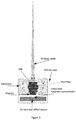
- Figure I illustrates a general principle of a whisker assembly formed in accordance with embodiments of the present invention.
- the assembly has a machined Delrin (or other marine grade material) housing containing epoxy-potted electronics, an elastomeric whisker suspension, and a glass-reinforced plastic (GRP) whisker. It uses marine-grade materials and is designed to be submerged. Submerged depth is limited by the depth ratings of the cable and connectors used, and not the design of the whisker itself.
- the whisker design has no areas of pressure differences and is solid state in other parts, so is predicted to be functional at depths in the magnitude of kilometres deep.
- the sensing principle involves a permanent magnet attached to the whisker base and a magnetic sensor (for example Melexis MLX90333 or MLX90363) detects the position of the magnet, and hence the position of the whisker.
- a magnetic sensor for example Melexis MLX90333 or MLX90363
- the whisker assembly is designed so the whisker attaches to a hub with a flange, which sits inside a cylindrical recess with openings at top and bottom for the whisker shaft and the magnet. It allows testing of two kinds of suspension - either a pair of O-rings, or a cast-in-place elastomer.
- O-rings have the practical advantage that they are commercially available in a range of materials and Shore A hardness. Cast-in-place allows access to a different selection of materials, and also allows a slightly different mechanical behaviour, since it fills the cavity completely.
- the O-ring design offers high quality and uniform material, but has been shown in experiments for this project to be unsuitable for sensing Vortex Induced Vibrations (VIV).
- VIV Vortex Induced Vibrations
- the compliant material must also be elastic enough to restore to the centre position and not accumulate significant deformation.
- the compliant material used in some embodiments is polyurethane with a stiffness of approximately Shore A 20.
- the artificial whisker therefore may consist of a flexible shaft mounted into a polyurethane filled casing referred to as the whisker follicle.
- the end of the mounted whisker shaft is effectively a ball joint which is designed to pivot above a Hall Effect sensor IC.
- a small neodymium magnet is bonded to the mounted base of the whisker such that it conveys the 2D angular pivot position of the whisker shaft.
- This assembly is mounted into a follicle holder which houses the tri-axis Hall effect sensor IC (e.g. Melexis MLX90363, MLX90393 or MLX90333) which is aligned such that the magnet attached to the whisker shaft is suspended directly above the Magneto-Concentrator on the IC.
- the tri-axis Hall effect sensor IC e.g. Melexis MLX90363, MLX90393 or MLX90333
- This programmable sensor can be configured to generate digital signals or analogue output voltages, proportional to the degree of displacement of the magnetic field in the orthogonal axes from a calibrated zero position.
- the third axis which is in-line with the whisker shaft, has been physically constrained. Therefore, any deflections of the whisker shaft can be measured as a proportional displacement vector at the base and captured using a computer or microcontroller or a standard Analogue to Digital Converter (ADC) at a maximum sample rate of, for example, up to 2KHz, for example up to 1.5KHz or up to 1 kHz.
- ADC Analogue to Digital Converter
- the whisker assembly may sense motion of the whisker shaft at the base of the shaft, where the magnet is located. Deflection of the shaft rotates the magnet about a pivot point.
- Utilisation of a magnet and Tri-axis Hall Effect sensor offers a 2 kHz sampling rate and a robust non-contact solution.
- the whisker can sense both AC and DC deflections, so therefore can sense a static deflection (i.e. force loading), and oscillating deflection (i.e. vibration).
- the sampling electronics consists of a custom-built Printed Circuit Board (PCB) and a dsPIC30f401 1 micro-controller programmed to sample the analogue voltages across all 6 channels of a 3 whisker array at 500 Hz.
- the micro-controller relays this information via a Universal Asynchronous Receiver/Transmitter (UART) serial port in singular whisker mode, or via a combination of UART and Serial Peripheral Interface (SPI) to a FTDI FT232R USB bridge for high bandwidth communications. Both communications use a standard desktop computer as an end point for logging, live processing and offline analysis.
- UART Universal Asynchronous Receiver/Transmitter
- SPI Serial Peripheral Interface
- a whisker shaft is attached to a hub.
- the hub is suspended in a rubbery polyurethane block, which means it tends to pivot about a point at the centre of the hub (which may or may not be at the centre of a follicle).
- Figure 3 shows a whisker sensor formed in accordance with an embodiment of the present invention.
- the whisker is tapered from its (narrower) tip end to its (wider) root end.
- the root end is mounted in a follicle case.
- the whisker root end is attached to a hub and the hub is suspended in an elastomeric block to provide a pivoting joint (i.e. not a cantilevered joint).
- the hub can move in X, Y and Z directions and the centre of rotation of the whisker is at the centre of the hub (and not, for example, at the base of the whisker).
- the whisker follicle arrangement includes a magnet which is located above a sensor for detecting movement.
- the whisker is attached to a stainless-steel hub, which is suspended in an elastomeric material to allow it to move.
- the root end of the whisker is not attached directly to the elastomer.
- the whisker can move smoothly over a range of angles, the centre of rotation is in the follicle, but there's a restoring force from the elastomer.
- the elastomer constrains the pivoting motion.
- Figure 4 shows the variation of one measure of the spectrum (the frequency of the strongest peak) with speed for a particular tapered whisker in water.
- FIG. 4 When a whisker is moved through a fluid, vortex-induced vibration is caused. With a whisker of any shape, the frequency spectrum of this vibration varies with speed and viscosity, and so the spectrum can be used to infer speed. With a tapered whisker, this variation is a particularly useful measure.
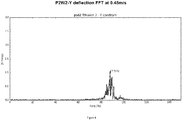
- Figures 5-7 show spectra at three different speeds, illustrating how the spectrum changes with speed.
- Figure 5 shows the frequency spectrum at a low speed, below the sensitivity range of the whisker under test. No significant peak is visible.
- Figure 6 shows the frequency spectrum at a higher speed, towards the bottom of the sensitivity range, where a distinct peak is detectable.
- Figure 7 shows the frequency spectrum higher in the sensitivity range, where a very well-defined peak is visible.
- Figure 8 illustrates one application for a whisker module formed in accordance with the present invention.
- a whisker is provided on a module which in turn is mounted on a robot arm.
- the whisker shaft can, for example, be rotated to and fro, to cause it to pass through the sediment. When the shaft contacts an object this can be recorded and a picture of the environment can be built up.
- This arrangement can be used as part of a tactile sensing system and to measure viscosity and flow speed across the whisker.
- the whisker is swept at a known speed it is possible to calculate viscosity of the medium through which the whisker is being moved. If the whisker is being moved through a medium of known viscosity it is possible to calculate the velocity.
Landscapes
- Physics & Mathematics (AREA)
- General Physics & Mathematics (AREA)
- Engineering & Computer Science (AREA)
- Aviation & Aerospace Engineering (AREA)
- Human Computer Interaction (AREA)
- Robotics (AREA)
- Mechanical Engineering (AREA)
- Geophysics And Detection Of Objects (AREA)
- Force Measurement Appropriate To Specific Purposes (AREA)
- Length Measuring Devices With Unspecified Measuring Means (AREA)
Applications Claiming Priority (1)
| Application Number | Priority Date | Filing Date | Title |
|---|---|---|---|
| GBGB1908291.6A GB201908291D0 (en) | 2019-06-11 | 2019-06-11 | Improvements in or relating to sensors |
Publications (1)
| Publication Number | Publication Date |
|---|---|
| EP3751237A1 true EP3751237A1 (de) | 2020-12-16 |
Family
ID=67386254
Family Applications (1)
| Application Number | Title | Priority Date | Filing Date |
|---|---|---|---|
| EP20179144.9A Pending EP3751237A1 (de) | 2019-06-11 | 2020-06-10 | Tasthaarsensor und verfahren zur taktilen erkundung unter verwendung eines tasthaarsensors |
Country Status (3)
| Country | Link |
|---|---|
| US (2) | US11692868B2 (de) |
| EP (1) | EP3751237A1 (de) |
| GB (3) | GB201908291D0 (de) |
Families Citing this family (3)
| Publication number | Priority date | Publication date | Assignee | Title |
|---|---|---|---|---|
| CN107655392B (zh) * | 2017-07-31 | 2022-06-14 | 东南大学 | 一种准确定位末端位置的三维触须传感器 |
| CN112763751B (zh) * | 2020-12-16 | 2021-12-07 | 北京理工大学 | 一种基于被动式触须传感器的形状识别方法及系统 |
| CN117147040B (zh) * | 2023-11-01 | 2024-01-26 | 中北大学 | 一种柔性共形仿生触须传感器 |
Citations (2)
| Publication number | Priority date | Publication date | Assignee | Title |
|---|---|---|---|---|
| US10024713B1 (en) * | 2016-09-30 | 2018-07-17 | The United States Of America As Represented By The Secretary Of The Navy | Vibrissa sensor |
| WO2019024575A1 (zh) * | 2017-07-31 | 2019-02-07 | 东南大学 | 一种准确定位末端位置的三维触须传感器 |
Family Cites Families (15)
| Publication number | Priority date | Publication date | Assignee | Title |
|---|---|---|---|---|
| JPH03173530A (ja) * | 1989-12-04 | 1991-07-26 | Hitachi Ltd | 磁気共鳴イメージング装置の傾斜磁場コイル |
| US6512365B1 (en) * | 2001-07-10 | 2003-01-28 | The Timken Company | Sensor for monitoring angular velocity |
| US7774951B2 (en) * | 2006-10-04 | 2010-08-17 | Northwestern University | Sensing device with whisker elements |
| US8109007B2 (en) * | 2007-10-03 | 2012-02-07 | Northwestern University | Object profile sensing |
| CN102326053B (zh) * | 2009-02-17 | 2015-02-18 | Cts公司 | 旋转位置传感器 |
| US8504500B2 (en) * | 2009-07-30 | 2013-08-06 | Northwestern University | Systems, methods, and apparatus for reconstruction of 3-D object morphology, position, orientation and texture using an array of tactile sensors |
| WO2013159940A1 (en) * | 2012-04-27 | 2013-10-31 | Eth Zurich | Force sensor device |
| US10073522B2 (en) * | 2014-12-12 | 2018-09-11 | Regents Of The University Of Minnesota | Articles of handwear for sensing forces applied to medical devices |
| JP6759751B2 (ja) * | 2016-06-23 | 2020-09-23 | 日立金属株式会社 | 回転検出装置及びセンサ付きケーブル |
| US10486314B1 (en) * | 2016-11-01 | 2019-11-26 | University Of South Florida | Sensor assembly and robotic system including an orthoplanar spring having multiple legs |
| JP6824764B2 (ja) * | 2017-01-27 | 2021-02-03 | キヤノン株式会社 | センサ、ロボット装置及び物品の製造方法 |
| US11060214B2 (en) * | 2017-08-11 | 2021-07-13 | Northwestern University | Processing methods and apparatus to manufacture a functional, multi-scale, tapered fiber from polymer filament |
| US10724844B2 (en) * | 2017-12-22 | 2020-07-28 | Infineon Technologies Ag | Multi-turn counter sensor |
| CN108995582B (zh) | 2018-07-06 | 2021-07-20 | 甘肃省机械科学研究院有限责任公司 | 收获机驾驶员视线盲区障碍物自动探测系统及探测方法 |
| DE102022102893B4 (de) * | 2022-02-08 | 2024-01-25 | Balluff Gmbh | Sensoreinrichtung zur Erfassung wenigstens einer physikalischen Größe |
-
2019
- 2019-06-11 GB GBGB1908291.6A patent/GB201908291D0/en not_active Ceased
-
2020
- 2020-06-10 US US16/897,280 patent/US11692868B2/en active Active
- 2020-06-10 GB GB2008781.3A patent/GB2587848B/en active Active
- 2020-06-10 GB GB2305237.6A patent/GB2633285B/en active Active
- 2020-06-10 EP EP20179144.9A patent/EP3751237A1/de active Pending
-
2023
- 2023-05-19 US US18/199,552 patent/US12480809B2/en active Active
Patent Citations (2)
| Publication number | Priority date | Publication date | Assignee | Title |
|---|---|---|---|---|
| US10024713B1 (en) * | 2016-09-30 | 2018-07-17 | The United States Of America As Represented By The Secretary Of The Navy | Vibrissa sensor |
| WO2019024575A1 (zh) * | 2017-07-31 | 2019-02-07 | 东南大学 | 一种准确定位末端位置的三维触须传感器 |
Non-Patent Citations (2)
| Title |
|---|
| R. ANDREW RUSSELL ET AL: "Object Location and Recognition using Whisker Sensors", PROCEEDINGS OF THE 2003 AUSTRALASIAN CONFERENCE ON ROBOTICS & AUTOMATION, 3 December 2003 (2003-12-03), Brisbane Qld Australia, pages 1 - 9, XP055744484, ISBN: 978-0-9587583-5-2, Retrieved from the Internet <URL:http://citeseerx.ist.psu.edu/viewdoc/download?doi=10.1.1.11.1271&rep=rep1&type=pdf> [retrieved on 20201027] * |
| WEGIRIYA HASITHA ET AL: "A biologically inspired multimodal whisker follicle", 9 October 2016, 2016 IEEE INTERNATIONAL CONFERENCE ON SYSTEMS, MAN, AND CYBERNETICS (SMC), IEEE, PAGE(S) 3847 - 3852, XP033060738 * |
Also Published As
| Publication number | Publication date |
|---|---|
| GB202305237D0 (en) | 2023-05-24 |
| GB2633285B (en) | 2025-07-16 |
| GB201908291D0 (en) | 2019-07-24 |
| GB2587848B (en) | 2023-05-24 |
| US20230288249A1 (en) | 2023-09-14 |
| US12480809B2 (en) | 2025-11-25 |
| GB202008781D0 (en) | 2020-07-22 |
| GB2587848A (en) | 2021-04-14 |
| US20200393291A1 (en) | 2020-12-17 |
| GB2633285A (en) | 2025-03-12 |
| US11692868B2 (en) | 2023-07-04 |
Similar Documents
| Publication | Publication Date | Title |
|---|---|---|
| US12480809B2 (en) | Sensors | |
| CN108698677B (zh) | 水下航行体的路径设定方法、使用该方法的水下航行体的最佳控制方法及水下航行体 | |
| US8004930B2 (en) | Methods and systems for determining coordinates of an underwater seismic component in a reference frame | |
| US9651374B1 (en) | Method and system for measuring physical phenomena in an open water environment | |
| Meurer et al. | Differential pressure sensor speedometer for autonomous underwater vehicle velocity estimation | |
| Kurowski et al. | Automated survey in very shallow water using an unmanned surface vehicle | |
| US9335172B2 (en) | Apparatus for measuring location of underwater vehicle and method thereof | |
| Wang et al. | Modeling and simulation of the VideoRay Pro III underwater vehicle | |
| Kinsey et al. | Towards in-situ calibration of gyro and doppler navigation sensors for precision underwater vehicle navigation | |
| CN120294852B (zh) | 海洋激发极化与自然电位联合采集装置及数据处理方法 | |
| Wang et al. | Application study of a new underwater glider with single vector hydrophone for target direction finding | |
| Lin et al. | Experimental determination of the hydrodynamic coefficients of an underwater manipulator | |
| Hassanein et al. | Development of low cost autonomous underwater vehicle platform | |
| Skoglund et al. | Modeling and sensor fusion of a remotely operated underwater vehicle | |
| Lazar et al. | Development of underwater sensor unit for studying marine life | |
| RU2739871C1 (ru) | Подвижный подводный носитель, оснащенный системой горизонтальной угловой стабилизации относительно вертикальных плоскостных гидротехнических сооружений | |
| Rooney et al. | Measuring the local viscosity and velocity of fluids using a biomimetic tactile whisker | |
| CN114545471A (zh) | 一种用于水下导航的智能线缆定位系统及方法 | |
| RU205208U1 (ru) | Телеуправляемый необитаемый подводный аппарат | |
| Ferreira et al. | Identification of Hydrodynamic Parameters for a Hybrid ROV in a Free-flying Movement | |
| Kelasidi et al. | Fluid parameter identification for underwater snake robots | |
| Ogundiran | Hydrodynamic added mass determination and attitude estimation of the Seahog-a remotely-operated underwater vehicle | |
| Ahmad et al. | Integration and Testing of Multi-Purpose Platform Technologies System and High Resolution Multi-Beam Sonar on ROV Holland I | |
| Caiti et al. | Underwater archaeology: available techniques and open problems in fully automated search and inspection | |
| Kuch et al. | Preliminary report: Embedded platform for inertial based underwater navigation |
Legal Events
| Date | Code | Title | Description |
|---|---|---|---|
| PUAI | Public reference made under article 153(3) epc to a published international application that has entered the european phase |
Free format text: ORIGINAL CODE: 0009012 |
|
| STAA | Information on the status of an ep patent application or granted ep patent |
Free format text: STATUS: THE APPLICATION HAS BEEN PUBLISHED |
|
| AK | Designated contracting states |
Kind code of ref document: A1 Designated state(s): AL AT BE BG CH CY CZ DE DK EE ES FI FR GB GR HR HU IE IS IT LI LT LU LV MC MK MT NL NO PL PT RO RS SE SI SK SM TR |
|
| AX | Request for extension of the european patent |
Extension state: BA ME |
|
| STAA | Information on the status of an ep patent application or granted ep patent |
Free format text: STATUS: REQUEST FOR EXAMINATION WAS MADE |
|
| 17P | Request for examination filed |
Effective date: 20210615 |
|
| RBV | Designated contracting states (corrected) |
Designated state(s): AL AT BE BG CH CY CZ DE DK EE ES FI FR GB GR HR HU IE IS IT LI LT LU LV MC MK MT NL NO PL PT RO RS SE SI SK SM TR |
|
| STAA | Information on the status of an ep patent application or granted ep patent |
Free format text: STATUS: EXAMINATION IS IN PROGRESS |
|
| 17Q | First examination report despatched |
Effective date: 20220927 |