EP3751081B1 - Schnellmontagescharnier sowie blechschrank mit dem schnellmontagescharnier - Google Patents
Schnellmontagescharnier sowie blechschrank mit dem schnellmontagescharnier Download PDFInfo
- Publication number
- EP3751081B1 EP3751081B1 EP20179539.0A EP20179539A EP3751081B1 EP 3751081 B1 EP3751081 B1 EP 3751081B1 EP 20179539 A EP20179539 A EP 20179539A EP 3751081 B1 EP3751081 B1 EP 3751081B1
- Authority
- EP
- European Patent Office
- Prior art keywords
- hinge
- snap
- assembly
- plug
- section
- Prior art date
- Legal status (The legal status is an assumption and is not a legal conclusion. Google has not performed a legal analysis and makes no representation as to the accuracy of the status listed.)
- Active
Links
Images


Classifications
-
- E—FIXED CONSTRUCTIONS
- E05—LOCKS; KEYS; WINDOW OR DOOR FITTINGS; SAFES
- E05D—HINGES OR SUSPENSION DEVICES FOR DOORS, WINDOWS OR WINGS
- E05D5/00—Construction of single parts, e.g. the parts for attachment
- E05D5/02—Parts for attachment, e.g. flaps
- E05D5/0215—Parts for attachment, e.g. flaps for attachment to profile members or the like
-
- E—FIXED CONSTRUCTIONS
- E05—LOCKS; KEYS; WINDOW OR DOOR FITTINGS; SAFES
- E05D—HINGES OR SUSPENSION DEVICES FOR DOORS, WINDOWS OR WINGS
- E05D7/00—Hinges or pivots of special construction
- E05D7/10—Hinges or pivots of special construction to allow easy separation or connection of the parts at the hinge axis
- E05D7/1005—Hinges or pivots of special construction to allow easy separation or connection of the parts at the hinge axis by axially moving free pins, balls or sockets
- E05D7/1022—Hinges or pivots of special construction to allow easy separation or connection of the parts at the hinge axis by axially moving free pins, balls or sockets with snap-fitted pins
-
- E—FIXED CONSTRUCTIONS
- E05—LOCKS; KEYS; WINDOW OR DOOR FITTINGS; SAFES
- E05D—HINGES OR SUSPENSION DEVICES FOR DOORS, WINDOWS OR WINGS
- E05D7/00—Hinges or pivots of special construction
- E05D7/12—Hinges or pivots of special construction to allow easy detachment of the hinge from the wing or the frame
-
- A—HUMAN NECESSITIES
- A47—FURNITURE; DOMESTIC ARTICLES OR APPLIANCES; COFFEE MILLS; SPICE MILLS; SUCTION CLEANERS IN GENERAL
- A47B—TABLES; DESKS; OFFICE FURNITURE; CABINETS; DRAWERS; GENERAL DETAILS OF FURNITURE
- A47B47/00—Cabinets, racks or shelf units, characterised by features related to dismountability or building-up from elements
- A47B47/02—Cabinets, racks or shelf units, characterised by features related to dismountability or building-up from elements made of metal only
-
- E—FIXED CONSTRUCTIONS
- E05—LOCKS; KEYS; WINDOW OR DOOR FITTINGS; SAFES
- E05D—HINGES OR SUSPENSION DEVICES FOR DOORS, WINDOWS OR WINGS
- E05D5/00—Construction of single parts, e.g. the parts for attachment
- E05D5/02—Parts for attachment, e.g. flaps
- E05D5/06—Bent flaps
-
- E—FIXED CONSTRUCTIONS
- E05—LOCKS; KEYS; WINDOW OR DOOR FITTINGS; SAFES
- E05Y—INDEXING SCHEME ASSOCIATED WITH SUBCLASSES E05D AND E05F, RELATING TO CONSTRUCTION ELEMENTS, ELECTRIC CONTROL, POWER SUPPLY, POWER SIGNAL OR TRANSMISSION, USER INTERFACES, MOUNTING OR COUPLING, DETAILS, ACCESSORIES, AUXILIARY OPERATIONS NOT OTHERWISE PROVIDED FOR, APPLICATION THEREOF
- E05Y2600/00—Mounting or coupling arrangements for elements provided for in this subclass
- E05Y2600/50—Mounting methods; Positioning
- E05Y2600/52—Toolless
- E05Y2600/53—Snapping
-
- E—FIXED CONSTRUCTIONS
- E05—LOCKS; KEYS; WINDOW OR DOOR FITTINGS; SAFES
- E05Y—INDEXING SCHEME ASSOCIATED WITH SUBCLASSES E05D AND E05F, RELATING TO CONSTRUCTION ELEMENTS, ELECTRIC CONTROL, POWER SUPPLY, POWER SIGNAL OR TRANSMISSION, USER INTERFACES, MOUNTING OR COUPLING, DETAILS, ACCESSORIES, AUXILIARY OPERATIONS NOT OTHERWISE PROVIDED FOR, APPLICATION THEREOF
- E05Y2900/00—Application of doors, windows, wings or fittings thereof
- E05Y2900/20—Application of doors, windows, wings or fittings thereof for furniture, e.g. cabinets
- E05Y2900/208—Application of doors, windows, wings or fittings thereof for furniture, e.g. cabinets for metal cabinets
Definitions
- the invention relates to a quick-assembly hinge with the features of the upper handle of claim 1.
- the invention further relates to a sheet metal cabinet with the quick-assembly hinge.
- Quick-assembly hinges serve as fittings for flaps, doors, etc. on furniture, containers, etc., whereby such a quick-assembly hinge can be fixed in openings in thin walls using a snap fastening for simple and quick assembly.
- Such quick-assembly hinges generally have two mutually displaceable holding elements for each hinge half, which are arranged in a channel and braced against one another outwards by means of a spring.
- the quick-assembly hinge is mounted through at least one opening in a wall, with the two holding elements being displaced relative to one another and then engaging behind the wall, so that the quick-assembly hinge is held captively.
- the publication DE 20 2010 006 608 U1 which forms the closest state of the art, discloses a hinge, one hinge part of which can be fixed firmly or releasably by clipping into a rectangular opening in a thin wall by means of a snap fastening that starts from the hinge part and extends through the opening after assembly, the second hinge part also in a rectangular opening in another thin wall by means of a snap fastening that extends from the hinge part and extends through the opening after assembly or can be fixed firmly by clipping.
- the publication EP 0 992 644 A2 discloses a latch lock for mounting in a thin wall, such as a sheet metal cabinet door, consisting of a recessed grip that is inserted into a Rectangular cutout can be snapped into the thin wall, and which comprises a latch on one side of the rectangle, which is displaceably mounted against spring force with respect to the thin wall, the latch being formed by a second trough, which is in the first trough held in the thin wall is mounted displaceably against the force of a spring.
- the invention is based on the object of creating a quick-assembly hinge of the type mentioned, which is characterized by simple assembly and disassembly as well as stable attachment to a mounting wall. Furthermore, it is an object of the invention to propose a sheet metal cabinet with the quick-assembly hinge.
- the subject of the invention is a quick-assembly hinge with a first and a second hinge component.
- the quick-assembly hinge is used for detachable or fixed assembly of a pivotable component on a stationary component.
- one hinge component is assigned to the pivoting component and the other hinge component is assigned to the stationary component.
- the two hinge components are pivotally connected to one another via a swivel joint.
- the two hinge components can be pivoted relative to one another about the swivel joint.
- one hinge component is accommodated in the other hinge component, with the two hinge components lying in a common plane in a basic state, in particular in a folded state.
- the first hinge component has a first contact section with a first contact surface, which rests on a flat first mounting wall trained and/or suitable.
- the mounting wall is designed as a thin-walled wall with a thickness of preferably less than 5 mm, particularly preferably less than 3 mm, in particular less than 1 mm.
- the first hinge component preferably lies flat, in particular over the entire surface, on the first mounting wall.
- the first hinge component has a plug-in section adjoining the first contact section, which is designed and/or suitable for inserting through a first opening arranged in the first mounting wall.
- the plug-in section is preferably aligned at right angles to the first contact surface.
- the first contact section and the plug-in section are made in one piece, for example from a single casting.
- the first breakthrough has a square or rectangular shape, with the plug-in section, particularly viewed in a cross section, having at least a similar geometry to the first breakthrough.
- the first hinge component has a snap device which is designed and/or suitable for fixing the plug-in section in the first opening.
- the first hinge component is captively held in the first opening via the snap device.
- the plug-in section can be pushed through the opening in a plug-in direction, with the first hinge component being held in the plug-in direction by the contact section and against the plug-in direction by the snap device.
- the plug-in section rests in a form-fitting manner in the opening, in particular on the edges delimiting the opening.
- the snap device has a spring-loaded snap element and the plug-in section has a guide channel which is designed and/or suitable for receiving the snap element.
- the snap element is designed as a separate snap nose, which is movably accommodated in the guide channel.
- the snap element is preferably accommodated captively in the guide channel.
- the guide channel preferably has an elongated extension, whereby the Snap element is guided axially displaceably in the guide channel in a displacement direction, in particular in a longitudinal direction of the guide channel. In the transverse direction and/or in the insertion direction, the snap element is arranged in a form-fitting manner in the guide channel.
- the snap element has a first inclined surface which is designed and/or suitable for support on a first edge of the opening.
- the plug-in section has a second inclined surface, which is designed and/or suitable for support on a second edge of the opening opposite the first edge.
- the first inclined surface forms a surface that is movable relative to the plug-in section and the second inclined surface forms an inclined surface that is stationary relative to the plug-in section.
- the first and second inclined surfaces are arranged opposite the first contact surface in an installation situation.
- the second inclined surface is preferably formed by a notch or a projection or a shape of the plug-in section.
- the second inclined surface is arranged and/or aligned in a mirror image of the first inclined surface.
- the plug-in section including the snap element, is inserted through the opening in the plug-in direction until the first contact surface rests on the first mounting wall.
- the plug-in section with the second inclined surface is then placed or hooked onto the second edge, whereby at the same time the snap element automatically snaps out in a first displacement direction and the first inclined surface rests on the first edge.
- the plug-in section is thus held in a form-fitting manner between the two opposite edges, so that the first hinge component is secured against loss.
- the snap element is pressed in a second displacement direction that is opposite to the first displacement direction, so that the first hinge component can be removed from the opening again.
- the advantage of the invention is, in particular, that a quick-assembly hinge with only one snap element for fixing in the breakthrough is proposed. This means that the quick-assembly hinge can be manufactured particularly easily and cost-effectively. Another advantage is that the stationary second inclined surface enables a particularly stable hold in the opening, since only the first inclined surface is movable. In addition, the design according to the invention can significantly reduce the assembly effort.
- the snap element has a holding contour and the plug-in section has a guide link.
- the holding contour has the particular function of holding the snap element in the guide channel, in particular in the first displacement direction, so that the snap element is secured against loss.
- the guide link preferably has the function of guiding the snap element in the direction of displacement and/or forming an end stop.
- the snap element is arranged to be displaceable in the direction of displacement between a first and a second end stop via the holding contour within the guide link.
- the first and second end strokes are preferably defined as two opposing surfaces.
- the guide link has a receiving opening at the location of the first end stop.
- the receiving opening is preferably designed as a window introduced into the plug-in section transversely to the direction of displacement.
- the holding contour passes through the receiving opening in such a way that the snap element can be mounted or dismantled through the receiving opening by deforming the holding contour when the first end stop is reached, in particular in a first end position.
- the holding contour is preferably designed as a snap hook, the snap hook being deformable transversely to the direction of displacement.
- the snap element is in a maximally disengaged position in a first end position and in a maximally engaged position in a second end position.
- the snap element is completely or at least largely accommodated in the guide channel in the second end position.
- the snap hook engages behind the first end stop in the first end position and lies on the plug-in section, in particular on the second, in the second end position End stop, on.
- the receiving opening is preferably designed as a window introduced into the plug-in section transversely to the direction of displacement.
- the snap element When installing the quick-assembly hinge, the snap element is inserted into the guide channel, the holding contour being elastically deformed transversely to the direction of displacement and, when the first end position is reached, being locked to the plug-in section through the receiving opening.
- the holding contour can be deformed in the first end position of the snap element through the receiving opening, so that the holding contour disengages and the snap element can be removed from the guide channel.
- the snap device has a spring element.
- the spring element is preferably designed as a compression spring, in particular a helical compression spring.
- the spring element is arranged in the guide channel and applies a spring force to the snap element in the (first) displacement direction.
- the spring element is supported on the snap element in the first displacement direction and on an inner wall of the guide channel in the second displacement direction.
- the spring element is designed as the compression spring, the spring element being supported on the one hand on the snap element and on the other hand on the plug-in section.
- the plug-in section has a pin aligned in the displacement direction, in particular in the first displacement direction, as a first spring seat and the snap element has an opposite and/or aligned in the second displacement direction pin as a second spring seat.
- the first and second pins preferably protrude into the guide channel opposite one another, with the spring element being arranged between the two pins and being plugged onto one of the pins at each end. The spring element can thus be in the guide channel be kept in the correct position.
- the plug-in section has at least or exactly one guide contour extending in the axial direction and the snap element has at least or exactly one corresponding guide counter-contour.
- the guide contour has the particular function of guiding the snap element in the guide channel between the first and the second end position.
- the guide contour is in engagement with the guide counter-contour in such a way that the snap element is guided in a straight manner in the guide channel, in particular in the direction of displacement.
- the guide contour is preferably designed as a web running in the direction of displacement and the guide counter contour is designed as a groove running in the direction of displacement. In particular, the groove forms a negative contour to the web.
- the guide contour preferably extends over the entire axial length within the guide channel.
- the plug-in section has two of the webs and the snap element has two of the grooves, with the two webs projecting into the guide channel in a mirror image of one another, in particular in an axial view, and the two grooves are each introduced into the snap element opposite the associated web and/or each one of the grooves is introduced into the snap element opposite one of the webs.
- the snap element viewed in a longitudinal section, has a triangular end contour with a steep slope as an insertion surface and a flat slope as the first inclined surface.
- the insertion surface serves in particular to insert the snap element onto the first assembly wall during the assembly or disassembly process through the first opening.
- the introduction surface and the first inclined surface are aligned with one another in such a way that an acute angle is included between the two surfaces.
- the introduction surface and the first inclined surface are arranged at an angle of more than 50 degrees, preferably more than 65 degrees, in particular more than 80 degrees, to one another. It is particularly preferably provided that the first and second inclined surfaces have the same pitch.
- the quick-assembly hinge has a hinge pin which is designed and/or suitable for forming the swivel joint.
- the second hinge component has a first receiving section for receiving a first end section of the hinge pin and a second receiving section for receiving a second end section of the hinge pin.
- the first and/or the second end section are accommodated in a form-fitting and/or rotationally fixed manner in the respective associated receiving section.
- at least or exactly one of the end sections preferably has an angular and/or non-round contour, with the associated receiving section having a corresponding counter contour, so that the hinge pin is secured against twisting.
- the first hinge component has a guide section which is designed and/or suitable for guiding a central section of the hinge pin.
- the guide section is designed as a hole receiving the hinge pin.
- the first hinge component with the guide section is arranged between the first and the second receiving section, the hinge pin being guided with the middle section through the guide section and being received with the two end sections in the respective associated receiving section. The first hinge component is thus pivotably connected to the second hinge component via the hinge pin.
- the first hinge component has a latching element and the hinge pin has a latching receptacle, which is designed and/or suitable for receiving the latching element.
- the locking element is automatically held in the locking receptacle, so that the hinge pin is secured against loss in the guide section.
- the locking receptacle is designed as a recess or impression or cutout made laterally in the hinge pin.
- the locking element is in particular designed as a catch that is complementary to the locking receptacle and engages with the locking receptacle.
- the first hinge component has a guide space spatially connected to the guide section.
- the locking element is displaceably arranged, in particular mounted, in the guide space, with the locking element protruding into the guide section at least in sections.
- the locking element is captively accommodated in the guide space.
- the hinge component has a spring device, wherein the spring device applies a spring force to the locking element in the direction of the guide section, so that the locking element automatically locks into the locking receptacle when the hinge pin is mounted.
- the spring device is formed by at least or exactly one compression spring, in particular a helical compression spring.
- the spring device is formed by exactly two compression springs.
- the locking receptacle has at least or exactly one inclined contact surface in the longitudinal direction, so that when the hinge pin is displaced, the locking element slides off the inclined contact surface and is pushed back.
- the contact surface serves to facilitate dismantling of the hinge pin.
- the second hinge component has a second contact section with a second contact surface, which is designed and/or suitable for contact with a second flat mounting wall.
- one mounting wall is part of a frame and the other mounting wall is part of a door or a flap.
- the first and second contact sections can be pivoted relative to one another about the swivel joint.
- the quick-assembly hinge is positioned above the first contact section on the first mounting wall and via the second contact section on the second mounting wall, the first and the second mounting wall being pivotable relative to one another via the swivel joint.
- the second hinge component has a further plug-in section adjoining the second contact section for insertion through a second opening arranged in the second mounting wall.
- the second hinge component has a further snap device which is designed and/or suitable for fixing in the second opening.
- the further plug-in section is designed to be identical in construction to the plug-in section and the further snap-in device is designed to be identical in construction to the snap-in device.
- the two plug-in sections can be aligned in the same direction, with the associated snap element being able to be displaced in or out of the associated guide channel in the same displacement direction.
- the plug-in section and the further plug-in section are preferably oppositely directed and/or aligned in opposite directions. The snap elements can therefore each be displaced in opposite directions of displacement into or out of the associated guide channel.
- the second hinge component has at least or exactly one threaded pin section adjoining the second contact section, which is designed and/or suitable for insertion through a through opening arranged in the second mounting wall.
- the through opening is designed as an elongated hole or a bore.
- the second hinge component has exactly two of the threaded pin sections and the second mounting wall has exactly two of the through openings, with one of the threaded pin sections being assigned to one of the through openings.
- the second hinge component has at least or exactly one securing means, which is designed and/or suitable for securing and/or fixing the threaded pin section in the through opening.
- the securing means is preferably designed as a screw nut.
- the second hinge component rests with the second contact surface on the second mounting wall, with the threaded section passing through the Through opening protrudes through and is secured at the end with the securing means, so that the second hinge component is firmly connected to the second mounting wall.
- the sheet metal cabinet has a cabinet frame and a cabinet door, the cabinet door being hinged to the cabinet frame via the quick-assembly hinge.
- the first mounting wall is defined by the cabinet frame and the second mounting wall is defined by the cabinet door.
- the first hinge component is supported via the first contact section on one side of the cabinet frame, in particular the first mounting wall, and is fixed in the first opening on the cabinet frame via the snap device.
- the first hinge component is thus supported on one side of the cabinet frame via the associated two inclined surfaces and the first contact section is supported on a side facing away from the cabinet frame via the first contact surface, so that the first hinge component is fixed to the cabinet frame via the snap device.
- the second hinge component is supported via the second contact section on one side of the cabinet door, in particular the second mounting wall, and is fixed via the further snap device on a rear side of the cabinet door and/or in the second opening on the cabinet door.
- the second hinge component is thus supported on one side of the cabinet door via the two associated inclined surfaces and the second contact section is supported on a side facing away from the cabinet door via the second contact surface, so that the second hinge component is fixed to the cabinet door via the second snap device.
- the second hinge component is supported on one side of the cabinet door via the second contact section and is fixed in the through opening on the cabinet door via the set screw section.
- the second hinge component is therefore supported via the second contact surface on one side of the cabinet door and via the securing means on a remote side of the cabinet door, so that the second hinge component is fixed to the cabinet door via a screw connection.
- the sheet metal cabinet is designed as follows: In an installation situation, the first hinge component is supported on one side of the cabinet frame via the first contact section and is secured to a rear side of the cabinet frame via the snap device. Alternatively or additionally, in one or the installation situation, the second hinge component is supported on one side of the cabinet door via the second contact section and is fixed on a rear side of the cabinet door via the further snap device. Alternatively or additionally, in one or the installation situation, the second hinge component is supported on one side of the cabinet door via the second contact section and is secured to a rear side of the cabinet door via the threaded pin section and the securing means. Alternatively or additionally, it is provided that the cabinet frame has the first mounting wall and the cabinet door has the second mounting wall.
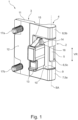
- Figure 1 shows a perspective view of a quick-assembly hinge 1 as an exemplary embodiment of the invention.
- the quick-assembly hinge 1 has a first and a second hinge component 2, 3, the two hinge components 2, 3 being pivotally connected to one another about a pivot axis SA via a swivel joint 4.
- the quick-assembly hinge 1 has a hinge pin 5 to form the swivel joint 4, the first hinge component 2 having a guide section 6 for receiving a central section 5c of the hinge pin 5 and the second hinge component 3 having a first and a second receiving section 7, 8 for receiving an end section 5a , b of the hinge pin 5.
- the guide section 6 is arranged axially between the first and the second receiving sections 7, 8 with respect to the pivot axis SA, the hinge pin 5 defining the pivot axis SA and being guided captively through the guide section 6 and the two receiving sections 7, 8.
- the first hinge component 2 has a first contact section 9, with the guide section 6 directly adjoining the first contact section 9.
- the guide section 6 is defined by a bore extending axially through the first contact section 9 with respect to the pivot axis SA.
- the first contact section 9 has a first contact surface 10, which is used to contact a flat mounting surface.
- the second hinge component 3 has a second contact section 11, whereby the second contact section 11 directly adjoins the first and second receiving sections 7, 8.
- the first and second receiving sections 7, 8 are each designed as a receiving tab molded onto the second contact section 11, the first receiving section 7 having a through hole and the second receiving section 8 having a blind hole for receiving the respective associated end section 5a, b of the hinge pin 5 .
- the second contact section 11 has a second contact surface 12, which serves to contact another flat mounting surface.
- the first and the second contact surfaces 10, 12 lie in a common plane, wherein in an unfolded state of the quick-assembly hinge 1, the first hinge component 2 pivots relative to the second hinge component 3 about the pivot axis SA and thus the first and the second contact surface 10, 12 are arranged at an angle to one another.
- the first hinge component 2 has a plug-in section 13, which is used to push through a first opening, not shown.
- the plug-in section 13 directly adjoins the first contact section 9, with the plug-in section 13 extending perpendicular to the first contact surface 10.
- the first hinge component 2 has a snap device 14, which serves to secure the first hinge component 2 in the first opening.
- the snap device 14 has a snap element 15 and the plug-in section 13 has a guide channel 16, the snap element 15 being accommodated in the guide channel 16 so as to be displaceable in a displacement direction VR.
- the second hinge component 3 has a first and a second threaded pin section 17a, b, which are used to pass through a through opening, not shown.
- the two threaded pin sections 17a, b directly adjoin the second contact section 11, with the two threaded pin sections 17a, b extending in the same direction perpendicular to the second contact surface 12.
- the two setscrew sections 17a, b can be designed as separate threaded bolts, which are in a corresponding one Recording are screwed into the second contact section 11.
- the two setscrew sections 17a, b can also be formed directly onto the second contact section 11.
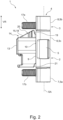
- Figure 2 shows the quick-assembly hinge 1 Figure 1 in a side view.
- the snap element 15 has a triangular end contour 18 which protrudes from the guide channel 16.
- the end contour 18 has a first inclined surface 19 and an insertion surface 20 facing away from the first inclined surface 19.
- the first inclined surface 19 has a flat gradient of, for example, less than 10%.
- the introduction surface 20 has a steep gradient of, for example, more than 200%.
- the plug-in section 13 has a second inclined surface 21 on a rear side facing away from the snap element 15.
- the two inclined surfaces 19, 21 are each arranged opposite the first contact surface 10, with the two inclined surfaces 19, 21 being spaced apart from the first contact surface 10 and running inclined to it.
- a wedge-shaped gap is thus formed between the two inclined surfaces 19, 21 and the first contact surface 10, which converges towards the plug-in section 13.
- Figure 3 shows a perspective view of the quick-assembly hinge 1 in an installation situation, wherein the quick-assembly hinge 1 is fixed with the first hinge component 2 on a first assembly wall 22 and with the second hinge component 3 on a second assembly wall 23.
- the quick-mounting hinge 1 serves to form a hinge between the first and second mounting walls 22, 23, so that, for example, the first mounting wall 23 can be pivoted relative to the second mounting wall 22.
- the first and second mounting walls 22, 23 are part of a sheet metal cabinet, for example a control cabinet.
- the first mounting wall 22 forms a door frame and the second mounting wall 23 forms a door, which can be pivoted relative to the door frame.
- the first mounting wall 22 has a first opening 24, the plug-in section 13 being inserted through the first opening 24 in a plug-in direction SR and fixed in the first opening 24 by the snap device 14 .
- the first hinge component 2 with the contact section 9 rests on the back of the first mounting wall 22 in the insertion direction SR and the first hinge component 2 is supported against the insertion direction SR via the first and second inclined surfaces 19, 21.
- the first mounting wall 22 is thus arranged in a form-fitting manner between the first contact section 9 and the two inclined surfaces 19, 21.
- the breakthrough 24 has a rectangular cross-sectional opening, with the plug-in section 13 being accommodated in a form-fitting manner in the first breakthrough 24 transversely to the plug-in direction SR.
- the second mounting wall 23 has a first and a second through opening 25a, b, the first threaded pin section 17a passing through the first through opening 25a and the second threaded pin section 17b through the second through opening 25b in the Plugging direction SR is guided.
- the second hinge component 3 rests on the back of the second mounting wall 23 via the second contact section 11 in the plug-in direction SR, the second hinge component 3 being secured against the plug-in direction SR, for example with a screw nut, not shown, screwed onto the ends of the set screw sections 17a, b is.
- the second mounting wall 23 is thus arranged in a form-fitting manner between the second contact section 11 and the screw nuts.
- the two through openings 25a, b are each designed as a through hole, with the two threaded pin sections 17a, b being accommodated with a precise fit in the associated through hole 25a, b.
- Figure 4 shows a sectional view through the first hinge component 2 in an installation situation with the first mounting wall 22.
- the snap element 15 has a holding contour 26 designed as a snap hook, the plug-in section 13 having a receiving opening 27, which passes through the plug-in section 13 in the direction of the guide channel 16, whereby the holding contour 26 engages behind the plug-in section 13 through the receiving opening 27.
- the plug-in section 13 has a Guide link 28, the holding contour 16 being displaceable in the guide link 28 between a first and a second end stop 29a, b.
- the receiving opening 27 is introduced into the plug-in section 13 at the location of the first end stop 29a, the holding contour 29a being able to be elastically deformed through the receiving opening 27 at the location of the first end stop 29a, so that the snap element 15 can be mounted or dismantled.
- the snap device 14 has a spring element 30 designed as a helical compression spring, which is arranged in the guide channel 16.
- the spring element 30 applies a spring force to the snap element 15 in a first displacement direction VR1, so that the snap element 15 protrudes from the guide channel 16 with the end contour 18 and rests on the first end stop 29a via the holding contour 16.
- the spring element 30 is supported in the first displacement direction VR1 on the snap element 15 and in a second displacement direction VR2 that is opposite to the first displacement direction VR1 on the plug-in section 13.
- the plug-in section 13 has a pin aligned in the first displacement direction VR1 and to form a second spring seat 31b, the snap element 15 has a pin aligned in the second displacement direction VR2, the spring element 30 being plugged onto each end of the two pins .
- the second inclined surface 24b is formed by a wedge-shaped indentation of the plug-in section 13 in a transition area to the contact section 9. This means that a second snap element can be dispensed with, so that the quick-assembly hinge 1 can be designed to be much simpler.
- the quick-assembly hinge 1 can be assembled particularly easily and inexpensively, with a particularly robust design of the quick-assembly hinge 1 being implemented by forming the second inclined surface 21 on the plug-in section.
- the plug-in section 13 When assembling the first hinge component 2, the plug-in section 13 is inserted in the plug-in direction SR through the opening 24, in which case the Snap element 15 slides with the introduction surface 20 on an edge of the opening 24.
- the snap element 15 is displaced in the second displacement direction VR2 into the guide channel 16 against the spring force.
- the plug-in section 13 is pushed into the opening until the first contact section 9 rests with its first contact surface 10 on the first mounting wall 22.
- the snap element 15 snaps out in the first displacement direction VR1, so that the snap element 15 is supported with its first inclined surface 19 on a first edge 24a of the opening 24.
- the plug-in section 13 is suspended in the second displacement direction VR2 between the first contact surface 10 and the second inclined surface 21, the second inclined surface 21 being supported on a second edge 24b opposite the first edge 24a.
- the plug-in section 13 is thus held in the opening 24 in a form-fitting and non-positive manner.
- the snap element 15 When dismantling, the snap element 15 must be pushed back in the second displacement direction VR2, so that the plug-in section 13 can be unhooked in the first displacement direction VR1 and removed from the opening 24 in the opposite direction to the plug-in direction SR.
- Figures 5a, b each show the quick-assembly hinge 1 in a sectional view, where Figure 5a the quick-assembly hinge 1 in a longitudinal section along the pivot axis SA and Figure 5b represents the quick-assembly hinge 1 in a cross section.
- the middle section 5c of the hinge pin 5 has a locking receptacle 32, which serves to accommodate a locking element 33.
- the locking receptacle 32 is inserted laterally into the hinge pin 5, the locking element 33 being arranged within a receiving space 34 spatially connected to the guide section 6 and being displaceable in the receiving space 34 relative to the locking receptacle 32.
- the locking element 33 is subjected to a spring force in the direction of the locking receptacle 32 by a spring device 35, which is formed by two compression springs.
- the locking receptacle 32 is designed as a recess, which in an axial direction and an axial opposite direction with respect to the pivot axis SA is provided by an oblique contact surface 36a, b is limited.
- the hinge pin 5 is inserted through the through hole of the first receiving section 7 and then through the guide section 6 into the blind hole of the second receiving section 8. If the hinge pin 5 is fully inserted, the locking element 33 automatically snaps into the locking receptacle 32, so that the hinge pin 5 is secured against being lost.
- the second end section 5b of the hinge pin 4 has a non-round contour, with the second receiving section 5b having a corresponding counter contour, so that the hinge pin 5 is secured against twisting.
- the contour of the second end section 5b is formed by a flattening.
- the hinge pin 4 is removed from the two receiving sections 7, 8 and the guide section 6, with the locking element 33 sliding along the first contact surface 36a and being pressed back into the receiving space 34 against the spring force applied by the spring device 35.
- the hinge pin 5 is thus released and can be completely removed.
- the plug-in section 13 has a guide contour 37 for guiding the snap element 15 in the guide channel 16.
- the snap element 15 has a guide counter-contour 18, wherein the guide contour 37 and the guide counter-contour 38 extend in the displacement direction VR and are in engagement with one another, so that the snap element 15 is guided straight in the displacement direction VR.
- the guide contour 37 is formed by two opposing webs which extend into the guide channel 16.
- the guide counter contour 38 is formed by two grooves that are complementary to the two webs and are introduced into the snap element 15 laterally opposite the associated web.
- the Figures 6a, b show an alternative embodiment of the quick-assembly hinge 1 as a further exemplary embodiment of the invention.
- the Figure 6a shows the quick-assembly hinge 1 in a perspective view, with the second hinge component 3 instead of the two threaded pin sections 17a, b Plug-in section 39 and a further snap device 40.
- the further plug-in section 39 and the further snap device 40 are designed to be identical to the plug-in section 13 or the snap device 14 of the first hinge component 2, with the two plug-in sections 13, 39 being aligned in opposite directions in the displacement direction VR.
- the Figure 6b shows the quick-assembly hinge 1 in an installation situation, wherein the quick-assembly hinge 1 is fixed with the first hinge component 2 on the first mounting wall 22 and with the second hinge component 3 on the second mounting wall 23.
- the second mounting wall 22 has instead of the two through openings 25a, b, as in Figure 3 shown, a second breakthrough 41.
- the quick-assembly hinge 1 is inserted in the insertion direction SR with the first insertion section 13 through the first opening 24 and with the second insertion section 39 through the second opening 41 and fixed in the respective opening 24, 41 by the respective associated snap device 14, 40.
Landscapes
- Engineering & Computer Science (AREA)
- Mechanical Engineering (AREA)
- Hinges (AREA)
Applications Claiming Priority (1)
| Application Number | Priority Date | Filing Date | Title |
|---|---|---|---|
| DE202019103364.9U DE202019103364U1 (de) | 2019-06-14 | 2019-06-14 | Schnellmontagescharnier sowie Blechschrank mit dem Schnellmontagescharnier |
Publications (3)
| Publication Number | Publication Date |
|---|---|
| EP3751081A1 EP3751081A1 (de) | 2020-12-16 |
| EP3751081C0 EP3751081C0 (de) | 2023-12-27 |
| EP3751081B1 true EP3751081B1 (de) | 2023-12-27 |
Family
ID=69148113
Family Applications (1)
| Application Number | Title | Priority Date | Filing Date |
|---|---|---|---|
| EP20179539.0A Active EP3751081B1 (de) | 2019-06-14 | 2020-06-11 | Schnellmontagescharnier sowie blechschrank mit dem schnellmontagescharnier |
Country Status (3)
| Country | Link |
|---|---|
| EP (1) | EP3751081B1 (pl) |
| DE (1) | DE202019103364U1 (pl) |
| PL (1) | PL3751081T3 (pl) |
Families Citing this family (3)
| Publication number | Priority date | Publication date | Assignee | Title |
|---|---|---|---|---|
| CN113482478B (zh) * | 2021-09-07 | 2021-11-16 | 南通四维幕墙装饰装潢有限责任公司 | 一种铝合金门便于安装拆卸的装置 |
| CN118426281B (zh) * | 2024-07-04 | 2024-10-29 | 深圳辉业科技有限公司 | 一种组合型复印机金属铰链及复印机 |
| CN119754656B (zh) * | 2025-03-06 | 2025-05-02 | 台力电气有限公司 | 一种环网柜 |
Family Cites Families (2)
| Publication number | Priority date | Publication date | Assignee | Title |
|---|---|---|---|---|
| DE29817875U1 (de) * | 1998-10-07 | 2000-02-10 | Ramsauer, Dieter, 42555 Velbert | Riegelverschluß zur Montage in einer dünnen Wand |
| DE202010006608U1 (de) | 2010-05-08 | 2011-11-08 | Dirak Dieter Ramsauer Konstruktionselemente Gmbh | Scharnier und mit derartigem Scharnier ausgestatteter Luftkanal, Wärmekanal, Kasten oder Schrank |
-
2019
- 2019-06-14 DE DE202019103364.9U patent/DE202019103364U1/de active Active
-
2020
- 2020-06-11 PL PL20179539.0T patent/PL3751081T3/pl unknown
- 2020-06-11 EP EP20179539.0A patent/EP3751081B1/de active Active
Also Published As
| Publication number | Publication date |
|---|---|
| EP3751081C0 (de) | 2023-12-27 |
| DE202019103364U1 (de) | 2019-12-17 |
| EP3751081A1 (de) | 2020-12-16 |
| PL3751081T3 (pl) | 2024-05-13 |
Similar Documents
| Publication | Publication Date | Title |
|---|---|---|
| DE19646988C5 (de) | Beschlag für ein Fenster | |
| EP3556978B1 (de) | Vorrichtung zur bewegung eines an einem möbelkorpus eines möbels aufgenommenen möbelteils | |
| EP3751081B1 (de) | Schnellmontagescharnier sowie blechschrank mit dem schnellmontagescharnier | |
| DE4437532A1 (de) | Vorrichtung zum Verbinden eines Fensterhebers mit der verschiebbaren Fensterscheibe eines Kraftfahrzeugs | |
| EP0761130A2 (de) | Halterungs-Beschlag für Frontblenden von Schubladen | |
| EP3760076A1 (de) | Verbindungsstift für möbelteile | |
| EP3535824B1 (de) | Sammelschienenhalter und eine entsprechende anordnung | |
| DE4428496C2 (de) | Kugelgelenk | |
| WO2019011978A1 (de) | Verbinder, system aus einem verbinder und einem einen kopf aufweisenden raststift eines zweiten bauteils, verfahren unter einsatz eines derartigen systems | |
| DE102004023867B3 (de) | Befestigungselement für einen Betätigungszug bzw. eine Schlauchfassung eines Betätigungszuges | |
| EP1297232B1 (de) | Kraftfahrzeugtürverschluss | |
| DE102019129432B4 (de) | Befestigungselement und Bauteilanordnung mit Befestigungselement sowie Befestigungsverfahren | |
| EP4069924A1 (de) | Verschluss | |
| DE19859546A1 (de) | Schieberstangenbefestigungs- und -führungselement | |
| WO2023232182A1 (de) | Stangenverschluss | |
| EP1963604B1 (de) | Gleitstück für einen beschlag | |
| EP0791759A1 (de) | Schnellverschluss | |
| EP3392078A1 (de) | Gelenkvorrichtung, ausstattungsvorrichtung eines fahrzeuginnenraums umfassend eine gelenkvorrichtung sowie ein verfahren zur montage der gelenkvorrichtung | |
| EP2385200B1 (de) | Beschlagteil zur Befestigung an einer C-förmigen Beschlagteilnut | |
| EP4074931A1 (de) | Beschlag mit einem durch längsschieben arretierbaren rasthaken | |
| DE102015209997A1 (de) | Anordnung zur Befestigung eines leistenförmigen Anbauteils | |
| EP4286635B1 (de) | Gleitschiene für einen türantrieb | |
| EP2532816B1 (de) | Antriebsvorrichtung für einen Treibstangenbeschlag | |
| DE102018114585A1 (de) | Schubkasten und Verfahren zur Montage einer Rückwand an einer Seitenzarge eines Schubkastens | |
| DE19717116B4 (de) | Drehlager |
Legal Events
| Date | Code | Title | Description |
|---|---|---|---|
| PUAI | Public reference made under article 153(3) epc to a published international application that has entered the european phase |
Free format text: ORIGINAL CODE: 0009012 |
|
| STAA | Information on the status of an ep patent application or granted ep patent |
Free format text: STATUS: THE APPLICATION HAS BEEN PUBLISHED |
|
| AK | Designated contracting states |
Kind code of ref document: A1 Designated state(s): AL AT BE BG CH CY CZ DE DK EE ES FI FR GB GR HR HU IE IS IT LI LT LU LV MC MK MT NL NO PL PT RO RS SE SI SK SM TR |
|
| AX | Request for extension of the european patent |
Extension state: BA ME |
|
| STAA | Information on the status of an ep patent application or granted ep patent |
Free format text: STATUS: REQUEST FOR EXAMINATION WAS MADE |
|
| 17P | Request for examination filed |
Effective date: 20210614 |
|
| RBV | Designated contracting states (corrected) |
Designated state(s): AL AT BE BG CH CY CZ DE DK EE ES FI FR GB GR HR HU IE IS IT LI LT LU LV MC MK MT NL NO PL PT RO RS SE SI SK SM TR |
|
| RIC1 | Information provided on ipc code assigned before grant |
Ipc: E05D 5/06 20060101ALN20230605BHEP Ipc: A47B 96/14 20060101ALI20230605BHEP Ipc: E05D 7/12 20060101ALI20230605BHEP Ipc: E05D 5/02 20060101ALI20230605BHEP Ipc: E05D 7/10 20060101AFI20230605BHEP |
|
| GRAP | Despatch of communication of intention to grant a patent |
Free format text: ORIGINAL CODE: EPIDOSNIGR1 |
|
| STAA | Information on the status of an ep patent application or granted ep patent |
Free format text: STATUS: GRANT OF PATENT IS INTENDED |
|
| INTG | Intention to grant announced |
Effective date: 20230721 |
|
| GRAS | Grant fee paid |
Free format text: ORIGINAL CODE: EPIDOSNIGR3 |
|
| GRAA | (expected) grant |
Free format text: ORIGINAL CODE: 0009210 |
|
| STAA | Information on the status of an ep patent application or granted ep patent |
Free format text: STATUS: THE PATENT HAS BEEN GRANTED |
|
| AK | Designated contracting states |
Kind code of ref document: B1 Designated state(s): AL AT BE BG CH CY CZ DE DK EE ES FI FR GB GR HR HU IE IS IT LI LT LU LV MC MK MT NL NO PL PT RO RS SE SI SK SM TR |
|
| REG | Reference to a national code |
Ref country code: GB Ref legal event code: FG4D Free format text: NOT ENGLISH |
|
| REG | Reference to a national code |
Ref country code: CH Ref legal event code: EP |
|
| REG | Reference to a national code |
Ref country code: DE Ref legal event code: R096 Ref document number: 502020006490 Country of ref document: DE |
|
| REG | Reference to a national code |
Ref country code: IE Ref legal event code: FG4D Free format text: LANGUAGE OF EP DOCUMENT: GERMAN |
|
| U01 | Request for unitary effect filed |
Effective date: 20231227 |
|
| U07 | Unitary effect registered |
Designated state(s): AT BE BG DE DK EE FI FR IT LT LU LV MT NL PT SE SI Effective date: 20240109 |
|
| PG25 | Lapsed in a contracting state [announced via postgrant information from national office to epo] |
Ref country code: GR Free format text: LAPSE BECAUSE OF FAILURE TO SUBMIT A TRANSLATION OF THE DESCRIPTION OR TO PAY THE FEE WITHIN THE PRESCRIBED TIME-LIMIT Effective date: 20240328 |
|
| PG25 | Lapsed in a contracting state [announced via postgrant information from national office to epo] |
Ref country code: ES Free format text: LAPSE BECAUSE OF FAILURE TO SUBMIT A TRANSLATION OF THE DESCRIPTION OR TO PAY THE FEE WITHIN THE PRESCRIBED TIME-LIMIT Effective date: 20231227 |
|
| PG25 | Lapsed in a contracting state [announced via postgrant information from national office to epo] |
Ref country code: GR Free format text: LAPSE BECAUSE OF FAILURE TO SUBMIT A TRANSLATION OF THE DESCRIPTION OR TO PAY THE FEE WITHIN THE PRESCRIBED TIME-LIMIT Effective date: 20240328 Ref country code: ES Free format text: LAPSE BECAUSE OF FAILURE TO SUBMIT A TRANSLATION OF THE DESCRIPTION OR TO PAY THE FEE WITHIN THE PRESCRIBED TIME-LIMIT Effective date: 20231227 |
|
| PG25 | Lapsed in a contracting state [announced via postgrant information from national office to epo] |
Ref country code: RS Free format text: LAPSE BECAUSE OF FAILURE TO SUBMIT A TRANSLATION OF THE DESCRIPTION OR TO PAY THE FEE WITHIN THE PRESCRIBED TIME-LIMIT Effective date: 20231227 Ref country code: NO Free format text: LAPSE BECAUSE OF FAILURE TO SUBMIT A TRANSLATION OF THE DESCRIPTION OR TO PAY THE FEE WITHIN THE PRESCRIBED TIME-LIMIT Effective date: 20240327 Ref country code: HR Free format text: LAPSE BECAUSE OF FAILURE TO SUBMIT A TRANSLATION OF THE DESCRIPTION OR TO PAY THE FEE WITHIN THE PRESCRIBED TIME-LIMIT Effective date: 20231227 |
|
| PG25 | Lapsed in a contracting state [announced via postgrant information from national office to epo] |
Ref country code: IS Free format text: LAPSE BECAUSE OF FAILURE TO SUBMIT A TRANSLATION OF THE DESCRIPTION OR TO PAY THE FEE WITHIN THE PRESCRIBED TIME-LIMIT Effective date: 20240427 |
|
| U20 | Renewal fee for the european patent with unitary effect paid |
Year of fee payment: 5 Effective date: 20240610 |
|
| PG25 | Lapsed in a contracting state [announced via postgrant information from national office to epo] |
Ref country code: CZ Free format text: LAPSE BECAUSE OF FAILURE TO SUBMIT A TRANSLATION OF THE DESCRIPTION OR TO PAY THE FEE WITHIN THE PRESCRIBED TIME-LIMIT Effective date: 20231227 |
|
| PG25 | Lapsed in a contracting state [announced via postgrant information from national office to epo] |
Ref country code: SK Free format text: LAPSE BECAUSE OF FAILURE TO SUBMIT A TRANSLATION OF THE DESCRIPTION OR TO PAY THE FEE WITHIN THE PRESCRIBED TIME-LIMIT Effective date: 20231227 |
|
| PG25 | Lapsed in a contracting state [announced via postgrant information from national office to epo] |
Ref country code: SM Free format text: LAPSE BECAUSE OF FAILURE TO SUBMIT A TRANSLATION OF THE DESCRIPTION OR TO PAY THE FEE WITHIN THE PRESCRIBED TIME-LIMIT Effective date: 20231227 Ref country code: SK Free format text: LAPSE BECAUSE OF FAILURE TO SUBMIT A TRANSLATION OF THE DESCRIPTION OR TO PAY THE FEE WITHIN THE PRESCRIBED TIME-LIMIT Effective date: 20231227 Ref country code: RO Free format text: LAPSE BECAUSE OF FAILURE TO SUBMIT A TRANSLATION OF THE DESCRIPTION OR TO PAY THE FEE WITHIN THE PRESCRIBED TIME-LIMIT Effective date: 20231227 Ref country code: IS Free format text: LAPSE BECAUSE OF FAILURE TO SUBMIT A TRANSLATION OF THE DESCRIPTION OR TO PAY THE FEE WITHIN THE PRESCRIBED TIME-LIMIT Effective date: 20240427 Ref country code: CZ Free format text: LAPSE BECAUSE OF FAILURE TO SUBMIT A TRANSLATION OF THE DESCRIPTION OR TO PAY THE FEE WITHIN THE PRESCRIBED TIME-LIMIT Effective date: 20231227 |
|
| REG | Reference to a national code |
Ref country code: DE Ref legal event code: R097 Ref document number: 502020006490 Country of ref document: DE |
|
| PLBE | No opposition filed within time limit |
Free format text: ORIGINAL CODE: 0009261 |
|
| STAA | Information on the status of an ep patent application or granted ep patent |
Free format text: STATUS: NO OPPOSITION FILED WITHIN TIME LIMIT |
|
| 26N | No opposition filed |
Effective date: 20240930 |
|
| PG25 | Lapsed in a contracting state [announced via postgrant information from national office to epo] |
Ref country code: MC Free format text: LAPSE BECAUSE OF FAILURE TO SUBMIT A TRANSLATION OF THE DESCRIPTION OR TO PAY THE FEE WITHIN THE PRESCRIBED TIME-LIMIT Effective date: 20231227 |
|
| REG | Reference to a national code |
Ref country code: CH Ref legal event code: PL |
|
| GBPC | Gb: european patent ceased through non-payment of renewal fee |
Effective date: 20240611 |
|
| PG25 | Lapsed in a contracting state [announced via postgrant information from national office to epo] |
Ref country code: IE Free format text: LAPSE BECAUSE OF NON-PAYMENT OF DUE FEES Effective date: 20240611 |
|
| PG25 | Lapsed in a contracting state [announced via postgrant information from national office to epo] |
Ref country code: CH Free format text: LAPSE BECAUSE OF NON-PAYMENT OF DUE FEES Effective date: 20240630 |
|
| PG25 | Lapsed in a contracting state [announced via postgrant information from national office to epo] |
Ref country code: GB Free format text: LAPSE BECAUSE OF NON-PAYMENT OF DUE FEES Effective date: 20240611 |
|
| PGFP | Annual fee paid to national office [announced via postgrant information from national office to epo] |
Ref country code: PL Payment date: 20250602 Year of fee payment: 6 |
|
| U20 | Renewal fee for the european patent with unitary effect paid |
Year of fee payment: 6 Effective date: 20250602 |
|
| PGFP | Annual fee paid to national office [announced via postgrant information from national office to epo] |
Ref country code: TR Payment date: 20250603 Year of fee payment: 6 |
|
| PG25 | Lapsed in a contracting state [announced via postgrant information from national office to epo] |
Ref country code: CY Free format text: LAPSE BECAUSE OF FAILURE TO SUBMIT A TRANSLATION OF THE DESCRIPTION OR TO PAY THE FEE WITHIN THE PRESCRIBED TIME-LIMIT; INVALID AB INITIO Effective date: 20200611 |
|
| PG25 | Lapsed in a contracting state [announced via postgrant information from national office to epo] |
Ref country code: HU Free format text: LAPSE BECAUSE OF FAILURE TO SUBMIT A TRANSLATION OF THE DESCRIPTION OR TO PAY THE FEE WITHIN THE PRESCRIBED TIME-LIMIT; INVALID AB INITIO Effective date: 20200611 |