EP3750966A1 - Adhesive composition, thermosetting adhesive sheet, and printed wiring board - Google Patents
Adhesive composition, thermosetting adhesive sheet, and printed wiring board Download PDFInfo
- Publication number
- EP3750966A1 EP3750966A1 EP19747534.6A EP19747534A EP3750966A1 EP 3750966 A1 EP3750966 A1 EP 3750966A1 EP 19747534 A EP19747534 A EP 19747534A EP 3750966 A1 EP3750966 A1 EP 3750966A1
- Authority
- EP
- European Patent Office
- Prior art keywords
- adhesive composition
- mass
- parts
- epoxy resin
- resin
- Prior art date
- Legal status (The legal status is an assumption and is not a legal conclusion. Google has not performed a legal analysis and makes no representation as to the accuracy of the status listed.)
- Pending
Links
Images
Classifications
-
- C—CHEMISTRY; METALLURGY
- C09—DYES; PAINTS; POLISHES; NATURAL RESINS; ADHESIVES; COMPOSITIONS NOT OTHERWISE PROVIDED FOR; APPLICATIONS OF MATERIALS NOT OTHERWISE PROVIDED FOR
- C09J—ADHESIVES; NON-MECHANICAL ASPECTS OF ADHESIVE PROCESSES IN GENERAL; ADHESIVE PROCESSES NOT PROVIDED FOR ELSEWHERE; USE OF MATERIALS AS ADHESIVES
- C09J7/00—Adhesives in the form of films or foils
- C09J7/30—Adhesives in the form of films or foils characterised by the adhesive composition
- C09J7/35—Heat-activated
-
- C—CHEMISTRY; METALLURGY
- C09—DYES; PAINTS; POLISHES; NATURAL RESINS; ADHESIVES; COMPOSITIONS NOT OTHERWISE PROVIDED FOR; APPLICATIONS OF MATERIALS NOT OTHERWISE PROVIDED FOR
- C09J—ADHESIVES; NON-MECHANICAL ASPECTS OF ADHESIVE PROCESSES IN GENERAL; ADHESIVE PROCESSES NOT PROVIDED FOR ELSEWHERE; USE OF MATERIALS AS ADHESIVES
- C09J153/00—Adhesives based on block copolymers containing at least one sequence of a polymer obtained by reactions only involving carbon-to-carbon unsaturated bonds; Adhesives based on derivatives of such polymers
- C09J153/02—Vinyl aromatic monomers and conjugated dienes
-
- C—CHEMISTRY; METALLURGY
- C08—ORGANIC MACROMOLECULAR COMPOUNDS; THEIR PREPARATION OR CHEMICAL WORKING-UP; COMPOSITIONS BASED THEREON
- C08G—MACROMOLECULAR COMPOUNDS OBTAINED OTHERWISE THAN BY REACTIONS ONLY INVOLVING UNSATURATED CARBON-TO-CARBON BONDS
- C08G59/00—Polycondensates containing more than one epoxy group per molecule; Macromolecules obtained by polymerising compounds containing more than one epoxy group per molecule using curing agents or catalysts which react with the epoxy groups
- C08G59/18—Macromolecules obtained by polymerising compounds containing more than one epoxy group per molecule using curing agents or catalysts which react with the epoxy groups ; e.g. general methods of curing
- C08G59/68—Macromolecules obtained by polymerising compounds containing more than one epoxy group per molecule using curing agents or catalysts which react with the epoxy groups ; e.g. general methods of curing characterised by the catalysts used
- C08G59/686—Macromolecules obtained by polymerising compounds containing more than one epoxy group per molecule using curing agents or catalysts which react with the epoxy groups ; e.g. general methods of curing characterised by the catalysts used containing nitrogen
-
- C—CHEMISTRY; METALLURGY
- C08—ORGANIC MACROMOLECULAR COMPOUNDS; THEIR PREPARATION OR CHEMICAL WORKING-UP; COMPOSITIONS BASED THEREON
- C08G—MACROMOLECULAR COMPOUNDS OBTAINED OTHERWISE THAN BY REACTIONS ONLY INVOLVING UNSATURATED CARBON-TO-CARBON BONDS
- C08G65/00—Macromolecular compounds obtained by reactions forming an ether link in the main chain of the macromolecule
- C08G65/34—Macromolecular compounds obtained by reactions forming an ether link in the main chain of the macromolecule from hydroxy compounds or their metallic derivatives
- C08G65/48—Polymers modified by chemical after-treatment
-
- C—CHEMISTRY; METALLURGY
- C08—ORGANIC MACROMOLECULAR COMPOUNDS; THEIR PREPARATION OR CHEMICAL WORKING-UP; COMPOSITIONS BASED THEREON
- C08G—MACROMOLECULAR COMPOUNDS OBTAINED OTHERWISE THAN BY REACTIONS ONLY INVOLVING UNSATURATED CARBON-TO-CARBON BONDS
- C08G65/00—Macromolecular compounds obtained by reactions forming an ether link in the main chain of the macromolecule
- C08G65/34—Macromolecular compounds obtained by reactions forming an ether link in the main chain of the macromolecule from hydroxy compounds or their metallic derivatives
- C08G65/48—Polymers modified by chemical after-treatment
- C08G65/485—Polyphenylene oxides
-
- C—CHEMISTRY; METALLURGY
- C08—ORGANIC MACROMOLECULAR COMPOUNDS; THEIR PREPARATION OR CHEMICAL WORKING-UP; COMPOSITIONS BASED THEREON
- C08K—Use of inorganic or non-macromolecular organic substances as compounding ingredients
- C08K5/00—Use of organic ingredients
- C08K5/0008—Organic ingredients according to more than one of the "one dot" groups of C08K5/01 - C08K5/59
- C08K5/0025—Crosslinking or vulcanising agents; including accelerators
-
- C—CHEMISTRY; METALLURGY
- C08—ORGANIC MACROMOLECULAR COMPOUNDS; THEIR PREPARATION OR CHEMICAL WORKING-UP; COMPOSITIONS BASED THEREON
- C08L—COMPOSITIONS OF MACROMOLECULAR COMPOUNDS
- C08L63/00—Compositions of epoxy resins; Compositions of derivatives of epoxy resins
-
- C—CHEMISTRY; METALLURGY
- C08—ORGANIC MACROMOLECULAR COMPOUNDS; THEIR PREPARATION OR CHEMICAL WORKING-UP; COMPOSITIONS BASED THEREON
- C08L—COMPOSITIONS OF MACROMOLECULAR COMPOUNDS
- C08L65/00—Compositions of macromolecular compounds obtained by reactions forming a carbon-to-carbon link in the main chain; Compositions of derivatives of such polymers
- C08L65/02—Polyphenylenes
-
- C—CHEMISTRY; METALLURGY
- C08—ORGANIC MACROMOLECULAR COMPOUNDS; THEIR PREPARATION OR CHEMICAL WORKING-UP; COMPOSITIONS BASED THEREON
- C08L—COMPOSITIONS OF MACROMOLECULAR COMPOUNDS
- C08L9/00—Compositions of homopolymers or copolymers of conjugated diene hydrocarbons
-
- C—CHEMISTRY; METALLURGY
- C09—DYES; PAINTS; POLISHES; NATURAL RESINS; ADHESIVES; COMPOSITIONS NOT OTHERWISE PROVIDED FOR; APPLICATIONS OF MATERIALS NOT OTHERWISE PROVIDED FOR
- C09J—ADHESIVES; NON-MECHANICAL ASPECTS OF ADHESIVE PROCESSES IN GENERAL; ADHESIVE PROCESSES NOT PROVIDED FOR ELSEWHERE; USE OF MATERIALS AS ADHESIVES
- C09J11/00—Features of adhesives not provided for in group C09J9/00, e.g. additives
- C09J11/08—Macromolecular additives
-
- C—CHEMISTRY; METALLURGY
- C09—DYES; PAINTS; POLISHES; NATURAL RESINS; ADHESIVES; COMPOSITIONS NOT OTHERWISE PROVIDED FOR; APPLICATIONS OF MATERIALS NOT OTHERWISE PROVIDED FOR
- C09J—ADHESIVES; NON-MECHANICAL ASPECTS OF ADHESIVE PROCESSES IN GENERAL; ADHESIVE PROCESSES NOT PROVIDED FOR ELSEWHERE; USE OF MATERIALS AS ADHESIVES
- C09J125/00—Adhesives based on homopolymers or copolymers of compounds having one or more unsaturated aliphatic radicals, each having only one carbon-to-carbon double bond, and at least one being terminated by an aromatic carbocyclic ring; Adhesives based on derivatives of such polymers
- C09J125/02—Homopolymers or copolymers of hydrocarbons
- C09J125/04—Homopolymers or copolymers of styrene
-
- C—CHEMISTRY; METALLURGY
- C09—DYES; PAINTS; POLISHES; NATURAL RESINS; ADHESIVES; COMPOSITIONS NOT OTHERWISE PROVIDED FOR; APPLICATIONS OF MATERIALS NOT OTHERWISE PROVIDED FOR
- C09J—ADHESIVES; NON-MECHANICAL ASPECTS OF ADHESIVE PROCESSES IN GENERAL; ADHESIVE PROCESSES NOT PROVIDED FOR ELSEWHERE; USE OF MATERIALS AS ADHESIVES
- C09J153/00—Adhesives based on block copolymers containing at least one sequence of a polymer obtained by reactions only involving carbon-to-carbon unsaturated bonds; Adhesives based on derivatives of such polymers
- C09J153/02—Vinyl aromatic monomers and conjugated dienes
- C09J153/025—Vinyl aromatic monomers and conjugated dienes modified
-
- C—CHEMISTRY; METALLURGY
- C09—DYES; PAINTS; POLISHES; NATURAL RESINS; ADHESIVES; COMPOSITIONS NOT OTHERWISE PROVIDED FOR; APPLICATIONS OF MATERIALS NOT OTHERWISE PROVIDED FOR
- C09J—ADHESIVES; NON-MECHANICAL ASPECTS OF ADHESIVE PROCESSES IN GENERAL; ADHESIVE PROCESSES NOT PROVIDED FOR ELSEWHERE; USE OF MATERIALS AS ADHESIVES
- C09J163/00—Adhesives based on epoxy resins; Adhesives based on derivatives of epoxy resins
-
- C—CHEMISTRY; METALLURGY
- C09—DYES; PAINTS; POLISHES; NATURAL RESINS; ADHESIVES; COMPOSITIONS NOT OTHERWISE PROVIDED FOR; APPLICATIONS OF MATERIALS NOT OTHERWISE PROVIDED FOR
- C09J—ADHESIVES; NON-MECHANICAL ASPECTS OF ADHESIVE PROCESSES IN GENERAL; ADHESIVE PROCESSES NOT PROVIDED FOR ELSEWHERE; USE OF MATERIALS AS ADHESIVES
- C09J165/00—Adhesives based on macromolecular compounds obtained by reactions forming a carbon-to-carbon link in the main chain; Adhesives based on derivatives of such polymers
- C09J165/02—Polyphenylenes
-
- C—CHEMISTRY; METALLURGY
- C09—DYES; PAINTS; POLISHES; NATURAL RESINS; ADHESIVES; COMPOSITIONS NOT OTHERWISE PROVIDED FOR; APPLICATIONS OF MATERIALS NOT OTHERWISE PROVIDED FOR
- C09J—ADHESIVES; NON-MECHANICAL ASPECTS OF ADHESIVE PROCESSES IN GENERAL; ADHESIVE PROCESSES NOT PROVIDED FOR ELSEWHERE; USE OF MATERIALS AS ADHESIVES
- C09J171/00—Adhesives based on polyethers obtained by reactions forming an ether link in the main chain; Adhesives based on derivatives of such polymers
- C09J171/08—Polyethers derived from hydroxy compounds or from their metallic derivatives
- C09J171/10—Polyethers derived from hydroxy compounds or from their metallic derivatives from phenols
- C09J171/12—Polyphenylene oxides
-
- C—CHEMISTRY; METALLURGY
- C09—DYES; PAINTS; POLISHES; NATURAL RESINS; ADHESIVES; COMPOSITIONS NOT OTHERWISE PROVIDED FOR; APPLICATIONS OF MATERIALS NOT OTHERWISE PROVIDED FOR
- C09J—ADHESIVES; NON-MECHANICAL ASPECTS OF ADHESIVE PROCESSES IN GENERAL; ADHESIVE PROCESSES NOT PROVIDED FOR ELSEWHERE; USE OF MATERIALS AS ADHESIVES
- C09J5/00—Adhesive processes in general; Adhesive processes not provided for elsewhere, e.g. relating to primers
- C09J5/06—Adhesive processes in general; Adhesive processes not provided for elsewhere, e.g. relating to primers involving heating of the applied adhesive
-
- C—CHEMISTRY; METALLURGY
- C09—DYES; PAINTS; POLISHES; NATURAL RESINS; ADHESIVES; COMPOSITIONS NOT OTHERWISE PROVIDED FOR; APPLICATIONS OF MATERIALS NOT OTHERWISE PROVIDED FOR
- C09J—ADHESIVES; NON-MECHANICAL ASPECTS OF ADHESIVE PROCESSES IN GENERAL; ADHESIVE PROCESSES NOT PROVIDED FOR ELSEWHERE; USE OF MATERIALS AS ADHESIVES
- C09J7/00—Adhesives in the form of films or foils
- C09J7/20—Adhesives in the form of films or foils characterised by their carriers
-
- C—CHEMISTRY; METALLURGY
- C09—DYES; PAINTS; POLISHES; NATURAL RESINS; ADHESIVES; COMPOSITIONS NOT OTHERWISE PROVIDED FOR; APPLICATIONS OF MATERIALS NOT OTHERWISE PROVIDED FOR
- C09J—ADHESIVES; NON-MECHANICAL ASPECTS OF ADHESIVE PROCESSES IN GENERAL; ADHESIVE PROCESSES NOT PROVIDED FOR ELSEWHERE; USE OF MATERIALS AS ADHESIVES
- C09J7/00—Adhesives in the form of films or foils
- C09J7/20—Adhesives in the form of films or foils characterised by their carriers
- C09J7/22—Plastics; Metallised plastics
-
- H—ELECTRICITY
- H05—ELECTRIC TECHNIQUES NOT OTHERWISE PROVIDED FOR
- H05K—PRINTED CIRCUITS; CASINGS OR CONSTRUCTIONAL DETAILS OF ELECTRIC APPARATUS; MANUFACTURE OF ASSEMBLAGES OF ELECTRICAL COMPONENTS
- H05K1/00—Printed circuits
- H05K1/02—Details
- H05K1/03—Use of materials for the substrate
- H05K1/0313—Organic insulating material
- H05K1/032—Organic insulating material consisting of one material
- H05K1/0326—Organic insulating material consisting of one material containing O
-
- H—ELECTRICITY
- H05—ELECTRIC TECHNIQUES NOT OTHERWISE PROVIDED FOR
- H05K—PRINTED CIRCUITS; CASINGS OR CONSTRUCTIONAL DETAILS OF ELECTRIC APPARATUS; MANUFACTURE OF ASSEMBLAGES OF ELECTRICAL COMPONENTS
- H05K3/00—Apparatus or processes for manufacturing printed circuits
- H05K3/22—Secondary treatment of printed circuits
- H05K3/28—Applying non-metallic protective coatings
- H05K3/281—Applying non-metallic protective coatings by means of a preformed insulating foil
-
- H—ELECTRICITY
- H05—ELECTRIC TECHNIQUES NOT OTHERWISE PROVIDED FOR
- H05K—PRINTED CIRCUITS; CASINGS OR CONSTRUCTIONAL DETAILS OF ELECTRIC APPARATUS; MANUFACTURE OF ASSEMBLAGES OF ELECTRICAL COMPONENTS
- H05K3/00—Apparatus or processes for manufacturing printed circuits
- H05K3/38—Improvement of the adhesion between the insulating substrate and the metal
- H05K3/386—Improvement of the adhesion between the insulating substrate and the metal by the use of an organic polymeric bonding layer, e.g. adhesive
-
- B—PERFORMING OPERATIONS; TRANSPORTING
- B32—LAYERED PRODUCTS
- B32B—LAYERED PRODUCTS, i.e. PRODUCTS BUILT-UP OF STRATA OF FLAT OR NON-FLAT, e.g. CELLULAR OR HONEYCOMB, FORM
- B32B2457/00—Electrical equipment
- B32B2457/08—PCBs, i.e. printed circuit boards
-
- C—CHEMISTRY; METALLURGY
- C09—DYES; PAINTS; POLISHES; NATURAL RESINS; ADHESIVES; COMPOSITIONS NOT OTHERWISE PROVIDED FOR; APPLICATIONS OF MATERIALS NOT OTHERWISE PROVIDED FOR
- C09J—ADHESIVES; NON-MECHANICAL ASPECTS OF ADHESIVE PROCESSES IN GENERAL; ADHESIVE PROCESSES NOT PROVIDED FOR ELSEWHERE; USE OF MATERIALS AS ADHESIVES
- C09J2203/00—Applications of adhesives in processes or use of adhesives in the form of films or foils
- C09J2203/326—Applications of adhesives in processes or use of adhesives in the form of films or foils for bonding electronic components such as wafers, chips or semiconductors
-
- C—CHEMISTRY; METALLURGY
- C09—DYES; PAINTS; POLISHES; NATURAL RESINS; ADHESIVES; COMPOSITIONS NOT OTHERWISE PROVIDED FOR; APPLICATIONS OF MATERIALS NOT OTHERWISE PROVIDED FOR
- C09J—ADHESIVES; NON-MECHANICAL ASPECTS OF ADHESIVE PROCESSES IN GENERAL; ADHESIVE PROCESSES NOT PROVIDED FOR ELSEWHERE; USE OF MATERIALS AS ADHESIVES
- C09J2301/00—Additional features of adhesives in the form of films or foils
- C09J2301/40—Additional features of adhesives in the form of films or foils characterized by the presence of essential components
- C09J2301/408—Additional features of adhesives in the form of films or foils characterized by the presence of essential components additives as essential feature of the adhesive layer
-
- C—CHEMISTRY; METALLURGY
- C09—DYES; PAINTS; POLISHES; NATURAL RESINS; ADHESIVES; COMPOSITIONS NOT OTHERWISE PROVIDED FOR; APPLICATIONS OF MATERIALS NOT OTHERWISE PROVIDED FOR
- C09J—ADHESIVES; NON-MECHANICAL ASPECTS OF ADHESIVE PROCESSES IN GENERAL; ADHESIVE PROCESSES NOT PROVIDED FOR ELSEWHERE; USE OF MATERIALS AS ADHESIVES
- C09J2453/00—Presence of block copolymer
-
- C—CHEMISTRY; METALLURGY
- C09—DYES; PAINTS; POLISHES; NATURAL RESINS; ADHESIVES; COMPOSITIONS NOT OTHERWISE PROVIDED FOR; APPLICATIONS OF MATERIALS NOT OTHERWISE PROVIDED FOR
- C09J—ADHESIVES; NON-MECHANICAL ASPECTS OF ADHESIVE PROCESSES IN GENERAL; ADHESIVE PROCESSES NOT PROVIDED FOR ELSEWHERE; USE OF MATERIALS AS ADHESIVES
- C09J2463/00—Presence of epoxy resin
-
- C—CHEMISTRY; METALLURGY
- C09—DYES; PAINTS; POLISHES; NATURAL RESINS; ADHESIVES; COMPOSITIONS NOT OTHERWISE PROVIDED FOR; APPLICATIONS OF MATERIALS NOT OTHERWISE PROVIDED FOR
- C09J—ADHESIVES; NON-MECHANICAL ASPECTS OF ADHESIVE PROCESSES IN GENERAL; ADHESIVE PROCESSES NOT PROVIDED FOR ELSEWHERE; USE OF MATERIALS AS ADHESIVES
- C09J2465/00—Presence of polyphenylene
-
- C—CHEMISTRY; METALLURGY
- C09—DYES; PAINTS; POLISHES; NATURAL RESINS; ADHESIVES; COMPOSITIONS NOT OTHERWISE PROVIDED FOR; APPLICATIONS OF MATERIALS NOT OTHERWISE PROVIDED FOR
- C09J—ADHESIVES; NON-MECHANICAL ASPECTS OF ADHESIVE PROCESSES IN GENERAL; ADHESIVE PROCESSES NOT PROVIDED FOR ELSEWHERE; USE OF MATERIALS AS ADHESIVES
- C09J2471/00—Presence of polyether
-
- H—ELECTRICITY
- H05—ELECTRIC TECHNIQUES NOT OTHERWISE PROVIDED FOR
- H05K—PRINTED CIRCUITS; CASINGS OR CONSTRUCTIONAL DETAILS OF ELECTRIC APPARATUS; MANUFACTURE OF ASSEMBLAGES OF ELECTRICAL COMPONENTS
- H05K2201/00—Indexing scheme relating to printed circuits covered by H05K1/00
- H05K2201/01—Dielectrics
- H05K2201/0137—Materials
- H05K2201/0141—Liquid crystal polymer [LCP]
Definitions
- This technology relates to an adhesive composition, a thermosetting adhesive sheet, and a printed wiring board.
- polyphenyleneether Although polyphenyleneether has many advantages as a substrate material having a low dielectric properties, it lacks folding endurance since polyphenyleneether has a very high melting point (softening point) and a hard property at ordinary temperature. For example, as in the resin composition described in PLT 2, when approximately 30 to 50% of the entire resin is composed of polyphenyleneether, the folding endurance tends to be inferior.
- the present technology has been proposed in view of such conventional circumstances, and provides an adhesive composition, a thermosetting adhesive sheet, and a printed wiring board having a low dielectric constant, a low dielectric loss tangent, and an excellent folding endurance.
- An adhesive composition according to the present technology includes: with respect to the total of 100 parts by mass of the adhesive composition, 75 to 90 parts by mass of a styrene elastomer; 3 to 25 parts by mass of a modified polyphenyleneether resin having a polymerizable group at an end; and totally 10 parts by mass or less of an epoxy resin and an epoxy resin curing agent.
- thermosetting adhesive sheet includes a base material and a thermosetting adhesive layer formed on the base material and composed of the adhesive composition described above.
- a printed wiring board according to the present technology comprises: a wiring resin substrate having a base material and a wiring pattern; and a cover lay laminated on the wiring pattern of the resin substrate via a cured product of the adhesive composition described above.
- the values of the weight-average molecular weight and the number-average molecular weight of the components described below refer to values calculated from the molecular weight in terms of standard polystyrene measured by the gel permeation chromatography (GPC) method.
- the adhesive composition according to the present technology is a thermosetting adhesive composition which contains, with respect to the total of 100 parts by mass of the adhesive composition, 75 to 90 parts by mass of a styrene elastomer (Component A), 3 to 25 parts by mass of a modified polyphenyleneether resin having a polymerizable group at an end (Component B; hereinafter simply referred to as modified polyphenyleneether resin), and totally 10 parts by mass or less of an epoxy resin (Component C) and an epoxy resin curing agent (Component D).
- This composition it is possible to obtain an adhesive composition having a low dielectric constant and a low dielectric loss tangent even after thermosetting, and having an excellent folding endurance even after thermosetting.
- Such an adhesive composition can be suitably used as an adhesive (interlayer adhesive) for a flexible printed wiring board, among other applications.
- the styrene elastomer is a copolymer of styrene and an olefin (conjugated dienes such as butadiene and isoprene) and/or a hydrogenated product thereof.
- the styrene elastomer is a block copolymer having styrene as a hard segment and conjugated diene as a soft segment.
- styrene elastomers examples include styrene/butadiene/styrene block copolymers, styrene/isoprene/styrene block copolymers, styrene/ethylene/butylene/styrene block copolymers, styrene/ethylene/propylene/styrene block copolymers, and styrene/butadiene block copolymers.
- a styrene/ethylene/butylene/styrene block copolymer a styrene/ethylene/propylene/styrene block copolymer, and a styrene/butadiene block copolymer in which the double bond of the conjugated diene component is eliminated by hydrogenation (also referred to as a hydrogenated styrene elastomer) may be used.
- the weight average molecular weight of the styrene elastomer is preferably 100,000 or more, more preferably 100,000 to 150,000, and still more preferably 110,000 to 150,000. With such a configuration, peel strength (connection reliability) and heat resistance can be improved.
- the styrene ratio in the styrene elastomer is preferably less than 30%, more preferably 5 to 30%, still more preferably 5 to 25%, and particularly preferably 10 to 20%. With such a configuration, the folding endurance can be improved, and peel strength (connection reliability) and heat resistance can be improved.
- styrene elastomer examples include TUFTEC H 1221 (Mw 120,000, styrene ratio 10%), TUFTEC H 1041 (Mw 90,000, styrene ratio 30%), TUFTEC H 1043 (Mw 110,000, styrene content 67%, all of the above manufactured by Asahi Kasei) and HYBRAR 7125 (Mw 110,000, styrene content 20%, manufactured by Kuraray).
- TUFTEC H 1221 and HYBRAR 7125 are preferable from the viewpoint of molecular weight and styrene ratio.
- the content of the styrene elastomer in the adhesive composition may be 75 to 90 parts by mass or 80 to 90 parts by mass with respect to the total of 100 parts by mass of the components A, B, C, and D.
- the content of the styrene elastomer being less than 75 parts by mass tends to degrade folding endurance.
- the content of the styrene elastomer exceeds 90 parts by mass, the content of other components (for example, component B) is relatively small, thereby degrading heat resistance.
- the styrene elastomer may be used alone or in combination of two or more.
- the modified polyphenyleneether resin has a polyphenyleneether chain in the molecule and a polymerizable group at the end.
- the modified polyphenyleneether resin preferably has two or more of at least one of an epoxy group and an ethylenically unsaturated bond as a polymerizable group in one molecule.
- the modified polyphenyleneether resin preferably has at least one of an epoxy group and an ethylenically unsaturated bond (a (meth)acryloyl group and a vinylbenzyl group, among others) at both ends.
- polyphenyleneether resin not modified by a compound having a polymerizable group that is, the polyphenyleneether resin having a hydroxyl group at an end has an excessive polarity and therefore has an inferior compatibility with the styrene elastomer described above, there is a possibility that the adhesive composition cannot be formed into a film, which is undesirable.
- a modified polyphenyleneether resin having vinylbenzyl groups at both ends which is an example of the modified polyphenyleneether resin can be obtained, for example, by converting terminal phenolic hydroxyl groups of a bifunctional phenylene ether oligomer into vinylbenzyl ether, the bifunctional phenylene ether oligomer being obtained by oxidative coupling of a bifunctional phenol compound and a monofunctional phenol compound.
- the weight-average molecular weight (or number average molecular weight) of the modified polyphenyleneether resin is preferably 1,000 to 3,000 from the viewpoint of compatibility with the styrene elastomer described above and the conformability to the level difference formed when thermally curing (pressing) a cover lay with a wiring pattern side of a wiring resin substrate having a base material and a wiring pattern.
- modified polyphenyleneether resin examples include OPE-2 St (modified polyphenyleneether resin having vinylbenzyl groups at both ends), OPE-2 Gly (modified polyphenyleneether resin having epoxy groups at both ends), OPE-2 EA (modified polyphenyleneether resin having acryloyl groups at both ends, all of the above manufactured by Mitsubishi Gas Chemical), and Noryl SA 9000 (modified polyphenyleneether resin having methacryloyl groups at both ends, manufactured by SABIC).
- OPE-2 St modified polyphenyleneether resin having vinylbenzyl groups at both ends
- OPE-2 Gly modified polyphenyleneether resin having epoxy groups at both ends
- OPE-2 EA modified polyphenyleneether resin having acryloyl groups at both ends, all of the above manufactured by Mitsubishi Gas Chemical
- Noryl SA 9000 modified polyphenyleneether resin having methacryloyl groups at both ends, manufactured by SABIC.
- the content of the modified polyphenyleneether resin in the adhesive composition is preferably 3 to 25 parts by mass or 5 to 20 parts by mass, with respect to the total of 100 parts by mass of the components A, B, C, and D.
- the content of the modified polyphenyleneether resin exceeding 25 parts by mass tends to degrade folding endurance.
- the content of the modified polyphenyleneether resin being 5 parts by mass or more can further improve the heat resistance.
- the polyphenyleneether resin may be used alone or in combination of two or more.
- the epoxy resin examples include an epoxy resin having a naphthalene skeleton, a bisphenol A type epoxy resin, a bisphenol F type epoxy resin, a phenol novolak type epoxy resin, an alicyclic epoxy resin, a siloxane type epoxy resin, a biphenyl type epoxy resin, a glycidyl ester type epoxy resin, a glycidyl amine type epoxy resin, and a hydantoin type epoxy resin, among others.
- an epoxy resin having a naphthalene skeleton examples include an epoxy resin having a naphthalene skeleton, a bisphenol A type epoxy resin, a bisphenol F type epoxy resin, a phenol novolak type epoxy resin, an alicyclic epoxy resin, a siloxane type epoxy resin, a biphenyl type epoxy resin, a glycidyl ester type epoxy resin, a glycidyl amine type epoxy resin, and a hydantoin type epoxy resin
- an epoxy resin which is in a liquid state at ordinary temperature such as an epoxy resin having a naphthalene skeleton, a bisphenol A type epoxy resin, or a bisphenol F type epoxy resin.
- the epoxy resin may be used alone or in combination of two or more.
- the epoxy resin curing agent is a catalyst for promoting the curing reaction of the epoxy resin.
- the epoxy resin curing agent for example, imidazole-based, phenol-based, amine-based, acid anhydride-based, and organic peroxide-based epoxy resin curing agent can be used.
- the epoxy resin curing agent is preferably a latent curing agent and is more preferably an encapsulated imidazole-based curing agent having latent properties. Improved storability at ordinary temperature further facilitates the management in the supply and use of the adhesive composition.
- a microcapsule-type latent curing agent comprising a latent imidazole-modified substance as a core coated with polyurethane can be used.
- a commercial product for example, Novacure 3941 (manufactured by ASAHI KASEI E-materials) can be used.
- the epoxy resin curing agent may be used alone or in combination of two or more.
- the total content of the epoxy resin and the epoxy resin curing agent in the adhesive composition is 10 parts by mass or less, and preferably 5 parts by mass or less, with respect to the total of 100 parts by mass of the components A, B, C, and D.
- the total content of the epoxy resin and the epoxy resin curing agent exceeding 10 parts by mass tends to degrade dielectric properties.
- the adhesive composition may further contain components other than the components A to D described above to the extent that the effect of the present technology is not impaired.
- Other components include organic solvents, silane coupling agents, and flowability control fillers, among others.
- the organic solvent is not particularly limited, examples thereof include an alcohol solvent, a ketone solvent, an ether solvent, an aromatic solvent, and an ester solvent. Among these, aromatic solvents and ester solvents are preferable from the viewpoint of solubility.
- the organic solvent may be used alone or in combination of two or more.
- the thermosetting adhesive sheet according to the present technology includes a base material and a thermosetting adhesive layer made of the above-described adhesive composition formed on the base material, and is formed into a film shape.
- the thermosetting adhesive sheet is obtained, for example, by diluting the above-described adhesive composition with a solvent, applying the diluted adhesive composition to at least one surface of the base material by a bar coater, a roll coater or the like so that the thickness after drying is 10 to 60 ⁇ m, and drying the adhesive sheet at a temperature of about 50 to 130 °C.
- the base material for example, a release-treated base material in which a base material such as a polyethylene terephthalate film or a polyimide film is appropriately subjected to release treatment with silicone or the like can be used.
- the thickness of the thermosetting adhesive layer constituting the thermosetting adhesive sheet can be 1 to 100 ⁇ m or 1 to 30 ⁇ m as an example, although the thickness may be appropriately set according to the purpose.
- thermosetting adhesive layer constituting the thermosetting adhesive sheet is made of an adhesive composition having a low dielectric constant and a low dielectric loss tangent even after thermosetting and an excellent folding endurance even after thermosetting as described above, it can be used, for example, as an interlayer adhesive of a flexible printed wiring board, and for an application of bonding and fixing a terminal portion of the flexible printed wiring board and a connecting base material for backing the terminal portion. Further, the thermosetting adhesive sheet has an excellent peel strength and heat resistance after thermosetting, and storability at ordinary temperature.
- the printed wiring board according to the present technology includes a wiring substrate having a base material and a wiring pattern, and a cover lay laminated on the wiring pattern of the substrate via a cured product of the adhesive composition (thermosetting adhesive layer) described above.
- the printed wiring board is obtained, for example, by arranging a thermosetting adhesive layer of a thermosetting adhesive sheet between the wiring pattern side of the wiring substrate and the cover lay, and performing thermocompression bonding, thereby integrating the wiring substrate and the cover lay.
- the wiring substrate preferably has an excellent electrical properties in a high-frequency region, for example, a low dielectric constant and a low dielectric loss tangent in a frequency region of 1 to 10 GHz.
- the base material include base materials containing any one of a liquid crystal polymer (LCP), polytetrafluoroethylene, polyimide, and polyethylene naphthalate as a main component.
- LCP liquid crystal polymer
- polyimide polytetrafluoroethylene
- polyethylene naphthalate polyethylene naphthalate
- a base material containing a liquid crystal polymer as a main component liquid crystal polymer film
- the liquid crystal polymer has a moisture absorption rate much lower than polyimide and is less susceptible to the use environment.
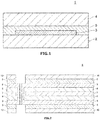
- a copper foil 3 side of a wiring substrate (copper-clad laminate: CCL) provided with a liquid crystal polymer film 2 and the copper foil (rolled copper foil) 3 and a liquid crystal polymer film 4 are laminated via a cured product layer 5 made of the above-described adhesive composition (thermosetting adhesive layer).
- the printed wiring board may have a multilayer structure as shown in FIG. 2 , for example.
- the printed wiring board 6 shown in FIG. 2 includes: a wiring substrate provided with a polyimide layer 7 (25 ⁇ m thick), a copper foil 8 (18 ⁇ m thick) and a copper plated layer 9 (10 ⁇ m thick); and a cover lay 10 (25 ⁇ m thick) laminated on the copper plated layer 9 side of the wiring substrate via a cured product layer 5 (35 ⁇ m thick) made of the above-described adhesive composition (thermosetting adhesive layer) (total thickness of 201 ⁇ m).
- thermosetting adhesive composition Preparation of thermosetting adhesive composition
- thermosetting adhesive composition coating material for forming thermosetting adhesive layer.
- thermosetting sheet Preparation of thermosetting sheet
- thermosetting adhesive compositions were applied to a release-treated polyethylene terephthalate film and dried in a drying furnace at 50 to 130 °C to prepare a thermosetting adhesive sheet having the polyethylene terephthalate film and a thermosetting adhesive layer having a thickness of 25 ⁇ m.
- thermosetting adhesive layer-forming coating After the preparation of the above-described thermosetting sheet, the coatability of the thermosetting adhesive composition was evaluated according to the following criteria. The results are shown in Table 1.
- the adhesive sheets prepared in Examples and Comparative Examples were laminated to each other to prepare a test piece having a thickness of 1 mm, and then the test piece was thermally cured at 160 °C and 1.0 MPa for 1 hour to prepare a test piece for evaluation.
- the dielectric constant of the test piece for evaluation was determined using a dielectric constant measuring device (available from AET) at a measurement temperature of 23 °C and a measurement frequency of 10 GHz. The results are shown in Table 1.
- the dielectric loss tangent of the test piece for evaluation was obtained by the same method as the measurement of the dielectric constant described above. The results are shown in Table 1.
- thermosetting adhesive sheet was cut into a strip of a predetermined size (2cm x 5cm), and the cut thermosetting adhesive layer was temporarily pasted to a liquid crystal polymer film having a size of 2 cm x 7 cm x 50 ⁇ m (thickness) by a laminator set at 100 °C, and then the base material (polyethylene terephthalate film) was removed to expose the thermosetting adhesive layer.
- thermosetting adhesive layer Upon the exposed thermosetting adhesive layer, a rolled copper foil surface (surface without roughening process) of a copper-clad laminate (CCL consisting of a rolled copper foil with a thickness of 12 ⁇ m and a liquid crystal polymer film with a thickness of 50 ⁇ m) of the same size was stacked and thermally cured at 160 °C and 1.0 MPa for 1 hour. Thus, samples were prepared.
- CCL copper-clad laminate
- the obtained sample was subjected to a 90 degree peeling test at a peeling speed of 50 mm/min, and the force required for peeling (initial peel strength and peel strength after reliability test) was measured.
- the results are shown in Table 1.
- Peel strength after the reliability test 85 °C, 85% RH (relative humidity), 240 hr (that is, after thermosetting under the above conditions of 160 °C and 1.0 MPa, the sample is placed in an environment of 85 °C and 85% RH for 240 hours, and measured 3 hours after removal.)
- the sample was subjected three times through a reflow process with a top temperature of 260 °C to 30 seconds, and the appearance of the sample after passing through the processes was checked to evaluate the presence or absence of peeling or swelling according to the following criteria.
- the results are shown in Table 1.
- thermosetting adhesive sheet was cut into a strip of a predetermined size (1.5 cm x 12 cm), and the cut thermosetting adhesive layer was temporarily pasted to a liquid crystal polymer film having a size of 1.5 cm x 12 cm x 50 ⁇ m (thickness) by a laminator set at 100 °C, and then the base material (polyethylene terephthalate film) was removed to expose the thermosetting adhesive layer.
- an FPC-TEG for the MIT folding endurance test was stacked and thermally cured at 160 °C and 1.0 MPa for 1 hour.
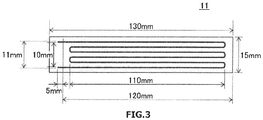
- FIG. 3 shows a structure of the TEG 11 for the MIT folding endurance test.
- the TEG 11 is formed by forming copper wiring from CCL composed of a liquid crystal polymer film (50 ⁇ m thick) as a base material and rolled copper foil (12 ⁇ m thick).
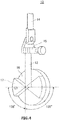
- the MIT folding endurance test was carried out by setting a prepared test piece 12 in a MIT type folding endurance tester 13 having the structure shown in FIG. 4 . The test was conducted at a bending angle of 135 °, a bending clamp angle R of 0.38, and a test speed of 175 cpm. The number of folds to break the copper wiring was counted. The results are shown in Table 1.
- thermosetting sheet After the thermosetting sheet was stored at ordinary temperature for four months, the same evaluation as the above-described evaluation of the peel strength was performed. The reduction rate was determined by comparing with the peel strength evaluated immediately after the thermosetting adhesive sheet was prepared. The results are shown in Table 1.
- the adhesive composition containing, with respect to the total of 100 parts by mass of the adhesive composition, 75 to 90 parts by mass of a styrene elastomer (Component A), 3 to 25 parts by mass of a modified polyphenyleneether resin having a polymerizable group at an end (Component B), and 10 parts by mass or less of an epoxy resin (Component C) and an epoxy resin curing agent (Component D) in total, had a low dielectric constant and dielectric loss tangent, and an excellent folding endurance even after thermosetting.
- a styrene elastomer Component A
- Component B modified polyphenyleneether resin having a polymerizable group at an end
- Component C an epoxy resin curing agent
- Example 8 From the results of Example 8, it was found to be difficult to reduce the dielectric loss tangent when the total amount of the epoxy resin and the epoxy resin curing agent exceeds 10 parts by mass.
- Example 12 From the results of Examples 11 and 12, it was found that a polyphenyleneether resin having a hydroxyl group at an end would degrade the film state or degrade dielectric properties and folding endurance. In Example 12, the dielectric constant, the dielectric loss tangent, the peel strength, the heat resistance, and the folding endurance could not be evaluated because the film was in a bad state.
- the content of the modified polyphenyleneether resin being 5 to 20 parts by mass would reduce the dielectric constant and dielectric loss tangent and improve the folding endurance.
- the styrene ratio of the styrene elastomer being less than 30% could improve the dielectric properties, peel strength, heat resistance, and folding endurance.
Landscapes
- Chemical & Material Sciences (AREA)
- Organic Chemistry (AREA)
- Chemical Kinetics & Catalysis (AREA)
- Health & Medical Sciences (AREA)
- Medicinal Chemistry (AREA)
- Polymers & Plastics (AREA)
- Engineering & Computer Science (AREA)
- Microelectronics & Electronic Packaging (AREA)
- Manufacturing & Machinery (AREA)
- General Chemical & Material Sciences (AREA)
- Adhesives Or Adhesive Processes (AREA)
- Adhesive Tapes (AREA)
- Laminated Bodies (AREA)
- Epoxy Resins (AREA)
Abstract
Description
- This technology relates to an adhesive composition, a thermosetting adhesive sheet, and a printed wiring board. This application claims priority on the basis of Japanese Patent Application No.
2018-018177, filed on February 5, 2018 - With the increase in the speed and capacity of information communications, the trend of increasing the frequency of signals flowing through printed circuit boards is accelerating. Accordingly, low dielectric properties such as low dielectric constant and low dielectric loss tangent are required for constituent materials (for example, an adhesive composition) of a rigid substrate or a flexible printed wiring board (FPC) (see
PLT - Although polyphenyleneether has many advantages as a substrate material having a low dielectric properties, it lacks folding endurance since polyphenyleneether has a very high melting point (softening point) and a hard property at ordinary temperature. For example, as in the resin composition described in
PLT 2, when approximately 30 to 50% of the entire resin is composed of polyphenyleneether, the folding endurance tends to be inferior. -
- PLT 1: Japanese Unexamined Patent Application Publication No.
2017-57346 - PLT 2: Japanese Unexamined Patent Application Publication No.
2016-79354 - The present technology has been proposed in view of such conventional circumstances, and provides an adhesive composition, a thermosetting adhesive sheet, and a printed wiring board having a low dielectric constant, a low dielectric loss tangent, and an excellent folding endurance.
- An adhesive composition according to the present technology includes: with respect to the total of 100 parts by mass of the adhesive composition, 75 to 90 parts by mass of a styrene elastomer; 3 to 25 parts by mass of a modified polyphenyleneether resin having a polymerizable group at an end; and totally 10 parts by mass or less of an epoxy resin and an epoxy resin curing agent.
- A thermosetting adhesive sheet according to the present technology includes a base material and a thermosetting adhesive layer formed on the base material and composed of the adhesive composition described above.
- A printed wiring board according to the present technology comprises: a wiring resin substrate having a base material and a wiring pattern; and a cover lay laminated on the wiring pattern of the resin substrate via a cured product of the adhesive composition described above.
- According to the present technology, it is possible to provide an adhesive composition having a low dielectric constant and a low dielectric loss tangent, and an excellent folding endurance.
-
-
FIG. 1 is a cross-sectional view showing a configuration example of a printed wiring board. -
FIG. 2 is a cross-sectional view showing an example of a configuration of a multilayer printed wiring board. -
FIG. 3 is a plan view showing an example of a structure of a TEG used in a folding endurance test. -
FIG. 4 is a perspective view of a measuring device used in a folding endurance test. - Embodiments of the present technology will be described below. The values of the weight-average molecular weight and the number-average molecular weight of the components described below refer to values calculated from the molecular weight in terms of standard polystyrene measured by the gel permeation chromatography (GPC) method.
- The adhesive composition according to the present technology is a thermosetting adhesive composition which contains, with respect to the total of 100 parts by mass of the adhesive composition, 75 to 90 parts by mass of a styrene elastomer (Component A), 3 to 25 parts by mass of a modified polyphenyleneether resin having a polymerizable group at an end (Component B; hereinafter simply referred to as modified polyphenyleneether resin), and totally 10 parts by mass or less of an epoxy resin (Component C) and an epoxy resin curing agent (Component D). With this composition, it is possible to obtain an adhesive composition having a low dielectric constant and a low dielectric loss tangent even after thermosetting, and having an excellent folding endurance even after thermosetting. Such an adhesive composition can be suitably used as an adhesive (interlayer adhesive) for a flexible printed wiring board, among other applications.
- The styrene elastomer is a copolymer of styrene and an olefin (conjugated dienes such as butadiene and isoprene) and/or a hydrogenated product thereof. The styrene elastomer is a block copolymer having styrene as a hard segment and conjugated diene as a soft segment. Examples of styrene elastomers include styrene/butadiene/styrene block copolymers, styrene/isoprene/styrene block copolymers, styrene/ethylene/butylene/styrene block copolymers, styrene/ethylene/propylene/styrene block copolymers, and styrene/butadiene block copolymers. Further, a styrene/ethylene/butylene/styrene block copolymer, a styrene/ethylene/propylene/styrene block copolymer, and a styrene/butadiene block copolymer in which the double bond of the conjugated diene component is eliminated by hydrogenation (also referred to as a hydrogenated styrene elastomer) may be used.
- The weight average molecular weight of the styrene elastomer is preferably 100,000 or more, more preferably 100,000 to 150,000, and still more preferably 110,000 to 150,000. With such a configuration, peel strength (connection reliability) and heat resistance can be improved.
- The styrene ratio in the styrene elastomer is preferably less than 30%, more preferably 5 to 30%, still more preferably 5 to 25%, and particularly preferably 10 to 20%. With such a configuration, the folding endurance can be improved, and peel strength (connection reliability) and heat resistance can be improved.
- Specific examples of the styrene elastomer include TUFTEC H 1221 (Mw 120,000,
styrene ratio 10%), TUFTEC H 1041 (Mw 90,000, styrene ratio 30%), TUFTEC H 1043 (Mw 110,000, styrene content 67%, all of the above manufactured by Asahi Kasei) and HYBRAR 7125 (Mw 110,000, styrene content 20%, manufactured by Kuraray). Among these, TUFTEC H 1221 and HYBRAR 7125 are preferable from the viewpoint of molecular weight and styrene ratio. - The content of the styrene elastomer in the adhesive composition may be 75 to 90 parts by mass or 80 to 90 parts by mass with respect to the total of 100 parts by mass of the components A, B, C, and D. The content of the styrene elastomer being less than 75 parts by mass tends to degrade folding endurance. When the content of the styrene elastomer exceeds 90 parts by mass, the content of other components (for example, component B) is relatively small, thereby degrading heat resistance. The styrene elastomer may be used alone or in combination of two or more.
- The modified polyphenyleneether resin has a polyphenyleneether chain in the molecule and a polymerizable group at the end. The modified polyphenyleneether resin preferably has two or more of at least one of an epoxy group and an ethylenically unsaturated bond as a polymerizable group in one molecule. In particular, from the viewpoint of compatibility with the styrene elastomer and dielectric properties of the adhesive composition, the modified polyphenyleneether resin preferably has at least one of an epoxy group and an ethylenically unsaturated bond (a (meth)acryloyl group and a vinylbenzyl group, among others) at both ends.
- Because polyphenyleneether resin not modified by a compound having a polymerizable group, that is, the polyphenyleneether resin having a hydroxyl group at an end has an excessive polarity and therefore has an inferior compatibility with the styrene elastomer described above, there is a possibility that the adhesive composition cannot be formed into a film, which is undesirable.
- A modified polyphenyleneether resin having vinylbenzyl groups at both ends, which is an example of the modified polyphenyleneether resin can be obtained, for example, by converting terminal phenolic hydroxyl groups of a bifunctional phenylene ether oligomer into vinylbenzyl ether, the bifunctional phenylene ether oligomer being obtained by oxidative coupling of a bifunctional phenol compound and a monofunctional phenol compound.
- The weight-average molecular weight (or number average molecular weight) of the modified polyphenyleneether resin is preferably 1,000 to 3,000 from the viewpoint of compatibility with the styrene elastomer described above and the conformability to the level difference formed when thermally curing (pressing) a cover lay with a wiring pattern side of a wiring resin substrate having a base material and a wiring pattern.
- Examples of the modified polyphenyleneether resin include OPE-2 St (modified polyphenyleneether resin having vinylbenzyl groups at both ends), OPE-2 Gly (modified polyphenyleneether resin having epoxy groups at both ends), OPE-2 EA (modified polyphenyleneether resin having acryloyl groups at both ends, all of the above manufactured by Mitsubishi Gas Chemical), and Noryl SA 9000 (modified polyphenyleneether resin having methacryloyl groups at both ends, manufactured by SABIC).
- The content of the modified polyphenyleneether resin in the adhesive composition is preferably 3 to 25 parts by mass or 5 to 20 parts by mass, with respect to the total of 100 parts by mass of the components A, B, C, and D. The content of the modified polyphenyleneether resin exceeding 25 parts by mass tends to degrade folding endurance. In addition, the content of the modified polyphenyleneether resin being 5 parts by mass or more can further improve the heat resistance. The polyphenyleneether resin may be used alone or in combination of two or more.
- Examples of the epoxy resin include an epoxy resin having a naphthalene skeleton, a bisphenol A type epoxy resin, a bisphenol F type epoxy resin, a phenol novolak type epoxy resin, an alicyclic epoxy resin, a siloxane type epoxy resin, a biphenyl type epoxy resin, a glycidyl ester type epoxy resin, a glycidyl amine type epoxy resin, and a hydantoin type epoxy resin, among others. In particular, from the viewpoint of the moldability of the film, it is preferable to use an epoxy resin which is in a liquid state at ordinary temperature, such as an epoxy resin having a naphthalene skeleton, a bisphenol A type epoxy resin, or a bisphenol F type epoxy resin. The epoxy resin may be used alone or in combination of two or more.
- The epoxy resin curing agent is a catalyst for promoting the curing reaction of the epoxy resin. As the epoxy resin curing agent, for example, imidazole-based, phenol-based, amine-based, acid anhydride-based, and organic peroxide-based epoxy resin curing agent can be used. In particular, from the viewpoint of the storability (life) of the adhesive composition at ordinary temperature, the epoxy resin curing agent is preferably a latent curing agent and is more preferably an encapsulated imidazole-based curing agent having latent properties. Improved storability at ordinary temperature further facilitates the management in the supply and use of the adhesive composition. Specifically, as the epoxy resin curing agent, a microcapsule-type latent curing agent comprising a latent imidazole-modified substance as a core coated with polyurethane can be used. As a commercial product, for example, Novacure 3941 (manufactured by ASAHI KASEI E-materials) can be used. The epoxy resin curing agent may be used alone or in combination of two or more.
- The total content of the epoxy resin and the epoxy resin curing agent in the adhesive composition is 10 parts by mass or less, and preferably 5 parts by mass or less, with respect to the total of 100 parts by mass of the components A, B, C, and D. The total content of the epoxy resin and the epoxy resin curing agent exceeding 10 parts by mass tends to degrade dielectric properties.
- The adhesive composition may further contain components other than the components A to D described above to the extent that the effect of the present technology is not impaired. Other components include organic solvents, silane coupling agents, and flowability control fillers, among others. Although the organic solvent is not particularly limited, examples thereof include an alcohol solvent, a ketone solvent, an ether solvent, an aromatic solvent, and an ester solvent. Among these, aromatic solvents and ester solvents are preferable from the viewpoint of solubility. The organic solvent may be used alone or in combination of two or more.
- The thermosetting adhesive sheet according to the present technology includes a base material and a thermosetting adhesive layer made of the above-described adhesive composition formed on the base material, and is formed into a film shape. The thermosetting adhesive sheet is obtained, for example, by diluting the above-described adhesive composition with a solvent, applying the diluted adhesive composition to at least one surface of the base material by a bar coater, a roll coater or the like so that the thickness after drying is 10 to 60 µm, and drying the adhesive sheet at a temperature of about 50 to 130 °C. As the base material, for example, a release-treated base material in which a base material such as a polyethylene terephthalate film or a polyimide film is appropriately subjected to release treatment with silicone or the like can be used.
- The thickness of the thermosetting adhesive layer constituting the thermosetting adhesive sheet can be 1 to 100 µm or 1 to 30 µm as an example, although the thickness may be appropriately set according to the purpose.
- Since the thermosetting adhesive layer constituting the thermosetting adhesive sheet is made of an adhesive composition having a low dielectric constant and a low dielectric loss tangent even after thermosetting and an excellent folding endurance even after thermosetting as described above, it can be used, for example, as an interlayer adhesive of a flexible printed wiring board, and for an application of bonding and fixing a terminal portion of the flexible printed wiring board and a connecting base material for backing the terminal portion. Further, the thermosetting adhesive sheet has an excellent peel strength and heat resistance after thermosetting, and storability at ordinary temperature.
- The printed wiring board according to the present technology includes a wiring substrate having a base material and a wiring pattern, and a cover lay laminated on the wiring pattern of the substrate via a cured product of the adhesive composition (thermosetting adhesive layer) described above. The printed wiring board is obtained, for example, by arranging a thermosetting adhesive layer of a thermosetting adhesive sheet between the wiring pattern side of the wiring substrate and the cover lay, and performing thermocompression bonding, thereby integrating the wiring substrate and the cover lay.
- As with the adhesive composition described above, the wiring substrate preferably has an excellent electrical properties in a high-frequency region, for example, a low dielectric constant and a low dielectric loss tangent in a frequency region of 1 to 10 GHz. Specific examples of the base material include base materials containing any one of a liquid crystal polymer (LCP), polytetrafluoroethylene, polyimide, and polyethylene naphthalate as a main component. Among these base materials, a base material containing a liquid crystal polymer as a main component (liquid crystal polymer film) is preferable. This is because the liquid crystal polymer has a moisture absorption rate much lower than polyimide and is less susceptible to the use environment.
- An example of a configuration of a printed wiring board using an adhesive composition according to the present technology will be described. In the printed
wiring board 1 shown inFIG. 1 , acopper foil 3 side of a wiring substrate (copper-clad laminate: CCL) provided with a liquidcrystal polymer film 2 and the copper foil (rolled copper foil) 3 and a liquidcrystal polymer film 4 are laminated via a curedproduct layer 5 made of the above-described adhesive composition (thermosetting adhesive layer). - Furthermore, the printed wiring board may have a multilayer structure as shown in
FIG. 2 , for example. The printedwiring board 6 shown inFIG. 2 includes: a wiring substrate provided with a polyimide layer 7 (25 µm thick), a copper foil 8 (18 µm thick) and a copper plated layer 9 (10 µm thick); and a cover lay 10 (25 µm thick) laminated on the copper platedlayer 9 side of the wiring substrate via a cured product layer 5 (35 µm thick) made of the above-described adhesive composition (thermosetting adhesive layer) (total thickness of 201 µm). - Examples of the present technology will be described below. However, the present technology is not limited to these examples.
-
- TUFTEC H 1221: hydrogenated styrene thermoplastic elastomer (Mw 120,000,
styrene ratio 10%), manufactured by Asahi Kasei - HYBRAR 7125: hydrogenated styrene thermoplastic elastomer (Mw 110,000, styrene ratio 20%), manufactured by Kuraray
- TUFTEC H 1041: hydrogenated styrene thermoplastic elastomer (Mw 90,000, styrene ratio 30%), manufactured by Asahi Kasei
- TUFTEC H 1043: hydrogenated styrene thermoplastic elastomer (Mw 110,000, styrene ratio 67%), manufactured by Asahi Kasei
-
- OPE-2St2200: modified polyphenyleneether resin having vinylbenzyl groups at both ends (Mn = 2200), manufactured by MITSUBISHI GAS CHEMICAL
- SA9000: modified polyphenyleneether resin having methacryloyl groups at both ends (Mw 1700), manufactured by SABIC
- SA120: polyphenyleneether resin having hydroxyl groups at both ends, manufactured by SABIC
- S201A: polyphenyleneether resin having hydroxyl groups at both ends, manufactured by Asahi Kasei
-
- 4032D: naphthalene epoxy resin, manufactured by DIC
- JER828: epoxy resin, manufactured by Mitsubishi Chemical
- YD014: bisphenol A epoxy resin, manufactured by Nippon Steel & Sumitomo Metal
- Component D
- Novacure Cure 3941: microcapsule type latent curing agent having imidazole modified substance as core coated with polyurethane, manufactured by ASAHI KASEI E-materials
- 2E4MZ: 2-ethyl-4 methylimidazole (non-latent imidazole)
- The components shown in Table 1 were weighed to obtain the mass shown in Table 1 and uniformly mixed in an organic solvent containing toluene and ethyl acetate to prepare a thermosetting adhesive composition (coating material for forming thermosetting adhesive layer).
- Each of the obtained thermosetting adhesive compositions was applied to a release-treated polyethylene terephthalate film and dried in a drying furnace at 50 to 130 °C to prepare a thermosetting adhesive sheet having the polyethylene terephthalate film and a thermosetting adhesive layer having a thickness of 25 µm.
- Evaluation of coatability (film state) of thermosetting adhesive layer-forming coating
After the preparation of the above-described thermosetting sheet, the coatability of the thermosetting adhesive composition was evaluated according to the following criteria. The results are shown in Table 1. - A: The compatibility of the adhesive composition is good, and the evaluation described later can be performed in the film state.
- B: The compatibility of the adhesive composition is bad, and the evaluation described later cannot be performed in the film state.
- The adhesive sheets prepared in Examples and Comparative Examples were laminated to each other to prepare a test piece having a thickness of 1 mm, and then the test piece was thermally cured at 160 °C and 1.0 MPa for 1 hour to prepare a test piece for evaluation. The dielectric constant of the test piece for evaluation was determined using a dielectric constant measuring device (available from AET) at a measurement temperature of 23 °C and a measurement frequency of 10 GHz. The results are shown in Table 1.
- A: Dielectric constant is less than 2.3.
- B: Dielectric constant is 2.3 or more and less than 2.4.
- C: Dielectric constant is 2.4 or more and less than 2.6.
- D: Dielectric constant is 2.6 or more.
- The dielectric loss tangent of the test piece for evaluation was obtained by the same method as the measurement of the dielectric constant described above. The results are shown in Table 1.
- A: Dielectric loss tangent is less than 0.002.
- B: Dielectric loss tangent is 0.002 or more and less than 0.0035.
- C: Dielectric loss tangent is 0.0035 or more and less than 0.005.
- D: Dielectric loss tangent is 0.005 or more.
- The obtained thermosetting adhesive sheet was cut into a strip of a predetermined size (2cm x 5cm), and the cut thermosetting adhesive layer was temporarily pasted to a liquid crystal polymer film having a size of 2 cm x 7 cm x 50 µm (thickness) by a laminator set at 100 °C, and then the base material (polyethylene terephthalate film) was removed to expose the thermosetting adhesive layer. Upon the exposed thermosetting adhesive layer, a rolled copper foil surface (surface without roughening process) of a copper-clad laminate (CCL consisting of a rolled copper foil with a thickness of 12 µm and a liquid crystal polymer film with a thickness of 50 µm) of the same size was stacked and thermally cured at 160 °C and 1.0 MPa for 1 hour. Thus, samples were prepared.
- The obtained sample was subjected to a 90 degree peeling test at a peeling speed of 50 mm/min, and the force required for peeling (initial peel strength and peel strength after reliability test) was measured. The results are shown in Table 1.
- Initial peel strength (measured as it is after thermosetting under the above conditions of 160 °C and 1.0 MPa)
- A: Peel strength is 8 N/cm or more.
- B: Peel strength is 6 N/cm or more and less than 8 N/cm.
- C: Peel strength is 4 N/cm or more and less than 6 N/cm.
- D: Peel strength is less than 4 N/cm.
- Peel strength after the reliability test (85 °C, 85% RH (relative humidity), 240 hr (that is, after thermosetting under the above conditions of 160 °C and 1.0 MPa, the sample is placed in an environment of 85 °C and 85% RH for 240 hours, and measured 3 hours after removal.))
- A: Peel strength is 7 N/cm or more.
- B: Peel strength is 5 N/cm or more and less than 7 N/cm.
- C: Peel strength is 3 N/cm or more and less than 5 N/cm.
- D: Peel strength is less than 3 N/cm.
- The sample was subjected three times through a reflow process with a top temperature of 260 °C to 30 seconds, and the appearance of the sample after passing through the processes was checked to evaluate the presence or absence of peeling or swelling according to the following criteria. The results are shown in Table 1.
- A: No abnormality was occurred after the third process.
- B: No abnormality was occurred at the second process, and an abnormality such as peeling and swelling was occurred at the third process.
- C: No abnormality was occurred after the first process, and an abnormality such as peeling and swelling was occurred after the second process.
- D: An abnormality such as peeling and swelling was occurred at the first process.
- The obtained thermosetting adhesive sheet was cut into a strip of a predetermined size (1.5 cm x 12 cm), and the cut thermosetting adhesive layer was temporarily pasted to a liquid crystal polymer film having a size of 1.5 cm x 12 cm x 50 µm (thickness) by a laminator set at 100 °C, and then the base material (polyethylene terephthalate film) was removed to expose the thermosetting adhesive layer. Upon the exposed thermosetting adhesive layer, an FPC-TEG for the MIT folding endurance test was stacked and thermally cured at 160 °C and 1.0 MPa for 1 hour.
FIG. 3 shows a structure of theTEG 11 for the MIT folding endurance test. TheTEG 11 is formed by forming copper wiring from CCL composed of a liquid crystal polymer film (50 µm thick) as a base material and rolled copper foil (12 µm thick). The MIT folding endurance test was carried out by setting aprepared test piece 12 in a MIT type foldingendurance tester 13 having the structure shown inFIG. 4 . The test was conducted at a bending angle of 135 °, a bending clamp angle R of 0.38, and a test speed of 175 cpm. The number of folds to break the copper wiring was counted. The results are shown in Table 1. - A: The number of folds to break is 1,200 or more.
- B: The number of folds to break is 500 or more and less than 1,200.
- C: The number of folds to break is 200 or more and less than 500.
- D: The number of folds to break is less than 200.
- After the thermosetting sheet was stored at ordinary temperature for four months, the same evaluation as the above-described evaluation of the peel strength was performed. The reduction rate was determined by comparing with the peel strength evaluated immediately after the thermosetting adhesive sheet was prepared. The results are shown in Table 1.
- A: Decrease in peel strength is less than 10%.
- B: Decrease in peel strength is 10% or more and less than 30%.
- C: Decrease in peel strength is 30% or more.
- From the results shown in Table 1, it was revealed that the adhesive composition containing, with respect to the total of 100 parts by mass of the adhesive composition, 75 to 90 parts by mass of a styrene elastomer (Component A), 3 to 25 parts by mass of a modified polyphenyleneether resin having a polymerizable group at an end (Component B), and 10 parts by mass or less of an epoxy resin (Component C) and an epoxy resin curing agent (Component D) in total, had a low dielectric constant and dielectric loss tangent, and an excellent folding endurance even after thermosetting.
- From the result of Example 6, it was found that the content of the modified polyphenyleneether resin being more than 25 parts by mass would degrade the folding endurance.
- From the results of Example 8, it was found to be difficult to reduce the dielectric loss tangent when the total amount of the epoxy resin and the epoxy resin curing agent exceeds 10 parts by mass.
- From the results of Examples 11 and 12, it was found that a polyphenyleneether resin having a hydroxyl group at an end would degrade the film state or degrade dielectric properties and folding endurance. In Example 12, the dielectric constant, the dielectric loss tangent, the peel strength, the heat resistance, and the folding endurance could not be evaluated because the film was in a bad state.
- From the results of the experimental examples, it was found that the content of the modified polyphenyleneether resin being 5 to 20 parts by mass would reduce the dielectric constant and dielectric loss tangent and improve the folding endurance.
- From the results of the experimental examples, it was found that the mass average molecular weight of the styrene elastomer being 100,000 or more could improve the peel strength, heat resistance, and folding endurance.
- From the results of the experimental examples, it was found that the styrene ratio of the styrene elastomer being less than 30% could improve the dielectric properties, peel strength, heat resistance, and folding endurance.
- From the results of the experimental examples, it was found that peel strength, heat resistance, and folding endurance could be improved by using a liquid epoxy resin.
- From the results of the experimental examples, it was found that the storability at ordinary temperature could be improved by using a latent epoxy resin curing agent.
- From the results of Examples 3, 7, and 14, it was found that, in spite of extremely low values such as a dielectric constant (Dk) of 2.3 or less and a dielectric loss tangent (Df) of less than 0.002 at 10 GHz, a very high adhesive strength of 8 N/cm or more was obtained for a liquid crystal polymer film and a rolled copper foil not subjected to a surface roughening process.
- 1 printed wiring board, 2 liquid crystal polymer film, 3 copper foil, 4 liquid crystal polymer film, 5 cured product layer composed of adhesive composition, 6 printed wiring board, 7 polyimide layer, 8 copper foil, 9 copper plating layer, 10 cover lay, 11 TEG, 12 test piece, 13 MIT type folding endurance tester, 14 plunger, 15 upper chuck, 16 rotary chuck, 17 bending top
| Ex.1 | Ex. 2 | Ex. 3 | Ex. 4 | Ex. 5 | Ex. 6 | Ex. 7 | Ex. 8 | Ex. 9 | Ex. 10 | Ex. 11 | Ex. 12 | Ex. 13 | Ex. 14 | ||
| Component A | TUFTEC H1221 | 75 | 0 | 80 | 0 | 0 | 60 | 92 | 75 | 0 | 0 | 80 | 80 | 80 | 80 |
| HYBRAR 7125 | 0 | 80 | 0 | 90 | 80 | 0 | 0 | 0 | 0 | 0 | 0 | 0 | 0 | 0 | |
| TUFTEC H1041 | 0 | 0 | 0 | 0 | 0 | 0 | 0 | 0 | 80 | 0 | 0 | 0 | 0 | 0 | |
| TUFTEC H1043 | 0 | 0 | 0 | 0 | 0 | 0 | 0 | 0 | 0 | 80 | 0 | 0 | 0 | 0 | |
| Component B | OPE-2St 2200 | 20 | 15 | 5 | 0 | 0 | 35 | 3 | 10 | 5 | 5 | 0 | 0 | 5 | 5 |
| SA9000 | 0 | 0 | 10 | 5 | 15 | 0 | 0 | 0 | 10 | 10 | 0 | 0 | 10 | 10 | |
| Component B' | SA120 | 0 | 0 | 0 | 0 | 0 | 0 | 0 | 0 | 0 | 0 | 15 | 0 | 0 | 0 |
| S201A | 0 | 0 | 0 | 0 | 0 | 0 | 0 | 0 | 0 | 0 | 0 | 15 | 0 | 0 | |
| Component C | 4032D | 2 | 2 | 2 | 2 | 0 | 2 | 2 | 5 | 2 | 2 | 2 | 2 | 0 | 2 |
| JER828 | 0 | 0 | 0 | 0 | 3 | 0 | 0 | 0 | 0 | 0 | 0 | 0 | 0 | 2 | |
| YD014 | 0 | 0 | 0 | 0 | 0 | 0 | 0 | 0 | 0 | 0 | 0 | 0 | 2 | 0 | |
| Component D | Novacure 3941 | 3 | 3 | 3 | 3 | 2 | 3 | 3 | 10 | 3 | 3 | 3 | 3 | 3 | 0 |
| 2E4MZ | 0 | 0 | 0 | 0 | 0 | 0 | 0 | 0 | 0 | 0 | 0 | 0 | 0 | 1 | |
| Total | 100 | 100 | 100 | 100 | 100 | 100 | 100 | 100 | 100 | 100 | 100 | 100 | 100 | 100 | |
| Film state | A | A | A | A | A | A | A | A | A | A | A | B | A | A | |
| Dielectric properties | Dk | A | A | A | A | A | B | A | C | A | B | C | - | A | A |
| Df | A | B | A | B | B | B | A | D | A | B | C | - | A | A | |
| Peel | Cu/Cu initial | B | A | A | A | A | B | A | A | B | D | C | - | B | A |
| Cu/Cu reliability | B | B | A | B | B | C | A | A | C | D | D | - | C | A | |
| Heat resistance | A | A | A | B | A | A | D | A | C | B | D | - | B | A | |
| Folding endurance | A | A | A | A | A | D | A | A | B | C | D | - | B | A | |
| Life | A | A | A | A | A | A | A | A | A | A | A | - | A | C | |
Claims (9)
- An adhesive composition, comprising: with respect to the total of 100 parts by mass of the adhesive composition,75 to 90 parts by mass of a styrene elastomer,3 to 25 parts by mass of a modified polyphenyleneether resin having a polymerizable group at an end; andtotally 10 parts by mass or less of an epoxy resin and an epoxy resin curing agent.
- The adhesive composition according to claim 1, wherein the styrene elastomer has a mass average molecular weight of 100,000 or more.
- The adhesive composition according to claim 1 or 2, wherein the styrene content of the styrene elastomer is less than 30%.
- The adhesive composition according to one of claims 1 to 3, wherein the content of the modified polyphenyleneether resin is 5 to 20 parts by mass.
- The adhesive composition according to one of claims 1 to 4, wherein the modified polyphenyleneether resin has at least one of an epoxy group and an ethylenically unsaturated bond at an end.
- The adhesive composition according to one of claims 1 to 5, wherein the epoxy resin curing agent is a latent epoxy resin curing agent.
- A thermosetting adhesive sheet comprising a base material and a thermosetting adhesive layer formed on the base material and composed of the adhesive composition according to one of claims 1 to 6 formed on the base material.
- A printed wiring board comprising: a wiring resin substrate having a base material and a wiring pattern; and a cover lay laminated on the wiring pattern of the resin substrate via a cured product of the adhesive composition according to one of claims 1 to 6.
- The printed wiring board according to claim 8, wherein the base material is a liquid crystal polymer film.
Applications Claiming Priority (2)
| Application Number | Priority Date | Filing Date | Title |
|---|---|---|---|
| JP2018018177A JP7090428B2 (en) | 2018-02-05 | 2018-02-05 | Adhesive composition, thermosetting adhesive sheet and printed wiring board |
| PCT/JP2019/001652 WO2019151014A1 (en) | 2018-02-05 | 2019-01-21 | Adhesive composition, thermosetting adhesive sheet, and printed wiring board |
Publications (2)
| Publication Number | Publication Date |
|---|---|
| EP3750966A1 true EP3750966A1 (en) | 2020-12-16 |
| EP3750966A4 EP3750966A4 (en) | 2021-12-01 |
Family
ID=67478240
Family Applications (1)
| Application Number | Title | Priority Date | Filing Date |
|---|---|---|---|
| EP19747534.6A Pending EP3750966A4 (en) | 2018-02-05 | 2019-01-21 | ADHESIVE COMPOSITION, THERMOSETTING ADHESIVE SHEET AND PRINTED CIRCUIT BOARD |
Country Status (7)
| Country | Link |
|---|---|
| US (1) | US20210040360A1 (en) |
| EP (1) | EP3750966A4 (en) |
| JP (1) | JP7090428B2 (en) |
| KR (1) | KR102445337B1 (en) |
| CN (1) | CN111742029B (en) |
| TW (1) | TWI823894B (en) |
| WO (1) | WO2019151014A1 (en) |
Families Citing this family (27)
| Publication number | Priority date | Publication date | Assignee | Title |
|---|---|---|---|---|
| MY204665A (en) * | 2018-03-30 | 2024-09-07 | Mitsui Mining & Smelting Co Ltd | Copper-clad laminate |
| JP7272473B2 (en) * | 2018-07-26 | 2023-05-12 | 味の素株式会社 | resin composition |
| JP7099128B2 (en) * | 2018-07-26 | 2022-07-12 | 味の素株式会社 | Resin composition |
| JP7020332B2 (en) * | 2018-07-26 | 2022-02-16 | 味の素株式会社 | Resin composition |
| WO2021010432A1 (en) * | 2019-07-17 | 2021-01-21 | パナソニックIpマネジメント株式会社 | Resin composition, prepreg, film with resin, metal foil with resin, metal-clad laminate, and wiring board |
| WO2021024328A1 (en) * | 2019-08-02 | 2021-02-11 | デクセリアルズ株式会社 | Adhesive composition, thermally curable adhesive sheet, and printed wiring board |
| US12454634B2 (en) * | 2019-08-06 | 2025-10-28 | Dexerials Corporation | Adhesive composition, thermosetting adhesive sheet, and printed wiring board |
| KR102906596B1 (en) | 2019-10-30 | 2025-12-31 | 린텍 가부시키가이샤 | Adhesive sheets for devices |
| CN114555740B (en) * | 2019-11-28 | 2024-01-05 | 东洋纺Mc株式会社 | Adhesive films, laminates and printed wiring boards |
| JP7659970B2 (en) * | 2020-03-30 | 2025-04-10 | 株式会社Adeka | Composition, cured product, and method for producing the cured product |
| US12624261B2 (en) | 2020-03-31 | 2026-05-12 | Lintec Corporation | Adhesive for high-frequency dielectric heating, structure, and manufacturing method of structure |
| JP7484517B2 (en) * | 2020-07-14 | 2024-05-16 | artience株式会社 | Thermosetting adhesive sheet and its use |
| US11839024B2 (en) * | 2020-07-15 | 2023-12-05 | Dupont Electronics, Inc. | Composite and copper clad laminate made therefrom |
| CN114080088B (en) * | 2020-08-10 | 2024-05-31 | 鹏鼎控股(深圳)股份有限公司 | Circuit board and preparation method thereof |
| WO2022210671A1 (en) | 2021-03-30 | 2022-10-06 | リンテック株式会社 | Curable adhesive composition and cured product |
| JPWO2022255078A1 (en) * | 2021-06-02 | 2022-12-08 | ||
| JPWO2023054676A1 (en) | 2021-09-30 | 2023-04-06 | ||
| CN118019819A (en) * | 2021-09-30 | 2024-05-10 | 琳得科株式会社 | Curable adhesive sheet and method for producing cured product |
| EP4417652A4 (en) * | 2021-10-14 | 2025-01-08 | Resonac Corporation | RESIN FILM, LAMINATED BOARD, METAL-CLAD LAMINATED BOARD, PRINTED CIRCUIT BOARD AND SEMICONDUCTOR HOUSING |
| WO2023199738A1 (en) * | 2022-04-11 | 2023-10-19 | 株式会社Adeka | Composition and cured product |
| KR20250055502A (en) * | 2022-08-31 | 2025-04-24 | 나믹스 가부시끼가이샤 | Resin composition, adhesive film, bonding sheet for interlayer bonding, and resin composition for semiconductor package having antenna formed thereon |
| KR20250166950A (en) * | 2023-03-31 | 2025-11-28 | 린텍 가부시키가이샤 | Thermosetting adhesive sheet, laminate, and method for producing laminate |
| TW202502994A (en) | 2023-04-06 | 2025-01-16 | 日商Dic股份有限公司 | Thermosetting adhesive sheet and printed wiring board |
| JPWO2025004587A1 (en) * | 2023-06-30 | 2025-01-02 | ||
| WO2025004762A1 (en) * | 2023-06-30 | 2025-01-02 | 富士フイルム株式会社 | Polymer film, multilayer body, and method for producing multilayer body |
| WO2025105009A1 (en) * | 2023-11-17 | 2025-05-22 | ナミックス株式会社 | Adhesive film, semiconductor device, and method for manufacturing semiconductor device |
| JP7569954B1 (en) * | 2024-03-29 | 2024-10-18 | デクセリアルズ株式会社 | Thermosetting adhesive composition, thermosetting adhesive sheet and printed wiring board |
Family Cites Families (24)
| Publication number | Priority date | Publication date | Assignee | Title |
|---|---|---|---|---|
| US6558790B1 (en) * | 1999-11-30 | 2003-05-06 | Avery Dennison Corporation | Water vapor-permeable, pressure-sensitive adhesives |
| KR20070085911A (en) * | 2004-11-10 | 2007-08-27 | 제이에스알 가부시끼가이샤 | Thermosetting resin compositions, thermosetting films and cured products thereof, and electronic components |
| JP2007302817A (en) * | 2006-05-12 | 2007-11-22 | Mitsubishi Engineering Plastics Corp | Thermoplastic resin composition for manufacturing automotive exterior parts |
| JP5540559B2 (en) | 2009-05-11 | 2014-07-02 | デクセリアルズ株式会社 | Method for producing film adhesive for circuit connection |
| JP5463110B2 (en) | 2009-09-24 | 2014-04-09 | ナミックス株式会社 | Coverlay film |
| CN102220091A (en) * | 2010-03-31 | 2011-10-19 | 古河电气工业株式会社 | Adhesive tape for wafer processing |
| JP2011228642A (en) | 2010-03-31 | 2011-11-10 | Furukawa Electric Co Ltd:The | Wafer processing tape |
| CN103153811B (en) * | 2010-10-13 | 2015-04-08 | 电气化学工业株式会社 | Cover film |
| JP5955156B2 (en) * | 2012-08-10 | 2016-07-20 | ナミックス株式会社 | Resin composition, and adhesive film and coverlay film thereby |
| CN104663007B (en) * | 2012-09-20 | 2017-10-24 | 株式会社可乐丽 | Circuit substrate and its manufacture method |
| JP6408759B2 (en) * | 2013-11-08 | 2018-10-17 | デクセリアルズ株式会社 | Adhesive composition and film winding body |
| JP6328938B2 (en) | 2014-01-09 | 2018-05-23 | ナミックス株式会社 | Elastomer composition, film and semiconductor device |
| JP6578142B2 (en) | 2014-06-26 | 2019-09-18 | 住友電気工業株式会社 | Adhesive composition, printed wiring board coverlay, printed wiring board bonding film, and printed wiring board |
| CN106660322B (en) * | 2014-07-16 | 2019-11-22 | 松下知识产权经营株式会社 | Metal-clad laminate and method for producing the same, resin-adhered metal foil, and printed circuit board |
| JP6458985B2 (en) * | 2014-10-22 | 2019-01-30 | ナミックス株式会社 | Resin composition, insulating film using the same, and semiconductor device |
| CN107207932B (en) * | 2015-01-19 | 2019-10-25 | 株式会社巴川制纸所 | Thermosetting adhesive composition, thermosetting adhesive film and composite film |
| US11041045B2 (en) * | 2015-04-30 | 2021-06-22 | Showa Denko Materials Co., Ltd. | Resin composition, prepreg, laminate and multilayer printed wiring board |
| US10196545B2 (en) * | 2015-05-26 | 2019-02-05 | Tatsuta Electric Wire & Cable Co., Ltd. | Shielding film and shielded printed wiring board |
| CN107708999A (en) | 2015-08-25 | 2018-02-16 | 三井金属矿业株式会社 | The manufacture method of the metal foil of tape tree lipid layer, metal-clad and printed circuit board (PCB) |
| JP6896993B2 (en) | 2015-09-18 | 2021-06-30 | 昭和電工マテリアルズ株式会社 | Resin composition, prepreg, laminated board and multi-layer printed wiring board |
| TWI600709B (en) * | 2016-03-10 | 2017-10-01 | 台燿科技股份有限公司 | Resin composition and uses of the same |
| JP6726877B2 (en) | 2016-07-04 | 2020-07-22 | パナソニックIpマネジメント株式会社 | Metal foil with resin, laminated board, printed wiring board and multilayer printed wiring board |
| JP6821989B2 (en) | 2016-07-25 | 2021-01-27 | 富士通株式会社 | Information processing device, information processing system, information processing device control program and information processing device control method |
| CN110177820B (en) * | 2017-01-10 | 2022-03-01 | 住友精化株式会社 | Epoxy resin composition |
-
2018
- 2018-02-05 JP JP2018018177A patent/JP7090428B2/en active Active
-
2019
- 2019-01-21 CN CN201980009500.2A patent/CN111742029B/en active Active
- 2019-01-21 US US16/963,431 patent/US20210040360A1/en active Pending
- 2019-01-21 KR KR1020207019181A patent/KR102445337B1/en active Active
- 2019-01-21 WO PCT/JP2019/001652 patent/WO2019151014A1/en not_active Ceased
- 2019-01-21 EP EP19747534.6A patent/EP3750966A4/en active Pending
- 2019-02-01 TW TW108104102A patent/TWI823894B/en active
Also Published As
| Publication number | Publication date |
|---|---|
| JP7090428B2 (en) | 2022-06-24 |
| KR20200093028A (en) | 2020-08-04 |
| JP2019135280A (en) | 2019-08-15 |
| TWI823894B (en) | 2023-12-01 |
| TW201936849A (en) | 2019-09-16 |
| KR102445337B1 (en) | 2022-09-20 |
| CN111742029A (en) | 2020-10-02 |
| CN111742029B (en) | 2023-11-07 |
| EP3750966A4 (en) | 2021-12-01 |
| WO2019151014A1 (en) | 2019-08-08 |
| US20210040360A1 (en) | 2021-02-11 |
Similar Documents
| Publication | Publication Date | Title |
|---|---|---|
| US20210040360A1 (en) | Adhesive composition, thermosetting adhesive sheet, and printed wiring board | |
| US12454634B2 (en) | Adhesive composition, thermosetting adhesive sheet, and printed wiring board | |
| US20220298396A1 (en) | Adhesive composition, thermosetting adhesive sheet, and printed wiring board | |
| US20080113184A1 (en) | Adhesive sheet | |
| JP2009007424A (en) | Adhesive composition, and adhesive sheet and coverlay film using the same | |
| CN103937436A (en) | Adhesive varnish, adhesive film and wiring film | |
| JP3419436B2 (en) | Anisotropic conductive adhesive film | |
| EP3086411B1 (en) | Mounting body manufacturing method | |
| US6475641B2 (en) | Connecting material and connection structure | |
| KR20110134946A (en) | Insulation sheath conductive particles | |
| KR20130073192A (en) | Anisotropic conductive film and the semiconductor device | |
| JP2005197032A (en) | Anisotropic conductive film | |
| JP7569954B1 (en) | Thermosetting adhesive composition, thermosetting adhesive sheet and printed wiring board | |
| KR102429087B1 (en) | Resin composition for manufacturing coverlay film, manufacturing method of coverlay film and printed circuit board using the same | |
| WO2026079074A1 (en) | Thermosetting adhesive composition, thermosetting adhesive sheet, and printed wiring board | |
| KR20200012505A (en) | Thermosetting adhesive composition, laminated film having the cured product of the composition, and printed wiring board having the laminated film | |
| KR20070021074A (en) | Adhesive composition and coverlay film and adhesive sheet using same | |
| JP2012129106A (en) | Anisotropic conductive material and connection structure |
Legal Events
| Date | Code | Title | Description |
|---|---|---|---|
| STAA | Information on the status of an ep patent application or granted ep patent |
Free format text: STATUS: THE INTERNATIONAL PUBLICATION HAS BEEN MADE |
|
| PUAI | Public reference made under article 153(3) epc to a published international application that has entered the european phase |
Free format text: ORIGINAL CODE: 0009012 |
|
| STAA | Information on the status of an ep patent application or granted ep patent |
Free format text: STATUS: REQUEST FOR EXAMINATION WAS MADE |
|
| 17P | Request for examination filed |
Effective date: 20200730 |
|
| AK | Designated contracting states |
Kind code of ref document: A1 Designated state(s): AL AT BE BG CH CY CZ DE DK EE ES FI FR GB GR HR HU IE IS IT LI LT LU LV MC MK MT NL NO PL PT RO RS SE SI SK SM TR |
|
| AX | Request for extension of the european patent |
Extension state: BA ME |
|
| DAV | Request for validation of the european patent (deleted) | ||
| DAX | Request for extension of the european patent (deleted) | ||
| A4 | Supplementary search report drawn up and despatched |
Effective date: 20211028 |
|
| RIC1 | Information provided on ipc code assigned before grant |
Ipc: C09J 171/00 20060101ALI20211022BHEP Ipc: C08L 71/00 20060101ALI20211022BHEP Ipc: C08L 53/02 20060101ALI20211022BHEP Ipc: C08L 9/00 20060101ALI20211022BHEP Ipc: C09J 7/35 20180101ALI20211022BHEP Ipc: C09J 7/22 20180101ALI20211022BHEP Ipc: C08G 65/48 20060101ALI20211022BHEP Ipc: C08G 59/40 20060101ALI20211022BHEP Ipc: B32B 25/14 20060101ALI20211022BHEP Ipc: B32B 15/08 20060101ALI20211022BHEP Ipc: B32B 7/12 20060101ALI20211022BHEP Ipc: C09J 153/02 20060101AFI20211022BHEP |
|
| STAA | Information on the status of an ep patent application or granted ep patent |
Free format text: STATUS: EXAMINATION IS IN PROGRESS |
|
| 17Q | First examination report despatched |
Effective date: 20240925 |
|
| RAP3 | Party data changed (applicant data changed or rights of an application transferred) |
Owner name: DEXERIALS CORPORATION |