EP3750348B1 - Verfahren zur adaptiven routenauswahl in einem knoten eines drahtlosen netzkommunikationsnetzwerks entsprechenden vorrichtung zur durchführung des verfahrens der anpassenden routenauswahl und des entsprechenden computerprogramms - Google Patents
Verfahren zur adaptiven routenauswahl in einem knoten eines drahtlosen netzkommunikationsnetzwerks entsprechenden vorrichtung zur durchführung des verfahrens der anpassenden routenauswahl und des entsprechenden computerprogramms Download PDFInfo
- Publication number
- EP3750348B1 EP3750348B1 EP18705854.0A EP18705854A EP3750348B1 EP 3750348 B1 EP3750348 B1 EP 3750348B1 EP 18705854 A EP18705854 A EP 18705854A EP 3750348 B1 EP3750348 B1 EP 3750348B1
- Authority
- EP
- European Patent Office
- Prior art keywords
- reward
- node
- route
- rssi
- value
- Prior art date
- Legal status (The legal status is an assumption and is not a legal conclusion. Google has not performed a legal analysis and makes no representation as to the accuracy of the status listed.)
- Active
Links
Images




Classifications
-
- H—ELECTRICITY
- H04—ELECTRIC COMMUNICATION TECHNIQUE
- H04L—TRANSMISSION OF DIGITAL INFORMATION, e.g. TELEGRAPHIC COMMUNICATION
- H04L45/00—Routing or path finding of packets in data switching networks
- H04L45/26—Route discovery packet
-
- H—ELECTRICITY
- H04—ELECTRIC COMMUNICATION TECHNIQUE
- H04W—WIRELESS COMMUNICATION NETWORKS
- H04W40/00—Communication routing or communication path finding
- H04W40/02—Communication route or path selection, e.g. power-based or shortest path routing
- H04W40/12—Communication route or path selection, e.g. power-based or shortest path routing based on transmission quality or channel quality
-
- H—ELECTRICITY
- H04—ELECTRIC COMMUNICATION TECHNIQUE
- H04W—WIRELESS COMMUNICATION NETWORKS
- H04W40/00—Communication routing or communication path finding
- H04W40/02—Communication route or path selection, e.g. power-based or shortest path routing
- H04W40/12—Communication route or path selection, e.g. power-based or shortest path routing based on transmission quality or channel quality
- H04W40/16—Communication route or path selection, e.g. power-based or shortest path routing based on transmission quality or channel quality based on interference
-
- H—ELECTRICITY
- H04—ELECTRIC COMMUNICATION TECHNIQUE
- H04W—WIRELESS COMMUNICATION NETWORKS
- H04W40/00—Communication routing or communication path finding
- H04W40/24—Connectivity information management, e.g. connectivity discovery or connectivity update
- H04W40/28—Connectivity information management, e.g. connectivity discovery or connectivity update for reactive routing
-
- H—ELECTRICITY
- H04—ELECTRIC COMMUNICATION TECHNIQUE
- H04W—WIRELESS COMMUNICATION NETWORKS
- H04W84/00—Network topologies
- H04W84/18—Self-organising networks, e.g. ad-hoc networks or sensor networks
Definitions
- a major class of ad hoc network routing protocols is intended to minimize such main network attributes like control overhead, packet loss ratio, packet delay and energy consumption rate, while maximizing a network throughput [1].
- this class of protocols is divided into three large subclasses, based on their underlying route discovery logics:
- a route network path
- a route discovery procedure must be invoked each time a data entity has to be transmitted.
- a source node sends a route request message RREQ and waits for route reply messages RREP from its direct neighbors.
- the first RREQ message arrives at the destination node, it sends back said RREP message, containing some information about the path.
- the route gets established when the source receives back an RREP packet from the destination node, and the data transmission can be triggered.
- the established route becomes inactive after some predefined timeout interval.
- each node has its own routing table containing information about the paths from it to all the other nodes in the network.
- the global routing information is continuously being updated and exchanged between the nodes by broadcasting control packets to the network.
- all nodes in the network obtain an actual global route table, so that a classical routing algorithm (Bellman-Ford, Dijkstra) from a graph theory can be used by a node to find a path to any possible destination in the network.
- a classical routing algorithm Bellman-Ford, Dijkstra
- the route update mechanism in proactive protocols becomes a challenging problem in the conditions of wireless ad hoc networks due to their specific features, such as power consumption restrictions, dynamic topology, noisy wireless environment. Thus, they are not widely used in ad hoc networks in their initial concept, however, proper modifications of this proactive scheme have been realized described in [4] and [5], such that now they are most commonly used for the routing in ad hoc networks. Also [6] describes a well-known proactive routing protocol.
- Another type of routing algorithm is based on Reinforcement Learning which belongs to the field of Machine Learning.
- the theory of Machine Learning is described in [8, 9]. In general it can be described as the following.
- Each action is associated with some "estimation value” which tells the agent “how good is this action” if this action will be chosen/triggered.
- Those estimation values are being dynamically modified during the interaction process, when the agent chooses some action, and receives some "reward” from it. This reward value plays a crucial role, since it directly influences the corresponding estimation value of this action - in general, the lower the estimation value is, the lower the probability of choosing this action will be.
- an "N-armed bandit” task establishes a goal to retrieve a maximal amount of reward from the N-armed bandit machine used in gambling houses, where "N-arm” means that there is some reasonable number of levers the machine can have (1, 2, 5, 10, etc. number of levers).
- a player can select one "arm” (lever) from all available ones and pull it, in order to get the winning points/reward.
- a "play” is defined as an event when the player pulls the lever, and the outcome of this event is defined as "reward”. So, the task is to maximize the expected total reward over some number of plays, in other words the action selections.
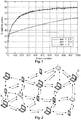
- Fig. 1 shows distributions of the optimal selection ratio when an e-Greedy selection method is used.
- the three curves correspond to a variation of the e-Greedy parameter eps between 0, 0.01 and 0.1 as indicated in the drawing.
- Such curves simulate results of the e-Greedy selection method over 1000 plays for a 10-arm bandit model, averaged over 2000 tasks.
- Wireless mesh networks may be used in particular in situations where the network nodes are moveable or portable and a great flexibility is required in configuring the network.
- One form of wireless mesh networks are wireless mobile ad hoc networks. These are self-configuring, dynamic networks in which nodes are free to move. Wireless ad hoc networks lack the complexities of infrastructure setup and administration, enabling devices to create and join networks "on the fly" - anywhere, anytime.
- intelligent street lighting also referred to as adaptive street lighting
- the street lights are dimmed when no activity is detected, but brightened when movement is detected.
- Such an intelligent street light is equipped with a camera or sensor for object recognition and processing and communication means. When a passer-by is detected, it will communicate this to neighboring street lights, which will brighten so that people are always surrounded by a safe circle of light on their way.
- a detailed description of such concept is presented in DE 10 2010 049 121 B8 .
- WO 2007/001286 A1 it is known a method for discovering routes in wireless communication networks.
- the method contains the steps of discovering a route through the multiple nodes of the communication network.
- a route request frame RREQ is broadcast by a first node.
- the RREQ frame is generated to discover a route.
- a second node receives the RREQ frame.
- the second node unicasts a PING frame to the first node to verify an integrity of a wireless communications channel between the first node and the second node. Then, the second node unicasts a route reply frame RREP only if the integrity of the wireless channel is verified.
- a station for use in a mesh network having an improved path finding capability comprises a controller configured to receive a path request for a path from the first station to the second station from a transmitting station; determine a proposed path between the first station and the second station; and determine a cost for the proposed path.
- the controller is configured to retrieve a power output level for the transmitting station, and to include the battery level in the determination of the cost for the proposed path, wherein an increase in power output level leads to an increase in cost for the proposed path.
- the proposal concerns an improvement in a method of adaptive route selection in a node of a wireless mesh communication network, wherein the RL-based routing technique is used.
- the proposal concerns an improvement in the path discovery procedure which is used for setting up route tables to reflect the current state of the network.
- a route request message (RREQ) is broadcast by the source node.
- a neighboring node receiving such RREQ message will re-broadcast this message further into the network. This happens on and on in a number of hops until the RREQ-message ultimately is received by the addressed destination node.
- the destination node broadcasts a route reply message (RREP) in response to the reception of said RREQ-message which is likewise re-broadcast in a number of hops by the intermediate nodes receiving the route RREP-message.
- RREP route reply message
- a node which has received said RREQ-message updates a route table with corresponding estimated reward values, for the corresponding action.
- a specific reward function is proposed for estimating said reward values in the path discovery procedure.
- the proposal includes that the reward function is dependent on a receiving signal strength indicator RSSI measured during reception of said route request message or route reply message and the number of hops the route request message or the route reply message has propagated in the network to reach the receiving node.
- This proposal has the advantage that shorter routes with a strong reception signal are prioritized in the initial stage.
- RSSI min is measured in dBm values varying in the range of [-100, 0], where Zero corresponds to the strongest received signal.
- ACK feedback message
- a node takes a next-hop decision at a step number t based on a probability distribution function P t (a), where P t (a) corresponds to the selection probability of choosing action a at the step number t .
- High values of the temperature parameter T make the selections of the actions to be evenly probable, i.e. the selection probabilities of all possible actions will be equal or very close to each other.
- low temperatures cause greater differences in selection probabilities between the actions. This way a control parameter ⁇ is defined which may be used to adjust the routing behavior.
- the temperature parameter is adaptively defined in dependence of the current packet loss rate PLR. High values of the temperature parameter T make the selections of the actions to be evenly probable, i.e. the selection probabilities of all possible actions will be equal or very close to each other. On the other hand, low temperatures cause greater difference in selection probabilities between the actions.
- the PLR value may vary in an unpredicted manner, thus affecting the reliability of the established routes.
- Another proposed improvement bringing an advantage in RL-based routing is the measure that in the case that a packet is lost the sending node generates a negative reward value and uses it in the process to update its route table in order to mark the selected route as less attractive for further transmissions.
- the invention also concerns a correspondingly adapted apparatus to perform the method of adaptive route selection.
- the invention also concerns a corresponding adapted computer program with instructions which perform the method for route selection when run in a computing system.
- processor or “controller” should not be construed to refer exclusively to hardware capable of executing software, and may implicitly include, without limitation, digital signal processor (DSP) hardware, read only memory (ROM) for storing software, random access memory (RAM), and nonvolatile storage.
- DSP digital signal processor
- ROM read only memory
- RAM random access memory
- any switches shown in the figures are conceptual only. Their function may be carried out through the operation of program logic, through dedicated logic, through the interaction of program control and dedicated logic, or even manually, the particular technique being selectable by the implementer as more specifically understood from the context.
- any element expressed as a means for performing a specified function is intended to encompass any way of performing that function including, for example, a) a combination of circuit elements that performs that function or b) software in any form, including, therefore, firmware, microcode or the like, combined with appropriate circuitry for executing that software to perform the function.
- the disclosure as defined by such claims resides in the fact that the functionalities provided by the various recited means are combined and brought together in the manner which the claims call for. It is thus regarded that any means that can provide those functionalities are equivalent to those shown herein.
- FIG. 2 An example of a wireless ad hoc network is depicted in Fig. 2 .
- This drawing shows a plurality of portable devices such as laptops, or tablet computers and smart phones and routers. The direct links between these devices are depicted with dotted lines.
- One source station at the left side is labelled with a reference sign S.
- One destination station at the right side is labelled with a reference sign D.
- a data packet sent by the source node S needs to be routed through the network towards the destination node D. Possible network paths with 5 hops the packet could be routed along are indicated by arrows.
- All participants in the communication network depicted in Fig. 1 are equipped with a WLAN interface according to one of the IEEE 802.11xx standards family, e.g. the IEEE 802.11s standard.
- the reinforcement learning-based routing technology is used.
- the main logic of the reinforcement learning concept consists in the fact that there is an action which is being chosen from a set of actions and that there is a feedback in the form of a reward on the chosen action, which modifies some selection criteria (an estimation value) for this action in the future.
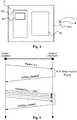
- Fig.3 the concept of reinforcement learning is illustrated in the form of a block diagram of a wireless network node. It could be any network node but the one shown corresponds to a source node S.
- there is an agent AG who decides which path a packet from a source node S to a destination D should be sent on further.
- the agent AG updates a routing table RT in which for each link to a direct neighbor of this node it is recorded the estimation value Q representing the success ratio a packet when routed into this direction reaches the destination node D.
- the agent AG takes the routing decision leading to the transmission of the packet via WLAN circuitry WI and the antenna ANT, the agent AG awaits receiving back an acknowledge packet ACK in which a reward value is returned from the neighbor, who received that packet.
- the agent AG upon receiving back the acknowledge packet or detecting loss of such a packet updates its routing table RT. All these tasks of the agent will now be explained in greater detail.
- the agent could be implemented in the form of an application program which is installed in memory of the network node and run on a processor of the network node.
- a node When a node, with a packet to a destination address, selects a "next hop node" from the list of its direct neighbors and sends the packet there, it then waits for an acknowledgement message ACK from this neighbor, which contains some reward value for choosing this neighbor.
- This process of sending out a packet pi and receiving back an acknowledgement packet ACK(pi, reward) is illustrated in Fig. 4 . Further packets p 2 to p N may be sent and further acknowledgement packets awaited. There is an ACK delay timeout period which is needed in the receiving node for processing until the ACK packet can be transmitted back. Such processing incudes a reward value calculation which is returned back in the ACK packet.
- the sending node will not receive the ACK packet, so it will automatically assign some negative reward value for the chosen action. This is reasonable, because if the packet or the ACK packet are being constantly lost while being sent to the particular neighbor, this means that either the node has gone offline, or the node has gone out of the transmission range while moving, or the wireless link has become too unreliable (due to various reasons related to wireless transmission problems), or the node is too overloaded with incoming traffic.
- the neighbor which has received the data packet does have a path to the destination, but this path is either not optimal in length (too many hops), or the further links quality is bad. So, the node will slowly decrease the estimation value Q for this particular choice in the long run, raising the probabilities of choosing the other neighbors.
- the received ACK packet contains high reward value, it means that this neighbor has a good path to the destination node, so it might be preferred as a good forwarding decision. While sending the packets to such neighbor and getting back the ACK packets with high reward values, the overall estimation value Q of this neighbor will increase in the long run, therefore, the probability of choosing this action will increase, providing a good data routing on this link.
- FIG. 5 An example of a route table RT with the constantly updated estimated Q values is illustrated in Fig. 5
- the initial distribution of reward values for the paths throughout the network takes place in a phase of route discovery, illustrated in Fig. 6 .
- the node broadcasts a route request message RREQ to its direct neighbors, and the neighbors re-broadcast this RREQ further into the network. This process is illustrated in Fig. 6a .
- This broadcast technique is often called "flooding" in the state-of-the art, since the RREQ-message is basically being forwarded to every node in a network, until either the broadcast time-to-live counter TTL is reached, or a duplicate RREQ message is received by a node which has already sent this RREQ message previously.
- RREQ message The format of an RREQ message is shown in Fig. 7 . It is noted that the payload field of the RREQ message is shown, only. In such a way, every node in the network updates its own routing table RT with an actual information about the route towards the RREQ-message's source address (to the address of the originating node in Fig. 7 ).
- the returning back of the route reply messages RREPs starts once the destination node D has received an RREQ-message.
- the forwarding of the RREP-message happens in a similar way but in the opposite direction.
- the forward process of the RREP-messages is illustrated in Fig. 6b .
- the format of an RREP-message is shown in Fig. 8 .
- the format of an ACK message is shown in Fig. 9 . It is noted that the first byte in the payload field of the ACK message contains the ACK type. The second byte contains the reward value.
- the available range of estimated reward values for initialization is defined as: [ Q 0 ,
- the RSSI entry can be read with a corresponding command in the driver software of a wireless network adapter, the value represents the signal strength in dBm.
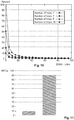
- Fig. 10 shows a dependency between the calculated reward value and RSSI, with the number of hops [1, 2, 5, 10].
- the minimum RSSI value RSSI min corresponds to - 100 dBm.
- the estimation values are distributed based on the hop count value from the source/destination, as well as the RSSI indicator. In that way, shorter routes with strong receive signal values are prioritized in the initial stage.
- a mechanism of reward generation plays an important role in the overall packet forwarding procedure, since it defines a degree of "flexibility" in the packet forwarding decisions. For example, if the reward values do not greatly vary between "good” and “bad” routes, the nodes will simply not use more optimal paths most of the time, instead, there is a high probability, that the packets will go in the most inefficient way, causing more packet losses and delays. In the same way, if a reward with a very small negative value will be generated after failing to receive the ACK message, the corresponding entry will decrease the estimation value for this route too slowly, so the succeeding packets will likely to be sent and lost along the same route with higher probability.
- a node receives a packet from a sending node, it calculates its average estimation value towards the destination address of the received packet and sends it back in an ACK message.
- the receiving node gets the average value, and divides it by the absolute RSSI value of the received message.
- This formula corresponds to the particular case of the initial Q values estimation, with the number of hops equal to 1, see formula (2).
- the sender node After receiving the ACK message, the sender node gets a general information about "how good is this neighbor for such destination", or "how good are the routes of this neighbor" towards the destination address. If the average estimation value is high, it means, that this neighbor is located closely to the destination, or it has many other good opportunities for forwarding the packet further. In contrast, if the average value is low, then either the neighbor is located farther from the destination, or it has too few forwarding opportunities for the given destination. In any case, the node, after receiving the ACK, updates its own route entry towards this neighbor with either a high or low reward value.
- Fig. 11 shows a better RRT (Route Recovery Time) value on the left side compared with a traditional routing scheme on the right side.
- ⁇ (x) function An example of the ⁇ (x) function is depicted in Fig. 12 , where x corresponds to the PLR value. On the left the ⁇ (x) function is shown for the k value of 0.5 and on the right side for the k value of 0.1.
- the proposed ⁇ (x) function defines the form of weights (probabilities) distribution of selecting the given action, depending on current PLR values which is the aim of this proposal.
- Fig. 13 shows a wireless mesh network with a number of participants.
- the direct links are illustrated with bold lines and the indirect links in the perspective of node A are illustrated with dotted lines.
- the source node has a list of estimated reward values to all direct neighbors towards the destination - Q(n). In the given example with 5 direct neighbors, the list size is equal to 5.
- the list of weights contains the following, here presented in the Python computer language dictionary format:
- Q n n1:50 .0 , n2:33 .3 , n3:11 .1 , n4:44 .0 , n5:51 .0
- the neighbor 5 will be selected most of the time - with 37 % of selection probability at the initial step 0.
- the PLR value may vary in an unpredicted pattern, thus, affecting the reliability of the established routes.
- the temperature ⁇ parameter is modified according to the formula above.
- the selection probabilities of neighbors 1 and 5 have decreased, while the chances of selecting the neighbors 2 and 3 have increased significantly.
- This modification of selection probabilities implies a selection of previously less-attractive routes, since the overall channel reliability had decreased drastically (from 0 to 20%). This shows, that a much more flexible route selection process is resulting under unreliable communication conditions, making sure that the alternative routes are explored more frequently.
- Fig. 14 illustrates the dependency between the neighbor selection probability and the PLR value under the constraints of the given example, with the initial estimated reward values equal to Q(n) as listed above. It is very evident, that there is a substantial difference in selection probability for the 5 neighbors when the PLR value is in the range of 0 to 20%.
- Route Error service messages RERR which are broadcast in the same way as the RREP-messages in the case of a route error detection. This behavior increases the number of service messages in the network drastically, thereby decreasing an overall performance of the network.
- the sender node waits for an incoming ACK message, containing the calculated reward value for choosing this neighbor.
- the sent packets could easily be lost.
- a sender node generates a negative reward in order to mark the selected route as less attractive for further transmissions.
- Fig. 15 shows a significant advantage in the Packet Loss Rate (PLR) value provided in per cent, comparing to a traditional routing scheme.
- PLR Packet Loss Rate
- a source node has selected and sent a data packet towards a neighbor. During a certain timeout, the source node has failed to receive an ACK message from the neighbor. Thus, the source node generates and applies a negative reward value to the chosen action, which at the first step is equal to -1.
- the negative reward value will be strongly amplified due to the exponential function as illustrated in Fig. 16 .
- negative values n are not defined even though the Fig. 16 shows the calculated results for such values.
- the proposed method and apparatus may be implemented in various forms of hardware, software, firmware, special purpose processors, or a combination thereof.
- Special purpose processors may include application specific integrated circuits (ASICs), reduced instruction set computers (RISCs) and/or field programmable gate arrays (FPGAs).
- ASICs application specific integrated circuits
- RISCs reduced instruction set computers
- FPGAs field programmable gate arrays
- the proposed method and apparatus is implemented as a combination of hardware and software.
- the software is preferably implemented as an application program tangibly embodied on a program storage device.
- the application program may be uploaded to, and executed by, a machine comprising any suitable architecture.
- the machine is implemented on a computer platform having hardware such as one or more central processing units (CPU), a random access memory (RAM), and input/output (I/O) interface(s).
- CPU central processing units
- RAM random access memory
- I/O input/output
- the computer platform also includes an operating system and microinstruction code.
- the various processes and functions described herein may either be part of the microinstruction code or part of the application program (or a combination thereof), which is executed via the operating system.
- various other peripheral devices may be connected to the computer platform such as an additional data storage device and a printing device.
- the elements shown in the figures may be implemented in various forms of hardware, software or combinations thereof. Preferably, these elements are implemented in a combination of hardware and software on one or more appropriately programmed general-purpose devices, which may include a processor, memory and input/output interfaces.
- general-purpose devices which may include a processor, memory and input/output interfaces.
- the phrase "coupled" is defined to mean directly connected to or indirectly connected with through one or more intermediate components. Such intermediate components may include both hardware and software based components.
Landscapes
- Engineering & Computer Science (AREA)
- Computer Networks & Wireless Communication (AREA)
- Signal Processing (AREA)
- Mobile Radio Communication Systems (AREA)
- Quality & Reliability (AREA)
- Physics & Mathematics (AREA)
- Electromagnetism (AREA)
- Data Exchanges In Wide-Area Networks (AREA)
Claims (14)
- Verfahren zur adaptiven Routenauswahl in einem Knoten eines drahtlosen Maschenkommunikationsnetzes, wobei eine Pfaderkennungsprozedur zum Ermitteln eines Pfades von einem Quellknoten (S) zu einem Zielknoten (D) durchgeführt wird, wobei eine Routenanfragenachricht, RREQ, von dem Quellknoten (S) ausgesendet wird, die in mehreren Hops von einem oder mehreren Knoten, die die Routenanfragenachricht, RREQ, empfangen, neuausgesendet wird, wobei der Zielknoten (D) eine Routenantwortnachricht, RREP, in Antwort auf den Empfang der Routenanfragenachricht, RREQ, aussendet, die in mehreren Hops von einem oder mehreren Knoten, die die Routenantwortnachricht, RREP, empfangen, neuausgesendet wird, wobei ein Knoten, der die Routenanfragenachricht, RREQ, oder die Routenantwortnachricht, RREP, empfangen hat, eine Routentabelle (RT) mit entsprechenden geschätzten Belohnungswerten (Qx) für die entsprechende Aussendeaktion aktualisiert, wobei eine verstärkende Lernprozedur in der Pfaderkennungsprozedur durchgeführt wird und dass eine Belohnungsfunktion verwendet wird, um die Belohnungswerte (Qx) in der Pfaderkennungsprozedur zu schätzen, die von einem Empfangssignalstärkenindikator, RSSI, der während Empfangs der Routenanfragenachricht, RREQ, oder Routenantwortnachricht, RREP, gemessen wird, und der Zahl an Hops, über die sich die Routenanfragenachricht, RREQ, oder die Routenantwortnachricht, RREP, in dem Netz verbreitet hat, abhängt, wobei die Belohnungsfunktion in der Form definiert ist:

- Verfahren nach Anspruch 1, wobei RSSI min in dBm-Werten gemessen wird, die in der Reichweite von [-100, 0] variieren, wo Null in dieser Reichweite dem stärksten empfangenen Signal entspricht.
- Verfahren nach einem der vorstehenden Ansprüche, wobei die Routing-Tabelle (RT) auch während einer Gesamtpaketweiterleitungsprozedur ohne der Pfaderkennungsprozedur aktualisiert wird, wobei eine verstärkende Lernprozedur auch für die Gesamtpaketweiterleitungsprozedur verwendet wird, wobei eine Rückmeldungsbelohnungsfunktion zum Schätzen von Belohnungswerten verwendet wird, wobei die Rückmeldungsbelohnungsfunktion in der Form definiert ist:

wo Qavg der berechnete geschätzte Durchschnittsbelohnungswert ist, der bei dem Sendeknoten in einer Rückmeldungsnachricht (ACK) für eine Übertragung von dem Sendeknoten empfangen wird. - Verfahren nach Anspruch 3, wobei Qavg gemäß der Formel berechnet wird

- Verfahren nach einem der vorstehenden Ansprüche, wobei ein Knoten eine Entscheidung des nächsten Hops bei einer Schrittzahl t auf Basis von Auswahlwahrscheinlichkeiten trifft, die mit einer Wahrscheinlichkeitsverteilungsfunktion Pt(a) berechnet werden, wo Pt(a) die Wahrscheinlichkeit ist, eine nächste HopÜbertragungsaktion a bei der Schrittzahl t zu wählen.
- Verfahren nach Anspruch 5, wobei die Wahrscheinlichkeitsverteilungsfunktion Pt(a) einer Gibbs-Boltzmann-Verteilungsfunktion gemäß der Formel entspricht:
 mit Qt(a) als den geschätzten Belohnungswert der nächsten HopÜbertragungsaktion a bei dem aktuellen Schritt tmit Qt(bi) als den geschätzten Belohnungswert einer alternativen nächsten HopÜbertragungsaktion bi bei dem aktuellen Schritt t undwobei τ ein positiver Temperaturparameter für die Gibbs-Boltzmann-Verteilung ist und i ein Indexwert ist.
 - Verfahren nach Anspruch 5 oder 6, wobei der Temperaturparameter adaptiv in Abhängigkeit von der aktuellen Paketverlustrate PLR definiert wird.
- Verfahren nach Anspruch 7, wobei der Temperaturparameter adaptiv gemäß der Formel definiert wird:

und t0 ein Anfangswert des Temperaturparameters ist, der aus der Reichweite [0,1000] genommen wird. - Verfahren nach Anspruch 8, wobei die aktuelle Paketverlustrate PLR gemäß der Formel berechnet wird

- Verfahren nach einem der vorstehenden Ansprüche, wobei in dem Fall, dass ein Paket verloren wird, der Sendeknoten einen negativen Belohnungswert erzeugt und ihn in dem Prozess verwendet, die Routentabelle (RT) zu aktualisieren, um die ausgewählte Route für weitere Übertragungen als weniger attraktiv zu markieren.
- Verfahren nach Anspruch 10, wobei eine exponentielle Zunahme in der negativen Belohnungswertberechnung angewendet wird, wenn aufeinanderfolgende Paketverluste auftreten.
- Verfahren nach Anspruch 11, wobei die exponentielle Zunahme des negativen Belohnungswerts gemäß der Formel berechnet wird:

- Einrichtung, die angepasst ist, die Schritte zur Routenauswahl in dem Verfahren nach einem der vorstehenden Ansprüche durchzuführen.
- Computerprogramm, das Programmcode umfasst, der, wenn er in einem Rechensystem abläuft, die Schritte zur adaptiven Routenauswahl nach dem Verfahren von einem der Ansprüche 1 bis 12 durchführt.
Applications Claiming Priority (1)
| Application Number | Priority Date | Filing Date | Title |
|---|---|---|---|
| PCT/EP2018/053015 WO2019154483A1 (en) | 2018-02-07 | 2018-02-07 | Method of adaptive route selection in a node of a wireless mesh communication network corresponding apparatus for performing the method of adaptive route selection and corresponding computer program |
Publications (2)
| Publication Number | Publication Date |
|---|---|
| EP3750348A1 EP3750348A1 (de) | 2020-12-16 |
| EP3750348B1 true EP3750348B1 (de) | 2021-11-24 |
Family
ID=61244562
Family Applications (1)
| Application Number | Title | Priority Date | Filing Date |
|---|---|---|---|
| EP18705854.0A Active EP3750348B1 (de) | 2018-02-07 | 2018-02-07 | Verfahren zur adaptiven routenauswahl in einem knoten eines drahtlosen netzkommunikationsnetzwerks entsprechenden vorrichtung zur durchführung des verfahrens der anpassenden routenauswahl und des entsprechenden computerprogramms |
Country Status (5)
| Country | Link |
|---|---|
| US (1) | US11277781B2 (de) |
| EP (1) | EP3750348B1 (de) |
| RU (1) | RU2757663C1 (de) |
| SG (1) | SG11202007312YA (de) |
| WO (1) | WO2019154483A1 (de) |
Families Citing this family (26)
| Publication number | Priority date | Publication date | Assignee | Title |
|---|---|---|---|---|
| US11570271B2 (en) * | 2019-04-10 | 2023-01-31 | Cisco Technology, Inc. | Differentiated smart sidecars in a service mesh |
| US11711310B2 (en) * | 2019-09-18 | 2023-07-25 | Tweenznet Ltd. | System and method for determining a network performance property in at least one network |
| US11716338B2 (en) | 2019-11-26 | 2023-08-01 | Tweenznet Ltd. | System and method for determining a file-access pattern and detecting ransomware attacks in at least one computer network |
| CN111148175B (zh) * | 2019-12-30 | 2023-02-07 | 沈阳理工大学 | 一种无线自组织网络中自适应路由修复方法 |
| CN111479306B (zh) * | 2020-04-02 | 2023-08-04 | 中国科学院上海微系统与信息技术研究所 | 一种基于Q-learning的飞行自组网QoS路由方法 |
| CN111522775B (zh) * | 2020-04-22 | 2023-05-16 | 合肥工业大学 | 片上网络路由装置及其控制方法 |
| CN111614559B (zh) * | 2020-05-15 | 2022-07-01 | 上海交通大学 | 实现全局优化aodv路由的方法、系统及介质 |
| US11765609B2 (en) * | 2020-06-12 | 2023-09-19 | Arizona Board Of Regents On Behalf Of Arizona State University | Systems and methods for consensus-based distributed graph spectral radius estimation |
| CN112261702B (zh) * | 2020-09-18 | 2022-09-16 | 北京邮电大学 | 基于位置的无线Mesh网络路由选路方法、装置和电子设备 |
| CN113207124B (zh) * | 2021-03-17 | 2022-11-01 | 北京邮电大学 | 一种车载自组网络数据包传送方法及装置 |
| CN113316168B (zh) * | 2021-05-06 | 2022-12-23 | 北京和峰科技有限公司 | 节点组网参数的修改方法、装置、存储介质及电子设备 |
| CN115412484A (zh) * | 2021-05-28 | 2022-11-29 | 中国石油天然气股份有限公司 | 数据传输装置、数据传输系统及数据传输方法 |
| CN113347682B (zh) * | 2021-06-07 | 2022-07-29 | 武汉特试特科技有限公司 | 一种具有自适应通讯避障能力的配电终端方法及设备 |
| CN113645589B (zh) * | 2021-07-09 | 2024-05-17 | 北京邮电大学 | 一种基于反事实策略梯度的无人机集群路由计算方法 |
| CN113766599B (zh) * | 2021-08-18 | 2024-04-26 | 国网河北省电力有限公司信息通信分公司 | 管廊无线传感网的中继节点选择的方法、装置及终端 |
| CN114024639B (zh) * | 2021-11-09 | 2024-01-05 | 成都天软信息技术有限公司 | 一种无线多跳网络中分布式信道分配方法 |
| CN114374989A (zh) * | 2021-11-30 | 2022-04-19 | 深圳市联洲国际技术有限公司 | 基于强化学习优化组网的方法、装置及系统 |
| US12501225B2 (en) | 2022-01-02 | 2025-12-16 | Poltorak Technologies Llc | Bluetooth enabled intercom with hearing aid functionality |
| CN115580578B (zh) * | 2022-09-01 | 2024-06-25 | 广东电网有限责任公司 | 一种面向多业务需求保障的路由选择方法及装置 |
| CN115866778A (zh) * | 2022-11-10 | 2023-03-28 | 广西壮族自治区通信产业服务有限公司工程分公司 | 一种基于物联网的通信资源调度方法、系统、设备及介质 |
| CN115811759A (zh) * | 2022-11-14 | 2023-03-17 | 浙江大学 | 一种基于水下传感器网络的路由方法 |
| CN116113008B (zh) * | 2022-12-05 | 2025-07-18 | 中国电子科技集团公司第十研究所 | 一种无人机自组织网络多智能体路由方法 |
| CN116074661B (zh) * | 2022-12-22 | 2023-08-22 | 北京邮电大学 | 基于q学习的自适应路由方法及相关设备 |
| CN119277519B (zh) * | 2024-12-09 | 2025-04-15 | 宁波麦思捷科技有限公司武汉分公司 | 一种应急救援快速自组网定位方法及系统 |
| CN120378353B (zh) * | 2025-06-26 | 2025-08-19 | 四川九洲电器集团有限责任公司 | 适于水声通信的矩阵编码及多跳链路状态感知的路由协议方法 |
| CN121262631B (zh) * | 2025-12-03 | 2026-03-10 | 三峡高科信息技术有限责任公司 | 一种无人机集群路由方法及系统 |
Family Cites Families (9)
| Publication number | Priority date | Publication date | Assignee | Title |
|---|---|---|---|---|
| WO2007001286A1 (en) * | 2005-06-24 | 2007-01-04 | Mitsubishi Electric Research Laboratories | Method for discovering routes in wireless communications networks |
| US20070019593A1 (en) * | 2005-06-30 | 2007-01-25 | Sarkar Prateep K | Apparatus, system and method capable of signal strength based dynamic source routing in Ad-Hoc wireless networks |
| US8149715B1 (en) | 2007-07-17 | 2012-04-03 | Marvell International Ltd. | Mesh network operations |
| EP2232772B1 (de) * | 2007-12-05 | 2012-06-06 | Thomson Licensing | Verfahren zur charakterisierung einer kommunikationsverbindung in einem kommunikationsnetzwerk |
| US8548465B2 (en) * | 2010-04-23 | 2013-10-01 | Apple Inc. | Methods and apparatus for providing dynamic information in a wireless information channel |
| DE102010049121B8 (de) | 2010-10-21 | 2014-06-18 | Hochschule Anhalt (Fh) | Verfahren zur Beleuchtung von Straßen, Wegen, Plätzen oder Räumen sowie Kommunikationseinheit zur Verwendung bei dem Verfahren |
| US9652720B2 (en) * | 2013-02-05 | 2017-05-16 | Cisco Technology, Inc. | Triggering on-the-fly requests for supervised learning of learning machines |
| US9930604B2 (en) * | 2013-10-09 | 2018-03-27 | Terranet Ab | Path finding in a mesh network |
| GB2558923B (en) * | 2017-01-20 | 2019-12-25 | Airties Kablosuz Iletism Sanayi Ve Disticaret As | Methods for link and path quality assessment |
-
2018
- 2018-02-07 EP EP18705854.0A patent/EP3750348B1/de active Active
- 2018-02-07 WO PCT/EP2018/053015 patent/WO2019154483A1/en not_active Ceased
- 2018-02-07 SG SG11202007312YA patent/SG11202007312YA/en unknown
- 2018-02-07 RU RU2020126567A patent/RU2757663C1/ru active
- 2018-02-07 US US16/967,137 patent/US11277781B2/en active Active
Also Published As
| Publication number | Publication date |
|---|---|
| EP3750348A1 (de) | 2020-12-16 |
| SG11202007312YA (en) | 2020-08-28 |
| US20200359296A1 (en) | 2020-11-12 |
| RU2757663C1 (ru) | 2021-10-20 |
| US11277781B2 (en) | 2022-03-15 |
| WO2019154483A1 (en) | 2019-08-15 |
Similar Documents
| Publication | Publication Date | Title |
|---|---|---|
| US11277781B2 (en) | Method of adaptive route selection in a node of a wireless mesh communication network corresponding apparatus for performing the method of adaptive route selection and corresponding computer program | |
| CN1886942B (zh) | 用于在ad hoc网中路由业务的方法和系统 | |
| CN1906898B (zh) | 用于在ad-hoc网中有效地路由的方法和系统 | |
| US7751332B2 (en) | Data routing method and apparatus | |
| US7843833B2 (en) | Detection and handling of lost messages during load-balancing routing protocols | |
| JP2008519531A (ja) | 無線通信ネットワークにおいて経路収束時間を短縮し、且つ最適な経路を探索するためのシステム及び方法 | |
| Roosta et al. | Probabilistic geographic routing protocol for ad hoc and sensor networks | |
| Thepvilojanapong et al. | Har: Hierarchy-based anycast routing protocol for wireless sensor networks | |
| Jahanbakhsh Gudakahriz et al. | Link life time and energy-aware stable routing for MANETs | |
| Yu et al. | An ad hoc routing protocol with multiple backup routes | |
| CN114339668B (zh) | 一种基于多维度量准则的olsr路由协议 | |
| Sivakumar et al. | A Survey on Investigating the Need for Intelligent Power‐Aware Load Balanced Routing Protocols for Handling Critical Links in MANETs | |
| Ahmad et al. | Efficient AODV routing based on traffic load and mobility of node in MANET | |
| Yen et al. | Flooding-limited for multi-constrained quality-of-service routing protocol in mobile ad hoc networks | |
| KR100664685B1 (ko) | 무선 네트워크에서의 점진적 패킷 포워딩 경로 결정 방법 | |
| Huang et al. | A routing algorithm based on cross-layer power control in wireless ad hoc networks | |
| Ranjan et al. | Optimized local route repair and congestion control in Mobile Ad hoc Network | |
| Wannawilai et al. | AOMDV with sufficient bandwidth aware | |
| Raju et al. | ZRP versus aodv and dsr: A comprehensive study on zrp performance on manets | |
| Liang et al. | An ad hoc on-demand routing protocol with high packet delivery fraction | |
| Hamamreh et al. | An intelligent routing protocol based on DYMO for MANET | |
| Hamatta et al. | Protocols in mobile ad-hoc networks: a review | |
| Patel et al. | Graph theoretic routing algorithm (GTRA) for mobile ad-hoc networks (MANET) | |
| Tabatabaei et al. | Routing and quality of service support for mobile ad hoc networks | |
| Sharma | Protocol Development Using Computational Intelligence in WSNs |
Legal Events
| Date | Code | Title | Description |
|---|---|---|---|
| STAA | Information on the status of an ep patent application or granted ep patent |
Free format text: STATUS: UNKNOWN |
|
| STAA | Information on the status of an ep patent application or granted ep patent |
Free format text: STATUS: THE INTERNATIONAL PUBLICATION HAS BEEN MADE |
|
| PUAI | Public reference made under article 153(3) epc to a published international application that has entered the european phase |
Free format text: ORIGINAL CODE: 0009012 |
|
| STAA | Information on the status of an ep patent application or granted ep patent |
Free format text: STATUS: REQUEST FOR EXAMINATION WAS MADE |
|
| 17P | Request for examination filed |
Effective date: 20200907 |
|
| AK | Designated contracting states |
Kind code of ref document: A1 Designated state(s): AL AT BE BG CH CY CZ DE DK EE ES FI FR GB GR HR HU IE IS IT LI LT LU LV MC MK MT NL NO PL PT RO RS SE SI SK SM TR |
|
| AX | Request for extension of the european patent |
Extension state: BA ME |
|
| DAV | Request for validation of the european patent (deleted) | ||
| DAX | Request for extension of the european patent (deleted) | ||
| GRAP | Despatch of communication of intention to grant a patent |
Free format text: ORIGINAL CODE: EPIDOSNIGR1 |
|
| STAA | Information on the status of an ep patent application or granted ep patent |
Free format text: STATUS: GRANT OF PATENT IS INTENDED |
|
| INTG | Intention to grant announced |
Effective date: 20210614 |
|
| GRAS | Grant fee paid |
Free format text: ORIGINAL CODE: EPIDOSNIGR3 |
|
| GRAA | (expected) grant |
Free format text: ORIGINAL CODE: 0009210 |
|
| STAA | Information on the status of an ep patent application or granted ep patent |
Free format text: STATUS: THE PATENT HAS BEEN GRANTED |
|
| AK | Designated contracting states |
Kind code of ref document: B1 Designated state(s): AL AT BE BG CH CY CZ DE DK EE ES FI FR GB GR HR HU IE IS IT LI LT LU LV MC MK MT NL NO PL PT RO RS SE SI SK SM TR |
|
| REG | Reference to a national code |
Ref country code: GB Ref legal event code: FG4D |
|
| REG | Reference to a national code |
Ref country code: AT Ref legal event code: REF Ref document number: 1450822 Country of ref document: AT Kind code of ref document: T Effective date: 20211215 |
|
| REG | Reference to a national code |
Ref country code: DE Ref legal event code: R096 Ref document number: 602018027116 Country of ref document: DE |
|
| REG | Reference to a national code |
Ref country code: IE Ref legal event code: FG4D |
|
| REG | Reference to a national code |
Ref country code: NL Ref legal event code: FP |
|
| REG | Reference to a national code |
Ref country code: LT Ref legal event code: MG9D |
|
| REG | Reference to a national code |
Ref country code: AT Ref legal event code: MK05 Ref document number: 1450822 Country of ref document: AT Kind code of ref document: T Effective date: 20211124 |
|
| PG25 | Lapsed in a contracting state [announced via postgrant information from national office to epo] |
Ref country code: RS Free format text: LAPSE BECAUSE OF FAILURE TO SUBMIT A TRANSLATION OF THE DESCRIPTION OR TO PAY THE FEE WITHIN THE PRESCRIBED TIME-LIMIT Effective date: 20211124 Ref country code: LT Free format text: LAPSE BECAUSE OF FAILURE TO SUBMIT A TRANSLATION OF THE DESCRIPTION OR TO PAY THE FEE WITHIN THE PRESCRIBED TIME-LIMIT Effective date: 20211124 Ref country code: FI Free format text: LAPSE BECAUSE OF FAILURE TO SUBMIT A TRANSLATION OF THE DESCRIPTION OR TO PAY THE FEE WITHIN THE PRESCRIBED TIME-LIMIT Effective date: 20211124 Ref country code: BG Free format text: LAPSE BECAUSE OF FAILURE TO SUBMIT A TRANSLATION OF THE DESCRIPTION OR TO PAY THE FEE WITHIN THE PRESCRIBED TIME-LIMIT Effective date: 20220224 Ref country code: AT Free format text: LAPSE BECAUSE OF FAILURE TO SUBMIT A TRANSLATION OF THE DESCRIPTION OR TO PAY THE FEE WITHIN THE PRESCRIBED TIME-LIMIT Effective date: 20211124 |
|
| PG25 | Lapsed in a contracting state [announced via postgrant information from national office to epo] |
Ref country code: IS Free format text: LAPSE BECAUSE OF FAILURE TO SUBMIT A TRANSLATION OF THE DESCRIPTION OR TO PAY THE FEE WITHIN THE PRESCRIBED TIME-LIMIT Effective date: 20220324 Ref country code: SE Free format text: LAPSE BECAUSE OF FAILURE TO SUBMIT A TRANSLATION OF THE DESCRIPTION OR TO PAY THE FEE WITHIN THE PRESCRIBED TIME-LIMIT Effective date: 20211124 Ref country code: PT Free format text: LAPSE BECAUSE OF FAILURE TO SUBMIT A TRANSLATION OF THE DESCRIPTION OR TO PAY THE FEE WITHIN THE PRESCRIBED TIME-LIMIT Effective date: 20220324 Ref country code: PL Free format text: LAPSE BECAUSE OF FAILURE TO SUBMIT A TRANSLATION OF THE DESCRIPTION OR TO PAY THE FEE WITHIN THE PRESCRIBED TIME-LIMIT Effective date: 20211124 Ref country code: NO Free format text: LAPSE BECAUSE OF FAILURE TO SUBMIT A TRANSLATION OF THE DESCRIPTION OR TO PAY THE FEE WITHIN THE PRESCRIBED TIME-LIMIT Effective date: 20220224 Ref country code: LV Free format text: LAPSE BECAUSE OF FAILURE TO SUBMIT A TRANSLATION OF THE DESCRIPTION OR TO PAY THE FEE WITHIN THE PRESCRIBED TIME-LIMIT Effective date: 20211124 Ref country code: HR Free format text: LAPSE BECAUSE OF FAILURE TO SUBMIT A TRANSLATION OF THE DESCRIPTION OR TO PAY THE FEE WITHIN THE PRESCRIBED TIME-LIMIT Effective date: 20211124 Ref country code: GR Free format text: LAPSE BECAUSE OF FAILURE TO SUBMIT A TRANSLATION OF THE DESCRIPTION OR TO PAY THE FEE WITHIN THE PRESCRIBED TIME-LIMIT Effective date: 20220225 |
|
| PG25 | Lapsed in a contracting state [announced via postgrant information from national office to epo] |
Ref country code: SM Free format text: LAPSE BECAUSE OF FAILURE TO SUBMIT A TRANSLATION OF THE DESCRIPTION OR TO PAY THE FEE WITHIN THE PRESCRIBED TIME-LIMIT Effective date: 20211124 Ref country code: SK Free format text: LAPSE BECAUSE OF FAILURE TO SUBMIT A TRANSLATION OF THE DESCRIPTION OR TO PAY THE FEE WITHIN THE PRESCRIBED TIME-LIMIT Effective date: 20211124 Ref country code: RO Free format text: LAPSE BECAUSE OF FAILURE TO SUBMIT A TRANSLATION OF THE DESCRIPTION OR TO PAY THE FEE WITHIN THE PRESCRIBED TIME-LIMIT Effective date: 20211124 Ref country code: ES Free format text: LAPSE BECAUSE OF FAILURE TO SUBMIT A TRANSLATION OF THE DESCRIPTION OR TO PAY THE FEE WITHIN THE PRESCRIBED TIME-LIMIT Effective date: 20211124 Ref country code: EE Free format text: LAPSE BECAUSE OF FAILURE TO SUBMIT A TRANSLATION OF THE DESCRIPTION OR TO PAY THE FEE WITHIN THE PRESCRIBED TIME-LIMIT Effective date: 20211124 Ref country code: DK Free format text: LAPSE BECAUSE OF FAILURE TO SUBMIT A TRANSLATION OF THE DESCRIPTION OR TO PAY THE FEE WITHIN THE PRESCRIBED TIME-LIMIT Effective date: 20211124 Ref country code: CZ Free format text: LAPSE BECAUSE OF FAILURE TO SUBMIT A TRANSLATION OF THE DESCRIPTION OR TO PAY THE FEE WITHIN THE PRESCRIBED TIME-LIMIT Effective date: 20211124 |
|
| REG | Reference to a national code |
Ref country code: DE Ref legal event code: R097 Ref document number: 602018027116 Country of ref document: DE |
|
| PG25 | Lapsed in a contracting state [announced via postgrant information from national office to epo] |
Ref country code: MC Free format text: LAPSE BECAUSE OF FAILURE TO SUBMIT A TRANSLATION OF THE DESCRIPTION OR TO PAY THE FEE WITHIN THE PRESCRIBED TIME-LIMIT Effective date: 20211124 |
|
| PLBE | No opposition filed within time limit |
Free format text: ORIGINAL CODE: 0009261 |
|
| STAA | Information on the status of an ep patent application or granted ep patent |
Free format text: STATUS: NO OPPOSITION FILED WITHIN TIME LIMIT |
|
| REG | Reference to a national code |
Ref country code: CH Ref legal event code: PL |
|
| REG | Reference to a national code |
Ref country code: BE Ref legal event code: MM Effective date: 20220228 |
|
| PG25 | Lapsed in a contracting state [announced via postgrant information from national office to epo] |
Ref country code: LU Free format text: LAPSE BECAUSE OF NON-PAYMENT OF DUE FEES Effective date: 20220207 Ref country code: AL Free format text: LAPSE BECAUSE OF FAILURE TO SUBMIT A TRANSLATION OF THE DESCRIPTION OR TO PAY THE FEE WITHIN THE PRESCRIBED TIME-LIMIT Effective date: 20211124 |
|
| 26N | No opposition filed |
Effective date: 20220825 |
|
| PG25 | Lapsed in a contracting state [announced via postgrant information from national office to epo] |
Ref country code: SI Free format text: LAPSE BECAUSE OF FAILURE TO SUBMIT A TRANSLATION OF THE DESCRIPTION OR TO PAY THE FEE WITHIN THE PRESCRIBED TIME-LIMIT Effective date: 20211124 |
|
| PG25 | Lapsed in a contracting state [announced via postgrant information from national office to epo] |
Ref country code: LI Free format text: LAPSE BECAUSE OF NON-PAYMENT OF DUE FEES Effective date: 20220228 Ref country code: IE Free format text: LAPSE BECAUSE OF NON-PAYMENT OF DUE FEES Effective date: 20220207 Ref country code: CH Free format text: LAPSE BECAUSE OF NON-PAYMENT OF DUE FEES Effective date: 20220228 |
|
| PG25 | Lapsed in a contracting state [announced via postgrant information from national office to epo] |
Ref country code: BE Free format text: LAPSE BECAUSE OF NON-PAYMENT OF DUE FEES Effective date: 20220228 |
|
| PG25 | Lapsed in a contracting state [announced via postgrant information from national office to epo] |
Ref country code: IT Free format text: LAPSE BECAUSE OF FAILURE TO SUBMIT A TRANSLATION OF THE DESCRIPTION OR TO PAY THE FEE WITHIN THE PRESCRIBED TIME-LIMIT Effective date: 20211124 |
|
| PG25 | Lapsed in a contracting state [announced via postgrant information from national office to epo] |
Ref country code: MK Free format text: LAPSE BECAUSE OF FAILURE TO SUBMIT A TRANSLATION OF THE DESCRIPTION OR TO PAY THE FEE WITHIN THE PRESCRIBED TIME-LIMIT Effective date: 20211124 Ref country code: CY Free format text: LAPSE BECAUSE OF FAILURE TO SUBMIT A TRANSLATION OF THE DESCRIPTION OR TO PAY THE FEE WITHIN THE PRESCRIBED TIME-LIMIT Effective date: 20211124 |
|
| PG25 | Lapsed in a contracting state [announced via postgrant information from national office to epo] |
Ref country code: HU Free format text: LAPSE BECAUSE OF FAILURE TO SUBMIT A TRANSLATION OF THE DESCRIPTION OR TO PAY THE FEE WITHIN THE PRESCRIBED TIME-LIMIT; INVALID AB INITIO Effective date: 20180207 |
|
| PG25 | Lapsed in a contracting state [announced via postgrant information from national office to epo] |
Ref country code: MT Free format text: LAPSE BECAUSE OF FAILURE TO SUBMIT A TRANSLATION OF THE DESCRIPTION OR TO PAY THE FEE WITHIN THE PRESCRIBED TIME-LIMIT Effective date: 20211124 |
|
| PGFP | Annual fee paid to national office [announced via postgrant information from national office to epo] |
Ref country code: NL Payment date: 20250226 Year of fee payment: 8 |
|
| PGFP | Annual fee paid to national office [announced via postgrant information from national office to epo] |
Ref country code: FR Payment date: 20250220 Year of fee payment: 8 |
|
| PG25 | Lapsed in a contracting state [announced via postgrant information from national office to epo] |
Ref country code: TR Free format text: LAPSE BECAUSE OF FAILURE TO SUBMIT A TRANSLATION OF THE DESCRIPTION OR TO PAY THE FEE WITHIN THE PRESCRIBED TIME-LIMIT Effective date: 20211124 |
|
| REG | Reference to a national code |
Ref country code: DE Ref legal event code: R081 Ref document number: 602018027116 Country of ref document: DE Owner name: SMARTLIGHTING TECHNOLOGIES UG (HAFTUNGSBESCHRA, DE Free format text: FORMER OWNER: HOCHSCHULE ANHALT, 06366 KOETHEN, DE |
|
| PGFP | Annual fee paid to national office [announced via postgrant information from national office to epo] |
Ref country code: GB Payment date: 20260227 Year of fee payment: 9 |
|
| PGFP | Annual fee paid to national office [announced via postgrant information from national office to epo] |
Ref country code: DE Payment date: 20260302 Year of fee payment: 9 |