EP3745339B1 - Verfahren zum implantieren von werbung in video und computervorrichtung - Google Patents
Verfahren zum implantieren von werbung in video und computervorrichtung Download PDFInfo
- Publication number
- EP3745339B1 EP3745339B1 EP19750801.3A EP19750801A EP3745339B1 EP 3745339 B1 EP3745339 B1 EP 3745339B1 EP 19750801 A EP19750801 A EP 19750801A EP 3745339 B1 EP3745339 B1 EP 3745339B1
- Authority
- EP
- European Patent Office
- Prior art keywords
- image
- print advertisement
- advertisement
- layer
- images
- Prior art date
- Legal status (The legal status is an assumption and is not a legal conclusion. Google has not performed a legal analysis and makes no representation as to the accuracy of the status listed.)
- Active
Links
Images



Classifications
-
- G—PHYSICS
- G06—COMPUTING OR CALCULATING; COUNTING
- G06F—ELECTRIC DIGITAL DATA PROCESSING
- G06F17/00—Digital computing or data processing equipment or methods, specially adapted for specific functions
- G06F17/10—Complex mathematical operations
- G06F17/15—Correlation function computation including computation of convolution operations
-
- G—PHYSICS
- G06—COMPUTING OR CALCULATING; COUNTING
- G06N—COMPUTING ARRANGEMENTS BASED ON SPECIFIC COMPUTATIONAL MODELS
- G06N3/00—Computing arrangements based on biological models
- G06N3/02—Neural networks
- G06N3/04—Architecture, e.g. interconnection topology
- G06N3/045—Combinations of networks
-
- G—PHYSICS
- G06—COMPUTING OR CALCULATING; COUNTING
- G06N—COMPUTING ARRANGEMENTS BASED ON SPECIFIC COMPUTATIONAL MODELS
- G06N3/00—Computing arrangements based on biological models
- G06N3/02—Neural networks
- G06N3/04—Architecture, e.g. interconnection topology
- G06N3/0464—Convolutional networks [CNN, ConvNet]
-
- G—PHYSICS
- G06—COMPUTING OR CALCULATING; COUNTING
- G06N—COMPUTING ARRANGEMENTS BASED ON SPECIFIC COMPUTATIONAL MODELS
- G06N3/00—Computing arrangements based on biological models
- G06N3/02—Neural networks
- G06N3/04—Architecture, e.g. interconnection topology
- G06N3/047—Probabilistic or stochastic networks
-
- G—PHYSICS
- G06—COMPUTING OR CALCULATING; COUNTING
- G06N—COMPUTING ARRANGEMENTS BASED ON SPECIFIC COMPUTATIONAL MODELS
- G06N3/00—Computing arrangements based on biological models
- G06N3/02—Neural networks
- G06N3/04—Architecture, e.g. interconnection topology
- G06N3/0475—Generative networks
-
- G—PHYSICS
- G06—COMPUTING OR CALCULATING; COUNTING
- G06N—COMPUTING ARRANGEMENTS BASED ON SPECIFIC COMPUTATIONAL MODELS
- G06N3/00—Computing arrangements based on biological models
- G06N3/02—Neural networks
- G06N3/08—Learning methods
- G06N3/084—Backpropagation, e.g. using gradient descent
-
- G—PHYSICS
- G06—COMPUTING OR CALCULATING; COUNTING
- G06N—COMPUTING ARRANGEMENTS BASED ON SPECIFIC COMPUTATIONAL MODELS
- G06N3/00—Computing arrangements based on biological models
- G06N3/02—Neural networks
- G06N3/08—Learning methods
- G06N3/09—Supervised learning
-
- G—PHYSICS
- G06—COMPUTING OR CALCULATING; COUNTING
- G06N—COMPUTING ARRANGEMENTS BASED ON SPECIFIC COMPUTATIONAL MODELS
- G06N3/00—Computing arrangements based on biological models
- G06N3/02—Neural networks
- G06N3/08—Learning methods
- G06N3/094—Adversarial learning
-
- G—PHYSICS
- G06—COMPUTING OR CALCULATING; COUNTING
- G06N—COMPUTING ARRANGEMENTS BASED ON SPECIFIC COMPUTATIONAL MODELS
- G06N3/00—Computing arrangements based on biological models
- G06N3/02—Neural networks
- G06N3/08—Learning methods
- G06N3/096—Transfer learning
-
- G—PHYSICS
- G06—COMPUTING OR CALCULATING; COUNTING
- G06Q—INFORMATION AND COMMUNICATION TECHNOLOGY [ICT] SPECIALLY ADAPTED FOR ADMINISTRATIVE, COMMERCIAL, FINANCIAL, MANAGERIAL OR SUPERVISORY PURPOSES; SYSTEMS OR METHODS SPECIALLY ADAPTED FOR ADMINISTRATIVE, COMMERCIAL, FINANCIAL, MANAGERIAL OR SUPERVISORY PURPOSES, NOT OTHERWISE PROVIDED FOR
- G06Q30/00—Commerce
- G06Q30/02—Marketing; Price estimation or determination; Fundraising
- G06Q30/0241—Advertisements
-
- G—PHYSICS
- G06—COMPUTING OR CALCULATING; COUNTING
- G06Q—INFORMATION AND COMMUNICATION TECHNOLOGY [ICT] SPECIALLY ADAPTED FOR ADMINISTRATIVE, COMMERCIAL, FINANCIAL, MANAGERIAL OR SUPERVISORY PURPOSES; SYSTEMS OR METHODS SPECIALLY ADAPTED FOR ADMINISTRATIVE, COMMERCIAL, FINANCIAL, MANAGERIAL OR SUPERVISORY PURPOSES, NOT OTHERWISE PROVIDED FOR
- G06Q30/00—Commerce
- G06Q30/02—Marketing; Price estimation or determination; Fundraising
- G06Q30/0241—Advertisements
- G06Q30/0276—Advertisement creation
-
- G—PHYSICS
- G06—COMPUTING OR CALCULATING; COUNTING
- G06T—IMAGE DATA PROCESSING OR GENERATION, IN GENERAL
- G06T7/00—Image analysis
- G06T7/0002—Inspection of images, e.g. flaw detection
-
- G—PHYSICS
- G06—COMPUTING OR CALCULATING; COUNTING
- G06T—IMAGE DATA PROCESSING OR GENERATION, IN GENERAL
- G06T7/00—Image analysis
- G06T7/20—Analysis of motion
- G06T7/277—Analysis of motion involving stochastic approaches, e.g. using Kalman filters
-
- G—PHYSICS
- G06—COMPUTING OR CALCULATING; COUNTING
- G06V—IMAGE OR VIDEO RECOGNITION OR UNDERSTANDING
- G06V10/00—Arrangements for image or video recognition or understanding
- G06V10/70—Arrangements for image or video recognition or understanding using pattern recognition or machine learning
- G06V10/764—Arrangements for image or video recognition or understanding using pattern recognition or machine learning using classification, e.g. of video objects
-
- G—PHYSICS
- G06—COMPUTING OR CALCULATING; COUNTING
- G06V—IMAGE OR VIDEO RECOGNITION OR UNDERSTANDING
- G06V10/00—Arrangements for image or video recognition or understanding
- G06V10/70—Arrangements for image or video recognition or understanding using pattern recognition or machine learning
- G06V10/82—Arrangements for image or video recognition or understanding using pattern recognition or machine learning using neural networks
-
- G—PHYSICS
- G06—COMPUTING OR CALCULATING; COUNTING
- G06V—IMAGE OR VIDEO RECOGNITION OR UNDERSTANDING
- G06V20/00—Scenes; Scene-specific elements
- G06V20/40—Scenes; Scene-specific elements in video content
- G06V20/46—Extracting features or characteristics from the video content, e.g. video fingerprints, representative shots or key frames
-
- H—ELECTRICITY
- H04—ELECTRIC COMMUNICATION TECHNIQUE
- H04N—PICTORIAL COMMUNICATION, e.g. TELEVISION
- H04N21/00—Selective content distribution, e.g. interactive television or video on demand [VOD]
- H04N21/20—Servers specifically adapted for the distribution of content, e.g. VOD servers; Operations thereof
- H04N21/23—Processing of content or additional data; Elementary server operations; Server middleware
- H04N21/234—Processing of video elementary streams, e.g. splicing of video streams or manipulating encoded video stream scene graphs
- H04N21/23418—Processing of video elementary streams, e.g. splicing of video streams or manipulating encoded video stream scene graphs involving operations for analysing video streams, e.g. detecting features or characteristics
-
- H—ELECTRICITY
- H04—ELECTRIC COMMUNICATION TECHNIQUE
- H04N—PICTORIAL COMMUNICATION, e.g. TELEVISION
- H04N21/00—Selective content distribution, e.g. interactive television or video on demand [VOD]
- H04N21/20—Servers specifically adapted for the distribution of content, e.g. VOD servers; Operations thereof
- H04N21/23—Processing of content or additional data; Elementary server operations; Server middleware
- H04N21/234—Processing of video elementary streams, e.g. splicing of video streams or manipulating encoded video stream scene graphs
- H04N21/23424—Processing of video elementary streams, e.g. splicing of video streams or manipulating encoded video stream scene graphs involving splicing one content stream with another content stream, e.g. for inserting or substituting an advertisement
-
- H—ELECTRICITY
- H04—ELECTRIC COMMUNICATION TECHNIQUE
- H04N—PICTORIAL COMMUNICATION, e.g. TELEVISION
- H04N21/00—Selective content distribution, e.g. interactive television or video on demand [VOD]
- H04N21/20—Servers specifically adapted for the distribution of content, e.g. VOD servers; Operations thereof
- H04N21/25—Management operations performed by the server for facilitating the content distribution or administrating data related to end-users or client devices, e.g. end-user or client device authentication, learning user preferences for recommending movies
- H04N21/266—Channel or content management, e.g. generation and management of keys and entitlement messages in a conditional access system, merging a VOD unicast channel into a multicast channel
- H04N21/2668—Creating a channel for a dedicated end-user group, e.g. insertion of targeted commercials based on end-user profiles
-
- H—ELECTRICITY
- H04—ELECTRIC COMMUNICATION TECHNIQUE
- H04N—PICTORIAL COMMUNICATION, e.g. TELEVISION
- H04N21/00—Selective content distribution, e.g. interactive television or video on demand [VOD]
- H04N21/40—Client devices specifically adapted for the reception of or interaction with content, e.g. set-top-box [STB]; Operations thereof
- H04N21/43—Processing of content or additional data, e.g. demultiplexing additional data from a digital video stream; Elementary client operations, e.g. monitoring of home network or synchronising decoder's clock; Client middleware
- H04N21/44—Processing of video elementary streams, e.g. splicing a video clip retrieved from local storage with an incoming video stream or rendering scenes according to encoded video stream scene graphs
- H04N21/44008—Processing of video elementary streams, e.g. splicing a video clip retrieved from local storage with an incoming video stream or rendering scenes according to encoded video stream scene graphs involving operations for analysing video streams, e.g. detecting features or characteristics in the video stream
-
- H—ELECTRICITY
- H04—ELECTRIC COMMUNICATION TECHNIQUE
- H04N—PICTORIAL COMMUNICATION, e.g. TELEVISION
- H04N21/00—Selective content distribution, e.g. interactive television or video on demand [VOD]
- H04N21/40—Client devices specifically adapted for the reception of or interaction with content, e.g. set-top-box [STB]; Operations thereof
- H04N21/43—Processing of content or additional data, e.g. demultiplexing additional data from a digital video stream; Elementary client operations, e.g. monitoring of home network or synchronising decoder's clock; Client middleware
- H04N21/44—Processing of video elementary streams, e.g. splicing a video clip retrieved from local storage with an incoming video stream or rendering scenes according to encoded video stream scene graphs
- H04N21/44016—Processing of video elementary streams, e.g. splicing a video clip retrieved from local storage with an incoming video stream or rendering scenes according to encoded video stream scene graphs involving splicing one content stream with another content stream, e.g. for substituting a video clip
-
- H—ELECTRICITY
- H04—ELECTRIC COMMUNICATION TECHNIQUE
- H04N—PICTORIAL COMMUNICATION, e.g. TELEVISION
- H04N21/00—Selective content distribution, e.g. interactive television or video on demand [VOD]
- H04N21/80—Generation or processing of content or additional data by content creator independently of the distribution process; Content per se
- H04N21/81—Monomedia components thereof
- H04N21/812—Monomedia components thereof involving advertisement data
-
- G—PHYSICS
- G06—COMPUTING OR CALCULATING; COUNTING
- G06T—IMAGE DATA PROCESSING OR GENERATION, IN GENERAL
- G06T2207/00—Indexing scheme for image analysis or image enhancement
- G06T2207/10—Image acquisition modality
- G06T2207/10016—Video; Image sequence
-
- G—PHYSICS
- G06—COMPUTING OR CALCULATING; COUNTING
- G06T—IMAGE DATA PROCESSING OR GENERATION, IN GENERAL
- G06T2207/00—Indexing scheme for image analysis or image enhancement
- G06T2207/20—Special algorithmic details
- G06T2207/20081—Training; Learning
-
- G—PHYSICS
- G06—COMPUTING OR CALCULATING; COUNTING
- G06T—IMAGE DATA PROCESSING OR GENERATION, IN GENERAL
- G06T2207/00—Indexing scheme for image analysis or image enhancement
- G06T2207/20—Special algorithmic details
- G06T2207/20084—Artificial neural networks [ANN]
-
- G—PHYSICS
- G06—COMPUTING OR CALCULATING; COUNTING
- G06T—IMAGE DATA PROCESSING OR GENERATION, IN GENERAL
- G06T2207/00—Indexing scheme for image analysis or image enhancement
- G06T2207/20—Special algorithmic details
- G06T2207/20112—Image segmentation details
- G06T2207/20164—Salient point detection; Corner detection
-
- G—PHYSICS
- G06—COMPUTING OR CALCULATING; COUNTING
- G06T—IMAGE DATA PROCESSING OR GENERATION, IN GENERAL
- G06T2207/00—Indexing scheme for image analysis or image enhancement
- G06T2207/20—Special algorithmic details
- G06T2207/20212—Image combination
- G06T2207/20221—Image fusion; Image merging
Definitions
- This application relates to the field of video processing technologies, and in particular, to a method for embedding an advertisement in a video and a computer device.
- a pre-movie advert is played at the beginning of a movie, or an advertisement is embedded in a video picture when the movie is paused, which is relatively obtrusive and blunt, is antipathetic to a user, and has a low advertising conversion rate (the advertising conversion rate refers to a conversion rate of netizens who enter a promotion website by clicking an advertisement).
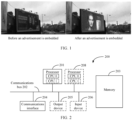
- FIG. 1 A left figure in FIG. 1 is an original video picture, and a right figure is a picture in which a print advertisement is embedded.
- an embedded advertisement has also experienced a relatively primitive stage to a relatively intelligent stage of development.
- an advertisement board and a poster are usually placed in a shooting scenario, and a shot is reserved.
- problems such as advertiser material selection, advertisement position selection, and abrupt market change, an originally existing advertisement needs to be replaced. Therefore, some methods for performing advertisement replacement based on a simple feature parameter after a placeholder is preset in a video or an advertisement position is manually identified are proposed.
- some methods tend to automatically implement advertisement replacement.
- a candidate advertisement insertion position is simply determined based on preset attribute features such as a shape, a size, a color, and duration of an area in a video, and the advertisement position is stitched and rendered in a manner such as template matching.
- preset attribute features such as a shape, a size, a color, and duration of an area in a video
- the advertisement position is stitched and rendered in a manner such as template matching.
- US 2016/0212455 A1 discloses the idea of adaptively embedding advertising content into media content.
- a candidate content object within the media content is identified to be replaced with an advertisement. It is further suggested that the visual characteristics of the selected advertisment is adapted to match with those of the media content.
- CN 105 657 446 A discloses a method for detecting attached advertisement in a video.
- CHANG C H ET AL "Virtual spotlighted advertising for tennis videos", JOURNAL OF VISUAL COMMUNICATION AND IMAGE REPRESENTATION, ACADEMIC PRESS, INC, US, vol. 21, no. 7, 1 October 2010 (2010-10-01), pages 595-612, ISSN: 1047-3203 , discloses a virtual virtual spotlighted advertising system for tennis videos.
- the system automatically detects the candidate insertion points in both temporal and spatial domains and estimates the most effective region for visual communication. Then, the harmonically re-colored advertisements with foveation model based non-uniform transparency, are projected onto the court.
- FIG. 2 is a schematic diagram of a computer device according to an embodiment of the present invention.
- a computer device 200 includes at least one processor 201, a communications bus 202, a memory 203, and at least one communications interface 204.
- the processor 201 may be a general-purpose central processing unit (Central Processing Unit, CPU), a microprocessor, an application-specific integrated circuit (Application-Specific Integrated Circuit, ASIC), or one or more integrated circuits configured to control execution of programs of the solution of this invention.
- CPU Central Processing Unit
- ASIC Application-Specific Integrated Circuit
- the communications bus 202 may include a channel for transmitting information between the foregoing components.
- the communications interface 204 uses any transceiver-like apparatus to communicate with another device or a communications network, such as an Ethernet, a radio access network (Radio Access Network, RAN), or a wireless local area network (Wireless Local Area Networks, WLAN).
- RAN Radio Access Network
- WLAN Wireless Local Area Networks
- the memory 203 may be a read-only memory (Read-Only Memory, ROM) or another type of static storage device that can store static information and a static instruction, a random access memory (Random Access Memory, RAM) or another type of dynamic storage device that can store information and an instruction, an electrically erasable programmable read-only memory (Electrically Erasable Programmable Read-Only Memory, EEPROM), a compact disc read-only memory (Compact Disc Read-Only Memory, CD-ROM) or another compact disc storage, an optical disc storage (including a compact disc, a laser disc, an optical disc, a digital versatile disc, a Blu-ray disc, and the like), a magnetic disk storage medium or another magnetic storage device, or any other medium that can be configured to carry or store expected program code in a form of an instruction or a data structure and that can be accessed by a computer.
- the memory may exist independently, and is connected to the processor by using the bus.
- the memory may alternatively be integrated with the
- the memory 203 is configured to store program code used to execute the solution of the present invention, and the processor 201 controls execution of the program code.
- the processor 201 is configured to execute the program code stored in the memory 203.
- the processor 201 may include one or more CPUs, for example, a CPU 0 and a CPU 1 in FIG. 2 .
- the computer device 200 may include a plurality of processors, for example, the processor 201 and a processor 208 in FIG. 2 .
- Each of the processors may be a single-core (single-CPU) processor, or a multicore (multi-CPU) processor.
- the processor herein may be one or more devices, circuits, and/or processing cores configured to process data (for example, a computer program instruction).
- the computer device 200 may further include an output device 205 and an input device 206.
- the output device 205 communicates with the processor 201, and may display information in a plurality of manners.
- the output device 205 may be a liquid crystal display (Liquid Crystal Display, LCD), a light emitting diode (Light Emitting Diode, LED) display device, a cathode ray tube (Cathode Ray Tube, CRT) display device, a projector (projector), an audio output module, or the like.
- the input device 206 communicates with the processor 201, and may receive user input in a plurality of manners.
- the input device 206 may be a mouse, a keyboard, a touchscreen device, a sensing device, or the like.
- the computer device 200 may be a general-purpose computer device or a special-purpose computer device. During specific implementation, the computer device 200 may be a desktop computer, a portable computer, a network server, a wireless terminal device, a communications device, an embedded device, or a device having a structure similar to that in FIG. 2 . A type of the computer device 200 is not limited in this embodiment of the present invention.
- the method for embedding an advertisement in a video includes but is not limited to the following steps.
- the computer device determines a target image, where the target image is an image that is in M frames of images of a target video and that includes a first print advertisement, and M is a positive integer.
- the first print advertisement is any print advertisement.
- the first print advertisement may also be referred to as an old print advertisement, and a to-be-embedded second print advertisement may be referred to as a new print advertisement.
- the print advertisement herein is an advertisement in any quadrilateral shape, and a location and a size of an area may be determined by using four coordinates: an upper left corner, an upper right corner, a lower left corner, and a lower right corner. Advertisement content is not specifically limited to a quadrilateral shape, and may be in any shape.
- the computer device determines a target image includes: The computer device recognizes, based on a first convolutional neural network model, whether an i th frame of image in the M frames of images includes the first print advertisement; and if the i th frame of image includes the first print advertisement, the computer device determines that the i th frame of image is the target image, where i is a positive integer ranging from 1 to M successively. That an image includes a print advertisement means that there is a print advertisement in the image.
- the target video is a video file in which an advertisement needs to be embedded.
- the M frames of images may be several key frames (key frame) in a plurality of frames of images included in the target video.
- a video compression domain corresponding to the target video includes I frames, B frames, and P frames, and the M frames of images are the I frames.
- the M frames of images may alternatively be several frames of images selected from the target video at a specified interval.
- the M frames of images may alternatively be all frames included in the target video. This is not specifically limited in this embodiment of the present invention.
- the following describes how to recognize/detect whether a frame of image includes advertisement content in this embodiment of the present invention.
- classification is used to implement to detect whether an image includes a print advertisement.
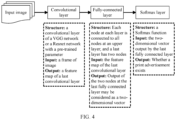
- a structure of a designed first convolutional neural network model is shown in FIG. 4 .
- the first convolutional neural network model includes a convolutional layer, a fully connected layer, and a Softmax layer. There is at least one convolutional layer, and there is at least one fully connected layer.
- the convolutional layer uses an idea of transfer learning, and a structure of the convolutional layer may be a convolutional layer part of a VGG network, a Resnet network, or another network that has a pre-trained network parameter.
- a convolutional layer of a VGG-16 network is used as an example: All network structures from a first convolutional layer (that includes 64 3 x 3 convolution kernels, and can generate 64 feature maps) to a last convolutional layer (that includes 512 1 x 1 convolution kernels, and can generate 512 feature maps) in the VGG-16 network are used as the convolutional layer in this step, and parameters that are of each convolutional layer and are trained on an Imagenet or some other Benchmark data sets are used as parameters in this step.
- An input of the convolutional layer is a single-frame video image, and an output is a feature map generated by the last convolution layer.
- the output of the conventional layer is 512 feature maps.
- the convolutional layer is followed by k fully connected layers (value of k is usually 2 to 3). Because classification is used to implement detection of an existing print advertisement, in this embodiment of the present invention, a quantity of nodes of a last fully connected layer is set to 2, and a quantity of nodes of the other fully connected layers is not limited.
- An input of a fully connected layer is all feature maps output by the last convolutional layer (using the VGG-16 as an example, an output of the fully connected layer is 512 feature maps), and the output of the fully connected layer is a two-dimensional vector.
- the last layer of the first convolutional neural network model is the Softmax layer. This layer has no parameter, and is used to normalize a two-dimensional vector output by the last fully connected layer, and map a result to a range of [0, 1].
- An output of the Softmax layer is a probability of whether there is a print advertisement.
- a subscript i with a maximum p i value identifies whether an image belongs to the first type or the second type, in other words, whether the image includes a print advertisement or does not include a print advertisement.
- a parameter of the fully connected layer in the model needs to be determined by training, and the parameter of the convolutional layer needs to be finely adjusted.
- a large quantity of images that include print advertisements and images that do not include print advertisements are collected to construct a training dataset. For example, assuming that a type of an image x i is marked as y i , and there are a total of n images, the training dataset is represented as ⁇ (x 1 , y 1 ), (x 2 , y 2 ), ..., and (x n , y n ) ⁇ .
- W represents a weight parameter of all layers (specifically including all the convolutional layers and all the fully connected layers) in the first convolutional neural network model
- b represents a bias term parameter of all the layers (namely, the convolutional layers and the fully connected layers) in the first convolutional neural network model
- f W,b ( x i ) is an actual output value of the first convolutional neural network model.
- one frame of image in the video is input to the first convolutional neural network model with a trained parameter, a classification and prediction vector is output at the Softmax layer, and a type represented by a component with a maximum value in the vector is a type to which the image actually belongs. For example, assuming that an image that includes a print advertisement belongs to the first type and is represented as [1, 0], and an image that does not include a print advertisement belongs to the second type and is represented as [0, 1], if a to-be-detected image is output as [0.9, 0.1] after passing through the Softmax layer, the image belongs to the first type, in other words, the image includes a print advertisement.
- the computer device determines a target area, where the target area is an area in which the first print advertisement is located in the target image.
- the target image that is determined in step S301 and already has the first print advertisement is input into a second convolutional neural network model, to roughly segment the print advertisement, so as to obtain an approximate area (which may specifically be represented as coordinates, for example, the approximate area is a quadrilateral shape, and may be determined by using coordinates of four vertexes in the quadrilateral shape, and the coordinates of the four vertexes form a first vertex coordinate set) of the print advertisement in the target image.
- the second convolutional neural network model may include but is not limited to a classic Unet or Deconvnet that is a convolutional neural network used for image segmentation.
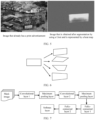
- FIG. 5 shows a manner of performing image segmentation by using the Unet to extract an area in which a print advertisement is located. After image segmentation is performed by using the Unet, an area in which a print advertisement is located and that is shown in a right figure in FIG. 5 is extracted.
- k bounding boxes may be generated, by using a selective search method, near a print advertisement position obtained after rough segmentation, and are used to subsequently identify accurate coordinates of the print advertisement position.
- the generated k bounding boxes correspond to k groups of second vertex coordinate sets, and each second vertex coordinate set may be used to determine one bounding box.
- the selective search method is a classic method for generating a bounding box, and may cover a meaningful object in an image as much as possible. In this step, the meaningful object refers to the print advertisement. It should be noted that a manner of generating the bounding boxes is not limited to the selective search method.
- each of the k bounding boxes generated in the foregoing step is deformed into m different shapes, to match a real shape of the print advertisement.
- the deformation includes any operation such as changing a side length and an inner angle of a rectangle, to change the bounding box to any quadrilateral shape. It should be noted that, because the selective search method can only generate bounding boxes and a form of a real print advertisement in an image are changeable, proper deformation of the bounding boxes can ensure that a finally determined area is more accurately positioned in a real area in which the print advertisement is located. It should be noted that quantities of shapes that each of the k bounding boxes generated in the foregoing step is deformed into may be different.
- the k bounding boxes include three bounding boxes, a first bounding box is deformed into three different shapes, a second bounding box is deformed into two different shapes, and a third bounding box is deformed into four different shapes.
- N 9 deformed areas are obtained, in other words, nine candidate advertisement positions are obtained.
- each bounding box is deformed into a same quantity of shapes is used for description.
- FIG. 6 An example in which a bounding box obtained by using the selective search method in FIG. 5 is used for deformation is shown in FIG. 6 .
- Each bounding box in a deformed image generates m deformed areas (which may be referred to as candidate advertisement positions), and coordinates (x1, y1), (x2, y2), (x3, y3), and (x4, y4) of four corners of the m candidate advertisement positions are separately recorded.
- k x m N candidate advertisement positions are obtained, an area accurate in positioning needs to be selected from the candidate advertisement positions as an area of a to-be-embedded advertisement.
- classification is used to implement pixel-level accurate positioning of the print advertisement.
- An area formed by coordinates of four corners of m candidate advertisement positions generated by a bounding box is filled with a pure color, to generate m mask images.
- the m mask images are input to a newly designed third convolutional neural network model, and an output of the third convolutional neural network model is a mask image that in the m mask images and in which advertisement positioning is most accurate.
- a third convolutional neural network may be referred to as a FourCornerNet network.
- a process of selecting a candidate advertisement position that is most accurately positioned may specifically include the following steps 11 to 14.
- the third convolutional neural network uses a simple shallow convolutional neural network design, includes multi-layer superposition of a convolutional layer and a pooling layer, then is connected to several fully connected layers, and finally is connected to a Softmax layer.
- FIG. 7 shows the structure of the third convolutional neural network.
- the third convolutional neural network includes two convolutional layers, two maximum pooling layers, two fully connected layers, and one Softmax layer.
- a quantity and sizes of convolution kernels in the convolutional layers, a downsampling scale of the maximum pooling layers, and a quantity of nodes in a fully connected layer 1 are not limited, and may be adjusted based on an experiment requirement. Because classification is used to implement accurate positioning of an advertisement position, to be specific, determining whether a mask image is an image that has an accurate advertisement position, a fully connected layer 2 includes two nodes, and an output of the corresponding Softmax layer is a two-dimensional vector.
- each bounding box After each image that already has the first print advertisement is processed in the foregoing step, each bounding box generates m mask images, only one of the m mask images is accurate in advertisement position positioning, and the rest are inaccurate in positioning. Therefore, the mask images may be simply divided into two types, namely, mask images accurate in positioning and mask images inaccurate in positioning. Assuming that bounding boxes of n images that already have a print advertisement are collected, there are m x n mask images, and each of the m x n mask images has an accurate advertisement position, or has an inaccurate advertisement position.
- the m x n mask images x and their corresponding types y form a training sample set: ⁇ (x 1 , y 1 ), (x 2 , y 2 ), ..., and (x mn , y mn ) ⁇ .
- W represents a weight parameter of all layers (including all the convolutional layers and all the fully connected layers) in the third convolutional neural network
- b represents a bias term parameter of all the layers (including all the convolutional layers and all the fully connected layers) in the third convolutional neural network
- f W,b ( x i ) is an actual output value of the network.
- a mask image having an accurate advertisement position belongs to a first type and is represented as [1, 0] and a mask image having an inaccurate advertisement position belongs to a second type and is represented as [0, 1]
- a to-be-predicted mask image is output as [0.8, 0.2] after passing through the Softmax layer, the mask image belongs to the first type, in other words, a candidate advertisement position in the mask image is accurately positioned.
- coordinates of a candidate advertisement position A that is accurately positioned at a pixel level and that is selected from the third convolutional neural network are finely adjusted. Because a real shape of a print advertisement is diversified, and the m deformations in the foregoing step may not completely cover all shapes, a conventional manner that is based on pixel value difference and an edge feature may be used to finely adjust coordinates of a real advertisement position. A feasible method is to perform edge detection on an image.
- an optimal advertisement position is selected from a plurality of obtained accurate candidate advertisement positions.
- the optimal advertisement position may be manually selected based on shapes, sizes, and relative positions of the candidate advertisement positions in the image.
- the optimal advertisement position may not be selected, but the plurality of accurate candidate advertisement positions are directly used as optimal advertisement positions.
- the computer device inserts a to-be-embedded second print advertisement into the target area to replace the first print advertisement.
- an optimal advertisement position has been extracted from an image that already has the first print advertisement, and a print advertisement usually appears in a plurality of consecutive frames in the video. Assuming that a total of P frames of consecutive images already include an old print advertisement after automatic detection in the step S301. Then optional advertisement positions in these consecutive images are extracted in the step S302. However, with movement of video pictures, coordinates of four corners of the optimal advertisement position in each frame of image may not be completely consistent. Subsequent processing steps include the following steps 21 and 22.
- a manner of inserting a to-be-embedded new print advertisement into the optimal advertisement position in the frame of image may be as follows: It is assumed that coordinates of the optimal advertisement position in the frame of image in the image are an upper left corner (x 1 , y 1 ), an upper right corner (x 2 , y 2 ), a lower left corner (x 3 , y 3 ), and a lower right corner (x 4 , y 4 ). First, the to-be-embedded new print advertisement is moved in the image until coordinates of an upper left corner of the to-be-embedded new print advertisement coincide with (x 1 , y 1 ).
- a shape of the new print advertisement is not necessarily the same as the optimal advertisement position. Therefore, stretching, narrowing, and perspective transformation need to be used to adjust the shape of the new print advertisement to a shape of the optimal advertisement position, to be specific, coordinates of the other three points of the new print advertisement are adjusted to (x 2 , y 2 ), (x 3 , y 3 ), and (x 4 , y 4 ), an area enclosed by the four points is the same as that of the optimal advertisement position, and positions of the four points are the same as those of the optimal advertisement position in the image.
- the corner point tracking algorithm includes but is not limited to: a KLT (Kanade-Lucas-Tomasi) algorithm, where the KLT algorithm herein is a classic corner point tracking algorithm, and object tracking is implemented by selecting feature points in a plurality of frames of images for matching.
- KLT Kanade-Lucas-Tomasi
- object tracking is implemented by selecting feature points in a plurality of frames of images for matching.
- a specific example is as follows: Assuming that several consecutive frames of images are respectively A, B, and C, and coordinates of four corners of a newly embedded print advertisement position in A are: an upper left corner (Ax 1 , Ay 1 ), an upper right corner (Ax 2 , Ay 2 ), a lower left corner (Ax 3 , Ay 3 ), and a lower right corner (Ax 4 , Ay 4 ).
- coordinates of four corners of the rest two images are respectively: an upper left corner (Bx 1 , By 1 ), an upper right corner (Bx 2 , By 2 ), a lower left corner (Bx 3 , By 3 ), and a lower right corner (Bx 4 , By 4 ), and an upper left corner (Cx 1 , Cy 1 ), an upper right corner (Cx 2 , Cy 2 ), a lower left corner (Cx 3 , Cy 3 ), and a lower right corner (Cx 4 , Cy 4 ).
- the four corners are tracked frame by frame by using the KLT algorithm.
- a tracking path is from (Ax 1 , Ay 1 ) to (Bx 1 , By 1 ) to (Cx 1 , Cy 1 ).
- a coordinate offset of the upper left corner is calculated, and if the coordinate offset is less than a preset threshold, the coordinates are not adjusted; and if the coordinate offset is greater than a threshold, the coordinates are adjusted.
- a tracking path for the coordinates of the lower right corner of the advertisement position is from (Ax 4 , Ay 4 ) to (Bx 4 , By 4 ) to (Cx 4 , Cy 4 ), where the coordinates of the lower right corner of the image B are obviously different from those of A and C. If the coordinates are greater than a threshold, the coordinates are adjusted to an average value of the coordinates of the lower right corners of A and C, to keep time-space coherence.
- the computer device converts a style of the target image in which the second print advertisement is embedded, where a style of the second print advertisement in the target image after style conversion is consistent with a style of an image pixel outside the area in which the second print advertisement is located in the target image.
- the style of the embedded second print advertisement may be converted into a style of image pixels around the second print advertisement in the target image.
- the image pixels around the second print advertisement are image pixels in a specified range centered on the area in which the second print advertisement is located.
- the style of the embedded second print advertisement may be converted into a style of all image pixels outside the second print advertisement in the target image.
- the style conversion is implemented by using a generative adversarial network-based style migration algorithm. Specifically, the process includes the following steps 31 and 32.
- a generative adversarial network model includes a generator and a discriminator.
- G generator
- G discriminator
- a function of the generator G is to automatically render an input image x, to generate an image G ( x ) .
- the G ( x ) needs to be as similar as possible to a ground truth y corresponding to the x, to achieve an effect of mixing the false with the genuine.
- a function of the discriminator D is to distinguish between the ground truth y and the generated image G ( x ) as correctly as possible.
- a network structure of the generator G uses a classic VGG network in which a last pooling layer and all fully connected layers are removed, and a reverse VGG network is added.
- the reverse VGG network means that each layer of the network is in a one-to-one correspondence with the VGG network, and all operations are reverse operations.
- FIG. 10 shows the network structure of the generator G.
- a first convolutional layer and a second convolutional layer each include 64 3 x 3 convolution kernels; a third layer is a maximum pooling layer; a fourth convolutional layer and a fifth convolutional layer each include 128 3 x 3 convolution kernels; a sixth layer is a maximum pooling layer; a seventh convolutional layer and an eighth convolutional layer each include 256 3 x 3 convolution kernels; a ninth layer is also a maximum pooling layer; a tenth convolutional layer and an eleventh convolutional layer each include 512 3 x 3 convolution kernels; a twelfth layer is a maximum pooling layer; and a thirteenth convolutional layer and a fourteenth convolutional layer each include 512 3 x 3 convolution kernels.
- a first deconvolution layer and a second deconvolution layer each include 64 3 x 3 convolution kernels; a third layer is a maximum anti-pooling layer; a fourth deconvolution layer and a fifth deconvolution layer each include 128 3 x 3 convolution kernels; a sixth layer is a maximum anti-pooling layer; a seventh deconvolution layer and an eighth deconvolution layer each include 256 3 x 3 convolution kernels; a ninth layer is also a maximum anti-pooling layer; a tenth deconvolution layer and an eleventh deconvolution layer each include 512 3 x 3 convolution kernels; a twelfth layer is a maximum anti-pooling layer; a thirteenth deconvolution layer and a fourteenth deconvolution layer each include 512 3 x 3 convolution kernels; and the fourteenth deconvolution layer is connected to a convolutional layer that includes three 3 x 3 convolution
- the discriminator D uses a variant of a classic Resnet network structure: All network structures between a first convolutional layer and a last convolutional layer in the Resnet network are retained, and then the discriminator is connected to a maximum pooling layer, and then connected to m fully connected layers.
- the function of the discriminator D is to distinguish between a real image y and the generated image G ( x ), and may be considered as a classification of the two types. Therefore, the last fully connected layer includes two nodes. Finally, the discriminator is connected to a Softmax layer, to output a determining result (a real image or a generated image).
- FIG. 11 shows the network structure of the discriminator D.
- a novel loss function for the generative adversarial network GAN needs to be constructed, and network parameters of the discriminator D and the generator G are separately trained.
- n indicates that there are n input images (real images or generated images)
- W D indicates a weight parameter of all layers (including all convolutional layers and all fully connected layers in the discriminator D) in the discriminator D
- b D represents a bias term parameter of all the layers (including all the convolutional layers and all the fully connected layers in the discriminator D) in the discriminator D
- D W D ,b D ( G ( x )) represents an actual output value obtained through calculation after the generated image G(x) is input into the discriminator D
- D W D ,b D ( y ) indicates an actual output value obtained through calculation after the real image y is input to the discriminator D
- • 2 2 is an L2 norm.
- n indicates that there are n input images, namely, the images x 1 , x 2 , ..., and x n in which the new print advertisement is embedded and that are obtained after the processing in the steps S301 to S303 and are described in the step 5a;
- W G represents a weight parameter of all layers (including all the convolutional layers and all the deconvolution layers in the generator G) in the generator G
- b G represents a bias term parameter of all the layers (including all the convolutional layers and all the deconvolution layers in the generator G) in the generator G
- G W G ,b G ( x i ) represents an actually generated image obtained after the input image x is processed by the generator G;
- y i represents a ground truth corresponding to an image x i .
- • 1 1 is an L1 norm, and is specifically an absolute value of a difference between pixels at each same location in the images x i and y i .
- an alternate optimization method may be used: The generator G is first fixed, and the parameters of the discriminator D are trained, so that determining accuracy of the D is maximized; and then, the discriminator D is fixed, and the parameters of the generator G are trained, so that the determining accuracy of the D is minimized.
- the parameters of the discriminator D are usually updated for k times, and then the parameters of the G are updated once.
- each frame of image x in which the new print advertisement is embedded in the video is sequentially input into the generator G with trained parameters, and after operations at the convolutional layers, the pooling layers, the deconvolution layers, and the anti-pooling layers in the G, the generator G outputs a generated image G(x); and, in this case, the G(x) already achieves a degree of mixing the false with the genuine, and the newly embedded print advertisement is seamlessly stitched into the surrounding environment thereof.
- an existing old print advertisement in a video may be fully automatically detected and positioned without manually presetting a particular placeholder or manually detecting and identifying advertisement position coordinates, and designing a simple print advertisement feature rule to implement automatic detection. Instead, a feature of a print advertisement is automatically generated by using a convolutional neural network. Therefore, detection and positioning are more flexible and more intelligent, and positioning is more accurate. Moreover, during advertisement embedding, an advertisement is not only simply placed, and a print advertisement material is seamlessly stitched into a surrounding environment thereof based on a style migration method, which makes a print advertisement seem to be originally a part of a video, and improves visual experience of an embedded advertisement.
- FIG. 12 is a structural block diagram of a computer device according to an embodiment of the present invention.
- a computer device 120 may include: a first determining unit 1201, a second determining unit 1202, a replacement unit 1203, and a style conversion unit 1204.
- the first determining unit 1201 is configured to determine a target image, where the target image is an image that is in M frames of images of a target video and that includes a first print advertisement, and M is a positive integer.
- the second determining unit 1202 is configured to determine a target area, where the target area is an area in which the first print advertisement is located in the target image.
- the replacement unit 1203 is configured to insert a to-be-embedded second print advertisement into the target area to replace the first print advertisement.
- the style conversion unit 1204 is configured to convert a style of the target image in which the second print advertisement is embedded, where a style of the second print advertisement in the target image after style conversion is consistent with a style of an image pixel outside the area in which the second print advertisement is located in the target image.
- the first determining unit 1201 is specifically configured to: recognize, based on a first convolutional neural network model, whether an i th frame of image in the M frames of images includes the first print advertisement; and if the i th frame of image includes the first print advertisement, determine that the i th frame of image is the target image, where i is a positive integer ranging from 1 to M successively.
- the first determining unit 1201 includes:
- a weight parameter and a bias term parameter of a convolutional layer in the first convolutional neural network model, and a weight parameter and a bias term parameter of a fully connected layer in the first convolutional neural network model are trained and generated based on a preset image that includes the first print advertisement and a preset image that does not include the first print advertisement.
- the second determining unit 1202 includes:
- a weight parameter and a bias term parameter of a convolutional layer in the third convolutional neural network model, and a weight parameter and a bias term parameter of a fully connected layer in the third convolutional neural network model are trained and generated based on a preset area that is accurate in positioning and a preset area that is inaccurate in positioning.
- the target image includes P frames.
- the computer device 120 further includes:
- the style conversion unit 1204 is specifically configured to: input the target image in which the second print advertisement is embedded to a generative adversarial network model, to obtain an image after style conversion, where the style of the second print advertisement is consistent with a style of an image pixel outside the second print advertisement in the image after style conversion.
- the generative adversarial network model includes a generator and a discriminator.
- the generator includes a convolutional layer, a pooling layer, a deconvolution layer, and an anti-pooling layer.
- the discriminator includes a convolutional layer, a pooling layer, a fully connected layer, and a Softmax layer.
- a weight parameter and a bias term parameter of the convolutional layer in the generator, and a weight parameter and a bias term parameter of the deconvolution layer in the generator are trained and generated based on a preset image in which the second print advertisement has been embedded and an image that is obtained by adjusting a style of the image in which the second print advertisement has been embedded; and a weight parameter and a bias term parameter of the convolutional layer in the discriminator, and a weight parameter and a bias term parameter of the fully connected layer in the discriminator are trained and generated based on the preset image in which the second print advertisement has been embedded and the image that is obtained by adjusting the style of the image in which the second print advertisement has been embedded.
- an existing old print advertisement in a video may be fully automatically detected and positioned without manually presetting a particular placeholder or manually detecting and identifying advertisement position coordinates, and designing a simple print advertisement feature rule to implement automatic detection.
- a feature of a print advertisement is automatically generated by using a convolutional neural network. Therefore, detection and positioning are more flexible and more intelligent, and positioning is more accurate.
- an advertisement is not only simply placed,and a print advertisement material is seamlessly stitched into image pixels around the print advertisement material based on a style migration method, which makes a print advertisement seem to be originally a part of a video, and improves visual experience of an embedded advertisement.
- the embodiments of the present invention may be provided as a method, a system, or a computer program product. Therefore, the present invention may use a form of hardware only embodiments, software only embodiments, or embodiments with a combination of software and hardware. Moreover, the present invention may use a form of a computer program product that is implemented on one or more computer-usable storage media (including but not limited to a disk memory, an optical memory, and the like) that include computer-usable program code.
- computer-usable storage media including but not limited to a disk memory, an optical memory, and the like
- These computer program instructions may be provided for a general-purpose computer, a special-purpose computer, an embedded processor, or a processor of any other programmable data processing device to generate a machine, so that the instructions executed by a computer or the processor of any other programmable data processing device generate an apparatus for implementing a specific function in one or more processes in the flowcharts and/or in one or more blocks in the block diagrams.
- These computer program instructions may also be stored in a computer-readable memory that can instruct the computer or any other programmable data processing device to work in a specific manner, so that the instructions stored in the computer-readable memory generate an artifact that includes an instruction apparatus.
- the instruction apparatus implements a specific function in one or more processes in the flowcharts and/or in one or more blocks in the block diagrams.
- These computer program instructions may also be loaded onto a computer or another programmable data processing device, so that a series of operations and steps are performed on the computer or the another programmable device, thereby generating computer-implemented processing. Therefore, the instructions executed on the computer or the another programmable device provide steps for implementing a specific function in one or more processes in the flowcharts and/or in one or more blocks in the block diagrams.
Landscapes
- Engineering & Computer Science (AREA)
- Theoretical Computer Science (AREA)
- Physics & Mathematics (AREA)
- General Physics & Mathematics (AREA)
- Multimedia (AREA)
- Evolutionary Computation (AREA)
- Computing Systems (AREA)
- Software Systems (AREA)
- Health & Medical Sciences (AREA)
- Artificial Intelligence (AREA)
- General Health & Medical Sciences (AREA)
- Mathematical Physics (AREA)
- Data Mining & Analysis (AREA)
- Business, Economics & Management (AREA)
- General Engineering & Computer Science (AREA)
- Signal Processing (AREA)
- Computational Linguistics (AREA)
- Biomedical Technology (AREA)
- Biophysics (AREA)
- Life Sciences & Earth Sciences (AREA)
- Molecular Biology (AREA)
- Marketing (AREA)
- Databases & Information Systems (AREA)
- Computer Vision & Pattern Recognition (AREA)
- Finance (AREA)
- Medical Informatics (AREA)
- Accounting & Taxation (AREA)
- Development Economics (AREA)
- Strategic Management (AREA)
- Mathematical Optimization (AREA)
- Computational Mathematics (AREA)
- Mathematical Analysis (AREA)
- Pure & Applied Mathematics (AREA)
- Game Theory and Decision Science (AREA)
- Entrepreneurship & Innovation (AREA)
- Economics (AREA)
- General Business, Economics & Management (AREA)
- Algebra (AREA)
- Quality & Reliability (AREA)
- Probability & Statistics with Applications (AREA)
Claims (9)
- Verfahren zum Einbetten einer Werbung in ein Video, das durch eine Computervorrichtung durchgeführt wird, wobei das Verfahren die folgenden Schritte umfasst:• Bestimmen (S301) eines Zielbilds, wobei das Zielbild ein Bild ist, das in M Frames von Bildern eines Zielvideos vorliegt und das eine erste Druckwerbung umfasst, und M eine positive Ganzzahl ist;• Bestimmen (S302) eines Zielbereichs, wobei der Zielbereich ein Bereich ist, in dem sich die erste Druckwerbung in dem Zielbild befindet;• Einfügen (S303) einer einzubettenden zweiten Druckwerbung in den Zielbereich, um die erste Druckwerbung zu ersetzen; und• Umwandeln (S304) eines Stiles des Zielbilds, in das die zweite Druckwerbung eingebettet ist, wobei ein Stil der zweiten Druckwerbung in dem Zielbild nach der Stilumwandlung mit einem Stil von Bildpixeln um den Bereich herum, in dem sich die zweite Druckwerbung in dem Zielbild befindet, übereinstimmt, wobei der Stil die Farbe und/oder die Schattierung ist,wobei das Umwandeln (S304) des Stiles des Zielbilds, in das die zweite Druckwerbung eingebettet ist, Folgendes umfasst:∘ Eingeben des Zielbilds, in das die zweite Druckwerbung eingebettet ist, in ein erzeugendes gegnerisches Netzmodell, um ein Bild nach der Stilumwandlung zu erlangen, wobei der Stil der zweiten Druckwerbung mit dem Stil der Bildpixel um die zweite Druckwerbung herum in dem Bild nach der Stilumwandlung übereinstimmt; undwobei das erzeugende gegnerische Netzmodell einen Erzeuger und einen Diskriminator umfasst, der Erzeuger eine Faltungsschicht, eine Poolingschicht, eine Entfaltungsschicht und eine Anti-Poolingschicht umfasst und der Diskriminator eine Faltungsschicht, eine Poolingschicht, eine vollständig verbundene Schicht und eine Softmax-Schicht umfasst,wobei das Verfahren ferner die folgenden Verfahrensschritte umfasst:• Erstellen eines Trainingsabtastungssatzes durch Folgendes:∘ Auswählen von Bildern, in die jeweils eine neue Druckwerbung eingebettet ist, wobei jedes ausgewählte Bild nach Folgendem erlangt wird:Bestimmen eines jeweiligen Zielbilds, wobei das jeweilige Zielbild ein Bild ist, das in M Frames von Bildern eines jeweiligen Zielvideos vorliegt und das eine jeweilige erste Druckwerbung umfasst, und M eine positive Ganzzahl ist,Bestimmen eines jeweiligen Zielbereichs, wobei der jeweilige Zielbereich ein Bereich ist, in dem sich die jeweilige erste Druckwerbung in dem jeweiligen Zielbild befindet, undEinfügen einer jeweiligen einzubettenden neuen Druckwerbung in den jeweiligen Zielbereich, um die jeweilige erste Druckwerbung zu ersetzen;∘ nach der Auswahl der Bilder Anpassen von Stilen der ausgewählten Bilder unter Verwendung von Software, um es der neuen Druckwerbung in den Bildern zu ermöglichen, hinsichtlich einer visuellen Wirkung glatt und nahtlos in die umliegende Umgebung eingefädelt zu werden, um Bilder als Ground-Truths zu erlangen, und∘ Bilden des Trainingsabtastungssatzes unter Verwendung der ausgewählten Bilder und der Ground-Truth-Bilder und• Trainieren des Erzeugers und des Diskriminators unter Verwendung des Trainingsabtastungssatzes.
- Verfahren nach Anspruch 1, wobei das Bestimmen (S301) des Zielbilds Folgendes umfasst:∘ Erkennen, basierend auf einem ersten neuronalen Faltungsnetzmodell, ob ein i-ter Bildframe in den M Frames von Bildern die erste Druckwerbung umfasst; und, wenn der i-te Bildframe die erste Druckwerbung umfasst, Bestimmen, dass der i-te Bildframe das Zielbild ist, wobei i eine positive Ganzzahl ist, die sukzessive von 1 bis M reicht.
- Verfahren nach Anspruch 2, wobei das Erkennen, basierend auf dem ersten neuronalen Faltungsnetzmodell, ob der i-te Bildframe in den M Frames von Bildern die erste Druckwerbung umfasst, Folgendes umfasst:∘ Eingeben des i-ten Bildframes in den M Frames von Bildern in mindestens eine Faltungsschicht in dem ersten neuronalen Faltungsnetzmodell, um eine Merkmalskarte einer letzten Faltungsschicht in der mindestens einen Faltungsschicht zu erlangen, wobei das erste neuronale Faltungsnetzmodell die mindestens eine Faltungsschicht, mindestens eine vollständig verbundene Schicht und eine Softmax-Schicht umfasst;∘ Eingeben der Merkmalskarte der letzten Faltungsschicht in die mindestens eine vollständig verbundene Schicht, um einen zweidimensionalen Vektor zu erlangen, der durch eine letzte vollständig verbundene Schicht in der mindestens einen vollständig verbundenen Schicht ausgegeben wird; und∘ Eingeben des zweidimensionalen Vektors in die Softmax-Ebene, um einen Vektor zu erlangen, der dazu verwendet wird, zu identifizieren, ob der i-te Bildframe die erste Druckwerbung umfasst.
- Verfahren nach Anspruch 3, wobei ein Gewichtsparameter und ein Bias-Begriffsparameter einer Faltungsschicht in dem ersten neuronalen Faltungsnetzmodell und ein Gewichtsparameter und ein Bias-Begriffsparameter einer vollständig verbundenen Schicht in dem ersten neuronalen Faltungsnetzmodell basierend auf einem voreingestellten Bild, das die erste Druckwerbung umfasst, und einem voreingestellten Bild, das die erste Druckwerbung nicht umfasst, trainiert und erzeugt werden.
- Verfahren nach einem der Ansprüche 1 bis 4, wobei das Bestimmen (S302) des Zielbereichs Folgendes umfasst:∘ Eingeben des Zielbilds in ein zweites neuronales Faltungsnetzmodell, um einen ersten Vertexkoordinatensatz der ersten Druckwerbung in dem Zielbild zu erlangen;∘ Erlangen eines zweiten Vertexkoordinatensatzes basierend auf dem ersten Vertexkoordinatensatz, wobei eine Differenz zwischen dem zweiten Vertexkoordinatensatz und dem ersten Vertexkoordinatensatz kleiner oder gleich einem ersten voreingestellten Schwellenwert ist;∘ Durchführen mindestens einer Verformung an einem Bereich, der den zweiten Vertexkoordinatensatz umfasst, um N verformte Bereiche zu erlangen, wobei N eine positive Ganzzahl ist; und∘ Eingeben der N verformten Bereiche in ein voreingestelltes drittes neuronales Faltungsnetzmodell, um den Zielbereich zu erlangen, wobei das dritte neuronale Faltungsnetzmodell dazu verwendet wird, einen Bereich zu erkennen, der in den N verformten Bereichen vorliegt und der am genauesten ist, um die erste Druckwerbung zu positionieren.
- Verfahren nach Anspruch 5, wobei ein Gewichtsparameter und ein Bias-Begriffsparameter einer Faltungsschicht in dem dritten neuronalen Faltungsnetzmodell und ein Gewichtsparameter und ein Bias-Begriffsparameter einer vollständig verbundenen Schicht in dem dritten neuronalen Faltungsnetzmodell basierend auf einem voreingestellten Bereich, der für das Positionieren genau ist, und einem voreingestellten Bereich, der für das Positionieren ungenau ist, trainiert und erzeugt werden.
- Verfahren nach einem der Ansprüche 1 bis 6, wobei das Zielbild P-Frames umfasst; und das Verfahren nach dem Einfügen der einzubettenden zweiten Druckwerbung in den Zielbereich, um die erste Druckwerbung zu ersetzen, und vor dem Umwandeln des Stiles des Zielbilds, in das die zweite Druckwerbung eingebettet ist, ferner Folgendes umfasst:∘ Verfolgen, unter Verwendung eines Eckpunktverfolgungsalgorithmus, von Koordinaten der zweiten Druckwerbung, die in jeden der P-Frames des Zielbilds eingebettet sind; und∘ wenn die P-Frames des Zielbilds ein erstes Bild umfassen, in das die zweite Druckwerbung eingebettet ist, und ein Koordinatenversatzwert der zweiten Druckwerbung größer oder gleich einem zweiten voreingestellten Schwellenwert ist, Anpassen der Koordinaten der zweiten Druckwerbung in dem ersten Bild, sodass der Koordinatenversatzwert der zweiten Druckwerbung in dem ersten Bild kleiner als der zweite voreingestellte Schwellenwert ist.
- Computervorrichtung (120), die dazu konfiguriert ist, das Verfahren nach einem der Ansprüche 1 bis 7 durchzuführen.
- Computerlesbares Speichermedium, umfassend Anweisungen, wobei, wenn die Anweisungen durch eine Computervorrichtung ausgeführt werden, die Computervorrichtung dazu veranlasst wird, das Verfahren nach einem der Ansprüche 1 bis 7 durchzuführen.
Applications Claiming Priority (2)
| Application Number | Priority Date | Filing Date | Title |
|---|---|---|---|
| CN201810147228.1A CN110163640B (zh) | 2018-02-12 | 2018-02-12 | 一种在视频中植入广告的方法及计算机设备 |
| PCT/CN2019/072103 WO2019154035A1 (zh) | 2018-02-12 | 2019-01-17 | 一种在视频中植入广告的方法及计算机设备 |
Publications (3)
| Publication Number | Publication Date |
|---|---|
| EP3745339A1 EP3745339A1 (de) | 2020-12-02 |
| EP3745339A4 EP3745339A4 (de) | 2021-03-31 |
| EP3745339B1 true EP3745339B1 (de) | 2025-05-21 |
Family
ID=67548213
Family Applications (1)
| Application Number | Title | Priority Date | Filing Date |
|---|---|---|---|
| EP19750801.3A Active EP3745339B1 (de) | 2018-02-12 | 2019-01-17 | Verfahren zum implantieren von werbung in video und computervorrichtung |
Country Status (4)
| Country | Link |
|---|---|
| US (1) | US11595737B2 (de) |
| EP (1) | EP3745339B1 (de) |
| CN (1) | CN110163640B (de) |
| WO (1) | WO2019154035A1 (de) |
Families Citing this family (39)
| Publication number | Priority date | Publication date | Assignee | Title |
|---|---|---|---|---|
| US11049151B2 (en) * | 2017-12-28 | 2021-06-29 | Verizon Media Inc. | Systems and/or methods for constructing online ads using media objects created by generative processes |
| CN110264413B (zh) * | 2019-05-17 | 2021-08-31 | 北京达佳互联信息技术有限公司 | 一种图像处理方法、装置、电子设备及存储介质 |
| CN112446886B (zh) * | 2019-08-30 | 2024-12-13 | 上海商汤临港智能科技有限公司 | 图像处理方法及相关产品 |
| US20220398823A1 (en) * | 2019-11-10 | 2022-12-15 | Mirage Dynamics Ltd | Video Advertising Signage Replacement |
| JP7278202B2 (ja) * | 2019-11-27 | 2023-05-19 | 富士フイルム株式会社 | 画像学習装置、画像学習方法、ニューラルネットワーク、及び画像分類装置 |
| CN111031366B (zh) * | 2019-11-29 | 2021-12-17 | 深圳市掌众信息技术有限公司 | 一种在视频中植入广告的方法及系统 |
| CN111292280B (zh) * | 2020-01-20 | 2023-08-29 | 北京百度网讯科技有限公司 | 用于输出信息的方法和装置 |
| US11132780B2 (en) * | 2020-02-14 | 2021-09-28 | Huawei Technologies Co., Ltd. | Target detection method, training method, electronic device, and computer-readable medium |
| CN111372122B (zh) | 2020-02-27 | 2022-03-15 | 腾讯科技(深圳)有限公司 | 一种媒体内容植入方法、模型训练方法以及相关装置 |
| CN111556362A (zh) * | 2020-03-19 | 2020-08-18 | 上海万面智能科技有限公司 | 一种车身广告植入方法、装置、电子设备及存储介质 |
| CN111461772A (zh) * | 2020-03-27 | 2020-07-28 | 上海大学 | 一种基于生成对抗网络的视频广告融入系统与方法 |
| CN113626832B (zh) * | 2020-05-08 | 2025-08-19 | 北京沃东天骏信息技术有限公司 | 处理请求的方法和装置 |
| CN111556336B (zh) * | 2020-05-12 | 2023-07-14 | 腾讯科技(深圳)有限公司 | 一种多媒体文件处理方法、装置、终端设备及介质 |
| CN111556337B (zh) * | 2020-05-15 | 2021-09-21 | 腾讯科技(深圳)有限公司 | 一种媒体内容植入方法、模型训练方法以及相关装置 |
| CN111898732B (zh) * | 2020-06-30 | 2023-06-20 | 江苏省特种设备安全监督检验研究院 | 基于深度卷积神经网络的超声波测距补偿方法 |
| CN111598917B (zh) * | 2020-07-15 | 2020-12-04 | 腾讯科技(深圳)有限公司 | 数据嵌入方法、装置、设备及计算机可读存储介质 |
| CN112085532B (zh) * | 2020-09-10 | 2024-03-22 | 网易(杭州)网络有限公司 | 一种插入广告的方法、装置、计算机设备和介质 |
| CN113766147B (zh) * | 2020-09-22 | 2022-11-08 | 北京沃东天骏信息技术有限公司 | 视频中嵌入图像的方法、平面预测模型获取方法和装置 |
| CN112153422B (zh) * | 2020-09-25 | 2023-03-31 | 连尚(北京)网络科技有限公司 | 视频融合方法和设备 |
| CN112214643B (zh) * | 2020-10-15 | 2024-01-12 | 百度(中国)有限公司 | 视频贴片生成方法、装置、电子设备及存储介质 |
| US20220191027A1 (en) * | 2020-12-16 | 2022-06-16 | Kyndryl, Inc. | Mutual multi-factor authentication technology |
| CN113190775B (zh) * | 2021-04-28 | 2023-07-14 | 北京百度网讯科技有限公司 | 广告样式的优化方法、装置、电子设备和存储介质 |
| CN113159864A (zh) * | 2021-05-11 | 2021-07-23 | 两比特(北京)科技有限公司 | 一种新型影视植入广告系统 |
| CN113490028A (zh) * | 2021-06-01 | 2021-10-08 | 深圳喜悦机器人有限公司 | 视频处理方法、装置、存储介质以及终端 |
| CN113486803B (zh) * | 2021-07-07 | 2025-06-17 | 北京沃东天骏信息技术有限公司 | 视频中嵌入图像的装置 |
| CN114125500A (zh) * | 2021-10-11 | 2022-03-01 | 深圳市易售科技有限公司 | 一种广告投放视频的合成方法及投放系统 |
| US11979620B2 (en) | 2021-12-17 | 2024-05-07 | Industrial Technology Research Institute | System, non-transitory computer readable storage medium and method for automatically placing virtual advertisements in sports videos |
| CN114494481A (zh) * | 2021-12-23 | 2022-05-13 | 天翼云科技有限公司 | 一种广告替换方法、装置及设备 |
| CN114565016B (zh) * | 2022-01-24 | 2025-04-22 | 有米科技股份有限公司 | 标签识别模型的训练、识别图像标签的方法及装置 |
| CN114820042B (zh) * | 2022-04-01 | 2025-06-17 | 中央广播电视总台 | 一种广告节目实时替换方法、设备、芯片及存储介质 |
| CN114898112B (zh) * | 2022-04-27 | 2025-04-29 | 咪咕文化科技有限公司 | 视频内容的植入方法、模型训练方法、装置及电子设备 |
| TWI890144B (zh) * | 2022-10-24 | 2025-07-11 | 仁寶電腦工業股份有限公司 | 目標影像偵測方法及目標影像偵測系統 |
| CN115578130B (zh) * | 2022-11-21 | 2023-04-07 | 成都智元汇信息技术股份有限公司 | 全图扫描生成广告位信息展示组件方法 |
| CN116074582B (zh) * | 2023-01-31 | 2024-08-30 | 北京奇艺世纪科技有限公司 | 一种植入位置确定方法、装置、电子设备及存储介质 |
| CN116485631A (zh) * | 2023-02-03 | 2023-07-25 | 天翼云科技有限公司 | 广告替换方法、装置、电子设备及可读存储介质 |
| US20240333998A1 (en) * | 2023-03-31 | 2024-10-03 | Adeia Guides Inc. | Intelligent content visibility filtering via transparent screen overlay |
| CN116761037B (zh) * | 2023-08-23 | 2023-11-03 | 星河视效科技(北京)有限公司 | 视频植入多媒体信息的方法、装置、设备及介质 |
| CN119478496B (zh) * | 2024-10-14 | 2025-05-16 | 北京鸿途信达科技股份有限公司 | 基于深度卷积神经网络模型的广告图像分类方法及系统 |
| CN120372095A (zh) * | 2025-04-30 | 2025-07-25 | 北京顶悦卧客旅游科技有限公司 | 一种旅游减脂信息推荐方法、装置、电子设备及介质 |
Family Cites Families (12)
| Publication number | Priority date | Publication date | Assignee | Title |
|---|---|---|---|---|
| GB0809631D0 (en) * | 2008-05-28 | 2008-07-02 | Mirriad Ltd | Zonesense |
| CN103297811A (zh) * | 2012-02-24 | 2013-09-11 | 北京明日时尚信息技术有限公司 | 一种智能嵌入式视频广告的实现方法 |
| WO2015047246A1 (en) * | 2013-09-25 | 2015-04-02 | Intel Corporation | Dynamic product placement in media content |
| CN103873741A (zh) * | 2014-04-02 | 2014-06-18 | 北京奇艺世纪科技有限公司 | 一种用于替换视频中感兴趣区域的方法及装置 |
| CN104735465B (zh) * | 2015-03-31 | 2019-04-12 | 北京奇艺世纪科技有限公司 | 在视频画面中植入平面图案广告的方法及装置 |
| CN105657446B (zh) * | 2015-12-30 | 2018-06-22 | 北京奇艺世纪科技有限公司 | 一种视频中贴片广告的检测方法和装置 |
| WO2018033156A1 (zh) * | 2016-08-19 | 2018-02-22 | 北京市商汤科技开发有限公司 | 视频图像的处理方法、装置和电子设备 |
| CN106792007A (zh) * | 2017-01-19 | 2017-05-31 | 深圳市奥拓电子股份有限公司 | 一种视频转播方法及系统 |
| CN107341452B (zh) * | 2017-06-20 | 2020-07-14 | 东北电力大学 | 基于四元数时空卷积神经网络的人体行为识别方法 |
| CN107577985B (zh) * | 2017-07-18 | 2019-10-15 | 南京邮电大学 | 基于循环生成对抗网络的人脸头像卡通化的实现方法 |
| WO2019075276A1 (en) * | 2017-10-11 | 2019-04-18 | Aquifi, Inc. | SYSTEMS AND METHODS FOR IDENTIFYING OBJECT |
| US10469859B2 (en) * | 2017-12-08 | 2019-11-05 | Hulu, LLC | Accelerated re-encoding of video for video delivery |
-
2018
- 2018-02-12 CN CN201810147228.1A patent/CN110163640B/zh active Active
-
2019
- 2019-01-17 EP EP19750801.3A patent/EP3745339B1/de active Active
- 2019-01-17 WO PCT/CN2019/072103 patent/WO2019154035A1/zh not_active Ceased
-
2020
- 2020-08-11 US US16/990,011 patent/US11595737B2/en active Active
Also Published As
| Publication number | Publication date |
|---|---|
| EP3745339A1 (de) | 2020-12-02 |
| WO2019154035A1 (zh) | 2019-08-15 |
| EP3745339A4 (de) | 2021-03-31 |
| US20200374600A1 (en) | 2020-11-26 |
| CN110163640A (zh) | 2019-08-23 |
| CN110163640B (zh) | 2023-12-08 |
| US11595737B2 (en) | 2023-02-28 |
Similar Documents
| Publication | Publication Date | Title |
|---|---|---|
| EP3745339B1 (de) | Verfahren zum implantieren von werbung in video und computervorrichtung | |
| CN110176027B (zh) | 视频目标跟踪方法、装置、设备及存储介质 | |
| US10810435B2 (en) | Segmenting objects in video sequences | |
| US11978216B2 (en) | Patch-based image matting using deep learning | |
| US11042990B2 (en) | Automatic object replacement in an image | |
| CN108122234B (zh) | 卷积神经网络训练及视频处理方法、装置和电子设备 | |
| CN107341805B (zh) | 图像前背景分割及网络模型训练、图像处理方法和装置 | |
| US10726599B2 (en) | Realistic augmentation of images and videos with graphics | |
| US9336578B2 (en) | Interactive tone mapping for high dynamic range video | |
| WO2018033156A1 (zh) | 视频图像的处理方法、装置和电子设备 | |
| CN107610202B (zh) | 人脸图像替换方法、设备及存储介质 | |
| CN108734120A (zh) | 标注图像的方法、装置、设备和计算机可读存储介质 | |
| WO2021169396A1 (zh) | 一种媒体内容植入方法以及相关装置 | |
| CN112101344A (zh) | 一种视频文本跟踪方法及装置 | |
| US20240386639A1 (en) | Video cover generation method, apparatus, electronic device and readable medium | |
| CN113516666A (zh) | 图像裁剪方法、装置、计算机设备及存储介质 | |
| Montserrat et al. | Logo detection and recognition with synthetic images | |
| WO2024000728A1 (zh) | 单目三维平面恢复方法、设备及存储介质 | |
| CN117677973A (zh) | 旁观者和附着对象移除 | |
| JP3716455B2 (ja) | 領域抽出方法及び領域抽出装置 | |
| CN116862920A (zh) | 一种人像分割方法、装置、设备及介质 | |
| CN118799439A (zh) | 数字人图像融合方法、装置、设备及可读存储介质 | |
| CN111010605A (zh) | 一种视频画中画窗口的显示方法 | |
| CN117649457A (zh) | 图像处理和图像处理模型的训练方法、装置、设备和介质 | |
| CN116308996A (zh) | 图形显示方法、装置、设备、存储介质及程序产品 |
Legal Events
| Date | Code | Title | Description |
|---|---|---|---|
| STAA | Information on the status of an ep patent application or granted ep patent |
Free format text: STATUS: THE INTERNATIONAL PUBLICATION HAS BEEN MADE |
|
| PUAI | Public reference made under article 153(3) epc to a published international application that has entered the european phase |
Free format text: ORIGINAL CODE: 0009012 |
|
| STAA | Information on the status of an ep patent application or granted ep patent |
Free format text: STATUS: REQUEST FOR EXAMINATION WAS MADE |
|
| 17P | Request for examination filed |
Effective date: 20200824 |
|
| AK | Designated contracting states |
Kind code of ref document: A1 Designated state(s): AL AT BE BG CH CY CZ DE DK EE ES FI FR GB GR HR HU IE IS IT LI LT LU LV MC MK MT NL NO PL PT RO RS SE SI SK SM TR |
|
| AX | Request for extension of the european patent |
Extension state: BA ME |
|
| RIN1 | Information on inventor provided before grant (corrected) |
Inventor name: XU, WEI Inventor name: PITIE, FRANCOIS Inventor name: CONRAN, CLARE |
|
| A4 | Supplementary search report drawn up and despatched |
Effective date: 20210225 |
|
| RIC1 | Information provided on ipc code assigned before grant |
Ipc: G06Q 30/02 20120101AFI20210219BHEP Ipc: G06K 9/00 20060101ALI20210219BHEP Ipc: H04N 21/81 20110101ALI20210219BHEP Ipc: G06N 3/04 20060101ALI20210219BHEP Ipc: G06T 7/277 20170101ALI20210219BHEP Ipc: H04N 21/44 20110101ALI20210219BHEP Ipc: G06K 9/62 20060101ALI20210219BHEP Ipc: G06T 11/60 20060101ALI20210219BHEP Ipc: H04N 21/234 20110101ALI20210219BHEP |
|
| DAV | Request for validation of the european patent (deleted) | ||
| DAX | Request for extension of the european patent (deleted) | ||
| STAA | Information on the status of an ep patent application or granted ep patent |
Free format text: STATUS: EXAMINATION IS IN PROGRESS |
|
| 17Q | First examination report despatched |
Effective date: 20221011 |
|
| REG | Reference to a national code |
Ref country code: DE Ref legal event code: R079 Free format text: PREVIOUS MAIN CLASS: G06Q0030020000 Ipc: H04N0021234000 Ref country code: DE Ref legal event code: R079 Ref document number: 602019070253 Country of ref document: DE Free format text: PREVIOUS MAIN CLASS: G06Q0030020000 Ipc: H04N0021234000 |
|
| GRAP | Despatch of communication of intention to grant a patent |
Free format text: ORIGINAL CODE: EPIDOSNIGR1 |
|
| STAA | Information on the status of an ep patent application or granted ep patent |
Free format text: STATUS: GRANT OF PATENT IS INTENDED |
|
| INTG | Intention to grant announced |
Effective date: 20250128 |
|
| RIC1 | Information provided on ipc code assigned before grant |
Ipc: G06N 3/047 20230101ALI20250117BHEP Ipc: G06N 3/045 20230101ALI20250117BHEP Ipc: G06V 10/764 20220101ALI20250117BHEP Ipc: G06V 20/40 20220101ALI20250117BHEP Ipc: G06V 10/82 20220101ALI20250117BHEP Ipc: G06Q 30/0241 20230101ALI20250117BHEP Ipc: G06N 3/084 20230101ALI20250117BHEP Ipc: G06T 7/277 20170101ALI20250117BHEP Ipc: H04N 21/44 20110101ALI20250117BHEP Ipc: H04N 21/81 20110101ALI20250117BHEP Ipc: H04N 21/234 20110101AFI20250117BHEP |
|
| GRAS | Grant fee paid |
Free format text: ORIGINAL CODE: EPIDOSNIGR3 |
|
| GRAA | (expected) grant |
Free format text: ORIGINAL CODE: 0009210 |
|
| STAA | Information on the status of an ep patent application or granted ep patent |
Free format text: STATUS: THE PATENT HAS BEEN GRANTED |
|
| P01 | Opt-out of the competence of the unified patent court (upc) registered |
Free format text: CASE NUMBER: APP_15189/2025 Effective date: 20250327 |
|
| AK | Designated contracting states |
Kind code of ref document: B1 Designated state(s): AL AT BE BG CH CY CZ DE DK EE ES FI FR GB GR HR HU IE IS IT LI LT LU LV MC MK MT NL NO PL PT RO RS SE SI SK SM TR |
|
| REG | Reference to a national code |
Ref country code: GB Ref legal event code: FG4D |
|
| REG | Reference to a national code |
Ref country code: CH Ref legal event code: EP |
|
| REG | Reference to a national code |
Ref country code: DE Ref legal event code: R096 Ref document number: 602019070253 Country of ref document: DE |
|
| REG | Reference to a national code |
Ref country code: IE Ref legal event code: FG4D |
|
| REG | Reference to a national code |
Ref country code: NL Ref legal event code: MP Effective date: 20250521 |
|
| PG25 | Lapsed in a contracting state [announced via postgrant information from national office to epo] |
Ref country code: PT Free format text: LAPSE BECAUSE OF FAILURE TO SUBMIT A TRANSLATION OF THE DESCRIPTION OR TO PAY THE FEE WITHIN THE PRESCRIBED TIME-LIMIT Effective date: 20250922 Ref country code: FI Free format text: LAPSE BECAUSE OF FAILURE TO SUBMIT A TRANSLATION OF THE DESCRIPTION OR TO PAY THE FEE WITHIN THE PRESCRIBED TIME-LIMIT Effective date: 20250521 Ref country code: ES Free format text: LAPSE BECAUSE OF FAILURE TO SUBMIT A TRANSLATION OF THE DESCRIPTION OR TO PAY THE FEE WITHIN THE PRESCRIBED TIME-LIMIT Effective date: 20250521 |
|
| REG | Reference to a national code |
Ref country code: LT Ref legal event code: MG9D |
|
| PG25 | Lapsed in a contracting state [announced via postgrant information from national office to epo] |
Ref country code: NO Free format text: LAPSE BECAUSE OF FAILURE TO SUBMIT A TRANSLATION OF THE DESCRIPTION OR TO PAY THE FEE WITHIN THE PRESCRIBED TIME-LIMIT Effective date: 20250821 Ref country code: GR Free format text: LAPSE BECAUSE OF FAILURE TO SUBMIT A TRANSLATION OF THE DESCRIPTION OR TO PAY THE FEE WITHIN THE PRESCRIBED TIME-LIMIT Effective date: 20250822 |
|
| PG25 | Lapsed in a contracting state [announced via postgrant information from national office to epo] |
Ref country code: NL Free format text: LAPSE BECAUSE OF FAILURE TO SUBMIT A TRANSLATION OF THE DESCRIPTION OR TO PAY THE FEE WITHIN THE PRESCRIBED TIME-LIMIT Effective date: 20250521 Ref country code: PL Free format text: LAPSE BECAUSE OF FAILURE TO SUBMIT A TRANSLATION OF THE DESCRIPTION OR TO PAY THE FEE WITHIN THE PRESCRIBED TIME-LIMIT Effective date: 20250521 |
|
| PG25 | Lapsed in a contracting state [announced via postgrant information from national office to epo] |
Ref country code: BG Free format text: LAPSE BECAUSE OF FAILURE TO SUBMIT A TRANSLATION OF THE DESCRIPTION OR TO PAY THE FEE WITHIN THE PRESCRIBED TIME-LIMIT Effective date: 20250521 |
|
| PG25 | Lapsed in a contracting state [announced via postgrant information from national office to epo] |
Ref country code: HR Free format text: LAPSE BECAUSE OF FAILURE TO SUBMIT A TRANSLATION OF THE DESCRIPTION OR TO PAY THE FEE WITHIN THE PRESCRIBED TIME-LIMIT Effective date: 20250521 |
|
| PG25 | Lapsed in a contracting state [announced via postgrant information from national office to epo] |
Ref country code: RS Free format text: LAPSE BECAUSE OF FAILURE TO SUBMIT A TRANSLATION OF THE DESCRIPTION OR TO PAY THE FEE WITHIN THE PRESCRIBED TIME-LIMIT Effective date: 20250821 |
|
| PG25 | Lapsed in a contracting state [announced via postgrant information from national office to epo] |
Ref country code: IS Free format text: LAPSE BECAUSE OF FAILURE TO SUBMIT A TRANSLATION OF THE DESCRIPTION OR TO PAY THE FEE WITHIN THE PRESCRIBED TIME-LIMIT Effective date: 20250921 |
|
| PG25 | Lapsed in a contracting state [announced via postgrant information from national office to epo] |
Ref country code: LV Free format text: LAPSE BECAUSE OF FAILURE TO SUBMIT A TRANSLATION OF THE DESCRIPTION OR TO PAY THE FEE WITHIN THE PRESCRIBED TIME-LIMIT Effective date: 20250521 |
|
| REG | Reference to a national code |
Ref country code: AT Ref legal event code: MK05 Ref document number: 1797872 Country of ref document: AT Kind code of ref document: T Effective date: 20250521 |
|
| PG25 | Lapsed in a contracting state [announced via postgrant information from national office to epo] |
Ref country code: AT Free format text: LAPSE BECAUSE OF FAILURE TO SUBMIT A TRANSLATION OF THE DESCRIPTION OR TO PAY THE FEE WITHIN THE PRESCRIBED TIME-LIMIT Effective date: 20250521 Ref country code: SM Free format text: LAPSE BECAUSE OF FAILURE TO SUBMIT A TRANSLATION OF THE DESCRIPTION OR TO PAY THE FEE WITHIN THE PRESCRIBED TIME-LIMIT Effective date: 20250521 Ref country code: DK Free format text: LAPSE BECAUSE OF FAILURE TO SUBMIT A TRANSLATION OF THE DESCRIPTION OR TO PAY THE FEE WITHIN THE PRESCRIBED TIME-LIMIT Effective date: 20250521 |
|
| PG25 | Lapsed in a contracting state [announced via postgrant information from national office to epo] |
Ref country code: CZ Free format text: LAPSE BECAUSE OF FAILURE TO SUBMIT A TRANSLATION OF THE DESCRIPTION OR TO PAY THE FEE WITHIN THE PRESCRIBED TIME-LIMIT Effective date: 20250521 |
|
| PG25 | Lapsed in a contracting state [announced via postgrant information from national office to epo] |
Ref country code: EE Free format text: LAPSE BECAUSE OF FAILURE TO SUBMIT A TRANSLATION OF THE DESCRIPTION OR TO PAY THE FEE WITHIN THE PRESCRIBED TIME-LIMIT Effective date: 20250521 |
|
| PG25 | Lapsed in a contracting state [announced via postgrant information from national office to epo] |
Ref country code: SK Free format text: LAPSE BECAUSE OF FAILURE TO SUBMIT A TRANSLATION OF THE DESCRIPTION OR TO PAY THE FEE WITHIN THE PRESCRIBED TIME-LIMIT Effective date: 20250521 Ref country code: RO Free format text: LAPSE BECAUSE OF FAILURE TO SUBMIT A TRANSLATION OF THE DESCRIPTION OR TO PAY THE FEE WITHIN THE PRESCRIBED TIME-LIMIT Effective date: 20250521 |
|
| PG25 | Lapsed in a contracting state [announced via postgrant information from national office to epo] |
Ref country code: IT Free format text: LAPSE BECAUSE OF FAILURE TO SUBMIT A TRANSLATION OF THE DESCRIPTION OR TO PAY THE FEE WITHIN THE PRESCRIBED TIME-LIMIT Effective date: 20250521 |
|
| REG | Reference to a national code |
Ref country code: DE Ref legal event code: R097 Ref document number: 602019070253 Country of ref document: DE |
|
| PLBE | No opposition filed within time limit |
Free format text: ORIGINAL CODE: 0009261 |
|
| STAA | Information on the status of an ep patent application or granted ep patent |
Free format text: STATUS: NO OPPOSITION FILED WITHIN TIME LIMIT |
|
| REG | Reference to a national code |
Ref country code: CH Ref legal event code: L10 Free format text: ST27 STATUS EVENT CODE: U-0-0-L10-L00 (AS PROVIDED BY THE NATIONAL OFFICE) Effective date: 20260402 |
|
| PGFP | Annual fee paid to national office [announced via postgrant information from national office to epo] |
Ref country code: DE Payment date: 20251203 Year of fee payment: 8 |