EP3740602B1 - Elektrode für katalysierte elektrochemische reaktionen und ihre herstellung, anwendungen und verwendungen - Google Patents
Elektrode für katalysierte elektrochemische reaktionen und ihre herstellung, anwendungen und verwendungen Download PDFInfo
- Publication number
- EP3740602B1 EP3740602B1 EP19702813.7A EP19702813A EP3740602B1 EP 3740602 B1 EP3740602 B1 EP 3740602B1 EP 19702813 A EP19702813 A EP 19702813A EP 3740602 B1 EP3740602 B1 EP 3740602B1
- Authority
- EP
- European Patent Office
- Prior art keywords
- gas
- carbon dioxide
- bismuth
- diffusion electrode
- indium
- Prior art date
- Legal status (The legal status is an assumption and is not a legal conclusion. Google has not performed a legal analysis and makes no representation as to the accuracy of the status listed.)
- Active
Links
Images

Classifications
-
- C—CHEMISTRY; METALLURGY
- C25—ELECTROLYTIC OR ELECTROPHORETIC PROCESSES; APPARATUS THEREFOR
- C25B—ELECTROLYTIC OR ELECTROPHORETIC PROCESSES FOR THE PRODUCTION OF COMPOUNDS OR NON-METALS; APPARATUS THEREFOR
- C25B3/00—Electrolytic production of organic compounds
- C25B3/20—Processes
- C25B3/25—Reduction
- C25B3/26—Reduction of carbon dioxide
-
- C—CHEMISTRY; METALLURGY
- C25—ELECTROLYTIC OR ELECTROPHORETIC PROCESSES; APPARATUS THEREFOR
- C25B—ELECTROLYTIC OR ELECTROPHORETIC PROCESSES FOR THE PRODUCTION OF COMPOUNDS OR NON-METALS; APPARATUS THEREFOR
- C25B11/00—Electrodes; Manufacture thereof not otherwise provided for
- C25B11/02—Electrodes; Manufacture thereof not otherwise provided for characterised by shape or form
- C25B11/03—Electrodes; Manufacture thereof not otherwise provided for characterised by shape or form perforated or foraminous
- C25B11/031—Porous electrodes
- C25B11/032—Gas diffusion electrodes
-
- C—CHEMISTRY; METALLURGY
- C25—ELECTROLYTIC OR ELECTROPHORETIC PROCESSES; APPARATUS THEREFOR
- C25B—ELECTROLYTIC OR ELECTROPHORETIC PROCESSES FOR THE PRODUCTION OF COMPOUNDS OR NON-METALS; APPARATUS THEREFOR
- C25B11/00—Electrodes; Manufacture thereof not otherwise provided for
- C25B11/04—Electrodes; Manufacture thereof not otherwise provided for characterised by the material
- C25B11/051—Electrodes formed of electrocatalysts on a substrate or carrier
-
- C—CHEMISTRY; METALLURGY
- C25—ELECTROLYTIC OR ELECTROPHORETIC PROCESSES; APPARATUS THEREFOR
- C25B—ELECTROLYTIC OR ELECTROPHORETIC PROCESSES FOR THE PRODUCTION OF COMPOUNDS OR NON-METALS; APPARATUS THEREFOR
- C25B3/00—Electrolytic production of organic compounds
- C25B3/01—Products
- C25B3/07—Oxygen containing compounds
Definitions
- the present invention generally relates to a gas-diffusion electrode for catalyzed electrochemical reactions, comprising a conductive support and a catalyst, in particular for reducing carbon dioxide in order to prepare products or intermediates thereof like carboxylates and/or carboxylic acids.
- the electrochemical conversion of carbon dioxide into economically valuable materials such as fuels and industrial chemicals or intermediate products thereof is gaining interest in view of mitigating the emission of carbon dioxide into the atmosphere, which is responsible for climate alterations, changes in pH of seawater and other potentially damaging effects like melting of polar ice and sea level rise.
- WO2013/006711 discloses methods and systems for the electrochemical conversion of carbon dioxide to products like carboxylic acids, glycols and carboxylates in the presence of a homogeneous heterocyclic amine catalyst.
- the cathode of the electrochemical cell wherein the conversion is performed comprises a material suitable for the reduction of carbon dioxide.
- the cathode materials include metal and metal alloys, amongst others indium and indium alloys.
- WO2014/032000 discloses a method of reducing carbon dioxide into one or more organic products in an electrochemical cell, wherein the cathode is an oxidized indium electrode, in particular an anodized indium electrode.
- WO2014/042781 discloses the electrochemical conversion of carbon dioxide into products using a high surface area cathode, wherein the cathode includes an indium coating and has a void volume of between about 30% to 98%.
- the cathode may also include indium coatings and/or metal structures further containing Pb, Sn, Hg, TI, In, Bi, and Cd, their alloys, and combinations thereof.
- Metals including Ti, Nb, Cr, Mo, Ag, Cd, Hg, TI, An, and Pb as well as Cr-Ni-Mo steel alloys among many others may be incorporated.
- the alloys of indium with other metals, including Sn, Pb, Hg, TI, Bi, Cu, and Cd and their mixed alloys and combinations thereof on the exposed catalytic surfaces of the electrode preferably comprise 5% to 99% indium.
- US2013/0105304 discloses methods and systems for electrochemical conversion of carbon dioxide to organic products including formate and formic acid, wherein the system includes an electrochemical cell including a cathode compartment containing a high surface area cathode and a bicarbonate-based catholyte saturated with carbon dioxide.
- the high surface area cathode may include an indium coating and having a void volume of between about 30% to 98.
- the system may also include an anode compartment containing an anode and an acidic anolyte.
- EP3149228 A1 discloses a method and system for the reduction of carbon dioxide, wherein the method includes receiving hydrogen gas at an anolyte region of an electrochemical cell including an anode, the anode including a gas diffusion electrode, receiving an anolyte feed at an anolyte region of the electrochemical cell, and receiving a catholyte feed including carbon dioxide and an alkali metal bicarbonate at a catholyte region of the electrochemical cell including a cathode.
- the present invention aims at providing a catalyst system having a high Faradaic efficiency for the electrochemical reduction of carbon dioxide and a high selectivity towards valuable reduction products, in particular carboxylic acids or intermediates thereof, such as carboxylate salts.
- This invention provides a gas-diffusion electrode comprising a gas diffusion layer on a conductive substrate, the gas-diffusion layer comprising a catalyst for catalyzed electrochemical reactions, wherein the catalyst is an amorphous binary indium bismuth catalyst, wherein the amount of bismuth is in the range of 10-90 wt.% , based on the total amount of bismuth and indium.
- This catalyst will herein below be referred to as an indium bismuth catalyst.
- the gas-diffusion electrode for use in the invention for catalyzed electrochemical reactions, in particular reduction of carbon dioxide preferably comprises an electrically conductive support and the amount of bismuth in the catalyst is preferably in the range of 40-60 wt.%, based on the total amount of bismuth and indium.
- the binary metal combination of bismuth and indium as catalyst for the electrochemical conversion of carbon dioxide shows a good selectivity for the reduction of carbon dioxide into carboxylic acids and carboxylates, as well as a good Faradaic yield, in particular for the aqueous conversion of carbon dioxide to formate salt.
- the indium bismuth catalyst shows an improved Faradaic yield.
- the amount of bismuth is in the range of 10-90 wt.% based on the total amount of bismuth and indium, preferably in the range of 30-90 wt.%, such as 35-90 wt.%.
- Experimental results have indicated that an amount of bismuth in the range of 40-60 wt.%, such as 45-55 wt.%, e.g. about 1:1 weight ratio of bismuth to indium, offers improved catalytic properties regarding carbon dioxide to formate conversion.
- the catalyst can comprise a combination of bismuth and indium in different thermodynamic phases.
- An amorphous combination of bismuth and indium is used. That is, the gas-diffusion electrode according to the invention comprises a catalyst, wherein the catalyst comprises an amorphous combination of 10-90 wt.% bismuth, based on the total amount of bismuth and indium.
- the indium bismuth catalyst according to the invention can be applied without or in combination with an electrically conductive support. It can, for example, be applied without or in combination with a carbon containing support.
- the indium bismuth catalyst is applied in combination with an electrically conductive support. Therefore, the catalyst system is preferably a catalyst system for catalyzed electrochemical reactions, comprising an electrically conductive support and a catalyst, wherein the catalyst comprises 10-90 wt.% bismuth, based on the total amount of bismuth and indium.
- a particulate material in particular carbon particles
- the conductive support comprises a porous structure of carbon particles bonded together.
- a preferred binding material is a hydrophobic binder, such as a fluorinated binder.
- the catalyst is deposited onto or adhered to the conductive material.
- the weight ratio of indium and bismuth to carbon can advantageously be in the range of 0.10-1.50, e.g. about 30 wt.%.
- the electrochemical reduction of carbon dioxide into chemical reduction products is performed in an electrochemical cell or photochemical cell having at least two cell compartments containing the respective electrodes.
- Carbon dioxide is supplied to the cathode.
- the cathode is preferably a gas-diffusion electrode providing a high surface area or interface for solid-liquid-gas contact.
- a gas-diffusion electrode comprises an electrically conductive substrate, which may serve as a supporting structure for a gas-diffusion layer.
- the gas-diffusion layer provides a thin porous structure or network e.g. made from carbon, for passing a gas like carbon dioxide from one side to the other. Typically the structure is hydrophobic to distract water.
- the gas-diffusion layer may comprise a catalytically active material.
- a further aspect of the invention relates to a gas-diffusion electrode, comprising a gas-diffusion layer on an electrically conductive substrate, wherein the gas-diffusion layer comprises the catalyst system according to the invention as outlined above.
- the binary metal catalyst system of bismuth and indium according to the invention may be embedded in the gas-diffusion layer structure or provided as one or more additional separate layers thereof.
- a particulate carbon is a preferred example of the conductive support for the catalyst.
- the catalyst system is preferably bonded to the electrically conductive substrate using a hydrophobic binder such as PTFE.
- a hydrophobic binder such as PTFE.
- suitable substrates include metal structures like expanded or woven metals, metal foams, and carbon structures including wovens, cloth and paper.
- Yet another aspect of the invention is an electrochemical cell comprising at least one gas chamber and at least one liquid chamber, which chambers are separated by a gas-diffusion electrode according to the invention.
- an electrochemical cell typically a divided cell having two cell compartments.
- One cell compartment contains the anode
- the other cell compartment contains a gas-diffusion cathode electrode according to the invention, comprising the binary metal electrocatalyst of bismuth and indium.
- the two cell compartments may be separated by a suitable membrane, e.g. made from porous glass frit, microporous material, ion exchanging membrane or ion conducting bridge, allowing ionic species to travel from one compartment to the other, such as protons generated at the anode to the cathode compartment.
- a further aspect of the invention concerns a method of preparing a gas-diffusion electrode as defined above, comprising the binary metal electrocatalyst system according to the invention.
- This manufacturing method comprises a step of providing an electrically conductive substrate and a step of applying the catalyst system according to the invention, comprising indium and bismuth and an electrically conductive support, in particular particulate support material, and a binder to the gas-diffusion layer of the gas-diffusion electrode.
- the electrocatalyst loaded gas-diffusion electrode can be manufactured in various ways including spraying, casting and sintering, often using one or more suitable binders.
- the invention also relates to a method of electrocatalytically converting carbon dioxide into valuable products or product intermediates. This method comprises:
- the method according to the invention allows to reduce carbon dioxide to carboxylic acid and intermediates, including salts such as formate, glycolate, glyoxylate, oxalate and lactate, carboxylic acids, and glycols.
- the production of a carboxylic acid or carboxylic acid intermediate may be dependent on the pH of the electrolyte solution in the cell, with lower pH ranges favoring carboxylic acid production.
- the pH of the cathode compartment may be adjusted to favor production of one of a carboxylic acid or carboxylic acid intermediate over production of the other, such as by introducing an acid (e.g., HCl or H 2 SO 4 ) to the cathode compartment.
- the pH of the catholyte is preferably between about 1 and 8.
- a pH range of 1-4 is preferable for production of carboxylic acids from carbon dioxide.
- a pH range of 4-8 is preferable for production of carboxylic acid intermediates from carbon dioxide.
- the electrical potential may be a DC voltage.
- the applied electrical potential is generally between about -1.5V vs. SCE and about -6V vs. SCE, preferably from about -1.5V vs. SCE to about -5V vs. SCE, such as in the range of -3V vs. SCE to -5V vs SCE and more preferably from about -1.5V vs. SCE to about -4V vs. SCE.
- the hydrogen ions pass through the ion exchange membrane from the anolyte compartment to the catholyte compartment in the electrochemical cell.
- the carbon dioxide conversion to formate/formic acid is typically performed in an aqueous medium, wherein the CO 2 is bubbled through the aqueous medium or distributed to the gas-diffusion electrode, e.g. using perculator systems.
- Non-aqueous media may also be used, e.g. in the direct conversion of carbon dioxide to oxalic acid or oxalate.
- a homogeneous heterocyclic catalyst may be added to the cathode compartment of the cell containing the cathode.
- the homogeneous heterocyclic catalyst may include, for example, one or more of 4-hydroxy pyridine, adenine, a heterocyclic amine containing sulfur, a heterocyclic amine containing oxygen, an azole, a benzimidazole, a bipyridine, furan, an imidazole, an imidazole related species with at least one five-member ring, an indole, a lutidine, methylimidazole, an oxazole, phenanthroline, pterin, pteridine, a pyridine, a pyridine related species with at least one six-member ring, pyrrole, quinoline, or a thiazole, and mixtures thereof.
- the homogeneous heterocyclic catalyst is preferably present at a concentration of between about 0.001M and about 1M, and more preferably between about 0.01M and 0.5M.
- the chemicals derived as reaction products from the direct electrochemical conversion according to the invention can be processed further into industrial products.
- E.g. oxalic acid can be used as a starting material for the production of ethylene glycol and/or glycine. See e.g. US2016/0017503 .
- Hydrogen may be introduced to the carboxylic acid or carboxylic acid intermediate to produce a glycol or a carboxylic acid, respectively. Hydrogen may be derived from natural gas or water.
- FIG. 1 a block diagram of a system 100 is shown in accordance with an embodiment of the present invention.
- System 100 may be utilized for electrochemical production of carboxylic acid intermediates, carboxylic acids, and glycols from carbon dioxide and water (and hydrogen for glycol production).
- the system 100 generally comprises an electrochemical cell 102, a liquid source 104, an energy source 106, a carbon dioxide source 108, a product extractor 110 and an extractor 112, the latter in this embodiment for the recovery of oxygen produced at the anode.
- the liquid source 104 is a water source.
- the liquid source is an organic solvent source.
- a product or product mixture may be obtained from the product extractor 110 after extraction.
- An output gas containing oxygen may be output from the oxygen extractor 112 after extraction.
- the cell 102 is a divided electrochemical cell.
- the cell 102 reduces carbon dioxide into products or product intermediates. The reduction may take place by introducing such as bubbling carbon dioxide into an electrolyte solution in the cell 102.
- carbon dioxide is reduced into a carboxylic acid or a carboxylic acid intermediate.
- the cell 102 generally comprises two or more or cell compartments 114a, 114b, a separator 116 e.g. a ion exchange membrane, an anode 118 in anode cell compartment 114a, and a cathode 120 in cathode cell compartment 114b on an opposite side of the separator 116.
- the cathode 120 includes a catalyst system according to the invention suitable for the reduction of carbon dioxide.
- An electrolyte solution e.g., anolyte 122a and catholyte 122b may fill the respective cell compartments 114a and 114b.
- the liquid source 104 preferably includes a water source, such that the liquid source 104 may provide pure water to the cell 102.
- the liquid source 104 may provide other fluids to the cell 102, including an organic solvent, such as methanol, acetonitrile, and dimethylfuran.
- the liquid source 104 may also provide a mixture of an organic solvent and water to the cell 102.
- the catholyte 122 may include an aromatic heterocyclic catalyst, e.g. in a concentration of about 10 mM to 1 M.
- the electrolyte may also include one or more suitable salts, such as KCI, NaNO 3 , Na 2 SO 4 , NaCL, NaF, NaClO 4 , KClO 4 , K 2 SiO 3 or CaCl 2 , e.g. at a concentration of about 0.5 M.
- Other additives may include Group I cations (H, li, Na, K, Rb and Cs except Fr), divalent cations (e.g., Ca 2+ , Mg 2+ , Zn 2+ ) ammonium, alkylammonium cations and alkyl amines.
- anions comprise halides, carbonates, bicarbonates, nitrates, nitrites, perchlorates, phosphates, polyphosphates, silicates and sulfates. Bicarbonate is
- the pH of the cathode compartment 114b is preferably between about 1 and 8.
- the energy source 106 may include a variable voltage source.
- the energy source 106 may be operational to generate an electrical potential between the anode 118 and the cathode 120.
- the gas source 108 preferably includes a carbon dioxide source, such that the gas source 108 may provide carbon dioxide to the cell 102.
- the carbon dioxide is bubbled directly into the compartment 114b containing the cathode 120.
- the compartment 114b may include a carbon dioxide input, such as a port 126a configured to be coupled between the carbon dioxide source and the cathode 120.
- the carbon dioxide may be obtained from any source, preferably a renewable source.
- the product extractor 110 may include an organic product and/or inorganic product extractor.
- the product extractor 110 generally facilitates extraction of one or more products e.g., carboxylic acid, and /or carboxylic acid intermediate from the electrolyte 122.
- the extraction may occur via one or more of a solid sorbent, carbon dioxide- assisted solid sorbent, liquid-liquid extraction, nanofiltration, crystallization and electrodialysis.
- the extracted products may be presented through a port 126b of the system 100 for subsequent storage, consumption, and/or processing by other devices and /or processes at A.
- the carboxylic acid or carboxylic acid intermediate is continuously removed from the cell 102, where cell 102 operates on a continuous basis, such as through a continuous flow-single pass reactor where fresh catholyte and carbon dioxide is fed continuously as the input, and where the output from the reactor is continuously removed.
- the carboxylic acid or carboxylic acid intermediate is continuously removed from the catholyte 122 via one or more of adsorbing with a solid sorbent, liquid-liquid extraction, and electrodialysis.
- the separated carboxylic acid or carboxylic acid intermediate may be placed in contact with a hydrogen stream at A, e.g. in an additional reactor, to produce a glycol or carboxylic acid, respectively.
- Oxygen may be discharged from extractor 112 through port 128.
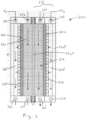
- FIG. 2 An embodiment of a gas-diffusion electrode according to the invention is shown in Fig. 2 .
- Fig. 2 represents a schematic illustration of an electrochemical cell 200 utilizing an anode electrode 202 for the anode reaction, in this specific embodiment a hydrogen gas-diffusion electrode, and a carbon dioxide gas-diffusion electrode 204 for the cathode reaction of reducing carbon dioxide e.g. to formate.
- the cathode 204 may have a carbon dioxide internal gas plenum 206 in the current collector 208 of the electrode 204 to distribute carbon dioxide evenly into the gas-diffusion electrode.
- a cathode trickle bed solution distributor or percolator 210 is present in the catholyte cell compartment 212.
- the catholyte solution may be introduced at the top entry 214 of the catholyte compartment 212 and the catholyte solution is distributed evenly down the cell and is discharged via exit 216 at the bottom of the catholyte compartment 212.
- the flow may be reversed, so that the flow is in the upward vertical direction.
- the solution may be fed at specific rates, such as in the range of 0.001 to 10 liters per minute or more depending on the electrochemical cell dimensions, so that the cathode gas diffusion electrode 204 may not be flooded with the catholyte solution due to excessive pressure, and so as to maintain good ionic contact with the cathode gas diffusion electrode 204 for the transfer of electrons into the solution in the reduction of carbon dioxide.
- the flow and pressure of the catholyte flow are such that minimal amounts of catholyte solution pass through the gas diffusion electrode 204 into the carbon dioxide gas plenum 206 inside the cathode current collector 208, and that the carbon dioxide gas reduction within the gas diffusion electrode is sufficient, so as to obtain a reasonable cathode current density, e.g. in the range of 10 mA/cm 2 to 1000 mA/cm 2 , or more preferably in a range of about 50 to 500 mA/cm 2 .
- An energy source (not shown) is operably coupled with the electrodes 202 and 204 to reduce carbon dioxide at the cathode 204. Carbon dioxide is fed to the gas-diffusion electrode 204 via entry 218 into the gas plenum 206.
- Micro-channels 220 may be provided to pass carbon dioxide from the plenum 206 to the gas-diffusion electrode 204 that comprises the bismuth indium catalyst system. Carbon dioxide leaves the cell through exit 222.
- the anode side of the cell is similarly constructed.
- hydrogen gas is fed via entry 224 to gas plenum 226 provided with microchannels 228 and leaves the cell via exit 230.
- Anolyte is introduced at entry 232, flows through a distributor 234 down to the exit 236.
- a ion exchange membrane 238 is arranged between the anolyte and catholyte distributors 234 and 210.
- the cathode trickle bed 210 may include a thin construction, e.g. made from non-conductive corrosion resistant polymer plastics, such as PTFE, polypropylene and the like, in the form of screen-like or convoluted forms so to distribute the catholyte solution evenly as it passes down the gas-diffusion electrode 204.
- the trickle bed material may include conductive carbon and graphite, or potentially be manufactured from metal.
- the entry and exit ports of the catholyte compartment are designed such that the flow distribution of liquid is uniform along the cross section of the trickle bed at the top and bottom.
- the GDE cathode may be able to be operated in a partially flooded or possibly fully flooded condition, and the flow conditions and electrolyte may be adjusted to operate the cathode in this mode.
- Various binary metal catalysts were screened for their formate Faradaic yield in a test set up.
- the test set up comprised a 3 chambered glass cell wherein the electrodes were positioned. 0.75M KHCO3 was used as elektrolyt. Potentiostatic (xV vs SCE) electrolysis for the electrochemical reduction of CO 2 to formate was performed during 3.5-5 hrs. Tables 1 and 2 show the results. It has appeared that a 50 wt.% Bi sample showed the best results in this screening test, while a 10 wt.% Bi sample outperformed a 90 wt.% Bi sample. Table 1.
- InCl 3 , Bi(NO 3 ) 3 *5H 2 O and tri-sodium citrate dehydrate were weighted as shown in Table 3 and put inside a two-neck round bottom flask containing 100 mL of tri-ethylene glycol and Vulcan carbon (available from Cabot).
- the round bottom flask was placed in an oil bath and fitted with a condenser. The system was continuously purged with N 2 gas. The oil bath temperature was set to 100 °C. The content of the flask was stirred. After the system reached the desired value of the temperature, it was allowed to stabilize for about 10 minutes, before rapidly injecting a water solution of NaBH 4 using a syringe and needle.
- the NaBH 4 was freshly prepared and sonicated in order to speed up the solubilization process. As soon as the NaBH 4 was injected, a vigorous bubbling was observed in the mixture. The color of the suspension was black and no change in it was observed throughout the course of the reaction. After injecting NaBH 4 , the system was maintained at 100 °C under stirring for 15 minutes. Then the heater was turned off and the suspension was allowed to cool slowly. At room temperature the suspension was transferred into 4 centrifuge tubes and centrifuged at 8000 rpm for 30 min. The supernatant was poured out and ethanol was added into the tubes, followed by a thorough washing. The washing was performed by sonicating the suspension for 10 min. Then centrifugation at 8000 rpm for 30 minutes was performed.
- a gas-diffusion electrode with a geometric surface area of about 172 cm 2 was cut using a metallic blade.
- the GDE thus prepared was fixed on an aluminum panel using magnets and positioned at an angle of about 60° from the horizontal planed inside a ventilated fume hood.
- the catalyst ink was sprayed on the GDE using a manual air brusher at room temperature under atmospheric conditions.
Landscapes
- Chemical & Material Sciences (AREA)
- Organic Chemistry (AREA)
- Engineering & Computer Science (AREA)
- Chemical Kinetics & Catalysis (AREA)
- Electrochemistry (AREA)
- Materials Engineering (AREA)
- Metallurgy (AREA)
- Electrolytic Production Of Non-Metals, Compounds, Apparatuses Therefor (AREA)
- Electrodes For Compound Or Non-Metal Manufacture (AREA)
Claims (11)
- Gasdiffusionselektrode, umfassend eine Gasdiffusionsschicht auf einem leitfähigen Substrat, die Gasdiffusionsschicht umfassend einen Katalysator für katalysierte elektrochemische Reaktionen, wobei der Katalysator ein amorpher binärer Indium-Bismut-Katalysator ist, wobei die Bismutmenge in dem Bereich von 10 bis 90 Gew.-%, basierend auf der Gesamtmenge an Bismut und Indium, liegt.
- Gasdiffusionselektrode nach Anspruch 1, wobei das leitfähige Substrat ein elektrisch leitfähiger Träger ist und die Bismutmenge in dem binären Indium-Bismut-Katalysator in dem Bereich von 40 bis 60 Gew.-%, basierend auf der Gesamtmenge an Bismut und Indium, liegt.
- Gasdiffusionselektrode nach Anspruch 2, wobei der leitfähige Träger eine poröse Struktur aus Kohlenstoffpartikeln umfasst.
- Gasdiffusionselektrode nach einem der Ansprüche 1 bis 3, wobei das Katalysatorsystem durch ein hydrophobes Bindemittel an das leitfähige Substrat gebunden ist.
- Elektrochemische Zelle, umfassend mindestens eine Gaskammer und mindestens eine Flüssigkeitskammer, wobei Kammern durch eine Gasdiffusionselektrode nach einem der Ansprüche 1 bis 4 getrennt sind.
- Verfahren zum Herstellen einer Gasdiffusionselektrode nach einem der Ansprüche 1 bis 5, das Verfahren umfassend die Schritte einesBereitstellens eines leitfähigen Substrats;eines Aufbringens von Bismut, Indium, einem leitfähigen Träger und einem Bindemittel auf das leitfähige Substrat.
- Verfahren nach Anspruch 6, wobei das Bindemittel ein hydrophobes Bindemittel ist.
- Verfahren zum elektrokatalytischen Reduzieren von Kohlendioxid, umfassendein Einführen eines Anolyten in ein erstes Zellkompartiment einer elektrochemischen Zelle, das erste Zellkompartiment umfassend eine Anode;Einführen eines Katholyten und Kohlendioxids in ein zweites Zellkompartiment der elektrochemischen Zelle, das zweite Zellkompartiment umfassend eine Kathode, undAnlegen eines elektrischen Potentials zwischen der Anode und der Kathode, das ausreicht, um das Kohlendioxid zu einem reduzierten Reaktionsprodukt zu reduzieren,wobei die Kathode eine Gasdiffusionselektrode nach einem der Ansprüche 1 bis 5 umfasst.
- Verfahren nach Anspruch 8, wobei Kohlendioxid zu einem Reaktionsprodukt reduziert wird, das aus Carboxylaten und Carbonsäuren ausgewählt ist.
- Verfahren nach Anspruch 8 oder 9, wobei Kohlendioxid in einem wässrigen Medium zu Formiat oder Ameisensäure reduziert wird.
- Verfahren nach einem der Ansprüche 8 bis 10, wobei Kohlendioxid in einem nichtwässrigen Medium zu Oxalat oder Oxalsäure reduziert wird.
Applications Claiming Priority (2)
| Application Number | Priority Date | Filing Date | Title |
|---|---|---|---|
| US201862619028P | 2018-01-18 | 2018-01-18 | |
| PCT/EP2019/051296 WO2019141827A1 (en) | 2018-01-18 | 2019-01-18 | Catalyst system for catalyzed electrochemical reactions and preparation thereof, applications and uses thereof |
Publications (2)
| Publication Number | Publication Date |
|---|---|
| EP3740602A1 EP3740602A1 (de) | 2020-11-25 |
| EP3740602B1 true EP3740602B1 (de) | 2024-08-07 |
Family
ID=65276120
Family Applications (1)
| Application Number | Title | Priority Date | Filing Date |
|---|---|---|---|
| EP19702813.7A Active EP3740602B1 (de) | 2018-01-18 | 2019-01-18 | Elektrode für katalysierte elektrochemische reaktionen und ihre herstellung, anwendungen und verwendungen |
Country Status (5)
| Country | Link |
|---|---|
| EP (1) | EP3740602B1 (de) |
| CA (1) | CA3085243A1 (de) |
| DK (1) | DK3740602T3 (de) |
| FI (1) | FI3740602T3 (de) |
| WO (1) | WO2019141827A1 (de) |
Families Citing this family (9)
| Publication number | Priority date | Publication date | Assignee | Title |
|---|---|---|---|---|
| DE102019210277A1 (de) * | 2019-07-11 | 2021-01-14 | Siemens Aktiengesellschaft | Vorrichtung zur elektrochemischen Umsetzung eines Eduktgases mit einer Gasdiffusionselektrode |
| EP3831982A1 (de) * | 2019-12-02 | 2021-06-09 | Vito NV | Elektrochemische co2-umwandlung |
| WO2021122323A1 (en) | 2019-12-20 | 2021-06-24 | Avantium Knowledge Centre B.V. | Formation of formic acid with the help of indium-containing catalytic electrode |
| EP4097276A1 (de) | 2020-01-30 | 2022-12-07 | Avantium Knowledge Centre B.V. | Elektrochemische herstellung von format |
| CN113201759B (zh) * | 2021-04-02 | 2022-04-08 | 浙江大学衢州研究院 | 一种三维多孔碳支撑的硫化铋/氧化铋复合催化剂及其制备方法和应用 |
| CN113441189B (zh) * | 2021-08-09 | 2022-07-15 | 中国科学技术大学 | 一种Na离子修饰的Bi纳米催化剂、其制备方法和应用 |
| CA3248749A1 (en) * | 2022-01-12 | 2023-07-20 | Électro Carbone Inc. | ELECTROCHEMICAL PROCESS FOR THE CONVERSION OF CARBON DIOXIDE INTO FORMIATE SALTS |
| WO2025229144A1 (en) | 2024-05-02 | 2025-11-06 | Avantium Knowledge Centre B.V. | Catalyst system for electrochemical reduction of carbon dioxide |
| WO2025229143A1 (en) | 2024-05-02 | 2025-11-06 | Avantium Knowledge Centre B.V. | Method for preparing a catalyst composition |
Citations (1)
| Publication number | Priority date | Publication date | Assignee | Title |
|---|---|---|---|---|
| EP3149228A1 (de) * | 2014-05-29 | 2017-04-05 | Avantium Knowledge Centre B.V. | Verfahren und system zur elektrochemischen reduktion von kohlendioxid mit einer gasdiffusionselektrode |
Family Cites Families (7)
| Publication number | Priority date | Publication date | Assignee | Title |
|---|---|---|---|---|
| JP2014518335A (ja) | 2011-07-06 | 2014-07-28 | リキッド・ライト・インコーポレーテッド | 二酸化炭素のカルボン酸、グリコール、及びカルボキシレートへの還元 |
| US20130105304A1 (en) * | 2012-07-26 | 2013-05-02 | Liquid Light, Inc. | System and High Surface Area Electrodes for the Electrochemical Reduction of Carbon Dioxide |
| US10329676B2 (en) | 2012-07-26 | 2019-06-25 | Avantium Knowledge Centre B.V. | Method and system for electrochemical reduction of carbon dioxide employing a gas diffusion electrode |
| WO2014032000A1 (en) | 2012-08-23 | 2014-02-27 | Liquid Light, Inc. | Reducing carbon dioxide to products with an indium oxide electrode |
| KR20150055033A (ko) | 2012-09-14 | 2015-05-20 | 리퀴드 라이트 인코포레이티드 | 이산화탄소의 전기화학적 환원을 위한 방법 및 고 표면적 전극 |
| FR3007427B1 (fr) * | 2013-06-20 | 2016-07-01 | Ifp Energies Now | Couche active a base de particules metalliques sur support conducteur poreux, methode de fabrication et utilisation en tant que cathode pour l'electroreduction de dioxyde de carbone. |
| WO2017118712A1 (en) * | 2016-01-05 | 2017-07-13 | Avantium Holding B.V. | Method and system for electrochemical reduction of carbon dioxide employing a gas diffusion anode |
-
2019
- 2019-01-18 WO PCT/EP2019/051296 patent/WO2019141827A1/en not_active Ceased
- 2019-01-18 CA CA3085243A patent/CA3085243A1/en active Pending
- 2019-01-18 FI FIEP19702813.7T patent/FI3740602T3/fi active
- 2019-01-18 DK DK19702813.7T patent/DK3740602T3/da active
- 2019-01-18 EP EP19702813.7A patent/EP3740602B1/de active Active
Patent Citations (1)
| Publication number | Priority date | Publication date | Assignee | Title |
|---|---|---|---|---|
| EP3149228A1 (de) * | 2014-05-29 | 2017-04-05 | Avantium Knowledge Centre B.V. | Verfahren und system zur elektrochemischen reduktion von kohlendioxid mit einer gasdiffusionselektrode |
Also Published As
| Publication number | Publication date |
|---|---|
| EP3740602A1 (de) | 2020-11-25 |
| FI3740602T3 (fi) | 2024-10-31 |
| CA3085243A1 (en) | 2019-07-25 |
| DK3740602T3 (da) | 2024-10-21 |
| WO2019141827A1 (en) | 2019-07-25 |
Similar Documents
| Publication | Publication Date | Title |
|---|---|---|
| EP3740602A1 (de) | Katalysatorsystem für katalysierte elektrochemische reaktionen und herstellung davon, anwendungen und verwendungen davon | |
| JP6599367B2 (ja) | ガス拡散電極を用いて二酸化炭素を電気化学的に還元するための方法及びシステム | |
| US11131028B2 (en) | Method and system for electrochemical reduction of carbon dioxide employing a gas diffusion electrode | |
| EP3149228B1 (de) | Verfahren zur elektrochemischen reduktion von kohlendioxid mit einer gasdiffusionselektrode | |
| EP3234226B1 (de) | Verfahren zur herstellung von 2,3-butandiol | |
| CA2883127C (en) | Process and high surface area electrodes for the electrochemical reduction of carbon dioxide | |
| CN104641019B (zh) | 用于卤素和一氧化碳电化学联合生产羰基化产物的方法和系统 | |
| US7959784B2 (en) | Electrolytic method to make alkali alcoholates using ceramic ion conducting solid membranes | |
| US6217728B1 (en) | Electrolysis cell | |
| EP2935654B1 (de) | Verfahren zur herstellung von oxalsäure und oxalsäurereduktionsprodukten | |
| KR20140050038A (ko) | 이산화탄소의 카복실산, 글리콜 및 카복실레이트로의 환원 | |
| Marshall et al. | A review of some recent electrolytic cell designs | |
| US20150240369A1 (en) | Electrolysis Electrocatalyst | |
| US20230193487A1 (en) | Catalyst System for Catalyzed Electrochemical Reactions and Preparation Thereof, Applications and Uses Thereof | |
| JP2015534607A (ja) | 電気分解電極触媒 | |
| Zimmer et al. | Catalytic epoxidation with electrochemically in situ generated hydrogen peroxide | |
| Kolyagin et al. | Electrochemical reduction of oxygen to hydrogen peroxide in a gas-diffusion electrode based on mesoporous carbon | |
| US11814738B2 (en) | Electrochemical production of formate | |
| CN102443819A (zh) | 运输和储存稳定的耗氧电极的制造方法 | |
| WO2025229144A1 (en) | Catalyst system for electrochemical reduction of carbon dioxide | |
| Aishah et al. | Carbon dioxide fixation method for electrosynthesis of benzoic acid from chlorobenzene | |
| EP0082514A1 (de) | Elektrodenmaterial | |
| KR860000736B1 (ko) | 전극 조성물 및 그의 제조방법 | |
| CN119855944A (zh) | 电解装置 |
Legal Events
| Date | Code | Title | Description |
|---|---|---|---|
| STAA | Information on the status of an ep patent application or granted ep patent |
Free format text: STATUS: UNKNOWN |
|
| STAA | Information on the status of an ep patent application or granted ep patent |
Free format text: STATUS: THE INTERNATIONAL PUBLICATION HAS BEEN MADE |
|
| PUAI | Public reference made under article 153(3) epc to a published international application that has entered the european phase |
Free format text: ORIGINAL CODE: 0009012 |
|
| STAA | Information on the status of an ep patent application or granted ep patent |
Free format text: STATUS: REQUEST FOR EXAMINATION WAS MADE |
|
| 17P | Request for examination filed |
Effective date: 20200716 |
|
| AK | Designated contracting states |
Kind code of ref document: A1 Designated state(s): AL AT BE BG CH CY CZ DE DK EE ES FI FR GB GR HR HU IE IS IT LI LT LU LV MC MK MT NL NO PL PT RO RS SE SI SK SM TR |
|
| AX | Request for extension of the european patent |
Extension state: BA ME |
|
| RIN1 | Information on inventor provided before grant (corrected) |
Inventor name: ANSOVINI, DAVIDE Inventor name: PARAJULI, RISHI Inventor name: SCHOUTEN, KLAAS JAN PIETER Inventor name: PHILIPS, MATTHEW FRANCIS |
|
| DAV | Request for validation of the european patent (deleted) | ||
| DAX | Request for extension of the european patent (deleted) | ||
| STAA | Information on the status of an ep patent application or granted ep patent |
Free format text: STATUS: EXAMINATION IS IN PROGRESS |
|
| 17Q | First examination report despatched |
Effective date: 20220907 |
|
| REG | Reference to a national code |
Ref legal event code: R079 Free format text: PREVIOUS MAIN CLASS: C25B0011040000 Ipc: C25B0003000000 Ref country code: DE Ref legal event code: R079 Ref document number: 602019056507 Country of ref document: DE Free format text: PREVIOUS MAIN CLASS: C25B0011040000 Ipc: C25B0003000000 |
|
| GRAP | Despatch of communication of intention to grant a patent |
Free format text: ORIGINAL CODE: EPIDOSNIGR1 |
|
| RIC1 | Information provided on ipc code assigned before grant |
Ipc: C25B 3/00 20060101AFI20240125BHEP |
|
| STAA | Information on the status of an ep patent application or granted ep patent |
Free format text: STATUS: GRANT OF PATENT IS INTENDED |
|
| INTG | Intention to grant announced |
Effective date: 20240229 |
|
| GRAS | Grant fee paid |
Free format text: ORIGINAL CODE: EPIDOSNIGR3 |
|
| GRAA | (expected) grant |
Free format text: ORIGINAL CODE: 0009210 |
|
| STAA | Information on the status of an ep patent application or granted ep patent |
Free format text: STATUS: THE PATENT HAS BEEN GRANTED |
|
| P01 | Opt-out of the competence of the unified patent court (upc) registered |
Free format text: CASE NUMBER: APP_36865/2024 Effective date: 20240624 |
|
| AK | Designated contracting states |
Kind code of ref document: B1 Designated state(s): AL AT BE BG CH CY CZ DE DK EE ES FI FR GB GR HR HU IE IS IT LI LT LU LV MC MK MT NL NO PL PT RO RS SE SI SK SM TR |
|
| REG | Reference to a national code |
Ref country code: GB Ref legal event code: FG4D |
|
| REG | Reference to a national code |
Ref country code: CH Ref legal event code: EP |
|
| REG | Reference to a national code |
Ref country code: IE Ref legal event code: FG4D |
|
| REG | Reference to a national code |
Ref country code: DE Ref legal event code: R096 Ref document number: 602019056507 Country of ref document: DE |
|
| REG | Reference to a national code |
Ref country code: NL Ref legal event code: FP |
|
| REG | Reference to a national code |
Ref country code: DK Ref legal event code: T3 Effective date: 20241016 |
|
| REG | Reference to a national code |
Ref country code: SE Ref legal event code: TRGR |
|
| REG | Reference to a national code |
Ref country code: FI Ref legal event code: FGE |
|
| REG | Reference to a national code |
Ref country code: LT Ref legal event code: MG9D |
|
| REG | Reference to a national code |
Ref country code: AT Ref legal event code: MK05 Ref document number: 1711014 Country of ref document: AT Kind code of ref document: T Effective date: 20240807 |
|
| PG25 | Lapsed in a contracting state [announced via postgrant information from national office to epo] |
Ref country code: PL Free format text: LAPSE BECAUSE OF FAILURE TO SUBMIT A TRANSLATION OF THE DESCRIPTION OR TO PAY THE FEE WITHIN THE PRESCRIBED TIME-LIMIT Effective date: 20240807 Ref country code: GR Free format text: LAPSE BECAUSE OF FAILURE TO SUBMIT A TRANSLATION OF THE DESCRIPTION OR TO PAY THE FEE WITHIN THE PRESCRIBED TIME-LIMIT Effective date: 20241108 Ref country code: PT Free format text: LAPSE BECAUSE OF FAILURE TO SUBMIT A TRANSLATION OF THE DESCRIPTION OR TO PAY THE FEE WITHIN THE PRESCRIBED TIME-LIMIT Effective date: 20241209 |
|
| PG25 | Lapsed in a contracting state [announced via postgrant information from national office to epo] |
Ref country code: BG Free format text: LAPSE BECAUSE OF FAILURE TO SUBMIT A TRANSLATION OF THE DESCRIPTION OR TO PAY THE FEE WITHIN THE PRESCRIBED TIME-LIMIT Effective date: 20240807 |
|
| PG25 | Lapsed in a contracting state [announced via postgrant information from national office to epo] |
Ref country code: LV Free format text: LAPSE BECAUSE OF FAILURE TO SUBMIT A TRANSLATION OF THE DESCRIPTION OR TO PAY THE FEE WITHIN THE PRESCRIBED TIME-LIMIT Effective date: 20240807 |
|
| PG25 | Lapsed in a contracting state [announced via postgrant information from national office to epo] |
Ref country code: AT Free format text: LAPSE BECAUSE OF FAILURE TO SUBMIT A TRANSLATION OF THE DESCRIPTION OR TO PAY THE FEE WITHIN THE PRESCRIBED TIME-LIMIT Effective date: 20240807 |
|
| PG25 | Lapsed in a contracting state [announced via postgrant information from national office to epo] |
Ref country code: HR Free format text: LAPSE BECAUSE OF FAILURE TO SUBMIT A TRANSLATION OF THE DESCRIPTION OR TO PAY THE FEE WITHIN THE PRESCRIBED TIME-LIMIT Effective date: 20240807 |
|
| PG25 | Lapsed in a contracting state [announced via postgrant information from national office to epo] |
Ref country code: ES Free format text: LAPSE BECAUSE OF FAILURE TO SUBMIT A TRANSLATION OF THE DESCRIPTION OR TO PAY THE FEE WITHIN THE PRESCRIBED TIME-LIMIT Effective date: 20240807 Ref country code: RS Free format text: LAPSE BECAUSE OF FAILURE TO SUBMIT A TRANSLATION OF THE DESCRIPTION OR TO PAY THE FEE WITHIN THE PRESCRIBED TIME-LIMIT Effective date: 20241107 |
|
| PG25 | Lapsed in a contracting state [announced via postgrant information from national office to epo] |
Ref country code: RS Free format text: LAPSE BECAUSE OF FAILURE TO SUBMIT A TRANSLATION OF THE DESCRIPTION OR TO PAY THE FEE WITHIN THE PRESCRIBED TIME-LIMIT Effective date: 20241107 Ref country code: PT Free format text: LAPSE BECAUSE OF FAILURE TO SUBMIT A TRANSLATION OF THE DESCRIPTION OR TO PAY THE FEE WITHIN THE PRESCRIBED TIME-LIMIT Effective date: 20241209 Ref country code: PL Free format text: LAPSE BECAUSE OF FAILURE TO SUBMIT A TRANSLATION OF THE DESCRIPTION OR TO PAY THE FEE WITHIN THE PRESCRIBED TIME-LIMIT Effective date: 20240807 Ref country code: LV Free format text: LAPSE BECAUSE OF FAILURE TO SUBMIT A TRANSLATION OF THE DESCRIPTION OR TO PAY THE FEE WITHIN THE PRESCRIBED TIME-LIMIT Effective date: 20240807 Ref country code: HR Free format text: LAPSE BECAUSE OF FAILURE TO SUBMIT A TRANSLATION OF THE DESCRIPTION OR TO PAY THE FEE WITHIN THE PRESCRIBED TIME-LIMIT Effective date: 20240807 Ref country code: GR Free format text: LAPSE BECAUSE OF FAILURE TO SUBMIT A TRANSLATION OF THE DESCRIPTION OR TO PAY THE FEE WITHIN THE PRESCRIBED TIME-LIMIT Effective date: 20241108 Ref country code: ES Free format text: LAPSE BECAUSE OF FAILURE TO SUBMIT A TRANSLATION OF THE DESCRIPTION OR TO PAY THE FEE WITHIN THE PRESCRIBED TIME-LIMIT Effective date: 20240807 Ref country code: BG Free format text: LAPSE BECAUSE OF FAILURE TO SUBMIT A TRANSLATION OF THE DESCRIPTION OR TO PAY THE FEE WITHIN THE PRESCRIBED TIME-LIMIT Effective date: 20240807 Ref country code: AT Free format text: LAPSE BECAUSE OF FAILURE TO SUBMIT A TRANSLATION OF THE DESCRIPTION OR TO PAY THE FEE WITHIN THE PRESCRIBED TIME-LIMIT Effective date: 20240807 |
|
| PG25 | Lapsed in a contracting state [announced via postgrant information from national office to epo] |
Ref country code: RO Free format text: LAPSE BECAUSE OF FAILURE TO SUBMIT A TRANSLATION OF THE DESCRIPTION OR TO PAY THE FEE WITHIN THE PRESCRIBED TIME-LIMIT Effective date: 20240807 Ref country code: SM Free format text: LAPSE BECAUSE OF FAILURE TO SUBMIT A TRANSLATION OF THE DESCRIPTION OR TO PAY THE FEE WITHIN THE PRESCRIBED TIME-LIMIT Effective date: 20240807 |
|
| PG25 | Lapsed in a contracting state [announced via postgrant information from national office to epo] |
Ref country code: EE Free format text: LAPSE BECAUSE OF FAILURE TO SUBMIT A TRANSLATION OF THE DESCRIPTION OR TO PAY THE FEE WITHIN THE PRESCRIBED TIME-LIMIT Effective date: 20240807 |
|
| PG25 | Lapsed in a contracting state [announced via postgrant information from national office to epo] |
Ref country code: CZ Free format text: LAPSE BECAUSE OF FAILURE TO SUBMIT A TRANSLATION OF THE DESCRIPTION OR TO PAY THE FEE WITHIN THE PRESCRIBED TIME-LIMIT Effective date: 20240807 |
|
| PG25 | Lapsed in a contracting state [announced via postgrant information from national office to epo] |
Ref country code: SK Free format text: LAPSE BECAUSE OF FAILURE TO SUBMIT A TRANSLATION OF THE DESCRIPTION OR TO PAY THE FEE WITHIN THE PRESCRIBED TIME-LIMIT Effective date: 20240807 |
|
| REG | Reference to a national code |
Ref country code: DE Ref legal event code: R097 Ref document number: 602019056507 Country of ref document: DE |
|
| PLBE | No opposition filed within time limit |
Free format text: ORIGINAL CODE: 0009261 |
|
| STAA | Information on the status of an ep patent application or granted ep patent |
Free format text: STATUS: NO OPPOSITION FILED WITHIN TIME LIMIT |
|
| 26N | No opposition filed |
Effective date: 20250508 |
|
| REG | Reference to a national code |
Ref country code: CH Ref legal event code: PL |
|
| PG25 | Lapsed in a contracting state [announced via postgrant information from national office to epo] |
Ref country code: MC Free format text: LAPSE BECAUSE OF FAILURE TO SUBMIT A TRANSLATION OF THE DESCRIPTION OR TO PAY THE FEE WITHIN THE PRESCRIBED TIME-LIMIT Effective date: 20240807 Ref country code: LU Free format text: LAPSE BECAUSE OF NON-PAYMENT OF DUE FEES Effective date: 20250118 |
|
| PG25 | Lapsed in a contracting state [announced via postgrant information from national office to epo] |
Ref country code: CH Free format text: LAPSE BECAUSE OF NON-PAYMENT OF DUE FEES Effective date: 20250131 |
|
| PG25 | Lapsed in a contracting state [announced via postgrant information from national office to epo] |
Ref country code: IT Free format text: LAPSE BECAUSE OF NON-PAYMENT OF DUE FEES Effective date: 20250118 |
|
| PG25 | Lapsed in a contracting state [announced via postgrant information from national office to epo] |
Ref country code: IE Free format text: LAPSE BECAUSE OF NON-PAYMENT OF DUE FEES Effective date: 20250118 |
|
| PGFP | Annual fee paid to national office [announced via postgrant information from national office to epo] |
Ref country code: NL Payment date: 20260126 Year of fee payment: 8 |
|
| PGFP | Annual fee paid to national office [announced via postgrant information from national office to epo] |
Ref country code: SE Payment date: 20260127 Year of fee payment: 8 |
|
| PGFP | Annual fee paid to national office [announced via postgrant information from national office to epo] |
Ref country code: GB Payment date: 20260127 Year of fee payment: 8 |
|
| PGFP | Annual fee paid to national office [announced via postgrant information from national office to epo] |
Ref country code: NO Payment date: 20260128 Year of fee payment: 8 Ref country code: DE Payment date: 20260128 Year of fee payment: 8 Ref country code: DK Payment date: 20260126 Year of fee payment: 8 |
|
| PG25 | Lapsed in a contracting state [announced via postgrant information from national office to epo] |
Ref country code: IT Free format text: LAPSE BECAUSE OF NON-PAYMENT OF DUE FEES Effective date: 20250118 |
|
| PGFP | Annual fee paid to national office [announced via postgrant information from national office to epo] |
Ref country code: BE Payment date: 20260127 Year of fee payment: 8 Ref country code: IT Payment date: 20260121 Year of fee payment: 8 Ref country code: FI Payment date: 20260126 Year of fee payment: 8 |
|
| PGRI | Patent reinstated in contracting state [announced from national office to epo] |
Ref country code: IT Effective date: 20250603 |
|
| PGFP | Annual fee paid to national office [announced via postgrant information from national office to epo] |
Ref country code: IS Payment date: 20260113 Year of fee payment: 8 Ref country code: FR Payment date: 20260126 Year of fee payment: 8 |