EP3740129B1 - Spectral imaging with a non-spectral imaging system - Google Patents
Spectral imaging with a non-spectral imaging system Download PDFInfo
- Publication number
- EP3740129B1 EP3740129B1 EP19700140.7A EP19700140A EP3740129B1 EP 3740129 B1 EP3740129 B1 EP 3740129B1 EP 19700140 A EP19700140 A EP 19700140A EP 3740129 B1 EP3740129 B1 EP 3740129B1
- Authority
- EP
- European Patent Office
- Prior art keywords
- spectral
- image
- images
- estimated
- results module
- Prior art date
- Legal status (The legal status is an assumption and is not a legal conclusion. Google has not performed a legal analysis and makes no representation as to the accuracy of the status listed.)
- Active
Links
Images



Classifications
-
- A—HUMAN NECESSITIES
- A61—MEDICAL OR VETERINARY SCIENCE; HYGIENE
- A61B—DIAGNOSIS; SURGERY; IDENTIFICATION
- A61B6/00—Apparatus or devices for radiation diagnosis; Apparatus or devices for radiation diagnosis combined with radiation therapy equipment
- A61B6/02—Arrangements for diagnosis sequentially in different planes; Stereoscopic radiation diagnosis
- A61B6/03—Computed tomography [CT]
- A61B6/032—Transmission computed tomography [CT]
-
- G—PHYSICS
- G06—COMPUTING OR CALCULATING; COUNTING
- G06T—IMAGE DATA PROCESSING OR GENERATION, IN GENERAL
- G06T12/00—Tomographic reconstruction from projections
- G06T12/10—Image preprocessing, e.g. calibration, positioning of sources or scatter correction
-
- A—HUMAN NECESSITIES
- A61—MEDICAL OR VETERINARY SCIENCE; HYGIENE
- A61B—DIAGNOSIS; SURGERY; IDENTIFICATION
- A61B6/00—Apparatus or devices for radiation diagnosis; Apparatus or devices for radiation diagnosis combined with radiation therapy equipment
- A61B6/48—Diagnostic techniques
- A61B6/482—Diagnostic techniques involving multiple energy imaging
-
- A—HUMAN NECESSITIES
- A61—MEDICAL OR VETERINARY SCIENCE; HYGIENE
- A61B—DIAGNOSIS; SURGERY; IDENTIFICATION
- A61B6/00—Apparatus or devices for radiation diagnosis; Apparatus or devices for radiation diagnosis combined with radiation therapy equipment
- A61B6/52—Devices using data or image processing specially adapted for radiation diagnosis
- A61B6/5205—Devices using data or image processing specially adapted for radiation diagnosis involving processing of raw data to produce diagnostic data
-
- A—HUMAN NECESSITIES
- A61—MEDICAL OR VETERINARY SCIENCE; HYGIENE
- A61B—DIAGNOSIS; SURGERY; IDENTIFICATION
- A61B6/00—Apparatus or devices for radiation diagnosis; Apparatus or devices for radiation diagnosis combined with radiation therapy equipment
- A61B6/52—Devices using data or image processing specially adapted for radiation diagnosis
- A61B6/5211—Devices using data or image processing specially adapted for radiation diagnosis involving processing of medical diagnostic data
-
- G—PHYSICS
- G06—COMPUTING OR CALCULATING; COUNTING
- G06N—COMPUTING ARRANGEMENTS BASED ON SPECIFIC COMPUTATIONAL MODELS
- G06N3/00—Computing arrangements based on biological models
- G06N3/02—Neural networks
- G06N3/04—Architecture, e.g. interconnection topology
- G06N3/045—Combinations of networks
-
- G—PHYSICS
- G06—COMPUTING OR CALCULATING; COUNTING
- G06N—COMPUTING ARRANGEMENTS BASED ON SPECIFIC COMPUTATIONAL MODELS
- G06N3/00—Computing arrangements based on biological models
- G06N3/02—Neural networks
- G06N3/04—Architecture, e.g. interconnection topology
- G06N3/0464—Convolutional networks [CNN, ConvNet]
-
- G—PHYSICS
- G06—COMPUTING OR CALCULATING; COUNTING
- G06N—COMPUTING ARRANGEMENTS BASED ON SPECIFIC COMPUTATIONAL MODELS
- G06N3/00—Computing arrangements based on biological models
- G06N3/02—Neural networks
- G06N3/04—Architecture, e.g. interconnection topology
- G06N3/048—Activation functions
-
- G—PHYSICS
- G06—COMPUTING OR CALCULATING; COUNTING
- G06N—COMPUTING ARRANGEMENTS BASED ON SPECIFIC COMPUTATIONAL MODELS
- G06N3/00—Computing arrangements based on biological models
- G06N3/02—Neural networks
- G06N3/08—Learning methods
-
- G—PHYSICS
- G06—COMPUTING OR CALCULATING; COUNTING
- G06N—COMPUTING ARRANGEMENTS BASED ON SPECIFIC COMPUTATIONAL MODELS
- G06N3/00—Computing arrangements based on biological models
- G06N3/02—Neural networks
- G06N3/08—Learning methods
- G06N3/09—Supervised learning
-
- G—PHYSICS
- G06—COMPUTING OR CALCULATING; COUNTING
- G06N—COMPUTING ARRANGEMENTS BASED ON SPECIFIC COMPUTATIONAL MODELS
- G06N3/00—Computing arrangements based on biological models
- G06N3/02—Neural networks
- G06N3/08—Learning methods
- G06N3/094—Adversarial learning
-
- G—PHYSICS
- G16—INFORMATION AND COMMUNICATION TECHNOLOGY [ICT] SPECIALLY ADAPTED FOR SPECIFIC APPLICATION FIELDS
- G16H—HEALTHCARE INFORMATICS, i.e. INFORMATION AND COMMUNICATION TECHNOLOGY [ICT] SPECIALLY ADAPTED FOR THE HANDLING OR PROCESSING OF MEDICAL OR HEALTHCARE DATA
- G16H30/00—ICT specially adapted for the handling or processing of medical images
- G16H30/20—ICT specially adapted for the handling or processing of medical images for handling medical images, e.g. DICOM, HL7 or PACS
-
- G—PHYSICS
- G16—INFORMATION AND COMMUNICATION TECHNOLOGY [ICT] SPECIALLY ADAPTED FOR SPECIFIC APPLICATION FIELDS
- G16H—HEALTHCARE INFORMATICS, i.e. INFORMATION AND COMMUNICATION TECHNOLOGY [ICT] SPECIALLY ADAPTED FOR THE HANDLING OR PROCESSING OF MEDICAL OR HEALTHCARE DATA
- G16H30/00—ICT specially adapted for the handling or processing of medical images
- G16H30/40—ICT specially adapted for the handling or processing of medical images for processing medical images, e.g. editing
-
- G—PHYSICS
- G16—INFORMATION AND COMMUNICATION TECHNOLOGY [ICT] SPECIALLY ADAPTED FOR SPECIFIC APPLICATION FIELDS
- G16H—HEALTHCARE INFORMATICS, i.e. INFORMATION AND COMMUNICATION TECHNOLOGY [ICT] SPECIALLY ADAPTED FOR THE HANDLING OR PROCESSING OF MEDICAL OR HEALTHCARE DATA
- G16H40/00—ICT specially adapted for the management or administration of healthcare resources or facilities; ICT specially adapted for the management or operation of medical equipment or devices
- G16H40/60—ICT specially adapted for the management or administration of healthcare resources or facilities; ICT specially adapted for the management or operation of medical equipment or devices for the operation of medical equipment or devices
- G16H40/63—ICT specially adapted for the management or administration of healthcare resources or facilities; ICT specially adapted for the management or operation of medical equipment or devices for the operation of medical equipment or devices for local operation
-
- G—PHYSICS
- G16—INFORMATION AND COMMUNICATION TECHNOLOGY [ICT] SPECIALLY ADAPTED FOR SPECIFIC APPLICATION FIELDS
- G16H—HEALTHCARE INFORMATICS, i.e. INFORMATION AND COMMUNICATION TECHNOLOGY [ICT] SPECIALLY ADAPTED FOR THE HANDLING OR PROCESSING OF MEDICAL OR HEALTHCARE DATA
- G16H50/00—ICT specially adapted for medical diagnosis, medical simulation or medical data mining; ICT specially adapted for detecting, monitoring or modelling epidemics or pandemics
- G16H50/20—ICT specially adapted for medical diagnosis, medical simulation or medical data mining; ICT specially adapted for detecting, monitoring or modelling epidemics or pandemics for computer-aided diagnosis, e.g. based on medical expert systems
-
- G—PHYSICS
- G16—INFORMATION AND COMMUNICATION TECHNOLOGY [ICT] SPECIALLY ADAPTED FOR SPECIFIC APPLICATION FIELDS
- G16H—HEALTHCARE INFORMATICS, i.e. INFORMATION AND COMMUNICATION TECHNOLOGY [ICT] SPECIALLY ADAPTED FOR THE HANDLING OR PROCESSING OF MEDICAL OR HEALTHCARE DATA
- G16H50/00—ICT specially adapted for medical diagnosis, medical simulation or medical data mining; ICT specially adapted for detecting, monitoring or modelling epidemics or pandemics
- G16H50/50—ICT specially adapted for medical diagnosis, medical simulation or medical data mining; ICT specially adapted for detecting, monitoring or modelling epidemics or pandemics for simulation or modelling of medical disorders
-
- A—HUMAN NECESSITIES
- A61—MEDICAL OR VETERINARY SCIENCE; HYGIENE
- A61B—DIAGNOSIS; SURGERY; IDENTIFICATION
- A61B6/00—Apparatus or devices for radiation diagnosis; Apparatus or devices for radiation diagnosis combined with radiation therapy equipment
- A61B6/48—Diagnostic techniques
- A61B6/481—Diagnostic techniques involving the use of contrast agents
-
- A—HUMAN NECESSITIES
- A61—MEDICAL OR VETERINARY SCIENCE; HYGIENE
- A61B—DIAGNOSIS; SURGERY; IDENTIFICATION
- A61B6/00—Apparatus or devices for radiation diagnosis; Apparatus or devices for radiation diagnosis combined with radiation therapy equipment
- A61B6/48—Diagnostic techniques
- A61B6/483—Diagnostic techniques involving scattered radiation
-
- G—PHYSICS
- G06—COMPUTING OR CALCULATING; COUNTING
- G06N—COMPUTING ARRANGEMENTS BASED ON SPECIFIC COMPUTATIONAL MODELS
- G06N3/00—Computing arrangements based on biological models
- G06N3/02—Neural networks
- G06N3/04—Architecture, e.g. interconnection topology
- G06N3/047—Probabilistic or stochastic networks
-
- G—PHYSICS
- G06—COMPUTING OR CALCULATING; COUNTING
- G06T—IMAGE DATA PROCESSING OR GENERATION, IN GENERAL
- G06T2210/00—Indexing scheme for image generation or computer graphics
- G06T2210/41—Medical
Definitions
- the following generally relates to imaging and more particularly to estimating spectral images from non-spectral images produced by a non-spectral imaging system, and is described with particular application to computed tomography (CT), but is also amenable to other non-spectral imaging systems.
- CT computed tomography
- a traditional computed tomography (CT) scanner generally includes an x-ray tube mounted on a rotatable gantry opposite a detector array including one or more rows of detector pixels.
- the x-ray tube rotates around an examination region located between the x-ray tube and the detector array, and emits polychromatic radiation that traverses the examination region and an object or subject disposed therein.
- the detector array detects radiation that traverses the examination region and generates projection data indicative of the examination region and the object or subject disposed therein.
- a reconstructor processes the projection data and generates volumetric image data indicative of the examination region and the object or subject disposed therein.
- the volumetric image data can be processed to generate one or more images that include the scanned portion of the object or subject.
- the resulting image(s) includes pixels that typically are represented in terms of gray scale values corresponding to relative radiodensity. Such information reflects the attenuation characteristics of the scanned subject and/or object, and generally shows structure such as anatomical structures within a patient, physical structures within an inanimate object, and the like.
- the detected radiation also includes spectral information as the absorption of the radiation by the subject and/or object is dependent on the energy of the photons traversing therethrough.
- spectral information can provide additional information such as information indicative of the elemental or material composition (e.g., atomic number) of the tissue and/or material of the subject and/or object.
- the projection data does not reflect the spectral characteristics as the signal output by the detector array is proportional to the energy fluence integrated over the energy spectrum.
- a scanner of this configuration is referred to herein as a non-spectral scanner.
- a computed tomography scanner configured for spectral imaging leverages this spectral information to provide further information indicative of elemental or material composition.
- One approach includes using multiple X-ray tubes, each emitting an X-ray beam having a different energy spectrum.
- Another approach includes fast kVp switching in which the voltage across the tube is switched between different voltages such that measurements at multiple energies are taken.
- Another approach includes a multi-layer indirect conversion detector with an uppermost layer that detects lower energy X-rays and a bottommost layer that detects higher energy X-ray.
- Another approach uses direct conversion photon detectors which energy bins photons in multiple energy ranges.
- a dual-energy scanner is a specific configuration that utilizes two attenuation values acquired concurrently at two photon energies to solve for photoelectric effect and Compton scattering basis components. Because any two linearly independent sums of two basis functions span the entire attenuation coefficient space, any material can be represented by a linear combination of two basis materials.
- the basis material components can be used to produce, e.g., a non-spectral image and/or a spectral image such as an image for an energy band, a virtual monochromatic image, a contrast agent quantitative map, a virtual non-contrast image, a material cancellation image, an effective atomic number image, an electron density image, and/or other spectral image.
- spectral imaging generally cannot utilize existing acquisition protocols, reconstruction settings and/or dataflow and storage configuration of non-spectral scanners, and thus, may require adapting the acquisition protocols, reconstruction settings and/or dataflow and storage configuration.
- image quality may be degraded (e.g., temporal resolution may be reduced), the ability to produce non-spectral images may be lost, and/or data storage capacity may have to be significantly increased.
- the invention may take form in various components and arrangements of components, and in various steps and arrangements of steps.
- the drawings are only for purposes of illustrating the preferred embodiments and are not to be construed as limiting the invention.
- FIGURE 1 schematically illustrates a system 102 including an imaging system 104, such as a non-spectral CT scanner (i.e., a CT scanner not configured for spectral imaging).
- the imaging system 104 includes a generally stationary gantry 106 and a rotating gantry 108, which is rotatably supported by the stationary gantry 106 and rotates around an examination region 110 about a z-axis.
- a radiation source 112, such as an x-ray tube, is rotatably supported by the rotating gantry 108, rotates with the rotating gantry 108, and emits radiation that traverses the examination region 110.
- a radiation sensitive detector array 114 subtends an angular arc opposite the radiation source 112 across the examination region 110.
- the illustrated radiation sensitive detector array 114 includes one or more rows of layer indirect conversion detector elements (e.g., scintillator/photosenser).
- the array 114 detects radiation traversing the examination region 110 and generates projection data (line integrals) indicative thereof.
- a reconstructor 116 reconstructs the projection data, generating non-spectral volumetric image data indicative of the examination region 110.
- a subject support 120 such as a couch, supports an object or subject in the examination region 110.
- An operator console 118 includes a computer with a human readable output device such as a display monitor 121 and an input device 122 such as a keyboard, mouse, etc.
- the console 118 further includes a processor 124 (e.g., a central processing unit (CPU), a microprocessor, etc.) and computer readable storage medium 126 (which excludes transitory medium) such as physical memory, a memory device, and/or other non-transitory storage medium.
- the processor 124 is configured to execute a control instruction 128, which allows an operator to control an operation such as select an acquisition, reconstruction, etc. protocol, set an acquisition, reconstruction, etc. parameter, start a scan, select a mode of operation, etc.
- the one or more processors 124 are also configured to execute instructions of a spectral results module 130 and a training module 132.
- the spectral results module 130 is configured to process the non-spectral volumetric image data along with acquisition and reconstruction parameters and estimate spectral data such as basis components (e.g., photoelectric electric and Compton scattering, etc.) and/or spectral images (e.g., virtual monochromatic, iodine map, etc.).
- basis components e.g., photoelectric electric and Compton scattering, etc.
- spectral images e.g., virtual monochromatic, iodine map, etc.
- estimating the spectral data includes employing a deep learning regression algorithm trained with the training module 132.
- the training module 132 is executed in a training mode, and the spectral results module 130 is operated in an operation mode.
- the non-spectral imaging system 102 reconstructs non-spectral volumetric image data and estimates spectral data therefrom.
- the non-spectral imaging system 102 does not require specialized acquisition hardware (e.g., multiple X-ray tubes, kVp switching hardware and circuitry, and/or spectral detectors) to produce spectral volumetric image data. This mitigates an increase in overall system cost associated with such specialized hardware.
- the non-spectral imaging system 102 can utilize acquisition and/or reconstruction protocols and/or dataflow and storage configuration of non-spectral scanners, which mitigates degradation of image quality and/or increased data storage capacity relative to a configuration which requires adaption thereof.
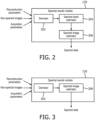
- FIGURE 2 schematically illustrates an example of the spectral results module 130.
- the spectral results module 130 receives the non-spectral images, the acquisition protocol parameters, and the reconstruction protocol parameters as input.
- acquisition protocol parameters include scan type, body part, mA (X-ray tube current in milliamperes), mAs (X-ray intensity as the product of mA and exposure time in seconds), kVp (X-ray tube peak kilovoltage), rotating source 108 rotation time, X-ray beam collimation, pitch or subject support 120 speed per rotation, and/or other acquisition protocol parameter(s).
- reconstruction protocol parameters include reconstruction filter, reconstruction algorithm, slice thickness, slice increment, matrix size, field of view, and/or other reconstruction protocol parameter(s).
- the spectral results module 130 outputs spectral data (i.e. spectral basis components and/or spectral images).
- a denoiser 202 removes noise from the input non-spectral images using a noise removal algorithm.
- An example algorithm is described in patent application US 2012/0224760 A1, filed October 29, 2010 , and entitle "Enhanced Image Data / Dose Reduction," which is incorporated by reference herein in its entirety. In one instance, this improves contrast to noise ratio (CNR) of the input images. Additionally, or alternatively, this could improve the performance of the system 102.
- a spectral basis estimator 204 processes the denoised non-spectral images and estimates, based on the input acquisition and reconstruction protocol parameters, spectral basis components. In this example, the spectral basis estimator 204 estimates photoelectric effect and Compton scattering basis components.
- a spectral image estimator 206 processes the estimated basis components and predicts spectral images.
- An example algorithm is described in patent application US20140133729A1 . "Image processing for spectral CT,” which is incorporated by reference herein in its entirety.
- Other suitable algorithms include Goshen, et al., "An iodine-calcium separation analysis and virtually non-contrasted image generation obtained with single source dual energy MDCT, "In IEEE Nucl Sci Symp Conf Rec, (2008, October), pp.
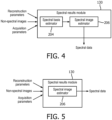
- FIGURE 3 schematically illustrates a variation of the spectral results module 130 of FIGURE 2 in which the spectral basis estimator 204 is omitted.
- the spectral image estimator 206 estimates the spectral basis components and/or the spectral images directly from the denoised non-spectral images.
- the spectral results module 130 outputs the spectral data (i.e. spectral basis components and/or spectral images).
- FIGURE 4 schematically illustrates another variation of the spectral results module 130 of FIGURE 2 in which the denoiser 202 is omitted.
- the spectral basis estimator 204 estimates the basis components directly from the input non-spectral images (i.e., no denoising), and the spectral image estimator 206 produces spectral data therefrom.
- the spectral results module 130 outputs the spectral data (i.e. spectral basis components and/or spectral images).
- FIGURE 5 schematically illustrates another variation of the spectral results module 130 of FIGURE 2 in which the denoiser 202 and the spectral basis estimator 204 are omitted.
- the spectral image estimator 206 estimates the spectral basis components and/or the spectral images directly from the input non-spectral images (i.e., no denoising).
- the spectral results module 130 outputs the spectral data (i.e. spectral basis components and/or spectral images).
- FIGURES 6 and 7 schematically illustrate examples of the deep learning algorithm.
- the deep learning algorithm includes a feed-forward artificial neural network such as a convolutional neural network and/or other neural network that analyzes visual imagery.
- the spectral data estimator 204 employs another algorithm.
- a sliding-window algorithm is utilized, which estimates the spectral image voxel-by-voxel.
- the algorithm receives, as input, a patch of voxels, which includes a voxel value of the non-spectral image at a location (x,y,z) to be estimated in the spectral data and a local-volume (e.g., 3x3x3, 5x5x5, 7x7x7, etc.) of voxel values around that voxel value.
- a patch of voxels which includes a voxel value of the non-spectral image at a location (x,y,z) to be estimated in the spectral data and a local-volume (e.g., 3x3x3, 5x5x5, 7x7x7, etc.) of voxel values around that voxel value.
- the algorithm includes N (where N is an integer equal or greater than one) pairs of convolutional layers / rectified linear units, including a first pair 602 1 with a convolutional layer 604 1 and a rectified linear unit 606 1 , ..., an ith pair 602 i with a convolutional layer 604 i and a rectified linear unit 606 i , ..., and an Nth pair 602 N with a convolutional layer 604rr and a rectified linear unit 606 N .
- Each of the convolutional layers 604 1 , ..., 604 i , ..., 604rr includes convolutional neurons that apply a convolution operation to the input. In one instance, this includes convolving a set of kernels across a width and a height of the input volume, computing a dot product between the entries of the filter and the input volume.
- Each of the rectified linear units 606 1 , ..., 606 i , ..., 606 N (also referred to collectively herein as rectified linear units 606) applies a non-linear activation function to its input, which increases nonlinear properties of the overall network.
- suitable functions include, but are not limited to, max(0,x), tanh(x), and (1+e -x ) -1 .
- the algorithm further includes a fully connected layer 608 and M (where M is an integer equal or greater than zero) pairs of fully connected layers / rectified linear units, including a first pair 610 1 with a fully connected layer 612 1 and a rectified linear unit 614 1 , ..., and an Mth pair 612 M with a fully connected layer 612 M and a rectified linear unit 614 M .
- the fully connected layer (layer 612 M in the illustrated example) after the last pair of convolutional layers / rectified linear units (pair 602 1 in the illustrated example) receives, as input, the output of that last pair rectified linear units 606 1 , with the acquisition and reconstruction parameters added thereto.
- Each of the fully connected layers 612 1 , ..., and 612 M (also referred to collectively herein as fully connected layers 612) combines all of the features learned by the previous layers across the image to identify patterns.
- Each of the rectified linear units 614 1 , ..., and 614 M (also referred to collectively herein as convolutional layers 614) are configured similar to the rectified linear units 606 and applies a non-linear activation function to its input.
- the final fully connected layer (the fully connected layer 608) combines all the learned features to estimate the spectral voxel value at the location (x,y,z) in the spectral basis component and/or spectral image being estimated.
- FIGURE 7 a fully convolution regression network algorithm is utilized, which concurrently estimates groups of voxels, including an entire image.
- the algorithm includes at least two convolutional layers 702 (also referred to as conv-l), at least one fully connected layer 704, and at least one rectified linear unit 706 (also referred to as relu). Convolutional layers, fully connected layers, and/or the rectified linear units are configured to perform the same functions as those described in connection with the embodiment of FIGURE 6 and thus are not described again here.
- the algorithm further includes at least one pooling layer (PL) 708 and at least one up-sampling layer (ups-l) 710.
- the at least one pooling layer 708 down-samples its input, e.g., using a non-linear down-sampling algorithm.
- the at least one pooling layer 708 employs a max pooling function, which partitions the input into a set of non-overlapping rectangles and, for each such sub-region, outputs the maximum, reducing the spatial size of the input.
- Other suitable algorithms include average pooling or L2-norm pooling.
- the at least one up-sampling layer 710 up-samples its input, e.g., back to the original size of the input or other predetermined size.
- FIGURES 8, 9 and 10 illustrate example training of the deep learning algorithm of the spectral results module 130.
- an adversarial trainer 802 is trained using a set of initial network parameters.
- the input includes generated spectral images from a spectral imaging system along with a classification that they are generated spectral images by the spectral imaging system, and estimated spectral images from a non-spectral imaging system along with a classification that they are estimated spectral images from non-spectral image generated by the non-spectral imaging system.
- the adversarial trainer 802 is trained to distinguish between the generated spectral images generated by the spectral imaging system and the estimated spectral images estimated from non-spectral images generated by the non-spectral imaging system.
- the adversarial trainer 802 is trained as a fully convolutional classification neural network.
- the adversarial trainer 802 is further trained.
- the input includes a set of generated spectral images from a spectral imaging system and a set of estimated spectral images estimated from non-spectral image generated by a non-spectral imaging system.
- the classification of the input data sets is known, and the known classification and the classification results of the adversarial trainer 802 are provided to an adversarial parameter updater 902, which updates the network to improve the classification results of the adversarial trainer 802.
- the adversarial trainer 802 is trained until stopping criteria is met. Examples of stopping criteria include a correct classification percentage, a time duration, a number of update iterations, and/or other stopping criteria.
- An adversarial network is discussed in Goodfellow, et al., "Generative Adversarial Nets," In: Advances in neural information processing systems, 2672-2680, 10 June 2014 .
- the deep learning algorithm of the spectral results module 130 is trained using the trained adversarial trainer 802 and a set of initial network parameters.
- the input includes a set of non-spectral images from a non-spectral imaging system along with acquisition and reconstruction parameters used to produce the non-spectral images, and a set of non-spectral images from a spectral imaging system produced by combining spectral images along with acquisition and reconstruction parameters used to produce the spectral images and the spectral images.
- the spectral results module 130 estimates spectral images from the input data sets using its network parameters.
- the estimated spectral images are provided to the trained adversarial trainer 802, which classifies the estimated spectral images as either estimated spectral images from non-spectral image or generated spectral images from a spectral imaging system.
- the trained adversarial trainer 802 classifies input without a reference gold truth spectral image data set.
- the estimated spectral images and the generated spectral images are provided to an error determiner 1002, which computes a difference or error between the estimated spectral images and the generated spectral images. In one instance, the difference or error is computed as a root mean square error (RMSE).
- RMSE root mean square error
- a spectral results module parameter updater 1004 receives the classification results from trained adversarial trainer 802 and the error determined from the error determiner 1002.
- the spectral results module parameter updater 1004 adjusts the network parameters of the spectral results module 130 based on the classification results and error. In one instance, this includes optimizing a loss function that includes at least two terms, one term for the error and another term for the classification.
- the loss function is optimized to decrease the error between estimated and generated spectral images (e.g., lower the RMSE) and increase the number of classifications of estimated images as generated spectral images due to the estimated images being indistinguishable therefrom.
- the training described in FIGURES 8-10 is a deep regression neural network hybrid training that includes both 1) ground truth data sets consisting of estimated spectral images estimated from non-spectral images produced by combining generated spectral images generated by a spectral imaging system and the generated spectral images, and 2) data sets without ground truth spectral images, which include estimated spectral images estimated from non-spectral images produced by a non-spectral imaging system.
- Training deep regression neural network on ground truth data sets alone to predict spectral images from non-spectral images from a non-spectral imaging system may result in sub-optimal predicted spectral images due to, e.g., variations in image reconstruction pipelines between non-spectral and the spectral imaging system.
- the approached described herein mitigates this by also including the data sets without the ground truth spectral images in the loss function.
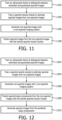
- FIGURE 11 illustrates an example method in accordance with an embodiment herein.
- the adversarial trainer 802 is trained with estimated and generated spectral images to distinguish therebetween, as described herein and/or otherwise.
- the deep learning algorithm of the spectral results module 130 is trained using the trained adversarial trainer 802 and the error determiner 1002 to estimate spectral images from non-spectral images, as described herein and/or otherwise.
- non-spectral images are generated with a non-spectral imaging system 102, as described herein and/or otherwise.
- the trained spectral results module 130 estimates spectral data (basis components and/or images) from the non-spectral images, as described herein and/or otherwise.
- FIGURE 12 illustrates an example method in accordance with an embodiment herein.
- the adversarial trainer 802 is trained with estimated and generated spectral images to distinguish therebetween, as described herein and/or otherwise.
- the deep learning algorithm of the spectral results module 130 is trained using the trained adversarial trainer 802 and the error determiner 1002 to estimate spectral images from non-spectral images, as described herein and/or otherwise.
- non-spectral images are generated with a non-spectral imaging system 102, as described herein and/or otherwise.
- the trained the spectral results module 130 estimates spectral basis components from the non-spectral images, as described herein and/or otherwise.
- the trained the spectral results module 130 generates spectral images from the spectral basis components, as described herein and/or otherwise.
- the above may be implemented by way of computer readable instructions, encoded or embedded on computer readable storage medium, which, when executed by a computer processor(s), cause the processor(s) to carry out the described acts. Additionally or alternatively, at least one of the computer readable instructions is carried by a signal, carrier wave or other transitory medium, which is not computer readable storage medium.
- a computer program may be stored/distributed on a suitable medium, such as an optical storage medium or a solid-state medium supplied together with or as part of other hardware, but may also be distributed in other forms, such as via the Internet or other wired or wireless telecommunication systems. Any reference signs in the claims should not be construed as limiting the scope.
Landscapes
- Engineering & Computer Science (AREA)
- Health & Medical Sciences (AREA)
- Life Sciences & Earth Sciences (AREA)
- Physics & Mathematics (AREA)
- Medical Informatics (AREA)
- General Health & Medical Sciences (AREA)
- Theoretical Computer Science (AREA)
- Biomedical Technology (AREA)
- Public Health (AREA)
- Biophysics (AREA)
- Molecular Biology (AREA)
- Data Mining & Analysis (AREA)
- Radiology & Medical Imaging (AREA)
- Nuclear Medicine, Radiotherapy & Molecular Imaging (AREA)
- General Physics & Mathematics (AREA)
- Pathology (AREA)
- General Engineering & Computer Science (AREA)
- Mathematical Physics (AREA)
- Software Systems (AREA)
- Computing Systems (AREA)
- Evolutionary Computation (AREA)
- Computational Linguistics (AREA)
- Artificial Intelligence (AREA)
- Epidemiology (AREA)
- Primary Health Care (AREA)
- Optics & Photonics (AREA)
- Veterinary Medicine (AREA)
- High Energy & Nuclear Physics (AREA)
- Animal Behavior & Ethology (AREA)
- Heart & Thoracic Surgery (AREA)
- Surgery (AREA)
- Computer Vision & Pattern Recognition (AREA)
- Pulmonology (AREA)
- Databases & Information Systems (AREA)
- Business, Economics & Management (AREA)
- General Business, Economics & Management (AREA)
- Apparatus For Radiation Diagnosis (AREA)
- Image Analysis (AREA)
- Analysing Materials By The Use Of Radiation (AREA)
Applications Claiming Priority (2)
| Application Number | Priority Date | Filing Date | Title |
|---|---|---|---|
| US201862617774P | 2018-01-16 | 2018-01-16 | |
| PCT/EP2019/050197 WO2019141527A1 (en) | 2018-01-16 | 2019-01-07 | Spectral imaging with a non-spectral imaging system |
Publications (2)
| Publication Number | Publication Date |
|---|---|
| EP3740129A1 EP3740129A1 (en) | 2020-11-25 |
| EP3740129B1 true EP3740129B1 (en) | 2024-03-13 |
Family
ID=65009766
Family Applications (1)
| Application Number | Title | Priority Date | Filing Date |
|---|---|---|---|
| EP19700140.7A Active EP3740129B1 (en) | 2018-01-16 | 2019-01-07 | Spectral imaging with a non-spectral imaging system |
Country Status (5)
| Country | Link |
|---|---|
| US (1) | US11417034B2 (https=) |
| EP (1) | EP3740129B1 (https=) |
| JP (1) | JP7378404B2 (https=) |
| CN (1) | CN111615363B (https=) |
| WO (1) | WO2019141527A1 (https=) |
Families Citing this family (6)
| Publication number | Priority date | Publication date | Assignee | Title |
|---|---|---|---|---|
| US20200294288A1 (en) * | 2019-03-13 | 2020-09-17 | The Uab Research Foundation | Systems and methods of computed tomography image reconstruction |
| EP3838154A1 (en) | 2019-12-16 | 2021-06-23 | Koninklijke Philips N.V. | Apparatus for generating photon counting spectral image data |
| EP4104767A1 (en) | 2021-06-17 | 2022-12-21 | Koninklijke Philips N.V. | Controlling an alert signal for spectral computed tomography imaging |
| CN116577819B (zh) * | 2023-05-18 | 2023-09-26 | 兰州大学 | 一种多头康普顿探测方法及系统 |
| US12561805B2 (en) | 2023-09-20 | 2026-02-24 | GE Precision Healthcare LLC | Methods and systems for generating dual-energy images from a single-energy imaging system based on anatomical segmentation |
| EP4559397A1 (de) * | 2023-11-24 | 2025-05-28 | Siemens Healthineers AG | Materialdekomposition bei der dual-energie-röntgenbildgebung |
Family Cites Families (17)
| Publication number | Priority date | Publication date | Assignee | Title |
|---|---|---|---|---|
| JP5042465B2 (ja) | 2005-05-18 | 2012-10-03 | 株式会社日立メディコ | 放射線撮影装置、画像処理方法 |
| EP2504811B1 (en) | 2009-11-25 | 2014-06-18 | Koninklijke Philips N.V. | Enhanced image data/dose reduction |
| JP6100772B2 (ja) | 2011-07-15 | 2017-03-22 | コーニンクレッカ フィリップス エヌ ヴェKoninklijke Philips N.V. | 画像処理方法及びコンピューティング装置 |
| CA3141754A1 (en) * | 2011-10-24 | 2013-05-02 | President And Fellows Of Harvard College | Enhancing diagnosis of disorder through artificial intelligence and mobile health technologies without compromising accuracy |
| US9285326B2 (en) | 2012-06-19 | 2016-03-15 | Kabushiki Kaisha Toshiba | Sparse and energy discriminating collimated detector elements to assist scatter evaluation in CT imaging |
| JP6472088B2 (ja) | 2013-02-21 | 2019-02-20 | コーニンクレッカ フィリップス エヌ ヴェKoninklijke Philips N.V. | スペクトルctに関する構造伝播復元 |
| CN105188547B (zh) | 2013-05-10 | 2019-06-04 | 皇家飞利浦有限公司 | 光子计数探测器校准 |
| WO2015011587A1 (en) * | 2013-07-23 | 2015-01-29 | Koninklijke Philips N.V. | Hybrid (spectral/non-spectral) imaging detector array and corresponding processing electronics |
| JP6526669B2 (ja) | 2013-12-06 | 2019-06-05 | コーニンクレッカ フィリップス エヌ ヴェKoninklijke Philips N.V. | 画像データからの骨の区分化 |
| JP6546201B2 (ja) | 2014-06-04 | 2019-07-17 | コーニンクレッカ フィリップス エヌ ヴェKoninklijke Philips N.V. | オブジェクトの画像を生成するイメージングシステム |
| US9808216B2 (en) * | 2014-06-20 | 2017-11-07 | Marquette University | Material decomposition of multi-spectral x-ray projections using neural networks |
| EP3210192B1 (en) * | 2014-10-20 | 2018-12-12 | Koninklijke Philips N.V. | Start image for spectral image iterative reconstruction |
| KR102372214B1 (ko) | 2015-01-19 | 2022-03-14 | 삼성전자주식회사 | 영상 처리 장치, 의료영상 장치 및 영상 처리 방법 |
| CN104751429B (zh) | 2015-01-27 | 2018-02-02 | 南方医科大学 | 一种基于字典学习的低剂量能谱ct图像处理方法 |
| WO2016158234A1 (ja) | 2015-03-30 | 2016-10-06 | 株式会社日立製作所 | 画像生成装置、画像生成方法及びx線ct装置 |
| US11071519B2 (en) * | 2015-11-13 | 2021-07-27 | Orthoforge, Inc. | Medical devices, systems and methods for monitoring and stimulating osteogenesis |
| DE102016215109B4 (de) | 2016-08-12 | 2025-05-28 | Siemens Healthineers Ag | Verfahren und Datenverarbeitungseinheit zum Optimieren eines Bildrekonstruktionsalgorithmus |
-
2019
- 2019-01-07 CN CN201980008806.6A patent/CN111615363B/zh active Active
- 2019-01-07 EP EP19700140.7A patent/EP3740129B1/en active Active
- 2019-01-07 JP JP2020538976A patent/JP7378404B2/ja active Active
- 2019-01-07 WO PCT/EP2019/050197 patent/WO2019141527A1/en not_active Ceased
- 2019-01-07 US US16/962,261 patent/US11417034B2/en active Active
Also Published As
| Publication number | Publication date |
|---|---|
| JP2021510579A (ja) | 2021-04-30 |
| US20210065410A1 (en) | 2021-03-04 |
| WO2019141527A1 (en) | 2019-07-25 |
| EP3740129A1 (en) | 2020-11-25 |
| JP7378404B2 (ja) | 2023-11-13 |
| CN111615363B (zh) | 2024-09-10 |
| US11417034B2 (en) | 2022-08-16 |
| CN111615363A (zh) | 2020-09-01 |
Similar Documents
| Publication | Publication Date | Title |
|---|---|---|
| EP3740129B1 (en) | Spectral imaging with a non-spectral imaging system | |
| US11864939B2 (en) | Apparatus and method that uses deep learning to correct computed tomography (CT) with sinogram completion of projection data | |
| US10945695B2 (en) | Apparatus and method for dual-energy computed tomography (CT) image reconstruction using sparse kVp-switching and deep learning | |
| EP3195265B1 (en) | Iterative image reconstruction with a sharpness driven regularization parameter | |
| EP2732431B1 (en) | Image processing for spectral ct | |
| JP7475979B2 (ja) | X線システム及び撮像プログラム | |
| US11986336B2 (en) | Non-spectral computed tomography (CT) scanner configured to generate spectral volumetric image data | |
| EP3746979B1 (en) | Image quality improved virtual non-contrast images generated by a spectral computed tomography (ct) scanner | |
| US10282870B2 (en) | Spectral imaging | |
| US9165384B2 (en) | Dual-energy tomographic imaging system | |
| WO2014080311A1 (en) | Projection data de-noising | |
| EP3039650B1 (en) | Spectral projection data de-noising with anti-correlation filter | |
| EP3123446B1 (en) | Image generation apparatus | |
| EP3711026A1 (en) | Single ct backprojector with one geometry calculation per voxel for multiple different types of projection data | |
| EP3671647B1 (en) | X-ray computed tomography (ct) system and method | |
| JP2025539399A (ja) | 二層システムにおけるフロント層検出器のための機械学習ベースのラグ補正 | |
| CN114901148A (zh) | 用于生成光子计数光谱图像数据的设备 |
Legal Events
| Date | Code | Title | Description |
|---|---|---|---|
| STAA | Information on the status of an ep patent application or granted ep patent |
Free format text: STATUS: UNKNOWN |
|
| STAA | Information on the status of an ep patent application or granted ep patent |
Free format text: STATUS: THE INTERNATIONAL PUBLICATION HAS BEEN MADE |
|
| PUAI | Public reference made under article 153(3) epc to a published international application that has entered the european phase |
Free format text: ORIGINAL CODE: 0009012 |
|
| STAA | Information on the status of an ep patent application or granted ep patent |
Free format text: STATUS: REQUEST FOR EXAMINATION WAS MADE |
|
| 17P | Request for examination filed |
Effective date: 20200817 |
|
| AK | Designated contracting states |
Kind code of ref document: A1 Designated state(s): AL AT BE BG CH CY CZ DE DK EE ES FI FR GB GR HR HU IE IS IT LI LT LU LV MC MK MT NL NO PL PT RO RS SE SI SK SM TR |
|
| AX | Request for extension of the european patent |
Extension state: BA ME |
|
| DAV | Request for validation of the european patent (deleted) | ||
| DAX | Request for extension of the european patent (deleted) | ||
| REG | Reference to a national code |
Ref country code: DE Ref legal event code: R079 Free format text: PREVIOUS MAIN CLASS: A61B0006030000 Ipc: G06N0003045000 Ref country code: DE Ref legal event code: R079 Ref document number: 602019048157 Country of ref document: DE Free format text: PREVIOUS MAIN CLASS: A61B0006030000 Ipc: G06N0003045000 |
|
| RIC1 | Information provided on ipc code assigned before grant |
Ipc: G16H 50/50 20180101ALI20230718BHEP Ipc: G16H 30/40 20180101ALI20230718BHEP Ipc: G16H 30/20 20180101ALI20230718BHEP Ipc: G06N 3/08 20060101ALI20230718BHEP Ipc: G06N 3/048 20230101ALI20230718BHEP Ipc: G06N 3/045 20230101AFI20230718BHEP |
|
| GRAP | Despatch of communication of intention to grant a patent |
Free format text: ORIGINAL CODE: EPIDOSNIGR1 |
|
| STAA | Information on the status of an ep patent application or granted ep patent |
Free format text: STATUS: GRANT OF PATENT IS INTENDED |
|
| INTG | Intention to grant announced |
Effective date: 20231010 |
|
| GRAS | Grant fee paid |
Free format text: ORIGINAL CODE: EPIDOSNIGR3 |
|
| GRAA | (expected) grant |
Free format text: ORIGINAL CODE: 0009210 |
|
| STAA | Information on the status of an ep patent application or granted ep patent |
Free format text: STATUS: THE PATENT HAS BEEN GRANTED |
|
| AK | Designated contracting states |
Kind code of ref document: B1 Designated state(s): AL AT BE BG CH CY CZ DE DK EE ES FI FR GB GR HR HU IE IS IT LI LT LU LV MC MK MT NL NO PL PT RO RS SE SI SK SM TR |
|
| REG | Reference to a national code |
Ref country code: GB Ref legal event code: FG4D |
|
| REG | Reference to a national code |
Ref country code: CH Ref legal event code: EP |
|
| REG | Reference to a national code |
Ref country code: DE Ref legal event code: R084 Ref document number: 602019048157 Country of ref document: DE |
|
| REG | Reference to a national code |
Ref country code: DE Ref legal event code: R096 Ref document number: 602019048157 Country of ref document: DE |
|
| REG | Reference to a national code |
Ref country code: IE Ref legal event code: FG4D |
|
| PG25 | Lapsed in a contracting state [announced via postgrant information from national office to epo] |
Ref country code: LT Free format text: LAPSE BECAUSE OF FAILURE TO SUBMIT A TRANSLATION OF THE DESCRIPTION OR TO PAY THE FEE WITHIN THE PRESCRIBED TIME-LIMIT Effective date: 20240313 |
|
| REG | Reference to a national code |
Ref country code: LT Ref legal event code: MG9D |
|
| PG25 | Lapsed in a contracting state [announced via postgrant information from national office to epo] |
Ref country code: GR Free format text: LAPSE BECAUSE OF FAILURE TO SUBMIT A TRANSLATION OF THE DESCRIPTION OR TO PAY THE FEE WITHIN THE PRESCRIBED TIME-LIMIT Effective date: 20240614 |
|
| REG | Reference to a national code |
Ref country code: NL Ref legal event code: MP Effective date: 20240313 Ref country code: GB Ref legal event code: 746 Effective date: 20240620 |
|
| PG25 | Lapsed in a contracting state [announced via postgrant information from national office to epo] |
Ref country code: RS Free format text: LAPSE BECAUSE OF FAILURE TO SUBMIT A TRANSLATION OF THE DESCRIPTION OR TO PAY THE FEE WITHIN THE PRESCRIBED TIME-LIMIT Effective date: 20240613 Ref country code: HR Free format text: LAPSE BECAUSE OF FAILURE TO SUBMIT A TRANSLATION OF THE DESCRIPTION OR TO PAY THE FEE WITHIN THE PRESCRIBED TIME-LIMIT Effective date: 20240313 |
|
| PG25 | Lapsed in a contracting state [announced via postgrant information from national office to epo] |
Ref country code: ES Free format text: LAPSE BECAUSE OF FAILURE TO SUBMIT A TRANSLATION OF THE DESCRIPTION OR TO PAY THE FEE WITHIN THE PRESCRIBED TIME-LIMIT Effective date: 20240313 |
|
| PG25 | Lapsed in a contracting state [announced via postgrant information from national office to epo] |
Ref country code: RS Free format text: LAPSE BECAUSE OF FAILURE TO SUBMIT A TRANSLATION OF THE DESCRIPTION OR TO PAY THE FEE WITHIN THE PRESCRIBED TIME-LIMIT Effective date: 20240613 Ref country code: NO Free format text: LAPSE BECAUSE OF FAILURE TO SUBMIT A TRANSLATION OF THE DESCRIPTION OR TO PAY THE FEE WITHIN THE PRESCRIBED TIME-LIMIT Effective date: 20240613 Ref country code: LT Free format text: LAPSE BECAUSE OF FAILURE TO SUBMIT A TRANSLATION OF THE DESCRIPTION OR TO PAY THE FEE WITHIN THE PRESCRIBED TIME-LIMIT Effective date: 20240313 Ref country code: HR Free format text: LAPSE BECAUSE OF FAILURE TO SUBMIT A TRANSLATION OF THE DESCRIPTION OR TO PAY THE FEE WITHIN THE PRESCRIBED TIME-LIMIT Effective date: 20240313 Ref country code: GR Free format text: LAPSE BECAUSE OF FAILURE TO SUBMIT A TRANSLATION OF THE DESCRIPTION OR TO PAY THE FEE WITHIN THE PRESCRIBED TIME-LIMIT Effective date: 20240614 Ref country code: FI Free format text: LAPSE BECAUSE OF FAILURE TO SUBMIT A TRANSLATION OF THE DESCRIPTION OR TO PAY THE FEE WITHIN THE PRESCRIBED TIME-LIMIT Effective date: 20240313 Ref country code: ES Free format text: LAPSE BECAUSE OF FAILURE TO SUBMIT A TRANSLATION OF THE DESCRIPTION OR TO PAY THE FEE WITHIN THE PRESCRIBED TIME-LIMIT Effective date: 20240313 Ref country code: BG Free format text: LAPSE BECAUSE OF FAILURE TO SUBMIT A TRANSLATION OF THE DESCRIPTION OR TO PAY THE FEE WITHIN THE PRESCRIBED TIME-LIMIT Effective date: 20240313 |
|
| REG | Reference to a national code |
Ref country code: AT Ref legal event code: MK05 Ref document number: 1666456 Country of ref document: AT Kind code of ref document: T Effective date: 20240313 |
|
| PG25 | Lapsed in a contracting state [announced via postgrant information from national office to epo] |
Ref country code: SE Free format text: LAPSE BECAUSE OF FAILURE TO SUBMIT A TRANSLATION OF THE DESCRIPTION OR TO PAY THE FEE WITHIN THE PRESCRIBED TIME-LIMIT Effective date: 20240313 Ref country code: LV Free format text: LAPSE BECAUSE OF FAILURE TO SUBMIT A TRANSLATION OF THE DESCRIPTION OR TO PAY THE FEE WITHIN THE PRESCRIBED TIME-LIMIT Effective date: 20240313 |
|
| PG25 | Lapsed in a contracting state [announced via postgrant information from national office to epo] |
Ref country code: NL Free format text: LAPSE BECAUSE OF FAILURE TO SUBMIT A TRANSLATION OF THE DESCRIPTION OR TO PAY THE FEE WITHIN THE PRESCRIBED TIME-LIMIT Effective date: 20240313 |
|
| PG25 | Lapsed in a contracting state [announced via postgrant information from national office to epo] |
Ref country code: NL Free format text: LAPSE BECAUSE OF FAILURE TO SUBMIT A TRANSLATION OF THE DESCRIPTION OR TO PAY THE FEE WITHIN THE PRESCRIBED TIME-LIMIT Effective date: 20240313 |
|
| PG25 | Lapsed in a contracting state [announced via postgrant information from national office to epo] |
Ref country code: IS Free format text: LAPSE BECAUSE OF FAILURE TO SUBMIT A TRANSLATION OF THE DESCRIPTION OR TO PAY THE FEE WITHIN THE PRESCRIBED TIME-LIMIT Effective date: 20240713 |
|
| PG25 | Lapsed in a contracting state [announced via postgrant information from national office to epo] |
Ref country code: PT Free format text: LAPSE BECAUSE OF FAILURE TO SUBMIT A TRANSLATION OF THE DESCRIPTION OR TO PAY THE FEE WITHIN THE PRESCRIBED TIME-LIMIT Effective date: 20240715 Ref country code: SM Free format text: LAPSE BECAUSE OF FAILURE TO SUBMIT A TRANSLATION OF THE DESCRIPTION OR TO PAY THE FEE WITHIN THE PRESCRIBED TIME-LIMIT Effective date: 20240313 |
|
| PG25 | Lapsed in a contracting state [announced via postgrant information from national office to epo] |
Ref country code: CZ Free format text: LAPSE BECAUSE OF FAILURE TO SUBMIT A TRANSLATION OF THE DESCRIPTION OR TO PAY THE FEE WITHIN THE PRESCRIBED TIME-LIMIT Effective date: 20240313 Ref country code: EE Free format text: LAPSE BECAUSE OF FAILURE TO SUBMIT A TRANSLATION OF THE DESCRIPTION OR TO PAY THE FEE WITHIN THE PRESCRIBED TIME-LIMIT Effective date: 20240313 |
|
| PG25 | Lapsed in a contracting state [announced via postgrant information from national office to epo] |
Ref country code: AT Free format text: LAPSE BECAUSE OF FAILURE TO SUBMIT A TRANSLATION OF THE DESCRIPTION OR TO PAY THE FEE WITHIN THE PRESCRIBED TIME-LIMIT Effective date: 20240313 |
|
| PG25 | Lapsed in a contracting state [announced via postgrant information from national office to epo] |
Ref country code: PL Free format text: LAPSE BECAUSE OF FAILURE TO SUBMIT A TRANSLATION OF THE DESCRIPTION OR TO PAY THE FEE WITHIN THE PRESCRIBED TIME-LIMIT Effective date: 20240313 |
|
| PG25 | Lapsed in a contracting state [announced via postgrant information from national office to epo] |
Ref country code: SK Free format text: LAPSE BECAUSE OF FAILURE TO SUBMIT A TRANSLATION OF THE DESCRIPTION OR TO PAY THE FEE WITHIN THE PRESCRIBED TIME-LIMIT Effective date: 20240313 |
|
| PG25 | Lapsed in a contracting state [announced via postgrant information from national office to epo] |
Ref country code: SM Free format text: LAPSE BECAUSE OF FAILURE TO SUBMIT A TRANSLATION OF THE DESCRIPTION OR TO PAY THE FEE WITHIN THE PRESCRIBED TIME-LIMIT Effective date: 20240313 Ref country code: SK Free format text: LAPSE BECAUSE OF FAILURE TO SUBMIT A TRANSLATION OF THE DESCRIPTION OR TO PAY THE FEE WITHIN THE PRESCRIBED TIME-LIMIT Effective date: 20240313 Ref country code: RO Free format text: LAPSE BECAUSE OF FAILURE TO SUBMIT A TRANSLATION OF THE DESCRIPTION OR TO PAY THE FEE WITHIN THE PRESCRIBED TIME-LIMIT Effective date: 20240313 Ref country code: PT Free format text: LAPSE BECAUSE OF FAILURE TO SUBMIT A TRANSLATION OF THE DESCRIPTION OR TO PAY THE FEE WITHIN THE PRESCRIBED TIME-LIMIT Effective date: 20240715 Ref country code: PL Free format text: LAPSE BECAUSE OF FAILURE TO SUBMIT A TRANSLATION OF THE DESCRIPTION OR TO PAY THE FEE WITHIN THE PRESCRIBED TIME-LIMIT Effective date: 20240313 Ref country code: IS Free format text: LAPSE BECAUSE OF FAILURE TO SUBMIT A TRANSLATION OF THE DESCRIPTION OR TO PAY THE FEE WITHIN THE PRESCRIBED TIME-LIMIT Effective date: 20240713 Ref country code: EE Free format text: LAPSE BECAUSE OF FAILURE TO SUBMIT A TRANSLATION OF THE DESCRIPTION OR TO PAY THE FEE WITHIN THE PRESCRIBED TIME-LIMIT Effective date: 20240313 Ref country code: CZ Free format text: LAPSE BECAUSE OF FAILURE TO SUBMIT A TRANSLATION OF THE DESCRIPTION OR TO PAY THE FEE WITHIN THE PRESCRIBED TIME-LIMIT Effective date: 20240313 Ref country code: AT Free format text: LAPSE BECAUSE OF FAILURE TO SUBMIT A TRANSLATION OF THE DESCRIPTION OR TO PAY THE FEE WITHIN THE PRESCRIBED TIME-LIMIT Effective date: 20240313 |
|
| PG25 | Lapsed in a contracting state [announced via postgrant information from national office to epo] |
Ref country code: IT Free format text: LAPSE BECAUSE OF FAILURE TO SUBMIT A TRANSLATION OF THE DESCRIPTION OR TO PAY THE FEE WITHIN THE PRESCRIBED TIME-LIMIT Effective date: 20240313 |
|
| REG | Reference to a national code |
Ref country code: DE Ref legal event code: R097 Ref document number: 602019048157 Country of ref document: DE |
|
| PG25 | Lapsed in a contracting state [announced via postgrant information from national office to epo] |
Ref country code: IT Free format text: LAPSE BECAUSE OF FAILURE TO SUBMIT A TRANSLATION OF THE DESCRIPTION OR TO PAY THE FEE WITHIN THE PRESCRIBED TIME-LIMIT Effective date: 20240313 |
|
| PG25 | Lapsed in a contracting state [announced via postgrant information from national office to epo] |
Ref country code: DK Free format text: LAPSE BECAUSE OF FAILURE TO SUBMIT A TRANSLATION OF THE DESCRIPTION OR TO PAY THE FEE WITHIN THE PRESCRIBED TIME-LIMIT Effective date: 20240313 |
|
| PLBE | No opposition filed within time limit |
Free format text: ORIGINAL CODE: 0009261 |
|
| STAA | Information on the status of an ep patent application or granted ep patent |
Free format text: STATUS: NO OPPOSITION FILED WITHIN TIME LIMIT |
|
| PG25 | Lapsed in a contracting state [announced via postgrant information from national office to epo] |
Ref country code: DK Free format text: LAPSE BECAUSE OF FAILURE TO SUBMIT A TRANSLATION OF THE DESCRIPTION OR TO PAY THE FEE WITHIN THE PRESCRIBED TIME-LIMIT Effective date: 20240313 |
|
| 26N | No opposition filed |
Effective date: 20241216 |
|
| PG25 | Lapsed in a contracting state [announced via postgrant information from national office to epo] |
Ref country code: SI Free format text: LAPSE BECAUSE OF FAILURE TO SUBMIT A TRANSLATION OF THE DESCRIPTION OR TO PAY THE FEE WITHIN THE PRESCRIBED TIME-LIMIT Effective date: 20240313 |
|
| REG | Reference to a national code |
Ref country code: CH Ref legal event code: PL |
|
| PG25 | Lapsed in a contracting state [announced via postgrant information from national office to epo] |
Ref country code: MC Free format text: LAPSE BECAUSE OF FAILURE TO SUBMIT A TRANSLATION OF THE DESCRIPTION OR TO PAY THE FEE WITHIN THE PRESCRIBED TIME-LIMIT Effective date: 20240313 Ref country code: LU Free format text: LAPSE BECAUSE OF NON-PAYMENT OF DUE FEES Effective date: 20250107 |
|
| PG25 | Lapsed in a contracting state [announced via postgrant information from national office to epo] |
Ref country code: BE Free format text: LAPSE BECAUSE OF NON-PAYMENT OF DUE FEES Effective date: 20250131 |
|
| PG25 | Lapsed in a contracting state [announced via postgrant information from national office to epo] |
Ref country code: FR Free format text: LAPSE BECAUSE OF NON-PAYMENT OF DUE FEES Effective date: 20250131 |
|
| PG25 | Lapsed in a contracting state [announced via postgrant information from national office to epo] |
Ref country code: CH Free format text: LAPSE BECAUSE OF NON-PAYMENT OF DUE FEES Effective date: 20250131 |
|
| REG | Reference to a national code |
Ref country code: BE Ref legal event code: MM Effective date: 20250131 |
|
| PG25 | Lapsed in a contracting state [announced via postgrant information from national office to epo] |
Ref country code: IE Free format text: LAPSE BECAUSE OF NON-PAYMENT OF DUE FEES Effective date: 20250107 |
|
| PGFP | Annual fee paid to national office [announced via postgrant information from national office to epo] |
Ref country code: GB Payment date: 20260126 Year of fee payment: 8 |
|
| PGFP | Annual fee paid to national office [announced via postgrant information from national office to epo] |
Ref country code: DE Payment date: 20260127 Year of fee payment: 8 |