EP3739679B1 - Hexagonal column-shaped battery cell, manufacturing method therefor, and battery module comprising same - Google Patents
Hexagonal column-shaped battery cell, manufacturing method therefor, and battery module comprising same Download PDFInfo
- Publication number
- EP3739679B1 EP3739679B1 EP19857863.5A EP19857863A EP3739679B1 EP 3739679 B1 EP3739679 B1 EP 3739679B1 EP 19857863 A EP19857863 A EP 19857863A EP 3739679 B1 EP3739679 B1 EP 3739679B1
- Authority
- EP
- European Patent Office
- Prior art keywords
- electrode
- active material
- electrode active
- battery cell
- hexagonal prism
- Prior art date
- Legal status (The legal status is an assumption and is not a legal conclusion. Google has not performed a legal analysis and makes no representation as to the accuracy of the status listed.)
- Active
Links
Images





Classifications
-
- H—ELECTRICITY
- H01—ELECTRIC ELEMENTS
- H01M—PROCESSES OR MEANS, e.g. BATTERIES, FOR THE DIRECT CONVERSION OF CHEMICAL ENERGY INTO ELECTRICAL ENERGY
- H01M50/00—Constructional details or processes of manufacture of the non-active parts of electrochemical cells other than fuel cells, e.g. hybrid cells
- H01M50/10—Primary casings; Jackets or wrappings
- H01M50/102—Primary casings; Jackets or wrappings characterised by their shape or physical structure
-
- H—ELECTRICITY
- H01—ELECTRIC ELEMENTS
- H01M—PROCESSES OR MEANS, e.g. BATTERIES, FOR THE DIRECT CONVERSION OF CHEMICAL ENERGY INTO ELECTRICAL ENERGY
- H01M10/00—Secondary cells; Manufacture thereof
- H01M10/04—Construction or manufacture in general
-
- H—ELECTRICITY
- H01—ELECTRIC ELEMENTS
- H01M—PROCESSES OR MEANS, e.g. BATTERIES, FOR THE DIRECT CONVERSION OF CHEMICAL ENERGY INTO ELECTRICAL ENERGY
- H01M10/00—Secondary cells; Manufacture thereof
- H01M10/04—Construction or manufacture in general
- H01M10/0431—Cells with wound or folded electrodes
-
- H—ELECTRICITY
- H01—ELECTRIC ELEMENTS
- H01M—PROCESSES OR MEANS, e.g. BATTERIES, FOR THE DIRECT CONVERSION OF CHEMICAL ENERGY INTO ELECTRICAL ENERGY
- H01M10/00—Secondary cells; Manufacture thereof
- H01M10/04—Construction or manufacture in general
- H01M10/045—Cells or batteries with folded plate-like electrodes
-
- H—ELECTRICITY
- H01—ELECTRIC ELEMENTS
- H01M—PROCESSES OR MEANS, e.g. BATTERIES, FOR THE DIRECT CONVERSION OF CHEMICAL ENERGY INTO ELECTRICAL ENERGY
- H01M10/00—Secondary cells; Manufacture thereof
- H01M10/60—Heating or cooling; Temperature control
- H01M10/61—Types of temperature control
- H01M10/613—Cooling or keeping cold
-
- H—ELECTRICITY
- H01—ELECTRIC ELEMENTS
- H01M—PROCESSES OR MEANS, e.g. BATTERIES, FOR THE DIRECT CONVERSION OF CHEMICAL ENERGY INTO ELECTRICAL ENERGY
- H01M10/00—Secondary cells; Manufacture thereof
- H01M10/60—Heating or cooling; Temperature control
- H01M10/64—Heating or cooling; Temperature control characterised by the shape of the cells
-
- H—ELECTRICITY
- H01—ELECTRIC ELEMENTS
- H01M—PROCESSES OR MEANS, e.g. BATTERIES, FOR THE DIRECT CONVERSION OF CHEMICAL ENERGY INTO ELECTRICAL ENERGY
- H01M10/00—Secondary cells; Manufacture thereof
- H01M10/60—Heating or cooling; Temperature control
- H01M10/64—Heating or cooling; Temperature control characterised by the shape of the cells
- H01M10/647—Prismatic or flat cells, e.g. pouch cells
-
- H—ELECTRICITY
- H01—ELECTRIC ELEMENTS
- H01M—PROCESSES OR MEANS, e.g. BATTERIES, FOR THE DIRECT CONVERSION OF CHEMICAL ENERGY INTO ELECTRICAL ENERGY
- H01M10/00—Secondary cells; Manufacture thereof
- H01M10/60—Heating or cooling; Temperature control
- H01M10/65—Means for temperature control structurally associated with the cells
- H01M10/655—Solid structures for heat exchange or heat conduction
- H01M10/6554—Rods or plates
- H01M10/6555—Rods or plates arranged between the cells
-
- Y—GENERAL TAGGING OF NEW TECHNOLOGICAL DEVELOPMENTS; GENERAL TAGGING OF CROSS-SECTIONAL TECHNOLOGIES SPANNING OVER SEVERAL SECTIONS OF THE IPC; TECHNICAL SUBJECTS COVERED BY FORMER USPC CROSS-REFERENCE ART COLLECTIONS [XRACs] AND DIGESTS
- Y02—TECHNOLOGIES OR APPLICATIONS FOR MITIGATION OR ADAPTATION AGAINST CLIMATE CHANGE
- Y02E—REDUCTION OF GREENHOUSE GAS [GHG] EMISSIONS, RELATED TO ENERGY GENERATION, TRANSMISSION OR DISTRIBUTION
- Y02E60/00—Enabling technologies; Technologies with a potential or indirect contribution to GHG emissions mitigation
- Y02E60/10—Energy storage using batteries
-
- Y—GENERAL TAGGING OF NEW TECHNOLOGICAL DEVELOPMENTS; GENERAL TAGGING OF CROSS-SECTIONAL TECHNOLOGIES SPANNING OVER SEVERAL SECTIONS OF THE IPC; TECHNICAL SUBJECTS COVERED BY FORMER USPC CROSS-REFERENCE ART COLLECTIONS [XRACs] AND DIGESTS
- Y02—TECHNOLOGIES OR APPLICATIONS FOR MITIGATION OR ADAPTATION AGAINST CLIMATE CHANGE
- Y02P—CLIMATE CHANGE MITIGATION TECHNOLOGIES IN THE PRODUCTION OR PROCESSING OF GOODS
- Y02P70/00—Climate change mitigation technologies in the production process for final industrial or consumer products
- Y02P70/50—Manufacturing or production processes characterised by the final manufactured product
Definitions
- the present disclosure relates to a hexagonal prism-shaped battery cell and a method for manufacturing the same and a battery module comprising the same. More particularly, the present disclosure relates to a hexagonal prism-shaped battery cell manufactured using an electrode assembly having a structure for preventing an electrode active material from being damaged at the edge of a hexagonal prism by loading the electrode active material onto an electrode current collector at a predetermined interval and a method for manufacturing the same, and a battery module comprising the same.
- the present application claims the benefit of Korean Patent Application No. 10-2018-0106083 filed on September 5, 2018 with the Korean Intellectual Property Office.
- the contact area between the battery cell and the cooling plate is narrow due to the shape of the side of the cylindrical battery cell, resulting in low cooling efficiency.
- the battery cell When the battery cell is manufactured in the shape of a hexagonal prism, it is possible to remove or minimize an empty space between battery cells.
- To manufacture the hexagonal prism-shaped battery cell it is desirable to receive a hexagonal prism-shaped electrode assembly in a hexagonal prism-shaped cell case since energy density increases and cooling efficiency is improved through the cell case.
- the hexagonal prism-shaped electrode assembly is manufactured using the conventional electrode including an electrode active material continuously loaded on an electrode current collector, when bending the electrode, the electrode active material is also bent at the edge of the hexagonal prism where the electrode is bent, and a cracking or peeling phenomenon occurs in the electrode active material, resulting in degradation of the battery cell and the battery module.
- US 2012/164494 A1 discloses an electrode coil, and its housing being prismatic in shape.
- KR 2017 0033516 A and EP 2 680 361 A1 disclose an electrode assembly having a bending shape.
- the present disclosure is designed to solve the above-described problem, and therefore the present disclosure is directed to providing a battery cell in the shape of a hexagonal prism to increase the energy density when packing battery cells to manufacture a battery module.
- the present disclosure is further directed to providing a hexagonal prism-shaped electrode assembly used to manufacture a hexagonal prism-shaped battery cell, having a structure for preventing the electrode active material from being damaged and/or separated at the edge of the hexagonal prism.
- a battery cell as defined in the appended set of claims includes an electrode assembly having a hollow structure with a hexagonal prism-shaped hole at a center, wherein an exterior of the electrode assembly is in a shape of a hexagonal prism, and a cell case in which the electrode assembly is received, wherein an exterior of the cell case is in a shape of a hexagonal prism.
- the electrode assembly includes a first electrode including a first electrode current collector and a first electrode active material block coated discontinuously at predetermined intervals on the first electrode current collector, a second electrode including a second electrode current collector and a second electrode active material block coated discontinuously at predetermined intervals on the second electrode current collector, and a separator interposed between the first electrode and the second electrode.
- the first electrode may be bent at each first uncoated region between adjacent first electrode active material blocks, and the second electrode may be bent at each second uncoated region between adjacent second electrode active material blocks.
- the first electrode active material block and the second electrode active material block may be longer.
- the separator may be interposed between an outermost surface of the electrode assembly and an inner surface of the cell case.
- a method for manufacturing a battery cell includes preparing a first electrode by forming a first electrode active material block discontinuously at predetermined intervals on at least one surface of a first electrode current collector, preparing a second electrode by forming a second electrode active material block discontinuously at predetermined intervals on at least one surface of a second electrode current collector, forming a stack structure including the first electrode, the second electrode and a separator interposed the first electrode and the second electrode, winding the stack structure so that an exterior of an electrode assembly is in a shape of a hexagonal prism, and receiving the wound electrode assembly in a case.
- first electrode active material blocks belonging to a same group may be equal, and first electrode active material blocks belonging to a group that is farther away from the start point of the winding may be longer.
- second electrode active material blocks belonging to a same group may be equal, and second electrode active material blocks belonging to a group that is farther away from the start point of the winding may be longer.
- the step of winding the stack structure may include bending the stack structure with respect to a first uncoated region between the first electrode active material blocks discontinuously formed and a second uncoated region between the second electrode active material blocks.
- a battery module includes a cell assembly including a plurality of battery cells according to an embodiment of the present disclosure, and a cooling plate interposed between opposing surfaces of adjacent battery cells.
- the energy density of the battery module increases.
- an electrode assembly used to manufacture a hexagonal prism-shaped battery cell is manufactured in the shape of a hexagonal prism, damage and/or separation of the electrode active material at the edge of the hexagonal prism is prevented.
- FIGS. 1 and 2 a battery module and a battery cell 100 according to an embodiment of the present disclosure will be described.
- FIG. 1 is a plane view showing the battery module according to an embodiment of the present disclosure
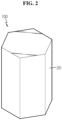
- FIG. 2 is a diagram showing the battery cell according to an embodiment of the present disclosure.
- the battery module includes a plurality of battery cells 100 and at least one cooling plate 200.
- the battery cell 100 is in the shape of an approximately hexagonal prism, and accordingly it has an approximately regular hexagonal shape when viewed from the top.
- the battery cell 100 is in the shape of a hexagonal prism, it is possible to remove or minimize en empty space between adjacent battery cells 100 when packing the plurality of battery cells 100.
- each of the plurality of battery cells 100 of the battery module has six sides, and it is possible to pack such that all the six sides of one battery cell 100 are in contact with adjacent battery cells 100. Accordingly, the manufacture of the battery module using the hexagonal prism-shaped battery cell 100 according to the present disclosure is very advantageous in terms of energy density.
- the cooling plate 200 may be interposed between opposing surfaces of adjacent battery cells 100, and may be made of a metal material for efficient heat transfer.
- the cooling plate 200 may extend from one side of the battery module to the other side, and may be bent to conform the shape of the battery cell 100 having an approximately regular hexagonal shape when viewed on the plane.
- the cooling plate 200 is in surface-to-surface contact with the side of the battery cell 100, and is bent at a location corresponding to the edge on the side of the battery cell 100 to maximize the contact area between the cooling plate 200 and the battery cell 100.
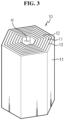
- FIG. 3 is a diagram showing an electrode assembly that is applied to the battery cell according to an embodiment of the present disclosure.
- the battery cell 100 includes an electrode assembly 10 and a cell case 20 in which the electrode assembly 10 is received.
- the cell case 20 is also in the shape of an approximately hexagonal prism for such a shape, and has an empty internal space for receiving the electrode assembly 10. Additionally, the electrode assembly 10 has a size that matches the size of the cell case 20, and is in the shape of an approximately hexagonal prism in the same way as the cell case 20.
- the battery cell 100 include the hexagonal prism-shaped cell case 20 and the hexagonal prism-shaped electrode assembly 10 that is received in the cell case 20.
- the electrode assembly 10 is in the shape of a hexagonal prism, it is possible to maximize the volume of the electrode assembly 10 received in the cell case 20, and as a consequence, the energy density of the battery cell 100.
- the electrode assembly 10 has a hollow structure having a hole H in the shape of an approximately hexagonal prism passing therethrough from the upper surface to the lower surface at the center.
- the hollow structure is formed by winding a stack structure including a first electrode 12, a second electrode 13 and a separator 11 interposed between the first electrode 12 and the second electrode 13 into the shape of a hexagonal prism.
- the cell case 20 may be made of a metal material to maintain the shape and ensure the strength, and in this case, an additional separator 11 may be wound on the outermost of the electrode assembly 10 to prevent a short circuit caused by the contact between the electrodes 12, 13 and the cell case 20.
- the first electrode 12 may be a positive electrode and the second electrode 13 may be a negative electrode, and on the contrary, the first electrode 12 may be a negative electrode and the second electrode 13 may be a positive electrode.
- FIGS. 4 and 5 the detailed structure of the electrode assembly 10 applied to the battery cell 100 according to an embodiment of the present disclosure and its manufacturing method will be described.
- FIG. 4 is a plane view showing the electrode assembly shown in FIG. 3
- FIG. 5 is an enlarged view of section E in FIG. 4 .
- the electrode assembly 10 includes the first electrode 12, the second electrode 13 and the separator 11 interposed between the first electrode 12 and the second electrode 13. Additionally, the electrode assembly 10 may further include the additional separator 11 wound on the outermost as described above.
- the electrode assembly 10 has an approximately regular hexagonal shape on the basis of the plane view seen from the top, and the regular hexagonal shape is obtained by bending the stack structure formed by stacking the electrodes 12, 13 and the separator 11 at predetermined intervals along the lengthwise direction. That is, in the electrode assembly 10, the stack structure is bent at the angle of approximately 60° toward the center C of the winding at predetermined intervals along the lengthwise direction.
- the first electrode 12 includes a first electrode current collector 12a and a first electrode active material block 12b formed by a first electrode active material coated on at least one surface of the first electrode current collector 12a.
- the first electrode active material block 12b is coated discontinuously at predetermined intervals along the lengthwise direction of the first electrode current collector 12a. Accordingly, there is a first uncoated region F1, or a region in which the first electrode active material is not coated, between neighboring first electrode active material blocks 12b.
- the first uncoated region F 1 corresponds to the edge of the hexagonal prism in the hexagonal prism-shaped electrode assembly 10.
- the second electrode 13 includes a second electrode current collector 13a and a second electrode active material block 13b formed by a second electrode active material coated on at least one surface of the second electrode current collector 13a.
- the second electrode active material block 13b is coated discontinuously at predetermined intervals along the lengthwise direction of the second electrode current collector 13a. Accordingly, there is a second uncoated region F2, or a region in which the second electrode active material is not coated, between neighboring second electrode active material blocks 13b.
- the second uncoated region F2 corresponds to the edge of the hexagonal prism in the hexagonal prism-shaped electrode assembly 10.
- the electrode assembly 10 is in the shape of a hexagonal prism by bending the uncoated regions F 1, F2 of the first electrode 12 and the second electrode 13 of the stack structure, and bending does not occur on the electrode active material blocks 12b, 13b, thereby preventing the damage and separation of the electrode active material.
- the stack structure including the first electrode/the separator/the second electrode stacked in a sequential order such that it is bent toward the center of winding at predetermined intervals to form electrode assembly in the shape of a hexagonal prism
- damage such as cracks may occur in the electrode active material or at least parts of the electrode active material may be separated.
- the present disclosure does not continuously coat the electrode active material on the electrode current collector, and instead, discontinuously coats the electrode active material to form the uncoated region at predetermined intervals, and bends the stack structure at the uncoated region, so that the uncoated region becomes the edge of the hexagonal prism.
- the first electrode current collector 12a may be a positive electrode current collector and the second electrode current collector 13a may be a negative electrode current collector, and on the contrary, the first electrode current collector 12a may be a negative electrode current collector and the second electrode current collector 13a may be a positive electrode current collector.
- first electrode active material block 12b may be a positive electrode active material block and the second electrode active material block 13b may be a negative electrode active material block, and on the contrary, the first electrode active material block 12b may be a negative electrode active material block and the second electrode active material block 13b may be a positive electrode active material block.
- FIGS. 6 to 9 a method for manufacturing the battery cell 10 according to an embodiment of the present disclosure will be described.
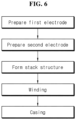
- FIG. 6 is a diagram showing a process of manufacturing the battery cell 10 according to an embodiment of the present disclosure. Additionally, FIG. 7 is a diagram showing an unfolded first electrode in the electrode assembly that is applied to the present disclosure, FIG. 8 is a diagram showing an unfolded second electrode in the electrode assembly that is applied to the present disclosure, and FIG. 9 is a diagram showing a process of winding the stack structure including the separator, the first electrode and the second electrode.
- the method for manufacturing a battery cell includes preparing the first electrode 12; preparing the second electrode 13; forming a stack structure including the first electrode 12, the second electrode 13 and the separator 11 interposed between; winding the stack structure; and a casing step of receiving the electrode assembly 10 in the case 20.
- a first electrode active material is discontinuously coated on one or two surfaces of the first electrode current collector 12a to form a plurality of first electrode active material blocks 12b.
- the plurality of first electrode active material blocks 12b may be grouped to form a group for each six first electrode active material blocks 12b in a sequential order from one side of the lengthwise direction of the first electrode current collector 12a (where winding starts) to the other side.
- the first electrode active material blocks 12b belonging to the same group are formed with equal length. Additionally, the first electrode active material blocks 12b belonging to a group that is farther away from the start point of the winding are longer.
- the length A2 of the first electrode active material blocks 12b belonging to a second group G2 is longer than the length A1 of the first electrode active material blocks 12b belonging to a first group G1, and the length AN of the first electrode active material blocks 12b belonging to an Nth group GN is longest.
- first electrode active material blocks 12b of the first group form an innermost hexagonal prism
- six first electrode active material blocks 12b of the second group form a hexagonal prism that surrounds the innermost hexagonal prism
- six first electrode active material blocks 12b of the Nth group form an outermost hexagonal prism.
- the distances D1, D2, DN between neighboring first electrode active material blocks 12b may be equal within the same group, and may be different between different groups. That is, a group that is farther away from the start point of the winding may have a wider uncoated region F1.
- the width D2 of the uncoated region F1 formed between the first electrode active material blocks 12b belonging to the second group G2 may be larger than the width D1 of the uncoated region F1 formed between the first electrode active material blocks 12b belonging to the first group G1, and the width DN of the uncoated region F1 formed between the first electrode active material blocks 12b belonging to the Nth group GN may be largest.
- the second electrode active material is discontinuously coated on one or two surfaces of the second electrode current collector 13a to form a plurality of second electrode active material blocks 13b.
- the plurality of second electrode active material blocks 13b may be grouped to form a group for each six second electrode active material blocks in a sequential order from one side of the lengthwise direction of the second electrode current collector 13a (where winding starts) to the other side.
- the second electrode active material blocks 13b belonging to the same group are formed with equal length. Additionally, the second electrode active material blocks 13b belonging to a group that is farther away from the start point of the winding are longer.
- the length B2 of the second electrode active material blocks 13b belonging to a second group G'2 is larger than the length B 1 of the second electrode active material block 13b belonging to a first group G'1, and the length BN of the second electrode active material blocks 13b belonging to an Nth group G'N is largest.
- six second electrode active material blocks 13b of the first group form an innermost hexagonal prism
- six second electrode active material blocks 13b of the second group form a hexagonal prism that surrounds the innermost hexagonal prism
- six second electrode active material blocks 13b of the Nth group form an outermost hexagonal prism.
- the distances D1, D2, DN between neighboring second electrode active material blocks 13b may be equal within the same group, and may be different between different groups. That is, a group that is farther away from the start point of the winding may have a wider uncoated region F2.
- the width D2 of the uncoated region F2 formed between the second electrode active material blocks 13b belonging to the second group G'2 may be larger than the width D1 of the uncoated region F2 formed between the second electrode active material blocks 13b belonging to the first group G'1, and the width DN of the uncoated region F2 formed between the second electrode active material blocks 13b belonging to the Nth group G'N is largest.
- the first electrode 12/the separator 11/the second electrode 13 are stacked in a sequential order to form the stack structure having the separator 11 interposed between the first electrode 12 and the second electrode 13.
- the step of forming the stack structure may further include placing the additional separator 11 on the outer surface of the first electrode 12 and/or on the outer surface of the second electrode 13. That is, the stack structure prepared through the step of forming the stack structure may have a sequential stack of the separator 11/the first electrode 12/the separator 11/the second electrode 13/the separator 11, or a sequential stack of the first electrode 12/the separator 11/the second electrode 13/the separator 11, or a sequential stack of the separator 11/the first electrode 12/the separator 11/the second electrode 13.
- the stack structure in the step of winding the stack structure, the stack structure is wound in the direction of the arrow such that the first electrode 12 forms an innermost layer.
- the step of winding the stack structure corresponds to the step of winding the stack structure in the direction of the arrow such that the separator 11 forms an innermost layer.
- the stack structure In the step of winding the stack structure, the stack structure is wound in the direction of the arrow shown in FIG. 9 , and the electrode assembly 10 (see FIG. 3 ) is formed in the shape of an approximately hexagonal prism by stacking such that the electrode current collectors 12a, 13a are bent at the uncoated regions F1, F2 shown in FIGS. 7 and 8 .
- the electrode assembly 10 in the shape of an approximately hexagonal prism through the winding step is received in the hexagonal prism-shaped cell case 20 (see FIG. 2 ).
- the method may further include the step of winding the separator 11 on the outer surface of the electrode assembly 10 between the winding step and the casing step. That is, the separator 11 may be or may not be disposed on the outermost of the stack structure as described above, and when the separator 11 is not disposed on the outermost of the stack structure, the second electrode 13 is disposed at the outermost of the electrode assembly 10 completed by winding the stack structure.
- the second electrode 13 When the second electrode 13 is disposed at the outermost of the electrode assembly 10, the second electrode 13 may come into contact with the inner surface of the cell case 20, and as a consequence, a short circuit may occur. Accordingly, it is necessary to wind the separator 11 on the outer surface of the electrode assembly 10 to prevent a short circuit.
- the battery cell 100 includes the electrode assembly 10 and the cell case 20 both in the shape of an approximately hexagonal prism (in more detail, the shape of a hexagonal prism having an approximately regularly hexagonal shape in cross section), thereby maximizing the energy density when manufacturing the battery module by packing the plurality of battery cells 100. Additionally, the battery cell 100 according to an embodiment of the present disclosure has the uncoated regions F 1, F2 at each location corresponding to the edge of the hexagonal prism to prevent the damage or separation of the electrode active materials 12b, 13b at the edge of the hexagonal prism.
Landscapes
- Chemical & Material Sciences (AREA)
- Chemical Kinetics & Catalysis (AREA)
- Electrochemistry (AREA)
- General Chemical & Material Sciences (AREA)
- Engineering & Computer Science (AREA)
- Manufacturing & Machinery (AREA)
- Secondary Cells (AREA)
- Battery Electrode And Active Subsutance (AREA)
- Sealing Battery Cases Or Jackets (AREA)
Description
- The present disclosure relates to a hexagonal prism-shaped battery cell and a method for manufacturing the same and a battery module comprising the same. More particularly, the present disclosure relates to a hexagonal prism-shaped battery cell manufactured using an electrode assembly having a structure for preventing an electrode active material from being damaged at the edge of a hexagonal prism by loading the electrode active material onto an electrode current collector at a predetermined interval and a method for manufacturing the same, and a battery module comprising the same. The present application claims the benefit of
Korean Patent Application No. 10-2018-0106083 filed on September 5, 2018 - In the manufacture of a battery module including battery cells, the use of a cylindrical battery cell increases an empty space between adjacent battery cells, resulting in low energy density.
- Additionally, when a cooling plate is interposed between battery cells for the purpose of cooling, the contact area between the battery cell and the cooling plate is narrow due to the shape of the side of the cylindrical battery cell, resulting in low cooling efficiency.
- It is possible to increase the contact area a little bit by bringing the bottom surfaces of the cylindrical battery cells and the cooling plate into contact, but in this case, it takes a long time to transfer heat generated from the center of the battery cell to the bottom, resulting in inefficient cooling.
- When the battery cell is manufactured in the shape of a hexagonal prism, it is possible to remove or minimize an empty space between battery cells. To manufacture the hexagonal prism-shaped battery cell, it is desirable to receive a hexagonal prism-shaped electrode assembly in a hexagonal prism-shaped cell case since energy density increases and cooling efficiency is improved through the cell case.
- However, in case that the hexagonal prism-shaped electrode assembly is manufactured using the conventional electrode including an electrode active material continuously loaded on an electrode current collector, when bending the electrode, the electrode active material is also bent at the edge of the hexagonal prism where the electrode is bent, and a cracking or peeling phenomenon occurs in the electrode active material, resulting in degradation of the battery cell and the battery module.
- Accordingly, there is a need for the development of technology for preventing the damage and/or separation of the electrode active material in the manufacture of the battery cell in the shape of a hexagonal prism.
-
US 2012/164494 A1 discloses an electrode coil, and its housing being prismatic in shape.KR 2017 0033516 A EP 2 680 361 A1 disclose an electrode assembly having a bending shape. - The present disclosure is designed to solve the above-described problem, and therefore the present disclosure is directed to providing a battery cell in the shape of a hexagonal prism to increase the energy density when packing battery cells to manufacture a battery module.
- The present disclosure is further directed to providing a hexagonal prism-shaped electrode assembly used to manufacture a hexagonal prism-shaped battery cell, having a structure for preventing the electrode active material from being damaged and/or separated at the edge of the hexagonal prism.
- However, the technical problem to solve is not limited to the above-described problems, and other problems not mentioned herein will be clearly understood by those skilled in the art from the following detailed description.
- To achieve the above-described object, a battery cell as defined in the appended set of claims includes an electrode assembly having a hollow structure with a hexagonal prism-shaped hole at a center, wherein an exterior of the electrode assembly is in a shape of a hexagonal prism, and a cell case in which the electrode assembly is received, wherein an exterior of the cell case is in a shape of a hexagonal prism.
- The electrode assembly includes a first electrode including a first electrode current collector and a first electrode active material block coated discontinuously at predetermined intervals on the first electrode current collector, a second electrode including a second electrode current collector and a second electrode active material block coated discontinuously at predetermined intervals on the second electrode current collector, and a separator interposed between the first electrode and the second electrode.
- The first electrode may be bent at each first uncoated region between adjacent first electrode active material blocks, and the second electrode may be bent at each second uncoated region between adjacent second electrode active material blocks.
- As the first electrode active material block and the second electrode active material block are farther away from a center of a cross section of the electrode assembly, the first electrode active material block and the second electrode active material block may be longer.
- The separator may be interposed between an outermost surface of the electrode assembly and an inner surface of the cell case.
- To achieve the above-described object, a method for manufacturing a battery cell according to an embodiment of the present disclosure includes preparing a first electrode by forming a first electrode active material block discontinuously at predetermined intervals on at least one surface of a first electrode current collector, preparing a second electrode by forming a second electrode active material block discontinuously at predetermined intervals on at least one surface of a second electrode current collector, forming a stack structure including the first electrode, the second electrode and a separator interposed the first electrode and the second electrode, winding the stack structure so that an exterior of an electrode assembly is in a shape of a hexagonal prism, and receiving the wound electrode assembly in a case.
- When six first electrode active material blocks form a group in a sequential order from a start point of the winding, lengths of first electrode active material blocks belonging to a same group may be equal, and first electrode active material blocks belonging to a group that is farther away from the start point of the winding may be longer.
- When six second electrode active material blocks form a group in a sequential order from the start point of the winding, lengths of second electrode active material blocks belonging to a same group may be equal, and second electrode active material blocks belonging to a group that is farther away from the start point of the winding may be longer.
- The step of winding the stack structure may include bending the stack structure with respect to a first uncoated region between the first electrode active material blocks discontinuously formed and a second uncoated region between the second electrode active material blocks.
- To achieve the above-described object, a battery module according to an embodiment of the present disclosure includes a cell assembly including a plurality of battery cells according to an embodiment of the present disclosure, and a cooling plate interposed between opposing surfaces of adjacent battery cells.
- According to an aspect of the present disclosure, as a battery module is manufactured by packing hexagonal prism-shaped battery cells, the energy density of the battery module increases.
- According to another aspect of the present disclosure, as an electrode assembly used to manufacture a hexagonal prism-shaped battery cell is manufactured in the shape of a hexagonal prism, damage and/or separation of the electrode active material at the edge of the hexagonal prism is prevented.
- The accompanying drawings illustrate preferred embodiments of the present disclosure and, together with the following detailed description, serve to provide a further understanding of the technical features of the present disclosure. However, the present disclosure is not to be construed as being limited to the drawings.
-
FIG. 1 is a plane view showing a battery module according to an embodiment of the present disclosure. -
FIG. 2 is a diagram showing a battery cell according to an embodiment of the present disclosure. -
FIG. 3 is a diagram showing an electrode assembly that is applied to a battery cell according to an embodiment of the present disclosure. -
FIG. 4 is a plane view showing the electrode assembly shown inFIG. 3 . -
FIG. 5 is an enlarged view of section E inFIG. 4 . -
FIG. 6 is a diagram showing a process of manufacturing a battery cell according to an embodiment of the present disclosure. -
FIG. 7 is a diagram showing an unfolded first electrode in an electrode assembly that is applied to the present disclosure. -
FIG. 8 is a diagram showing an unfolded second electrode in an electrode assembly that is applied to the present disclosure. -
FIG. 9 is a diagram showing a process of winding a stack structure including a separator, a first electrode and a second electrode. - Hereinafter, preferred embodiments of the present disclosure will be described in detail with reference to the accompanying drawings. Prior to the description, the terms or words used in the specification and the appended claims should not be construed as limited to general and dictionary meanings, and should be interpreted based on the meanings and concepts corresponding to technical aspects of the present disclosure on the basis of the principle that the inventor is allowed to define terms appropriately for the best explanation. Therefore, the embodiments described herein and illustrations shown in the drawings are just a most preferred embodiment of the present disclosure, but not intended to fully describe the technical aspects of the present disclosure, so it should be understood that other equivalents and modifications could be made thereto at the time of filing the application.
- First, referring to
FIGS. 1 and2 , a battery module and abattery cell 100 according to an embodiment of the present disclosure will be described. -
FIG. 1 is a plane view showing the battery module according to an embodiment of the present disclosure, andFIG. 2 is a diagram showing the battery cell according to an embodiment of the present disclosure. - Referring to
FIGS. 1 and2 , the battery module according to an embodiment of the present disclosure includes a plurality ofbattery cells 100 and at least onecooling plate 200. - The
battery cell 100 is in the shape of an approximately hexagonal prism, and accordingly it has an approximately regular hexagonal shape when viewed from the top. - As the
battery cell 100 according to an embodiment of the present disclosure is in the shape of a hexagonal prism, it is possible to remove or minimize en empty space betweenadjacent battery cells 100 when packing the plurality ofbattery cells 100. - That is, each of the plurality of
battery cells 100 of the battery module has six sides, and it is possible to pack such that all the six sides of onebattery cell 100 are in contact withadjacent battery cells 100. Accordingly, the manufacture of the battery module using the hexagonal prism-shaped battery cell 100 according to the present disclosure is very advantageous in terms of energy density. - The
cooling plate 200 may be interposed between opposing surfaces ofadjacent battery cells 100, and may be made of a metal material for efficient heat transfer. Thecooling plate 200 may extend from one side of the battery module to the other side, and may be bent to conform the shape of thebattery cell 100 having an approximately regular hexagonal shape when viewed on the plane. - That is, the
cooling plate 200 is in surface-to-surface contact with the side of thebattery cell 100, and is bent at a location corresponding to the edge on the side of thebattery cell 100 to maximize the contact area between thecooling plate 200 and thebattery cell 100. - Subsequently, referring to
FIG. 3 withFIG. 2 , the schematic structure of thebattery cell 100 according to an embodiment of the present disclosure will be described. -
FIG. 3 is a diagram showing an electrode assembly that is applied to the battery cell according to an embodiment of the present disclosure. - Referring to
FIG. 3 withFIG. 2 , thebattery cell 100 includes anelectrode assembly 10 and acell case 20 in which theelectrode assembly 10 is received. - As the
battery cell 100 according to the present disclosure is in the shape of an approximately hexagonal prism as described above, thecell case 20 is also in the shape of an approximately hexagonal prism for such a shape, and has an empty internal space for receiving theelectrode assembly 10. Additionally, theelectrode assembly 10 has a size that matches the size of thecell case 20, and is in the shape of an approximately hexagonal prism in the same way as thecell case 20. - As described above, the
battery cell 100 according to an embodiment of the present disclosure include the hexagonal prism-shaped cell case 20 and the hexagonal prism-shaped electrode assembly 10 that is received in thecell case 20. As theelectrode assembly 10 is in the shape of a hexagonal prism, it is possible to maximize the volume of theelectrode assembly 10 received in thecell case 20, and as a consequence, the energy density of thebattery cell 100. - The
electrode assembly 10 has a hollow structure having a hole H in the shape of an approximately hexagonal prism passing therethrough from the upper surface to the lower surface at the center. The hollow structure is formed by winding a stack structure including afirst electrode 12, asecond electrode 13 and aseparator 11 interposed between thefirst electrode 12 and thesecond electrode 13 into the shape of a hexagonal prism. - The
cell case 20 may be made of a metal material to maintain the shape and ensure the strength, and in this case, anadditional separator 11 may be wound on the outermost of theelectrode assembly 10 to prevent a short circuit caused by the contact between theelectrodes cell case 20. - In the present disclosure, the
first electrode 12 may be a positive electrode and thesecond electrode 13 may be a negative electrode, and on the contrary, thefirst electrode 12 may be a negative electrode and thesecond electrode 13 may be a positive electrode. - Subsequently, referring to
FIGS. 4 and5 , the detailed structure of theelectrode assembly 10 applied to thebattery cell 100 according to an embodiment of the present disclosure and its manufacturing method will be described. -
FIG. 4 is a plane view showing the electrode assembly shown inFIG. 3 , andFIG. 5 is an enlarged view of section E inFIG. 4 . - Referring to
FIGS. 4 and5 , theelectrode assembly 10 includes thefirst electrode 12, thesecond electrode 13 and theseparator 11 interposed between thefirst electrode 12 and thesecond electrode 13. Additionally, theelectrode assembly 10 may further include theadditional separator 11 wound on the outermost as described above. - The
electrode assembly 10 has an approximately regular hexagonal shape on the basis of the plane view seen from the top, and the regular hexagonal shape is obtained by bending the stack structure formed by stacking theelectrodes separator 11 at predetermined intervals along the lengthwise direction. That is, in theelectrode assembly 10, the stack structure is bent at the angle of approximately 60° toward the center C of the winding at predetermined intervals along the lengthwise direction. - The
first electrode 12 includes a first electrodecurrent collector 12a and a first electrodeactive material block 12b formed by a first electrode active material coated on at least one surface of the first electrodecurrent collector 12a. The first electrodeactive material block 12b is coated discontinuously at predetermined intervals along the lengthwise direction of the first electrodecurrent collector 12a. Accordingly, there is a first uncoated region F1, or a region in which the first electrode active material is not coated, between neighboring first electrodeactive material blocks 12b. - When winding the stack structure, bending occurs at the first uncoated region F1. That is, the first uncoated region F 1 corresponds to the edge of the hexagonal prism in the hexagonal prism-shaped
electrode assembly 10. - Likewise, the
second electrode 13 includes a second electrodecurrent collector 13a and a second electrodeactive material block 13b formed by a second electrode active material coated on at least one surface of the second electrodecurrent collector 13a. The second electrodeactive material block 13b is coated discontinuously at predetermined intervals along the lengthwise direction of the second electrodecurrent collector 13a. Accordingly, there is a second uncoated region F2, or a region in which the second electrode active material is not coated, between neighboring second electrodeactive material blocks 13b. - When winding the stack structure, bending occurs at the second uncoated region F2. That is, the second uncoated region F2 corresponds to the edge of the hexagonal prism in the hexagonal prism-shaped
electrode assembly 10. - As described above, the
electrode assembly 10 is in the shape of a hexagonal prism by bending the uncoated regions F 1, F2 of thefirst electrode 12 and thesecond electrode 13 of the stack structure, and bending does not occur on the electrodeactive material blocks - When winding the stack structure including the first electrode/the separator/the second electrode stacked in a sequential order such that it is bent toward the center of winding at predetermined intervals to form electrode assembly in the shape of a hexagonal prism, if the electrode active material exists at the region in which bending occurs, damage such as cracks may occur in the electrode active material or at least parts of the electrode active material may be separated.
- To prevent this problem, the present disclosure does not continuously coat the electrode active material on the electrode current collector, and instead, discontinuously coats the electrode active material to form the uncoated region at predetermined intervals, and bends the stack structure at the uncoated region, so that the uncoated region becomes the edge of the hexagonal prism.
- The first electrode
current collector 12a may be a positive electrode current collector and the second electrodecurrent collector 13a may be a negative electrode current collector, and on the contrary, the first electrodecurrent collector 12a may be a negative electrode current collector and the second electrodecurrent collector 13a may be a positive electrode current collector. - Likewise, the first electrode
active material block 12b may be a positive electrode active material block and the second electrodeactive material block 13b may be a negative electrode active material block, and on the contrary, the first electrodeactive material block 12b may be a negative electrode active material block and the second electrodeactive material block 13b may be a positive electrode active material block. - Subsequently, referring to
FIGS. 6 to 9 , a method for manufacturing thebattery cell 10 according to an embodiment of the present disclosure will be described. -
FIG. 6 is a diagram showing a process of manufacturing thebattery cell 10 according to an embodiment of the present disclosure. Additionally,FIG. 7 is a diagram showing an unfolded first electrode in the electrode assembly that is applied to the present disclosure,FIG. 8 is a diagram showing an unfolded second electrode in the electrode assembly that is applied to the present disclosure, andFIG. 9 is a diagram showing a process of winding the stack structure including the separator, the first electrode and the second electrode. - First, referring to
FIG. 6 , the method for manufacturing a battery cell according to an embodiment of the present disclosure includes preparing thefirst electrode 12; preparing thesecond electrode 13; forming a stack structure including thefirst electrode 12, thesecond electrode 13 and theseparator 11 interposed between; winding the stack structure; and a casing step of receiving theelectrode assembly 10 in thecase 20. - Referring to
FIG. 7 , in the step of preparing the first electrode, a first electrode active material is discontinuously coated on one or two surfaces of the first electrodecurrent collector 12a to form a plurality of first electrodeactive material blocks 12b. - The plurality of first electrode
active material blocks 12b may be grouped to form a group for each six first electrode active material blocks 12b in a sequential order from one side of the lengthwise direction of the first electrodecurrent collector 12a (where winding starts) to the other side. In this case, the first electrode active material blocks 12b belonging to the same group are formed with equal length. Additionally, the first electrode active material blocks 12b belonging to a group that is farther away from the start point of the winding are longer. - For example, when the first electrode active material blocks 12b are grouped into N groups, the length A2 of the first electrode active material blocks 12b belonging to a second group G2 is longer than the length A1 of the first electrode active material blocks 12b belonging to a first group G1, and the length AN of the first electrode active material blocks 12b belonging to an Nth group GN is longest.
- This is because in the
electrode assembly 10, six first electrode active material blocks 12b of the first group form an innermost hexagonal prism, six first electrode active material blocks 12b of the second group form a hexagonal prism that surrounds the innermost hexagonal prism, and six first electrode active material blocks 12b of the Nth group form an outermost hexagonal prism. - The distances D1, D2, DN between neighboring first electrode
active material blocks 12b may be equal within the same group, and may be different between different groups. That is, a group that is farther away from the start point of the winding may have a wider uncoated region F1. For example, the width D2 of the uncoated region F1 formed between the first electrode active material blocks 12b belonging to the second group G2 may be larger than the width D1 of the uncoated region F1 formed between the first electrode active material blocks 12b belonging to the first group G1, and the width DN of the uncoated region F1 formed between the first electrode active material blocks 12b belonging to the Nth group GN may be largest. - Referring to
FIG. 8 , in the step of preparing the second electrode, the second electrode active material is discontinuously coated on one or two surfaces of the second electrodecurrent collector 13a to form a plurality of second electrodeactive material blocks 13b. - The plurality of second electrode
active material blocks 13b may be grouped to form a group for each six second electrode active material blocks in a sequential order from one side of the lengthwise direction of the second electrodecurrent collector 13a (where winding starts) to the other side. In this case, the second electrode active material blocks 13b belonging to the same group are formed with equal length. Additionally, the second electrode active material blocks 13b belonging to a group that is farther away from the start point of the winding are longer. - For example, when the second electrode active material blocks 13b are grouped into N groups, the length B2 of the second electrode active material blocks 13b belonging to a second group G'2 is larger than the length B 1 of the second electrode
active material block 13b belonging to a first group G'1, and the length BN of the second electrode active material blocks 13b belonging to an Nth group G'N is largest. - This is because in the
electrode assembly 10, six second electrode active material blocks 13b of the first group form an innermost hexagonal prism, six second electrode active material blocks 13b of the second group form a hexagonal prism that surrounds the innermost hexagonal prism, and six second electrode active material blocks 13b of the Nth group form an outermost hexagonal prism. - The distances D1, D2, DN between neighboring second electrode
active material blocks 13b may be equal within the same group, and may be different between different groups. That is, a group that is farther away from the start point of the winding may have a wider uncoated region F2. For example, the width D2 of the uncoated region F2 formed between the second electrode active material blocks 13b belonging to the second group G'2 may be larger than the width D1 of the uncoated region F2 formed between the second electrode active material blocks 13b belonging to the first group G'1, and the width DN of the uncoated region F2 formed between the second electrode active material blocks 13b belonging to the Nth group G'N is largest. - In the step of forming the stack structure, the
first electrode 12/theseparator 11/thesecond electrode 13 are stacked in a sequential order to form the stack structure having theseparator 11 interposed between thefirst electrode 12 and thesecond electrode 13. - The step of forming the stack structure may further include placing the
additional separator 11 on the outer surface of thefirst electrode 12 and/or on the outer surface of thesecond electrode 13. That is, the stack structure prepared through the step of forming the stack structure may have a sequential stack of theseparator 11/thefirst electrode 12/theseparator 11/thesecond electrode 13/theseparator 11, or a sequential stack of thefirst electrode 12/theseparator 11/thesecond electrode 13/theseparator 11, or a sequential stack of theseparator 11/thefirst electrode 12/theseparator 11/thesecond electrode 13. - Referring to
FIG. 9 , in the step of winding the stack structure, the stack structure is wound in the direction of the arrow such that thefirst electrode 12 forms an innermost layer. As opposed toFIG. 9 , when theseparator 11 is placed on the outermost of the stack structure, the step of winding the stack structure corresponds to the step of winding the stack structure in the direction of the arrow such that theseparator 11 forms an innermost layer. - In the step of winding the stack structure, the stack structure is wound in the direction of the arrow shown in
FIG. 9 , and the electrode assembly 10 (seeFIG. 3 ) is formed in the shape of an approximately hexagonal prism by stacking such that the electrodecurrent collectors FIGS. 7 and8 . - In the casing step, the electrode assembly 10 (see
FIG. 3 ) in the shape of an approximately hexagonal prism through the winding step is received in the hexagonal prism-shaped cell case 20 (seeFIG. 2 ). - The method may further include the step of winding the
separator 11 on the outer surface of theelectrode assembly 10 between the winding step and the casing step. That is, theseparator 11 may be or may not be disposed on the outermost of the stack structure as described above, and when theseparator 11 is not disposed on the outermost of the stack structure, thesecond electrode 13 is disposed at the outermost of theelectrode assembly 10 completed by winding the stack structure. - When the
second electrode 13 is disposed at the outermost of theelectrode assembly 10, thesecond electrode 13 may come into contact with the inner surface of thecell case 20, and as a consequence, a short circuit may occur. Accordingly, it is necessary to wind theseparator 11 on the outer surface of theelectrode assembly 10 to prevent a short circuit. - As described above, the
battery cell 100 according to an embodiment of the present disclosure includes theelectrode assembly 10 and thecell case 20 both in the shape of an approximately hexagonal prism (in more detail, the shape of a hexagonal prism having an approximately regularly hexagonal shape in cross section), thereby maximizing the energy density when manufacturing the battery module by packing the plurality ofbattery cells 100. Additionally, thebattery cell 100 according to an embodiment of the present disclosure has the uncoated regions F 1, F2 at each location corresponding to the edge of the hexagonal prism to prevent the damage or separation of the electrodeactive materials
Claims (9)
- A battery cell (100), comprising:an electrode assembly (10) having a hollow structure with a hexagonal prism-shaped hole (H) at a center, wherein an exterior of the electrode assembly is in a shape of a hexagonal prism; anda cell case (20) in which the electrode assembly is received, wherein an exterior of the cell case is in a shape of a hexagonal prism,wherein the electrode assembly includes:a first electrode (12) including a first electrode current collector (12a) and a first electrode active material block (12a) coated discontinuously at predetermined intervals on the first electrode current collector;a second electrode (13) including a second electrode current collector (13a) and a second electrode active material block (13b) coated discontinuously at predetermined intervals on the second electrode current collector; anda separator (11) interposed between the first electrode (12) and the second electrode (13).
- The battery cell according to claim 1, wherein the first electrode (12) is bent at each first uncoated region (F1) between adjacent first electrode active material blocks (12b), and
the second electrode (13) is bent at each second uncoated region (F2) between adjacent second electrode active material blocks (13b). - The battery cell according to claim 2, wherein as the first electrode active material block (12b) and the second electrode active material block (13b) are farther away from a center of a cross section of the electrode assembly (10), the first electrode active material block (12b) and the second electrode active material block (13b) are longer.
- The battery cell according to claim 1, wherein the separator (11) is interposed between an outermost surface of the electrode assembly (10) and an inner surface of the cell case (20).
- A method for manufacturing a battery cell, comprising:preparing a first electrode (12) by forming a first electrode active material block (12b) discontinuously at predetermined intervals on at least one surface of a first electrode current collector (12a);preparing a second electrode (13) by forming a second electrode active material block (13b) discontinuously at predetermined intervals on at least one surface of a second electrode current collector (13a);forming a stack structure including the first electrode (12), the second electrode (13) and a separator (11) interposed the first electrode and the second electrode;winding the stack structure so that an exterior of an electrode assembly (10) is in a shape of a hexagonal prism; andreceiving the wound electrode assembly in a case which is in a shape of a hexagonal prism.
- The method for manufacturing a battery cell according to claim 5, wherein when six first electrode active material blocks (12b) form a group in a sequential order from a start point of the winding, lengths of first electrode active material blocks belonging to a same group are equal, and first electrode active material blocks belonging to a group that is farther away from the start point of the winding are longer.
- The method for manufacturing a battery cell according to claim 6, wherein when six second electrode active material blocks (13b) form a group in a sequential order from the start point of the winding, lengths of second electrode active material blocks belonging to a same group are equal, and second electrode active material blocks belonging to a group that is farther away from the start point of the winding are longer.
- The method for manufacturing a battery cell according to claim 5, wherein winding the stack structure comprises bending the stack structure with respect to a first uncoated region (F 1) between the first electrode active material blocks (12b) discontinuously formed and a second uncoated region (F2) between the second electrode active material blocks (13b).
- A battery module comprising:a cell assembly including a plurality of battery cells (100) according to any one of claims 1 to 4; anda cooling plate (200) interposed between opposing surfaces of adjacent battery cells.
Applications Claiming Priority (2)
| Application Number | Priority Date | Filing Date | Title |
|---|---|---|---|
| KR1020180106083A KR102503269B1 (en) | 2018-09-05 | 2018-09-05 | Hexagonal prism-shaped battery cell and Method for manufacturing the same, and Battery module comprising the same |
| PCT/KR2019/010867 WO2020050534A1 (en) | 2018-09-05 | 2019-08-26 | Hexagonal column-shaped battery cell, manufacturing method therefor, and battery module comprising same |
Publications (3)
| Publication Number | Publication Date |
|---|---|
| EP3739679A1 EP3739679A1 (en) | 2020-11-18 |
| EP3739679A4 EP3739679A4 (en) | 2021-10-06 |
| EP3739679B1 true EP3739679B1 (en) | 2024-11-20 |
Family
ID=69722007
Family Applications (1)
| Application Number | Title | Priority Date | Filing Date |
|---|---|---|---|
| EP19857863.5A Active EP3739679B1 (en) | 2018-09-05 | 2019-08-26 | Hexagonal column-shaped battery cell, manufacturing method therefor, and battery module comprising same |
Country Status (8)
| Country | Link |
|---|---|
| US (1) | US11575145B2 (en) |
| EP (1) | EP3739679B1 (en) |
| JP (1) | JP7055876B2 (en) |
| KR (1) | KR102503269B1 (en) |
| CN (1) | CN111512486A (en) |
| ES (1) | ES3006026T3 (en) |
| HU (1) | HUE069772T2 (en) |
| WO (1) | WO2020050534A1 (en) |
Families Citing this family (10)
| Publication number | Priority date | Publication date | Assignee | Title |
|---|---|---|---|---|
| WO2021260620A1 (en) | 2020-06-25 | 2021-12-30 | Impulse Dynamics Nv | Treating crt non-responders using cardiac contractility modulation therapy |
| WO2022213306A1 (en) * | 2021-04-07 | 2022-10-13 | 江苏时代新能源科技有限公司 | Battery cell, battery, electric device, and method and apparatus for manufacturing battery cell |
| DE102021005011A1 (en) | 2021-10-06 | 2021-11-18 | Daimler Ag | Battery cell for an electrical energy store of a motor vehicle and electrical energy store |
| CN115966816B (en) * | 2021-10-12 | 2025-02-21 | 宁德时代新能源科技股份有限公司 | Battery cell, battery and electricity utilization device |
| CN114204173A (en) * | 2021-12-01 | 2022-03-18 | 远景动力技术(江苏)有限公司 | Battery and battery module |
| WO2023189636A1 (en) * | 2022-03-28 | 2023-10-05 | 株式会社村田製作所 | Secondary battery, battery pack, electronic device, electric tool, electric aircraft, electric vehicle, and method for manufacturing electrode winding body for secondary battery |
| FR3134242B1 (en) * | 2022-03-31 | 2024-03-01 | Plastic Omnium Clean Energy Systems Res | Battery assembly for motor vehicle |
| CN115472973A (en) * | 2022-08-26 | 2022-12-13 | 重庆长安新能源汽车科技有限公司 | Cell structure, battery components and vehicles |
| CN116315034A (en) * | 2022-11-02 | 2023-06-23 | 南京工业大学 | An aging-resistant polyprismatic lithium-ion battery with non-pole tabs |
| US20250023088A1 (en) * | 2023-07-13 | 2025-01-16 | GM Global Technology Operations LLC | Hexagonal battery cell with wound jelly roll |
Family Cites Families (31)
| Publication number | Priority date | Publication date | Assignee | Title |
|---|---|---|---|---|
| JP3457461B2 (en) * | 1996-03-29 | 2003-10-20 | 日機装株式会社 | Non-aqueous electrolyte secondary battery and assembled battery |
| JP4972824B2 (en) * | 2001-03-21 | 2012-07-11 | 新神戸電機株式会社 | Flat winding group manufacturing method and winding apparatus |
| JP4927765B2 (en) * | 2004-09-09 | 2012-05-09 | 国立大学法人北海道大学 | Method for manufacturing functional element |
| KR101119851B1 (en) * | 2004-09-09 | 2012-03-16 | 국립대학법인 홋가이도 다이가쿠 | Function element, storage element, magnetic recording element, solar cell, photoelectric conversion element, light emitting element, catalyst reaction device, and clean unit |
| JP2008109165A (en) * | 2004-09-09 | 2008-05-08 | Hokkaido Univ | Method for producing solar cell and method for producing photoelectric conversion element |
| JP4022631B2 (en) * | 2004-09-09 | 2007-12-19 | 国立大学法人 北海道大学 | Solar cell and photoelectric conversion element |
| JP2007207649A (en) * | 2006-02-03 | 2007-08-16 | Matsushita Electric Ind Co Ltd | Manufacturing method of prismatic non-aqueous electrolyte battery |
| DE102007017024B3 (en) * | 2007-04-11 | 2008-09-25 | Daimler Ag | Battery cell and method for its manufacture and battery |
| JP4744617B2 (en) | 2008-05-22 | 2011-08-10 | パナソニック株式会社 | Secondary battery electrode group and secondary battery using the same |
| DE102009022678A1 (en) | 2009-05-26 | 2010-12-02 | Li-Tec Battery Gmbh | electrode winding |
| DE102010002000A1 (en) | 2010-02-16 | 2011-09-08 | Sgl Carbon Se | Heat sink and electrical energy storage |
| JP5458898B2 (en) | 2010-01-12 | 2014-04-02 | トヨタ自動車株式会社 | Solid battery stack |
| EP2680361B1 (en) | 2011-12-23 | 2016-07-13 | LG Chem, Ltd. | Jelly roll-type electrode assembly with active material pattern-coated thereon, and secondary battery having same |
| CN202503077U (en) | 2012-03-01 | 2012-10-24 | 广州市云通磁电有限公司 | Battery core of orthohexagonal lithium ion battery |
| CN102593524A (en) | 2012-03-01 | 2012-07-18 | 广州市云通磁电有限公司 | Manufacturing method of orthohexagonal lithium ion battery cell |
| KR101590217B1 (en) | 2012-11-23 | 2016-01-29 | 주식회사 엘지화학 | Method for manufacturing electorde assembly and electrode assembly manufactured thereby |
| KR101650417B1 (en) | 2013-10-31 | 2016-08-23 | 주식회사 엘지화학 | Secondary battery having jelly roll type electrode assembly with intermittent non-coated positive electrode active material |
| CN106536392A (en) * | 2014-07-23 | 2017-03-22 | 博世株式会社 | Roll and roll manufacturing method |
| KR102275638B1 (en) * | 2014-11-19 | 2021-07-09 | 삼성에스디아이 주식회사 | Rechargeable battery |
| KR102119651B1 (en) | 2014-12-09 | 2020-06-05 | 현대자동차주식회사 | Exhaust manifold of automobile |
| KR101780037B1 (en) * | 2015-04-22 | 2017-09-19 | 주식회사 엘지화학 | Cooling device for battery cell and battery module comprising the same |
| KR102394450B1 (en) * | 2015-07-01 | 2022-05-03 | 삼성에스디아이 주식회사 | Rechargeable battery module |
| KR20170022465A (en) | 2015-08-20 | 2017-03-02 | 주식회사 엘지화학 | Electrode assembly of combination structure and electrochemical device including the same |
| KR102036590B1 (en) | 2015-09-17 | 2019-10-25 | 주식회사 엘지화학 | Electrode for Secondary Battery with Transformable Structure Based upon Folding Manner and Secondary Battery Having the Same |
| CN106026366A (en) | 2016-07-12 | 2016-10-12 | 成都奥卡卡科技有限公司 | Motor protection type standby generator emergency start-up system |
| CN106025366A (en) * | 2016-07-13 | 2016-10-12 | 深圳市秸川材料科技有限公司 | Lithium ion button battery |
| CN206076410U (en) | 2016-07-13 | 2017-04-05 | 深圳市秸川材料科技有限公司 | A kind of lithium ion button shape cell |
| CN205944252U (en) * | 2016-08-22 | 2017-02-08 | 联想(北京)有限公司 | Group battery and battery |
| CN106532134B (en) * | 2016-12-06 | 2019-04-26 | 中兴高能技术有限责任公司 | Square lithium battery lamination machine and lamination process |
| KR101918393B1 (en) | 2017-03-17 | 2018-11-13 | 부산대학교 산학협력단 | Cell-based plasma simulation apparatus utilizing gpu |
| CN207517751U (en) * | 2017-09-21 | 2018-06-19 | 深圳市沃特玛电池有限公司 | A kind of heat conduction battery module device |
-
2018
- 2018-09-05 KR KR1020180106083A patent/KR102503269B1/en active Active
-
2019
- 2019-08-26 ES ES19857863T patent/ES3006026T3/en active Active
- 2019-08-26 HU HUE19857863A patent/HUE069772T2/en unknown
- 2019-08-26 US US16/959,027 patent/US11575145B2/en active Active
- 2019-08-26 EP EP19857863.5A patent/EP3739679B1/en active Active
- 2019-08-26 CN CN201980006674.3A patent/CN111512486A/en active Pending
- 2019-08-26 WO PCT/KR2019/010867 patent/WO2020050534A1/en not_active Ceased
- 2019-08-26 JP JP2020531463A patent/JP7055876B2/en active Active
Also Published As
| Publication number | Publication date |
|---|---|
| JP7055876B2 (en) | 2022-04-18 |
| KR20200027808A (en) | 2020-03-13 |
| HUE069772T2 (en) | 2025-04-28 |
| EP3739679A4 (en) | 2021-10-06 |
| CN111512486A (en) | 2020-08-07 |
| US11575145B2 (en) | 2023-02-07 |
| WO2020050534A1 (en) | 2020-03-12 |
| EP3739679A1 (en) | 2020-11-18 |
| US20200358126A1 (en) | 2020-11-12 |
| KR102503269B1 (en) | 2023-02-22 |
| JP2021506078A (en) | 2021-02-18 |
| ES3006026T3 (en) | 2025-03-17 |
Similar Documents
| Publication | Publication Date | Title |
|---|---|---|
| EP3739679B1 (en) | Hexagonal column-shaped battery cell, manufacturing method therefor, and battery module comprising same | |
| CN101485032B (en) | Double wound electrode assembly | |
| EP2750239B1 (en) | Stepped electrode assembly and battery cell comprising same | |
| KR101639209B1 (en) | A Cell Assembly with Improved Jelly-Roll Type Structure and A Secondary Battery Comprising the Same | |
| EP3168918B1 (en) | Electrode assembly wound in both directions, and lithium secondary battery comprising same | |
| KR102754017B1 (en) | Negative plate, electrode assembly including the same, and method of manufacturing the negative plate and electorde assembly | |
| CN103548195A (en) | Cell coil of a lithium ion accumulator and method for producing a cell coil | |
| CN109314280B (en) | Lithium ion secondary battery | |
| KR101154872B1 (en) | Electrode Assembly of Novel Structure | |
| KR101706319B1 (en) | Electrode Assembly and Composite Electrode Assembly of Stair-like Structure | |
| EP4203122A1 (en) | Electrode assembly and secondary battery including same | |
| KR20220122400A (en) | Fixing device for cylindrical electrode assembly | |
| EP3780237A1 (en) | Unit cell and manufacturing method therefor | |
| KR102159530B1 (en) | Electrode Assembly Stack Comprising Unit Cell Having Fixing Hole | |
| US20250149620A1 (en) | Power storage cell | |
| CN221262655U (en) | Pole piece, battery core and battery | |
| US20260128424A1 (en) | Secondary battery and case for secondary battery | |
| KR102922645B1 (en) | Electrode assembly, secondary battery, battery pack and vehicle | |
| EP4738549A1 (en) | Secondary battery and case for secondary battery | |
| US20250046954A1 (en) | Porosity of a battery separator | |
| US20260058341A1 (en) | Secondary battery electrode | |
| KR20250170967A (en) | Electrode assembly and electrode manufactring method | |
| US20250233191A1 (en) | Electrode assembly and rechargeable battery including the same | |
| KR102953904B1 (en) | Cylindrical battery having a loading amount gradient for the active material | |
| KR20250169929A (en) | Electrode assembly including electrode tab with slanted-cut end and method for manufacturing same |
Legal Events
| Date | Code | Title | Description |
|---|---|---|---|
| STAA | Information on the status of an ep patent application or granted ep patent |
Free format text: STATUS: THE INTERNATIONAL PUBLICATION HAS BEEN MADE |
|
| PUAI | Public reference made under article 153(3) epc to a published international application that has entered the european phase |
Free format text: ORIGINAL CODE: 0009012 |
|
| STAA | Information on the status of an ep patent application or granted ep patent |
Free format text: STATUS: REQUEST FOR EXAMINATION WAS MADE |
|
| 17P | Request for examination filed |
Effective date: 20200810 |
|
| AK | Designated contracting states |
Kind code of ref document: A1 Designated state(s): AL AT BE BG CH CY CZ DE DK EE ES FI FR GB GR HR HU IE IS IT LI LT LU LV MC MK MT NL NO PL PT RO RS SE SI SK SM TR |
|
| AX | Request for extension of the european patent |
Extension state: BA ME |
|
| A4 | Supplementary search report drawn up and despatched |
Effective date: 20210906 |
|
| RIC1 | Information provided on ipc code assigned before grant |
Ipc: H01M 10/647 20140101ALI20210831BHEP Ipc: H01M 50/102 20210101ALI20210831BHEP Ipc: H01M 10/613 20140101ALI20210831BHEP Ipc: H01M 10/64 20140101ALI20210831BHEP Ipc: H01M 10/6555 20140101ALI20210831BHEP Ipc: H01M 10/04 20060101AFI20210831BHEP |
|
| DAV | Request for validation of the european patent (deleted) | ||
| DAX | Request for extension of the european patent (deleted) | ||
| RAP1 | Party data changed (applicant data changed or rights of an application transferred) |
Owner name: LG ENERGY SOLUTION LTD. |
|
| RAP3 | Party data changed (applicant data changed or rights of an application transferred) |
Owner name: LG ENERGY SOLUTION, LTD. |
|
| STAA | Information on the status of an ep patent application or granted ep patent |
Free format text: STATUS: EXAMINATION IS IN PROGRESS |
|
| 17Q | First examination report despatched |
Effective date: 20230113 |
|
| GRAP | Despatch of communication of intention to grant a patent |
Free format text: ORIGINAL CODE: EPIDOSNIGR1 |
|
| STAA | Information on the status of an ep patent application or granted ep patent |
Free format text: STATUS: GRANT OF PATENT IS INTENDED |
|
| INTG | Intention to grant announced |
Effective date: 20240730 |
|
| P01 | Opt-out of the competence of the unified patent court (upc) registered |
Free format text: CASE NUMBER: APP_44504/2024 Effective date: 20240731 |
|
| GRAS | Grant fee paid |
Free format text: ORIGINAL CODE: EPIDOSNIGR3 |
|
| GRAA | (expected) grant |
Free format text: ORIGINAL CODE: 0009210 |
|
| STAA | Information on the status of an ep patent application or granted ep patent |
Free format text: STATUS: THE PATENT HAS BEEN GRANTED |
|
| AK | Designated contracting states |
Kind code of ref document: B1 Designated state(s): AL AT BE BG CH CY CZ DE DK EE ES FI FR GB GR HR HU IE IS IT LI LT LU LV MC MK MT NL NO PL PT RO RS SE SI SK SM TR |
|
| REG | Reference to a national code |
Ref country code: GB Ref legal event code: FG4D |
|
| REG | Reference to a national code |
Ref country code: CH Ref legal event code: EP |
|
| REG | Reference to a national code |
Ref country code: DE Ref legal event code: R096 Ref document number: 602019062369 Country of ref document: DE |
|
| REG | Reference to a national code |
Ref country code: IE Ref legal event code: FG4D |
|
| REG | Reference to a national code |
Ref country code: ES Ref legal event code: FG2A Ref document number: 3006026 Country of ref document: ES Kind code of ref document: T3 Effective date: 20250317 |
|
| REG | Reference to a national code |
Ref country code: LT Ref legal event code: MG9D |
|
| REG | Reference to a national code |
Ref country code: NL Ref legal event code: MP Effective date: 20241120 |
|
| PG25 | Lapsed in a contracting state [announced via postgrant information from national office to epo] |
Ref country code: PT Free format text: LAPSE BECAUSE OF FAILURE TO SUBMIT A TRANSLATION OF THE DESCRIPTION OR TO PAY THE FEE WITHIN THE PRESCRIBED TIME-LIMIT Effective date: 20250320 Ref country code: IS Free format text: LAPSE BECAUSE OF FAILURE TO SUBMIT A TRANSLATION OF THE DESCRIPTION OR TO PAY THE FEE WITHIN THE PRESCRIBED TIME-LIMIT Effective date: 20250320 Ref country code: HR Free format text: LAPSE BECAUSE OF FAILURE TO SUBMIT A TRANSLATION OF THE DESCRIPTION OR TO PAY THE FEE WITHIN THE PRESCRIBED TIME-LIMIT Effective date: 20241120 |
|
| PG25 | Lapsed in a contracting state [announced via postgrant information from national office to epo] |
Ref country code: FI Free format text: LAPSE BECAUSE OF FAILURE TO SUBMIT A TRANSLATION OF THE DESCRIPTION OR TO PAY THE FEE WITHIN THE PRESCRIBED TIME-LIMIT Effective date: 20241120 Ref country code: NL Free format text: LAPSE BECAUSE OF FAILURE TO SUBMIT A TRANSLATION OF THE DESCRIPTION OR TO PAY THE FEE WITHIN THE PRESCRIBED TIME-LIMIT Effective date: 20241120 |
|
| REG | Reference to a national code |
Ref country code: AT Ref legal event code: MK05 Ref document number: 1744421 Country of ref document: AT Kind code of ref document: T Effective date: 20241120 |
|
| PG25 | Lapsed in a contracting state [announced via postgrant information from national office to epo] |
Ref country code: BG Free format text: LAPSE BECAUSE OF FAILURE TO SUBMIT A TRANSLATION OF THE DESCRIPTION OR TO PAY THE FEE WITHIN THE PRESCRIBED TIME-LIMIT Effective date: 20241120 |
|
| PG25 | Lapsed in a contracting state [announced via postgrant information from national office to epo] |
Ref country code: NO Free format text: LAPSE BECAUSE OF FAILURE TO SUBMIT A TRANSLATION OF THE DESCRIPTION OR TO PAY THE FEE WITHIN THE PRESCRIBED TIME-LIMIT Effective date: 20250220 |
|
| PG25 | Lapsed in a contracting state [announced via postgrant information from national office to epo] |
Ref country code: GR Free format text: LAPSE BECAUSE OF FAILURE TO SUBMIT A TRANSLATION OF THE DESCRIPTION OR TO PAY THE FEE WITHIN THE PRESCRIBED TIME-LIMIT Effective date: 20250221 Ref country code: AT Free format text: LAPSE BECAUSE OF FAILURE TO SUBMIT A TRANSLATION OF THE DESCRIPTION OR TO PAY THE FEE WITHIN THE PRESCRIBED TIME-LIMIT Effective date: 20241120 Ref country code: LV Free format text: LAPSE BECAUSE OF FAILURE TO SUBMIT A TRANSLATION OF THE DESCRIPTION OR TO PAY THE FEE WITHIN THE PRESCRIBED TIME-LIMIT Effective date: 20241120 |
|
| PG25 | Lapsed in a contracting state [announced via postgrant information from national office to epo] |
Ref country code: PL Free format text: LAPSE BECAUSE OF FAILURE TO SUBMIT A TRANSLATION OF THE DESCRIPTION OR TO PAY THE FEE WITHIN THE PRESCRIBED TIME-LIMIT Effective date: 20241120 |
|
| REG | Reference to a national code |
Ref country code: HU Ref legal event code: AG4A Ref document number: E069772 Country of ref document: HU |
|
| PG25 | Lapsed in a contracting state [announced via postgrant information from national office to epo] |
Ref country code: RS Free format text: LAPSE BECAUSE OF FAILURE TO SUBMIT A TRANSLATION OF THE DESCRIPTION OR TO PAY THE FEE WITHIN THE PRESCRIBED TIME-LIMIT Effective date: 20250220 |
|
| PG25 | Lapsed in a contracting state [announced via postgrant information from national office to epo] |
Ref country code: SM Free format text: LAPSE BECAUSE OF FAILURE TO SUBMIT A TRANSLATION OF THE DESCRIPTION OR TO PAY THE FEE WITHIN THE PRESCRIBED TIME-LIMIT Effective date: 20241120 |
|
| PG25 | Lapsed in a contracting state [announced via postgrant information from national office to epo] |
Ref country code: DK Free format text: LAPSE BECAUSE OF FAILURE TO SUBMIT A TRANSLATION OF THE DESCRIPTION OR TO PAY THE FEE WITHIN THE PRESCRIBED TIME-LIMIT Effective date: 20241120 |
|
| PGFP | Annual fee paid to national office [announced via postgrant information from national office to epo] |
Ref country code: BE Payment date: 20250407 Year of fee payment: 7 |
|
| PG25 | Lapsed in a contracting state [announced via postgrant information from national office to epo] |
Ref country code: EE Free format text: LAPSE BECAUSE OF FAILURE TO SUBMIT A TRANSLATION OF THE DESCRIPTION OR TO PAY THE FEE WITHIN THE PRESCRIBED TIME-LIMIT Effective date: 20241120 |
|
| PG25 | Lapsed in a contracting state [announced via postgrant information from national office to epo] |
Ref country code: RO Free format text: LAPSE BECAUSE OF FAILURE TO SUBMIT A TRANSLATION OF THE DESCRIPTION OR TO PAY THE FEE WITHIN THE PRESCRIBED TIME-LIMIT Effective date: 20241120 |
|
| PG25 | Lapsed in a contracting state [announced via postgrant information from national office to epo] |
Ref country code: SK Free format text: LAPSE BECAUSE OF FAILURE TO SUBMIT A TRANSLATION OF THE DESCRIPTION OR TO PAY THE FEE WITHIN THE PRESCRIBED TIME-LIMIT Effective date: 20241120 |
|
| PG25 | Lapsed in a contracting state [announced via postgrant information from national office to epo] |
Ref country code: CZ Free format text: LAPSE BECAUSE OF FAILURE TO SUBMIT A TRANSLATION OF THE DESCRIPTION OR TO PAY THE FEE WITHIN THE PRESCRIBED TIME-LIMIT Effective date: 20241120 |
|
| PG25 | Lapsed in a contracting state [announced via postgrant information from national office to epo] |
Ref country code: IT Free format text: LAPSE BECAUSE OF FAILURE TO SUBMIT A TRANSLATION OF THE DESCRIPTION OR TO PAY THE FEE WITHIN THE PRESCRIBED TIME-LIMIT Effective date: 20241120 |
|
| REG | Reference to a national code |
Ref country code: DE Ref legal event code: R097 Ref document number: 602019062369 Country of ref document: DE |
|
| PG25 | Lapsed in a contracting state [announced via postgrant information from national office to epo] |
Ref country code: SE Free format text: LAPSE BECAUSE OF FAILURE TO SUBMIT A TRANSLATION OF THE DESCRIPTION OR TO PAY THE FEE WITHIN THE PRESCRIBED TIME-LIMIT Effective date: 20241120 |
|
| PGFP | Annual fee paid to national office [announced via postgrant information from national office to epo] |
Ref country code: HU Payment date: 20250827 Year of fee payment: 7 |
|
| PLBE | No opposition filed within time limit |
Free format text: ORIGINAL CODE: 0009261 |
|
| STAA | Information on the status of an ep patent application or granted ep patent |
Free format text: STATUS: NO OPPOSITION FILED WITHIN TIME LIMIT |
|
| PGFP | Annual fee paid to national office [announced via postgrant information from national office to epo] |
Ref country code: ES Payment date: 20250911 Year of fee payment: 7 |
|
| PGFP | Annual fee paid to national office [announced via postgrant information from national office to epo] |
Ref country code: DE Payment date: 20250721 Year of fee payment: 7 |
|
| PGFP | Annual fee paid to national office [announced via postgrant information from national office to epo] |
Ref country code: GB Payment date: 20250722 Year of fee payment: 7 |
|
| PGFP | Annual fee paid to national office [announced via postgrant information from national office to epo] |
Ref country code: FR Payment date: 20250725 Year of fee payment: 7 |
|
| 26N | No opposition filed |
Effective date: 20250821 |
|
| REG | Reference to a national code |
Ref country code: CH Ref legal event code: H13 Free format text: ST27 STATUS EVENT CODE: U-0-0-H10-H13 (AS PROVIDED BY THE NATIONAL OFFICE) Effective date: 20260324 |
|
| PG25 | Lapsed in a contracting state [announced via postgrant information from national office to epo] |
Ref country code: MC Free format text: LAPSE BECAUSE OF FAILURE TO SUBMIT A TRANSLATION OF THE DESCRIPTION OR TO PAY THE FEE WITHIN THE PRESCRIBED TIME-LIMIT Effective date: 20241120 |
|
| PG25 | Lapsed in a contracting state [announced via postgrant information from national office to epo] |
Ref country code: LU Free format text: LAPSE BECAUSE OF NON-PAYMENT OF DUE FEES Effective date: 20250826 |
|
| PG25 | Lapsed in a contracting state [announced via postgrant information from national office to epo] |
Ref country code: CH Free format text: LAPSE BECAUSE OF NON-PAYMENT OF DUE FEES Effective date: 20250831 |