EP3737709B1 - Superabsorbermischungen - Google Patents
Superabsorbermischungen Download PDFInfo
- Publication number
- EP3737709B1 EP3737709B1 EP19700006.0A EP19700006A EP3737709B1 EP 3737709 B1 EP3737709 B1 EP 3737709B1 EP 19700006 A EP19700006 A EP 19700006A EP 3737709 B1 EP3737709 B1 EP 3737709B1
- Authority
- EP
- European Patent Office
- Prior art keywords
- superabsorbent
- mixture
- less
- liquid absorption
- pressure
- Prior art date
- Legal status (The legal status is an assumption and is not a legal conclusion. Google has not performed a legal analysis and makes no representation as to the accuracy of the status listed.)
- Active
Links
Images
Classifications
-
- C—CHEMISTRY; METALLURGY
- C08—ORGANIC MACROMOLECULAR COMPOUNDS; THEIR PREPARATION OR CHEMICAL WORKING-UP; COMPOSITIONS BASED THEREON
- C08J—WORKING-UP; GENERAL PROCESSES OF COMPOUNDING; AFTER-TREATMENT NOT COVERED BY SUBCLASSES C08B, C08C, C08F, C08G or C08H
- C08J3/00—Processes of treating or compounding macromolecular substances
- C08J3/12—Powdering or granulating
- C08J3/122—Pulverisation by spraying
-
- B—PERFORMING OPERATIONS; TRANSPORTING
- B01—PHYSICAL OR CHEMICAL PROCESSES OR APPARATUS IN GENERAL
- B01J—CHEMICAL OR PHYSICAL PROCESSES, e.g. CATALYSIS OR COLLOID CHEMISTRY; THEIR RELEVANT APPARATUS
- B01J20/00—Solid sorbent compositions or filter aid compositions; Sorbents for chromatography; Processes for preparing, regenerating or reactivating thereof
- B01J20/28—Solid sorbent compositions or filter aid compositions; Sorbents for chromatography; Processes for preparing, regenerating or reactivating thereof characterised by their form or physical properties
- B01J20/28002—Solid sorbent compositions or filter aid compositions; Sorbents for chromatography; Processes for preparing, regenerating or reactivating thereof characterised by their form or physical properties characterised by their physical properties
- B01J20/28011—Other properties, e.g. density, crush strength
-
- A—HUMAN NECESSITIES
- A61—MEDICAL OR VETERINARY SCIENCE; HYGIENE
- A61L—METHODS OR APPARATUS FOR STERILISING MATERIALS OR OBJECTS IN GENERAL; DISINFECTION, STERILISATION OR DEODORISATION OF AIR; CHEMICAL ASPECTS OF BANDAGES, DRESSINGS, ABSORBENT PADS OR SURGICAL ARTICLES; MATERIALS FOR BANDAGES, DRESSINGS, ABSORBENT PADS OR SURGICAL ARTICLES
- A61L15/00—Chemical aspects of, or use of materials for, bandages, dressings or absorbent pads
- A61L15/16—Bandages, dressings or absorbent pads for physiological fluids such as urine or blood, e.g. sanitary towels, tampons
- A61L15/42—Use of materials characterised by their function or physical properties
-
- A—HUMAN NECESSITIES
- A61—MEDICAL OR VETERINARY SCIENCE; HYGIENE
- A61L—METHODS OR APPARATUS FOR STERILISING MATERIALS OR OBJECTS IN GENERAL; DISINFECTION, STERILISATION OR DEODORISATION OF AIR; CHEMICAL ASPECTS OF BANDAGES, DRESSINGS, ABSORBENT PADS OR SURGICAL ARTICLES; MATERIALS FOR BANDAGES, DRESSINGS, ABSORBENT PADS OR SURGICAL ARTICLES
- A61L15/00—Chemical aspects of, or use of materials for, bandages, dressings or absorbent pads
- A61L15/16—Bandages, dressings or absorbent pads for physiological fluids such as urine or blood, e.g. sanitary towels, tampons
- A61L15/42—Use of materials characterised by their function or physical properties
- A61L15/60—Liquid-swellable gel-forming materials, e.g. super-absorbents
-
- B—PERFORMING OPERATIONS; TRANSPORTING
- B01—PHYSICAL OR CHEMICAL PROCESSES OR APPARATUS IN GENERAL
- B01J—CHEMICAL OR PHYSICAL PROCESSES, e.g. CATALYSIS OR COLLOID CHEMISTRY; THEIR RELEVANT APPARATUS
- B01J20/00—Solid sorbent compositions or filter aid compositions; Sorbents for chromatography; Processes for preparing, regenerating or reactivating thereof
- B01J20/28—Solid sorbent compositions or filter aid compositions; Sorbents for chromatography; Processes for preparing, regenerating or reactivating thereof characterised by their form or physical properties
- B01J20/28014—Solid sorbent compositions or filter aid compositions; Sorbents for chromatography; Processes for preparing, regenerating or reactivating thereof characterised by their form or physical properties characterised by their form
- B01J20/28016—Particle form
- B01J20/28019—Spherical, ellipsoidal or cylindrical
-
- C—CHEMISTRY; METALLURGY
- C08—ORGANIC MACROMOLECULAR COMPOUNDS; THEIR PREPARATION OR CHEMICAL WORKING-UP; COMPOSITIONS BASED THEREON
- C08J—WORKING-UP; GENERAL PROCESSES OF COMPOUNDING; AFTER-TREATMENT NOT COVERED BY SUBCLASSES C08B, C08C, C08F, C08G or C08H
- C08J3/00—Processes of treating or compounding macromolecular substances
- C08J3/02—Making solutions, dispersions, lattices or gels by other methods than by solution, emulsion or suspension polymerisation techniques
- C08J3/03—Making solutions, dispersions, lattices or gels by other methods than by solution, emulsion or suspension polymerisation techniques in aqueous media
- C08J3/075—Macromolecular gels
-
- C—CHEMISTRY; METALLURGY
- C08—ORGANIC MACROMOLECULAR COMPOUNDS; THEIR PREPARATION OR CHEMICAL WORKING-UP; COMPOSITIONS BASED THEREON
- C08J—WORKING-UP; GENERAL PROCESSES OF COMPOUNDING; AFTER-TREATMENT NOT COVERED BY SUBCLASSES C08B, C08C, C08F, C08G or C08H
- C08J3/00—Processes of treating or compounding macromolecular substances
- C08J3/12—Powdering or granulating
-
- C—CHEMISTRY; METALLURGY
- C08—ORGANIC MACROMOLECULAR COMPOUNDS; THEIR PREPARATION OR CHEMICAL WORKING-UP; COMPOSITIONS BASED THEREON
- C08J—WORKING-UP; GENERAL PROCESSES OF COMPOUNDING; AFTER-TREATMENT NOT COVERED BY SUBCLASSES C08B, C08C, C08F, C08G or C08H
- C08J3/00—Processes of treating or compounding macromolecular substances
- C08J3/24—Crosslinking, e.g. vulcanising, of macromolecules
-
- C—CHEMISTRY; METALLURGY
- C08—ORGANIC MACROMOLECULAR COMPOUNDS; THEIR PREPARATION OR CHEMICAL WORKING-UP; COMPOSITIONS BASED THEREON
- C08J—WORKING-UP; GENERAL PROCESSES OF COMPOUNDING; AFTER-TREATMENT NOT COVERED BY SUBCLASSES C08B, C08C, C08F, C08G or C08H
- C08J3/00—Processes of treating or compounding macromolecular substances
- C08J3/24—Crosslinking, e.g. vulcanising, of macromolecules
- C08J3/245—Differential crosslinking of one polymer with one crosslinking type, e.g. surface crosslinking
-
- B—PERFORMING OPERATIONS; TRANSPORTING
- B01—PHYSICAL OR CHEMICAL PROCESSES OR APPARATUS IN GENERAL
- B01J—CHEMICAL OR PHYSICAL PROCESSES, e.g. CATALYSIS OR COLLOID CHEMISTRY; THEIR RELEVANT APPARATUS
- B01J2220/00—Aspects relating to sorbent materials
- B01J2220/50—Aspects relating to the use of sorbent or filter aid materials
- B01J2220/68—Superabsorbents
-
- C—CHEMISTRY; METALLURGY
- C08—ORGANIC MACROMOLECULAR COMPOUNDS; THEIR PREPARATION OR CHEMICAL WORKING-UP; COMPOSITIONS BASED THEREON
- C08J—WORKING-UP; GENERAL PROCESSES OF COMPOUNDING; AFTER-TREATMENT NOT COVERED BY SUBCLASSES C08B, C08C, C08F, C08G or C08H
- C08J2333/00—Characterised by the use of homopolymers or copolymers of compounds having one or more unsaturated aliphatic radicals, each having only one carbon-to-carbon double bond, and only one being terminated by only one carboxyl radical, or of salts, anhydrides, esters, amides, imides, or nitriles thereof; Derivatives of such polymers
- C08J2333/04—Characterised by the use of homopolymers or copolymers of compounds having one or more unsaturated aliphatic radicals, each having only one carbon-to-carbon double bond, and only one being terminated by only one carboxyl radical, or of salts, anhydrides, esters, amides, imides, or nitriles thereof; Derivatives of such polymers esters
- C08J2333/06—Characterised by the use of homopolymers or copolymers of compounds having one or more unsaturated aliphatic radicals, each having only one carbon-to-carbon double bond, and only one being terminated by only one carboxyl radical, or of salts, anhydrides, esters, amides, imides, or nitriles thereof; Derivatives of such polymers esters of esters containing only carbon, hydrogen, and oxygen, the oxygen atom being present only as part of the carboxyl radical
- C08J2333/08—Homopolymers or copolymers of acrylic acid esters
-
- C—CHEMISTRY; METALLURGY
- C08—ORGANIC MACROMOLECULAR COMPOUNDS; THEIR PREPARATION OR CHEMICAL WORKING-UP; COMPOSITIONS BASED THEREON
- C08J—WORKING-UP; GENERAL PROCESSES OF COMPOUNDING; AFTER-TREATMENT NOT COVERED BY SUBCLASSES C08B, C08C, C08F, C08G or C08H
- C08J2433/00—Characterised by the use of homopolymers or copolymers of compounds having one or more unsaturated aliphatic radicals, each having only one carbon-to-carbon double bond, and only one being terminated by only one carboxyl radical, or of salts, anhydrides, esters, amides, imides, or nitriles thereof; Derivatives of such polymers
- C08J2433/04—Characterised by the use of homopolymers or copolymers of compounds having one or more unsaturated aliphatic radicals, each having only one carbon-to-carbon double bond, and only one being terminated by only one carboxyl radical, or of salts, anhydrides, esters, amides, imides, or nitriles thereof; Derivatives of such polymers esters
- C08J2433/06—Characterised by the use of homopolymers or copolymers of compounds having one or more unsaturated aliphatic radicals, each having only one carbon-to-carbon double bond, and only one being terminated by only one carboxyl radical, or of salts, anhydrides, esters, amides, imides, or nitriles thereof; Derivatives of such polymers esters of esters containing only carbon, hydrogen, and oxygen, the oxygen atom being present only as part of the carboxyl radical
- C08J2433/08—Homopolymers or copolymers of acrylic acid esters
Definitions
- the present invention relates to superabsorbent mixtures M containing at least 70 wt.% superabsorbent A with a liquid absorption of 20 g/g (T20) of less than 300 s and/or a volumetric liquid absorption under 0.3 psi (2.07 kPa) pressure (VAUL) with a ⁇ value of less than 400 s and at least 5 wt.% superabsorbent B with a centrifuge retention capacity (CRC) of at least 30 g/g.
- Superabsorbents are used to make diapers, tampons, sanitary napkins and other hygiene products, but also as water-retaining agents in agricultural horticulture. Superabsorbents are also known as water-absorbing polymers.
- the object of the present invention was to provide improved superabsorbents, in particular superabsorbent mixtures with rapid liquid absorption and high centrifuge retention capacity.
- the object was achieved by superabsorbent mixtures M containing at least 70 wt. % superabsorbent A with a liquid absorption of 20 g/g (T20) of less than 300 s and/or a volumetric liquid absorption under 0.3 psi (2.07 kPa) pressure (VAUL) with a ⁇ value of less than 400 s and at least 5 wt. % superabsorbent B with a centrifuge retention capacity (CRC) of at least 30 g/g.
- superabsorbent mixtures M containing at least 70 wt. % superabsorbent A with a liquid absorption of 20 g/g (T20) of less than 300 s and/or a volumetric liquid absorption under 0.3 psi (2.07 kPa) pressure (VAUL) with a ⁇ value of less than 400 s and at least 5 wt. % superabsorbent B with a centrifuge retention capacity (CRC) of at least 30
- the liquid absorption of 20 g/g (T20) of the superabsorbent A is preferably less than 240 s, particularly preferably less than 180 s, most preferably less than 120 s.
- the ⁇ value is preferably less than 350 s, more preferably less than 250 s, most preferably less than 200 s.
- the liquid uptake of 20 g/g (T20) and the volumetric liquid uptake under 0.3 psi (2.07 kPa) pressure (VAUL) of superabsorbent A can be improved by increasing the amount of crosslinker in the monomer solution. It is also possible to extrude the polymer gel obtained in solution polymerization before drying, as in the WO 2014/118024 A1 described. It is also possible to increase the amount of surface post-crosslinker.
- the superabsorbent A has a mean sphericity (mSPHT) of preferably less than 0.72, more preferably less than 0.70, most preferably less than 0.68.
- mSPHT mean sphericity
- the superabsorbent A has a bulk density (ASG) of preferably less than 0.70 g/ml, particularly preferably less than 0.67 g/ml, most preferably less than 0.64 g/ml.
- ASG bulk density
- Superabsorbent A is produced, for example, by solution polymerization. The resulting polymer gel must be dried and crushed. This leads to an irregular shape of the polymer particles and a relatively low bulk density (ASG). Superabsorbent A can alternatively be produced by droplet polymerization or reverse suspension polymerization. Superabsorbent A is preferably surface post-crosslinked.
- the centrifuge retention capacity (CRC) of the superabsorbent B is preferably at least 35 g/g, more preferably at least 40 g/g, most preferably at least 45 g/g.
- the centrifuge retention capacity (CRC) of superabsorbent B can be improved by reducing the amount of crosslinker in the monomer solution. It is also possible to reduce the amount of surface post-crosslinker or to dispense with surface post-crosslinking.
- the superabsorbent B has a mean sphericity (mSPHT) of preferably greater than 0.72, particularly preferably greater than 0.76, most preferably greater than 0.80.
- mSPHT mean sphericity
- the superabsorbent B has a bulk density (ASG) of preferably greater than 0.70 g/ml, particularly preferably greater than 0.75 g/ml, most preferably greater than 0.80 g/ml.
- ASG bulk density
- Superabsorbent B is produced, for example, by droplet polymerization.
- the polymer particles obtained in this way have a largely round shape and a relatively high bulk density (ASG).
- Superabsorbent B can alternatively also be produced by solution polymerization or reverse suspension polymerization.
- Superabsorbent B is preferably not surface post-crosslinked.
- the superabsorbent A and/or the superabsorbent B has an average particle size of preferably 150 to 850 ⁇ m, particularly preferably 200 to 600 ⁇ m, very particularly preferably 250 to 500 ⁇ m
- the present invention is based on the finding that the fluid absorption of 20 g/g (T20) and the volumetric fluid absorption below 0.3 psi (2.07 kPa) pressure (VAUL) in superabsorbent blends.
- Superabsorbent blends that predominantly contain a superabsorbent with a rapid liquid uptake of 20 g/g (T20) and/or a rapid volumetric liquid uptake under 0.3 psi (2.07 kPa) pressure (VAUL) have a liquid uptake of 20 g/g (T20) or volumetric liquid uptake under 0.3 psi (2.07 kPa) pressure (VAUL) comparable to that of pure superabsorbent.
- the centrifuge retention capacity (CRC) behaves linearly in superabsorbent blends.
- the centrifuge retention capacity (CRC) of a superabsorbent blend can therefore be calculated using the centrifuge retention capacity (CRC) of the pure superabsorbents and their blend ratio.
- a superabsorbent A with a rapid liquid absorption of 20 g/g (T20) is mixed with a superabsorbent B with a high centrifuge retention capacity (CRC)
- a superabsorbent mixture is obtained with a liquid absorption of 20 g/g (T20) comparable to that of pure superabsorbent A and a centrifuge retention capacity (CRC) that is significantly higher than that of pure superabsorbent A.
- a superabsorbent A with a fast volumetric liquid absorption under 0.3 psi (2.07 kPa) pressure (VAUL) is mixed with a superabsorbent B with a high centrifuge retention capacity (CRC)
- a superabsorbent mixture is obtained with a volumetric liquid absorption under 0.3 psi (2.07 kPa) pressure (VAUL) comparable to that of pure superabsorbent A and a centrifuge retention capacity (CRC) significantly increased compared to pure superabsorbent A.
- the monomers a) are preferably water-soluble, i.e. the solubility in water at 23° C is typically at least 1 g/100 g water, preferably at least 5 g/100 g water, particularly preferably at least 25 g/100 g water, most preferably at least 35 g/100 g water.
- Suitable monomers a) are, for example, ethylenically unsaturated carboxylic acids, such as acrylic acid, methacrylic acid, and itaconic acid. Particularly preferred monomers are acrylic acid and methacrylic acid. Acrylic acid is very particularly preferred.
- the proportion of acrylic acid and/or salts thereof in the total amount of monomers a) is preferably at least 50 mol%, particularly preferably at least 90 mol%, very particularly preferably at least 95 mol%.
- the monomers a) usually contain polymerization inhibitors, preferably hydroquinone monomethyl ether (MEHQ), as a storage stabilizer.
- polymerization inhibitors preferably hydroquinone monomethyl ether (MEHQ), as a storage stabilizer.
- the monomer solution preferably contains up to 250 ppm by weight, preferably at most 130 ppm by weight, particularly preferably at most 70 ppm by weight, preferably at least 10 ppm by weight, particularly preferably at least 30 ppm by weight, in particular around 50 ppm by weight, of hydroquinone monomethyl ether (MEHQ), in each case based on the unneutralized monomer a).
- MEHQ hydroquinone monomethyl ether
- an ethylenically unsaturated, acid group-bearing monomer with a corresponding content of hydroquinone monomethyl ether (MEHQ) can be used to prepare the monomer solution.
- Suitable crosslinkers b) are compounds with at least two groups suitable for crosslinking. Such groups are, for example, ethylenically unsaturated groups that can be radically polymerized into the polymer chain, and functional groups that can form covalent bonds with the acid groups of the monomer a). Furthermore, polyvalent metal salts that can form coordinate bonds with at least two acid groups of the monomer a) are also suitable as crosslinkers b). Other suitable crosslinkers b) are those in US 2017/0361305 described "nano-clays" that are WO 00/31157 A1 described water glasses and the ones in WO 99/55767 A1 described aluminates.
- Crosslinkers b) are preferably compounds having at least two polymerizable groups which can be radically polymerized into the polymer network.
- Suitable crosslinkers b) are, for example, ethylene glycol dimethacrylate, diethylene glycol diacrylate, polyethylene glycol diacrylate, allyl methacrylate, trimethylolpropane triacrylate, triallylamine, tetraallylammonium chloride, tetraallyloxyethane, as in EP 0 530 438 A1 described, di- and triacrylates, as in EP 0 547 847 A1 , EP 0 559 476 A1 , EP 0 632 068 A1 , WO 93/21237 A1 , WO 03/104299 A1 , WO 03/104300 A1 , WO 03/104301 A1 and DE 103 31 450 A1 Mixed acrylates containing ethylenically unsaturated groups in addition to acrylate groups, as described in DE
- Preferred crosslinkers b) are pentaerythritol triallyl ether, tetraallyloxyethane, methylenebismethacrylamide, 15-fold ethoxylated trimethylolpropane triacrylate, polyethylene glycol diacrylate, trimethylolpropane triacrylate and triallylamine.
- the amount of crosslinker b) is preferably 0.25 to 1.5% by weight, particularly preferably 0.3 to 1.2% by weight, very particularly preferably 0.4 to 0.8% by weight, in each case calculated on the total amount of monomer a) used.
- the Centrifuge retention capacity (CRC) and absorption under a pressure of 21.0 g/cm 2 passes through a maximum.
- initiators c All compounds that generate radicals under the polymerization conditions can be used as initiators c), for example thermal initiators, redox initiators, photoinitiators.
- Suitable redox initiators are sodium peroxodisulfate/ascorbic acid, hydrogen peroxide/ascorbic acid, sodium peroxodisulfate/sodium bisulfite and hydrogen peroxide/sodium bisulfite.
- thermal initiators and redox initiators are preferably used, such as sodium peroxodisulfate/hydrogen peroxide/ascorbic acid.
- the disodium salt of 2-hydroxy-2-sulfonatoacetic acid or a mixture of the sodium salt of 2-hydroxy-2-sulfinatoacetic acid, the disodium salt of 2-hydroxy-2-sulfonatoacetic acid and sodium bisulfite is preferably used as the reducing component.
- Such mixtures are available as Brüggolite ® FF6 and Brüggolite ® FF7 (Brüggemann Chemicals; Heilbronn; Germany).
- pure 2-hydroxy-2-sulfonatoacetic acid or a salt thereof can also be used as a reducing component, especially if ascorbic acid is also used.
- Chelating agents and 2-hydroxycarboxylic acids can be added to the monomer solution before or during polymerization, as for example in the WO 2017/170604 A1 described.
- aqueous monomer solution is usually used.
- the water content of the monomer solution is preferably from 40 to 75% by weight, particularly preferably from 45 to 70% by weight, very particularly preferably from 50 to 65% by weight. It is also possible to use monomer suspensions, i.e. monomer solutions with monomer a) that exceeds the solubility, for example sodium acrylate. As the water content increases, the energy required for the subsequent drying increases, and as the water content decreases, the heat of polymerization can only be dissipated insufficiently.
- the acid groups of the polymer gels obtained are usually partially neutralized. Neutralization is carried out at the monomer stage. This is usually done by mixing in the neutralizing agent as an aqueous solution or preferably as a solid.
- the degree of neutralization is preferably from 25 to 85 mol%, particularly preferably from 30 to 80 mol%, very particularly preferably from 40 to 75 mol%, and the usual neutralizing agents can be used, preferably alkali metal hydroxides, alkali metal oxides, alkali metal carbonates or alkali metal hydrogen carbonates and mixtures thereof.
- Ammonium salts can also be used instead of alkali metal salts.
- Sodium and potassium are particularly preferred as alkali metals, but sodium hydroxide, sodium carbonate or sodium hydrogen carbonate and mixtures thereof are very particularly preferred.
- Suitable reactors for solution polymerization are, for example, kneader reactors or belt reactors.
- the polymer gel formed during the polymerization of an aqueous monomer solution or suspension is continuously comminuted by, for example, counter-rotating stirring shafts, as in WO 2001/038402 A1
- the polymerization on the tape is described, for example, in DE 38 25 366 A1 and US 6,241,928 described.
- a polymer gel is formed which must be crushed, for example in an extruder or kneader.
- the comminuted polymer gel obtained by means of a kneader can be additionally extruded.
- the polymer gel is then dried, usually using a circulating air belt dryer, until the residual moisture content is preferably 0.5 to 10% by weight, particularly preferably 1 to 6% by weight, very particularly preferably 1.5 to 4% by weight, the residual moisture content being determined according to test method no. WSP 230.2-05 "Mass Loss Upon Heating" recommended by EDANA. If the residual moisture is too high, the dried polymer gel has a glass transition temperature T g that is too low and is difficult to process further. If the residual moisture is too low, the dried polymer gel is too brittle and undesirably large amounts of polymer particles with too small a particle size ("fines") are produced in the subsequent comminution steps.
- the solids content of the polymer gel before drying is preferably between 25 and 90% by weight, particularly preferably between 35 and 70% by weight, very particularly preferably between 40 and 60% by weight. The dried polymer gel is then broken and optionally coarsely crushed.
- the dried polymer gel is then usually ground and classified, whereby single- or multi-stage roller mills, preferably two- or three-stage roller mills, pin mills, hammer mills or vibrating mills, can usually be used for grinding.
- single- or multi-stage roller mills preferably two- or three-stage roller mills, pin mills, hammer mills or vibrating mills, can usually be used for grinding.
- the average particle size of the polymer particles separated as a product fraction is preferably from 150 to 850 ⁇ m, particularly preferably from 250 to 600 ⁇ m, most particularly from 300 to 500 ⁇ m.
- the average particle size of the product fraction can be determined using the test method No. WSP 220.2-05 "Particle Size Distribution" recommended by EDANA, whereby the mass fractions of the sieve fractions are plotted cumulatively and the average particle size is determined graphically.
- the average particle size is the value of the mesh size that results for a cumulative 50 wt.%.
- the proportion of polymer particles with a particle size of greater than 150 ⁇ m is preferably at least 90 wt.%, particularly preferably at least 95 wt.%, very particularly preferably at least 98 wt.%.
- Polymer particles that are too small are therefore usually separated and returned to the process, preferably before, during or immediately after polymerization, i.e. before drying the polymer gel.
- the polymer particles that are too small can be moistened with water and/or aqueous surfactant before or during the return.
- the returned polymer particles that are too small are surface post-crosslinked or coated in another way, for example with pyrogenic silica.
- the polymer particles that are too small are preferably added during the last third of the polymerization.
- the centrifuge retention capacity (CRC) of the resulting polymer particles is reduced. However, this can be compensated for by adjusting the amount of crosslinker b) used, for example.
- the proportion of polymer particles with a particle size of at most 850 ⁇ m is preferably at least 90 wt.%, particularly preferably at least 95 wt.%, very particularly preferably at least 98 wt.%.
- the proportion of polymer particles with a particle size of at most 600 ⁇ m is preferably at least 90 wt.%, particularly preferably at least 95 wt.%, very particularly preferably at least 98 wt.%.
- Polymer particles that are too large reduce the swelling rate. Therefore, the proportion of polymer particles that are too large should also be low. Polymer particles that are too large are therefore usually separated and returned to the grinding process.
- droplet polymerization In droplet polymerization, the monomer solution is dosed into the reactor through at least one hole, forming droplets. Droplet polymerization is used, for example, in WO 2014/079694 A1 and WO 2015/110321 A1 described.
- the holes can be located in a dropletizer plate, for example.
- the number and size of the holes are selected according to the desired capacity and droplet size.
- the droplet diameter is usually 1.9 times the diameter of the hole. It is important that the liquid to be dripped does not pass through the hole too quickly and that the pressure loss across the hole is not too great. Otherwise, the liquid will not drip, but the liquid jet will be torn apart (sprayed) due to the high kinetic energy.
- the Reynolds number based on the throughput per hole and the hole diameter is preferably less than 2,000, preferably less than 1,600, particularly preferably less than 1,400, and most particularly preferably less than 1,200.
- the dropletizer plate preferably has at least 5, particularly preferably at least 25, very particularly preferably at least 50, and preferably up to 750, particularly preferably up to 500, very particularly preferably up to 250, holes.
- the diameter of the holes is selected according to the desired drop size.
- the diameter of the holes is preferably from 50 to 500 ⁇ m, particularly preferably from 70 to 300 ⁇ m, very particularly preferably from 100 to 200 ⁇ m.
- the distance between the holes is preferably 50 to 500 times, particularly preferably 70 to 300 times, very particularly preferably 80 to 200 times the hole diameter. Distances that are too small lead to the formation of agglomerates, distances that are too large reduce the yield.
- the temperature of the monomer solution as it passes through the holes is preferably from 5 to 80°C, particularly preferably from 10 to 70°C, most preferably from 30 to 60°C.
- a carrier gas flows through the reactor.
- the carrier gas can be passed through the reactor in cocurrent or countercurrent to the freely falling drops of the monomer solution, preferably in cocurrent, i.e. from bottom to top.
- the carrier gas is at least partially returned to the reactor as recycle gas after a pass, preferably at least 50%, particularly preferably at least 75%.
- a portion of the carrier gas is discharged after each pass, preferably up to 10%, particularly preferably up to 3%, very particularly preferably up to 1%.
- the oxygen content of the carrier gas is preferably from 0.5 to 15 vol.%, particularly preferably from 1 to 10 vol.%, most preferably from 2 to 7 vol.%.
- the carrier gas preferably contains nitrogen in addition to oxygen.
- the nitrogen content of the carrier gas is preferably at least 80 vol.%, particularly preferably at least 90 vol.%, very particularly preferably at least 95 vol.%. Gas mixtures can also be used.
- the carrier gas can also be loaded with water vapor and/or acrylic acid vapors.
- the gas velocity is preferably set so that the flow in the reactor is directed, for example there are no convection vortices opposite to the general flow direction, and is usually 0.1 to 2.5 m/s, preferably 0.3 to 1.5 m/s, preferably from 0.5 to 1.2 m/s, particularly preferably 0.6 to 1.0 m/s, very particularly preferably 0.7 to 0.9 m/s.
- the carrier gas flowing through the reactor is conveniently preheated to the reaction temperature before entering the reactor.
- the gas inlet temperature is controlled such that the gas outlet temperature, i.e. the temperature at which the carrier gas leaves the reactor, is usually from 90 to 150° C, preferably from 100 to 140° C, more preferably from 105 to 135° C, particularly preferably from 110 to 130° C, most preferably from 115 to 125° C.
- the reaction can be carried out under overpressure or under negative pressure; a negative pressure of up to 100 mbar compared to the ambient pressure is preferred.
- the reaction exhaust gas i.e. the gas leaving the reactor, can be cooled in a heat exchanger, for example. This condenses water and unreacted monomer a).
- the reaction exhaust gas can then be at least partially reheated and returned to the reactor as cycle gas. Part of the reaction exhaust gas can be discharged and replaced by fresh carrier gas, whereby water and unreacted monomer a) contained in the reaction exhaust gas can be separated and returned.
- a heat network is particularly preferred, i.e. part of the waste heat when cooling the exhaust gas is used to heat the cycle gas.
- the reactors can be heated.
- the heating is set so that the wall temperature is at least 5°C above the internal reactor temperature and condensation on the reactor walls is reliably avoided.
- reverse suspension polymerization is described below: In reverse suspension polymerization, the monomer solution is suspended in a hydrophobic solvent during polymerization. Reverse suspension polymerization is used for example in WO 2008/068208 A1 and WO 2015/062883 A2 described.
- hydrophobic solvents can be used as hydrophobic solvents.
- Aliphatic hydrocarbons such as n-hexane, n-heptane, n-octane, n-nonane, n-decane, cyclohexane or mixtures thereof are preferably used.
- Hydrophobic solvents have a solubility in water of less than 5 g/100 g at 23°C, preferably less than 1 g/100 g, particularly preferably less than 0.5 g/100 g.
- the hydrophobic solvent boils in the range of preferably 50 to 150° C, particularly preferably 60 to 120° C, most preferably 70 to 90° C.
- the ratio between hydrophobic solvent and monomer solution is 0.5 to 3, preferably 0.7 to 2.5 and most preferably 0.8 to 2.2.
- the average diameter of the monomer solution droplets in the suspension is preferably at least 100 ⁇ m, particularly preferably from 100 to 1000 ⁇ m, particularly preferably from 150 to 850 ⁇ m, very particularly preferably from 300 to 600 ⁇ m, where the droplet diameter can be determined by light scattering and means the volume-averaged average diameter.
- the diameter of the monomer solution droplets can be adjusted by the applied stirring energy and by suitable dispersing aids.
- Dispersing aids are preferably added to disperse the aqueous monomer solution in the hydrophobic solvent or to disperse the resulting superabsorbent particles. These can be anionic, cationic, nonionic or amphoteric surfactants, or natural, semi-synthetic or synthetic polymers.
- anionic surfactants are sodium polyoxyethylene dodecyl ether sulfate and sodium dodecyl ether sulfate.
- cationic surfactants are trimethylstearylammonium chloride.
- amphoteric surfactants are carboxymethyldimethylcetylammonium.
- nonionic surfactants are sucrose fatty acid esters such as sucrose monostearate and sucrose dilaurate, sorbitan esters such as sorbitan monostearate, and polyoxyalkylene compounds based on sorbitan esters such as polyoxyethylene sorbitan monostearate.
- the dispersing agent is usually dissolved or dispersed in the hydrophobic solvent.
- the dispersing agent is used in amounts between 0.01 and 10% by weight, preferably between 0.2 and 5% by weight, particularly preferably between 0.5 and 2% by weight, based on the monomer solution.
- the diameter of the monomer solution drops can be adjusted by the type and amount of the dispersing agent.
- the reaction is preferably carried out under reduced pressure, for example at a pressure of 800 mbar.
- the boiling point of the reaction mixture can be adjusted to the desired reaction temperature via the pressure.
- the superabsorbent particles can be azeotropically dewatered in the polymer dispersion, separated from the polymer dispersion, and the separated superabsorbent particles can be dried to remove the adhering residual hydrophobic solvent.
- the polymer particles can be thermally surface-crosslinked to further improve their properties.
- Suitable surface-crosslinkers are compounds that contain groups that can form covalent bonds with at least two carboxylate groups of the polymer particles.
- Suitable compounds are, for example, polyfunctional amines, polyfunctional amidoamines, polyfunctional epoxides, as in EP 0 083 022 A2 , EP 0 543 303 A1 and EP 0 937 736 A2 described, di- or polyfunctional alcohols, as in DE 33 14 019 A1 , DE 35 23 617 A1 and EP 0 450 922 A2 described, ⁇ -hydroxyalkylamides, as in DE 102 04 938 A1 and US 6,239,230 described, or oxazolines, as in EP 0 999 938 A2 described.
- DE 40 20 780 C1 cyclic carbonates in DE 198 07 502 A1 2-Oxazolidinone and its derivatives, such as 2-hydroxyethyl-2-oxazolidinone, in DE 198 07 992 C1 Bis- and poly-2-oxazolidinones, in DE 198 54 573 A1 2-Oxotetrahydro-1,3-oxazine and its derivatives, in DE 198 54 574 A1 N-acyl-2-oxazolidinones, in DE 102 04 937 A1 cyclic ureas, in EP 2 204 388 A1 Oxetanes, in DE 103 34 584 A1 bicyclic amidoacetals, in EP 1 199 327 A2 Oxetanes and cyclic ureas and in WO 03/031482 A1 Morpholine-2,3-dione and its derivatives are described as suitable surface post-crosslinkers.
- Preferred surface crosslinkers are ethylene carbonate, ethylene glycol diglycidyl ether, reaction products of polyamides with epichlorohydrin and mixtures of propylene glycol and 1,4-butanediol.
- Particularly preferred surface post-crosslinkers are 2-hydroxyethyl-2-oxazolidinone, 2-oxazolidinone and 1,3-propanediol.
- surface post-crosslinkers can be used which contain additional polymerizable ethylenically unsaturated groups, as in DE 37 13 601 A1 described
- the amount of surface postcrosslinker is preferably 0.001 to 3 wt.%, particularly preferably 0.02 to 1 wt.%, very particularly preferably 0.05 to 0.2 wt.%, in each case based on the polymer particles.
- Surface post-crosslinking is usually carried out by spraying a solution of the surface post-crosslinker onto the dried polymer particles. Following spraying, the polymer particles coated with surface post-crosslinker are surface post-crosslinked and dried, whereby the surface post-crosslinking reaction can take place both before and during drying.
- the spraying of a solution of the surface post-crosslinker is preferably carried out in mixers with moving mixing tools, such as screw mixers, disk mixers and paddle mixers.
- Moving mixing tools such as screw mixers, disk mixers and paddle mixers.
- Horizontal mixers such as paddle mixers, are particularly preferred, and vertical mixers are very particularly preferred.
- the distinction between horizontal mixers and vertical mixers is made by the bearing of the mixing shaft, ie horizontal mixers have a horizontally mounted mixing shaft and vertical mixers have a vertically mounted mixing shaft.
- Suitable mixers are, for example, Horizontale Pflugschar ® mixers (Gebr.
- the surface post-crosslinkers are typically used as an aqueous solution.
- the penetration depth of the surface post-crosslinker into the polymer particles can be adjusted via the content of non-aqueous solvent or the total amount of solvent.
- solvent mixtures are preferably used, for example isopropanol/water, 1,3-propanediol/water, propylene glycol/water, 2-methyl-1,3-propanediol/water, ethylene glycol/water, diethylene glycol/water, triethylene glycol/water, tetraethylene glycol/water, or polyethylene glycol/water, with the mixing ratio preferably being from 20:80 to 40:60.
- the surface post-crosslinking is preferably carried out in contact dryers, particularly preferably paddle dryers, most preferably disk dryers.
- dryers are Hosokawa Bepex ® Horizontal Paddle Dryer (Hosokawa Micron GmbH; Leingart; Germany), Hosokawa Bepex ® Disc Dryer (Hosokawa Micron GmbH; Leingart; Germany), Holo-Flite ® dryers (Metso Minerals Industries Inc.; Danville; USA) and Nara Paddle Dryer (NARA Machinery Europe; Frechen; Germany). Fluidized bed dryers can also be used.
- the surface post-crosslinking can take place in the mixer itself, by heating the jacket or blowing in warm air.
- a downstream dryer such as a tray dryer, a rotary kiln or a heatable screw, is also suitable. Mixing and thermal surface post-crosslinking is particularly advantageous in a fluidized bed dryer.
- Preferred reaction temperatures are in the range 100 to 250°C, preferably 120 to 220°C, particularly preferably 130 to 210°C, very particularly preferably 150 to 200°C.
- the preferred residence time at this temperature is preferably at least 10 minutes, particularly preferably at least 20 minutes, very particularly preferably at least 30 minutes, and usually at most 60 minutes.
- the polymer particles are cooled after surface post-crosslinking.
- the cooling is preferably carried out in contact coolers, particularly preferably paddle coolers, very particularly preferably disc coolers.
- Suitable coolers are, for example, Hosokawa Bepex ® Horizontal Paddle Cooler (Hosokawa Micron GmbH; Leingart; Germany), Hosokawa Bepex ® Disc Cooler (Hosokawa Micron GmbH; Leingart; Germany), Holo-Flite ® coolers (Metso Minerals Industries Inc.; Danville; USA) and Nara Paddle Cooler (NARA Machinery Europe; Frechen; Germany).
- fluidized bed coolers can also be used.
- the polymer particles are cooled to preferably 40 to 90° C, particularly preferably 45 to 80° C, most preferably 50 to 70° C.
- the polymer particles can be coated or moistened to further improve their properties:
- the remoistening is preferably carried out at 40 to 120° C, particularly preferably at 50 to 110° C, and most preferably at 60 to 100° C. At temperatures that are too low, the polymer particles tend to clump together, and at higher temperatures, water evaporates noticeably.
- the amount of water used for remoistening is preferably from 1 to 10% by weight, particularly preferably from 2 to 8% by weight, and most preferably from 3 to 5% by weight.
- the remoistening increases the mechanical stability of the polymer particles and reduces their tendency to become statically charged.
- Suitable coatings to improve the swelling rate and the gel bed permeability are, for example, inorganic inert substances, such as water-insoluble Metal salts, organic polymers, cationic polymers and divalent or multivalent metal cations.
- Suitable coatings for dust binding are, for example, polyols.
- Suitable coatings against the undesirable caking tendency of the polymer particles are, for example, pyrogenic silica, such as Aerosil ® 200, and surfactants, such as Span ® 20.
- Suitable coatings for dust binding, for reducing the caking tendency and for increasing the mechanical stability are polymer dispersions, as in EP 0 703 265 B1 described, and waxes, as in US 5 840 321 described.
- WSP Standard Test Methods for the Nonwovens Industry
- EDANA Avenue Euither Plasky, 157, 1030 Brussels, Belgium, www.edana.org
- INDA 1100 Crescent Green, Suite 115, Cary, North Carolina 27518, USA, www.inda.org ). This publication is available from both EDANA and INDA.
- measurements should be carried out at an ambient temperature of 23 ⁇ 2 ° C and a relative humidity of 50 ⁇ 10 %.
- the superabsorbent particles are thoroughly mixed before measurement.
- the fluid intake of 20 g/g (T20) is determined according to the EP 2 535 027 A1 determined using the test method "K(t) Test Method (Dynamic Effective Permeability and Uptake Kinetics Measurement Test Method)" described on pages 13 to 18.
- VAUL volumetric fluid intake under 0.3 psi (2.07 kPa) pressure
- VAUL volumetric fluid intake under 0.3 psi (2.07 kPa) pressure
- VAUL volumetric fluid intake under 0.3 psi (2.07 kPa) pressure
- the residual monomer content is determined according to the test method WSP No. 210.2 (05) "Residual Monomers" recommended by EDANA.
- the moisture content is determined according to the test method No. WSP 230.2 (05) "Mass Loss Upon Heating” recommended by EDANA.
- Free swell capacity is determined according to EDANA recommended test method No. WSP 240.2 (05) "Free swell capacity in saline, gravimetric determination”.
- the centrifuge retention capacity (CRC) is determined according to EDANA recommended test method No. WSP 241.2 (05) "Fluid Retention Capacity in Saline, After Centrifugation".
- the absorption under a pressure of 0.0 g/cm 2 is determined analogously to the test method No. WSP 242.2 (05) "Absorption Under Pressure, Gravimetric Determination" recommended by EDANA, whereby a pressure of 0.0 g/cm 2 (0.0psi) is set instead of a pressure of 21.0 g/cm 2 (0.3psi).
- the absorption under a pressure of 49.2 g/cm 2 (AUHL) is determined analogously to the test method No. WSP 242.2 (05) "Absorption Under Pressure, Gravimetric Determination" recommended by EDANA, whereby a pressure of 49.2 g/cm 2 (0.7psi) is set instead of a pressure of 21.0 g/cm 2 (0.3psi).
- the content of extractable components of the superabsorbent particles is determined according to the test method No. WSP 270.2 (05) "Extractable” recommended by EDANA.
- the fluid conductance (SFC) of a swollen gel layer under pressure of 0.3 psi (2070 Pa) is determined as in EP 0 640 330 A1 described, as gel layer permeability of a swollen gel layer of superabsorbent particles, whereby the data in the aforementioned patent application on page 19 and in Figure 8
- the apparatus described has been modified in such a way that the glass frit (40) is no longer used, the stamp (39) is made of the same plastic material as the cylinder (37) and now covers the entire contact surface evenly distributed 21 equally sized holes. The procedure and evaluation of the measurement remains unchanged compared to EP 0 640 330 A1 The flow is recorded automatically.
- mSPHT mean sphericity
- the sample to be analyzed is filled into a funnel.
- the computer-controlled measuring system starts the dosing device and ensures a continuous, concentration-controlled particle flow.
- the particles fall individually through the measuring shaft and create high-contrast shadow images between the light source and the high-resolution camera.
- the light source is controlled by the camera and, due to very short exposure times, creates error-free image information for the multiple evaluation of each individual particle in real time.
- each particle is analyzed multiple times and the process provides the absolute results for length, width, thickness, area and circumference.
- the size and shape are calculated based on the number of pixels covered by the particle.
- the bulk density is determined according to the test method No. WSP 260.2 (05) "Density, Gravimetric Determination” recommended by EDANA.
- the average particle size is determined using the test method no. WSP 220.2 (05) "Particle Size Distribution” recommended by EDANA, whereby the mass fractions of the sieve fractions are plotted cumulatively and the average particle size is determined graphically.
- the average particle size is the value of the mesh size that results for a cumulative 50 wt.%.
- a base polymer analogous to Example 1 of WO 2017/207330 A1 The degree of neutralization was 72.0 mol% and the solids content of the monomer solution was 43.0 wt%.
- Triethoxylated glycerol triacrylate was used as the polyunsaturated crosslinker.
- the crosslinker was prepared according to Example 7 of WO 03/104299 A1 The crosslinker was used in an amount of 0.20 wt.%, based on acrylic acid before neutralization.
- the monomer solution contained 0.75 wt.% polyethylene glycol-4000 (polyethylene glycol with an average molecular weight of 4000 g/mol), again based on acrylic acid before neutralization.
- the polymerization initiators used were 0.16 wt.% sodium peroxodisulfate, 0.0007 wt.% hydrogen peroxide and 0.0028 wt.% ascorbic acid, each based on acrylic acid before neutralization.
- the prepared superabsorbent (base polymer) had a centrifuge retention capacity (CRC) of 44.8 g/g, an absorption under a pressure of 0.0 g/cm 2 (AUNL) of 48.2 g/g, an absorption under a pressure of 21.0 g/cm 2 (AUL) of 7.8 g/g, a swelling capacity (FSC) of 56.9 g/g, a moisture content of 3.2 wt.% and a bulk density (ASG) of 0.67 g/ml.
- CRC centrifuge retention capacity
- AUNL absorption under a pressure of 0.0 g/cm 2
- AUL absorption under a pressure of 21.0 g/cm 2
- FSC swelling capacity
- ASG bulk density
- the superabsorbent had the following particle size distribution: >710 ⁇ m 0.2 wt.% 600 - 710 ⁇ m 14.3 wt.% 500 - 600 ⁇ m 19.0 wt.% 400 - 500 ⁇ m 28.8 wt.% 300 - 400 ⁇ m 19.0 wt.% 200 - 300 ⁇ m 12.3 wt.% 150 - 200 ⁇ m 5.2 wt.% 106 - 150 ⁇ m 1.2 wt.% ⁇ 106 ⁇ m 0.0 wt.%
- the superabsorbent had a mean particle size (d50) of 430 ⁇ m and a mean sphericity (mSPHT) of 0.60.
- the shaft speed was set to 60 revolutions per minute and the product was heated to a temperature of 120° C. To maintain this temperature, the temperature of the heating fluid was reduced accordingly. After 30 minutes at 120° C, the product was cooled to ambient temperature.
- the resulting polymer particles were then remoistened in another mixer at 80°C. To do this, 7.0% by weight of a 0.05% by weight aqueous aluminum sulfate solution was sprayed onto the polymer using a nitrogen-operated two-fluid nozzle while stirring. While stirring, the polymer was cooled to 25°C within 20 minutes and sieved to a particle size of 150 to 710 ⁇ m.
- the prepared superabsorbent had a centrifuge retention capacity (CRC) of 33.4 g/g, an absorption under a pressure of 0.0 g/cm 2 (AUNL) of 48.3 g/g, an absorption under a pressure of 21.0 g/cm 2 (AUL) of 31.7 g/g, an absorption under a pressure of 49.2 g/cm 2 (AUHL) of 23.9 g/g, a swelling capacity (FSC) of 54.4 g/g, a moisture content of 5.0 wt.%, a liquid transfer coefficient (SFC) of 8 x 10 -7 cm 3 s/g, a vortex of 52 s, a residual monomer content of 310 ppm and a bulk density (ASG) of 0.67 g/ml.
- CRC centrifuge retention capacity
- AUNL absorption under a pressure of 0.0 g/cm 2
- AUL absorption under a pressure of 21.0 g/cm 2
- the superabsorbent had the following particle size distribution: > 710 ⁇ m 0.50 wt.% 600 - 710 um 11.2 wt.% 500 - 600 ⁇ m 20.9 wt.% 425 - 500 ⁇ m 24.5 wt.% 300 - 425 ⁇ m 23.6 wt.% 150 - 300 ⁇ m 18.0 wt.% 106 - 150 ⁇ m 0.4 wt.% ⁇ 106 ⁇ m 0.0 wt.%
- the superabsorbent had a mean particle size (d50) of 464 ⁇ m and a mean sphericity (mSPHT) of 0.60.
- a superabsorbent was prepared according to Example 14 of WO 2014/118024 A1
- the produced superabsorbent had a bulk density (ASG) of 0.60 g/ml, a centrifuge retention capacity (CRC) of 26.0 g/g, an absorption under pressure of 49.2 g/cm 2 (AUHL) of 23.9 g/g and a liquid transfer coefficient (SFC) of 136 x 10 -7 cm 3 s/g.
- ASG bulk density
- CRC centrifuge retention capacity
- AUHL absorption under pressure
- SFC liquid transfer coefficient
- the superabsorbent had the following particle size distribution: >710 ⁇ m 8.7 wt.% 600 - 710 ⁇ m 19.2 wt.% 500 - 600 ⁇ m 26.9 wt.% 400 - 500 ⁇ m 21.9 wt.% 300 - 400 ⁇ m 14.2 wt.% 150 - 300 ⁇ m 9.0 wt.% 106 - 150 um 0.1 wt.% ⁇ 106 ⁇ m 0.0 wt.%
- the superabsorbent had a mean particle size (d50) of 510 ⁇ m and a mean sphericity (mSPHT) of 0.66.
- a superabsorbent was prepared analogously to Example 2 of WO 2016/134905 A1
- the monomer solution used additionally contained 1.07 wt.% of the disodium salt of 1-hydroxyethylidene-1,1-diphosphonic acid.
- the gas inlet temperature of the reaction zone (5) was 167° C
- the gas outlet temperature of the reaction zone (5) was 107° C
- the gas inlet temperature of the internal fluidized bed (27) was 100° C
- the product temperature in the internal fluidized bed (27) was 78° C
- the gas outlet temperature of the condensation column (12) was 57° C
- the gas outlet temperature of the gas drying unit (37) was 47° C.
- the prepared superabsorbent (base polymer) had a bulk density (ASG) of 0.681 g/ml, a centrifuge retention capacity (CRC) of 56.8 g/g, an absorption under pressure of 21.0 g/cm 2 (AUL) of 8.1 g/g, a residual monomer content of 8550 ppm, an extractable content of 9.7 wt% and a moisture content of 8.5 wt%.
- the superabsorbent had the following particle size distribution: >1000 ⁇ m 0.3 wt.% 850 - 1000 ⁇ m 1.1 wt.% 600 - 850 ⁇ m 4.7 wt.% 500 - 600 ⁇ m 13.9 wt.% 400 - 500 ⁇ m 35.5 wt.% 300 - 400 ⁇ m 34.3 wt.% 250 - 300 ⁇ m 6.6 wt.% 200 - 250 ⁇ m 3.1 wt.% 106 - 200 ⁇ m 0.4 wt.% ⁇ 106 ⁇ m 0.1 wt.%
- the superabsorbent had a mean particle size (d50) of 397 ⁇ m and a mean sphericity (mSPHT) of 0.81.
- the base polymer was then prepared analogously to Examples 11 to 15 of WO 2015/110321 A1 surface post-crosslinked. 2.0 wt.% ethylene carbonate, 5.0 wt.% water and 0.4 wt.% aluminum sulfate were used, each based on the base polymer. The product temperature was 150° C and the height of the weir was 75%.
- the prepared superabsorbent had a bulk density (ASG) of 0.753 g/ml, a centrifuge retention capacity (CRC) of 46.8 g/g, an absorption under pressure of 21.0 g/cm 2 (AUL) of 33.0 g/g, an absorption under pressure of 49.2 g/cm 2 (AUHL) of 16.7 g/g, a liquid flow conductance (SFC) of 0 x 10 -7 cm 3 s/g, a vortex of 60 s, a moisture content of 4.4 wt.%, a residual monomer content of 460 ppm and an extractable content of 5.0 wt.%.
- ASG bulk density
- CRC centrifuge retention capacity
- AUL absorption under pressure of 21.0 g/cm 2
- AUHL absorption under pressure of 49.2 g/cm 2
- SFC liquid flow conductance
- the surface-crosslinked superabsorbent had the following particle size distribution: >850 ⁇ m 0.0 wt.% 710 - 850 ⁇ m 0.6 wt.% 600 - 710 ⁇ m 4.5 wt.% 500 - 600 ⁇ m 10.9 wt.% 400 - 500 ⁇ m 40.6 wt.% 300 - 400 ⁇ m 34.0 wt.% 250 - 300 ⁇ m 6.1 wt.% 200 - 250 ⁇ m 2.6 wt.% 150 - 200 ⁇ m 0.5 wt.% ⁇ 150 ⁇ m 0.2 wt.%
- the superabsorbent had a mean particle size (d50) of 405 ⁇ m and a mean sphericity (mSPHT) of 0.80.
- a superabsorbent was prepared analogously to Example 2 of WO 2016/134905 A1
- the monomer solution used additionally contained 1.07 wt.% of the disodium salt of 1-hydroxyethylidene-1,1-diphosphonic acid.
- a dropper plate with 645 holes, a hole diameter of 100 ⁇ m and a hole spacing of 8 mm was used.
- the gas inlet temperature of the reaction zone (5) was 167° C
- the gas outlet temperature of the reaction zone (5) was 108° C
- the gas inlet temperature of the internal fluidized bed (27) was 94° C
- the product temperature in the internal fluidized bed (27) was 73° C
- the gas outlet temperature of the condensation column (12) was 58° C
- the gas outlet temperature of the gas drying unit (37) was 47° C.
- the prepared superabsorbent (base polymer) had a bulk density (ASG) of 0.648 g/ml, a centrifuge retention capacity (CRC) of 54.7 g/g, an absorption under pressure of 21.0 g/cm 2 (AUL) of 8.8 g/g, a residual monomer content of 12600 ppm, an extractable content of 8.9 wt% and a moisture content of 9.0 wt%.
- the superabsorbent had the following particle size distribution: >1000 ⁇ m 0.1 wt.% 850 - 1000 ⁇ m 0.1 wt.% 600 - 850 ⁇ m 0.6 wt.% 500 - 600 ⁇ m 2.6 wt.% 400 - 500 ⁇ m 13.1 wt.% 300 - 400 ⁇ m 41.5 wt.% 250 - 300 ⁇ m 22.0 wt.% 200 - 250 ⁇ m 15.0 wt.% 106 - 200 ⁇ m 4.9 wt.% ⁇ 106 ⁇ m 0.1 wt.%
- the superabsorbent had a mean particle size (d50) of 284 ⁇ m and a mean sphericity (mSPHT) of 0.82.
- the base polymer was then prepared analogously to Examples 11 to 15 of WO 2015/110321 A1 surface post-crosslinked. 2.0 wt.% ethylene carbonate, 5.0 wt.% water and 0.4 wt.% aluminum sulfate were used, each based on the base polymer. The product temperature was 175° C and the height of the weir was 75%.
- the prepared superabsorbent had a bulk density (ASG) of 0.733 g/mL, a centrifuge retention capacity (CRC) of 28.6 g/g, an absorption under pressure of 21.0 g/ cm2 (AUL) of 29.2 g/g, an absorption under pressure of 49.2 g/ cm2 (AUHL) of 23.8 g/g, a liquid conductance (SFC) of 32 ⁇ 10-7 cm3 s /g, a vortex of 43 s, a moisture content of 3.5 wt%, a residual monomer content of 790 ppm and an extractable content of 1.5 wt%.
- ASG bulk density
- CRC centrifuge retention capacity
- AUL absorption under pressure of 21.0 g/ cm2
- AUHL absorption under pressure of 49.2 g/ cm2
- SFC liquid conductance
- the surface-crosslinked superabsorbent had the following particle size distribution: >850 ⁇ m 0.2 wt.% 710 - 850 ⁇ m 0.2 wt.% 600 - 710 ⁇ m 0.9 wt.% 500 - 600 ⁇ m 2.1 wt.% 400 - 500 ⁇ m 13.5 wt.% 300 - 400 ⁇ m 41.9 wt.% 250 - 300 ⁇ m 24.2 wt.% 200 - 250 ⁇ m 11.8 wt.% 150 - 200 ⁇ m 4.7 wt.% ⁇ 150 ⁇ m 0.5 wt.%
- the superabsorbent had a mean particle size (d50) of 285 ⁇ m and a mean sphericity (mSPHT) of 0.80.
- a superabsorbent of the type AQUA KEEP SA-60-SX-II (Sumitomo Seika Chemicals Co., Ltd.; Osaka; Japan) was used.
- AQUA KEEP SA-60-SX-II is a superabsorbent produced by reverse suspension polymerization.
- the superabsorbent had a bulk density (ASG) of 0.66 g/mL, a centrifuge retention capacity (CRC) of 34.0 g/g, an absorption under pressure of 0.0 g/ cm2 (AUNL) of 54.8 g/g, an absorption under pressure of 21.0 g/ cm2 (AUL) of 32.8 g/g, an absorption under pressure of 49.2 g/ cm2 (AUHL) of 14.7 g/g, a liquid transfer coefficient (SFC) of 0 ⁇ 10-7 cm3 s/g, a vortex of 46 s, and a moisture content of 11.1 wt%.
- ASG bulk density
- CRC centrifuge retention capacity
- the superabsorbent had the following particle size distribution: >710 ⁇ m 6.5 wt.% 600 - 710 ⁇ m 9.6 wt.% 500 - 600 ⁇ m 16.1 wt.% 400 - 500 ⁇ m 24.7 wt.% 300 - 400 ⁇ m 28.2 wt.% 150 - 300 ⁇ m 14.6 wt.% 106 - 150 ⁇ m 0.3 wt.% ⁇ 106 ⁇ m 0.0 wt.%
- the superabsorbent had a mean particle size (d50) of 429 ⁇ m and a mean sphericity (mSPHT) of 0.68.
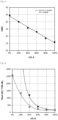
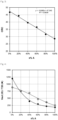
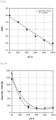
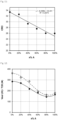
- Table 1 The results of Table 1 are in the Figures 1 and 2 shown.
- Table 2 Mixtures of superabsorbent A (Example 5) and superabsorbent B (Example 4)
- Comparison example Comparison example
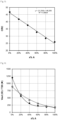
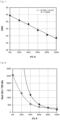
- Table 2 The results of Table 2 are in the Figures 3 and 4 shown.
- Table 3 Mixtures of superabsorbent A (Example 3) and superabsorbent B (Example 4)
- Comparison example Comparison example
- Table 4 Mixtures of superabsorbent A (Example 5) and superabsorbent B (Example 1) Example superabsorbent superabsorbent CRC T20 VAUL B A g/g s s 19*) 100% 0% 44.4 > 1200 2567 20*) 80% 20% 41.0 > 1200 1309 21*) 60% 40% 38.4 > 1200 561 22*) 40% 60% 34.0 546 378 23 20% 80% 30.7 323 300 24*) 0% 100% 28.6 182 254 *) Comparison example
- Table 4 The results of Table 4 are in the Figures 7 and 8 shown.
- Table 5 Mixtures of superabsorbent A (Example 3) and superabsorbent B (Example 6)
- Example superabsorbent superabsorbent CRC T20 VAUL B A g/g s s 25*) 100% 0% 34.0 > 1200 1398 26*) 80% 20% 32.1 753 520 27*) 60% 40% 29.9 222 177 28*) 40% 60% 28.0 167 145 29 20% 80% 26.9 155 161 30*) 0% 100% 26.0 165 180 *)
- Comparison example Comparison example
- Table 5 The results of Table 5 are in the Figures 9 and 10 shown.
- Table 6 Mixtures of superabsorbent A (Example 3) and superabsorbent B (Example 2) Example superabsorbent superabsorbent CRC T20 VAUL B A g/g s s 31*) 100% 0% 33.4 285 362 32*) 80% 20% 32.6 271 323 33*) 60% 40% 29.3 217 287 34*) 40% 60% 27.6 182 192 35 20% 80% 26.1 143 163 36*) 0% 100% 26.0 165 180 *) Comparison example
Landscapes
- Chemical & Material Sciences (AREA)
- Health & Medical Sciences (AREA)
- Organic Chemistry (AREA)
- Chemical Kinetics & Catalysis (AREA)
- Polymers & Plastics (AREA)
- Medicinal Chemistry (AREA)
- Dispersion Chemistry (AREA)
- Materials Engineering (AREA)
- Engineering & Computer Science (AREA)
- Epidemiology (AREA)
- Life Sciences & Earth Sciences (AREA)
- Animal Behavior & Ethology (AREA)
- General Health & Medical Sciences (AREA)
- Public Health (AREA)
- Veterinary Medicine (AREA)
- Hematology (AREA)
- Analytical Chemistry (AREA)
- Absorbent Articles And Supports Therefor (AREA)
- Addition Polymer Or Copolymer, Post-Treatments, Or Chemical Modifications (AREA)
Applications Claiming Priority (2)
| Application Number | Priority Date | Filing Date | Title |
|---|---|---|---|
| EP18150837 | 2018-01-09 | ||
| PCT/EP2019/050010 WO2019137833A1 (de) | 2018-01-09 | 2019-01-02 | Superabsorbermischungen |
Publications (3)
| Publication Number | Publication Date |
|---|---|
| EP3737709A1 EP3737709A1 (de) | 2020-11-18 |
| EP3737709C0 EP3737709C0 (de) | 2024-12-04 |
| EP3737709B1 true EP3737709B1 (de) | 2024-12-04 |
Family
ID=61074285
Family Applications (1)
| Application Number | Title | Priority Date | Filing Date |
|---|---|---|---|
| EP19700006.0A Active EP3737709B1 (de) | 2018-01-09 | 2019-01-02 | Superabsorbermischungen |
Country Status (6)
| Country | Link |
|---|---|
| US (1) | US11491463B2 (pl) |
| EP (1) | EP3737709B1 (pl) |
| JP (1) | JP2021510320A (pl) |
| CN (1) | CN111566145A (pl) |
| PL (1) | PL3737709T3 (pl) |
| WO (1) | WO2019137833A1 (pl) |
Families Citing this family (12)
| Publication number | Priority date | Publication date | Assignee | Title |
|---|---|---|---|---|
| JP2025532677A (ja) | 2022-09-23 | 2025-10-01 | ビーエーエスエフ ソシエタス・ヨーロピア | 超吸収体材料の技術適用特性を決定するための装置 |
| EP4677606A1 (en) | 2023-03-09 | 2026-01-14 | Basf Se | Apparatus for determining a hygiene property for a sanitary product |
| WO2025040440A1 (de) * | 2023-08-18 | 2025-02-27 | Basf Se | Verfahren zur thermischen oberflächennachvernetzung von superabsorbern |
| CN121712828A (zh) * | 2023-08-18 | 2026-03-20 | 巴斯夫欧洲公司 | 超级吸收剂的表面热后交联的方法 |
| CN121773156A (zh) * | 2023-08-18 | 2026-03-31 | 巴斯夫欧洲公司 | 对超吸收剂进行热表面后交联的方法 |
| CN121712827A (zh) * | 2023-08-18 | 2026-03-20 | 巴斯夫欧洲公司 | 超级吸收剂的表面热后交联的方法 |
| US12383885B2 (en) | 2023-11-24 | 2025-08-12 | Lg Chem, Ltd. | Super absorbent polymer |
| KR20250141546A (ko) | 2024-03-20 | 2025-09-29 | 주식회사 엘지화학 | 고흡수성 수지 |
| KR20250152994A (ko) | 2024-04-17 | 2025-10-24 | 주식회사 엘지화학 | 고흡수성 수지 |
| US12533656B2 (en) | 2024-05-02 | 2026-01-27 | Lg Chem, Ltd. | Super absorbent polymer |
| US12521695B2 (en) | 2024-05-02 | 2026-01-13 | Lg Chem, Ltd. | Super absorbent polymer |
| US12605694B2 (en) | 2024-05-03 | 2026-04-21 | Lg Chem, Ltd. | Super absorbent polymer |
Family Cites Families (55)
| Publication number | Priority date | Publication date | Assignee | Title |
|---|---|---|---|---|
| JPS6018690B2 (ja) | 1981-12-30 | 1985-05-11 | 住友精化株式会社 | 吸水性樹脂の吸水性改良方法 |
| JPS58180233A (ja) | 1982-04-19 | 1983-10-21 | Nippon Shokubai Kagaku Kogyo Co Ltd | 吸収剤 |
| US4734478A (en) | 1984-07-02 | 1988-03-29 | Nippon Shokubai Kagaku Kogyo Co., Ltd. | Water absorbing agent |
| DE3713601A1 (de) | 1987-04-23 | 1988-11-10 | Stockhausen Chem Fab Gmbh | Verfahren zur herstellung eines stark wasserabsorbierenden polymerisats |
| FI90554C (fi) | 1987-07-28 | 1994-02-25 | Dai Ichi Kogyo Seiyaku Co Ltd | Menetelmä akryylipolymeerigeelin jatkuvaksi valmistamiseksi |
| WO1990015830A1 (en) | 1989-06-12 | 1990-12-27 | Weyerhaeuser Company | Hydrocolloid polymer |
| CA2038779A1 (en) | 1990-04-02 | 1991-10-03 | Takumi Hatsuda | Method for production of fluid stable aggregate |
| DE4020780C1 (pl) | 1990-06-29 | 1991-08-29 | Chemische Fabrik Stockhausen Gmbh, 4150 Krefeld, De | |
| ES2097235T3 (es) | 1991-09-03 | 1997-04-01 | Hoechst Celanese Corp | Polimero superabsorbente que tiene propiedades de absorcion mejoradas. |
| DE4138408A1 (de) | 1991-11-22 | 1993-05-27 | Cassella Ag | Hydrophile, hochquellfaehige hydrogele |
| JP3045422B2 (ja) | 1991-12-18 | 2000-05-29 | 株式会社日本触媒 | 吸水性樹脂の製造方法 |
| DE69312126T2 (de) | 1992-03-05 | 1997-11-06 | Nippon Catalytic Chem Ind | Verfahren zu Herstellung eines absorbierenden Harzes |
| GB9208449D0 (en) | 1992-04-16 | 1992-06-03 | Dow Deutschland Inc | Crosslinked hydrophilic resins and method of preparation |
| DE69412547T2 (de) | 1993-06-18 | 1999-04-22 | Nippon Shokubai Co. Ltd., Osaka | Verfahren zur Herstellung eines absorbierenden Harzes |
| DE4426008A1 (de) | 1994-07-22 | 1996-01-25 | Cassella Ag | Hydrophile, hochquellfähige Hydrogele |
| DE19524724A1 (de) | 1995-07-07 | 1997-01-09 | Hoechst Ag | Hydrophile, hochquellfähige Hydrogele |
| DE19646484C2 (de) | 1995-11-21 | 2000-10-19 | Stockhausen Chem Fab Gmbh | Flüssigkeitsabsorbierende Polymere, Verfahren zu deren Herstellung und deren Verwendung |
| DE19543368C2 (de) | 1995-11-21 | 1998-11-26 | Stockhausen Chem Fab Gmbh | Wasserabsorbierende Polymere mit verbesserten Eigenschaften, Verfahren zu deren Herstellung und deren Verwendung |
| DE19732809C2 (de) | 1997-07-30 | 2000-04-20 | Bochumer Verein Verkehrstechni | Schienenrad mit verschleißoptimierter Lauffläche |
| DE19807502B4 (de) | 1998-02-21 | 2004-04-08 | Basf Ag | Verfahren zur Nachvernetzung von Hydrogelen mit 2-Oxazolidinonen, daraus hergestellte Hydrogele und deren Verwendung |
| US6265488B1 (en) | 1998-02-24 | 2001-07-24 | Nippon Shokubai Co., Ltd. | Production process for water-absorbing agent |
| US6503979B1 (en) | 1998-02-26 | 2003-01-07 | Basf Aktiengesellschaft | Method for cross-linking hydrogels with bis- and poly-2-oxazolidinones |
| JP2002513059A (ja) | 1998-04-28 | 2002-05-08 | ビーエーエスエフ アクチェンゲゼルシャフト | 機械的に安定なヒドロゲル |
| US6241928B1 (en) | 1998-04-28 | 2001-06-05 | Nippon Shokubai Co., Ltd. | Method for production of shaped hydrogel of absorbent resin |
| DE19854575A1 (de) | 1998-11-26 | 2000-05-31 | Basf Ag | Vernetzte quellfähige Polymere |
| DE19854573A1 (de) | 1998-11-26 | 2000-05-31 | Basf Ag | Verfahren zur Nachvernetzung von Hydrogelen mit 2-Oxo-tetrahydro-1,3-oxazinen |
| DE19854574A1 (de) | 1998-11-26 | 2000-05-31 | Basf Ag | Verfahren zur Nachvernetzung von Hydrogelen mit N-Acyl-2-Oxazolidinonen |
| US6239230B1 (en) | 1999-09-07 | 2001-05-29 | Bask Aktiengesellschaft | Surface-treated superabsorbent polymer particles |
| DE19955861A1 (de) | 1999-11-20 | 2001-05-23 | Basf Ag | Verfahren zur kontinuierlichen Herstellung von vernetzten feinteiligen gelförmigen Polymerisaten |
| US6979564B2 (en) | 2000-10-20 | 2005-12-27 | Millennium Pharmaceuticals, Inc. | 80090, human fucosyltransferase nucleic acid molecules and uses thereof |
| US6809158B2 (en) | 2000-10-20 | 2004-10-26 | Nippon Shokubai Co., Ltd. | Water-absorbing agent and process for producing the same |
| JP2005504865A (ja) | 2001-10-05 | 2005-02-17 | ビーエーエスエフ アクチェンゲゼルシャフト | モルホリン−2,3−ジオンを用いたヒドロゲルの架橋法 |
| DE10204938A1 (de) | 2002-02-07 | 2003-08-21 | Stockhausen Chem Fab Gmbh | Verfahren zur Nachvernetzung im Bereich der Oberfläche von wasserabsorbierenden Polymeren mit beta-Hydroxyalkylamiden |
| DE10204937A1 (de) | 2002-02-07 | 2003-08-21 | Stockhausen Chem Fab Gmbh | Verfahren zur Nachvernetzung im Bereich der Oberfläche von wasserabsorbierenden Polymeren mit Harnstoffderivaten |
| DE10225943A1 (de) | 2002-06-11 | 2004-01-08 | Basf Ag | Verfahren zur Herstellung von Estern von Polyalkoholen |
| CA2487030A1 (en) | 2002-06-11 | 2003-12-18 | Basf Aktiengesellschaft | (meth)acrylic esters of polyalkoxylated glycerine |
| CA2488226A1 (en) | 2002-06-11 | 2003-12-18 | Basf Aktiengesellschaft | (meth)acrylic esters of polyalkoxylated trimethylolpropane |
| KR20050036975A (ko) * | 2002-08-23 | 2005-04-20 | 바스프 악티엔게젤샤프트 | 초흡수성 중합체 및 그의 제조 방법 |
| DE10331456A1 (de) | 2003-07-10 | 2005-02-24 | Basf Ag | (Meth)acrylsäureester alkoxilierter ungesättigter Polyolether und deren Herstellung |
| DE10331450A1 (de) | 2003-07-10 | 2005-01-27 | Basf Ag | (Meth)acrylsäureester monoalkoxilierter Polyole und deren Herstellung |
| DE10334584A1 (de) | 2003-07-28 | 2005-02-24 | Basf Ag | Verfahren zur Nachvernetzung von Hydrogelen mit bicyclischen Amidacetalen |
| DE10355401A1 (de) | 2003-11-25 | 2005-06-30 | Basf Ag | (Meth)acrylsäureester ungesättigter Aminoalkohole und deren Herstellung |
| JP5627239B2 (ja) | 2006-12-06 | 2014-11-19 | ビーエーエスエフ ソシエタス・ヨーロピアBasf Se | 懸濁重合による吸水性ポリマー粒子の製造方法 |
| ES2398736T3 (es) | 2007-10-24 | 2013-03-21 | Sumitomo Seika Chemicals Co. Ltd. | Procedimiento para la produccion de resinas hidro-absorbentes y las resinas hidro-absorbentes obtenidas |
| WO2013078109A1 (en) | 2011-11-21 | 2013-05-30 | The Procter & Gamble Company | Absorbent articles with improved absorption properties |
| EP2535027B1 (en) | 2011-06-17 | 2022-08-17 | The Procter & Gamble Company | Absorbent article having improved absorption properties |
| BR112015011531B1 (pt) * | 2012-11-21 | 2021-08-24 | Basf Se | Processo para a produção de partículas de polímeros absorventes de água pósreticuladas na superfície, partículas de polímeros absorventes de água pós-reticuladas na superfície, e, artigo absorvente de fluido |
| JP2016506981A (ja) | 2013-01-29 | 2016-03-07 | ビーエーエスエフ ソシエタス・ヨーロピアBasf Se | 膨潤したゲル床の高い透過性と同時に、速い膨潤速度、かつ高い遠心分離保持容量を有する吸水性ポリマー粒子の製造方法 |
| EP3063189B1 (de) | 2013-10-30 | 2019-01-30 | Basf Se | Wasserabsorbierende polymerpartikel |
| CN105916527B (zh) | 2014-01-24 | 2019-06-18 | 巴斯夫欧洲公司 | 一种通过使单体溶液的液滴聚合来制备吸水聚合物颗粒的方法 |
| KR101899924B1 (ko) | 2014-08-04 | 2018-09-18 | 주식회사 엘지화학 | 고흡수성 수지 및 이의 제조 방법 |
| EP3262089B1 (en) | 2015-02-25 | 2018-11-21 | Basf Se | A process for producing surface-postcrosslinked water-absorbent polymer particles by polymerizing droplets of a monomer solution |
| CN109310984A (zh) | 2016-03-28 | 2019-02-05 | 株式会社日本触媒 | 吸水剂的制造方法 |
| US10881555B2 (en) * | 2016-03-30 | 2021-01-05 | Basf Se | Fluid-absorbent article |
| EP3464427B1 (de) | 2016-05-31 | 2021-01-06 | Basf Se | Verfahren zur herstellung von superabsorbern |
-
2019
- 2019-01-02 PL PL19700006.0T patent/PL3737709T3/pl unknown
- 2019-01-02 EP EP19700006.0A patent/EP3737709B1/de active Active
- 2019-01-02 CN CN201980007265.5A patent/CN111566145A/zh active Pending
- 2019-01-02 JP JP2020537781A patent/JP2021510320A/ja active Pending
- 2019-01-02 WO PCT/EP2019/050010 patent/WO2019137833A1/de not_active Ceased
- 2019-01-02 US US16/958,793 patent/US11491463B2/en active Active
Also Published As
| Publication number | Publication date |
|---|---|
| EP3737709A1 (de) | 2020-11-18 |
| JP2021510320A (ja) | 2021-04-22 |
| US11491463B2 (en) | 2022-11-08 |
| EP3737709C0 (de) | 2024-12-04 |
| PL3737709T3 (pl) | 2025-03-31 |
| WO2019137833A1 (de) | 2019-07-18 |
| US20210362126A1 (en) | 2021-11-25 |
| CN111566145A (zh) | 2020-08-21 |
Similar Documents
| Publication | Publication Date | Title |
|---|---|---|
| EP3737709B1 (de) | Superabsorbermischungen | |
| EP3473655B1 (de) | Verfahren zur herstellung wasserabsorbierender polymerpartikel durch suspensionspolymerisation | |
| EP2486084B1 (de) | Verfahren zur nachbefeuchtung oberflächennachvernetzter wasserabsorbierender polymerpartikel | |
| EP2951212B1 (de) | Verfahren zur herstellung wasserabsorbierender polymerpartikel mit hoher quellgeschwindigkeit und hoher zentrifugenretentionskapazität bei gleichzeitig hoher permeabilität des gequollenen gelbetts | |
| EP2411422B1 (de) | Verfahren zur herstellung oberflächennachvernetzter wasserabsorbierender polymerpartikel | |
| EP2673011B2 (de) | Verfahren zur herstellung wasserabsorbierender polymerpartikel mit hoher anquellgeschwindigkeit | |
| EP2432836B1 (de) | Beschichtungsverfahren für wasserabsorbierende polymerpartikel | |
| EP3280460B1 (de) | Verfahren zur herstellung von superabsorberpartikeln | |
| EP2046400A1 (de) | Verfahren zur herstellung nachvernetzter wasserabsorbierender polymerpartikel mit hoher absorption durch polymerisation von tropfen einer monomerlösung | |
| EP3140325B1 (de) | Verfahren zur herstellung wasserabsorbierender polymerpartikel | |
| EP2550304B1 (de) | Verfahren zur entfernung von restmonomeren aus wasserabsorbierenden polymerpartikeln | |
| EP2870183B2 (de) | Verfahren zur herstellung wasserabsorbierender polymerpartikel mit verbessertem eigenschaftsprofil | |
| EP2550316B2 (de) | Verfahren zur herstellung wasserabsorbierender polymerpartikel | |
| EP2486066B1 (de) | Verfahren zur nachbefeuchtung oberflächennachvernetzter wasserabsorbierender polymerpartikel | |
| EP3140326B1 (de) | Wasserabsorbierende polymerpartikel | |
| EP2547705B1 (de) | Verfahren zur herstellung wasserabsorbierender polymerpartikel mit verbesserter farbstabilität | |
| EP3749376B1 (de) | Verfahren zur pneumatischen förderung von superabsorberpartikeln | |
| EP2831153A1 (de) | Verfahren zur thermischen oberflächennachvernetzung in einem trommelwärmetauscher mit inverser schneckenwendel | |
| EP2129706B1 (de) | Verfahren zum beschichten wasserabsorbierender polymerpartikel | |
| EP2300063B1 (de) | Verfahren zur oberflächennachvernetzung wasserabsorbierender polymerpartikel | |
| EP3280743B1 (de) | Verfahren zur agglomeration von superabsorberpartikeln | |
| EP3914400B1 (de) | Verfahren zur herstellung von superabsorberpartikeln | |
| EP2714104B1 (de) | Verfahren zur herstellung wasserabsorbierender polymerpartikel | |
| WO2026093043A1 (de) | Verfahren zur herstellung von fliessfähigen superabsorberpartikeln |
Legal Events
| Date | Code | Title | Description |
|---|---|---|---|
| STAA | Information on the status of an ep patent application or granted ep patent |
Free format text: STATUS: UNKNOWN |
|
| STAA | Information on the status of an ep patent application or granted ep patent |
Free format text: STATUS: THE INTERNATIONAL PUBLICATION HAS BEEN MADE |
|
| PUAI | Public reference made under article 153(3) epc to a published international application that has entered the european phase |
Free format text: ORIGINAL CODE: 0009012 |
|
| STAA | Information on the status of an ep patent application or granted ep patent |
Free format text: STATUS: REQUEST FOR EXAMINATION WAS MADE |
|
| 17P | Request for examination filed |
Effective date: 20200810 |
|
| AK | Designated contracting states |
Kind code of ref document: A1 Designated state(s): AL AT BE BG CH CY CZ DE DK EE ES FI FR GB GR HR HU IE IS IT LI LT LU LV MC MK MT NL NO PL PT RO RS SE SI SK SM TR |
|
| AX | Request for extension of the european patent |
Extension state: BA ME |
|
| DAV | Request for validation of the european patent (deleted) | ||
| DAX | Request for extension of the european patent (deleted) | ||
| STAA | Information on the status of an ep patent application or granted ep patent |
Free format text: STATUS: EXAMINATION IS IN PROGRESS |
|
| 17Q | First examination report despatched |
Effective date: 20210504 |
|
| GRAP | Despatch of communication of intention to grant a patent |
Free format text: ORIGINAL CODE: EPIDOSNIGR1 |
|
| STAA | Information on the status of an ep patent application or granted ep patent |
Free format text: STATUS: GRANT OF PATENT IS INTENDED |
|
| INTG | Intention to grant announced |
Effective date: 20240729 |
|
| GRAS | Grant fee paid |
Free format text: ORIGINAL CODE: EPIDOSNIGR3 |
|
| GRAA | (expected) grant |
Free format text: ORIGINAL CODE: 0009210 |
|
| STAA | Information on the status of an ep patent application or granted ep patent |
Free format text: STATUS: THE PATENT HAS BEEN GRANTED |
|
| AK | Designated contracting states |
Kind code of ref document: B1 Designated state(s): AL AT BE BG CH CY CZ DE DK EE ES FI FR GB GR HR HU IE IS IT LI LT LU LV MC MK MT NL NO PL PT RO RS SE SI SK SM TR |
|
| REG | Reference to a national code |
Ref country code: GB Ref legal event code: FG4D Free format text: NOT ENGLISH |
|
| REG | Reference to a national code |
Ref country code: CH Ref legal event code: EP |
|
| REG | Reference to a national code |
Ref country code: DE Ref legal event code: R096 Ref document number: 502019012591 Country of ref document: DE |
|
| REG | Reference to a national code |
Ref country code: IE Ref legal event code: FG4D Free format text: LANGUAGE OF EP DOCUMENT: GERMAN |
|
| U01 | Request for unitary effect filed |
Effective date: 20241206 |
|
| U07 | Unitary effect registered |
Designated state(s): AT BE BG DE DK EE FI FR IT LT LU LV MT NL PT RO SE SI Effective date: 20241216 |
|
| PG25 | Lapsed in a contracting state [announced via postgrant information from national office to epo] |
Ref country code: HR Free format text: LAPSE BECAUSE OF FAILURE TO SUBMIT A TRANSLATION OF THE DESCRIPTION OR TO PAY THE FEE WITHIN THE PRESCRIBED TIME-LIMIT Effective date: 20241204 |
|
| PG25 | Lapsed in a contracting state [announced via postgrant information from national office to epo] |
Ref country code: ES Free format text: LAPSE BECAUSE OF FAILURE TO SUBMIT A TRANSLATION OF THE DESCRIPTION OR TO PAY THE FEE WITHIN THE PRESCRIBED TIME-LIMIT Effective date: 20241204 |
|
| PG25 | Lapsed in a contracting state [announced via postgrant information from national office to epo] |
Ref country code: NO Free format text: LAPSE BECAUSE OF FAILURE TO SUBMIT A TRANSLATION OF THE DESCRIPTION OR TO PAY THE FEE WITHIN THE PRESCRIBED TIME-LIMIT Effective date: 20250304 |
|
| U20 | Renewal fee for the european patent with unitary effect paid |
Year of fee payment: 7 Effective date: 20250317 |
|
| PG25 | Lapsed in a contracting state [announced via postgrant information from national office to epo] |
Ref country code: GR Free format text: LAPSE BECAUSE OF FAILURE TO SUBMIT A TRANSLATION OF THE DESCRIPTION OR TO PAY THE FEE WITHIN THE PRESCRIBED TIME-LIMIT Effective date: 20250305 |
|
| PGFP | Annual fee paid to national office [announced via postgrant information from national office to epo] |
Ref country code: CZ Payment date: 20250307 Year of fee payment: 8 |
|
| PG25 | Lapsed in a contracting state [announced via postgrant information from national office to epo] |
Ref country code: RS Free format text: LAPSE BECAUSE OF FAILURE TO SUBMIT A TRANSLATION OF THE DESCRIPTION OR TO PAY THE FEE WITHIN THE PRESCRIBED TIME-LIMIT Effective date: 20250304 |
|
| PG25 | Lapsed in a contracting state [announced via postgrant information from national office to epo] |
Ref country code: SM Free format text: LAPSE BECAUSE OF FAILURE TO SUBMIT A TRANSLATION OF THE DESCRIPTION OR TO PAY THE FEE WITHIN THE PRESCRIBED TIME-LIMIT Effective date: 20241204 |
|
| PG25 | Lapsed in a contracting state [announced via postgrant information from national office to epo] |
Ref country code: IS Free format text: LAPSE BECAUSE OF FAILURE TO SUBMIT A TRANSLATION OF THE DESCRIPTION OR TO PAY THE FEE WITHIN THE PRESCRIBED TIME-LIMIT Effective date: 20250404 |
|
| PG25 | Lapsed in a contracting state [announced via postgrant information from national office to epo] |
Ref country code: SK Free format text: LAPSE BECAUSE OF FAILURE TO SUBMIT A TRANSLATION OF THE DESCRIPTION OR TO PAY THE FEE WITHIN THE PRESCRIBED TIME-LIMIT Effective date: 20241204 |
|
| REG | Reference to a national code |
Ref country code: CH Ref legal event code: PL |
|
| PG25 | Lapsed in a contracting state [announced via postgrant information from national office to epo] |
Ref country code: MC Free format text: LAPSE BECAUSE OF FAILURE TO SUBMIT A TRANSLATION OF THE DESCRIPTION OR TO PAY THE FEE WITHIN THE PRESCRIBED TIME-LIMIT Effective date: 20241204 |
|
| PLBE | No opposition filed within time limit |
Free format text: ORIGINAL CODE: 0009261 |
|
| STAA | Information on the status of an ep patent application or granted ep patent |
Free format text: STATUS: NO OPPOSITION FILED WITHIN TIME LIMIT |
|
| PG25 | Lapsed in a contracting state [announced via postgrant information from national office to epo] |
Ref country code: CH Free format text: LAPSE BECAUSE OF NON-PAYMENT OF DUE FEES Effective date: 20250131 |
|
| 26N | No opposition filed |
Effective date: 20250905 |
|
| GBPC | Gb: european patent ceased through non-payment of renewal fee |
Effective date: 20250304 |
|
| PG25 | Lapsed in a contracting state [announced via postgrant information from national office to epo] |
Ref country code: GB Free format text: LAPSE BECAUSE OF NON-PAYMENT OF DUE FEES Effective date: 20250304 |
|
| PG25 | Lapsed in a contracting state [announced via postgrant information from national office to epo] |
Ref country code: IE Free format text: LAPSE BECAUSE OF NON-PAYMENT OF DUE FEES Effective date: 20250102 |
|
| PGFP | Annual fee paid to national office [announced via postgrant information from national office to epo] |
Ref country code: PL Payment date: 20251208 Year of fee payment: 8 |
|
| U20 | Renewal fee for the european patent with unitary effect paid |
Year of fee payment: 8 Effective date: 20260202 |
|
| PGFP | Annual fee paid to national office [announced via postgrant information from national office to epo] |
Ref country code: TR Payment date: 20260102 Year of fee payment: 8 |