EP3737597B1 - Siebelement zum sieben und fördern von streugut zur aufnahme an eine sandungsvorrichtung einer sandungsanlage für ein fahrzeug, sandungsvorrichtung mit einem siebelement, verfahren zum erzeugen und verfahren zum betreiben eines siebelements - Google Patents
Siebelement zum sieben und fördern von streugut zur aufnahme an eine sandungsvorrichtung einer sandungsanlage für ein fahrzeug, sandungsvorrichtung mit einem siebelement, verfahren zum erzeugen und verfahren zum betreiben eines siebelements Download PDFInfo
- Publication number
- EP3737597B1 EP3737597B1 EP19700640.6A EP19700640A EP3737597B1 EP 3737597 B1 EP3737597 B1 EP 3737597B1 EP 19700640 A EP19700640 A EP 19700640A EP 3737597 B1 EP3737597 B1 EP 3737597B1
- Authority
- EP
- European Patent Office
- Prior art keywords
- screening
- screening element
- additional
- plate
- lug
- Prior art date
- Legal status (The legal status is an assumption and is not a legal conclusion. Google has not performed a legal analysis and makes no representation as to the accuracy of the status listed.)
- Active
Links
Images

Classifications
-
- B—PERFORMING OPERATIONS; TRANSPORTING
- B07—SEPARATING SOLIDS FROM SOLIDS; SORTING
- B07B—SEPARATING SOLIDS FROM SOLIDS BY SIEVING, SCREENING, SIFTING OR BY USING GAS CURRENTS; SEPARATING BY OTHER DRY METHODS APPLICABLE TO BULK MATERIAL, e.g. LOOSE ARTICLES FIT TO BE HANDLED LIKE BULK MATERIAL
- B07B1/00—Sieving, screening, sifting, or sorting solid materials using networks, gratings, grids, or the like
- B07B1/46—Constructional details of screens in general; Cleaning or heating of screens
- B07B1/4609—Constructional details of screens in general; Cleaning or heating of screens constructional details of screening surfaces or meshes
- B07B1/469—Perforated sheet-like material
-
- B—PERFORMING OPERATIONS; TRANSPORTING
- B24—GRINDING; POLISHING
- B24B—MACHINES, DEVICES, OR PROCESSES FOR GRINDING OR POLISHING; DRESSING OR CONDITIONING OF ABRADING SURFACES; FEEDING OF GRINDING, POLISHING, OR LAPPING AGENTS
- B24B55/00—Safety devices for grinding or polishing machines; Accessories fitted to grinding or polishing machines for keeping tools or parts of the machine in good working condition
- B24B55/06—Dust extraction equipment on grinding or polishing machines
-
- B—PERFORMING OPERATIONS; TRANSPORTING
- B60—VEHICLES IN GENERAL
- B60B—VEHICLE WHEELS; CASTORS; AXLES FOR WHEELS OR CASTORS; INCREASING WHEEL ADHESION
- B60B39/00—Increasing wheel adhesion
- B60B39/02—Vehicle fittings for scattering or dispensing material in front of its wheels
- B60B39/021—Details of the dispensing device
-
- B—PERFORMING OPERATIONS; TRANSPORTING
- B60—VEHICLES IN GENERAL
- B60B—VEHICLE WHEELS; CASTORS; AXLES FOR WHEELS OR CASTORS; INCREASING WHEEL ADHESION
- B60B39/00—Increasing wheel adhesion
- B60B39/02—Vehicle fittings for scattering or dispensing material in front of its wheels
- B60B39/021—Details of the dispensing device
- B60B39/024—Details of the dispensing device related to preconditioning of the dispensing materials
-
- B—PERFORMING OPERATIONS; TRANSPORTING
- B65—CONVEYING; PACKING; STORING; HANDLING THIN OR FILAMENTARY MATERIAL
- B65G—TRANSPORT OR STORAGE DEVICES, e.g. CONVEYORS FOR LOADING OR TIPPING, SHOP CONVEYOR SYSTEMS OR PNEUMATIC TUBE CONVEYORS
- B65G53/00—Conveying materials in bulk through troughs, pipes or tubes by floating the materials or by flow of gas, liquid or foam
- B65G53/34—Details
- B65G53/40—Feeding or discharging devices
- B65G53/46—Gates or sluices, e.g. rotary wheels
- B65G53/4608—Turnable elements, e.g. rotary wheels with pockets or passages for material
- B65G53/4616—Turnable elements, e.g. rotary wheels with pockets or passages for material with axis of turning parallel to flow
-
- B—PERFORMING OPERATIONS; TRANSPORTING
- B60—VEHICLES IN GENERAL
- B60B—VEHICLE WHEELS; CASTORS; AXLES FOR WHEELS OR CASTORS; INCREASING WHEEL ADHESION
- B60B39/00—Increasing wheel adhesion
- B60B39/02—Vehicle fittings for scattering or dispensing material in front of its wheels
- B60B39/04—Vehicle fittings for scattering or dispensing material in front of its wheels the material being granular, e.g. sand
-
- B—PERFORMING OPERATIONS; TRANSPORTING
- B60—VEHICLES IN GENERAL
- B60B—VEHICLE WHEELS; CASTORS; AXLES FOR WHEELS OR CASTORS; INCREASING WHEEL ADHESION
- B60B39/00—Increasing wheel adhesion
- B60B39/02—Vehicle fittings for scattering or dispensing material in front of its wheels
- B60B39/04—Vehicle fittings for scattering or dispensing material in front of its wheels the material being granular, e.g. sand
- B60B39/06—Vehicle fittings for scattering or dispensing material in front of its wheels the material being granular, e.g. sand the dispensing being effected by mechanical means
-
- B—PERFORMING OPERATIONS; TRANSPORTING
- B60—VEHICLES IN GENERAL
- B60B—VEHICLE WHEELS; CASTORS; AXLES FOR WHEELS OR CASTORS; INCREASING WHEEL ADHESION
- B60B39/00—Increasing wheel adhesion
- B60B39/02—Vehicle fittings for scattering or dispensing material in front of its wheels
- B60B39/04—Vehicle fittings for scattering or dispensing material in front of its wheels the material being granular, e.g. sand
- B60B39/08—Vehicle fittings for scattering or dispensing material in front of its wheels the material being granular, e.g. sand the dispensing being effected by fluid means
-
- B—PERFORMING OPERATIONS; TRANSPORTING
- B61—RAILWAYS
- B61C—LOCOMOTIVES; MOTOR RAILCARS
- B61C15/00—Maintaining or augmenting the starting or braking power by auxiliary devices and measures; Preventing wheel slippage; Controlling distribution of tractive effort between driving wheels
- B61C15/08—Preventing wheel slippage
- B61C15/10—Preventing wheel slippage by depositing sand or like friction increasing materials
-
- B—PERFORMING OPERATIONS; TRANSPORTING
- B65—CONVEYING; PACKING; STORING; HANDLING THIN OR FILAMENTARY MATERIAL
- B65G—TRANSPORT OR STORAGE DEVICES, e.g. CONVEYORS FOR LOADING OR TIPPING, SHOP CONVEYOR SYSTEMS OR PNEUMATIC TUBE CONVEYORS
- B65G2201/00—Indexing codes relating to handling devices, e.g. conveyors, characterised by the type of product or load being conveyed or handled
- B65G2201/04—Bulk
- B65G2201/045—Sand, soil and mineral ore
Definitions
- the present approach relates to a screen element for screening and conveying grit to be received by a sanding device of a sanding system for a vehicle, a sanding device with a screen element, a method for producing and a method for operating a screen element.
- sanding systems that have a rotary valve with a vertical axis (also called a horizontal rotary valve) for dosing grit or bulk material. Before dosing, the grit passes from a sand storage tank of the sanding system to an inlet opening on the cellular wheel.
- the WO 11127937 A1 describes a sanding plant with a horizontal cellular wheel sluice for dosing bulk material.
- DE 2606483 A1 describe dosing systems for spreading material with a vertical axis of rotation.
- Stirring rods and impellers are used to make the sand flowable and eliminate dead volume.
- the sand is generally fed in via a separate filling pipe.
- the DE 10 24 881 discloses a device for uniformly feeding dusty to gritty bulk material.
- the object of the present approach is to create a sieve element for sieving and conveying grit for receiving a sanding device of a sanding system for a vehicle, an improved sanding device with a sieve element, a method for producing and a method for operating a sieve element.
- a screen element presented here screens and also promotes grit during operation in or on a sanding device before it enters an inlet opening of a cellular wheel of the sanding device.
- the screen element presented here can thus prevent foreign bodies or lumps of sand from getting into the star feeder and also ensures that the sand is conveyed evenly and thoroughly to the inlet opening of the star feeder.
- the sieve element advantageously takes up only an extremely small amount of space.
- a sieve element for sieving and conveying grit is designed to be attached to a sanding device of a sanding system for a vehicle.
- the sieve element has a plate element with a shaft coupling device, at least one passage opening and at least one tab.
- the shaft coupling device is designed for coupling the sieve element to a shaft device of a cellular wheel of the sanding device.
- the passage opening is arranged in the plate element and is shaped to allow grit to pass through the plate element.
- the tab extends away from the panel member transversely or at a defined angle to a major surface of the panel member.
- the sanding device can be at least one element of a sanding system, for example an element of a sand dosing device of the sanding system.
- a sand dosing device can, for example, have a cellular wheel for dosing grit such as sand, which in turn can have a vertical axis of rotation.
- the sanding device can be or have a shaft device of the sand metering device, wherein the shaft device for moving the cell wheel can be coupled or can be coupled to it.
- the sanding device can also have the cellular wheel.
- the vehicle can be a rail vehicle.
- the shaft coupling device of the sieve element is formed in order to make the sieve element coupleable, for example, to a shaft housing of the shaft device of the cellular wheel.
- a torque transmission of the shaft device to the sieve element is thus advantageously made possible, as a result of which this also rotates on the shaft device during operation of the cellular wheel.
- the screen element presented here can be arranged or can be arranged between a sand storage container of the sanding system and an inlet opening of the cellular wheel.
- the through-opening thus advantageously allows grit to be passed through in a sieved manner from the sand storage container to the inlet opening.
- the passage opening can be designed in the shape of a long circle.
- the tab is arranged and shaped to move the grit when the shaft means moves.
- wet grit can be broken up and/or loosened by the tab and/or shoveled in one direction.
- the plate element can be shaped as a metal sheet.
- the sieve element can have a circular configuration.
- the shaft coupling device can be arranged in a center of the plate element, in particular in which case the shaft coupling device can be formed as a shaft passage opening for passing through the shaft device.
- the shaft coupling device can have a hexagonal opening and/or a polygonal opening and/or a feather key and/or a feather key groove and/or a toothing.
- the shaft coupling device can be welded, glued, clamped and/or pressed to the shaft housing in order to make the sieve element movable in the sanding system by means of the shaft device.
- the tab may extend from an inner edge side of the port.
- the tab can be rectangular or semi-circular or triangular or designed as a stud.
- An angle of the tab can be inclined to a center point in order to be able to shovel grit in one direction when the screen element is moved.
- the sieve element can have at least one additional tab, which extends away from the plate element transversely or at a defined angle to the main surface, in particular wherein the additional tab can extend from a further inner edge side of the passage opening arranged transversely to the inner edge side.
- additional tab can extend from a further inner edge side of the passage opening arranged transversely to the inner edge side.
- the sieve element can also have at least one additional passage opening arranged in the plate element and/or at least one additional tab, which can extend away from the plate element transversely or at a defined angle to a main surface of the plate element opposite the main surface. Accordingly, if tabs extend away from the plate element to both main surfaces of the sieve element, conveying of the grit is made possible both before and after the sieving.
- the sieve element can be arranged on the shaft device in such a way that the tab and the additional tab extend in the direction of the sand storage container and the additional tab in the direction of the inlet opening of the cellular wheel. In such a position, the additional tab can prevent, during operation of the screening element, that grit that has already been screened can accumulate or back up under the screening element.
- the plate element and the tab and/or the additional tab and/or the additional tab can be formed in one piece, in particular with the passage opening and/or the additional passage opening being formed by a stamping process and/or the tab and/or the further tab and/or the additional tab may have been produced by a bending process of a stamped or lasered plate section of the plate element. It is also conceivable that the Passage opening can be done by means of a laser, eroding, water jet cutting, machining process or the like.
- the sieve element can have four of the passage openings and/or four of the tabs and/or four of the additional tabs and/or four of the additional passage openings and/or four of the additional tabs.
- the through-openings and the additional through-openings can be arranged around the shaft coupling device, in particular it being possible for the through-openings to be arranged in each case adjacent to the additional through-openings. Such a number and arrangement of the through-openings and tabs enables effective screening and conveying of grit in the sanding system.
- a sanding device has a sieve element which is formed in one of the variants presented, in particular with the sieve element being arranged and/or fastened to a shaft device.
- Such a sanding device can serve as a replacement for known sanding devices, with the sanding device presented here advantageously enabling screening and thorough conveying of grit before the grit enters an inlet opening of a cellular wheel in a sanding system.
- a method for generating one of the screen elements presented has at least the following steps: Punching, shaping and/or lasering at least one passage opening in a plate element; and
- a shaft coupling device can also be stamped into the plate element.
- a stamped Plate portion of the plate member can be bent to position the tab to create the screen member.
- an embodiment includes an "and/or" link between a first feature and a second feature, this should be read in such a way that the embodiment according to one embodiment includes both the first feature and the second feature and according to a further embodiment either only that having the first feature or only the second feature.
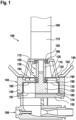
- FIG. 1 shows a schematic cross-sectional representation of a sanding system 100 with a sanding device 105 with a screen element 110 for screening and conveying grit for a vehicle according to an embodiment.
- the sanding system 100 is designed for use with a vehicle, according to this exemplary embodiment with a rail vehicle.
- the sanding device 105 has the sieve element 110 and at least one shaft device 115, on which the sieve element 110 according to this exemplary embodiment is arranged.
- the screen element 110 is attached to a shaft sleeve 120 of the shaft device 115 .
- the sanding device 105 optionally also has a cellular wheel 122 which is coupled to the shaft device 115 .
- the screen element 110 is designed to screen and convey grit.
- the sieve element 110 has a plate element 125 with a shaft coupling device 130, at least one passage opening and at least one tab.
- the passage opening and the tab are in 2 shown in more detail.
- the shaft coupling device 130 is designed to couple the sieve element 110 to the shaft device 115 of the cellular wheel 122 of the sanding device 105 .
- the shaft coupling device 130 is formed as a shaft passage opening through which the shaft device 115 is passed.
- the passage opening is arranged in the plate element 125 and is shaped in order to allow grit to pass through the plate element 125 .
- the tab extends away from the panel member 125 transversely to a major surface of the panel member 125 .
- One approach presented here relates to a mechanical sand dosing device in the form of the sanding device 105 with rotary valve for a sanding system in the form of the sanding system 100 for vehicles, in particular rail vehicles, in order to increase the friction between the vehicle wheel and the ground, in particular the rails.
- the screen element 110 presented here advantageously eliminates weak points and shortcomings of known sand dosing devices with cellular wheel sluices, which, like the sanding system 100 shown here, have a vertical axis of rotation in particular, in that the screen element 110 allows the grit to be screened and conveyed before it enters an inlet opening 135 to the cellular wheel 122 .
- Cellular wheels 122 with a vertical axis of rotation have proven to be less wear-resistant and more space-saving than those with a horizontal axis for dosing devices for rail vehicles.
- an activator plate in the form of the sieve element 110 which is located above the cellular wheel housing of the cellular wheel 122 and its inlet opening 135 and which has the at least one passage opening and the one tab.
- Said activator plate is rigidly connected to the cellular wheel 122 via the shaft device 115 and rotates with it. While the passage opening as sieve is used for large clumps of sand and foreign bodies, the flap acts like a shovel, causing bulk material or sand to be taken along and pushed into the inlet opening.
- the sand dosing device in the form of the sanding device 105 is a mechanical dosing device with the cellular wheel 122, which rotates about a vertical axis.
- this cellular wheel 122 is accommodated in a housing 145 which is designed in several parts and consists of a main housing part 150 and a housing base plate 155 .
- the housing 145 is designed to accommodate a cylindrical bushing 160, the cellular wheel 122 rotatably mounted therein, two cover disks 165, 170 sealing the cylindrical bushing 160 at the top and bottom, and a bell 185 carrying a gear 175 and a motor 180.
- the cover disks 165, 170 determine the shape of the inlet opening 135 and an outlet opening 187.
- the inlet opening 135 in the upper cover disk 165 has the shape of a circular ring sector and measures 135° in its extent, which, according to this exemplary embodiment, corresponds to exactly three chambers of the cell wheel 122 .
- the diameter of the second half, which the vanes of cell wheel 122 pass over last during one revolution, is wider. This shape ensures that the chambers in cell wheel 122 are completely filled.
- the bell 185 is designed in such a way that it has supports for the motor 180 and intermediate openings for the inflow of the sand.
- the bell 185 also has an anti-twist device and is screwed together with the main housing piece 150 and provided with a sealing ring 190 placed on top.
- the housing 145 is placed as a whole in a lower opening of the sand storage container 140 in such a way that the sand storage container 140 has a mounting ring 192 fitted in its lower opening, which is again secured by a main screw connection using six large screws with the sealing ring 190, the housing main piece 150, the lower cover plate 170 and the housing base plate 155 is screwed.
- the housing 145 protrudes from the sand storage container 140 and represents its outlet opening.
- Bell 185, gear 175 and motor 180 are located inside the sand storage container 140.
- the motor 180 Seated on the bell 185 is the motor 180, which is an electric motor according to this exemplary embodiment, and the gear 175 below it 175 and cellular wheel 122 receives and coupled to each other by rotary locking.
- the shaft sleeve 120 has a hexagonal section for mounting the screen element 110 in a manner secured against torsion 2 .
- the fitted sieve element 110 is secured against slipping down by a safety ring.
- the tab or at least one in 2 The additional tab of the sieve element 110 shown in more detail, this additional tab can also be referred to as a shovel, engages according to this exemplary embodiment in a channel 194 which is formed by the inside of the bell 185 on the one hand and by an elevation of the main housing piece 150 on the other. That elevation is intended to protect an underlying shaft sealing ring 196 enclosing the shaft sleeve 120 .
- a dead volume similar to that which is formed in the channel 194 described, is in a construction in which the cellular wheel housing is in an outlet of the Sand reservoir 140 is located and a supply of sand from above into the housing 145 is almost unavoidable.
- a pneumatic conveying device 198 can be fastened to an underside of the housing base plate 155.
- the grit, in this case sand, of the sand storage container 140 can trickle into the inlet opening 135 of the housing 145 by gravity, or will, if it is next to the inlet opening 135 on a top side of the housing 145 comes to rest, is pushed into the inlet opening 135 by the tabs of the sieve element 110 .
- the sand in the evenly filled chambers of the cellular wheel 122 is conveyed from the inlet opening 135 to the outlet opening 187 by the rotation of the cellular wheel 122 caused by the motor 180 .
- it can again trickle down to the nozzle of the conveying device 198, which then conveys the dosed sand in front of the wheels of the rail vehicle via a conveying line.
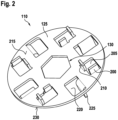
- FIG 2 shows a perspective view of a sieve element 110 according to an embodiment. It can be an embodiment of the basis of 1 acting sieve element 110 described.
- the plate element 125 is formed as a metal sheet and/or configured in a circular shape.
- the shaft coupling device 130 is arranged in a center of the plate element 125 .
- the tab 200 extends from an inner edge side of the through hole 205.
- the sieve element 110 has at least one further tab 210, which extends transversely to the main surface 215 of the plate element 110 stretches away.
- the further tab 210 extends from a further inner edge side of the passage opening 205 that is arranged transversely to the inner edge side.
- the sieve element 110 also has at least one additional passage opening 220 arranged in the plate element 125 and/or at least one additional tab 225, which extends away from the plate element 125 transversely to a main surface 230 of the plate element 125 opposite the main surface 215.
- the additional tab 225 extends from an additional inner edge side of the additional passage opening 220.
- At least one of the tabs 200, 210 extends away from the main surface 215 and/or at least the one additional tab 225 extends away from the opposite main surface 230.
- the plate element 125 and at least the tab 200 and/or the additional tab 210 and/or the additional tab 225 are formed in one piece.
- at least passage opening 205 and/or the additional passage opening 220 is formed by a stamping process and/or at least tab 200 and/or the additional tab 210 and/or the additional tab 225 is formed by a bending process of a stamped or lasered plate section of plate element 125 been generated.
- the sieve element is formed from plastic and/or from die-cast metal.
- the sieve element 110 has four of the passage openings 205 and/or four of the tabs 200 and/or four of the additional tabs 210 and/or four of the additional passage openings 220 and/or four of the additional tabs 225.
- the four through-openings 205 and the four additional through-openings 220 are arranged around the shaft coupling device 130 .
- the passage openings 205 are each arranged adjacent to the additional passage openings 220 according to this exemplary embodiment.
- the sieve element 110 is described again in the following in other words: According to this exemplary embodiment, the sieve element 110 has four long-circular openings in the form of through-openings 205 and four punched-out sections in the form of additional through-openings 220, in which the additional tabs 225 are bent into downward-pointing vanes. A number, shape and dimensions of said openings and punched-out portions shown here have proven to be advantageous in a test phase.
- the additional tabs 225 ensure that grit, such as sand, that falls directly on the in 1 described dosing has come to rest and cannot trickle into the inlet opening, is taken along and pushed or shoveled into the inlet opening.
- the additional tabs 225 which can also be referred to as “tabs down”, are used to convey the sand further under the sheet metal into the inlet and thereby promote the flow of sand. Furthermore, the additional tabs 225 prevent the sand from solidifying under the metal sheet.
- a shape of the additional tabs 225 and an orientation, an angle with respect to the center, can vary.
- torque transmission is made possible via a hexagon.
- the shaft coupling device 130 is designed to enable torque transmission via a polygon, feather key and/or toothing.
- the wave coupling device 130 can be welded and/or glued and/or clamped and/or pressed to the shaft device.
- the tabs 200 and/or further tabs 210 which can also be referred to as “tabs pointing upwards”, ensure that the sand structure is broken up and loosened, in particular in the case of wet sand, in particular up to 0.5% by volume.
- the lugs 200 and/or further lugs 210 are not formed in one piece with the plate element 125, but are welded and/or screwed on and/or riveted on and/or designed as bolts.
- the tab 200 and/or additional tabs 210 are not rectangular as shown here, but instead are designed in a semi-circular or triangular manner or in another suitable shape. An angle of the lugs 200 and/or other lugs 210 is inclined to the center in order to be able to shovel the sand in one direction.
- the through-flow openings 205 and/or additional through-flow openings 220 allow the sand to flow under the sieve element 110 into an area of the inlet to the cellular wheel.
- at least one of the openings 205, 220 has a minimum size of approximately 10 times the average grain size of the grit. Likewise, when dimensioning, care is taken to ensure that there is enough flow to fill the cells at maximum movement speed. Likewise, the openings 205, 220 are small enough to retain debris.
- a sieve function of the sieve element 110 advantageously keeps larger parts such as stones, chewing gum, lumps of fat or the like away from the star feeder or the downstream conveyor unit.
- the sanding system did not show any failures or impairments when introducing the foreign bodies into the amount of sand.
- the mean values from the measurement data are almost identical to the mean values from the reference measurement. No damage whatsoever could be determined for any of the foreign bodies after the test had been carried out. In the case of stones and broom hair, no residues of the foreign bodies were found after the measurement in the sanding system.
- the test specimens were found after the measurement at sieve element 110. In the event of an error, film residues could be found after measuring one of three pieces of film on screen element 110.
- the sand storage tank 140 could be completely emptied without failure.
- FIG. 3 shows a flow diagram of a method 300 for generating a sieve element according to an embodiment. This can be a method 300 for generating one of the in 1 or 2 acting screen elements described.
- the method 300 has a step 305 of stamping, forming and/or lasering and a step 310 of arranging.
- step 305 of punching, shaping and/or lasering at least one passage opening is punched/lasered in a plate element.
- step 310 at least one tab extending transversely to a major surface of the panel member is disposed away from the panel member to create the screen member.
- a shaft coupling device is optionally also stamped into the plate element.
- a stamped panel portion of the panel member is bent to locate the tab to create the screen member.
- FIG. 4 shows a flowchart of a method 400 for operating a screen element according to an embodiment. This can be a method 400 for operating one of the in 1 or 2 acting screen elements described.
- the method 400 has a step 405 of moving and a step 410 of conveying.
- step 405 of moving the sieve element is moved in order to obtain sieved grit.
- step 410 of conveying the screened grit is conveyed by means of the moving screen element.
Landscapes
- Engineering & Computer Science (AREA)
- Mechanical Engineering (AREA)
- Transportation (AREA)
- Combined Means For Separation Of Solids (AREA)
- Finish Polishing, Edge Sharpening, And Grinding By Specific Grinding Devices (AREA)
Description
- Der vorliegende Ansatz bezieht sich auf ein Siebelement zum Sieben und Fördern von Streugut zur Aufnahme an eine Sandungsvorrichtung einer Sandungsanlage für ein Fahrzeug, eine Sandungsvorrichtung mit einem Siebelement, ein Verfahren zum Erzeugen und ein Verfahren zum Betreiben eines Siebelements.
- Es gibt Sandungsanlagen, die eine Zellenradschleuse mit vertikaler Achse (auch horizontale Zellradschleuse genannt) zur Dosierung von Streugut oder Schüttgut aufweisen. Vor der Dosierung gelangt das Streugut von einem Sandvorratsbehälter der Sandungsanlage zu einer Zulauföffnung zum Zellenrad.
- Die
WO 11127937 A1 DE 19501179 A1 und die -
DE 2606483 A1 beschreiben Dosieranlagen für Streugut mit vertikaler Drehachse. In derDE 19501179 A1 werden Rührstäbe und Rührflügel eingesetzt, um den Sand fließbar zu machen und ein Totvolumen zu beseitigen. In derDE 2606483 A1 wird der Sand generell über ein eigenes Füllrohr zugeführt. DieDE 10 24 881 offenbart eine Vorrichtung zum gleichmäßigen Aufgeben von staubförmigem bis grießigem Schüttgut. Vor diesem Hintergrund ist es die Aufgabe des vorliegenden Ansatzes ein Siebelement zum Sieben und Fördern von Streugut zur Aufnahme an eine Sandungsvorrichtung einer Sandungsanlage für ein Fahrzeug, eine verbesserte Sandungsvorrichtung mit einem Siebelement, ein Verfahren zum Erzeugen und ein Verfahren zum Betreiben eines Siebelements zu schaffen. - Diese Aufgabe wird durch ein Siebelement zum Sieben und Fördern von Streugut zur Aufnahme an eine Sandungsvorrichtung einer Sandungsanlage für ein Fahrzeug, eine Sandungsvorrichtung mit einem Siebelement, ein Verfahren zum Erzeugen und ein Verfahren zum Betreiben eines Siebelements gemäß den Hauptansprüchen gelöst.
- Die mit dem vorgestellten Ansatz erreichbaren Vorteile bestehen darin, dass ein hier vorgestelltes Siebelement im Betrieb in oder an einer Sandungsvorrichtung Streugut vor einem Eintritt in eine Zulauföffnung eines Zellenrads der Sandungsvorrichtung siebt und auch fördert. Durch das hier vorgestellte Siebelement kann somit verhindert werden, dass Fremdkörper oder Sandklumpen in das Zellenrad gelangen und zudem wird ein gleichmäßiges und gründliches Fördern des Sandes zu der Zulauföffnung des Zellenrads gewährleistet. Hierbei beansprucht das Siebelement vorteilhafterweise lediglich einen äußerst geringen Bauraum.
- Ein Siebelement zum Sieben und Fördern von Streugut ist zur Aufnahme an eine Sandungsvorrichtung einer Sandungsanlage für ein Fahrzeug ausgeformt. Das Siebelement weist ein Plattenelement mit einer Wellenkoppeleinrichtung, zumindest eine Durchlassöffnung und zumindest eine Lasche auf. Die Wellenkoppeleinrichtung ist zum Koppeln des Siebelements mit einer Welleneinrichtung eines Zellenrads der Sandungsvorrichtung ausgeformt. Die Durchlassöffnung ist in dem Plattenelement angeordnete und zum Durchlassen von Streugut durch das Plattenelement ausgeformt. Die Lasche erstreckt sich quer oder unter einem definierten Winkel zu einer Hauptoberfläche des Plattenelements von dem Plattenelement weg.
- Bei der Sandungsvorrichtung kann es sich um zumindest ein Element einer Sandungsanlage, beispielsweise ein Element einer Sanddosiereinrichtung der Sandungsanlage handeln. Eine solche Sanddosiereinrichtung kann zum Dosieren von Streugut wie Sand beispielsweise ein Zellenrad aufweisen, welches wiederum eine vertikale Rotationsachse aufweisen kann. Beispielsweise kann die Sandungsvorrichtung eine Welleneinrichtung der Sanddosiereinrichtung sein oder aufweisen, wobei die Welleneinrichtung zum Bewegen des Zellenrads mit diesem gekoppelt oder koppelbar sein kann. Die Sandungsvorrichtung kann auch das Zellenrad aufweisen.
- Bei dem Fahrzeug kann es sich um ein Schienenfahrzeug handeln.
- Die Wellenkoppeleinrichtung des Siebelements ist dazu ausgeformt, um das Siebelement beispielsweise an einem Wellengehäuse der Welleneinrichtung des Zellenrads koppelbar zu machen. In einem gekoppelten Zustand mit der Welleneinrichtung ist so vorteilhafterweise eine Drehmomentübertragung der Welleneinrichtung auf das Siebelement ermöglicht, wodurch sich auch dieses im Betrieb des Zellenrads an der Welleneinrichtung dreht.
- Das hier vorgestellte Siebelement kann zwischen einem Sandvorratsbehälter der Sandungsanlage und einer Zulauföffnung des Zellenrads angeordnet oder anordenbar sein. Die Durchlassöffnung ermöglicht so vorteilhafterweise ein gesiebtes Durchlassen von Streugut von dem Sandvorratsbehälter zu der Zulauföffnung. Die Durchlassöffnung kann langkreisförmig ausgestaltet sein.
- Wenn die Siebeinrichtung wie beschrieben mit der Welleneinrichtung gekoppelt ist, ist die Lasche vorteilhafterweise dazu angeordnet und ausgeformt, um das Streugut zu bewegen, wenn sich die Welleneinrichtung bewegt. So kann beispielsweise nasses Streugut durch die Lasche aufgebrochen und/oder gelockert werden und/oder in eine Richtung geschaufelt werden.
- Das Plattenelement kann als ein Blech ausgeformt sein.
- Das Siebelement kann gemäß einer Ausführungsform kreisförmig ausgestaltet sein.
- Die Wellenkoppeleinrichtung kann in einer Mitte des Plattenelements angeordnet sein, insbesondere wobei die Wellenkoppeleinrichtung als eine Wellendurchgangsöffnung zum Durchführen der Welleneinrichtung ausgeformt sein kann. Beispielsweise kann die Wellenkoppeleinrichtung eine Sechskant-Öffnung und/oder eine Polygon-Öffnung und/oder eine Passfeder und/oder eine Passfeder-Nut und/oder eine Verzahnung aufweisen. Die Wellenkoppeleinrichtung kann mit dem Wellengehäuse verschweißt, verklebt, verklemmt und/oder verpresst sein oder werden, um das Siebelement mittels der Welleneinrichtung in der Sandungsanlage beweglich zu machen.
- Die Lasche kann sich von einer Innenrandseite der Durchlassöffnung erstrecken. Die Lasche kann rechteckig oder halbrund oder dreieckig oder als ein Bolzen ausgeführt sein. Ein Winkel der Lasche kann geneigt zu einem Mittelpunkt sein, um beim Bewegen des Siebelements Streugut in eine Richtung schaufeln zu können.
- Gemäß einer Ausführungsform kann das Siebelement zumindest eine weitere Lasche aufweisen, die sich quer oder unter einem definierten Winkel zu der Hauptoberfläche von dem Plattenelement weg erstreckt, insbesondere wobei sich die weitere Lasche von einer quer zu der Innenrandseite angeordneten weiteren Innenrandseite der Durchlassöffnung erstrecken kann. Eine derartige Anordnung von Lasche und weiterer Lasche kann ein effektives Aufbrechen und/oder Schaufeln von Streugut ermöglichen.
- Das Siebelement kann auch zumindest eine in dem Plattenelement angeordnete zusätzliche Durchlassöffnung und/oder zumindest eine zusätzliche Lasche aufweisen, die sich quer oder unter einem definierten Winkel zu einer der Hauptoberfläche gegenüberliegenden Hauptoberfläche des Plattenelements von dem Plattenelement weg erstrecken kann. Wenn sich demnach zu beiden Hauptoberflächen des Siebelements Laschen von dem Plattenelement weg erstrecken, so ist ein Fördern des Streuguts sowohl vor als auch nach dem Sieben ermöglicht. Beispielsweise kann das Siebelement derart an der Welleneinrichtung angeordnet sein oder werden, dass sich die Lasche und die weitere Lasche in Richtung des Sandvorratsbehälters und die zusätzliche Lasche in Richtung der Zulauföffnung des Zellenrads erstrecken. In einer solchen Position kann die zusätzliche Lasche im Betrieb des Siebelements verhindern, dass sich unter dem Siebelement bereits gesiebtes Streugut ansammeln oder anstauen kann.
- Das Plattenelement und die Lasche und/oder die weitere Lasche und/oder die zusätzliche Lasche können einstückig ausgeformt sein, insbesondere wobei die Durchlassöffnung und/oder die zusätzliche Durchlassöffnung durch ein Stanzverfahren und/oder die Lasche und/oder die weitere Lasche und/oder die zusätzliche Lasche durch ein Biegeverfahren eines gestanzten oder gelaserten Plattenabschnitts des Plattenelements erzeugt worden sein kann. Denkbar ist ebenfalls, dass die Druchlassöffnung mittels eines Laserns, Erodierens, Wasserstrahlschneidens, spanabhebenden Verfahrens oder Ähnlichem erfolgen kann.
- Das Siebelement kann vier der Durchlassöffnungen und/oder vier der Laschen und/oder vier der weiteren Laschen und/oder vier der zusätzlichen Durchlassöffnungen und/oder vier der zusätzlichen Laschen aufweisen. Die Durchlassöffnungen und die zusätzlichen Durchlassöffnungen können um die Wellenkoppeleinrichtung herum angeordnet sein, insbesondere wobei die Durchlassöffnungen jeweils benachbart zu den zusätzlichen Durchlassöffnungen angeordnet sein können. Eine derartige Anzahl und Anordnung der Durchlassöffnungen und Laschen ermöglicht ein effektives Sieben und Fördern von Streugut in der Sandungsanlage.
- Eine Sandungsvorrichtung weist ein Siebelement auf, das in einer der vorgestellten Varianten ausgeformt ist, insbesondere wobei das Siebelement an einer Welleneinrichtung angeordnet und/oder befestigt ist. Eine solche Sandungsvorrichtung kann als Ersatz für bekannte Sandungsvorrichtungen dienen, wobei die hier vorgestellte Sandungsvorrichtung vorteilhafterweise ein Sieben und gründliches Fördern von Streugut vor einem Eintritt des Streuguts in eine Zulauföffnung eines Zellenrads in einer Sandungsanlage ermöglicht.
- Ein Verfahren zum Erzeugen eines der vorgestellten Siebelemente weist zumindest die folgenden Schritte auf:
Stanzen, Ausformen und/oder Lasern zumindest einer Durchlassöffnung in ein Plattenelement; und - Anordnen zumindest einer Lasche, die sich quer zu einer Hauptoberfläche des Plattenelements von dem Plattenelement weg erstreckt, um das Siebelement zu erzeugen.
- Im Schritt des Stanzens kann außerdem eine Wellenkoppeleinrichtung in das Plattenelement gestanzt werden. Im Schritt des Anordnens kann ein gestanzter Plattenabschnitt des Plattenelements gebogen werden, um die Lasche anzuordnen, um das Siebelement zu erzeugen.
- Ein Verfahren zum Betreiben eines der vorgestellten Siebelemente weist zumindest die folgenden Schritte auf:
- Bewegen des Siebelements, um gesiebtes Streugut zu erhalten; und
- Fördern des gesiebten Streuguts mittels des sich bewegenden Siebelements.
- Ausführungsbeispiele des hier vorgestellten Ansatzes werden in der nachfolgenden Beschreibung mit Bezug zu den Figuren näher erläutert. Es zeigen:
-
Fig. 1 eine schematische Querschnittdarstellung einer Sandungsanlage mit einer Sandungsvorrichtung mit einem Siebelement zum Sieben und Fördern von Streugut für ein Fahrzeug gemäß einem Ausführungsbeispiel; -
Fig. 2 eine perspektivische Darstellung eines Siebelements gemäß einem Ausführungsbeispiel; -
Fig. 3 ein Ablaufdiagramm eines Verfahrens zum Erzeugen eines Siebelements gemäß einem Ausführungsbeispiel; und -
Fig. 4 ein Ablaufdiagramm eines Verfahrens zum Betreiben eines Siebelements gemäß einem Ausführungsbeispiel. - In der nachfolgenden Beschreibung günstiger Ausführungsbeispiele des vorliegenden Ansatzes werden für die in den verschiedenen Figuren dargestellten und ähnlich wirkenden Elemente gleiche oder ähnliche Bezugszeichen verwendet, wobei auf eine wiederholte Beschreibung dieser Elemente verzichtet wird.
- Umfasst ein Ausführungsbeispiel eine "und/oder"-Verknüpfung zwischen einem ersten Merkmal und einem zweiten Merkmal, so ist dies so zu lesen, dass das Ausführungsbeispiel gemäß einer Ausführungsform sowohl das erste Merkmal als auch das zweite Merkmal und gemäß einer weiteren Ausführungsform entweder nur das erste Merkmal oder nur das zweite Merkmal aufweist.
-
Fig. 1 zeigt eine schematische Querschnittdarstellung einer Sandungsanlage 100 mit einer Sandungsvorrichtung 105 mit einem Siebelement 110 zum Sieben und Fördern von Streugut für ein Fahrzeug gemäß einem Ausführungsbeispiel. Die Sandungsanlage 100 ist zur Verwendung mit einem Fahrzeug, gemäß diesem Ausführungsbeispiel mit einem Schienenfahrzeug, ausgeformt. - Gemäß diesem Ausführungsbeispiel weist die Sandungsvorrichtung 105 das Siebelement 110 und zumindest eine Welleneinrichtung 115 auf, an der das Siebelement 110 gemäß diesem Ausführungsbeispiel angeordnet ist. Gemäß diesem Ausführungsbeispiel ist das Siebelement 110 an einer Wellenhülse 120 der Welleneinrichtung 115 befestigt. Gemäß diesem Ausführungsbeispiel weist die Sandungsvorrichtung 105 optional außerdem ein Zellenrad 122 auf, das mit der Welleneinrichtung 115 gekoppelt ist.
- Das Siebelement 110 ist dazu ausgebildet, um Streugut zu sieben und zu fördern.
- Das Siebelement 110 weist ein Plattenelement 125 mit einer Wellenkoppeleinrichtung 130, zumindest eine Durchlassöffnung und zumindest eine Lasche auf. Die Durchlassöffnung und die Lasche sind in
Fig. 2 genauer dargestellt. Die Wellenkoppeleinrichtung 130 ist zum Koppeln des Siebelements 110 mit der Welleneinrichtung 115 des Zellenrads 122 der Sandungsvorrichtung 105 ausgeformt. Gemäß diesem Ausführungsbeispiel ist die Wellenkoppeleinrichtung 130 als eine Wellendurchgangsöffnung ausgeformt, durch die die Welleneinrichtung 115 durchgeführt ist. Die Durchlassöffnung ist in dem Plattenelement 125 angeordnet und dazu ausgeformt, um Streugut durch das Plattenelement 125 durchzulassen. Die Lasche erstreckt sich quer zu einer Hauptoberfläche des Plattenelements 125 von dem Plattenelement 125 weg. - Im Folgenden werden Details des hier vorgestellten Siebelements 110 und der Sandungsvorrichtung 105 noch einmal genauer ausgeführt.
- Ein hier vorgestellter Ansatz bezieht sich auf eine mechanische Sanddosiereinrichtung in Form der Sandungsvorrichtung 105 mit Zellenradschleuse für ein Sandungssystem in Form der Sandungsanlage 100 für Fahrzeuge, insbesondere Schienenfahrzeuge, um die Reibung zwischen Fahrzeugrad und dem Untergrund, insbesondere der Schiene, zu erhöhen.
- Das hier vorgestellte Siebelement 110 behebt vorteilhafterweise Schwachstellen und Mängel bekannter Sanddosiereinrichtungen mit Zellenradschleusen, die wie die hier gezeigte Sandungsanlage 100 im Speziellen eine vertikale Rotationsachse aufweisen, indem das Siebelement 110 ein Sieben und Fördern des Streuguts vor einem Eintritt in eine Zulauföffnung 135 zum Zellenrad 122 ermöglicht. Zellenräder 122 mit vertikaler Rotationsachse haben sich für Dosiereinrichtungen für Schienenfahrzeuge als verschleißärmer und platzsparender erwiesen als solche mit horizontaler Achse.
- Durch Feuchtigkeit verursachte Sandverklumpungen oder in einem Sandvorratsbehälter 140 der Sandungsanlage 100 befindliche Fremdkörper können zu Verstopfungen in der Zulauföffnung 135 des Zellenradgehäuses oder in der nachfolgenden pneumatischen Förderereinrichtung 198 führen. Aus bekannten Ausführungen sind vor der Zulauföffnung angebrachte Rührstangen oder Siebe bekannt, wobei die Rührstangen das Problem der Verklumpungen lösen sollen und den Sand fließfähiger machen und die Siebe Fremdkörper abhalten sollen. Bei den bekannten Ausführungen mit Rührstäben und Rührflügeln, um den Sand fließbar zu machen und ein Totvolumen zu beseitigen, ist ein großes, oberhalb des Zellenradgehäuses befindliches Rührgehäuse erforderlich. Das hier vorgestellte Siebelement 110 behebt vorteilhafterweise als nur ein einziges Bauteil beide Probleme und ist dabei wesentlich platzsparender einsetzbar. Auch ein eigenes Füllrohr ist dank des hier vorgestellten Siebelements 110 nicht notwendig.
- Gelöst werden obige Probleme durch ein oberhalb des Zellenradgehäuses des Zellenrads 122 und dessen Zulauföffnung 135 befindliches Aktivatorblech in Form des Siebelements 110, welches die zumindest eine Durchlassöffnung und die eine Lasche aufweist. Besagtes Aktivatorblech ist über die Welleneinrichtung 115 mit dem Zellenrad 122 starr verbunden und dreht sich mit diesem mit. Während die Durchlassöffnung als Sieb für große Sandverklumpungen und Fremdkörper dient, bewirkt die Lasche wie eine Schaufel, dass Schüttgut oder Sand mitgenommen und in die Zulauföffnung geschoben wird.
- Es folgt eine Beschreibung eines hier gezeigten beispielhaften Aufbaus der Sandungsanlage 100, die auch als eine Sandungseinheit bezeichnet werden kann.
- Bei der Sanddosiereinrichtung in Form der Sandungsvorrichtung 105 handelt es sich gemäß diesem Ausführungsbeispiel um eine mechanische Dosiereinrichtung mit dem Zellenrad 122, welches um eine vertikale Achse rotiert. Dieses Zellenrad 122 ist gemäß diesem Ausführungsbeispiel in einem Gehäuse 145 untergebracht, welches mehrteilig ausgebildet ist und aus einem Gehäusehauptstück 150 und einer Gehäusebodenplatte 155 besteht. Das Gehäuse 145 ist zur Aufnahme einer zylinderförmigen Buchse 160, des darin rotierbar gelagerten Zellenrades 122, zweier die zylinderförmige Buchse 160 oben und unten abschließenden Deckscheiben 165, 170 sowie einer ein Getriebe 175 und einen Motor 180 tragenden Glocke 185 ausgestaltet.
- Die Deckscheiben 165, 170 bestimmen Formen der Zulauföffnung 135 und einer Auslassöffnung 187. Die Zulauföffnung 135 in der oberen Deckscheibe 165 hat gemäß diesem Ausführungsbeispiel die Form eines Kreisringsektors und bemisst in ihrer Ausdehnung 135°, was gemäß diesem Ausführungsbeispiel exakt drei Kammern des Zellenrades 122 entspricht. In ihrem Durchmesser ist die zweite Hälfte, welche die Flügel des Zellenrades 122 bei einer Umdrehung als Letztes überstreichen, breiter ausgebildet. Diese Form gewährleistet ein vollständiges Befüllen der Kammern im Zellenrad 122.
- Die Glocke 185 ist gemäß diesem Ausführungsbeispiel derartig ausgebildet, dass sie Abstützungen für den Motor 180 und dazwischen liegende Öffnungen zum Einströmen des Sandes besitzt. Die Glocke 185 weist ebenfalls eine Verdrehsicherung auf und ist zusammen mit dem Gehäusehauptstück 150 verschraubt und mit einem oben aufgelegten Dichtring 190 versehen.
- Das Gehäuse 145 wird bei der Montage im Schienenfahrzeug als Ganzes in einer unteren Öffnung des Sandvorratsbehälters 140 eingebracht, derart, dass der Sandvorratsbehälter 140 einen in seiner unteren Öffnung angebrachten Montagering 192 aufweist, welcher nochmals durch eine Hauptverschraubung mittels sechs großer Schrauben mit dem Dichtring 190, dem Gehäusehauptstück 150, der unteren Deckscheibe 170 und der Gehäusebodenplatte 155 verschraubt wird. Somit ragt das Gehäuse 145 aus dem Sandvorratsbehälter 140 heraus und stellt dessen Auslassöffnung dar. Glocke 185, Getriebe 175 und Motor 180 befinden sich im Inneren des Sandvorratsbehälters 140. Zwecks erhöhter Kompatibilität mit den Auslassöffnungen bestehender Sandvorratsbehälter 140 ist gemäß diesem Ausführungsbeispiel optional zwischen Montagering 192 und Gehäuse 145 eine Adapterplatte angeordnet.
- Auf der Glocke 185 sitzend befinden sich der Motor 180, der gemäß diesem Ausführungsbeispiel ein Elektromotor ist, und unter ihm das Getriebe 175. Das Moment des Getriebes 175 wird durch die Wellenhülse 120 an das Zellenrad 122 weitergegeben, indem die Wellenhülse 120 axiale Fortsätze von Getriebe 175 und Zellenrad 122 aufnimmt und durch Drehverriegelung miteinander koppelt.
- Die Wellenhülse 120 bietet gemäß diesem Ausführungsbeispiel einen Sechskantabschnitt zum verdrehgesicherten Aufsetzen des Siebelements 110. Die Wellendurchgangsöffnung des Siebelements ist gemäß diesem Ausführungsbeispiel entsprechend als eine Sechskant-Öffnung ausgeformt, siehe hierzu auch
Fig. 2 . Das aufgesetzte Siebelement 110 ist vor Hinunterrutschen durch einen Sicherheitsring fixiert. Die Lasche oder zumindest eine inFig. 2 näher gezeigte zusätzliche Lasche des Siebelements 110, diese zusätzliche Lasche kann auch als Schaufel bezeichnet werden, greift gemäß diesem Ausführungsbeispiel in eine Rinne 194, die durch die Innenseite der Glocke 185 einerseits, und durch eine Erhebung des Gehäusehauptstückes 150 andererseits gebildet ist. Jene Erhebung ist zum Schutz eines darunterliegenden, die Wellenhülse 120 umschließenden Wellendichtringes 196 gedacht. Ein Totvolumen, ähnlich wie es sich in der beschriebenen Rinne 194 ausbildet, ist bei einer Konstruktion, bei welcher das Zellenradgehäuse in einem Auslauf des Sandvorratsbehälters 140 liegt und eine Sandzufuhr von oben in das Gehäuse 145 erfolgt, nahezu unvermeidbar. - An einer Unterseite der Gehäusebodenplatte 155 befestigbar ist eine pneumatische Fördereinrichtung 198.
- Es folgt eine Beschreibung einer Funktionsweise der Sandungsanlage 100:
Das Streugut, in diesem Fall Sand, des Sandvorratsbehälters 140, dessen Wände zur Auslassöffnung trichterförmig nach unten verlaufend sind, kann durch die Schwerkraft in die Zulauföffnung 135 des Gehäuses 145 einrieseln, bzw. wird, wenn er neben der Zulauföffnung 135 auf einer Oberseite des Gehäuses 145 zum Liegen kommt, von den Laschen des Siebelements 110 in die Zulauföffnung 135 hineingeschoben. Im Gehäuse 145 wird der Sand in den gleichmäßig gefüllten Kammern des Zellenrades 122 durch die vom Motor 180 verursachte Drehung des Zellenrades 122 von der Zulauföffnung 135 zur Auslassöffnung 187 befördert. Dort kann er wieder schwerkraftbedingt zur Düse der Fördereinrichtung 198 hinunterrieseln, welche den dosierten Sand dann über eine Förderleitung vor die Räder des Schienenfahrzeuges befördert. -
Fig. 2 zeigt eine perspektivische Darstellung eines Siebelements 110 gemäß einem Ausführungsbeispiel. Dabei kann es sich um ein Ausführungsbeispiel des anhand vonFig. 1 beschriebenen Siebelements 110 handeln. - Das Plattenelement 125 ist gemäß diesem Ausführungsbeispiel als ein Blech ausgeformt und/oder kreisförmig ausgestaltet.
- Die Wellenkoppeleinrichtung 130 ist gemäß diesem Ausführungsbeispiel in einer Mitte des Plattenelements 125 angeordnet.
- Die Lasche 200 erstreckt sich von einer Innenrandseite der Durchlassöffnung 205.
- Das Siebelement 110 weist gemäß diesem Ausführungsbeispiel zumindest eine weitere Lasche 210 auf, die sich quer zu der Hauptoberfläche 215 von dem Plattenelement 110 weg erstreckt. Gemäß diesem Ausführungsbeispiel erstreckt sich die weitere Lasche 210 von einer quer zu der Innenrandseite angeordneten weiteren Innenrandseite der Durchlassöffnung 205.
- Das Siebelement 110 weist außerdem gemäß diesem Ausführungsbeispiel zumindest eine in dem Plattenelement 125 angeordnete zusätzliche Durchlassöffnung 220 und/oder zumindest eine zusätzliche Lasche 225 auf, die sich quer zu einer der Hauptoberfläche 215 gegenüberliegenden Hauptoberfläche 230 des Plattenelements 125 von dem Plattenelement 125 weg erstreckt. Gemäß diesem Ausführungsbeispiel erstreckt sich die zusätzliche Lasche 225 von einer zusätzlichen Innenrandseite der zusätzlichen Durchlassöffnung 220.
- Gemäß einem alternativen Ausführungsbeispiel erstreckt sich zumindest eine der Laschen 200, 210 von der Hauptoberfläche 215 und/oder zumindest die eine zusätzliche Lasche 225 von der gegenüberliegenden Hauptoberfläche 230 weg.
- Gemäß diesem Ausführungsbeispiel sind das Plattenelement 125 und zumindest die Lasche 200 und/oder die weitere Lasche 210 und/oder die zusätzliche Lasche 225 einstückig ausgeformt. Gemäß diesem Ausführungsbeispiel ist zumindest die Durchlassöffnung 205 und/oder die zusätzliche Durchlassöffnung 220 durch ein Stanzverfahren und/oder zumindest die Lasche 200 und/oder die weitere Lasche 210 und/oder die zusätzliche Lasche 225 durch ein Biegeverfahren eines gestanzten oder gelaserten Plattenabschnitts des Plattenelements 125 erzeugt worden. Denkbar ist ferner auch ein Ausführungsbeispiel, bei dem das Siebelement aus Kunststoff und/oder aus Metalldruckguss geformt ist.
- Gemäß diesem Ausführungsbeispiel weist das Siebelement 110 vier der Durchlassöffnungen 205 und/oder vier der Laschen 200 und/oder vier der weiteren Laschen 210 und/oder vier der zusätzlichen Durchlassöffnungen 220 und/oder vier der zusätzlichen Laschen 225 auf.
- Die vier Durchlassöffnungen 205 und die vier zusätzlichen Durchlassöffnungen 220 sind um die Wellenkoppeleinrichtung 130 herum angeordnet. Die Durchlassöffnungen 205 sind gemäß diesem Ausführungsbeispiel jeweils benachbart zu den zusätzlichen Durchlassöffnungen 220 angeordnet.
- Im Folgenden wird das Siebelement 110 noch einmal mit anderen Worten beschrieben:
Das Siebelement 110 weist gemäß diesem Ausführungsbeispiel vier langkreisförmige Öffnungen in Form der Durchlassöffnungen 205 und vier Ausstanzungen in Form der zusätzlichen Durchlassöffnungen 220 auf, bei denen die zusätzlichen Laschen 225 zu nach unten zeigenden Schaufeln gebogen sind. Eine hier gezeigte Anzahl, Form und Dimensionierung besagter Öffnungen und Ausstanzungen hat sich in einer Versuchsphase als vorteilhaft erwiesen. - Die zusätzlichen Laschen 225 bewirken, dass Streugut wie Sand, der direkt auf dem in
Fig. 1 beschriebenen Dosiergehäuse zum Liegen gekommen ist und nicht in die Zulauföffnung einrieseln kann, mitgenommen und in die Zulauföffnung geschoben oder geschaufelt wird. - Somit kann sich in einem konstruktionsbedingten Totvolumen in einer Umgebung der Zulauföffnung zur Zellenradschleuse vorteilhafterweise unter Verwendung des Siebelements 110 kein Streugut ansammeln.
- Die zusätzlichen Laschen 225, die auch als "Laschen nach unten" bezeichnet werden können, dienen dazu, den Sand unter dem Blech in den Einlass weiterzufördern und dadurch den Sandnachfluss zu begünstigen. Weiterhin wird durch die zusätzlichen Laschen 225 verhindert, dass sich der Sand unter dem Blech verfestigt. Eine Form der zusätzlichen Laschen 225 und eine Ausrichtung, ein Winkel in Bezug auf den Mittelpunkt, können variieren.
- Eine Drehmomentübertragung ist gemäß diesem Ausführungsbeispiel über Sechskant ermöglicht. Gemäß einem alternativen Ausführungsbeispiel ist die Wellenkoppeleinrichtung 130 dazu ausgeformt, um die Drehmomentübertragung über Polygon, Passfeder und/oder Verzahnung zu ermöglichen. Die Wellenkoppeleinrichtung 130 ist mit der Welleneinrichtung verschweißbar und/oder verklebbar und/oder verklemmbar und/oder verpressbar ausgestaltet.
- Die Laschen 200 und/oder weiteren Laschen 210, die auch als "nach oben gerichtete Laschen" bezeichnet werden können, sorgen insbesondere bei nassem Sand, insbesondere bis 0,5 Vol%, für ein Aufbrechen und Lockern des Sandgefüges. Die Laschen 200 und/oder weiteren Laschen 210 sind gemäß einem alternativen Ausführungsbeispiel nicht einstückig mit dem Plattenelement 125 ausgeformt, sondern angeschweißt und/oder angeschraubt und/oder angenietet und/oder als Bolzen ausgeführt. Gemäß einem alternativen Ausführungsbeispiel sind die Lasche 200 und/oder weiteren Laschen 210 nicht wie hier gezeigt rechteckig, sondern halbrund oder dreieckig oder in anderer brauchbarer Form ausgeführt. Ein Winkel der Laschen 200 und/oder weiteren Laschen 210 ist geneigt zum Mittelpunkt, um den Sand in eine Richtung schaufeln zu können.
- Die Durchflussöffnungen 205 und/oder zusätzlichen Durchflussöffnungen 220 dienen dem Durchfluss des Sandes unter das Siebelement 110 in einen Bereich des Einlasses zum Zellrad. Gemäß diesem Ausführungsbeispiel weist zumindest eine der Öffnungen 205, 220 eine Mindestgröße von ca. 10x einer mittleren Korngröße des Streuguts auf. Ebenso ist bei der Dimensionierung darauf geachtet, dass genug Durchfluss gegeben ist, um die Zellen bei maximaler Bewegungsgeschwindigkeit vollfüllen zu können. Ebenso sind die Öffnungen 205, 220 klein genug, um Fremdkörper zurückzuhalten.
- Eine Siebfunktion des Siebelements 110 hält vorteilhafterweise größere Teile wie Steine, Kaugummis, Fettklumpen o. ä. vom Zellrad bzw. der nachgelagerten Fördereinheit fern.
- An einer Sandungsanlage mit mechanischer Sanddosierung mittels Zellenrad, wie sie in
Fig. 1 beschrieben ist, und mit dem hier gezeigten eingebauten Siebelement 110 wurden im Prüffeld mögliche Fehler im Fahrzeugeinsatz simuliert. Hierbei wurden als Fremdkörper Steine, Folienreste, Besenhaare und Kaugummi im Sandvorratsbehälter angeordnet, der auch als Sandkasten bezeichnet werden kann. Außerdem wurde 0,5 % nasser Sand eingesetzt. - Die Sandungsanlage zeigte keinerlei Ausfälle oder Beeinträchtigungen bei der Einbringung der Fremdkörper in die Sandmenge. Die Mittelwerte aus den Messdaten sind nahezu identisch mit den Mittelwerten aus der Referenzmessung. Bei allen Fremdkörpern konnten nach der Versuchsdurchführung keinerlei Schäden festgestellt werden. Im Fehlerfall Steine und Besenhaare wurden keine Rückstände der Fremdkörper nach der Messung in der Sandungsanlage gefunden. Im Fehlerfall Kaugummi wurden die Probekörper nach der Messung beim Siebelement 110 gefunden. Im Fehlerfall Folienreste konnte nach der Messung eines von drei Folienstücken beim Siebelement 110 gefunden werden. Der Sandvorratsbehälter 140 konnte ohne Ausfall vollständig entleert werden.
-
Fig. 3 zeigt ein Ablaufdiagramm eines Verfahrens 300 zum Erzeugen eines Siebelements gemäß einem Ausführungsbeispiel. Dabei kann es sich um ein Verfahren 300 zum Erzeugen eines der inFig. 1 oder2 beschriebenen Siebelemente handeln. - Das Verfahren 300 weist einen Schritt 305 des Stanzens, Ausformens und/oder Laserns und einen Schritt 310 des Anordnens auf. Im Schritt 305 des Stanzens, Ausformens und/oder Laserns wird zumindest eine Durchlassöffnung in ein Plattenelement gestanzt/gelasert. Im Schritt 310 des Anordnens wird zumindest eine Lasche, die sich quer zu einer Hauptoberfläche des Plattenelements von dem Plattenelement weg erstreckt angeordnet, um das Siebelement zu erzeugen.
- Im Schritt 305 des Stanzens, Ausformens und/oder Laserns wird gemäß diesem Ausführungsbeispiel optional außerdem eine Wellenkoppeleinrichtung in das Plattenelement gestanzt. Im Schritt 310 des Anordnens wird gemäß diesem Ausführungsbeispiel optional ein gestanzter Plattenabschnitt des Plattenelements gebogen, um die Lasche anzuordnen, um das Siebelement zu erzeugen.
- Die hier vorgestellten Verfahrensschritte können wiederholt sowie in einer anderen als in der beschriebenen Reihenfolge ausgeführt werden.
-
Fig. 4 zeigt ein Ablaufdiagramm eines Verfahrens 400 zum Betreiben eines Siebelements gemäß einem Ausführungsbeispiel. Dabei kann es sich um ein Verfahren 400 zum Betreiben eines der inFig. 1 oder2 beschriebenen Siebelemente handeln. - Das Verfahren 400 weist einen Schritt 405 des Bewegens und einen Schritt 410 des Förderns auf. Im Schritt 405 des Bewegens wird das Siebelement bewegt, um gesiebtes Streugut zu erhalten. Im Schritt 410 des Förderns wird das gesiebte Streugut mittels des sich bewegenden Siebelements gefördert.
- Die hier vorgestellten Verfahrensschritte können wiederholt sowie in einer anderen als in der beschriebenen Reihenfolge ausgeführt werden.
-
- 100
- Sandungsanlage
- 105
- Sandungsvorrichtung
- 110
- Siebelement
- 115
- Welleneinrichtung
- 120
- Wellenhülse
- 122
- Zellenrad
- 125
- Plattenelement
- 130
- Wellenkoppeleinrichtung
- 135
- Zulauföffnung
- 140
- Sandvorratsbehälter
- 145
- Gehäuse
- 150
- Gehäusehauptstück
- 155
- Gehäusebodenplatte
- 160
- Buchse
- 165
- obere Deckscheibe
- 170
- untere Deckscheibe
- 175
- Getriebe
- 180
- Motor
- 185
- Glocke
- 187
- Auslassöffnung
- 190
- Dichtring
- 192
- Montagering
- 194
- Rinne
- 196
- Wellendichtring
- 198
- pneumatische Fördereinrichtung
- 200
- Lasche
- 205
- Durchlassöffnung
- 210
- weitere Lasche
- 215
- Hauptoberfläche
- 220
- zusätzliche Durchlassöffnung
- 225
- zusätzliche Lasche
- 230
- gegenüberliegende Hauptoberfläche
- 300
- Verfahren zum Erzeugen eines Siebelements
- 305
- Schritt des Stanzens Ausformens und/oder Laserns
- 310
- Schritt des Anordnens
- 400
- Verfahren zum Betreiben eines Siebelements
- 405
- Schritt des Bewegens
- 410
- Schritt des Förderns
Claims (13)
- Siebelement (110) zum Sieben und Fördern von Streugut zur Aufnahme an eine Sandungsvorrichtung (105) einer Sandungsanlage (100) für ein Fahrzeug, wobei das Siebelement (110) zumindest die folgenden Merkmale aufweist:- ein Plattenelement (125) mit einer Wellenkoppeleinrichtung (130) zum Koppeln des Siebelements (110) mit einer Welleneinrichtung (115) eines Zellenrads (122) der Sandungsvorrichtung (105);- zumindest eine in dem Plattenelement (125) angeordnete Durchlassöffnung (205) zum Durchlassen von Streugut durch das Siebelement (110); und- zumindest eine Lasche (200), die sich quer zu einer Hauptoberfläche (215) des Plattenelements (125) von dem Plattenelement (125) weg erstreckt.
- Siebelement (110) gemäß Anspruch 1, bei dem das Plattenelement (125) als ein Blech ausgeformt ist.
- Siebelement (110) gemäß einem der vorangegangenen Ansprüche, bei dem das Plattenelement (125) kreisförmig ausgestaltet ist.
- Siebelement (110) gemäß einem der vorangegangenen Ansprüche, bei dem die Wellenkoppeleinrichtung (130) in einer Mitte des Plattenelements (125) angeordnet ist, insbesondere wobei die Wellenkoppeleinrichtung (130) als eine Wellendurchgangsöffnung zum Durchführen der Welleneinrichtung (115) ausgeformt ist.
- Siebelement (110) gemäß einem der vorangegangenen Ansprüche, bei dem sich die Lasche (200) von einer Innenrandseite der Durchlassöffnung (205) erstreckt.
- Siebelement (110) gemäß einem der vorangegangenen Ansprüche, mit einer weiteren Lasche (210), die sich quer zu der Hauptoberfläche (215) von dem Plattenelement (125) weg erstreckt, insbesondere wobei sich die weitere Lasche (210) von einer quer zu der Innenrandseite angeordneten weiteren Innenrandseite der Durchlassöffnung (205) erstreckt.
- Siebelement (110) gemäß einem der vorangegangenen Ansprüche, mit zumindest einer in dem Plattenelement (125) angeordneten zusätzlichen Durchlassöffnung (220) und/oder zumindest einer zusätzlichen Lasche (225), die sich quer zu einer der Hauptoberfläche (215) gegenüberliegenden Hauptoberfläche (230) des Plattenelements (125) von dem Plattenelement (125) weg erstreckt.
- Siebelement (110) gemäß einem der vorangegangenen Ansprüche, bei dem das Plattenelement (125) und die Lasche (200) und/oder die weitere Lasche (210) und/oder die zusätzliche Lasche (225) einstückig ausgeformt sind, insbesondere wobei die Durchlassöffnung (205) und/oder die zusätzliche Durchlassöffnung (220) durch ein Stanzverfahren und/oder die Lasche (200) und/oder die weitere Lasche (210) und/oder die zusätzliche Lasche (225) durch ein Biegeverfahren eines gestanzten und/oder gelaserten Plattenabschnitts des Plattenelements (125) erzeugt wurde.
- Siebelement (110) gemäß einem der vorangegangenen Ansprüche, mit vier der Durchlassöffnungen (205) und/oder vier der Laschen (200) und/oder vier der weiteren Laschen (210) und/oder vier der zusätzlichen Durchlassöffnungen (220) und/oder vier der zusätzlichen Laschen (225).
- Siebelement (110) gemäß Anspruch 9, bei dem die Durchlassöffnungen (205) und die zusätzlichen Durchlassöffnungen (220) um die Wellenkoppeleinrichtung (130) herum angeordnet sind, insbesondere wobei die Durchlassöffnungen (205) jeweils benachbart zu den zusätzlichen Durchlassöffnungen (220) angeordnet sind.
- Sandungsvorrichtung (105) mit einem Siebelement (110) gemäß einem der vorangegangenen Ansprüche, insbesondere wobei das Siebelement (110) an einer Welleneinrichtung (115) angeordnet und/oder befestigt ist.
- Verfahren (300) zum Erzeugen eines Siebelements (110) gemäß einem der Ansprüche 1 bis 10, wobei das Verfahren (300) zumindest die folgenden Schritte umfasst:- Stanzen (305), Ausformen und/oder Lasern zumindest einer Durchlassöffnung (205) in ein Plattenelement (125); und- Anordnen (310) zumindest einer Lasche (200), die sich quer zu einer Hauptoberfläche (215) des Plattenelements (125) von dem Plattenelement (125) weg erstreckt, um das Siebelement (110) zu erzeugen.
- Verfahren (400) zum Betreiben eines Siebelements (110) gemäß einem der Ansprüche 1 bis 10, wobei das Verfahren (400) zumindest die folgenden Schritte umfasst:- Bewegen (405) des Siebelements (110), um gesiebtes Streugut zu erhalten; und- Fördern (410) des gesiebten Streuguts mittels des sich bewegenden Siebelements (110).
Applications Claiming Priority (2)
| Application Number | Priority Date | Filing Date | Title |
|---|---|---|---|
| DE102018100264.5A DE102018100264B3 (de) | 2018-01-08 | 2018-01-08 | Siebelement zum Sieben und Fördern von Streugut zur Aufnahme an eine Sandungsvorrichtung einer Sandungsanlage für ein Fahrzeug, Sandungsvorrichtung mit einem Siebelement, Verfahren zum Erzeugen und Verfahren zum Betreiben eines Siebelements |
| PCT/EP2019/050205 WO2019134986A1 (de) | 2018-01-08 | 2019-01-07 | Siebelement zum sieben und fördern von streugut zur aufnahme an eine sandungsvorrichtung einer sandungsanlage für ein fahrzeug, sandungsvorrichtung mit einem siebelement, verfahren zum erzeugen und verfahren zum betreiben eines siebelements |
Publications (2)
| Publication Number | Publication Date |
|---|---|
| EP3737597A1 EP3737597A1 (de) | 2020-11-18 |
| EP3737597B1 true EP3737597B1 (de) | 2023-02-22 |
Family
ID=65031030
Family Applications (1)
| Application Number | Title | Priority Date | Filing Date |
|---|---|---|---|
| EP19700640.6A Active EP3737597B1 (de) | 2018-01-08 | 2019-01-07 | Siebelement zum sieben und fördern von streugut zur aufnahme an eine sandungsvorrichtung einer sandungsanlage für ein fahrzeug, sandungsvorrichtung mit einem siebelement, verfahren zum erzeugen und verfahren zum betreiben eines siebelements |
Country Status (6)
| Country | Link |
|---|---|
| US (1) | US11786939B2 (de) |
| EP (1) | EP3737597B1 (de) |
| CN (1) | CN111712422B (de) |
| CA (1) | CA3087713C (de) |
| DE (1) | DE102018100264B3 (de) |
| WO (1) | WO2019134986A1 (de) |
Family Cites Families (10)
| Publication number | Priority date | Publication date | Assignee | Title |
|---|---|---|---|---|
| US2760884A (en) | 1954-07-22 | 1956-08-28 | Celastic Corp | Composition and method for impregnation of sheet materials with synthetic resin latices |
| DE1024881B (de) * | 1955-08-08 | 1958-02-20 | Polysius Gmbh | Vorrichtung zum gleichmaessigen Aufgeben von staubfoermigem bis griessigem Schuettgut |
| HU171373B (hu) | 1975-02-18 | 1977-12-28 | Sandor Toth | Dozirovochnoe ustrojstvo dlja kuskovykh ili zernistykh materialov |
| DE19501179A1 (de) | 1995-01-17 | 1996-07-18 | Zeppelin Schuettguttech Gmbh | Vorrichtung zum Dosieren von Schüttgut |
| SE514483C2 (sv) * | 1999-06-08 | 2001-03-05 | Valmet Fibertech Ab | Sluss för utmatning av bulkmaterial |
| WO2011127937A1 (de) | 2010-04-12 | 2011-10-20 | Schenck Process Gmbh | Vorrichtung zum fördern von material mittels einer horizontalzellenradschleuse |
| WO2015005887A1 (ru) * | 2013-07-12 | 2015-01-15 | Общество С Ограниченной Ответственностью "Корум Групп" | Устройство для подачи песка под колёса транспортного средства |
| DE102013017660B4 (de) | 2013-10-25 | 2015-06-03 | Auto-Kabel Management Gmbh | Elektrische Anschlusskonsole für KFZ Bordnetzleitung |
| AT516794B1 (de) * | 2015-01-28 | 2021-02-15 | Knorr Bremse Gmbh | Sandungsanlage mit geschütztem Motor |
| AT516793B1 (de) * | 2015-01-28 | 2019-08-15 | Knorr Bremse Gmbh | Zellenradschleuse und Sandungsanlage für ein Schienenfahrzeug mit verbessertem Ansprechverhalten |
-
2018
- 2018-01-08 DE DE102018100264.5A patent/DE102018100264B3/de active Active
-
2019
- 2019-01-07 US US16/960,820 patent/US11786939B2/en active Active
- 2019-01-07 EP EP19700640.6A patent/EP3737597B1/de active Active
- 2019-01-07 CN CN201980010575.2A patent/CN111712422B/zh active Active
- 2019-01-07 CA CA3087713A patent/CA3087713C/en active Active
- 2019-01-07 WO PCT/EP2019/050205 patent/WO2019134986A1/de not_active Ceased
Also Published As
| Publication number | Publication date |
|---|---|
| CA3087713C (en) | 2023-02-14 |
| CA3087713A1 (en) | 2019-07-11 |
| US11786939B2 (en) | 2023-10-17 |
| WO2019134986A1 (de) | 2019-07-11 |
| CN111712422B (zh) | 2023-02-03 |
| DE102018100264B3 (de) | 2019-05-09 |
| EP3737597A1 (de) | 2020-11-18 |
| US20200353508A1 (en) | 2020-11-12 |
| CN111712422A (zh) | 2020-09-25 |
Similar Documents
| Publication | Publication Date | Title |
|---|---|---|
| EP1167755B1 (de) | Arretiervorrichtung für den Rotor einer Windkraftanlage | |
| EP3250435B1 (de) | Sandungsanlage mit geschütztem motor | |
| WO2009036713A1 (de) | Strömungsenergieanlage, insbesondere windkraftanlage | |
| WO2018162116A1 (de) | Verteilmaschine und hierfür geeignetes dosierorgan | |
| EP3621717A1 (de) | Filtervorrichtung | |
| DE202015008663U1 (de) | Mehrfach-Klingen Dosierungsventil | |
| EP2542767B1 (de) | Vorrichtung und verfahren zum abreinigen eines luftfilters eines fahrzeugs sowie eine kühlervorrichtung | |
| DE19545419A1 (de) | Vorrichtung zur Bereitstellung, Orientierung und Ordnung von Werkstücken | |
| EP3737597B1 (de) | Siebelement zum sieben und fördern von streugut zur aufnahme an eine sandungsvorrichtung einer sandungsanlage für ein fahrzeug, sandungsvorrichtung mit einem siebelement, verfahren zum erzeugen und verfahren zum betreiben eines siebelements | |
| CH702452A1 (de) | Bearbeitungsvorrichtung zum Bearbeiten eines Werkstücks mittels mindestens eines Flüssigkeitsstrahls. | |
| DE202004002601U1 (de) | Vorrichtung zum Dosieren von Schüttgütern mit einem Rührwerk und einer Antriebseinheit | |
| EP3127416B1 (de) | Schneckenverteiler | |
| DE202007013820U1 (de) | Vorrichtung zum Fördern einer fließfähigen Fördermasse, insbesondere einer faserhaltigen Biomasse | |
| EP1150810A1 (de) | Schneidvorrichtung mit eigenantrieb für eine einrichtung zum längsteilen von durchlaufenden materialbahnen | |
| AT516793A1 (de) | Zellenradschleuse und Sandungsanlage für ein Schienenfahrzeug mit verbessertem Ansprechverhalten | |
| EP0824966A1 (de) | Zerkleinerungsvorrichtung sowie Zerkleinerer für feste und pastöse Abfälle in einer Flüsigkeit | |
| DE102017201719A1 (de) | Vorrichtung zum Vermischen eines Reduktionsmittels mit einem Abgas einer Brennkraftmaschine | |
| EP0856243B1 (de) | Gülle-Austragsvorrichtung | |
| DE102013014375A1 (de) | Dosiervorrichtung mit Vorratsbehälter und Austragsvorrichtung | |
| DE202012104540U1 (de) | Fallschachtanordnung und insbesondere Vorrichtung zur Beleimung von Partikeln | |
| DE1912501U (de) | Vorrichtung zur beseitigung von abfaellen. | |
| DE10212418B4 (de) | Vorrichtung zum Beschicken einer Förderschnecke | |
| DE102007043885A1 (de) | Zellradschleuse | |
| DE2008349A1 (de) | Verfahren und Vorrichtung zur Trennung von Schüttgutgemischen | |
| DE9405470U1 (de) | Vorrichtung zum Wiederaufbereiten von Restbeton mit einer Förderschnecke |
Legal Events
| Date | Code | Title | Description |
|---|---|---|---|
| STAA | Information on the status of an ep patent application or granted ep patent |
Free format text: STATUS: UNKNOWN |
|
| STAA | Information on the status of an ep patent application or granted ep patent |
Free format text: STATUS: THE INTERNATIONAL PUBLICATION HAS BEEN MADE |
|
| PUAI | Public reference made under article 153(3) epc to a published international application that has entered the european phase |
Free format text: ORIGINAL CODE: 0009012 |
|
| STAA | Information on the status of an ep patent application or granted ep patent |
Free format text: STATUS: REQUEST FOR EXAMINATION WAS MADE |
|
| 17P | Request for examination filed |
Effective date: 20200630 |
|
| AK | Designated contracting states |
Kind code of ref document: A1 Designated state(s): AL AT BE BG CH CY CZ DE DK EE ES FI FR GB GR HR HU IE IS IT LI LT LU LV MC MK MT NL NO PL PT RO RS SE SI SK SM TR |
|
| AX | Request for extension of the european patent |
Extension state: BA ME |
|
| DAV | Request for validation of the european patent (deleted) | ||
| DAX | Request for extension of the european patent (deleted) | ||
| STAA | Information on the status of an ep patent application or granted ep patent |
Free format text: STATUS: EXAMINATION IS IN PROGRESS |
|
| 17Q | First examination report despatched |
Effective date: 20220113 |
|
| GRAP | Despatch of communication of intention to grant a patent |
Free format text: ORIGINAL CODE: EPIDOSNIGR1 |
|
| STAA | Information on the status of an ep patent application or granted ep patent |
Free format text: STATUS: GRANT OF PATENT IS INTENDED |
|
| INTG | Intention to grant announced |
Effective date: 20220802 |
|
| GRAS | Grant fee paid |
Free format text: ORIGINAL CODE: EPIDOSNIGR3 |
|
| GRAA | (expected) grant |
Free format text: ORIGINAL CODE: 0009210 |
|
| STAA | Information on the status of an ep patent application or granted ep patent |
Free format text: STATUS: THE PATENT HAS BEEN GRANTED |
|
| AK | Designated contracting states |
Kind code of ref document: B1 Designated state(s): AL AT BE BG CH CY CZ DE DK EE ES FI FR GB GR HR HU IE IS IT LI LT LU LV MC MK MT NL NO PL PT RO RS SE SI SK SM TR |
|
| REG | Reference to a national code |
Ref country code: GB Ref legal event code: FG4D Free format text: NOT ENGLISH |
|
| REG | Reference to a national code |
Ref country code: CH Ref legal event code: EP |
|
| REG | Reference to a national code |
Ref country code: DE Ref legal event code: R096 Ref document number: 502019007024 Country of ref document: DE |
|
| REG | Reference to a national code |
Ref country code: AT Ref legal event code: REF Ref document number: 1549333 Country of ref document: AT Kind code of ref document: T Effective date: 20230315 Ref country code: IE Ref legal event code: FG4D Free format text: LANGUAGE OF EP DOCUMENT: GERMAN |
|
| REG | Reference to a national code |
Ref country code: LT Ref legal event code: MG9D |
|
| P01 | Opt-out of the competence of the unified patent court (upc) registered |
Effective date: 20230523 |
|
| REG | Reference to a national code |
Ref country code: NL Ref legal event code: MP Effective date: 20230222 |
|
| PG25 | Lapsed in a contracting state [announced via postgrant information from national office to epo] |
Ref country code: RS Free format text: LAPSE BECAUSE OF FAILURE TO SUBMIT A TRANSLATION OF THE DESCRIPTION OR TO PAY THE FEE WITHIN THE PRESCRIBED TIME-LIMIT Effective date: 20230222 Ref country code: PT Free format text: LAPSE BECAUSE OF FAILURE TO SUBMIT A TRANSLATION OF THE DESCRIPTION OR TO PAY THE FEE WITHIN THE PRESCRIBED TIME-LIMIT Effective date: 20230622 Ref country code: NO Free format text: LAPSE BECAUSE OF FAILURE TO SUBMIT A TRANSLATION OF THE DESCRIPTION OR TO PAY THE FEE WITHIN THE PRESCRIBED TIME-LIMIT Effective date: 20230522 Ref country code: NL Free format text: LAPSE BECAUSE OF FAILURE TO SUBMIT A TRANSLATION OF THE DESCRIPTION OR TO PAY THE FEE WITHIN THE PRESCRIBED TIME-LIMIT Effective date: 20230222 Ref country code: LV Free format text: LAPSE BECAUSE OF FAILURE TO SUBMIT A TRANSLATION OF THE DESCRIPTION OR TO PAY THE FEE WITHIN THE PRESCRIBED TIME-LIMIT Effective date: 20230222 Ref country code: LT Free format text: LAPSE BECAUSE OF FAILURE TO SUBMIT A TRANSLATION OF THE DESCRIPTION OR TO PAY THE FEE WITHIN THE PRESCRIBED TIME-LIMIT Effective date: 20230222 Ref country code: HR Free format text: LAPSE BECAUSE OF FAILURE TO SUBMIT A TRANSLATION OF THE DESCRIPTION OR TO PAY THE FEE WITHIN THE PRESCRIBED TIME-LIMIT Effective date: 20230222 Ref country code: ES Free format text: LAPSE BECAUSE OF FAILURE TO SUBMIT A TRANSLATION OF THE DESCRIPTION OR TO PAY THE FEE WITHIN THE PRESCRIBED TIME-LIMIT Effective date: 20230222 |
|
| PG25 | Lapsed in a contracting state [announced via postgrant information from national office to epo] |
Ref country code: SE Free format text: LAPSE BECAUSE OF FAILURE TO SUBMIT A TRANSLATION OF THE DESCRIPTION OR TO PAY THE FEE WITHIN THE PRESCRIBED TIME-LIMIT Effective date: 20230222 Ref country code: PL Free format text: LAPSE BECAUSE OF FAILURE TO SUBMIT A TRANSLATION OF THE DESCRIPTION OR TO PAY THE FEE WITHIN THE PRESCRIBED TIME-LIMIT Effective date: 20230222 Ref country code: IS Free format text: LAPSE BECAUSE OF FAILURE TO SUBMIT A TRANSLATION OF THE DESCRIPTION OR TO PAY THE FEE WITHIN THE PRESCRIBED TIME-LIMIT Effective date: 20230622 Ref country code: GR Free format text: LAPSE BECAUSE OF FAILURE TO SUBMIT A TRANSLATION OF THE DESCRIPTION OR TO PAY THE FEE WITHIN THE PRESCRIBED TIME-LIMIT Effective date: 20230523 Ref country code: FI Free format text: LAPSE BECAUSE OF FAILURE TO SUBMIT A TRANSLATION OF THE DESCRIPTION OR TO PAY THE FEE WITHIN THE PRESCRIBED TIME-LIMIT Effective date: 20230222 |
|
| PG25 | Lapsed in a contracting state [announced via postgrant information from national office to epo] |
Ref country code: SM Free format text: LAPSE BECAUSE OF FAILURE TO SUBMIT A TRANSLATION OF THE DESCRIPTION OR TO PAY THE FEE WITHIN THE PRESCRIBED TIME-LIMIT Effective date: 20230222 Ref country code: RO Free format text: LAPSE BECAUSE OF FAILURE TO SUBMIT A TRANSLATION OF THE DESCRIPTION OR TO PAY THE FEE WITHIN THE PRESCRIBED TIME-LIMIT Effective date: 20230222 Ref country code: EE Free format text: LAPSE BECAUSE OF FAILURE TO SUBMIT A TRANSLATION OF THE DESCRIPTION OR TO PAY THE FEE WITHIN THE PRESCRIBED TIME-LIMIT Effective date: 20230222 Ref country code: DK Free format text: LAPSE BECAUSE OF FAILURE TO SUBMIT A TRANSLATION OF THE DESCRIPTION OR TO PAY THE FEE WITHIN THE PRESCRIBED TIME-LIMIT Effective date: 20230222 Ref country code: CZ Free format text: LAPSE BECAUSE OF FAILURE TO SUBMIT A TRANSLATION OF THE DESCRIPTION OR TO PAY THE FEE WITHIN THE PRESCRIBED TIME-LIMIT Effective date: 20230222 |
|
| REG | Reference to a national code |
Ref country code: DE Ref legal event code: R097 Ref document number: 502019007024 Country of ref document: DE |
|
| PG25 | Lapsed in a contracting state [announced via postgrant information from national office to epo] |
Ref country code: SK Free format text: LAPSE BECAUSE OF FAILURE TO SUBMIT A TRANSLATION OF THE DESCRIPTION OR TO PAY THE FEE WITHIN THE PRESCRIBED TIME-LIMIT Effective date: 20230222 |
|
| PLBE | No opposition filed within time limit |
Free format text: ORIGINAL CODE: 0009261 |
|
| STAA | Information on the status of an ep patent application or granted ep patent |
Free format text: STATUS: NO OPPOSITION FILED WITHIN TIME LIMIT |
|
| 26N | No opposition filed |
Effective date: 20231123 |
|
| PG25 | Lapsed in a contracting state [announced via postgrant information from national office to epo] |
Ref country code: SI Free format text: LAPSE BECAUSE OF FAILURE TO SUBMIT A TRANSLATION OF THE DESCRIPTION OR TO PAY THE FEE WITHIN THE PRESCRIBED TIME-LIMIT Effective date: 20230222 |
|
| PG25 | Lapsed in a contracting state [announced via postgrant information from national office to epo] |
Ref country code: IT Free format text: LAPSE BECAUSE OF FAILURE TO SUBMIT A TRANSLATION OF THE DESCRIPTION OR TO PAY THE FEE WITHIN THE PRESCRIBED TIME-LIMIT Effective date: 20230222 |
|
| PG25 | Lapsed in a contracting state [announced via postgrant information from national office to epo] |
Ref country code: MC Free format text: LAPSE BECAUSE OF FAILURE TO SUBMIT A TRANSLATION OF THE DESCRIPTION OR TO PAY THE FEE WITHIN THE PRESCRIBED TIME-LIMIT Effective date: 20230222 |
|
| PG25 | Lapsed in a contracting state [announced via postgrant information from national office to epo] |
Ref country code: MC Free format text: LAPSE BECAUSE OF FAILURE TO SUBMIT A TRANSLATION OF THE DESCRIPTION OR TO PAY THE FEE WITHIN THE PRESCRIBED TIME-LIMIT Effective date: 20230222 |
|
| PG25 | Lapsed in a contracting state [announced via postgrant information from national office to epo] |
Ref country code: LU Free format text: LAPSE BECAUSE OF NON-PAYMENT OF DUE FEES Effective date: 20240107 |
|
| PG25 | Lapsed in a contracting state [announced via postgrant information from national office to epo] |
Ref country code: LU Free format text: LAPSE BECAUSE OF NON-PAYMENT OF DUE FEES Effective date: 20240107 |
|
| PG25 | Lapsed in a contracting state [announced via postgrant information from national office to epo] |
Ref country code: BE Free format text: LAPSE BECAUSE OF NON-PAYMENT OF DUE FEES Effective date: 20240131 |
|
| PG25 | Lapsed in a contracting state [announced via postgrant information from national office to epo] |
Ref country code: BE Free format text: LAPSE BECAUSE OF NON-PAYMENT OF DUE FEES Effective date: 20240131 |
|
| REG | Reference to a national code |
Ref country code: BE Ref legal event code: MM Effective date: 20240131 |
|
| PG25 | Lapsed in a contracting state [announced via postgrant information from national office to epo] |
Ref country code: BG Free format text: LAPSE BECAUSE OF FAILURE TO SUBMIT A TRANSLATION OF THE DESCRIPTION OR TO PAY THE FEE WITHIN THE PRESCRIBED TIME-LIMIT Effective date: 20230222 |
|
| PG25 | Lapsed in a contracting state [announced via postgrant information from national office to epo] |
Ref country code: BG Free format text: LAPSE BECAUSE OF FAILURE TO SUBMIT A TRANSLATION OF THE DESCRIPTION OR TO PAY THE FEE WITHIN THE PRESCRIBED TIME-LIMIT Effective date: 20230222 |
|
| PG25 | Lapsed in a contracting state [announced via postgrant information from national office to epo] |
Ref country code: IE Free format text: LAPSE BECAUSE OF NON-PAYMENT OF DUE FEES Effective date: 20240107 |
|
| PG25 | Lapsed in a contracting state [announced via postgrant information from national office to epo] |
Ref country code: IE Free format text: LAPSE BECAUSE OF NON-PAYMENT OF DUE FEES Effective date: 20240107 |
|
| PG25 | Lapsed in a contracting state [announced via postgrant information from national office to epo] |
Ref country code: CY Free format text: LAPSE BECAUSE OF FAILURE TO SUBMIT A TRANSLATION OF THE DESCRIPTION OR TO PAY THE FEE WITHIN THE PRESCRIBED TIME-LIMIT; INVALID AB INITIO Effective date: 20190107 |
|
| PG25 | Lapsed in a contracting state [announced via postgrant information from national office to epo] |
Ref country code: HU Free format text: LAPSE BECAUSE OF FAILURE TO SUBMIT A TRANSLATION OF THE DESCRIPTION OR TO PAY THE FEE WITHIN THE PRESCRIBED TIME-LIMIT; INVALID AB INITIO Effective date: 20190107 |
|
| PG25 | Lapsed in a contracting state [announced via postgrant information from national office to epo] |
Ref country code: TR Free format text: LAPSE BECAUSE OF FAILURE TO SUBMIT A TRANSLATION OF THE DESCRIPTION OR TO PAY THE FEE WITHIN THE PRESCRIBED TIME-LIMIT Effective date: 20230222 |
|
| REG | Reference to a national code |
Ref country code: CH Ref legal event code: U11 Free format text: ST27 STATUS EVENT CODE: U-0-0-U10-U11 (AS PROVIDED BY THE NATIONAL OFFICE) Effective date: 20260201 |
|
| PGFP | Annual fee paid to national office [announced via postgrant information from national office to epo] |
Ref country code: GB Payment date: 20260126 Year of fee payment: 8 |
|
| PGFP | Annual fee paid to national office [announced via postgrant information from national office to epo] |
Ref country code: DE Payment date: 20260127 Year of fee payment: 8 |
|
| PGFP | Annual fee paid to national office [announced via postgrant information from national office to epo] |
Ref country code: AT Payment date: 20260119 Year of fee payment: 8 |
|
| PGFP | Annual fee paid to national office [announced via postgrant information from national office to epo] |
Ref country code: FR Payment date: 20260126 Year of fee payment: 8 |
|
| PGFP | Annual fee paid to national office [announced via postgrant information from national office to epo] |
Ref country code: CH Payment date: 20260201 Year of fee payment: 8 |