EP3736685B1 - Anzeigevorrichtung und verfahren zur steuerung davon - Google Patents
Anzeigevorrichtung und verfahren zur steuerung davon Download PDFInfo
- Publication number
- EP3736685B1 EP3736685B1 EP20172921.7A EP20172921A EP3736685B1 EP 3736685 B1 EP3736685 B1 EP 3736685B1 EP 20172921 A EP20172921 A EP 20172921A EP 3736685 B1 EP3736685 B1 EP 3736685B1
- Authority
- EP
- European Patent Office
- Prior art keywords
- user
- information
- display apparatus
- voice
- utterance sentence
- Prior art date
- Legal status (The legal status is an assumption and is not a legal conclusion. Google has not performed a legal analysis and makes no representation as to the accuracy of the status listed.)
- Active
Links
Images







Classifications
-
- G—PHYSICS
- G10—MUSICAL INSTRUMENTS; ACOUSTICS
- G10L—SPEECH ANALYSIS TECHNIQUES OR SPEECH SYNTHESIS; SPEECH RECOGNITION; SPEECH OR VOICE PROCESSING TECHNIQUES; SPEECH OR AUDIO CODING OR DECODING
- G10L15/00—Speech recognition
- G10L15/26—Speech to text systems
-
- G—PHYSICS
- G06—COMPUTING OR CALCULATING; COUNTING
- G06F—ELECTRIC DIGITAL DATA PROCESSING
- G06F21/00—Security arrangements for protecting computers, components thereof, programs or data against unauthorised activity
- G06F21/30—Authentication, i.e. establishing the identity or authorisation of security principals
- G06F21/31—User authentication
-
- G—PHYSICS
- G06—COMPUTING OR CALCULATING; COUNTING
- G06F—ELECTRIC DIGITAL DATA PROCESSING
- G06F3/00—Input arrangements for transferring data to be processed into a form capable of being handled by the computer; Output arrangements for transferring data from processing unit to output unit, e.g. interface arrangements
- G06F3/16—Sound input; Sound output
- G06F3/167—Audio in a user interface, e.g. using voice commands for navigating, audio feedback
-
- G—PHYSICS
- G06—COMPUTING OR CALCULATING; COUNTING
- G06N—COMPUTING ARRANGEMENTS BASED ON SPECIFIC COMPUTATIONAL MODELS
- G06N3/00—Computing arrangements based on biological models
- G06N3/02—Neural networks
- G06N3/04—Architecture, e.g. interconnection topology
-
- G—PHYSICS
- G06—COMPUTING OR CALCULATING; COUNTING
- G06N—COMPUTING ARRANGEMENTS BASED ON SPECIFIC COMPUTATIONAL MODELS
- G06N5/00—Computing arrangements using knowledge-based models
- G06N5/04—Inference or reasoning models
-
- G—PHYSICS
- G10—MUSICAL INSTRUMENTS; ACOUSTICS
- G10L—SPEECH ANALYSIS TECHNIQUES OR SPEECH SYNTHESIS; SPEECH RECOGNITION; SPEECH OR VOICE PROCESSING TECHNIQUES; SPEECH OR AUDIO CODING OR DECODING
- G10L15/00—Speech recognition
- G10L15/04—Segmentation; Word boundary detection
-
- G—PHYSICS
- G10—MUSICAL INSTRUMENTS; ACOUSTICS
- G10L—SPEECH ANALYSIS TECHNIQUES OR SPEECH SYNTHESIS; SPEECH RECOGNITION; SPEECH OR VOICE PROCESSING TECHNIQUES; SPEECH OR AUDIO CODING OR DECODING
- G10L15/00—Speech recognition
- G10L15/06—Creation of reference templates; Training of speech recognition systems, e.g. adaptation to the characteristics of the speaker's voice
- G10L15/063—Training
-
- G—PHYSICS
- G10—MUSICAL INSTRUMENTS; ACOUSTICS
- G10L—SPEECH ANALYSIS TECHNIQUES OR SPEECH SYNTHESIS; SPEECH RECOGNITION; SPEECH OR VOICE PROCESSING TECHNIQUES; SPEECH OR AUDIO CODING OR DECODING
- G10L15/00—Speech recognition
- G10L15/22—Procedures used during a speech recognition process, e.g. man-machine dialogue
-
- G—PHYSICS
- G10—MUSICAL INSTRUMENTS; ACOUSTICS
- G10L—SPEECH ANALYSIS TECHNIQUES OR SPEECH SYNTHESIS; SPEECH RECOGNITION; SPEECH OR VOICE PROCESSING TECHNIQUES; SPEECH OR AUDIO CODING OR DECODING
- G10L17/00—Speaker identification or verification techniques
-
- G—PHYSICS
- G10—MUSICAL INSTRUMENTS; ACOUSTICS
- G10L—SPEECH ANALYSIS TECHNIQUES OR SPEECH SYNTHESIS; SPEECH RECOGNITION; SPEECH OR VOICE PROCESSING TECHNIQUES; SPEECH OR AUDIO CODING OR DECODING
- G10L17/00—Speaker identification or verification techniques
- G10L17/04—Training, enrolment or model building
-
- G—PHYSICS
- G10—MUSICAL INSTRUMENTS; ACOUSTICS
- G10L—SPEECH ANALYSIS TECHNIQUES OR SPEECH SYNTHESIS; SPEECH RECOGNITION; SPEECH OR VOICE PROCESSING TECHNIQUES; SPEECH OR AUDIO CODING OR DECODING
- G10L17/00—Speaker identification or verification techniques
- G10L17/22—Interactive procedures; Man-machine interfaces
Definitions
- the disclosure relates to a display apparatus and a method for control thereof, and more specifically to a display apparatus generating and providing an utterance sentence in a user voice registration process and a method for controlling thereof.
- US2018/0308492 discusses segment based speaker verification using dynamically generated phrases
- US2012/0130714 discusses a system and method for generating challenging utterances for speaker verification
- US2016/0035450 discusses a related electronic apparatus and control method thereof.
- the disclosure has been devised to solve the above-described problems, and an object of the disclosure is to provide a display apparatus generating an utterance sentence appropriate to circumstance using information on a surrounding environment and information on a user in a process of a user voice registration, and a method of controlling thereof.
- Expressions such as “include,” “may include,” “consist of,” or “may consist of” are used herein to designate a presence of relevant characteristic (e.g., elements such as a number, a step, an operation, or a component), and not to preclude a presence of an additional characteristic.
- expressions such as “A or B,” “at least one of A and/or B,” or “one or more of A and/or B” may include all possible combinations of items listed therewith.
- “A or B,” “at least one of A and B,” or “at least one of A or B” may refer to all of (1) including at least one of A, (2) including at least one of B, or (3) including at least one of A and at least one of B altogether.
- Expressions such as “1st” or “first” and “2nd” or “second” may be used to describe various elements regardless of order and/or importance, and may be used to distinguish one element from another element only and not to limit the relevant elements.
- first element When a certain element (e.g., first element) is indicated as being “(operatively or communicatively) coupled with/to" or “connected to” another element (e.g., second element), it is to be understood that the certain element may be directly coupled to another element or may be coupled through another intervening element (for example, third element). Meanwhile, when a certain element (e.g., first element) is indicated as being “directly coupled with/to” or “directly connected to” another element (e.g., second element), it is to be understood that no other intervening element (e.g., third element) may be between the certain element and the another element.
- first element e.g., first element
- the expression “configured to (or set to)” used herein may be used interchangeably with, for example, “suitable for,” “comprising the capacity to,” “designed to,” “adapted to,” “made to,” or “capable of.”
- the term “configured to (or set to)” may not necessarily mean “specifically designed to” in a hardware sense. Instead, under some circumstances, the expression “a device configured to” may indicate that the device may perform an action along with another device or component.
- a sub-processor configured to (or set to) perform A, B, and C may indicate an exclusive processor (e.g., an embedded processor) to perform a relevant action, or a generic-purpose processor (e.g., a central processor (CPU) or application processor (AP)) capable of performing relevant actions by executing one or more software programs stored in a memory device.
- an exclusive processor e.g., an embedded processor
- a generic-purpose processor e.g., a central processor (CPU) or application processor (AP) capable of performing relevant actions by executing one or more software programs stored in a memory device.
- CPU central processor
- AP application processor
- the display apparatus 100 may obtain one or more information on surrounding environment of the display apparatus 100 and information on the authenticated user, and generate an utterance sentence based on the obtained information.
- the display apparatus 100 may at this time generate a plurality of utterance sentences.
- the display apparatus 100 may then display the generated utterance sentences.
- instructions for executing a function of the display apparatus 100 may be displayed on the display 110 in an utterance sentence, and when user voice corresponding thereto is input, the display 110 may display a screen in which the function displayed in the utterance sentence is performed.
- the voice input receiver 120 may receive voice input through the microphone provided in an external apparatus such as a remote control and an artificial intelligence (AI) speaker.
- a communication interface may be implemented to perform the function of the voice input receiver 120.
- the memory 130 may store instructions or data for executing or controlling operations of the display apparatus 100.
- the memory 130 may be implemented as a non-volatile memory, a volatile memory, a flash-memory, a hard disk drive (HDD), or a solid state drive (SSD).
- the memory 130 may be accessed by the processor 140, and reading/recording/modifying/deleting/renewing or the like of data may be performed by the processor 140.
- the term memory used herein may include a memory 130, a read-only memory (ROM) within the processor 140, a random access memory (RAM), or a memory card detachably mounted to the display apparatus 100 (e.g., micro secure digital (SD) card, memory stick, etc.).
- the memory 130 may store programs, data, and the like for configuring various screens to be displayed in a display area of the display 110.
- the memory 130 may be further stored with an artificial intelligence model trained based on at least one of user interaction input in the display apparatus 100, search history of user, sensing information sensed by the display apparatus 100, sensing information received from an external apparatus, and user information received from an external apparatus.
- the artificial intelligence model may learn user propensity, preference, and the like. Based on one or more of sensing information and user information being input to the artificial intelligence model, the artificial intelligence model may predict the function to be used by the user and output instruction for performing the predicted function in utterance sentence.
- the artificial intelligence model may be executed by a conventional generic-purpose processor (e.g., CPU) or a separate Al dedicated processor (e.g., graphics processing unit (GPU), etc.).
- a conventional generic-purpose processor e.g., CPU
- a separate Al dedicated processor e.g., graphics processing unit (GPU), etc.
- the processor 140 may obtain an utterance sentence based on the obtained information.
- the processor 140 may generate an utterance sentence based on the obtained information or transmit the obtained information to the external apparatus through the communication interface (reference numeral 160 of FIG. 3 ), and receive an utterance sentence corresponding to information transmitted from the external apparatus.
- information on the surrounding environment of the display apparatus 100 may include environmental information such as the country in which the display apparatus is located, the location the display apparatus 100 is disposed in the household, environmental information such as illuminance, temperature, humidity, and color temperature of the space in which the display apparatus 100 is disposed, the external apparatus coupled with the display apparatus 100, and whether a companion animal of the authenticated user is located in the surroundings of the display apparatus 100.
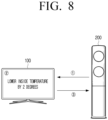
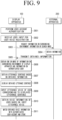
- the processor 140 may generate an instruction for controlling the external apparatus as an utterance sentence. For example, based on receiving temperature information from an air conditioner (i.e. external apparatus), the processor 140 may generate an instruction for controlling the air conditioner such as "lower temperature by two degrees" as an utterance sentence.
- the display apparatus 100 may be, for example, an edge device capable of controlling the external device.
- the processor 140 may identify that a companion animal is located in the surroundings of the display apparatus 100 at the time of user voice registration when a sound emitted by the companion animal of the user is recognized through the voice input receiver 120, and generate an utterance sentence related to the companion animal such as "show bathing methods puppies enjoy.”
- the information on the authenticated user may include user preferred applications, user preferred content, user nationality, and the like.
- the information on the authenticated user may be obtained by use history of the user stored in the memory 130 or from the external apparatus.
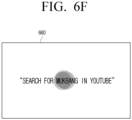
- the processor 140 may identify a preferred application of the authenticated user and a preferred content of the authenticated user based on user history of the authenticated user. The processor 140 may then generate an utterance sentence including one or more of the identified preferred application name and preferred content name such as "search for mukbang in youtube.”
- the processor 140 may generate an utterance sentence with the language of the relevant country based on information on the nationality of the authenticated user.
- the processor 140 may use the artificial intelligence model stored in the memory 130 to generate an utterance sentence.
- the processor 140 may input the obtained information to the artificial intelligence model, and obtain a text output from the artificial intelligence model as an utterance sentence.
- the artificial intelligence model may predict the function to be executed by the authenticated user based on one or more information of information on the surrounding of the display apparatus 100 and information on the authenticated user, and may be trained to generate an instruction for performing a predicted function as an utterance sentence.
- the artificial intelligence model may output a text corresponding to the input information from texts of a plurality of stored utterance sentences, and generate and output a text corresponding to the input information.
- the above is described as if an utterance sentence is generated based on one information, the utterance sentence may be generated based on two or more information from the obtained information in the actual embodiment. For example, if the location the display apparatus is displayed is a bedroom and based on information on receiving preferred temperature of the user from the external apparatus, the processor 140 may generate an utterance sentence considering both the location and preferred temperature.
- the processor 140 may display the generated utterance sentence in the display 110.
- voice information of the user based on the input utterance voice may be obtained.
- the processor 140 may identify the user voice input after displaying the utterance sentence as the voice of the authenticated user, analyze the input voice, and obtain a characteristic of frequency as voice information.
- the characteristic of frequency may be a frequency form of the input voice.
- the obtained voice information may be matched to an authenticated user account and stored in the memory 130.
- the processor 140 may generate a plurality of utterance sentences based on the obtained various information, and display one utterance sentence from the plurality of utterance sentences in the display 110. Based on a user voice corresponding to the displayed utterance sentence being input, the processor 140 may control the display 110 to display an utterance sentence different from the displayed utterance sentence from the plurality of utterance sentences.
- the order in which the plurality of utterance sentences is displayed may be random, or may be identified based on a pre-defined priority. The pre-defined priority may be set at the time of manufacturing or by preference of the user.
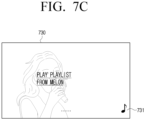
- the processor 140 may provide one or more visual feedback and auditory feedback related to the utterance sentence based on an utterance voice of the user on the utterance sentence displayed in the display 110 being input through the voice input receiver 120. For example, if "play playlist from melon" is displayed in the display 110 and an utterance voice uttered by the user is input through the voice input receiver 120, the processor 140 may control the display 110 to display a visual feedback related to music based on "melon," which is a music application. The processor 140 may further provide an auditory feedback related to music through a speaker (reference numeral 170 of FIG. 3 ) and display an indicator indicating that auditory feedback is being provided in the display 110.
- a speaker reference numeral 170 of FIG. 3
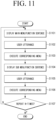
- the processor 140 may generate an utterance sentence related to a function provided in the display apparatus 100. For example, when not connected with a network, the processor 140 may generate an instruction for executing a function provided in the display apparatus 100 as an utterance sentence. The processor 140 may generate and display an instruction for performing a main function provided in the display apparatus 100 as an utterance sentence, and when a user voice corresponding to the utterance sentence is input, an instruction for performing a sub function may be generated and displayed as an utterance sentence.
- An embodiment describing the above may be described in greater detail below with reference to FIG. 11 .
- Some configurations of the display 110, the voice input receiver 120, the memory 130, and the processor 140 are the same as the configuration illustrated in FIG. 2 , and redundant disclosures are omitted.
- the information sensed by the external apparatus may refer to information on the surrounding environment of the display apparatus 100 sensed by the sensor provided in the external apparatus coupled with the display apparatus 100 such as an air conditioner and an air purifier.
- the processor 140 may, based on a control instruction for user voice registration being input, receive information on a search word of which increased number of searches from an external server is equal to or greater than a pre-defined value through the communication interface 160.
- the external server may be a social network service (SNS) server or a search portal server.
- the processor 140 may identify that a companion animal is located in the surroundings of the display apparatus 100 through crying sounds of the user's companion animal input through the voice input receiver 120, receive information on search word that is becoming a hot topic in real-time from the external server, and generate an utterance sentence such as "show bathing methods puppies enjoy” in case a search word related to the companion animal of the user is present in the received search word information.
- an utterance sentence is generated based on information received from the external apparatus coupled with the display apparatus 100 may be described in greater detail below with reference to FIG. 9 .
- the speaker 170 may be a configuration outputting not only various audio data for which various audio processing operations such as decoding, amplification, and noise filtering is performed, but also various notification sounds or voice messages.
- the speaker 170 may, for example, provide auditory feedback related to utterance sentences to users based on the user voice on the displayed utterance sentence being input.
- the configuration for outputting audio may be implemented as a speaker, but this is merely one embodiment, and there may also be included an output interface as an output terminal capable of outputting audio data.
- the display apparatus 100 may further include various external input ports for coupling with an external terminal, a button for receiving input of user manipulation, and the like.
- FIG. 4 is a diagram illustrating an artificial intelligence model according to an embodiment of the disclosure.
- the artificial intelligence model 141 stored in the memory 130 of the display apparatus 100 may include a learning part 411 and an obtaining part 412. Further, the processor 140 may, by executing the learning part 411 stored in the memory 130, predict the function to be executed by the user and may be trained to include a standard for generating a text consisting of an instruction for executing a predicted function.
- the learning part 411 may obtain propensity information of the user, preference information of the user, or the like based on at least one of the interaction of the user, the search history of the user, the sensed information by the display apparatus, and the user information received from the external apparatus.
- the learning part 411 may predict the function to be executed by the user based on the obtained user propensity information and preference information, and may be trained to obtain an utterance sentence including the instruction for executing the predicted function.
- the obtaining part 412 may obtain a predetermined input data according to a pre-defined standard, and by applying the obtained input data to the artificial intelligence model as an input value, identify (or estimate) a predetermined output based on the predetermined input data.
- the resulting value output by applying the obtained input data to the artificial intelligence model may be used to renew the artificial intelligence model.
- At least a part of the learning part 411 and at least a part of the obtaining part 412 may be implemented as a software module or manufactured as at least one hardware chip form and loaded in the display apparatus 100.
- at least one of the learning part and the obtaining part 412 may be manufactured to a hardware chip form dedicated to artificial intelligence (AI), or manufactured as a part of a conventional generic-purpose processor (e.g., CPU or an application processor) or a graphics dedicated processor (e.g., a graphics processing unit (GPU)).
- the hardware chip dedicated for artificial intelligence may be a processor specialized in probability calculation with a higher parallel processing performance than the conventional generic-purpose processor and may rapidly process calculation in the artificial intelligence field such as machine learning.
- the software module may be stored in a non-transitory computer readable media readable by a computer.
- the software module may be executed by an operating system (OS) or by a predetermined application. Alternatively, a part of the software module may be provided by the OS and the remaining part may be provided by the predetermined application.
- OS operating system
- predetermined application a part of the software module may be provided by the OS and the remaining part may be provided by the predetermined application.
- the learning part 411 and the obtaining part 412 may be loaded in one server, or loaded to separate servers respectively.
- one of the learning part 411 and the obtaining part 412 may be included in a first server and a remaining one may be included in a second server.
- the learning part 411 and the obtaining part 412 may provide model information constructed by the learning part 411 to the obtaining part 412 through wired communication or wireless communication, and data input to the obtaining part 412 may be provided to the learning part 411 as additional learning data.
- the artificial intelligence model may be constructed considering an application field of the model, learning purpose or computer performance of an apparatus.
- the artificial intelligence model may, for example, be a model based on a neural network.
- the artificial intelligence model may be designed to simulate a human brain structure on a computer.
- the artificial intelligence model may include a plurality of network nodes that simulate neurons in a human neural network and include weighted values.
- the plurality of network nodes may form a connection relationship for neurons to simulate synaptic activity of sending and receiving signals through synapses.
- the artificial intelligence model may, for example, include a neural network model or a deep learning model developed from the neural network model.
- the plurality of network nodes in the deep learning model may be placed at different depths (or, layers) from each other and may send and receive data according to a convolution connection relationship.
- models such as deep neural network (DNN), recurrent neural network (RNN), bidirectional recurrent deep neural network (BRDNN), and long short term memory network (LSTM) may be used as an artificial intelligence model, but is not limited thereto.
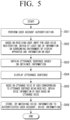
- the display apparatus may first perform user account authentication (S501).
- the display apparatus may display a login screen, and may either authenticate user account through an identification (ID) and password of the user input through the login screen or authenticate user account through an operation of recognizing fingerprint input through a remote controller, or the like.
- ID identification
- password password
- the display apparatus may obtain one or more of information on surrounding environment of the display apparatus and information on authenticated user (S502).
- the user input for user voice registration may refer to cognitive intervention of the user such as voice input, gesture input, touch input, and menu selection through a remote controller.
- the display apparatus may obtain one or more information on the surrounding environment of the display apparatus and the information on the authenticated user to identify the circumstance at the time user input is received.
- Information of the surrounding environment of the display apparatus may be obtained through a sensor provided in the display apparatus or received from the external apparatus.
- information of the authenticated user may be stored in the memory of the display apparatus or received from the external apparatus.
- the display apparatus may obtain an utterance sentence based on the obtained information (S503). For example, the display apparatus may directly generate an utterance sentence based on the obtained information or transmit the obtained information to the external server, and receive an utterance sentence corresponding to the transmitted information.
- the obtained utterance sentence may be a plurality of utterance sentences.
- the display apparatus may display the obtained utterance sentence (S504).
- the display apparatus may display one utterance sentence from a plurality of utterance sentences. Based on user voice corresponding to the displayed utterance sentence being input, the display apparatus may display an utterance sentence different from the displayed utterance sentence from the plurality of utterances sentences.
- the display apparatus may obtain voice information of user based on input utterance voice (S505). For example, the display apparatus may identify user voice input after displaying the utterance sentence as voice of the authenticated user, and analyze the input voice to obtain a characteristic of frequency such as frequency form as voice information.
- the display apparatus may then store, by matching the voice information to the authenticated user account of the user, the voice information (S506).
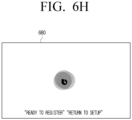
- FIGS. 6A to 6I are diagrams illustrating a UI screen displaying utterance sentences generated according to an embodiment of the disclosure.
- the display apparatus may display a first UI screen 610 displaying an object 611 indicating that voice recognition operation is being performed.
- the object 611 indicating that voice recognition operation is being performed may move continuously and indicate that the voice recognition operation is in progress.
- the object 611 may otherwise be displayed to indicate that voice recognition operation is being performed.
- other information may be provided on the display to indicate that voice recognition operation is being performed .
- the display apparatus may identify that the user input for user voice registration has been received based on the results of voice recognition. Further, the display apparatus may display a text 612 corresponding to the recognized voice in a first UI screen 610. The authentication on the user account may be in a completed state.
- the display apparatus may display a second UI screen 620 displaying an object 612 indicating that user voice registration is in in progress.
- the object 612 indicating that the user voice registration is in progress may move continuously and indicate that the user voice recognition operation is in progress.
- the display apparatus may obtain information on the surrounding environment of the display apparatus and information on the authenticated user.
- the user may utter the user ID and the display apparatus may display the uttered ID in a second UI screen 620 by voice recognition.
- a third UI screen 630 indicating that an ID of an already authenticated user account and an ID uttered by a user matches may be displayed.
- the display apparatus may generate a plurality of utterance sentences based on the obtained information. Further, the generated utterance sentences may be displayed consecutively.
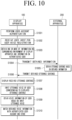
- the display apparatus 100 may transmit the obtained information to the external apparatus 200 (S1004).
- the external apparatus 200 may obtain an utterance sentence based on information obtained from the display apparatus 100 (S1005).
- the utterance sentence obtained by the external apparatus 200 may be in plurality.
- the external apparatus 200 may select an utterance sentence corresponding to the information received from the display apparatus 100 from stored plurality of utterance sentences, and use the artificial intelligence model stored in the external apparatus 200 to generate and output a text corresponding to the received information.
Landscapes
- Engineering & Computer Science (AREA)
- Physics & Mathematics (AREA)
- Health & Medical Sciences (AREA)
- Theoretical Computer Science (AREA)
- Multimedia (AREA)
- Human Computer Interaction (AREA)
- Audiology, Speech & Language Pathology (AREA)
- Acoustics & Sound (AREA)
- General Physics & Mathematics (AREA)
- General Engineering & Computer Science (AREA)
- Computational Linguistics (AREA)
- General Health & Medical Sciences (AREA)
- Software Systems (AREA)
- Artificial Intelligence (AREA)
- Evolutionary Computation (AREA)
- Computer Security & Cryptography (AREA)
- Data Mining & Analysis (AREA)
- Computing Systems (AREA)
- Mathematical Physics (AREA)
- Computer Hardware Design (AREA)
- Life Sciences & Earth Sciences (AREA)
- Biomedical Technology (AREA)
- Biophysics (AREA)
- Molecular Biology (AREA)
- User Interface Of Digital Computer (AREA)
- Computer Vision & Pattern Recognition (AREA)
- Medical Informatics (AREA)
Claims (15)
- Anzeigevorrichtung (100), umfassend:eine Anzeige (110);einen Spracheingabeempfänger (120);einen Speicher (130), der mindestens eine Anweisung speichert; undeinen Prozessor (140), der beim Ausführen der mindestens einen Anweisung dazu konfiguriert ist, Folgendes zu steuern:Durchführen einer Benutzerkontenauthentifizierung eines Benutzers der Anzeigevorrichtung;Erhalten von Informationen über eine umliegende Umgebung der Anzeigevorrichtung und Informationen über den Benutzer auf Grundlage davon, dass eine Benutzereingabe zur Benutzerstimmenregistrierung des Benutzers empfangen wird;Erhalten eines Äußerungssatzes zum Anleiten einer Spracheingabe, um die Stimme des authentifizierten Benutzers zu registrieren, auf Grundlage der Informationen über die umliegende Umgebung der Anzeigevorrichtung und der Informationen über den Benutzer;Steuern der Anzeige (110), um den Äußerungssatz anzuzeigen;Erhalten von Stimminformationen des Benutzers auf Grundlage einer Äußerungsstimme des Benutzers auf Grundlage davon, dass die Äußerungsstimme des Benutzers dem Äußerungssatz entspricht, der über den Spracheingabeempfänger empfangen wird; undSpeichern der Stimminformationen auf dem Speicher durch Abgleichen der Stimminformationen mit dem authentifizierten Benutzerkonto des Benutzers,wobei die Informationen über die umliegende Umgebung mindestens eines von Folgenden beinhalten: einem Land, in dem sich die Anzeigevorrichtung befindet, einem Standort, an dem die Anzeigevorrichtung angeordnet ist, oder Umgebungsinformationen über einen Raum, in dem die Anzeigevorrichtung angeordnet ist,wobei die Umgebungsinformationen mindestens eines von einer Beleuchtungsstärke, Temperatur, Feuchtigkeit oder Farbtemperatur des Raums beinhalten undwobei die Informationen über den Benutzer mindestens eines von bevorzugten Anwendungen, einem bevorzugten Inhalt oder einer Nationalität des authentifizierten Benutzers beinhalten.
- Anzeigevorrichtung (100) nach Anspruch 1, ferner umfassend:einen Sensor (150), der dazu konfiguriert ist, die Informationen über die umliegende Umgebung der Anzeigevorrichtung zu erfassen,wobei der Prozessor (140) beim Ausführen der mindestens einen Anweisung ferner dazu konfiguriert ist, eine Anweisung zum Steuern der Anzeigevorrichtung auf Grundlage der Informationen über die umliegende Umgebung der Anzeigevorrichtung zu erhalten, die durch den Sensor als der Äußerungssatz erfasst wird.
- Anzeigevorrichtung (100) nach einem der Ansprüche 1 bis 2, ferner umfassend:eine Kommunikationsschnittstelle (160),wobei der Prozessor (140) beim Ausführen der mindestens einen Anweisung ferner zu Folgendem konfiguriert ist:Erhalten von Informationen über eine externe Vorrichtung oder von Informationen, die durch die externe Vorrichtung als die Informationen über die umliegende Umgebung der Anzeigevorrichtung erfasst werden, von der externen Vorrichtung, die über die Kommunikationsschnittstelle mit der Anzeigevorrichtung verbunden ist, undErhalten einer Anweisung zum Steuern der externen Vorrichtung auf Grundlage der Informationen über die externe Vorrichtung als den Äußerungssatz.
- Anzeigevorrichtung (100) nach einem der Ansprüche 1 bis 2, ferner umfassend:eine Kommunikationsschnittstelle (160),wobei der Prozessor (140) beim Ausführen der mindestens einen Anweisung ferner zu Folgendem konfiguriert ist:Übertragen der Informationen über die umliegende Umgebung der Anzeigevorrichtung und der Informationen über den Benutzer über die Kommunikationsschnittstelle an einen externen Server undEmpfangen des Äußerungssatzes, der den Informationen über die umliegende Umgebung der Anzeigevorrichtung und den Informationen über den Benutzer entspricht, von dem externen Server über die Kommunikationsschnittstelle.
- Anzeigevorrichtung (100) nach einem der Ansprüche 1 bis 4, wobei der Prozessor (140) beim Ausführen der mindestens einen Anweisung ferner zu Folgendem konfiguriert ist:Erhalten der bevorzugten Anwendung oder des bevorzugten Inhalts des Benutzers auf Grundlage eines auf dem Speicher gespeicherten Nutzungsverlaufs des Benutzers als die Information des Benutzers undErhalten des Äußerungssatzes, um die bevorzugte Anwendung oder den bevorzugten Inhalt einzuschließen.
- Anzeigevorrichtung (100) nach einem der Ansprüche 1 bis 2, ferner umfassend:eine Kommunikationsschnittstelle (160),wobei der Prozessor (140) beim Ausführen der mindestens einen Anweisung ferner zu Folgendem konfiguriert ist:Empfangen von Informationen über ein Suchwort, dessen erhöhte Anzahl von Suchen von einem externen Server gleich einem vordefinierten Wert oder größer als dieser ist, über die Kommunikationsschnittstelle auf Grundlage einer Steueranweisung für die Benutzerstimmenregistrierung des Benutzers undErhalten des Äußerungssatzes, um das Suchwort einzuschließen.
- Anzeigevorrichtung (100) nach einem der Ansprüche 1 bis 6, wobei der Prozessor (140) beim Ausführen der mindestens einen Anweisung ferner zu Folgendem konfiguriert ist:Erhalten einer Vielzahl von Äußerungssätzen auf Grundlage der Informationen über die umliegende Umgebung der Anzeigevorrichtung und der Informationen über den Benutzer undSteuern der Anzeige, um einen neuen Äußerungssatz, der sich von dem Äußerungssatz unterscheidet, aus der Vielzahl von Äußerungssätzen anzuzeigen, auf Grundlage davon, dass die Benutzerstimme dem Äußerungssatz entspricht, der empfangen wird.
- Anzeigevorrichtung (100) nach einem der Ansprüche 1 bis 7, wobei der Speicher (130) ferner dazu konfiguriert ist, ein Modell künstlicher Intelligenz zu speichern,
wobei der Prozessor (140) beim Ausführen der mindestens einen Anweisung ferner zu Folgendem konfiguriert ist:Eingeben der Informationen über die umliegende Umgebung der Anzeigevorrichtung und der Informationen über den Benutzer in das Modell künstlicher Intelligenz undErhalten einer Textausgabe von dem Modell künstlicher Intelligenz als den Äußerungssatz undwobei das Modell künstlicher Intelligenz dazu konfiguriert ist, eine durch den Benutzer auszuführende Funktion auf Grundlage der Informationen über die umliegende Umgebung der Anzeigevorrichtung und der Informationen über den Benutzer vorherzusagen, und das Modell künstlicher Intelligenz dazu trainiert ist, eine Anweisung zum Durchführen der Funktion als den Äußerungssatz zu erhalten. - Anzeigevorrichtung (100) nach einem der Ansprüche 1 bis 8, wobei der Prozessor beim Ausführen der mindestens einen Anweisung ferner dazu konfiguriert ist, auf Grundlage der Äußerungsstimme des Benutzers, die über den Spracheingabeempfänger (120) empfangen wird, eines oder mehrere von einem visuellen Feedback und einem akustischen Feedback in Bezug auf den Äußerungssatz bereitzustellen.
- Anzeigevorrichtung (100) nach einem der Ansprüche 1 bis 9, wobei der Prozessor (140) beim Ausführen der mindestens einen Anweisung ferner dazu konfiguriert ist, auf Grundlage davon, dass die Anzeigevorrichtung von einem Netzwerk getrennt ist, eine Anweisung zum Ausführen einer Funktion, die in der Anzeigevorrichtung als der Äußerungssatz bereitgestellt wird, zu erhalten.
- Verfahren zur Steuerung einer Anzeigevorrichtung (100), wobei das Verfahren Folgendes umfasst:Durchführen einer Benutzerkontenauthentifizierung eines Benutzers der Anzeigevorrichtung;Erhalten sowohl von Informationen über eine umliegende Umgebung der Anzeigevorrichtung als auch von Informationen über den Benutzer auf Grundlage einer Steueranweisung für eine Benutzerstimmenregistrierung des Benutzers, die eingegeben wird;Erhalten eines Äußerungssatzes zum Anleiten einer Spracheingabe, um die Stimme des authentifizierten Benutzersatzes zu registrieren, auf Grundlage der Informationen über die umliegende Umgebung der Anzeigevorrichtung und der Informationen über den Benutzer;Anzeigen des Äußerungssatzes;Erhalten von Stimminformationen über den Benutzer auf Grundlage einer Äußerungsstimme des Benutzers auf Grundlage davon, dass die Äußerungsstimme des Benutzers dem Äußerungssatz entspricht, der empfangen wird; undSpeichern der Stimminformationen auf dem Speicher durch Abgleichen der Stimminformationen mit dem authentifizierten Benutzerkonto des Benutzers,wobei die Informationen über die umliegende Umgebung mindestens eines von Folgenden beinhalten: einem Land, in dem sich die Anzeigevorrichtung befindet, einem Standort, an dem die Anzeigevorrichtung angeordnet ist, oder Umgebungsinformationen über einen Raum, in dem die Anzeigevorrichtung angeordnet ist,wobei die Umgebungsinformationen mindestens eines von einer Beleuchtungsstärke, Temperatur, Feuchtigkeit oder Farbtemperatur des Raums beinhalten undwobei die Informationen über den Benutzer mindestens eines von bevorzugten Anwendungen, einem bevorzugten Inhalt oder einer Nationalität des authentifizierten Benutzers beinhalten.
- Verfahren nach Anspruch 11, wobei das Erhalten Erfassen der umliegenden Umgebung der Anzeigevorrichtung (100) durch einen Sensor der Anzeigevorrichtung umfasst und
das Erhalten Erhalten einer Anweisung zum Steuern der Anzeigevorrichtung auf Grundlage der Informationen über die umliegende Umgebung der Anzeigevorrichtung als den Äußerungssatz umfasst. - Verfahren nach einem der Ansprüche 11 bis 12, wobei das Erhalten Erhalten von Informationen über eine externe Vorrichtung oder von Informationen, die durch die externe Vorrichtung erfasst werden, von der externen Vorrichtung, die mit dem Anzeigevorrichtung (100) verbunden ist, als die Informationen über die umliegende Umgebung der Anzeigevorrichtung umfasst und
das Erhalten Erhalten einer Anweisung zum Steuern der externen Vorrichtung auf Grundlage der Informationen über die externe Vorrichtung als den Äußerungssatz umfasst. - Verfahren nach einem der Ansprüche 11 bis 12, wobei das Verfahren ferner Folgendes umfasst:Übertragen der Informationen über die umliegende Umgebung der Anzeigevorrichtung (100) und der Informationen über den Benutzer an einen externen Server; undEmpfangen des Äußerungssatzes, der den Informationen über die umliegende Umgebung der Anzeigevorrichtung und den Informationen über den Benutzer entspricht, von dem externen Server.
- Verfahren nach einem der Ansprüche 11 bis 14, wobei das Erhalten Erhalten der bevorzugten Anwendung oder des bevorzugten Inhalts des Benutzers auf Grundlage eines Nutzungsverlaufs des Benutzers als Informationen des Benutzers umfasst und
das Erhalten Erhalten des Äußerungssatzes umfasst, um die bevorzugte Anwendung oder den bevorzugten Inhalt einzuschließen.
Applications Claiming Priority (1)
| Application Number | Priority Date | Filing Date | Title |
|---|---|---|---|
| KR1020190053607A KR20200129346A (ko) | 2019-05-08 | 2019-05-08 | 디스플레이 장치 및 이의 제어 방법 |
Publications (2)
| Publication Number | Publication Date |
|---|---|
| EP3736685A1 EP3736685A1 (de) | 2020-11-11 |
| EP3736685B1 true EP3736685B1 (de) | 2025-07-02 |
Family
ID=70553860
Family Applications (1)
| Application Number | Title | Priority Date | Filing Date |
|---|---|---|---|
| EP20172921.7A Active EP3736685B1 (de) | 2019-05-08 | 2020-05-05 | Anzeigevorrichtung und verfahren zur steuerung davon |
Country Status (4)
| Country | Link |
|---|---|
| US (1) | US20200357414A1 (de) |
| EP (1) | EP3736685B1 (de) |
| KR (1) | KR20200129346A (de) |
| WO (1) | WO2020226413A1 (de) |
Families Citing this family (2)
| Publication number | Priority date | Publication date | Assignee | Title |
|---|---|---|---|---|
| US12028778B2 (en) | 2022-02-28 | 2024-07-02 | International Business Machines Corporation | Contextual enhancement of user service inquiries |
| KR20250123646A (ko) * | 2024-02-08 | 2025-08-18 | 엘지전자 주식회사 | 전자장치 및 이를 포함하는 시스템 |
Family Cites Families (29)
| Publication number | Priority date | Publication date | Assignee | Title |
|---|---|---|---|---|
| JP5319149B2 (ja) * | 2008-03-28 | 2013-10-16 | 株式会社東芝 | 情報機器及び情報提示方法 |
| US8380503B2 (en) * | 2008-06-23 | 2013-02-19 | John Nicholas and Kristin Gross Trust | System and method for generating challenge items for CAPTCHAs |
| US9318114B2 (en) * | 2010-11-24 | 2016-04-19 | At&T Intellectual Property I, L.P. | System and method for generating challenge utterances for speaker verification |
| US9021565B2 (en) * | 2011-10-13 | 2015-04-28 | At&T Intellectual Property I, L.P. | Authentication techniques utilizing a computing device |
| US8646060B1 (en) * | 2013-07-30 | 2014-02-04 | Mourad Ben Ayed | Method for adaptive authentication using a mobile device |
| JP6162009B2 (ja) * | 2013-09-18 | 2017-07-12 | 株式会社Nttドコモ | ユーザのデータ入力に応じて情報提供を行うためのサーバ装置、プログラム、システムおよび方法 |
| US10248771B1 (en) * | 2014-01-24 | 2019-04-02 | Microstrategy Incorporated | Performing biometrics operations in uncontrolled environments |
| US9489171B2 (en) * | 2014-03-04 | 2016-11-08 | Microsoft Technology Licensing, Llc | Voice-command suggestions based on user identity |
| US8812320B1 (en) * | 2014-04-01 | 2014-08-19 | Google Inc. | Segment-based speaker verification using dynamically generated phrases |
| KR102339657B1 (ko) * | 2014-07-29 | 2021-12-16 | 삼성전자주식회사 | 전자 장치 및 이의 제어 방법 |
| KR102348084B1 (ko) * | 2014-09-16 | 2022-01-10 | 삼성전자주식회사 | 영상표시장치, 영상표시장치의 구동방법 및 컴퓨터 판독가능 기록매체 |
| JP6394709B2 (ja) * | 2014-12-11 | 2018-09-26 | 日本電気株式会社 | 話者識別装置および話者識別用の登録音声の特徴量登録方法 |
| KR101678087B1 (ko) * | 2015-02-16 | 2016-11-23 | 현대자동차주식회사 | 차량 및 그 제어방법 |
| US10504509B2 (en) * | 2015-05-27 | 2019-12-10 | Google Llc | Providing suggested voice-based action queries |
| CN105185379B (zh) * | 2015-06-17 | 2017-08-18 | 百度在线网络技术(北京)有限公司 | 声纹认证方法和装置 |
| US11188857B1 (en) * | 2016-06-30 | 2021-11-30 | Amazon Technologies, Inc. | Automating functions in a computing environment |
| US10223512B2 (en) * | 2016-08-25 | 2019-03-05 | Sensory, Incorporated | Voice-based liveness verification |
| US10331867B2 (en) * | 2016-10-05 | 2019-06-25 | Plantronics, Inc. | Enhanced biometric user authentication |
| US9990926B1 (en) * | 2017-03-13 | 2018-06-05 | Intel Corporation | Passive enrollment method for speaker identification systems |
| KR101970008B1 (ko) * | 2017-06-23 | 2019-04-18 | (주)디노비즈 | 딥러닝 신경망회로에 의한 번역알고리즘을 구비한 컴퓨터 판독가능 저장 매체에 저장된 컴퓨터 프로그램 및 사용자 장치 |
| US10490195B1 (en) * | 2017-09-26 | 2019-11-26 | Amazon Technologies, Inc. | Using system command utterances to generate a speaker profile |
| KR102549204B1 (ko) * | 2017-09-26 | 2023-06-30 | 주식회사 케이티 | 음성인식 서비스를 제공하는 단말, 서버 및 방법 |
| US11450314B2 (en) * | 2017-10-03 | 2022-09-20 | Google Llc | Voice user interface shortcuts for an assistant application |
| US11831409B2 (en) * | 2018-01-12 | 2023-11-28 | Nok Nok Labs, Inc. | System and method for binding verifiable claims |
| KR20190099586A (ko) * | 2018-02-19 | 2019-08-28 | 삼성전자주식회사 | 전자 장치, 전자 장치의 제어방법 및 서버 |
| JP2021144065A (ja) * | 2018-06-12 | 2021-09-24 | ソニーグループ株式会社 | 情報処理装置および情報処理方法 |
| US10777200B2 (en) * | 2018-07-27 | 2020-09-15 | International Business Machines Corporation | Artificial intelligence for mitigating effects of long-term cognitive conditions on patient interactions |
| CN118865972A (zh) * | 2018-12-28 | 2024-10-29 | 谷歌有限责任公司 | 根据选择的建议向自动化助理补充语音输入 |
| US10896679B1 (en) * | 2019-03-26 | 2021-01-19 | Amazon Technologies, Inc. | Ambient device state content display |
-
2019
- 2019-05-08 KR KR1020190053607A patent/KR20200129346A/ko not_active Ceased
-
2020
- 2020-05-05 EP EP20172921.7A patent/EP3736685B1/de active Active
- 2020-05-06 WO PCT/KR2020/005938 patent/WO2020226413A1/en not_active Ceased
- 2020-05-07 US US16/869,147 patent/US20200357414A1/en not_active Abandoned
Also Published As
| Publication number | Publication date |
|---|---|
| US20200357414A1 (en) | 2020-11-12 |
| WO2020226413A1 (en) | 2020-11-12 |
| KR20200129346A (ko) | 2020-11-18 |
| EP3736685A1 (de) | 2020-11-11 |
Similar Documents
| Publication | Publication Date | Title |
|---|---|---|
| US11790912B2 (en) | Phoneme recognizer customizable keyword spotting system with keyword adaptation | |
| Hoy | Alexa, Siri, Cortana, and more: an introduction to voice assistants | |
| US10860289B2 (en) | Flexible voice-based information retrieval system for virtual assistant | |
| US11355127B2 (en) | Electronic apparatus and controlling method thereof | |
| US11817097B2 (en) | Electronic apparatus and assistant service providing method thereof | |
| US11393459B2 (en) | Method and apparatus for recognizing a voice | |
| KR102925108B1 (ko) | 전자 장치 및 이의 제어 방법 | |
| CN112074900A (zh) | 用于自然语言处理的音频分析 | |
| US12008988B2 (en) | Electronic apparatus and controlling method thereof | |
| US11908464B2 (en) | Electronic device and method for controlling same | |
| KR20190096308A (ko) | 전자기기 | |
| US11893813B2 (en) | Electronic device and control method therefor | |
| EP3736685A1 (de) | Anzeigevorrichtung und verfahren zur steuerung davon | |
| US10952075B2 (en) | Electronic apparatus and WiFi connecting method thereof | |
| CN112912954B (zh) | 电子装置及其控制方法 | |
| KR102937317B1 (ko) | 전자 장치 및 이의 제어 방법 | |
| WO2025243528A1 (ja) | 装置及び方法 | |
| KR20240020141A (ko) | 언어 모델에 기초하여 사용자 발화를 처리하는 방법 및 전자 장치 | |
| CN116635933A (zh) | 包括个性化文本到语音模块的电子装置及其控制方法 |
Legal Events
| Date | Code | Title | Description |
|---|---|---|---|
| PUAI | Public reference made under article 153(3) epc to a published international application that has entered the european phase |
Free format text: ORIGINAL CODE: 0009012 |
|
| STAA | Information on the status of an ep patent application or granted ep patent |
Free format text: STATUS: THE APPLICATION HAS BEEN PUBLISHED |
|
| AK | Designated contracting states |
Kind code of ref document: A1 Designated state(s): AL AT BE BG CH CY CZ DE DK EE ES FI FR GB GR HR HU IE IS IT LI LT LU LV MC MK MT NL NO PL PT RO RS SE SI SK SM TR |
|
| AX | Request for extension of the european patent |
Extension state: BA ME |
|
| STAA | Information on the status of an ep patent application or granted ep patent |
Free format text: STATUS: REQUEST FOR EXAMINATION WAS MADE |
|
| 17P | Request for examination filed |
Effective date: 20210118 |
|
| RBV | Designated contracting states (corrected) |
Designated state(s): AL AT BE BG CH CY CZ DE DK EE ES FI FR GB GR HR HU IE IS IT LI LT LU LV MC MK MT NL NO PL PT RO RS SE SI SK SM TR |
|
| STAA | Information on the status of an ep patent application or granted ep patent |
Free format text: STATUS: EXAMINATION IS IN PROGRESS |
|
| 17Q | First examination report despatched |
Effective date: 20220128 |
|
| GRAP | Despatch of communication of intention to grant a patent |
Free format text: ORIGINAL CODE: EPIDOSNIGR1 |
|
| STAA | Information on the status of an ep patent application or granted ep patent |
Free format text: STATUS: GRANT OF PATENT IS INTENDED |
|
| RIC1 | Information provided on ipc code assigned before grant |
Ipc: G10L 17/22 20130101ALI20241204BHEP Ipc: G10L 17/04 20130101ALI20241204BHEP Ipc: G10L 15/06 20130101ALI20241204BHEP Ipc: G06F 3/16 20060101AFI20241204BHEP |
|
| INTG | Intention to grant announced |
Effective date: 20241223 |
|
| RAP3 | Party data changed (applicant data changed or rights of an application transferred) |
Owner name: SAMSUNG ELECTRONICS CO., LTD. |
|
| RIN1 | Information on inventor provided before grant (corrected) |
Inventor name: BAN, SUNGDO Inventor name: SON, SUNGDO Inventor name: LEE, YOUNGAH Inventor name: SHIM, DAHYE Inventor name: PARK, JUNYONG |
|
| GRAS | Grant fee paid |
Free format text: ORIGINAL CODE: EPIDOSNIGR3 |
|
| GRAA | (expected) grant |
Free format text: ORIGINAL CODE: 0009210 |
|
| STAA | Information on the status of an ep patent application or granted ep patent |
Free format text: STATUS: THE PATENT HAS BEEN GRANTED |
|
| AK | Designated contracting states |
Kind code of ref document: B1 Designated state(s): AL AT BE BG CH CY CZ DE DK EE ES FI FR GB GR HR HU IE IS IT LI LT LU LV MC MK MT NL NO PL PT RO RS SE SI SK SM TR |
|
| REG | Reference to a national code |
Ref country code: GB Ref legal event code: FG4D |
|
| REG | Reference to a national code |
Ref country code: CH Ref legal event code: EP |
|
| REG | Reference to a national code |
Ref country code: DE Ref legal event code: R096 Ref document number: 602020053645 Country of ref document: DE |
|
| REG | Reference to a national code |
Ref country code: IE Ref legal event code: FG4D |
|
| REG | Reference to a national code |
Ref country code: NL Ref legal event code: MP Effective date: 20250702 |
|
| PG25 | Lapsed in a contracting state [announced via postgrant information from national office to epo] |
Ref country code: PT Free format text: LAPSE BECAUSE OF FAILURE TO SUBMIT A TRANSLATION OF THE DESCRIPTION OR TO PAY THE FEE WITHIN THE PRESCRIBED TIME-LIMIT Effective date: 20251103 |
|
| PG25 | Lapsed in a contracting state [announced via postgrant information from national office to epo] |
Ref country code: NL Free format text: LAPSE BECAUSE OF FAILURE TO SUBMIT A TRANSLATION OF THE DESCRIPTION OR TO PAY THE FEE WITHIN THE PRESCRIBED TIME-LIMIT Effective date: 20250702 |
|
| REG | Reference to a national code |
Ref country code: AT Ref legal event code: MK05 Ref document number: 1809999 Country of ref document: AT Kind code of ref document: T Effective date: 20250702 |
|
| PG25 | Lapsed in a contracting state [announced via postgrant information from national office to epo] |
Ref country code: IS Free format text: LAPSE BECAUSE OF FAILURE TO SUBMIT A TRANSLATION OF THE DESCRIPTION OR TO PAY THE FEE WITHIN THE PRESCRIBED TIME-LIMIT Effective date: 20251102 |
|
| PG25 | Lapsed in a contracting state [announced via postgrant information from national office to epo] |
Ref country code: NO Free format text: LAPSE BECAUSE OF FAILURE TO SUBMIT A TRANSLATION OF THE DESCRIPTION OR TO PAY THE FEE WITHIN THE PRESCRIBED TIME-LIMIT Effective date: 20251002 |
|
| REG | Reference to a national code |
Ref country code: LT Ref legal event code: MG9D |
|
| PG25 | Lapsed in a contracting state [announced via postgrant information from national office to epo] |
Ref country code: AT Free format text: LAPSE BECAUSE OF FAILURE TO SUBMIT A TRANSLATION OF THE DESCRIPTION OR TO PAY THE FEE WITHIN THE PRESCRIBED TIME-LIMIT Effective date: 20250702 |
|
| PG25 | Lapsed in a contracting state [announced via postgrant information from national office to epo] |
Ref country code: FI Free format text: LAPSE BECAUSE OF FAILURE TO SUBMIT A TRANSLATION OF THE DESCRIPTION OR TO PAY THE FEE WITHIN THE PRESCRIBED TIME-LIMIT Effective date: 20250702 |
|
| PG25 | Lapsed in a contracting state [announced via postgrant information from national office to epo] |
Ref country code: HR Free format text: LAPSE BECAUSE OF FAILURE TO SUBMIT A TRANSLATION OF THE DESCRIPTION OR TO PAY THE FEE WITHIN THE PRESCRIBED TIME-LIMIT Effective date: 20250702 |
|
| PG25 | Lapsed in a contracting state [announced via postgrant information from national office to epo] |
Ref country code: GR Free format text: LAPSE BECAUSE OF FAILURE TO SUBMIT A TRANSLATION OF THE DESCRIPTION OR TO PAY THE FEE WITHIN THE PRESCRIBED TIME-LIMIT Effective date: 20251003 |
|
| PG25 | Lapsed in a contracting state [announced via postgrant information from national office to epo] |
Ref country code: CZ Free format text: LAPSE BECAUSE OF FAILURE TO SUBMIT A TRANSLATION OF THE DESCRIPTION OR TO PAY THE FEE WITHIN THE PRESCRIBED TIME-LIMIT Effective date: 20250702 Ref country code: SE Free format text: LAPSE BECAUSE OF FAILURE TO SUBMIT A TRANSLATION OF THE DESCRIPTION OR TO PAY THE FEE WITHIN THE PRESCRIBED TIME-LIMIT Effective date: 20250702 |
|
| PG25 | Lapsed in a contracting state [announced via postgrant information from national office to epo] |
Ref country code: LV Free format text: LAPSE BECAUSE OF FAILURE TO SUBMIT A TRANSLATION OF THE DESCRIPTION OR TO PAY THE FEE WITHIN THE PRESCRIBED TIME-LIMIT Effective date: 20250702 |
|
| PG25 | Lapsed in a contracting state [announced via postgrant information from national office to epo] |
Ref country code: BG Free format text: LAPSE BECAUSE OF FAILURE TO SUBMIT A TRANSLATION OF THE DESCRIPTION OR TO PAY THE FEE WITHIN THE PRESCRIBED TIME-LIMIT Effective date: 20250702 Ref country code: PL Free format text: LAPSE BECAUSE OF FAILURE TO SUBMIT A TRANSLATION OF THE DESCRIPTION OR TO PAY THE FEE WITHIN THE PRESCRIBED TIME-LIMIT Effective date: 20250702 |
|
| PG25 | Lapsed in a contracting state [announced via postgrant information from national office to epo] |
Ref country code: RS Free format text: LAPSE BECAUSE OF FAILURE TO SUBMIT A TRANSLATION OF THE DESCRIPTION OR TO PAY THE FEE WITHIN THE PRESCRIBED TIME-LIMIT Effective date: 20251002 |
|
| PG25 | Lapsed in a contracting state [announced via postgrant information from national office to epo] |
Ref country code: ES Free format text: LAPSE BECAUSE OF FAILURE TO SUBMIT A TRANSLATION OF THE DESCRIPTION OR TO PAY THE FEE WITHIN THE PRESCRIBED TIME-LIMIT Effective date: 20250702 |
|
| PG25 | Lapsed in a contracting state [announced via postgrant information from national office to epo] |
Ref country code: SM Free format text: LAPSE BECAUSE OF FAILURE TO SUBMIT A TRANSLATION OF THE DESCRIPTION OR TO PAY THE FEE WITHIN THE PRESCRIBED TIME-LIMIT Effective date: 20250702 |
|
| PG25 | Lapsed in a contracting state [announced via postgrant information from national office to epo] |
Ref country code: DK Free format text: LAPSE BECAUSE OF FAILURE TO SUBMIT A TRANSLATION OF THE DESCRIPTION OR TO PAY THE FEE WITHIN THE PRESCRIBED TIME-LIMIT Effective date: 20250702 |
|
| PG25 | Lapsed in a contracting state [announced via postgrant information from national office to epo] |
Ref country code: IT Free format text: LAPSE BECAUSE OF FAILURE TO SUBMIT A TRANSLATION OF THE DESCRIPTION OR TO PAY THE FEE WITHIN THE PRESCRIBED TIME-LIMIT Effective date: 20250702 |
|
| PG25 | Lapsed in a contracting state [announced via postgrant information from national office to epo] |
Ref country code: SK Free format text: LAPSE BECAUSE OF FAILURE TO SUBMIT A TRANSLATION OF THE DESCRIPTION OR TO PAY THE FEE WITHIN THE PRESCRIBED TIME-LIMIT Effective date: 20250702 Ref country code: EE Free format text: LAPSE BECAUSE OF FAILURE TO SUBMIT A TRANSLATION OF THE DESCRIPTION OR TO PAY THE FEE WITHIN THE PRESCRIBED TIME-LIMIT Effective date: 20250702 |
|
| PLBE | No opposition filed within time limit |
Free format text: ORIGINAL CODE: 0009261 |
|
| STAA | Information on the status of an ep patent application or granted ep patent |
Free format text: STATUS: NO OPPOSITION FILED WITHIN TIME LIMIT |