EP3736135A1 - Additive fertigung eines formkörpers aus einem refraktärmetallpulver - Google Patents
Additive fertigung eines formkörpers aus einem refraktärmetallpulver Download PDFInfo
- Publication number
- EP3736135A1 EP3736135A1 EP19172733.8A EP19172733A EP3736135A1 EP 3736135 A1 EP3736135 A1 EP 3736135A1 EP 19172733 A EP19172733 A EP 19172733A EP 3736135 A1 EP3736135 A1 EP 3736135A1
- Authority
- EP
- European Patent Office
- Prior art keywords
- refractory metal
- additive manufacturing
- electron beam
- metal
- powder
- Prior art date
- Legal status (The legal status is an assumption and is not a legal conclusion. Google has not performed a legal analysis and makes no representation as to the accuracy of the status listed.)
- Granted
Links
Images
Classifications
-
- B—PERFORMING OPERATIONS; TRANSPORTING
- B33—ADDITIVE MANUFACTURING TECHNOLOGY
- B33Y—ADDITIVE MANUFACTURING, i.e. MANUFACTURING OF THREE-DIMENSIONAL [3D] OBJECTS BY ADDITIVE DEPOSITION, ADDITIVE AGGLOMERATION OR ADDITIVE LAYERING, e.g. BY 3D PRINTING, STEREOLITHOGRAPHY OR SELECTIVE LASER SINTERING
- B33Y10/00—Processes of additive manufacturing
-
- B—PERFORMING OPERATIONS; TRANSPORTING
- B22—CASTING; POWDER METALLURGY
- B22F—WORKING METALLIC POWDER; MANUFACTURE OF ARTICLES FROM METALLIC POWDER; MAKING METALLIC POWDER; APPARATUS OR DEVICES SPECIALLY ADAPTED FOR METALLIC POWDER
- B22F1/00—Metallic powder; Treatment of metallic powder, e.g. to facilitate working or to improve properties
- B22F1/05—Metallic powder characterised by the size or surface area of the particles
-
- B—PERFORMING OPERATIONS; TRANSPORTING
- B22—CASTING; POWDER METALLURGY
- B22F—WORKING METALLIC POWDER; MANUFACTURE OF ARTICLES FROM METALLIC POWDER; MAKING METALLIC POWDER; APPARATUS OR DEVICES SPECIALLY ADAPTED FOR METALLIC POWDER
- B22F1/00—Metallic powder; Treatment of metallic powder, e.g. to facilitate working or to improve properties
- B22F1/06—Metallic powder characterised by the shape of the particles
-
- B—PERFORMING OPERATIONS; TRANSPORTING
- B22—CASTING; POWDER METALLURGY
- B22F—WORKING METALLIC POWDER; MANUFACTURE OF ARTICLES FROM METALLIC POWDER; MAKING METALLIC POWDER; APPARATUS OR DEVICES SPECIALLY ADAPTED FOR METALLIC POWDER
- B22F1/00—Metallic powder; Treatment of metallic powder, e.g. to facilitate working or to improve properties
- B22F1/06—Metallic powder characterised by the shape of the particles
- B22F1/068—Flake-like particles
-
- B—PERFORMING OPERATIONS; TRANSPORTING
- B33—ADDITIVE MANUFACTURING TECHNOLOGY
- B33Y—ADDITIVE MANUFACTURING, i.e. MANUFACTURING OF THREE-DIMENSIONAL [3D] OBJECTS BY ADDITIVE DEPOSITION, ADDITIVE AGGLOMERATION OR ADDITIVE LAYERING, e.g. BY 3D PRINTING, STEREOLITHOGRAPHY OR SELECTIVE LASER SINTERING
- B33Y70/00—Materials specially adapted for additive manufacturing
-
- B—PERFORMING OPERATIONS; TRANSPORTING
- B22—CASTING; POWDER METALLURGY
- B22F—WORKING METALLIC POWDER; MANUFACTURE OF ARTICLES FROM METALLIC POWDER; MAKING METALLIC POWDER; APPARATUS OR DEVICES SPECIALLY ADAPTED FOR METALLIC POWDER
- B22F10/00—Additive manufacturing of workpieces or articles from metallic powder
- B22F10/20—Direct sintering or melting
- B22F10/28—Powder bed fusion, e.g. selective laser melting [SLM] or electron beam melting [EBM]
-
- Y—GENERAL TAGGING OF NEW TECHNOLOGICAL DEVELOPMENTS; GENERAL TAGGING OF CROSS-SECTIONAL TECHNOLOGIES SPANNING OVER SEVERAL SECTIONS OF THE IPC; TECHNICAL SUBJECTS COVERED BY FORMER USPC CROSS-REFERENCE ART COLLECTIONS [XRACs] AND DIGESTS
- Y02—TECHNOLOGIES OR APPLICATIONS FOR MITIGATION OR ADAPTATION AGAINST CLIMATE CHANGE
- Y02P—CLIMATE CHANGE MITIGATION TECHNOLOGIES IN THE PRODUCTION OR PROCESSING OF GOODS
- Y02P10/00—Technologies related to metal processing
- Y02P10/25—Process efficiency
Definitions
- Refractory metals such as tungsten are difficult to cast due to their high melting points (T m (tungsten): 3422 ° C). In addition, their high strength severely limits their workability through forming processes. Due to these properties, molded bodies made of refractory metals are therefore usually produced by powder metallurgical processes.
- Electron beam melting is a powder-bed-based additive manufacturing process in which a metal powder is applied in layers and the metal in each applied layer is melted in defined areas by the electron beam. After the metal that has melted in one layer has solidified, another layer of powder can be applied. In order to achieve high process stability, the applied metal powder layer is preferably subjected to preheating (for example with a defocused electron beam) before melting. The powder is at least partially sintered and the sintered metal is then melted in defined areas of the layer with a focused electron beam. Electron beam melting takes place under vacuum.
- tungsten powder is produced, for example, by reducing a tungsten oxide in a reducing (e.g. hydrogen-containing) gas atmosphere.
- the powder particles of commercially available tungsten powder usually have an undefined shape for production reasons, unless they have been subjected to a specific treatment (e.g. production by gas atomization).
- WO 2016/004448 A1 describes an additive manufacturing process of a shaped body from a refractory metal by laser or electron beam melting.
- the particles of the powder used have a spherical shape and are obtained, for example, by spray granulation.
- the Wadell roundness is a measure of the angularity of the particles. The lower the value of the roundness (hereinafter also referred to as Wadell roundness), the more angular the particle shape. While the sphericity of a particle is a measure of the ratio of the largest diameter to the smallest diameter of this particle, the roundness determined according to Wadell provides information about the actual shape of the particle. Sphericity and roundness are independent parameters.
- a powder particle can, for example, have a high sphericity (expressed via the ratio of the largest diameter to the smallest diameter of the particle), but have a low roundness.
- One object of the present invention is the production of a refractory metal-containing shaped body using a method that is as efficient as possible (e.g. does not require any specific pretreatment of the starting material) and with which shaped bodies of complex geometry and high relative density can be realized.
- the object is achieved by using a powdery refractory metal for the additive manufacturing of a shaped body, the powdery refractory metal having an average roundness, determined according to the method given in the description below, of 0.70 or less and the additive manufacturing being carried out by electron beam melting.
- a refractory metal such as, for example, tungsten can be manufactured additively to a shaped body of high relative density if the powder particles have a very angular shape (and thus a low roundness).
- a complex pretreatment through which the powder particles are converted into a particle shape that is as spherical as possible is not necessary.
- Such refractory metal powders which have a relatively low roundness, are commercially available or can be obtained in a known manner by reducing a refractory metal compound (eg a refractory metal oxide) in a reducing (eg hydrogen-containing) gas atmosphere.
- a refractory metal compound eg a refractory metal oxide
- a reducing (eg hydrogen-containing) gas atmosphere eg hydrogen-containing
- the roundness determined according to Wadell provides information about the actual shape of the particle, while the sphericity is a measure of the ratio of the largest diameter to the smallest diameter of the particle.
- Sphericity and roundness are independent parameters.
- a powder particle can, for example, have a high sphericity (expressed via the ratio of the largest diameter to the smallest diameter of the particle), but a low roundness.
- the refractory metal is tungsten, niobium, tantalum, chromium, molybdenum or rhenium.
- the refractory metal is preferably tungsten or molybdenum, particularly preferably tungsten.
- the refractory metal can be an elemental refractory metal or an alloy of a refractory metal.
- the refractory metal is present as an elementary refractory metal, it contains other metals only in the form of unavoidable impurities, for example in one Total amount of less than 0.5% by weight, preferably less than 0.2% by weight or even less than 0.1% by weight.
- the alloy contains one or more of the above-mentioned refractory metals in an amount of more than 50 at%, more preferably ⁇ 70 at%, even more preferably ⁇ 90 at%, for example in the range of 90-99 at%.
- the tungsten-based alloy can contain one or more of the following non-refractory metals as alloying elements: Ni, Fe, Co.
- part of the tungsten can be replaced by one or more of the following Refractory metals may be substituted: Ta, Mo, Re.
- the powdery refractory metal preferably has an average roundness in the range from 0.30 to 0.70, more preferably 0.35 to 0.65.
- the powdery refractory metal has, for example, a volume-based particle size distribution with ad 50 value in the range from 15 ⁇ m to 150 ⁇ m.
- the powdery refractory metal has, for example, a BET surface area of less than 0.07 m 2 / g, more preferably less than 0.05 m 2 / g.
- the shaped body formed from the refractory metal has, for example, a relative density of at least 95%, more preferably at least 97.0%, even more preferably at least 98.0% or even at least 99.0%.
- the application of the powdery refractory metal in the form of a layer on a substrate in the installation space of a device for electron beam melting takes place under conditions which are known to the person skilled in the art in the context of an additive manufacturing process.
- the substrate can be the as yet uncoated building board in the installation space of the device or, alternatively, material layers of the molded body to be produced and / or a support structure that have already been deposited on the building board.
- the powdered metal is applied in layers, for example, by a doctor blade, a roller, a press or by screen printing or a combination of at least two of these methods.
- the powdered refractory metal can optionally be subjected to preheating after each application, for example using a defocused electron beam.
- the applied powdery refractory metal is possibly at least partially sintered by preheating.
- the at least partially sintered refractory metal is then melted in defined areas of the respective layer.
- the refractory metal is usually melted in defined areas of a layer with a focused electron beam.
- the term “in defined areas” expresses the fact that, within the framework of additive manufacturing, digital 3D data of the molded body specify the areas of a layer that are to be melted.
- a suitable energy input by the electron beam, which leads to a melting of the refractory metal is known to the person skilled in the art or can be determined by routine tests.
- the volume energy introduced by the electron beam when the refractory metal is melted is 150-400 J / mm 3 .
- the layer of the powdery refractory metal applied in steps (i) and (iii) has a thickness in the range from 15 ⁇ m to 400 ⁇ m.
- electron beam melting is usually carried out under vacuum (e.g. a pressure of less than 0.01 mbar).
- the shaped body formed from the refractory metal has, for example, a relative density of at least 95%, more preferably at least 97.0%, even more preferably at least 98.0% or even at least 99.0%.
- the mean Wadell roundness of the powder results from the arithmetic mean of the Wadell roundness values of the individual powder particles.
- the particle shape was evaluated with regard to its Wadell roundness using the Camsizer® X2 particle measuring device from Retsch Technology.
- the particle size distribution is carried out by image analysis of at least 1000 powder particles. It is a volume-based size distribution curve.
- the size of an individual particle is taken to be the diameter of a circle, the area of which corresponds to the projection area of the particle in the recording ("circle-equivalent diameter").
- the d 50 value can be determined from the distribution curve.
- the particle sizes were determined using the Camsizer® X2 particle measuring device from Retsch Technology.
- the relative density D rel (in%) results from ( ⁇ geo / ⁇ th ) x 100%, where ⁇ geo is the geometric density of the component and ⁇ th is the theoretical density of the component.
- the geometric density can be determined according to the Archimedes principle, for example with a hydrostatic balance.
- the theoretical density of the component corresponds to the theoretical density of the metal from which the component is formed.
- ICP-OEC inductively coupled plasma
- tungsten powder For additive manufacturing, a tungsten powder was used that had an average roundness, determined using the method described above using the Camsizer® X2 particle measuring device from Retsch Technology, of 0.47. It was a powder made of relatively angular tungsten particles.
- the tungsten powder used in the example is commercially available and is sold by HC Starck under the name "WMP GG".
- the layers of tungsten powder were applied in a thickness of about 25-250 ⁇ m.
- the powder layers were each preheated using a defocused electron beam so that the powder particles were at least partially sintered with one another.
- the tungsten was melted in the specified areas of the respective layer with a focused electron beam.
- a shaped tungsten body with a very high relative density of 99.7% was obtained.
- a refractory metal such as Tungsten can therefore also be manufactured additively by electron beam melting to form a molded body with a high relative density if the powder particles have a very angular shape (and thus a slight roundness).
- a complex pretreatment through which the powder particles are converted into a particle shape that is as spherical as possible is not necessary.
Landscapes
- Chemical & Material Sciences (AREA)
- Engineering & Computer Science (AREA)
- Nanotechnology (AREA)
- Manufacturing & Machinery (AREA)
- Materials Engineering (AREA)
- Powder Metallurgy (AREA)
Abstract
Description
- Refraktärmetalle wie Wolfram lassen sich aufgrund ihrer hohen Schmelzpunkte (Tm(Wolfram): 3422°C) schlecht gießen. Außerdem schränkt ihre hohe Festigkeit die Verarbeitbarkeit durch Umformprozesse stark ein. Aufgrund dieser Eigenschaften werden Formkörper aus Refraktärmetallen daher üblicherweise durch pulvermetallurgische Verfahren hergestellt.
- Um Formkörper mit komplexer Geometrie zu realisieren, wäre die Verwendung von Wolfram oder anderen Refraktärmetallen in additiven Herstellungsverfahren von Interesse.
- In der Norm EN ISO/ASTM 52921:2017 werden die additiven Fertigungsverfahren in Kategorien eingeteilt. Für die additive Fertigung metallischer Formkörper eignen sich beispielsweise
- "Powder Bed Fusion" (Pulverbett-basierte Verfahren): Additives Fertigungsverfahren, bei dem durch einen örtlich selektiven Energieeintrag (z.B. durch einen Laserstrahl oder einen Elektronenstrahl) definierte Bereiche in einem Pulverbett verschmolzen werden;
- "Directed Energy Deposition": Additives Fertigungsverfahren, bei dem gebündelte thermische Energie genutzt wird, um Materialien an ihrem Aufbringungsort durch Verschmelzen miteinander zu verbinden;
- "Binder Jetting": Additives Fertigungsverfahren, bei dem ein flüssiges Bindemittel selektiv aufgetragen wird, um ein Pulver zu verfestigen;
- "Sheet Lamination": Additives Fertigungsverfahren, bei dem Schichten eines Materials flächig verbunden werden, um ein Objekt zu formen.
- Eine Übersicht hinsichtlich der additiven Fertigung metallischer Formkörper findet sich bei W.J. Sames et al., International Materials Reviews, 61, 2016, S. 1-46.
- Die Grundlagen der additiven Fertigung durch selektives Elektronenstrahlschmelzen beschreiben C. Körner et al. in "Schweißen und Schneiden", 69, 2017, Heft 1-2, S. 30-38. Das Elektronenstrahlschmelzen ist ein Pulverbett-basiertes additives Fertigungsverfahren, in dem ein Metallpulver in Schichten aufgebracht und das Metall in jeder aufgebrachten Schicht in definierten Bereichen durch den Elektronenstrahl aufgeschmolzen wird. Nach der Erstarrung des in einer Schicht aufgeschmolzenen Metalls kann eine weitere Pulverschicht aufgebracht werden. Um eine hohe Prozessstabilität zu erzielen, wird die aufgebrachte Metallpulverschicht vor dem Aufschmelzen bevorzugt einem Vorheizen (z.B. mit einem defokussierten Elektronenstrahl) unterzogen. Dabei wird das Pulver zumindest teilweise versintert und anschließend erfolgt das Aufschmelzen des versinterten Metalls in definierten Bereichen der Schicht mit einem fokussierten Elektronenstrahl. Das Elektronenstrahlschmelzen erfolgt unter Vakuum.
- Die Herstellung kommerziell erhältlicher Wolframpulver erfolgt beispielsweise durch Reduktion eines Wolframoxids in reduzierender (z.B. Wasserstoff-haltiger) Gasatmosphäre. Die Pulverpartikel kommerziell erhältlicher Wolframpulver weisen herstellungsbedingt üblicherweise eine undefinierte Form auf, sofern sie nicht einer spezifischen Behandlung unterzogen wurden (z.B. Herstellung durch Gasverdüsung).
- C. Chen et al., Materials Science and Technology, 34, 2018, S. 735-742, beschreiben die Herstellung eines Formkörpers aus Wolfram durch ein selektives Laserstrahlschmelzen (SLM). Bei der Verwendung eines Wolframpulvers mit undefinierter Partikelform führt die additive Fertigung durch selektives Laserstrahlschmelzen zu einem Formkörper, dessen relative Dichte maximal 91% betrug (siehe Figur 6 dieser Publikation). Deutlich höhere relative Dichten von bis zu 96,9% ließen sich nur unter Verwendung eines sphärischen Wolframpulvers realisieren. Die Herstellung eines solchen sphärischen Pulvers (z.B. durch Gasverdüsung) ist allerdings aufwändig. Kommerziell erhältliche sphärische Pulver eines Refraktärmetalls sind daher im Vergleich zu den Pulvern mit undefinierter Partikelform teurer. In der Praxis werden relative Dichten von mindestens 97%, bevorzugter mindestens 99% als "dicht" angenommen.
-
WO 2016/004448 A1 beschreibt ein additives Herstellungsverfahren eines Formkörpers aus einem Refraktärmetall durch ein Laser- oder Elektronenstrahlschmelzen. Die Partikel des verwendeten Pulvers weisen eine Kugelform auf und werden beispielsweise durch eine Sprühgranulation erhalten. - A.L. Cook und J.A. Slotwinski, National Institute of Standards and Technology, "Properties of Metal Powders for Additive Manufacturing: A Review of the State of the Art of Metal Powder Property Testing", erhältlich unter http://dx.doi.org/10.6028/NIST.IR.7873, beschreiben verschiedene Methoden zur Charakterisierung von Metallpulvern. Dem Fachmann bekannte Parameter für die Charakterisierung der Pulverpartikelmorphologie sind beispielsweise die Sphärizität und die Rundheit. Gemäß der Methode nach H. Wadell erfolgt die Bestimmung der Rundheit eines Pulverpartikels folgendermaßen: In Aufnahmen (z.B. Lichtmikroskopie-Aufnahmen) von Pulverpartikeln wird für jede Teilchenprojektion der größte Innenkreis eingefügt und an allen konvexen Stellen der Teilchenprojektion wird ein Krümmungskreis angepasst. In Figur 6 der Publikation von A.L. Cook und J.A. Slotwinski wird dies anhand zweier beispielhafter Partikel veranschaulicht. Die Rundheit eines Pulverpartikels ergibt sich anhand der folgenden Formel

- n die Anzahl der Krümmungskreise ist,
- ri der Radius des i-ten Krümmungskreises ist,
- R der Radius des größten Innenkreises ist.
- Die Rundheit nach Wadell ist ein Maß für die Kantigkeit der Partikel. Je geringer der Wert der Rundheit (nachfolgend auch als Wadell-Rundheit bezeichnet), desto kantiger ist die Partikelform. Während die Sphärizität eines Partikels ein Maß für das Verhältnis des größten Durchmessers zu dem kleinsten Durchmesser dieses Partikels ist, gibt die nach Wadell bestimmte Rundheit Auskunft über die tatsächliche Form des Partikels. Sphärizität und Rundheit sind voneinander unabhängige Parameter. Ein Pulverpartikel kann beispielsweise eine hohe Sphärizität (ausgedrückt über das Verhältnis von größtem Durchmesser zu kleinstem Durchmesser des Partikels), jedoch eine geringe Rundheit aufweisen.
- Eine Aufgabe der vorliegenden Erfindung ist die Herstellung eines Refraktärmetallhaltigen Formkörpers über ein Verfahren, das möglichst effizient ist (z.B. keine spezifische Vorbehandlung des Ausgangsmaterials erfordert) und mit dem sich Formkörper komplexer Geometrie und hoher relativer Dichte realisieren lassen.
- Gelöst wird die Aufgabe durch die Verwendung eines pulverförmigen Refraktärmetalls zur additiven Fertigung eines Formkörpers, wobei das pulverförmige Refraktärmetall eine mittlere Rundheit, bestimmt gemäß der nachfolgend in der Beschreibung angegebenen Methode, von 0,70 oder weniger aufweist und die additive Fertigung durch ein Elektronenstrahlschmelzen erfolgt.
- Im Rahmen der vorliegenden Erfindung wurde überraschend festgestellt, dass sich durch Elektronenstrahlschmelzen ein Refraktärmetall wie z.B. Wolfram auch dann zu einem Formkörper hoher relativer Dichte additiv fertigen lässt, wenn die Pulverpartikel eine sehr kantige Form (und somit eine geringe Rundheit) aufweisen. Eine aufwändige Vorbehandlung, durch die die Pulverpartikel in eine möglichst sphärische Partikelform überführt werden, ist nicht erforderlich. Solche Pulver eines Refraktärmetalls, die eine relativ geringe Rundheit aufweisen, sind kommerziell erhältlich oder in bekannter Weise durch Reduktion einer Refraktärmetallverbindung (z.B. eines Refraktärmetalloxids) in reduzierender (z.B. Wasserstoff-haltiger) Gasatmosphäre erhältlich. Als kommerziell erhältliches Wolframpulver, das eine mittlere Rundheit von weniger als 0,70 aufweist, kann beispielsweise das von H.C. Starck unter der Bezeichnung "WMP GG" vertriebene Wolfram-Pulver genannt werden.
- Wie oben bereits erwähnt, gibt die nach Wadell bestimmte Rundheit Auskunft über die tatsächliche Form des Partikels, während die Sphärizität ein Maß für das Verhältnis des größten Durchmessers zu dem kleinsten Durchmesser des Partikels ist. Sphärizität und Rundheit sind voneinander unabhängige Parameter. Ein Pulverpartikel kann beispielsweise eine hohe Sphärizität (ausgedrückt über das Verhältnis von größtem Durchmesser zu kleinstem Durchmesser des Partikels), jedoch eine geringe Rundheit aufweisen.
- Das Refraktärmetall ist Wolfram, Niob, Tantal, Chrom, Molybdän oder Rhenium. Bevorzugt ist das Refraktärmetall Wolfram oder Molybdän, besonders bevorzugt Wolfram.
- Das Refraktärmetall kann ein elementares Refraktärmetall oder eine Legierung eines Refraktärmetalls sein.
- Sofern das Refraktärmetall als elementares Refraktärmetall vorliegt, enthält es andere Metalle nur in Form unvermeidlicher Verunreinigungen, z.B. in einer Gesamtmenge von weniger als 0,5 Gew%, bevorzugt weniger als 0,2 Gew% oder sogar weniger als 0,1 Gew%.
- Sofern das Refraktärmetall als Legierung vorliegt, enthält die Legierung ein oder mehrere der oben genannten Refraktärmetalle in einer Menge von mehr als 50 at%, bevorzugter ≥70 at%, noch bevorzugter ≥ 90 at%, beispielsweise im Bereich von 90-99 at%. Ist das Refraktärmetall beispielsweise Wolfram und liegt dieses als Legierung vor, so kann die Wolfram-basierte Legierung beispielsweise ein oder mehrere der folgenden Nicht-Refraktärmetalle als Legierungselement enthalten: Ni, Fe, Co. Optional kann ein Teil des Wolframs durch ein oder mehrere der folgenden Refraktärmetalle substituiert sein: Ta, Mo, Re.
- Bevorzugt weist das pulverförmige Refraktärmetall eine mittlere Rundheit im Bereich von 0,30 bis 0,70, bevorzugter 0,35 bis 0,65 auf.
- Das pulverförmige Refraktärmetall weist beispielsweise eine Volumen-basierte Partikelgrößenverteilung mit einem d50-Wert im Bereich von 15 µm bis 150 µm auf.
- Das pulverförmige Refraktärmetall weist beispielsweise eine BET-Oberfläche von weniger als 0,07 m2/g, bevorzugter weniger als 0,05 m2/g auf.
- Der aus dem Refraktärmetall gebildete Formkörper weist beispielsweise eine relative Dichte von mindestens 95%, bevorzugter mindestens 97,0%, noch bevorzugter mindestens 98,0% oder sogar mindestens 99,0% auf.
- Die vorliegende Erfindung betrifft außerdem ein Verfahren zur additiven Fertigung eines Formkörpers, der ein Refraktärmetall enthält, durch ein Elektronenstrahlschmelzen, umfassend:
- (i) Aufbringen des oben beschriebenen pulverförmigen Refraktärmetalls in Form einer Schicht auf einem Substrat,
- (ii) Aufschmelzen des Refraktärmetalls in definierten Bereichen der Schicht durch einen Elektronenstrahl und Erstarren lassen des aufgeschmolzenen Metalls,
- (iii) Aufbringen einer weiteren Schicht des pulverförmigen Refraktärmetalls auf der zuvor aufgebrachten Schicht,
- (iv) Aufschmelzen des Refraktärmetalls in definierten Bereichen der weiteren Schicht durch einen Elektronenstrahl und Erstarren lassen des aufgeschmolzenen Metalls,
- (v) optional ein oder mehrmalige Wiederholung der Schritte (iii)-(iv).
- Hinsichtlich der bevorzugten Eigenschaften des pulverförmigen Refraktärmetalls kann auf die obigen Ausführungen verwiesen werden.
- Das Aufbringen des pulverförmigen Refraktärmetalls in Form einer Schicht auf einem Substrat in dem Bauraum einer Vorrichtung für Elektronenstrahlschmelzen erfolgt unter Bedingungen, die dem Fachmann im Rahmen eines additiven Fertigungsverfahrens bekannt sind. Bei dem Substrat kann es sich um die noch unbeschichtete Bauplatte im Bauraum der Vorrichtung oder alternativ um zuvor bereits auf der Bauplatte abgeschiedene Materialschichten des herzustellenden Formkörpers und/oder einer Stützstruktur handeln. Das schichtförmige Aufbringen des pulverförmigen Metalls erfolgt beispielsweise durch ein Rakel, eine Walze, eine Presse oder durch Siebdruck oder eine Kombination aus mindestens zwei dieser Methoden.
- Das pulverförmige Refraktärmetall kann optional nach dem Aufbringen jeweils einem Vorheizen unterzogen werden, beispielsweise unter Verwendung eines defokussierten Elektronenstrahls. Durch das Vorheizen wird gegebenenfalls das aufgebrachte pulverförmige Refraktärmetall zumindest teilweise versintert. Anschließend erfolgt dann das Aufschmelzen des zumindest teilweise versinterten Refraktärmetalls in definierten Bereichen der jeweiligen Schicht.
- Das Aufschmelzen des Refraktärmetalls in definierten Bereichen einer Schicht erfolgt üblicherweise mit einem fokussierten Elektronenstrahl.
- Mit dem Begriff "in definierten Bereichen" wird bekanntermaßen zum Ausdruck gebracht, dass im Rahmen der additiven Fertigung digitale 3D-Daten des Formkörpers die Bereiche einer Schicht, die aufgeschmolzen werden sollen, vorgeben.
- Ein geeigneter Energieeintrag durch den Elektronenstrahl, der zu einem Aufschmelzen des Refraktärmetalls führt, ist dem Fachmann bekannt oder kann durch Routineversuche bestimmt werden. Beispielsweise beträgt die durch den Elektronenstrahl eingetragene Volumenenergie beim Aufschmelzen des Refraktärmetalls 150-400 J/mm3.
- Eine geeignete Dicke der aufgebrachten Schicht des pulverförmigen Refraktärmetalls kann der Fachmann über Routineversuche bestimmen. Beispielsweise weist die in den Schritten (i) und (iii) aufgebrachte Schicht des pulverförmigen Refraktärmetalls eine Dicke im Bereich von 15 µm bis 400 µm auf.
- Wie dem Fachmann bekannt ist, wird das Elektronenstrahlschmelzen üblicherweise unter Vakuum (z.B. einem Druck von weniger als 0,01 mbar) durchgeführt.
- Wie oben bereits erwähnt, weist der aus dem Refraktärmetall gebildete Formkörper beispielsweise eine relative Dichte von mindestens 95%, bevorzugter mindestens 97,0%, noch bevorzugter mindestens 98,0% oder sogar mindestens 99,0% auf.
- Im Rahmen der vorliegenden Erfindung wurden folgende Messmethoden verwendet:
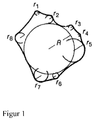
- In Bildaufnahmen von mindestens 1000 Pulverpartikeln wird für jede Partikelprojektion der größte Innenkreis (mit einem Radius R) eingefügt und an allen konvexen Stellen der Partikelprojektion wird jeweils ein Krümmungskreis (mit dem Radius ri) angepasst. In
Figur 1 wird dies beispielhaft veranschaulicht. Die Wadell-Rundheit eines Pulverpartikels ergibt sich anhand der folgenden Formel:
- n die Anzahl der Krümmungskreise ist,
- ri der Radius des i-ten Krümmungskreises ist,
- R der Radius des größten Innenkreises ist.
- Die mittlere Wadell-Rundheit des Pulvers ergibt sich aus dem arithmetischen Mittelwert der Wadell-Rundheitswerte der einzelnen Pulverpartikel.
- Die Auswertung der Partikelform hinsichtlich ihrer Wadell-Rundheit erfolgte mit dem Partikelmessgerät Camsizer® X2 der Firma Retsch Technology.
- Die Partikelgrößenverteilung wird durch Bildanalyse von mindestens 1000 Pulverpartikeln durchgeführt. Es handelt sich um eine Volumen-basierte Größenverteilungskurve. Als Größe eines einzelnen Partikels wird der Durchmesser eines Kreises, dessen Fläche der Projektionsfläche des Partikels in der Aufnahme entspricht, genommen ("Kreisäquivalent-Durchmesser"). Aus der Verteilungskurve lässt sich der d50-Wert bestimmen.
- Die Bestimmung der Partikelgrößen erfolgte mit dem Partikelmessgerät Camsizer® X2 der Firma Retsch Technology.
- Die relative Dichte Drel (in %) ergibt sich aus (ρgeo / ρth) x 100%, wobei ρgeo die geometrische Dichte des Bauteils und ρth die theoretische Dichte des Bauteils ist. Die geometrische Dichte kann nach dem Archimedes-Prinzip beispielsweise mit einer hydrostatischen Waage ermittelt werden. Die theoretische Dichte des Bauteils entspricht der theoretischen Dichte des Metalls, aus dem das Bauteil gebildet ist.
- Bestimmt durch optische Emissionsspektrometrie mittels induktiv gekoppeltem Plasma (ICP-OEC)
- Messung erfolgte mit Stickstoff als Adsorbat bei 77 K. Die Bestimmung der BET-Oberfläche erfolgte unter Verwendung der Mehrpunktmethode (ISO 9277:2010).
- Anhand des nachfolgenden Beispiels wird die vorliegende Erfindung eingehender beschrieben.
- Für die additive Fertigung wurde ein Wolframpulver verwendet, das eine mittlere Rundheit, bestimmt gemäß der oben beschriebenen Methode mit dem Partikelmessgerät Camsizer® X2 der Firma Retsch Technology, von 0,47 aufwies. Es handelte sich also um ein Pulver aus relativ kantigen Wolframpartikeln. Das in dem Beispiel verwendete Wolframpulver ist kommerziell erhältlich und wird von der Firma H.C. Starck unter der Bezeichnung "WMP GG" vertrieben.
- Folgende Anlage wurde für das Elektronenstrahlschmelzen verwendet: Arcam A2X der Firma Arcam AB.
- Die Schichten des Wolframpulvers wurden in einer Dicke von etwa 25-250 µm aufgebracht. Über einen defokusierten Elektronenstrahl wurden die Pulverschichten jeweils vorgeheizt, so dass die Pulverpartikel zumindest teilweise miteinander versintert wurden. Das Aufschmelzen des Wolframs in den vorgegebenen Bereichen der jeweiligen Schicht erfolgte mit einem fokussierten Elektronenstrahl.
- Es wurde ein Wolfram-Formkörper mit einer sehr hohen relativen Dichte von 99,7% erhalten.
- Ein Refraktärmetall wie z.B. Wolfram lässt sich also durch Elektronenstrahlschmelzen auch dann zu einem Formkörper hoher relativer Dichte additiv fertigen, wenn die Pulverpartikel eine sehr kantige Form (und somit eine geringe Rundheit) aufweisen. Eine aufwändige Vorbehandlung, durch die die Pulverpartikel in eine möglichst sphärische Partikelform überführt werden, ist nicht erforderlich.
Claims (8)
- Verwendung eines pulverförmigen Refraktärmetalls zur additiven Fertigung eines Formkörpers, wobei das pulverförmige Refraktärmetall eine mittlere Rundheit, bestimmt nach der in der Beschreibung angegebenen Methode, von 0,70 oder weniger aufweist und die additive Fertigung durch ein Elektronenstrahlschmelzen erfolgt.
- Verwendung nach Anspruch 1, wobei das Refraktärmetall Wolfram, Niob, Tantal, Chrom, Molybdän oder Rhenium ist.
- Verwendung nach Anspruch 1 oder 2, wobei das Refraktärmetall ein elementares Refraktärmetall oder eine Legierung eines Refraktärmetalls ist.
- Verwendung nach einem der vorstehenden Ansprüche, wobei die mittlere Rundheit des pulverförmigen Refraktärmetalls im Bereich von 0,30 bis 0,70, bevorzugter 0,35 bis 0,65 liegt.
- Verwendung nach einem der vorstehenden Ansprüche, wobei das pulverförmige Refraktärmetall eine Volumen-basierte Partikelgrößenverteilung mit einem d50-Wert im Bereich von 15 µm bis 150 µm aufweist.
- Verwendung nach einem der vorstehenden Ansprüche, wobei das pulverförmige Refraktärmetall eine BET-Oberfläche von weniger als 0,07 m2/g aufweist.
- Verwendung nach einem der vorstehenden Ansprüche, wobei der aus dem Refraktärmetall gebildete Formkörper eine relative Dichte von mindestens 95,0%, bevorzugter mindestens 97,0%, noch bevorzugter mindestens 98,0%, am bevorzugsten mindestens 99,0% aufweist.
- Verfahren zur additiven Fertigung eines Formkörpers, der ein Refraktärmetall enthält, durch ein Elektronenstrahlschmelzen, umfassend:(i) Aufbringen des pulverförmigen Refraktärmetalls gemäß einem der Ansprüche 1 bis 6 in Form einer Schicht auf einem Substrat,(ii) Aufschmelzen des Refraktärmetalls in definierten Bereichen der Schicht durch einen Elektronenstrahl und Erstarren lassen des aufgeschmolzenen Metalls,(iii) Aufbringen einer weiteren Schicht des pulverförmigen Refraktärmetalls auf der zuvor aufgebrachten Schicht,(iv) Aufschmelzen des Refraktärmetalls in definierten Bereichen der weiteren Schicht durch einen Elektronenstrahl und Erstarren lassen des aufgeschmolzenen Metalls,(v) optional ein- oder mehrmalige Wiederholung der Schritte (iii)-(iv).
Priority Applications (2)
| Application Number | Priority Date | Filing Date | Title |
|---|---|---|---|
| EP19172733.8A EP3736135B1 (de) | 2019-05-06 | 2019-05-06 | Additive fertigung eines formkörpers aus einem refraktärmetallpulver |
| PCT/EP2020/062524 WO2020225284A1 (de) | 2019-05-06 | 2020-05-06 | Additive fertigung eines formkörpers aus einem refraktärmetallpulver |
Applications Claiming Priority (1)
| Application Number | Priority Date | Filing Date | Title |
|---|---|---|---|
| EP19172733.8A EP3736135B1 (de) | 2019-05-06 | 2019-05-06 | Additive fertigung eines formkörpers aus einem refraktärmetallpulver |
Publications (2)
| Publication Number | Publication Date |
|---|---|
| EP3736135A1 true EP3736135A1 (de) | 2020-11-11 |
| EP3736135B1 EP3736135B1 (de) | 2023-08-09 |
Family
ID=66429248
Family Applications (1)
| Application Number | Title | Priority Date | Filing Date |
|---|---|---|---|
| EP19172733.8A Active EP3736135B1 (de) | 2019-05-06 | 2019-05-06 | Additive fertigung eines formkörpers aus einem refraktärmetallpulver |
Country Status (2)
| Country | Link |
|---|---|
| EP (1) | EP3736135B1 (de) |
| WO (1) | WO2020225284A1 (de) |
Cited By (1)
| Publication number | Priority date | Publication date | Assignee | Title |
|---|---|---|---|---|
| WO2024038077A1 (de) * | 2022-08-16 | 2024-02-22 | H. C. Starck Tungsten GmbH | Refraktärmetallpulver für die additive fertigung und verfahren zu deren herstellung |
Families Citing this family (1)
| Publication number | Priority date | Publication date | Assignee | Title |
|---|---|---|---|---|
| CN116511534A (zh) * | 2023-05-18 | 2023-08-01 | 西安交通大学 | 一种电子束选区熔化技术制备钼铼合金管材的方法 |
Citations (3)
| Publication number | Priority date | Publication date | Assignee | Title |
|---|---|---|---|---|
| EP2343143A2 (de) * | 2009-12-23 | 2011-07-13 | Josch Strahlschweisstechnik Gmbh | Verfahren zur Fertigung von Bauteilen aus Refraktärmetallen |
| WO2016004448A1 (de) | 2014-07-09 | 2016-01-14 | Plansee Se | Verfahren zur herstellung eines bauteils |
| US20170209963A1 (en) * | 2016-01-27 | 2017-07-27 | David B. Smathers | Additive manufacturing utilizing metallic wire |
-
2019
- 2019-05-06 EP EP19172733.8A patent/EP3736135B1/de active Active
-
2020
- 2020-05-06 WO PCT/EP2020/062524 patent/WO2020225284A1/de not_active Ceased
Patent Citations (3)
| Publication number | Priority date | Publication date | Assignee | Title |
|---|---|---|---|---|
| EP2343143A2 (de) * | 2009-12-23 | 2011-07-13 | Josch Strahlschweisstechnik Gmbh | Verfahren zur Fertigung von Bauteilen aus Refraktärmetallen |
| WO2016004448A1 (de) | 2014-07-09 | 2016-01-14 | Plansee Se | Verfahren zur herstellung eines bauteils |
| US20170209963A1 (en) * | 2016-01-27 | 2017-07-27 | David B. Smathers | Additive manufacturing utilizing metallic wire |
Non-Patent Citations (7)
| Title |
|---|
| A.L. COOK; J.A. SLOTWINSKI: "Properties of Metal Powders for Additive Manufacturing: A Review of the State of the Art of Metal Powder Property Testing", NATIONAL INSTITUTE OF STANDARDS AND TECHNOLOGY, Retrieved from the Internet <URL:http://dx.doi.org/10.6028/NIST.IR.7873> |
| C. CHEN ET AL., MATERIALS SCIENCE AND TECHNOLOGY, vol. 34, 2018, pages 735 - 742 |
| C. KÖRNER ET AL., SCHWEISSEN UND SCHNEIDEN, vol. 69, 2017, pages 30 - 38 |
| JUAN M RODRIGUEZ ET AL: "Particle shape quantities and measurement techniques - A review", THE ELECTRONIC JOURNAL OF GEOTECHNICAL ENGINEERING, vol. 18/A, 1 January 2013 (2013-01-01), pages 169 - 198, XP055436071, ISSN: 1089-3032 * |
| N/A: "Metal powders from LPW PowderRange - Metal powders from LPW", 30 April 2017 (2017-04-30), XP055629009, Retrieved from the Internet <URL:https://carpenteradditive.com/wp-content/uploads/2016/11/LPW-Powders-Brochure-2017.pdf> [retrieved on 20191004] * |
| TERRAZAS CESAR A ET AL: "Fabrication and characterization of high-purity niobium using electron beam melting additive manufacturing technology", THE INTERNATIONAL JOURNAL OF ADVANCED MANUFACTURING TECHNOLOGY, SPRINGER, LONDON, vol. 84, no. 5, 10 September 2015 (2015-09-10), pages 1115 - 1126, XP035745714, ISSN: 0268-3768, [retrieved on 20150910], DOI: 10.1007/S00170-015-7767-X * |
| W.J. SAMES ET AL., INTERNATIONAL MATERIALS REVIEWS, vol. 61, 2016, pages 1 - 46 |
Cited By (1)
| Publication number | Priority date | Publication date | Assignee | Title |
|---|---|---|---|---|
| WO2024038077A1 (de) * | 2022-08-16 | 2024-02-22 | H. C. Starck Tungsten GmbH | Refraktärmetallpulver für die additive fertigung und verfahren zu deren herstellung |
Also Published As
| Publication number | Publication date |
|---|---|
| EP3736135B1 (de) | 2023-08-09 |
| WO2020225284A1 (de) | 2020-11-12 |
Similar Documents
| Publication | Publication Date | Title |
|---|---|---|
| EP3166741B9 (de) | Verfahren zur herstellung eines bauteils | |
| DE2503165C2 (de) | Verfahren zur Herstellung eines Sinterkörpers mit örtlich unterschiedlichen Materialeigenschaften und Anwendung des Verfahrens | |
| EP3688200B1 (de) | Molybdän-sinterteil und herstellungsverfahren | |
| EP2200768B1 (de) | Verfahren zur herstellung von halbzeuge aus niti-formgedächtnislegierungen | |
| CH677530A5 (de) | ||
| DE102018127401A1 (de) | Hochfeste Aluminiumlegierungen für die additive Fertigung von dreidimensionalen Objekten | |
| DE102009051551A1 (de) | Verfahren und Vorrichtung zur Herstellung eines Bauteils einer Strömungsmaschine | |
| WO2014044429A1 (de) | Herstellen eines refraktärmetall-bauteils | |
| WO2018145824A1 (de) | Pulver zur verwendung in einem additiven fertigungsverfahren | |
| EP3736135B1 (de) | Additive fertigung eines formkörpers aus einem refraktärmetallpulver | |
| DE102017101050A1 (de) | Verfahren zur herstellung von hartmetallkörpern mittels 3d-druck | |
| DE2730661A1 (de) | Verfahren zum herstellen von metallischen praezisionsformteilen aus pulvern | |
| EP2584062A1 (de) | Sputtertarget und seine Verwendung | |
| AT15102U1 (de) | Verfahren zum schichtweisen Herstellen eines dreidimensionalen Hartmetall Körpers | |
| DE102018102616B4 (de) | Verfahren zur Herstellung von Hartmetallkörpern | |
| DE102010055791A1 (de) | Verfahren zur Fertigung von Bauteilen aus Refraktärmetallen | |
| DE102004042775B4 (de) | Verfahren zur Herstellung komplexer hochfester Bauteile oder Werkzeuge und dessen Verwendung | |
| EP3083108B1 (de) | Verfahren zur herstellung einer chrom enthaltender schicht | |
| EP0988124A2 (de) | Verfahren und pulver zur herstellung metallischer funktionsmuster mittels lasersintern | |
| DE102020105725A1 (de) | Verbundschweissdrähte und zugehörige plattierungsartikel | |
| DE60002476T2 (de) | Hochdichtes, bei niedrigen temperaturen gesintertes material aus wolfram | |
| EP0794265A2 (de) | Verfahren zur Herstellung von Formteilen | |
| DE102008062614A1 (de) | Vorprodukt für die Herstellung gesinterter metallischer Bauteile, ein Verfahren zur Herstellung des Vorproduktes sowie die Herstellung der Bauteile | |
| EP3878578A1 (de) | Metallpulverzusammensetzung zur verwendung für ein additives fertigungsverfahren | |
| EP4311047B1 (de) | Verfahren zur herstellung einer zündkerzenelektrode mit additiv gefertigter platingruppenmetallspitze |
Legal Events
| Date | Code | Title | Description |
|---|---|---|---|
| PUAI | Public reference made under article 153(3) epc to a published international application that has entered the european phase |
Free format text: ORIGINAL CODE: 0009012 |
|
| STAA | Information on the status of an ep patent application or granted ep patent |
Free format text: STATUS: REQUEST FOR EXAMINATION WAS MADE |
|
| 17P | Request for examination filed |
Effective date: 20190506 |
|
| AK | Designated contracting states |
Kind code of ref document: A1 Designated state(s): AL AT BE BG CH CY CZ DE DK EE ES FI FR GB GR HR HU IE IS IT LI LT LU LV MC MK MT NL NO PL PT RO RS SE SI SK SM TR |
|
| AX | Request for extension of the european patent |
Extension state: BA ME |
|
| STAA | Information on the status of an ep patent application or granted ep patent |
Free format text: STATUS: EXAMINATION IS IN PROGRESS |
|
| 17Q | First examination report despatched |
Effective date: 20211217 |
|
| RAP1 | Party data changed (applicant data changed or rights of an application transferred) |
Owner name: HERAEUS DEUTSCHLAND GMBH & CO. KG |
|
| REG | Reference to a national code |
Ref country code: DE Ref legal event code: R079 Free format text: PREVIOUS MAIN CLASS: B33Y0010000000 Ipc: C22C0001040000 Ref country code: DE Ref legal event code: R079 Ref document number: 502019008830 Country of ref document: DE Free format text: PREVIOUS MAIN CLASS: B33Y0010000000 Ipc: C22C0001040000 |
|
| GRAP | Despatch of communication of intention to grant a patent |
Free format text: ORIGINAL CODE: EPIDOSNIGR1 |
|
| STAA | Information on the status of an ep patent application or granted ep patent |
Free format text: STATUS: GRANT OF PATENT IS INTENDED |
|
| RIC1 | Information provided on ipc code assigned before grant |
Ipc: B22F 10/28 20210101ALN20230202BHEP Ipc: B22F 1/068 20220101ALI20230202BHEP Ipc: B22F 1/06 20220101ALI20230202BHEP Ipc: B22F 1/05 20220101ALI20230202BHEP Ipc: B33Y 70/00 20150101ALI20230202BHEP Ipc: B33Y 10/00 20150101ALI20230202BHEP Ipc: C22C 1/04 20060101AFI20230202BHEP |
|
| INTG | Intention to grant announced |
Effective date: 20230222 |
|
| GRAS | Grant fee paid |
Free format text: ORIGINAL CODE: EPIDOSNIGR3 |
|
| GRAA | (expected) grant |
Free format text: ORIGINAL CODE: 0009210 |
|
| STAA | Information on the status of an ep patent application or granted ep patent |
Free format text: STATUS: THE PATENT HAS BEEN GRANTED |
|
| P01 | Opt-out of the competence of the unified patent court (upc) registered |
Effective date: 20230628 |
|
| AK | Designated contracting states |
Kind code of ref document: B1 Designated state(s): AL AT BE BG CH CY CZ DE DK EE ES FI FR GB GR HR HU IE IS IT LI LT LU LV MC MK MT NL NO PL PT RO RS SE SI SK SM TR |
|
| REG | Reference to a national code |
Ref country code: GB Ref legal event code: FG4D Free format text: NOT ENGLISH |
|
| REG | Reference to a national code |
Ref country code: CH Ref legal event code: EP |
|
| REG | Reference to a national code |
Ref country code: IE Ref legal event code: FG4D Free format text: LANGUAGE OF EP DOCUMENT: GERMAN |
|
| REG | Reference to a national code |
Ref country code: DE Ref legal event code: R096 Ref document number: 502019008830 Country of ref document: DE |
|
| REG | Reference to a national code |
Ref country code: SE Ref legal event code: TRGR |
|
| REG | Reference to a national code |
Ref country code: LT Ref legal event code: MG9D |
|
| REG | Reference to a national code |
Ref country code: NL Ref legal event code: MP Effective date: 20230809 |
|
| PG25 | Lapsed in a contracting state [announced via postgrant information from national office to epo] |
Ref country code: GR Free format text: LAPSE BECAUSE OF FAILURE TO SUBMIT A TRANSLATION OF THE DESCRIPTION OR TO PAY THE FEE WITHIN THE PRESCRIBED TIME-LIMIT Effective date: 20231110 |
|
| PG25 | Lapsed in a contracting state [announced via postgrant information from national office to epo] |
Ref country code: IS Free format text: LAPSE BECAUSE OF FAILURE TO SUBMIT A TRANSLATION OF THE DESCRIPTION OR TO PAY THE FEE WITHIN THE PRESCRIBED TIME-LIMIT Effective date: 20231209 |
|
| PG25 | Lapsed in a contracting state [announced via postgrant information from national office to epo] |
Ref country code: RS Free format text: LAPSE BECAUSE OF FAILURE TO SUBMIT A TRANSLATION OF THE DESCRIPTION OR TO PAY THE FEE WITHIN THE PRESCRIBED TIME-LIMIT Effective date: 20230809 Ref country code: PT Free format text: LAPSE BECAUSE OF FAILURE TO SUBMIT A TRANSLATION OF THE DESCRIPTION OR TO PAY THE FEE WITHIN THE PRESCRIBED TIME-LIMIT Effective date: 20231211 Ref country code: NO Free format text: LAPSE BECAUSE OF FAILURE TO SUBMIT A TRANSLATION OF THE DESCRIPTION OR TO PAY THE FEE WITHIN THE PRESCRIBED TIME-LIMIT Effective date: 20231109 Ref country code: NL Free format text: LAPSE BECAUSE OF FAILURE TO SUBMIT A TRANSLATION OF THE DESCRIPTION OR TO PAY THE FEE WITHIN THE PRESCRIBED TIME-LIMIT Effective date: 20230809 Ref country code: LV Free format text: LAPSE BECAUSE OF FAILURE TO SUBMIT A TRANSLATION OF THE DESCRIPTION OR TO PAY THE FEE WITHIN THE PRESCRIBED TIME-LIMIT Effective date: 20230809 Ref country code: LT Free format text: LAPSE BECAUSE OF FAILURE TO SUBMIT A TRANSLATION OF THE DESCRIPTION OR TO PAY THE FEE WITHIN THE PRESCRIBED TIME-LIMIT Effective date: 20230809 Ref country code: IS Free format text: LAPSE BECAUSE OF FAILURE TO SUBMIT A TRANSLATION OF THE DESCRIPTION OR TO PAY THE FEE WITHIN THE PRESCRIBED TIME-LIMIT Effective date: 20231209 Ref country code: HR Free format text: LAPSE BECAUSE OF FAILURE TO SUBMIT A TRANSLATION OF THE DESCRIPTION OR TO PAY THE FEE WITHIN THE PRESCRIBED TIME-LIMIT Effective date: 20230809 Ref country code: GR Free format text: LAPSE BECAUSE OF FAILURE TO SUBMIT A TRANSLATION OF THE DESCRIPTION OR TO PAY THE FEE WITHIN THE PRESCRIBED TIME-LIMIT Effective date: 20231110 Ref country code: FI Free format text: LAPSE BECAUSE OF FAILURE TO SUBMIT A TRANSLATION OF THE DESCRIPTION OR TO PAY THE FEE WITHIN THE PRESCRIBED TIME-LIMIT Effective date: 20230809 |
|
| PG25 | Lapsed in a contracting state [announced via postgrant information from national office to epo] |
Ref country code: PL Free format text: LAPSE BECAUSE OF FAILURE TO SUBMIT A TRANSLATION OF THE DESCRIPTION OR TO PAY THE FEE WITHIN THE PRESCRIBED TIME-LIMIT Effective date: 20230809 |
|
| PG25 | Lapsed in a contracting state [announced via postgrant information from national office to epo] |
Ref country code: ES Free format text: LAPSE BECAUSE OF FAILURE TO SUBMIT A TRANSLATION OF THE DESCRIPTION OR TO PAY THE FEE WITHIN THE PRESCRIBED TIME-LIMIT Effective date: 20230809 |
|
| PG25 | Lapsed in a contracting state [announced via postgrant information from national office to epo] |
Ref country code: SM Free format text: LAPSE BECAUSE OF FAILURE TO SUBMIT A TRANSLATION OF THE DESCRIPTION OR TO PAY THE FEE WITHIN THE PRESCRIBED TIME-LIMIT Effective date: 20230809 Ref country code: RO Free format text: LAPSE BECAUSE OF FAILURE TO SUBMIT A TRANSLATION OF THE DESCRIPTION OR TO PAY THE FEE WITHIN THE PRESCRIBED TIME-LIMIT Effective date: 20230809 Ref country code: ES Free format text: LAPSE BECAUSE OF FAILURE TO SUBMIT A TRANSLATION OF THE DESCRIPTION OR TO PAY THE FEE WITHIN THE PRESCRIBED TIME-LIMIT Effective date: 20230809 Ref country code: EE Free format text: LAPSE BECAUSE OF FAILURE TO SUBMIT A TRANSLATION OF THE DESCRIPTION OR TO PAY THE FEE WITHIN THE PRESCRIBED TIME-LIMIT Effective date: 20230809 Ref country code: DK Free format text: LAPSE BECAUSE OF FAILURE TO SUBMIT A TRANSLATION OF THE DESCRIPTION OR TO PAY THE FEE WITHIN THE PRESCRIBED TIME-LIMIT Effective date: 20230809 Ref country code: CZ Free format text: LAPSE BECAUSE OF FAILURE TO SUBMIT A TRANSLATION OF THE DESCRIPTION OR TO PAY THE FEE WITHIN THE PRESCRIBED TIME-LIMIT Effective date: 20230809 Ref country code: SK Free format text: LAPSE BECAUSE OF FAILURE TO SUBMIT A TRANSLATION OF THE DESCRIPTION OR TO PAY THE FEE WITHIN THE PRESCRIBED TIME-LIMIT Effective date: 20230809 |
|
| REG | Reference to a national code |
Ref country code: DE Ref legal event code: R097 Ref document number: 502019008830 Country of ref document: DE |
|
| PG25 | Lapsed in a contracting state [announced via postgrant information from national office to epo] |
Ref country code: IT Free format text: LAPSE BECAUSE OF FAILURE TO SUBMIT A TRANSLATION OF THE DESCRIPTION OR TO PAY THE FEE WITHIN THE PRESCRIBED TIME-LIMIT Effective date: 20230809 |
|
| PLBE | No opposition filed within time limit |
Free format text: ORIGINAL CODE: 0009261 |
|
| STAA | Information on the status of an ep patent application or granted ep patent |
Free format text: STATUS: NO OPPOSITION FILED WITHIN TIME LIMIT |
|
| 26N | No opposition filed |
Effective date: 20240513 |
|
| PG25 | Lapsed in a contracting state [announced via postgrant information from national office to epo] |
Ref country code: SI Free format text: LAPSE BECAUSE OF FAILURE TO SUBMIT A TRANSLATION OF THE DESCRIPTION OR TO PAY THE FEE WITHIN THE PRESCRIBED TIME-LIMIT Effective date: 20230809 |
|
| PGFP | Annual fee paid to national office [announced via postgrant information from national office to epo] |
Ref country code: SE Payment date: 20240521 Year of fee payment: 6 |
|
| PG25 | Lapsed in a contracting state [announced via postgrant information from national office to epo] |
Ref country code: BG Free format text: LAPSE BECAUSE OF FAILURE TO SUBMIT A TRANSLATION OF THE DESCRIPTION OR TO PAY THE FEE WITHIN THE PRESCRIBED TIME-LIMIT Effective date: 20230809 |
|
| PG25 | Lapsed in a contracting state [announced via postgrant information from national office to epo] |
Ref country code: BG Free format text: LAPSE BECAUSE OF FAILURE TO SUBMIT A TRANSLATION OF THE DESCRIPTION OR TO PAY THE FEE WITHIN THE PRESCRIBED TIME-LIMIT Effective date: 20230809 |
|
| REG | Reference to a national code |
Ref country code: CH Ref legal event code: PL |
|
| PG25 | Lapsed in a contracting state [announced via postgrant information from national office to epo] |
Ref country code: MC Free format text: LAPSE BECAUSE OF FAILURE TO SUBMIT A TRANSLATION OF THE DESCRIPTION OR TO PAY THE FEE WITHIN THE PRESCRIBED TIME-LIMIT Effective date: 20230809 |
|
| PG25 | Lapsed in a contracting state [announced via postgrant information from national office to epo] |
Ref country code: LU Free format text: LAPSE BECAUSE OF NON-PAYMENT OF DUE FEES Effective date: 20240506 |
|
| PG25 | Lapsed in a contracting state [announced via postgrant information from national office to epo] |
Ref country code: MC Free format text: LAPSE BECAUSE OF FAILURE TO SUBMIT A TRANSLATION OF THE DESCRIPTION OR TO PAY THE FEE WITHIN THE PRESCRIBED TIME-LIMIT Effective date: 20230809 Ref country code: LU Free format text: LAPSE BECAUSE OF NON-PAYMENT OF DUE FEES Effective date: 20240506 Ref country code: CH Free format text: LAPSE BECAUSE OF NON-PAYMENT OF DUE FEES Effective date: 20240531 |
|
| REG | Reference to a national code |
Ref country code: BE Ref legal event code: MM Effective date: 20240531 |
|
| PG25 | Lapsed in a contracting state [announced via postgrant information from national office to epo] |
Ref country code: IE Free format text: LAPSE BECAUSE OF NON-PAYMENT OF DUE FEES Effective date: 20240506 |
|
| PG25 | Lapsed in a contracting state [announced via postgrant information from national office to epo] |
Ref country code: BE Free format text: LAPSE BECAUSE OF NON-PAYMENT OF DUE FEES Effective date: 20240531 |
|
| PGFP | Annual fee paid to national office [announced via postgrant information from national office to epo] |
Ref country code: DE Payment date: 20250521 Year of fee payment: 7 |
|
| PGFP | Annual fee paid to national office [announced via postgrant information from national office to epo] |
Ref country code: GB Payment date: 20250527 Year of fee payment: 7 |
|
| PGFP | Annual fee paid to national office [announced via postgrant information from national office to epo] |
Ref country code: FR Payment date: 20250528 Year of fee payment: 7 |
|
| PGFP | Annual fee paid to national office [announced via postgrant information from national office to epo] |
Ref country code: AT Payment date: 20250522 Year of fee payment: 7 |
|
| PG25 | Lapsed in a contracting state [announced via postgrant information from national office to epo] |
Ref country code: CY Free format text: LAPSE BECAUSE OF FAILURE TO SUBMIT A TRANSLATION OF THE DESCRIPTION OR TO PAY THE FEE WITHIN THE PRESCRIBED TIME-LIMIT; INVALID AB INITIO Effective date: 20190506 |
|
| PG25 | Lapsed in a contracting state [announced via postgrant information from national office to epo] |
Ref country code: HU Free format text: LAPSE BECAUSE OF FAILURE TO SUBMIT A TRANSLATION OF THE DESCRIPTION OR TO PAY THE FEE WITHIN THE PRESCRIBED TIME-LIMIT; INVALID AB INITIO Effective date: 20190506 |
|
| PG25 | Lapsed in a contracting state [announced via postgrant information from national office to epo] |
Ref country code: SE Free format text: LAPSE BECAUSE OF NON-PAYMENT OF DUE FEES Effective date: 20250507 |
|
| REG | Reference to a national code |
Ref country code: SE Ref legal event code: EUG |