EP3732185B1 - Conjugates and preparation and use thereof - Google Patents
Conjugates and preparation and use thereof Download PDFInfo
- Publication number
- EP3732185B1 EP3732185B1 EP18896766.5A EP18896766A EP3732185B1 EP 3732185 B1 EP3732185 B1 EP 3732185B1 EP 18896766 A EP18896766 A EP 18896766A EP 3732185 B1 EP3732185 B1 EP 3732185B1
- Authority
- EP
- European Patent Office
- Prior art keywords
- alkyl
- nucleotide
- group
- conjugate
- nucleotide sequence
- Prior art date
- Legal status (The legal status is an assumption and is not a legal conclusion. Google has not performed a legal analysis and makes no representation as to the accuracy of the status listed.)
- Active
Links
Images













Classifications
-
- A—HUMAN NECESSITIES
- A61—MEDICAL OR VETERINARY SCIENCE; HYGIENE
- A61K—PREPARATIONS FOR MEDICAL, DENTAL OR TOILETRY PURPOSES
- A61K31/00—Medicinal preparations containing organic active ingredients
- A61K31/70—Carbohydrates; Sugars; Derivatives thereof
- A61K31/7088—Compounds having three or more nucleosides or nucleotides
-
- A—HUMAN NECESSITIES
- A61—MEDICAL OR VETERINARY SCIENCE; HYGIENE
- A61K—PREPARATIONS FOR MEDICAL, DENTAL OR TOILETRY PURPOSES
- A61K31/00—Medicinal preparations containing organic active ingredients
- A61K31/70—Carbohydrates; Sugars; Derivatives thereof
- A61K31/7088—Compounds having three or more nucleosides or nucleotides
- A61K31/713—Double-stranded nucleic acids or oligonucleotides
-
- A—HUMAN NECESSITIES
- A61—MEDICAL OR VETERINARY SCIENCE; HYGIENE
- A61K—PREPARATIONS FOR MEDICAL, DENTAL OR TOILETRY PURPOSES
- A61K47/00—Medicinal preparations characterised by the non-active ingredients used, e.g. carriers or inert additives; Targeting or modifying agents chemically bound to the active ingredient
- A61K47/50—Medicinal preparations characterised by the non-active ingredients used, e.g. carriers or inert additives; Targeting or modifying agents chemically bound to the active ingredient the non-active ingredient being chemically bound to the active ingredient, e.g. polymer-drug conjugates
- A61K47/51—Medicinal preparations characterised by the non-active ingredients used, e.g. carriers or inert additives; Targeting or modifying agents chemically bound to the active ingredient the non-active ingredient being chemically bound to the active ingredient, e.g. polymer-drug conjugates the non-active ingredient being a modifying agent
- A61K47/54—Medicinal preparations characterised by the non-active ingredients used, e.g. carriers or inert additives; Targeting or modifying agents chemically bound to the active ingredient the non-active ingredient being chemically bound to the active ingredient, e.g. polymer-drug conjugates the non-active ingredient being a modifying agent the modifying agent being an organic compound
- A61K47/549—Sugars, nucleosides, nucleotides or nucleic acids
-
- A—HUMAN NECESSITIES
- A61—MEDICAL OR VETERINARY SCIENCE; HYGIENE
- A61P—SPECIFIC THERAPEUTIC ACTIVITY OF CHEMICAL COMPOUNDS OR MEDICINAL PREPARATIONS
- A61P1/00—Drugs for disorders of the alimentary tract or the digestive system
- A61P1/16—Drugs for disorders of the alimentary tract or the digestive system for liver or gallbladder disorders, e.g. hepatoprotective agents, cholagogues, litholytics
-
- A—HUMAN NECESSITIES
- A61—MEDICAL OR VETERINARY SCIENCE; HYGIENE
- A61P—SPECIFIC THERAPEUTIC ACTIVITY OF CHEMICAL COMPOUNDS OR MEDICINAL PREPARATIONS
- A61P3/00—Drugs for disorders of the metabolism
- A61P3/06—Antihyperlipidemics
-
- A—HUMAN NECESSITIES
- A61—MEDICAL OR VETERINARY SCIENCE; HYGIENE
- A61P—SPECIFIC THERAPEUTIC ACTIVITY OF CHEMICAL COMPOUNDS OR MEDICINAL PREPARATIONS
- A61P31/00—Antiinfectives, i.e. antibiotics, antiseptics, chemotherapeutics
- A61P31/12—Antivirals
- A61P31/20—Antivirals for DNA viruses
-
- A—HUMAN NECESSITIES
- A61—MEDICAL OR VETERINARY SCIENCE; HYGIENE
- A61P—SPECIFIC THERAPEUTIC ACTIVITY OF CHEMICAL COMPOUNDS OR MEDICINAL PREPARATIONS
- A61P9/00—Drugs for disorders of the cardiovascular system
- A61P9/10—Drugs for disorders of the cardiovascular system for treating ischaemic or atherosclerotic diseases, e.g. antianginal drugs, coronary vasodilators, drugs for myocardial infarction, retinopathy, cerebrovascula insufficiency, renal arteriosclerosis
-
- C—CHEMISTRY; METALLURGY
- C07—ORGANIC CHEMISTRY
- C07H—SUGARS; DERIVATIVES THEREOF; NUCLEOSIDES; NUCLEOTIDES; NUCLEIC ACIDS
- C07H15/00—Compounds containing hydrocarbon or substituted hydrocarbon radicals directly attached to hetero atoms of saccharide radicals
- C07H15/02—Acyclic radicals, not substituted by cyclic structures
- C07H15/04—Acyclic radicals, not substituted by cyclic structures attached to an oxygen atom of the saccharide radical
-
- C—CHEMISTRY; METALLURGY
- C07—ORGANIC CHEMISTRY
- C07H—SUGARS; DERIVATIVES THEREOF; NUCLEOSIDES; NUCLEOTIDES; NUCLEIC ACIDS
- C07H21/00—Compounds containing two or more mononucleotide units having separate phosphate or polyphosphate groups linked by saccharide radicals of nucleoside groups, e.g. nucleic acids
- C07H21/02—Compounds containing two or more mononucleotide units having separate phosphate or polyphosphate groups linked by saccharide radicals of nucleoside groups, e.g. nucleic acids with ribosyl as saccharide radical
-
- C—CHEMISTRY; METALLURGY
- C12—BIOCHEMISTRY; BEER; SPIRITS; WINE; VINEGAR; MICROBIOLOGY; ENZYMOLOGY; MUTATION OR GENETIC ENGINEERING
- C12N—MICROORGANISMS OR ENZYMES; COMPOSITIONS THEREOF; PROPAGATING, PRESERVING, OR MAINTAINING MICROORGANISMS; MUTATION OR GENETIC ENGINEERING; CULTURE MEDIA
- C12N15/00—Mutation or genetic engineering; DNA or RNA concerning genetic engineering, vectors, e.g. plasmids, or their isolation, preparation or purification; Use of hosts therefor
- C12N15/09—Recombinant DNA-technology
- C12N15/11—DNA or RNA fragments; Modified forms thereof; Non-coding nucleic acids having a biological activity
- C12N15/113—Non-coding nucleic acids modulating the expression of genes, e.g. antisense oligonucleotides; Antisense DNA or RNA; Triplex- forming oligonucleotides; Catalytic nucleic acids, e.g. ribozymes; Nucleic acids used in co-suppression or gene silencing
-
- C—CHEMISTRY; METALLURGY
- C12—BIOCHEMISTRY; BEER; SPIRITS; WINE; VINEGAR; MICROBIOLOGY; ENZYMOLOGY; MUTATION OR GENETIC ENGINEERING
- C12N—MICROORGANISMS OR ENZYMES; COMPOSITIONS THEREOF; PROPAGATING, PRESERVING, OR MAINTAINING MICROORGANISMS; MUTATION OR GENETIC ENGINEERING; CULTURE MEDIA
- C12N15/00—Mutation or genetic engineering; DNA or RNA concerning genetic engineering, vectors, e.g. plasmids, or their isolation, preparation or purification; Use of hosts therefor
- C12N15/09—Recombinant DNA-technology
- C12N15/11—DNA or RNA fragments; Modified forms thereof; Non-coding nucleic acids having a biological activity
- C12N15/113—Non-coding nucleic acids modulating the expression of genes, e.g. antisense oligonucleotides; Antisense DNA or RNA; Triplex- forming oligonucleotides; Catalytic nucleic acids, e.g. ribozymes; Nucleic acids used in co-suppression or gene silencing
- C12N15/1131—Non-coding nucleic acids modulating the expression of genes, e.g. antisense oligonucleotides; Antisense DNA or RNA; Triplex- forming oligonucleotides; Catalytic nucleic acids, e.g. ribozymes; Nucleic acids used in co-suppression or gene silencing against viruses
-
- C—CHEMISTRY; METALLURGY
- C12—BIOCHEMISTRY; BEER; SPIRITS; WINE; VINEGAR; MICROBIOLOGY; ENZYMOLOGY; MUTATION OR GENETIC ENGINEERING
- C12N—MICROORGANISMS OR ENZYMES; COMPOSITIONS THEREOF; PROPAGATING, PRESERVING, OR MAINTAINING MICROORGANISMS; MUTATION OR GENETIC ENGINEERING; CULTURE MEDIA
- C12N15/00—Mutation or genetic engineering; DNA or RNA concerning genetic engineering, vectors, e.g. plasmids, or their isolation, preparation or purification; Use of hosts therefor
- C12N15/09—Recombinant DNA-technology
- C12N15/11—DNA or RNA fragments; Modified forms thereof; Non-coding nucleic acids having a biological activity
- C12N15/113—Non-coding nucleic acids modulating the expression of genes, e.g. antisense oligonucleotides; Antisense DNA or RNA; Triplex- forming oligonucleotides; Catalytic nucleic acids, e.g. ribozymes; Nucleic acids used in co-suppression or gene silencing
- C12N15/1136—Non-coding nucleic acids modulating the expression of genes, e.g. antisense oligonucleotides; Antisense DNA or RNA; Triplex- forming oligonucleotides; Catalytic nucleic acids, e.g. ribozymes; Nucleic acids used in co-suppression or gene silencing against growth factors, growth regulators, cytokines, lymphokines or hormones
-
- C—CHEMISTRY; METALLURGY
- C12—BIOCHEMISTRY; BEER; SPIRITS; WINE; VINEGAR; MICROBIOLOGY; ENZYMOLOGY; MUTATION OR GENETIC ENGINEERING
- C12Q—MEASURING OR TESTING PROCESSES INVOLVING ENZYMES, NUCLEIC ACIDS OR MICROORGANISMS; COMPOSITIONS OR TEST PAPERS THEREFOR; PROCESSES OF PREPARING SUCH COMPOSITIONS; CONDITION-RESPONSIVE CONTROL IN MICROBIOLOGICAL OR ENZYMOLOGICAL PROCESSES
- C12Q1/00—Measuring or testing processes involving enzymes, nucleic acids or microorganisms; Compositions therefor; Processes of preparing such compositions
- C12Q1/68—Measuring or testing processes involving enzymes, nucleic acids or microorganisms; Compositions therefor; Processes of preparing such compositions involving nucleic acids
- C12Q1/6876—Nucleic acid products used in the analysis of nucleic acids, e.g. primers or probes
- C12Q1/6883—Nucleic acid products used in the analysis of nucleic acids, e.g. primers or probes for diseases caused by alterations of genetic material
- C12Q1/6886—Nucleic acid products used in the analysis of nucleic acids, e.g. primers or probes for diseases caused by alterations of genetic material for cancer
-
- C—CHEMISTRY; METALLURGY
- C12—BIOCHEMISTRY; BEER; SPIRITS; WINE; VINEGAR; MICROBIOLOGY; ENZYMOLOGY; MUTATION OR GENETIC ENGINEERING
- C12N—MICROORGANISMS OR ENZYMES; COMPOSITIONS THEREOF; PROPAGATING, PRESERVING, OR MAINTAINING MICROORGANISMS; MUTATION OR GENETIC ENGINEERING; CULTURE MEDIA
- C12N2310/00—Structure or type of the nucleic acid
- C12N2310/10—Type of nucleic acid
- C12N2310/14—Type of nucleic acid interfering nucleic acids [NA]
-
- C—CHEMISTRY; METALLURGY
- C12—BIOCHEMISTRY; BEER; SPIRITS; WINE; VINEGAR; MICROBIOLOGY; ENZYMOLOGY; MUTATION OR GENETIC ENGINEERING
- C12N—MICROORGANISMS OR ENZYMES; COMPOSITIONS THEREOF; PROPAGATING, PRESERVING, OR MAINTAINING MICROORGANISMS; MUTATION OR GENETIC ENGINEERING; CULTURE MEDIA
- C12N2310/00—Structure or type of the nucleic acid
- C12N2310/30—Chemical structure
- C12N2310/31—Chemical structure of the backbone
- C12N2310/312—Phosphonates
-
- C—CHEMISTRY; METALLURGY
- C12—BIOCHEMISTRY; BEER; SPIRITS; WINE; VINEGAR; MICROBIOLOGY; ENZYMOLOGY; MUTATION OR GENETIC ENGINEERING
- C12N—MICROORGANISMS OR ENZYMES; COMPOSITIONS THEREOF; PROPAGATING, PRESERVING, OR MAINTAINING MICROORGANISMS; MUTATION OR GENETIC ENGINEERING; CULTURE MEDIA
- C12N2310/00—Structure or type of the nucleic acid
- C12N2310/30—Chemical structure
- C12N2310/31—Chemical structure of the backbone
- C12N2310/315—Phosphorothioates
-
- C—CHEMISTRY; METALLURGY
- C12—BIOCHEMISTRY; BEER; SPIRITS; WINE; VINEGAR; MICROBIOLOGY; ENZYMOLOGY; MUTATION OR GENETIC ENGINEERING
- C12N—MICROORGANISMS OR ENZYMES; COMPOSITIONS THEREOF; PROPAGATING, PRESERVING, OR MAINTAINING MICROORGANISMS; MUTATION OR GENETIC ENGINEERING; CULTURE MEDIA
- C12N2310/00—Structure or type of the nucleic acid
- C12N2310/30—Chemical structure
- C12N2310/32—Chemical structure of the sugar
- C12N2310/321—2'-O-R Modification
-
- C—CHEMISTRY; METALLURGY
- C12—BIOCHEMISTRY; BEER; SPIRITS; WINE; VINEGAR; MICROBIOLOGY; ENZYMOLOGY; MUTATION OR GENETIC ENGINEERING
- C12N—MICROORGANISMS OR ENZYMES; COMPOSITIONS THEREOF; PROPAGATING, PRESERVING, OR MAINTAINING MICROORGANISMS; MUTATION OR GENETIC ENGINEERING; CULTURE MEDIA
- C12N2310/00—Structure or type of the nucleic acid
- C12N2310/30—Chemical structure
- C12N2310/32—Chemical structure of the sugar
- C12N2310/322—2'-R Modification
-
- C—CHEMISTRY; METALLURGY
- C12—BIOCHEMISTRY; BEER; SPIRITS; WINE; VINEGAR; MICROBIOLOGY; ENZYMOLOGY; MUTATION OR GENETIC ENGINEERING
- C12N—MICROORGANISMS OR ENZYMES; COMPOSITIONS THEREOF; PROPAGATING, PRESERVING, OR MAINTAINING MICROORGANISMS; MUTATION OR GENETIC ENGINEERING; CULTURE MEDIA
- C12N2310/00—Structure or type of the nucleic acid
- C12N2310/30—Chemical structure
- C12N2310/34—Spatial arrangement of the modifications
- C12N2310/344—Position-specific modifications, e.g. on every purine, at the 3'-end
-
- C—CHEMISTRY; METALLURGY
- C12—BIOCHEMISTRY; BEER; SPIRITS; WINE; VINEGAR; MICROBIOLOGY; ENZYMOLOGY; MUTATION OR GENETIC ENGINEERING
- C12N—MICROORGANISMS OR ENZYMES; COMPOSITIONS THEREOF; PROPAGATING, PRESERVING, OR MAINTAINING MICROORGANISMS; MUTATION OR GENETIC ENGINEERING; CULTURE MEDIA
- C12N2310/00—Structure or type of the nucleic acid
- C12N2310/30—Chemical structure
- C12N2310/35—Nature of the modification
- C12N2310/351—Conjugate
-
- C—CHEMISTRY; METALLURGY
- C12—BIOCHEMISTRY; BEER; SPIRITS; WINE; VINEGAR; MICROBIOLOGY; ENZYMOLOGY; MUTATION OR GENETIC ENGINEERING
- C12N—MICROORGANISMS OR ENZYMES; COMPOSITIONS THEREOF; PROPAGATING, PRESERVING, OR MAINTAINING MICROORGANISMS; MUTATION OR GENETIC ENGINEERING; CULTURE MEDIA
- C12N2310/00—Structure or type of the nucleic acid
- C12N2310/30—Chemical structure
- C12N2310/35—Nature of the modification
- C12N2310/351—Conjugate
- C12N2310/3519—Fusion with another nucleic acid
-
- C—CHEMISTRY; METALLURGY
- C12—BIOCHEMISTRY; BEER; SPIRITS; WINE; VINEGAR; MICROBIOLOGY; ENZYMOLOGY; MUTATION OR GENETIC ENGINEERING
- C12N—MICROORGANISMS OR ENZYMES; COMPOSITIONS THEREOF; PROPAGATING, PRESERVING, OR MAINTAINING MICROORGANISMS; MUTATION OR GENETIC ENGINEERING; CULTURE MEDIA
- C12N2310/00—Structure or type of the nucleic acid
- C12N2310/30—Chemical structure
- C12N2310/35—Nature of the modification
- C12N2310/352—Nature of the modification linked to the nucleic acid via a carbon atom
- C12N2310/3521—Methyl
-
- C—CHEMISTRY; METALLURGY
- C12—BIOCHEMISTRY; BEER; SPIRITS; WINE; VINEGAR; MICROBIOLOGY; ENZYMOLOGY; MUTATION OR GENETIC ENGINEERING
- C12N—MICROORGANISMS OR ENZYMES; COMPOSITIONS THEREOF; PROPAGATING, PRESERVING, OR MAINTAINING MICROORGANISMS; MUTATION OR GENETIC ENGINEERING; CULTURE MEDIA
- C12N2310/00—Structure or type of the nucleic acid
- C12N2310/30—Chemical structure
- C12N2310/35—Nature of the modification
- C12N2310/353—Nature of the modification linked to the nucleic acid via an atom other than carbon
- C12N2310/3533—Halogen
-
- C—CHEMISTRY; METALLURGY
- C12—BIOCHEMISTRY; BEER; SPIRITS; WINE; VINEGAR; MICROBIOLOGY; ENZYMOLOGY; MUTATION OR GENETIC ENGINEERING
- C12N—MICROORGANISMS OR ENZYMES; COMPOSITIONS THEREOF; PROPAGATING, PRESERVING, OR MAINTAINING MICROORGANISMS; MUTATION OR GENETIC ENGINEERING; CULTURE MEDIA
- C12N2320/00—Applications; Uses
- C12N2320/30—Special therapeutic applications
- C12N2320/32—Special delivery means, e.g. tissue-specific
-
- C—CHEMISTRY; METALLURGY
- C12—BIOCHEMISTRY; BEER; SPIRITS; WINE; VINEGAR; MICROBIOLOGY; ENZYMOLOGY; MUTATION OR GENETIC ENGINEERING
- C12N—MICROORGANISMS OR ENZYMES; COMPOSITIONS THEREOF; PROPAGATING, PRESERVING, OR MAINTAINING MICROORGANISMS; MUTATION OR GENETIC ENGINEERING; CULTURE MEDIA
- C12N2320/00—Applications; Uses
- C12N2320/50—Methods for regulating/modulating their activity
- C12N2320/51—Methods for regulating/modulating their activity modulating the chemical stability, e.g. nuclease-resistance
-
- C—CHEMISTRY; METALLURGY
- C12—BIOCHEMISTRY; BEER; SPIRITS; WINE; VINEGAR; MICROBIOLOGY; ENZYMOLOGY; MUTATION OR GENETIC ENGINEERING
- C12Q—MEASURING OR TESTING PROCESSES INVOLVING ENZYMES, NUCLEIC ACIDS OR MICROORGANISMS; COMPOSITIONS OR TEST PAPERS THEREFOR; PROCESSES OF PREPARING SUCH COMPOSITIONS; CONDITION-RESPONSIVE CONTROL IN MICROBIOLOGICAL OR ENZYMOLOGICAL PROCESSES
- C12Q2600/00—Oligonucleotides characterized by their use
- C12Q2600/112—Disease subtyping, staging or classification
-
- C—CHEMISTRY; METALLURGY
- C12—BIOCHEMISTRY; BEER; SPIRITS; WINE; VINEGAR; MICROBIOLOGY; ENZYMOLOGY; MUTATION OR GENETIC ENGINEERING
- C12Q—MEASURING OR TESTING PROCESSES INVOLVING ENZYMES, NUCLEIC ACIDS OR MICROORGANISMS; COMPOSITIONS OR TEST PAPERS THEREFOR; PROCESSES OF PREPARING SUCH COMPOSITIONS; CONDITION-RESPONSIVE CONTROL IN MICROBIOLOGICAL OR ENZYMOLOGICAL PROCESSES
- C12Q2600/00—Oligonucleotides characterized by their use
- C12Q2600/158—Expression markers
-
- C—CHEMISTRY; METALLURGY
- C12—BIOCHEMISTRY; BEER; SPIRITS; WINE; VINEGAR; MICROBIOLOGY; ENZYMOLOGY; MUTATION OR GENETIC ENGINEERING
- C12Q—MEASURING OR TESTING PROCESSES INVOLVING ENZYMES, NUCLEIC ACIDS OR MICROORGANISMS; COMPOSITIONS OR TEST PAPERS THEREFOR; PROCESSES OF PREPARING SUCH COMPOSITIONS; CONDITION-RESPONSIVE CONTROL IN MICROBIOLOGICAL OR ENZYMOLOGICAL PROCESSES
- C12Q2600/00—Oligonucleotides characterized by their use
- C12Q2600/178—Oligonucleotides characterized by their use miRNA, siRNA or ncRNA
-
- Y—GENERAL TAGGING OF NEW TECHNOLOGICAL DEVELOPMENTS; GENERAL TAGGING OF CROSS-SECTIONAL TECHNOLOGIES SPANNING OVER SEVERAL SECTIONS OF THE IPC; TECHNICAL SUBJECTS COVERED BY FORMER USPC CROSS-REFERENCE ART COLLECTIONS [XRACs] AND DIGESTS
- Y02—TECHNOLOGIES OR APPLICATIONS FOR MITIGATION OR ADAPTATION AGAINST CLIMATE CHANGE
- Y02P—CLIMATE CHANGE MITIGATION TECHNOLOGIES IN THE PRODUCTION OR PROCESSING OF GOODS
- Y02P20/00—Technologies relating to chemical industry
- Y02P20/50—Improvements relating to the production of bulk chemicals
- Y02P20/55—Design of synthesis routes, e.g. reducing the use of auxiliary or protecting groups
Definitions
- each L 1 is independently selected from the group consisting of groups A1-A26 and any combinations thereof:
- conjugate of the invention for use in treating and/or preventing a pathological condition or disease as defined in the claims caused by expression of a specific gene in hepatocytes as defined in the claims.
- C, G, U, and A indicate the base composition of the nucleotides; lowercase letter m indicates that the nucleotide adjacent to the left side of the letter m is a 2'-methoxy modified nucleotide; lowercase letter f indicates that the nucleotide adjacent to the left side of the letter f is a 2'-fluoro modified nucleotide; lowercase letter s indicates the phosphorothioate linkage between the two nucleotides adjacent to both sides of the letter s; P1 indicates that the nucleotide adjacent to the right side of P1 is a 5'-phosphate nucleotide or a nucleotide modified by a 5'-phosphate analog, especially a nucleotide modified by vinyl phosphate (represented as VP in the examples below), a 5'-phosphate nucleotide (represented as P in the examples below) or a nucleotide modified by 5'-
- a purine base adenine (A) is always paired with a pyrimidine base thymine (T) (or a uracil (U) in RNAs); and a purine base guanine (G) is always paired with a pyrimidine base cytosine (C).
- T pyrimidine base thymine
- U uracil
- C pyrimidine base cytosine
- adenines in a strand are always paired with thymines (or uracils) in another strand, and guanines paired with cytosines, the strands are considered as complementary; and a base sequence of a strand may be deduced from the sequence of its complementary strand.
- a "mispairing" refers to the bases at corresponding sites are not presented in a complementary pair in a double-stranded nucleic acid.
- “basically reverse complementary” refers to no more than 3 mispairings in two nucleotide sequences.
- substantially reverse complementary refers to no more than 1 mispairing in two nucleotide sequences.
- “Completely reverse complementary” refers to no mispairing in two nucleotide sequences.
- nucleotide difference between a nucleotide sequence and another refers to a change in the base of the nucleotides at the same site therebetween.
- a nucleotide base in the second sequence is A while the base at the same site in the first sequence is U, C, G or T, it is considered a nucleotide difference exists at the site between the 2 sequences.
- a nucleotide at a site is replaced with an abasic nucleotide or a nucleotide analogue, it is also considered that there is a nucleotide difference at the site.
- nucleoside monomer refers to, according to the RNA sequence to be prepared, "unmodified or modified RNA phosphoramidite", or “unmodified or modified RNA phosphoramidites” respectively used in a so called “solid phase phosphoramidite synthesis” which is well-known in the art for synthesis of RNA.
- the RNA phosphoramidites are also referred to as nucleoside phosphoramidites elsewhere.
- Nucleoside monomers used in the disclosure are all commercially available.
- a dash that is not between two letters or symbols is used to indicate a point of attachment for a substituent.
- -C 1 -C 10 alkyl-NH 2 is attached through the C 1 -C 10 alkyl.
- optionally substituted alkyl encompasses both “alkyl” and “substituted alkyl” as defined below. It will be understood by those skilled in the art, with respect to any group containing one or more substituents, that such groups are not intended to introduce any substitution or substitution patterns that are sterically impractical, synthetically non-feasible and/or inherently unstable.
- alkyl refers to straight chain and branched chain having the indicated number of carbon atoms, usually from 1 to 20 carbon atoms, for example 1 to 10 carbon atoms, such as 1 to 8 or 1 to 6 carbon atoms.
- C 1 -C 6 alkyl encompasses both straight and branched chain alkyl of from 1 to 6 carbon atoms.
- alkyl residue having a specific number of carbons when named, all branched and straight chain versions having that number of carbons are intended to be encompassed; thus, for example, "butyl” is meant to include n-butyl, sec-butyl, isobutyl and t-butyl; “propyl” includes n-propyl and isopropyl.
- Alkylene is a subset of alkyl, referring to the same residues as alkyl, but having two points of attachment.
- alkenyl refers to an unsaturated branched or straight-chain alkyl group having at least one carbon-carbon double bond derived by the removal of one molecule of hydrogen from adjacent carbon atoms of the parent alkyl.
- the group may be in either the cis or trans configuration about the double bond(s).
- Typical alkenyl groups include, but are not limited to, ethenyl; propenyls such as prop-1-en-1-yl, prop-1-en-2-yl, prop-2-en-1-yl (allyl), prop-2-en-2-yl; butenyls such as but-1-en-1-yl, but-1-en-2-yl, 2-methyl-prop-1-en-1-yl, but-2-en-1-yl, but-2-en-1-yl, but-2-en-2-yl, buta-1,3-dien-1-yl, buta-1,3-dien-2-yl; and the like.
- an alkenyl group has from 2 to 20 carbon atoms and in other embodiments, from 2 to 10, 2 to 8, or 2 to 6 carbon atoms.
- Alkenylene is a subset of alkenyl, referring to the same residues as alkenyl, but having two points of attachment.
- alkynyl refers to an unsaturated branched or straight-chain alkyl group having at least one carbon-carbon triple bond derived by the removal of two molecules of hydrogen from adjacent carbon atoms of the parent alkyl.
- Typical alkynyl groups include, but are not limited to, ethynyl; propynyls such as prop-1-yn-1-yl, prop-2-yn-1-yl; butynyls such as but-1-yn-1-yl, but-1-yn-3-yl, but-3-yn-1-yl; and the like.
- an alkynyl group has from 2 to 20 carbon atoms and in other embodiments, from 2 to 10, 2 to 8, or 2 to 6 carbon atoms.
- Alkynylene is a subset of alkynyl, referring to the same residues as alkynyl, but having two points of attachment.
- alkoxy refers to an alkyl group of the indicated number of carbon atoms attached through an oxygen bridge such as, for example, methoxy, ethoxy, propoxy, isopropoxy, n-butoxy, sec-butoxy, tert-butoxy, pentyloxy, 2-pentyloxy, isopentyloxy, neopentyloxy, hexyloxy, 2-hexyloxy, 3-hexyloxy, 3-methylpentyloxy, and the like. Alkoxy groups will usually have from 1 to 10, 1 to 8, 1 to 6, or 1 to 4 carbon atoms attached through the oxygen bridge.
- aryl refers to a radical derived from an aromatic monocyclic or multicyclic hydrocarbon ring system by removing a hydrogen atom from a ring carbon atom.
- the aromatic monocyclic or multicyclic hydrocarbon ring system contains only hydrogen and carbon from six to eighteen carbon atoms, where at least one of the rings in the ring system is fully unsaturated, i.e., it contains a cyclic, delocalized (4n+2) ⁇ -electron system in accordance with the Hückel theory.
- Aryl groups include, but are not limited to, groups such as phenyl, fluorenyl, and naphthyl.
- Arylene is a subset of aryl, referring to the same residues as aryl, but having two points of attachment.
- cycloalkyl refers to a non-aromatic carbocyclic ring, usually having from 3 to 7 ring carbon atoms. The ring may be saturated or have one or more carbon-carbon double bonds.
- cycloalkyl groups include cyclopropyl, cyclobutyl, cyclopentyl, cyclopentenyl, cyclohexyl, and cyclohexenyl, as well as bridged and caged ring groups such as norbornane.
- halo or halogen refers to fluoro, chloro, bromo, and iodo, and the term “halogen” includes fluorine, chlorine, bromine, and iodine.
- haloalkyl refers to alkyl as defined above having the specified number of carbon atoms, substituted with 1 or more halogen atoms, up to the maximum allowable number of halogen atoms.
- haloalkyl include, but are not limited to, trifluoromethyl, difluoromethyl, 2-fluoroethyl, and penta-fluoroethyl.
- Heterocyclyl refers to a stable 3- to 18-membered non-aromatic ring radical that comprises two to twelve carbon atoms and from one to six heteroatoms selected from nitrogen, oxygen and sulfur. Unless stated otherwise specifically in the specification, the heterocyclyl radical is a monocyclic, bicyclic, tricyclic or tetracyclic ring system, which may include fused or bridged ring systems. The heteroatoms in the heterocyclyl radical may be optionally oxidized. One or more nitrogen atoms, if present, are optionally quaternized. The heterocyclyl radical is partially or fully saturated. The heterocyclyl may be attached to the rest of the molecule through any atom of the ring(s).
- heterocyclyl radicals include, but are not limited to, dioxolanyl, thienyl[1,3]dithianyl, decahydroisoquinolyl, imidazolinyl, imidazolidinyl, isothiazolidinyl, isoxazolidinyl, morpholinyl, octahydroindolyl, octahydroisoindolyl, 2-oxopiperazinyl, 2-oxopiperidinyl, 2-oxopyrrolidinyl, oxazolidinyl, piperidinyl, piperazinyl, 4-piperidonyl, pyrrolidinyl, pyrazolidinyl, quinuclidinyl, thiazolidinyl, tetrahydrofuryl, trithianyl, tetrahydropyranyl, thiomorpholinyl, thiamorpholinyl, 1-oxo-thio
- Heteroaryl refers to a radical derived from a 3- to 18-membered aromatic ring radical that comprises two to seventeen carbon atoms and from one to six heteroatoms selected from nitrogen, oxygen and sulfur.
- the heteroaryl radical may be a monocyclic, bicyclic, tricyclic or tetracyclic ring system, wherein at least one of the rings in the ring system is fully unsaturated, i.e., it contains a cyclic, delocalized (4n+2) ⁇ -electron system in accordance with the Hückel theory.
- Heteroaryl includes fused or bridged ring systems.
- the heteroatom(s) in the heteroaryl radical is optionally oxidized.
- heteroaryl is attached to the rest of the molecule through any atom of the ring(s).
- heteroaryls include, but are not limited to, azepinyl, acridinyl, benzimidazolyl, benzindolyl, 1,3-benzodioxolyl, benzofuranyl, benzooxazolyl, benzo[d]thiazolyl, benzothiadiazolyl, benzo[b][1,4]dioxepinyl, benzo[b][1,4]oxazinyl, 1,4-benzodioxanyl, benzonaphthofuranyl, benzoxazolyl, benzodioxolyl, benzodioxinyl, benzopyranyl, benzopyranonyl, benzofuranyl, benzofuranonyl, benzothienyl (benzothienyl (benzothion
- hydroxyl protecting groups may be used in the present disclosure.
- protecting groups render chemical functionalities inert to specific reaction conditions, and may be appended to and removed from such functionalities in a molecule without substantially damaging the remainder of the molecule.
- Representative hydroxylprotecting groups are disclosed by Beaucage, et al., Tetrahedron 1992, 48, 2223-2311 , and also in Greene and Wuts, Protective Groups in Organic Synthesis, Chapter 2, 2d ed, John Wiley & Sons, New York, 1991 .
- the protecting group is stable under basic conditions but may be removed under acidic conditions.
- non-exclusive examples of the hydroxyl protecting groups that may be used herein include dimethoxytrityl (DMT), monomethoxytrityl, 9-phenylxanthen-9-yl (Pixyl) and 9-(p-methoxyphenyl)xanthen-9-yl (Mox).
- non-exclusive examples of the hydroxyl protecting groups that may be used herein comprises Tr (trityl), MMTr (4-methoxytrityl), DMTr (4,4'-dimethoxytrityl), and TMTr (4,4',4"-trimethoxytrityl).
- subject refers to any animal, e.g., a mammal or marsupial.
- Subjects of the present invention include but are not limited to humans, non-human primates (e.g., rhesus or other types of macaques), mice, pigs, horses, donkeys, cows, sheep, rats and fowl of any kind.
- treatment or “treating,” or “palliating” or “ameliorating” are used interchangeably herein. These terms refers to an approach for obtaining beneficial or desired results including but not limited to therapeutic benefit.
- therapeutic benefit is meant eradication or amelioration of the underlying disorder being treated. Also, a therapeutic benefit is achieved with the eradication or amelioration of one or more of the physiological symptoms associated with the underlying disorder such that an improvement is observed in the patient, notwithstanding that the patient may still be afflicted with the underlying disorder.
- prevention and “preventing” are used interchangeably. These terms refers to an approach for obtaining beneficial or desired results including but not limited to a prophylactic benefit.
- prophylactic benefit the conjugates or compositions may be administered to a patient at risk of developing a particular disease, or to a patient reporting one or more of the physiological symptoms of a disease, even though a diagnosis of this disease may not have been made.
- a conjugating molecule for delivering an active agent or active drug.
- the conjugating molecules disclosed herein are useful for tissue specific targeting.
- the conjugating molecules disclosed here bind to a cell surface receptor.
- the conjugating molecules disclosed herein specifically bind to a receptor unique to a certain tissue, and thereby achieving tissue specific targeting.
- the conjugating molecules disclosed herein specifically targets hepatocyte surface receptors, and thus specifically target liver tissues.
- the conjugating molecules disclosed herein specifically targets cell surface receptors that are unique to liver cells.
- the conjugating molecules disclosed herein specifically targets hepatic surface asialoglycoprotein receptors (ASGPR).
- an “active agent” is used interchangeably with the term an “active drug”, both referring to the molecule capable of being delivered by the conjugating molecule disclosed herein.
- the active agents are agents delivery of which to hepatocyte is desired.
- agents are known to those skilled in the art and include but are not limited to functional nucleotides, such as functional oligonucleotides, especially those disclosed herein.
- R 10 , R 11 , R 12 , R 13 , R 14 , and R 15 being independently selected from H, C 1 -C 10 alkyl, C 1 -C 10 haloalkyl, and C 1 -C 10 alkoxy
- the purpose of the present disclosure may be achieved without changing the properties of the conjugating molecule disclosed herein.
- R 10 , R 11 , R 12 , R 13 , R 14 , and R 15 are each independently selected from H, methyl and ethyl.
- R 10 , R 11 , R 12 , R 13 , R 14 , and R 15 are all H.
- the phosphoramidite can couple with a hydroxy group on a universal solid phase support, such as a resin, and form a conjugating molecule comprising a solid phase support linked via a phosphodiester bond by subsequent oxidation.
- a method for prepaing a conjugate disclosed herein with such a conjugating molecule comprises firstly linking the conjugating molecule with a solid phase support by a condensation or a coupling reaction, and then adding nucleoside monomers in accordance with solid phase phosphoramidite synthesis method, thereby providing the conjugate disclosed herein comprising the conjugating molecule of the disclosure conjugated to an oligonucleotide.
- the first functional group is deprotected, followed by a coupling with a phosphoramidite group on a nucleoside under a coupling condition.
- the method comprises reacting the conjugating molecule comprising a solid phase support with nucleoside monomers in accordance with solid phase phosphoramidite synthesis method, thereby providing the conjugating molecule of the disclosure conjugated to an oligonucleotide.
- the conjugating molecule comprising a solid phase support may be prepared inhouse from the conjugating molecule with a carboxyl, a carboxylate or a phosphoramidite by reacting the conjugating molecule with a solid phase support.
- the conjugating molecule may be supplied by a supplier.
- the carboxylate may be represented by -COO - M + , wherein M + is a cation such as a metal cation, an ammonium cation NH 4 + or an organic ammonium cation.
- the metal cation may be an alkali metal cation, such as K + or Na + .
- the organic ammonium cation is an ammonium cation formed by a tertiary amine or a quaternary ammonium cation, such as an ammonium cation formed by triethylamine or N,N-diisopropylethylamine.
- the carboxylate is a triethylamine carboxylate or an N,N-diisopropylethylamine carboxylate.
- R 4 is a group represented by Formula (B9), (B10), (B9'), (B 10'), (B11), (B12), (B11') or (B12'): wherein q 1 is an integer of 1-4, q 2 is an integer of 1-10, X is O or NH, M + is a cation, R k is a hydroxy protecting group, SPS represents a solid phase support, and represents the site there the group is covalently attached. In some embodiments, q 1 is 1 or 2. In some embodiments, q 2 is an integer of 1-5. In some embodiments, R 4 comprises a group represented by Formula (B9) or (B10). In some embodiments, R 4 comprises a group represented by Formula (B11) or (B12).
- R k is one or more of Tr (trityl), MMTr (4-methoxytrityl), DMTr (4,4'-dimethoxytrityl), and TMTr (4,4',4"-trimethoxytrityl). In some embodiments, R k is DMTr.
- L 1 is defined as a linear alkylene for convenience, but it may not be a linear group or be named differently, such as an amine or alkenyl as a result of the above replacement and/or substitution.
- the length of L 1 is the atom number in the chain connecting the two attaching point.
- a ring resulted from replacement of a carbon atom of the linear alkylene, such as a heterocyclylene or heteroarylene, is counted as one atom.
- L 1 is used to link the M 1 ligand (or the corresponding S 1 group) to the N atom on the nitrogenous backbone, thereby providing liver targeting function for the conjugate of the disclosure.
- L 1 comprises any one of Formulae A1-A26, and any combinations thereof.
- L 1 is any one of A1, A4, A5, A6, A8, A10, A11, A13, and combinations thereof.
- L 1 is a combination of at least two of A1, A4, A8, A10, and A11;
- L 1 is a combination of at least two groups of A1, A8, and A10.
- the length of L 1 may be 3 to 25, 3 to 20, 4 to 15 or 5 to 12 atoms. In some embodiments, L 1 is 3, 4, 5, 6, 7, 8, 9, 10, 11, 12, 13, 14, 15, 16, 17, 18, 19, 20, 21, 22, 23, 24, 25, 30, 35, 40, 45, 50, 55, 60 atoms in length.
- Ra is one of A27, A28, A29, A30, and A31, and in some embodiments is A27 or A28;
- Rb is a C 1 -C 5 alkyl, and in some embodiments is one of methyl, ethyl, isopropyl, and butyl.
- j1, j2, R', Ra, and Rb of A1-A26 are respectively selected to achieve the linkage between the M 1 ligands and the N atom on the nitrogenous backbone in the oligonucleotide conjugate formed by the conjugating molecule, and to make the steric position among M 1 ligands more suitable for binding M 1 ligands to the asialoglycoprotein receptors on the surface of hepatocytes.
- Each M 1 is independently selected from a ligand capable of binding to a cell surface receptor, wherein the receptor is an asialoglycoprotein receptor (ASGPR) on human hepatocytes.
- ASGPR asialoglycoprotein receptor
- M 1 may be any one of the ligands that have affinity to the asialoglycoprotein receptors (ASGP-R) on the surface of mammalian hepatocytes.
- ASGP-R asialoglycoprotein receptors
- at least one of M 1 is a saccharide.
- each M 1 is a saccharide.
- at least one of M 1 is a monosaccharide, disaccharide, trisaccharide or polysaccharide.
- each M 1 is a monosaccharide, disaccharide, trisaccharide or polysaccharide.
- at least one of M 1 is a modified saccharide.
- each M 1 is a modified saccharide. In some embodiments, each M 1 is independently selected from polysaccharides, modified polysaccharides, monosaccharides or monosaccharide derivatives. In some embodiments, each or at least one M 1 may be independently selected from a group consisting of glucose and its derivatives, mannose and its derivatives, galactose and its derivatives, xylose and its derivatives, ribose and its derivatives, fucose and its derivatives, lactose and its derivatives, maltose and its derivatives, arabinose and its derivatives, fructose and its derivatives, and sialic acid.
- each or at least one M 1 may be independently selected from a group consisting of D-mannopyranose, L-mannopyranose, D-arabinose, D-xylofuranose, L-xylofuranose, D-glucose, L-glucose, D-galactose, L-galactose, ⁇ -D-mannofuranose, ⁇ -D-mannofuranose, ⁇ -D-mannopyranose, ⁇ -D-glucopyranose, ⁇ -D-glucopyranose, ⁇ -D-glucofuranose, ⁇ -D-glucofuranose, ⁇ -D-fructofuranose, ⁇ -D-fructopyranose, ⁇ -D-galactopyranose, ⁇ -D-galactopyranose, ⁇ -D-galactopyranose, ⁇ -D-galactopyranose, ⁇ -D-galactopyranose, ⁇ -D-galact
- At least one M 1 is N-acetylgalactosamine (GalNAc). In some embodiments, each M 1 is N-acetylgalactosamine (GalNAc).
- Ligand selection may be found, for example, in the disclosure of CN105378082A .
- CN105378082A discloses a compound comprising a modified oligonucleotide and a conjugating group, wherein the conjugating group comprises at least one phosphorus linking group or neutral linking group, as well as one or more ligand(s).
- Each ligand is selected from the group consisting of polysaccharides, modified polysaccharides, mannose, galactose, mannose derivatives, galactose derivatives, D-mannopyranose, L-mannopyranose, D-arabinose, D-xylofuranose, L-xylofuranose, D-glucose, L-glucose, D-galactose, L-galactose, ⁇ -D-mannofuranose, ⁇ -D-mannofuranose, ⁇ -D-mannopyranose, ⁇ -D-mannopyranose, ⁇ -D-glucopyranose, ⁇ -D-glucopyranose, ⁇ -D-glucofuranose, ⁇ -D-glucofuranose, ⁇ -D-fructofuranose, ⁇ -D-fructopyranose, ⁇ -D-galactopyranose, ⁇ -D-galactopyranose, ⁇ -
- WO2016077321A1 discloses a number of siRNAs specifically targeting HBV gene and delivery methods thereof, and the serum stability of the siRNAs is enhanced by modifying the nucleotides thereof. This document also discloses siRNA conjugates, and further specifically discloses several siRNA conjugates.
- WO2016168286A1 discloses a number of siRNAs specifically targeting ANGPTL3 gene and delivery methods thereof, and the serum stability of the siRNAs is enhanced by modifying the nucleotides thereof. This document also discloses siRNA conjugates.
- N-acetylgalactosamine is a ligand that binds to a hepatic surface asialoglycoprotein receptors (ASGPR).
- ASGPR is an endocytic receptor that is specifically expressed by hepatocytes.
- GalNAc N-acetylgalactosamine
- Alnylam Pharmaceuticals, Inc. firstly reported that siRNAs based on GalNAc conjugation technology exert interference activity in mice ( Nair et al., J. Am. Chem. Soc., 2014, 136, 16958-16961 ).
- ED 50 of a single dose was determined to be 1 mg/kg when a single injection dose was less than 1 ml.
- a stable interfering activity for up to 9 months allegedly may be obtained by subcutaneously injection once a week.
- each Y is independently selected from the group consisting of methyl, trifluoromethyl, difluoromethyl, monofluoromethyl, trichloromethyl, dichloromethyl, monochloromethyl, ethyl, n-propyl, isopropyl, phenyl, halophenyl, and C 1 -C 6 alkylphenyl.
- S 1 is A49 or A50.
- Y is independently for each occurrence one of methyl, trifluoromethyl, difluoromethyl, monofluoromethyl, trichloromethyl, dichloromethyl, monochloromethyl, ethyl, n-propyl, isopropyl, phenyl, halophenyl, and alkylphenyl.
- Y is methyl.
- the conjugating molecule of the present disclosure has a structure represented by Formula (403), (404), (405), (406), (407), (408), (409), (410), (411), (412), (413), (414), (415), (416), (417), (418), (419), (420), (421), or (422):
- X is O or NH
- R k is a hydroxy protecting group
- M + is a metal cation, an ammonium cation, a cation formed from a tertary amine, or a quaternary ammonium cation.
- M + is
- the conjugating molecule of the present disclosure has a structure represented by Formula (423), (424), (425), (426), (427), (428), (429), (430), (431), (432), (433), (434), (435), (436), (437), (438), (439), (440), (441), or (442):
- X is O or NH
- R k is a hydroxy protecting group
- SPS represents a solid phase support.
- the conjugating molecule of the present disclosure has a structure represented by Formula (503), (504), (505), (506), (507), (508), (509), (510), (511), (512), (513), (514), (515), (516), (517), (518), (519), (520), (521), or (522):
- DMTr represents 4,4'-dimethoxytrityl.
- Structure represents the salts formed by corresponding carboxylic acids and triethylamine.
- the conjugating molecule of the present disclosure has a structure represented by Formula (523), (524), (525), (526), (527), (528), (529), (530), (531), (532), (533), (534), (535), (536), (537), (538), (539), (540), (541), or (542):
- SPS represents a solid phase support
- DMTr refers to a 4,4'-dimethoxytrityl
- the conjugating molecule of the present disclosure may be prepared via any appropriate synthetic route by those skilled in the art.
- the method for preparing the conjugating molecule represented by Formula (321) comprises contacting a compound represented by Formula (313) with a cyclic anhydride under the esterification reaction condition in the presence of a base and an esterification catalyst in an organic solvent; ion exchanging and isolating the compound represented by Formula (321): wherein:
- the esterification reaction condition includes a reaction temperature of 0-100 °C and a reaction time of 8-48 hours. In some embodiments, the esterification reaction condition comprises a reaction temperature of 10-40 °C and a reaction time of 20-30 hours.
- the organic solvent comprises one or more of an epoxy solvent, an ether solvent, an haloalkane solvent, dimethyl sulfoxide, N,N-dimethylformamide, and N,N-diisopropylethylamine.
- the epoxy solvent is dioxane and/or tetrahydrofuran.
- the ether solvent is diethyl ether and/or methyl tert-butyl ether.
- the haloalkane solvent is one or more of dichloromethane, trichloromethane and 1,2-dichloroethane.
- the organic solvent is dichloromethane.
- the amount of the organic solvent is 3-50 L/mol, and In some embodiments, 5-20 L/mol with respect to the compound represented by Formula (313).
- the cyclic anhydride is one of succinic anhydride, glutaric anhydride, adipic anhydride or pimelic anhydride. In some embodiments, the cyclic anhydride is succinic anhydride.
- the molar ratio of the cyclic anhydride to the compound represented by Formula (313) is 1:1 to 10:1, and in some embodiments is2:1 to 5:1.
- the esterification catalyst may be any catalyst capable of catalyzing the esterification, such as 4-dimethylaminopyridine.
- the molar ratio of the catalyst to the compound represented by Formula (313) is 1:1 to 10:1, and in some embodiments is 2:1 to 5:1.
- the base may be any inorganic base, organic base or combination thereof.
- the base is a tertiary amine.
- the tertiary amine is triethylamine or N,N-diisopropylethylamine
- the molar ratio of the tertiary amine to the compound represented by Formula (313) is 1:1 to 20:1, and in some embodiments is 3:1 to 10:1.
- the ion exchanging serves to convert the compound represented by Formula (321) to a desired form of carboxylic acid or salt thereof.
- the conjugating molecule with the M + cation may be obtained by using suitable ion exchanging solution and ion exchanging condition, which is well known in the art.
- a triethylamine phosphate solution is employed in the ion exchanging.
- the concentration of the triethylamine phosphate solution is 0.2-0.8 M.
- the concentration of the triethylamine phosphate solution is 0.4-0.6 M.
- the amount of the triethylamine phosphate solution is 3-6 L/mol, and in further embodiment 4-5 L/mol with respect to the compound represented by Formula (313).
- the compound represented by Formula (321) may be isolated from the reaction mixture using any suitable methods.
- the solvent may be removed directly to obtain a crude product of the compound represented by Formula (321), which may be used directly in subsequent reactions.
- the preparation method of the compound represented by Formula (321) further comprises: contacting the product of the above ion exchanging with a solid phase support with amino or hydroxy groups under a condensation reaction condition in the presence of a condensing agent, a condensation catalyst, and a tertiary amine in an organic solvent.
- a compound represented by Formula (321) is obtained, wherein R 4 comprises a hydroxy protecting group as the first functional group and a group represented by Formula (C1') as the second functional group.
- the solid phase support is one of the supports used in siRNA solid phase synthesis, some of which are well known to those skilled in the art.
- the solid phase support may be selected from one having an active hydroxy or amino functional group.
- the solid phase support is an amino or hydroxy resin.
- the amino or hydroxy resin has a particle size of 100-400 mesh, and amino or hydroxy surface loading of 0.2-0.5 mmol/g.
- the ratio of the compound represented by Formula (321) to the solid phase support is 10 ⁇ mol compound per gram of solid phase support ( ⁇ mol/g) to 400 ⁇ mol/g. In some embodiments, the ratio of compound of Formula (321) to the solid phase support is 50 ⁇ mol/g to 200 ⁇ mol/g.
- the capping reagent is composed of capping reagent A (capA) and capping reagent B (capB).
- the capA is N-methylimidazole, and in some embodiments provided as a solution of N-methylimidazole in a mixture solvent of pyridine/acetonitrile, wherein the volume ratio of pyridine to acetonitrile is 1:10 to 1:1, and in some embodiments is 1:3 to 1:1. In some embodiments, the ratio of the total volume of pyridine and acetonitrile to the volume of N-methylimidazole is 1:1 to 10:1, and in some embodiments is 3:1 to 7:1.
- the capping reagent B is acetic anhydride.
- the capping reagent B is provided as a solution of acetic anhydride in acetonitrile solvent, wherein the volume ratio of acetic anhydride to acetonitrile is 1:1 to 1:10, and in further embodiments is 1:2 to 1:6.
- the capping reagent is equimolar acetic anhydride and N-methylimidazole.
- the organic solvent is one or more of acetonitrile, an epoxy solvent, an ether solvent, an haloalkane solvent, dimethyl sulfoxide, N,N-dimethylformamide, and N,N-diisopropylethylamine.
- the organic solvent is acetonitrile.
- the amount of the organic solvent is 10-50 L/mol, and in some embodiments 5-30 L/mol with respect to the compound represented by Formula (313).
- the acylation catalyst may be selected from any catalyst that may be used for esterification or amidation, such as alkaline heterocyclic compounds.
- the acylation catalyst is 4-dimethylaminopyridine.
- the ratio of the mass of the catalyst to the mass of the compound represented by Formula (313) may be 0.001:1 to 1:1, and in some embodiments is 0.01:1 to 0.1:1.
- the compound represented by Formula (321) may be isolated from the reaction mixture by any suitable methods.
- the compound of Formula (321) may be obtained by sufficiently washing with an organic solvent and filtering to remove unreacted reactants, excess capping reagent and other impurities, wherein the organic solvent is selected from acetonitrile, dichloromethane, or methanol.
- the organic solvent is acetonitrile.
- the preparation of the conjugating molecule represented by Formula (321) comprises contacting a compound represented by Formula (313) with a phosphorodiamidite under a coupling reaction condition in the presence of a coupling agent in an organic solvent, and isolating the compound represented by Formula (321).
- a compound represented by Formula (321) is obtained, where R 4 comprises a hydroxy protecting group as the first functional group and a group represented by Formula (C3) as the second functional group.
- the coupling reaction condition comprises a reaction temperature of 0-50°C, such as 15-35°C.
- the molar ratio of the compound of Formula (322) to the phosphorodiamidite may be 1:1 to 1:50, such as 1:5 to 1:15.
- the molar ratio of the compound of Formula (313) to the coupling agent may be 1:1 to 1:100, such as 1:50 to 1:80.
- the reaction time may be 200-3000 seconds, preferably 500-1500 seconds.
- the phosphorodiamidite may be such as 2-cyanoethyl N,N,N',N'-tetraisopropylphosphorodiamidite, and may be commercially available or prepared according to methods well-known in the art.
- the coupling agent is selected from one or more of 1H-tetrazole, 5-ethylthio-1H-tetrazole and 5-benzylthio-1H-tetrazole, such as 5-ethylthio-1H-tetrazole.
- the coupling reaction may be performed in an organic solvent.
- the organic solvent is selected from one or more of anhydrous acetonitrile, anhydrous DMF and anhydrous dichloromethane, preferably anhydrous acetonitrile.
- the amount of the organic solvent may be 3-50 L/mol, such as 5-20 L/mol with respect to the compound represented by Formula (313).
- the hydroxy group in the compound (313) reacts with the phosphorodiamidite to form a phosphoramidite group.
- the solvent may be removed directly to obtain a crude product of the compound represented by Formula (321), which may be used directly in subsequent reactions.
- the preparation method of the compound represented by Formula (321) further comprises: contacting the isolated product with a solid phase support with hydroxy groups under a coupling reaction condition in the presence of a coupling agent in an organic solvent, followed by capping, oxidation, and isolation to obtain the compound represented by Formula (321), where R 4 comprises a hydroxy protecting group as the first functional group and a group represented by Formula (C3') as the second functional group.
- the solid phase support is a support used in nucleic acid solid phase synthesis, such as a deprotected universal solid phase support, which is commercially available (such as NittoPhase ® HL UnyLinker TM 300 Oligonucleotide Synthesis Support, Kinovate Life Sciences, represented by Formula B80):
- the deprotection condition comprises a temperature of 0-50°C, such as 15-35°C, and a reaction time of 30-300 seconds, such as 50-150 seconds.
- the deprotection agent may be selected from one or more of trifluoroacetic acid, trichloroacetic acid, dichloroacetic acid, and monochloroacetic acid. In some embodiments, the deprotection agent is dichloroacetic acid.
- the molar ratio of the deprotection agent to the protecting group -DMTr (4,4'-dimethoxytrityl) on the solid phase support may be 2:1 to 100:1, such as 3:1 to 50:1. Via such deprotection, reactive free hydroxy groups are obtained on the surface of the solid phase support, thus being available for the consequent coupling reaction.
- the coupling reaction condition and the coupling agent may be selected as above. Via such coupling, the free hydroxy groups formed in the deprotection react with the phosphoramidite groups, so as to form a phosphite ester linkage.
- the capping reaction condition comprises a temperature of 0-50 °C, such as 15-35 °C, and a reaction time of 5-500 seconds, such as 10-100 seconds.
- the capping agent and the amount thereof may be selected as above.
- the oxidation reaction condition may comprise a temperature of 0-50 °C, such as 15-35 °C, and a reaction time of 1-100 seconds, such as 5-50 seconds.
- the oxidation agent may be, for example, iodine (in some embodiments, provided as iodine water).
- the molar ratio of the oxidation agent to the nucleic acid sequence linked to the solid phase support in the coupling step is 1:1 to 100:1, preferably 5:1 to 50:1.
- R 6 is B7 or B8.
- the compound shown in the Formula (313) may be obtained by contacting the compound represented by Formula (314) with a compound represented by Formula (A-1) or (A-2) under an amidation reaction condition in the presence of an condensing agent for amidation reaction and a tertiary amine, in an organic solvent, and followed by isolation: wherein, the definitions and options of n1, n3, m1, m2, m3, R 10 , R 11 , R 12 , R 13 , R 14 , R 15 , L 1 , S 1 , q 2 and R k are respectively as described above.
- the amidation reaction condition may comprise a reaction temperature of 0-100 °C and a reaction time of 1-48 hours. In some embodiments, the amidation reaction condition is a reaction temperature of 10-40 °C and a reaction time of 2-16 hours.
- the organic solvent is one or more of an alcohol solvent, an epoxy solvent, an ether solvent, an haloalkane solvent, dimethyl sulfoxide, N,N-dimethylformamide, and N,N-diisopropylethylamine.
- the alcohol solvent is one or more of methanol, ethanol and propanol, and in further embodiments is ethanol.
- the epoxy solvent is dioxane and/or tetrahydrofuran.
- the ether solvent is diethyl ether and/or methyl tert-butyl ether.
- the haloalkane solvent is one or more of dichloromethane, trichloromethane and 1,2-dichloroethane.
- the organic solvent is dichloromethane.
- the amount of the organic solvent is 3-50 L/mol, and in further embodiments 3-20 L/mol with respect to the compound represented by Formula (314).
- the condensing agent for amidation reaction is benzotriazol-1-yl-oxytripyrrolidinophosphonium hexafluorophosphate, 3-(diethoxyphosphoryloxy)-1,2,3-benzotrizin-4(3H)-one, 4-(4,6-dimethoxytriazin-2-yl)-4-methylmorpholine hydrochloride, 2-ethoxy-1-ethoxycarbonyl-1,2-dihydroquinoline (EEDQ) or O-benzotriazol-tetramethyluronium hexafluorophosphate, and in further embodiments is 3-(diethoxyphosphoryloxy)-1,2,3-benzotrizin-4(3H)-one.
- the molar ratio of the condensing agent for amidation reaction to the compound represented by Formula (314) may be 1:1 to 10:1, and in some embodiments is 2.5:1 to 5:1.
- the tertiary amine is triethylamine or N,N-diisopropylethylamine, and in further embodiments is N,N-diisopropylethylamine.
- the molar ratio of the tertiary amine to the compound represented by Formula (314) may be 3:1 to 20:1, and in some embodiments is 5:1 to 10:1.
- the compound represented by Formula (313) may be isolated from the reaction mixture by any suitable isolation methods.
- the compound represented by Formula (313) may be isolated by removal of solvent via evaporation followed by chromatography.
- the solvent may be removed directly to obtain a crude product of the compound represented by Formula (313), which may be directly used in subsequent reactions.
- the compound represented by Formula (314) may be obtained by contacting the compound represented by Formula (315) with haloacetic acid under a deprotection reaction condition in an organic solvent, and followed up by isolation: wherein, R 7 is selected from the groups represented by Formula (330), (331), (332) or (333), and In some embodiments, R 7 has the structure represented by Formula (330): wherein the definitions and options of n1, n3, m1, m2, m3, R 10 , R 11 , R 12 , R 13 , R 14 , R 15 , L 1 and S 1 are respectively as described above.
- the haloacetic acid may be selected from one or more of dichloroacetic acid, trichloroacetic acid, monochloroacetic acid and trifluoroacetic acid, and in some embodiments is dichloroacetic acid.
- the deprotection reaction condition may comprise a reaction temperature of 0-100 °C and a reaction time of 0.1-24 hours, and in some embodiments comprises a reaction temperature of 10-40 °C and a reaction time of 0.5-16 hours.
- the organic solvent is one or more of an epoxy solvent, an ether solvent, an haloalkane solvent, dimethyl sulfoxide, N,N-dimethylformamide, and N,N-diisopropylethylamine.
- the epoxy solvent is dioxane and/or tetrahydrofuran.
- the ether solvent is diethyl ether and/or methyl tert-butyl ether.
- the haloalkane solvent is one or more of dichloromethane, trichloromethane and 1,2-dichloroethane.
- the organic solvent is dichloromethane.
- the amount of the organic solvent is 3-50 L/mol, and in further embodiments 5-20 L/mol with respect to the compound represented by Formula (315).
- the molar ratio of the haloacetic acid to the compound represented by Formula (315) may be 5:1 to 100:1, and in some embodiments is 10:1 to 50:1.
- the compound represented by Formula (314) may be isolated from the reaction mixture by any suitable isolation methods.
- the solvent may be removed directly to obtain a crude product of the compound represented by Formula (314), which may be directly used in subsequent reactions.
- the compound represented by Formula (315) may be obtained by contacting the compound represented by Formula (317) with the compound represented by Formula (316) under a condensation reaction condition in the presence of an condensing agent for amidation reaction and a tertiary amine, in an organic solvent, and followed by isolation: S 1 -L 1 -COOH Formula (316) wherein the definitions and options of n1, n3, m1, m2, m3, R 7 , R 10 , R 11 , R 12 , R 13 , R 14 , R 15 , L 1 and S 1 are respectively as described above.
- compounds of Formula (316) may be employed.
- compounds of Formula (316) may be prepared by the skilled in the art via various methods.
- some compounds of Formula (316) may be prepared according to the disclosure in Example 1 of US patent 8,106,022 B2.
- the condensation reaction condition comprises a reaction temperature of 0-100 °C and a reaction time of 0.1-24 hours. In some embodiments, the reaction temperature is 10-40 °C and the reaction time is 0.5-16 hours.
- the molar ratio of the compound represented by Formula (316) to the compound represented by Formula (317) may be 2:1 to 10:1, and in some embodiments is 2.5:1 to 5:1.
- the organic solvent is one or more of acetonitrile, an epoxy solvent, an ether solvent, an haloalkane solvent, dimethyl sulfoxide, N,N-dimethylformamide and N,N-diisopropylethylamine.
- the epoxy solvent is dioxane and/or tetrahydrofuran.
- the ether solvent is diethyl ether and/or methyl tert-butyl ether.
- the haloalkane solvent is one or more of dichloromethane, trichloromethane and 1,2-dichloroethane.
- the organic solvent is acetonitrile.
- the amount of the organic solvent may be 3-50 L/mol, and in some embodiments is 5-20 L/mol with respect to the compound represented by Formula (317).
- the condensing agent for amidation reaction is benzotriazol-1-yl-oxytripyrrolidinophosphonium hexafluorophosphate, 3-(diethoxyphosphoryloxy)-1,2,3-benzotrizin-4(3H)-one (DEPBT), O-benzotriazol-tetramethyluronium hexafluorophosphate or 4-(4,6-dimethoxytriazin-2-yl)-4-methylmorpholine hydrochloride, and in further embodiments may be 4-(4,6-dimethoxytriazin-2-yl)-4-methylmorpholine hydrochloride.
- the molar ratio of the condensing agent for amidation reaction to the compound represented by Formula (317) may be 2:1 to 10:1, and in some embodiments is 2.5:1 to 5:1.
- the tertiary amine may be N-methylmorpholine, triethylamine or N,N-diisopropylethylamine, and in some embodiments is N-methylmorpholine.
- the molar ratio of the tertiary amine to the compound represented by Formula (317) may be 3:1 to 20:1, and in some embodiments is 5:1 to 10:1.
- the compound represented by Formula (315) may be isolated from the reaction mixture by any suitable isolation methods.
- the solvent is removed directly to obtain a crude product of the compound represented by Formula (315), which may be used directly in subsequent reactions.
- the compound of Formula (317) is reacted with a sufficient amount of one compound of Formula (316) in one batch to obtain the desired compound of Formula (315) having identical S 1 -L 1 moieties.
- the compound of Formula (317) is reacted in batches with different compounds of Formula (316), i.e., the compounds of Formula (316) having different L 1 and/or S 1 , as desired, so as to obtain the compound of Formula (315) having two or more types of S 1 and/or L 1 therein.
- 1 eq of the compound of Formula (317) may be firstly contacted with 2 eq of a first compound of Formula (316) to attach a first S 1 -L 1 moieties to the two terminal primary amine groups in the compound of Formula (317), and then contacted with the (n3+n1-1) eq of a second compound of Formula (316) to attach a second S 1 -L 1 moieties to the (n3+n1-1) secondary amine groups (wherein the definition and scope of n3 and n1 are as defined above) in the compound of Formula (317).
- the compound represented by Formula (317) may be obtained by contacting the compound represented by Formula (318) with methylamine aqueous solution under a deprotection reaction condition in the presence of an organic solvent, and follow by isolation: wherein the definitions and options of n1, n3, m1, m2, m3, R 7 , R 10 , R 11 , R 12 , R 13 , R 14 and R 15 are respectively as defined above.
- the deprotection reaction condition may comprise a reaction temperature of 0-150 °C and a reaction time of 5-72 hours, and in some embodiments comprises a reaction temperature of 20-80 °C and a reaction time of 10-30 hours.
- the organic solvent may be selected from alcohols, in some embodiments is one of methanol, ethanol and isopropanol, and in further embodiments is methanol.
- the amount of the organic solvent may be 1-20 L/mol, and in some embodiments is 1.5-10 L/mol with respect to the compound represented by Formula (318).
- the concentration of the methylamine aqueous solution may be 30%-40% by mass, and the molar ratio of methylamine to the compound represented by Formula (318) may be 10:1 to 500:1, and in some embodiments is 50:1 to 200:1.
- the compound represented by Formula (317) may be isolated from the reaction mixture using any suitable isolation methods.
- the solvent may be removed directly to obtain a crude product of the compound represented by Formula (317), which may be used directly in subsequent reactions.
- the compound represented by Formula (318) may be obtained by contacting the compound represented by Formula (319) with triphenylchloromethane (TrCl), diphenylethylphenylchloromethane, phenyldiethylphenylchloromethane or triethylphenylchloromethane, and in some embodiments with triphenylchloromethane (TrCl) under a substitution reaction condition in the presence of an organic solvent, and followed by isolation: wherein the definitions and options of n1, n3, m1, m2, m3, R 10 , R 11 , R 12 , R 13 , R 14 and R 15 are respectively as defined above.
- the substitution reaction condition may comprise a reaction temperature of 0-100 °C and a reaction time of 5-72 hours, and in some embodiments comprises a reaction temperature of 10-40 °C and a reaction time of 10-30 hours.
- Triphenylchloromethane (TrCl), diphenylethylphenylchloromethane, phenyldiethylphenylchloromethane or triethylphenylchloromethane are commercially available.
- the molar ratio of triphenylchloromethane (TrCl), diphenylethylphenylchloromethane, phenyldiethylphenylchloromethane or triethylphenylchloromethane to the compound represented by Formula (319) may be 1:1 to 10:1, and in some embodiments is 1:1 to 3:1.
- the organic solvent may be one or more of an epoxy solvent, an ether solvent, an haloalkane solvent, dimethyl sulfoxide, N,N-dimethylformamide, and N,N-diisopropylethylamine.
- the epoxy solvent is dioxane and/or tetrahydrofuran.
- the ether solvent is diethyl ether and/or methyl tert-butyl ether.
- the haloalkane solvent is one or more of dichloromethane, trichloromethane and 1,2-dichloroethane.
- the organic solvent is dichloromethane.
- the amount of the organic solvent may be 3-50 L/mol, and in some embodiments is 5-20 L/mol with respect to the compound represented by Formula (319).
- the organic solvent is one or more of acetonitrile, an epoxy solvent, an ether solvent, an haloalkane solvent, dimethyl sulfoxide, N,N-dimethylformamide, and N,N-diisopropylethylamine.
- the epoxy solvent is dioxane and/or tetrahydrofuran.
- the ether solvent is diethyl ether and/or methyl tert-butyl ether.
- the haloalkane solvent is one or more of dichloromethane, trichloromethane and 1,2-dichloroethane.
- the organic solvent is acetonitrile.
- the amount of the organic solvent may be 1-50 L/mol, and in some embodiments is 1-20 L/mol with respect to the compound represented by Formula (320).
- the substitution reaction condition may comprise a reaction temperature of 0-100 °C and a reaction time of 5-72 hours, and in some embodiments comprises a reaction temperature of 10-40 °C and a reaction time of 10-30 hours.
- the molar ratio of ethyl trifluoroacetate to the compound represented by Formula (320) may be 2:1 to 10:1, and in some embodiments is 3:1 to 5:1.
- the compound represented by Formula (319) may be isolated from the reaction mixture using any suitable isolation methods.
- the solvent may be removed directly to obtain a crude product of the compound represented by Formula (319), which may be used directly in subsequent reactions.
- R 2 is a linking group formed by linking R 4 group in the compound of Formula (321) to the active drug via reaction. In some embodiments, R 2 is a linking group formed by linking R 4 group in the compound of Formula (321) to the functional oligonucleotide via reaction. In some embodiments, R 2 group has both a site linking to the N atom on the nitrogenous backbone and a site linking to the P atom in R 3 . In some embodiments, in R 2 , the site linking to the N atom on the nitrogenous backbone forms an amide bond with the N atom, and the site linking to the P atom in R 3 forms a phosphoester bond with the P atom. In some embodiments, R 2 is B5, B6, B5' or B6': wherein, represents the site where the groups are covalently linked; the selections and ranges of q 2 are as described above.
- R 3 is a group having the structure represented by Formula A59: wherein E 1 is OH, SH or BH 2 , and in some embodiments is OH or SH; and Nu is a functional oligonucleotide.
- conjugating group or molecule refers to a group or molecule which is capable of forming a covalent linkage to appropriate partner thereof, and both the conjugating group or molecule and its partner have specific functions.
- conjugating group or molecule and its partner have specific functions.
- conjugate refers to the compound formed by covalent linkage of such a chemical moiety with its partner.
- an "oligonucleotide conjugate” represents a compound formed by covalently attached oligonucleotide and one or more conjugating moieties each with specific functions.
- the conjugate disclosed herein is an oligonucleotide conjugate.
- a "conjugating molecule” may be a specific compound capable of conjugating to an oligonucleotide via reactions, thus finally forming the oligonucleotide conjugating of the disclosure.
- the oligonucleotide is an siRNA, hence the oligonucleotide conjugating of the disclosure is an siRNA conjugate.
- a polynucleotide such as the mRNA per se or fragments thereof, is also suitable for forming a conjugate by conjugation with the conjugating molecule provided by the present disclosure to achieve targeting delivery such as liver targeting deliver, thereby regulating the expression of protein transcribed by the mRNA.
- targeting delivery such as liver targeting deliver, thereby regulating the expression of protein transcribed by the mRNA.
- the "functional oligonucleotide" can also encompass an mRNA or fragments thereof.
- the functional oligonucleotide is capable of interacting with a target sequence, thereby affecting the normal function of the target sequence molecule, such as causing breakage or translational repression of mRNA or alternative splicing of mRNA resulting from exon skipping, etc..
- the functional oligonucleotide is complementary to the bases in the target sequence.
- the functional oligonucleotide is complementary to more than 80%, 81%, 82%, 83%, 84%, 85%, 86%, 87%, 88%, 89%, 90%, 91%, 92%, 93%, 94%, 95%, 96%, 97%, 98% or 99% of the bases in the target sequence, or may be fully complementary to the target sequence.
- the functional oligonucleotide can have 1, 2, or 3 bases that are not complementary to the target sequence.
- the functional oligonucleotide includes deoxyribonucleotides, ribonucleotides, and modified nucleotides.
- the functional oligonucleotide is a single strand DNA, RNA or DNA-RNA chimera, or a double stranded DNA, RNA or DNA-RNA hybrid.
- the functional oligonucleotide suitable for the oligonucleotide conjugate of the present disclosure may be one of small interfering RNA (siRNA), microRNA, anti-microRNA (antimiR), microRNA antagonist (antagomir), microRNA mimics, decoy oligonucleotide, immune stimulatory, G-quadruplex, splice altering, single strand RNA (ssRNA), antisense nucleic acid, nucleic acid aptamer, small activating RNA (saRNA), stem-loop RNA, or DNA.
- small interfering RNA siRNA
- microRNA anti-microRNA
- antiagomir microRNA antagonist
- microRNA mimics decoy oligonucleotide
- immune stimulatory G-quadruplex
- splice altering single strand RNA
- ssRNA single strand RNA
- saRNA small activating RNA
- stem-loop RNA or DNA.
- WO2015/006740A2 discloses a conjugate with different ligands conjugated to an oligonucleotide, wherein the ligands are linked to the oligonucleotide via linkers.
- the oligonucleotide is selected from the group consisting of small interfering RNA (siRNA), microRNA, anti microRNA (antimiR), antagomir, microRNA mimics, decoy oligonucleotides (decoy), immune stimulatory, G-quadruplex, splice altering, single stranded RNA (ssRNA), antisense nucleic acid (antisense), aptamer, stem-loop RNA or DNA.
- the functional oligonucleotide suitable for the oligonucleotide conjugate of the present disclosure is an oligonucleotides disclosed in WO2009082607A2 , WO2009073809A2 or WO2015006740A2 .
- the oligonucleotide conjugate of the present disclosure may regulate the aberrant expression of specific genes in certain cells such as hepatocytes by increasing the liver-targeting delivery of the active agent, such as the functional oligonucleotide, and thus improving the interaction of the functional oligonucleotide with the target sequence in the cells.
- the specific gene may be an endogenous gene expressed in liver or a pathogen gene reproduced in liver.
- the gene that is aberrantly expressed in hepatocytes may be a gene such as ApoB, ApoC, ANGPTL3, PCSK9, SCD1, TIMP-1, Col1A1, FVII, STAT3, p53, HBV, and HCV, etc.
- the gene that is aberrantly expressed in hepatocytes is an HBV gene, an ANGPTL3 gene, or an APOC3 gene.
- HBV gene refers to a gene having a sequence as shown in Genbank Accession No. NC_003977.1
- ANGPTL3 gene refers to a gene having an mRNA sequence as shown in Genbank Accession No. NM_014495.3
- APOC3 gene refers to a gene having an mRNA sequence as shown in Genbank Accession No. NM_000040.1.
- a “target sequence” is a target mRNA.
- a “target mRNA” refers to a mRNA corresponding to a gene that is aberrantly expressed in such as hepatocytes, which may be either a mRNA corresponding to an overexpressed gene or a mRNA corresponding to an under-expressed gene.
- a target mRNA is preferably an mRNA corresponding to an overexpressed gene, since most of diseases are derived from the overexpression of mRNA.
- the target mRNA corresponding to the above-mentioned aberrantly expressed gene may be an mRNA corresponding to a gene such as ApoB, ApoC, ANGPTL3, PCSK9, SCD1, TIMP-1, Col1A1, FVII, STAT3, p53, HBV, and HCV, etc..
- the target mRNA may be an mRNA transcribed by a corresponding HBV gene, ANGPTL3 gene or APOC3 gene.
- the P atom in Formula A59 may be linked to any possible position in the oligonucleotide sequence, for example, to any nucleotide of the oligonucleotide.
- the functional oligonucleotide in the oligonucleotide conjugate of the present disclosure is a single strand oligonucleotide (e.g., a single strand RNA or an aptamer).
- the P atom in Formula A59 may be linked to a terminal region of the single strand oligonucleotide, which refers to the 4 nucleotides closest to one end of the single strand oligonucleotide.
- the P atom in Formula A59 is linked to either end of the single strand oligonucleotide.
- the functional oligonucleotide in the oligonucleotide conjugate of the present disclosure is a double stranded oligonucleotide (e.g., siRNA, microRNA, or DNA) comprising a sense strand and an antisense strand.
- the P atom in Formula A59 may be linked to aterminal region of the sense strand or the antisense strand in the double stranded oligonucleotide, which refers to the 4 nucleotides closest to one end of the sense or antisense strand.
- the P atom in Formula A59 is linked to either end of the sense or antisense strand.
- the P atom in Formula A59 is linked to 3' end of the sense strand.
- the oligonucleotide conjugate provided by the present disclosure can release a separate antisense strand of the double stranded oligonucleotide during unwinding after entering into cells, thereby blocking the translation of the target mRNA into a protein and inhibiting the expression of a specific gene.
- the P atom in Formula A59 may be linked to any possible position of a nucleotide in the oligonucleotide sequence, for example, to position 5', 2' or 3', or to the base of the nucleotide. In some embodiments, the P atom in Formula A59 may be linked to position 2', 3', or 5' of a nucleotide in the oligonucleotide sequence by forming a phosphodiester bond.
- the P atom in Formula A59 is linked to an oxygen atom formed after deprotonation of 3'-hydroxy of the nucleotide at 3' end of the sense strand in the double stranded oligonucleotide sequence, or linked to a nucleotide by substituting a hydrogen atom in 2'-hydroxy of a nucleotide of the sense strand or by substituting a hydrogen atom in 5'-hydroxy of the nucleotide at 5' end of the sense strand in the double stranded oligonucleotide sequence.
- the invention is described in further details in the following embodiments and examples with respect to the exemplary embodiments where the functional oligonucleotide in the oligonucleotide conjugate of the disclosure is a small interfering RNA (siRNA).
- the oligonucleotide conjugate of the present disclosure is an siRNA conjugate.
- siRNA conjugates in these embodiments are also referred to as siRNA conjugates of the present disclosure just for convenience of description.
- the oligonucleotide in the oligonucleotide conjugate of the present disclosure can only be siRNA, instead, the oligonucleotide and even the active drug may be additional alternatives as disclosed herein or known to a skilled one. It is envisaged that, based on the detailed illustration on siRNA conjugate, other active drugs or functional oligonucleotides would work similarly when conjugated with the conjugating molecules provided herein.
- an siRNA comprises nucleotide groups as building blocks.
- the nucleotide group in turn, comprises a phosphate group, a ribose group and a base.
- an active siRNA i.e., a functional siRNA, may have a length of about 12-40 nucleotides, and in some embodiments is about 15-30 nucleotides in length.
- Each nucleotide in the siRNAs may be independently a modified or unmodified nucleotide. For an increased stability, at least one nucleotide in the siRNA is a modified nucleotide.
- siRNAs described in the following embodiments have higher activity and/or stability and thus may be used as siRNAs for the purposes disclosed herein.
- each nucleotide in the siRNA of the siRNA conjugate of the present disclosure is independently a modified or unmodified nucleotide.
- the siRNA comprises a sense strand and an antisense strand, wherein the sense strand comprises a nucleotide sequence 1, and the antisense strand comprises a nucleotide sequence 2.
- the nucleotide sequence 1 and the nucleotide sequence 2 both have a length of 10, 11, 12, 13, 14, 15, 16, 17, 18, 19, 20, 21, 22, 23, 24, or 25 nucleotides and are at least partly reverse complementary to form a double-stranded complementary region.
- the nucleotide sequence 2 is complementary to a first nucleotide sequence segment, which refers to a segment of nucleotide sequence in the target mRNA.
- the siRNA of the present disclosure refers to an siRNA capable of inhibiting at least 50% of the expression of HBV gene, at least 50% of the expression of ANGPTL3 gene, or at least 50% of the expression of APOC3 gene, at a concentration of 3 mg/kg. In some embodiments, the siRNA of the present disclosure refers to an siRNA capable of inhibiting at least 55%, 60%, 65%, 70%, 75%, or 80% of the expression of HBV gene, ANGPTL3 gene, or APOC3 gene, at a concentration of 3 mg/kg.
- the nucleotide sequence 1 has the same length and no more than 3 nucleotides different from the first nucleotide sequence segment; the nucleotide sequence 2 has the same length and no more than 3 nucleotides different from a nucleotide sequence B, which refers to a nucleotide sequence completely reverse complementary to the first nucleotide sequence segment.
- nucleotide sequence B refers to a nucleotide sequence completely reverse complementary to the first nucleotide sequence segment.
- the nucleotide sequence 1 is basically reverse complementary, Substantially reverse complementary, or completely reverse complementary with the nucleotide sequence 2.
- the nucleotide sequence 1 has no more than 1 nucleotide different from the first nucleotide sequence segment; and/or the nucleotide sequence 2 has no more than 1 nucleotides different from a nucleotide sequence B.
- the nucleotide differences between the nucleotide sequence 2 and the nucleotide sequence B includes the difference at the site of the first nucleotide Z' on the nucleotide sequence 2 from 5' end to 3' end.
- the last nucleotide Z on the nucleotide sequence 1 from 5' end to 3' end is a nucleotide complementary to Z'.
- the sense strand also comprises a nucleotide sequence 3
- the antisense strand also comprises a nucleotide sequence 4.
- the nucleotide sequences 3 and 4 have the same length of 1-4 nucleotides.
- the nucleotide sequence 3 is linked to the 5' end of the nucleotide sequence 1, and the nucleotide sequence 4 is linked to the 3' end of the nucleotide sequence 2.
- the nucleotide sequence 4 is complementary to a second nucleotide sequence segment, which refers to a nucleotide sequence adjacent to the first nucleotide sequence segment and having the same length as the nucleotide sequence 4 in the target mRNA.
- the nucleotide sequence 3 is substantially reverse complementary or completely reverse complementary to the nucleotide sequence 4. Therefore, in some embodiments, the sense strand and the antisense strand may have a length of 19-23 nucleotides.
- the siRNA of the present disclosure also comprises a nucleotide sequence 5, which has a length of 1-3 nucleotides and is linked to 3' end of the antisense strand, thereby constituting a 3' overhang of the antisense strand.
- the nucleotide sequence 5 is 1 or 2 nucleotides in length.
- the length ratio of the sense strand to the antisense strand in the siRNA of the present disclosure may be 19/20, 19/21, 20/21, 20/22, 21/22, 21/23, 22/23, 22/24, 23/24, or 23/25.
- the nucleotide sequence 5 has 2 nucleotides in length. Moreover, the nucleotide sequence 5 is 2 continuous thymidine deoxynucleotides, or 2 continuous uridine nucleotides in the direction from 5' end to 3' end, or complementary to a third nucleotide sequence segment, which refers to a nucleotide sequence adjacent to the first or second nucleotide sequence segment in the target mRNA, and having the same length as the nucleotide sequence 5.
- the length ratio of the sense strand to the antisense strand in the siRNA of the present disclosure is 19/21 or 21/23.
- the siRNA of the present disclosure exhibits significant silencing activity against mRNA in hepatocytes.
- the nucleotides in the siRNA of the present disclosure are each independently a modified or unmodified nucleotide. In some embodiments, the siRNA of the present disclosure comprises no modified nucleotide. In some embodiments, the siRNA of the present disclosure comprises a modified nucleotide group.
- siRNA in the art, there are currently many means that may be used to modify siRNA in the art, including backbone modification (or internucleotide linkage modification, such as phosphate group modification), ribose group modification, base modification, etc. (see, for example, Watts, J.K., G. F. Deleavey and M. J.Damha, Chemically Modified siRNA: tools and applications. Drug Discov Today, 2008.13(19-20): p.842-55 .
- backbone modification or internucleotide linkage modification, such as phosphate group modification
- ribose group modification ribose group modification
- base modification etc.
- a modified nucleotide employed herein comprises a nucleotide where the ribose group is modified, such as those formed by substituting the 2'-hydroxy of the ribose group with other groups, a nucleotide analogue, or a nucleotide with modified base.
- At least one nucleotide in the sense or antisense strand is a modified nucleotide
- at least one phosphate is a phosphate group with modified groups.
- at least a portion of the phosphate and/or ribose groups in phosphate-ribose backbone of at least one single strand in the sense strand and the antisense strand are phosphate and/or ribose groups with modified groups (or modified phosphate and/or modified ribose).
- all nucleotides in the sense strand and/or the antisense strand are modified nucleotides.
- each nucleotide in the sense strand and the antisense strand is independently a fluoro modified nucleotide or a non-fluoro modified nucleotide.
- a "fluoro modified nucleotide” refers to a nucleotide formed by substituting the 2'-hydroxy of the ribose group with a fluoro as represented by Formula (207).
- non-fluoro modified nucleotide refers to a nucleotide formed by substituting the 2'-hydroxy of the ribose group with a group other than a fluoro, or a nucleotide analogue.
- each non-fluoro modified nucleotide is independently a nucleotide formed by substituting the 2'-hydroxy of the ribose group thereof with a non-fluoro group, or a nucleotide analogue.
- a nucleotide formed by substituting the 2'-hydroxy of the ribose group with a non-fluoro group is well-known in the art, such as 2'-alkoxy modified nucleotides, 2'-substituted alkoxy modified nucleotides, 2'-alkyl modified nucleotides, 2'-substituted alkyl modified nucleotides, 2'-amino modified nucleotides, 2'-substituted amino modified nucleotides or 2'-deoxy nucleotides.
- the 2'-alkoxy modified nucleotide is a methoxy modified nucleotide represented by Formula (208).
- the 2'-substituted alkoxy modified nucleotide is a 2'-O-methoxyethoxy modified nucleotide represented by Formula (209).
- the 2'-amino modified nucleotide is represented by Formula (210).
- the 2'-deoxy nucleotide (DNA) is represented by Formula (211).
- nucleotide analogue refers to a group that can replace a nucleotide in the nucleic acid, while differs from an adenine ribonucleotide, a guanine ribonucleotide, a cytosine ribonucleotide, a uracil ribonucleotide or thymine deoxyribonucleotide.
- the nucleotide analogue may be such as an isonucleotide, a bridged nucleic acid (BNA) nucleotide or a acyclic nucleotide.
- a BNA nucleotide is a nucleotide that is constrained or inaccessible.
- BNA can contain a 5-, 6- membered or even a 7-membered ring bridged structure with a "fixed" C3'-endo sugar puckering.
- the bridge is typically incorporated at the 2'- and 4'-position of the ribose ring to afford a 2', 4'-BNA nucleotide, such as LNA, ENA and cET BNA which is represented by Formula (212), (213) and (214), respectively.
- An acyclic nucleotide is a nucleotide in which the ribose ring is opened, such as an unlocked nucleic acid (UNA) nucleotide and a glycerol nucleic acid (GNA) nucleotide, which are respectively represented by Formula (215) and (216). wherein R is H, OH or alkoxy (O-alkyl).
- An isonucleotide is a nucleotide in which the position of the base on the ribose ring alters, such as a compound in with the base is moved from 1' to 2' or 3' on the ribose ring represented respectively by Formula (217) or (218).
- a Base represents a nucleic acid base A, U, G, C or T; R is H, OH, F or a non-fluoro group described above.
- a nucleotide analogue is an isonucleotide, LNA, ENA, cET, UNA or GNA.
- each non-fluoro modified nucleotide is a methoxy modified nucleotide, which refers to a nucleotide formed by substituting the 2'-hydroxy of the ribose group with a methoxy group.
- a "fluoro modified nucleotide”, a “2'-fluoro modified nucleotide”, a “nucleotide in which 2'-hydroxy of a ribose group is substituted with fluoro” and a “nucleotide with 2'-fluororibosyl” have the same meaning, referring to the nucleotide that 2'-hydroxy of the nucleotide is substituted with fluoro to form a structure represented by Formula (207).
- a "methoxy modified nucleotide”, a “2'-methoxy modified nucleotide”, a “nucleotide in which 2'-hydroxy of a ribose group is substituted with methoxy” and a " nucleotide with 2'-methoxyribosyl” have the same meaning, referring to the nucleotide that 2'-hydroxy of the ribose group in the nucleotide is substituted with methoxy to form a structure represented by Formula (208).
- the siRNA of the disclosure is a siRNA with the following modifications: in the direction from 5' end to 3' end, the nucleotides at positions 7, 8 and 9 of the nucleotide sequence 1 in the sense strand of the siRNA are fluoro modified nucleotides, and the nucleotides at the rest of positions in the sense strand are methoxy modified nucleotides; and/or the nucleotides at positions 2, 6, 14 and 16 of the nucleotide sequence 2 in the antisense strand are fluoro modified nucleotides, and the nucleotides at the rest of positions in the antisense strand are methoxy modified nucleotides.
- the siRNA of the disclosure is a siRNA with the following modifications: in the direction from 5' end to 3' end, the nucleotides at positions 5, 7, 8 and 9 of the nucleotide sequence 1 in the sense strand of the siRNA are fluoro modified nucleotides, and the nucleotides at the rest of positions in the sense strand are methoxy modified nucleotides; and/or the nucleotides at positions 2, 6, 8, 9, 14 and 16 of the nucleotide sequence 2 in the antisense strand are fluoro modified nucleotides, and the nucleotides at the rest of positions in the antisense strand are 2'-methoxy modified nucleotides.
- the siRNA of the disclosure is a siRNA with the following modifications: in the direction from 5' end to 3' end, the nucleotides at positions 7, 8 and 9 of the nucleotide sequence 1 in the sense strand of the siRNA are fluoro modified nucleotides, and the nucleotides at the rest of positions in the sense strand are methoxy modified nucleotides; and/or in the direction from 5' end to 3' end, the nucleotides at positions 2, 6, 14 and 16 of the nucleotide sequence 2 in the antisense strand of the siRNA are fluoro modified nucleotides, and the nucleotides at the rest of positions in the antisense strand are methoxy modified nucleotides.
- the nucleotide has modifications on phosphate groups.
- the modification on a phosphate group is in some embodiments a phosphorothioate modification represented by Formula (201) below, that is, the substitution of a non-bridging oxygen atom in a phosphodiester bond with a sulfur atom so that the phosphodiester bond is changed to a phosphorothioate diester bond.
- this modification stabilizes the structure of the siRNA and maintaining high specificity and high affinity for base pairing.
- a phosphorothioate linkage exists in at least one of the following position: between the first and the second nucleotides from either end of the sense or antisense strand, between the second and the third nucleotides from either end of the sense strand or antisense strand, or any combination thereof.
- a phosphorothioate linkage exists at all the above positions except for 5' end of the sense strand.
- a phosphorothioate linkage exists at all the above positions except for 3' end of the sense strand.
- a phosphorothioate linkage exists in at least one of the following positions:
- the 5'-terminal nucleotide in the antisense strand sequence of the siRNA molecule is a 5'-phosphate nucleotide or a 5'-phosphate analogue modified nucleotide.
- the 5'-phosphate nucleotide has the following structure represented by Formula (202):
- Common types of the 5'-phosphate analogue modified nucleotides are well known to those skilled in the art, for example, the following 4 nucleotides represented by Formulas (203)-(206) disclosed in Anastasia Khvorova and Jonathan K. Watts, The chemical evolution of oligonucleotide therapies of clinical utility. Nature Biotechnology, 2017, 35(3): 238-48 : wherein R represents a group selected from the group consisting of H, OH, F, and methoxy;
- Base represents a base selected from A, U, C, G, or T.
- the 5'-phosphate nucleotide or the 5'-phosphate analogue modified nucleotide is a nucleotide with a vinyl phosphate (VP) modification represented by Formula (203), a 5'-phosphate nucleotide represented by Formula (202) or a 5'-phosphorothioate modified nucleotide represented by Formula (205).
- VP vinyl phosphate
- the inventors of the present disclosure have unexpectedly discovered that the siRNA conjugate of the present disclosure exhibits a significantly improved serum stability while the target mRNA silencing activity is not significantly compromised, leading to an excellent inhibitory effect in vivo on gene expression. It has shown that these siRNA conjugates of the present disclosure have higher delivery efficiency in vivo.
- the oligonucleotide conjugates of the present disclosure are therefore siRNA conjugates comprising siRNAs such as those shown in Table 1A-Table 1F: Table 1 siRNA sequences Table 1A NO.
- siHBd1 S CGUGUGCACUUCGCUUCAA 66 AS UUGAAGCGAAGUGCACACGGU 67
- siHBd1M1 S CmGmUmGmUmGmCfAfCfUmUmCmGmCmUmUmCmAmAmAm 68 AS UmUfGmAmAmGfCmGmAmAmGmUmGmCfAmCfAmCmGmGmUm 69
- siHBdlM2 S CmGmUmGmUfGmCfAfCfUmUmCmGmCmUmUmCmAmAmAm 70 AS UmUfGmAmAmGfCmGfAfAmGmUmGmCfAmCfAmCmGmGmUm 71
- siHBd1M1S S CmsGmsUmGmUmGmGmCfAfCfUmUmCmGmGmUmCmGmUm
- capital letters C, G, U, and A indicate the base compositions of the nucleotides; lowercase letter m indicates that the nucleotide adjacent to the left side of the letter m is a 2'-methoxy modified nucleotide; lowercase letter f indicates that the nucleotide adjacent to the left side of the letter f is a 2'-fluoro modified nucleotide; lowercase letter s indicates the phosphorothioate linkage between the two nucleotides adjacent to both sides of the letter s; P1 indicates that the nucleotide adjacent to the right side of P1 is a 5'-phosphate nucleotide or a 5'-phosphate analogue modified nucleotide, and in some embodiments is a vinyl phosphate modified nucleotide (represented as VP in the examples below), a phosphate nucleotide (represented as P in the examples below) or a phosphorothioate modified nucleotide (represented as
- a modified nucleotide group may be introduced into the siRNA of the present disclosure by a nucleoside monomer with a corresponding modification.
- Methods for preparing a nucleoside monomer having a corresponding modification and for introducing a modified nucleotide group into siRNA are also well known to those skilled in the art.
- Modified nucleoside monomers are either commercially available or may be prepared by known methods.
- the oligonucleotide conjugates of the present disclosure may be prepared by any appropriate synthetic routes.
- the oligonucleotide conjugate of the present disclosure may be prepared by a method comprising successively linking nucleoside monomers in 3' to 5' direction according to the nucleotide type and sequence of the oligonucleotide respectively, under a condition of phosphoramidite solid phase synthesis, wherein the linking of each nucleoside monomer includes a four-step reaction of deprotection, coupling, capping, and oxidation or sulfurization.
- the method further comprises contacting the compound represented by Formula (321) with a nucleoside monomer or a nucleotide sequence linked to a solid phase support under a coupling reaction condition in the presence of a coupling reagent, thereby linking the compound represented by Formula (321) to the nucleotide sequence through a coupling reaction.
- the method further comprises the step of deprotecting of the protecting groups and cutting down the solid phase support, isolation and purification.
- the oligonucleotide is a double stranded oligonucleotide
- the preparation method comprises the following steps: contacting the compound represented by Formula (321) with the nucleoside monomer at 3' end of the sense or antisense strand under a coupling reaction condition in the presence of a coupling reagent, thereby linking the compound represented by Formula (321) to the first nucleotide in the sequence, successively linking nucleoside monomers from 3' to 5' to synthesize the sense or antisense strand of the double stranded oligonucleotide, wherein, the compound of Formula (321) is a compound in which R 4 comprises a protected hydroxy as the first functional group and a group represented by Formula (C1') or (C3') as the second functional group, the compound of Formula (321) is deprotected before linking to the first nucleoside monomer, and the linking of each nucleoside monomer comprising a four-step reaction of deprotect
- the oligonucleotide is a double stranded oligonucleotide
- the preparation method comprises the following steps: successively linking nucleoside monomers from 3' to 5' to synthesize the sense strand and the antisense strand of the double stranded oligonucleotide, the linking of each nucleoside monomer including a four-step reaction of deprotection, coupling, capping, and oxidation or sulfurization, thus obtaining the sense strand linked to the solid phase support and the antisense strand linked to the solid phase support; contacting the compound represented by Formula (321) with the sense strand linked to the solid phase support or the antisense strand linked to the solid phase support under a coupling reaction condition in the presence of a coupling reagent, thereby linking the compound represented by Formula (321) to the sense or antisense strand, wherein, the compound of Formula (321) is a compound in which R 4 comprises a phosphoramidite group as the first functional
- the P atom in formula A59 is linked to the 3' end of the sense strand in the siRNA, and the preparation method of the siRNA conjugate of the present disclosure comprises:
- the method for removing the protecting group R k in the solid phase support-linking L-conjugating molecule comprises contacting the compound of Formula (321) with a deprotection agent under a deprotection condition.
- the deprotection condition comprises a temperature of 0-50°C, and in some embodiments of 15-35°C, and a reaction time of 30-300 seconds, and in some embodiments of 50-150 seconds.
- the deprotection agent may be selected from one or more of trifluoroacetic acid, trichloroacetic acid, dichloroacetic acid, and monochloroacetic acid, and in some embodiments is dichloroacetic acid.
- the molar ratio of the deprotection agent to the compound represented by Formula (322) may be 10:1 to 1000:1, and in some embodiments is 50:1 to 500:1.
- the coupling reaction condition and the coupling agent may be any conditions and agents appropriate for the above coupling reaction.
- the same condition and agent as the coupling reaction in the solid phase synthesis method employed are used.
- the coupling reaction condition comprises a reaction temperature of 0-50°C, and in some embodiments 15-35°C.
- the molar ratio of the compound of Formula (321) to the nucleoside monomer may be 1:1 to 1:50, and in some embodiments is 1:2 to 1:5.
- the molar ratio of the compound of Formula (322) to the coupling agent may be 1:1 to 1:50, and in some embodiments is 1:3 to 1:10.
- the reaction time may be 200-3000 seconds, and in some embodiments is 500-1500 seconds.
- the coupling agent may be selected from one or more of 1H-tetrazole, 5-ethylthio-1H-tetrazole and 5-benzylthio-1H-tetrazole, and in some embodiments is 5-ethylthio-1H-tetrazole.
- the coupling reaction may be performed in an organic solvent.
- the organic solvent may be selected from one or more of anhydrous acetonitrile, anhydrous DMF and anhydrous dichloromethane, and in some embodiments is anhydrous acetonitrile.
- the amount of the organic solvent may be 3-50 L/mol, and in some embodiments is 5-20 L/mol with respect to the compound represented by Formula (321).
- step (2) a sense strand S of the siRNA conjugate is synthesized in 3' to 5' direction by the phosphoramidite solid phase synthesis method starting from the nucleoside monomer linked to a solid phase support via an L-conjugating molecule prepared in the above steps.
- the L-conjugating molecule is linked to the 3' terminal of the resulting sense strand.
- conditions for solid phase synthesis described in steps (2) and (3) comprise the deprotection condition for the nucleoside monomer, type and amount of the deprotection agent, the coupling reaction condition, type and amount of the coupling agent, the capping reaction condition, type and amount of the capping agent, the oxidation reaction condition, type and amount of the oxidation agent, the sulfuration reaction condition, and type and amount of the sulfuration agent, various agents, amounts, and conditions conventionally used in the art are employed herein.
- the solid phase synthesis described in steps (2) and (3) can use the following conditions:
- the deprotection condition for the nucleoside monomer comprises a temperature of 0-50°C, and in some embodiments, 15-35°C, and a reaction time of 30-300 seconds, and in some embodiments, 50-150 seconds.
- the deprotection agent may be selected from one or more of trifluoroacetic acid, trichloroacetic acid, dichloroacetic acid, and monochloroacetic acid, and in some embodiments is dichloroacetic acid.
- the molar ratio of the deprotection agent to the protecting group of 4,4'-dimethoxytrityl on the solid phase support may be 2:1 to 100:1, and in some embodiments is 3:1 to 50:1.
- the coupling reaction condition comprises a temperature of 0-50°C, and in some embodiments, 15-35°C.
- the molar ratio of the nucleic acid sequence linked to the solid phase support to the nucleoside monomer may be 1:1 to 1:50, and in some embodiments is 1:5 to 1:15.
- the molar ratio of the nucleic acid sequence linked to the solid phase support to the coupling agent may be 1:1 to 1:100, and in some embodiments is 1:50 to 1:80.
- the reaction time and the coupling agent are selected as above.
- the capping reaction condition comprises a temperature of 0-50 °C, and in some embodiments, 15-35 °C, and a reaction time of 5-500 seconds, and in some embodiments, 10-100 seconds.
- the capping agent is selected as above.
- the molar ratio of the total amount of the capping agent to the nucleic acid sequence linked to the solid phase support may be 1:100 to 100:1, and in some embodiments is 1:10 to 10:1.
- the molar ratio of acetic anhydride, N-methylimidazole, and the nucleic acid sequence linked to the solid phase support may be 1:1:10-10:10:1, and in some embodiments is 1:1:2-2:2:1.
- the oxidation reaction condition comprises a temperature of 0-50 °C, and in some embodiments 15-35 °C, and a reaction time of 1-100 seconds, and in some embodiments, 5-50 seconds.
- the oxidation agent is iodine (and in further embodiments provided as iodine water).
- the molar ratio of the oxidation agent to the nucleic acid sequence linked to the solid phase support in the coupling step may be 1:1 to 100:1, and in some embodiments is 5:1 to 50:1.
- the sulfuration reaction condition comprises a temperature of 0-50 °C, and in some embodiments, 15-35 °C, and a reaction time of 50-2000 seconds, and in some embodiments, 100-1000 seconds.
- the sulfuration agent is xanthane hydride.
- the molar ratio of the sulfuration agent to the nucleic acid sequence linked to the solid phase support in the coupling step may be 10:1 to 1000:1, and in some embodiments is 10:1 to 500:1.
- the method further comprises isolating the sense strand and the antisense strand of the siRNA after linking all nucleoside monomers and before the annealing.
- Methods for isolation are well known to those skilled in the art and generally comprise removing the synthesized nucleotide sequence from the solid phase support, deprotecting the bases, phosphate groups and ligands, and purifying and desalting.
- the synthesized nucleotide sequence may be cleaved from the solid phase support, and protecting groups on bases, phosphate groups and ligands removed, according to conventional cleavage and deprotection methods in the synthesis of siRNA.
- the resulting nucleotide sequence linked to the solid phase support is contacted with concentrated aqueous ammonia; during deprotection, the protecting group YCOO - in groups A46-A54 is converted to a hydroxyl group, thus the S 1 groups are converted to corresponding M 1 groups, providing the conjugate represented by Formula (1).
- the concentrated aqueous ammonia may be aqueous ammonia of a concentration of 25-30% by weight.
- the amount of the concentrated aqueous ammonia may be 0.2 ml/ ⁇ mol-0.8 ml/ ⁇ mol with respect to the target siRNA sequence.
- the method further comprises contacting the nucleotide sequence removed from the solid phase support with triethylamine trihydrofluoride to remove the 2'-TBDMS protection.
- the resulting target siRNA sequence has a free 2'-hydroxy in the corresponding nucleoside.
- the amount of pure triethylamine trihydrofluoride with respect to the target siRNA sequence may be 0.4 ml/ ⁇ mol - 1.0 ml/ ⁇ mol. As such, the siRNA conjugate of the present disclosure may be obtained.
- nucleic acid purification may be performed using a preparative ion chromatography purification column with a gradient elution of NaBr or NaCl; after collection and combination of the product, a reversed phase chromatography purification column may be used for desalting.
- the purity and molecular weight of the nucleic acid sequence may be determined at any time, in order to control the synthesis quality more conveniently. Such methods are well known to those skilled in the art.
- the purity of the nucleic acid may be determined by ion exchange chromatography, and the molecular weight may be determined by liquid chromatography-mass spectrometry (LC-MS).
- the synthesized sense strand (S strand) and antisense strand (AS strand) may be simply mixed in water for injection in an equimolar ratio, heated to 70-95 °C, and then cooled at room temperature to form a double stranded structure via hydrogen bond.
- S strand sense strand
- AS strand antisense strand
- the siRNA conjugates of the disclosure may be thus obtained.
- the siRNA conjugate thus synthesized can also be characterized by using instruments such as LC-MS by means such as molecular weight detection, to confirm that the synthesized siRNA conjugate is the designed target siRNA conjugate and the synthesized siRNA sequence is the desired siRNA sequence, for example, is one of the sequences listed in Table 1 above.
- the conjugate is useful to deliver to a cell a certain active agent for treating or preventing a disease or condition where such deliver may be desirable.
- a certain active agent for treating or preventing a disease or condition where such deliver may be desirable.
- the spatial arrangement of the conjugating molecule is especially efficient in targeting a cell surface receptor, and thus bring loaded active agent into contact with the cell.
- such a conjugate is an oligonucleotide conjugate targeting hepatocyte.
- the oligonucleotide conjugate of the present disclosure has excellent liver-targeting specificity, and therefore can efficiently deliver the conjugated functional oligonucleotide into liver, thereby effectively regulating expression of specific genes in hepatocytes.
- the oligonucleotide conjugate of the present disclosure has a wide application prospect.
- the oligonucleotide conjugate of the present disclosure for use in treating and/or preventing pathological conditions or diseases caused by the expression of specific genes in hepatocytes as defined in the claims.
- the specific gene may be an endogenous gene expressed in liver or a pathogen gene reproduced in liver.
- the specific genes are such as ApoB, ApoC, ANGPTL3, PCSK9, SCD1, TIMP-1, Col1A1, FVII, STAT3, p53, HBV or HCV.
- the specific gene is an HBV gene, an ANGPTL3 gene, or an APOC3 gene.
- the diseases are selected from chronic liver disease, hepatitis, hepatic fibrosis, liver proliferative diseases and dyslipidemia.
- the dyslipidemia is hypercholesterolemia, hypertriglyceridemia, or atherosclerosis.
- a method for treating pathological conditions or diseases caused by the expression of specific genes in hepatocytes comprising administering the oligonucleotide conjugate of the present disclosure to a subject in need thereof.
- the specific genes may be such as ApoB, ApoC, ANGPTL3, PCSK9, SCD1, TIMP-1, Col1A1, FVII, STAT3, p53, HBV or HCV.
- the specific gene may be selected from a HBV gene, an ANGPTL3 gene, and an APO C3 gene.
- the diseases are selected from chronic liver disease, hepatitis, hepatic fibrosis, liver proliferative diseases and dyslipidemia.
- the dyslipidemia may be hypercholesterolemia, hypertriglyceridemia, or atherosclerosis.
- the conjugate provided by the disclosure may also be used to treat other liver diseases, including diseases characterized by undesired cell proliferation, blood diseases, metabolic diseases, and diseases characterized by inflammation.
- Proliferative diseases of liver may be benign or malignant diseases such as cancer, hepatocellular carcinoma (HCC), hepatic metastasis or hepatoblastoma.
- Liver hematology or inflammatory diseases may be diseases that involve blood coagulation factors, complement-mediated inflammation, or fibrosis.
- Metabolic diseases of liver include dyslipidemia and irregular glucose regulation.
- the method may comprise administering one or more oligonucleotides having a high degree of homology to the gene sequences involved in the liver diseases.
- provided herein is a method for inhibiting the expression of specific genes in hepatocytes, comprising contacting the siRNA conjugate of the present disclosure with the hepatocytes in vitro.
- the purpose of preventing and/or treating pathological conditions or diseases caused by the expression of specific genes in hepatocytes may be achieved through the mechanism of gene expression regulation by administering the oligonucleotide conjugate of the present disclosure to a subject in need thereof. Therefore, the oligonucleotide conjugate of the present disclosure may be used for preventing and/or treating the pathological conditions or diseases disclosed herein, or for preparing a medicine for preventing and/or treating the pathological conditions or diseases disclosed herein.
- the term "administration" and its grammatical equivalents refer to the delivery of the conjugate such as the oligonucleotide conjugate into a subject's body by a method or a route that at least partly locating the conjugate at a desired site to produce a desired effect.
- Suitable routes of administration for the methods of the present disclosure include but are not limited to topical administration and systemic administration.
- topical administration results in the delivery of more oligonucleotide conjugates to a particular site compared to the systemic circulation of the subject; whereas systemic administration results in the delivery of the oligonucleotide conjugate to systemic circulation of the patient.
- a mode of administration capable of delivering drugs to liver is employed, taking in consideration that the present disclosure aims to provide a means for preventing and/or treating pathological conditions or diseases caused by the expression of specific genes in hepatocytes.
- Administration to the patient may be performed by any suitable routes known in the art, including but not limited to oral and parenteral route, such as intravenous administration, intramuscular administration, subcutaneous administration, transdermal administration, intratracheal administration (aerosol), pulmonary administration, nasal administration, rectal administration and topical administration (including buccal administration and sublingual administration).
- routes known in the art including but not limited to oral and parenteral route, such as intravenous administration, intramuscular administration, subcutaneous administration, transdermal administration, intratracheal administration (aerosol), pulmonary administration, nasal administration, rectal administration and topical administration (including buccal administration and sublingual administration).
- the frequency of administration may be once or more times daily, weekly, biweekly, monthly, or yearly.
- the dose of the oligonucleotide conjugate of the present disclosure may be a conventional dose in the art, which may be determined according to various parameters, especially age, weight, and gender of the patient. Toxicity and efficacy may be measured in cell cultures or experimental animals by standard pharmaceutical procedures, for example, by determining LD50 (the lethal dose that causes 50% population death) and ED50 (the dose that can cause 50% of the maximum response intensity in a graded response, and that causes 50% of the experimental subjects to have a positive response in a qualitative response).
- the dose range for human may be derived based on data obtained from cell culture assays and animal studies.
- the amount of the oligonucleotide to be delivered by the conjugate may be 0.001-100 mg/kg body weight, and in some embodiments is 0.01-50 mg/kg body weight, and in further embodiments is 0.05-20 mg/kg body weight, and in still further embodiments is 0.1-15 mg/kg body weight, and in still yet further embodiments is 0.1-10 mg/kg body weight, as calculated by amount of the oligonucleotide in the oligonucleotide conjugate.
- the above amounts are preferred.
- the purpose of inhibiting the expression of specific genes in hepatocytes may also be achieved through the mechanism of gene expression regulation by introducing the oligonucleotide conjugate of the present disclosure into hepatocytes with aberrant expression of specific genes.
- the hepatocytes are hepatitis cells, and in some embodiments are HepG2.2.15 cells.
- the hepatocytes may be selected from hepatoma cell lines such as Hep3B, HepG2 or Huh7, and isolated liver primary cells, and in some embodiments are Huh7 hepatoma cells.
- the amount of the functional oligonucleotide in the provided oligonucleotide conjugate is readily determined by those skilled in the art according to the desired effects.
- the amount of siRNA in the provided siRNA conjugate is an amount sufficient to reduce the expression of the target gene and resulting in an extracellular concentration of 1 pM to 1 ⁇ M, or 0.01 nM to 100 nM, or 0.05 nM to 50 nM or 0.05 nM to about 5 nM.
- the amount required to achieve this local concentration will vary with various factors, including the delivery method, the delivery site, the number of cell layers between the delivery site and the target cells or tissue, the delivery route (topical or systemic), etc.
- the concentration at the delivery site may be significantly higher than that on the surface of the target cells or tissue.
- the conjugates provided by the present disclosure have higher delivery efficiency of oligonucleotide in vivo, lower toxicity, better stability and/or higher activity.
- the conjugates disclosed herein exhibit an inhibition rate of target gene expression of at least 20%, 30%, 40%, 50%, 60%, 70%, 80%, 90%, or 95%.
- the conjugates disclosed herein exhibit an inhibition rate of HBV gene expression of at least 20%, 30%, 40%, 50%, 60%, 70%, 80%, 90%, or 95%.
- the conjugates disclosed herein exhibit an inhibition rate of HBV gene expression in liver of at least 20%, 30%, 40%, 50%, 60%, 70%, 80%, 90%, or 95%.
- the conjugates disclosed herein exhibit an inhibition rate of HBV gene expression in liver in animal models of at least 20%, 30%, 40%, 50%, 60%, 70%, 80%, 90%, or 95%. In some embodiments, the conjugates disclosed herein exhibit an inhibition rate of HBV gene expression in human subjects of at least 20%, 30%, 40%, 50%, 60%, 70%, 80%, 90%, or 95%. In some embodiments, the conjugates disclosed herein exhibit an inhibition rate of HBV surface antigen expression of at least 20%, 30%, 40%, 50%, 60%, 70%, 80%, 90%, or 95%. In some embodiments, the conjugates disclosed herein exhibit an inhibition rate of ANGPTL3 gene expression of at least 20%, 30%, 40%, 50%, 60%, 70%, 80%, 90%, or 95%.
- the conjugates disclosed herein exhibit an inhibition rate of ANGPTL3 gene expression in liver of at least 20%, 30%, 40%, 50%, 60%, 70%, 80%, 90%, or 95%. In some embodiments, the conjugates disclosed herein exhibit an inhibition rate of ANGPTL3 gene expression in liver in animal models of at least 20%, 30%, 40%, 50%, 60%, 70%, 80%, 90%, or 95%. In some embodiments, the conjugates disclosed herein exhibit an inhibition rate of ANGPTL3 gene expression in human subjects of at least 20%, 30%, 40%, 50%, 60%, 70%, 80%, 90%, or 95%.
- the conjugates disclosed herein exhibit an inhibition rate of ApoC3 gene expression of at least 20%, 30%, 40%, 50%, 60%, 70%, 80%, 90%, or 95%. In some embodiments, the conjugates disclosed herein exhibit an inhibition rate of ApoC3 gene expression in liver of at least 20%, 30%, 40%, 50%, 60%, 70%, 80%, 90%, or 95%. In some embodiments, the conjugates disclosed herein exhibit an inhibition rate of ApoC3 gene expression in liver in animal models of at least 20%, 30%, 40%, 50%, 60%, 70%, 80%, 90%, or 95%.
- the conjugates disclosed herein exhibit an inhibition rate of ApoC3 gene expression in human subjects of at least 20%, 30%, 40%, 50%, 60%, 70%, 80%, 90%, or 95%. In some embodiments, the conjugates disclosed herein exhibit no significant off-target effect.
- An off-target effect may be for example inhibition on a gene expression which is not the target gene. It is considered insignificant if the binding/inhibition of off-target gene expression is at a level of lower than 50%, 40%, 30%, 20%, or 10% of the on-target effect.
- the conjugates provided by the disclosure effectively deliver the siRNA to liver, and exhibit an excellent property of inhibiting HBV gene expression, for example, an inhibition rate of 87.4%-92.2% of HBV gene expression in the liver of HBV model mice at a dose of 1 mg/kg, along with a low off-target effect.
- the conjugates of the present disclosure effectively reduce the expression of HBV surface antigen in HBV model mice and achieve an inhibition ratio of 96.9% for HBV surface antigen expression and an inhibition ratio of 95.4% for HBV DNA at a dose of 3 mg/kg.
- the conjugates provided by the disclosure exhibit an excellent inhibitory effect on HBV expression at low doses over a period of up to 140 days.
- the conjugates provided by the present disclosure effectively deliver the siRNA to liver, and exhibit an excellent property of inhibiting HBV gene expression, for example, an inhibition rate of at least 69.3%, or 78.1%-89.1% of HBV gene expression in the liver of HBV model mice at a dose of 1 mg/kg, along with a low off-target effect.
- the conjugates of the present disclosure effectively reduce the expression of HBV surface antigen in HBV model mice and achieve an inhibition ratio of 98.4% for HBV surface antigen expression and an inhibition ratio of 95.8% for HBV DNA at a dose of 3 mg/kg.
- the specific conjugates provided by the present disclosure exhibit an excellent inhibitory effect on HBV expression at low doses over a period of up to 84 days, compared to reference conjugates.
- the conjugates provided by the present disclosure effectively deliver the siRNA to liver, and exhibit an excellent property of inhibiting HBV gene expression, for example, an inhibition rate of at least 48.5%, or 76.8%-80.0% of HBV gene expression in the liver of HBV model mice at a dose of 1 mg/kg, along with a low off-target effect.
- the conjugates of the present disclosure also effectively reduce the expression of HBV surface antigen in HBV model mice and achieve an inhibition ratio of 84.6% for HBV surface antigen expression and an inhibition ratio of 85.6% for HBV DNA even at a dose of 3 mg/kg.
- the conjugates provided by the present disclosure exhibit a higher inhibitory effect on HBV expression at low doses over a period of 21 days, compared to reference conjugates.
- the conjugates provided by the present disclosure effectively deliver the siRNA to liver, and exhibit an excellent property of inhibiting HBV gene expression, for example, an inhibition rate of at least 60.1%, or In some embodiments, 80.7%-84.5% of gene expression of HBV X gene region in the liver of HBV model mice at a dose of 1 mg/kg, along with a low off-target effect.
- the conjugates of the present disclosure also effectively reduce the expression of HBV surface antigen in HBV model mice and achieve an inhibition ratio of 94.8% for HBV surface antigen expression and an inhibition ratio of 95.8% for HBV DNA even at a dose of 3 mg/kg.
- the conjugates provided by the disclosure exhibit an excellent inhibitory effect on HBV expression at low doses over a period of up to 56 days, compared to reference conjugates.
- the conjugates provided by the present disclosure can effectively deliver the siRNA to liver, and exhibit an excellent property of inhibiting ANGPTL3 gene expression, for example, an inhibition rate of at least 57.3% of ANGPTL3 gene expression in the liver of high-fat model mice at a dose of 1 mg/kg and up to 90.4% at a dose of 3 mg/kg.
- the conjugates provided by the present disclosure exhibit excellent ANGPTL3 expression inhibition and hypolipidemic effects at low doses and low frequency of administration over a period of up to 49 days, compared to reference conjugates.
- the conjugates provided by the present disclosure effectively deliver the siRNA to liver, and exhibit excellent property of inhibiting ApoC3 gene expression, for example, an inhibition rate of at least 75% of ApoC3 gene expression in the liver of high-fat model mice at a dose of 3 mg/kg.
- the conjugates provided by the present disclosure exhibit an excellent inhibitory effect on blood lipid at low doses and low frequency of administration over a period of up to 65 days, compared to reference conjugates.
- the conjugates described in the disclosure exhibit low toxicity in animal models, which indicates good safety. For example, in some embodiments, there is no obvious toxic response observed even when the conjugate of the present disclosure is administered to C57BL/6J mice at a concentration up to 100-fold of the effective concentration (3 mg/kg for the effective concentration).
- conjugates provided herein are effective to target cell surface receptors and deliver the loaded active agents to the cells expressing the receptors. It is envisaged that the conjugating molecules may be adapted for additional cell surface receptors and additional active agents to target the active agents to the cells expressing these receptors.
- kits comprising the conjugates as described above.
- kits provided herein comprise conjugates in one container.
- the kits provided herein comprise a container comprising pharmaceutically acceptable excipients.
- the kits provided herein further comprise pharmaceutically acceptable excipients, such as stabilizers or preservatives.
- the kits provided herein comprise at least one additional therapeutic agent.
- the kits comprise at least one additional therapeutic agent in a container different than the one comprising the conjugates provided herein.
- the kits comprise an instruction for mixing the conjugates with pharmaceutically acceptable excipients or other ingredients (if present).
- the conjugates and/or the pharmaceutically acceptable excipients may be provided in any form, e.g., in a liquid form, a dry form, or a lyophilized form.
- the conjugates and/or the pharmaceutically acceptable excipients are substantially pure and/or sterile.
- sterile water may be provided in the kits of the present disclosure.
- HEK293A cells were provided by Nucleic acid technology laboratory, Institute of Molecular Medicine, Peking University and cultured with DMEM complete media (Hyclone company) containing 20% fetal bovine serum (FBS, Hyclone company), 0.2v% cyanomycin biresistant (Penicillin-Streptomycin, Gibco, Invitrogen company) at 37°C in an incubator containing 5% CO2/95% air.
- DMEM complete media Hyclone company
- FBS Hyclone company
- 0.2v% cyanomycin biresistant Penicillin-Streptomycin, Gibco, Invitrogen company
- Huh7 cells were purchased from the Stem Cell Bank of Chinese Academy of Science and cultured with DMEM complete media (Hyclone company) containing 10% fetal bovine serum (FBS, Hyclone company), 1% nonessential amino acid (NEAA, Corning company) at 37°C in an incubator containing 5% CO2/95% air.
- DMEM complete media Hyclone company
- FBS fetal bovine serum
- NEAA nonessential amino acid
- LipofectamineTM2000 (Invitrogen company) was used as a transfection reagent when cells were transfected with siRNA conjugates synthesized in Preparation Examples 12-15 below. Detailed operation was performed with reference to the instruction provided by manufacturer.
- ratios of reagents provided below are all calculated by volume ratio (v/v).
- Conjugating Molecule 1 (also referred to as L-9 Conjugating Molecule hereinafter) was synthesized according to following method.
- GAL-1 N-acetyl-D-galactosamine hydrochloride, CAS No.: 1772-03-8 , purchased from Ning Bo hongxiang bio-chem Co., Ltd., 463.8 mmol
- 100.0 g of GAL-1 N-acetyl-D-galactosamine hydrochloride, CAS No.: 1772-03-8 , purchased from Ning Bo hongxiang bio-chem Co., Ltd., 463.8 mmol
- 540 ml of acetic anhydride purchased from Enox Inc., 5565.6 mmol
- step (1-1a) GAL-2 (35.1 g, 90.0 mmol) obtained in step (1-1a) was dissolved in 213 ml of anhydrous 1,2-dichloroethane, to which 24.0 g of TMSOTf ( CAS No.: 27607-77-8 , purchased from Macklin Inc., 108.0 mmol) was added under an ice water bath and nitrogen atmosphere to react overnight at room temperature.
- TMSOTf CAS No.: 27607-77-8
- step (1-1b) GAL-3 (26.9 g, 81.7 mmol) obtained in step (1-1b) was dissolved in 136 ml of anhydrous 1,2-dichloroethane, added with 30 g of 4 ⁇ molecular sieve as a dry powder followed by 9.0 g of 5-hexen-1-ol ( CAS No.: 821-41-0 , purchased from Adamas-beta Inc., 89.9 mmol), and stirred for 30 minutes at room temperature. 9.08 ml of TMSOTf (40.9 mmol) was added under an ice bath and the protection of nitrogen to react overnight under stirring at room temperature. The 4 ⁇ molecular sieve powder was removed by filtration.
- step (1-1c) GAL-4 (14.9 g, 34.7 mmol) obtained according to the method described in step (1-1c) was dissolved in a mixed solvent of 77 ml of dichloromethane and 77 ml of acetonitrile, added with 103 ml of deionized water and 29.7 g of sodium periodate ( CAS No.: 7790-28-5 , purchased from Aladdin Inc., 138.8 mmol) respectively, and stirred under an ice bath for 10 minutes. Ruthenium trichloride ( CAS No.: 14898-67-0 , available from Energy Chemical, 238 mg, 1.145 mmol) was added to react overnight at room temperature.
- the resulting reaction solution was diluted by adding 300 ml of water, stirred, and adjusted to a pH of about 7.5 by adding saturated sodium bicarbonate.
- the organic phase isolated was discarded.
- the aqueous phase remained was extracted three times, each with 200 ml of dichloromethane, and the organic phase resulted from the extraction was discarded.
- the aqueous phase resulted from the extraction was adjusted to a pH of about 3 with citric acid solids and extracted three times, each with 200 ml of dichloromethane, and the organic phases were combined and dried with anhydrous sodium sulfate.
- the solvent is evaporated under reduced pressure to give 6.85 g of product GAL-5 as a white foamy solid.
- the L-9 Conjugating Molecule was synthesized by using the compound GAL-5 obtained according to the above method via following process routes:
- the crude product M-11-T3 (5.342 g, 10 mmol) was dissolved in 50 ml of dichloromethane. The resulting reaction solution was added with TrCl (3.345 g, 12 mmol) and triethylamine (1.518 g, 15 mmol) to react for 20 hours under stirring at room temperature. The reaction solution was washed twice, each with 20 ml of saturated sodium bicarbonate and once with 20 ml of saturated brine. An organic phase was dried with anhydrous sodium sulfate and filtered. The solvent was evaporated under reduced pressure, and the residue was foam-dried with a vacuum oil pump overnight to give 7.763 g of crude solid product M-11-T3-Tr.
- the solvent was evaporated under reduced pressure, and the residue was foam-dried with a vacuum oil pump overnight, and purified by using a normal phase silica gel column, 200-300 mesh.
- the eluate was collected, the solvent was evaporated under reduced pressure, and the residue was foam-dried with a vacuum oil pump to give 2.887g of pure product M-18-Tr.
- the resulting reaction solution was diluted with 200 ml of dichloromethane, washed with 100 ml of a saturated sodium bicarbonate solution and 100 ml of saturated brine, dried with anhydrous sodium sulfate, and filtered. Then the solvent was evaporated under reduced pressure to give a crude product.
- step (1-5) L-5-Tr (5.94 g, 3.456 mmol) obtained in step (1-5) was dissolved in 69 ml of dichloromethane, and added with dichloroacetic acid (13.367 g, 103.67 mmol) to react for 2 hours at room temperature.
- the resulting reaction solution was diluted by adding 100 ml of dichloromethane, washed and adjusted to pH 7-8 with saturated sodium bicarbonate solution.
- the aqueous phase isolated was extracted six times, each with 30 ml of dichloromethane. All organic phases were combined, dried with anhydrous sodium sulfate, and filtrated. Then the solvent was evaporated under reduced pressure to give a crude product.
- the crude product was purified by using a normal phase silica gel column, 200-300 mesh, adding with 10 wt% triethylamine for neutralizing the acidity of silica gel.
- the eluate was collected, and the solvent was evaporated under reduced pressure to give 4.26 g of pure product L-8.
- DMTrCl (4,4'-dimethoxytrityl chloride, 38.12 g, 112.5 mmol) was dissolved in 450 ml of anhydrous pyridine, and added with calcium DL-glycerate hydrate (12.88 g, 45.0 mmol) to react for 22 hours at 45°C.
- the resulting reaction solution was filtered.
- the residue was rinsed with 200 ml of DCM, and the filtrate was concentrated to dryness under reduced pressure.
- L-8 (2.262 g, 1.532 mmol) obtained in step (1-6) and A-1 (2.342 g, 4.596 mmol) obtained in step (1-7a) were mixed and dissolved in 16 ml of dichloromethane, added with 3-(diethoxyphosphoryloxy)-1,2,3-benzotrizin-4(3H)-one (DEPBT, 1.375 g, 4.596 mmol), and further added with diisopropylethylamine (1.188 g, 9.191 mmol) to react for 2 hours under stirring at 25 °C, washed with 10 ml of saturated sodium bicarbonate. The aqueous phase isolated was extracted three times, each with 10 ml of dichloromethane.
- DEPBT 3-(diethoxyphosphoryloxy)-1,2,3-benzotrizin-4(3H)-one
- the crude product was subjected to a column purification by using a normal phase silica gel, 200-300 mesh, 60 g, with 1 wt% triethylamine for neutralizing the acidity of silica gel.
- the eluate was collected, and the solvent was evaporated under reduced pressure to give 1.874 g of pure product of L-9 Conjugating Molecule (Conjugating Molecule 1).
- Conjugating Molecule 2 (also referred to as P-9 Conjugating Molecule hereinafter) was synthesized according to following method:
- GAL-5 (13.43 g, 30.0 mmol) obtained according to the method described in (1-1) above, t-butyl 4-aminobutyrate hydrochloride (5.87 g, 30.0 mmol), O-benzotriazol-tetramethyluronium hexafluorophosphate (13.65 g, 36.0 mmol) and diisopropylethylamine (11.63 g, 90.0 mmol) were added into 40 ml of N,N-dimethylformamide, dissolved uniformly and then stirred at room temperature to react for 5 hours. 300 ml of saturated aqueous sodium bicarbonate solution was added into the resulting reaction solution.
- the aqueous phase isolated was extracted three times, each with 200 ml of ethyl acetate. All organic phases were combined and washed once with 200 ml of saturated brine. The organic phases resulted from washing was isolated and dried with anhydrous sodium sulfate. The solvent was evaporated under reduced pressure to dryness to give 30.3 g of crude product GAL5-C4-1 as oil, which was directly used in the next reaction.
- the crude product was purified by using a normal phase silica gel column, 200-300 mesh, with 10 wt% triethylamine for neutralizing the acidity of silica gel.
- the eluate was collected, and the solvent was evaporated under reduced pressure to give a total of 4.82 g of P-7.
- P-7 (2.653 g, 1.532 mmol) and A-1 (2.342 g, 4.596 mmol) were mixed and dissolved in 16 ml of dichloromethane, and added with 3-diethoxyphosphoryl-1,2,3-benzotriazol 4(3H)-one (DEPBT) (1.375 g, 4.596 mmol) followed by diisopropylethylamine (1.188 g, 9.191 mmol) to react for 2 hours under stirring at 25°C, washed with 10 ml of saturated sodium bicarbonate. The aqueous phase isolated was extracted three times, each with 10 ml of dichloromethane. All organic phases were combined and washed with 10 ml of saturated brine.
- DEPBT 3-diethoxyphosphoryl-1,2,3-benzotriazol 4(3H)-one
- the aqueous phase isolated was extracted twice, each with 10 ml of dichloromethane, and the obtained organic phases were combined, dried with anhydrous sodium sulfate and filtrated. The solvent was evaporated under reduced pressure, and the residue was foam-dried overnight with a vacuum oil pump to give a crude product.
- the crude product was subjected to a column purification by using normal phase silica gel, 200-300 mesh, 120 g, with 20 ml triethylamine for neutralizing the acidity of silica gel.
- Conjugating Molecule 3 (also referred to as R-4 Conjugating Molecule hereinafter) was synthesized according to following method:
- GAL-3 (26.4 g, 80.2 mmol) obtained according to the method described in step (1-1b) was dissolved in 134 ml of anhydrous 1,2-dichloroethane, and added with 60 g of 4 ⁇ molecular sieve as a powder followed by 7-octen-1-ol (11.3 g, 88.2 mmol) to react for 10 minutes under stirring at room temperature.
- Trimethylsilyl trifluoromethanesulphonate (TMSOTf, 8.9g, 40.1 mmol) was added under an ice bath and the protection of nitrogen to react for 24 hours under stirring at room temperature. The 4 ⁇ molecular sieve powder was removed by filtration.
- step (3-1) GAL-C7-1 (33.3 g, 72.8 mmol) obtained in step (3-1) was dissolved in a mixed solvent of 160 ml of dichloromethane and 160 ml of acetonitrile, added with 216 ml of water and sodium periodate solid (62.3 g, 291.2 mmol) respectively, stirred under an ice water bath for 10 minutes, and added with a catalyst ruthenium trichloride (498 mg, 2.4 mmol). The reaction was naturally warmed to room temperature and stirred for 23 hours. The resulting reaction solution was diluted by adding 200 ml of water, stirred, and adjusted to pH 7.5 by adding saturated sodium bicarbonate. The organic phase isolated was discarded.
- R-1 (6.23 g, 3.456 mmol) was dissolved in 69 ml of dichloromethane, and added with dichloroacetic acid (13.367 g, 103.67 mmol) to react for 2 hours at room temperature.
- the resulting reaction solution was diluted by adding 100 ml of dichloromethane, washed and adjust to pH 7-8 with saturated sodium bicarbonate solution.
- the aqueous phase isolated was extracted six times, each with 30 ml of dichloromethane. All organic phases were combined, dried with anhydrous sodium sulfate, and filtrated. Then the solvent was evaporated under reduced pressure to give a crude product.
- the crude product was purified by using a normal phase silica gel column, 200-300 mesh, with 10 wt% triethylamine for neutralizing the acidity of silica gel.
- the solvent of the eluate was evaporated under reduced pressure to give 4.49 g of pure product R-2.
- R-2 (2.391 g, 1.532 mmol) and A-1 (2.342 g, 4.596 mmol) were mixed and dissolved in 16 ml of dichloromethane, and added with 3-(diethoxyphosphoryloxy)-1,2,3-benzotrizin-4(3H)-one (DEPBT, 1.375 g, 4.596 mmol) followed by diisopropylethylamine (1.188 g, 9.191 mmol) to react for 2 hours under stirring at 25°C, washed with 10 ml of saturated sodium bicarbonate. The aqueous phase isolated was extracted three times, each with 10 ml of dichloromethane. All organic phases were combined and washed with 10 ml of saturated brine.
- DEPBT 3-(diethoxyphosphoryloxy)-1,2,3-benzotrizin-4(3H)-one
- R-3 (795mg, 0.4074mmol), succinic anhydride (82mg, 0.8148mmol) and 4-dimethylaminopyridine (DMAP, 100mg, 0.8148mmol) were mixed and dissolved in 4 ml of dichloromethane, and added with diisopropylethylamine (DIPEA, 100mg, 0.8148 mmol) to react for 18 hours under stirring at 25 °C.
- DIPEA diisopropylethylamine
- the resulting reaction solution was washed with 5 ml of 0.5 M triethylamine phosphate.
- An aqueous phase was extracted three times, each with 5 ml of dichloromethane. All organic phases were combined, and the solvent was evaporated under reduced pressure to give a crude product.
- the crude product was subjected to a column purification by using normal phase silica gel, 200-300 mesh, 30 g, with 1 wt% triethylamine for neutralizing the acidity of silica gel.
- the eluate was collected, and the solvent was evaporated under reduced pressure to give 505 mg of pure product of R-4 Conjugating Molecule (Conjugating Molecule 3).
- the structure of the resulting R-4 Conjugating Molecule is represented by Formula (507).
- Conjugating Molecule 4 (also referred to as LA-4 Conjugating Molecule hereinafter) can be synthesized according to following process route.
- the structure of the resulting LA-4 Conjugating Molecule is represented by Formula (512).
- Conjugating Molecule 5 (also referred to as LB-4 Conjugating Molecule hereinafter) was synthesized according to following method:
- the aqueous phase isolated was extracted for four times, each with 10 ml of dichloromethane. All organic phases were combined, and the solvent was evaporated under reduced pressure to give a crude product.
- the crude product was subjected to a column purification by using normal phase silica gel, 200-300 mesh, 120 g, with 1 wt% triethylamine for neutralizing the acidity of silica gel.
- the solvent was evaporated under reduced pressure to give 4.267 g of pure product LB-1.
- LB-3 (822 mg, 0.415 mmol), succinic anhydride (83 g, 0.83 mmol) and 4-dimethylaminopyridine (DMAP, 102 mg, 0.83 mmol) were mixed and dissolved in 4 ml of dichloromethane, added with DIPEA (270 mg, 2.075 mmol), and stirred at 25 °C to react overnight.
- the resulting reaction liquid was washed with 0.5 M triethylamine phosphate for three times.
- the aqueous phaseisolated was extracted three times, each with 2 ml of dichloromethane. All organic phases were combined, and the solvent was evaporated under reduced pressure to give a crude product.
- the crude product was subjected to a column purification by using normal phase silica gel, 200-300 mesh, with 5 wt% triethylamine for neutralizing the acidity of silica gel.
- the solvent was evaporated under reduced pressure to give 787 mg of pure product, LB-4 Conjugating Molecule (Conjugating Molecule 5).
- the structure of the resulting LB-4 Conjugating Molecule is represented by Formula (513).
- Conjugating Molecule 6 (also referred to as V-7 Conjugating Molecule hereinafter) can be synthesized according to following process route.
- the structure of the resulting V-7 Conjugating Molecule is represented by Formula (514).
- Conjugating Molecule 7 (also referred to as W-7 Conjugating Molecule hereinafter) was synthesized according to following method.
- the crude product W-1 (5.835 g, 10 mmol) was dissolved in 50 ml of dichloromethane. TrCl (3.345 g, 12 mmol) and triethylamine (1.518 g, 15 mmol) were added to react for 20 hours under stirring at room temperature. The resulting reaction liquid was washed twice with 20 ml of saturated sodium bicarbonate and once with 20 ml of saturated brine. All organic phases were combined, dried with anhydrous sodium sulfate and filtered. The organic solvent was evaporated under reduced pressure, and the residue was foam-dried with a vacuum oil pump overnight to give 8.012 g of crude solid product W-2. The crude solid product W-2 was used in the next deprotection reaction without treatment.
- the crude product W-2 (8.012 g, 10 mmol) was dissolved in 100 ml of methanol, and added with 100 ml of aqueous methylamine solution (40 wt%) to react for 23 hours under stirring at 50 °C. Insoluble particles were removed from the reaction mixture by filtration. The solvent was evaporated under reduced pressure. The residue was added with 200 ml of mixed solvent of DCM: methanol in a volume ratio of 1:1, and the resulting organic phase was washed with 50 ml of saturated sodium bicarbonate. The aqueous phase isolated was extracted three times, each with 50 ml of dichloromethane. All organic phases were combined, dried with anhydrous sodium sulfate and filtered.
- the solvent was evaporated under reduced pressure, and the residue was foam-dried with a vacuum oil pump overnight, and purified by using a normal phase silica gel column, 200-300 mesh.
- the eluate was collected.
- the solvent was evaporated under reduced pressure, and the residue was foam-dried with a vacuum oil pump to give 3.062 g of pure product W-3.
- step (1-7a) W-5 (1.25 g, 0.793 mmol) and A-1 (1.21 g, 2.38 mmol) obtained according to the method described in step (1-7a) were mixed and dissolved in 12 ml of dichloromethane, and added with 3-(diethoxyphosphoryloxy)-1,2,3-benzotrizin-4(3H)-one (DEPBT, 0.712 g, 2.38 mmol) followed by diisopropylethylamine (0.615 g, 4.76 mmol) to react for 3 hours under stirring at 25°C, washed with 80 ml of saturated sodium bicarbonate. The aqueous phase isolated was extracted three times, each with 10 ml of dichloromethane.
- DEPBT 3-(diethoxyphosphoryloxy)-1,2,3-benzotrizin-4(3H)-one
- the crude product was subjected to a column purification by using normal phase silica gel, 200-300 mesh, 30 g, with 1 wt% triethylamine for neutralizing the acidity of silica gel.
- the eluate was collected, and the solvent was evaporated under reduced pressure to give 1.033 g of pure product, W-7 Conjugating Molecule (Conjugating Molecule 7).
- the structure of the resulting W-7 Conjugating Molecule is represented by Formula (515).
- Conjugating Molecule 8 (also referred to as X-7 Conjugating Molecule hereinafter) can be synthesized according to following process route.
- the structure of the resulting X-7 Conjugating Molecule is represented by Formula (521). Conjugating Molecule
- K-3 Conjugating Molecule (also referred to as comparative Conjugating Molecule 1Conjugating Molecule hereinafter) was synthesized according to following method:
- A-1 (3.0 g, 6.0 mmol) obtained according to the method described in step (1-7a), PyBOP (6.2 g, 12.0 mmol), HOBt (1.6 g, 2.0 mmol) and diisopropylethylamine (DIPEA, 3.9 g, 30.0 mmol) were added to 60 ml of dichloromethane to react for 10 minutes under stirring at room temperature. Then the above solution was added into K-0 (5.6 g, 30.0 mmol) to react at room temperature for 1 hour and 50 minutes. The reaction liquid was poured into 30 ml of saturated sodium bicarbonate solution. The aqueous phase isolated was extracted three times, each with 30 ml of dichloromethane.
- step (1-1) 3-(diethoxyphosphoryloxy)-1,2,3-benzotrizin-4(3H)-one (359 mg, 1.2 mmol) and diisopropylethylamine (DIPEA, 310 mg, 2.4 mmol) were added into 3 ml of dichloromethane, and stirred at room temperature for 30 minutes. Then K-1 (174 mg, 0.3 mmol) was added to react at room temperature for 16 hours. The reaction liquid was poured into 10ml of saturated sodium bicarbonate solution. The aqueous phase isolated was extracted three times, each with 10ml dichloromethane.
- DIPEA diisopropylethylamine
- compound 47 was synthesized according to the preparation method described in Example 1-4 of WO2014025805A1 .
- the structure of compound 47 is shown in the following formula, which is herein referred to as (GalNAc)3 Conjugating Molecule (Comparative Conjugating Molecule 2):
- FIN-2 Conjugating Molecule (Comparative Conjugating Molecule 3) was synthesized with reference to the preparation method described in Rajeev et al., ChemBioChem 2015, 16, 903-908 according to the following process route:
- PRO-6 L-hydroxyproline, CAS No.: 51-35-4 , purchased from Energy Chemical, 22.4 mmol
- PRO-6 L-hydroxyproline, CAS No.: 51-35-4 , purchased from Energy Chemical, 22.4 mmol
- Fmoc-Cl 9-fluorenylmethyl chloroformate, CAS No.: 28920-43-6 , purchased from Energy Chemical, 26.8 mmol
- 56.5 ml of 1,4-dioxane was dissolved in 56.5 ml of 1,4-dioxane, added into the above reaction mixture under an ice bath, and naturally warmed to room temperature for reacting overnight.
- reaction liquid was poured into 150 ml of ice water, and extracted three times, each with 100 ml of methyl t-butyl ether, the resulting organic phases were discarded.
- the aqueous phase remained was adjusted to pH ⁇ 5 with concentrated hydrochloric acid, extracted twice with 100 ml of ethyl acetate, and the obtained organic phases were combined and dried with anhydrous sodium sulfate.
- the solvent was evaporated under reduced pressure to give 7.83 g of product PRO-7 as a white foamy solid.
- Fmoc was eluted with DCM containing 1% (v/v) pyridine, and then the product was eluted with ethyl acetate. The eluate was collected, and the solvent was evaporated under reduced pressure to give 4.65 g of product PRO-10 as a white solid.
- GAL-5 (4.5 g, 10 mmol) obtained according to the method described in (1-1) was dissolved in 40 ml of DMF, sequentially added with 3.9 g of DIPEA (N,N-diisopropylethylamine, CAS No.: 7087-68-5 , purchased from Aladdin Inc., 30 mmol) and 3.8 g of HBTU (benzotriazol-N,N,N',N'-tetramethyluronium hexafluorophosphate, CAS No.: 94790-37-2 , purchased from Aladdin Inc., 11 mmol), and stirred at room temperature for 10 minutes to obtain a reaction liquid.
- DIPEA N,N-diisopropylethylamine, CAS No.: 7087-68-5 , purchased from Aladdin Inc., 30 mmol
- HBTU benzotriazol-N,N,N',N'-tetramethyluronium hexafluoro
- PRO-10 (4.2 g, 10 mmol) obtained in step (12-4) was dissolved in 40 ml of DMF, then added into the above reaction liquid.
- the resulting reaction liquid was dried by addition of anhydrous sodium sulfate and stirred at room temperature for 2 hours.
- the reaction liquid was poured into 120 ml of ice water and extracted three times, each with 60ml of ethyl acetate.
- the resulting organic phases were combined, washed with 20ml of water and 20ml of saturated brine, respectively.
- the organic phase obtained from washing was isolated, dried with anhydrous sodium sulfate.
- the solvent was evaporated under reduced pressure, and then the residue was purified by using a silica gel column.
- a sample was loaded onto the silica gel column pretreated with pyridine to alkalify the column, and was eluted with dichloromethane (DCM) solution containing 1% (v/v) triethylamine and 1% (v/v) methanol. The eluate was collected, and the solvent was evaporated under reduced pressure to give 6.5 g of product FIN-1 as a light yellow foamy solid.
- DCM dichloromethane
- FIN-1 (3.0 g, 3.53 mmol) obtained in step (11-2) was dissolved in 10 ml of DMF, added with 2.13 g of PA (2-cyanoethyl N,N,N',N'-tetraisopropylphosphorodiamidite, Adamas Inc., product No. 11356B, 7.06 mmol) and 346 mg tetrazole ( CAS No.: 288-94-8 , purchased from Aladdin Inc., 4.94 mmol) under nitrogen atmosphere, and stired to reaction at room temperature. 10 ml of DMF was supplemented and continually stirred to react for 1 hour.
- PA 2-cyanoethyl N,N,N',N'-tetraisopropylphosphorodiamidite, Adamas Inc., product No. 11356B, 7.06 mmol
- 346 mg tetrazole ( CAS No.: 288-94-8 , purchased from Aladdin Inc., 4.94 m
- the solvent was removed by evaporation under reduced pressure, and then the residue was purification by silica gel column chromatography.
- the crude product dissolved in DCM was loaded onto the silica gel column pretreated with pyridine to alkalify the column, and eluted with ethyl acetate. The eluate was collected, and the solvent was evaporated under reduced pressure to give 4.5 g of crude product as a colorless syrup.
- the crude product was completely dissolved in 50% (v/v) aqueous acetonitrile solution and purified by using a medium pressure column (C-18, 330 g, 300 ⁇ ) pretreated with a solution of 1% (v/v) pyridine in acetonitrile to alkalify the column.
- Preparation Example 12 This preparation example is used to illustrate the preparation of Z-4 Conjugating Molecule (Conjugating Molecule 153).
- Conjugating Molecule 153 (also referred to as Z-4 Conjugating Molecule hereinafter) was synthesized according to following method.
- step (1-7a) Z-2 (3.49 g, 2.0 mmol) and A-1 (3.06 g, 6.0 mmol) obtained according to the method described in step (1-7a) were mixed and dissolved in 30 ml of dichloromethane, and added with 3-(diethoxyphosphoryloxy)-1,2,3-benzotrizin-4(3H)-one (DEPBT, 1.80 g, 6.0 mmol) followed by diisopropylethylamine (1.55 g, 12.0 mmol) to react for 3 hours under stirring at 25°C. 100 ml dichloromethane was added to the resulting reaction solution for dilution. The organic phase was washed twice with 30ml of saturated sodium bicarbonate.
- DEPBT 3-(diethoxyphosphoryloxy)-1,2,3-benzotrizin-4(3H)-one
- the aqueous phase was extracted with 10 ml of dichloromethane. All organic phases were combined and washed with 50 ml of saturated brine. And the obtained organic phases were combined and dried with anhydrous sodium sulfate, and filtrated. The solvent was evaporated under reduced pressure, and the residue was foam-dried overnight with a vacuum oil pump to give a crude product.
- the crude product was subjected to a column purification by using normal phase silica gel, 200-300 mesh, 200 g, with 20 ml triethylamine for neutralizing the acidity of silica gel.
- L10-siHBa1 conjugate (also referred to as conjugate hereinafter) was prepared from the L-9 Conjugating Molecule (Conjugating Molecule 1) according to the following method.
- a compound L-10 was prepared by linking the L-9 Conjugating Molecule to a solid phase support.
- Cap 1 and Cap 2 are solutions of capping reagents.
- Cap 1 is a solution of 20% by volume of N-methylimidazole in a mixture of pyridine/acetonitrile, wherein the volume ratio of pyridine to acetonitrile is 3:5.
- Cap 2 is a solution of 20% by volume of acetic anhydride in acetonitrile.
- Cap1, Cap2, 4-dimethylaminopyridine (DMAP) and acetonitrile were added into the above reaction mixture.
- a reaction was performed on a shaker at 25°C and 200 rpm/min for 5 hours.
- the reaction liquid was filtrated.
- the residue was rinsed three times, each with 30 ml of acetonitrile, the solvent was evaporated to dryness, and the mixture was dried overnight under a reduced pressure with a vacuum oil pump to give 1.100 g of compound L-10 (i.e., L-9 Conjugating Molecule linked to a solid phase support), with a loading of 90.8 ⁇ mol/g.
- the structure of compound L-10 can be represented by Formula (523).
- siRNA of the siRNA conjugate is a sequence numbered as siHBa1:
- Nucleoside monomers were linked one by one in 3' to 5' direction according to the sequence above by the phosphoramidite solid phase synthesis method starting from the compound L-10 prepared in the above step.
- the linking of each nucleoside monomer included a four-step reaction of deprotection, coupling, capping, and oxidation.
- the synthesis condition was given as follows.
- the nucleoside monomers were provided in a 0.1 M acetonitrile solution.
- the conditions were the same for each deprotection reaction, i.e., a temperature of 25 °C, a reaction time of 70 seconds, a solution of dichloroacetic acid in dichloromethane (3% v/v) as a deprotection reagent, and a molar ratio of dichloroacetic acid to the protecting group on the solid phase support of 4,4'-dimethoxytrityl of 5:1.
- the conditions were the same for each coupling reaction, including a temperature of 25°C, a molar ratio of the nucleic acid sequence linked onto the solid phase support to nucleoside monomers of 1:10, a molar ratio of the nucleic acid sequence linked onto the solid phase support to a coupling reagent of 1:65, a reaction time of 600 seconds, and 0.5 M acetonitrile solution of 5-ethylthio-1H-tetrazole as a coupling reagent.
- the conditions were the same for each oxidation reaction, including a temperature of 25 °C, a reaction time of 15 seconds, and 0.05 M iodine water as an oxidation reagent; and a molar ratio of iodine to the nucleic acid sequence linked onto the solid phase support in the coupling step was 30:1.
- the conditions for cleavage and deprotection were as follows.
- the synthesized nucleotide sequence linked to the support was added into 25 wt% aqueous ammonia to react for 16 hours at 55 °C, and the aqueous ammonia is in an amount of 0.5 ml/ ⁇ mol with respect to the nucleotide sequence.
- the liquid was removed, and the residue was concentrated in vacuum to dryness.
- the product was dissolved in N-methylpyrrolidone in an amount of 0.4 ml/ ⁇ mol, followed by addition of 0.3 ml/ ⁇ mol of triethylamine and 0.6 ml/ ⁇ mol of triethylamine trihydrofluoride, with respect to the amount of the single strand nucleic acid, thereby removing the 2'-TBDMS protection on ribose.
- Purification and desalination purification of the nucleic acid was achieved by using a preparative ion chromatography column (Source 15Q) with a gradient elution of NaCl.
- the eluate was collected, combined and desalted by using a reversed phase chromatography column.
- IEX-HPLC ion exchange chromatography
- LC-MS Liquid Chromatography-Mass Spectrometry
- the L-9 Conjugating Molecule was linked to the 3' terminal of the resulting sense strand, resulting in a sense strand S of siRNA in which the L-9 Conjugating Molecule was conjugated to the 3' terminal of siRNA.
- an antisense strand AS of the L10-siHB1 conjugate was synthesized by using a universal solid phase support (UnyLinker TM loaded NittoPhase ® HL Solid Supports, Kinovate Life Sciences Inc.).
- the antisense strand AS of siRNA was obtained by the same conditions as that in the synthesis of the sense strand, including conditions of deprotection, coupling, capping, and oxidation reaction in the solid phase synthesis method, conditions of deprotection and cleavage, and isolation conditions.
- Detection the purity detected by IEX-HPLC was 93.2%; and the molecular weight was analyzed by LC-MS, with a calculated value of 6675.04 and a measured value of 6674.50.
- the S strand and AS strand were dissolved in water for injection to get a solution of 40 mg/mL, respectively. They are mixed in an equimolar ratio, heated for 15 min at 50 °C, and then cooled to room temperature to form a double stranded structure via hydrogen bonds.
- the conjugate was diluted to a concentration of 0.2 mg/mL by using ultra-pure water (homemade by Milli-Q ultra-pure water instrument, with resistivity of 18.2M ⁇ *cm (25°C) ).
- the molecular weight was measured by LC-MS (purchased from Waters Corp., model: LCT Premier).
- the calculated values of the molecular weight for S and AS are 7253.96 and 6675.04 respectively, and the measured values thereof are 7253.24 and 6674.61 respectively.
- the synthesized conjugate is the target designed double stranded nucleic acid sequence with the L9 Conjugating Molecule, since the measured values are in conformity with the calculated values.
- the structure of the L10-siHBa1 conjugate (Conjugate 9) is represented by Formula (3).
- VP-Um 2'-methoxy modified uridine monomer
- a VP-U-2 molecule was synthesized according to the following method:
- a 2'-methoxy modified uracil nucleoside (2'-OMe-U, 51.30 g, 91.6 mmol), tert-butyl diphenylchlorosilane (TBDPSCl, 50.35 g, 183.2 mmol), and imidazole (12.47 g, 183.2 mmol) were mixed and dissolved in 450 ml of N,N-dimethylformamide (DMF) to react for 20 hours under stirring at room temperature. DMF was removed by evaporation, and the residue was dissolved with 600 ml of dichloromethane and washed with 300 ml of saturated sodium bicarbonate. The aqueous phase isolated was extracted three times, each with 300 ml of dichloromethane.
- DMF N,N-dimethylformamide
- the solvent was evaporated, and the residue was purified by using a normal phase silica gel column, 200-300 mesh.
- the eluate was collected, the solvent was evaporated under reduced pressure, and the residue was foam-dried with a vacuum oil pump to give a total of 40.00 g of pure product VP-U-2.
- VP-U-2 (19.84 g, 40.0 mmol), dicyclohexylcarbodiimide (DCC, 16.48 g, 80.0 mmol), pyridine (4.20 g, 53.2 mmol), and trifluoroacetic acid (6.61 g, 53.2 mmol) were mixed and dissolved in 200 ml of dimethyl sulfoxide (DMSO) to react for 20 hours under stirring at room temperature to obtain a reaction liquid.
- DMSO dimethyl sulfoxide
- tetraethyl methylenediphosphate 21.44 g, 74.4 mmol was dissolved in 120 ml of THF, cooled under an ice bath, added with t-BuOK (11.36 g, 101.2 mmol) at a temperature of the ice bath to react for 10 min, warmed to room temperature to react for 0.5 h and added into the above reaction liquid over about 1 h.
- the reaction was carried out for 1 h at a temperature of the ice bath and then warmed to room temperature to react for 18 h.
- the reaction was quenched by addition of water.
- the aqueous phase isolated was extracted three times, each with 200 ml of dichloromethane.
- VP-U-4 14.00 g, 22.29 mmol was dissolved in 100 ml of tetrahydrofuran, added with triethylamine trihydrofluoride (17.96 g, 111.45 mmol), and stirred at room temperature for 20 hours to react completely.
- a crude product was obtained by direct evaporation of the solvent to dryness followed by dissolution in dichloromethane and evaporation to dryness twice with 50 ml of dichloromethane.
- the crude product was purified by using a normal phase silica gel column, 200-300 mesh.
- the eluate was collected, the solvent was evaporated under reduced pressure, and the residue was foam-dried with a vacuum oil pump to give a total of 6.70 g of pure product VP-U-5.
- VP-U-5 (391 mg, 1.0 mmol), pyridine trifluoroacetate (0.232 g, 1.2 mmol), N-methylimidazole (0.099 g, 1.2 mmol), and 2-cyanoethyl N,N,N',N'-tetraisopropylphosphorodiamidite (0.452 g, 1.5 mmol) were added into 10 ml of anhydrous dichloromethane under argon atmosphere to react for 5 hours under stirring at room temperature.
- a 5'-phosphate ester modification is linked to 5' terminal using the following method:
- a phosphorylated structural monomer with the following structure of Formula CPR-I (purchased by Suzhou GenePharma Inc. as Cat#13-2601-XX) is employed:
- the monomer of Formula (CPR-I) is linked to the 5' terminal of the antisense strand by a four-step reaction of deprotection, coupling, capping, and oxidation according to the method of solid phase phosphoramidite synthesis of nucleic acid, following by cutting down and deprotection according to the following condition, thus obtaining the antisense strand:
- the synthesized nucleotide sequence linked to the support was added into 25 wt% aqueous ammonia to react for 16 hours at 55 °C, and the aqueous ammonia is in an amount of 0.5 ml/ ⁇ mol with respect to the nucleotide sequence.
- the liquid was removed, and the residue was concentrated in vacuum to dryness.
- the product was dissolved in N-methylpyrrolidone in an amount of 0.4 ml/ ⁇ mol, followed by addition of 0.3 ml/ ⁇ mol of triethylamine and 0.6 ml/ ⁇ mol of triethylamine trihydrofluoride, with respect to the amount of the single strand nucleic acid, thereby removing the 2'-TBDMS protection on ribose.
- Purification and desalination purification of the nucleic acid was achieved by using a preparative ion chromatography column (Source 15Q) with a gradient elution of NaCl.
- the eluate was collected, combined and desalted by using a reversed phase chromatography column.
- the same procedure as above is employed, except that the above oxidation reaction conditions is replaced with a sulfuration reaction condition in the linking, thereby carrying out the sulfuration reaction.
- the conjugates 32, 53, 69, 85, 122 and 147 which are numbered with a R5 conjugate can be obtained, and so forth; 2) the conjugated siRNAs have sequences shown in Tables 3A-3G corresponding to conjugats 10-15, 19-23, 27-41, 44-61, 63-77, 79-104, 106-108, 110, 112-114, 116-141 and 143-152, and comparative conjugates 4-5, 7-8 and 10-17; 3) when a phosphorothioate linkage exists between two nucleotides in the target sequence, the sulfuration reaction step described in Preparation Example 13 was used to replace the oxidation reaction step during linking of the later of the two nucleotides; and 4) when 2'-positions of all nucleotides in the target sequence are modified hydroxyl groups, the step of removal of
- the comparative conjugates 6 and 9 were synthesized by using FIN-2 obtained in the above step (11-3).
- the conditions for RNA solid phase synthesis and deprotection are the same as solid phase synthesis of nucleic acid described in the aforementioned step (11-2).
- the only difference is that FIN_FIN_FIN was firstly conjugated to the 3' terminal of the sense strand of RNA through three reaction cycles of FIN-2, followed by solid phase synthesis by using a universal solid phase support (UnyLinker TM loaded NittoPhase ® HL Solid Supports).
- connection of FIN_FIN_FIN conjugating group was proceeded according to the method described in Rajeev et al., Chem Bio Chem 2015, 16, 903-908 .
- the hydroxy protecting group was firstly removed from the above-mentioned universal solid phase support, and the solid phase support was subsequently brought into contact and coupled with the FIN-2 conjugating molecule under the coupling condition and a coupling agent, and a FIN conjugating molecule connected to the solid phase support was obtained after the capping and oxidation reaction.
- the hydroxy protecting group DMTr was removed from the FIN conjugating molecule connected to the solid phase support, and the solid phase support was further brought into contact and coupled with another FIN-2 conjugating molecule, followed by capping and oxidation reaction.
- conjugates After the preparation of the conjugates above, they were lyophilized to solid powder via standard process and stored until used. When required, they can be resolved with such as water for injection or normal saline to a solution at a desired concentration.
- Conjugate 24 was subcutaneously administrated to each mouse, respectively, with a single dose of 100 mg/kg or 200 mg/kg (by siRNA, in the form of 0.9 wt% NaCl aq., 10 mL/kg was administrated each at the concentration of 10 mg/mL or 20 mg/mL).
- siRNA in the form of 0.9 wt% NaCl aq.
- 10 mL/kg was administrated each at the concentration of 10 mg/mL or 20 mg/mL.
- Conjugates 24, 25, 42, 43, 62, 78, and Comparative Sequence 1 were individually mixed well with 27.2 ⁇ L of sodium citrate aqueous solution (pH 5.0), 4.08 ⁇ L of deionized water and 2.72 ⁇ L of Rat Tritosomes (purchased from Xenotech Inc., Cat. R0610LT, No. 1610069, at a final concentration of 0.2 mU/ ⁇ L), and incubated at a constant temperature of 37 °C.
- Each cryopreserved sample was all mixed with 4 ⁇ L of loading buffer (purchased from Solarbio Inc., aquarious solution of 20 mM EDTA, 36 wt% glycerol, and 0.06 wt% bromophenol blue) and then 20 ⁇ L of the mixture was loaded into the gel to perform electrophoresis for 10 minutes under 20 mA and then 30 minutes under 40 mA. After finishing the electrophoresis, the gel was stained with Gelred dye (BioTium, Cat. 13G1203) for 10 minutes followed by imaging. The results are shown in Fig. 1A .
- loading buffer purchased from Solarbio Inc., aquarious solution of 20 mM EDTA, 36 wt% glycerol, and 0.06 wt% bromophenol blue
- the comparative sequence 1 is as follows: Sense: 5'-CCUUGAGGCAUACUUCAAA-3' (SEQ ID NO: 250); antisense strand: 5'-UUUGAAGUAUGCCUCAAGGUU-3' (SEQ ID NO: 251).
- Figs. 1A and 1B show the semiquantitative result of the stability test of the siRNA conjugates in the Tritosome in vitro. It is demonstrated that the conjugates of the disclosure can remain undegraded in a long time in Tritosome, showing good stability.
- Conjugates 24, 25, 42, 43, 62, 78, and Comparative Sequence 1 were individually mixed well with 108 ⁇ L of 90% human plasma (diluted in PBS) and incubated at a constant temperature of 37 °C. 10 ⁇ L samples were taken at each time point of 0 h, 2 h, 4 h, 6 h, 8 h, 24 h, 48 h and 72 h respectively, and immediately frozen in liquid nitrogen and cryopreserved in a -80°C freezer for use.
- each of the conjugates above at equal moles (2 ⁇ M, 2 ⁇ L) was mixed well with 8 ⁇ L of 1x PBS, thus obtaining 10 ⁇ L of samples untreated with human plasma (marked as Con).
- 20 wt% of non-denatured polyacrylamide gel was prepared.
- Each cryopreserved sample was all mixed with 4 ⁇ L of loading buffer (aquarious solution of 20 mM EDTA, 36 wt% glycerol, and 0.06 wt% bromophenol blue) and then loaded into the gel to perform electrophoresis for 60 minutes under 80 mA constant current. After finishing the electrophoresis, the gel was stained with 1x Sybr Gold dye (Invitrogen, Cat.
- the comparative sequence 1 is as follows: Sense: 5'-CCUUGAGGCAUACUUCAAA-3' (SEQ ID NO: 250); antisense strand: 5'-UUUGAAGUAUGCCUCAAGGUU-3' (SEQ ID NO: 251).
- Figs. 2A and 2B show the semiquantitative result of the stability test of the tested siRNA conjugates in the human plasma in vitro. It is demonstrated that in human plasma, the conjugates of the disclosure remain undegraded in up to 72 hours, showing good stability in human plasma. Experimental Example 2-3 Stability in the monkey plasma in vitro.
- Conjugates 24, 25, 42, 43, 62, 78, and Comparative Sequence 2 (each provided in the form of 0.9 wt% NaCl aqueous solution at 20 ⁇ M respectively with regard to siRNA, 12 ⁇ l for each group, wherein Comparative Sequence 2 is an siRNA with a sense strand having a sequence represented by SEQ ID NO: 80 and an antisense strand having a sequence represented by SEQ ID NO: 81, while without being conjugated to any concjugating molecule) were individually mixed well with 108 ⁇ L of 90% cynomolgus monkey plasma (Monkey plasma, purchased form HONGQUAN Bio, Cat. HQ70082, diluted in PBS) and incubated at a constant temperature of 37 °C.
- Comparative Sequence 2 was an siRNA with a sense strand having a sequence represented by SEQ ID NO: 80 and an antisense strand having a sequence represented by SEQ ID NO: 81, while without being conjugated to any concjugating
- Each diluted sample was all mixed with 4 ⁇ L of loading buffer (aquarious solution of 20 mM EDTA, 36 wt% glycerol, and 0.06 wt% bromophenol blue) and then loaded into the gel to perform electrophoresis for 60 minutes under 80 mA constant current. After finishing the electrophoresis, the gel was stained with 1x Sybr Gold dye (Invitrogen, Cat. 11494) for 15 minutes followed by imaging. The results are shown in Fig. 3A .
- Figs. 3A and 3B show the semiquantitative result of the stability test of the tested siRNA conjugates in the monkey plasma in vitro. It is demonstrated that in cynomolgus monkey plasma, the conjugates of the disclosure remain undegraded in up to 72 hours, showing good stability in monkey plasma.
- Conjugates 24 and 25 were administered to rats in each experimental group (10 rats in each group, half female and half male) by subcutaneous injection, respectively, with a single dose of 10 mg/kg and 50 mg/kg. Subsequently, the drug concentration in plasma, liver and kidney tissue of rats were measured at each time point.
- SD rats were randomly divided into groups according to the body weight and gender thereof by using the PRISTIMA 7.2.0 data system, followed by respectively administration of the conjugates according to the designed dosage.
- the drug dosages for all animals were calculated according to the body weight.
- a single dose was administered subcutaneously, with the dosage of 10 mg/kg and 50 mg/kg respectively in the form of 1mg/ml and 5 mg/ml of 0.9% NaCl aqueous solution and the volume of 10 ml/kg.
- Rat whole blood was collected from the jugular vein before administration and at 5 minutes ( ⁇ 30 seconds), 30 minutes ( ⁇ 1 minute), 1 hour ( ⁇ 2 minutes), 2 hours ( ⁇ 2 minutes), 6 hours ( ⁇ 5 minutes), 24 hours ( ⁇ 10 minutes), 48 hours ( ⁇ 20 minutes), 72 hours ( ⁇ 20 minutes), 120 hours ( ⁇ 30 minutes), and 168 hours ( ⁇ 30 minutes) after administration. Then the whole blood samples were centrifugated at 2-8°C under 1800 x g for 10 minutes to separate plasma. About 70 ⁇ L volume of a plasma sample was placed in one tube, and the remaining of the same sample was placed in another, both of which were cryopreserved at -70°C to -86°C for inspection.
- Liver and kidney tissues of rats were collected at about 24, 48, 72, 120, and 168 hours after administration by the method comprising anesthetizing the rats with pentobarbital sodium according to the weight thereof (60 mg/kg by intraperitoneal injection), euthanizing the rats by blood collection from abdominal aorta, and performing gross anatomy.
- the liver and kidney of each rat were sampled and stored in 1 mL cryotube at below -68°C until measurement and analysis.
- FIGS. 4-11 show metabolic profiles over time of PK/TK plasma concentrations in rat plasma and PK/TK tissue concentrations in rat liver and kidney for Conjugate 24, respectively;
- FIGS. 8-11 show metabolic profiles over time of PK/TK plasma concentrations in rat plasma and PK/TK tissue concentrations in rat liver and kidney for Conjugate 25, respectively.
- Fig. 4 is a metabolic profile over time showing PK/TK plasma concentration for Conjugate 24 in rat plasma at a dosage of 10 mg/kg.
- Fig. 5 is a metabolic profile over time showing PK/TK tissue concentrations for Conjugate 24 in rat liver and kidney at a dosage of 10 mg/kg.
- Fig. 6 is a metabolic profile over time showing PK/TK plasma concentration for Conjugate 24 in rat plasma at a dosage of 50 mg/kg.
- Fig. 7 is a metabolic profile over time showing PK/TK tissue concentrations for Conjugate 24 in rat liver and kidney at a dosage of 50 mg/kg.
- Fig. 8 is a metabolic profile over time showing PK/TK plasma concentration for Conjugate 25 in rat plasma at a dosage of 10 mg/kg.
- Fig. 9 is a metabolic profile over time showing PK/TK tissue concentrations for Conjugate 25 in rat liver and kidney at a dosage of 10 mg/kg.
- Fig. 10 is a metabolic profile over time showing PK/TK plasma concentration for Conjugate 25 in rat plasma at a dosage of 50 mg/kg.
- Fig. 11 is a metabolic profile over time showing PK/TK tissue concentrations for Conjugate 25 in rat liver and kidney at a dosage of 50 mg/kg.
- the concentrations for Conjugates 24 and 25 in rat plasma were rapidly decreased below the detection limit within several hours, while the concentrations at a relatively stable level were maintained over at least 168 hours in rat liver tissue, either at a low dosage (10 mg/kg) or at a relatively high dosage (50 mg/kg).
- C57BL/6J mice (all females) were randomly divided into groups.
- the experiment groups were numbered with Conjugate 158 (5 mice), Comparative Conjugate 14 (5 mice), and the PBS control group (8 mice), respectively. All animals were dosed according to body weight, and were subcutaneously administered at different single doses of 1 mg/kg or 0.1 mg/kg. The dosing volume was 5 ml/kg.
- the conjugates were dissolved in a 0.9% aqueous solution of sodium chloride at the concentration of 0.2 mg/mL and 0.02 mg/mL.
- RNAVzol VIGOROUS, lot: 161G
- the expression level of TTR mRNA in liver tissue was detected by real-time fluorescent-based quantitative PCR. Specifically, the total RNA extracted was reverse-transcribed into cDNA using the Reverse Transcription System (Promega, Lot#0000223677, REF: A3500) according to the instructions. The quantitative fluorescence PCR instrument (ABI step One) was subsequently used to detect the inhibition efficiency of siRNA on mTTR mRNA expression in liver tissue. In this detection method, the GAPDH gene was used as an internal reference gene, and mTTR and GAPDH expressions were detected using primers for TTR and primers for GAPDH, respectively.
- the sequences of the detection primers are shown in table 4.
- Table 4 The sequences of detection primers gene Upstream primer Downstream primer mTTR 5'- CCGTCTGTGCCTTCTCATCT -3' (SEQ ID NO: 187) 5'- TAATCTCCTCCCCCAACTCC -3' (SEQ ID NO: 188) GAPD H 5'- AGAAGGCTGGGGCTCATTTG- 3' (SEQ ID NO: 189) 5'- AGGGGCCATCCACAGTCTTC -3' (SEQ ID NO: 190)
- mRNA inhibition rate 1 ⁇ remaining amount of TTR gene expression ⁇ 100 % ,
- mice which PBS was administered in the experiment were mice which PBS was administered in the experiment, and each test group was a group of mice administered with different siRNA conjugates.
- Table5 Inhibition effect of mTTR mRNA in mice siRNA conjugate Sample serial number mRNA inhibition ratio (%) 1mg/kg 0.1mg/kg Conjugate158 L10-simTTR 94 51 Comp. Conjugate 14 K4--simTTR 74 18
- modified siRNA with a DNA seed arm is a powerful tool for mammalian gene silencing with significantly reduced off-target effect.
- Nucleic Acids Research, 2008.36(7), 2136-2151 plasmids for detection were constructed and co-transfected with the siRNA conjugates to be detected into HEK293A cells; and the expression level of the dual luciferase reporter gene were measured using a dual luciferase reporter detection kit. Specific steps are as follows:
- the target sequence was inserted into the Xho I/Not I site of the psiCHECK TM -2 plasmid.
- siRNA and each of the above plasmids were co-transfected according to the instructions of LipofectamineTM 2000 (Invitrogen), each plasmid with 11 groups of corresponding siRNA at certain concentrations, respectively. Specifically, 10 ng of plasmid was transfected per well; and the final concentration of siRNA co-transfected per well was from 100 nM to 0.0001 nM (4-fold serial dilutions), 3 replicate wells per group, using 0.2 ⁇ L of LipofectamineTM 2000 per well.
- HEK293A cells were lysed by using a dual luciferase reporter gene assay kit (Promega, cat. E2940) according to the instruction manual to detect the expression level of the dual luciferase reporter gene. For each test group of certain concentration, those untreated with the conjugate are used as control (con).
- the Renilla luciferase protein level (Ren) was normalized to the firefly luciferase protein level (Fir).
- the IC 50 of the conjugate to be detected corresponding to GSCM was determined via calculation based on the dose-effect curve, and then was compared with PSCM, GSSM or PSSM.
- C57BL/6J-Tg (Alb1HBV) 44Bri/J mice were randomly divided into groups based on HBsAg content in serum (all female, 4 mice in each group) and respectively numbered as Conjugate 16 and Conjugate 24, and a nonmal saline (NS) group was added as a control group.
- the drug dosages for all animals were calculated according to the body weight.
- a single dose was administered subcutaneously, with the dosage of 1 mg/kg, respectevily in a conjugate concentration of 0.2 mg/ml and 0.02 mg/ml in 0.9 wt% NaCl aqueous solution and the dosage volume of 5 ml/kg.
- Animals were sacrificed at day 14 after administration.
- the liver was collected and kept with RNA later (Sigma Aldrich), and the liver tissue was homogenized with a tissue homogenizer. Then the total RNA was extracted and obtained by using Trizol according to the standard procedure for total RNA extraction.
- the expression level of HBV mRNA in liver tissue was measured by real-time fluorescent qPCR. Specifically, the extracted total RNA was reverse transcribed into cDNA by using ImProm-II TM reverse transcription kit (Promega) according to the instruction thereof, and then the inhibitory efficiency of siRNAs in the expression of HBV mRNA in liver tissue was measured by using the fluorescent qPCR kit (Beijing Cowin Biosicences Co., Ltd). In this fluorescent qPCR method, ⁇ -actin gene was used as an internal control gene, the HBV and ⁇ -actin were detected by using primers for HBV and ⁇ -actin, respectively.
- Table 5A Sequences of primers for detection are shown in Table 5A.
- Table 5A Sequences of primers for detection Genes Upstream Primers Downstream Primers HBV 5'- CCGTCTGTGCCTTCTCATCT -3' (SEQ ID NO: 187) 5'- TAATCTCCTCCCCCAACTCC -3' (SEQ ID NO: 188) ⁇ -actin 5'- AGCTTCTTTGCAGCTCCTTCGTTG -3' (SEQ ID NO: 191) 5'- TTCTGACCCATTCCCACCATCACA-3' (SEQ ID NO: 192)
- the expresion of HBV mRNA was expressed as the remaining expression of HBV gene and calculated by the following equation:
- the remaining expression of HBV gene (the copy number of HBV gene in the test group/the copy number of ⁇ -actin gene in the test group)/(the copy number of HBV gene in the control group/the copy number of ⁇ -actin gene in the control group) ⁇ 100%, which is marked as HBV X / ⁇ -actin mRNA expression.
- Table 6A Inhibitory efficiency of siRNA conjugates to the target mRNA siRNA conjugate NO. mRNA Inhibitory efficiency (%) 1mg/kg 0.1mg/kg Conjugate 25 L10- siHBa1M2SP 91 40 Conjugate 164 P10- siHBa1M2SP 92 65 Conjugate 165 W8- siHBa1M2SP 96 74 Conjugate 166 Z5- siHBa1M2SP 96 78
- siRNA conjugates formed by various conjugating molecules of the present disclosure show excellent inhibitory efficiency to the target mRNA in mice in vivo.
- Experimental Example 5-4 This experiment illustrates a time-dependent test of the inhibitory efficiency of the siRNA conjugates in Table 3A to HBsAg and HBV DNA in HBV transgenic mice serum.
- the blood was taken from mouse orbital venous plexus before administration and at days 7, 14, 21, 28, 56, 84, 112, 140, 154, 168 and 182 after administration, and HBsAg level in serum was measured for each time point.
- a test to a subject is ended once the HBsAg content in serum is close to or over the original value in the test result thereof.
- the blood taken from the orbit was about 100 ⁇ l each time, and the serum was no less than 20 ⁇ l after centrifugation.
- the expression level of HBsAg in serum was measured by using HBsAg CLIA kit (Autobio, CL0310).
- the expression level of HBV DNA was measured by extraction of the DNA from the serum with reference to the instruction of QIAamp 96 DNA Blood Kit followed by qPCR.
- the normalized HBsAg expression (the content of HBsAg after administration/the content of HBsAg before administration) ⁇ 100%.
- the inhibition ratio against HBsAg (1 - the content of HBsAg after administration/the content of HBsAg before administration) ⁇ 100%, wherein the content of HBsAg was expressed in equivalents (UI) of HBsAg per milliliter (ml) of serum.
- the normalized HBV DNA expression (the content of HBV DNA after administration/the content of HBV DNA before administration) ⁇ 100%.
- the inhibition ratio against HBV DNA (1 - the content of HBV DNA after administration/the content of HBV DNA before administration) ⁇ 100%, wherein the content of HBV DNA was expressed in copies of HBV DNA per milliliter (ml) of serum.
- Figs. 16 and 17 The results are shown in Figs. 16 and 17 .
- the NS negative control group shows no inhibitory effect at different time points after administration; in contrast, both Conjugates 24 and 25 show excellent inhibitory effect against HBsAg at different time points after administration.
- Conjugate 24 at the dose of 3mg/kg consistently shows high inhibition ratio against HBsAg in serum over a period of up to 140 days, indicating that it can stably and efficiently inhibit the expression of HBV gene over a longer period.
- the siRNA conjugate of each example also shows efficient inhibition against the expression of HBV DNA and maintains a relatively high inhibition ratio over a period of up to 84 days.
- Comparative Conjugates 15 achieve approximate mRNA inhibitory effects as in each example in the first 28 days, the inhibitory effects markedly reduced thereafter, thus the duration of the inhibitory effects thereof shown in Fig.16 and Fig.17 are significantly shorter than that of Conjugates 24 and 25 at same dose level.
- each conjugate was administrated in the same dose volume, while concentration of the conjugate solution individually adjusted, so as to be dosed accordingly.
- siRNA conjugates of the disclosure show prolonged and efficient inhibitory efficiency to serum HBsAg in various animal models, and regular dose dependency was revealed.
- C57BL/6J-Tg (Alb1HBV) 44Bri/J mice were randomly divided into groups based on HBsAg content in serum (all female, 4 mice in each group) and numbered individually, and an NS group was added as a control group.
- the drug dosages for all animals were calculated according to the body weight.
- a single dose of Conjugate 24 or 42 was administered subcutaneously, each with the dosage of 1 mg/kg or 0.1 ml/kg, respectively as 0.2 mg/ml and 0.02 mg/ml conjugate in 0.9 wt% NaCl aqueous solution and the dosage volume of 5 ml/kg.
- Animals were sacrificed at day 7 after administration.
- the liver was collected and kept with RNA later (Sigma Aldrich), and the liver tissue was homogenized with a tissue homogenizer. Then the total RNA was extracted and obtained by using Trizol according to the standard procedure for total RNA extraction.
- the expression level of HBV mRNA in liver tissue was measured by real-time fluorescent qPCR. Specifically, the extracted total RNA was reverse transcribed into cDNA by using ImProm-II TM reverse transcription kit (Promega) according to the instruction thereof, and then the inhibitory efficiency of siRNAs in the expression of HBV mRNA in liver tissue was measured by using the fluorescent qPCR kit (Beijing Cowin Biosicences Co., Ltd). In this fluorescent qPCR method, ⁇ -actin gene was used as an internal control gene, the HBV and ⁇ -actin were detected by using primers for HBV and ⁇ -actin, respectively.
- mice were randomly divided into groups based on HBsAg content in serum (5 mice in each group).
- Conjugate 43 were respectively administered to each group, and PBS was used as a blank control.
- the drug dosages for all animals were calculated according to the body weight.
- a single dose was administered subcutaneously, with the dosage of 3 mg/kg or 1 mg/kg, with respect to 0.6 mg/ml or 0.2 mg/ml of conjugate in 0.9 wt% NaCl aqueous solution and the volume of 5 ml/kg.
- the blood was taken from mouse orbital venous plexus before administration and at days 7, 14, 21, 28, 56, 84, 112, 126 and 140 after administration, and HBsAg level in serum was measured for each time point.
- the blood taken from the orbit was about 100 ⁇ l each time, and the serum was no less than 20 ⁇ l after centrifugation.
- the content of HBsAg in serum was measured by using HBsAg CLIA kit (Autobio, CL0310).
- the normalized HBsAg expression (the content of HBsAg after administration/the content of HBsAg before administration) ⁇ 100%.
- the inhibition ratio against HBsAg (1 - the content of HBsAg after administration/the content of HBsAg before administration) ⁇ 100%, wherein the content of HBsAg was expressed in equivalents (UI) of HBsAg per milliliter (ml) of serum.
- Fig. 28 The results are shown in Fig. 28 .
- the NS negative control group shows no inhibitory effect at different time points after administration; in contrast, Conjugate 43 shows excellent inhibitory effect against HBsAg at different time points after administration, and consistently shows high inhibition ratio against HBsAg in serum over a period of up to 100 days, indicating that it can stably and efficiently inhibit the expression of HBV gene over a longer period.
- Conjugate 168 was investigated in in vitro psiCHECK system for the on-target activity and off-target effect. Specifically speaking, Conjugate 168 was tested for the activity of targeting completely matching target sequence (in which the nuecleotide sequence is completely complementary or the same with the neucleotide sequence of the whole length of the antisense strand of Conjugate 168) or targeting seed region matching target sequence (in which the nuecleotide sequence is complementary or the same with the neucleotide sequence of position 1-8 of the antisense strand of Conjugate 168).
- completely matching target sequence in which the nuecleotide sequence is completely complementary or the same with the neucleotide sequence of the whole length of the antisense strand of Conjugate 168
- targeting seed region matching target sequence in which the nuecleotide sequence is complementary or the same with the neucleotide sequence of position 1-8 of the antisense strand of Conjugate 168.
- Conjugate 168 was tested, except in that, a target sequence fully complementarily paired with the anti-sense strand sequence of the siRNA in Conjugate 168 is employed to construct the on-target plasmid GSCM, while target sequences fully the same with the anti-sense strand sequence, complementarily paired with positions 1-8 of the antisense strand sequence or the same with positions 1-8 of the antisense strand sequence of the siRNA in Conjugate 168 were respectively employed to construct the off-target plasmids GSSM, PSCM and PSSM.
- Conjugates 167, and Comparative Sequence 1 obtained in Preparative Example 1 were individually mixed well with 27.2 ⁇ L of sodium citrate aqueous solution (pH 5.0), 4.08 ⁇ L of deionized water and 2.72 ⁇ L of Rat Tritosomes (purchased from Xenotech Inc., Cat. R0610LT, at a final concentration of 0.2 mU/ ⁇ L), and incubated at a constant temperature of 37 °C.
- 16 wt% of non-denatured polyacrylamide gel was prepared. 20 ⁇ L of each sample for testing was separately loaded into the gel to perform electrophoresis for 60 minutes under 80 mA constant current. After finishing the electrophoresis, the gel was stained with 1x Sybr Gole dye (Invitrogen, Cat. 11494) for 15 minutes followed by imaging. The results are shown in Fig. 33 .
- Figs. 33 and 34 indicated that the conjugates of the disclosure can remain undegraded in at least 24 hours both in human- and rat-edged lysosome lysate, showing good stability.
- Experimental Conjugate 7-3 This experiment illustrates the inhibitory efficiency of the conjugates of the present disclosure in expression of HBV mRNA in mice in vivo.
- C57BL/6J-Tg (Alb1HBV) 44Bri/J mice were randomly divided into groups based on HBsAg content in serum (all female, 5 mice in each group) and PBS group and Conjugates 167 and 168 were individually administrated.
- 5 mg/kg of 1x PBS was administered subcutaneously to each animal for the PBS group.
- Conjugate 167 or 168 a single dose of the conjugate was administered subcutaneously, each with the dosage of 1 mg/kg as 0.2 mg/ml conjugate in 0.9 wt% NaCl aqueous solution and the dosage volume of 5 ml/kg.
- Animals were sacrificed at day 28 after administration.
- the liver was collected and kept with RNA later (Sigma Aldrich), and the liver tissue was homogenized with a tissue homogenizer. Then the total RNA was extracted and obtained by using Trizol according to the standard procedure for total RNA extraction.
- the expression level of HBV mRNA in liver tissue was measured by real-time fluorescent qPCR. Specifically, the extracted total RNA was reverse transcribed into cDNA by using ImProm-II TM reverse transcription kit (Promega) according to the instruction thereof, and then the inhibitory efficiency of siRNAs in the expression of HBV mRNA in liver tissue was measured by using the fluorescent qPCR kit (Beijing Cowin Biosicences Co., Ltd). In this fluorescent qPCR method, ⁇ -actin gene was used as an internal control gene, the HBV and ⁇ -actin were detected by using primers for HBV and ⁇ -actin, respectively.
- Table 5G Sequences of primers for detection are shown in Table 5G.
- Table 5G Sequences of primers for detection Genes Upstream Primers Downstream Primers HBV 5'- GTCTTTTGGGTTTTGCTGCC -3' (SEQ ID NO: 238) 5'- GCAACGGGGTAAAGGTTCAG -3' (SEQ ID NO: 239) ⁇ -actin 5'- GGTCGGAGTCAACGGATTT -3' (SEQ ID NO: 240) 5'- CCAGCATCGCCCCACTTGA -3' (SEQ ID NO: 241)
- mice were randomly divided into groups (6 mice for each group, half female and half male). Normal saline and different dosages of Conjugate 168 were respectively administered to each group, and for NS groups, 5 ml/kg of normal saline was administered subcutaneously.
- the drug dosages for all animals were calculated according to the body weight. A single dose was administered subcutaneously, with the dosage of 3 mg/kg or 1 mg/kg, with respect to 0.6 mg/ml or 0.2 mg/ml of conjugate in 0.9 wt% NaCl aqueous solution and the volume of 5 ml/kg.
- the blood was taken from mouse orbital venous plexus before administration and at days 7, 13, 21, 28, 42, 56, 70, 84, 98, 112, 126, 140 and 154 after administration, and HBsAg, HBeAg as well as HBV DNA level in serum was measured for each time point.
- the blood taken from the orbit was about 100 ⁇ l each time, and the serum was no less than 20 ⁇ l after centrifugation.
- the content of HBsAg in serum was measured by using HBsAg CLIA kit (Autobio, CL0310).
- the content of HBeAg in serum was measured by using HBeAg CLIA kit (Autobio, CL0310).
- the expression level of HBV DNA was measured by extraction of the DNA from the serum with reference to the instruction of QIAamp 96 DNA Blood Kit followed by qPCR.
- the normalized HBsAg expression (the content of HBsAg after administration/the content of HBsAg before administration) ⁇ 100%.
- the inhibition ratio against HBsAg (1 - the content of HBsAg after administration/the content of HBsAg before administration) ⁇ 100%, wherein the content of HBsAg was expressed in equivalents (UI) of HBsAg per milliliter (ml) of serum.
- the normalized HBeAg expression (the content of HBeAg after administration/the content of HBeAg before administration) ⁇ 100%.
- the inhibition ratio against HBeAg (1 - the content of HBeAg after administration/the content of HBeAg before administration) ⁇ 100%, wherein the content of HBeAg was expressed in equivalents (UI) of HBeAg per milliliter (ml) of serum.
- the normalized HBV DNA expression (the content of HBV DNA after administration/the content of HBsAg before administration) ⁇ 100%.
- the inhibition ratio against HBV DNA (1 - the content of HBV DNA after administration/the content of HBV DNA before administration) ⁇ 100%, wherein the content of HBV DNA was expressed in copies of HBV DNA per milliliter (ml) of serum.
- Figs. 35-37 The results are shown in Figs. 35-37 .
- the NS negative control group shows no inhibitory effect at different time points after administration; in contrast, Both of Conjugate 168 showed excellent inhibitory effect against HBsAg at different time points after administration, particularly the 3 mg/kg group consistently shows an inhibition ratio over 90% against HBsAg in serum over a period of up to 100 days, indicating that it can stably and efficiently inhibit the expression of HBV gene over a longer period.
- the siRNA conjugates can also nhibit HBeAg expression.
- both 3 mg/kg groups consistently show an inhibition ratio over 50% against HBsAg in serum over a period of up to 70 days.
- the conjugates also show efficient inhibitory efficiency to the expression of HBV DNA and show a relatively high inhibition ratio against HBV DNA over a period of up to 154 days.
- Experimental Example 8-1 This experiment illustrates the inhibitory efficiency of the siRNA conjugates in Table 3E in expression of ANGPTL3 mRNA in vivo.
- mice (6-8 week old, purchased from Beijing Vital River Laboratory Animal Technology Co., Ltd.) were randomly divided into groups (5 mice in each group). Conjugates 105, 109, 111, 115 and PBS were individually administrated to the mice in each group. The drug dosages for all animals were calculated according to the body weight. A single dose was administered subcutaneously, with the dosage of 3 mg/kg and 0.3 mg/kg (by the amount of siRNA) as 0.3 mg/ml and 0.03 mg/ml of 0.9 wt% NaCl aqueous solution and the dose volume of 10 ml/kg for the siRNA conjugates. Mice were sacrificed in batches respectively at day 14 and day 28 after administration.
- RNA was extracted and obtained by using Trizol (Thermo Fisher) according to the standard procedure for total RNA extraction.
- the expression level of ANGPTL3 mRNA in liver tissue was measured by real-time fluorescent qPCR. Specifically, the extracted total RNA was reverse transcribed into cDNA using ImProm-II TM reverse transcription kit (Promega) according to the instruction thereof, and then the inhibitory efficiency of siRNAs in the expression of ANGPTL3 mRNA in liver tissue was measured by using the fluorescent qPCR kit (Beijing Cowin Biosicences Co., Ltd). In this fluorescent qPCR method, GAPDH gene was used as an internal control gene, and ANGPTL3 and GAPDH were detected by using primers for ANGPTL3 and GAPDH, respectively.
- ANGPTL3 mRNA (the expression of ANGPTL3 mRNA in the test group/the expression of GAPDH mRNA in the test group)/(the expression of ANGPTL3 mRNA in the control group/the expression of GAPDH mRNA in the control group) ⁇ 100%.
- the control group was a group of control mice administrated with PBS in this experiment and each test group was a group of mice administrated with different siRNA conjugates, respectively. The results are shown in Figs. 38A and 38B .
- the blood (about 100 ⁇ L) was taken from orbits of the experimental subjects above and centrifuged to obtain serum.
- the contents of total cholesterol (CHO) and triglyceride (TG) in serum were further measured by using a PM1P000/3 full-automatic serum biochemical analyzer (SABA, Italy).
- the blood lipid refers to total cholesterol or triglyceride.
- the test results are shown in Figs. 39A and 39B .
- Tg(APOC3)3707Bres mice were randomly divided into groups based on TG content > 2mmol/L (5 mice in each group) and to each group, PBS negative control and Conjugate 115 were individually administrated. The drug dosages for all animals were calculated according to the body weight. A single dose of the conjugates was administered subcutaneously, each with the dosage of 3 mg/kg or 1 mg/kg, each as 0.6 mg/ml or 0.2 mg/ml conjugate in 0.9 wt% NaCl aqueous solution and the dosage volume of 5 ml/kg. Blood was taken from orbits of the mice before the administration and 7, 14, 21, 28, 35, 56, 70, 84, 98, 112, 126, 140, 154 and 168 days after the administration, and the contents of CHO and TG in serum were measured.
- the blood taken from the orbit was about 0.1 ml each time, and the serum was no less than 20 ⁇ l after centrifugation.
- the contents of total cholesterol (CHO) and triglyceride (TG) in serum by using a PM1P000/3 full-automatic serum biochemical analyzer (SABA, Italy).
- the test results are shown in Figs. 40A and 40B .
- Conjugate 115 show signifigant effects of TG and CHO reduction duting up to 168 days, indicating a long-time stable and effective inhibition against the expression of ANGPTL3 gene expression in mice in vivo.
- Conjugates 111 and 115 of the present disclosure can continuously reduce the blood lipid level in ob/ob mice in vivo in 41 days, showing excellent inhibitory activity.
- Conjugate 111 and Comparative Conjugate 16 were separately administrated, each at the dosage of 3 mg/kg and 1 mg/kg respectively as 0.6 mg/ml and 0.2 mg/ml of 0.9 wt% NaCl aqueous solution, and the dosage volume is 5 ml/kg; and CHO and TG value were tested in days 0, 7, 14, 21, 28, 35, 42, 56 and 70 after administration. The result is shown in Figs. 42A-42D .
- a single dose was administered subcutaneously, with the dosage of 9 mg/kg (by the amount of siRNA) as 100 mg/ml of 0.9 wt% NaCl aqueous solution and the dose volume of no more than 2 ml for each administration site.
- Blood was taken before and days 7, 14, 21, 28 and 35 after administration, the TG and CHO level in serum was tested at each time point.
- the blood lipid content in the test group before administration is the mean value of the blood lipid during 3 weeks before administration, and is marked as D0 in Figs. 43A and 43B .
- RNA expression level of the ANGPTL3 in the liver tissue was measured. Liver was collected and kept with RNA Later (Sigma Aldrich), and the liver tissue was homogenized with a tissue homogenizer. Then the total RNA was extracted and obtained by using Trizol according to the standard procedure for total RNA extraction.
- the expression level of ANGPTL3 mRNA in liver tissue was measured by real-time fluorescent qPCR. Specifically, the extracted total RNA was reverse transcribed into cDNA by using ImProm-II TM reverse transcription kit (Promega) according to the instruction thereof, and then the inhibitory efficiency of siRNAs in the expression of ANGPTL3 mRNA in liver tissue was measured by using the fluorescent qPCR kit (Beijing Cowin Biosicences Co., Ltd). In this fluorescent qPCR method, GAPDH gene was used as an internal control gene, the ANGPTL3 and GAPDH were detected by using primers for HBV and GAPDH, respectively.
- the calculation for the expression of ANGPTL3 mRNA and the inhibition ration against ANGPTL3 mRNA was in accordance with Experimental Example (8-1).
- the control group was a group of control monkeys administrated with PBS in this experiment and each test group was a group of monkeys administrated with different siRNA conjugates, respectively.
- the results are shown in Figs. 43A-43C .
- Conjugate 169 shows significant TG reduction and inhibitory against the expression of ANGPTL3 gene, reducing 82.7% of ANGPTL3 gene mRNA at day 28 after administration.
- Experimental Example 9-1 This experiment illustrates the inhibitory efficiency of the siRNA conjugates in Table 3F against expression of APOC3 mRNA in vivo.
- Human APOC3 transgenic mice (6-8 week old, triglyceride > 2mmol/L) were randomly divided into groups (5 mice in each group).
- Conjugates 144 and Conjugate 25 (as a comparative conjugate as the siRNA thereof targets a completely irrelevant mRNA) were administrated to the mice in each group respectively.
- the drug dosages for all animals were calculated according to the body weight.
- a single dose was administered subcutaneously, with the dosage of 1 mg/kg and 0.1 mg/kg (by the amount of siRNA) respectively as 0.2 mg/ml and 0.02 mg/ml of 0.9 wt% NaCl aqueous solution and the dosage volume of 5 ml/kg for the siRNA conjugates.
- Mice were sacrificed at day 14 after administration.
- RNA was extracted and obtained by using Trizol (Thermo Fisher) according to the standard procedure for total RNA extraction.
- mice (6-8 week old, TG content > 2mmol/L) were randomly divided into groups (7 mice for each group): (1) NS control group; (2) 3 mg/kg group for the conjugate of Conjugate 144; (3) 1 mg/kg group for the conjugate of Conjugate 144.
- the drug dosages for all animals were calculated according to the body weight.
- a single dose was administered subcutaneously, respectively as 0.6 mg/ml and 0.2 mg/ml of 0.9 wt% NaCl aqueous solution with the volume of 5 ml/kg for the siRNA conjugate.
- the blood (about 100 ⁇ L) was taken from orbits before administration (recorded as day 0) and at days 7, 14, 21, 28, 35, 42, 49, 63, 77, 91, 112, 133, 147, 154, 161, 175 and 189 after administration respectively and centrifuged to obtain serum.
- the contents of total cholesterol (CHO) and triglyceride (TG) in serum were further measured by using a PM1P000/3 full-automatic serum biochemical analyzer (SABA, Italy).
- SABA PM1P000/3 full-automatic serum biochemical analyzer
- Conjugate 144 showed a significant down-regulation effect for the contents of TG and CHO lever in mouse serum in up to 189 days, indicating a long-time, stable and efficient inhibitory against the expression of human APOC3 gene.
- Conjugates 170 can continuously reduce the blood lipid and ANGPTL3 mRNA level in transgene mice in vivo in up to 112 days, and the reduction shows significant dose dependency.
Landscapes
- Health & Medical Sciences (AREA)
- Life Sciences & Earth Sciences (AREA)
- Chemical & Material Sciences (AREA)
- Engineering & Computer Science (AREA)
- Genetics & Genomics (AREA)
- Organic Chemistry (AREA)
- Molecular Biology (AREA)
- Bioinformatics & Cheminformatics (AREA)
- General Health & Medical Sciences (AREA)
- Biotechnology (AREA)
- Biomedical Technology (AREA)
- Biochemistry (AREA)
- Wood Science & Technology (AREA)
- Zoology (AREA)
- General Engineering & Computer Science (AREA)
- Medicinal Chemistry (AREA)
- Pharmacology & Pharmacy (AREA)
- Animal Behavior & Ethology (AREA)
- Public Health (AREA)
- Veterinary Medicine (AREA)
- Biophysics (AREA)
- Physics & Mathematics (AREA)
- Microbiology (AREA)
- Virology (AREA)
- Chemical Kinetics & Catalysis (AREA)
- Nuclear Medicine, Radiotherapy & Molecular Imaging (AREA)
- General Chemical & Material Sciences (AREA)
- Plant Pathology (AREA)
- Epidemiology (AREA)
- Crystallography & Structural Chemistry (AREA)
- Gastroenterology & Hepatology (AREA)
- Oncology (AREA)
- Proteomics, Peptides & Aminoacids (AREA)
- Analytical Chemistry (AREA)
- Communicable Diseases (AREA)
- Pathology (AREA)
- Immunology (AREA)
- Endocrinology (AREA)
- Hospice & Palliative Care (AREA)
- Obesity (AREA)
Description
- Delivery system is one of key technologies in the development of small RNA drugs. One type of small RNA delivery system is a targeted conjugation delivery technology on liver cells. T. Ren et al. Tetrahedron Letters 42 (2001) 1007-1010 describe the synthesis of bifunctional cationic compound carrying trivalent galactosides as the cell targeting ligand, and DAB-dendr-(NH2)8 (generation 2.0) as the DNA binding domain was synthesized for gene delivery to hepatocytes. K.S. Kim et al. Gene Therapy 14 (2007) 704-708 describes the synthesis of bifunctional compounds with galactosyl residues as targeting ligand for asialoglycoprotein receptors on hepatocytes and various dendrimers as the DNA-binding domain. When mixed with plasmid DNA, these compounds self assempled into particles that exhibited high transfection activity both in vitro and in vivo.
- According to one aspect of the invention, provided herein is a compound having a structure represented by Formula (321):

- n1 is an integer of 1-2, and n3 is an integer of 0-1, and n1+n3=2-3;
- each of m1, m2, and m3 is independently an integer of 2-10;
- each of R10, R11, R12, R13, R14 and R15 is independently selected from H, C1-C10 alkyl, C1-C10 haloalkyl, and C1-C10 alkoxy;
- R4 is a moiety capable of binding to an active drug or active agent via a covalent bond;
- each L1 is a linear alkylene of 1 to 70 carbon atoms in length, wherein one or more carbon atoms are optionally replaced with any one or more of the group consisting of: C(O), NH, O, S, CH=N, S(O)2, C2-C10 alkenylene, C2-C10 alkynylene, C6-C10 arylene, C3-C18 heterocyclylene, and C5-C10 heteroarylene, and wherein L1 is optionally substituted by any one or more of the group consisting of: C1-C10 alkyl, C6-C10 aryl, C5-C10 heteroaryl, C1-C10 haloalkyl, -OC1-C10 alkyl, -OC1-C10 alkylphenyl, -C1-C10 alkyl-OH, -OC1-C10 haloalkyl, -SC1-C10 alkyl, -SC1-C10 alkylphenyl, -C1-C10 alkyl-SH, -SC1-C10 haloalkyl, halo, -OH, -SH, -NH2, -C1-C10 alkyl-NH2, -N(C1-C10 alkyl)(C1-C10 alkyl), -NH(C1-C10 alkyl), -N(C1-C10 alkyl)(C1-C10 alkylphenyl), -NH(C1-C10 alkylphenyl), cyano, nitro, -CO2H, -C(O)OC1-C10 alkyl, -CON(C1-C10 alkyl)(C1-C10 alkyl), -CONH(C1-C10 alkyl), -CONH2, -NHC(O)(C1-C10 alkyl), -NHC(O)(phenyl), -N(C1-C10 alkyl)C(O)(C1-C10 alkyl), -N(C1-C10 alkyl)C(O)(phenyl), -C(O)C1-C10 alkyl, -C(O)C1-C10 alkylphenyl, -C(O)C1-C10 haloalkyl, -OC(O)C1-C10 alkyl, -SO2(C1-C10 alkyl), -SO2(phenyl), -SO2(C1-C10 haloalkyl), -SO2NH2, -SO2NH(C1-C10 alkyl), -SO2NH(phenyl), -NHSO2(C1-C10 alkyl), -NHSO2(phenyl), and -NHSO2(C1-C10 haloalkyl);
- each S1 is independently an M1, wherein any active hydroxyl, if any, is protected with a hydroxyl protecting group;
- each M1 is independently selected from a ligand capable of binding to a cell surface receptor; and
- wherein the receptor is an asialoglycoprotein receptor on human hepatocytes.
- In some embodiments, each L1 is independently selected from the group consisting of groups A1-A26 and any combinations thereof:


- wherein each j1 is independently an integer of 1-20;
- each j2 is independently an integer of 1-20;
- each R' is independently a C1-C10 alkyl;
- each Ra is independently selected from the group consisting of A27-A45 and any combinations thereof:


- each Rb is independently a C1-C10 alkyl; and
represents a site where a group is attached to the rest of the molecule.
- In one aspect of the invention, provided herein is a conjugate having a structure represented by Formula (1):

- n1 is an integer of 1-2, and n3 is an integer of 0-1, and n1+n3=2-3;
- each of m1, m2, and m3 is independently an integer of 2-10;
- each of R10, R11, R12, R13, R14 and R15 is independently selected from H, C1-C10 alkyl, C1-C10 haloalkyl, and C1-C10 alkoxy;
- R3 is an active drug;
- R2 is a linear alkylene of 1 to 20 carbon atoms in length, wherein one or more carbon atoms are optionally replaced with any one or more of the group consisting of: C(O), NH, O, S, CH=N, S(O)2, C2-C10 alkenylene, C2-C10 alkynylene, C6-C10 arylene, C3-C18 heterocyclylene, and C5-C10 heteroarylene, and wherein R2 is optionally substituted by any one or more of the group consisting of: C1-C10 alkyl, C6-C10 aryl, C5-C10 heteroaryl, C1-C10 haloalkyl, -OC1-C10 alkyl, -OC1-C10 alkylphenyl, -C1-C10 alkyl-OH, -OC1-C10 haloalkyl, -SC1-C10 alkyl, -SC1-C10 alkylphenyl, -C1-C10 alkyl-SH, -SC1-C10 haloalkyl, halo, -OH, -SH, -NH2, -C1-C10 alkyl-NH2, -N(C1-C10 alkyl)(C1-C10 alkyl), -NH(C1-C10 alkyl), -N(C1-C10 alkyl)(C1-C10 alkylphenyl), -NH(C1-C10 alkylphenyl), cyano, nitro, -CO2H, -C(O)OC1-C10 alkyl, -CON(C1-C10 alkyl)(C1-C10 alkyl), -CONH(C1-C10 alkyl), -CONH2, -NHC(O)(C1-C10 alkyl), -NHC(O)(phenyl), -N(C1-C10 alkyl)C(O)(C1-C10 alkyl), -N(C1-C10 alkyl)C(O)(phenyl), -C(O)C1-C10 alkyl, -C(O)C1-C10 alkylphenyl, -C(O)C1-C10 haloalkyl, -OC(O)C1-C10 alkyl, -SO2(C1-C10 alkyl), -SO2(phenyl), -SO2(C1-C10 haloalkyl), -SO2NH2, -SO2NH(C1-C10 alkyl), -SO2NH(phenyl), -NHSO2(C1-C10 alkyl), -NHSO2(phenyl), and -NHSO2(C1-C10 haloalkyl);
- each L1 is independently a linear alkylene of 1 to 70 carbon atoms in length, wherein one or more carbon atoms are optionally replaced with any one or more of the group consisting of: C(O), NH, O, S, CH=N, S(O)2, C2-C10 alkenylene, C2-C10 alkynylene, C6-C10 arylene, C3-C18 heterocyclylene, and C5-C10 heteroarylene, and wherein L1 is optionally substituted by any one or more of the group consisting of: C1-C10 alkyl, C6-C10 aryl, C5-C10 heteroaryl, C1-C10 haloalkyl, -OC1-C10 alkyl, -OC1-C10 alkylphenyl, -C1-C10 alkyl-OH, -OC1-C10 haloalkyl, -SC1-C10 alkyl, -SC1-C10 alkylphenyl, -C1-C10 alkyl-SH, -SC1-C10 haloalkyl, halo, -OH, -SH, -NH2, -C1-C10 alkyl-NH2, -N(C1-C10 alkyl)(C1-C10 alkyl), -NH(C1-C10 alkyl), -N(C1-C10 alkyl)(C1-C10 alkylphenyl), -NH(C1-C10 alkylphenyl), cyano, nitro, -CO2H, -C(O)OC1-C10 alkyl, -CON(C1-C10 alkyl)(C1-C10 alkyl), -CONH(C1-C10 alkyl), -CONH2, -NHC(O)(C1-C10 alkyl), -NHC(O)(phenyl), -N(C1-C10 alkyl)C(O)(C1-C10 alkyl), -N(C1-C10 alkyl)C(O)(phenyl), -C(O)C1-C10 alkyl, -C(O)C1-C10 alkylphenyl, -C(O)C1-C10 haloalkyl, -OC(O)C1-C10 alkyl, -SO2(C1-C10 alkyl), -SO2(phenyl), -SO2(C1-C10 haloalkyl), -SO2NH2, -SO2NH(C1-C10 alkyl), -SO2NH(phenyl), -NHSO2(C1-C10 alkyl), -NHSO2(phenyl), and -NHSO2(C1-C10 haloalkyl);
- each M1 is selected from one of ligands capable of binding to a cell surface receptor; and
- wherein the receptor is an asialoglycoprotein receptor on human hepatocytes.
- In some embodiments, each L1 is independently selected from the group consisting of groups A1-A26 and any combinations thereof:


- wherein each j1 is independently an integer of 1-20;
- each j2 is independently an integer of 1-20;
- each R' is independently a C1-C10 alkyl;
- each Ra is independently selected from the group consisting of A27-A45 and any combinations thereof:


- each Rb is independently a C1-C10 alkyl; and
- represents a site where a group is attached to the rest of the molecule.

- In one aspect of the invention, provided herein is the conjugate of the invention for use in treating and/or preventing a pathological condition or disease as defined in the claims caused by expression of a specific gene in hepatocytes as defined in the claims.
- Disclosed herein, not part of the invention, is a method for inhibiting expression of a specific gene in hepatocytes, comprising contacting the conjugate of the present invention.
- Further disclosed herein is a kit comprising the conjugate disclosed herein.
- Additional features and advantages of the present disclosure will be illustrated in detail hereinafter.
- The novel features of the invention are set forth with particularity in the appended claims. A better understanding of the features and advantages of the present invention will be obtained by reference to the following detailed description that sets forth illustrative embodiments, in which the principles of the invention are utilized, and the accompanying drawings of which:
-
FIGs. 1A and 1B show the semiquantitative result of the stability test of the siRNA conjugates in the Tritosome in vitro. -
FIGs. 2A and 2B show the semiquantitative result of the stability test of the tested siRNA conjugates in the human plasma in vitro. -
FIGs. 3A and 3B show the semiquantitative result of the stability test of the tested siRNA conjugates in the monkey plasma in vitro. -
FIGs. 4-11 are metabolic profiles over time showing PK/TK plasma or tissue concentration for: Conjugate 24 in rat plasma at a dosage of 10 mg/kg (FIG. 4 ); Conjugate 24 in rat liver and kidney at a dosage of 10 mg/kg (FIG. 5 ); Conjugate 24 in rat plasma at a dosage of 50 mg/kg (FIG. 6 ); Conjugate 24 in rat liver and kidney at a dosage of 50 mg/kg (FIG. 7 ); Conjugate 25 in rat plasma at a dosage of 10 mg/kg (FIG. 8 ); Conjugate 25 in rat liver and kidney at a dosage of 10 mg/kg (FIG. 9 ); Conjugate 25 in rat plasma at a dosage of 50 mg/kg (FIG. 10 ); Conjugate 25 in rat liver and kidney at a dosage of 50 mg/kg (FIG. 11 ). -
FIGs. 12A, 12B ,12C, and 12D show the determination of IC50 value of Conjugate 24 in inhibiting expression of GSCM compared with GSSM, PSCM and PSSM, respectively. -
FIGs. 13-15 show inhibition of HBV mRNA by the conjugates disclosed herein in vivo. -
FIG. 16 shows a time-dependent inhibition of HBsAg expression in HBV transgenic mice serum by conjugates disclosed herein. -
FIG. 17 shows a time-dependent inhibition of HBV DNA expression in HBV transgenic mice serum by conjugates disclosed herein. -
FIG. 18 shows a time-dependent inhibition of HBsAg expression in HBV transgenic mice serum by Conjugate 25 disclosed herein. -
FIG. 19 shows a time-dependent inhibition of HBsAg expression in M-Tg models by conjugates disclosed herein. -
FIG. 20 shows a time-dependent inhibition of HBsAg expression in M-Tg models by conjugates disclosed herein. -
FIG. 21 shows a time-dependent inhibition of HBsAg expression in 1.28 copy HBV-Tg models by conjugates disclosed herein. -
FIGs. 22-24 show the inhibition on target mRNA vs. off-target mRNA of the conjugates disclosed herein. -
FIGs. 25-27 show inhibition of HBV mRNA by the conjugates disclosed herein in vivo. -
FIG. 28 shows a time-dependent inhibition of HBsAg expression in HBV transgenic mice serum by conjugates disclosed herein. -
FIG. 29 shows a time-dependent inhibition of HBsAg expression in HBV transgenic mice serum by conjugates disclosed herein. -
FIG. 30 shows inhibition of HBV mRNA at D85 by the conjugates disclosed herein in vivo. -
FIG. 31 shows a time-dependent inhibition of HBsAg expression in HBV transgenic mice serum byConjugate 43. -
FIG. 32 shows a time-dependent inhibition of HBV DNA expression in HBV transgenic mice serum byConjugate 43. -
FIGs. 33 and 34 show stability ofConjugate 167 in human- and rat-originated lysosome lysate. -
FIG. 35 shows a time-dependent inhibition of HBsAg expression in 1.28 copy HBV-Tg models byConjugate 168. -
FIG. 36 shows a time-dependent inhibition of HBeAg expression in 1.28 copy HBV-Tg models byConjugate 168. -
FIG. 37 shows a time-dependent inhibition of HBV DNA expression in 1.28 copy HBV-Tg models byConjugate 168. -
FIGs. 38A and 38B show the inhibition ratio of ANGPTL mRNA expression at D14 and D28. -
FIGs. 39A and 39B shows the inhibition ratio of blood lipid, represented by total cholesterol (CHO) and triglyceride (TG) in serum, by conjugates disclosed herein. -
FIGs. 40A and 40B show the time-dependent inhibition ratio of blood lipid, represented by total cholesterol (CHO) and triglyceride (TG) in serum, byConjugate 115. -
FIGs. 41A and 41B show the time dependent inhibition ratio of blood lipid, represented by total cholesterol (CHO) and triglyceride (TG) in serum, byConjugates -
FIGs. 42A, 42B ,42C and 42D show the time-dependent inhibition ratio of blood lipid, represented by total cholesterol (CHO) and triglyceride (TG) in serum, byConjugate 111 at different dosages. -
FIGs. 43A and 43B show the time-dependent inhibition ratio of blood lipid, represented by total cholesterol (CHO) and triglyceride (TG) in serum, byConjugates FIG. 43C shows the inhibition ratio of ANGPTL mRNA expression. -
FIG. 44A shows the inhibition ratio of APOC3 expression in liver at D14, andFIGs. 44B and 44C shows the inhibition ratio of blood lipid, represented by total cholesterol (CHO) and triglyceride (TG) in serum, byConjugate 144 at different dosages. -
FIGs. 45A and 45B show the inhibition ratio of blood lipid, represented by total cholesterol (CHO) and triglyceride (TG) in serum, byConjugate 170 at different dosages. -
FIGs. 46A, 46B ,46C and 46D show the inhibition ratio of blood lipid, represented by total cholesterol (CHO) and triglyceride (TG) in serum, by conjugates disclosed herein. - The detailed embodiments of the present disclosure are described in detail as below. It should be understood that the detailed embodiments described herein are only used to illustrate and explain the present disclosure.
- In the context of the present disclosure, unless otherwise specified, capital letters C, G, U, and A indicate the base composition of the nucleotides; lowercase letter m indicates that the nucleotide adjacent to the left side of the letter m is a 2'-methoxy modified nucleotide; lowercase letter f indicates that the nucleotide adjacent to the left side of the letter f is a 2'-fluoro modified nucleotide; lowercase letter s indicates the phosphorothioate linkage between the two nucleotides adjacent to both sides of the letter s; P1 indicates that the nucleotide adjacent to the right side of P1 is a 5'-phosphate nucleotide or a nucleotide modified by a 5'-phosphate analog, especially a nucleotide modified by vinyl phosphate (represented as VP in the examples below), a 5'-phosphate nucleotide (represented as P in the examples below) or a nucleotide modified by 5'-thiophosphate (represented as Ps in the examples below).
- In the context of the present disclosure, expressions "complementary" and "reverse complementary" are interchangeably used herein, and have the meaning well-known in the art, namely, bases in one strand are each paired in complementary with those in another strand in a double-stranded nucleic acid molecule. In DNAs, a purine base adenine (A) is always paired with a pyrimidine base thymine (T) (or a uracil (U) in RNAs); and a purine base guanine (G) is always paired with a pyrimidine base cytosine (C). Each base pair comprises a purine and a pyrimidine. While adenines in a strand are always paired with thymines (or uracils) in another strand, and guanines paired with cytosines, the strands are considered as complementary; and a base sequence of a strand may be deduced from the sequence of its complementary strand. Correspondingly, a "mispairing" refers to the bases at corresponding sites are not presented in a complementary pair in a double-stranded nucleic acid.
- In the context of the present disclosure, unless otherwise specified, "basically reverse complementary" refers to no more than 3 mispairings in two nucleotide sequences. "Substantially reverse complementary" refers to no more than 1 mispairing in two nucleotide sequences. "Completely reverse complementary" refers to no mispairing in two nucleotide sequences.
- In the context of the present disclosure, a "nucleotide difference" between a nucleotide sequence and another refers to a change in the base of the nucleotides at the same site therebetween. For example, in the case that a nucleotide base in the second sequence is A while the base at the same site in the first sequence is U, C, G or T, it is considered a nucleotide difference exists at the site between the 2 sequences. In some embodiments, while a nucleotide at a site is replaced with an abasic nucleotide or a nucleotide analogue, it is also considered that there is a nucleotide difference at the site.
- In the context of the present disclosure, particularly in the description of the method for preparing the conjugating molecule or the siRNA conjugate described in the disclosure, unless otherwise specified, the "nucleoside monomer" or "nucleoside monomers" refers to, according to the RNA sequence to be prepared, "unmodified or modified RNA phosphoramidite", or "unmodified or modified RNA phosphoramidites" respectively used in a so called "solid phase phosphoramidite synthesis" which is well-known in the art for synthesis of RNA. The RNA phosphoramidites are also referred to as nucleoside phosphoramidites elsewhere. Nucleoside monomers used in the disclosure are all commercially available.
- As used herein, a dash ("-") that is not between two letters or symbols is used to indicate a point of attachment for a substituent. For example, -C1-C10 alkyl-NH2 is attached through the C1-C10 alkyl.
- As used herein, "optional" or "optionally" is meant that the subsequently described event or circumstance may or may not occur, and that the description includes instances wherein the event or circumstance occurs and instances in which it does not. For example, "optionally substituted alkyl" encompasses both "alkyl" and "substituted alkyl" as defined below. It will be understood by those skilled in the art, with respect to any group containing one or more substituents, that such groups are not intended to introduce any substitution or substitution patterns that are sterically impractical, synthetically non-feasible and/or inherently unstable.
- As used herein, "alkyl" refers to straight chain and branched chain having the indicated number of carbon atoms, usually from 1 to 20 carbon atoms, for example 1 to 10 carbon atoms, such as 1 to 8 or 1 to 6 carbon atoms. For example C1-C6 alkyl encompasses both straight and branched chain alkyl of from 1 to 6 carbon atoms. When an alkyl residue having a specific number of carbons is named, all branched and straight chain versions having that number of carbons are intended to be encompassed; thus, for example, "butyl" is meant to include n-butyl, sec-butyl, isobutyl and t-butyl; "propyl" includes n-propyl and isopropyl. Alkylene is a subset of alkyl, referring to the same residues as alkyl, but having two points of attachment.
- As used herein, "alkenyl" refers to an unsaturated branched or straight-chain alkyl group having at least one carbon-carbon double bond derived by the removal of one molecule of hydrogen from adjacent carbon atoms of the parent alkyl. The group may be in either the cis or trans configuration about the double bond(s). Typical alkenyl groups include, but are not limited to, ethenyl; propenyls such as prop-1-en-1-yl, prop-1-en-2-yl, prop-2-en-1-yl (allyl), prop-2-en-2-yl; butenyls such as but-1-en-1-yl, but-1-en-2-yl, 2-methyl-prop-1-en-1-yl, but-2-en-1-yl, but-2-en-1-yl, but-2-en-2-yl, buta-1,3-dien-1-yl, buta-1,3-dien-2-yl; and the like. In certain embodiments, an alkenyl group has from 2 to 20 carbon atoms and in other embodiments, from 2 to 10, 2 to 8, or 2 to 6 carbon atoms. Alkenylene is a subset of alkenyl, referring to the same residues as alkenyl, but having two points of attachment.
- As used herein, "alkynyl" refers to an unsaturated branched or straight-chain alkyl group having at least one carbon-carbon triple bond derived by the removal of two molecules of hydrogen from adjacent carbon atoms of the parent alkyl. Typical alkynyl groups include, but are not limited to, ethynyl; propynyls such as prop-1-yn-1-yl, prop-2-yn-1-yl; butynyls such as but-1-yn-1-yl, but-1-yn-3-yl, but-3-yn-1-yl; and the like. In certain embodiments, an alkynyl group has from 2 to 20 carbon atoms and in other embodiments, from 2 to 10, 2 to 8, or 2 to 6 carbon atoms. Alkynylene is a subset of alkynyl, referring to the same residues as alkynyl, but having two points of attachment.
- As used herein, "alkoxy" refers to an alkyl group of the indicated number of carbon atoms attached through an oxygen bridge such as, for example, methoxy, ethoxy, propoxy, isopropoxy, n-butoxy, sec-butoxy, tert-butoxy, pentyloxy, 2-pentyloxy, isopentyloxy, neopentyloxy, hexyloxy, 2-hexyloxy, 3-hexyloxy, 3-methylpentyloxy, and the like. Alkoxy groups will usually have from 1 to 10, 1 to 8, 1 to 6, or 1 to 4 carbon atoms attached through the oxygen bridge.
- As used herein, "aryl" refers to a radical derived from an aromatic monocyclic or multicyclic hydrocarbon ring system by removing a hydrogen atom from a ring carbon atom. The aromatic monocyclic or multicyclic hydrocarbon ring system contains only hydrogen and carbon from six to eighteen carbon atoms, where at least one of the rings in the ring system is fully unsaturated, i.e., it contains a cyclic, delocalized (4n+2) π-electron system in accordance with the Hückel theory. Aryl groups include, but are not limited to, groups such as phenyl, fluorenyl, and naphthyl. Arylene is a subset of aryl, referring to the same residues as aryl, but having two points of attachment.
- As used herein, "cycloalkyl" refers to a non-aromatic carbocyclic ring, usually having from 3 to 7 ring carbon atoms. The ring may be saturated or have one or more carbon-carbon double bonds. Examples of cycloalkyl groups include cyclopropyl, cyclobutyl, cyclopentyl, cyclopentenyl, cyclohexyl, and cyclohexenyl, as well as bridged and caged ring groups such as norbornane.
- As used herein, "halo" or "halogen" refers to fluoro, chloro, bromo, and iodo, and the term "halogen" includes fluorine, chlorine, bromine, and iodine.
- As used herein, "haloalkyl" refers to alkyl as defined above having the specified number of carbon atoms, substituted with 1 or more halogen atoms, up to the maximum allowable number of halogen atoms. Examples of haloalkyl include, but are not limited to, trifluoromethyl, difluoromethyl, 2-fluoroethyl, and penta-fluoroethyl.
- "Heterocyclyl" refers to a stable 3- to 18-membered non-aromatic ring radical that comprises two to twelve carbon atoms and from one to six heteroatoms selected from nitrogen, oxygen and sulfur. Unless stated otherwise specifically in the specification, the heterocyclyl radical is a monocyclic, bicyclic, tricyclic or tetracyclic ring system, which may include fused or bridged ring systems. The heteroatoms in the heterocyclyl radical may be optionally oxidized. One or more nitrogen atoms, if present, are optionally quaternized. The heterocyclyl radical is partially or fully saturated. The heterocyclyl may be attached to the rest of the molecule through any atom of the ring(s). Examples of such heterocyclyl radicals include, but are not limited to, dioxolanyl, thienyl[1,3]dithianyl, decahydroisoquinolyl, imidazolinyl, imidazolidinyl, isothiazolidinyl, isoxazolidinyl, morpholinyl, octahydroindolyl, octahydroisoindolyl, 2-oxopiperazinyl, 2-oxopiperidinyl, 2-oxopyrrolidinyl, oxazolidinyl, piperidinyl, piperazinyl, 4-piperidonyl, pyrrolidinyl, pyrazolidinyl, quinuclidinyl, thiazolidinyl, tetrahydrofuryl, trithianyl, tetrahydropyranyl, thiomorpholinyl, thiamorpholinyl, 1-oxo-thiomorpholinyl, and 1,1-dioxo-thiomorpholinyl.
- "Heteroaryl" refers to a radical derived from a 3- to 18-membered aromatic ring radical that comprises two to seventeen carbon atoms and from one to six heteroatoms selected from nitrogen, oxygen and sulfur. As used herein, the heteroaryl radical may be a monocyclic, bicyclic, tricyclic or tetracyclic ring system, wherein at least one of the rings in the ring system is fully unsaturated, i.e., it contains a cyclic, delocalized (4n+2) π-electron system in accordance with the Hückel theory. Heteroaryl includes fused or bridged ring systems. The heteroatom(s) in the heteroaryl radical is optionally oxidized. One or more nitrogen atoms, if present, are optionally quaternized. The heteroaryl is attached to the rest of the molecule through any atom of the ring(s). Examples of heteroaryls include, but are not limited to, azepinyl, acridinyl, benzimidazolyl, benzindolyl, 1,3-benzodioxolyl, benzofuranyl, benzooxazolyl, benzo[d]thiazolyl, benzothiadiazolyl, benzo[b][1,4]dioxepinyl, benzo[b][1,4]oxazinyl, 1,4-benzodioxanyl, benzonaphthofuranyl, benzoxazolyl, benzodioxolyl, benzodioxinyl, benzopyranyl, benzopyranonyl, benzofuranyl, benzofuranonyl, benzothienyl (benzothiophenyl), benzothieno[3,2-d]pyrimidinyl, benzotriazolyl, benzo[4,6]imidazo[1,2-a]pyridinyl, carbazolyl, cinnolinyl, cyclopenta[d]pyrimidinyl, 6,7-dihydro-SH-cyclopenta[4,5]thieno[2,3-d]pyrimidinyl, 5,6-dihydrobenzo[h]quinazolinyl, 5,6-dihydrobenzo[h]cinnolinyl, 6,7-dihydro-5H-benzo[6,7]cyclohepta[1,2-c]pyridazinyl, dibenzofuranyl, dibenzothiophenyl, furanyl, furanonyl, furo[3,2-c]pyridinyl, 5,6,7,8,9,10-hexahydrocycloocta[d]pyrimidinyl, 5,6,7,8,9, 10-hexahydrocycloocta[d]pyridazinyl, 5,6,7,8,9,10-hexahydrocycloocta[d]pyridinyl,isothiazolyl, imidazolyl, indazolyl, indolyl, indazolyl, isoindolyl, indolinyl, isoindolinyl, isoquinolyl, indolizinyl, isoxazolyl, 5,8-methano-5,6,7,8-tetrahydroquinazolinyl, naphthyridinyl, 1,6-naphthyridinonyl, oxadiazolyl, 2-oxoazepinyl, oxazolyl, oxiranyl, 5,6,6a,7,8,9,10,10a-octahydrobenzo[h]quinazolinyl, 1-phenyl-1H-pyrrolyl, phenazinyl, phenothiazinyl, phenoxazinyl, phthalazinyl, pteridinyl, purinyl, pyrrolyl, pyrazolyl, pyrazolo[3,4-d]pyrimidinyl, pyridinyl, pyrido[3,2-d]pyrimidinyl, pyrido[3,4-d]pyrimidinyl, pyrazinyl, pyrimidinyl, pyridazinyl, pyrrolyl, quinazolinyl, quinoxalinyl, quinolinyl, isoquinolinyl, tetrahydroquinolinyl, 5,6,7,8-tetrahydroquinazolinyl, 5,6,7,8-tetrahydrobenzo[4,5]thieno[2,3-d]pyrimidinyl, 6,7,8,9-tetrahydro-5H-cyclohepta [4,5]thieno[2,3-d]pyrimidinyl, 5,6,7,8-tetrahydropyrido[4,5-c]pyridazinyl, thiazolyl, thiadiazolyl, triazolyl, tetrazolyl, triazinyl, thieno[2,3-d]pyrimidinyl, thieno[3,2-d]pyrimidinyl, thieno[2,3-c]pridinyl, and thiophenyl (i.e. thienyl).
- Various hydroxyl protecting groups may be used in the present disclosure. In general, protecting groups render chemical functionalities inert to specific reaction conditions, and may be appended to and removed from such functionalities in a molecule without substantially damaging the remainder of the molecule. Representative hydroxylprotecting groups are disclosed by Beaucage, et al., Tetrahedron 1992, 48, 2223-2311, and also in Greene and Wuts, Protective Groups in Organic Synthesis, . In some embodiments, the protecting group is stable under basic conditions but may be removed under acidic conditions. In some embodiments, non-exclusive examples of the hydroxyl protecting groups that may be used herein include dimethoxytrityl (DMT), monomethoxytrityl, 9-phenylxanthen-9-yl (Pixyl) and 9-(p-methoxyphenyl)xanthen-9-yl (Mox). In some embodiments, non-exclusive examples of the hydroxyl protecting groups that may be used herein comprises Tr (trityl), MMTr (4-methoxytrityl), DMTr (4,4'-dimethoxytrityl), and TMTr (4,4',4"-trimethoxytrityl).
- The term "subject", as used herein, refers to any animal, e.g., a mammal or marsupial. Subjects of the present invention include but are not limited to humans, non-human primates (e.g., rhesus or other types of macaques), mice, pigs, horses, donkeys, cows, sheep, rats and fowl of any kind.
- As used herein, "treatment" or "treating," or "palliating" or "ameliorating" are used interchangeably herein. These terms refers to an approach for obtaining beneficial or desired results including but not limited to therapeutic benefit. By "therapeutic benefit" is meant eradication or amelioration of the underlying disorder being treated. Also, a therapeutic benefit is achieved with the eradication or amelioration of one or more of the physiological symptoms associated with the underlying disorder such that an improvement is observed in the patient, notwithstanding that the patient may still be afflicted with the underlying disorder.
- As used herein, "prevention" and "preventing" are used interchangeably. These terms refers to an approach for obtaining beneficial or desired results including but not limited to a prophylactic benefit. For "prophylactic benefit", the conjugates or compositions may be administered to a patient at risk of developing a particular disease, or to a patient reporting one or more of the physiological symptoms of a disease, even though a diagnosis of this disease may not have been made.
- In one aspect, disclosed herein is a conjugating molecule for delivering an active agent or active drug. In some embodiments, the conjugating molecules disclosed herein are useful for tissue specific targeting. In some embodiments, the conjugating molecules disclosed here bind to a cell surface receptor. For this purpose, any cell surface receptor or biomarker or a fraction thereof is envisaged to be suitable. In some embodiments, the conjugating molecules disclosed herein specifically bind to a receptor unique to a certain tissue, and thereby achieving tissue specific targeting. In some embodiments, the conjugating molecules disclosed herein specifically targets hepatocyte surface receptors, and thus specifically target liver tissues. In some embodiments, the conjugating molecules disclosed herein specifically targets cell surface receptors that are unique to liver cells. In some embodiments, the conjugating molecules disclosed herein specifically targets hepatic surface asialoglycoprotein receptors (ASGPR).
- As used herein, an "active agent" is used interchangeably with the term an "active drug", both referring to the molecule capable of being delivered by the conjugating molecule disclosed herein. In some embodiments, the active agents are agents delivery of which to hepatocyte is desired. Such agents are known to those skilled in the art and include but are not limited to functional nucleotides, such as functional oligonucleotides, especially those disclosed herein.
- In some embodiments, the disclosure provides a conjugating molecule having a structure represented by Formula (321):

- n1 is an integer of 1-3, and n3 is an integer of 0-1, and n1+n3=2-3;
- each of m1, m2, and m3 is independently an integer of 2-10; each of R10, R11, R12, R13, R14 and R15 is independently selected from H, C1-C10 alkyl, C1-C10 haloalkyl, and C1-C10 alkoxy;
- R4 is a moiety capable of binding to an active drug or active agent via a covalent bond;
- each L1 is a linear alkylene of 1 to 70 carbon atoms in length, wherein one or more carbon atoms are optionally replaced with any one or more of the group consisting of: C(O), NH, O, S, CH=N, S(O)2, C2-C10 alkenylene, C2-C10 alkynylene, C6-C10 arylene, C3-C18 heterocyclylene, and C5-C10 heteroarylene, and wherein L1 is optionally substituted by any one or more of the group consisting of: C1-C10 alkyl, C6-C10 aryl, C5-C10 heteroaryl, C1-C10 haloalkyl, -OC1-C10 alkyl, -OC1-C10 alkylphenyl, -C1-C10 alkyl-OH, -OC1-C10 haloalkyl, -SC1-C10 alkyl, -SC1-C10 alkylphenyl, -C1-C10 alkyl-SH, -SC1-C10 haloalkyl, halo, -OH, -SH, -NH2, -C1-C10 alkyl-NH2, -N(C1-C10 alkyl)(C1-C10 alkyl), -NH(C1-C10 alkyl), -N(C1-C10 alkyl)(C1-C10 alkylphenyl), -NH(C1-C10 alkylphenyl), cyano, nitro, -CO2H, -C(O)OC1-C10 alkyl, -CON(C1-C10 alkyl)(C1-C10 alkyl), -CONH(C1-C10 alkyl), -CONH2, -NHC(O)(C1-C10 alkyl), -NHC(O)(phenyl), -N(C1-C10 alkyl)C(O)(C1-C10 alkyl), -N(C1-C10 alkyl)C(O)(phenyl), -C(O)C1-C10 alkyl, -C(O)C1-C10 alkylphenyl, -C(O)C1-C10 haloalkyl, -OC(O)C1-C10 alkyl, -SO2(C1-C10 alkyl), -SO2(phenyl), -SO2(C1-C10 haloalkyl), -SO2NH2, -SO2NH(C1-C10 alkyl), -SO2NH(phenyl), -NHSO2(C1-C10 alkyl), -NHSO2(phenyl), and -NHSO2(C1-C10 haloalkyl);
- each S1 is independently an M1, wherein any active hydroxyl, if any, is protected with a hydroxyl protecting group;
each M1 is independently selected from a ligand capable of binding to a cell surface receptor; and - wherein the receptor is an asialoglycoprotein receptor on human hepatocytes.
- In some embodiments, n1 may be an integer of 1-2, and n3 may be an integer of 0-1, and n1+n3=2-3 to ensure that there are at least 2 S1 groups in the conjugating molecule. According to the invention, n1+n3 = 2-3, so that the number of M1 ligand in the conjugate formed by the conjugating molecule may be at least 3, thereby allowing the M1 ligand to bind to the asialoglycoprotein receptors on the surface of hepatocytes more conveniently, which may facilitates the endocytosis of the conjugate into cells. Experiments have shown that when the number of M1 ligands is greater than 3, the feasibility of binding M1 ligand to the asialoglycoprotein receptors on the surface of hepatocytes is not significantly increased. Therefore, in view of various aspects such as the synthesis convenience, structure/process costs and delivery efficiency, In some embodiments, n1 is an integer of 1-2, n3 is an integer of 0-1, and n1+n3 = 2-3.
- According to the invention, when m1, m2, and m3 are each independently selected from an integer of 2-10, it is believed that the steric position among a plurality of M1 ligands in the conjugate formed by the conjugating molecule may be fit for binding M1 ligands to the asialoglycoprotein receptors on the surface of hepatocytes. In order to make the conjugating molecule provided by the disclosure simpler, more convenient to synthesize and/or costs reduced, in some embodiments of the disclosure, m1, m2 and m3 are each independently an integer of 2-5, in some embodiments, m1 = m2 = m3.
- It may be understood by those skilled in the art that with each of R10, R11, R12, R13, R14, and R15 being independently selected from H, C1-C10 alkyl, C1-C10 haloalkyl, and C1-C10 alkoxy, the purpose of the present disclosure may be achieved without changing the properties of the conjugating molecule disclosed herein. In some embodiments, R10, R11, R12, R13, R14, and R15 are each independently selected from H, methyl and ethyl. In some embodiments, R10, R11, R12, R13, R14, and R15 are all H.
- R4 is a moiety capable of binding to the active agent to be delivered by the conjugating molecules disclosed herein. In some embodiments, R4 is a moiety capable of binding to an oligonucleotide to be delivered by the conjugating molecules disclosed herein. In some embodiments, R4 is a moiety capable of binding to an oligonucleotide via a covalent bond. In some embodiments, R4 is a moiety capable of binding to an oligonucleotide via a phosphodiester bond. In some embodiments, R4 is selected to achieve the linkage to the N atom on a nitrogenous backbone and to provide suitable reaction sites for synthesizing the oligonucleotide conjugate. In the context of the present disclosure, a "nitrogenous backbone" refers to a chain structure in which the carbon atoms to which R10, R11, R12, R13, R14, and R15 are attached and the N atoms are linked to each other. In some embodiments, R4 is a moiety that may be attached to the N atom on a nitrogenous backbone in an appropriate manner. In some embodiments, R4 comprises a site linking to the N atom on the nitrogenous backbone and any functional group that may be conjugated to an oligonucleotide via a phosphodiester bond by reaction.
- In some embodiments, R4 comprises a first functional group that can react with a group on an oligonucleotide or a nucleotide to form a phosphate ester bond, and a second functional group that can form a covalent bond with a hydroxy group or an amino group, or a solid phase support linked via the covalent bond. In some embodiments, the first functional group is a phosphoramidite, a hydroxy or a protected hydroxy. In some embodiments, the second functional group is a phosphoramidite, a carboxyl or a carboxylate salt. In some embodiments, the second functional group is a solid phase support attached to the rest of the molecule via a covalent bond formed with a hydroxy group or an amino group. In some embodiments, the solid phase support is linked via a phosphoester bond, a carboxyl ester bond, or an amido bond. In some embodiments, the solid phase support is a resin.
- In some embodiments, the first functional group comprises hydroxy, -ORk or a group represented by Formula (C3); and/or the second functional group comprises a group represented by Formula (C1), (C2), (C3), (C1'), or (C3'):

 represents the site where the group is covalently attached.
- In some embodiments, the first functional group comprises a phosphoramidite group, such as the group represented by Formula (C3). The phosphoramidite group can couple with a hydroxy at any site on a nucleotide, such as a 2'- or 3'- hydroxy, and form a phosphodiester bond by oxidation, so as to conjugating the conjugating molecule to an oligonucleotide. Thus even if the second functional group does not exist, the conjugating molecule disclosed herein will be able to be conjugated with the nucleotide. In this case, the conjugating molecule is fit for reacting with a hydroxy on the last nucleotide of a nucleotide sequence, and forming a phosphodiester bond by a subsequent oxidation, thereby conjugating the conjugating molecule of the disclosure to an oligonucleotide.
- In some embodiments, the first functional group comprises a protected hydroxy group. In some embodiments, the second functional group comprises a group reactive to a solid phase support to provide a conjugating molecule comprising a solid phase support. In some embodiments, the second functional group comprises a carboxyl, a carboxylate or a phosphoramidite, such as the functional group represented by Formula (C1), (C2) or (C3). The carboxyl or carboxylate can react via an esterification or an amidation with a hydroxy or an amino group on a solid phase support, such as a resin, to form a conjugating molecule comprising a solid phase support linked via a carboxylate ester bond or an amido bond. The phosphoramidite can couple with a hydroxy group on a universal solid phase support, such as a resin, and form a conjugating molecule comprising a solid phase support linked via a phosphodiester bond by subsequent oxidation. Accordingly, in one aspect of the invention, provided herein is a method for prepaing a conjugate disclosed herein with such a conjugating molecule. In some embodiments, the method comprises firstly linking the conjugating molecule with a solid phase support by a condensation or a coupling reaction, and then adding nucleoside monomers in accordance with solid phase phosphoramidite synthesis method, thereby providing the conjugate disclosed herein comprising the conjugating molecule of the disclosure conjugated to an oligonucleotide. In some embodiments, during the solid phase phosphoramidite synthesis, the first functional group is deprotected, followed by a coupling with a phosphoramidite group on a nucleoside under a coupling condition.
- In some embodiments, R4 comprises a first functional group and a second functional group, wherein the first functional group comprises a hydroxy or a protected hydroxy group, and the second functional group comprises a carboxylate ester bond, an amido bond or a phosphodiester bond, or a solid phase support linked via the carboxylate ester bond, the amido bond or the phosphodiester bond. In some embodiments, the second functional group is a moiety represented by Formula (C1') or (C3'). In some embodiments, when the second function group comprises a solid phase support, the conjugating molecule comprising such a solid phase support is useful for preparing the conjugate disclosed herein. Accordingly, in one aspect of the invention, provided herein is a method for prepaing the conjugate disclosed herein with the conjugating molecule. In some embodiments, the method comprises reacting the conjugating molecule comprising a solid phase support with nucleoside monomers in accordance with solid phase phosphoramidite synthesis method, thereby providing the conjugating molecule of the disclosure conjugated to an oligonucleotide. In some embodiments, the conjugating molecule comprising a solid phase support may be prepared inhouse from the conjugating molecule with a carboxyl, a carboxylate or a phosphoramidite by reacting the conjugating molecule with a solid phase support. In some embodiments, the conjugating molecule may be supplied by a supplier.
- In some embodiments, the carboxylate may be represented by -COO-M+, wherein M+ is a cation such as a metal cation, an ammonium cation NH4 + or an organic ammonium cation. In some embodiments, the metal cation may be an alkali metal cation, such as K+ or Na+. In order to increase solubility and facilitate the reaction, in some embodiments, the organic ammonium cation is an ammonium cation formed by a tertiary amine or a quaternary ammonium cation, such as an ammonium cation formed by triethylamine or N,N-diisopropylethylamine. In some embodiments, the carboxylate is a triethylamine carboxylate or an N,N-diisopropylethylamine carboxylate.
- In some embodiments of the disclosure, R4 is a group represented by Formula (B9), (B10), (B9'), (B 10'), (B11), (B12), (B11') or (B12'):

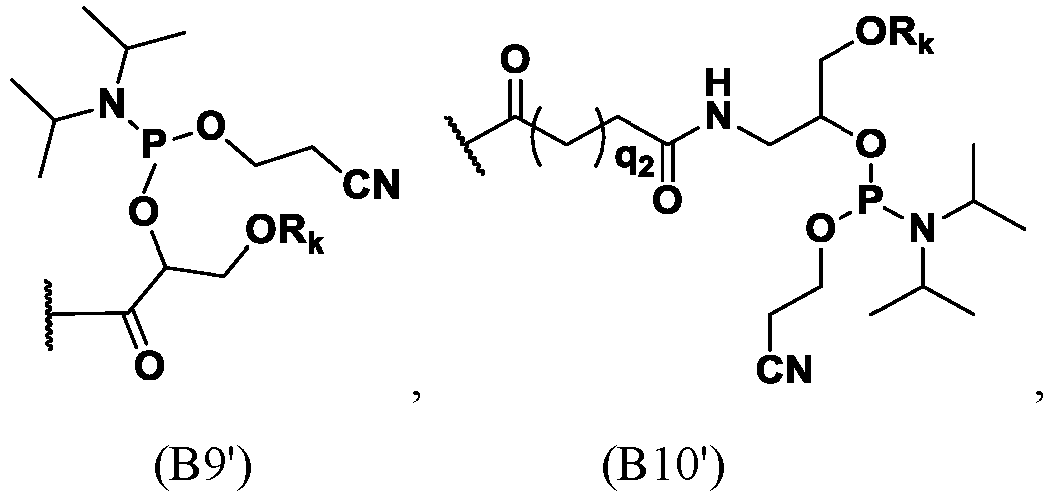

 represents the site there the group is covalently attached. In some embodiments, q1 is 1 or 2. In some embodiments, q2 is an integer of 1-5. In some embodiments, R4 comprises a group represented by Formula (B9) or (B10). In some embodiments, R4 comprises a group represented by Formula (B11) or (B12).
- In some embodiments, Rk is one or more of Tr (trityl), MMTr (4-methoxytrityl), DMTr (4,4'-dimethoxytrityl), and TMTr (4,4',4"-trimethoxytrityl). In some embodiments, Rk is DMTr.
- L1 is a linear alkylene of 1 to 70 carbon atoms in length, wherein one or more carbon atoms are optionally replaced with any one or more of the group consisting of: C(O), NH, O, S, CH=N, S(O)2, C2-C10 alkenylene, C2-C10 alkynylene, C6-C10 arylene, C3-C18 heterocyclylene, and C5-C10 heteroarylene, and wherein L1 is optionally substituted by any one or more of the group consisting of: C1-C10 alkyl, C6-C10 aryl, C5-C10 heteroaryl, C1-C10 haloalkyl, -OC1-C10 alkyl, -OC1-C10 alkylphenyl, -C1-C10 alkyl-OH, -OC1-C10 haloalkyl, -SC1-C10 alkyl, -SC1-C10 alkylphenyl, -C1-C10 alkyl-SH, -SC1-C10 haloalkyl, halo, -OH, -SH, -NH2, -C1-C10 alkyl-NH2, -N(C1-C10 alkyl)(C1-C10 alkyl), -NH(C1-C10 alkyl), -N(C1-C10 alkyl)(C1-C10 alkylphenyl), -NH(C1-C10 alkylphenyl), cyano, nitro, -CO2H, -C(O)OC1-C10 alkyl, -CON(C1-C10 alkyl)(C1-C10 alkyl), -CONH(C1-C10 alkyl), -CONH2, -NHC(O)(C1-C10 alkyl), -NHC(O)(phenyl), -N(C1-C10 alkyl)C(O)(C1-C10 alkyl), -N(C1-C10 alkyl)C(O)(phenyl), -C(O)C1-C10 alkyl, -C(O)C1-C10 alkylphenyl, -C(O)C1-C10 haloalkyl, -OC(O)C1-C10 alkyl, -SO2(C1-C10 alkyl), -SO2(phenyl), -SO2(C1-C10 haloalkyl), -SO2NH2, -SO2NH(C1-C10 alkyl), -SO2NH(phenyl), -NHSO2(C1-C10 alkyl), -NHSO2(phenyl), and -NHSO2(C1-C10 haloalkyl). A skilled one would understand that, though L1 is defined as a linear alkylene for convenience, but it may not be a linear group or be named differently, such as an amine or alkenyl as a result of the above replacement and/or substitution. For the purpose of the disclosure herein, the length of L1 is the atom number in the chain connecting the two attaching point. For this purpose, a ring resulted from replacement of a carbon atom of the linear alkylene, such as a heterocyclylene or heteroarylene, is counted as one atom.
- In some embodiments, L1 is used to link the M1 ligand (or the corresponding S1 group) to the N atom on the nitrogenous backbone, thereby providing liver targeting function for the conjugate of the disclosure. In some embodiments, L1 comprises any one of Formulae A1-A26, and any combinations thereof. In some embodiments, L1 is any one of A1, A4, A5, A6, A8, A10, A11, A13, and combinations thereof. In some embodiments, L1 is a combination of at least two of A1, A4, A8, A10, and A11; In some embodiments, L1 is a combination of at least two groups of A1, A8, and A10.
- In some embodiments, the length of L1 may be 3 to 25, 3 to 20, 4 to 15 or 5 to 12 atoms. In some embodiments, L1 is 3, 4, 5, 6, 7, 8, 9, 10, 11, 12, 13, 14, 15, 16, 17, 18, 19, 20, 21, 22, 23, 24, 25, 30, 35, 40, 45, 50, 55, 60 atoms in length.
- In some embodiments according to the present disclosure, therefore, j1 is an integer of 2-10, and in some embodiments is an integer of 3-5; j2 is an integer of 2-10, and in some embodiments is an integer of 3-5; R' is a C1-C4 alkyl, and in some embodiments is one of methyl, ethyl, and isopropyl. Ra is one of A27, A28, A29, A30, and A31, and in some embodiments is A27 or A28; Rb is a C1-C5 alkyl, and in some embodiments is one of methyl, ethyl, isopropyl, and butyl. In some embodiments, j1, j2, R', Ra, and Rb of A1-A26 are respectively selected to achieve the linkage between the M1 ligands and the N atom on the nitrogenous backbone in the oligonucleotide conjugate formed by the conjugating molecule, and to make the steric position among M1 ligands more suitable for binding M1 ligands to the asialoglycoprotein receptors on the surface of hepatocytes.
- Each M1 is independently selected from a ligand capable of binding to a cell surface receptor, wherein the receptor is an asialoglycoprotein receptor (ASGPR) on human hepatocytes.
- In some embodiments, M1 may be any one of the ligands that have affinity to the asialoglycoprotein receptors (ASGP-R) on the surface of mammalian hepatocytes. The types of these ligands are well known to those skilled in the art. In some embodiments, at least one of M1 is a saccharide. In some embodiments, each M1 is a saccharide. In some embodiments, at least one of M1 is a monosaccharide, disaccharide, trisaccharide or polysaccharide. In some embodiments, each M1 is a monosaccharide, disaccharide, trisaccharide or polysaccharide. In some embodiments, at least one of M1 is a modified saccharide. In some embodiments, each M1 is a modified saccharide. In some embodiments, each M1 is independently selected from polysaccharides, modified polysaccharides, monosaccharides or monosaccharide derivatives. In some embodiments, each or at least one M1 may be independently selected from a group consisting of glucose and its derivatives, mannose and its derivatives, galactose and its derivatives, xylose and its derivatives, ribose and its derivatives, fucose and its derivatives, lactose and its derivatives, maltose and its derivatives, arabinose and its derivatives, fructose and its derivatives, and sialic acid.
- In some embodiments, each or at least one M1 may be independently selected from a group consisting of D-mannopyranose, L-mannopyranose, D-arabinose, D-xylofuranose, L-xylofuranose, D-glucose, L-glucose, D-galactose, L-galactose, α-D-mannofuranose, β-D-mannofuranose, α-D-mannopyranose, β-D-mannopyranose, α-D-glucopyranose, β-D-glucopyranose, α-D-glucofuranose, β-D-glucofuranose, α-D-fructofuranose, α-D-fructopyranose, α-D-galactopyranose, β-D-galactopyranose, α-D-galactofuranose, β-D-galactofuranose, glucosamine, sialic acid, galactosamine, N-acetylgalactosamine, N-trifluoroacetylgalactosamine, N-propionylgalactosamine, N-n-butyrylgalactosamine, N-isobutyrylgalactosamine, 2-amino-3-O-[(R)-1-carboxyethyl]-2-deoxy-β-D-glucopyranose, 2-deoxy-2-methylamino-L-glucopyranose, 4,6-dideoxy-4-formamido-2,3-di-O-methyl-D-mannopyranose, 2-deoxy-2-sulfoamino-D-glucopyranose, N-glycolyl-α-neuraminic acid, 5-thio-β-D-glucopyranose, methyl 2,3,4-tris-O-acetyl-1-thio-6-O-trityl-α-D-glucopyranoside, 4-thio-β-D-galactopyranose, ethyl 3,4,6,7-tetra-O-acetyl-2-deoxy-1,5-dithio-α-D-glucoheptopyranoside, 2,5-anhydro-D-allononitrile, ribose, D-ribose, D-4-thioribose, L-ribose, L-4-thioribose. In some embodiments, at least one M1 is N-acetylgalactosamine (GalNAc). In some embodiments, each M1 is N-acetylgalactosamine (GalNAc). Ligand selection may be found, for example, in the disclosure of
CN105378082A . -
CN105378082A discloses a compound comprising a modified oligonucleotide and a conjugating group, wherein the conjugating group comprises at least one phosphorus linking group or neutral linking group, as well as one or more ligand(s). Each ligand is selected from the group consisting of polysaccharides, modified polysaccharides, mannose, galactose, mannose derivatives, galactose derivatives, D-mannopyranose, L-mannopyranose, D-arabinose, D-xylofuranose, L-xylofuranose, D-glucose, L-glucose, D-galactose, L-galactose, α-D-mannofuranose, β-D-mannofuranose, α-D-mannopyranose, β-D-mannopyranose, α-D-glucopyranose, β-D-glucopyranose, α-D-glucofuranose, β-D-glucofuranose, α-D-fructofuranose, α-D-fructopyranose, α-D-galactopyranose, β-D-galactopyranose, α-D-galactofuranose, β-D-galactofuranose, glucosamine, sialic acid, α-D-galactosamine, N-acetylgalactosamine, 2-amino-3-O-[(R)-1-carboxyethyl]-2-deoxy-β-D-glucopyranose, 2-deoxy-2-methylamino-L-glucopyranose, 4,6-dideoxy-4-formamido- 2,3-di-O-methyl-D-mannopyranose, 2-deoxy-2-sulfoamino-D-glucopyranose, N-glycolyl-α-neuraminic acid, 5-thio-β-D-glucopyranose, methyl 2,3,4-tris-O-acetyl-1-thio-6-O-trityl-α-D-glucopyranoside, 4-thio-β-D-galactopyranose, ethyl 3,4,6,7-tetra-O-acetyl-2-deoxy-1,5-dithio-α-D-glucoheptopyranoside, 2,5-anhydro-D-allononitrile, ribose, D-ribose, D-4-thioribose, L-ribose and L-4-thioribose. It is alleged that the compound can reduce the amount or activity of nucleic acid transcription in cells. -
WO2016077321A1 discloses a number of siRNAs specifically targeting HBV gene and delivery methods thereof, and the serum stability of the siRNAs is enhanced by modifying the nucleotides thereof. This document also discloses siRNA conjugates, and further specifically discloses several siRNA conjugates. -
WO2016168286A1 discloses a number of siRNAs specifically targeting ANGPTL3 gene and delivery methods thereof, and the serum stability of the siRNAs is enhanced by modifying the nucleotides thereof. This document also discloses siRNA conjugates. - N-acetylgalactosamine (GalNAc) is a ligand that binds to a hepatic surface asialoglycoprotein receptors (ASGPR). ASGPR is an endocytic receptor that is specifically expressed by hepatocytes. Recently, N-acetylgalactosamine (GalNAc) has been used as a targeting molecule to deliver small RNA drugs to liver. For example, Alnylam Pharmaceuticals, Inc. firstly reported that siRNAs based on GalNAc conjugation technology exert interference activity in mice (Nair et al., J. Am. Chem. Soc., 2014, 136, 16958-16961). The article reported that a siRNA conjugated to three clusters of GalNAc exhibits good delivery activity both in vitro and in vivo. Via in vivo experiments of mice administered subcutaneously, ED50 of a single dose was determined to be 1 mg/kg when a single injection dose was less than 1 ml. In long-term administration experiments, a stable interfering activity for up to 9 months allegedly may be obtained by subcutaneously injection once a week.
- According to the invention, S1 is independently an M1 where all active hydroxyl, if any, has been protected with a hydroxyl protecting group. In some embodiments, any hydroxyl protecting group known to a skilled one may be used to protect the active hydroxyl on M1. In some embodiments, the protected hydroxy is presented by the formula YCOO- wherein each Y is independently selected from the group consisting of C1-C10 alkyl and C6-C10 aryl, which is optionally substituted with one or more substituents selected from the group consisting of halo and C1-C6 alkyl. In some embodiments, each Y is independently selected from the group consisting of methyl, trifluoromethyl, difluoromethyl, monofluoromethyl, trichloromethyl, dichloromethyl, monochloromethyl, ethyl, n-propyl, isopropyl, phenyl, halophenyl, and C1-C6 alkylphenyl.
- In some embodiments, each S1 is independently selected from the group consisting of Formulae A46-A54:


- In some embodiments, S1 is A49 or A50. In some embodiments, Y is independently for each occurrence one of methyl, trifluoromethyl, difluoromethyl, monofluoromethyl, trichloromethyl, dichloromethyl, monochloromethyl, ethyl, n-propyl, isopropyl, phenyl, halophenyl, and alkylphenyl. In order to simplify the conjugating molecule of the disclosure, In some embodiments, Y is methyl.
- In some embodiments, the conjugating molecule of the present disclosure has a structure represented by Formula (403), (404), (405), (406), (407), (408), (409), (410), (411), (412), (413), (414), (415), (416), (417), (418), (419), (420), (421), or (422):


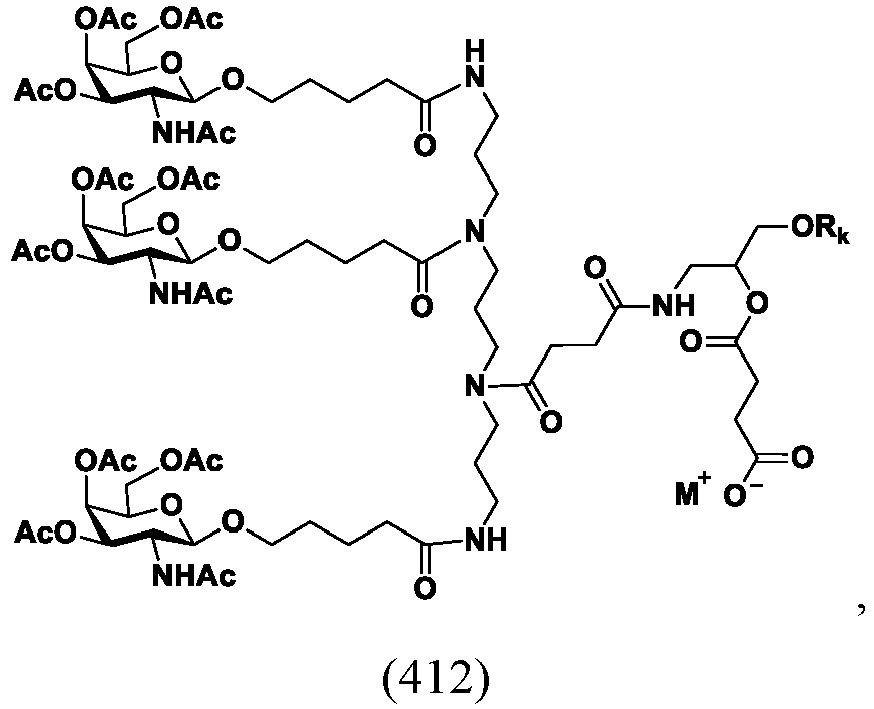


- In Formulae (403) to (422) above, X is O or NH, Rk is a hydroxy protecting group, and M+ is a metal cation, an ammonium cation, a cation formed from a tertary amine, or a quaternary ammonium cation. In some embodiments, M+ is

- In some embodiments, the conjugating molecule of the present disclosure has a structure represented by Formula (423), (424), (425), (426), (427), (428), (429), (430), (431), (432), (433), (434), (435), (436), (437), (438), (439), (440), (441), or (442):
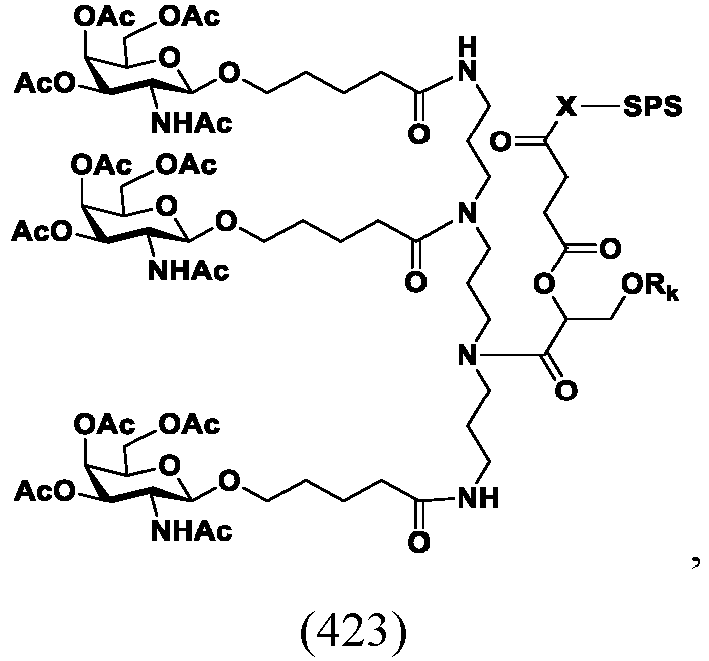


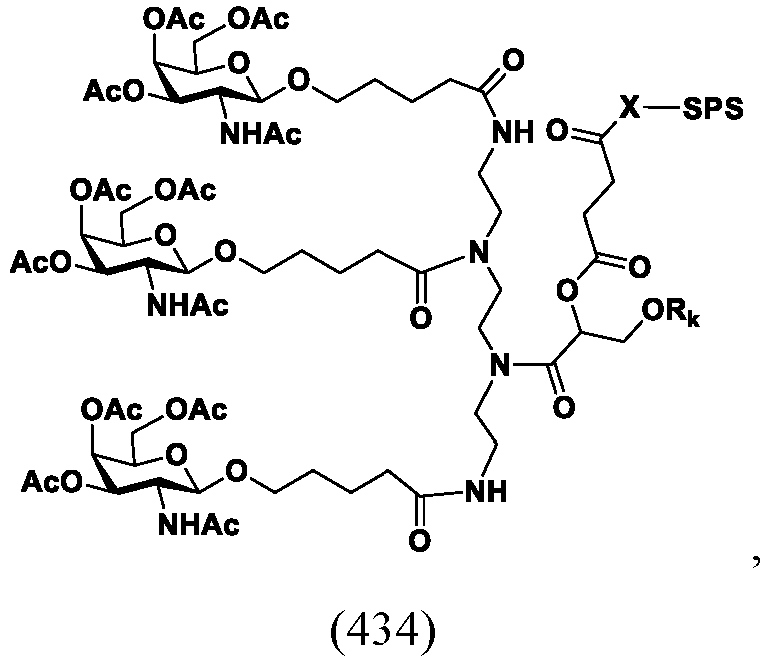


- In Formulae (423) to (442) above, X is O or NH, Rk is a hydroxy protecting group, and SPS represents a solid phase support.
- In some embodiments, the conjugating molecule of the present disclosure has a structure represented by Formula (503), (504), (505), (506), (507), (508), (509), (510), (511), (512), (513), (514), (515), (516), (517), (518), (519), (520), (521), or (522):


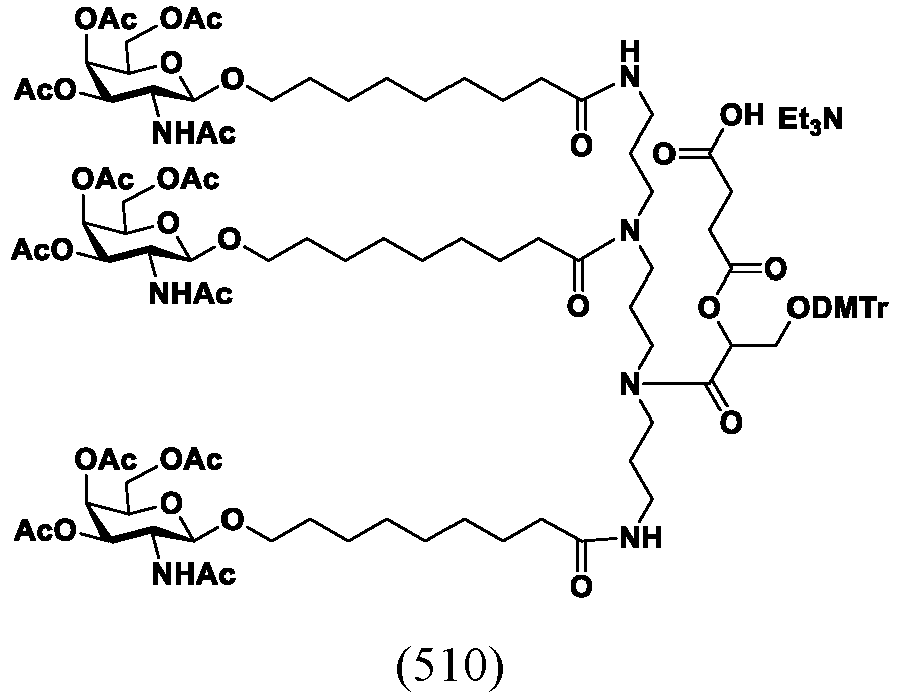


- In the above Formulae (503)-(522), DMTr represents 4,4'-dimethoxytrityl. Structure

- In some embodiments, the conjugating molecule of the present disclosure has a structure represented by Formula (523), (524), (525), (526), (527), (528), (529), (530), (531), (532), (533), (534), (535), (536), (537), (538), (539), (540), (541), or (542):

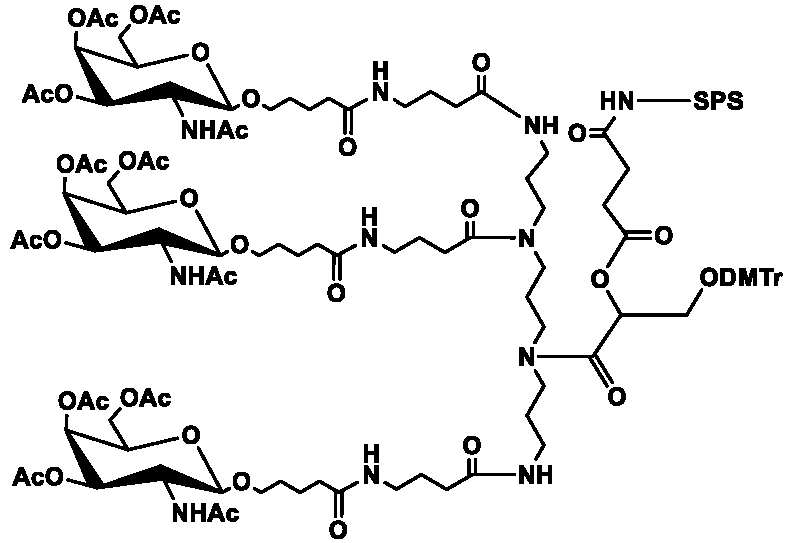


- In Formulae (523) to (542) above, SPS represents a solid phase support, and DMTr refers to a 4,4'-dimethoxytrityl.
- The conjugating molecule of the present disclosure may be prepared via any appropriate synthetic route by those skilled in the art.
- In some embodiments of the disclosure, the method for preparing the conjugating molecule represented by Formula (321) comprises contacting a compound represented by Formula (313) with a cyclic anhydride under the esterification reaction condition in the presence of a base and an esterification catalyst in an organic solvent; ion exchanging and isolating the compound represented by Formula (321):

- R6 is a group to provide R4 of Formula (321). In some embodiments, for example, R6 has a structure represented by Formula (A61):

- the definitions and options of n1, n3, m1, m2, m3, R10, R11, R12, R13, R14, R15, L1, S1 are respectively as described above; Ri is a group capable of linking to the N atom on the nitrogenous backbone, to RkO and to a free hydroxy group; Rk is a hydroxy protecting group. In this case, a compound represented by Formula (321) is obtained, where R4 comprises a hydroxy protecting group as the first functional group and a group represented by Formula (C1) or (C2) as the second functional group. In some embodiments, R6 is B7 or B8:
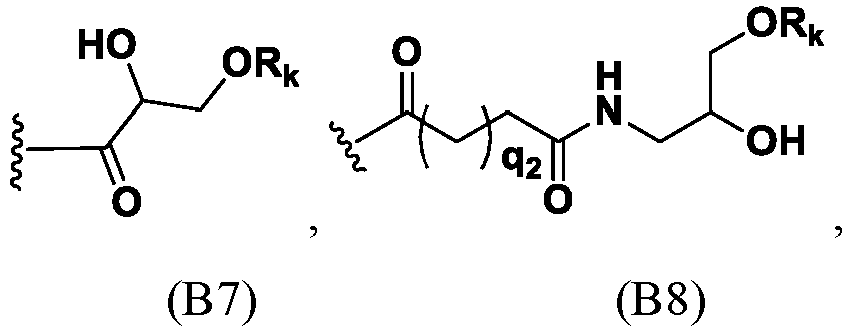
- wherein q2 and Rk are respectively as defined above.
- The esterification reaction condition includes a reaction temperature of 0-100 °C and a reaction time of 8-48 hours. In some embodiments, the esterification reaction condition comprises a reaction temperature of 10-40 °C and a reaction time of 20-30 hours.
- In some embodiments, the organic solvent comprises one or more of an epoxy solvent, an ether solvent, an haloalkane solvent, dimethyl sulfoxide, N,N-dimethylformamide, and N,N-diisopropylethylamine. In some embodiments, the epoxy solvent is dioxane and/or tetrahydrofuran. In some embodiments, the ether solvent is diethyl ether and/or methyl tert-butyl ether. In some embodiments, the haloalkane solvent is one or more of dichloromethane, trichloromethane and 1,2-dichloroethane. In some embodiments, the organic solvent is dichloromethane. The amount of the organic solvent is 3-50 L/mol, and In some embodiments, 5-20 L/mol with respect to the compound represented by Formula (313).
- In some embodiments, the cyclic anhydride is one of succinic anhydride, glutaric anhydride, adipic anhydride or pimelic anhydride. In some embodiments, the cyclic anhydride is succinic anhydride. The molar ratio of the cyclic anhydride to the compound represented by Formula (313) is 1:1 to 10:1, and in some embodiments is2:1 to 5:1.
- The esterification catalyst may be any catalyst capable of catalyzing the esterification, such as 4-dimethylaminopyridine. The molar ratio of the catalyst to the compound represented by Formula (313) is 1:1 to 10:1, and in some embodiments is 2:1 to 5:1.
- In some embodiments, the base may be any inorganic base, organic base or combination thereof. Regarding the solubility as well as the product stability, the base is a tertiary amine. In some embodiments, the tertiary amine is triethylamine or N,N-diisopropylethylamine The molar ratio of the tertiary amine to the compound represented by Formula (313) is 1:1 to 20:1, and in some embodiments is 3:1 to 10:1.
- The ion exchanging serves to convert the compound represented by Formula (321) to a desired form of carboxylic acid or salt thereof. For the method for ion exchanging, the conjugating molecule with the M+cation may be obtained by using suitable ion exchanging solution and ion exchanging condition, which is well known in the art. In some embodiments, a triethylamine phosphate solution is employed in the ion exchanging. In some embodiments, the concentration of the triethylamine phosphate solution is 0.2-0.8 M. In some embodiments, the concentration of the triethylamine phosphate solution is 0.4-0.6 M. In some embodiments, the amount of the triethylamine phosphate solution is 3-6 L/mol, and in further embodiment 4-5 L/mol with respect to the compound represented by Formula (313).
- The compound represented by Formula (321) may be isolated from the reaction mixture using any suitable methods. In some embodiments, the compound represented by Formula (321) may be isolated by removal of solvent via evaporation followed by chromatography, for example, using the following chromatographic conditions for the isolation: (1) normal phase purification: 200-300 mesh silica gel filler, with gradient elution of 1 wt‰ triethylamine-containing dichloromethane: methanol = 100:18-100:20; or (2) reverse phase purification: C18 and C8 reverse phase filler, with gradient elution of methanol:acetonitrile = 0.1:1-1:0.1. In some embodiments, the solvent may be removed directly to obtain a crude product of the compound represented by Formula (321), which may be used directly in subsequent reactions.
- In some embodiments, the preparation method of the compound represented by Formula (321) further comprises: contacting the product of the above ion exchanging with a solid phase support with amino or hydroxy groups under a condensation reaction condition in the presence of a condensing agent, a condensation catalyst, and a tertiary amine in an organic solvent. In this case, a compound represented by Formula (321) is obtained, wherein R4 comprises a hydroxy protecting group as the first functional group and a group represented by Formula (C1') as the second functional group.
- The solid phase support is one of the supports used in siRNA solid phase synthesis, some of which are well known to those skilled in the art. For example, the solid phase support may be selected from one having an active hydroxy or amino functional group. In some embodiments, the solid phase support is an amino or hydroxy resin. In some embodiments, the amino or hydroxy resin has a particle size of 100-400 mesh, and amino or hydroxy surface loading of 0.2-0.5 mmol/g. The ratio of the compound represented by Formula (321) to the solid phase support is 10 µmol compound per gram of solid phase support (µmol/g) to 400 µmol/g. In some embodiments, the ratio of compound of Formula (321) to the solid phase support is 50 µmol/g to 200 µmol/g.
- The organic solvent may be any suitable solvent of mixture of solvents known to the skilled ones suitable for the purpose disclosed herein. In some embodiments, the organic solvent is one or more of acetonitrile, an epoxy solvent, an ether solvent, an haloalkane solvent, dimethyl sulfoxide, N,N-dimethylformamide, and N,N-diisopropylethylamine. In some embodiments, the epoxy solvent is dioxane and/or tetrahydrofuran, the ether solvent is diethyl ether and/or methyl tert-butyl ether, the haloalkane solvent is one or more of dichloromethane, trichloromethane and 1,2-dichloroethane. In some embodiments, the organic solvent is acetonitrile. The amount of the organic solvent is 20-200 L/mol, in some embodiments is 50-100 L/mol with respect to the compound represented by Formula (313).
- In some embodiments, the condensing agent may be benzotriazol-1-yl-oxytripyrrolidinophosphonium hexafluorophosphate, 3-diethoxyphosphoryl- 1,2,3-benzotriazol-4(3H)-one and/or O-benzotriazol-tetramethyluronium hexafluorophosphate. In some embodiments, the condensing agent is O-benzotriazol- tetramethyluronium hexafluorophosphate. The molar ratio of the condensing agent to the compound represented by Formula (313) is 1:1 to 20:1, and in further embodiments, 1:1 to 5:1.
- In some embodiments, the tertiary amine is triethylamine and/or N,N-diisopropylethylamine, and in some embodiments is N,N-diisopropylethylamine. The molar ratio of the tertiary amine to the compound represented by Formula (313) is 1:1 to 20:1, and in some embodiments is 1:1 to 5:1.
- In some embodiments, the method for preparing the compound represented by Formula (321) further comprises: contacting the obtained product of condensation reaction with a capping reagent and an acylation catalyst under a capping reaction condition in an organic solvent, and isolating the compound represented by Formula (321). The capping reaction is used to remove any active functional groups that are not reacted, so as to avoid unnecessary by-products in subsequent reactions. The capping reaction condition comprises a reaction temperature of 0-50 °C, and in some embodiments of 15-35 °C, and a reaction time of 1-10 hours, and in some embodiments, of 3-6 hours. The capping reagent may be the ones used in siRNA solid phase synthesis, which are well known to those skilled in the art. In some embodiments, the capping reagent is composed of capping reagent A (capA) and capping reagent B (capB). The capA is N-methylimidazole, and in some embodiments provided as a solution of N-methylimidazole in a mixture solvent of pyridine/acetonitrile, wherein the volume ratio of pyridine to acetonitrile is 1:10 to 1:1, and in some embodiments is 1:3 to 1:1. In some embodiments, the ratio of the total volume of pyridine and acetonitrile to the volume of N-methylimidazole is 1:1 to 10:1, and in some embodiments is 3:1 to 7:1. In some embodiments, the capping reagent B is acetic anhydride. In some embodiments, the capping reagent B is provided as a solution of acetic anhydride in acetonitrile solvent, wherein the volume ratio of acetic anhydride to acetonitrile is 1:1 to 1:10, and in further embodiments is 1:2 to 1:6.
- In some embodiments, the ratio of the volume of the solution of N-methylimidazole in a mixture solvent of pyridine/acetonitrile to the mass of the compound of Formula (313) is 5 ml/g-50 ml/g, and in some embodiments is 15ml/g-30ml/g. The ratio of the volume of the solution of acetic anhydride in acetonitrile to the mass of the compound of Formula (313) is 0.5 ml/g-10 ml/g, and in some embodiments is 1 ml/g-5 ml/g.
- In some embodiments, the capping reagent is equimolar acetic anhydride and N-methylimidazole. In some embodiments, the organic solvent is one or more of acetonitrile, an epoxy solvent, an ether solvent, an haloalkane solvent, dimethyl sulfoxide, N,N-dimethylformamide, and N,N-diisopropylethylamine. In some embodiments, the organic solvent is acetonitrile. In some embodiments, the amount of the organic solvent is 10-50 L/mol, and in some embodiments 5-30 L/mol with respect to the compound represented by Formula (313).
- In some embodiments, the acylation catalyst may be selected from any catalyst that may be used for esterification or amidation, such as alkaline heterocyclic compounds. In some embodiments, the acylation catalyst is 4-dimethylaminopyridine. The ratio of the mass of the catalyst to the mass of the compound represented by Formula (313) may be 0.001:1 to 1:1, and in some embodiments is 0.01:1 to 0.1:1.
- In some embodiments, the compound represented by Formula (321) may be isolated from the reaction mixture by any suitable methods. In some embodiments, the compound of Formula (321) may be obtained by sufficiently washing with an organic solvent and filtering to remove unreacted reactants, excess capping reagent and other impurities, wherein the organic solvent is selected from acetonitrile, dichloromethane, or methanol. In some embodiments, the organic solvent is acetonitrile.
- In some embodiments, the preparation of the conjugating molecule represented by Formula (321) comprises contacting a compound represented by Formula (313) with a phosphorodiamidite under a coupling reaction condition in the presence of a coupling agent in an organic solvent, and isolating the compound represented by Formula (321). In this case, a compound represented by Formula (321) is obtained, where R4 comprises a hydroxy protecting group as the first functional group and a group represented by Formula (C3) as the second functional group.
- In some embodiments, the coupling reaction condition comprises a reaction temperature of 0-50°C, such as 15-35°C. The molar ratio of the compound of Formula (322) to the phosphorodiamidite may be 1:1 to 1:50, such as 1:5 to 1:15. The molar ratio of the compound of Formula (313) to the coupling agent may be 1:1 to 1:100, such as 1:50 to 1:80. The reaction time may be 200-3000 seconds, preferably 500-1500 seconds. The phosphorodiamidite may be such as 2-cyanoethyl N,N,N',N'-tetraisopropylphosphorodiamidite, and may be commercially available or prepared according to methods well-known in the art. The coupling agent is selected from one or more of 1H-tetrazole, 5-ethylthio-1H-tetrazole and 5-benzylthio-1H-tetrazole, such as 5-ethylthio-1H-tetrazole. The coupling reaction may be performed in an organic solvent. In some embodiments, the organic solvent is selected from one or more of anhydrous acetonitrile, anhydrous DMF and anhydrous dichloromethane, preferably anhydrous acetonitrile. The amount of the organic solvent may be 3-50 L/mol, such as 5-20 L/mol with respect to the compound represented by Formula (313). Via the coupling reaction, the hydroxy group in the compound (313) reacts with the phosphorodiamidite to form a phosphoramidite group. In some embodiments, the solvent may be removed directly to obtain a crude product of the compound represented by Formula (321), which may be used directly in subsequent reactions.
- In some embodiments, the preparation method of the compound represented by Formula (321) further comprises: contacting the isolated product with a solid phase support with hydroxy groups under a coupling reaction condition in the presence of a coupling agent in an organic solvent, followed by capping, oxidation, and isolation to obtain the compound represented by Formula (321), where R4 comprises a hydroxy protecting group as the first functional group and a group represented by Formula (C3') as the second functional group.
- In some embodiments, the solid phase support is a support used in nucleic acid solid phase synthesis, such as a deprotected universal solid phase support, which is commercially available (such as NittoPhase®HL UnyLinker™ 300 Oligonucleotide Synthesis Support, Kinovate Life Sciences, represented by Formula B80):

- A deprotection reaction is well known in the art. In some embodiments, the deprotection condition comprises a temperature of 0-50°C, such as 15-35°C, and a reaction time of 30-300 seconds, such as 50-150 seconds. The deprotection agent may be selected from one or more of trifluoroacetic acid, trichloroacetic acid, dichloroacetic acid, and monochloroacetic acid. In some embodiments, the deprotection agent is dichloroacetic acid. The molar ratio of the deprotection agent to the protecting group -DMTr (4,4'-dimethoxytrityl) on the solid phase support may be 2:1 to 100:1, such as 3:1 to 50:1. Via such deprotection, reactive free hydroxy groups are obtained on the surface of the solid phase support, thus being available for the consequent coupling reaction.
- The coupling reaction condition and the coupling agent may be selected as above. Via such coupling, the free hydroxy groups formed in the deprotection react with the phosphoramidite groups, so as to form a phosphite ester linkage.
- In some embodiments, the capping reaction condition comprises a temperature of 0-50 °C, such as 15-35 °C, and a reaction time of 5-500 seconds, such as 10-100 seconds. The capping agent and the amount thereof may be selected as above.
- The oxidation reaction condition may comprise a temperature of 0-50 °C, such as 15-35 °C, and a reaction time of 1-100 seconds, such as 5-50 seconds. The oxidation agent may be, for example, iodine (in some embodiments, provided as iodine water). In some embodiments, the molar ratio of the oxidation agent to the nucleic acid sequence linked to the solid phase support in the coupling step is 1:1 to 100:1, preferably 5:1 to 50:1. In some embodiments, the oxidation reaction is performed in a mixed solvent of tetrahydrofuran: water: pyridine = 3:1:1-1:1:3.
- In some embodiments, R6 is B7 or B8. In this case, the compound shown in the Formula (313) may be obtained by contacting the compound represented by Formula (314) with a compound represented by Formula (A-1) or (A-2) under an amidation reaction condition in the presence of an condensing agent for amidation reaction and a tertiary amine, in an organic solvent, and followed by isolation:


- The amidation reaction condition may comprise a reaction temperature of 0-100 °C and a reaction time of 1-48 hours. In some embodiments, the amidation reaction condition is a reaction temperature of 10-40 °C and a reaction time of 2-16 hours.
- In some embodiments, the organic solvent is one or more of an alcohol solvent, an epoxy solvent, an ether solvent, an haloalkane solvent, dimethyl sulfoxide, N,N-dimethylformamide, and N,N-diisopropylethylamine. In some embodiments, the alcohol solvent is one or more of methanol, ethanol and propanol, and in further embodiments is ethanol. In some embodiments, the epoxy solvent is dioxane and/or tetrahydrofuran. In some embodiments, the ether solvent is diethyl ether and/or methyl tert-butyl ether. In some embodiments, the haloalkane solvent is one or more of dichloromethane, trichloromethane and 1,2-dichloroethane. In some embodiments, the organic solvent is dichloromethane. The amount of the organic solvent is 3-50 L/mol, and in further embodiments 3-20 L/mol with respect to the compound represented by Formula (314).
- In some embodiments, the condensing agent for amidation reaction is benzotriazol-1-yl-oxytripyrrolidinophosphonium hexafluorophosphate, 3-(diethoxyphosphoryloxy)-1,2,3-benzotrizin-4(3H)-one, 4-(4,6-dimethoxytriazin-2-yl)-4-methylmorpholine hydrochloride, 2-ethoxy-1-ethoxycarbonyl-1,2-dihydroquinoline (EEDQ) or O-benzotriazol-tetramethyluronium hexafluorophosphate, and in further embodiments is 3-(diethoxyphosphoryloxy)-1,2,3-benzotrizin-4(3H)-one. The molar ratio of the condensing agent for amidation reaction to the compound represented by Formula (314) may be 1:1 to 10:1, and in some embodiments is 2.5:1 to 5:1.
- In some embodiments, the tertiary amine is triethylamine or N,N-diisopropylethylamine, and in further embodiments is N,N-diisopropylethylamine. The molar ratio of the tertiary amine to the compound represented by Formula (314) may be 3:1 to 20:1, and in some embodiments is 5:1 to 10:1.
- In some embodiments, the compounds of Formula (A-1) and (A-2) may be prepared by any suitable means. For example, the compound of Formula (A-1) may be prepared by reacting calcium glycerate with DMTrCl wherein Rk is a DMTr group. Similarly, the compound of Formula (A-2) may be prepared by firstly contacting 3-amino-1,2-propanediol with a cyclic anhydride which may have 4-13 carbon atoms, and in some embodiments 4-8 carbon atoms, followed by reacting with DMTrCl. It will be readily understood by those skilled in the art that the selection of different cyclic anhydride corresponds to different values for q2 in the compound of Formula (A-2). For example, when the cyclic anhydride is succinic anhydride, q2=1; when the cyclic anhydride is glutaric anhydride, q2=2, and so on.
- In some variations, the compound of Formula (313) can also be prepared by successively reacting the compound represented by Formula (314) with the cyclic anhydride, 3-amino-1,2-propanediol, and DMTrCl. It will be readily understood by those skilled in the art that these variations would not affect the structure and functions of the compound of Formula (313), and these variations are readily achieved by those skilled in the art on the basis of the above methods.
- Similarly, the compound represented by Formula (313) may be isolated from the reaction mixture by any suitable isolation methods. In some embodiments, the compound represented by Formula (313) may be isolated by removal of solvent via evaporation followed by chromatography. For example, the following two sets of chromatographic conditions may be employed for the isolation, (1) normal phase purification: 200-300 mesh silica gel filler, with gradient elution of petroleum ether: ethyl acetate: dichloromethane: N,N-dimethylformamide = 1:1:1:0.5-1:1:1:0.6; and (2) reverse phase purification: C18 and C8 reverse phase fillers, with gradient elution of methanol: acetonitrile = 0.1:1-1:0.1. In some embodiments, the solvent may be removed directly to obtain a crude product of the compound represented by Formula (313), which may be directly used in subsequent reactions.
- In some embodiments, the compound represented by Formula (314) may be obtained by contacting the compound represented by Formula (315) with haloacetic acid under a deprotection reaction condition in an organic solvent, and followed up by isolation:


- The haloacetic acid may be selected from one or more of dichloroacetic acid, trichloroacetic acid, monochloroacetic acid and trifluoroacetic acid, and in some embodiments is dichloroacetic acid.
- The deprotection reaction condition may comprise a reaction temperature of 0-100 °C and a reaction time of 0.1-24 hours, and in some embodiments comprises a reaction temperature of 10-40 °C and a reaction time of 0.5-16 hours.
- In some embodiments, the organic solvent is one or more of an epoxy solvent, an ether solvent, an haloalkane solvent, dimethyl sulfoxide, N,N-dimethylformamide, and N,N-diisopropylethylamine. In some embodiments, the epoxy solvent is dioxane and/or tetrahydrofuran. In some embodiments, the ether solvent is diethyl ether and/or methyl tert-butyl ether. In some embodiments, the haloalkane solvent is one or more of dichloromethane, trichloromethane and 1,2-dichloroethane. In some embodiments, the organic solvent is dichloromethane. The amount of the organic solvent is 3-50 L/mol, and in further embodiments 5-20 L/mol with respect to the compound represented by Formula (315).
- The molar ratio of the haloacetic acid to the compound represented by Formula (315) may be 5:1 to 100:1, and in some embodiments is 10:1 to 50:1.
- Similarly, the compound represented by Formula (314) may be isolated from the reaction mixture by any suitable isolation methods. In some embodiments, the compound represented by Formula (314) may be isolated by removal of solvent via evaporation followed by chromatography, for example, using the following two sets of chromatographic conditions for the isolation, (1) normal phase purification: 200-300 mesh silica gel filler, with gradient elution of dichloromethane: methanol = 100:30-100:40; and (2) reverse phase purification: C18 and C8 reverse phase fillers, with gradient elution of methanol: acetonitrile = 0.1:1-1:0.1. In some embodiments, the solvent may be removed directly to obtain a crude product of the compound represented by Formula (314), which may be directly used in subsequent reactions.
- The compound represented by Formula (315) may be obtained by contacting the compound represented by Formula (317) with the compound represented by Formula (316) under a condensation reaction condition in the presence of an condensing agent for amidation reaction and a tertiary amine, in an organic solvent, and followed by isolation:
S1-L1-COOH Formula (316)

- Regarding the compound of Formula (316), compounds such as those disclosed in J. Am. Chem. Soc. 2014, 136, 16958-16961 may be employed. Alternatively, compounds of Formula (316) may be prepared by the skilled in the art via various methods. For example, some compounds of Formula (316) may be prepared according to the disclosure in Example 1 of US patent 8,106,022 B2.
- In some embodiments, the condensation reaction condition comprises a reaction temperature of 0-100 °C and a reaction time of 0.1-24 hours. In some embodiments, the reaction temperature is 10-40 °C and the reaction time is 0.5-16 hours.
- The molar ratio of the compound represented by Formula (316) to the compound represented by Formula (317) may be 2:1 to 10:1, and in some embodiments is 2.5:1 to 5:1.
- In some embodiments, the organic solvent is one or more of acetonitrile, an epoxy solvent, an ether solvent, an haloalkane solvent, dimethyl sulfoxide, N,N-dimethylformamide and N,N-diisopropylethylamine. In some embodiments, the epoxy solvent is dioxane and/or tetrahydrofuran. In some embodiments, the ether solvent is diethyl ether and/or methyl tert-butyl ether. In some embodiments, the haloalkane solvent is one or more of dichloromethane, trichloromethane and 1,2-dichloroethane. In some embodiments, the organic solvent is acetonitrile. The amount of the organic solvent may be 3-50 L/mol, and in some embodiments is 5-20 L/mol with respect to the compound represented by Formula (317).
- In some embodiments, the condensing agent for amidation reaction is benzotriazol-1-yl-oxytripyrrolidinophosphonium hexafluorophosphate, 3-(diethoxyphosphoryloxy)-1,2,3-benzotrizin-4(3H)-one (DEPBT), O-benzotriazol-tetramethyluronium hexafluorophosphate or 4-(4,6-dimethoxytriazin-2-yl)-4-methylmorpholine hydrochloride, and in further embodiments may be 4-(4,6-dimethoxytriazin-2-yl)-4-methylmorpholine hydrochloride. The molar ratio of the condensing agent for amidation reaction to the compound represented by Formula (317) may be 2:1 to 10:1, and in some embodiments is 2.5:1 to 5:1.
- The tertiary amine may be N-methylmorpholine, triethylamine or N,N-diisopropylethylamine, and in some embodiments is N-methylmorpholine. The molar ratio of the tertiary amine to the compound represented by Formula (317) may be 3:1 to 20:1, and in some embodiments is 5:1 to 10:1.
- Similarly, the compound represented by Formula (315) may be isolated from the reaction mixture by any suitable isolation methods. In some embodiments, the compound represented by Formula (315) is isolated by removal of solvent via evaporation followed by chromatography, for example, using the following two sets of chromatographic conditions for the isolation, (1) normal phase purification: 200-300 mesh silica gel filler, with gradient elution of dichloromethane: methanol = 100:5-100:7; (2) reverse phase purification: C18 and C8 reverse phase fillers, with gradient elution of methanol: acetonitrile = 0.1:1-1:0.1. In some embodiments, the solvent is removed directly to obtain a crude product of the compound represented by Formula (315), which may be used directly in subsequent reactions.
- In some embodiments, the compound of Formula (317) is reacted with a sufficient amount of one compound of Formula (316) in one batch to obtain the desired compound of Formula (315) having identical S1-L1 moieties. In some embodiments, the compound of Formula (317) is reacted in batches with different compounds of Formula (316), i.e., the compounds of Formula (316) having different L1 and/or S1, as desired, so as to obtain the compound of Formula (315) having two or more types of S1 and/or L1 therein. For example, 1 eq of the compound of Formula (317) may be firstly contacted with 2 eq of a first compound of Formula (316) to attach a first S1-L1 moieties to the two terminal primary amine groups in the compound of Formula (317), and then contacted with the (n3+n1-1) eq of a second compound of Formula (316) to attach a second S1-L1 moieties to the (n3+n1-1) secondary amine groups (wherein the definition and scope of n3 and n1 are as defined above) in the compound of Formula (317).
- In some embodiments, the compound represented by Formula (317) may be obtained by contacting the compound represented by Formula (318) with methylamine aqueous solution under a deprotection reaction condition in the presence of an organic solvent, and follow by isolation:

- The deprotection reaction condition may comprise a reaction temperature of 0-150 °C and a reaction time of 5-72 hours, and in some embodiments comprises a reaction temperature of 20-80 °C and a reaction time of 10-30 hours.
- The organic solvent may be selected from alcohols, in some embodiments is one of methanol, ethanol and isopropanol, and in further embodiments is methanol. The amount of the organic solvent may be 1-20 L/mol, and in some embodiments is 1.5-10 L/mol with respect to the compound represented by Formula (318).
- The concentration of the methylamine aqueous solution may be 30%-40% by mass, and the molar ratio of methylamine to the compound represented by Formula (318) may be 10:1 to 500:1, and in some embodiments is 50:1 to 200:1.
- Similarly, the compound represented by Formula (317) may be isolated from the reaction mixture using any suitable isolation methods. In some embodiments, the compound represented by Formula (317) may be isolated by removal of solvent via evaporation followed by chromatography, for example, using the following two sets of chromatographic conditions for the isolation, (1) normal phase purification: 200-300 mesh silica gel filler, with gradient elution of dichloromethane: methanol: aqueous ammonia (25 wt%) = 1:1:0.05-1:1:0.25; and (2) reverse phase purification: C18 and C8 reverse phase fillers, with gradient elution of methanol: acetonitrile = 0.1:1-1:0.1. In some embodiments, the solvent may be removed directly to obtain a crude product of the compound represented by Formula (317), which may be used directly in subsequent reactions.
- The compound represented by Formula (318) may be obtained by contacting the compound represented by Formula (319) with triphenylchloromethane (TrCl), diphenylethylphenylchloromethane, phenyldiethylphenylchloromethane or triethylphenylchloromethane, and in some embodiments with triphenylchloromethane (TrCl) under a substitution reaction condition in the presence of an organic solvent, and followed by isolation:

- The substitution reaction condition may comprise a reaction temperature of 0-100 °C and a reaction time of 5-72 hours, and in some embodiments comprises a reaction temperature of 10-40 °C and a reaction time of 10-30 hours.
- Triphenylchloromethane (TrCl), diphenylethylphenylchloromethane, phenyldiethylphenylchloromethane or triethylphenylchloromethane are commercially available. The molar ratio of triphenylchloromethane (TrCl), diphenylethylphenylchloromethane, phenyldiethylphenylchloromethane or triethylphenylchloromethane to the compound represented by Formula (319) may be 1:1 to 10:1, and in some embodiments is 1:1 to 3:1.
- The organic solvent may be one or more of an epoxy solvent, an ether solvent, an haloalkane solvent, dimethyl sulfoxide, N,N-dimethylformamide, and N,N-diisopropylethylamine. In some embodiments, the epoxy solvent is dioxane and/or tetrahydrofuran. In some embodiments, the ether solvent is diethyl ether and/or methyl tert-butyl ether. In some embodiments, the haloalkane solvent is one or more of dichloromethane, trichloromethane and 1,2-dichloroethane. In some embodiments, the organic solvent is dichloromethane. The amount of the organic solvent may be 3-50 L/mol, and in some embodiments is 5-20 L/mol with respect to the compound represented by Formula (319).
- Similarly, the compound represented by Formula (318) may be isolated from the reaction mixture by any suitable isolation methods. In some embodiments, the compound represented by Formula (318) may be isolated by removal of solvent via evaporation followed by chromatography, for example, using the following two sets of chromatographic conditions for the isolation, (1) normal phase purification: 200-300 mesh silica gel filler, with gradient elution of methanol: dichloromethane = 0.01:1-0.5:1 or gradient elution of methanol: dichloromethane: ethyl acetate: petroleum ether = 0.1:1:1:1-1:1:1:1; and (2) reverse phase purification: C18 and C8 reverse phase fillers, with gradient elution of methanol: acetonitrile = 0.1:1-1:0.1. In some embodiments, the solvent may be removed directly to obtain a crude product of the compound represented by Formula (318), which may be used directly in subsequent reactions.
- In some embodiments, the compound represented by Formula (319) may be obtained by contacting the compound represented by Formula (320) with ethyl trifluoroacetate under a substitution reaction condition in an organic solvent, and followed by isolation:

- In some embodiments, the organic solvent is one or more of acetonitrile, an epoxy solvent, an ether solvent, an haloalkane solvent, dimethyl sulfoxide, N,N-dimethylformamide, and N,N-diisopropylethylamine. In some embodiments, the epoxy solvent is dioxane and/or tetrahydrofuran. In some embodiments, the ether solvent is diethyl ether and/or methyl tert-butyl ether. In some embodiments, the haloalkane solvent is one or more of dichloromethane, trichloromethane and 1,2-dichloroethane. In some embodiments, the organic solvent is acetonitrile. The amount of the organic solvent may be 1-50 L/mol, and in some embodiments is 1-20 L/mol with respect to the compound represented by Formula (320).
- The substitution reaction condition may comprise a reaction temperature of 0-100 °C and a reaction time of 5-72 hours, and in some embodiments comprises a reaction temperature of 10-40 °C and a reaction time of 10-30 hours.
- The compound represented by Formula (320) may be commercially purchased, or obtained via methods known to the skilled in the art. For example, in the case that m1=m2=m3=3, n1=1, n3=2, whi le each of R10, R11, R12, R13, R14 and R15 is H, the compound represented by Formula (320) is available from Alfa Aesar Inc..
- The molar ratio of ethyl trifluoroacetate to the compound represented by Formula (320) may be 2:1 to 10:1, and in some embodiments is 3:1 to 5:1.
- Similarly, the compound represented by Formula (319) may be isolated from the reaction mixture using any suitable isolation methods. In some embodiments, the compound represented by Formula (319) may be isolated by removal of solvent via evaporation followed by chromatography, for example, using the following two sets of chromatographic conditions for the isolation, (1) normal phase purification: 200-300 mesh silica gel filler, with gradient elution of methanol: dichloromethane = 0.01:1-0.5:1 or gradient elution of methanol: dichloromethane: ethyl acetate: petroleum ether = 0.1:1:1:1-1:1:1:1; and (2) reverse phase purification: C18 and C8 reverse phase fillers, with gradient elution of methanol: acetonitrile = 0.1:1-1:0.1. In some embodiments, the solvent may be removed directly to obtain a crude product of the compound represented by Formula (319), which may be used directly in subsequent reactions.
- In another aspect, provided herein is a conjugate having a structure represented by Formula (1):

- n1 is an integer of 1-3, and n3 is an integer of 0-4;
- each of m1, m2, and m3 is independently an integer of 2-10;
- each of R10, R11, R12, R13, R14 and R15 is independently selected from H, C1-C10 alkyl, C1-C10 haloalkyl, and C1-C10 alkoxy, and in some embodiments, is independently H, methyl, or ethyl;
- R3 is an active drug, in some embodiments comprises a functional oligonucleotide;
- R2 is a linear alkylene of 1 to 20 carbon atoms in length, wherein one or more carbon atoms are optionally replaced with any one or more of the group consisting of: C(O), NH, O, S, CH=N, S(O)2, C2-C10 alkeylene, C2-C10 alkynylene, C6-C10 arylene, C3-C18 heterocyclylene, and C5-C10 heteroarylene, and wherein R2 is optionally substituted by any one or more of the group consisting of: C1-C10 alkyl, C6-C10 aryl, C5-C10 heteroaryl, C1-C10 haloalkyl, -OC1-C10 alkyl, -OC1-C10 alkylphenyl, -C1-C10 alkyl-OH, -OC1-C10 haloalkyl, -SC1-C10 alkyl, -SC1-C10 alkylphenyl, -C1-C10 alkyl-SH, -SC1-C10 haloalkyl, halo, -OH, -SH, -NH2, -C1-C10 alkyl-NH2, -N(C1-C10 alkyl)(C1-C10 alkyl), -NH(C1-C10 alkyl), -N(C1-C10 alkyl)(C1-C10 alkylphenyl), -NH(C1-C10 alkylphenyl), cyano, nitro, -CO2H, -C(O)OC1-C10 alkyl, -CON(C1-C10 alkyl)(C1-C10 alkyl), -CONH(C1-C10 alkyl), -CONH2, -NHC(O)(C1-C10 alkyl), -NHC(O)(phenyl), -N(C1-C10 alkyl)C(O)(C1-C10 alkyl), -N(C1-C10 alkyl)C(O)(phenyl), -C(O)C1-C10 alkyl, -C(O)C1-C10 alkylphenyl, -C(O)C1-C10 haloalkyl, -OC(O)C1-C10 alkyl, -SO2(C1-C10 alkyl), -SO2(phenyl), -SO2(C1-C10 haloalkyl), -SO2NH2, -SO2NH(C1-C10 alkyl), -SO2NH(phenyl), -NHSO2(C1-C10 alkyl), -NHSO2(phenyl), and -NHSO2(C1-C10 haloalkyl); each L1 is independently a linear alkylene of 1 to 70 carbon atoms in length, wherein one or more carbon atoms are optionally replaced with any one or more of the group consisting of: C(O), NH, O, S, CH=N, S(O)2, C2-C10 alkeylene, C2-C10 alkynylene, C6-C10 arylene, C3-C18 heterocyclylene, and C5-C10 heteroarylene, and wherein L1 is optionally substituted by any one or more of the group consisting of: C1-C10 alkyl, C6-C10 aryl, C5-C10 heteroaryl, C1-C10 haloalkyl, -OC1-C10 alkyl, -OC1-C10 alkylphenyl, -C1-C10 alkyl-OH, -OC1-C10 haloalkyl, -SC1-C10 alkyl, -SC1-C10 alkylphenyl, -C1-C10 alkyl-SH, -SC1-C10 haloalkyl, halo, -OH, -SH, -NH2, -C1-C10 alkyl-NH2, -N(C1-C10 alkyl)(C1-C10 alkyl), -NH(C1-C10 alkyl), -N(C1-C10 alkyl)(C1-C10 alkylphenyl), -NH(C1-C10 alkylphenyl), cyano, nitro, -CO2H, -C(O)OC1-C10 alkyl, -CON(C1-C10 alkyl)(C1-C10 alkyl), -CONH(C1-C10 alkyl), -CONH2, -NHC(O)(C1-C10 alkyl), -NHC(O)(phenyl), -N(C1-C10 alkyl)C(O)(C1-C10 alkyl), -N(C1-C10 alkyl)C(O)(phenyl), -C(O)C1-C10 alkyl, -C(O)C1-C10 alkylphenyl, -C(O)C1-C10 haloalkyl, -OC(O)C1-C10 alkyl, -SO2(C1-C10 alkyl), -SO2(phenyl), -SO2(C1-C10 haloalkyl), -SO2NH2, -SO2NH(C1-C10 alkyl), -SO2NH(phenyl), -NHSO2(C1-C10 alkyl), -NHSO2(phenyl), and -NHSO2(C1-C10 haloalkyl), and in some embodiments, L1 may be selected from the group consisting of A1-A26 or any combinations thereof, wherein the structures and definitions of A1-A26 are shown above;
- n1, n3, m1, m2, m3, R10, R11, R12, R13, R14, R15 and M1 are as defined above.
- In some embodiments, R2 is a linking group formed by linking R4 group in the compound of Formula (321) to the active drug via reaction. In some embodiments, R2 is a linking group formed by linking R4 group in the compound of Formula (321) to the functional oligonucleotide via reaction. In some embodiments, R2 group has both a site linking to the N atom on the nitrogenous backbone and a site linking to the P atom in R3. In some embodiments, in R2, the site linking to the N atom on the nitrogenous backbone forms an amide bond with the N atom, and the site linking to the P atom in R3 forms a phosphoester bond with the P atom. In some embodiments, R2 is B5, B6, B5' or B6':

 represents the site where the groups are covalently linked; the selections and ranges of q2 are as described above.
- In some embodiments, R3 is a group having the structure represented by Formula A59:

- In the context of the disclosure, unless otherwise stated, a "conjugating" group or molecule refers to a group or molecule which is capable of forming a covalent linkage to appropriate partner thereof, and both the conjugating group or molecule and its partner have specific functions. Correspondingly, a "conjugate" refers to the compound formed by covalent linkage of such a chemical moiety with its partner. Further, an "oligonucleotide conjugate" represents a compound formed by covalently attached oligonucleotide and one or more conjugating moieties each with specific functions. In some embodiments, the conjugate disclosed herein is an oligonucleotide conjugate. In this context, a "conjugating molecule" may be a specific compound capable of conjugating to an oligonucleotide via reactions, thus finally forming the oligonucleotide conjugating of the disclosure. In some embodiments, the oligonucleotide is an siRNA, hence the oligonucleotide conjugating of the disclosure is an siRNA conjugate.
- In some embodiments, the conjugate has a structure represented by Formula (3), (4), (5), (6), (7), (8), (9), (10), (11), (12), (13), (14), (15), (16), (17), (18), (19), (20), (21), or (22):


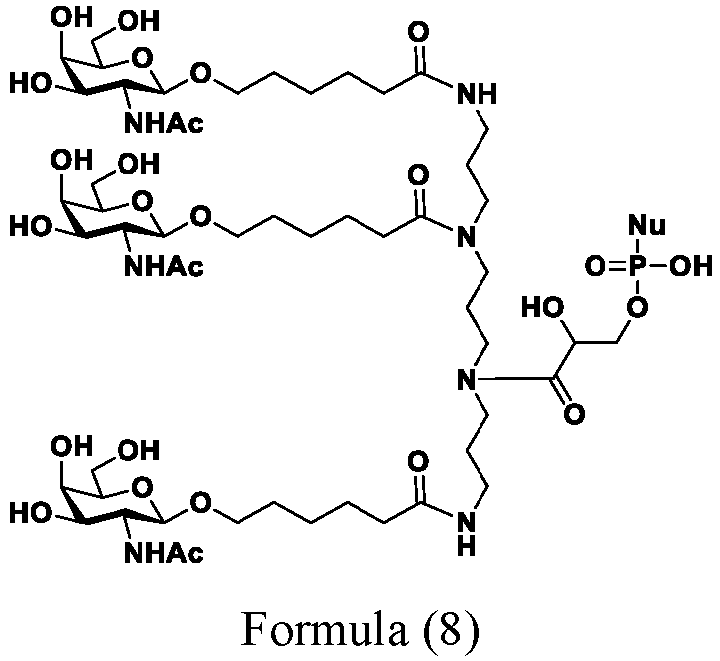
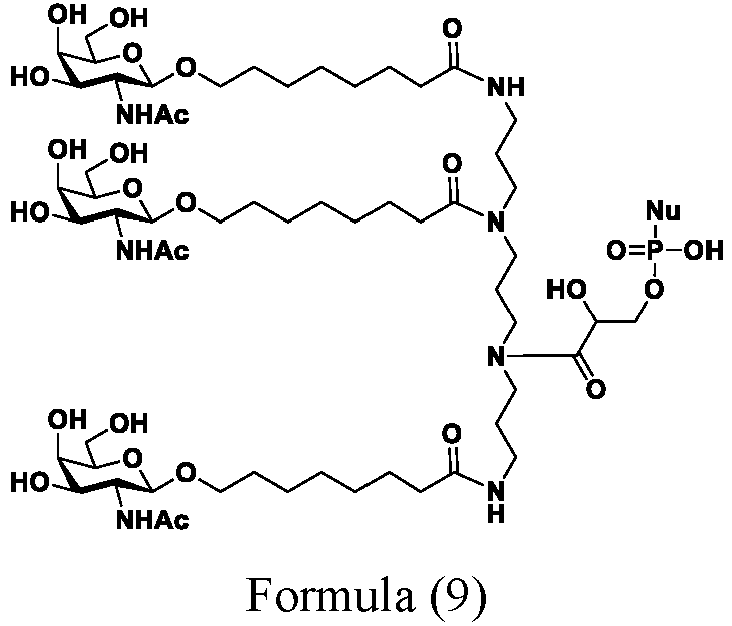


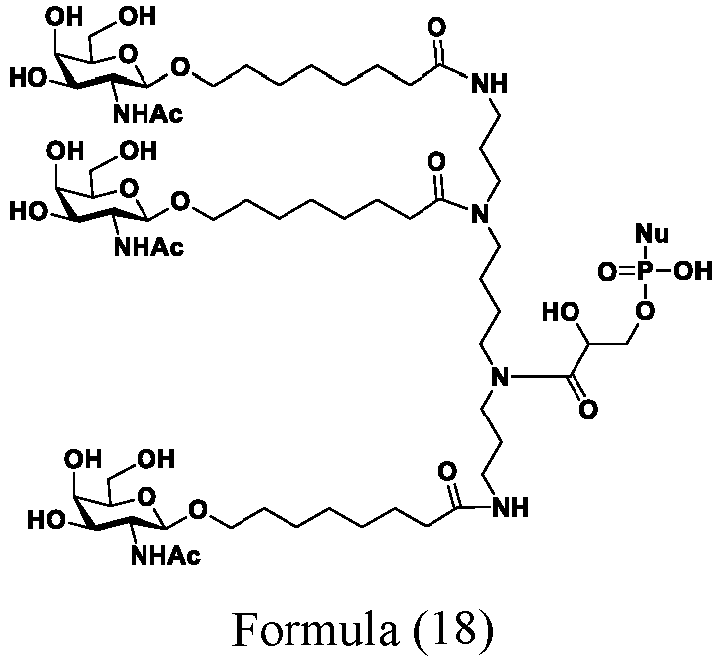


- In some embodiments, the oligonucleotide in the oligonucleotide conjugate of the present disclosure is a functional oligonucleotide. A functional oligonucleotide refers to an oligonucleotide that is capable of up- or down-regulating the expression of a target gene or resulting in alternative splicing of mRNA by producing a stable and specific hybridization to a target sequence, utilizing principles such as RNA activation (RNAa), RNA interference (RNAi), antisense nucleic acid technology, and exon skipping technology. In some embodiments, the functional oligonucleotide may also be a nucleic acid structure that produces a stable and specific binding to a target protein. In addition, it will be readily understood by those skilled in the art that a polynucleotide, such as the mRNA per se or fragments thereof, is also suitable for forming a conjugate by conjugation with the conjugating molecule provided by the present disclosure to achieve targeting delivery such as liver targeting deliver, thereby regulating the expression of protein transcribed by the mRNA. Thus, in the context, the "functional oligonucleotide" can also encompass an mRNA or fragments thereof.
- In some embodiments, the functional oligonucleotide is capable of interacting with a target sequence, thereby affecting the normal function of the target sequence molecule, such as causing breakage or translational repression of mRNA or alternative splicing of mRNA resulting from exon skipping, etc.. In some embodiments, the functional oligonucleotide is complementary to the bases in the target sequence. In some embodiments, the functional oligonucleotide is complementary to more than 80%, 81%, 82%, 83%, 84%, 85%, 86%, 87%, 88%, 89%, 90%, 91%, 92%, 93%, 94%, 95%, 96%, 97%, 98% or 99% of the bases in the target sequence, or may be fully complementary to the target sequence. In some embodiments, the functional oligonucleotide can have 1, 2, or 3 bases that are not complementary to the target sequence. In some embodiments, the functional oligonucleotide includes deoxyribonucleotides, ribonucleotides, and modified nucleotides. In some embodiments, the functional oligonucleotide is a single strand DNA, RNA or DNA-RNA chimera, or a double stranded DNA, RNA or DNA-RNA hybrid.
- As such, in some embodiments, the functional oligonucleotide suitable for the oligonucleotide conjugate of the present disclosure may be one of small interfering RNA (siRNA), microRNA, anti-microRNA (antimiR), microRNA antagonist (antagomir), microRNA mimics, decoy oligonucleotide, immune stimulatory, G-quadruplex, splice altering, single strand RNA (ssRNA), antisense nucleic acid, nucleic acid aptamer, small activating RNA (saRNA), stem-loop RNA, or DNA.
WO2015/006740A2 discloses a conjugate with different ligands conjugated to an oligonucleotide, wherein the ligands are linked to the oligonucleotide via linkers. The oligonucleotide is selected from the group consisting of small interfering RNA (siRNA), microRNA, anti microRNA (antimiR), antagomir, microRNA mimics, decoy oligonucleotides (decoy), immune stimulatory, G-quadruplex, splice altering, single stranded RNA (ssRNA), antisense nucleic acid (antisense), aptamer, stem-loop RNA or DNA. These conjugates exhibit good stability in the delivery of oligonucleotides in vivo. In further embodiments, the functional oligonucleotide suitable for the oligonucleotide conjugate of the present disclosure is an oligonucleotides disclosed inWO2009082607A2 ,WO2009073809A2 orWO2015006740A2 . - The oligonucleotide conjugate of the present disclosure may regulate the aberrant expression of specific genes in certain cells such as hepatocytes by increasing the liver-targeting delivery of the active agent, such as the functional oligonucleotide, and thus improving the interaction of the functional oligonucleotide with the target sequence in the cells. In some embodiments, the specific gene may be an endogenous gene expressed in liver or a pathogen gene reproduced in liver. The gene that is aberrantly expressed in hepatocytes may be a gene such as ApoB, ApoC, ANGPTL3, PCSK9, SCD1, TIMP-1, Col1A1, FVII, STAT3, p53, HBV, and HCV, etc.. In some embodiments, the gene that is aberrantly expressed in hepatocytes is an HBV gene, an ANGPTL3 gene, or an APOC3 gene. In the context of the present disclosure, HBV gene refers to a gene having a sequence as shown in Genbank Accession No. NC_003977.1; ANGPTL3 gene refers to a gene having an mRNA sequence as shown in Genbank Accession No. NM_014495.3; and APOC3 gene refers to a gene having an mRNA sequence as shown in Genbank Accession No. NM_000040.1.
- In some embodiments, a "target sequence" is a target mRNA. In the context of the present disclosure, a "target mRNA" refers to a mRNA corresponding to a gene that is aberrantly expressed in such as hepatocytes, which may be either a mRNA corresponding to an overexpressed gene or a mRNA corresponding to an under-expressed gene. In some embodiments, , a target mRNA is preferably an mRNA corresponding to an overexpressed gene, since most of diseases are derived from the overexpression of mRNA. In some embodiments of the present disclosure, the target mRNA corresponding to the above-mentioned aberrantly expressed gene may be an mRNA corresponding to a gene such as ApoB, ApoC, ANGPTL3, PCSK9, SCD1, TIMP-1, Col1A1, FVII, STAT3, p53, HBV, and HCV, etc.. In some embodiments, the target mRNA may be an mRNA transcribed by a corresponding HBV gene, ANGPTL3 gene or APOC3 gene.
- The P atom in Formula A59 may be linked to any possible position in the oligonucleotide sequence, for example, to any nucleotide of the oligonucleotide. In some embodiments, the functional oligonucleotide in the oligonucleotide conjugate of the present disclosure is a single strand oligonucleotide (e.g., a single strand RNA or an aptamer). In this case, the P atom in Formula A59 may be linked to a terminal region of the single strand oligonucleotide, which refers to the 4 nucleotides closest to one end of the single strand oligonucleotide. In some embodiments, the P atom in Formula A59 is linked to either end of the single strand oligonucleotide.
- In some embodiments, the functional oligonucleotide in the oligonucleotide conjugate of the present disclosure is a double stranded oligonucleotide (e.g., siRNA, microRNA, or DNA) comprising a sense strand and an antisense strand. In some embodiments, the P atom in Formula A59 may be linked to aterminal region of the sense strand or the antisense strand in the double stranded oligonucleotide, which refers to the 4 nucleotides closest to one end of the sense or antisense strand. In some embodiments, the P atom in Formula A59 is linked to either end of the sense or antisense strand. In some embodiments, the P atom in Formula A59 is linked to 3' end of the sense strand. In the case where the P atom in Formula A59 is linked to the above position in the sense strand of the double stranded oligonucleotide, the oligonucleotide conjugate provided by the present disclosure can release a separate antisense strand of the double stranded oligonucleotide during unwinding after entering into cells, thereby blocking the translation of the target mRNA into a protein and inhibiting the expression of a specific gene.
- The P atom in Formula A59 may be linked to any possible position of a nucleotide in the oligonucleotide sequence, for example, to position 5', 2' or 3', or to the base of the nucleotide. In some embodiments, the P atom in Formula A59 may be linked to position 2', 3', or 5' of a nucleotide in the oligonucleotide sequence by forming a phosphodiester bond. In some embodiments, the P atom in Formula A59 is linked to an oxygen atom formed after deprotonation of 3'-hydroxy of the nucleotide at 3' end of the sense strand in the double stranded oligonucleotide sequence, or linked to a nucleotide by substituting a hydrogen atom in 2'-hydroxy of a nucleotide of the sense strand or by substituting a hydrogen atom in 5'-hydroxy of the nucleotide at 5' end of the sense strand in the double stranded oligonucleotide sequence.
- Without wishing to be limited, the invention is described in further details in the following embodiments and examples with respect to the exemplary embodiments where the functional oligonucleotide in the oligonucleotide conjugate of the disclosure is a small interfering RNA (siRNA). In this case, the oligonucleotide conjugate of the present disclosure is an siRNA conjugate. In the context of the present disclosure, siRNA conjugates in these embodiments are also referred to as siRNA conjugates of the present disclosure just for convenience of description. It does not mean that the oligonucleotide in the oligonucleotide conjugate of the present disclosure can only be siRNA, instead, the oligonucleotide and even the active drug may be additional alternatives as disclosed herein or known to a skilled one. It is envisaged that, based on the detailed illustration on siRNA conjugate, other active drugs or functional oligonucleotides would work similarly when conjugated with the conjugating molecules provided herein.
- It is known to those skilled in the art that an siRNA comprises nucleotide groups as building blocks. The nucleotide group, in turn, comprises a phosphate group, a ribose group and a base. Generally, an active siRNA, i.e., a functional siRNA, may have a length of about 12-40 nucleotides, and in some embodiments is about 15-30 nucleotides in length. Each nucleotide in the siRNAs may be independently a modified or unmodified nucleotide. For an increased stability, at least one nucleotide in the siRNA is a modified nucleotide.
- The inventors of the present disclosure have found that the siRNAs described in the following embodiments have higher activity and/or stability and thus may be used as siRNAs for the purposes disclosed herein.
- In some embodiments, each nucleotide in the siRNA of the siRNA conjugate of the present disclosure (also referred to as the siRNA of the present disclosure hereinafter) is independently a modified or unmodified nucleotide. The siRNA comprises a sense strand and an antisense strand, wherein the sense strand comprises a
nucleotide sequence 1, and the antisense strand comprises anucleotide sequence 2. Thenucleotide sequence 1 and thenucleotide sequence 2 both have a length of 10, 11, 12, 13, 14, 15, 16, 17, 18, 19, 20, 21, 22, 23, 24, or 25 nucleotides and are at least partly reverse complementary to form a double-stranded complementary region. Thenucleotide sequence 2 is complementary to a first nucleotide sequence segment, which refers to a segment of nucleotide sequence in the target mRNA. - In some embodiments, the siRNA of the present disclosure refers to an siRNA capable of inhibiting at least 50% of the expression of HBV gene, at least 50% of the expression of ANGPTL3 gene, or at least 50% of the expression of APOC3 gene, at a concentration of 3 mg/kg. In some embodiments, the siRNA of the present disclosure refers to an siRNA capable of inhibiting at least 55%, 60%, 65%, 70%, 75%, or 80% of the expression of HBV gene, ANGPTL3 gene, or APOC3 gene, at a concentration of 3 mg/kg.
- In some embodiments, the
nucleotide sequence 1 has the same length and no more than 3 nucleotides different from the first nucleotide sequence segment; thenucleotide sequence 2 has the same length and no more than 3 nucleotides different from a nucleotide sequence B, which refers to a nucleotide sequence completely reverse complementary to the first nucleotide sequence segment. Without wishing to be bounded by any theory, these special nucleotide differences will not significantly reduce the depressing ability of the siRNA conjugates, and are thus within the scope of the disclosure. - In some embodiments, the
nucleotide sequence 1 is basically reverse complementary, Substantially reverse complementary, or completely reverse complementary with thenucleotide sequence 2. - In some embodiments, the
nucleotide sequence 1 has no more than 1 nucleotide different from the first nucleotide sequence segment; and/or thenucleotide sequence 2 has no more than 1 nucleotides different from a nucleotide sequence B. In some embodiments, the nucleotide differences between thenucleotide sequence 2 and the nucleotide sequence B includes the difference at the site of the first nucleotide Z' on thenucleotide sequence 2 from 5' end to 3' end. In some embodiments, the last nucleotide Z on thenucleotide sequence 1 from 5' end to 3' end is a nucleotide complementary to Z'. - in some embodiments, the sense strand also comprises a
nucleotide sequence 3, and the antisense strand also comprises anucleotide sequence 4. Thenucleotide sequences nucleotide sequence 3 is linked to the 5' end of thenucleotide sequence 1, and thenucleotide sequence 4 is linked to the 3' end of thenucleotide sequence 2. Thenucleotide sequence 4 is complementary to a second nucleotide sequence segment, which refers to a nucleotide sequence adjacent to the first nucleotide sequence segment and having the same length as thenucleotide sequence 4 in the target mRNA. In some embodiments, thenucleotide sequence 3 is substantially reverse complementary or completely reverse complementary to thenucleotide sequence 4. Therefore, in some embodiments, the sense strand and the antisense strand may have a length of 19-23 nucleotides. - In some embodiments, the siRNA of the present disclosure also comprises a
nucleotide sequence 5, which has a length of 1-3 nucleotides and is linked to 3' end of the antisense strand, thereby constituting a 3' overhang of the antisense strand. In some embodiments, thenucleotide sequence 5 is 1 or 2 nucleotides in length. As such, in some embodiments, the length ratio of the sense strand to the antisense strand in the siRNA of the present disclosure may be 19/20, 19/21, 20/21, 20/22, 21/22, 21/23, 22/23, 22/24, 23/24, or 23/25. - In some embodiments, the
nucleotide sequence 5 has 2 nucleotides in length. Moreover, thenucleotide sequence 5 is 2 continuous thymidine deoxynucleotides, or 2 continuous uridine nucleotides in the direction from 5' end to 3' end, or complementary to a third nucleotide sequence segment, which refers to a nucleotide sequence adjacent to the first or second nucleotide sequence segment in the target mRNA, and having the same length as thenucleotide sequence 5. In some embodiments, the length ratio of the sense strand to the antisense strand in the siRNA of the present disclosure is 19/21 or 21/23. Here, the siRNA of the present disclosure exhibits significant silencing activity against mRNA in hepatocytes. - In some embodiments, the nucleotides in the siRNA of the present disclosure are each independently a modified or unmodified nucleotide. In some embodiments, the siRNA of the present disclosure comprises no modified nucleotide. In some embodiments, the siRNA of the present disclosure comprises a modified nucleotide group.
- There are currently many means that may be used to modify siRNA in the art, including backbone modification (or internucleotide linkage modification, such as phosphate group modification), ribose group modification, base modification, etc. (see, for example, Watts, J.K., G. F. Deleavey and M. J.Damha, Chemically Modified siRNA: tools and applications. Drug Discov Today, 2008.13(19-20): p.842-55.
- In the context of the disclosure, the term "a modified nucleotide" employed herein comprises a nucleotide where the ribose group is modified, such as those formed by substituting the 2'-hydroxy of the ribose group with other groups, a nucleotide analogue, or a nucleotide with modified base.
- In some embodiments of the disclosure, at least one nucleotide in the sense or antisense strand is a modified nucleotide, and/or at least one phosphate is a phosphate group with modified groups. In other words, at least a portion of the phosphate and/or ribose groups in phosphate-ribose backbone of at least one single strand in the sense strand and the antisense strand are phosphate and/or ribose groups with modified groups (or modified phosphate and/or modified ribose).In some embodiments of the disclosure, all nucleotides in the sense strand and/or the antisense strand are modified nucleotides.
- In some embodiments, each nucleotide in the sense strand and the antisense strand is independently a fluoro modified nucleotide or a non-fluoro modified nucleotide.
- A "fluoro modified nucleotide" refers to a nucleotide formed by substituting the 2'-hydroxy of the ribose group with a fluoro as represented by Formula (207).
- A "non-fluoro modified nucleotide" refers to a nucleotide formed by substituting the 2'-hydroxy of the ribose group with a group other than a fluoro, or a nucleotide analogue. In some embodiments, each non-fluoro modified nucleotide is independently a nucleotide formed by substituting the 2'-hydroxy of the ribose group thereof with a non-fluoro group, or a nucleotide analogue.
- A nucleotide formed by substituting the 2'-hydroxy of the ribose group with a non-fluoro group is well-known in the art, such as 2'-alkoxy modified nucleotides, 2'-substituted alkoxy modified nucleotides, 2'-alkyl modified nucleotides, 2'-substituted alkyl modified nucleotides, 2'-amino modified nucleotides, 2'-substituted amino modified nucleotides or 2'-deoxy nucleotides.
- In some embodiments, the 2'-alkoxy modified nucleotide is a methoxy modified nucleotide represented by Formula (208). In some embodiments, the 2'-substituted alkoxy modified nucleotide is a 2'-O-methoxyethoxy modified nucleotide represented by Formula (209). In some embodiments, the 2'-amino modified nucleotide is represented by Formula (210). In some embodiments, the 2'-deoxy nucleotide (DNA) is represented by Formula (211).


- A "nucleotide analogue" refers to a group that can replace a nucleotide in the nucleic acid, while differs from an adenine ribonucleotide, a guanine ribonucleotide, a cytosine ribonucleotide, a uracil ribonucleotide or thymine deoxyribonucleotide. In some embodiments, the nucleotide analogue may be such as an isonucleotide, a bridged nucleic acid (BNA) nucleotide or a acyclic nucleotide.
- A BNA nucleotide is a nucleotide that is constrained or inaccessible. BNA can contain a 5-, 6- membered or even a 7-membered ring bridged structure with a "fixed" C3'-endo sugar puckering. The bridge is typically incorporated at the 2'- and 4'-position of the ribose ring to afford a 2', 4'-BNA nucleotide, such as LNA, ENA and cET BNA which is represented by Formula (212), (213) and (214), respectively.

- An acyclic nucleotide is a nucleotide in which the ribose ring is opened, such as an unlocked nucleic acid (UNA) nucleotide and a glycerol nucleic acid (GNA) nucleotide, which are respectively represented by Formula (215) and (216).

- An isonucleotide is a nucleotide in which the position of the base on the ribose ring alters, such as a compound in with the base is moved from 1' to 2' or 3' on the ribose ring represented respectively by Formula (217) or (218).

- In some embodiments, a nucleotide analogue is an isonucleotide, LNA, ENA, cET, UNA or GNA. In some embodiments, each non-fluoro modified nucleotide is a methoxy modified nucleotide, which refers to a nucleotide formed by substituting the 2'-hydroxy of the ribose group with a methoxy group.
- In the context of the disclosure, a "fluoro modified nucleotide", a "2'-fluoro modified nucleotide", a "nucleotide in which 2'-hydroxy of a ribose group is substituted with fluoro" and a "nucleotide with 2'-fluororibosyl" have the same meaning, referring to the nucleotide that 2'-hydroxy of the nucleotide is substituted with fluoro to form a structure represented by Formula (207). A "methoxy modified nucleotide", a "2'-methoxy modified nucleotide", a "nucleotide in which 2'-hydroxy of a ribose group is substituted with methoxy" and a " nucleotide with 2'-methoxyribosyl" have the same meaning, referring to the nucleotide that 2'-hydroxy of the ribose group in the nucleotide is substituted with methoxy to form a structure represented by Formula (208).
- In some embodiments, the siRNA of the disclosure is a siRNA with the following modifications: in the direction from 5' end to 3' end, the nucleotides at
positions nucleotide sequence 1 in the sense strand of the siRNA are fluoro modified nucleotides, and the nucleotides at the rest of positions in the sense strand are methoxy modified nucleotides; and/or the nucleotides atpositions nucleotide sequence 2 in the antisense strand are fluoro modified nucleotides, and the nucleotides at the rest of positions in the antisense strand are methoxy modified nucleotides. In some embodiments, the siRNA of the disclosure is a siRNA with the following modifications: in the direction from 5' end to 3' end, the nucleotides atpositions nucleotide sequence 1 in the sense strand of the siRNA are fluoro modified nucleotides, and the nucleotides at the rest of positions in the sense strand are methoxy modified nucleotides; and/or the nucleotides atpositions nucleotide sequence 2 in the antisense strand are fluoro modified nucleotides, and the nucleotides at the rest of positions in the antisense strand are 2'-methoxy modified nucleotides. In some embodiments, the siRNA of the disclosure is a siRNA with the following modifications: in the direction from 5' end to 3' end, the nucleotides atpositions nucleotide sequence 1 in the sense strand of the siRNA are fluoro modified nucleotides, and the nucleotides at the rest of positions in the sense strand are methoxy modified nucleotides; and/or in the direction from 5' end to 3' end, the nucleotides atpositions nucleotide sequence 2 in the antisense strand of the siRNA are fluoro modified nucleotides, and the nucleotides at the rest of positions in the antisense strand are methoxy modified nucleotides. - In some embodiments of the siRNA of the present disclosure, the nucleotide has modifications on phosphate groups. In the context of the present disclosure, the modification on a phosphate group is in some embodiments a phosphorothioate modification represented by Formula (201) below, that is, the substitution of a non-bridging oxygen atom in a phosphodiester bond with a sulfur atom so that the phosphodiester bond is changed to a phosphorothioate diester bond. In some embodiments, this modification stabilizes the structure of the siRNA and maintaining high specificity and high affinity for base pairing.

- According to some embodiments of the present disclosure, in the siRNA, a phosphorothioate linkage exists in at least one of the following position: between the first and the second nucleotides from either end of the sense or antisense strand, between the second and the third nucleotides from either end of the sense strand or antisense strand, or any combination thereof. In some embodiments, a phosphorothioate linkage exists at all the above positions except for 5' end of the sense strand. In some embodiments, a phosphorothioate linkage exists at all the above positions except for 3' end of the sense strand. In some embodiments, a phosphorothioate linkage exists in at least one of the following positions:
- between the first and second nucleotides from 5' end of the sense strand;
- between the second and third nucleotides from 5' end of the sense strand;
- between the first and second nucleotides from 3' end of the sense strand;
- between the second and third nucleotides from 3' end of the sense strand;
- between the first and second nucleotides from 5' end of the antisense strand;
- between the second and third nucleotides from 5' end of the antisense strand;
- between the first and second nucleotides from 3' end of the antisense strand; and
- between the second and third nucleotides from 3' end of the antisense strand.
- According to some embodiments of the present disclosure, the 5'-terminal nucleotide in the antisense strand sequence of the siRNA molecule is a 5'-phosphate nucleotide or a 5'-phosphate analogue modified nucleotide.
- In some embodiments, the 5'-phosphate nucleotide has the following structure represented by Formula (202):


- "Base" represents a base selected from A, U, C, G, or T.
- In some embodiments, the 5'-phosphate nucleotide or the 5'-phosphate analogue modified nucleotide is a nucleotide with a vinyl phosphate (VP) modification represented by Formula (203), a 5'-phosphate nucleotide represented by Formula (202) or a 5'-phosphorothioate modified nucleotide represented by Formula (205).
- The inventors of the present disclosure have unexpectedly discovered that the siRNA conjugate of the present disclosure exhibits a significantly improved serum stability while the target mRNA silencing activity is not significantly compromised, leading to an excellent inhibitory effect in vivo on gene expression. It has shown that these siRNA conjugates of the present disclosure have higher delivery efficiency in vivo. According to some embodiments of the present disclosure, the oligonucleotide conjugates of the present disclosure are therefore siRNA conjugates comprising siRNAs such as those shown in Table 1A-Table 1F:
Table 1 siRNA sequences Table 1A NO. Sequence Direction 5' - 3' SEQ ID NO siHBa1 * S CCUUGAGGCAUACUUCAAA 1 AS UUUGAAGUAUGCCUCAAGGUU 2 siHBa2 S GACCUUGAGGCAUACUUCAAA 3 AS UUUGAAGUAUGCCUCAAGGUCGG 4 siHBa1M1 S CmCmUmUmGmAmGfGfCfAmUmAmCmUmUmCmAmAmAm 5 AS UmUfUmGmAmAfGmUmAmUmGmCmCmUfCmAfAmGmGmUmUm 6 siHBa1M2 S CmCmUmUmGfAmGfGfCfAmUmAmCmUmUmCmAmAmAm 7 AS UmUfUmGmAmAfGmUfAfUmGmCmCmUfCmAfAmGmGmUmUm 8 siHBa2M1 S GmAmCmCmUmUmGmAmGfGfCfAmUmAmCmUmUmCmAmAmAm 9 AS UmUfUmGmMAmMAfGmUmAmUmGmCmCmUfCmAfAmGmGmUmCmGmGm 10 siHBa2M2 S GmAmCmCmUmUmGfAmGfGfCfAmUmAmCmUmUmCmAmAmAm 11 AS UmUfUmGmAmAfGmUfAfUmGmCmCmUfCmAfAmGmGmUmCmGmGm 12 siHBa1M1S S CmsCmsUmUmGmAmGfGfCfAmUmAmCmUmUmCmAmAmAm 13 AS UmsUfsUmGmAmAfGmUmAmUmGmCmCmUfCmAfAmGmGmsUmsUm 14 siHBa1M2S S CmsCmsUmUmGfAmGfGfCfAmUmAmCmUmUmCmAmAmAm 15 AS UmsUfsUmGmAmAfGmUfAfUmGmCmCmUfCmAfAmGmGmsUmsUm 16 siHBa2M1S S GmsAmsCmCmUmUmGmAmGfGfCfAmUmAmCmUmUmCmAmAmAm 17 AS 
18 siHBa2M2S S GmsAmsCmCmUmUmGfAmGfGfCfAmUmAmCmUmUmCmAmAmAm 19 AS 
20 siHBa1M1P1 S CmCmUmUmGmAmGfGfCfAmUmAmCmUmUmCmAmAmAm 5 AS P1- UmUfUmGmAmAfGmUmAmUmGmCmCmUfCmAfAmGmGmUmUm 21 siHBa1M2P1 S CmCmUmUmGfAmGfGfCfAmUmAmCmUmUmCmAmAmAm 7 AS P1-UmUfUmGmAmAfGmUfAfUmGmCmCmUfCmAfAmGmGmUmUm 22 siHBa2M1P1 S GmAmCmCmUmUmGmAmGfGfCfAmUmAmCmUmUmCmAmAmAm 9 AS 
23 siHBa2M2P1 S GmAmCmCmUmUmGfAmGfGfCfAmUmAmCmUmUmCmAmAmAm 11 AS 
24 siHBa1M1SP1 S CmsCmsUmUmGmAmGfGfCfAmUmAmCmUmUmCmAmAmAm 13 AS P1- UmsUfsUmGmAmAfGmUmAmUmGmCmCmUfCmAfAmGmGmsUmsUm 25 siHBa1M2SP1 S CmsCmsUmUmGfAmGfGfCfAmUmAmCmUmUmCmAmAmAm 15 AS P1-UmsUfsUmGmAmAfGmUfAfUmGmCmCmUfCmAfAmGmGmsUmsUm 26 siHBa2M1SP1 S GmsAmsCmCmUmUmGmAmGfGfCfAmUmAmCmUmUmCmAmAmAm 17 AS 
27 siHBa2M2SP1 S GmsAmsCmCmUmUmGfAmGfGfCfAmUmAmCmUmUmCmAmAmAm 19 AS 
28 Table 1B NO. Sequence Direction 5' - 3' SEQ ID NO siHBb1 S UGCUAUGCCUCAUCUUCUA 29 AS UAGAAGAUGAGGCAUAGCAGC 30 siHBb2 S UGCUAUGCCUCAUCUUCUA 29 AS UAGAAGAUGAGGCAUAGCAUU 31 siHBb1M1 S UmGmCmUmAmUmGfCfCfUmCmAmUmCmUmUmCmUmAm 32 AS 
33 siHBb2M1 S UmGmCmUmAmUmGfCfCfUmCmAmUmCmUmUmCmUmAm 32 AS 
34 siHBb1M2 S UmGmCmUmAfUmGfCfCfUmCmAmUmCmUmUmCmUmAm 35 AS UmAfGmAmAmGfAmUfGfAmGmGmCmAfUmAfGmCmAmGmCm 36 siHBb2M2 S UmGmCmUmAfUmGfCfCfUmCmAmUmCmUmUmCmUmAm 35 AS UmAfGmAmAmGfAmUfGfAmGmGmCmAfUmAfGmCmAmUmUm 37 siHBb1M1S S UmsGmsCmUmAmUmGfCfCfUmCmAmUmCmUmUmCmUmAm 38 AS 
39 siHBb2M1S S UmsGmsCmUmAmUmGfCfCfUmCmAmUmCmUmUmCmUmAm 38 AS 
40 siHBblM2S S UmsGmsCmUmAfUmGfCfCfUmCmAmUmCmUmUmCmUmAm 41 AS 
42 siHBb2M2S S UmsGmsCmUmAfUmGfCfCfUmCmAmUmCmUmUmCmUmAm 41 AS 
43 siHBb1M1P1 S UmGmCmUmAmUmGfCfCfUmCmAmUmCmUmUmCmUmAm 32 AS 
44 siHBb2M1P1 S UmGmCmUmAmUmGfCfCfUmCmAmUmCmUmUmCmUmAm 32 AS 
45 siHBb1M2P1 S UmGmCmUmAfUmGfCfCfUmCmAmUmCmUmUmCmUmAm 35 AS 
46 siHBb2M2P1 S UmGmCmUmAfUmGfCfCfUmCmAmUmCmUmUmCmUmAm 35 AS 
47 siHBb1M1SP1 S UmsGmsCmUmAmUmGfCfCfUmCmAmUmCmUmUmCmUmAm 38 AS 
48 siHBb2M1SP1 S UmsGmsCmUmAmUmGfCfCfUmCmAmUmCmUmUmCmUmAm 38 AS 
49 siHBb1M2SP1 S UmsGmsCmUmAfUmGfCfCfUmCmAmUmCmUmUmCmUmAm 41 AS 
50 siHBb2M2SP1 S UmsGmsCmUmAfUmGfCfCfUmCmAmUmCmUmUmCmUmAm 41 AS 
51 Table 1C NO. Sequence Direction 5' - 3' SEQ ID NO siHBc1 S UCUGUGCCUUCUCAUCUGA 52 AS UCAGAUGAGAAGGCACAGACG 53 siHBc1M1 S UmCmUmGmUmGmCfCfUfUmCmUmCmAmUmCmUmGmAm 54 AS UmCfAmGmAmUfGmAmGmAmAmGmGmCfAmCfAmGmAmCmGm 55 siHBclM2 S UmCmUmGmUfGmCfCfUfUmCmUmCmAmUmCmUmGmAm 56 AS UmCfAmGmAmUfGmAfGfAmAmGmGmCfAmCfAmGmAmCmGm 57 siHBc1M1S S UmsCmsUmGmUmGmCfCfUfUmCmUmCmAmUmCmUmGmAm 58 AS UmsCfsAmGmAmUfGmAmGmAmAmGmGmCfAmCfAmGmAmsCmsGm 59 siHBc1M2S S UmsCmsUmGmUfGmCfCfUfUmCmUmCmAmUmCmUmGmAm 60 AS UmsCfsAmGmAmUfGmAfGfAmAmGmGmCfAmCfAmGmAmsCmsGm 61 siHBc1M1P1 S UmCmUmGmUmGmCfCfUfUmCmUmCmAmUmCmUmGmAm 54 AS P1- UmCfAmGmAmUfGmAmGmAmAmGmGmCfAmCfAmGmAmCmGm 62 siHBc1M2P1 S UmCmUmGmUfGmCfCfUfUmCmUmCmAmUmCmUmGmAm 56 AS P1-UmCfAmGmAmUfGmAfGfAmAmGmGmCfAmCfAmGmAmCmGm 63 siHBc1M1SP1 S UmsCmsUmGmUmGmCfCfUfUmCmUmCmAmUmCmUmGmAm 58 AS 
64 siHBc1M2SP1 S UmsCmsUmGmUfGmCfCfUfUmCmUmCmAmUmCmUmGmAm 60 AS 
65 Table 1D NO. Sequence Direction 5' - 3' SEQ ID NO siHBd1 S CGUGUGCACUUCGCUUCAA 66 AS UUGAAGCGAAGUGCACACGGU 67 siHBd1M1 S CmGmUmGmUmGmCfAfCfUmUmCmGmCmUmUmCmAmAm 68 AS UmUfGmAmAmGfCmGmAmAmGmUmGmCfAmCfAmCmGmGmUm 69 siHBdlM2 S CmGmUmGmUfGmCfAfCfUmUmCmGmCmUmUmCmAmAm 70 AS UmUfGmAmAmGfCmGfAfAmGmUmGmCfAmCfAmCmGmGmUm 71 siHBd1M1S S CmsGmsUmGmUmGmCfAfCfUmUmCmGmCmUmUmCmAmAm 72 AS UmsUfsGmAmAmGfCmGmAmAmGmUmGmCfAmCfAmCmGmsGmsUm 73 siHBdlM2S S CmsGmsUmGmUfGmCfAfCfUmUmCmGmCmUmUmCmAmAm 74 AS UmsUfsGmAmAmGfCmGfAfAmGmUmGmCfAmCfAmCmGmsGmsUm 75 siHBd1M1P1 S CmGmUmGmUmGmCfAfCfUmUmCmGmCmUmUmCmAmAm 68 AS P1-UmUfGmAmAmGfCmGmAmAmGmUmGmCfAmCfAmCmGmGmUm 76 siHBd1M2P1 S CmGmUmGmUfGmCfAfCfUmUmCmGmCmUmUmCmAmAm 70 AS P1- UmUfGmAmAmGfCmGfAfAmGmUmGmCfAmCfAmCmGmGmUm 77 siHBd1M1SP1 S CmsGmsUmGmUmGmCfAfCfUmUmCmGmCmUmUmCmAmAm 72 AS 
78 siHBd1M2SP1 S CmsGmsUmGmUfGmCfAfCfUmUmCmGmCmUmUmCmAmAm 74 AS P1-UmsUfsGmAmAmGfCmGfAfAmGmUmGmCfAmCfAmCmGmsGmsUm 79 Table 1E NO. Sequence Direction 5' - 3' SEQ ID NO siAN1 S CCAAGAGCACCAAGAACUA 80 AS UAGUUCUUGGUGCUCUUGGCU 81 siAN2 S AGCCAAGAGCACCAAGAACUA 82 AS UAGUUCUUGGUGCUCUUGGCUUG 83 siAN1M1 S CmCmAmAmGfAmGfCfAfCmCmAmAmGmAmAmCmUmAm 84 AS UmAfGmUmUmCfUmUfGfGmUmGmCmUfCmUfUmGmGmCmUm 85 siAN2M1 S AmGmCmCmAmAmGfAmGfCfAfCmCmAmAmGmAmAmCmUmAm 86 AS UmAfGmUmUmCfUmUfGfGmUmGmCmUfCmUfUmGmGmCmUmUmGm 87 siAN1M2 S CmCmAmAmGfAmGfCfAfCmCmAmAmGmAmAmCmUmAm 84 AS UmAfGmUmUmCfUmUmGmGmUmGmCmUfCmUfUmGmGmCmUm 88 siAN2M2 S AmGmCmCmAmAmGfAmGfCfAfCmCmAmAmGmAmAmCmUmAm 86 AS UmAfGmUmUmCfUmUmGmGmUmGmCmUfCmUfUmGmGmCmUmUmGm 89 siAN1M3 S CmCmAmAmGmAmGfCfAfCmCmAmAmGmAmAmCmUmAm 90 AS UmAfGmUmUmCfUmUmGmGmUmGmCmUfCmUfUmGmGmCmUm 88 siAN2M3 S AmGmCmCmAmAmGmAmGfCfAfCmCmAmAmGmAmAmCmUmAm 91 AS UmAfGmUmUmCfUmUmGmGmUmGmCmUfCmUfUmGmGmCmUmUmGm 89 siAN1M1S S CmsCmsAmAmGfAmGfCfAfCmCmAmAmGmAmAmCmUmAm 92 AS UmsAfsGmUmUmCfUmUfGfGmUmGmCmUfCmUfUmGmGmsCmsUm 93 siAN2M1S S AmsGmsCmCmAmAmGfAmGfCfAfCmCmAmAmGmAmAmCmUmAm 94 AS UmsAfsGmUmUmCfUmUfGfGmUmGmCmUfCmUfUmGmGmCmUmsUmsGm 95 siAN1M2S S CmsCmsAmAmGfAmGfCfAfCmCmAmAmGmAmAmCmUmAm 92 AS UmsAfsGmUmUmCfUmUmGmGmUmGmCmUfCmUfUmGmGmsCmsUm 96 siAN2M2S S AmsGmsCmCmAmAmGfAmGfCfAfCmCmAmAmGmAmAmCmUmAm 94 AS UmsAfsGmUmUmCfUmUmGmGmUmGmCmUfCmUfUmGmGmCmUmsUmsGm 97 siAN1M3S S CmsCmsAmAmGmAmGfCfAfCmCmAmAmGmAmAmCmUmAm 98 AS UmsAfsGmUmUmCfUmUmGmGmUmGmCmUfCmUfUmGmGmsCmsUm 96 siAN2M3S S AmsGmsCmCmAmAmGmAmGfCfAfCmCmAmAmGmAmAmCmUmAm 99 AS UmsAfsGmUmUmCfUmUmGmGmUmGmCmUfCmUfUmGmGmCmUmsUmsGm 97 siAN1M1P1 S CmCmAmAmGfAmGfCfAfCmCmAmAmGmAmAmCmUmAm 84 AS P1- UmAfGmUmUmCfUmUfGfGmUmGmCmUfCmUfUmGmGmCmUm 100 siAN2M1P1 S AmGmCmCmAmAmGfAmGfCfAfCmCmAmAmGmAmAmCmUmAm 86 AS P1-UmAfGmUmUmCfUmUfGfGmUmGmCmUfCmUfUmGmGmCmUmUmGm 101 siAN1M2P1 S CmCmAmAmGfAmGfCfAfCmCmAmAmGmAmAmCmUmAm 84 AS P1-UmAfGmUmUmCfUmUmGmGmUmGmCmUfCmUfUmGmGmCmUm 102 siAN2M2P1 S AmGmCmCmAmAmGfAmGfCfAfCmCmAmAmGmAmAmCmUmAm 86 AS P1-UmAfGmUmUmCfUmUmGmGmUmGmCmUfCmUfUmGmGmCmUmUmGm 103 siAN1M3P1 S CmCmAmAmGmAmGfCfAfCmCmAmAmGmAmAmCmUmAm 90 AS P1-UmAfGmUmUmCfUmUmGmGmUmGmCmUfCmUfUmGmGmCmUm 102 siAN2M3P1 S AmGmCmCmAmAmGmAmGfCfAfCmCmAmAmGmAmAmCmUmAm 91 AS P1-UmAfGmUmUmCfUmUmGmGmUmGmCmUfCmUfUmGmGmCmUmUmGm 103 siAN1M1SP1 S CmsCmsAmAmGfAmGfCfAfCmCmAmAmGmAmAmCmUmAm 92 AS P1-UmsAfsGmUmUmCfUmUfGfGmUmGmCmUfCmUfUmGmGmsCmsUm 104 siAN2M1SP1 S AmsGmsCmCmAmAmGfAmGfCfAfCmCmAmAmGmAmAmCmUmAm 94 AS P1- UmsAfsGmUmUmCfUmUfGfGmUmGmCmUfCmUfUmGmGmCmUmsUmsGm 105 siAN1M2SP1 S CmsCmsAmAmGfAmGfCfAfCmCmAmAmGmAmAmCmUmAm 92 AS P1-UmsAfsGmUmUmCfUmUmGmGmUmGmCmUfCmUfUmGmGmsCmsUm 106 siAN2M2SP1 S AmsGmsCmCmAmAmGfAmGfCfAfCmCmAmAmGmAmAmCmUmAm 94 AS P1-UmsAfsGmUmUmCfUmUmGmGmUmGmCmUfCmUfUmGmGmCmUmsUmsGm 107 siAN1M3SP1 S CmsCmsAmAmGmAmGfCfAfCmCmAmAmGmAmAmCmUmAm 98 AS P1-UmsAfsGmUmUmCfUmUmGmGmUmGmCmUfCmUfUmGmGmsCmsUm 106 siAN2M3SP1 S AmsGmsCmCmAmAmGmAmGfCfAfCmCmAmAmGmAmAmCmUmAm 99 AS P1-UmsAfsGmUmUmCfUmUmGmGmUmGmCmUfCmUfUmGmGmCmUmsUmsGm 107 Table 1F NO. Sequence Direction 5' - 3' SEQ ID NO siAP1 S CAAUAAAGCUGGACAAGAA 108 AS UUCUUGUCCAGCUUUAUUGGG 109 siAP2 S CCCAAUAAAGCUGGACAAGAA 110 AS UUCUUGUCCAGCUUUAUUGGGAG 111 siAP1M1 S CmAmAmUmAfAmAfGfCfUmGmGmAmCmAmAmGmAmAm 112 AS UmUfCmUmUmGfUmCfCfAmGmCmUmUfUmAfUmUmGmGmGm 113 siAP2M1 S CmCmCmAmAmUmAfAmAfGfCfUmGmGmAmCmAmAmGmAmAm 114 AS UmUfCmUmUmGfUmCfCfAmGmCmUmUfUmAfUmUmGmGmGmAmGm 115 siAP1M2 S CmAmAmUmAmAmAfGfCfUmGmGmAmCmAmAmGmAmAm 116 AS UmUfCmUmUmGfUmCmCmAmGmCmUmUfUmAfUmUmGmGmGm 117 siAP2M2 S CmCmCmAmAmUmAmAmAfGfCfUmGmGmAmCmAmAmGmAmAm 118 AS UmUfCmUmUmGfUmCmCmAmGmCmUmUfUmAfUmUmGmGmGmAmGm 119 siAP1M1S S CmsAmsAmUmAfAmAfGfCfUmGmGmAmCmAmAmGmAmAm 120 AS UmsUfsCmUmUmGfUmCfCfAmGmCmUmUfUmAfUmUmGmsGmsGm 121 siAP2M1S S CmsCmsCmAmAmUmAfAmAfGfCfUmGmGmAmCmAmAmGmAmAm 122 AS UmsUfsCmUmUmGfUmCfCfAmGmCmUmUfUmAfUmUmGmGmGmsAmsGm 123 siAPIM2S S CmsAmsAmUmAmAmAfGfCfUmGmGmAmCmAmAmGmAmAm 124 AS UmsUfsCmUmUmGfUmCmCmAmGmCmUmUfUmAfUmUmGmsGmsGm 125 siAP2M2S S CmsCmsCmAmAmUmAmAmAfGfCfUmGmGmAmCmAmAmGmAmAm 126 AS 
127 siAP1M1P1 S CmAmAmUmAfAmAfGfCfUmGmGmAmCmAmAmGmAmAm 112 AS P1-UmUfCmUmUmGfUmCfCfAmGmCmUmUfUmAfUmUmGmGmGm 128 siAP2M1P1 S CmCmCmAmAmUmAfAmAfGfCfUmGmGmAmCmAmAmGmAmAm 114 AS P1-UmUfCmUmUmGfUmCfCfAmGmCmUmUfUmAfUmUmGmGmGmAmGm 129 siAP1M2P1 S CmAmAmUmAmAmAfGfCfUmGmGmAmCmAmAmGmAmAm 116 AS P1-UmUfCmUmUmGfUmCmCmAmGmCmUmUfUmAfUmUmGmGmGm 130 siAP2M2P1 S CmCmCmAmAmUmAmAmAfGfCfUmGmGmAmCmAmAmGmAmAm 118 AS 
131 siAP1M1SP1 S CmsAmsAmUmAfAmAfGfCfUmGmGmAmCmAmAmGmAmAm 120 AS P1-UmsUfsCmUmUmGfUmCfCfAmGmCmUmUfUmAfUmUmGmsGmsGm 132 siAP2M1SP1 S CmsCmsCmAmAmUmAfAmAfGfCftJmCrmGmAmCmAmAmGmAmAm 122 AS 
133 siAP1M2SP1 S CmsAmsAmUmAmAmAfGfCfUmGmGmAmCmAmAmGmAmAm 124 AS P1-UmsUfsCmUmUmGfUmCmCmAmGmCmUmUfUmAfUmUmGmsGmsGm 134 siAP2M2SP1 S CmsCmsCmAmAmUmAmAmAfGfCfUmGmGmAmCmAmAmGmAmAm 126 AS 
135 *S: Sense Strand; AS: Antisense Srand - In the above tables, capital letters C, G, U, and A indicate the base compositions of the nucleotides; lowercase letter m indicates that the nucleotide adjacent to the left side of the letter m is a 2'-methoxy modified nucleotide; lowercase letter f indicates that the nucleotide adjacent to the left side of the letter f is a 2'-fluoro modified nucleotide; lowercase letter s indicates the phosphorothioate linkage between the two nucleotides adjacent to both sides of the letter s; P1 indicates that the nucleotide adjacent to the right side of P1 is a 5'-phosphate nucleotide or a 5'-phosphate analogue modified nucleotide, and in some embodiments is a vinyl phosphate modified nucleotide (represented as VP in the examples below), a phosphate nucleotide (represented as P in the examples below) or a phosphorothioate modified nucleotide (represented as Ps in the examples below).
- It is well known to those skilled in the art that a modified nucleotide group may be introduced into the siRNA of the present disclosure by a nucleoside monomer with a corresponding modification. Methods for preparing a nucleoside monomer having a corresponding modification and for introducing a modified nucleotide group into siRNA are also well known to those skilled in the art. Modified nucleoside monomers are either commercially available or may be prepared by known methods.
- The oligonucleotide conjugates of the present disclosure may be prepared by any appropriate synthetic routes. For example, the oligonucleotide conjugate of the present disclosure may be prepared by a method comprising successively linking nucleoside monomers in 3' to 5' direction according to the nucleotide type and sequence of the oligonucleotide respectively, under a condition of phosphoramidite solid phase synthesis, wherein the linking of each nucleoside monomer includes a four-step reaction of deprotection, coupling, capping, and oxidation or sulfurization. In some embodiments, the method further comprises contacting the compound represented by Formula (321) with a nucleoside monomer or a nucleotide sequence linked to a solid phase support under a coupling reaction condition in the presence of a coupling reagent, thereby linking the compound represented by Formula (321) to the nucleotide sequence through a coupling reaction.
- In some embodiments, the method further comprises the step of deprotecting of the protecting groups and cutting down the solid phase support, isolation and purification.
- In some embodiments, the oligonucleotide is a double stranded oligonucleotide, and the preparation method comprises the following steps: contacting the compound represented by Formula (321) with the nucleoside monomer at 3' end of the sense or antisense strand under a coupling reaction condition in the presence of a coupling reagent, thereby linking the compound represented by Formula (321) to the first nucleotide in the sequence, successively linking nucleoside monomers from 3' to 5' to synthesize the sense or antisense strand of the double stranded oligonucleotide, wherein, the compound of Formula (321) is a compound in which R4 comprises a protected hydroxy as the first functional group and a group represented by Formula (C1') or (C3') as the second functional group, the compound of Formula (321) is deprotected before linking to the first nucleoside monomer, and the linking of each nucleoside monomer comprising a four-step reaction of deprotection, coupling, capping, and oxidation or sulfurization, thus obtaining a sense or antisense strand linked with the conjugating molecule; successively linking nucleoside monomers from 3' to 5' to synthesize the other strand of the double stranded oligonucleotide, wherein the linking of each nucleoside monomer includes a four-step reaction of deprotection, coupling, capping, and oxidation or sulfurization; removing the protecting groups and cutting down the solid phase support; obtaining the sense strand and the antisense strand via isolation and purification; and annealing.
- In some embodiments, the oligonucleotide is a double stranded oligonucleotide, and the preparation method comprises the following steps: successively linking nucleoside monomers from 3' to 5' to synthesize the sense strand and the antisense strand of the double stranded oligonucleotide, the linking of each nucleoside monomer including a four-step reaction of deprotection, coupling, capping, and oxidation or sulfurization, thus obtaining the sense strand linked to the solid phase support and the antisense strand linked to the solid phase support; contacting the compound represented by Formula (321) with the sense strand linked to the solid phase support or the antisense strand linked to the solid phase support under a coupling reaction condition in the presence of a coupling reagent, thereby linking the compound represented by Formula (321) to the sense or antisense strand, wherein, the compound of Formula (321) is a compound in which R4 comprises a phosphoramidite group as the first functional group; removing the protecting groups and cutting down the solid phase support, obtaining the sense strand and the antisense strand of the oligonucleotide via isolation and purification, and annealing, wherein the sense or antisense strand of the oligonucleotide is linked to the conjugating molecule.
- In some embodiments, the P atom in formula A59 is linked to the 3' end of the sense strand in the siRNA, and the preparation method of the siRNA conjugate of the present disclosure comprises:
- (1) removing the protecting group Rk in the compound of Formula (321) linked to the solid phase support described above (hereinafter also referred to as L-conjugating molecule linked to the solid phase support); contacting the L-conjugating molecule linked to the solid phase support with a nucleoside monomer to obtain a nucleoside monomer linked to a solid phase support via the L-conjugating molecule, under a coupling reaction condition in the presence of a coupling agent;
- (2) synthesizing a sense strand of the siRNA from 3' to 5' by a phosphoramidite solid phase synthesis method starting from the nucleoside monomer linked to a solid phase support via the L-conjugating molecule;
- (3) synthesizing an antisense strand of the siRNA by a phosphoramidite solid phase synthesis method; and
- (4) isolating the sense strand and the antisense strand of the siRNA and annealing the same to obtain the siRNA conjugate of the present disclosure.
- Wherein, in step (1), the method for removing the protecting group Rk in the solid phase support-linking L-conjugating molecule comprises contacting the compound of Formula (321) with a deprotection agent under a deprotection condition. The deprotection condition comprises a temperature of 0-50°C, and in some embodiments of 15-35°C, and a reaction time of 30-300 seconds, and in some embodiments of 50-150 seconds. The deprotection agent may be selected from one or more of trifluoroacetic acid, trichloroacetic acid, dichloroacetic acid, and monochloroacetic acid, and in some embodiments is dichloroacetic acid. The molar ratio of the deprotection agent to the compound represented by Formula (322) may be 10:1 to 1000:1, and in some embodiments is 50:1 to 500:1.
- The coupling reaction condition and the coupling agent may be any conditions and agents appropriate for the above coupling reaction. In some embodiments, the same condition and agent as the coupling reaction in the solid phase synthesis method employed are used.
- In some embodiments, the coupling reaction condition comprises a reaction temperature of 0-50°C, and in some embodiments 15-35°C. The molar ratio of the compound of Formula (321) to the nucleoside monomer may be 1:1 to 1:50, and in some embodiments is 1:2 to 1:5. The molar ratio of the compound of Formula (322) to the coupling agent may be 1:1 to 1:50, and in some embodiments is 1:3 to 1:10. The reaction time may be 200-3000 seconds, and in some embodiments is 500-1500 seconds. The coupling agent may be selected from one or more of 1H-tetrazole, 5-ethylthio-1H-tetrazole and 5-benzylthio-1H-tetrazole, and in some embodiments is 5-ethylthio-1H-tetrazole. The coupling reaction may be performed in an organic solvent. The organic solvent may be selected from one or more of anhydrous acetonitrile, anhydrous DMF and anhydrous dichloromethane, and in some embodiments is anhydrous acetonitrile. The amount of the organic solvent may be 3-50 L/mol, and in some embodiments is 5-20 L/mol with respect to the compound represented by Formula (321).
- In step (2), a sense strand S of the siRNA conjugate is synthesized in 3' to 5' direction by the phosphoramidite solid phase synthesis method starting from the nucleoside monomer linked to a solid phase support via an L-conjugating molecule prepared in the above steps. In this case, the L-conjugating molecule is linked to the 3' terminal of the resulting sense strand.
- Other conditions for solid phase synthesis described in steps (2) and (3) comprise the deprotection condition for the nucleoside monomer, type and amount of the deprotection agent, the coupling reaction condition, type and amount of the coupling agent, the capping reaction condition, type and amount of the capping agent, the oxidation reaction condition, type and amount of the oxidation agent, the sulfuration reaction condition, and type and amount of the sulfuration agent, various agents, amounts, and conditions conventionally used in the art are employed herein.
- In some embodiments, for example, the solid phase synthesis described in steps (2) and (3) can use the following conditions:
- The deprotection condition for the nucleoside monomer comprises a temperature of 0-50°C, and in some embodiments, 15-35°C, and a reaction time of 30-300 seconds, and in some embodiments, 50-150 seconds. The deprotection agent may be selected from one or more of trifluoroacetic acid, trichloroacetic acid, dichloroacetic acid, and monochloroacetic acid, and in some embodiments is dichloroacetic acid. The molar ratio of the deprotection agent to the protecting group of 4,4'-dimethoxytrityl on the solid phase support may be 2:1 to 100:1, and in some embodiments is 3:1 to 50:1.
- The coupling reaction condition comprises a temperature of 0-50°C, and in some embodiments, 15-35°C. The molar ratio of the nucleic acid sequence linked to the solid phase support to the nucleoside monomer may be 1:1 to 1:50, and in some embodiments is 1:5 to 1:15. The molar ratio of the nucleic acid sequence linked to the solid phase support to the coupling agent may be 1:1 to 1:100, and in some embodiments is 1:50 to 1:80. The reaction time and the coupling agent are selected as above.
- The capping reaction condition comprises a temperature of 0-50 °C, and in some embodiments, 15-35 °C, and a reaction time of 5-500 seconds, and in some embodiments, 10-100 seconds. The capping agent is selected as above. The molar ratio of the total amount of the capping agent to the nucleic acid sequence linked to the solid phase support may be 1:100 to 100:1, and in some embodiments is 1:10 to 10:1. In the case where equimolar acetic anhydride and N-methylimidazole are used as a capping agent, the molar ratio of acetic anhydride, N-methylimidazole, and the nucleic acid sequence linked to the solid phase support may be 1:1:10-10:10:1, and in some embodiments is 1:1:2-2:2:1.
- The oxidation reaction condition comprises a temperature of 0-50 °C, and in some embodiments 15-35 °C, and a reaction time of 1-100 seconds, and in some embodiments, 5-50 seconds. In some embodiments, the oxidation agent is iodine (and in further embodiments provided as iodine water). The molar ratio of the oxidation agent to the nucleic acid sequence linked to the solid phase support in the coupling step may be 1:1 to 100:1, and in some embodiments is 5:1 to 50:1. In some embodiments, the oxidation reaction is performed in a mixed solvent of tetrahydrofuran: water: pyridine = 3:1:1-1:1:3. The sulfuration reaction condition comprises a temperature of 0-50 °C, and in some embodiments, 15-35 °C, and a reaction time of 50-2000 seconds, and in some embodiments, 100-1000 seconds. In some embodiments, the sulfuration agent is xanthane hydride. The molar ratio of the sulfuration agent to the nucleic acid sequence linked to the solid phase support in the coupling step may be 10:1 to 1000:1, and in some embodiments is 10:1 to 500:1. In some embodiments, the sulfuration reaction is performed in a mixed solvent of acetonitrile: pyridine = 1:3-3:1.
- According to the method provided herein, the method further comprises isolating the sense strand and the antisense strand of the siRNA after linking all nucleoside monomers and before the annealing. Methods for isolation are well known to those skilled in the art and generally comprise removing the synthesized nucleotide sequence from the solid phase support, deprotecting the bases, phosphate groups and ligands, and purifying and desalting.
- The synthesized nucleotide sequence may be cleaved from the solid phase support, and protecting groups on bases, phosphate groups and ligands removed, according to conventional cleavage and deprotection methods in the synthesis of siRNA. For example, the resulting nucleotide sequence linked to the solid phase support is contacted with concentrated aqueous ammonia; during deprotection, the protecting group YCOO- in groups A46-A54 is converted to a hydroxyl group, thus the S1 groups are converted to corresponding M1 groups, providing the conjugate represented by Formula (1). In this case, the concentrated aqueous ammonia may be aqueous ammonia of a concentration of 25-30% by weight. The amount of the concentrated aqueous ammonia may be 0.2 ml/µmol-0.8 ml/µmol with respect to the target siRNA sequence.
- When there is at least one 2'-TBDMS protection on the synthesized nucleotide sequence, the method further comprises contacting the nucleotide sequence removed from the solid phase support with triethylamine trihydrofluoride to remove the 2'-TBDMS protection. Here, the resulting target siRNA sequence has a free 2'-hydroxy in the corresponding nucleoside. The amount of pure triethylamine trihydrofluoride with respect to the target siRNA sequence may be 0.4 ml/µmol - 1.0 ml/µmol. As such, the siRNA conjugate of the present disclosure may be obtained.
- Methods for purification and desalting are well known to those skilled in the art. For example, nucleic acid purification may be performed using a preparative ion chromatography purification column with a gradient elution of NaBr or NaCl; after collection and combination of the product, a reversed phase chromatography purification column may be used for desalting.
- During synthesis, the purity and molecular weight of the nucleic acid sequence may be determined at any time, in order to control the synthesis quality more conveniently. Such methods are well known to those skilled in the art. For example, the purity of the nucleic acid may be determined by ion exchange chromatography, and the molecular weight may be determined by liquid chromatography-mass spectrometry (LC-MS).
- Methods for annealing are also well known to those skilled in the art. For example, the synthesized sense strand (S strand) and antisense strand (AS strand) may be simply mixed in water for injection in an equimolar ratio, heated to 70-95 °C, and then cooled at room temperature to form a double stranded structure via hydrogen bond. Hence, the siRNA conjugates of the disclosure may be thus obtained.
- After obtaining the conjugate of the present disclosure, in some embodiments, the siRNA conjugate thus synthesized can also be characterized by using instruments such as LC-MS by means such as molecular weight detection, to confirm that the synthesized siRNA conjugate is the designed target siRNA conjugate and the synthesized siRNA sequence is the desired siRNA sequence, for example, is one of the sequences listed in Table 1 above.
- As disclosed herein, the conjugate is useful to deliver to a cell a certain active agent for treating or preventing a disease or condition where such deliver may be desirable. Without wishing to be bound by any theory, it is believed that the spatial arrangement of the conjugating molecule is especially efficient in targeting a cell surface receptor, and thus bring loaded active agent into contact with the cell. In some embodiments, such a conjugate is an oligonucleotide conjugate targeting hepatocyte.
- In some embodiments, the oligonucleotide conjugate of the present disclosure has excellent liver-targeting specificity, and therefore can efficiently deliver the conjugated functional oligonucleotide into liver, thereby effectively regulating expression of specific genes in hepatocytes. Thus, the oligonucleotide conjugate of the present disclosure has a wide application prospect.
- In some embodiments of the present disclosure, provided herein is the oligonucleotide conjugate of the present disclosure for use in treating and/or preventing pathological conditions or diseases caused by the expression of specific genes in hepatocytes as defined in the claims. The specific gene may be an endogenous gene expressed in liver or a pathogen gene reproduced in liver. In some embodiments, the specific genes are such as ApoB, ApoC, ANGPTL3, PCSK9, SCD1, TIMP-1, Col1A1, FVII, STAT3, p53, HBV or HCV. In some embodiments, the specific gene is an HBV gene, an ANGPTL3 gene, or an APOC3 gene. Correspondingly, the diseases are selected from chronic liver disease, hepatitis, hepatic fibrosis, liver proliferative diseases and dyslipidemia. In some embodiments, the dyslipidemia is hypercholesterolemia, hypertriglyceridemia, or atherosclerosis.
- Disclosed herein, not part of the invention, is a method for treating pathological conditions or diseases caused by the expression of specific genes in hepatocytes, comprising administering the oligonucleotide conjugate of the present disclosure to a subject in need thereof. The specific genes may be such as ApoB, ApoC, ANGPTL3, PCSK9, SCD1, TIMP-1, Col1A1, FVII, STAT3, p53, HBV or HCV. The specific gene may be selected from a HBV gene, an ANGPTL3 gene, and an APO C3 gene. Correspondingly, the diseases are selected from chronic liver disease, hepatitis, hepatic fibrosis, liver proliferative diseases and dyslipidemia. The dyslipidemia may be hypercholesterolemia, hypertriglyceridemia, or atherosclerosis. The conjugate provided by the disclosure may also be used to treat other liver diseases, including diseases characterized by undesired cell proliferation, blood diseases, metabolic diseases, and diseases characterized by inflammation. Proliferative diseases of liver may be benign or malignant diseases such as cancer, hepatocellular carcinoma (HCC), hepatic metastasis or hepatoblastoma. Liver hematology or inflammatory diseases may be diseases that involve blood coagulation factors, complement-mediated inflammation, or fibrosis. Metabolic diseases of liver include dyslipidemia and irregular glucose regulation. The method may comprise administering one or more oligonucleotides having a high degree of homology to the gene sequences involved in the liver diseases.
- In some embodiments of the present disclosure, provided herein is a method for inhibiting the expression of specific genes in hepatocytes, comprising contacting the siRNA conjugate of the present disclosure with the hepatocytes in vitro.
- The purpose of preventing and/or treating pathological conditions or diseases caused by the expression of specific genes in hepatocytes may be achieved through the mechanism of gene expression regulation by administering the oligonucleotide conjugate of the present disclosure to a subject in need thereof. Therefore, the oligonucleotide conjugate of the present disclosure may be used for preventing and/or treating the pathological conditions or diseases disclosed herein, or for preparing a medicine for preventing and/or treating the pathological conditions or diseases disclosed herein.
- As used herein, the term "administration" and its grammatical equivalents refer to the delivery of the conjugate such as the oligonucleotide conjugate into a subject's body by a method or a route that at least partly locating the conjugate at a desired site to produce a desired effect. Suitable routes of administration for the methods of the present disclosure include but are not limited to topical administration and systemic administration. In general, topical administration results in the delivery of more oligonucleotide conjugates to a particular site compared to the systemic circulation of the subject; whereas systemic administration results in the delivery of the oligonucleotide conjugate to systemic circulation of the patient. In some embodiments, a mode of administration capable of delivering drugs to liver is employed, taking in consideration that the present disclosure aims to provide a means for preventing and/or treating pathological conditions or diseases caused by the expression of specific genes in hepatocytes.
- Administration to the patient may be performed by any suitable routes known in the art, including but not limited to oral and parenteral route, such as intravenous administration, intramuscular administration, subcutaneous administration, transdermal administration, intratracheal administration (aerosol), pulmonary administration, nasal administration, rectal administration and topical administration (including buccal administration and sublingual administration). The frequency of administration may be once or more times daily, weekly, biweekly, monthly, or yearly.
- The dose of the oligonucleotide conjugate of the present disclosure may be a conventional dose in the art, which may be determined according to various parameters, especially age, weight, and gender of the patient. Toxicity and efficacy may be measured in cell cultures or experimental animals by standard pharmaceutical procedures, for example, by determining LD50 (the lethal dose that causes 50% population death) and ED50 (the dose that can cause 50% of the maximum response intensity in a graded response, and that causes 50% of the experimental subjects to have a positive response in a qualitative response). The dose range for human may be derived based on data obtained from cell culture assays and animal studies.
- When administering the conjugate of the present disclosure, for example, to C57BL/6J or C3H/HeNCrlVr mice, male or female, 6-12 weeks old, 18-25 g body weight, for delivering an oligonucleotide conjugate formed by a functional oligonucleotide and the conjugating molecules disclosed herein, the amount of the oligonucleotide to be delivered by the conjugate may be 0.001-100 mg/kg body weight, and in some embodiments is 0.01-50 mg/kg body weight, and in further embodiments is 0.05-20 mg/kg body weight, and in still further embodiments is 0.1-15 mg/kg body weight, and in still yet further embodiments is 0.1-10 mg/kg body weight, as calculated by amount of the oligonucleotide in the oligonucleotide conjugate. When administering the oligonucleotide conjugate of the present disclosure, the above amounts are preferred.
- In addition, the purpose of inhibiting the expression of specific genes in hepatocytes may also be achieved through the mechanism of gene expression regulation by introducing the oligonucleotide conjugate of the present disclosure into hepatocytes with aberrant expression of specific genes. In some embodiments, the hepatocytes are hepatitis cells, and in some embodiments are HepG2.2.15 cells. In some embodiments, the hepatocytes may be selected from hepatoma cell lines such as Hep3B, HepG2 or Huh7, and isolated liver primary cells, and in some embodiments are Huh7 hepatoma cells.
- In the case where the expression of specific genes in hepatocytes is inhibited by using the method provided by the disclosure, the amount of the functional oligonucleotide in the provided oligonucleotide conjugate is readily determined by those skilled in the art according to the desired effects. For example, in some embodiments where the oligonucleotide conjugate is a siRNA conjugate, the amount of siRNA in the provided siRNA conjugate is an amount sufficient to reduce the expression of the target gene and resulting in an extracellular concentration of 1 pM to 1 µM, or 0.01 nM to 100 nM, or 0.05 nM to 50 nM or 0.05 nM to about 5 nM. The amount required to achieve this local concentration will vary with various factors, including the delivery method, the delivery site, the number of cell layers between the delivery site and the target cells or tissue, the delivery route (topical or systemic), etc. The concentration at the delivery site may be significantly higher than that on the surface of the target cells or tissue.
- In some embodiments, the conjugates provided by the present disclosure have higher delivery efficiency of oligonucleotide in vivo, lower toxicity, better stability and/or higher activity. In some embodiments, the conjugates disclosed herein exhibit an inhibition rate of target gene expression of at least 20%, 30%, 40%, 50%, 60%, 70%, 80%, 90%, or 95%. In some embodiments, the conjugates disclosed herein exhibit an inhibition rate of HBV gene expression of at least 20%, 30%, 40%, 50%, 60%, 70%, 80%, 90%, or 95%. In some embodiments, the conjugates disclosed herein exhibit an inhibition rate of HBV gene expression in liver of at least 20%, 30%, 40%, 50%, 60%, 70%, 80%, 90%, or 95%. In some embodiments, the conjugates disclosed herein exhibit an inhibition rate of HBV gene expression in liver in animal models of at least 20%, 30%, 40%, 50%, 60%, 70%, 80%, 90%, or 95%. In some embodiments, the conjugates disclosed herein exhibit an inhibition rate of HBV gene expression in human subjects of at least 20%, 30%, 40%, 50%, 60%, 70%, 80%, 90%, or 95%. In some embodiments, the conjugates disclosed herein exhibit an inhibition rate of HBV surface antigen expression of at least 20%, 30%, 40%, 50%, 60%, 70%, 80%, 90%, or 95%. In some embodiments, the conjugates disclosed herein exhibit an inhibition rate of ANGPTL3 gene expression of at least 20%, 30%, 40%, 50%, 60%, 70%, 80%, 90%, or 95%. In some embodiments, the conjugates disclosed herein exhibit an inhibition rate of ANGPTL3 gene expression in liver of at least 20%, 30%, 40%, 50%, 60%, 70%, 80%, 90%, or 95%. In some embodiments, the conjugates disclosed herein exhibit an inhibition rate of ANGPTL3 gene expression in liver in animal models of at least 20%, 30%, 40%, 50%, 60%, 70%, 80%, 90%, or 95%. In some embodiments, the conjugates disclosed herein exhibit an inhibition rate of ANGPTL3 gene expression in human subjects of at least 20%, 30%, 40%, 50%, 60%, 70%, 80%, 90%, or 95%. In some embodiments, the conjugates disclosed herein exhibit an inhibition rate of ApoC3 gene expression of at least 20%, 30%, 40%, 50%, 60%, 70%, 80%, 90%, or 95%. In some embodiments, the conjugates disclosed herein exhibit an inhibition rate of ApoC3 gene expression in liver of at least 20%, 30%, 40%, 50%, 60%, 70%, 80%, 90%, or 95%. In some embodiments, the conjugates disclosed herein exhibit an inhibition rate of ApoC3 gene expression in liver in animal models of at least 20%, 30%, 40%, 50%, 60%, 70%, 80%, 90%, or 95%. In some embodiments, the conjugates disclosed herein exhibit an inhibition rate of ApoC3 gene expression in human subjects of at least 20%, 30%, 40%, 50%, 60%, 70%, 80%, 90%, or 95%. In some embodiments, the conjugates disclosed herein exhibit no significant off-target effect. An off-target effect may be for example inhibition on a gene expression which is not the target gene. It is considered insignificant if the binding/inhibition of off-target gene expression is at a level of lower than 50%, 40%, 30%, 20%, or 10% of the on-target effect.
- According to some embodiments of the present disclosure, the conjugates provided by the disclosure effectively deliver the siRNA to liver, and exhibit an excellent property of inhibiting HBV gene expression, for example, an inhibition rate of 87.4%-92.2% of HBV gene expression in the liver of HBV model mice at a dose of 1 mg/kg, along with a low off-target effect. In some embodiments, the conjugates of the present disclosure effectively reduce the expression of HBV surface antigen in HBV model mice and achieve an inhibition ratio of 96.9% for HBV surface antigen expression and an inhibition ratio of 95.4% for HBV DNA at a dose of 3 mg/kg. In some embodiments, the conjugates provided by the disclosure exhibit an excellent inhibitory effect on HBV expression at low doses over a period of up to 140 days.
- According to one embodiment of the present disclosure, the conjugates provided by the present disclosure effectively deliver the siRNA to liver, and exhibit an excellent property of inhibiting HBV gene expression, for example, an inhibition rate of at least 69.3%, or 78.1%-89.1% of HBV gene expression in the liver of HBV model mice at a dose of 1 mg/kg, along with a low off-target effect. In some embodiments, the conjugates of the present disclosure effectively reduce the expression of HBV surface antigen in HBV model mice and achieve an inhibition ratio of 98.4% for HBV surface antigen expression and an inhibition ratio of 95.8% for HBV DNA at a dose of 3 mg/kg. In some embodiments, the specific conjugates provided by the present disclosure exhibit an excellent inhibitory effect on HBV expression at low doses over a period of up to 84 days, compared to reference conjugates.
- According to one embodiment of the present disclosure, the conjugates provided by the present disclosure effectively deliver the siRNA to liver, and exhibit an excellent property of inhibiting HBV gene expression, for example, an inhibition rate of at least 48.5%, or 76.8%-80.0% of HBV gene expression in the liver of HBV model mice at a dose of 1 mg/kg, along with a low off-target effect. In some embodiments, the conjugates of the present disclosure also effectively reduce the expression of HBV surface antigen in HBV model mice and achieve an inhibition ratio of 84.6% for HBV surface antigen expression and an inhibition ratio of 85.6% for HBV DNA even at a dose of 3 mg/kg. In some embodiments, the conjugates provided by the present disclosure exhibit a higher inhibitory effect on HBV expression at low doses over a period of 21 days, compared to reference conjugates.
- According to one embodiment of the present disclosure, the conjugates provided by the present disclosure effectively deliver the siRNA to liver, and exhibit an excellent property of inhibiting HBV gene expression, for example, an inhibition rate of at least 60.1%, or In some embodiments, 80.7%-84.5% of gene expression of HBV X gene region in the liver of HBV model mice at a dose of 1 mg/kg, along with a low off-target effect. In some embodiments, the conjugates of the present disclosure also effectively reduce the expression of HBV surface antigen in HBV model mice and achieve an inhibition ratio of 94.8% for HBV surface antigen expression and an inhibition ratio of 95.8% for HBV DNA even at a dose of 3 mg/kg. In some embodiments, the conjugates provided by the disclosure exhibit an excellent inhibitory effect on HBV expression at low doses over a period of up to 56 days, compared to reference conjugates.
- According to one embodiment of the present disclosure, the conjugates provided by the present disclosure can effectively deliver the siRNA to liver, and exhibit an excellent property of inhibiting ANGPTL3 gene expression, for example, an inhibition rate of at least 57.3% of ANGPTL3 gene expression in the liver of high-fat model mice at a dose of 1 mg/kg and up to 90.4% at a dose of 3 mg/kg. In some embodiments, the conjugates provided by the present disclosure exhibit excellent ANGPTL3 expression inhibition and hypolipidemic effects at low doses and low frequency of administration over a period of up to 49 days, compared to reference conjugates.
- According to one embodiment of the present disclosure, the conjugates provided by the present disclosure effectively deliver the siRNA to liver, and exhibit excellent property of inhibiting ApoC3 gene expression, for example, an inhibition rate of at least 75% of ApoC3 gene expression in the liver of high-fat model mice at a dose of 3 mg/kg. In some embodiments, the conjugates provided by the present disclosure exhibit an excellent inhibitory effect on blood lipid at low doses and low frequency of administration over a period of up to 65 days, compared to reference conjugates.
- In some embodiments, the conjugates described in the disclosure exhibit low toxicity in animal models, which indicates good safety. For example, in some embodiments, there is no obvious toxic response observed even when the conjugate of the present disclosure is administered to C57BL/6J mice at a concentration up to 100-fold of the effective concentration (3 mg/kg for the effective concentration).
- The above instances illustrate the conjugates provided herein are effective to target cell surface receptors and deliver the loaded active agents to the cells expressing the receptors. It is envisaged that the conjugating molecules may be adapted for additional cell surface receptors and additional active agents to target the active agents to the cells expressing these receptors.
- In another aspect, provided herein is a kit comprising the conjugates as described above.
- In some embodiments, the kits provided herein comprise conjugates in one container. In some embodiments, the kits provided herein comprise a container comprising pharmaceutically acceptable excipients. In some embodiments, the kits provided herein further comprise pharmaceutically acceptable excipients, such as stabilizers or preservatives. In some embodiments, the kits provided herein comprise at least one additional therapeutic agent. In some embodiments, the kits comprise at least one additional therapeutic agent in a container different than the one comprising the conjugates provided herein. In some embodiments, the kits comprise an instruction for mixing the conjugates with pharmaceutically acceptable excipients or other ingredients (if present).
- In the kit of the present disclosure, the conjugates and/or the pharmaceutically acceptable excipients may be provided in any form, e.g., in a liquid form, a dry form, or a lyophilized form. In some embodiments, the conjugates and/or the pharmaceutically acceptable excipients are substantially pure and/or sterile. In some embodiments, sterile water may be provided in the kits of the present disclosure.
- Hereinafter, the present disclosure will be described in detail by way of examples. Unless otherwise specified, reagents and culture media used in following examples are all commercially available, and operations used such as nucleic acid electrophoresis and real-time PCR are all performed according to methods described in Molecular Cloning (Cold Spring Harbor Laboratory Press (1989)).
- HEK293A cells were provided by Nucleic acid technology laboratory, Institute of Molecular Medicine, Peking University and cultured with DMEM complete media (Hyclone company) containing 20% fetal bovine serum (FBS, Hyclone company), 0.2v% cyanomycin biresistant (Penicillin-Streptomycin, Gibco, Invitrogen company) at 37°C in an incubator containing 5% CO2/95% air.
- Huh7 cells were purchased from the Stem Cell Bank of Chinese Academy of Science and cultured with DMEM complete media (Hyclone company) containing 10% fetal bovine serum (FBS, Hyclone company), 1% nonessential amino acid (NEAA, Corning company) at 37°C in an incubator containing 5% CO2/95% air.
- Unless otherwise specified, LipofectamineTM2000 (Invitrogen company) was used as a transfection reagent when cells were transfected with siRNA conjugates synthesized in Preparation Examples 12-15 below. Detailed operation was performed with reference to the instruction provided by manufacturer.
- Unless otherwise specified, ratios of reagents provided below are all calculated by volume ratio (v/v).
- Unless otherwise specified, the animal models used are as follows:
- C57BL/6J mice: purchased from Beijing Vital River Laboratory Animal Technology Co., Ltd.;
- SD rats: provided by Beijing Vital River Laboratory Animal Technology Co., Ltd.;
- HBV transgenic mice C57B/6N-Tg (1.28 HBV)/Vst (genotype A), purchased from Beijing Vitalstar Biotechnology Co., Ltd.. Mice with COI>104 (refered as 1.28 copy mice for short below) are selected before experiments;
- HBV transgenic mice C57BL/6J-Tg (Alb1HBV) 44Bri/J: purchased from Department of Laboratory Animal Science, Peking University Health Science Center. Mice with S/COV>10 are selected before experiments;
- HBV transgenic mice: named M-TgHBV, purchased from Department of Animal, Shanghai Public Health Center. The preparation methods of transgenic mice were described as Ren J. et al., in J. Medical Virology. 2006, 78:551-560;
- AAV-HBV transgenic mice: prepared according to the literature method (Xiaoyan Dong et al., Chin J Biotech 2010, May 25; 26(5): 679-686) by using rAAV8-1.3HBV, D type (ayw) virus (purchased from Beijing FivePlus Molecular Medicine Institute Co. Ltd., 1×10¹² viral genome (v.g.)/mL, Lot number 2016123011). The rAAV8-1.3HBV was diluted to 5×10¹¹ v.g./mL with sterile PBS. 200 µL of the diluted rAAV8-1.3HBV was injected into each mouse, i.e., 1×10¹¹ v.g. per mouse. The blood (about 100 µL) was taken from orbits of all mice at
day 28 after injection of the virus to collect serum for detection of HBsAg and HBV DNA; - Low concentration AAV-HBV transgenic mice: Using the almost same modeling method as above, the difference was that the virus was diluted to 1×10¹¹ v.g./mL with sterile PBS before the experiment. 100 µL virus was injected into each mouse, i.e., 1×10¹⁰ v.g. per mouse;
- BALB/c mice: 6-8 week old, purchased from Beijing Vital River Laboratory Animal Technology Co., Ltd.;
- ob/ob mice: 6-8 week old, purchased from Changzhou Cavens Laboratory Animal Co., Ltd.;
- Human APOC3 transgenic mice: B6; CBA-Tg(APOC3)3707Bres/J, purchased from Jackson Lab;
- Metabolic syndrome monkey: All male, provided by Non-human primate research center, Institute of Molecular Medicine, Peking University;
- In this preparation example, Conjugating Molecule 1(also referred to as L-9 Conjugating Molecule hereinafter) was synthesized according to following method.
-

- 100.0 g of GAL-1 (N-acetyl-D-galactosamine hydrochloride, CAS No.: 1772-03-8, purchased from Ning Bo hongxiang bio-chem Co., Ltd., 463.8 mmol) was dissolved in 1000 ml of anhydrous pyridine, to which 540 ml of acetic anhydride (purchased from Enox Inc., 5565.6 mmol) was added under an ice water bath to react for 1.5 hours under stirring at room temperature. The resulting reaction solution was poured into 10L of ice water and suction filtration under reduced pressure. The residue was washed with 2L of ice water, and then added with a mixed acetonitrile/toluene solvent (v/v of acetonitrile: toluene = 1:1) until completely dissolved. The solvent was evaporated to give 130.0 g of product GAL-2 as a white solid.
- GAL-2 (35.1 g, 90.0 mmol) obtained in step (1-1a) was dissolved in 213 ml of
anhydrous 1,2-dichloroethane, to which 24.0 g of TMSOTf (CAS No.: 27607-77-8, purchased from Macklin Inc., 108.0 mmol) was added under an ice water bath and nitrogen atmosphere to react overnight at room temperature. - 400 ml dichloromethane was added to the reaction solution for dilution, filtered with diatomite, and then 1L saturated aqueous sodium bicarbonate solution was added to the resulting reaction solution and stirred evenly. An organic phase was isolated. The aqueous phase remained was extracted twice, each with 300 ml of dichloroethane, and all organic phases were combined and washed with 300 ml of saturated aqueous sodium bicarbonate solution and 300 ml of saturated brine, respectively. The organic phase resulted from washing was isolated and dried with anhydrous sodium sulfate. The solvent was evaporated under reduced pressure to give 26.9 g of product GAL-3 as a light yellow viscous syrup.
- GAL-3 (26.9 g, 81.7 mmol) obtained in step (1-1b) was dissolved in 136 ml of
anhydrous 1,2-dichloroethane, added with 30 g of 4Å molecular sieve as a dry powder followed by 9.0 g of 5-hexen-1-ol (CAS No.: 821-41-0, purchased from Adamas-beta Inc., 89.9 mmol), and stirred for 30 minutes at room temperature. 9.08 ml of TMSOTf (40.9 mmol) was added under an ice bath and the protection of nitrogen to react overnight under stirring at room temperature. The 4Å molecular sieve powder was removed by filtration. 300 ml dichloroethane was added to the filtrate for dilution, filtered with diatomite, and then 500 ml of saturated aqueous sodium bicarbonate solution was added to the resulting reaction solution and stirred for 10 minutes for washing. An organic phase was isolated. The aqueous phase remained was extracted once with 300 ml of dichloroethane. All organic phases were combined and washed with 300 ml of saturated aqueous sodium bicarbonate solution and 300 ml of saturated brine respectively. The organic phase resulted from the washing was isolated and dried with anhydrous sodium sulfate. The solvent was evaporated under reduced pressure to give 41.3g of product GAL-4 as a yellow syrup, which was directly used in the next oxidation reaction without purification. - GAL-4 (14.9 g, 34.7 mmol) obtained according to the method described in step (1-1c) was dissolved in a mixed solvent of 77 ml of dichloromethane and 77 ml of acetonitrile, added with 103 ml of deionized water and 29.7 g of sodium periodate (CAS No.: 7790-28-5, purchased from Aladdin Inc., 138.8 mmol) respectively, and stirred under an ice bath for 10 minutes. Ruthenium trichloride (CAS No.: 14898-67-0, available from Energy Chemical, 238 mg, 1.145 mmol) was added to react overnight at room temperature. The resulting reaction solution was diluted by adding 300 ml of water, stirred, and adjusted to a pH of about 7.5 by adding saturated sodium bicarbonate. The organic phase isolated was discarded. The aqueous phase remained was extracted three times, each with 200 ml of dichloromethane, and the organic phase resulted from the extraction was discarded. The aqueous phase resulted from the extraction was adjusted to a pH of about 3 with citric acid solids and extracted three times, each with 200 ml of dichloromethane, and the organic phases were combined and dried with anhydrous sodium sulfate. The solvent is evaporated under reduced pressure to give 6.85 g of product GAL-5 as a white foamy solid.
- The L-9 Conjugating Molecule was synthesized by using the compound GAL-5 obtained according to the above method via following process routes:

-

- J-0 (1.883 g, 10 mmol, purchased from Alfa Aesar) was dissolved in 25 ml of acetonitrile, added with triethylamine (4.048 g, 40 mmol), and cooled to 0 °C in an ice water bath. Ethyl trifluoroacetate (5.683 g, 40 mmol) was added to react for 22 hours at room temperature. The solvent was evaporated under reduced pressure, and the residue was foam-dried with a vacuum oil pump for 18 hours to give 5.342 g of crude solid product M-11-T3, which was directly used in subsequent reaction without further purification. MS m/z: C15H22F9N4O3, [M+H]+, calcd: 477.35, measured: 477.65.
-

- The crude product M-11-T3 (5.342 g, 10 mmol) was dissolved in 50 ml of dichloromethane. The resulting reaction solution was added with TrCl (3.345 g, 12 mmol) and triethylamine (1.518 g, 15 mmol) to react for 20 hours under stirring at room temperature. The reaction solution was washed twice, each with 20 ml of saturated sodium bicarbonate and once with 20 ml of saturated brine. An organic phase was dried with anhydrous sodium sulfate and filtered. The solvent was evaporated under reduced pressure, and the residue was foam-dried with a vacuum oil pump overnight to give 7.763 g of crude solid product M-11-T3-Tr. MS m/z: C34H36F9N4O3, [M+Na]+, calcd: 741.25, measured: 741.53. The crude solid product M-11-T3-Tr was then used in the next step for synthesis of M-18-Tr without purification.
-

- The crude product M-11-T3-Tr (7.763 g, 10 mmol) obtained in step (1-3) was dissolved in 100 ml of methanol, and added with 100 ml of aqueous methylamine solution (40 mass%) to react for 23 hours under stirring at 50 °C. Insoluble particles were removed by filtration. The solvent was evaporated under reduced pressure, and to the residue was added 200 ml of mixed solvent of DCM: methanol in a volume ratio of 1:1, washed with 50 ml of saturated sodium bicarbonate. The aqueous phase obtained was extracted three times, each with 50 ml of dichloromethane. All organic phases were combined, dried with anhydrous sodium sulfate and filtered. The solvent was evaporated under reduced pressure, and the residue was foam-dried with a vacuum oil pump overnight, and purified by using a normal phase silica gel column, 200-300 mesh. The column was packed with petroleum ether, added with 1 wt% triethylamine for neutralizing the acidity of silica gel, and gradient eluted with dichloromethane: methanol: aqueous ammonia (25 wt%) = 1:1:0.05-1:1:0.25. The eluate was collected, the solvent was evaporated under reduced pressure, and the residue was foam-dried with a vacuum oil pump to give 2.887g of pure product M-18-Tr. 1H NMR (400 MHz, DMSO) δ7.47 - 7.39 (m, 6H), 7.32 -7.24 (m, 6H), 7.19 - 7.12 (m, 3H), 2.60 - 2.47 (m, 4H), 2.46 - 2.19 (m, 13H), 1.70 - 1.55 (m, 4H), 1.40 (p, J = 6.8 Hz, 2H). MS m/z: C28H39N4, [M+H]+, calcd: 431.65, measured: 432.61. (1-5) Synthesis of L-5-Tr:

- M-18-Tr (2.02 g, 4.69 mmol) obtained in step (1-4) and GAL-5 (6.93 g, 15.48 mmol) obtained in step (1-1) were mixed and dissolved in 47 ml of acetonitrile, and added with N-methylmorpholine (3.13 g, 30.96 mmol) and 4-(4,6-dimethoxytriazin-2-yl)-4-methylmorpholine hydrochloride (DMTMM, 4.28 g, 15.48 mmol) to react for 2 hours under stirring at room temperature. The resulting reaction solution was diluted with 200 ml of dichloromethane, washed with 100 ml of a saturated sodium bicarbonate solution and 100 ml of saturated brine, dried with anhydrous sodium sulfate, and filtered. Then the solvent was evaporated under reduced pressure to give a crude product. The crude product was purified by using a normal phase silica gel column, 200-300 mesh. The column was packed with petroleum ether, added with 1 wt% triethylamine for neutralizing the acidity of silica gel, and gradient eluted with dichloromethane: methanol = 100:5-100:7. The eluate was collected, and the solvent was evaporated to dry under reduced pressure to give 7.49 g of pure product L-5-Tr. 1H NMR (400 MHz, DMSO) δ7.83 - 7.10 (m, 4H), 7.67 - 7.60 (m, 1H), 7.44 - 7.34 (m, 6H), 7.33 - 7.24 (m, 6H), 7.20 - 7.15 (m, 3H), 5.22 (s, 3H), 4.97 (d, J = 11.3 Hz, 3H), 4.49 (d, J = 8.4 Hz, 3H), 4.06 - 3.07 (m, 9H),3.95 - 3.83 (m, 3H), 3.77 - 3.64 (m, 3H), 3.45 - 3.35 (m, 3H), 3.12 - 2.87 (m, 8H), 2.30 - 2.15 (m, 3H), 2.11 - 1.98 (m, 22H), 1.95 - 1.84 (m, 11H), 1.81 - 1.61 (m, 14H), 1.54 - 1.36 (m, 14H).MS m/z: C85H119N7O30, [M+H]+, calcd: 1718.81, measured: 1718.03.
-

- L-5-Tr (5.94 g, 3.456 mmol) obtained in step (1-5) was dissolved in 69 ml of dichloromethane, and added with dichloroacetic acid (13.367 g, 103.67 mmol) to react for 2 hours at room temperature. The resulting reaction solution was diluted by adding 100 ml of dichloromethane, washed and adjusted to pH 7-8 with saturated sodium bicarbonate solution. The aqueous phase isolated was extracted six times, each with 30 ml of dichloromethane. All organic phases were combined, dried with anhydrous sodium sulfate, and filtrated. Then the solvent was evaporated under reduced pressure to give a crude product. The crude product was purified by using a normal phase silica gel column, 200-300 mesh, adding with 10 wt% triethylamine for neutralizing the acidity of silica gel. The column was equilibrated with 1wt‰ triethylamine and gradient eluted with dichloromethane: methanol = 100:30-100:40. The eluate was collected, and the solvent was evaporated under reduced pressure to give 4.26 g of pure product L-8. 1H NMR (400 MHz, DMSO) δ 7.84 (d, J = 9.0 Hz, 3H), 7.27 - 7.23 (m, 1H), 7.13 - 7.18 (m, 1H), 5.22 (d, J = 3.1 Hz, 3H), 4.97 (dd, J = 11.3, 3.1 Hz, 3H), 4.48 (d, J = 8.4 Hz, 3H), 4.09 - 3.98 (m, 9H), 3.88 (dd, J = 19.3, 9.3 Hz, 3H), 3.75 - 3.66 (m, 3H), 3.44 - 3.38 (m, 3H), 3.17 - 3.30 (m, 4H), 3.10 - 2.97 (m, 4H), 2.35 - 2.20 (m, 6H), 2.15 - 2.08 (m, 9H), 2.07 - 1.98 (m, 13H), 1.94 - 1.87 (m, 9H), 1.81 - 1.74 (m, 9H), 1.65 - 1.42 (m, 18H).MS m/z: C85H119N7O30, [M+H]+, calcd: 1477.59, measured: 1477.23.
-

- DMTrCl (4,4'-dimethoxytrityl chloride, 38.12 g, 112.5 mmol) was dissolved in 450 ml of anhydrous pyridine, and added with calcium DL-glycerate hydrate (12.88 g, 45.0 mmol) to react for 22 hours at 45°C. The resulting reaction solution was filtered. The residue was rinsed with 200 ml of DCM, and the filtrate was concentrated to dryness under reduced pressure. The residue was redissolved in 500 ml of dichloromethane and washed twice, each with 200 ml of 0.5 M triethylamine phosphate (pH = 7-8). The aqueous phase isolated was extracted twice, each with 200 ml of dichloromethane. All organic phases were combined, dried with anhydrous sodium sulfate, and filtered. The solvent was evaporated under reduced pressure, and the residue was purified by using a normal phase silica gel column, 200-300 mesh, gradient eluted with petroleum ether: ethyl acetate: dichloromethane: methanol = 1:1:1:0.35-1:1:1:0.55. The eluate was collected, and the solvent was evaporated under reduced pressure. The residue was redissolved in 500 ml of dichloromethane, and washed once with 200 ml of 0.5 M triethylamine phosphate. The aqueous phase isolated was extracted twice, each with 200 ml of dichloromethane. All organic phases were combined, dried with anhydrous sodium sulfate, and filtered. The solvent was evaporated under reduced pressure, and the residue was subject to a reduced pressure with a vacuum oil pump to dryness overnight to give 20.7 g of product A-1 as a white solid. 1H NMR (400 MHz, DMSO-d6) δ 7.46 (ddd, J = 6.5, 2.3, 1.1 Hz, 1H), 7.40 - 7.28 (m, 7H), 6.89 - 6.81 (m, 4H), 4.84 (d, J = 5.0 Hz, 1H), 4.36 - 4.24 (m, 1H), 4.29 (s, 6H), 3.92 (dd, J = 12.4, 7.0 Hz, 1H), 3.67 (dd, J = 12.3, 7.0 Hz, 1H), 2.52 (q, J = 6.3 Hz, 6H), 1.03 (t, J = 6.3 Hz, 9H). MS m/z: C24H23O6, [M-H]-, calcd: 407.15, measured: 406.92.
-

- L-8 (2.262 g, 1.532 mmol) obtained in step (1-6) and A-1 (2.342 g, 4.596 mmol) obtained in step (1-7a) were mixed and dissolved in 16 ml of dichloromethane, added with 3-(diethoxyphosphoryloxy)-1,2,3-benzotrizin-4(3H)-one (DEPBT, 1.375 g, 4.596 mmol), and further added with diisopropylethylamine (1.188 g, 9.191 mmol) to react for 2 hours under stirring at 25 °C, washed with 10 ml of saturated sodium bicarbonate. The aqueous phase isolated was extracted three times, each with 10 ml of dichloromethane. All organic phases were combined and washed with 10 ml of saturated brine, and the aqueous phase isolated was extracted twice, each with 10 ml of dichloromethane, and the obtained organic phases were combined, dried with anhydrous sodium sulfate and filtrated. The solvent was evaporated under reduced pressure, and the residue was foam-dried overnight with a vacuum oil pump to give 4.900 g of crude product. The crude product was subjected to a column purification by using a normal phase silica gel, 200-300 mesh, 120 g, with 20 ml triethylamine for neutralizing the acidity of silica gel. The column was equilibrated with petroleum ether containing 1 wt% triethylamine and gradient eluted with petroleum ether: ethyl acetate: dichloromethane: N,N-dimethylformamide = 1:1:1:0.5-1:1:1:0.6. The eluate was collected, and the solvent was evaporated under reduced pressure to give 2.336 g of pure product L-7. 1H NMR (400 MHz, DMSO) δ7.90 - 7.78 (m, 4H), 7.75 - 7.64 (m, 1H), 7.38 - 7.18 (m, 9H), 6.91 - 6.83 (m, 4H), 5.25 - 5.10 (m, 4H), 4.97 (dd, J = 11.2, 3.2 Hz, 3H), 4.48 - 4.30 (m, 4H), 4.02 (s, 9H), 3.93 - 3.84 (m, 3H), 3.76 - 3.66 (m, 9H), 3.45 - 3.35 (m, 3H), 3.24 - 2.98 (m, 10H), 2.30 - 2.20 (m, 2H), 2.11 - 1.88 (m, 31H), 1.80 - 1.40 (m, 28H). MS m/z: C90H128N7O35, [M-DMTr]+, calcd: 1564.65, measured: 1564.88.
-

- L-7 (2.300 g, 1.26 mmol) obtained in step (1-7b), succinic anhydride (0.378 g, 3.78 mmol) and 4-dimethylaminopyridine (DMAP, 0.462 g, 3.78 mmol) were mixed and dissolved in 13 ml of dichloromethane, further added with DIPEA (0.814 g, 6.30 mmol), and stirred for 24 hours at 25 °C. The resulting reaction solution was washed with 5 ml of 0.5 M triethylamine phosphate. The aqueous phase isolated was extracted three times, each with 5 ml of dichloromethane. All organic phases were combined, and the solvent was evaporated under reduced pressure to give 2.774 g of crude product. The crude product was subjected to a column purification by using a normal phase silica gel, 200-300 mesh, 60 g, with 1 wt% triethylamine for neutralizing the acidity of silica gel. The column was equilibrated with dichloromethane and gradient eluted with 1wt‰ triethylamine-containing dichloromethane: methanol = 100:18-100:20. The eluate was collected, and the solvent was evaporated under reduced pressure to give 1.874 g of pure product of L-9 Conjugating Molecule (Conjugating Molecule 1). 1H NMR (400 MHz, DMSO) δ 8.58 (d, J = 4.2 Hz, 1H), 7.94 - 7.82 (m, 3H), 7.41 - 7.29 (m, 5H), 7.22 (d, J = 8.1 Hz, 5H), 6.89 (d, J = 8.3 Hz, 4H), 5.49 - 5.37 (m, 1H), 5.21 (d, J = 3.0 Hz, 3H), 4.97 (d, J = 11.1 Hz, 3H), 4.49 (d, J = 8.2 Hz, 3H), 4.02 (s, 9H), 3.88 (dd, J = 19.4, 9.4 Hz, 3H), 3.77 - 3.65 (m, 9H), 3.50 - 3.39 (m, 6H), 3.11 - 2.90 (m, 5H), 2.61 - 2.54 (m, 4H), 2.47 - 2.41 (m, 2H), 2.26 - 2.17 (m, 2H), 2.15 - 1.95 (m, 22H), 1.92 - 1.84 (m, 9H), 1.80 - 1.70 (m, 10H), 1.65 - 1.35 (m, 17H), 1.31 - 1.19 (m, 4H), 0.96 (t, J = 7.1 Hz, 9H). MS m/z: C94H132N7O38, [M-DMTr]+, calcd: 1664.72, measured: 1655.03. The structure of the resulting L-9 Conjugating Molecule is represented by Formula (503).
- In this preparation example, Conjugating Molecule 2(also referred to as P-9 Conjugating Molecule hereinafter) was synthesized according to following method:

- GAL-5 (13.43 g, 30.0 mmol) obtained according to the method described in (1-1) above, t-butyl 4-aminobutyrate hydrochloride (5.87 g, 30.0 mmol), O-benzotriazol-tetramethyluronium hexafluorophosphate (13.65 g, 36.0 mmol) and diisopropylethylamine (11.63 g, 90.0 mmol) were added into 40 ml of N,N-dimethylformamide, dissolved uniformly and then stirred at room temperature to react for 5 hours. 300 ml of saturated aqueous sodium bicarbonate solution was added into the resulting reaction solution. The aqueous phase isolated was extracted three times, each with 200 ml of ethyl acetate. All organic phases were combined and washed once with 200 ml of saturated brine. The organic phases resulted from washing was isolated and dried with anhydrous sodium sulfate. The solvent was evaporated under reduced pressure to dryness to give 30.3 g of crude product GAL5-C4-1 as oil, which was directly used in the next reaction.
- The crude product GAL5-C4-1 (30.3 g, 30 mmol) obtained in step (2-1) was dissolved in 180 ml of formic acid and stirred at room temperature to react for 16 hours. The solvent was evaporated to dryness. The residue was purified by column chromatography (200-300 mesh normal phase silica gel, with a gradient elution of dichloromethane: methanol = 100:18-100:20). The eluate was collected and concentrated to remove the solvents to give a total of 14.84 g of target product GAL5-C4-2.
- M-18-Tr (2.02 g, 4.69 mmol) obtained according to the method described in step (1-4) and GAL5-C4-2 (8.24 g, 15.48 mmol) obtained in step (2-2) were mixed and dissolved in 47 ml of acetonitrile, added with N-methylmorpholine (3.13 g, 30.96 mmol) followed by 4-(4,6-dimethoxytriazin-2-yl)-4-methylmorpholine hydrochloride (DMTMM, 4.28 g, 15.48 mmol) to react for 2 hours under stirring at room temperature. The resulting reaction solution was diluted with 200 ml of dichloromethane. The resulting organic phase was washed with 100 ml of saturated sodium bicarbonate solution and 100 ml of saturated brine, respectively. All organic phases were combined, dried with anhydrous sodium sulfate, and filtrated. The solvent was evaporated under reduced pressure to give a crude product, which was purified by using a normal phase silica gel column, 200-300 mesh. The column was packed with petroleum ether, added with 1 wt% triethylamine for neutralizing the acidity of silica gel, and gradient eluted with dichloromethane: methanol = 100:5-100:7. The eluate was collected, and the solvent was evaporated under reduced pressure to give a total of 8.27 g of pure product P-6.
- P-6 (6.82 g, 3.456 mmol) obtained in (2-3) above was dissolved in 69 ml of dichloromethane, and added with dichloroacetic acid (13.367 g, 103.67 mmol) to react for 2 hours at room temperature. The resulting reaction solution was diluted by adding 100 ml of dichloromethane, washed and adjusted to pH 7-8 with saturated sodium bicarbonate solution. The aqueous phase isolated was extracted six times, each with 30 ml of dichloromethane. All organic phases were combined, dried with anhydrous sodium sulfate, and filtrated. Then the solvent was evaporated under reduced pressure to give a crude product. The crude product was purified by using a normal phase silica gel column, 200-300 mesh, with 10 wt% triethylamine for neutralizing the acidity of silica gel. The column was equilibrated with 1wt‰ triethylamine and gradient eluted with dichloromethane: methanol = 100:30-100:40. The eluate was collected, and the solvent was evaporated under reduced pressure to give a total of 4.82 g of P-7. MS m/z: C78H127N10O33, [M+H]+, calcd: 1732.91, measured: 1735.73.
-

- P-7 (2.653 g, 1.532 mmol) and A-1 (2.342 g, 4.596 mmol) were mixed and dissolved in 16 ml of dichloromethane, and added with 3-diethoxyphosphoryl-1,2,3-benzotriazol 4(3H)-one (DEPBT) (1.375 g, 4.596 mmol) followed by diisopropylethylamine (1.188 g, 9.191 mmol) to react for 2 hours under stirring at 25°C, washed with 10 ml of saturated sodium bicarbonate. The aqueous phase isolated was extracted three times, each with 10 ml of dichloromethane. All organic phases were combined and washed with 10 ml of saturated brine. The aqueous phase isolated was extracted twice, each with 10 ml of dichloromethane, and the obtained organic phases were combined, dried with anhydrous sodium sulfate and filtrated. The solvent was evaporated under reduced pressure, and the residue was foam-dried overnight with a vacuum oil pump to give a crude product. The crude product was subjected to a column purification by using normal phase silica gel, 200-300 mesh, 120 g, with 20 ml triethylamine for neutralizing the acidity of silica gel. The column was equilibrated with petroleum ether containing 1 wt% triethylamine and gradient eluted with petroleum ether: ethyl acetate: dichloromethane: N,N-dimethylformamide = 1:1:1:0.5-1:1:1:0.6. The eluate was collected, and the solvent was evaporated under reduced pressure to give a total of 2.793 g of pure product P-8.
- P-8 (490 mg, 0.231 mmol), succinic anhydride (69 mg, 0.693 mmol) and 4-dimethylaminopyridine (DMAP, 68 mg, 0.554 mmol) were mixed and dissolved in 2.3 ml of dichloromethane, and added with diisopropylethylamine (DIPEA, 149 mg, 1.155 mmol) to react for 21 hours under stirring at 25 °C. 50 ml dichloromethane was added to the resulting reaction solution for dilution, and then washed with 100 ml of 0.5 M triethylamine phosphate. The aqueous phase isolated was extracted three times, each with 10 ml of dichloromethane. All organic phases were combined, and the solvent was evaporated under reduced pressure to give a crude product. The crude product was subjected to a column purification by using a normal phase silica gel, 200-300 mesh, 80g, with 1 wt% triethylamine for neutralizing the acidity of silica gel. The column was equilibrated with dichloromethane and gradient eluted with dichloromethane containing 1wt‰ triethylamine: methanol = 100:18-100:20. The eluate was collected, and the solvent was evaporated under reduced pressure to give a total of 200 mg of pure product, P-9 Conjugating Molecule (Conjugating Molecule 2). MS m/z: C106H153N10O41, [M-DMTr]+, calcd: 1921.05, measured: 1920.97. The structure of the resulting P-9 Conjugating Molecule is represented by Formula (504).
- In this preparation example, Conjugating Molecule 3 (also referred to as R-4 Conjugating Molecule hereinafter) was synthesized according to following method:

- GAL-3 (26.4 g, 80.2 mmol) obtained according to the method described in step (1-1b) was dissolved in 134 ml of
anhydrous 1,2-dichloroethane, and added with 60 g of 4Å molecular sieve as a powder followed by 7-octen-1-ol (11.3 g, 88.2 mmol) to react for 10 minutes under stirring at room temperature. Trimethylsilyl trifluoromethanesulphonate (TMSOTf, 8.9g, 40.1 mmol) was added under an ice bath and the protection of nitrogen to react for 24 hours under stirring at room temperature. The 4Å molecular sieve powder was removed by filtration. 500 ml of saturated aqueous sodium bicarbonate solution was added to the filtrate for washing. An organic phase was isolated. An aqueous phase remained was extracted once with 100 ml of dichloromethane. All organic phases were combined and washed once with 250 ml of saturated brine. The organic phase resulted from washing was dried with anhydrous sodium sulfate. The solvent was evaporated under reduced pressure to dryness to give 33.3 g of product GAL-C7-1 as yellow syrup, which was directly used in the next oxidation reaction without purification. - GAL-C7-1 (33.3 g, 72.8 mmol) obtained in step (3-1) was dissolved in a mixed solvent of 160 ml of dichloromethane and 160 ml of acetonitrile, added with 216 ml of water and sodium periodate solid (62.3 g, 291.2 mmol) respectively, stirred under an ice water bath for 10 minutes, and added with a catalyst ruthenium trichloride (498 mg, 2.4 mmol). The reaction was naturally warmed to room temperature and stirred for 23 hours. The resulting reaction solution was diluted by adding 200 ml of water, stirred, and adjusted to pH 7.5 by adding saturated sodium bicarbonate. The organic phase isolated was discarded. The aqueous phase remained was extracted three times, each with dichloromethane. The organic phases resulted from the extraction were discarded. The aqueous phase resulted from the extraction was adjusted to a pH of about 3 with citric acid solid, extracted three times, each with 200 ml of dichloromethane, and the obtained organic phases were combined, dried with anhydrous sodium sulfate. The solvent was evaporated under reduced pressure, and then the residue was purified by column chromatography (200-300 mesh normal phase silica gel, with a gradient elution of dichloromethane: methanol = 100:18-100:20) to give 22.4 g of product GAL-C7-2 as a white foamy solid. MS m/z: C21H32NO11, [M+H]+, calcd: 476.50, measured: 475.94.
- M-18-Tr (2.02 g, 4.69 mmol) obtained according to the method described in step (1-4) and GAL-C7-2 (7.36 g, 15.48 mmol) were mixed and dissolved in 47 ml of acetonitrile, added with N-methylmorpholine (3.13 g, 30.96 mmol) followed by 4-(4,6-dimethoxytriazin-2-yl)-4-methylmorpholine hydrochloride (DMTMM, 4.28 g, 15.48 mmol) to react for 2 hours under stirring at room temperature. The resulting reaction solution was diluted with 200 ml of dichloromethane. The resulting organic phase was washed with 100 ml of saturated sodium bicarbonate solution and 100 ml of saturated brine, respectively. All organic phases were combined, dried with anhydrous sodium sulfate, and filtrated. The solvent was evaporated under reduced pressure to give a crude product, which was purified by using a normal phase silica gel column, 200-300 mesh. The column was packed with petroleum ether, added with 1 wt% triethylamine for neutralizing the acidity of silica gel, and gradient eluted with dichloromethane: methanol = 100:5-100:7. The eluate was collected and the solvent was evaporated under reduced pressure to give 7.82 g of pure product R-1.
- R-1 (6.23 g, 3.456 mmol) was dissolved in 69 ml of dichloromethane, and added with dichloroacetic acid (13.367 g, 103.67 mmol) to react for 2 hours at room temperature. The resulting reaction solution was diluted by adding 100 ml of dichloromethane, washed and adjust to pH 7-8 with saturated sodium bicarbonate solution. The aqueous phase isolated was extracted six times, each with 30 ml of dichloromethane. All organic phases were combined, dried with anhydrous sodium sulfate, and filtrated. Then the solvent was evaporated under reduced pressure to give a crude product. The crude product was purified by using a normal phase silica gel column, 200-300 mesh, with 10 wt% triethylamine for neutralizing the acidity of silica gel. The column was equilibrated with 1wt‰ triethylamine and gradient eluted with dichloromethane: methanol = 100:30-100:40. The solvent of the eluate was evaporated under reduced pressure to give 4.49 g of pure product R-2.
- R-2 (2.391 g, 1.532 mmol) and A-1 (2.342 g, 4.596 mmol) were mixed and dissolved in 16 ml of dichloromethane, and added with 3-(diethoxyphosphoryloxy)-1,2,3-benzotrizin-4(3H)-one (DEPBT, 1.375 g, 4.596 mmol) followed by diisopropylethylamine (1.188 g, 9.191 mmol) to react for 2 hours under stirring at 25°C, washed with 10 ml of saturated sodium bicarbonate. The aqueous phase isolated was extracted three times, each with 10 ml of dichloromethane. All organic phases were combined and washed with 10 ml of saturated brine. The aqueous phase isolated was extracted twice, each with 10 ml of dichloromethane, and the obtained organic phases were combined, dried with anhydrous sodium sulfate and filtrated. The solvent was evaporated under reduced pressure, and the residue was foam-dried overnight with a vacuum oil pump to give a crude product. The crude product was subjected to a column purification by using normal phase silica gel, 200-300 mesh, 120 g, with 20 ml triethylamine for neutralizing the acidity of silica gel. The column was equilibrated with petroleum ether containing 1 wt% triethylamine and gradient eluted with petroleum ether: ethyl acetate: dichloromethane: N,N-dimethylformamide = 1:1:1:0.5-1:1:1:0.6. The solvent was evaporated under reduced pressure to give 2.642 g of pure product R-3.
- R-3 (795mg, 0.4074mmol), succinic anhydride (82mg, 0.8148mmol) and 4-dimethylaminopyridine (DMAP, 100mg, 0.8148mmol) were mixed and dissolved in 4 ml of dichloromethane, and added with diisopropylethylamine (DIPEA, 100mg, 0.8148 mmol) to react for 18 hours under stirring at 25 °C. The resulting reaction solution was washed with 5 ml of 0.5 M triethylamine phosphate. An aqueous phase was extracted three times, each with 5 ml of dichloromethane. All organic phases were combined, and the solvent was evaporated under reduced pressure to give a crude product. The crude product was subjected to a column purification by using normal phase silica gel, 200-300 mesh, 30 g, with 1 wt% triethylamine for neutralizing the acidity of silica gel. The column was equilibrated with dichloromethane and gradient eluted with dichloromethane containing 1wt‰ triethylamine: methanol = 100:18-100:20. The eluate was collected, and the solvent was evaporated under reduced pressure to give 505 mg of pure product of R-4 Conjugating Molecule (Conjugating Molecule 3). The structure of the resulting R-4 Conjugating Molecule is represented by Formula (507).
- It is expected that Conjugating Molecule 4 (also referred to as LA-4 Conjugating Molecule hereinafter) can be synthesized according to following process route. The structure of the resulting LA-4 Conjugating Molecule is represented by Formula (512).

- In this preparation example, Conjugating Molecule 5 (also referred to as LB-4 Conjugating Molecule hereinafter) was synthesized according to following method:

- L-8 (5.0g, 3.386mmol) obtained according to the method described in step (1-6), adipic anhydride (870mg, 6.772mmol) and 4-dimethylaminopyridine (DMAP, 827mg, 6.772 mmol) were mixed and dissolved in 130 ml of dichloromethane, and added with diisopropylethylamine (DIPEA, 2.2 g, 16.931 mmol) to react for 4 hours under stirring at 25 °C. 70ml dichloromethane was added to the resulting reaction solution for dilution, and thenwashed with 0.5 M triethylamine phosphate. The aqueous phase isolated was extracted for four times, each with 10 ml of dichloromethane. All organic phases were combined, and the solvent was evaporated under reduced pressure to give a crude product. The crude product was subjected to a column purification by using normal phase silica gel, 200-300 mesh, 120 g, with 1 wt% triethylamine for neutralizing the acidity of silica gel. The column was equilibrated with dichloromethane and gradient eluted with petroleum ether: ethyl acetate: dichloromethane: methanol = 1:1:1:0.2-1:1:1:1. The solvent was evaporated under reduced pressure to give 4.267 g of pure product LB-1.
- LB-1 (4.697 g, 2.753 mmol, combination of 2 batches) obtained according to the method described in step (5-1), 3-amino-1,2-propanediol (313mg, 3.442 mmol) 4-(4,6-dimethoxytriazin-2-yl)-4-methylmorpholine hydrochloride (DMTMM, 953mg, 3.442mmol) and N-methylmorpholine (700mg, 6.884mmol) were sequentially added to the mixture of 30 ml of acetonitrile and 3 ml of methanol to react overnight under stirring at room temperature. The reaction was transferred to an oil bath at 60°C and stirring for 18 hours. The solvent was evaporated to dryness, and the residue was purified by column chromatography (200-300 mesh normal phase silica gel, with a gradient elution of dichloromethane: methanol = 1:0.07-1:0.5). The eluate was collected and concentrated to remove the solvents to give 3.27 g of target product LB-2.
- LB-2 (2.27 g, 1.353 mmol) was dissolved in 14 ml of anhydrous pyridine, and added with 4,4'-dimethoxytrityl chloride (688mg, 2.03mmol) to react overnight under stirring at room temperature. The reaction was quenched by addition of 150 ml of methanol. The solvent was evaporated to dryness, and the residue was purified by column chromatography (200-300 mesh normal phase silica gel, with a gradient elution of dichloromethane: methanol = 1:0.05-1:0.2). The eluate was collected and concentrated to remove the solvents to give 1.647 g of target product LB-3.
- LB-3 (822 mg, 0.415 mmol), succinic anhydride (83 g, 0.83 mmol) and 4-dimethylaminopyridine (DMAP, 102 mg, 0.83 mmol) were mixed and dissolved in 4 ml of dichloromethane, added with DIPEA (270 mg, 2.075 mmol), and stirred at 25 °C to react overnight. The resulting reaction liquid was washed with 0.5 M triethylamine phosphate for three times. The aqueous phaseisolated was extracted three times, each with 2 ml of dichloromethane. All organic phases were combined, and the solvent was evaporated under reduced pressure to give a crude product. The crude product was subjected to a column purification by using normal phase silica gel, 200-300 mesh, with 5 wt% triethylamine for neutralizing the acidity of silica gel. The column was equilibrated with petroleum ether and gradient eluted with 1wt‰ triethylamine-containing dichloromethane: methanol = 100:5-100:20. The solvent was evaporated under reduced pressure to give 787 mg of pure product, LB-4 Conjugating Molecule (Conjugating Molecule 5). The structure of the resulting LB-4 Conjugating Molecule is represented by Formula (513).
- It is expected that Conjugating Molecule 6 (also referred to as V-7 Conjugating Molecule hereinafter) can be synthesized according to following process route. The structure of the resulting V-7 Conjugating Molecule is represented by Formula (514). Conjugating Molecule
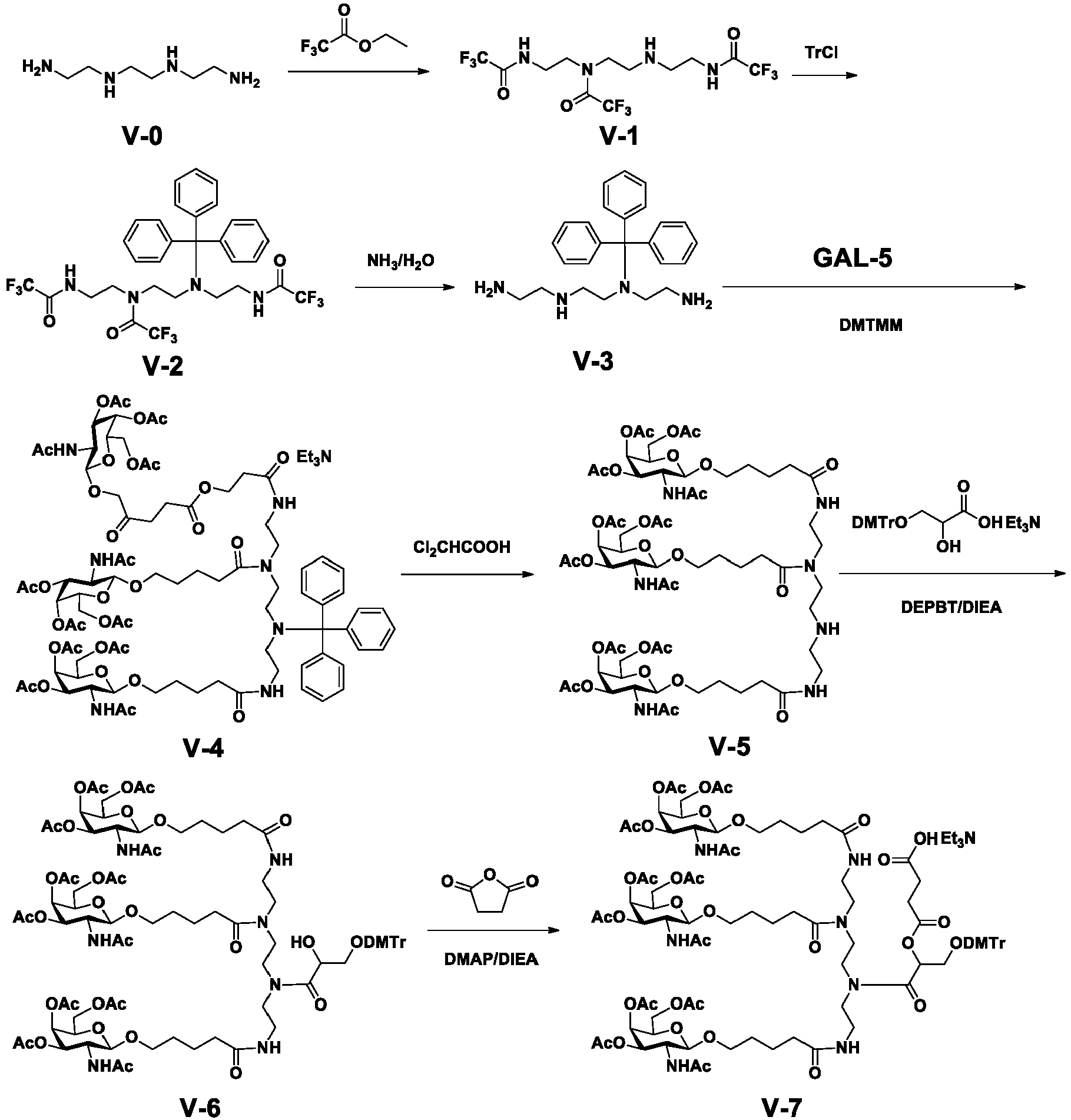
- In this preparation example, Conjugating Molecule 7 (also referred to as W-7 Conjugating Molecule hereinafter) was synthesized according to following method.

- W-0 (2.024 g, 10 mmol) was dissolved in 25 ml of acetonitrile, added with triethylamine (4.048 g, 40 mmol), and cooled to about 0 °C in an ice water bath. Ethyl trifluoroacetate (5.683 g, 40 mmol) was added to react for 22 hours at room temperature. The solvent was evaporated under reduced pressure, and the residue was foam-dried with a vacuum oil pump for 18 hours to give 5.835 g of crude solid product W-1.
- The crude product W-1 (5.835 g, 10 mmol) was dissolved in 50 ml of dichloromethane. TrCl (3.345 g, 12 mmol) and triethylamine (1.518 g, 15 mmol) were added to react for 20 hours under stirring at room temperature. The resulting reaction liquid was washed twice with 20 ml of saturated sodium bicarbonate and once with 20 ml of saturated brine. All organic phases were combined, dried with anhydrous sodium sulfate and filtered. The organic solvent was evaporated under reduced pressure, and the residue was foam-dried with a vacuum oil pump overnight to give 8.012 g of crude solid product W-2. The crude solid product W-2 was used in the next deprotection reaction without treatment.
- The crude product W-2 (8.012 g, 10 mmol) was dissolved in 100 ml of methanol, and added with 100 ml of aqueous methylamine solution (40 wt%) to react for 23 hours under stirring at 50 °C. Insoluble particles were removed from the reaction mixture by filtration. The solvent was evaporated under reduced pressure. The residue was added with 200 ml of mixed solvent of DCM: methanol in a volume ratio of 1:1, and the resulting organic phase was washed with 50 ml of saturated sodium bicarbonate. The aqueous phase isolated was extracted three times, each with 50 ml of dichloromethane. All organic phases were combined, dried with anhydrous sodium sulfate and filtered. The solvent was evaporated under reduced pressure, and the residue was foam-dried with a vacuum oil pump overnight, and purified by using a normal phase silica gel column, 200-300 mesh. The column was packed with petroleum ether, added with 1 wt% triethylamine for neutralizing the acidity of silica gel, and gradient eluted with dichloromethane: methanol: aqueous ammonia (25 wt%) = 1:1:0.05-1:1:0.25. The eluate was collected. The solvent was evaporated under reduced pressure, and the residue was foam-dried with a vacuum oil pump to give 3.062 g of pure product W-3.
- W-3 (675 mg, 1.517 mmol) and GAL-C7-2 (2.60 g, 5.46 mmol) were mixed and dissolved in 47 ml of acetonitrile, added with diisopropylethylamine (1.57 g, 12.14 mmol) followed by 3-(diethoxyphosphoryloxy)-1,2,3-benzotrizin-4(3H)-one (DEPBT, 1.816 g, 6.04 mmol) to react for 2.5 hours under stirring at room temperature. The resulting reaction liquid was diluted with 100 ml of dichloromethane. The organic phase obtained was washed with 80 ml of saturated sodium bicarbonate solution and 80 ml of saturated brine, respectively. All organic phases were combined, dried with anhydrous sodium sulfate, and filtrated. The solvent was evaporated under reduced pressure to give a crude product, which was purified by using a normal phase silica gel column, 200-300 mesh. The column was packed with petroleum ether, added with 1 wt% triethylamine for neutralizing the acidity of silica gel, and gradient eluted with dichloromethane: methanol = 100:5-100:7. The eluate was collected, and the solvent was evaporated under reduced pressure to give 1.610 g of pure product W-4.
- W-4 (1.61 g, 0.886 mmol) was dissolved in 125 ml of dichloromethane, and added with dichloroacetic acid (3.5 ml, 42.43 mmol) to react for 1 hour at room temperature. The resulting reaction liquid was neutralized by adding 150 ml of pyridine. The solvent was evaporated under reduced pressure to give a crude product. The crude product was purified by using a normal phase silica gel column, 200-300 mesh, with 10 wt% triethylamine for neutralizing the acidity of silica gel. The column was equilibrated with 1wt‰ triethylamine and gradient eluted with dichloromethane: methanol = 100:30-100:40. The eluate was collected, and the solvent was evaporated under reduced pressure to give 1.26 g of pure product W-5.
- W-5 (1.25 g, 0.793 mmol) and A-1 (1.21 g, 2.38 mmol) obtained according to the method described in step (1-7a) were mixed and dissolved in 12 ml of dichloromethane, and added with 3-(diethoxyphosphoryloxy)-1,2,3-benzotrizin-4(3H)-one (DEPBT, 0.712 g, 2.38 mmol) followed by diisopropylethylamine (0.615 g, 4.76 mmol) to react for 3 hours under stirring at 25°C, washed with 80 ml of saturated sodium bicarbonate. The aqueous phase isolated was extracted three times, each with 10 ml of dichloromethane. All organic phases were combined and washed with 10 ml of saturated brine. The obtained organic phases were combined, dried with anhydrous sodium sulfate, filtrated. The solvent was evaporated under reduced pressure, and the residue was foam-dried overnight with a vacuum oil pump to give a crude product. The crude product was subjected to a column purification by using normal phase silica gel, 200-300 mesh, 185 g, with 20 ml triethylamine for neutralizing the acidity of silica gel. The column was equilibrated with petroleum ether containing 1 wt% triethylamine and gradient eluted with petroleum ether: ethyl acetate: dichloromethane: N,N-dimethylformamide = 1:1:1:0.1-1:1:1:0.7. The eluate was collected, and the solvent was evaporated under reduced pressure to give 1.57 g of pure product W-6.
- W-6 (1.238 g, 0.63 mmol), succinic anhydride (0.189 g, 1.89 mmol) and 4-dimethylaminopyridine (DMAP, 0.231 g, 1.89 mmol) were mixed and dissolved in 7 ml of dichloromethane, and added with DIEA (0.407 g, 3.15 mmol) to react for 24 hours under stirring at 25 °C. The resulting reaction liquid was washed with 5 ml of 0.5 M triethylamine phosphate. The aqueous phase isolated was extracted three times, each with 5 ml of dichloromethane. All organic phases were combined, and the solvent was evaporated under reduced pressure to give a crude product. The crude product was subjected to a column purification by using normal phase silica gel, 200-300 mesh, 30 g, with 1 wt% triethylamine for neutralizing the acidity of silica gel. The column was equilibrated with dichloromethane and gradient eluted with 1wt‰ triethylamine-containing dichloromethane: methanol = 100:18-100:20. The eluate was collected, and the solvent was evaporated under reduced pressure to give 1.033 g of pure product, W-7 Conjugating Molecule (Conjugating Molecule 7). MS m/z: C101H146N7O38, [M-DMTr]+, calcd: 1763.92, measured: 1763.21. The structure of the resulting W-7 Conjugating Molecule is represented by Formula (515).
- It is expected that Conjugating Molecule 8 (also referred to as X-7 Conjugating Molecule hereinafter) can be synthesized according to following process route. The structure of the resulting X-7 Conjugating Molecule is represented by Formula (521). Conjugating Molecule

- In this preparation example, K-3 Conjugating Molecule (also referred to as comparative Conjugating Molecule 1Conjugating Molecule hereinafter) was synthesized according to following method:

- A-1 (3.0 g, 6.0 mmol) obtained according to the method described in step (1-7a), PyBOP (6.2 g, 12.0 mmol), HOBt (1.6 g, 2.0 mmol) and diisopropylethylamine (DIPEA, 3.9 g, 30.0 mmol) were added to 60 ml of dichloromethane to react for 10 minutes under stirring at room temperature. Then the above solution was added into K-0 (5.6 g, 30.0 mmol) to react at room temperature for 1 hour and 50 minutes. The reaction liquid was poured into 30 ml of saturated sodium bicarbonate solution. The aqueous phase isolated was extracted three times, each with 30 ml of dichloromethane. All organic phases were combined, washed with saturated sodium chloride solution, dried with anhydrous sodium sulfate, then filtrated and concentrated, and purified by using a normal phase silica gel column, 200-300 mesh, with a gradient elution of dichloromethane: methanol: aqueous ammonia (25 wt%) = 10:2:0.1- 4:4:1. The eluate was collected, concentrated to remove the solvents, and foam-dried with a vacuum oil pump to give 2.2 g of product K-1 as a white solid. 1H NMR (400 MHz, DMSO-d6) δ 8.02 (s, 1H), 7.43 (d, J = 7.8 Hz, 2H), 7.34 - 7.17 (m, 7H), 6.87 (d, J = 8.6 Hz, 4H), 4.05 (d, J = 5.2 Hz, 1H), 3.74(s, 6H), 3.20 - 3.01 (m, 5H), 2.60 - 2.38 (m, 12H), 1.60 - 1.39 (m, 8H), 1.24 (s, 1H). MS m/z: C33H47N4O5, [M+H]+, calcd: 579.35, measured: 579.26.
- GAL-5 (483 mg, 1.08 mmol) obtained according to the method described in step (1-1), 3-(diethoxyphosphoryloxy)-1,2,3-benzotrizin-4(3H)-one (359 mg, 1.2 mmol) and diisopropylethylamine (DIPEA, 310 mg, 2.4 mmol) were added into 3 ml of dichloromethane, and stirred at room temperature for 30 minutes. Then K-1 (174 mg, 0.3 mmol) was added to react at room temperature for 16 hours. The reaction liquid was poured into 10ml of saturated sodium bicarbonate solution. The aqueous phase isolated was extracted three times, each with 10ml dichloromethane. All organic phases were combined, washed with 10 ml of saturated sodium chloride solution, dried with anhydrous sodium sulfate, then filtrated and concentrated, and purified by using a normal phase silica gel column, 200-300 mesh, with a gradient elution of dichloromethane: methanol = 20:1. The eluate was collected, concentrated to remove the solvents, and foam-dried with a vacuum oil pump to give 205 mg of product K-2 as a yellow solid.
- K-2 (205 mg, 0.11 mmol), succinic anhydride (22 mg, 0.22 mmol), 4-dimethylaminopyridine (DMAP, 27 mg, 0.22 mmol) and diisopropylethylamine (DIPEA, 71 mg, 0.55 mmol) were added into 1.1 ml of dichloromethane to react overnight under stirring at room temperature. The reaction liquid was washed three times, each with 0.5 ml of 0.5 M triethylamine phosphate solution, and the aqueous phase resulted from each washing was reverse extracted once with 0.5 ml of dichloromethane. All organic phases were combined, dried with anhydrous sodium sulfate, and concentrated to remove the solvent, and foam-dried with a vacuum oil pump to give 218 mg of product as a light yellow solid, K-3 conjugate molecule (Comparative Conjugating Molecule 1).
- In this preparation example, compound 47 was synthesized according to the preparation method described in Example 1-4 of
WO2014025805A1 . The structure of compound 47 is shown in the following formula, which is herein referred to as (GalNAc)3 Conjugating Molecule (Comparative Conjugating Molecule 2):
- In this preparation example, FIN-2 Conjugating Molecule (Comparative Conjugating Molecule 3) was synthesized with reference to the preparation method described in Rajeev et al., according to the following process route:
-

- 2.93 g of PRO-6 (L-hydroxyproline, CAS No.: 51-35-4, purchased from Energy Chemical, 22.4 mmol) was dissolved in 22.5 ml of 1,4-dioxane and added with 34 ml of 10% (w/w) aqueous Na2CO3 solution. 6.954 g of Fmoc-Cl (9-fluorenylmethyl chloroformate, CAS No.: 28920-43-6, purchased from Energy Chemical, 26.8 mmol) was dissolved in 56.5 ml of 1,4-dioxane, added into the above reaction mixture under an ice bath, and naturally warmed to room temperature for reacting overnight. The reaction liquid was poured into 150 ml of ice water, and extracted three times, each with 100 ml of methyl t-butyl ether, the resulting organic phases were discarded. The aqueous phase remained was adjusted to pH ≤ 5 with concentrated hydrochloric acid, extracted twice with 100 ml of ethyl acetate, and the obtained organic phases were combined and dried with anhydrous sodium sulfate. The solvent was evaporated under reduced pressure to give 7.83 g of product PRO-7 as a white foamy solid. 1H NMR (400 MHz, DMSO-d6) δ 7.91 (t, J = 7.2 Hz, 2H), 7.67 (d, J = 7.5 Hz, 2H), 7.48 - 7.39 (m, 2H), 7.38 - 7.27 (m, 2H), 5.17 (s, 1H), 4.27 (s, 2H), 4.23 - 4.11 (m, 2H), 3.55 - 3.41 (m, 3H), 2.31 - 2.10 (m, 1H), 2.08 - 1.88 (m, 1H). HRMS (ESI) m/z calcd for C20H19NO5 [M-H]-352.1190, measured: 352.1033.
- 7.83 g of PRO-7 (22.2 mmol) was dissolved in 80 ml of THF, heated to 65oC under an oil bath, added with 36.6 ml of 2 mol/L solution of BH3-Me2S in THF (CAS No. 13292-87-0, purchased from J&K Scientific Ltd., 73.2 mmol) under reflux, and refluxed continually to react for 3 hours. The reaction liquid was poured out, and the remaining solid therein was dissolved in methanol. To the resulting reaction liquid mehtanol was added under stirring until no gas evolved, stirred continually for 30 minutes. The solvent was evaporated under reduced pressure, and then the residue was purified three times, each with petroleum ether to give 7.1 g of product PRO-8 as a white solid. 1H NMR (400 MHz, DMSO-d6) δ 7.91 (t, J = 6.7 Hz, 2H), 7.67 (d, J = 7.2 Hz, 2H), 7.49 - 7.39 (m, 2H), 7.38 - 7.26 (m, 2H), 5.18 (dd, J = 6.1, 3.8 Hz, 1H), 4.28 (s, 2H), 4.23 - 4.13 (m, 2H), 3.55 - 3.38 (m, 2H), 2.32 - 2.11 (m, 1H), 2.08 - 1.89 (m, 1H). HRMS (ESI) m/z calcd for C20H21NO4 [M+Na]+ 362.1368, measured: 362.1012.
- 7.1 g of PRO-8 (21 mmol) was dissolved in 100 ml of pyridine, and added with 14.2 g of DMTr-Cl (4,4'-dimethoxytrityl chloride, 42 mmol) to react for 5 hours under stirring at room temperature. The solvent was removed by evaporation under reduced pressure. The resulting crude product was dissolved in ethyl acetate and filtered to remove salt impurities. The solvent was evaporated under reduced pressure, and then the residue was purified by using a silica gel column. For purification, the crude product dissolved in DCM was loaded onto the silica gel column pretreated with pyridine to alkalify the column. DMTr-Cl was eluted with DCM containing 1% (v/v) pyridine, and then the product was eluted with ethyl acetate. The eluate was collected, and the solvent was evaporated under reduced pressure to give 8.2 g of product PRO-9 as a white solid. HRMS (ESI) m/z calcd for C41H39NO6 [M+Na]+ 664.2675, measured: 664.2348; C18 RP-HPLC (Lot Number: JJS160324-1); purity: 94.20%.
- 8.2 g of PRO-9 (12.8 mmol) was dissolved in 64 ml of DMF and added with 40 ml of piperidine (384 mmol) to react for 30 minutes under stirring at room temperature. The reaction liquid was poured into 300 ml of ice water and extracted three times, each with 150 ml of ethyl acetate. The resulting organic phases were combined, washed with 200 ml of saturated brine, and the organic phases resulted from washing was dried with anhydrous sodium sulfate. The solvent was evaporated under reduced pressure, and then the residue was purified by using a silica gel column. For purification, the crude product dissolved in DCM was loaded onto the silica gel column pretreated with pyridine to alkalify the column. Fmoc was eluted with DCM containing 1% (v/v) pyridine, and then the product was eluted with ethyl acetate. The eluate was collected, and the solvent was evaporated under reduced pressure to give 4.65 g of product PRO-10 as a white solid. 1H NMR (400 MHz, DMSO-d6) δ 7.40 (d, J = 7.2 Hz, 2H), 7.35 - 7.18 (m, 7H), 6.93 - 6.84 (m, 4H), 4.56 (d, J = 3.9 Hz, 1H), 4.12 (s, 1H), 3.74 (s, 6H), 3.46 - 3.37 (m, 1H), 2.88 (ddd, J = 18.5, 10.0, 5.5 Hz, 2H), 2.75 (dd, J = 8.7, 5.8 Hz, 1H), 2.62 (dd, J = 11.0, 2.7 Hz, 1H), 1.74 - 1.65 (m, 1H), 1.40 (ddd, J = 12.9, 8.5, 5.9 Hz, 1H); HRMS (ESI) m/z calcd for C26H29NO4 [M+Na]+ 442.1994, measured: 442.1999; C18 RP-HPLC (Lot Number: JJS160329-1), purity: 97.07%.
-
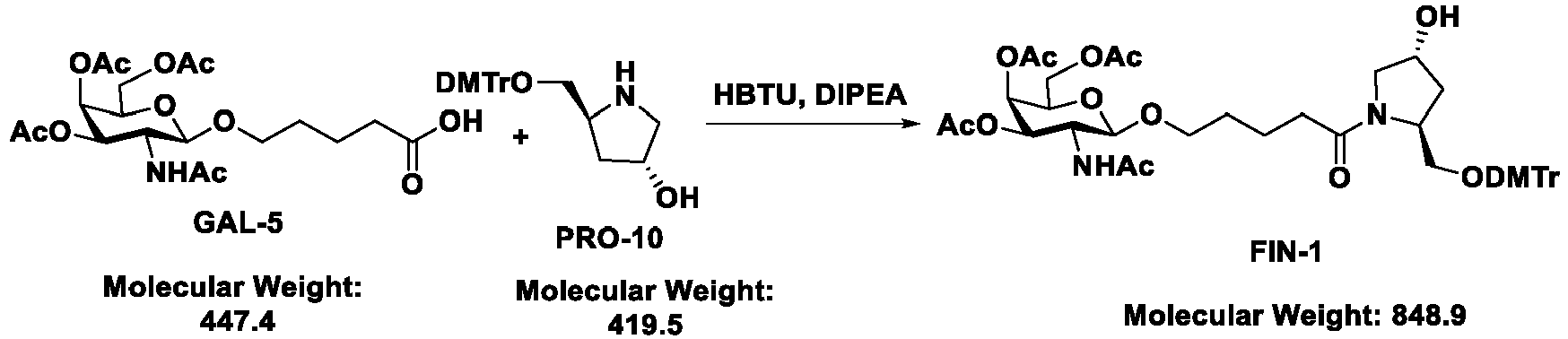
- GAL-5 (4.5 g, 10 mmol) obtained according to the method described in (1-1) was dissolved in 40 ml of DMF, sequentially added with 3.9 g of DIPEA (N,N-diisopropylethylamine, CAS No.: 7087-68-5, purchased from Aladdin Inc., 30 mmol) and 3.8 g of HBTU (benzotriazol-N,N,N',N'-tetramethyluronium hexafluorophosphate, CAS No.: 94790-37-2, purchased from Aladdin Inc., 11 mmol), and stirred at room temperature for 10 minutes to obtain a reaction liquid. PRO-10 (4.2 g, 10 mmol) obtained in step (12-4) was dissolved in 40 ml of DMF, then added into the above reaction liquid. The resulting reaction liquid was dried by addition of anhydrous sodium sulfate and stirred at room temperature for 2 hours. The reaction liquid was poured into 120 ml of ice water and extracted three times, each with 60ml of ethyl acetate. The resulting organic phases were combined, washed with 20ml of water and 20ml of saturated brine, respectively. The organic phase obtained from washing was isolated, dried with anhydrous sodium sulfate. The solvent was evaporated under reduced pressure, and then the residue was purified by using a silica gel column. For purification, a sample was loaded onto the silica gel column pretreated with pyridine to alkalify the column, and was eluted with dichloromethane (DCM) solution containing 1% (v/v) triethylamine and 1% (v/v) methanol. The eluate was collected, and the solvent was evaporated under reduced pressure to give 6.5 g of product FIN-1 as a light yellow foamy solid. 1H NMR (400 MHz, DMSO-d6) δ 7.83 (d, J = 9.2 Hz, 1H), 7.32 (t, J = 6.6 Hz, 4H), 7.20 (td, J = 8.9, 3.5 Hz, 5H), 6.93 - 6.84 (m, 4H), 5.21 (d, J = 3.2 Hz, 1H), 5.04 - 4.90 (m, 2H), 4.49 (s, 1H), 4.40 (d, J = 4.4 Hz, 0.8H), 4.31 (d, J = 5.0 Hz, 0.2H), 4.15 (s, 1H), 4.03 (s, 3H), 3.93 (s, 1H), 3.74 (s, 7H), 3.59 (dt, J = 12.0, 6.0 Hz, 1H), 3.50 - 3.40 (m, 1H), 3.39 - 3.25 (m, 3H), 3.13 (dd, J = 8.9, 5.2 Hz, 1H), 3.00 (dq, J = 9.3, 5.3, 4.3 Hz, 1H), 2.22 (s, 2H), 2.07 (s, 3H), 1.99 (s, 3H), 1.90 (s, 4H), 1.74 (s, 3H), 1.50 (s, 3H), 1.36 (s, 1H). C18 RP-HPLC (Lot Number: LJ160422), purity: 95.45%.
-

- FIN-1 (3.0 g, 3.53 mmol) obtained in step (11-2) was dissolved in 10 ml of DMF, added with 2.13 g of PA (2-cyanoethyl N,N,N',N'-tetraisopropylphosphorodiamidite, Adamas Inc., product No. 11356B, 7.06 mmol) and 346 mg tetrazole (CAS No.: 288-94-8, purchased from Aladdin Inc., 4.94 mmol) under nitrogen atmosphere, and stired to reaction at room temperature. 10 ml of DMF was supplemented and continually stirred to react for 1 hour. The solvent was removed by evaporation under reduced pressure, and then the residue was purification by silica gel column chromatography. For purification, the crude product dissolved in DCM was loaded onto the silica gel column pretreated with pyridine to alkalify the column, and eluted with ethyl acetate. The eluate was collected, and the solvent was evaporated under reduced pressure to give 4.5 g of crude product as a colorless syrup. The crude product was completely dissolved in 50% (v/v) aqueous acetonitrile solution and purified by using a medium pressure column (C-18, 330 g, 300 Å) pretreated with a solution of 1% (v/v) pyridine in acetonitrile to alkalify the column. A product was collected by gradient elution and the solvent was evaporated under reduced pressure to give 2.2 g of product as a white powder, FIN-2 Conjugating Molecule (Comparative Conjugating Molecule 3). 31P NMR (162 MHz, CDCl3) δ 148.04, 147.94, 147.62, 147.19, purity of 31P NMR: 92%; purity of C18 RP-HPLC: 90.54%.
- In this preparation example, Conjugating Molecule 153 (also referred to as Z-4 Conjugating Molecule hereinafter) was synthesized according to following method.

- W-3 (1.50 g, 3.37 mmol) obtained according to the method described in step (7-3) and GAL5-C4-2 (7.18 g, 13.48 mmol) obtained according to the method described in step (2-2) were mixed and dissolved in 34 ml of dichloromethane, added with diisopropylethylamine (3.48 g, 26.96 mmol) followed by 3-(diethoxyphosphoryloxy)-1,2,3-benzotrizin-4(3H)-one (DEPBT, 4.04 g, 13.48 mmol) to react for 4.5 hours under stirring at room temperature. The resulting liquid solution was diluted with 100 ml of dichloromethane, washed with 80 ml of saturated sodium bicarbonate solution and 80 ml of saturated brine, respectively. All organic phases were combined, dried with anhydrous sodium sulfate, and filtrated. The solvent was evaporated under reduced pressure to give a crude product, which was purified by using a normal phase silica gel column, 200-300 mesh. The column was packed with petroleum ether, added with 1 wt% triethylamine for neutralizing the acidity of silica gel, and gradient eluted with dichloromethane: methanol = 30:1-15:1. The eluate was collected and evaporated under reduced pressure to give 3.97 g of pure product Z-1. MS m/z: C98H143N10O33, [M+H]+, calcd: 1987.98, measured: 1987.90.
- Z-1 (3.97 g, 2.00 mmol) obtained according to the method described in (12-1) was dissolved in 250 ml of dichloromethane, and added with dichloroacetic acid (10.941 g, 84.85 mmol) to react for 1 hour at room temperature. Pyridine was added to neutralize the resulting reaction solution to neutral. The solvent was evaporated under reduced pressure to give a crude product. The column was loaded with 200 g 200-300 mesh normal phase silica gel, and with 10 wt% pyridine for neutralizing the acidity of silica gel. The column was equilibrated with 1wt‰ pyridine and gradient eluted with dichloromethane: methanol = 10:1-2:1. The eluate was collected, and the solvent was evaporated under reduced pressure to give 3.49 g of pure product Z-2. MS m/z: C79H129N10O33, [M+H]+, calcd: 1746.94, measured: 1746.90.
- Z-2 (3.49 g, 2.0 mmol) and A-1 (3.06 g, 6.0 mmol) obtained according to the method described in step (1-7a) were mixed and dissolved in 30 ml of dichloromethane, and added with 3-(diethoxyphosphoryloxy)-1,2,3-benzotrizin-4(3H)-one (DEPBT, 1.80 g, 6.0 mmol) followed by diisopropylethylamine (1.55 g, 12.0 mmol) to react for 3 hours under stirring at 25°C. 100 ml dichloromethane was added to the resulting reaction solution for dilution. The organic phase was washed twice with 30ml of saturated sodium bicarbonate. The aqueous phase was extracted with 10 ml of dichloromethane. All organic phases were combined and washed with 50 ml of saturated brine. And the obtained organic phases were combined and dried with anhydrous sodium sulfate, and filtrated. The solvent was evaporated under reduced pressure, and the residue was foam-dried overnight with a vacuum oil pump to give a crude product. The crude product was subjected to a column purification by using normal phase silica gel, 200-300 mesh, 200 g, with 20 ml triethylamine for neutralizing the acidity of silica gel. The column was equilibrated with petroleum ether containing 1 wt% triethylamine and gradient eluted with dichloromethane: methanol = 25:1-15:1. The eluate was collected, and the solvent was evaporated under reduced pressure to give 2.2 g of pure product Z-3. MS m/z: C103H151N10O38, [M+H]+, calcd: 2136.02, measured: 2136.20.
- Z-3 (2.10 g, 0.983 mmol) was dissolved in 14.8 ml of dichloromethane containing DIEA (635mg, 4.915 mmol), 4-dimethylaminopyridin (DMAP, 240 mg, 1.966 mmol) was added to the resulting solution and stirred to clarity. Succinic anhydride (197 mg, 1.966 mmol) was added to react for 18 hours under stirring at 25°C. 50 ml dichloromethane was added to the resulting reaction solution for dilution, and washed with 80 ml of 0.5 M triethylamine phosphate. The aqueous phase was extracted twice with 50 ml of dichloromethane. All organic phases were combined, and the solvent was evaporated under reduced pressure to give a crude product. The crude product was subjected to a column purification by using normal phase silica gel, 200-300 mesh, 188 g, with 1 wt% triethylamine for neutralizing the acidity of silica gel. The column was equilibrated with dichloromethane and gradient eluted with dichloromethane containing 1wt‰ triethylamine: methanol = 10:1-3:1. The eluate was collected, and the solvent was evaporated under reduced pressure to give 1.95 g of pure product, Z-4 Conjugating Molecule (Conjugating Molecule 12). MS m/z: C107H155N10O41, [M+H]+, calcd: 1935.07, measured: 1935.29. The structure of the resulting Z-4 Conjugating Molecule is represented by Formula (422).
- In this preparation example, L10-siHBa1 conjugate (also referred to as conjugate hereinafter) was prepared from the L-9 Conjugating Molecule (Conjugating Molecule 1) according to the following method.
-

- In this step, a compound L-10 was prepared by linking the L-9 Conjugating Molecule to a solid phase support.
- The L-9 Conjugating Molecule (0.233 g, 0.1126 mmol) obtained in step (1-8), O-benzotriazol-tetramethyluronium hexafluorophosphate (HBTU, 0.064 g, 0.1689 mmol) and diisopropylethylamine (DIPEA, 0.029 g, 0.2252 mmol) were mixed and dissolved in 19 ml of acetonitrile, and stirred at room temperature for 5 minutes. Aminomethyl resin (0.901 g, 100-200 mesh, amino loading: 400 µmol/g, purchased from Tianjin Nankai HECHENG S&T Co., Ltd.) was added into the reaction liquid. A reaction was performed on a shaker at 25°C and 220 rpm/min for 15 hours, followed by filtration. The residue was rinsed twice, each with 30 ml of DCM, three times, each with 30 ml of acetonitrile, and once with 30 ml of ethyl ether, and dried for 2 hours with a vacuum oil pump. Then a capping reaction was performed according to the charge ratio shown in Table 2.
Table 2 The charge ratio of capping reaction Starting Materials Amount Level Lot No. Manufacturer Cap1 20 ml Cap2 2.3 ml DMAP 0.01 g analytical pure I1422139 Aladdin acetonitrile 2.3 ml spectroscopic pure 015161001 CINC (Shanghai) Co., Ltd - In the above table,
Cap 1 andCap 2 are solutions of capping reagents.Cap 1 is a solution of 20% by volume of N-methylimidazole in a mixture of pyridine/acetonitrile, wherein the volume ratio of pyridine to acetonitrile is 3:5.Cap 2 is a solution of 20% by volume of acetic anhydride in acetonitrile. - Cap1, Cap2, 4-dimethylaminopyridine (DMAP) and acetonitrile were added into the above reaction mixture. A reaction was performed on a shaker at 25°C and 200 rpm/min for 5 hours. The reaction liquid was filtrated. The residue was rinsed three times, each with 30 ml of acetonitrile, the solvent was evaporated to dryness, and the mixture was dried overnight under a reduced pressure with a vacuum oil pump to give 1.100 g of compound L-10 (i.e., L-9 Conjugating Molecule linked to a solid phase support), with a loading of 90.8 µmol/g. The structure of compound L-10 can be represented by Formula (523).
- In this step, siRNA of the siRNA conjugate is a sequence numbered as siHBa1:
- siHBa1
- sense strand: 5'- CCUUGAGGCAUACUUCAAA-3' (SEQ ID NO: 1),
- antisense strand: 5'- UUUGAAGUAUGCCUCAAGGUU -3' (SEQ ID NO: 2).
- Nucleoside monomers were linked one by one in 3' to 5' direction according to the sequence above by the phosphoramidite solid phase synthesis method starting from the compound L-10 prepared in the above step. The linking of each nucleoside monomer included a four-step reaction of deprotection, coupling, capping, and oxidation. The synthesis condition was given as follows.
- The nucleoside monomers were provided in a 0.1 M acetonitrile solution. The conditions were the same for each deprotection reaction, i.e., a temperature of 25 °C, a reaction time of 70 seconds, a solution of dichloroacetic acid in dichloromethane (3% v/v) as a deprotection reagent, and a molar ratio of dichloroacetic acid to the protecting group on the solid phase support of 4,4'-dimethoxytrityl of 5:1.
- The conditions were the same for each coupling reaction, including a temperature of 25°C, a molar ratio of the nucleic acid sequence linked onto the solid phase support to nucleoside monomers of 1:10, a molar ratio of the nucleic acid sequence linked onto the solid phase support to a coupling reagent of 1:65, a reaction time of 600 seconds, and 0.5 M acetonitrile solution of 5-ethylthio-1H-tetrazole as a coupling reagent.
- The conditions were the same for each capping reaction, including a temperature of 25°C and a reaction time of 15 seconds. A capping reagent was a mixed solution of
Cap 1 andCap 2 in a molar ratio of 1:1; and a molar ratio of the capping reagent to the nucleic acid sequence linked onto the solid phase support was acetic anhydride: N-methylimidazole: the nucleic acid sequence linked onto the solid phase support = 1:1:1. - The conditions were the same for each oxidation reaction, including a temperature of 25 °C, a reaction time of 15 seconds, and 0.05 M iodine water as an oxidation reagent; and a molar ratio of iodine to the nucleic acid sequence linked onto the solid phase support in the coupling step was 30:1. The reaction was carried out in a mixed solvent of tetrahydrofuran: water: pyridine = 3:1:1.
- The conditions for cleavage and deprotection were as follows. The synthesized nucleotide sequence linked to the support was added into 25 wt% aqueous ammonia to react for 16 hours at 55 °C, and the aqueous ammonia is in an amount of 0.5 ml/µmol with respect to the nucleotide sequence. The liquid was removed, and the residue was concentrated in vacuum to dryness. After treatment with aqueous ammonia, the product was dissolved in N-methylpyrrolidone in an amount of 0.4 ml/µmol, followed by addition of 0.3 ml/µmol of triethylamine and 0.6 ml/µmol of triethylamine trihydrofluoride, with respect to the amount of the single strand nucleic acid, thereby removing the 2'-TBDMS protection on ribose. Purification and desalination: purification of the nucleic acid was achieved by using a preparative ion chromatography column (Source 15Q) with a gradient elution of NaCl. Specifically, eluent A: 20 mM sodium phosphate (pH 8.1), solvent: water/acetonitrile = 9:1 (v/v); eluent B: 1.5 M sodium chloride, 20 mM sodium phosphate (pH 8.1), solvent: water/acetonitrile = 9:1 (v/v); elution gradient: the ratio of eluent A: eluent B = 100:0-50:50. The eluate was collected, combined and desalted by using a reversed phase chromatography column. The specific condition included that a Sephadex column was used for desalination, with Sephadex-G25 as the filler and deionized water for eluting.
- Detection: the purity detected by ion exchange chromatography (IEX-HPLC) was 92.4%; and the molecular weight was analyzed by Liquid Chromatography-Mass Spectrometry (LC-MS), with a calculated value of 7253.96 and a measured value of 7253.12.
- Thus, in this step, the L-9 Conjugating Molecule was linked to the 3' terminal of the resulting sense strand, resulting in a sense strand S of siRNA in which the L-9 Conjugating Molecule was conjugated to the 3' terminal of siRNA.
- In this step, an antisense strand AS of the L10-siHB1 conjugate was synthesized by using a universal solid phase support (UnyLinker™ loaded NittoPhase®HL Solid Supports, Kinovate Life Sciences Inc.). The antisense strand AS of siRNA was obtained by the same conditions as that in the synthesis of the sense strand, including conditions of deprotection, coupling, capping, and oxidation reaction in the solid phase synthesis method, conditions of deprotection and cleavage, and isolation conditions.
- Detection: the purity detected by IEX-HPLC was 93.2%; and the molecular weight was analyzed by LC-MS, with a calculated value of 6675.04 and a measured value of 6674.50.
- The S strand and AS strand were dissolved in water for injection to get a solution of 40 mg/mL, respectively. They are mixed in an equimolar ratio, heated for 15 min at 50 °C, and then cooled to room temperature to form a double stranded structure via hydrogen bonds.
- After completion of the synthesis above, the conjugate was diluted to a concentration of 0.2 mg/mL by using ultra-pure water (homemade by Milli-Q ultra-pure water instrument, with resistivity of 18.2M Ω *cm (25°C) ). The molecular weight was measured by LC-MS (purchased from Waters Corp., model: LCT Premier). As a result, the calculated values of the molecular weight for S and AS are 7253.96 and 6675.04 respectively, and the measured values thereof are 7253.24 and 6674.61 respectively. It is confirmed that the synthesized conjugate is the target designed double stranded nucleic acid sequence with the L9 Conjugating Molecule, since the measured values are in conformity with the calculated values. The structure of the L10-siHBa1 conjugate (Conjugate 9) is represented by Formula (3).
- The given conjugates were prepared by using the same method as in Preparation Example 13, except that: 1) the conjugated siRNAs have sequences shown in Tables 3A-3G corresponding to conjugates 16-18, 24-26, 42-43, 62, 78, 105, 109, 111, 115, 144, 157-163, and 167-171; 2) when a phosphorothioate linkage exists between two nucleotides in the target sequence, the following sulfuration reaction step was used to replace the oxidation reaction step during linking of the later of the two nucleotides; the conditions were the same for each sulfuration reaction, including a temperature of 25 °C, a reaction time of 300 seconds, and xanthane hydride as a sulfurization reagent; a molar ratio of the sulfurization reagent to the nucleic acid sequence linked onto the solid phase support in the coupling step was 120:1; the reaction was carried out in a mixed solvent of acetonitrile: pyridine = 1:1; and 3) when 2'-positions of all nucleotides in the target sequence are modified hydroxyl groups, the step of removing the 2'-TBDMS protection on ribose was not included in the conditions for cleavage and deprotection. Therefore, the conjugates 16-18, 24-26, 42-43, 62, 78, 105, 109, 111, 115, 144, 157-163 of the present disclosure were prepared.
- In addition, conjugates 154-156 and 164-166 were prepared by using the same method as in Preparation Example 13, except that: the following Conjugating Molecule were used to replace L-9 Conjugating Molecule, respectively: Conjugate 164 was prepared from P-9 Conjugating Molecule (Conjugating Molecule 2) which obtained in Preparation Example 2; Conjugate 155, 156 and 165 were prepared from W-7 Conjugating Molecule (Conjugating Molecule 7) which obtained in Preparation Example 7;
Conjugate 154 and 166 were prepared from Z-4 (Conjugating Molecule 12) which obtained in Preparation Example 12, and the conjugated siRNAs have sequences shown in Tables 3A-3G corresponding to conjugates 154-156 and 164-166, respectively, and the conjugates were numbered separately according to Tables 3A-3G. Their structures were represented by Formula (3), Formula (4), Formula (15) and Formula (22), respectively. The molecular weights of the conjugates were measured by LC-MS as follows: - Conjugate 142:
- Calculated values S: 7649.55, AS: 6991.46,
- Measured values: S: 7649.1, AS: 6991;
- Conjugate170:
- Calculated values S: 7649.55, AS: 6995.47,
- Measured values: S: 7648.8, AS: 6994.8;
- Conjugate 171:
- Calculated values S: 7649.55, AS: 7011.53,
- Measured values: S: 7648.8, AS: 7010.9;
- Conjugate 115:
- Calculated values S: 7584.5, AS: 7007.46,
- Measured values: S: 7584, AS: 7006.2;
- Conjugate 109:
- Calculated values S: 7584.5, AS: 6931.47,
- Measured values: S: 7584, AS: 6930.9;
- Conjugate 106:
- Calculated values S: 7572.47, AS: 6907.41,
- Measured values: S: 7571.8, AS: 6906.9;
- Conjugate 113:
- Calculated values S: 7584.5, AS: 7011.47,
- Measured values: S: 7584, AS: 7011.3;
- Conjugate 17:
- Calculated values S: 7504.34, AS: 6961.52,
- Measured values: S: 7503.4, AS: 6960.9;
- Conjugate 25:
- Calculated values S: 7504.34, AS: 7037.51,
- Measured values: S: 7503.6, AS: 7036.9;
- Conjugate 18:
- Calculated values S: 8218.83, AS: 7703.05,
- Measured values: S: 8218, AS: 7702.5;
- Conjugate 16:
- Calculated values S: 7516.37, AS: 6985.58,
- Measured values: S: 7516.5, AS: 6984.9;
- Conjugate 159:
- Calculated values S: 7504.34, AS: 7057.58,
- Measured values: S: 7503.6, AS: 7057;
- Conjugate 160:
- Calculated values S: 7504.34, AS: 7041.52,
- Measured values: S: 7503.6, AS: 7040.8;
- Conjugate 161:
- Calculated values S: 7516.37, AS: 7065.58,
- Measured values: S: 7516.6, AS: 7064.5;
- Conjugate 162:
- Calculated values S: 7504.34, AS: 7139.68,
- Measured values: S: 7515.6, AS: 7138.9;
- Conjugate 163:
- Calculated values S: 7516.37, AS: 7081.64,
- Measured values: S: 7515.6, AS: 7080.9;
- Conjugate 62:
- Calculated values S: 7485.3, AS: 7161.7,
- Measured values: S: 7484.4, AS: 7160.9;
- Conjugate 78:
- Calculated values S: 7423.22, AS: 7207.78,
- Measured values: S: 7422.6, AS: 7207.2;
- Conjugate 42:
- Calculated values S: 7407.22, AS: 7208.77,
- Measured values: S: 7406.4, AS: 7208.1;
- Conjugate 43:
- Calculated values S: 7407.22, AS: 7170.72,
- Measured values: S: 7406.5, AS: 7170.1,
- Note: capital letters C, G, U, and A indicate the base composition of nucleotides; dT indicate a deoxythymine nucleotide; a lowercase letter m indicates that the nucleotide adjacent to the left side of the letter m is a 2'-methoxy modified nucleotide; a lowercase letter f indicates that the nucleotide adjacent to the left side of the letter f is a 2'-fluoro modified nucleotide; a lowercase letter s indicates the phosphorothioate linkage between the two nucleotides adjacent to both sides of the letter s; VP indicates that the nucleotide adjacent to the right side of the letters VP is a vinyl phosphate modified nucleotide; P indicates that the nucleotide adjacent to the right side of the letter P is a phosphate nucleotide; Ps indicates that the nucleotide adjacent to the right side of the letters Ps is a phosphorothioate modified nucleotide; Tmoe indicates thymine nucleotide modified with 2'-methoxyethoxyl.
- A vinyl phosphate and 2'-methoxy modified uridine monomer (VP-Um) was synthesized according to the following method:
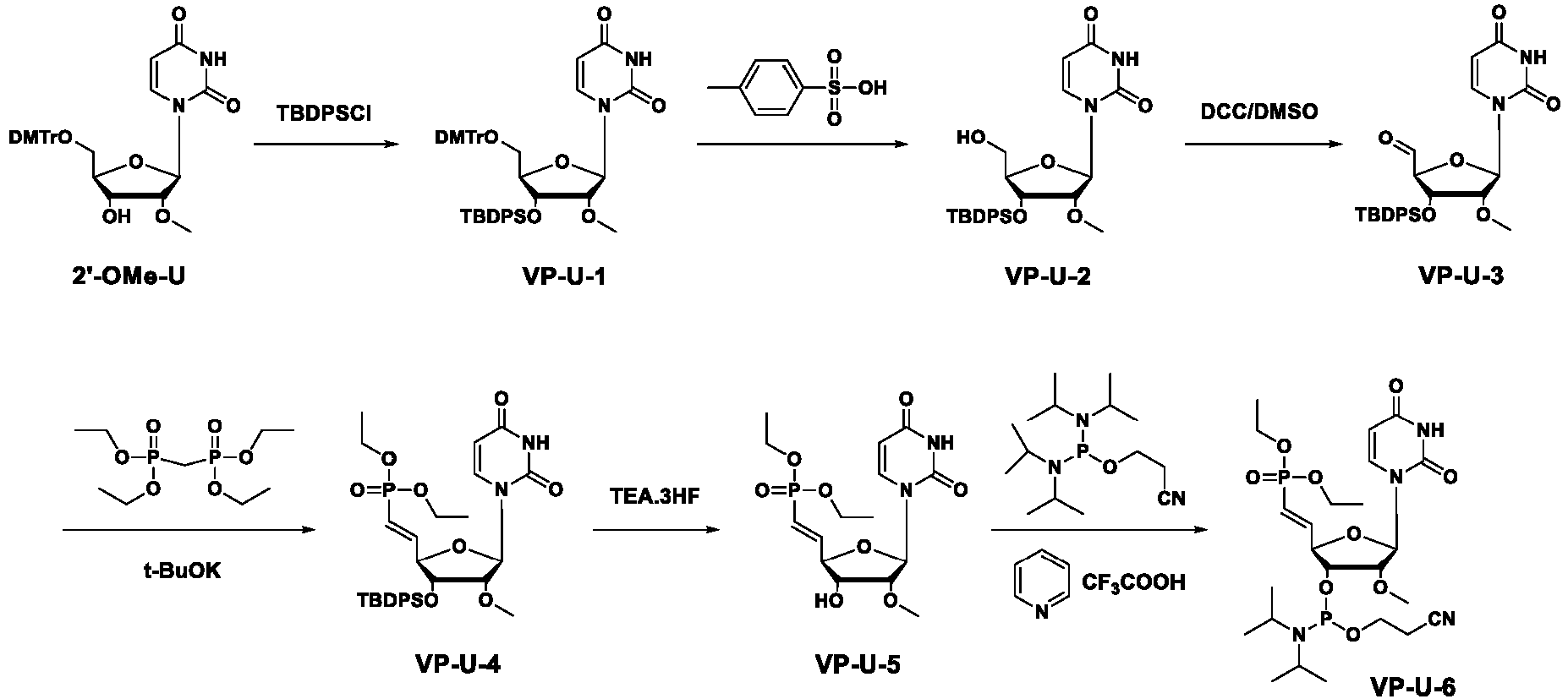
- A VP-U-2 molecule was synthesized according to the following method:

- A 2'-methoxy modified uracil nucleoside (2'-OMe-U, 51.30 g, 91.6 mmol), tert-butyl diphenylchlorosilane (TBDPSCl, 50.35 g, 183.2 mmol), and imidazole (12.47 g, 183.2 mmol) were mixed and dissolved in 450 ml of N,N-dimethylformamide (DMF) to react for 20 hours under stirring at room temperature. DMF was removed by evaporation, and the residue was dissolved with 600 ml of dichloromethane and washed with 300 ml of saturated sodium bicarbonate. The aqueous phase isolated was extracted three times, each with 300 ml of dichloromethane. All organic phases were combined, washed with 5% oxalic acid until an aqueous phase of pH<5 was obtained. The solvent was evaporated to dryness to give a crude product VP-U-1, which was directly used in the subsequent synthesis of VP-U-2.
- The crude product VP-U-1 was dissolved in 100 ml of dichloromethane, and then stirred for 10 minutes under an ice bath. 450 ml of 2% p-toluenesulfonic acid solution (with a mixed solvent of methanol and dichloromethane in a volume ratio of 3:7) pre-cooled in a refrigerator at 4 °C was added to react for 10 minutes. The reaction was quenched by addition of 200 ml of saturated sodium bicarbonate. The organic phase obtained was washed by addition of saturated sodium bicarbonate solution to pH=8. Aqueous phases were combined and extracted twice with 200 ml of dichloromethane. All organic phases were combined and washed once with 200 ml of saturated brine. The solvent was evaporated, and the residue was purified by using a normal phase silica gel column, 200-300 mesh. The column was packed with petroleum ether and gradient eluted with petroleum ether: ethyl acetate: dichloromethane: methanol = 1:1:1:0.05-1:1:1:0.25. The eluate was collected, the solvent was evaporated under reduced pressure, and the residue was foam-dried with a vacuum oil pump to give a total of 40.00 g of pure product VP-U-2. 1H NMR (400 MHz, DMSO-d6) δ 7.96 (d, J = 7.8 Hz, 1H), 7.64 (dtd, J = 5.1, 4.0, 2.2 Hz, 4H), 7.41-7.30 (m, 6H), 6.79 (d, J = 4.7 Hz, 1H), 5.73 (d, J = 7.6 Hz, 1H), 4.94 (t, J = 7.0 Hz, 1H), 4.12 (td, J = 4.6, 3.9 Hz, 1H), 4.05 (dd, J = 4.8, 4.0 Hz, 1H), 3.96 (t, J = 4.7 Hz, 1H), 3.68 (ddd, J = 11.8, 7.0, 4.6 Hz, 1H), 3.57 - 3.46 (m, 1H), 3.39 (s, 3H), 1.05 (s, 8H). MS m/z: C26H33N2O6Si, [M+H]+, calcd: 497.21, Measured: 497.45.
-

- VP-U-2 (19.84 g, 40.0 mmol), dicyclohexylcarbodiimide (DCC, 16.48 g, 80.0 mmol), pyridine (4.20 g, 53.2 mmol), and trifluoroacetic acid (6.61 g, 53.2 mmol) were mixed and dissolved in 200 ml of dimethyl sulfoxide (DMSO) to react for 20 hours under stirring at room temperature to obtain a reaction liquid. Separately, tetraethyl methylenediphosphate (21.44 g, 74.4 mmol) was dissolved in 120 ml of THF, cooled under an ice bath, added with t-BuOK (11.36 g, 101.2 mmol) at a temperature of the ice bath to react for 10 min, warmed to room temperature to react for 0.5 h and added into the above reaction liquid over about 1 h. The reaction was carried out for 1 h at a temperature of the ice bath and then warmed to room temperature to react for 18 h. The reaction was quenched by addition of water. The aqueous phase isolated was extracted three times, each with 200 ml of dichloromethane. All organic phases were combined and washed once with 200 ml of saturated brine. The solvent was evaporated to dryness, and the residue was purified by using a normal phase silica gel column, 200-300 mesh. The column was packed with petroleum ether and gradient eluted with petroleum ether: ethyl acetate = 1:1-1:4. The eluate was collected, the solvent was evaporated under reduced pressure, and the residue was foam-dried with a vacuum oil pump to give a total of 14.00 g of pure product VP-U-4. 1H NMR (400 MHz, DMSO-d6) δ 7.96 (d, J = 7.8 Hz, 1H), 7.64 (dtd, J = 5.1, 4.0, 2.2 Hz, 4H), 7.41 - 7.30 (m, 6H), 6.82 - 6.71 (m, 2H), 5.90 (ddd, J = 25.9, 15.0, 1.0 Hz, 1H), 5.73 (d, J = 7.6 Hz, 1H), 4.36 - 4.21 (m, 3H), 4.18 (t, J = 4.9 Hz, 1H), 4.05 (ddq, J = 9.7, 8.5, 6.9 Hz, 2H), 3.87 (t, J = 4.8 Hz, 1H), 3.39 (s, 3H), 1.32 (td, J = 6.9, 0.7 Hz, 6H), 1.05 (s, 8H). MS m/z: C31H42N2O8PSi, [M+H]+, calcd: 629.24, measured: 629.51.
-

- VP-U-4 (14.00 g, 22.29 mmol) was dissolved in 100 ml of tetrahydrofuran, added with triethylamine trihydrofluoride (17.96 g, 111.45 mmol), and stirred at room temperature for 20 hours to react completely. A crude product was obtained by direct evaporation of the solvent to dryness followed by dissolution in dichloromethane and evaporation to dryness twice with 50 ml of dichloromethane. The crude product was purified by using a normal phase silica gel column, 200-300 mesh. The column was packed with petroleum ether and gradient eluted with petroleum ether: ethyl acetate: dichloromethane: methanol = 1:1:1:0.05-1:1:1:0.25. The eluate was collected, the solvent was evaporated under reduced pressure, and the residue was foam-dried with a vacuum oil pump to give a total of 6.70 g of pure product VP-U-5. 1H NMR (400 MHz, DMSO-d6) δ 7.96 (d, J = 7.8 Hz, 1H), 6.77 (dd, J = 15.0, 6.2 Hz, 1H), 5.99 - 5.82 (m, 2H), 5.73 (d, J = 7.6 Hz, 1H), 5.27 (d, J = 5.1 Hz, 1H), 5.10 (dd, J = 5.3, 4.7 Hz, 1H), 4.29 (ddq, J = 9.8, 8.6, 7.0 Hz, 2H), 4.17 (ddd, J = 6.2, 5.2, 1.0 Hz, 1H), 4.12 - 3.98 (m, 3H), 3.39 (s, 2H), 1.32 (td, J = 6.9, 0.6 Hz, 6H). MS m/z: C15H24N2O8P, [M+H]+, calcd: 391.13, measured: 391.38.
-

- VP-U-5 (391 mg, 1.0 mmol), pyridine trifluoroacetate (0.232 g, 1.2 mmol), N-methylimidazole (0.099 g, 1.2 mmol), and 2-cyanoethyl N,N,N',N'-tetraisopropylphosphorodiamidite (0.452 g, 1.5 mmol) were added into 10 ml of anhydrous dichloromethane under argon atmosphere to react for 5 hours under stirring at room temperature. The solvent was evaporated to dryness, and then the residue was purified by column chromatography (200-300 mesh normal phase silica gel, with a gradient elution of dichloromethane: acetonitrile (containing 0.5 wt% triethylamine) = 3:1-1:3). The eluate was collected and concentrated to remove the solvent to give a total of 508 mg of target product VP-U-6. 31P NMR (161 MHz, DMSO-d6) δ 150.34, 150.29, 17.07, 15.50. MS m/z: C24H41N4O9P2, [M+H]+, calcd: 591.23, measured: 591.55. It indicates that VP-U-6 is the target product VP-Um, which involves in the synthesis of RNA strands as a nucleoside monomer.
- A 5'-phosphate ester modification is linked to 5' terminal using the following method:
- As a starting material, a phosphorylated structural monomer with the following structure of Formula CPR-I (purchased by Suzhou GenePharma Inc. as Cat#13-2601-XX) is employed:

- After all nucleosides of the antisense strand is linked, the monomer of Formula (CPR-I) is linked to the 5' terminal of the antisense strand by a four-step reaction of deprotection, coupling, capping, and oxidation according to the method of solid phase phosphoramidite synthesis of nucleic acid, following by cutting down and deprotection according to the following condition, thus obtaining the antisense strand:
- The synthesized nucleotide sequence linked to the support was added into 25 wt% aqueous ammonia to react for 16 hours at 55 °C, and the aqueous ammonia is in an amount of 0.5 ml/µmol with respect to the nucleotide sequence. The liquid was removed, and the residue was concentrated in vacuum to dryness. After treatment with aqueous ammonia, the product was dissolved in N-methylpyrrolidone in an amount of 0.4 ml/µmol, followed by addition of 0.3 ml/µmol of triethylamine and 0.6 ml/µmol of triethylamine trihydrofluoride, with respect to the amount of the single strand nucleic acid, thereby removing the 2'-TBDMS protection on ribose. Purification and desalination: purification of the nucleic acid was achieved by using a preparative ion chromatography column (Source 15Q) with a gradient elution of NaCl. Specifically, eluent A: 20 mM sodium phosphate (pH 8.1), solvent: water/acetonitrile = 9:1 (v/v); eluent B: 1.5 M sodium chloride, 20 mM sodium phosphate (pH 8.1), solvent: water/acetonitrile = 9:1 (v/v); elution gradient: the ratio of eluent A: eluent B = 100:0-50:50. The eluate was collected, combined and desalted by using a reversed phase chromatography column. The specific condition included that a Sephadex column was used for desalination, with Sephadex-G25 as the filler and deionized water for eluting.
- In the case where the target product has a 5'-phosphorothioate modification, the same procedure as above is employed, except that the above oxidation reaction conditions is replaced with a sulfuration reaction condition in the linking, thereby carrying out the sulfuration reaction.
- For the sense strand and antisense strand synthesized above, the purity was determined by ion exchange chromatography (IEX-HPLC), and the molecular weight was analyzed by LC-MS, and it was confirmed that the synthesized nucleic acid sequence corresponds to the respective siRNAs of the examples and comparative examples in Table 5.
- Otherwise, it is expected that the rest of the conjugates in tables 3A-3G can be prepared by employing the same method as in Preparation Example 13, except that: 1) As to Conjugates 31-37, 52-58, 68-74, 84-90, 121-127 and 146-152, Comparative conjugates 4-5, 7-8 and 10-13, the L-9 Conjugating Molecule is replaced with the Conjugating Molecules 2-8 or 12 and Comparative Conjugating Molecules 1-2 obtained from Examples 2-10 or 12 (e.g., when the L-9 Conjugating Molecule is replaced with the P-9 Conjugating Molecule (Conjugating Molecule 2) it is anticipated that the
conjugates conjugates 32, 53, 69, 85, 122 and 147 which are numbered with a R5 conjugate can be obtained, and so forth; 2) the conjugated siRNAs have sequences shown in Tables 3A-3G corresponding to conjugats 10-15, 19-23, 27-41, 44-61, 63-77, 79-104, 106-108, 110, 112-114, 116-141 and 143-152, and comparative conjugates 4-5, 7-8 and 10-17; 3) when a phosphorothioate linkage exists between two nucleotides in the target sequence, the sulfuration reaction step described in Preparation Example 13 was used to replace the oxidation reaction step during linking of the later of the two nucleotides; and 4) when 2'-positions of all nucleotides in the target sequence are modified hydroxyl groups, the step of removal of the 2'-TBDMS protection on ribose was not included in the conditions for cleavage and deprotection. Therefore, it is anticipated that conjugates 10-15, 19-23, 27-41, 44-61, 63-77, 79-104, 106-108, 110, 112-114, 116-141 and 143-152, and comparative conjugates 4-5, 7-8 and 10-17 can be obtained, and the conjugates were numbered separately according to Tables 3A-3G. The disclosure conjugates are represented by Formulas (3), (4), (7), (12), (13), (14), (15), (21), and (22) respectively, and the comparative conjugates are represented by Formulas (901) and (902) respectively:

- The
comparative conjugates - The connection of FIN_FIN_FIN conjugating group was proceeded according to the method described in Rajeev et al., . Specifically, the hydroxy protecting group was firstly removed from the above-mentioned universal solid phase support, and the solid phase support was subsequently brought into contact and coupled with the FIN-2 conjugating molecule under the coupling condition and a coupling agent, and a FIN conjugating molecule connected to the solid phase support was obtained after the capping and oxidation reaction. Moreover, the hydroxy protecting group DMTr was removed from the FIN conjugating molecule connected to the solid phase support, and the solid phase support was further brought into contact and coupled with another FIN-2 conjugating molecule, followed by capping and oxidation reaction. After a still further cycle of Deprotection-Coupling-Capping-Oxidation, a third FIN-2 conjugating molecule was connected, and a conjugating group (FIN_FIN_FIN) connected to the solid phase support was thus obtained. Thereafter, started with the conjugating group connected to the solid phase support, nucleotide monomers were consequently connected, and an RNA sense strand with the conjugating group (FIN_FIN_FIN) conjugated to 3' end was finally obtained.
- In the reactions above, the conditions, solvents and agents of the deprotection, coupling, capping, and oxidation are in accordance with the RNA solid phase synthesis described in the step (11-2).
- Subsequently, cleavage and deprotection, purification and desalting, detection, and annealing were performed by the same method as in Preparation Example 12 to finally obtain
comparative conjugates 6 and 9 (sometimes also simply referred to as FIN conjugates hereinafter). The molecular weight was measured by LC-MS (purchased from Waters Corp., model: LCT Premier). It is confirmed that the synthesized FIN-siHBa1M1SP conjugate is the target designedcompound, since the measured values is in conformity with the theoretical values. Its structure is as represented by Formula (903):
comparative conjugates - After the preparation of the conjugates above, they were lyophilized to solid powder via standard process and stored until used. When required, they can be resolved with such as water for injection or normal saline to a solution at a desired concentration.
- In C57BL/6J mice,
Conjugate 24 was subcutaneously administrated to each mouse, respectively, with a single dose of 100 mg/kg or 200 mg/kg (by siRNA, in the form of 0.9 wt% NaCl aq., 10 mL/kg was administrated each at the concentration of 10 mg/mL or 20 mg/mL). During a period of administration for continuous observation, no animal death occurred, no clinical symptoms associated with adverse drug responses were observed, and no abnormalities were found in clinical pathology test or gross anatomy, both of which being proceeded at 24h after the administration. Thus, the above results indicate a relatively low toxicity of the conjugates of the present disclosure at animal level. -
Conjugates Fig. 1A . Thecomparative sequence 1 is as follows: Sense: 5'-CCUUGAGGCAUACUUCAAA-3' (SEQ ID NO: 250); antisense strand: 5'-UUUGAAGUAUGCCUCAAGGUU-3' (SEQ ID NO: 251). - According to the same method, the stability of
Conjugates Fig. 1B . -
Figs. 1A and 1B show the semiquantitative result of the stability test of the siRNA conjugates in the Tritosome in vitro. It is demonstrated that the conjugates of the disclosure can remain undegraded in a long time in Tritosome, showing good stability. -
Conjugates Fig. 2A . Thecomparative sequence 1 is as follows: Sense: 5'-CCUUGAGGCAUACUUCAAA-3' (SEQ ID NO: 250); antisense strand: 5'-UUUGAAGUAUGCCUCAAGGUU-3' (SEQ ID NO: 251). - According to the same method, the stability of
Conjugates Fig. 2B . -
Figs. 2A and 2B show the semiquantitative result of the stability test of the tested siRNA conjugates in the human plasma in vitro. It is demonstrated that in human plasma, the conjugates of the disclosure remain undegraded in up to 72 hours, showing good stability in human plasma. Experimental Example 2-3 Stability in the monkey plasma in vitro. -
Conjugates Comparative Sequence 2 is an siRNA with a sense strand having a sequence represented by SEQ ID NO: 80 and an antisense strand having a sequence represented by SEQ ID NO: 81, while without being conjugated to any concjugating molecule) were individually mixed well with 108 µL of 90% cynomolgus monkey plasma (Monkey plasma, purchased form HONGQUAN Bio, Cat. HQ70082, diluted in PBS) and incubated at a constant temperature of 37 °C. 10 µL samples were taken at each time point of 0 h, 2 h, 4 h, 6h, 8h, 24 h, 48 h and 72 h respectively, and immediately frozen in liquid nitrogen and cryopreserved in a - 80°C freezer. After sampling at each time point, each sample was diluted 5-fold with 1×PBS (pH 7.4) and then taken in a volume of 10 µL for use. Meanwhile, each of the conjugates above at equal moles (2 µM, 2µL) was mixed well with 8 µL of 1x PBS, thus obtaining 10 µL of samples untreated with monkey plasma (marked as Con). 20 wt% of non-denatured polyacrylamide gel was prepared. Each diluted sample was all mixed with 4 µL of loading buffer (aquarious solution of 20 mM EDTA, 36 wt% glycerol, and 0.06 wt% bromophenol blue) and then loaded into the gel to perform electrophoresis for 60 minutes under 80 mA constant current. After finishing the electrophoresis, the gel was stained with 1x Sybr Gold dye (Invitrogen, Cat. 11494) for 15 minutes followed by imaging. The results are shown inFig. 3A . - The stability of
Conjugates Fig. 3B . -
Figs. 3A and 3B show the semiquantitative result of the stability test of the tested siRNA conjugates in the monkey plasma in vitro. It is demonstrated that in cynomolgus monkey plasma, the conjugates of the disclosure remain undegraded in up to 72 hours, showing good stability in monkey plasma. - In this experimental example, Conjugates 24 and 25 were administered to rats in each experimental group (10 rats in each group, half female and half male) by subcutaneous injection, respectively, with a single dose of 10 mg/kg and 50 mg/kg. Subsequently, the drug concentration in plasma, liver and kidney tissue of rats were measured at each time point.
- Firstly, SD rats were randomly divided into groups according to the body weight and gender thereof by using the PRISTIMA 7.2.0 data system, followed by respectively administration of the conjugates according to the designed dosage. The drug dosages for all animals were calculated according to the body weight. A single dose was administered subcutaneously, with the dosage of 10 mg/kg and 50 mg/kg respectively in the form of 1mg/ml and 5 mg/ml of 0.9% NaCl aqueous solution and the volume of 10 ml/kg. Rat whole blood was collected from the jugular vein before administration and at 5 minutes (±30 seconds), 30 minutes (±1 minute), 1 hour (±2 minutes), 2 hours (±2 minutes), 6 hours (±5 minutes), 24 hours (±10 minutes), 48 hours (±20 minutes), 72 hours (±20 minutes), 120 hours (±30 minutes), and 168 hours (±30 minutes) after administration. Then the whole blood samples were centrifugated at 2-8°C under 1800 x g for 10 minutes to separate plasma. About 70 µL volume of a plasma sample was placed in one tube, and the remaining of the same sample was placed in another, both of which were cryopreserved at -70°C to -86°C for inspection. Liver and kidney tissues of rats were collected at about 24, 48, 72, 120, and 168 hours after administration by the method comprising anesthetizing the rats with pentobarbital sodium according to the weight thereof (60 mg/kg by intraperitoneal injection), euthanizing the rats by blood collection from abdominal aorta, and performing gross anatomy. The liver and kidney of each rat were sampled and stored in 1 mL cryotube at below -68°C until measurement and analysis.
- The concentrations of the conjugates of
Conjugates - (1) grinding the tissue until a tissue mass of no more than 80 mg was obtained, then adding Tissue and Cell Lysis Solution (supplier: Epicentre, Cat. MTC096H) to prepare a tissue homogenate of 66.7 mg/mL;
- (2) subjecting the tissue homogenate to a sonication (150 W, 30 s) to disrupt cells;
- (3) for each group of tissue samples, adding 75 µL of tissue samples to a 96-well PCR plate, adding 5 µL of proteinase K (supplier: Invitrogen, Cat. 25530-015) and 10 µL of mixed aqueous solution of 10 wt% acetonitrile and 0.01
wt% Tween 20;
for each group of plasma samples, adding 20 µL of plasma to a 96-well PCR plate, adding 45 µL of Tissue and Cell Lysis Solution, 5 µL of proteinase K, and 20 µL of mixed liquid of 10 wt% acetonitrile and 0.01wt% Tween 20; - (4) closing the plates and placing them in a PCR instrument (supplier: Applied Biosystems, model: GeneAmp® PCR system 9700) and incubating at 65°C for 45 minutes;
- (5) after finishing incubation, adding 10 µl of 3 M KCl aqueous solution (supplier: Sigma-aldrich, Cat. 60135-250ML), shaking well, and centrifuging at 3200 rcf at 4°C for 15 minutes;
- (6) for each group of tissue samples, adding 80 µL of supernatant into 120 µL of hybridization mixture (formula: 0.5 mL of 6 µM PNA probe (supplier: TAHE-PNA), 1 mL of 200 mM Trizma/pH = 8, 5 mL of 8 M urea aqueous solution, 3.5 mL of H2O, 2 mL of acetonitrile);
for each group of plasma samples, adding 40 µL of supernatant into 160 µL of hybridization mixture (formula: 0.5 mL of 6 µM PNA probe, 1 mL of 200 mM Trizma/pH = 8, 5 mL of 8 M urea aqueous solution, 7.5 mL of H2O, 2 mL of acetonitrile); - (7) closing the plates and placing them in a PCR instrument, incubating at 95°C for 15 minutes, then immediately placing on ice for 5 minutes;
- (8) transferring the samples to new 96-well plates with conical bottom, shaking well, and centrifuging at 3200 rcf for 1 minute;
- (9) injecting the samples for measurement and quantitatively analyzing by using HPLC-FLD (liquid-phase system supplier: Thermo Fisher, chromatography model: ultimate 3000).
- The analysis results can be found in
FIGS. 4-11 .FIGS. 4-7 show metabolic profiles over time of PK/TK plasma concentrations in rat plasma and PK/TK tissue concentrations in rat liver and kidney forConjugate 24, respectively;FIGS. 8-11 show metabolic profiles over time of PK/TK plasma concentrations in rat plasma and PK/TK tissue concentrations in rat liver and kidney forConjugate 25, respectively. Specifically, -
Fig. 4 is a metabolic profile over time showing PK/TK plasma concentration forConjugate 24 in rat plasma at a dosage of 10 mg/kg. -
Fig. 5 is a metabolic profile over time showing PK/TK tissue concentrations forConjugate 24 in rat liver and kidney at a dosage of 10 mg/kg. -
Fig. 6 is a metabolic profile over time showing PK/TK plasma concentration forConjugate 24 in rat plasma at a dosage of 50 mg/kg. -
Fig. 7 is a metabolic profile over time showing PK/TK tissue concentrations forConjugate 24 in rat liver and kidney at a dosage of 50 mg/kg. -
Fig. 8 is a metabolic profile over time showing PK/TK plasma concentration forConjugate 25 in rat plasma at a dosage of 10 mg/kg. -
Fig. 9 is a metabolic profile over time showing PK/TK tissue concentrations forConjugate 25 in rat liver and kidney at a dosage of 10 mg/kg. -
Fig. 10 is a metabolic profile over time showing PK/TK plasma concentration forConjugate 25 in rat plasma at a dosage of 50 mg/kg. -
Fig. 11 is a metabolic profile over time showing PK/TK tissue concentrations forConjugate 25 in rat liver and kidney at a dosage of 50 mg/kg. - As can be seen from the results of
FIGS. 4-11 , the concentrations forConjugates - Firstly, C57BL/6J mice (all females) were randomly divided into groups. The experiment groups were numbered with Conjugate 158 (5 mice), Comparative Conjugate 14 (5 mice), and the PBS control group (8 mice), respectively. All animals were dosed according to body weight, and were subcutaneously administered at different single doses of 1 mg/kg or 0.1 mg/kg. The dosing volume was 5 ml/kg. For different doses, the conjugates were dissolved in a 0.9% aqueous solution of sodium chloride at the concentration of 0.2 mg/mL and 0.02 mg/mL. The animals were sacrificed 72 h after the administration, and the liver was collected; the liver tissue was homogenized with a tissue homogenizer, and total RNA was extracted by RNAVzol (VIGOROUS, lot: 161G) according to the standard procedure of total RNA extraction.
- The expression level of TTR mRNA in liver tissue was detected by real-time fluorescent-based quantitative PCR. Specifically, the total RNA extracted was reverse-transcribed into cDNA using the Reverse Transcription System (Promega, Lot#0000223677, REF: A3500) according to the instructions. The quantitative fluorescence PCR instrument (ABI step One) was subsequently used to detect the inhibition efficiency of siRNA on mTTR mRNA expression in liver tissue. In this detection method, the GAPDH gene was used as an internal reference gene, and mTTR and GAPDH expressions were detected using primers for TTR and primers for GAPDH, respectively.
- The sequences of the detection primers are shown in table 4.
Table 4 The sequences of detection primers gene Upstream primer Downstream primer mTTR 5'- CCGTCTGTGCCTTCTCATCT -3' (SEQ ID NO: 187) 5'- TAATCTCCTCCCCCAACTCC -3' (SEQ ID NO: 188) GAPD H 5'- AGAAGGCTGGGGCTCATTTG- 3' (SEQ ID NO: 189) 5'- AGGGGCCATCCACAGTCTTC -3' (SEQ ID NO: 190) - In this real-time PCR method, the expression of mTTR mRNA is expressed by the percentage of the remaining amount of TTR gene expression, and is calculated as follows:
Remaining amount of TTR gene expression = (copy number of TTR gene in test group / copy number of GAPDH in test group) / (copy number of TTR gene in control group/copy number GAPDH in control group) × 100% - The mRNA inhibition rate of the conjugate is then calculated according to the following formula:

- Wherein, the control group was mice which PBS was administered in the experiment, and each test group was a group of mice administered with different siRNA conjugates. The results are shown in Table 5.
Table5 Inhibition effect of mTTR mRNA in mice siRNA conjugate Sample serial number mRNA inhibition ratio (%) 1mg/kg 0.1mg/kg Conjugate158 L10-simTTR 94 51 Comp. Conjugate 14K4--simTTR 74 18 - The result demonstrates that, although with the same siRNA sequences and modifications, the target mRNA inhibition ratio of the Conjugate 158 was significantly higher than that of the
Comparative Conjugate 14. - In the following experimental example 5 to experimental example 11, the properties and effects of the siRNA conjugates in tables 3A to 3F were experimentally verified according to the siRNA target position and sequence correlation.
- According to the method described by Kumico Ui-Tei et. al., Functional dissection of siRNA sequence by systematic DNA substitution: modified siRNA with a DNA seed arm is a powerful tool for mammalian gene silencing with significantly reduced off-target effect. Nucleic Acids Research, 2008.36(7), 2136-2151, plasmids for detection were constructed and co-transfected with the siRNA conjugates to be detected into HEK293A cells; and the expression level of the dual luciferase reporter gene were measured using a dual luciferase reporter detection kit. Specific steps are as follows:
- Four recombinant plasmids were constructed using psiCHECK™-2 (Promega™) plasmid, in which GSCM was expressed as the on-target plasmid; and PSCM, GSSM, and PSSM were expressed as the off-target plasmids:
- (1) GSCM, containing a target sequence, the target sequence is fully complementarily pared with all 21 nucleotide sequences of the antisense strand in the conjugate to be detected.
- (2) PSCM, containing a target sequence, the target sequence is fully complementarily pared with all 21 nucleotide sequences of the sense strand in the conjugate to be detected.
- (3) GSSM, containing a target sequence, the target sequence is fully complementarily pared with the nucleotide sequence at positions 1-8 from the 5' end of antisense strand in the conjugate to be detected. The nucleotide sequence at positions 9-21 from the 5' end of antisense strand in the conjugate to be detected is complementary mismatched with its corresponding target sequence. The mismatch rule is: the nucleotide G, C, A or U in any position between 9 and 21 from the 5' end of antisense strand in the conjugate to be detected is respectively mismatched with the nucleotides T, A, C or G, in the corresponding position of the target sequence.
- (4) PSSM, containing a target sequence, the target sequence is fully complementarily pared with the nucleotide sequence at positions 1-8 from the 5' end of sense strand in the conjugate to be detected. The nucleotide sequence at positions 9-21 from the 5' end of sense strand in the conjugate to be detected is complementary mismatched with its corresponding target sequence. The mismatch rule is: the nucleotide G, C, A or U in any position between 9 and 21 from the 5' end of sense strand in the conjugate to be detected is respectively mismatched with the nucleotides T, A, C or G, in the corresponding position of the target sequence.
- The target sequence was inserted into the Xho I/Not I site of the psiCHECK™-2 plasmid.
- In a 96-well plate, siRNA and each of the above plasmids were co-transfected according to the instructions of LipofectamineTM 2000 (Invitrogen), each plasmid with 11 groups of corresponding siRNA at certain concentrations, respectively. Specifically, 10 ng of plasmid was transfected per well; and the final concentration of siRNA co-transfected per well was from 100 nM to 0.0001 nM (4-fold serial dilutions), 3 replicate wells per group, using 0.2 µL of
LipofectamineTM 2000 per well. - 24 hours post co-transfection, the HEK293A cells were lysed by using a dual luciferase reporter gene assay kit (Promega, cat. E2940) according to the instruction manual to detect the expression level of the dual luciferase reporter gene. For each test group of certain concentration, those untreated with the conjugate are used as control (con). The Renilla luciferase protein level (Ren) was normalized to the firefly luciferase protein level (Fir). The dose-response curves were plotted by the activity results measured at different siRNA concentrations, and the curves were modeled using Function log(inhibitor) vs. response-Variable slope of Graphpad 5.0 software with the formula below:

- Y is the expression level of remaining mRNA,
- X is the logarithm of the concentration of transfected siRNA,
- Bot is the Y value at the bottom of the asymptote,
- Top is the Y value at the top of the asymptote,
- LogIC50 is the X value at which Y is median value between the bottom and the top of the asymptote, and HillSlope is the slope of the curve.
- The IC50 of the conjugate to be detected corresponding to GSCM was determined via calculation based on the dose-effect curve, and then was compared with PSCM, GSSM or PSSM.
- For
Conjugate 24, the results are shown inFigures 12A-12D , and the IC50 value ofConjugate 24 corresponding to GSCM was calculated as 0.0019 nM; compared with PSCM, GSSM or PSSM,Conjugate 24 showed no significant inhibitory effect at each siRNA concentration, indicating that the siRNA conjugate of the present disclosure possesses relatively high activity in vitro and low off-target effects.
Experimental Example 5-2 - This experiment illustrates the inhibitory efficiency of the siRNA conjugates in Table 3A in expression of HBV mRNA in vivo. - In this experimental example, the inhibitory efficiencies of
Conjugates - At first, C57BL/6J-Tg (Alb1HBV) 44Bri/J mice were randomly divided into groups based on HBsAg content in serum (all female, 4 mice in each group) and respectively numbered as
Conjugate 16 andConjugate 24, and a nonmal saline (NS) group was added as a control group. The drug dosages for all animals were calculated according to the body weight. A single dose was administered subcutaneously, with the dosage of 1 mg/kg, respectevily in a conjugate concentration of 0.2 mg/ml and 0.02 mg/ml in 0.9 wt% NaCl aqueous solution and the dosage volume of 5 ml/kg. Animals were sacrificed atday 14 after administration. The liver was collected and kept with RNA later (Sigma Aldrich), and the liver tissue was homogenized with a tissue homogenizer. Then the total RNA was extracted and obtained by using Trizol according to the standard procedure for total RNA extraction. - The expression level of HBV mRNA in liver tissue was measured by real-time fluorescent qPCR. Specifically, the extracted total RNA was reverse transcribed into cDNA by using ImProm-II™ reverse transcription kit (Promega) according to the instruction thereof, and then the inhibitory efficiency of siRNAs in the expression of HBV mRNA in liver tissue was measured by using the fluorescent qPCR kit (Beijing Cowin Biosicences Co., Ltd). In this fluorescent qPCR method, β-actin gene was used as an internal control gene, the HBV and β-actin were detected by using primers for HBV and β-actin, respectively.
- Sequences of primers for detection are shown in Table 5A.
Table 5A Sequences of primers for detection Genes Upstream Primers Downstream Primers HBV 5'- CCGTCTGTGCCTTCTCATCT -3' (SEQ ID NO: 187) 5'- TAATCTCCTCCCCCAACTCC -3' (SEQ ID NO: 188) β-actin 5'- AGCTTCTTTGCAGCTCCTTCGTTG -3' (SEQ ID NO: 191) 5'- TTCTGACCCATTCCCACCATCACA-3' (SEQ ID NO: 192) - In this fluorescent qPCR method, the expresion of HBV mRNA was expressed as the remaining expression of HBV gene and calculated by the following equation:
The remaining expression of HBV gene = (the copy number of HBV gene in the test group/the copy number of β-actin gene in the test group)/(the copy number of HBV gene in the control group/the copy number of β-actin gene in the control group) × 100%, which is marked as HBV X / β-actin mRNA expression. - Then, the inhibition ratio against mRNA of the conjugate was calculated according to the following equation:

Fig. 13 . - As can be seen from the above results, in several experiments with different testing time points, all conjugates above of the present disclosure show high inhibitory activity in the expression of HBV mRNA in mice in vivo.
Experimental Example 5-3 - This experiment illustrates the inhibitory efficiency of the siRNA conjugates with different conjugating molecules in Table 3A in the expression of HBsAg and HBV DNA in HBV transgenic mice serum. - According to the method of Experimental Example 4, in 44Bri HBV mice, Sequences for detection of Table 5A were used as primers to measure the inhibitory efficiency of
Conjugates 25, 164, 165 and 166 to the target mRNA. The results thereof are respectively shown in Table 6A.Table 6A Inhibitory efficiency of siRNA conjugates to the target mRNA siRNA conjugate NO. mRNA Inhibitory efficiency (%) 1mg/kg 0.1mg/ kg Conjugate 25 L10- siHBa1M2SP 91 40 Conjugate 164 P10- siHBa1M2SP 92 65 Conjugate 165 W8- siHBa1M2SP 96 74 Conjugate 166 Z5- siHBa1M2SP 96 78 - As can be seen from Table 6A, siRNA conjugates formed by various conjugating molecules of the present disclosure show excellent inhibitory efficiency to the target mRNA in mice in vivo.
Experimental Example 5-4 - This experiment illustrates a time-dependent test of the inhibitory efficiency of the siRNA conjugates in Table 3A to HBsAg and HBV DNA in HBV transgenic mice serum. - An AAV-HBV mouse model was employed. After successful establishment of the animal models, these mice were randomly divided into groups based on HBsAg content in serum (5 mice in each group).
Conjugates Comparative Conjugate 15 were respectively administered to each group, and NS was used as a blank control. The drug dosages for all animals were calculated according to the body weight. A single dose was administered subcutaneously, with the dosage of 3 mg/kg, and is provided at 0.6 mg/ml in 0.9 wt% NaCl aqueous solution and the volume of 5 ml/kg. The blood was taken from mouse orbital venous plexus before administration and atdays - The blood taken from the orbit was about 100 µl each time, and the serum was no less than 20 µl after centrifugation. The expression level of HBsAg in serum was measured by using HBsAg CLIA kit (Autobio, CL0310). The expression level of HBV DNA was measured by extraction of the DNA from the serum with reference to the instruction of QIAamp 96 DNA Blood Kit followed by qPCR.
The normalized HBsAg expression = (the content of HBsAg after administration/the content of HBsAg before administration) × 100%. The normalized HBV DNA expression = (the content of HBV DNA after administration/the content of HBV DNA before administration) × 100%. The inhibition ratio against HBV DNA = (1 - the content of HBV DNA after administration/the content of HBV DNA before administration) × 100%, - The results are shown in
Figs. 16 and17 . As can be seen from the results ofFig. 16 , the NS negative control group shows no inhibitory effect at different time points after administration; in contrast, bothConjugates Conjugate 24 at the dose of 3mg/kg consistently shows high inhibition ratio against HBsAg in serum over a period of up to 140 days, indicating that it can stably and efficiently inhibit the expression of HBV gene over a longer period. - As can be seen from the results of
Fig. 17 , the siRNA conjugate of each example also shows efficient inhibition against the expression of HBV DNA and maintains a relatively high inhibition ratio over a period of up to 84 days. - In contrast, although
Comparative Conjugates 15 achieve approximate mRNA inhibitory effects as in each example in the first 28 days, the inhibitory effects markedly reduced thereafter, thus the duration of the inhibitory effects thereof shown inFig.16 andFig.17 are significantly shorter than that ofConjugates - According to the same methods as above, four more tests were further proceeded, wherein serum HBsAg is measured, except in that:
- In AAV-HBV low concentration mouse models, 3 mg/kg and 1 mg/kg of
Conjugate 25 were dosed respectively, NS was used as a control, the test continues untilday 140, and the results are shown inFig. 18 ; - In M-Tg models, 3 mg/kg and 1 mg/kg of
Conjugates day 70, and the results are shown inFig. 19 ; - In M-Tg models, 5 mg/kg, 1 mg/kg and 0.2 mg/kg of
Conjugate 26 and 5 mg/kg ofComparative Conjugate 15 were dosed respectively, PBS was dosed as control, the test continues untilday 78, and the results are shown inFig. 20 ; - In 1.28 copy models, 3 mg/kg and 1mg/kg of
Conjugate 24 were dosed respectively, the test continues until day 210, and the results are shown inFig. 21 . - For various dosages above, each conjugate was administrated in the same dose volume, while concentration of the conjugate solution individually adjusted, so as to be dosed accordingly.
- From the results of
Figs. 18-21 , it can be seen that the siRNA conjugates of the disclosure show prolonged and efficient inhibitory efficiency to serum HBsAg in various animal models, and regular dose dependency was revealed. - According to methods described in Experimental Example 5-1, Off-target effect of
Conjugates Figs. 22-24 , respectively. From the results ofFigs. 22-24 , it can be seen that all the conjugates above not only have excellent inhibitory effect to the target mRNA, but also show low off-target effects.
Experimental Conjugate 6-2 - This experiment illustrates the inhibitory efficiency of the conjugates of the present disclosure in expression of HBV mRNA in mice in vivo. - In this experimental example, the inhibitory efficiencies of
Conjugates - At first, C57BL/6J-Tg (Alb1HBV) 44Bri/J mice were randomly divided into groups based on HBsAg content in serum (all female, 4 mice in each group) and numbered individually, and an NS group was added as a control group. The drug dosages for all animals were calculated according to the body weight. A single dose of
Conjugate day 7 after administration. The liver was collected and kept with RNA later (Sigma Aldrich), and the liver tissue was homogenized with a tissue homogenizer. Then the total RNA was extracted and obtained by using Trizol according to the standard procedure for total RNA extraction. - The expression level of HBV mRNA in liver tissue was measured by real-time fluorescent qPCR. Specifically, the extracted total RNA was reverse transcribed into cDNA by using ImProm-II™ reverse transcription kit (Promega) according to the instruction thereof, and then the inhibitory efficiency of siRNAs in the expression of HBV mRNA in liver tissue was measured by using the fluorescent qPCR kit (Beijing Cowin Biosicences Co., Ltd). In this fluorescent qPCR method, β-actin gene was used as an internal control gene, the HBV and β-actin were detected by using primers for HBV and β-actin, respectively.
- Sequences of primers for detection are shown in Table 5A.
- In this fluorescent qPCR method, the calculation of the expression of HBV mRNA as well as the inhibition ratio aganst mRNA for the conjugates are in accordance with Experimental Example 5-2.
wherein, the control group was a group of control mice administrated with NS in this experiment and each test group was a group of mice administrated with different siRNA conjugates, respectively. The results are shown inFig. 25 . - In other experiments, two tests were further proceeded according to the protocol below:
- Method same to the above was employed, except in that the siRNA conjugated administrated for testing is replaced with
Conjugate day 7, the results are shown inFig. 26 ; and - Method same to the above was employed, except in that the siRNA conjugated administrated for testing is replaced with
Conjugate Conjugate Fig. 27 .Table 5B Sequences of primers for detection Genes Upstream Primers Downstream Primers HBV 5'- CCGTCTGTGCCTTCTCATCT -3' (SEQ ID NO: 187) 5'- TAATCTCCTCCCCCAACTCC -3' (SEQ ID NO: 188) β-actin 5'- AGCTTCTTTGCAGCTCCTTCGTTG -3' (SEQ ID NO: 191) 5'- TTCTGACCCATTCCCACCATCACA-3' (SEQ ID NO: 192) - As can be seen from
Figs. 26 and27 , all conjugates above of the present disclosure show high inhibitory activity in the expression of HBV mRNA in mice in vivo. Moreover, inhibitory effects thereof to different kinds of HBV mRNA remain basically the same.
Experimental Example 6-3 - This experiment illustrates a time-dependent test of the inhibitory efficiency of the siRNA conjugates in Table 3B in the expression of HBsAg and HBV DNA in HBV transgenic mice serum. - An AAV-HBV low concentration mouse model was employed. After successful establishment of the animal models, these mice were randomly divided into groups based on HBsAg content in serum (5 mice in each group).
Conjugate 43 were respectively administered to each group, and PBS was used as a blank control. The drug dosages for all animals were calculated according to the body weight. A single dose was administered subcutaneously, with the dosage of 3 mg/kg or 1 mg/kg, with respect to 0.6 mg/ml or 0.2 mg/ml of conjugate in 0.9 wt% NaCl aqueous solution and the volume of 5 ml/kg. The blood was taken from mouse orbital venous plexus before administration and atdays - The blood taken from the orbit was about 100 µl each time, and the serum was no less than 20 µl after centrifugation. The content of HBsAg in serum was measured by using HBsAg CLIA kit (Autobio, CL0310).
The normalized HBsAg expression = (the content of HBsAg after administration/the content of HBsAg before administration) × 100%. - The results are shown in
Fig. 28 . As can be seen from the results ofFig. 28 , the NS negative control group shows no inhibitory effect at different time points after administration; in contrast,Conjugate 43 shows excellent inhibitory effect against HBsAg at different time points after administration, and consistently shows high inhibition ratio against HBsAg in serum over a period of up to 100 days, indicating that it can stably and efficiently inhibit the expression of HBV gene over a longer period. - In further experiments, according to the methods described above, in M-tg model mice, 3 mg/kg and 1 mg/kg of
Conjugates Fig.s 29 and 30 . - From the results of
Fig. 29 , it can be seen that Conjugates 24, 62 and 78 all show prolonged and efficient inhibitory efficiency to serum HBsAg in up to 85 days. From the results ofFig. 30 , at day 85 after administration, Conjugates 24 and 78 at the dosage of 3 mg/kg still shows 68.6% and 62% of inhibitory of HBV mRNA, respectively. - In further experiments, according to the methods described above, in 1.28 copy model mice, 3 mg/kg and 1 mg/kg of
Conjugate 43 were dosed respectively, with respect to 0.6 mg/ml or 0.2 mg/ml of conjugate in 0.9 wt% NaCl aqueous solution and the volume of 5 ml/kg. The test continues until day 85. The inhibitory effects to HBsAg and HBV DNA are measured according to Experimental Example 5-4, and the results are shown inFigs. 31 and 32 . - From the results of
Figs. 31 and 32 , it can be seen that in 1.28 copy model mice,Conjugate 43 continuously showed efficient inhibitory to expression of HBV as well as HBV DNA in up to 85 days. - Experimental Example 7-1 - This experiment illustrates that the siRNA conjugate of the present disclosure not only have relatively high in vitro activity, but also show low off-target effect.
- In this experimental example,
Conjugate 168 was investigated in in vitro psiCHECK system for the on-target activity and off-target effect. Specifically speaking,Conjugate 168 was tested for the activity of targeting completely matching target sequence (in which the nuecleotide sequence is completely complementary or the same with the neucleotide sequence of the whole length of the antisense strand of Conjugate 168) or targeting seed region matching target sequence (in which the nuecleotide sequence is complementary or the same with the neucleotide sequence of position 1-8 of the antisense strand of Conjugate 168). - According to methods described in Experimental Example 5-1,
Conjugate 168 was tested, except in that, a target sequence fully complementarily paired with the anti-sense strand sequence of the siRNA inConjugate 168 is employed to construct the on-target plasmid GSCM, while target sequences fully the same with the anti-sense strand sequence, complementarily paired with positions 1-8 of the antisense strand sequence or the same with positions 1-8 of the antisense strand sequence of the siRNA inConjugate 168 were respectively employed to construct the off-target plasmids GSSM, PSCM and PSSM. From the test results, it can be seen that all the conjugates above not only have excellent inhibitory effect to the target mRNA (with IC50=0.0513 nM), but also show low off-target effects.
Experimental Example 7-2 - This experiment illustrates the stability of the siRNA conjugates lysosome lysate in vitro. -
Conjugates 167, andComparative Sequence 1 obtained in Preparative Example 1 (each provided in the form of 0.9 wt% NaCl aqueous solution at 20 µM with regard to siRNA, 6 µl for each group, respectively, andComparative Sequence 1 was marked as NC) were individually mixed well with 27.2 µL of sodium citrate aqueous solution (pH 5.0), 4.08 µL of deionized water and 2.72 µL of Rat Tritosomes (purchased from Xenotech Inc., Cat. R0610LT, at a final concentration of 0.2 mU/µL), and incubated at a constant temperature of 37 °C. 5 µL samples were taken at each time point of 0 h, 1 h, 2 h, 6 h, and 24 h respectively, each added to 15 µL of 9 M urea aqueous solution for denaturation, and immediately cryopreserved in a -80°C freezer for use, wherein 0 h represents the time point when the siRNA conjugate is mixed well with the lysosome lysate and instantly taken out for testing. Meantime, as forConjugate 167 andComparative Sequence 1, equal molar ratio of siRNA (20 µM, 1.5 µL) were individually mixed well with 7.5 µL of sodium citrate aqueous solution (pH 5.0) and 1 µL of deionized water, then added to 30 µL of 9 M urea aqueous solution for denaturation, and consequently mixed well with 8 µL of 6x loading buffer (aquarious solution of 20 mM EDTA, 36 wt% glycerol, and 0.06 wt% bromophenol blue), and immediately cryopreserved in a -80°C freezer to quench the reaction, thus preparing samples for testing which are not treated with the lysosome lysate (marked as M in the electrophoretogram). 16 wt% of non-denatured polyacrylamide gel was prepared. 20 µL of each sample for testing was separately loaded into the gel to perform electrophoresis for 60 minutes under 80 mA constant current. After finishing the electrophoresis, the gel was stained with 1x Sybr Gole dye (Invitrogen, Cat. 11494) for 15 minutes followed by imaging. The results are shown inFig. 33 . - The stability in rat-origined lysosome lysate of Conjugate 167 and Comparative Sequence 1 (marked as NC in
Fig. 34 ) is measured according to the same method, execpet in that the human-origined lysosome lysate were replaced with rat-origined lysosome lysate (Rat Liver Tritosomes purchased from Xenotech Inc., Cat. R0610.LT, at a final concentration of 0.2 mU/µL). The result of which is shown inFig. 34 . -
Figs. 33 and 34 indicated that the conjugates of the disclosure can remain undegraded in at least 24 hours both in human- and rat-origined lysosome lysate, showing good stability. Experimental Conjugate 7-3 - This experiment illustrates the inhibitory efficiency of the conjugates of the present disclosure in expression of HBV mRNA in mice in vivo. - In this experimental example, the inhibitory efficiencies of
Conjugates - At first, C57BL/6J-Tg (Alb1HBV) 44Bri/J mice were randomly divided into groups based on HBsAg content in serum (all female, 5 mice in each group) and PBS group and
Conjugates day 28 after administration. The liver was collected and kept with RNA later (Sigma Aldrich), and the liver tissue was homogenized with a tissue homogenizer. Then the total RNA was extracted and obtained by using Trizol according to the standard procedure for total RNA extraction. - The expression level of HBV mRNA in liver tissue was measured by real-time fluorescent qPCR. Specifically, the extracted total RNA was reverse transcribed into cDNA by using ImProm-II™ reverse transcription kit (Promega) according to the instruction thereof, and then the inhibitory efficiency of siRNAs in the expression of HBV mRNA in liver tissue was measured by using the fluorescent qPCR kit (Beijing Cowin Biosicences Co., Ltd). In this fluorescent qPCR method, β-actin gene was used as an internal control gene, the HBV and β-actin were detected by using primers for HBV and β-actin, respectively.
- Sequences of primers for detection are shown in Table 5G.
Table 5G Sequences of primers for detection Genes Upstream Primers Downstream Primers HBV 5'- GTCTTTTGGGTTTTGCTGCC -3' (SEQ ID NO: 238) 5'- GCAACGGGGTAAAGGTTCAG -3' (SEQ ID NO: 239) β-actin 5'- GGTCGGAGTCAACGGATTT -3' (SEQ ID NO: 240) 5'- CCAGCATCGCCCCACTTGA -3' (SEQ ID NO: 241) - In this fluorescent qPCR method, the calculation of the expression of HBV mRNA as well as the inhibition ratio aganst mRNA for the conjugates are in accordance with Experimental Example 5-2. The results are shown in Table 6G.
- In other experiments, method same to the above was employed, except in that the siRNA conjugated administrated for testing is replaced with Conjugate 167 and 168, and the dosage of administration alters, the results are shown in Table 6G.
Table 6G Inhibition of HBV Mrna expression by siRNA conjugates in mouse liver Conjugate Dose (mg/kg) Inhibitory to Liver HBV mRNA (%) -- NA 0 Conjugate167 1 77.41 Conjugate 168 1 88.27 Conjugate 168 0.3 57.95 - As can be seen from the results above, all conjugates above of the present disclosure show high inhibitory activity in the expression of HBV mRNA in mice in vivo, illustrating good in vivo delivery efficiency of the siRNA conjugates of the present disclosure.
Experimental Example 7-4 - This experiment illustrates a time-dependent test of the inhibitory efficiency of the siRNA conjugates in Table 3B in the expression of HBsAg and HBV DNA in HBV transgenic mice serum. - In 1.28 copy models, these mice were randomly divided into groups (6 mice for each group, half female and half male). Normal saline and different dosages of Conjugate 168 were respectively administered to each group, and for NS groups, 5 ml/kg of normal saline was administered subcutaneously. For the conjugate groups, the drug dosages for all animals were calculated according to the body weight. A single dose was administered subcutaneously, with the dosage of 3 mg/kg or 1 mg/kg, with respect to 0.6 mg/ml or 0.2 mg/ml of conjugate in 0.9 wt% NaCl aqueous solution and the volume of 5 ml/kg. The blood was taken from mouse orbital venous plexus before administration and at
days - The blood taken from the orbit was about 100 µl each time, and the serum was no less than 20 µl after centrifugation. The content of HBsAg in serum was measured by using HBsAg CLIA kit (Autobio, CL0310). The content of HBeAg in serum was measured by using HBeAg CLIA kit (Autobio, CL0310). The expression level of HBV DNA was measured by extraction of the DNA from the serum with reference to the instruction of QIAamp 96 DNA Blood Kit followed by qPCR.
The normalized HBsAg expression = (the content of HBsAg after administration/the content of HBsAg before administration) × 100%. The normalized HBeAg expression = (the content of HBeAg after administration/the content of HBeAg before administration) × 100%. The normalized HBV DNA expression = (the content of HBV DNA after administration/the content of HBsAg before administration) × 100%. The inhibition ratio against HBV DNA = (1 - the content of HBV DNA after administration/the content of HBV DNA before administration) × 100%, - The results are shown in
Figs. 35-37 . As can be seen from the results ofFig. 35 , the NS negative control group shows no inhibitory effect at different time points after administration; in contrast, Both of Conjugate 168 showed excellent inhibitory effect against HBsAg at different time points after administration, particularly the 3 mg/kg group consistently shows an inhibition ratio over 90% against HBsAg in serum over a period of up to 100 days, indicating that it can stably and efficiently inhibit the expression of HBV gene over a longer period. - As can be seen from the results of
Fig. 36 , the siRNA conjugates can also nhibit HBeAg expression. Wherein, both 3 mg/kg groups consistently show an inhibition ratio over 50% against HBsAg in serum over a period of up to 70 days. - From the results of
Fig. 37 , it can be seen that the conjugates also show efficient inhibitory efficiency to the expression of HBV DNA and show a relatively high inhibition ratio against HBV DNA over a period of up to 154 days. - Experimental Example 8-1 - This experiment illustrates the inhibitory efficiency of the siRNA conjugates in Table 3E in expression of ANGPTL3 mRNA in vivo.
- In this experimental example, the inhibition ratios of
Conjugates - Normal BALB/c mice (6-8 week old, purchased from Beijing Vital River Laboratory Animal Technology Co., Ltd.) were randomly divided into groups (5 mice in each group).
Conjugates day 14 andday 28 after administration. The liver was collected and kept with RNA later (Sigma Aldrich), and the liver tissue was homogenized with a tissue homogenizer. Then the total RNA was extracted and obtained by using Trizol (Thermo Fisher) according to the standard procedure for total RNA extraction. - The expression level of ANGPTL3 mRNA in liver tissue was measured by real-time fluorescent qPCR. Specifically, the extracted total RNA was reverse transcribed into cDNA using ImProm-II™ reverse transcription kit (Promega) according to the instruction thereof, and then the inhibitory efficiency of siRNAs in the expression of ANGPTL3 mRNA in liver tissue was measured by using the fluorescent qPCR kit (Beijing Cowin Biosicences Co., Ltd). In this fluorescent qPCR method, GAPDH gene was used as an internal control gene, and ANGPTL3 and GAPDH were detected by using primers for ANGPTL3 and GAPDH, respectively.
- Sequences of primers for detection are shown in Table 5E.
Genes Upstream Primers Downstream Primers Mouse ANGPTL3 5'-GAGGAGCAGCTAACCAACTTAAT-3' (SEQ ID NO: 199) 5'-TCTGCATGTGCTGTTGACTTAAT-3' (SEQ ID NO: 200) Mouse GAPDH 5'-AACTTTGGCATTGTGGAAGGGCTC-3' (SEQ ID NO: 201) 5'-TGGAAGAGTGGGAGTTGCTGTTGA-3' (SEQ ID NO: 202) - The expression of ANGPTL3 mRNA was calculated by the equation: the expression of ANGPTL3 mRNA = (the expression of ANGPTL3 mRNA in the test group/the expression of GAPDH mRNA in the test group)/(the expression of ANGPTL3 mRNA in the control group/the expression of GAPDH mRNA in the control group) × 100%.
- The inhibition ration against ANGPTL3 mRNA by the conjugates was calculated by the equation: the expression of ANGPTL3 mRNA = (1 - the expression of ANGPTL3 mRNA in the test group/the expression of GAPDH mRNA in the test group)/(the expression of ANGPTL3 mRNA in the control group/the expression of GAPDH mRNA in the control group) × 100%. The control group was a group of control mice administrated with PBS in this experiment and each test group was a group of mice administrated with different siRNA conjugates, respectively. The results are shown in
Figs. 38A and 38B . - As can be seen from the results of
Figs. 38A and 38B , the siRNA conjugates above all show excellent inhibitory activity against the expression of ANGPTL3 mRNA. - The blood (about 100 µL) was taken from orbits of the experimental subjects above and centrifuged to obtain serum. The contents of total cholesterol (CHO) and triglyceride (TG) in serum were further measured by using a PM1P000/3 full-automatic serum biochemical analyzer (SABA, Italy). The results of blood lipid were normalized and the inhibition ratio against blood lipid levels was calculated by the equation: the inhibition ratio = (1 - the blood lipid content in the test group after administration/the blood lipid content in the test group before administration) × 100%. The blood lipid refers to total cholesterol or triglyceride. The test results are shown in
Figs. 39A and 39B . - As can be seen from the results of
Figs. 39A and 39B , in the serum of the mice treated with different dosages ofConjugates
Experimental Conjugate 8-2 - This experiment illustrates the effects on blood lipid for the siRNA conjugates of the present disclosure. - Tg(APOC3)3707Bres mice were randomly divided into groups based on TG content > 2mmol/L (5 mice in each group) and to each group, PBS negative control and Conjugate 115 were individually administrated. The drug dosages for all animals were calculated according to the body weight. A single dose of the conjugates was administered subcutaneously, each with the dosage of 3 mg/kg or 1 mg/kg, each as 0.6 mg/ml or 0.2 mg/ml conjugate in 0.9 wt% NaCl aqueous solution and the dosage volume of 5 ml/kg. Blood was taken from orbits of the mice before the administration and 7, 14, 21, 28, 35, 56, 70, 84, 98, 112, 126, 140, 154 and 168 days after the administration, and the contents of CHO and TG in serum were measured.
- The blood taken from the orbit was about 0.1 ml each time, and the serum was no less than 20 µl after centrifugation. The contents of total cholesterol (CHO) and triglyceride (TG) in serum by using a PM1P000/3 full-automatic serum biochemical analyzer (SABA, Italy).
- The results of blood lipid were normalized: Normalized blood lipid levels = (the blood lipid content in the test group after administration/the blood lipid content in the test group before administration), and the inhibition ratio against blood lipid levels = (1 - the blood lipid content in the test group after administration/the blood lipid content in the test group before administration) × 100%. The test results are shown in
Figs. 40A and 40B . - As can be seen from the results of
Figs. 40A and 40B , in various time points after administration,Conjugate 115 show signifigant effects of TG and CHO reduction duting up to 168 days, indicating a long-time stable and effective inhibition against the expression of ANGPTL3 gene expression in mice in vivo. - In other experiments, method same to the above was employed, except in that: ob/ob model mice were employed;
Conjugates Comparative Conjugate 16 were separately administrated, each at the dosage of 3 mg/kg and 1 mg/kg; and the data is collected indays Figs. 41A-41B . - As can be seen from the results of
Figs. 41A-41B , it can be seen that Conjugates 111 and 115 of the present disclosure can continuously reduce the blood lipid level in ob/ob mice in vivo in 41 days, showing excellent inhibitory activity. - In other experiments, method same to the above was employed, except in that:
Conjugate 111 andComparative Conjugate 16 was separately administrated, each at the dosage of 3 mg/kg and 1 mg/kg respectively as 0.6 mg/ml and 0.2 mg/ml of 0.9 wt% NaCl aqueous solution, and the dosage volume is 5 ml/kg; and CHO and TG value were tested indays Figs. 42A-42D . - As can be seen from the results of
Figs. 42A-42D , it can be seen thatConjugate 111 of the present disclosure can continuously reduce the blood lipid in 70 days, which is superior toComparative Conjugate 16 under the same dosage level.
Experimental Example 8-3 - This experiment illustrates the inhibitory efficiency of the siRNA conjugates with different conjugating molecules in Table 3A against the expression of ANGPTL3 mRNA and effects on the blood lipids in non-human primates. - As for Monkeys with metabolic syndrome (all male), 12 animals were grouped as 8 for the experimental
group dosaging Conjugate group dosaging Conjugate 25; the base data of the monkeys were tested and observed for 3 weeks, blood was taken weekly, measuring the blood lipid level (TG, CHO, HDL). Later,Conjugate 169 and Conjugate 25 (as a comparative conjugate as the siRNA thereof targets a completely irrelevant mRNA) were administrated. The drug dosages for all animals were calculated according to the body weight. A single dose was administered subcutaneously, with the dosage of 9 mg/kg (by the amount of siRNA) as 100 mg/ml of 0.9 wt% NaCl aqueous solution and the dose volume of no more than 2 ml for each administration site. Blood was taken before anddays - The results of blood lipid were normalized and Normalized blood lipid levels = (the blood lipid content in the test group after administration/the blood lipid content in the test group before administration), and the inhibition ratio against blood lipid levels = (1 - the blood lipid content in the test group after administration/the blood lipid content in the test group before administration) × 100%. Wherein the blood lipid content in the test group before administration is the mean value of the blood lipid during 3 weeks before administration, and is marked as D0 in
Figs. 43A and 43B . - In day 0 (the very day of administration) and
day 28, a Percutanous transshepatic biopsy was proceeded to measure the mRNA expression level of the ANGPTL3 in the liver tissue. Liver was collected and kept with RNA Later (Sigma Aldrich), and the liver tissue was homogenized with a tissue homogenizer. Then the total RNA was extracted and obtained by using Trizol according to the standard procedure for total RNA extraction. - The expression level of ANGPTL3 mRNA in liver tissue was measured by real-time fluorescent qPCR. Specifically, the extracted total RNA was reverse transcribed into cDNA by using ImProm-II™ reverse transcription kit (Promega) according to the instruction thereof, and then the inhibitory efficiency of siRNAs in the expression of ANGPTL3 mRNA in liver tissue was measured by using the fluorescent qPCR kit (Beijing Cowin Biosicences Co., Ltd). In this fluorescent qPCR method, GAPDH gene was used as an internal control gene, the ANGPTL3 and GAPDH were detected by using primers for HBV and GAPDH, respectively.
- Sequences of primers for detection are shown in Table 6E.
Table 6E Sequences of primers for detection Genes Upstream Primers (5' -3' ) Downstream Primers (5' -3' ) Monkey ANGPTL3 CTGGTGGTGGCATGATGAGT (SEQ ID NO: 242) CTCTTCTCCGCTCTGGCTTAG (SEQ ID NO: 243) Monkey GAPDH GGGAGCCAAAAGGGTCATCA (SEQ ID NO: 244) CGTGGACTGTGGTCATGAGT (SEQ ID NO: 245) - The calculation for the expression of ANGPTL3 mRNA and the inhibition ration against ANGPTL3 mRNA was in accordance with Experimental Example (8-1). The control group was a group of control monkeys administrated with PBS in this experiment and each test group was a group of monkeys administrated with different siRNA conjugates, respectively. The results are shown in
Figs. 43A-43C . - As can be seen from the results of
Figs. 43A-43C ,Conjugate 169 shows significant TG reduction and inhibitory against the expression of ANGPTL3 gene, reducing 82.7% of ANGPTL3 gene mRNA atday 28 after administration. - Experimental Example 9-1 - This experiment illustrates the inhibitory efficiency of the siRNA conjugates in Table 3F against expression of APOC3 mRNA in vivo.
- In this experimental example, the inhibition ratios of
Conjugate 144 in the expression level of APOC3 in liver tissue of human APOC3 transgenic mice (B6; CBA-Tg(APOC3)3707Bres/J, purchased from Jackson Lab) in vivo were investigated. - Human APOC3 transgenic mice (6-8 week old, triglyceride > 2mmol/L) were randomly divided into groups (5 mice in each group).
Conjugates 144 and Conjugate 25 (as a comparative conjugate as the siRNA thereof targets a completely irrelevant mRNA) were administrated to the mice in each group respectively. The drug dosages for all animals were calculated according to the body weight. A single dose was administered subcutaneously, with the dosage of 1 mg/kg and 0.1 mg/kg (by the amount of siRNA) respectively as 0.2 mg/ml and 0.02 mg/ml of 0.9 wt% NaCl aqueous solution and the dosage volume of 5 ml/kg for the siRNA conjugates. Mice were sacrificed atday 14 after administration. The liver was collected and kept with RNA later (Sigma Aldrich), and the liver tissue was homogenized with a tissue homogenizer. Then the total RNA was extracted and obtained by using Trizol (Thermo Fisher) according to the standard procedure for total RNA extraction. - The expression level of APOC3 mRNA in liver tissue was measured by real-time fluorescent qPCR. Specifically, the extracted total RNA was reverse transcribed into cDNA by using ImProm-II™ reverse transcription kit (Promega) according to the instruction thereof, and then the inhibitory efficiency of siRNAs in the expression of APOC3 mRNA in liver tissue was measured by using the fluorescent qPCR kit (Beijing Cowin Biosicences Co., Ltd). In this fluorescent qPCR method, β-actin gene was used as an internal control gene, and APOC3 and β-actin were detected by using primers for APOC3 and β-actin, respectively.
- Sequences of primers for detection are shown in Table 7F.
Table 7F Sequences of primers for detection Genes Upstream Primers Downstream Primers Human APOC3 5'- GTGACCGATGGCTTCAGTTC -3' (SEQ ID NO: 248) 5'- ATGGATAGGCAGGTGGACTT -3' (SEQ ID NO: 249) Mouse β-actin 

- The expression of APOC3 mRNA was calculated by the equation: the expression of APOC3 mRNA = (the expression of APOC3 mRNA in the test group/the expression of β-actin m RNA in the test group)/(the expression of APOC3 mRNA in the control group/the expression of β-actin mRNA in the control group) × 100%.
- The inhibition ratio of conjugates against the expression of APOC3 mRNA was calculated by the equation: the inhibition ratio = [1-(the expression of APOC3 mRNA in the test group/the expression of β-actin mRNA in the test group)/(the expression of APOC3 mRNA in the control group/the expression of β-actin mRNA in the control group) × 100%. Therein, the control group was a group of control mice administrated with PBS in this experiment and each test group was a group of mice administrated with different siRNA conjugates, respectively. The results are shown in
Fig. 44A . - As can be seen from the results of
Fig. 44A , Conjugates 144 shows excellent inhibitory activity in the expression of human APOC3 gene in transgene mice in vivo.
Experimental Conjugate 9-2 - This experiment illustrates the effect of the siRNA conjugate ofConjugates 144 on the blood lipid content in vivo. - In this experimental example, the effects of the siRNA conjugate of
Conjugate 144 on the contents of total cholesterol (CHO) and triglyceride (TG) in serum in human APOC3 transgenic mice (B6; CBA-Tg(APOC3)3707Bres/J, purchased from Jackson Lab) in vivo were investigated. - The human APOC3 transgenic mice (6-8 week old, TG content > 2mmol/L) were randomly divided into groups (7 mice for each group): (1) NS control group; (2) 3 mg/kg group for the conjugate of
Conjugate 144; (3) 1 mg/kg group for the conjugate ofConjugate 144. The drug dosages for all animals were calculated according to the body weight. A single dose was administered subcutaneously, respectively as 0.6 mg/ml and 0.2 mg/ml of 0.9 wt% NaCl aqueous solution with the volume of 5 ml/kg for the siRNA conjugate. - The blood (about 100 µL) was taken from orbits before administration (recorded as day 0) and at
days Figs. 44B and 44C . - As can be seen from
Figs. 44B and 44C ,Conjugate 144 showed a significant down-regulation effect for the contents of TG and CHO lever in mouse serum in up to 189 days, indicating a long-time, stable and efficient inhibitory against the expression of human APOC3 gene. - In other experiments, method same to the above was employed, except in that Conjugate 170 was administrated, each at the dosage of 0.1, 0.3, 1, 3 and 9 mg/kg (with same dosage volume and concentration of the cogjugates in the solution respectively adjusted); and the data is collected until
day 112 after administration. The result is shown inFigs. 45A and 45B . - As can be seen from the results of
Figs. 45A and 45B , it can be seen that Conjugates 170 can continuously reduce the blood lipid and ANGPTL3 mRNA level in transgene mice in vivo in up to 112 days, and the reduction shows significant dose dependency. - In other experiments, method same to the above was employed to measure the contents of total cholesterol (CHO) and triglyceride (TG) in serum of the mice, except in that Conjugates 144, 170 and 171 as well as
Comparative Conjugate 17 were administrated, each at the dosage of 1mg/kg and 3 mg/kg (with same dosage volume and concentration of the cogjugates in the solution respectively adjusted); and the data is collected untilday 112 after administration. The result is shown inFigs. 46A-46D . - As can be seen from the results of
Figs. 46A-46D , it can be seen that Conjugates 144, 170 and 171 showed continuously reduction on the blood lipid in transgene mice during up to 112 days, and the lasting effect of the reduction is generally superior toComparative Conjugate 17. - Embodiments of the present disclosure are described in detail above, but the present disclosure is not limited to the specific details of the above-described embodiments. Various simple variations of the technical solution of the present disclosure can be made within the scope of the technical concept of the present disclosure, and these simple variations are within the scope of the present disclosure.
- It is to be noted that each of the specific technical features described in the above embodiments can be combined in any suitable manner as long as no contradiction is caused. In order to avoid unnecessary repetition, the various possible combination manners are no longer described in the present disclosure.
| Table 3A | ||||
| Conjugate | NO. | Sequence Direction 5' - 3' | SEQ ID NO | |
| Conjugate 10 | L10-siHBa1 | S* | CCUUGAGGCAUACUUCAAA | 1 |
| AS | UUUGAAGUAUGCCUCAAGGUU | 2 | ||
| Conjugate 11 | L10-siHBa2 | S | GACCUUGAGGCAUACUUCAAA | 3 |
| AS | UUUGAAGUAUGCCUCAAGGUCGG | 4 | ||
| Conjugate 12 | L10-siHBa1M1 | S |  | 5 |
| AS |  | 6 | ||
| Conjugate 13 | L10-siHBa1M2 | S |  | 7 |
| AS |  | 8 | ||
| Conjugate 14 | L10-siHBa2M1 | S |  | 9 |
| AS |  | 10 | ||
| Conjugate 15 | L10-siHBa2M2 | S |  | 11 |
| AS |  | 12 | ||
| Conjugate 16 | L10-siHBa1M1S | S |  | 13 |
| AS |  | 14 | ||
| Conjugate 17 | L10-siHBa1M2S | S |  | 15 |
| AS |  | 16 | ||
| Conjugate 18 | L10-siHBa2M1S | S |  | 17 |
| AS |  | 18 | ||
| Conjugate 19 | L10-siHBa2M2S | S |  | 19 |
| AS |  | 20 | ||
| Conjugate 20 | L10-siHBa1M1P | S |  | 5 |
| AS |  | 136 | ||
| Conjugate 21 | L10-siHBa1M2P | S |  | 7 |
| AS |  | 137 | ||
| Conjugate 22 | L10-siHBa2M1P | S |  | 9 |
| AS |  | 138 | ||
| Conjugate 23 | L10-siHBa2M2P | S |  | 11 |
| AS |  | 139 | ||
| Conjugate 24 | L10-siHBa1M1SP | S |  | 13 |
| AS |  | 140 | ||
| Conjugate 25 | L10-siHBa1M2SP | S |  | 15 |
| AS |  | 141 | ||
| Conjugate 26 | L10-siHBa2M1SP | S |  | 17 |
| AS |  | 142 | ||
| Conjugate 27 | L10-siHBa2M2SP | S |  | 19 |
| AS |  | 143 | ||
| Conjugate 28 | L10-siHBa1M5SP | S |  | 15 |
| AS |  | 140 | ||
| Conjugate 29 | L10-siHBa1M3SP | S |  | 144 |
| AS |  | 140 | ||
| Conjugate 30 | L10-siHBa1M4SP | S |  | 13 |
| AS |   | 145 | ||
| Conjugate 31 | P10-siHBa1M1SP | S |  | 13 |
| AS |  | 140 | ||
| Conjugate 32 | R5-siHBa1M1SP | S |  | 13 |
| AS |  | 140 | ||
| Conjugate 33 | LA5-siHBa1M1SP | S |  | 13 |
| AS |  | 140 | ||
| Conjugate 34 | LB5-siHBa1M1SP | S |  | 13 |
| AS |  | 140 | ||
| Conjugate 35 | V8-siHBa1M1SP | S |  | 13 |
| AS |  | 140 | ||
| Conjugate 36 | W8-siHBa1M1SP | S |  | 13 |
| AS |  | 140 | ||
| Conjugate 37 | X8-siHBa1M1SP | S |  | 13 |
| AS |  | 140 | ||
| Conjugate 154 | Z5-siHBa1M2SP | S |  | 15 |
| AS |  | 141 | ||
| Conjugate 155 | W8-siHBalM2SP | S |  | 15 |
| AS |   | 141 | ||
| Comparative Conjugate 4 | K4-siHBa1M1SP | S |  | 13 |
| AS |  | 140 | ||
| Comparative Conjugate 5 | (GalNAc)3-siHBa1M1SP | S |  | 13 |
| AS |  | 140 | ||
| Comparative Conjugate 6 | FIN-siHBa1M1SP | S |  | 13 |
| AS |  | 140 | ||
| Conjugate | NO. | Sequence Direction 5' - 3' | SEQ ID NO | ||
| Conjugate 38 | L10-siHBb1M1S | S |  | 38 | |
| AS |  | 39 | |||
| Conjugate 39 | L10-siHBb2Ml S | S |  | 38 | |
| AS |  | 40 | |||
| Conjugate 40 | L10- | S |  | 35 | |
| AS |  | 36 | |||
| Conjugate 41 | L10- | S |  | 35 | |
| AS |  | 37 | |||
| Conjugate 42 | L10-siHBb1M1SP | S |  | 38 | |
| AS |  | 146 | |||
| Conjugate 43 | L10-siHBb2M1SP | S |  | 38 | |
| AS |  | 147 | |||
| Conjugate 44 | L10- | S |  | 41 | |
| AS |  | 148 | |||
| Conjugate 45 | L10- | S |  | 41 | |
| AS |  | 149 | |||
| Conjugate 46 | L10- | S |  | 41 | |
| AS |  | 146 | |||
| Conjugate 47 | L10- | S |  | 150 | |
| AS |  | 146 | |||
| Conjugate 48 | L10-siHBblM4SP | S |  | 38 | |
| AS |  | 151 | |||
| Conjugate 49 | L10-siHBb4M1SP | S |  | 152 | |
| AS |  | 153 | |||
| Conjugate 50 | L10-siHBb1 | S | UGCUAUGCCUCAUCUUCUA | 29 | |
| AS | | 30 | |||
| Conjugate 51 | L10-siHBb2 | S | UGCUAUGCCUCAUCUUCUA | 29 | |
| AS | | 31 | |||
| Conjugate 52 | P10-siHBb2M1SP | S |  | 38 | |
| AS |  | 147 | |||
| Conjugate 53 | R5-siHBb2M1SP | S |  | 38 | |
| AS |  | 147 | |||
| Conjugate 54 | LA5-siHBb2M1SP | S |  | 38 | |
| AS |  | 147 | |||
| Conjugate 55 | LB5-siHBb2M1SP | S |  | 38 | |
| AS |  | 147 | |||
| Conjugate 56 | V8-siHBb2M1SP | S |  | 38 | |
| AS |  | 147 | |||
| Conjugate 57 | W8-siHBb2M1SP | S |  | 38 | |
| AS |  | 147 | |||
| Conjugate 58 | X8-siHBb2M1SP | S |  | 38 | |
| AS |  | 147 | |||
| | K4-siHBb2M1SP | S |  | 38 | |
| AS |  | 147 | |||
| | GalNAc-siHBb2M1SP | S |  | 38 | |
| AS |  | 147 | |||
| | FIN-siHBb2M1SP | S |  | 38 | |
| AS |  | 147 | |||
| Conjugate | NO. | Sequence Direction 5' - 3' | SEQ ID NO | ||
| Conjugatee 59 | L10-siHBc1 | S | UCUGUGCCUUCUCAUCUGA | 52 | |
| AS | UCAGAUGAGAAGGCACAGACG | 53 | |||
| | L10-siHBc1M1 | S |  | 54 | |
| AS |  | 55 | |||
| Conjugate 61 | L10- | S |  | 56 | |
| AS |  | 57 | |||
| Conjugate 62 | L10-siHBe1M1SP | S |  | 58 | |
| AS |  | 154 | |||
| Conjugate 63 | L10- | S |  | 60 | |
| AS |  | 155 | |||
| Conjugate 64 | L10-siHBc1M3SP | S |  | 156 | |
| AS |   | 154 | |||
| Conjugate 65 | L10-siHBclM4SP | S |  | 58 | |
| AS |  | 157 | |||
| Conjugate 66 | L10- | S |  | 60 | |
| AS |  | 154 | |||
| Conjugate 67 | L10-siHBc2M1SP | S |  | 158 | |
| AS |  | 159 | |||
| Conjugate 68 | P10-siHBc1M1SP | S |  | 58 | |
| AS |  | 154 | |||
| Conjugate 69 | R5-siHBc1M1SP | S |  | 58 | |
| AS |  | 154 | |||
| Conjugate 70 | LA5-siHBc1M1SP | S |  | 58 | |
| AS |  | 154 | |||
| Conjugate 71 | LB5-siHBc1M1SP | S |  | 58 | |
| AS |  | 154 | |||
| Conjugate 72 | V8-siHBc1M1SP | S |  | 58 | |
| AS |  | 154 | |||
| Conjugate 73 | W8-siHBc1M1SP | S |  | 58 | |
| AS |  | 154 | |||
| Conjugate 74 | X8-siHBc1M1SP | S |  | 58 | |
| AS |  | 154 | |||
| | K4-siHBc1M1SP | S |  | 58 | |
| AS |  | 154 | |||
| Conjugate | NO. | Sequence Direction 5' - 3' | SEQ ID NO | ||
| Conjugate 75 | L10-siHBd1 | S | CGUGUGCACUUCGCUUCAA | 66 | |
| AS | UUGAAGCGAAGUGCACACGGU | 67 | |||
| Conjugate 76 | L10-siHBd1M1 | S |  | 68 | |
| AS |  | 69 | |||
| Conjugate 77 | L10- | S |  | 70 | |
| AS |  | 71 | |||
| Conjugate 78 | L10-siHBd1M1SP | S |  | 72 | |
| AS |  | 160 | |||
| Conjugate 79 | L10-siHBdlM2SP | S |  | 74 | |
| AS |  | 161 | |||
| Conjugate 80 | L10- | S |  | 162 | |
| AS |  | 160 | |||
| Conjugate 81 | L10-siHBd1M4SP | S |  | 72 | |
| AS |  | 163 | |||
| Conjugate 82 | L10-siHBdlM5SP | S |  | 74 | |
| AS |  | 160 | |||
| Conjugate 83 | L10-siHBd2M1SP | S |  | 164 | |
| AS |  | 165 | |||
| Conjugate 84 | P10-siHBd1M1SP | S |  | 72 | |
| AS |  | 160 | |||
| Conjugate 85 | R5-siHBd1M1SP | S |  | 72 | |
| AS |  | 160 | |||
| Conjugate 86 | LA5-siHBd1M1SP | S |  | 72 | |
| AS |  | 160 | |||
| Conjugate 87 | LB5-siHBd1M1SP | S |  | 72 | |
| AS |  | 160 | |||
| Conjugate 88 | V8-siHBd1M1SP | S |  | 72 | |
| AS |  | 160 | |||
| Conjugate 89 | W8-siHBd1M1SP | S |  | 72 | |
| AS |  | 160 | |||
| Conjugate 90 | X8-siHBd1M1SP | S |   | 72 | |
| AS |  | 160 | |||
| Comparative Conjugate 11 | K4-siHBd1M1SP | S |  | 72 | |
| AS |  | 160 | |||
| Conjugate | NO. | Sequence Direction 5' - 3' | SEQ ID NO | |
| Conjugate 91 | L10-siAN1 | S | CCAAGAGCACCAAGAACUA | 80 |
| AS | UAGUUCUUGGUGCUCUUGGCU | 81 | ||
| Conjugate 92 | L10-siAN2 | S | AGCCAAGAGCACCAAGAACUA | 82 |
| AS | UAGUUCUUGGUGCUCUUGGCUUG | 83 | ||
| Conjugate 93 | L10-siAN1M1 | S |  | 84 |
| AS |  | 85 | ||
| Conjugatee 94 | L10-siAN2M1 | S |  | 86 |
| AS |  | 87 | ||
| Conjugatee 95 | L10-siAN1M2 | S |  | 84 |
| AS |  | 88 | ||
| Conjugate 96 | L10-siAN2M2 | S |  | 86 |
| AS |  | 89 | ||
| Conjugate 97 | L10-siAN1M3 | S |  | 90 |
| AS |  | 88 | ||
| Conjugate 98 | L10-siAN2M3 | S |  | 91 |
| AS |  | 89 | ||
| Conjugate 99 | L10-siAN1M1P | S |  | 84 |
| AS |   | 166 | ||
| Conjugate 100 | L10-siAN2M1P | S |  | 86 |
| AS |  | 167 | ||
| Conjugate 101 | L10-siAN1M2P | S |  | 84 |
| AS |  | 168 | ||
| Conjugate 102 | L10-siAN2M2P | S |  | 86 |
| AS |  | 169 | ||
| Conjugate 103 | L10-siAN1M3P | S |  | 90 |
| AS |  | 168 | ||
| Conjugate 104 | L10-siAN2M3P | S |  | 91 |
| AS |  | 169 | ||
| Conjugate 105 | L10-siAN1M1S | S |  | 92 |
| AS |  | 93 | ||
| Conjugate 106 | L10-siAN2M1S | S |  | 94 |
| AS |  | 95 | ||
| Conjugate 107 | L10-siAN1M2S | S |  | 92 |
| AS |  | 96 | ||
| Conjugate 108 | L10-siAN2M2S | S |  | 94 |
| AS |  | 97 | ||
| Conjugate 109 | L10-siAN1M3S | S |   | 98 |
| AS |  | 96 | ||
| Conjugate 110 | L10-siAN2M3S | S |  | 99 |
| AS |  | 97 | ||
| Conjugate 111 | L10-siAN1M1SP | S |  | 92 |
| AS |  | 170 | ||
| Conjugate 112 | L10-siAN2M1SP | S |  | 94 |
| AS |  | 171 | ||
| Conjugate 113 | L10-siAN1M2SP | S |  | 92 |
| AS |  | 172 | ||
| Conjugate 114 | L10-siAN2M2SP | S |  | 94 |
| AS |  | 173 | ||
| Conjugate 115 | L10-siAN1M3SP | S |  | 98 |
| AS |  | 172 | ||
| Conjugate 116 | L10-siAN2M3SP | S |  | 99 |
| AS |  | 173 | ||
| Conjugate 117 | L10-siAN1M4S | S |  | 98 |
| AS |  | 174 | ||
| Conjugate 118 | L10-siAN1M4SP | S |  | 98 |
| AS |   | 175 | ||
| Conjugate 119 | L10-siAN1M5S | S |  | 176 |
| AS |  | 177 | ||
| Conjugate 120 | L10-siAN1M5SP | S |  | 176 |
| AS |  | 178 | ||
| Conjugate 121 | P10-siAN1M3SP | S |  | 98 |
| AS |  | 172 | ||
| Conjugate 122 | R5-siAN1M3SP | S |  | 98 |
| AS |  | 172 | ||
| Conjugate 123 | LA5-siAN1M3SP | S |  | 98 |
| AS |  | 172 | ||
| Conjugate 124 | LB5-siAN1M3SP | S |  | 98 |
| AS |  | 172 | ||
| Conjugate 125 | V8-siAN1M3SP | S |  | 98 |
| AS |  | 172 | ||
| Conjugate 126 | W8-siAN1M3SP | S |  | 98 |
| AS |  | 172 | ||
| Conjugate 127 | X8-siAN1M3SP | S |  | 98 |
| AS |   | 172 | ||
| Conjugate 156 | W8-siAN1M3SPs | S |  | 98 |
| AS |  | 203 | ||
| Conjugate 157 | L10-siAN1M3SPs | S |  | 98 |
| AS |  | 203 | ||
| Comparative Conjugate 12 | K4-siAN1M3SP | S |  | 98 |
| AS |  | 172 | ||
| Conjugate | NO. | Sequence Direction 5' - 3' | SEQ ID NO | |
| Conjugate 128 | L10-siAP1 | S | CAAUAAAGCUGGACAAGAA | 108 |
| AS | UUCUUGUCCAGCUUUAUUGGG | 109 | ||
| Conjugate 129 | L10-siAP2 | S | CCCAAUAAAGCUGGACAAGAA | 110 |
| AS | UUCUUGUCCAGCUUUAUUGGGAG | 111 | ||
| Conjugate 130 | L10-siAP1M1 | S |  | 112 |
| AS |  | 113 | ||
| Conjugate 131 | L10-siAP2M1 | S |  | 114 |
| AS |  | 115 | ||
| Conjugate 132 | L10-siAP1M2 | S |  | 116 |
| AS |  | 117 | ||
| Conjugate 133 | L10-siAP2M2 | S |  | 118 |
| AS |  | 119 | ||
| Conjugate 134 | L10-siAP1M1P | S |  | 112 |
| AS |   | 179 | ||
| Conjugate 135 | L10-siAP2M1P | S |  | 114 |
| AS |  | 180 | ||
| Conjugate 136 | L10-siAP1M2P | S |  | 116 |
| AS |  | 181 | ||
| Conjugate 137 | L10-siAP2M2P | S |  | 118 |
| AS |  | 182 | ||
| Conjugate 138 | L10-siAP1M1S | S |  | 120 |
| AS |  | 121 | ||
| Conjugate 139 | L10-siAP2M1S | S |  | 122 |
| AS |  | 123 | ||
| Conjugate 140 | L10-siAP1M2S | S |  | 124 |
| AS |  | 125 | ||
| Conjugate 141 | L10-siAP2M2S | S |  | 126 |
| AS |  | 127 | ||
| Conjugate 142 | L10-siAP1M1SP | S |  | 120 |
| AS |  | 183 | ||
| Conjugate 143 | L10-siAP2M1SP | S |  | 122 |
| AS |  | 184 | ||
| Conjugate 144 | L10-siAP1M2SP | S |   | 124 |
| AS |  | 185 | ||
| Conjugate 145 | L10-siAP2M2SP | S |  | 126 |
| AS |  | 186 | ||
| Conjugate 146 | P10-siAP1M2SP | S |  | 124 |
| AS |  | 185 | ||
| Conjugate 147 | R5-siAP1M2SP | S |  | 124 |
| AS |  | 185 | ||
| Conjugate 148 | LA5-siAP1M2SP | S |  | 124 |
| AS |  | 185 | ||
| Conjugate 149 | LB5-siAP1M2SP | S |  | 124 |
| AS |  | 185 | ||
| Conjugate 150 | V8-siAP1M2SP | S |  | 124 |
| AS |  | 185 | ||
| Conjugate 151 | W8-siAP1M2SP | S |  | 124 |
| AS |  | 185 | ||
| Conjugate 152 | X8-siAP1M2SP | S |  | 124 |
| AS |  | 185 | ||
| Comparative Conjugate 13 | K4-siAP1M3SP | S |  | 124 |
| AS |  | 185 | ||
| Conjugate | NO. | Sequence Direction 5' - 3' | SEQ ID NO | ||
| Conjugate 158 | L10-simTTR | S |  | 204 | |
| AS |  | 205 | |||
| Conjugate 159 | L10-siHBa1M2Sps | S |  | 206 | |
| AS |  | 207 | |||
| Conjugate 160 | L10- siHBa1M2Sp | S |  | 208 | |
| AS |  | 209 | |||
| Conjugate 161 | L10-siHBa1M1Sp | S |  | 210 | |
| AS |  | 211 | |||
| Conjugate 162 | L10-siHBa1M1SpsT | S |  | 212 | |
| AS |  | 213 | |||
| Conjugate 163 | L10-siHBa1M1Sps | S |  | 214 | |
| AS |  | 215 | |||
| Conjugate 164 | P10-siHBa1M2SP | S |  | 216 | |
| AS |  | 217 | |||
| Conjugate 165 | W8-siHBa1M2SP | S |   | 218 | |
| AS |  | 219 | |||
| Conjugate 166 | Z5- | S |  | 220 | |
| AS |  | 221 | |||
| Conjugate 167 | L10-siP1M1Sp | S |  | 222 | |
| AS |  | 223 | |||
| Conjugate 168 | L10-siP1M1SP | S |  | 224 | |
| AS |  | 225 | |||
| Conjugate 169 | L10- siAN2M1Sp | S |  | 226 | |
| AS |  | 227 | |||
| Conjugate 170 | L10- siAP1M1Sp | S |  | 228 | |
| AS |  | 229 | |||
| Conjugate 171 | L10- siAP1M1Sps | S |  | 230 | |
| AS |  | 231 | |||
| | K4-simTTR | S |  | 232 | |
| AS |  | 233 | |||
| | AD-66810 | S |  | 234 | |
| AS |  | 235 | |||
| | AD-65695 | S |  | 195 | |
| AS |  | 196 | |||
| | AD-69535 | S |  | 197 | |
| AS |  | 198 | |||
| Comparative siRNA 18 | X2M2 | S |  | 236 | |
| AS | UfUmUfGAAGUfAUGCCUfCAAGGdTsdT | 237 | |||
| *S: sense strand; AS: antisense strand |
Claims (41)
- A compound having a structure represented by Formula (321):
 n1 is an integer of 1-2, and n3 is an integer of 0-1, and n1+n3=2-3;each of m1, m2, and m3 is independently an integer of 2-10;each of R10, R11, R12, R13, R14 and R15 is independently selected from H, C1-C10 alkyl, C1-C10 haloalkyl, and C1-C10 alkoxy;R4 is a moiety capable of binding to an active drug or active agent via a covalent bond;each L1 is a linear alkylene of 1 to 70 carbon atoms in length, wherein one or more carbon atoms are optionally replaced with any one or more of the group consisting of: C(O), NH, O, S, CH=N, S(O)2, C2-C10 alkenylene, C2-C10 alkynylene, C6-C10 arylene, C3-C18 heterocyclylene, and C5-C10 heteroarylene, and wherein L1 is optionally substituted by any one or more of the group consisting of: C1-C10 alkyl, C6-C10 aryl, C5-C10 heteroaryl, C1-C10 haloalkyl, -OC1-C10 alkyl, -OC1-C10 alkylphenyl, -C1-C10 alkyl-OH, -OC1-C10 haloalkyl, -SC1-C10 alkyl, -SC1-C10 alkylphenyl, -C1-C10 alkyl-SH, -SC1-C10 haloalkyl, halo, -OH, -SH, -NH2, -C1-C10 alkyl-NH2, -N(C1-C10 alkyl)(C1-C10 alkyl), -NH(C1-C10 alkyl), -N(C1-C10 alkyl)(C1-C10 alkylphenyl), -NH(C1-C10 alkylphenyl), cyano, nitro, -CO2H, -C(O)OC1-C10 alkyl, -CON(C1-C10 alkyl)(C1-C10 alkyl), -CONH(C1-C10 alkyl), -CONH2, -NHC(O)(C1-C10 alkyl), -NHC(O)(phenyl), -N(C1-C10 alkyl)C(O)(C1-C10 alkyl), -N(C1-C10 alkyl)C(O)(phenyl), -C(O)C1-C10 alkyl, -C(O)C1-C10 alkylphenyl, -C(O)C1-C10 haloalkyl, -OC(O)C1-C10 alkyl, -SO2(C1-C10 alkyl), -SO2(phenyl), -SO2(C1-C10 haloalkyl), -SO2NH2, -SO2NH(C1-C10 alkyl), -SO2NH(phenyl), -NHSO2(C1-C10 alkyl), -NHSO2(phenyl), and -NHSO2(C1-C10 haloalkyl);each S1 is independently an M1, wherein any active hydroxyl, if any, is protected with a hydroxyl protecting group;each M1 is independently selected from a ligand capable of binding to a cell surface receptor; andwherein the receptor is an asialoglycoprotein receptor on human hepatocytes.
 - The compound according to claim 1, wherein each L1 is independently selected from the group consisting of groups A1-A26 and any combinations thereof:


 wherein each j1 is independently an integer of 1-20;each j2 is independently an integer of 1-20;each R' is independently a C1-C10 alkyl;each Ra is independently selected from the group consisting of A27-A45 and any combinations thereof:


 each Rb is independently a C1-C10 alkyl; andrepresents a site where a group is attached to the rest of the molecule.
- The compound according to claim 2, wherein L1 is selected from the group consisting of groups A1, A4, A5, A6, A8, A10, A11, A13, and connection combinations thereof.
- The compound according to claim 1, wherein the length of L1 is 3 to 25 atoms, wherein the length of L1 refers to the number of chain-forming atoms in L1 within the longest atom chain formed from the atom linked to the N atom on the nitrogenous backbone to the atom linked to S1.
- The compound according to claim 1, wherein each of m1, m2 and m3 is independently
an integer of 2-5, or m1 = m2 = m3. - The compound according to claim 1, wherein each M1 is independently selected from the group consisting of D-mannopyranose, L-mannopyranose, D-arabinose, D-xylofuranose, L-xylofuranose, D-glucose, L-glucose, D-galactose, L-galactose, α-D-mannofuranose, β-D-mannofuranose, α-D-mannopyranose, β-D-mannopyranose, α-D-glucopyranose, β-D-glucopyranose, α-D-glucofuranose, β-D-glucofuranose, α-D-fructofuranose, α-D-fructopyranose, α-D-galactopyranose, β-D-galactopyranose, α-D-galactofuranose, β-D-galactofuranose, glucosamine, sialic acid, galactosamine, N-acetylgalactosamine, N-trifluoroacetylgalactosamine, N-propionylgalactosamine, N-n-butyrylgalactosamine, N-isobutyrylgalactosamine, 2-amino-3-O-[(R)-1-carboxyethyl]-2-deoxy-β-D-glucopyranose, 2-deoxy-2-methylamino-L-glucopyranose, 4,6-dideoxy-4-formamido-2,3-di-O-methyl-D-mannopyranose, 2-deoxy-2-sulfoamino-D-glucopyranose, N-glycolyl-α-neuraminic acid, 5-thio-β-D-glucopyranose, methyl 2,3,4-tris-O-acetyl-1-thio-6-O-trityl-α-D-glucopyranoside, 4-thio-β-D-galactopyranose, ethyl 3,4,6,7-tetra-O-acetyl-2-deoxy-1,5-dithio-α-D-glucoheptopyranoside, 2,5-anhydro-D-allononitrile, ribose, D-ribose, D-4-thioribose, L-ribose, and L-4-thioribose.
- The compound according to claim 1, wherein R4 is a group capable of binding to an oligonucleotide via a phosphodiester bond.
- The compound according to claim 1, wherein R4 comprises a first functional group that can react with a group on an oligonucleotide or a nucleotide to form a phosphate ester bond.
- The compound according to claim 8, wherein R4 futher comprises a second functional group which is capable of forming a covalent bond with a hydroxy group or an amino group, or is a solid phase support attached to the rest of the molecule via a covalent bond formed with a hydroxy group or an amino group.
- The compound according to claim 8, wherein the first functional group is a phosphoramidite, a hydroxy or a protected hydroxy.
- The compound according to claim 9, wherein the second functional group is a phosphoramidite group, a carboxyl or a carboxylate.
- The compound according to claim 8, wherein the compound has a structure represented by Formula (403)-(442):


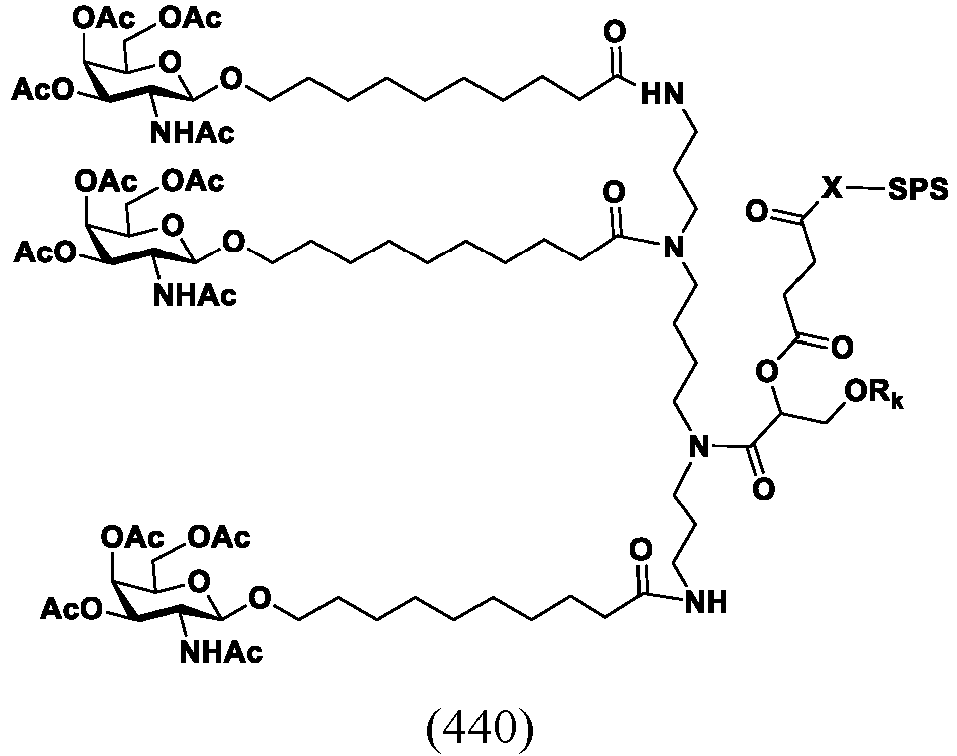


- The compound according to claim 12, wherein M+ is an alkali metal cation, an ammonium cation, a cation formed from a tertary amine, or a quaternary ammonium cation, Rk is trityl, 4-methoxytrityl, 4,4'-dimethoxytrityl, or 4,4',4"-trimethoxytrityl, and SPS represents a resin.
- A conjugate having a structure represented by Formula (1):
 n1 is an integer of 1-2, and n3 is an integer of 0-1, and n1+n3=2-3;each of m1, m2, and m3 is independently an integer of 2-10;each of R10, R11, R12, R13, R14 and R15 is independently selected from H, C1-C10 alkyl, C1-C10 haloalkyl, and C1-C10 alkoxy;R3 is an active drug;R2 is a linear alkylene of 1 to 20 carbon atoms in length, wherein one or more carbon atoms are optionally replaced with any one or more of the group consisting of: C(O), NH, O, S, CH=N, S(O)2, C2-C10 alkenylene, C2-C10 alkynylene, C6-C10 arylene, C3-C18 heterocyclylene, and C5-C10 heteroarylene, and wherein R2 is optionally substituted by any one or more of the group consisting of: C1-C10 alkyl, C6-C10 aryl, C5-C10 heteroaryl, C1-C10 haloalkyl, -OC1-C10 alkyl, -OC1-C10 alkylphenyl, -C1-C10 alkyl-OH, -OC1-C10 haloalkyl, -SC1-C10 alkyl, -SC1-C10 alkylphenyl, -C1-C10 alkyl-SH, -SC1-C10 haloalkyl, halo, -OH, -SH, -NH2, -C1-C10 alkyl-NH2, -N(C1-C10 alkyl)(C1-C10 alkyl), -NH(C1-C10 alkyl), -N(C1-C10 alkyl)(C1-C10 alkylphenyl), -NH(C1-C10 alkylphenyl), cyano, nitro, -CO2H, -C(O)OC1-C10 alkyl, -CON(C1-C10 alkyl)(C1-C10 alkyl), -CONH(C1-C10 alkyl), -CONH2, -NHC(O)(C1-C10 alkyl), -NHC(O)(phenyl), -N(C1-C10 alkyl)C(O)(C1-C10 alkyl), -N(C1-C10 alkyl)C(O)(phenyl), -C(O)C1-C10 alkyl, -C(O)C1-C10 alkylphenyl, -C(O)C1-C10 haloalkyl, -OC(O)C1-C10 alkyl, -SO2(C1-C10 alkyl), -SO2(phenyl), -SO2(C1-C10 haloalkyl), -SO2NH2, -SO2NH(C1-C10 alkyl), -SO2NH(phenyl), -NHSO2(C1-C10 alkyl), -NHSO2(phenyl), and -NHSO2(C1-C10 haloalkyl);each L1 is independently a linear alkylene of 1 to 70 carbon atoms in length, wherein one or more carbon atoms are optionally replaced with any one or more of the group consisting of: C(O), NH, O, S, CH=N, S(O)2, C2-C10 alkenylene, C2-C10 alkynylene, C6-C10 arylene, C3-C18 heterocyclylene, and C5-C10 heteroarylene, and wherein L1 is optionally substituted by any one or more of the group consisting of: C1-C10 alkyl, C6-C10 aryl, C5-C10 heteroaryl, C1-C10 haloalkyl, -OC1-C10 alkyl, -OC1-C10 alkylphenyl, -C1-C10 alkyl-OH, -OC1-C10 haloalkyl, -SC1-C10 alkyl, -SC1-C10 alkylphenyl, -C1-C10 alkyl-SH, -SC1-C10 haloalkyl, halo, -OH, -SH, -NH2, -C1-C10 alkyl-NH2, -N(C1-C10 alkyl)(C1-C10 alkyl), -NH(C1-C10 alkyl), -N(C1-C10 alkyl)(C1-C10 alkylphenyl), -NH(C1-C10 alkylphenyl), cyano, nitro, -CO2H, -C(O)OC1-C10 alkyl, -CON(C1-C10 alkyl)(C1-C10 alkyl), -CONH(C1-C10 alkyl), -CONH2, -NHC(O)(C1-C10 alkyl), -NHC(O)(phenyl), -N(C1-C10 alkyl)C(O)(C1-C10 alkyl), -N(C1-C10 alkyl)C(O)(phenyl), -C(O)C1-C10 alkyl, -C(O)C1-C10 alkylphenyl, -C(O)C1-C10 haloalkyl, -OC(O)C1-C10 alkyl, -SO2(C1-C10 alkyl), -SO2(phenyl), -SO2(C1-C10 haloalkyl), -SO2NH2, -SO2NH(C1-C10 alkyl), -SO2NH(phenyl), -NHSO2(C1-C10 alkyl), -NHSO2(phenyl), and -NHSO2(C1-C10 haloalkyl);each M1 is selected from one of ligands capable of binding to a cell surface receptor; andwherein the receptor is an asialoglycoprotein receptor on human hepatocytes.
 - The conjugate according to claim 14, wherein each L1 is independently selected from the group consisting of groups A1-A26 and any combinations thereof:


 wherein each j1 is independently an integer of 1-20;each j2 is independently an integer of 1-20;each R' is independently a C1-C10 alkyl;each Ra is independently selected from the group consisting of A27-A45 and any combinations thereof:


 each Rb is independently a C1-C10 alkyl; andrepresents a site where a group is attached to the rest of the molecule.
- The conjugate according to claim 15, wherein L1 is selected from the group consisting of groups A1, A4, A5, A6, A8, A10, A11, A13, and connection combinations thereof.
- The conjugate according to claim 14, wherein the length of L1 is 3 to 25 atoms.
- The conjugate according to claim 14, wherein each of m1, m2 and m3 is independently an integer of 2-5; or m1= m2 = m3.
- The conjugate according to claim 14, wherein each M1 is independently a monosaccaride, disaccharide, trisaccharide, or polysaccharide.
- The conjugate according to claim 14, wherein each M1 is independently selected from the group consisting of D-mannopyranose, L-mannopyranose, D-arabinose, D-xylofuranose, L-xylofuranose, D-glucose, L-glucose, D-galactose, L-galactose, α-D-mannofuranose, β-D-mannofuranose, α-D-mannopyranose, β-D-mannopyranose, α-D-glucopyranose, β-D-glucopyranose, α-D-glucofuranose, β-D-glucofuranose, α-D-fructofuranose, α-D-fructopyranose, α-D-galactopyranose, β-D-galactopyranose, α-D-galactofuranose, β-D-galactofuranose, glucosamine, sialic acid, galactosamine, N-acetylgalactosamine, N-trifluoroacetylgalactosamine, N-propionylgalactosamine, N-n-butyrylgalactosamine, N-isobutyrylgalactosamine, 2-amino-3-O-[(R)-1-carboxyethyl]-2-deoxy-β-D-glucopyranose, 2-deoxy-2-methylamino-L-glucopyranose, 4,6-dideoxy-4-formamido-2,3-di-O-methyl-D-mannopyranose, 2-deoxy-2-sulfoamino-D-glucopyranose, N-glycolyl-α-neuraminic acid, 5-thio-β-D-glucopyranose, methyl 2,3,4-tris-O-acetyl-1-thio-6-O-trityl-α-D-glucopyranoside, 4-thio-β-D-galactopyranose, ethyl 3,4,6,7-tetra-O-acetyl-2-deoxy-1,5-dithio-α-D-glucoheptopyranoside, 2,5-anhydro-D-allononitrile, ribose, D-ribose, D-4-thioribose, L-ribose, and L-4-thioribose.
- The conjugate according to claim 14, wherein R3 is a group having a structure represented by Formula A59:

- The conjugate according to claim 21, wherein R2 forms a phosphoester bond with the P atom in R3.
- The conjugate according to claim 14, wherein the conjugate has a structure represented by Formula (3), (4), (5), (6), (7), (8), (9), (10), (11), (12), (13), (14), (15), (16), (17), (18), (19), (20), (21), or (22):


- The conjugate according to claim 21, wherein the functional oligonucleotide is selected from the group consisting of small interfering RNA, microRNA, anti-microRNA, microRNA antagonist, microRNA mimics, decoy oligonucleotide, immune stimulatory, G-quadruplex, splice altering, single strand RNA, antisense nucleic acid, nucleic acid aptamer, stem-loop RNA, mRNA fragments, activating RNA, or DNA.
- The conjugate according to claim 24, wherein the functional oligonucleotide is a single strand oligonucleotide, and the P atom in formula A59 is linked to 3' terminal region of the single strand oligonucleotide; or
the functional oligonucleotide is a double stranded oligonucleotide comprising a sense strand and an antisense strand, and the P atom in formula A59 is linked to 3' terminal region of the sense strand. - The conjugate according to claim 25, wherein the double stranded oligonucleotide is an siRNA, and each nucleotide in the siRNA is independently a modified or unmodified nucleotide; the siRNA contains a sense strand and an antisense strand, wherein the sense strand comprises a nucleotide sequence 1, and the antisense strand comprises a nucleotide sequence 2, both of which have a length of 19 nucleotides and are at least partly reverse complementary to form a double-stranded complementary region; the nucleotide sequence 2 is at least partly complementary to a first nucleotide sequence segment which refers to a segment of nucleotide in a target mRNA; and the target mRNA refers to a mRNA of a gene that is aberrantly expressed in hepatocytes.
- The conjugate according to claim 26, wherein the target mRNA is the mRNA corresponding to ApoB, ApoC, ANGPTL3, PCSK9, SCD1, TIMP-1, Col1A1, FVII, STAT3, p53, HBV or HCV.
- The conjugate according to claim 26, wherein the nucleotide sequence 1 has the same length with the first nucleotide sequence segment and no more than 3 nucleotides different from the first nucleotide sequence segment; the nucleotide sequence 2 has the same length with a nucleotide sequence B and no more than 3 nucleotides different from the nucleotide sequence B, which refers to a nucleotide sequence completely reverse complementary to the first nucleotide sequence segment.
- The conjugate according to claim 28, wherein the nucleotide differences between the nucleotide sequence 2 and the nucleotide sequence B includes the difference at the site of the first nucleotide Z' on the nucleotide sequence 2 from 5' end to 3' end.
- The conjugate according to claim 26, wherein the sense strand further comprises a nucleotide sequence 3, and the antisense strand further comprises a nucleotide sequence 4; the nucleotide sequences 3 and 4 have an identical length of 1-4 nucleotides; the nucleotide sequence 3 is linked to 5' end of the nucleotide sequence 1, and the nucleotide sequence 4 is linked to 3' end of the nucleotide sequence 2; the nucleotide sequence 4 is complementary to a second nucleotide sequence segment; the second nucleotide sequence segment refers to a nucleotide sequence adjacent to the first nucleotide sequence segment in the target mRNA, and having a same length as the nucleotide sequence 4; and the nucleotide sequence 3 is substantially reverse complementary, or completely reverse complementary to the nucleotide sequence 4.
- The conjugate according to claim 26, wherein the siRNA further comprises a nucleotide sequence 5, which has a length of 1-3 nucleotides and is linked to 3' end of the antisense strand, thereby constituting a 3' overhang of the antisense strand.
- The conjugate according to claim 26, wherein each nucleotide in the sense and antisense strand is independently a fluoro modified nucleotide or a non-fluoro modified nucleotide, the fluoro modified nucleotide refers to a nucleotide formed by substituting the 2'-hydroxy of the ribose group thereof with a fluoro group; the non-fluoro modified nucleotide refers to a nucleotide formed by substituting the 2'-hydroxy of the ribose group thereof with a group other than a fluoro, or a nucleotide analogue, the nucleotide analogue refers to a group capable of replacing a nucleotide in a nucleic acid, while having a different structure from any one of adenine ribonucleotide, guanine ribonucleotide, cytosine ribonucleotide, uracil ribonucleotide or thymine deoxyribonucleotide.
- The conjugate according to claim 32, wherein both of the sense and antisense strand comprises fluoro and non-fluoro modified nucleotides, the fluoro modified nucleotides exist in the nucleotide sequence 1 and the nucleotide sequence 2, no more than 5 fluoro modified nucleotides exist in the nucleotide sequence 1, and in the direction from 5' terminal to 3' terminal, the nucleotides at positions 7, 8 and 9 in the nucleotide sequence 1 are fluoro modified nucleotides; no more than 7 fluoro modified nucleotides exist in the nucleotide sequence 2, and in the direction from 5' terminal to 3' terminal, the nucleotides at positions 2, 6, 14 and 16 in the nucleotide sequence 2 are fluoro modified nucleotides.
- The conjugate according to claim 32, wherein each non-fluoro modified nucleotide is a methoxy modified nucleotide, wherein a methoxy modified nucleotide refers to a nucleotide formed by substituting the 2'-hydroxy of the ribose group thereof with a methoxy group.
- The conjugate according to claim 26, wherein in the siRNA, at least one phosphate group is a phosphorothioate group, and a phosphorothioate linkage exists in at least one of following positions:between the first nucleotide and the second nucleotide from 5' end of the sense strand;between the second nucleotide and the third nucleotide from 5' end of the sense strand;between the first nucleotide and the second nucleotide from 3' end of the sense strand;between the second nucleotide and the third nucleotide from 3' end of the sense strand;between the first nucleotide and the second nucleotide from 5' end of the antisense strand;between the second nucleotide and the third nucleotide from 5' end of the antisense strand;between the first nucleotide and the second nucleotide from 3' end of the antisense strand; andbetween the second nucleotide and the third nucleotide from 3' end of the antisense strand.
- The conjugate according to claim 26, wherein a nucleotide at 5' end of the antisense strand is a 5'-phosphate nucleotide or a 5'-phosphate analogue modified nucleotide.
- The conjugate according to claim 14 for use in treating and/or preventing a pathological condition or disease selected from a group consisting of chronic liver disease, hepatitis, hepatic fibrosis, liver proliferative diseases, and dyslipidemia, the disease being caused by expression of a specific gene in hepatocytes.
- The conjugate according to claim 14 for use in treating and/or preventing a pathological condition or
disease caused by expression of a specific gene in hepatocytes, wherein the specific gene is selected from a group consisting of a hepatitis B virus gene, an angiopoietin-like protein 3 gene, and an apolipoprotein C3 gene. - The conjugate for use in treating and/or preventing a pathological condition or disease caused by expression of a specific gene in hepatocytes according to claim 37, wherein the dyslipidemia is hypercholesterolemia, hypertriglyceridemia, or atherosclerosis.
- A method for inhibiting expression of a specific gene in hepatocytes, comprising contacting the conjugate according to claim 14 with the hepatocytes in vitro.
- The method according to claim 40, wherein the specific gene is ApoB, ApoC, ANGPTL3, PCSK9, SCD1, TIMP-1, Col1A1, FVII, STAT3, p53, HBV or HCV.
Priority Applications (1)
| Application Number | Priority Date | Filing Date | Title |
|---|---|---|---|
| HRP20250408TT HRP20250408T1 (en) | 2017-12-29 | 2018-11-29 | Conjugates and preparation and use thereof |
Applications Claiming Priority (3)
| Application Number | Priority Date | Filing Date | Title |
|---|---|---|---|
| CN201711479058 | 2017-12-29 | ||
| CN201811165363 | 2018-09-30 | ||
| PCT/CN2018/118224 WO2019128611A1 (en) | 2017-12-29 | 2018-11-29 | Conjugates and preparation and use thereof |
Publications (3)
| Publication Number | Publication Date |
|---|---|
| EP3732185A1 EP3732185A1 (en) | 2020-11-04 |
| EP3732185A4 EP3732185A4 (en) | 2021-11-10 |
| EP3732185B1 true EP3732185B1 (en) | 2025-02-26 |
Family
ID=67066459
Family Applications (1)
| Application Number | Title | Priority Date | Filing Date |
|---|---|---|---|
| EP18896766.5A Active EP3732185B1 (en) | 2017-12-29 | 2018-11-29 | Conjugates and preparation and use thereof |
Country Status (11)
| Country | Link |
|---|---|
| US (2) | US11633482B2 (en) |
| EP (1) | EP3732185B1 (en) |
| JP (2) | JP7436030B2 (en) |
| KR (1) | KR102617947B1 (en) |
| CN (2) | CN110959011B (en) |
| AU (1) | AU2018394875B2 (en) |
| DK (1) | DK3732185T3 (en) |
| HR (1) | HRP20250408T1 (en) |
| TW (1) | TWI826405B (en) |
| WO (1) | WO2019128611A1 (en) |
| ZA (1) | ZA202003833B (en) |
Families Citing this family (52)
| Publication number | Priority date | Publication date | Assignee | Title |
|---|---|---|---|---|
| SG11202002149XA (en) * | 2017-09-14 | 2020-04-29 | Janssen Biopharma Inc | Galnac derivatives |
| JP7261494B2 (en) | 2017-12-01 | 2023-04-20 | スーチョウ リボ ライフ サイエンス カンパニー、リミテッド | Nucleic acids, compositions and complexes containing said nucleic acids, preparation methods and uses |
| US11660347B2 (en) | 2017-12-01 | 2023-05-30 | Suzhou Ribo Life Science Co., Ltd. | Nucleic acid, composition and conjugate containing same, preparation method, and use thereof |
| WO2019105435A1 (en) | 2017-12-01 | 2019-06-06 | 苏州瑞博生物技术有限公司 | Nucleic acid, composition and conjugate containing nucleic acid, preparation method and use |
| CN110997919B (en) | 2017-12-01 | 2024-04-02 | 苏州瑞博生物技术股份有限公司 | Double-stranded oligonucleotide, composition containing double-stranded oligonucleotide, conjugate, preparation method and application |
| CN118236391A (en) * | 2017-12-01 | 2024-06-25 | 苏州瑞博生物技术股份有限公司 | Nucleic acid, composition and conjugate containing the nucleic acid, preparation method and use thereof |
| CN110959011B (en) | 2017-12-29 | 2023-03-28 | 苏州瑞博生物技术股份有限公司 | Conjugate, preparation method and application thereof |
| EP3842534A4 (en) | 2018-08-21 | 2022-07-06 | Suzhou Ribo Life Science Co., Ltd. | NUCLEIC ACID, COMPOSITION AND CONJUGATE CONTAINING NUCLEIC ACID AND METHOD OF USE THEREOF |
| EP3862024A4 (en) | 2018-09-30 | 2022-08-17 | Suzhou Ribo Life Science Co., Ltd. | SHORT INTERFERENT RNA CONJUGATE, METHOD FOR PREPARATION AND USE THEREOF |
| CN112423795A (en) * | 2018-12-28 | 2021-02-26 | 苏州瑞博生物技术股份有限公司 | Nucleic acid, composition containing nucleic acid, conjugate, preparation method and application |
| CN112423794A (en) * | 2018-12-28 | 2021-02-26 | 苏州瑞博生物技术股份有限公司 | Nucleic acid, composition containing nucleic acid, conjugate, preparation method and application |
| JP7663951B2 (en) | 2019-05-22 | 2025-04-17 | スーチョウ リボ ライフ サイエンス カンパニー、リミテッド | Nucleic acids, drug compositions and complexes and methods of preparation and use |
| AU2020280439B2 (en) | 2019-05-22 | 2025-08-14 | Suzhou Ribo Life Science Co., Ltd. | Nucleic acid, pharmaceutical composition, conjugate, preparation method, and use |
| CN113811613B (en) * | 2019-05-22 | 2024-04-05 | 苏州瑞博生物技术股份有限公司 | Nucleic acid, pharmaceutical composition and conjugate, and preparation method and application thereof |
| WO2020238766A1 (en) * | 2019-05-24 | 2020-12-03 | 苏州瑞博生物技术股份有限公司 | Nucleic acid, pharmaceutical composition, conjugate, preparation method, and use |
| CN118217305A (en) * | 2019-05-24 | 2024-06-21 | 苏州瑞博生物技术股份有限公司 | Nucleic acid, pharmaceutical composition and conjugate, preparation method and use thereof |
| CN112390835A (en) * | 2019-08-14 | 2021-02-23 | 苏州瑞博生物技术股份有限公司 | Liver targeting compounds and conjugates |
| EP4023659A4 (en) * | 2019-08-29 | 2024-02-28 | Suzhou Ribo Life Science Co., Ltd. | Compound and drug conjugate, and preparation method and use thereof |
| WO2021107097A1 (en) * | 2019-11-28 | 2021-06-03 | 株式会社ボナック | Nucleic acid molecule for hepatitis b treatment use |
| CN111544580B (en) * | 2020-03-13 | 2021-05-28 | 中国农业科学院北京畜牧兽医研究所 | An anti-cancer pharmaceutical composition |
| US20250320500A1 (en) | 2020-12-29 | 2025-10-16 | Suzhou Ribo Life Science Co., Ltd. | Nucleic acid, pharmaceutical composition and sirna conjugate containing the nucleic acid, preparation method therefor, and use thereof |
| CN114685585B (en) * | 2020-12-31 | 2024-06-04 | 苏州瑞博生物技术股份有限公司 | Nucleotide sequence, double-stranded oligonucleotide, pharmaceutical composition and conjugate, preparation method and application |
| WO2022206946A1 (en) * | 2021-04-02 | 2022-10-06 | 上海拓界生物医药科技有限公司 | Sirna against hepatitis b virus, and sirna conjugate |
| EP4365290A1 (en) * | 2021-07-02 | 2024-05-08 | Tuojie Biotech (Shanghai) Co., Ltd. | Nucleic acid ligand and conjugate thereof, and preparation method therefor and use thereof |
| JP2024528634A (en) | 2021-07-16 | 2024-07-30 | スーチョウ リボ ライフ サイエンス カンパニー、リミテッド | Double-stranded oligonucleotides, compositions and complexes containing double-stranded oligonucleotides, and methods of preparation and use |
| WO2023284559A1 (en) | 2021-07-16 | 2023-01-19 | 苏州瑞博生物技术股份有限公司 | Nucleic acid, composition and conjugate containing same, and preparation method and use |
| CN115677810B (en) * | 2021-07-23 | 2026-02-03 | 苏州瑞博生物技术股份有限公司 | Double-stranded oligonucleotide, composition containing double-stranded oligonucleotide, conjugate, preparation method and application |
| CN115677770A (en) * | 2021-07-23 | 2023-02-03 | 北京瑞博开拓医药科技有限公司 | Modified nucleoside monomers, siRNAs comprising modified nucleotides, pharmaceutical compositions and conjugates |
| WO2023088455A1 (en) * | 2021-11-22 | 2023-05-25 | 苏州瑞博生物技术股份有限公司 | Nucleic acid, pharmaceutical composition containing same, sirna conjugate, preparation method, and use |
| AU2022422864A1 (en) | 2021-12-21 | 2024-07-04 | Suzhou Ribo Life Science Co., Ltd. | Nucleic acid, composition and conjugate containing nucleic acid, preparation method therefor and use thereof |
| US20250161461A1 (en) * | 2022-01-30 | 2025-05-22 | Rona Bioscience, Limited | Targeting ligand containing n-acetylgalactosamine |
| CA3246696A1 (en) * | 2022-04-14 | 2025-02-03 | Suzhou Ribo Life Science Co., Ltd. | Conjugate and composition as well as preparation method therefor and use thereof |
| JP2025512450A (en) * | 2022-04-14 | 2025-04-17 | スーチョウ リボ ライフ サイエンス カンパニー、リミテッド | Aptamers, conjugates and compositions and methods of making and using |
| US20250269040A1 (en) * | 2022-04-14 | 2025-08-28 | Suzhou Ribo Life Science Co., Ltd. | Conjugate, pharmaceutical composition comprising same, method for preparing same, and use thereof |
| US20230399645A1 (en) * | 2022-05-16 | 2023-12-14 | University Of Massachusetts | Optimized sirna scaffolds |
| JP2025520520A (en) * | 2022-06-14 | 2025-07-03 | 大睿生物 | siRNA molecules that modulate PCSK9 gene activity |
| CN119421952A (en) * | 2022-06-27 | 2025-02-11 | 大睿生物医药科技(上海)有限公司 | siRNA to inhibit apolipoprotein C3 expression |
| EP4577244A1 (en) * | 2022-08-25 | 2025-07-02 | 1Globe Health Institute LLC | Novel compositions for conjugating oligonucleotides and carbohydrates |
| WO2024164008A1 (en) * | 2023-02-03 | 2024-08-08 | Sirnaomics, Inc. | Products and compositions |
| JP2026507087A (en) * | 2023-02-24 | 2026-02-27 | 重▲慶▼葯友制葯有限責任公司 | Double-stranded siRNA analogs containing R and E and conjugates thereof |
| WO2024188174A1 (en) | 2023-03-10 | 2024-09-19 | 苏州瑞博生物技术股份有限公司 | Pharmaceutical composition and use thereof |
| CN120882730A (en) * | 2023-04-14 | 2025-10-31 | 苏州炫景生物科技有限公司 | Compounds, pharmaceutical compositions and their uses that inhibit AGT gene expression |
| CN120917033A (en) * | 2023-04-14 | 2025-11-07 | 北京炫景瑞医药科技有限公司 | Compounds, conjugates, compositions and uses thereof |
| CN118930593A (en) * | 2023-05-11 | 2024-11-12 | 广东东阳光药业股份有限公司 | A novel targeting compound and nucleic acid conjugate, and uses thereof |
| WO2025007274A1 (en) * | 2023-07-04 | 2025-01-09 | 成都先导药物开发股份有限公司 | Conjugate, and intermediate compound and use thereof |
| CN117384226B (en) * | 2023-09-14 | 2025-12-26 | 苏州盛诺维生物科技有限公司 | Synthesis process of a GalNAc-type compound |
| CN117624266A (en) * | 2023-10-19 | 2024-03-01 | 弘亮(上海)生物医药科技有限公司 | A liver-targeting compound and its oligonucleotide conjugate, coupling method and application |
| CN117402096A (en) * | 2023-10-20 | 2024-01-16 | 康羽生命科学技术(苏州)有限公司 | A kind of synthesis method of auxiliary acid derivatives |
| WO2025087290A1 (en) * | 2023-10-27 | 2025-05-01 | 苏州瑞博生物技术股份有限公司 | Pharmaceutical composition and use thereof |
| WO2025140632A1 (en) * | 2023-12-27 | 2025-07-03 | 武汉人福创新药物研发中心有限公司 | Targeting compound for use in delivery and use thereof |
| WO2026007966A1 (en) * | 2024-07-01 | 2026-01-08 | 武汉人福创新药物研发中心有限公司 | Sirna for inhibiting inhbe gene expression, conjugate, and use thereof |
| WO2026052079A1 (en) * | 2024-09-07 | 2026-03-12 | 苏州瑞博生物技术股份有限公司 | Oligonucleotide, oligonucleotide conjugate, composition, and use |
Family Cites Families (129)
| Publication number | Priority date | Publication date | Assignee | Title |
|---|---|---|---|---|
| US20030206887A1 (en) | 1992-05-14 | 2003-11-06 | David Morrissey | RNA interference mediated inhibition of hepatitis B virus (HBV) using short interfering nucleic acid (siNA) |
| EP1829856A3 (en) * | 1998-11-12 | 2009-02-25 | Invitrogen Corporation | Transfection reagents |
| CN1254234C (en) * | 2000-06-09 | 2006-05-03 | 莱古伦公司 | Encapsulation of plasmid DNA (LIPOGENEST™) and therapeutic agent containing nuclear localization signal/fusogenic peptide conjugate into directed liposome complexes |
| WO2006006948A2 (en) | 2002-11-14 | 2006-01-19 | Dharmacon, Inc. | METHODS AND COMPOSITIONS FOR SELECTING siRNA OF IMPROVED FUNCTIONALITY |
| JP2006507841A (en) | 2002-11-14 | 2006-03-09 | ダーマコン, インコーポレイテッド | Functional and ultrafunctional siRNA |
| CN1257284C (en) | 2003-03-05 | 2006-05-24 | 北京博奥生物芯片有限责任公司 | Method for blocking expression of hepatitis B virus in vitro |
| JP4597976B2 (en) | 2003-04-17 | 2010-12-15 | アルナイラム ファーマシューティカルズ インコーポレイテッド | Modified iRNA agent |
| EP1752536A4 (en) | 2004-05-11 | 2008-04-16 | Alphagen Co Ltd | Polynucleotide causing rna interfere and method of regulating gene expression with the use of the same |
| US8394947B2 (en) | 2004-06-03 | 2013-03-12 | Isis Pharmaceuticals, Inc. | Positionally modified siRNA constructs |
| JP5192234B2 (en) | 2004-08-10 | 2013-05-08 | アルナイラム ファーマシューティカルズ, インコーポレイテッド | Chemically modified oligonucleotide |
| CN101142316A (en) | 2005-03-09 | 2008-03-12 | 牧岩生命工学研究所 | Small interfering RNA and pharmaceutical composition containing it for treating hepatitis B |
| CN101484588B (en) | 2006-05-11 | 2013-11-06 | 阿尔尼拉姆医药品有限公司 | Compositions and methods for inhibiting PCSK9 gene expression |
| CA2658183A1 (en) | 2006-07-17 | 2008-01-24 | Sirna Therapeutics Inc. | Rna interference mediated inhibition of proprotein convertase subtilisin kexin 9 (pcsk9) gene expression using short interfering nucleic acid (sina) |
| WO2008109369A2 (en) | 2007-03-02 | 2008-09-12 | Mdrna, Inc. | Nucleic acid compounds for inhibiting tnf gene expression and uses thereof |
| CN102006890A (en) | 2007-12-04 | 2011-04-06 | 阿尔尼拉姆医药品有限公司 | Targeting lipids |
| AU2014208251B2 (en) | 2007-12-04 | 2016-07-14 | Alnylam Pharmaceuticals, Inc. | Carbohydrate conjugates as delivery agents for oligonucleotides |
| BRPI0907008A2 (en) | 2008-01-31 | 2015-07-07 | Alnylam Pharmaceuticals Inc | Optimized methods for dsrna release by targeting the pcsk9 gene |
| EP2247729B1 (en) | 2008-02-11 | 2019-05-01 | Phio Pharmaceuticals Corp. | Modified rnai polynucleotides and uses thereof |
| CN101603042B (en) | 2008-06-13 | 2013-05-01 | 厦门大学 | RNA interference target for treating hepatitis B virus infection |
| WO2010012244A1 (en) | 2008-08-01 | 2010-02-04 | 苏州瑞博生物技术有限公司 | Small rna interference target site sequences of hepatitis b virus and small interference rnas and the compositions and uses thereof |
| EP2379084B1 (en) | 2008-10-15 | 2017-11-22 | Ionis Pharmaceuticals, Inc. | Modulation of factor 11 expression |
| EP2376641A4 (en) | 2008-12-17 | 2013-01-09 | Commw Scient Ind Res Org | METHODS OF MODULATING THE SEX OF AVIAN SPECIES |
| WO2010083615A1 (en) | 2009-01-26 | 2010-07-29 | Protiva Biotherapeutics, Inc. | Compositions and methods for silencing apolipoprotein c-iii expression |
| EP3424939A1 (en) | 2009-03-02 | 2019-01-09 | Alnylam Pharmaceuticals Inc. | Nucleic acid chemical modifications |
| JP2012524068A (en) | 2009-04-15 | 2012-10-11 | アイシス ファーマシューティカルズ, インコーポレーテッド | Modulation of inflammatory response by factor XI |
| KR101224828B1 (en) | 2009-05-14 | 2013-01-22 | (주)바이오니아 | SiRNA conjugate and preparing method thereof |
| AU2010260148A1 (en) | 2009-06-15 | 2012-02-02 | Alnylam Pharmaceuticals, Inc. | Lipid formulated dsRNA targeting the PCSK9 gene |
| US9051567B2 (en) | 2009-06-15 | 2015-06-09 | Tekmira Pharmaceuticals Corporation | Methods for increasing efficacy of lipid formulated siRNA |
| JP2014501097A (en) | 2009-07-06 | 2014-01-20 | アルナイラム ファーマシューティカルズ, インコーポレイテッド | Composition and method for enhancing production of biological material |
| US9187746B2 (en) | 2009-09-22 | 2015-11-17 | Alnylam Pharmaceuticals, Inc. | Dual targeting siRNA agents |
| CN111700901A (en) | 2010-01-08 | 2020-09-25 | Ionis制药公司 | Modulation of angiopoietin-like 3 expression |
| CN102140458B (en) | 2010-01-29 | 2013-05-22 | 苏州瑞博生物技术有限公司 | SiRNA (Small interference ribonucleic acid) as well as medicine composition and pharmaceutical application thereof |
| CN102140459B (en) | 2010-01-29 | 2013-04-03 | 苏州瑞博生物技术有限公司 | SiRNA (Small interference ribonucleic acid) as well as medicine composition and pharmaceutical application thereof |
| CN102140461B (en) | 2010-01-29 | 2012-12-05 | 苏州瑞博生物技术有限公司 | Small interfering nucleic acid and medical composite and pharmaceutical applications of nucleic acid |
| CN102140460B (en) | 2010-01-29 | 2012-12-12 | 苏州瑞博生物技术有限公司 | SiRNA (Small interference ribonucleic acid) as well as medicine composition and pharmaceutical application thereof |
| EP3023495B1 (en) | 2010-02-24 | 2019-05-08 | Arrowhead Pharmaceuticals, Inc. | Compositions for targeted delivery of sirna |
| CN102892420A (en) * | 2010-04-09 | 2013-01-23 | 默沙东公司 | Novel single chemical entities and methods for delivery of oligonucleotides |
| EP2601204B1 (en) | 2010-04-28 | 2016-09-07 | Ionis Pharmaceuticals, Inc. | Modified nucleosides and oligomeric compounds prepared therefrom |
| WO2011154331A1 (en) * | 2010-06-10 | 2011-12-15 | F. Hoffmann-La Roche Ag | Polymers for delivery of nucleic acids |
| CN102344477B (en) | 2010-07-27 | 2015-04-08 | 苏州瑞博生物技术有限公司 | Nucleotide and / or oligonucleotide and preparation method thereof |
| EP2606134B1 (en) | 2010-08-17 | 2019-04-10 | Sirna Therapeutics, Inc. | RNA INTERFERENCE MEDIATED INHIBITION OF HEPATITIS B VIRUS (HBV) GENE EXPRESSION USING SHORT INTERFERING NUCLEIC ACID (siNA) |
| CA2812046A1 (en) | 2010-09-15 | 2012-03-22 | Alnylam Pharmaceuticals, Inc. | Modified irna agents |
| CA2816321A1 (en) | 2010-10-29 | 2012-05-03 | Alnylam Pharmaceuticals, Inc. | Compositions and methods for inhibition of pcsk9 genes |
| JP2014508102A (en) | 2010-11-15 | 2014-04-03 | ライフ テクノロジーズ コーポレーション | Amine-containing transfection reagents and methods for producing and using the same |
| US8501930B2 (en) | 2010-12-17 | 2013-08-06 | Arrowhead Madison Inc. | Peptide-based in vivo siRNA delivery system |
| ES2605990T3 (en) | 2010-12-29 | 2017-03-17 | F. Hoffmann-La Roche Ag | Small molecule conjugates for intracellular administration of nucleic acids |
| IL269565B2 (en) | 2011-01-06 | 2024-06-01 | Dyax Corp | KALLIKREIN PLASMA BINDING PROTEINS |
| MX360349B (en) | 2011-03-29 | 2018-10-30 | Alnylam Pharmaceuticals Inc | Compositions and methods for inhibiting expression of tmprss6 gene. |
| CN102719434A (en) | 2011-03-31 | 2012-10-10 | 百奥迈科生物技术有限公司 | Specific modification for inhibiting RNA interference off-target effect |
| CN102727907B (en) | 2011-04-13 | 2015-03-11 | 苏州瑞博生物技术有限公司 | Drug delivery system of small interfering RNA drug and preparation |
| US9157082B2 (en) | 2011-04-27 | 2015-10-13 | Isis Pharmaceuticals, Inc. | Modulation of apolipoprotein CIII (ApoCIII) expression |
| EP3444348A1 (en) | 2011-06-21 | 2019-02-20 | Alnylam Pharmaceuticals, Inc. | Angiopoietin-like 3 (angptl3) irna compositions and methods of use thereof |
| JP6165723B2 (en) | 2011-06-30 | 2017-07-19 | アローヘッド ファーマシューティカルズ インコーポレイテッド | Compositions and methods for inhibiting gene expression of hepatitis B virus |
| CN103073726B (en) | 2011-10-26 | 2015-09-23 | 苏州瑞博生物技术有限公司 | Segmented copolymer and liquid composition and nucleic acid preparation and its preparation method and application |
| KR20150000461A (en) | 2011-10-27 | 2015-01-02 | 메사추세츠 인스티튜트 오브 테크놀로지 | Amino acid derivatives functionalized on the n-terminal capable of forming drug incapsulating microspheres |
| WO2013070771A1 (en) | 2011-11-07 | 2013-05-16 | Isis Pharmaceuticals, Inc. | Administration of factor xi antisense oligonucleotides |
| AR090905A1 (en) | 2012-05-02 | 2014-12-17 | Merck Sharp & Dohme | CONJUGATES CONTAINING TETRAGALNAC AND PEPTIDES AND PROCEDURES FOR THE ADMINISTRATION OF OLIGONUCLEOTIDES, PHARMACEUTICAL COMPOSITION |
| AU2013299717B2 (en) | 2012-08-06 | 2018-06-28 | Alnylam Pharmaceuticals, Inc. | Carbohydrate conjugated RNA agents and process for their preparation |
| SG10201804331TA (en) * | 2012-11-15 | 2018-07-30 | Roche Innovation Ct Copenhagen As | Oligonucleotide conjugates |
| KR102096014B1 (en) | 2012-12-05 | 2020-04-03 | 알닐람 파마슈티칼스 인코포레이티드 | PCSK9 iRNA COMPOSITIONS AND METHODS OF USE THEREOF |
| US20150368642A1 (en) | 2013-01-30 | 2015-12-24 | Hoffmann-La Roche Inc. | Lna oligonucleotide carbohydrate conjugates |
| ME03043B (en) | 2013-03-14 | 2018-10-20 | Alnylam Pharmaceuticals Inc | IRNK ASSEMBLES C5 COMPLEMENT COMPONENTS AND METHODS FOR THEIR USE |
| CA2921162A1 (en) | 2013-05-01 | 2014-11-06 | Ionis Pharmaceuticals, Inc. | Conjugated antisense compounds and their use |
| TW201515650A (en) | 2013-05-06 | 2015-05-01 | 艾爾妮蘭製藥公司 | Dosages and methods for delivering lipid formulated nucleic acid molecules |
| CN104107437B (en) | 2013-06-09 | 2015-08-26 | 厦门成坤生物技术有限公司 | A kind of RNA being used for the treatment of hepatitis B disturbs composition and method of making the same |
| JP2016528890A (en) | 2013-07-09 | 2016-09-23 | プレジデント アンド フェローズ オブ ハーバード カレッジ | Therapeutic use of genome editing using the CRISPR / Cas system |
| EP4039278A1 (en) | 2013-07-11 | 2022-08-10 | Alnylam Pharmaceuticals, Inc. | Oligonucleotide-ligand conjugates and process for their preparation |
| US9889200B2 (en) * | 2013-07-31 | 2018-02-13 | Qbi Enterprises Ltd. | Sphingolipid-polyalkylamine-oligonucleotide compounds |
| KR102365486B1 (en) | 2013-08-28 | 2022-02-18 | 아이오니스 파마수티컬즈, 인코포레이티드 | Modulation of prekallikrein (pkk) expression |
| EP3066215B1 (en) | 2013-11-06 | 2019-04-24 | The United States of America, represented by the Secretary, Department of Health and Human Services | Method for subtyping lymphoma types by means of expression profiling |
| HUE052243T2 (en) | 2013-12-24 | 2021-04-28 | Ionis Pharmaceuticals Inc | Modulation of angiopoietin-like 3 expression |
| KR20240049627A (en) | 2014-01-21 | 2024-04-16 | 다케다 파머수티컬 컴패니 리미티드 | Plasma kallikrein binding proteins and uses thereof in treating hereditary angioedema |
| JP2017505623A (en) | 2014-01-30 | 2017-02-23 | エフ.ホフマン−ラ ロシュ アーゲーF. Hoffmann−La Roche Aktiengesellschaft | Poly-oligomer compound having biocleavable conjugate |
| AU2015236215B2 (en) | 2014-03-25 | 2020-03-19 | Arcturus Therapeutics, Inc. | UNA oligomers having reduced off-target effects in gene silencing |
| MX382230B (en) | 2014-05-01 | 2025-03-13 | Ionis Pharmaceuticals Inc | COMPOSITIONS AND METHODS FOR MODULATING THE EXPRESSION OF ANGIOPOETIN TYPE 3 LIKE. |
| JP6665111B2 (en) | 2014-05-01 | 2020-03-13 | アイオーニス ファーマシューティカルズ, インコーポレーテッドIonis Pharmaceuticals,Inc. | Compositions and methods for modulating PKK expression |
| EP3152308A4 (en) | 2014-06-06 | 2017-12-27 | Solstice Biologics, Ltd. | Polynucleotide constructs having bioreversible and non-bioreversible groups |
| EP3736334A1 (en) * | 2014-07-16 | 2020-11-11 | Arrowhead Pharmaceuticals, Inc. | Rnai compositions to treat apoc3-related diseases |
| IL316808A (en) | 2014-08-20 | 2025-01-01 | Alnylam Pharmaceuticals Inc | Modified double-stranded rna agents and uses thereof |
| CN104232644B (en) | 2014-09-03 | 2016-10-12 | 浙江大学 | The siRNA of a kind of special suppression XOR gene expression and application thereof |
| SG11201703638XA (en) | 2014-11-10 | 2017-06-29 | Alnylam Pharmaceuticals Inc | Hepatitis b virus (hbv) irna compositions and methods of use thereof |
| CA2968114A1 (en) | 2014-11-17 | 2016-05-26 | Alnylam Pharmaceuticals, Inc. | Apolipoprotein c3 (apoc3) irna compositions and methods of use thereof |
| AU2015363042B2 (en) | 2014-12-15 | 2021-02-25 | Emory University | Phosphoramidates for the treatment of Hepatitis B virus |
| US10036017B2 (en) | 2015-02-17 | 2018-07-31 | Dicerna Pharmaceuticals, Inc. | Methods and compositions for the specific inhibition of complement component 5(C5) by double-stranded RNA |
| CA2979703A1 (en) | 2015-03-17 | 2016-09-22 | Arrowhead Pharmaceuticals, Inc. | Compositions and methods for inhibiting gene expression of factor xii |
| CA2979998A1 (en) | 2015-03-20 | 2016-09-29 | Protiva Biotherapeutics, Inc. | Compositions and methods for treating hypertriglyceridemia |
| KR20250005546A (en) | 2015-04-13 | 2025-01-09 | 알닐람 파마슈티칼스 인코포레이티드 | Angiopoietin-like 3 (angptl3) irna compositions and methods of use thereof |
| KR20250107273A (en) | 2015-05-06 | 2025-07-11 | 알닐람 파마슈티칼스 인코포레이티드 | Factor XII (Hageman Factor) (F12), KALLIKREIN B, PLASMA (FLETCHER FACTOR) 1 (KLKB1), and Kininogen 1 (KNG1) iRNA COMPOSITIONS AND METHODS OF USE THEREOF |
| CN104922141B (en) | 2015-05-28 | 2016-05-25 | 厦门成坤生物技术有限公司 | A kind of siRNA composition that is used for the treatment of virus B hepatitis |
| JP6715325B2 (en) | 2015-06-26 | 2020-07-01 | スーチョウ リボ ライフ サイエンス カンパニー、リミテッドSuzhou Ribo Life Science Co., Ltd. | siRNA, pharmaceutical composition and conjugate containing siRNA, and applications thereof |
| CA2996722A1 (en) | 2015-07-17 | 2017-01-26 | Arcturus Therapeutics, Inc. | Compositions and agents against hepatitis b virus and uses thereof |
| TW201718620A (en) | 2015-07-27 | 2017-06-01 | 阿尼拉製藥公司 | Xanthine dehydrogenase (XDH) iRNA composition and method of use thereof |
| HK1248278A1 (en) | 2015-07-29 | 2018-10-12 | Arbutus Biopharma Corporation | Compositions and methods for silencing hepatitis b virus gene expression |
| KR20180038465A (en) | 2015-08-07 | 2018-04-16 | 애로우헤드 파마슈티컬스 인코포레이티드 | RNAi therapy for hepatitis B virus infection |
| MX2018002158A (en) | 2015-08-25 | 2018-07-06 | Alnylam Pharmaceuticals Inc | METHODS AND COMPOSITIONS FOR TREATING A DISORDER ASSOCIATED WITH PROPROTEIN CONVERTASE SUBTILISIN KEXIN GENE (PCSK9). |
| WO2017055627A1 (en) | 2015-10-02 | 2017-04-06 | INSERM (Institut National de la Santé et de la Recherche Médicale) | Apoc3 mutations for the diagnosis and therapy of hereditary renal amyloidosis disease |
| JP2018536689A (en) | 2015-12-10 | 2018-12-13 | アルナイラム ファーマシューティカルズ, インコーポレイテッドAlnylam Pharmaceuticals, Inc. | Sterol regulatory element binding protein (SREBP) chaperone (SCAP) iRNA compositions and methods of use thereof |
| WO2017120397A1 (en) | 2016-01-08 | 2017-07-13 | Alnylam Pharmaceuticals, Inc. | Polynucleotide agents targeting factor xii (hageman factor) (f12) and methods of use thereof |
| WO2017184689A1 (en) | 2016-04-19 | 2017-10-26 | Alnylam Pharmaceuticals, Inc. | High density lipoprotein binding protein (hdlbp/vigilin) irna compositions and methods of use thereof |
| AU2017258105B2 (en) | 2016-04-28 | 2024-09-05 | Regeneron Pharmaceuticals, Inc. | Methods for treating patients with familial hypercholesterolemia |
| JOP20190015A1 (en) | 2016-08-04 | 2019-02-04 | Arrowhead Pharmaceuticals Inc | RNAi AGENTS FOR HEPATITIS B VIRUS INFECTION |
| WO2018035380A1 (en) | 2016-08-17 | 2018-02-22 | Solstice Biologics, Ltd. | Polynucleotide constructs |
| JP6989521B2 (en) | 2016-09-02 | 2022-01-05 | アローヘッド ファーマシューティカルズ インコーポレイテッド | Targeting ligand |
| KR20240067272A (en) | 2016-10-18 | 2024-05-16 | 노파르티스 아게 | Methods for preventing cardiovascular events through proprotein convertase subtilisin kexin 9 (pcsk9) protein reduction |
| CN113652431A (en) | 2016-12-21 | 2021-11-16 | 苏州瑞博生物技术股份有限公司 | A kind of small interfering nucleic acid and pharmaceutical composition and use thereof |
| CN108239644B (en) | 2016-12-23 | 2021-05-28 | 苏州瑞博生物技术股份有限公司 | A kind of small interfering nucleic acid and pharmaceutical composition and use thereof |
| CN108265052B (en) | 2016-12-30 | 2021-05-28 | 苏州瑞博生物技术股份有限公司 | A kind of small interfering nucleic acid and pharmaceutical composition and use thereof |
| EP3573623B1 (en) | 2017-01-30 | 2026-03-04 | Arrowhead Pharmaceuticals, Inc. | Compositions and methods for inhibition of factor xii gene expression |
| WO2018191278A2 (en) | 2017-04-11 | 2018-10-18 | Arbutus Biopharma Corporation | Targeted compositions |
| CN108929870B (en) | 2017-05-19 | 2020-01-24 | 百奥迈科生物技术有限公司 | siRNA molecule for inhibiting HBV and application thereof |
| EP3630788A4 (en) | 2017-06-02 | 2021-04-28 | Wave Life Sciences Ltd. | COMPOSITIONS OF OLIGONUCLEOTIDES AND THEIR METHODS OF USE |
| JP7366751B2 (en) | 2017-11-09 | 2023-10-23 | ソニーセミコンダクタソリューションズ株式会社 | Solid-state imaging devices and electronic equipment |
| CN110945131B (en) | 2017-12-01 | 2024-05-28 | 苏州瑞博生物技术股份有限公司 | Nucleic acid, composition and conjugate containing the nucleic acid, preparation method and use thereof |
| WO2019105435A1 (en) | 2017-12-01 | 2019-06-06 | 苏州瑞博生物技术有限公司 | Nucleic acid, composition and conjugate containing nucleic acid, preparation method and use |
| JP7261494B2 (en) | 2017-12-01 | 2023-04-20 | スーチョウ リボ ライフ サイエンス カンパニー、リミテッド | Nucleic acids, compositions and complexes containing said nucleic acids, preparation methods and uses |
| US11660347B2 (en) | 2017-12-01 | 2023-05-30 | Suzhou Ribo Life Science Co., Ltd. | Nucleic acid, composition and conjugate containing same, preparation method, and use thereof |
| CN118236391A (en) | 2017-12-01 | 2024-06-25 | 苏州瑞博生物技术股份有限公司 | Nucleic acid, composition and conjugate containing the nucleic acid, preparation method and use thereof |
| CN111050807B (en) | 2017-12-01 | 2024-05-28 | 苏州瑞博生物技术股份有限公司 | Nucleic acid, composition and conjugate containing the nucleic acid, preparation method and use thereof |
| CN110997919B (en) | 2017-12-01 | 2024-04-02 | 苏州瑞博生物技术股份有限公司 | Double-stranded oligonucleotide, composition containing double-stranded oligonucleotide, conjugate, preparation method and application |
| CN110959011B (en) | 2017-12-29 | 2023-03-28 | 苏州瑞博生物技术股份有限公司 | Conjugate, preparation method and application thereof |
| EP3842534A4 (en) | 2018-08-21 | 2022-07-06 | Suzhou Ribo Life Science Co., Ltd. | NUCLEIC ACID, COMPOSITION AND CONJUGATE CONTAINING NUCLEIC ACID AND METHOD OF USE THEREOF |
| EP3862024A4 (en) | 2018-09-30 | 2022-08-17 | Suzhou Ribo Life Science Co., Ltd. | SHORT INTERFERENT RNA CONJUGATE, METHOD FOR PREPARATION AND USE THEREOF |
| US20220062323A1 (en) | 2018-11-02 | 2022-03-03 | Arbutus Biopharma Corporation | Bivalent targeted conjugates |
| CN112423795A (en) | 2018-12-28 | 2021-02-26 | 苏州瑞博生物技术股份有限公司 | Nucleic acid, composition containing nucleic acid, conjugate, preparation method and application |
| WO2020147847A1 (en) | 2019-01-18 | 2020-07-23 | 苏州瑞博生物技术有限公司 | Nucleic acid, composition and conjugate containing nucleic acid, preparation method, and use |
| CN111979237A (en) | 2019-05-22 | 2020-11-24 | 苏州瑞博生物技术股份有限公司 | Nucleic acid, pharmaceutical composition and siRNA conjugate containing the nucleic acid, and preparation method and use |
| CN111973618B (en) | 2019-05-23 | 2024-02-02 | 苏州瑞博生物技术股份有限公司 | Nucleic acids, pharmaceutical compositions and siRNA conjugates, preparation methods and uses |
| CN111973619B (en) | 2019-05-23 | 2024-01-30 | 苏州瑞博生物技术股份有限公司 | Nucleic acid, pharmaceutical composition containing nucleic acid, siRNA conjugate, preparation method and application |
| CN111973617A (en) | 2019-05-23 | 2020-11-24 | 苏州瑞博生物技术股份有限公司 | Nucleic acid, pharmaceutical composition and conjugate, preparation method and application |
-
2018
- 2018-11-29 CN CN201880049520.8A patent/CN110959011B/en active Active
- 2018-11-29 HR HRP20250408TT patent/HRP20250408T1/en unknown
- 2018-11-29 DK DK18896766.5T patent/DK3732185T3/en active
- 2018-11-29 JP JP2020536015A patent/JP7436030B2/en active Active
- 2018-11-29 AU AU2018394875A patent/AU2018394875B2/en active Active
- 2018-11-29 KR KR1020207014140A patent/KR102617947B1/en active Active
- 2018-11-29 EP EP18896766.5A patent/EP3732185B1/en active Active
- 2018-11-29 WO PCT/CN2018/118224 patent/WO2019128611A1/en not_active Ceased
- 2018-11-29 CN CN202310228885.XA patent/CN116375774B/en active Active
- 2018-11-29 US US16/758,318 patent/US11633482B2/en active Active
- 2018-11-30 TW TW107142925A patent/TWI826405B/en active
-
2020
- 2020-06-24 ZA ZA2020/03833A patent/ZA202003833B/en unknown
-
2023
- 2023-03-09 US US18/181,057 patent/US20230257827A1/en active Pending
- 2023-09-08 JP JP2023145794A patent/JP7662216B2/en active Active
Also Published As
| Publication number | Publication date |
|---|---|
| AU2018394875B2 (en) | 2023-08-03 |
| CN110959011A (en) | 2020-04-03 |
| DK3732185T3 (en) | 2025-03-31 |
| KR102617947B1 (en) | 2023-12-27 |
| CN116375774A (en) | 2023-07-04 |
| US20230257827A1 (en) | 2023-08-17 |
| EP3732185A1 (en) | 2020-11-04 |
| ZA202003833B (en) | 2022-01-26 |
| KR20200105812A (en) | 2020-09-09 |
| TWI826405B (en) | 2023-12-21 |
| CN116375774B (en) | 2025-09-23 |
| AU2018394875A1 (en) | 2020-04-09 |
| RU2020121741A (en) | 2022-02-01 |
| JP7662216B2 (en) | 2025-04-15 |
| EP3732185A4 (en) | 2021-11-10 |
| JP2023171772A (en) | 2023-12-05 |
| CA3087106A1 (en) | 2019-07-04 |
| JP7436030B2 (en) | 2024-02-21 |
| JP2021509402A (en) | 2021-03-25 |
| HRP20250408T1 (en) | 2025-06-06 |
| US11633482B2 (en) | 2023-04-25 |
| US20200338201A1 (en) | 2020-10-29 |
| TW201929905A (en) | 2019-08-01 |
| WO2019128611A1 (en) | 2019-07-04 |
| CN110959011B (en) | 2023-03-28 |
Similar Documents
| Publication | Publication Date | Title |
|---|---|---|
| US20230257827A1 (en) | Conjugates and preparation and use thereof | |
| EP3719125B1 (en) | Nucleic acid, composition and conjugate containing same, and preparation method and use | |
| EP3719126B1 (en) | Nucleic acid, composition and conjugate containing nucleic acid, preparation method therefor and use thereof | |
| EP3718572B1 (en) | Nucleic acid, composition and conjugate containing nucleic acid, preparation method and use | |
| EP3719127A1 (en) | Nucleic acid, composition and conjugate containing same, preparation method, and use | |
| EP3719128B1 (en) | Double-stranded oligonucleotide, composition and conjugate comprising double-stranded oligonucleotide, preparation method therefor and use thereof | |
| CN112876534B (en) | Liver targeting compounds and conjugates | |
| WO2020135581A1 (en) | Nucleic acid, composition and conjugate containing nucleic acid, preparation method therefor and use thereof | |
| EP3974533A1 (en) | Nucleic acid, pharmaceutical composition, conjugate, preparation method, and use | |
| CN112390835A (en) | Liver targeting compounds and conjugates | |
| CN111377985A (en) | Compounds and conjugates and methods of making and using the same | |
| CN111377984A (en) | Compounds and conjugates, methods for their preparation and use | |
| RU2795400C2 (en) | Conjugates and their obtaining and application | |
| CA3087106C (en) | Conjugates and preparation and use thereof | |
| HK40019836A (en) | Conjugates and preparation and use thereof | |
| HK40019836B (en) | Conjugates and preparation and use thereof |
Legal Events
| Date | Code | Title | Description |
|---|---|---|---|
| STAA | Information on the status of an ep patent application or granted ep patent |
Free format text: STATUS: THE INTERNATIONAL PUBLICATION HAS BEEN MADE |
|
| PUAI | Public reference made under article 153(3) epc to a published international application that has entered the european phase |
Free format text: ORIGINAL CODE: 0009012 |
|
| STAA | Information on the status of an ep patent application or granted ep patent |
Free format text: STATUS: REQUEST FOR EXAMINATION WAS MADE |
|
| 17P | Request for examination filed |
Effective date: 20200629 |
|
| AK | Designated contracting states |
Kind code of ref document: A1 Designated state(s): AL AT BE BG CH CY CZ DE DK EE ES FI FR GB GR HR HU IE IS IT LI LT LU LV MC MK MT NL NO PL PT RO RS SE SI SK SM TR |
|
| AX | Request for extension of the european patent |
Extension state: BA ME |
|
| DAV | Request for validation of the european patent (deleted) | ||
| DAX | Request for extension of the european patent (deleted) | ||
| REG | Reference to a national code |
Ref country code: DE Ref legal event code: R079 Free format text: PREVIOUS MAIN CLASS: C07H0015040000 Ipc: A61K0047540000 Ref document number: 602018079706 Country of ref document: DE |
|
| A4 | Supplementary search report drawn up and despatched |
Effective date: 20211007 |
|
| RIC1 | Information provided on ipc code assigned before grant |
Ipc: C12N 15/113 20100101ALI20211002BHEP Ipc: A61P 1/16 20060101ALI20211002BHEP Ipc: C12N 15/00 20060101ALI20211002BHEP Ipc: C07H 15/04 20060101ALI20211002BHEP Ipc: A61K 47/54 20170101AFI20211002BHEP |
|
| STAA | Information on the status of an ep patent application or granted ep patent |
Free format text: STATUS: EXAMINATION IS IN PROGRESS |
|
| 17Q | First examination report despatched |
Effective date: 20230629 |
|
| GRAP | Despatch of communication of intention to grant a patent |
Free format text: ORIGINAL CODE: EPIDOSNIGR1 |
|
| STAA | Information on the status of an ep patent application or granted ep patent |
Free format text: STATUS: GRANT OF PATENT IS INTENDED |
|
| RIC1 | Information provided on ipc code assigned before grant |
Ipc: C12N 15/113 20100101ALI20240429BHEP Ipc: A61P 1/16 20060101ALI20240429BHEP Ipc: C07H 15/04 20060101ALI20240429BHEP Ipc: A61K 47/54 20170101AFI20240429BHEP |
|
| INTG | Intention to grant announced |
Effective date: 20240522 |
|
| GRAJ | Information related to disapproval of communication of intention to grant by the applicant or resumption of examination proceedings by the epo deleted |
Free format text: ORIGINAL CODE: EPIDOSDIGR1 |
|
| STAA | Information on the status of an ep patent application or granted ep patent |
Free format text: STATUS: EXAMINATION IS IN PROGRESS |
|
| GRAP | Despatch of communication of intention to grant a patent |
Free format text: ORIGINAL CODE: EPIDOSNIGR1 |
|
| STAA | Information on the status of an ep patent application or granted ep patent |
Free format text: STATUS: GRANT OF PATENT IS INTENDED |
|
| INTC | Intention to grant announced (deleted) | ||
| P01 | Opt-out of the competence of the unified patent court (upc) registered |
Free format text: CASE NUMBER: APP_50846/2024 Effective date: 20240909 |
|
| INTG | Intention to grant announced |
Effective date: 20241015 |
|
| GRAS | Grant fee paid |
Free format text: ORIGINAL CODE: EPIDOSNIGR3 |
|
| GRAA | (expected) grant |
Free format text: ORIGINAL CODE: 0009210 |
|
| STAA | Information on the status of an ep patent application or granted ep patent |
Free format text: STATUS: THE PATENT HAS BEEN GRANTED |
|
| AK | Designated contracting states |
Kind code of ref document: B1 Designated state(s): AL AT BE BG CH CY CZ DE DK EE ES FI FR GB GR HR HU IE IS IT LI LT LU LV MC MK MT NL NO PL PT RO RS SE SI SK SM TR |
|
| REG | Reference to a national code |
Ref country code: GB Ref legal event code: FG4D |
|
| REG | Reference to a national code |
Ref country code: CH Ref legal event code: EP |
|
| REG | Reference to a national code |
Ref country code: DE Ref legal event code: R096 Ref document number: 602018079706 Country of ref document: DE |
|
| REG | Reference to a national code |
Ref country code: IE Ref legal event code: FG4D |
|
| REG | Reference to a national code |
Ref country code: DK Ref legal event code: T3 Effective date: 20250327 |
|
| REG | Reference to a national code |
Ref country code: SE Ref legal event code: TRGR |
|
| REG | Reference to a national code |
Ref country code: HR Ref legal event code: T1PR Ref document number: P20250408 Country of ref document: HR |
|
| PG25 | Lapsed in a contracting state [announced via postgrant information from national office to epo] |
Ref country code: RS Free format text: LAPSE BECAUSE OF FAILURE TO SUBMIT A TRANSLATION OF THE DESCRIPTION OR TO PAY THE FEE WITHIN THE PRESCRIBED TIME-LIMIT Effective date: 20250526 |
|
| PG25 | Lapsed in a contracting state [announced via postgrant information from national office to epo] |
Ref country code: FI Free format text: LAPSE BECAUSE OF FAILURE TO SUBMIT A TRANSLATION OF THE DESCRIPTION OR TO PAY THE FEE WITHIN THE PRESCRIBED TIME-LIMIT Effective date: 20250226 |
|
| PG25 | Lapsed in a contracting state [announced via postgrant information from national office to epo] |
Ref country code: PL Free format text: LAPSE BECAUSE OF FAILURE TO SUBMIT A TRANSLATION OF THE DESCRIPTION OR TO PAY THE FEE WITHIN THE PRESCRIBED TIME-LIMIT Effective date: 20250226 |
|
| PG25 | Lapsed in a contracting state [announced via postgrant information from national office to epo] |
Ref country code: ES Free format text: LAPSE BECAUSE OF FAILURE TO SUBMIT A TRANSLATION OF THE DESCRIPTION OR TO PAY THE FEE WITHIN THE PRESCRIBED TIME-LIMIT Effective date: 20250226 |
|
| REG | Reference to a national code |
Ref country code: LT Ref legal event code: MG9D |
|
| PG25 | Lapsed in a contracting state [announced via postgrant information from national office to epo] |
Ref country code: IS Free format text: LAPSE BECAUSE OF FAILURE TO SUBMIT A TRANSLATION OF THE DESCRIPTION OR TO PAY THE FEE WITHIN THE PRESCRIBED TIME-LIMIT Effective date: 20250626 Ref country code: NO Free format text: LAPSE BECAUSE OF FAILURE TO SUBMIT A TRANSLATION OF THE DESCRIPTION OR TO PAY THE FEE WITHIN THE PRESCRIBED TIME-LIMIT Effective date: 20250526 |
|
| PG25 | Lapsed in a contracting state [announced via postgrant information from national office to epo] |
Ref country code: PT Free format text: LAPSE BECAUSE OF FAILURE TO SUBMIT A TRANSLATION OF THE DESCRIPTION OR TO PAY THE FEE WITHIN THE PRESCRIBED TIME-LIMIT Effective date: 20250626 Ref country code: LV Free format text: LAPSE BECAUSE OF FAILURE TO SUBMIT A TRANSLATION OF THE DESCRIPTION OR TO PAY THE FEE WITHIN THE PRESCRIBED TIME-LIMIT Effective date: 20250226 |
|
| PG25 | Lapsed in a contracting state [announced via postgrant information from national office to epo] |
Ref country code: BG Free format text: LAPSE BECAUSE OF FAILURE TO SUBMIT A TRANSLATION OF THE DESCRIPTION OR TO PAY THE FEE WITHIN THE PRESCRIBED TIME-LIMIT Effective date: 20250226 Ref country code: GR Free format text: LAPSE BECAUSE OF FAILURE TO SUBMIT A TRANSLATION OF THE DESCRIPTION OR TO PAY THE FEE WITHIN THE PRESCRIBED TIME-LIMIT Effective date: 20250527 |
|
| REG | Reference to a national code |
Ref country code: AT Ref legal event code: MK05 Ref document number: 1770019 Country of ref document: AT Kind code of ref document: T Effective date: 20250226 |
|
| REG | Reference to a national code |
Ref country code: NL Ref legal event code: FP |
|
| PG25 | Lapsed in a contracting state [announced via postgrant information from national office to epo] |
Ref country code: SM Free format text: LAPSE BECAUSE OF FAILURE TO SUBMIT A TRANSLATION OF THE DESCRIPTION OR TO PAY THE FEE WITHIN THE PRESCRIBED TIME-LIMIT Effective date: 20250226 |
|
| PG25 | Lapsed in a contracting state [announced via postgrant information from national office to epo] |
Ref country code: AT Free format text: LAPSE BECAUSE OF FAILURE TO SUBMIT A TRANSLATION OF THE DESCRIPTION OR TO PAY THE FEE WITHIN THE PRESCRIBED TIME-LIMIT Effective date: 20250226 |
|
| PG25 | Lapsed in a contracting state [announced via postgrant information from national office to epo] |
Ref country code: EE Free format text: LAPSE BECAUSE OF FAILURE TO SUBMIT A TRANSLATION OF THE DESCRIPTION OR TO PAY THE FEE WITHIN THE PRESCRIBED TIME-LIMIT Effective date: 20250226 Ref country code: CZ Free format text: LAPSE BECAUSE OF FAILURE TO SUBMIT A TRANSLATION OF THE DESCRIPTION OR TO PAY THE FEE WITHIN THE PRESCRIBED TIME-LIMIT Effective date: 20250226 |
|
| PG25 | Lapsed in a contracting state [announced via postgrant information from national office to epo] |
Ref country code: RO Free format text: LAPSE BECAUSE OF FAILURE TO SUBMIT A TRANSLATION OF THE DESCRIPTION OR TO PAY THE FEE WITHIN THE PRESCRIBED TIME-LIMIT Effective date: 20250226 |
|
| PG25 | Lapsed in a contracting state [announced via postgrant information from national office to epo] |
Ref country code: SK Free format text: LAPSE BECAUSE OF FAILURE TO SUBMIT A TRANSLATION OF THE DESCRIPTION OR TO PAY THE FEE WITHIN THE PRESCRIBED TIME-LIMIT Effective date: 20250226 |
|
| PGFP | Annual fee paid to national office [announced via postgrant information from national office to epo] |
Ref country code: NL Payment date: 20251028 Year of fee payment: 8 |
|
| REG | Reference to a national code |
Ref country code: DE Ref legal event code: R097 Ref document number: 602018079706 Country of ref document: DE |
|
| REG | Reference to a national code |
Ref country code: CH Ref legal event code: U11 Free format text: ST27 STATUS EVENT CODE: U-0-0-U10-U11 (AS PROVIDED BY THE NATIONAL OFFICE) Effective date: 20251201 |
|
| REG | Reference to a national code |
Ref country code: HR Ref legal event code: ODRP Ref document number: P20250408 Country of ref document: HR Payment date: 20251021 Year of fee payment: 8 |
|
| PLBE | No opposition filed within time limit |
Free format text: ORIGINAL CODE: 0009261 |
|
| STAA | Information on the status of an ep patent application or granted ep patent |
Free format text: STATUS: NO OPPOSITION FILED WITHIN TIME LIMIT |
|
| PGFP | Annual fee paid to national office [announced via postgrant information from national office to epo] |
Ref country code: DE Payment date: 20251117 Year of fee payment: 8 |
|
| PGFP | Annual fee paid to national office [announced via postgrant information from national office to epo] |
Ref country code: GB Payment date: 20251126 Year of fee payment: 8 |
|
| PGFP | Annual fee paid to national office [announced via postgrant information from national office to epo] |
Ref country code: DK Payment date: 20251029 Year of fee payment: 8 Ref country code: IT Payment date: 20251107 Year of fee payment: 8 |
|
| PGFP | Annual fee paid to national office [announced via postgrant information from national office to epo] |
Ref country code: HR Payment date: 20251021 Year of fee payment: 8 Ref country code: FR Payment date: 20251127 Year of fee payment: 8 |
|
| PGFP | Annual fee paid to national office [announced via postgrant information from national office to epo] |
Ref country code: AL Payment date: 20251117 Year of fee payment: 8 Ref country code: BE Payment date: 20251120 Year of fee payment: 8 |
|
| PGFP | Annual fee paid to national office [announced via postgrant information from national office to epo] |
Ref country code: SE Payment date: 20251121 Year of fee payment: 8 Ref country code: CH Payment date: 20251201 Year of fee payment: 8 |
|
| PGFP | Annual fee paid to national office [announced via postgrant information from national office to epo] |
Ref country code: IE Payment date: 20251021 Year of fee payment: 8 |
|
| 26N | No opposition filed |
Effective date: 20251127 |