EP3728276B1 - Neuartige abstimmbare photoaktivierbare silicium-rhodamin-fluorophore - Google Patents
Neuartige abstimmbare photoaktivierbare silicium-rhodamin-fluorophore Download PDFInfo
- Publication number
- EP3728276B1 EP3728276B1 EP18829855.8A EP18829855A EP3728276B1 EP 3728276 B1 EP3728276 B1 EP 3728276B1 EP 18829855 A EP18829855 A EP 18829855A EP 3728276 B1 EP3728276 B1 EP 3728276B1
- Authority
- EP
- European Patent Office
- Prior art keywords
- bis
- silin
- ylidene
- dimethylamino
- moiety
- Prior art date
- Legal status (The legal status is an assumption and is not a legal conclusion. Google has not performed a legal analysis and makes no representation as to the accuracy of the status listed.)
- Active
Links
Images


Classifications
-
- C—CHEMISTRY; METALLURGY
- C07—ORGANIC CHEMISTRY
- C07F—ACYCLIC, CARBOCYCLIC OR HETEROCYCLIC COMPOUNDS CONTAINING ELEMENTS OTHER THAN CARBON, HYDROGEN, HALOGEN, OXYGEN, NITROGEN, SULFUR, SELENIUM OR TELLURIUM
- C07F7/00—Compounds containing elements of Groups 4 or 14 of the Periodic Table
- C07F7/02—Silicon compounds
- C07F7/08—Compounds having one or more C—Si linkages
- C07F7/0803—Compounds with Si-C or Si-Si linkages
- C07F7/081—Compounds with Si-C or Si-Si linkages comprising at least one atom selected from the elements N, O, halogen, S, Se or Te
- C07F7/0812—Compounds with Si-C or Si-Si linkages comprising at least one atom selected from the elements N, O, halogen, S, Se or Te comprising a heterocyclic ring
- C07F7/0816—Compounds with Si-C or Si-Si linkages comprising at least one atom selected from the elements N, O, halogen, S, Se or Te comprising a heterocyclic ring said ring comprising Si as a ring atom
-
- C—CHEMISTRY; METALLURGY
- C09—DYES; PAINTS; POLISHES; NATURAL RESINS; ADHESIVES; COMPOSITIONS NOT OTHERWISE PROVIDED FOR; APPLICATIONS OF MATERIALS NOT OTHERWISE PROVIDED FOR
- C09B—ORGANIC DYES OR CLOSELY-RELATED COMPOUNDS FOR PRODUCING DYES, e.g. PIGMENTS; MORDANTS; LAKES
- C09B11/00—Diaryl- or thriarylmethane dyes
- C09B11/28—Pyronines ; Xanthon, thioxanthon, selenoxanthan, telluroxanthon dyes
-
- C—CHEMISTRY; METALLURGY
- C09—DYES; PAINTS; POLISHES; NATURAL RESINS; ADHESIVES; COMPOSITIONS NOT OTHERWISE PROVIDED FOR; APPLICATIONS OF MATERIALS NOT OTHERWISE PROVIDED FOR
- C09K—MATERIALS FOR MISCELLANEOUS APPLICATIONS, NOT PROVIDED FOR ELSEWHERE
- C09K11/00—Luminescent materials, e.g. electroluminescent or chemiluminescent
- C09K11/06—Luminescent materials, e.g. electroluminescent or chemiluminescent containing organic luminescent materials
-
- G—PHYSICS
- G01—MEASURING; TESTING
- G01N—INVESTIGATING OR ANALYSING MATERIALS BY DETERMINING THEIR CHEMICAL OR PHYSICAL PROPERTIES
- G01N1/00—Sampling; Preparing specimens for investigation
- G01N1/28—Preparing specimens for investigation including physical details of (bio-)chemical methods covered elsewhere, e.g. G01N33/50, C12Q
- G01N1/30—Staining; Impregnating ; Fixation; Dehydration; Multistep processes for preparing samples of tissue, cell or nucleic acid material and the like for analysis
-
- G—PHYSICS
- G01—MEASURING; TESTING
- G01N—INVESTIGATING OR ANALYSING MATERIALS BY DETERMINING THEIR CHEMICAL OR PHYSICAL PROPERTIES
- G01N21/00—Investigating or analysing materials by the use of optical means, i.e. using sub-millimetre waves, infrared, visible or ultraviolet light
- G01N21/62—Systems in which the material investigated is excited whereby it emits light or causes a change in wavelength of the incident light
- G01N21/63—Systems in which the material investigated is excited whereby it emits light or causes a change in wavelength of the incident light optically excited
- G01N21/64—Fluorescence; Phosphorescence
- G01N21/6428—Measuring fluorescence of fluorescent products of reactions or of fluorochrome labelled reactive substances, e.g. measuring quenching effects, using measuring "optrodes"
-
- G—PHYSICS
- G01—MEASURING; TESTING
- G01N—INVESTIGATING OR ANALYSING MATERIALS BY DETERMINING THEIR CHEMICAL OR PHYSICAL PROPERTIES
- G01N21/00—Investigating or analysing materials by the use of optical means, i.e. using sub-millimetre waves, infrared, visible or ultraviolet light
- G01N21/62—Systems in which the material investigated is excited whereby it emits light or causes a change in wavelength of the incident light
- G01N21/63—Systems in which the material investigated is excited whereby it emits light or causes a change in wavelength of the incident light optically excited
- G01N21/64—Fluorescence; Phosphorescence
- G01N21/645—Specially adapted constructive features of fluorimeters
- G01N21/6456—Spatial resolved fluorescence measurements; Imaging
-
- G—PHYSICS
- G01—MEASURING; TESTING
- G01N—INVESTIGATING OR ANALYSING MATERIALS BY DETERMINING THEIR CHEMICAL OR PHYSICAL PROPERTIES
- G01N33/00—Investigating or analysing materials by specific methods not covered by groups G01N1/00 - G01N31/00
- G01N33/48—Biological material, e.g. blood, urine; Haemocytometers
- G01N33/50—Chemical analysis of biological material, e.g. blood, urine; Testing involving biospecific ligand binding methods; Immunological testing
- G01N33/58—Chemical analysis of biological material, e.g. blood, urine; Testing involving biospecific ligand binding methods; Immunological testing involving labelled substances
- G01N33/582—Chemical analysis of biological material, e.g. blood, urine; Testing involving biospecific ligand binding methods; Immunological testing involving labelled substances with fluorescent label
-
- C—CHEMISTRY; METALLURGY
- C09—DYES; PAINTS; POLISHES; NATURAL RESINS; ADHESIVES; COMPOSITIONS NOT OTHERWISE PROVIDED FOR; APPLICATIONS OF MATERIALS NOT OTHERWISE PROVIDED FOR
- C09K—MATERIALS FOR MISCELLANEOUS APPLICATIONS, NOT PROVIDED FOR ELSEWHERE
- C09K2211/00—Chemical nature of organic luminescent or tenebrescent compounds
- C09K2211/10—Non-macromolecular compounds
- C09K2211/1018—Heterocyclic compounds
-
- G—PHYSICS
- G01—MEASURING; TESTING
- G01N—INVESTIGATING OR ANALYSING MATERIALS BY DETERMINING THEIR CHEMICAL OR PHYSICAL PROPERTIES
- G01N1/00—Sampling; Preparing specimens for investigation
- G01N1/28—Preparing specimens for investigation including physical details of (bio-)chemical methods covered elsewhere, e.g. G01N33/50, C12Q
- G01N1/30—Staining; Impregnating ; Fixation; Dehydration; Multistep processes for preparing samples of tissue, cell or nucleic acid material and the like for analysis
- G01N2001/302—Stain compositions
-
- G—PHYSICS
- G01—MEASURING; TESTING
- G01N—INVESTIGATING OR ANALYSING MATERIALS BY DETERMINING THEIR CHEMICAL OR PHYSICAL PROPERTIES
- G01N21/00—Investigating or analysing materials by the use of optical means, i.e. using sub-millimetre waves, infrared, visible or ultraviolet light
- G01N21/62—Systems in which the material investigated is excited whereby it emits light or causes a change in wavelength of the incident light
- G01N21/63—Systems in which the material investigated is excited whereby it emits light or causes a change in wavelength of the incident light optically excited
- G01N21/64—Fluorescence; Phosphorescence
- G01N21/6428—Measuring fluorescence of fluorescent products of reactions or of fluorochrome labelled reactive substances, e.g. measuring quenching effects, using measuring "optrodes"
- G01N2021/6439—Measuring fluorescence of fluorescent products of reactions or of fluorochrome labelled reactive substances, e.g. measuring quenching effects, using measuring "optrodes" with indicators, stains, dyes, tags, labels, marks
Definitions
- the present invention relates to a new class of photoactivatable Silicon rhodamine (PA-SiR) fluorophores.
- PA-SiR photoactivatable Silicon rhodamine
- Small molecule organic dyes are generally brighter and therefore better suited for single-molecule localisation microscopy (SMLM) than fluorescent proteins, and hence interest in intracellular labelling techniques using synthetic dyes has grown with the advent of super-resolution microscopy.
- Photoactivatable synthetic dyes are particularly powerful tools for studying cellular processes with high temporal and spatial resolution.
- An application of particular interest is the adaption of small molecule dyes to their use with self-labelling protein tags or other protein labelling techniques such as click chemistry with unnatural amino acids, enabling their localization to specific cellular targets.
- Rhodamines and their silicon derivatives are important classes of fluorophores used in live cell imaging due to their high brightness (high extinction coefficient ( ⁇ ) and high quantum yield ( ⁇ )), their photostability, and their cell permeability.
- WO2013029650A1 PCT/EP2011/064750 ) discusses the present inventors' previous contributions to this field.
- Photoactivatable ortho -nitrobenzyl analogues can be obtained, but were mostly used in fixed cell microscopy. When applied in live cells, the stoichiometric formation of the coloured and toxic byproduct nitroso-aldehyde is a major disadvantage.
- the o-nitrobenzyl group is bulky and adds lipophilicity to the molecule, making the probe less cell permeable than its non-activatable analogue.
- WO2017201531A1 discloses photoactivatable silicon rhodamine derivatives.
- C 1 -C 4 alkyl in the context of the present specification signifies a saturated linear or branched hydrocarbon having 1, 2, 3 or 4 carbon atoms.
- Non-limiting examples for a C 1 -C 4 alkyl are methyl, ethyl, propyl, prop-2-enyl, n-butyl, 2-methylpropyl, tert -butyl, but-3-enyl, prop-2-inyl and but-3-inyl.
- a C 1 -C 4 alkyl is a methyl, ethyl, propyl or butyl moiety.
- unsubstituted C n alkyl when used herein in the narrowest sense relates to the moiety -C n H 2n - if used as a bridge between moieties of the molecule, or -C n H 2n+1 if used in the context of a terminal moiety. It may still contain fewer H atoms if a cyclical structure or one or more (non-aromatic) double bonds are present.
- C n alkylene in the context of the present specification signifies a saturated linear or branched hydrocarbon comprising one or more double bonds.
- An unsubstituted alkylene consists of C and H only.
- a substituted alkylene may comprise one or several substituents as defined herein for substituted alkyl.
- C n alkylyne in the context of the present specification signifies a saturated linear or branched hydrocarbon comprising one or more triple bonds and may also comprise one or more double bonds in addition to the triple bond(s).
- An unsubstituted alkylyne consists of C and H only.
- a substituted alkylyne may comprise one or several substituents as defined herein for substituted alkyl.
- Me is methyl CH 3
- Et is ethyl -CH 2 CH 3
- Prop is propyl -(CH 2 ) 2 CH 3 (n-propyl, n-pr) or -CH(CH 3 ) 2 (iso-propyl, i-pr), but is butyl -C 4 H 9 , -(CH 2 ) 3 CH 3 , -CHCH 3 CH 2 CH 3 , -CH 2 CH(CH 3 ) 2 or -C(CH 3 ) 3 .
- substituted alkyl in its broadest sense refers to an alkyl as defined above in the broadest sense that is covalently linked to an atom that is not carbon or hydrogen, particularly to an atom selected from N, O, F, B, Si, P, S, Se, Cl, Br and I, which itself may be -if applicable-linked to one or several other atoms of this group, or to hydrogen, or to an unsaturated or saturated hydrocarbon (alkyl or aryl in their broadest sense).
- substituted alkyl refers to an alkyl as defined above in the broadest sense that is substituted in one or several carbon atoms by groups selected from amine NH 2 , alkylamine NHR, imide NH, alkylimide NR, amino(carboxyalkyl) NHCOR or NRCOR, hydroxyl OH, oxyalkyl OR, oxy(carboxyalkyl) OCOR, carbonyl O and its ketal or acetal (OR) 2 , nitril CN, isonitril NC, cyanate CNO, isocyanate NCO, thiocyanate CNS, isothiocyanate NCS, fluoride F, choride Cl, bromide Br, iodide I, phosphonate PO 3 H 2 , PO 3 R 2 , phosphate OPO 3 H 2 and OPO 3 R 2 , sulfhydryl SH, suflalkyl SR, sulfoxide S
- amino substituted alkyl or hydroxyl substituted alkyl refers to an alkyl according to the above definition that is modified by one or several amine or hydroxyl groups NH 2 , NHR, NR 2 or OH, wherein the R substituent as used in the current paragraph, different from other uses assigned to R in the body of the specification, is itself an unsubstituted or substituted C 1 to C 12 alkyl in its broadest sense, and in a narrower sense, R is methyl, ethyl or propyl unless otherwise specified.
- An alkyl having more than one carbon may comprise more than one amine or hydroxyl.
- substituted alkyl refers to alkyl in which each C is only substituted by at most one amine or hydroxyl group, in addition to bonds to the alkyl chain, terminal methyl, or hydrogen.
- carboxyl substituted alkyl refers to an alkyl according to the above definition that is modified by one or several carboxyl groups COOH, or derivatives thereof, particularly carboxylamides CONH 2 , CONHR and CONR 2 , or carboxylic esters COOR, with R having the meaning as laid out in the preceding paragraph and different from other meanings assigned to R in the body of this specification.
- Non-limiting examples of amino-substituted alkyl include -CH 2 NH 2 , -CH 2 NHMe, -CH 2 NHEt, -CH 2 CH 2 NH 2 , -CH 2 CH 2 NHMe, -CH 2 CH 2 NHEt, -(CH 2 ) 3 NH 2 , -(CH 2 ) 3 NHMe, -(CH 2 ) 3 NHEt, -CH 2 CH(NH 2 )CH 3 , -CH 2 CH(NHMe)CH 3 , -CH 2 CH(NHEt)CH 3 , -(CH 2 ) 3 CH 2 NH 2 , -(CH 2 ) 3 CH 2 NHMe, -(CH 2 ) 3 CH 2 NHEt, -CH(CH 2 NH 2 )CH 2 CH 3 , -CH(CH 2 NHMe)CH 2 CH 3 , -CH(CH 2 NHEt)CH 2 CH 3 , -CH 2 CH(CH 2 NH 2
- Non-limiting examples of hydroxy-substituted alkyl include -CH 2 OH, -(CH 2 ) 2 OH, -(CH 2 ) 3 OH, -CH 2 CH(OH)CH 3 , -(CH 2 ) 4 OH, -CH(CH 2 OH)CH 2 CH 3 , -CH 2 CH(CH 2 OH)CH 3 , -CH(OH)(CH 2 ) 2 OH, -CH 2 CH(OH)CH 2 OH, -CH 2 CH(OH)(CH 2 ) 2 OH and -CH 2 CH(CH 2 OH) 2 for terminal moieties and -CHOH-, -CH 2 CHOH-, -CH 2 CH(OH)CH 2 -, -(CH 2 ) 2 CHOHCH 2 -,-CH(CH 2 OH)CH 2 CH 2 -, -CH 2 CH(CH 2 OH)CH 2 -, -CH(OH)(CH 2 CHOH-, -CH(OH)
- halogen-substituted alkyl refers to an alkyl according to the above definition that is modified by one or several halogen atoms selected (independently) from F, Cl, Br, I.
- fluoro substituted alkyl refers to an alkyl according to the above definition that is modified by one or several fluoride groups F.
- fluoro-substituted alkyl include -CH 2 F, -CHF 2 , -CF 3 , -(CH 2 ) 2 F, -(CHF) 2 H, -(CHF) 2 F, -C 2 F 5 , -(CH 2 ) 3 F, -(CHF) 3 H,-(CHF) 3 F, -C 3 F 7 , -(CH 2 ) 4 F, -(CHF) 4 H, -(CHF) 4 F and -C 4 F 9 .
- Non-limiting examples of hydroxyl- and fluoro-substituted alkyl include -CHFCH 2 OH,-CF 2 CH 2 OH, -(CHF) 2 CH 2 OH, -(CF 2 ) 2 CH 2 OH, -(CHF) 3 CH 2 OH, -(CF 2 ) 3 CH 2 OH, -(CH 2 ) 3 OH, -CF 2 CH(OH)CH 3 , -CF 2 CH(OH)CF 3 , -CF(CH 2 OH)CHFCH 3 , and -CF(CH 2 OH)CHFCF 3 .
- aryl in the context of the present invention signifies a cyclic aromatic C 5 -C 10 hydrocarbon that may comprise a heteroatom (e.g. N, O, S).
- aryl include, without being restricted to, phenyl and naphthyl, and any heteroaryl.
- a heteroaryl is an aryl that comprises one or several nitrogen, oxygen and/or sulphur atoms.
- heteroaryl include, without being restricted to, pyrrole, thiophene, furan, imidazole, pyrazole, thiazole, oxazole, pyridine, pyrimidine, thiazin, quinoline, benzofuran and indole.
- An aryl or a heteroaryl in the context of the invention additionally may be substituted by one or more alkyl groups.
- An aryl methylene in the context of the present invention signifies a CH 2 (-methylene) group substituted by an aryl moiety.
- One non-limiting example of aryl methylene is a benzyl (Bn) group.
- Bn benzyl
- a heteroaryl methylene in the context of the present invention signifies a CH 2 (-methylene) group substituted by a heteroaryl moiety.
- a substituted aryl or heteroaryl or aryl methylene may comprise one or several substituents as defined herein for substituted alkyl.
- “Capable of forming a hybrid” in the context of the present invention relates to sequences that under the conditions existing within the cytosol of a mammalian cell, are able to bind selectively to their target sequence.
- Such hybridizing sequences may be contiguously reverse-complimentary to the target sequence, or may comprise gaps, mismatches or additional non-matching nucleotides.
- the minimal length for a sequence to be capable of forming a hybrid depends on its composition, with C or G nucleotides contributing more to the energy of binding than A or T/U nucleotides, and the backbone chemistry.
- nucleotides in the context of the present invention are nucleic acid or nucleic acid analogue building blocks, oligomers of which are capable of forming selective hybrids with RNA oligomers on the basis of base pairing.
- the term nucleotides in this context includes the classic ribonucleotide building blocks adenosine, guanosine, uridine (and ribosylthymin), cytidine, the classic deoxyribonucleotides deoxyadenosine, deoxyguanosine, thymidine, deoxyuridine and deoxycytidine.
- nucleic acids such as phosphotioates, 2'O-methylphosphothioates, peptide nucleic acids (PNA; N-(2-aminoethyl)-glycine units linked by peptide linkage, with the nucleobase attached to the alpha-carbon of the glycine) or locked nucleic acids (LNA; 2'O, 4'C methylene bridged RNA building blocks).
- PNA peptide nucleic acids
- LNA locked nucleic acids
- the hybridizing sequence may be composed of any of the above nucleotides, or mixtures thereof.
- any salt particularly any pharmaceutically acceptable salt of such molecule is encompassed by the invention.
- the salt comprises the ionized molecule of the invention and an oppositely charged counterion.
- Non-limiting examples of anionic salt forms include acetate, benzoate, besylate, bitatrate, bromide, carbonate, chloride, citrate, edetate, edisylate, embonate, estolate, fumarate, gluceptate, gluconate, hydrobromide, hydrochloride, iodide, lactate, lactobionate, malate, maleate, mandelate, mesylate, methyl bromide, methyl sulfate, mucate, napsylate, nitrate, pamoate, phosphate, diphosphate, salicylate, disalicylate, stearate, succinate, sulfate, tartrate, tosylate, triethiodide and valerate.
- Non-limiting examples of cationic salt forms include aluminium, benzathine, calcium, ethylene diamine, lysine, magnesium, meglumine, potassium, procaine, sodium, tromethamine and zinc.
- a first aspect of the invention relates to a compound characterized by general formula (100):
- R 1 and R 6 are independently selected from hydrogen and fluorine. In certain embodiments, R 1 and R 6 are hydrogen.
- R 2 , R 3 , R 4 and R 5 independently of each other can be any substituent as defined in the claims.
- the skilled person is aware that these positions are highly variable in the art of rhodamine chemistry. If the molecule of the invention is to be connected to, for example, a tag or selective targeting moiety, these positions (in addition to one of R 9 and R 10 ) offer themselves to this function, as derivatization by an alkyl linker will not greatly affect optical properties.
- R 2 , R 3 , R 4 and R 5 independently of each other are selected from H and a moiety having a molecular weight between 15 and 250 u (g/mol).
- R 2 , R 3 , R 4 and R 5 independently of each other are selected from H, halogen, SO 3 H, CO 2 H, NO 2 , CO 2 R, SO 2 R (with R being selected from C 1 to C 4 unsubstituted alkyl) and an unsubstituted or substituted (particularly unsubstituted or halogen-, amino-, hydroxyl-, SO 3 H- and/or carboxyl substituted) moiety selected from C 1 -C 20 alkyl, C 3 -C 8 cycloalkyl, C 1 -C 20 alkoxy, C 2 -C 20 alkenyl, C 2 -C 20 alkynyl, C 7 -C 20 alkylaryl, phenyl and 5- or 6-membered ring heteroaryl, or a combination thereof.
- R 7 and R 8 are independently selected from unsubstituted and halogen-substituted C 1 to C 4 alkyl or C 3 to C 6 cycloalkyl and phenyl.
- R 7 and R 8 are the same and each comprises 1, 2, 3, 4, carbon atoms. In certain embodiments, R 7 and R 8 are both methyl, ethyl, isopropyl, n-propyl, n-butyl, isobutyl or tert-butyl.
- R 7 and R 8 are both phenyl.
- the N substituents R N1 R N2 , R N3 and R N4 can be varied widely and allow tuning of the optical properties of the compound.
- the compound may also be attached to a tag or targeting moiety through these positions.
- R N1 R N2 , R N3 and R N4 may be independently selected the substituents as defined in claim 1.
- R 9 and R 10 is hydrogen and the other one is hydrogen or a saturated carbon atom connected to any substituent as defined in claim 1.
- the moiety connected to the saturated carbon atom is selected from H and a moiety having a molecular weight between 15 and 250 u (g/mol).
- the moiety connected to the saturated carbon atom is selected from H, halogen, SO 3 H, CO 2 H, NO 2 , CO 2 R, SO 2 R (with R being selected from C 1 to C 4 unsubstituted alkyl) and an unsubstituted or substituted (particularly unsubstituted or halogen-, amino-, hydroxyl-, SO 3 H- and/or carboxyl substituted) moiety selected from C 1 -C 20 alkyl, C 3 -C 8 cycloalkyl, C 1 -C 20 alkoxy, C 2 -C 20 alkenyl, C 2 -C 20 alkynyl, C 7 -C 20 alkylaryl, phenyl and 5- or 6-membered ring heteroaryl, or a combination thereof.
- the non-H moiety is an alkyl, alkenyl, or linker moiety connecting the fluorophore system to a binding moiety M.
- the compound of the invention is covalently linked to a binding moiety M via any of the substituents R 1 , R 2 , R 3 , R 4 , R 5 , R 6 , R 7 , R 8 , R 9 , R 10 , R N1 , R N2 , R N3 or R N4 .
- the compound is covalently linked (particularly through any one of substituents R 1 , R 2 , R 3 , R 4 , R 5 , R 6 , R 7 , R 8 , R 9 , R 10 , R N1 , R N2 , R N3 and R N4 ) to a binding moiety M.
- M is a targeting or tagging moiety that allows the core dye compound to be selectively attached to biomolecules or certain target structures selected from: M may be a moiety selectively attachable by covalent bond to a protein or nucleic acid under conditions prevailing in cell culture or inside of a living cell.
- M is a moiety able to form an ester bond, an ether bond, an amide bond, a disulfide bond, a Schiff' base, or react in a click-chemistry reaction.
- -CO-NHS N-hydroxysuccinimide
- biotin an azide or ethyne moiety
- BCN bicyclo[6.1.0]nonyne
- SCO Cyclooctyne
- TCO Transcyclooctene
- M may alternatively be a moiety a substrate of O 6 -alkylguanine-DNA-alkyltransferase, particularly a 6-[(4-methylenephenyl)methoxy]-9H-purin-2-amine moiety of formula (110), or a pyrimidine derivative thereof, particularly a moiety of formula (111) or (112), or a substrate of a haloalkane halotransferase, particularly a 1-chlorohexyl moiety as exemplarily shown below;
- M may also be a substrate of dihydrofolate reductase DHFR, particularly the moiety:
- M is selected to function as a targeting moiety for biomolecules, a particularly advantageous approach is to covalently link the dye to a drug or drug-like small molecule with high specificity for a particular protein, nucleic acid or other complex biological structure.
- M is a moiety capable of selectively interacting non-covalently with a biomolecule (particularly a protein or nucleic acid) under inside of a live cell, wherein said moiety and said biomolecule form a complex having a dissociation constant k D of 10 -6 mol/l or less.
- M has a molecular mass of more than 160 u but less than 1000 u, particularly less than 700 u, more particularly less than 500 u, and M comprises up to five hydrogen bond donators (e.g., oxygen and or nitrogen atoms with one H attached), up to ten hydrogen bond acceptors (e.g., oxygen or nitrogen atoms) and is characterized by an octanol-water partition coefficient logP of below 5.6 (any of these characteristics applied to the isolated M moiety, without regard to the rest of compound).
- hydrogen bond donators e.g., oxygen and or nitrogen atoms with one H attached
- up to ten hydrogen bond acceptors e.g., oxygen or nitrogen atoms
- octanol-water partition coefficient logP of below 5.6
- M can be any licensed medicinal or veterinary drug or a drug candidate for which affinity data for a particular biomolecule are known.
- M is selected from taxol (see e.g. compound 56), jasplakinolide (see e.g. compound 49), a bis-benzimide DNA stain (Hoechst dyes 33342, 33258, 34580; see compd 51), pepstatin A (specific staining of lysosomes), and triphenylphosphonium (specific staining of mitochondria).
- M is an oligonucleotide having a sequence length of 10 to 40 nucleotides capable of sequence specifically forming a hybrid with a DNA or RNA sequence, particularly inside a human, animal, plant or bacterial cell.
- M is a lipid. In certain embodiments, M is a lipid selected from a ceramide derivative, a glyceride, or a fatty acid.
- any one of substituents R 2 , R 3 , R 4 , R 5 , and one of R 9 and R 10 independently of any other is H or a moiety having a molecular weight between 15 and 1500 u (g/mol) constituted of C, H, D, N, O, Si, P, S, Se F, Cl, Br, I atoms.
- one of substituents R 2 , R 3 , R 4 , R 5 , R 9 and R 10 is a moiety having a molecular weight between 15 and 1500 u and the other ones are selected from H and unsubstituted or fluoro-, amino-, hydroxyl-, SO 3 H- and/or carboxyl substituted C 1 to C 4 alkyl, alkenyl or alkynyl.
- one of substituents R 2 , R 3 , R 4 , R 5 , R 9 and R 10 is a moiety having a molecular weight between 15 and 1500 u and the other ones are H.
- the moiety having a molecular weight between 15 and 1500 u is characterized by a general formula -L-M, wherein L is a linker covalently connecting the compound of structure (1) to the binding moiety M as defined above, and L is a covalent bond or a linker consisting of 1 to 50 atoms having an atomic weight of 12 or higher (and H to fill valencies).
- the gist of the invention encompasses the attachment of a specific tagging or targeting moiety M to the central fluorophore, and the skilled artisan is aware that a very large number of alternatives exist to link the central fluorophore to M.
- the moiety having a molecular weight between 15 and 1500 u is characterized by a general formula -L A1 n -L J1 n '-L A2 m - L J2 m '-L A3 p -L J3 p '-L A4 q -L J4 q '-M s , wherein
- L is -L A1 -L J1 -L A2 m -L J2 m '-L A3 p , wherein
- R 7 and R 8 are independently selected from
- R 7 and R 8 are methyl, ethyl, n-propyl, isopropyl, n-butyl, isobutyl, tert-butyl, or phenyl. In even more particular embodiments, R 7 and R 8 are the same.
- the N substituents on one or both N are selected together as one linear chain to form a ring structure.
- R N1 together with R N2 , and/or R N3 together with R N4 together are an unsubstituted or alkyl-, and/or fluoro-substituted C 3 -C 6 alkyl, particularly -(CH 2 ) 3 -, -(CH 2 ) 4 -, -(CH 2 ) 5 -, -(CH 2 ) 2 O(CH 2 ) 2 - or -(CH 2 ) 2 NR NN (CH 2 ) 2 - with R NN being selected from H and unsubstituted C 1 to C 4 alkyl.
- one or several of the ring carbon atoms may be substituted by methyl.
- R N1 and/or R N3 are independently selected from H, unsubstituted and alkyl- (particularly methyl-), amino-, hydroxy-, carboxy- and/or fluoro-substituted C 1 -C 6 alkyl, C 1 - C 4 acyl, and C 3 -C 6 cycloalkyl, and R N2 together with R 2 , and/or R N4 together with R 5 , form an annular structure according to any one of substructures (101) to (104). Methods for introducing substructures as shown in (101) to (109) and (101') to (109') are disclosed in US6191278 and US6130101 .
- the N substituents together form a four-membered ring (azetidine).
- R N1 together with R N2 , and/or R N3 together with R N4 together are selected from -(CH 2 ) 3 -, -CH 2 CHFCH 2 -, -CH 2 CF 2 CH 2 -, -CH 2 CH(CH 3 )CH 2 -, -CH 2 C(CH 3 ) 2 CH 2 -, CH 2 CH(CN)CH 2 -, CH 2 CH(COOH)CH 2 -, CH 2 CH(CH 2 COOH)CH 2 -, -CH 2 CH(OCH 3 )CH 2 - and-CH 2 CH(N(CH 3 ) 2 )CH 2 -.
- the substituent is the same for R N1 with R N2 , and R N3 with R N4 .
- US2017045501 discloses methods for making the above azetidine rings.
- R 1 , R 6 and R 9 are H.
- R 2 and R 5 are F or Cl.
- R 1 , R 6 and R 9 are H and R 2 and R 5 are F or Cl.
- R 2 , R 3 , R 4 and R 5 are selected from H, halogen, SO 3 H, and unsubstituted and amino-, hydroxy-, carboxy-, SO 3 H-, and/or halogen-substituted C 1 -C 4 alkyl, CO 2 H, CO 2 R, SO 2 R with R being selected from C 1 to C 4 unsubstituted alkyl.
- R 7 and R 8 are independently selected from unsubstituted, or halogen-substituted C 1 to C 4 alkyl or C 3 to C 6 cycloalkyl and phenyl.
- R N1 R N2 , R N3 and R N4 are individually unsubstituted or amino-, hydroxyl- or halogen-substituted C 1 to C 4 alkyl or C 3 to C 6 cycloalkyl, or R N1 together with R N2 , and R N3 together with R N4 together with the N form an unsubstituted or methyl-, ethylpropyl-, or halogen-substituted aziridine, pyrrolidine, piperidine, piperazine or morpholine.
- R 10 is selected from unsubstituted or amino-, hydroxyl-, carboxyl- and/or halogen-substituted C 2 to C 12 alkyl or C 3 to C 7 cycloalkyl.
- R 10 is -L A1 n -L J1 n '-L A2 m -L J2 m '-L A3 p -L J3 p '-L A4 q -L J4 q '-M s , wherein L A1...4 , L J1...4 , n, n' ...q', s and M have the definitions recited above.
- Certain particular embodiments relate to the following selection of features, with all undefined features being selectable from other particular embodiments or general descriptions of the missing features:
- Another particular combination is:
- Another particular combination is:
- Another particular combination is:
- Another particular combination is:
- Another particular combination is:
- Another particular combination is:
- the invention further encompasses the following compounds:
- Another aspect of the invention relates to the use of a compound according to any one of the preceding aspects and embodiments of the invention in an ex-vivo method of staining a biological sample.
- Photoactivatable silicon rhodamines were synthesised in three steps from commercially available starting materials in analogy to a previously published synthesis ( Grimm et al., ACS Cent. Sci. 2017, 3, 975-985 ).
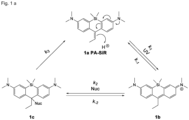
- Fig. 1A Upon UV irradiation of an aqueous solution of PA-SiR 2a, the fluorescent and blue-coloured cation 2b is forming ( Fig. 1A ), as confirmed by LC-MS.
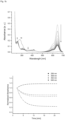
- Compound 2b has an excitation maximum at 646 nm and an emission maximum at 668 nm.
- the extinction coefficient is 25'000 M -1 cm -1 (in PBS at pH 7.3) and the quantum yield in aqueous solution was measured to be 0.37, whereas 2a shows only absorbance in the UV-range ( Fig. 1B and C and Table 1).
- the blue solution of 2b undergoes discoloration over time ( Fig. 1C ).
- Example 2 Fine-tuning of the equilibria between fluorescent cation and the non-fluorescent compounds
- PA-SIR PA-SIR
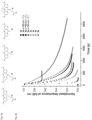
- various ligands PA-SiR-Halo, PA-SiR-SNAP, PA-SiR-Actin, PA-SiR-DNA, PA-SiR-Tubulin
- the olefinic structure is not charged and therefore ideal to pass the plasma membrane.
- the compounds showed good cell-permeability and could be activated efficiently in live cells in both widefield (DAPI channel) and confocal microscopy (355 nm laser).
- PA-SiR-SNAP and PA-SiR-Halo probes were successfully localised in Hela cells expressing either SNAP-tag or HaloTag in the nucleus.
- PA-SiR-Halo was also successfully localised to H2B ( Fig. 3 ).
- PA-SiR-Actin, PA-SiR-DNA and PA-SiR-Tubulin were localised to their targets.
- 3-Bromo-N,N-dimethylaniline (13) (3.20 g, 16.00 mmol, 2.0 eq.) was dissolved in dry Et 2 O (45 mL) and cooled down to -78 °C.
- sec-BuLi (14.0 mL, 18.40 mmol, 2.3 eq., 1.3 M in cyclohexane) was added dropwise over 15 min and the mixture was stirred for 30 min at - 78 °C.
- Dichlorodimethylsilane (14) (1.0 mL, 8.00 mmol, 1.0 eq.) was added dropwise over 10 min at -78 °C.
- Flash column chromatography was performed using a CombiFlash Rf system (Teledyne ISCO) using SiO 2 RediSep ® Rf columns at 25 °C. The used solvent compositions are reported individually in parentheses. Analytical thin layer chromatography was performed on glass plates coated with silica gel 60 F254 (Merck). Visualisation was achieved using UV light (254 nm). Evaporation in vacuo was performed at 25-60 °C and 900-10 mbar.
- LC-MS Liquid chromatography coupled to mass spectrometry
- RP-HPLC reverse phase high-performance liquid chromatography
- Dionex system equipped with an UltiMate 3000 diode array detector for product visualisation on a Waters Symmetry C18 column (5 ⁇ m, 3.9 ⁇ 150 mm) or on a Waters SunFire TM Prep C18 OBD TM (5 ⁇ m, 10 ⁇ 150 mm) column.
- Buffer A 0.1% TFA in H 2 O
- Buffer B ACN.
- Typical gradient was from 10% to 90% B within 32 min with 3 or 4 mL/min flow.
- UV light sources Three different UV light sources were used in the following experiments: a transilluminator (Biometra TI 1, 312 nm, high), a photography flash (Agfatronic 261B, plastic cover removed), a monochromator (Polychrome V, FEI, at 330 nm for 12 s) abbreviated as T, F and M. PBS (6.7 mM, Lonza) was used in all experiments.
- PA-SiR 2a was dissolved in water (50 ⁇ M). UV irradiation was performed in a quartz cuvette (Hellma Analytics) for the indicated times (T). Aliquots were taken to measure LC-MS at defined time points using an analytical gradient from 10% to 100% B within 6 min with 0.5 mL/min flow.
- Fluorescence spectra were measured on an Infinite M1000 (Tecan) plate reader. Quantum yields were determined using a Quantaurus QY (Hamamatsu).
- PA-SiRs were prepared as stock solutions in dry DMSO and diluted in PBS or PBS/ACN such that the final concentration of DMSO did not exceed 5% v/v.
- PBS solutions of different pH were adjusted by addition of HCl or NaOH solution using a pH meter.
- SNAP-tag protein and HaloTag protein were available in the Johnsson lab as 5.3 and 3.6 mm solutions in HEPES-Glycerol (1:1).
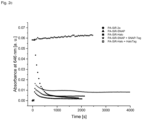
- PA-SiR-Halo and PA-SiR-SNAP were dissolved in PBS (10 ⁇ M) and protein (20 ⁇ M, 2.0 equiv.) was added. The mixture was incubated for 1 h (HaloTag) or 2 h (SNAP-tag) before UV-Vis measurement. UV irradiation was performed directly inside the spectrophotometer during the running experiment at a fixed distance (M, 12 s).
- Kinetic absorbance measurements were recorded on a Jasco V770 spectrophotometer equipped with a Peltier cooling element (PAC743R) at 646 nm.
- PAC743R Peltier cooling element
- H2B-Halo was constructed from a pEBTet plasmid and the commercially available pCLIPf-H2B plasmid (NEB).
- HeLa or U2OS cells were cultured in high-glucose DMEM media with GlutaMAX-1 (Life Technologies) supplemented with 10% FBS (Life Technologies) in a humidified 5% CO 2 incubator at 37 °C. Cells were split every 3-4 days or at confluency.
- Confocal imaging was performed on a Leica DMi8 microscope equipped with a Leica TCS SP8 X scanhead, a white light laser, a 355 nm laser (Coherent) and HC PL APO 63x1.47 Oil objective.
- the 355 nm laser was used to perform the photoactivation.
- a solution of 55 (1.0 mg, 2.0 ⁇ mol, 1.0 eq.) in DMSO (120 ⁇ L) was treated with DIEA (1.0 ⁇ L, 6.0 ⁇ mol, 3.0 eq.) and TSTU (0.7 mg, 2.4 ⁇ mol, 1.2 eq.). The mixture was shaken for 20 min at room temperature.
- a solution of docetaxel (52) (20 mg, 25.2 ⁇ mol, 12.6 eq.) in formic acid (370 ⁇ L) was shaken for 45 min. The solution was evaporated, coevaporated with toluene (3 x 500 ⁇ L) and dried on the high vacuum for 1 h.
- ACN acetonitrile
- NBS N-bromosuccinimide
- PBS phosphate buffered saline
Landscapes
- Health & Medical Sciences (AREA)
- Chemical & Material Sciences (AREA)
- Life Sciences & Earth Sciences (AREA)
- Immunology (AREA)
- Engineering & Computer Science (AREA)
- Physics & Mathematics (AREA)
- Analytical Chemistry (AREA)
- Pathology (AREA)
- General Physics & Mathematics (AREA)
- Biochemistry (AREA)
- General Health & Medical Sciences (AREA)
- Biomedical Technology (AREA)
- Molecular Biology (AREA)
- Organic Chemistry (AREA)
- Hematology (AREA)
- Urology & Nephrology (AREA)
- Nuclear Medicine, Radiotherapy & Molecular Imaging (AREA)
- Medicinal Chemistry (AREA)
- Food Science & Technology (AREA)
- Microbiology (AREA)
- Cell Biology (AREA)
- Biotechnology (AREA)
- Materials Engineering (AREA)
- Chemical Kinetics & Catalysis (AREA)
- Optics & Photonics (AREA)
- Pharmaceuticals Containing Other Organic And Inorganic Compounds (AREA)
Claims (9)
- Verbindung, gekennzeichnet durch eine allgemeine Formel (100):
 - R1, R6 und R9 H sind,- R2, R3, R4 und R5 ausgewählt sind aus H, Halogen, SO3H und unsubstituiertem Amino-, Hydroxy-, Carboxy-, SO3H- und/oder Halogen-substituiertem C1-C4-Alkyl, wobei CO2H, CO2R und SO2R mit R ausgewählt sind aus unsubstituiertem C1- bis C4-Alkyl,- R7 und R8 unabhängig ausgewählt sind aus unsubstituiertem oder Halogen-substituiertem C1- bis C4-Alkyl oder C3- bis C6-Cycloalkyl und Phenyl,- RN1, RN2, RN3 und RN4 einzeln unsubstituiertes oder Amino-, Hydroxyl- oder Halogen-substituiertes C1- bis C4-Alkyl oder C3- bis C6-Cycloalkyl oder RN1 zusammen mit RN2 und RN3 zusammen mit RN4 zusammen mit dem N ein unsubstituiertes oder Methyl-, Ethyl-, Propyl- oder Halogen-substituiertes Aziridin, Pyrrolidin, Piperidin, Piperazin oder Morpholin bilden;- R10 ausgewählt ist aus- unsubstituiertem oder Amino-, Hydroxyl-, Carboxyl- und/oder Halogen-substituiertem C2- bis C12-Alkyl oder C3- bis C7-Cycloalkyl; oder- einem Anteil, der ein Molekulargewicht von zwischen 15 und 1500 u aufweist und gekennzeichnet ist durch eine allgemeine Formel -LA1 n-LJ1 n'-LA2 m-LJ2 m'-LA3 p-LJ3 p'-LA4 q-LJ4 q'-Ms,wobei- LA1, LA2, LA3 und LA4 unabhängig voneinander ausgewählt sind aus unsubstituiertem C1- bis C12- oder Amino-, Hydroxyl-, Carboxyl- oder Fluor-substituiertem Alkyl oder Cycloalkyl, (CH2-CH2-O)r oder (CH2-CH(OH)-CH2-O)r, wobei r eine ganze Zahl von 1 bis 20 ist, Alkylaryl, Alkylaryl-Alkyl, und unsubstituiertem oder Alkyl-, Halogen-, Amino-, Alkylamino-, Imido-, Nitro-, Hydroxyl-, Oxyalkyl-, Carbonyl-, Carboxyl-, Sulfuryl- und/oder Sulfoxylsubstituiertem Aryl oder Heteroaryl,- LJ1, LJ2, LJ3 und LJ4 unabhängig voneinander ausgewählt sind aus -NR5C(O)-, - C(O)N(RN5)-, -CN-, -NC-, -CO-, -OC(O)-, -C(O)O-, -NRN5-, -O-, -P(OOH)-, -OP(OOH)-, -P(OOH)O-, -OP(OOH)O-, -OP(OOH)O-, -S-, -SO-, SO2-,
wobei RN5 ausgewählt ist aus H und unsubstituiertem oder Amino-, Hydroxyl-, Carboxyl- oder Fluor-substituiertem C1- bis C6-Alkyl, wobei RN5 insbesondere ausgewählt ist aus H und unsubstituiertem C1- bis C3-Alkyl;n, n', m, m', p, p', q, q' und s unabhängig voneinander ausgewählt sind aus 0 und 1,und wobei wahlweise die Verbindung kovalent über einen beliebigen der Substituenten R1, R2, R3, R4 , R5, R6 , R7, R8, R9 , R10, RN1, RN2 RN3 und RN4 an einen Bindungsanteil M gebunden ist, wobei M ausgewählt ist aus:a. einem Anteil, der unter in einer Zellkultur oder im Inneren einer lebenden Zelle vorherrschenden Bedingungen selektiv durch kovalente Bindung ankoppelbar ist an ein Protein oder eine Nukleinsäure, insbesondere einem Anteil, der in der Lage ist, eine Esterbindung, eine Etherbindung, eine Amidbindung, eine Disulfidbindung, eine Schiffsche Base zu bilden, oder einem Anteil, der in der Lage ist, in einer Click-Chemie-Reaktion zu reagieren,
insbesondere ausgewählt aus -COCHCH2, -CO-NHS, Biotin, einem Azid- oder Ethin-Anteil, einem Tetrazin-Anteil, einem (Bicyclo[6.1.0]nonyn]-Anteil, einem Cyclooctyn-Anteil, einem Transcycloocten-Anteil und einem Maleimid, oder vonb. einem Substrat aus O6-Alkylguanin-DNA-Alkyltransferase, insbesondere einem 6-[(4-Methylenphenyl)methoxy]-9H-purin-2-amin-Anteil mit der Formel (110), oder einem Pyrimidin-Derivat davon, insbesondere einem Anteil mit der Formel (111) oder (112), c. einem Substrat einer Halogenalkanhalotransferase, insbesondere ein 1-Chlorhexyl-Anteil wie unten beispielhaft gezeigt;
 d. einem Substrat aus Dihydrofolatreduktase, insbesondere dem Anteil:
 e. einem Anteil, der in der Lage ist, selektiv nicht kovalent mit einem Biomolekül (insbesondere einem Protein oder einer Nukleinsäure) unter Bedingungen zu interagieren, die in einer lebenden Zelle vorherrschen, wobei der Anteil und das Biomolekül einen Komplex bilden, der eine Dissoziationskonstante kD von 10-6 mol/l oder niedriger aufweist;wobei M insbesondere eine Molekülmasse von höher als 160 u, aber niedriger als 1000 u, insbesondere niedriger als 700 u, genauer gesagt niedriger als 500 u aufweist, und M bis zu fünf Wasserstoffbrückendonatoren, bis zu zehn Wasserstoffbrückenakzeptoren umfasst und durch einen Octanol-Wasser-Verteilungskoeffizienten logP von unter 5,6 gekennzeichnet ist;wobei M insbesondere ausgewählt ist aus Taxol, Jasplakinolid, einem Bisbenzimid-DNA-Farbstoff, Pepstatin A und Triphenylphosphonium;oder wobei M ein Oligonukleotid ist, das eine Sequenzlänge von 10 bis 40 Nukleotiden aufweist,f. einem Lipid, insbesondere einem Lipid, das ausgewählt ist aus einem Ceramid-Derivat, einem Glycerid oder einer Fettsäure.
 - Verbindung nach Anspruch 1, wobei ein beliebiger der Substituenten R2, R3, R4 und R5 unabhängig von einem beliebigen anderen H oder ein Anteil ist, der ein Molekülgewicht von zwischen 15 und 1500 u (g/mol) aufweist;wobei insbesondere einer der Substituenten R2, R3, R4 und R5 ein Anteil ist, der ein Molekülgewicht von zwischen 15 und 1500 u aufweist, und die anderen ausgewählt sind aus H und unsubstituiertem oder Fluor-, Amino-, Hydroxyl-, SO3H- und/oder Carboxyl-substituiertem C1- bis C4-Alkyl, Alkenyl oder Alkynyl;wobei insbesondere einer der Substituenten R2, R3, R4 und R5 ein Anteil ist, der ein Molekülgewicht von zwischen 15 und 1500 u aufweist, und die anderen H sind.
- Verbindung nach Anspruch 2, wobei der Anteil, der ein Molekülgewicht von zwischen 15 und 1500 u aufweist, durch eine allgemeine Formel -L-M gekennzeichnet ist, wobei L ein Koppler ist, der die Verbindung mit der Struktur (1) kovalent mit dem Bindungsanteil M nach Anspruch 1 verbindet und L eine kovalente Bindung oder ein Koppler ist, die bzw. der aus 1 bis 50 Atomen besteht, die ein Atomgewicht von 12 oder höher aufweisen,
wobei insbesondere der Anteil, der ein Molekülgewicht von zwischen 15 und 1500 u aufweist, gekennzeichnet ist durch die folgende Formel:
-LA1 n-LJ1 n'-LA2 m-LJ2 m'-LA3 p-LJ3 p'-LA4 q-LJ4 q'-Ms, wobei LA1...4, LJ1...4, n, n' ... q', s und M die Definitionen nach Anspruch 1 aufweisen. - Verbindung nach Anspruch 3, wobei L -LA1-L1-LA2 m-L2 m'-LA3 p ist, wobei- LA1, LA2 und LA3 unabhängig ausgewählt sind aus unsubstituiertem C1- bis C6-, Amino-, Hydroxyl-, Carboxyl-, oder Fluor-substituiertem Alkyl oder Cycloalkyl und (CH2-CH2-O)r oder (CH2-CH(OH)-CH2-O)r , wobei r eine ganze Zahl von 1 bis 4 ist, und- LJ1 und LJ2 unabhängig ausgewählt sind aus -NR5C(O)-, -C(O)N(R5)-, - CN-, -NC-, -CO-, -OC(O)-, -C(O)O-, NRN5-, -O- und -S-, und- m, m' und p unabhängig voneinander ausgewählt sind aus 0 und 1.
- Verbindung nach einem der vorhergehenden Ansprüche, wobei R2 und R5 F oder Cl sind.
- Verbindung nach einem der vorhergehenden Ansprüche, wobei R2, R3, R4 und R5 H sind,- R7 und R8 C1- bis C4-Alkyl oder Phenyl sind,- RN1, RN2, RN3 und RN4 einzeln unsubstituiertes oder Amino-, Hydroxyl- oder Fluor-substituiertes C1- bis C4-Alkyl sind, oder RN1 zusammen mit RN2, und RN3 zusammen mit RN4 zusammen -(CH2)3-, -(CH2)4-, -(CH2)5-, -(CH2)2O(CH2)2- oder -(CH2)2NH(CH2)2- sind.
- Verbindung, die ausgewählt ist aus:a. 4-(3,7-Bis(dimethylamino)-5,5-dimethyldibenzo[b,e]silin-10(5H)-yliden)butanoicacid (2a);b. 4-(3,7-Bis(dimethylamino)-5,5-dimethyldibenzo[b,e]silin-10(5H)-yliden)-3-Methylbutansäure (3a);c. N3,N3,N7,N7,5,5-Hexamethyl-10-propyliden-5,10-dihydrodibenzo[b,e]silin-3,7-diamin (4a);d. N3,N3,N7,N7,5,5-Hexamethyl-10-methylen-5,10-dihydrodibenzo[b,e]silin-3,7-diamin (5a);e. 3-(3,7-Bis(dimethylamino)-5,5-dimethyldibenzo[b,e]silin-10(5H)-yliden)propionsäure (22);f. 4-(3,7-Bis(dimethylamino)-5,5-dimethyldibenzo[b,e]silin-10(5H)-yliden)-2,2-dimethylbutansäure (28);g. 4-(3,7-Bis(dimethylamino)-5,5-diisopropyldibenzo[b,e]silin-10(5H)-yliden)butansäure (6a);h. 4-(3,7-Bis(dimethylamino)-2,8-difluor-5,5-dimethyldibenzo[b,e]silin-10(5H)-yliden)butansäure (36);i. 3-(3,7-Di(azetidin-1-yl)-5,5-dimethyldibenzo[b,e]silin-10(5H)-yliden)propionsäure (42);j. 4-(3,7-Bis(dimethylamino)-5,5-dimethyldibenzo[b,e]silin-10(5H)-yliden)-N-(2-(2-((6-chlorohexyl)oxy)ethoxy)ethyl)butanamid (44);k. 2,5-Dioxopyrrolidin-1-yl-4-(3,7-bis(dimethylamino)-5,5-dimethyldibenzo[b,e]silin-10(5H)-yliden)butanoat (45);l. N-(4-(((2-Amino-9H-purin-6-yl)oxy)methyl)benzyl)-4-(3,7-bis(dimethylamino)-5,5-dimethyldibenzo[b,e]silin-10(5H)-yliden)butanamid (47);m. N-(4-((4R,7R,10S,13S,19S,E)-7-((1H-Indol-2-yl)methyl)-4-(4-hydroxyphenyl)-8,13,15,19-tetramethyl-2,6,9,12-tetraoxo-1-oxa-5,8,11-triazacyclononadec-15-en-10-yl)butyl)-4-(3,7-bis(dimethylamino)-5,5-dimethyldibenzo[b,e]silin-10(5H)-yliden)butanamid (49);n. 4-(3,7-Bis(dimethylamino)-5,5-dimethyldibenzo[b,e]silin-10(5H)-yliden)-N-(4-(4-(6-(4-methylpiperazin-1-yl)-1H,3'H-[2,5'-bibenzo[d]imidazol]-2'-yl)phenoxy)butyl)butanamid (51);o. (2αR,4S,4αS,6R,9S,11S,12S,12αR,12βS)-12β-Acetoxy-9-((3-(4-(3,7-bis(dimethylamino)-5,5-dimethyldibenzo[b,e]silin-10(5H)-yliden)butanamido)-2-hydroxy-3-phenylpropanoyl)oxy)-4,6,11-trihydroxy-4α,8,13,13-tetramethyl-5-oxo-2α,3,4,4α,5,6,9,10,11,12,12α,12β-dodecahydro-1H-7,11-methanocyclodeca[3,4]benzo[1,2-β]oxet-12-yl benzoat (53);p. 8-(4-(3,7-Bis(dimethylamino)-5,5-dimethyldibenzo[b,e]silin-10(5H)-yliden)butanamido)octansäure (55);q. (2αR,4S,4αS,6R,9S,11S,12S,12αR,12βS)-12β-Acetoxy-9-((3-(8-(4-(3,7-bis(dimethylamino)-5,5-dimethyldibenzo[b,e]silin-10(5H)-yliden)butanamido)octanamido)-2-hydroxy-3-phenylpropanoyl)oxy)-4,6,11-trihydroxy-4α,8,13,13-tetramethyl-5-oxo-2α,3,4,4α,5,6,9,10,11,12,12α, 12β-dodecahydro-1H-7,11-methanocyclodeca[3,4]benzo[1,2-β]oxet-12-yl-benzoat (56);r. 4-(3,7-Bis(dimethylamino)-5,5-dimethyldibenzo[b,e]silin-10(5H)-yliden)-N-(4-(6-methyl-1,2,4,5-tetrazin-3-yl)benzyl)butanamid (58);s. 4-(3,7-Bis(dimethylamino)-5,5-diisopropyldibenzo[b,e]silin-10(5H)-yliden)-N-(2-(2-((6-chlorohexyl)oxy)ethoxy)ethyl)butanamid (59);t. 4-(3,7-Bis(dimethylamino)-5,5-diisopropyldibenzo[b,e]silin-10(5H)-yliden)-N-(21-chloro-8-oxo-3,6,12,15-tetraoxa-9-azahenicosyl)butanamid (64);u. 1-(4-(3,7-Bis(dimethylamino)-5,5-diisopropyldibenzo[b,e]silin-10(5H)-yliden)butanamido)-N-(2-(2-((6-chlorohexyl)oxy)ethoxy)ethyl)-3,6,9,12-tetraoxapentadecan-15-amid (65);v. N-(4-(((2-Amino-9H-purin-6-yl)oxy)methyl)benzyl)-4-(3,7-bis(dimethylamino)-5,5-diisopropyldibenzo[b,e]silin-10(5H)-yliden)butanamid (66);w. 3-((4-(((2-Amino-9H-purin-6-yl)oxy)methyl)benzyl)amino)-2-(4-(3,7-bis(dimethylamino)-5,5-diisopropyldibenzo[b,e]silin-10(5H)-yliden)butanamido)-3-oxopropan-1-Sulfonsäure (69);x. N-(4-((4R,7R,10S,13 S,19S,E)-7-((1H-Indol-2-yl)methyl)-4-(4-hydroxyphenyl)-8,13,15,19-tetramethyl-2,6,9,12-tetraoxo-1-oxa-5,8,11-triazacyclononadec-15-en-10-yl)butyl)-4-(3,7-bis(dimethylamino)-5,5-diisopropyldibenzo[b,e]silin-10(5H)-yliden)butanamid (70);y. N-(4-(((2-Amino-9H-purin-6-yl)oxy)methyl)benzyl)-4-(3,7-bis(dimethylamino)-2,8-difluoro-5,5-dimethyldibenzo[b,e]silin-10(5H)-yliden)butanamid (71);z. N-(4-((4R,7R,10S,13S,19S,E)-7-((1H-Indol-2-yl)methyl)-4-(4-hydroxyphenyl)-8,13,15,19-tetramethyl-2,6,9,12-tetraoxo-1-oxa-5,8,11-triazacyclononadec-15-en-10-yl)butyl)-4-(3,7-bis(dimethylamino)-2,8-difluoro-5,5-dimethyldibenzo[b,e]silin-10(5H)-yliden)butanamid (72).
- Verwendung einer Verbindung nach einem der vorhergehenden Ansprüche in einem Ex-vivo-Verfahren zum Färben einer biologischen Probe.
- Ex-vivo-Verfahren zum Färben einer Probe, wobei das Verfahren die folgenden Schritte umfasst:a. Kontaktieren der Probe mit einer Verbindung nach einem der vorhergehenden Ansprüche,b. Beleuchten der Probe mit Licht mit einer Wellenlänge im Bereich von 280 bis 450 nm;c. Aufzeichnen des Vorhandenseins und des Orts der Verbindung in der Probe durch Beleuchten der Probe mit Licht mit einer geeigneten Anregungswellenlänge undd. Aufzeichnen von Licht, ausgesendet von der Probe, mit einer geeigneten Emissionswellenlänge λ, insbesondere einem λ, das nahe am Maximum des Emissionsspektrums von 668 nm liegt.
Applications Claiming Priority (3)
| Application Number | Priority Date | Filing Date | Title |
|---|---|---|---|
| EP17209895 | 2017-12-21 | ||
| EP18168134.7A EP3556762A1 (de) | 2018-04-19 | 2018-04-19 | Neuartige abstimmbare photoaktivierbare silicium-rhodamin-fluorophore |
| PCT/EP2018/086440 WO2019122269A1 (en) | 2017-12-21 | 2018-12-20 | Novel tunable photoactivatable silicon rhodamine fluorophores |
Publications (3)
| Publication Number | Publication Date |
|---|---|
| EP3728276A1 EP3728276A1 (de) | 2020-10-28 |
| EP3728276C0 EP3728276C0 (de) | 2025-04-16 |
| EP3728276B1 true EP3728276B1 (de) | 2025-04-16 |
Family
ID=64949292
Family Applications (1)
| Application Number | Title | Priority Date | Filing Date |
|---|---|---|---|
| EP18829855.8A Active EP3728276B1 (de) | 2017-12-21 | 2018-12-20 | Neuartige abstimmbare photoaktivierbare silicium-rhodamin-fluorophore |
Country Status (3)
| Country | Link |
|---|---|
| US (1) | US12018157B2 (de) |
| EP (1) | EP3728276B1 (de) |
| WO (1) | WO2019122269A1 (de) |
Families Citing this family (6)
| Publication number | Priority date | Publication date | Assignee | Title |
|---|---|---|---|---|
| WO2022229466A2 (en) | 2021-04-30 | 2022-11-03 | Max-Planck-Gesellschaft zur Förderung der Wissenschaften e. V. | Non-covalent halotag ligands |
| US20240366799A1 (en) | 2021-07-15 | 2024-11-07 | Max-Planck-Gesellschaft Zur Foerderung Der Wissenschaften E. V. | Caging-group-free photoactivatable fluorescent dyes and their use |
| CN113912607B (zh) * | 2021-09-26 | 2022-12-13 | 中山大学肿瘤防治中心(中山大学附属肿瘤医院、中山大学肿瘤研究所) | 一种SNAP-tag探针及其制备方法与应用 |
| EP4421166A1 (de) | 2023-02-22 | 2024-08-28 | Max-Planck-Gesellschaft zur Förderung der Wissenschaften e.V. | Verbesserte geteilte halotags |
| WO2025012402A1 (en) | 2023-07-11 | 2025-01-16 | Max-Planck-Gesellschaft zur Förderung der Wissenschaften e. V. | Spatial proximity assay |
| WO2025224010A1 (en) | 2024-04-24 | 2025-10-30 | Max-Planck-Gesellschaft zur Förderung der Wissenschaften e. V. | Improved o6-alkylguanine-dna alkyltransferase substrates |
Family Cites Families (7)
| Publication number | Priority date | Publication date | Assignee | Title |
|---|---|---|---|---|
| US6130101A (en) | 1997-09-23 | 2000-10-10 | Molecular Probes, Inc. | Sulfonated xanthene derivatives |
| US6191278B1 (en) | 1999-11-03 | 2001-02-20 | Pe Corporation | Water-soluble rhodamine dyes and conjugates thereof |
| US7964722B2 (en) * | 2002-08-31 | 2011-06-21 | Board Of Regents Of The Nevada System Of Higher Education, On Behalf Of The University Of Nevada, Reno | Light-driven rotary molecular motors |
| WO2012083064A1 (en) | 2010-12-16 | 2012-06-21 | Southern Illinois University Carbondale | Silaanthracene as a red and near infrared sensor and a method to manufacture such a sensor |
| US9346957B2 (en) | 2011-08-26 | 2016-05-24 | École Polytechnique Fédérale De Lausanne (Epfl) | Cell permeable, fluorescent dye |
| CA2944476C (en) | 2014-04-01 | 2021-06-15 | Howard Hughes Medical Institute | Azetidine-substituted fluorescent compounds |
| CN109073557A (zh) * | 2016-05-20 | 2018-12-21 | 霍华德休斯医学研究所 | 光活性荧光团和体内标记方法 |
-
2018
- 2018-12-20 EP EP18829855.8A patent/EP3728276B1/de active Active
- 2018-12-20 US US16/956,596 patent/US12018157B2/en active Active
- 2018-12-20 WO PCT/EP2018/086440 patent/WO2019122269A1/en not_active Ceased
Also Published As
| Publication number | Publication date |
|---|---|
| EP3728276C0 (de) | 2025-04-16 |
| US20230147145A1 (en) | 2023-05-11 |
| US12018157B2 (en) | 2024-06-25 |
| EP3728276A1 (de) | 2020-10-28 |
| WO2019122269A1 (en) | 2019-06-27 |
Similar Documents
| Publication | Publication Date | Title |
|---|---|---|
| EP3728276B1 (de) | Neuartige abstimmbare photoaktivierbare silicium-rhodamin-fluorophore | |
| Herner et al. | A new family of bioorthogonally applicable fluorogenic labels | |
| US12326385B2 (en) | Cell-permeable fluorogenic fluorophores | |
| US6207831B1 (en) | Fluorescent dyes (AIDA) for solid phase and solution phase screening | |
| Zhang et al. | Rational design of NIR fluorescence probes for sensitive detection of viscosity in living cells | |
| AU2019319901A1 (en) | Silicon-substituted rhodamine dyes and dye conjugates | |
| Zatsikha et al. | Functionalized bispyridoneannelated BODIPY–Bright long-wavelength fluorophores | |
| US20230104281A1 (en) | Fluorescent rhodamine dyes with enhanced cell permeability | |
| CN103443101A (zh) | 具有荧光发色团的化合物、含有化合物的离子浓度传感器、含有化合物的试剂、具备试剂的试剂盒、化合物的前体、以及化合物的合成方法 | |
| EP3556762A1 (de) | Neuartige abstimmbare photoaktivierbare silicium-rhodamin-fluorophore | |
| EP3868838A2 (de) | Fluoreszenter farbstoffmaterial und verwendung davon | |
| US20230052551A1 (en) | Fluorescent probe for detection of enpp activity | |
| US20110318772A1 (en) | Reactive coumarin derivatives and their use in cellular analyses | |
| Kindahl et al. | Efficient one-step synthesis of 4-amino substituted phthalimides and evaluation of their potential as fluorescent probes | |
| US20240366799A1 (en) | Caging-group-free photoactivatable fluorescent dyes and their use | |
| JP2006500588A (ja) | 複数のドナー及びアクセプターを有する蛍光標識試薬 | |
| US20070009977A1 (en) | Kinase-directed, activity-based probes | |
| US20250188284A1 (en) | Caging-group-free photoactivatable fluorescent dyes and their use | |
| Stavytskyi et al. | Esters and amides of 3-R-2, 8-dioxo-7, 8-dihydro-2H-pyrrolo [1, 2-a][1, 2, 4] triazino [2, 3-c] quinazolin-5a (6H)-carboxylic (-propanoic) acids: synthesis and biological activity | |
| US9958452B2 (en) | Highly fluorogenic protein labelling agents | |
| JPWO2015125851A1 (ja) | 神経伝達物質受容体のリガンドスクリーニングシステムの開発 | |
| JP2001288187A (ja) | 一酸化窒素発生用試薬 | |
| WO2023166801A1 (ja) | 新規時間分解蛍光イメージングプローブ | |
| Ariyasu et al. | Photochemical cleavage reaction of 8-quinolinyl sulfonates that are halogenated and nitrated at the 7-position | |
| WO2025224010A1 (en) | Improved o6-alkylguanine-dna alkyltransferase substrates |
Legal Events
| Date | Code | Title | Description |
|---|---|---|---|
| STAA | Information on the status of an ep patent application or granted ep patent |
Free format text: STATUS: UNKNOWN |
|
| STAA | Information on the status of an ep patent application or granted ep patent |
Free format text: STATUS: THE INTERNATIONAL PUBLICATION HAS BEEN MADE |
|
| PUAI | Public reference made under article 153(3) epc to a published international application that has entered the european phase |
Free format text: ORIGINAL CODE: 0009012 |
|
| STAA | Information on the status of an ep patent application or granted ep patent |
Free format text: STATUS: REQUEST FOR EXAMINATION WAS MADE |
|
| 17P | Request for examination filed |
Effective date: 20200717 |
|
| AK | Designated contracting states |
Kind code of ref document: A1 Designated state(s): AL AT BE BG CH CY CZ DE DK EE ES FI FR GB GR HR HU IE IS IT LI LT LU LV MC MK MT NL NO PL PT RO RS SE SI SK SM TR |
|
| AX | Request for extension of the european patent |
Extension state: BA ME |
|
| DAV | Request for validation of the european patent (deleted) | ||
| DAX | Request for extension of the european patent (deleted) | ||
| STAA | Information on the status of an ep patent application or granted ep patent |
Free format text: STATUS: EXAMINATION IS IN PROGRESS |
|
| 17Q | First examination report despatched |
Effective date: 20210722 |
|
| GRAP | Despatch of communication of intention to grant a patent |
Free format text: ORIGINAL CODE: EPIDOSNIGR1 |
|
| STAA | Information on the status of an ep patent application or granted ep patent |
Free format text: STATUS: GRANT OF PATENT IS INTENDED |
|
| RIC1 | Information provided on ipc code assigned before grant |
Ipc: C09B 11/28 20060101ALI20240920BHEP Ipc: G01N 33/58 20060101ALI20240920BHEP Ipc: C07F 7/08 20060101AFI20240920BHEP |
|
| INTG | Intention to grant announced |
Effective date: 20241024 |
|
| GRAJ | Information related to disapproval of communication of intention to grant by the applicant or resumption of examination proceedings by the epo deleted |
Free format text: ORIGINAL CODE: EPIDOSDIGR1 |
|
| STAA | Information on the status of an ep patent application or granted ep patent |
Free format text: STATUS: EXAMINATION IS IN PROGRESS |
|
| GRAP | Despatch of communication of intention to grant a patent |
Free format text: ORIGINAL CODE: EPIDOSNIGR1 |
|
| STAA | Information on the status of an ep patent application or granted ep patent |
Free format text: STATUS: GRANT OF PATENT IS INTENDED |
|
| GRAS | Grant fee paid |
Free format text: ORIGINAL CODE: EPIDOSNIGR3 |
|
| GRAA | (expected) grant |
Free format text: ORIGINAL CODE: 0009210 |
|
| STAA | Information on the status of an ep patent application or granted ep patent |
Free format text: STATUS: THE PATENT HAS BEEN GRANTED |
|
| INTC | Intention to grant announced (deleted) | ||
| INTG | Intention to grant announced |
Effective date: 20250307 |
|
| AK | Designated contracting states |
Kind code of ref document: B1 Designated state(s): AL AT BE BG CH CY CZ DE DK EE ES FI FR GB GR HR HU IE IS IT LI LT LU LV MC MK MT NL NO PL PT RO RS SE SI SK SM TR |
|
| REG | Reference to a national code |
Ref country code: GB Ref legal event code: FG4D |
|
| REG | Reference to a national code |
Ref country code: CH Ref legal event code: EP Ref country code: DE Ref legal event code: R096 Ref document number: 602018081173 Country of ref document: DE |
|
| REG | Reference to a national code |
Ref country code: IE Ref legal event code: FG4D |
|
| U01 | Request for unitary effect filed |
Effective date: 20250429 |
|
| U07 | Unitary effect registered |
Designated state(s): AT BE BG DE DK EE FI FR IT LT LU LV MT NL PT RO SE SI Effective date: 20250507 |
|
| PG25 | Lapsed in a contracting state [announced via postgrant information from national office to epo] |
Ref country code: ES Free format text: LAPSE BECAUSE OF FAILURE TO SUBMIT A TRANSLATION OF THE DESCRIPTION OR TO PAY THE FEE WITHIN THE PRESCRIBED TIME-LIMIT Effective date: 20250416 |
|
| PG25 | Lapsed in a contracting state [announced via postgrant information from national office to epo] |
Ref country code: GR Free format text: LAPSE BECAUSE OF FAILURE TO SUBMIT A TRANSLATION OF THE DESCRIPTION OR TO PAY THE FEE WITHIN THE PRESCRIBED TIME-LIMIT Effective date: 20250717 Ref country code: NO Free format text: LAPSE BECAUSE OF FAILURE TO SUBMIT A TRANSLATION OF THE DESCRIPTION OR TO PAY THE FEE WITHIN THE PRESCRIBED TIME-LIMIT Effective date: 20250716 |
|
| PG25 | Lapsed in a contracting state [announced via postgrant information from national office to epo] |
Ref country code: PL Free format text: LAPSE BECAUSE OF FAILURE TO SUBMIT A TRANSLATION OF THE DESCRIPTION OR TO PAY THE FEE WITHIN THE PRESCRIBED TIME-LIMIT Effective date: 20250416 |
|
| PG25 | Lapsed in a contracting state [announced via postgrant information from national office to epo] |
Ref country code: HR Free format text: LAPSE BECAUSE OF FAILURE TO SUBMIT A TRANSLATION OF THE DESCRIPTION OR TO PAY THE FEE WITHIN THE PRESCRIBED TIME-LIMIT Effective date: 20250416 |
|
| PG25 | Lapsed in a contracting state [announced via postgrant information from national office to epo] |
Ref country code: RS Free format text: LAPSE BECAUSE OF FAILURE TO SUBMIT A TRANSLATION OF THE DESCRIPTION OR TO PAY THE FEE WITHIN THE PRESCRIBED TIME-LIMIT Effective date: 20250716 |
|
| PG25 | Lapsed in a contracting state [announced via postgrant information from national office to epo] |
Ref country code: IS Free format text: LAPSE BECAUSE OF FAILURE TO SUBMIT A TRANSLATION OF THE DESCRIPTION OR TO PAY THE FEE WITHIN THE PRESCRIBED TIME-LIMIT Effective date: 20250816 |
|
| REG | Reference to a national code |
Ref country code: CH Ref legal event code: U11 Free format text: ST27 STATUS EVENT CODE: U-0-0-U10-U11 (AS PROVIDED BY THE NATIONAL OFFICE) Effective date: 20260101 |
|
| PG25 | Lapsed in a contracting state [announced via postgrant information from national office to epo] |
Ref country code: SM Free format text: LAPSE BECAUSE OF FAILURE TO SUBMIT A TRANSLATION OF THE DESCRIPTION OR TO PAY THE FEE WITHIN THE PRESCRIBED TIME-LIMIT Effective date: 20250416 |
|
| PG25 | Lapsed in a contracting state [announced via postgrant information from national office to epo] |
Ref country code: CZ Free format text: LAPSE BECAUSE OF FAILURE TO SUBMIT A TRANSLATION OF THE DESCRIPTION OR TO PAY THE FEE WITHIN THE PRESCRIBED TIME-LIMIT Effective date: 20250416 |
|
| PG25 | Lapsed in a contracting state [announced via postgrant information from national office to epo] |
Ref country code: SK Free format text: LAPSE BECAUSE OF FAILURE TO SUBMIT A TRANSLATION OF THE DESCRIPTION OR TO PAY THE FEE WITHIN THE PRESCRIBED TIME-LIMIT Effective date: 20250416 |
|
| U20 | Renewal fee for the european patent with unitary effect paid |
Year of fee payment: 8 Effective date: 20251222 |
|
| PLBE | No opposition filed within time limit |
Free format text: ORIGINAL CODE: 0009261 |
|
| STAA | Information on the status of an ep patent application or granted ep patent |
Free format text: STATUS: NO OPPOSITION FILED WITHIN TIME LIMIT |
|
| REG | Reference to a national code |
Ref country code: CH Ref legal event code: L10 Free format text: ST27 STATUS EVENT CODE: U-0-0-L10-L00 (AS PROVIDED BY THE NATIONAL OFFICE) Effective date: 20260225 |
|
| 26N | No opposition filed |
Effective date: 20260119 |