EP3707863B1 - Mehrweg-richtlinienentscheidungen für verschlüsselte videoströme - Google Patents
Mehrweg-richtlinienentscheidungen für verschlüsselte videoströme Download PDFInfo
- Publication number
- EP3707863B1 EP3707863B1 EP17825399.3A EP17825399A EP3707863B1 EP 3707863 B1 EP3707863 B1 EP 3707863B1 EP 17825399 A EP17825399 A EP 17825399A EP 3707863 B1 EP3707863 B1 EP 3707863B1
- Authority
- EP
- European Patent Office
- Prior art keywords
- resolution
- path
- video
- control entity
- video stream
- Prior art date
- Legal status (The legal status is an assumption and is not a legal conclusion. Google has not performed a legal analysis and makes no representation as to the accuracy of the status listed.)
- Active
Links
Images




Classifications
-
- H—ELECTRICITY
- H04—ELECTRIC COMMUNICATION TECHNIQUE
- H04L—TRANSMISSION OF DIGITAL INFORMATION, e.g. TELEGRAPHIC COMMUNICATION
- H04L45/00—Routing or path finding of packets in data switching networks
- H04L45/24—Multipath
-
- H—ELECTRICITY
- H04—ELECTRIC COMMUNICATION TECHNIQUE
- H04L—TRANSMISSION OF DIGITAL INFORMATION, e.g. TELEGRAPHIC COMMUNICATION
- H04L65/00—Network arrangements, protocols or services for supporting real-time applications in data packet communication
- H04L65/80—Responding to QoS
-
- H—ELECTRICITY
- H04—ELECTRIC COMMUNICATION TECHNIQUE
- H04N—PICTORIAL COMMUNICATION, e.g. TELEVISION
- H04N21/00—Selective content distribution, e.g. interactive television or video on demand [VOD]
- H04N21/20—Servers specifically adapted for the distribution of content, e.g. VOD servers; Operations thereof
- H04N21/23—Processing of content or additional data; Elementary server operations; Server middleware
- H04N21/234—Processing of video elementary streams, e.g. splicing of video streams or manipulating encoded video stream scene graphs
- H04N21/2347—Processing of video elementary streams, e.g. splicing of video streams or manipulating encoded video stream scene graphs involving video stream encryption
-
- H—ELECTRICITY
- H04—ELECTRIC COMMUNICATION TECHNIQUE
- H04N—PICTORIAL COMMUNICATION, e.g. TELEVISION
- H04N21/00—Selective content distribution, e.g. interactive television or video on demand [VOD]
- H04N21/20—Servers specifically adapted for the distribution of content, e.g. VOD servers; Operations thereof
- H04N21/23—Processing of content or additional data; Elementary server operations; Server middleware
- H04N21/238—Interfacing the downstream path of the transmission network, e.g. adapting the transmission rate of a video stream to network bandwidth; Processing of multiplex streams
- H04N21/2385—Channel allocation; Bandwidth allocation
-
- H—ELECTRICITY
- H04—ELECTRIC COMMUNICATION TECHNIQUE
- H04N—PICTORIAL COMMUNICATION, e.g. TELEVISION
- H04N21/00—Selective content distribution, e.g. interactive television or video on demand [VOD]
- H04N21/60—Network structure or processes for video distribution between server and client or between remote clients; Control signalling between clients, server and network components; Transmission of management data between server and client, e.g. sending from server to client commands for recording incoming content stream; Communication details between server and client
- H04N21/63—Control signaling related to video distribution between client, server and network components; Network processes for video distribution between server and clients or between remote clients, e.g. transmitting basic layer and enhancement layers over different transmission paths, setting up a peer-to-peer communication via Internet between remote STB's; Communication protocols; Addressing
- H04N21/633—Control signals issued by server directed to the network components or client
- H04N21/6338—Control signals issued by server directed to the network components or client directed to network
-
- H—ELECTRICITY
- H04—ELECTRIC COMMUNICATION TECHNIQUE
- H04N—PICTORIAL COMMUNICATION, e.g. TELEVISION
- H04N21/00—Selective content distribution, e.g. interactive television or video on demand [VOD]
- H04N21/60—Network structure or processes for video distribution between server and client or between remote clients; Control signalling between clients, server and network components; Transmission of management data between server and client, e.g. sending from server to client commands for recording incoming content stream; Communication details between server and client
- H04N21/63—Control signaling related to video distribution between client, server and network components; Network processes for video distribution between server and clients or between remote clients, e.g. transmitting basic layer and enhancement layers over different transmission paths, setting up a peer-to-peer communication via Internet between remote STB's; Communication protocols; Addressing
- H04N21/647—Control signaling between network components and server or clients; Network processes for video distribution between server and clients, e.g. controlling the quality of the video stream, by dropping packets, protecting content from unauthorised alteration within the network, monitoring of network load, bridging between two different networks, e.g. between IP and wireless
- H04N21/64746—Control signals issued by the network directed to the server or the client
-
- H—ELECTRICITY
- H04—ELECTRIC COMMUNICATION TECHNIQUE
- H04N—PICTORIAL COMMUNICATION, e.g. TELEVISION
- H04N21/00—Selective content distribution, e.g. interactive television or video on demand [VOD]
- H04N21/80—Generation or processing of content or additional data by content creator independently of the distribution process; Content per se
- H04N21/83—Generation or processing of protective or descriptive data associated with content; Content structuring
- H04N21/845—Structuring of content, e.g. decomposing content into time segments
- H04N21/8456—Structuring of content, e.g. decomposing content into time segments by decomposing the content in the time domain, e.g. in time segments
Definitions
- the application relates to a method for controlling at least one path in a multipath environment wherein the at least one path is used for transmitting an encrypted video stream comprising a sequence of video segments. Furthermore the corresponding path control entity is provided which controls the at least one path in the multipath environment. Additionally a computer program comprising programme code is provided and a carrier comprising the computer program.
- the streaming of a video based on TCP comprises different phases as shown in Fig 1 .
- a pre-download phase 2 is provided and a download phase 3.
- the former phase comprises a streaming access phase 4 wherein the latter phase comprises a buffering phase 5 which starts with the first transfer of the video and which ends when the first frame of the video is displayed.
- the different phases shown in Fig. 1 can occur during a download of a video from a provider such as YouTube.
- the buffering occurs when there is not enough information in the video buffer of the player so that the end user cannot visualise the video.
- the video session then starts with a playout phase 6 where the end user is playing the video and where the video is still downloaded.
- the end-user periodically downloads some video frames to keep the buffer state over a minimum needed for still reproducing the video.
- These video services use TCP as transport protocol.
- the payload of the traffic is sent using encryption mechanisms.
- Adaptive bit rate is the most common technology used to deliver video by over-the-top (OTT) video providers using HTTP/HTTPS over TCP.
- any video can be reproduced at different resolution levels (144p, 240p, 360p, 480p, 720p, ...), called video representations.
- 144p means that the video frame has 144 lines
- 244p means that each video frame has 244 lines per video frame.
- higher resolution level implies better video quality reproduction so both terms (video resolution and video quality reproduction) are connected.
- video quality, video resolution, resolution of a video stream, and resolution used in a video stream are used interchangeably.
- the client can decide the resolution of the video reproduction, based on client properties and network conditions.
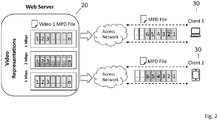
- Fig. 2 shows an example of a web server 20 in which a video is stored with different possible resolutions.
- the client can change the video quality on the fly, pursuing adaptation to bandwidth fluctuations as shown by the different gray scales of the transmitted video stream.
- Each video stream is fragmented into small chunks called video segments.
- video segments When a client is requesting more video payload from the server one video segment is the minimum video payload that has to be downloaded.
- the video stream has several video frames per second and a video segment comprises video content for several seconds.
- QoE according to Wikipedia is the degree of delight or annoyance of the user of an application or service.
- QoE has historically emerged from QoS), which attempts to objectively measure service parameters QoS measurement is most of the time not related to a customer, but to the media or network itself.
- Hybrid Access technology is the way network operators offer the combined usage of fixed broadband and 3GPP access networks.
- TR-348 Hybrid Access Broadband Network Architecture the architectural requirements to allow coordinated and, when needed, simultaneous use of fixed broadband access and 3GPP access networks for converged operators is specified, enabling further Fixed-Mobile Convergence (FMC) use cases.
- FMC Fixed-Mobile Convergence
- Hybrid Access Broadband Network Architecture there are several solutions that may be used to transport traffic between a HCPE (Hybrid Customer Premises Equipment) and HAG (Hybrid Access Gateway) in Hybrid Access broadband networks.
- the main objective is faster service turn-up for new subscribers, increased access reliability and enabling higher throughput for subscribers.
- L4 Multipath There are different options to transport traffic between the HCPE and HAG in Hybrid Access broadband networks, one of them being the L4 Multipath.
- the connectivity between the HCPE and the HAG is established using a Layer 4 multipath transport service, enabling L4 (layer4) flows to use multiple paths in the Hybrid Access path group simultaneously.
- L4 layer4
- a L4 multipath implementation using MPTCP sets up multiple TCP sub-flows over the different access networks and utilizes real time HCPE to HAG flow control.
- the HCPE and HAG are responsible for managing the MPTCP (Multipath TCP) paths, including establishment and tear down.
- MPTCP Multipath TCP
- Fig. 3 describes how this process works.
- a first step S 31 the capabilities of the involved entities are exchanged.
- the hybrid access Gateway is informed of the capabilities such as deep packet inspection (DPI) and multipath.
- the policy server generates the connections to the customer premises equipment (CPE) and in step S34 the connections are established between the policy server and the hybrid access Gateway.
- the DSL leg is established between the hybrid access Gateway, HAG, and the customer premises equipment.
- the implementation itself is access network agnostic, therefore no changes at either the fixed broadband or the 3GPP access networks are necessary.
- the HCPE and HAG terminate the end user layer 4 sessions before transporting the data over the Hybrid Access paths, effectively executing a proxy function for the end user sessions.
- policies are applied taking into account how much congestion exists in each of the path or a priority of each path, e.g. which is the cheaper path for the user.
- the path is opened as soon as it is available. This can mean that both paths, the DSL and LTE path are opened at the beginning. However there may exist scenarios where both paths are not needed at the same time for transmitting a video to a user.
- CN 105 490 933 A discloses a selection of paths in a multipath environment based on the quality of service (QoS) of each path. Paths with a bad QoS are deselected.
- QoS quality of service
- a method for controlling at least one path in a multipath environment is provided by a path control entity, wherein the at least one path is used for transmitting an encrypted video stream comprising a sequence of video segments.
- a resolution used in the video stream is estimated based on the video segments. Furthermore, it is determined that the resolution used in the video stream has changed during the transmission. When it is determined that the resolution used in the video stream has changed, an adaptation of a number of the at least one path used for transmitting the video stream in the multipath configuration is initiated based on the determined change of the resolution.
- the resolution of the media stream can be estimated based on the video segments of the media stream, e.g. based on the size of the video segments.
- this can mean that the resolution is increased or that the resolution is decreased.
- the resolution decreases it can mean that the Quality of experience for the user also decreases.
- it may be necessary to open a further path in the multipath environment to be able to provide the same amount of data to the end user so that the quality of experience remains substantially the same.
- the resolution increases it may be deduced that one of the path in the multipath environment may not be needed any more.
- the invention it is possible to react to a change of the resolution by adapting the at least one path that is used for transmitting a video stream in the multipath environment.
- the size of the reduce segments is determined and the change of the size can initiate the adaptation of the transmission path in the multipath environment.
- Initiating the change of the at least one path can mean that a further path is opened or one of the existing path is closed or can mean that another entity such as a policy controller is contacted in order to indicate that the at least one path should be adapted.
- the path control entity configured to control the at least one path in the multipath environment.
- the path control entity comprises a memory and at least one processing unit, wherein the memory contains instructions executable by the at least one processing unit.
- the path control unit is operative to estimate a resolution used in the media stream based on the video segments.
- the path adapting entity is operative to determine that the resolution used in the media stream has changed during the transmission and when the path adapting entity determines that the resolution used in the encrypted video stream has changed an adaptation of the number of the at least one path used for transmitting the video in the multipath configuration is initiated based on the determined change of the resolution.
- a carrier comprising the computer program wherein the carrier is one of an electronic signal, optical signal, radio signal, or computer readable storage medium.
- a path control entity configured to control the at least one path in the multipath environment wherein the path control entity comprises a first module configured to estimate the resolution used individual stream based on the video segments.
- the path control entity can furthermore comprise a second module configured to determine that the resolution individual stream is changed during the transmission and configured to initiate an adaptation of the number of the least one path used for the transmission when it is determined that the resolution used in the media stream has changed.
- the term “mobile entity” or “user equipment” refers to a device for instance used by a person (i.e. a user) for his or her personal communication. It can be a telephone type of device, for example a telephone or a Session Initiating Protocol (SIP) or Voice over IP (VoIP) phone, cellular telephone, a mobile station, cordless phone, or a personal digital assistant type of device like laptop, notebook, notepad, tablet equipped with a wireless data connection.
- SIP Session Initiating Protocol
- VoIP Voice over IP
- the UE may also be associated with non-humans like animals, plants, or machines.
- a UE may be equipped with a SIM (Subscriber Identity Module) or electronic-SIM comprising unique identities such as IMSI (International Mobile Subscriber Identity), TMSI (Temporary Mobile Subscriber Identity), or GUTI (Globally Unique Temporary UE Identity) associated with the user using the UE.
- SIM Subscriber Identity Module
- electronic-SIM comprising unique identities such as IMSI (International Mobile Subscriber Identity), TMSI (Temporary Mobile Subscriber Identity), or GUTI (Globally Unique Temporary UE Identity) associated with the user using the UE.
- IMSI International Mobile Subscriber Identity
- TMSI Temporary Mobile Subscriber Identity
- GUTI Globally Unique Temporary UE Identity
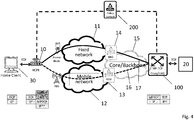
- Fig. 4 shows a solution in which the Hybrid access technology is used for transmitting an encrypted video stream from a web server 20 to a client 30.
- the home client 30 can be a mobile client/mobile entity or a fixed computing entity such as a desktop computer.
- the solution involves a hybrid customer premises equipment, HCPE, 10 on the client side, which provides at least two interfaces, e.g. two WAN (wide area network) interfaces, such as DSL and LTE communicating with a proxy, such as multi-service proxy MP-TCP Proxy or hybrid access gateway (HAG) 100 .
- HCPE hybrid customer premises equipment
- the data can be split at HAG 100 and sent via the fixed network 11 and BNG (border network gateway) 14 to the hybrid customer premises equipment HCPE 10 and via the mobile network 12 passing PGW 13 (packet gateway).
- a policy control entity 200 controls the policies required for the data transmission.
- normal TCP is used between the HCPE 10 and the client end device 30 and between HAG 100 and the Internet server 20.
- Fig. 5 an embodiment similar to the situation as shown in Fig. 4 is disclosed with the difference that the user equipment itself is multipath enabled so that a hybrid equipment 31 is provided replacing the home client 30 and the HCPE 10.
- the resolution of an encrypted video which is transmitted in the embodiment of Fig. 4 and 5 from the server 20 to the home client is detected based on the size of video segments. Furthermore the deviation of the size is determined and based on the determined deviation a path is selected for the transmission of the encrypted video stream. This can mean that a multipath leg is opened according to the determined resolution, especially according to the determined change in resolution.
- the mobile communications network is an LTE network. However it should be understood that any other cellular or mobile communications network may be used, such as 3G or 5G or any other technology.
- the opening multipath leg based on the determined resolution is disclosed, the closing of a multipath leg based on the determined resolution.
- implementation details for closing and opening a path in the multipath environment is given and an example of opening a multipath leg for a video session.
- the video resolution is analyzed according to the size of a video segment and its deviation against the mean of the average size of the video segments.
- Fig. 6 the size of 28 consecutive segments for the different resolution of the same video is listed, both for Android and IOS operating systems (OS). As a reference, for IOS OS, these 28 consecutive segments correspond to 2 min of video approximately.
- video quality can be determined by calculating each segment size and how constant the size of consecutive segments is.
- OTT Over the Top
- CBR Constant Bit Rate
- VBR Variable Bit rate
- the deviation between the different segments is not relevant to determine the video resolution (as all segments do have the same size) but the segment size will determine it, as the higher the quality the higher the segment size is.
- the deviation between the different segments provides the video quality, wherein the higher the deviation the higher is the video quality.
- the resolution of the video stream is detected analyzing the segment size of each video segment. Then, with this video segment size the resolution of the video can be deduced.
- the way to calculate the segment size for a video over HTTPS considers that:
- DPI can calculate each segment size and track how much the size of the following segments is deviated from the size of the previous segment. So, during a video download if the size of the segments decreases it means that the quality of the video has decreased and the QoE of the end user has been reduced.
- a Machine Learning algorithm (embedded in SPI software) can be used.
- Machine learning is a scientific discipline that explores the construction and study of algorithms that can learn from data. Such algorithms operate by building a model based on inputs and using that to make predictions or decisions, rather than following only explicitly programmed instructions.
- Machine learning techniques for traffic classification are based on behavioral characteristics from protocols and flows, such as TCP window size, ports, ip address, packet size distribution, time between packets, payload bit level statistics, etc.
- unsupervised learning mode machine is learning and comparing the behavior of the group towards the new devices, protocols. Then it groups those with same characteristics in the same cluster.
- unsupervised learning there is a growing accuracy when classifying packets.
- clustering becomes a fine-grained classification, improving both the number of categories, and the fitness of each packet, according to its behavior.
- the Hag 100, the policy server 200 and the HCPE 10 are involved.
- Both HAG 100 and HCPE 10 can have Multipath and DPI capabilities. From a deployment perspective, these functionalities can be included in the HAG 100 or HCPE 10 nodes or deployed in a standalone fashion.
- Both HCPE 10 and HAG 100 have connectivity to a policy server as shown in Fig. 4 or 5 .
- HCPE 10 and HAG send their capabilities towards the policy server as discussed above in connection with Fig. 3 .
- HAG 100 can report QoE measures towards policy server 200, based on a resolution parameter value obtained locally in the HAG 100. Then, the decision of opening a new path can be taken locally in the HAG 100 or externally in the policy server 200.
- policy server 200 other parameters from other nodes like Customer Premises Equipment (CPE) or Subscriber Profile Repository (SPR) can be considered.
- CPE Customer Premises Equipment
- SPR Subscriber Profile Repository
- HCPE and HAG send which capabilities are supported by them.
- DPI and multipath are supported.
- the policy server knows which capabilities are supported by both sides.
- the way how currently HAG and HCPE are establishing the legs is known in the art.
- the HCPE 10 and HAG 100 are working as TCP Multipath proxy. Users who connect to HCPE open a TCP connection. Then HCPE and HAG have multipath connection between them. HAG talks multipath towards HCPE and TCP towards the internet server.
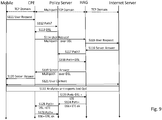
- the policy server 200 determines the first path that should be employed. In connection with Fig. 7 an example will be disclosed in which the resolution is obtained locally in the HAG 100.
- traffic is sent using both LTE and DSL paths.
- the resolution parameter values are determined externally by an analytics unit.
- the analytics unit is an external entity that receives information from different nodes regarding the communication of an end user with a flow. It can provide the QoE of end user communication. It could be included as part of the PCRF or as an external entity. In this example, it has been included as part of the policy server 200.
- traffic is sent using both LTE and DSL paths.
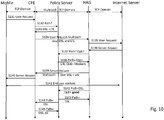
- a multipath leg is closed based on the resolution parameter.
- the policy for selecting which path should be closed is defined according to criteria such as which path has more congestion, which is the most expensive path, etc.
- Fig. 10 shows the following steps:
- Analytics unit is an external entity that receives information from different nodes regarding the communication of an end user with a flow. It can provide the QoE of end user communication. It could be included as part of the PCRF or as an external entity. In this example, it has been included as part of the policy server 200.
- policies may be used:
- policy server requests sending traffic to a new path but new path according to local measures is congested.
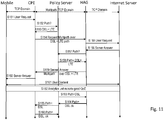
- FIG. 8 an opening of a multipath leg for a video session is discussed. In this example, it is explained how to open a new path in multipath based on the resolution parameter of a video session that uses encrypted HTTP traffic. It is an example of combining the method defined.
- HAG 100 is aware of the video quality requested by policy server.
- HAG 100 by means of DPI, tracks each of the video segments and calculate the segments size and the segments dispersion. Based on the estimation of video quality and the target video quality induced by Policy Server 200, HAG 100 will be able to report any significant deviation to Policy Server and, Policy Server will take the proper action to mitigate that deviation:
- HAG 100 will notify the policy server 200 that the video is not being reproduced with the requested quality.
- Use Case 1 User subscription to video with maximum quality (e.g. 480p)
- This Use Case allows the network operator to optimize the network resources by enforcing a maximum video quality for certain subscribers (e.g. non-premium subscribers).
- the network will be able to detect the resolution used in a subscriber's video session and in case the detected video resolution (e.g. 720p) is above the subscribed value (e.g. 480p), the network will be able to apply a certain enforcement action (e.g. throttling or bandwidth limitation) to ensure the subscriber terminal does not use a video resolution with higher quality than the subscribed one.
- a certain enforcement action e.g. throttling or bandwidth limitation
- Use Case 2 User subscription to video with a guaranteed minimum quality (e.g. 480p)
- This Use Case allows the network operator to optimize the network resources by enforcing a minimum video quality for certain subscribers (e.g. premium subscribers).
- the network will be able to detect the resolution used in a subscriber's video session and in case the detected video resolution (e.g. 240p) is below the subscribed value (e.g. 480p), the network will be able to apply a certain enforcement action to ensure the subscriber terminal uses a video resolution with higher quality than the subscribed one.
- the possible enforcement actions are:
- This Use Case allows the network operator to optimize the network resources by enforcing a maximum video quality for certain subscribers (e.g. non-premium subscribers) when there is congestion or network nodes reach CPU limits.
- the network will be able to detect the resolution used in a subscriber's video session and, in case there is network congestion or some network node/s reach their CPU limit (e.g. 85%), the non-premium subscribers will get their video traffic throttled or bandwidth limited in case the detected video resolution (e.g. 720p) is above a configured value (e.g. 480p).
- the congestion situation or CPU usage
- the throttling action will finish.
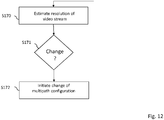
- Fig. 12 some of the steps carried out either at the hybrid access Gateway 100 or the policy server 200 are summarised.
- the gateway 100 on the policy server 200 initiates the adaptation of the multipath environment.
- the Gateway 100 or the policy server 200 play a role of a path control entity.
- This path control entity estimates the resolution of the media stream, based on the video segments, especially based on the change in size of the video segments.
- This resolution is controlled or monitored continuously and in step S 171 it is asked whether the resolution has changed, but way of example changed by more than a threshold.
- the resolution can be categorized into several resolution parameter values e.g. 3 to 4 different values. If the resolution in the image frames changes such that the resolution parameter changes to another value, the multipath configuration can be adapted. If this is the case the change of the multipath environment is initiated, either by adding a new like to the multipath configuration or by closing an existing leg of the multipath configuration.
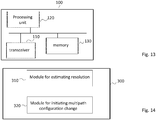
- Fig. 13 shows a schematic architectural view of an the path control entity, here the HAG 100 which can carry out the above discussed controlling of the multipath environment based on a change of the resolution in the transmitted video stream.
- the HAG 100 comprises a transceiver 110 which is provided for transmitting user data or control messages to other entities and for receiving user data and control messages from other entities such as the policy server, the HCPE or the video server.
- the HAG 100 furthermore comprises a processing unit 120 which is responsible for the operation of the HAG 100.
- the processing unit 120 comprises one or more processors and can carry out instructions stored on a memory 130, wherein the memory may include a read-only memory, a random access memory, a mass storage, a hard disk or the like.
- the memory can furthermore include suitable program code to be executed by the processing unit 120 so as to implement the above described functionalities in which the HAG is involved.
- the policy control unit is the policy server 200
- the policy server 200 can be embodied as discussed above in connection with Fig. 13 .
- the path control entity 300 comprises a module 310 configured for estimating the resolution of the encrypted media stream and configured to estimate the resolution parameter as discussed above.
- a module 320 is provided which is configured for initiating the change of the multipath configuration, meaning that either a new path is opened or an existing path is closed.
- the step of estimating the resolution can comprise the step of determining a size of the video segments used in the video stream and can comprise the step of determining a change of the size of the video segments over time.
- the resolution used in the stream is estimated taking into account the determined size and the determined change of the size.
- One example for the determination of the size and the change of the size comprises the step of determining an average size of a defined number of last video segments, e.g. the videos present in a moving window.
- a mean value of the average size of the defined number of last video segments can be determined and when a deviation of the mean value is larger than a threshold value, the adaptation of the at least one path in the multipath environment is initiated.
- this can mean that a new path is opened or an existing path is closed based on the determined change of the resolution.
- the resolution is estimated, it is possible to estimate the resolution of the video frames present in the video stream and this resolution is then translated into a possible set of resolution parameter values.
- the resolution parameter was either high, medium or low.
- the multipath environment is an adapted based on the change of the value of the resolution parameter.
- This policy server is then informed about the estimated resolution or the determined change of the resolution and the at least one path in the multipath environment is adapted based on the feedback received from the policy server.
- an opening of an additional path in the multipath environment may be initiated. Furthermore it is possible that when it is determined that that the resolution used individual stream during the transmission has decreased, a closing of an existing path in the multipath environment is initiated.
- the video segment upon which the estimation of the resolution is based can comprise the payload data transmitted over the at least one path in a first transmission direction between two consecutive requests transmitted in the opposite direction requesting to receive the video stream.
- the resolution used in the video stream during transmission remains substantially the same, it can be determined that the resolution is in a lower resolution range of a known possible resolution range. However when it is determined that the resolution of the video segments changes by more than a defined threshold, it is determined that the resolution is in a higher resolution range of the known possible resolution range.
- the encrypted media stream is a video stream based on a name indication present in a message exchanged between the video server, here the media streaming entity and the media receiving entity, here the customer premises equipment wherein the name indication allows video server to be identified.
- the resolution may be estimated based on a machine learning algorithm which is embedded in a deep packet inspection module which comprises a first clustering part in which different possible resolutions of the media stream are determined based on test data and which comprises a second classification part in which the video streams are classified in one of the possible resolutions.
- the invention described above allows a network to detect the video resolution employed in a user's video session in case of encrypted traffic and allows a network to open or close multipath legs based on the estimated resolution.
- a new interface is provided between the HAG 100 and the Policy server 200 which allows the HAG to report its capabilities and the estimated resolution parameter.
- a new interface is provided between the HCPE 10 and the Policy server 200 which allows the HCPE to report its capabilities and the estimated QoE.
- the above described method allows the detection of the quality of the video according to the deviation against the mean of the average size of the video segments and it works even when the video traffic is encrypted.
- the quality/resolution of the video is detected analyzing the segment size of each video segment.
- the method allows better usage of the Radio Bearer.
- Radio Bearers are not assigned if the QoE of a video session is good from end user point of view.
- Streaming Radio Access Bearer are assigned only when the QoE of the user is bad (lower than expected quality defined by operators) or when a user has suffered more than one change in the quality of the video.
- LTE path is opened only when the quality of the video is not fulfilling the end user requirements.
Landscapes
- Engineering & Computer Science (AREA)
- Signal Processing (AREA)
- Multimedia (AREA)
- Computer Networks & Wireless Communication (AREA)
- Computer Security & Cryptography (AREA)
- Two-Way Televisions, Distribution Of Moving Picture Or The Like (AREA)
- Data Exchanges In Wide-Area Networks (AREA)
Claims (15)
- Verfahren zur Steuerung mindestens eines Weges (16, 17) in einer Mehrwege-Umgebung durch eine Wegsteuerungsentität (100, 200), wobei der mindestens eine Weg zum Senden eines verschlüsselten Videostroms verwendet wird, der eine Folge von Videosegmenten umfasst, wobei das Verfahren umfasst:- Schätzen einer Auflösung, die im Videostrom verwendet wird, basierend auf den Videosegmenten, und- Bestimmen, dass die im Videostrom verwendete Auflösung sich während der Übertragung geändert hat, wobei, wenn bestimmt wird, dass die im Videostrom verwendete Auflösung sich geändert hat, eine Anpassung einer Anzahl des mindestens einen Weges in der Mehrwege-Konfiguration, der zum Senden des Videostroms verwendet wird, basierend auf der bestimmten Änderung der Auflösung initiiert wird.
- Verfahren nach Anspruch 1, wobei die Auflösung basierend auf einem maschinellen Lernalgorithmus geschätzt wird, der in einem Modul für tiefe Paketprüfung eingebettet ist, das einen ersten Gruppierungsteil umfasst, in welchem verschiedene mögliche Auflösungen des Videostroms basierend auf Prüfdaten bestimmt werden, und einen zweiten Klassifizierungsteil umfasst, in welchem die Videoströme in einer der möglichen Auflösungen eingestuft werden.
- Wegsteuerungsentität (100, 200), die zum Steuern mindestens eines Weges in einer Mehrwege-Umgebung konfiguriert ist, wobei der mindestens eine Weg zum Senden eines verschlüsselten Videostroms verwendet wird, der eine Folge von Videosegmenten umfasst, die Wegsteuerungsentität einen Speicher (130) und mindestens eine Verarbeitungseinheit (120) umfasst, wobei der Speicher Anweisungen enthält, die von der mindestens einen Verarbeitungseinheit ausgeführt werden können, wobei die Wegsteuerungsentität (100) ausgelegt ist zum:- Schätzen einer Auflösung, die im Videostrom verwendet wird, basierend auf den Videosegmenten,- Bestimmen, dass die im Videostrom verwendete Auflösung sich während der Übertragung geändert hat, wobei, wenn bestimmt wird, dass die im Videostrom verwendete Auflösung sich geändert hat, eine Anpassung einer Anzahl des mindestens einen Weges in der Mehrwege-Konfiguration, der zum Senden des Videostroms verwendet wird, basierend auf der bestimmten Änderung der Auflösung initiiert wird.
- Wegsteuerungsentität nach Anspruch 3, die ferner die ausgelegt ist zum:- Bestimmen einer Größe der Videosegmente im Videostrom,- Bestimmen einer Änderung der Größe der Videosegmente im Zeitablauf, wobei die im Videostrom verwendete Auflösung unter Berücksichtigung der bestimmten Größe und der bestimmten Änderung der Größe geschätzt wird.
- Wegsteuerungsentität nach Anspruch 3 oder 4, wobei die Wegsteuerungsentität zum Initiieren einer Anpassung des mindestens einen Weges ausgelegt ist, um in der Mehrwege-Umgebung basierend auf der bestimmten Änderung der Auflösung einen neuen Weg zu öffnen oder einen bestehenden Weg zu schließen.
- Wegsteuerungsentität nach Anspruch 3 oder 4, wobei die Wegsteuerungsentität zum Initiieren einer Anpassung des mindestens einen Weges ausgelegt ist, um eine Richtliniensteuerung, die zum Steuern einer Übertragungsrichtlinie der Videoströme in der Mehrwege-Umgebung konfiguriert ist, über die geschätzte Auflösung zu informieren und den mindestens einen Pfad in der Mehrwege-Umgebung basierend auf einer Rückmeldung anzupassen, die von der Richtliniensteuerung empfangen wird.
- Wegsteuerungsentität nach einem der Ansprüche 3 bis 6, wobei die Wegsteuerungsentität so ausgelegt ist, dass sie ein Öffnen eines zusätzlichen Weges in der Mehrwege-Umgebung initiiert, der zum Senden des Videostroms verwendet wird, wenn sie bestimmt hat, dass die im Videostrom verwendete Auflösung während der Übertragung im Zeitablauf abgenommen hat.
- Wegsteuerungsentität nach einem der Ansprüche 3 bis 7, wobei die Wegsteuerungsentität so ausgelegt ist, dass sie ein Schließen eines bestehenden Weges in der Mehrwege-Umgebung initiiert, der zum Senden des Videostroms verwendet wird, wenn sie bestimmt hat, dass die im Videostrom verwendete Auflösung während der Übertragung abgenommen hat.
- Wegsteuerungsentität nach einem der Ansprüche 3 bis 8, wobei die Wegsteuerungsentität zum Bestimmen der Größe und der Änderung der Größe ausgelegt ist, um eine mittlere Größe einer definierten Anzahl von letzten Videosegmenten im Videostrom zu bestimmen und einen Mittelwert der mittleren Größe der definierten Anzahl von letzten Videosegmenten zu bestimmen, wobei die Wegsteuerungsentität die Anpassung des mindestens einen Weges initiiert, wenn eine Abweichung des Mittelwerts größer als ein Schwellenwert ist.
- Wegsteuerungsentität nach einem der Ansprüche 3 bis 9, wobei die Wegsteuerungsentität so ausgelegt ist, dass sie, wenn die im Videostrom verwendete Auflösung während der Übertragung im Wesentlichen gleich bleibt, bestimmt, dass die Auflösung in einem niedrigeren Auflösungsbereich eines bekannten möglichen Auflösungsbereichs ist, wobei die Wegsteuerungsentität so ausgelegt ist, dass sie, wenn die Auflösung des Videosegments sich um mehr als eine vordefinierte Schwelle ändert, bestimmt, dass die Auflösung in einem höheren Auflösungsbereich des bekannten möglichen Auflösungsbereichs ist.
- Wegsteuerungsentität nach einem der Ansprüche 3 bis 10, wobei die Wegsteuerungsentität ein Hybrid-Zugangs-Gateway ist, das sich in einem Hybrid-Zugangs-Breitbandnetzwerk befindet.
- Wegsteuerungsentität nach Anspruch 11, wobei das Hybrid-Zugangs-Gateway eine Schnittstelle zur Richtliniensteuerung umfasst, durch welche die geschätzte Auflösung an die Richtliniensteuerung gesendet wird.
- Wegsteuerungsentität nach einem der Ansprüche 3 bis 10, wobei die Wegsteuerungsentität eine Richtliniensteuerung ist, die sich in einem Hybrid-Zugangs-Breitbandnetzwerk befindet.
- Wegsteuerungsentität nach Anspruch 13, wobei die Richtliniensteuerung eine Schnittstelle zu einer Hybrid-Teilnehmereinrichtung umfasst, über welche die geschätzte Auflösung zu empfangen die Richtliniensteuerung der konfiguriert ist.
- Wegsteuerungsentität nach einem der Ansprüche 3 bis 14, wobei die Wegsteuerungsentität so ausgelegt ist, dass sie bestimmt, dass die Auflösung sich geändert hat, um einen Auflösungsparameter mit einem vordefinierten Satz von Parameterwerten zu bestimmen und einen der Parameterwerte der geschätzten Auflösung zuzuordnen, wobei nur dann, wenn bestimmt wird, die geschätzte Auflösung sich derart geändert hat, dass der Parameterwert des Auflösungsparameter sich ändert, bestimmt wird, dass die im Videostrom verwendete Auflösung sich geändert hat und dass die Anpassung des mindestens einen Weges initiiert wird.
Applications Claiming Priority (2)
| Application Number | Priority Date | Filing Date | Title |
|---|---|---|---|
| EP17382761 | 2017-11-10 | ||
| PCT/EP2017/081660 WO2019091591A1 (en) | 2017-11-10 | 2017-12-06 | Multipath policy decisions for encrypted video streams |
Publications (2)
| Publication Number | Publication Date |
|---|---|
| EP3707863A1 EP3707863A1 (de) | 2020-09-16 |
| EP3707863B1 true EP3707863B1 (de) | 2021-06-23 |
Family
ID=60331543
Family Applications (1)
| Application Number | Title | Priority Date | Filing Date |
|---|---|---|---|
| EP17825399.3A Active EP3707863B1 (de) | 2017-11-10 | 2017-12-06 | Mehrweg-richtlinienentscheidungen für verschlüsselte videoströme |
Country Status (3)
| Country | Link |
|---|---|
| US (1) | US11533546B2 (de) |
| EP (1) | EP3707863B1 (de) |
| WO (1) | WO2019091591A1 (de) |
Families Citing this family (15)
| Publication number | Priority date | Publication date | Assignee | Title |
|---|---|---|---|---|
| JP7103637B2 (ja) * | 2018-07-10 | 2022-07-20 | 日本電気株式会社 | 通信システム及び通信方法 |
| US11304075B2 (en) * | 2019-01-28 | 2022-04-12 | Nokia Solutions And Networks Oy | Network path reliability |
| US11075844B2 (en) | 2019-08-15 | 2021-07-27 | Netsia, Inc. | Apparatus and method for providing hybrid access coordination |
| CN110708512A (zh) * | 2019-10-17 | 2020-01-17 | 烟台艾易新能源有限公司 | 一种智能家居无线网络图像加密传输优化方法 |
| US11350150B2 (en) | 2019-12-26 | 2022-05-31 | Hughes Network Systems, Llc | Method for estimation of quality of experience (QoE) metrics for video streaming using passive measurements |
| TWI793399B (zh) * | 2020-02-14 | 2023-02-21 | 緯創資通股份有限公司 | 使用者裝置及資料流量傳遞之排程方法 |
| EP4201074B1 (de) | 2020-08-18 | 2025-04-09 | Telefonaktiebolaget LM Ericsson (publ) | Schätzung der videoauflösung, die von einem verschlüsselten videostrom geliefert wird |
| GB202017135D0 (en) * | 2020-10-29 | 2020-12-16 | British Telecomm | Apportioning of data traffic between communication channels |
| US11770318B2 (en) | 2021-03-15 | 2023-09-26 | T-Mobile Usa, Inc. | Systems and methods for estimating throughput |
| US11743198B1 (en) * | 2021-06-09 | 2023-08-29 | T-Mobile Usa, Inc. | Systems and methods for traffic classification |
| US20230067019A1 (en) * | 2021-09-01 | 2023-03-02 | At&T Intellectual Property I, L.P. | Methods, systems, and devices for streaming video content under data budget constraints using available adaptive bit-rate (abr) track information |
| EP4156636A1 (de) * | 2021-09-24 | 2023-03-29 | Tessares SA | Öffentlicher mehrweg-netzwerkzugang |
| CN114423043B (zh) * | 2021-12-31 | 2025-02-21 | 上海旷通科技有限公司 | 一种用于移动终端分配链路的方法及设备 |
| US12248689B2 (en) * | 2022-02-23 | 2025-03-11 | Samsung Electronics Co., Ltd. | Video stream encoding for computational storage device |
| WO2023162128A1 (ja) * | 2022-02-25 | 2023-08-31 | 日本電信電話株式会社 | データを収集するシステム、方法及びプログラム |
Family Cites Families (11)
| Publication number | Priority date | Publication date | Assignee | Title |
|---|---|---|---|---|
| US8743954B1 (en) * | 2008-02-01 | 2014-06-03 | Zenverge, Inc. | Architecture for adjusting bit rate based on measured quality |
| US9392295B2 (en) * | 2011-07-20 | 2016-07-12 | Broadcom Corporation | Adaptable media processing architectures |
| US9736056B2 (en) * | 2014-05-02 | 2017-08-15 | Cisco Technology, Inc. | Centralized predictive routing using delay predictability measurements |
| US9634919B2 (en) * | 2014-06-27 | 2017-04-25 | Cisco Technology, Inc. | Multipath data stream optimization |
| KR102352679B1 (ko) * | 2015-03-25 | 2022-01-18 | 삼성전자주식회사 | 다중 경로 전송 제어 프로토콜을 지원하는 디바이스 및 디바이스에서 영상 데이터를 스트리밍으로 수신하는 방법 |
| CN105490933B (zh) | 2015-12-28 | 2019-06-11 | 中国电子科技集团公司第五十四研究所 | 基于多路径传输协议mptcp的路径管理方法及装置 |
| US9800915B2 (en) * | 2016-02-10 | 2017-10-24 | At&T Intellectual Property I, L.P. | Method and apparatus for satellite television service with alternate delivery capabilities |
| US20170346724A1 (en) * | 2016-05-25 | 2017-11-30 | Doru Calin | Dynamic multi-path control and adaptive end-to-end content delivery over wireless media |
| US10425458B2 (en) * | 2016-10-14 | 2019-09-24 | Cisco Technology, Inc. | Adaptive bit rate streaming with multi-interface reception |
| US10348796B2 (en) * | 2016-12-09 | 2019-07-09 | At&T Intellectual Property I, L.P. | Adaptive video streaming over preference-aware multipath |
| US10382517B2 (en) * | 2017-06-09 | 2019-08-13 | At&T Intellectual Property I, L.P. | Estimating network data encoding rate |
-
2017
- 2017-12-06 EP EP17825399.3A patent/EP3707863B1/de active Active
- 2017-12-06 WO PCT/EP2017/081660 patent/WO2019091591A1/en not_active Ceased
- 2017-12-06 US US16/762,864 patent/US11533546B2/en active Active
Non-Patent Citations (1)
| Title |
|---|
| None * |
Also Published As
| Publication number | Publication date |
|---|---|
| WO2019091591A1 (en) | 2019-05-16 |
| EP3707863A1 (de) | 2020-09-16 |
| US20200288212A1 (en) | 2020-09-10 |
| US11533546B2 (en) | 2022-12-20 |
Similar Documents
| Publication | Publication Date | Title |
|---|---|---|
| US11533546B2 (en) | Multipath policy decisions for encrypted video streams | |
| Mazhar et al. | Real-time video quality of experience monitoring for https and quic | |
| US10251178B2 (en) | QoE provisioning method and apparatus for mobile video application | |
| US10567988B2 (en) | Radio access type detection using traffic metrics | |
| Gómez et al. | Towards a QoE‐driven resource control in LTE and LTE‐A networks | |
| US9172643B2 (en) | Method and system for cooperative congestion detection in cellular networks | |
| KR101107945B1 (ko) | 패킷 손실 감소 방법 | |
| US12256263B2 (en) | Machine learning based adaptation of QoE control policy | |
| US10122651B2 (en) | Dynamic bandwidth control | |
| US20190089623A1 (en) | Hcpe-based intelligent path selection over a multipath network | |
| US20230231939A1 (en) | Methods and systems for detection and classification of multimedia content in secured transactions using pattern matching | |
| KR20120109619A (ko) | 애플리케이션에 대해 액세스 네트워크 어웨어 프레즌스를 제공하는 방법 및 장치 | |
| EP3744056A1 (de) | Systeme und verfahren zur identifizierung von kandidatenflüssen in datenpaketnetzen | |
| US20200244547A1 (en) | System and Method for Optimization of an Over-The-Top (OTT) Platform | |
| Zhang et al. | MoWIE: toward systematic, adaptive network information exposure as an enabling technique for cloud-based applications over 5G and beyond | |
| Ali et al. | Congestion or no congestion: Packet loss identification and prediction using machine learning | |
| Kilinc et al. | A congestion avoidance mechanism for WebRTC interactive video sessions in LTE networks | |
| Sidhu et al. | From 5G RAN Queue Dynamics to Playback: A Performance Analysis for QUIC Video Streaming | |
| Atxutegi et al. | TCP performance over current cellular access: A comprehensive analysis | |
| Balasubramanian et al. | Detecting shared congested router for mobile communication using multiple-interface devices | |
| Kim et al. | Network Access Control for Location‐Based Mobile Services in Heterogeneous Wireless Networks | |
| Fejes et al. | Application agnostic QoE triggered multipath switching for Android devices | |
| US20230403222A1 (en) | Apportioning of data traffic between communication channels | |
| Gilski et al. | Quality expectations of mobile subscribers | |
| Peschke et al. | Combining DASH with MPTCP for video streaming |
Legal Events
| Date | Code | Title | Description |
|---|---|---|---|
| STAA | Information on the status of an ep patent application or granted ep patent |
Free format text: STATUS: UNKNOWN |
|
| STAA | Information on the status of an ep patent application or granted ep patent |
Free format text: STATUS: THE INTERNATIONAL PUBLICATION HAS BEEN MADE |
|
| PUAI | Public reference made under article 153(3) epc to a published international application that has entered the european phase |
Free format text: ORIGINAL CODE: 0009012 |
|
| STAA | Information on the status of an ep patent application or granted ep patent |
Free format text: STATUS: REQUEST FOR EXAMINATION WAS MADE |
|
| GRAP | Despatch of communication of intention to grant a patent |
Free format text: ORIGINAL CODE: EPIDOSNIGR1 |
|
| STAA | Information on the status of an ep patent application or granted ep patent |
Free format text: STATUS: GRANT OF PATENT IS INTENDED |
|
| 17P | Request for examination filed |
Effective date: 20200604 |
|
| AK | Designated contracting states |
Kind code of ref document: A1 Designated state(s): AL AT BE BG CH CY CZ DE DK EE ES FI FR GB GR HR HU IE IS IT LI LT LU LV MC MK MT NL NO PL PT RO RS SE SI SK SM TR |
|
| AX | Request for extension of the european patent |
Extension state: BA ME |
|
| DAV | Request for validation of the european patent (deleted) | ||
| DAX | Request for extension of the european patent (deleted) | ||
| INTG | Intention to grant announced |
Effective date: 20200915 |
|
| GRAJ | Information related to disapproval of communication of intention to grant by the applicant or resumption of examination proceedings by the epo deleted |
Free format text: ORIGINAL CODE: EPIDOSDIGR1 |
|
| STAA | Information on the status of an ep patent application or granted ep patent |
Free format text: STATUS: REQUEST FOR EXAMINATION WAS MADE |
|
| GRAS | Grant fee paid |
Free format text: ORIGINAL CODE: EPIDOSNIGR3 |
|
| STAA | Information on the status of an ep patent application or granted ep patent |
Free format text: STATUS: GRANT OF PATENT IS INTENDED |
|
| GRAS | Grant fee paid |
Free format text: ORIGINAL CODE: EPIDOSNIGR3 |
|
| GRAP | Despatch of communication of intention to grant a patent |
Free format text: ORIGINAL CODE: EPIDOSNIGR1 |
|
| GRAJ | Information related to disapproval of communication of intention to grant by the applicant or resumption of examination proceedings by the epo deleted |
Free format text: ORIGINAL CODE: EPIDOSDIGR1 |
|
| GRAL | Information related to payment of fee for publishing/printing deleted |
Free format text: ORIGINAL CODE: EPIDOSDIGR3 |
|
| STAA | Information on the status of an ep patent application or granted ep patent |
Free format text: STATUS: REQUEST FOR EXAMINATION WAS MADE |
|
| INTC | Intention to grant announced (deleted) | ||
| GRAS | Grant fee paid |
Free format text: ORIGINAL CODE: EPIDOSNIGR3 |
|
| STAA | Information on the status of an ep patent application or granted ep patent |
Free format text: STATUS: GRANT OF PATENT IS INTENDED |
|
| GRAP | Despatch of communication of intention to grant a patent |
Free format text: ORIGINAL CODE: EPIDOSNIGR1 |
|
| INTG | Intention to grant announced |
Effective date: 20210125 |
|
| INTC | Intention to grant announced (deleted) | ||
| INTG | Intention to grant announced |
Effective date: 20210215 |
|
| GRAF | Information related to payment of grant fee modified |
Free format text: ORIGINAL CODE: EPIDOSCIGR3 |
|
| GRAA | (expected) grant |
Free format text: ORIGINAL CODE: 0009210 |
|
| STAA | Information on the status of an ep patent application or granted ep patent |
Free format text: STATUS: THE PATENT HAS BEEN GRANTED |
|
| AK | Designated contracting states |
Kind code of ref document: B1 Designated state(s): AL AT BE BG CH CY CZ DE DK EE ES FI FR GB GR HR HU IE IS IT LI LT LU LV MC MK MT NL NO PL PT RO RS SE SI SK SM TR |
|
| REG | Reference to a national code |
Ref country code: GB Ref legal event code: FG4D |
|
| REG | Reference to a national code |
Ref country code: CH Ref legal event code: EP |
|
| REG | Reference to a national code |
Ref country code: DE Ref legal event code: R096 Ref document number: 602017040940 Country of ref document: DE Ref country code: AT Ref legal event code: REF Ref document number: 1405271 Country of ref document: AT Kind code of ref document: T Effective date: 20210715 |
|
| REG | Reference to a national code |
Ref country code: IE Ref legal event code: FG4D |
|
| REG | Reference to a national code |
Ref country code: NL Ref legal event code: FP |
|
| REG | Reference to a national code |
Ref country code: LT Ref legal event code: MG9D |
|
| PG25 | Lapsed in a contracting state [announced via postgrant information from national office to epo] |
Ref country code: BG Free format text: LAPSE BECAUSE OF FAILURE TO SUBMIT A TRANSLATION OF THE DESCRIPTION OR TO PAY THE FEE WITHIN THE PRESCRIBED TIME-LIMIT Effective date: 20210923 Ref country code: HR Free format text: LAPSE BECAUSE OF FAILURE TO SUBMIT A TRANSLATION OF THE DESCRIPTION OR TO PAY THE FEE WITHIN THE PRESCRIBED TIME-LIMIT Effective date: 20210623 Ref country code: FI Free format text: LAPSE BECAUSE OF FAILURE TO SUBMIT A TRANSLATION OF THE DESCRIPTION OR TO PAY THE FEE WITHIN THE PRESCRIBED TIME-LIMIT Effective date: 20210623 Ref country code: LT Free format text: LAPSE BECAUSE OF FAILURE TO SUBMIT A TRANSLATION OF THE DESCRIPTION OR TO PAY THE FEE WITHIN THE PRESCRIBED TIME-LIMIT Effective date: 20210623 |
|
| REG | Reference to a national code |
Ref country code: AT Ref legal event code: MK05 Ref document number: 1405271 Country of ref document: AT Kind code of ref document: T Effective date: 20210623 |
|
| REG | Reference to a national code |
Ref country code: DE Ref legal event code: R079 Ref document number: 602017040940 Country of ref document: DE Free format text: PREVIOUS MAIN CLASS: H04L0012707000 Ipc: H04L0045240000 |
|
| PG25 | Lapsed in a contracting state [announced via postgrant information from national office to epo] |
Ref country code: GR Free format text: LAPSE BECAUSE OF FAILURE TO SUBMIT A TRANSLATION OF THE DESCRIPTION OR TO PAY THE FEE WITHIN THE PRESCRIBED TIME-LIMIT Effective date: 20210924 Ref country code: LV Free format text: LAPSE BECAUSE OF FAILURE TO SUBMIT A TRANSLATION OF THE DESCRIPTION OR TO PAY THE FEE WITHIN THE PRESCRIBED TIME-LIMIT Effective date: 20210623 Ref country code: NO Free format text: LAPSE BECAUSE OF FAILURE TO SUBMIT A TRANSLATION OF THE DESCRIPTION OR TO PAY THE FEE WITHIN THE PRESCRIBED TIME-LIMIT Effective date: 20210923 Ref country code: SE Free format text: LAPSE BECAUSE OF FAILURE TO SUBMIT A TRANSLATION OF THE DESCRIPTION OR TO PAY THE FEE WITHIN THE PRESCRIBED TIME-LIMIT Effective date: 20210623 Ref country code: RS Free format text: LAPSE BECAUSE OF FAILURE TO SUBMIT A TRANSLATION OF THE DESCRIPTION OR TO PAY THE FEE WITHIN THE PRESCRIBED TIME-LIMIT Effective date: 20210623 |
|
| PG25 | Lapsed in a contracting state [announced via postgrant information from national office to epo] |
Ref country code: SK Free format text: LAPSE BECAUSE OF FAILURE TO SUBMIT A TRANSLATION OF THE DESCRIPTION OR TO PAY THE FEE WITHIN THE PRESCRIBED TIME-LIMIT Effective date: 20210623 Ref country code: SM Free format text: LAPSE BECAUSE OF FAILURE TO SUBMIT A TRANSLATION OF THE DESCRIPTION OR TO PAY THE FEE WITHIN THE PRESCRIBED TIME-LIMIT Effective date: 20210623 Ref country code: ES Free format text: LAPSE BECAUSE OF FAILURE TO SUBMIT A TRANSLATION OF THE DESCRIPTION OR TO PAY THE FEE WITHIN THE PRESCRIBED TIME-LIMIT Effective date: 20210623 Ref country code: EE Free format text: LAPSE BECAUSE OF FAILURE TO SUBMIT A TRANSLATION OF THE DESCRIPTION OR TO PAY THE FEE WITHIN THE PRESCRIBED TIME-LIMIT Effective date: 20210623 Ref country code: CZ Free format text: LAPSE BECAUSE OF FAILURE TO SUBMIT A TRANSLATION OF THE DESCRIPTION OR TO PAY THE FEE WITHIN THE PRESCRIBED TIME-LIMIT Effective date: 20210623 Ref country code: AT Free format text: LAPSE BECAUSE OF FAILURE TO SUBMIT A TRANSLATION OF THE DESCRIPTION OR TO PAY THE FEE WITHIN THE PRESCRIBED TIME-LIMIT Effective date: 20210623 Ref country code: PT Free format text: LAPSE BECAUSE OF FAILURE TO SUBMIT A TRANSLATION OF THE DESCRIPTION OR TO PAY THE FEE WITHIN THE PRESCRIBED TIME-LIMIT Effective date: 20211025 Ref country code: RO Free format text: LAPSE BECAUSE OF FAILURE TO SUBMIT A TRANSLATION OF THE DESCRIPTION OR TO PAY THE FEE WITHIN THE PRESCRIBED TIME-LIMIT Effective date: 20210623 |
|
| PG25 | Lapsed in a contracting state [announced via postgrant information from national office to epo] |
Ref country code: PL Free format text: LAPSE BECAUSE OF FAILURE TO SUBMIT A TRANSLATION OF THE DESCRIPTION OR TO PAY THE FEE WITHIN THE PRESCRIBED TIME-LIMIT Effective date: 20210623 |
|
| REG | Reference to a national code |
Ref country code: DE Ref legal event code: R097 Ref document number: 602017040940 Country of ref document: DE |
|
| PG25 | Lapsed in a contracting state [announced via postgrant information from national office to epo] |
Ref country code: DK Free format text: LAPSE BECAUSE OF FAILURE TO SUBMIT A TRANSLATION OF THE DESCRIPTION OR TO PAY THE FEE WITHIN THE PRESCRIBED TIME-LIMIT Effective date: 20210623 |
|
| PLBE | No opposition filed within time limit |
Free format text: ORIGINAL CODE: 0009261 |
|
| STAA | Information on the status of an ep patent application or granted ep patent |
Free format text: STATUS: NO OPPOSITION FILED WITHIN TIME LIMIT |
|
| 26N | No opposition filed |
Effective date: 20220324 |
|
| PG25 | Lapsed in a contracting state [announced via postgrant information from national office to epo] |
Ref country code: AL Free format text: LAPSE BECAUSE OF FAILURE TO SUBMIT A TRANSLATION OF THE DESCRIPTION OR TO PAY THE FEE WITHIN THE PRESCRIBED TIME-LIMIT Effective date: 20210623 |
|
| PG25 | Lapsed in a contracting state [announced via postgrant information from national office to epo] |
Ref country code: MC Free format text: LAPSE BECAUSE OF FAILURE TO SUBMIT A TRANSLATION OF THE DESCRIPTION OR TO PAY THE FEE WITHIN THE PRESCRIBED TIME-LIMIT Effective date: 20210623 Ref country code: IT Free format text: LAPSE BECAUSE OF FAILURE TO SUBMIT A TRANSLATION OF THE DESCRIPTION OR TO PAY THE FEE WITHIN THE PRESCRIBED TIME-LIMIT Effective date: 20210623 |
|
| REG | Reference to a national code |
Ref country code: CH Ref legal event code: PL |
|
| REG | Reference to a national code |
Ref country code: BE Ref legal event code: MM Effective date: 20211231 |
|
| PG25 | Lapsed in a contracting state [announced via postgrant information from national office to epo] |
Ref country code: LU Free format text: LAPSE BECAUSE OF NON-PAYMENT OF DUE FEES Effective date: 20211206 Ref country code: IE Free format text: LAPSE BECAUSE OF NON-PAYMENT OF DUE FEES Effective date: 20211206 |
|
| PG25 | Lapsed in a contracting state [announced via postgrant information from national office to epo] |
Ref country code: FR Free format text: LAPSE BECAUSE OF NON-PAYMENT OF DUE FEES Effective date: 20211231 Ref country code: BE Free format text: LAPSE BECAUSE OF NON-PAYMENT OF DUE FEES Effective date: 20211231 |
|
| PG25 | Lapsed in a contracting state [announced via postgrant information from national office to epo] |
Ref country code: LI Free format text: LAPSE BECAUSE OF NON-PAYMENT OF DUE FEES Effective date: 20211231 Ref country code: CH Free format text: LAPSE BECAUSE OF NON-PAYMENT OF DUE FEES Effective date: 20211231 |
|
| PG25 | Lapsed in a contracting state [announced via postgrant information from national office to epo] |
Ref country code: CY Free format text: LAPSE BECAUSE OF FAILURE TO SUBMIT A TRANSLATION OF THE DESCRIPTION OR TO PAY THE FEE WITHIN THE PRESCRIBED TIME-LIMIT Effective date: 20210623 |
|
| PG25 | Lapsed in a contracting state [announced via postgrant information from national office to epo] |
Ref country code: HU Free format text: LAPSE BECAUSE OF FAILURE TO SUBMIT A TRANSLATION OF THE DESCRIPTION OR TO PAY THE FEE WITHIN THE PRESCRIBED TIME-LIMIT; INVALID AB INITIO Effective date: 20171206 |
|
| PG25 | Lapsed in a contracting state [announced via postgrant information from national office to epo] |
Ref country code: MK Free format text: LAPSE BECAUSE OF FAILURE TO SUBMIT A TRANSLATION OF THE DESCRIPTION OR TO PAY THE FEE WITHIN THE PRESCRIBED TIME-LIMIT Effective date: 20210623 |
|
| PG25 | Lapsed in a contracting state [announced via postgrant information from national office to epo] |
Ref country code: MT Free format text: LAPSE BECAUSE OF FAILURE TO SUBMIT A TRANSLATION OF THE DESCRIPTION OR TO PAY THE FEE WITHIN THE PRESCRIBED TIME-LIMIT Effective date: 20210623 |
|
| PG25 | Lapsed in a contracting state [announced via postgrant information from national office to epo] |
Ref country code: TR Free format text: LAPSE BECAUSE OF FAILURE TO SUBMIT A TRANSLATION OF THE DESCRIPTION OR TO PAY THE FEE WITHIN THE PRESCRIBED TIME-LIMIT Effective date: 20210623 |
|
| PGFP | Annual fee paid to national office [announced via postgrant information from national office to epo] |
Ref country code: GB Payment date: 20251229 Year of fee payment: 9 |
|
| PGFP | Annual fee paid to national office [announced via postgrant information from national office to epo] |
Ref country code: NL Payment date: 20251226 Year of fee payment: 9 |
|
| PGFP | Annual fee paid to national office [announced via postgrant information from national office to epo] |
Ref country code: DE Payment date: 20251229 Year of fee payment: 9 |