EP3707228B1 - Aldehyd-duftstoff - Google Patents
Aldehyd-duftstoff Download PDFInfo
- Publication number
- EP3707228B1 EP3707228B1 EP19712592.5A EP19712592A EP3707228B1 EP 3707228 B1 EP3707228 B1 EP 3707228B1 EP 19712592 A EP19712592 A EP 19712592A EP 3707228 B1 EP3707228 B1 EP 3707228B1
- Authority
- EP
- European Patent Office
- Prior art keywords
- compound
- product
- butyl
- composition
- formula
- Prior art date
- Legal status (The legal status is an assumption and is not a legal conclusion. Google has not performed a legal analysis and makes no representation as to the accuracy of the status listed.)
- Active
Links
Classifications
-
- C—CHEMISTRY; METALLURGY
- C07—ORGANIC CHEMISTRY
- C07C—ACYCLIC OR CARBOCYCLIC COMPOUNDS
- C07C47/00—Compounds having —CHO groups
- C07C47/20—Unsaturated compounds having —CHO groups bound to acyclic carbon atoms
- C07C47/225—Unsaturated compounds having —CHO groups bound to acyclic carbon atoms containing rings other than six-membered aromatic rings
-
- C—CHEMISTRY; METALLURGY
- C11—ANIMAL OR VEGETABLE OILS, FATS, FATTY SUBSTANCES OR WAXES; FATTY ACIDS THEREFROM; DETERGENTS; CANDLES
- C11B—PRODUCING, e.g. BY PRESSING RAW MATERIALS OR BY EXTRACTION FROM WASTE MATERIALS, REFINING OR PRESERVING FATS, FATTY SUBSTANCES, e.g. LANOLIN, FATTY OILS OR WAXES; ESSENTIAL OILS; PERFUMES
- C11B9/00—Essential oils; Perfumes
- C11B9/0026—Essential oils; Perfumes compounds containing an alicyclic ring not condensed with another ring
- C11B9/0034—Essential oils; Perfumes compounds containing an alicyclic ring not condensed with another ring the ring containing six carbon atoms
-
- C—CHEMISTRY; METALLURGY
- C07—ORGANIC CHEMISTRY
- C07C—ACYCLIC OR CARBOCYCLIC COMPOUNDS
- C07C2601/00—Systems containing only non-condensed rings
- C07C2601/06—Systems containing only non-condensed rings with a five-membered ring
- C07C2601/10—Systems containing only non-condensed rings with a five-membered ring the ring being unsaturated
Definitions
- the present invention relates to the field of perfumery. More particularly, it concerns the compound of formula (I) as defined herein below, and its uses as perfuming ingredient. Therefore, following what is mentioned herein, the present invention comprises the invention compound as part of a perfuming composition or of a perfumed consumer product.
- the present invention provides a novel perfumery ingredient of formula (I), which has never been previously reported, which could be used to bring one facet of the muguet note, imparting a very interesting organoleptic note combining aldehydic, creamy and coriander characteristics.
- the invention relates to compound of formula (I) imparting an aldehydic note characteristic of one aspect of the complex lily of the valley odor while possessing a creamy and coriander note.
- a first object of the present invention is the use of a compound of formula (I), in the form of any one of its stereoisomers or as a mixture thereof, and wherein R represents a n -butyl or a (3-methylbutan-2-yl) group.
- a second object of the present invention is a method to confer, enhance, improve or modify the odor properties of a perfuming composition or of a perfumed article, which method comprises adding to said composition or article an effective amount of at least a compound of formula (I) as defined above.
- a third object of the present invention is a compound of formula (I) as defined above.
- Another object of the present invention is a perfuming composition
- a perfuming composition comprising
- a last object of the present invention is a perfumed consumer product comprising at least one compound of formula (I) or a composition as defined above.
- a first object of the present invention is a compound of formula in the form of any one of its stereoisomers or as a mixture thereof, and wherein R represents a n-butyl or a (3-methylbutan-2-yl) group.
- Said compound can be used as perfuming ingredient, for instance to impart odor notes of the aldehydic, coriander and creamy type with lily and the valley aspect.
- any one of its stereoisomers or the similar, it is meant the normal meaning understood by a person skilled in the art, i.e. that the invention's compound can be a pure enantiomer (if chiral), a mixture of enantiomers (mixture of stereoisomers), a pure diastereomer, a mixture of diastereoisomers; or a mixture thereof.
- said compound (I) is a C 13 -C 14 compound.
- R represents a n-butyl or a (3-methylbutan-2-yl) group.
- R represents a n -butyl group.
- 3-(4- n -butyl-1-cyclohexen-1-yl)propanal which is characterized by having an aldehydic note characteristic of the lily of the valley odor note along with creamy note and coriander note, in particular coriander leaf notes, and also comprising a mandarin facet and freshness aspect.
- Said compound possesses also a fatty and watery character strongly reminiscent of the very well-known ingredient, Lilial ® (2-methyl-3-[4-(2-methyl-2-propanyl)phenyl]propanal, trademark from Givaudan-Roure SA, Vernier, Congress).
- the overall organoleptic effect provided by this compound is very powerful with a bloom effect (diffusion).
- the invention's compound is surprisingly very powerful. All of the comparative compounds cited above, being structurally close to the invention compound, impart a less interesting odor note with metallic and / or fatty notes and lacking radiance. Only the invention's compound is devoid of metallic and fatty notes.
- the compounds of formula (I) may be selected from the group consisting of 3-(4- n -butyl-1-cyclohexen-1-yl)propanal, and 3-[4-(1,2-dimethylpropyl)-1-cyclohexen-1-yl]propanal.
- the compounds of formula (I) may be 3-(4- n -butyl-1-cyclohexen-1-yl)propanal.
- 3-(4- n -butylcyclohexyl) propanal reported in US 20110117046 , does not possess the typical floral note odor of the invention's compound but imparts undesired fatty and metallic odor notes.
- the odor of the invention's compounds is much fresher than the prior art compounds.
- the invention's compound possesses a blooming effect and diffusion/radiance which are not present in the prior art compounds.
- the invention concerns the use of a compound of formula (I) as a perfuming ingredient.
- it concerns a method or a process to confer, enhance, improve or modify the odor properties of a perfuming composition or of a perfumed article or of a surface, which method comprises adding to said composition or article an effective amount of at least a compound of formula (I), e.g. to impart its typical note.
- the final hedonic effect may depend on the precise dosage and on the organoleptic properties of the invention's compound, but anyway the addition of the invention's compound will impart to the final product its typical touch in the form of a note, touch or aspect depending on the dosage.
- compositions which in fact can be advantageously employed as perfuming ingredients, are also an object of the present invention.
- Another object of the present invention is a perfuming composition
- a perfuming composition comprising:
- perfumery carrier it is meant here a material which is practically neutral from a perfumery point of view, i.e. that does not significantly alter the organoleptic properties of perfuming ingredients.
- Said carrier may be a liquid or a solid.
- liquid carrier one may cite, as non-limiting examples, an emulsifying system, i.e. a solvent and a surfactant system, or a solvent commonly used in perfumery.
- an emulsifying system i.e. a solvent and a surfactant system
- a solvent commonly used in perfumery i.e. a solvent and a surfactant system
- solvents such as butylene or propylene glycol, glycerol, dipropyleneglycol and its monoether, 1,2,3-propanetriyl triacetate, dimethyl glutarate, dimethyl adipate 1,3-diacetyloxypropan-2-yl acetate, diethyl phthalate, isopropyl myristate, benzyl benzoate, benzyl alcohol, 2-(2-ethoxyethoxy)-1-ethano, tri-ethyl citrate or mixtures thereof, which are the most commonly used.
- solvents such as butylene or propylene glycol, glycerol, dipropyleneglycol and its monoether, 1,2,3-propanetriyl triacetate, dimethyl glutarate, dimethyl adipate 1,3-diacetyloxypropan-2-yl acetate, diethyl phthalate, isopropyl myristate, benzyl benzoate, benz
- compositions which comprise both a perfumery carrier and a perfumery base can be also ethanol, water/ethanol mixtures, limonene or other terpenes, isoparaffins such as those known under the trademark Isopar ® (origin: Exxon Chemical) or glycol ethers and glycol ether esters such as those known under the trademark Dowanol ® (origin: Dow Chemical Company), or hydrogenated castors oils such as those known under the trademark Cremophor ® RH 40 (origin: BASF).
- isoparaffins such as those known under the trademark Isopar ® (origin: Exxon Chemical) or glycol ethers and glycol ether esters such as those known under the trademark Dowanol ® (origin: Dow Chemical Company)
- Dowanol ® origin: Dow Chemical Company
- hydrogenated castors oils such as those known under the trademark Cremophor ® RH 40 (origin: BASF).
- Solid carrier is meant to designate a material to which the perfuming composition or some element of the perfuming composition can be chemically or physically bound. In general such solid carriers are employed either to stabilize the composition, or to control the rate of evaporation of the compositions or of some ingredients.
- the use of solid carrier is of current use in the art and a person skilled in the art knows how to reach the desired effect.
- solid carriers one may cite absorbing gums or polymers or inorganic material, such as porous polymers, cyclodextrins, wood based materials, organic or inorganic gels, clays, gypsum talc or zeolites.
- solid carriers As other non-limiting examples of solid carriers, one may cite encapsulating materials.
- materials may comprise wall-forming and plasticizing materials, such as mono, di- or trisaccharides, natural or modified starches, hydrocolloids, cellulose derivatives, polyvinyl acetates, polyvinylalcohols, proteins or pectins, or yet the materials cited in reference texts such as H. Scherz, Hydrokolloide: Stabilisatoren, Dickungs- und Gelierstoff in Strukturn, Band 2 der clergy honorari Strukturchemie, fürtechnik, Behr's Verlag GmbH & Co., Hamburg, 1996 .
- wall-forming and plasticizing materials such as mono, di- or trisaccharides, natural or modified starches, hydrocolloids, cellulose derivatives, polyvinyl acetates, polyvinylalcohols, proteins or pectins, or yet the materials cited in reference texts such as H. Scherz, Hydrokolloide: Stabilisatoren, Dickung
- the encapsulation is a well-known process to a person skilled in the art, and may be performed, for instance, by using techniques such as spray-drying, agglomeration or yet extrusion; or consists of a coating encapsulation, including coacervation and complex coacervation technique.
- solid carriers As non-limiting examples of solid carriers, one may cite in particular the core-shell capsules with resins of aminoplast, polyamide, polyester, polyurea or polyurethane type or a mixture threof (all of said resins are well known to a person skilled in the art) using techniques like phase separation process induced by polymerization, interfacial polymerization, coacervation or altogether (all of said techniques have been described in the prior art), optionally in the presence of a polymeric stabilizer or of a cationic copolymer.
- Resins may be produced by the polycondensation of an aldehyde (e.g. formaldehyde, 2,2-dimethoxyethanal, glyoxal, glyoxylic acid or glycolaldehyde and mixtures thereof) with an amine such as urea, benzoguanamine, glycoluryl, melamine, methylol melamine, methylated methylol melamine, guanazole and the like, as well as mixtures thereof.
- an aldehyde e.g. formaldehyde, 2,2-dimethoxyethanal, glyoxal, glyoxylic acid or glycolaldehyde and mixtures thereof
- an amine such as urea, benzoguanamine, glycoluryl, melamine, methylol melamine, methylated methylol melamine, guanazole and the like, as well as mixtures thereof.
- alkylolated polyamines such as those commercially available under the trademark Urac ® (origin: Cytec Technology Corp.), Cy mel ® (origin: Cytec Technology Corp.), Urecoll ® or Luracoll ® (origin: BASF).
- Others resins one are the ones produced by the polycondensation of an a polyol, like glycerol, and a polyisocyanate, like a trimer of hexamethylene diisocyanate, a trimer of isophorone diisocyanate or xylylene diisocyanate or a Biuret of hexamethylene diisocyanate or a trimer of xylylene diisocyanate with trimethylolpropane (known with the tradename of Takenate ® , origin: Mitsui Chemicals), among which a trimer of xylylene diisocyanate with trimethylolpropane and a Biuret of hexamethylene diisocyanate.
- a polyocyanate like a trimer of hexamethylene diisocyanate, a trimer of isophorone diisocyanate or xylylene diisocyanate or a Biuret of hexamethylene diisocyan
- perfumery base what is meant here is a composition comprising at least one perfuming co-ingredient.
- perfuming co-ingredient is not of formula (I).
- perfuming co-ingredient it is meant here a compound, which is used in a perfuming preparation or a composition to impart a hedonic effect.
- co-ingredient to be considered as being a perfuming one, must be recognized by a person skilled in the art as being able to impart or modify in a positive or pleasant way the odor of a composition, and not just as having an odor.
- perfuming co-ingredients present in the base do not warrant a more detailed description here, which in any case would not be exhaustive, the skilled person being able to select them on the basis of his general knowledge and according to the intended use or application and the desired organoleptic effect.
- these perfuming co-ingredients belong to chemical classes as varied as alcohols, lactones, aldehydes, ketones, esters, ethers, acetates, nitriles, terpenoids, nitrogenous or sulphurous heterocyclic compounds and essential oils, and said perfuming co-ingredients can be of natural or synthetic origin.
- perfuming co-ingredients knows for having a similar olfactive note, such as:
- perfuming co-ingredients which are commonly used in perfume formulations such as:
- a perfumery base according to the invention may not be limited to the above mentioned perfuming co-ingredients, and many other of these co-ingredients are in any case listed in reference texts such as the book by S. Arctander, Perfume and Flavor Chemicals, 1969, Montclair, New Jersey, USA , or its more recent versions, or in other works of a similar nature, as well as in the abundant patent literature in the field of perfumery. It is also understood that said co-ingredients may also be compounds known to release in a controlled manner various types of perfuming compounds.
- perfumery adjuvant we mean here an ingredient capable of imparting additional added benefit such as a color, a particular light resistance, chemical stability, etc.
- viscosity agents e.g. surfactants, thickeners, gelling and/or rheology modifiers
- stabilizing agents e.g. preservatives, antioxidant, heat/light and or buffers or chelating agents, such as BHT
- coloring agents e.g. dyes and/or pigments
- preservatives e.g. antibacterial or antimicrobial or antifungal or anti irritant agents
- abrasives skin cooling agents, fixatives, insect repellants, ointments, vitamins and mixtures thereof.
- An invention's composition consisting of at least one compound of formula (I) and at least one perfumery carrier consists of a particular embodiment of the invention as well as a perfuming composition comprising at least one compound of formula (I), at least one perfumery carrier, at least one perfumery base, and optionally at least one perfumery adjuvant.
- compositions mentioned above comprise more than one compound of formula (I) and enable the perfumer to prepare accords or perfumes possessing the odor tonality of various compounds of the invention, creating thus new building block for creation purposes.
- any mixture resulting directly from a chemical synthesis e.g. a reaction medium without an adequate purification, in which the compound of the invention would be involved as a starting, intermediate or end-product could not be considered as a perfuming composition according to the invention as far as said mixture does not provide the inventive compound in a suitable form for perfumery.
- unpurified reaction mixtures are generally excluded from the present invention unless otherwise specified.
- the invention's compound can also be advantageously used in all the fields of modern perfumery, i.e. fine or functional perfumery, to positively impart or modify the odor of a consumer product into which said compound (I) is added. Consequently, another object of the present invention consists of by a perfumed consumer product comprising, as a perfuming ingredient, at least one compound of formula (I), as defined above.
- the invention's compound can be added as such or as part of an invention's perfuming composition.
- perfumed consumer product is meant to designate a consumer product which delivers at least a pleasant perfuming effect to the surface or space to which it is applied (e.g. skin, hair, textile, or home surface).
- a perfumed consumer product according to the invention is a perfumed consumer product which comprises a functional formulation, as well as optionally additional benefit agents, corresponding to the desired consumer product, and an olfactive effective amount of at least one invention's compound.
- said perfumed consumer product is a non-edible product.
- Non-limiting examples of suitable perfumed consumer product include a perfume, such as a fine perfume, a splash or eau de perfume, a cologne or a shave or after-shave lotion; a fabric care product, such as a liquid or solid detergent, a fabric softener, a liquid or solid scent booster, a fabric refresher, an ironing water, a paper, a bleach, a carpet cleaner, a curtain-care product; a body-care product, such as a hair care product (e.g. a shampoo, a coloring preparation or a hair spray, a color-care product, a hair shaping product, a dental care product), a disinfectant, an intimate care product; a cosmetic preparation (e.g.
- a skin cream or lotion a vanishing cream or a deodorant or antiperspirant (e.g. a spray or roll on), a hair remover, a tanning or sun or after sun product, a nail product, a skin cleansing, a makeup); or a skin-care product (e.g.
- an air care product such as an air freshener or a "ready to use" powdered air freshener which can be used in the home space (rooms, refrigerators, cupboards, shoes or car) and/or in a public space (halls, hotels, malls, etc..); or a home care product, such as a mold remover, a furnisher care product, a wipe, a dish detergent or a hard-surface (e.g. a floor, bath, sanitary or a window-cleaning) detergent; a leather care product; a car care product, such as a polish, a wax or a plastic cleaner.
- an air care product such as an air freshener or a "ready to use" powdered air freshener which can be used in the home space (rooms, refrigerators, cupboards, shoes or car) and/or in a public space (halls, hotels, malls, etc..); or a home care product, such as a mold remover, a furnisher care product, a wipe, a
- Some of the above-mentioned perfumed consumer products may represent an aggressive medium for the invention's compounds, so that it may be necessary to protect the latter from premature decomposition, for example by encapsulation or by chemically binding it to another chemical which is suitable to release the invention's ingredient upon a suitable external stimulus, such as an enzyme, light, heat or a change of pH.
- a suitable external stimulus such as an enzyme, light, heat or a change of pH.
- the proportions in which the compounds according to the invention can be incorporated into the various aforementioned products or compositions vary within a wide range of values. These values are dependent on the nature of the article to be perfumed and on the desired organoleptic effect as well as on the nature of the co-ingredients in a given base when the compounds according to the invention are mixed with perfuming co-ingredients, solvents or additives commonly used in the art.
- typical concentrations are in the order of 0.001 % to 10 % by weight, or even more, of the compounds of the invention based on the weight of the composition into which they are incorporated.
- typical concentrations are in the order of 0.001 % to 1 % by weight, or even more, of the compounds of the invention based on the weight of the consumer product into which they are incorporated.
- the compound of formula (I) can be prepared according to a method as described herein-below.
- the aqueous phase was re-extracted with diethyl ether (500 ml). Each organic phase was treated with water (300 ml). The organic phase (containing the excess of 4-n-butylcyclohexanol) was dried over sodium sulfate, filtered and concentrated and distilled (bulb-to-bulb; 90°C/1 mbar) to give 61 g (390 mmol) of recovered 4-n-butylcyclohexanol.
- the aqueous phase (containing the sodium salt of the hydroxy-carboxylic acid) was acidified with 50 % aq. H 2 SO 4 (400 ml, this protonated the salt of the acid which then formed the lactone) and extracted with diethyl ether (2 x 750 ml). Each org. phase was washed with water (2 x 1 liter), aq. sat. NaHCO 3 . Combined organic fractions were dried over sodium sulfate. GC of the crude mixture showed 11 % of starting material and 84 % product. Most of the starting material was distilled off by bulb-to-bulb distillation (80-105°C/0.028 mbar). 8-butyl-1-oxaspiro[4.5]decan-2-one was distilled at 130°C/0.028 mbar), giving two fractions:
- Aqueous phases were extracted with n-pentane (300 ml). The combined extracts were dried over sodium sulfate and filtered. The product was purified by bulb-to-bulb distillation (132-160°C/0.046 mbar).
- Diisobutylaluminum hydride (1M in dichloromethane, 241 ml; 241 mmol) was added dropwise to a solution of 8-butyl-1-oxaspiro[4.5]decan-2-one (56.42 g; 95 %; 201 mmol) in dry dichloromethane (500 ml) at - 70°C under N 2 (over 1h30).
- the reaction was further stirred at - 70°C for 2h30, then quenched by slow addition of a 10 % aqueous solution of Na/K tartrate (Rochelle's salt; 700 g). A very efficient stirring required at this stage.
- the reaction was warmed up to RT and stirred overnight. The phases were separated.
- the aqueous phase was extracted with dichloromethane. Each organic phase was washed with brine. Combined extracts were dried over sodium sulfate and filtered.
- the product was purified by column chromatography on silica gel (eluent: heptane/ethyl acetate 15:1 to 10:1) followed by bulb-to-bulb distillation (80°C/0.04 mbar).
- step b) The dioxolane obtained in step b) (3.4 g, 14.4 mmol) was dissolved in acetone (45 mL) and water (15 mL) and concentrated HCl (0.5 mL) was added, then the mixture heated under reflux for 15 hrs. The mixture was then cooled, diluted in Et 2 O (100 mL), the aqueous phase re extracted with Et 2 O (100 mL). The combined organic extract was then washed with saturated sodium bicarbonate (2 x 50 mL), brine (50 mL), dried over MgSO 4 , filtered and the solvents removed in vacuo to yield the crude aldehyde. Further purification by bulb to bulb distillation gave the desired aldehyde, 2.5 g.
- 3-(4-propylcyclohex-1-en-1-yl)propanal was prepared following the experimental part reported in Example 2 by replacing, in the first step, 4-(sec-butyl)cyclohexan-1-one with 4-propylcyclohexan-1-one.
- 2-methyl-3-(4-propylcyclohex-1-en-1-yl)propanal was prepared following the experimental part reported in Example 2 by replacing, in the first step, 4-(sec-butyl)cyclohexan-1-one with 4-propylcyclohexan-1-one and 2-(2-bromoethyl-1,3-dioxolane with 2-(1-bromopropan-2-yl)-1,3-dioxolane (prepared according to JP 2016084325 ).
- 3-(4-(sec-butyl)cyclohex-1-en-1-yl)-2methylpropanal was prepared following the experimental part reported in Example 2 by replacing, in the first step, 2-(2-bromoethyl-1,3-dioxolane with 2-(1-bromopropan-2-yl)-1,3-dioxolane (prepared according to JP 2016084325 ).
- POCl 3 (6.27 g, 40.9 mmol) was added dropwise in 15 min. to a solution of 1-(2-(1,3-Dioxolan-2-yl)propyl)-4-isobutylcyclohexan-1-ol (7.37 g, 27.3 mmol) in pyridine (40 ml) at 0°C. After 15 min. at 0°C and an additional 60 min. at 20°C, the reaction mixture was cooled down at 0°C and a mixture of ice/H 2 O (50 ml) was slowly added, followed by Et 2 O (100 ml). After 1 h at 20°C, the reaction mixture was partitioned.
- aqueous phase was washed with saturated aqueous solution of NaHCO 3 , brine to neutrality, dried (Na 2 SO 4 ), concentrated, and then purified by CC/SiO 2 (cyclohexane/AcOEt 98:2) to afford 2-(1-(4-Isobutylcyclohex-1-en-1-yl)propan-2-yl)-1,3-dioxolane in 79% yield.
- a perfuming composition for liquid detergent was prepared by admixing the following ingredients: Ingredient Parts by weight Benzyl acetate 200 (2E)-2-benzylideneoctanal 600 (+-)-2-methylundecanal 200 Cetalox ®1) 40 (+-)-3,7-Dimethyl-6-octen-1-ol 600 4-cyclohexyl-2-methyl-2-butanol 1000 Verdyl Propionate 2) 800 (+-)-2,6-dimethyl-7-octen-2-ol 2000 (+-)-(1-ethoxyethoxy)cyclododecane 3) 200 (E)-3,7-dimethyl-2,6-octadien-1-ol 200 Helvetolide ®4) 400 Iso E Super ®5) 800 Lilyflore ®6) 200 Hedione ®7) 150 Neobutenone ® alpha 8) 10 Norlimbanol ® dextro 9) 40 (2RS,4SR)-4-methyl-2-(
- 3-(4- n -butyl-1-cyclohexen-1-yl)propanal imparted to the latter a creamy, petallic and mandarin note with also coriander aspect while providing freshness to the composition.
- the composition acquired more volume and becomes very powerful.
- 3-(4- n -butyl-1-cyclohexen-1-yl)propanal blends particularly well with the clean-aldehydic elements such as (+-)-2-methylundecanal and with floral elements such as (+-)-3,7-Dimethyl-6-octen-1-ol, (E)-3,7-dimethyl-2,6-octadien-1-ol and Lilyflore of the composition
- the composition becomes fattier, more metallic and slightly animal-fecal.
- composition comprising 3-(4- n -butyl-1-cyclohexen-1-yl)propanal is the most powerful. After 24 h, said composition is still the strongest with effects on the top note still present.
- Table 2 Composition of the liquid detergent formulation Ingredients Concentration [wt%] Sodium C14-17 Alkyl Sec Sulfonate 1) 7 Fatty acids, C12-18 and C18-unsaturated 2) 7.5 C12/14 fatty alcohol polyglycol ether with 7 mol EO 3) 17 Triethanolamine 7.5 Propylene Glycol 11 Citric acid 6.5 Potassium Hydroxyde 9.5 Properase L 4) 0.2 Puradax EG L 4) 0.2 Purastar ST L 4) 0.2 Acrylates/Steareth-20 Methacrylate structuring Crosspolymer 5) 6 Deionized Water 27.4 1) Hostapur SAS 60; Origin: Clariant 2) Edenor K 12-18; Origin: Cognis 3) Genapol LA 070; Origin: Clariant 4) Origin: Genencor International 5) Aculyn 88; Origin: Dow Chemical
- the liquid detergent was prepared by adding 1.5% by weight, relative to the total weight of the liquid detergent, of the invention's composition of example 13 into the unperfumed liquid detergent formulation of Table 2 under gentle shaking.
- Table 3 Composition of the softener formulation Ingredient Concentration [wt%] Methyl bis[ethyl (tallowate)]-2-hydroxyethyl ammonium methyl sulfate 1) 12.20 1,2-benzisothiazolin-3-one 2) 0.04 CaCl 2 (10% aqueous solution) 0.40 Water 87.36 1) Stepantex VL90 A Diester Quat; Origin: Stepan 2) Proxel GXL; Origin: Arch
- the softener was prepared by weighting Methyl bis[ethyl (tallowate)]-2- hydroxyethyl ammonium methyl sulfate which was heated at 65°C. Then Water and 1,2-benzisothiazolin-3-one were placed in the reactor and were heated at 65°C under stirring. To the above mixture was added Methyl bis[ethyl (tallowate)]-2- hydroxyethyl ammonium methyl sulfate. The mixture was stirred 15 minuted and CaCl2 was added. Then 0.5 to 2% by weight, relative to the total weight of the softener, of the invention's composition of example 13 was added. The mixture was stirred 15 minutes and was cooled down to room temperature under stirring (viscosity measure : result 35 +/- 5 mPas. (shear rate 106 sec-1)).
- Table 4 Composition of the transparent isotropic shampoo formulation Phases Ingredients Concentration [wt%] A Water deionized 44.4 Polyquaternium-10 1) 0.3 Glycerin 85% 2) 1 DMDM Hydantoin 3) 0.2 B Sodium Laureth Sulfate 4) 28 Cocamidopropyl Betaine 5) 3.2 Disodium Cocoamphodiacetate 6) 4 Ethoxy (20) Stearyl Alcohol 6) 1 C Sodium Laureth Sulfate 4) 3 Glyceryl Laureate 7) 0.2 D Water deionized 1 Sodium Methylparaben 8) 0.1 E Sodium Chloride 10% aqueous sol. 15 Citric acid 10% aqueous sol. till pH 5.5-6 q.s.
- the shampoo was prepared by dispersed in water Polyquatemium-10.
- the remaining ingredients of phase A were mixed separately by addition of one after the other while mixing well after each adjunction. This pre-mix was added to the Polyquaternium-10 dispersion and mixed for another 5 min.
- the premixed phase B and the premixed Phase C were added (Monomuls 90L-12 was heated to melt in Texapon NSO IS) while agitating.
- Phase D and Phase E were added while agitating.
- PH was adjusted with citric acid solution till pH: 5.5 - 6.0 leading to an unperfumed shampoo formulae.
- the perfumed shampoo was prepared by adding 0.4 to 0.8% by weight, relative to the total weight of the shampoo, of the invention's composition of example 13 into the unperfumed shampoo formulation of Table 4 under gentle shaking.
- Table 5 Composition of the shower gel formulation
- Ingredients Amount (% wt) WATER deionised 49.350 Tetrasodium EDTA 1) 0.050 Acrylates Copolymer 2) 6.000 Sodium C12-C15 Pareth Sulfate 3) 35.000 Sodium Hydroxide 20% aqueous solution 1.000
- Cocamidopropyl Betaine 4) 8.000 Methylchloroisothiazolinone and Methylisothiazolinone 5) 0.100 Citric Acid (40%) 0.500
- the shower gel was prepared by adding 0.5 to 1.5% by weight, relative to the total weight of the shower gel, of the invention's composition of example 13 into the unperfumed shower gel formulation of Table 5 under gentle shaking.
- Table 6 Composition of the transparent shower gel formulation Ingredients Concentration (% wt) WATER deionized 52.40 Tetrasodium EDTA 1) 0.10 Sodium Benzoate 0.50 Propylene Glycol 2.00 Sodium C12-C15 Pareth Sulfate 2) 35.00 Cocamidopropyl Betaine 3) 8.00 Polyquaternium-7 4) 0.20 Citric Acid (40%) 1.00 Sodium Chloride 0.80 1) EDETA B POWDER; trademark and origin: BASF 2) ZETESOL AO 328 U; trademark and origin: ZSCHIMMER & SCHWARZ 3) TEGO-BETAIN F 50; trademark and origin: GOLDSCHMIDT 4) MERQUAT 550; trademark and origin: LUBRIZOL
- the transparent shower gel was prepared by adding 0.5 to 1.5% by weight, relative to the total weight of the shower gel, of the invention's composition of example 13 into the unperfumed shower gel formulation of Table 6 under gentle shaking.
- Table 7 Composition of the milky shower gel formulation
- the transparent shower gel was prepared by adding 0.5 to 1.5% by weight, relative to the total weight of the shower gel, of the invention's composition of example 13 into the unperfumed shower gel formulation of Table 7 under gentle shaking.
- Table 8 Composition of the pearly isotropic shampoo formulation Phases Ingredients Concentration (% wt) A Water deionized 45.97 Tetrasodium EDTA 1) 0.05 Guar Hydroxypropyltrimonium Chloride 2) 0.05 Polyquaternium-10 3) 0.075 B NaOH 10% aqueous sol.
- the shampoo was prepared by dispersed in water and Tetrasodium EDTA, Guar Hydroxypropyltrimonium Chloride and Polyquatemium-10. NaOH 10% solution (Phase B) was added once Phase A was homogeneous. Then, the premixed Phase C was added. and mixture was heated to 75°C. Phase D ingredients were added and mixed till homogeneous. The mixture was cooled down. At 45°C, Phase E ingredients were added while mixing. Final viscosity was adjusted with 25% NaCl solution and pH of 5.5-6 was adjusted with 10% NaOH solution.
- the perfumed pearly shampoo was prepared by adding 0.4 to 0.8% by weight, relative to the total weight of the shampoo, of the invention's composition of example 13 into the unperfumed shampoo formulation of Table 8 under gentle shaking.
- the transparent shower gel was prepared by adding 0.5 to 1.5% by weight, relative to the total weight of the shower gel, of the invention's composition of example 13 into the unperfumed shower gel formulation of Table 9 under gentle shaking.
- the eau de toilette was prepared by adding 5 to 20% by weight, relative to the total weight of the eau de toilette, of the invention's composition of example 13 into ethanol under gentle shaking.
Landscapes
- Chemical & Material Sciences (AREA)
- Organic Chemistry (AREA)
- Chemical Kinetics & Catalysis (AREA)
- Life Sciences & Earth Sciences (AREA)
- Oil, Petroleum & Natural Gas (AREA)
- Wood Science & Technology (AREA)
- Engineering & Computer Science (AREA)
- Fats And Perfumes (AREA)
- Cosmetics (AREA)
- Detergent Compositions (AREA)
- Treatments For Attaching Organic Compounds To Fibrous Goods (AREA)
- Disinfection, Sterilisation Or Deodorisation Of Air (AREA)
- Organic Low-Molecular-Weight Compounds And Preparation Thereof (AREA)
Claims (10)
- Verwendung einer Verbindung der Formel (I)
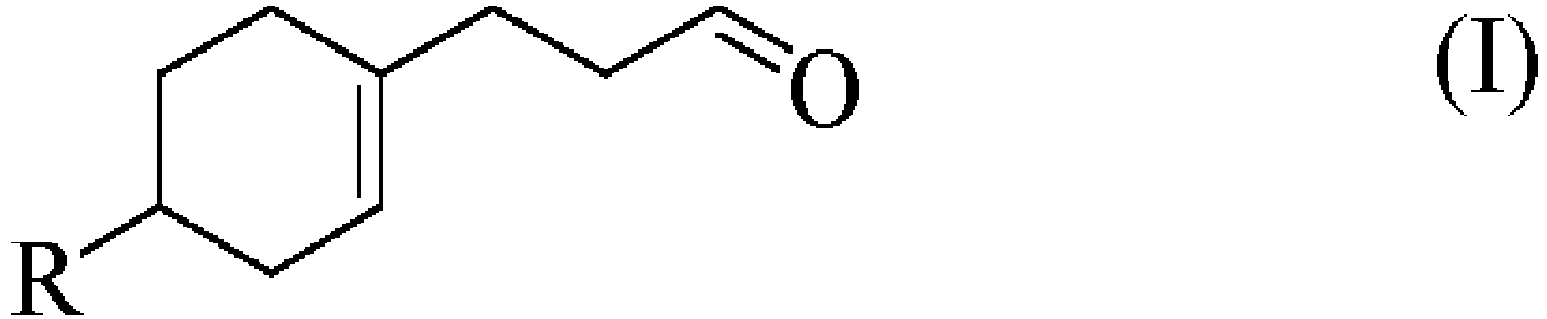
- Verwendung nach Anspruch 1, dadurch gekennzeichnet, dass R für eine n-Butylgruppe steht.
- Verwendung nach Anspruch 1 oder 2, dadurch gekennzeichnet, dass die Verbindungen der Formel (I) aus der aus 3-(4-n-Butyl-1-cyclohexen-1-yl)propanal und 3-[4-(1,2-Dimethylpropyl)-1-cyclohexen-1-yl]propanal bestehenden Gruppe ausgewählt sind.
- Verwendung nach einem der Ansprüche 1 bis 3, dadurch gekennzeichnet, dass es sich bei der Verbindung der Formel (I) um 3-(4-n-Butyl-1-cyclohexen-1-yl)propanal handelt.
- Verfahren zum Verleihen, Verstärken, Verbessern oder Modifizieren der Geruchseigenschaften einer Duftzusammensetzung oder eines parfümierten Artikels, wobei das Verfahren die Zugabe einer wirksamen Menge mindestens einer wie in den Ansprüchen 1 bis 4 definierten Verbindung der Formel (I) zu der Zusammensetzung oder dem Artikel umfasst.
- Verbindung der Formel (I), wie in den Ansprüchen 1 bis 5 definiert.
- Duftzusammensetzung, umfassendi. mindestens eine wie in Anspruch 6 definierte Verbindung der Formel (I),ii. mindestens einen aus der aus einem Parfümträger und einer Parfümgrundlage bestehenden Gruppe ausgewählten Bestandteil undiii. gegebenenfalls mindestens ein Parfümadjuvans.
- Parfümiertes Verbraucherprodukt, das mindestens eine wie in Anspruch 6 definierte Verbindung der Formel (I) oder eine wie in Anspruch 7 definierte Zusammensetzung enthält.
- Parfümiertes Verbraucherprodukt nach Anspruch 8, dadurch gekennzeichnet, dass es sich bei dem parfümierten Verbraucherprodukt um ein Parfüm, ein Textilpflegeprodukt, ein Körperpflegeprodukt, eine kosmetische Zubereitung, ein Hautpflegeprodukt, ein Luftpflegeprodukt oder ein Haushaltspflegeprodukt handelt.
- Parfümiertes Verbraucherprodukt nach Anspruch 9, dadurch gekennzeichnet, dass es sich bei dem parfümierten Verbraucherprodukt um ein Feinparfüm, einen Splash oder ein Eau de Parfüm, ein Eau de Cologne, eine Rasier- oder After-Shave-Lotion, ein flüssiges oder festes Waschmittel, einen Weichspüler, einen Textilauffrischer, ein Bügelwasser, ein Papier, ein Bleichmittel, einen Teppichreiniger, Gardinenpflegemittel, ein Shampoo, ein Färbepräparat, ein Farbpflegeprodukt, ein Haarformmittel, ein Zahnpflegeprodukt, ein Desinfektionsmittel, ein Intimpflegemittel, ein Haarspray, eine Abdeckcreme, ein Deodorant oder Antitranspirant, Haarentferner, Bräunungs- oder Sonnenschutzmittel, Nagelprodukte, ein Hautreinigungsmittel, ein Make-up, eine parfümierte Seife, Dusch- oder Badeschaum, -öl oder -gel oder Fuß/Handpflegemittel, ein Hygieneprodukt, ein Luftauffrischer, einen "gebrauchsfertigen" pulverförmigen Luftauffrischer, einen Schimmelentferner, ein Möbelpflegemittel, ein Wischtuch, ein Geschirrspülmittel oder ein Reinigungsmittel für harte Oberflächen, ein Lederpflegemittel, ein Autopflegemittel handelt.
Applications Claiming Priority (2)
| Application Number | Priority Date | Filing Date | Title |
|---|---|---|---|
| EP18164274 | 2018-03-27 | ||
| PCT/EP2019/057529 WO2019185599A1 (en) | 2018-03-27 | 2019-03-26 | Aldehydic odorant |
Publications (2)
| Publication Number | Publication Date |
|---|---|
| EP3707228A1 EP3707228A1 (de) | 2020-09-16 |
| EP3707228B1 true EP3707228B1 (de) | 2024-09-11 |
Family
ID=61912963
Family Applications (1)
| Application Number | Title | Priority Date | Filing Date |
|---|---|---|---|
| EP19712592.5A Active EP3707228B1 (de) | 2018-03-27 | 2019-03-26 | Aldehyd-duftstoff |
Country Status (8)
| Country | Link |
|---|---|
| US (1) | US11530367B2 (de) |
| EP (1) | EP3707228B1 (de) |
| JP (1) | JP7223010B2 (de) |
| CN (1) | CN111587284B (de) |
| ES (1) | ES2993161T3 (de) |
| IL (1) | IL275230B2 (de) |
| MX (1) | MX2020006261A (de) |
| WO (1) | WO2019185599A1 (de) |
Families Citing this family (2)
| Publication number | Priority date | Publication date | Assignee | Title |
|---|---|---|---|---|
| EP4153552A2 (de) * | 2020-09-01 | 2023-03-29 | Firmenich SA | Verfahren und zwischenprodukte zur herstellung von 3-(cyclohex-1-en-1-yl)-propanalderivaten |
| IL314463A (en) | 2022-03-01 | 2024-09-01 | Firmenich & Cie | Process for preparing unsaturated aldehydes |
Family Cites Families (10)
| Publication number | Priority date | Publication date | Assignee | Title |
|---|---|---|---|---|
| JPS5246943B2 (de) * | 1973-12-22 | 1977-11-29 | ||
| EP1073702B1 (de) | 1998-04-24 | 2002-10-16 | Quest International B.V. | 4-isobutylcyclohexanol enthaltende riechstoffe |
| ES2226644T3 (es) | 1999-05-19 | 2005-04-01 | Firmenich S.A. | Utilizacion de acetaldehidos sustituidos que tienen un sustituyente ciclico como ingredientes perfumantes. |
| FR2801811B1 (fr) | 1999-12-06 | 2002-05-03 | Gerard Habar | Procede de fabrication de microcapsules portant des charges cationiques |
| ATE520638T1 (de) * | 2003-11-06 | 2011-09-15 | Firmenich & Cie | Aldehyde als parfüm- oder geschmackstoffbestandteile |
| US20110217257A1 (en) * | 2009-11-16 | 2011-09-08 | Belko Robert P | Novel 4-alkyl cyclohexanepropanal compounds and their use in perfume compositions |
| US8188023B2 (en) * | 2009-11-16 | 2012-05-29 | International Flavors & Fragrances Inc. | 4-alkyl cyclohexanepropanal compounds and their use in perfume compositions |
| EP2578671B1 (de) * | 2011-10-07 | 2015-12-30 | Symrise AG | Riechstoffe mit Maiglöckchennote |
| JP6059702B2 (ja) | 2014-10-28 | 2017-01-11 | 公立大学法人大阪府立大学 | 含臭素環状アセタール化合物の製造方法 |
| EP3349862B1 (de) | 2015-09-16 | 2019-09-04 | Firmenich SA | Grüne und maiglöckchenduftstoffzutat |
-
2019
- 2019-03-26 US US16/954,283 patent/US11530367B2/en active Active
- 2019-03-26 MX MX2020006261A patent/MX2020006261A/es unknown
- 2019-03-26 JP JP2020536527A patent/JP7223010B2/ja active Active
- 2019-03-26 WO PCT/EP2019/057529 patent/WO2019185599A1/en not_active Ceased
- 2019-03-26 EP EP19712592.5A patent/EP3707228B1/de active Active
- 2019-03-26 IL IL275230A patent/IL275230B2/en unknown
- 2019-03-26 ES ES19712592T patent/ES2993161T3/es active Active
- 2019-03-26 CN CN201980007235.4A patent/CN111587284B/zh active Active
Also Published As
| Publication number | Publication date |
|---|---|
| ES2993161T3 (en) | 2024-12-23 |
| IL275230B1 (en) | 2023-09-01 |
| EP3707228A1 (de) | 2020-09-16 |
| US11530367B2 (en) | 2022-12-20 |
| IL275230A (en) | 2020-07-30 |
| CN111587284A (zh) | 2020-08-25 |
| CN111587284B (zh) | 2024-05-17 |
| WO2019185599A1 (en) | 2019-10-03 |
| IL275230B2 (en) | 2024-01-01 |
| JP7223010B2 (ja) | 2023-02-15 |
| JP2021517176A (ja) | 2021-07-15 |
| US20210095225A1 (en) | 2021-04-01 |
| MX2020006261A (es) | 2020-09-07 |
Similar Documents
| Publication | Publication Date | Title |
|---|---|---|
| US12247181B2 (en) | Cyclopentanone compounds | |
| EP3596036B1 (de) | Cyclohexan-derivate als parfümbestandteile | |
| EP3558213B1 (de) | Maiglöckchen-odoriermittel | |
| EP3707228B1 (de) | Aldehyd-duftstoff | |
| US12441952B2 (en) | Green odorant | |
| US12441954B2 (en) | Powdery, musky odorant macrocycles | |
| EP4139274B1 (de) | Enolether-proparfüm | |
| EP3668850B1 (de) | Amber-geruchsstoff | |
| WO2018192923A1 (en) | Alpha alkylation of aldehyde with a polycyclic olefin | |
| EP3810567B1 (de) | Cyclische oxyetherverbindungen als riechstoffe | |
| EP4281433B1 (de) | Weihrauchduftstoff | |
| EP3612510B1 (de) | Alpha-alkylierung von aldehyd mit polycyclischem olefin |
Legal Events
| Date | Code | Title | Description |
|---|---|---|---|
| STAA | Information on the status of an ep patent application or granted ep patent |
Free format text: STATUS: UNKNOWN |
|
| STAA | Information on the status of an ep patent application or granted ep patent |
Free format text: STATUS: THE INTERNATIONAL PUBLICATION HAS BEEN MADE |
|
| PUAI | Public reference made under article 153(3) epc to a published international application that has entered the european phase |
Free format text: ORIGINAL CODE: 0009012 |
|
| STAA | Information on the status of an ep patent application or granted ep patent |
Free format text: STATUS: REQUEST FOR EXAMINATION WAS MADE |
|
| 17P | Request for examination filed |
Effective date: 20200612 |
|
| AK | Designated contracting states |
Kind code of ref document: A1 Designated state(s): AL AT BE BG CH CY CZ DE DK EE ES FI FR GB GR HR HU IE IS IT LI LT LU LV MC MK MT NL NO PL PT RO RS SE SI SK SM TR |
|
| AX | Request for extension of the european patent |
Extension state: BA ME |
|
| DAV | Request for validation of the european patent (deleted) | ||
| DAX | Request for extension of the european patent (deleted) | ||
| GRAP | Despatch of communication of intention to grant a patent |
Free format text: ORIGINAL CODE: EPIDOSNIGR1 |
|
| STAA | Information on the status of an ep patent application or granted ep patent |
Free format text: STATUS: GRANT OF PATENT IS INTENDED |
|
| INTG | Intention to grant announced |
Effective date: 20240124 |
|
| GRAJ | Information related to disapproval of communication of intention to grant by the applicant or resumption of examination proceedings by the epo deleted |
Free format text: ORIGINAL CODE: EPIDOSDIGR1 |
|
| STAA | Information on the status of an ep patent application or granted ep patent |
Free format text: STATUS: REQUEST FOR EXAMINATION WAS MADE |
|
| RAP3 | Party data changed (applicant data changed or rights of an application transferred) |
Owner name: FIRMENICH SA |
|
| GRAP | Despatch of communication of intention to grant a patent |
Free format text: ORIGINAL CODE: EPIDOSNIGR1 |
|
| STAA | Information on the status of an ep patent application or granted ep patent |
Free format text: STATUS: GRANT OF PATENT IS INTENDED |
|
| P01 | Opt-out of the competence of the unified patent court (upc) registered |
Effective date: 20240425 |
|
| INTC | Intention to grant announced (deleted) | ||
| INTG | Intention to grant announced |
Effective date: 20240527 |
|
| RIN1 | Information on inventor provided before grant (corrected) |
Inventor name: CHAPUIS, CHRISTIAN Inventor name: BIRKBECK, ANTHONY ALEXANDER Inventor name: MORETTI, ROBERT |
|
| GRAS | Grant fee paid |
Free format text: ORIGINAL CODE: EPIDOSNIGR3 |
|
| GRAA | (expected) grant |
Free format text: ORIGINAL CODE: 0009210 |
|
| STAA | Information on the status of an ep patent application or granted ep patent |
Free format text: STATUS: THE PATENT HAS BEEN GRANTED |
|
| AK | Designated contracting states |
Kind code of ref document: B1 Designated state(s): AL AT BE BG CH CY CZ DE DK EE ES FI FR GB GR HR HU IE IS IT LI LT LU LV MC MK MT NL NO PL PT RO RS SE SI SK SM TR |
|
| REG | Reference to a national code |
Ref country code: GB Ref legal event code: FG4D |
|
| REG | Reference to a national code |
Ref country code: CH Ref legal event code: EP |
|
| REG | Reference to a national code |
Ref country code: DE Ref legal event code: R096 Ref document number: 602019058657 Country of ref document: DE |
|
| REG | Reference to a national code |
Ref country code: IE Ref legal event code: FG4D |
|
| REG | Reference to a national code |
Ref country code: ES Ref legal event code: FG2A Ref document number: 2993161 Country of ref document: ES Kind code of ref document: T3 Effective date: 20241223 |
|
| REG | Reference to a national code |
Ref country code: LT Ref legal event code: MG9D |
|
| PG25 | Lapsed in a contracting state [announced via postgrant information from national office to epo] |
Ref country code: NO Free format text: LAPSE BECAUSE OF FAILURE TO SUBMIT A TRANSLATION OF THE DESCRIPTION OR TO PAY THE FEE WITHIN THE PRESCRIBED TIME-LIMIT Effective date: 20241211 |
|
| REG | Reference to a national code |
Ref country code: NL Ref legal event code: MP Effective date: 20240911 |
|
| PG25 | Lapsed in a contracting state [announced via postgrant information from national office to epo] |
Ref country code: GR Free format text: LAPSE BECAUSE OF FAILURE TO SUBMIT A TRANSLATION OF THE DESCRIPTION OR TO PAY THE FEE WITHIN THE PRESCRIBED TIME-LIMIT Effective date: 20241212 Ref country code: FI Free format text: LAPSE BECAUSE OF FAILURE TO SUBMIT A TRANSLATION OF THE DESCRIPTION OR TO PAY THE FEE WITHIN THE PRESCRIBED TIME-LIMIT Effective date: 20240911 |
|
| PG25 | Lapsed in a contracting state [announced via postgrant information from national office to epo] |
Ref country code: BG Free format text: LAPSE BECAUSE OF FAILURE TO SUBMIT A TRANSLATION OF THE DESCRIPTION OR TO PAY THE FEE WITHIN THE PRESCRIBED TIME-LIMIT Effective date: 20240911 |
|
| PG25 | Lapsed in a contracting state [announced via postgrant information from national office to epo] |
Ref country code: LV Free format text: LAPSE BECAUSE OF FAILURE TO SUBMIT A TRANSLATION OF THE DESCRIPTION OR TO PAY THE FEE WITHIN THE PRESCRIBED TIME-LIMIT Effective date: 20240911 |
|
| PG25 | Lapsed in a contracting state [announced via postgrant information from national office to epo] |
Ref country code: HR Free format text: LAPSE BECAUSE OF FAILURE TO SUBMIT A TRANSLATION OF THE DESCRIPTION OR TO PAY THE FEE WITHIN THE PRESCRIBED TIME-LIMIT Effective date: 20240911 |
|
| PG25 | Lapsed in a contracting state [announced via postgrant information from national office to epo] |
Ref country code: RS Free format text: LAPSE BECAUSE OF FAILURE TO SUBMIT A TRANSLATION OF THE DESCRIPTION OR TO PAY THE FEE WITHIN THE PRESCRIBED TIME-LIMIT Effective date: 20241211 |
|
| PG25 | Lapsed in a contracting state [announced via postgrant information from national office to epo] |
Ref country code: RS Free format text: LAPSE BECAUSE OF FAILURE TO SUBMIT A TRANSLATION OF THE DESCRIPTION OR TO PAY THE FEE WITHIN THE PRESCRIBED TIME-LIMIT Effective date: 20241211 Ref country code: NO Free format text: LAPSE BECAUSE OF FAILURE TO SUBMIT A TRANSLATION OF THE DESCRIPTION OR TO PAY THE FEE WITHIN THE PRESCRIBED TIME-LIMIT Effective date: 20241211 Ref country code: LV Free format text: LAPSE BECAUSE OF FAILURE TO SUBMIT A TRANSLATION OF THE DESCRIPTION OR TO PAY THE FEE WITHIN THE PRESCRIBED TIME-LIMIT Effective date: 20240911 Ref country code: HR Free format text: LAPSE BECAUSE OF FAILURE TO SUBMIT A TRANSLATION OF THE DESCRIPTION OR TO PAY THE FEE WITHIN THE PRESCRIBED TIME-LIMIT Effective date: 20240911 Ref country code: GR Free format text: LAPSE BECAUSE OF FAILURE TO SUBMIT A TRANSLATION OF THE DESCRIPTION OR TO PAY THE FEE WITHIN THE PRESCRIBED TIME-LIMIT Effective date: 20241212 Ref country code: FI Free format text: LAPSE BECAUSE OF FAILURE TO SUBMIT A TRANSLATION OF THE DESCRIPTION OR TO PAY THE FEE WITHIN THE PRESCRIBED TIME-LIMIT Effective date: 20240911 Ref country code: BG Free format text: LAPSE BECAUSE OF FAILURE TO SUBMIT A TRANSLATION OF THE DESCRIPTION OR TO PAY THE FEE WITHIN THE PRESCRIBED TIME-LIMIT Effective date: 20240911 |
|
| REG | Reference to a national code |
Ref country code: AT Ref legal event code: MK05 Ref document number: 1722698 Country of ref document: AT Kind code of ref document: T Effective date: 20240911 |
|
| PG25 | Lapsed in a contracting state [announced via postgrant information from national office to epo] |
Ref country code: NL Free format text: LAPSE BECAUSE OF FAILURE TO SUBMIT A TRANSLATION OF THE DESCRIPTION OR TO PAY THE FEE WITHIN THE PRESCRIBED TIME-LIMIT Effective date: 20240911 |
|
| PG25 | Lapsed in a contracting state [announced via postgrant information from national office to epo] |
Ref country code: PT Free format text: LAPSE BECAUSE OF FAILURE TO SUBMIT A TRANSLATION OF THE DESCRIPTION OR TO PAY THE FEE WITHIN THE PRESCRIBED TIME-LIMIT Effective date: 20250113 Ref country code: IS Free format text: LAPSE BECAUSE OF FAILURE TO SUBMIT A TRANSLATION OF THE DESCRIPTION OR TO PAY THE FEE WITHIN THE PRESCRIBED TIME-LIMIT Effective date: 20250111 |
|
| PGFP | Annual fee paid to national office [announced via postgrant information from national office to epo] |
Ref country code: DE Payment date: 20250128 Year of fee payment: 7 |
|
| PG25 | Lapsed in a contracting state [announced via postgrant information from national office to epo] |
Ref country code: SM Free format text: LAPSE BECAUSE OF FAILURE TO SUBMIT A TRANSLATION OF THE DESCRIPTION OR TO PAY THE FEE WITHIN THE PRESCRIBED TIME-LIMIT Effective date: 20240911 Ref country code: RO Free format text: LAPSE BECAUSE OF FAILURE TO SUBMIT A TRANSLATION OF THE DESCRIPTION OR TO PAY THE FEE WITHIN THE PRESCRIBED TIME-LIMIT Effective date: 20240911 |
|
| PG25 | Lapsed in a contracting state [announced via postgrant information from national office to epo] |
Ref country code: EE Free format text: LAPSE BECAUSE OF FAILURE TO SUBMIT A TRANSLATION OF THE DESCRIPTION OR TO PAY THE FEE WITHIN THE PRESCRIBED TIME-LIMIT Effective date: 20240911 Ref country code: AT Free format text: LAPSE BECAUSE OF FAILURE TO SUBMIT A TRANSLATION OF THE DESCRIPTION OR TO PAY THE FEE WITHIN THE PRESCRIBED TIME-LIMIT Effective date: 20240911 |
|
| PG25 | Lapsed in a contracting state [announced via postgrant information from national office to epo] |
Ref country code: PL Free format text: LAPSE BECAUSE OF FAILURE TO SUBMIT A TRANSLATION OF THE DESCRIPTION OR TO PAY THE FEE WITHIN THE PRESCRIBED TIME-LIMIT Effective date: 20240911 Ref country code: CZ Free format text: LAPSE BECAUSE OF FAILURE TO SUBMIT A TRANSLATION OF THE DESCRIPTION OR TO PAY THE FEE WITHIN THE PRESCRIBED TIME-LIMIT Effective date: 20240911 |
|
| PGFP | Annual fee paid to national office [announced via postgrant information from national office to epo] |
Ref country code: FR Payment date: 20250210 Year of fee payment: 7 |
|
| PG25 | Lapsed in a contracting state [announced via postgrant information from national office to epo] |
Ref country code: IT Free format text: LAPSE BECAUSE OF FAILURE TO SUBMIT A TRANSLATION OF THE DESCRIPTION OR TO PAY THE FEE WITHIN THE PRESCRIBED TIME-LIMIT Effective date: 20240911 Ref country code: SK Free format text: LAPSE BECAUSE OF FAILURE TO SUBMIT A TRANSLATION OF THE DESCRIPTION OR TO PAY THE FEE WITHIN THE PRESCRIBED TIME-LIMIT Effective date: 20240911 |
|
| PGFP | Annual fee paid to national office [announced via postgrant information from national office to epo] |
Ref country code: GB Payment date: 20250130 Year of fee payment: 7 |
|
| REG | Reference to a national code |
Ref country code: DE Ref legal event code: R097 Ref document number: 602019058657 Country of ref document: DE |
|
| PG25 | Lapsed in a contracting state [announced via postgrant information from national office to epo] |
Ref country code: DK Free format text: LAPSE BECAUSE OF FAILURE TO SUBMIT A TRANSLATION OF THE DESCRIPTION OR TO PAY THE FEE WITHIN THE PRESCRIBED TIME-LIMIT Effective date: 20240911 |
|
| PGFP | Annual fee paid to national office [announced via postgrant information from national office to epo] |
Ref country code: ES Payment date: 20250414 Year of fee payment: 7 |
|
| PLBE | No opposition filed within time limit |
Free format text: ORIGINAL CODE: 0009261 |
|
| STAA | Information on the status of an ep patent application or granted ep patent |
Free format text: STATUS: NO OPPOSITION FILED WITHIN TIME LIMIT |
|
| PGFP | Annual fee paid to national office [announced via postgrant information from national office to epo] |
Ref country code: CH Payment date: 20250401 Year of fee payment: 7 |
|
| 26N | No opposition filed |
Effective date: 20250612 |
|
| PG25 | Lapsed in a contracting state [announced via postgrant information from national office to epo] |
Ref country code: SE Free format text: LAPSE BECAUSE OF FAILURE TO SUBMIT A TRANSLATION OF THE DESCRIPTION OR TO PAY THE FEE WITHIN THE PRESCRIBED TIME-LIMIT Effective date: 20240911 |
|
| PG25 | Lapsed in a contracting state [announced via postgrant information from national office to epo] |
Ref country code: MC Free format text: LAPSE BECAUSE OF FAILURE TO SUBMIT A TRANSLATION OF THE DESCRIPTION OR TO PAY THE FEE WITHIN THE PRESCRIBED TIME-LIMIT Effective date: 20240911 |
|
| PG25 | Lapsed in a contracting state [announced via postgrant information from national office to epo] |
Ref country code: LU Free format text: LAPSE BECAUSE OF NON-PAYMENT OF DUE FEES Effective date: 20250326 |