EP3704292B1 - Absorbierender artikelbestandteil - Google Patents
Absorbierender artikelbestandteil Download PDFInfo
- Publication number
- EP3704292B1 EP3704292B1 EP18801051.6A EP18801051A EP3704292B1 EP 3704292 B1 EP3704292 B1 EP 3704292B1 EP 18801051 A EP18801051 A EP 18801051A EP 3704292 B1 EP3704292 B1 EP 3704292B1
- Authority
- EP
- European Patent Office
- Prior art keywords
- core cover
- fibres
- functional core
- functional
- absorbent article
- Prior art date
- Legal status (The legal status is an assumption and is not a legal conclusion. Google has not performed a legal analysis and makes no representation as to the accuracy of the status listed.)
- Active
Links
Images


Classifications
-
- A—HUMAN NECESSITIES
- A61—MEDICAL OR VETERINARY SCIENCE; HYGIENE
- A61F—FILTERS IMPLANTABLE INTO BLOOD VESSELS; PROSTHESES; DEVICES PROVIDING PATENCY TO, OR PREVENTING COLLAPSING OF, TUBULAR STRUCTURES OF THE BODY, e.g. STENTS; ORTHOPAEDIC, NURSING OR CONTRACEPTIVE DEVICES; FOMENTATION; TREATMENT OR PROTECTION OF EYES OR EARS; BANDAGES, DRESSINGS OR ABSORBENT PADS; FIRST-AID KITS
- A61F13/00—Bandages or dressings; Absorbent pads
- A61F13/15—Absorbent pads, e.g. sanitary towels, swabs or tampons for external or internal application to the body; Supporting or fastening means therefor; Tampon applicators
- A61F13/51—Absorbent pads, e.g. sanitary towels, swabs or tampons for external or internal application to the body; Supporting or fastening means therefor; Tampon applicators characterised by the outer layers of the pads
- A61F13/511—Topsheet, i.e. the permeable cover or layer facing the skin
- A61F13/5116—Topsheet, i.e. the permeable cover or layer facing the skin being formed of multiple layers
-
- A—HUMAN NECESSITIES
- A61—MEDICAL OR VETERINARY SCIENCE; HYGIENE
- A61F—FILTERS IMPLANTABLE INTO BLOOD VESSELS; PROSTHESES; DEVICES PROVIDING PATENCY TO, OR PREVENTING COLLAPSING OF, TUBULAR STRUCTURES OF THE BODY, e.g. STENTS; ORTHOPAEDIC, NURSING OR CONTRACEPTIVE DEVICES; FOMENTATION; TREATMENT OR PROTECTION OF EYES OR EARS; BANDAGES, DRESSINGS OR ABSORBENT PADS; FIRST-AID KITS
- A61F13/00—Bandages or dressings; Absorbent pads
- A61F13/15—Absorbent pads, e.g. sanitary towels, swabs or tampons for external or internal application to the body; Supporting or fastening means therefor; Tampon applicators
- A61F13/51—Absorbent pads, e.g. sanitary towels, swabs or tampons for external or internal application to the body; Supporting or fastening means therefor; Tampon applicators characterised by the outer layers of the pads
- A61F13/511—Topsheet, i.e. the permeable cover or layer facing the skin
-
- A—HUMAN NECESSITIES
- A61—MEDICAL OR VETERINARY SCIENCE; HYGIENE
- A61F—FILTERS IMPLANTABLE INTO BLOOD VESSELS; PROSTHESES; DEVICES PROVIDING PATENCY TO, OR PREVENTING COLLAPSING OF, TUBULAR STRUCTURES OF THE BODY, e.g. STENTS; ORTHOPAEDIC, NURSING OR CONTRACEPTIVE DEVICES; FOMENTATION; TREATMENT OR PROTECTION OF EYES OR EARS; BANDAGES, DRESSINGS OR ABSORBENT PADS; FIRST-AID KITS
- A61F13/00—Bandages or dressings; Absorbent pads
- A61F13/15—Absorbent pads, e.g. sanitary towels, swabs or tampons for external or internal application to the body; Supporting or fastening means therefor; Tampon applicators
- A61F13/15203—Properties of the article, e.g. stiffness or absorbency
-
- A—HUMAN NECESSITIES
- A61—MEDICAL OR VETERINARY SCIENCE; HYGIENE
- A61F—FILTERS IMPLANTABLE INTO BLOOD VESSELS; PROSTHESES; DEVICES PROVIDING PATENCY TO, OR PREVENTING COLLAPSING OF, TUBULAR STRUCTURES OF THE BODY, e.g. STENTS; ORTHOPAEDIC, NURSING OR CONTRACEPTIVE DEVICES; FOMENTATION; TREATMENT OR PROTECTION OF EYES OR EARS; BANDAGES, DRESSINGS OR ABSORBENT PADS; FIRST-AID KITS
- A61F13/00—Bandages or dressings; Absorbent pads
- A61F13/15—Absorbent pads, e.g. sanitary towels, swabs or tampons for external or internal application to the body; Supporting or fastening means therefor; Tampon applicators
- A61F13/15577—Apparatus or processes for manufacturing
-
- A—HUMAN NECESSITIES
- A61—MEDICAL OR VETERINARY SCIENCE; HYGIENE
- A61F—FILTERS IMPLANTABLE INTO BLOOD VESSELS; PROSTHESES; DEVICES PROVIDING PATENCY TO, OR PREVENTING COLLAPSING OF, TUBULAR STRUCTURES OF THE BODY, e.g. STENTS; ORTHOPAEDIC, NURSING OR CONTRACEPTIVE DEVICES; FOMENTATION; TREATMENT OR PROTECTION OF EYES OR EARS; BANDAGES, DRESSINGS OR ABSORBENT PADS; FIRST-AID KITS
- A61F13/00—Bandages or dressings; Absorbent pads
- A61F13/15—Absorbent pads, e.g. sanitary towels, swabs or tampons for external or internal application to the body; Supporting or fastening means therefor; Tampon applicators
- A61F13/15577—Apparatus or processes for manufacturing
- A61F13/15666—Wrapping formed fibrous webs or pads, e.g. the pads being formed by uniting pad pieces cut from fibrous webs
-
- A—HUMAN NECESSITIES
- A61—MEDICAL OR VETERINARY SCIENCE; HYGIENE
- A61F—FILTERS IMPLANTABLE INTO BLOOD VESSELS; PROSTHESES; DEVICES PROVIDING PATENCY TO, OR PREVENTING COLLAPSING OF, TUBULAR STRUCTURES OF THE BODY, e.g. STENTS; ORTHOPAEDIC, NURSING OR CONTRACEPTIVE DEVICES; FOMENTATION; TREATMENT OR PROTECTION OF EYES OR EARS; BANDAGES, DRESSINGS OR ABSORBENT PADS; FIRST-AID KITS
- A61F13/00—Bandages or dressings; Absorbent pads
- A61F13/15—Absorbent pads, e.g. sanitary towels, swabs or tampons for external or internal application to the body; Supporting or fastening means therefor; Tampon applicators
- A61F13/45—Absorbent pads, e.g. sanitary towels, swabs or tampons for external or internal application to the body; Supporting or fastening means therefor; Tampon applicators characterised by the shape
- A61F13/49—Absorbent pads, e.g. sanitary towels, swabs or tampons for external or internal application to the body; Supporting or fastening means therefor; Tampon applicators characterised by the shape specially adapted to be worn around the waist, e.g. diapers, nappies
-
- A—HUMAN NECESSITIES
- A61—MEDICAL OR VETERINARY SCIENCE; HYGIENE
- A61F—FILTERS IMPLANTABLE INTO BLOOD VESSELS; PROSTHESES; DEVICES PROVIDING PATENCY TO, OR PREVENTING COLLAPSING OF, TUBULAR STRUCTURES OF THE BODY, e.g. STENTS; ORTHOPAEDIC, NURSING OR CONTRACEPTIVE DEVICES; FOMENTATION; TREATMENT OR PROTECTION OF EYES OR EARS; BANDAGES, DRESSINGS OR ABSORBENT PADS; FIRST-AID KITS
- A61F13/00—Bandages or dressings; Absorbent pads
- A61F13/15—Absorbent pads, e.g. sanitary towels, swabs or tampons for external or internal application to the body; Supporting or fastening means therefor; Tampon applicators
- A61F13/51—Absorbent pads, e.g. sanitary towels, swabs or tampons for external or internal application to the body; Supporting or fastening means therefor; Tampon applicators characterised by the outer layers of the pads
- A61F13/511—Topsheet, i.e. the permeable cover or layer facing the skin
- A61F13/51121—Topsheet, i.e. the permeable cover or layer facing the skin characterised by the material
-
- A—HUMAN NECESSITIES
- A61—MEDICAL OR VETERINARY SCIENCE; HYGIENE
- A61F—FILTERS IMPLANTABLE INTO BLOOD VESSELS; PROSTHESES; DEVICES PROVIDING PATENCY TO, OR PREVENTING COLLAPSING OF, TUBULAR STRUCTURES OF THE BODY, e.g. STENTS; ORTHOPAEDIC, NURSING OR CONTRACEPTIVE DEVICES; FOMENTATION; TREATMENT OR PROTECTION OF EYES OR EARS; BANDAGES, DRESSINGS OR ABSORBENT PADS; FIRST-AID KITS
- A61F13/00—Bandages or dressings; Absorbent pads
- A61F13/15—Absorbent pads, e.g. sanitary towels, swabs or tampons for external or internal application to the body; Supporting or fastening means therefor; Tampon applicators
- A61F13/53—Absorbent pads, e.g. sanitary towels, swabs or tampons for external or internal application to the body; Supporting or fastening means therefor; Tampon applicators characterised by the absorbing medium
- A61F13/534—Absorbent pads, e.g. sanitary towels, swabs or tampons for external or internal application to the body; Supporting or fastening means therefor; Tampon applicators characterised by the absorbing medium having an inhomogeneous composition through the thickness of the pad
-
- A—HUMAN NECESSITIES
- A61—MEDICAL OR VETERINARY SCIENCE; HYGIENE
- A61F—FILTERS IMPLANTABLE INTO BLOOD VESSELS; PROSTHESES; DEVICES PROVIDING PATENCY TO, OR PREVENTING COLLAPSING OF, TUBULAR STRUCTURES OF THE BODY, e.g. STENTS; ORTHOPAEDIC, NURSING OR CONTRACEPTIVE DEVICES; FOMENTATION; TREATMENT OR PROTECTION OF EYES OR EARS; BANDAGES, DRESSINGS OR ABSORBENT PADS; FIRST-AID KITS
- A61F13/00—Bandages or dressings; Absorbent pads
- A61F13/15—Absorbent pads, e.g. sanitary towels, swabs or tampons for external or internal application to the body; Supporting or fastening means therefor; Tampon applicators
- A61F13/53—Absorbent pads, e.g. sanitary towels, swabs or tampons for external or internal application to the body; Supporting or fastening means therefor; Tampon applicators characterised by the absorbing medium
- A61F13/538—Absorbent pads, e.g. sanitary towels, swabs or tampons for external or internal application to the body; Supporting or fastening means therefor; Tampon applicators characterised by the absorbing medium characterised by specific fibre orientation or weave
-
- A—HUMAN NECESSITIES
- A61—MEDICAL OR VETERINARY SCIENCE; HYGIENE
- A61F—FILTERS IMPLANTABLE INTO BLOOD VESSELS; PROSTHESES; DEVICES PROVIDING PATENCY TO, OR PREVENTING COLLAPSING OF, TUBULAR STRUCTURES OF THE BODY, e.g. STENTS; ORTHOPAEDIC, NURSING OR CONTRACEPTIVE DEVICES; FOMENTATION; TREATMENT OR PROTECTION OF EYES OR EARS; BANDAGES, DRESSINGS OR ABSORBENT PADS; FIRST-AID KITS
- A61F15/00—Auxiliary appliances for wound dressings; Dispensing containers for dressings or bandages
-
- D—TEXTILES; PAPER
- D04—BRAIDING; LACE-MAKING; KNITTING; TRIMMINGS; NON-WOVEN FABRICS
- D04H—MAKING TEXTILE FABRICS, e.g. FROM FIBRES OR FILAMENTARY MATERIAL; FABRICS MADE BY SUCH PROCESSES OR APPARATUS, e.g. FELTS, NON-WOVEN FABRICS; COTTON-WOOL; WADDING ; NON-WOVEN FABRICS FROM STAPLE FIBRES, FILAMENTS OR YARNS, BONDED WITH AT LEAST ONE WEB-LIKE MATERIAL DURING THEIR CONSOLIDATION
- D04H1/00—Non-woven fabrics formed wholly or mainly of staple fibres or like relatively short fibres
- D04H1/40—Non-woven fabrics formed wholly or mainly of staple fibres or like relatively short fibres from fleeces or layers composed of fibres without existing or potential cohesive properties
- D04H1/42—Non-woven fabrics formed wholly or mainly of staple fibres or like relatively short fibres from fleeces or layers composed of fibres without existing or potential cohesive properties characterised by the use of certain kinds of fibres insofar as this use has no preponderant influence on the consolidation of the fleece
- D04H1/425—Cellulose series
-
- D—TEXTILES; PAPER
- D04—BRAIDING; LACE-MAKING; KNITTING; TRIMMINGS; NON-WOVEN FABRICS
- D04H—MAKING TEXTILE FABRICS, e.g. FROM FIBRES OR FILAMENTARY MATERIAL; FABRICS MADE BY SUCH PROCESSES OR APPARATUS, e.g. FELTS, NON-WOVEN FABRICS; COTTON-WOOL; WADDING ; NON-WOVEN FABRICS FROM STAPLE FIBRES, FILAMENTS OR YARNS, BONDED WITH AT LEAST ONE WEB-LIKE MATERIAL DURING THEIR CONSOLIDATION
- D04H1/00—Non-woven fabrics formed wholly or mainly of staple fibres or like relatively short fibres
- D04H1/40—Non-woven fabrics formed wholly or mainly of staple fibres or like relatively short fibres from fleeces or layers composed of fibres without existing or potential cohesive properties
- D04H1/42—Non-woven fabrics formed wholly or mainly of staple fibres or like relatively short fibres from fleeces or layers composed of fibres without existing or potential cohesive properties characterised by the use of certain kinds of fibres insofar as this use has no preponderant influence on the consolidation of the fleece
- D04H1/425—Cellulose series
- D04H1/4258—Regenerated cellulose series
-
- D—TEXTILES; PAPER
- D04—BRAIDING; LACE-MAKING; KNITTING; TRIMMINGS; NON-WOVEN FABRICS
- D04H—MAKING TEXTILE FABRICS, e.g. FROM FIBRES OR FILAMENTARY MATERIAL; FABRICS MADE BY SUCH PROCESSES OR APPARATUS, e.g. FELTS, NON-WOVEN FABRICS; COTTON-WOOL; WADDING ; NON-WOVEN FABRICS FROM STAPLE FIBRES, FILAMENTS OR YARNS, BONDED WITH AT LEAST ONE WEB-LIKE MATERIAL DURING THEIR CONSOLIDATION
- D04H1/00—Non-woven fabrics formed wholly or mainly of staple fibres or like relatively short fibres
- D04H1/40—Non-woven fabrics formed wholly or mainly of staple fibres or like relatively short fibres from fleeces or layers composed of fibres without existing or potential cohesive properties
- D04H1/42—Non-woven fabrics formed wholly or mainly of staple fibres or like relatively short fibres from fleeces or layers composed of fibres without existing or potential cohesive properties characterised by the use of certain kinds of fibres insofar as this use has no preponderant influence on the consolidation of the fleece
- D04H1/4282—Addition polymers
- D04H1/4291—Olefin series
-
- D—TEXTILES; PAPER
- D04—BRAIDING; LACE-MAKING; KNITTING; TRIMMINGS; NON-WOVEN FABRICS
- D04H—MAKING TEXTILE FABRICS, e.g. FROM FIBRES OR FILAMENTARY MATERIAL; FABRICS MADE BY SUCH PROCESSES OR APPARATUS, e.g. FELTS, NON-WOVEN FABRICS; COTTON-WOOL; WADDING ; NON-WOVEN FABRICS FROM STAPLE FIBRES, FILAMENTS OR YARNS, BONDED WITH AT LEAST ONE WEB-LIKE MATERIAL DURING THEIR CONSOLIDATION
- D04H1/00—Non-woven fabrics formed wholly or mainly of staple fibres or like relatively short fibres
- D04H1/40—Non-woven fabrics formed wholly or mainly of staple fibres or like relatively short fibres from fleeces or layers composed of fibres without existing or potential cohesive properties
- D04H1/42—Non-woven fabrics formed wholly or mainly of staple fibres or like relatively short fibres from fleeces or layers composed of fibres without existing or potential cohesive properties characterised by the use of certain kinds of fibres insofar as this use has no preponderant influence on the consolidation of the fleece
- D04H1/4326—Condensation or reaction polymers
- D04H1/435—Polyesters
-
- D—TEXTILES; PAPER
- D04—BRAIDING; LACE-MAKING; KNITTING; TRIMMINGS; NON-WOVEN FABRICS
- D04H—MAKING TEXTILE FABRICS, e.g. FROM FIBRES OR FILAMENTARY MATERIAL; FABRICS MADE BY SUCH PROCESSES OR APPARATUS, e.g. FELTS, NON-WOVEN FABRICS; COTTON-WOOL; WADDING ; NON-WOVEN FABRICS FROM STAPLE FIBRES, FILAMENTS OR YARNS, BONDED WITH AT LEAST ONE WEB-LIKE MATERIAL DURING THEIR CONSOLIDATION
- D04H1/00—Non-woven fabrics formed wholly or mainly of staple fibres or like relatively short fibres
- D04H1/40—Non-woven fabrics formed wholly or mainly of staple fibres or like relatively short fibres from fleeces or layers composed of fibres without existing or potential cohesive properties
- D04H1/44—Non-woven fabrics formed wholly or mainly of staple fibres or like relatively short fibres from fleeces or layers composed of fibres without existing or potential cohesive properties the fleeces or layers being consolidated by mechanical means, e.g. by rolling
- D04H1/46—Non-woven fabrics formed wholly or mainly of staple fibres or like relatively short fibres from fleeces or layers composed of fibres without existing or potential cohesive properties the fleeces or layers being consolidated by mechanical means, e.g. by rolling by needling or like operations to cause entanglement of fibres
- D04H1/492—Non-woven fabrics formed wholly or mainly of staple fibres or like relatively short fibres from fleeces or layers composed of fibres without existing or potential cohesive properties the fleeces or layers being consolidated by mechanical means, e.g. by rolling by needling or like operations to cause entanglement of fibres by fluid jet
-
- D—TEXTILES; PAPER
- D04—BRAIDING; LACE-MAKING; KNITTING; TRIMMINGS; NON-WOVEN FABRICS
- D04H—MAKING TEXTILE FABRICS, e.g. FROM FIBRES OR FILAMENTARY MATERIAL; FABRICS MADE BY SUCH PROCESSES OR APPARATUS, e.g. FELTS, NON-WOVEN FABRICS; COTTON-WOOL; WADDING ; NON-WOVEN FABRICS FROM STAPLE FIBRES, FILAMENTS OR YARNS, BONDED WITH AT LEAST ONE WEB-LIKE MATERIAL DURING THEIR CONSOLIDATION
- D04H1/00—Non-woven fabrics formed wholly or mainly of staple fibres or like relatively short fibres
- D04H1/40—Non-woven fabrics formed wholly or mainly of staple fibres or like relatively short fibres from fleeces or layers composed of fibres without existing or potential cohesive properties
- D04H1/44—Non-woven fabrics formed wholly or mainly of staple fibres or like relatively short fibres from fleeces or layers composed of fibres without existing or potential cohesive properties the fleeces or layers being consolidated by mechanical means, e.g. by rolling
- D04H1/46—Non-woven fabrics formed wholly or mainly of staple fibres or like relatively short fibres from fleeces or layers composed of fibres without existing or potential cohesive properties the fleeces or layers being consolidated by mechanical means, e.g. by rolling by needling or like operations to cause entanglement of fibres
- D04H1/498—Non-woven fabrics formed wholly or mainly of staple fibres or like relatively short fibres from fleeces or layers composed of fibres without existing or potential cohesive properties the fleeces or layers being consolidated by mechanical means, e.g. by rolling by needling or like operations to cause entanglement of fibres entanglement of layered webs
-
- A—HUMAN NECESSITIES
- A61—MEDICAL OR VETERINARY SCIENCE; HYGIENE
- A61F—FILTERS IMPLANTABLE INTO BLOOD VESSELS; PROSTHESES; DEVICES PROVIDING PATENCY TO, OR PREVENTING COLLAPSING OF, TUBULAR STRUCTURES OF THE BODY, e.g. STENTS; ORTHOPAEDIC, NURSING OR CONTRACEPTIVE DEVICES; FOMENTATION; TREATMENT OR PROTECTION OF EYES OR EARS; BANDAGES, DRESSINGS OR ABSORBENT PADS; FIRST-AID KITS
- A61F13/00—Bandages or dressings; Absorbent pads
- A61F13/15—Absorbent pads, e.g. sanitary towels, swabs or tampons for external or internal application to the body; Supporting or fastening means therefor; Tampon applicators
- A61F13/15203—Properties of the article, e.g. stiffness or absorbency
- A61F2013/15284—Properties of the article, e.g. stiffness or absorbency characterized by quantifiable properties
- A61F2013/15406—Basis weight
-
- A—HUMAN NECESSITIES
- A61—MEDICAL OR VETERINARY SCIENCE; HYGIENE
- A61F—FILTERS IMPLANTABLE INTO BLOOD VESSELS; PROSTHESES; DEVICES PROVIDING PATENCY TO, OR PREVENTING COLLAPSING OF, TUBULAR STRUCTURES OF THE BODY, e.g. STENTS; ORTHOPAEDIC, NURSING OR CONTRACEPTIVE DEVICES; FOMENTATION; TREATMENT OR PROTECTION OF EYES OR EARS; BANDAGES, DRESSINGS OR ABSORBENT PADS; FIRST-AID KITS
- A61F13/00—Bandages or dressings; Absorbent pads
- A61F13/15—Absorbent pads, e.g. sanitary towels, swabs or tampons for external or internal application to the body; Supporting or fastening means therefor; Tampon applicators
- A61F13/15203—Properties of the article, e.g. stiffness or absorbency
- A61F2013/15284—Properties of the article, e.g. stiffness or absorbency characterized by quantifiable properties
- A61F2013/15422—Density
-
- A—HUMAN NECESSITIES
- A61—MEDICAL OR VETERINARY SCIENCE; HYGIENE
- A61F—FILTERS IMPLANTABLE INTO BLOOD VESSELS; PROSTHESES; DEVICES PROVIDING PATENCY TO, OR PREVENTING COLLAPSING OF, TUBULAR STRUCTURES OF THE BODY, e.g. STENTS; ORTHOPAEDIC, NURSING OR CONTRACEPTIVE DEVICES; FOMENTATION; TREATMENT OR PROTECTION OF EYES OR EARS; BANDAGES, DRESSINGS OR ABSORBENT PADS; FIRST-AID KITS
- A61F13/00—Bandages or dressings; Absorbent pads
- A61F13/15—Absorbent pads, e.g. sanitary towels, swabs or tampons for external or internal application to the body; Supporting or fastening means therefor; Tampon applicators
- A61F13/15577—Apparatus or processes for manufacturing
- A61F2013/15821—Apparatus or processes for manufacturing characterized by the apparatus for manufacturing
- A61F2013/15934—Apparatus or processes for manufacturing characterized by the apparatus for manufacturing for making non-woven
-
- A—HUMAN NECESSITIES
- A61—MEDICAL OR VETERINARY SCIENCE; HYGIENE
- A61F—FILTERS IMPLANTABLE INTO BLOOD VESSELS; PROSTHESES; DEVICES PROVIDING PATENCY TO, OR PREVENTING COLLAPSING OF, TUBULAR STRUCTURES OF THE BODY, e.g. STENTS; ORTHOPAEDIC, NURSING OR CONTRACEPTIVE DEVICES; FOMENTATION; TREATMENT OR PROTECTION OF EYES OR EARS; BANDAGES, DRESSINGS OR ABSORBENT PADS; FIRST-AID KITS
- A61F13/00—Bandages or dressings; Absorbent pads
- A61F13/15—Absorbent pads, e.g. sanitary towels, swabs or tampons for external or internal application to the body; Supporting or fastening means therefor; Tampon applicators
- A61F13/15577—Apparatus or processes for manufacturing
- A61F2013/15821—Apparatus or processes for manufacturing characterized by the apparatus for manufacturing
- A61F2013/15934—Apparatus or processes for manufacturing characterized by the apparatus for manufacturing for making non-woven
- A61F2013/15983—Apparatus or processes for manufacturing characterized by the apparatus for manufacturing for making non-woven by hydroentangled technique
-
- A—HUMAN NECESSITIES
- A61—MEDICAL OR VETERINARY SCIENCE; HYGIENE
- A61F—FILTERS IMPLANTABLE INTO BLOOD VESSELS; PROSTHESES; DEVICES PROVIDING PATENCY TO, OR PREVENTING COLLAPSING OF, TUBULAR STRUCTURES OF THE BODY, e.g. STENTS; ORTHOPAEDIC, NURSING OR CONTRACEPTIVE DEVICES; FOMENTATION; TREATMENT OR PROTECTION OF EYES OR EARS; BANDAGES, DRESSINGS OR ABSORBENT PADS; FIRST-AID KITS
- A61F13/00—Bandages or dressings; Absorbent pads
- A61F13/15—Absorbent pads, e.g. sanitary towels, swabs or tampons for external or internal application to the body; Supporting or fastening means therefor; Tampon applicators
- A61F13/51—Absorbent pads, e.g. sanitary towels, swabs or tampons for external or internal application to the body; Supporting or fastening means therefor; Tampon applicators characterised by the outer layers of the pads
- A61F2013/51002—Absorbent pads, e.g. sanitary towels, swabs or tampons for external or internal application to the body; Supporting or fastening means therefor; Tampon applicators characterised by the outer layers of the pads with special fibres
- A61F2013/51019—Absorbent pads, e.g. sanitary towels, swabs or tampons for external or internal application to the body; Supporting or fastening means therefor; Tampon applicators characterised by the outer layers of the pads with special fibres being cellulosic material
- A61F2013/51021—Absorbent pads, e.g. sanitary towels, swabs or tampons for external or internal application to the body; Supporting or fastening means therefor; Tampon applicators characterised by the outer layers of the pads with special fibres being cellulosic material being chemically modified
-
- A—HUMAN NECESSITIES
- A61—MEDICAL OR VETERINARY SCIENCE; HYGIENE
- A61F—FILTERS IMPLANTABLE INTO BLOOD VESSELS; PROSTHESES; DEVICES PROVIDING PATENCY TO, OR PREVENTING COLLAPSING OF, TUBULAR STRUCTURES OF THE BODY, e.g. STENTS; ORTHOPAEDIC, NURSING OR CONTRACEPTIVE DEVICES; FOMENTATION; TREATMENT OR PROTECTION OF EYES OR EARS; BANDAGES, DRESSINGS OR ABSORBENT PADS; FIRST-AID KITS
- A61F13/00—Bandages or dressings; Absorbent pads
- A61F13/15—Absorbent pads, e.g. sanitary towels, swabs or tampons for external or internal application to the body; Supporting or fastening means therefor; Tampon applicators
- A61F13/51—Absorbent pads, e.g. sanitary towels, swabs or tampons for external or internal application to the body; Supporting or fastening means therefor; Tampon applicators characterised by the outer layers of the pads
- A61F2013/51002—Absorbent pads, e.g. sanitary towels, swabs or tampons for external or internal application to the body; Supporting or fastening means therefor; Tampon applicators characterised by the outer layers of the pads with special fibres
- A61F2013/51023—Absorbent pads, e.g. sanitary towels, swabs or tampons for external or internal application to the body; Supporting or fastening means therefor; Tampon applicators characterised by the outer layers of the pads with special fibres being polymeric fibres
- A61F2013/51026—Absorbent pads, e.g. sanitary towels, swabs or tampons for external or internal application to the body; Supporting or fastening means therefor; Tampon applicators characterised by the outer layers of the pads with special fibres being polymeric fibres being in thermoplastic material
-
- A—HUMAN NECESSITIES
- A61—MEDICAL OR VETERINARY SCIENCE; HYGIENE
- A61F—FILTERS IMPLANTABLE INTO BLOOD VESSELS; PROSTHESES; DEVICES PROVIDING PATENCY TO, OR PREVENTING COLLAPSING OF, TUBULAR STRUCTURES OF THE BODY, e.g. STENTS; ORTHOPAEDIC, NURSING OR CONTRACEPTIVE DEVICES; FOMENTATION; TREATMENT OR PROTECTION OF EYES OR EARS; BANDAGES, DRESSINGS OR ABSORBENT PADS; FIRST-AID KITS
- A61F13/00—Bandages or dressings; Absorbent pads
- A61F13/15—Absorbent pads, e.g. sanitary towels, swabs or tampons for external or internal application to the body; Supporting or fastening means therefor; Tampon applicators
- A61F13/51—Absorbent pads, e.g. sanitary towels, swabs or tampons for external or internal application to the body; Supporting or fastening means therefor; Tampon applicators characterised by the outer layers of the pads
- A61F13/511—Topsheet, i.e. the permeable cover or layer facing the skin
- A61F13/51121—Topsheet, i.e. the permeable cover or layer facing the skin characterised by the material
- A61F2013/51139—Topsheet, i.e. the permeable cover or layer facing the skin characterised by the material being woven or knitted fabrics
-
- A—HUMAN NECESSITIES
- A61—MEDICAL OR VETERINARY SCIENCE; HYGIENE
- A61F—FILTERS IMPLANTABLE INTO BLOOD VESSELS; PROSTHESES; DEVICES PROVIDING PATENCY TO, OR PREVENTING COLLAPSING OF, TUBULAR STRUCTURES OF THE BODY, e.g. STENTS; ORTHOPAEDIC, NURSING OR CONTRACEPTIVE DEVICES; FOMENTATION; TREATMENT OR PROTECTION OF EYES OR EARS; BANDAGES, DRESSINGS OR ABSORBENT PADS; FIRST-AID KITS
- A61F13/00—Bandages or dressings; Absorbent pads
- A61F13/15—Absorbent pads, e.g. sanitary towels, swabs or tampons for external or internal application to the body; Supporting or fastening means therefor; Tampon applicators
- A61F13/51—Absorbent pads, e.g. sanitary towels, swabs or tampons for external or internal application to the body; Supporting or fastening means therefor; Tampon applicators characterised by the outer layers of the pads
- A61F13/511—Topsheet, i.e. the permeable cover or layer facing the skin
- A61F13/5116—Topsheet, i.e. the permeable cover or layer facing the skin being formed of multiple layers
- A61F2013/51165—Topsheet, i.e. the permeable cover or layer facing the skin being formed of multiple layers with the combination of films and nonwovens
- A61F2013/51169—Topsheet, i.e. the permeable cover or layer facing the skin being formed of multiple layers with the combination of films and nonwovens the nonwoven being hydroentangled or needlingentangled to the film
-
- A—HUMAN NECESSITIES
- A61—MEDICAL OR VETERINARY SCIENCE; HYGIENE
- A61F—FILTERS IMPLANTABLE INTO BLOOD VESSELS; PROSTHESES; DEVICES PROVIDING PATENCY TO, OR PREVENTING COLLAPSING OF, TUBULAR STRUCTURES OF THE BODY, e.g. STENTS; ORTHOPAEDIC, NURSING OR CONTRACEPTIVE DEVICES; FOMENTATION; TREATMENT OR PROTECTION OF EYES OR EARS; BANDAGES, DRESSINGS OR ABSORBENT PADS; FIRST-AID KITS
- A61F13/00—Bandages or dressings; Absorbent pads
- A61F13/15—Absorbent pads, e.g. sanitary towels, swabs or tampons for external or internal application to the body; Supporting or fastening means therefor; Tampon applicators
- A61F13/51—Absorbent pads, e.g. sanitary towels, swabs or tampons for external or internal application to the body; Supporting or fastening means therefor; Tampon applicators characterised by the outer layers of the pads
- A61F13/511—Topsheet, i.e. the permeable cover or layer facing the skin
- A61F13/5116—Topsheet, i.e. the permeable cover or layer facing the skin being formed of multiple layers
- A61F2013/51178—Topsheet, i.e. the permeable cover or layer facing the skin being formed of multiple layers with the combination of nonwoven webs
-
- A—HUMAN NECESSITIES
- A61—MEDICAL OR VETERINARY SCIENCE; HYGIENE
- A61F—FILTERS IMPLANTABLE INTO BLOOD VESSELS; PROSTHESES; DEVICES PROVIDING PATENCY TO, OR PREVENTING COLLAPSING OF, TUBULAR STRUCTURES OF THE BODY, e.g. STENTS; ORTHOPAEDIC, NURSING OR CONTRACEPTIVE DEVICES; FOMENTATION; TREATMENT OR PROTECTION OF EYES OR EARS; BANDAGES, DRESSINGS OR ABSORBENT PADS; FIRST-AID KITS
- A61F13/00—Bandages or dressings; Absorbent pads
- A61F13/15—Absorbent pads, e.g. sanitary towels, swabs or tampons for external or internal application to the body; Supporting or fastening means therefor; Tampon applicators
- A61F13/53—Absorbent pads, e.g. sanitary towels, swabs or tampons for external or internal application to the body; Supporting or fastening means therefor; Tampon applicators characterised by the absorbing medium
- A61F13/534—Absorbent pads, e.g. sanitary towels, swabs or tampons for external or internal application to the body; Supporting or fastening means therefor; Tampon applicators characterised by the absorbing medium having an inhomogeneous composition through the thickness of the pad
- A61F2013/53463—Absorbent pads, e.g. sanitary towels, swabs or tampons for external or internal application to the body; Supporting or fastening means therefor; Tampon applicators characterised by the absorbing medium having an inhomogeneous composition through the thickness of the pad with a reinforcing structure, e.g. net
- A61F2013/53472—Absorbent pads, e.g. sanitary towels, swabs or tampons for external or internal application to the body; Supporting or fastening means therefor; Tampon applicators characterised by the absorbing medium having an inhomogeneous composition through the thickness of the pad with a reinforcing structure, e.g. net being a non-woven tissue wrapping the core
-
- D—TEXTILES; PAPER
- D10—INDEXING SCHEME ASSOCIATED WITH SUBLASSES OF SECTION D, RELATING TO TEXTILES
- D10B—INDEXING SCHEME ASSOCIATED WITH SUBLASSES OF SECTION D, RELATING TO TEXTILES
- D10B2509/00—Medical; Hygiene
- D10B2509/02—Bandages, dressings or absorbent pads
- D10B2509/026—Absorbent pads; Tampons; Laundry; Towels
Definitions
- the present invention relates to a core cover for the absorbent core in absorbent products.
- SAP cellulosic fluff pulp and super absorbent polymers
- SAP cellulosic fluff pulp and super absorbent polymers
- One aspect of using more SAP can be gel blocking, whereby some of the SAP is wet and swells, thereby blocking the path for more liquid to get to the remaining (non-saturated) SAP thus making the product less efficient and comfortable as the absorbent core may feel lumpy due to differential swelling.
- SAP requires a certain amount of time to absorb expelled liquid, which may not be given when used in diapers.
- the production of such products comprising an absorbent core involves prepreparing the pulp core as an airlaid sheet (or by other formation methods) and where said sheet is rolled out along with the other component layers making up the absorbent product, e.g. the diaper.
- a sheet may feel stiff and does not provide optimum movement and comfort when the product is worn. Having such a sheet also restricts how the SAP can be added as this is typically provided as granules.
- Another method involves using loose fluff with which the SAP granules are mixed prior to assembly in the absorbent product.
- this loose fluff and/or SAP needs to be controlled and contained which leads to the development of core covers/wraps or "bags" for the core material (mix of loose fluff and SAP).
- core covers are made of lightweight spunbond/meltblown fibres or tissue.
- the material may be considered lightweight (or very lightweight) of the order of 8-10 gsm (grams per square meter) up to around 20 gsm.
- the spunbond/meltblown core cover has the advantages of having a relatively high strength at a low weight and having the potential to be heat or sonic welded into the absorbent product.
- This core cover is not absorbent in itself and may thus be considered passive in the absorbent sense and may thus not provide any further functionality to the product. This passiveness may or may not be addressed by special finishing in order to adjust the hydrophilic or hydrophobic properties to allow liquid to penetrate into the absorbent core which is the aim of the core cover.
- Tissue is a second option for making a core cover which is also considered lightweight and may be more active in regard to absorbency.
- tissue may be considered too absorbent.
- lightweight tissue is considered relatively weak and is thus likely to break/tear during high-speed manufacturing processes. Further, the wet integrity of the tissue is likewise considered relatively weak.
- very lightweight and thin materials provide less protection or cushioning effect in the end product, e.g. the diaper, and thus, granules of the dry SAP may be felt at the surface or could even puncture the core cover.
- EP 1614790A1 describes a non-wowen functional core, but here is no disclosure of a non-wowen material attached to a functional core. constitutes the core itself.
- WO 2007/114742 A1 describes non-wowen fabrics, but not in combination with any kind of functional cores.
- EP 2305749 A1 only describes absorbing fabrics but not in combination with any kind of core.
- EP 1748 100 A2 describes a non-wowen structure to be applied as a top sheet of a napkin, but again there is no functional cores. Also, in US2008/003908 A1 there is description of absorbing layers, but without a functional core.
- a non-woven functional core cover for use in combination with an absorbent core, where said functional core cover comprises at least a first fraction comprising lyocell fibres, and characterised in that a majority of the fibres constituting the functional core cover are oriented in the same direction.
- the functional core cover may be considered an absorbent article component.
- other fractions may be included, since it is a majority of the fibres constituting the functional core cover as a whole which should be oriented in the same direction, and not necessarily the lyocell fibres only.
- non-woven product By a non-woven product should be understood a type of fabric based on textile fibres being physically bonded or entangled. The skilled person should understand that multiple bonding techniques exist, but hydroentanglement, also known as spunlacing, is a preferred technique in the present invention.
- a core cover should be understood a type of material or fabric used to wrap, encapsulate, cover, or in any other way contain a core.
- the core is an absorbent core comprising absorbent materials such as cellulosic fluff and/or super absorbent polymers (SAP).
- SAP super absorbent polymers
- a majority should be understood, that at least 50 % of the fibres are oriented in the same direction. This may also be expressed in terms of the tensile strength of the fabric, where the tensile strength should be greater in the direction in which a majority of the fibres are oriented, compared to any other direction, e.g. a direction perpendicular to the direction in which a majority of the fibres are oriented.
- Lyocell in the present case should be understood as a sub-category of rayon. More specifically, the lyocell is a man-made cellulosic material, which is composed of cellulose precipitated from an organic solution in which no substitution of the hydroxyl groups takes place and no chemical intermediates are formed. This definition reflects the definition as used by the US Federal Trade Commission. During the manufacturing process of the lyocell fibres, the individual chains of cellulose molecules are primarily oriented in the same direction being in the longitudinal extension of the fibre, thereby giving the fibres a "nano orientation" beneficial for the purpose of the present invention.
- a functional core cover having improved wicking properties and improved wet integrity is realised.
- Such advantages are especially relevant when used in combination with an absorbent core, for example in a diaper.
- the person skilled in the art would understand that the desire for a fabric having improved wicking properties is present in multiple industries since such wicking properties allow a distribution of a liquid in contact with the fabric.
- the wet integrity is relevant to consider whenever a fabric becomes wet since it is known that the presence of a liquid may compromise the functionality of said fabric.
- the functional core cover is described in relation to the absorbent core in a diaper, but the skilled person acknowledges that the functional core cover may be used in similar end products, including sanitary towels, absorbent bandages, etc. Common for these products is the ability to absorb and hold a liquid.
- the advantages of the functional core cover include allowing reducing the amount of fluff used in the mix with SAP and improved wicking properties.
- a reduction of material used in the absorbent core improves the feeling of wearing the absorbent product, e.g. a baby diaper, which in turn facilitates the movement of the baby.
- a reduction of fluff allows making the absorbent core thinner, which in turn reduces the risk of leakages since thick absorbent cores are less flexible.
- wicking properties are ensured through the use of the material as disclosed, the use of a non-woven product, and the orientation of the fibres.
- the wicking may be measured according to the DIN 53924 standard.
- the wicking properties cause liquid to be distributed better across the surface of the core cover, such that more of the absorbent core is exposed to the expelled liquid.
- Enhanced wicking properties are especially relevant where a large amount of liquid is expelled locally.
- absorbent cores covered by core covers known from prior art would have difficulties absorbing the large amount of liquid since the SAP requires a certain amount of time to initiate absorption and to absorb all the liquid.
- the liquid not absorbed is readily at risk of leaking or introducing an unpleasant feeling to the wearer due to the liquid being in contact with the skin.
- the absorbent core may remain dry despite other parts being saturated. Due to the wicking properties of the functional core cover according to the invention, the locally expelled liquid is more easily carried away from the point of depletion. This ensures that more SAP absorbs liquid, and thus reduces the risk of excess liquid causing a leak or unpleasant feeling. Further, the properties of the functional core cover ensure that part of the liquid may be absorbed by the core cover before being carried into the absorbent core, which takes away the instant "pressure" on the SAP in the event of liquid expelling thereby allowing the SAP to react, i.e. initiate absorption.
- the orientation of the fibres according to the invention ensures that the direction of the liquid distribution may be controlled.
- the functional core cover When used in a diaper product, the functional core cover is commonly shaped into a rectangle due to the dimensioning of the human body. When shaped into such a rectangle, it is desired to have the liquid distributed in its length since this carries the liquid further distances away.
- the functional core cover according to the invention is especially advantageous since the orientation of the fibres within said functional core cover allows controlling the direction of the wicking. More specifically, when a majority of the fibres of the functional core cover according to the invention are oriented in the same direction, wicking is experienced primarily in said same direction.
- the "same direction" should be understood such that the fibres are oriented primarily in the same direction, but the skilled person acknowledges that due to the flexible nature of fibres, this is not always the case.
- the tensile strength of the fabric may be considered as is the case in the industry. More specifically, the functional core cover according to the invention should have a higher tensile strength in the direction in which a majority of the fibres are oriented than in the cross direction, i.e. the direction perpendicular to this direction.
- the direction in which a majority of the fibres are oriented may be known as the machine direction.
- a further advantage of the functional core cover is the increased wet integrity over prior art.
- wet integrity should be understood the resistance to tear and/or break when wet.
- a wet state may be present when used in combination with an absorbent core.
- an increased wet integrity implies a reduced risk of tear when wet.
- lyocell is a product based on wood pulp which reduces the environmental impact of the product. Means for reducing the environmental impact is especially relevant to consider in respect to products intended for one-time use only, such as most diapers today.
- the avoidance of use of PP and/or PET in a majority of the functional core cover qualifies the product to e.g. the EU Ecolabel.
- the functional core cover may comprise a second fraction comprising viscose rayon fibres.
- the core cover may be made up of a plurality of fractions of textile fibres.
- the first fraction of lyocell fibres may constitute a percentage P of the functional core cover
- a second fraction of viscose rayon fibres may constitute a corresponding percentage (100 % - P) of the functional core cover.
- further fractions may be added, with or without affecting the ratio between lyocell and viscose rayon.
- viscose rayon should be understood as a term for cellulose xanthate which is rayon made by using a specific viscose process.
- wood pulp is treated with carbon disulfide, whereby the cellulose in the wood pulp is converted into cellulose xanthate.
- xanthate rayon another name for viscose rayon is xanthate rayon.
- Said process is considered the standard process for making viscose rayon and is thus not limiting to the purpose of the present invention in case other processes of making viscose rayon become available.
- "viscose” is considered a synonym for "rayon”, the present use of the word “viscose” is used for simplicity instead of "viscose rayon”.
- the functional core cover comprises about 30 wt% lyocell fibres and about 70 wt% viscose fibres.
- the amount of viscose may vary from 0 wt% to 95 wt%, but an amount of viscose fibres between 50 wt% and 80 wt% is preferred, or even more preferred is the range between 65 wt% and 75 wt%. In the even more preferred range of viscose, the corresponding amount of lyocell fibres is 25 wt% to 35 wt%.
- the absorbent core may comprise at least a super absorbent polymer (SAP).
- SAP super absorbent polymer
- SAP may be characterised by its ability to absorb and retain large or extremely large amounts of liquid relative to its own mass.
- the absorbency of the SAP may be between 50 times its own weight and up to 300 times its own weight. However, the absorbency depends on the composition of the liquid and therefore, absorbencies below 50 times its own weight are also expected within the scope of the invention.
- SAP may be made from the polymerisation of acrylic acid blended with sodium hydroxide in the presence of an initiator to form a poly-acrylic acid sodium salt (sodium polyacrylate) which is the most common type of SAP made today.
- Other types of SAP include polyacrylamide copolymer, ethylene maleic anhydride copolymer, cross-linked carboxymethylcellulose, polyvinyl alcohol copolymers, cross-linked polyethylene oxide, and starch grafted copolymer of polyacrylonitrile.
- the SAP may be provided as granules, whereby the SAP achieves a large surface area and further allows an even distribution in the entire absorbent core.
- the granules may have a size below 4 mm, or below 1 mm.
- the provided cushioning effect reduces the feeling of the presence of granules in the absorbent core. Further, the provided strength ((wet) integrity) reduces the risk of the granules penetrating or tearing the functional core. In other words, the functional core cover reduces the risk of SAP granules escaping the absorbent core, which would cause skin irritation in case of skin contact.
- the absorbent core may further comprise fluff pulp.
- Fluff pulp is a type of chemical pulp made from long fibre softwoods. Fluff pulp may also be referred to as cellulosic fluff pulp or cellulosic fluff.
- the fluff pulp is used due to its water absorbency and bulk volume. The fluff pulp cooperates with the SAP, such that said fluff pulp may absorb the instantly expelled liquid thereby giving the SAP some time to initiate the absorption of the liquid in a subsequent step.
- fluff pulp is necessary to take away the instant "pressure" on the SAP when liquid is expelled onto the absorbent core.
- fluff is used as a carrier for the SAP thereby ensuring that the SAP is distributed evenly in the absorbent core.
- the amount of fluff may be reduced since the absorbency and wicking properties of the core cover may absorb some of the liquid before it reaches the fluff pulp. This absorbed liquid may then be wicked/distributed towards dry portions of the SAP, thereby ensuring that more SAP is utilised in the absorbent core which is especially relevant in case of a large liquid expelling.
- the core cover does not provide means, i.e. appropriately chosen materials and accompanying fibre orientation, for wicking and carrying away the liquid from the point of depletion.
- prior art results in dry SAP in some parts of the absorbent core, while other parts are completely saturated, which increases the risk of leakage since the liquid cannot be distributed.
- the non-woven core cover may be made in a hydroentanglement process.
- Hydroentanglement is also known as spunlacing. Hydroentanglement is a fabrication technique wherein the individual fibres are entangled using high-pressure water jets.
- a plurality of non-entangled individual fibres is arranged in a fibrous web using at least one carding machine followed by moving said fibrous web into a hydroentanglement section, wherein multiple high-pressure water jets are introduced, said water jets penetrating the fibrous web and causing entanglement and thereby (mutual) physical bonding of the textile fibres.
- the fibrous web may be formed using at least one carding machine, but may also be formed by other means.
- the movement of the fibrous web between the carding machine and the hydroentanglement section may be carried out by means of a conveyor belt, the speed of said movement partly affecting the orientation of the fibres.
- the fibrous web is laid down on a conveyor belt by the carding machine and subsequently transported into the hydroentanglement section.
- the carding machine forming the fibrous web serves to arrange a majority of the fibres in the same direction, such that both said carding machine, the movement of the conveyor belt, and the hydroentanglement section cooperate to arrange a majority of the fibres in the same direction according to the invention.
- a second aspect responsible for orienting a majority of the fibres in the same direction is the combination of the fibre densities, the preferred fibre lengths, and the action of the carding machine to the fibres.
- the disclosed ranges of density and length partly ensure that a majority of the fibres become oriented - but it also depends on settings of the machinery, i.e. the carding machine and the hydroentanglement section.
- Hydroentanglement is commonly employed to non-woven fabric having a relatively low weight due to the limitations set by the use of water jets.
- a relatively low weight may be less than 100 gsm (grams per square meter, g/m 2 ).
- the direction in which the fibrous web flows into the hydroentanglement section is known as the machine direction.
- the majority of the fibres of the functional core cover may be oriented in the machine direction of the functional core cover, the machine direction being the direction in which a precursor to the functional core cover flows into a hydroentanglement section for bonding in the hydroentanglement process.
- the precursor may be the fibrous web as described previously.
- a hydroentanglement section By flowing into a hydroentanglement section is meant that e.g. a conveyor belt transports/moves the fibrous web into said hydroentanglement section.
- the hydroentanglement section should be understood as the machinery and part of the process, wherein the actual bonding of the fibres within the fibrous web takes place.
- the orientation of the fibres may be controlled by both the carding machine laying down the fibrous web, the speed and movement of the conveyor belt, and the hydroentanglement section. In addition to these settings of the machinery, the orientation of the fibres is to a great extent dependent on the density of the fibres, the length of the fibres, and the weight of the fabric when assembled.
- the functional core cover may be flat, patterned, or apertured.
- Such surface shaping may be introduced in the hydroentanglement process or in a subsequent process, e.g. using a press.
- the shaping may be considered as contours in the otherwise planar/flat fabric/core cover.
- Shaping such as patterns and apertures may manipulate the wicking properties, such that the inherent wicking properties of the functional core cover according to the invention may be enhanced.
- the apertures should be of a size smaller than the minimum size of the SAP granules, such that said granules do not escape the absorbent core covered by the functional core cover.
- the functional core cover may further comprise a third fraction comprising polypropylene fibres and/or polyester fibres.
- Polypropylene (PP) fibres and/or polyester (PES) fibres may be included for multiple reasons, including cost considerations, and the possibility of sonic bonding the core cover due to the presence of plastic-based polymers.
- a preferred type of polyester (PES) is polyethylene terephthalate (PET).
- PET polyethylene terephthalate
- the PP and/or PET may be included as a blend in a third fraction, or individually as a third and a fourth fraction. For example, when both lyocell and viscose is used, the ratio between the first and second fractions may or may not be constant despite adding a third and/or a fourth fraction of PP and/or PET.
- adding PP and/or PET to the functional core cover according to the invention inevitably affects the amount of lyocell and viscose in the core cover, but the mutual ratio between lyocell and viscose may be unaffected.
- the addition of PP and/or PET may be added on the expense of viscose only, such that the amount by weight or percentage of lyocell is the same, even before the addition of PP and/or PET.
- a fibrous web comprising 30 % lyocell and 70 % viscose may be added to an amount of PP and/or PET, but without affecting the percentage of lyocell.
- a new composition could be 30 % lyocell, 50 % viscose, and 20 % PP and/or PET. The same applies in the opposite case where the amount of viscose is kept constant.
- a maximum of 50 % of the functional core cover may comprise PP and/or PET.
- the basis weight of the functional core cover may be between 15 gsm and 30 gsm, or more specifically between 18 gsm and 22 gsm.
- the functional core cover may be considered lightweight which is a desired property in the foreseen uses. Further, the weights are achievable using hydroentanglement, whereby the feel of a hydroentangled non-woven fabric is transferred to the feel of the functional core cover.
- a low weight increases the comfort of the product when worn due to the reduced thickness of the product and further reduces the cost of the product.
- the lower weight inevitably reduces the amount of material when comparing to a like product being heavier.
- the reduced amount of material allows the functional core cover to act as a transportation/distribution layer rather than an absorption layer which would be expected if the amount of material were higher.
- a too heavy fabric would retain a large amount of liquid, meaning less liquid is transported into the absorbent core and/or distributed across the surface of said absorbent core for subsequent absorption, the latter being an objective of the present invention.
- the density of the fibres may be between 1 dtex and 3.3 dtex.
- the low density of the fibres adds to the lightweight properties of the fabric. Further, the low density of the fibres allows the basis weight of the fabric to be reduced in case a fixed number of fibres is needed to form a fabric having the desired strength, opacity, softness, and volume.
- density is meant the yarn count expressed in terms of mass per unit length. In the present case, the unit used is dtex, which is equal to the number of grams per 10,000 m. The use of finer ( ⁇ 1 dtex) fibres or coarser (> 3.3 dtex) fibres are foreseen within the present invention.
- the fibres may comprise varying cross sections.
- the cross section of the fibres may be round, flat, trilobal, multilobal, triangular, hollow, solid, etc.
- the use of certain cross sections may be particularly relevant for enhancing the wicking properties along the surface and/or within the fibre itself.
- a hollow fibre may more easily wick liquid in its interior due to capillary forces, and a fibre having a large surface area, such as a trilobal fibre, may more easily wick liquid on its outer surface due to its surface area.
- the fibre length may be between 20 mm and 60 mm, or more specifically between 35 mm and 45 mm. In a preferred embodiment, the fibre length is around 40 mm.
- the fibres are suitable for hydroentanglement and are of a length wherein wicking is optimised.
- wicking is experienced along the surface of the fibre, or within the fibre itself, it is desirable to have a long fibre since each discontinuation results in decreased wicking.
- the fibre cannot be too long either since this would result in poorer bonding properties in the hydroentanglement process and/or strength properties.
- a method of making a functional core cover according to the invention may involve at least the steps of selecting a fraction of lyocell fibres, preparing a fibrous web of said selected fibres, and moving said fibrous web into a hydroentanglement section, whereby the fibres become mutually bonded in a non-woven fabric, and a majority of the fibres become oriented in the same direction as a result of the selected fraction of fibres, the preparation of the fibrous web, and the movement of the fibrous web into the hydroentanglement section.
- the subsequent step of bonding the selected fibres in a hydroentanglement process involves disposing the fibres in a fibrous web on a conveyor belt followed by the introduction of high-pressure water jets penetrating said fibrous web, the water jets entangling and thereby bonding the fibres into a non-woven fabric, or core cover, according to the invention.
- the use of carding machines and/or disposition of the fibres on a moving conveyor belt causes the fibres to be oriented primarily in what is known as the machine direction (i.e. the fibres are oriented in the same direction), which is the travelling direction of the conveyor belt.
- the direction perpendicular to the machine direction is known as the cross direction.
- the tensile strength of the fabric in the machine direction (or the direction in which a majority of the fibres are oriented) is higher than the tensile strength of the fabric in the cross direction due to the frictional forces between the fibres.
- a diaper comprising an absorbent core, characterised in that said absorbent core is covered by a functional core cover according to the invention.
- a diaper By a diaper should be understood an absorbent article designed for wear by a human being.
- the diaper may for example be worn by not yet toilet-trained babies or by people suffering from incontinence.
- the absorbent core is the core of the diaper, i.e. the part of the diaper doing the actual absorption which may be considered the main purpose of a diaper.
- the diaper benefits from the wicking and strength advantages of the functional core cover as described previously.
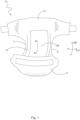
- Fig. 1 illustrates a diaper 10 suitable for use in combination with a functional core cover 100 according to the invention. It should be noted that the figure is included for illustrative purposes only and does not explicitly disclose features of the functional core cover 100 as such. Further, it should be noted that the use of the functional core cover 100 is not limited to diapers only, but that said functional core cover 100 may be used in other products as well, for example in hygiene towels, bandages, or wipes. However, in a diaper as illustrated, the machine direction MD of the functional core cover 100 is preferably oriented, such that it extends from a front side 11 to a reverse side 12 of the diaper 10. Consequently, the cross direction CD extends from a first leg opening 1 to a second leg opening 2.
- the leg openings 1,2 are open since the diaper 10 is open, i.e. the ears of the reverse side 12 are not fastened on the front side 11.
- the machine direction MD and the cross direction CD are included for reference, but refer to the functional core cover 100 only since other parts of the diaper 100 may comprise fabric of different types.
- the line A-B indicates a series of side views discussed in relation to Fig. 2 .
- the functional core cover 100 encapsulates an absorbent core (not shown explicitly) suitable for absorbing expelled liquid (not shown).
- the absorbent core is arranged in a bottom part 13 of the diaper 10, the bottom part 13 extending between the front side 11 and the reverse side 12.
- the absorbent core is substantially flat and flexible, such that it may adjust to the shape of the diaper and the movements and contours of the wearer.
- the functional core cover 100 may be arranged below a cushioning layer (not shown).
- the cushioning layer may be omitted by the functional core cover 100 in certain embodiments of the invention, whereby the diaper may be made lighter and more flexible.
- the functional core cover 100 may in itself function as a cushioning layer thus having a dual function.
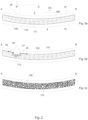
- Fig. 2 illustrates a series of side views of a diaper taken along the line A-B in Fig. 1 . References to A and B are included in Fig. 2 for illustrating the orientation of the side view.
- the invention relates to the functional core cover as such.
- a functional core cover according to the invention may be utilised in other absorbent products, especially products used in the health care industry or in hygiene.
- the series of side views illustrate the process of liquid absorption, and how a functional core cover according to the invention improves the utilisation of the absorbent core.
- the side views are taken from a diaper comprising a cushioning layer 14, but as it was mentioned above, the functional core cover itself may provide sufficient cushioning thereby removing the need for further layers.
- the cushioning layer 14 is oriented adjacent the skin 3 of the wearer.
- the functional core cover 100 is shown as a box covering/encapsulating the absorbent core 110.
- the absorbent core 110 is illustrated using a plurality of dots 111 for highlighting a preferred embodiment wherein the absorbent core 110 comprises granules of SAP.
- the absorbent core 110 may further comprise cellulosic fluff pulp (not shown) functioning as a carrier for the SAP and for providing further cushioning and absorbency.
- a droplet 20 is included for illustrating how liquid is wicked and absorbed by the functional core cover 100 and the absorbent core 110 in combination.
- a back sheet 15 shields the diaper from the environment 4.
- a droplet 20 is expelled onto the diaper.
- the displaced position P relative to an origin O of the absorbent core 110 illustrates a common situation in a diaper, wherein liquid is expelled either in the front or in the back by human physiology. Thus, this helps illustrating the obstacles in prior art.
- Fig. 2b the droplet 20 has been partly absorbed by the absorbent core 110. This is illustrated by enlarged dots (saturated SAP) 112 in the vicinity of the droplet 20. This resembles the situation and problems in prior art: the absorption occurs in the vicinity of the liquid expelling (the droplet 20), whereas a large portion of the absorbent core 110 remains dry. It is an aspect of the invention to provide means for wicking liquid towards the dry portions of the absorbent core 110 in order to utilise the full potential of said absorbent core 110, and especially the SAP.
- the situation shown in Fig. 2b merely represents an intermediate step, wherein the preliminary absorption occurs.
- liquid is partly absorbed by the absorbent core 110, especially by the SAP, whereas a remaining part of the liquid is absorbed by the functional core cover 100.
- the liquid is absorbed by any kind of medium, rather than overflowing the absorbent core 110, i.e. no liquid remains unabsorbed until SAP of the absorbent core 110 becomes active.
- the liquid absorbed by the functional core cover 100 is wicked away from the point of depletion 21, i.e. the local area where liquid is expelled.
- the wicking 22 is illustrated by a set of arrows pointing in opposite directions away from the point of depletion 21.
- the liquid wicked by the functional core cover 100 has been wicked towards all parts of the absorbent core 110.
- the absorbent core/SAP gradually absorbs liquid until it has been saturated. When saturated, liquid is wicked further away towards unsaturated SAP, and so on.
- the liquid initially absorbed by the functional core cover 100 is eventually absorbed by the absorbent core 110, such that said absorbent core 110 holds the majority of the liquid, but that the functional core cover 100 functions as an intermediate absorption medium.
- the absorbent core 110 has absorbed the entire droplet, despite said droplet being arranged in a displaced position P relative to an origin O of the absorbent core 110. In prior art, this would not be the case following a single expelling of liquid.
- Fig. 3 illustrates the process of making a functional core cover 100 according to the invention.
- Fig. 3a illustrates a side view of the process
- Fig. 3b illustrates a top view of the embodiment shown in Fig. 3a .
- At least one carding machine 50 is provided with the selected fibres, i.e. at least a fraction comprising lyocell fibres L.
- the carding machine 50 lays a fibrous web 51 comprising the fibres according to the invention on a conveyor belt 52, said conveyor belt 52 moving the fibrous web 51 into a hydroentanglement section 53.
- the direction of the conveyor belt 52 is indicated by the arrow 59.
- the hydroentanglement section 53 applies a plurality of water jets 54 onto the fibrous web 51, whereby the fibres within said fibrous web 51 are bonded/entangled.
- the end product of the process is a non-woven functional core cover 100 according to the invention which is bonded using hydroentanglement.
- a majority of the fibres are oriented primarily in the machine direction MD, i.e. the direction identical to the orientation of the conveyor belt 52 carrying the fibrous web 51 into the hydroentanglement section 53 and the direction in which the fibrous web flows into the hydroentanglement section 53.
- This resulting orientation of the fibres in the functional core cover 100 may be utilised in the implementation of said functional core cover 100 in a diaper as described above. More precisely, if the functional core cover 100 is oriented in the diaper such that the machine direction MD is parallel to the direction extending from a front side to a reverse side of said diaper, wicking is enhanced, since liquid wicks along the length of fibres more easily than across fibres. The combination of fibre densities and lengths may further ensure that a majority of the fibres become oriented in the same direction.
- the corresponding cross direction CD being perpendicular to the machine direction MD is included for reference.
- Fig. 4 illustrates the concept of wicking in a prior art core cover 90 ( Fig. 4a ) compared to wicking in a functional core cover 100 ( Fig. 4b ) according to the invention from a top view perspective.
- the machine direction MD and the cross direction CD have been included for reference.
- the rectangle illustrates a common shape of a prior art core cover 90 and a functional core cover 100 when used in an absorbent product, e.g. a diaper, where the shape ensures a broad coverage of the body.
- a liquid depletion 200 is shown to have its centre displaced from the centre of the rectangle, such that the need for enhanced wicking properties is highlighted.
- prior art 90 Fig.
- the liquid depletion is seen to form concentric circles 210, where the increase of the radii of the circles illustrates how the liquid is distributed in time.
- part of the liquid will reach the edge 91 of the rectangle (core cover) which illustrates a leakage situation.
- a large part of the rectangle i.e. core cover
- the wicking properties ensure that the liquid has a tendency to wick in the machine direction MD, i.e. the direction in which the fibres are oriented in the functional core cover 100.
- the functional core cover 100 provides a way to utilise the SAP present in the absorbent core (not shown) encapsulated/covered by the functional core cover to a greater extent than known from prior art.
- Fig. 4c illustrates a zoom Z of a part of the functional core cover 100 according to the invention.
- part of the fibres 101 constituting the functional core cover 100 are shown.
- the orientation of the fibres 101 is particularly illustrated: although being flexible, i.e. bending in the illustration, the main orientation of the fibres is identical to a majority of the fibres.
- This common orientation is preferably aligned with the machine direction MD of the fabric, but may in general be any direction and may thus for example be independent from the manufacturing technique.
- the orientation may be expressed in terms of the tensile strength of the fabric, where said tensile strength is greater in the machine direction MD (or any direction in which a majority of the fibres are oriented) than in the cross direction CD (the direction perpendicular to the direction in which a majority of the fibres are oriented).
Landscapes
- Health & Medical Sciences (AREA)
- Engineering & Computer Science (AREA)
- Life Sciences & Earth Sciences (AREA)
- Animal Behavior & Ethology (AREA)
- Veterinary Medicine (AREA)
- Public Health (AREA)
- Epidemiology (AREA)
- Biomedical Technology (AREA)
- Heart & Thoracic Surgery (AREA)
- Vascular Medicine (AREA)
- General Health & Medical Sciences (AREA)
- Textile Engineering (AREA)
- Chemical & Material Sciences (AREA)
- Chemical Kinetics & Catalysis (AREA)
- Mechanical Engineering (AREA)
- Manufacturing & Machinery (AREA)
- Absorbent Articles And Supports Therefor (AREA)
- Nonwoven Fabrics (AREA)
- Materials For Medical Uses (AREA)
- Multicomponent Fibers (AREA)
- Orthopedics, Nursing, And Contraception (AREA)
- Artificial Filaments (AREA)
Claims (11)
- Ein absorbierender Artikel, der eine ungewebte funktionelle Kernabdeckung umfasst, die einen absorbierenden Kern einkapselt, wobei jene funktionelle Kernabdeckung mindestens eine erste Fraktion umfasst, die Lyocell-Fasern umfasst, wo eine Mehrheit der Fasern, welche die funktionelle Kernabdeckung bilden, in die gleiche Richtung orientiert sind, dadurch gekennzeichnet, dass die Fasern in jener funktionellen Kernabdeckung durch Verflechtung miteinander verbunden sind.
- Ein absorbierender Artikel gemäß Anspruch 1, wobei jene funktionelle Kernabdeckung ferner eine zweite Fraktion umfasst, die Viskose-Rayon-Fasern umfasst.
- Ein absorbierender Artikel gemäß einem der vorhergehenden Ansprüche, wobei die ungewebte Kernabdeckung in einem Hydroverflechtungsverfahren hergestellt wird.
- Ein absorbierender Artikel gemäß einem der vorhergehenden Ansprüche, wobei ein Großteil der Fasern jener funktionellen Kernabdeckung in der Maschinenrichtung der funktionellen Kernabdeckung ausgerichtet sind, wobei die Maschinenrichtung die Richtung ist, in der ein Vorläufer der funktionellen Kernabdeckung in einen Hydroverflechtungungsabschnitt zur Verbindung im Hydroverflechtungsverfahren fließt.
- Ein absorbierender Artikel gemäß einem der vorhergehenden Ansprüche, wobei jene funktionelle Kernabdeckung flach, strukturiert oder mit Öffnungen versehen ist.
- Ein absorbierender Artikel gemäß einem der vorhergehenden Ansprüche, wobei jene funktionelle Kernabdeckung ferner eine dritte Fraktion umfasst, die Polypropylenfasern und/oder Polyesterfasern umfasst.
- Ein absorbierender Artikel gemäß einem der vorhergehenden Ansprüche, wobei das Basisgewicht jener funktionellen Kernabdeckung zwischen 15 g/m2 und 30 g/m2 liegt.
- Ein absorbierender Artikel gemäß einem der vorhergehenden Ansprüche, wobei die Dichte der Fasern der ungewebten funktionellen Kernabdeckung zwischen 1 dtex und 3,3 dtex liegt.
- Ein absorbierender Artikel gemäß einem der vorhergehenden Ansprüche, wobei die Faserlänge in der ungewebten funktionellen Kernabdeckung zwischen 20 mm und 60 mm beträgt, oder insbesondere zwischen 35 mm und 45 mm beträgt.
- Ein Verfahren zur Herstellung eines absorbierenden Artikels gemäß einem der vorhergehenden Ansprüche, dadurch gekennzeichnet, dass das Verfahren mindestens die Schritte von:- Herstellen einer funktionellen Kernabdeckung durch:- Auswählen einer Fraktion von Lyocell-Fasern,- Herstellen eines Faservlieses aus jenen ausgewählten Fasern, und- Bewegen jenes Faservlieses in einen Hydroverflechtungsabschnitt, wodurch die Fasern gegenseitig zu einem ungewebten Stoff verbunden werden und ein Großteil der Fasern in dieselbe Richtung ausgerichtet werden, und- Einkapseln eines absorbierenden Kerns mit jener funktionellen Kernabdeckung umfasst.
- Ein absorbierender Artikel gemäß einem der Ansprüche 1-9, wobei der absorbierende Artikel eine Windel ist, die einen absorbierenden Kern einkapselt, der von einer funktionellen Kernabdeckung bedeckt ist.
Applications Claiming Priority (2)
| Application Number | Priority Date | Filing Date | Title |
|---|---|---|---|
| DKPA201770824A DK201770824A1 (en) | 2017-11-03 | 2017-11-03 | Absorbent article component |
| PCT/IB2018/058609 WO2019087138A1 (en) | 2017-11-03 | 2018-11-02 | Absorbent article component |
Publications (2)
| Publication Number | Publication Date |
|---|---|
| EP3704292A1 EP3704292A1 (de) | 2020-09-09 |
| EP3704292B1 true EP3704292B1 (de) | 2023-03-22 |
Family
ID=64277745
Family Applications (1)
| Application Number | Title | Priority Date | Filing Date |
|---|---|---|---|
| EP18801051.6A Active EP3704292B1 (de) | 2017-11-03 | 2018-11-02 | Absorbierender artikelbestandteil |
Country Status (20)
| Country | Link |
|---|---|
| US (1) | US20200297554A1 (de) |
| EP (1) | EP3704292B1 (de) |
| JP (1) | JP7201697B2 (de) |
| KR (1) | KR20200084331A (de) |
| CN (1) | CN111344449B (de) |
| AU (1) | AU2018361980A1 (de) |
| BR (1) | BR112020008489B1 (de) |
| CA (1) | CA3080670A1 (de) |
| DK (1) | DK201770824A1 (de) |
| EA (1) | EA039896B1 (de) |
| ES (1) | ES2947410T3 (de) |
| FI (1) | FI3704292T3 (de) |
| IL (1) | IL274335B2 (de) |
| MX (1) | MX2020004520A (de) |
| MY (1) | MY202427A (de) |
| PH (1) | PH12020550543A1 (de) |
| SG (1) | SG11202003917YA (de) |
| UA (1) | UA126596C2 (de) |
| WO (1) | WO2019087138A1 (de) |
| ZA (1) | ZA202003100B (de) |
Families Citing this family (2)
| Publication number | Priority date | Publication date | Assignee | Title |
|---|---|---|---|---|
| US12270130B2 (en) * | 2020-11-10 | 2025-04-08 | Oceansafe Ag | Biodegradable yarn with an increased flame resistance and manufacturing method thereof |
| WO2023229889A1 (en) * | 2022-05-25 | 2023-11-30 | The Procter & Gamble Company | Absorbent articles with absorbent core structure perimeter seal arrangements |
Family Cites Families (13)
| Publication number | Priority date | Publication date | Assignee | Title |
|---|---|---|---|---|
| US6022818A (en) * | 1995-06-07 | 2000-02-08 | Kimberly-Clark Worldwide, Inc. | Hydroentangled nonwoven composites |
| US8268424B1 (en) * | 1996-12-13 | 2012-09-18 | Dsg International Limited | Highly absorbent composite compositions, absorbent sheets provided with the compositions, and process for producing the same |
| US7759540B2 (en) * | 2002-07-23 | 2010-07-20 | Paragon Trade Brands, Llc | Absorbent articles containing absorbent cores having zoned absorbency and methods of making same |
| PL1614790T3 (pl) * | 2004-07-09 | 2009-05-29 | Johnson & Johnson Gmbh | Produkt chłonny do higieny osobistej, mający zastosowanie kosmetyczne oraz/albo dermatologiczne, zawierający przynajmniej jeden arkusz absorbentu |
| US7562427B2 (en) * | 2005-07-25 | 2009-07-21 | Johnson & Johnson Consumer Companies, Inc. | Low-density, non-woven structures and methods of making the same |
| BRPI0520736B8 (pt) * | 2005-12-07 | 2021-06-22 | Essity Hygiene & Health Ab | material não-tecido para uso em produtos absorventes |
| AU2006341313B2 (en) * | 2006-03-30 | 2013-01-31 | Essity Hygiene And Health Aktiebolag | Hydroentangled nonwoven fabric, method of making it and absorbent article containing the fabric |
| US20080003908A1 (en) * | 2006-06-29 | 2008-01-03 | Hien Nguyen | Non-woven structures and methods of making the same |
| EP2113233A1 (de) * | 2008-04-29 | 2009-11-04 | The Procter and Gamble Company | Saugfähiges Absorbent mit dehnungsresistentem Innenteilüberzug |
| CN102014826A (zh) * | 2008-04-29 | 2011-04-13 | 宝洁公司 | 制造具有抗应变芯覆盖件的吸收芯的方法 |
| JP2014079566A (ja) * | 2012-09-30 | 2014-05-08 | Uni Charm Corp | 吸収性物品 |
| EP3038579B1 (de) * | 2013-08-27 | 2018-08-08 | The Procter and Gamble Company | Absorbierender gegenstand mit kanal |
| WO2015130263A1 (en) * | 2014-02-25 | 2015-09-03 | Kimberly-Clark Worldwide, Inc. | Product line of absorbent article |
-
2017
- 2017-11-03 DK DKPA201770824A patent/DK201770824A1/en not_active Application Discontinuation
-
2018
- 2018-11-02 ES ES18801051T patent/ES2947410T3/es active Active
- 2018-11-02 CA CA3080670A patent/CA3080670A1/en active Pending
- 2018-11-02 CN CN201880071514.2A patent/CN111344449B/zh active Active
- 2018-11-02 SG SG11202003917YA patent/SG11202003917YA/en unknown
- 2018-11-02 WO PCT/IB2018/058609 patent/WO2019087138A1/en not_active Ceased
- 2018-11-02 JP JP2020544695A patent/JP7201697B2/ja active Active
- 2018-11-02 FI FIEP18801051.6T patent/FI3704292T3/fi active
- 2018-11-02 MY MYPI2020002133A patent/MY202427A/en unknown
- 2018-11-02 AU AU2018361980A patent/AU2018361980A1/en not_active Abandoned
- 2018-11-02 MX MX2020004520A patent/MX2020004520A/es unknown
- 2018-11-02 BR BR112020008489-1A patent/BR112020008489B1/pt active IP Right Grant
- 2018-11-02 KR KR1020207014614A patent/KR20200084331A/ko not_active Ceased
- 2018-11-02 EA EA202091126A patent/EA039896B1/ru unknown
- 2018-11-02 US US16/760,968 patent/US20200297554A1/en not_active Abandoned
- 2018-11-02 EP EP18801051.6A patent/EP3704292B1/de active Active
- 2018-11-02 IL IL274335A patent/IL274335B2/en unknown
- 2018-11-02 UA UAA202003352A patent/UA126596C2/uk unknown
-
2020
- 2020-05-02 PH PH12020550543A patent/PH12020550543A1/en unknown
- 2020-05-26 ZA ZA2020/03100A patent/ZA202003100B/en unknown
Also Published As
| Publication number | Publication date |
|---|---|
| CN111344449A (zh) | 2020-06-26 |
| IL274335A (en) | 2020-06-30 |
| EA039896B1 (ru) | 2022-03-24 |
| UA126596C2 (uk) | 2022-11-02 |
| CA3080670A1 (en) | 2019-05-09 |
| MX2020004520A (es) | 2020-08-20 |
| US20200297554A1 (en) | 2020-09-24 |
| EA202091126A1 (ru) | 2020-09-02 |
| KR20200084331A (ko) | 2020-07-10 |
| ZA202003100B (en) | 2022-10-26 |
| MY202427A (en) | 2024-04-29 |
| EP3704292A1 (de) | 2020-09-09 |
| AU2018361980A1 (en) | 2020-05-21 |
| NZ764079A (en) | 2025-08-29 |
| IL274335B2 (en) | 2023-10-01 |
| IL274335B1 (en) | 2023-06-01 |
| BR112020008489B1 (pt) | 2023-12-26 |
| SG11202003917YA (en) | 2020-05-28 |
| JP2021501671A (ja) | 2021-01-21 |
| JP7201697B2 (ja) | 2023-01-10 |
| ES2947410T3 (es) | 2023-08-08 |
| PH12020550543A1 (en) | 2021-03-22 |
| WO2019087138A1 (en) | 2019-05-09 |
| BR112020008489A2 (pt) | 2020-10-20 |
| DK201770824A1 (en) | 2019-05-08 |
| FI3704292T3 (fi) | 2023-06-07 |
| CN111344449B (zh) | 2023-02-17 |
Similar Documents
| Publication | Publication Date | Title |
|---|---|---|
| EP2901992B1 (de) | Mehrschichtiges absorbierendes material | |
| EP2152217B1 (de) | Vlies zur verwendung als dem körper zugewendetes flächenstück in einem saugfähigen artikel | |
| EP3434239B1 (de) | Saugfähiger artikel | |
| KR20060053181A (ko) | 흡수성 물품 | |
| DE202011111006U1 (de) | Absorbierende Struktur | |
| WO2006076281A1 (en) | Sealed core for an absorbent article | |
| JPH09117470A (ja) | 吸収性物品 | |
| KR102148222B1 (ko) | 흡수 용품을 위한 단일 유체 흡입 시스템 및 그 제조 방법 | |
| JP5963987B1 (ja) | 吸収性物品 | |
| JP6611651B2 (ja) | 不織布、および吸収性物品用不織布 | |
| EP2901993B1 (de) | Gewellte Struktur für einen saugfähigen Artikel | |
| KR101143174B1 (ko) | 음순간 패드 | |
| US20200297554A1 (en) | Absorbent article component | |
| JP4570153B2 (ja) | 吸収体の製造方法 | |
| JP2023110380A (ja) | 吸収性物品用不織布およびその製造方法、ならびに吸収性物品 | |
| JP2005312601A (ja) | 吸収性物品 | |
| CN221950086U (zh) | 吸收用品 | |
| JP6668029B2 (ja) | 吸収性物品 | |
| WO2020145308A1 (ja) | 開孔不織布及びその製造方法 | |
| JP7097270B2 (ja) | 吸収性シート、吸収性物品及び吸収性シートの製造方法 |
Legal Events
| Date | Code | Title | Description |
|---|---|---|---|
| STAA | Information on the status of an ep patent application or granted ep patent |
Free format text: STATUS: UNKNOWN |
|
| STAA | Information on the status of an ep patent application or granted ep patent |
Free format text: STATUS: THE INTERNATIONAL PUBLICATION HAS BEEN MADE |
|
| PUAI | Public reference made under article 153(3) epc to a published international application that has entered the european phase |
Free format text: ORIGINAL CODE: 0009012 |
|
| STAA | Information on the status of an ep patent application or granted ep patent |
Free format text: STATUS: REQUEST FOR EXAMINATION WAS MADE |
|
| 17P | Request for examination filed |
Effective date: 20200514 |
|
| AK | Designated contracting states |
Kind code of ref document: A1 Designated state(s): AL AT BE BG CH CY CZ DE DK EE ES FI FR GB GR HR HU IE IS IT LI LT LU LV MC MK MT NL NO PL PT RO RS SE SI SK SM TR |
|
| AX | Request for extension of the european patent |
Extension state: BA ME |
|
| DAV | Request for validation of the european patent (deleted) | ||
| STAA | Information on the status of an ep patent application or granted ep patent |
Free format text: STATUS: EXAMINATION IS IN PROGRESS |
|
| 17Q | First examination report despatched |
Effective date: 20210531 |
|
| GRAP | Despatch of communication of intention to grant a patent |
Free format text: ORIGINAL CODE: EPIDOSNIGR1 |
|
| STAA | Information on the status of an ep patent application or granted ep patent |
Free format text: STATUS: GRANT OF PATENT IS INTENDED |
|
| INTG | Intention to grant announced |
Effective date: 20221006 |
|
| GRAS | Grant fee paid |
Free format text: ORIGINAL CODE: EPIDOSNIGR3 |
|
| GRAA | (expected) grant |
Free format text: ORIGINAL CODE: 0009210 |
|
| STAA | Information on the status of an ep patent application or granted ep patent |
Free format text: STATUS: THE PATENT HAS BEEN GRANTED |
|
| AK | Designated contracting states |
Kind code of ref document: B1 Designated state(s): AL AT BE BG CH CY CZ DE DK EE ES FI FR GB GR HR HU IE IS IT LI LT LU LV MC MK MT NL NO PL PT RO RS SE SI SK SM TR |
|
| REG | Reference to a national code |
Ref country code: GB Ref legal event code: FG4D |
|
| REG | Reference to a national code |
Ref country code: CH Ref legal event code: EP |
|
| REG | Reference to a national code |
Ref country code: DE Ref legal event code: R096 Ref document number: 602018047530 Country of ref document: DE |
|
| REG | Reference to a national code |
Ref country code: IE Ref legal event code: FG4D |
|
| REG | Reference to a national code |
Ref country code: AT Ref legal event code: REF Ref document number: 1555343 Country of ref document: AT Kind code of ref document: T Effective date: 20230415 |
|
| RAP4 | Party data changed (patent owner data changed or rights of a patent transferred) |
Owner name: GLATFELTER HOLDING (SWITZERLAND) AG |
|
| REG | Reference to a national code |
Ref country code: DE Ref legal event code: R081 Ref document number: 602018047530 Country of ref document: DE Owner name: GLATFELTER HOLDING (SWITZERLAND) AG, CH Free format text: FORMER OWNER: JACOB HOLM & SONS AG, BASEL, CH |
|
| REG | Reference to a national code |
Ref country code: FI Ref legal event code: FGE |
|
| REG | Reference to a national code |
Ref country code: NL Ref legal event code: HC Owner name: GLATFELTER HOLDING (SWITZERLAND) AG; CH Free format text: DETAILS ASSIGNMENT: CHANGE OF OWNER(S), CHANGE OF OWNER(S) NAME; FORMER OWNER NAME: JACOB HOLM & SONS AG Effective date: 20230608 Ref country code: NL Ref legal event code: FP |
|
| REG | Reference to a national code |
Ref country code: SE Ref legal event code: TRGR |
|
| REG | Reference to a national code |
Ref country code: LT Ref legal event code: MG9D |
|
| P01 | Opt-out of the competence of the unified patent court (upc) registered |
Effective date: 20230528 |
|
| PG25 | Lapsed in a contracting state [announced via postgrant information from national office to epo] |
Ref country code: RS Free format text: LAPSE BECAUSE OF FAILURE TO SUBMIT A TRANSLATION OF THE DESCRIPTION OR TO PAY THE FEE WITHIN THE PRESCRIBED TIME-LIMIT Effective date: 20230322 Ref country code: NO Free format text: LAPSE BECAUSE OF FAILURE TO SUBMIT A TRANSLATION OF THE DESCRIPTION OR TO PAY THE FEE WITHIN THE PRESCRIBED TIME-LIMIT Effective date: 20230622 Ref country code: LV Free format text: LAPSE BECAUSE OF FAILURE TO SUBMIT A TRANSLATION OF THE DESCRIPTION OR TO PAY THE FEE WITHIN THE PRESCRIBED TIME-LIMIT Effective date: 20230322 Ref country code: LT Free format text: LAPSE BECAUSE OF FAILURE TO SUBMIT A TRANSLATION OF THE DESCRIPTION OR TO PAY THE FEE WITHIN THE PRESCRIBED TIME-LIMIT Effective date: 20230322 Ref country code: HR Free format text: LAPSE BECAUSE OF FAILURE TO SUBMIT A TRANSLATION OF THE DESCRIPTION OR TO PAY THE FEE WITHIN THE PRESCRIBED TIME-LIMIT Effective date: 20230322 |
|
| REG | Reference to a national code |
Ref country code: ES Ref legal event code: FG2A Ref document number: 2947410 Country of ref document: ES Kind code of ref document: T3 Effective date: 20230808 |
|
| REG | Reference to a national code |
Ref country code: AT Ref legal event code: MK05 Ref document number: 1555343 Country of ref document: AT Kind code of ref document: T Effective date: 20230322 |
|
| REG | Reference to a national code |
Ref country code: BE Ref legal event code: HC Owner name: GLATFELTER HOLDING (SWITZERLAND) AG; CH Free format text: DETAILS ASSIGNMENT: CHANGE OF OWNER(S), CHANGE OF OWNER(S) NAME; FORMER OWNER NAME: JACOB HOLM & SONS AG Effective date: 20230627 |
|
| PG25 | Lapsed in a contracting state [announced via postgrant information from national office to epo] |
Ref country code: GR Free format text: LAPSE BECAUSE OF FAILURE TO SUBMIT A TRANSLATION OF THE DESCRIPTION OR TO PAY THE FEE WITHIN THE PRESCRIBED TIME-LIMIT Effective date: 20230623 |
|
| REG | Reference to a national code |
Ref country code: BE Ref legal event code: HC Owner name: GLATFELTER HOLDING (SWITZERLAND) AG; CH Free format text: DETAILS ASSIGNMENT: CHANGE OF OWNER(S), CHANGE OF OWNER(S) NAME; FORMER OWNER NAME: JACOB HOLM & SONS AG Effective date: 20230627 |
|
| PG25 | Lapsed in a contracting state [announced via postgrant information from national office to epo] |
Ref country code: SM Free format text: LAPSE BECAUSE OF FAILURE TO SUBMIT A TRANSLATION OF THE DESCRIPTION OR TO PAY THE FEE WITHIN THE PRESCRIBED TIME-LIMIT Effective date: 20230322 Ref country code: RO Free format text: LAPSE BECAUSE OF FAILURE TO SUBMIT A TRANSLATION OF THE DESCRIPTION OR TO PAY THE FEE WITHIN THE PRESCRIBED TIME-LIMIT Effective date: 20230322 Ref country code: PT Free format text: LAPSE BECAUSE OF FAILURE TO SUBMIT A TRANSLATION OF THE DESCRIPTION OR TO PAY THE FEE WITHIN THE PRESCRIBED TIME-LIMIT Effective date: 20230724 Ref country code: EE Free format text: LAPSE BECAUSE OF FAILURE TO SUBMIT A TRANSLATION OF THE DESCRIPTION OR TO PAY THE FEE WITHIN THE PRESCRIBED TIME-LIMIT Effective date: 20230322 Ref country code: AT Free format text: LAPSE BECAUSE OF FAILURE TO SUBMIT A TRANSLATION OF THE DESCRIPTION OR TO PAY THE FEE WITHIN THE PRESCRIBED TIME-LIMIT Effective date: 20230322 |
|
| PG25 | Lapsed in a contracting state [announced via postgrant information from national office to epo] |
Ref country code: SK Free format text: LAPSE BECAUSE OF FAILURE TO SUBMIT A TRANSLATION OF THE DESCRIPTION OR TO PAY THE FEE WITHIN THE PRESCRIBED TIME-LIMIT Effective date: 20230322 Ref country code: PL Free format text: LAPSE BECAUSE OF FAILURE TO SUBMIT A TRANSLATION OF THE DESCRIPTION OR TO PAY THE FEE WITHIN THE PRESCRIBED TIME-LIMIT Effective date: 20230322 Ref country code: IS Free format text: LAPSE BECAUSE OF FAILURE TO SUBMIT A TRANSLATION OF THE DESCRIPTION OR TO PAY THE FEE WITHIN THE PRESCRIBED TIME-LIMIT Effective date: 20230722 |
|
| REG | Reference to a national code |
Ref country code: DE Ref legal event code: R097 Ref document number: 602018047530 Country of ref document: DE |
|
| PLBE | No opposition filed within time limit |
Free format text: ORIGINAL CODE: 0009261 |
|
| STAA | Information on the status of an ep patent application or granted ep patent |
Free format text: STATUS: NO OPPOSITION FILED WITHIN TIME LIMIT |
|
| PG25 | Lapsed in a contracting state [announced via postgrant information from national office to epo] |
Ref country code: SI Free format text: LAPSE BECAUSE OF FAILURE TO SUBMIT A TRANSLATION OF THE DESCRIPTION OR TO PAY THE FEE WITHIN THE PRESCRIBED TIME-LIMIT Effective date: 20230322 Ref country code: DK Free format text: LAPSE BECAUSE OF FAILURE TO SUBMIT A TRANSLATION OF THE DESCRIPTION OR TO PAY THE FEE WITHIN THE PRESCRIBED TIME-LIMIT Effective date: 20230322 Ref country code: CZ Free format text: LAPSE BECAUSE OF FAILURE TO SUBMIT A TRANSLATION OF THE DESCRIPTION OR TO PAY THE FEE WITHIN THE PRESCRIBED TIME-LIMIT Effective date: 20230322 |
|
| 26N | No opposition filed |
Effective date: 20240102 |
|
| REG | Reference to a national code |
Ref country code: CH Ref legal event code: PL |
|
| PG25 | Lapsed in a contracting state [announced via postgrant information from national office to epo] |
Ref country code: MC Free format text: LAPSE BECAUSE OF FAILURE TO SUBMIT A TRANSLATION OF THE DESCRIPTION OR TO PAY THE FEE WITHIN THE PRESCRIBED TIME-LIMIT Effective date: 20230322 |
|
| PG25 | Lapsed in a contracting state [announced via postgrant information from national office to epo] |
Ref country code: CH Free format text: LAPSE BECAUSE OF NON-PAYMENT OF DUE FEES Effective date: 20231130 |
|
| PG25 | Lapsed in a contracting state [announced via postgrant information from national office to epo] |
Ref country code: MC Free format text: LAPSE BECAUSE OF FAILURE TO SUBMIT A TRANSLATION OF THE DESCRIPTION OR TO PAY THE FEE WITHIN THE PRESCRIBED TIME-LIMIT Effective date: 20230322 Ref country code: CH Free format text: LAPSE BECAUSE OF NON-PAYMENT OF DUE FEES Effective date: 20231130 |
|
| REG | Reference to a national code |
Ref country code: IE Ref legal event code: MM4A |
|
| PG25 | Lapsed in a contracting state [announced via postgrant information from national office to epo] |
Ref country code: IE Free format text: LAPSE BECAUSE OF NON-PAYMENT OF DUE FEES Effective date: 20231102 |
|
| PG25 | Lapsed in a contracting state [announced via postgrant information from national office to epo] |
Ref country code: IE Free format text: LAPSE BECAUSE OF NON-PAYMENT OF DUE FEES Effective date: 20231102 |
|
| PG25 | Lapsed in a contracting state [announced via postgrant information from national office to epo] |
Ref country code: BG Free format text: LAPSE BECAUSE OF FAILURE TO SUBMIT A TRANSLATION OF THE DESCRIPTION OR TO PAY THE FEE WITHIN THE PRESCRIBED TIME-LIMIT Effective date: 20230322 |
|
| PG25 | Lapsed in a contracting state [announced via postgrant information from national office to epo] |
Ref country code: BG Free format text: LAPSE BECAUSE OF FAILURE TO SUBMIT A TRANSLATION OF THE DESCRIPTION OR TO PAY THE FEE WITHIN THE PRESCRIBED TIME-LIMIT Effective date: 20230322 |
|
| PG25 | Lapsed in a contracting state [announced via postgrant information from national office to epo] |
Ref country code: CY Free format text: LAPSE BECAUSE OF FAILURE TO SUBMIT A TRANSLATION OF THE DESCRIPTION OR TO PAY THE FEE WITHIN THE PRESCRIBED TIME-LIMIT; INVALID AB INITIO Effective date: 20181102 |
|
| PG25 | Lapsed in a contracting state [announced via postgrant information from national office to epo] |
Ref country code: HU Free format text: LAPSE BECAUSE OF FAILURE TO SUBMIT A TRANSLATION OF THE DESCRIPTION OR TO PAY THE FEE WITHIN THE PRESCRIBED TIME-LIMIT; INVALID AB INITIO Effective date: 20181102 |
|
| PG25 | Lapsed in a contracting state [announced via postgrant information from national office to epo] |
Ref country code: TR Free format text: LAPSE BECAUSE OF FAILURE TO SUBMIT A TRANSLATION OF THE DESCRIPTION OR TO PAY THE FEE WITHIN THE PRESCRIBED TIME-LIMIT Effective date: 20230322 |
|
| PGFP | Annual fee paid to national office [announced via postgrant information from national office to epo] |
Ref country code: NL Payment date: 20251118 Year of fee payment: 8 Ref country code: LU Payment date: 20251118 Year of fee payment: 8 |
|
| PGFP | Annual fee paid to national office [announced via postgrant information from national office to epo] |
Ref country code: DE Payment date: 20251118 Year of fee payment: 8 |
|
| PGFP | Annual fee paid to national office [announced via postgrant information from national office to epo] |
Ref country code: GB Payment date: 20251027 Year of fee payment: 8 |
|
| PGFP | Annual fee paid to national office [announced via postgrant information from national office to epo] |
Ref country code: IT Payment date: 20251121 Year of fee payment: 8 Ref country code: FI Payment date: 20251118 Year of fee payment: 8 |
|
| PGFP | Annual fee paid to national office [announced via postgrant information from national office to epo] |
Ref country code: FR Payment date: 20251104 Year of fee payment: 8 |
|
| PGFP | Annual fee paid to national office [announced via postgrant information from national office to epo] |
Ref country code: BE Payment date: 20251118 Year of fee payment: 8 |
|
| PGFP | Annual fee paid to national office [announced via postgrant information from national office to epo] |
Ref country code: SE Payment date: 20251106 Year of fee payment: 8 |
|
| PGFP | Annual fee paid to national office [announced via postgrant information from national office to epo] |
Ref country code: ES Payment date: 20251201 Year of fee payment: 8 |