EP3702738A1 - Method for increasing the position measurement accuracy using inductive position sensor - Google Patents
Method for increasing the position measurement accuracy using inductive position sensor Download PDFInfo
- Publication number
- EP3702738A1 EP3702738A1 EP20159859.6A EP20159859A EP3702738A1 EP 3702738 A1 EP3702738 A1 EP 3702738A1 EP 20159859 A EP20159859 A EP 20159859A EP 3702738 A1 EP3702738 A1 EP 3702738A1
- Authority
- EP
- European Patent Office
- Prior art keywords
- periods
- sensor
- coil
- target
- coils
- Prior art date
- Legal status (The legal status is an assumption and is not a legal conclusion. Google has not performed a legal analysis and makes no representation as to the accuracy of the status listed.)
- Granted
Links
Images




Classifications
-
- G—PHYSICS
- G01—MEASURING; TESTING
- G01D—MEASURING NOT SPECIALLY ADAPTED FOR A SPECIFIC VARIABLE; ARRANGEMENTS FOR MEASURING TWO OR MORE VARIABLES NOT COVERED IN A SINGLE OTHER SUBCLASS; TARIFF METERING APPARATUS; MEASURING OR TESTING NOT OTHERWISE PROVIDED FOR
- G01D5/00—Mechanical means for transferring the output of a sensing member; Means for converting the output of a sensing member to another variable where the form or nature of the sensing member does not constrain the means for converting; Transducers not specially adapted for a specific variable
- G01D5/12—Mechanical means for transferring the output of a sensing member; Means for converting the output of a sensing member to another variable where the form or nature of the sensing member does not constrain the means for converting; Transducers not specially adapted for a specific variable using electric or magnetic means
- G01D5/14—Mechanical means for transferring the output of a sensing member; Means for converting the output of a sensing member to another variable where the form or nature of the sensing member does not constrain the means for converting; Transducers not specially adapted for a specific variable using electric or magnetic means influencing the magnitude of a current or voltage
- G01D5/20—Mechanical means for transferring the output of a sensing member; Means for converting the output of a sensing member to another variable where the form or nature of the sensing member does not constrain the means for converting; Transducers not specially adapted for a specific variable using electric or magnetic means influencing the magnitude of a current or voltage by varying inductance, e.g. by a movable armature
- G01D5/204—Mechanical means for transferring the output of a sensing member; Means for converting the output of a sensing member to another variable where the form or nature of the sensing member does not constrain the means for converting; Transducers not specially adapted for a specific variable using electric or magnetic means influencing the magnitude of a current or voltage by varying inductance, e.g. by a movable armature by influencing the mutual induction between two or more coils
- G01D5/2053—Mechanical means for transferring the output of a sensing member; Means for converting the output of a sensing member to another variable where the form or nature of the sensing member does not constrain the means for converting; Transducers not specially adapted for a specific variable using electric or magnetic means influencing the magnitude of a current or voltage by varying inductance, e.g. by a movable armature by influencing the mutual induction between two or more coils by a movable non-ferromagnetic conductive element
-
- G—PHYSICS
- G01—MEASURING; TESTING
- G01B—MEASURING LENGTH, THICKNESS OR SIMILAR LINEAR DIMENSIONS; MEASURING ANGLES; MEASURING AREAS; MEASURING IRREGULARITIES OF SURFACES OR CONTOURS
- G01B7/00—Measuring arrangements characterised by the use of electric or magnetic techniques
- G01B7/003—Measuring arrangements characterised by the use of electric or magnetic techniques for measuring position, not involving coordinate determination
-
- G—PHYSICS
- G01—MEASURING; TESTING
- G01D—MEASURING NOT SPECIALLY ADAPTED FOR A SPECIFIC VARIABLE; ARRANGEMENTS FOR MEASURING TWO OR MORE VARIABLES NOT COVERED IN A SINGLE OTHER SUBCLASS; TARIFF METERING APPARATUS; MEASURING OR TESTING NOT OTHERWISE PROVIDED FOR
- G01D5/00—Mechanical means for transferring the output of a sensing member; Means for converting the output of a sensing member to another variable where the form or nature of the sensing member does not constrain the means for converting; Transducers not specially adapted for a specific variable
- G01D5/12—Mechanical means for transferring the output of a sensing member; Means for converting the output of a sensing member to another variable where the form or nature of the sensing member does not constrain the means for converting; Transducers not specially adapted for a specific variable using electric or magnetic means
- G01D5/14—Mechanical means for transferring the output of a sensing member; Means for converting the output of a sensing member to another variable where the form or nature of the sensing member does not constrain the means for converting; Transducers not specially adapted for a specific variable using electric or magnetic means influencing the magnitude of a current or voltage
- G01D5/20—Mechanical means for transferring the output of a sensing member; Means for converting the output of a sensing member to another variable where the form or nature of the sensing member does not constrain the means for converting; Transducers not specially adapted for a specific variable using electric or magnetic means influencing the magnitude of a current or voltage by varying inductance, e.g. by a movable armature
- G01D5/22—Mechanical means for transferring the output of a sensing member; Means for converting the output of a sensing member to another variable where the form or nature of the sensing member does not constrain the means for converting; Transducers not specially adapted for a specific variable using electric or magnetic means influencing the magnitude of a current or voltage by varying inductance, e.g. by a movable armature differentially influencing two coils
- G01D5/225—Mechanical means for transferring the output of a sensing member; Means for converting the output of a sensing member to another variable where the form or nature of the sensing member does not constrain the means for converting; Transducers not specially adapted for a specific variable using electric or magnetic means influencing the magnitude of a current or voltage by varying inductance, e.g. by a movable armature differentially influencing two coils by influencing the mutual induction between the two coils
- G01D5/2258—Mechanical means for transferring the output of a sensing member; Means for converting the output of a sensing member to another variable where the form or nature of the sensing member does not constrain the means for converting; Transducers not specially adapted for a specific variable using electric or magnetic means influencing the magnitude of a current or voltage by varying inductance, e.g. by a movable armature differentially influencing two coils by influencing the mutual induction between the two coils by a movable ferromagnetic element, e.g. core
-
- G—PHYSICS
- G01—MEASURING; TESTING
- G01D—MEASURING NOT SPECIALLY ADAPTED FOR A SPECIFIC VARIABLE; ARRANGEMENTS FOR MEASURING TWO OR MORE VARIABLES NOT COVERED IN A SINGLE OTHER SUBCLASS; TARIFF METERING APPARATUS; MEASURING OR TESTING NOT OTHERWISE PROVIDED FOR
- G01D5/00—Mechanical means for transferring the output of a sensing member; Means for converting the output of a sensing member to another variable where the form or nature of the sensing member does not constrain the means for converting; Transducers not specially adapted for a specific variable
- G01D5/12—Mechanical means for transferring the output of a sensing member; Means for converting the output of a sensing member to another variable where the form or nature of the sensing member does not constrain the means for converting; Transducers not specially adapted for a specific variable using electric or magnetic means
- G01D5/244—Mechanical means for transferring the output of a sensing member; Means for converting the output of a sensing member to another variable where the form or nature of the sensing member does not constrain the means for converting; Transducers not specially adapted for a specific variable using electric or magnetic means influencing characteristics of pulses or pulse trains; generating pulses or pulse trains
- G01D5/245—Mechanical means for transferring the output of a sensing member; Means for converting the output of a sensing member to another variable where the form or nature of the sensing member does not constrain the means for converting; Transducers not specially adapted for a specific variable using electric or magnetic means influencing characteristics of pulses or pulse trains; generating pulses or pulse trains using a variable number of pulses in a train
- G01D5/2451—Incremental encoders
- G01D5/2452—Incremental encoders incorporating two or more tracks having an (n, n+1, ...) relationship
-
- G—PHYSICS
- G01—MEASURING; TESTING
- G01R—MEASURING ELECTRIC VARIABLES; MEASURING MAGNETIC VARIABLES
- G01R33/00—Arrangements or instruments for measuring magnetic variables
- G01R33/20—Arrangements or instruments for measuring magnetic variables involving magnetic resonance
- G01R33/28—Details of apparatus provided for in groups G01R33/44 - G01R33/64
- G01R33/38—Systems for generation, homogenisation or stabilisation of the main or gradient magnetic field
- G01R33/385—Systems for generation, homogenisation or stabilisation of the main or gradient magnetic field using gradient magnetic field coils
Definitions
- Embodiments of the present invention are related to position sensors and, in particular, to improvements on position sensors.
- Position sensors are used in various settings for measuring the position of one component with respect to another.
- Inductive position sensors can be used in automotive, industrial and consumer applications for absolute rotary and linear motion sensing.
- a transmit coil is used to induce eddy currents in a metallic target that is sliding or rotating above a set of receiver coils.
- Receiver coils receive the magnetic field generated from eddy currents and the transmit coils and provide signals to a processor.
- the processor uses the signals from the receiver coils to determine the position of the metallic target above the set of coils.
- the processor, transmitter, and receiver coils may all be formed on a printed circuit board (PCB).
- PCB printed circuit board
- maintaining accuracy of the position sensor may be difficult over a longer distance measurement (e.g. 124mm vs 19mm distances).
- the position sensor can include a first sensor coil having a first number of periods over a range of motion of a target; and a second sensor coil having a second number of periods over the range, wherein the first number of periods is different from the second number of periods, and wherein the first sensor coil and the second sensor coil are arranged with respect to one another such that the target engages both of them simultaneously.
- the first number of periods is one and the second number of periods is greater than one.
- the first number of periods is greater than one and the second number of periods is greater than the first number of periods.
- a method of determining a position with a position sensor includes determining a first value from a first sensor having a first number of periods over a range of motion of a target; determining a second value from a second sensor coil having a second number of periods over the range; and calculating a position value from the first value and the second value.
- Embodiments of the present invention provide for accuracy over a long-range position sensing situation by using multiple sets of sensor coils having different periods. In that fashion, the multiple sets of sensor coils provide multiple measurements of the position of the target, which can be processed to provide an accurate measurement of the position of the target.
- Figures 1A and 1B illustrate operation of a typical positioning system 100. Although Figures 1A and 1B illustrate operation of a linear position sensor, rotational position sensors are operationally the same.
- the positioning system includes transmit/receive control circuit 102 that is coupled to drive a transmitter coil 106 and receive signals from receive coils 104.
- receive coils 104 are located within transmitter coil 106, however in Figure 1A they are illustrated separately for clarification purposes.
- Receive coils 104 are generally physically located within the border of transmit coil 106.
- Embodiments of the present invention can include a transmitter coil 106, two receiver coils 104, and an integrated circuit (IC) 102 driving the transmitter coil 106 and measuring the signals originated in the receiver coils 104 all formed on a printed circuit board (PCB).
- IC integrated circuit
- Figure 1B illustrates a configuration of transmit coils 106 and receive coils 104 in a linear position locating system.
- a conductive metallic target 124 can be positioned over the transmitter coil 106 and the two receiver coils 104.
- transmit coil 106 is driven to form magnetic field 108.
- Transmit coil 106 can be driven at a range of frequencies or at particular frequencies.
- magnetic field 108 with the positive current illustrated by the arrows, is circular around each wire and in a direction that points out of the page inside coil 106 and into the page outside of coil 108 with the current direction as illustrated in Figure 1A .
- Receive coils 104 are located inside coil 106, as is illustrated in Figure 1B .
- Transmit coil 106 is driven at any frequency that can produce electromagnetic field 108 to induce voltages in receiver coils 104. In general, there can be any number of receiver coils, however, for ease of discussion, a system with two receiver coils is discussed below.
- FIG. 1B illustrates the arrangement of sensor receive coils (RX) 104 within transmit coil (TX) 106 for a linear position sensor.
- sensor receive coils 104 includes a sine-wave oriented coil RXSIN 112 and a cosine-oriented signal coil RXCOS 110.
- Sine-wave oriented coil RXSIN 112 includes sine loops 114, 116, and 118 where coil 112 is wound in in-phase or anti-phase directions, here depicted as clockwise or counter clockwise depictions, to result in the production of voltages in the loop of opposite sign as a result of the presence of electro-magnetic field 108.
- cosine-oriented coil 110 may include a first loop 120 with a clockwise orientation and a second loop 122 with a counterclockwise orientation.
- Figure 1B illustrates a possible electromotive force reference direction, as indicated by the arrows, that is consistent with the magnetic fields produced by transmitter coil 106 as illustrated in Figure 1A .
- the transmitter coil (TX) 106 is stimulated by the circuit 102, which may be an integrated circuit, to generate a variable Electromagnetic field (EMF), illustrated as magnetic field 108.
- the magnetic field 108 couples with the receiver coils (RX) 104. If a conductive metallic target 124 is placed on the top of the receiver coils 104 as illustrated in Figure 1B , an eddy current is generated in the metallic target 124. This eddy current generates a new electromagnetic field that is ideally equal and opposite of field 108, canceling the field in receiver coils 104 directly under metallic target 124.
- the receiver coils (RX) 104 capture the variable EMF field 108 generated by the transmit coils 106 and those induced by metallic target 124, resulting in sinusoidal voltages generated at the terminals of receiver coils 104.
- the RX coils 104 are designed in a way that a sine voltage is created at the terminals of one RX coil (RxSin 112) and a cosine voltage is created at the terminals of the other RX coil (RxCos 110) as metallic target 124 is swept across receiver coils 104.
- the position of the target with respect to the RX coils 104 modulates the amplitude and the phase of the voltage at the terminals of the RX coils 104.
- transmitter coil 106, receive coils 104, and transmit/receive circuit 102 can be mounted on a single PCB. Further, the PCB can be positioned such that metallic target 124 is positioned above receive coils 104 and spaced from receive coils 104 by an air gap (AG). The position of metallic target 124 relative to the PCB on which receive coils 104 and transmitter coil 106 is mounted can be determined by processing the signals generated by sine-oriented coil 112 and cosine-oriented coil 110. Below, the determination of the position of metallic target 124 with respect to receive coils 104 is described in a theoretical ideal condition.
- metallic target 124 is located at a first location.
- Figures 1B depicts operation of a linear position locator system. The principle of operation is the same in both linear and circular locators.
- the position is given in relation to the construction of cosine-oriented coil 110 and sine-oriented coil 112 by providing the angular relations with respect to the sine operation of sine-oriented coil 112 which results from the position of the leading edge of metallic target 124 and coils 110 and 112.
- the actual position of metallic target 124 in such a system can be derived from the angular position as measured by the output voltages of receive coils 104 and the topology of receive coils 110 and 112.
- the topology of coil 110 and the topology of coil 112 are coordinated to provide indication of the location of metallic target 124 relative to the receive coils 104.
- Figure 1B illustrates a one-period receiver coil 104.
- the accuracy of this arrangement can be improved by the addition of a second receiver coil having multiple periods along the traveling distance of target 124.
- Embodiments of the present invention can achieve higher accuracy on long-range measurements using similar technologies. Some embodiments are directed towards achieving high accuracy on long range measurements using the same silicon devices that applies for short ranges. For example, getting the same accuracy over 124 mm of travel as can be achieved over a 19 mm range. Applications are currently using long measurement ranges and better accuracy than the short-range measurement ranges are capable of producing. The accuracy of long range measurement positions sensors according to some embodiments are increased by a factor of M over the short-range single period systems currently available.
- some embodiments of the present invention implement sensors with a double scale provided on the printed circuit board (PCB).
- One scale can be for raw positioning while one scale is for fine positioning.
- An algorithm for analyzing the position sensor signals from both sensors provides an accurate position of the target.
- Embodiments of the present invention can be formed with existing technologies.
- the silicon device ZMID520x made by Integrated Device Technologies can be used.
- Such a device has a performance of about 0.2% accuracy.
- accuracy performance is sensor shape dependent.
- a linear geometry is discussed below. A linear geometry does not have the best accuracy in comparison of other geometries however it may have a larger market potential for a linear long-stroke position sensor.
- Some embodiments use two algorithms: a) a Pseudo Vernier (Double scale: one for raw positioning and one for fine positioning); and b) A Vernier algorithm.
- Some embodiments employ the use of at least two sets of sensor coils working in parallel (i.e. simultaneously), each one having a different period with respect to the full travel of the target over the sensor coils.
- two sensor coil geometries are used (each sensor geometry, for example, including a sine and a cosine coil) where a first sensor coil geometry includes a one-period geometry and the second sensor coil geometry includes a multiperiod geometry.
- both sensor geometries are multi-period geometries that include different periods, e.g. a first board having a sensor coils of N1 periods and a second board having sensor coils of N2 periods. In either example, both sensor geometries have the same travel range and the same target characteristics. These two examples are discussed further below.
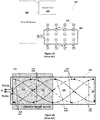
- Figures 2A and 2B illustrate relative relationships of sensor coils according to some embodiments of the present invention.
- configuration 200 includes a first coil 202, including periods 202-1 through 202-N, having N periods and a second coil 204 having a single period. Both sets of receive coils are arranged to have the same target travel range. Furthermore, each coil determines a target position based on the values of the sine and cosine voltages.
- Coil 202 determines a position X A based on VAcos and VAsin while coil 204 determines a position X B based on VBcos and VBsin.
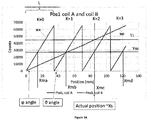
- Figure 3A illustrates a position recovery geometry from a multi-period position sensor combined with a single period sensor as illustrated in Figure 2A .
- Response from the single period sensor geometry as a function of target position X is provided as response 302 while response from the multi-period sensor geometry as a function of target position X is provided as response 304.
- response 302 At an actual position X s , single period geometry from sensor coils 204 resulting in response 302 provides a response value of Y s while multi-period geometry from coils 202 giving response 304 provides a response value of Y m .
- the single period length of multi-period geometry 204, with response 304 is given by L.
- a response Ym of response 304 can correspond to positions Xma, Xmb, Xmc, and Xmd.
- ⁇ L/2, where j 0,1,2,3.
- Figure 2B illustrates a configuration 210 with a first receive coil 212 having N1 periods (212-1 through 212-N1) and a second receive coil 214 having N2 periods (214-1 through 214-N2).
- coil 212 and 214 are positioned relative to each other to measure the same travel of the target.
- receive coil 212 provides voltages VCcos and VCsin from which a position of the target can be determined relative to coil 212 while coil 214 provides voltages VDcos and VDsin from which a position of the target can be determined relative to coil 214.
- the positions measured by each of coils 212 is periodic depending on the one period segment where the target is located.
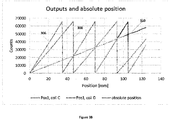
- Figure 3B illustrates a situation where two multi-period geometries are used such as that illustrated in Figure 2B .
- OUTD is the output value from coil 214
- OUTC is the output value 306 from coil 212
- the absolution position value is provided as line 310
- Coil configurations 200 and 210 as depicted in Figures 2A and 2B can be formed on a single printed circuit board (PCB) or can be formed on separate PCBs and arranged relative to each other.
- coil 204 and 202 illustrated in Figure 2A are arranged to overlap, e.g. one being over-laid on the other.
- the end period of one or both of the coils may include only a partial period.
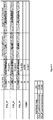
- Figure 4 shows a table with various PCB configurations to facilitate an example of configuration 200 illustrated in Figure 2A or 2B formed on different PCB boards.
- This example is for a target travel distance of 140 mm.
- a one period PCB (PCB_1P) has a receive coil length of 140 mm a transmitter coil width of 16 mm.
- the target is located with 11.4%.
- the 1-period length can be about 46.7 mm.
- the 1 period length is 35.0 mm.
- the PCB_3P one-period travel range is 30.7 while in the PCB-4P configuration, the one-period travel range is 19.0 mm.
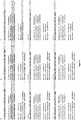
- Figure 5 illustrates results of various geometric characteristics with three-period, four-period, and one-period configurations according a particular example of the present invention. One skilled in the art will recognize that these operation parameters can be obtained for any particular configuration according to some embodiments.
- Figures 6A and 6B illustrate the layout of sensor coils on PCB boards according to some embodiments. As shown in Figures 6A and 6B , two arrangement of sensor coils are arranged on separate PCBs or on separate sides of a single PCB. The target can travel over both sensor coils at the same time.
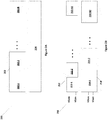
- Figure 6A illustrates a geometry 600 with a first sensor coil 602 being a single period construction and a second sensor coil 604 with a multi-period construction.
- electronics 606 drives transmit coils 610 and receives sine and cosine signals from receive coils 604 while electronics 608 drives transmit coils 612 and receives sine and cosine signals from receive coils 602. Consequently, electronics 606 provides a position indication from receive coils 604 while electronics 608 provides a position indication from receive coils 602, which was discussed above with respect to Figure 3A . Consequently, Figure 6A illustrates a 4P-1P embodiment.
- Figure 6B illustrates a geometry with both sensor coils being multi-period construction, where the periods are different.
- Figure 6B illustrates a 4P-3P implementation.
- implementation 620 includes a 4P receive coil 624 and a 3P receive coil 622 implemented side by side such that the target can overlay both of them.
- Electronic circuit 626 can drive transmit coils 630, receive signals from receive coils 624, and provide location data indicating the location of a target over receive coils 624.
- electronic circuit 638 can drive transmit coils 632, receive signals from receive coils 622, and provide location data indicating the location of a target over receive coils 622.
- Figure 6C illustrates a block diagram of a system 650 further illustrating the arrangement illustrated in Figures 6A and 6B .
- system 650 includes a processor 652 coupled to a configuration 654 according to some embodiments.
- Configuration 654 includes first coils 656, which is a N1P coil, and second coils 658, which is a N2P coil. Consequently, configuration 654 represents an N1P-N2P configuration.
- Circuit 660 drives transmit coils, receives signals from receive coils, and provides location data to processor 652 related to first coils 656.
- Circuit 662 drives transmit coils, receives signals from receive coils, and provides location data to processor 652 related to second coils 658.
- Processor 652 includes memory, microprocessors, and other components sufficient to store and execute instructions for calculating the accurate positions as described in this disclosure. In some embodiments, processor 652 may be included on the PCB of configuration 654 to form an integrated package.
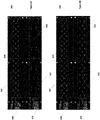
- Figure 7 illustrates electrical data and pre-measurements for various coil configurations according to some embodiments.
- the boards being investigated are 1P, 3P, 4P and combinations of these boards. These boards are further tested as shown in Figures 8A, 8B, and 8C .
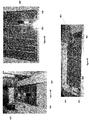
- Figures 8A, 8B, and 8C illustrate implementations of configurations of sensor coils according to some embodiments placed in a test instrument. As illustrated, each of the sensor coils may be formed on a separate coil PCB boards and placed in relation to each other such that a target, which has the same configuration over each of the coils, is moved along the linear path.
- Figure 8A illustrates a testing apparatus 802 that is coupled to move target 664 relative to coils configurations 656 and 658.
- Figure 8A illustrates a first view of the testing apparatus.
- Figure 8C illustrates a second view of the apparatus, with electronic circuits 660 and 662 coupled to an external processor.
- Figure 8B illustrates the target 664 along with the four specific boards (1P, 3P and 4P) discussed above.
- target 664 may include two conducting plates separated by an insulator or may be a continuously formed metallic plate.
- Test data was obtained using the geometries illustrated in Figures 8A, 8B, and 8C , with an air gap (distance between the sensor coils and the target) being 1mm, a fixed gain of 10, and a target position resolution of 0.1mm.
- an air gap distance between the sensor coils and the target
- a fixed gain of 10 10
- a target position resolution 10
- a Pseudo-Vernier method calibration, calibration and linearization for coil A is used on average of SPAs.
- Vernier method calibration and linearization for coil C and average of SPAs along with calibration and linearization for coil D along with average SPAs was used.
- Figure 9A illustrates the full-scale error for measurement error with a single period sensor coil.
- Figure 9B illustrates the measurement error using a pseudo-Vernier algorithm.
- Figure 9C illustrates the measurement error using a Vernier algorithm.
- Figure 9D illustrates a comparative table of errors.
- the Pseudo Vernier method offers the best performance with a factor of 4 improvement in accuracy in comparison to the single coil sensor. An accuracy of 0.12 mm (0.1 %) versus 0.52 mm (0.42%) of the single period coil over a 124mm measurement range is observed.
Landscapes
- Physics & Mathematics (AREA)
- General Physics & Mathematics (AREA)
- Transmission And Conversion Of Sensor Element Output (AREA)
- Measurement Of Length, Angles, Or The Like Using Electric Or Magnetic Means (AREA)
Abstract
Description
- This application claims priority to
U.S. Provisional Application 62/812,851, filed on March 1, 2019 - Embodiments of the present invention are related to position sensors and, in particular, to improvements on position sensors.
- Position sensors are used in various settings for measuring the position of one component with respect to another. Inductive position sensors can be used in automotive, industrial and consumer applications for absolute rotary and linear motion sensing. In many inductive positioning sensing systems, a transmit coil is used to induce eddy currents in a metallic target that is sliding or rotating above a set of receiver coils. Receiver coils receive the magnetic field generated from eddy currents and the transmit coils and provide signals to a processor. The processor uses the signals from the receiver coils to determine the position of the metallic target above the set of coils. The processor, transmitter, and receiver coils may all be formed on a printed circuit board (PCB). However, maintaining accuracy of the position sensor may be difficult over a longer distance measurement (e.g. 124mm vs 19mm distances).
- Therefore, there is a need to develop better methods of designing position sensors that offer better accuracy for position sensing.
- An accurate position sensor that operates over a long range is provided. The position sensor can include a first sensor coil having a first number of periods over a range of motion of a target; and a second sensor coil having a second number of periods over the range, wherein the first number of periods is different from the second number of periods, and wherein the first sensor coil and the second sensor coil are arranged with respect to one another such that the target engages both of them simultaneously. In some embodiments, the first number of periods is one and the second number of periods is greater than one. In some embodiments, the first number of periods is greater than one and the second number of periods is greater than the first number of periods.
- A method of determining a position with a position sensor includes determining a first value from a first sensor having a first number of periods over a range of motion of a target; determining a second value from a second sensor coil having a second number of periods over the range; and calculating a position value from the first value and the second value.
- These and other embodiments are discussed below with respect to the following figures.
-
-
Figures 1A and 1B illustrate typical operation of a position sensor. -
Figures 2A and 2B illustrate position sensors according to some embodiments of the present invention. -
Figure 3A illustrates operation of a position sensor having a one-period geometry and a multi-period geometry according to some embodiments. -
Figure 3B illustrates operation of a position sensor having two multi-period geometries according to some embodiments. -
Figure 4 illustrates parameters for various sensor geometries according to a particular 140 mm example sensor. -
Figure 5 illustrates design parameters for various sensor geometries according to some embodiments. -
Figures 6A and 6B illustrate printed circuit board layouts for position sensor configurations according to some embodiments. -
Figure 6C illustrates a sensing system using the position sensor configurations according to some embodiments. -
Figure 7 illustrates electrical data and pre-measurement data for sensor geometries according to some embodiments. -
Figures 8A, 8B, and 8C illustrate testing of printed-circuit boards having sensor geometry layouts according to some embodiments. -
Figures 9A, 9B ,9C, and 9D illustrate error data for operation of position sensors with geometries according to some embodiments. - These and other aspects of embodiments of the present invention are further discussed below.
- In the following description, specific details are set forth describing some embodiments of the present invention. It will be apparent, however, to one skilled in the art that some embodiments may be practiced without some or all of these specific details. The specific embodiments disclosed herein are meant to be illustrative but not limiting. One skilled in the art may realize other elements that, although not specifically described here, are within the scope and the spirit of this disclosure.
- This description illustrates inventive aspects and embodiments should not be taken as limiting--the claims define the protected invention. Various changes may be made without departing from the spirit and scope of this description and the claims. In some instances, well-known structures and techniques have not been shown or described in detail in order not to obscure the invention.
- Embodiments of the present invention provide for accuracy over a long-range position sensing situation by using multiple sets of sensor coils having different periods. In that fashion, the multiple sets of sensor coils provide multiple measurements of the position of the target, which can be processed to provide an accurate measurement of the position of the target.
-
Figures 1A and 1B illustrate operation of atypical positioning system 100. AlthoughFigures 1A and 1B illustrate operation of a linear position sensor, rotational position sensors are operationally the same. As illustrated inFigure 1A , the positioning system includes transmit/receivecontrol circuit 102 that is coupled to drive atransmitter coil 106 and receive signals from receivecoils 104. In most configurations, receivecoils 104 are located withintransmitter coil 106, however inFigure 1A they are illustrated separately for clarification purposes.Receive coils 104 are generally physically located within the border oftransmit coil 106. Embodiments of the present invention can include atransmitter coil 106, tworeceiver coils 104, and an integrated circuit (IC) 102 driving thetransmitter coil 106 and measuring the signals originated in thereceiver coils 104 all formed on a printed circuit board (PCB). -
Figure 1B illustrates a configuration oftransmit coils 106 and receivecoils 104 in a linear position locating system. As is shown inFigure 1B , a conductivemetallic target 124 can be positioned over thetransmitter coil 106 and the tworeceiver coils 104. - As is illustrated in
Figure 1A ,transmit coil 106 is driven to formmagnetic field 108. Transmitcoil 106 can be driven at a range of frequencies or at particular frequencies. InFigure 1A ,magnetic field 108, with the positive current illustrated by the arrows, is circular around each wire and in a direction that points out of the page insidecoil 106 and into the page outside ofcoil 108 with the current direction as illustrated inFigure 1A .Receive coils 104 are located insidecoil 106, as is illustrated inFigure 1B .Transmit coil 106 is driven at any frequency that can produceelectromagnetic field 108 to induce voltages inreceiver coils 104. In general, there can be any number of receiver coils, however, for ease of discussion, a system with two receiver coils is discussed below. -
Figure 1B illustrates the arrangement of sensor receive coils (RX) 104 within transmit coil (TX) 106 for a linear position sensor. As illustrated inFigure 1B , sensor receivecoils 104 includes a sine-wave oriented coil RXSIN 112 and a cosine-oriented signal coil RXCOS 110. Sine-wave oriented coil RXSIN 112 includessine loops coil 112 is wound in in-phase or anti-phase directions, here depicted as clockwise or counter clockwise depictions, to result in the production of voltages in the loop of opposite sign as a result of the presence of electro-magnetic field 108. As is illustrated, the wiring of sine- waveoriented coil 112 provides a clockwise rotation inloops loop 116 resulting in nominally negative voltages. Similarly, cosine-oriented coil 110 may include afirst loop 120 with a clockwise orientation and asecond loop 122 with a counterclockwise orientation.Figure 1B illustrates a possible electromotive force reference direction, as indicated by the arrows, that is consistent with the magnetic fields produced bytransmitter coil 106 as illustrated inFigure 1A . - In the system illustrated in
Figure 1B , the transmitter coil (TX) 106 is stimulated by thecircuit 102, which may be an integrated circuit, to generate a variable Electromagnetic field (EMF), illustrated asmagnetic field 108. Themagnetic field 108 couples with the receiver coils (RX) 104. If a conductivemetallic target 124 is placed on the top of the receiver coils 104 as illustrated inFigure 1B , an eddy current is generated in themetallic target 124. This eddy current generates a new electromagnetic field that is ideally equal and opposite offield 108, canceling the field inreceiver coils 104 directly undermetallic target 124. The receiver coils (RX) 104 capture thevariable EMF field 108 generated by the transmitcoils 106 and those induced bymetallic target 124, resulting in sinusoidal voltages generated at the terminals of receiver coils 104. - In absence of
metallic target 124, there will be no voltage at the terminals of the RX coils 104 (labeledRxCOS 110 andRXSin 112 inFigure 1B ). Whenmetallic target 124 is placed in a specific position with respect to the RX coils 104, the resultant electromagnetic field on the area covered by themetallic target 124 is ideally zero and therefore the voltages at the terminals of the RX coils 104 will have different characteristic depending on the location ofmetallic target 124 relative to receiver coils 104. The RX coils 104 are designed in a way that a sine voltage is created at the terminals of one RX coil (RxSin 112) and a cosine voltage is created at the terminals of the other RX coil (RxCos 110) asmetallic target 124 is swept across receiver coils 104. The position of the target with respect to the RX coils 104 modulates the amplitude and the phase of the voltage at the terminals of the RX coils 104. - As illustrated in
Figure 1A and discussed above,transmitter coil 106, receivecoils 104, and transmit/receivecircuit 102 can be mounted on a single PCB. Further, the PCB can be positioned such thatmetallic target 124 is positioned above receivecoils 104 and spaced from receivecoils 104 by an air gap (AG). The position ofmetallic target 124 relative to the PCB on which receive coils 104 andtransmitter coil 106 is mounted can be determined by processing the signals generated by sine-orientedcoil 112 and cosine-orientedcoil 110. Below, the determination of the position ofmetallic target 124 with respect to receivecoils 104 is described in a theoretical ideal condition. - In
Figure 1B ,metallic target 124 is located at a first location. In this example,Figures 1B and depicts operation of a linear position locator system. The principle of operation is the same in both linear and circular locators. In the discussion below, the position is given in relation to the construction of cosine-orientedcoil 110 and sine-orientedcoil 112 by providing the angular relations with respect to the sine operation of sine-orientedcoil 112 which results from the position of the leading edge ofmetallic target 124 and coils 110 and 112. The actual position ofmetallic target 124 in such a system can be derived from the angular position as measured by the output voltages of receivecoils 104 and the topology of receivecoils Figure 1B , the topology ofcoil 110 and the topology ofcoil 112 are coordinated to provide indication of the location ofmetallic target 124 relative to the receive coils 104. -
Figure 1B illustrates a one-period receiver coil 104. However, the accuracy of this arrangement can be improved by the addition of a second receiver coil having multiple periods along the traveling distance oftarget 124. - Embodiments of the present invention can achieve higher accuracy on long-range measurements using similar technologies. Some embodiments are directed towards achieving high accuracy on long range measurements using the same silicon devices that applies for short ranges. For example, getting the same accuracy over 124 mm of travel as can be achieved over a 19 mm range. Applications are currently using long measurement ranges and better accuracy than the short-range measurement ranges are capable of producing. The accuracy of long range measurement positions sensors according to some embodiments are increased by a factor of M over the short-range single period systems currently available.
- Accordingly, some embodiments of the present invention implement sensors with a double scale provided on the printed circuit board (PCB). One scale can be for raw positioning while one scale is for fine positioning. A physical implementation of a system using two sensors simultaneously working in parallel. One of the two sensors can have on period over the range of the position sensor while the other sensor has multiple periods over the range. Both sensors use the same target and have the same travel range. An algorithm for analyzing the position sensor signals from both sensors provides an accurate position of the target.
- Embodiments of the present invention can be formed with existing technologies. For example, the silicon device ZMID520x made by Integrated Device Technologies can be used. Such a device has a performance of about 0.2% accuracy. Such accuracy performance is sensor shape dependent. For purposes of explanation, a linear geometry is discussed below. A linear geometry does not have the best accuracy in comparison of other geometries however it may have a larger market potential for a linear long-stroke position sensor.
- Some embodiments use two algorithms: a) a Pseudo Vernier (Double scale: one for raw positioning and one for fine positioning); and b) A Vernier algorithm. Some embodiments employ the use of at least two sets of sensor coils working in parallel (i.e. simultaneously), each one having a different period with respect to the full travel of the target over the sensor coils. For example, in a first exemplary system, two sensor coil geometries are used (each sensor geometry, for example, including a sine and a cosine coil) where a first sensor coil geometry includes a one-period geometry and the second sensor coil geometry includes a multiperiod geometry. In a second example, both sensor geometries are multi-period geometries that include different periods, e.g. a first board having a sensor coils of N1 periods and a second board having sensor coils of N2 periods. In either example, both sensor geometries have the same travel range and the same target characteristics. These two examples are discussed further below.
-
Figures 2A and 2B illustrate relative relationships of sensor coils according to some embodiments of the present invention. As illustrated inFigure 2A ,configuration 200 includes afirst coil 202, including periods 202-1 through 202-N, having N periods and asecond coil 204 having a single period. Both sets of receive coils are arranged to have the same target travel range. Furthermore, each coil determines a target position based on the values of the sine and cosine voltages.Coil 202 determines a position XA based on VAcos and VAsin whilecoil 204 determines a position XB based on VBcos and VBsin. -
Figure 3A illustrates a position recovery geometry from a multi-period position sensor combined with a single period sensor as illustrated inFigure 2A . Response from the single period sensor geometry as a function of target position X is provided asresponse 302 while response from the multi-period sensor geometry as a function of target position X is provided asresponse 304. At an actual position Xs, single period geometry fromsensor coils 204 resulting inresponse 302 provides a response value of Ys while multi-period geometry fromcoils 202 givingresponse 304 provides a response value of Ym. As is further illustrated inFigure 1 , the single period length ofmulti-period geometry 204, withresponse 304, is given by L. As is illustrated, the single period response value Ys provides locates which period of the multiperiod sensor 204 (K=0, 1, 2, 3, ...) is active and the multi-period provides the fine location within that period. Consequently, the position value can be provided by a rough value Xs and a fine value Xm as follows:

response 302, Xm is the fine position given byresponse 304, δ represents the angle of the line representing line 302 (given in terms of counts/mm), Ys is the response fromresponse 302 with the coil at the actual position of target, Ym is the response from response 304of the multi-period geometry, and k is the period ofresponse 304 as determined by rough value Ys. As indicated inFigure 3 , a response Ym ofresponse 304 can correspond to positions Xma, Xmb, Xmc, and Xmd. However, the response Ys locates target in this particular example within the k=2 period ofresponse 304. This can be determined by calculating the following:


|Xs-Xmj|<L/2, where j=0,1,2,3. -
Figure 2B illustrates aconfiguration 210 with a first receivecoil 212 having N1 periods (212-1 through 212-N1) and a second receivecoil 214 having N2 periods (214-1 through 214-N2). As discussed above,coil coil 212 provides voltages VCcos and VCsin from which a position of the target can be determined relative tocoil 212 whilecoil 214 provides voltages VDcos and VDsin from which a position of the target can be determined relative tocoil 214. As discussed above, the positions measured by each ofcoils 212 is periodic depending on the one period segment where the target is located. -
Figure 3B illustrates a situation where two multi-period geometries are used such as that illustrated inFigure 2B . In this illustrates, N1 is the number of periods of the first geometry and N2 is the number of periods in the second geometry. It is sufficient, as in this case, that N1=N2+1, however any relationship between N2 and N1 such that N2 is not equal to N1 can be used. Using this as an example, if OUTD is the output value fromcoil 214, with depictedresponse 308 , OUTC is theoutput value 306 fromcoil 212, and the absolution position value is provided asline 310, then the position can be calculated as follows: - If OUTC>OUTD: absolute measured position is OUTC-OUTD;
- IF OUTC<OUTD: absolute measured position is OUTC-OUTD+Full Scale Position.
-
Coil configurations Figures 2A and 2B can be formed on a single printed circuit board (PCB) or can be formed on separate PCBs and arranged relative to each other. In some embodiments,coil Figure 2A are arranged to overlap, e.g. one being over-laid on the other. In some embodiments, the end period of one or both of the coils may include only a partial period. -
Figure 4 shows a table with various PCB configurations to facilitate an example ofconfiguration 200 illustrated inFigure 2A or 2B formed on different PCB boards. This example is for a target travel distance of 140 mm. For example, a one period PCB (PCB_1P) has a receive coil length of 140 mm a transmitter coil width of 16 mm. With a target size of 16 mm X 16mm, the target is located with 11.4%. With a three-period receive coil oflength 140 mm, the 1-period length can be about 46.7 mm. With a four-period receive coil oflength 140 mm, the 1 period length is 35.0 mm. As is further illustrated, with a total travel range of 124 mm, the PCB_3P one-period travel range is 30.7 while in the PCB-4P configuration, the one-period travel range is 19.0 mm.Figure 5 illustrates results of various geometric characteristics with three-period, four-period, and one-period configurations according a particular example of the present invention. One skilled in the art will recognize that these operation parameters can be obtained for any particular configuration according to some embodiments. -
Figures 6A and 6B illustrate the layout of sensor coils on PCB boards according to some embodiments. As shown inFigures 6A and 6B , two arrangement of sensor coils are arranged on separate PCBs or on separate sides of a single PCB. The target can travel over both sensor coils at the same time.Figure 6A , for example, illustrates ageometry 600 with afirst sensor coil 602 being a single period construction and asecond sensor coil 604 with a multi-period construction. As is further illustrated inFigure 6A ,electronics 606 drives transmitcoils 610 and receives sine and cosine signals from receivecoils 604 whileelectronics 608 drives transmitcoils 612 and receives sine and cosine signals from receivecoils 602. Consequently,electronics 606 provides a position indication from receivecoils 604 whileelectronics 608 provides a position indication from receivecoils 602, which was discussed above with respect toFigure 3A . Consequently,Figure 6A illustrates a 4P-1P embodiment. -
Figure 6B illustrates a geometry with both sensor coils being multi-period construction, where the periods are different. In particular,Figure 6B illustrates a 4P-3P implementation. As shown,implementation 620 includes a 4P receivecoil 624 and a 3P receivecoil 622 implemented side by side such that the target can overlay both of them. Electronic circuit 626 can drive transmitcoils 630, receive signals from receivecoils 624, and provide location data indicating the location of a target over receive coils 624. Similarly,electronic circuit 638 can drive transmitcoils 632, receive signals from receivecoils 622, and provide location data indicating the location of a target over receive coils 622. -
Figure 6C illustrates a block diagram of asystem 650 further illustrating the arrangement illustrated inFigures 6A and 6B . As shown inFigure 6C ,system 650 includes aprocessor 652 coupled to aconfiguration 654 according to some embodiments.Configuration 654 includesfirst coils 656, which is a N1P coil, andsecond coils 658, which is a N2P coil. Consequently,configuration 654 represents an N1P-N2P configuration.Circuit 660 drives transmit coils, receives signals from receive coils, and provides location data toprocessor 652 related tofirst coils 656.Circuit 662 drives transmit coils, receives signals from receive coils, and provides location data toprocessor 652 related tosecond coils 658. The location data in each offirst coil 656 andsecond coils 658 indicates the location oftarget 664 as it is traversed along the length.Processor 652 includes memory, microprocessors, and other components sufficient to store and execute instructions for calculating the accurate positions as described in this disclosure. In some embodiments,processor 652 may be included on the PCB ofconfiguration 654 to form an integrated package. -
Figure 7 illustrates electrical data and pre-measurements for various coil configurations according to some embodiments. The boards being investigated are 1P, 3P, 4P and combinations of these boards. These boards are further tested as shown inFigures 8A, 8B, and 8C . -
Figures 8A, 8B, and 8C illustrate implementations of configurations of sensor coils according to some embodiments placed in a test instrument. As illustrated, each of the sensor coils may be formed on a separate coil PCB boards and placed in relation to each other such that a target, which has the same configuration over each of the coils, is moved along the linear path.Figure 8A illustrates atesting apparatus 802 that is coupled to movetarget 664 relative tocoils configurations Figure 8A illustrates a first view of the testing apparatus.Figure 8C illustrates a second view of the apparatus, withelectronic circuits Figure 8B illustrates thetarget 664 along with the four specific boards (1P, 3P and 4P) discussed above. As is illustrated inFigures 8A, 8B, and 8C ,target 664 may include two conducting plates separated by an insulator or may be a continuously formed metallic plate. - Test data was obtained using the geometries illustrated in
Figures 8A, 8B, and 8C , with an air gap (distance between the sensor coils and the target) being 1mm, a fixed gain of 10, and a target position resolution of 0.1mm. For a Pseudo-Vernier method, calibration, calibration and linearization for coil A is used on average of SPAs. Using the Vernier method calibration and linearization for coil C and average of SPAs along with calibration and linearization for coil D along with average SPAs was used. -
Figure 9A illustrates the full-scale error for measurement error with a single period sensor coil.Figure 9B illustrates the measurement error using a pseudo-Vernier algorithm.Figure 9C illustrates the measurement error using a Vernier algorithm.Figure 9D illustrates a comparative table of errors. As is illustrates, the Pseudo Vernier method offers the best performance with a factor of 4 improvement in accuracy in comparison to the single coil sensor. An accuracy of 0.12 mm (0.1 %) versus 0.52 mm (0.42%) of the single period coil over a 124mm measurement range is observed. - The above detailed description is provided to illustrate specific embodiments of the present invention and is not intended to be limiting. Numerous variations and modifications within the scope of the present invention are possible. The present invention is set forth in the following claims.
Claims (15)
- A position sensor, comprising:a first sensor coil having a first number of periods over a range of motion of a target; anda second sensor coil having a second number of periods over the range,wherein the first number of periods is different from the second number of periods, andwherein the first sensor coil and the second sensor coil are arranged with respect to one another such that the target engages both of them simultaneously.
- The position sensor of claim 1, wherein the first number of periods is one and the second number of periods is greater than one.
- The position sensor of claim 2, wherein the first sensor provides a course position location and the second sensor provides a fine position location.
- The position sensor of claim 3, wherein the second number of periods is three.
- The position sensor of claim 3, wherein the second number of periods is four.
- The position sensor of claim 3, wherein the second number of periods is greater than four.
- The position sensor of claim 1, wherein the first number of periods and the second number of periods is greater than one.
- The position sensor of claim 7, wherein the first number of periods is greater than the second number of periods.
- The position sensor of claim 8, wherein the first number of periods is one more than the second number of periods.
- A method of determining a position of a target with a position sensor, comprising
arranging the target over a first sensor having a first number of periods over a range of motion of the target and a second sensor having a second number of periods over the range of motion of the target;
determining a first value from a first sensor;
determining a second value from the second sensor coil; and
calculating a position value from the first value and the second value. - The method of claim 10, wherein the first number of periods is one and the first sensor provides a coarse location while the second sensor provides a fine location.
- The method of claim 10, wherein the first number of periods and the second number of periods are both greater than one and the position value is determined by comparing the first value and the second value.
- A position sensing system, including
a first sensor coil having a first number of periods over a range of motion of a target;
a second sensor coil having a second number of periods over the range, wherein the first number of periods is different from the second number of periods, the first sensor coil and the second sensor coil are arranged with respect to one another such that the target engages both of them simultaneously;
a first electronic circuit coupled to drive a first transmit coil and receive signals from the first sensor coil, the first electronic circuit providing first data;
a second electronic circuit coupled to drive a second transmit coil and receives signals from the second sensor coil, the second electronic circuit providing second data; and
a processor coupled to receive the first data and the second data and determine a location of the target based on the first data and the second data. - The position sensing system of claim 13, wherein the first number of periods is one.
- The position sensing system of claim 13, wherein the second number of periods is one more than the first number of periods.
Applications Claiming Priority (2)
| Application Number | Priority Date | Filing Date | Title |
|---|---|---|---|
| US201962812851P | 2019-03-01 | 2019-03-01 | |
| US16/789,374 US11293744B2 (en) | 2019-03-01 | 2020-02-12 | Method for increasing the position measurement accuracy using inductive position sensor |
Publications (2)
| Publication Number | Publication Date |
|---|---|
| EP3702738A1 true EP3702738A1 (en) | 2020-09-02 |
| EP3702738B1 EP3702738B1 (en) | 2022-01-05 |
Family
ID=69742810
Family Applications (1)
| Application Number | Title | Priority Date | Filing Date |
|---|---|---|---|
| EP20159859.6A Active EP3702738B1 (en) | 2019-03-01 | 2020-02-27 | Method for increasing the position measurement accuracy using inductive position sensor |
Country Status (3)
| Country | Link |
|---|---|
| US (1) | US11293744B2 (en) |
| EP (1) | EP3702738B1 (en) |
| CN (1) | CN111637831B (en) |
Cited By (2)
| Publication number | Priority date | Publication date | Assignee | Title |
|---|---|---|---|---|
| CN114577101A (en) * | 2020-12-02 | 2022-06-03 | 泰连感应德国有限公司 | Eddy current sensor device for measuring linear displacement |
| US11920927B2 (en) | 2021-05-03 | 2024-03-05 | Vishay MCB Industrie S.A.S. | Position encoder with combined inductive and magnetic sensors |
Families Citing this family (9)
| Publication number | Priority date | Publication date | Assignee | Title |
|---|---|---|---|---|
| US10444037B2 (en) | 2017-08-22 | 2019-10-15 | Semiconductor Components Industries, Llc | Inductive position sensor |
| EP3988903A1 (en) * | 2020-10-22 | 2022-04-27 | Renesas Electronics America Inc. | Position sensor system |
| US12196581B2 (en) | 2021-04-09 | 2025-01-14 | Semiconductor Components Industries, Llc | Harmonic distortion reduction in inductive position sensors |
| US11885649B2 (en) | 2021-04-09 | 2024-01-30 | Semiconductor Components Industries, Llc | Rotor for inductive slip, eccentricity, and tilt sensing |
| EP4125106A1 (en) * | 2021-07-27 | 2023-02-01 | Abb Schweiz Ag | Monitoring system for a low voltage, medium voltage, or high voltage circuit breaker |
| US20230153482A1 (en) * | 2021-11-12 | 2023-05-18 | Renesas Electronics America Inc. | Method for designing receiver coil based on arbitrary target shape |
| US12018768B2 (en) | 2021-12-17 | 2024-06-25 | Hamilton Sundstrand Corporation | Dual range position sensing configurations for variable differential transformers |
| US12298127B2 (en) | 2022-02-08 | 2025-05-13 | Semiconductor Components Industries, Llc | Linear inductive position sensor |
| US12399036B2 (en) * | 2022-08-30 | 2025-08-26 | Proterial, Ltd. | Position detection device |
Citations (4)
| Publication number | Priority date | Publication date | Assignee | Title |
|---|---|---|---|---|
| EP1078226A1 (en) * | 1998-05-22 | 2001-02-28 | Synaptics (UK) Limited | Position sensor |
| US20030062889A1 (en) * | 1996-12-12 | 2003-04-03 | Synaptics (Uk) Limited | Position detector |
| WO2006064236A1 (en) * | 2004-12-14 | 2006-06-22 | Darran Kreit | Inductive position sensor |
| CN206146372U (en) * | 2016-08-31 | 2017-05-03 | 安徽沃巴弗电子科技有限公司 | Inductance type sensor based on redundant formula design |
Family Cites Families (8)
| Publication number | Priority date | Publication date | Assignee | Title |
|---|---|---|---|---|
| CN1085332C (en) * | 1994-05-14 | 2002-05-22 | 辛纳普蒂克斯(英国)有限公司 | Position encoder |
| GB0417686D0 (en) * | 2004-08-09 | 2004-09-08 | Sensopad Ltd | Novel targets for inductive sensing applications |
| US20090184707A1 (en) * | 2007-11-29 | 2009-07-23 | Luetzow Robert H | Electromagnetic barrier for use in association with inductive position sensors |
| GB2503006B (en) * | 2012-06-13 | 2017-08-09 | Cambridge Integrated Circuits Ltd | Position sensing transducer |
| GB2517152A (en) * | 2013-08-12 | 2015-02-18 | Gde Technology Ltd | Position sensor |
| CN108571986A (en) * | 2017-03-07 | 2018-09-25 | 赛卓电子科技(上海)有限公司 | Motion detector |
| US10690517B2 (en) * | 2017-11-01 | 2020-06-23 | Integrated Device Technology, Inc. | Sensor Coil optimization |
| US11397098B2 (en) * | 2018-10-15 | 2022-07-26 | Integrated Device Technology, Inc. | Method for detecting errors in a rotating position sensor system having sine and cosine signals |
-
2020
- 2020-02-12 US US16/789,374 patent/US11293744B2/en active Active
- 2020-02-27 EP EP20159859.6A patent/EP3702738B1/en active Active
- 2020-02-28 CN CN202010128366.2A patent/CN111637831B/en active Active
Patent Citations (4)
| Publication number | Priority date | Publication date | Assignee | Title |
|---|---|---|---|---|
| US20030062889A1 (en) * | 1996-12-12 | 2003-04-03 | Synaptics (Uk) Limited | Position detector |
| EP1078226A1 (en) * | 1998-05-22 | 2001-02-28 | Synaptics (UK) Limited | Position sensor |
| WO2006064236A1 (en) * | 2004-12-14 | 2006-06-22 | Darran Kreit | Inductive position sensor |
| CN206146372U (en) * | 2016-08-31 | 2017-05-03 | 安徽沃巴弗电子科技有限公司 | Inductance type sensor based on redundant formula design |
Cited By (4)
| Publication number | Priority date | Publication date | Assignee | Title |
|---|---|---|---|---|
| CN114577101A (en) * | 2020-12-02 | 2022-06-03 | 泰连感应德国有限公司 | Eddy current sensor device for measuring linear displacement |
| EP4009004A1 (en) * | 2020-12-02 | 2022-06-08 | TE Connectivity Sensors Germany GmbH | Eddy current sensor device for measuring a linear displacement |
| US11774229B2 (en) | 2020-12-02 | 2023-10-03 | TE Connectivity Sensors Germany GmbH | Eddy current sensor device for measuring a linear displacement |
| US11920927B2 (en) | 2021-05-03 | 2024-03-05 | Vishay MCB Industrie S.A.S. | Position encoder with combined inductive and magnetic sensors |
Also Published As
| Publication number | Publication date |
|---|---|
| US20200278190A1 (en) | 2020-09-03 |
| US11293744B2 (en) | 2022-04-05 |
| CN111637831B (en) | 2024-12-06 |
| EP3702738B1 (en) | 2022-01-05 |
| CN111637831A (en) | 2020-09-08 |
Similar Documents
| Publication | Publication Date | Title |
|---|---|---|
| EP3702738B1 (en) | Method for increasing the position measurement accuracy using inductive position sensor | |
| US11226211B2 (en) | Inductive position detection | |
| EP3617659B1 (en) | Fully redundant position sensor | |
| CN109883305B (en) | Inductive position measuring device | |
| CN110657826B (en) | Scale construction for inductive position encoders | |
| US10317249B2 (en) | Method for determining the position of a moving part along an axis, using an inductive sensor | |
| EP2918964B1 (en) | Method, sensor, and printed circuit board for sensing position or motion of a shaft | |
| JP2018031777A (en) | Winding configuration of electromagnetic induction type encoder | |
| CN116635696B (en) | High resolution angle sensing sensor and associated methods of use | |
| US11662225B2 (en) | Inductive sensor device for determining a longitudinal position of a moveable object along a sensitive axis of the sensor device and method for operating a sensor device of this kind | |
| CN108351224A (en) | Angular sensor | |
| JP2009069148A (en) | Device for measuring magnetic field | |
| EP3627113B1 (en) | Calibration and linearization of position sensor | |
| CN116136420A (en) | Radial inductive position sensor, high resolution position sensor system and torque sensor system for detecting rotational movement | |
| WO2007017136A1 (en) | Position sensing | |
| JP2009025310A (en) | Detector for inductive rotation speed and rotational direction | |
| JP7118627B2 (en) | Electromagnetic induction position detector | |
| JP2024031954A (en) | Inductive linear displacement sensor device and method for determining the position of a moving object | |
| US10591317B2 (en) | Encoder apparatus and motion guide apparatus with encoder apparatus | |
| JP6145467B2 (en) | Position detection device | |
| EP4065935B1 (en) | LINEAR MOTION SENSOR | |
| US9329207B2 (en) | Surface current probe | |
| US6469501B1 (en) | Conductive system for measuring the linear and angular positions of one object relative to another | |
| US11248935B2 (en) | Position sensor with varying output slope | |
| CN118225137A (en) | Angle sensor and laser radar |
Legal Events
| Date | Code | Title | Description |
|---|---|---|---|
| PUAI | Public reference made under article 153(3) epc to a published international application that has entered the european phase |
Free format text: ORIGINAL CODE: 0009012 |
|
| STAA | Information on the status of an ep patent application or granted ep patent |
Free format text: STATUS: THE APPLICATION HAS BEEN PUBLISHED |
|
| AK | Designated contracting states |
Kind code of ref document: A1 Designated state(s): AL AT BE BG CH CY CZ DE DK EE ES FI FR GB GR HR HU IE IS IT LI LT LU LV MC MK MT NL NO PL PT RO RS SE SI SK SM TR |
|
| AX | Request for extension of the european patent |
Extension state: BA ME |
|
| STAA | Information on the status of an ep patent application or granted ep patent |
Free format text: STATUS: REQUEST FOR EXAMINATION WAS MADE |
|
| 17P | Request for examination filed |
Effective date: 20210301 |
|
| RBV | Designated contracting states (corrected) |
Designated state(s): AL AT BE BG CH CY CZ DE DK EE ES FI FR GB GR HR HU IE IS IT LI LT LU LV MC MK MT NL NO PL PT RO RS SE SI SK SM TR |
|
| GRAP | Despatch of communication of intention to grant a patent |
Free format text: ORIGINAL CODE: EPIDOSNIGR1 |
|
| STAA | Information on the status of an ep patent application or granted ep patent |
Free format text: STATUS: GRANT OF PATENT IS INTENDED |
|
| INTG | Intention to grant announced |
Effective date: 20210722 |
|
| GRAS | Grant fee paid |
Free format text: ORIGINAL CODE: EPIDOSNIGR3 |
|
| GRAA | (expected) grant |
Free format text: ORIGINAL CODE: 0009210 |
|
| STAA | Information on the status of an ep patent application or granted ep patent |
Free format text: STATUS: THE PATENT HAS BEEN GRANTED |
|
| AK | Designated contracting states |
Kind code of ref document: B1 Designated state(s): AL AT BE BG CH CY CZ DE DK EE ES FI FR GB GR HR HU IE IS IT LI LT LU LV MC MK MT NL NO PL PT RO RS SE SI SK SM TR |
|
| REG | Reference to a national code |
Ref country code: GB Ref legal event code: FG4D |
|
| REG | Reference to a national code |
Ref country code: CH Ref legal event code: EP |
|
| REG | Reference to a national code |
Ref country code: AT Ref legal event code: REF Ref document number: 1460976 Country of ref document: AT Kind code of ref document: T Effective date: 20220115 |
|
| REG | Reference to a national code |
Ref country code: DE Ref legal event code: R096 Ref document number: 602020001486 Country of ref document: DE |
|
| REG | Reference to a national code |
Ref country code: IE Ref legal event code: FG4D |
|
| REG | Reference to a national code |
Ref country code: LT Ref legal event code: MG9D |
|
| REG | Reference to a national code |
Ref country code: NL Ref legal event code: MP Effective date: 20220105 |
|
| REG | Reference to a national code |
Ref country code: AT Ref legal event code: MK05 Ref document number: 1460976 Country of ref document: AT Kind code of ref document: T Effective date: 20220105 |
|
| PG25 | Lapsed in a contracting state [announced via postgrant information from national office to epo] |
Ref country code: NL Free format text: LAPSE BECAUSE OF FAILURE TO SUBMIT A TRANSLATION OF THE DESCRIPTION OR TO PAY THE FEE WITHIN THE PRESCRIBED TIME-LIMIT Effective date: 20220105 |
|
| PG25 | Lapsed in a contracting state [announced via postgrant information from national office to epo] |
Ref country code: SE Free format text: LAPSE BECAUSE OF FAILURE TO SUBMIT A TRANSLATION OF THE DESCRIPTION OR TO PAY THE FEE WITHIN THE PRESCRIBED TIME-LIMIT Effective date: 20220105 Ref country code: RS Free format text: LAPSE BECAUSE OF FAILURE TO SUBMIT A TRANSLATION OF THE DESCRIPTION OR TO PAY THE FEE WITHIN THE PRESCRIBED TIME-LIMIT Effective date: 20220105 Ref country code: PT Free format text: LAPSE BECAUSE OF FAILURE TO SUBMIT A TRANSLATION OF THE DESCRIPTION OR TO PAY THE FEE WITHIN THE PRESCRIBED TIME-LIMIT Effective date: 20220505 Ref country code: NO Free format text: LAPSE BECAUSE OF FAILURE TO SUBMIT A TRANSLATION OF THE DESCRIPTION OR TO PAY THE FEE WITHIN THE PRESCRIBED TIME-LIMIT Effective date: 20220405 Ref country code: LT Free format text: LAPSE BECAUSE OF FAILURE TO SUBMIT A TRANSLATION OF THE DESCRIPTION OR TO PAY THE FEE WITHIN THE PRESCRIBED TIME-LIMIT Effective date: 20220105 Ref country code: HR Free format text: LAPSE BECAUSE OF FAILURE TO SUBMIT A TRANSLATION OF THE DESCRIPTION OR TO PAY THE FEE WITHIN THE PRESCRIBED TIME-LIMIT Effective date: 20220105 Ref country code: ES Free format text: LAPSE BECAUSE OF FAILURE TO SUBMIT A TRANSLATION OF THE DESCRIPTION OR TO PAY THE FEE WITHIN THE PRESCRIBED TIME-LIMIT Effective date: 20220105 Ref country code: BG Free format text: LAPSE BECAUSE OF FAILURE TO SUBMIT A TRANSLATION OF THE DESCRIPTION OR TO PAY THE FEE WITHIN THE PRESCRIBED TIME-LIMIT Effective date: 20220405 |
|
| PG25 | Lapsed in a contracting state [announced via postgrant information from national office to epo] |
Ref country code: PL Free format text: LAPSE BECAUSE OF FAILURE TO SUBMIT A TRANSLATION OF THE DESCRIPTION OR TO PAY THE FEE WITHIN THE PRESCRIBED TIME-LIMIT Effective date: 20220105 Ref country code: LV Free format text: LAPSE BECAUSE OF FAILURE TO SUBMIT A TRANSLATION OF THE DESCRIPTION OR TO PAY THE FEE WITHIN THE PRESCRIBED TIME-LIMIT Effective date: 20220105 Ref country code: GR Free format text: LAPSE BECAUSE OF FAILURE TO SUBMIT A TRANSLATION OF THE DESCRIPTION OR TO PAY THE FEE WITHIN THE PRESCRIBED TIME-LIMIT Effective date: 20220406 Ref country code: FI Free format text: LAPSE BECAUSE OF FAILURE TO SUBMIT A TRANSLATION OF THE DESCRIPTION OR TO PAY THE FEE WITHIN THE PRESCRIBED TIME-LIMIT Effective date: 20220105 Ref country code: AT Free format text: LAPSE BECAUSE OF FAILURE TO SUBMIT A TRANSLATION OF THE DESCRIPTION OR TO PAY THE FEE WITHIN THE PRESCRIBED TIME-LIMIT Effective date: 20220105 |
|
| PG25 | Lapsed in a contracting state [announced via postgrant information from national office to epo] |
Ref country code: IS Free format text: LAPSE BECAUSE OF FAILURE TO SUBMIT A TRANSLATION OF THE DESCRIPTION OR TO PAY THE FEE WITHIN THE PRESCRIBED TIME-LIMIT Effective date: 20220505 |
|
| REG | Reference to a national code |
Ref country code: DE Ref legal event code: R097 Ref document number: 602020001486 Country of ref document: DE |
|
| REG | Reference to a national code |
Ref country code: BE Ref legal event code: MM Effective date: 20220228 |
|
| PG25 | Lapsed in a contracting state [announced via postgrant information from national office to epo] |
Ref country code: SM Free format text: LAPSE BECAUSE OF FAILURE TO SUBMIT A TRANSLATION OF THE DESCRIPTION OR TO PAY THE FEE WITHIN THE PRESCRIBED TIME-LIMIT Effective date: 20220105 Ref country code: SK Free format text: LAPSE BECAUSE OF FAILURE TO SUBMIT A TRANSLATION OF THE DESCRIPTION OR TO PAY THE FEE WITHIN THE PRESCRIBED TIME-LIMIT Effective date: 20220105 Ref country code: RO Free format text: LAPSE BECAUSE OF FAILURE TO SUBMIT A TRANSLATION OF THE DESCRIPTION OR TO PAY THE FEE WITHIN THE PRESCRIBED TIME-LIMIT Effective date: 20220105 Ref country code: MC Free format text: LAPSE BECAUSE OF FAILURE TO SUBMIT A TRANSLATION OF THE DESCRIPTION OR TO PAY THE FEE WITHIN THE PRESCRIBED TIME-LIMIT Effective date: 20220105 Ref country code: LU Free format text: LAPSE BECAUSE OF NON-PAYMENT OF DUE FEES Effective date: 20220227 Ref country code: EE Free format text: LAPSE BECAUSE OF FAILURE TO SUBMIT A TRANSLATION OF THE DESCRIPTION OR TO PAY THE FEE WITHIN THE PRESCRIBED TIME-LIMIT Effective date: 20220105 Ref country code: DK Free format text: LAPSE BECAUSE OF FAILURE TO SUBMIT A TRANSLATION OF THE DESCRIPTION OR TO PAY THE FEE WITHIN THE PRESCRIBED TIME-LIMIT Effective date: 20220105 Ref country code: CZ Free format text: LAPSE BECAUSE OF FAILURE TO SUBMIT A TRANSLATION OF THE DESCRIPTION OR TO PAY THE FEE WITHIN THE PRESCRIBED TIME-LIMIT Effective date: 20220105 |
|
| PLBE | No opposition filed within time limit |
Free format text: ORIGINAL CODE: 0009261 |
|
| STAA | Information on the status of an ep patent application or granted ep patent |
Free format text: STATUS: NO OPPOSITION FILED WITHIN TIME LIMIT |
|
| PG25 | Lapsed in a contracting state [announced via postgrant information from national office to epo] |
Ref country code: AL Free format text: LAPSE BECAUSE OF FAILURE TO SUBMIT A TRANSLATION OF THE DESCRIPTION OR TO PAY THE FEE WITHIN THE PRESCRIBED TIME-LIMIT Effective date: 20220105 |
|
| 26N | No opposition filed |
Effective date: 20221006 |
|
| PG25 | Lapsed in a contracting state [announced via postgrant information from national office to epo] |
Ref country code: IE Free format text: LAPSE BECAUSE OF NON-PAYMENT OF DUE FEES Effective date: 20220227 Ref country code: FR Free format text: LAPSE BECAUSE OF NON-PAYMENT OF DUE FEES Effective date: 20220305 |
|
| PG25 | Lapsed in a contracting state [announced via postgrant information from national office to epo] |
Ref country code: SI Free format text: LAPSE BECAUSE OF FAILURE TO SUBMIT A TRANSLATION OF THE DESCRIPTION OR TO PAY THE FEE WITHIN THE PRESCRIBED TIME-LIMIT Effective date: 20220105 Ref country code: BE Free format text: LAPSE BECAUSE OF NON-PAYMENT OF DUE FEES Effective date: 20220228 |
|
| PG25 | Lapsed in a contracting state [announced via postgrant information from national office to epo] |
Ref country code: IT Free format text: LAPSE BECAUSE OF FAILURE TO SUBMIT A TRANSLATION OF THE DESCRIPTION OR TO PAY THE FEE WITHIN THE PRESCRIBED TIME-LIMIT Effective date: 20220105 |
|
| REG | Reference to a national code |
Ref country code: CH Ref legal event code: PL |
|
| PG25 | Lapsed in a contracting state [announced via postgrant information from national office to epo] |
Ref country code: LI Free format text: LAPSE BECAUSE OF NON-PAYMENT OF DUE FEES Effective date: 20230228 Ref country code: CH Free format text: LAPSE BECAUSE OF NON-PAYMENT OF DUE FEES Effective date: 20230228 |
|
| PG25 | Lapsed in a contracting state [announced via postgrant information from national office to epo] |
Ref country code: MK Free format text: LAPSE BECAUSE OF FAILURE TO SUBMIT A TRANSLATION OF THE DESCRIPTION OR TO PAY THE FEE WITHIN THE PRESCRIBED TIME-LIMIT Effective date: 20220105 Ref country code: CY Free format text: LAPSE BECAUSE OF FAILURE TO SUBMIT A TRANSLATION OF THE DESCRIPTION OR TO PAY THE FEE WITHIN THE PRESCRIBED TIME-LIMIT Effective date: 20220105 |
|
| PG25 | Lapsed in a contracting state [announced via postgrant information from national office to epo] |
Ref country code: HU Free format text: LAPSE BECAUSE OF FAILURE TO SUBMIT A TRANSLATION OF THE DESCRIPTION OR TO PAY THE FEE WITHIN THE PRESCRIBED TIME-LIMIT; INVALID AB INITIO Effective date: 20200227 |
|
| PG25 | Lapsed in a contracting state [announced via postgrant information from national office to epo] |
Ref country code: MT Free format text: LAPSE BECAUSE OF FAILURE TO SUBMIT A TRANSLATION OF THE DESCRIPTION OR TO PAY THE FEE WITHIN THE PRESCRIBED TIME-LIMIT Effective date: 20220105 |
|
| GBPC | Gb: european patent ceased through non-payment of renewal fee |
Effective date: 20240227 |
|
| PG25 | Lapsed in a contracting state [announced via postgrant information from national office to epo] |
Ref country code: GB Free format text: LAPSE BECAUSE OF NON-PAYMENT OF DUE FEES Effective date: 20240227 |
|
| PG25 | Lapsed in a contracting state [announced via postgrant information from national office to epo] |
Ref country code: GB Free format text: LAPSE BECAUSE OF NON-PAYMENT OF DUE FEES Effective date: 20240227 |
|
| PG25 | Lapsed in a contracting state [announced via postgrant information from national office to epo] |
Ref country code: TR Free format text: LAPSE BECAUSE OF FAILURE TO SUBMIT A TRANSLATION OF THE DESCRIPTION OR TO PAY THE FEE WITHIN THE PRESCRIBED TIME-LIMIT Effective date: 20220105 |
|
| PGFP | Annual fee paid to national office [announced via postgrant information from national office to epo] |
Ref country code: DE Payment date: 20260220 Year of fee payment: 7 |