EP3701767B1 - Systeme und verfahren zur automatischen paarung von vorrichtungen - Google Patents
Systeme und verfahren zur automatischen paarung von vorrichtungen Download PDFInfo
- Publication number
- EP3701767B1 EP3701767B1 EP18869535.7A EP18869535A EP3701767B1 EP 3701767 B1 EP3701767 B1 EP 3701767B1 EP 18869535 A EP18869535 A EP 18869535A EP 3701767 B1 EP3701767 B1 EP 3701767B1
- Authority
- EP
- European Patent Office
- Prior art keywords
- mobile device
- devices
- data
- user
- ids
- Prior art date
- Legal status (The legal status is an assumption and is not a legal conclusion. Google has not performed a legal analysis and makes no representation as to the accuracy of the status listed.)
- Active
Links
Images

Classifications
-
- G—PHYSICS
- G16—INFORMATION AND COMMUNICATION TECHNOLOGY [ICT] SPECIALLY ADAPTED FOR SPECIFIC APPLICATION FIELDS
- G16H—HEALTHCARE INFORMATICS, i.e. INFORMATION AND COMMUNICATION TECHNOLOGY [ICT] SPECIALLY ADAPTED FOR THE HANDLING OR PROCESSING OF MEDICAL OR HEALTHCARE DATA
- G16H15/00—ICT specially adapted for medical reports, e.g. generation or transmission thereof
-
- G—PHYSICS
- G16—INFORMATION AND COMMUNICATION TECHNOLOGY [ICT] SPECIALLY ADAPTED FOR SPECIFIC APPLICATION FIELDS
- G16H—HEALTHCARE INFORMATICS, i.e. INFORMATION AND COMMUNICATION TECHNOLOGY [ICT] SPECIALLY ADAPTED FOR THE HANDLING OR PROCESSING OF MEDICAL OR HEALTHCARE DATA
- G16H40/00—ICT specially adapted for the management or administration of healthcare resources or facilities; ICT specially adapted for the management or operation of medical equipment or devices
- G16H40/20—ICT specially adapted for the management or administration of healthcare resources or facilities; ICT specially adapted for the management or operation of medical equipment or devices for the management or administration of healthcare resources or facilities, e.g. managing hospital staff or surgery rooms
-
- G—PHYSICS
- G16—INFORMATION AND COMMUNICATION TECHNOLOGY [ICT] SPECIALLY ADAPTED FOR SPECIFIC APPLICATION FIELDS
- G16H—HEALTHCARE INFORMATICS, i.e. INFORMATION AND COMMUNICATION TECHNOLOGY [ICT] SPECIALLY ADAPTED FOR THE HANDLING OR PROCESSING OF MEDICAL OR HEALTHCARE DATA
- G16H40/00—ICT specially adapted for the management or administration of healthcare resources or facilities; ICT specially adapted for the management or operation of medical equipment or devices
- G16H40/60—ICT specially adapted for the management or administration of healthcare resources or facilities; ICT specially adapted for the management or operation of medical equipment or devices for the operation of medical equipment or devices
- G16H40/63—ICT specially adapted for the management or administration of healthcare resources or facilities; ICT specially adapted for the management or operation of medical equipment or devices for the operation of medical equipment or devices for local operation
-
- G—PHYSICS
- G16—INFORMATION AND COMMUNICATION TECHNOLOGY [ICT] SPECIALLY ADAPTED FOR SPECIFIC APPLICATION FIELDS
- G16H—HEALTHCARE INFORMATICS, i.e. INFORMATION AND COMMUNICATION TECHNOLOGY [ICT] SPECIALLY ADAPTED FOR THE HANDLING OR PROCESSING OF MEDICAL OR HEALTHCARE DATA
- G16H40/00—ICT specially adapted for the management or administration of healthcare resources or facilities; ICT specially adapted for the management or operation of medical equipment or devices
- G16H40/60—ICT specially adapted for the management or administration of healthcare resources or facilities; ICT specially adapted for the management or operation of medical equipment or devices for the operation of medical equipment or devices
- G16H40/67—ICT specially adapted for the management or administration of healthcare resources or facilities; ICT specially adapted for the management or operation of medical equipment or devices for the operation of medical equipment or devices for remote operation
-
- H—ELECTRICITY
- H04—ELECTRIC COMMUNICATION TECHNIQUE
- H04W—WIRELESS COMMUNICATION NETWORKS
- H04W4/00—Services specially adapted for wireless communication networks; Facilities therefor
- H04W4/30—Services specially adapted for particular environments, situations or purposes
- H04W4/38—Services specially adapted for particular environments, situations or purposes for collecting sensor information
-
- H—ELECTRICITY
- H04—ELECTRIC COMMUNICATION TECHNIQUE
- H04W—WIRELESS COMMUNICATION NETWORKS
- H04W4/00—Services specially adapted for wireless communication networks; Facilities therefor
- H04W4/80—Services using short range communication, e.g. near-field communication [NFC], radio-frequency identification [RFID] or low energy communication
-
- H—ELECTRICITY
- H04—ELECTRIC COMMUNICATION TECHNIQUE
- H04W—WIRELESS COMMUNICATION NETWORKS
- H04W76/00—Connection management
- H04W76/10—Connection setup
- H04W76/11—Allocation or use of connection identifiers
-
- H—ELECTRICITY
- H04—ELECTRIC COMMUNICATION TECHNIQUE
- H04W—WIRELESS COMMUNICATION NETWORKS
- H04W76/00—Connection management
- H04W76/10—Connection setup
- H04W76/14—Direct-mode setup
-
- G—PHYSICS
- G16—INFORMATION AND COMMUNICATION TECHNOLOGY [ICT] SPECIALLY ADAPTED FOR SPECIFIC APPLICATION FIELDS
- G16H—HEALTHCARE INFORMATICS, i.e. INFORMATION AND COMMUNICATION TECHNOLOGY [ICT] SPECIALLY ADAPTED FOR THE HANDLING OR PROCESSING OF MEDICAL OR HEALTHCARE DATA
- G16H10/00—ICT specially adapted for the handling or processing of patient-related medical or healthcare data
- G16H10/20—ICT specially adapted for the handling or processing of patient-related medical or healthcare data for electronic clinical trials or questionnaires
Definitions
- the embodiments described herein are related to remote devices and more particularly to automatically pairing such device with a mobile device and an application running thereon.
- mHealth also written as m-health and also referred to as connected health is an abbreviation for mobile health, a term used for the practice of medicine and public health supported by mobile devices. The term is most commonly used in reference to using mobile communication devices, such as mobile phones, tablet computers and PDAs, and wearable devices such as smart watches, for health services, information, and data collection.
- the mHealth field has emerged as a sub-segment of eHealth and Digital Health, the use of information and communication technology (ICT), such as computers, mobile phones, communications satellite, patient monitors, etc., for health services and information.
- ICT information and communication technology
- mHealth applications include the use of mobile devices in collecting community and clinical health data, delivery of healthcare information to practitioners, researchers, and patients, real-time monitoring of patient vital signs, and direct provision of care (via mobile telemedicine).
- mHealth space projects operate with a variety of objectives, including increased access to healthcare and health-related information (particularly for hard-to-reach populations); improved ability to diagnose and track diseases; timelier, more actionable public health information; and expanded access to ongoing medical education and training for health workers.
- an analyst firm around 2.8 million patients worldwide were using a home monitoring service based on equipment with integrated connectivity at the end of 2012. The figure does not include patients that use monitoring devices connected to a PC or mobile phone.
- a growing segment of mhealth involves interfacing a remote monitoring device, such as a scale, blood pressure cuff glucose meter, activity tracker and any device with short-range wireless connectivity with a PC, laptop, or mobile device, such as a smartphone or tablet.
- a remote monitoring device such as a scale, blood pressure cuff glucose meter, activity tracker and any device with short-range wireless connectivity with a PC, laptop, or mobile device, such as a smartphone or tablet.
- the ability to use, e.g., a smartphone to interface with remote monitoring devices can potentially, significantly increase the adoption of such devices and can be a catalyst to growing the mhealth space at even greater rates.
- many devices do not interface with a mobile device or PC. Rather, conventional devices more typically interface with a hub that then interfaces with a remote back end system, or the devices themselves include cellular capability that allows them to interface with a back end.
- the integrators of these systems have complete control of the hub and devices and can readily identify all of the devices and pair them.
- Interfacing remote monitoring devices with a smartphone can allow patients/consumers to use their own cellular phones and eliminates the cost for a hub or extra cellular line.
- a problem with conventional devices is that they can be difficult to set up and pair with the mobile device. Often, each device is form a different manufacturer and requires registering the device with a different manufacturer, then trying to pair the device, which can have its own specific pairing protocol or procedure. If a user has multiple devices, then this problem is multiplied. As a result, adoption and interest in the use of and adherence to usage protocols for such devices is limited.
- Figure 27 of US 2012/0182939 A1 shows a conventional method of pairing devices.
- US 2013/203032 A1 discloses a method of device pairing which employs a list of external devices that are approved to communicate with the specific implanted medical device.
- WO 2017/030584 A1 discloses a method which facilitates dynamic pairing of a computing device with a peripheral device.
- the invention sets out a system comprising a provider server configured to establish communication with a mobile device as set out in claim 1, and a method for automatically pairing a mobile device with remote devices as set out in claim 7.
- a system comprising a provider server configured to establish communication with a mobile device, receive a user ID form the mobile device, provide device IDs for a plurality of devices to the mobile device, and provide the user ID and device IDs to a device manager server; a device manager server configured to receive the user ID and device IDs associate them in a database, and provide the device IDs to the mobile device associated with the device ID; a mobile device comprising an application associated with the provider server and a short range communication interface, the mobile device configured to receive a plurality of device IDs via the short range communication interface, provide the received device IDs with device IDs received from a device manager, and when the device IDs match, then automatically pair with devices associated with the device IDs and begin receiving data from the devices.
- a mobile device comprising an application, an imaging device and a short range communication interface, the mobile device configured to receive device ID information for one or more devices via the imaging device, receive one or more device IDs via the short range communication interface, compare the device IDs received via the short range communication device with device IDs received via the imaging device, and when the device IDs match, then automatically pair with devices associated with the device IDs and begin receiving data from the devices.
- Figure 1 is a diagram illustrating a remote monitoring system 100 that allows automatic pairing of multiple devices.
- a provider 102 provides multiple devices 104 to a user that is going to interface the devices with their mobile device 112 in order to collect and monitor multiple types of health or wellness information.
- devices 104 do need to be health or wellness monitoring devices.
- the systems and methods described herein are equally applicable to other types of remote devices.
- system 100 the various entities or participants can communicate via a network 114 that can comprise various wired or wireless communication networks and capabilities.
- system 100 comprises the provider 102, which is the entity providing a service to or managing the user of mobile device 112.
- Device manager 106 will manage the relationship between the devices 104 and mobile device 112 as described below.
- a provider associated with provider system/server 102 is going to provide devices 104 to the user of mobile device 112.
- Devices 104 can come from device manager associated with device manager system/server 106 or a third party.
- the user will first download an application 113 associated with provider 102 and in setting up or registering the application 113, the application 113 will provide via a communication link 116 established through network 114, a user ID associated, with mobile device 112.
- Provider 102 can then obtain the device ID for each of the devices 104 that are going to be sent to the user.
- the device ID(s) can comprise a MAC address for each device.
- each device 104 can comprise a label 111 that includes a barcode or QR code that can be scanned or otherwise imaged in order to get the device ID or can be manually entered.
- the user ID and associated device ID are then sent to device manager 106 via a communication link 118 established via network 114, where it is stored in database(s) 108, e.g., in table(s) 110.
- the device IDs can be communicated wirelessly or via a wired connection from devices 104 to server 102.
- Device manager 106 will then send the device IDs to mobile device 112 and application 113 via communication link 120 established via network 114.
- Application 113 now has the devices ID's for the devices it is going to interface with.
- the user can ensure that whatever interface mechanism, e.g., WiFi, Bluetooth, etc., being used is enabled, and then launch application 113.
- mobile device 112 and devices 104 will often have a short range communication interface that can be used to interface with other devices.
- application 113 will recognize the device IDs automatically pair and begin receiving and, depending on the embodiment, displaying data received from devices 104. The user does not have to do anything specific in order to pair devices 104 with mobile devices 112 and application 113.
- the user may have to set up the devices first and position them in order to make measurements and provide data. For example, the user may need to be sure the devices are plugged in or batteries installed and the devices turned on.
- the user typically has to interact with, wear, position, etc., the devices in order for them to gather data. For example, the user may have to put on a blood pressure cuff and activate it, or step on a scale, etc.
- application 113 can store the information on device 112 and/or send the information to provider 102 or some other back end for storage and analysis. This can allow for a much easier integration of data from multiple devices. Not to mention much greater adoption and adherence by improving the manner in which mobile devices, such as device 112 pair with remote monitoring devices 104.
- the user of device 112 can simply purchase devices 104, e.g., off-the-shelf, and then use a scanner or camera included in device 112 to scan or image label 111 in order to obtain the device IDs.
- the device IDs can then be provided to application 113 to enable automatic pairing and information/data gathering as described above.
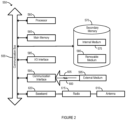
- Figure 2 is a block diagram illustrating an example wired or wireless system 550 that may be used in connection with various embodiments described herein.
- the system 550 may be used as or in conjunction with the system 100, as previously described with respect to figure 1 .
- the system 550 can be a conventional personal computer, computer server, personal digital assistant, smart phone, tablet computer, vehicle navigation and/or control system, or any other processor enabled device that is capable of wired or wireless data communication.
- Other computer systems and/or architectures may be also used, as will be clear to those skilled in the art.
- the system 550 preferably includes one or more processors, such as processor 560.
- Additional processors may be provided, such as an auxiliary processor to manage input/output, an auxiliary processor to perform floating point mathematical operations, a special-purpose microprocessor having an architecture suitable for fast execution of signal processing algorithms (e.g., digital signal processor), a slave processor subordinate to the main processing system (e.g., back-end processor), an additional microprocessor or controller for dual or multiple processor systems, or a coprocessor.
- auxiliary processors may be discrete processors or may be integrated with the processor 560.
- the processor 560 is preferably connected to a communication bus 555.
- the communication bus 555 may include a data channel for facilitating information transfer between storage and other peripheral components of the system 550.
- the communication bus 555 further may provide a set of signals used for communication with the processor 560, including a data bus, address bus, and control bus (not shown).
- the communication bus 555 may comprise any standard or non-standard bus architecture such as, for example, bus architectures compliant with industry standard architecture ("ISA”), extended industry standard architecture (“EISA”), Micro Channel Architecture (“MCA”), peripheral component interconnect (“PCI”) local bus, or standards promulgated by the Institute of Electrical and Electronics Engineers (“IEEE”) including IEEE 488 general-purpose interface bus (“GPIB”), IEEE 696/S-100, and the like.
- ISA industry standard architecture
- EISA extended industry standard architecture
- MCA Micro Channel Architecture
- PCI peripheral component interconnect
- IEEE Institute of Electrical and Electronics Engineers
- IEEE Institute of Electrical and Electronics Engineers
- GPIB
- the System 550 preferably includes a main memory 565 and may also include a secondary memory 570.
- the main memory 565 provides storage of instructions and data for programs executing on the processor 560, such as one or more of the modules described above.
- the main memory 565 is typically semiconductor-based memory such as dynamic random access memory (“DRAM”) and/or static random access memory (“SRAM”).
- DRAM dynamic random access memory
- SRAM static random access memory
- Other semiconductor-based memory types include, for example, synchronous dynamic random access memory (“SDRAM”), Rambus dynamic random access memory (“RDRAM”), ferroelectric random access memory (“FRAM”), and the like, including read only memory (“ROM”).
- the secondary memory 570 may optionally include a internal memory 575 and/or a removable medium 580, for example a floppy disk drive, a magnetic tape drive, a compact disc (“CD”) drive, a digital versatile disc (“DVD”) drive, etc.
- the removable medium 580 is read from and/or written to in a well-known manner.
- Removable storage medium 580 may be, for example, a floppy disk, magnetic tape, CD, DVD, SD card, etc.
- the removable storage medium 580 is a non-transitory computer readable medium having stored thereon computer executable code (i.e., software) and/or data.
- the computer software or data stored on the removable storage medium 580 is read into the system 550 for execution by the processor 560.
- secondary memory 570 may include other similar means for allowing computer programs or other data or instructions to be loaded into the system 550.
- Such means may include, for example, an external storage medium 595 and an interface 570.
- external storage medium 595 may include an external hard disk drive or an external optical drive, or and external magneto-optical drive.
- secondary memory 570 may include semiconductor-based memory such as programmable read-only memory (“PROM”), erasable programmable read-only memory (“EPROM”), electrically erasable read-only memory (“EEPROM”), or flash memory (block oriented memory similar to EEPROM). Also included are any other removable storage media 580 and communication interface 590, which allow software and data to be transferred from an external medium 595 to the system 550.
- PROM programmable read-only memory
- EPROM erasable programmable read-only memory
- EEPROM electrically erasable read-only memory
- flash memory block oriented memory similar to EEPROM
- System 550 may also include a communication interface 590.
- the communication interface 590 allows software and data to be transferred between system 550 and external devices (e.g. printers), networks, or information sources.
- external devices e.g. printers
- computer software or executable code may be transferred to system 550 from a network server via communication interface 590.
- Examples of communication interface 590 include a modem, a network interface card ("NIC"), a wireless data card, a communications port, a PCMCIA slot and card, an infrared interface, and an IEEE 1394 fire-wire, just to name a few.
- Communication interface 590 preferably implements industry promulgated protocol standards, such as Ethernet IEEE 802 standards, Fiber Channel, digital subscriber line (“DSL”), asynchronous digital subscriber line (“ADSL”), frame relay, asynchronous transfer mode (“ATM”), integrated digital services network (“ISDN”), personal communications services (“PCS”), transmission control protocol/Internet protocol (“TCP/IP”), serial line Internet protocol/point to point protocol (“SLIP/PPP”), and so on, but may also implement customized or non-standard interface protocols as well.
- industry promulgated protocol standards such as Ethernet IEEE 802 standards, Fiber Channel, digital subscriber line (“DSL”), asynchronous digital subscriber line (“ADSL”), frame relay, asynchronous transfer mode (“ATM”), integrated digital services network (“ISDN”), personal communications services (“PCS”), transmission control protocol/Internet protocol (“TCP/IP”), serial line Internet protocol/point to point protocol (“SLIP/PPP”), and so on, but may also implement customized or non-standard interface protocols as well.
- Software and data transferred via communication interface 590 are generally in the form of electrical communication signals 605. These signals 605 are preferably provided to communication interface 590 via a communication channel 600.
- the communication channel 600 may be a wired or wireless network, or any variety of other communication links.
- Communication channel 600 carries signals 605 and can be implemented using a variety of wired or wireless communication means including wire or cable, fiber optics, conventional phone line, cellular phone link, wireless data communication link, radio frequency (“RF”) link, or infrared link, just to name a few.
- RF radio frequency
- Computer executable code i.e., computer programs or software
- main memory 565 and/or the secondary memory 570 Computer programs can also be received via communication interface 590 and stored in the main memory 565 and/or the secondary memory 570.
- computer readable medium is used to refer to any non-transitory computer readable storage media used to provide computer executable code (e.g., software and computer programs) to the system 550.
- Examples of these media include main memory 565, secondary memory 570 (including internal memory 575, removable medium 580, and external storage medium 595), and any peripheral device communicatively coupled with communication interface 590 (including a network information server or other network device).
- These non-transitory computer readable mediums are means for providing executable code, programming instructions, and software to the system 550.
- the software may be stored on a computer readable medium and loaded into the system 550 by way of removable medium 580, I/O interface 585, or communication interface 590.
- the software is loaded into the system 550 in the form of electrical communication signals 605.
- the system 550 also includes optional wireless communication components that facilitate wireless communication over a voice and over a data network.
- the wireless communication components comprise an antenna system 610, a radio system 615 and a baseband system 620.
- RF radio frequency
- the antenna system 610 may comprise one or more antennae and one or more multiplexors (not shown) that perform a switching function to provide the antenna system 610 with transmit and receive signal paths.
- received RF signals can be coupled from a multiplexor to a low noise amplifier (not shown) that amplifies the received RF signal and sends the amplified signal to the radio system 615.
- the radio system 615 may comprise one or more radios that are configured to communicate over various frequencies.
- the radio system 615 may combine a demodulator (not shown) and modulator (not shown) in one integrated circuit ("IC").
- the demodulator and modulator can also be separate components. In the incoming path, the demodulator strips away the RF carrier signal leaving a baseband receive audio signal, which is sent from the radio system 615 to the baseband system 620.
- baseband system 620 decodes the signal and converts it to an analog signal. Then the signal is amplified and sent to a speaker.
- the baseband system 620 also receives analog audio signals from a microphone. These analog audio signals are converted to digital signals and encoded by the baseband system 620.
- the baseband system 620 also codes the digital signals for transmission and generates a baseband transmit audio signal that is routed to the modulator portion of the radio system 615.
- the modulator mixes the baseband transmit audio signal with an RF carrier signal generating an RF transmit signal that is routed to the antenna system and may pass through a power amplifier (not shown).
- the power amplifier amplifies the RF transmit signal and routes it to the antenna system 610 where the signal is switched to the antenna port for transmission.
- the baseband system 620 is also communicatively coupled with the processor 560.
- the central processing unit 560 has access to data storage areas 565 and 570.
- the central processing unit 560 is preferably configured to execute instructions (i.e., computer programs or software) that can be stored in the memory 565 or the secondary memory 570.
- Computer programs can also be received from the baseband processor 610 and stored in the data storage area 565 or in secondary memory 570, or executed upon receipt.
- ASICs application specific integrated circuits
- FPGAs field programmable gate arrays
- ASICs application specific integrated circuits
- FPGAs field programmable gate arrays
- DSP digital signal processor
- a general-purpose processor can be a microprocessor, but in the alternative, the processor can be any processor, controller, microcontroller, or state machine.
- a processor can also be implemented as a combination of computing devices, for example, a combination of a DSP and a microprocessor, a plurality of microprocessors, one or more microprocessors in conjunction with a DSP core, or any other such configuration.
- a software module can reside in RAM memory, flash memory, ROM memory, EPROM memory, EEPROM memory, registers, hard disk, a removable disk, a CD-ROM, or any other form of storage medium including a network storage medium.
- An exemplary storage medium can be coupled to the processor such the processor can read information from, and write information to, the storage medium.
- the storage medium can be integral to the processor.
- the processor and the storage medium can also reside in an ASIC.
Landscapes
- Engineering & Computer Science (AREA)
- Health & Medical Sciences (AREA)
- Biomedical Technology (AREA)
- Business, Economics & Management (AREA)
- General Business, Economics & Management (AREA)
- Computer Networks & Wireless Communication (AREA)
- Signal Processing (AREA)
- General Health & Medical Sciences (AREA)
- Epidemiology (AREA)
- Medical Informatics (AREA)
- Primary Health Care (AREA)
- Public Health (AREA)
- Telephonic Communication Services (AREA)
- Telephone Function (AREA)
- Mobile Radio Communication Systems (AREA)
- Medical Treatment And Welfare Office Work (AREA)
- Measuring And Recording Apparatus For Diagnosis (AREA)
Claims (7)
- System (100), umfassend:eine mobile Vorrichtung (112), die eine Kennung (identifier - ID) eines Benutzers, eine Nahbereichskommunikationsschnittstelle und eine Anwendung (113) aufweist;einen Anbieterserver (102), der mit der mobilen Vorrichtung (112) kommunikativ gekoppelt und dazu konfiguriert ist, eine Vielzahl von ersten Vorrichtungs-ID (111) zu speichern, die einer Vielzahl von entfernten Vorrichtungen (104) zugeordnet ist, wobei die Anwendung (113) dem Anbieterserver (102) zugeordnet ist; undeinen Vorrichtungsmanager(106)-Server, der mit dem Anbieterserver (102) und der mobilen Vorrichtung (112) kommunikativ gekoppelt und dazu konfiguriert ist, die Benutzer-ID zu empfangen,Empfangen der Vielzahl von ersten Vorrichtungs-ID (111) von dem Anbieterserver (102),Zuordnen der Benutzer-ID zu der Vielzahl von ersten Vorrichtungs-ID (111) in einer Datenbank (108, 110) undBereitstellen der Vielzahl von ersten Vorrichtungs-ID (111) an die Anwendung (113) basierend auf der Benutzer-ID;wobei die Anwendung (113) dazu konfiguriert ist, die Vielzahl von ersten Vorrichtungs-ID (111) von dem Vorrichtungsmanager-Server (106) zu empfangen,Bereitstellen der ersten Vorrichtungs-ID (111) an die mobile Vorrichtung (112), um eine automatische Paarung der mobilen Vorrichtung (112) mit der Vielzahl von entfernten Vorrichtungen (104) zu ermöglichen, die den ersten Vorrichtungs-ID (111) zugeordnet ist,Empfangen von Daten von einer gepaarten entfernten Vorrichtung mit einer Vorrichtungs-ID, die eine der Vielzahl von ersten Vorrichtungs-ID (111) ist, undDurchführen mindestens einer der folgenden Operationen: Speichern der Daten, Anzeigen der Daten oder Senden der Daten an einen Backend-Server.
- System nach Anspruch 1, wobei die Vielzahl von Vorrichtungs-ID (111) einer oder mehreren der folgenden Vorrichtungen zugeordnet ist: einer Waage, einer Blutdruckmanschette, einem Glukosemessgerät und einem Aktivitätstracker.
- System nach Anspruch 1, wobei jede der Vielzahl von Vorrichtungs-ID (111) eine MAC-Adresse beinhaltet.
- System nach Anspruch 1, wobei die mobile Vorrichtung (112) beginnt, Messungen über die Nahbereichskommunikationsschnittstelle von mindestens einer der entfernten Vorrichtungen (104), mit denen sie gepaart ist, zu empfangen, ohne jegliche weitere Einrichtung oder Aktion durch einen Benutzer.
- System nach Anspruch 4, wobei die mobile Vorrichtung (112) ferner eine Anzeige umfasst, und wobei die Anwendung bewirkt, dass die empfangenen Messungen an die Anzeige ausgegeben werden.
- System nach Anspruch 1, wobei die mobile Vorrichtung (112) ferner dazu konfiguriert ist, die Messdaten an den Anbieterserver (102) bereitzustellen.
- Verfahren zum automatischen Paaren einer mobilen Vorrichtung (112) mit entfernten Vorrichtungen (104), umfassend:
an einem Vorrichtungsmanager-Server (106):Empfangen der Benutzer-ID und einer Vielzahl von ersten Vorrichtungs-ID (111), die einer Vielzahl von entfernten Vorrichtungen (104) zugeordnet ist, von einem Anbieterserver (102);Zuordnen der Benutzer-ID zu der Vielzahl von ersten Vorrichtungs-ID (111) undSpeichern der zugeordneten Benutzer-ID und einer Vielzahl von ersten Vorrichtungs-ID (111); undauf einer mobilen Vorrichtung (112):Speichern einer einem Anbieterserver (102) zugeordneten Anwendung (113), wobei die mobile Vorrichtung eine Benutzerkennung (ID) und eine Nahbereichskommunikationsschnittstelle aufweist, Übertragen der Benutzerkennung durch die mobile Vorrichtung (112) an den Anbieterserver (102) über die Anwendung (113),Empfangen der Vielzahl von ersten Vorrichtungs-ID (111) an der mobilen Vorrichtung (112) von dem Vorrichtungsmanager-Server (106) und über die Anwendung (113),automatisches Paaren der mobilen Vorrichtung (112) mit einer entfernten Vorrichtung mit einer Vorrichtungs-ID, die eine der Vielzahl von ersten Vorrichtungs-ID (111) ist,Empfangen von Daten von der gepaarten entfernten Vorrichtung, undDurchführen mindestens einer der folgenden Operationen: Speichern der Daten, Anzeigen der Daten oder Senden der Daten an einen Backend-Server.
Applications Claiming Priority (2)
| Application Number | Priority Date | Filing Date | Title |
|---|---|---|---|
| US15/793,903 US10701746B2 (en) | 2017-10-25 | 2017-10-25 | Systems and methods for automatic pairing of devices |
| PCT/US2018/055941 WO2019083763A1 (en) | 2017-10-25 | 2018-10-15 | SYSTEMS AND METHODS FOR AUTOMATIC DEVICE MATCHING |
Publications (4)
| Publication Number | Publication Date |
|---|---|
| EP3701767A1 EP3701767A1 (de) | 2020-09-02 |
| EP3701767A4 EP3701767A4 (de) | 2021-07-28 |
| EP3701767B1 true EP3701767B1 (de) | 2024-08-21 |
| EP3701767C0 EP3701767C0 (de) | 2024-08-21 |
Family
ID=66169590
Family Applications (1)
| Application Number | Title | Priority Date | Filing Date |
|---|---|---|---|
| EP18869535.7A Active EP3701767B1 (de) | 2017-10-25 | 2018-10-15 | Systeme und verfahren zur automatischen paarung von vorrichtungen |
Country Status (7)
| Country | Link |
|---|---|
| US (2) | US10701746B2 (de) |
| EP (1) | EP3701767B1 (de) |
| JP (1) | JP6849203B2 (de) |
| KR (1) | KR102246395B1 (de) |
| CN (1) | CN111480390B (de) |
| CA (1) | CA3080244C (de) |
| WO (1) | WO2019083763A1 (de) |
Families Citing this family (6)
| Publication number | Priority date | Publication date | Assignee | Title |
|---|---|---|---|---|
| US11418939B2 (en) * | 2017-10-25 | 2022-08-16 | Indie Health LLC | Systems and methods for automatic pairing of devices |
| US10856347B2 (en) * | 2019-06-28 | 2020-12-01 | Advanced New Technologies Co., Ltd. | Wireless communications method, apparatus, device, and storage medium |
| US20210377726A1 (en) * | 2020-05-27 | 2021-12-02 | Medtronic Minimed, Inc. | Method and system for automatically associating a non-medical device with a medical device |
| CN115474179A (zh) * | 2021-05-28 | 2022-12-13 | 中兴通讯股份有限公司 | 一种跟踪器的网络自动控制方法、装置、设备及存储介质 |
| US11711860B2 (en) * | 2021-06-06 | 2023-07-25 | Kyndryl, Inc. | Device pairing by cognitive computing |
| US12477601B1 (en) * | 2023-06-21 | 2025-11-18 | Amazon Technologies, Inc. | Automated temporary device connectivity |
Family Cites Families (19)
| Publication number | Priority date | Publication date | Assignee | Title |
|---|---|---|---|---|
| WO2008018889A2 (en) | 2005-09-29 | 2008-02-14 | The General Hospital Corporation | Medical training system for casualty simulation |
| US9047648B1 (en) | 2006-03-30 | 2015-06-02 | At&T Mobility Ii Llc | Measurement, collection, reporting and processing of health condition data |
| US8315708B2 (en) | 2006-08-31 | 2012-11-20 | Biotronik Crm Patent Ag | Patient device for bidirectional data communication with an implant |
| US20090292178A1 (en) * | 2008-05-21 | 2009-11-26 | Qualcomm Incorporated | System and method of monitoring users during an interactive activity |
| US20100205209A1 (en) * | 2009-02-12 | 2010-08-12 | Medixine Oy | Method and system for monitoring a personal intake |
| US8914523B2 (en) * | 2010-05-17 | 2014-12-16 | Verizon Patent And Licensing Inc. | Dynamic internet protocol registry for mobile internet protocol based communications |
| US20120182939A1 (en) * | 2011-01-14 | 2012-07-19 | Qualcomm Incorporated | Telehealth wireless communication hub and service platform system |
| US9974108B2 (en) * | 2012-02-06 | 2018-05-15 | Nuvectra Corporation | Paired communication between an implanted medical device and an external control device |
| KR101581656B1 (ko) * | 2012-07-16 | 2016-01-04 | 삼성전자 주식회사 | 스마트장치, 이를 이용한 동기화 시스템 및 방법 |
| US9705989B2 (en) * | 2013-09-13 | 2017-07-11 | Polar Electro Oy | Pairing of devices |
| US9053654B2 (en) | 2013-09-30 | 2015-06-09 | John Sherman | Facilitating user input via arm-mounted peripheral device interfacing with head-mounted display device |
| WO2016037015A1 (en) * | 2014-09-04 | 2016-03-10 | Bidgely Inc. | Systems and methods for connecting home area network devices to smart meters and utility accounts |
| CN104680213A (zh) * | 2015-02-12 | 2015-06-03 | 无锡识凌科技有限公司 | 一种设备之间快速连接及数据传输的控制方法 |
| US20160328576A1 (en) | 2015-05-08 | 2016-11-10 | YC Wellness, Inc. | Integration platform and application interfaces for remote data management and security |
| CN106413124B (zh) * | 2015-07-31 | 2021-03-23 | 腾讯科技(深圳)有限公司 | 设备绑定方法和装置 |
| CN108353266B (zh) * | 2015-08-20 | 2022-05-10 | 惠普发展公司,有限责任合伙企业 | 外围设备配对 |
| CN105357629A (zh) * | 2015-11-20 | 2016-02-24 | 青岛海尔股份有限公司 | 移动终端与智能家电的绑定方法及装置 |
| WO2017109663A1 (en) | 2015-12-22 | 2017-06-29 | GOGINENI, Shyamala Devi | A smart bio-fluids diagnostic monitoring system and a method of monitoring healthiness |
| US20180116560A1 (en) * | 2016-10-31 | 2018-05-03 | Welch Allyn, Inc. | Method and apparatus for monitoring body parts of an individual |
-
2017
- 2017-10-25 US US15/793,903 patent/US10701746B2/en active Active
-
2018
- 2018-10-15 CN CN201880080778.4A patent/CN111480390B/zh active Active
- 2018-10-15 JP JP2020536757A patent/JP6849203B2/ja active Active
- 2018-10-15 EP EP18869535.7A patent/EP3701767B1/de active Active
- 2018-10-15 WO PCT/US2018/055941 patent/WO2019083763A1/en not_active Ceased
- 2018-10-15 CA CA3080244A patent/CA3080244C/en active Active
- 2018-10-15 KR KR1020207014694A patent/KR102246395B1/ko active Active
-
2020
- 2020-06-29 US US16/915,810 patent/US11419168B2/en active Active
Also Published As
| Publication number | Publication date |
|---|---|
| CN111480390A (zh) | 2020-07-31 |
| EP3701767A4 (de) | 2021-07-28 |
| CA3080244A1 (en) | 2019-05-02 |
| JP2021503262A (ja) | 2021-02-04 |
| EP3701767C0 (de) | 2024-08-21 |
| US10701746B2 (en) | 2020-06-30 |
| CA3080244C (en) | 2021-01-12 |
| JP6849203B2 (ja) | 2021-03-24 |
| CN111480390B (zh) | 2021-09-17 |
| WO2019083763A1 (en) | 2019-05-02 |
| US20200329517A1 (en) | 2020-10-15 |
| US20190124701A1 (en) | 2019-04-25 |
| KR102246395B1 (ko) | 2021-04-29 |
| KR20200072538A (ko) | 2020-06-22 |
| US11419168B2 (en) | 2022-08-16 |
| EP3701767A1 (de) | 2020-09-02 |
Similar Documents
| Publication | Publication Date | Title |
|---|---|---|
| US11419168B2 (en) | Systems and methods for automatic pairing of devices | |
| US12382265B2 (en) | Systems and methods for automatic pairing of devices | |
| US9872087B2 (en) | Platform for patient monitoring | |
| US20170140120A1 (en) | Mobile data hub for patient monitors | |
| US10411794B2 (en) | Method and system for transmitting result of examination of specimen from medical device to destination through mobile device | |
| Jiménez-Fernández et al. | Usability and interoperability in wireless sensor networks for patient telemonitoring in chronic disease management | |
| TW201421417A (zh) | 透過藍牙/Wi-Fi與行動電話裝置以傳輸生理偵測訊號的方法 | |
| JP2009503978A (ja) | 携帯型医療デバイスのためのコンテキスト依存によるサービス発見システム及び方法 | |
| KR20140105011A (ko) | 의료 디바이스들을 위한 원격 모니터링 시스템들 및 방법들 | |
| US20150208921A1 (en) | Information processing apparatus, portable communication terminal, and control methods and control programs thereof | |
| CN108322450A (zh) | 使用多种协议进行通信的方法及其电子设备 | |
| US20150261933A1 (en) | System and method for receiving communications and providing alerts | |
| KR102074913B1 (ko) | 웨어러블 기기에서 감지된 ecg(심전도) 및 라이프 로그 정보를 이용한 개인 주치의 서비스 시스템 및 그 방법 | |
| CN106817668B (zh) | 一种基于蓝牙的连接通信方法 | |
| US10939286B2 (en) | Link status-aware medical devices and gateways | |
| Julio | Design ubiquitous architecture for telemedicine based on mhealth Arduino 4G LTE | |
| KR101747859B1 (ko) | 생체 정보 관리 방법 및 장치 | |
| Bluetooth | Health Device Profile | |
| US20200345233A1 (en) | Monitoring system, data transmission method, portable monitor, and configurator | |
| KR20080082025A (ko) | 무선 건강관리 가이드 장치 |
Legal Events
| Date | Code | Title | Description |
|---|---|---|---|
| STAA | Information on the status of an ep patent application or granted ep patent |
Free format text: STATUS: THE INTERNATIONAL PUBLICATION HAS BEEN MADE |
|
| PUAI | Public reference made under article 153(3) epc to a published international application that has entered the european phase |
Free format text: ORIGINAL CODE: 0009012 |
|
| STAA | Information on the status of an ep patent application or granted ep patent |
Free format text: STATUS: REQUEST FOR EXAMINATION WAS MADE |
|
| 17P | Request for examination filed |
Effective date: 20200522 |
|
| AK | Designated contracting states |
Kind code of ref document: A1 Designated state(s): AL AT BE BG CH CY CZ DE DK EE ES FI FR GB GR HR HU IE IS IT LI LT LU LV MC MK MT NL NO PL PT RO RS SE SI SK SM TR |
|
| AX | Request for extension of the european patent |
Extension state: BA ME |
|
| DAV | Request for validation of the european patent (deleted) | ||
| DAX | Request for extension of the european patent (deleted) | ||
| A4 | Supplementary search report drawn up and despatched |
Effective date: 20210630 |
|
| RIC1 | Information provided on ipc code assigned before grant |
Ipc: H04W 76/11 20180101AFI20210624BHEP Ipc: H04W 76/14 20180101ALI20210624BHEP Ipc: H04W 4/80 20180101ALI20210624BHEP Ipc: H04W 4/38 20180101ALI20210624BHEP Ipc: G16H 40/20 20180101ALI20210624BHEP Ipc: G16H 40/63 20180101ALI20210624BHEP Ipc: G16H 40/67 20180101ALI20210624BHEP |
|
| GRAP | Despatch of communication of intention to grant a patent |
Free format text: ORIGINAL CODE: EPIDOSNIGR1 |
|
| STAA | Information on the status of an ep patent application or granted ep patent |
Free format text: STATUS: GRANT OF PATENT IS INTENDED |
|
| INTG | Intention to grant announced |
Effective date: 20240321 |
|
| GRAS | Grant fee paid |
Free format text: ORIGINAL CODE: EPIDOSNIGR3 |
|
| GRAA | (expected) grant |
Free format text: ORIGINAL CODE: 0009210 |
|
| STAA | Information on the status of an ep patent application or granted ep patent |
Free format text: STATUS: THE PATENT HAS BEEN GRANTED |
|
| AK | Designated contracting states |
Kind code of ref document: B1 Designated state(s): AL AT BE BG CH CY CZ DE DK EE ES FI FR GB GR HR HU IE IS IT LI LT LU LV MC MK MT NL NO PL PT RO RS SE SI SK SM TR |
|
| REG | Reference to a national code |
Ref country code: GB Ref legal event code: FG4D |
|
| RIN1 | Information on inventor provided before grant (corrected) |
Inventor name: MCCLELLAN, CLINT |
|
| REG | Reference to a national code |
Ref country code: CH Ref legal event code: EP |
|
| REG | Reference to a national code |
Ref country code: IE Ref legal event code: FG4D |
|
| REG | Reference to a national code |
Ref country code: DE Ref legal event code: R096 Ref document number: 602018073470 Country of ref document: DE |
|
| U01 | Request for unitary effect filed |
Effective date: 20240919 |
|
| U07 | Unitary effect registered |
Designated state(s): AT BE BG DE DK EE FI FR IT LT LU LV MT NL PT RO SE SI Effective date: 20241009 |
|
| PG25 | Lapsed in a contracting state [announced via postgrant information from national office to epo] |
Ref country code: NO Free format text: LAPSE BECAUSE OF FAILURE TO SUBMIT A TRANSLATION OF THE DESCRIPTION OR TO PAY THE FEE WITHIN THE PRESCRIBED TIME-LIMIT Effective date: 20241121 |
|
| PG25 | Lapsed in a contracting state [announced via postgrant information from national office to epo] |
Ref country code: GR Free format text: LAPSE BECAUSE OF FAILURE TO SUBMIT A TRANSLATION OF THE DESCRIPTION OR TO PAY THE FEE WITHIN THE PRESCRIBED TIME-LIMIT Effective date: 20241122 Ref country code: PL Free format text: LAPSE BECAUSE OF FAILURE TO SUBMIT A TRANSLATION OF THE DESCRIPTION OR TO PAY THE FEE WITHIN THE PRESCRIBED TIME-LIMIT Effective date: 20240821 |
|
| PG25 | Lapsed in a contracting state [announced via postgrant information from national office to epo] |
Ref country code: IS Free format text: LAPSE BECAUSE OF FAILURE TO SUBMIT A TRANSLATION OF THE DESCRIPTION OR TO PAY THE FEE WITHIN THE PRESCRIBED TIME-LIMIT Effective date: 20241221 |
|
| PG25 | Lapsed in a contracting state [announced via postgrant information from national office to epo] |
Ref country code: HR Free format text: LAPSE BECAUSE OF FAILURE TO SUBMIT A TRANSLATION OF THE DESCRIPTION OR TO PAY THE FEE WITHIN THE PRESCRIBED TIME-LIMIT Effective date: 20240821 |
|
| PG25 | Lapsed in a contracting state [announced via postgrant information from national office to epo] |
Ref country code: ES Free format text: LAPSE BECAUSE OF FAILURE TO SUBMIT A TRANSLATION OF THE DESCRIPTION OR TO PAY THE FEE WITHIN THE PRESCRIBED TIME-LIMIT Effective date: 20240821 Ref country code: RS Free format text: LAPSE BECAUSE OF FAILURE TO SUBMIT A TRANSLATION OF THE DESCRIPTION OR TO PAY THE FEE WITHIN THE PRESCRIBED TIME-LIMIT Effective date: 20241121 |
|
| PG25 | Lapsed in a contracting state [announced via postgrant information from national office to epo] |
Ref country code: RS Free format text: LAPSE BECAUSE OF FAILURE TO SUBMIT A TRANSLATION OF THE DESCRIPTION OR TO PAY THE FEE WITHIN THE PRESCRIBED TIME-LIMIT Effective date: 20241121 Ref country code: PL Free format text: LAPSE BECAUSE OF FAILURE TO SUBMIT A TRANSLATION OF THE DESCRIPTION OR TO PAY THE FEE WITHIN THE PRESCRIBED TIME-LIMIT Effective date: 20240821 Ref country code: NO Free format text: LAPSE BECAUSE OF FAILURE TO SUBMIT A TRANSLATION OF THE DESCRIPTION OR TO PAY THE FEE WITHIN THE PRESCRIBED TIME-LIMIT Effective date: 20241121 Ref country code: IS Free format text: LAPSE BECAUSE OF FAILURE TO SUBMIT A TRANSLATION OF THE DESCRIPTION OR TO PAY THE FEE WITHIN THE PRESCRIBED TIME-LIMIT Effective date: 20241221 Ref country code: HR Free format text: LAPSE BECAUSE OF FAILURE TO SUBMIT A TRANSLATION OF THE DESCRIPTION OR TO PAY THE FEE WITHIN THE PRESCRIBED TIME-LIMIT Effective date: 20240821 Ref country code: GR Free format text: LAPSE BECAUSE OF FAILURE TO SUBMIT A TRANSLATION OF THE DESCRIPTION OR TO PAY THE FEE WITHIN THE PRESCRIBED TIME-LIMIT Effective date: 20241122 Ref country code: ES Free format text: LAPSE BECAUSE OF FAILURE TO SUBMIT A TRANSLATION OF THE DESCRIPTION OR TO PAY THE FEE WITHIN THE PRESCRIBED TIME-LIMIT Effective date: 20240821 |
|
| PG25 | Lapsed in a contracting state [announced via postgrant information from national office to epo] |
Ref country code: SM Free format text: LAPSE BECAUSE OF FAILURE TO SUBMIT A TRANSLATION OF THE DESCRIPTION OR TO PAY THE FEE WITHIN THE PRESCRIBED TIME-LIMIT Effective date: 20240821 |
|
| PG25 | Lapsed in a contracting state [announced via postgrant information from national office to epo] |
Ref country code: CZ Free format text: LAPSE BECAUSE OF FAILURE TO SUBMIT A TRANSLATION OF THE DESCRIPTION OR TO PAY THE FEE WITHIN THE PRESCRIBED TIME-LIMIT Effective date: 20240821 |
|
| PG25 | Lapsed in a contracting state [announced via postgrant information from national office to epo] |
Ref country code: SK Free format text: LAPSE BECAUSE OF FAILURE TO SUBMIT A TRANSLATION OF THE DESCRIPTION OR TO PAY THE FEE WITHIN THE PRESCRIBED TIME-LIMIT Effective date: 20240821 |
|
| U21 | Renewal fee for the european patent with unitary effect paid with additional fee |
Year of fee payment: 7 Effective date: 20250416 |
|
| REG | Reference to a national code |
Ref country code: CH Ref legal event code: PL |
|
| PLBE | No opposition filed within time limit |
Free format text: ORIGINAL CODE: 0009261 |
|
| STAA | Information on the status of an ep patent application or granted ep patent |
Free format text: STATUS: NO OPPOSITION FILED WITHIN TIME LIMIT |
|
| PG25 | Lapsed in a contracting state [announced via postgrant information from national office to epo] |
Ref country code: MC Free format text: LAPSE BECAUSE OF FAILURE TO SUBMIT A TRANSLATION OF THE DESCRIPTION OR TO PAY THE FEE WITHIN THE PRESCRIBED TIME-LIMIT Effective date: 20240821 |
|
| PG25 | Lapsed in a contracting state [announced via postgrant information from national office to epo] |
Ref country code: CH Free format text: LAPSE BECAUSE OF NON-PAYMENT OF DUE FEES Effective date: 20241031 |
|
| 26N | No opposition filed |
Effective date: 20250522 |
|
| PG25 | Lapsed in a contracting state [announced via postgrant information from national office to epo] |
Ref country code: IE Free format text: LAPSE BECAUSE OF NON-PAYMENT OF DUE FEES Effective date: 20241015 |
|
| U20 | Renewal fee for the european patent with unitary effect paid |
Year of fee payment: 8 Effective date: 20251021 |
|
| PGFP | Annual fee paid to national office [announced via postgrant information from national office to epo] |
Ref country code: GB Payment date: 20251021 Year of fee payment: 8 |
|
| PG25 | Lapsed in a contracting state [announced via postgrant information from national office to epo] |
Ref country code: CY Free format text: LAPSE BECAUSE OF FAILURE TO SUBMIT A TRANSLATION OF THE DESCRIPTION OR TO PAY THE FEE WITHIN THE PRESCRIBED TIME-LIMIT; INVALID AB INITIO Effective date: 20181015 |
|
| PG25 | Lapsed in a contracting state [announced via postgrant information from national office to epo] |
Ref country code: HU Free format text: LAPSE BECAUSE OF FAILURE TO SUBMIT A TRANSLATION OF THE DESCRIPTION OR TO PAY THE FEE WITHIN THE PRESCRIBED TIME-LIMIT; INVALID AB INITIO Effective date: 20181015 |