EP3698133B1 - Vorrichtung und verfahren zur automatischen erkennung von geruchsstoffen in einer lösung unter verwendung von caenorabditis elegans nematoden - Google Patents
Vorrichtung und verfahren zur automatischen erkennung von geruchsstoffen in einer lösung unter verwendung von caenorabditis elegans nematoden Download PDFInfo
- Publication number
- EP3698133B1 EP3698133B1 EP18803477.1A EP18803477A EP3698133B1 EP 3698133 B1 EP3698133 B1 EP 3698133B1 EP 18803477 A EP18803477 A EP 18803477A EP 3698133 B1 EP3698133 B1 EP 3698133B1
- Authority
- EP
- European Patent Office
- Prior art keywords
- nematodes
- nematode
- measurement
- selection unit
- optical sensor
- Prior art date
- Legal status (The legal status is an assumption and is not a legal conclusion. Google has not performed a legal analysis and makes no representation as to the accuracy of the status listed.)
- Active
Links
Images




Classifications
-
- G—PHYSICS
- G01—MEASURING; TESTING
- G01N—INVESTIGATING OR ANALYSING MATERIALS BY DETERMINING THEIR CHEMICAL OR PHYSICAL PROPERTIES
- G01N33/00—Investigating or analysing materials by specific methods not covered by groups G01N1/00 - G01N31/00
- G01N33/0001—Investigating or analysing materials by specific methods not covered by groups G01N1/00 - G01N31/00 by organoleptic means
-
- A—HUMAN NECESSITIES
- A01—AGRICULTURE; FORESTRY; ANIMAL HUSBANDRY; HUNTING; TRAPPING; FISHING
- A01K—ANIMAL HUSBANDRY; AVICULTURE; APICULTURE; PISCICULTURE; FISHING; REARING OR BREEDING ANIMALS, NOT OTHERWISE PROVIDED FOR; NEW BREEDS OF ANIMALS
- A01K67/00—Rearing or breeding animals, not otherwise provided for; New or modified breeds of animals
- A01K67/30—Rearing or breeding invertebrates
-
- B—PERFORMING OPERATIONS; TRANSPORTING
- B01—PHYSICAL OR CHEMICAL PROCESSES OR APPARATUS IN GENERAL
- B01L—CHEMICAL OR PHYSICAL LABORATORY APPARATUS FOR GENERAL USE
- B01L3/00—Containers or dishes for laboratory use, e.g. laboratory glassware; Droppers
- B01L3/50—Containers for the purpose of retaining a material to be analysed, e.g. test tubes
- B01L3/502—Containers for the purpose of retaining a material to be analysed, e.g. test tubes with fluid transport, e.g. in multi-compartment structures
- B01L3/5027—Containers for the purpose of retaining a material to be analysed, e.g. test tubes with fluid transport, e.g. in multi-compartment structures by integrated microfluidic structures, i.e. dimensions of channels and chambers are such that surface tension forces are important, e.g. lab-on-a-chip
- B01L3/502761—Containers for the purpose of retaining a material to be analysed, e.g. test tubes with fluid transport, e.g. in multi-compartment structures by integrated microfluidic structures, i.e. dimensions of channels and chambers are such that surface tension forces are important, e.g. lab-on-a-chip specially adapted for handling suspended solids or molecules independently from the bulk fluid flow, e.g. for trapping or sorting beads or physically stretching molecules
-
- G—PHYSICS
- G01—MEASURING; TESTING
- G01N—INVESTIGATING OR ANALYSING MATERIALS BY DETERMINING THEIR CHEMICAL OR PHYSICAL PROPERTIES
- G01N21/00—Investigating or analysing materials by the use of optical means, i.e. using sub-millimetre waves, infrared, visible or ultraviolet light
- G01N21/62—Systems in which the material investigated is excited whereby it emits light or causes a change in wavelength of the incident light
- G01N21/63—Systems in which the material investigated is excited whereby it emits light or causes a change in wavelength of the incident light optically excited
- G01N21/64—Fluorescence; Phosphorescence
- G01N21/6486—Measuring fluorescence of biological material, e.g. DNA, RNA, cells
-
- G—PHYSICS
- G01—MEASURING; TESTING
- G01N—INVESTIGATING OR ANALYSING MATERIALS BY DETERMINING THEIR CHEMICAL OR PHYSICAL PROPERTIES
- G01N33/00—Investigating or analysing materials by specific methods not covered by groups G01N1/00 - G01N31/00
- G01N33/48—Biological material, e.g. blood, urine; Haemocytometers
- G01N33/50—Chemical analysis of biological material, e.g. blood, urine; Testing involving biospecific ligand binding methods; Immunological testing
- G01N33/5005—Chemical analysis of biological material, e.g. blood, urine; Testing involving biospecific ligand binding methods; Immunological testing involving human or animal cells
- G01N33/5008—Chemical analysis of biological material, e.g. blood, urine; Testing involving biospecific ligand binding methods; Immunological testing involving human or animal cells for testing or evaluating the effect of chemical or biological compounds, e.g. drugs, cosmetics
- G01N33/5082—Supracellular entities, e.g. tissue, organisms
- G01N33/5085—Supracellular entities, e.g. tissue, organisms of invertebrates
-
- B—PERFORMING OPERATIONS; TRANSPORTING
- B01—PHYSICAL OR CHEMICAL PROCESSES OR APPARATUS IN GENERAL
- B01L—CHEMICAL OR PHYSICAL LABORATORY APPARATUS FOR GENERAL USE
- B01L2300/00—Additional constructional details
- B01L2300/06—Auxiliary integrated devices, integrated components
- B01L2300/0627—Sensor or part of a sensor is integrated
- B01L2300/0663—Whole sensors
-
- G—PHYSICS
- G01—MEASURING; TESTING
- G01N—INVESTIGATING OR ANALYSING MATERIALS BY DETERMINING THEIR CHEMICAL OR PHYSICAL PROPERTIES
- G01N2333/00—Assays involving biological materials from specific organisms or of a specific nature
- G01N2333/435—Assays involving biological materials from specific organisms or of a specific nature from animals; from humans
- G01N2333/43504—Assays involving biological materials from specific organisms or of a specific nature from animals; from humans from invertebrates
- G01N2333/43526—Assays involving biological materials from specific organisms or of a specific nature from animals; from humans from invertebrates from worms
- G01N2333/4353—Assays involving biological materials from specific organisms or of a specific nature from animals; from humans from invertebrates from worms from nematodes
- G01N2333/43534—Assays involving biological materials from specific organisms or of a specific nature from animals; from humans from invertebrates from worms from nematodes from Caenorhabditis
Definitions
- the present invention refers to an apparatus and a method for automatically detecting molecular compounds in solution based on the use of multicellular microorganisms that is efficient, reliable, simple and inexpensive.
- the apparatus is based on the use of nematodes Caenorhabditis Elegans or C. Elegans, highly efficient in recognising and interacting with certain molecular compounds showing high chemo-sensitivity and chemotaxis (phenomenon according to which unicellular or multicellular organisms direct their movements in function of the presence of chemical substances in the surrounding environment). Such molecular compounds interact with the sensorial-olfactory system of the nematodes C. Elegans, whereby they are also called odorant substances, or odorants.
- the present invention may be applied in different application contexts such as for instance screening in the medical field for early detection of tumour markers and other diseases, control of environmental pollution to detect the presence of certain chemical compounds or toxins, development of artificial intelligence and human-robot interaction through detection of molecules linked to behavioral dynamics, still remaining within the scope of protection defined by the attached claims.
- the C. Elegans with its genetically modified lineage is naturally capable of a neuronal activity in response to the molecules stimulating its olfactory system.
- Most of its nervous system and more than 5% of its genes are dedicated to the recognition of chemical substances in the environment.
- Chemo-sensory stimuli may induce chemotaxis, change in overall motility and entry and exit from various staged of development. These behaviours are regulated by the sensory organs, amphid, containing 11 pairs of chemo-sensory neurons.
- Each sensory neuron expresses a specific set of candidate receptor genes and identifies a specific set of attractant molecules, repellent molecules or pheromones.
- C. Elegans has a highly developed chemo-sensory system that render the same capable to identify a large variety of volatile or water soluble compounds.
- GPCR G-protein coupled receptors
- an automated apparatus for detection of odorant substances based on use of nematodes that includes a mechanical selection unit configured to select nematodes in adult stage from an initial nematode population obtaining an intermediate nematode population, a nematode optical selection unit configured to select from the intermediate population a final population of nematodes in adult stage and to select nematodes in young adult stage from nematodes in egg producing adult stage to be sent to a measurement unit configured to detect the response of nematodes of the final population to a stimulus of an odorant substance, the mechanical selection unit being connected to the optical selection unit by a connection channel with an at least three way branch and the optical selection unit being connected to the measurement unit by a loading microchannel, wherein:
- said at least three ways of the connection channel and said loading microchannel may have a section not lower than 100 ⁇ m.
- said holes of the double grid may have a size ranging from 50 ⁇ m to 500 ⁇ m.
- said three optical sensors may be positioned along a longitudinal direction of the channel and may be translated from each other at such distances that orthogonal projections on the channel of a first optical sensor, of a second optical sensor and of a third optical sensor identify a first target position, a second target position and a third target position respectively, the second and the third optical sensor being optionally translated with respect to the first optical sensor by about 900 ⁇ m and 1000 ⁇ m respectively.
- each optical sensor may be positioned at a first height and said illuminator at a second height opposite to the first height, said illuminator being positioned in a central position with respect to the three target positions, optionally centrally with respect to the first and second target positions.
- said sources of the first end layer may be LEDs arranged in a double array to emit continuous light and modulated light, optionally at 550 nm and at 470 nm respectively, optionally with a modulation frequency not exceeding 1 KHz.
- said length range ⁇ / may range between the distances of the first optical sensor from the second optical sensor and of the first optical sensor from the third optical sensor respectively, optionally ranging from 900 ⁇ m to 1000 ⁇ m.
- said threshold ⁇ may be equal to 0,5.
- said N tot may range from 20 to 50.
- said step of analysing the acquired images may be performed by comparing subsequent transmission images and through a differential threshold procedure that generates a binary image, whereby a pixel may be associated to a background or to a nematode depending on whether intensity exceeds a determined threshold or not.
- the unit of separation of the nematodes on the basis of their vital stage downstream of the unit of separation thereof by size and specific weight, ensures a highly efficient nematode population for detecting molecular compounds with respect to a heterogeneous population.
- This has a first advantage that is to overcome the problem of a synchronous rearing of nematodes, for instance by organizing a system of rearing and distributing nematodes that allows to supply multiple measurement laboratories placed at a reasonable distance from the rearing centre making daily deliveries.
- a second advantage is to increase the reliability of the detection of molecular compounds as the signal/noise ratio in the measurements of the neuronal response of the nematodes to the molecular compounds increases.
- the unit of measurement of the response to the stimulus of the odorant substance allows a behavioral measurement, i.e. of chemotaxis, and a measurement of neuronal activity, i.e. of calcium imaging.
- This advantageously increases the reliability of the apparatus, i.e. its sensitivity, in detecting molecular compounds, reducing false positives or negatives.
- Another significant advantage is that the apparatus is completely automated and provides response times in the order of few minutes, as opposed to what happens today in laboratory tests where selection and preparation take more than one day.
- a further advantage is that the apparatus is compact and portable and thus extremely versatile.
- Still a further advantage is that C. Elegans, as raw material, is available in large quantities or alternatively it is possible to produce it in large quantities and at low cost and does not pose any ethical problem.
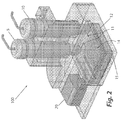
- Figure 1 shows a preferred embodiment of an apparatus 1000 according to the present invention comprising a unit 100 for mechanical selection of adult nematodes from an initial nematode population to obtain an intermediate nematode population.
- Such mechanical selection unit 100 is connected to a unit 200 for optical selection of nematodes from the intermediate population to obtain a final population, that is in turn connected to a measurement unit 300 configured to detect the response of nematodes of the final population to a stimulus of an odorant substance.
- a measurement unit 300 configured to detect the response of nematodes of the final population to a stimulus of an odorant substance.
- the apparatus 1000 further includes service units for fluid management such as liquid storage tanks and at least one control module (not shown in the Figures) for controlling and regulating flows of liquids, for controlling the mechanical and optical selection units 100, 200 and the measurement unit 300, as well as for analysing data obtained from the measurement unit 300.
- the apparatus 1000 includes a first storage tank 5 for storing C. Elegans in solution in a maintenance buffer liquid such as for instance M9, S basal, and a second storage tank 10 for storing an additional buffer liquid, i.e. not containing nematodes.
- the first and second storage tanks 5, 10 are connected at a first end to an overpressure system (not shown in the Figure) operated by a pump and at a second end to an inlet microchannel structure 11.
- Such inlet microchannel structure 11 has the function of making maintenance buffer liquid containing nematodes or additional buffer liquid pass from the respective storage tanks to the unit 100 through the overpressure system operated by a pump not shown in the Figure.
- the mechanical selection unit 100 is configured to select nematodes in adult stage from an initial nematode population.
- It comprises a collection vessel 12 provided with a first closable inlet nozzle configured to introduce maintenance buffer liquid containing nematodes into the vessel 12 and a second closable inlet nozzle configured to introduce additional buffer liquid into the vessel 12.
- the first and second closable inlet nozzles are positioned on the vessel base and are controlled by the control unit.
- the vessel 12 may be provided with more than two closable inlet nozzles.
- the at least two nozzles may be placed near a base of the vessel 12.
- an initial amount of maintenance buffer liquid containing an initial nematode population, is drained from the first storage tank 5, is caused to pass into the inlet microchannel structure 11 and is injected into the collection vessel 12 through the open first closable inlet nozzle.
- the vessel 12 is sized such that its capacity is greater than the initial amount of liquid drained from the first tank 5.
- the collection vessel 12 is provided with a double grid 14 placed parallel to the base of the vessel 12 at a certain distance from the same.
- the double grid is arranged at a distance from the base greater than the distances of the at least two closable inlet nozzles.
- the double grid is configured to let only eggs or larvae of nematodes to pass through itself.
- the double grid 14 is motorised and is controlled by the control unit.
- the double grid 14 is constituted of a first grid and a second grid parallel thereto. Such first and second grids may translate from each other, through linear actuators 19 so as to assume a first position at which the respective holes are aligned, i.e.
- the double grid 14 is open, whereby the solution contained in the vessel 12 may pass from inside the vessel 12 outwards through the holes, and a second position at which the respective holes are misaligned, i.e. the double grid 14 is closed, whereby the solution contained in the vessel 12 cannot pass through the holes.
- the first perforated grid is fixed and a second sliding grid, operated by a linear actuator, opens and closes the double grid 14. It is a square array one with holes which can range from 50 ⁇ m to 500 ⁇ m . In other embodiments, the holes may assume different shapes from the square.
- the double grid 14 is placed at a touching height of the vessel 12 so as to touch a liquid volume equal to the volume of the initial amount of maintenance liquid introduced into the vessel 12.
- the double grid 14 touches such liquid amount.
- the additional buffer liquid is designed to make the solution flow from the lower part of the vessel 12 and to push it through the open double grid 14.
- the members of the initial population having lowest specific weight and specific size lower than the size of the holes of the open double grid 14, i.e. eggs and larvae pass through such grid until an intermediate amount of maintenance liquid containing an intermediate nematode population a majority of which is in adult stage remains in the vessel 12.
- the vessel 12 includes an outlet hole 15 closable by a first solenoid valve assembly 20, visible in Figure 3 , configured to make liquids exit from the vessel 12 emptying the same.
- the amount of injected solution is of about 200 ⁇ L equal to about 200 mm 3 of volume
- the vessel 12 has a square base of about 6 ⁇ 6 mm 2 , wherein the double grid 14 is positioned at a height of about 6 mm, so as to touch the amount of initial solution in the vessel 12.
- the vessel 12 has a square or rectangular base of greater area, so as to have the double grid 14 positioned at a lower height, closer to the lower part of the vessel 12, with a greater area that can be more easily made.
- the vessel extends above the grid for a height of additional 11 mm to contain about 400 ⁇ L of additional buffer liquid.
- connection channel with a three way branch not shown in the Figures, each one of section not lower than 100 ⁇ m, connected through the first solenoid valve assembly 20 to the closable outlet hole 15 of the vessel 14.
- connection channel may have a branch with a number of ways larger than three.
- the connection channel has the function of making the intermediate amount of liquid, i.e.
- the optical selection unit 200 is configured to select a final population of nematodes in adult stage from the intermediate population and to select nematodes in young adult stage from nematodes in egg producing adult stage, through a first optical measurement and a second optical measurement on each individual nematode contained in the intermediate population.
- the optical selection unit 200 includes three measurement microfluidic channels, parallel to each other, in which the three way connection channel branches and in which the nematodes are channelled one by one, through the overpressure system operated by a pump.
- the presence of at least three measurement microfluidic channels avoids possible apparatus operation interruptions caused by nematode blocks in one of the channels themselves.
- the number of measurement channels of the optical selection unit is larger than three.
- the first optical measurement identifies the length of a channelled nematode and the second optical measurement identifies the green autofluorescence intensity thereof with respect to the red autofluorescence.
- the measurement of the ratio of the green and red autofluorescences selects nematodes since the ratio of the autofluorescences increases as the nematode age increases.
- nematodes to be sent to the unit 300 of measurement of their response to a stimulus of an odorant substance are selected.
- the optical selection unit 200 includes a first optical sensor 22, a second optical sensor 23 and a third optical sensor 24 for each one of the three measurement microfluidic channels to perform the first optical measurement of the nematode length.
- the first, second and third optical sensors 22, 23 and 24 are positioned at a first height from the channel and along the longitudinal direction of the channel and they are translated from each other so that the orthogonal projection of the first optical sensor 22 on the related channel identifies a first target position, the orthogonal projection of the second optical sensor 23 on the related channel identifies a second target position and the orthogonal projection of the third optical sensor 24 on the related channel identifies a third target position.
- the distances of the second and third optical sensors from the first one are equal to about 900 ⁇ m and 1000 ⁇ m, respectively.
- the three optical sensors 22, 23 and 24 are controlled by the control unit.
- the logic of selection of nematodes given by the first optical measurement provides that, once the first sensor 22 is activated due to the arrival of an individual channelled nematode at the first target position, the electrical signal from the first optical sensor 22 must not fall down to zero until the activation of the second optical sensor 23 caused by the individual channelled nematode when reaching the second target position and it must be back to zero before the activation of the third optical sensor 24 caused by the individual channelled nematode when reaching the second target position.
- the optical selection unit 200 includes an illuminator 25, optionally a LED one, having white light or blue light within the wavelength range 400-440 nm, configured to illuminate the three measurement microfluidic channels and associated with a double photodiode 26 for each one of the measurement microfluidic channels configured to perform the second optical measurement of autofluorescence of the channelled nematodes.
- the double photodiode 26 has two sensing elements for detection of light in the green and red wavelengths respectively, two interferential filters deposited on the surface of the sensing elements and two collection optics focusing the emitted light onto each one of the two sensing elements.
- the nematode selection logic given by the second optical measurement provides that the ratio between green autofluorescence to red one is lower than a determined threshold, optionally lower than 0,5. Only when this condition and the condition on the length described above occur, the individual channelled nematode is selected from the intermediate population exiting from the mechanical selection unit 100 in a final population.
- the illuminator 25 is positioned at a second height from the three measurement microfluidic channels.
- the second height is opposite to the first height of the three optical sensors 22, 23 and 24 and the illuminator 25 is in such a position to perform the second optical measurement of autofluorescence when the nematode is in a central position with respect to the three targets, optionally centrally with respect to the first and second targets.
- the optical sensors 22, 23 and 24 are controlled by the control unit.
- the second measurement of fluorescence is performed in cascade, after the first length measurement.
- a second solenoid valve assembly 21, controlled by the control unit, is positioned at the outlet of the three measurement microfluidic channels to direct a channelled nematode into a loading microchannel connecting the optical selection unit 200 to the measurement unit 300, optionally with diameter not lower than about 100 ⁇ m, towards the measurement unit 300 or towards a waste tank 16.
- An additional counting optical sensor is positioned in correspondence of the nematode loading microchannel and controlled by the control unit.
- the apparatus 1000 includes a blocking valve to block the passage of nematodes in the measurement unit 300 after the passage of a determined number of nematodes, optionally ranging from 20 to 50.
- the nematodes of the intermediate population blocked by the blocking valve remain, for times in the order of few minutes, in the loading channel between the unit 200 and the unit 300 awaiting the next measurement performed by the measurement unit 300 or are sent to the waste tank 16 though the second solenoid valve assembly 21.
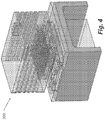
- a schematic representation of the unit 300 of measurement of the response of nematodes to the stimulus of an odorant substance is shown in Figure 4 .
- the measurement unit 300 is configured to detect the response of nematodes to a stimulus of an odorant substance through measurements of chemotaxis and neuronal activity, i.e. of motility and fluorescence.
- the measurement unit 300 includes an at least three layer device.
- a central layer contains a microfluidic chip 50 in which a pillar microfluidic circuit 51 is made, in which wherein nematodes of the final population are introduced.
- Figure 5 shows an embodiment of a microfluidic chip 50. Near a first edge of the pillar microfluidic circuit 51, the microfluidic chip 50 is provided with a loading hole 52, connected to the loading microchannel, configured to introduce nematodes into the microfluidic circuit 51. Near the first edge, the microfluidic chip 50 is further provided with a first inlet hole 53 configured to receive a test liquid from a third storage tank 17 through a first inlet channel and with a second inlet hole 54 configured to receive a neutral buffer liquid from a fourth storage tank 18 through a second inlet channel.
- the test liquid is a liquid in which possible presence of odorant substances has to be detected
- the buffer liquid is a liquid that does not contain odorant substances, such as for instance M9, S basal.
- the microfluidic chip 50 is provided with a drain hole 55, connected to the waste tank 16 through an outlet channel, configured to make liquids exit from the circuit 51.
- the outlet channel is connected to an outlet tank different from the waste tank 16.
- the microfluidic chip has size up to 20 mm ⁇ 20 mm with pillars being 70 ⁇ m high, with diameter of 200 ⁇ m and spacing of 300 ⁇ m, and the liquid inlet channels have a diameter of about 100 ⁇ m. Further embodiments of the present invention may have different size and spacing.
- a first end layer contains continuous light sources and modulated light sources illuminating the microfluidic chip of the central layer and a second end layer (opposite to the first end layer with respect to the central layer) containing an optical sensor such as for instance a sCMOS or CCD to acquire the transmitted light image of the microfluidic chip upon illumination coming from the light sources of the first end layer, i.e.
- the distance between the optical sensor of the second end layer and the chip of the layer is about 300 ⁇ m.
- the light sources of the first end layer are LEDs arranged in a double array and are configured to emit continuous light at 550 nm, to acquire transmission images, i.e.
- the third unit 300 of measurement of response further comprises photodiodes, with proper collection optics, associated with the modulated light sources, on the sensing surfaces of which an interferential filter at about 525/50 nm is deposited that corresponds to the emission peak of the specific GFP of the employed transgenic line.
- employed nematodes express a specific protein binding calcium in the receptor neurons.
- an initial step 600 through the overpressure system operated by a pump, an initial amount of maintenance buffer liquid, containing an initial nematode population, is drained from the first storage tank 5 and injected into the mechanical selection unit 100 to select adult nematodes from the initial population.
- the initial nematode population is injected through the inlet microchannel structure 11 into the collection vessel 12 with the first closable inlet nozzle that is open.
- the initial amount corresponds to a liquid volume that, when contained in the collection vessel 12, touches the open double grid 14.
- amounts of additional buffer liquid, not containing nematodes are drained in a pulsed manner from the second storage tank 10 through the overpressure system operated by a pump and they are injected into the collection vessel 12 through the inlet microchannel structure 11 with the second closable inlet nozzle that is open. In this way, the additional buffer liquid pushes the initial amount of liquid contained in the vessel 12 through the open double grid 14, so that nematode eggs and larvae pass through the double grid 14.
- the number of pulses is 4 and the volumetric flow rate of the amounts of additional buffer liquid is equal to about 100 ⁇ L/s. In other embodiments the number of pulses and the volumetric flow rate of the additional buffer liquid may vary depending on the size of the mechanical selection unit 100, in particular on that of the collection vessel 12.
- the double grid 14 is closed to avoid the downfall of the members which have just passed through the double grid 14 and the first and second inlet nozzles of the collection vessel 12 are closed.
- the collection vessel 12 contains an intermediate amount of maintenance liquid containing an intermediate nematode population a majority of which is in adult stage.
- the first solenoid valve assembly 20 opens the closable outlet hole 15 and the intermediate amount of liquid is injected, by means of the overpressure system operated by a pump, through the connection channel with three way branch into the optical selection unit 200, where nematodes of the intermediate population are channelled one by one into the three measurement microfluidic channels.
- nematodes in adult stage and nematodes in young adult stage are optically selected from the nematodes in egg producing adult stage. Such selection occurs by optically analysing the individual nematodes contained in the intermediate population.
- Step 620 of optical selection of the nematodes includes two optical measurements 621 and 623 which may be performed simultaneously or in cascade.
- a length / of an individual channelled nematode is optically measured, as previously described, and in sub-step 622 it is checked whether such length / is included within a determined range of lengths ⁇ l. If the length l is not included in the determined range ⁇ l, flow continues through the "NO" branch to step 630 of discarding the nematode, whereby at the outlet of the measurement channels of the optical selection unit 200 the second solenoid valve assembly 21 directs the individual channelled nematode towards the waste tank 16.
- step 640 of sending the individual channelled nematode to the measurement unit 300, whereby, at the outlet of the measurement channels of the optical selection unit 200, the second solenoid valve assembly 21 directs the individual channelled nematode into the loading microchannel towards the microfluidic chip 50 of the measurement unit 300.
- step 640 the individual nematodes sent to the measurement unit 300 are further counted by means of the counting optical sensor positioned in correspondence of the nematode loading microchannel, obtaining a number N of sent nematodes.
- step 650 it is checked whether the number N of nematodes sent to the measurement unit 300, measured in step 640, is equal to or larger than a determined value N tot , optionally ranging from 20 to 50. If the number N of nematodes sent to the measurement unit 300 is lower than N tot , flow continues through the "NO" branch returning to step 640. If the number N of nematodes sent to the measurement unit 300 is equal to or larger than N tot , flow continues through the "YES" branch to step 660 of blocking the passage of nematodes in the measurement unit 300 by means of the blocking valve and to subsequent step 670 of analysing the response of the N tot nematodes to an odorant substance in the response measurement unit 300.
- the analysis 670 of the response of the nematodes to an odorant substance includes the sub-steps described in the following. Initially, in sub-step 671 an area of the pillar microfluidic circuit 51 is illuminated with the light emitted by the sources of the first end layer and in sub-step 672 a first autofluorescence signal integrated over the area of the pillar microfluidic circuit 51 is measured, by means of the photodiodes associated with the sources in order to obtain a background value to use in the analysis of the subsequent fluorescence measurements. In sub-step 672, the positions of the individual nematodes are further stored through measurements of transmitted light imaging, and their number and motility are checked in order to ensure the measurement quality.
- the test liquid is injected from the third tank 17 into the microfluidic chip 50 and in subsequent sub-step 674 the neutral buffer liquid is injected from the fourth tank 18 into the microfluidic chip 50.
- the injection of neutral buffer liquid into the pillar microfluidic circuit 51 causes the test liquid to be drained from the chip into the waste tank 16 and to be replaced by the neutral buffer liquid itself.
- a second integrated fluorescence signal i.e. the neuronal signal of the nematodes, is detected by the photodiodes associated with the light sources synchronously with the modulated light sources, with techniques such as for instance the lock-in technique that increases the measurement sensitivity.
- sub-step 676 parameters of the neuronal signal such as rise time ⁇ rise and fall time ⁇ fall are calculated and in sub-step 677 it is checked whether the time plot of the integrated second fluorescence signal corresponds to a pulse with a rise time included in a first time range T 1 and a fall time included in a second time range T 2 .
- first and second time ranges T 1 and T 2 are standard ones of the rearrangement of calcium concentrations in a neuron activated by the lack of a stimulus previously sensed by a nematode and their values depend on the particular calcium indicator that is used, respectively in the order of hundreds of milliseconds and of seconds.
- the method according to the invention recognises that no odorant substance is present in the test liquid and flow continues through the "NO" branch from step 677 to step 690 of the method wherein the neutral buffer liquid is drained from the microfluidic circuit 51 to the outlet tank. If ⁇ rise ⁇ T 1 and ⁇ fall ⁇ T 2 , flow continues through the "YES" branch from step 677 to step 680, described in the following, of checking motility due to chemotaxis of the nematodes.
- sub-step 678 transmission images of the area of the pillar microfluidic circuit 51 are acquired by means of the optical sensor, i.e. sCMOS or CCD, of the second end layer of the measurement unit 300.
- the acquired images are analysed to check in sub-step 680 the possible motility due to chemotaxis of the nematodes, whereby if there is motility due to chemotaxis the method recognises that an odorant substance is present in the test liquid, while if the nematodes remain indifferent, i.e.
- the method recognises that no odorant substance is present in the test liquid.
- the analysis of sub-step 679 is performed through worm-tracing techniques, whereby the images of the obtained shades are analysed, i.e. subsequent transmission images are compared. With this technique, the shape of nematodes is then extrapolated from the background noise with a differential threshold procedure between different images both to improve the signal to noise ratio and to discard the fixed background of the microfluidic chip.
- Such a procedure allows to optimise the video quality so that the nematodes may be easily recognised as highly contrasted (black) objects on a white background.
- the differential threshold operation described above assigns a pixel to the nematodes or to the background depending on whether the intensity exceeds a determined threshold thus generating a binary image permitting to define the nematode from the head to the tail end. Having this binary image available, it is thus possible to obtain different parameters as the number of nematodes or the centre of mass of the nematodes from which it is then possible to also obtain their speed as rate of displacement of the centre of mass along time.
- m 2
- the flow rate of the liquids is about 50 ⁇ L min ⁇ 100 ⁇ L min
- test liquid is inlet for 30 seconds
- neutral buffer liquid is inlet for 30 seconds.
- a flow rate of 50 ⁇ L per minute permits to completely change the content of the pillar microfluidic circuit 51, then to pass from test liquid to neutral buffer liquid, or alternatively to change test liquid.
Landscapes
- Health & Medical Sciences (AREA)
- Life Sciences & Earth Sciences (AREA)
- Engineering & Computer Science (AREA)
- Chemical & Material Sciences (AREA)
- Immunology (AREA)
- Biomedical Technology (AREA)
- Physics & Mathematics (AREA)
- General Health & Medical Sciences (AREA)
- Analytical Chemistry (AREA)
- Pathology (AREA)
- Molecular Biology (AREA)
- Biochemistry (AREA)
- General Physics & Mathematics (AREA)
- Hematology (AREA)
- Food Science & Technology (AREA)
- Urology & Nephrology (AREA)
- Cell Biology (AREA)
- Medicinal Chemistry (AREA)
- Environmental Sciences (AREA)
- Toxicology (AREA)
- Tropical Medicine & Parasitology (AREA)
- Microbiology (AREA)
- Biotechnology (AREA)
- Bioinformatics & Cheminformatics (AREA)
- Biodiversity & Conservation Biology (AREA)
- Zoology (AREA)
- Animal Behavior & Ethology (AREA)
- Animal Husbandry (AREA)
- Clinical Laboratory Science (AREA)
- Nuclear Medicine, Radiotherapy & Molecular Imaging (AREA)
- Chemical Kinetics & Catalysis (AREA)
- Dispersion Chemistry (AREA)
- Fluid Mechanics (AREA)
- Investigating, Analyzing Materials By Fluorescence Or Luminescence (AREA)
- Apparatus Associated With Microorganisms And Enzymes (AREA)
- Investigating Or Analysing Biological Materials (AREA)
Claims (12)
- Automatisierte Vorrichtung (1000) zum Detektieren von Geruchsstoffen basierend auf der Verwendung von Nematoden, beinhaltend eine mechanische Selektionseinheit (100), die so gestaltet ist, dass sie Nematoden im Erwachsenenstadium aus einer anfänglichen Nematodenpopulation auswählt, um eine Zwischennematodenpopulation zu erlangen, eine optische Nematodenselektionseinheit (200), die so gestaltet ist, dass sie aus der Zwischenpopulation eine Endpopulation von Nematoden im Erwachsenenstadium auswählt und Nematoden im jungen Erwachsenenstadium von Nematoden in eierproduzierenden Erwachsenenstadium auswählt, die an eine Messeinheit (300) gesendet werden, die so gestaltet ist, dass sie die Reaktion von Nematoden der Endpopulation auf einen Reiz eines Geruchsstoffs detektiert, wobei die mechanische Selektionseinheit (100) mit der optischen Selektionseinheit (200) durch einen Verbindungskanal mit einer wenigstens dreiwegigen Verzweigung verbunden ist und die optische Selektionseinheit (200) mit der Messeinheit (300) durch einen Lademikrokanal verbunden ist, wobei:- die mechanische Selektionseinheit (100) einen Sammelbehälter (12) umfasst, der mit wenigstens einer ersten verschließbaren Einlassdüse versehen ist, die so gestaltet ist, dass sie eine Erhaltungspufferflüssigkeit, die Nematoden enthält, in den Behälter (12) einführt, und mit mindestens einer zweiten verschließbaren Einlassdüse versehen ist, die so gestaltet ist, dass sie zusätzliche Pufferflüssigkeit in den Behälter (12) einführt, wobei der Behälter (12) mit einer verschließbaren Auslassöffnung (15) und einem motorisierten Doppelgitter (14) versehen ist, das so gestaltet ist, dass es eine erste offene Konfiguration und eine zweite geschlossene Konfiguration annimmt, wobei die wenigstens eine erste Düse und die wenigstens eine zweite Düse in der Nähe eines Bodens des Behälters (12) angeordnet sind und so gestaltet sind, dass sie den Behälter (12) von dem Boden aus füllen, wobei das motorisierte Doppelgitter (14) parallel zu dem Boden des Behälters in einem Abstand von diesem angeordnet ist, der größer ist, als die wenigstens eine erste Düse und die wenigstens eine zweite Düse und so gestaltet ist, dass nur Eier oder Larven der Nematoden durch seine eigenen Öffnungen hindurchtreten;- die optische Selektionseinheit (200) wenigstens drei Mikrofluidmesskanäle, die so gestaltet sind, dass sie Nematoden der Zwischenpopulation eine nach der anderen hindurchleiten, drei optische Sensoren (22, 23, 24), die so gestaltet sind, dass sie eine Längenmessung der durchgeleiteten Nematoden durchführen, einen Beleuchter (25), der so gestaltet ist, dass er die wenigstens drei Mikrofluidmesskanäle beleuchtet und der mit doppelten Fotodioden (26) verknüpft ist, die so gestaltet sind, dass sie eine Autofluoreszenzmessung der einzeln hindurchgeleiteten Nematoden durchführen, wobei die optische Selektionseinheit (200) so gestaltet ist, dass sie eine Nematode in Richtung der Messeinheit (300) oder in Richtung eines Abfalltanks (16) lenkt, und ein Absperrventil umfasst, das so gestaltet ist, dass es die Passage von Nematoden in die Messeinheit (300) blockiert;- die Messeinheit (300) umfasst eine Zentralschicht, die einen Mikrofluidchip (50) mit einem Säulen-Mikrofluidschaltkreis (51) beinhaltet, der mit einer Ladeöffnung, die mit dem Lademikrokanal verbunden ist, versehen ist, der so gestaltet ist, dass er Nematoden in den Mikrofluidschaltkreis (51) einführt, und einer Ablassöffnung, die so gestaltet ist, dass sie Nematoden von dem Mikrofluidschaltkreis (51) entfernt, versehen ist, wobei der Chip (50) so gestaltet ist, dass er eine Testflüssigkeit über einen ersten Einlasskanal aufnimmt und eine neutrale Pufferflüssigkeit über einen zweiten Einlasskanal aufnimmt, eine erste Endschicht, die Quellen beinhaltet, die so ausgestaltet sind, dass sie kontinuierliches Licht und moduliertes Licht emittieren, das den Mikrofluidschaltkreis (51) beleuchtet, wobei das emittierte modulierte Licht so gestaltet ist, dass es eine Fluoreszenz von Nematoden stimuliert, und die Quellen mit Fotodioden assoziiert sind, die so gestaltet sind, dass sie Fluoreszenz von Nematoden empfangen, eine zweite Endschicht, die einen optischen Sensor beinhaltet, der bezüglich der Zentralschicht der ersten Endschicht gegenüberliegt und so gestaltet ist, dass er übertragene Lichtbilder des Mikrofluidschaltkreises (51) erfasst, wenn er durch das emittierte kontinuierliche Licht beleuchtet wird, und dass er die Beweglichkeit von Nematoden in Gegenwart und in Abwesenheit einer Geruchssubstanz analysiert;wobei die Vorrichtung (1000) ferner eine Steuereinheit zum Steuern der mechanischen Auswahleinheit (100), der optischen Auswahleinheit (200) und der Messeinheit (300) umfasst.
- Vorrichtung (1000) gemäß Anspruch 1, wobei die wenigstens drei Wege des Verbindungskanals und der Lademikrokanal einen Abschnitt haben, der nicht niedriger als 100 µm ist.
- Vorrichtung (1000) gemäß Anspruch 1 oder 2, wobei die Öffnungen in dem Doppelgitter (14) eine Größe haben, die von 50 µm bis 500 µm reicht.
- Vorrichtung (1000) gemäß einem der vorhergehenden Ansprüche, wobei für jeden der wenigstens drei Mikrofluidmesskanäle die drei optischen Sensoren (22, 23, 24) entlang einer longitudinalen Richtung des Kanals positioniert sind und in solchen Abständen zueinander verschoben sind, dass orthogonale Projektionen auf den Kanal eines ersten optischen Sensors (22), eines zweiten optischen Sensors (23) und eines dritten optischen Sensors (24) eine erste Zielposition, eine zweite Zielposition beziehungsweise eine dritte Zielposition identifizieren, wobei der zweite und der dritte optische Sensor (23, 24) gegenüber dem ersten optischen Sensor (22) um etwa 900 µm beziehungsweise 1000 µm verschoben sind.
- Vorrichtung (1000) gemäß Anspruch 4, wobei jeder optische Sensor (22, 23, 24) bezüglich jedem der wenigstens drei Mikrofluidmesskanäle in einer ersten Höhe positioniert ist und der Beleuchter (25) in einer zweiten Höhe gegenüber der ersten Höhe, wobei der Beleuchter (25) in einer zentralen Position bezüglich der drei Zielpositionen positioniert ist, optional zentral bezüglich der ersten und zweiten Zielpositionen.
- Vorrichtung (1000) gemäß einem der vorhergehenden Ansprüche, wobei die Quellen der ersten Endschicht LEDs sind, die in einem Doppelarray angeordnet sind, um kontinuierliches Licht und moduliertes Licht zu emittieren, optional bei 550 nm beziehungsweise 470 nm, optional mit einer Modulationsfrequenz, die 1 KHz nicht übersteigt.
- Verfahren zum automatischen Detektieren von Geruchsstoffen basierend auf dem Verwenden von Nematoden unter Verwendung der Vorrichtung gemäß Anspruch 1, wobei das Verfahren die folgenden Schritte umfasst:Injizieren (600) einer anfänglichen Menge von Erhaltungspufferflüssigkeit, die eine anfängliche Population von Nematoden beinhaltet, in dem Behälter (12), wobei die wenigstens eine erste verschließbare Einlassdüse offen ist, der mechanischen Selektionseinheit (100) durch ein Überdrucksystem durch eine Mikrokanalstruktur (11), wobei die anfängliche Menge von Erhaltungspufferflüssigkeit so bemessen ist, dass sie das Doppelgitter (14) in offener Konfiguration berührt;nach einem Zeitintervall, Injizieren (610), in pulsierender Weise, einer Menge an zusätzlicher Pufferflüssigkeit in den Behälter (12), wobei die wenigstens eine zweite verschließbare Einlassdüse geöffnet ist, der mechanischen Selektionseinheit (100) durch die Struktur (11) der Mikrokanäle, um die anfängliche Nematodenpopulation in Richtung des offenen Doppelgitters (14) zu drücken, so dass Mitglieder der anfänglichen Population mit dem geringsten spezifischen Gewicht und einer spezifischen Größe, die kleiner als die Öffnungen des offenen Doppelgitters (14) ist, durch das Doppelgitter hindurchtreten;Schließen (611) des Doppelgitters (14) und der wenigstens einen ersten und wenigstens einen zweiten verschließbaren Einlassdüsen, wodurch der Sammelbehälter (12) eine Zwischenmenge an Erhaltungspufferflüssigkeit enthält, die eine Zwischenpopulation von Nematoden enthält, von der sich ein Großteil im Erwachsenenstadium befindet;Öffnen (612) der verschließbaren Auslassöffnung (15) und Injizieren der Zwischenmenge an Flüssigkeit in die optische Selektionseinheit (200) durch den Verbindungskanal mit wenigstens einer Dreiwegeverzweigung, um die Nematoden einzeln in die wenigstens drei Mikrofluidmesskanäle zu leiten;optisches Selektieren (620) einzeln geleiteter Nematoden, wobei das optische Selektieren die folgenden Unterschritte umfasst:- optisches Messen (621) einer Länge / einer einzeln kanalisierten Nematode und Prüfen (622), ob die Länge / in einem bestimmten Längenbereich Δl liegt, wobei, wenn die Länge / nicht in dem bestimmten Bereich Δlliegt, Entsorgen (630) der einzeln kanalisierten Nematode an dem Ausgang der mindestens drei Messkanäle in Richtung des Abfalltanks (16);- Messen (623) der grünen Autofluoreszenz Fgreen und der roten Autofluoreszenz Fred der einzeln kanalisierten Nematode und Überprüfen (624), ob das Verhältnis

 - für den Fall, dass die Länge / in dem Bereich Δl liegt und das Verhältnis
 Überprüfen (650), ob N größer oder gleich einem bestimmten Wert Ntot ist, wobei, falls die Anzahl N größer oder gleich Ntot ist, Blockieren (660) der Passage von Nematoden in der Messeinheit (300) durch Aktivieren des Sperrventils;Analysieren (670) der Antwort der N Nematoden in dem Säulen-Mikrofluidschaltkreis (51) auf eine Geruchssubstanz durch die folgenden Teilschritte:- Beleuchten (671) eines Bereichs der Säulen-Mikrofluidschaltung (51) mit Licht, das durch die Quellen der ersten Endschicht emittiert wird;- Messen (672) eines ersten Autofluoreszenzsignals, das über den Bereich der Säulen-Mikrofluidschaltung (51) integriert wird, durch die Fotodioden, die mit den Quellen assoziiert sind, um einen Fluoreszenzhintergrundwert zu erhalten und Erfassen von übertragenen Lichtbildern durch den optischen Sensor, sCMOS oder CCD, des Bereichs der Säulen-Mikrofluidschaltung (51), um die Anzahl und Beweglichkeit der Nematoden in der Mikrofluidschaltung (51) zu überprüfen;- Injizieren (673) von Testflüssigkeit, die möglicherweise wenigstens einen Geruchsstoff aus einem dritten Tank (17) enthält, in den Chip (50);- Injizieren (674) neutraler Pufferflüssigkeit von einem vierten Tank (18) in den Chip (50), um die Testflüssigkeit zu dem Auslasstank abzulassen;- Messen (675) eines zweiten integrierten Fluoreszenzsignals durch die Fotodioden, die mit den Lichtquellen der ersten Endschicht assoziiert sind;- Berechnen (676) von Parametern des zweiten Fluoreszenzsignals, wie zum Beispiel Anstiegszeit τrise, und Abfallzeit τfall;- Überprüfen (677), ob τrise' in einem ersten Zeitbereich T1 enthalten ist, τrise ∈ T1, und ob τfall in einem zweiten Zeitbereich T2 enthalten ist, τfall ∈ T2, wobei T1 und T2 Standardzeitbereiche für das Neuanordnen von Kalziumkonzentrationen in einem Neuron sind, welches durch das Fehlen eines Stimulus aktiviert wird, welcher von einer Nematode in Anwesenheit eines Geruchsstoffs sensiert wird, wobei, wenn τrise ∉ T1 und τfall ∉ T2 sind, das Verfahren erkennt, dass keine Geruchsstoffe in der Testflüssigkeit vorhanden sind, während, wenn τrise ∈ T1 und τfall ∈ T2 sind, das Verfahren überprüft (679), ob eine Beweglichkeit der Nematoden aufgrund von Chemotaxis besteht;- Erlangen (678) von übertragenen Lichtbildern durch den optischen sCMOS- oder CCD-Sensor des Bereichs der Mikrofluidschaltung (51);- Analysieren (679) der erlangten Bilder, um eine Beweglichkeit von Nematoden zu bestimmen, zum Prüfen (680), ob eine Beweglichkeit aufgrund von Chemotaxis besteht, wobei- falls keine Beweglichkeit aufgrund von Chemotaxis besteht, das Verfahren erkennt, dass keine Geruchsstoffe in der Testflüssigkeit vorhanden sind, während- falls eine Beweglichkeit aufgrund von Chemotaxis besteht, das Verfahren erkennt, dass Geruchssubstanzen in der Testflüssigkeit vorhanden sind;- Ablassen (690) der neutralen Pufferflüssigkeit aus dem Chip (50) in den Auslasstank.
 - Verfahren gemäß Anspruch 7, wobei der Schritt (670) des Analysierens der N Nematodenantwort m Mal ausgeführt wird, wobei m = 1, 2, ..., optional gleich 2 ist, bevor das Verfahren endet.
- Verfahren gemäß Anspruch 7 oder 8, wobei der Längenbereich Δl zwischen den Abständen des ersten optischen Sensors (22) von dem zweiten optischen Sensor (23) und des ersten optischen Sensors (22) von dem dritten optischen Sensor (24) liegt, beziehungsweise, optional zwischen 900 µm bis 1000 µm liegt.
- Verfahren gemäß einem der Ansprüche 7 bis 9, wobei der Schwellenwert ε gleich 0,5 ist.
- Verfahren gemäß einem der Ansprüche 7 bis 10, wobei Ntot zwischen 20 und 50 liegt.
- Verfahren gemäß einem der Ansprüche 7 bis 11, wobei der Schritt (679) des Analysierens der erlangten Bilder ausgeführt wird durch Vergleichen von aufeinanderfolgenden übertragenen Bildern und durch ein differenzielles Schwellenwertverfahren, das ein binäres Bild erzeugt, wobei ein Pixel einem Hintergrund oder einer Nematode zugeordnet ist, abhängig davon, ob eine Intensität einen vorbestimmten Schwellenwert übersteigt oder nicht.
Applications Claiming Priority (2)
| Application Number | Priority Date | Filing Date | Title |
|---|---|---|---|
| IT102017000119113A IT201700119113A1 (it) | 2017-10-20 | 2017-10-20 | Apparato e metodo per il rilevamento automatizzato di sostanze odoranti in soluzione tramite impiego di nematodi Chaenorabditis Elegans |
| PCT/IB2018/058127 WO2019077558A1 (en) | 2017-10-20 | 2018-10-19 | APPARATUS AND METHOD FOR AUTOMATIC DETECTION OF ODORANT SUBSTANCES IN SOLUTION USING CAENORABDITIS ELEGANS NEMATODES |
Publications (2)
| Publication Number | Publication Date |
|---|---|
| EP3698133A1 EP3698133A1 (de) | 2020-08-26 |
| EP3698133B1 true EP3698133B1 (de) | 2021-12-01 |
Family
ID=61257009
Family Applications (1)
| Application Number | Title | Priority Date | Filing Date |
|---|---|---|---|
| EP18803477.1A Active EP3698133B1 (de) | 2017-10-20 | 2018-10-19 | Vorrichtung und verfahren zur automatischen erkennung von geruchsstoffen in einer lösung unter verwendung von caenorabditis elegans nematoden |
Country Status (7)
| Country | Link |
|---|---|
| US (1) | US11513106B2 (de) |
| EP (1) | EP3698133B1 (de) |
| JP (1) | JP7237071B2 (de) |
| CN (1) | CN111247426B (de) |
| ES (1) | ES2907786T3 (de) |
| IT (1) | IT201700119113A1 (de) |
| WO (1) | WO2019077558A1 (de) |
Families Citing this family (18)
| Publication number | Priority date | Publication date | Assignee | Title |
|---|---|---|---|---|
| JP6336481B2 (ja) | 2013-12-10 | 2018-06-06 | 国立大学法人九州大学 | 線虫の嗅覚を用いた癌検出法 |
| IT201700119113A1 (it) * | 2017-10-20 | 2019-04-20 | Crestoptics S P A | Apparato e metodo per il rilevamento automatizzato di sostanze odoranti in soluzione tramite impiego di nematodi Chaenorabditis Elegans |
| WO2020181028A1 (en) | 2019-03-05 | 2020-09-10 | Texas Tech University System | Automated microfluidic system for lifespan and healthspan analysis in nematodes |
| US11881093B2 (en) | 2020-08-20 | 2024-01-23 | Denso International America, Inc. | Systems and methods for identifying smoking in vehicles |
| US11760169B2 (en) | 2020-08-20 | 2023-09-19 | Denso International America, Inc. | Particulate control systems and methods for olfaction sensors |
| US12251991B2 (en) | 2020-08-20 | 2025-03-18 | Denso International America, Inc. | Humidity control for olfaction sensors |
| US11636870B2 (en) | 2020-08-20 | 2023-04-25 | Denso International America, Inc. | Smoking cessation systems and methods |
| US12377711B2 (en) | 2020-08-20 | 2025-08-05 | Denso International America, Inc. | Vehicle feature control systems and methods based on smoking |
| US11932080B2 (en) | 2020-08-20 | 2024-03-19 | Denso International America, Inc. | Diagnostic and recirculation control systems and methods |
| US11813926B2 (en) | 2020-08-20 | 2023-11-14 | Denso International America, Inc. | Binding agent and olfaction sensor |
| US12017506B2 (en) | 2020-08-20 | 2024-06-25 | Denso International America, Inc. | Passenger cabin air control systems and methods |
| US11828210B2 (en) | 2020-08-20 | 2023-11-28 | Denso International America, Inc. | Diagnostic systems and methods of vehicles using olfaction |
| US12269315B2 (en) | 2020-08-20 | 2025-04-08 | Denso International America, Inc. | Systems and methods for measuring and managing odor brought into rental vehicles |
| US11760170B2 (en) | 2020-08-20 | 2023-09-19 | Denso International America, Inc. | Olfaction sensor preservation systems and methods |
| US11885786B1 (en) * | 2021-01-29 | 2024-01-30 | Sigma Scientific LLC | Insect olfactometer |
| JP7627471B6 (ja) * | 2021-02-03 | 2025-03-07 | ディスラプティブ テクノロジカル アドバンシス イン ライフ サイエンス エッセ.エッレ.エッレ. - ソシエタ’ ベネフィット、イン フォルマ アブレヴィアータ、ディ - テールズ エッセ.エッレ.エッレ.エッセビ | がん検出方法 |
| CN113884012A (zh) * | 2021-09-27 | 2022-01-04 | 海南大学 | 一种在杀线虫剂活性测定中鉴别植物病原线虫幼虫生存状态的方法 |
| CN117099747A (zh) * | 2023-09-28 | 2023-11-24 | 淮北师范大学 | 一种用于分析昆虫趋向行为的装置 |
Family Cites Families (9)
| Publication number | Priority date | Publication date | Assignee | Title |
|---|---|---|---|---|
| US20040073961A1 (en) * | 2002-08-09 | 2004-04-15 | Andres Pedro J. | Nematode screening assay |
| WO2004033654A2 (en) * | 2002-10-09 | 2004-04-22 | Buck Institute | Automated method for high throughput screening of nematodes |
| WO2009021232A2 (en) * | 2007-08-09 | 2009-02-12 | Massachusetts Institute Of Technology | High-throughput, whole-animal screening system |
| US8809617B2 (en) * | 2009-11-05 | 2014-08-19 | The University of Pittsburgh—Of the Commonwealth System of Higher Education | Automated high-content live animal drug screening using C. elegans |
| US8702939B2 (en) * | 2010-09-15 | 2014-04-22 | Mcmaster University | Electrotaxis methods and devices |
| CN102669058A (zh) * | 2011-03-18 | 2012-09-19 | 中国科学院大连化学物理研究所 | 基于微阀的秀丽隐杆线虫长期培养及双检测微流控芯片 |
| EP2775302A1 (de) * | 2013-03-08 | 2014-09-10 | Assistance Publique - Hôpitaux de Paris | Verbindungsträgersysteme für Tests in Nematoden |
| JP6336481B2 (ja) | 2013-12-10 | 2018-06-06 | 国立大学法人九州大学 | 線虫の嗅覚を用いた癌検出法 |
| IT201700119113A1 (it) * | 2017-10-20 | 2019-04-20 | Crestoptics S P A | Apparato e metodo per il rilevamento automatizzato di sostanze odoranti in soluzione tramite impiego di nematodi Chaenorabditis Elegans |
-
2017
- 2017-10-20 IT IT102017000119113A patent/IT201700119113A1/it unknown
-
2018
- 2018-10-19 ES ES18803477T patent/ES2907786T3/es active Active
- 2018-10-19 JP JP2020521434A patent/JP7237071B2/ja active Active
- 2018-10-19 WO PCT/IB2018/058127 patent/WO2019077558A1/en not_active Ceased
- 2018-10-19 CN CN201880068024.7A patent/CN111247426B/zh active Active
- 2018-10-19 EP EP18803477.1A patent/EP3698133B1/de active Active
- 2018-10-19 US US16/756,669 patent/US11513106B2/en active Active
Also Published As
| Publication number | Publication date |
|---|---|
| WO2019077558A1 (en) | 2019-04-25 |
| ES2907786T3 (es) | 2022-04-26 |
| CN111247426B (zh) | 2022-08-09 |
| JP2021500543A (ja) | 2021-01-07 |
| EP3698133A1 (de) | 2020-08-26 |
| JP7237071B2 (ja) | 2023-03-10 |
| CN111247426A (zh) | 2020-06-05 |
| US20200333305A1 (en) | 2020-10-22 |
| US11513106B2 (en) | 2022-11-29 |
| IT201700119113A1 (it) | 2019-04-20 |
Similar Documents
| Publication | Publication Date | Title |
|---|---|---|
| US11513106B2 (en) | Apparatus and method for automatically detecting odorant substances in solution by using nematodes Caenorabditis Elegans | |
| JP5203453B2 (ja) | 集積光学および流体制御要素を有する反応容器 | |
| AU2015283366B2 (en) | Method and device for the Raman spectroscopic, in ovo sex determination of fertilised and incubated birds' eggs | |
| CN104081210B (zh) | 具有气动式样本致动的光学测定装置 | |
| WO2015130233A1 (en) | Urinalysis device for quantitative urinalysis | |
| US20220018827A1 (en) | Solution collection device with evaluation element | |
| US5225333A (en) | Process and apparatus for the detection of toxicity in surface waters as well as drinking water and industrial water | |
| US20200400640A1 (en) | Method for In-Ovo Fertilisation Determination and Gender Determination on a Closed Egg | |
| CN1677105A (zh) | 光电子快速诊断测试系统 | |
| WO2010055308A1 (en) | Optical detection system | |
| Chakravarthi et al. | Spatial vision in Bombus terrestris | |
| IL303323A (en) | Optical means for examining snails and fish | |
| Yan et al. | Continuous-flow C. elegans fluorescence expression analysis with real-time image processing through microfluidics | |
| Caprini et al. | A shearless microfluidic device detects a role in mechanosensitivity for AWCON neuron in Caenorhabditis elegans | |
| US9360433B1 (en) | Detection of agglutination by optical density measurement | |
| JP7798264B2 (ja) | 生体の検査方法 | |
| US20210072142A1 (en) | Device and Method for Sorting Biological Entities | |
| JP7827268B2 (ja) | 生体の検査装置及び学習済みモデル | |
| US11454585B2 (en) | Microorganism evaluation system | |
| White et al. | Automated multimodal stimulation and simultaneous neuronal recording from multiple small organisms | |
| Lanza | C. elegans based strategy for high-throughput early cancer detection through urine analysis | |
| Fonsaca et al. | Machine-learning-assisted waveguide scattering microscopy for the immunological detection of bovine brucellosis: A proof concept | |
| Bai | Towards a higher-throughput chemobehavioural phenomics using small model organisms | |
| EP4404201B1 (de) | Verfahren zur krebserkennung | |
| JP2025540415A (ja) | 試料に対して蛍光測定を実行するための改善された方法 |
Legal Events
| Date | Code | Title | Description |
|---|---|---|---|
| STAA | Information on the status of an ep patent application or granted ep patent |
Free format text: STATUS: UNKNOWN |
|
| STAA | Information on the status of an ep patent application or granted ep patent |
Free format text: STATUS: THE INTERNATIONAL PUBLICATION HAS BEEN MADE |
|
| PUAI | Public reference made under article 153(3) epc to a published international application that has entered the european phase |
Free format text: ORIGINAL CODE: 0009012 |
|
| STAA | Information on the status of an ep patent application or granted ep patent |
Free format text: STATUS: REQUEST FOR EXAMINATION WAS MADE |
|
| 17P | Request for examination filed |
Effective date: 20200512 |
|
| AK | Designated contracting states |
Kind code of ref document: A1 Designated state(s): AL AT BE BG CH CY CZ DE DK EE ES FI FR GB GR HR HU IE IS IT LI LT LU LV MC MK MT NL NO PL PT RO RS SE SI SK SM TR |
|
| AX | Request for extension of the european patent |
Extension state: BA ME |
|
| DAV | Request for validation of the european patent (deleted) | ||
| DAX | Request for extension of the european patent (deleted) | ||
| GRAP | Despatch of communication of intention to grant a patent |
Free format text: ORIGINAL CODE: EPIDOSNIGR1 |
|
| STAA | Information on the status of an ep patent application or granted ep patent |
Free format text: STATUS: GRANT OF PATENT IS INTENDED |
|
| INTG | Intention to grant announced |
Effective date: 20210701 |
|
| GRAS | Grant fee paid |
Free format text: ORIGINAL CODE: EPIDOSNIGR3 |
|
| GRAA | (expected) grant |
Free format text: ORIGINAL CODE: 0009210 |
|
| STAA | Information on the status of an ep patent application or granted ep patent |
Free format text: STATUS: THE PATENT HAS BEEN GRANTED |
|
| AK | Designated contracting states |
Kind code of ref document: B1 Designated state(s): AL AT BE BG CH CY CZ DE DK EE ES FI FR GB GR HR HU IE IS IT LI LT LU LV MC MK MT NL NO PL PT RO RS SE SI SK SM TR |
|
| REG | Reference to a national code |
Ref country code: GB Ref legal event code: FG4D |
|
| REG | Reference to a national code |
Ref country code: AT Ref legal event code: REF Ref document number: 1452247 Country of ref document: AT Kind code of ref document: T Effective date: 20211215 Ref country code: CH Ref legal event code: EP |
|
| REG | Reference to a national code |
Ref country code: IE Ref legal event code: FG4D |
|
| REG | Reference to a national code |
Ref country code: DE Ref legal event code: R096 Ref document number: 602018027646 Country of ref document: DE |
|
| RAP2 | Party data changed (patent owner data changed or rights of a patent transferred) |
Owner name: FONDAZIONE ISTITUTO ITALIANO DI TECNOLOGIA Owner name: DISRUPTIVE TECHNOLOGICAL ADVANCES IN LIFE SCIENCE S.R.L. |
|
| REG | Reference to a national code |
Ref country code: DE Ref legal event code: R081 Ref document number: 602018027646 Country of ref document: DE Owner name: FONDAZIONE ISTITUTO ITALIANO DI TECNOLOGIA, IT Free format text: FORMER OWNERS: CRESTOPTICS S.P.A., ROMA, RM, IT; FONDAZIONE ISTITUTO ITALIANO DI TECNOLOGIA, GENOVA, IT Ref country code: DE Ref legal event code: R081 Ref document number: 602018027646 Country of ref document: DE Owner name: DISRUPTIVE TECHNOLOGICAL ADVANCES IN LIFE SCIE, IT Free format text: FORMER OWNERS: CRESTOPTICS S.P.A., ROMA, RM, IT; FONDAZIONE ISTITUTO ITALIANO DI TECNOLOGIA, GENOVA, IT |
|
| REG | Reference to a national code |
Ref country code: GB Ref legal event code: 732E Free format text: REGISTERED BETWEEN 20220217 AND 20220223 |
|
| REG | Reference to a national code |
Ref country code: LT Ref legal event code: MG9D |
|
| REG | Reference to a national code |
Ref country code: NL Ref legal event code: MP Effective date: 20211201 |
|
| REG | Reference to a national code |
Ref country code: AT Ref legal event code: MK05 Ref document number: 1452247 Country of ref document: AT Kind code of ref document: T Effective date: 20211201 |
|
| REG | Reference to a national code |
Ref country code: ES Ref legal event code: FG2A Ref document number: 2907786 Country of ref document: ES Kind code of ref document: T3 Effective date: 20220426 |
|
| PG25 | Lapsed in a contracting state [announced via postgrant information from national office to epo] |
Ref country code: RS Free format text: LAPSE BECAUSE OF FAILURE TO SUBMIT A TRANSLATION OF THE DESCRIPTION OR TO PAY THE FEE WITHIN THE PRESCRIBED TIME-LIMIT Effective date: 20211201 Ref country code: LT Free format text: LAPSE BECAUSE OF FAILURE TO SUBMIT A TRANSLATION OF THE DESCRIPTION OR TO PAY THE FEE WITHIN THE PRESCRIBED TIME-LIMIT Effective date: 20211201 Ref country code: FI Free format text: LAPSE BECAUSE OF FAILURE TO SUBMIT A TRANSLATION OF THE DESCRIPTION OR TO PAY THE FEE WITHIN THE PRESCRIBED TIME-LIMIT Effective date: 20211201 Ref country code: BG Free format text: LAPSE BECAUSE OF FAILURE TO SUBMIT A TRANSLATION OF THE DESCRIPTION OR TO PAY THE FEE WITHIN THE PRESCRIBED TIME-LIMIT Effective date: 20220301 Ref country code: AT Free format text: LAPSE BECAUSE OF FAILURE TO SUBMIT A TRANSLATION OF THE DESCRIPTION OR TO PAY THE FEE WITHIN THE PRESCRIBED TIME-LIMIT Effective date: 20211201 |
|
| PG25 | Lapsed in a contracting state [announced via postgrant information from national office to epo] |
Ref country code: SE Free format text: LAPSE BECAUSE OF FAILURE TO SUBMIT A TRANSLATION OF THE DESCRIPTION OR TO PAY THE FEE WITHIN THE PRESCRIBED TIME-LIMIT Effective date: 20211201 Ref country code: PL Free format text: LAPSE BECAUSE OF FAILURE TO SUBMIT A TRANSLATION OF THE DESCRIPTION OR TO PAY THE FEE WITHIN THE PRESCRIBED TIME-LIMIT Effective date: 20211201 Ref country code: NO Free format text: LAPSE BECAUSE OF FAILURE TO SUBMIT A TRANSLATION OF THE DESCRIPTION OR TO PAY THE FEE WITHIN THE PRESCRIBED TIME-LIMIT Effective date: 20220301 Ref country code: LV Free format text: LAPSE BECAUSE OF FAILURE TO SUBMIT A TRANSLATION OF THE DESCRIPTION OR TO PAY THE FEE WITHIN THE PRESCRIBED TIME-LIMIT Effective date: 20211201 Ref country code: HR Free format text: LAPSE BECAUSE OF FAILURE TO SUBMIT A TRANSLATION OF THE DESCRIPTION OR TO PAY THE FEE WITHIN THE PRESCRIBED TIME-LIMIT Effective date: 20211201 Ref country code: GR Free format text: LAPSE BECAUSE OF FAILURE TO SUBMIT A TRANSLATION OF THE DESCRIPTION OR TO PAY THE FEE WITHIN THE PRESCRIBED TIME-LIMIT Effective date: 20220302 |
|
| PG25 | Lapsed in a contracting state [announced via postgrant information from national office to epo] |
Ref country code: NL Free format text: LAPSE BECAUSE OF FAILURE TO SUBMIT A TRANSLATION OF THE DESCRIPTION OR TO PAY THE FEE WITHIN THE PRESCRIBED TIME-LIMIT Effective date: 20211201 |
|
| PG25 | Lapsed in a contracting state [announced via postgrant information from national office to epo] |
Ref country code: SM Free format text: LAPSE BECAUSE OF FAILURE TO SUBMIT A TRANSLATION OF THE DESCRIPTION OR TO PAY THE FEE WITHIN THE PRESCRIBED TIME-LIMIT Effective date: 20211201 Ref country code: SK Free format text: LAPSE BECAUSE OF FAILURE TO SUBMIT A TRANSLATION OF THE DESCRIPTION OR TO PAY THE FEE WITHIN THE PRESCRIBED TIME-LIMIT Effective date: 20211201 Ref country code: RO Free format text: LAPSE BECAUSE OF FAILURE TO SUBMIT A TRANSLATION OF THE DESCRIPTION OR TO PAY THE FEE WITHIN THE PRESCRIBED TIME-LIMIT Effective date: 20211201 Ref country code: PT Free format text: LAPSE BECAUSE OF FAILURE TO SUBMIT A TRANSLATION OF THE DESCRIPTION OR TO PAY THE FEE WITHIN THE PRESCRIBED TIME-LIMIT Effective date: 20220401 Ref country code: EE Free format text: LAPSE BECAUSE OF FAILURE TO SUBMIT A TRANSLATION OF THE DESCRIPTION OR TO PAY THE FEE WITHIN THE PRESCRIBED TIME-LIMIT Effective date: 20211201 Ref country code: CZ Free format text: LAPSE BECAUSE OF FAILURE TO SUBMIT A TRANSLATION OF THE DESCRIPTION OR TO PAY THE FEE WITHIN THE PRESCRIBED TIME-LIMIT Effective date: 20211201 |
|
| REG | Reference to a national code |
Ref country code: DE Ref legal event code: R097 Ref document number: 602018027646 Country of ref document: DE |
|
| PG25 | Lapsed in a contracting state [announced via postgrant information from national office to epo] |
Ref country code: IS Free format text: LAPSE BECAUSE OF FAILURE TO SUBMIT A TRANSLATION OF THE DESCRIPTION OR TO PAY THE FEE WITHIN THE PRESCRIBED TIME-LIMIT Effective date: 20220401 |
|
| PLBE | No opposition filed within time limit |
Free format text: ORIGINAL CODE: 0009261 |
|
| STAA | Information on the status of an ep patent application or granted ep patent |
Free format text: STATUS: NO OPPOSITION FILED WITHIN TIME LIMIT |
|
| PG25 | Lapsed in a contracting state [announced via postgrant information from national office to epo] |
Ref country code: DK Free format text: LAPSE BECAUSE OF FAILURE TO SUBMIT A TRANSLATION OF THE DESCRIPTION OR TO PAY THE FEE WITHIN THE PRESCRIBED TIME-LIMIT Effective date: 20211201 Ref country code: AL Free format text: LAPSE BECAUSE OF FAILURE TO SUBMIT A TRANSLATION OF THE DESCRIPTION OR TO PAY THE FEE WITHIN THE PRESCRIBED TIME-LIMIT Effective date: 20211201 |
|
| 26N | No opposition filed |
Effective date: 20220902 |
|
| PG25 | Lapsed in a contracting state [announced via postgrant information from national office to epo] |
Ref country code: SI Free format text: LAPSE BECAUSE OF FAILURE TO SUBMIT A TRANSLATION OF THE DESCRIPTION OR TO PAY THE FEE WITHIN THE PRESCRIBED TIME-LIMIT Effective date: 20211201 |
|
| PG25 | Lapsed in a contracting state [announced via postgrant information from national office to epo] |
Ref country code: MC Free format text: LAPSE BECAUSE OF FAILURE TO SUBMIT A TRANSLATION OF THE DESCRIPTION OR TO PAY THE FEE WITHIN THE PRESCRIBED TIME-LIMIT Effective date: 20211201 Ref country code: IT Free format text: LAPSE BECAUSE OF FAILURE TO SUBMIT A TRANSLATION OF THE DESCRIPTION OR TO PAY THE FEE WITHIN THE PRESCRIBED TIME-LIMIT Effective date: 20211201 |
|
| REG | Reference to a national code |
Ref country code: BE Ref legal event code: MM Effective date: 20221031 |
|
| PG25 | Lapsed in a contracting state [announced via postgrant information from national office to epo] |
Ref country code: LU Free format text: LAPSE BECAUSE OF NON-PAYMENT OF DUE FEES Effective date: 20221019 |
|
| PG25 | Lapsed in a contracting state [announced via postgrant information from national office to epo] |
Ref country code: BE Free format text: LAPSE BECAUSE OF NON-PAYMENT OF DUE FEES Effective date: 20221031 |
|
| PG25 | Lapsed in a contracting state [announced via postgrant information from national office to epo] |
Ref country code: IE Free format text: LAPSE BECAUSE OF NON-PAYMENT OF DUE FEES Effective date: 20221019 |
|
| PG25 | Lapsed in a contracting state [announced via postgrant information from national office to epo] |
Ref country code: CY Free format text: LAPSE BECAUSE OF FAILURE TO SUBMIT A TRANSLATION OF THE DESCRIPTION OR TO PAY THE FEE WITHIN THE PRESCRIBED TIME-LIMIT Effective date: 20211201 |
|
| PG25 | Lapsed in a contracting state [announced via postgrant information from national office to epo] |
Ref country code: MK Free format text: LAPSE BECAUSE OF FAILURE TO SUBMIT A TRANSLATION OF THE DESCRIPTION OR TO PAY THE FEE WITHIN THE PRESCRIBED TIME-LIMIT Effective date: 20211201 Ref country code: HU Free format text: LAPSE BECAUSE OF FAILURE TO SUBMIT A TRANSLATION OF THE DESCRIPTION OR TO PAY THE FEE WITHIN THE PRESCRIBED TIME-LIMIT; INVALID AB INITIO Effective date: 20181019 |
|
| PG25 | Lapsed in a contracting state [announced via postgrant information from national office to epo] |
Ref country code: MT Free format text: LAPSE BECAUSE OF FAILURE TO SUBMIT A TRANSLATION OF THE DESCRIPTION OR TO PAY THE FEE WITHIN THE PRESCRIBED TIME-LIMIT Effective date: 20211201 |
|
| REG | Reference to a national code |
Ref country code: DE Ref legal event code: R081 Ref document number: 602018027646 Country of ref document: DE Owner name: FONDAZIONE ISTITUTO ITALIANO DI TECNOLOGIA, IT Free format text: FORMER OWNERS: DISRUPTIVE TECHNOLOGICAL ADVANCES IN LIFE SCIENCE S.R.L., ROM, IT; FONDAZIONE ISTITUTO ITALIANO DI TECNOLOGIA, GENOVA, IT Ref country code: DE Ref legal event code: R081 Ref document number: 602018027646 Country of ref document: DE Owner name: DISRUPTIVE TECHNOLOGICAL ADVANCES IN LIFE SCIE, IT Free format text: FORMER OWNERS: DISRUPTIVE TECHNOLOGICAL ADVANCES IN LIFE SCIENCE S.R.L., ROM, IT; FONDAZIONE ISTITUTO ITALIANO DI TECNOLOGIA, GENOVA, IT |
|
| REG | Reference to a national code |
Ref country code: ES Ref legal event code: PC2A Owner name: DISRUPTIVE TECHNOLOGICAL ADVANCES IN LIFE SCIENCE S.R.L.- SOCIET A' BENEFIT, IN FORMA ABBREVIATA, D-TAILS S.R.L. SB Effective date: 20250509 |
|
| REG | Reference to a national code |
Ref country code: CH Ref legal event code: U11 Free format text: ST27 STATUS EVENT CODE: U-0-0-U10-U11 (AS PROVIDED BY THE NATIONAL OFFICE) Effective date: 20251101 |
|
| REG | Reference to a national code |
Ref country code: ES Ref legal event code: PC2A Owner name: DISRUPTIVE TECHNOLOGICAL ADVANCES IN LIFE SCIENCE S.R.L.- SOCIETA BENEFIT, IN FORMA ABBREVIATA, D-TAILS S.R.L. SB Effective date: 20251117 |
|
| PG25 | Lapsed in a contracting state [announced via postgrant information from national office to epo] |
Ref country code: TR Free format text: LAPSE BECAUSE OF FAILURE TO SUBMIT A TRANSLATION OF THE DESCRIPTION OR TO PAY THE FEE WITHIN THE PRESCRIBED TIME-LIMIT Effective date: 20211201 |
|
| PGFP | Annual fee paid to national office [announced via postgrant information from national office to epo] |
Ref country code: DE Payment date: 20251021 Year of fee payment: 8 |
|
| PGFP | Annual fee paid to national office [announced via postgrant information from national office to epo] |
Ref country code: GB Payment date: 20251022 Year of fee payment: 8 |
|
| PGFP | Annual fee paid to national office [announced via postgrant information from national office to epo] |
Ref country code: FR Payment date: 20251030 Year of fee payment: 8 |
|
| PGFP | Annual fee paid to national office [announced via postgrant information from national office to epo] |
Ref country code: CH Payment date: 20251101 Year of fee payment: 8 |
|
| PGFP | Annual fee paid to national office [announced via postgrant information from national office to epo] |
Ref country code: ES Payment date: 20251216 Year of fee payment: 8 |