EP3695965A1 - Surface-modified film for automotive interior/exterior components - Google Patents
Surface-modified film for automotive interior/exterior components Download PDFInfo
- Publication number
- EP3695965A1 EP3695965A1 EP18865744.9A EP18865744A EP3695965A1 EP 3695965 A1 EP3695965 A1 EP 3695965A1 EP 18865744 A EP18865744 A EP 18865744A EP 3695965 A1 EP3695965 A1 EP 3695965A1
- Authority
- EP
- European Patent Office
- Prior art keywords
- parts
- weight
- photopolymerizable
- urethane acrylate
- automotive interior
- Prior art date
- Legal status (The legal status is an assumption and is not a legal conclusion. Google has not performed a legal analysis and makes no representation as to the accuracy of the status listed.)
- Withdrawn
Links
- 239000000203 mixture Substances 0.000 claims abstract description 66
- UHESRSKEBRADOO-UHFFFAOYSA-N ethyl carbamate;prop-2-enoic acid Chemical compound OC(=O)C=C.CCOC(N)=O UHESRSKEBRADOO-UHFFFAOYSA-N 0.000 claims abstract description 60
- -1 acrylate compound Chemical class 0.000 claims abstract description 44
- 239000000945 filler Substances 0.000 claims abstract description 27
- JOYRKODLDBILNP-UHFFFAOYSA-N Ethyl urethane Chemical compound CCOC(N)=O JOYRKODLDBILNP-UHFFFAOYSA-N 0.000 claims abstract description 26
- 229910052731 fluorine Inorganic materials 0.000 claims abstract description 26
- 239000004417 polycarbonate Substances 0.000 claims abstract description 23
- 229920000515 polycarbonate Polymers 0.000 claims abstract description 23
- NIXOWILDQLNWCW-UHFFFAOYSA-M Acrylate Chemical compound [O-]C(=O)C=C NIXOWILDQLNWCW-UHFFFAOYSA-M 0.000 claims abstract description 21
- 229920000058 polyacrylate Polymers 0.000 claims abstract description 21
- YCKRFDGAMUMZLT-UHFFFAOYSA-N Fluorine atom Chemical compound [F] YCKRFDGAMUMZLT-UHFFFAOYSA-N 0.000 claims abstract description 19
- 239000011737 fluorine Substances 0.000 claims abstract description 19
- 239000003999 initiator Substances 0.000 claims abstract description 12
- 239000000463 material Substances 0.000 claims description 40
- 239000011241 protective layer Substances 0.000 claims description 40
- 239000001257 hydrogen Substances 0.000 claims description 12
- 229910052739 hydrogen Inorganic materials 0.000 claims description 12
- 125000000725 trifluoropropyl group Chemical group [H]C([H])(*)C([H])([H])C(F)(F)F 0.000 claims description 10
- UFHFLCQGNIYNRP-UHFFFAOYSA-N Hydrogen Chemical compound [H][H] UFHFLCQGNIYNRP-UHFFFAOYSA-N 0.000 claims description 9
- 125000002023 trifluoromethyl group Chemical group FC(F)(F)* 0.000 claims description 8
- 125000002947 alkylene group Chemical group 0.000 claims description 7
- 125000003118 aryl group Chemical group 0.000 claims description 7
- 235000021189 garnishes Nutrition 0.000 claims description 7
- QVGXLLKOCUKJST-UHFFFAOYSA-N atomic oxygen Chemical compound [O] QVGXLLKOCUKJST-UHFFFAOYSA-N 0.000 claims description 6
- 239000001301 oxygen Substances 0.000 claims description 6
- 229910052760 oxygen Inorganic materials 0.000 claims description 6
- 125000000217 alkyl group Chemical group 0.000 claims description 4
- 125000003709 fluoroalkyl group Chemical group 0.000 claims description 4
- 125000004407 fluoroaryl group Chemical group 0.000 claims description 4
- 125000000325 methylidene group Chemical group [H]C([H])=* 0.000 claims description 4
- 125000004435 hydrogen atom Chemical group [H]* 0.000 claims description 3
- 238000013461 design Methods 0.000 abstract description 2
- 239000000758 substrate Substances 0.000 abstract 1
- XLYOFNOQVPJJNP-UHFFFAOYSA-N water Substances O XLYOFNOQVPJJNP-UHFFFAOYSA-N 0.000 description 21
- 239000002585 base Substances 0.000 description 19
- 230000000475 sunscreen effect Effects 0.000 description 18
- 239000000516 sunscreening agent Substances 0.000 description 18
- 239000006071 cream Substances 0.000 description 17
- 238000000034 method Methods 0.000 description 16
- 239000000047 product Substances 0.000 description 16
- 239000003921 oil Substances 0.000 description 15
- 239000011248 coating agent Substances 0.000 description 14
- 238000000576 coating method Methods 0.000 description 14
- 238000012360 testing method Methods 0.000 description 14
- NIXOWILDQLNWCW-UHFFFAOYSA-N acrylic acid group Chemical group C(C=C)(=O)O NIXOWILDQLNWCW-UHFFFAOYSA-N 0.000 description 12
- 229920000642 polymer Polymers 0.000 description 11
- 230000000052 comparative effect Effects 0.000 description 10
- 239000000077 insect repellent Substances 0.000 description 10
- 238000000465 moulding Methods 0.000 description 10
- 239000000243 solution Substances 0.000 description 10
- 239000007921 spray Substances 0.000 description 10
- 150000001875 compounds Chemical class 0.000 description 9
- 230000006866 deterioration Effects 0.000 description 7
- 125000001153 fluoro group Chemical group F* 0.000 description 7
- 239000011347 resin Substances 0.000 description 7
- 229920005989 resin Polymers 0.000 description 7
- 239000007787 solid Substances 0.000 description 7
- 239000000126 substance Substances 0.000 description 7
- IJGRMHOSHXDMSA-UHFFFAOYSA-N Atomic nitrogen Chemical compound N#N IJGRMHOSHXDMSA-UHFFFAOYSA-N 0.000 description 6
- YMWUJEATGCHHMB-UHFFFAOYSA-N Dichloromethane Chemical compound ClCCl YMWUJEATGCHHMB-UHFFFAOYSA-N 0.000 description 6
- KFZMGEQAYNKOFK-UHFFFAOYSA-N Isopropanol Chemical compound CC(C)O KFZMGEQAYNKOFK-UHFFFAOYSA-N 0.000 description 6
- OKKJLVBELUTLKV-UHFFFAOYSA-N Methanol Chemical compound OC OKKJLVBELUTLKV-UHFFFAOYSA-N 0.000 description 6
- 238000006243 chemical reaction Methods 0.000 description 6
- 238000011156 evaluation Methods 0.000 description 6
- 238000010992 reflux Methods 0.000 description 6
- 229910052782 aluminium Inorganic materials 0.000 description 5
- XAGFODPZIPBFFR-UHFFFAOYSA-N aluminium Chemical compound [Al] XAGFODPZIPBFFR-UHFFFAOYSA-N 0.000 description 5
- 238000001746 injection moulding Methods 0.000 description 5
- 239000000178 monomer Substances 0.000 description 5
- 238000006116 polymerization reaction Methods 0.000 description 5
- OZAIFHULBGXAKX-UHFFFAOYSA-N 2-(2-cyanopropan-2-yldiazenyl)-2-methylpropanenitrile Chemical compound N#CC(C)(C)N=NC(C)(C)C#N OZAIFHULBGXAKX-UHFFFAOYSA-N 0.000 description 4
- ZWEHNKRNPOVVGH-UHFFFAOYSA-N 2-Butanone Chemical compound CCC(C)=O ZWEHNKRNPOVVGH-UHFFFAOYSA-N 0.000 description 4
- 208000035874 Excoriation Diseases 0.000 description 4
- 238000005299 abrasion Methods 0.000 description 4
- 125000003647 acryloyl group Chemical group O=C([*])C([H])=C([H])[H] 0.000 description 4
- 238000005034 decoration Methods 0.000 description 4
- 239000004744 fabric Substances 0.000 description 4
- 239000007788 liquid Substances 0.000 description 4
- 238000004519 manufacturing process Methods 0.000 description 4
- 238000012986 modification Methods 0.000 description 4
- 230000004048 modification Effects 0.000 description 4
- XEKOWRVHYACXOJ-UHFFFAOYSA-N Ethyl acetate Chemical compound CCOC(C)=O XEKOWRVHYACXOJ-UHFFFAOYSA-N 0.000 description 3
- CSNNHWWHGAXBCP-UHFFFAOYSA-L Magnesium sulfate Chemical compound [Mg+2].[O-][S+2]([O-])([O-])[O-] CSNNHWWHGAXBCP-UHFFFAOYSA-L 0.000 description 3
- HEMHJVSKTPXQMS-UHFFFAOYSA-M Sodium hydroxide Chemical compound [OH-].[Na+] HEMHJVSKTPXQMS-UHFFFAOYSA-M 0.000 description 3
- ZMANZCXQSJIPKH-UHFFFAOYSA-N Triethylamine Chemical compound CCN(CC)CC ZMANZCXQSJIPKH-UHFFFAOYSA-N 0.000 description 3
- 239000000654 additive Substances 0.000 description 3
- 230000015572 biosynthetic process Effects 0.000 description 3
- 238000001035 drying Methods 0.000 description 3
- 238000005516 engineering process Methods 0.000 description 3
- 238000002156 mixing Methods 0.000 description 3
- 229910052757 nitrogen Inorganic materials 0.000 description 3
- 238000005457 optimization Methods 0.000 description 3
- 239000004033 plastic Substances 0.000 description 3
- 230000001681 protective effect Effects 0.000 description 3
- 150000003377 silicon compounds Chemical class 0.000 description 3
- QNRATNLHPGXHMA-XZHTYLCXSA-N (r)-(6-ethoxyquinolin-4-yl)-[(2s,4s,5r)-5-ethyl-1-azabicyclo[2.2.2]octan-2-yl]methanol;hydrochloride Chemical compound Cl.C([C@H]([C@H](C1)CC)C2)CN1[C@@H]2[C@H](O)C1=CC=NC2=CC=C(OCC)C=C21 QNRATNLHPGXHMA-XZHTYLCXSA-N 0.000 description 2
- PCTZLSCYMRXUGW-UHFFFAOYSA-N 1,1,1,2,2-pentafluorobutane Chemical group [CH2]CC(F)(F)C(F)(F)F PCTZLSCYMRXUGW-UHFFFAOYSA-N 0.000 description 2
- OZAIFHULBGXAKX-VAWYXSNFSA-N AIBN Substances N#CC(C)(C)\N=N\C(C)(C)C#N OZAIFHULBGXAKX-VAWYXSNFSA-N 0.000 description 2
- LFQSCWFLJHTTHZ-UHFFFAOYSA-N Ethanol Chemical compound CCO LFQSCWFLJHTTHZ-UHFFFAOYSA-N 0.000 description 2
- CERQOIWHTDAKMF-UHFFFAOYSA-N Methacrylic acid Chemical compound CC(=C)C(O)=O CERQOIWHTDAKMF-UHFFFAOYSA-N 0.000 description 2
- MMOXZBCLCQITDF-UHFFFAOYSA-N N,N-diethyl-m-toluamide Chemical compound CCN(CC)C(=O)C1=CC=CC(C)=C1 MMOXZBCLCQITDF-UHFFFAOYSA-N 0.000 description 2
- 239000004419 Panlite Substances 0.000 description 2
- VYPSYNLAJGMNEJ-UHFFFAOYSA-N Silicium dioxide Chemical compound O=[Si]=O VYPSYNLAJGMNEJ-UHFFFAOYSA-N 0.000 description 2
- 229910052783 alkali metal Inorganic materials 0.000 description 2
- 150000001340 alkali metals Chemical group 0.000 description 2
- 230000001588 bifunctional effect Effects 0.000 description 2
- 230000008859 change Effects 0.000 description 2
- 239000011247 coating layer Substances 0.000 description 2
- 238000007334 copolymerization reaction Methods 0.000 description 2
- 238000004132 cross linking Methods 0.000 description 2
- 239000008367 deionised water Substances 0.000 description 2
- 229910021641 deionized water Inorganic materials 0.000 description 2
- 238000011161 development Methods 0.000 description 2
- 239000003085 diluting agent Substances 0.000 description 2
- 238000004090 dissolution Methods 0.000 description 2
- 239000000706 filtrate Substances 0.000 description 2
- 238000001914 filtration Methods 0.000 description 2
- 238000005286 illumination Methods 0.000 description 2
- 238000005259 measurement Methods 0.000 description 2
- 239000012778 molding material Substances 0.000 description 2
- 239000004745 nonwoven fabric Substances 0.000 description 2
- RVTZCBVAJQQJTK-UHFFFAOYSA-N oxygen(2-);zirconium(4+) Chemical compound [O-2].[O-2].[Zr+4] RVTZCBVAJQQJTK-UHFFFAOYSA-N 0.000 description 2
- 125000000538 pentafluorophenyl group Chemical group FC1=C(F)C(F)=C(*)C(F)=C1F 0.000 description 2
- 230000000379 polymerizing effect Effects 0.000 description 2
- 125000001436 propyl group Chemical group [H]C([*])([H])C([H])([H])C([H])([H])[H] 0.000 description 2
- 239000002994 raw material Substances 0.000 description 2
- 238000003756 stirring Methods 0.000 description 2
- 239000006228 supernatant Substances 0.000 description 2
- CWERGRDVMFNCDR-UHFFFAOYSA-N thioglycolic acid Chemical compound OC(=O)CS CWERGRDVMFNCDR-UHFFFAOYSA-N 0.000 description 2
- 229910001928 zirconium oxide Inorganic materials 0.000 description 2
- 238000005160 1H NMR spectroscopy Methods 0.000 description 1
- ZNJXRXXJPIFFAO-UHFFFAOYSA-N 2,2,3,3,4,4,5,5-octafluoropentyl 2-methylprop-2-enoate Chemical compound CC(=C)C(=O)OCC(F)(F)C(F)(F)C(F)(F)C(F)F ZNJXRXXJPIFFAO-UHFFFAOYSA-N 0.000 description 1
- KWVGIHKZDCUPEU-UHFFFAOYSA-N 2,2-dimethoxy-2-phenylacetophenone Chemical compound C=1C=CC=CC=1C(OC)(OC)C(=O)C1=CC=CC=C1 KWVGIHKZDCUPEU-UHFFFAOYSA-N 0.000 description 1
- SMZOUWXMTYCWNB-UHFFFAOYSA-N 2-(2-methoxy-5-methylphenyl)ethanamine Chemical compound COC1=CC=C(C)C=C1CCN SMZOUWXMTYCWNB-UHFFFAOYSA-N 0.000 description 1
- XMLYCEVDHLAQEL-UHFFFAOYSA-N 2-hydroxy-2-methyl-1-phenylpropan-1-one Chemical compound CC(C)(O)C(=O)C1=CC=CC=C1 XMLYCEVDHLAQEL-UHFFFAOYSA-N 0.000 description 1
- DPNXHTDWGGVXID-UHFFFAOYSA-N 2-isocyanatoethyl prop-2-enoate Chemical compound C=CC(=O)OCCN=C=O DPNXHTDWGGVXID-UHFFFAOYSA-N 0.000 description 1
- DOGMJCPBZJUYGB-UHFFFAOYSA-N 3-trichlorosilylpropyl 2-methylprop-2-enoate Chemical compound CC(=C)C(=O)OCCC[Si](Cl)(Cl)Cl DOGMJCPBZJUYGB-UHFFFAOYSA-N 0.000 description 1
- 229920000178 Acrylic resin Polymers 0.000 description 1
- 239000004925 Acrylic resin Substances 0.000 description 1
- WIJOTYZFVVKLHA-UHFFFAOYSA-N CC(C(OCCC[Si](O[Si](O[Si](O1)(O[Si](O2)(O[Si](O3)(O4)F)F)F)(O[Si]2(O2)F)F)(O[Si]13F)O[Si]42F)=O)=C Chemical compound CC(C(OCCC[Si](O[Si](O[Si](O1)(O[Si](O2)(O[Si](O3)(O4)F)F)F)(O[Si]2(O2)F)F)(O[Si]13F)O[Si]42F)=O)=C WIJOTYZFVVKLHA-UHFFFAOYSA-N 0.000 description 1
- 241000238631 Hexapoda Species 0.000 description 1
- 101000642347 Homo sapiens Splicing factor 45 Proteins 0.000 description 1
- WOBHKFSMXKNTIM-UHFFFAOYSA-N Hydroxyethyl methacrylate Chemical compound CC(=C)C(=O)OCCO WOBHKFSMXKNTIM-UHFFFAOYSA-N 0.000 description 1
- DGAQECJNVWCQMB-PUAWFVPOSA-M Ilexoside XXIX Chemical compound C[C@@H]1CC[C@@]2(CC[C@@]3(C(=CC[C@H]4[C@]3(CC[C@@H]5[C@@]4(CC[C@@H](C5(C)C)OS(=O)(=O)[O-])C)C)[C@@H]2[C@]1(C)O)C)C(=O)O[C@H]6[C@@H]([C@H]([C@@H]([C@H](O6)CO)O)O)O.[Na+] DGAQECJNVWCQMB-PUAWFVPOSA-M 0.000 description 1
- 239000004420 Iupilon Substances 0.000 description 1
- WHXSMMKQMYFTQS-UHFFFAOYSA-N Lithium Chemical compound [Li] WHXSMMKQMYFTQS-UHFFFAOYSA-N 0.000 description 1
- VVQNEPGJFQJSBK-UHFFFAOYSA-N Methyl methacrylate Chemical compound COC(=O)C(C)=C VVQNEPGJFQJSBK-UHFFFAOYSA-N 0.000 description 1
- OAICVXFJPJFONN-UHFFFAOYSA-N Phosphorus Chemical compound [P] OAICVXFJPJFONN-UHFFFAOYSA-N 0.000 description 1
- ZLMJMSJWJFRBEC-UHFFFAOYSA-N Potassium Chemical compound [K] ZLMJMSJWJFRBEC-UHFFFAOYSA-N 0.000 description 1
- 102100036374 Splicing factor 45 Human genes 0.000 description 1
- 229910000831 Steel Inorganic materials 0.000 description 1
- GWEVSGVZZGPLCZ-UHFFFAOYSA-N Titan oxide Chemical compound O=[Ti]=O GWEVSGVZZGPLCZ-UHFFFAOYSA-N 0.000 description 1
- HVVWZTWDBSEWIH-UHFFFAOYSA-N [2-(hydroxymethyl)-3-prop-2-enoyloxy-2-(prop-2-enoyloxymethyl)propyl] prop-2-enoate Chemical compound C=CC(=O)OCC(CO)(COC(=O)C=C)COC(=O)C=C HVVWZTWDBSEWIH-UHFFFAOYSA-N 0.000 description 1
- UKLDJPRMSDWDSL-UHFFFAOYSA-L [dibutyl(dodecanoyloxy)stannyl] dodecanoate Chemical compound CCCCCCCCCCCC(=O)O[Sn](CCCC)(CCCC)OC(=O)CCCCCCCCCCC UKLDJPRMSDWDSL-UHFFFAOYSA-L 0.000 description 1
- GUCYFKSBFREPBC-UHFFFAOYSA-N [phenyl-(2,4,6-trimethylbenzoyl)phosphoryl]-(2,4,6-trimethylphenyl)methanone Chemical compound CC1=CC(C)=CC(C)=C1C(=O)P(=O)(C=1C=CC=CC=1)C(=O)C1=C(C)C=C(C)C=C1C GUCYFKSBFREPBC-UHFFFAOYSA-N 0.000 description 1
- 230000002159 abnormal effect Effects 0.000 description 1
- 230000000996 additive effect Effects 0.000 description 1
- 150000008044 alkali metal hydroxides Chemical class 0.000 description 1
- PNEYBMLMFCGWSK-UHFFFAOYSA-N aluminium oxide Inorganic materials [O-2].[O-2].[O-2].[Al+3].[Al+3] PNEYBMLMFCGWSK-UHFFFAOYSA-N 0.000 description 1
- 238000004458 analytical method Methods 0.000 description 1
- 239000003963 antioxidant agent Substances 0.000 description 1
- 230000003078 antioxidant effect Effects 0.000 description 1
- XTKDAFGWCDAMPY-UHFFFAOYSA-N azaperone Chemical compound C1=CC(F)=CC=C1C(=O)CCCN1CCN(C=2N=CC=CC=2)CC1 XTKDAFGWCDAMPY-UHFFFAOYSA-N 0.000 description 1
- JRPBQTZRNDNNOP-UHFFFAOYSA-N barium titanate Chemical compound [Ba+2].[Ba+2].[O-][Ti]([O-])([O-])[O-] JRPBQTZRNDNNOP-UHFFFAOYSA-N 0.000 description 1
- 229910002113 barium titanate Inorganic materials 0.000 description 1
- 238000005452 bending Methods 0.000 description 1
- 229910052792 caesium Inorganic materials 0.000 description 1
- TVFDJXOCXUVLDH-UHFFFAOYSA-N caesium atom Chemical compound [Cs] TVFDJXOCXUVLDH-UHFFFAOYSA-N 0.000 description 1
- BVKZGUZCCUSVTD-UHFFFAOYSA-N carbonic acid Chemical compound OC(O)=O BVKZGUZCCUSVTD-UHFFFAOYSA-N 0.000 description 1
- 239000003795 chemical substances by application Substances 0.000 description 1
- 238000006482 condensation reaction Methods 0.000 description 1
- 238000007796 conventional method Methods 0.000 description 1
- 239000002537 cosmetic Substances 0.000 description 1
- 239000011928 denatured alcohol Substances 0.000 description 1
- 239000003599 detergent Substances 0.000 description 1
- 229960001673 diethyltoluamide Drugs 0.000 description 1
- 238000007865 diluting Methods 0.000 description 1
- 238000003113 dilution method Methods 0.000 description 1
- 125000000118 dimethyl group Chemical group [H]C([H])([H])* 0.000 description 1
- VFHVQBAGLAREND-UHFFFAOYSA-N diphenylphosphoryl-(2,4,6-trimethylphenyl)methanone Chemical compound CC1=CC(C)=CC(C)=C1C(=O)P(=O)(C=1C=CC=CC=1)C1=CC=CC=C1 VFHVQBAGLAREND-UHFFFAOYSA-N 0.000 description 1
- 231100000676 disease causative agent Toxicity 0.000 description 1
- 239000012153 distilled water Substances 0.000 description 1
- 238000009826 distribution Methods 0.000 description 1
- 230000000694 effects Effects 0.000 description 1
- LYCAIKOWRPUZTN-UHFFFAOYSA-N ethylene glycol Natural products OCCO LYCAIKOWRPUZTN-UHFFFAOYSA-N 0.000 description 1
- 230000009969 flowable effect Effects 0.000 description 1
- 238000009472 formulation Methods 0.000 description 1
- 239000007789 gas Substances 0.000 description 1
- 239000008269 hand cream Substances 0.000 description 1
- 238000007542 hardness measurement Methods 0.000 description 1
- 230000020169 heat generation Effects 0.000 description 1
- 238000010438 heat treatment Methods 0.000 description 1
- WGCNASOHLSPBMP-UHFFFAOYSA-N hydroxyacetaldehyde Natural products OCC=O WGCNASOHLSPBMP-UHFFFAOYSA-N 0.000 description 1
- 230000006872 improvement Effects 0.000 description 1
- 238000002347 injection Methods 0.000 description 1
- 239000007924 injection Substances 0.000 description 1
- 239000011256 inorganic filler Substances 0.000 description 1
- 229910003475 inorganic filler Inorganic materials 0.000 description 1
- 239000010410 layer Substances 0.000 description 1
- 229910052744 lithium Inorganic materials 0.000 description 1
- 229910052943 magnesium sulfate Inorganic materials 0.000 description 1
- 235000019341 magnesium sulphate Nutrition 0.000 description 1
- 238000012423 maintenance Methods 0.000 description 1
- 239000003550 marker Substances 0.000 description 1
- 239000012528 membrane Substances 0.000 description 1
- 238000010137 moulding (plastic) Methods 0.000 description 1
- 230000007935 neutral effect Effects 0.000 description 1
- 239000003960 organic solvent Substances 0.000 description 1
- NWVVVBRKAWDGAB-UHFFFAOYSA-N p-methoxyphenol Chemical compound COC1=CC=C(O)C=C1 NWVVVBRKAWDGAB-UHFFFAOYSA-N 0.000 description 1
- 229910052698 phosphorus Inorganic materials 0.000 description 1
- 239000011574 phosphorus Substances 0.000 description 1
- 239000004431 polycarbonate resin Substances 0.000 description 1
- 229920005668 polycarbonate resin Polymers 0.000 description 1
- 229920001296 polysiloxane Polymers 0.000 description 1
- 239000011148 porous material Substances 0.000 description 1
- 229910052700 potassium Inorganic materials 0.000 description 1
- 239000011591 potassium Substances 0.000 description 1
- 239000000843 powder Substances 0.000 description 1
- 238000002360 preparation method Methods 0.000 description 1
- 230000008569 process Effects 0.000 description 1
- 239000001294 propane Substances 0.000 description 1
- 239000000376 reactant Substances 0.000 description 1
- 239000011541 reaction mixture Substances 0.000 description 1
- 229920013730 reactive polymer Polymers 0.000 description 1
- 230000009467 reduction Effects 0.000 description 1
- 230000002787 reinforcement Effects 0.000 description 1
- 239000000523 sample Substances 0.000 description 1
- 239000000377 silicon dioxide Substances 0.000 description 1
- 239000002356 single layer Substances 0.000 description 1
- 229910052708 sodium Inorganic materials 0.000 description 1
- 239000011734 sodium Substances 0.000 description 1
- 239000002904 solvent Substances 0.000 description 1
- 239000003381 stabilizer Substances 0.000 description 1
- 229910001220 stainless steel Inorganic materials 0.000 description 1
- 239000010935 stainless steel Substances 0.000 description 1
- 239000010959 steel Substances 0.000 description 1
- 150000005846 sugar alcohols Polymers 0.000 description 1
- 238000003786 synthesis reaction Methods 0.000 description 1
- OGIDPMRJRNCKJF-UHFFFAOYSA-N titanium oxide Inorganic materials [Ti]=O OGIDPMRJRNCKJF-UHFFFAOYSA-N 0.000 description 1
- 230000002087 whitening effect Effects 0.000 description 1
- 210000002268 wool Anatomy 0.000 description 1
- 230000037303 wrinkles Effects 0.000 description 1
Images


Classifications
-
- B—PERFORMING OPERATIONS; TRANSPORTING
- B32—LAYERED PRODUCTS
- B32B—LAYERED PRODUCTS, i.e. PRODUCTS BUILT-UP OF STRATA OF FLAT OR NON-FLAT, e.g. CELLULAR OR HONEYCOMB, FORM
- B32B27/00—Layered products comprising a layer of synthetic resin
- B32B27/30—Layered products comprising a layer of synthetic resin comprising vinyl (co)polymers; comprising acrylic (co)polymers
-
- C—CHEMISTRY; METALLURGY
- C08—ORGANIC MACROMOLECULAR COMPOUNDS; THEIR PREPARATION OR CHEMICAL WORKING-UP; COMPOSITIONS BASED THEREON
- C08F—MACROMOLECULAR COMPOUNDS OBTAINED BY REACTIONS ONLY INVOLVING CARBON-TO-CARBON UNSATURATED BONDS
- C08F2/00—Processes of polymerisation
- C08F2/44—Polymerisation in the presence of compounding ingredients, e.g. plasticisers, dyestuffs, fillers
-
- B—PERFORMING OPERATIONS; TRANSPORTING
- B32—LAYERED PRODUCTS
- B32B—LAYERED PRODUCTS, i.e. PRODUCTS BUILT-UP OF STRATA OF FLAT OR NON-FLAT, e.g. CELLULAR OR HONEYCOMB, FORM
- B32B27/00—Layered products comprising a layer of synthetic resin
- B32B27/06—Layered products comprising a layer of synthetic resin as the main or only constituent of a layer, which is next to another layer of the same or of a different material
- B32B27/08—Layered products comprising a layer of synthetic resin as the main or only constituent of a layer, which is next to another layer of the same or of a different material of synthetic resin
-
- B—PERFORMING OPERATIONS; TRANSPORTING
- B32—LAYERED PRODUCTS
- B32B—LAYERED PRODUCTS, i.e. PRODUCTS BUILT-UP OF STRATA OF FLAT OR NON-FLAT, e.g. CELLULAR OR HONEYCOMB, FORM
- B32B27/00—Layered products comprising a layer of synthetic resin
- B32B27/36—Layered products comprising a layer of synthetic resin comprising polyesters
- B32B27/365—Layered products comprising a layer of synthetic resin comprising polyesters comprising polycarbonates
-
- B—PERFORMING OPERATIONS; TRANSPORTING
- B32—LAYERED PRODUCTS
- B32B—LAYERED PRODUCTS, i.e. PRODUCTS BUILT-UP OF STRATA OF FLAT OR NON-FLAT, e.g. CELLULAR OR HONEYCOMB, FORM
- B32B27/00—Layered products comprising a layer of synthetic resin
- B32B27/40—Layered products comprising a layer of synthetic resin comprising polyurethanes
-
- C—CHEMISTRY; METALLURGY
- C08—ORGANIC MACROMOLECULAR COMPOUNDS; THEIR PREPARATION OR CHEMICAL WORKING-UP; COMPOSITIONS BASED THEREON
- C08F—MACROMOLECULAR COMPOUNDS OBTAINED BY REACTIONS ONLY INVOLVING CARBON-TO-CARBON UNSATURATED BONDS
- C08F2/00—Processes of polymerisation
- C08F2/46—Polymerisation initiated by wave energy or particle radiation
- C08F2/48—Polymerisation initiated by wave energy or particle radiation by ultraviolet or visible light
- C08F2/50—Polymerisation initiated by wave energy or particle radiation by ultraviolet or visible light with sensitising agents
-
- C—CHEMISTRY; METALLURGY
- C08—ORGANIC MACROMOLECULAR COMPOUNDS; THEIR PREPARATION OR CHEMICAL WORKING-UP; COMPOSITIONS BASED THEREON
- C08F—MACROMOLECULAR COMPOUNDS OBTAINED BY REACTIONS ONLY INVOLVING CARBON-TO-CARBON UNSATURATED BONDS
- C08F220/00—Copolymers of compounds having one or more unsaturated aliphatic radicals, each having only one carbon-to-carbon double bond, and only one being terminated by only one carboxyl radical or a salt, anhydride ester, amide, imide or nitrile thereof
- C08F220/02—Monocarboxylic acids having less than ten carbon atoms; Derivatives thereof
- C08F220/10—Esters
- C08F220/34—Esters containing nitrogen, e.g. N,N-dimethylaminoethyl (meth)acrylate
- C08F220/343—Esters containing nitrogen, e.g. N,N-dimethylaminoethyl (meth)acrylate in the form of urethane links
-
- C—CHEMISTRY; METALLURGY
- C08—ORGANIC MACROMOLECULAR COMPOUNDS; THEIR PREPARATION OR CHEMICAL WORKING-UP; COMPOSITIONS BASED THEREON
- C08F—MACROMOLECULAR COMPOUNDS OBTAINED BY REACTIONS ONLY INVOLVING CARBON-TO-CARBON UNSATURATED BONDS
- C08F265/00—Macromolecular compounds obtained by polymerising monomers on to polymers of unsaturated monocarboxylic acids or derivatives thereof as defined in group C08F20/00
- C08F265/04—Macromolecular compounds obtained by polymerising monomers on to polymers of unsaturated monocarboxylic acids or derivatives thereof as defined in group C08F20/00 on to polymers of esters
-
- C—CHEMISTRY; METALLURGY
- C08—ORGANIC MACROMOLECULAR COMPOUNDS; THEIR PREPARATION OR CHEMICAL WORKING-UP; COMPOSITIONS BASED THEREON
- C08F—MACROMOLECULAR COMPOUNDS OBTAINED BY REACTIONS ONLY INVOLVING CARBON-TO-CARBON UNSATURATED BONDS
- C08F290/00—Macromolecular compounds obtained by polymerising monomers on to polymers modified by introduction of aliphatic unsaturated end or side groups
- C08F290/02—Macromolecular compounds obtained by polymerising monomers on to polymers modified by introduction of aliphatic unsaturated end or side groups on to polymers modified by introduction of unsaturated end groups
- C08F290/06—Polymers provided for in subclass C08G
- C08F290/067—Polyurethanes; Polyureas
-
- C—CHEMISTRY; METALLURGY
- C08—ORGANIC MACROMOLECULAR COMPOUNDS; THEIR PREPARATION OR CHEMICAL WORKING-UP; COMPOSITIONS BASED THEREON
- C08F—MACROMOLECULAR COMPOUNDS OBTAINED BY REACTIONS ONLY INVOLVING CARBON-TO-CARBON UNSATURATED BONDS
- C08F290/00—Macromolecular compounds obtained by polymerising monomers on to polymers modified by introduction of aliphatic unsaturated end or side groups
- C08F290/02—Macromolecular compounds obtained by polymerising monomers on to polymers modified by introduction of aliphatic unsaturated end or side groups on to polymers modified by introduction of unsaturated end groups
- C08F290/06—Polymers provided for in subclass C08G
- C08F290/068—Polysiloxanes
-
- C—CHEMISTRY; METALLURGY
- C08—ORGANIC MACROMOLECULAR COMPOUNDS; THEIR PREPARATION OR CHEMICAL WORKING-UP; COMPOSITIONS BASED THEREON
- C08G—MACROMOLECULAR COMPOUNDS OBTAINED OTHERWISE THAN BY REACTIONS ONLY INVOLVING UNSATURATED CARBON-TO-CARBON BONDS
- C08G77/00—Macromolecular compounds obtained by reactions forming a linkage containing silicon with or without sulfur, nitrogen, oxygen or carbon in the main chain of the macromolecule
- C08G77/04—Polysiloxanes
- C08G77/045—Polysiloxanes containing less than 25 silicon atoms
-
- C—CHEMISTRY; METALLURGY
- C09—DYES; PAINTS; POLISHES; NATURAL RESINS; ADHESIVES; COMPOSITIONS NOT OTHERWISE PROVIDED FOR; APPLICATIONS OF MATERIALS NOT OTHERWISE PROVIDED FOR
- C09D—COATING COMPOSITIONS, e.g. PAINTS, VARNISHES OR LACQUERS; FILLING PASTES; CHEMICAL PAINT OR INK REMOVERS; INKS; CORRECTING FLUIDS; WOODSTAINS; PASTES OR SOLIDS FOR COLOURING OR PRINTING; USE OF MATERIALS THEREFOR
- C09D151/00—Coating compositions based on graft polymers in which the grafted component is obtained by reactions only involving carbon-to-carbon unsaturated bonds; Coating compositions based on derivatives of such polymers
- C09D151/003—Coating compositions based on graft polymers in which the grafted component is obtained by reactions only involving carbon-to-carbon unsaturated bonds; Coating compositions based on derivatives of such polymers grafted on to macromolecular compounds obtained by reactions only involving unsaturated carbon-to-carbon bonds
-
- C—CHEMISTRY; METALLURGY
- C09—DYES; PAINTS; POLISHES; NATURAL RESINS; ADHESIVES; COMPOSITIONS NOT OTHERWISE PROVIDED FOR; APPLICATIONS OF MATERIALS NOT OTHERWISE PROVIDED FOR
- C09D—COATING COMPOSITIONS, e.g. PAINTS, VARNISHES OR LACQUERS; FILLING PASTES; CHEMICAL PAINT OR INK REMOVERS; INKS; CORRECTING FLUIDS; WOODSTAINS; PASTES OR SOLIDS FOR COLOURING OR PRINTING; USE OF MATERIALS THEREFOR
- C09D151/00—Coating compositions based on graft polymers in which the grafted component is obtained by reactions only involving carbon-to-carbon unsaturated bonds; Coating compositions based on derivatives of such polymers
- C09D151/08—Coating compositions based on graft polymers in which the grafted component is obtained by reactions only involving carbon-to-carbon unsaturated bonds; Coating compositions based on derivatives of such polymers grafted on to macromolecular compounds obtained otherwise than by reactions only involving carbon-to-carbon unsaturated bonds
-
- B—PERFORMING OPERATIONS; TRANSPORTING
- B32—LAYERED PRODUCTS
- B32B—LAYERED PRODUCTS, i.e. PRODUCTS BUILT-UP OF STRATA OF FLAT OR NON-FLAT, e.g. CELLULAR OR HONEYCOMB, FORM
- B32B2250/00—Layers arrangement
- B32B2250/24—All layers being polymeric
- B32B2250/244—All polymers belonging to those covered by group B32B27/36
-
- B—PERFORMING OPERATIONS; TRANSPORTING
- B32—LAYERED PRODUCTS
- B32B—LAYERED PRODUCTS, i.e. PRODUCTS BUILT-UP OF STRATA OF FLAT OR NON-FLAT, e.g. CELLULAR OR HONEYCOMB, FORM
- B32B2255/00—Coating on the layer surface
- B32B2255/10—Coating on the layer surface on synthetic resin layer or on natural or synthetic rubber layer
-
- B—PERFORMING OPERATIONS; TRANSPORTING
- B32—LAYERED PRODUCTS
- B32B—LAYERED PRODUCTS, i.e. PRODUCTS BUILT-UP OF STRATA OF FLAT OR NON-FLAT, e.g. CELLULAR OR HONEYCOMB, FORM
- B32B2255/00—Coating on the layer surface
- B32B2255/26—Polymeric coating
-
- B—PERFORMING OPERATIONS; TRANSPORTING
- B32—LAYERED PRODUCTS
- B32B—LAYERED PRODUCTS, i.e. PRODUCTS BUILT-UP OF STRATA OF FLAT OR NON-FLAT, e.g. CELLULAR OR HONEYCOMB, FORM
- B32B2255/00—Coating on the layer surface
- B32B2255/28—Multiple coating on one surface
-
- B—PERFORMING OPERATIONS; TRANSPORTING
- B32—LAYERED PRODUCTS
- B32B—LAYERED PRODUCTS, i.e. PRODUCTS BUILT-UP OF STRATA OF FLAT OR NON-FLAT, e.g. CELLULAR OR HONEYCOMB, FORM
- B32B2307/00—Properties of the layers or laminate
- B32B2307/50—Properties of the layers or laminate having particular mechanical properties
- B32B2307/536—Hardness
-
- B—PERFORMING OPERATIONS; TRANSPORTING
- B32—LAYERED PRODUCTS
- B32B—LAYERED PRODUCTS, i.e. PRODUCTS BUILT-UP OF STRATA OF FLAT OR NON-FLAT, e.g. CELLULAR OR HONEYCOMB, FORM
- B32B2307/00—Properties of the layers or laminate
- B32B2307/50—Properties of the layers or laminate having particular mechanical properties
- B32B2307/584—Scratch resistance
-
- B—PERFORMING OPERATIONS; TRANSPORTING
- B32—LAYERED PRODUCTS
- B32B—LAYERED PRODUCTS, i.e. PRODUCTS BUILT-UP OF STRATA OF FLAT OR NON-FLAT, e.g. CELLULAR OR HONEYCOMB, FORM
- B32B2307/00—Properties of the layers or laminate
- B32B2307/70—Other properties
- B32B2307/712—Weather resistant
-
- B—PERFORMING OPERATIONS; TRANSPORTING
- B32—LAYERED PRODUCTS
- B32B—LAYERED PRODUCTS, i.e. PRODUCTS BUILT-UP OF STRATA OF FLAT OR NON-FLAT, e.g. CELLULAR OR HONEYCOMB, FORM
- B32B2307/00—Properties of the layers or laminate
- B32B2307/70—Other properties
- B32B2307/714—Inert, i.e. inert to chemical degradation, corrosion
-
- B—PERFORMING OPERATIONS; TRANSPORTING
- B32—LAYERED PRODUCTS
- B32B—LAYERED PRODUCTS, i.e. PRODUCTS BUILT-UP OF STRATA OF FLAT OR NON-FLAT, e.g. CELLULAR OR HONEYCOMB, FORM
- B32B2307/00—Properties of the layers or laminate
- B32B2307/70—Other properties
- B32B2307/714—Inert, i.e. inert to chemical degradation, corrosion
- B32B2307/7145—Rot proof, resistant to bacteria, mildew, mould, fungi
-
- B—PERFORMING OPERATIONS; TRANSPORTING
- B32—LAYERED PRODUCTS
- B32B—LAYERED PRODUCTS, i.e. PRODUCTS BUILT-UP OF STRATA OF FLAT OR NON-FLAT, e.g. CELLULAR OR HONEYCOMB, FORM
- B32B2307/00—Properties of the layers or laminate
- B32B2307/70—Other properties
- B32B2307/724—Permeability to gases, adsorption
- B32B2307/7242—Non-permeable
- B32B2307/7246—Water vapor barrier
-
- B—PERFORMING OPERATIONS; TRANSPORTING
- B32—LAYERED PRODUCTS
- B32B—LAYERED PRODUCTS, i.e. PRODUCTS BUILT-UP OF STRATA OF FLAT OR NON-FLAT, e.g. CELLULAR OR HONEYCOMB, FORM
- B32B2307/00—Properties of the layers or laminate
- B32B2307/70—Other properties
- B32B2307/726—Permeability to liquids, absorption
- B32B2307/7265—Non-permeable
-
- B—PERFORMING OPERATIONS; TRANSPORTING
- B32—LAYERED PRODUCTS
- B32B—LAYERED PRODUCTS, i.e. PRODUCTS BUILT-UP OF STRATA OF FLAT OR NON-FLAT, e.g. CELLULAR OR HONEYCOMB, FORM
- B32B2307/00—Properties of the layers or laminate
- B32B2307/70—Other properties
- B32B2307/73—Hydrophobic
-
- B—PERFORMING OPERATIONS; TRANSPORTING
- B32—LAYERED PRODUCTS
- B32B—LAYERED PRODUCTS, i.e. PRODUCTS BUILT-UP OF STRATA OF FLAT OR NON-FLAT, e.g. CELLULAR OR HONEYCOMB, FORM
- B32B2307/00—Properties of the layers or laminate
- B32B2307/70—Other properties
- B32B2307/732—Dimensional properties
-
- B—PERFORMING OPERATIONS; TRANSPORTING
- B32—LAYERED PRODUCTS
- B32B—LAYERED PRODUCTS, i.e. PRODUCTS BUILT-UP OF STRATA OF FLAT OR NON-FLAT, e.g. CELLULAR OR HONEYCOMB, FORM
- B32B2307/00—Properties of the layers or laminate
- B32B2307/70—Other properties
- B32B2307/738—Thermoformability
-
- B—PERFORMING OPERATIONS; TRANSPORTING
- B32—LAYERED PRODUCTS
- B32B—LAYERED PRODUCTS, i.e. PRODUCTS BUILT-UP OF STRATA OF FLAT OR NON-FLAT, e.g. CELLULAR OR HONEYCOMB, FORM
- B32B2307/00—Properties of the layers or laminate
- B32B2307/70—Other properties
- B32B2307/756—Refurbishable, i.e. marks or scratches can be removed
-
- B—PERFORMING OPERATIONS; TRANSPORTING
- B32—LAYERED PRODUCTS
- B32B—LAYERED PRODUCTS, i.e. PRODUCTS BUILT-UP OF STRATA OF FLAT OR NON-FLAT, e.g. CELLULAR OR HONEYCOMB, FORM
- B32B2605/00—Vehicles
-
- B—PERFORMING OPERATIONS; TRANSPORTING
- B32—LAYERED PRODUCTS
- B32B—LAYERED PRODUCTS, i.e. PRODUCTS BUILT-UP OF STRATA OF FLAT OR NON-FLAT, e.g. CELLULAR OR HONEYCOMB, FORM
- B32B2605/00—Vehicles
- B32B2605/003—Interior finishings
-
- B—PERFORMING OPERATIONS; TRANSPORTING
- B32—LAYERED PRODUCTS
- B32B—LAYERED PRODUCTS, i.e. PRODUCTS BUILT-UP OF STRATA OF FLAT OR NON-FLAT, e.g. CELLULAR OR HONEYCOMB, FORM
- B32B2605/00—Vehicles
- B32B2605/08—Cars
Definitions
- the invention relates to a laminated film used as a molding material of automotive interior and exterior parts.
- the number of parts which constitutes one automobile is reported to be about 30,000.
- engine parts account for only about 10,000 of all parts, and the rest of parts of about 20,000 includes automotive interior and exterior parts relating to structure maintenance of a body, driving control, safety ensuring, decoration and so forth.
- the engine parts are foreseen to be replaced by only about 100 pieces of batteries and motor parts by widespread use of an electric vehicle, but the number of automotive interior and exterior parts common to the gasoline vehicle and the electric vehicle is foreseen to have no noticeable change. Accordingly, regardless of widespread use of the electric vehicle, development demand of the automotive interior and exterior parts never declines.
- the automotive interior and exterior parts are parts which easily catch people's eyes and contacted by a crew with high frequency, and therefore are sites required to have performance and designability in any kinds of vehicles.
- a price of a hybrid vehicle or an electric vehicle in which development competition between automobile manufacturers is intense is set to a level comparatively higher than the price of the gasoline vehicle, and therefore the automotive interior and exterior parts of the above kinds of vehicles are often required to have particularly high quality fit to a purchasing group who is a high-end customer or has high brand awareness.
- automotive interior and exterior parts which particularly easily catch people's eyes include an instrument panel, a seat, a console box, a sun visor, a pillar trim, a door trim, a radiator grill, an emblem, various garnishes, a wheel cap, a grill illumination and covers inside and outside a vehicle.
- a so-called "decorative part" such as the instrument panel, the emblem, the radiator grill and the garnish is a part which is most easily recognized by a driver and a passerby, and therefore is required to have a distinct design and particularly high quality for each kind of vehicle.
- Most of the automotive interior and exterior parts are mainly composed of a thin and bent plastic material, and is produced by injection molding or a method in combining injection molding with coating or laminate molding.
- a great number of attempts for improving a molding material itself are made in order to improve quality of the automotive interior and exterior parts.
- Specific examples of optimization of a polycarbonate resin and an acrylic resin typical as a material of an automobile decorative part are described in Patent literature Nos. 5, 6, 7 and 8, for example.
- An objective of the examples of optimization is to improve scratch resistance, transparency, impact resistance, heat resistance, chemical resistance, and bending whitening resistance of a molded article to be obtained.
- Patent literature Nos. 5 and 6 describe sunscreen cream resistance as recent required performance for the automotive interior and exterior parts.
- a skin care product such as a hand cream and a sunscreen cream adheres to a hand of the crew of the automobile or a person approaching the automobile with high frequency, and therefore after an automobile product is delivered to a purchaser, such a skin care product adheres to the automotive interior and exterior parts with high frequency. Therefore, the skin care product is unable to be ignored as a causative agent of deterioration of quality of the automotive interior and exterior parts.
- a stimulus in a natural world such as a weather and an insect
- stain by contact with a user has been also examined. Also from such a circumstance, a level required from a market for the automotive interior and exterior parts is understandable to be in a further increasing trend.
- Patent literature No. 9 a surface-modified molded article is produced by installing a stain-proof film previously formed on a surface of a molded body by in-mold molding.
- Patent literature No. 9 also describes that such a stain-proof film can also be expected to have a function to decorate a molded article, and specific examples of the molded article that can be decorated include an automobile part.
- Patent literature No. 9 discloses neither a specific proposal about a material of a stain-proof film suitable for surface modification and decoration of the automobile parts nor description of verifying that any surface-modified and decorated automobile part has performance and designability satisfying a requirement from a market. Therefore, disclosure in Patent literature No. 9 has only indefinitely proposed a new means for surface modification and decoration of the automotive interior and exterior parts, and has not reached an effective improved technology of the automobile parts at all.
- the present applicant has attempted optimization of a material and a structure of a stain-proof film aiming at breaking through, to a practicable technology, a surface modification and surface decoration technology of automobile part formed body, which has been proposed by the present applicant.
- the present applicant has succeeded in finding an optimum formulation and combination that can meet requirements from a market from among a vast amount of options regarding a material and a structure of a stain-proof film. More specifically, the invention is as described below.
- a surface-modified film for automotive interior and exterior parts of the invention (hereinafter referred to as a "modified film”) has oil repellency, stain-proof properties, water repellency, sunscreen cream resistance, insect repellent spray resistance, high surface hardness, scratch resistance, high-temperature and high-humidity resistance and formability in a well-balanced manner.
- Automotive interior and exterior parts in which at least a part of a surface is coated with the modified film of the invention, have oil repellency, stain-proof properties, water repellency, sunscreen cream resistance, insect repellent spray resistance, high surface hardness, scratch resistance, high-temperature and high-humidity resistance and formability in a well-balanced manner.
- a modified film of the invention is a film in which a surface protective layer formed of a cured product of a photopolymerizable urethane acrylate composition containing photopolymerizable urethane acrylate mixture (A), photopolymerization initiator (C), and further, when necessary, filler (B) is laminated on one side of a polycarbonate base material film.
- a material used for the surface protective layer will be described in detail.
- Photopolymerizable urethane acrylate mixture (A) used in the invention which is a main component of the photopolymerizable urethane acrylate composition, contains photopolymerizable urethane acrylic polymer (a1), polyfunctional acrylate compound (a2), fluorine-containing photopolymerizable acrylic compound (a3) and photopolymerizable acrylate oligomer having a unit derived from a fluorosilsesquioxane derivative (a4).
- components (a1), (a2), (a3) and (a4) will be described in detail.
- the photopolymerizable urethane acrylic polymer is a reactive polymer being industrially often used. A molecule thereof has about thousands to hundreds of thousands of weight average molecular weight with a rigid acrylic oligomer chain and a flexible urethane oligomer chain as an indispensable constitutional unit.
- a photopolymerizable urethane acrylic polymer is used for a primer of a coating material or functionarization of a surface of a molded article, a photopolymerizable urethane acrylic polymer in a solution state is applied on an object, and then the coating is cured (photopolymerized) by light energy such as ultraviolet light.
- an acryloyl group that is present in a molecular terminal of the photopolymerizable urethane acrylic polymer reacts with another acryloyl group in a reaction system to extend a molecular chain, and the urethane acrylic polymer having increased molecular weight, which combines strength derived from an acrylic oligomer chain and flexibility derived from a urethane oligomer chain, adheres to an object to be applied.
- strength and flexibility of the coating are adjusted by selecting a molecular structure and molecular weight of the photopolymerizable urethane acrylic polymer.
- photopolymerizable urethane acrylic polymer (a1) constituting photopolymerizable urethane acrylate mixture (A) of the invention among the photopolymerizable urethane acrylic polymers as described above, a polymer usable for a coating material or as a coating agent can be used without limitation.
- photopolymerizable urethane acrylic polymer (a1) for example, "Heat curable Silicone-Acrylic Polymer 8BR series” made by Taisei Fine Chemical Co., Ltd., "UNIDIC” made by DIC Corporation, "Hitaloid” made by Hitachi Chemical Co., Ltd., "RUA series” made by Asia Chemical Industry Co., Ltd. and the like can be used.
- the polyfunctional acrylate compound is a monomer having a plurality of photopolymerizable groups in one molecule, obtained by a condensation reaction of polyhydric alcohol and various acrylic acid-based compounds, and is often industrially used as one of photopolymerizable polymeric materials.
- a crosslinking structure can be introduced into urethane acrylate molecules simultaneously with extension of a molecular chain of urethane acrylate by light-curing a photopolymerizable polymer such as photopolymerizable urethane acrylate in the presence of the polyfunctional acrylate compound.
- the polyfunctional acrylate compound is used for adjustment of molecular weight and strength of a cured product of the photopolymerizable polymer such as a photopolymerizable urethane acrylic polymer.
- polyfunctional acrylate compound (a2) constituting photopolymerizable urethane acrylate mixture (A) of the invention the polyfunctional acrylate compound as described above can be used without limitation.
- polyfunctional acrylate compound (a) photocurable acrylate made by Shin-Nakamura Chemical Co., Ltd., "KAYARAD” made by Nippon Kayaku Co., Ltd., "ARONIX (registered trademark)” made by Toagosei Co., Ltd., polyfunctional acrylate made by TOMOE Engineering Co., Ltd., polyfunctional acrylate made by Kyoeisha Chemical Co., Ltd. and the like can be used, for example.
- Photopolymerizable urethane acrylate mixture (A) used in the invention further contains fluorine-containing photopolymerizable acrylic compound (a3) in order to provide the surface protective layer with significant stain-proof properties and water repellency.
- fluorine-containing photopolymerizable acrylic compound (a3) of the invention a so-called fluorine-containing acrylic polymer in which a fluorine atom or a fluorine-containing group is introduced into a photopolymerizable acrylic oligomer and monomer, including the photopolymerizable urethane acrylic polymer and the polyfunctional acrylate compound as described above, can be used without limitation.
- fluorine-containing photopolymerizable acrylic compound (a3) "LE-600” made by Toshin Kagaku co., Ltd., “VISCOAT 8FM” made by OSAKA ORGANIC CHEMICAL INDUSTRY LTD., “MEGAFAC RS” made by DIC Corporation, “Fclear (registered trademark)” made by Kanto Denka Kogyo Co., Ltd. and the like can be used, for example.
- Photopolymerizable acrylate oligomer having a unit derived from a fluorosilsesquioxane derivative (a4) used in the invention is a photopolymerizable oligomer contributing to improvement in stain-proof properties, developed by the present applicant.
- the fluorosilsesquioxane derivative is a compound represented by formula (1).
- R f 1 to R f 7 are independently straight-chain or branched-chain fluoroalkyl having 1 to 20 carbons in which at least one methylene may be replaced by oxygen; fluoroaryl having 6 to 20 carbons in which at least one hydrogen is replaced by fluorine or trifluoromethyl; or fluoroarylalkyl having 7 to 20 carbons in which at least one hydrogen in aryl is replaced by fluorine or trifluoromethyl, and A 1 is a group represented by formula (1-1) or formula (1-2).
- R f 1 to R f 7 in formula (1) are preferably independently 3,3,3-trifluoropropyl, 3,3,4,4,4-pentafluorobutyl, 3,3,4,4,5,5,6,6,6-nonafluorohexyl, tridecafluoro-1,1,2,2-tetrahydrooctyl, heptadecafluoro-1,1,2,2-tetrahydrodecyl, henicosafluoro-1, 1,2,2-tetrahydrododecyl, pentacosafluoro-1,1,2,2-tetrahydrotetradecyl, (3-heptafluoroisopropoxy)propyl, pentafluorophenylpropyl, pentafluorophenyl or ⁇ , ⁇ , ⁇ -trifluoromethylphenyl.
- R f 1 to R f 7 in formula (1) are further preferably independently 3,3,3-trifluoropropyl or 3,3,4,4,5,5,6,6,6-nonafluorohexyl.
- Y 3 is alkylene having 2 to 10 carbons, and preferably alkylene having 2 to 6 carbons
- R 6 is hydrogen or straight-chain or branched-chain alkyl having 1 to 5 carbons or aryl having 6 to 10 carbons, and preferably hydrogen or alkyl having 1 to 3 carbons.
- Y 4 is a single bond or alkylene having 1 to 10 carbons.
- Fluorosilsesquioxane derivative (1) is produced by a method described below. First, silicon compound (2) having a trifunctional hydrolyzable group represented by formula (2) is hydrolyzed and polycondensed in an oxygen-containing organic solvent in the presence of alkali metal hydroxide to produce compound (3) represented by formula (3).
- M is not particularly limited as long as M is alkali metal.
- alkali metal include lithium, sodium, potassium and cesium.
- R in formulas (2) and (3) independently corresponds to one group selected from R f 1 to R f 7 in formula (1), and is straight-chain or branched-chain fluoroalkyl having 1 to 20 carbons in which at least one methylene may be replaced by oxygen; fluoroaryl having 6 to 20 carbons in which at least one hydrogen is replaced by fluorine or trifluoromethyl; or fluoroarylalkyl having 7 to 20 carbons in which at least one hydrogen in aryl is replaced by fluorine or trifluoromethyl, and X is a hydrolyzable group.
- R in formulas (2) and (3) is preferably independently 3,3,3-trifluoropropyl, 3,3,4,4,4-pentafluorobutyl, 3,3,4,4,5,5,6,6,6-nonafluorohexyl, tridecafluoro-1,1,2,2-tetrahydrooctyl, heptadecafluoro-1,1,2,2-tetrahydrodecyl, henicosafluoro-1, 1,2,2-tetrahydrododecyl, pentacosafluoro-1,1,2,2-tetrahydrotetradecyl, propyl(3-heptafluoroisopropoxy), pentafluorophenylpropyl, pentafluorophenyl or a,a,a-trifluoromethylphenyl.
- R in formula (2) is further preferably independently 3,3,3-trifluoropropyl or 3,3,4,4,5,5,6,6,6-nonafluorohexyl.
- fluorosilsesquioxane derivative (1) is obtained by allowing compound (3) to react with compound (4) represented by formula (4).
- Group X in formula (4) is a group represented by formula (1-1) or formula (1-2).
- fluorosilsesquioxane derivative (1) such as ⁇ -methacryloxypropylhepta(trifluoropropyl)-T8-silsesquioxane is introduced into the coating layer, a stain-proof function of the coating layer can be further improved.
- fluorosilsesquioxane derivative (1) may be directly mixed with other photopolymerizable acrylic compounds having no urethane unit and containing the fluorine atom, or an oligomer produced by previously crosslinking and/or polymerizing fluorosilsesquioxane derivative (1) with photopolymerizable acrylic compounds having no urethane unit may be mixed with other photopolymerizable acrylic compounds having no urethane unit and containing the fluorine atom.
- fluorosilsesquioxane derivative (1) is copolymerized with one or more kinds of acrylate-based copolymerization components selected from monofunctional acrylate, bifunctional acrylate and polyfunctional acrylate to previously produce a polymer having a fluorosilsesquioxane derivative (1) unit, and the polymer is used as a part of the photopolymerizable acrylic compound having no urethane unit and containing the fluorine atom.
- the polymer having the fluorosilsesquioxane derivative (1) unit is blended so as to have a proportion of 0.01 part by weight to 10 parts by weight, preferably 0.05 part by weight to 5 parts by weight, based on 100 parts by weight of the urethane acrylate.
- a compound generally called the photocurable acrylic monomer for example, monofunctional acrylate such as (meth)acrylic acid and (meth)acrylic acid ester, bifunctional acrylate such as (poly)alkylene glycol di(meth)acrylate, and trifunctional or more functional acrylate such as pentaerythritol triacrylate, or the like can be used.
- a copolymerization component may be the oligomer obtained by polymerizing a reactive compound containing the photocurable acrylic monomer.
- An amount ratio of components (a1), (a2), (a3) and (a4) is appropriately adjusted according to a balance of stain-proof properties, water repellency, chemical resistance and sunscreen cream resistance of the surface protective layer.
- Components (a1), (a2), (a3) and (a4) preferably are present at proportions of 25 parts by weight or more 87.99 parts by weight or less, 1 part by weight or more and 20 parts by weight or less, 1 part by weight or more and 10 parts by weight or less, and 0.01 part by weight or more and 5 parts by weight or less, based on 100 parts by weight of photopolymerizable urethane acrylate mixture (A), respectively.
- filler (B) can be blended to the photopolymerizable urethane acrylate composition of the invention.
- filler (B) of the invention an inorganic filler to be blended to a plastic molding compound or a coating material for extension, reinforcement, glazing, water repellency provision, smoothness provision, designability provision and the like can be used without limitation.
- silica, zirconium oxide, barium titanate, titanium oxide, alumina or the like can be used, for example.
- a so-called fine grade filler is preferred in terms of not spoiling appearance of the surface protective layer.
- a filler "MHI" made by Mikuni-Color Ltd. is preferred as filler (B) in terms of being excellent in dispersibility into the photopolymerizable urethane acrylate composition.
- a blending proportion of filler (B) of the invention is appropriately determined.
- Photopolymerizable urethane acrylate mixture (A) and filler (B) preferably are present at proportions of 60 parts by weight or more and 100 parts by weight or less, and 0 parts by weight or more and 40 parts by weight or less, based on a total of 100 parts by weight of photopolymerizable urethane acrylate mixture (A) and filler (B), respectively.
- Photopolymerizable urethane acrylate mixture (A) and filler (B) further preferably are present at proportions of 60 parts by weight or more and 90 parts by weight or less, and 10 parts by weight or more and 40 parts by weight or less, based on a total of 100 parts by weight of photopolymerizable urethane acrylate mixture (A) and filler (B), respectively.
- the photopolymerizable urethane acrylate composition of the invention further contains photopolymerization initiator (C).
- a kind and a blending amount of photopolymerization initiator (C) are not limited according to a conventional technique in photopolymerization of a photopolymerizable acrylic polymer.
- photopolymerization initiator (C) various other commercially available products such as "IRGACURE” made by BASF SE (currently sold as “Omnirad” made by IGM Resins B.V.) can be used.
- hydroxy ketone such as oligo ⁇ 2-hydroxy-2-methyl-1-phenylpropaneone ⁇ , 1-hydroxydicyclohexyl phenyl ketone, 2-hydroxy-2-methyl-1-phenylpropane-1-one, 2,2-dimethoxy-1,2-diphenylethane-1-one, 1- ⁇ 4(2-hydroxyethoxy)pheny1 ⁇ 2-hydroxy-2-methyl-1-propane 1-one, 2,4,6-trimethylbenzoyldiphenylphosphine oxide, bis(2,4,6-trimethylbenzoyl)phenylphosphine oxide or the like can be used, for example.
- hydroxy ketone such as oligo ⁇ 2-hydroxy-2-methyl-1-phenylpropaneone ⁇ , 1-hydroxydicyclohexyl phenyl ketone, 2-hydroxy-2-methyl-1-phenylpropane-1-one, 2,2-dimethoxy-1,2-diphenylethane-1-one, 1- ⁇ 4(2-hydroxyethoxy)pheny1 ⁇
- an additive such as an antioxidant, a weather-resistant stabilizer, a toning agent and a diluent, which are generally blended to a coating material or a material of a film, can be further blended to the photopolymerizable urethane acrylate composition.
- a blending amount thereof is not limited as long as the amount is within the range in which a function of the surface protective layer is not reduced.
- the surface protective layer is laminated on one side of the polycarbonate base material film of the invention.
- the polycarbonate base material film used in the invention is a monolayer or multilayer film or sheet mainly formed of a polycarbonate-based resin.
- a resin known as a material of the automotive interior and exterior parts can be used without limitation.
- a polycarbonate base material film "Panlite (registered trademark)” made by TEIJIN LIMITED, "Iupilon Sheet” made by MITSUBISHI GAS CHEMICAL COMPANY, INC., "CARBO GLAS (registered trademark)” made by AGC POLYCARBONATE CO., LTD., or the like can be used, for example.
- a thickness of the polycarbonate base material film of the invention is not particularly limited, but is ordinarily 100 micrometers or more and 500 micrometers or less, and preferably 200 micrometers or more and 400 micrometers or less.
- the photopolymerizable urethane acrylate composition in the solution state is coated on one side of such a polycarbonate base material film so as to obtain a coating thickness of ordinarily 1 micrometer or more and 30 micrometers or less and preferably 1 micrometer or more and 20 micrometers or less, and finally the cured product of the photopolymerizable urethane acrylate composition in the solution state is formed on one side of the polycarbonate base material film as the surface protective layer of ordinarily 1 micrometer or more and 30 micrometers or less and preferably 1 micrometer or more and 20 micrometers or less.
- the surface protective layer In formation of the surface protective layer, first, a solution obtained by diluting the photopolymerizable urethane acrylate composition containing photopolymerizable urethane acrylate mixture (A), photopolymerization initiator (C) and further, when necessary, filler (B) with a solvent when necessary is prepared. Then, the solution is coated on one side of the polycarbonate base material film, and after drying under appropriate conditions, a coated surface is irradiated with light energy rays such as ultraviolet light to cure the photopolymerizable urethane acrylate composition. Thus, the modified film of the invention is obtained.
- a dilution method of the photopolymerizable urethane acrylate composition, a coating method of the photopolymerizable urethane acrylate composition in the solution state, irradiation conditions for the light energy rays and a drying method of the cured product of the photopolymerizable urethane acrylate composition are appropriately selected from publicly-known conditions for handling of a photopolymerizable coating material.
- the modified film of the invention On a side of the surface protective layer of the modified film of the invention, all of the stain-proof properties, the water repellency, the chemical resistance and the sunscreen cream resistance derived from the surface protective layer of the invention are developed in a well-balanced manner.
- the modified film of the invention is also comparatively suitable for a complicated shape. Such a modified film of the invention is effective for surface modification of the automotive interior and exterior parts.
- the automotive interior and exterior parts of the invention are automotive interior and exterior parts in which at least a part of a surface is coated with the modified film of the invention.
- a method of producing the automotive interior and exterior parts of the invention a method of allowing an automotive interior and exterior part material mainly formed of plastic to adhere to the modified film in a predetermined shape can be used without limitation.
- Specific examples thereof include film insert molding or laminate injection press molding in which the modified film is arranged in a mold and the mold is filled with a resin by injection molding, a film in-mold molding in which the modified film is preliminarily formed and then arranged in a mold and the mold is filled with a resin by injection molding, and a method combining double molding, sandwich molding or the like with the above molding methods.
- the modified film of the invention is effective for the automotive interior and exterior parts, in general.
- Various automotive interior and exterior parts such as an instrument panel, a seat, a console box, a sun visor, a pillar trim, a door trim, a radiator grill, an emblem, various garnishes, a wheel cap, a grill illumination, covers inside and outside the vehicle can be produced, for example.
- Particularly valuable parts as such automotive interior and exterior parts of the invention include the instrument panel, the emblem, the radiator grill and various garnishes, which are required to have all of the stain-proof properties, the water repellency, the chemical resistance and the sunscreen cream resistance because such parts are used under an environment in which frequency at which humans touch the parts with hands and fingers is high.
- a modified film of the invention was produced according to procedures described below.
- the product precipitated was obtained by filtration using a pressure filter equipped with a membrane filter having a pore diameter of 0.5 micrometer. Then, the solid obtained was washed once with THF, and dried using a dryer under reduced pressure at 80°C for 3 hours to obtain 74 g of a colorless powdery solid.
- the resulting mixture was washed 3 times with deionized water, and then a dichloromethane layer was dehydrated over anhydrous magnesium sulfate to remove magnesium sulfate by filtration.
- the resulting filtrate was concentrated using a rotary evaporator until a viscous solid precipitated, and 260 g of methanol was added thereto, and the resulting mixture was stirred until a powdery state was formed.
- the resulting powder was filtrated using a pressure filter equipped with 5- ⁇ m filter paper, and the filtrate was dried at 65°C for 3 hours using a dryer under reduced pressure to obtain 41.5 g of a colorless powdery solid.
- GPC and 1 H-NMR measurement were carried out on the solid obtained to confirm formation of ⁇ -methacryloxypropylhepta(trifluoropropyl)-T8-silsesquioxane represented by formula (5).
- the flask was set to an oil bath kept at 95°C to allow the resulting mixture to be refluxed, and then subjected to oxygen removal for 10 minutes. Then, a solution in which 0.70 g of 2,2'-azobisisobutyronitrile (AIBN) and 0.08 g of mercaptoacetic acid (AcSH) were dissolved in 7.0 g of MEK was introduced thereinto, and polymerization was started while being kept at a reflux temperature. After polymerization was performed for 3 hours, a solution in which 7.00 g of AIBN was dissolved in 7.0 g of MEK was introduced thereinto, and polymerization was further continued for 5 hours.
- AIBN 2,2'-azobisisobutyronitrile
- AcSH mercaptoacetic acid
- ultraviolet curing type urethane acrylic polymer (a1) an ultraviolet curing type urethane acrylic polymer "8BR-600” made by Taisei Fine Chemical Co., Ltd. was used.
- polyfunctional acrylate compound (a2) a hexafunctional acrylate compound "KAYARAD DPCA-120” made by Nippon Kayaku Co., Ltd. was used.
- fluorine-containing photopolymerizable acrylic compound (a3) "MEGAFAC RS75" made by DIC Corporation was used.
- photopolymerizable acrylate oligomer having a unit derived from a fluorosilsesquioxane derivative (a4) a polymer containing the above-described ⁇ -methacryloxypropylhepta(trifluoropropyl)-T8-silsesquioxane unit and having an acryloyl group in a side chain was used.
- filler (B) zirconium oxide "MHI series FM-215M” made by Mikuni-Color Ltd. was used.
- photopolymerization initiator (C) "Omnirad 127" made by IGM Resins B.V. was used. Further, as a diluent, isopropyl alcohol (IPA) was used.
- Components (a1), (a2), (a3), (B) and (C) were selected as shown in Table 1, and the components were mixed with each other at an amount ratio shown in Table 1 to obtain a coating liquid containing a photopolymerizable urethane acrylate composition in which the above components were favorably dispersed, at a concentration of 25% by weight.
- each of the above-described coating liquids was coated on one side of a 300 ⁇ m-thick polycarbonate base material film ("Panlite 2151" made by TEIJIN LIMITED) by using a wire bar coater No. 30 made by R.D.S. Webster Co., and the resulting material was dried at 80°C for 1 minute. Then, a photopolymerizable coating liquid was cured at integrated quantity of light: 1000 mJ/cm 2 by using a conveyor device for ultraviolet curing for 8 kW ⁇ 1 lamp, ESC-801G1 type, made by EYE GRAPHICS CO., LTD. Thus, 7 kinds of modified films in which a surface protective layer formed of an 11 ⁇ m-thick cured product of the photopolymerizable urethane acrylate composition was formed on one side of the polycarbonate base material film were obtained.
- Oil repellency of the surface protective layer of the obtained modified film to commercially available black oil-based ink was evaluated. A degree to which the black oil-based ink was repelled when a line was drawn with a Sharpie marker on a surface of the surface protective layer of the obtained modified film was judged according to the following criteria.
- Oil repellency test described above was rubbed by reciprocation once using a nonwoven fabric (Dusper K-3 made by OZU CORPORATION) was judged according to the following criteria.
- a test piece (20 mm ⁇ 90 mm) cut out from the obtained modified film was pasted to a stainless steel plate (25 mm ⁇ 100 mm) so that a polycarbonate base material film side adhered thereto.
- a water contact angle on an upper surface (surface protective layer surface) of the modified film was measured by applying distilled water for measuring nitrogen and phosphorus (made by KANTO CHEMICAL CO.,INC.) as probe water using an automatic contact angle meter DMs-400 (made by Kyowa Interface Science Co., Ltd.).
- the water contact angle is preferably 95° or more, and as the water contact angle is larger, higher water repellency is exhibited.
- a commercially available sunscreen cream (Neutrogena ULTRA SHEER SUNSCREEN SPF45) was coated on a surface protective layer of a test piece (50 mm ⁇ 50 mm) cut out from the obtained modified film at a uniform thickness in an amount of 0.5 g/100cm 2 .
- a surface on which the sunscreen cream adhered 2 sheets of white cloth and an aluminum plate were laminated, and 500 g of a weight was placed from above the aluminum plate.
- a whole test object including the modified film was left to stand and heated in a constant-temperature bath at 55°C for 4 hours. After heating, the weight, the aluminum plate and the white cloth were removed.
- the sunscreen cream adhering to the surface protective layer was removed by rubbing the surface protective layer with a nonwoven fabric impregnated with a neutral detergent.
- a state of the surface protective layer from which the sunscreen cream was removed was judged according to the following criteria.
- Hardness of the surface protective layer was measured by pencil hardness measurement in accordance with JIS K 5600.
- Haze (H 1 ) of a test piece (120 mm ⁇ 70 mm) cut out from the obtained modified film was measured using Haze Meter Model NDH-5000 made by Nippon Denshoku Industries Co., Ltd.
- the test piece in which haze H 1 was measured was installed in Model IMC-1557 Abrasion Resistance Tester C made by Imoto Machinery Co., LTD., and a surface protective layer thereof was subjected to abrasion treatment. Abrasion conditions were set as follows: use of steel wool #0000, a load: 400 g and 15 times of reciprocation.
- Haze (H 2 ) of the test piece after the abrasion treatment was measured according to the method identical to the method for measurement of haze H 1 .
- ⁇ H
- ⁇ H
- Fig. 1 shows a state of the lattice of the modified film obtained in Example 1.
- the lattice is found to be formed by a smooth groove having an approximately constant width.
- Fig. 2 shows a state of the lattice of the modified film obtained in Comparative Example 1. In Fig. 2 , unevenness is found in the groove forming the lattice and peeling of the surface protective layer is found in a portion surrounded by the lattice.
- the modified film was vacuum and pressure-formed into a dome-shaped thin shape by using a hemisphere mold having a rhombic streak under conditions in which an area of the modified film was extended to 200%.
- a surface protective layer of the dome-shaped modified film obtained was visually observed, and vacuum and pressure formability of the modified film was determined according to the following criteria.
- Fig. 3 shows a surface of a dome-shaped formed body obtained from the modified film in Example 1.
- the rhombic streak that matches well with the mold shape is reproduced on a surface of the formed body.
- a portion having no streak forms a smooth curved surface.
- the modified film in Example 1 can be understood as a material suitable for vacuum and pressure forming.
- Fig. 4 shows a surface of a dome-shaped formed body obtained from the modified film in Comparative Example 2. Unevenness and wrinkles are observed on a whole surface.
- the modified film in Comparative Example 1 can be understood to have a problem in vacuum and pressure forming.
- the modified films produced in Example 1, Example 2 and Example 3 have the oil repellency, the stain-proof properties, the water repellency, the sunscreen cream resistance, the insect repellent spray resistance, the high surface hardness, the scratch resistance, the high-temperature and high-humidity resistance and the formability in a well-balanced manner, and are suitable as a surface protective member of the automotive interior and exterior parts.
- any one of the oil repellency, the stain-proof properties, the water repellency, the sunscreen cream resistance, the insect repellent spray resistance, the high surface hardness, the scratch resistance, the high-temperature and high-humidity resistance and the formability is significantly deteriorated, and the modified films are lack in practicality as the surface protective member of the automotive interior and exterior parts.
- the surface modified film for automotive interior and exterior parts having high practicality was able to be obtained only by arranging the surface protective layer produced from a carefully selected raw material on an appropriate base material film.
- a modified film of the invention has oil repellency, stain-proof properties, water repellency, sunscreen cream resistance, insect repellent spray resistance, high surface hardness, transparency and scratch resistance, high-temperature and high-humidity resistance and formability in a well-balanced manner.
- Such a modified film of the invention is useful as a surface protective member of automotive interior and exterior parts required to have high performance and designability, such as an instrument panel, an emblem, a radiator grill and various garnishes, for example. According to the invention, the automotive interior and exterior parts that can meet further sophisticated requirements in recent years are expected to be able to be produced.
Landscapes
- Chemical & Material Sciences (AREA)
- Chemical Kinetics & Catalysis (AREA)
- Organic Chemistry (AREA)
- Health & Medical Sciences (AREA)
- Medicinal Chemistry (AREA)
- Polymers & Plastics (AREA)
- Life Sciences & Earth Sciences (AREA)
- Engineering & Computer Science (AREA)
- Materials Engineering (AREA)
- Wood Science & Technology (AREA)
- Macromonomer-Based Addition Polymer (AREA)
- Paints Or Removers (AREA)
- Coating Of Shaped Articles Made Of Macromolecular Substances (AREA)
- Laminated Bodies (AREA)
Abstract
Description
- The invention relates to a laminated film used as a molding material of automotive interior and exterior parts.
- The number of parts which constitutes one automobile is reported to be about 30,000. In the case of a gasoline vehicle or a diesel vehicle, engine parts account for only about 10,000 of all parts, and the rest of parts of about 20,000 includes automotive interior and exterior parts relating to structure maintenance of a body, driving control, safety ensuring, decoration and so forth. The engine parts are foreseen to be replaced by only about 100 pieces of batteries and motor parts by widespread use of an electric vehicle, but the number of automotive interior and exterior parts common to the gasoline vehicle and the electric vehicle is foreseen to have no noticeable change. Accordingly, regardless of widespread use of the electric vehicle, development demand of the automotive interior and exterior parts never declines.
- Furthermore, the automotive interior and exterior parts are parts which easily catch people's eyes and contacted by a crew with high frequency, and therefore are sites required to have performance and designability in any kinds of vehicles. Today, a price of a hybrid vehicle or an electric vehicle in which development competition between automobile manufacturers is intense is set to a level comparatively higher than the price of the gasoline vehicle, and therefore the automotive interior and exterior parts of the above kinds of vehicles are often required to have particularly high quality fit to a purchasing group who is a high-end customer or has high brand awareness.
- From such a circumstance, achievement of high performance and high designability of the automotive interior and exterior parts may be referred to as a still larger object in automobile manufacturing in the future.
- Specific examples of the automotive interior and exterior parts which particularly easily catch people's eyes include an instrument panel, a seat, a console box, a sun visor, a pillar trim, a door trim, a radiator grill, an emblem, various garnishes, a wheel cap, a grill illumination and covers inside and outside a vehicle. Above all, a so-called "decorative part" such as the instrument panel, the emblem, the radiator grill and the garnish is a part which is most easily recognized by a driver and a passerby, and therefore is required to have a distinct design and particularly high quality for each kind of vehicle. Most of the automotive interior and exterior parts are mainly composed of a thin and bent plastic material, and is produced by injection molding or a method in combining injection molding with coating or laminate molding. Among such methods, a method of injecting a flowable plastic material into an injection molding machine to mold the material into a thin and bent shape (in-mold molding) is one of basic methods, and a great number of molding methods described in Patent literature Nos. 1, 2, 3 and 4 are known, for example.
- A great number of attempts for improving a molding material itself are made in order to improve quality of the automotive interior and exterior parts. Specific examples of optimization of a polycarbonate resin and an acrylic resin typical as a material of an automobile decorative part are described in Patent literature Nos. 5, 6, 7 and 8, for example. An objective of the examples of optimization is to improve scratch resistance, transparency, impact resistance, heat resistance, chemical resistance, and bending whitening resistance of a molded article to be obtained.
- Patent literature Nos. 5 and 6 describe sunscreen cream resistance as recent required performance for the automotive interior and exterior parts. A skin care product such as a hand cream and a sunscreen cream adheres to a hand of the crew of the automobile or a person approaching the automobile with high frequency, and therefore after an automobile product is delivered to a purchaser, such a skin care product adheres to the automotive interior and exterior parts with high frequency. Therefore, the skin care product is unable to be ignored as a causative agent of deterioration of quality of the automotive interior and exterior parts. Thus, in recent years, as a factor causing deterioration of quality of the automotive interior and exterior parts, in addition to a stimulus in a natural world, such as a weather and an insect, stain by contact with a user has been also examined. Also from such a circumstance, a level required from a market for the automotive interior and exterior parts is understandable to be in a further increasing trend.
- Meanwhile, the present applicant has already proposed in Patent literature No. 9 that a surface-modified molded article is produced by installing a stain-proof film previously formed on a surface of a molded body by in-mold molding. Patent literature No. 9 also describes that such a stain-proof film can also be expected to have a function to decorate a molded article, and specific examples of the molded article that can be decorated include an automobile part.
- However, the objects to be decorated described in Patent literature No. 9 are only a list of possibilities, and automobile parts are indefinitely mentioned as one of industrially mass-produced molded products required to have a certain level of performance and designability today along with a mobile telephone terminal, a notebook PC, a digital camera, home electronics, a cosmetic container and so forth. Patent literature No. 9 discloses neither a specific proposal about a material of a stain-proof film suitable for surface modification and decoration of the automobile parts nor description of verifying that any surface-modified and decorated automobile part has performance and designability satisfying a requirement from a market. Therefore, disclosure in Patent literature No. 9 has only indefinitely proposed a new means for surface modification and decoration of the automotive interior and exterior parts, and has not reached an effective improved technology of the automobile parts at all.
-
- Patent literature No. 1:
JP 2008-37026 A - Patent literature No. 2:
JP 2009-96241 A - Patent literature No. 3:
JP 2001-341173 A - Patent literature No. 4:
JP 2016-533920 A - Patent literature No. 5:
JP 2010-18720 A - Patent literature No. 6:
JP 2009-235236 A - Patent literature No. 7:
JP 2017-8140 A - Patent literature No. 8:
JP 2013-133361 A - Patent literature No. 9:
JP 6011529 B - Then, the present applicant has attempted optimization of a material and a structure of a stain-proof film aiming at breaking through, to a practicable technology, a surface modification and surface decoration technology of automobile part formed body, which has been proposed by the present applicant.
- As a result, the present applicant has succeeded in finding an optimum formulation and combination that can meet requirements from a market from among a vast amount of options regarding a material and a structure of a stain-proof film. More specifically, the invention is as described below.
- Item 1. A surface-modified film for automotive interior and exterior parts, in which a surface protective layer is laminated on one side of a polycarbonate base material film, wherein
the surface protective layer is a cured product of a photopolymerizable urethane acrylate composition,
the photopolymerizable urethane acrylate composition contains photopolymerizable urethane acrylate mixture (A), photopolymerization initiator (C), and further, when necessary, filler (B),
in the photopolymerizable urethane acrylate mixture, photopolymerizable urethane acrylate mixture (A) is present at a proportion of 60 parts by weight or more and 100 parts by weight or less, and filler (B) is present at a proportion of 0 parts by weight or more and 40 parts by weight or less, based on a total of 100 parts by weight of photopolymerizable urethane acrylate mixture (A) and filler (B),
photopolymerizable urethane acrylate mixture (A) contains photopolymerizable urethane acrylic polymer (a1), polyfunctional acrylate compound (a2), fluorine-containing photopolymerizable acrylic compound (a3) and photopolymerizable acrylate oligomer having a unit derived from a fluorosilsesquioxane derivative (a4) represented by formula (1), and
component (a1) is present at a proportion of 25 parts by weight or more and 87.99 parts by weight or less, component (a2) is present at a proportion of 1 part by weight or more and 20 parts by weight or less, component (a3) is present at a proportion of 1 part by weight or more and 10 parts by weight or less, and component (a4) is present at a proportion of 0.01 part by weight or more and 5 parts by weight or less, based on 100 parts by weight of photopolymerizable urethane acrylate mixture (A).

In formula (1), Rf 1 to Rf 7 are independently straight-chain or branched-chain fluoroalkyl having 1 to 20 carbons in which at least one methylene may be replaced by oxygen; fluoroaryl having 6 to 20 carbons in which at least one hydrogen is replaced by fluorine or trifluoromethyl; or fluoroarylalkyl having 7 to 20 carbons in which at least one hydrogen in aryl is replaced by fluorine or trifluoromethyl, and A1 is a group represented by formula (1-1) or formula (1-2).
In formula (1-1), Y3 is alkylene having 2 to 10 carbons, and R6 is hydrogen or straight-chain or branched-chain alkyl having 1 to 5 carbons or aryl having 6 to 10 carbons.
In formula (1-2), Y4 represents a single bond or alkylene having 1 to 10 carbons. - Item 2. The surface-modified film for automotive interior and exterior parts according to item 1, wherein, in the photopolymerizable urethane acrylate composition, photopolymerizable urethane acrylate mixture (A) is present at a proportion of 60 parts by weight or more and 90 parts by weight or less, and filler (B) is present at a proportion of 10 parts by weight or more and 40 parts by weight or less, based on a total of 100 parts by weight of photopolymerizable urethane acrylate mixture (A) and filler (B).
- Item 3. The surface-modified film for automotive interior and exterior parts according to item 1 or 2, wherein component (a4) is a photopolymerizable acrylate oligomer having a unit derived from γ-methacryloxypropylhepta(trifluoropropyl)-T8-silsesquioxane represented by formulas (1-3).

- Item 4. The surface-modified film for automotive interior and exterior parts according to any of items 1 to 3, wherein the automotive interior and exterior parts are selected from an instrument panel, an emblem, a radiator grill and various garnishes.
- Item 5. Automotive interior and exterior parts, in which at least a part of a surface is coated with the surface-modified film for automotive interior and exterior parts according to any of items 1 to 4.
- A surface-modified film for automotive interior and exterior parts of the invention (hereinafter referred to as a "modified film") has oil repellency, stain-proof properties, water repellency, sunscreen cream resistance, insect repellent spray resistance, high surface hardness, scratch resistance, high-temperature and high-humidity resistance and formability in a well-balanced manner. Automotive interior and exterior parts, in which at least a part of a surface is coated with the modified film of the invention, have oil repellency, stain-proof properties, water repellency, sunscreen cream resistance, insect repellent spray resistance, high surface hardness, scratch resistance, high-temperature and high-humidity resistance and formability in a well-balanced manner.
-
-
Fig. 1 shows a modified film in Example 1, in which a cross-cut test (evaluation (8) described later) is conducted. -
Fig. 2 shows a modified film in Comparative Example 1, in which the cross-cut test (evaluation (8) described later) is conducted. -
Fig. 3 shows the modified film in Example 1, in which a formability test (evaluation (9) described later) is conducted. -
Fig. 4 shows the modified film in Comparative Example 2, in which the formability test (evaluation (9) described later) is conducted. - A modified film of the invention is a film in which a surface protective layer formed of a cured product of a photopolymerizable urethane acrylate composition containing photopolymerizable urethane acrylate mixture (A), photopolymerization initiator (C), and further, when necessary, filler (B) is laminated on one side of a polycarbonate base material film. Hereinafter, a material used for the surface protective layer will be described in detail.
- Photopolymerizable urethane acrylate mixture (A) used in the invention, which is a main component of the photopolymerizable urethane acrylate composition, contains photopolymerizable urethane acrylic polymer (a1), polyfunctional acrylate compound (a2), fluorine-containing photopolymerizable acrylic compound (a3) and photopolymerizable acrylate oligomer having a unit derived from a fluorosilsesquioxane derivative (a4). Hereinafter, components (a1), (a2), (a3) and (a4) will be described in detail.
- The photopolymerizable urethane acrylic polymer is a reactive polymer being industrially often used. A molecule thereof has about thousands to hundreds of thousands of weight average molecular weight with a rigid acrylic oligomer chain and a flexible urethane oligomer chain as an indispensable constitutional unit. When such a photopolymerizable urethane acrylic polymer is used for a primer of a coating material or functionarization of a surface of a molded article, a photopolymerizable urethane acrylic polymer in a solution state is applied on an object, and then the coating is cured (photopolymerized) by light energy such as ultraviolet light. In the process of photopolymerization, an acryloyl group that is present in a molecular terminal of the photopolymerizable urethane acrylic polymer reacts with another acryloyl group in a reaction system to extend a molecular chain, and the urethane acrylic polymer having increased molecular weight, which combines strength derived from an acrylic oligomer chain and flexibility derived from a urethane oligomer chain, adheres to an object to be applied. In general, strength and flexibility of the coating are adjusted by selecting a molecular structure and molecular weight of the photopolymerizable urethane acrylic polymer.
- As photopolymerizable urethane acrylic polymer (a1) constituting photopolymerizable urethane acrylate mixture (A) of the invention, among the photopolymerizable urethane acrylic polymers as described above, a polymer usable for a coating material or as a coating agent can be used without limitation. As such photopolymerizable urethane acrylic polymer (a1), for example, "Heat curable Silicone-Acrylic Polymer 8BR series" made by Taisei Fine Chemical Co., Ltd., "UNIDIC" made by DIC Corporation, "Hitaloid" made by Hitachi Chemical Co., Ltd., "RUA series" made by Asia Chemical Industry Co., Ltd. and the like can be used.
- The polyfunctional acrylate compound is a monomer having a plurality of photopolymerizable groups in one molecule, obtained by a condensation reaction of polyhydric alcohol and various acrylic acid-based compounds, and is often industrially used as one of photopolymerizable polymeric materials. A crosslinking structure can be introduced into urethane acrylate molecules simultaneously with extension of a molecular chain of urethane acrylate by light-curing a photopolymerizable polymer such as photopolymerizable urethane acrylate in the presence of the polyfunctional acrylate compound. Thus, the polyfunctional acrylate compound is used for adjustment of molecular weight and strength of a cured product of the photopolymerizable polymer such as a photopolymerizable urethane acrylic polymer.
- As polyfunctional acrylate compound (a2) constituting photopolymerizable urethane acrylate mixture (A) of the invention, the polyfunctional acrylate compound as described above can be used without limitation. As such polyfunctional acrylate compound (a), photocurable acrylate made by Shin-Nakamura Chemical Co., Ltd., "KAYARAD" made by Nippon Kayaku Co., Ltd., "ARONIX (registered trademark)" made by Toagosei Co., Ltd., polyfunctional acrylate made by TOMOE Engineering Co., Ltd., polyfunctional acrylate made by Kyoeisha Chemical Co., Ltd. and the like can be used, for example.
- Photopolymerizable urethane acrylate mixture (A) used in the invention further contains fluorine-containing photopolymerizable acrylic compound (a3) in order to provide the surface protective layer with significant stain-proof properties and water repellency. As fluorine-containing photopolymerizable acrylic compound (a3) of the invention, a so-called fluorine-containing acrylic polymer in which a fluorine atom or a fluorine-containing group is introduced into a photopolymerizable acrylic oligomer and monomer, including the photopolymerizable urethane acrylic polymer and the polyfunctional acrylate compound as described above, can be used without limitation. As such fluorine-containing photopolymerizable acrylic compound (a3), "LE-600" made by Toshin Kagaku co., Ltd., "VISCOAT 8FM" made by OSAKA ORGANIC CHEMICAL INDUSTRY LTD., "MEGAFAC RS" made by DIC Corporation, "Fclear (registered trademark)" made by Kanto Denka Kogyo Co., Ltd. and the like can be used, for example.
- Photopolymerizable acrylate oligomer having a unit derived from a fluorosilsesquioxane derivative (a4) used in the invention is a photopolymerizable oligomer contributing to improvement in stain-proof properties, developed by the present applicant. The fluorosilsesquioxane derivative is a compound represented by formula (1).

- In formula (1), Rf 1 to Rf 7 are independently straight-chain or branched-chain fluoroalkyl having 1 to 20 carbons in which at least one methylene may be replaced by oxygen; fluoroaryl having 6 to 20 carbons in which at least one hydrogen is replaced by fluorine or trifluoromethyl; or fluoroarylalkyl having 7 to 20 carbons in which at least one hydrogen in aryl is replaced by fluorine or trifluoromethyl, and A1 is a group represented by formula (1-1) or formula (1-2).
- Rf 1 to Rf 7 in formula (1) are preferably independently 3,3,3-trifluoropropyl, 3,3,4,4,4-pentafluorobutyl, 3,3,4,4,5,5,6,6,6-nonafluorohexyl, tridecafluoro-1,1,2,2-tetrahydrooctyl, heptadecafluoro-1,1,2,2-tetrahydrodecyl, henicosafluoro-1, 1,2,2-tetrahydrododecyl, pentacosafluoro-1,1,2,2-tetrahydrotetradecyl, (3-heptafluoroisopropoxy)propyl, pentafluorophenylpropyl, pentafluorophenyl or α,α,α-trifluoromethylphenyl.
- Rf 1 to Rf 7 in formula (1) are further preferably independently 3,3,3-trifluoropropyl or 3,3,4,4,5,5,6,6,6-nonafluorohexyl.

- In formula (1-1), Y3 is alkylene having 2 to 10 carbons, and preferably alkylene having 2 to 6 carbons, and R6 is hydrogen or straight-chain or branched-chain alkyl having 1 to 5 carbons or aryl having 6 to 10 carbons, and preferably hydrogen or alkyl having 1 to 3 carbons.

- In formula (1-2), Y4 is a single bond or alkylene having 1 to 10 carbons.
- Fluorosilsesquioxane derivative (1) is produced by a method described below. First, silicon compound (2) having a trifunctional hydrolyzable group represented by formula (2) is hydrolyzed and polycondensed in an oxygen-containing organic solvent in the presence of alkali metal hydroxide to produce compound (3) represented by formula (3).

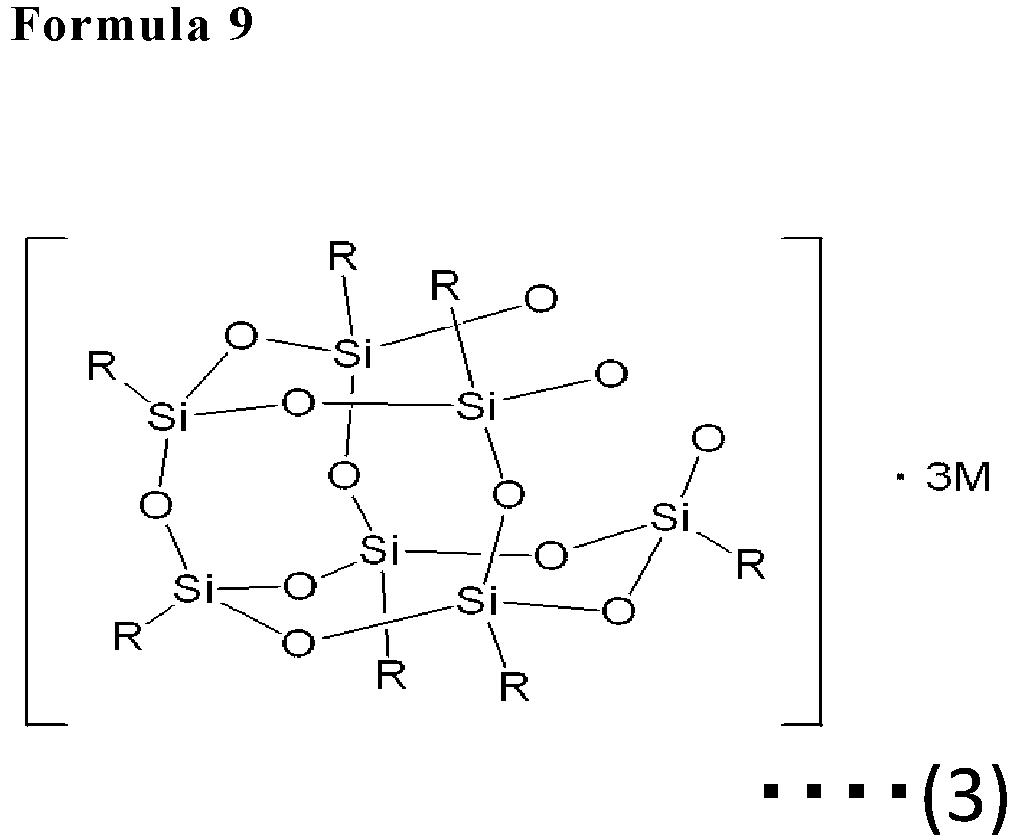
- In formula (3), M is not particularly limited as long as M is alkali metal. Specific examples of such alkali metal include lithium, sodium, potassium and cesium.
- R in formulas (2) and (3) independently corresponds to one group selected from Rf 1 to Rf 7 in formula (1), and is straight-chain or branched-chain fluoroalkyl having 1 to 20 carbons in which at least one methylene may be replaced by oxygen; fluoroaryl having 6 to 20 carbons in which at least one hydrogen is replaced by fluorine or trifluoromethyl; or fluoroarylalkyl having 7 to 20 carbons in which at least one hydrogen in aryl is replaced by fluorine or trifluoromethyl, and X is a hydrolyzable group.
- R in formulas (2) and (3) is preferably independently 3,3,3-trifluoropropyl, 3,3,4,4,4-pentafluorobutyl, 3,3,4,4,5,5,6,6,6-nonafluorohexyl, tridecafluoro-1,1,2,2-tetrahydrooctyl, heptadecafluoro-1,1,2,2-tetrahydrodecyl, henicosafluoro-1, 1,2,2-tetrahydrododecyl, pentacosafluoro-1,1,2,2-tetrahydrotetradecyl, propyl(3-heptafluoroisopropoxy), pentafluorophenylpropyl, pentafluorophenyl or a,a,a-trifluoromethylphenyl.
- R in formula (2) is further preferably independently 3,3,3-trifluoropropyl or 3,3,4,4,5,5,6,6,6-nonafluorohexyl.
- Next, fluorosilsesquioxane derivative (1) is obtained by allowing compound (3) to react with compound (4) represented by formula (4).

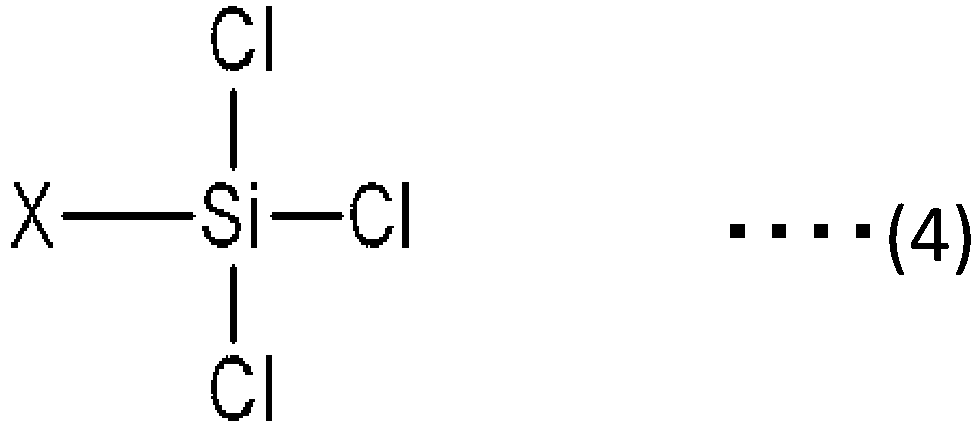
- Group X in formula (4) is a group represented by formula (1-1) or formula (1-2).
- Among such fluorosilsesquioxane derivatives (1), γ-methacryloxypropylhepta(trifluoropropyl)-T8-silsesquioxane represented by formula (5) is preferred.

- If fluorosilsesquioxane derivative (1) such as γ-methacryloxypropylhepta(trifluoropropyl)-T8-silsesquioxane is introduced into the coating layer, a stain-proof function of the coating layer can be further improved. Upon incorporating fluorosilsesquioxane derivative (1) into the photopolymerizable acrylic compounds having no urethane unit and containing the fluorine atom, fluorosilsesquioxane derivative (1) may be directly mixed with other photopolymerizable acrylic compounds having no urethane unit and containing the fluorine atom, or an oligomer produced by previously crosslinking and/or polymerizing fluorosilsesquioxane derivative (1) with photopolymerizable acrylic compounds having no urethane unit may be mixed with other photopolymerizable acrylic compounds having no urethane unit and containing the fluorine atom.
- In general, fluorosilsesquioxane derivative (1) is copolymerized with one or more kinds of acrylate-based copolymerization components selected from monofunctional acrylate, bifunctional acrylate and polyfunctional acrylate to previously produce a polymer having a fluorosilsesquioxane derivative (1) unit, and the polymer is used as a part of the photopolymerizable acrylic compound having no urethane unit and containing the fluorine atom. In the above case, the polymer having the fluorosilsesquioxane derivative (1) unit is blended so as to have a proportion of 0.01 part by weight to 10 parts by weight, preferably 0.05 part by weight to 5 parts by weight, based on 100 parts by weight of the urethane acrylate.
- As a photocurable acrylic monomer and/or oligomer having the fluorine atom in the molecule or the photopolymerizable acrylic compounds having no urethane unit and containing the fluorine atom to be used with fluorosilsesquioxane derivative (1), a compound generally called the photocurable acrylic monomer, for example, monofunctional acrylate such as (meth)acrylic acid and (meth)acrylic acid ester, bifunctional acrylate such as (poly)alkylene glycol di(meth)acrylate, and trifunctional or more functional acrylate such as pentaerythritol triacrylate, or the like can be used. Such a copolymerization component may be the oligomer obtained by polymerizing a reactive compound containing the photocurable acrylic monomer.
- An amount ratio of components (a1), (a2), (a3) and (a4) is appropriately adjusted according to a balance of stain-proof properties, water repellency, chemical resistance and sunscreen cream resistance of the surface protective layer. Components (a1), (a2), (a3) and (a4) preferably are present at proportions of 25 parts by weight or more 87.99 parts by weight or less, 1 part by weight or more and 20 parts by weight or less, 1 part by weight or more and 10 parts by weight or less, and 0.01 part by weight or more and 5 parts by weight or less, based on 100 parts by weight of photopolymerizable urethane acrylate mixture (A), respectively.
- In addition to photopolymerizable urethane acrylate mixture (A), filler (B) can be blended to the photopolymerizable urethane acrylate composition of the invention. As filler (B) of the invention, an inorganic filler to be blended to a plastic molding compound or a coating material for extension, reinforcement, glazing, water repellency provision, smoothness provision, designability provision and the like can be used without limitation. As such filler (B), silica, zirconium oxide, barium titanate, titanium oxide, alumina or the like can be used, for example. Among the above compounds, a so-called fine grade filler is preferred in terms of not spoiling appearance of the surface protective layer. For example, a filler "MHI" made by Mikuni-Color Ltd. is preferred as filler (B) in terms of being excellent in dispersibility into the photopolymerizable urethane acrylate composition.
- In the invention, a blending proportion of filler (B) of the invention is appropriately determined. Photopolymerizable urethane acrylate mixture (A) and filler (B) preferably are present at proportions of 60 parts by weight or more and 100 parts by weight or less, and 0 parts by weight or more and 40 parts by weight or less, based on a total of 100 parts by weight of photopolymerizable urethane acrylate mixture (A) and filler (B), respectively. Photopolymerizable urethane acrylate mixture (A) and filler (B) further preferably are present at proportions of 60 parts by weight or more and 90 parts by weight or less, and 10 parts by weight or more and 40 parts by weight or less, based on a total of 100 parts by weight of photopolymerizable urethane acrylate mixture (A) and filler (B), respectively.
- The photopolymerizable urethane acrylate composition of the invention further contains photopolymerization initiator (C). A kind and a blending amount of photopolymerization initiator (C) are not limited according to a conventional technique in photopolymerization of a photopolymerizable acrylic polymer. As photopolymerization initiator (C), various other commercially available products such as "IRGACURE" made by BASF SE (currently sold as "Omnirad" made by IGM Resins B.V.) can be used. As photopolymerization initiator (C), a polymer body of hydroxy ketone such as oligo{2-hydroxy-2-methyl-1-phenylpropaneone}, 1-hydroxydicyclohexyl phenyl ketone, 2-hydroxy-2-methyl-1-phenylpropane-1-one, 2,2-dimethoxy-1,2-diphenylethane-1-one, 1-{4(2-hydroxyethoxy)pheny1}2-hydroxy-2-methyl-1-propane 1-one, 2,4,6-trimethylbenzoyldiphenylphosphine oxide, bis(2,4,6-trimethylbenzoyl)phenylphosphine oxide or the like can be used, for example.
- In addition to components (A), (B) and (C), an additive such as an antioxidant, a weather-resistant stabilizer, a toning agent and a diluent, which are generally blended to a coating material or a material of a film, can be further blended to the photopolymerizable urethane acrylate composition. A blending amount thereof is not limited as long as the amount is within the range in which a function of the surface protective layer is not reduced.
- The cured product of the photopolymerizable urethane acrylate composition containing photopolymerizable urethane acrylate mixture (A), filler (B), photopolymerization initiator (C), and other additives that can be blended when necessary forms the surface protective layer of the invention. The surface protective layer is laminated on one side of the polycarbonate base material film of the invention.
- The polycarbonate base material film used in the invention is a monolayer or multilayer film or sheet mainly formed of a polycarbonate-based resin. As the polycarbonate-based resin constituting the polycarbonate base material film, a resin known as a material of the automotive interior and exterior parts can be used without limitation. As such a polycarbonate base material film, "Panlite (registered trademark)" made by TEIJIN LIMITED, "Iupilon Sheet" made by MITSUBISHI GAS CHEMICAL COMPANY, INC., "CARBO GLAS (registered trademark)" made by AGC POLYCARBONATE CO., LTD., or the like can be used, for example.
- A thickness of the polycarbonate base material film of the invention is not particularly limited, but is ordinarily 100 micrometers or more and 500 micrometers or less, and preferably 200 micrometers or more and 400 micrometers or less. The photopolymerizable urethane acrylate composition in the solution state is coated on one side of such a polycarbonate base material film so as to obtain a coating thickness of ordinarily 1 micrometer or more and 30 micrometers or less and preferably 1 micrometer or more and 20 micrometers or less, and finally the cured product of the photopolymerizable urethane acrylate composition in the solution state is formed on one side of the polycarbonate base material film as the surface protective layer of ordinarily 1 micrometer or more and 30 micrometers or less and preferably 1 micrometer or more and 20 micrometers or less.
- In formation of the surface protective layer, first, a solution obtained by diluting the photopolymerizable urethane acrylate composition containing photopolymerizable urethane acrylate mixture (A), photopolymerization initiator (C) and further, when necessary, filler (B) with a solvent when necessary is prepared. Then, the solution is coated on one side of the polycarbonate base material film, and after drying under appropriate conditions, a coated surface is irradiated with light energy rays such as ultraviolet light to cure the photopolymerizable urethane acrylate composition. Thus, the modified film of the invention is obtained.
- A dilution method of the photopolymerizable urethane acrylate composition, a coating method of the photopolymerizable urethane acrylate composition in the solution state, irradiation conditions for the light energy rays and a drying method of the cured product of the photopolymerizable urethane acrylate composition are appropriately selected from publicly-known conditions for handling of a photopolymerizable coating material.
- On a side of the surface protective layer of the modified film of the invention, all of the stain-proof properties, the water repellency, the chemical resistance and the sunscreen cream resistance derived from the surface protective layer of the invention are developed in a well-balanced manner. In addition, the modified film of the invention is also comparatively suitable for a complicated shape. Such a modified film of the invention is effective for surface modification of the automotive interior and exterior parts.
- The automotive interior and exterior parts of the invention are automotive interior and exterior parts in which at least a part of a surface is coated with the modified film of the invention. As a method of producing the automotive interior and exterior parts of the invention, a method of allowing an automotive interior and exterior part material mainly formed of plastic to adhere to the modified film in a predetermined shape can be used without limitation. Specific examples thereof include film insert molding or laminate injection press molding in which the modified film is arranged in a mold and the mold is filled with a resin by injection molding, a film in-mold molding in which the modified film is preliminarily formed and then arranged in a mold and the mold is filled with a resin by injection molding, and a method combining double molding, sandwich molding or the like with the above molding methods.
- The modified film of the invention is effective for the automotive interior and exterior parts, in general. Various automotive interior and exterior parts such as an instrument panel, a seat, a console box, a sun visor, a pillar trim, a door trim, a radiator grill, an emblem, various garnishes, a wheel cap, a grill illumination, covers inside and outside the vehicle can be produced, for example. Particularly valuable parts as such automotive interior and exterior parts of the invention include the instrument panel, the emblem, the radiator grill and various garnishes, which are required to have all of the stain-proof properties, the water repellency, the chemical resistance and the sunscreen cream resistance because such parts are used under an environment in which frequency at which humans touch the parts with hands and fingers is high.
- A modified film of the invention was produced according to procedures described below.
- Into a four-necked flask having an inner volume of 1 litter and equipped with a reflux condenser, a thermometer and a dropping funnel, trifluoropropyltrimetoxysilane (100 g), THF (500 mL), deionized water (10.5 g) and sodium hydroxide (7.9 g) were charged, and the resulting mixture was heated in an oil bath from room temperature to a temperature at which THF was refluxed while stirring the mixture with a magnetic stirrer. Stirring was continued for 5 hours from reflux start to complete a reaction. Then, the flask was pulled up from the oil bath, and left to stand overnight at room temperature, and then the flask was set to the oil bath again, and the mixture was heated and concentrated under constant pressure until a solid precipitated.
- The product precipitated was obtained by filtration using a pressure filter equipped with a membrane filter having a pore diameter of 0.5 micrometer. Then, the solid obtained was washed once with THF, and dried using a dryer under reduced pressure at 80°C for 3 hours to obtain 74 g of a colorless powdery solid.
- Into a four-necked flask having an inner volume of 1 litter and equipped with a reflux condenser, a thermometer and a dropping funnel, the obtained solid (65 g), dichloromethane (491 g) and triethylamine (8.1 g) were charged, and the resulting mixture was cooled down to 3°C in an ice bath. Then, γ-methacryloxypropyltrichlorosilane (21.2 g) was added thereto, and heat generation was confirmed to cease, and then the flask was pulled up from the ice bath, and the resulting mixture was aged as was at room temperature overnight. The resulting mixture was washed 3 times with deionized water, and then a dichloromethane layer was dehydrated over anhydrous magnesium sulfate to remove magnesium sulfate by filtration. The resulting filtrate was concentrated using a rotary evaporator until a viscous solid precipitated, and 260 g of methanol was added thereto, and the resulting mixture was stirred until a powdery state was formed. The resulting powder was filtrated using a pressure filter equipped with 5-µm filter paper, and the filtrate was dried at 65°C for 3 hours using a dryer under reduced pressure to obtain 41.5 g of a colorless powdery solid. GPC and 1H-NMR measurement were carried out on the solid obtained to confirm formation of γ-methacryloxypropylhepta(trifluoropropyl)-T8-silsesquioxane represented by formula (5).

- Into a four-necked flask having an inner volume of 200 milliliters and equipped with a reflux condenser, a thermometer and a dropping funnel, 36.65 g of γ-methacryloxypropylhepta(trifluoropropyl)-T8-silsesquioxane obtained by the method described above, 18.33 g of methyl methacrylate (MMA), 27.49 g of 2-hydroxyethyl methacrylate (HEMA), 9.16 g of dimethyl silicone modified with a methacryloxy group at one end (FM-0721, molecular weight: about 6,300) and 106.4 g of 2-butanone (MEK) were introduced, and the flask was sealed with nitrogen. The flask was set to an oil bath kept at 95°C to allow the resulting mixture to be refluxed, and then subjected to oxygen removal for 10 minutes. Then, a solution in which 0.70 g of 2,2'-azobisisobutyronitrile (AIBN) and 0.08 g of mercaptoacetic acid (AcSH) were dissolved in 7.0 g of MEK was introduced thereinto, and polymerization was started while being kept at a reflux temperature. After polymerization was performed for 3 hours, a solution in which 7.00 g of AIBN was dissolved in 7.0 g of MEK was introduced thereinto, and polymerization was further continued for 5 hours. After completion of polymerization, 65 milliliters of denatured alcohol (Solmix AP-1, made by Japan Alcohol Trading Co., Ltd.) was added to the polymerization liquid, and then the resulting mixture was poured into 1300 milliliters of Solmix AP-1 to allow a polymer to precipitate. A supernatant was removed, and a product was separated by drying under reduced pressure (40°C, 3 hours, 70°C, 3 hours).
- Into a four-necked flask having an inner volume of 200 milliliters and equipped with a reflux condenser, a thermometer and a septum cap, 15.0 g of the product, 0.015 g of MEHQ, 0.0263 g of DBTDL and 130 g of ethyl acetate were introduced, and the flask was sealed with nitrogen. The flask was set to an oil bath kept at 48°C, and was heated. Then, when a solution temperature reached 45°C, 15.9 g of acryloyloxyethyl isocyanate (AOI, made by Showa Denko K.K.) was introduced thereinto, and a reaction was started. After the reaction was performed for 6 hours, the temperature was reduced to room temperature, and 10.0 g of MeOH was introduced thereinto, and the reaction was completed. After completion of the reaction, 65 milliliters of Solmix AP-1 was added to the reaction mixture, and then 1300 milliliters of Solmix AP-1 was poured thereinto to allow a reactant to precipitate. A supernatant was removed, and the resulting material was dried under reduced pressure (40°C, 3 hours, 70°C, 3 hours) to obtain 11.8 g of a polymer including a γ-methacryloxypropylhepta(trifluoropropyl)-T8-silsesquioxane unit and having an acryloyl group in a side chain. A weight average molecular weight of the polymer determined by GPC analysis was 45,000, and a molecular weight distribution was 1.7.
- As ultraviolet curing type urethane acrylic polymer (a1), an ultraviolet curing type urethane acrylic polymer "8BR-600" made by Taisei Fine Chemical Co., Ltd. was used. As polyfunctional acrylate compound (a2), a hexafunctional acrylate compound "KAYARAD DPCA-120" made by Nippon Kayaku Co., Ltd. was used. As fluorine-containing photopolymerizable acrylic compound (a3), "MEGAFAC RS75" made by DIC Corporation was used. As photopolymerizable acrylate oligomer having a unit derived from a fluorosilsesquioxane derivative (a4), a polymer containing the above-described γ-methacryloxypropylhepta(trifluoropropyl)-T8-silsesquioxane unit and having an acryloyl group in a side chain was used. As filler (B), zirconium oxide "MHI series FM-215M" made by Mikuni-Color Ltd. was used. As photopolymerization initiator (C), "Omnirad 127" made by IGM Resins B.V. was used. Further, as a diluent, isopropyl alcohol (IPA) was used. Components (a1), (a2), (a3), (B) and (C) were selected as shown in Table 1, and the components were mixed with each other at an amount ratio shown in Table 1 to obtain a coating liquid containing a photopolymerizable urethane acrylate composition in which the above components were favorably dispersed, at a concentration of 25% by weight.
- Each of the above-described coating liquids was coated on one side of a 300 µm-thick polycarbonate base material film ("Panlite 2151" made by TEIJIN LIMITED) by using a wire bar coater No. 30 made by R.D.S. Webster Co., and the resulting material was dried at 80°C for 1 minute. Then, a photopolymerizable coating liquid was cured at integrated quantity of light: 1000 mJ/cm2 by using a conveyor device for ultraviolet curing for 8 kW × 1 lamp, ESC-801G1 type, made by EYE GRAPHICS CO., LTD. Thus, 7 kinds of modified films in which a surface protective layer formed of an 11 µm-thick cured product of the photopolymerizable urethane acrylate composition was formed on one side of the polycarbonate base material film were obtained.
- The results of evaluation of the 7 kinds of modified films in terms of the following viewpoints and methods are shown in Table 1.
- Oil repellency of the surface protective layer of the obtained modified film to commercially available black oil-based ink was evaluated. A degree to which the black oil-based ink was repelled when a line was drawn with a Sharpie marker on a surface of the surface protective layer of the obtained modified film was judged according to the following criteria.
- Sign: +: The ink is repelled and a track of the ink is visible in a dotted shape.
- Sign: -: The ink is not repelled and the track of the ink is visible in a linear shape
- Removal easiness of the ink when a track of the ink adhering to the surface protective layer in (1) Oil repellency test described above was rubbed by reciprocation once using a nonwoven fabric (Dusper K-3 made by OZU CORPORATION) was judged according to the following criteria.
- Sign: +: The ink is completely wiped off and no ink mark remains.
- Sign: -: The ink is not completely wiped off and the ink mark remains.
- A test piece (20 mm × 90 mm) cut out from the obtained modified film was pasted to a stainless steel plate (25 mm × 100 mm) so that a polycarbonate base material film side adhered thereto. In the above state, a water contact angle on an upper surface (surface protective layer surface) of the modified film was measured by applying distilled water for measuring nitrogen and phosphorus (made by KANTO CHEMICAL CO.,INC.) as probe water using an automatic contact angle meter DMs-400 (made by Kyowa Interface Science Co., Ltd.). The water contact angle is preferably 95° or more, and as the water contact angle is larger, higher water repellency is exhibited.
- A commercially available sunscreen cream (Neutrogena ULTRA SHEER SUNSCREEN SPF45) was coated on a surface protective layer of a test piece (50 mm × 50 mm) cut out from the obtained modified film at a uniform thickness in an amount of 0.5 g/100cm2. On a surface on which the sunscreen cream adhered, 2 sheets of white cloth and an aluminum plate were laminated, and 500 g of a weight was placed from above the aluminum plate. In the above state, a whole test object including the modified film was left to stand and heated in a constant-temperature bath at 55°C for 4 hours. After heating, the weight, the aluminum plate and the white cloth were removed. The sunscreen cream adhering to the surface protective layer was removed by rubbing the surface protective layer with a nonwoven fabric impregnated with a neutral detergent. A state of the surface protective layer from which the sunscreen cream was removed was judged according to the following criteria.
- Sign: +: A state before coating of the sunscreen cream remains and neither deterioration nor deformation is observed.
- Sign: -: A mark, dissolution unevenness or the like of the sunscreen cream is observed and deterioration or deformation is found.
- Onto a surface protective layer of a test piece (50 mm × 50 mm) cut out from the obtained modified film, 0.05 g of a commercially available insect repellent spray (OFF! Deep Woods (registered trademark) Sportsman with 25% DEET) was uniformly sprayed. On a surface to which the insect repellent spray adhered, 2 sheets of white cloth and an aluminum plate were laminated. In the above state, a whole test object including the modified film was left to stand at room temperature (23°C) for 24 hours. Then, the aluminum plate and the white cloth were removed. A state of the surface protective layer on the occasion was judged according to the following criteria.
- Sign: +: A state before contact with the insect repellent spray remains and neither deterioration nor deformation is observed.
- Sign: -: A mark, dissolution unevenness or the like of the insect repellent spray is observed and deterioration or deformation is observed.
- Hardness of the surface protective layer was measured by pencil hardness measurement in accordance with JIS K 5600.
- Haze (H1) of a test piece (120 mm × 70 mm) cut out from the obtained modified film was measured using Haze Meter Model NDH-5000 made by Nippon Denshoku Industries Co., Ltd. The test piece in which haze H1 was measured was installed in Model IMC-1557 Abrasion Resistance Tester C made by Imoto Machinery Co., LTD., and a surface protective layer thereof was subjected to abrasion treatment. Abrasion conditions were set as follows: use of steel wool #0000, a load: 400 g and 15 times of reciprocation. Haze (H2) of the test piece after the abrasion treatment was measured according to the method identical to the method for measurement of haze H1. A transparency change degree (ΔH) represented by the following equation was determined from the values of H1 and H2. As ΔH is smaller, higher scratch resistance is exhibited.
ΔH = |H1 - H2|
- Temperature and humidity inside a vehicle rise after stopping an engine of the automobile in a summer season, and therefore quality deterioration of automotive interior parts placed under a high-temperature and high-humidity environment is concerned. Then, occurrence of peeling between the surface protective layer and the polycarbonate base material under the high-temperature and high-humidity environment was evaluated. The modified film was left to stand under an environment of temperature of 50°C and humidity of 95% RH for 250 hours, and then a cross-cut test was conducted at an interval of 1 millimeter on the modified film in accordance with JIS K5600-6. A state of a lattice formed by cross-cuts was visually observed, and an adhesion state between the surface protective layer and the polycarbonate base material in the modified film was judged according to the following criteria.
- Sign: +: A cut edge is smooth and the surface protective layer and the polycarbonate base material favorably adhere with each other.
- Sign: -: Flaking is found in the lattice, and reduction in adhesion between the surface protective layer and the polycarbonate base material is observed.
- The modified film in Example 1 was judged as "+" according to the criteria.
Fig. 1 shows a state of the lattice of the modified film obtained in Example 1. InFig. 1 , the lattice is found to be formed by a smooth groove having an approximately constant width. - The modified firm in Comparative Example 1 was judged as "-" according to the criteria.
Fig. 2 shows a state of the lattice of the modified film obtained in Comparative Example 1. InFig. 2 , unevenness is found in the groove forming the lattice and peeling of the surface protective layer is found in a portion surrounded by the lattice. - Assuming a step of forming automotive interior and exterior parts by using the modified film for a part of a formed member, the modified film was vacuum and pressure-formed into a dome-shaped thin shape by using a hemisphere mold having a rhombic streak under conditions in which an area of the modified film was extended to 200%. A surface protective layer of the dome-shaped modified film obtained was visually observed, and vacuum and pressure formability of the modified film was determined according to the following criteria.
- Sign: +: The surface protective layer matches with a mold shape.
- Sign: -: An abnormal shape that does not match with the mold shape is observed in the surface protective layer.
-
Fig. 3 shows a surface of a dome-shaped formed body obtained from the modified film in Example 1. The rhombic streak that matches well with the mold shape is reproduced on a surface of the formed body. A portion having no streak forms a smooth curved surface. The modified film in Example 1 can be understood as a material suitable for vacuum and pressure forming. -
Fig. 4 shows a surface of a dome-shaped formed body obtained from the modified film in Comparative Example 2. Unevenness and wrinkles are observed on a whole surface. The modified film in Comparative Example 1 can be understood to have a problem in vacuum and pressure forming.

- As shown in Table 1, the modified films produced in Example 1, Example 2 and Example 3 have the oil repellency, the stain-proof properties, the water repellency, the sunscreen cream resistance, the insect repellent spray resistance, the high surface hardness, the scratch resistance, the high-temperature and high-humidity resistance and the formability in a well-balanced manner, and are suitable as a surface protective member of the automotive interior and exterior parts.
- In contrast, in the modified films produced in Comparative Example 1, Comparative Example 2, Comparative Example 3, and Comparative Example 4 in which the raw materials of the surface protective layers were changed, any one of the oil repellency, the stain-proof properties, the water repellency, the sunscreen cream resistance, the insect repellent spray resistance, the high surface hardness, the scratch resistance, the high-temperature and high-humidity resistance and the formability is significantly deteriorated, and the modified films are lack in practicality as the surface protective member of the automotive interior and exterior parts.
- Thus, in the invention, the surface modified film for automotive interior and exterior parts having high practicality was able to be obtained only by arranging the surface protective layer produced from a carefully selected raw material on an appropriate base material film.
- A modified film of the invention has oil repellency, stain-proof properties, water repellency, sunscreen cream resistance, insect repellent spray resistance, high surface hardness, transparency and scratch resistance, high-temperature and high-humidity resistance and formability in a well-balanced manner. Such a modified film of the invention is useful as a surface protective member of automotive interior and exterior parts required to have high performance and designability, such as an instrument panel, an emblem, a radiator grill and various garnishes, for example. According to the invention, the automotive interior and exterior parts that can meet further sophisticated requirements in recent years are expected to be able to be produced.
Claims (5)
- A surface-modified film for automotive interior and exterior parts, in which a surface protective layer is laminated on one side of a polycarbonate base material film, wherein
the surface protective layer is a cured product of a photopolymerizable urethane acrylate composition,
the photopolymerizable urethane acrylate composition contains photopolymerizable urethane acrylate mixture (A), photopolymerization initiator (C), and further, when necessary, filler (B),
in the photopolymerizable urethane acrylate mixture, photopolymerizable urethane acrylate mixture (A) is present at a proportion of 60 parts by weight or more and 100 parts by weight or less, and filler (B) is present at a proportion of 0 parts by weight or more and 40 parts by weight or less, based on a total of 100 parts by weight of photopolymerizable urethane acrylate mixture (A) and filler (B),
photopolymerizable urethane acrylate mixture (A) contains photopolymerizable urethane acrylic polymer (a1), polyfunctional acrylate compound (a2), fluorine-containing photopolymerizable acrylic compound (a3) and photopolymerizable acrylate oligomer having a unit derived from a fluorosilsesquioxane derivative (a4) represented by formula (1), and
component (a1) is present at a proportion of 25 parts by weight or more and 87.99 parts by weight or less, component (a2) is present at a proportion of 1 part by weight or more and 20 parts by weight or less, component (a3) is present at a proportion of 1 part by weight or more and 10 parts by weight or less, and component (a4) is present at a proportion of 0.01 part by weight or more and 5 parts by weight or less, based on 100 parts by weight of photopolymerizable urethane acrylate mixture (A):


- The surface-modified film for automotive interior and exterior parts according to claim 1, wherein, in the photopolymerizable urethane acrylate composition, photopolymerizable urethane acrylate mixture (A) is present at a proportion of 60 parts by weight or more and 90 parts by weight or less, and filler (B) is present at a proportion of 10 parts by weight or more and 40 parts by weight or less, based on a total of 100 parts by weight of photopolymerizable urethane acrylate mixture (A) and filler (B).
- The surface-modified film for automotive interior and exterior parts according to claim 1 or 2, wherein component (a4) is a photopolymerizable acrylate oligomer having a unit derived from γ-methacryloxypropylhepta(trifluoropropyl)-T8-silsesquioxane represented by formulas (1-3):
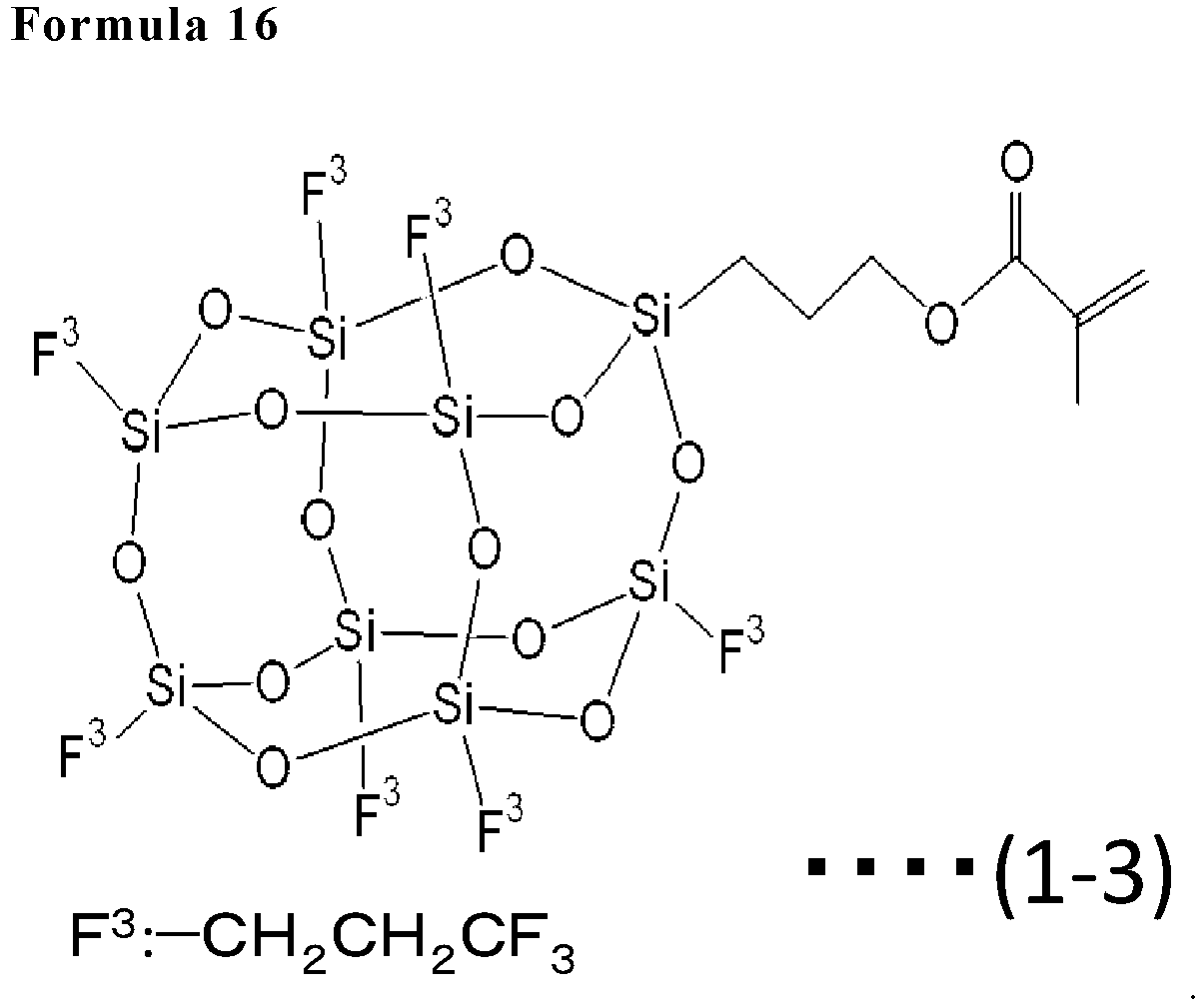
- The surface-modified film for automotive interior and exterior parts according to any of claims 1 to 3, wherein the automotive interior and exterior parts are selected from an instrument panel, an emblem, a radiator grill and various garnishes.
- Automotive interior and exterior parts, in which at least a part of a surface is coated with the surface-modified film for automotive interior and exterior parts according to any of claims 1 to 4.
Applications Claiming Priority (2)
| Application Number | Priority Date | Filing Date | Title |
|---|---|---|---|
| JP2017197940 | 2017-10-11 | ||
| PCT/JP2018/037540 WO2019073952A1 (en) | 2017-10-11 | 2018-10-09 | Surface-modified film for automotive interior/exterior components |
Publications (1)
| Publication Number | Publication Date |
|---|---|
| EP3695965A1 true EP3695965A1 (en) | 2020-08-19 |
Family
ID=66100852
Family Applications (1)
| Application Number | Title | Priority Date | Filing Date |
|---|---|---|---|
| EP18865744.9A Withdrawn EP3695965A1 (en) | 2017-10-11 | 2018-10-09 | Surface-modified film for automotive interior/exterior components |
Country Status (5)
| Country | Link |
|---|---|
| US (1) | US20200298540A1 (en) |
| EP (1) | EP3695965A1 (en) |
| JP (1) | JPWO2019073952A1 (en) |
| TW (1) | TW201927875A (en) |
| WO (1) | WO2019073952A1 (en) |
Families Citing this family (5)
| Publication number | Priority date | Publication date | Assignee | Title |
|---|---|---|---|---|
| KR102608459B1 (en) * | 2018-11-23 | 2023-12-04 | (주)엘엑스하우시스 | Decorative sheet having excellent anti scratch resistance and anti pollution, and preparation method thereof |
| JP2021121653A (en) * | 2020-01-31 | 2021-08-26 | Jnc株式会社 | Coating composition and product using the same |
| JP7443508B2 (en) * | 2020-05-15 | 2024-03-05 | 富士フイルム株式会社 | Curable resin composition, film for molding, molded product, and molding method |
| CN112778560A (en) * | 2020-11-24 | 2021-05-11 | 宁波康加分电器科技有限公司 | Easily-cleaned filter element composite material for juicer and preparation method thereof |
| CN115746363B (en) * | 2022-11-01 | 2023-08-18 | 神通科技集团股份有限公司 | An aging-resistant automobile B-pillar exterior trim panel that is easy to install and its preparation method |
Family Cites Families (14)
| Publication number | Priority date | Publication date | Assignee | Title |
|---|---|---|---|---|
| US4123619A (en) | 1977-07-01 | 1978-10-31 | Westinghouse Electric Corp. | Gas termination support system |
| JP2001341173A (en) | 2000-06-05 | 2001-12-11 | Japan Polychem Corp | Method for manufacturing exterior parts for car |
| JP4572883B2 (en) | 2006-08-09 | 2010-11-04 | トヨタ車体株式会社 | Interior panel and injection molding method |
| JP2009096241A (en) | 2007-10-15 | 2009-05-07 | Mitsuboshi Kaseihin Kk | Automobile interior article |
| JP5224866B2 (en) | 2008-03-27 | 2013-07-03 | 株式会社カネカ | Automotive film |
| JP2010018720A (en) | 2008-07-11 | 2010-01-28 | Kaneka Corp | Automotive film |
| KR20190131140A (en) * | 2011-06-20 | 2019-11-25 | 제이엔씨 주식회사 | Transfer film for in-mold molding and method for producing same |
| JP2013133361A (en) | 2011-12-26 | 2013-07-08 | Mitsubishi Engineering Plastics Corp | Aromatic polycarbonate resin composition and molded article |
| JP6083233B2 (en) * | 2012-12-19 | 2017-02-22 | Jnc株式会社 | Transfer film for in-mold molding, method for producing in-mold molded body, and molded body |
| CA2918512C (en) | 2013-10-11 | 2022-08-02 | Magna International Inc. | Selective chroming |
| WO2015133517A1 (en) * | 2014-03-05 | 2015-09-11 | Jnc株式会社 | Coating agent, cured film, laminate, molded product |
| JP2015168095A (en) * | 2014-03-05 | 2015-09-28 | グンゼ株式会社 | laminate |
| US10513586B2 (en) * | 2015-03-31 | 2019-12-24 | Jnc Corporation | Coating agent, coating film, laminate and surface-protected article |
| JP6515699B2 (en) | 2015-06-17 | 2019-05-22 | 三菱ケミカル株式会社 | Polycarbonate resin composition and molded article comprising the same |
-
2018
- 2018-10-09 US US16/755,161 patent/US20200298540A1/en not_active Abandoned
- 2018-10-09 WO PCT/JP2018/037540 patent/WO2019073952A1/en not_active Ceased
- 2018-10-09 JP JP2019548187A patent/JPWO2019073952A1/en active Pending
- 2018-10-09 EP EP18865744.9A patent/EP3695965A1/en not_active Withdrawn
- 2018-10-11 TW TW107135692A patent/TW201927875A/en unknown
Also Published As
| Publication number | Publication date |
|---|---|
| US20200298540A1 (en) | 2020-09-24 |
| WO2019073952A1 (en) | 2019-04-18 |
| TW201927875A (en) | 2019-07-16 |
| JPWO2019073952A1 (en) | 2020-12-03 |
Similar Documents
| Publication | Publication Date | Title |
|---|---|---|
| US20200298540A1 (en) | Surface-modified film for automotive interior/exterior components | |
| US10696865B2 (en) | Laminated film | |
| EP1170109B1 (en) | Photocuring resin compositions, photocuring sheets using the same, production thereof and process of production of a molded article using the same sheets | |
| CN102171265A (en) | Curable resin composition, paint, and plastic molded article formed by laminating them | |
| JP5158852B2 (en) | Acrylic resin composition, acrylic resin film, matte acrylic resin film for thermoforming, photocurable acrylic resin film, and laminate obtained by laminating these | |
| JP2014037453A (en) | Active energy ray curable resin composition and laminate using the same | |
| WO2021235493A1 (en) | Multilayer film, molded body, method for producing multilayer film, and method for producing molded body | |
| CN103087276A (en) | Active energy ray-curable resin, active energy ray-curable resin composition, active energy ray-curable hard coating agent, cured film using them, decoration film laminated with the cured film and plastic injection-molded product using the decoration film | |
| US20210138769A1 (en) | Laminated film | |
| JP4293886B2 (en) | Photocurable resin composition, photocurable sheet using the same, and method for producing molded article using the same | |
| JP2018065947A (en) | Acrylic resin composition, acrylic film, decorative film, and decorative molded body | |
| JP2006044195A (en) | Photo-curable sheet and molded product using the same | |
| JP4210127B2 (en) | Photocurable sheet manufacturing method, photocurable sheet and insert molded article manufacturing method | |
| JP2021121653A (en) | Coating composition and product using the same | |
| WO2019073953A1 (en) | Surface-modifying film for automobile interior/exterior components | |
| JP2003165178A (en) | Method for manufacturing transfer sheet and resin molded product | |
| JP4933801B2 (en) | Molded article having surface fine uneven structure and manufacturing method thereof | |
| JP2020066577A (en) | (meth)acrylate compound, and coating composition and coated article containing the same | |
| JP2006249323A (en) | Photocurable resin composition, photocurable sheet and method for producing molded product | |
| JP2006249322A (en) | Photocurable sheet and method for producing molded product using the same | |
| JP4395285B2 (en) | Photocurable sheet and method for producing molded product using the same | |
| JP2004082720A (en) | Photocurable sheet and molded article using the same | |
| JP4728539B2 (en) | Method for producing photocurable sheet | |
| JP2006282909A (en) | Photocurable casting liquid composition, photocurable sheet, method for producing photocurable sheet, and method for producing molded product | |
| JP2007283539A (en) | Manufacturing method of multilayer resin molded product |
Legal Events
| Date | Code | Title | Description |
|---|---|---|---|
| STAA | Information on the status of an ep patent application or granted ep patent |
Free format text: STATUS: THE INTERNATIONAL PUBLICATION HAS BEEN MADE |
|
| PUAI | Public reference made under article 153(3) epc to a published international application that has entered the european phase |
Free format text: ORIGINAL CODE: 0009012 |
|
| STAA | Information on the status of an ep patent application or granted ep patent |
Free format text: STATUS: REQUEST FOR EXAMINATION WAS MADE |
|
| 17P | Request for examination filed |
Effective date: 20200429 |
|
| AK | Designated contracting states |
Kind code of ref document: A1 Designated state(s): AL AT BE BG CH CY CZ DE DK EE ES FI FR GB GR HR HU IE IS IT LI LT LU LV MC MK MT NL NO PL PT RO RS SE SI SK SM TR |
|
| AX | Request for extension of the european patent |
Extension state: BA ME |
|
| STAA | Information on the status of an ep patent application or granted ep patent |
Free format text: STATUS: THE APPLICATION HAS BEEN WITHDRAWN |
|
| 18W | Application withdrawn |
Effective date: 20200910 |