EP3694480B1 - Compact shampoo composition containing sulfate-free surfactants - Google Patents
Compact shampoo composition containing sulfate-free surfactants Download PDFInfo
- Publication number
- EP3694480B1 EP3694480B1 EP18793151.4A EP18793151A EP3694480B1 EP 3694480 B1 EP3694480 B1 EP 3694480B1 EP 18793151 A EP18793151 A EP 18793151A EP 3694480 B1 EP3694480 B1 EP 3694480B1
- Authority
- EP
- European Patent Office
- Prior art keywords
- composition
- weight
- cationic
- shampoo composition
- surfactant
- Prior art date
- Legal status (The legal status is an assumption and is not a legal conclusion. Google has not performed a legal analysis and makes no representation as to the accuracy of the status listed.)
- Active
Links
Images
Classifications
-
- A—HUMAN NECESSITIES
- A61—MEDICAL OR VETERINARY SCIENCE; HYGIENE
- A61K—PREPARATIONS FOR MEDICAL, DENTAL OR TOILETRY PURPOSES
- A61K8/00—Cosmetics or similar toiletry preparations
- A61K8/02—Cosmetics or similar toiletry preparations characterised by special physical form
- A61K8/04—Dispersions; Emulsions
- A61K8/046—Aerosols; Foams
-
- A—HUMAN NECESSITIES
- A61—MEDICAL OR VETERINARY SCIENCE; HYGIENE
- A61K—PREPARATIONS FOR MEDICAL, DENTAL OR TOILETRY PURPOSES
- A61K8/00—Cosmetics or similar toiletry preparations
- A61K8/18—Cosmetics or similar toiletry preparations characterised by the composition
- A61K8/30—Cosmetics or similar toiletry preparations characterised by the composition containing organic compounds
- A61K8/40—Cosmetics or similar toiletry preparations characterised by the composition containing organic compounds containing nitrogen
- A61K8/44—Aminocarboxylic acids or derivatives thereof, e.g. aminocarboxylic acids containing sulfur; Salts; Esters or N-acylated derivatives thereof
-
- A—HUMAN NECESSITIES
- A61—MEDICAL OR VETERINARY SCIENCE; HYGIENE
- A61K—PREPARATIONS FOR MEDICAL, DENTAL OR TOILETRY PURPOSES
- A61K8/00—Cosmetics or similar toiletry preparations
- A61K8/18—Cosmetics or similar toiletry preparations characterised by the composition
- A61K8/30—Cosmetics or similar toiletry preparations characterised by the composition containing organic compounds
- A61K8/40—Cosmetics or similar toiletry preparations characterised by the composition containing organic compounds containing nitrogen
- A61K8/44—Aminocarboxylic acids or derivatives thereof, e.g. aminocarboxylic acids containing sulfur; Salts; Esters or N-acylated derivatives thereof
- A61K8/442—Aminocarboxylic acids or derivatives thereof, e.g. aminocarboxylic acids containing sulfur; Salts; Esters or N-acylated derivatives thereof substituted by amido group(s)
-
- A—HUMAN NECESSITIES
- A61—MEDICAL OR VETERINARY SCIENCE; HYGIENE
- A61K—PREPARATIONS FOR MEDICAL, DENTAL OR TOILETRY PURPOSES
- A61K8/00—Cosmetics or similar toiletry preparations
- A61K8/18—Cosmetics or similar toiletry preparations characterised by the composition
- A61K8/30—Cosmetics or similar toiletry preparations characterised by the composition containing organic compounds
- A61K8/46—Cosmetics or similar toiletry preparations characterised by the composition containing organic compounds containing sulfur
- A61K8/466—Cosmetics or similar toiletry preparations characterised by the composition containing organic compounds containing sulfur containing sulfonic acid derivatives; Salts
-
- A—HUMAN NECESSITIES
- A61—MEDICAL OR VETERINARY SCIENCE; HYGIENE
- A61K—PREPARATIONS FOR MEDICAL, DENTAL OR TOILETRY PURPOSES
- A61K8/00—Cosmetics or similar toiletry preparations
- A61K8/18—Cosmetics or similar toiletry preparations characterised by the composition
- A61K8/72—Cosmetics or similar toiletry preparations characterised by the composition containing organic macromolecular compounds
- A61K8/84—Cosmetics or similar toiletry preparations characterised by the composition containing organic macromolecular compounds obtained by reactions otherwise than those involving only carbon-carbon unsaturated bonds
- A61K8/89—Polysiloxanes
-
- A—HUMAN NECESSITIES
- A61—MEDICAL OR VETERINARY SCIENCE; HYGIENE
- A61Q—SPECIFIC USE OF COSMETICS OR SIMILAR TOILETRY PREPARATIONS
- A61Q5/00—Preparations for care of the hair
- A61Q5/006—Antidandruff preparations
-
- A—HUMAN NECESSITIES
- A61—MEDICAL OR VETERINARY SCIENCE; HYGIENE
- A61Q—SPECIFIC USE OF COSMETICS OR SIMILAR TOILETRY PREPARATIONS
- A61Q5/00—Preparations for care of the hair
- A61Q5/02—Preparations for cleaning the hair
-
- A—HUMAN NECESSITIES
- A61—MEDICAL OR VETERINARY SCIENCE; HYGIENE
- A61Q—SPECIFIC USE OF COSMETICS OR SIMILAR TOILETRY PREPARATIONS
- A61Q5/00—Preparations for care of the hair
- A61Q5/12—Preparations containing hair conditioners
-
- A—HUMAN NECESSITIES
- A61—MEDICAL OR VETERINARY SCIENCE; HYGIENE
- A61K—PREPARATIONS FOR MEDICAL, DENTAL OR TOILETRY PURPOSES
- A61K2800/00—Properties of cosmetic compositions or active ingredients thereof or formulation aids used therein and process related aspects
- A61K2800/20—Chemical, physico-chemical or functional or structural properties of the composition as a whole
- A61K2800/30—Characterized by the absence of a particular group of ingredients
-
- A—HUMAN NECESSITIES
- A61—MEDICAL OR VETERINARY SCIENCE; HYGIENE
- A61K—PREPARATIONS FOR MEDICAL, DENTAL OR TOILETRY PURPOSES
- A61K2800/00—Properties of cosmetic compositions or active ingredients thereof or formulation aids used therein and process related aspects
- A61K2800/40—Chemical, physico-chemical or functional or structural properties of particular ingredients
- A61K2800/59—Mixtures
- A61K2800/596—Mixtures of surface active compounds
-
- A—HUMAN NECESSITIES
- A61—MEDICAL OR VETERINARY SCIENCE; HYGIENE
- A61K—PREPARATIONS FOR MEDICAL, DENTAL OR TOILETRY PURPOSES
- A61K2800/00—Properties of cosmetic compositions or active ingredients thereof or formulation aids used therein and process related aspects
- A61K2800/80—Process related aspects concerning the preparation of the cosmetic composition or the storage or application thereof
- A61K2800/87—Application Devices; Containers; Packaging
Definitions
- the present invention relates to compact shampoo compositions. More particularly a clear, stable, compact shampoo composition that is substantially free of sulfate-based surfactants and contains sodium cocoyl isethionate.
- shampoo compositions in a foam form.
- shampoo ingredients may be present at a higher concentration.
- compact shampoo compositions can contain a high concentration of surfactant, to deliver enough surfactant for proper cleaning and lather during use.
- shampoos typically employ sulfate-based surfactant systems because of their effectiveness in generating high lather volume and good lather stability and cleaning.
- sulfate-based surfactants like sodium lauryl sulfate and sodium laureth sulfate, can be less gentle to the hair and skin, especially colored hair, as compared to shampoos that are substantially free of sulfate-based surfactant systems.
- shampoos containing sulfate-free surfactants may contain fatty acyl isethionates.
- fatty acyl isethionate has a low solubility in water (typically 0.01% by weight at 25 °C), which is an obstacle to incorporating it into aqueous compositions.
- fatty acyl isethionates like sodium cocoyl isethionate, are generally used at relatively low levels because the low solubility can lead to crystallization if incorporated at higher levels. Even when a shampoo contains a low level of sodium cocyl isethionate (i.e. 2% - 5%, a level where there is no crystallization at ambient temperature), the shampoo can turn cloudy at low temperatures (e.g. ⁇ 5°C) due to the high Kraft point of sodium cocyl isethionate.
- compact shampoo compositions may require a higher level of sodium cocyl isethionate (e.g. from 3% to 8%) to obtain the cleaning and lather benefits and therefore it can be difficult to have a shampoo product that is stable and clear without crystallization at both ambient temperature and low temperatures (e.g. ⁇ 5°C).
- the present application relates to a compact shampoo composition as defined in claim 1, and in particular to a compact shampoo composition
- a compact shampoo composition comprising: (a) from 20% to 40%, by weight of the composition, of a surfactant system wherein the surfactant system comprises: (i) from 5% to 20%, by weight of the composition, acyl glutamate; (ii) from 2% to 8% sodium cocoyl isethionate; (iii) from 7% to 10% zwitterionic surfactant; wherein the ratio of zwitterionic surfactant to sodium cocoyl isethionate is greater than 1.5; wherein the composition is clear and stable after storage at ambient temperature and at 5 °C; and wherein the shampoo composition is substantially free of sulfate-based surfactants.
- the present application also relates to a compact shampoo composition
- a compact shampoo composition comprising: (a) from 20% to 35%, by weight of the composition, of a surfactant system wherein the surfactant system comprises: (i) from 10% to 20%, by weight of the composition, acyl glutamate; (ii) from 2% to 6% sodium cocoyl isethionate; (iii) from 7% to 10% zwitterionic surfactant; wherein the ratio of zwitterionic surfactant to sodium cocoyl isethionate is from 1.5 to 2.5; wherein the composition is clear and stable after storage at ambient temperature and at 5 °C; and wherein the shampoo composition is substantially free of sulfate-based surfactants.
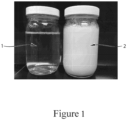
- Figure 1 is a digital photograph of two example shampoo compositions where one composition is clear and one composition is cloudy.
- fluid includes liquids, gels, emulsions, or suspensions.
- mixtures is meant to include a simple combination of materials and any compounds that may result from their combination.
- molecular weight refers to the weight average molecular weight unless otherwise stated. Molecular weight is measured using industry standard method, gel permeation chromatography ("GPC").
- personal care composition includes hair care products such as shampoos, conditioners, conditioning shampoos, hair colorants, as well as shower gels, liquid hand cleansers, facial cleansers, laundry detergent, dish detergent, and other surfactant-based liquid compositions.
- substantially free means less than 3%, alternatively less than 2%, alternatively less than 1%, alternatively less than 0.5%, alternatively less than 0.25%, alternatively less than 0.1%, alternatively less than 0.05%, alternatively less than 0.01%, alternatively less than 0.001%, and/or alternatively free of.
- free of' means 0%.
- component or composition levels are in reference to the active portion of that component or composition, and are exclusive of impurities, for example, residual solvents or by-products, which may be present in commercially available sources of such components or compositions.
- the amount of each particular ingredient or mixtures thereof described hereinafter can account for up to 100% (or 100%) of the total amount of the ingredient(s) in the shampoo composition.
- stable, compact shampoo compositions are disclosed that are substantially free of sulfate-based surfactants and contain sodium cocoyl isethionate.
- the compact shampoo can have a low liquid phase viscosity so it can be delivered through an aerosol and/or mechanical pump foamer.
- Examples A-D discussed hereafter, could be preferred by consumers over Comparative Examples 1-9 because they are stable at ambient temperature and at 5 °C.
- Examples A-D contain from 25% to 30% total surfactant, which includes 15% disodium cocoyl glutamate, 3% to 5% sodium cocoyl isethionate, and 7% to 10% zwitterionic surfactant. It was unexpectedly found that using more than 5% zwitterionic surfactant, like LAPB or CAPB, the product does not turn cloudy when exposed to low temperature, therefore making a consumer acceptable clear and phase stable shampoo product.
- the shampoo compositions can have a viscosity from 1 cP to 5000 cP, from 2 cP to 3000 cP, from 5 cP to 2000 cP, from 10 cP to 1000 cP, from 10 cP to 500 cP, and/or from 20 cP to 100 cP.
- the shampoo compositions can have a viscosity less than 100 cP, less than 80 cP, less than 60 cP, less than 50 cP, less than 40 cP, less than 30 cP, and/or less than 25 cP, at constant shear rate of 2000 s -1 and at temperature of 26.5°C, as determined by the Cone/Plate Viscosity Measurement, described hereafter.
- the shampoo compositions can be phase stable and can be substantially free of a viscosity reducing agent or hydrotrope.
- viscosity reducing agents can include propylene glycol, dipropylene glycol, alcohols, glycerin, and combinations thereof.
- the shampoo compositions can be phase stable and can be substantially free of a thickener.
- thickeners can include polyacrylate polymers such as Carbopol ® SF-1 and other Carbopol ® thickeners, gum thickeners such as xanthan gum, and combinations thereof.
- the shampoo compositions can have a pH from 2 to 10, from 4 to 8, from 5 to 7, and/or 6.
- the neat shampoo composition can appear clear and/or translucent.
- the neat shampoo composition can have a percent transmittance (%T) of at least 75%, alternatively at least 80%, alternatively at least 85%, and alternatively at least 90%, as measured by the Light Transmittance Method described hereafter.
- the shampoo compositions described herein can include one or more surfactants in the surfactant system and the one or more surfactants can be substantially free of sulfate-based surfactants.
- surfactants provide a cleaning benefit to soiled articles such as hair, skin, and hair follicles by facilitating the removal of oil and other soils.
- Surfactants generally facilitate such cleaning due to their amphiphilic nature which allows for the surfactants to break up, and form micelles around, oil and other soils which can then be rinsed out, thereby removing them from the soiled article.
- Suitable surfactants for a shampoo composition can include anionic moieties to allow for the formation of a coacervate with a cationic polymer.
- the surfactant can be selected from anionic surfactants, amphoteric surfactants, zwitterionic surfactants, non-ionic surfactants, and combinations thereof.
- Shampoo compositions typically employ sulfate-based surfactant systems (such as, but not limited to, sodium lauryl sulfate) because of their effectiveness in lather production, stability, clarity and cleansing.
- sulfate-based surfactant systems such as, but not limited to, sodium lauryl sulfate
- the foamed shampoo compositions described herein can be substantially free of sulfate-based surfactants.
- the concentration of the surfactant in the composition should be sufficient to provide the desired cleaning and lather performance.
- the shampoo composition can comprise a total surfactant level of from 10% to 50%, by weight, from 15% to 48%, by weight, from 18% to 45%, by weight, from 20% to 40%, by weight, from 22% to 38%, from 23% to 35%, and/or from 25% to 30%.
- Suitable surfactants that are substantially free of sulfates can include isethionates, sulfonates, sulfosuccinates, sulfoacetates, acyl glucosides, acyl glycinates, acyl sarcosinate, acyl glutamates, acyl alaninates, glucamide, glucose carboxylates, amphoacetates, taurates, other acyl aminoacids, betaines, sultaines, and/or phosphate esters.
- Suitable surfactants that are substantially free of sulfates can contain carboxylic acids.
- the surfactant system comprises from 5% to 20%, by weight of the composition, of an anionic surfactant, preferably from 10% to 20%, by weight of the composition of an anionic surfactant; wherein the anionic surfactant is selected from the group consisting of acyl glutamate, acyl alaninate, acyl glycinate, acyl sarcosinate, sulfonate, carboxylate, sulfosuccinate, taurate or a mixture thereof.
- the composition can contain a primary surfactant that can be an anionic surfactant and the anionic surfactant can be a glutamate, for instance an acyl glutamate.
- the composition can comprise an acyl glutamate level from 5% to 20%, by weight, 10% to 18%, by weight, and/or from 12% to 15%, by weight.
- the composition can contain less than 20%, by weight, acyl glutamate, less than 18%, less than 16%, and/or less than 15%.
- the ratio of acyl glutamate to total surfactant can be less than 0.6, less than 0.58, less than 0.55, less than 0.53, and/or less than or equal to 0.51.
- the ratio of acyl glutamate to total surfactant can be from 0.05 to 0.6, from 0.1 to 0.58, from 0.15 to 0.55, from 0.20 to 0.53, and/or from 0.25 to 0.05.
- Non-limiting examples of acyl glutamates can be selected from the group consisting of sodium cocoyl glutamate, disodium cocoyl glutamate, ammonium cocoyl glutamate, diammonium cocoyl glutamate, sodium lauroyl glutamate, disodium lauroyl glutamate, sodium cocoyl hydrolyzed wheat protein glutamate, disodium cocoyl hydrolyzed wheat protein glutamate, potassium cocoyl glutamate, dipotassium cocoyl glutamate, potassium lauroyl glutamate, dipotassium lauroyl glutamate, potassium cocoyl hydrolyzed wheat protein glutamate, dipotassium cocoyl hydrolyzed wheat protein glutamate, sodium capryloyl glutamate, disodium capryloyl glutamate, potassium capryloyl glutamate, dipotassium capryloyl glutamate, sodium undecylenoyl glutamate, disodium undecylenoyl glutamate, potassium
- the composition comprises from 2% to 8%, by weight of the composition of sodium cocoyl isethionate; from 7% to 10%, by weight of the composition of a zwitterionic surfactant, and can contain one or more co-surfactants selected from the group consisting of an anionic co-surfactant, zwitterionic surfactant, non-ionic surfactant, and combinations thereof.
- the composition can contain a primary surfactant that can be an acyl glutamate and the co-surfactant can be an isethionate or a sulfosuccinate.
- the anionic co-surfactant can be selected from the group consisting of isethionates, sarcosinates, sulfosuccinates, sulfonates, sulfoacetates, acyl glycinates, acyl alaninates, glucose carboxylates, alkyl ether carboxylates, alkyl amphoacetates, acyl taurates, and mixture thereof.
- the composition can comprise an anionic co-surfactant level can be from 0% to 10%, by weight, from 1% to 8%, by weight, from 2% to 7%, by weight, from 1% to 6%, by weight, and/or from 3% to 5%.
- the weight ratio of primary surfactant to anionic co-surfactant can be from 1:1 to 10:1, from 3:2 to 7:1, and/or from 3:1 to 5:1.
- the weight ratio of primary surfactant to anionic co-surfactant can be less than 5:1.
- Suitable isethionate surfactants can include the reaction product of fatty acids esterified with isethionic acid and neutralized with sodium hydroxide.
- Suitable fatty acids for isethionate surfactants can be derived from coconut oil or palm kernel oil including amides of methyl tauride.
- Non-limiting examples of isethionates can be selected from the group consisting of sodium lauroyl methyl isethionate, sodium cocoyl isethionate, ammonium cocoyl isethionate, sodium hydrogenated cocoyl methyl isethionate, sodium lauroyl isethionate, sodium cocoyl methyl isethionate, sodium myristoyl isethionate, sodium oleoyl isethionate, sodium oleyl methyl isethionate, sodium palm kerneloyl isethionate, sodium stearoyl methyl isethionate, and mixtures thereof.
- Non-limiting examples of sarcosinates can be selected from the group consisting of sodium lauroyl sarcosinate, sodium cocoyl sarcosinate, sodium myristoyl sarcosinate, TEA-cocoyl sarcosinate, ammonium cocoyl sarcosinate, ammonium lauroyl sarcosinate, dimer dilinoleyl bis-lauroylglutamate/lauroylsarcosinate, disodium lauroamphodiacetate lauroyl sarcosinate, isopropyl lauroyl sarcosinate, potassium cocoyl sarcosinate, potassium lauroyl sarcosinate, sodium cocoyl sarcosinate, sodium lauroyl sarcosinate, sodium myristoyl sarcosinate, sodium oleoyl sarcosinate, sodium palmitoyl sarcosinate, TEA-co
- Non-limiting examples of sulfosuccinate surfactants can include disodium N-octadecyl sulfosuccinate, disodium lauryl sulfosuccinate, diammonium lauryl sulfosuccinate, sodium lauryl sulfosuccinate, disodium laureth sulfosuccinate, tetrasodium N-(1,2-dicarboxyethyl)-N-octadecyl sulfosuccinnate, diamyl ester of sodium sulfosuccinic acid, dihexyl ester of sodium sulfosuccinic acid, dioctyl esters of sodium sulfosuccinic acid, and combinations thereof.
- Non-limiting examples of sulfonates can include alpha olefin sulfonates, linear alkylbenzene sulfonates, sodium laurylglucosides hydroxypropylsulfonate and combination thereof.
- Non-limiting examples of sulfoacetates can include sodium lauryl sulfoacetate, ammonium lauryl sulfoacetate and combination thereof.
- Non-limiting example of acyl glycinates can include sodium cocoyl glycinate, sodium lauroyl glycinate and combination thereof.
- Non-limiting example of acyl alaninates can include sodium cocoyl alaninate, sodium lauroyl alaninate, sodium N-dodecanoyl-l-alaninate and combination thereof.
- Non-limiting example of glucose carboxylates can include sodium lauryl glucoside carboxylate, sodium cocoyl glucoside carboxylate and combinations thereof.
- Non-limiting example of alkyl ether carboxylate can include sodium laureth-4 carboxylate, laureth-5 carboxylate, laureth-13 carboxylate, sodium C12-13 pareth-8 carboxylate, sodium C12-15 pareth-8 carboxylate and combination thereof.
- alkylamphoacetates can include sodium cocoyl amphoacetate, sodium lauroyl amphoacetate and combination thereof.
- Non-limiting example of acyl taurates can include sodium methyl cocoyl taurate, sodium methyl lauroyl taurate, sodium methyl oleoyl taurate and combination thereof.
- the surfactant system further comprises one or more zwitterionic surfactants and the zwitterionic surfactant can be a co-surfactant selected from the group consisting of: lauryl hydroxysultaine, cocamidopropyl hydroxysultaine, coco-betaine, coco-hydroxysultaine, coco-sultaine, lauryl betaine, lauryl sultaine, and mixtures thereof.
- betaine zwitterionic surfactants can include coco dimethyl carboxymethyl betaine, cocoamidopropyl betaine (CAPB), cocobetaine, lauryl amidopropyl betaine (LAPB), oleyl betaine, lauryl dimethyl carboxymethyl betaine, lauryl dimethyl alphacarboxyethyl betaine, cetyl dimethyl carboxymethyl betaine, lauryl bis-(2-hydroxyethyl) carboxymethyl betaine, stearyl bis-(2-hydroxypropyl) carboxymethyl betaine, oleyl dimethyl gamma-carboxypropyl betaine, lauryl bis-(2-hydroxypropyl)alpha-carboxyethyl betaine, and mixtures thereof.
- coco dimethyl carboxymethyl betaine cocoamidopropyl betaine (CAPB), cocobetaine, lauryl amidopropyl betaine (LAPB), oleyl betaine, lauryl dimethyl carboxymethyl betaine, lauryl dimethyl alphacarbox
- sulfobetaines can include coco dimethyl sulfopropyl betaine, stearyl dimethyl sulfopropyl betaine, lauryl dimethyl sulfoethyl betaine, lauryl bis-(2-hydroxyethyl) sulfopropyl betaine and mixtures thereof.
- the zwitterionic surfactant can comprise cocamidopropyl betaine (CAPB), lauramidopropyl betaine (LAPB), and combinations thereof.
- CAPB cocamidopropyl betaine
- LAPB lauramidopropyl betaine
- the surfactant system can have a weight ratio of anionic surfactant to zwitterionic surfactant from 1:2 to 5:1, from 1:1 to 7:2, from 3:2 to 3:1, and/or from 2:1 to 5:2.
- the surfactant system can have a weight ratio of anionic surfactant to zwitterionic surfactant less than 4:1, less than 3:1, and/or less than or equal to 5:2.
- the surfactant system can have a weight ratio of zwitterionic surfactant to anionic co-surfactant of from 1:1 to 5:1, from 5:4 to 4:1, from 3:2: to 3:1, and/or from 3:2 to 5:2.
- the surfactant system can have a weight ratio zwitterionic surfactant to anionic co-surfactant greater than 1:1, greater than 5:4, and/or greater than 3:2.
- the surfactant system has a weight ratio of zwitterionic surfactant to sodium cocoyl isethionate from 3:2 to 5:2.
- the foamed shampoo composition can comprise a non-ionic surfactant select from alkyl glucoside, acyl glucamide and other non-ionic surfactants.
- alkyl glucosides can include decyl glucoside, cocoyl glucoside, lauroyl glucoside and combination thereof.
- Non-limiting examples of acyl glucamide can include lauroyl/ myristoyl methyl glucamide, capryloyl/ caproyl methyl glucamide, lauroyl/ myristoyl methyl glucamide, cocoyl methyl glucamide and combinations thereof.
- a shampoo composition can include, by weight of the composition, 50% to 95%, of a liquid carrier, 60% to 85%, 65% to 80%, 68% to 78%, and/or 70% to 77%.
- a liquid carrier can be water, or can be a miscible mixture of water and organic solvent.
- a liquid carrier can be water with minimal or no significant concentrations of organic solvent, except as otherwise incidentally incorporated into the composition as minor ingredients of other essential or optional components.
- Suitable organic solvents can include water solutions of lower alkyl alcohols and polyhydric alcohols.
- Useful lower alkyl alcohols include monohydric alcohols having 1 to 6 carbons, such as ethanol and isopropanol.
- Exemplary polyhydric alcohols include propylene glycol, hexylene glycol, glycerin, and propane diol.
- shampoo compositions described herein can include a variety of optional components to tailor the properties and characteristics of the composition.
- suitable optional components are well known and can generally include any components which are physically and chemically compatible with the essential components of the shampoo compositions described herein.
- Optional components should not otherwise unduly impair product stability, aesthetics, or performance.
- Individual concentrations of optional components can generally range from 0.001% to 10%, by weight of a shampoo composition.
- Optional components can be further limited to components which will not impair the clarity of a translucent shampoo composition.
- Optional components may include, but are not limited to, conditioning agents (including hydrocarbon oils, fatty esters, silicones), cationic polymers, anti-dandruff actives, chelating agents, and natural oils such as sun flower oil or castor oil.
- conditioning agents including hydrocarbon oils, fatty esters, silicones
- cationic polymers including hydrocarbon oils, fatty esters, silicones
- anti-dandruff actives including hydrocarbon oils, fatty esters, silicones
- cationic polymers including hydrocarbon oils, fatty esters, silicones
- anti-dandruff actives including cationic oils such as sun flower oil or castor oil.
- Additional suitable optional ingredients include but are not limited to perfumes, perfume microcapsules, colorants, particles, anti-microbials, foam boosters, anti-static agents, propellants, self-foaming agents, pH adjusting agents and buffers, preservatives, pearlescent agents, solvents, diluents, anti-oxidants, vitamins and combinations thereof.
- CTFA Cosmetic Ingredient Handbook, Tenth Edition (published by the Cosmetic, Toiletry, and Fragrance Association, Inc., Washington, D.C.) (2004 ) (hereinafter "CTFA"), describes a wide variety of nonlimiting materials that can be added to the composition herein.
- a shampoo composition can include a silicone conditioning agent.
- Suitable silicone conditioning agents can include volatile silicone, non-volatile silicone, or combinations thereof.
- a silicone conditioning agent, the agent can be included from 0.01% to 10% active silicone material, by weight of the composition, from 0.1% to 8%, from 0.1% to 5%, and/or from 0.2% to 3%. Examples of suitable silicone conditioning agents, and optional suspending agents for the silicone, are described in U.S. Reissue Pat. No. 34,584 , U.S. Patent No. 5,104,646 , and U.S. Patent No. 5,106,609 .
- Suitable silicone conditioning agents can have a viscosity, as measured at 25° C, from 20 centistokes ("csk”) to 2,000,000 csk, from 1,000 csk to 1,800,000 csk, from 50,000 csk to 1,500,000 csk, and from 100,000 csk to 1,500,000 csk.
- csk centistokes
- the dispersed silicone conditioning agent particles can have a volume average particle diameter ranging from 0.01 micrometer to 50 micrometer.
- the volume average particle diameters can range from 0.01 micrometer to 4 micrometer, from 0.01 micrometer to 2 micrometer, from 0.01 micrometer to 0.5 micrometer.
- the volume average particle diameters typically range from 5 micrometer to 125 micrometer, from 10 micrometer to 90 micrometer, from 15 micrometer to 70 micrometer, and/or from 20 micrometer to 50 micrometer.
- Silicone emulsions suitable for the shampoo compositions described herein can include emulsions of insoluble polysiloxanes prepared in accordance with the descriptions provided in U. S. Patent No. 4,476,282 and U.S. Patent Application Publication No. 2007/0276087 .
- Suitable insoluble polysiloxanes include polysiloxanes such as alpha, omega hydroxy-terminated polysiloxanes or alpha, omega alkoxy-terminated polysiloxanes having a molecular weight within the range from 50,000 to 500,000 g/mol.
- the insoluble polysiloxane can have an average molecular weight within the range from 50,000 to 500,000 g/mol.
- the insoluble polysiloxane may have an average molecular weight within the range from 60,000 to 400,000; from 75,000 to 300,000; from 100,000 to 200,000; or the average molecular weight may be 150,000 g/mol.
- the insoluble polysiloxane can have an average particle size within the range from 30 nm to 10 micron.
- the average particle size may be within the range from 40 nm to 5 micron, from 50nm to 1micron, from 75 nm to 500 nm, or 100 nm, for example.
- the average molecular weight of the insoluble polysiloxane, the viscosity of the silicone emulsion, and the size of the particle comprising the insoluble polysiloxane are determined by methods commonly used by those skilled in the art, such as the methods disclosed in Smith, A. L. The Analytical Chemistry of Silicones, John Wiley & Sons, Inc.: New York, 1991 .
- the viscosity of the silicone emulsion can be measured at 30 °C with a Brookfield viscosimeter with spindle 6 at 2.5 rpm.
- the silicone emulsion can further include an additional emulsifier together with the anionic surfactant.
- silicones suitable for the shampoo compositions described herein can include i) silicone fluids, including silicone oils, which are flowable materials having viscosity less than 1,000,000 csk as measured at 25 °C; ii) aminosilicones, which contain at least one primary, secondary or tertiary amine; iii) cationic silicones, which contain at least one quaternary ammonium functional group; iv) silicone gums; which include materials having viscosity greater or equal to 1,000,000 csk as measured at 25 °C; v) silicone resins, which include highly crosslinked polymeric siloxane systems; vi) high refractive index silicones, having refractive index of at least 1.46, and vii) mixtures thereof.
- silicone fluids including silicone oils, which are flowable materials having viscosity less than 1,000,000 csk as measured at 25 °C
- aminosilicones which contain at least one primary, secondary or tertiary amine
- the silicone conditioning agent can be a silicone emulsion having particles size less than 10 microns, less than 1 microns and less than 0.1 microns.
- the conditioning agent of the shampoo compositions described herein can also include at least one organic conditioning material such as oil or wax, either alone or in combination with other conditioning agents, such as the silicones described above.
- the organic material can be non-polymeric, oligomeric or polymeric.
- the organic material can be in the form of an oil or wax and can be added in the personal care formulation neat or in a pre-emulsified form.
- Suitable examples of organic conditioning materials can include: i) hydrocarbon oils; ii) polyolefins, iii) fatty esters, iv) fluorinated conditioning compounds, v) fatty alcohols, vi) alkyl glucosides and alkyl glucoside derivatives; vii) quaternary ammonium compounds; viii) polyethylene glycols and polypropylene glycols having a molecular weight of up to 2,000,000 including those with CTFA names PEG-200, PEG-400, PEG-600, PEG-1000, PEG-2M, PEG-7M, PEG-14M, PEG-45M and mixtures thereof.
- a shampoo composition can include a cationic polymer to allow formation of a coacervate, particularly formation of a coacervate during use.
- the cationic charge of a cationic polymer can interact with an anionic charge of a surfactant to form the coacervate.
- Suitable cationic polymers can include: a cationic guar polymer, a cationic non-guar galactomannan polymer, a cationic starch polymer, a cationic copolymer of acrylamide monomers and cationic monomers, a synthetic, non-crosslinked, cationic polymer, which may or may not form lyotropic liquid crystals upon combination with the detersive surfactant, and a cationic cellulose polymer.
- a cationic polymer can be included by weight of the shampoo composition at 0.01% to 2%, 0.05% to 1%, 0.1% to 0.8%, and/or from 0.1% to 0.5%.
- Cationic polymers can have cationic charge densities of 0.9 meq/g or more, 1.2 meq/g or more, and 1.5 meq/g or more. However, cationic charge density can also be 7 meq/g or less and/or 5 meq/g or less.
- the charge densities can be measured at the pH of intended use of the shampoo composition. (e.g., at pH 3 to pH 9; or pH 4 to pH 8).
- the average molecular weight of cationic polymers can generally be between 1,000 and 2 million, between 5,000 and 1 million, and between 10,000 and 0.5 million.
- Low molecular weight cationic polymers can be preferred.
- Low molecular weight cationic polymers can have greater translucency in the liquid carrier of a shampoo composition.
- Suitable cationic polymers can include Polyquaternium-6 with a charge density of 6.2 meq/g and a M.Wt. of 223,000 g/mole available from Clariant, Polyquaternium-76 with a charge density of 1.6 meq/g and a M.Wt. of 1.1 million g/mole.
- the cationic polymer can be a cationic guar polymer, which is a cationically substituted galactomannan (guar) gum derivative.
- guar cationically substituted galactomannan
- Suitable guar gums for guar gum derivatives can be obtained as a naturally occurring material from the seeds of the guar plant.
- the guar molecule is a straight chain mannan which is branched at regular intervals with single membered galactose units on alternative mannose units. The mannose units are linked to each other by means of ⁇ (1-4) glycosidic linkages. The galactose branching arises by way of an ⁇ (1-6) linkage.
- Cationic derivatives of the guar gums can be obtained through reactions between the hydroxyl groups of the polygalactomannan and reactive quaternary ammonium compounds.
- the degree of substitution of the cationic groups onto the guar structure can be sufficient to provide the requisite cationic charge density described above.
- a cationic guar polymer can have a weight average molecular weight ("M.Wt.”) of less than 1 million g/mol, and can have a charge density from 0.05 meq/g to 2.5 meq/g.
- Cationic guar suitable can have a weight average molecular weight ("M.Wt.”) of less than 0.5 million g/mol.
- a shampoo composition can include from 0.01% to less than 0.7%, by weight of the shampoo composition of a cationic guar polymer, from 0.05% to 0.6%, from 0.1% to 0.50%, by weight, and/or from 0.1% to 0.4%, by weight.
- the cationic guar polymer can be formed from quaternary ammonium compounds which conform to general Formula II: wherein where R 3 , R 4 and R 5 are methyl or ethyl groups; and R 6 is either an epoxyalkyl group of the general Formula III: or R 6 is a halohydrin group of the general Formula IV: wherein R 7 is a Ci to C 3 alkylene; X is chlorine or bromine, and Z is an anion such as Cl-, Br-, I- or HSO 4 -.
- a cationic guar polymer can conform to the general formula V: wherein R 8 is guar gum; and wherein R 4 , R 5 , R 6 and R 7 are as defined above; and wherein Z is a halogen.
- a cationic guar polymer can conform to Formula VI: wherein R 8 is guar gum.
- Suitable cationic guar polymers can also include cationic guar gum derivatives, such as guar hydroxypropyltrimonium chloride.
- Suitable examples of guar hydroxypropyltrimonium chlorides can include the Jaguar ® series commercially available from Solvay S.A., Hi-Care TM Series from Rhodia, and N-Hance TM and AquaCat TM from Ashland Inc.
- Jaguar ® Optima has a charge density of 1.25 meg/g and a M. Wt. of 500,000 g/moles.
- Jaguar ® C-500 has a charge density of 0.8 meq/g and a M.Wt.
- N-Hance TM BF-13 and N-Hance TM BF-17 are borate (boron) free guar polymers.
- N-Hance TM BF-13 has a charge density of 1.1 meq/g and M.W.t of 800,000 and N-Hance TM BF-17 has a charge density of 1.7 meq/g and M.W.t of 800,000.
- a cationic polymer can be a galactomannan polymer derivative.
- a suitable galactomannan polymer can have a mannose to galactose ratio of greater than 2:1 on a monomer to monomer basis and can be a cationic galactomannan polymer derivative or an amphoteric galactomannan polymer derivative having a net positive charge.
- the term "cationic galactomannan” refers to a galactomannan polymer to which a cationic group is added.
- amphoteric galactomannan refers to a galactomannan polymer to which a cationic group and an anionic group are added such that the polymer has a net positive charge.
- Galactomannan polymers can be present in the endosperm of seeds of the Leguminosae family.
- Galactomannan polymers are made up of a combination of mannose monomers and galactose monomers.
- the galactomannan molecule is a straight chain mannan branched at regular intervals with single membered galactose units on specific mannose units.
- the mannose units are linked to each other by means of ⁇ (1-4) glycosidic linkages.
- the galactose branching arises by way of an ⁇ (1-6) linkage.
- the ratio of mannose monomers to galactose monomers varies according to the species of the plant and can be affected by climate.
- Non-Guar Galactomannan polymer derivatives can have a ratio of mannose to galactose of greater than 2:1 on a monomer to monomer basis. Suitable ratios of mannose to galactose can also be greater than 3:1 or greater than 4:1. Analysis of mannose to galactose ratios is well known in the art and is typically based on the measurement of the galactose content.
- the gum for use in preparing the non-guar galactomannan polymer derivatives can be obtained from naturally occurring materials such as seeds or beans from plants.
- examples of various non-guar galactomannan polymers include Tara gum (3 parts mannose/1 part galactose), Locust bean or Carob (4 parts mannose/1 part galactose), and Cassia gum (5 parts mannose/1 part galactose).
- a non-guar galactomannan polymer derivative can have a M. Wt. from 1,000 g/mol to 10,000,000 g/mol, and a M.Wt. from 5,000 g/mol to 3,000,000 g/mol.
- the shampoo compositions described herein can include galactomannan polymer derivatives which have a cationic charge density from 0.5 meq/g to 7 meq/g.
- the galactomannan polymer derivatives can have a cationic charge density from 1 meq/g to 5 meq/g.
- the degree of substitution of the cationic groups onto the galactomannan structure can be sufficient to provide the requisite cationic charge density.
- a galactomannan polymer derivative can be a cationic derivative of the non-guar galactomannan polymer, which is obtained by reaction between the hydroxyl groups of the polygalactomannan polymer and reactive quaternary ammonium compounds.
- Suitable quaternary ammonium compounds for use in forming the cationic galactomannan polymer derivatives include those conforming to the general Formulas II to VI, as defined above.
- Cationic non-guar galactomannan polymer derivatives formed from the reagents described above can be represented by the general Formula VII: wherein R is the gum.
- the cationic galactomannan derivative can be a gum hydroxypropyltrimethylammonium chloride, which can be more specifically represented by the general Formula VIII:
- the galactomannan polymer derivative can be an amphoteric galactomannan polymer derivative having a net positive charge, obtained when the cationic galactomannan polymer derivative further comprises an anionic group.
- a cationic non-guar galactomannan can have a ratio of mannose to galactose which is greater than 4:1, a M.Wt. of 100,000 g/mol to 500,000 g/mol, a M.Wt. of 50,000 g/mol to 400,000 g/mol, and a cationic charge density from 1 meq/g to 5 meq/g, and from 2 meq/ g to 4 meq/g.
- Shampoo compositions can include at least 0.05% of a galactomannan polymer derivative by weight of the composition.
- the shampoo compositions can include from 0.05% to 2%, by weight of the composition, of a galactomannan polymer derivative.
- a shampoo composition can include a cationic copolymer of an acrylamide monomer and a cationic monomer, wherein the copolymer has a charge density of from 1.0 meq/g to 3.0 meq/g.
- the cationic copolymer can be a synthetic cationic copolymer of acrylamide monomers and cationic monomers.
- Suitable cationic polymers can include:
- the structure of Formula XII can be referred to as triquat.
- the acrylamide monomer can be either acrylamide or methacrylamide.
- the cationic copolymer can be AM:TRIQUAT which is a copolymer of acrylamide and 1,3-Propanediaminium,N-[2-[[[dimethyl[3-[(2-methyl-1-oxo-2-propenyl)amino]propyl]ammonio]acetyl]amino]ethyl]2-hydroxy-N,N,N',N',N'-pentamethyl-, trichloride.
- AM:TRIQUAT is also known as polyquaternium 76 (PQ76).
- AM:TRIQUAT can have a charge density of 1.6 meq/g and a M.Wt. of 1.1 million g/mol.
- the cationic copolymer can include an acrylamide monomer and a cationic monomer, wherein the cationic monomer is selected from the group consisting of: dimethylaminoethyl (meth)acrylate, dimethylaminopropyl (meth)acrylate, ditertiobutylaminoethyl (meth)acrylate, dimethylaminomethyl (meth)acrylamide, dimethylaminopropyl (meth)acrylamide; ethylenimine, vinylamine, 2-vinylpyridine, 4- vinylpyridine; trimethylammonium ethyl (meth)acrylate chloride, trimethylammonium ethyl (meth)acrylate methyl sulphate, dimethylammonium ethyl (meth)acrylate benzyl chloride, 4-benzoylbenzyl dimethylammonium ethyl acrylate chloride, trimethyl ammonium ethyl (meth)acrylamido chloride,
- the cationic copolymer can include a cationic monomer selected from the group consisting of: trimethylammonium ethyl (meth)acrylate chloride, trimethylammonium ethyl (meth)acrylate methyl sulphate, dimethylammonium ethyl (meth)acrylate benzyl chloride, 4-benzoylbenzyl dimethylammonium ethyl acrylate chloride, trimethyl ammonium ethyl (meth)acrylamido chloride, trimethyl ammonium propyl (meth)acrylamido chloride, vinylbenzyl trimethyl ammonium chloride, and mixtures thereof.
- a cationic monomer selected from the group consisting of: trimethylammonium ethyl (meth)acrylate chloride, trimethylammonium ethyl (meth)acrylate methyl sulphate, dimethylammonium ethyl (meth)acrylate benzyl chloride, 4-
- the cationic copolymer can be formed from (1) copolymers of (meth)acrylamide and cationic monomers based on (meth)acrylamide, and/or hydrolysis-stable cationic monomers, (2) terpolymers of (meth)acrylamide, monomers based on cationic (meth)acrylic acid esters, and monomers based on (meth)acrylamide, and/or hydrolysis-stable cationic monomers.
- Monomers based on cationic (meth)acrylic acid esters can be cationized esters of the (meth)acrylic acid containing a quaternized N atom.
- Cationized esters of the (meth)acrylic acid containing a quaternized N atom are quaternized dialkylaminoalkyl (meth)acrylates with Ci to C 3 in the alkyl and alkylene groups.
- the cationized esters of the (meth)acrylic acid containing a quaternized N atom can be selected from the group consisting of: ammonium salts of dimethylaminomethyl (meth)acrylate, dimethylaminoethyl (meth)acrylate, dimethylaminopropyl (meth)acrylate, diethylaminomethyl (meth)acrylate, diethylaminoethyl (meth)acrylate; and diethylaminopropyl (meth)acrylate quaternized with methyl chloride.
- the cationized esters of the (meth)acrylic acid containing a quaternized N atom can be dimethylaminoethyl acrylate, which is quaternized with an alkyl halide, or with methyl chloride or benzyl chloride or dimethyl sulfate (ADAME-Quat).
- the cationic monomer when based on (meth)acrylamides are quaternized dialkylaminoalkyl(meth)acrylamides with Ci to C 3 in the alkyl and alkylene groups, or dimethylaminopropylacrylamide, which is quaternized with an alkyl halide, or methyl chloride or benzyl chloride or dimethyl sulfate.
- the cationic monomer based on a (meth)acrylamide can be a quaternized dialkylaminoalkyl(meth)acrylamide with Ci to C 3 in the alkyl and alkylene groups.
- the cationic monomer based on a (meth)acrylamide can be dimethylaminopropylacrylamide, which is quaternized with an alkyl halide, especially methyl chloride or benzyl chloride or dimethyl sulfate.
- the cationic monomer can be a hydrolysis-stable cationic monomer.
- Hydrolysis-stable cationic monomers can be, in addition to a dialkylaminoalkyl(meth)acrylamide, any monomer that can be regarded as stable to the OECD hydrolysis test.
- the cationic monomer can be hydrolysis-stable and the hydrolysis-stable cationic monomer can be selected from the group consisting of: diallyldimethylammonium chloride and water-soluble, cationic styrene derivatives.
- the cationic copolymer can be a terpolymer of acrylamide, 2-dimethylammoniumethyl (meth)acrylate quaternized with methyl chloride (ADAME-Q) and 3-dimethylammoniumpropyl(meth)acrylamide quaternized with methyl chloride (DIMAPA-Q).
- the cationic copolymer can be formed from acrylamide and acrylamidopropyltrimethylammonium chloride, wherein the acrylamidopropyltrimethylammonium chloride has a charge density of from 1.0 meq/g to 3.0 meq/g.
- the cationic copolymer can have a charge density of from 1.1 meq/g to 2.5 meq/g, from 1.1 meq/g to 2.3 meq/g, from 1.2 meq/g to 2.2 meq/g, from 1.2 meq/g to 2.1 meq/g, from 1.3 meq/g to 2.0 meq/g, and from 1.3 meq/g to 1.9 meq/g.
- the cationic copolymer can have a M.Wt. from 100 thousand g/mol to 2 million g/mol, from 300 thousand g/mol to 1.8 million g/mol, from 500 thousand g/mol to 1.6 million g/mol, from 700 thousand g/mol to 1.4 million g/mol, and from 900 thousand g/mol to 1.2 million g/mol.
- the cationic copolymer can be a trimethylammoniopropylmethacrylamide chloride-N-Acrylamide copolymer, which is also known as AM:MAPTAC.
- AM:MAPTAC can have a charge density of 1.3 meq/g and a M.Wt. of 1.1 million g/mol.
- the cationic copolymer is AM:ATPAC.
- AM:ATPAC can have a charge density of 1.8 meq/g and a M.Wt. of 1.1 million g/mol.
- a cationic polymer can be a synthetic polymer that is formed from:
- the cationic polymers can be water soluble or dispersible, non-crosslinked, and synthetic cationic polymers which have the structure of Formula XIII:
- R2' H, C 1 -C 4 linear or branched alkyl and R3 is:
- nonionic monomer H, C 1 -C 4 linear or branched alkyl
- R6 linear or branched alkyl
- Suitable monomers can include aminoalkyl (meth)acrylates, (meth)aminoalkyl (meth)acrylamides; monomers comprising at least one secondary, tertiary or quaternary amine function, or a heterocyclic group containing a nitrogen atom, vinylamine or ethylenimine; diallyldialkyl ammonium salts; their mixtures, their salts, and macromonomers deriving from therefrom.
- suitable cationic monomers can include dimethylaminoethyl (meth)acrylate, dimethylaminopropyl (meth)acrylate, ditertiobutylaminoethyl (meth)acrylate, dimethylaminomethyl (meth)acrylamide, dimethylaminopropyl (meth)acrylamide, ethylenimine, vinylamine, 2-vinylpyridine, 4- vinylpyridine, trimethylammonium ethyl (meth)acrylate chloride, trimethylammonium ethyl (meth)acrylate methyl sulphate, dimethylammonium ethyl (meth)acrylate benzyl chloride, 4-benzoylbenzyl dimethylammonium ethyl acrylate chloride, trimethyl ammonium ethyl (meth)acrylamido chloride, trimethyl ammonium propyl (meth)acrylamido chloride, vinylbenzyl trimethyl ammonium chloride, dial
- Suitable cationic monomers can include quaternary monomers of formula -NR 3 + , wherein each R can be identical or different, and can be a hydrogen atom, an alkyl group comprising 1 to 10 carbon atoms, or a benzyl group, optionally carrying a hydroxyl group, and including an anion (counter-ion).
- suitable anions include halides such as chlorides, bromides, phosphates, citrates, formates, and acetates.
- Suitable cationic monomers can also include trimethylammonium ethyl (meth)acrylate chloride, trimethylammonium ethyl (meth)acrylate methyl sulphate, dimethylammonium ethyl (meth)acrylate benzyl chloride, 4-benzoylbenzyl dimethylammonium ethyl acrylate chloride, trimethyl ammonium ethyl (meth)acrylamido chloride, trimethyl ammonium propyl (meth)acrylamido chloride, vinylbenzyl trimethyl ammonium chloride.
- Additional suitable cationic monomers can include trimethyl ammonium propyl (meth)acrylamido chloride.
- Examples of monomers bearing a negative charge include alpha ethylenically unsaturated monomers including a phosphate or phosphonate group, alpha ethylenically unsaturated monocarboxylic acids, monoalkylesters of alpha ethylenically unsaturated dicarboxylic acids, monoalkylamides of alpha ethylenically unsaturated dicarboxylic acids, alpha ethylenically unsaturated compounds comprising a sulphonic acid group, and salts of alpha ethylenically unsaturated compounds comprising a sulphonic acid group.
- Suitable monomers with a negative charge can include acrylic acid, methacrylic acid, vinyl sulphonic acid, salts of vinyl sulfonic acid, vinylbenzene sulphonic acid, salts of vinylbenzene sulphonic acid, alpha-acrylamidomethylpropanesulphonic acid, salts of alpha-acrylamidomethylpropanesulphonic acid, 2-sulphoethyl methacrylate, salts of 2-sulphoethyl methacrylate, acrylamido-2-methylpropanesulphonic acid (AMPS), salts of acrylamido-2-methylpropanesulphonic acid, and styrenesulphonate (SS).
- acrylic acid methacrylic acid, vinyl sulphonic acid, salts of vinyl sulfonic acid, vinylbenzene sulphonic acid, salts of vinylbenzene sulphonic acid, alpha-acrylamidomethylpropanesulphonic acid, salts of alpha-acrylamidomethylpropanesulphonic
- nonionic monomers can include vinyl acetate, amides of alpha ethylenically unsaturated carboxylic acids, esters of an alpha ethylenically unsaturated monocarboxylic acids with an hydrogenated or fluorinated alcohol, polyethylene oxide (meth)acrylate (i.e. polyethoxylated (meth)acrylic acid), monoalkylesters of alpha ethylenically unsaturated dicarboxylic acids, monoalkylamides of alpha ethylenically unsaturated dicarboxylic acids, vinyl nitriles, vinylamine amides, vinyl alcohol, vinyl pyrolidone, and vinyl aromatic compounds.
- vinyl acetate amides of alpha ethylenically unsaturated carboxylic acids, esters of an alpha ethylenically unsaturated monocarboxylic acids with an hydrogenated or fluorinated alcohol
- polyethylene oxide (meth)acrylate i.e. polyethoxylated
- Suitable nonionic monomers can also include styrene, acrylamide, methacrylamide, acrylonitrile, methylacrylate, ethylacrylate, n-propylacrylate, n-butylacrylate, methylmethacrylate, ethylmethacrylate, n-propylmethacrylate, n-butylmethacrylate, 2-ethyl-hexyl acrylate, 2-ethyl-hexyl methacrylate, 2-hydroxyethylacrylate and 2-hydroxyethylmethacrylate.
- the anionic counterion (X - ) in association with the synthetic cationic polymers can be any known counterion so long as the polymers remain soluble or dispersible in water, in the shampoo composition, or in a coacervate phase of the shampoo composition, and so long as the counterions are physically and chemically compatible with the essential components of the shampoo composition or do not otherwise unduly impair product performance, stability or aesthetics.
- suitable counterions can include halides (e.g., chlorine, fluorine, bromine, iodine).
- the cationic polymer described herein can also aid in repairing damaged hair, particularly chemically treated hair by providing a surrogate hydrophobic F-layer.
- the microscopically thin F-layer provides natural weatherproofing, while helping to seal in moisture and prevent further damage. Chemical treatments damage the hair cuticle and strip away its protective F-layer. As the F-layer is stripped away, the hair becomes increasingly hydrophilic. It has been found that when lyotropic liquid crystals are applied to chemically treated hair, the hair becomes more hydrophobic and more virgin-like, in both look and feel. Without being limited to any theory, it is believed that the lyotropic liquid crystal complex creates a hydrophobic layer or film, which coats the hair fibers and protects the hair, much like the natural F-layer protects the hair.
- the hydrophobic layer can return the hair to a generally virgin-like, healthier state.
- Lyotropic liquid crystals are formed by combining the synthetic cationic polymers described herein with the aforementioned anionic detersive surfactant component of the shampoo composition.
- the synthetic cationic polymer has a relatively high charge density. It should be noted that some synthetic polymers having a relatively high cationic charge density do not form lyotropic liquid crystals, primarily due to their abnormal linear charge densities. Such synthetic cationic polymers are described in PCT Patent App. No. WO 94/06403 .
- the synthetic polymers described herein can be formulated in a stable shampoo composition that provides improved conditioning performance, with respect to damaged hair.
- Cationic synthetic polymers that can form lyotropic liquid crystals have a cationic charge density of from 2 meq/gm to 7 meq/gm, and/or from 3 meq/gm to 7 meq/gm, and/or from 4 meq/gm to 7 meq/gm.
- the cationic charge density is 6.2 meq/gm.
- the polymers also have a M. Wt. of from 1,000 to 5,000,000, and/or from 10,000 to 2,000,000, and/or from 100,000 to 2,000,000.
- Cationic synthetic polymers that provide enhanced conditioning and deposition of benefit agents but do not necessarily form lytropic liquid crystals can have a cationic charge density of from 0.7 meq/gm to 7 meq/gm, and/or from 0.8 meq/gm to 5 meq/gm, and/or from 1.0 meq/gm to 3 meq/gm.
- the polymers also have a M.Wt. of from 1,000 g/mol to 5,000,000 g/mol, from 10,000 g/mol to 2,000,000 g/mol, and from 100,000 g/mol to 2,000,000 g/mol.
- Suitable cationic polymers can be cellulose polymers.
- Suitable cellulose polymers can include salts of hydroxyethyl cellulose reacted with trimethyl ammonium substituted epoxide, referred to in the industry (CTFA) as Polyquaternium 10 and available from Dwo/ Amerchol Corp. (Edison, N.J., USA) in their Polymer LR, JR, and KG series of polymers.
- CTFA trimethyl ammonium substituted epoxide
- Other suitable types of cationic cellulose can include the polymeric quaternary ammonium salts of hydroxyethyl cellulose reacted with lauryl dimethyl ammonium-substituted epoxide referred to in the industry (CTFA) as Polyquaternium 24.
- cationic cellulose can include the polymeric quaternary ammonium salts of hydroxyethyl cellulose reacted with lauryl dimethyl ammonium-substituted epoxide and trimethyl ammonium substituted epoxide referred to in the industry (CTFA) as Polyquaternium 67.
- CTFA trimethyl ammonium substituted epoxide
- SoftCAT Polymer SL-5, SoftCAT Polymer SL-30, Polymer SL-60, Polymer SL-100, Polymer SK-L, Polymer SK-M, Polymer SK-MH, and Polymer SK-H SoftCAT Polymer SL-5, SoftCAT Polymer SL-30, Polymer SL-60, Polymer SL-100, Polymer SK-L, Polymer SK-M, Polymer SK-MH, and Polymer SK-H.
- Anti-dandruff agents suitable for use in shampoo compositions can include piroctone olamine (commercially available as Octopirox ® ), pyridinethione salts, azoles (e.g.,ketoconazole, econazole, and elubiol), selenium sulfide, particulate sulfur, salicylic acid, zinc pyrithione, and mixtures thereof.
- the composition can include anti-dandruff agents that are soluble, non-particulate actives such as Piroctone Olamine.
- Example of scalp care actives can include Hydroxyphenyl Propamidobenzoic Acid available from Symrise as SymCalmin ® .
- the shampoo composition can also comprise a chelant.
- Suitable chelants include those listed in A E Martell & R M Smith, Critical Stability Constants, Vol. 1, Plenum Press, New York & London (1974 ) and A E Martell & R D Hancock, Metal Complexes in Aqueous Solution, Plenum Press, New York & London (1996 ).
- salts and derivatives thereof means the salts and derivatives comprising the same functional structure (e.g., same chemical backbone) as the chelant they are referring to and that have similar or better chelating properties. This term include alkali metal, alkaline earth, ammonium, substituted ammonium (i.e.
- chelants also includes "chelating surfactant” compounds, such as those exemplified in U.S. Pat. No. 5,284,972 , and large molecules comprising one or more chelating groups having the same functional structure as the parent chelants, such as polymeric EDDS (ethylenediaminedisuccinic acid) disclosed in U.S. Pat. No. 5,747,440 .
- polymeric EDDS ethylenediaminedisuccinic acid
- U.S. Patent No. 5,284,972 and U.S. Patent No. 5,747,440 can further include histidine.
- Levels of an EDDS chelant or histidine chelant in the shampoo compositions can be low.
- an EDDS chelant or histidine chelant can be included at 0.01%, by weight. Above 10% by weight, formulation and/or human safety concerns can arise.
- the level of an EDDS chelant or histidine chelant can be at least 0.05%, by weight, at least 0.1%, by weight, at least 0.25%, by weight, at least 0.5%, by weight, at least 1%, by weight, or at least 2%, by weight, by weight of the shampoo composition.
- the shampoo compositions may be presented in typical hair care formulations. They may be in the form of solutions, dispersion, emulsions, foams, and other delivery mechanisms.
- the composition can be a low viscosity or a viscous liquid that can be applied to wet hair, then massaged into the hair, and then rinsed out.
- the shampoo composition in the form of a foam can have a density of from 0.02g/cm 3 to 0.2 g/cm 3 , alternatively from 0.025 g/cm 3 to 0.15 g/cm 3 , and alternatively from 0.05 g/cm 3 to 0.15 g/cm 3 .
- the density can be measured Foam Density & Foam Volume Method, described hereafter.
- the shampoo composition can be stored and dispensed from an aerosol foam dispenser that can include a reservoir for holding the shampoo composition.
- the reservoir may be made from any suitable material including materials selected from the group consisting of plastic, metal, alloy, laminate, and combinations thereof.
- the reservoir may be for one-time use.
- the reservoir may be removable from the aerosol foam dispenser.
- the reservoir may be integrated with the aerosol foam dispenser.
- there may be two or more reservoirs.
- the reservoir may be comprised of a material selected from the group consisting of rigid materials, flexible materials, and combinations thereof.
- the reservoir may be comprised of a rigid material if it does not collapse under external atmospheric pressure when it is subject to an interior partial vacuum.
- the hair composition can be stored and dispensed from a mechanical foam dispenser.
- suitable pump dispensers include those described in WO 2004/078903 , WO 2004/078901 , and WO 2005/078063 and may be supplied by Albea (60 Electric Ave., Thomaston, CT 06787 USA) or Rieke Packaging Systems (500 West Seventh St., Auburn, Indiana 46706).
- the shampoo composition can be stored and dispensed from a squeeze foam dispenser.
- squeeze foamer is EZ'R available from Albéa.
- the shampoo composition and/or the dispenser can be free or substantially free of a propellant, for instance aerosol propellants.
- the shampoo composition described herein may comprise from 2% to 10% propellant, alternatively from 3% to 8% propellant, and alternatively from 4% to 7% propellant, by weight of the shampoo.
- the propellant may comprise one or more volatile materials, which in a gaseous state, may carry the other components of the shampoo in particulate or droplet form.
- the propellant may have a boiling point within the range of from -45° C. to 5° C.
- the propellant may be liquefied when packaged in convention aerosol containers under pressure. The rapid boiling of the propellant upon leaving the aerosol foam dispenser may aid in the atomization of the other components of the shampoo composition.
- Aerosol propellants which may be employed in the aerosol composition may include the chemically-inert hydrocarbons such as propane, n-butane, isobutane, cyclopropane, and mixtures thereof, as well as halogenated hydrocarbons such as dichlorodifluoromethane, 1,1-dichloro-1,1,2,2-tetrafluoroethane, 1-chloro-1,1-difluoro-2,2-trifluoroethane, 1-chloro-1,1-difluoroethylene, 1,1-difluoroethane, dimethyl ether, monochlorodifluoromethane, trans-1,3,3,3-tetrafluoropropene (HFO 1234ze available by Honeywell), and mixtures thereof.
- chemically-inert hydrocarbons such as propane, n-butane, isobutane, cyclopropane, and mixtures thereof
- halogenated hydrocarbons such as dichlorodiflu
- the propellant may comprise hydrocarbons such as isobutane, propane, and butane-these materials may be used for their low ozone reactivity and may be used as individual components where their vapor pressures at 21.1° C. range from 1.17 Bar to 7.45 Bar, alternatively from 1.17 Bar to 4.83 Bar, and alternatively from 2.14 Bar to 3.79 Bar.
- the foaming agent may comprise hydrofluoroolefins (HFOs).
- Compositions that use an HFO propellant can have a higher foam densities (approximately 2X greater) versus hydrocarbon propellants and at equal formula pressure and formula % saturated pressure.
- the higher density can enable higher gravimetric foam dosage per unit volume of the resulting dispensed foam shampoo. This means that a consumer could use a smaller volume of foam to achieve similar results when using a less dense foam.
- the pressure and % saturated pressure can be important to enable sufficient foam dispensing over the life of the product (from beginning to middle to end of the pressurized container).
- the 1,3,3,3-tetrafluoropropene can also enable significantly greater gloss or shine of the dispensed foam.
- the viscosities of the examples are measured by a Cone/Plate Controlled Stress Brookfield Rheometer R/S Plus, by Brookfield Engineering Laboratories, Stoughton, MA.
- the cone used (Spindle C-75-1) has a diameter of 75 mm and 1° angle.
- the liquid viscosity is determined using a steady state flow experiment at constant shear rate of 2000 s -1 and at temperature of 26.5 °C.
- the sample size is 2.5 ml and the total measurement reading time is 3 minutes.
- Foam density is measured by placing a 100 ml beaker onto a mass balance, tarring the mass of the beaker and then dispensing product from the aerosol container into the 100 ml beaker until the volume of the foam is above the rim of the vessel.
- the foam is made level with the top of the beaker by scraping a spatula across it within 10 seconds of dispensing the foam above the rim of the vessel.
- the resulting mass of the 100 ml of foam is then divided by the volume (100) to determine the foam density in units of g/ml.
- Foam volume is measured by placing a weigh boat onto a mass balance, tarring the mass of the weigh boat and then dispensing the desired amount of product from the aerosol container. The grams of foam dispensed is determined and then divided by the density of foam as determined from the Foam Density methodology to reach a volume of foam in ml or cm 3 .
- One method to assess coacervate formation upon dilution for a transparent or translucent composition is to use a spectrophotometer to measure the percentage of light transmitted through the diluted sample (%T). As percent light transmittance (%T) values measured of the dilution decrease, typically higher levels of coacervate are formed.
- Dilutions samples at various weight ratios of water to composition can be prepared, for example 2 parts of water to 1 part composition (2:1), or 7.5 parts of water to 1 part composition (7.5:1), or 16 parts of water to 1 part composition (16:1), or 34 parts of water to 1 part composition (34:1), and the %T measured for each dilution ratio sample.
- Examples of possible dilution ratios may include 2:1, 3:1, 5:1, 7.5:1, 11:1, 16:1, 24:1, or 34:1.
- Average %T can be calculated by taking the numerical average of individual %T measurements for the following dilution ratios: 2:1, 3:1, 5:1, 7.5:1, 11:1, 16:1, 24:1, and 34:1.
- %T can be measured using Ultra-Violet/Visible (UV/VI) spectrophotometry which determines the transmission of UV/VIS light through a sample.
- UV/VI Ultra-Violet/Visible
- a light wavelength of 600 nm has been shown to be adequate for characterizing the degree of light transmittance through a sample.
- the procedure for measuring percent transmittance starts by setting the spectrophotometer to 600 nm. Then a calibration "blank" is run to calibrate the readout to 100 percent transmittance.
- a single test sample is then placed in a cuvette designed to fit the specific spectrophotometer and care is taken to insure no air bubbles are within the sample before the %T is measured by the spectrophotometer at 600 nm.
- multiple samples can be measured simultaneously by using a spectrophotometer such as the SpectraMax M-5 available from Molecular Devices.
- Multiple dilution samples can be prepared within a 96 well plate (VWR catalog# 82006-448) and then transferred to a 96 well visible flat bottom plate (Greiner part #655-001), ensuring that no air bubbles are within the sample.
- the flat bottom plate is placed within the SpectraMax M-5 and %T measured using the Software Pro v.5TM software available from Molecular Devices.
- Table 1 Table 2, and Table 3 the appearance at ambient (20-25 °C) and appearance at 5 °C was determined as follows.
- the example was put in a clear, glass jar. The cap was screwed on the jar, finger-tight. The example was stored at ambient temperatures (20-25 °C), away from direct sunlight, for 14 days. Then the example was visually inspected to determine if it was clear and/or phase stable. Next, the example was stored at 5 °C for 24 hours. Then the product was visually inspected to determine if it was clear and/or phase stable after being stored at a cool temperature.
- the example was phase stable if by visual detection there is no phase separation, which includes precipitates, and the example appears homogeneous.
- the example was considered clear if by visual detection if there are no visible particulates and it allows light to pass through so that objects behind can be distinctly seen, similar to water.
- the example was cloudy if by visual detection the example appeared to have visible material in suspension.
- visual detection means that a human viewer can visually discern the quality of the example with the unaided eye (excepting standard corrective lenses adapted to compensate for near-sightedness, farsightedness, or stigmatism, or other corrected vision) in lighting at least equal to the illumination of a standard 100 watt incandescent white light bulb at a distance of 1 meter.
- Comparative Examples A-F could be preferred by consumers over Comparative Examples 1-9 because they are stable and clear at ambient temperature and at 5 °C.
- Comparative Examples 1-9 contain from 20% to 30% total surfactant, which includes from 15% to 20% disodium cocoyl glutamate, 5% sodium cocoyl isethionate, and from 0% to 5% zwitterionic co-surfactant.
- Comparative Example 1 was clear at ambient temperature and Comparative Examples 2-9 were cloudy at ambient temperature. However, Comparative Examples 1-9 all turned cloudy at 5 °C, a temperature that may be frequently encountered during shipping, handling, and storage of shampoo compositions.
- the Figure shows an example of a cloudy composition. They cloudy composition is not consumer preferred and a cloudy shampoo composition may signal to a consumer that the product is ineffective.
- the cloudy solution can contain small, suspended crystals. Over time, the crystals can agglomerate and form large crystals, which can settle out of solution and be difficult for a consumer to re-suspend, cause non-uniform product usage and/or varying performance throughout the life of the product and/or clog the orifice of the dispenser, particularly an aerosol dispenser.
- Examples A-F contain from 15% to 30% total surfactant, which includes 5-15% disodium cocoyl glutamate, 10% sodium sulfosuccinate, 3% to 5% sodium cocoyl isethionate, and 7% to 10% zwitterionic surfactant. Unlike Comparative Examples 1-9, Examples A-F are clear at ambient temperature and there is no change in the appearance when the composition is at 5 °C. Examples A-F are single phase compositions at ambient temperature and 5 °C. The Figure shows an example of a clear composition.
- weight ratio of zwitterionic surfactant to sodium cocoyl isethionate is important for phase stability and clarity.
- Examples A-F which are single phase and clear, have a weight ratio of zwitterionic surfactant to sodium cocoyl isethionate of 1.6 to 2.3.
- Examples, 1-9 which are cloudy when stored at 5 °C, have a weight ratio of zwitterionic surfactant to sodium cocoyl isethionate of from 0 to 1.
Landscapes
- Health & Medical Sciences (AREA)
- Life Sciences & Earth Sciences (AREA)
- Animal Behavior & Ethology (AREA)
- General Health & Medical Sciences (AREA)
- Public Health (AREA)
- Veterinary Medicine (AREA)
- Birds (AREA)
- Epidemiology (AREA)
- Chemical & Material Sciences (AREA)
- Dispersion Chemistry (AREA)
- Dermatology (AREA)
- Cosmetics (AREA)
Description
- The present invention relates to compact shampoo compositions. More particularly a clear, stable, compact shampoo composition that is substantially free of sulfate-based surfactants and contains sodium cocoyl isethionate.
- Some consumers desire a shampoo composition in a foam form. Given the low density of the foam, shampoo ingredients may be present at a higher concentration. For instance, compact shampoo compositions can contain a high concentration of surfactant, to deliver enough surfactant for proper cleaning and lather during use.
- Furthermore, shampoos typically employ sulfate-based surfactant systems because of their effectiveness in generating high lather volume and good lather stability and cleaning. However, some consumers believe that sulfate-based surfactants, like sodium lauryl sulfate and sodium laureth sulfate, can be less gentle to the hair and skin, especially colored hair, as compared to shampoos that are substantially free of sulfate-based surfactant systems.
- Therefore, some consumers may prefer a shampoo composition that is substantially free of sulfate-based surfactants. However, it can be difficult to use these surfactants in traditional liquid shampoos because it is difficult to formulate a composition that has acceptable lather volume, cleansing, stability, and clarity. To improve lather volume and cleansing, shampoos containing sulfate-free surfactants may contain fatty acyl isethionates. However, fatty acyl isethionate has a low solubility in water (typically 0.01% by weight at 25 °C), which is an obstacle to incorporating it into aqueous compositions. Therefore, fatty acyl isethionates, like sodium cocoyl isethionate, are generally used at relatively low levels because the low solubility can lead to crystallization if incorporated at higher levels. Even when a shampoo contains a low level of sodium cocyl isethionate (i.e. 2% - 5%, a level where there is no crystallization at ambient temperature), the shampoo can turn cloudy at low temperatures (e.g. ≤ 5°C) due to the high Kraft point of sodium cocyl isethionate.
- The problems with formulating with sodium cocyl isethionate can be exacerbated when making a compact shampoo. For instance, compact shampoo compositions may require a higher level of sodium cocyl isethionate (e.g. from 3% to 8%) to obtain the cleaning and lather benefits and therefore it can be difficult to have a shampoo product that is stable and clear without crystallization at both ambient temperature and low temperatures (e.g. < 5°C).
- Therefore, there is a need for a clear, stable, compact shampoo composition that is substantially free of sulfate-based surfactants and contains sodium cocoyl isethionate.
- The present application relates to a compact shampoo composition as defined in claim 1, and in particular to a compact shampoo composition comprising: (a) from 20% to 40%, by weight of the composition, of a surfactant system wherein the surfactant system comprises: (i) from 5% to 20%, by weight of the composition, acyl glutamate; (ii) from 2% to 8% sodium cocoyl isethionate; (iii) from 7% to 10% zwitterionic surfactant; wherein the ratio of zwitterionic surfactant to sodium cocoyl isethionate is greater than 1.5; wherein the composition is clear and stable after storage at ambient temperature and at 5 °C; and wherein the shampoo composition is substantially free of sulfate-based surfactants.
- The present application also relates to a compact shampoo composition comprising: (a) from 20% to 35%, by weight of the composition, of a surfactant system wherein the surfactant system comprises: (i) from 10% to 20%, by weight of the composition, acyl glutamate; (ii) from 2% to 6% sodium cocoyl isethionate; (iii) from 7% to 10% zwitterionic surfactant; wherein the ratio of zwitterionic surfactant to sodium cocoyl isethionate is from 1.5 to 2.5; wherein the composition is clear and stable after storage at ambient temperature and at 5 °C; and wherein the shampoo composition is substantially free of sulfate-based surfactants.
- While the specification concludes with claims particularly pointing out and distinctly claiming the subject matter of the present invention, it is believed that the invention can be more readily understood from the following description taken in connection with the accompanying drawings, in which:
Figure 1 is a digital photograph of two example shampoo compositions where one composition is clear and one composition is cloudy. - While the specification concludes with claims particularly pointing out and distinctly claiming the invention, it is believed that the present disclosure will be better understood from the following description.
- As used herein, the articles including "a" and "an" when used in a claim, are understood to mean one or more of what is claimed or described.
- As used herein, "comprising" means that other steps and other ingredients which do not affect the end result can be added. This term encompasses the terms "consisting of" and "consisting essentially of."
- As used herein, the term "fluid" includes liquids, gels, emulsions, or suspensions.
- As used herein, "mixtures" is meant to include a simple combination of materials and any compounds that may result from their combination.
- As used herein, "molecular weight" or "M.Wt." refers to the weight average molecular weight unless otherwise stated. Molecular weight is measured using industry standard method, gel permeation chromatography ("GPC").
- As used herein, "personal care composition" includes hair care products such as shampoos, conditioners, conditioning shampoos, hair colorants, as well as shower gels, liquid hand cleansers, facial cleansers, laundry detergent, dish detergent, and other surfactant-based liquid compositions.
- As used herein, "substantially free" means less than 3%, alternatively less than 2%, alternatively less than 1%, alternatively less than 0.5%, alternatively less than 0.25%, alternatively less than 0.1%, alternatively less than 0.05%, alternatively less than 0.01%, alternatively less than 0.001%, and/or alternatively free of. As used herein, "free of' means 0%.
- As used herein, the terms "include," "includes," and "including," are meant to be non-limiting and are understood to mean "comprise," "comprises," and "comprising," respectively.
- All percentages, parts and ratios are based upon the total weight of the compositions of the present invention, unless otherwise specified. All such weights as they pertain to listed ingredients are based on the active level and, therefore, do not include carriers or by-products that may be included in commercially available materials.
- Unless otherwise noted, all component or composition levels are in reference to the active portion of that component or composition, and are exclusive of impurities, for example, residual solvents or by-products, which may be present in commercially available sources of such components or compositions.
- It should be understood that every maximum numerical limitation given throughout this specification includes every lower numerical limitation, as if such lower numerical limitations were expressly written herein. Every minimum numerical limitation given throughout this specification will include every higher numerical limitation, as if such higher numerical limitations were expressly written herein. Every numerical range given throughout this specification will include every narrower numerical range that falls within such broader numerical range, as if such narrower numerical ranges were all expressly written herein.
- Where amount ranges are given, these are to be understood as being the total amount of said ingredient in the composition, or where more than one species fall within the scope of the ingredient definition, the total amount of all ingredients fitting that definition, in the composition. For example, if the composition comprises from 1% to 5% fatty alcohol, then a composition comprising 2% stearyl alcohol and 1% cetyl alcohol and no other fatty alcohol, would fall within this scope.
- The amount of each particular ingredient or mixtures thereof described hereinafter can account for up to 100% (or 100%) of the total amount of the ingredient(s) in the shampoo composition.
- As will be described herein, stable, compact shampoo compositions are disclosed that are substantially free of sulfate-based surfactants and contain sodium cocoyl isethionate. The compact shampoo can have a low liquid phase viscosity so it can be delivered through an aerosol and/or mechanical pump foamer.
- It can be difficult to make shampoo compositions that are substantially free of sulfate-based surfactants because it can be difficult to formulate a composition that has acceptable lather volume, cleansing, stability, and clarity. These problems can be exacerbated when making a compact formula, which has a higher surfactant level and it can be even more complex when the compact shampoo contains sodium cocyl isethionate. One significant problem in formulating these compositions is making it stable and clear without crystallization at ambient (20-25 °C) and low (≤5 °C) temperatures.
- Examples A-D, discussed hereafter, could be preferred by consumers over Comparative Examples 1-9 because they are stable at ambient temperature and at 5 °C. Examples A-D contain from 25% to 30% total surfactant, which includes 15% disodium cocoyl glutamate, 3% to 5% sodium cocoyl isethionate, and 7% to 10% zwitterionic surfactant. It was unexpectedly found that using more than 5% zwitterionic surfactant, like LAPB or CAPB, the product does not turn cloudy when exposed to low temperature, therefore making a consumer acceptable clear and phase stable shampoo product.
- The shampoo compositions can have a viscosity from 1 cP to 5000 cP, from 2 cP to 3000 cP, from 5 cP to 2000 cP, from 10 cP to 1000 cP, from 10 cP to 500 cP, and/or from 20 cP to 100 cP. The shampoo compositions can have a viscosity less than 100 cP, less than 80 cP, less than 60 cP, less than 50 cP, less than 40 cP, less than 30 cP, and/or less than 25 cP, at constant shear rate of 2000 s-1 and at temperature of 26.5°C, as determined by the Cone/Plate Viscosity Measurement, described hereafter.
- The shampoo compositions can be phase stable and can be substantially free of a viscosity reducing agent or hydrotrope. Non-limiting examples of viscosity reducing agents can include propylene glycol, dipropylene glycol, alcohols, glycerin, and combinations thereof.
- The shampoo compositions can be phase stable and can be substantially free of a thickener. Non-limiting examples of thickeners can include polyacrylate polymers such as Carbopol® SF-1 and other Carbopol® thickeners, gum thickeners such as xanthan gum, and combinations thereof.
- The shampoo compositions can have a pH from 2 to 10, from 4 to 8, from 5 to 7, and/or 6.
- The neat shampoo composition can appear clear and/or translucent. The neat shampoo composition can have a percent transmittance (%T) of at least 75%, alternatively at least 80%, alternatively at least 85%, and alternatively at least 90%, as measured by the Light Transmittance Method described hereafter.
- The shampoo compositions described herein can include one or more surfactants in the surfactant system and the one or more surfactants can be substantially free of sulfate-based surfactants. As can be appreciated, surfactants provide a cleaning benefit to soiled articles such as hair, skin, and hair follicles by facilitating the removal of oil and other soils. Surfactants generally facilitate such cleaning due to their amphiphilic nature which allows for the surfactants to break up, and form micelles around, oil and other soils which can then be rinsed out, thereby removing them from the soiled article. Suitable surfactants for a shampoo composition can include anionic moieties to allow for the formation of a coacervate with a cationic polymer. The surfactant can be selected from anionic surfactants, amphoteric surfactants, zwitterionic surfactants, non-ionic surfactants, and combinations thereof.
- Shampoo compositions typically employ sulfate-based surfactant systems (such as, but not limited to, sodium lauryl sulfate) because of their effectiveness in lather production, stability, clarity and cleansing. The foamed shampoo compositions described herein can be substantially free of sulfate-based surfactants.
- The concentration of the surfactant in the composition should be sufficient to provide the desired cleaning and lather performance. The shampoo composition can comprise a total surfactant level of from 10% to 50%, by weight, from 15% to 48%, by weight, from 18% to 45%, by weight, from 20% to 40%, by weight, from 22% to 38%, from 23% to 35%, and/or from 25% to 30%.
- Suitable surfactants that are substantially free of sulfates can include isethionates, sulfonates, sulfosuccinates, sulfoacetates, acyl glucosides, acyl glycinates, acyl sarcosinate, acyl glutamates, acyl alaninates, glucamide, glucose carboxylates, amphoacetates, taurates, other acyl aminoacids, betaines, sultaines, and/or phosphate esters. Suitable surfactants that are substantially free of sulfates can contain carboxylic acids.
- The surfactant system comprises from 5% to 20%, by weight of the composition, of an anionic surfactant, preferably from 10% to 20%, by weight of the composition of an anionic surfactant; wherein the anionic surfactant is selected from the group consisting of acyl glutamate, acyl alaninate, acyl glycinate, acyl sarcosinate, sulfonate, carboxylate, sulfosuccinate, taurate or a mixture thereof.
- The composition can contain a primary surfactant that can be an anionic surfactant and the anionic surfactant can be a glutamate, for instance an acyl glutamate. The composition can comprise an acyl glutamate level from 5% to 20%, by weight, 10% to 18%, by weight, and/or from 12% to 15%, by weight. The composition can contain less than 20%, by weight, acyl glutamate, less than 18%, less than 16%, and/or less than 15%.
- The ratio of acyl glutamate to total surfactant can be less than 0.6, less than 0.58, less than 0.55, less than 0.53, and/or less than or equal to 0.51. The ratio of acyl glutamate to total surfactant can be from 0.05 to 0.6, from 0.1 to 0.58, from 0.15 to 0.55, from 0.20 to 0.53, and/or from 0.25 to 0.05.
- Non-limiting examples of acyl glutamates can be selected from the group consisting of sodium cocoyl glutamate, disodium cocoyl glutamate, ammonium cocoyl glutamate, diammonium cocoyl glutamate, sodium lauroyl glutamate, disodium lauroyl glutamate, sodium cocoyl hydrolyzed wheat protein glutamate, disodium cocoyl hydrolyzed wheat protein glutamate, potassium cocoyl glutamate, dipotassium cocoyl glutamate, potassium lauroyl glutamate, dipotassium lauroyl glutamate, potassium cocoyl hydrolyzed wheat protein glutamate, dipotassium cocoyl hydrolyzed wheat protein glutamate, sodium capryloyl glutamate, disodium capryloyl glutamate, potassium capryloyl glutamate, dipotassium capryloyl glutamate, sodium undecylenoyl glutamate, disodium undecylenoyl glutamate, potassium undecylenoyl glutamate, dipotassium undecylenoyl glutamate, disodium hydrogenated tallow glutamate, sodium stearoyl glutamate, disodium stearoyl glutamate, potassium stearoyl glutamate, dipotassium stearoyl glutamate, sodium myristoyl glutamate, disodium myristoyl glutamate, potassium myristoyl glutamate, dipotassium myristoyl glutamate, sodium cocoyl/hydrogenated tallow glutamate, sodium cocoyl/palmoyl/sunfloweroyl glutamate, sodium hydrogenated tallowoyl Glutamate, sodium olivoyl glutamate, disodium olivoyl glutamate, sodium palmoyl glutamate, disodium palmoyl Glutamate, TEA-cocoyl glutamate, TEA-hydrogenated tallowoyl glutamate, TEA-lauroyl glutamate, and mixtures thereof.
- The composition comprises from 2% to 8%, by weight of the composition of sodium cocoyl isethionate; from 7% to 10%, by weight of the composition of a zwitterionic surfactant, and can contain one or more co-surfactants selected from the group consisting of an anionic co-surfactant, zwitterionic surfactant, non-ionic surfactant, and combinations thereof. The composition can contain a primary surfactant that can be an acyl glutamate and the co-surfactant can be an isethionate or a sulfosuccinate.
- The anionic co-surfactant can be selected from the group consisting of isethionates, sarcosinates, sulfosuccinates, sulfonates, sulfoacetates, acyl glycinates, acyl alaninates, glucose carboxylates, alkyl ether carboxylates, alkyl amphoacetates, acyl taurates, and mixture thereof. The composition can comprise an anionic co-surfactant level can be from 0% to 10%, by weight, from 1% to 8%, by weight, from 2% to 7%, by weight, from 1% to 6%, by weight, and/or from 3% to 5%.
- The weight ratio of primary surfactant to anionic co-surfactant can be from 1:1 to 10:1, from 3:2 to 7:1, and/or from 3:1 to 5:1. The weight ratio of primary surfactant to anionic co-surfactant can be less than 5:1.
- Suitable isethionate surfactants can include the reaction product of fatty acids esterified with isethionic acid and neutralized with sodium hydroxide. Suitable fatty acids for isethionate surfactants can be derived from coconut oil or palm kernel oil including amides of methyl tauride. Non-limiting examples of isethionates can be selected from the group consisting of sodium lauroyl methyl isethionate, sodium cocoyl isethionate, ammonium cocoyl isethionate, sodium hydrogenated cocoyl methyl isethionate, sodium lauroyl isethionate, sodium cocoyl methyl isethionate, sodium myristoyl isethionate, sodium oleoyl isethionate, sodium oleyl methyl isethionate, sodium palm kerneloyl isethionate, sodium stearoyl methyl isethionate, and mixtures thereof.
- Non-limiting examples of sarcosinates can be selected from the group consisting of sodium lauroyl sarcosinate, sodium cocoyl sarcosinate, sodium myristoyl sarcosinate, TEA-cocoyl sarcosinate, ammonium cocoyl sarcosinate, ammonium lauroyl sarcosinate, dimer dilinoleyl bis-lauroylglutamate/lauroylsarcosinate, disodium lauroamphodiacetate lauroyl sarcosinate, isopropyl lauroyl sarcosinate, potassium cocoyl sarcosinate, potassium lauroyl sarcosinate, sodium cocoyl sarcosinate, sodium lauroyl sarcosinate, sodium myristoyl sarcosinate, sodium oleoyl sarcosinate, sodium palmitoyl sarcosinate, TEA-cocoyl sarcosinate, TEA-lauroyl sarcosinate, TEA-oleoyl sarcosinate, TEA-palm kernel sarcosinate, and combinations thereof.
- Non-limiting examples of sulfosuccinate surfactants can include disodium N-octadecyl sulfosuccinate, disodium lauryl sulfosuccinate, diammonium lauryl sulfosuccinate, sodium lauryl sulfosuccinate, disodium laureth sulfosuccinate, tetrasodium N-(1,2-dicarboxyethyl)-N-octadecyl sulfosuccinnate, diamyl ester of sodium sulfosuccinic acid, dihexyl ester of sodium sulfosuccinic acid, dioctyl esters of sodium sulfosuccinic acid, and combinations thereof.
- Non-limiting examples of sulfonates can include alpha olefin sulfonates, linear alkylbenzene sulfonates, sodium laurylglucosides hydroxypropylsulfonate and combination thereof.
- Non-limiting examples of sulfoacetates can include sodium lauryl sulfoacetate, ammonium lauryl sulfoacetate and combination thereof.
- Non-limiting example of acyl glycinates can include sodium cocoyl glycinate, sodium lauroyl glycinate and combination thereof.
- Non-limiting example of acyl alaninates can include sodium cocoyl alaninate, sodium lauroyl alaninate, sodium N-dodecanoyl-l-alaninate and combination thereof.
- Non-limiting example of glucose carboxylates can include sodium lauryl glucoside carboxylate, sodium cocoyl glucoside carboxylate and combinations thereof.
- Non-limiting example of alkyl ether carboxylate can include sodium laureth-4 carboxylate, laureth-5 carboxylate, laureth-13 carboxylate, sodium C12-13 pareth-8 carboxylate, sodium C12-15 pareth-8 carboxylate and combination thereof.
- Non-limiting example of alkylamphoacetates can include sodium cocoyl amphoacetate, sodium lauroyl amphoacetate and combination thereof.
- Non-limiting example of acyl taurates can include sodium methyl cocoyl taurate, sodium methyl lauroyl taurate, sodium methyl oleoyl taurate and combination thereof.
- The surfactant system further comprises one or more zwitterionic surfactants and the zwitterionic surfactant can be a co-surfactant selected from the group consisting of: lauryl hydroxysultaine, cocamidopropyl hydroxysultaine, coco-betaine, coco-hydroxysultaine, coco-sultaine, lauryl betaine, lauryl sultaine, and mixtures thereof.
- Examples of betaine zwitterionic surfactants can include coco dimethyl carboxymethyl betaine, cocoamidopropyl betaine (CAPB), cocobetaine, lauryl amidopropyl betaine (LAPB), oleyl betaine, lauryl dimethyl carboxymethyl betaine, lauryl dimethyl alphacarboxyethyl betaine, cetyl dimethyl carboxymethyl betaine, lauryl bis-(2-hydroxyethyl) carboxymethyl betaine, stearyl bis-(2-hydroxypropyl) carboxymethyl betaine, oleyl dimethyl gamma-carboxypropyl betaine, lauryl bis-(2-hydroxypropyl)alpha-carboxyethyl betaine, and mixtures thereof. Examples of sulfobetaines can include coco dimethyl sulfopropyl betaine, stearyl dimethyl sulfopropyl betaine, lauryl dimethyl sulfoethyl betaine, lauryl bis-(2-hydroxyethyl) sulfopropyl betaine and mixtures thereof.
- The zwitterionic surfactant can comprise cocamidopropyl betaine (CAPB), lauramidopropyl betaine (LAPB), and combinations thereof.
- The surfactant system can have a weight ratio of anionic surfactant to zwitterionic surfactant from 1:2 to 5:1, from 1:1 to 7:2, from 3:2 to 3:1, and/or from 2:1 to 5:2. The surfactant system can have a weight ratio of anionic surfactant to zwitterionic surfactant less than 4:1, less than 3:1, and/or less than or equal to 5:2.
- The surfactant system can have a weight ratio of zwitterionic surfactant to anionic co-surfactant of from 1:1 to 5:1, from 5:4 to 4:1, from 3:2: to 3:1, and/or from 3:2 to 5:2. The surfactant system can have a weight ratio zwitterionic surfactant to anionic co-surfactant greater than 1:1, greater than 5:4, and/or greater than 3:2.
- The surfactant system has a weight ratio of zwitterionic surfactant to sodium cocoyl isethionate from 3:2 to 5:2.
- The foamed shampoo composition can comprise a non-ionic surfactant select from alkyl glucoside, acyl glucamide and other non-ionic surfactants. Non-limiting examples of alkyl glucosides can include decyl glucoside, cocoyl glucoside, lauroyl glucoside and combination thereof.
- Non-limiting examples of acyl glucamide can include lauroyl/ myristoyl methyl glucamide, capryloyl/ caproyl methyl glucamide, lauroyl/ myristoyl methyl glucamide, cocoyl methyl glucamide and combinations thereof.
- Inclusion of an appropriate quantity of a liquid carrier can facilitate the formation of a shampoo composition having an appropriate liquid viscosity and rheology. A shampoo composition can include, by weight of the composition, 50% to 95%, of a liquid carrier, 60% to 85%, 65% to 80%, 68% to 78%, and/or 70% to 77%.
- A liquid carrier can be water, or can be a miscible mixture of water and organic solvent. A liquid carrier can be water with minimal or no significant concentrations of organic solvent, except as otherwise incidentally incorporated into the composition as minor ingredients of other essential or optional components. Suitable organic solvents can include water solutions of lower alkyl alcohols and polyhydric alcohols. Useful lower alkyl alcohols include monohydric alcohols having 1 to 6 carbons, such as ethanol and isopropanol. Exemplary polyhydric alcohols include propylene glycol, hexylene glycol, glycerin, and propane diol.
- As can be appreciated, shampoo compositions described herein can include a variety of optional components to tailor the properties and characteristics of the composition. As can be appreciated, suitable optional components are well known and can generally include any components which are physically and chemically compatible with the essential components of the shampoo compositions described herein. Optional components should not otherwise unduly impair product stability, aesthetics, or performance. Individual concentrations of optional components can generally range from 0.001% to 10%, by weight of a shampoo composition. Optional components can be further limited to components which will not impair the clarity of a translucent shampoo composition.
- Optional components may include, but are not limited to, conditioning agents (including hydrocarbon oils, fatty esters, silicones), cationic polymers, anti-dandruff actives, chelating agents, and natural oils such as sun flower oil or castor oil. Additional suitable optional ingredients include but are not limited to perfumes, perfume microcapsules, colorants, particles, anti-microbials, foam boosters, anti-static agents, propellants, self-foaming agents, pH adjusting agents and buffers, preservatives, pearlescent agents, solvents, diluents, anti-oxidants, vitamins and combinations thereof.
- Such optional ingredients should be physically and chemically compatible with the components of the composition, and should not otherwise unduly impair product stability, aesthetics, or performance. The CTFA Cosmetic Ingredient Handbook, Tenth Edition (published by the Cosmetic, Toiletry, and Fragrance Association, Inc., Washington, D.C.) (2004) (hereinafter "CTFA"), describes a wide variety of nonlimiting materials that can be added to the composition herein.
- A shampoo composition can include a silicone conditioning agent. Suitable silicone conditioning agents can include volatile silicone, non-volatile silicone, or combinations thereof. A silicone conditioning agent, the agent can be included from 0.01% to 10% active silicone material, by weight of the composition, from 0.1% to 8%, from 0.1% to 5%, and/or from 0.2% to 3%. Examples of suitable silicone conditioning agents, and optional suspending agents for the silicone, are described in
U.S. Reissue Pat. No. 34,584 ,U.S. Patent No. 5,104,646 , andU.S. Patent No. 5,106,609 . Suitable silicone conditioning agents can have a viscosity, as measured at 25° C, from 20 centistokes ("csk") to 2,000,000 csk, from 1,000 csk to 1,800,000 csk, from 50,000 csk to 1,500,000 csk, and from 100,000 csk to 1,500,000 csk. - The dispersed silicone conditioning agent particles can have a volume average particle diameter ranging from 0.01 micrometer to 50 micrometer. For small particle application to hair, the volume average particle diameters can range from 0.01 micrometer to 4 micrometer, from 0.01 micrometer to 2 micrometer, from 0.01 micrometer to 0.5 micrometer. For larger particle application to hair, the volume average particle diameters typically range from 5 micrometer to 125 micrometer, from 10 micrometer to 90 micrometer, from 15 micrometer to 70 micrometer, and/or from 20 micrometer to 50 micrometer.
- Additional material on silicones including sections discussing silicone fluids, gums, and resins, as well as manufacture of silicones, are found in Encyclopedia of Polymer Science and Engineering, vol. 15, 2d ed., pp 204-308, John Wiley & Sons, Inc. (1989).
- Silicone emulsions suitable for the shampoo compositions described herein can include emulsions of insoluble polysiloxanes prepared in accordance with the descriptions provided in
U. S. Patent No. 4,476,282 andU.S. Patent Application Publication No. 2007/0276087 . Suitable insoluble polysiloxanes include polysiloxanes such as alpha, omega hydroxy-terminated polysiloxanes or alpha, omega alkoxy-terminated polysiloxanes having a molecular weight within the range from 50,000 to 500,000 g/mol. The insoluble polysiloxane can have an average molecular weight within the range from 50,000 to 500,000 g/mol. For example, the insoluble polysiloxane may have an average molecular weight within the range from 60,000 to 400,000; from 75,000 to 300,000; from 100,000 to 200,000; or the average molecular weight may be 150,000 g/mol. The insoluble polysiloxane can have an average particle size within the range from 30 nm to 10 micron. The average particle size may be within the range from 40 nm to 5 micron, from 50nm to 1micron, from 75 nm to 500 nm, or 100 nm, for example. - The average molecular weight of the insoluble polysiloxane, the viscosity of the silicone emulsion, and the size of the particle comprising the insoluble polysiloxane are determined by methods commonly used by those skilled in the art, such as the methods disclosed in Smith, A. L. The Analytical Chemistry of Silicones, John Wiley & Sons, Inc.: New York, 1991. For example, the viscosity of the silicone emulsion can be measured at 30 °C with a Brookfield viscosimeter with spindle 6 at 2.5 rpm. The silicone emulsion can further include an additional emulsifier together with the anionic surfactant.
- Other classes of silicones suitable for the shampoo compositions described herein can include i) silicone fluids, including silicone oils, which are flowable materials having viscosity less than 1,000,000 csk as measured at 25 °C; ii) aminosilicones, which contain at least one primary, secondary or tertiary amine; iii) cationic silicones, which contain at least one quaternary ammonium functional group; iv) silicone gums; which include materials having viscosity greater or equal to 1,000,000 csk as measured at 25 °C; v) silicone resins, which include highly crosslinked polymeric siloxane systems; vi) high refractive index silicones, having refractive index of at least 1.46, and vii) mixtures thereof.
- The silicone conditioning agent can be a silicone emulsion having particles size less than 10 microns, less than 1 microns and less than 0.1 microns.
- The conditioning agent of the shampoo compositions described herein can also include at least one organic conditioning material such as oil or wax, either alone or in combination with other conditioning agents, such as the silicones described above. The organic material can be non-polymeric, oligomeric or polymeric. The organic material can be in the form of an oil or wax and can be added in the personal care formulation neat or in a pre-emulsified form. Suitable examples of organic conditioning materials can include: i) hydrocarbon oils; ii) polyolefins, iii) fatty esters, iv) fluorinated conditioning compounds, v) fatty alcohols, vi) alkyl glucosides and alkyl glucoside derivatives; vii) quaternary ammonium compounds; viii) polyethylene glycols and polypropylene glycols having a molecular weight of up to 2,000,000 including those with CTFA names PEG-200, PEG-400, PEG-600, PEG-1000, PEG-2M, PEG-7M, PEG-14M, PEG-45M and mixtures thereof.
- A shampoo composition can include a cationic polymer to allow formation of a coacervate, particularly formation of a coacervate during use. As can be appreciated, the cationic charge of a cationic polymer can interact with an anionic charge of a surfactant to form the coacervate. Suitable cationic polymers can include: a cationic guar polymer, a cationic non-guar galactomannan polymer, a cationic starch polymer, a cationic copolymer of acrylamide monomers and cationic monomers, a synthetic, non-crosslinked, cationic polymer, which may or may not form lyotropic liquid crystals upon combination with the detersive surfactant, and a cationic cellulose polymer.
- A cationic polymer can be included by weight of the shampoo composition at 0.01% to 2%, 0.05% to 1%, 0.1% to 0.8%, and/or from 0.1% to 0.5%. Cationic polymers can have cationic charge densities of 0.9 meq/g or more, 1.2 meq/g or more, and 1.5 meq/g or more. However, cationic charge density can also be 7 meq/g or less and/or 5 meq/g or less. The charge densities can be measured at the pH of intended use of the shampoo composition. (e.g., at pH 3 to pH 9; or pH 4 to pH 8). The average molecular weight of cationic polymers can generally be between 1,000 and 2 million, between 5,000 and 1 million, and between 10,000 and 0.5 million. Low molecular weight cationic polymers can be preferred. Low molecular weight cationic polymers can have greater translucency in the liquid carrier of a shampoo composition. Suitable cationic polymers can include Polyquaternium-6 with a charge density of 6.2 meq/g and a M.Wt. of 223,000 g/mole available from Clariant, Polyquaternium-76 with a charge density of 1.6 meq/g and a M.Wt. of 1.1 million g/mole.
- The cationic polymer can be a cationic guar polymer, which is a cationically substituted galactomannan (guar) gum derivative. Suitable guar gums for guar gum derivatives can be obtained as a naturally occurring material from the seeds of the guar plant. As can be appreciated, the guar molecule is a straight chain mannan which is branched at regular intervals with single membered galactose units on alternative mannose units. The mannose units are linked to each other by means of β(1-4) glycosidic linkages. The galactose branching arises by way of an α(1-6) linkage. Cationic derivatives of the guar gums can be obtained through reactions between the hydroxyl groups of the polygalactomannan and reactive quaternary ammonium compounds. The degree of substitution of the cationic groups onto the guar structure can be sufficient to provide the requisite cationic charge density described above.
- A cationic guar polymer can have a weight average molecular weight ("M.Wt.") of less than 1 million g/mol, and can have a charge density from 0.05 meq/g to 2.5 meq/g. Cationic guar suitable can have a weight average molecular weight ("M.Wt.") of less than 0.5 million g/mol.
- A shampoo composition can include from 0.01% to less than 0.7%, by weight of the shampoo composition of a cationic guar polymer, from 0.05% to 0.6%, from 0.1% to 0.50%, by weight, and/or from 0.1% to 0.4%, by weight.
- The cationic guar polymer can be formed from quaternary ammonium compounds which conform to general Formula II:


- A cationic guar polymer can conform to the general formula V:


- Suitable cationic guar polymers can also include cationic guar gum derivatives, such as guar hydroxypropyltrimonium chloride. Suitable examples of guar hydroxypropyltrimonium chlorides can include the Jaguar® series commercially available from Solvay S.A., Hi-Care™ Series from Rhodia, and N-Hance™ and AquaCat™ from Ashland Inc. Jaguar® Optima has a charge density of 1.25 meg/g and a M. Wt. of 500,000 g/moles. Jaguar® C-500 has a charge density of 0.8 meq/g and a M.Wt. of 500,000 g/mole; Hi-Care™ 1000 has a charge density of 0.7 meq/g and a M.Wt. of 600,000 g/mole; -Hance™ 3269, N-Hance™ 3270 and N-Hance™ 3271 have a charge density of 0.7 meq/g and a M.Wt. of 425,000 g/mole; AquaCat™ PF618 and AquaCat™ CG518 have a charge density of 0.9 meq/g and a M.Wt. of 50,000 g/mole. N-Hance™ BF-13 and N-Hance™ BF-17 are borate (boron) free guar polymers. N-Hance™ BF-13 has a charge density of 1.1 meq/g and M.W.t of 800,000 and N-Hance™ BF-17 has a charge density of 1.7 meq/g and M.W.t of 800,000.
- A cationic polymer can be a galactomannan polymer derivative. A suitable galactomannan polymer can have a mannose to galactose ratio of greater than 2:1 on a monomer to monomer basis and can be a cationic galactomannan polymer derivative or an amphoteric galactomannan polymer derivative having a net positive charge. As used herein, the term "cationic galactomannan" refers to a galactomannan polymer to which a cationic group is added. The term "amphoteric galactomannan" refers to a galactomannan polymer to which a cationic group and an anionic group are added such that the polymer has a net positive charge.
- Galactomannan polymers can be present in the endosperm of seeds of the Leguminosae family. Galactomannan polymers are made up of a combination of mannose monomers and galactose monomers. The galactomannan molecule is a straight chain mannan branched at regular intervals with single membered galactose units on specific mannose units. The mannose units are linked to each other by means of β (1-4) glycosidic linkages. The galactose branching arises by way of an α (1-6) linkage. The ratio of mannose monomers to galactose monomers varies according to the species of the plant and can be affected by climate. Non-Guar Galactomannan polymer derivatives can have a ratio of mannose to galactose of greater than 2:1 on a monomer to monomer basis. Suitable ratios of mannose to galactose can also be greater than 3:1 or greater than 4:1. Analysis of mannose to galactose ratios is well known in the art and is typically based on the measurement of the galactose content.
- The gum for use in preparing the non-guar galactomannan polymer derivatives can be obtained from naturally occurring materials such as seeds or beans from plants. Examples of various non-guar galactomannan polymers include Tara gum (3 parts mannose/1 part galactose), Locust bean or Carob (4 parts mannose/1 part galactose), and Cassia gum (5 parts mannose/1 part galactose).
- A non-guar galactomannan polymer derivative can have a M. Wt. from 1,000 g/mol to 10,000,000 g/mol, and a M.Wt. from 5,000 g/mol to 3,000,000 g/mol.
- The shampoo compositions described herein can include galactomannan polymer derivatives which have a cationic charge density from 0.5 meq/g to 7 meq/g. The galactomannan polymer derivatives can have a cationic charge density from 1 meq/g to 5 meq/g. The degree of substitution of the cationic groups onto the galactomannan structure can be sufficient to provide the requisite cationic charge density.
- A galactomannan polymer derivative can be a cationic derivative of the non-guar galactomannan polymer, which is obtained by reaction between the hydroxyl groups of the polygalactomannan polymer and reactive quaternary ammonium compounds. Suitable quaternary ammonium compounds for use in forming the cationic galactomannan polymer derivatives include those conforming to the general Formulas II to VI, as defined above.
- Cationic non-guar galactomannan polymer derivatives formed from the reagents described above can be represented by the general Formula VII:


- The galactomannan polymer derivative can be an amphoteric galactomannan polymer derivative having a net positive charge, obtained when the cationic galactomannan polymer derivative further comprises an anionic group.
- A cationic non-guar galactomannan can have a ratio of mannose to galactose which is greater than 4:1, a M.Wt. of 100,000 g/mol to 500,000 g/mol, a M.Wt. of 50,000 g/mol to 400,000 g/mol, and a cationic charge density from 1 meq/g to 5 meq/g, and from 2 meq/ g to 4 meq/g.
- Shampoo compositions can include at least 0.05% of a galactomannan polymer derivative by weight of the composition. The shampoo compositions can include from 0.05% to 2%, by weight of the composition, of a galactomannan polymer derivative.
- A shampoo composition can include a cationic copolymer of an acrylamide monomer and a cationic monomer, wherein the copolymer has a charge density of from 1.0 meq/g to 3.0 meq/g. The cationic copolymer can be a synthetic cationic copolymer of acrylamide monomers and cationic monomers.
- Examples of suitable cationic polymers can include:
- (i) an acrylamide monomer of the following Formula IX:

- (ii) a cationic monomer conforming to Formula X:

- A cationic monomer can conform to Formula X where k = 1, v = 3 and w = 0, z = 1 and X- is Cl- to form the following structure (Formula XI):

- A cationic monomer can conform to Formula X wherein v and v" are each 3, v' = 1, w =1, y = 1 and X- is Cl-, to form the following structure of Formula XII:

- The acrylamide monomer can be either acrylamide or methacrylamide.
- The cationic copolymer can be AM:TRIQUAT which is a copolymer of acrylamide and 1,3-Propanediaminium,N-[2-[[[dimethyl[3-[(2-methyl-1-oxo-2-propenyl)amino]propyl]ammonio]acetyl]amino]ethyl]2-hydroxy-N,N,N',N',N'-pentamethyl-, trichloride. AM:TRIQUAT is also known as polyquaternium 76 (PQ76). AM:TRIQUAT can have a charge density of 1.6 meq/g and a M.Wt. of 1.1 million g/mol.
- The cationic copolymer can include an acrylamide monomer and a cationic monomer, wherein the cationic monomer is selected from the group consisting of: dimethylaminoethyl (meth)acrylate, dimethylaminopropyl (meth)acrylate, ditertiobutylaminoethyl (meth)acrylate, dimethylaminomethyl (meth)acrylamide, dimethylaminopropyl (meth)acrylamide; ethylenimine, vinylamine, 2-vinylpyridine, 4- vinylpyridine; trimethylammonium ethyl (meth)acrylate chloride, trimethylammonium ethyl (meth)acrylate methyl sulphate, dimethylammonium ethyl (meth)acrylate benzyl chloride, 4-benzoylbenzyl dimethylammonium ethyl acrylate chloride, trimethyl ammonium ethyl (meth)acrylamido chloride, trimethyl ammonium propyl (meth)acrylamido chloride, vinylbenzyl trimethyl ammonium chloride, diallyldimethyl ammonium chloride, and mixtures thereof.
- The cationic copolymer can include a cationic monomer selected from the group consisting of: trimethylammonium ethyl (meth)acrylate chloride, trimethylammonium ethyl (meth)acrylate methyl sulphate, dimethylammonium ethyl (meth)acrylate benzyl chloride, 4-benzoylbenzyl dimethylammonium ethyl acrylate chloride, trimethyl ammonium ethyl (meth)acrylamido chloride, trimethyl ammonium propyl (meth)acrylamido chloride, vinylbenzyl trimethyl ammonium chloride, and mixtures thereof.
- The cationic copolymer can be formed from (1) copolymers of (meth)acrylamide and cationic monomers based on (meth)acrylamide, and/or hydrolysis-stable cationic monomers, (2) terpolymers of (meth)acrylamide, monomers based on cationic (meth)acrylic acid esters, and monomers based on (meth)acrylamide, and/or hydrolysis-stable cationic monomers. Monomers based on cationic (meth)acrylic acid esters can be cationized esters of the (meth)acrylic acid containing a quaternized N atom. Cationized esters of the (meth)acrylic acid containing a quaternized N atom are quaternized dialkylaminoalkyl (meth)acrylates with Ci to C3 in the alkyl and alkylene groups. The cationized esters of the (meth)acrylic acid containing a quaternized N atom can be selected from the group consisting of: ammonium salts of dimethylaminomethyl (meth)acrylate, dimethylaminoethyl (meth)acrylate, dimethylaminopropyl (meth)acrylate, diethylaminomethyl (meth)acrylate, diethylaminoethyl (meth)acrylate; and diethylaminopropyl (meth)acrylate quaternized with methyl chloride. The cationized esters of the (meth)acrylic acid containing a quaternized N atom can be dimethylaminoethyl acrylate, which is quaternized with an alkyl halide, or with methyl chloride or benzyl chloride or dimethyl sulfate (ADAME-Quat). The cationic monomer when based on (meth)acrylamides are quaternized dialkylaminoalkyl(meth)acrylamides with Ci to C3 in the alkyl and alkylene groups, or dimethylaminopropylacrylamide, which is quaternized with an alkyl halide, or methyl chloride or benzyl chloride or dimethyl sulfate.
- The cationic monomer based on a (meth)acrylamide can be a quaternized dialkylaminoalkyl(meth)acrylamide with Ci to C3 in the alkyl and alkylene groups. The cationic monomer based on a (meth)acrylamide can be dimethylaminopropylacrylamide, which is quaternized with an alkyl halide, especially methyl chloride or benzyl chloride or dimethyl sulfate.
- The cationic monomer can be a hydrolysis-stable cationic monomer. Hydrolysis-stable cationic monomers can be, in addition to a dialkylaminoalkyl(meth)acrylamide, any monomer that can be regarded as stable to the OECD hydrolysis test. The cationic monomer can be hydrolysis-stable and the hydrolysis-stable cationic monomer can be selected from the group consisting of: diallyldimethylammonium chloride and water-soluble, cationic styrene derivatives.
- The cationic copolymer can be a terpolymer of acrylamide, 2-dimethylammoniumethyl (meth)acrylate quaternized with methyl chloride (ADAME-Q) and 3-dimethylammoniumpropyl(meth)acrylamide quaternized with methyl chloride (DIMAPA-Q). The cationic copolymer can be formed from acrylamide and acrylamidopropyltrimethylammonium chloride, wherein the acrylamidopropyltrimethylammonium chloride has a charge density of from 1.0 meq/g to 3.0 meq/g.
- The cationic copolymer can have a charge density of from 1.1 meq/g to 2.5 meq/g, from 1.1 meq/g to 2.3 meq/g, from 1.2 meq/g to 2.2 meq/g, from 1.2 meq/g to 2.1 meq/g, from 1.3 meq/g to 2.0 meq/g, and from 1.3 meq/g to 1.9 meq/g.
- The cationic copolymer can have a M.Wt. from 100 thousand g/mol to 2 million g/mol, from 300 thousand g/mol to 1.8 million g/mol, from 500 thousand g/mol to 1.6 million g/mol, from 700 thousand g/mol to 1.4 million g/mol, and from 900 thousand g/mol to 1.2 million g/mol.
- The cationic copolymer can be a trimethylammoniopropylmethacrylamide chloride-N-Acrylamide copolymer, which is also known as AM:MAPTAC. AM:MAPTAC can have a charge density of 1.3 meq/g and a M.Wt. of 1.1 million g/mol. The cationic copolymer is AM:ATPAC. AM:ATPAC can have a charge density of 1.8 meq/g and a M.Wt. of 1.1 million g/mol.
- A cationic polymer can be a synthetic polymer that is formed from:
- i) one or more cationic monomer units, and optionally
- ii) one or more monomer units bearing a negative charge, and/or
- iii) a nonionic monomer,
- The cationic polymers can be water soluble or dispersible, non-crosslinked, and synthetic cationic polymers which have the structure of Formula XIII:

- where A, may be one or more of the following cationic moieties:

- where @ = amido, alkylamido, ester, ether, alkyl or alkylaryl;
- where Y = C1-C22 alkyl, alkoxy, alkylidene, alkyl or aryloxy;
- where ψ = C1-C22 alkyl, alkyloxy, alkyl aryl or alkyl arylox;.
- where Z = C1-C22 alkyl, alkyloxy, aryl or aryloxy;
- where R1 = H, C1-C4 linear or branched alkyl;
- where s = 0 or 1, n = 0 or ≥ 1;
- where T and R7 = C1-C22 alkyl; and
- where X- = halogen, hydroxide, alkoxide, sulfate or alkylsulfate.
- Where the monomer bearing a negative charge is defined by R2' = H, C1-C4 linear or branched alkyl and R3 is:

- where D = O, N, or S;
- where Q = NH2 or O;
- where u = 1-6;
- where t = 0-1; and
- where J = oxygenated functional group containing the following elements P, S, C.
- Where the nonionic monomer is defined by R2" = H, C1-C4 linear or branched alkyl, R6 = linear or branched alkyl, alkyl aryl, aryl oxy, alkyloxy, alkylaryl oxy and β is defined as

where G' and G" are, independently of one another, O, S or N-H and L =0 or 1. - Suitable monomers can include aminoalkyl (meth)acrylates, (meth)aminoalkyl (meth)acrylamides; monomers comprising at least one secondary, tertiary or quaternary amine function, or a heterocyclic group containing a nitrogen atom, vinylamine or ethylenimine; diallyldialkyl ammonium salts; their mixtures, their salts, and macromonomers deriving from therefrom.
- Further examples of suitable cationic monomers can include dimethylaminoethyl (meth)acrylate, dimethylaminopropyl (meth)acrylate, ditertiobutylaminoethyl (meth)acrylate, dimethylaminomethyl (meth)acrylamide, dimethylaminopropyl (meth)acrylamide, ethylenimine, vinylamine, 2-vinylpyridine, 4- vinylpyridine, trimethylammonium ethyl (meth)acrylate chloride, trimethylammonium ethyl (meth)acrylate methyl sulphate, dimethylammonium ethyl (meth)acrylate benzyl chloride, 4-benzoylbenzyl dimethylammonium ethyl acrylate chloride, trimethyl ammonium ethyl (meth)acrylamido chloride, trimethyl ammonium propyl (meth)acrylamido chloride, vinylbenzyl trimethyl ammonium chloride, diallyldimethyl ammonium chloride.
- Suitable cationic monomers can include quaternary monomers of formula -NR3 +, wherein each R can be identical or different, and can be a hydrogen atom, an alkyl group comprising 1 to 10 carbon atoms, or a benzyl group, optionally carrying a hydroxyl group, and including an anion (counter-ion). Examples of suitable anions include halides such as chlorides, bromides, phosphates, citrates, formates, and acetates.
- Suitable cationic monomers can also include trimethylammonium ethyl (meth)acrylate chloride, trimethylammonium ethyl (meth)acrylate methyl sulphate, dimethylammonium ethyl (meth)acrylate benzyl chloride, 4-benzoylbenzyl dimethylammonium ethyl acrylate chloride, trimethyl ammonium ethyl (meth)acrylamido chloride, trimethyl ammonium propyl (meth)acrylamido chloride, vinylbenzyl trimethyl ammonium chloride. Additional suitable cationic monomers can include trimethyl ammonium propyl (meth)acrylamido chloride.
- Examples of monomers bearing a negative charge include alpha ethylenically unsaturated monomers including a phosphate or phosphonate group, alpha ethylenically unsaturated monocarboxylic acids, monoalkylesters of alpha ethylenically unsaturated dicarboxylic acids, monoalkylamides of alpha ethylenically unsaturated dicarboxylic acids, alpha ethylenically unsaturated compounds comprising a sulphonic acid group, and salts of alpha ethylenically unsaturated compounds comprising a sulphonic acid group.
- Suitable monomers with a negative charge can include acrylic acid, methacrylic acid, vinyl sulphonic acid, salts of vinyl sulfonic acid, vinylbenzene sulphonic acid, salts of vinylbenzene sulphonic acid, alpha-acrylamidomethylpropanesulphonic acid, salts of alpha-acrylamidomethylpropanesulphonic acid, 2-sulphoethyl methacrylate, salts of 2-sulphoethyl methacrylate, acrylamido-2-methylpropanesulphonic acid (AMPS), salts of acrylamido-2-methylpropanesulphonic acid, and styrenesulphonate (SS).
- Examples of nonionic monomers can include vinyl acetate, amides of alpha ethylenically unsaturated carboxylic acids, esters of an alpha ethylenically unsaturated monocarboxylic acids with an hydrogenated or fluorinated alcohol, polyethylene oxide (meth)acrylate (i.e. polyethoxylated (meth)acrylic acid), monoalkylesters of alpha ethylenically unsaturated dicarboxylic acids, monoalkylamides of alpha ethylenically unsaturated dicarboxylic acids, vinyl nitriles, vinylamine amides, vinyl alcohol, vinyl pyrolidone, and vinyl aromatic compounds.
- Suitable nonionic monomers can also include styrene, acrylamide, methacrylamide, acrylonitrile, methylacrylate, ethylacrylate, n-propylacrylate, n-butylacrylate, methylmethacrylate, ethylmethacrylate, n-propylmethacrylate, n-butylmethacrylate, 2-ethyl-hexyl acrylate, 2-ethyl-hexyl methacrylate, 2-hydroxyethylacrylate and 2-hydroxyethylmethacrylate.
- The anionic counterion (X-) in association with the synthetic cationic polymers can be any known counterion so long as the polymers remain soluble or dispersible in water, in the shampoo composition, or in a coacervate phase of the shampoo composition, and so long as the counterions are physically and chemically compatible with the essential components of the shampoo composition or do not otherwise unduly impair product performance, stability or aesthetics. Non-limiting examples of suitable counterions can include halides (e.g., chlorine, fluorine, bromine, iodine).
- The cationic polymer described herein can also aid in repairing damaged hair, particularly chemically treated hair by providing a surrogate hydrophobic F-layer. The microscopically thin F-layer provides natural weatherproofing, while helping to seal in moisture and prevent further damage. Chemical treatments damage the hair cuticle and strip away its protective F-layer. As the F-layer is stripped away, the hair becomes increasingly hydrophilic. It has been found that when lyotropic liquid crystals are applied to chemically treated hair, the hair becomes more hydrophobic and more virgin-like, in both look and feel. Without being limited to any theory, it is believed that the lyotropic liquid crystal complex creates a hydrophobic layer or film, which coats the hair fibers and protects the hair, much like the natural F-layer protects the hair. The hydrophobic layer can return the hair to a generally virgin-like, healthier state. Lyotropic liquid crystals are formed by combining the synthetic cationic polymers described herein with the aforementioned anionic detersive surfactant component of the shampoo composition. The synthetic cationic polymer has a relatively high charge density. It should be noted that some synthetic polymers having a relatively high cationic charge density do not form lyotropic liquid crystals, primarily due to their abnormal linear charge densities. Such synthetic cationic polymers are described in
PCT Patent App. No. WO 94/06403 - Cationic synthetic polymers that can form lyotropic liquid crystals have a cationic charge density of from 2 meq/gm to 7 meq/gm, and/or from 3 meq/gm to 7 meq/gm, and/or from 4 meq/gm to 7 meq/gm. The cationic charge density is 6.2 meq/gm. The polymers also have a M. Wt. of from 1,000 to 5,000,000, and/or from 10,000 to 2,000,000, and/or from 100,000 to 2,000,000.
- Cationic synthetic polymers that provide enhanced conditioning and deposition of benefit agents but do not necessarily form lytropic liquid crystals can have a cationic charge density of from 0.7 meq/gm to 7 meq/gm, and/or from 0.8 meq/gm to 5 meq/gm, and/or from 1.0 meq/gm to 3 meq/gm. The polymers also have a M.Wt. of from 1,000 g/mol to 5,000,000 g/mol, from 10,000 g/mol to 2,000,000 g/mol, and from 100,000 g/mol to 2,000,000 g/mol.
- Suitable cationic polymers can be cellulose polymers. Suitable cellulose polymers can include salts of hydroxyethyl cellulose reacted with trimethyl ammonium substituted epoxide, referred to in the industry (CTFA) as Polyquaternium 10 and available from Dwo/ Amerchol Corp. (Edison, N.J., USA) in their Polymer LR, JR, and KG series of polymers. Other suitable types of cationic cellulose can include the polymeric quaternary ammonium salts of hydroxyethyl cellulose reacted with lauryl dimethyl ammonium-substituted epoxide referred to in the industry (CTFA) as Polyquaternium 24. These materials are available from Dow/ Amerchol Corp. under the tradename Polymer LM-200. Other suitable types of cationic cellulose can include the polymeric quaternary ammonium salts of hydroxyethyl cellulose reacted with lauryl dimethyl ammonium-substituted epoxide and trimethyl ammonium substituted epoxide referred to in the industry (CTFA) as Polyquaternium 67. These materials are available from Dow/ Amerchol Corp. under the tradename SoftCAT Polymer SL-5, SoftCAT Polymer SL-30, Polymer SL-60, Polymer SL-100, Polymer SK-L, Polymer SK-M, Polymer SK-MH, and Polymer SK-H.
- Additional cationic polymers are also described in the CTFA Cosmetic Ingredient Dictionary, 3rd edition, edited by Estrin, Crosley, and Haynes, (The Cosmetic, Toiletry, and Fragrance Association, Inc., Washington, D.C. (1982)).
- Techniques for analysis of formation of complex coacervates are known in the art. For example, microscopic analyses of the compositions, at any chosen stage of dilution, can be utilized to identify whether a coacervate phase has formed. Such coacervate phase can be identifiable as an additional emulsified phase in the composition. The use of dyes can aid in distinguishing the coacervate phase from other insoluble phases dispersed in the composition. Additional details the use of cationic polymers and coacervates are disclosed in
U.S. Patent No. 9,272,164 - Anti-dandruff agents suitable for use in shampoo compositions can include piroctone olamine (commercially available as Octopirox®), pyridinethione salts, azoles (e.g.,ketoconazole, econazole, and elubiol), selenium sulfide, particulate sulfur, salicylic acid, zinc pyrithione, and mixtures thereof. The composition can include anti-dandruff agents that are soluble, non-particulate actives such as Piroctone Olamine. Example of scalp care actives can include Hydroxyphenyl Propamidobenzoic Acid available from Symrise as SymCalmin®.
- The shampoo composition can also comprise a chelant. Suitable chelants include those listed in A E Martell & R M Smith, Critical Stability Constants, Vol. 1, Plenum Press, New York & London (1974) and A E Martell & R D Hancock, Metal Complexes in Aqueous Solution, Plenum Press, New York & London (1996). When related to chelants, the term "salts and derivatives thereof" means the salts and derivatives comprising the same functional structure (e.g., same chemical backbone) as the chelant they are referring to and that have similar or better chelating properties. This term include alkali metal, alkaline earth, ammonium, substituted ammonium (i.e. monoethanolammonium, diethanolammonium, triethanolammonium) salts, esters of chelants having an acidic moiety and mixtures thereof, in particular all sodium, potassium or ammonium salts. The term "derivatives" also includes "chelating surfactant" compounds, such as those exemplified in
U.S. Pat. No. 5,284,972 , and large molecules comprising one or more chelating groups having the same functional structure as the parent chelants, such as polymeric EDDS (ethylenediaminedisuccinic acid) disclosed inU.S. Pat. No. 5,747,440 .U.S. Patent No. 5,284,972 andU.S. Patent No. 5,747,440 . Suitable chelants can further include histidine. - Levels of an EDDS chelant or histidine chelant in the shampoo compositions can be low. For example, an EDDS chelant or histidine chelant can be included at 0.01%, by weight. Above 10% by weight, formulation and/or human safety concerns can arise. The level of an EDDS chelant or histidine chelant can be at least 0.05%, by weight, at least 0.1%, by weight, at least 0.25%, by weight, at least 0.5%, by weight, at least 1%, by weight, or at least 2%, by weight, by weight of the shampoo composition.
- The shampoo compositions may be presented in typical hair care formulations. They may be in the form of solutions, dispersion, emulsions, foams, and other delivery mechanisms. The composition can be a low viscosity or a viscous liquid that can be applied to wet hair, then massaged into the hair, and then rinsed out.
- The shampoo composition in the form of a foam can have a density of from 0.02g/cm3 to 0.2 g/cm3, alternatively from 0.025 g/cm3 to 0.15 g/cm3, and alternatively from 0.05 g/cm3 to 0.15 g/cm3. The density can be measured Foam Density & Foam Volume Method, described hereafter.
- The shampoo composition can be stored and dispensed from an aerosol foam dispenser that can include a reservoir for holding the shampoo composition. The reservoir may be made from any suitable material including materials selected from the group consisting of plastic, metal, alloy, laminate, and combinations thereof. The reservoir may be for one-time use. The reservoir may be removable from the aerosol foam dispenser. Alternatively, the reservoir may be integrated with the aerosol foam dispenser. Alternatively, there may be two or more reservoirs.
- The reservoir may be comprised of a material selected from the group consisting of rigid materials, flexible materials, and combinations thereof. The reservoir may be comprised of a rigid material if it does not collapse under external atmospheric pressure when it is subject to an interior partial vacuum.
- Alternatively, the hair composition can be stored and dispensed from a mechanical foam dispenser. Non-limiting examples of suitable pump dispensers include those described in
WO 2004/078903 ,WO 2004/078901 , andWO 2005/078063 and may be supplied by Albea (60 Electric Ave., Thomaston, CT 06787 USA) or Rieke Packaging Systems (500 West Seventh St., Auburn, Indiana 46706). - The shampoo composition can be stored and dispensed from a squeeze foam dispenser. An example of squeeze foamer is EZ'R available from Albéa.
- The shampoo composition and/or the dispenser can be free or substantially free of a propellant, for instance aerosol propellants.
- The shampoo composition described herein may comprise from 2% to 10% propellant, alternatively from 3% to 8% propellant, and alternatively from 4% to 7% propellant, by weight of the shampoo.
- The propellant may comprise one or more volatile materials, which in a gaseous state, may carry the other components of the shampoo in particulate or droplet form. The propellant may have a boiling point within the range of from -45° C. to 5° C. The propellant may be liquefied when packaged in convention aerosol containers under pressure. The rapid boiling of the propellant upon leaving the aerosol foam dispenser may aid in the atomization of the other components of the shampoo composition.
- Aerosol propellants which may be employed in the aerosol composition may include the chemically-inert hydrocarbons such as propane, n-butane, isobutane, cyclopropane, and mixtures thereof, as well as halogenated hydrocarbons such as dichlorodifluoromethane, 1,1-dichloro-1,1,2,2-tetrafluoroethane, 1-chloro-1,1-difluoro-2,2-trifluoroethane, 1-chloro-1,1-difluoroethylene, 1,1-difluoroethane, dimethyl ether, monochlorodifluoromethane, trans-1,3,3,3-tetrafluoropropene (HFO 1234ze available by Honeywell), and mixtures thereof. The propellant may comprise hydrocarbons such as isobutane, propane, and butane-these materials may be used for their low ozone reactivity and may be used as individual components where their vapor pressures at 21.1° C. range from 1.17 Bar to 7.45 Bar, alternatively from 1.17 Bar to 4.83 Bar, and alternatively from 2.14 Bar to 3.79 Bar. The foaming agent may comprise hydrofluoroolefins (HFOs).
- Compositions that use an HFO propellant can have a higher foam densities (approximately 2X greater) versus hydrocarbon propellants and at equal formula pressure and formula % saturated pressure. The higher density can enable higher gravimetric foam dosage per unit volume of the resulting dispensed foam shampoo. This means that a consumer could use a smaller volume of foam to achieve similar results when using a less dense foam.
- The pressure and % saturated pressure can be important to enable sufficient foam dispensing over the life of the product (from beginning to middle to end of the pressurized container). The 1,3,3,3-tetrafluoropropene can also enable significantly greater gloss or shine of the dispensed foam.
- The viscosities of the examples are measured by a Cone/Plate Controlled Stress Brookfield Rheometer R/S Plus, by Brookfield Engineering Laboratories, Stoughton, MA. The cone used (Spindle C-75-1) has a diameter of 75 mm and 1° angle. The liquid viscosity is determined using a steady state flow experiment at constant shear rate of 2000 s-1 and at temperature of 26.5 °C. The sample size is 2.5 ml and the total measurement reading time is 3 minutes.
- Foam density is measured by placing a 100 ml beaker onto a mass balance, tarring the mass of the beaker and then dispensing product from the aerosol container into the 100 ml beaker until the volume of the foam is above the rim of the vessel. The foam is made level with the top of the beaker by scraping a spatula across it within 10 seconds of dispensing the foam above the rim of the vessel. The resulting mass of the 100 ml of foam is then divided by the volume (100) to determine the foam density in units of g/ml.
- Foam volume is measured by placing a weigh boat onto a mass balance, tarring the mass of the weigh boat and then dispensing the desired amount of product from the aerosol container. The grams of foam dispensed is determined and then divided by the density of foam as determined from the Foam Density methodology to reach a volume of foam in ml or cm3.
- Techniques for analysis of formation of complex coacervates are known in the art. One method to assess coacervate formation upon dilution for a transparent or translucent composition is to use a spectrophotometer to measure the percentage of light transmitted through the diluted sample (%T). As percent light transmittance (%T) values measured of the dilution decrease, typically higher levels of coacervate are formed. Dilutions samples at various weight ratios of water to composition can be prepared, for example 2 parts of water to 1 part composition (2:1), or 7.5 parts of water to 1 part composition (7.5:1), or 16 parts of water to 1 part composition (16:1), or 34 parts of water to 1 part composition (34:1), and the %T measured for each dilution ratio sample. Examples of possible dilution ratios may include 2:1, 3:1, 5:1, 7.5:1, 11:1, 16:1, 24:1, or 34:1. By averaging the %T values for samples that span a range of dilution ratios, it is possible to simulate and ascertain how much coacervate a composition on average would form as a consumer applies the composition to wet hair, lathers, and then rinses it out. Average %T can be calculated by taking the numerical average of individual %T measurements for the following dilution ratios: 2:1, 3:1, 5:1, 7.5:1, 11:1, 16:1, 24:1, and 34:1.
- %T can be measured using Ultra-Violet/Visible (UV/VI) spectrophotometry which determines the transmission of UV/VIS light through a sample. A light wavelength of 600 nm has been shown to be adequate for characterizing the degree of light transmittance through a sample. Typically, it is best to follow the specific instructions relating to the specific spectrophotometer being used. In general, the procedure for measuring percent transmittance starts by setting the spectrophotometer to 600 nm. Then a calibration "blank" is run to calibrate the readout to 100 percent transmittance. A single test sample is then placed in a cuvette designed to fit the specific spectrophotometer and care is taken to insure no air bubbles are within the sample before the %T is measured by the spectrophotometer at 600 nm. Alternatively, multiple samples can be measured simultaneously by using a spectrophotometer such as the SpectraMax M-5 available from Molecular Devices. Multiple dilution samples can be prepared within a 96 well plate (VWR catalog# 82006-448) and then transferred to a 96 well visible flat bottom plate (Greiner part #655-001), ensuring that no air bubbles are within the sample. The flat bottom plate is placed within the SpectraMax M-5 and %T measured using the Software Pro v.5TM software available from Molecular Devices.
- The following are non-limiting examples of the shampoo composition described herein. The examples were prepared by conventional techniques and included adding the ingredients one by one and mixing until homogeneous or dissolved and adding heat as necessary to dissolve particular ingredients. All parts, percentages, and ratios herein are by weight unless otherwise specified. Some components may come from suppliers as dilute solutions. The amount stated reflects the weight percent of the active material, unless otherwise specified.
Table 1: Comparative Examples 1-5 of Compact Shampoo Compositions Comp. Ex. 1 Comp. Ex. 2 Comp. Ex. 3 Comp. Ex. 4 Comp. Ex. 5 Disodium cocoyl glutamate1 15 15 15 15 15 Sodium cocoyl isethionate2 5 5 5 5 5 Lauramidopropyl betaine3 - - 3 5 - Cocamidopropyl betaine4 - 1 - - 5 Sodium lauroamphoacetate5 - - - - - Polyquaternium-66 0.2 0.2 0.2 0.2 0.2 Versene™ 2207 0.16 0.16 0.16 0.17 0.16 Natrlquest E308 0.23 0.23 0.23 0.23 0.23 Sodium benzoate9 0.24 0.24 0.24 0.24 0.24 Kathon™10 0.03 0.03 0.03 0.03 0.03 Perfume 0.90 0.90 0.90 0.90 0.90 DL-Panthanol 50L11 0.05 0.05 0.05 0.05 0.05 D/DI Panthenyl ether12 0.03 0.03 0.03 0.03 0.03 Citric acid To pH 6.0 To pH 6.0 To pH 6.0 To pH 6.0 To pH 6.0 Water Q.S. Q.S. Q.S. Q.S. Q.S. Weight ratio zwitterionic co-surfactant/sodium cocoyl isethionate 0 0.2 0.6 1.0 1.0 Appearance at ambient temperature (20-25 °C) Clear Clear Clear Clear Clear Appearance at 5 °C Cloudy Cloudy Cloudy Cloudy Cloudy Table 2: Comparative Examples 6-9 of Compact Shampoo Compositions Comp. Ex. 6 Comp. Ex. 7 Comp. Ex. 8 Comp. Ex. 9 Disodium cocoyl glutamate1 20 20 20 20 Sodium cocoyl isethionate2 5 5 5 5 Lauramidopropyl betaine3 - 5 - 5 Cocamidopropyl betaine4 - - 5 - Sodium lauroamphoacetate5 5 - - - Polyquaternium-66 0.2 0.2 0.2 - Versene™ 2207 0.16 0.16 0.16 0.17 Natrlquest E308 0.23 0.23 0.23 0.23 Sodium benzoate9 0.24 0.24 0.24 0.24 Kathon™10 0.03 0.03 0.03 0.03 Perfume 0.90 0.90 0.90 0.90 DL-Panthanol 50L11 0.05 0.05 0.05 0.05 D/DI Panthenyl ether12 0.03 0.03 0.03 0.03 Citric acid To pH 6.0 To pH 6.0 To pH 6.0 To pH 6.0 Water Q.S. Q.S. Q.S. Q.S. Weight ratio zwitterionic co-surfactant/sodium cocoyl isethionate 1.0 1.0 1.0 1.0 Appearance at ambient temperature (20-25 °C) Clear Clear Clear Clear Appearance at 5 °C Cloudy Cloudy Cloudy Cloudy Table 3: Examples A-F of Compact Shampoo Compositions Ex. A Ex. B Ex. C Ex. D Ex. E Ex. F Disodium cocoyl glutamate1 15 15 15 10 - 5 Sodium Laureth Sulfosuccinate13 - - - - 10 Sodium cocoyl isethionate2 5 5 5 3 5 3 Lauramidopropyl betaine3 10 - 8 7 10 - Cocamidopropyl betaine4 - 10 0 - - 7 Polyquaternium-66 0.2 0.1 0.2 0.2 0.2 0.2 Versene™ 2207 0.16 0.16 0.16 0.17 0.17 0.17 Natrlquest E308 0.23 0.23 0.23 0.23 0.23 0.23 Sodium benzoate9 0.24 0.24 0.24 0.24 0.24 0.24 Kathon™10 0.03 0.03 0.03 0.03 0.03 0.03 Perfume 0.90 0.90 0.90 0.90 0.90 0.90 DL-Panthanol 50L11 0.05 0.05 0.05 0.05 0.05 0.05 D/DI Panthenyl ether12 0.03 0.03 0.03 0.03 0.03 0.03 Citric acid To pH 6.0 To pH 6.0 To pH 6.0 To pH 6.0 To pH 6.0 To pH 6.0 Water Q.S. Q.S. Q.S. Q.S. Q.S. Q.S. Weight ratio zwitterionic co-surfactant/sodium cocoyl isethionate 2.0 2.0 1.6 2.3 2.0 2.3 Appearance at ambient temperature (20-25 °C) Clear Clear Clear Clear Clear Clear Appearance at 5 °C Clear Clear Clear Clear Clear Clear 1. Disodium cocoyl glutamate, tradename: Eversoft™ UCS-50SG, 40% active from Sino-Lion
2. Sodium cocoyl isethionate, Jordan C Prill from BASF
3. Lauramidopropyl betaine, Mackam® DAB, 35.0% active from Solvay
4. Cocamidopropyl betaine, Amphosol HCA from Stepan
5. Sodium lauroamphoacetate, from BASF
6. Polyquaternium 6, PolyDADMAC, MW of 150,000, CD of 6.2, tradename: Mirapol® 100s, 31.5% active, from Solvay
7. Versene™ 220, Tetrasodium ethylenediaminetetraacetate tetrahydrate from Dow
8. Natrlquest E30, Trisodium Ethylenediamine Disuccinate, from Innospec.
9. Sodium benzoate from Emerald Kalama Chemical
10. Kathon™CG, Methyl chloro isothiazolinone and Methyl isothiazolinone from Dow
11. DL-Panthanol 50L from DSM Nutritional Products
12. D/DI Panthenyl ether from DSM Nutritional Products
13. Mackanate EL P from Solvay - For Table 1, Table 2, and Table 3 the appearance at ambient (20-25 °C) and appearance at 5 °C was determined as follows. The example was put in a clear, glass jar. The cap was screwed on the jar, finger-tight. The example was stored at ambient temperatures (20-25 °C), away from direct sunlight, for 14 days. Then the example was visually inspected to determine if it was clear and/or phase stable. Next, the example was stored at 5 °C for 24 hours. Then the product was visually inspected to determine if it was clear and/or phase stable after being stored at a cool temperature.
- The example was phase stable if by visual detection there is no phase separation, which includes precipitates, and the example appears homogeneous. The example was considered clear if by visual detection if there are no visible particulates and it allows light to pass through so that objects behind can be distinctly seen, similar to water. On the other hand, the example was cloudy if by visual detection the example appeared to have visible material in suspension. As used herein, "visual detection" means that a human viewer can visually discern the quality of the example with the unaided eye (excepting standard corrective lenses adapted to compensate for near-sightedness, farsightedness, or stigmatism, or other corrected vision) in lighting at least equal to the illumination of a standard 100 watt incandescent white light bulb at a distance of 1 meter.
- Examples A-F could be preferred by consumers over Comparative Examples 1-9 because they are stable and clear at ambient temperature and at 5 °C. Comparative Examples 1-9 contain from 20% to 30% total surfactant, which includes from 15% to 20% disodium cocoyl glutamate, 5% sodium cocoyl isethionate, and from 0% to 5% zwitterionic co-surfactant. Comparative Example 1 was clear at ambient temperature and Comparative Examples 2-9 were cloudy at ambient temperature. However, Comparative Examples 1-9 all turned cloudy at 5 °C, a temperature that may be frequently encountered during shipping, handling, and storage of shampoo compositions. The Figure shows an example of a cloudy composition. They cloudy composition is not consumer preferred and a cloudy shampoo composition may signal to a consumer that the product is ineffective. Furthermore, the cloudy solution can contain small, suspended crystals. Over time, the crystals can agglomerate and form large crystals, which can settle out of solution and be difficult for a consumer to re-suspend, cause non-uniform product usage and/or varying performance throughout the life of the product and/or clog the orifice of the dispenser, particularly an aerosol dispenser.
- Examples A-F contain from 15% to 30% total surfactant, which includes 5-15% disodium cocoyl glutamate, 10% sodium sulfosuccinate, 3% to 5% sodium cocoyl isethionate, and 7% to 10% zwitterionic surfactant. Unlike Comparative Examples 1-9, Examples A-F are clear at ambient temperature and there is no change in the appearance when the composition is at 5 °C. Examples A-F are single phase compositions at ambient temperature and 5 °C. The Figure shows an example of a clear composition.
- It was surprisingly found the weight ratio of zwitterionic surfactant to sodium cocoyl isethionate is important for phase stability and clarity. Examples A-F, which are single phase and clear, have a weight ratio of zwitterionic surfactant to sodium cocoyl isethionate of 1.6 to 2.3. Examples, 1-9, which are cloudy when stored at 5 °C, have a weight ratio of zwitterionic surfactant to sodium cocoyl isethionate of from 0 to 1.
Claims (15)
- A compact shampoo composition comprising:a. from 10% to 50%, by weight of the composition, of a surfactant system, preferably from 15% to 48%, by weight of the composition, of a surfactant system, more preferably from 18% to 45%, by weight of the composition, of a surfactant system, most preferably from 20% to 35%, by weight of the composition, of a surfactant system, wherein the surfactant system comprises:i. from 5% to 20%, by weight of the composition, of an anionic surfactant, preferably from 10% to 20%, by weight of the composition of an anionic surfactant;
wherein the anionic surfactant is selected from the group consisting of acyl glutamate, acyl alaninate, acyl glycinate, acyl sarcosinate, sulfonate, carboxylate, sulfosuccinate, taurate or a mixture thereof;ii. from 2% to 8%, by weight of the composition, of sodium cocoyl isethionate, preferably from 2% to 6%, by weight of the composition, of sodium cocoyl isethionate;iii. from 7% to 10%, by weight of the composition, of a zwitterionic surfactant;wherein the weight ratio of the zwitterionic surfactant to sodium cocoyl isethionate is from 3:2 to 5:2;wherein the composition is clear and stable after storage at ambient temperature and at 5°C; andwherein the shampoo composition comprises less than 3%, by weight of the composition, of sulfate-based surfactants. - The compact shampoo composition of claim 1 wherein the anionic surfactant comprises an acyl glutamate.
- The compact shampoo composition of claim 2, wherein the acyl glutamate comprises disodium cocoyl glutamate.
- The compact shampoo composition of claims 2-3, wherein the weight ratio of acyl glutamate to total surfactant is from 0.1 to 0.58, preferably from 0.15 to 0.55, more preferably from 0.20 to 0.53.
- The compact shampoo composition of any of the preceding claims, wherein the zwitterionic surfactant is selected from the group consisting of cocamidopropyl betaine (CAPB), lauramidopropyl betaine (LAPB), coco-betaine, lauryl hydroxysultaine, cocamidopropyl hydroxysultaine and combinations thereof.
- The compact shampoo composition of any of the preceding claims, wherein the shampoo composition comprises a viscosity from 1 mPa.s (1 cP) to 5 Pa.s (5000 cP), preferably from 2 mPa.s (2 cP) to 3 Pa.s (3000 cP), more preferably from 5 mPa.s (5 cP) to 2 Pa.s (2000 cP), most preferably from 10 mPa.s (10 cP) to 1 Pa.s (1000 cP) as measured according to the Cone/Plate Viscosity Method as disclosed herein.
- The compact shampoo composition of any of the preceding claims, wherein the shampoo composition further comprises a conditioning agent selected from the group consisting of silicone conditioning agents, organic conditioning materials, and combinations thereof.
- The compact shampoo composition of any of the preceding claims, wherein the shampoo composition is substantially free of a viscosity reducing agent selected from the group consisting of propylene glycol, dipropylene glycol, alcohols, glycerin, and combinations thereof.
- The compact shampoo composition of any of the preceding claims, wherein the shampoo composition is substantially free of one or more thickeners selected from the group consisting of acrylate polymers and co-polymers, xanthan gum, and combinations thereof.
- The compact shampoo composition of any of the preceding claims, wherein the composition further comprises from 0.01% to 2%, by weight of the composition, of a cationic polymer, preferably from 0.05% to 1%, by weight of the composition, of a cationic polymer, more preferably from 0.1% to 0.8%, by weight of the composition, of a cationic polymer, most preferably from 0.1% to 0.5%, by weight of the composition, of a cationic polymer; wherein the cationic polymer is selected from the group consisting of cationic guar polymers, cationic non-guar galactomannan polymers, cationic starch polymers, cationic copolymer of acrylamide monomers and cationic monomers, synthetic, non-crosslinked cationic polymers, and combinations thereof.
- Use of a weight ratio of zwitterionic surfactant to sodium cocoyl isethionate greater than 1.5 to stabilize the shampoo composition according to any of the preceding claims.
- A method of treating hair, the method comprising:a. applying to the hair the compact shampoo composition of any of the preceding claims, wherein the shampoo composition is dispensed from an aerosol foam dispenser or a pump foam dispenser as a dosage of foam;b. rinsing the hair care composition.
- The method of claim 12, wherein the shampoo composition is dispensed from an aerosol dispenser as a foam and wherein the shampoo composition further comprises from 2% to 10%, by weight of the composition, propellant, preferably from 3% to 8%, by weight of the composition, propellant, more preferably from 4% to 7%, by weight of the composition, propellant.
- The method of claim 13, wherein the propellant is selected from the group consisting of propane, n-butane, isobutane, cyclopropane, and mixtures thereof, as well as halogenated hydrocarbons such as dichlorodifluoromethane, 1,1-dichloro-1,1,2,2-tetrafluoroethane, 1-chloro-1,1-difluoro-2,2-trifluoroethane, 1 -chloro-1,1 -difluoroethylene, 1,1-difluoroethane, dimethyl ether, monochlorodifluoromethane, trans-1,3,3,3-tetrafluoropropene (HFO 1234ze available by Honeywell), and combinations thereof.
- The method of claims 12-14, wherein the foam has a density of from 0.02g/cm3 to 0.2 g/cm3, preferably from 0.025 g/cm3 to 0.15 g/cm3, most preferably from 0.05 g/cm3 to 0.15 g/cm3 as measured according to the Foam Density & Foam Volume Method as disclosed herein.
Priority Applications (1)
| Application Number | Priority Date | Filing Date | Title |
|---|---|---|---|
| EP24191805.1A EP4427727A3 (en) | 2017-10-10 | 2018-10-10 | Compact shampoo composition containing sulfate-free surfactants |
Applications Claiming Priority (2)
| Application Number | Priority Date | Filing Date | Title |
|---|---|---|---|
| US201762570375P | 2017-10-10 | 2017-10-10 | |
| PCT/US2018/055103 WO2019074989A1 (en) | 2017-10-10 | 2018-10-10 | Compact shampoo composition containing sulfate-free surfactants |
Related Child Applications (1)
| Application Number | Title | Priority Date | Filing Date |
|---|---|---|---|
| EP24191805.1A Division EP4427727A3 (en) | 2017-10-10 | 2018-10-10 | Compact shampoo composition containing sulfate-free surfactants |
Publications (2)
| Publication Number | Publication Date |
|---|---|
| EP3694480A1 EP3694480A1 (en) | 2020-08-19 |
| EP3694480B1 true EP3694480B1 (en) | 2024-08-28 |
Family
ID=63966160
Family Applications (2)
| Application Number | Title | Priority Date | Filing Date |
|---|---|---|---|
| EP24191805.1A Pending EP4427727A3 (en) | 2017-10-10 | 2018-10-10 | Compact shampoo composition containing sulfate-free surfactants |
| EP18793151.4A Active EP3694480B1 (en) | 2017-10-10 | 2018-10-10 | Compact shampoo composition containing sulfate-free surfactants |
Family Applications Before (1)
| Application Number | Title | Priority Date | Filing Date |
|---|---|---|---|
| EP24191805.1A Pending EP4427727A3 (en) | 2017-10-10 | 2018-10-10 | Compact shampoo composition containing sulfate-free surfactants |
Country Status (6)
| Country | Link |
|---|---|
| US (1) | US11116703B2 (en) |
| EP (2) | EP4427727A3 (en) |
| JP (1) | JP6945746B2 (en) |
| CN (1) | CN111194207B (en) |
| MX (1) | MX388495B (en) |
| WO (1) | WO2019074989A1 (en) |
Families Citing this family (57)
| Publication number | Priority date | Publication date | Assignee | Title |
|---|---|---|---|---|
| CN103025929B (en) | 2010-07-02 | 2015-11-25 | 宝洁公司 | Active agent-containing filaments, nonwoven webs, and methods of making them |
| WO2012003360A2 (en) | 2010-07-02 | 2012-01-05 | The Procter & Gamble Company | Detergent product and method for making same |
| US20180163325A1 (en) | 2016-12-09 | 2018-06-14 | Robert Wayne Glenn, Jr. | Dissolvable fibrous web structure article comprising active agents |
| CA2982480C (en) | 2015-04-23 | 2021-04-13 | The Procter & Gamble Company | Delivery of surfactant soluble anti-dandruff agent |
| CN108697609A (en) | 2016-03-03 | 2018-10-23 | 宝洁公司 | Aerosol anti-dandruff composition |
| CN109715131B (en) | 2016-10-21 | 2022-04-26 | 宝洁公司 | Low viscosity hair care compositions |
| MX386123B (en) | 2016-10-21 | 2025-03-18 | Procter & Gamble | COMPACT AND STABLE SHAMPOO PRODUCTS WITH LOW VISCOSITY AND VISCOSITY REDUCING AGENT. |
| EP3528897A1 (en) | 2016-10-21 | 2019-08-28 | The Procter & Gamble Company | Dosage of foam for delivering consumer desired dosage volume, surfactant amount, and scalp health agent amount in an optimal formulation space |
| US10842720B2 (en) | 2016-10-21 | 2020-11-24 | The Procter And Gamble Company | Dosage of foam comprising an anionic/zwitterionic surfactant mixture |
| EP3528896A1 (en) | 2016-10-21 | 2019-08-28 | The Procter & Gamble Company | Concentrated shampoo dosage of foam for providing hair care benefits |
| EP3528898A1 (en) | 2016-10-21 | 2019-08-28 | The Procter and Gamble Company | Concentrated shampoo dosage of foam designating hair conditioning benefits |
| EP3528894A1 (en) | 2016-10-21 | 2019-08-28 | The Procter and Gamble Company | Concentrated shampoo dosage of foam for providing hair care benefits |
| US11141361B2 (en) | 2016-10-21 | 2021-10-12 | The Procter And Gamble Plaza | Concentrated shampoo dosage of foam designating hair volume benefits |
| EP3573593B1 (en) | 2017-01-27 | 2023-08-30 | The Procter & Gamble Company | Compositions in the form of dissolvable solid structures |
| CN110650723A (en) | 2017-05-16 | 2020-01-03 | 宝洁公司 | Conditioning hair care compositions in soluble solid structured form |
| US11141370B2 (en) | 2017-06-06 | 2021-10-12 | The Procter And Gamble Company | Hair compositions comprising a cationic polymer mixture and providing improved in-use wet feel |
| US11679073B2 (en) | 2017-06-06 | 2023-06-20 | The Procter & Gamble Company | Hair compositions providing improved in-use wet feel |
| US11224567B2 (en) | 2017-06-06 | 2022-01-18 | The Procter And Gamble Company | Hair compositions comprising a cationic polymer/silicone mixture providing improved in-use wet feel |
| EP3694481B1 (en) | 2017-10-10 | 2024-06-05 | The Procter & Gamble Company | Compact shampoo composition with amino acid based anionic surfactants and cationic polymers |
| JP6952906B2 (en) | 2017-10-10 | 2021-10-27 | ザ プロクター アンド ギャンブル カンパニーThe Procter & Gamble Company | How to treat hair or skin with a personal care composition in the form of foam |
| JP6974928B2 (en) | 2017-10-10 | 2021-12-01 | ザ プロクター アンド ギャンブル カンパニーThe Procter & Gamble Company | Compact shampoo composition |
| MX391195B (en) | 2017-12-20 | 2025-03-21 | Procter & Gamble | Clear shampoo composition containing silicone polymers |
| MX2020014144A (en) | 2018-06-29 | 2021-03-25 | Procter & Gamble | ANTI-DANDRUFF COMPOSITION IN AEROSOL WITH LOW SURFACTANT CONTENT. |
| US12226505B2 (en) | 2018-10-25 | 2025-02-18 | The Procter & Gamble Company | Compositions having enhanced deposition of surfactant-soluble anti-dandruff agents |
| MX2021015385A (en) | 2019-06-28 | 2022-01-24 | Procter & Gamble | SYNERGIC ANTI-INFLAMMATORY COMPOSITIONS. |
| WO2021013476A1 (en) | 2019-07-22 | 2021-01-28 | Unilever N.V. | Hair care composition |
| US11253111B2 (en) | 2019-08-22 | 2022-02-22 | Gpcp Ip Holdings Llc | Skin care product dispensers and associated self-foaming compositions |
| JP7625598B2 (en) * | 2019-11-19 | 2025-02-03 | ユニリーバー・アイピー・ホールディングス・ベスローテン・ヴェンノーツハップ | Hair care composition |
| CN114727933B (en) * | 2019-11-20 | 2024-03-08 | 宝洁公司 | Porous soluble solid structures |
| BR112022004762A2 (en) * | 2019-11-29 | 2022-06-21 | Unilever Ip Holdings B V | Method for measuring the rinsing properties of a human surface composition |
| BR112022010474A2 (en) | 2019-12-06 | 2022-09-06 | Procter & Gamble | SULFATE-FREE COMPOSITION WITH SEVERE DEPOSITION OF ASSETS ON THE HAIR LEATHER |
| MX2022009191A (en) | 2020-02-27 | 2022-08-18 | Procter & Gamble | ANTI-DANDRUFF COMPOSITIONS WITH SULFUR THAT HAVE IMPROVED EFFICACY AND AESTHETICS. |
| CN115605180A (en) * | 2020-05-15 | 2023-01-13 | 宝洁公司(Us) | Shampoo compositions comprising alkyl glucosides |
| EP4171755A1 (en) | 2020-06-26 | 2023-05-03 | The Procter & Gamble Company | Synergistic anti-inflammatory compositions |
| US20210401707A1 (en) * | 2020-06-26 | 2021-12-30 | The Procter & Gamble Company | Azoxystrobin in a sulfate free personal care composition |
| JP7448690B2 (en) * | 2020-06-26 | 2024-03-12 | ザ プロクター アンド ギャンブル カンパニー | Dissolvable solid fibrous article containing anionic surfactant |
| BR112022024238A2 (en) * | 2020-08-31 | 2023-03-07 | Oreal | COMPOSITION FOR CLEANING KERATIN MATERIALS, AND METHODS FOR CLEANING KERATIN MATERIALS AND FOR CLEANING HAIR |
| CN111920726B (en) * | 2020-09-27 | 2023-01-10 | 广州德谷个人护理用品有限公司 | Multi-effect quick scalp itching relieving composition, preparation method thereof and shampoo composition |
| JP7678101B2 (en) | 2020-11-23 | 2025-05-15 | ザ プロクター アンド ギャンブル カンパニー | Personal care compositions free of sulfated surfactants |
| JP7768985B2 (en) | 2020-12-04 | 2025-11-12 | ザ プロクター アンド ギャンブル カンパニー | Hair care compositions containing malodor-reducing substances |
| US11701316B2 (en) | 2020-12-18 | 2023-07-18 | The Procter & Gamble Company | Synergistic anti-inflammatory compositions |
| US12544352B2 (en) | 2020-12-31 | 2026-02-10 | Melaleuca, Inc. | Diaper cream |
| US12491142B2 (en) | 2020-12-31 | 2025-12-09 | Melaleuca, Inc. | Baby wash/shampoo |
| WO2022165137A1 (en) | 2021-01-29 | 2022-08-04 | L'oreal | Cleansing compositions |
| EP4301323B1 (en) * | 2021-03-05 | 2025-01-29 | Unilever IP Holdings B.V. | Oral care composition |
| US12409125B2 (en) * | 2021-05-14 | 2025-09-09 | The Procter & Gamble Company | Shampoo compositions containing a sulfate-free surfactant system and sclerotium gum thickener |
| US11986543B2 (en) | 2021-06-01 | 2024-05-21 | The Procter & Gamble Company | Rinse-off compositions with a surfactant system that is substantially free of sulfate-based surfactants |
| EP4395730A1 (en) | 2021-08-30 | 2024-07-10 | The Procter & Gamble Company | Dissolvable solid structure comprising first and second polymeric structurants |
| JP2024533826A (en) | 2021-10-07 | 2024-09-12 | ザ プロクター アンド ギャンブル カンパニー | Sulfate-free conditioning shampoo composition containing a cationic polymer and an inorganic salt |
| MX2024004243A (en) | 2021-10-07 | 2024-04-24 | Procter & Gamble | Sulfate free shampoo composition containing a cationic polymer and inorganic salt. |
| JP7769106B2 (en) * | 2021-10-07 | 2025-11-12 | ザ プロクター アンド ギャンブル カンパニー | Sulfate-free personal cleansing composition containing low inorganic salt content and hydroxamic acid or hydroxamic acid derivatives |
| CA3238164A1 (en) * | 2021-12-02 | 2023-06-08 | Samuel MCANGEL | Personal care compositions |
| WO2023108097A1 (en) | 2021-12-09 | 2023-06-15 | The Procter & Gamble Company | Sulfate free personal cleansing composition comprising effective preservation |
| MX2024005474A (en) | 2021-12-17 | 2024-05-22 | Procter & Gamble | Dissolvable solid fibrous shampoo articles containing salts. |
| EP4489719A1 (en) | 2022-03-10 | 2025-01-15 | The Procter & Gamble Company | Dissolvable solid structure having first and second layers |
| CN115340911B (en) * | 2022-08-08 | 2024-06-04 | 湖北无忧车管家网络科技服务有限公司 | Micro-water environment-friendly automobile cleaning agent and preparation method thereof |
| US20260000594A1 (en) * | 2024-06-28 | 2026-01-01 | The Procter & Gamble Company | Compact shampoo composition |
Citations (2)
| Publication number | Priority date | Publication date | Assignee | Title |
|---|---|---|---|---|
| DE102007040909A1 (en) | 2007-08-30 | 2009-03-05 | Clariant International Ltd. | Aqueous concentrates of isethionate, taurate and betaine |
| US20160095804A1 (en) | 2014-10-01 | 2016-04-07 | L'oreal | Sulfate-free cleansing composition with thickener |
Family Cites Families (404)
| Publication number | Priority date | Publication date | Assignee | Title |
|---|---|---|---|---|
| US34584A (en) | 1862-03-04 | Improvement in rakes for harvesters | ||
| US2879231A (en) | 1950-10-13 | 1959-03-24 | Colgate Palmolive Co | Shampoo composition |
| US3709437A (en) | 1968-09-23 | 1973-01-09 | Hershel Earl Wright | Method and device for producing foam |
| LU63168A1 (en) | 1971-05-14 | 1973-01-22 | ||
| GB1423179A (en) | 1973-05-16 | 1976-01-28 | Wilkinson Sword Ltd | Pressurised shaving foam dispensers |
| DE2926796C2 (en) | 1979-07-03 | 1986-11-13 | Goldwell Gmbh, Chemische Fabrik H.E. Dotter, 6100 Darmstadt | Cosmetics applicator with piston moved by propellant gas - has gas chamber vented by opening of dispensing valve as cosmetic is introduced |
| US4309119A (en) | 1979-07-03 | 1982-01-05 | Goldwell Gmbh, Chemische Fabrik H.E. Dotter | Applicator device for cosmetic preparations |
| US4329334A (en) | 1980-11-10 | 1982-05-11 | Colgate-Palmolive Company | Anionic-amphoteric based antimicrobial shampoo |
| DE3174234D1 (en) | 1981-06-22 | 1986-05-07 | Toshiba Kk | System for identifying currency note |
| JPS58113300A (en) | 1981-12-26 | 1983-07-06 | ライオン株式会社 | Shampoo - Composition |
| DE3216585C2 (en) | 1982-05-04 | 1984-07-26 | Th. Goldschmidt Ag, 4300 Essen | Process for the production of finely divided, stable O / W emulsions of organopolysiloxanes |
| JPS61236708A (en) | 1985-04-12 | 1986-10-22 | Shiseido Co Ltd | Cosmetic |
| LU86429A1 (en) | 1986-05-16 | 1987-12-16 | Oreal | COSMETIC COMPOSITIONS CONTAINING A CATIONIC POLYMER AND AN ANIONIC POLYMER AS A THICKENING AGENT |
| US4726945A (en) | 1986-06-17 | 1988-02-23 | Colgate-Palmolive Co. | Hair rinse conditioner |
| US5294644A (en) | 1986-06-27 | 1994-03-15 | Isp Investments Inc. | Surface active lactams |
| US4867971A (en) | 1988-04-22 | 1989-09-19 | Colgate-Palmolive Company | Low pH shampoo containing climbazole |
| US4997641A (en) | 1990-04-09 | 1991-03-05 | Colgate-Palmolive Company | Hair conditioning shampoo containing C6 -C10 alkyl sulfate or alkyl alkoxy sulfate |
| US5106609A (en) | 1990-05-01 | 1992-04-21 | The Procter & Gamble Company | Vehicle systems for use in cosmetic compositions |
| US5104646A (en) | 1989-08-07 | 1992-04-14 | The Procter & Gamble Company | Vehicle systems for use in cosmetic compositions |
| AU7457191A (en) | 1990-03-27 | 1991-10-21 | Procter & Gamble Company, The | Foaming personal cleansing product with foam enhancing polymer |
| GB9009824D0 (en) * | 1990-04-27 | 1990-06-20 | Procter & Gamble | Cleaning products |
| JP2883700B2 (en) | 1990-08-24 | 1999-04-19 | 花王株式会社 | Hair cosmetics |
| GB9102412D0 (en) | 1991-02-05 | 1991-03-20 | Ici Plc | Composition |
| CA2068124A1 (en) | 1991-05-24 | 1992-11-25 | Daniel J. Halloran | Optically clear hair care compositions containing amino-functional silicone microemulsions |
| JP3069802B2 (en) | 1991-06-12 | 2000-07-24 | 山発産業株式会社 | Hair dye |
| US5417965A (en) | 1991-06-24 | 1995-05-23 | Helene Curtis, Inc. | Stable conditioning shampoo having a high foam level containing a silicone conditioner, a cationic quaternary acrylate copolymer, an anionic surfactant and polyethyleneimine |
| GB9123422D0 (en) | 1991-11-05 | 1991-12-18 | Unilever Plc | Detergent composition |
| US5830440A (en) | 1991-11-21 | 1998-11-03 | L'oreal | Aqueous aerosol hair spray |
| CA2122272A1 (en) | 1991-11-22 | 1993-05-27 | Susan C. Wivell | Combined personal cleansing and moisturizing compositions |
| AU3814893A (en) | 1992-03-31 | 1993-11-08 | Alberto-Culver Company | Emulsifier compositions for applying silicone oil to hair |
| NZ247676A (en) | 1992-06-08 | 1995-04-27 | Colgate Palmolive Co | Anionic surfactant compositions containing alkyl sulphates as viscosity modifiers; hair shampoo |
| AU4408893A (en) | 1992-06-16 | 1994-01-04 | Henkel Corporation | Viscosity-adjusted surfactant concentrate compositions |
| CA2078375A1 (en) | 1992-09-16 | 1994-03-17 | Hamed A. Mohamed | Anti headache and pain hair/bath shampoo |
| MX9305744A (en) | 1992-09-22 | 1994-05-31 | Colgate Palmolive Co | SHAMPOO HAIR CONDITIONER CONTAINING POLYMERS CATIONIC CONDITIONERS. |
| DE4315396A1 (en) | 1993-05-08 | 1994-11-10 | Henkel Kgaa | Hair-softening compositions |
| US5364031A (en) | 1993-06-10 | 1994-11-15 | The Procter & Gamble Company | Foam dispensing nozzles and dispensers employing said nozzles |
| US5635469A (en) | 1993-06-10 | 1997-06-03 | The Procter & Gamble Company | Foaming cleansing products |
| US5284972A (en) | 1993-06-14 | 1994-02-08 | Hampshire Chemical Corp. | N-acyl-N,N',N'-ethylenediaminetriacetic acid derivatives and process of preparing same |
| CN1066039C (en) | 1993-07-12 | 2001-05-23 | 普罗克特和甘保尔公司 | High lathering anti-dandruff shampoos with improved deposition of particulate anti-dandruff agent |
| US5441659A (en) | 1993-11-12 | 1995-08-15 | E. I. Du Pont De Nemours And Company | Compositions including a fluoroamine and a second component |
| US5409695A (en) | 1994-02-22 | 1995-04-25 | Dow Corning Corporation | Method of increasing deposition of silicone conditioner to hair |
| JPH07252134A (en) | 1994-03-11 | 1995-10-03 | Kao Corp | Skin cleanser |
| GB9406555D0 (en) | 1994-03-31 | 1994-05-25 | Unilever Plc | Shampoo composition |
| US5578298A (en) | 1994-05-27 | 1996-11-26 | General Electric Company | Microemulsions for high viscosity amino silicone fluids and gums and their preparation |
| WO1996011162A1 (en) | 1994-10-11 | 1996-04-18 | Monson James A | Dispensing apparatus for foaming compositions and method |
| JPH0920618A (en) | 1995-07-07 | 1997-01-21 | Kao Corp | Skin cleansing supplies |
| US5624666A (en) | 1995-01-20 | 1997-04-29 | The Procter & Gamble Company | Anti-dandruff shampoos with particulate active agent and cationic polymer |
| EP1500629A1 (en) | 1995-02-23 | 2005-01-26 | Ecolab Inc. | Method for dispensing a viscous use solution |
| GB9507130D0 (en) | 1995-04-06 | 1995-05-31 | Unilever Plc | Hair treatment composition |
| US6231844B1 (en) | 1995-04-13 | 2001-05-15 | The Procter & Gamble Company | Nonionic surfactant foaming agents for foaming cosmetic compositions |
| FR2733417B1 (en) | 1995-04-25 | 1997-06-06 | Oreal | FOAMING OIL-IN-WATER EMULSION BASED ON NON-IONIC SURFACTANTS, A FATTY PHASE AND A CATIONIC OR ANIONIC POLYMER CROSS-LINKED AND USE IN TOPICAL APPLICATION |
| JPH08310924A (en) | 1995-05-22 | 1996-11-26 | Masaki Nakamura | Shampoo and macromolecular compound remover |
| US5853618A (en) | 1995-07-13 | 1998-12-29 | The Procter & Gamble Company | Foam |
| JP3458256B2 (en) | 1995-07-21 | 2003-10-20 | ライオン株式会社 | Hair cleaning composition |
| US6268431B1 (en) | 1995-09-01 | 2001-07-31 | The Procter & Gamble Company | Hair styling shampoos containing low Tg latex polymer particles |
| US5985939A (en) | 1995-10-11 | 1999-11-16 | E.I. Du Pont De Nemours And Company | Processes for producing aerosol propellants that include butane or isobutane |
| JP3480165B2 (en) | 1995-12-23 | 2003-12-15 | 花王株式会社 | Acidic semi-permanent hair dye composition for aerosol injection |
| TW446563B (en) | 1996-01-16 | 2001-07-21 | Colgate Palmolive Co | Low static conditioning shampoo |
| KR19990082074A (en) | 1996-01-29 | 1999-11-15 | 데이비드 엠 모이어 | Shampoo composition with improved antimicrobial depositability |
| US5747440A (en) | 1996-01-30 | 1998-05-05 | Procter & Gamble Company | Laundry detergents comprising heavy metal ion chelants |
| PH11997056158B1 (en) | 1996-04-16 | 2001-10-15 | Procter & Gamble | Mid-chain branched primary alkyl sulphates as surfactants |
| MA24136A1 (en) | 1996-04-16 | 1997-12-31 | Procter & Gamble | MANUFACTURE OF SURFACE AGENTS. |
| EG21623A (en) | 1996-04-16 | 2001-12-31 | Procter & Gamble | Mid-chain branced surfactants |
| WO1997039089A1 (en) | 1996-04-16 | 1997-10-23 | The Procter & Gamble Company | Liquid cleaning compositions containing selected mid-chain branched surfactants |
| FR2751221B1 (en) | 1996-07-17 | 1998-09-04 | Oreal | PRESSURIZED COMPOSITION BASED ON FIXING POLYMER, SOLVENT AND OXYALKYLENATED SILICONE, AND RESULTING FOAM |
| US5980877A (en) | 1996-10-25 | 1999-11-09 | The Procter & Gamble Company | Conditioning shampoo composition |
| GB9624874D0 (en) | 1996-11-29 | 1997-01-15 | Unilever Plc | Composition |
| AU5898598A (en) * | 1996-12-19 | 1998-07-15 | Rhodia Inc. | Liquid delivery systems |
| GB9626463D0 (en) | 1996-12-20 | 1997-02-05 | Procter & Gamble | Packaged personal cleansing product |
| JP2964226B2 (en) | 1997-01-17 | 1999-10-18 | 三洋化成工業株式会社 | Detergent composition |
| DE19714369A1 (en) | 1997-04-08 | 1998-10-15 | Henkel Kgaa | Means for cleaning hard surfaces |
| EP0874041A1 (en) | 1997-04-22 | 1998-10-28 | The Procter & Gamble Company | Detergent compositions |
| US6284225B1 (en) | 1997-09-29 | 2001-09-04 | Helene Curtis, Inc. | Propellant compositions comprising a hydrofluorocarbon and a hydrocarbon |
| JP2001519376A (en) | 1997-10-14 | 2001-10-23 | ザ、プロクター、エンド、ギャンブル、カンパニー | Personal cleansing composition comprising a mid-chain branched surfactant |
| US6015547A (en) | 1997-10-27 | 2000-01-18 | Church & Dwight Co., Inc. | Stable solution of zinc ions and bicarbonate and/or carbonate ions |
| WO1999024013A1 (en) | 1997-11-12 | 1999-05-20 | The Procter & Gamble Company | Conditioning shampoo compositions |
| EP1032354A1 (en) | 1997-11-12 | 2000-09-06 | The Procter & Gamble Company | Conditioning shampoo compositions |
| GB9726969D0 (en) | 1997-12-19 | 1998-02-18 | Unilever Plc | Mousse-forming shampoo compositions |
| FR2773069B1 (en) | 1997-12-29 | 2001-02-02 | Oreal | COSMETIC COMPOSITION COMPRISING AT LEAST ONE AMIDOETHERCARBOXYLIC ACID SURFACTANT AND AT LEAST ONE ASSOCIATION OF AN ANIONIC POLYMER AND A CATIONIC POLYMER |
| GB9804720D0 (en) | 1998-03-05 | 1998-04-29 | Unilever Plc | Shampoo compositions |
| FR2776510B1 (en) | 1998-03-31 | 2002-11-29 | Oreal | POLYAMINO-ACID DERIVATIVES AND THEIR USE IN KERATIN FIBER TREATMENT COMPOSITIONS |
| GB9807269D0 (en) | 1998-04-03 | 1998-06-03 | Unilever Plc | Detergent compositions |
| CA2341810A1 (en) | 1998-08-28 | 2000-03-09 | Myelos Corporation | Cyclic prosaposin-derived peptides and uses thereof |
| US6110451A (en) | 1998-12-18 | 2000-08-29 | Calgon Corporation | Synergistic combination of cationic and ampholytic polymers for cleansing and/or conditioning keratin based substrates |
| FR2789574B1 (en) | 1999-02-16 | 2001-03-30 | Oreal | DETERGENT COSMETIC COMPOSITIONS CONTAINING ANIONIC HYDROXYALKYLETHER SURFACTANT AND CATIONIC POLYMER AND USES THEREOF |
| US6451300B1 (en) | 1999-05-03 | 2002-09-17 | The Procter & Gamble Company | Anti-dandruff and conditioning shampoos containing polyalkylene glycols and cationic polymers |
| US6649155B1 (en) | 1999-05-03 | 2003-11-18 | The Procter & Gamble Company | Anti-dandruff and conditioning shampoos containing certain cationic polymers |
| US6827795B1 (en) | 1999-05-26 | 2004-12-07 | Procter & Gamble Company | Detergent composition comprising polymeric suds enhancers which have improved mildness and skin feel |
| GB9913951D0 (en) | 1999-06-15 | 1999-08-18 | Unilever Plc | Mousse-forming shampoo compositions |
| FR2798285B1 (en) | 1999-09-15 | 2003-08-08 | Oreal | COSMETIC COMPOSITION, PARTICULARLY FOR CLEANING THE SKIN |
| JP3634988B2 (en) | 1999-10-15 | 2005-03-30 | 三洋化成工業株式会社 | Anionic surfactant and detergent composition |
| JP3634991B2 (en) | 1999-11-01 | 2005-03-30 | 三洋化成工業株式会社 | Anionic surfactant and detergent composition |
| JP3634996B2 (en) | 1999-11-19 | 2005-03-30 | 三洋化成工業株式会社 | Anionic surfactant and detergent and water-soluble lubricant composition containing the same |
| GB9928822D0 (en) | 1999-12-06 | 2000-02-02 | Unilever Plc | Stable high glycerol liquids comprising N-acyl amino acids and/or salts |
| GB9929969D0 (en) | 1999-12-17 | 2000-02-09 | Unilever Plc | Packaged liquid cleansing composition |
| DE19961256A1 (en) | 1999-12-18 | 2001-06-21 | Clariant Gmbh | Cosmetic preparations |
| AU2464501A (en) | 1999-12-29 | 2001-07-09 | Union Carbide Chemicals And Plastics Company Inc. | Highly charged cationic cellulose ethers |
| DE10002513A1 (en) | 2000-01-21 | 2001-08-16 | Wella Ag | Composition for a hair treatment composition in the form of an aerosol foam |
| US6635702B1 (en) | 2000-04-11 | 2003-10-21 | Noveon Ip Holdings Corp. | Stable aqueous surfactant compositions |
| DE10053728A1 (en) | 2000-10-30 | 2002-05-16 | Kao Chemicals Europe Sl | Transparent aqueous compositions comprising hydrophobic silicone oils |
| JP2002226889A (en) | 2000-11-30 | 2002-08-14 | Sanyo Chem Ind Ltd | Detergent composition |
| JP2002179552A (en) * | 2000-12-08 | 2002-06-26 | Shiseido Co Ltd | Cleansing agent composition |
| DE10111288A1 (en) | 2001-03-09 | 2002-09-12 | Wella Ag | Anti-dandruff agents |
| FR2822680B1 (en) | 2001-03-30 | 2003-05-16 | Oreal | DETERGENT COSMETIC COMPOSITIONS CONTAINING AN ANIONIC SURFACTANT DERIVED FROM AMINO ACIDS AND A SOLUBLE CONDITIONING AGENT AND USES THEREOF |
| US6992054B2 (en) | 2001-05-14 | 2006-01-31 | Unilever Home & Personal Care Usa, Division Of Conopco, Inc. | Damp cleansing wipe |
| EP1269974A1 (en) | 2001-06-18 | 2003-01-02 | Unilever Plc | Hair styling compositions |
| US20030022799A1 (en) | 2001-07-27 | 2003-01-30 | Alvarado Robert M. | A shampoo foaming composition which comprises an alkyl ether sulfate, a sorbitan derivative, a betaine, an alkylamido alkylamine, an alkoxylated carboxylic acid, and an organic salt |
| JP5041113B2 (en) | 2001-08-20 | 2012-10-03 | ライオン株式会社 | Liquid detergent composition |
| US20030083210A1 (en) * | 2001-08-24 | 2003-05-01 | Unilever Home And Personal Care Usa, Division Of Conopco, Inc. | Lamellar post foaming cleansing composition and dispensing system |
| DE10142476A1 (en) | 2001-08-31 | 2003-03-20 | Wella Ag | Gel-shaped hair treatment composition containing itaconic acid monoester / acrylate copolymer |
| US6695743B2 (en) | 2001-09-13 | 2004-02-24 | Toyota Jidosha Kabushiki Kaisha | Vehicular lockup clutch-equipped transmission control apparatus and control method thereof |
| MXPA04003009A (en) | 2001-10-03 | 2004-07-15 | Procter & Gamble | Shampoo containing a cationic polymer and particles. |
| US6642194B2 (en) | 2001-11-07 | 2003-11-04 | Chemsil Silicones, Inc. | Clear conditioning detersive compositions and methods for making the same |
| AU2002301803B2 (en) | 2001-11-08 | 2004-09-09 | L'oreal | Cosmetic compositions containing an aminosilicone and a conditioner, and uses thereof |
| AU2002301801B2 (en) | 2001-11-08 | 2004-09-30 | L'oreal | Cosmetic compositions containing an aminosilicone and a conditioner, and uses thereof |
| FR2831803B1 (en) | 2001-11-08 | 2004-07-30 | Oreal | COSMETIC COMPOSITIONS CONTAINING AN AMINO SILICONE AND A THICKENING AGENT AND THEIR USES |
| CA2471043C (en) | 2001-12-21 | 2012-06-19 | Rhodia Inc. | Stable surfactant compositions for suspending components |
| JP2003201217A (en) | 2001-12-28 | 2003-07-18 | Daizo:Kk | Aerosol composition for hair |
| US6726729B2 (en) | 2001-12-28 | 2004-04-27 | Unilever Home & Personal Care Usa, Division Of Conopco, Inc. | Gradual permanent coloring of hair using dye intermediates in a shampoo base |
| US20030161802A1 (en) | 2002-02-05 | 2003-08-28 | Flammer Linda J. | Anti-dandruff and anti-itch compositions containing sensate and sensate enhancer-containing compounds |
| FR2836631B1 (en) | 2002-03-01 | 2006-06-23 | Oreal | AEROSOL FOAM COMPRISING THE COMBINATION OF A VINYLPYRROLIDONE CATIONIC POLYMER AND A CELLULOSIC COMPOUND AND USES IN COSMETICS |
| US6858217B2 (en) | 2002-03-22 | 2005-02-22 | Unilever Home & Personal Care Usa Division Of Conopco, Inc. | Stabilization of terpenoids in cosmetic compositions |
| JP2003277246A (en) | 2002-03-22 | 2003-10-02 | Takasago Internatl Corp | Deodorant composition |
| US20030228272A1 (en) | 2002-03-27 | 2003-12-11 | Zahid Amjad | Novel antidandruff conditioning shampoo |
| MXPA04009553A (en) | 2002-04-22 | 2005-01-25 | Procter & Gamble | Shampoo containing a cationic guar derivative. |
| CA2481994C (en) | 2002-04-22 | 2009-12-08 | The Procter & Gamble Company | Personal care compositions comprising a zinc containing material in an aqueous surfactant composition |
| ES2279106T3 (en) | 2002-05-10 | 2007-08-16 | Unilever N.V. | COMPOSITION OF CONDITIONING SHAMPOO. |
| US20050202984A1 (en) | 2003-03-18 | 2005-09-15 | Schwartz James R. | Composition comprising zinc-containing layered material with a high relative zinc lability |
| US8367048B2 (en) | 2002-06-04 | 2013-02-05 | The Procter & Gamble Company | Shampoo containing a gel network |
| US8491877B2 (en) | 2003-03-18 | 2013-07-23 | The Procter & Gamble Company | Composition comprising zinc-containing layered material with a high relative zinc lability |
| EP1509192A1 (en) | 2002-06-04 | 2005-03-02 | The Procter & Gamble Company | Conditioning shampoo composition containing select cationic conditioning polymers |
| GB0222500D0 (en) | 2002-09-27 | 2002-11-06 | Unilever Plc | Packaged personal care compositions |
| GB0228877D0 (en) | 2002-12-11 | 2003-01-15 | Unilever Plc | Shampoo compositions |
| US6979668B2 (en) | 2002-12-16 | 2005-12-27 | Generex Pharmaceuticals Incorporated | Cleaning compound for and method of cleaning valves and actuators of metered dose dispensers containing pharmaceutical compositions |
| GB0229733D0 (en) | 2002-12-23 | 2003-01-29 | Unilever Plc | Hair treatment compositions |
| US6824079B2 (en) | 2003-01-24 | 2004-11-30 | S. C. Johnson & Son, Inc. | Aerosol dispenser assembly and method of reducing the particle size of a dispensed product |
| EP1597561A2 (en) | 2003-02-28 | 2005-11-23 | Imperial Chemical Industries PLC | Foam assessment |
| BRPI0407890A (en) | 2003-02-28 | 2006-03-01 | Procter & Gamble | foaming kit containing a foaming doser and a high surfactant composition |
| US7402554B2 (en) | 2003-02-28 | 2008-07-22 | The Procter & Gamble Company | Foam-generating kit containing a foam-generating dispenser and a composition containing a high level of surfactant |
| US20040229763A1 (en) | 2003-02-28 | 2004-11-18 | The Procter & Gamble Company | Cleaning kit and/or a dishwashing kit containing a foam-generating dispenser and a cleaning and/or dishwashing composition |
| US7651992B2 (en) | 2003-02-28 | 2010-01-26 | The Procter & Gamble Company | Foam-generating kit containing a foam-generating dispenser and a composition containing a high level of surfactant |
| US20040191331A1 (en) | 2003-03-18 | 2004-09-30 | The Procter & Gamble Company | Composition comprising particulate zinc materials having a defined crystallite size |
| JP4220824B2 (en) | 2003-04-17 | 2009-02-04 | 花王株式会社 | Hair cleanser |
| CA2524747A1 (en) | 2003-05-23 | 2004-12-09 | The Procter & Gamble Company | Clear personal care compositions containing a cationic conditioning polymer and an anionic surfactant system |
| US6743760B1 (en) | 2003-05-29 | 2004-06-01 | Colgate-Palmolive Company | Transparent conditioning shampoo |
| US20050026805A1 (en) | 2003-07-14 | 2005-02-03 | Ici Americas, Inc. | Solvated nonionic surfactants and fatty acids |
| AU2004259004B2 (en) | 2003-07-22 | 2010-04-22 | Rhodia Inc. | New branched sulfates for use in personal care formulations |
| WO2005023975A1 (en) | 2003-09-03 | 2005-03-17 | Henkel Kommanditgesellschaft Auf Aktien | Multi-phase cosmetic agent for cleansing hair and skin |
| DE10356869A1 (en) | 2003-12-03 | 2005-07-07 | Beiersdorf Ag | Surfactant-containing preparation with licochalcone A |
| EP1537847B1 (en) | 2003-12-05 | 2011-01-26 | KPSS-Kao Professional Salon Services GmbH | Conditioning and cleansing composition for hair |
| US20050136011A1 (en) | 2003-12-23 | 2005-06-23 | Unilever Home & Personal Care Usa, Division Of Conopco, Inc. | Mousse product and method for conditioning hair |
| JP2005187359A (en) | 2003-12-25 | 2005-07-14 | Lion Corp | Hair cleaning composition for non-aerosol foam discharge container |
| WO2005072687A1 (en) | 2004-01-16 | 2005-08-11 | The Procter & Gamble Company | Conditioning shampoo compositions |
| US7541320B2 (en) | 2004-01-23 | 2009-06-02 | Unilever Home & Personal Care Usa, Division Of Conopco, Inc. | Mild, viscous cleansing composition with versatile compatibility and enhanced conditioning |
| FR2867196A1 (en) | 2004-02-10 | 2005-09-09 | Procter & Gamble | LIQUID DETERGENT COMPOSITION FOR USE WITH A FOAM GENERATING DISPENSER |
| JP2005232113A (en) | 2004-02-23 | 2005-09-02 | Lion Corp | Hair cosmetics |
| US8623341B2 (en) | 2004-07-02 | 2014-01-07 | The Procter & Gamble Company | Personal care compositions containing cationically modified starch and an anionic surfactant system |
| US20060057075A1 (en) | 2004-08-02 | 2006-03-16 | Moshe Arkin | Pharmaceutical and cosmeceutical wash-off mousse shampoo compositions, processes for preparing the same and uses thereof |
| US20080261844A1 (en) | 2004-09-03 | 2008-10-23 | Beiersdorf Ag | Multicolor Cosmetics |
| US7666825B2 (en) | 2004-10-08 | 2010-02-23 | The Procter & Gamble Company | Stable, patterned multi-phased personal care composition |
| US20060079419A1 (en) | 2004-10-08 | 2006-04-13 | Julie Ann Wagner | Depositable solids |
| US20060079421A1 (en) | 2004-10-08 | 2006-04-13 | Wagner Julie A | Stable multi-phased personal care composition |
| US20060079420A1 (en) | 2004-10-08 | 2006-04-13 | Wagner Julie A | Multi-phase personal cleansing composition |
| US20060079418A1 (en) | 2004-10-08 | 2006-04-13 | Wagner Julie A | Stable multi-phased personal care composition |
| US7531497B2 (en) | 2004-10-08 | 2009-05-12 | The Procter & Gamble Company | Personal care composition containing a cleansing phase and a benefit phase |
| US8124063B2 (en) | 2004-10-25 | 2012-02-28 | Conopco, Inc. | Method for moisturizing human skin using dihydroxypropyltri(C1-C3 alkyl) ammonium salts |
| US7659233B2 (en) | 2004-10-25 | 2010-02-09 | Conopco, Inc. | Personal care compositions with silicones and dihydroxypropyl trialkyl ammonium salts |
| BRPI0515846B1 (en) | 2004-10-25 | 2020-10-20 | Unilever N.V | personal hygiene composition |
| JP3912546B2 (en) | 2004-10-28 | 2007-05-09 | ライオン株式会社 | Shampoo composition |
| US20060090777A1 (en) | 2004-11-01 | 2006-05-04 | Hecht Stacie E | Multiphase cleaning compositions having ionic liquid phase |
| DE102004054278A1 (en) | 2004-11-10 | 2006-06-01 | Wella Ag | Clear, biphasic, foam-forming aerosol hair styling product |
| US20060110415A1 (en) | 2004-11-22 | 2006-05-25 | Bioderm Research | Topical Delivery System for Cosmetic and Pharmaceutical Agents |
| US7776318B2 (en) | 2004-11-26 | 2010-08-17 | L'oreal S.A. | Liquid cleaning composition comprising at least one anionic surfactant and its use for cleansing human keratin materials |
| JP4527655B2 (en) | 2004-11-30 | 2010-08-18 | ライオン株式会社 | Cleaner composition in former container |
| JP4558514B2 (en) | 2005-01-11 | 2010-10-06 | 日本メナード化粧品株式会社 | Liquid detergent composition |
| US7977288B2 (en) | 2005-01-12 | 2011-07-12 | Amcol International Corporation | Compositions containing cationically surface-modified microparticulate carrier for benefit agents |
| EP1846478B2 (en) | 2005-02-02 | 2021-09-08 | Wacker Chemie AG | Manufacture of stable low particle size organopolysiloxane emulsion |
| US20060183662A1 (en) | 2005-02-16 | 2006-08-17 | Unilever Home & Personal Care Usa, Division Of Conopco, Inc. | Liquid cleansing composition with unique sensory properties |
| CN101170904A (en) | 2005-03-07 | 2008-04-30 | 戴博全球保健有限公司 | High alcohol content foaming compositions containing silicone based surfactants |
| US7820609B2 (en) | 2005-04-13 | 2010-10-26 | The Procter & Gamble Company | Mild, structured, multi-phase personal cleansing compositions comprising density modifiers |
| MX2007007312A (en) | 2005-04-13 | 2007-07-09 | Procter & Gamble | Mild, structured, multiphase personal cleansing compositions. |
| DE102005018668A1 (en) | 2005-04-21 | 2006-11-02 | Henkel Kgaa | Body cleansing composition with reduced water content |
| DE202005009618U1 (en) | 2005-06-20 | 2005-09-08 | Wella Ag | Delivery system for spraying a cosmetic composition comprises a pressure-resistant pack, a capillary spray head and a composition including a propellant and a detergent |
| CN101208134A (en) | 2005-06-24 | 2008-06-25 | 宝洁公司 | Transparent conditioning composition comprising coacervate |
| EP1948130B1 (en) | 2005-10-24 | 2013-09-11 | Precision Dermatology, Inc. | Topical pharmaceutical foam composition |
| JP2007131687A (en) | 2005-11-09 | 2007-05-31 | Sunstar Inc | Transparent detergent composition |
| RU2428968C2 (en) | 2005-12-08 | 2011-09-20 | Унилевер Н.В. | Shampoo compositions containing combination of cationic polymers |
| US9427391B2 (en) | 2006-01-09 | 2016-08-30 | The Procter & Gamble Company | Personal care compositions containing cationic synthetic copolymer and a detersive surfactant |
| US20070160555A1 (en) | 2006-01-09 | 2007-07-12 | Staudigel James A | Personal care compositions containing cationically modified starch and an anionic surfactant system |
| US20080206179A1 (en) | 2006-01-09 | 2008-08-28 | Marjorie Mossman Peffly | Personal Care Compositions Containing Cationic Synthetic Copolymer and a Detersive Surfactant |
| CN101404973A (en) | 2006-03-22 | 2009-04-08 | 宝洁公司 | Aerosol product comprising a foaming concentrate composition comprising particulate materials |
| US20070269397A1 (en) | 2006-05-22 | 2007-11-22 | Kao Corporation | Aqueous hair cleansing agent |
| US20070292380A1 (en) | 2006-06-16 | 2007-12-20 | James Anthony Staudigel | Hair conditioning composition containing a non-guar galactomannan polymer derivative |
| JP2008001626A (en) | 2006-06-22 | 2008-01-10 | Lion Corp | Transparent shampoo composition |
| EP1894603B1 (en) | 2006-09-04 | 2014-11-19 | Takasago International Corporation | Encapsulation of bulky fragrance molecules |
| US20080260655A1 (en) | 2006-11-14 | 2008-10-23 | Dov Tamarkin | Substantially non-aqueous foamable petrolatum based pharmaceutical and cosmetic compositions and their uses |
| US8349296B2 (en) | 2006-12-21 | 2013-01-08 | Kpss-Kao Professional Salon Services Gmbh | Aerosol foam composition |
| US20080260665A1 (en) | 2007-01-08 | 2008-10-23 | Laurence Guerchet | Nail varnish comprising at least one polycondensate and at least one polyoxyalkylene copolymer |
| JP2008214292A (en) | 2007-03-06 | 2008-09-18 | Masao Ando | Agent for shampooing |
| US8349300B2 (en) | 2007-04-19 | 2013-01-08 | The Procter & Gamble Company | Personal care compositions containing at least two cationic polymers and an anionic surfactant |
| US20080299054A1 (en) | 2007-05-30 | 2008-12-04 | Conopco, Inc., D/B/A Unilever | Personal care compositions with enhanced fragrance delivery |
| KR100876329B1 (en) | 2007-06-18 | 2008-12-29 | 황성규 | Aerosol Spray Waterless Shampoo |
| FR2917968B1 (en) | 2007-06-29 | 2010-02-26 | Oreal | DETERGENT COSMETIC COMPOSITIONS COMPRISING FOUR SURFACTANTS, CATIONIC POLYMER AND BENEFICATED AGENT AND USE |
| EP2018841A1 (en) | 2007-07-26 | 2009-01-28 | KPSS-Kao Professional Salon Services GmbH | Color enhancing shampoo composition |
| US20090029900A1 (en) | 2007-07-27 | 2009-01-29 | The Procter & Gamble Company | Personal care article for sequentially dispensing compositions with distinct fragrance characters |
| US8457392B2 (en) | 2007-07-27 | 2013-06-04 | Sportvision, Inc. | Identifying an object in an image using color profiles |
| EP2170256A2 (en) | 2007-07-27 | 2010-04-07 | The Procter & Gamble | Conditioning composition comprising dual cationic surfactant system, aminosilicone and silicone resin |
| EP2022468A1 (en) | 2007-08-07 | 2009-02-11 | KPSS-Kao Professional Salon Services GmbH | Conditioning composition for hair |
| EP2042216B1 (en) | 2007-09-28 | 2015-09-09 | Omega Pharma Nordic AB | Body and hair cleansing formulations |
| JP5005495B2 (en) | 2007-10-19 | 2012-08-22 | ホーユー株式会社 | Shampoo composition |
| US9968535B2 (en) | 2007-10-26 | 2018-05-15 | The Procter & Gamble Company | Personal care compositions comprising undecyl sulfates |
| JP5688293B2 (en) | 2007-12-21 | 2015-03-25 | ビーエーエスエフ ソシエタス・ヨーロピアBasf Se | Anti-dandruff composition containing peptide |
| EP2242476A2 (en) | 2008-01-14 | 2010-10-27 | Foamix Ltd. | Poloxamer foamable pharmaceutical compositions with active agents and/or therapeutic cells and uses |
| WO2009090617A2 (en) | 2008-01-18 | 2009-07-23 | The Procter & Gamble Company | Concentrated personal cleansing compositions |
| AU2009219779A1 (en) | 2008-02-25 | 2009-09-03 | The Procter & Gamble Company. | Hair care compositions comprising sucrose polyesters |
| US8437556B1 (en) | 2008-02-26 | 2013-05-07 | Hrl Laboratories, Llc | Shape-based object detection and localization system |
| US20090312224A1 (en) | 2008-06-13 | 2009-12-17 | Conopco, Inc., D/B/A Unilever | Method of Reducing Viscosity of Concentrated Liquid Cleansers by Selection of Perfume Components |
| EP2296619B1 (en) | 2008-06-19 | 2015-10-07 | DSM IP Assets B.V. | Shampoo preparations |
| US8691301B2 (en) | 2008-06-30 | 2014-04-08 | Kimberly-Clark Worldwide, Inc. | Surfactant gas pressurized liquid composition and method and package for delivering |
| CA2742551A1 (en) | 2008-11-07 | 2010-05-14 | Unilever Plc | Composition |
| EP2376059A2 (en) | 2008-11-25 | 2011-10-19 | B.G. Negev Technologies and Applications Ltd. | Pharmaceutical composition and system for permeabilizing fetal membranes |
| EP2196186A1 (en) | 2008-12-15 | 2010-06-16 | KPSS-Kao Professional Salon Services GmbH | Cleansing composition |
| US8124577B2 (en) | 2009-01-21 | 2012-02-28 | Stepan Company | Personal care compositions of sulfonated estolides and other derivatives of fatty acids and uses thereof |
| EP2419077B1 (en) | 2009-04-15 | 2016-10-12 | Rhodia Opérations | Process of treating damaged hair |
| EP2437720A2 (en) | 2009-06-04 | 2012-04-11 | The Procter & Gamble Company | Multiple product system for hair |
| JP5653007B2 (en) | 2009-06-12 | 2015-01-14 | ホーユー株式会社 | Hair treatment composition |
| CA2763593A1 (en) | 2009-06-24 | 2010-12-29 | Unilever Plc | Antidandruff shampoo based on a gel network |
| US8343469B2 (en) | 2009-07-02 | 2013-01-01 | Hercules Incorporated | Cationic synthetic polymers with improved solubility and performance in surfactant-based systems and use in personal care and household applications |
| EP2277499A1 (en) | 2009-07-22 | 2011-01-26 | KPSS-Kao Professional Salon Services GmbH | Method for levelling hair colour |
| AR078363A1 (en) | 2009-09-14 | 2011-11-02 | Procter & Gamble | COMPACT FLUID DETERGENT COMPOSITION FOR LAUNDRY |
| EP2511363A1 (en) | 2009-12-08 | 2012-10-17 | Shiseido Company, Ltd. | Cleanser composition, method for generating foam, foam, and method for washing hair |
| US8771765B1 (en) | 2009-12-22 | 2014-07-08 | Ailin Fernandez | Method and composition for treatment of hair loss |
| US20110166370A1 (en) | 2010-01-12 | 2011-07-07 | Charles Winston Saunders | Scattered Branched-Chain Fatty Acids And Biological Production Thereof |
| JP5548464B2 (en) | 2010-01-26 | 2014-07-16 | 株式会社ミルボン | Washing soap |
| JP2011190221A (en) | 2010-03-16 | 2011-09-29 | Milbon Co Ltd | Hair treatment agent |
| US8263538B2 (en) * | 2010-03-31 | 2012-09-11 | Conopco, Inc. | Personal wash cleanser with mild surfactant systems comprising defined alkanoyl compounds and defined fatty acyl isethionate surfactant product |
| JP4912483B2 (en) | 2010-04-12 | 2012-04-11 | 株式会社 資生堂 | Concentrated liquid detergent composition and method for producing the same |
| CN102869758B (en) | 2010-04-21 | 2014-11-19 | 宝洁公司 | Liquid cleaning and/or cleansing composition |
| US20110268778A1 (en) | 2010-04-28 | 2011-11-03 | Jiten Odhavji Dihora | Delivery particles |
| US20110269657A1 (en) | 2010-04-28 | 2011-11-03 | Jiten Odhavji Dihora | Delivery particles |
| US9186642B2 (en) | 2010-04-28 | 2015-11-17 | The Procter & Gamble Company | Delivery particle |
| US8300949B2 (en) | 2010-05-18 | 2012-10-30 | Sharp Laboratories Of America, Inc. | Edge detection technique having improved feature visibility |
| MX2012014467A (en) | 2010-06-09 | 2013-04-24 | Procter & Gamble | Method for preparing a non-ionic surfactant stable personal care dispersion. |
| JP5667790B2 (en) | 2010-06-15 | 2015-02-12 | 株式会社 資生堂 | Cleaning composition |
| EP2407144A1 (en) | 2010-07-13 | 2012-01-18 | The Procter & Gamble Company | Aerosol hairspray product for styling and/or shaping hair |
| EP2593075A2 (en) | 2010-07-15 | 2013-05-22 | The Procter and Gamble Company | A personal care composition comprising a near-terminal branched compound |
| DE102010038952A1 (en) | 2010-08-05 | 2012-02-09 | Henkel Ag & Co. Kgaa | Preservative compositions and cosmetics containing these |
| EP2605832B1 (en) | 2010-08-18 | 2014-05-28 | Unilever PLC | Anti-dandruff shampoo |
| US20130216491A1 (en) | 2010-08-31 | 2013-08-22 | Otsuka Pharmaceutical Co., Ltd. | Composition for cleaning scalp and head hair |
| FR2964317B1 (en) | 2010-09-06 | 2013-04-12 | Oreal | COSMETIC COMPOSITION COMPRISING A FIXING POLYMER AND A PARTICULAR THICKENER AND STAPLING USES |
| DE102010043074A1 (en) | 2010-10-28 | 2012-05-03 | Henkel Ag & Co. Kgaa | Active substance combination and hair treatment agent for dandruff III |
| EP2645986B1 (en) | 2010-12-02 | 2015-02-25 | Unilever PLC | Anti-dandruff shampoo |
| DE102010055817A1 (en) | 2010-12-23 | 2012-06-28 | Henkel Ag & Co. Kgaa | Foaming agent-containing foamable cosmetic composition for skin and body care |
| US9701430B2 (en) | 2011-05-16 | 2017-07-11 | The Procter & Gamble Company | Components for aerosol dispenser |
| US9296550B2 (en) | 2013-10-23 | 2016-03-29 | The Procter & Gamble Company | Recyclable plastic aerosol dispenser |
| JP5970244B2 (en) | 2011-06-03 | 2016-08-17 | 株式会社ダイゾー | Aerosol composition and aerosol product |
| EP2532343A1 (en) * | 2011-06-10 | 2012-12-12 | KPSS-Kao Professional Salon Services GmbH | Hair cleansing composition |
| WO2012170171A1 (en) | 2011-06-10 | 2012-12-13 | Lubrizol Advanced Materials, Inc. | Cassia derivatives |
| CN104024392A (en) | 2011-06-10 | 2014-09-03 | 宝洁公司 | Personal care compositions |
| DE102011078382A1 (en) | 2011-06-30 | 2013-01-03 | Evonik Goldschmidt Gmbh | Microemulsion of quaternary ammonium group-containing polysiloxanes, their preparation and use |
| DE102011079539A1 (en) | 2011-07-21 | 2013-01-24 | Henkel Ag & Co. Kgaa | Performance Enhanced Drug Combination and Hair Treatments for Dandruff II |
| US20130034515A1 (en) | 2011-08-03 | 2013-02-07 | Melaleuca, Inc. | Hair care compositions |
| PH12014500359A1 (en) | 2011-08-15 | 2021-08-09 | Procter & Gamble | Methods of enhancing skin hydration and improving non-diseased skin |
| US20130244922A1 (en) | 2011-09-13 | 2013-09-19 | E I Du Pont De Nemours And Company | Azeotropic compositions comprising methyl perfluoropentene ethers for cleaning applications |
| US9155768B2 (en) | 2011-09-30 | 2015-10-13 | Elc Management Llc | Regimen for reducing the appearance of thinning hair |
| AU2012315728B2 (en) * | 2011-09-30 | 2016-04-14 | Elc Management Llc | Regimen for reducing the appearance of thinning hair |
| CN103841955B (en) | 2011-10-07 | 2016-08-17 | 宝洁公司 | Personal care composition and the method preparing them |
| MX337661B (en) | 2011-10-07 | 2016-03-14 | Procter & Gamble | Shampoo composition containing a gel network. |
| IN2014DN02140A (en) | 2011-10-07 | 2015-05-15 | Procter & Gamble | |
| DE102011084888A1 (en) | 2011-10-20 | 2013-04-25 | Henkel Ag & Co. Kgaa | Mild cosmetic cleaner |
| US20130115173A1 (en) | 2011-11-03 | 2013-05-09 | Precision Dermatology, Inc. | Stable Dermatological Aerosol Foams Utilizing Reactive Propellants |
| DE102011086632A1 (en) | 2011-11-18 | 2013-05-23 | Henkel Ag & Co. Kgaa | Hair care products containing selected nonionic polymers and cationic silicones |
| US9724283B2 (en) | 2011-12-01 | 2017-08-08 | L'oreal | Hair cleansing composition |
| US20130189212A1 (en) * | 2012-01-24 | 2013-07-25 | Galaxy Surfactants Ltd. | Novel Surfactant Composition |
| JP2013151434A (en) | 2012-01-24 | 2013-08-08 | Milbon Co Ltd | Shampoo |
| JP5702317B2 (en) | 2012-02-15 | 2015-04-15 | 株式会社オプティム | Sales promotion server, sales promotion method, and sales promotion program |
| US8675919B2 (en) | 2012-03-02 | 2014-03-18 | The Procter & Gamble Company | Method for quantifying the number of free fibers emanating from a surface |
| US8699751B2 (en) | 2012-03-02 | 2014-04-15 | The Procter & Gamble Company | Method for quantifying the effective height of fibers emanating from a surface |
| EP3199592B1 (en) | 2012-03-29 | 2020-02-26 | Momentive Performance Materials GmbH | Low viscosity polyorganosiloxanes comprising quaternary ammonium groups, methods for the production and the use thereof |
| EP2831177B1 (en) | 2012-03-29 | 2018-05-09 | Momentive Performance Materials GmbH | Low viscosity polyorganosiloxanes comprising quaternary ammonium groups, methods for the production and the use thereof (ii) |
| US9364421B2 (en) | 2012-03-30 | 2016-06-14 | Kose Corporation | Hair cosmetic |
| JP5986290B2 (en) | 2012-04-20 | 2016-09-06 | ザ プロクター アンド ギャンブル カンパニー | Hair care composition comprising a metathesized unsaturated polyol ester |
| WO2013158851A2 (en) | 2012-04-20 | 2013-10-24 | The Procter & Gamble Company | Improving skin appearance with increase in skin chroma |
| US20130284195A1 (en) | 2012-04-27 | 2013-10-31 | The Procter & Gamble Company | Applicator Assembly for Applying a Composition |
| JP6518187B2 (en) | 2012-05-22 | 2019-05-22 | ユニリーバー・ナームローゼ・ベンノートシヤープ | Personal care composition |
| CN102697670B (en) | 2012-06-13 | 2014-07-30 | 广州温雅日用化妆品有限公司 | Foaming agent type shampoo |
| CN102697668B (en) | 2012-06-13 | 2013-08-07 | 广州温雅日用化妆品有限公司 | Hair washing method of foaming agent type shampoo |
| JP5947121B2 (en) | 2012-06-22 | 2016-07-06 | 花王株式会社 | Liquid cleaner in non-gas former container |
| JP6046394B2 (en) | 2012-06-29 | 2016-12-14 | ホーユー株式会社 | Hair cleaning composition |
| US20140039066A1 (en) | 2012-08-03 | 2014-02-06 | Piped Limited | Formulation for gritty foam dispenser |
| BR112014010853B1 (en) | 2012-08-16 | 2021-01-12 | Toyo Aerosol Industry Co., Ltd. | foaming aerosol product |
| CN104813500B (en) | 2012-08-22 | 2018-07-24 | 3M创新有限公司 | Transparent OLED light extraction |
| DE102012216293A1 (en) | 2012-09-13 | 2014-03-13 | Henkel Ag & Co. Kgaa | Hair care products containing anti-dandruff active ingredients and selected plant-based cationic surfactants |
| CN102851015B (en) | 2012-09-28 | 2014-12-24 | 四川仁智油田技术服务股份有限公司 | Foam drainage agent with high temperature resistance, high condensate oil resistance and hypersalinity resistance and preparation method |
| JP2015534944A (en) | 2012-10-11 | 2015-12-07 | ダウ コーニング コーポレーションDow Corning Corporation | Aqueous silicone polyether microemulsion |
| DE102012219218A1 (en) | 2012-10-22 | 2014-04-24 | Henkel Ag & Co. Kgaa | Surfactant-containing foams |
| CN102895151B (en) | 2012-10-22 | 2014-04-16 | 广州立白企业集团有限公司 | Sulfate-free hair cleanser and preparation method thereof |
| JP6092576B2 (en) | 2012-11-06 | 2017-03-08 | 株式会社ミルボン | Effervescent aerosol products |
| JP6108594B2 (en) | 2012-11-06 | 2017-04-05 | 株式会社ミルボン | shampoo |
| JP2013091642A (en) | 2012-11-07 | 2013-05-16 | Milbon Co Ltd | Foaming aerosol product |
| KR20140060882A (en) | 2012-11-13 | 2014-05-21 | 농업회사법인주식회사청명 | Shampoo compositions and preparation method thereof |
| AU2013344990B2 (en) | 2012-11-14 | 2018-03-08 | Edgewell Personal Care Brands, Llc | Packaged products including a personal care medium and a non-flammable volatile agent stored within an aerosol container |
| US8983156B2 (en) | 2012-11-23 | 2015-03-17 | Icad, Inc. | System and method for improving workflow efficiences in reading tomosynthesis medical image data |
| US8778910B2 (en) | 2012-12-07 | 2014-07-15 | Conopco, Inc. | Concentrated lamellar liquid personal cleansing composition |
| CA2899227A1 (en) | 2013-02-07 | 2014-08-14 | The Procter & Gamble Company | Method of treating hair with foam |
| BR112015021509A2 (en) | 2013-03-08 | 2017-07-18 | Lubrizol Advanced Mat Inc | uses of at least one anionic surfactant and an amphiphilic nonionic dispersion polymer |
| EP2969021B1 (en) | 2013-03-15 | 2019-08-07 | ISP Investments LLC | Hair care compositions comprising polyelectrolyte complexes for durable benefits |
| WO2014148245A1 (en) | 2013-03-21 | 2014-09-25 | ライオン株式会社 | Shampoo composition |
| WO2014165788A1 (en) | 2013-04-05 | 2014-10-09 | The Procter & Gamble Company | Personal care composition comprising a pre-emulsified formulation |
| WO2014172692A1 (en) | 2013-04-19 | 2014-10-23 | Theracell, Inc. | Demineralized bone fibers having controlled geometry and shapes and methods thereof |
| US20140335041A1 (en) | 2013-05-10 | 2014-11-13 | The Procter & Gamble Company | Shampoo compositions and methods of making same |
| EP2999455B1 (en) | 2013-05-22 | 2019-05-15 | The Procter and Gamble Company | Method of achieving improved product rheology, cosmetic consumer acceptance and deposition |
| US20140348884A1 (en) | 2013-05-22 | 2014-11-27 | The Procter & Gamble Company | Shampoo composition with associative thickeners |
| KR101814895B1 (en) | 2013-06-04 | 2018-01-04 | 바이옴 바이오사이언스 피브이티. 엘티디. | Coated particles and compositions comprising same |
| US20150021496A1 (en) | 2013-07-17 | 2015-01-22 | Muhammad Imran Shabbir | Method to assist gel analysis and processing and apparatus for the same |
| US9580670B2 (en) | 2013-07-29 | 2017-02-28 | The Procter & Gamble Company | Consumer product compositions comprising organopolysiloxane conditioning polymers |
| EP3027303B1 (en) | 2013-07-30 | 2016-09-28 | Unilever N.V. | Improvements relating to encapsulated benefit agents |
| CN103356408A (en) | 2013-08-06 | 2013-10-23 | 珀莱雅化妆品股份有限公司 | Conditioning shampoo composition free of sulfates and dioxan |
| SG11201601590RA (en) | 2013-09-06 | 2016-04-28 | Jubilant Life Sciences Ltd | Anti-dandruff compositions and hair care formulations containing zinc pyrithione and quaternary ammonium salt |
| FR3010900B1 (en) | 2013-09-24 | 2017-02-17 | Oreal | COSMETIC COMPOSITION COMPRISING AN ASSOCIATION OF SURFACTANTS AGAINST CARBOXYLATE, ACYL-ISETHIONATE, AND ALKYL (POLY) GLYCOSIDE. |
| EP3049050B1 (en) | 2013-09-27 | 2018-10-24 | The Procter and Gamble Company | Hair conditioning compositions comprising low viscosity emulsified silicone polymers |
| RU2688667C2 (en) | 2013-10-07 | 2019-05-22 | Геркулес Ллк | Dihydroxyalkyl substituted polygalactomannan and methods for production and use thereof |
| JP6609244B2 (en) | 2013-10-18 | 2019-11-20 | ユニリーバー・ナームローゼ・ベンノートシヤープ | Hair care composition |
| US10604332B2 (en) | 2013-10-23 | 2020-03-31 | The Procter & Gamble Company | Aerosol container having valve cup with integral bag |
| JP6282849B2 (en) | 2013-11-21 | 2018-02-21 | 株式会社ダイゾー | Emulsion type aerosol composition |
| US9006162B1 (en) | 2013-12-09 | 2015-04-14 | L'oreal | Cleansing composition with increased conditioning effect |
| DE102013226274A1 (en) | 2013-12-17 | 2015-06-18 | Henkel Ag & Co. Kgaa | Mild cosmetic cleaner |
| EP3086854A1 (en) | 2013-12-23 | 2016-11-02 | Lubrizol Advanced Materials, Inc. | Suspension and stability agent for antidandruff hair care compositions |
| JP6449544B2 (en) | 2014-02-13 | 2019-01-09 | ロレアル | Cleaning composition |
| JP6028231B2 (en) | 2014-04-11 | 2016-11-16 | パナソニックIpマネジメント株式会社 | Assembled battery |
| DE102014207386A1 (en) | 2014-04-17 | 2015-10-22 | Evonik Degussa Gmbh | Surfactant compositions and high oily formulations containing these |
| US10064810B2 (en) | 2014-05-01 | 2018-09-04 | Avon Products, Inc. | Matte cosmetic compositions |
| EP3154640B1 (en) | 2014-06-16 | 2022-05-18 | The Procter & Gamble Company | Method of treating hair with a concentrated conditioner |
| EP3154506A1 (en) | 2014-06-16 | 2017-04-19 | The Procter & Gamble Company | Method of treating hair with a concentrated conditioner |
| EP3154511B1 (en) | 2014-06-16 | 2020-01-29 | The Procter and Gamble Company | Method of treating hair with a concentrated conditioner |
| DE202015009039U1 (en) | 2014-11-18 | 2016-07-25 | Unilever N.V. | Low pH composition comprising special preservative systems |
| CN105769617A (en) | 2014-12-24 | 2016-07-20 | 阎珊珊 | Preparation of smoothing shampoo |
| US9265727B1 (en) | 2015-01-14 | 2016-02-23 | Delcor Asset Corporation | Spray foam corticosteroid product |
| US10376456B2 (en) | 2015-03-16 | 2019-08-13 | Galaxy Surfactant | Concentrated and self-preserving compositions of mild surfactants for transparent and skin-pH personal care formulations |
| DE102015204987A1 (en) | 2015-03-19 | 2016-09-22 | Beiersdorf Aktiengesellschaft | Hair shampoo with improved care performance containing silicones |
| US20160303043A1 (en) | 2015-04-16 | 2016-10-20 | Kate Somerville Skincare, LLC | Self-foaming compositions and methods |
| MX2017013580A (en) | 2015-04-23 | 2018-03-02 | Procter & Gamble | Method of achieving targeted delivery/application of hair. |
| US20160310389A1 (en) * | 2015-04-23 | 2016-10-27 | The Procter & Gamble Company | Low Viscosity Hair Care Composition |
| EP3285724A1 (en) | 2015-04-23 | 2018-02-28 | The Procter and Gamble Company | Low viscosity hair care composition |
| US20160310375A1 (en) | 2015-04-23 | 2016-10-27 | The Procter & Gamble Company | Hair Care Regimen Using an Aerosol Foam Concentrated Conditioner |
| US9949901B2 (en) | 2015-04-23 | 2018-04-24 | The Procter & Gamble Company | Low viscosity hair care composition |
| MX369415B (en) | 2015-04-23 | 2019-11-07 | Procter & Gamble | Concentrated personal cleansing compositions. |
| CN107847767A (en) | 2015-04-23 | 2018-03-27 | 宝洁公司 | Hair-care care composition |
| US11202746B2 (en) | 2015-04-23 | 2021-12-21 | The Procter And Gamble Company | Concentrated personal cleansing compositions and methods |
| EP3285727B1 (en) | 2015-04-23 | 2019-12-18 | The Procter and Gamble Company | Concentrated personal cleansing compositions and methods |
| CA2982480C (en) * | 2015-04-23 | 2021-04-13 | The Procter & Gamble Company | Delivery of surfactant soluble anti-dandruff agent |
| JP6726686B2 (en) | 2015-04-23 | 2020-07-22 | ザ プロクター アンド ギャンブル カンパニーThe Procter & Gamble Company | Low viscosity hair care composition |
| WO2016172475A1 (en) | 2015-04-23 | 2016-10-27 | The Procter & Gamble Company | Concentrated personal cleansing compositions and methods |
| CN107690328A (en) | 2015-04-23 | 2018-02-13 | 宝洁公司 | Low viscosity hair care composition |
| EP3324926B1 (en) | 2015-07-22 | 2020-07-01 | L'Oréal | Composition for cleansing keratin material containing amino acid surfactant |
| DE102015217502A1 (en) | 2015-09-14 | 2017-03-16 | Henkel Ag & Co. Kgaa | Cleaning compositions with biosurfactants in a foam dispenser |
| KR102418098B1 (en) | 2015-09-23 | 2022-07-08 | (주)아모레퍼시픽 | A transparent composition for hair |
| US10273437B2 (en) | 2015-10-08 | 2019-04-30 | Illinois Tool Works Inc. | Low flammability solvent composition |
| CN108366939A (en) | 2015-12-15 | 2018-08-03 | 宝洁公司 | Hair cleansing compositions |
| KR102720370B1 (en) | 2016-02-16 | 2024-10-23 | 스페셜티 오퍼레이션스 프랑스 | Sulfate-free personal hygiene compositions and methods of using such compositions |
| MX370963B (en) | 2016-02-19 | 2020-01-10 | Colgate Palmolive Co | Personal care compositions. |
| CN105726393A (en) | 2016-03-02 | 2016-07-06 | 王玉芹 | Hair caring, brightening and washing composition with plant extract |
| CN108697609A (en) | 2016-03-03 | 2018-10-23 | 宝洁公司 | Aerosol anti-dandruff composition |
| EP3432776B1 (en) | 2016-03-23 | 2023-03-29 | The Procter & Gamble Company | Imaging method for determining stray fibers |
| WO2017176646A1 (en) | 2016-04-04 | 2017-10-12 | Dov Shellef | Method for cleaning articles using nonflammable, azeotropic or azeotrope-like composition |
| MX2018012706A (en) | 2016-04-22 | 2019-01-30 | Procter & Gamble | Method of forming a silicone layer. |
| JP2019511538A (en) | 2016-04-22 | 2019-04-25 | ザ プロクター アンド ギャンブル カンパニー | Delivery of surfactant solubilizers |
| MX384157B (en) | 2016-04-22 | 2025-03-14 | Procter & Gamble | METHOD FOR FORMING A SILICONE LAYER. |
| WO2017184795A1 (en) | 2016-04-22 | 2017-10-26 | The Procter & Gamble Company | Method of forming a silicone layer |
| FR3052057B1 (en) | 2016-06-02 | 2020-04-24 | L'oreal | COMPOSITION COMPRISING AN ANIONIC SURFACTANT, ORGANOSILANE AND POLYOXYALKYLENATED OR QUATERNIZED AMINO SILICONE, AND COSMETIC PROCESSING METHOD |
| JP2018012673A (en) | 2016-07-22 | 2018-01-25 | 名古屋エアゾール株式会社 | Aerosol composition for cosmetics |
| WO2018023180A1 (en) | 2016-08-05 | 2018-02-08 | L'oreal | Hair cosmetic composition |
| US10435359B2 (en) | 2016-09-01 | 2019-10-08 | Exxonmobil Chemical Patents Inc. | Alkylaromatic sulfonate compositions from mixed hydrocarbons |
| MX386123B (en) | 2016-10-21 | 2025-03-18 | Procter & Gamble | COMPACT AND STABLE SHAMPOO PRODUCTS WITH LOW VISCOSITY AND VISCOSITY REDUCING AGENT. |
| WO2018075844A1 (en) | 2016-10-21 | 2018-04-26 | The Procter & Gamble Company | Concentrated shampoo dosage of foam for providing hair care benefits |
| EP3528896A1 (en) | 2016-10-21 | 2019-08-28 | The Procter & Gamble Company | Concentrated shampoo dosage of foam for providing hair care benefits |
| US20180110714A1 (en) | 2016-10-21 | 2018-04-26 | The Procter & Gamble Company | Concentrated shampoo comprising a hydrofluoroolefin or a hydrochlorofluoroolefin for delivering compositional and foam dosage property benefits |
| US11141361B2 (en) | 2016-10-21 | 2021-10-12 | The Procter And Gamble Plaza | Concentrated shampoo dosage of foam designating hair volume benefits |
| US10842720B2 (en) | 2016-10-21 | 2020-11-24 | The Procter And Gamble Company | Dosage of foam comprising an anionic/zwitterionic surfactant mixture |
| JP2019530694A (en) | 2016-10-21 | 2019-10-24 | ザ プロクター アンド ギャンブルカンパニーThe Procter & Gamble Company | Aerosol hair care composition comprising HFO blowing agent and water miscible solvent |
| EP3528897A1 (en) | 2016-10-21 | 2019-08-28 | The Procter & Gamble Company | Dosage of foam for delivering consumer desired dosage volume, surfactant amount, and scalp health agent amount in an optimal formulation space |
| EP3528894A1 (en) | 2016-10-21 | 2019-08-28 | The Procter and Gamble Company | Concentrated shampoo dosage of foam for providing hair care benefits |
| EP3528898A1 (en) | 2016-10-21 | 2019-08-28 | The Procter and Gamble Company | Concentrated shampoo dosage of foam designating hair conditioning benefits |
| CN109715131B (en) | 2016-10-21 | 2022-04-26 | 宝洁公司 | Low viscosity hair care compositions |
| US10485637B2 (en) | 2016-10-26 | 2019-11-26 | Dental Milling Solutions, LLC | Dental prosthetic assemblies and coupling systems |
| US10265261B2 (en) | 2016-10-31 | 2019-04-23 | L'oreal | Cleansing compositions with conditioning properties |
| CN106750361B (en) | 2016-11-25 | 2019-05-17 | 广州市浪奇实业股份有限公司 | A kind of lignin sulfonate modified object and its application and the shampoo comprising the modifier |
| US20180311136A1 (en) | 2017-04-26 | 2018-11-01 | The Procter & Gamble Company | Compositions with a thickening polymer |
| US20180311135A1 (en) | 2017-04-26 | 2018-11-01 | The Procter & Gamble Company | Compositions with anionic and cationic polymers having improved benefits |
| MX386122B (en) | 2017-05-12 | 2025-03-18 | Procter & Gamble | COMPOSITIONS WITH AGENTS FOR SCALP HEALTH WITH INCREASED DEPOSIT. |
| WO2018226774A1 (en) | 2017-06-06 | 2018-12-13 | The Procter & Gamble Company | Hair compositions in a foam form providing improved in-use wet feel |
| US11141370B2 (en) | 2017-06-06 | 2021-10-12 | The Procter And Gamble Company | Hair compositions comprising a cationic polymer mixture and providing improved in-use wet feel |
| US11224567B2 (en) | 2017-06-06 | 2022-01-18 | The Procter And Gamble Company | Hair compositions comprising a cationic polymer/silicone mixture providing improved in-use wet feel |
| US11679073B2 (en) | 2017-06-06 | 2023-06-20 | The Procter & Gamble Company | Hair compositions providing improved in-use wet feel |
| EP3694481B1 (en) | 2017-10-10 | 2024-06-05 | The Procter & Gamble Company | Compact shampoo composition with amino acid based anionic surfactants and cationic polymers |
| JP6974928B2 (en) | 2017-10-10 | 2021-12-01 | ザ プロクター アンド ギャンブル カンパニーThe Procter & Gamble Company | Compact shampoo composition |
| JP6952906B2 (en) | 2017-10-10 | 2021-10-27 | ザ プロクター アンド ギャンブル カンパニーThe Procter & Gamble Company | How to treat hair or skin with a personal care composition in the form of foam |
| US20190117544A1 (en) | 2017-10-20 | 2019-04-25 | The Procter & Gamble Company | Compact aerosol hair care composition comprising hydrocarbon foaming agent |
| MX2020003323A (en) | 2017-10-20 | 2020-07-28 | Procter & Gamble | Compact aerosol hair care composition comprising hydrocarbon foaming agent. |
| US20190117543A1 (en) | 2017-10-20 | 2019-04-25 | The Procter & Gamble Company | Stable Hair Care Compositions Comprising Soluble Salt |
| MX391195B (en) | 2017-12-20 | 2025-03-21 | Procter & Gamble | Clear shampoo composition containing silicone polymers |
| EP3727324B1 (en) | 2017-12-20 | 2024-06-26 | The Procter & Gamble Company | Low viscosity conditioner composition containing silicone polymers |
| MX2020014144A (en) | 2018-06-29 | 2021-03-25 | Procter & Gamble | ANTI-DANDRUFF COMPOSITION IN AEROSOL WITH LOW SURFACTANT CONTENT. |
| US12226505B2 (en) | 2018-10-25 | 2025-02-18 | The Procter & Gamble Company | Compositions having enhanced deposition of surfactant-soluble anti-dandruff agents |
-
2018
- 2018-10-10 US US16/156,038 patent/US11116703B2/en active Active
- 2018-10-10 EP EP24191805.1A patent/EP4427727A3/en active Pending
- 2018-10-10 MX MX2020003316A patent/MX388495B/en unknown
- 2018-10-10 CN CN201880065594.0A patent/CN111194207B/en active Active
- 2018-10-10 EP EP18793151.4A patent/EP3694480B1/en active Active
- 2018-10-10 WO PCT/US2018/055103 patent/WO2019074989A1/en not_active Ceased
- 2018-10-10 JP JP2020540701A patent/JP6945746B2/en active Active
Patent Citations (2)
| Publication number | Priority date | Publication date | Assignee | Title |
|---|---|---|---|---|
| DE102007040909A1 (en) | 2007-08-30 | 2009-03-05 | Clariant International Ltd. | Aqueous concentrates of isethionate, taurate and betaine |
| US20160095804A1 (en) | 2014-10-01 | 2016-04-07 | L'oreal | Sulfate-free cleansing composition with thickener |
Also Published As
| Publication number | Publication date |
|---|---|
| MX2020003316A (en) | 2021-12-06 |
| CN111194207B (en) | 2023-05-23 |
| EP4427727A3 (en) | 2024-12-18 |
| WO2019074989A1 (en) | 2019-04-18 |
| JP2020536958A (en) | 2020-12-17 |
| EP3694480A1 (en) | 2020-08-19 |
| JP6945746B2 (en) | 2021-10-06 |
| MX388495B (en) | 2025-03-20 |
| US11116703B2 (en) | 2021-09-14 |
| US20190105243A1 (en) | 2019-04-11 |
| CN111194207A (en) | 2020-05-22 |
| EP4427727A2 (en) | 2024-09-11 |
Similar Documents
| Publication | Publication Date | Title |
|---|---|---|
| EP3694480B1 (en) | Compact shampoo composition containing sulfate-free surfactants | |
| EP3694607B1 (en) | Compact shampoo composition | |
| EP3694481B1 (en) | Compact shampoo composition with amino acid based anionic surfactants and cationic polymers | |
| EP3694479B1 (en) | A method of treating hair or skin with a personal care composition in a foam form | |
| JP2017537109A (en) | Low viscosity hair care composition | |
| WO2026006664A1 (en) | Compact shampoo composition | |
| WO2026006661A1 (en) | Compact shampoo composition | |
| WO2026006662A1 (en) | Compact shampoo composition comprising a scalp care active |
Legal Events
| Date | Code | Title | Description |
|---|---|---|---|
| STAA | Information on the status of an ep patent application or granted ep patent |
Free format text: STATUS: UNKNOWN |
|
| STAA | Information on the status of an ep patent application or granted ep patent |
Free format text: STATUS: THE INTERNATIONAL PUBLICATION HAS BEEN MADE |
|
| PUAI | Public reference made under article 153(3) epc to a published international application that has entered the european phase |
Free format text: ORIGINAL CODE: 0009012 |
|
| STAA | Information on the status of an ep patent application or granted ep patent |
Free format text: STATUS: REQUEST FOR EXAMINATION WAS MADE |
|
| 17P | Request for examination filed |
Effective date: 20200408 |
|
| AK | Designated contracting states |
Kind code of ref document: A1 Designated state(s): AL AT BE BG CH CY CZ DE DK EE ES FI FR GB GR HR HU IE IS IT LI LT LU LV MC MK MT NL NO PL PT RO RS SE SI SK SM TR |
|
| AX | Request for extension of the european patent |
Extension state: BA ME |
|
| DAV | Request for validation of the european patent (deleted) | ||
| DAX | Request for extension of the european patent (deleted) | ||
| P01 | Opt-out of the competence of the unified patent court (upc) registered |
Effective date: 20230429 |
|
| GRAP | Despatch of communication of intention to grant a patent |
Free format text: ORIGINAL CODE: EPIDOSNIGR1 |
|
| STAA | Information on the status of an ep patent application or granted ep patent |
Free format text: STATUS: GRANT OF PATENT IS INTENDED |
|
| INTG | Intention to grant announced |
Effective date: 20230906 |
|
| GRAJ | Information related to disapproval of communication of intention to grant by the applicant or resumption of examination proceedings by the epo deleted |
Free format text: ORIGINAL CODE: EPIDOSDIGR1 |
|
| STAA | Information on the status of an ep patent application or granted ep patent |
Free format text: STATUS: REQUEST FOR EXAMINATION WAS MADE |
|
| INTC | Intention to grant announced (deleted) | ||
| GRAP | Despatch of communication of intention to grant a patent |
Free format text: ORIGINAL CODE: EPIDOSNIGR1 |
|
| STAA | Information on the status of an ep patent application or granted ep patent |
Free format text: STATUS: GRANT OF PATENT IS INTENDED |
|
| INTG | Intention to grant announced |
Effective date: 20240104 |
|
| GRAJ | Information related to disapproval of communication of intention to grant by the applicant or resumption of examination proceedings by the epo deleted |
Free format text: ORIGINAL CODE: EPIDOSDIGR1 |
|
| STAA | Information on the status of an ep patent application or granted ep patent |
Free format text: STATUS: REQUEST FOR EXAMINATION WAS MADE |
|
| INTC | Intention to grant announced (deleted) | ||
| GRAP | Despatch of communication of intention to grant a patent |
Free format text: ORIGINAL CODE: EPIDOSNIGR1 |
|
| STAA | Information on the status of an ep patent application or granted ep patent |
Free format text: STATUS: GRANT OF PATENT IS INTENDED |
|
| INTG | Intention to grant announced |
Effective date: 20240320 |
|
| GRAS | Grant fee paid |
Free format text: ORIGINAL CODE: EPIDOSNIGR3 |
|
| GRAA | (expected) grant |
Free format text: ORIGINAL CODE: 0009210 |
|
| STAA | Information on the status of an ep patent application or granted ep patent |
Free format text: STATUS: THE PATENT HAS BEEN GRANTED |
|
| AK | Designated contracting states |
Kind code of ref document: B1 Designated state(s): AL AT BE BG CH CY CZ DE DK EE ES FI FR GB GR HR HU IE IS IT LI LT LU LV MC MK MT NL NO PL PT RO RS SE SI SK SM TR |
|
| REG | Reference to a national code |
Ref country code: GB Ref legal event code: FG4D |
|
| REG | Reference to a national code |
Ref country code: CH Ref legal event code: EP |
|
| REG | Reference to a national code |
Ref country code: DE Ref legal event code: R096 Ref document number: 602018073680 Country of ref document: DE |
|
| REG | Reference to a national code |
Ref country code: IE Ref legal event code: FG4D |
|
| REG | Reference to a national code |
Ref country code: LT Ref legal event code: MG9D |
|
| PG25 | Lapsed in a contracting state [announced via postgrant information from national office to epo] |
Ref country code: NO Free format text: LAPSE BECAUSE OF FAILURE TO SUBMIT A TRANSLATION OF THE DESCRIPTION OR TO PAY THE FEE WITHIN THE PRESCRIBED TIME-LIMIT Effective date: 20241128 |
|
| REG | Reference to a national code |
Ref country code: AT Ref legal event code: MK05 Ref document number: 1717190 Country of ref document: AT Kind code of ref document: T Effective date: 20240828 |
|
| PG25 | Lapsed in a contracting state [announced via postgrant information from national office to epo] |
Ref country code: NL Free format text: LAPSE BECAUSE OF FAILURE TO SUBMIT A TRANSLATION OF THE DESCRIPTION OR TO PAY THE FEE WITHIN THE PRESCRIBED TIME-LIMIT Effective date: 20240828 Ref country code: PL Free format text: LAPSE BECAUSE OF FAILURE TO SUBMIT A TRANSLATION OF THE DESCRIPTION OR TO PAY THE FEE WITHIN THE PRESCRIBED TIME-LIMIT Effective date: 20240828 Ref country code: GR Free format text: LAPSE BECAUSE OF FAILURE TO SUBMIT A TRANSLATION OF THE DESCRIPTION OR TO PAY THE FEE WITHIN THE PRESCRIBED TIME-LIMIT Effective date: 20241129 Ref country code: FI Free format text: LAPSE BECAUSE OF FAILURE TO SUBMIT A TRANSLATION OF THE DESCRIPTION OR TO PAY THE FEE WITHIN THE PRESCRIBED TIME-LIMIT Effective date: 20240828 Ref country code: PT Free format text: LAPSE BECAUSE OF FAILURE TO SUBMIT A TRANSLATION OF THE DESCRIPTION OR TO PAY THE FEE WITHIN THE PRESCRIBED TIME-LIMIT Effective date: 20241230 |
|
| PG25 | Lapsed in a contracting state [announced via postgrant information from national office to epo] |
Ref country code: BG Free format text: LAPSE BECAUSE OF FAILURE TO SUBMIT A TRANSLATION OF THE DESCRIPTION OR TO PAY THE FEE WITHIN THE PRESCRIBED TIME-LIMIT Effective date: 20240828 |
|
| PG25 | Lapsed in a contracting state [announced via postgrant information from national office to epo] |
Ref country code: LV Free format text: LAPSE BECAUSE OF FAILURE TO SUBMIT A TRANSLATION OF THE DESCRIPTION OR TO PAY THE FEE WITHIN THE PRESCRIBED TIME-LIMIT Effective date: 20240828 |
|
| REG | Reference to a national code |
Ref country code: NL Ref legal event code: MP Effective date: 20240828 |
|
| PG25 | Lapsed in a contracting state [announced via postgrant information from national office to epo] |
Ref country code: IS Free format text: LAPSE BECAUSE OF FAILURE TO SUBMIT A TRANSLATION OF THE DESCRIPTION OR TO PAY THE FEE WITHIN THE PRESCRIBED TIME-LIMIT Effective date: 20241228 Ref country code: AT Free format text: LAPSE BECAUSE OF FAILURE TO SUBMIT A TRANSLATION OF THE DESCRIPTION OR TO PAY THE FEE WITHIN THE PRESCRIBED TIME-LIMIT Effective date: 20240828 |
|
| PG25 | Lapsed in a contracting state [announced via postgrant information from national office to epo] |
Ref country code: HR Free format text: LAPSE BECAUSE OF FAILURE TO SUBMIT A TRANSLATION OF THE DESCRIPTION OR TO PAY THE FEE WITHIN THE PRESCRIBED TIME-LIMIT Effective date: 20240828 |
|
| PG25 | Lapsed in a contracting state [announced via postgrant information from national office to epo] |
Ref country code: RS Free format text: LAPSE BECAUSE OF FAILURE TO SUBMIT A TRANSLATION OF THE DESCRIPTION OR TO PAY THE FEE WITHIN THE PRESCRIBED TIME-LIMIT Effective date: 20241128 Ref country code: ES Free format text: LAPSE BECAUSE OF FAILURE TO SUBMIT A TRANSLATION OF THE DESCRIPTION OR TO PAY THE FEE WITHIN THE PRESCRIBED TIME-LIMIT Effective date: 20240828 |
|
| PG25 | Lapsed in a contracting state [announced via postgrant information from national office to epo] |
Ref country code: RS Free format text: LAPSE BECAUSE OF FAILURE TO SUBMIT A TRANSLATION OF THE DESCRIPTION OR TO PAY THE FEE WITHIN THE PRESCRIBED TIME-LIMIT Effective date: 20241128 Ref country code: PT Free format text: LAPSE BECAUSE OF FAILURE TO SUBMIT A TRANSLATION OF THE DESCRIPTION OR TO PAY THE FEE WITHIN THE PRESCRIBED TIME-LIMIT Effective date: 20241230 Ref country code: PL Free format text: LAPSE BECAUSE OF FAILURE TO SUBMIT A TRANSLATION OF THE DESCRIPTION OR TO PAY THE FEE WITHIN THE PRESCRIBED TIME-LIMIT Effective date: 20240828 Ref country code: NO Free format text: LAPSE BECAUSE OF FAILURE TO SUBMIT A TRANSLATION OF THE DESCRIPTION OR TO PAY THE FEE WITHIN THE PRESCRIBED TIME-LIMIT Effective date: 20241128 Ref country code: NL Free format text: LAPSE BECAUSE OF FAILURE TO SUBMIT A TRANSLATION OF THE DESCRIPTION OR TO PAY THE FEE WITHIN THE PRESCRIBED TIME-LIMIT Effective date: 20240828 Ref country code: LV Free format text: LAPSE BECAUSE OF FAILURE TO SUBMIT A TRANSLATION OF THE DESCRIPTION OR TO PAY THE FEE WITHIN THE PRESCRIBED TIME-LIMIT Effective date: 20240828 Ref country code: IS Free format text: LAPSE BECAUSE OF FAILURE TO SUBMIT A TRANSLATION OF THE DESCRIPTION OR TO PAY THE FEE WITHIN THE PRESCRIBED TIME-LIMIT Effective date: 20241228 Ref country code: HR Free format text: LAPSE BECAUSE OF FAILURE TO SUBMIT A TRANSLATION OF THE DESCRIPTION OR TO PAY THE FEE WITHIN THE PRESCRIBED TIME-LIMIT Effective date: 20240828 Ref country code: GR Free format text: LAPSE BECAUSE OF FAILURE TO SUBMIT A TRANSLATION OF THE DESCRIPTION OR TO PAY THE FEE WITHIN THE PRESCRIBED TIME-LIMIT Effective date: 20241129 Ref country code: FI Free format text: LAPSE BECAUSE OF FAILURE TO SUBMIT A TRANSLATION OF THE DESCRIPTION OR TO PAY THE FEE WITHIN THE PRESCRIBED TIME-LIMIT Effective date: 20240828 Ref country code: ES Free format text: LAPSE BECAUSE OF FAILURE TO SUBMIT A TRANSLATION OF THE DESCRIPTION OR TO PAY THE FEE WITHIN THE PRESCRIBED TIME-LIMIT Effective date: 20240828 Ref country code: BG Free format text: LAPSE BECAUSE OF FAILURE TO SUBMIT A TRANSLATION OF THE DESCRIPTION OR TO PAY THE FEE WITHIN THE PRESCRIBED TIME-LIMIT Effective date: 20240828 Ref country code: AT Free format text: LAPSE BECAUSE OF FAILURE TO SUBMIT A TRANSLATION OF THE DESCRIPTION OR TO PAY THE FEE WITHIN THE PRESCRIBED TIME-LIMIT Effective date: 20240828 |
|
| PG25 | Lapsed in a contracting state [announced via postgrant information from national office to epo] |
Ref country code: DK Free format text: LAPSE BECAUSE OF FAILURE TO SUBMIT A TRANSLATION OF THE DESCRIPTION OR TO PAY THE FEE WITHIN THE PRESCRIBED TIME-LIMIT Effective date: 20240828 Ref country code: SM Free format text: LAPSE BECAUSE OF FAILURE TO SUBMIT A TRANSLATION OF THE DESCRIPTION OR TO PAY THE FEE WITHIN THE PRESCRIBED TIME-LIMIT Effective date: 20240828 Ref country code: RO Free format text: LAPSE BECAUSE OF FAILURE TO SUBMIT A TRANSLATION OF THE DESCRIPTION OR TO PAY THE FEE WITHIN THE PRESCRIBED TIME-LIMIT Effective date: 20240828 |
|
| PG25 | Lapsed in a contracting state [announced via postgrant information from national office to epo] |
Ref country code: EE Free format text: LAPSE BECAUSE OF FAILURE TO SUBMIT A TRANSLATION OF THE DESCRIPTION OR TO PAY THE FEE WITHIN THE PRESCRIBED TIME-LIMIT Effective date: 20240828 |
|
| PG25 | Lapsed in a contracting state [announced via postgrant information from national office to epo] |
Ref country code: CZ Free format text: LAPSE BECAUSE OF FAILURE TO SUBMIT A TRANSLATION OF THE DESCRIPTION OR TO PAY THE FEE WITHIN THE PRESCRIBED TIME-LIMIT Effective date: 20240828 |
|
| PG25 | Lapsed in a contracting state [announced via postgrant information from national office to epo] |
Ref country code: IT Free format text: LAPSE BECAUSE OF FAILURE TO SUBMIT A TRANSLATION OF THE DESCRIPTION OR TO PAY THE FEE WITHIN THE PRESCRIBED TIME-LIMIT Effective date: 20240828 Ref country code: SK Free format text: LAPSE BECAUSE OF FAILURE TO SUBMIT A TRANSLATION OF THE DESCRIPTION OR TO PAY THE FEE WITHIN THE PRESCRIBED TIME-LIMIT Effective date: 20240828 |
|
| REG | Reference to a national code |
Ref country code: DE Ref legal event code: R026 Ref document number: 602018073680 Country of ref document: DE |
|
| PLBI | Opposition filed |
Free format text: ORIGINAL CODE: 0009260 |
|
| REG | Reference to a national code |
Ref country code: CH Ref legal event code: PL |
|
| PLAX | Notice of opposition and request to file observation + time limit sent |
Free format text: ORIGINAL CODE: EPIDOSNOBS2 |
|
| 26 | Opposition filed |
Opponent name: HENKEL AG & CO. KGAA Effective date: 20250526 |
|
| PG25 | Lapsed in a contracting state [announced via postgrant information from national office to epo] |
Ref country code: MC Free format text: LAPSE BECAUSE OF FAILURE TO SUBMIT A TRANSLATION OF THE DESCRIPTION OR TO PAY THE FEE WITHIN THE PRESCRIBED TIME-LIMIT Effective date: 20240828 |
|
| PG25 | Lapsed in a contracting state [announced via postgrant information from national office to epo] |
Ref country code: BE Free format text: LAPSE BECAUSE OF NON-PAYMENT OF DUE FEES Effective date: 20241031 Ref country code: LU Free format text: LAPSE BECAUSE OF NON-PAYMENT OF DUE FEES Effective date: 20241010 |
|
| PG25 | Lapsed in a contracting state [announced via postgrant information from national office to epo] |
Ref country code: CH Free format text: LAPSE BECAUSE OF NON-PAYMENT OF DUE FEES Effective date: 20241031 |
|
| REG | Reference to a national code |
Ref country code: BE Ref legal event code: MM Effective date: 20241031 |
|
| PG25 | Lapsed in a contracting state [announced via postgrant information from national office to epo] |
Ref country code: SE Free format text: LAPSE BECAUSE OF FAILURE TO SUBMIT A TRANSLATION OF THE DESCRIPTION OR TO PAY THE FEE WITHIN THE PRESCRIBED TIME-LIMIT Effective date: 20240828 |
|
| PLAF | Information modified related to communication of a notice of opposition and request to file observations + time limit |
Free format text: ORIGINAL CODE: EPIDOSCOBS2 |
|
| PGFP | Annual fee paid to national office [announced via postgrant information from national office to epo] |
Ref country code: GB Payment date: 20250904 Year of fee payment: 8 |
|
| PGFP | Annual fee paid to national office [announced via postgrant information from national office to epo] |
Ref country code: FR Payment date: 20250908 Year of fee payment: 8 |
|
| PG25 | Lapsed in a contracting state [announced via postgrant information from national office to epo] |
Ref country code: IE Free format text: LAPSE BECAUSE OF NON-PAYMENT OF DUE FEES Effective date: 20241010 |
|
| PLBB | Reply of patent proprietor to notice(s) of opposition received |
Free format text: ORIGINAL CODE: EPIDOSNOBS3 |
|
| PGFP | Annual fee paid to national office [announced via postgrant information from national office to epo] |
Ref country code: DE Payment date: 20250902 Year of fee payment: 8 |
|
| PG25 | Lapsed in a contracting state [announced via postgrant information from national office to epo] |
Ref country code: CY Free format text: LAPSE BECAUSE OF FAILURE TO SUBMIT A TRANSLATION OF THE DESCRIPTION OR TO PAY THE FEE WITHIN THE PRESCRIBED TIME-LIMIT; INVALID AB INITIO Effective date: 20181010 |
|
| PG25 | Lapsed in a contracting state [announced via postgrant information from national office to epo] |
Ref country code: HU Free format text: LAPSE BECAUSE OF FAILURE TO SUBMIT A TRANSLATION OF THE DESCRIPTION OR TO PAY THE FEE WITHIN THE PRESCRIBED TIME-LIMIT; INVALID AB INITIO Effective date: 20181010 |