EP3690865A1 - Tactile stimulus presentation device - Google Patents
Tactile stimulus presentation device Download PDFInfo
- Publication number
- EP3690865A1 EP3690865A1 EP20150980.9A EP20150980A EP3690865A1 EP 3690865 A1 EP3690865 A1 EP 3690865A1 EP 20150980 A EP20150980 A EP 20150980A EP 3690865 A1 EP3690865 A1 EP 3690865A1
- Authority
- EP
- European Patent Office
- Prior art keywords
- subject
- plate
- arrangement surface
- contact member
- information
- Prior art date
- Legal status (The legal status is an assumption and is not a legal conclusion. Google has not performed a legal analysis and makes no representation as to the accuracy of the status listed.)
- Granted
Links
Images


Classifications
-
- G—PHYSICS
- G06—COMPUTING OR CALCULATING; COUNTING
- G06F—ELECTRIC DIGITAL DATA PROCESSING
- G06F3/00—Input arrangements for transferring data to be processed into a form capable of being handled by the computer; Output arrangements for transferring data from processing unit to output unit, e.g. interface arrangements
- G06F3/01—Input arrangements or combined input and output arrangements for interaction between user and computer
- G06F3/016—Input arrangements with force or tactile feedback as computer generated output to the user
-
- A—HUMAN NECESSITIES
- A61—MEDICAL OR VETERINARY SCIENCE; HYGIENE
- A61B—DIAGNOSIS; SURGERY; IDENTIFICATION
- A61B5/00—Measuring for diagnostic purposes; Identification of persons
- A61B5/0048—Detecting, measuring or recording by applying mechanical forces or stimuli
- A61B5/0053—Detecting, measuring or recording by applying mechanical forces or stimuli by applying pressure, e.g. compression, indentation, palpation, grasping, gauging
-
- A—HUMAN NECESSITIES
- A61—MEDICAL OR VETERINARY SCIENCE; HYGIENE
- A61B—DIAGNOSIS; SURGERY; IDENTIFICATION
- A61B5/00—Measuring for diagnostic purposes; Identification of persons
- A61B5/16—Devices for psychotechnics; Testing reaction times ; Devices for evaluating the psychological state
- A61B5/162—Testing reaction times
-
- A—HUMAN NECESSITIES
- A61—MEDICAL OR VETERINARY SCIENCE; HYGIENE
- A61B—DIAGNOSIS; SURGERY; IDENTIFICATION
- A61B5/00—Measuring for diagnostic purposes; Identification of persons
- A61B5/40—Detecting, measuring or recording for evaluating the nervous system
- A61B5/4076—Diagnosing or monitoring particular conditions of the nervous system
-
- A—HUMAN NECESSITIES
- A61—MEDICAL OR VETERINARY SCIENCE; HYGIENE
- A61B—DIAGNOSIS; SURGERY; IDENTIFICATION
- A61B5/00—Measuring for diagnostic purposes; Identification of persons
- A61B5/40—Detecting, measuring or recording for evaluating the nervous system
- A61B5/4076—Diagnosing or monitoring particular conditions of the nervous system
- A61B5/4088—Diagnosing of monitoring cognitive diseases, e.g. Alzheimer, prion diseases or dementia
-
- G—PHYSICS
- G08—SIGNALLING
- G08B—SIGNALLING SYSTEMS, e.g. PERSONAL CALLING SYSTEMS; ORDER TELEGRAPHS; ALARM SYSTEMS
- G08B6/00—Tactile signalling systems, e.g. tactile personal calling systems
-
- G—PHYSICS
- G09—EDUCATION; CRYPTOGRAPHY; DISPLAY; ADVERTISING; SEALS
- G09B—EDUCATIONAL OR DEMONSTRATION APPLIANCES; APPLIANCES FOR TEACHING, OR COMMUNICATING WITH, THE BLIND, DEAF OR MUTE; MODELS; PLANETARIA; GLOBES; MAPS; DIAGRAMS
- G09B21/00—Teaching, or communicating with, the blind, deaf or mute
- G09B21/001—Teaching or communicating with blind persons
- G09B21/003—Teaching or communicating with blind persons using tactile presentation of the information, e.g. Braille displays
- G09B21/004—Details of particular tactile cells, e.g. electro-mechanical or mechanical layout
Definitions
- the present invention relates to a tactile stimulus presentation device for presenting a tactile stimulus to a subject in order to diagnose cognitive ability of the subject.
- Sumanu a method for diagnosing dementia
- an experimenter presents tactile stimuli by writing Japanese characters " "(su), " “(ma), “ “(nu) on the back or palm of a subject, and the subject answers the characters presented by the experimenter.
- the subject answers the characters presented by the experimenter.
- a method of diagnosing dementia in addition to the method of presenting tactile stimuli as described above, there is a method of presenting auditory stimuli or visual stimuli to a subject, and a device for checking the presence or absence of development of dementia by presenting auditory stimuli or visual stimuli to a subject has also been proposed (see, for example, WO2012/077313A1 ).
- the conventional Sumanu method has a problem in that a character shape and writing pressure differ by each experimenter who writes characters on the body of a subject, and this difference affects identification of characters.
- a device has also been proposed that presents information such as characters to a subject by pressing a member having a surface on which a character, a symbol, or the like is represented by unevenness against a palm or finger of the subject.
- the types of information that can be presented to the subject are limited.
- the tactile stimulus presentation device includes a stage, a contact member, a drive mechanism, an information setting part, and a control part.
- the stage includes an opening and an arrangement surface on which a body part of a subject is arranged thereon so as to close the opening.
- the contact member is for giving a tactile stimulus to the subject by being in contact with the body part of the subject arranged on the arrangement surface of the stage through the opening.
- the drive mechanism is a mechanism for holding the contact member and moving the contact member in a direction substantially parallel to the arrangement surface and in a direction substantially perpendicular to the arrangement surface.
- the information setting part is configured to set information to be presented by giving tactile stimulation to the subject.
- the control part is configured to control the drive mechanism to present the information set by the information setting part by giving tactile stimulation to the body part of the subject arranged on the arrangement surface.
- the tactile stimulus presentation device presents information to a subject by arranging a body part of the subject on a stage, and moving a contact member through an opening provided in the stage, to thereby write information such as a character or symbol on the body part of the subject. Since desired information such as a character or symbol can be written on the body part of the subject by moving the contact member, various pieces of information can be accurately presented to the subject by contact stimulation.
- the tactile stimulus presentation device may further include a contact pressure setting part configured to set a contact pressure by the contact member to the body part of the subject arranged on the arrangement surface, in which the control part is configured to control the drive mechanism so as to adjust a contact pressure by the contact member to the body part of the subject arranged in abutment on the arrangement surface to the contact pressure set by the contact pressure setting part.
- the contact pressure of the contact member to the body of a subject can be adjusted, and influence on a diagnosis by individual differences in sensitivity of tactile sense of the subject can be made small.
- the tactile stimulus presentation device may further include a speed setting part configured to set a speed at which the drive mechanism moves the contact member in a direction substantially parallel to the arrangement surface, in which the control part is configured to control the drive mechanism to move the contact member in a direction substantially parallel to the arrangement surface at the speed set by the speed setting part.
- the contact member cannot continue to be in contact with the body of the subject normally during presentation of information to the subject, and it is conceivable that accurate information is not presented to the subject.
- the contact member may be configured so that a tip thereof is elastically displaced by an external force in a direction substantially perpendicular to the arrangement surface.
- the stage may be formed by a plate supported at a predetermined position by a plate support part, and the plate supported by the plate support part is a plate arbitrarily selected from a plurality of types of plates having different sizes of the opening.
- the size of the opening can be adjusted by selecting a plate according to the subject.
- the tactile stimulus presentation device may further include a plate recognition part configured to recognize a type of the plate supported by the plate support part, and the control part is configured to control the drive mechanism so as to present, by giving tactile stimulation to a subject, information of a size corresponding to a size of the opening of the plate recognized by the plate recognition part. Then, since the device automatically recognizes the plate supported by the plate support part and performs an operation according to the size of the opening of the plate, the experimenter does not need to input information about the plate to the device.
- each of the plurality of types of plates may have a through hole at a different position thereof from each other or have a different number of through holes
- the plate recognition part can be configured to recognize a type of the plate supported by the plate support part by detecting the position of the through hole of the plate or the number of through holes of the plate supported by the plate support part by using a switch.
- the body part of the subject to be arranged on the arrangement surface may be a palm.
- the tactile stimulus presentation device presents information to a subject by arranging a body part of a subject on a stage, and moving a contact member through an opening provided in the stage, to thereby write information such as a character or symbol on the body part of the subject.
- the tactile stimulus presentation device can accurately present various pieces of information to a subject by tactile stimulation.
- the tactile stimulus presentation device includes a housing 2, a plate 4, a contact member 6, and a drive mechanism 8.
- the plate 4 has an opening 4a, and is disposed on an upper surface of the housing 2 so that the opening 4a is located above an opening 2a provided in an upper surface of the housing 2.
- the palm that is a body part of a subject is arranged on an upper surface of the plate 4 so as to close the opening 4a. That is, the upper surface of the plate 4 constitutes an arrangement surface for arranging a body part of a subject, the plate 4 constitutes a stage having the arrangement surface, and the housing 2 is a plate support part that supports the plate 4.
- the contact member 6 is for giving a contact stimulus to the subject by being in contact with the palm of the subject arranged on the upper surface of the plate 4 through the openings 2a and 4a.
- the contact member 6 is held by the drive mechanism 8 with a spherical tip facing upward.
- the drive mechanism 8 is provided inside the housing 2, and has a mechanism for moving the contact member 6 in an X-axis direction and a Y-axis direction orthogonal to each other in an in-plane direction and a mechanism for moving the contact member 6 in a Z-axis direction that is a vertical direction.
- the plate 4 on the housing 2 can be changed to another plate having a different size of the opening 4a.
- plates 4-1 to 4-3 having openings 4a-1 to 4a-3 of different sizes are prepared, and a plate 4 suitable for the subject can be arbitrarily selected from these three plates 4-1 to 4-3 and placed on the housing 2.
- Through holes 5a and/or 5b for individual recognition are provided at corners of the respective plates 4-1 to 4-3.
- a switch 12 (see FIG. 4 ) for detecting presence or absence of the through holes 5a and 5b of the plate 4 placed on the housing 2 is provided in the housing 2.
- the tactile stimulus presentation device of this embodiment has a function to recognize which of the plates 4-1 to 4-3 is the plate 4 placed on the housing 2 using a signal of the switch 12.
- the through hole 5a is provided at a corner of the plate 4-1
- only the through hole 5b is provided at a corner of the plate 4-2, and the through holes 5a and 5b are provided at a corner of the plate 4-3.
- the contact member 6 is constituted of a projection 6a and a main body 6b that holds a base end of the projection 6a.
- the projection 6a is provided so as to be displaced in the vertical direction relative to the main body 6b.
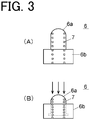
- the projection 6a is supported by an elastic member 7 such as a coil spring that expands and contracts in the vertical direction, and when a downward external force acts on a tip portion of the projection 6a, the projection 6a is elastically displaced vertically downward relative to the main body 6b.
- the projection 6a of the contact member 6 is elastically displaced, when the contact member 6 is moved in a horizontal direction with the tip portion of the projection 6a being in contact with the palm of the subject arranged on the plate 4, the tip portion of the projection 6a moves up and down following irregularities of the palm of the subject.
- the tactile stimulus presentation device includes a control device 10 for controlling operation of the drive mechanism 8.
- the control device 10 is implemented by an electronic circuit on which an arithmetic element, a storage memory, and so on are mounted.
- the control device 10 includes an information setting part 16, a plate recognition part 18, a contact pressure setting part 20, a speed setting part 22, and a control part 24.
- the information setting part 16, the plate recognition part 18, the contact pressure setting part 20, the speed setting part 22, and the control part 24 are functions that are obtained when the arithmetic element executes a predetermined program.
- the information setting part 16 is configured to set information to be presented to the subject by tactile stimulation based on information input by an experimenter via an input device 14.
- the control device 10 holds information about a control method of the drive part 8 for causing the contact member 6 to write predetermined characters and symbols, and the experimenter can select a character or symbol desired to be presented to the subject as presentation information from among those characters and symbols.
- Japanese characters such as " "(su), " "(ma), and " “(nu) can be selected and set as presentation information, but if information about other characters and symbols are registered in the control device 10, various characters and symbols can be set as presentation information.
- the experimenter can input a plurality of characters and symbols and a presentation order thereof, and the information setting part 16 is configured to set the characters and symbols and the presentation order input by the experimenter as the presentation information.
- the plate recognition part 18 is configured to recognize, based on a signal from the switch 12, which of the plates 4-1 to 4-3 the plate 4 placed on the housing 2 is.
- the contact pressure setting part 20 is configured to set, based on contact pressure information input by the experimenter via the input device 14, a contact pressure given by the contact member 6 to the palm of the subject when the contact member 6 writes a character or symbol on the palm of the subject.
- the contact pressure can be adjusted by changing a sending position in the Z-axis direction of the drive mechanism 8 when writing a character or symbol on the palm of the subject by the contact member 6.
- the control device 10 is provided with multiple levels of contact pressures, and the experimenter can select a desired level from these levels.
- the speed setting part 22 is configured to set, based on the contact pressure information input by the experimenter via the input device 14, driving speeds in the X-axis direction and the Y-axis direction of the drive mechanism 8 when writing a character or symbol on the palm of the subject by the contact member 6.
- the control device 10 is provided with multiple levels of driving speeds, and the experimenter can select a desired level from these levels.
- the control part 24 is configured to perform operation control of an X-axis motor 8a, a Y-axis motor 8b, and a Z-axis motor 8c of the drive mechanism 8 based on the presentation information set by the information setting part 16, the type of the plate 4 recognized by the plate recognition part 18, the contact pressure set by the contact pressure setting part 20, and the driving speed set by the speed setting part 22.
- control part 24 recognizes the size of the opening 4a of the plate 4 based on the type of the plate 4 recognized by the plate recognition part 18, and controls operation of the X-axis motor 8a, the Y-axis motor 8b, and the Z-axis motor 8c so that presentation information (character or symbol) set by the information setting part 16 is written on the palm of the subject within the range of the size of the opening 4a.
- the height position of the contact member 6 when writing presentation information on the palm of the subject is adjusted based on the level of the contact pressure set by the contact pressure setting part 20, and the moving speed of the moving speed 6 when writing presentation information on the palm of the subject is adjusted based on the level of the driving speed set by the speed setting part 22.
- the X-axis motor 8a is a motor for moving the contact member 6 in the X-axis direction
- the Y-axis motor 8b is a motor for moving the contact member 6 in the Y-axis direction
- the Z-axis motor 8c is a motor for moving the contact member 6 in the Z-axis direction.
- the plate recognition part 18 is not an essential component. Even when the plate recognition part 18 is not provided, the control part 24 can recognize the size of the opening of the plate 4 by the experimenter inputting information on the type of the plate 4 placed on the housing 2 to the control device 10.
- the contact pressure setting part 20 and the speed setting part 22 are not essential components.
- the size of the opening 4a can be changed according to the size of the palm of the subject by using a plate 4 arbitrarily selected from a plurality of types of plates 4-1 to 4-3.
- the present invention is not limited to this, and it is not necessary that the size of the opening can be changed.
- the palm is arranged on the upper surface of the plate 4 as a body part of the subject.
- the present invention is not limited to this, and the body part of the subject to be arranged on the upper surface of the plate 4 may be any part as long as tactile stimulation can be given to the subject.
- the arrangement surface (the upper surface of the plate 4) on which a body part of the subject is arranged is a horizontal surface.
- the present invention is not limited to this, and the arrangement surface may be inclined with respect to the horizontal direction.
- the drive mechanism 8 is configured to move the contact member 6 in a direction substantially parallel to the arrangement surface on which a body part of the subject is arranged and in a direction substantially perpendicular to the arrangement surface.
Landscapes
- Health & Medical Sciences (AREA)
- Life Sciences & Earth Sciences (AREA)
- Engineering & Computer Science (AREA)
- Physics & Mathematics (AREA)
- Neurology (AREA)
- General Health & Medical Sciences (AREA)
- Heart & Thoracic Surgery (AREA)
- Animal Behavior & Ethology (AREA)
- Veterinary Medicine (AREA)
- Public Health (AREA)
- Surgery (AREA)
- Biophysics (AREA)
- Pathology (AREA)
- Molecular Biology (AREA)
- Biomedical Technology (AREA)
- Medical Informatics (AREA)
- General Engineering & Computer Science (AREA)
- Developmental Disabilities (AREA)
- Hospice & Palliative Care (AREA)
- Theoretical Computer Science (AREA)
- Child & Adolescent Psychology (AREA)
- Psychiatry (AREA)
- Psychology (AREA)
- Physiology (AREA)
- Neurosurgery (AREA)
- General Physics & Mathematics (AREA)
- Educational Technology (AREA)
- Human Computer Interaction (AREA)
- Social Psychology (AREA)
- Audiology, Speech & Language Pathology (AREA)
- Business, Economics & Management (AREA)
- Educational Administration (AREA)
- User Interface Of Digital Computer (AREA)
Abstract
Description
- The present invention relates to a tactile stimulus presentation device for presenting a tactile stimulus to a subject in order to diagnose cognitive ability of the subject.
- Various diagnostic methods have been employed to diagnose cognitive ability of a subject. One of methods for diagnosing dementia is a method called Sumanu () method. In the Sumanu method, an experimenter presents tactile stimuli by writing Japanese characters "
 "(su), "
 "(ma), "
 "(nu) on the back or palm of a subject, and the subject answers the characters presented by the experimenter. By analyzing a correct answer rate and a state of cerebral blood flow when the stimuli are presented, presence or absence of dementia or mild cognitive impairment is determined.
- As a method of diagnosing dementia, in addition to the method of presenting tactile stimuli as described above, there is a method of presenting auditory stimuli or visual stimuli to a subject, and a device for checking the presence or absence of development of dementia by presenting auditory stimuli or visual stimuli to a subject has also been proposed (see, for example,
WO2012/077313A1 ). - The conventional Sumanu method has a problem in that a character shape and writing pressure differ by each experimenter who writes characters on the body of a subject, and this difference affects identification of characters. In order to make the tactile stimulus to be presented to the subject constant, a device has also been proposed that presents information such as characters to a subject by pressing a member having a surface on which a character, a symbol, or the like is represented by unevenness against a palm or finger of the subject. However, in such a device, the types of information that can be presented to the subject are limited. In order to increase the types of information to be presented, it is necessary to prepare uneven members according to the respective types of information, and such a device is not generally usable.
- Accordingly, it is an object of the present invention to provide a device capable of accurately presenting various pieces of information to a subject by tactile stimulation.
- The tactile stimulus presentation device according to the present invention includes a stage, a contact member, a drive mechanism, an information setting part, and a control part. The stage includes an opening and an arrangement surface on which a body part of a subject is arranged thereon so as to close the opening. The contact member is for giving a tactile stimulus to the subject by being in contact with the body part of the subject arranged on the arrangement surface of the stage through the opening. The drive mechanism is a mechanism for holding the contact member and moving the contact member in a direction substantially parallel to the arrangement surface and in a direction substantially perpendicular to the arrangement surface. The information setting part is configured to set information to be presented by giving tactile stimulation to the subject. The control part is configured to control the drive mechanism to present the information set by the information setting part by giving tactile stimulation to the body part of the subject arranged on the arrangement surface.
- That is, the tactile stimulus presentation device according to the present invention presents information to a subject by arranging a body part of the subject on a stage, and moving a contact member through an opening provided in the stage, to thereby write information such as a character or symbol on the body part of the subject. Since desired information such as a character or symbol can be written on the body part of the subject by moving the contact member, various pieces of information can be accurately presented to the subject by contact stimulation.
- Incidentally, since there are individual differences in sensitivity of tactile sense of a subject, when information is presented while the contact member is in contact with the body of the subject with the same contact pressure, a subject who can feel the contact of the contact member sufficiently and a subject who cannot exist, and it is conceivable that cognitive ability cannot be accurately determined.
- Accordingly, the tactile stimulus presentation device may further include a contact pressure setting part configured to set a contact pressure by the contact member to the body part of the subject arranged on the arrangement surface, in which the control part is configured to control the drive mechanism so as to adjust a contact pressure by the contact member to the body part of the subject arranged in abutment on the arrangement surface to the contact pressure set by the contact pressure setting part. Thus, the contact pressure of the contact member to the body of a subject can be adjusted, and influence on a diagnosis by individual differences in sensitivity of tactile sense of the subject can be made small.
- Further, the tactile stimulus presentation device may further include a speed setting part configured to set a speed at which the drive mechanism moves the contact member in a direction substantially parallel to the arrangement surface, in which the control part is configured to control the drive mechanism to move the contact member in a direction substantially parallel to the arrangement surface at the speed set by the speed setting part.
- Further, when the body of a subject arranged on the stage arrangement surface is uneven, the contact member cannot continue to be in contact with the body of the subject normally during presentation of information to the subject, and it is conceivable that accurate information is not presented to the subject.
- Accordingly, in the present invention, the contact member may be configured so that a tip thereof is elastically displaced by an external force in a direction substantially perpendicular to the arrangement surface. Thus, when information is presented to the subject by moving the contact member, a tip of the contact member can follow unevenness of the body of the subject, and accuracy of information presentation to the subject can be ensured.
- Further, even the same body part differs in size depending on the subject. Accordingly, in the present invention, the stage may be formed by a plate supported at a predetermined position by a plate support part, and the plate supported by the plate support part is a plate arbitrarily selected from a plurality of types of plates having different sizes of the opening. Thus, the size of the opening can be adjusted by selecting a plate according to the subject. In this case, the tactile stimulus presentation device may further include a plate recognition part configured to recognize a type of the plate supported by the plate support part, and the control part is configured to control the drive mechanism so as to present, by giving tactile stimulation to a subject, information of a size corresponding to a size of the opening of the plate recognized by the plate recognition part. Then, since the device automatically recognizes the plate supported by the plate support part and performs an operation according to the size of the opening of the plate, the experimenter does not need to input information about the plate to the device.
- In the above case, each of the plurality of types of plates may have a through hole at a different position thereof from each other or have a different number of through holes, and the plate recognition part can be configured to recognize a type of the plate supported by the plate support part by detecting the position of the through hole of the plate or the number of through holes of the plate supported by the plate support part by using a switch.
- Further, the body part of the subject to be arranged on the arrangement surface may be a palm.
- The tactile stimulus presentation device according to the present invention presents information to a subject by arranging a body part of a subject on a stage, and moving a contact member through an opening provided in the stage, to thereby write information such as a character or symbol on the body part of the subject. Thus, the tactile stimulus presentation device can accurately present various pieces of information to a subject by tactile stimulation.
-
-
FIG. 1 is a schematic configuration view illustrating an embodiment of a tactile stimulus presentation device; -
FIG. 2 is a plan view illustrating three types of plates used in the same embodiment; -
FIGs. 3A and 3B are views for explaining operation of a contact member of the embodiment, whereFIG. 3A illustrates a case where no external force acts on a tip portion, andFIG. 3B illustrates a case where an external force acts on the tip portion; and -
FIG. 4 is a block diagram illustrating a configuration of the same embodiment. - Hereinafter, an embodiment of a tactile stimulus presentation device will be described with reference to drawings.
- As illustrated in
FIG. 1 , the tactile stimulus presentation device includes ahousing 2, aplate 4, acontact member 6, and adrive mechanism 8. Theplate 4 has anopening 4a, and is disposed on an upper surface of thehousing 2 so that the opening 4a is located above an opening 2a provided in an upper surface of thehousing 2. The palm that is a body part of a subject is arranged on an upper surface of theplate 4 so as to close the opening 4a. That is, the upper surface of theplate 4 constitutes an arrangement surface for arranging a body part of a subject, theplate 4 constitutes a stage having the arrangement surface, and thehousing 2 is a plate support part that supports theplate 4. - The
contact member 6 is for giving a contact stimulus to the subject by being in contact with the palm of the subject arranged on the upper surface of theplate 4 through theopenings contact member 6 is held by thedrive mechanism 8 with a spherical tip facing upward. Thedrive mechanism 8 is provided inside thehousing 2, and has a mechanism for moving thecontact member 6 in an X-axis direction and a Y-axis direction orthogonal to each other in an in-plane direction and a mechanism for moving thecontact member 6 in a Z-axis direction that is a vertical direction. As the mechanisms for moving thecontact member 6 in the X-axis direction, the Y-axis direction, and the Z-axis direction, besides a mechanism for moving a moving portion joined to a timing belt in one axis direction using rotation of the timing belt, there is one using a rack and pinion mechanism. - The
plate 4 on thehousing 2 can be changed to another plate having a different size of the opening 4a. As illustrated inFIG. 2 , in this embodiment, plates 4-1 to 4-3 havingopenings 4a-1 to 4a-3 of different sizes are prepared, and aplate 4 suitable for the subject can be arbitrarily selected from these three plates 4-1 to 4-3 and placed on thehousing 2. - Through
holes 5a and/or 5b for individual recognition are provided at corners of the respective plates 4-1 to 4-3. Although not illustrated inFIG. 1 , a switch 12 (seeFIG. 4 ) for detecting presence or absence of the throughholes plate 4 placed on thehousing 2 is provided in thehousing 2. As will be described later, the tactile stimulus presentation device of this embodiment has a function to recognize which of the plates 4-1 to 4-3 is theplate 4 placed on thehousing 2 using a signal of theswitch 12. In the example ofFIG. 2 , only the throughhole 5a is provided at a corner of the plate 4-1, only the throughhole 5b is provided at a corner of the plate 4-2, and the throughholes - As illustrated in
FIGs. 3A and 3B , thecontact member 6 is constituted of aprojection 6a and amain body 6b that holds a base end of theprojection 6a. Theprojection 6a is provided so as to be displaced in the vertical direction relative to themain body 6b. Theprojection 6a is supported by anelastic member 7 such as a coil spring that expands and contracts in the vertical direction, and when a downward external force acts on a tip portion of theprojection 6a, theprojection 6a is elastically displaced vertically downward relative to themain body 6b. Since theprojection 6a of thecontact member 6 is elastically displaced, when thecontact member 6 is moved in a horizontal direction with the tip portion of theprojection 6a being in contact with the palm of the subject arranged on theplate 4, the tip portion of theprojection 6a moves up and down following irregularities of the palm of the subject. - As illustrated in
FIG. 4 , the tactile stimulus presentation device includes acontrol device 10 for controlling operation of thedrive mechanism 8. Thecontrol device 10 is implemented by an electronic circuit on which an arithmetic element, a storage memory, and so on are mounted. Thecontrol device 10 includes aninformation setting part 16, aplate recognition part 18, a contactpressure setting part 20, aspeed setting part 22, and acontrol part 24. Theinformation setting part 16, theplate recognition part 18, the contactpressure setting part 20, thespeed setting part 22, and thecontrol part 24 are functions that are obtained when the arithmetic element executes a predetermined program. - The
information setting part 16 is configured to set information to be presented to the subject by tactile stimulation based on information input by an experimenter via aninput device 14. Thecontrol device 10 holds information about a control method of thedrive part 8 for causing thecontact member 6 to write predetermined characters and symbols, and the experimenter can select a character or symbol desired to be presented to the subject as presentation information from among those characters and symbols. For example, in the case of the Sumanu() method, Japanese characters such as " "(su), "
 "(ma), and "
 "(nu) can be selected and set as presentation information, but if information about other characters and symbols are registered in the
control device 10, various characters and symbols can be set as presentation information. Further, the experimenter can input a plurality of characters and symbols and a presentation order thereof, and theinformation setting part 16 is configured to set the characters and symbols and the presentation order input by the experimenter as the presentation information. - The
plate recognition part 18 is configured to recognize, based on a signal from theswitch 12, which of the plates 4-1 to 4-3 theplate 4 placed on thehousing 2 is. - The contact
pressure setting part 20 is configured to set, based on contact pressure information input by the experimenter via theinput device 14, a contact pressure given by thecontact member 6 to the palm of the subject when thecontact member 6 writes a character or symbol on the palm of the subject. The contact pressure can be adjusted by changing a sending position in the Z-axis direction of thedrive mechanism 8 when writing a character or symbol on the palm of the subject by thecontact member 6. Thecontrol device 10 is provided with multiple levels of contact pressures, and the experimenter can select a desired level from these levels. - The
speed setting part 22 is configured to set, based on the contact pressure information input by the experimenter via theinput device 14, driving speeds in the X-axis direction and the Y-axis direction of thedrive mechanism 8 when writing a character or symbol on the palm of the subject by thecontact member 6. Thecontrol device 10 is provided with multiple levels of driving speeds, and the experimenter can select a desired level from these levels. - The
control part 24 is configured to perform operation control of anX-axis motor 8a, a Y-axis motor 8b, and a Z-axis motor 8c of thedrive mechanism 8 based on the presentation information set by theinformation setting part 16, the type of theplate 4 recognized by theplate recognition part 18, the contact pressure set by the contactpressure setting part 20, and the driving speed set by thespeed setting part 22. Specifically, thecontrol part 24 recognizes the size of theopening 4a of theplate 4 based on the type of theplate 4 recognized by theplate recognition part 18, and controls operation of theX-axis motor 8a, the Y-axis motor 8b, and the Z-axis motor 8c so that presentation information (character or symbol) set by theinformation setting part 16 is written on the palm of the subject within the range of the size of theopening 4a. The height position of thecontact member 6 when writing presentation information on the palm of the subject is adjusted based on the level of the contact pressure set by the contactpressure setting part 20, and the moving speed of the movingspeed 6 when writing presentation information on the palm of the subject is adjusted based on the level of the driving speed set by thespeed setting part 22. - Note that the
X-axis motor 8a is a motor for moving thecontact member 6 in the X-axis direction, the Y-axis motor 8b is a motor for moving thecontact member 6 in the Y-axis direction, and the Z-axis motor 8c is a motor for moving thecontact member 6 in the Z-axis direction. - Note that the
plate recognition part 18 is not an essential component. Even when theplate recognition part 18 is not provided, thecontrol part 24 can recognize the size of the opening of theplate 4 by the experimenter inputting information on the type of theplate 4 placed on thehousing 2 to thecontrol device 10. - Moreover, the contact
pressure setting part 20 and thespeed setting part 22 are not essential components. - Further, in the above embodiment, the size of the
opening 4a can be changed according to the size of the palm of the subject by using aplate 4 arbitrarily selected from a plurality of types of plates 4-1 to 4-3. However, the present invention is not limited to this, and it is not necessary that the size of the opening can be changed. - Further, in the above embodiment, the palm is arranged on the upper surface of the
plate 4 as a body part of the subject. However, the present invention is not limited to this, and the body part of the subject to be arranged on the upper surface of theplate 4 may be any part as long as tactile stimulation can be given to the subject. - Further, in the above embodiment, the arrangement surface (the upper surface of the plate 4) on which a body part of the subject is arranged is a horizontal surface. However, the present invention is not limited to this, and the arrangement surface may be inclined with respect to the horizontal direction. In that case, the
drive mechanism 8 is configured to move thecontact member 6 in a direction substantially parallel to the arrangement surface on which a body part of the subject is arranged and in a direction substantially perpendicular to the arrangement surface. -
- 2
- housing
- 2a
- opening
- 4, 4-1, 4-2, 4-3
- plate
- 4a, 4a-1, 4a-2, 4a-3
- opening
- 5a, 5b
- through hole
- 6
- contact member
- 6a
- projection
- 6b
- main body
- 7
- elastic member
- 8
- drive mechanism
- 8a
- X-axis motor
- 8b
- Y-axis motor
- 8c
- Z-axis motor
- 10
- control device
- 12
- switch
- 14
- input device
- 16
- information setting part
- 18
- plate recognition part
- 20
- contact pressure setting part
- 22
- speed setting part
- 24
- control part
Claims (7)
- A tactile stimulus presentation device comprising:a stage that has an opening and an arrangement surface on which a body part of a subject is arranged thereon so as to close the opening;a contact member for giving a tactile stimulus to the subject by being in contact with the body part of the subject arranged on the arrangement surface of the stage through the opening;a drive mechanism that holds the contact member and moves the contact member in a direction substantially parallel to the arrangement surface and in a direction substantially perpendicular to the arrangement surface;an information setting part configured to set information to be presented by giving tactile stimulation to the subject; anda control part configured to control the drive mechanism to present the information set by the information setting part by giving tactile stimulation to the body part of the subject arranged on the arrangement surface.
- The tactile stimulus presentation device according to claim 1, further comprising a contact pressure setting part configured to set a contact pressure by the contact member to the body part of the subject arranged on the arrangement surface, wherein
the control part is configured to control the drive mechanism so as to adjust a contact pressure by the contact member to the body part of the subject arranged on the arrangement surface to the contact pressure set by the contact pressure setting part. - The tactile stimulus presentation device according to claim 1 or 2, further comprising a speed setting part configured to set a speed at which the drive mechanism moves the contact member in a direction substantially parallel to the arrangement surface, wherein
the control part is configured to control the drive mechanism to move the contact member in a direction substantially parallel to the arrangement surface at the speed set by the speed setting part. - The tactile stimulus presentation device according to any one of claims 1 to 3, wherein the contact member is configured so that a tip thereof is elastically displaced by an external force in a direction substantially perpendicular to the arrangement surface.
- The tactile stimulus presentation device according to any one of claims 1 to 4, wherein
the stage is formed by a plate supported at a predetermined position by a plate support part, and the plate supported by the plate support part is a plate arbitrarily selected from a plurality of types of plates having different sizes of the opening,
the tactile stimulus presentation device further comprises a plate recognition part configured to recognize a type of the plate supported by the plate support part, and
the control part is configured to control the drive mechanism so as to present, by giving tactile stimulation to a subject, information of a size corresponding to a size of the opening of the plate recognized by the plate recognition part. - The tactile stimulus presentation device according to claim 5, wherein each of the plurality of types of plates has a through hole at a different position thereof from each other or has a different number of through holes, and
the plate recognition part is configured to recognize a type of the plate supported by the plate support part by detecting the position of the through hole of the plate or the number of through holes of the plate supported by the plate support part using a switch. - The tactile stimulus presentation device according to any one of claims 1 to 6, wherein the arrangement surface is configured so that a palm of the subject is arranged as the body part.
Applications Claiming Priority (1)
| Application Number | Priority Date | Filing Date | Title |
|---|---|---|---|
| JP2019015800A JP7127562B2 (en) | 2019-01-31 | 2019-01-31 | Tactile stimulus presentation device |
Publications (2)
| Publication Number | Publication Date |
|---|---|
| EP3690865A1 true EP3690865A1 (en) | 2020-08-05 |
| EP3690865B1 EP3690865B1 (en) | 2023-09-27 |
Family
ID=69157606
Family Applications (1)
| Application Number | Title | Priority Date | Filing Date |
|---|---|---|---|
| EP20150980.9A Active EP3690865B1 (en) | 2019-01-31 | 2020-01-09 | Tactile stimulus presentation device |
Country Status (4)
| Country | Link |
|---|---|
| US (1) | US11537207B2 (en) |
| EP (1) | EP3690865B1 (en) |
| JP (1) | JP7127562B2 (en) |
| CN (1) | CN111493818B (en) |
Citations (3)
| Publication number | Priority date | Publication date | Assignee | Title |
|---|---|---|---|---|
| DE19517649A1 (en) * | 1995-05-17 | 1996-11-21 | Thomas Rupp | Communication device for information transfer from data processor to deaf and dumb people |
| WO2012077313A1 (en) | 2010-12-06 | 2012-06-14 | 国立大学法人岡山大学 | Method and device for verifying onset of dementia |
| US20130088341A1 (en) * | 2011-10-06 | 2013-04-11 | Samsung Electronics Co., Ltd. | Apparatus and method for 3 degree of freedom (3dof) tactile feedback |
Family Cites Families (22)
| Publication number | Priority date | Publication date | Assignee | Title |
|---|---|---|---|---|
| AU2002336708A1 (en) * | 2001-11-01 | 2003-05-12 | Immersion Corporation | Method and apparatus for providing tactile sensations |
| US6965370B2 (en) * | 2002-11-19 | 2005-11-15 | Immersion Corporation | Haptic feedback devices for simulating an orifice |
| US8690576B2 (en) * | 2004-01-30 | 2014-04-08 | Freedom Scientific, Inc. | Braille display device and method of constructing same |
| JP4066055B2 (en) | 2004-05-13 | 2008-03-26 | 株式会社日立製作所 | Tactile stimulation communication device |
| TWI524218B (en) * | 2011-10-05 | 2016-03-01 | 廣達電腦股份有限公司 | Method and electronic device for virtual keyboard with haptic feedback |
| US9812033B2 (en) * | 2013-03-06 | 2017-11-07 | Venkatesh R. Chari | Tactile graphic display |
| DE102013006209A1 (en) * | 2013-04-10 | 2014-10-16 | Universität Heidelberg | Apparatus and method for inducing non-tissue damaging stimuli for testing a mechanically induced pain sensation of a subject |
| US10121335B2 (en) * | 2014-07-18 | 2018-11-06 | Google Technology Holdings LLC | Wearable haptic device for the visually impaired |
| US9965036B2 (en) * | 2014-07-18 | 2018-05-08 | Google Technology Holdings LLC | Haptic guides for a touch-sensitive display |
| CN106796451B (en) * | 2014-07-28 | 2020-07-21 | Ck高新材料有限公司 | Haptic information providing module |
| JP6132074B2 (en) * | 2014-08-22 | 2017-05-24 | 株式会社村田製作所 | Tactile presentation device |
| US10437335B2 (en) * | 2015-04-14 | 2019-10-08 | John James Daniels | Wearable electronic, multi-sensory, human/machine, human/human interfaces |
| KR101650099B1 (en) * | 2015-07-23 | 2016-08-23 | 린츠 주식회사 | A wearable haptic pattern display device for blind |
| US9880735B2 (en) * | 2015-08-10 | 2018-01-30 | Apple Inc. | Devices, methods, and graphical user interfaces for manipulating user interface objects with visual and/or haptic feedback |
| US10248207B2 (en) * | 2015-10-28 | 2019-04-02 | Capital One Services, Llc | Systems and methods for providing variable haptic feedback |
| KR102200556B1 (en) * | 2016-03-25 | 2021-01-08 | 주식회사 비햅틱스 | Tactile stimulation providing device |
| CN106249904B (en) * | 2016-09-22 | 2022-10-25 | 中国科学院合肥物质科学研究院 | A tactile stimulation device with measurable tactile stimulation force and adjustable force frequency |
| US10388186B2 (en) * | 2017-04-17 | 2019-08-20 | Facebook, Inc. | Cutaneous actuators with dampening layers and end effectors to increase perceptibility of haptic signals |
| US10635175B2 (en) * | 2018-05-31 | 2020-04-28 | Synaptics Incorporated | Method and system for providing haptic feedback using an input device |
| US10965464B1 (en) * | 2018-06-08 | 2021-03-30 | Wells Fargo Bank, N.A. | Tactile binary coded communication |
| US10775894B2 (en) * | 2018-11-02 | 2020-09-15 | Immersion Corporation | Systems and methods for providing customizable haptic playback |
| WO2020095088A1 (en) * | 2018-11-05 | 2020-05-14 | Ecole Polytechnique Federale De Lausanne (Epfl) | Method and system for creating an out-of-body experience |
-
2019
- 2019-01-31 JP JP2019015800A patent/JP7127562B2/en active Active
-
2020
- 2020-01-09 EP EP20150980.9A patent/EP3690865B1/en active Active
- 2020-01-16 US US16/744,316 patent/US11537207B2/en active Active
- 2020-01-21 CN CN202010071885.XA patent/CN111493818B/en active Active
Patent Citations (3)
| Publication number | Priority date | Publication date | Assignee | Title |
|---|---|---|---|---|
| DE19517649A1 (en) * | 1995-05-17 | 1996-11-21 | Thomas Rupp | Communication device for information transfer from data processor to deaf and dumb people |
| WO2012077313A1 (en) | 2010-12-06 | 2012-06-14 | 国立大学法人岡山大学 | Method and device for verifying onset of dementia |
| US20130088341A1 (en) * | 2011-10-06 | 2013-04-11 | Samsung Electronics Co., Ltd. | Apparatus and method for 3 degree of freedom (3dof) tactile feedback |
Also Published As
| Publication number | Publication date |
|---|---|
| US20200249760A1 (en) | 2020-08-06 |
| JP2020121024A (en) | 2020-08-13 |
| CN111493818B (en) | 2023-08-15 |
| EP3690865B1 (en) | 2023-09-27 |
| CN111493818A (en) | 2020-08-07 |
| US11537207B2 (en) | 2022-12-27 |
| JP7127562B2 (en) | 2022-08-30 |
Similar Documents
| Publication | Publication Date | Title |
|---|---|---|
| US8197065B2 (en) | Vision testing and/or training using adaptable visual indicia | |
| JP6752818B2 (en) | Methods and devices for determining a user's eyesight | |
| AU2013201418B2 (en) | Aircrew training system | |
| US4869589A (en) | Automated visual screening system | |
| US9940859B2 (en) | Testing apparatus for testing display apparatus and method of testing the same | |
| KR20060111368A (en) | Drop detection device | |
| KR102080586B1 (en) | Method and system for screening of attention deficit hyperactivity disorder by robot | |
| EP3690865A1 (en) | Tactile stimulus presentation device | |
| JP2020149101A (en) | Work support equipment and work support program | |
| CN106462273B (en) | Touch screen display with monitoring function | |
| KR102032241B1 (en) | Game consoles and recording media | |
| KR101992250B1 (en) | Game machine and recording medium | |
| JPH1019991A (en) | Test head for circuit board tester | |
| RU2663639C2 (en) | System for determining visual perception | |
| EP0050986A2 (en) | Computer peripheral testing equipment | |
| JPH10329073A (en) | Method and device for automatic discrimination of adaptive nozzle | |
| JP7062574B2 (en) | Error learning device and method | |
| CN106023722A (en) | Visual sense space intelligent training device | |
| JP2017219607A (en) | Training support device | |
| Soomro et al. | Design & evaluation of layout-agnostic tactile guides for in-vehicle touchscreens | |
| US20240221517A1 (en) | Dedicated assistive typing device | |
| KR20100022752A (en) | Command input apparatus of touch type using infrared rays and command input system of a vehicle using the apparatus | |
| JP2020192226A (en) | Ability determination device, ability determination method, and computer readable storage medium | |
| JPH057544Y2 (en) | ||
| JP2022120876A (en) | Learning support device, learning system, and learning support method |
Legal Events
| Date | Code | Title | Description |
|---|---|---|---|
| PUAI | Public reference made under article 153(3) epc to a published international application that has entered the european phase |
Free format text: ORIGINAL CODE: 0009012 |
|
| STAA | Information on the status of an ep patent application or granted ep patent |
Free format text: STATUS: REQUEST FOR EXAMINATION WAS MADE |
|
| 17P | Request for examination filed |
Effective date: 20200109 |
|
| AK | Designated contracting states |
Kind code of ref document: A1 Designated state(s): AL AT BE BG CH CY CZ DE DK EE ES FI FR GB GR HR HU IE IS IT LI LT LU LV MC MK MT NL NO PL PT RO RS SE SI SK SM TR |
|
| AX | Request for extension of the european patent |
Extension state: BA ME |
|
| STAA | Information on the status of an ep patent application or granted ep patent |
Free format text: STATUS: EXAMINATION IS IN PROGRESS |
|
| 17Q | First examination report despatched |
Effective date: 20211208 |
|
| GRAP | Despatch of communication of intention to grant a patent |
Free format text: ORIGINAL CODE: EPIDOSNIGR1 |
|
| STAA | Information on the status of an ep patent application or granted ep patent |
Free format text: STATUS: GRANT OF PATENT IS INTENDED |
|
| RIC1 | Information provided on ipc code assigned before grant |
Ipc: A61B 5/00 20060101ALI20230405BHEP Ipc: G06F 3/01 20060101ALI20230405BHEP Ipc: G09B 21/00 20060101AFI20230405BHEP |
|
| INTG | Intention to grant announced |
Effective date: 20230509 |
|
| GRAS | Grant fee paid |
Free format text: ORIGINAL CODE: EPIDOSNIGR3 |
|
| GRAA | (expected) grant |
Free format text: ORIGINAL CODE: 0009210 |
|
| STAA | Information on the status of an ep patent application or granted ep patent |
Free format text: STATUS: THE PATENT HAS BEEN GRANTED |
|
| AK | Designated contracting states |
Kind code of ref document: B1 Designated state(s): AL AT BE BG CH CY CZ DE DK EE ES FI FR GB GR HR HU IE IS IT LI LT LU LV MC MK MT NL NO PL PT RO RS SE SI SK SM TR |
|
| REG | Reference to a national code |
Ref country code: GB Ref legal event code: FG4D |
|
| REG | Reference to a national code |
Ref country code: CH Ref legal event code: EP |
|
| REG | Reference to a national code |
Ref country code: DE Ref legal event code: R096 Ref document number: 602020018104 Country of ref document: DE |
|
| REG | Reference to a national code |
Ref country code: IE Ref legal event code: FG4D |
|
| REG | Reference to a national code |
Ref country code: NL Ref legal event code: FP |
|
| REG | Reference to a national code |
Ref country code: LT Ref legal event code: MG9D |
|
| PG25 | Lapsed in a contracting state [announced via postgrant information from national office to epo] |
Ref country code: GR Free format text: LAPSE BECAUSE OF FAILURE TO SUBMIT A TRANSLATION OF THE DESCRIPTION OR TO PAY THE FEE WITHIN THE PRESCRIBED TIME-LIMIT Effective date: 20231228 |
|
| PG25 | Lapsed in a contracting state [announced via postgrant information from national office to epo] |
Ref country code: SE Free format text: LAPSE BECAUSE OF FAILURE TO SUBMIT A TRANSLATION OF THE DESCRIPTION OR TO PAY THE FEE WITHIN THE PRESCRIBED TIME-LIMIT Effective date: 20230927 Ref country code: RS Free format text: LAPSE BECAUSE OF FAILURE TO SUBMIT A TRANSLATION OF THE DESCRIPTION OR TO PAY THE FEE WITHIN THE PRESCRIBED TIME-LIMIT Effective date: 20230927 Ref country code: NO Free format text: LAPSE BECAUSE OF FAILURE TO SUBMIT A TRANSLATION OF THE DESCRIPTION OR TO PAY THE FEE WITHIN THE PRESCRIBED TIME-LIMIT Effective date: 20231227 Ref country code: LV Free format text: LAPSE BECAUSE OF FAILURE TO SUBMIT A TRANSLATION OF THE DESCRIPTION OR TO PAY THE FEE WITHIN THE PRESCRIBED TIME-LIMIT Effective date: 20230927 Ref country code: LT Free format text: LAPSE BECAUSE OF FAILURE TO SUBMIT A TRANSLATION OF THE DESCRIPTION OR TO PAY THE FEE WITHIN THE PRESCRIBED TIME-LIMIT Effective date: 20230927 Ref country code: HR Free format text: LAPSE BECAUSE OF FAILURE TO SUBMIT A TRANSLATION OF THE DESCRIPTION OR TO PAY THE FEE WITHIN THE PRESCRIBED TIME-LIMIT Effective date: 20230927 Ref country code: GR Free format text: LAPSE BECAUSE OF FAILURE TO SUBMIT A TRANSLATION OF THE DESCRIPTION OR TO PAY THE FEE WITHIN THE PRESCRIBED TIME-LIMIT Effective date: 20231228 Ref country code: FI Free format text: LAPSE BECAUSE OF FAILURE TO SUBMIT A TRANSLATION OF THE DESCRIPTION OR TO PAY THE FEE WITHIN THE PRESCRIBED TIME-LIMIT Effective date: 20230927 |
|
| REG | Reference to a national code |
Ref country code: AT Ref legal event code: MK05 Ref document number: 1616214 Country of ref document: AT Kind code of ref document: T Effective date: 20230927 |
|
| PG25 | Lapsed in a contracting state [announced via postgrant information from national office to epo] |
Ref country code: IS Free format text: LAPSE BECAUSE OF FAILURE TO SUBMIT A TRANSLATION OF THE DESCRIPTION OR TO PAY THE FEE WITHIN THE PRESCRIBED TIME-LIMIT Effective date: 20240127 |
|
| PG25 | Lapsed in a contracting state [announced via postgrant information from national office to epo] |
Ref country code: AT Free format text: LAPSE BECAUSE OF FAILURE TO SUBMIT A TRANSLATION OF THE DESCRIPTION OR TO PAY THE FEE WITHIN THE PRESCRIBED TIME-LIMIT Effective date: 20230927 |
|
| PG25 | Lapsed in a contracting state [announced via postgrant information from national office to epo] |
Ref country code: ES Free format text: LAPSE BECAUSE OF FAILURE TO SUBMIT A TRANSLATION OF THE DESCRIPTION OR TO PAY THE FEE WITHIN THE PRESCRIBED TIME-LIMIT Effective date: 20230927 |
|
| PG25 | Lapsed in a contracting state [announced via postgrant information from national office to epo] |
Ref country code: SM Free format text: LAPSE BECAUSE OF FAILURE TO SUBMIT A TRANSLATION OF THE DESCRIPTION OR TO PAY THE FEE WITHIN THE PRESCRIBED TIME-LIMIT Effective date: 20230927 Ref country code: RO Free format text: LAPSE BECAUSE OF FAILURE TO SUBMIT A TRANSLATION OF THE DESCRIPTION OR TO PAY THE FEE WITHIN THE PRESCRIBED TIME-LIMIT Effective date: 20230927 Ref country code: IS Free format text: LAPSE BECAUSE OF FAILURE TO SUBMIT A TRANSLATION OF THE DESCRIPTION OR TO PAY THE FEE WITHIN THE PRESCRIBED TIME-LIMIT Effective date: 20240127 Ref country code: ES Free format text: LAPSE BECAUSE OF FAILURE TO SUBMIT A TRANSLATION OF THE DESCRIPTION OR TO PAY THE FEE WITHIN THE PRESCRIBED TIME-LIMIT Effective date: 20230927 Ref country code: EE Free format text: LAPSE BECAUSE OF FAILURE TO SUBMIT A TRANSLATION OF THE DESCRIPTION OR TO PAY THE FEE WITHIN THE PRESCRIBED TIME-LIMIT Effective date: 20230927 Ref country code: CZ Free format text: LAPSE BECAUSE OF FAILURE TO SUBMIT A TRANSLATION OF THE DESCRIPTION OR TO PAY THE FEE WITHIN THE PRESCRIBED TIME-LIMIT Effective date: 20230927 Ref country code: AT Free format text: LAPSE BECAUSE OF FAILURE TO SUBMIT A TRANSLATION OF THE DESCRIPTION OR TO PAY THE FEE WITHIN THE PRESCRIBED TIME-LIMIT Effective date: 20230927 Ref country code: PT Free format text: LAPSE BECAUSE OF FAILURE TO SUBMIT A TRANSLATION OF THE DESCRIPTION OR TO PAY THE FEE WITHIN THE PRESCRIBED TIME-LIMIT Effective date: 20240129 Ref country code: SK Free format text: LAPSE BECAUSE OF FAILURE TO SUBMIT A TRANSLATION OF THE DESCRIPTION OR TO PAY THE FEE WITHIN THE PRESCRIBED TIME-LIMIT Effective date: 20230927 |
|
| PG25 | Lapsed in a contracting state [announced via postgrant information from national office to epo] |
Ref country code: PL Free format text: LAPSE BECAUSE OF FAILURE TO SUBMIT A TRANSLATION OF THE DESCRIPTION OR TO PAY THE FEE WITHIN THE PRESCRIBED TIME-LIMIT Effective date: 20230927 Ref country code: IT Free format text: LAPSE BECAUSE OF FAILURE TO SUBMIT A TRANSLATION OF THE DESCRIPTION OR TO PAY THE FEE WITHIN THE PRESCRIBED TIME-LIMIT Effective date: 20230927 |
|
| REG | Reference to a national code |
Ref country code: DE Ref legal event code: R097 Ref document number: 602020018104 Country of ref document: DE |
|
| PG25 | Lapsed in a contracting state [announced via postgrant information from national office to epo] |
Ref country code: DK Free format text: LAPSE BECAUSE OF FAILURE TO SUBMIT A TRANSLATION OF THE DESCRIPTION OR TO PAY THE FEE WITHIN THE PRESCRIBED TIME-LIMIT Effective date: 20230927 |
|
| PG25 | Lapsed in a contracting state [announced via postgrant information from national office to epo] |
Ref country code: DK Free format text: LAPSE BECAUSE OF FAILURE TO SUBMIT A TRANSLATION OF THE DESCRIPTION OR TO PAY THE FEE WITHIN THE PRESCRIBED TIME-LIMIT Effective date: 20230927 |
|
| PLBE | No opposition filed within time limit |
Free format text: ORIGINAL CODE: 0009261 |
|
| STAA | Information on the status of an ep patent application or granted ep patent |
Free format text: STATUS: NO OPPOSITION FILED WITHIN TIME LIMIT |
|
| PG25 | Lapsed in a contracting state [announced via postgrant information from national office to epo] |
Ref country code: MC Free format text: LAPSE BECAUSE OF FAILURE TO SUBMIT A TRANSLATION OF THE DESCRIPTION OR TO PAY THE FEE WITHIN THE PRESCRIBED TIME-LIMIT Effective date: 20230927 |
|
| PG25 | Lapsed in a contracting state [announced via postgrant information from national office to epo] |
Ref country code: MC Free format text: LAPSE BECAUSE OF FAILURE TO SUBMIT A TRANSLATION OF THE DESCRIPTION OR TO PAY THE FEE WITHIN THE PRESCRIBED TIME-LIMIT Effective date: 20230927 |
|
| REG | Reference to a national code |
Ref country code: CH Ref legal event code: PL |
|
| 26N | No opposition filed |
Effective date: 20240628 |
|
| PG25 | Lapsed in a contracting state [announced via postgrant information from national office to epo] |
Ref country code: LU Free format text: LAPSE BECAUSE OF NON-PAYMENT OF DUE FEES Effective date: 20240109 |
|
| PG25 | Lapsed in a contracting state [announced via postgrant information from national office to epo] |
Ref country code: LU Free format text: LAPSE BECAUSE OF NON-PAYMENT OF DUE FEES Effective date: 20240109 |
|
| PG25 | Lapsed in a contracting state [announced via postgrant information from national office to epo] |
Ref country code: BE Free format text: LAPSE BECAUSE OF NON-PAYMENT OF DUE FEES Effective date: 20240131 |
|
| PG25 | Lapsed in a contracting state [announced via postgrant information from national office to epo] |
Ref country code: FR Free format text: LAPSE BECAUSE OF NON-PAYMENT OF DUE FEES Effective date: 20240131 |
|
| PG25 | Lapsed in a contracting state [announced via postgrant information from national office to epo] |
Ref country code: CH Free format text: LAPSE BECAUSE OF NON-PAYMENT OF DUE FEES Effective date: 20240131 |
|
| PG25 | Lapsed in a contracting state [announced via postgrant information from national office to epo] |
Ref country code: SI Free format text: LAPSE BECAUSE OF FAILURE TO SUBMIT A TRANSLATION OF THE DESCRIPTION OR TO PAY THE FEE WITHIN THE PRESCRIBED TIME-LIMIT Effective date: 20230927 |
|
| PG25 | Lapsed in a contracting state [announced via postgrant information from national office to epo] |
Ref country code: SI Free format text: LAPSE BECAUSE OF FAILURE TO SUBMIT A TRANSLATION OF THE DESCRIPTION OR TO PAY THE FEE WITHIN THE PRESCRIBED TIME-LIMIT Effective date: 20230927 Ref country code: FR Free format text: LAPSE BECAUSE OF NON-PAYMENT OF DUE FEES Effective date: 20240131 Ref country code: CH Free format text: LAPSE BECAUSE OF NON-PAYMENT OF DUE FEES Effective date: 20240131 Ref country code: BE Free format text: LAPSE BECAUSE OF NON-PAYMENT OF DUE FEES Effective date: 20240131 |
|
| REG | Reference to a national code |
Ref country code: BE Ref legal event code: MM Effective date: 20240131 |
|
| PG25 | Lapsed in a contracting state [announced via postgrant information from national office to epo] |
Ref country code: BG Free format text: LAPSE BECAUSE OF FAILURE TO SUBMIT A TRANSLATION OF THE DESCRIPTION OR TO PAY THE FEE WITHIN THE PRESCRIBED TIME-LIMIT Effective date: 20230927 |
|
| PG25 | Lapsed in a contracting state [announced via postgrant information from national office to epo] |
Ref country code: BG Free format text: LAPSE BECAUSE OF FAILURE TO SUBMIT A TRANSLATION OF THE DESCRIPTION OR TO PAY THE FEE WITHIN THE PRESCRIBED TIME-LIMIT Effective date: 20230927 |
|
| PG25 | Lapsed in a contracting state [announced via postgrant information from national office to epo] |
Ref country code: IE Free format text: LAPSE BECAUSE OF NON-PAYMENT OF DUE FEES Effective date: 20240109 |
|
| PG25 | Lapsed in a contracting state [announced via postgrant information from national office to epo] |
Ref country code: IE Free format text: LAPSE BECAUSE OF NON-PAYMENT OF DUE FEES Effective date: 20240109 |
|
| PG25 | Lapsed in a contracting state [announced via postgrant information from national office to epo] |
Ref country code: CY Free format text: LAPSE BECAUSE OF FAILURE TO SUBMIT A TRANSLATION OF THE DESCRIPTION OR TO PAY THE FEE WITHIN THE PRESCRIBED TIME-LIMIT; INVALID AB INITIO Effective date: 20200109 |
|
| PG25 | Lapsed in a contracting state [announced via postgrant information from national office to epo] |
Ref country code: HU Free format text: LAPSE BECAUSE OF FAILURE TO SUBMIT A TRANSLATION OF THE DESCRIPTION OR TO PAY THE FEE WITHIN THE PRESCRIBED TIME-LIMIT; INVALID AB INITIO Effective date: 20200109 |
|
| PG25 | Lapsed in a contracting state [announced via postgrant information from national office to epo] |
Ref country code: TR Free format text: LAPSE BECAUSE OF FAILURE TO SUBMIT A TRANSLATION OF THE DESCRIPTION OR TO PAY THE FEE WITHIN THE PRESCRIBED TIME-LIMIT Effective date: 20230927 |
|
| PGFP | Annual fee paid to national office [announced via postgrant information from national office to epo] |
Ref country code: GB Payment date: 20251127 Year of fee payment: 7 |
|
| PGFP | Annual fee paid to national office [announced via postgrant information from national office to epo] |
Ref country code: NL Payment date: 20251215 Year of fee payment: 7 |
|
| PGFP | Annual fee paid to national office [announced via postgrant information from national office to epo] |
Ref country code: DE Payment date: 20251203 Year of fee payment: 7 |