EP3689014B1 - Terminalmodell-id in einer verbindungsaufbauanfrage zur bereitstellung von fähigkeiten - Google Patents
Terminalmodell-id in einer verbindungsaufbauanfrage zur bereitstellung von fähigkeiten Download PDFInfo
- Publication number
- EP3689014B1 EP3689014B1 EP18862732.7A EP18862732A EP3689014B1 EP 3689014 B1 EP3689014 B1 EP 3689014B1 EP 18862732 A EP18862732 A EP 18862732A EP 3689014 B1 EP3689014 B1 EP 3689014B1
- Authority
- EP
- European Patent Office
- Prior art keywords
- information
- capabilities
- model identifier
- model
- connection setup
- Prior art date
- Legal status (The legal status is an assumption and is not a legal conclusion. Google has not performed a legal analysis and makes no representation as to the accuracy of the status listed.)
- Active
Links
Images


Classifications
-
- H—ELECTRICITY
- H04—ELECTRIC COMMUNICATION TECHNIQUE
- H04W—WIRELESS COMMUNICATION NETWORKS
- H04W76/00—Connection management
- H04W76/10—Connection setup
-
- H—ELECTRICITY
- H04—ELECTRIC COMMUNICATION TECHNIQUE
- H04W—WIRELESS COMMUNICATION NETWORKS
- H04W76/00—Connection management
- H04W76/10—Connection setup
- H04W76/12—Setup of transport tunnels
-
- H—ELECTRICITY
- H04—ELECTRIC COMMUNICATION TECHNIQUE
- H04W—WIRELESS COMMUNICATION NETWORKS
- H04W8/00—Network data management
- H04W8/22—Processing or transfer of terminal data, e.g. status or physical capabilities
- H04W8/24—Transfer of terminal data
Definitions
- the present disclosure relates to connection set up in a telecommunication system. It particularly relates to the provision to the network of information relating to the capabilities of a particular device or User Equipment (UE).
- UE User Equipment
- the 5G or pre-5G communication system is also called a 'Beyond 4G Network' or a 'Post Long Term Evolution (LTE) System'.
- the 5G communication system is considered to be implemented in higher frequency (mmWave) bands, e.g., 60GHz bands, so as to accomplish higher data rates.
- mmWave e.g., 60GHz bands
- MIMO massive multiple-input multiple-output
- FD-MIMO Full Dimensional MIMO
- array antenna an analog beam forming, large scale antenna techniques are discussed in 5G communication systems.
- RANs Cloud Radio Access Networks
- D2D device-to-device
- wireless backhaul moving network
- cooperative communication Coordinated Multi-Points (CoMP), reception-end interference cancellation and the like.
- CoMP Coordinated Multi-Points
- FSK Hybrid frequency shift keying
- FQAM quadrature amplitude modulation
- SWSC sliding window superposition coding
- ACM advanced coding modulation
- FBMC filter bank multi carrier
- NOMA non-orthogonal multiple access
- SCMA sparse code multiple access
- a problem with providing such capability information after connection setup is that it can delay the proper or optimum configuration of the UE at the time of initially attaching to the network. This can have adverse effects in terms of optimal performance and can unnecessarily inhibit data throughput, for instance.
- a method for operating a user equipment, UE (10) in a wireless communication system comprises: receiving, from a base station, BS (20), connection setup message requesting information on capabilities of the UE (10); and transmitting, to the BS (20), the information on capabilities of the UE (10).
- a method for operating a base station, BS (20) in a wireless communication system comprises: transmitting, to a user equipment, UE (10), connection setup message requesting information on capabilities of the UE (10); and receiving, from the UE (10), the information on capabilities of the UE (10).
- a user equipment, UE (10) in a wireless communication system comprises: a transceiver; and at least one processor coupled to the transceiver, and configured to: receive, from a base station, BS (20), connection setup message requesting information on capabilities of the UE (10); and transmit, to the BS (20), the information on capabilities of the UE (10).
- a method and an apparatus for improving in and relating to connection setup is provided.
- Fig. 1 illustrates a wireless communication system according to various embodiments of the present disclosure.
- Fig. 1 illustrates a wireless communication system according to various embodiments of the present disclosure.
- a base station (BS) 110 a terminal 120, and a terminal 130 are illustrated as the part of nodes using a wireless channel in a wireless communication system.
- Fig. 1 illustrates only one BS, but another BS, which is the same as or similar to the BS 110, may be further included.
- the BS 110 is network infrastructure that provides wireless access to the terminals 120 and 130.
- the BS 110 has coverage defined as a predetermined geographical region based on the distance at which a signal can be transmitted.
- the BS 110 may be referred to as "access point (AP),” “eNodeB (eNB),” “5th generation (5G) node,” “wireless point,” “transmission/reception Point (TRP)” as well as “base station.”
- Each of the terminals 120 and 130 is a device used by a user, and performs communication with the BS 110 through a wireless channel. Depending on the case, at least one of the terminals 120 and 130 may operate without user involvement. That is, at least one of the terminals 120 and 130 is a device that performs machine-type communication (MTC) and may not be carried by the user.
- MTC machine-type communication
- Each of the terminals 120 and 130 may be referred to as "user equipment (UE),” “mobile station,” “subscriber station,” “remote terminal,” “wireless terminal,” or “user device” as well as “terminal.”
- the BS 110, the terminal 120, and the terminal 130 may transmit and receive wireless signals in millimeter wave (mmWave) bands (for example, 28 GHz, 30 GHz, 38 GHz, and 60 GHz).
- mmWave millimeter wave
- the BS 110, the terminal 120, and the terminal 130 may perform beamforming.
- the beamforming may include transmission beamforming and reception beamforming. That is, the BS 110, the terminal 120, and the terminal 130 may assign directivity to a transmission signal and a reception signal.
- the BS 110 and the terminals 120 and 130 may select serving beams 112, 113, 121, and 131 through a beam search procedure or a beam management procedure.
- communications may be performed using resources having a quasi co-located relationship with resources carrying the serving beams 112, 113, 121, and 131.
- a first antenna port and a second antenna ports are considered to be quasi co-located if the large-scale properties of the channel over which a symbol on the first antenna port is conveyed can be inferred from the channel over which a symbol on the second antenna port is conveyed.
- the large-scale properties may include one or more of delay spread, doppler spread, doppler shift, average gain, average delay, and spatial Rx parameters.
- ITU-R M.[IMT.VISION] provides detailed description including requirement prospect, application scenarios and various important performances of 5G.
- ITU report ITU-R M.[IMT.FUTURE TECHNOLOGY TRENDS] provides information related to technology trends of 5G, aims to solve dramatic problems such as system throughput, user experience consistency, extendibility, supporting loT, tendency, efficient, cost, network flexibility, supporting of new services and flexible spectrum utilization.
- ultra-reliable low-latency communication proposed in 5G has requirements on both latency and reliability. It requires an end-to-end latency less than 1ms and a block error rate lower than 10-5. It also gives challenges to the conventional LTE communication procedures. For example, although the conventional schedule-based communication procedure is able to decrease block error rate of data transmission by decreasing code rate, increasing bandwidth or time-domain repeating, the complicated scheduling in the conventional LTE communication procedure will increase the data transmission delay, which is unfavorable for meeting the latency requirement of the URLLC scenario.
- Grant-free transmission is able to solve the signaling cost and delay problem caused by the schedule-based transmission.
- no matter whether UEs randomly select resources or a resource allocation manner based on semi-persistent scheduling is adopted there inevitably exists UE conflict. Therefore, for the grant-free transmission, it is a problem to be solved in the standardization of 5G that how to tradeoff between transmission reliability and resource utilization ratio, and transmission reliability and transmission delay.
- the base station configures a resource pool used for the grant-free transmission. When a UE has data to be transmitted, the UE randomly selects a resource for the grant-free transmission to implement uplink data transmission.
- the resources include at least one of: time resources, multiple access signatures, uplink demodulation reference signals.
- the base station allocates resources for grant-free transmission for UEs adopting grant-free transmission.
- the resources include at least one of: time-frequency resources, multiple access signatures, uplink demodulation reference signals, when a UE needs to transmit data using the grant-free mode, the UE transmits using the resources allocated by the base station.
- the time-frequency resources refer to those specially allocated for the grant-free transmission.
- the multiple access signatures refer to the orthogonal or non-orthogonal divided multiple access signatures, including but not limited to: orthogonal time-frequency resources, orthogonal code sequences, code books, interleave sequences, scrambling sequences, etc.
- the UE may operate in a connected mode (i.e. a random access procedure is completed) or a non-connected mode. Since multiple UEs select resources from the same resource pool with the same probability, collide inevitably happens to the uplink transmissions of the UEs, i.e., the multiple UEs select the same resources for the uplink data transmission.
- the resources include at least one of: time-frequency resources, multiple access signatures, uplink demodulation reference signals, which may degrade the reliability of the data transmission.
- the base station may control the number of UEs whose data may collide through control the number of UEs allocated with the same resources, the resources include at least one of: time-frequency resources, multiple access signatures, uplink demodulation reference signals, which increases the reliability of the data transmission at a price of spectrum efficiency and resource utilization ratio.
- the first manner may degrade the reliability of the data transmission.
- the second manner may decrease the spectrum efficiency and spectrum utilization ratio.
- the convention grant-free transmission cannot reach a balance between the data transmission reliability and spectrum utilization ratio.
- Fig. 2 illustrates the BS in the wireless communication system according to various embodiments of the present disclosure.
- a structure exemplified at Fig. 2 may be understood as a structure of the BS 110.
- the term "-module”, “-unit” or “-er” used hereinafter may refer to the unit for processing at least one function or operation and may be implemented in hardware, software, or a combination of hardware and software.
- the BS may include a wireless communication interface 210, a backhaul communication interface 220, a storage unit 230, and a controller 240.
- the wireless communication interface 210 performs functions for transmitting and receiving signals through a wireless channel.
- the wireless communication interface 210 may perform a function of conversion between a baseband signal and bitstreams according to a physical layer standard of the system.
- the wireless communication interface 210 in data transmission, the wireless communication interface 210 generates complex symbols by encoding and modulating transmission bitstreams. Further, in data reception, the wireless communication interface 210 reconstructs reception bitstreams by demodulating and decoding the baseband signal.
- the wireless communication interface 210 up-converts the baseband signal into an Radio Frequency (RF) band signal, transmits the converted signal through an antenna, and then down-converts the RF band signal received through the antenna into the baseband signal.
- the wireless communication interface 210 may include a transmission filter, a reception filter, an amplifier, a mixer, an oscillator, a digital-to-analog convertor (DAC), an analog-to-digital convertor (ADC), and the like.
- the wireless communication interface 210 may include a plurality of transmission/reception paths.
- the wireless communication interface 210 may include at least one antenna array consisting of a plurality of antenna elements.
- the wireless communication interface 210 may include a digital unit and an analog unit, and the analog unit may include a plurality of sub-units according to operation power, operation frequency, and the like.
- the digital unit may be implemented as at least one processor (e.g., a digital signal processor (DSP)).
- DSP digital signal processor
- the wireless communication interface 210 transmits and receives the signal as described above. Accordingly, the wireless communication interface 210 may be referred to as a "transmitter” a “receiver,” or a “transceiver.” Further, in the following description, transmission and reception performed through the wireless channel may be used to have a meaning including the processing performed by the wireless communication interface 210 as described above.
- the backhaul communication interface 220 provides an interface for performing communication with other nodes within the network. That is, the backhaul communication interface 220 converts bitstreams transmitted to another node, for example, another access node, another BS, a higher node, or a core network, from the BS into a physical signal and converts the physical signal received from the other node into the bitstreams.
- the storage unit 230 stores a basic program, an application, and data such as setting information for the operation of the BS 110.
- the storage unit 230 may include a volatile memory, a non-volatile memory, or a combination of volatile memory and non-volatile memory. Further, the storage unit 230 provides stored data in response to a request from the controller 240.
- the controller 240 controls the general operation of the BS. For example, the controller 240 transmits and receives a signal through the wireless communication interface 210 or the backhaul communication interface 220. Further, the controller 240 records data in the storage unit 230 and reads the recorded data.
- the controller 240 may performs functions of a protocol stack that is required from a communication standard. According to another implementation, the protocol stack may be included in the wireless communication interface 210. To this end, the controller 240 may include at least one processor.
- the controller 240 may transmit resource allocation information for grant-free transmission, receive uplink data from a terminal on grant-free transmission resources, if a dedicate resource request indicator is received from the terminal, allocate dedicated resources for the terminal, and indicating dedicated resource allocation information to the terminal, and receive subsequent uplink data of the terminal on the dedicated resources.
- the controller 240 may control the base station to perform operations according to the exemplary embodiments of the present disclosure.
- Fig. 3 illustrates the terminal in the wireless communication system according to various embodiments of the present disclosure.
- a structure exemplified at Fig. 3 may be understood as a structure of the terminal 120 or the terminal 130.
- the term "-module”, “-unit” or “-er” used hereinafter may refer to the unit for processing at least one function or operation, and may be implemented in hardware, software, or a combination of hardware and software.
- the terminal 120 includes a communication interface 310, a storage unit 320, and a controller 330.
- the communication interface 310 performs functions for transmitting/receiving a signal through a wireless channel. For example, the communication interface 310 performs a function of conversion between a baseband signal and bitstreams according to the physical layer standard of the system. For example, in data transmission, the communication interface 310 generates complex symbols by encoding and modulating transmission bitstreams. Also, in data reception, the communication interface 310 reconstructs reception bitstreams by demodulating and decoding the baseband signal. In addition, the communication interface 310 up-converts the baseband signal into an RF band signal, transmits the converted signal through an antenna, and then down-converts the RF band signal received through the antenna into the baseband signal. For example, the communication interface 310 may include a transmission filter, a reception filter, an amplifier, a mixer, an oscillator, a DAC, and an ADC.
- the communication interface 310 may include a plurality of transmission/reception paths.
- the communication interface 310 may include at least one antenna array consisting of a plurality of antenna elements.
- the wireless communication interface 210 may include a digital circuit and an analog circuit (for example, a radio frequency integrated circuit (RFIC)).
- the digital circuit and the analog circuit may be implemented as one package.
- the digital circuit may be implemented as at least one processor (e.g., a DSP).
- the communication interface 310 may include a plurality of RF chains.
- the communication interface 310 may perform beamforming.
- the communication interface 310 transmits and receives the signal as described above. Accordingly, the communication interface 310 may be referred to as a "transmitter,” a “receiver,” or a “transceiver.” Further, in the following description, transmission and reception performed through the wireless channel is used to have a meaning including the processing performed by the communication interface 310 as described above.
- the storage unit 320 stores a basic program, an application, and data such as setting information for the operation of the terminal 120.
- the storage unit 320 may include a volatile memory, a non-volatile memory, or a combination of volatile memory and non-volatile memory. Further, the storage unit 320 provides stored data in response to a request from the controller 330.
- the controller 330 controls the general operation of the terminal 120. For example, the controller 330 transmits and receives a signal through the communication interface 310. Further, the controller 330 records data in the storage unit 320 and reads the recorded data.
- the controller 330 may performs functions of a protocol stack that is required from a communication standard. According to another implementation, the protocol stack may be included in the communication interface 310. To this end, the controller 330 may include at least one processor or microprocessor, or may play the part of the processor. Further, the part of the communication interface 310 or the controller 330 may be referred to as a communication processor (CP).
- CP communication processor
- the controller 330 may receive resource allocation information for a grant-free transmission from a base station, transmit uplink data using grant-free transmission resources according to the resource allocation information to the base station, if the transmission of the uplink data cannot be completed within a predefined number of uplink data transmissions, transmit a dedicated resource request indicator to the base station, receive dedicated resource allocation information from the base station, and transmit subsequent uplink data on dedicated resources corresponding to the dedicated resource allocation information to the base station.
- the controller 330 may control the terminal to perform operations according to the exemplary embodiments of the present disclosure.
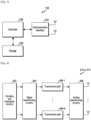
- Fig. 4 illustrates the communication interface in the wireless communication system according to various embodiments of the present disclosure.
- Fig. 4 shows an example for the detailed configuration of the communication interface 210 of Fig. 2 or the communication interface 310 of Fig. 3 . More specifically, Fig. 4 shows elements for performing beamforming as part of the communication interface 210 of Fig. 2 or the communication interface 310 of Fig. 3 .
- the communication interface 210 or 310 includes an encoding and circuitry 402, a digital circuitry 404, a plurality of transmission paths 406-1 to 406-N, and an analog circuitry 408.
- the encoding and circuitry 402 performs channel encoding.
- a low-density parity check (LDPC) code For the channel encoding, at least one of a low-density parity check (LDPC) code, a convolution code, and a polar code may be used.
- the encoding and circuitry 402 generates modulation symbols by performing constellation mapping.
- LDPC low-density parity check
- the digital circuitry 404 performs beamforming for a digital signal (for example, modulation symbols). To this end, the digital circuitry 404 multiples the modulation symbols by beamforming weighted values.
- the beamforming weighted values may be used for changing the size and phrase of the signal, and may be referred to as a "precoding matrix" or a "precoder.”
- the digital circuitry 404 outputs the digitally beamformed modulation symbols to the plurality of transmission paths 406-1 to 406-N.
- the modulation symbols may be multiplexed, or the same modulation symbols may be provided to the plurality of transmission paths 406-1 to 406-N.
- MIMO multiple input multiple output
- the plurality of transmission paths 406-1 to 406-N convert the digitally beamformed digital signals into analog signals.
- each of the plurality of transmission paths 406-1 to 406-N may include an inverse fast Fourier transform (IFFT) calculation unit, a cyclic prefix (CP) insertion unit, a DAC, and an up-conversion unit.
- the CP insertion unit is for an orthogonal frequency division multiplexing (OFDM) scheme, and may be omitted when another physical layer scheme (for example, a filter bank multi-carrier: FBMC) is applied. That is, the plurality of transmission paths 406-1 to 406-N provide independent signal processing processes for a plurality of streams generated through the digital beamforming. However, depending on the implementation, some of the elements of the plurality of transmission paths 406-1 to 406-N may be used in common.
- OFDM orthogonal frequency division multiplexing
- the analog circuitry 408 performs beamforming for analog signals. To this end, the digital circuitry 404 multiples the analog signals by beamforming weighted values. The beamformed weighted values are used for changing the size and phrase of the signal. More specifically, according to a connection structure between the plurality of transmission paths 406-1 to 406-N and antennas, the analog circuitry 408 may be configured in various ways. For example, each of the plurality of transmission paths 406-1 to 406-N may be connected to one antenna array. In another example, the plurality of transmission paths 406-1 to 406-N may be connected to one antenna array. In still another example, the plurality of transmission paths 406-1 to 406-N may be adaptively connected to one antenna array, or may be connected to two or more antenna arrays.
- the network usually requests a UE to provide certain information regarding its capabilities only when required and usually after setup has taken place.
- capabilities is intended to include certain technical capabilities of the UE, including, but not limited to, bandwidth, MIMO layers, Bands or Band Combinations, Dual Connectivity.
- the capabilities of any particular UE are stored within the network, specifically in the RAN node while the UE has a radio connection to this node and within the Core Network (CN), even while the UE is e.g. in idle and not in an active connection.
- the capability information is stored so that when the UE connects at a later time, the CH can provide the capability information to the RAN node upon connection setup. As such, if such information is needed by the network e.g. when the UE first attaches, it must be specifically requested from the UE as needed.
- the UE identifies itself to the network using the prior art identifiers, which relate to its specific identity, but also by providing information regarding its model i.e. the particular device, manufactured by a particular manufacturer.
- a model identifier may provide a great deal of information regarding the capabilities of the UE in question, without requiring each capability to be provided explicitly.
- the degree of granularity provided can be made as fine as is required. For example manufacturer X manufactures model Y in different variants A, B and C (where A, B and C have different capabilities), then the particular variant A, B or C can be identified to the network, meaning that the UE can be setup using the full range of its capabilities, without the network having to request specific information from the UE.
- the network maintains a database of at least some UEs which are commonly used, so that it is able to cross-refer the UE which is attempting setup with the database, based on the model identifier, so that the UE can be configured optimally.
- the database can be provided centrally in the network and populated with information provided by the manufacturers or network operators. It may contain details of the most popular UEs in use e.g. the ten or twenty most commonly used devices.
- the capability information included in the database may alternatively or additionally be populated on the basis of occasional demands of UEs to provide their full capability information in response to a request from the network.
- a UE provides a model identifier not known to the network
- the network requests the UE to provide capability information in the usual way, as known in the prior art.
- the UE may also provide the model identifier so that the network can then relate the model identifier with the capability information provided. In this way, the network is able to build a database of capability information to be associated with particular model identifiers.
- Fig. 5 illustrates an exemplary message exchange according to an embodiment of the present invention.
- the UE 10 is in communication with the base station, gNB 20 which, in turn is in communication with the Core Network, 5GC 30.
- Message 1 is transmitted from UE 10 to gNB 20 and comprises a connection request, as known from the prior art.
- Message 2 is transmitted from the gNB 20 to the UE 10 and comprises a connection setup message, as known from the prior art.
- Message 2 includes a field, requestModelld, by which the network can control whether the UE should include the model identifier in Message 3.
- Message 3 is transmitted from the UE 10 to the gNB 20 and comprises the model identifier information, which identifies the type of UE including at least one of manufacturer, model and variant information, from which capability information can be inferred.
- Message 4 is transmitted from the gNB 20 to the core network 30 and comprises the model identifier information received from the UE 10. Additionally, the message includes 'needForUE-capabilities' which indicates to the core network 30 that the gNB is aware of the capabilities of the UE, represented by the model identifier and, as such, the core network does not need to provide the corresponding UE capabilities during step 5 - context set up.
- Message 4 also includes the model identifier.
- the gNB 20 may still provide model identifier information to the core network 30, since this may still be useful to the core network 30 even if, for instance, the UE has not attached before, the core network 30 may still have the relevant capabilities and can thus provide these during context setup.
- Message 6 is transmitted from the gNB 20 to UE 10 includes a request for the UE 10 to provide full capabilities information. This would only be required in the event that neither the gNB 20 or core network 30 has the UE capabilities represented by the model identifier information provided by UE 10.
- Message 7 is sent from the UE to the gNB and includes full capability information, as well as the model identifier.
- model identifier is able to represent certain capabilities of the UE 10. This could e.g. be a subset of the capabilities for one particular Radio Access Technology supported by the UE, the entire capabilities for one particular Radio Access Technology supported by the UE or the capabilities for multiple or all Radio Access Technologies supported by the UE.
- the model identifier may take the form of a string which could be an identifier similar to IMEI or it could be a number from a hash over the UE capabilities represented.
- the IMEI includes a field known as Type Allocation Code (TAC) which includes information partly allocated by an authorised body and a second part allocated by a manufacturer.
- TAC Type Allocation Code
- the model identifier may be set up similarly, with a first part assigned by some authority such as a standards body and a second part allocated by a particular manufacturer. In this way, each model can be uniquely identified using relatively few bits.
- the UE indicates that some of its capabilities are temporarily not available for use by the RAN node i.e. are temporarily suspended.
- the model identifier is however assumed to represent the entire UE capabilities i.e. as applicable when none have been temporarily suspended. Other use cases are, however, not precluded.
- Embodiments of the invention are particularly applicable to New Radio (i.e. 5th Generation) system and may also find application in earlier systems, such as LTE.
- embodiments of the invention are not limited to any particular radio access technology and may be used in any suitable system.
- embodiments of the present disclosure allow earlier availability of UE capabilities, which can allow the UE to be optimally set up at the outset.
- model identifier information By making use of model identifier information, it is possible to provide centrally at a point (or points) in the network, information on certain more popular UEs which commonly access the network. Such information being available in this way lessens the information which must be provided by the UE on connection setup, since much of it will be common to a particular type of device and so does not need to be sent by each UE to the network at setup.
- the overhead involved in providing such a capability in the network is relatively low cost, since the additional messaging overhead of the exchange exemplified in Fig. 5 results, overall, in less data traffic than if each UE provides full capability information individually. Furthermore, embodiments of the invention reduce capability storage in the RAN and the CH. Also, UE capabilities may be known earlier to the RAN and any such capabilities may therefore be used earlier upon connection setup.
- Fig. 6 is a flowchart for operation of the user equipment according to various embodiments of the present invention.
- the user equipment receives, from a base station, connection setup message requesting information on capabilities of the user equipment.
- the information on the capabilities of the user equipment may include a field, requestModelld.
- the information on the capabilities of the user equipment may be in a form of a model identifier.
- the model identifier may be information regarding a particular model of the user equipment.
- the model identifier may correspond to capability information of a device with the model identifier in a data base.
- the database may be maintained by a network connecting to the base station.
- the user equipment transmits, to the base station, the information on capabilities of the user equipment.
- the information may comprise the model identifier information, which identifies the type of user equipment including at least one of manufacturer, model and variant information, from which capability information can be inferred.
- the user equipment may receive, from the base station, inquiry message requesting information on full capabilities of the user equipment when capability information of a device with the model identifier is not present in a data base; and may transmit, to the base station, the information on full capabilities of the user equipment.
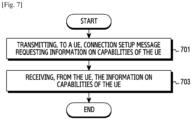
- Fig. 7 is a flowchart for operation of a base station according to various embodiments of the present invention.
- the base station may transmit, to a user equipment, connection setup message requesting information on capabilities of the user equipment.
- the information on the capabilities of the user equipment may include a field, requestModelld.
- the information on the capabilities of the user equipment may be in a form of a model identifier.
- the model identifier may be information regarding a particular model of the user equipment.
- the model identifier may correspond to capability information of a device with the model identifier in a data base.
- the database may be maintained by a network connecting to the base station.
- the base station receives, from the user equipment, the information on capabilities of the user equipment.
- the information may comprise the model identifier information, which identifies the type of user equipment including at least one of manufacturer, model and variant information, from which capability information can be inferred.
- the base station may transmit, to the user equipment, inquiry message requesting information on full capabilities of the user equipment when capability information of a device with the model identifier is not present in a data base; and receives, from the user equipment, the information on full capabilities of the user equipment.
- At least some of the example embodiments described herein may be constructed, partially or wholly, using dedicated special-purpose hardware.
- Terms such as 'component', 'module' or 'unit' used herein may include, but are not limited to, a hardware device, such as circuitry in the form of discrete or integrated components, a Field Programmable Gate Array (FPGA) or Application Specific Integrated Circuit (ASIC), which performs certain tasks or provides the associated functionality.
- FPGA Field Programmable Gate Array
- ASIC Application Specific Integrated Circuit
- the described elements may be configured to reside on a tangible, persistent, addressable storage medium and may be configured to execute on one or more processors.
- These functional elements may in some embodiments include, by way of example, components, such as software components, object-oriented software components, class components and task components, processes, functions, attributes, procedures, subroutines, segments of program code, drivers, firmware, microcode, circuitry, data, databases, data structures, tables, arrays, and variables.
- components such as software components, object-oriented software components, class components and task components, processes, functions, attributes, procedures, subroutines, segments of program code, drivers, firmware, microcode, circuitry, data, databases, data structures, tables, arrays, and variables.
- components such as software components, object-oriented software components, class components and task components, processes, functions, attributes, procedures, subroutines, segments of program code, drivers, firmware, microcode, circuitry, data, databases, data structures, tables, arrays, and variables.
- a computer-readable storage medium for storing one or more programs (software modules) may be provided.
- the one or more programs stored in the computer-readable storage medium may be configured for execution by one or more processors within the electronic device.
- the at least one program may include instructions that cause the electronic device to perform the methods according to various embodiments of the present disclosure as defined by the appended claims and/or disclosed herein.
- the programs may be stored in non-volatile memories including a random access memory and a flash memory, a read only memory (ROM), an electrically erasable programmable read only memory (EEPROM), a magnetic disc storage device, a compact disc-ROM (CD-ROM), digital versatile discs (DVDs), or other type optical storage devices, or a magnetic cassette.
- ROM read only memory
- EEPROM electrically erasable programmable read only memory
- CD-ROM compact disc-ROM
- DVDs digital versatile discs
- any combination of some or all of the may form a memory in which the program is stored.
- a plurality of such memories may be included in the electronic device.
- the programs may be stored in an attachable storage device which is accessible through communication networks such as the Internet, Intranet, local area network (LAN), wide area network (WAN), and storage area network (SAN), or a combination thereof.
- a storage device may access the electronic device via an external port.
- a separate storage device on the communication network may access a portable electronic device.
- a component included in the present disclosure is expressed in the singular or the plural according to a presented detailed embodiment.
- the singular form or plural form is selected for convenience of description suitable for the presented situation, and various embodiments of the present disclosure are not limited to a single element or multiple elements thereof. Further, either multiple elements expressed in the description may be configured into a single element or a single element in the description may be configured into multiple elements.
Landscapes
- Engineering & Computer Science (AREA)
- Computer Networks & Wireless Communication (AREA)
- Signal Processing (AREA)
- Databases & Information Systems (AREA)
- Mobile Radio Communication Systems (AREA)
Claims (10)
- Verfahren zum Betreiben eines Benutzergeräts, UE, (10) in einem drahtlosen Kommunikationssystem, wobei das Verfahren Folgendes umfasst:Empfangen einer Verbindungsaufbaunachricht von einer Basisstation, BS, (20), die Informationen über die Fähigkeiten des UE (10) anfordert; undÜbertragen der Information über die Fähigkeiten des UE (10) an die BS (20), wobei die Information über die Fähigkeiten des UE in Form einer Modellkennung vorliegt, wobei die Verbindungsaufbaunachricht ein Feld für eine Anforderung der Modellkennung beinhaltet,wobei die Modellkennung einen Typ des UE einschließlich eines Herstellers oder eines Modells des UE identifiziert,wobei die Modellkennung eine Teilmenge der Fähigkeiten des UE (10) für eine bestimmte Funkzugriffstechnologie, RAT, darstellt, die von dem UE (10) unterstützt wird.
- Verfahren nach Anspruch 1, wobei die Modellkennung eine Information über ein bestimmtes Modell des UE (10) ist.
- Verfahren nach Anspruch 1, wobei die Modellkennung den Fähigkeitsinformationen einer Vorrichtung mit der Modellkennung in einer Datenbank entspricht.
- Verfahren nach Anspruch 1, ferner umfassend:Empfangen einer Anfragenachricht von der BS (20), die Informationen über die vollständigen Fähigkeiten des UE (10) anfordert, wenn die Fähigkeitsinformationen einer Vorrichtung mit der Modellkennung nicht in einer Datenbank vorhanden sind; undÜbertragen der Informationen über die vollständigen Fähigkeiten des UE (10) an die BS (20).
- Verfahren zum Betreiben einer Basisstation, BS, (20) in einem drahtlosen Kommunikationssystem, wobei das Verfahren Folgendes umfasst:Übertragen einer Verbindungsaufbaunachricht an ein Benutzergerät, UE, (10), die Informationen über die Fähigkeiten des UE (10) anfordert; undEmpfangen der Informationen über die Fähigkeiten des UE (10) von dem UE (10), wobei die Informationen über die Fähigkeiten des UE in Form einer Modellkennung vorliegen, wobei die Verbindungsaufbaunachricht ein Feld für eine Anforderung der Modellkennung beinhaltet, wobei die Modellkennung einen Typ des UE einschließlich eines Herstellers oder eines Modells des UE identifiziert,wobei die Modellkennung eine Teilmenge der Fähigkeiten des UE (10) für eine bestimmte Funkzugriffstechnologie, RAT, darstellt, die von dem UE (10) unterstützt wird.
- Verfahren nach Anspruch 5, wobei die Modellkennung eine Information über ein bestimmtes Modell des UE (10) ist.
- Verfahren nach Anspruch 5, wobei die Modellkennung den Fähigkeitsinformationen einer Vorrichtung mit der Modellkennung in einer Datenbank entspricht.
- Verfahren nach Anspruch 5, ferner umfassend:Übertragen einer Anfragenachricht an das UE (10), die Informationen über die vollständigen Fähigkeiten des UE (10) anfordert, wenn die Fähigkeitsinformationen einer Vorrichtung mit der Modellkennung nicht in einer Datenbank vorhanden sind; undEmpfangen der Informationen über die vollständigen Fähigkeiten des UE (10) von dem UE (10).
- Benutzergerät, UE, (10) in einem drahtlosen Kommunikationssystem, wobei das UE Folgendes umfasst:einen Transceiver; undmindestens einen Prozessor, der mit dem Transceiver gekoppelt ist und konfiguriert ist zum:Empfangen einer Verbindungsaufbaunachricht von einer Basisstation, BS, (20), die Informationen über die Fähigkeiten des UE (10) anfordert; undÜbertragen der Informationen über die Fähigkeiten des UE (10) an die BS (20), wobei die Informationen über die Fähigkeiten des UE in Form einer Modellkennung vorliegen, wobei die Verbindungsaufbaunachricht ein Feld für eine Anforderung der Modellkennung beinhaltet, wobei die Modellkennung einen Typ des UE einschließlich eines Herstellers oder eines Modells des UE identifiziert,wobei die Modellkennung eine Teilmenge der Fähigkeiten des UE (10) für eine bestimmte Funkzugriffstechnologie, RAT, darstellt, die von dem UE (10) unterstützt wird.
- UE (10) nach Anspruch 9, wobei die Modellkennung eine Information über ein bestimmtes Modell des UE (10) ist.
Applications Claiming Priority (2)
| Application Number | Priority Date | Filing Date | Title |
|---|---|---|---|
| GB1715723.1A GB2566965A (en) | 2017-09-28 | 2017-09-28 | Improvements in and relating to connection setup |
| PCT/KR2018/006164 WO2019066190A1 (en) | 2017-09-28 | 2018-05-30 | METHOD AND APPARATUS FOR CONFIGURING CONNECTION IN A WIRELESS COMMUNICATION SYSTEM |
Publications (3)
| Publication Number | Publication Date |
|---|---|
| EP3689014A1 EP3689014A1 (de) | 2020-08-05 |
| EP3689014A4 EP3689014A4 (de) | 2020-10-21 |
| EP3689014B1 true EP3689014B1 (de) | 2025-02-19 |
Family
ID=60270310
Family Applications (1)
| Application Number | Title | Priority Date | Filing Date |
|---|---|---|---|
| EP18862732.7A Active EP3689014B1 (de) | 2017-09-28 | 2018-05-30 | Terminalmodell-id in einer verbindungsaufbauanfrage zur bereitstellung von fähigkeiten |
Country Status (6)
| Country | Link |
|---|---|
| US (1) | US11323871B2 (de) |
| EP (1) | EP3689014B1 (de) |
| KR (1) | KR102512846B1 (de) |
| CN (1) | CN111133783B (de) |
| GB (1) | GB2566965A (de) |
| WO (1) | WO2019066190A1 (de) |
Families Citing this family (6)
| Publication number | Priority date | Publication date | Assignee | Title |
|---|---|---|---|---|
| US11647381B2 (en) * | 2017-08-10 | 2023-05-09 | Ntt Docomo, Inc. | Radio communication system, network device, user device, radio base station and radio communication method |
| BR112021005685A2 (pt) | 2018-09-27 | 2021-06-22 | Telefonaktiebolaget Lm Ericsson (Publ) | métodos, dispositivo sem fio e nó de rede |
| US10701700B2 (en) * | 2018-10-29 | 2020-06-30 | Apple Inc. | Signaling messaging and UE capability with tag and compression |
| EP3893581A4 (de) * | 2019-02-01 | 2022-01-05 | Guangdong Oppo Mobile Telecommunications Corp., Ltd. | Drahtloskommunikationsverfahren, endgerätevorrichtung und netzwerkvorrichtung |
| CN116097837A (zh) * | 2020-08-06 | 2023-05-09 | 富士通株式会社 | 信号的发送和接收方法、装置和通信系统 |
| US11818796B1 (en) * | 2021-07-22 | 2023-11-14 | T-Mobile Innovations Llc | Distributed computing across a wireless communications network |
Family Cites Families (24)
| Publication number | Priority date | Publication date | Assignee | Title |
|---|---|---|---|---|
| KR100946887B1 (ko) * | 2005-03-18 | 2010-03-09 | 삼성전자주식회사 | 통신 시스템에서 단말의 능력 정보를 획득하는 방법 및 장치와 이를 위한 전달 장치 |
| CN101155381A (zh) * | 2006-09-27 | 2008-04-02 | 中兴通讯股份有限公司 | 终端能力信息自适应添加系统及方法 |
| CN101155368A (zh) * | 2006-09-27 | 2008-04-02 | 中兴通讯股份有限公司 | 终端能力信息更新系统及方法 |
| ATE545294T1 (de) | 2006-10-03 | 2012-02-15 | Qualcomm Inc | Verfahren und vorrichtung zur handhabung von kapazitätsinformationen eines benutzergeräts |
| US8090369B2 (en) * | 2007-05-01 | 2012-01-03 | Qualcomm Incorporated | User equipment capability handling in long-term evolution systems |
| GB2458885A (en) * | 2008-03-20 | 2009-10-07 | Nec Corp | Accepting or rejecting a connection request based upon capability information of a user device |
| CN101616493B (zh) * | 2008-06-27 | 2011-12-07 | 华为技术有限公司 | 一种数据传输方法、网络系统及相应装置 |
| GB2493705A (en) * | 2011-08-11 | 2013-02-20 | Nec Corp | Mobile radio communications performance measurement and network optimization |
| DK2648459T3 (en) * | 2012-04-05 | 2016-11-28 | Telia Co Ab | Network selection in a shared network environment |
| CN104521157B (zh) | 2012-07-20 | 2019-02-15 | Lg 电子株式会社 | 在无线通信系统中发送设备对设备有关信息的方法和装置 |
| CN103891344B (zh) * | 2012-09-29 | 2018-12-14 | 华为技术有限公司 | 一种多用户协作通信的方法、设备及系统 |
| WO2014084675A1 (ko) * | 2012-11-29 | 2014-06-05 | 엘지전자 주식회사 | 무선 통신 시스템에서 단말에 의해 수행되는 단말 상태 정보 보고 방법 및 이를 지원하는 장치 |
| US9655121B2 (en) * | 2014-05-09 | 2017-05-16 | Samsung Electronics Co., Ltd. | Method and apparatus for transmitting and receiving UE capability information in mobile communication system |
| US9820225B2 (en) | 2014-05-13 | 2017-11-14 | Qualcomm Incorporated | Techniques for managing power consumption of a mobile device |
| KR102251130B1 (ko) * | 2014-08-15 | 2021-05-11 | 애플 인크. | 능력 정보 설정을 위한 진화된 노드 b 및 사용자 장비의 방법 및 장치 |
| CN105517043A (zh) * | 2014-09-26 | 2016-04-20 | 中兴通讯股份有限公司 | 终端能力的上报、获取方法及装置 |
| JP6654184B2 (ja) | 2015-03-02 | 2020-02-26 | 京セラ株式会社 | 基地局、無線端末、及びモビリティ管理装置 |
| WO2017026442A1 (ja) | 2015-08-11 | 2017-02-16 | 京セラ株式会社 | 無線端末、基地局及びwlan装置 |
| KR20180078233A (ko) * | 2015-09-16 | 2018-07-09 | 엘지전자 주식회사 | 무선 통신 시스템에서 데이터를 송수신하기 위한 베어러 설정 방법 및 이를 지원하는 장치 |
| GB2542770B (en) * | 2015-09-25 | 2020-01-08 | Samsung Electronics Co Ltd | Mobile device capability identifier |
| EP3490281A1 (de) * | 2016-07-25 | 2019-05-29 | Nec Corporation | Basisstation, mobilstation, kernnetzvorrichtung, kommunikationsverfahren und speichermedium mit darauf gespeichertem programm |
| WO2018117313A1 (ko) * | 2016-12-23 | 2018-06-28 | 엘지전자(주) | 무선 통신 시스템에서 단말의 무선 링크 및 무선 연결을 제어하기 위한 방법 및 이를 지원하는 장치 |
| EP3620008A4 (de) * | 2017-05-02 | 2020-12-02 | Intel IP Corporation | Vorrichtungen und verfahren zur prioritätsfrequenzbandableitung in der drahtlosen kommunikation |
| US11647381B2 (en) * | 2017-08-10 | 2023-05-09 | Ntt Docomo, Inc. | Radio communication system, network device, user device, radio base station and radio communication method |
-
2017
- 2017-09-28 GB GB1715723.1A patent/GB2566965A/en not_active Withdrawn
-
2018
- 2018-05-30 US US16/652,245 patent/US11323871B2/en active Active
- 2018-05-30 EP EP18862732.7A patent/EP3689014B1/de active Active
- 2018-05-30 WO PCT/KR2018/006164 patent/WO2019066190A1/en not_active Ceased
- 2018-05-30 KR KR1020207012210A patent/KR102512846B1/ko active Active
- 2018-05-30 CN CN201880062939.7A patent/CN111133783B/zh active Active
Also Published As
| Publication number | Publication date |
|---|---|
| GB201715723D0 (en) | 2017-11-15 |
| WO2019066190A1 (en) | 2019-04-04 |
| EP3689014A1 (de) | 2020-08-05 |
| KR20200049886A (ko) | 2020-05-08 |
| CN111133783A (zh) | 2020-05-08 |
| KR102512846B1 (ko) | 2023-03-24 |
| US11323871B2 (en) | 2022-05-03 |
| CN111133783B (zh) | 2023-04-07 |
| US20200245131A1 (en) | 2020-07-30 |
| GB2566965A (en) | 2019-04-03 |
| EP3689014A4 (de) | 2020-10-21 |
Similar Documents
| Publication | Publication Date | Title |
|---|---|---|
| US11082103B2 (en) | Apparatus and method for beam management in wireless communication system | |
| US11811693B2 (en) | Method and apparatus for configuring and signalling PTRS in a telecommunication system | |
| US11206689B2 (en) | Method and device for performing a random access in wireless communication system | |
| US11051326B2 (en) | Method and apparatus for requesting uplink scheduling in wireless communication system | |
| US11323871B2 (en) | Method and apparatus of a connection setup in a wireless communication system | |
| US11570775B2 (en) | Method and apparatus for improving in and relating to integrated access and backhaul and non terrestrial networks | |
| US11252611B2 (en) | Apparatus and method for determining bandwidth in wireless communication system | |
| KR20210038141A (ko) | 무선 통신 시스템에서 컴퓨팅 구조 및 무선 통신 프로토콜 구조의 결정을 위한 방법 및 장치 | |
| EP3777001B1 (de) | Verfahren und vorrichtung zur verbesserung von und in zusammenhang mit referenzsignalen in einem telekommunikationsnetzwerk | |
| KR102489733B1 (ko) | 무선 통신 시스템에서 랜덤 억세스 채널을 전송하기 위한 방법 및 장치 | |
| KR20260037154A (ko) | Wlan 시스템에 대한 간섭 인식 절차 | |
| KR102700046B1 (ko) | 무선 통신 시스템에서 스케줄링 요청을 위한 방법 및 장치 |
Legal Events
| Date | Code | Title | Description |
|---|---|---|---|
| STAA | Information on the status of an ep patent application or granted ep patent |
Free format text: STATUS: THE INTERNATIONAL PUBLICATION HAS BEEN MADE |
|
| PUAI | Public reference made under article 153(3) epc to a published international application that has entered the european phase |
Free format text: ORIGINAL CODE: 0009012 |
|
| STAA | Information on the status of an ep patent application or granted ep patent |
Free format text: STATUS: REQUEST FOR EXAMINATION WAS MADE |
|
| 17P | Request for examination filed |
Effective date: 20200427 |
|
| AK | Designated contracting states |
Kind code of ref document: A1 Designated state(s): AL AT BE BG CH CY CZ DE DK EE ES FI FR GB GR HR HU IE IS IT LI LT LU LV MC MK MT NL NO PL PT RO RS SE SI SK SM TR |
|
| AX | Request for extension of the european patent |
Extension state: BA ME |
|
| A4 | Supplementary search report drawn up and despatched |
Effective date: 20200917 |
|
| RIC1 | Information provided on ipc code assigned before grant |
Ipc: H04W 76/12 20180101ALI20200911BHEP Ipc: H04W 76/10 20180101ALI20200911BHEP Ipc: H04W 8/24 20090101AFI20200911BHEP |
|
| DAV | Request for validation of the european patent (deleted) | ||
| DAX | Request for extension of the european patent (deleted) | ||
| STAA | Information on the status of an ep patent application or granted ep patent |
Free format text: STATUS: EXAMINATION IS IN PROGRESS |
|
| 17Q | First examination report despatched |
Effective date: 20210928 |
|
| GRAP | Despatch of communication of intention to grant a patent |
Free format text: ORIGINAL CODE: EPIDOSNIGR1 |
|
| STAA | Information on the status of an ep patent application or granted ep patent |
Free format text: STATUS: GRANT OF PATENT IS INTENDED |
|
| INTG | Intention to grant announced |
Effective date: 20240913 |
|
| GRAS | Grant fee paid |
Free format text: ORIGINAL CODE: EPIDOSNIGR3 |
|
| GRAA | (expected) grant |
Free format text: ORIGINAL CODE: 0009210 |
|
| STAA | Information on the status of an ep patent application or granted ep patent |
Free format text: STATUS: THE PATENT HAS BEEN GRANTED |
|
| AK | Designated contracting states |
Kind code of ref document: B1 Designated state(s): AL AT BE BG CH CY CZ DE DK EE ES FI FR GR HR HU IE IS IT LI LT LU LV MC MK MT NL NO PL PT RO RS SE SI SK SM TR |
|
| RBV | Designated contracting states (corrected) |
Designated state(s): AL AT BE BG CH CY CZ DE DK EE ES FI FR GR HR HU IE IS IT LI LT LU LV MC MK MT NL NO PL PT RO RS SE SI SK SM TR |
|
| REG | Reference to a national code |
Ref country code: CH Ref legal event code: EP |
|
| REG | Reference to a national code |
Ref country code: DE Ref legal event code: R096 Ref document number: 602018079419 Country of ref document: DE |
|
| REG | Reference to a national code |
Ref country code: IE Ref legal event code: FG4D |
|
| REG | Reference to a national code |
Ref country code: NL Ref legal event code: MP Effective date: 20250219 |
|
| PG25 | Lapsed in a contracting state [announced via postgrant information from national office to epo] |
Ref country code: RS Free format text: LAPSE BECAUSE OF FAILURE TO SUBMIT A TRANSLATION OF THE DESCRIPTION OR TO PAY THE FEE WITHIN THE PRESCRIBED TIME-LIMIT Effective date: 20250519 |
|
| PG25 | Lapsed in a contracting state [announced via postgrant information from national office to epo] |
Ref country code: FI Free format text: LAPSE BECAUSE OF FAILURE TO SUBMIT A TRANSLATION OF THE DESCRIPTION OR TO PAY THE FEE WITHIN THE PRESCRIBED TIME-LIMIT Effective date: 20250219 |
|
| PG25 | Lapsed in a contracting state [announced via postgrant information from national office to epo] |
Ref country code: PL Free format text: LAPSE BECAUSE OF FAILURE TO SUBMIT A TRANSLATION OF THE DESCRIPTION OR TO PAY THE FEE WITHIN THE PRESCRIBED TIME-LIMIT Effective date: 20250219 |
|
| PGFP | Annual fee paid to national office [announced via postgrant information from national office to epo] |
Ref country code: DE Payment date: 20250422 Year of fee payment: 8 |
|
| PG25 | Lapsed in a contracting state [announced via postgrant information from national office to epo] |
Ref country code: ES Free format text: LAPSE BECAUSE OF FAILURE TO SUBMIT A TRANSLATION OF THE DESCRIPTION OR TO PAY THE FEE WITHIN THE PRESCRIBED TIME-LIMIT Effective date: 20250219 |
|
| REG | Reference to a national code |
Ref country code: LT Ref legal event code: MG9D |
|
| PG25 | Lapsed in a contracting state [announced via postgrant information from national office to epo] |
Ref country code: IS Free format text: LAPSE BECAUSE OF FAILURE TO SUBMIT A TRANSLATION OF THE DESCRIPTION OR TO PAY THE FEE WITHIN THE PRESCRIBED TIME-LIMIT Effective date: 20250619 Ref country code: NO Free format text: LAPSE BECAUSE OF FAILURE TO SUBMIT A TRANSLATION OF THE DESCRIPTION OR TO PAY THE FEE WITHIN THE PRESCRIBED TIME-LIMIT Effective date: 20250519 |
|
| PG25 | Lapsed in a contracting state [announced via postgrant information from national office to epo] |
Ref country code: NL Free format text: LAPSE BECAUSE OF FAILURE TO SUBMIT A TRANSLATION OF THE DESCRIPTION OR TO PAY THE FEE WITHIN THE PRESCRIBED TIME-LIMIT Effective date: 20250219 |
|
| PG25 | Lapsed in a contracting state [announced via postgrant information from national office to epo] |
Ref country code: HR Free format text: LAPSE BECAUSE OF FAILURE TO SUBMIT A TRANSLATION OF THE DESCRIPTION OR TO PAY THE FEE WITHIN THE PRESCRIBED TIME-LIMIT Effective date: 20250219 |
|
| PG25 | Lapsed in a contracting state [announced via postgrant information from national office to epo] |
Ref country code: PT Free format text: LAPSE BECAUSE OF FAILURE TO SUBMIT A TRANSLATION OF THE DESCRIPTION OR TO PAY THE FEE WITHIN THE PRESCRIBED TIME-LIMIT Effective date: 20250620 Ref country code: LV Free format text: LAPSE BECAUSE OF FAILURE TO SUBMIT A TRANSLATION OF THE DESCRIPTION OR TO PAY THE FEE WITHIN THE PRESCRIBED TIME-LIMIT Effective date: 20250219 |
|
| PG25 | Lapsed in a contracting state [announced via postgrant information from national office to epo] |
Ref country code: BG Free format text: LAPSE BECAUSE OF FAILURE TO SUBMIT A TRANSLATION OF THE DESCRIPTION OR TO PAY THE FEE WITHIN THE PRESCRIBED TIME-LIMIT Effective date: 20250219 Ref country code: GR Free format text: LAPSE BECAUSE OF FAILURE TO SUBMIT A TRANSLATION OF THE DESCRIPTION OR TO PAY THE FEE WITHIN THE PRESCRIBED TIME-LIMIT Effective date: 20250520 |
|
| REG | Reference to a national code |
Ref country code: AT Ref legal event code: MK05 Ref document number: 1769542 Country of ref document: AT Kind code of ref document: T Effective date: 20250219 |
|
| PG25 | Lapsed in a contracting state [announced via postgrant information from national office to epo] |
Ref country code: SE Free format text: LAPSE BECAUSE OF FAILURE TO SUBMIT A TRANSLATION OF THE DESCRIPTION OR TO PAY THE FEE WITHIN THE PRESCRIBED TIME-LIMIT Effective date: 20250219 |
|
| PG25 | Lapsed in a contracting state [announced via postgrant information from national office to epo] |
Ref country code: SM Free format text: LAPSE BECAUSE OF FAILURE TO SUBMIT A TRANSLATION OF THE DESCRIPTION OR TO PAY THE FEE WITHIN THE PRESCRIBED TIME-LIMIT Effective date: 20250219 |
|
| PG25 | Lapsed in a contracting state [announced via postgrant information from national office to epo] |
Ref country code: DK Free format text: LAPSE BECAUSE OF FAILURE TO SUBMIT A TRANSLATION OF THE DESCRIPTION OR TO PAY THE FEE WITHIN THE PRESCRIBED TIME-LIMIT Effective date: 20250219 |
|
| PG25 | Lapsed in a contracting state [announced via postgrant information from national office to epo] |
Ref country code: IT Free format text: LAPSE BECAUSE OF FAILURE TO SUBMIT A TRANSLATION OF THE DESCRIPTION OR TO PAY THE FEE WITHIN THE PRESCRIBED TIME-LIMIT Effective date: 20250219 |
|
| PG25 | Lapsed in a contracting state [announced via postgrant information from national office to epo] |
Ref country code: AT Free format text: LAPSE BECAUSE OF FAILURE TO SUBMIT A TRANSLATION OF THE DESCRIPTION OR TO PAY THE FEE WITHIN THE PRESCRIBED TIME-LIMIT Effective date: 20250219 |
|
| PG25 | Lapsed in a contracting state [announced via postgrant information from national office to epo] |
Ref country code: EE Free format text: LAPSE BECAUSE OF FAILURE TO SUBMIT A TRANSLATION OF THE DESCRIPTION OR TO PAY THE FEE WITHIN THE PRESCRIBED TIME-LIMIT Effective date: 20250219 Ref country code: CZ Free format text: LAPSE BECAUSE OF FAILURE TO SUBMIT A TRANSLATION OF THE DESCRIPTION OR TO PAY THE FEE WITHIN THE PRESCRIBED TIME-LIMIT Effective date: 20250219 |
|
| PG25 | Lapsed in a contracting state [announced via postgrant information from national office to epo] |
Ref country code: RO Free format text: LAPSE BECAUSE OF FAILURE TO SUBMIT A TRANSLATION OF THE DESCRIPTION OR TO PAY THE FEE WITHIN THE PRESCRIBED TIME-LIMIT Effective date: 20250219 |
|
| PG25 | Lapsed in a contracting state [announced via postgrant information from national office to epo] |
Ref country code: SK Free format text: LAPSE BECAUSE OF FAILURE TO SUBMIT A TRANSLATION OF THE DESCRIPTION OR TO PAY THE FEE WITHIN THE PRESCRIBED TIME-LIMIT Effective date: 20250219 |
|
| REG | Reference to a national code |
Ref country code: DE Ref legal event code: R097 Ref document number: 602018079419 Country of ref document: DE |
|
| REG | Reference to a national code |
Ref country code: CH Ref legal event code: H13 Free format text: ST27 STATUS EVENT CODE: U-0-0-H10-H13 (AS PROVIDED BY THE NATIONAL OFFICE) Effective date: 20251223 |
|
| PLBE | No opposition filed within time limit |
Free format text: ORIGINAL CODE: 0009261 |
|
| STAA | Information on the status of an ep patent application or granted ep patent |
Free format text: STATUS: NO OPPOSITION FILED WITHIN TIME LIMIT |
|
| PG25 | Lapsed in a contracting state [announced via postgrant information from national office to epo] |
Ref country code: LU Free format text: LAPSE BECAUSE OF NON-PAYMENT OF DUE FEES Effective date: 20250530 |
|
| PG25 | Lapsed in a contracting state [announced via postgrant information from national office to epo] |
Ref country code: CH Free format text: LAPSE BECAUSE OF NON-PAYMENT OF DUE FEES Effective date: 20250531 |
|
| 26N | No opposition filed |
Effective date: 20251120 |
|
| REG | Reference to a national code |
Ref country code: BE Ref legal event code: MM Effective date: 20250531 |
|
| PG25 | Lapsed in a contracting state [announced via postgrant information from national office to epo] |
Ref country code: MC Free format text: LAPSE BECAUSE OF FAILURE TO SUBMIT A TRANSLATION OF THE DESCRIPTION OR TO PAY THE FEE WITHIN THE PRESCRIBED TIME-LIMIT Effective date: 20250219 |
|
| PG25 | Lapsed in a contracting state [announced via postgrant information from national office to epo] |
Ref country code: IE Free format text: LAPSE BECAUSE OF NON-PAYMENT OF DUE FEES Effective date: 20250530 |
|
| PG25 | Lapsed in a contracting state [announced via postgrant information from national office to epo] |
Ref country code: BE Free format text: LAPSE BECAUSE OF NON-PAYMENT OF DUE FEES Effective date: 20250531 |
|
| PG25 | Lapsed in a contracting state [announced via postgrant information from national office to epo] |
Ref country code: FR Free format text: LAPSE BECAUSE OF NON-PAYMENT OF DUE FEES Effective date: 20250531 |