EP3687649B1 - Kurzwegdestillation im vakuum zur anreicherung von naturstoffen - Google Patents
Kurzwegdestillation im vakuum zur anreicherung von naturstoffen Download PDFInfo
- Publication number
- EP3687649B1 EP3687649B1 EP18795294.0A EP18795294A EP3687649B1 EP 3687649 B1 EP3687649 B1 EP 3687649B1 EP 18795294 A EP18795294 A EP 18795294A EP 3687649 B1 EP3687649 B1 EP 3687649B1
- Authority
- EP
- European Patent Office
- Prior art keywords
- extract
- tetrahydrocannabinol
- thc
- short
- extraction
- Prior art date
- Legal status (The legal status is an assumption and is not a legal conclusion. Google has not performed a legal analysis and makes no representation as to the accuracy of the status listed.)
- Active
Links
Images

Classifications
-
- B—PERFORMING OPERATIONS; TRANSPORTING
- B01—PHYSICAL OR CHEMICAL PROCESSES OR APPARATUS IN GENERAL
- B01D—SEPARATION
- B01D11/00—Solvent extraction
- B01D11/02—Solvent extraction of solids
- B01D11/0203—Solvent extraction of solids with a supercritical fluid
-
- A—HUMAN NECESSITIES
- A61—MEDICAL OR VETERINARY SCIENCE; HYGIENE
- A61K—PREPARATIONS FOR MEDICAL, DENTAL OR TOILETRY PURPOSES
- A61K31/00—Medicinal preparations containing organic active ingredients
- A61K31/33—Heterocyclic compounds
- A61K31/335—Heterocyclic compounds having oxygen as the only ring hetero atom, e.g. fungichromin
- A61K31/35—Heterocyclic compounds having oxygen as the only ring hetero atom, e.g. fungichromin having six-membered rings with one oxygen as the only ring hetero atom
- A61K31/352—Heterocyclic compounds having oxygen as the only ring hetero atom, e.g. fungichromin having six-membered rings with one oxygen as the only ring hetero atom condensed with carbocyclic rings, e.g. methantheline
-
- A—HUMAN NECESSITIES
- A61—MEDICAL OR VETERINARY SCIENCE; HYGIENE
- A61K—PREPARATIONS FOR MEDICAL, DENTAL OR TOILETRY PURPOSES
- A61K31/00—Medicinal preparations containing organic active ingredients
- A61K31/658—Medicinal preparations containing organic active ingredients o-phenolic cannabinoids, e.g. cannabidiol, cannabigerolic acid, cannabichromene or tetrahydrocannabinol
-
- A—HUMAN NECESSITIES
- A61—MEDICAL OR VETERINARY SCIENCE; HYGIENE
- A61K—PREPARATIONS FOR MEDICAL, DENTAL OR TOILETRY PURPOSES
- A61K36/00—Medicinal preparations of undetermined constitution containing material from algae, lichens, fungi or plants, or derivatives thereof, e.g. traditional herbal medicines
- A61K36/18—Magnoliophyta (angiosperms)
- A61K36/185—Magnoliopsida (dicotyledons)
- A61K36/348—Cannabaceae
- A61K36/3482—Cannabis
-
- A—HUMAN NECESSITIES
- A61—MEDICAL OR VETERINARY SCIENCE; HYGIENE
- A61K—PREPARATIONS FOR MEDICAL, DENTAL OR TOILETRY PURPOSES
- A61K9/00—Medicinal preparations characterised by special physical form
- A61K9/0012—Galenical forms characterised by the site of application
- A61K9/007—Pulmonary tract; Aromatherapy
- A61K9/0073—Sprays or powders for inhalation; Aerolised or nebulised preparations generated by other means than thermal energy
-
- A—HUMAN NECESSITIES
- A61—MEDICAL OR VETERINARY SCIENCE; HYGIENE
- A61P—SPECIFIC THERAPEUTIC ACTIVITY OF CHEMICAL COMPOUNDS OR MEDICINAL PREPARATIONS
- A61P25/00—Drugs for disorders of the nervous system
-
- B—PERFORMING OPERATIONS; TRANSPORTING
- B01—PHYSICAL OR CHEMICAL PROCESSES OR APPARATUS IN GENERAL
- B01D—SEPARATION
- B01D15/00—Separating processes involving the treatment of liquids with solid sorbents; Apparatus therefor
- B01D15/08—Selective adsorption, e.g. chromatography
- B01D15/10—Selective adsorption, e.g. chromatography characterised by constructional or operational features
- B01D15/18—Selective adsorption, e.g. chromatography characterised by constructional or operational features relating to flow patterns
- B01D15/1892—Selective adsorption, e.g. chromatography characterised by constructional or operational features relating to flow patterns the sorbent material moving as a whole, e.g. continuous annular chromatography, true moving beds or centrifugal chromatography
-
- B—PERFORMING OPERATIONS; TRANSPORTING
- B01—PHYSICAL OR CHEMICAL PROCESSES OR APPARATUS IN GENERAL
- B01D—SEPARATION
- B01D15/00—Separating processes involving the treatment of liquids with solid sorbents; Apparatus therefor
- B01D15/08—Selective adsorption, e.g. chromatography
- B01D15/26—Selective adsorption, e.g. chromatography characterised by the separation mechanism
- B01D15/30—Partition chromatography
-
- B—PERFORMING OPERATIONS; TRANSPORTING
- B01—PHYSICAL OR CHEMICAL PROCESSES OR APPARATUS IN GENERAL
- B01D—SEPARATION
- B01D3/00—Distillation or related exchange processes in which liquids are contacted with gaseous media, e.g. stripping
- B01D3/10—Vacuum distillation
-
- B—PERFORMING OPERATIONS; TRANSPORTING
- B01—PHYSICAL OR CHEMICAL PROCESSES OR APPARATUS IN GENERAL
- B01D—SEPARATION
- B01D3/00—Distillation or related exchange processes in which liquids are contacted with gaseous media, e.g. stripping
- B01D3/12—Molecular distillation
-
- C—CHEMISTRY; METALLURGY
- C07—ORGANIC CHEMISTRY
- C07D—HETEROCYCLIC COMPOUNDS
- C07D311/00—Heterocyclic compounds containing six-membered rings having one oxygen atom as the only hetero atom, condensed with other rings
- C07D311/02—Heterocyclic compounds containing six-membered rings having one oxygen atom as the only hetero atom, condensed with other rings ortho- or peri-condensed with carbocyclic rings or ring systems
- C07D311/78—Ring systems having three or more relevant rings
- C07D311/80—Dibenzopyrans; Hydrogenated dibenzopyrans
-
- A—HUMAN NECESSITIES
- A61—MEDICAL OR VETERINARY SCIENCE; HYGIENE
- A61K—PREPARATIONS FOR MEDICAL, DENTAL OR TOILETRY PURPOSES
- A61K2236/00—Isolation or extraction methods of medicinal preparations of undetermined constitution containing material from algae, lichens, fungi or plants, or derivatives thereof, e.g. traditional herbal medicine
-
- A—HUMAN NECESSITIES
- A61—MEDICAL OR VETERINARY SCIENCE; HYGIENE
- A61K—PREPARATIONS FOR MEDICAL, DENTAL OR TOILETRY PURPOSES
- A61K2236/00—Isolation or extraction methods of medicinal preparations of undetermined constitution containing material from algae, lichens, fungi or plants, or derivatives thereof, e.g. traditional herbal medicine
- A61K2236/30—Extraction of the material
- A61K2236/39—Complex extraction schemes, e.g. fractionation or repeated extraction steps
Definitions
- the present invention relates to a process for the production, extraction and enrichment of dronabinol ( ⁇ 9-THC) as well as natural substances from plant extracts.
- carboxylic acids are found in the raw drug. These carboxylic acids are biosynthetic precursors.
- Cannabis preparations exert a variety of therapeutic effects, including antispastic, analgesic, antiemetic, neuroprotective, anti-inflammatory and effects on psychiatric disorders ( Grotenhermen F, Müller-Vahl K: The therapeutic potential of cannabis and cannabinoids. Dtsch Cardioebl Int 2012; 109(29-30): 495-501. DOI: 10.3238/aticianbl.2012.0495 ).
- a cannabis extract containing THC (dronabinol) and CBD in a ratio of 1:1 (nabiximols) has been approved under pharmaceutical law since 2011 for the treatment of moderate to severe, therapy-resistant spasticity in multiple sclerosis (MS) as a sublingual spray (Sativex).
- tetrahydrocannabinol or “THC” - unless otherwise - include all isomers, in particular double bond isomers.
- THC can be produced synthetically ( EP2314580B1 ).
- WO2017055619A1 describes a short path distillation for cannabidiol.
- the task is to provide an improved distillation for the extraction of THC, so that a THC-enriched extract, or even THC in high purity, is obtained.
- the invention relates to a method for extracting THC from cannabis plant material, wherein a short path distillation is carried out in a vacuum (hereinafter: method according to the invention).
- distillation means a thermal separation process to obtain evaporable liquids from a gas phase and to separate them from substances that are difficult to evaporate, whereby a THC-containing extract is enriched in the distillate.
- "Vacuum distillation” in the sense of This invention means that the distillation takes place in a vacuum at 0.001 to 50 mbar, preferably 0.001 to 10 mbar, particularly preferably 0.001 to 1 mbar in the so-called fine vacuum range.
- the evaporator temperature according to the invention is 120 to 240 degrees Celsius and preferably 150 to 230 degrees Celsius.
- Short-path distillation in a vacuum in the sense of this invention means that the gas phase in the applied fine vacuum only has to travel a very short distance of preferably 10 cm, in particular 5 cm, in particular 2 cm, in particular 0.5 cm between the evaporator wall and the (internal) condenser.
- a short-path evaporator can be used which is structurally equivalent to a conventional thin-film evaporator, but the condenser is integrated into the interior of the evaporator cylinder, so that the path that the vapors have to travel to the condenser is very short and pressures of 0.001 mbar can be achieved.
- a suitable thin film evaporator in the sense of this invention has a substantially cylindrical, steam-heated inner wall onto which a thin layer of a primary extract is applied by means of rotating distribution elements.
- the motor-driven distribution elements are required to apply and distribute the mixture that evaporates quickly on the plates.
- a wiper system accelerates the evaporation process by keeping the thin layer (product film) turbulent and optimizing heat transfer and mass transfer.
- the lighter boiling fractions of the raw material or crude extract evaporate within a short time directly from the product film. The time the product needs to remain on the heated inner wall of the evaporator is therefore minimal. Thanks to the short residence time, low evaporation temperature and the immediate subsequent cooling of the concentrate, thermal damage and stress on the cannabinoids, especially THC, is minimized. It is particularly advantageous that the raw extract can be applied without any additional solvent.
- a short-path evaporator or a correspondingly adapted thin-film evaporator in a vacuum device is preferred.
- the column can have conventional trays as well as packing or compartments, so that preferably at least 10 separation stages are achieved.
- separation columns according to the invention are available, for example, from VTA Maschinenmaschinestechnische Anlagen GmbH & Co. KG, Niederwinkling (DE) or UIC GmbH, Alzenau-Hörstein.
- the length of the column is at least 2.50 m, preferably 2.70 m or more than 3 m.
- the short path distillation in a vacuum can be equipped with an additional column distillation.
- a short path evaporator a suitably adapted thin film evaporator can be equipped with a separation column.
- a column distillation is also a suitable rectification in a vacuum, also under reflux, which preferably takes 10 separation stages. The rectification allows the safe separation of CBD and enrichment of THC to more than 80%.
- the short path distillation according to the invention is carried out in a vacuum with a coupled or connected column distillation or coupled or connected separation column at a pressure of 0.001 to 50 mbar, preferably 0.001 to 10 mbar, in particular 0.001 to 1 mbar.
- the temperature is 120 to 240 degrees Celsius, in particular 150 to 230 degrees Celsius.
- the pressure is up to 5 - 10 mbar and the temperature is 200 to 230 degrees Celsius. This allows safe THC enrichment, with other cannabinoids being completely depleted.
- the short path distillation in a vacuum according to the invention is combined with a "Centrifugal Partition Chromatography (CPC)" process, in series upstream or downstream.
- CPC Chromatography
- the short path distillation in a vacuum can be coupled or connected to a CPC process.
- the invention relates to a method for separating and/or purifying natural substances from plant extracts, in particular cannabinoids from a cannabis extract.
- a process for the separation and/or purification of natural substances from plant extracts, in particular cannabinoids from a cannabis extract comprising at least one liquid-liquid partition chromatography step, wherein a solvent is kept stationary by centrifugal force with a second immiscible liquid phase in the mobile phase and a short-path distillation in a vacuum is carried out upstream or downstream, wherein one or more fractions or one or more pure substances are separated.
- the CPC process can be used to extract and enrich plant ingredients from plant extracts on an analytical, semi-preparative and preparative scale.
- CPC is a liquid-liquid chromatography process using a mostly two-phase solvent system.
- the CPC process enables a nearly loss-free separation of highly complex substance mixtures from crude extracts.
- Manufacturers of such centrifugal distribution chromatographs for carrying out CPC include Kromaton S.a.r.l (Annonay, FR) or Armen Instrument Sas ( Saint-Avé, FR).
- the CPC process uses a 2-phase solvent mixture. Either the upper or lower phase can be used as the stationary phase. Unlike the HSCCC, however, the CPC does not work with a capillary coil, but with a rotor equipped with several hundred separation chambers. In these chambers, which are connected directly one after the other, the substances contained in the plant extract are distributed between the mobile and stationary phases.
- the system is set into rapid rotation during separation (up to 2,500 rpm). This means that, depending on the flow direction, the desired phase is retained in the CPC rotor and, at the same time, the separation of the two phases is accelerated by centrifugal force. This enables the use of high flow rates and, consequently, the throughput of large amounts of substance in a short time, making a preparative application of this separation technique possible.
- the short path distillation according to the invention in a vacuum is combined with a "Sequential Centrifugal Partition Chromatography (sCPC)" process, in series before or after.
- sCPC Sequential Centrifugal Partition Chromatography
- the Short path distillation in vacuum can be coupled or connected to an sCPC process.
- a process for the separation and/or purification of natural substances from plant extracts, in particular of cannabinoids from a cannabis extract, comprising at least one liquid-liquid partition chromatography step, wherein a continuous change of the stationary phase to the mobile phase and vice versa takes place and a short-path distillation in a vacuum is carried out upstream or downstream, wherein one or more fractions or one or more pure substances is/are separated.
- a characteristic feature of sCPC is the continuous change of the stationary phase to the mobile phase and vice versa, i.e. the denser or less dense phase can be selected as the mobile phase and a change of this selection is possible during a separation.
- the substances to be separated are moved in a liquid-liquid centrifugal column at different speeds in the two phases of different density due to a different distribution coefficient.
- An sCPC apparatus has at least one rotor with many round metal plates in which there are, for example, over a thousand separation chambers connected in series (also called rotor chambers, forming a rotating separation column).
- a mobile liquid phase flows (continuously) through the stationary liquid phase in the rotor.
- the rotor is accelerated to approx. 1,000 rpm and more, so that the centrifugal force causes the separation of the two liquid phases due to the density differences in the individual chambers.
- the sample or substance mixture is injected into the rotor.
- the separation of substances takes place based on different adsorption in the mobile or stationary phase or the respective distribution coefficient (K) of a substance to the mobile/stationary phase, whereby the substances are moved through the individual separation chambers to the rotor outlet and fractionated.
- the characteristic alternating change of stationary phase and mobile phase takes place by controlling the pumps used using valves at a frequency to be selected.
- the corresponding solvent is pumped into the respective controlled phase over a period of time to be selected ("duration of pumping"), at both ends of a rotor, so that the pumps are arranged opposite each other.
- the sample or substance mixture is preferably fed into the rotor as an intermediate.
- two or more rotors can be coupled.
- the rotor chambers are preferably filled with an upper and a lower liquid phase in a ratio of 50/50 (volume %).
- the substance mixture is continuously fed between the two rotating separation columns at a defined flow rate using pumps and the separation takes place cyclically and at different times, with the upper phase serving as the mobile phase in a first step ("ascending") and the lower phase serving as the mobile phase in a second step ("descending").
- the separation takes place into two product streams.
- Suitable equipment and devices can be obtained from Armen Technologies (France) under the name "True Moving Bed CPC”.
- the sCPC method can be used to extract and enrich plant ingredients from plant extracts on an analytical, semi-preparative and preparative scale.
- the sCPC is a liquid-liquid chromatography method using a mostly two-phase solvent system.
- the following genera are preferred for the plant extracts according to the invention: Equiseti, Juglandis, Millefolii, Quercus, Taraxaci, Althaeae, Matricariae, Centaurium, Levisticum, Rosmarinus, Angelica, Artemisia, Astragalus, Leonurus, Salvia, Saposhnikovia, Scutellaria, Siegesbeckia, Armoracia, Capsicum, Cistus, Echinacea, Galphimia, Hedera, Melia, Olea, Pelargonium, Phytolacca, Primula, Salix, Thymus, Vitex, Vitis, Rumicis, Verbena, Sambucus, Gentiana, Cannabis, Silybum.
- Equiseti herba (horsetail herb), Juglandis folium (walnut leaves), Millefolii herba (yarrow herb), Quercus cortex (oak bark), Taraxaci herba (dandelion herb), Althaeae radix (marshmallow root) and Matricariae flos (or Flos chamomillae (chamomile flowers)), Centaurium erythraea (Milfoil), Levisticum officinale (lovage), Rosmarinus officinalis (rosemary), Angelica dahurica (Siberian angelica, PinYin name: Baizhi), Angelica sinensis (Chinese angelica, PinYin name: Danggui), Artemisia scoparia (Broom mugwort, PinYin name: Yinchen), Astragalus membranaceus (var.
- Mongolicus (tragacanth root, Chinese: Huang-Qi), Leonurus japonicus (lion's ear, Chinese: T'uei ), Salvia miltiorrhiza (red root sage, Chinese: Danshen), Saposhnikovia divaricata (Siler, PinYin name: Fangfeng), Scutellaria baicalensis (Baikal skullcap, Banzhilian), Siegesbeckia pubescens (heavenly herb, PinYin name: Xixianciao), Armoracia rusticana (horseradish), Capsicum sp.
- the above species and genera are particularly rich in natural medicinal substances and are described as medicinal plants, such as in the products based on plant extracts from Bionorica SE (e.g. Bronchipret ® , Imupret ® , Sinupret ® ). Furthermore, such plants have common characteristic classes of substances, such as flavonoids, polyphenols, etc.
- the plant extract is obtained from a first solvent, such as alcohols, ethanol, water, hydrocarbons, heptane or mixtures thereof, and the soluble components are used.
- a first solvent such as alcohols, ethanol, water, hydrocarbons, heptane or mixtures thereof, and the soluble components are used.
- the fractions may contain such classes of plant extracts as alkaloids, bitter substances, anthocyanins, anthraquinones, coumarins, flavonoids, Glucosinolates, lactones, lignans, lipids, cannabinoids, phenols, polyphenols, saponins, terpenes, xanthones can be enriched or depleted in the aforementioned processes and can be separated.
- plant extracts as alkaloids, bitter substances, anthocyanins, anthraquinones, coumarins, flavonoids, Glucosinolates, lactones, lignans, lipids, cannabinoids, phenols, polyphenols, saponins, terpenes, xanthones can be enriched or depleted in the aforementioned processes and can be separated.
- Solvents used in liquid-liquid partition chromatography can be taken, for example, from Skalicka- Wo ⁇ niak K, Garrard I, A comprehensive classification of solvent systems used for natural product purifications in countercurrent and centrifugal partition chromatography, Nat Prod Rep. 2015 Nov;32(11):1556-61.
- a method for the separation and/or purification of natural substances from plant extracts, in particular of cannabinoids from a cannabis extract, in particular of THC from cannabis plant material, wherein a short path distillation in a vacuum is coupled with a CPC process and/or sCPC or is connected upstream or downstream.
- the CPC method comprises at least one liquid-liquid partition chromatography step, or the use of a centrifugal distribution chromatograph for liquid-liquid partition chromatography for the extraction of e.g. THC, wherein preferably a solvent is selected from hexane, cyclohexane, heptane, n-heptane, iso-heptane, octane, n-octane, iso-octane, which is held stationary by centrifugal force and a second immiscible liquid phase can be pumped through as a mobile phase.
- a solvent is selected from hexane, cyclohexane, heptane, n-heptane, iso-heptane, octane, n-octane, iso-octane, which is held stationary by centrifugal force and a second immiscible liquid phase can be pumped through as a mobile phase
- the sCPC method comprises at least one liquid-liquid partition chromatography step for the extraction of, for example, THC, wherein preferably a solvent is selected from hexane, cyclohexane, heptane, n-heptane, iso-heptane, octane, n-octane, iso-octane, wherein a continuous change of the stationary phase to the mobile phase and vice versa takes place.
- a solvent is selected from hexane, cyclohexane, heptane, n-heptane, iso-heptane, octane, n-octane, iso-octane, wherein a continuous change of the stationary phase to the mobile phase and vice versa takes place.
- the density as well as the viscosity of hexane, cyclohexane, n-heptane, iso-octane are greater than the density/viscosity of n-hexane, so that, for example, compared to the second mobile phase such as acetonitrile, a more stable two-phase system is produced, enabling better retention of the stationary phase and consequently an increased separation performance is achieved; with, for example, purity for THC of over 95% by weight, even 99% by weight.
- one or more short-path distillations in a vacuum can be carried out before or after, so that a purity for THC of, for example, more than 99.0% by weight, in particular greater than 99.7% by weight, can be achieved.
- the short path distillation is carried out in a vacuum on a first primary extract with at least 15% by weight of THC or desired cannabinoid.
- a first step the cannabis plant material is cut, crushed and subjected to a first extraction, for example a CO2 extraction, as in DE 100 51 427 C1 described.
- a CO2 extraction for example a CO2 extraction, as in DE 100 51 427 C1 described.
- extraction with an alkane, propane, butane, pentane, hexane, heptane, alcohol, methanol, ethanol, propanol, isopropanol, water and other liquid and gaseous solvents or column chromatography can also be carried out and in this way a primary extract with at least 15% by weight of THC can be obtained, which is used for further short-path distillation in a vacuum (supra).
- CO 2 extraction is preferred.
- the preferred cannabis plant material is drug hemp (Cannabis Sativa).
- carboxylic acids of the cannabinoids can be decarboxylated in the primary extract.
- the decarboxylation is carried out by heating at 120°C under vacuum, preferably 100-200 mbar.
- a continuous Decarboxylation by short path distillation in the degasser stage is possible at preferably 120°C and 1 mbar.
- the invention also relates to a THC-containing extract obtainable by a process according to the invention.
- an extract with the following composition could be obtained after a short path distillation in vacuum: Delta9-THC % by weight 92.04 CBC % by weight 0.83 CBG % by weight 1.51 CBN % by weight 0.73 VUX % by weight 0.00
- the process according to the invention allows an enrichment of THC of more than 90% by weight, in particular 92% by weight as well as 95% by weight or more, with advantageous depletion of other cannabinoids and impurities that are difficult to separate.
- the low boiler content based on THC [wt. %] is 5 and the high boiler content based on THC [wt. %] is 3. This means that the process according to the invention advantageously made it possible to selectively separate almost all substances that boil before and after THC.
- the invention also relates to a THC-containing extract obtainable by a process according to the invention having a high boiling point content of less than 53 wt. % based on THC and a low boiling point content of less than 5 wt. % based on THC.
- an exemplary starting composition was used for the process according to the invention as follows: Delta9-THC % by weight 78 CBC % by weight 0.69 CBG % by weight 1.36 CBN % by weight 0.62
- the process according to the invention particularly advantageously allows the significant reduction of the low and high boiler components compared to a starting material used.
- the residue-free vaporization of THC is achieved in particular at 0.001 to 1 mbar.
- the temperature is 120 to 240 degrees Celsius, in particular 150 to 230 degrees Celsius, in particular 180-200 degrees Celsius.
- This extract is particularly advantageous for CPC or sCPC, as the loading can be increased by a factor of 5 compared to a non-distilled extract.
- the fractions, pure substances and extracts obtained can be the subject of a galenic or pharmaceutical composition.
- the galenic preparation of a pharmaceutical composition or agent according to the invention can be carried out in a conventional manner.
- suitable solid or liquid galenic preparation forms are, for example, granules, powders, Dragees, tablets, (micro)capsules, hard capsules, suppositories, syrups, juices, suspensions or emulsions, in the manufacture of which the usual excipients such as carriers, disintegrants, binding agents, coating agents, swelling agents, glidants or lubricants, flavorings, sweeteners and solubilizers are used.
- Excipients include magnesium stearate, sodium chloride, magnesium carbonate, titanium dioxide, lactose, mannitol and other sugars, talcum, milk protein, gelatin, starch, cellulose and its derivatives, animal and vegetable oils such as cod liver oil, sunflower, peanut or sesame oil, polyethylene glycols and solvents such as sterile water and mono- or polyhydric alcohols, for example glycerin.
- detergents and surfactants may be provided as auxiliary substances and additives, as explained below for a cosmetic composition.
- Emulsions are generally understood to be heterogeneous systems consisting of two liquids that are immiscible or only partially miscible with one another, which are usually referred to as phases.
- an emulsion one of the two liquids is dispersed in the other liquid in the form of very fine droplets. If the two liquids are water and oil and oil droplets are finely distributed in water, then this is an oil-in-water emulsion (O/W emulsion).
- O/W emulsion oil-in-water emulsion
- the basic character of an O/W emulsion is determined by the water.
- a water-in-oil emulsion (W/O emulsion) is the opposite principle, in which the basic character is determined by the oil.
- W/O/W emulsions water-in-oil-in-water emulsions
- O/W/O emulsions oil-in-water-in-oil emulsions
- the water-free systems suitable according to the invention include pure oil preparations such as skin oils. Pastes containing the preparation according to the invention can also be used and are characterized by the fact that they consist of the same or similar components as an emulsion, but are essentially water-free. In the context of the present invention, the terms oil phase and lipid phase are used synonymously.
- the preparation according to the invention can contain an emulsifier as a further component. In a very preferred embodiment, this emulsifier can be an O/W emulsifier.
- Emulsifiers can advantageously be selected from the group of non-ionic, anionic, cationic or amphoteric emulsifiers.
- emulsifiers from the groups of partial fatty acid esters, fatty alcohols, sterols, polyethylene glycols such as ethoxylated fatty acids, ethoxylated fatty alcohols and ethoxylated sorbitan esters, sugar emulsifiers, polyglycerol emulsifiers or silicone emulsifiers can be used as non-ionic emulsifiers.
- emulsifiers from the soap groups e.g. sodium stearate, fatty alcohol sulfates, mono-, di- and trialkylphosphoric acid esters and their ethoxylates, fatty acid lactate esters, fatty acid citrate esters or fatty acid citroglycerol esters, can be used as anionic emulsifiers.
- Quaternary ammonium compounds with a long-chain aliphatic residue e.g. distearyldimonium chloride
- amphoteric emulsifiers various emulsifiers from the groups alkylamininoalkanecarboxylic acids, betaines, sulfobetaines or imidazoline derivatives can be used.
- Naturally occurring emulsifiers are preferred, which include, for example, beeswax, wool wax, lecithin and sterols, among others, which can also be used in the production of a preparation according to the invention.
- O/W emulsifiers can be selected from the group of plant protein hydrolysates and their derivatives.
- substances selected from the group of esters of saturated and/or unsaturated, branched and/or unbranched alkanecarboxylic acids and/or alkenecarboxylic acids with a chain length of 3 - 30 carbon atoms and saturated and/or unsaturated, branched and/or unbranched alcohols with a chain length of 3 - 30 carbon atoms and from the group of esters of aromatic carboxylic acids and saturated and/or unsaturated, branched and/or unbranched alcohols with a chain length of 3 to 30 carbon atoms can also advantageously be included as additives.
- esterols can then advantageously be selected from the group isopropyl myristate, isopropyl palmitate, isopropyl stearate, isopropyl oleate, n-butyl stearate, n-hexyl laurate, n-decyl oleate, isooctyl stearate, isononyl stearate, isononyl isononanoate, 2-ethylhexyl palmitate, 2-ethylhexyl laurate, 2-hexyldecyl stearate, 2-octyldodecyl palmitate, oleyl oleate, oleyl erucate, erucyl oleate, erucyl erucate as well as synthetic, semi-synthetic and natural mixtures of such esters, such as jojoba oil.
- the oil phase can advantageously be selected from the group of branched and unbranched hydrocarbons and waxes, dialkyl ethers, the group of saturated or unsaturated, branched or unbranched alcohols, and fatty acid triglycerides, namely triglycerol esters of saturated and/or unsaturated, branched and/or unbranched alkanecarboxylic acids with a chain length of 8 - 24 C atoms, especially 12 - 18 C atoms.
- the fatty acid triglycerides can, for example, advantageously be selected from the group of synthetic, semi-synthetic and natural oils.
- antioxidants and/or radical scavengers can be added as auxiliary or additive substances in the preparations according to the invention.
- Such antioxidants are advantageously selected from the group of lipophilic systems, for example: natural and synthetic tocopherols, nordihydroguaiaretic acid, coniferyl benzoate, butylhydroxyanisole, butylhydroxytolul, gallic acid esters and various antioxidant plant extracts.
- the hydrophilic systems it is particularly advantageous to use inorganic sulfur compounds, sodium hydrogen sulfite, cysteine or ascorbic acid.
- Cannabis extract 50-95% Cannabis Sativa was used as the starting material.
- the starting material was previously heated at 80°C in an oil bath and transferred to the heated dropping funnel of the short path distillation.
- the amount used was 103.3 g.
- the temperature in the dosing vessel was 70°C.
- the speed of the stirrer was 400 rpm and the temperature in the evaporator was 180°C.
- the extract was fed in at a rate of 180 ml/h - 200 ml/h and the pressure in the entire apparatus was 1.2 * 10-1 mbar.
- the distillation lasted a total of 35 minutes. 79.53 g of distillate and 58.15 g of residue were obtained, which corresponds to a ratio of approximately 75/25.
- the starting material for the stock solution was the distillate from the short path distillation. The same concentration was used for the stock solution as in the FCPC system, i.e. 0.1 g/ml.
- the distillate from V9001 was dissolved in a water bath at 80°C and then transferred to a 1000 ml round-bottom flask. The initial weight was 62.26 g.
- the 1000 ml round-bottom flask was then dissolved again in a water bath at 80°C and 622 ml of heptane FCPC was added and dissolved.
Landscapes
- Health & Medical Sciences (AREA)
- Chemical & Material Sciences (AREA)
- Life Sciences & Earth Sciences (AREA)
- Chemical Kinetics & Catalysis (AREA)
- Organic Chemistry (AREA)
- General Health & Medical Sciences (AREA)
- Medicinal Chemistry (AREA)
- Veterinary Medicine (AREA)
- Public Health (AREA)
- Pharmacology & Pharmacy (AREA)
- Animal Behavior & Ethology (AREA)
- Natural Medicines & Medicinal Plants (AREA)
- Epidemiology (AREA)
- Engineering & Computer Science (AREA)
- Bioinformatics & Cheminformatics (AREA)
- Medical Informatics (AREA)
- Mycology (AREA)
- Microbiology (AREA)
- Botany (AREA)
- Analytical Chemistry (AREA)
- Biotechnology (AREA)
- Alternative & Traditional Medicine (AREA)
- Otolaryngology (AREA)
- Pulmonology (AREA)
- Biomedical Technology (AREA)
- Neurology (AREA)
- Neurosurgery (AREA)
- General Chemical & Material Sciences (AREA)
- Nuclear Medicine, Radiotherapy & Molecular Imaging (AREA)
- Pyrane Compounds (AREA)
- Medicines Containing Plant Substances (AREA)
- Organic Low-Molecular-Weight Compounds And Preparation Thereof (AREA)
Description
- Die vorliegende Erfindung betrifft ein Verfahren zur Herstellung, Gewinnung und Anreicherung von Dronabinol (Δ9-THC) als auch von Naturstoffen aus Pflanzenextrakten.
- Cannabis (Hanf) gehört zusammen mit der Gattung Humulus (Hopfen) der Familie der Cannabaceae an, wobei jedoch Humulus keine Cannabinoide enthält. Innerhalb der Gattung Cannabis erfolgt eine botanische und chemotaxonomische Differenzierung und zwar in den Arten Cannabis sativa Linnaeus, Cannabis indica LAM und Cannabis ruderalis oder in die "Sammelart" Cannabis sativa L., bestehend aus den Unterarten Cannabis sativa ssp. sativa und ssp. indica. Darüber hinaus wird Cannabis in einen Drogen- und Faserhanf unterschieden, wobei die Unterscheidung aufgrund des mengenmäßigen Verhältnisses der Hauptcannabinoide Cannabidiol (CBD) und Δ9-Tetrahydrocannabinol (Δ9-THC) erfolgt (INN: Dronabinol). Faserhanf (auch: Nutzhanf, industrial hemp) wird hauptsächlich zur industriellen Fasergewinnung herangezogen und darf maximal einen Δ9-THC-Gehalt von 0,2 % aufweisen (z.B. Deutschland u.a.), während der Drogentyp einen Δ9-THC-Gehalt von ca. 5-35 % aufweisen kann (Marihuana, Haschisch). Cannabis sativa L. enthält über 400 verschiedene Inhaltsstoffe, davon gehören mehr als 60 Verbindungen der Klasse der Cannabinoide an. Die wichtigsten Cannabinoide sind im Folgenden dargestellt:
- Cannabigerol-artige (CBG): Cannabigerol ((E)-CBG-C5), Cannabigerol Monomethylether ((E)-CBGM-C5 A), Cannabinerolsäure A ((Z)-CBGA-C5 A), Cannabigerovarin ((E)-CBGV-C3), Cannabigerolsäure A ((E)-CBGA-C5 A), Cannabigerolsäure A Monomethylether ((E)-CBGAM-C5 A), Cannabigerovarinsäure A ((E)-CBGVA-C3 A) ;
- Cannabichromen-artige (CBC): Cannabichromen (CBC-C5), Cannabichromensäure A (CBCA-C5 A), Cannabichromevarin (CBCV-C3), Cannabichromevarinsäure A (CBCVA-C3 A);
- Cannabidiol-artige (CBD): Cannabidiol (CBD-C5), Cannabidiol Monomethylether (CBDM-C5), Cannabidiol-C4 (CBD-C4), Cannabidivarin (CBDV-C3), Cannabidiorcol (CBD-C1), Cannabidiolsäure (CBDA-C5), Cannabidivarinsäure (CBDVA-C3);
- Cannabinodiol-artige (CBND) : Cannabinodiol (CBND-C5), Cannabinodivarin (CBND-C3);
- Tetrahydrocannabinol-artige (THC): Δ9-Tetrahydrocannabinol (Δ9-THC-C5), Δ9-Tetrahydrocannabinol-C4 (Δ9-THC-C4), Δ9-Tetrahydrocannabivarin (Δ9-THCV-C3), Δ9-Tetrahydrocannabiorcol (Δ9-THCO-C1), Δ9-Tetrahydrocannabinolsäure (Δ9-THCA-C5 A), Δ9-Tetrahydrocannabinolsäure B (Δ9-THCA-C5 B), Δ9-Tetrahydrocannabinolsäure-C4 (Δ9-THCA-C4 A und/oder B), Δ9-Tetrahydrocannabivarinsäure A (Δ9-THCVA-C3 A), Δ9-Tetrahydrocannabiorcolsäure (Δ9-THCOA-C1 A und/oder B), (-)-Δ8-trans-(6aR,10aR)-Δ8-Tetrahydrocannabinol (Δ8-THC-C5), (-)-Δ8-trans-(6aR,10aR)-Tetrahydrocannabinolsäure A (Δ8-THCA-C5 A); (-)-(6aS,10aR)-Δ9-Tetrahydrocannabinol ((-)-cis-Δ9-THC-C5);
- Cannabinol-artige (CBN): Cannabinol CBN-C5, Cannabinol-C4 (CBN-C4), Cannabivarin (CBN-C3), Cannabinol-C2 (CBN-C2), Cannabiorcol (CBN-C1), Cannabinolsäure A (CBNA-C5 A), Cannabinolmethylether (CBNM-C5)
- Cannabitriol-artige (CBT): (-)-(9R,10R)-trans-Cannabitriol ((-)-trans-CBT-C5), (+)-(9S,10S)-Cannabitriol ((+)-trans-CBT-C5), (±)-(9R,10S/9S,10R)-Cannabitriol ((±)-cis-CBT-C5), (-)-(9R,10R)-trans[10-O-Ethyl-cannabitriol] ((-)-trans-CBT-OEt-C5), (±)-(9R,10R/9S,10S)-Cannabitriol-C3 ((±)-trans-CBT-C3),8,9-Dihydroxy-Δ6a(10a) tetrahydrocannabinol (8,9-Di-OH-CBT-C5), Cannabidiolsäure A (CBDA-C5 9-OH-CBT-C5 ester), (-)-(6aR,9S,10S,10aR)-9,10-Dihydroxy-hexahydrocannabinol, Cannabiripsol Cannabiripsol-C5, (-)-6a,7,10a-Trihydroxy-Δ9-tetrahydrocannabinol ((-)-Cannabitetrol), 10-Oxo-Δ6a(10a) tetrahydrocannabinol (OTHC);
- Cannabielsoin-artige (CBE): (5aS, 6S, 9R, 9aR)- C5-Cannabielsoin (CBE-C5), (5aS,6S,9R,9aR)-C3-Cannabielsoin (CBE-C3), (5aS,6S,9R,9aR)-Cannabielsoinsäure A (CBEA-C5 A), (5aS,6S,9R,9aR)-Cannabielsoinsäure B (CBEA-C5 B), (5aS,6S,9R,9aR)-C3-Cannabielsoinsäure B (CBEA-C3 B), Cannabiglendol-C3 (OH-iso-HHCV-C3), Dehydrocannabifuran (DCBF-C5), Cannabifuran (CBF-C5);
- Isocannabinoide: (-)-Δ7-trans-(1R,3R,6R)-Isotetrahydrocannabinol, (±)-Δ7-1,2-cis-(1R,3R,6S/1S,3S,6R)-Isotetrahydrocannabivarin, (-)-Δ7-trans-(1R,3R,6R)-Isotetrahydrocannabivarin;
- Cannabicyclol-artige (CBL): (±)-(1aS,3aR,8bR,8cR)-Cannabicyclol (CBL-C5), (±)-(1aS,3aR,8bR,8cR)-Cannabicyclolsäure A (CBLA-C5 A), (±)-(1aS,3aR,8bR,8cR)-Cannabicyclovarin (CBLV-C3);
- Cannabicitran-artige (CBT): Cannabicitran (CBT-C5);
- Cannabichromanon-artige (CBCN): Cannabichromanon (CBCN-C5), Cannabichromanon-C3 (CBCN-C3), Cannabicoumaronon (CBCON-C5).
- Neben den o. g. erwähnten Cannabinoiden finden sich deren zugehörige Carbonsäuren in der Rohdroge. Diese Carbonsäuren sind biosynthetische Precursors.
- Cannabiszubereitungen üben eine Vielzahl therapeutischer Wirkungen aus, darunter antispastische, analgetische, antiemetische, neuroprotektive, anti-inflammatorische sowie Wirkungen bei psychiatrischen Erkrankungen (Grotenhermen F, Müller-Vahl K: The therapeutic potential of cannabis and cannabinoids. Dtsch Arztebl Int 2012; 109(29-30): 495-501. DOI: 10.3238/arztebl.2012.0495).
- In Deutschland ist seit 2011 ein Cannabisextrakt, der THC (Dronabinol) und CBD im Verhältnis 1:1 enthält (Nabiximols), für die Behandlung der mittelschweren bis schweren, therapieresistenten Spastik bei Multipler Sklerose (MS) als Sublingualspray (Sativex) arzneimittelrechtlich zugelassen.
- Im Folgenden sind die chemischen Strukturen einiger Cannabinoid-Wirkstoffe und die Nomenklatur der beiden Wirkstoffe des Tetrahydrocannabinols, deren IUPAC Namen (6aR-trans)-6a,7,8,10a-tetrahydro-6,6,9-trimethyl-3- pentyl-6H-dibenzo[b,d]pyran-1-ol oder Δ9-THC und (6aR-trans)-6a,7,10,10a- tetrahydro-6,6,9-trimethyl-3-pentyl-6H-dibenzo[b,d]pyran-1-ol oder Δ8-THC sind, angegeben.


- Für die Zwecke der vorliegenden Erfindung soll der Begriff "Tetrahydrocannabinol" oder "THC" - sofern nichts anderes bezeichnet ist - sämtliche Isomere, insbesondere Doppelbindungsisomere, umfassen.
- THC kann synthetisch hergestellt werden (
EP2314580B1 ). -
DE 100 51 427 C1 (Müller ) beschreibt einen THC-haltigen Primärextrakt mittels CO2-Extraktion aus Cannabis / Hanf unter Anwendung über- oder unterkritischem Druck und Temperaturbedingungen. Hierzu wird eine SFC- oder SFE-Anlage verwendet ("Supercriticalfluid-chromatography"). - Eine geeignete Kurzwegdestillation im Vakuum zur Extraktion von THC in hoher Reinheit aus einem Cannabisrohmaterial wird jedoch im Stand der Technik nicht beschrieben. Im Stand der Technik wird die einfache Vakuumdestillation von THC offenbart (
WO 00/25127A1 EP1051084B1 beschreibt z.B. eine Wasserdampfdestillaton aus Hanf.US 2002/039795 zeigt ein Verfahren zur Herstellung von Tetrahydrocannabinol durch Extraktion von Pflanzenmaterial mit einem unpolaren Lösungsmittel und anschließender Vakuumdestillation. -
WO2017055619A1 beschreibt eine Kurzwegdestillation für Cannabidiol. - Daher besteht die Aufgabe eine verbesserte Destillation zur Extraktion von THC bereitzustellen, so dass möglichst ein THCangereicherter Extrakt, gar THC in hoher Reinheit erhalten wird.
- Die Aufgabe wird durch die Patentansprüche gelöst.
- Daher betrifft die Erfindung ein Verfahren zur Extraktion von THC aus Cannabis-Pflanzenmaterial, wobei eine Kurzwegdestillation im Vakuum durchgeführt wird (nachstehend: erfindungsgemäßes Verfahren).
- Im Sinne dieser Erfindung bedeutet Destillation ein thermisches Trennverfahren, um verdampfbare Flüssigkeiten aus einer Gasphase zu gewinnen und von schwer verdampfbaren Stoffen abzutrennen, wobei ein THC-haltiger Extrakt im Destillat angereichert wird. "Vakuumdestillation" im Sinne dieser Erfindung bedeutet, dass die Destillation im Vakuum bei 0,001 bis 50 mbar, vorzugsweise 0,001 bis 10 mbar, besonders bevorzugt 0,001 bis 1 mbar im so genannten Feinvakuumbereich erfolgt.
- Weiterhin beträgt die Verdampfertemperatur erfindungsgemäß 120 bis 240 Grad Celsius und bevorzugt 150 bis 230 Grad Celsius.
- Wesentlich ist, dass das erfindungsgemäße Verfahren zur Vakuumdestillation mittels einer Kurzwegdestillation im Vakuum erfolgt. "Kurzwegdestillation im Vakuum" im Sinne dieser Erfindung bedeutet, dass die Gasphase im angelegten Feinvakuum nur einen sehr kurzen Weg von vorzugsweise 10 cm, insbesondere 5 cm, insbesondere 2 cm, insbesondere 0,5 cm zwischen der Verdampferwand und dem (Innen-)Kondensator zurückzulegen hat. Beispielsweise kann ein Kurzwegverdampfer verwendet werden, der konstruktiv einem konventionellen Dünnschichtverdampfer entspricht, wobei jedoch der Kondensator in das Innere des Verdampferzylinders integriert ist, so dass der Weg den die Dämpfe bis zum Kondensator zurücklegen müssen, sehr kurz ist und Drücke von 0,001 mbar erreicht werden können.
- Ein geeigneter Dünnschichtverdampfer (engl.: thin film evaporator) im Sinne dieser Erfindung weist eine im Wesentlichen zylindrische, mit Dampf beheizte Innenwandung auf, auf der mittels rotierender Verteilorgane eine dünne Schicht eines Primärextrakts aufgebracht wird. Die motorisch angetriebenen Verteilorgane werden benötigt, um das rasch auf den Platten verdampfende Gemisch auszubringen und zu verteilen.
- In einer weiteren Ausführungsform beschleunigt ein Wischersystem den Verdampfungsprozess, indem es die dünne Schicht (Produktfilm) turbulent hält und den Wärmeübergang und Stoffaustausch optimiert. Die leichter siedenden Fraktionen der eingeförderten Rohware bzw. Rohextrakt verdampfen innerhalb kurzer Zeit direkt aus dem Produktfilm. Die benötigte Verweilzeit des Produktes auf der beheizten Verdampferinnenwand ist dadurch minimal. Dank kurzer Verweilzeit, niedriger Verdampfungstemperatur und der sofortigen anschließenden Abkühlung des Konzentrats wird die thermische Schädigung und Belastung der Cannabinoide, insbesondere THC minimiert. Besonders vorteilhaft ist, dass der eingebrachte Rohextrakt ohne weiteres Lösungsmittel aufgebracht werden kann.
- Erfindungsgemäß bevorzugt ist jedoch ein Kurzwegverdampfer oder ein entsprechend adaptierter Dünnschichtverdampfer in einer Vakuumvorrichtung.
- Weiterhin ist bevorzugt, dass das erfindungsgemäße Verfahren zur Kurzwegdestillation im Vakuum mit mindestens einer zusätzlichen Kolonne bzw. Trennkolonne durchgeführt wird. Eine erfindungsgemäße geeignete Kolonne ist z.B. eine Kolonne DN 60 (ø50mm, L=360 cm) mit Vakuummantel und TI-Stutzen aus Borosilikat oder Edelstahl. Die Kolonne kann übliche Böden als auch Füllkörper oder Kompartimente aufweisen, so dass vorzugsweise mindestens 10 Trennstufen erreicht werden. Solche erfindungsgemäßen Trennkolonnen sind z.B. bei VTA Verfahrenstechnische Anlagen GmbH & Co. KG, Niederwinkling (DE) oder UIC GmbH, Alzenau-Hörstein erhältlich. In einer weiteren Ausführungsform beträgt die Länge der Kolonne mindestens 2,50 m, vorzugswiese 2,70 m oder mehr als 3 m.
- In einer weiteren bevorzugten Ausführungsform der Erfindung kann die Kurzwegdestillation im Vakuum mit einer zusätzlichen Kolonnendestillation ausgestattet sein. Insbesondere kann ein Kurzwegverdampfer, entsprechend adaptierter Dünnschichtverdampfer mit einer Trennkolonne entsprechend bestückt werden. Im Sinne dieser Erfindung ist eine Kolonnendestillation ebenfalls eine geeignete Rektifikation im Vakuum, auch unter Rückfluss, welche vorzugsweise 10 Trennstufen aufweist. Die Rektifikation erlaubt die sichere Abtrennung von CBD und Anreicherung von THC auf mehr als 80 %.
- Bevorzugt ist weiterhin, dass die erfindungsgemäße Kurzwegdestillation im Vakuum mit einer gekoppelten oder verbundenen Kolonnendestillation bzw. gekoppelten oder verbundenen Trennkolonne bei einem Druck von 0,001 bis 50 mbar, vorzugsweise 0,001 bis 10 mbar, insbesondere 0,001 bis 1 mbar erfolgt. Weiterhin ist bevorzugt, dass die Temperatur 120 bis 240 Grad Celsius beträgt, insbesondere 150 bis 230 Grad Celsius beträgt. In einer bevorzugten Ausführungsform beträgt der Druck bis 5 - 10 mbar und die Temperatur 200 bis 230 Grad Celsius. Dies erlaubt die sichere THC Anreicherung, wobei andere Cannabinoide vollständig abgereichert werden.
- Besonders bevorzugt ist weiterhin, dass die erfindungsgemäße Kurzwegdestillation im Vakuum mit einem "Centrifugal Partition Chromatography (CPC)" Verfahren kombiniert wird und zwar in Reihe vor oder nachgeschaltet. Insbesondere kann die Kurzwegdestillation im Vakuum mit einem CPC-Verfahren gekoppelt oder verbunden sein.
- Daher betrifft die Erfindung in einer weiteren Aufgabe ein Verfahren zur Trennung und/oder Reinigung von Naturstoffen aus Pflanzenextrakten, insbesondere Cannabinoiden aus einem Cannabisextrakt.
- Zur Lösung dieser Aufgabe wird ein Verfahren zur Trennung und/oder Reinigung von Naturstoffen aus Pflanzenextrakten, insbesondere von Cannabinoiden aus einem Cannabisextrakt durchgeführt, enthaltend mindestens einen Flüssig-flüssig-Verteilungschromatographieschritt, wobei ein Lösungsmittel durch Zentrifugalkraft stationär gehalten wird mit einer zweiten nicht mischbaren flüssigen Phase in der mobilen Phase und eine Kurzwegdestillation im Vakuum vor- oder nachgeschaltet wird, wobei eine oder mehrere Fraktionen oder ein oder mehrere Reinstoffe abgetrennt wird/werden.
- Das CPC-Verfahren kann zur Gewinnung und Anreicherung von Pflanzeninhaltsstoffen aus Pflanzenextrakten im analytischen, semipräparativen sowie präparativen Maßstab eingesetzt werden. Die CPC ist ein flüssig-flüssig Chromatographieverfahren unter Verwendung eines zumeist zweiphasigen Lösungsmittelsystems.
- Das CPC Verfahren ermöglicht eine nahezu verlustfreie Separation hochkomplexer Substanzgemische aus Rohextrakten. Hersteller solcher Zentrifugal-Verteilung-Chromatographen zur Durchführung einer CPC ist z.B. Kromaton S.a.r.l (Annonay, FR) oder Armen Instrument Sas (Saint-Avé, FR).
- Bei dem CPC Verfahren wird, wie bei gängigen flüssig-flüssigchromatographischen Methoden, wie zum Beispiel der High Speed Countercurrent Chromatography (HSCCC), ein 2-phasiges Lösungsmittelgemisch eingesetzt. Es kann wahlweise die obere oder die untere Phase als stationäre Phase verwendet werden. Anders jedoch als bei der HSCCC wird bei der CPC nicht mit einer Kapillarspule, sondern mit einem mit mehreren hundert Trennkammern versehenen Rotor gearbeitet. In diesen direkt hintereinander geschalteten Kammern findet die Verteilung der im Pflanzenextrakt enthaltenen Substanzen zwischen mobiler und stationärer Phase statt.
- Das System wird während der Trennung in schnelle Rotation versetzt (bis zu 2.500 rpm). Dadurch wird zum einen, je nach Durchflußrichtung, die gewünschte Phase im Rotor der CPC zurückgehalten und zum anderen die Trennung der beiden Phasen durch die Zentrifugalkraft beschleunigt. Dies ermöglicht die Verwendung großer Flußgeschwindigkeiten und folglich den Durchsatz großer Substanzmengen in kurzer Zeit, so dass eine präparative Anwendung dieser Trenntechnik möglich ist.
- Besonders bevorzugt ist weiterhin, dass die erfindungsgemäße Kurzwegdestillation im Vakuum mit einem "Sequential Centrifugal Partition Chromatography (sCPC)"-Verfahren kombiniert wird und zwar in Reihe vor oder nachgeschaltet. Insbesondere kann die Kurzwegdestillation im Vakuum mit einem sCPC-Verfahren gekoppelt oder verbunden sein.
- Zur Lösung dieser oben genannten Aufgabe wird ein Verfahren zur Trennung und/oder Reinigung von Naturstoffen aus Pflanzenextrakten, insbesondere von Cannabinoiden aus einem Cannabisextrakt durchgeführt, enthaltend mindestens einen Flüssig-flüssig-Verteilungschromatographieschritt, wobei ein kontinuierlicher Wechsel der stationären Phase zur mobilen Phase und umgekehrt erfolgt und eine Kurzwegdestillation im Vakuum vor- oder nachgeschaltet wird, wobei eine oder mehrere Fraktionen oder ein oder mehrere Reinstoffe abgetrennt wird/werden.
- Charakteristisch für sCPC ist der kontinuierliche Wechsel der stationären Phase zur mobilen Phase und umgekehrt, d.h. es kann die dichtere oder weniger dichte Phase als mobile Phase ausgewählt werden und ein Wechsel dieser Auswahl ist während einer Trennung möglich. Die zu trennenden Stoffe werden in einer Flüssig-Flüssig-Zentrifugalsäule aufgrund eines unterschiedlichen Verteilungskoeffizienten mit verschiedenen Geschwindigkeiten in den beiden Phasen verschiedener Dichte bewegt.
- Eine sCPC-Apparatur weist mindestens einen Rotor mit vielen runden Metallplatten auf in denen sich beispielsweise über Eintausend in Serie verbundene Trennkammern (auch Rotorkammern genannt unter Ausbildung einer rotierenden Trennsäule) befinden. Mit Hilfe einer Pumpe wird im Rotor die stationäre flüssige Phase von einer mobilen flüssigen Phase (kontinuierlich) durchströmt. Der Rotor wird z.B. auf ca. 1.000 U/min und mehr beschleunigt, so dass die Zentrifugalkraft die Trennung der beiden flüssigen Phasen aufgrund der Dichteunterschiede in den einzelnen Kammern bewirkt. Sobald die flüssige mobile Phase im Gleichgewicht (Equilibrium) mit der flüssigen stationären Phase liegt, kann die Probe bzw. das Substanzgemisch in den Rotor injiziert werden.
- Die Stofftrennung erfolgt aufgrund verschiedener Adsorption in der mobilen bzw. stationären Phase oder des jeweiligen Verteilungskoeffizienten (K) eines Stoffes zur mobilen/stationären Phase, wobei die Stoffe durch die einzelnen Trennkammern zum Rotorausgang bewegt und fraktioniert werden. Der charakteristische alternierende Wechsel von stationärer Phase und mobiler Phase erfolgt durch Steuerung der eingesetzten Pumpen mittels Ventile in einer zu wählenden Frequenz. In einer zu wählenden Zeitdauer ("Duration of pumping, Pumpdauer") wird zu der jeweils angesteuerten Phase das zugehörige Lösungsmittel eingepumpt und zwar jeweils an den beiden Enden eines Rotors, so dass die Pumpen entgegengesetzt angeordnet sind.
- Die Probe bzw. das Substanzgemisch wird vorzugsweise intermediär in den Rotor eingespeist. In einer weiteren Ausführungsform können zwei oder mehrere Rotoren gekoppelt werden.
- Die Rotorkammern werden vorzugsweise im Verhältnis 50/50 (Volumen %) mit einer oberen und einer unteren flüssigen Phase befüllt. Das Substanzgemisch wird mittels Pumpen kontinuierlich zwischen die beiden rotierenden Trennsäulen mit einer definierten Flussrate eingespeist und die Trennung erfolgt zyklisch und zeitversetzt, wobei in einem ersten Schritt die obere Phase als mobile Phase dient ("Ascending") und in einem zweiten Schritt die untere Phase als mobile Phase dient ("Descending").
- Entsprechend der Konzentration und der unterschiedlichen Verteilungskoeffizienten der Substanzen im Substanzgemisch erfolgt die Auftrennung in zwei Produktströme.
- Geeignete Geräte und Apparaturen können von Armen Technologies (Frankreich) unter dem Namen "True Moving Bed CPC" erhalten werden.
- Das sCPC-Verfahren kann zur Gewinnung und Anreicherung von Pflanzeninhaltsstoffen aus Pflanzenextrakten im analytischen, semipräparativen sowie präparativen Maßstab eingesetzt werden. Die sCPC ist ein flüssig-flüssig Chromatographieverfahren unter Verwendung eines zumeist zweiphasigen Lösungsmittelsystems.
- Nachstehende Gattungen sind für die Pflanzenextrakte erfindungsgemäß bevorzugt:
Equiseti, Juglandis, Millefolii, Quercus, Taraxaci, Althaeae, Matricariae, Centaurium, Levisticum, Rosmarinus, Angelica, Artemisia, Astragalus, Leonurus, Salvia, Saposhnikovia, Scutellaria, Siegesbeckia, Armoracia, Capsicum, Cistus, Echinacea, Galphimia, Hedera, Melia, Olea, Pelargonium, Phytolacca, Primula, Salix, Thymus, Vitex, Vitis, Rumicis, Verbena,Sambucus, Gentiana, Cannabis, Silybum. - Nachstehende Arten sind für die Pflanzenextrakte erfindungsgemäß bevorzugt:
Equiseti herba (Schachtelhalmkraut), Juglandis folium (Walnussblätter), Millefolii herba (Schafgarbenkraut), Quercus cortex (Eichenrinde), Taraxaci herba (Löwenzahnkraut), Althaeae radix (Eibischwurzel) und Matricariae flos (bzw. Flos chamomillae (Kamilleblüten)), Centaurium erythraea (Tausendgüldenkraut), Levisticum officinale (Liebstöckel), Rosmarinus officinalis (Rosmarin), Angelica dahurica (Sibirische Engelwurz, PinYin Name: Baizhi), Angelica sinensis (Chinesische Angelika, PinYin Name: Danggui), Artemisia scoparia (Besen-Beifuß, PinYin Name: Yinchen), Astragalus membranaceus (var. Mongolicus) (Traganthwurzel, Chin.: Huang-Qi), Leonurus japonicus (Löwenohr, Chin.: T'uei ), Salvia miltiorrhiza (Rotwurzel-Salbei, Chin.: Danshen), Saposhnikovia divaricata (Siler, PinYin Name: Fangfeng), Scutellaria baicalensis (Baikal-Helmkraut, Banzhilian), Siegesbeckia pubescens (Himmlisches Kraut, PinYin Name: Xixianciao), Armoracia rusticana (Meerettich), Capsicum sp.(Paprika), Cistus incanus (Zistrose), Echinacea angustifolia (Sonnenhut), Echinacea purpurea (Sonnenhut), Galphimia glauca, Hedera helix (Efeu), Melia toosendan (Chinesische Holunderfrüchte, Chin.: Chuan Lian Zi), Olea europaea (Olive), Pelargonium sp. (Pelagornien), Phytolacca americana (Kermesbeeren), Primula veris (Schlüsselblume), Salix sp. (Weide), Thymus L. (Thymian), Vitex agnus castus (Mönchspfeffer), Vitis vinifera (Edle Weinrebe), Rumicis herba (Sorrel herb),Verbena officinalis (Eisenkraut),Sambucus nigra (Schwarzer Holunder), Gentiana lutea (Gelber Enzian), Cannabis sativa (Hanf), Silybum marianum (Mariendistel). - Ebenfalls sind Mischungen der vorstehenden Gattungen und / oder Arten erfindungsgemäß umfasst.
- Vorstehende Arten und Gattungen sind besonders reich an heilbringenden Naturstoffen und sind als Arzneimittelpflanzen beschrieben, wie z.B. in den Produkten auf der Basis von Pflanzenextrakten der Bionorica SE (z.B. Bronchipret®, Imupret®, Sinupret®). Ferner weisen solche Pflanzen übliche charakteristische Stoffklassen auf, wie Flavonoide, Polyphenole, etc.
- In einer bevorzugten Ausführungsform wird der Pflanzenextrakt aus einem ersten Lösungsmittel, wie Alkohole, Ethanol, Wasser, Kohlenwasserstoffe, Heptan oder Mischungen davon gewonnen, und die löslichen Anteile eingesetzt.
- Beispielsweise können in den Fraktionen solche Stoffklassen von Pflanzenextrakten, wie Alkaloide, Bitterstoffe, Anthocyanine, Anthrachinone, Coumarine, Flavonoide, Glucosinolate, Lactone, Lignane, Lipide, Cannabinoide, Phenole, Polyphenole, Saponine, Terpene, Xanthone in den vorgenannten Verfahren an- oder abgereichert werden, die abgetrennt werden können.
- Besonders vorteilhaft können solche Fraktionen und Reinstoffe in hoher Reinheit und Ausbeute in den vorgenannten Verfahren erhalten werden.
- Zum Einsatz kommende Lösungsmittel können bei der Flüssig-Flüssig Verteilungschromatographie beispielsweise Skalicka- Woźniak K, Garrard I, A comprehensive classification of solvent systems used for natural product purifications in countercurrent and centrifugal partition chromatography, Nat Prod Rep. 2015 Nov;32(11):1556-61 entnommen werden.
- Erfindungsgemäße Beispiele für geeignete Lösungsmittel aus denen zweiphasige Lösungsmittelsysteme (mobile Phase / stationäre Phase) für Pflanzenextrakte bereitgestellt werden können, sind:
- a.) Kohlenwasserstoffe wie n-Hexan, Cyclohexan, Isohexan, Heptan, Isooctan;
- b.) Ether wie t-butylmethylether, Petrolether, Diethylether;
- c.) Halogenierte Lösungsmittel wie Chloroform, Dichlormethan, Benzotrifluorid, Dichlorethan, Tetrachlormethan, Trichlorethan;
- d.) Wasser-Lösliche Alkhole wie Butanol, Methanol, Ethanol, Isopropanol;
- e.) Wasser-Lösliche Ester wie Ethylacetat, Isopropylacetat;
- f.) Acetonitril, Toluol.
- Aus diesen vorgenannten Lösungsmitteln lassen sich geeignete zweiphasige Lösungsmittelsysteme herstellen, vorzugsweise solche wie:
- n-Heptan/Acetonitril
- n-Heptan/Ethylacetat/Acetonitril;
- n-Heptan/Ethylacetat/t-Butylmethylether/ Acetonitril;
- n-Heptan/Ethylacetat/Methanol/Wasser;
- n-Heptan/Ethanol/Wasser.
- Erfindungsgemäß wird daher ein Verfahren zur Trennung und/oder Reinigung von Naturstoffen aus Pflanzenextrakten, insbesondere von Cannabinoiden aus einem Cannabisextrakt, insbesondere von THC aus Cannabis-Pflanzenmaterial bereitgestellt, wobei eine Kurzwegdestillation im Vakuum mit einem CPC-Verfahren und / oder sCPC gekoppelt wird bzw. vor- oder nachgeschaltet wird.
- Beispielsweise weist das CPC-Verfahren mindestens einen Flüssig-flüssig-Verteilungschromatographieschritt, bzw. die Verwendung eines Zentrifugal-Verteilung Chromatographen zur Flüssig-flüssig-Verteilungschromatographie zur Extraktion z.B. von THC auf, wobei vorzugsweise ein Lösungsmittel aus Hexan, Cyclohexan, Heptan, n-Heptan, iso-Heptan, Octan, n-Octan, iso-Octan ausgewählt ist, das durch Zentrifugalkraft stationär gehalten wird und eine zweite nicht mischbare flüssige Phase als mobile Phase durchgepumpt werden kann.
- Beispielsweise weist das sCPC-Verfahren mindestens einen Flüssig-flüssig-Verteilungschromatographieschritt zur Extraktion z.B. von THC auf, wobei vorzugsweise ein Lösungsmittel aus Hexan, Cyclohexan, Heptan, n-Heptan, iso-Heptan, Octan, n-Octan, iso-Octan ausgewählt ist, wobei ein kontinuierlicher Wechsel der stationären Phase zur mobilen Phase und umgekehrt erfolgt.
- Die Dichte als auch die Viskosität von Hexan, Cyclohexan, n-Heptan, iso-Octan sind größer als die Dichte/Viskosität von n-Hexan, so dass z.B. gegenüber der zweiten mobilen Phase wie z.B. Acetonitril ein stabileres Zweiphasensystem hergestellt wird, so dass eine bessere Retention der stationären Phase ermöglicht und folglich eine erhöhte Trennleistung erreicht wird; mit z.B. Reinheit für THC von über 95 Gew. %, gar 99 Gew. %.
- In einer weiteren Ausführungsform kann eine oder mehrere Kurzwegdestillationen im Vakuum vor- oder nachgeschaltet werden, so dass eine z.B. Reinheit für THC von über 99,0 Gew. %, insbesondere größer als 99,7 Gew. % erreicht werden kann.
- Die Kurzwegdestillation erfolgt im Vakuum an einem ersten Primärextrakt mit mindestens 15 Gew. % an THC oder gewünschtem Cannabinoid. In einem ersten Schritt wird daher das Cannabis-Pflanzenmaterial geschnitten, zerkleinert und einer ersten Extraktion unterzogen, beispielsweise eine CO2 Extraktion, wie in
DE 100 51 427 C1 beschrieben. Ebenfalls kann alternativ eine Extraktion mit einem Alkan, Propan, Butan, Pentan, Hexan, Heptan, Alkohol, Methanol, Ethanol, Propanol, Isopropanol, Wasser und weiteren flüssigen und gasförmigen Lösungsmittel oder eine Säulenchromatographie erfolgen und auf diese Weise ein Primärextrakt mit mindestens 15 Gew. % an THC erhalten werden, welcher zur weiteren Kurzwegdestillation im Vakuum eingesetzt wird (supra). Eine CO2-Extraktion ist jedoch bevorzugt. Bevorzugtes Cannabis-Pflanzenmaterial ist Drogenhanf (Cannabis Sativa). - Weiterhin können im Primärextrakt die Carbonsäuren der Cannabinoide, insbesondere Tetrahydrocannabinolcarbonsäuren, Cannabidiolcarbonsäure decarboxyliert werden. Die Decarboxylierung erfolgt durch Erhitzen bei 120°C unter Vakuum vorzugsweise von 100-200 mbar. Ebenso ist eine kontinuierliche Decarboxylierung mittels Kurzwegdestillation in der Entgaserstufe möglich bei vorzugsweise 120°C und 1 mbar.
- Daher ist Gegenstand der Erfindung ebenfalls ein THC-haltiger Extrakt erhältlich nach einem erfindungsgemäßen Verfahren.
- In einer weiteren Ausführungsform gemäß dem erfindungsgemäßen Verfahren konnte ein Extrakt mit folgender Zusammensetzung nach einer Kurzwegdestillation im Vakuum erhalten werden:
Delta9-THC Gew. % 92,04 CBC Gew. % 0,83 CBG Gew. % 1,51 CBN Gew. % 0,73 VUX Gew. % 0,00 - Daher erlaubt das erfindungsgemäße Verfahren eine Anreicherung von THC von mehr als 90 Gewichts- %, insbesondere 92 Gewichts- % als auch 95 Gewichts- % oder mehr unter vorteilhafter Abreicherung von anderen Cannabinoiden und schwer abtrennbaren Verunreinigungen.
- Weiterhin beträgt der Leichtsiederanteil bezogen auf THC [Gew. %] 5 und der Schwersiederanteil bezogen auf THC [Gew. %] 3. D.h. durch das erfindungsgemäße Verfahren konnten vorteilhaft fast alle Substanzen, die vor und nach THC sieden, selektiv abgetrennt werden.
- Daher betrifft die Erfindung ebenfalls einen THC-haltigen Extrakt erhältlich nach einem erfindungsgemäßen Verfahren aufweisend einen Schwersiedeanteil von weniger als 53 Gew. % bezogen auf THC und einen Leichtsiedeanteil von weniger als 5 Gew. % bezogen auf THC.
- Weiterhin wurde für das erfindungsgemäße Verfahren eine exemplarische Ausgangszusammensetzung, wie folgt eingesetzt:
Delta9-THC Gew. % 78 CBC Gew. % 0,69 CBG Gew. % 1,36 CBN Gew. % 0,62 - Das erfindungsgemäße Verfahren erlaubt besonders vorteilhaft die deutliche Reduktion der Leicht- und Schwersiederanteile gegenüber einem eingesetzten Ausgangsmaterial. Dies führt zu einem Extrakt mit spezifischen Eigenschaften wie eine vorteilhafte rückstandsfreie Verdampfbarkeit, welche für die Inhalation von THC in der medizinischen Anwendung besonders geeignet ist, insbesondere für ein Arzneimittel. Die rückstandsfreie Verdampfbarkeit von THC wird insbesondere bei 0,001 bis 1 mbar erhalten. Weiterhin beträgt die Temperatur 120 bis 240 Grad Celsius, insbesondere 150 bis 230 Grad Celsius, insbesondere 180-200 Grad Celsius.
- Dieser Extrakt lässt sich besonders vorteilhaft für die CPC oder sCPC einsetzen, da die Beladung um Faktor 5 erhöht werden kann im Vergleich zu einem nicht-destillierten Extrakt.
- Die erhaltenen Fraktionen, Reinstoffe, Extrakte können Gegenstand einer Galenik oder einer pharmazeutischen Zusammensetzung sein.
- Die galenische Herrichtung einer erfindungsgemäßen pharmazeutischen Zusammensetzung oder Mittel, insbesondere ein Arzneimittel (Medikament), kann in fachüblicher Weise erfolgen. Geeignete feste oder flüssige galenische Zubereitungsformen sind beispielsweise Granulate, Pulver, Dragees, Tabletten, (Mikro-) Kapseln, Hartkapseln, Suppositorien, Sirupe, Säfte, Suspensionen, oder Emulsionen, bei deren Herstellung übliche Hilfsmittel wie Trägerstoffe, Spreng-, Binde-, Überzugs-, Quellungs-, Gleit™ oder Schmiermittel, Geschmacksstoffe, Süßungsmittel und Lösungsvermittler, Verwendung finden. Als Hilfsstoffe seien Magnesium-Stearat, Natriumchlorid, Magnesiumcarbonat, Titandioxid, Lactose, Mannit und andere Zucker, Talcum, Milcheiweiß, Gelatine, Stärke, Zellulose und ihre Derivate, tierische und pflanzliche Öle wie Lebertran, Sonnenblumen-, Erdnuss- oder Sesamöl, Polyethylenglycole und Lösungsmittel, wie etwa steriles Wasser und ein- oder mehrwertige Alkohole, beispielsweise Glycerin, genannt.
- Weiterhin können als Hilfs- und Zusatzstoffe weitere Detergentien und Tenside vorgesehen sein, wie beispielsweise nachstehend für eine kosmetische Zusammensetzung ausgeführt.
- Unter Emulsionen versteht man im Allgemeinen heterogene Systeme, die aus zwei nicht oder nur begrenzt miteinander mischbaren Flüssigkeiten bestehen, die üblicherweise als Phasen bezeichnet werden. In einer Emulsion ist eine der beiden Flüssigkeiten in Form feinster Tröpfchen in der anderen Flüssigkeit dispergiert. Sind die beiden Flüssigkeiten Wasser und Öl und liegen Öltröpfchen fein verteilt in Wasser vor, so handelt es sich um eine Öl-in-Wasser-Emulsion (O/W-Emulsion). Der Grundcharakter einer O/W-Emulsion ist durch das Wasser geprägt. Bei einer Wasser-in-Öl-Emulsion (W/O-Emulsion) handelt es sich um das umgekehrte Prinzip, in dem der Grundcharakter hier durch das Öl bestimmt wird. Weiterhin sind Mischsysteme wie Wasser-in-Öl-in-Wasser-Emulsionen (W/O/W-Emulsion) und Öl-in-Wasser-in-Öl-Emulsionen (O/W/O-Emulsionen) bekannt. Alle genannten Emulsionen sind erfindungsgemäß geeignet.
- Zu den erfindungsgemäß geeigneten wasserfreien Systemen gehören reine Ölzubereitungen wie z.B. Hautöle. Ebenfalls einsetzbare Pasten enthaltend die erfindungsgemäße Zubereitung und zeichnen sich dadurch aus, dass sie aus den gleichen oder ähnlichen Bestandteilen wie eine Emulsion bestehen, jedoch im Wesentlichen wasserfrei sind. Im Rahmen der vorliegenden Erfindung werden die Begriffe Ölphase und Lipidphase synonym verwendet. In einer weiteren bevorzugten Ausführungsform kann die erfindungsgemäße Zubereitung als weiteren Bestandteil einen Emulgator beinhalten. In einer ganz bevorzugten Ausführungsform kann dieser Emulgator ein O/W-Emulgator sein.
- Emulgatoren können vorteilhaft gewählt werden aus der Gruppe der nichtionischen, anionischen, kationischen oder amphoteren Emulgatoren.
- Als nichtionischen Emulgator können verschiedene Emulgatoren aus den Gruppen der Partialfettsäureester, Fettalkohole, Sterole, Polyethylengylcole wie z.B. ethoxylierte Fettsäuren, ethoxylierte Fettalkohole und ethoxylierte Sorbitanester, Zuckeremulgatoren, Polyglycerinemulgatoren oder Silikonemulgatoren Verwendung finden.
- Als anionische Emulgatoren können verschiedene Emulgatoren aus den Gruppen der Seifen z. B. Natriumstearat, Fettalkoholsulfate, Mono-, Di- und Trialkylphosphosäureester und deren Ethoxylate, Fettsäure Lactat Ester, Fettsäure Citrat Ester oder Fettsäure Citroglycerinester Verwendung finden.
- Als kationische Emulgatoren können beispielsweise quaternäre Ammoniumverbindungen mit einem langkettigen aliphatischen Rest z. B. Distearyldimonium Chloride eingesetzt werden.
- Unter den amphoteren Emulgatoren können verschiedene Emulgatoren aus den Gruppen Alkylamininoalkancarbonsäuren, Betaine, Sulfobetaine oder Imidazolinderivate Verwendung finden.
- Erfindungsgemäß bevorzugt sind natürlich vorkommende Emulgatoren, zu denen beispielsweise Bienenwachs, Wollwachs, Lecithin und Sterole u.a. gehören die ebenfalls bei der Herstellung einer erfindungsgemäßen Zubereitung eingesetzt werden können. In einer bevorzugten Formulierung der erfindungsgemäßen Zubereitung können O/W-Emulgatoren ausgewählt werden aus der Gruppe der Pflanzenproteinhydrolysate und deren Derivate.
- Im Sinne der vorliegenden Erfindung können ferner vorteilhaft Substanzen als Zusatzstoffe enthalten sein, ausgewählt aus der Gruppe der Ester aus gesättigten und/oder ungesättigten, verzweigten und/oder unverzweigten Alkancarbonsäuren und/oder Alkencarbonsäuren mit einer Kettenlänge von 3 - 30 Kohlenstoffatomen und gesättigten und/oder ungesättigten, verzweigten und/oder unverzweigten Alkoholen einer Kettenlänge von 3 - 30 Kohlenstoffatomen sowie aus der Gruppe der Ester aus aromatischen Carbonsäuren und gesättigten und/oder ungesättigten, verzweigten und/oder unverzweigten Alkoholen einer Kettenlänge von 3 bis 30 C-Atomen. Solche Esterole können dann vorteilhaft gewählt werden aus der Gruppe Isopropylmyristat, Isopropylpalmitat, Isopropylstearat, Isopropyloleat, n-Butylstearat, n-Hexyllaurat, n-Decyloleat, Isooctylstearat, Isononylstearat, Isononyliso-nonanoat, 2-Ethylhexylpalmitat, 2-Ethylhexyllaurat, 2- Hexyldecylstearat, 2-Octyldodecyl-palmitat, Oleyloleat, Oleylerucat, Erucyloleat, Erucylerucat sowie synthetische, halbsynthetische und natürliche Gemische solcher Ester, wie z.B. Jojobaöl.
- Ferner kann die Ölphase vorteilhaft gewählt werden aus der Gruppe der verzweigten und unverzweigten Kohlenwasserstoffe und -wachse, der Dialkylether, der Gruppe der gesättigten oder ungesättigten, verzweigten oder unverzweigten Alkohole, sowie der Fettsäuretriglyceride, namentlich der Triglycerinester gesättigter und/oder ungesättigter, verzweigter und/oder unverzweigter Alkancarbonsäuren einer Kettenlänge von 8 - 24 C-Atomen, insbesondere 12 - 18 C-Atomen. Die Fettsäuretriglyceride können beispielsweise vorteilhaft gewählt werden aus der Gruppe der synthetischen, halbsynthetischen und natürlichen Öle.
- Insbesondere können in den erfindungsgemäßen Zubereitungen zusätzlich als Hilfs- oder Zusatzstoff Antioxidantien und/oder Radikalfänger zugesetzt werden. Vorteilhaft werden solche Antioxidantien gewählt aus der Gruppe der lipophilen Systeme, beispielsweise: natürliche und synthetische Tocopherole, Nordihydroguajaretsäure, Coniferylbenzoat, Butylhydroxyanisol, Butlyhydroxy-tolul, Gallussäureester und verschiedene antioxidative Pflanzen Extrakte. Unter den hydrophilen Systemen sind besonders vorteilhaft anorganischen Schwefelverbindungen, Natriumhydrogensulfit, Cystein oder Ascorbinsäure zu verwenden.
- Nachfolgende Beispiele dienen zur weiteren Erörterung der Erfindung, ohne jedoch die Erfindung auf diese Beispiele zu beschränken.
- Als Edukt wurde Cannabisextrakt 50-95% Cannabis Sativa verwendet. Das Edukt wurde zuvor bei 80°C im Ölbad erhitzt und in den beheizten Tropftrichter der Kurzwegdestillation überführt. Die eingesetzte Menge betrug 103,3 g. Die Temperatur im Dosiergefäß lag bei 70°C. Die Drehzahl des Rührers betrug 400 rpm und die Temperatur im Verdampfer lag bei 180°C. Der Extrakt wurde mit einer Geschwindigkeit von 180 ml/h - 200 ml/h eingefördert und der Druck in der gesamten Apparatur lag bei 1,2 * 10-1 mbar. Die Destillation dauerte insgesamt 35 Minuten. Es konnten 79,53 g Destillat und 58,15 g Rückstand gewonnen werden was einem Schnittverhältnis von circa 75/25 entspricht. Außerdem bildete sich während der Destillation an der Kühlfalle ein Destillat. Die Menge an Destillat war circa 3 ml. Um den anfallenden Rückstand in eine fließfähige Form zu bekommen war ein Heißluftföhn nötig. Das Destillat, welches anschließend weiterverwendet wurde hatte eine leuchtend gelbe Farbe.
- Eingesetzt wurde 137,51 g Cannabisextrakt 50-95% Ch. 0000106433. Die Temperatur im Dosiergefäß lag bei 70°C, im Verdampfer bei 165°C. Die Drehzahl war wie zuvor bei 400 rpm eingestellt. Die gesamte Destillation dauerte circa 45 Minuten. Es konnte 90,4 g Destillat gewonnen werden, wobei 61,31 g Rückstand entstanden. In der Kühlfalle bildete sich ein Destillat von circa 3 ml. Das Schnittverhältnis war bei 65/35. Das Destillat, welches anschließend weiterverwendet wurde hatte eine leuchtend gelbe Färbung.
- Als Ausgangsmaterial für die Stammlösung diente das Destillat aus der Kurzwegdestillation. Es wurde die gleiche Konzentration für die Stammlösung verwendet wie auch an der FCPC Anlage, also 0,1 g/ml. Das Destillat aus V9001 wurde bei 80°C im Wasserbad angelöst, anschließend in einen 1000 ml Rundkolben überführt. Die Einwaage betrug 62,26 g. Der 1000 ml Rundkolben wurde dann nochmals in einem Wasserbad bei 80°C angelöst und mit 622 ml Heptan FCPC versetzt und gelöst.
- Die Ergebnisse sind in Tabelle 1 dargestellt.
- Vergleichsversuch eines THC-haltigen Cannabisextrakts und zwar mit und ohne Kurzwegvakuumdestillation (Kurzweg: 2-5 cm)
Angaben in Gew. % ohne KWD mit KWD D9 THC 97,53 98,90 Impurity A 0,00 0,05 Impurity B 0,12 0,00 Impurity C 0,09 0,08 Impurity D 0,32 0,24 Impurity E 0,05 0,06 CBD 0,00 0,00 CBN 0,05 0,10 CBC 0,64 0,62 Exo-THC <0,05 <0,05 D8-THC 0,00 0,00 Andere Verunreinigungen 1,30 <0,05 - Verunreinigungen können deutlich minimiert werden.
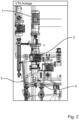
- Die
Figuren 1 und2 zeigen einen Querschnitt von geeigneten Anlagen zur Kurzwegvakuumdestillation mit folgenden Bezugszeichen: - 1 Wischermotor
- 2 Verdampfer
- 3 (Innen-)Kondensator
- 4 Destillataustrag
- 5 Rückstandsaustrag
| Test No. | Info | V9001 | V9001 | V9001 | V9002 | V90 02 | V9002 | V9005 | V90 65 | V9005 | V9006 | V90 06 | |
| Bezeichnung | NTHC KDL 1 | KW46, 2016 | Start | - | Ende | Start | - | Ende | Start | - | Ende | Start | - |
| Feed, aus Protokoll | Cannabisextrakt 50-95 v.H. | ||||||||||||
| Ch-B: | 0000106433 | ||||||||||||
| Datum | dd.mm.yy | 16.11.20 | 16.11.20 | 16.11.20 | 17.11.20 | 17.11.20 | 13.01.20 | 13.01.20 | 13.01.20 | ||||
| yy | 16 | 16 | 16 | 16 | 16 | 17 | 17 | 17 | |||||
| Uhrzeit | hh:mm | 13:50 | 14:00 | 14:25 | 09:43 | 10:30 | 10:47 | 11:30 | 11:30 | ||||
| Dosiergefäß | °C | 70 | 70 | 70 | 70 | 70 | 70 | 70 | 70 | ||||
| Verdampfer | °C | 180 | 180 | 180 | 165 | 165 | 195 | 195 | 215 | ||||
| Vakuum | mbar | 0,17-0,18 | 0,12 | 0,12 | 0,12 | 0,12 | 0,17-0,18 | 0,17-0,18 | - | ||||
| Drehzahl | U/min | 400 | 400 | 400 | 400 | 400 | 400 | 400 | 400 | ||||
| Feed, eingestellt | ml/h | 180-200 | 180-200 | 200 | 180-200 | 180-200 | 180 | 180 | - | ||||
| Feed, Protokoll | g/h | - | - | - | - | - | - | - | - | ||||
| Destillationsdauer | min | 35 | 47 | 43 | |||||||||
| Feed gerechnet | g/h | 177 | 176 | 136 | |||||||||
| m (Edukt, Start) | g | 800,26 | 692,85 | 527,00 | |||||||||
| m (Edukt, nach Entnahme) | g | 696,96 | 555,34 | 429,27 | |||||||||
| m (Edukt, verbraucht), Feed F | g | 103,30 | 137,51 | 215,529 | 97,73 | ||||||||
| m (Destillat) + m (Kolben) | g | 127,39 | 138,56 | 126,93 | |||||||||
| m (Destillatkolben) | tara | g | 47,86 | 48,14 | 49,28 | ||||||||
| m (Destillat) | Destillat D | g | 79,53 | 90,42 | 77,65 | ||||||||
| m (Rückstand) + m (Kolben) | g | 58,15 | 61,31 | 54,02 | |||||||||
| m (Rückstandkolben) | tara | g | 47,77 | 48,11 | 47,77 | ||||||||
| m (Rückstand) | Rückstand R | g | 23,77 | 47,09 | 6,25 | ||||||||
| m (Kühlfalle) | Kühlfalle K | g | |||||||||||
| m (Kühlfalle/Feed) | K/F | % | |||||||||||
| Schnittverhältnis D/R | D/R lt. Protokoll | % | 75/25 | 65/35 | |||||||||
| Schnittverhältnis | D/F gerechnet | % | 77 | 66 | 79 |
| Analytik | Massenanteil [%] | Versuch | V9001 | V9001 | V9001 | V9002 | V90 02 | V9002 | V9005 | V90 05 | V9005 | V9006 | V90 06 |
| Strom | F | D | R | F | D | R | F | D | R | F | D | ||
| CBG | % | 1,36 | 1,67 | 0,52 | 1,36 | 1,51 | 0,67 | 1,36 | 1,36 | ||||
| CBN | % | 0,62 | 0,81 | 0,21 | 0,62 | 0,73 | 0,27 | 0,62 | 0,62 | ||||
| D9-THC | % | 78,84 | 88,73 | 16,54 | 78,84 | 92,04 | 18,78 | 78,84 | 85,00 | 6,76 | 78,84 | 81,40 | |
| D8-THC | % | 0,08 | 0,13 | 0,04 | 0,08 | 0,02 | 0,04 | 0,08 | 0,08 | ||||
| CBC | % | 0,69 | 0,85 | 0,11 | 0,69 | 0,83 | 0,14 | 0,69 | 0,69 | ||||
| VU74 bei RT 74 | % | 0,00 | 0,00 | 0,46 | 0,00 | 0,00 | 0,91 | 0,00 | 0,00 | ||||
| VU77 bei RT 77 | % | 0,00 | 0,00 | 0,53 | 0,00 | 0,00 | 1,09 | 0,00 | 0,00 | ||||
| Vux bei RT ~150 | % | 0,20 | 0,00 | 0,20 | 0,20 | 0,00 | 1,33 | 0,20 | 0,20 |
| Auswertung | Masse absolut [g] | Versuch | V9001 | V9001 | V9001 | V9002 | V90 02 | V9002 | V9005 | V90 05 | V9005 | V9006 | V90 06 |
| Strom | F | D | R | F | D | R | F | D | R | F | D | ||
| CBG | g | 1,40 | 1,32 | 0,12 | 1,87 | 1,37 | 0,32 | 1,33 | 0,00 | 0,00 | 1,60 | 0,00 | |
| CBN | g | 0,64 | 0,65 | 0,05 | 0,85 | 0,66 | 0,13 | 0,60 | 0,00 | 0,00 | 0,73 | 0,00 | |
| D9-THC | g | 81,44 | 70,57 | 3,93 | 108,41 | 83,2 3 | 8,85 | 77,04 | 66,6 0 | 0,42 | 92,87 | 81,0 5 | |
| D8-THC | g | 0,09 | 0,10 | 0,01 | 0,11 | 0,02 | 0,02 | 0,08 | 0,00 | 0,00 | 0,10 | 0,00 | |
| CBC | g | 0,72 | 0,68 | 0,03 | 0,96 | 0,75 | 0,07 | 0,68 | 0,00 | 0,00 | 0,82 | 0,00 | |
| VU74 bei RT 74 | g | 0,00 | 0,00 | 0,11 | 0,00 | 0,00 | 0,43 | 0,00 | 0,00 | 0,00 | 0,00 | 0,00 | |
| VU77 bei RT 77 | g | 0,00 | 0,00 | 0,13 | 0,00 | 0,00 | 0,52 | 0,00 | 0,00 | 0,00 | 0,00 | 0,00 | |
| Vux bei RT ~150 | g | 0,21 | 0,00 | 0,05 | 0,28 | 0,00 | 0,63 | 0,20 | 0,00 | 0,00 | 0,24 | 0,00 |
| Ausbeute im Destillat | Anreicherung [%] | Versuch | V9001 | V90 02 | V90 05 | V90 06 | |||||||
| Strom | D | D | D | D | |||||||||
| CBG | VU | % | 94,42 | 73,1 6 | 0,00 | 0,00 | |||||||
| CBN | VU | % | 100,00 | 78,1 7 | 0,00 | 0,00 | |||||||
| D9-THC | Produkt | % | 86,65 | 76,7 7 | 85,6 7 | 87,2 7 | |||||||
| D8-THC | VU | % | 100,00 | 16,7 5 | 0,00 | 0,00 | |||||||
| CBC | VU | % | 94,60 | 78,1 4 | 0,00 | 0,00 | |||||||
| VU74 bei RT 74 | VU | % | - | - | - | - | |||||||
| VU77 bei RT 77 | VU | % | - | - | - | - | |||||||
| Vux bei RT ∼150 | VU | % | 0,00 | 0,00 | 0,00 | 0,00 | |||||||
| Massenbilanz D9-THC | SOLL = 0 | g | 6,9 | 16,3 | 10,6 | 11,6 | |||||||
| Massenbilanz D9-THC | Abweichung in % | % | 8,5 | 15,1 | 13,8 | 12,5 | |||||||
| Zusammenfassung D9-THC im Feed (Edukt) | V9001 | V90 02 | V90 05 | V90 06 | |||||||||
| w (D9-THC) Feed | w(D9-THC) | % | 78,8 | 78,8 | 78,8 | 78,8 | |||||||
| Zusammenfassung D9-THC im Produkt | V9001 | V90 02 | V90 05 | V90 06 | |||||||||
| Schnittverhältnis | D/F | % | 77,6 | 65,8 | 79,5 | 84,5 | |||||||
| w (D9-THC) Produkt | w(D9-THC) | % | 88,7 | 92,0 | 85,0 | 81,4 | |||||||
| Ausbeute D9-THC | m(D9,D) / m(D9,F) | % | 86,7 | 76,8 | 85,7 | 87,3 | |||||||
| % = Gew. % | |||||||||||||
Claims (9)
- Verfahren zur Extraktion von Tetrahydrocannabinol aus Cannabis-Pflanzenmaterial oder einem Extrakt davon, dadurch gekennzeichnet, dass eine Kurzwegvakuumdestillation durchgeführt wird, um einen Tetrahydrocannabinol-angereicherten Extrakt zu erhalten, in dem andere Cannabinoide abgereichert sind,wobei die Kurzwegvakuumdestillation bei einem Druck von 0,1 bis 5,0 × 10³ Pa (0,001 bis 50 mbar) und einer Temperatur von 120 bis 240 Grad Celsius erfolgt, undwobei die Kurzwegvakuumdestillation an einem ersten Primärextrakt mit mindestens 15 Gew. % an Tetrahydrocannabinol erfolgt.
- Verfahren zur Extraktion von Tetrahydrocannabinol aus Cannabis-Pflanzenmaterial oder einem Extrakt davon nach Anspruch 1, dadurch gekennzeichnet, dass die Kurzwegvakuumdestillation mittels eines Kurzwegverdampfers erfolgt.
- Verfahren zur Extraktion von Tetrahydrocannabinol aus Cannabis-Pflanzenmaterial oder einem Extrakt davon nach Anspruch 1 oder Anspruch 2, dadurch gekennzeichnet, dass der Kurzweg 10 cm, insbesondere 5 cm, insbesondere 2 cm, insbesondere 0,5 cm zwischen der Verdampferwand und dem Kondensator beträgt.
- Verfahren zur Extraktion von Tetrahydrocannabinol aus Cannabis-Pflanzenmaterial oder einem Extrakt davon nach einem der vorstehenden Ansprüche, dadurch gekennzeichnet, dass die Kurzwegvakuumdestillation mittels einer zusätzlichen Kolonne oder Trennkolonne erfolgt.
- Verfahren zur Extraktion von Tetrahydrocannabinol aus Cannabis-Pflanzenmaterial oder einem Extrakt davon nach Anspruch 4, dadurch gekennzeichnet, dass die Länge der Trennkolonne mindestens 2,50 m beträgt.
- Verfahren zur Extraktion von Tetrahydrocannabinol aus Cannabis-Pflanzenmaterial oder einem Extrakt davon nach einem der vorstehenden Ansprüche, wobei die Kurzwegvakuumdestillation bei einem Druck von 0,1 bis 1 × 10² Pa (0,001 bis 1 mbar) erfolgt.
- Verfahren zur Extraktion von Tetrahydrocannabinol aus Cannabis-Pflanzenmaterial oder einem Extrakt davon nach einem der vorstehenden Ansprüche, wobei die Kurzwegvakuumdestillation bei einer Temperatur von 150 bis 230 Grad Celsius erfolgt.
- Verfahren zur Extraktion von Tetrahydrocannabinol aus Cannabis-Pflanzenmaterial oder einem Extrakt davon nach einem der vorstehenden Ansprüche, dadurch gekennzeichnet, dass eine oder mehrere der Kurzwegvakuumdestillationen mindestens einem Flüssig-flüssig-Verteilungschromatographieschritt vorgeschaltet wird.
- Verfahren zur Extraktion von Tetrahydrocannabinol aus Cannabis-Pflanzenmaterial oder einem Extrakt davon nach Anspruch 8, wobei mindestens i.) ein kontinuierlicher Wechsel der stationären Phase zur mobilen Phase und umgekehrt erfolgt und / oder ii.) ein Lösungsmittel durch Zentrifugalkraft stationär gehalten wird mit einer zweiten nicht mischbaren flüssigen Phase in der mobilen Phase.
Priority Applications (1)
| Application Number | Priority Date | Filing Date | Title |
|---|---|---|---|
| SI201831196T SI3687649T1 (sl) | 2017-09-30 | 2018-10-01 | Destilacija s kratko potjo v vakuumu za obogatitev naravnih snovi |
Applications Claiming Priority (2)
| Application Number | Priority Date | Filing Date | Title |
|---|---|---|---|
| EP17194270.9A EP3461545A1 (de) | 2017-09-30 | 2017-09-30 | Kurzwegdestillation im vakuum zur anreicherung von naturstoffen |
| PCT/EP2018/076699 WO2019063848A1 (de) | 2017-09-30 | 2018-10-01 | Kurzwegdestillation im vakuum zur anreicherung von naturstoffen |
Publications (2)
| Publication Number | Publication Date |
|---|---|
| EP3687649A1 EP3687649A1 (de) | 2020-08-05 |
| EP3687649B1 true EP3687649B1 (de) | 2024-12-04 |
Family
ID=60185970
Family Applications (2)
| Application Number | Title | Priority Date | Filing Date |
|---|---|---|---|
| EP17194270.9A Withdrawn EP3461545A1 (de) | 2017-09-30 | 2017-09-30 | Kurzwegdestillation im vakuum zur anreicherung von naturstoffen |
| EP18795294.0A Active EP3687649B1 (de) | 2017-09-30 | 2018-10-01 | Kurzwegdestillation im vakuum zur anreicherung von naturstoffen |
Family Applications Before (1)
| Application Number | Title | Priority Date | Filing Date |
|---|---|---|---|
| EP17194270.9A Withdrawn EP3461545A1 (de) | 2017-09-30 | 2017-09-30 | Kurzwegdestillation im vakuum zur anreicherung von naturstoffen |
Country Status (7)
| Country | Link |
|---|---|
| US (1) | US20200222828A1 (de) |
| EP (2) | EP3461545A1 (de) |
| CA (1) | CA3076752A1 (de) |
| DK (1) | DK3687649T3 (de) |
| FI (1) | FI3687649T3 (de) |
| SI (1) | SI3687649T1 (de) |
| WO (1) | WO2019063848A1 (de) |
Families Citing this family (9)
| Publication number | Priority date | Publication date | Assignee | Title |
|---|---|---|---|---|
| US10239808B1 (en) | 2016-12-07 | 2019-03-26 | Canopy Holdings, LLC | Cannabis extracts |
| EP3745884A1 (de) | 2018-01-31 | 2020-12-09 | Canopy Holdings, Llc | Hanfpulver |
| US11040932B2 (en) | 2018-10-10 | 2021-06-22 | Treehouse Biotech, Inc. | Synthesis of cannabigerol |
| CN110304994B (zh) * | 2019-07-01 | 2022-04-01 | 吴平 | 一种从工业大麻中提取高纯度大麻二酚的方法 |
| US20220401405A1 (en) * | 2019-08-27 | 2022-12-22 | Herbolea Biotech S.P.A. | Cannabinoid concentrate and isolate, method of obtaining the same and use thereof |
| CN110862869A (zh) * | 2019-11-15 | 2020-03-06 | 广东暨晴生物医药科技有限公司 | 一种利用超临界co2萃取和二级分子蒸馏工艺制备艾叶精油及其副产物的方法 |
| CN112843776A (zh) * | 2020-12-24 | 2021-05-28 | 常州市芙丽佳生物科技有限公司 | 一种橄榄仁提取物的提纯工艺 |
| US12246050B2 (en) | 2022-10-05 | 2025-03-11 | Vapor Oil Technology LLC | Post extraction purification of terpenes |
| US11793785B2 (en) * | 2022-10-05 | 2023-10-24 | Vapor Oil Technology LLC | Thin film oxidation of crystallized cannabis products |
Family Cites Families (8)
| Publication number | Priority date | Publication date | Assignee | Title |
|---|---|---|---|---|
| DE19804010C2 (de) | 1998-02-02 | 2002-02-28 | Bayerische Landesanstalt Fuer | Verfahren und Vorrichtung zur Gewinnung von Pflanzen-Inhaltsstoffen |
| US20020039795A1 (en) * | 1998-10-26 | 2002-04-04 | Elsohly Et Al | Method of preparing delta-9-tetrahydrocannabinol |
| DE10051427C1 (de) | 2000-10-17 | 2002-06-13 | Adam Mueller | Verfahren zur Herstellung eines Tetrahydrocannabinol- und Cannabidiol-haltigen Extraktes aus Cannabis-Pflanzenmaterial sowie Cannabis-Extrakte |
| DE102009019322A1 (de) | 2009-04-30 | 2010-11-11 | The Health Concept Gmbh | Verfahren zur Herstellung von Synthetischen Cannabinoiden |
| EP3061510A1 (de) * | 2015-02-27 | 2016-08-31 | Bionorica Ethics GmbH | CPC Verteilungschromatographie von Cannabinoiden |
| DK3274321T3 (da) * | 2015-03-23 | 2019-12-02 | Echo Pharmaceuticals Bv | Cannabidiol-isolat fra industriel hamp og anvendelse deraf i farmaceutiske og/eller kosmetiske præparater |
| BG112018A (bg) * | 2015-05-22 | 2016-11-30 | "Побелч-Гле" Оод | Метод за получаване на канабиноиден извлек от коноп |
| EP3150264A1 (de) * | 2015-09-30 | 2017-04-05 | Bionorica Ethics GmbH | Vakuumdestillation zur anreicherung von cbd |
-
2017
- 2017-09-30 EP EP17194270.9A patent/EP3461545A1/de not_active Withdrawn
-
2018
- 2018-10-01 CA CA3076752A patent/CA3076752A1/en not_active Abandoned
- 2018-10-01 SI SI201831196T patent/SI3687649T1/sl unknown
- 2018-10-01 DK DK18795294.0T patent/DK3687649T3/da active
- 2018-10-01 WO PCT/EP2018/076699 patent/WO2019063848A1/de not_active Ceased
- 2018-10-01 EP EP18795294.0A patent/EP3687649B1/de active Active
- 2018-10-01 US US16/651,267 patent/US20200222828A1/en not_active Abandoned
- 2018-10-01 FI FIEP18795294.0T patent/FI3687649T3/fi active
Also Published As
| Publication number | Publication date |
|---|---|
| EP3461545A1 (de) | 2019-04-03 |
| EP3687649A1 (de) | 2020-08-05 |
| US20200222828A1 (en) | 2020-07-16 |
| FI3687649T3 (fi) | 2025-02-07 |
| DK3687649T3 (da) | 2025-01-27 |
| SI3687649T1 (sl) | 2025-03-31 |
| WO2019063848A1 (de) | 2019-04-04 |
| CA3076752A1 (en) | 2019-04-04 |
Similar Documents
| Publication | Publication Date | Title |
|---|---|---|
| EP3687649B1 (de) | Kurzwegdestillation im vakuum zur anreicherung von naturstoffen | |
| AU2016329526B2 (en) | Vacuum distillation for enriching cannabidiol | |
| EP2844243B1 (de) | Verfahren zur herstellung eines cannabis-pflanzenisolates mit delta-9-tetrahydrocannabinol | |
| EP3978095B1 (de) | Cpc verteilungschromatographie von cannabinoiden | |
| EP3630326B1 (de) | Verfahren zum trennen von naturstoffgemischen mittels scpc | |
| DE10051427C1 (de) | Verfahren zur Herstellung eines Tetrahydrocannabinol- und Cannabidiol-haltigen Extraktes aus Cannabis-Pflanzenmaterial sowie Cannabis-Extrakte | |
| Ara et al. | Application of response surface methodology for the optimization of supercritical fluid extraction of essential oil from pomegranate (Punica granatum L.) peel | |
| Okuda et al. | Fractionation of pharmacologically active plant polyphenols by centrifugal partition chromatography | |
| de Paiva et al. | Isolation of secondary metabolites from roots of Plumbago auriculata Lam. by countercurrent chromatography | |
| KR20250134118A (ko) | 신경퇴행성 질환 또는 장애 및 암 치료에 있어서의 칸나비노이드 조성물 및 이의 용도 | |
| EP4431169A1 (de) | Methode zur reinigung von cannabinoid-komponenten aus pflanzenextrakten | |
| US20230201286A1 (en) | High yield extraction method for and products of rhodiola plants | |
| El-Gazzar et al. | Polarity-driven metabolomic profiling of Mesquite (Prosopis juliflora) stem fractions using UPLC-MS/MS and chemometrics | |
| Fan et al. | Preparative separation and purification of two flavanols from Smilax china L. using high-speed counter-current chromatography | |
| EP4520417A1 (de) | Verfahren zum herstellen von cannabinoiden, insbesondere dronabinol mittels verteilungschromatographie | |
| AU2023361756A1 (en) | Novel liquid oral formulations of cannabidiol | |
| WO2023146536A1 (en) | High yield extraction method for and products of rhodiola plants | |
| Li et al. | Application of High-Speed Countercurrent Chromatography to the Isolation of Bioactive Natural Products | |
| DE202023104595U1 (de) | Cannabisextraktkonzentrate | |
| Grigoravičiūtė | Isolation of higher-added value components from bigroot geranium (Geranium macrorrhizum) and maral root (Rhaponticum carthamoides) by high-pressure extraction techniques | |
| Qilong et al. | 2SOLUBILITY AND DIFFUSION COEFFICIENT OF BIOACTIVE NATURAL PRODUCTS | |
| CZ305844B6 (cs) | Způsob přípravy extraktu z oleje černuchy seté se zvýšeným obsahem thymochinonu |
Legal Events
| Date | Code | Title | Description |
|---|---|---|---|
| STAA | Information on the status of an ep patent application or granted ep patent |
Free format text: STATUS: UNKNOWN |
|
| STAA | Information on the status of an ep patent application or granted ep patent |
Free format text: STATUS: THE INTERNATIONAL PUBLICATION HAS BEEN MADE |
|
| PUAI | Public reference made under article 153(3) epc to a published international application that has entered the european phase |
Free format text: ORIGINAL CODE: 0009012 |
|
| STAA | Information on the status of an ep patent application or granted ep patent |
Free format text: STATUS: REQUEST FOR EXAMINATION WAS MADE |
|
| 17P | Request for examination filed |
Effective date: 20200323 |
|
| AK | Designated contracting states |
Kind code of ref document: A1 Designated state(s): AL AT BE BG CH CY CZ DE DK EE ES FI FR GB GR HR HU IE IS IT LI LT LU LV MC MK MT NL NO PL PT RO RS SE SI SK SM TR |
|
| AX | Request for extension of the european patent |
Extension state: BA ME |
|
| RAP1 | Party data changed (applicant data changed or rights of an application transferred) |
Owner name: SPECTRUM THERAPEUTICS GMBH |
|
| DAV | Request for validation of the european patent (deleted) | ||
| DAX | Request for extension of the european patent (deleted) | ||
| STAA | Information on the status of an ep patent application or granted ep patent |
Free format text: STATUS: EXAMINATION IS IN PROGRESS |
|
| 17Q | First examination report despatched |
Effective date: 20221108 |
|
| RAP3 | Party data changed (applicant data changed or rights of an application transferred) |
Owner name: CANDORO ETHICS GMBH NM |
|
| GRAP | Despatch of communication of intention to grant a patent |
Free format text: ORIGINAL CODE: EPIDOSNIGR1 |
|
| STAA | Information on the status of an ep patent application or granted ep patent |
Free format text: STATUS: GRANT OF PATENT IS INTENDED |
|
| INTG | Intention to grant announced |
Effective date: 20240624 |
|
| RAP1 | Party data changed (applicant data changed or rights of an application transferred) |
Owner name: CANDORO ETHICS GMBH |
|
| P01 | Opt-out of the competence of the unified patent court (upc) registered |
Free format text: CASE NUMBER: APP_46763/2024 Effective date: 20240813 |
|
| GRAS | Grant fee paid |
Free format text: ORIGINAL CODE: EPIDOSNIGR3 |
|
| GRAA | (expected) grant |
Free format text: ORIGINAL CODE: 0009210 |
|
| STAA | Information on the status of an ep patent application or granted ep patent |
Free format text: STATUS: THE PATENT HAS BEEN GRANTED |
|
| AK | Designated contracting states |
Kind code of ref document: B1 Designated state(s): AL AT BE BG CH CY CZ DE DK EE ES FI FR GB GR HR HU IE IS IT LI LT LU LV MC MK MT NL NO PL PT RO RS SE SI SK SM TR |
|
| REG | Reference to a national code |
Ref country code: GB Ref legal event code: FG4D Free format text: NOT ENGLISH |
|
| REG | Reference to a national code |
Ref country code: CH Ref legal event code: EP |
|
| REG | Reference to a national code |
Ref country code: DE Ref legal event code: R096 Ref document number: 502018015394 Country of ref document: DE |
|
| REG | Reference to a national code |
Ref country code: IE Ref legal event code: FG4D Free format text: LANGUAGE OF EP DOCUMENT: GERMAN |
|
| REG | Reference to a national code |
Ref country code: DK Ref legal event code: T3 Effective date: 20250124 |
|
| REG | Reference to a national code |
Ref country code: FI Ref legal event code: FGE |
|
| REG | Reference to a national code |
Ref country code: SE Ref legal event code: TRGR |
|
| REG | Reference to a national code |
Ref country code: NL Ref legal event code: FP |
|
| REG | Reference to a national code |
Ref country code: GR Ref legal event code: EP Ref document number: 20250400088 Country of ref document: GR Effective date: 20250211 |
|
| REG | Reference to a national code |
Ref country code: LT Ref legal event code: MG9D |
|
| PG25 | Lapsed in a contracting state [announced via postgrant information from national office to epo] |
Ref country code: HR Free format text: LAPSE BECAUSE OF FAILURE TO SUBMIT A TRANSLATION OF THE DESCRIPTION OR TO PAY THE FEE WITHIN THE PRESCRIBED TIME-LIMIT Effective date: 20241204 |
|
| PG25 | Lapsed in a contracting state [announced via postgrant information from national office to epo] |
Ref country code: BG Free format text: LAPSE BECAUSE OF FAILURE TO SUBMIT A TRANSLATION OF THE DESCRIPTION OR TO PAY THE FEE WITHIN THE PRESCRIBED TIME-LIMIT Effective date: 20241204 |
|
| PG25 | Lapsed in a contracting state [announced via postgrant information from national office to epo] |
Ref country code: ES Free format text: LAPSE BECAUSE OF FAILURE TO SUBMIT A TRANSLATION OF THE DESCRIPTION OR TO PAY THE FEE WITHIN THE PRESCRIBED TIME-LIMIT Effective date: 20241204 |
|
| PG25 | Lapsed in a contracting state [announced via postgrant information from national office to epo] |
Ref country code: LV Free format text: LAPSE BECAUSE OF FAILURE TO SUBMIT A TRANSLATION OF THE DESCRIPTION OR TO PAY THE FEE WITHIN THE PRESCRIBED TIME-LIMIT Effective date: 20241204 |
|
| PG25 | Lapsed in a contracting state [announced via postgrant information from national office to epo] |
Ref country code: RS Free format text: LAPSE BECAUSE OF FAILURE TO SUBMIT A TRANSLATION OF THE DESCRIPTION OR TO PAY THE FEE WITHIN THE PRESCRIBED TIME-LIMIT Effective date: 20250304 |
|
| PG25 | Lapsed in a contracting state [announced via postgrant information from national office to epo] |
Ref country code: SM Free format text: LAPSE BECAUSE OF FAILURE TO SUBMIT A TRANSLATION OF THE DESCRIPTION OR TO PAY THE FEE WITHIN THE PRESCRIBED TIME-LIMIT Effective date: 20241204 |
|
| PG25 | Lapsed in a contracting state [announced via postgrant information from national office to epo] |
Ref country code: PL Free format text: LAPSE BECAUSE OF FAILURE TO SUBMIT A TRANSLATION OF THE DESCRIPTION OR TO PAY THE FEE WITHIN THE PRESCRIBED TIME-LIMIT Effective date: 20241204 |
|
| PG25 | Lapsed in a contracting state [announced via postgrant information from national office to epo] |
Ref country code: IS Free format text: LAPSE BECAUSE OF FAILURE TO SUBMIT A TRANSLATION OF THE DESCRIPTION OR TO PAY THE FEE WITHIN THE PRESCRIBED TIME-LIMIT Effective date: 20250404 |
|
| PG25 | Lapsed in a contracting state [announced via postgrant information from national office to epo] |
Ref country code: PT Free format text: LAPSE BECAUSE OF FAILURE TO SUBMIT A TRANSLATION OF THE DESCRIPTION OR TO PAY THE FEE WITHIN THE PRESCRIBED TIME-LIMIT Effective date: 20250404 |
|
| PG25 | Lapsed in a contracting state [announced via postgrant information from national office to epo] |
Ref country code: EE Free format text: LAPSE BECAUSE OF FAILURE TO SUBMIT A TRANSLATION OF THE DESCRIPTION OR TO PAY THE FEE WITHIN THE PRESCRIBED TIME-LIMIT Effective date: 20241204 |
|
| PG25 | Lapsed in a contracting state [announced via postgrant information from national office to epo] |
Ref country code: RO Free format text: LAPSE BECAUSE OF FAILURE TO SUBMIT A TRANSLATION OF THE DESCRIPTION OR TO PAY THE FEE WITHIN THE PRESCRIBED TIME-LIMIT Effective date: 20241204 |
|
| PG25 | Lapsed in a contracting state [announced via postgrant information from national office to epo] |
Ref country code: SK Free format text: LAPSE BECAUSE OF FAILURE TO SUBMIT A TRANSLATION OF THE DESCRIPTION OR TO PAY THE FEE WITHIN THE PRESCRIBED TIME-LIMIT Effective date: 20241204 |
|
| PG25 | Lapsed in a contracting state [announced via postgrant information from national office to epo] |
Ref country code: CZ Free format text: LAPSE BECAUSE OF FAILURE TO SUBMIT A TRANSLATION OF THE DESCRIPTION OR TO PAY THE FEE WITHIN THE PRESCRIBED TIME-LIMIT Effective date: 20241204 |
|
| PG25 | Lapsed in a contracting state [announced via postgrant information from national office to epo] |
Ref country code: IT Free format text: LAPSE BECAUSE OF FAILURE TO SUBMIT A TRANSLATION OF THE DESCRIPTION OR TO PAY THE FEE WITHIN THE PRESCRIBED TIME-LIMIT Effective date: 20241204 |
|
| REG | Reference to a national code |
Ref country code: DE Ref legal event code: R097 Ref document number: 502018015394 Country of ref document: DE |
|
| PLBE | No opposition filed within time limit |
Free format text: ORIGINAL CODE: 0009261 |
|
| STAA | Information on the status of an ep patent application or granted ep patent |
Free format text: STATUS: NO OPPOSITION FILED WITHIN TIME LIMIT |
|
| REG | Reference to a national code |
Ref country code: CH Ref legal event code: L10 Free format text: ST27 STATUS EVENT CODE: U-0-0-L10-L00 (AS PROVIDED BY THE NATIONAL OFFICE) Effective date: 20251015 |
|
| PGFP | Annual fee paid to national office [announced via postgrant information from national office to epo] |
Ref country code: SI Payment date: 20250923 Year of fee payment: 8 |
|
| REG | Reference to a national code |
Ref country code: CH Ref legal event code: U11 Free format text: ST27 STATUS EVENT CODE: U-0-0-U10-U11 (AS PROVIDED BY THE NATIONAL OFFICE) Effective date: 20251101 |
|
| 26N | No opposition filed |
Effective date: 20250905 |
|
| PGFP | Annual fee paid to national office [announced via postgrant information from national office to epo] |
Ref country code: NL Payment date: 20251023 Year of fee payment: 8 |