EP3684614B1 - Compositions and multilayer films for reclosable packaging - Google Patents
Compositions and multilayer films for reclosable packaging Download PDFInfo
- Publication number
- EP3684614B1 EP3684614B1 EP18785485.6A EP18785485A EP3684614B1 EP 3684614 B1 EP3684614 B1 EP 3684614B1 EP 18785485 A EP18785485 A EP 18785485A EP 3684614 B1 EP3684614 B1 EP 3684614B1
- Authority
- EP
- European Patent Office
- Prior art keywords
- layer
- composition
- multilayer film
- film
- facial surface
- Prior art date
- Legal status (The legal status is an assumption and is not a legal conclusion. Google has not performed a legal analysis and makes no representation as to the accuracy of the status listed.)
- Active
Links
Images



Classifications
-
- C—CHEMISTRY; METALLURGY
- C08—ORGANIC MACROMOLECULAR COMPOUNDS; THEIR PREPARATION OR CHEMICAL WORKING-UP; COMPOSITIONS BASED THEREON
- C08L—COMPOSITIONS OF MACROMOLECULAR COMPOUNDS
- C08L53/00—Compositions of block copolymers containing at least one sequence of a polymer obtained by reactions only involving carbon-to-carbon unsaturated bonds; Compositions of derivatives of such polymers
- C08L53/02—Compositions of block copolymers containing at least one sequence of a polymer obtained by reactions only involving carbon-to-carbon unsaturated bonds; Compositions of derivatives of such polymers of vinyl-aromatic monomers and conjugated dienes
-
- B—PERFORMING OPERATIONS; TRANSPORTING
- B32—LAYERED PRODUCTS
- B32B—LAYERED PRODUCTS, i.e. PRODUCTS BUILT-UP OF STRATA OF FLAT OR NON-FLAT, e.g. CELLULAR OR HONEYCOMB, FORM
- B32B27/00—Layered products comprising a layer of synthetic resin
- B32B27/06—Layered products comprising a layer of synthetic resin as the main or only constituent of a layer, which is next to another layer of the same or of a different material
- B32B27/08—Layered products comprising a layer of synthetic resin as the main or only constituent of a layer, which is next to another layer of the same or of a different material of synthetic resin
-
- B—PERFORMING OPERATIONS; TRANSPORTING
- B32—LAYERED PRODUCTS
- B32B—LAYERED PRODUCTS, i.e. PRODUCTS BUILT-UP OF STRATA OF FLAT OR NON-FLAT, e.g. CELLULAR OR HONEYCOMB, FORM
- B32B27/00—Layered products comprising a layer of synthetic resin
- B32B27/18—Layered products comprising a layer of synthetic resin characterised by the use of special additives
-
- B—PERFORMING OPERATIONS; TRANSPORTING
- B32—LAYERED PRODUCTS
- B32B—LAYERED PRODUCTS, i.e. PRODUCTS BUILT-UP OF STRATA OF FLAT OR NON-FLAT, e.g. CELLULAR OR HONEYCOMB, FORM
- B32B27/00—Layered products comprising a layer of synthetic resin
- B32B27/18—Layered products comprising a layer of synthetic resin characterised by the use of special additives
- B32B27/20—Layered products comprising a layer of synthetic resin characterised by the use of special additives using fillers, pigments, thixotroping agents
-
- B—PERFORMING OPERATIONS; TRANSPORTING
- B32—LAYERED PRODUCTS
- B32B—LAYERED PRODUCTS, i.e. PRODUCTS BUILT-UP OF STRATA OF FLAT OR NON-FLAT, e.g. CELLULAR OR HONEYCOMB, FORM
- B32B27/00—Layered products comprising a layer of synthetic resin
- B32B27/30—Layered products comprising a layer of synthetic resin comprising vinyl (co)polymers; comprising acrylic (co)polymers
- B32B27/302—Layered products comprising a layer of synthetic resin comprising vinyl (co)polymers; comprising acrylic (co)polymers comprising aromatic vinyl (co)polymers, e.g. styrenic (co)polymers
-
- B—PERFORMING OPERATIONS; TRANSPORTING
- B32—LAYERED PRODUCTS
- B32B—LAYERED PRODUCTS, i.e. PRODUCTS BUILT-UP OF STRATA OF FLAT OR NON-FLAT, e.g. CELLULAR OR HONEYCOMB, FORM
- B32B27/00—Layered products comprising a layer of synthetic resin
- B32B27/30—Layered products comprising a layer of synthetic resin comprising vinyl (co)polymers; comprising acrylic (co)polymers
- B32B27/304—Layered products comprising a layer of synthetic resin comprising vinyl (co)polymers; comprising acrylic (co)polymers comprising vinyl halide (co)polymers, e.g. PVC, PVDC, PVF, PVDF
-
- B—PERFORMING OPERATIONS; TRANSPORTING
- B32—LAYERED PRODUCTS
- B32B—LAYERED PRODUCTS, i.e. PRODUCTS BUILT-UP OF STRATA OF FLAT OR NON-FLAT, e.g. CELLULAR OR HONEYCOMB, FORM
- B32B27/00—Layered products comprising a layer of synthetic resin
- B32B27/30—Layered products comprising a layer of synthetic resin comprising vinyl (co)polymers; comprising acrylic (co)polymers
- B32B27/306—Layered products comprising a layer of synthetic resin comprising vinyl (co)polymers; comprising acrylic (co)polymers comprising vinyl acetate or vinyl alcohol (co)polymers
-
- B—PERFORMING OPERATIONS; TRANSPORTING
- B32—LAYERED PRODUCTS
- B32B—LAYERED PRODUCTS, i.e. PRODUCTS BUILT-UP OF STRATA OF FLAT OR NON-FLAT, e.g. CELLULAR OR HONEYCOMB, FORM
- B32B27/00—Layered products comprising a layer of synthetic resin
- B32B27/32—Layered products comprising a layer of synthetic resin comprising polyolefins
-
- B—PERFORMING OPERATIONS; TRANSPORTING
- B32—LAYERED PRODUCTS
- B32B—LAYERED PRODUCTS, i.e. PRODUCTS BUILT-UP OF STRATA OF FLAT OR NON-FLAT, e.g. CELLULAR OR HONEYCOMB, FORM
- B32B27/00—Layered products comprising a layer of synthetic resin
- B32B27/32—Layered products comprising a layer of synthetic resin comprising polyolefins
- B32B27/327—Layered products comprising a layer of synthetic resin comprising polyolefins comprising polyolefins obtained by a metallocene or single-site catalyst
-
- B—PERFORMING OPERATIONS; TRANSPORTING
- B32—LAYERED PRODUCTS
- B32B—LAYERED PRODUCTS, i.e. PRODUCTS BUILT-UP OF STRATA OF FLAT OR NON-FLAT, e.g. CELLULAR OR HONEYCOMB, FORM
- B32B27/00—Layered products comprising a layer of synthetic resin
- B32B27/34—Layered products comprising a layer of synthetic resin comprising polyamides
-
- B—PERFORMING OPERATIONS; TRANSPORTING
- B32—LAYERED PRODUCTS
- B32B—LAYERED PRODUCTS, i.e. PRODUCTS BUILT-UP OF STRATA OF FLAT OR NON-FLAT, e.g. CELLULAR OR HONEYCOMB, FORM
- B32B27/00—Layered products comprising a layer of synthetic resin
- B32B27/36—Layered products comprising a layer of synthetic resin comprising polyesters
-
- B—PERFORMING OPERATIONS; TRANSPORTING
- B32—LAYERED PRODUCTS
- B32B—LAYERED PRODUCTS, i.e. PRODUCTS BUILT-UP OF STRATA OF FLAT OR NON-FLAT, e.g. CELLULAR OR HONEYCOMB, FORM
- B32B7/00—Layered products characterised by the relation between layers; Layered products characterised by the relative orientation of features between layers, or by the relative values of a measurable parameter between layers, i.e. products comprising layers having different physical, chemical or physicochemical properties; Layered products characterised by the interconnection of layers
- B32B7/02—Physical, chemical or physicochemical properties
-
- C—CHEMISTRY; METALLURGY
- C08—ORGANIC MACROMOLECULAR COMPOUNDS; THEIR PREPARATION OR CHEMICAL WORKING-UP; COMPOSITIONS BASED THEREON
- C08L—COMPOSITIONS OF MACROMOLECULAR COMPOUNDS
- C08L23/00—Compositions of homopolymers or copolymers of unsaturated aliphatic hydrocarbons having only one carbon-to-carbon double bond; Compositions of derivatives of such polymers
- C08L23/02—Compositions of homopolymers or copolymers of unsaturated aliphatic hydrocarbons having only one carbon-to-carbon double bond; Compositions of derivatives of such polymers not modified by chemical after-treatment
- C08L23/04—Homopolymers or copolymers of ethene
- C08L23/08—Copolymers of ethene
- C08L23/0807—Copolymers of ethene with unsaturated hydrocarbons only containing four or more carbon atoms
- C08L23/0815—Copolymers of ethene with unsaturated hydrocarbons only containing four or more carbon atoms with aliphatic 1-olefins containing one carbon-to-carbon double bond
-
- B—PERFORMING OPERATIONS; TRANSPORTING
- B32—LAYERED PRODUCTS
- B32B—LAYERED PRODUCTS, i.e. PRODUCTS BUILT-UP OF STRATA OF FLAT OR NON-FLAT, e.g. CELLULAR OR HONEYCOMB, FORM
- B32B2250/00—Layers arrangement
- B32B2250/03—3 layers
-
- B—PERFORMING OPERATIONS; TRANSPORTING
- B32—LAYERED PRODUCTS
- B32B—LAYERED PRODUCTS, i.e. PRODUCTS BUILT-UP OF STRATA OF FLAT OR NON-FLAT, e.g. CELLULAR OR HONEYCOMB, FORM
- B32B2250/00—Layers arrangement
- B32B2250/04—4 layers
-
- B—PERFORMING OPERATIONS; TRANSPORTING
- B32—LAYERED PRODUCTS
- B32B—LAYERED PRODUCTS, i.e. PRODUCTS BUILT-UP OF STRATA OF FLAT OR NON-FLAT, e.g. CELLULAR OR HONEYCOMB, FORM
- B32B2250/00—Layers arrangement
- B32B2250/24—All layers being polymeric
-
- B—PERFORMING OPERATIONS; TRANSPORTING
- B32—LAYERED PRODUCTS
- B32B—LAYERED PRODUCTS, i.e. PRODUCTS BUILT-UP OF STRATA OF FLAT OR NON-FLAT, e.g. CELLULAR OR HONEYCOMB, FORM
- B32B2270/00—Resin or rubber layer containing a blend of at least two different polymers
-
- B—PERFORMING OPERATIONS; TRANSPORTING
- B32—LAYERED PRODUCTS
- B32B—LAYERED PRODUCTS, i.e. PRODUCTS BUILT-UP OF STRATA OF FLAT OR NON-FLAT, e.g. CELLULAR OR HONEYCOMB, FORM
- B32B2307/00—Properties of the layers or laminate
- B32B2307/20—Properties of the layers or laminate having particular electrical or magnetic properties, e.g. piezoelectric
- B32B2307/21—Anti-static
-
- B—PERFORMING OPERATIONS; TRANSPORTING
- B32—LAYERED PRODUCTS
- B32B—LAYERED PRODUCTS, i.e. PRODUCTS BUILT-UP OF STRATA OF FLAT OR NON-FLAT, e.g. CELLULAR OR HONEYCOMB, FORM
- B32B2307/00—Properties of the layers or laminate
- B32B2307/30—Properties of the layers or laminate having particular thermal properties
- B32B2307/31—Heat sealable
-
- B—PERFORMING OPERATIONS; TRANSPORTING
- B32—LAYERED PRODUCTS
- B32B—LAYERED PRODUCTS, i.e. PRODUCTS BUILT-UP OF STRATA OF FLAT OR NON-FLAT, e.g. CELLULAR OR HONEYCOMB, FORM
- B32B2307/00—Properties of the layers or laminate
- B32B2307/40—Properties of the layers or laminate having particular optical properties
- B32B2307/402—Coloured
- B32B2307/4026—Coloured within the layer by addition of a colorant, e.g. pigments, dyes
-
- B—PERFORMING OPERATIONS; TRANSPORTING
- B32—LAYERED PRODUCTS
- B32B—LAYERED PRODUCTS, i.e. PRODUCTS BUILT-UP OF STRATA OF FLAT OR NON-FLAT, e.g. CELLULAR OR HONEYCOMB, FORM
- B32B2307/00—Properties of the layers or laminate
- B32B2307/50—Properties of the layers or laminate having particular mechanical properties
- B32B2307/546—Flexural strength; Flexion stiffness
-
- B—PERFORMING OPERATIONS; TRANSPORTING
- B32—LAYERED PRODUCTS
- B32B—LAYERED PRODUCTS, i.e. PRODUCTS BUILT-UP OF STRATA OF FLAT OR NON-FLAT, e.g. CELLULAR OR HONEYCOMB, FORM
- B32B2307/00—Properties of the layers or laminate
- B32B2307/50—Properties of the layers or laminate having particular mechanical properties
- B32B2307/582—Tearability
- B32B2307/5825—Tear resistant
-
- B—PERFORMING OPERATIONS; TRANSPORTING
- B32—LAYERED PRODUCTS
- B32B—LAYERED PRODUCTS, i.e. PRODUCTS BUILT-UP OF STRATA OF FLAT OR NON-FLAT, e.g. CELLULAR OR HONEYCOMB, FORM
- B32B2307/00—Properties of the layers or laminate
- B32B2307/70—Other properties
- B32B2307/71—Resistive to light or to UV
-
- B—PERFORMING OPERATIONS; TRANSPORTING
- B32—LAYERED PRODUCTS
- B32B—LAYERED PRODUCTS, i.e. PRODUCTS BUILT-UP OF STRATA OF FLAT OR NON-FLAT, e.g. CELLULAR OR HONEYCOMB, FORM
- B32B2307/00—Properties of the layers or laminate
- B32B2307/70—Other properties
- B32B2307/714—Inert, i.e. inert to chemical degradation, corrosion
-
- B—PERFORMING OPERATIONS; TRANSPORTING
- B32—LAYERED PRODUCTS
- B32B—LAYERED PRODUCTS, i.e. PRODUCTS BUILT-UP OF STRATA OF FLAT OR NON-FLAT, e.g. CELLULAR OR HONEYCOMB, FORM
- B32B2307/00—Properties of the layers or laminate
- B32B2307/70—Other properties
- B32B2307/724—Permeability to gases, adsorption
-
- B—PERFORMING OPERATIONS; TRANSPORTING
- B32—LAYERED PRODUCTS
- B32B—LAYERED PRODUCTS, i.e. PRODUCTS BUILT-UP OF STRATA OF FLAT OR NON-FLAT, e.g. CELLULAR OR HONEYCOMB, FORM
- B32B2307/00—Properties of the layers or laminate
- B32B2307/70—Other properties
- B32B2307/724—Permeability to gases, adsorption
- B32B2307/7242—Non-permeable
- B32B2307/7246—Water vapor barrier
-
- B—PERFORMING OPERATIONS; TRANSPORTING
- B32—LAYERED PRODUCTS
- B32B—LAYERED PRODUCTS, i.e. PRODUCTS BUILT-UP OF STRATA OF FLAT OR NON-FLAT, e.g. CELLULAR OR HONEYCOMB, FORM
- B32B2307/00—Properties of the layers or laminate
- B32B2307/70—Other properties
- B32B2307/748—Releasability
-
- B—PERFORMING OPERATIONS; TRANSPORTING
- B32—LAYERED PRODUCTS
- B32B—LAYERED PRODUCTS, i.e. PRODUCTS BUILT-UP OF STRATA OF FLAT OR NON-FLAT, e.g. CELLULAR OR HONEYCOMB, FORM
- B32B2307/00—Properties of the layers or laminate
- B32B2307/70—Other properties
- B32B2307/758—Odour absorbent
-
- B—PERFORMING OPERATIONS; TRANSPORTING
- B32—LAYERED PRODUCTS
- B32B—LAYERED PRODUCTS, i.e. PRODUCTS BUILT-UP OF STRATA OF FLAT OR NON-FLAT, e.g. CELLULAR OR HONEYCOMB, FORM
- B32B2435/00—Closures, end caps, stoppers
- B32B2435/02—Closures, end caps, stoppers for containers
-
- B—PERFORMING OPERATIONS; TRANSPORTING
- B32—LAYERED PRODUCTS
- B32B—LAYERED PRODUCTS, i.e. PRODUCTS BUILT-UP OF STRATA OF FLAT OR NON-FLAT, e.g. CELLULAR OR HONEYCOMB, FORM
- B32B2439/00—Containers; Receptacles
- B32B2439/40—Closed containers
-
- B—PERFORMING OPERATIONS; TRANSPORTING
- B32—LAYERED PRODUCTS
- B32B—LAYERED PRODUCTS, i.e. PRODUCTS BUILT-UP OF STRATA OF FLAT OR NON-FLAT, e.g. CELLULAR OR HONEYCOMB, FORM
- B32B2439/00—Containers; Receptacles
- B32B2439/70—Food packaging
-
- B—PERFORMING OPERATIONS; TRANSPORTING
- B32—LAYERED PRODUCTS
- B32B—LAYERED PRODUCTS, i.e. PRODUCTS BUILT-UP OF STRATA OF FLAT OR NON-FLAT, e.g. CELLULAR OR HONEYCOMB, FORM
- B32B2553/00—Packaging equipment or accessories not otherwise provided for
-
- C—CHEMISTRY; METALLURGY
- C08—ORGANIC MACROMOLECULAR COMPOUNDS; THEIR PREPARATION OR CHEMICAL WORKING-UP; COMPOSITIONS BASED THEREON
- C08L—COMPOSITIONS OF MACROMOLECULAR COMPOUNDS
- C08L2203/00—Applications
- C08L2203/16—Applications used for films
- C08L2203/162—Applications used for films sealable films
Definitions
- Embodiments of the present disclosure generally relate to compositions, reclosable multilayer films that include the compositions, and reclosable packaging articles that include the compositions or the multilayer films.
- WO 2016/196000 relates to an adhesive composition for reclosable multi-layer film.
- EP1180534 relates to a thermoplastic resin composition, more specifically a thermoplastic resin composition useful for composite molded articles such as automobile moldings.
- US 2012/259050 relates to hot melt adhesives, and more specifically to a hot melt adhesive that is composed of a metallocene catalyzed polyethylene polymer, a hydrogenated styrenic block copolymer, a tackifying resin, and a solid plasticizer.
- US 2007/078222 relates to blends of ethylene/a-olefin multi-block interpolymer compositions and styrenic block copolymers having suitability for elastic compositions with improved processability.
- compositions and multilayer films that include the composition that provide reclosability (reclose/reopen functionality) to packaging and that, in some embodiments, is safe for food packaging applications and does not impart an odor to the contents of the reclosable packaging.
- the compositions may be adhesive compositions, such as extrudable pressure sensitive adhesive compositions that provide reclose/reopen functionality to multilayer films made therewith.
- the composition includes an ethylene/alpha-olefin random copolymer, less than 50 wt.% of a styrenic block copolymer, a tackifier, and an oil.
- the composition can be extruded to produce multilayer films that include the composition.
- the multilayer films may be included in packaging to provide reclose/reopen functionality to the packaging.
- a composition may include (a) an ethylene/ ⁇ -olefin random copolymer having density of 0.890 g/cm3 or less, a melting point of 100° C or less, and a melt index from 0.2 g/10 min to 8.0 g/10 min; (b) a styrenic block copolymer comprising from greater than 1 wt% to less than 50 wt% units of styrene; (c) a tackifier; and (d) an oil.
- the composition may be an adhesive composition.
- the composition may exhibit an overall melt index of the composition of from 2 g/10 min to 15 g/10 min.
- a multilayer film may include at least 3 layers, each having opposing facial surfaces.
- the 3 layers of the multilayer film may include a layer A, a layer B, and a Layer C.
- Layer A may include a sealant layer
- Layer B may include the composition of any of the embodiments disclosed herein.
- a top facial surface of Layer B may be in adhering contact with a bottom facial surface of Layer A.
- Layer C may include a polyolefin, and a top facial surface of Layer C may be in adhering contact with a bottom facial surface of Layer B.
- an article may include the compositions of any other embodiments of the present disclosure.
- the articles may further include the multilayer films of any other embodiments of the present disclosure.
- a package includes a substrate and a multilayer film that includes at least 3 layers, each layer having opposing facial surfaces.
- a Layer A comprises a sealant layer.
- a Layer B may include a composition comprising an ethylene/ ⁇ -olefin random copolymer having a density less than or equal to 0.890 g/cm3, a melting point of less than or equal to 100 °C, and a melt index of from 0.2 g/10 min to 8.0 g/10 min; a styrenic block copolymer comprising from greater than 1 wt.% to less than 50 wt.% units of styrene; a tackifier; and an oil.
- a Layer C may include a polyolefin or a sealant.
- a top facial surface of Layer B may be in adhering contact with a bottom facial surface of Layer A, and a top facial surface of Layer C may be in adhering contact with a bottom facial surface of Layer B.
- the package may include at least one sealing region in which at least a portion of a top facial surface of Layer A is in adhering contact with at least one surface of the substrate to form a seal between the multilayer film and the substrate.
- Embodiments of the present disclosure are directed to compositions, multilayer films that include the compositions, and reclosable packaging made from the multilayer films having the compositions disclosed herein.
- melt index (I 2 ) is a measure of the extrusion flow rate of a polymer and is generally measured using ASTM D1238 at a temperature of 190 °C and 2.16 kg of load.
- the Molecular Weight Distribution (MWD) of a polymer is defined as the quotient Mw/Mn, where Mw is a weight average molecular weight of the polymer and Mn is a number average molecular weight of the polymer.
- polymer refers to a polymeric compound prepared by polymerizing monomers, whether of the same or a different type.
- the generic term polymer thus embraces the term “homopolymer” usually employed to refer to polymers prepared from only one type of monomer as well as “copolymer” which refers to polymers prepared from two or more different monomers.
- block copolymer refers to a polymer comprising two or more chemically distinct regions or segments (referred to as "blocks"). In some embodiments, these blocks may be joined in a linear manner, that is, a polymer comprising chemically differentiated units which are joined end-to-end.
- a "random copolymer” as used herein comprises two or more polymers where each polymer may comprise a single unit or a plurality of successive repeat units along the copolymer chain back bone. Even though some of the units along the copolymer chain backbone exist as single units, these are referred to as polymers herein.
- Polyethylene or "ethylene-based polymer” shall mean polymers comprising greater than 50% by weight of units which have been derived from ethylene monomer. This includes polyethylene homopolymers or copolymers (meaning units derived from two or more comonomers).
- Common forms of polyethylene known in the art include Low Density Polyethylene (LDPE); Linear Low Density Polyethylene (LLDPE); Ultra Low Density Polyethylene (ULDPE); Very Low Density Polyethylene (VLDPE); single-site catalyzed Linear Low Density Polyethylene, including both linear and substantially linear low density resins (m-LLDPE); Medium Density Polyethylene (MDPE); and High Density Polyethylene (HDPE).
- ethylene/ ⁇ -olefin random copolymer is a random copolymer comprising greater than 50% by weight of units derived from ethylene monomer
- LDPE low density polyethylene polymer
- high pressure ethylene polymer or “highly branched polyethylene” and is defined to mean that the polymer is partly or entirely homopolymerized or copolymerized in autoclave or tubular reactors at pressures above 100 MPa (14,500 psi) with the use of free-radical initiators, such as peroxides (see for example US 4,599,392 ).
- LDPE resins typically have a density in the range of 0.916 to 0.935 g/cm.
- LLDPE includes resin made using Ziegler-Natta catalyst systems as well as resin made using single-site catalysts, including bis-metallocene catalysts (sometimes referred to as "m-LLDPE") and constrained geometry catalysts, and resin made using post-metallocene, molecular catalysts.
- LLDPE includes linear, substantially linear or heterogeneous polyethylene copolymers or homopolymers. LLDPEs contain less long chain branching than LDPEs and includes the substantially linear ethylene polymers which are further defined in U.S. Patent 5,272,236 , U.S. Patent 5,278,272 , U.S.
- Patent 5,582,923 and US Patent 5,733,155 the homogeneously branched linear ethylene polymer compositions such as those in U.S. Patent No. 3,645,992 ; the heterogeneously branched ethylene polymers such as those prepared according to the process disclosed in U.S. Patent No. 4,076,698 ; and/or blends thereof (such as those disclosed in US 3,914,342 or US 5,854,045 ).
- the LLDPE resins can be made via gas-phase, solution-phase or slurry polymerization or any combination thereof, using any type of reactor or reactor configuration known in the art.
- MDPE refers to polyethylenes having densities from 0.926 to 0.935 g/cc.
- MDPE is typically made using chromium or Ziegler-Natta catalysts or using single-site catalysts including bis-metallocene catalysts and constrained geometry catalysts.
- HDPE refers to polyethylenes having densities greater than about 0.935 g/cc, which are generally prepared with Ziegler-Natta catalysts, chrome catalysts or single-site catalysts including bis-metallocene catalysts and constrained geometry catalysts.
- ULDPE refers to polyethylenes having densities of 0.880 to 0.912 g/cc, which are generally prepared with Ziegler-Natta catalysts, single-site catalysts including bis-metallocene catalysts and constrained geometry catalysts, and post-metallocene, molecular catalysts.
- propylene-based polymer refers to a polymer that comprises, in polymerized form, refers to polymers comprising greater than 50% by weight of units which have been derived from propylene monomer.
- These polypropylene materials are generally known in the art.
- styrenic block copolymer refers to a block copolymer that is produced from the polymerization of styrene monomer and at least one other comonomer.
- a "seal" refers to a closure of two or more items in contact, direct or indirect, that is tight enough to prevent passage of unwanted materials through the point or surface of contact.
- a seal may be mechanical or chemical in nature.
- a mechanical seal might consist of two rigid surfaces that are interlocked in such a fashion as to prevent movement of the surfaces and movement between the surfaces, such as zippers, snap lids, or similar devices.
- Examples of chemical seals include solders, welds, adhesives, or similar substances that use a temperature, pressure, or a combination thereof to introduce a chemical composition that prevents movement of two or more items.
- the seal encompasses the items in contact, the surface or point of contact, and any other materials that might be at the surface or point of contact.
- the tightness of a seal may vary; hermetic seals, particle-tight seals, dust-tight seals, water-tight seals, liquid-tight seals, air-tight seals, wet gas-tight seals, or dry gas-tight seals are contemplated.
- compositions disclosed herein include an ethylene/ ⁇ -olefin random copolymer, a styrenic block copolymer, a tackifier, and an oil.
- the ethylene/ ⁇ -olefin random copolymer has a density of 0.890 g/cm 3 or less, a melting point of 100 °C or less, and a melt index of from 0.2 grams per 10 minutes (g/10 min) to 8.0 g/10 min.
- the styrenic block copolymer includes from greater than 1 wt.% to less than 50 wt.% units of styrene.
- the compositions may have an overall melt index (I 2 ) of from 2 g/10 min to 15 g/10 min.
- the compositions may be adhesive compositions.
- the compositions may be pressure sensitive adhesive compositions, such as hot melt pressure sensitive adhesives.
- the compositions may be incorporated into a multilayer film having at least 3 layers.
- Layer A may be a sealant layer
- Layer B may include the compositions disclosed herein
- Layer C may include a support material, such as a polyolefin or other support material, for example.
- Layer B may be positioned proximal to Layer A with a top facial surface of Layer B in adhering contact with a bottom facial surface of Layer A.
- a top facial surface of Layer C may be in adhering contact with the bottom facial surface of Layer B.
- the compositions of Layer B may provide reclose/reopen functionality to the multilayer film.
- the multilayer film that includes the compositions disclosed herein may exhibit a lower initial cohesive strength which may reduce the amount of force necessary to initially open the multilayer film and packaging made with the multilayer film compared to conventional reclose films. This may make the multilayer film easier to initially open.
- the multilayer film of the present disclosure may also provide reclose peel adhesion strength after multiple reclose cycles that may be equal to or greater than the reclose peel adhesive of conventional reclose films.
- the multilayer film that includes the compositions disclosed herein may also maintain acceptable reclose peel adhesion strength over a greater number of reclose cycles compared to conventional reclose films.
- compositions may be safe and suitable for use in food packaging applications in some embodiments. Additionally, in some embodiments, the composition does not negatively affect the quality of the packaged contents.
- some conventional reclosable packages may include compositions that may impart an unpleasant odor to the package contents.
- composition and multilayer films made with the compositon do not affect the aroma, smell, odor, or other olfactory properties of the package contents.
- the compositions of the present disclosure may include reduced concentrations of styrenic block copolymers compared to conventional reclose films. Therefore, the compositions of the present disclosure and the multilayer films made therewith may provide reclosability to food packaging films without changing the odor or taste of the food packaged in the films in some embodiments.
- the ethylene/ ⁇ -olefin random copolymer of the compositions may be a copolymer of ethylene comonomer and at least one ⁇ -olefin comonomer (i.e., alpha olefin comonomer).
- Suitable ⁇ -olefin comonomers may include those containing 3 to 20 carbon atoms (C 3 -C 20 ⁇ -olefins).
- the ⁇ -olefin comonomer may be a C 3 -C 20 ⁇ -olefin, a C 3 -C 12 ⁇ -olefin, a C 3 -C 10 ⁇ -olefin, a C 3 -C 8 ⁇ -olefin, a C 4 -C 20 ⁇ -olefin, a C 4 -C 12 ⁇ -olefin, a C 4 -C 10 ⁇ -olefin, or a C 4 -C 8 ⁇ -olefin.
- the ethylene/ ⁇ -olefin random copolymer may be a copolymer of ethylene comonomer and one or more co-monomers selected from propylene, 1-butene, 3-methyl-1-butene, 1-pentene, 3-methyl-1-pentene, 4-methyl-1-pentene, 1-hexene, 1-septene, 1-octene, 1-nonene, 1-decene, 1-dodecene, 1-tetradecene, 1-hexadecene, 1-octadecene, and 1-eicosene.
- the ethylene/ ⁇ -olefin random copolymer may be a copolymer of ethylene comonomer and 1-hexene comonomer. In one or more embodiments, the ethylene/ ⁇ -olefin random copolymer may be an ethylene/octene copolymer that may be made from ethylene comonomer and octene comonomer.
- a weight percent of ethylene monomer units in the ethylene/ ⁇ -olefin random copolymer may be greater than 50 wt. % in one or more embodiments, or greater than or equal to 55 wt. % in other embodiments, or greater than or equal to 60 wt. % in yet other embodiments, or greater than or equal to 65 wt. % in yet other embodiments.
- the ethylene/ ⁇ -olefin random copolymer may include from greater than 50 wt.% to 70 wt.%, from greater than 50 wt.% to 65 wt.%, from greater than 50 wt.% to 60 wt.%, from 55 wt.% to 70 wt.%, from 55 wt.% to 65 wt.%, from 55 wt.% to 60 wt.%, from 60 wt.% to 70 wt.%, from 60 wt.% to 65 wt.%, or from 65 wt.% to 70 wt.% ethylene monomer units.
- a weight percent of the ⁇ -olefin comonomer in the first polyethylene resin may be less than 50 wt. % in one or more embodiments, or less than or equal to 45 wt. % in other embodiments, or less than or equal to 40 wt. % in yet other embodiments, or less than or equal to 35 wt. % in yet other embodiments.
- the ethylene/ ⁇ -olefin random copolymer may have a density of less than or equal to 0.890 grams per centimeter cubed (g/cm 3 ). In some embodiments, the ethylene/ ⁇ -olefin random copolymer may have a density that is less than or equal to 0.880 g/cm 3 , or even less than 0.87 g/cm 3 . The density of the ethylene/ ⁇ -olefin random copolymer is measured in accordance with ASTM D792. In one or more embodiments, the ethylene/ ⁇ -olefin random copolymer may have a density of from 0.850 g/cm 3 to 0.890 g/cm 3 .
- the ethylene/ ⁇ -olefin random copolymer may have a density of from 0.850 g/cm 3 to 0.880 g/cm 3 , from 0.850 g/cm 3 to 0.870 g/cm 3 , from 0.860 g/cm 3 to 0.890 g/cm 3 , or 0.860 g/cm 3 to 0.880 g/cm 3 .
- the ethylene/ ⁇ -olefin random copolymer may have a melting point of less than or equal to 100 degrees Celsius (°C).
- the ethylene/ ⁇ -olefin random copolymer may have a melting point of less than or equal to 95 °C, less than or equal to 90 °C, less than or equal to 80 °C, or even less than or equal to 75 °C.
- the ethylene/ ⁇ -olefin random copolymer may have a melting point of greater than room temperature, such as greater than or equal to 30 °C or even greater than or equal to 40 °C.
- the ethylene/ ⁇ -olefin random copolymer may have a melting point of from 30 °C to 100 °C, from 30 °C to 95 °C, from 30 °C to 90 °C, from 30 °C to 80 °C, from 30 °C to 75 °C, from 40 °C to 100 °C, from 40 °C to 95 °C, from 40 °C to 90 °C, from 40 °C to 80 °C, or from 40 °C to 75 °C.
- the ethylene/ ⁇ -olefin random copolymer may have a melt index (I 2 ), which is measured according to ASTM D1238 at 190 °C and 2.16 kg load, of from 0.2 grams per 10 minutes (g/10 min) to 8.0 g/10 min, from 0.2 g/10 min to 5.0 g/10 min, from 0.2 g/10 min to 3.0 g/10 min, from 0.2 g/10 min to 1.5 g/10 min, from 0.2 g/10 min to 1.0 g/10 min, from 0.5 g/10 min to 8.0 g/10 min, from 0.5 g/10 min to 5.0 g/10 min, from 0.5 g/10 min to 3.0 g/10 min, from 0.5 g/10 min to 1.5 g/10 min, from 0.5 g/10 min to 1.0 g/10 min, from 1.0 g/10 min to 8.0 g/10 min, from 1.0 g/10 min to 5.0 g/10 min, from 1.0 g/10 min to 3.0 g/10 min, or from 3.0 g/10
- the ethylene/ ⁇ -olefin random copolymer may have a melt index (I 2 ) of from 0.2 g/10 min to 8.0 g/10 min. In one or more other embodiments, the ethylene/ ⁇ -olefin random copolymer may have a melt index (I 2 ) of from 0.5 g/10 min to 1.5 g/10 min.
- the ethylene/ ⁇ -olefin random copolymer may have a molecular weight distribution (MWD or Mw/Mn) of from 1.0 to 3.5, from 1.0 to 3.0, from 1.0 to 2.5, from 1.0 to 2.2, from 1.0 to 2.0, from 1.3 to 3.5, from 1.3 to 3.0, from 1.3 to 2.5, from 1.3 to 2.2, from 1.3 to 2.0, from 1.7 to 3.5, from 1.7 to 3.0, from 1.7 to 2.5, from 1.7 to 2.2, or from 1.7 to 2.0.
- the ethylene/ ⁇ -olefin random copolymer may have a MWD of from 1.0 to 3.5.
- Mw is the weight average molecular weight
- Mn is the number average molecular weight, both of which may be measured by gel permeation chromatography (GPC).
- the dynamic melt viscosity of the ethylene/ ⁇ -olefin random copolymer may be measured using Dynamic Mechanical Spectroscopy (DMS), which is described subsequently in this disclosure.
- DMS Dynamic Mechanical Spectroscopy
- the ethylene/ ⁇ -olefin random copolymer may have a ratio of the dynamic melt viscosity at 0.1 radians per second to the dynamic melt viscosity at 100 radians per second of less than or equal to 20 at a temperature of 110 °C as determined by DMS.
- the ethylene/ ⁇ -olefin random copolymer may have a ratio of the dynamic melt viscosity at 0.1 radians per second to the dynamic melt viscosity at 100 radians per second of less than or equal to 15 at a temperature of 130 °C as determined by DMS. In some embodiments, the ethylene/ ⁇ -olefin random copolymer may have a ratio of the dynamic melt viscosity at 0.1 radians per second to the dynamic melt viscosity at 100 radians per second of less than or equal to 10 at a temperature of 150 °C as determined by DMS.
- the ethylene/ ⁇ -olefin random copolymer may be made by gas-phase, solution-phase, or slurry polymerization processes, or any combination thereof, using any type of reactor or reactor configuration known in the art, e.g., fluidized bed gas phase reactors, loop reactors, continuous stirred tank reactors, batch reactors in parallel, series, and/or any combinations thereof.
- gas or slurry phase reactors are used.
- the ethylene/ ⁇ -olefin random copolymer is made in a gas-phase or slurry process such as that described in U.S. Patent No. 8,497,330 .
- the ethylene/ ⁇ -olefin random copolymer may also be made by a high pressure, free-radical polymerization process.
- Methods for preparing the ethylene/ ⁇ -olefin random copolymer by high pressure, free radical polymerization can be found in U.S. 2004/0054097 , and can be carried out in an autoclave or tubular reactor as well as any combination thereof. Details and examples of a solution polymerization of ethylene monomer and one or more ⁇ -olefin comonomers in the presence of a Ziegler-Natta catalyst are disclosed in U.S. Pat. Nos. 4,076,698 and 5,844,045 .
- the catalysts used to make the ethylene/ ⁇ -olefin random copolymer described herein may include Ziegler-Natta, metallocene, constrained geometry, single site catalysts, or chromium-based catalysts.
- Exemplary suitable ethylene/ ⁇ -olefin random copolymers may include AFFINITY TM EG 8100 ethylene/ ⁇ -olefin random copolymer and ENGAGE TM 8842 ethylene/ ⁇ -olefin copolymer supplied by The Dow Chemical Company, Midland, MI.
- compositions disclosed herein may include from 30 wt.% to 65 wt.% ethylene/ ⁇ -olefin random copolymer based on the total weight of the composition.
- the compositions may include from 30 wt.% to 55 wt.%, from 33 wt.% to 65 wt.%, or from 33 wt.% to 55 wt.% ethylene/ ⁇ -olefin random copolymer based on the total weight of the composition.
- compositions include a styrenic block copolymer.
- the styrenic block copolymer may include from greater than 1 wt. % to less than 50 wt.% styrene. In some embodiments, the styrenic block copolymer may include from 10 wt.% styrene to less than 50 wt.% styrene.
- the styrene monomer may be styrene or a styrene derivative, such as alpha-methyl styrene, 4-methylstyrene, 3,5-diethylstyrene, 2-ethyl-4-benzylstyrene, 4-phenylstyrene, or mixtures thereof.
- the styrene monomer is styrene.
- Various olefin or diolefin (diene) comonomers are contemplated as suitable for polymerizing with the styrene.
- the olefin comonomer may comprise C 3 -C 20 ⁇ -olefins.
- the diolefin comonomers may include various C 4 -C 20 olefins such as 1,3-butadiene, 1,3-cyclohexadiene, isoprene, 1,3-pentadiene, 1,3-hexadiene, 2,3-dimethyl-1,3-butadiene, 2-ethyl-1,3-butadiene, 2-methyl-1,3 pentadiene, 3-methyl-1,3-pentadiene, 4-methyl-1,3-pentadiene, and 2,4-hexadiene, or combinations thereof.
- C 4 -C 20 olefins such as 1,3-butadiene, 1,3-cyclohexadiene, isoprene, 1,3-pentadiene, 1,3-hexadiene, 2,3-dimethyl-1,3-butadiene, 2-ethyl-1,3-butadiene, 2-methyl-1,3 pentadiene, 3-methyl-1,3-
- styrenic block copolymers may include styrene-isoprene-styrene block copolymers (SIS), styrene-butadiene-styrene block copolymers (SBS), styrene-ethylene/butylene-styrene block copolymers (SEBS), styrene-isobutylene-styrene block copolymers (SIBS), styrene-ethylene-propylene-styrene block copolymers (SEPS), and mixtures thereof.
- SIS styrene-isoprene-styrene block copolymers
- SBS styrene-butadiene-styrene block copolymers
- SEBS styrene-ethylene/butylene-styrene block copolymers
- SIBS styrene-isobutylene-styrene
- styrenic block copolymers may include materials commercially available under the tradename "KRATON” such as KRATON D1161, KRATON D1118, KRATON G1657, and the like, available from Kraton Corp., Houston, Texas or materials commercially available under the trade name “Vector” such as 4113A, 4114A, 4213A, and the like, available from Dexco Polymers, Houston, Texas.
- KRATON such as KRATON D1161, KRATON D1118, KRATON G1657, and the like
- Vector such as 4113A, 4114A, 4213A, and the like, available from Dexco Polymers, Houston, Texas.
- the styrenic block copolymer includes less than 50 wt.% styrene.
- the stryrenic block polymer may include less than or equal to 45 wt.%, less than or equal to 40 wt.%, less than or equal to 35 wt.%, less than or equal to 30 wt.%, or even less than or equal to 25 wt.% styrene.
- the styrenic block copolymer may have from greater than or equal to 1 wt.% to less than 50 wt.% styrene.
- the styrenic block copolymer may have from 5 wt.% to less than 50 wt.%, from 10 wt.% to less than 50 wt.%, from 15 wt.% to less than 50 wt.%, from 20 wt.% to less than 50 wt.%, from 1 wt.% to 45 wt.%, from 1 wt.% to 40 wt.%, from 1 wt.% to 35 wt.%, from 1 wt.% to 30 wt.%, from 1 wt.% to 25 wt.%, from 5 wt.% to less than 50 wt.%, from 5 wt.% to 45 wt.%, from 5 wt.% to 40 wt.%, from 5 wt.% to 35 wt.%, from 5 wt.% to 30 wt.%, from 5 wt.% to 25 wt.%, from 5 wt
- the styrenic block copolymer including less than 50 wt.% styrene may include an amount of non-styrenic copolymer that is sufficient to interact with the tackifier.
- the styrenic block copolymer may be SIS and the styrenic block copolymer may include from 15 wt.% to 25 wt.% styrene.
- the styrenic block copolymer may be SIS and may include from 20 wt.% to 25 wt.% styrene.
- compositions disclosed herein may include from 10 wt.% to 35 wt.% styrenic block copolymer based on the total weight of the composition.
- the compositions may include from 10 wt.% to 30 wt.% styrenic block copolymer based on the total weight of the composition.
- the tackifier may be a resin added to the compositions disclosed herein to reduce the modulus and increase the surface adhesion of the compositions compared to the compositions without the tackifier.
- the tackifier may be a hydrocarbon tackifier.
- the tackifier may include non-hydrogenated aliphatic C 5 (five carbon atoms) resins, hydrogenated aliphatic C 5 resins, aromatic modified C 5 resins, terpene resin, hydrogenated C 9 resins, or combinations thereof.
- the tackifier may be selected from the group consisting of a non-hydrogenated aliphatic C 5 resin and a hydrogenated aliphatic C 5 resin.
- the composition may include a plurality of tackifiers.
- the tackifier may have a density from 0.92 g/cm 3 to 1.06 g/cm 3 .
- the tackifier may exhibit a Ring and Ball softening temperature of from 80 °C to 140 °C, from 85 °C to 130 °C, from 90 °C to 120 °C, from 90 °C to 110 °C, or from 91 ° to 100 °C.
- the Ring and Ball softening temperature may be measured in accordance with ASTM E 28.
- the tackifier may exhibit a melt viscosity of less than 1000 Pascal second (Pa-s) at 175 °C.
- the tackifier may exhibit a melt viscosity of less than or equal to 500 Pa-s, less than or equal to 200 Pa-s, less than or equal to 100 Pa-s, or even less than or equal to 50 Pa-s at 175 °C. Further, in some embodiments, the tackifier may exhibit a melt viscosity greater than or equal to 1 Pa-s or greater than or equal to 5 Pa-s at 175°C. In a some embodiments, the tackifier may exhibit a melt viscosity from 1 Pa-s to less than 100 Pa-s, or to less than 50 Pa-s at 175°C. The melt viscosity of the tackifier may be determined using dynamic mechanical spectroscopy (DMS).
- DMS dynamic mechanical spectroscopy
- the C 5 resin for a "C 5 tackifier” may be obtained from C 5 feedstocks such as pentenes and piperylene.
- the terpene resin for a tackifier may be based on pinene and d-limonene feedstocks.
- suitable tackifiers may include tackifiers sold under the tradename PICCOTAC, REGALITE, REGALREZ, and PICCOLYTE, such as PICCOTAC 1100, PICCOTAC 1095, REGALITE R1090, and REGALREZ 11126, available from The Eastman Chemical Company, and PICCOLYTE F-105 from PINOVA.
- compositions disclosed herein may include from 20 wt. % to 40 wt.% tackifier.
- the compositions may have from 20 wt.% to 35 wt.%, from 20 wt.% to 30 wt.%, from 25 wt.% to 40 wt.%, from 25 wt.% to 35 wt.%, or from 25 wt.% to 30 wt.% tackifier based on the total weight of the composition.
- compositions disclosed herein may also include an oil.
- the oil may include greater than 95 mole % aliphatic carbon compounds.
- the oil may exhibit a glass transition temperature for the amorphous portion of the oil that is less than -70 °C.
- the oil can be a mineral oil.
- suitable oils may include mineral oil sold under the tradenames HYDROBRITE 550 (Sonnebom), PARALUX 6001 (Chevron), KAYDOL (Sonnebom), BRITOL 50T (Sonneborn), CLARION 200 (Citgo), CLARION 500 (Citgo), or combinations thereof.
- the oil may comprise a combination or two or more oils described herein.
- the compositions disclosed herein may include from greater than 0 wt.% to 8 wt.% oil.
- the compositions may include from greater than 0 wt.% to 7 wt.%, from 3 wt.% to 8 wt.%, from 3 wt.% to 7 wt.%, from 5 wt.% to 8 wt.%, or from 5 wt.% to 7 wt.% oil based on the total weight of the composition.
- compositions may optionally include one or more additives.
- suitable additives may include antioxidants, ultraviolet absorbers, antistatic agents, pigments, viscosity modifiers, anti-block agents, release agents, fillers, coefficient of friction (COF) modifiers, induction heating particles, odor modifiers/absorbents, and any combination thereof.
- the compositions further comprise one or more additional polymers. Additional polymers include ethylene-based polymers and propylene-based polymers.
- compositions disclosed herein may include from 30 wt.% to 65 wt.% ethylene/ ⁇ -olefin random copolymer, from 10 wt.% to 35 wt.% styrenic block copolymer, from 20 wt.% to 40 wt.% tackifier, and from greater than 0 wt.% to 8 wt.% oil.
- the compositions may include from 33 wt.% to 55 wt.% ethylene/ ⁇ -olefin random copolymer, from 10 wt.% to 30 wt.% styrenic block copolymer, from 25 wt.% to 30 wt.% tackifier, and from 5 wt.% to 7 wt.% oil.
- the compositions may have an overall density of less than or equal to 0.930 g/cm 3 , or less than or equal to 0.920 g/cm 3 . In some embodiments, the compositions may have an overall density of from 0.880 g/cm 3 to 0.930 g/cm 3 , from 0.880 g/cm 3 to 0.920 g/cm 3 , from 0.890 g/cm 3 to 0.930 g/cm 3 , or from 0.89 g/cm 3 to 0.92 g/cm 3 .
- the compositions may exhibit an overall melt index (I 2 ) of from 2 grams per 10 minutes (g/10 min) to 15 g/10 min.
- the compositions may exhibit an overall melt index (I 2 ) of from 2 g/10 min to 14 g/10 min, from 2 g/10 min to 12 g/10 min, from 2 g/10 min to 10 g/10 min, from 3 g/10 min to 15 g/10 min, from 3 g/10 min to 14 g/10 min, from 3 g/10 min to 12 g/10 min, from 3 g/10 min to 10 g/10 min, from 5 g/10 min to 15 g/10 min, from 5 g/10 min to 14 g/10 min, from 5 g/10 min to 12 g/10 min, from 5 g/10 min to 10 g/10 min, from 7 g/10 min to 15 g/10 min, from 7 g/10 min to 14 g/10 min, from 7 g/10 min to 12 g/10 min, or from 7 g/10 min to 10 g/10
- the dynamic melt viscosity may be determined using Dynamic Mechanical Spectroscopy (DMS) at a various testing temperatures and testing frequency.
- the compositions may exhibit a dynamic melt viscosity of from 1,000 Pa-s to 1,400 Pa-s measured using DMS at a temperature of 190 °C and a frequency of 1 Hz.
- the compositions may exhibit a dynamic melt viscosity of from 3,200 Pa-s to 4,000 Pa-s measured using DMS at a temperature of 150 °C and a frequency of 1 Hz.
- the compositions may exhibit a dynamic melt viscosity of from 7,400 Pa-s to 7,800 Pa-s measured using DMS at a temperature of 130 °C and a frequency of 1 Hz.
- the compositions may exhibit a dynamic melt viscosity of from 12,400 Pa-s to 17,200 Pa-s measured using DMS at a temperature of 110 °C and a frequency of 1 Hz.
- the compositions disclosed herein may exhibit a melt temperature of less than or equal to 100 °C, less than or equal to 90 °C, or even less than or equal to 80 °C. In some embodiments, the compositions may exhibit a melt temperature of from 60 °C to 100 °C, from 60 °C to 90 °C, from 60 °C to 80 °C, from 70 °C to 100 °C, or from 70 °C to 90 °C. In some embodiments, the compositions may exhibit no melting peaks above 100 °C.
- compositions may exhibit an initial internal cohesion force of less than or equal to 1575 N/m (40 newtons/inch (N/in)), less than or equal to 1457 N/m (37 N/in), less than 1378 N/m (35 N/in), or even less than 1181 N/m (30 N/in) after being heat sealed at a heat sealing temperature of 150 °C.
- the initial internal cohesion force of the compositions may be determined according to the test method for peel strength described herein.
- the compositions may exhibit an initial internal cohesion force of from 984 N/m (25 N/in) to 1575 N/m (40 N/in), from 984 N/m (25 N/in) to 1457 N/m (37 N/in), from 984 N/m (25 N/in) to 1378 N/m (35 N/in), from 1063 N/m (27 N/in) to 1575 N/m (40 N/in), from 1063 N/m (27 N/in) to 1457 N/m (37 N/in), from 1063 N/m (27 N/in) to 1378 N/m (35 N/in), from 1181 N/m (30 N/in) to 1575 N/m (40 N/in), from 1181 N/m (30 N/in) to 1457 N/m (37 N/in), or from 1181 N/m (30 N/in) to 1378 N/m (35 N/in) after being heat sealed at a heat sealing temperature of 130 °C.
- the compositions may exhibit a reclose peel adhesion force of greater than or equal to 39 N/m (1.0 N/in) after being heat sealed at a heat seal temperature of 150 °C, initially opened, and after experiencing at least 4 reclose-reopen cycles. In some embodiments, the compositions may exhibit a reclose peel adhesion force of greater than or equal to 59 N/m (1.5 N/in), greater than or equal to 79 N/m (2.0 N/in), or even greater than 98 N/m (2.5 N/in) after being heat sealed at a heat seal temperature of 150 °C, initially opened, and after experiencing at least 4 reclose-reopen cycles.
- the compositions may exhibit a reclose peel adhesion force of from 79 N/m (2.0 N/in) to 394 N/m (10.0 N/in), from 79 N/m (2.0 N/in) to 276 N/m (7.0 N/in), from 79 N/m (2.0 N/in) to 197 N/m (5.0 N/in), from 98 N/m (2.5 N/in) to 394 N/m (10.0 N/in), from 98 N/m (2.5 N/in) to 276 N/m (7.0 N/in), or from 98 N/m (2.5 N/in) to 197 N/m (5.0 N/in) after being heat sealed at a heat seal temperature of 150 °C, initially opened, and after experiencing at least 4 reclose-reopen cycles.
- compositions disclosed herein may be compounded using a single stage twin-screw extrusion process or any other conventional blending or compounding process.
- compositions disclosed herein may be incorporated into a multilayer film, which may provide reclose functionality to packaging made from the multilayer film.
- the multilayer film may include at least three layers: a sealing layer forming a facial surface of the multilayer film, a reclose layer in adhering contact with the sealing layer, and at least one supplemental layer in adhering contact with the reclose layer.
- the sealing layer may seal the multilayer film to a substrate, such as a surface of a container, another flexible film, or to itself, for example.
- the reclose layer once activated by exerting an initial opening force on the multilayer film, may provide reclose/reopen functionality to the multilayer film.
- At least one supplemental layer may provide structural support to the multilayer film or may provide an additional sealing layer.
- the multilayer film 100 is illustrated that includes at least three layers: Layer A, Layer B, and Layer C.
- the multilayer film 100 will be described relative to an embodiment having three layers; however, the multilayer film may have more than three layers, such as 4, 5, 6, 7, 8, or more than 8 layers.
- the multilayer film may have 4 layers: Layer A, Layer B, Layer C, and Layer D. Multilayer films with more than 4 layers are also contemplated.
- the multilayer film 100 may have a film top facial surface 102 and a film bottom facial surface 104.
- each of the layers A, B, and C may have opposing facial surfaces, such as a top facial surface and a bottom facial surface.
- top refers to the facial surface of the multilayer oriented toward the Layer A side of the multilayer film 100
- bottom refers to the opposite side of the multilayer film 100 oriented away from the Layer A side of the multilayer film 100.
- Layer A may have a top facial surface 112 and a bottom facial surface 114.
- the top facial surface 112 of Layer A may be the film top facial surface 102 of the multilayer film 100.
- the bottom facial surface 114 of Layer A may be in adhering contact with the top facial surface 122 of Layer B.
- Layer A is a sealing layer that includes a sealing composition capable of sealing the film top facial surface 102 of the multilayer film 100 to a surface of a substrate or to itself.
- the sealing composition may be a heat sealing composition.
- the sealing composition may be capable of hermitically sealing the film top facial surface 102 of the multilayer film 100 to a surface of a substrate or to itself.
- the sealing composition may include a polyolefin.
- the sealing composition of Layer A may include at least one of low density polyethylene (LDPE), linear low density polyethylene (LLDPE), ultra-low density polyethylene (ULDPE), ethylene vinyl acetate (EVA), ionomers, other sealing composition, or combinations of these.
- sealing compositions may include AFFINITY TM polyolefin elastomer supplied by The Dow Chemical Company, Midland, MI.
- Layer A does not include the composition previously described in this disclosure.
- the sealing composition of Layer A has an internal cohesive strength greater than the internal cohesive strength of the composition of Layer B.
- the sealing composition of Layer A may have an internal cohesion strength that is greater than the internal cohesion strength of the composition of Layer B.
- the initial opening force causes the sealing composition of Layer A to fail in a direction generally perpendicular to the multilayer film 100. Failure of the sealing composition of Layer A may enable the composition of Layer B to cohesively fail in a direction generally parallel to the multilayer film 100 to activate the reclose functionality. Therefore, the internal cohesion strength of Layer A may be low enough so that the magnitude of the opening force needed to initially open the multilayer film 100 and activate the reclose/reopen functionality is not excessive.
- Layer B includes the top facial surface 122 and a bottom facial surface 124.
- the top facial surface 122 of Layer B may be in adhering contact with the bottom facial surface 114 of Layer A.
- the bottom facial surface 124 of Layer B may be in adhering contact with a top facial surface 132 of Layer C.
- Layer B is positioned adjacent to Layer A and in adhering contact with Layer B, and Layer B is disposed between Layer A and Layer C.
- Layer B comprises the compositions previously described in this disclosure that include the ethylene/ ⁇ -olefin random copolymer, styrenic block copolymer, tackifier, and oil.
- Layer C includes the top facial surface 132 and a bottom facial surface 134.
- the top facial surface 132 of Layer C may be in adhering contact with the bottom facial surface 124 of Layer B.
- the bottom facial surface 134 of Layer C may comprise the film bottom facial surface 104 of the multilayer film 100, such as when the multilayer film 100 includes three layers.
- the bottom facial surface 134 of Layer C may be in adhering contact with a top facial surface of a subsequent layer.
- the bottom facial surface 134 of Layer C may be in adhering contact with a top facial surface 142 of Layer D.
- Layer C may be a structural layer that may provide strength and stiffness to the multilayer film 100.
- Layer C may include a polymer or copolymer comprising at least an ethylene monomer, such as high density polyethylene (HDPE), medium density polyethylene (MDPE), low density polyethylene (LDPE), linear low density polyethylene (LLDPE), very low density polyethylene (VLDPE), or combinations of these.
- Layer C may include LLDPE.
- Layer C may include other polymer film materials, such as nylon, polypropylene, polyesters such as polyethylene terephthalate (PET) for example, polyvinyl chloride, other thermoplastic polymers, or combinations of these.
- Layer C may include additional structural materials, such as nylon for example.
- Layer C may be a sealant layer that includes any of the sealant compositions previously discussed in relation to Layer A.
- the multilayer film 100 may be a flexible film, which may enable the multilayer film 100 to conform its shape to seal to various substrates and substrate surfaces.
- multilayer film 200 may include Layer A, Layer B, Layer C, and Layer D.
- Layer A may again be the sealing layer, and Layer B may be the reclose layer in adhering contact with the sealing layer (Layer A).
- the multilayer film 200 depicted in FIG. 2 includes at least two supplemental layers; Layer C and Layer D.
- Layer C may have the top facial surface 132 in adhering contact with the bottom facial surface 124 of Layer B.
- the bottom facial surface 134 of Layer C may be in adhering contact with the top facial surface 142 of Layer D.
- the bottom facial surface 144 of Layer D may be the film bottom facial surface 104 of the multilayer film 200.
- the bottom facial surface 144 of Layer D may be in adhering contact with the top facial surface of another supplemental layer.
- Each of the supplemental layers may include different materials or combinations of materials that provide different properties to the multilayer film 200, such as structural support, insulating properties, moisture resistance, chemical resistance, tear or puncture resistance, optical properties, sealing capability, gas permeability or impermeability properties, friction resistance, other properties, or combinations of these.
- Layer C may include materials that provide structural support to the multilayer film
- Layer D may include a sealing composition, such as the sealing compositions previously described for Layer A, to enable sealing of the film bottom facial surface 104 of the multilayer film 200 to a second substrate.
- Layers C and D, as well as other supplemental layers included to the bottom portion of the multilayer film 200 may provide a plurality of other functionalities to the multilayer film 200.
- each of the plurality of layers may be coextruded to form the multilayer films 100, 200.
- the multilayer films 100, 200 may be produced using a blown film process.
- the multilayer films 100, 200 may be produced using cast film processes.
- Other conventional processes for producing multilayer films may also be employed to produce the multilayer films 100, 200.
- the multilayer film 100 may be initially sealed to a surface 152 of a substrate 150.
- the substrate 150 may be a rigid substrate, such as a rigid container made from plastic, metal, glass, ceramic, coated or uncoated cardboard (e.g., fiberboard, paperboard or other rigid structure made from wood pulp), other rigid material, or combinations of these.
- the substrate 150 may be a non-rigid or flexible substrate, such as a polymer film, metal foil, paper, natural or synthetic fabric, other flexible substrate, or combinations of these.
- the substrate 150 may include another multilayer polymer film.
- the substrate 150 may be the multilayer film 100 itself, such as by folding the multilayer film 100 and sealing the multilayer film 100 to itself or by providing two separate sheets or webs of the multilayer film 100.
- the film top facial surface 102 in one region of the multilayer film 100 may be in adhering contact with the film top facial surface 102 in another region of the multilayer film 100 or with the film top facial surface 102 of another sheet of the multilayer film 102.
- the film top facial surface 102 in one region of the multilayer film 100 may be in adhering contact with the film bottom facial surface 104 in another region of the multilayer film 102.
- the multilayer film 100 may be sealed to the surface 152 of the substrate 150 by contacting the top facial surface 112 of Layer A with a surface 152 of the substrate 150 and applying heat, pressure, or a combination of heat and pressure to the multilayer film 100 to seal the Layer A, which is the sealing layer of the multilayer film 100, to the surface 152 of the substrate 150.
- Layer A of the multilayer film 100 may be heat sealed to the substrate 150. Heat sealing may be accomplished by conventional heat sealing processes which may be operated at heat sealing temperatures of greater than about 130 °C.
- Layer A of the multilayer film 100 may be heat sealed to the surface 152 of the substrate 150 at a heat sealing temperature of from 100 °C to 180 °C.
- the heat sealing temperature may be from 100 °C to 160 °C, from 100 °C to 150 °C, from 120 °C to 180 °C, from 120 °C to 160 °C, from 120 °C to 150 °C, from 130 °C to 180 °C, from 130 °C to 160 °C, or from 130 °C to 150 °C.
- only a portion of Layer A of the multilayer film 100 is sealed to the surface 152 of the substrate 150 to form a sealed region 154.
- the portions of the multilayer film 100 in which Layer A is not sealed to the surface 152 of the substrate 150 may define an unsealed region 156 of the multilayer film 100.
- Layer A of the multilayer film 100 is not sealed to the surface 152 of the substrate 150 and may be free to move in a direction normal to the surface 152 of the substrate 150 so that Layer A of the multilayer film 100 is spaced apart from the substrate 150 in the unsealed region 156.
- the multilayer film 100 in the unsealed region 156, may be spaced apart from the substrate 150 to define a volume between the multilayer film 100 and the substrate 150.
- the unsealed region 156 may provide a tab 158 that may enable a force to be exerted on the multilayer film 100 relative to the substrate 150.
- the sealed regions 154 may exhibit a seal integrity sufficient to prevent passage of particulates between the multilayer film 100 and the substrate 150 in the sealed region 154. In other embodiments, seal integrity of the sealed regions 154 may be sufficient to prevent passage of liquids between the multilayer film 100 and the substrate 150 in the sealed region 154. In still other embodiments, seal integrity of the sealed regions 154 may be sufficient to prevent passage of moisture between the multilayer film 100 and the substrate 150 in the sealed region 154. In still other embodiments, seal integrity of the sealed regions 154 may be sufficient to prevent passage of are between the multilayer film 100 and the substrate 150 in the sealed region 154.
- a bond strength between the bottom facial surface 114 of Layer A and the top facial surface 122 of Layer B may be greater than a cohesive strength of the composition of Layer B. Additionally, after sealing, a bond strength between the bottom facial surface 124 of Layer B and the top facial surface 132 of Layer C may be also be greater than an internal cohesion strength of the composition of Layer B. After sealing, the bond strength of the top facial surface 112 of Layer A to the surface 152 of the substrate 150 may be greater than an internal cohesion strength of the composition of Layer B. Therefore, the sealing composition of Layer A does not provide reclose functionality to the multilayer film 100. Once sealed to the substrate 150, the multilayer film 100 does not exhibit reclose functionality until after an initial opening force is applied to the multilayer film 100 to separate a portion of the multilayer film 100 from the substrate 150.
- the reclose functionality of the multilayer film 100 may be activated by applying an initial opening force F1 on the multilayer film 100.
- the initial opening force F1 may be applied in a direction generally perpendicular to the film top facial surface 102 of the multilayer film 100.
- the initial opening force F1 may be greater than a threshold force, at which separation of the multilayer film 100 occurs to activate the reclose functionality.
- the initial opening force F1 may be sufficient to cause Layer A to fail at an interface 160 between the sealed region 154 and the unsealed region 156 of the multilayer film 100.
- the initial opening force F1 for the multilayer film 100 may be less than or equal to about 1575 N/m (40 newtons/inch (N/in)), less than less than or equal to 1457 N/m (37 N/in), less than or equal to 1378 N/m (35 N/in), or even less than or equal to 1181 N/m (30 N/in) after being heat sealed at a heat sealing temperature of 150 °C.
- the initial opening force F1 may be determined according to the Peel Adhesion Test described herein.
- the initial opening force F1 of the multilayer film may be determined according to the test method for peel strength described herein at the heat sealing temperature of 130 °C.
- the initial opening force F1 for the multilayer film 100 may be from 984 N/m (25 N/in) to 1575 N/m (40 N/in), from 984 N/m (25 N/in) to 1457 N/m (37 N/in), from 984 N/m (25 N/in) to 1378 N/m (35 N/in), from 1063 N/m (27 N/in) to 1575 N/m (40 N/in), from 1063 N/m (27 N/in) to 1457 N/m (37 N/in), from 1063 N/m (27 N/in) to 1378 N/m (35 N/in), from 1181 N/m (30 N/in) to 1575 N/m (40 N/in), from 1181 N/m (30 N/in) to 1457 N/m (37 N/in), or from 1181 N/m (30 N/in) to 1378 N/m (35 N/in) after the multilayer film is heat sealed at a heat sealing temperature of 130 °C.
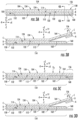
- Layer A ruptures at an interface 160 of the sealed region 154 and the unsealed region 156.
- Layer A may rupture in a direction from the bottom facial surface 114 to the top facial surface 112 of Layer A (e.g., generally perpendicular to the film top facial surface 102 or in the +/-Z direction of the coordinate axis of FIG. 3B ).
- the internal cohesion strength of the composition of Layer B is less than the initial opening force and less than the bond strengths between the top facial surface 122 of Layer B and the bottom facial surface 114 of Layer A, and between the bottom facial surface 124 of Layer B and the top facial surface 132 of Layer C.
- Layer B in the sealed region 154 cohesively fails in a direction generally parallel to the film top facial surface 102.
- Cohesive failure of Layer A results in a first portion 162 of the composition of Layer B coupled to the bottom facial surface 114 of Layer A and a second portion 164 of the composition of Layer B coupled to the top facial surface 132 of Layer C.
- the composition of Layer B covers both the top facial surface 132 of Layer C and the bottom facial surface 114 of Layer A.
- the sealed region 154 may bounded by the unsealed region 156 on one side of the sealed region 154 and a second unsealed region 157 on the other side of the sealed region.
- the initial opening force F1 may cause Layer A to rupture at the interface 160 of the sealed region 154 and the unsealed region 156 in a direction generally perpendicular to the film top facial surface 102, as previously described in relation to FIG. 3B .
- FIG. 4A a cross-section of the multilayer film 100 and substrate 150 of FIG. 3A is taken along reference line 4A-4A.
- the sealed region 154 may bounded by the unsealed region 156 on one side of the sealed region 154 and a second unsealed region 157 on the other side of the sealed region.
- the initial opening force F1 may cause Layer A to rupture at the interface 160 of the sealed region 154 and the unsealed region 156 in a direction generally perpendicular to the film top facial surface 102, as previously described in relation to FIG. 3
- the opening force F1 may cause Layer B to cohesively fail in a direction generally parallel to the film top facial surface 102, as previously described.
- cohesive failure of Layer B reaches a second interface 161 between the sealed region 154 and the second unsealed region 157
- the initial opening force F1 may cause Layer A to rupture again at the second interface 161 between the sealed region 154 and the second unsealed region 157.
- Layer A may rupture in a direction generally perpendicular to the film top facial surface 102.
- Initial opening of the multilayer film 100 activates the reclose functionality of the multilayer film resulting in the first portion 162 of the composition of Layer B on the bottom facial surface 114 of Layer A and the second portion 164 of the composition of Layer B on the top facial surface 132 of Layer C.
- the first portion 162 of the composition of Layer B may be returned into contact with the second portion 164 of the composition of Layer B and a reclose pressure F2 may be applied to the multilayer film 100 in the sealed region 154.
- the reclose pressure F2 may be applied to the multilayer film 100 in a direction generally perpendicular to the film bottom facial surface 104.
- the reclose pressure F2 may be sufficient to cause the first portion 162 and the second portion 164 of the composition of Layer B to re-adhere to reform Layer B.
- the reclose pressure F2 may be less than or equal to 1575 N/m (40 N/inch), less than or equal to 1181 N/m (30 N/inch), less than or equal to 787 N/m (20 N/inch), or even less than or equal to 394 N/m (10 N/inch).
- Applying the reclose pressure F2 to the multilayer film causes the first portion 162 and the second portion 164 of the composition of Layer B to re-adhere. Re-adherence of the first portion 162 and the second portion 164 of the composition to form a contiguous Layer B, may reseal the sealed region 154 of the multilayer film.
- the multilayer film 100 may be reopened by applying a reopen force F3 to the multilayer film 100.
- Reopen force F3 may be applied to the multilayer film in a direction generally perpendicular to the film top facial surface 102.
- the reopen force F3 may be applied by gripping the multilayer film 100 in the unsealed region 156 and pulling the multilayer film 100 away from the substrate 150.
- Application of the reopen force F3 may cause the composition of Layer B to cohesively fail in a direction parallel to the film top facial surface 102. Again, cohesive failure of the composition of Layer B results in a first portion of the composition coupled to the bottom facial surface 114 of Layer A and a second portion of the composition coupled to the top facial surface 132 of Layer C.
- the reopen force F3 may be sufficient to cause the composition of Layer B to cohesively fail. In some embodiments reopen force F3 may be greater than or equal to 39 N/m (1 N/inch), greater than or equal to 59 N/m (1.5 N/in), greater than or equal to 79 N/m (2.0 N/in), greater than or equal to 98 N/m (2.5 N/in), or even greater than or equal to 118 N/m (3 N/in) for the multilayer film 100 heat sealed to the substrate 150 at a heat seal temperature of 130 °C. The reopen force F3 may be determined according to the Peel Adhesion Test described herein. The multilayer film 100 may be subjected to multiple cycles of reopening and reclosing.
- the multilayer film 100 may exhibit a reopen force F3 of greater than or equal to 59 N/m (1.5 N/in), greater than or equal to 79 N/m (2.0 N/in), greater than or equal to 98 N/m (2.5 N/in), or even greater than 118 N/m (3.0 N/in).
- the multilayer film 100 which is initially heat sealed to the substrate 150 at a heat seal temperature of 130 °C, may exhibit a reopen force F3 after at least four reopen/reclose cycles of greater than 79 N/m (2.0 N/in).
- the multilayer film 100 may exhibit a reopen force of from 79 N/m (2.0 N/in) to 394 N/m (10.0 N/in), from 79 N/m (2.0 N/in) to 276 N/m (7.0 N/in), from 79 N/m (2.0 N/in) to 197 N/m (5.0 N/in), from 98 N/m (2.5 N/in) to 394 N/m (10.0 N/in), from 98 N/m (2.5 N/in) to 276 N/m (7.0 N/in), or from 98 N/m (2.5 N/in) to 197 N/m (5.0 N/in) after being heat sealed at a heat seal temperature of 130 °C, initially opened, and after experiencing at least 4 reclose-reopen cycles.
- a package 500 may include the substrate 150 and the multilayer film 100 sealed to at least one of the surfaces 152 of the substrate 150.
- the multilayer film 100 may be oriented so that Layer A of the multilayer film 100 face towards the surface 152 of the substrate 150 and the film top facial surface 102 may contact the surface 152 of the substrate 150.
- the multilayer film 100 is oriented so that the film top facial surface 102 is facing downward in the -Z direction of the coordinate axis of FIGS. 5A-5C .
- the package 500 may include the sealed region 154 in which at least a portion of the top facial surface 112 of Layer A of the multilayer film 100 is sealed to at least one of the surfaces 152 of the substrate 150 to form a seal between the multilayer film 100 and the substrate 150.
- the multilayer film 100 and the substrate 150 define a volume 502 therebetween for containing a composition or article.
- the substrate 150 may be a rigid substrate or a flexible substrate.
- the substrate 150 may be another portion of the multilayer film 100, such as a separate sheet of the multilayer film 100 or another part of the same sheet of the multilayer film 100.
- the substrate 150 of package 500 may include a rigid substrate.
- the substrate 150 may be a rigid tray 510 that includes a bottom wall 512 and four side walls 514 extending from the bottom wall 512 to define an open-sided container having one open side 516.
- the tray 510 may include a flange 518 coupled to the four side walls 514 and surrounding the open side 516 of the tray 510.
- the flange 518 may include a facial surface 520.
- the facial surface 520 may be oriented in a direction perpendicular to the bottom 512 of the tray 510.
- the multilayer film 100 may be any of the multilayer films previously described in this disclosure.
- the multilayer film 100 may be oriented so that the film top facial surface 102 faces and contacts the facial surface 520 of the tray 510 (i.e., in the -Z direction of the coordinate axis of FIG. 5B ).
- the multilayer film 100 may have a shape that conforms to an outer shape of the flange 518 of the tray 510 such that a plurality of edges 524 of the multilayer film 100 are positioned proximal to the outer edges 522 of the flange 518 of the tray 510.
- package 500 is described in the context of using multilayer film 100 with three layers, it is understood that multilayer films incorporating the composition disclosed herein and having more than three layers, such as multilayer film 200 for example, may also be used to make the package 500.
- the multilayer film 100 may be sealed to the facial surface 520 of the flange 518 of the tray 510 to form the sealed region 154 that extends along the flange 518.
- the multilayer film 100 may be sealed to the facial surface 520 of the flange 518 by heat sealing, applying an adhesive, or other conventional sealing process.
- the sealed region 154 may extend around the entire perimeter of the open side 516 of the tray 510 so that the volume 502 of the tray 510 is completely enclosed and isolated from the ambient atmosphere.
- the sealed region 154 may extend to the edges 524 of the multilayer film 100.
- the sealed region 154 may extend to the outer edges 522 of the flange 518.
- the sealed region 154 may be spaced apart from the edges 524 of the multilayer film 100, the outer edges 522 of the flange 518, or both.
- the sealed region 154 may have a width W1 , and the flange 518 may have a width W2.
- the width W1 of the sealed region 154 may be less than or equal to the width W2 of the flange 518.
- the multilayer film 100 may be sealed to other surfaces of the tray 510, such as the surfaces of the side walls 514 of the tray 510.
- the width W1 of the sealed region 154 may be adjusted to change the initial opening force or reopen force needed to initially open or reopen the package 500.
- the multilayer film 100 of the package 500 may include a tab 528 proximal to an edge 524 of the multilayer film 100.
- the multilayer film 100 may not be sealed to the flange 518 of the tray 510.
- the tab 528 may include an unsealed region of the multilayer film 100 extending outward from the sealed region 154.
- the tab 528 may provide a location from which to apply an initial opening force, a reopen force, or both to the multilayer film 100 to enable opening or reopening of the package 500.
- the unsealed region 156 of the multilayer film 100 that is disposed inward from the sealed region 154 may extend over the open side 516 of the tray 510 to cover the open side 516 of the tray 510.
- the bottom wall 512 and side walls 514 of the tray 510 and the unsealed region 156 of the multilayer film 100 may define the volume 502 of the package 500.
- the package 500 may be initially opened to activate a reclose functionality of the multilayer film 100.
- an initial opening force F1 may be applied to the multilayer film 100 to pull the multilayer film 100 away from the tray 510 to thereby open the package 500.
- Layer A of the multilayer film 100 may fail in a direction generally perpendicular to the facial surface 520 of the flange 518 at the interface 160, the second interface 161, or both, and Layer B may cohesively fail in a direction generally parallel to the facial surface 520 of the flange 518.
- Cohesive failure of Layer B of the multilayer film 100 may result in the first portion 162 of the composition of Layer B coupled to the bottom facial surface 114 of Layer A and the second portion 164 of the composition of Layer B coupled to the top facial surface 132 of Layer C.
- the package 500 may be reclosed by returning the multilayer film 100 into contact with the tray 510 so that the first portion 162 and the second portion 164 of the composition of Layer B in the sealed region 154 come into contact.
- a reclose pressure may be applied to the multilayer film 100 in a direction towards the flange 518 of the tray 510 to adhere the first portion 162 and the second portion 164 of the composition of Layer B together to reclose and reseal the package 500.
- the package 500 may be reopened by again applying a force to pull the multilayer film 100 away from the tray 510.
- the package 500 may be reclosed and reopened one or a plurality of times.
- the multilayer film 100 may exhibit an initial opening force F1 of less than 1575 N/m (40 N/inch), less than 1457 N/m (37 N/inch), less than 1378 N/m (35 N/inch), or less than 1181 N/m (30 N/inch) and a reopen force of greater than or equal to 79 N/m (2.0 N/inch), greater than 98 N/m (2.5 N/inch), or even greater than 118 N/m (3.0 N/inch) after at least 4 reclose/reopen cycles.
- F1 initial opening force F1 of less than 1575 N/m (40 N/inch), less than 1457 N/m (37 N/inch), less than 1378 N/m (35 N/inch), or less than 1181 N/m (30 N/inch) and a reopen force of greater than or equal to 79 N/m (2.0 N/inch), greater than 98 N/m (2.5 N/inch), or even greater than 118 N/m (3.0 N/inch) after at least 4 reclose/
- the multilayer film 100 may be used in making pouch packages, which are identified herein by reference number 600.
- the pouch package 600 may be a vertical form fill seal (VFFS) pouch package.
- the pouch package 600 may generally include a single sheet 601 of a flexible film, such as the multilayer film 100, the sheet 601 having a first end 606 and a second end 607 oriented in the transverse direction (i.e., extending in the +/-X direction of the coordinate axis in FIG. 6B ).
- the sheet 601 may also include a first longitudinal edge 608 and a second longitudinal edge 609, which both extend in the longitudinal direction (i.e., in the +/-Y direction of the coordinate axis of FIG. 6B ) from the first end 606 to the second end 607.
- the first longitudinal edge 608 and the second longitudinal edge 609 are brought into contact with each other and sealed together to form a sleeve 602 that defines an internal volume 604 of the pouch package 600.
- the first longitudinal edge 608 may be sealed to the second longitudinal edge 609 so that the same side of the film is in adhering contact with itself.
- sealing the first longitudinal edge 608 to the second longitudinal edge 609 forms a fin seal 630 that extends longitudinally (i.e., in the +/-Y direction of the coordinate axis in FIGS. 6A-6C ) along one side of the pouch package 600 from the first end 606 to the second end 607.
- the first end 606 may be sealed together to form a first end seal 610.
- the contents of the pouch package 600 may be filled into the internal volume 604 of the pouch package 600 and the second end 607 may be sealed to form a second end seal.
- Portions of the fin seal 630 may overlap with the first end seal 610 and the second end seal 620 at the first and second ends 606, 607 of the pouch package 600, respectively.
- the pouch package 600 may be formed filled and sealed using any conventional pouch packaging systems.
- Conventional pouch packages can be opened by grasping the fin seal and the opposite face of the package and pulling apart one of the end seals.
- the amount of force needed to open the package depends on the amount of sealing material in the end seal.
- the end seal of a conventional pouch package may be at least 3 cm long and at least a 1.5 cm wide. The size of the end seal may require additional force to open the package. Additionally, extra unsealed film material may be needed to provide a place to grasp the opposite face. Therefore, the internal volume 604 of the conventional package may need to be larger than the volume of the contents contained therein to allow for opening of the package.
- Many conventional pouch packages are sealed at the end seals and fin seal using an acrylic or water-based cold set adhesive. These acrylic or water-based adhesives do not provide reclose and reopen functionality to the conventional pouch package. Additionally, the application of acrylic or water-based adhesives may require additional processing steps to make and seal the conventional pouch package.
- the pouch package 600 of the present disclosure is made using the multilayer film 100 described herein, which may provide reopen/reclose functionality to the pouch package 600. Additionally, the pouch package 600 may be opened from the fin seal 630 of the pouch package 600, which may enable control of the initial opening force, reopen force, or both by changing the geometry of the fin seal 630.
- the single sheet 601 of flexible film may include the multilayer film 100 so that the pouch package 600 may be constructed entirely of the multilayer film 100.
- the longitudinal edges 608, 609 may be brought into contact with each other with the film top facial surface 102 of the multilayer film 100 at the first longitudinal edge 608 facing and contacting the film top facial surface 102 of the second longitudinal edge 609 along the fin seal 630.
- the sealing composition of Layer A at the first longitudinal edge 608 is in contact with the sealing composition of Layer A at the second longitudinal edge 609.
- the film top facial surface 102 of the multilayer film 100 therefore, forms the inner surface of the pouch package 600 that defines the internal volume 604 of the pouch package, as shown in FIG. 6C .
- Layer C and the film bottom facial surface 104 of the multilayer film 100 therefore, face outward from the internal volume 604 of the pouch package 600.
- the first longitudinal edge 608 and the second longitudinal edge 609 may be sealed together, such as by heat sealing for example, along the fin seal 630 to form a fin 632.
- the fin 632 may include the fin seal 630 and a tab 640 positioned proximal to the first and second longitudinal edges 608, 609 of the multilayer film 100.
- the fin 632 may extend away from the internal volume 604 of the pouch package 600.
- the fin 632 is shown in FIG. 6C as extending vertically upward (i.e., +Z direction of the coordinate axis of FIG. 6C ), however, the fin 632 may often fold down against the side of the pouch package 600 after filling and sealing.
- the tab 640 may be a portion of the fin 632 in which the multilayer film 100 is unsealed.
- the fin seal 630 may be disposed between the tab 640 and the sleeve 602 defining the internal volume 604 of the pouch package 600.
- the fin seal 630 may comprise the sealed region 154 of the multilayer film 100, and the sleeve 602 and the tab 640 may comprise the unsealed regions 156 of the multilayer film 100.
- the tab 640 may provide a region in which the first and second longitudinal edges 608, 609 of the multilayer film 100 may be grasped to facilitate initial opening and reopening of the pouch package 600.
- the tab 640 may extend the entire longitudinal dimension of the fin 632 or may extend over only a portion of the longitudinal dimension of the fin 632.
- the fin 632 may have an overall height H measured from the sleeve 602 of the pouch package 600 to the first and second longitudinal edges 608, 609 of the multilayer film 100.
- the fin seal 630 may have a fin seal height H S measured from the sleeve 602 to the tab 640.
- the tab 640 may have a tab height H T measured from the fin seal 630 to the first and second longitudinal edges 608, 609 of the multilayer film 100.
- first end seal 610 and the second end seal 620 may also be sealed with the film top facial surfaces 102 facing each other so that Layer A of the multilayer film 100 is sealed to itself along the first end seal 610 and the second end seal 620.
- first end seal 610, the second end seal 620, or both may exhibit reopen/reclose functionality after initial opening of the pouch package 600.
- the sheet 601 used to make the pouch package 600 may be constructed of a flexible film different from the multilayer film 100 disclosed herein, and the sheet 601 may include one or a plurality of strips of the multilayer film 100 coupled to the flexible film along the first longitudinal edge 608, the second longitudinal edge 609, or both of the sheet 601.
- a width of the strip of the multilayer film 100 may be greater than or equal to the height H of the fin 632 of the pouch package 600.
- the first and second longitudinal edges 608, 609 may be sealed along the strip of the multilayer film 100 to form the fin seal 630.
- the strips of the multilayer film 100 at the fin seal 630 may provide reopen/reclose functionality to the pouch package 600.
- additional strips of the multilayer film 100 may be included along the first end 606, the second end 607, or both so that the first end seal 610, second end seal 620, or both may also exhibit reopen/reclose functionality.
- the pouch package 600 is described herein in the context of the multilayer film 100 with three layers, it is understood that multilayer films incorporating the compositions disclosed herein and having more than three layers, such as multilayer film 200 for example, may also be used to make the pouch package 600.
- the pouch package 600 may be initially opened at the fin seal 630 to activate the reclose/reopen functionality of the multilayer film 100 in the sealed region 154 corresponding to the fin seal 630.
- the reclose/reopen functionality of the multilayer film 100 is not activated until the pouch package 600 is initially opened.
- an initial opening force F1 may be applied to the multilayer film 100 at the first longitudinal edge 608 and the second longitudinal edge 609 to pull apart the longitudinal edges 608, 609 of the multilayer film 100 along the fin seal 630 to thereby open the pouch package 600.
- first longitudinal edge 608 may be grasped in one hand
- second longitudinal edge 609 may be grasped in the other hand
- the force F1 may be applied to both of the first and second longitudinal edges 608, 609 of the multilayer film 100.
- Layer A of the multilayer film 100 may fail in a direction generally perpendicular to the film top facial surface 102 of the multilayer film 100 (e.g., in the +/-X direction as shown in FIG. 7B ) at the interface 160, which is at the transition point between the fin seal 630 and the tab 640.
- Layer B may then cohesively fail in a direction generally parallel to the film top facial surface 102 of the multilayer film 100 (e.g., in the +/-Z direction as shown in FIG. 7B ).
- Cohesive failure of Layer B of the multilayer film 100 may result in the first portion 162 of the composition of Layer B coupled to the bottom facial surface 114 of Layer A and the second portion 164 of the composition of Layer B coupled to the top facial surface 132 of Layer C.
- FIG. 7B shows Layer A and Layer B of the multilayer film 100 at the second longitudinal edge 609 as failing during initial opening of the pouch package 600. However, it is understood that the Layer A and Layer B of the multilayer film 100 on the first longitudinal edge 608 may fail during initial opening of the pouch package 600. Continued application of the opening force F1 to the fin seal 630 may also cause initial opening of the multilayer film 100 at the first end seal 610, second end seal 620, or both.
- the pouch package 600 may be reclosed by returning the first portion 162 of the composition of Layer B into contact with the second portion 164 of the composition of Layer B along the fin seal 630 and/or the first or second end seal 610, 620.
- a reclose pressure may be applied to the multilayer film 100 from both sides of the fin seal 630 (and/or end seals 610, 620) to adhere the first portion 162 and the second portion 164 of the composition of Layer B together to reclose and reseal the pouch package 600 along the fin seal 630 (and/or end seals 610, 620).
- the pouch package 600 may be reopened by again applying a force to pull the multilayer film 100 apart again at the fin seal 630 or end seals 610, 620.
- the pouch package 600 may be reclosed and reopened through a plurality of reclose/reopen cycles.
- the multilayer film 100 may exhibit an initial opening force F1 of less than 1575 N/m ( (40 N/inch), less than 1457 N/m (37 N/inch), less than 1378 N/m (35 N/inch), or less than 1181 N/m (30 N/inch) and a reopen force of greater than or equal to 79 N/m (2.0 N/inch), greater than 98 N/m (2.5 N/inch), or even greater than 118 N/m (3.0 N/inch) after at least 4 reclose/reopen cycles.
- F1 initial opening force F1 of less than 1575 N/m ( (40 N/inch), less than 1457 N/m (37 N/inch), less than 1378 N/m (35 N/inch), or less than 1181 N/m (30 N/inch) and a reopen force of greater than or equal to 79 N/m (2.0 N/inch), greater than 98 N/m (2.5 N/inch), or even greater than 118 N/m (3.0 N/inch) after at least 4 re
- the initial opening force F1 to initially open the pouch package 600 and activate the reclose/reopen functionality and the reopen force to reopen the pouch package 600 after reclosing may be controlled by changing the dimensions of the fin seal 630.
- increasing the fin seal height H S of the fin seal 630 may increase the magnitude of the initial opening force F1 needed to initially open the pouch package 600 by increasing the amount of Layer B that must cohesively fail to initially open the fin seal 630.
- decreasing the fin seal height H S may decrease the magnitude of the initial opening force F2 .
- Increasing or decreasing the fin seal height H S may also increase or decrease, respectively, the reopen force needed to reopen the pouch package 600.
- the fin seal 630 may have a fin seal height H S sufficient to prevent inadvertent opening of the fin seal 630 prior to initial opening of the fin seal 630. In some embodiments, the fin seal 630 may have a fin seal height H S small enough to enable the fin seal 630 to be opened with an initial opening force less than 1575 N/m (40 N/inch), less than 1457 N/m (37 N/inch), less than 1378 N/m (35 N/inch), or less than 1181 N/m (30 N/inch).
- the fin seal 630 may have a fin seal height H S less than or equal to 2.5 cm (1.0 inches), less than or equal to 1.9 cm (0.75 inches), or less than or equal to 1.3 cm (0.5 inches), or less than or equal to 0.64 cm (0.25 inches).
- Changing the fin seal height H S may be accomplished by increasing or decreasing the overall transverse width of the sheet 601 used to make the pouch package 600.
- the overall transverse width of the sheet 601 is measured as the transverse distance (i.e., distance in the +/-X direction of the coordinate axis of FIG. 6B ) between the first longitudinal edge 608 and the second longitudinal edge 609 of the sheet 601 prior to forming the sheet 601 into the sleeve 602.
- a wider sheet 601 i.e., a sheet 601 having a larger overall transverse width
- the initial opening force F1 needed to open the pouch package 600 may also be controlled by controlling the sealing temperature, sealing pressure, or both used to initial seal the fin seal 630.
- the tab 640 may have various shapes and positions relative to the fin seal 630.
- the tab 640A may extend the entire longitudinal length L1 of the fin seal 630 from the first end 606 to the second end 607 of the pouch package 600.
- the tab height H T of the tab 640A may be the same along the longitudinal length L1 or may vary along the longitudinal length L1 of the fin seal 630.
- tab 640B, 640C may be positioned proximal to the first end 606 or the second end 607 of the pouch package 600 and may extend only partially along the longitudinal length L1 of the fin seal 630. As shown in FIG.
- tab 640B may have a tab height H T that changes as a function of position along fin seal 630 (i.e., changes as a function of the +/-Y position of the coordinate axis in FIG. 8B ).
- tab 640C may have a tab height H T that is constant with respect to the +/-Y position along the fin seal 630.
- the tab 640D may have a tab length L2 that is less than the longitudinal length L1 of the fin seal 630.
- the tab 640D may be disposed in the middle of the longitudinal length L1 of the fin seal 630 to that the tab 640D is not proximal to the first end 606 or the second end 607 of the pouch package 600.
- Other shapes, sizes, and configurations of the tab 640 are contemplated.
- the first longitudinal edge 608 may be overlapped with the second longitudinal edge 609 and sealed so that the film top facial surface 102 of the multilayer film 100 along the first longitudinal edge 608 is in adhering contact with the film bottom facial surface 104 of the multilayer film 100 along the second longitudinal edge 609.
- the first longitudinal edge 608 may be sealed to the second longitudinal edge 609 to form a lap seal instead of the fin seal 630 depicted in FIGS. 6A-6C .
- the multilayer film 100 disclosed herein may be used in making various other pouch packages, such as stand-up pouch 900 in FIGS. 9A and 9B and pillow pouch 950 in FIG. 9C .
- the stand-up pouch 900 may include a first side 902, a second side 904, and a bottom 906 extending between the first side 902 and the second side 904.
- the bottom 906 may include a gusset 908 to provide a contoured bottom to the stand-up pouch 900.
- the first side 902 may be coupled to the second side 904 along a first edge seal 912, a second edge seal 914, and a top edge seal 916.
- the first side 902 may be coupled to the second side 904 by heat sealing or other sealing process.
- one or more than one of the first side 902, the second side 904, or the bottom 906 of the stand-up pouch 900 may be made from the multilayer film 100.
- the multilayer film 100 may be oriented so that Layer A ( FIG. 1 ) and the film top facial surface 102 ( FIG. 1 ) may face inward towards the internal volume of the stand-up pouch 900.
- the film top facial surface 102 may define at least a portion of the internal volume of the stand-up pouch 900.
- Layer C and the film bottom facial surface 104 may face outward, away from the internal volume of the stand-up pouch 900.
- Layer C of the multilayer film may comprise the outer surface of the first side 902, the second side 904, and/or the bottom 906 of the stand-up pouch 900.
- the sealing composition of Layer A of the multilayer film 100 may be sealed to (i.e., in adhering contact with) the inner surface of the opposite side of the stand-up pouch 900 along the first edge seal 912, the second edge seal 914, and/or the top edge seal 916.
- the multilayer film 100 may be initially opened at the first edge seal 912, the second edge seal 914, and/or the top edge seal 916 to activate the reclose/reopen functionality of the multilayer film 100.
- first side 902 and the second side 904 may be made from a flexible film and strips of the multilayer film 100 may be disposed between the first side 902 and the second side 904 of the stand-up pouch 900 along the first edge seal 912, the second edge seal 914, and/or the top edge seal 916.
- pillow pouch 950 may include a first side 952 and a second side (not shown).
- the first side 952, the second side, or both may include the multilayer film 100.
- the multilayer film 100 may be oriented with Layer A ( FIG. 1 ) and the film top facial surface 102 ( FIG. 1 ) of the facing inward toward the other side of the pillow pouch 950 (i.e., the first side 952 or second side).
- the film bottom facial surface 104 of the multilayer film 100 may face outward to form an outer surface of the pillow pouch 950.
- the first side 952 and the second side may be sealed together along the sealed region 154, which may be proximal to the outer edges of the first side 952 and the second side.
- the reclosable box 1000 may include a box 1010 comprising a top panel 1012, a bottom panel 1014, and a plurality of side panels 1016 extending from the bottom panel 1014 to the top panel 1012.
- the box 1010 may be made from a rigid or semi-rigid material, such as fiberboard, cardboard, corrugated cardboard, rigid plastic, metal, ceramic, other rigid materials, or combinations of these.
- the top panel 1012, bottom panel 1014, and plurality of side panels 1016 may define an internal volume of the reclosable box 1000.
- the top panel 1012 may include an opening 1018 from which to dispense the contents of the reclosable box 1000.
- the reclosable box 1000 may include the multilayer film 100 positioned to cover the opening 1018 in the top panel 1012 and sealed to the top panel 1012 to cover the opening 1018.
- the multilayer film 100 may be oriented so that Layer A ( FIG. 1 ) and the film top facial surface 102 may face inward towards the top panel 1012 so that the film top facial surface 102 contacts the top panel 1012 of the reclosable box 1000.
- Layer C and the film bottom facial surface 104 of the multilayer film 100 may face outward, away from the top panel 1012 of the reclosable box 1000.
- the multilayer film 100 may be heat sealed or otherwise adhered to an outer surface 1022 of the box 1010 proximal to and surrounding the perimeter of the opening 1018 of the box 1010.
- the multilayer film 100 may be sealed to the box 1010 before or after folding the box into its final shape.
- the sealed region 154 of the multilayer film 100 may include regions of the multilayer film 100 for which the film top facial surface 102 is in adhering contact with the outer surface 1022 of the box 1010.
- the unsealed region 156 of the multilayer film 100 may include the portion of the multilayer film 100 covering the opening 1018 of the box 1010.
- the multilayer film 100 may include the tab 158 for initially opening and reopening the multilayer film 100. At the tab 158, the film top facial surface 102 of the multilayer film 100 is not adhered or sealed to the outer surface 1022 of the box 1010.
- the reclosable box 1000 may be opened by initially opening the multilayer film 100.
- the multilayer film 100 may be opened by introducing an initial opening force to the multilayer film 100 in a direction away from the outer surface 1022 of the box 1010.
- the tab 158 may be used to pull the multilayer film 100 in a direction away from the outer surface 1022 of the box 1010.
- Layer A may break at the edge of the tab 158 and Layer B may cohesively fail in the sealed region 154, leaving the first portion 162 of the composition of Layer B on the bottom facial surface 114 of Layer A and the second portion 164 of the composition on the top facial surface 132 of Layer C.
- Layer A may remain sealed to the outer surface 1022 of the box 1010 in the sealed region 154 as Layer C and the second portion 164 of the composition is pulled away from the box 1010. As the initial opening force continues to be applied, Layer A may break at the interface of the sealed region 154 and the unsealed region 156 to uncover the opening 1018 of the box 1010.
- Initially opening the multilayer film 100 may activate the reclose/reopen functionality of the multilayer film 100.
- the multilayer film 100 may be reclosed by returning the multilayer film 100 to its original position with the second portion 164 of the composition of Layer B in contact with the first portion 162 of the composition in the sealed region 154 and applying a reclose pressure to the multilayer film 100.
- the multilayer film 100 may be reopened and reclosed through multiple reclose cycles to open and close the reclosable box 1000.
- the opening 1018 may be positioned in one of the side panels 1016 of the box 1010.
- the multilayer film 100 may be adhered or sealed to the side panel 1016 surrounding the opening 1018.
- the reclosable box 1000 is described herein in the context of the multilayer film 100 with three layers, it is understood that multilayer films incorporating the compositions disclosed herein and having more than three layers, such as multilayer film 200 for example, may also be used to make the reclosable box 1000.
- FIGS. 5A-10B illustrate only a few examples of reclosable package designs that can incorporate the multilayer film 100 and compositions according to embodiments of the present disclosure.
- a person of ordinary skill in the art can readily identify other package types, shapes, and sizes in which the multilayer film and composition disclosed herein may be incorporated.
- the multilayer film and/or compositions may be incorporated into package shapes and sizes for which zippers or other mechanical means have been used to provide reclosability to the package.
- the multilayer films and compositions may be incorporated into a broad range of package types and shapes that include at least one flexible film.
- Examples of these packaging types may include tray packaging; pouch packaging such as pillow pouches, vertical form fill and seal (VFFS) packaging, horizontal form fill and seal packages, stand-up pouches, or other pouches; bags; boxes; or other type of packaging.
- the reclosable films and compositions may be incorporated into primary packaging or secondary packaging, such as overwraps, bags, or other secondary packaging.
- Other packaging types, shapes and sizes having the reclosable film and/or compositions disclosed herein are also contemplated.
- the reclosable packaging disclosed herein may be used to package food products, beverages, consumer goods, personal care items, or other articles.
- Food products that may be packaged using the reclosable packaging disclosed herein may include particular food products, such as sugar, spices, flour, coffee, or other particulates; solid food products; such as meats, cheeses, snacks, vegetables, baked goods, pet food, pasta, or other solid food products; liquid food products, such as milk, soup, beverages, or other liquid food products; and/or bulk food items such as rice, dog food, flour or other grains, or other bulk food items.
- Consumer goods that may be packaged using the reclosable packaging may include consumer electronics, hardware, toys, sporting goods, plastic utensils, autoparts, batteries, cleaning supplies, software packages, salt, or other consumer goods.
- the reclosable packages disclosed herein may also be incorporated into post-consumer storage bags, such as food storage bags or freezer bags. A person of ordinary skill in the art can recognize many other potential uses for the reclosable packaging disclosed herein.
- Density is measure in accordance with ASTM D792 and reported in grams/cubic centimeter (g/cc or g/cm 3 ).
- melt index (I 2 ) is measured in accordance with ASTM D1238-10, under conditions of 190 °C and 2.16 kg of load. The melt index (I 2 ) is reported in grams eluted per 10 minutes (g/10 min).
- DSC can be used to measure the melting, crystallization, and glass transition behavior of a polymer over a wide range of temperature.
- the DSC analysis may be performed on a TA Instruments Q1000 DSC, equipped with a refrigerated cooling system (RCS) and an autosampler is used to perform the analysis.
- RCS refrigerated cooling system
- a nitrogen purge gas flow of 50 ml/min is used.
- Each sample is melt pressed into a thin film at about 175 °C.
- the melted sample is then air-cooled to room temperature (about 25 °C).
- a 3-10 mg, 6 mm diameter specimen is extracted from the cooled polymer, weighed, placed in a light aluminum pan (ca 50 mg), and crimped shut. Analysis is then performed to determine its thermal properties.
- Tm Melting point
- Tg Glass transition temperature
- DMS Dynamic Mechanical Spectroscopy
- a 1.5 mm plaque is pressed, and cut in a bar of dimensions 32 ⁇ 12 mm (test sample).
- the test sample is clamped at both ends between fixtures separated by 10 mm (grip separation AL), and subjected to successive temperature steps from -100 °C to 200 °C (5 °C per step).
- the torsion modulus G' is measured at an angular frequency of 10 rad/s, the strain amplitude being maintained between 0.1 percent and 4 percent, to ensure that the torque is sufficient and that the measurement remained in the linear regime.
- Constant frequency temperature sweeps are performed using a TA Instruments ARES strain rheometer equipped with 8 mm parallel plates geometry under a nitrogen purge. Temperature sweeps are performed at 1 Hz frequency, from -40 °C to 200 °C for all the samples at a gap of 2.0 mm and at a constant strain of 10%. The frequency interval is 0.1 to 100 radians/seconds.
- the stress response is analyzed in terms of amplitude and phase, from which the storage modulus (G'), loss modulus (G”) and dynamic melt viscosity (eta ⁇ , or ⁇ ⁇ ) are calculated.
- the adhesion test follows the general framework of PSTC - 101 test method A from the Pressure Sensitive Tape Council (PSTC). This is a 180° angle peel, at 305 mm/minute, against some surface of interest.
- PSTC Pressure Sensitive Tape Council
- a second piece of masking tape is used to fix the folded end of the test specimen to the panel; here, the tape is placed approximately 10 mm from the fold [masking tape /PET/ solventless adhesive/ core (3 layers) / PSA/ sealant / sealant/ PSA/ core (3 layers) / solventless adhesive / PET/ fixed to panel with masking tape; the adhesive on the masking tape is in contact with the upper PET layer of the folded end of the test specimen.]
- the other free end of the test specimen is peeled at 180° from the fixed free end of the test specimen, causing a break within the PSA for Examples 1-5 and at the PSA - core interface for Comparative Examples 1 and 2 [Free end: PET/ solventless adhesive / core (3 layers) / - BREAK - PSA / sealant/ sealant/ PSA/ core (3 layers)/ solventless adhesive/ PET- panel], and giving a force value.
- compositions of the following examples and comparative examples were compounded using a single stage twin-screw extrusion process.
- the compounding operation is performed on a Century- ZSK-40 45.375 length-to-diameter ratio (L/D) ( Eleven Barrels) extruder using one screw design with one oil injector, in barrel 4.
- L/D length-to-diameter ratio
- the extruder has a maximum screw speed of 1200 rpm.
- the polymers and the PICCOTAC tackifier were fed into the main feed throat of the extruder.
- the HYDROBRITE 550 process oil is added through an injection port at barrel 4.
- the compound is pelletized using an underwater Gala system, which is equipped with a 12 hole (2.362 mm hole diameter) Gala die with 6 holes plugged, and a 4 blade hub cutter. Soap and antifoam were added to the water bath as needed to prevent clumping. The pellets were collected and dusted with 2000 ppm POLYWAX 2000 (available from Baker Hughes), and then dried under nitrogen purge for 24 hours. Screw speed is set at 180 RPM for all the samples.
- Temperature profile is set as follows: 100 °C (zone 1), 100 °C (zone 2), 180 °C (zone 3), 180 °C (zone 4), 160 °C (zone 5), 160 °C (zone 6), 110 °C (zone 7), 110 °C (zone 8), 90 °C (zone 9), 90 °C (zone 10), and 90 °C (zone 11), with a die temperature of 140 °C.
- Table 1 below includes properties of commercial polymers used in the Examples that follow.
- Table 1 Properties of commercial polymers Material Melt Index (I 2 ) g/10 min Density (g/cc) Supplier INFUSE TM 9107 (olefin block copolymer) 1.00 0.866 The Dow Chemical Company, Midland, MI DOW TM LDPE 5004i (LDPE) 4.20 0.924 The Dow Chemical Company, Midland, MI DOWLEX TM NG 2038.68G (LLDPE) 1.00 0.935 The Dow Chemical Company, Midland, MI ENGAGE TM 8842 (polyolefin plastomer) 1.00 0.857 The Dow Chemical Company, Midland, MI VECTOR ® 4113A (styrene-isoprene triblock copolymer) 9.20 0.920 Dexco Polymers, Houston, TX VECTOR ® 4213A (SIS triblock/SI diblock copolymer) 12.0 0.940 Dexco Polymers, Houston, TX ELVAX ® 31
- Example 1 Example Composition
- a composition according to the present disclosure was made by combining 43.4 wt.% ethylene/ ⁇ -olefin random copolymer, 20 wt.% styrenic block copolymer, 30 wt.% tackifier, and 6.6 wt.% mineral oil.
- the ethylene/ ⁇ -olefin random copolymer was ENGAGE TM 8842.
- the styrenic block copolymer was VECTOR 4113A styrene-isoprene triblock copolymer, which had a styrene content of 18 wt.%, and a diblock content of 42 wt.%.
- the tackifier was PICCOTAC 1100 C 5 tackifier available from Eastman Chemical Company.
- the tackifier has a ring and ball softening point of 100 °C and a Mw of 2900.
- the mineral oil was HYDROBRITE 550 mineral oil available from Sonneborn and exhibited a density of 0.87 g/cm 3 and paraffinic carbon content of about 70 wt.%.
- Example 1 The individual constituents of the composition of Example 1 were compounded according to the previously described single stage twin-screw extrusion process. The composition of Example 1 was then tested for density, melt index (I 2 ) at a temperature of 190 °C and a load of 2.16 kg, and melt flow rate at a temperature of 230 °C and a load of 2.16 kg. The results for the density, melt index (I 2 ), and melt flow rate for the composition of Example 1 are provided below in Table 2.
- Comparative Example 2 Comparative Adhesive Composition Formulated with Olefin Block Copolymer
- Comparative Example 2 a comparative adhesive composition was produced using an olefin block copolymer in place of the ethylene/ ⁇ -olefin random copolymer of Example 1.
- the composition of Comparative Example 2 included 43.4 wt.% olefin block copolymer, 20 wt.% of the styrenic block copolymer, 30 wt.% tackifier, and 6.6 wt.% mineral oil.
- the olefin block copolymer was INFUSE TM .
- the styrenic block copolymer, tackifier, and mineral oil in Comparative Example 2 were the same as described above for Example 1.
- Comparative Example 2 The individual constituents of Comparative Example 2 were compounded using the previously described single stage twin-screw extrusion process.
- the composition of Comparative Example 2 was tested for density, melt index (I 2 ) at a temperature of 190 °C and a load of 2.16 kg, and melt flow rate at a temperature of 230 °C and a load of 2.16 kg.
- the results for the density, melt index (I 2 ), and melt flow rate for the composition of Comparative Example 2 are provided below in Table 2.
- Comparative Example 3 Comparative Adhesive Composition Formulated with a Lesser Amount of Olefin Block Copolymer.
- Comparative Example 3 a comparative adhesive composition was produced using an olefin block copolymer in place of the ethylene/ ⁇ -olefin random copolymer of Example 1.
- the composition of Comparative Example 3 included less olefin block copolymer and more styrenic block copolymer compared to the composition of Comparative Example 2.
- Comparative Example 3 was prepared to investigate the effect of increasing the amount of the styrenic block copolymer in the adhesive composition.
- the composition of Comparative Example 3 included 33.4 wt.% olefin block copolymer, 30 wt.% of the styrenic block copolymer, 30 wt.% tackifier, and 6.6 wt.% mineral oil.
- the olefin block copolymer was INFUSE TM 9107.
- the styrenic block copolymer, tackifier, and mineral oil were the same as described above for Example 1.
- Comparative Example 3 The individual constituents of Comparative Example 3 were compounded using the previously described single stage twin-screw extrusion process.
- the composition of Comparative Example 3 was tested for density, melt index (I 2 ) at a temperature of 190 °C and a load of 2.16 kg, and melt flow rate at a temperature of 230 °C and a load of 2.16 kg.
- the results for the density, melt index (I 2 ), and melt flow rate for the composition of Comparative Example 3 are provided below in Table 2.
- Comparative Example 4 a commercially available pressure sensitive adhesive composition marketed as providing reclose capability to multilayer film compositions was obtained.
- the commercially available composition comprised a styrene-isoprene-styrene block copolymer, hydrocarbon tackifier, and talc.
- the commercially available composition did not include a polyethylene component, such as a polyethylene/ ⁇ -olefin copolymer.
- the commercially available adhesive composition was tested for density, melt index (I 2 ) at a temperature of 190 °C and a load of 2.16 kg, and melt flow rate at a temperature of 230 °C and a load of 2.16 kg. The results for the density, melt index (I 2 ), and melt flow rate for the composition of Comparative Example 4 are provided below in Table 2.
- Comparative Example 5 Comparative Adhesive Composition Formulated with Styrenic Block Copolymer, Tackifier, and Oil
- Comparative Example 5 a comparative adhesive composition was produced using a styrenic block copolymer without the ethylene/ ⁇ -olefin random copolymer of Example 1.
- the composition of Comparative Example 5 included 64.3 wt.% styrenic block copolymer, 30 wt.% tackifier, and 6.6 wt.% mineral oil.
- the styrenic block copolymer was VECTOR ® 4213A SIS triblock/SI diblock copolymer.
- the tackifier and mineral oil were the same as described above for Example 1.
- Comparative Example 5 The individual constituents of Comparative Example 5 were compounded using the previously described single stage twin-screw extrusion process.
- the composition of Comparative Example 5 was tested for density, melt index (I 2 ) at a temperature of 190 °C and a load of 2.16 kg, and melt flow rate at a temperature of 230 °C and a load of 2.16 kg.
- the results for the density, melt index (I 2 ), and melt flow rate for the composition of Comparative Example 5 are provided below in Table 2.
- Comparative Example 6 Comparative Adhesive Composition Formulated with EVA and Styrenic Block Copolymer
- Comparative Example 6 a comparative adhesive composition was produced using an ethylene-vinyl acetate copolymer (EVA) in place of the ethylene/ ⁇ -olefin random copolymer of Example 1.
- the composition of Comparative Example 6 included 20.0 wt.% EVA, 43.4 wt.% styrenic block copolymer, 30 wt.% tackifier, and 6.6 wt.% mineral oil.
- the EVA was ELVAX ® ethylene-vinyl acetate copolymer having 9 wt.% vinyl acetate.
- the styrenic block copolymer, tackifier, and mineral oil were the same as described above for Example 1.
- Comparative Example 6 The individual constituents of Comparative Example 6 were compounded using the previously described single stage twin-screw extrusion process.
- the composition of Comparative Example 6 was tested for density, melt index (I 2 ) at a temperature of 190 °C and a load of 2.16 kg, and melt flow rate at a temperature of 230 °C and a load of 2.16 kg.
- the results for the density, melt index (I 2 ), and melt flow rate for the composition of Comparative Example 6 are provided below in Table 2.
- Example 7 Comparison of Properties of the Compositions of Example 1 and Comparative Examples 2-6
- Table 2 which is provided below, includes the density, melt index (I 2 ), and melt flow rate for the composition of Example 1 and the adhesive compositions of Comparative Examples 2-6.
- Table 2 Properties of the composition of Example 1 compared to the properties of the adhesive compositions of Comparative Examples 2-4
- I2 Melt Index
- MFR 230°C/2.16 kg
- Example 1 The composition of Example 1 and the adhesive compositions of Comparative Examples 2, 3, 5, and 6 were additionally tested using DSC to determine the melting curves of the compositions, from which the crystallization temperatures (Tc °C), melt temperature (Tm °C), glass transition temperature (Tg °C), heat of crystallization ( ⁇ Hc joules/gram (J/g)), and heat of melting ( ⁇ Hm J/g) for each composition, in accordance with the testing procedure previously described herein. These properties are provided below in Table 3.
- Example 1 and the adhesive compositions of Comparative Examples 2, 3, 5, and 6 were additionally testing using DMS to determine the dynamic melt viscosity ( ⁇ ⁇ millipascal seconds (mPa-s)) at 150 °C, the ratio of the dynamic melt viscosity at 0.1 radians per second to the dynamic melt viscosity at 100 radians per second at a temperature of 150 °C ( ⁇ ⁇ ratio at 150 °C), and the storage modulus (G' @ 25 °C dyne/cm 2 ) for each composition, according to the DMS testing procedure previously described herein.
- the results of the DMS testing are provided below in Table 3.
- the composition of Example 1 was tested two times, and the results reported in Table 3 below as Ex. 1-A and 1-B.
- Table 3 Melt temperature, crystallization temperature, dynamic melt viscosity, and storage modulus data for the compositions of Example 1 and Comparative Examples 2-6 Ex. 1-A Ex. 1-B Comp. 2 Comp. 3 Comp. 5 Comp. 6 T c1 (°C) 16.5 17.2 101.6 101.5 -- 78.8 T c2 (°C) -- -- -- -- -- -- 52.1 ⁇ H c (J/g) 16.3 14.9 22.0 19.5 - 17.0 T g (°C) -54.55 -53.7 -52.2 -53.1 -54.7 -52.0 T m1 (°C) 42.2 43.2 119.3 119.0 -- 93.0 ⁇ H m (J/g) 16.9 18.1 18.6 16.4 -- -- -- ⁇ * (mPa-s) 150 °C 4.0 x 10 6 3.3 x 10 6 3.3 x 10 6 3.1 x 10 6 7.9 x 10 6 2.0 x 10 6 ⁇ * ratio at 150 °C 8.9 7.7 17.5 17.0
- the composition of Examples 1-A and 1-B exhibited a lower crystallization temperature and melt temperature profile compared to the adhesive compositions of Comparative Examples 2, 3, 5, and 6.
- lower crystallization and melting temperatures may reduce or prevent secondary crystallization of the constituents of the composition, which increases the cohesive strength of the composition. Increased cohesive strength may provide lower opening force for the composition and more tackiness, which increases the reclose force.
- the lower crystallization and melting temperatures of the composition of Example 1 (Ex. 1-A, 1-B) may reduce or prevent secondary crystallization of the composition, thereby increasing the cohesive strength of the composition compared to the compositions of Comparative Examples 2, 3, 5, and 6.
- the lower crystallization and melting temperatures of the composition of Example 1 enables the composition of Example 1 to exhibit a greater reclose force compared to the compositions of Comparative Examples 2, 3, 5, and 6.
- the dynamic melt viscosity ratio ( ⁇ ⁇ ratio) at 150 °C for the composition of Examples 1-A and 1-B were less than the dynamic melt viscosity ratios of Comparative Examples 2, 3, 5, and 6.
- a lower dynamic melt viscosity ratio translates to more consistent behavior in response to different shear rates, such as the different shear rates experienced by the film layer during film fabrication (e.g., blown film extrusion) or sealing conditions.
- the compositions of Comparative Examples 2, 3, 5, and 6 have greater dynamic melt viscosity ratios, and therefore it is expected to be harder to maintain a stable bubble during blown film extrusion if shear rate changes.
- the adhesive layer made from the compositions of Comparative Examples 2, 3, 5, and 6 could thin out to a greater extent with increases in sealing pressure, which would reduce the thickness of the adhesive layer and reduce the amount of adhesive composition to enable cohesive peeling through the adhesive and packaging resealing.
- the composition of Examples 1-A and 1-B, which exhibited a reduced dynamic melt viscosity ratio of the compared to the compositions of Comparative Examples 2, 3, 5, and 6, is less sensitive to changes in shear rates, and therefore, the compositions of Examples 1-A and 1-B may be easier to process into the multilayer film and provide more consistent performance over a range of sealing temperatures and pressures compared to the compositions of Comparative Examples 2, 3, 5, and 6.
- Example 8 Multilayer Films with the Compositions of Example 1 and Comparative Examples 2-4
- Example 8 each of the composition of Example 1 and adhesive compositions of Comparative Examples 2 and 3 were used to make a multilayer film to evaluate the reclose properties of the compositions.
- the multilayer films were five-layer films made using blown film extrusion and included Layer A, Layer B, Layer C, Layer D, and Layer E.
- Layer A was a seal layer comprising 98.4 wt.% DOW LDPE 5004i, 1.0 wt.% AMPACET 10063 antiblock masterbatch available from Ampacet Corporation, and 0.6 wt.% AMPACET 10090 slip masterbatch available from Ampacet Corporation.
- Layer B included the composition of Example 1 or one of the adhesive compositions of Comparative Examples 2-4.
- Layers C, D, and E all included identical layers of 100 wt.% DOWLEX 2038.68G LLDPE.
- the formulations for each multilayer film of Example 8 are provided below in Table 4.
- Table 4 Multilayer film formulations for Example 8 Ex. Ex. 8A Comp. 8B Comp. 8C Thickness (mil) 3 3 3 Layer A LDPE 5004i LDPE 5004i LDPE 5004i Layer B Ex. 1 Comp. 2 Comp.
- the blown film extrusion samples were fabricated using a LABTECH 5-layer blown film line, and each layer was formed at the same temperature of 190 °C.
- the heat seal layer was positioned on the outside of the bubble, and the material was self-wound on uptake rollers. Film fabrication conditions for films 6A-6C are shown in Table 5.
- Table 5 Blown film fabrication conditions for making the multilayer films of Example 8 Film ID 6A 6B 6C Output (kg/hr) 30-35 17.3 17.3 Gauge (micron) 70 76.2 76.2 Layflat (cm) 31.75 33.0 33.0 Line speed (m/min) ⁇ 1.5 5.0 5.0 Melt temperature (°C) Extruder 1 215 °C 207 207 Extruder 2 190 °C 152 152 Extruder 3 220 °C 218 218 Extruder 4 220 °C 214 214 Extruder 5 220 °C 211 211 Melt pressure (megapascals) Extruder 1 ⁇ 5500 6 6 Extruder 2 ⁇ 5500 7 7 Extruder 3 ⁇ 5500 23 23 Extruder 4 ⁇ 5500 31 31 Extruder 5 ⁇ 5500 21 21
- the multilayer films of Example 8 and shown in Tables 4 and 5 are of good integrity. These multilayer films of Example 8 are flexible films, formed from only coextrudable polymer formulations. These multilayer films can be used for packaging products, and can be processed on conventional film converting equipment.
- Comparative film 8D was a commercially-available multilayer film believed to have been made by a blown film process at conditions typical in the blown film industry.
- the film 8D included a pressure sensitive adhesive layer that was found to include primarily an SIS block copolymer.
- the film 8D was found to not include a polyethylene copolymer of any kind.
- Each of the multilayer film 8A, and comparative films 8B, 8C, and 8D of Example 8 were adhesively laminated to a 48 gauge biaxially oriented polyethylene terephthalate (PET) (available from DuPont Teijin) using MORFREE 403A (solventless adhesive) and co-reactant C411 (solvent-less adhesive) both of which are available from the Dow Chemical Company, Midland MI, to form a final laminate film structure (sealant/PSA/core (3 layers)/solventless adhesive/PET).
- the multilayer films of Example 8 were tested for initial peel strength and reclose peel strength according to the peel adhesion test previously described herein. The reclose peel strength for each film was measured at time intervals after the initial opening peel strength.
- film 8A which included the composition of Example 1, exhibited an initial peel strength 1366 N/m (34.7 N/in) at a heat seal temperature of 130 °C. After being heat sealed at a temperature of 130 °C and initially opened, film 8A exhibited a reclose peel adhesion of at least 98 N/m (2.5 N/in) through four reclose cycles and a reclose peel adhesion of greater than 79 N/m (2.0 N/in) after at least 7 reclose cycles.
- the initial peel adhesion strength of film 8A was 1594 N/m (40.5 N/in) and the reclose peel adhesion strength was greater than 118 N/m (3 N/in) after four reclose cycles and greater than 79 N/m (2.0 N/in) after at least 7 reclose cycles.
- Comparative film 8D which was made with the adhesive composition of Comparative Example 4 that included mostly a styrene block copolymer, exhibited an initial peel strength 736 N/m (18.7 N/in) at a heat seal temperature of 150 °C. After being heat sealed at a temperature of 150 °C and initially opened, comparative film 8D exhibited a reclose peel adhesion of less than 39 N/m (1.0 N/in) through four reclose cycles and negligible reclose peel adhesion of less than 3.9 N/m (0.1 N/in) after at least 7 reclose cycles.
- initial peel strength of 1594 N/m (40.5 N/in) of the film 8A made with the composition of Example 1 was substantially higher than the initial peel strength of the comparative film 8D that included the styrene block copolymer pressure sensitive adhesive (PSA) of Comparative Example 4.
- Film 8A also exhibited a substantially greater reclose peel strength after 4 cycles and 7 cycles compared to the comparative film 8D that included the styrene block copolymer PSA of Comparative Example 4.
- Comparative film 8B included the adhesive composition of Comparative Example 2 for Layer B.
- the adhesive composition of Comparative Example 2 included 43.4 wt.% of an ethylene/ ⁇ -olefin block copolymer and 20 wt.% styrenic block copolymer.
- the film 8A included the composition of Example 1, which comprised 43.4 wt.% of the ethylene/ ⁇ -olefin random copolymer.
- the difference in composition between the composition of Example 1 and the adhesive composition of Comparative Example 2 is the substitution of the ethylene/ ⁇ -olefin random copolymer in Example 1 for the ethylene/ ⁇ -olefin block copolymer used in Comparative Example 2.
- film 8A which included the composition of Example 1
- Comparative film 8B which included the adhesive composition of Comparative Example 2
- film 8A resulted in a lower initial peel strength compared to the initial peel strength of comparative film 8B.
- the reclose peel strength of film 8A after 4 cycles and after 7 cycles was comparable to the reclose peel strength of comparative film 8B that included the adhesive composition of Comparative Example 2.
- the results measured after heat sealing at 150 °C exhibited a similar comparative relationship to the films prepared at a heat sealing temperature of 130 °C.
- film 8A and comparative film 8B indicate that the film 8A requires a lesser initial opening force compared to comparative film 8B, but would provide equivalent reclose performance. Therefore, film 8A would be easier to initially open compared to comparative film 8B, but would provide equivalent reclose strength to comparative film 8B.
- Comparative film 8C included the adhesive composition of Comparative Example 3, which included only 33.4 wt.% of the ethylene/ ⁇ -olefin block copolymer and 30 wt.% styrenic block copolymer.
- Layer B of comparative film 8C had an increased proportion of styrenic block copolymer and decreased amount of ethylene/ ⁇ -olefin block copolymer compared to Layer B of comparative film 8B and film 8A.
- increasing the amount of the styrenic block copolymer in Layer B reduces the initial peel strength of the comparative film 8C compared to the initial peel strength of film 8A.
- film 8A that included the composition of Example 1 in Layer B may provide better reclose performance compared to the comparative film 8C, which included an increased amount of styrenic block copolymer in Layer B.
- Film 8A has a lesser amount of styrenic block copolymer in Layer B compared with comparative films 8C and 8D. Therefore, film 8A may provide reclose functionality to food packaging without impacting the odor and/or taste of the food products packaged therein.
Landscapes
- Chemical & Material Sciences (AREA)
- Chemical Kinetics & Catalysis (AREA)
- Health & Medical Sciences (AREA)
- Medicinal Chemistry (AREA)
- Polymers & Plastics (AREA)
- Organic Chemistry (AREA)
- Laminated Bodies (AREA)
- Wrappers (AREA)
- Compositions Of Macromolecular Compounds (AREA)
- Adhesives Or Adhesive Processes (AREA)
Applications Claiming Priority (2)
| Application Number | Priority Date | Filing Date | Title |
|---|---|---|---|
| US201762562040P | 2017-09-22 | 2017-09-22 | |
| PCT/US2018/051661 WO2019060362A1 (en) | 2017-09-22 | 2018-09-19 | COMPOSITIONS AND MULTILAYER FILMS FOR REFERMABLE PACKAGING |
Publications (2)
| Publication Number | Publication Date |
|---|---|
| EP3684614A1 EP3684614A1 (en) | 2020-07-29 |
| EP3684614B1 true EP3684614B1 (en) | 2023-05-17 |
Family
ID=63832491
Family Applications (1)
| Application Number | Title | Priority Date | Filing Date |
|---|---|---|---|
| EP18785485.6A Active EP3684614B1 (en) | 2017-09-22 | 2018-09-19 | Compositions and multilayer films for reclosable packaging |
Country Status (9)
| Country | Link |
|---|---|
| US (1) | US11434354B2 (https=) |
| EP (1) | EP3684614B1 (https=) |
| JP (1) | JP7317001B2 (https=) |
| CN (1) | CN111065518B (https=) |
| AR (1) | AR113019A1 (https=) |
| ES (1) | ES2948288T3 (https=) |
| MX (1) | MX2020002452A (https=) |
| TW (1) | TWI781221B (https=) |
| WO (1) | WO2019060362A1 (https=) |
Families Citing this family (5)
| Publication number | Priority date | Publication date | Assignee | Title |
|---|---|---|---|---|
| JP7479143B2 (ja) * | 2019-12-20 | 2024-05-08 | 共同印刷株式会社 | 再封性蓋材 |
| JP2021098545A (ja) * | 2019-12-20 | 2021-07-01 | 共同印刷株式会社 | 再封性包材 |
| WO2021124741A1 (ja) * | 2019-12-20 | 2021-06-24 | 共同印刷株式会社 | 再封性包材 |
| US20250059361A1 (en) * | 2021-12-20 | 2025-02-20 | Dow Global Technologies Llc | Olefin-based interpolymers and tackifier compositions |
| WO2025023152A1 (ja) * | 2023-07-21 | 2025-01-30 | 積水フーラー株式会社 | 熱可塑性樹脂組成物 |
Citations (1)
| Publication number | Priority date | Publication date | Assignee | Title |
|---|---|---|---|---|
| EP1180534B1 (en) * | 2000-08-18 | 2006-01-11 | Riken Technos Corporation | Thermoplastic resin composition and laminates thereof |
Family Cites Families (56)
| Publication number | Priority date | Publication date | Assignee | Title |
|---|---|---|---|---|
| US4076698A (en) | 1956-03-01 | 1978-02-28 | E. I. Du Pont De Nemours And Company | Hydrocarbon interpolymer compositions |
| US3291377A (en) | 1966-02-07 | 1966-12-13 | Nat Dairy Prod Corp | Packaging |
| CA849081A (en) | 1967-03-02 | 1970-08-11 | Du Pont Of Canada Limited | PRODUCTION OF ETHYLENE/.alpha.-OLEFIN COPOLYMERS OF IMPROVED PHYSICAL PROPERTIES |
| US3578239A (en) | 1967-04-14 | 1971-05-11 | Vac Pac Mfg Co | Bag structure |
| US3914342A (en) | 1971-07-13 | 1975-10-21 | Dow Chemical Co | Ethylene polymer blend and polymerization process for preparation thereof |
| US3915302A (en) | 1974-10-07 | 1975-10-28 | Vac Pac Mfg Co | Imbricated package of closed-end bags |
| US4599392A (en) | 1983-06-13 | 1986-07-08 | The Dow Chemical Company | Interpolymers of ethylene and unsaturated carboxylic acids |
| DE3818111A1 (de) | 1988-05-27 | 1989-11-30 | Hag Gf Ag | Verpackung |
| US5040904A (en) | 1989-12-20 | 1991-08-20 | Gene D. Hoffman | Infectious/medical waste containment carrier |
| US5272236A (en) | 1991-10-15 | 1993-12-21 | The Dow Chemical Company | Elastic substantially linear olefin polymers |
| US5278272A (en) | 1991-10-15 | 1994-01-11 | The Dow Chemical Company | Elastic substantialy linear olefin polymers |
| US5582923A (en) | 1991-10-15 | 1996-12-10 | The Dow Chemical Company | Extrusion compositions having high drawdown and substantially reduced neck-in |
| US5172854A (en) | 1991-10-16 | 1992-12-22 | Moshe Epstein | Reclosable, reusable package |
| BR9405715A (pt) | 1993-01-29 | 1995-11-28 | Dow Chemical Co | Processo para preparar um composição de interpolímero de etileno/a-olefina e composição de interpolímero de etileno/a-olefina |
| US5693488A (en) | 1994-05-12 | 1997-12-02 | The Rockefeller University | Transmembrane tyrosine phosphatase, nucleic acids encoding the same, and methods of use thereof |
| US5882789A (en) | 1995-06-07 | 1999-03-16 | Pechiney Recherche | Packaging material for forming an easy-opening reclosable packaging material and package |
| US5691052A (en) | 1995-06-07 | 1997-11-25 | American National Can Company | Polymeric compositions with high self-adhesion and packaging materials and packages made therefrom |
| US5882749A (en) | 1995-06-08 | 1999-03-16 | Pechiney Recherche | Easy-opening reclosable package |
| JP3258534B2 (ja) | 1995-07-28 | 2002-02-18 | タイコエレクトロニクスアンプ株式会社 | 雌型コンタクト |
| ID17196A (id) * | 1996-03-14 | 1997-12-11 | Dow Chemical Co | Bahan-bahan perekat yang mengandung polimer-polimer olefin |
| US8497330B2 (en) | 1997-12-08 | 2013-07-30 | Univation Technologies, Llc | Methods for polymerization using spray dried and slurried catalyst |
| GB2337243A (en) | 1998-05-15 | 1999-11-17 | Dairy Crest Limited | Package with peelable seal and optional in register pattern |
| US5972396A (en) | 1998-05-15 | 1999-10-26 | Recot, Inc. | Flexible package having a re-closable zipper |
| ES2288316T3 (es) | 1998-07-08 | 2008-01-01 | Flexipol Packaging Limited | Bolsa con estructura de abertura facil. |
| FR2783512B1 (fr) | 1998-09-18 | 2000-10-20 | Soplaril Sa | Emballage pouvant etre referme apres ouverture, en particulier sac en matiere plastique, et procede de fabrication d'un tel emballage |
| US6657000B1 (en) * | 1999-06-25 | 2003-12-02 | Kraton Polymers U.S. Llc | Hot melt pressure sensitive positioning adhesive (III) |
| US6481183B1 (en) | 2000-04-21 | 2002-11-19 | Cmd Corporation | Vertical form fill seal bag with recloseable seal and method of making thereof |
| JP2002017365A (ja) | 2000-07-03 | 2002-01-22 | Tosoh Corp | 培養液保存法 |
| CN1478035A (zh) | 2000-09-29 | 2004-02-25 | ά����³��ҵ��˾ | 可重新封闭的包装和封口胶条 |
| DE10064752A1 (de) | 2000-12-22 | 2002-07-04 | Basell Polyolefine Gmbh | Geruchlose Polyethylenhomo- und copolymere mit guten mechanischen Eigenschaften |
| FR2820751B1 (fr) | 2001-02-09 | 2005-01-14 | Bostik Findley | Adhesifs thermofusibles auto-adhesifs extrudables a chaud et leur utilisation dans les films multicouches |
| FR2816952B1 (fr) | 2001-03-23 | 2007-03-16 | Soplaril Sa | Nouvelle composition collante |
| US7165888B2 (en) | 2001-07-25 | 2007-01-23 | Avery Dennison Corporation | Resealable closures for packages and packages containing the same |
| US6918532B2 (en) | 2003-04-16 | 2005-07-19 | Kraft Foods Holdings, Inc. | Resealable food container |
| WO2005014406A2 (en) * | 2003-08-06 | 2005-02-17 | Avery Dennison Corporation | Cohesive reclosure systems and containers using same |
| US7851540B2 (en) * | 2004-03-17 | 2010-12-14 | Mitsui Chemicals, Inc. | Resin composition and molded body made from same |
| US7737215B2 (en) * | 2005-03-17 | 2010-06-15 | Dow Global Technologies Inc. | Compositions of ethylene/α-olefin multi-block interpolymer for elastic films and laminates |
| US20060251342A1 (en) | 2005-05-04 | 2006-11-09 | Forman Josephine A | Reclosable packages |
| US7927679B2 (en) | 2005-10-11 | 2011-04-19 | Curwood, Inc. | Easy-open reclosable films having an interior frangible interface and articles made therefrom |
| US8398306B2 (en) | 2005-11-07 | 2013-03-19 | Kraft Foods Global Brands Llc | Flexible package with internal, resealable closure feature |
| CN102744946A (zh) | 2006-06-27 | 2012-10-24 | 出光统一科技株式会社 | 层叠带、包装体以及层叠带的制造方法 |
| GB0819200D0 (en) | 2008-10-20 | 2008-11-26 | Cadbury Holdings Ltd | Packaging |
| AU2010275394B2 (en) * | 2009-07-24 | 2015-06-18 | Bostik, Inc. | Hot melt adhesive based on olefin block copolymers |
| PH12012501694A1 (en) | 2010-02-26 | 2012-11-05 | Intercontinental Great Brands Llc | Reclosable package using low tack adhesive |
| WO2012139120A1 (en) * | 2011-04-08 | 2012-10-11 | Bostik, Inc. | Polyolefin based hot melt adhesive containing a solid plasticizer |
| ES2864849T3 (es) | 2011-07-27 | 2021-10-14 | Performance Mat Na Inc | Películas multicapa para envases que se pueden volver a cerrar |
| US9499309B2 (en) | 2011-07-28 | 2016-11-22 | Intercontinental Great Brands Llc | Reclosable packaging using a low-tack adhesive fastener |
| DE102011086845A1 (de) | 2011-11-22 | 2013-05-23 | Henkel Ag & Co. Kgaa | PSA enthaltend Olefinblockcopolymeren und Styrolblockcopolymere |
| US8541081B1 (en) | 2012-10-15 | 2013-09-24 | Cryovac, Inc. | Easy-open, reclosable package |
| RU2671854C2 (ru) | 2013-08-20 | 2018-11-07 | Ром Энд Хаас Компани | Связующие композиции, содержащие олефиновые блочные сополимеры, для фиксирующих устройств |
| US9586724B2 (en) | 2014-06-10 | 2017-03-07 | Cryovac, Inc. | Easy open and reclosable gusseted package with die-cut web and reclosure mechanism |
| JP6376464B2 (ja) * | 2014-06-19 | 2018-08-22 | 日立金属株式会社 | 絶縁電線 |
| US20170362468A1 (en) | 2014-12-22 | 2017-12-21 | 3M Innovative Properties Company | Tackified acrylate pressure sensitive adhesives with low acid content |
| US10457805B2 (en) | 2015-02-11 | 2019-10-29 | Polyone Corporation | Damping thermoplastic elastomers |
| WO2016159928A1 (en) | 2015-03-27 | 2016-10-06 | Bemis Company, Inc. | Flexible peelable/ resealable package |
| AR104645A1 (es) * | 2015-05-29 | 2017-08-02 | Dow Global Technologies Llc | Composición adhesiva para película de múltiples capas que puede volver a cerrarse |
-
2018
- 2018-09-03 TW TW107130869A patent/TWI781221B/zh active
- 2018-09-12 AR ARP180102595A patent/AR113019A1/es active IP Right Grant
- 2018-09-19 CN CN201880057123.5A patent/CN111065518B/zh active Active
- 2018-09-19 JP JP2020513534A patent/JP7317001B2/ja active Active
- 2018-09-19 US US16/640,474 patent/US11434354B2/en active Active
- 2018-09-19 WO PCT/US2018/051661 patent/WO2019060362A1/en not_active Ceased
- 2018-09-19 ES ES18785485T patent/ES2948288T3/es active Active
- 2018-09-19 MX MX2020002452A patent/MX2020002452A/es unknown
- 2018-09-19 EP EP18785485.6A patent/EP3684614B1/en active Active
Patent Citations (1)
| Publication number | Priority date | Publication date | Assignee | Title |
|---|---|---|---|---|
| EP1180534B1 (en) * | 2000-08-18 | 2006-01-11 | Riken Technos Corporation | Thermoplastic resin composition and laminates thereof |
Also Published As
| Publication number | Publication date |
|---|---|
| TWI781221B (zh) | 2022-10-21 |
| BR112020004374A2 (pt) | 2020-09-08 |
| MX2020002452A (es) | 2020-07-20 |
| JP2020534386A (ja) | 2020-11-26 |
| CN111065518B (zh) | 2023-08-01 |
| JP7317001B2 (ja) | 2023-07-28 |
| ES2948288T3 (es) | 2023-09-07 |
| US11434354B2 (en) | 2022-09-06 |
| AR113019A1 (es) | 2020-01-15 |
| EP3684614A1 (en) | 2020-07-29 |
| CN111065518A (zh) | 2020-04-24 |
| US20200216649A1 (en) | 2020-07-09 |
| WO2019060362A1 (en) | 2019-03-28 |
| TW201915078A (zh) | 2019-04-16 |
Similar Documents
| Publication | Publication Date | Title |
|---|---|---|
| EP3684614B1 (en) | Compositions and multilayer films for reclosable packaging | |
| US20200216225A1 (en) | Reclosable lap seal packages | |
| JP6797843B2 (ja) | 剥離可能なシール層の調製方法 | |
| JP2002146343A (ja) | シーラント樹脂組成物、シーラントフィルムおよびその用途 | |
| JP2024026060A (ja) | 多層フィルムおよびそれを含む包装 | |
| US20200354111A1 (en) | Reclosable packaging including a reclosable film and method of making the same | |
| CN109311291B (zh) | 多层膜和包含其的包装 | |
| US20200354112A1 (en) | Reclosable packages with tunable seal geometry | |
| BR112020004374B1 (pt) | Composição, filme de múltiplas camadas, artigo e embalagem | |
| JP2004059088A (ja) | 包装方法、共押出積層フィルムおよび角底袋 | |
| JP2006150737A (ja) | ヒートシール性積層体及び包装体 |
Legal Events
| Date | Code | Title | Description |
|---|---|---|---|
| STAA | Information on the status of an ep patent application or granted ep patent |
Free format text: STATUS: UNKNOWN |
|
| STAA | Information on the status of an ep patent application or granted ep patent |
Free format text: STATUS: THE INTERNATIONAL PUBLICATION HAS BEEN MADE |
|
| PUAI | Public reference made under article 153(3) epc to a published international application that has entered the european phase |
Free format text: ORIGINAL CODE: 0009012 |
|
| STAA | Information on the status of an ep patent application or granted ep patent |
Free format text: STATUS: REQUEST FOR EXAMINATION WAS MADE |
|
| 17P | Request for examination filed |
Effective date: 20200331 |
|
| AK | Designated contracting states |
Kind code of ref document: A1 Designated state(s): AL AT BE BG CH CY CZ DE DK EE ES FI FR GB GR HR HU IE IS IT LI LT LU LV MC MK MT NL NO PL PT RO RS SE SI SK SM TR |
|
| AX | Request for extension of the european patent |
Extension state: BA ME |
|
| DAV | Request for validation of the european patent (deleted) | ||
| DAX | Request for extension of the european patent (deleted) | ||
| REG | Reference to a national code |
Ref country code: DE Ref legal event code: R079 Ref document number: 602018049996 Country of ref document: DE Free format text: PREVIOUS MAIN CLASS: B32B0027320000 Ipc: C08L0023080000 |
|
| GRAP | Despatch of communication of intention to grant a patent |
Free format text: ORIGINAL CODE: EPIDOSNIGR1 |
|
| STAA | Information on the status of an ep patent application or granted ep patent |
Free format text: STATUS: GRANT OF PATENT IS INTENDED |
|
| RIC1 | Information provided on ipc code assigned before grant |
Ipc: B32B 27/32 20060101ALI20221115BHEP Ipc: B32B 27/36 20060101ALI20221115BHEP Ipc: B32B 27/34 20060101ALI20221115BHEP Ipc: B32B 27/30 20060101ALI20221115BHEP Ipc: B32B 27/20 20060101ALI20221115BHEP Ipc: B32B 27/18 20060101ALI20221115BHEP Ipc: B32B 27/08 20060101ALI20221115BHEP Ipc: B32B 7/02 20190101ALI20221115BHEP Ipc: C08L 53/02 20060101ALI20221115BHEP Ipc: C08L 23/08 20060101AFI20221115BHEP |
|
| INTG | Intention to grant announced |
Effective date: 20221205 |
|
| GRAS | Grant fee paid |
Free format text: ORIGINAL CODE: EPIDOSNIGR3 |
|
| GRAA | (expected) grant |
Free format text: ORIGINAL CODE: 0009210 |
|
| STAA | Information on the status of an ep patent application or granted ep patent |
Free format text: STATUS: THE PATENT HAS BEEN GRANTED |
|
| AK | Designated contracting states |
Kind code of ref document: B1 Designated state(s): AL AT BE BG CH CY CZ DE DK EE ES FI FR GB GR HR HU IE IS IT LI LT LU LV MC MK MT NL NO PL PT RO RS SE SI SK SM TR |
|
| REG | Reference to a national code |
Ref country code: GB Ref legal event code: FG4D |
|
| REG | Reference to a national code |
Ref country code: CH Ref legal event code: EP |
|
| REG | Reference to a national code |
Ref country code: DE Ref legal event code: R096 Ref document number: 602018049996 Country of ref document: DE |
|
| REG | Reference to a national code |
Ref country code: IE Ref legal event code: FG4D |
|
| REG | Reference to a national code |
Ref country code: AT Ref legal event code: REF Ref document number: 1568363 Country of ref document: AT Kind code of ref document: T Effective date: 20230615 |
|
| P01 | Opt-out of the competence of the unified patent court (upc) registered |
Effective date: 20230526 |
|
| REG | Reference to a national code |
Ref country code: ES Ref legal event code: FG2A Ref document number: 2948288 Country of ref document: ES Kind code of ref document: T3 Effective date: 20230907 |
|
| REG | Reference to a national code |
Ref country code: LT Ref legal event code: MG9D |
|
| REG | Reference to a national code |
Ref country code: NL Ref legal event code: MP Effective date: 20230517 |
|
| REG | Reference to a national code |
Ref country code: AT Ref legal event code: MK05 Ref document number: 1568363 Country of ref document: AT Kind code of ref document: T Effective date: 20230517 |
|
| PG25 | Lapsed in a contracting state [announced via postgrant information from national office to epo] |
Ref country code: SE Free format text: LAPSE BECAUSE OF FAILURE TO SUBMIT A TRANSLATION OF THE DESCRIPTION OR TO PAY THE FEE WITHIN THE PRESCRIBED TIME-LIMIT Effective date: 20230517 Ref country code: PT Free format text: LAPSE BECAUSE OF FAILURE TO SUBMIT A TRANSLATION OF THE DESCRIPTION OR TO PAY THE FEE WITHIN THE PRESCRIBED TIME-LIMIT Effective date: 20230918 Ref country code: NO Free format text: LAPSE BECAUSE OF FAILURE TO SUBMIT A TRANSLATION OF THE DESCRIPTION OR TO PAY THE FEE WITHIN THE PRESCRIBED TIME-LIMIT Effective date: 20230817 Ref country code: NL Free format text: LAPSE BECAUSE OF FAILURE TO SUBMIT A TRANSLATION OF THE DESCRIPTION OR TO PAY THE FEE WITHIN THE PRESCRIBED TIME-LIMIT Effective date: 20230517 Ref country code: AT Free format text: LAPSE BECAUSE OF FAILURE TO SUBMIT A TRANSLATION OF THE DESCRIPTION OR TO PAY THE FEE WITHIN THE PRESCRIBED TIME-LIMIT Effective date: 20230517 |
|
| PG25 | Lapsed in a contracting state [announced via postgrant information from national office to epo] |
Ref country code: RS Free format text: LAPSE BECAUSE OF FAILURE TO SUBMIT A TRANSLATION OF THE DESCRIPTION OR TO PAY THE FEE WITHIN THE PRESCRIBED TIME-LIMIT Effective date: 20230517 Ref country code: PL Free format text: LAPSE BECAUSE OF FAILURE TO SUBMIT A TRANSLATION OF THE DESCRIPTION OR TO PAY THE FEE WITHIN THE PRESCRIBED TIME-LIMIT Effective date: 20230517 Ref country code: LV Free format text: LAPSE BECAUSE OF FAILURE TO SUBMIT A TRANSLATION OF THE DESCRIPTION OR TO PAY THE FEE WITHIN THE PRESCRIBED TIME-LIMIT Effective date: 20230517 Ref country code: LT Free format text: LAPSE BECAUSE OF FAILURE TO SUBMIT A TRANSLATION OF THE DESCRIPTION OR TO PAY THE FEE WITHIN THE PRESCRIBED TIME-LIMIT Effective date: 20230517 Ref country code: IS Free format text: LAPSE BECAUSE OF FAILURE TO SUBMIT A TRANSLATION OF THE DESCRIPTION OR TO PAY THE FEE WITHIN THE PRESCRIBED TIME-LIMIT Effective date: 20230917 Ref country code: HR Free format text: LAPSE BECAUSE OF FAILURE TO SUBMIT A TRANSLATION OF THE DESCRIPTION OR TO PAY THE FEE WITHIN THE PRESCRIBED TIME-LIMIT Effective date: 20230517 Ref country code: GR Free format text: LAPSE BECAUSE OF FAILURE TO SUBMIT A TRANSLATION OF THE DESCRIPTION OR TO PAY THE FEE WITHIN THE PRESCRIBED TIME-LIMIT Effective date: 20230818 |
|
| PG25 | Lapsed in a contracting state [announced via postgrant information from national office to epo] |
Ref country code: FI Free format text: LAPSE BECAUSE OF FAILURE TO SUBMIT A TRANSLATION OF THE DESCRIPTION OR TO PAY THE FEE WITHIN THE PRESCRIBED TIME-LIMIT Effective date: 20230517 |
|
| PG25 | Lapsed in a contracting state [announced via postgrant information from national office to epo] |
Ref country code: SK Free format text: LAPSE BECAUSE OF FAILURE TO SUBMIT A TRANSLATION OF THE DESCRIPTION OR TO PAY THE FEE WITHIN THE PRESCRIBED TIME-LIMIT Effective date: 20230517 |
|
| PG25 | Lapsed in a contracting state [announced via postgrant information from national office to epo] |
Ref country code: SM Free format text: LAPSE BECAUSE OF FAILURE TO SUBMIT A TRANSLATION OF THE DESCRIPTION OR TO PAY THE FEE WITHIN THE PRESCRIBED TIME-LIMIT Effective date: 20230517 Ref country code: SK Free format text: LAPSE BECAUSE OF FAILURE TO SUBMIT A TRANSLATION OF THE DESCRIPTION OR TO PAY THE FEE WITHIN THE PRESCRIBED TIME-LIMIT Effective date: 20230517 Ref country code: RO Free format text: LAPSE BECAUSE OF FAILURE TO SUBMIT A TRANSLATION OF THE DESCRIPTION OR TO PAY THE FEE WITHIN THE PRESCRIBED TIME-LIMIT Effective date: 20230517 Ref country code: EE Free format text: LAPSE BECAUSE OF FAILURE TO SUBMIT A TRANSLATION OF THE DESCRIPTION OR TO PAY THE FEE WITHIN THE PRESCRIBED TIME-LIMIT Effective date: 20230517 Ref country code: DK Free format text: LAPSE BECAUSE OF FAILURE TO SUBMIT A TRANSLATION OF THE DESCRIPTION OR TO PAY THE FEE WITHIN THE PRESCRIBED TIME-LIMIT Effective date: 20230517 Ref country code: CZ Free format text: LAPSE BECAUSE OF FAILURE TO SUBMIT A TRANSLATION OF THE DESCRIPTION OR TO PAY THE FEE WITHIN THE PRESCRIBED TIME-LIMIT Effective date: 20230517 |
|
| REG | Reference to a national code |
Ref country code: DE Ref legal event code: R097 Ref document number: 602018049996 Country of ref document: DE |
|
| PLBE | No opposition filed within time limit |
Free format text: ORIGINAL CODE: 0009261 |
|
| STAA | Information on the status of an ep patent application or granted ep patent |
Free format text: STATUS: NO OPPOSITION FILED WITHIN TIME LIMIT |
|
| 26N | No opposition filed |
Effective date: 20240220 |
|
| REG | Reference to a national code |
Ref country code: CH Ref legal event code: PL |
|
| PG25 | Lapsed in a contracting state [announced via postgrant information from national office to epo] |
Ref country code: SI Free format text: LAPSE BECAUSE OF FAILURE TO SUBMIT A TRANSLATION OF THE DESCRIPTION OR TO PAY THE FEE WITHIN THE PRESCRIBED TIME-LIMIT Effective date: 20230517 |
|
| PG25 | Lapsed in a contracting state [announced via postgrant information from national office to epo] |
Ref country code: LU Free format text: LAPSE BECAUSE OF NON-PAYMENT OF DUE FEES Effective date: 20230919 |
|
| REG | Reference to a national code |
Ref country code: BE Ref legal event code: MM Effective date: 20230930 |
|
| PG25 | Lapsed in a contracting state [announced via postgrant information from national office to epo] |
Ref country code: SI Free format text: LAPSE BECAUSE OF FAILURE TO SUBMIT A TRANSLATION OF THE DESCRIPTION OR TO PAY THE FEE WITHIN THE PRESCRIBED TIME-LIMIT Effective date: 20230517 Ref country code: LU Free format text: LAPSE BECAUSE OF NON-PAYMENT OF DUE FEES Effective date: 20230919 Ref country code: IT Free format text: LAPSE BECAUSE OF FAILURE TO SUBMIT A TRANSLATION OF THE DESCRIPTION OR TO PAY THE FEE WITHIN THE PRESCRIBED TIME-LIMIT Effective date: 20230517 Ref country code: MC Free format text: LAPSE BECAUSE OF FAILURE TO SUBMIT A TRANSLATION OF THE DESCRIPTION OR TO PAY THE FEE WITHIN THE PRESCRIBED TIME-LIMIT Effective date: 20230517 |
|
| REG | Reference to a national code |
Ref country code: IE Ref legal event code: MM4A |
|
| PG25 | Lapsed in a contracting state [announced via postgrant information from national office to epo] |
Ref country code: IE Free format text: LAPSE BECAUSE OF NON-PAYMENT OF DUE FEES Effective date: 20230919 |
|
| PG25 | Lapsed in a contracting state [announced via postgrant information from national office to epo] |
Ref country code: CH Free format text: LAPSE BECAUSE OF NON-PAYMENT OF DUE FEES Effective date: 20230930 |
|
| PG25 | Lapsed in a contracting state [announced via postgrant information from national office to epo] |
Ref country code: IE Free format text: LAPSE BECAUSE OF NON-PAYMENT OF DUE FEES Effective date: 20230919 Ref country code: CH Free format text: LAPSE BECAUSE OF NON-PAYMENT OF DUE FEES Effective date: 20230930 |
|
| PG25 | Lapsed in a contracting state [announced via postgrant information from national office to epo] |
Ref country code: BE Free format text: LAPSE BECAUSE OF NON-PAYMENT OF DUE FEES Effective date: 20230930 |
|
| PG25 | Lapsed in a contracting state [announced via postgrant information from national office to epo] |
Ref country code: BG Free format text: LAPSE BECAUSE OF FAILURE TO SUBMIT A TRANSLATION OF THE DESCRIPTION OR TO PAY THE FEE WITHIN THE PRESCRIBED TIME-LIMIT Effective date: 20230517 |
|
| PG25 | Lapsed in a contracting state [announced via postgrant information from national office to epo] |
Ref country code: BG Free format text: LAPSE BECAUSE OF FAILURE TO SUBMIT A TRANSLATION OF THE DESCRIPTION OR TO PAY THE FEE WITHIN THE PRESCRIBED TIME-LIMIT Effective date: 20230517 |
|
| PG25 | Lapsed in a contracting state [announced via postgrant information from national office to epo] |
Ref country code: CY Free format text: LAPSE BECAUSE OF FAILURE TO SUBMIT A TRANSLATION OF THE DESCRIPTION OR TO PAY THE FEE WITHIN THE PRESCRIBED TIME-LIMIT; INVALID AB INITIO Effective date: 20180919 |
|
| PG25 | Lapsed in a contracting state [announced via postgrant information from national office to epo] |
Ref country code: HU Free format text: LAPSE BECAUSE OF FAILURE TO SUBMIT A TRANSLATION OF THE DESCRIPTION OR TO PAY THE FEE WITHIN THE PRESCRIBED TIME-LIMIT; INVALID AB INITIO Effective date: 20180919 |
|
| PGFP | Annual fee paid to national office [announced via postgrant information from national office to epo] |
Ref country code: DE Payment date: 20250702 Year of fee payment: 8 |
|
| PGFP | Annual fee paid to national office [announced via postgrant information from national office to epo] |
Ref country code: GB Payment date: 20250703 Year of fee payment: 8 |
|
| PGFP | Annual fee paid to national office [announced via postgrant information from national office to epo] |
Ref country code: FR Payment date: 20250708 Year of fee payment: 8 |
|
| PG25 | Lapsed in a contracting state [announced via postgrant information from national office to epo] |
Ref country code: TR Free format text: LAPSE BECAUSE OF FAILURE TO SUBMIT A TRANSLATION OF THE DESCRIPTION OR TO PAY THE FEE WITHIN THE PRESCRIBED TIME-LIMIT Effective date: 20230517 |
|
| PGFP | Annual fee paid to national office [announced via postgrant information from national office to epo] |
Ref country code: ES Payment date: 20251014 Year of fee payment: 8 |