EP3680186A2 - Method and system for automated packaging of shoes - Google Patents
Method and system for automated packaging of shoes Download PDFInfo
- Publication number
- EP3680186A2 EP3680186A2 EP19217880.4A EP19217880A EP3680186A2 EP 3680186 A2 EP3680186 A2 EP 3680186A2 EP 19217880 A EP19217880 A EP 19217880A EP 3680186 A2 EP3680186 A2 EP 3680186A2
- Authority
- EP
- European Patent Office
- Prior art keywords
- shoe
- shoes
- packaging
- pair
- type information
- Prior art date
- Legal status (The legal status is an assumption and is not a legal conclusion. Google has not performed a legal analysis and makes no representation as to the accuracy of the status listed.)
- Granted
Links
Images


Classifications
-
- B—PERFORMING OPERATIONS; TRANSPORTING
- B65—CONVEYING; PACKING; STORING; HANDLING THIN OR FILAMENTARY MATERIAL
- B65B—MACHINES, APPARATUS OR DEVICES FOR, OR METHODS OF, PACKAGING ARTICLES OR MATERIALS; UNPACKING
- B65B25/00—Packaging other articles presenting special problems
-
- B—PERFORMING OPERATIONS; TRANSPORTING
- B65—CONVEYING; PACKING; STORING; HANDLING THIN OR FILAMENTARY MATERIAL
- B65B—MACHINES, APPARATUS OR DEVICES FOR, OR METHODS OF, PACKAGING ARTICLES OR MATERIALS; UNPACKING
- B65B57/00—Automatic control, checking, warning, or safety devices
- B65B57/10—Automatic control, checking, warning, or safety devices responsive to absence, presence, abnormal feed, or misplacement of articles or materials to be packaged
-
- B—PERFORMING OPERATIONS; TRANSPORTING
- B65—CONVEYING; PACKING; STORING; HANDLING THIN OR FILAMENTARY MATERIAL
- B65B—MACHINES, APPARATUS OR DEVICES FOR, OR METHODS OF, PACKAGING ARTICLES OR MATERIALS; UNPACKING
- B65B57/00—Automatic control, checking, warning, or safety devices
- B65B57/10—Automatic control, checking, warning, or safety devices responsive to absence, presence, abnormal feed, or misplacement of articles or materials to be packaged
- B65B57/12—Automatic control, checking, warning, or safety devices responsive to absence, presence, abnormal feed, or misplacement of articles or materials to be packaged and operating to control, or stop, the feed of wrapping materials, containers, or packages
-
- B—PERFORMING OPERATIONS; TRANSPORTING
- B65—CONVEYING; PACKING; STORING; HANDLING THIN OR FILAMENTARY MATERIAL
- B65B—MACHINES, APPARATUS OR DEVICES FOR, OR METHODS OF, PACKAGING ARTICLES OR MATERIALS; UNPACKING
- B65B11/00—Wrapping, e.g. partially or wholly enclosing, articles or quantities of material, in strips, sheets or blanks, of flexible material
-
- B—PERFORMING OPERATIONS; TRANSPORTING
- B65—CONVEYING; PACKING; STORING; HANDLING THIN OR FILAMENTARY MATERIAL
- B65B—MACHINES, APPARATUS OR DEVICES FOR, OR METHODS OF, PACKAGING ARTICLES OR MATERIALS; UNPACKING
- B65B41/00—Supplying or feeding container-forming sheets or wrapping material
- B65B41/12—Feeding webs from rolls
- B65B41/14—Feeding webs from rolls by grippers
-
- B—PERFORMING OPERATIONS; TRANSPORTING
- B65—CONVEYING; PACKING; STORING; HANDLING THIN OR FILAMENTARY MATERIAL
- B65B—MACHINES, APPARATUS OR DEVICES FOR, OR METHODS OF, PACKAGING ARTICLES OR MATERIALS; UNPACKING
- B65B43/00—Forming, feeding, opening or setting-up containers or receptacles in association with packaging
- B65B43/12—Feeding flexible bags or carton blanks in flat or collapsed state; Feeding flat bags connected to form a series or chain
- B65B43/14—Feeding individual bags or carton blanks from piles or magazines
- B65B43/145—Feeding carton blanks from piles or magazines
-
- B—PERFORMING OPERATIONS; TRANSPORTING
- B65—CONVEYING; PACKING; STORING; HANDLING THIN OR FILAMENTARY MATERIAL
- B65B—MACHINES, APPARATUS OR DEVICES FOR, OR METHODS OF, PACKAGING ARTICLES OR MATERIALS; UNPACKING
- B65B43/00—Forming, feeding, opening or setting-up containers or receptacles in association with packaging
- B65B43/12—Feeding flexible bags or carton blanks in flat or collapsed state; Feeding flat bags connected to form a series or chain
- B65B43/14—Feeding individual bags or carton blanks from piles or magazines
- B65B43/16—Feeding individual bags or carton blanks from piles or magazines by grippers
- B65B43/165—Feeding individual bags or carton blanks from piles or magazines by grippers specially adapted for carton blanks
-
- B—PERFORMING OPERATIONS; TRANSPORTING
- B65—CONVEYING; PACKING; STORING; HANDLING THIN OR FILAMENTARY MATERIAL
- B65B—MACHINES, APPARATUS OR DEVICES FOR, OR METHODS OF, PACKAGING ARTICLES OR MATERIALS; UNPACKING
- B65B5/00—Packaging individual articles in containers or receptacles, e.g. bags, sacks, boxes, cartons, cans, jars
- B65B5/02—Machines characterised by incorporation of means for making the containers or receptacles
- B65B5/024—Machines characterised by incorporation of means for making the containers or receptacles for making containers from preformed blanks
-
- B—PERFORMING OPERATIONS; TRANSPORTING
- B65—CONVEYING; PACKING; STORING; HANDLING THIN OR FILAMENTARY MATERIAL
- B65B—MACHINES, APPARATUS OR DEVICES FOR, OR METHODS OF, PACKAGING ARTICLES OR MATERIALS; UNPACKING
- B65B5/00—Packaging individual articles in containers or receptacles, e.g. bags, sacks, boxes, cartons, cans, jars
- B65B5/04—Packaging single articles
-
- B—PERFORMING OPERATIONS; TRANSPORTING
- B65—CONVEYING; PACKING; STORING; HANDLING THIN OR FILAMENTARY MATERIAL
- B65B—MACHINES, APPARATUS OR DEVICES FOR, OR METHODS OF, PACKAGING ARTICLES OR MATERIALS; UNPACKING
- B65B5/00—Packaging individual articles in containers or receptacles, e.g. bags, sacks, boxes, cartons, cans, jars
- B65B5/06—Packaging groups of articles, the groups being treated as single articles
-
- B—PERFORMING OPERATIONS; TRANSPORTING
- B65—CONVEYING; PACKING; STORING; HANDLING THIN OR FILAMENTARY MATERIAL
- B65B—MACHINES, APPARATUS OR DEVICES FOR, OR METHODS OF, PACKAGING ARTICLES OR MATERIALS; UNPACKING
- B65B57/00—Automatic control, checking, warning, or safety devices
- B65B57/02—Automatic control, checking, warning, or safety devices responsive to absence, presence, abnormal feed, or misplacement of binding or wrapping material, containers, or packages
-
- B—PERFORMING OPERATIONS; TRANSPORTING
- B65—CONVEYING; PACKING; STORING; HANDLING THIN OR FILAMENTARY MATERIAL
- B65B—MACHINES, APPARATUS OR DEVICES FOR, OR METHODS OF, PACKAGING ARTICLES OR MATERIALS; UNPACKING
- B65B59/00—Arrangements to enable machines to handle articles of different sizes, to produce packages of different sizes, to vary the contents of packages, to handle different types of packaging material, or to give access for cleaning or maintenance purposes
- B65B59/001—Arrangements to enable adjustments related to the product to be packaged
-
- B—PERFORMING OPERATIONS; TRANSPORTING
- B65—CONVEYING; PACKING; STORING; HANDLING THIN OR FILAMENTARY MATERIAL
- B65B—MACHINES, APPARATUS OR DEVICES FOR, OR METHODS OF, PACKAGING ARTICLES OR MATERIALS; UNPACKING
- B65B59/00—Arrangements to enable machines to handle articles of different sizes, to produce packages of different sizes, to vary the contents of packages, to handle different types of packaging material, or to give access for cleaning or maintenance purposes
- B65B59/003—Arrangements to enable adjustments related to the packaging material
-
- B—PERFORMING OPERATIONS; TRANSPORTING
- B65—CONVEYING; PACKING; STORING; HANDLING THIN OR FILAMENTARY MATERIAL
- B65B—MACHINES, APPARATUS OR DEVICES FOR, OR METHODS OF, PACKAGING ARTICLES OR MATERIALS; UNPACKING
- B65B59/00—Arrangements to enable machines to handle articles of different sizes, to produce packages of different sizes, to vary the contents of packages, to handle different types of packaging material, or to give access for cleaning or maintenance purposes
- B65B59/02—Arrangements to enable adjustments to be made while the machine is running
-
- B—PERFORMING OPERATIONS; TRANSPORTING
- B65—CONVEYING; PACKING; STORING; HANDLING THIN OR FILAMENTARY MATERIAL
- B65B—MACHINES, APPARATUS OR DEVICES FOR, OR METHODS OF, PACKAGING ARTICLES OR MATERIALS; UNPACKING
- B65B61/00—Auxiliary devices, not otherwise provided for, for operating on sheets, blanks, webs, binding material, containers or packages
- B65B61/20—Auxiliary devices, not otherwise provided for, for operating on sheets, blanks, webs, binding material, containers or packages for adding cards, coupons or other inserts to package contents
-
- B—PERFORMING OPERATIONS; TRANSPORTING
- B65—CONVEYING; PACKING; STORING; HANDLING THIN OR FILAMENTARY MATERIAL
- B65D—CONTAINERS FOR STORAGE OR TRANSPORT OF ARTICLES OR MATERIALS, e.g. BAGS, BARRELS, BOTTLES, BOXES, CANS, CARTONS, CRATES, DRUMS, JARS, TANKS, HOPPERS, FORWARDING CONTAINERS; ACCESSORIES, CLOSURES, OR FITTINGS THEREFOR; PACKAGING ELEMENTS; PACKAGES
- B65D25/00—Details of other kinds or types of rigid or semi-rigid containers
- B65D25/20—External fittings
- B65D25/205—Means for the attachment of labels, cards, coupons or the like
-
- G—PHYSICS
- G06—COMPUTING OR CALCULATING; COUNTING
- G06K—GRAPHICAL DATA READING; PRESENTATION OF DATA; RECORD CARRIERS; HANDLING RECORD CARRIERS
- G06K17/00—Methods or arrangements for effecting co-operative working between equipments covered by two or more of main groups G06K1/00 - G06K15/00, e.g. automatic card files incorporating conveying and reading operations
-
- G—PHYSICS
- G06—COMPUTING OR CALCULATING; COUNTING
- G06Q—INFORMATION AND COMMUNICATION TECHNOLOGY [ICT] SPECIALLY ADAPTED FOR ADMINISTRATIVE, COMMERCIAL, FINANCIAL, MANAGERIAL OR SUPERVISORY PURPOSES; SYSTEMS OR METHODS SPECIALLY ADAPTED FOR ADMINISTRATIVE, COMMERCIAL, FINANCIAL, MANAGERIAL OR SUPERVISORY PURPOSES, NOT OTHERWISE PROVIDED FOR
- G06Q50/00—Information and communication technology [ICT] specially adapted for implementation of business processes of specific business sectors, e.g. utilities or tourism
- G06Q50/04—Manufacturing
-
- B—PERFORMING OPERATIONS; TRANSPORTING
- B65—CONVEYING; PACKING; STORING; HANDLING THIN OR FILAMENTARY MATERIAL
- B65B—MACHINES, APPARATUS OR DEVICES FOR, OR METHODS OF, PACKAGING ARTICLES OR MATERIALS; UNPACKING
- B65B2210/00—Specific aspects of the packaging machine
- B65B2210/02—Plurality of alternative input or output lines or plurality of alternative packaging units on the same packaging line for improving machine flexibility
-
- B—PERFORMING OPERATIONS; TRANSPORTING
- B65—CONVEYING; PACKING; STORING; HANDLING THIN OR FILAMENTARY MATERIAL
- B65B—MACHINES, APPARATUS OR DEVICES FOR, OR METHODS OF, PACKAGING ARTICLES OR MATERIALS; UNPACKING
- B65B2210/00—Specific aspects of the packaging machine
- B65B2210/04—Customised on demand packaging by determining a specific characteristic, e.g. shape or height, of articles or material to be packaged and selecting, creating or adapting a packaging accordingly, e.g. making a carton starting from web material
-
- B—PERFORMING OPERATIONS; TRANSPORTING
- B65—CONVEYING; PACKING; STORING; HANDLING THIN OR FILAMENTARY MATERIAL
- B65B—MACHINES, APPARATUS OR DEVICES FOR, OR METHODS OF, PACKAGING ARTICLES OR MATERIALS; UNPACKING
- B65B2220/00—Specific aspects of the packaging operation
- B65B2220/16—Packaging contents into primary and secondary packaging
-
- B—PERFORMING OPERATIONS; TRANSPORTING
- B65—CONVEYING; PACKING; STORING; HANDLING THIN OR FILAMENTARY MATERIAL
- B65B—MACHINES, APPARATUS OR DEVICES FOR, OR METHODS OF, PACKAGING ARTICLES OR MATERIALS; UNPACKING
- B65B35/00—Supplying, feeding, arranging or orientating articles to be packaged
- B65B35/10—Feeding, e.g. conveying, single articles
- B65B35/16—Feeding, e.g. conveying, single articles by grippers
- B65B35/18—Feeding, e.g. conveying, single articles by grippers by suction-operated grippers
-
- B—PERFORMING OPERATIONS; TRANSPORTING
- B65—CONVEYING; PACKING; STORING; HANDLING THIN OR FILAMENTARY MATERIAL
- B65B—MACHINES, APPARATUS OR DEVICES FOR, OR METHODS OF, PACKAGING ARTICLES OR MATERIALS; UNPACKING
- B65B43/00—Forming, feeding, opening or setting-up containers or receptacles in association with packaging
- B65B43/12—Feeding flexible bags or carton blanks in flat or collapsed state; Feeding flat bags connected to form a series or chain
- B65B43/14—Feeding individual bags or carton blanks from piles or magazines
- B65B43/16—Feeding individual bags or carton blanks from piles or magazines by grippers
- B65B43/18—Feeding individual bags or carton blanks from piles or magazines by grippers by suction-operated grippers
- B65B43/185—Feeding individual bags or carton blanks from piles or magazines by grippers by suction-operated grippers specially adapted for carton blanks
-
- B—PERFORMING OPERATIONS; TRANSPORTING
- B65—CONVEYING; PACKING; STORING; HANDLING THIN OR FILAMENTARY MATERIAL
- B65B—MACHINES, APPARATUS OR DEVICES FOR, OR METHODS OF, PACKAGING ARTICLES OR MATERIALS; UNPACKING
- B65B51/00—Devices for, or methods of, sealing or securing package folds or closures; Devices for gathering or twisting wrappers, or necks of bags
- B65B51/02—Applying adhesives or sealing liquids
- B65B51/023—Applying adhesives or sealing liquids using applicator nozzles
-
- B—PERFORMING OPERATIONS; TRANSPORTING
- B65—CONVEYING; PACKING; STORING; HANDLING THIN OR FILAMENTARY MATERIAL
- B65B—MACHINES, APPARATUS OR DEVICES FOR, OR METHODS OF, PACKAGING ARTICLES OR MATERIALS; UNPACKING
- B65B51/00—Devices for, or methods of, sealing or securing package folds or closures; Devices for gathering or twisting wrappers, or necks of bags
- B65B51/04—Applying separate sealing or securing members, e.g. clips
- B65B51/06—Applying adhesive tape
- B65B51/067—Applying adhesive tape to the closure flaps of boxes
-
- B—PERFORMING OPERATIONS; TRANSPORTING
- B65—CONVEYING; PACKING; STORING; HANDLING THIN OR FILAMENTARY MATERIAL
- B65B—MACHINES, APPARATUS OR DEVICES FOR, OR METHODS OF, PACKAGING ARTICLES OR MATERIALS; UNPACKING
- B65B55/00—Preserving, protecting or purifying packages or package contents in association with packaging
- B65B55/20—Embedding contents in shock-absorbing media, e.g. plastic foam, granular material
Definitions
- the present invention relates to automated packaging methods and systems for shoes.
- prior art document CN 105,730,760 provides an automatic express packaging device for shoeboxes configured for packaging a single shoebox into a corresponding shipping bag or outer carton and for providing the outer carton with a corresponding shipping label.
- prior art document CN 207,482,279 provides automatic packaging equipment for shoe production comprising two essentially colinearly arranged conveyor belts, the first belt providing pairs of shoes to be packaged and the second belt providing the corresponding shoe boxes. A motorized crane gripper then inserts the pair of shoes into the corresponding shoe box.
- the packaging methods and systems known from the prior art have various deficiencies. For instance, the degree of automatization is still insufficient because several packaging steps such as preparing the correct shoe boxes, still have to be performed manually. Moreover, the packaging systems known from the prior art may not provide sufficient flexibility and / or accuracy for packaging of shoes that differ in certain characteristics such as size, model, color, etc. into the correctly matching shoe boxes. Accordingly, conventional packaging systems are still heavily susceptible to errors, such as an incorrect order and / or spatial arrangement of shoes to be packaged and / or an incorrect order of shoe boxes provided to the packaging section. Such errors usually result in downtime of the packaging system. Moreover, conventional packaging systems have to be reconfigured manually each time a new batch of shoes with new characteristics such as size, model, color, etc. has to be packaged.
- the present invention provides a system for an automatic packaging of shoes, comprising means for determining shoe type information from a shoe or pair of shoes to be packaged, means for automatically packaging the shoe or pair of shoes in a packaging container and means for dynamically controlling the automatic packaging based at least in part on the determined shoe type information.
- the claimed invention therefore provides a system that allows to dynamically control, adjust and / or check the automatic packaging process continuously and in real-time while a batch of shoes is being automatically packaged.
- the shoes to be packaged may be provided to the system in a predetermined or even in a random order.
- the system may then determine shoe type information from each shoe or each pair of shoes provided to the system for packaging.
- the various steps of the packaging process can then be dynamically adjusted, controlled and / or checked based on the determined shoe type information. Consequently, the automatic packaging system, for example, does not have to be manually reconfigured each time a new batch of shoes is provided to the system for packaging.
- the system can also operate successfully even if there is a large variability among the shoes of a batch of shoes to be packaged. For instance, the system could be fed by a plurality of different pairs of shoes each customized for a certain customer. The system can then use the determined shoe type information to perform and dynamically adjust the desired packaging steps for each customized pair of shoes.
- errors that may occur during providing a batch of shoes to the system e.g. if a predetermined packaging order is accidentally not adhered to
- processing can easily be corrected by the automatic packaging system without resulting in an interrupt or slow-down of operation and / or without requiring a time-consuming intervention by a human operator.
- system for automatic packaging of shoes may further comprise at least one of: means for automatically providing the packaging container for the shoe or pair of shoes corresponding to the determined shoe type information, means for automatically providing the packaging container with a packaging container label corresponding to the determined shoe type information, means for automatically obtaining a packaging container label based on at least part of the determined shoe type information, means for comparing the determined shoe type information with previously stored information about the shoe or pair of shoes to be packaged and means for changing a processing order of the shoe or pair of shoes and / or of the packaging container based at least partially on the determined shoe type information.
- the packaging of shoes and / or the shipping preparations may be further automatized because the system is enabled to automatically provide a matching packaging container (e.g. a shoe box, a shoe bag, outer carton etc.) and / or the corresponding packaging container label for each shoe or pair of shoes to be packaged corresponding to the determined shoe type information.
- a matching packaging container e.g. a shoe box, a shoe bag, outer carton etc.
- the processing order of the shoes to be packaged can dynamically be adjusted such that subsequent processing steps can be performed in an optimize order.
- the means for determining the shoe type information may comprise at least one of: optical sensor equipment for determining at least part of the shoe type information from an optical label of the shoe or pair of shoes, radio frequency identification (RFID) equipment for determining at least part of the shoe type information from an RFID label of the shoe or pair of shoes, image recognition equipment for determining at least part of the shoe type information from a digital image of the shoe or pair of shoes and means for obtaining at least part of the shoe type information from a database.
- RFID radio frequency identification
- each shoe or pair of shoes may be provided with an RFID label for instance being implemented as a passive RFID tag.
- Such RFID label may comprise a RF antenna and a tag chip coupled to the antenna and comprising memory, wherein the memory is configured to store at least part of the shoe type information and / or a reference to a database storing at least part of the shoe type information.
- RFID labels are cheap, lightweight, easy to handle and reusable. In addition, they may even be integrated into a shoe during or after manufacturing without affecting the appearance and / or wearing comfort of the shoe.
- part of the shoe type information may also be determined via an optical bar code reader or via image recognition equipment.
- modern machine learning methods e.g. deep neural networks
- the means for automatically providing the packaging container with the packaging container label and the means for automatically obtaining the packaging container label may be integrated into a single apparatus or subsystem. In this manner, the system can be made more compact and easier to relocate and deploy.
- the shoe type information may comprise at least one of: a shoe size of the shoe or pair of shoes, a type of shoe model of the shoe or pair of shoes, an article number of the shoe or pair of shoes, a gender information of the of the shoe or pair of shoes, a dimension of the shoe or pair of shoes, a weight of the shoe or pair of shoes, a shipping destination for the shoe or pair of shoes, a material property of the shoe or pair of shoes, a design pattern of the shoe or pair of shoes, an indication of at least one accessory (e.g. shoe laces, cleats etc.) to be packaged together with the shoe or pair of shoes and retail information associated with the shoe or pair of shoes.
- at least one accessory e.g. shoe laces, cleats etc.
- system for automatic packaging of shoes may further comprise means for automatically wrapping or covering the shoe or pair of shoes with packaging material.
- the shoes may be automatically wrapped with packaging paper.
- said means for wrapping or covering may be configured to wrap or cover a first shoe inside the packaging container before a second shoe is inserted into the packaging container and to wrap or cover the second shoe after being inserted into the packaging container.
- a single sheet of packaging material preferably a single sheet of packaging paper may be used to wrap or cover both shoes in order to keep the wrapping process as simple and efficient as possible.
- the means for wrapping or covering may also be configured to place a sheet of packaging material, preferably a sheet of packaging paper over at least a part of the packaging container, to place the sheet of packaging material over the first shoe after the first shoe is inserted into the packaging container and to place the sheet of packaging material over the second shoe after the second shoe is inserted into the packaging container.
- the means for wrapping or covering may be further configured to draw and cut the sheet of packaging material of a roll of packaging material.
- the means for wrapping or covering may also comprise a mechanical gripper, such as a vacuum gripper, configured for gripping and / or drawing a sheet of packaging material, preferably a sheet of packaging paper over the packaging container and / or the shoe or pair of shoes.
- a mechanical gripper such as a vacuum gripper, configured for gripping and / or drawing a sheet of packaging material, preferably a sheet of packaging paper over the packaging container and / or the shoe or pair of shoes.
- the means for automatically providing the packaging container may comprise at least one of: means for automatically assembling the packaging container, means for determining packaging container type information, means for retrieving the packaging container, means for repositioning the packaging container, means for erecting the packaging container, means for applying an adhesive and / or a joining agent to a portion of the packaging container, means for folding at least a portion of the packaging container, means for joining at least two portions of the packaging container and means for inserting at least a portion of the packaging container into a folding mold.
- the means for applying the adhesive and / or the joining agent comprise at least one adhesive sprayer configured to apply a liquid adhesive on at least one side portion and / or a lid portion of the packaging container.
- the packaging containers needed for packaging can be directly assembled by the automatic packaging system, for example, from a batch of packaging container blanks.
- the footprint, the efficiency, speed and customizability of the automatic packaging system can be further improved.
- the conventional but time-consuming manual assembly of the packaging containers can be avoided.
- the automatic packaging system may also comprise at least two different folding molds each configured to receive different packaging containers having a different size.
- the system for automatic packaging of shoes may also comprises a magazine for storing at least two different types of packaging container blanks.
- the different types of packaging container blanks may be configured for different types of shoes to be packaged.
- the different packaging container blanks may exhibit different characteristics such as a size, a color, a shape, a material type and / or an imprint.
- the system is enabled to handle and / or assemble more than one different type of packaging container corresponding to the determined shoe type information.
- the customizability of the automatic packaging process can be further enhanced.
- the automatic packaging system may process at least two different batches of shoes each type requiring a different type of packaging container (i.e. batches of different shoe type or different shoe size such as one batch of football boots and another batch of running shoes) simultaneously, e.g. in the sense that one pair of the first batch is processed after another pair of the second batch etc.
- the means for automatic packaging the shoe or pair of shoes may comprise at least one of: means for obtaining the shoe or pair of shoes, means for obtaining the packaging container, means for repositioning the packaging container, means for opening the packaging container, means for gripping the shoe or pair of shoes, means for repositioning the shoe or pair of shoes, means for placing the shoe or pair of shoes in the corresponding packaging container, means for inserting at least one accessory associated with the shoe or pair of shoes into the packaging container, means for closing and / or sealing the packaging container.
- the means for providing the packaging container and the means for automatic packaging the shoe or pair of shoes may also be integrated into a single processing station or subsystem.
- the automatic packaging system may also comprise means for providing a plurality of shoes to be packaged.
- the shoes to be packaged may be provided by one or more conveyors.
- the shoes may be placed on the conveyor belts by a human operator or by a robotic actuator.
- the shoes may also be provided in a large container from which a robotic actuator directly obtains the shoes in a random order. Since the shoe type information is determined by the packaging system for each shoe or each pair of shoes it can still be ensured that each pair of shoes is correctly packaged and prepared for shipment.
- the means for providing the plurality of shoes may comprise at least one of: means for arranging the pluralities of shoes in a desired order and / or a desired spatial arrangement, preferably as matching pairs; means for providing the plurality of shoes with a machine-readable label, preferably an optical label and / or an RFID label and means for communicating the desired order and / or the desired spatial arrangement to other means of the system.
- the shoes maybe provided with an RFID label after manufacturing.
- a human operator or an automatic image recognition system may then assign shoe type information for each shoe or pair of shoes to the corresponding RFID label.
- part of the shoe type information may be directly stored on the RFID label.
- part of the shoe type information may also be stored in a database, wherein each database entry comprises at least part of the shoe type information for each shoe or pair of shoes and a unique reference to the corresponding RFID label that is provided for each shoe or pair of shoes.
- the system can determine the shoe type information for each shoe or pair of shoes by querying the database using the unique reference obtained by reading the RFID label that is attached to each shoe or pair of shoes.
- the RFID label may be directly attached to each shoe or one shoe of each pair of shoes.
- the RFID label may also be included in a shoe tongue label or a hang tag attached to each shoe of pair of shoes.
- the system for automatic packaging of shoes may further comprise at least one of: means for obtaining a plurality of packaging containers, each containing a shoe or a pair of shoes, means for determining packaging container type information associated with at least one packaging container of the plurality of packaging containers, means for automatically providing a shipping container for the least one packaging container corresponding to the determined packaging container type information and / or the determined shoe type information, means for automatically packaging the at least one packaging container in the shipping container corresponding to the determined packaging container type information and / or the determined shoe type information, means for inserting at least one packaging accessory into the shipping container corresponding to the determined packaging container type information and / or the determined shoe type information, means for automatically obtaining a shipping container label corresponding to at least part of the determined packaging container type information and / or the determined shoe type information, means for automatically providing the shipping container with the shipping container label corresponding to at least part of the determined packaging container type information and / or at least part of the determined shoe type information, means for changing a processing order of the shipping container corresponding to at least part of the determined packaging
- the packaged shoes can also be automatically packaged by the system into a corresponding shipping container.
- batches of identical or similar shoes e.g. ten pairs of similar shoes
- several shipping containers can automatically be arranged for shipment on a corresponding shipping pallet.
- the means for automatically packaging the packaging containers in the shipping container are configured to insert the at least one packaging container at an angle with respect to a wall of the shipping container.
- the means for automatically packaging the at least one packaging container in the shipping container may be configured to handle at least two, preferably at least three, more preferably at least four, even more preferably at least five and most preferably at least six packaging containers simultaneously.
- the system for automatic packaging of shoes may comprise at least one robotic actuator having at least three, preferably at least four, more preferably at least five and most preferably at least six actuation axes.
- robotic actuators By using such robotic actuators, the flexibility and accuracy of the system can be greatly improved.
- robotic actuators need significantly less space than conventional technology such as conveyor belts and / or crane grippers for example.
- the at least one robotic actuator may comprise a vacuum gripper and / or a particle jamming gripper. Details on using particle jamming devices in footwear manufacture can be found in the German patent application by the Applicant with application serial number 102018212228.8 .
- the robotic actuators are enabled to handle items of complex and / or of varying shape (e.g. shoes, various accessories, unfolded and / or partly folded packaging containers etc.) in a safe and efficient manner.
- the packaging container label is obtained (e.g. printed) while the corresponding shoe or pair of shoes is being packaged in the packaging container.
- the labels for the packaging containers do not need to be provided beforehand but can dynamically be printed according to the determined shoe type information relating to the respective shoe or pair of shoes being packaged.
- the packaging process is made more efficient and robust, i.e. the chance of attaching the wrong label to a packaging container is effectively eliminated.
- the present invention provides a method for automatic packaging of shoes, comprising the steps of, determining shoe type information from a shoe or pair of shoes to be packaged, automatically packaging the shoe or pair of shoes in a packaging container and dynamically controlling the automatic packaging based at least in part on the determined shoe type information.
- the present invention also provides a computer program for automatic packaging of shoes comprising instructions for controlling the above discussed system for automatic packaging of shoes and for performing the above method for automatic packaging of shoes, when the instructions are executed by computing and control means of an automatic packaging system such as described above.
- the packaging systems described below are constructed from a plurality of different processing stations each performing a single or a plurality of specific processing steps. While for reasons of clarity the processing steps are described to be carried out in a specific order (i.e. as a sequence of successive processing steps) it should be appreciated that adhering to such order is not mandatory for realizing the present invention. In other words, some or all of the processing steps performed by the described system may be performed in a different order and / or simultaneously without deviating from the scope of the present invention.
- FIG. 1 depicts a diagram illustrating a system 100 for automated packaging of shoes according to an embodiment of the present invention.
- the system comprises a shoe feeding section 110, a shoe packaging section 120 and a shipping container packaging section 140.
- the shoe feeding section 110 comprises two feed conveyors 112.
- a human operator or a robotic actuator places a batch of shoes to be packaged on the feed conveyors 112.
- each batch may only contain shoes of the same model or size.
- the batch size e.g. number of shoes
- the batch size maybe predetermined to match with the size (e.g. capacity) of a shipping container 146 that is used for shipping the respective batch of shoes to a desired shipping destination.
- a typical shipping container 146 may for example comprises ten pairs of shoes each packaged into a corresponding packaging container 126.
- the system may further comprise a so-called hang tag station (not shown).
- hang tags are attached to the shoes and an RFID label / tag may also be attached to one or both of the shoes, for instance on the left shoe of each pair of shoes.
- a human operator assigns shoe type information to the shoes to be processed by the system 100 for example via a HMI (Human Machine Interface).
- HMI Human Machine Interface
- the assigned shoe type information may comprise information such as a shoe model, an article number, a technical size, a color, an imprint, a gender etc.
- the batch of shoes may also be assigned according to different processing priorities determined by a production coordinator.
- the RFID labels / tags may also be part of the shoe itself (e.g. implemented in the hang tag or in shoe tongue label).
- the system may be even automated further such as no operator inputs are needed, and the assignments of shoe type information may also be done automatically.
- RFID labels may contain electronically stored information. Passive RFID labels collect energy from a nearby RFID reader's interrogating radio waves. Unlike a barcode, the RFID labels need not be within the line of sight of the RFID reader, so it may be directly embedded in the tracked object such as a shoe.
- the memory of the RFID label may store the product's electronic product code (EPC) and other variable information such as part of shoe type information.
- EPC electronic product code
- each shoe of pair of shoes can be tracked by RFID readers anywhere in the system.
- an RFID reader may be a network connected device (fixed or mobile) with an antenna that sends power as well as data and commands to the RFID labels. The RFID reader effectively acts as an access point for RFID labeled items so that the RFID labels' data can be made available to the automatic packaging system.
- Such RFID readers may be positioned at various sections of the packaging system 100, e.g. at certain positions where shoe type information maybe required for checking or for controlling the packaging process.
- RFID readers may be positioned upstream of the shoe packaging section 120.
- the RFID reader can read the information stored in the memory of the RFID label that is attached to the shoe or pair of shoes.
- the RFID reader could read the individual EPC and / or a part of the shoe type information stored in the memory of the RFID label. This information can then be used by the system 100 to control the various packaging steps to be performed by the system 100.
- the shoe packaging section 120 may further comprise at least one robotic actuator 122 that is configured for assembling the packaging containers 126 from different packaging container blanks stored in a magazine 124. For each shoe or pair of shoes that is fed to the packaging section 120 the robotic actuator 122 retrieves a packaging container blank from the magazine 124. For instance, the retrieved blank may correspond to the determined shoe type information.
- the robotic actuator 122 retrieves a packaging container blank whose size, color, shape, material type and / or imprint corresponds to the shoe type information determined from the shoe or pair of shoes e.g. via an upstream RFID reader or image recognition subsystem of the system 100.
- an RFID reader may be positioned at the entry port to the packaging section 120.
- the RFID reader determines a unique reference (e.g. the EPC) to a database entry storing at least part of the relevant shoe type information such as a shoe size, a shoe model type, etc.
- the relevant information may also be directly stored in a machine-readable format on the RFID label. In this case, the need for querying a database is omitted.
- the determined shoe type information can then be used to program and / or to control the operation of the robotic actuator 122 and / or other sub-systems of the packaging section 120.
- the packaging section 120 may also comprise several other mechanical actuators that perform several steps during assembly and preparation of the packaging container 126 from the corresponding packaging container blank retrieved from the magazine 124.
- the robotic actuator 122 may be equipped with a vacuum gripper to pick up the flat packaging container blanks from the magazine 124.
- the packaging container blank is then moved to a hot melt station where an adhesive can be applied on its sidewalls.
- the packaging container blank is further moved to a folding mold where the robotic actuator 122 presses the blank downwards to fold the packaging container into the desired shape.
- the packaging container is then placed on a further conveyor and a vacuum device (not shown) holds the lid on a lid mold (not shown), additional mechanical actuators then fold the lid into the desired shape.
- the adhesive is applied by adhesive sprayers.
- the adhesive sprayers may, for example, be stationary, and the packaging container blank is passed underneath so that liquid adhesive can be sprayed onto the sides.
- the same adhesive sprayers can be used for different types (e.g. sizes) of packaging containers. For instance, one size of packaging container blank may be passed under the adhesive sprayers in one direction then pressed downwards into a first folding mold. For a second size of packaging container, the blank is passed under the sprayers in the opposite direction, and is pressed down into a different folding mold, having a different size and located on the opposite side of the adhesive sprayers.
- adhesive sprayers for the lid of the packaging container 126, positioned in a vertical orientation and configured to spray an adhesive horizontally onto the lid before it is folded down by additional mechanical actuators.
- the packaging container 126 is moved to the next station of the packaging section 120 where the shoes are placed into the prepared packaging containers 126.
- a vacuum gripper 128 draws a sheet of packaging paper from a storage area over the open packaging container 126. Then, a second robotic actuator using a vacuum gripper or any other suitable handling tool such as a particle jamming gripper then picks up a first shoe and places it in the prepared packaging container 126, the vacuum gripper 128 then drives back to its home position, thereby covering the first shoe while the remaining piece of paper is laid on the lid of the packaging container 126.
- the second robotic actuator picks up the second shoe and places it next to the first shoe into the packaging container 126.
- the packaging container 126 is then closed and thereby now both shoes are wrapped with the sheet of packaging paper.
- the packaging container 126 now containing the pair of shoes wrapped with packaging paper is moved to the next processing section, e.g. an optional labeling station 130 for labeling the filled packaging containers 126 with a corresponding packaging container label.
- an RFID reader reads the RFID label of the shoe or pair of shoes already packaged in the corresponding packaging container 126.
- the RFID label is again used to determine part of the shoe type information (e.g. shoe model, article number, gender, size, color, language spoken at the shipping destination etc.) necessary for obtaining or producing the correct packaging container label for the packaging container 126.
- the information is send to an automated label printer, then the packaging container 126 moves to the printing station where the automatic printer will print the specific packaging container label, and by using an automatic applicator, attaches the label onto the packaging container 126.
- the printing and / or the attaching of the packaging container label may also be performed prior or simultaneously to placing the shoes into the corresponding packaging container 126.
- the packaging container 126 is then driven either to a bypass 129 (for instance when a batch of shoes being processed has less than a certain number of pairs), or to a packaging container buffer 132.
- the bypass 129 serves the purpose to dynamically modify the processing order of the automatic packaging system 100. For example, if ten pairs of identical shoes should be packaged into one single shipping container 146 by the shipping container packaging section 140 of the system 100, the bypass 129 can be used to temporally remove packaging containers 126 from the processing queue that contain a different type of shoe to ensure that said identical pairs of shoes arrive together at the shipping container packaging section 140.
- the packaging container buffer 132 of the shipping container packaging section 140 is configured to store (i.e. buffer) a certain number of filled packaging containers 126 that should be packaged together in a corresponding shipping container 146.
- a particular type of shipping container 146 may be configured to hold ten identical or similar packaging containers 126 arranged in two layers or two rows of five packaging containers 126 each.
- the buffer 132 may be configured to buffer five packaging containers 126. After the buffer 132 is filled with five packaging containers 126, a further robotic actuator 142 grips the five packaging containers stored in the buffer 132 in a single movement with a vacuum gripper and inserts them together into the corresponding shipping container 146.
- the shipping container 146 is assembled directly at the shipping container packaging section 140.
- the robotic actuator 142 retrieves a shipping container blank from a magazine 144.
- the blank is then assembled by the robotic actuator 142 and by several additional mechanical actuators (not shown) that perform tasks such as closing and sealing the bottom lid of the shipping container 146, closing and sealing the top lid after the shipping container 146 is filled etc.
- the robotic actuator 142 using a vacuum griper picks up a flat shipping container blank from the magazine 144 and places it on another vacuum device (not shown) to hold the shipping container 146 in place.
- the robotic actuator 142 then moves to grip a side of the shipping container blank and moves backward to erect the shipping container 146.
- the bottom lid of the shipping container 146 is closed and a movable tape roller (not shown) applies an adhesive tape to seal the bottom lid of the shipping container 146.
- the magazine 144 for the shipping container blanks can be configured to store more than one type of shipping container blank. In this manner, the flexibility of the packaging process can be further increased because the shipping container packaging section 140 can process (i.e. assemble and fill) different types of shipping containers simultaneously.
- the robotic actuator 142 is equipped with a vacuum gripper and is configured to perform different processing steps such as the retrieving and (partial) erecting of the shipping container blank, retrieving the plurality of filled packaging containers 126 (e.g. five at a time) buffered in the buffer 132, inserting the plurality of filled packaging containers 126 into the corresponding shipping container 146 and arranging of the filled and sealed shipping containers 146 on a corresponding shipping pallet 154.
- different processing steps such as the retrieving and (partial) erecting of the shipping container blank, retrieving the plurality of filled packaging containers 126 (e.g. five at a time) buffered in the buffer 132, inserting the plurality of filled packaging containers 126 into the corresponding shipping container 146 and arranging of the filled and sealed shipping containers 146 on a corresponding shipping pallet 154.
- the shipping container 146 is moved (e.g. by the robotic actuator 142) to the left, where the top lid is closed and sealed by an additional tape roller 148.
- the shipping container packaging section 140 Similar to the bypass 129 for the filled packaging containers 126 the shipping container packaging section 140 also comprises a bypass 152 for a plurality of filled shipping containers 146 that are not yet to be arranged on the shipping palettes 154 by the robotic actuator 142.
- the shipping container packaging section 140 may also comprise a labelling station (not shown) for the filled shipping containers 146.
- a labelling station for the filled shipping containers 146.
- a group of three RFID readers (not shown) scans the filled and sealed shipping container 146 to read the RFID labels of the shoes inside the packaging containers 126 inside the shipping container 146. Since RFID does not require a direct line of sight the enclosing material of the packaging containers 126 and the shipping container 146 does not interfere with the operation of the RFID readers.
- part of the shoe type information relevant for shipping such as the amount, the type of article, the type of model and the size of the shoes etc. can be determined by the RFID readers of the shipping container packaging section 140. Consequently, an automatic shipping label production process can be triggered. For instance, the determined shoe type information is sent to an automatic label printer (not shown), where a shipping label is printed and attached to the corresponding shipping container 146 by an automatic applicator (not shown). This sub-process might also be skipped according to customer requirements. Finally, the information stored on the RFID labels can be erased again and the filled shipping container 146 is moved to the palletizing station 150.
- the shipping container 146 arrives on the palletizing station 150, where the robotic actuator 142 using a vacuum gripper picks up the shipping container 146 and places it on a shipping pallet 154. In doing so, the robotic actuator 142 keeps track on the number of shipping containers 146 being arranged on one shipping pallet 154 in order to place the desired amount (e.g. 22) shipping containers on the same shipping pallet 154 for shipment.
- the robotic actuator 142 keeps track on the number of shipping containers 146 being arranged on one shipping pallet 154 in order to place the desired amount (e.g. 22) shipping containers on the same shipping pallet 154 for shipment.
- the system of Fig. 1 as well as similar implementations of the present invention can be dynamically controlled in various manners using the determined shoe type information.
- the system may be configured as a continuously manually controlled ordering system.
- a production coordinator assigns the order (i.e. a sequence) in which the packaging of the shoes should be performed.
- the production coordinator places the shoes to be packaged in a desired order on the conveyors 112 and the system 100 (e.g. by using the RFID scanning mechanism or image recognition) packages the shoes appropriately (e.g. first in the correct packaging containers 126, then into the correct shipping container 146 and on the correct shipping palette 154).
- the order that shoes are packaged can be constantly changed without risking an interrupt or slowdown of the operation if the system 100.
- the ordering itself maybe implemented by an MES system (Manufacturing Execution System), where the prioritizing of shoes into the desired packaging order is pre-planned.
- the RFID scanning mechanism is then simply a check that the order of the shoes provided matches the order in the plan.
- the MES system can take decisions on orders based on AI (Artificial Intelligence) or ever-changing production and priority plans.
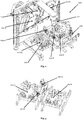
- Figure 2 depicts a diagram of a sub-system 200 of the system 100 for automated packaging of shoes described in detail with reference to Fig. 1 above.
- Said sub-system 200 is part of the shoe packaging section 120 described above and is configured for assembling and providing two different types of packaging containers 126.
- the packaging containers 126 are assembled from packaging container blanks 210-a and 210-b that may have a different size, material, color, imprint, etc.
- the packaging container blanks 210 are stored in a magazine 124.
- the magazine 124 may also be configured to store more or less than two different types of packaging containers, e.g. one, three, four, etc.
- the sub-system 200 for providing the packaging containers 126 further comprises a robotic actuator 122 being equipped with a vacuum gripper 216.
- the robotic actuator 122 is configured to grip one of the packaging container blanks 210 stored in the magazine 124 using the vacuum gripper 216 and insert it below the adhesive sprayers 214 applying adhesive to the side panels of the packaging container 126.
- the packaging container blank 210-b is then moved to one of the two folding molds 212, wherein the size of the left folding mold 212-a is configured to receive a corresponding type of packaging container 210-b and the size of the second folding mold 212-b is configured to receive the other type of packaging container blank 210-a stored in the magazine 124.
- the robotic actuator 122 pushes the packaging container blank 210 downwards in order to fold the packaging container blank 210 into the desired shape of the packaging container 126.
- the adhesive applied by the adhesive sprayers 214 ensures that the edges of the packaging container blank 210 are joined with each other.
- Fig. 3 illustrates a component of the sub-system 200 described with reference to Fig. 2 above.
- Fig. 3 shows the two folding molds 212-a and 212-b each being configured to receive a different type of packaging container blank 210.
- the left folding mold 212-a maybe configured to receive a different size of packaging container blank 210 than the right folding mold 212-b.
- the robotic actuator 122 grips the blank 210-b from the magazine 124 of Fig. 2 and inserts the blank 210-b on top of the right folding mold 212-b according to its size.
- the blank 210-b is then moved to the left folding mold 212-a such that the blank 210-b passes below the adhesive sprayers 214 which are configured to apply a certain amount of adhesive, e.g. a line of glue, to the side panels of the packaging container blank 210-b.
- the robotic actuator 122 of Fig. 2 pushes the blank 210-b downwards and thereby folds the blank 210-b into the desired box-like shape of the packaging container 126.
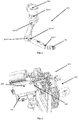
- Figure 4 illustrates a robotic actuator 400 similar to the robotic actuator 122 discussed above.
- the robotic actuator 400 comprises a base plate 410 that can be used to attach the actuator 400 to a support structure. Further, the actuator 400 comprises a pair of vacuum grippers 414 at its tip end.
- the vacuum grippers 414 enable the robotic actuator 400 to grip various objects of different shapes such as the packaging container blanks 210-b described above, the shoes being packaged into the folded packaging containers 126 and / or the filled packaging containers 126 after the shoes have been inserted and wrapped with packaging paper.
- the actuator 400 comprises several motorized rotation axes 412-a - 412-e that allow the actuator 400 to perform complicated movements in order to translate the objects gripped with the pair of vacuum grippers 414 along arbitrary trajectories that can be programed at will.
- Figure 5 shows a further sub-system 500 of the system 100 for automated packaging of shoes according to an embodiment of the present invention.
- the sub-system 500 is being configured to provide a sheet of packaging material 520 for wrapping a pair of shoes (not shown) while being packaged into a corresponding packaging container 126.
- a further vacuum gripper (not shown) draws the sheet of packaging material 520 over the top opening of the packaging container 126 and cuts the sheet of packaging material 520 along a cutting edge 530.
- the packaging material 520 maybe packaging paper stored on a roll 510 at one end of the sub-system 500.
- a robotic actuator (not shown) that may be similar to the actuator 400 of Fig.
- Figure 6 illustrates one possible position of an RFID reader 610 within the system 100 for automated packaging of shoes according to an embodiment of the present invention.
- the RFID reader 610 is arranged at the exit port of the shoe packaging section 120 of the system 100 and is configured to determine shoe type information of a shoe or pair of shoes packaged into a corresponding packaging container 126.
- the working principle of how shoe type information can be determined via RFID technology is described in detail above with reference to Fig. 1 .
- using the RFID reader 610 at the exit port of the shoe packaging section 120 allows to check whether the correct shoes (e.g. shoes according to a preprogrammed processing order) have been packed into the packaging container 126.
- the shoe type information determined by the RFID reader 610 may also be used for configuring and / or controlling the subsequent processing steps performed by downstream processing stations such as the shipping container packaging section 140. For instance, if the shipping container packaging section 140 is configured to package different types of packaging containers 126 into different types of shipping containers 146 the determined shoe type information can be used to program the packaging order of the shipping container packaging section 140.
- the bypass 129 can be used to temporarily remove the packaging container 126 from the processing order of the system 100 for automated packaging of shoes.
- the packaging container 126 needs to be permanently removed from the processing order, e.g. if non-matching shoes have been packaged together.
- the RFID reader 610 can determine this error and the bypass 129 can be used to remove the erroneous packaging container 126 from the processing order without affecting the efficiency or speed of operation of the system 100 as a whole.
- Figure 7 illustrates the position of additional RFID readers 710-a and 710-b being part of another sub-system of the system 100 for automated packaging of shoes according to an embodiment of the present invention.
- the additional RFID readers 710 are installed at the exit port of the shipping container packaging section 140 of the system 100. Similar to the RFID readers 610 installed at the exit port of the shoe packaging section 120, the RFID readers 710 are configured to determine the shoe type information of the shoes or pair of shoes packaged inside their respective packaging containers 126 inside the corresponding shipping container 146-a, 146-b. For instance, the determined shoe type information may be used to check whether the correct number of matching shoes or matching pairs of shoes are packaged into the correct shipping container 146, before the shipping container 146 is further processed.
- the shipping container packaging section 140 may also comprise an automated label printer (not shown) that prints and attaches a shipping container label onto the respective shipping container 146, wherein the label is printed based on at least a part of the determined shoe type information.
- the shipping container label may be provided with information such as the number, type and size of the shoes inside the shipping container 146.
- the determined shoe type information may also be used to control the operation of downstream sub-systems such as the bypass 152 or another robotic actuator (see Fig. 8 below) that is configured for arranging the shipping containers 146 of a corresponding shipping pallet 154 used for shipping a batch of shoes to the desired destination such as a customer or retail shop.
- the bypass 152 for the shipping containers 146 may be used to temporarily or permanently remove certain shipping containers 146 from the processing order of the shipping container packaging section 140 without significantly affecting the processing efficiency or speed of the system 100.
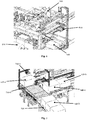
- FIG 8 shows a detailed illustration of the shipping container packaging section 140 during operation.
- the shipping container packaging section 140 comprises a magazine 144 for storing two different types of shipping container blanks 812-a and 812-b. These shipping container blanks 812-a and 812-b are gripped and removed from the magazine 144 by the robotic actuator 142 being equipped with a vacuum gripper 810 similar to the one described above with reference to Fig. 4 .
- the retrieved shipping container blank 812 is then transported by the robotic actuator 142 to the shipping container folding station 820 comprising several mechanical actuators that together with the robotic actuator 142 fold and join the various panels of the shipping container blank 812 in order to form a folded shipping container 146 that can then be filled with a plurality of filled packaging containers 126 in a similar manner as described in more detail above with reference to Fig. 1 .
- the shipping containers 146 are filled with the desired number of corresponding packaging containers 126 the shipping containers 146 are move to the left of the shipping container packaging section 140 and the lids of the shipping containers 146 are closed and sealed by the automated tape roller 148. Then the RFID readers 710 determine the shoe type information of the shoes inside each shipping container 146 as described above with reference to Fig. 7 .
- the shipping containers 146 are then moved by a conveyor 830 either to the bypass 152 or to the palletizing station 150.
- the filled and sealed shipping containers 146 can then be gripped again by the vacuum gripper 810 of the robotic actuator 142 and be arranged in a desired order on the shipping pallets 154 that are used for shipping a batch of shoes (i.e. a certain number of filled shipping containers 146) to the desired shipping destination.
Landscapes
- Engineering & Computer Science (AREA)
- Mechanical Engineering (AREA)
- Physics & Mathematics (AREA)
- General Physics & Mathematics (AREA)
- Theoretical Computer Science (AREA)
- Business, Economics & Management (AREA)
- General Health & Medical Sciences (AREA)
- Economics (AREA)
- Health & Medical Sciences (AREA)
- Human Resources & Organizations (AREA)
- Marketing (AREA)
- Primary Health Care (AREA)
- Strategic Management (AREA)
- Tourism & Hospitality (AREA)
- General Business, Economics & Management (AREA)
- Manufacturing & Machinery (AREA)
- Auxiliary Devices For And Details Of Packaging Control (AREA)
Abstract
Description
- The present invention relates to automated packaging methods and systems for shoes.
- Modern process automatization methods and equipment have successfully been applied to many different aspects of shoe manufacturing. For instance, several highly automated shoe manufacturing concepts have been recently developed by the applicant, as disclosed in
DE 10 2013 221018 A1 ,DE 10 2013 221020 A1 andDE 10 2016 208998 A1 . - However, the subsequent packaging of the manufactured shoes into shoe boxes and / or the packaging of filled shoe boxes into larger shipping boxes is still being performed manually to a large extend and only partly automatized. One reason for the lack of automatization is a large variation of different process steps that have to be performed until a shoe or a pair of shoes is packaged into the correct shoe box and is ready for shipment to a desired shipping destination such a retail shop or an individual customer.
- Recently, several automatization concepts for packaging of shoes have been suggested. For instance, it is already known in the prior art (e.g. see
CN 207,292,510 ) to use a packaging robot to automatically package shoes into shoe boxes, wherein both, the shoes to be packaged and the shoe boxes that the shoes are packaged in are provided to the robot via motorized conveyor belts. - Moreover, prior art document
CN 105,730,760 provides an automatic express packaging device for shoeboxes configured for packaging a single shoebox into a corresponding shipping bag or outer carton and for providing the outer carton with a corresponding shipping label. - Further, prior art document
CN 207,482,279 provides automatic packaging equipment for shoe production comprising two essentially colinearly arranged conveyor belts, the first belt providing pairs of shoes to be packaged and the second belt providing the corresponding shoe boxes. A motorized crane gripper then inserts the pair of shoes into the corresponding shoe box. - However, the packaging methods and systems known from the prior art have various deficiencies. For instance, the degree of automatization is still insufficient because several packaging steps such as preparing the correct shoe boxes, still have to be performed manually. Moreover, the packaging systems known from the prior art may not provide sufficient flexibility and / or accuracy for packaging of shoes that differ in certain characteristics such as size, model, color, etc. into the correctly matching shoe boxes. Accordingly, conventional packaging systems are still heavily susceptible to errors, such as an incorrect order and / or spatial arrangement of shoes to be packaged and / or an incorrect order of shoe boxes provided to the packaging section. Such errors usually result in downtime of the packaging system. Moreover, conventional packaging systems have to be reconfigured manually each time a new batch of shoes with new characteristics such as size, model, color, etc. has to be packaged.
- In addition, also the known methods and systems for packaging of filled shoe boxes into larger shipping boxes can be optimized. For instance, filled shoe boxes are also still being packaged manually into the corresponding shipping boxes.
- It is therefore the problem underlying the present invention to improve automated packaging of shoes so that the above outlined disadvantages of the prior art are at least partly overcome.
- The above-mentioned problem is at least partly solved by the subject matter of the independent claims of the present application. Exemplary embodiments of the invention are described in the depended claims.
- In one embodiment, the present invention provides a system for an automatic packaging of shoes, comprising means for determining shoe type information from a shoe or pair of shoes to be packaged, means for automatically packaging the shoe or pair of shoes in a packaging container and means for dynamically controlling the automatic packaging based at least in part on the determined shoe type information.
- In essence, the claimed invention therefore provides a system that allows to dynamically control, adjust and / or check the automatic packaging process continuously and in real-time while a batch of shoes is being automatically packaged.
- For instance, the shoes to be packaged may be provided to the system in a predetermined or even in a random order. The system may then determine shoe type information from each shoe or each pair of shoes provided to the system for packaging. The various steps of the packaging process can then be dynamically adjusted, controlled and / or checked based on the determined shoe type information. Consequently, the automatic packaging system, for example, does not have to be manually reconfigured each time a new batch of shoes is provided to the system for packaging.
- In addition, the system can also operate successfully even if there is a large variability among the shoes of a batch of shoes to be packaged. For instance, the system could be fed by a plurality of different pairs of shoes each customized for a certain customer. The system can then use the determined shoe type information to perform and dynamically adjust the desired packaging steps for each customized pair of shoes.
- Moreover, for example, errors that may occur during providing a batch of shoes to the system (e.g. if a predetermined packaging order is accidentally not adhered to) or during processing can easily be corrected by the automatic packaging system without resulting in an interrupt or slow-down of operation and / or without requiring a time-consuming intervention by a human operator.
- In some embodiments of the present invention the system for automatic packaging of shoes may further comprise at least one of: means for automatically providing the packaging container for the shoe or pair of shoes corresponding to the determined shoe type information, means for automatically providing the packaging container with a packaging container label corresponding to the determined shoe type information, means for automatically obtaining a packaging container label based on at least part of the determined shoe type information, means for comparing the determined shoe type information with previously stored information about the shoe or pair of shoes to be packaged and means for changing a processing order of the shoe or pair of shoes and / or of the packaging container based at least partially on the determined shoe type information.
- In this manner, the packaging of shoes and / or the shipping preparations may be further automatized because the system is enabled to automatically provide a matching packaging container (e.g. a shoe box, a shoe bag, outer carton etc.) and / or the corresponding packaging container label for each shoe or pair of shoes to be packaged corresponding to the determined shoe type information. In addition, the processing order of the shoes to be packaged can dynamically be adjusted such that subsequent processing steps can be performed in an optimize order.
- Further, in some embodiments of the present invention the means for determining the shoe type information may comprise at least one of: optical sensor equipment for determining at least part of the shoe type information from an optical label of the shoe or pair of shoes, radio frequency identification (RFID) equipment for determining at least part of the shoe type information from an RFID label of the shoe or pair of shoes, image recognition equipment for determining at least part of the shoe type information from a digital image of the shoe or pair of shoes and means for obtaining at least part of the shoe type information from a database.
- Depending on the specific implementation of the present invention the shoe type information can be determined from the shoes to be packaged in different ways using different technologies. For instance, each shoe or pair of shoes may be provided with an RFID label for instance being implemented as a passive RFID tag.
- Such RFID label may comprise a RF antenna and a tag chip coupled to the antenna and comprising memory, wherein the memory is configured to store at least part of the shoe type information and / or a reference to a database storing at least part of the shoe type information.
- Using RFID technology for determining the shoe type information has the advantage, for example, that the shoe type information can be remotely determined without requiring a line of sight between the label and the RFID reader. Further, RFID labels are cheap, lightweight, easy to handle and reusable. In addition, they may even be integrated into a shoe during or after manufacturing without affecting the appearance and / or wearing comfort of the shoe.
- Additionally, or alternatively part of the shoe type information may also be determined via an optical bar code reader or via image recognition equipment. For example, modern machine learning methods (e.g. deep neural networks) may be employed to categorize each shoe or pair of shoes to be packaged and thereby obtain the corresponding shoe type information that is then used to dynamically control the automatic packaging process.
- For instance, using image recognition has the advantage that the shoes can directly be fed to the packaging system after manufacturing without any further modifications.
- In some embodiments of the present invention the means for automatically providing the packaging container with the packaging container label and the means for automatically obtaining the packaging container label may be integrated into a single apparatus or subsystem. In this manner, the system can be made more compact and easier to relocate and deploy.
- Depending on the application and / or on the specific implementation of the present invention various types of shoe type information can be determined by the packaging system.
For instance, the shoe type information may comprise at least one of: a shoe size of the shoe or pair of shoes, a type of shoe model of the shoe or pair of shoes, an article number of the shoe or pair of shoes, a gender information of the of the shoe or pair of shoes, a dimension of the shoe or pair of shoes, a weight of the shoe or pair of shoes, a shipping destination for the shoe or pair of shoes, a material property of the shoe or pair of shoes, a design pattern of the shoe or pair of shoes, an indication of at least one accessory (e.g. shoe laces, cleats etc.) to be packaged together with the shoe or pair of shoes and retail information associated with the shoe or pair of shoes. - By using said shoe type information or various combinations thereof even more aspects of packaging and / or of preparing shoes for shipment can be automatized and / or customized by the automated packaging system.
- In some embodiments of the present invention the system for automatic packaging of shoes may further comprise means for automatically wrapping or covering the shoe or pair of shoes with packaging material. For instance, the shoes may be automatically wrapped with packaging paper.
- In some embodiments said means for wrapping or covering may be configured to wrap or cover a first shoe inside the packaging container before a second shoe is inserted into the packaging container and to wrap or cover the second shoe after being inserted into the packaging container.
- Specifically, only a single sheet of packaging material, preferably a single sheet of packaging paper may be used to wrap or cover both shoes in order to keep the wrapping process as simple and efficient as possible.
- Alternatively or additionally, the means for wrapping or covering may also be configured to place a sheet of packaging material, preferably a sheet of packaging paper over at least a part of the packaging container, to place the sheet of packaging material over the first shoe after the first shoe is inserted into the packaging container and to place the sheet of packaging material over the second shoe after the second shoe is inserted into the packaging container.
Further, the means for wrapping or covering may be further configured to draw and cut the sheet of packaging material of a roll of packaging material. - Further, the means for wrapping or covering may also comprise a mechanical gripper, such as a vacuum gripper, configured for gripping and / or drawing a sheet of packaging material, preferably a sheet of packaging paper over the packaging container and / or the shoe or pair of shoes.
- For instance, in this manner the intricate task of wrapping both shoes with a single sheet of delicate packaging paper such as silk paper can also be fully automatized. Thereby the speed, efficiency and robustness of the packaging process can be further optimized and the need for time-consuming manual processing can be reduced.
- In some embodiments of the present invention the means for automatically providing the packaging container may comprise at least one of: means for automatically assembling the packaging container, means for determining packaging container type information, means for retrieving the packaging container, means for repositioning the packaging container, means for erecting the packaging container, means for applying an adhesive and / or a joining agent to a portion of the packaging container, means for folding at least a portion of the packaging container, means for joining at least two portions of the packaging container and means for inserting at least a portion of the packaging container into a folding mold.
- Further, the means for applying the adhesive and / or the joining agent comprise at least one adhesive sprayer configured to apply a liquid adhesive on at least one side portion and / or a lid portion of the packaging container.
- In this way, the packaging containers needed for packaging can be directly assembled by the automatic packaging system, for example, from a batch of packaging container blanks. Thereby, the footprint, the efficiency, speed and customizability of the automatic packaging system can be further improved. Moreover, the conventional but time-consuming manual assembly of the packaging containers can be avoided.
- In some embodiments, the automatic packaging system may also comprise at least two different folding molds each configured to receive different packaging containers having a different size.
- Further, the system for automatic packaging of shoes may also comprises a magazine for storing at least two different types of packaging container blanks. For instance, the different types of packaging container blanks may be configured for different types of shoes to be packaged. For example, the different packaging container blanks may exhibit different characteristics such as a size, a color, a shape, a material type and / or an imprint.
- In this manner, the system is enabled to handle and / or assemble more than one different type of packaging container corresponding to the determined shoe type information. In this way the customizability of the automatic packaging process can be further enhanced. For instance, the automatic packaging system may process at least two different batches of shoes each type requiring a different type of packaging container (i.e. batches of different shoe type or different shoe size such as one batch of football boots and another batch of running shoes) simultaneously, e.g. in the sense that one pair of the first batch is processed after another pair of the second batch etc.
- In some embodiments of the present invention the means for automatic packaging the shoe or pair of shoes may comprise at least one of: means for obtaining the shoe or pair of shoes, means for obtaining the packaging container, means for repositioning the packaging container, means for opening the packaging container, means for gripping the shoe or pair of shoes, means for repositioning the shoe or pair of shoes, means for placing the shoe or pair of shoes in the corresponding packaging container, means for inserting at least one accessory associated with the shoe or pair of shoes into the packaging container, means for closing and / or sealing the packaging container.
- In some embodiments, the means for providing the packaging container and the means for automatic packaging the shoe or pair of shoes may also be integrated into a single processing station or subsystem.
- In this way the complexity and / or the footprint of the packaging system can be further reduced and / or the efficiency of the automatic packaging can be further improved. Further, the automatic packaging system may also comprise means for providing a plurality of shoes to be packaged.
- For instance, the shoes to be packaged may be provided by one or more conveyors. In some embodiments, the shoes may be placed on the conveyor belts by a human operator or by a robotic actuator. In other embodiments, the shoes may also be provided in a large container from which a robotic actuator directly obtains the shoes in a random order. Since the shoe type information is determined by the packaging system for each shoe or each pair of shoes it can still be ensured that each pair of shoes is correctly packaged and prepared for shipment.
- Specifically, in some embodiments, the means for providing the plurality of shoes may comprise at least one of: means for arranging the pluralities of shoes in a desired order and / or a desired spatial arrangement, preferably as matching pairs; means for providing the plurality of shoes with a machine-readable label, preferably an optical label and / or an RFID label and means for communicating the desired order and / or the desired spatial arrangement to other means of the system.
- For example, the shoes maybe provided with an RFID label after manufacturing. A human operator or an automatic image recognition system may then assign shoe type information for each shoe or pair of shoes to the corresponding RFID label.
- For instance, part of the shoe type information may be directly stored on the RFID label. Alternatively or additionally, part of the shoe type information may also be stored in a database, wherein each database entry comprises at least part of the shoe type information for each shoe or pair of shoes and a unique reference to the corresponding RFID label that is provided for each shoe or pair of shoes. In this way, the system can determine the shoe type information for each shoe or pair of shoes by querying the database using the unique reference obtained by reading the RFID label that is attached to each shoe or pair of shoes.
The RFID label may be directly attached to each shoe or one shoe of each pair of shoes. Alternatively, the RFID label may also be included in a shoe tongue label or a hang tag attached to each shoe of pair of shoes. - The system for automatic packaging of shoes may further comprise at least one of: means for obtaining a plurality of packaging containers, each containing a shoe or a pair of shoes, means for determining packaging container type information associated with at least one packaging container of the plurality of packaging containers, means for automatically providing a shipping container for the least one packaging container corresponding to the determined packaging container type information and / or the determined shoe type information, means for automatically packaging the at least one packaging container in the shipping container corresponding to the determined packaging container type information and / or the determined shoe type information, means for inserting at least one packaging accessory into the shipping container corresponding to the determined packaging container type information and / or the determined shoe type information, means for automatically obtaining a shipping container label corresponding to at least part of the determined packaging container type information and / or the determined shoe type information, means for automatically providing the shipping container with the shipping container label corresponding to at least part of the determined packaging container type information and / or at least part of the determined shoe type information, means for changing a processing order of the shipping container corresponding to at least part of the determined packaging container type information and / or the determined shoe type information, means for closing and sealing the shipping container and means for arranging the shipping container on a shipping pallet corresponding to at least part of the determined packaging container type information and / or the determined shoe type information.
- In this manner, not only the automatic packaging of shoes into a corresponding packaging container can be improved but the packaged shoes can also be automatically packaged by the system into a corresponding shipping container. For example, batches of identical or similar shoes (e.g. ten pairs of similar shoes) can automatically be packaged together into one shipping container destined for a particular shipping destination such as a particular retail shop. Moreover, several shipping containers can automatically be arranged for shipment on a corresponding shipping pallet.
- In this way, the whole commissioning process for shipping of a batch of shoes to a desired shipping destination can substantially be enhanced because most or even all relevant processing steps can be automatized and dynamically be controlled.
- In some embodiments, the means for automatically packaging the packaging containers in the shipping container are configured to insert the at least one packaging container at an angle with respect to a wall of the shipping container.
- In this manner, it can be ensured that the packaging containers do not get jammed when being inserted into the shipping container.
- Moreover, the means for automatically packaging the at least one packaging container in the shipping container may be configured to handle at least two, preferably at least three, more preferably at least four, even more preferably at least five and most preferably at least six packaging containers simultaneously.
- By handling more than one packaging container simultaneously the efficiency, accuracy and / or robustness of the automatic packaging of the shipping containers can further be increased.
- In some embodiments of the present invention, the system for automatic packaging of shoes may comprise at least one robotic actuator having at least three, preferably at least four, more preferably at least five and most preferably at least six actuation axes. By using such robotic actuators, the flexibility and accuracy of the system can be greatly improved. In addition, such robotic actuators need significantly less space than conventional technology such as conveyor belts and / or crane grippers for example.
- Further, the at least one robotic actuator may comprise a vacuum gripper and / or a particle jamming gripper. Details on using particle jamming devices in footwear manufacture can be found in the German patent application by the Applicant with application serial number
102018212228.8 . - By using such grippers instead of conventional handling tools, the robotic actuators are enabled to handle items of complex and / or of varying shape (e.g. shoes, various accessories, unfolded and / or partly folded packaging containers etc.) in a safe and efficient manner.
- In some embodiments of the present invention the packaging container label is obtained (e.g. printed) while the corresponding shoe or pair of shoes is being packaged in the packaging container.
- In this manner, the labels for the packaging containers do not need to be provided beforehand but can dynamically be printed according to the determined shoe type information relating to the respective shoe or pair of shoes being packaged. Thereby, the packaging process is made more efficient and robust, i.e. the chance of attaching the wrong label to a packaging container is effectively eliminated.
- In another embodiment the present invention provides a method for automatic packaging of shoes, comprising the steps of, determining shoe type information from a shoe or pair of shoes to be packaged, automatically packaging the shoe or pair of shoes in a packaging container and dynamically controlling the automatic packaging based at least in part on the determined shoe type information.
- Evidently, said method can be modified as needed by all processing steps performed by the system for automatic packaging of shoes described in detail above.
- The present invention also provides a computer program for automatic packaging of shoes comprising instructions for controlling the above discussed system for automatic packaging of shoes and for performing the above method for automatic packaging of shoes, when the instructions are executed by computing and control means of an automatic packaging system such as described above.
- Aspects of the present invention are described in more detail in the following by reference to the accompanying figures. These figures show:
- Fig. 1
- a diagram illustrating a system for automated packaging of shoes according to an embodiment of the present invention.
- Fig. 2
- a diagram illustrating a sub-system of a system for automated packaging of shoes according to an embodiment of the present invention, the sub-system being configured to provide two different types of packaging containers.
- Fig. 3
- a diagram illustrating a component of the sub-system of
Fig. 2 related to a system for automated packaging of shoes according to an embodiment of the present invention. - Fig. 4
- a diagram illustrating a robotic actuator as being used by a system for automated packaging of shoes according to an embodiment of the present invention.
- Fig. 5
- a diagram illustrating a sub-system of a system for automated packaging of shoes according to an embodiment of the present invention, the sub-system being configured to provide a sheet of packaging material for wrapping a pair of shoes inside a packaging container.
- Fig. 6
- a diagram illustrating the position of an RFID reader being part of a sub-system of a system for automated packaging of shoes according to an embodiment of the present invention.
- Fig. 7
- a diagram illustrating the position of further RFID readers being part of a further sub-system of a system for automated packaging of shoes according to an embodiment of the present invention.
- Fig. 8
- a diagram illustrating a further sub-system of a system for automated packaging of shoes according to an embodiment of the present invention, the further sub-system being configured for providing shipping containers and for packaging a plurality of packaging containers filled with shoes into the corresponding shipping containers.
- In the following, exemplary embodiments of the present invention are described in more detail, with reference to a system for automated packaging of shoes. While specific feature combinations are described in the following with respect to the exemplary embodiments of the present invention, it is to be understood that the disclosure is not limited to such embodiments. In particular, not all features have to be present for realizing the invention, and the embodiments may be modified by combining certain features of one embodiment with one or more features of another embodiment.
- Moreover, the packaging systems described below are constructed from a plurality of different processing stations each performing a single or a plurality of specific processing steps. While for reasons of clarity the processing steps are described to be carried out in a specific order (i.e. as a sequence of successive processing steps) it should be appreciated that adhering to such order is not mandatory for realizing the present invention. In other words, some or all of the processing steps performed by the described system may be performed in a different order and / or simultaneously without deviating from the scope of the present invention.
-
Figure 1 depicts a diagram illustrating asystem 100 for automated packaging of shoes according to an embodiment of the present invention. The system comprises ashoe feeding section 110, ashoe packaging section 120 and a shippingcontainer packaging section 140. Theshoe feeding section 110 comprises twofeed conveyors 112. A human operator or a robotic actuator (not shown) places a batch of shoes to be packaged on thefeed conveyors 112. For instance, each batch may only contain shoes of the same model or size. In some embodiments of the present invention the batch size (e.g. number of shoes) maybe predetermined to match with the size (e.g. capacity) of ashipping container 146 that is used for shipping the respective batch of shoes to a desired shipping destination. Atypical shipping container 146 may for example comprises ten pairs of shoes each packaged into a correspondingpackaging container 126. - Upstream of the
shoe feeding section 110 the system may further comprise a so-called hang tag station (not shown). There, hang tags are attached to the shoes and an RFID label / tag may also be attached to one or both of the shoes, for instance on the left shoe of each pair of shoes. Then, a human operator assigns shoe type information to the shoes to be processed by thesystem 100 for example via a HMI (Human Machine Interface). - The assigned shoe type information may comprise information such as a shoe model, an article number, a technical size, a color, an imprint, a gender etc. The batch of shoes may also be assigned according to different processing priorities determined by a production coordinator. In other embodiments, the RFID labels / tags may also be part of the shoe itself (e.g. implemented in the hang tag or in shoe tongue label). Thus, the system may be even automated further such as no operator inputs are needed, and the assignments of shoe type information may also be done automatically.
- For instance, such RFID labels may contain electronically stored information. Passive RFID labels collect energy from a nearby RFID reader's interrogating radio waves. Unlike a barcode, the RFID labels need not be within the line of sight of the RFID reader, so it may be directly embedded in the tracked object such as a shoe. The memory of the RFID label may store the product's electronic product code (EPC) and other variable information such as part of shoe type information. In this way, each shoe of pair of shoes can be tracked by RFID readers anywhere in the system. For instance, an RFID reader may be a network connected device (fixed or mobile) with an antenna that sends power as well as data and commands to the RFID labels. The RFID reader effectively acts as an access point for RFID labeled items so that the RFID labels' data can be made available to the automatic packaging system.
- Such RFID readers may be positioned at various sections of the
packaging system 100, e.g. at certain positions where shoe type information maybe required for checking or for controlling the packaging process. - For example, RFID readers may be positioned upstream of the
shoe packaging section 120. When a shoe or pair of shoes is transported by one of theconveyors 112 into the vicinity of one of the RFID readers the RFID reader can read the information stored in the memory of the RFID label that is attached to the shoe or pair of shoes. For instance, the RFID reader could read the individual EPC and / or a part of the shoe type information stored in the memory of the RFID label. This information can then be used by thesystem 100 to control the various packaging steps to be performed by thesystem 100. - The
shoe packaging section 120 may further comprise at least onerobotic actuator 122 that is configured for assembling thepackaging containers 126 from different packaging container blanks stored in amagazine 124. For each shoe or pair of shoes that is fed to thepackaging section 120 therobotic actuator 122 retrieves a packaging container blank from themagazine 124. For instance, the retrieved blank may correspond to the determined shoe type information. - For example, the
robotic actuator 122 retrieves a packaging container blank whose size, color, shape, material type and / or imprint corresponds to the shoe type information determined from the shoe or pair of shoes e.g. via an upstream RFID reader or image recognition subsystem of thesystem 100. - For example, an RFID reader may be positioned at the entry port to the
packaging section 120. The RFID reader determines a unique reference (e.g. the EPC) to a database entry storing at least part of the relevant shoe type information such as a shoe size, a shoe model type, etc. Alternatively, the relevant information may also be directly stored in a machine-readable format on the RFID label. In this case, the need for querying a database is omitted. The determined shoe type information can then be used to program and / or to control the operation of therobotic actuator 122 and / or other sub-systems of thepackaging section 120. For example, thepackaging section 120 may also comprise several other mechanical actuators that perform several steps during assembly and preparation of thepackaging container 126 from the corresponding packaging container blank retrieved from themagazine 124. - For instance, the
robotic actuator 122 may be equipped with a vacuum gripper to pick up the flat packaging container blanks from themagazine 124. The packaging container blank is then moved to a hot melt station where an adhesive can be applied on its sidewalls. The packaging container blank is further moved to a folding mold where therobotic actuator 122 presses the blank downwards to fold the packaging container into the desired shape. The packaging container is then placed on a further conveyor and a vacuum device (not shown) holds the lid on a lid mold (not shown), additional mechanical actuators then fold the lid into the desired shape. - In some embodiments, the adhesive is applied by adhesive sprayers. The adhesive sprayers may, for example, be stationary, and the packaging container blank is passed underneath so that liquid adhesive can be sprayed onto the sides. The same adhesive sprayers can be used for different types (e.g. sizes) of packaging containers. For instance, one size of packaging container blank may be passed under the adhesive sprayers in one direction then pressed downwards into a first folding mold. For a second size of packaging container, the blank is passed under the sprayers in the opposite direction, and is pressed down into a different folding mold, having a different size and located on the opposite side of the adhesive sprayers.
- There may further by adhesive sprayers for the lid of the
packaging container 126, positioned in a vertical orientation and configured to spray an adhesive horizontally onto the lid before it is folded down by additional mechanical actuators. - Afterwards the
packaging container 126 is moved to the next station of thepackaging section 120 where the shoes are placed into theprepared packaging containers 126. - First, a
vacuum gripper 128 draws a sheet of packaging paper from a storage area over theopen packaging container 126. Then, a second robotic actuator using a vacuum gripper or any other suitable handling tool such as a particle jamming gripper then picks up a first shoe and places it in theprepared packaging container 126, thevacuum gripper 128 then drives back to its home position, thereby covering the first shoe while the remaining piece of paper is laid on the lid of thepackaging container 126. - Then, the second robotic actuator picks up the second shoe and places it next to the first shoe into the
packaging container 126. Thepackaging container 126 is then closed and thereby now both shoes are wrapped with the sheet of packaging paper. Afterwards thepackaging container 126 now containing the pair of shoes wrapped with packaging paper is moved to the next processing section, e.g. anoptional labeling station 130 for labeling the filledpackaging containers 126 with a corresponding packaging container label. - At the
labeling station 130 an RFID reader reads the RFID label of the shoe or pair of shoes already packaged in the correspondingpackaging container 126. At this stage, the RFID label is again used to determine part of the shoe type information (e.g. shoe model, article number, gender, size, color, language spoken at the shipping destination etc.) necessary for obtaining or producing the correct packaging container label for thepackaging container 126. Once the required information is determined, the information is send to an automated label printer, then thepackaging container 126 moves to the printing station where the automatic printer will print the specific packaging container label, and by using an automatic applicator, attaches the label onto thepackaging container 126. Evidently, in other embodiments of the present invention, the printing and / or the attaching of the packaging container label may also be performed prior or simultaneously to placing the shoes into the correspondingpackaging container 126. - After the correct packaging container label has been attached to the
respective packaging container 126, thepackaging container 126 is then driven either to a bypass 129 (for instance when a batch of shoes being processed has less than a certain number of pairs), or to apackaging container buffer 132. Thebypass 129 serves the purpose to dynamically modify the processing order of theautomatic packaging system 100. For example, if ten pairs of identical shoes should be packaged into onesingle shipping container 146 by the shippingcontainer packaging section 140 of thesystem 100, thebypass 129 can be used to temporally removepackaging containers 126 from the processing queue that contain a different type of shoe to ensure that said identical pairs of shoes arrive together at the shippingcontainer packaging section 140. - The
packaging container buffer 132 of the shippingcontainer packaging section 140 is configured to store (i.e. buffer) a certain number of filledpackaging containers 126 that should be packaged together in acorresponding shipping container 146. For instance, a particular type ofshipping container 146 may be configured to hold ten identical orsimilar packaging containers 126 arranged in two layers or two rows of fivepackaging containers 126 each. - For example, the
buffer 132 may be configured to buffer fivepackaging containers 126. After thebuffer 132 is filled with fivepackaging containers 126, a furtherrobotic actuator 142 grips the five packaging containers stored in thebuffer 132 in a single movement with a vacuum gripper and inserts them together into thecorresponding shipping container 146. - For the embodiment illustrated in
Fig. 1 theshipping container 146 is assembled directly at the shippingcontainer packaging section 140. For example, therobotic actuator 142 retrieves a shipping container blank from amagazine 144. The blank is then assembled by therobotic actuator 142 and by several additional mechanical actuators (not shown) that perform tasks such as closing and sealing the bottom lid of theshipping container 146, closing and sealing the top lid after theshipping container 146 is filled etc. For example, therobotic actuator 142 using a vacuum griper picks up a flat shipping container blank from themagazine 144 and places it on another vacuum device (not shown) to hold theshipping container 146 in place. Therobotic actuator 142 then moves to grip a side of the shipping container blank and moves backward to erect theshipping container 146. Next, the bottom lid of theshipping container 146 is closed and a movable tape roller (not shown) applies an adhesive tape to seal the bottom lid of theshipping container 146. - Similar to the
magazine 124 for the packaging container blanks themagazine 144 for the shipping container blanks can be configured to store more than one type of shipping container blank. In this manner, the flexibility of the packaging process can be further increased because the shippingcontainer packaging section 140 can process (i.e. assemble and fill) different types of shipping containers simultaneously. - For the depicted embodiment, the
robotic actuator 142 is equipped with a vacuum gripper and is configured to perform different processing steps such as the retrieving and (partial) erecting of the shipping container blank, retrieving the plurality of filled packaging containers 126 (e.g. five at a time) buffered in thebuffer 132, inserting the plurality of filledpackaging containers 126 into thecorresponding shipping container 146 and arranging of the filled and sealedshipping containers 146 on acorresponding shipping pallet 154. - After the
shipping container 146 is filled with the desired amount ofpackaging containers 126 theshipping container 146 is moved (e.g. by the robotic actuator 142) to the left, where the top lid is closed and sealed by anadditional tape roller 148. - Similar to the
bypass 129 for the filledpackaging containers 126 the shippingcontainer packaging section 140 also comprises abypass 152 for a plurality of filledshipping containers 146 that are not yet to be arranged on theshipping palettes 154 by therobotic actuator 142. - The shipping
container packaging section 140 may also comprise a labelling station (not shown) for the filledshipping containers 146. At the labeling station, for instance, a group of three RFID readers (not shown) scans the filled and sealedshipping container 146 to read the RFID labels of the shoes inside thepackaging containers 126 inside theshipping container 146. Since RFID does not require a direct line of sight the enclosing material of thepackaging containers 126 and theshipping container 146 does not interfere with the operation of the RFID readers. - At this stage, part of the shoe type information relevant for shipping such as the amount, the type of article, the type of model and the size of the shoes etc. can be determined by the RFID readers of the shipping
container packaging section 140. Consequently, an automatic shipping label production process can be triggered. For instance, the determined shoe type information is sent to an automatic label printer (not shown), where a shipping label is printed and attached to thecorresponding shipping container 146 by an automatic applicator (not shown). This sub-process might also be skipped according to customer requirements. Finally, the information stored on the RFID labels can be erased again and the filledshipping container 146 is moved to thepalletizing station 150. - Succeeding the labeling of the
shipping container 146, theshipping container 146 arrives on thepalletizing station 150, where therobotic actuator 142 using a vacuum gripper picks up theshipping container 146 and places it on ashipping pallet 154. In doing so, therobotic actuator 142 keeps track on the number ofshipping containers 146 being arranged on oneshipping pallet 154 in order to place the desired amount (e.g. 22) shipping containers on thesame shipping pallet 154 for shipment. - The system of
Fig. 1 as well as similar implementations of the present invention can be dynamically controlled in various manners using the determined shoe type information. For instance, the system may be configured as a continuously manually controlled ordering system. A production coordinator assigns the order (i.e. a sequence) in which the packaging of the shoes should be performed. In this configuration, the production coordinator places the shoes to be packaged in a desired order on theconveyors 112 and the system 100 (e.g. by using the RFID scanning mechanism or image recognition) packages the shoes appropriately (e.g. first in thecorrect packaging containers 126, then into thecorrect shipping container 146 and on the correct shipping palette 154). In this configuration, the order that shoes are packaged can be constantly changed without risking an interrupt or slowdown of the operation if thesystem 100. - In other embodiments of the present invention the ordering itself maybe implemented by an MES system (Manufacturing Execution System), where the prioritizing of shoes into the desired packaging order is pre-planned. The RFID scanning mechanism is then simply a check that the order of the shoes provided matches the order in the plan. The MES system can take decisions on orders based on AI (Artificial Intelligence) or ever-changing production and priority plans.
-
Figure 2 depicts a diagram of asub-system 200 of thesystem 100 for automated packaging of shoes described in detail with reference toFig. 1 above. Saidsub-system 200 is part of theshoe packaging section 120 described above and is configured for assembling and providing two different types ofpackaging containers 126. Thepackaging containers 126 are assembled from packaging container blanks 210-a and 210-b that may have a different size, material, color, imprint, etc. Thepackaging container blanks 210 are stored in amagazine 124. In other embodiments of the present invention themagazine 124 may also be configured to store more or less than two different types of packaging containers, e.g. one, three, four, etc. - In the illustrated sub-system of
Fig. 2 thesub-system 200 for providing thepackaging containers 126 further comprises arobotic actuator 122 being equipped with avacuum gripper 216. Therobotic actuator 122 is configured to grip one of thepackaging container blanks 210 stored in themagazine 124 using thevacuum gripper 216 and insert it below theadhesive sprayers 214 applying adhesive to the side panels of thepackaging container 126. The packaging container blank 210-b is then moved to one of the twofolding molds 212, wherein the size of the left folding mold 212-a is configured to receive a corresponding type of packaging container 210-b and the size of the second folding mold 212-b is configured to receive the other type of packaging container blank 210-a stored in themagazine 124. When the packaging container blank 210 rests above thecorresponding folding mold 212, therobotic actuator 122 pushes the packaging container blank 210 downwards in order to fold the packaging container blank 210 into the desired shape of thepackaging container 126. The adhesive applied by theadhesive sprayers 214 ensures that the edges of the packaging container blank 210 are joined with each other. -
Fig. 3 illustrates a component of thesub-system 200 described with reference toFig. 2 above. Specifically,Fig. 3 shows the two folding molds 212-a and 212-b each being configured to receive a different type ofpackaging container blank 210. For instance, the left folding mold 212-a maybe configured to receive a different size of packaging container blank 210 than the right folding mold 212-b. For instance, if thesub-system 200 is programed to prepare apackaging container 126 from a first size of packaging container blank 210-b, therobotic actuator 122 grips the blank 210-b from themagazine 124 ofFig. 2 and inserts the blank 210-b on top of the right folding mold 212-b according to its size. The blank 210-b is then moved to the left folding mold 212-a such that the blank 210-b passes below theadhesive sprayers 214 which are configured to apply a certain amount of adhesive, e.g. a line of glue, to the side panels of the packaging container blank 210-b. After the blank 210-b has been moved to the left folding mold 212-a, therobotic actuator 122 ofFig. 2 pushes the blank 210-b downwards and thereby folds the blank 210-b into the desired box-like shape of thepackaging container 126. -
Figure 4 illustrates arobotic actuator 400 similar to therobotic actuator 122 discussed above. Therobotic actuator 400 comprises abase plate 410 that can be used to attach theactuator 400 to a support structure. Further, theactuator 400 comprises a pair ofvacuum grippers 414 at its tip end. The vacuum grippers 414 enable therobotic actuator 400 to grip various objects of different shapes such as the packaging container blanks 210-b described above, the shoes being packaged into the foldedpackaging containers 126 and / or the filledpackaging containers 126 after the shoes have been inserted and wrapped with packaging paper. Moreover, theactuator 400 comprises several motorized rotation axes 412-a - 412-e that allow theactuator 400 to perform complicated movements in order to translate the objects gripped with the pair ofvacuum grippers 414 along arbitrary trajectories that can be programed at will. -
Figure 5 shows afurther sub-system 500 of thesystem 100 for automated packaging of shoes according to an embodiment of the present invention. Specifically, thesub-system 500 is being configured to provide a sheet ofpackaging material 520 for wrapping a pair of shoes (not shown) while being packaged into a correspondingpackaging container 126. In one embodiment of the present invention a further vacuum gripper (not shown) draws the sheet ofpackaging material 520 over the top opening of thepackaging container 126 and cuts the sheet ofpackaging material 520 along acutting edge 530. Thepackaging material 520 maybe packaging paper stored on aroll 510 at one end of thesub-system 500. A robotic actuator (not shown) that may be similar to theactuator 400 ofFig. 4 above then grips and inserts a first shoe of a pair of shoes into thepackaging container 126, thereby pushing down and inserting the sheet ofpackaging material 520. After the first shoe is inserted the further vacuum gripper moves backwards towards the left (i.e. into the direction of the storage roll 510) and releases the sheet ofpackaging material 520. Then the second shoe of the pair of shoes to be packaged is inserted into thepackaging container 126 next to the first shoe thereby again pressing down the sheet ofpackaging paper 520. After the second shoe and the sheet ofpackaging material 520 are fully inserted into thepackaging container 126 another actuator (not shown) closes the lid of thepackaging container 126 which is then moved to a downstream processing station (e.g. the shipping container packaging section 140) for further processing. -
Figure 6 illustrates one possible position of anRFID reader 610 within thesystem 100 for automated packaging of shoes according to an embodiment of the present invention. TheRFID reader 610 is arranged at the exit port of theshoe packaging section 120 of thesystem 100 and is configured to determine shoe type information of a shoe or pair of shoes packaged into a correspondingpackaging container 126. The working principle of how shoe type information can be determined via RFID technology is described in detail above with reference toFig. 1 . - For instance, using the
RFID reader 610 at the exit port of theshoe packaging section 120 allows to check whether the correct shoes (e.g. shoes according to a preprogrammed processing order) have been packed into thepackaging container 126. - Moreover, the shoe type information determined by the
RFID reader 610 may also be used for configuring and / or controlling the subsequent processing steps performed by downstream processing stations such as the shippingcontainer packaging section 140. For instance, if the shippingcontainer packaging section 140 is configured to package different types ofpackaging containers 126 into different types ofshipping containers 146 the determined shoe type information can be used to program the packaging order of the shippingcontainer packaging section 140. - Moreover, if the shoe type information determined by the
RFID reader 610 does indicate that the pair of shoes inside thepackaging container 126 does not correspond to one of theshipping containers 146 being packaged at the moment by the shippingcontainer packaging section 140 the bypass 129 (seeFig. 1 above) can be used to temporarily remove thepackaging container 126 from the processing order of thesystem 100 for automated packaging of shoes. - Further, it may also happen that due to some error during upstream processing steps the
packaging container 126 needs to be permanently removed from the processing order, e.g. if non-matching shoes have been packaged together. In this case, theRFID reader 610 can determine this error and thebypass 129 can be used to remove theerroneous packaging container 126 from the processing order without affecting the efficiency or speed of operation of thesystem 100 as a whole. -
Figure 7 illustrates the position of additional RFID readers 710-a and 710-b being part of another sub-system of thesystem 100 for automated packaging of shoes according to an embodiment of the present invention. Specifically, theadditional RFID readers 710 are installed at the exit port of the shippingcontainer packaging section 140 of thesystem 100. Similar to theRFID readers 610 installed at the exit port of theshoe packaging section 120, theRFID readers 710 are configured to determine the shoe type information of the shoes or pair of shoes packaged inside theirrespective packaging containers 126 inside the corresponding shipping container 146-a, 146-b. For instance, the determined shoe type information may be used to check whether the correct number of matching shoes or matching pairs of shoes are packaged into thecorrect shipping container 146, before theshipping container 146 is further processed. - For example, the shipping
container packaging section 140 may also comprise an automated label printer (not shown) that prints and attaches a shipping container label onto therespective shipping container 146, wherein the label is printed based on at least a part of the determined shoe type information. For instance, the shipping container label may be provided with information such as the number, type and size of the shoes inside theshipping container 146. Moreover, the determined shoe type information may also be used to control the operation of downstream sub-systems such as thebypass 152 or another robotic actuator (seeFig. 8 below) that is configured for arranging theshipping containers 146 of acorresponding shipping pallet 154 used for shipping a batch of shoes to the desired destination such as a customer or retail shop. Similar to thebypass 129 for thepackaging containers 126, thebypass 152 for theshipping containers 146 may be used to temporarily or permanently removecertain shipping containers 146 from the processing order of the shippingcontainer packaging section 140 without significantly affecting the processing efficiency or speed of thesystem 100. -
Figure 8 shows a detailed illustration of the shippingcontainer packaging section 140 during operation. The shippingcontainer packaging section 140 comprises amagazine 144 for storing two different types of shipping container blanks 812-a and 812-b. These shipping container blanks 812-a and 812-b are gripped and removed from themagazine 144 by therobotic actuator 142 being equipped with avacuum gripper 810 similar to the one described above with reference toFig. 4 . The retrieved shipping container blank 812 is then transported by therobotic actuator 142 to the shippingcontainer folding station 820 comprising several mechanical actuators that together with therobotic actuator 142 fold and join the various panels of the shipping container blank 812 in order to form a foldedshipping container 146 that can then be filled with a plurality of filledpackaging containers 126 in a similar manner as described in more detail above with reference toFig. 1 . - After the
shipping containers 146 are filled with the desired number ofcorresponding packaging containers 126 theshipping containers 146 are move to the left of the shippingcontainer packaging section 140 and the lids of theshipping containers 146 are closed and sealed by theautomated tape roller 148. Then theRFID readers 710 determine the shoe type information of the shoes inside eachshipping container 146 as described above with reference toFig. 7 . - The
shipping containers 146 are then moved by aconveyor 830 either to thebypass 152 or to thepalletizing station 150. The filled and sealedshipping containers 146 can then be gripped again by thevacuum gripper 810 of therobotic actuator 142 and be arranged in a desired order on theshipping pallets 154 that are used for shipping a batch of shoes (i.e. a certain number of filled shipping containers 146) to the desired shipping destination. - In the following, further embodiments are described:
- 1. System (100) for automatic packaging of shoes, comprising:
- a. means for determining (610, 710) shoe type information from a shoe or pair of shoes to be packaged;
- b. means (120, 400) for automatically packaging the shoe or pair of shoes in a packaging container (126); and
- c. means for dynamically controlling the automatic packaging based at least in part on the determined shoe type information.
- 2. System (100) for automatic packaging of shoes according to the preceding embodiment, further comprising at least one of:
- a. means (122) for automatically providing the packaging container (126) for the shoe or pair of shoes corresponding to the determined shoe type information;
- b. means (130) for automatically providing the packaging container (126) with a packaging container label corresponding to the determined shoe type information;
- c. means (130) for automatically obtaining the packaging container label based on at least part of the determined shoe type information;
- d. means for comparing the determined shoe type information with previously stored information about the shoe or pair of shoes to be packaged; and
- e. means (129) for changing a processing order of the shoe or pair of shoes and / or of the packaging container (126) based at least partially on the determined shoe type information.
- 3. System (100) for automatic packaging of shoes according to the preceding embodiment,
wherein the means (130) for automatically providing the packaging container (126) with the packaging container label and the means (130) for automatically obtaining the packaging container label are integrated into a single apparatus or subsystem. - 4. System (100) for automatic packaging of shoes according to any of the preceding embodiments, wherein the means for determining (610, 710) the shoe type information comprise at least one of:
- a. optical sensor equipment for determining at least part of the shoe type information from an optical label of the shoe or pair of shoes;
- b. radio frequency identification, RFID, equipment for determining at least part of the shoe type information from an RFID label of the shoe or pair of shoes;
- c. image recognition equipment for determining at least part of the shoe type information from a digital image of the shoe or pair of shoes; and
- d. means for obtaining at least part of the shoe type information from a database.
- 5. System (100) for automatic packaging of shoes according to the preceding embodiment,
wherein the RFID labels comprise:- a. a RF antenna; and
- b. a tag chip coupled to the RF antenna and comprising memory, wherein the memory is configured to store at least part of the shoe type information and / or a reference to a database storing at least part of the shoe type information.
- 6. System (100) for automatic packaging of shoes according to any of the preceding embodiments, wherein the shoe type information comprises at least one of:
- a. a shoe size of the shoe or pair of shoes;
- b. a type of shoe model of the shoe or pair of shoes;
- c. an article number of the shoe or pair of shoes;
- d. a gender information of the of the shoe or pair of shoes;
- e. a dimension of the shoe or pair of shoes;
- f. a weight of the shoe or pair of shoes;
- g. a shipping destination for the shoe or pair of shoes;
- h. a material property of the shoe or pair of shoes;
- i. a design pattern of the shoe or pair of shoes;
- j. an indication of at least one accessory to be packed together with the shoe or pair of shoes; and
- k. retail information associated with the shoe or pair of shoes.
- 7. System (100) for automatic packaging of shoes according to any of the preceding embodiments, further comprising means (128) for automatically wrapping or covering the shoe or pair of shoes with packaging material (520).
- 8. System (100) for automatic packaging of shoes according to the preceding embodiment, wherein the means (128) for wrapping or covering are configured to:
- a. wrap or cover a first shoe inside the packaging container (126) before a second shoe is inserted into the packaging container (126); and
- b. wrap or cover the second shoe after being inserted into the packaging container (126).
- 9. System (100) for automatic packaging of shoes according to the preceding embodiment, wherein only a single sheet of packaging material (520), preferably a single sheet of packaging paper is used to wrap or cover both shoes.
- 10. System (100) for automatic packaging of shoes according to any of the preceding embodiments 7 - 9, wherein the means (128) for wrapping or covering are configured to:
- a. place a sheet of packaging material (520), preferably a sheet of packaging paper over at least a part of the packaging container (126);
- b. place the sheet of packaging material (520) over the first shoe after the first shoe is inserted into the packaging container (126);
- c. place the sheet of packaging material (520) over the second shoe after the second shoe is inserted into the packaging container (126).
- 11. System (100) for automatic packaging of shoes according to any of the preceding embodiments 7 - 10, wherein the means (128) for wrapping or covering are further configured to draw and cut the sheet of packaging material (520) of a roll (510) of packaging material.
- 12. System (100) for automatic packaging of shoes according to any of the preceding embodiments 7 - 11, wherein the means (128) for wrapping or covering comprise a mechanical gripper configured for gripping and drawing a sheet of packaging material, preferably a sheet of packaging paper.
- 13. System (100) for automatic packaging of shoes according to any of the preceding embodiments 2 - 12, wherein the means (122) for automatically providing the packaging container (126) comprise at least one of:
- a. means for automatically assembling (122, 212) the packaging container (126);
- b. means for determining packaging container type information;
- c. means for retrieving (122) the packaging container (126);
- d. means for repositioning (122) the packaging container (126);
- e. means for erecting (210) the packaging container (126);
- f. means for applying an adhesive (214) and / or joining agent to a portion of the packaging container;
- g. means for folding (210) at least a portion of the packing container (126);
- h. means for joining at least two portions of the packaging container (126); and
- i. means for inserting (122) at least a portion of the packaging container (126) into a folding mold (212).
- 14. System (100) for automatic packaging of shoes according to the preceding embodiment, wherein the means for applying the adhesive and / or the joining agent comprise at least one adhesive sprayer (214) configured to apply a liquid adhesive on at least one side portion and / or a lid portion of the packaging container (126).
- 15. System (100) for automatic packaging of shoes according to any of the preceding embodiments 13 or 14, comprising at least two different folding molds (212-a, 212-b) each configured to fold different packaging containers (126) having a different size.
- 16. System (100) for automatic packaging of shoes according to any of the preceding embodiments, further comprising a magazine (124) for storing at least two different types of packaging containers (210-a, 210-b).
- 17. System (100) for automatic packaging of shoes according to any of the preceding embodiments, wherein the means (120) for automatic packaging the shoe or pair of shoes comprise at least one of:
- a. means for obtaining the shoe or pair of shoes;
- b. means for obtaining (122, 216) the packaging container;
- c. means for repositioning (122, 216) the packaging container;
- d. means for opening the packaging container;
- e. means for gripping (414) the shoe or pair of shoes;
- f. means for repositioning (400, 414) the shoe or pair of shoes;
- g. means for placing (400, 414) the shoe or pair of shoes in the corresponding packaging container (126);
- h. means for inserting at least one accessory associated with the shoe or pair of shoes into the packaging container (126);
- i. means for closing and / or sealing the packaging container (126).
- 18. System (100) for automatic packaging of shoes according to any of the preceding embodiments 2 - 17, wherein the means (122) for providing the packaging container and the means for automatic packaging the shoe or pair of shoes are integrated into a single processing station or subsystem (120).
- 19. System (100) for automatic packaging of shoes according to any of the preceding embodiments, further comprising means (110, 112) for providing a plurality of shoes to be packaged.
- 20. System (100) for automatic packaging of shoes according to the preceding embodiment, wherein the means (110, 112) for providing the plurality of shoes comprise at least one of:
- a. means for arranging the pluralities of shoes in a desired order and / or a desired spatial arrangement, preferably as matching pairs;
- b. means for providing the plurality of shoes with a machine-readable label, preferably an optical label and / or an RFID label;
- c. means for communicating the desired order and / or the desired spatial arrangement to other means of the system.
- 21. System (100) for automatic packaging of shoes according to any of the preceding embodiments, further comprising at least one of:
- a. means for obtaining a plurality of packaging containers (126), each containing a shoe or a pair of shoes;
- b. means for determining packaging container type information associated with at least one packaging container of the plurality of packaging containers;
- c. means (142) for automatically providing a shipping container (146) for the least one packaging container (126) corresponding to the determined packaging container type information and / or the determined shoe type information;
- d. means (140, 142) for automatically packaging the at least one packaging container (126) in the shipping container (146) corresponding to the determined packaging container type information and / or the determined shoe type information;
- e. means for inserting at least one packaging accessory into the shipping container (146) corresponding to the determined packaging container type information and / or the determined shoe type information;
- f. means for automatically obtaining a shipping container label corresponding to at least part of the determined packaging container type information and / or the determined shoe type information; and
- g. means for automatically providing the shipping container with the shipping container label corresponding to at least part of the determined packaging container type information and / or at least part of the determined shoe type information;
- h. means for changing (152) a processing order of the shipping container (146);
- i. means for closing (148) and sealing the shipping container (146); and
- j. means (142) for automatically arranging the shipping container (146) on a shipping pallet (154).
- 22. System (100) for automatic packaging of shoes according to the preceding embodiment, wherein the means (140) for automatically packaging the packaging containers in the shipping container (146) are configured to insert the at least one packaging container (126) at an angle with respect to a wall of the shipping container (146).
- 23. System (100) for automatic packaging of shoes according to any of the preceding embodiments 21 or 22, wherein the means (140, 142) for automatically packaging the at least one packaging container (126) in the shipping container (146) are configured to handle at least two, preferably at least three, more preferably at least four, even more preferably at least five and most preferably at least six packaging containers (126) simultaneously.
- 24. System (100) for automatic packaging of shoes according to any of the preceding embodiments, further comprising at least one robotic actuator (122, 142, 400) having at least three, preferably at least four, more preferably at least five and most preferably at least six actuation axes (412).
- 25. System (100) for automatic packaging of shoes according to the preceding embodiment, wherein the at least one robotic actuator (122, 142) comprises a vacuum gripper (414) and / or a particle jamming gripper.
- 26. System (100) according to the preceding embodiments 2 - 25, wherein the packaging container label is obtained while the shoe or pair of shoes is being packaged in the packaging container (126).
- 27. Method for automatic packaging of shoes, comprising the steps of:
- a. determining shoe type information from a shoe or pair of shoes to be packaged;
- b. automatically packaging the shoe or pair of shoes in a packaging container (126); and
- c. dynamically controlling the automatic packaging based at least in part on the determined shoe type information.
- 28. Computer program for automatic packaging of shoes comprising: instructions for controlling the system (100) of any of the embodiments 1 - 26 or for performing the method of embodiment 27, when being executed by computing and control means of an automatic packaging system (100).
Claims (15)
- Automatic shoe packaging system (100), comprising:a. means for determining (610, 710) shoe type information from a shoe or pair of shoes to be packaged;b. means (120, 400) for automatically packaging the shoe or pair of shoes in a packaging container (126); andc. means for dynamically controlling the automatic packaging based at least in part on the determined shoe type information.
- System (100) according to the preceding claim, further comprising at least one of:a. means (122) for automatically providing the packaging container (126) for the shoe or pair of shoes corresponding to the determined shoe type information;b. means (130) for automatically providing the packaging container (126) with a packaging container label corresponding to the determined shoe type information;c. means (130) for automatically obtaining the packaging container label based on at least part of the determined shoe type information;d. means for comparing the determined shoe type information with previously stored information about the shoe or pair of shoes to be packaged; ande. means (129) for changing a processing order of the shoe or pair of shoes and / or of the packaging container (126) based at least partially on the determined shoe type information.
- System (100) according to any of the preceding claims, wherein the means for determining (610, 710) the shoe type information comprise at least one of:a. optical sensor equipment for determining at least part of the shoe type information from an optical label of the shoe or pair of shoes;b. radio frequency identification, RFID, equipment for determining at least part of the shoe type information from an RFID label of the shoe or pair of shoes;c. image recognition equipment for determining at least part of the shoe type information from a digital image of the shoe or pair of shoes; andd. means for obtaining at least part of the shoe type information from a database.
- System (100) according to the preceding claim,
wherein the RFID labels comprise:a. a RF antenna; andb. a tag chip coupled to the RF antenna and comprising memory, wherein the memory is configured to store at least part of the shoe type information and / or a reference to a database storing at least part of the shoe type information. - System (100) according to any of the preceding claims, wherein the shoe type information comprises at least one of:a. a shoe size of the shoe or pair of shoes;b. a type of shoe model of the shoe or pair of shoes;c. an article number of the shoe or pair of shoes;d. a gender information of the of the shoe or pair of shoes;e. a dimension of the shoe or pair of shoes;f. a weight of the shoe or pair of shoes;g. a shipping destination for the shoe or pair of shoes;h. a material property of the shoe or pair of shoes;i. a design pattern of the shoe or pair of shoes;j. an indication of at least one accessory to be packed together with the shoe or pair of shoes; andk. retail information associated with the shoe or pair of shoes.
- System (100) according to any of the preceding claims, further comprising means (128) for automatically wrapping or covering the shoe or pair of shoes with packaging material (520).
- System (100) according to any of the preceding claims 2 - 6, wherein the means (122) for automatically providing the packaging container (126) comprise at least one of:a. means for automatically assembling (122, 212) the packaging container (126);b. means for determining packaging container type information;c. means for retrieving (122) the packaging container (126);d. means for repositioning (122) the packaging container (126);e. means for erecting (210) the packaging container (126);f. means for applying an adhesive (214) and / or joining agent to a portion of the packaging container;g. means for folding (210) at least a portion of the packing container (126);h. means for joining at least two portions of the packaging container (126); andi. means for inserting (122) at least a portion of the packaging container (126) into a folding mold (212).
- System (100) according to any of the preceding claims, wherein the means (120) for automatic packaging the shoe or pair of shoes comprise at least one of:a. means for obtaining the shoe or pair of shoes;b. means for obtaining (122, 216) the packaging container;c. means for repositioning (122, 216) the packaging container;d. means for opening the packaging container;e. means for gripping (414) the shoe or pair of shoes;f. means for repositioning (400, 414) the shoe or pair of shoes;g. means for placing (400, 414) the shoe or pair of shoes in the corresponding packaging container (126);h. means for inserting at least one accessory associated with the shoe or pair of shoes into the packaging container (126);i. means for closing and / or sealing the packaging container (126).
- System (100) according to the preceding claim, wherein the means (110, 112) for providing the plurality of shoes comprise at least one of:a. means for arranging the pluralities of shoes in a desired order and / or a desired spatial arrangement, preferably as matching pairs;b. means for providing the plurality of shoes with a machine-readable label, preferably an optical label and / or an RFID label;c. means for communicating the desired order and / or the desired spatial arrangement to other means of the system.
- System (100) according to any of the preceding claims, further comprising at least one of:a. means for obtaining a plurality of packaging containers (126), each containing a shoe or a pair of shoes;b. means for determining packaging container type information associated with at least one packaging container of the plurality of packaging containers;c. means (142) for automatically providing a shipping container (146) for the least one packaging container (126) corresponding to the determined packaging container type information and / or the determined shoe type information;d. means (140, 142) for automatically packaging the at least one packaging container (126) in the shipping container (146) corresponding to the determined packaging container type information and / or the determined shoe type information;e. means for inserting at least one packaging accessory into the shipping container (146) corresponding to the determined packaging container type information and / or the determined shoe type information;f. means for automatically obtaining a shipping container label corresponding to at least part of the determined packaging container type information and / or the determined shoe type information; andg. means for automatically providing the shipping container with the shipping container label corresponding to at least part of the determined packaging container type information and / or at least part of the determined shoe type information;h. means for changing (152) a processing order of the shipping container (146);i. means for closing (148) and sealing the shipping container (146); andj. means (142) for automatically arranging the shipping container (146) on a shipping pallet (154).
- System (100) according to the preceding claim, wherein the means (140, 142) for automatically packaging the at least one packaging container (126) in the shipping container (146) are configured to handle at least two, preferably at least three, more preferably at least four, even more preferably at least five and most preferably at least six packaging containers (126) simultaneously.
- System (100) according to any of the preceding claims, further comprising at least one robotic actuator (122, 142, 400) having at least three, preferably at least four, more preferably at least five and most preferably at least six actuation axes (412).
- System (100) according to the preceding claim, wherein the at least one robotic actuator (122, 142) comprises a vacuum gripper (414) and / or a particle jamming gripper.
- Method for automatic packaging of shoes, comprising the steps of:a. determining shoe type information from a shoe or pair of shoes to be packaged;b. automatically packaging the shoe or pair of shoes in a packaging container (126); andc. dynamically controlling the automatic packaging based at least in part on the determined shoe type information.
- Computer program for automatic packaging of shoes comprising: instructions for controlling the system (100) of any of the claims 1 - 13 or for performing the method of claim 14, when being executed by computing and control means of an automatic packaging system (100).
Applications Claiming Priority (1)
| Application Number | Priority Date | Filing Date | Title |
|---|---|---|---|
| DE102018222816.7A DE102018222816B4 (en) | 2018-12-21 | 2018-12-21 | Method and system for the automated packaging of shoes |
Publications (3)
| Publication Number | Publication Date |
|---|---|
| EP3680186A2 true EP3680186A2 (en) | 2020-07-15 |
| EP3680186A3 EP3680186A3 (en) | 2020-10-07 |
| EP3680186B1 EP3680186B1 (en) | 2023-09-27 |
Family
ID=69156150
Family Applications (1)
| Application Number | Title | Priority Date | Filing Date |
|---|---|---|---|
| EP19217880.4A Active EP3680186B1 (en) | 2018-12-21 | 2019-12-19 | Method and system for automated packaging of shoes |
Country Status (4)
| Country | Link |
|---|---|
| US (1) | US11691773B2 (en) |
| EP (1) | EP3680186B1 (en) |
| CN (1) | CN111348269A (en) |
| DE (1) | DE102018222816B4 (en) |
Cited By (1)
| Publication number | Priority date | Publication date | Assignee | Title |
|---|---|---|---|---|
| ES2939723A1 (en) * | 2021-10-26 | 2023-04-26 | Pikokaizen S L | SYSTEM AND PROCEDURE FOR TASK MANAGEMENT AND ALARMS GENERATION IN FOOTWEAR MANUFACTURING LINES (Machine-translation by Google Translate, not legally binding) |
Families Citing this family (14)
| Publication number | Priority date | Publication date | Assignee | Title |
|---|---|---|---|---|
| US11842316B1 (en) | 2019-10-04 | 2023-12-12 | Express Scripts Strategic Development, Inc. | Methods and systems for filling climate controlled medications |
| JP7388983B2 (en) * | 2020-06-22 | 2023-11-29 | 株式会社京都製作所 | packaging equipment |
| CN111942685B (en) * | 2020-08-18 | 2022-06-17 | 南京德海智能装备科技有限公司 | Packing device |
| NL2026455B1 (en) * | 2020-09-11 | 2022-05-12 | Moba Group Bv | A system and method for handling packaging units, and manipulator unit. |
| US12304680B2 (en) | 2020-11-09 | 2025-05-20 | Iow, Llc | System and method for automatically packaging an item |
| US11931985B2 (en) | 2020-11-09 | 2024-03-19 | Iow, Llc | Packaging material with expanding layer and packaging enclosure formed therewith |
| US12605923B2 (en) | 2020-11-09 | 2026-04-21 | Iow, Llc | Packaging material having expandable layers |
| WO2023043927A1 (en) * | 2021-09-17 | 2023-03-23 | Iow, Llc | System and method for automatically packaging an item |
| CN114261595B (en) * | 2021-12-27 | 2023-06-06 | 丽荣鞋业(深圳)有限公司 | Automatic taking and folding equipment for shoe packaging bag |
| IT202200011477A1 (en) * | 2022-05-31 | 2023-12-01 | Milano Politecnico | METHOD AND SYSTEM FOR THE CREATION OF SECONDARY PACKAGING ACCORDING TO THE BOD LOGIC |
| AT526766A1 (en) * | 2022-12-09 | 2024-06-15 | Tgw Logistics Group Gmbh | Transfer device and method for reloading goods |
| KR102836467B1 (en) * | 2022-12-16 | 2025-07-21 | 재단법인 한국섬유기계융합연구원 | Device for aligning and packaing a pair of shoes |
| DE102023104357A1 (en) * | 2023-02-22 | 2024-08-22 | Advastore Se | Method for packing at least one article of an order, packaging systems for packing at least one article and storage system |
| CN118850485B (en) * | 2024-09-24 | 2024-12-13 | 成都国润通科技发展有限公司 | A PLC module assembly and packaging system |
Citations (6)
| Publication number | Priority date | Publication date | Assignee | Title |
|---|---|---|---|---|
| DE102013221020A1 (en) | 2013-10-16 | 2015-04-16 | Adidas Ag | Speedfactory 3D |
| DE102013221018A1 (en) | 2013-10-16 | 2015-04-16 | Adidas Ag | Speedfactory 2D |
| CN105730760A (en) | 2016-04-18 | 2016-07-06 | 温州大学 | Automatic expressage packaging device for shoebox |
| DE102016208998A1 (en) | 2016-05-24 | 2017-11-30 | Adidas Ag | Method and system for the automatic production of shoes |
| CN207292510U (en) | 2017-08-12 | 2018-05-01 | 惠州市中耐鞋业有限公司 | A kind of shoes boxing apparatus |
| CN207482279U (en) | 2018-02-09 | 2018-06-12 | 金帝集团有限公司 | A kind of automatic packaging equipment in shoes production |
Family Cites Families (16)
| Publication number | Priority date | Publication date | Assignee | Title |
|---|---|---|---|---|
| US3691724A (en) | 1970-09-22 | 1972-09-19 | Riegel Paper Corp | Continuous motion packaging machine for cartons with sealing tapes |
| DE60237544D1 (en) * | 2001-12-21 | 2010-10-14 | Sealed Air New Zealand | DEVICE AND METHOD FOR OPENING PACKAGES |
| US7085677B1 (en) * | 2004-04-19 | 2006-08-01 | Amazon Technologies, Inc. | Automatically identifying incongruous item packages |
| US7748199B2 (en) * | 2006-11-28 | 2010-07-06 | Align Technology, Inc. | System and method for packaging of mass-fabricated custom items |
| US8755925B2 (en) * | 2011-11-18 | 2014-06-17 | Nike, Inc. | Automated identification and assembly of shoe parts |
| US10118723B2 (en) | 2012-03-23 | 2018-11-06 | Amazon Technologies, Inc. | Custom containers in a materials handling facility |
| WO2016059218A1 (en) * | 2014-10-16 | 2016-04-21 | Neopost Technologies | System and method for automatically packaging items varying in size and number for shipment |
| CN104325681A (en) | 2014-10-22 | 2015-02-04 | 深圳市利和兴机电科技有限公司 | Automatic shoebox packaging machine |
| EP3200036B1 (en) * | 2016-01-29 | 2020-09-02 | Quadient Technologies France | Method and apparatus for optimizing automated packaging |
| US10723493B2 (en) * | 2016-08-23 | 2020-07-28 | Automated Solutions, Llc | Cross seal devices for package forming systems and related methods |
| CN206125586U (en) | 2016-10-25 | 2017-04-26 | 温州通尔自动化有限公司 | Say package system after intelligence shoes industry |
| WO2018112286A1 (en) * | 2016-12-15 | 2018-06-21 | Sealed Air Corporation (Us) | Packaging method |
| DE102017108524B4 (en) | 2017-04-21 | 2021-03-04 | Pepperl + Fuchs Gmbh | Method for position detection of objects |
| US10822128B2 (en) * | 2017-05-31 | 2020-11-03 | Nike, Inc. | Systems and processes for packing articles of footwear |
| CN107585343A (en) | 2017-09-18 | 2018-01-16 | 青岛普力捷自动化科技有限公司 | It is a kind of can simultaneously plural mode production automatic packaging line |
| DE102018212228A1 (en) | 2018-07-23 | 2020-01-23 | Adidas Ag | Method and system for making a shoe |
-
2018
- 2018-12-21 DE DE102018222816.7A patent/DE102018222816B4/en active Active
-
2019
- 2019-12-19 EP EP19217880.4A patent/EP3680186B1/en active Active
- 2019-12-19 US US16/720,912 patent/US11691773B2/en active Active
- 2019-12-20 CN CN201911323020.1A patent/CN111348269A/en active Pending
Patent Citations (6)
| Publication number | Priority date | Publication date | Assignee | Title |
|---|---|---|---|---|
| DE102013221020A1 (en) | 2013-10-16 | 2015-04-16 | Adidas Ag | Speedfactory 3D |
| DE102013221018A1 (en) | 2013-10-16 | 2015-04-16 | Adidas Ag | Speedfactory 2D |
| CN105730760A (en) | 2016-04-18 | 2016-07-06 | 温州大学 | Automatic expressage packaging device for shoebox |
| DE102016208998A1 (en) | 2016-05-24 | 2017-11-30 | Adidas Ag | Method and system for the automatic production of shoes |
| CN207292510U (en) | 2017-08-12 | 2018-05-01 | 惠州市中耐鞋业有限公司 | A kind of shoes boxing apparatus |
| CN207482279U (en) | 2018-02-09 | 2018-06-12 | 金帝集团有限公司 | A kind of automatic packaging equipment in shoes production |
Cited By (2)
| Publication number | Priority date | Publication date | Assignee | Title |
|---|---|---|---|---|
| ES2939723A1 (en) * | 2021-10-26 | 2023-04-26 | Pikokaizen S L | SYSTEM AND PROCEDURE FOR TASK MANAGEMENT AND ALARMS GENERATION IN FOOTWEAR MANUFACTURING LINES (Machine-translation by Google Translate, not legally binding) |
| WO2023073261A1 (en) * | 2021-10-26 | 2023-05-04 | Pikokaizen S.L. | System and method for task management and alarm generation in footware production lines |
Also Published As
| Publication number | Publication date |
|---|---|
| EP3680186A3 (en) | 2020-10-07 |
| DE102018222816B4 (en) | 2023-01-26 |
| DE102018222816A1 (en) | 2020-06-25 |
| EP3680186B1 (en) | 2023-09-27 |
| CN111348269A (en) | 2020-06-30 |
| US11691773B2 (en) | 2023-07-04 |
| US20200198823A1 (en) | 2020-06-25 |
Similar Documents
| Publication | Publication Date | Title |
|---|---|---|
| EP3680186B1 (en) | Method and system for automated packaging of shoes | |
| CN105599966B (en) | Device and method for handling article | |
| US20250236464A1 (en) | Systems and methods for processing objects, including automated linear processing stations | |
| US12486112B2 (en) | Warehouse system for fulfilling orders | |
| US20250263186A1 (en) | Packaging apparatus and method for producing packaging units | |
| EP3602437B1 (en) | Systems and methods for processing objects, including automated radial processing stations | |
| CN109414731B (en) | Automatic sorting system and sorting robot | |
| CN108698089B (en) | Automatic sorting system and automatic sorting robot | |
| EP1466282B1 (en) | Automated pack out | |
| US20210094716A1 (en) | Cartoning machine for multiple, different carton configurations and method of use | |
| KR101189870B1 (en) | Modular packing system | |
| WO2021087611A1 (en) | Method and apparatus for erecting cartons and for order fulfilment and packing | |
| TWI794861B (en) | An unmanned logistics order processing system that supplies boxes on demand | |
| CN111846355B (en) | Method and device for packaging multi-material-package food, computer equipment and storage medium | |
| US11999518B2 (en) | Pharmaceutical order processing systems and methods | |
| US20230347386A1 (en) | Automated Sorting and Packing System | |
| CN114162379B (en) | Apparatus and method for manufacturing packaging units | |
| TWM624975U (en) | Unmanned logistics order processing system for on-demand container supply | |
| IT201900002693A1 (en) | ROBOTIC ISLAND FOR THE PACKAGING OF ARTICLES OR PRODUCTS. | |
| CN113231339B (en) | Automatic medicine sorting system and method | |
| JP7699131B2 (en) | Conveyor | |
| JP3235196U (en) | On-demand supply type unmanned logistics order processing system | |
| US10745169B2 (en) | Unit to work relatively rigid material such as cardboard, and relative working method | |
| CN116198813B (en) | Automatic production line and automatic production method for marking and packaging | |
| CN211281763U (en) | Packaging and/or combining device |
Legal Events
| Date | Code | Title | Description |
|---|---|---|---|
| PUAI | Public reference made under article 153(3) epc to a published international application that has entered the european phase |
Free format text: ORIGINAL CODE: 0009012 |
|
| STAA | Information on the status of an ep patent application or granted ep patent |
Free format text: STATUS: REQUEST FOR EXAMINATION WAS MADE |
|
| 17P | Request for examination filed |
Effective date: 20191219 |
|
| AK | Designated contracting states |
Kind code of ref document: A2 Designated state(s): AL AT BE BG CH CY CZ DE DK EE ES FI FR GB GR HR HU IE IS IT LI LT LU LV MC MK MT NL NO PL PT RO RS SE SI SK SM TR |
|
| AX | Request for extension of the european patent |
Extension state: BA ME |
|
| PUAL | Search report despatched |
Free format text: ORIGINAL CODE: 0009013 |
|
| AK | Designated contracting states |
Kind code of ref document: A3 Designated state(s): AL AT BE BG CH CY CZ DE DK EE ES FI FR GB GR HR HU IE IS IT LI LT LU LV MC MK MT NL NO PL PT RO RS SE SI SK SM TR |
|
| AX | Request for extension of the european patent |
Extension state: BA ME |
|
| RIC1 | Information provided on ipc code assigned before grant |
Ipc: B65B 59/00 20060101ALI20200828BHEP Ipc: B65B 43/14 20060101ALI20200828BHEP Ipc: B65B 61/20 20060101ALI20200828BHEP Ipc: B65B 51/02 20060101ALI20200828BHEP Ipc: B65B 59/02 20060101ALI20200828BHEP Ipc: B65B 61/22 20060101ALI20200828BHEP Ipc: B65B 43/18 20060101ALI20200828BHEP Ipc: B65B 25/00 20060101AFI20200828BHEP Ipc: B65B 43/16 20060101ALI20200828BHEP |
|
| STAA | Information on the status of an ep patent application or granted ep patent |
Free format text: STATUS: EXAMINATION IS IN PROGRESS |
|
| 17Q | First examination report despatched |
Effective date: 20210319 |
|
| GRAP | Despatch of communication of intention to grant a patent |
Free format text: ORIGINAL CODE: EPIDOSNIGR1 |
|
| STAA | Information on the status of an ep patent application or granted ep patent |
Free format text: STATUS: GRANT OF PATENT IS INTENDED |
|
| INTG | Intention to grant announced |
Effective date: 20230403 |
|
| GRAS | Grant fee paid |
Free format text: ORIGINAL CODE: EPIDOSNIGR3 |
|
| GRAA | (expected) grant |
Free format text: ORIGINAL CODE: 0009210 |
|
| STAA | Information on the status of an ep patent application or granted ep patent |
Free format text: STATUS: THE PATENT HAS BEEN GRANTED |
|
| AK | Designated contracting states |
Kind code of ref document: B1 Designated state(s): AL AT BE BG CH CY CZ DE DK EE ES FI FR GB GR HR HU IE IS IT LI LT LU LV MC MK MT NL NO PL PT RO RS SE SI SK SM TR |
|
| REG | Reference to a national code |
Ref country code: GB Ref legal event code: FG4D |
|
| REG | Reference to a national code |
Ref country code: CH Ref legal event code: EP |
|
| REG | Reference to a national code |
Ref country code: DE Ref legal event code: R096 Ref document number: 602019038127 Country of ref document: DE |
|
| REG | Reference to a national code |
Ref country code: IE Ref legal event code: FG4D |
|
| REG | Reference to a national code |
Ref country code: LT Ref legal event code: MG9D |
|
| PG25 | Lapsed in a contracting state [announced via postgrant information from national office to epo] |
Ref country code: GR Free format text: LAPSE BECAUSE OF FAILURE TO SUBMIT A TRANSLATION OF THE DESCRIPTION OR TO PAY THE FEE WITHIN THE PRESCRIBED TIME-LIMIT Effective date: 20231228 |
|
| PG25 | Lapsed in a contracting state [announced via postgrant information from national office to epo] |
Ref country code: SE Free format text: LAPSE BECAUSE OF FAILURE TO SUBMIT A TRANSLATION OF THE DESCRIPTION OR TO PAY THE FEE WITHIN THE PRESCRIBED TIME-LIMIT Effective date: 20230927 Ref country code: RS Free format text: LAPSE BECAUSE OF FAILURE TO SUBMIT A TRANSLATION OF THE DESCRIPTION OR TO PAY THE FEE WITHIN THE PRESCRIBED TIME-LIMIT Effective date: 20230927 Ref country code: NO Free format text: LAPSE BECAUSE OF FAILURE TO SUBMIT A TRANSLATION OF THE DESCRIPTION OR TO PAY THE FEE WITHIN THE PRESCRIBED TIME-LIMIT Effective date: 20231227 Ref country code: LV Free format text: LAPSE BECAUSE OF FAILURE TO SUBMIT A TRANSLATION OF THE DESCRIPTION OR TO PAY THE FEE WITHIN THE PRESCRIBED TIME-LIMIT Effective date: 20230927 Ref country code: LT Free format text: LAPSE BECAUSE OF FAILURE TO SUBMIT A TRANSLATION OF THE DESCRIPTION OR TO PAY THE FEE WITHIN THE PRESCRIBED TIME-LIMIT Effective date: 20230927 Ref country code: HR Free format text: LAPSE BECAUSE OF FAILURE TO SUBMIT A TRANSLATION OF THE DESCRIPTION OR TO PAY THE FEE WITHIN THE PRESCRIBED TIME-LIMIT Effective date: 20230927 Ref country code: GR Free format text: LAPSE BECAUSE OF FAILURE TO SUBMIT A TRANSLATION OF THE DESCRIPTION OR TO PAY THE FEE WITHIN THE PRESCRIBED TIME-LIMIT Effective date: 20231228 Ref country code: FI Free format text: LAPSE BECAUSE OF FAILURE TO SUBMIT A TRANSLATION OF THE DESCRIPTION OR TO PAY THE FEE WITHIN THE PRESCRIBED TIME-LIMIT Effective date: 20230927 |
|
| REG | Reference to a national code |
Ref country code: NL Ref legal event code: MP Effective date: 20230927 |
|
| REG | Reference to a national code |
Ref country code: AT Ref legal event code: MK05 Ref document number: 1615206 Country of ref document: AT Kind code of ref document: T Effective date: 20230927 |
|
| PG25 | Lapsed in a contracting state [announced via postgrant information from national office to epo] |
Ref country code: NL Free format text: LAPSE BECAUSE OF FAILURE TO SUBMIT A TRANSLATION OF THE DESCRIPTION OR TO PAY THE FEE WITHIN THE PRESCRIBED TIME-LIMIT Effective date: 20230927 |
|
| PG25 | Lapsed in a contracting state [announced via postgrant information from national office to epo] |
Ref country code: IS Free format text: LAPSE BECAUSE OF FAILURE TO SUBMIT A TRANSLATION OF THE DESCRIPTION OR TO PAY THE FEE WITHIN THE PRESCRIBED TIME-LIMIT Effective date: 20240127 |
|
| PG25 | Lapsed in a contracting state [announced via postgrant information from national office to epo] |
Ref country code: AT Free format text: LAPSE BECAUSE OF FAILURE TO SUBMIT A TRANSLATION OF THE DESCRIPTION OR TO PAY THE FEE WITHIN THE PRESCRIBED TIME-LIMIT Effective date: 20230927 |
|
| PG25 | Lapsed in a contracting state [announced via postgrant information from national office to epo] |
Ref country code: ES Free format text: LAPSE BECAUSE OF FAILURE TO SUBMIT A TRANSLATION OF THE DESCRIPTION OR TO PAY THE FEE WITHIN THE PRESCRIBED TIME-LIMIT Effective date: 20230927 |
|
| PG25 | Lapsed in a contracting state [announced via postgrant information from national office to epo] |
Ref country code: SM Free format text: LAPSE BECAUSE OF FAILURE TO SUBMIT A TRANSLATION OF THE DESCRIPTION OR TO PAY THE FEE WITHIN THE PRESCRIBED TIME-LIMIT Effective date: 20230927 Ref country code: RO Free format text: LAPSE BECAUSE OF FAILURE TO SUBMIT A TRANSLATION OF THE DESCRIPTION OR TO PAY THE FEE WITHIN THE PRESCRIBED TIME-LIMIT Effective date: 20230927 Ref country code: IS Free format text: LAPSE BECAUSE OF FAILURE TO SUBMIT A TRANSLATION OF THE DESCRIPTION OR TO PAY THE FEE WITHIN THE PRESCRIBED TIME-LIMIT Effective date: 20240127 Ref country code: ES Free format text: LAPSE BECAUSE OF FAILURE TO SUBMIT A TRANSLATION OF THE DESCRIPTION OR TO PAY THE FEE WITHIN THE PRESCRIBED TIME-LIMIT Effective date: 20230927 Ref country code: EE Free format text: LAPSE BECAUSE OF FAILURE TO SUBMIT A TRANSLATION OF THE DESCRIPTION OR TO PAY THE FEE WITHIN THE PRESCRIBED TIME-LIMIT Effective date: 20230927 Ref country code: CZ Free format text: LAPSE BECAUSE OF FAILURE TO SUBMIT A TRANSLATION OF THE DESCRIPTION OR TO PAY THE FEE WITHIN THE PRESCRIBED TIME-LIMIT Effective date: 20230927 Ref country code: AT Free format text: LAPSE BECAUSE OF FAILURE TO SUBMIT A TRANSLATION OF THE DESCRIPTION OR TO PAY THE FEE WITHIN THE PRESCRIBED TIME-LIMIT Effective date: 20230927 Ref country code: PT Free format text: LAPSE BECAUSE OF FAILURE TO SUBMIT A TRANSLATION OF THE DESCRIPTION OR TO PAY THE FEE WITHIN THE PRESCRIBED TIME-LIMIT Effective date: 20240129 Ref country code: SK Free format text: LAPSE BECAUSE OF FAILURE TO SUBMIT A TRANSLATION OF THE DESCRIPTION OR TO PAY THE FEE WITHIN THE PRESCRIBED TIME-LIMIT Effective date: 20230927 |
|
| PG25 | Lapsed in a contracting state [announced via postgrant information from national office to epo] |
Ref country code: PL Free format text: LAPSE BECAUSE OF FAILURE TO SUBMIT A TRANSLATION OF THE DESCRIPTION OR TO PAY THE FEE WITHIN THE PRESCRIBED TIME-LIMIT Effective date: 20230927 Ref country code: IT Free format text: LAPSE BECAUSE OF FAILURE TO SUBMIT A TRANSLATION OF THE DESCRIPTION OR TO PAY THE FEE WITHIN THE PRESCRIBED TIME-LIMIT Effective date: 20230927 |
|
| REG | Reference to a national code |
Ref country code: DE Ref legal event code: R097 Ref document number: 602019038127 Country of ref document: DE |
|
| PG25 | Lapsed in a contracting state [announced via postgrant information from national office to epo] |
Ref country code: DK Free format text: LAPSE BECAUSE OF FAILURE TO SUBMIT A TRANSLATION OF THE DESCRIPTION OR TO PAY THE FEE WITHIN THE PRESCRIBED TIME-LIMIT Effective date: 20230927 |
|
| PG25 | Lapsed in a contracting state [announced via postgrant information from national office to epo] |
Ref country code: DK Free format text: LAPSE BECAUSE OF FAILURE TO SUBMIT A TRANSLATION OF THE DESCRIPTION OR TO PAY THE FEE WITHIN THE PRESCRIBED TIME-LIMIT Effective date: 20230927 |
|
| REG | Reference to a national code |
Ref country code: CH Ref legal event code: PL |
|
| PLBE | No opposition filed within time limit |
Free format text: ORIGINAL CODE: 0009261 |
|
| STAA | Information on the status of an ep patent application or granted ep patent |
Free format text: STATUS: NO OPPOSITION FILED WITHIN TIME LIMIT |
|
| PG25 | Lapsed in a contracting state [announced via postgrant information from national office to epo] |
Ref country code: LU Free format text: LAPSE BECAUSE OF NON-PAYMENT OF DUE FEES Effective date: 20231219 |
|
| PG25 | Lapsed in a contracting state [announced via postgrant information from national office to epo] |
Ref country code: MC Free format text: LAPSE BECAUSE OF FAILURE TO SUBMIT A TRANSLATION OF THE DESCRIPTION OR TO PAY THE FEE WITHIN THE PRESCRIBED TIME-LIMIT Effective date: 20230927 |
|
| REG | Reference to a national code |
Ref country code: BE Ref legal event code: MM Effective date: 20231231 |
|
| PG25 | Lapsed in a contracting state [announced via postgrant information from national office to epo] |
Ref country code: MC Free format text: LAPSE BECAUSE OF FAILURE TO SUBMIT A TRANSLATION OF THE DESCRIPTION OR TO PAY THE FEE WITHIN THE PRESCRIBED TIME-LIMIT Effective date: 20230927 Ref country code: LU Free format text: LAPSE BECAUSE OF NON-PAYMENT OF DUE FEES Effective date: 20231219 |
|
| 26N | No opposition filed |
Effective date: 20240628 |
|
| REG | Reference to a national code |
Ref country code: IE Ref legal event code: MM4A |
|
| PG25 | Lapsed in a contracting state [announced via postgrant information from national office to epo] |
Ref country code: IE Free format text: LAPSE BECAUSE OF NON-PAYMENT OF DUE FEES Effective date: 20231219 |
|
| PG25 | Lapsed in a contracting state [announced via postgrant information from national office to epo] |
Ref country code: BE Free format text: LAPSE BECAUSE OF NON-PAYMENT OF DUE FEES Effective date: 20231231 |
|
| PG25 | Lapsed in a contracting state [announced via postgrant information from national office to epo] |
Ref country code: CH Free format text: LAPSE BECAUSE OF NON-PAYMENT OF DUE FEES Effective date: 20231231 |
|
| PG25 | Lapsed in a contracting state [announced via postgrant information from national office to epo] |
Ref country code: SI Free format text: LAPSE BECAUSE OF FAILURE TO SUBMIT A TRANSLATION OF THE DESCRIPTION OR TO PAY THE FEE WITHIN THE PRESCRIBED TIME-LIMIT Effective date: 20230927 |
|
| PG25 | Lapsed in a contracting state [announced via postgrant information from national office to epo] |
Ref country code: SI Free format text: LAPSE BECAUSE OF FAILURE TO SUBMIT A TRANSLATION OF THE DESCRIPTION OR TO PAY THE FEE WITHIN THE PRESCRIBED TIME-LIMIT Effective date: 20230927 Ref country code: IE Free format text: LAPSE BECAUSE OF NON-PAYMENT OF DUE FEES Effective date: 20231219 Ref country code: CH Free format text: LAPSE BECAUSE OF NON-PAYMENT OF DUE FEES Effective date: 20231231 Ref country code: BE Free format text: LAPSE BECAUSE OF NON-PAYMENT OF DUE FEES Effective date: 20231231 |
|
| PG25 | Lapsed in a contracting state [announced via postgrant information from national office to epo] |
Ref country code: BG Free format text: LAPSE BECAUSE OF FAILURE TO SUBMIT A TRANSLATION OF THE DESCRIPTION OR TO PAY THE FEE WITHIN THE PRESCRIBED TIME-LIMIT Effective date: 20230927 |
|
| PG25 | Lapsed in a contracting state [announced via postgrant information from national office to epo] |
Ref country code: BG Free format text: LAPSE BECAUSE OF FAILURE TO SUBMIT A TRANSLATION OF THE DESCRIPTION OR TO PAY THE FEE WITHIN THE PRESCRIBED TIME-LIMIT Effective date: 20230927 |
|
| PG25 | Lapsed in a contracting state [announced via postgrant information from national office to epo] |
Ref country code: CY Free format text: LAPSE BECAUSE OF FAILURE TO SUBMIT A TRANSLATION OF THE DESCRIPTION OR TO PAY THE FEE WITHIN THE PRESCRIBED TIME-LIMIT; INVALID AB INITIO Effective date: 20191219 |
|
| PG25 | Lapsed in a contracting state [announced via postgrant information from national office to epo] |
Ref country code: HU Free format text: LAPSE BECAUSE OF FAILURE TO SUBMIT A TRANSLATION OF THE DESCRIPTION OR TO PAY THE FEE WITHIN THE PRESCRIBED TIME-LIMIT; INVALID AB INITIO Effective date: 20191219 |
|
| PG25 | Lapsed in a contracting state [announced via postgrant information from national office to epo] |
Ref country code: TR Free format text: LAPSE BECAUSE OF FAILURE TO SUBMIT A TRANSLATION OF THE DESCRIPTION OR TO PAY THE FEE WITHIN THE PRESCRIBED TIME-LIMIT Effective date: 20230927 |
|
| PGFP | Annual fee paid to national office [announced via postgrant information from national office to epo] |
Ref country code: DE Payment date: 20251126 Year of fee payment: 7 |
|
| PGFP | Annual fee paid to national office [announced via postgrant information from national office to epo] |
Ref country code: GB Payment date: 20251120 Year of fee payment: 7 |
|
| PGFP | Annual fee paid to national office [announced via postgrant information from national office to epo] |
Ref country code: FR Payment date: 20251120 Year of fee payment: 7 |