EP3680104B1 - Packung aus polyester mit einer thermoformbaren unterfolie und einer siegel- und peelbaren oberfolie, verfahren zu ihrer herstellung und ihre verwendung - Google Patents
Packung aus polyester mit einer thermoformbaren unterfolie und einer siegel- und peelbaren oberfolie, verfahren zu ihrer herstellung und ihre verwendung Download PDFInfo
- Publication number
- EP3680104B1 EP3680104B1 EP20150954.4A EP20150954A EP3680104B1 EP 3680104 B1 EP3680104 B1 EP 3680104B1 EP 20150954 A EP20150954 A EP 20150954A EP 3680104 B1 EP3680104 B1 EP 3680104B1
- Authority
- EP
- European Patent Office
- Prior art keywords
- film
- mol
- polyester
- weight
- transparent packaging
- Prior art date
- Legal status (The legal status is an assumption and is not a legal conclusion. Google has not performed a legal analysis and makes no representation as to the accuracy of the status listed.)
- Active
Links
Images
Classifications
-
- B—PERFORMING OPERATIONS; TRANSPORTING
- B65—CONVEYING; PACKING; STORING; HANDLING THIN OR FILAMENTARY MATERIAL
- B65D—CONTAINERS FOR STORAGE OR TRANSPORT OF ARTICLES OR MATERIALS, e.g. BAGS, BARRELS, BOTTLES, BOXES, CANS, CARTONS, CRATES, DRUMS, JARS, TANKS, HOPPERS, FORWARDING CONTAINERS; ACCESSORIES, CLOSURES, OR FITTINGS THEREFOR; PACKAGING ELEMENTS; PACKAGES
- B65D65/00—Wrappers or flexible covers; Packaging materials of special type or form
- B65D65/38—Packaging materials of special type or form
- B65D65/40—Applications of laminates for particular packaging purposes
-
- B—PERFORMING OPERATIONS; TRANSPORTING
- B29—WORKING OF PLASTICS; WORKING OF SUBSTANCES IN A PLASTIC STATE IN GENERAL
- B29C—SHAPING OR JOINING OF PLASTICS; SHAPING OF MATERIAL IN A PLASTIC STATE, NOT OTHERWISE PROVIDED FOR; AFTER-TREATMENT OF THE SHAPED PRODUCTS, e.g. REPAIRING
- B29C55/00—Shaping by stretching, e.g. drawing through a die; Apparatus therefor
- B29C55/02—Shaping by stretching, e.g. drawing through a die; Apparatus therefor of plates or sheets
- B29C55/10—Shaping by stretching, e.g. drawing through a die; Apparatus therefor of plates or sheets multiaxial
- B29C55/12—Shaping by stretching, e.g. drawing through a die; Apparatus therefor of plates or sheets multiaxial biaxial
- B29C55/14—Shaping by stretching, e.g. drawing through a die; Apparatus therefor of plates or sheets multiaxial biaxial successively
- B29C55/143—Shaping by stretching, e.g. drawing through a die; Apparatus therefor of plates or sheets multiaxial biaxial successively firstly parallel to the direction of feed and then transversely thereto
-
- B—PERFORMING OPERATIONS; TRANSPORTING
- B29—WORKING OF PLASTICS; WORKING OF SUBSTANCES IN A PLASTIC STATE IN GENERAL
- B29C—SHAPING OR JOINING OF PLASTICS; SHAPING OF MATERIAL IN A PLASTIC STATE, NOT OTHERWISE PROVIDED FOR; AFTER-TREATMENT OF THE SHAPED PRODUCTS, e.g. REPAIRING
- B29C48/00—Extrusion moulding, i.e. expressing the moulding material through a die or nozzle which imparts the desired form; Apparatus therefor
- B29C48/001—Combinations of extrusion moulding with other shaping operations
- B29C48/0018—Combinations of extrusion moulding with other shaping operations combined with shaping by orienting, stretching or shrinking, e.g. film blowing
-
- B—PERFORMING OPERATIONS; TRANSPORTING
- B29—WORKING OF PLASTICS; WORKING OF SUBSTANCES IN A PLASTIC STATE IN GENERAL
- B29C—SHAPING OR JOINING OF PLASTICS; SHAPING OF MATERIAL IN A PLASTIC STATE, NOT OTHERWISE PROVIDED FOR; AFTER-TREATMENT OF THE SHAPED PRODUCTS, e.g. REPAIRING
- B29C48/00—Extrusion moulding, i.e. expressing the moulding material through a die or nozzle which imparts the desired form; Apparatus therefor
- B29C48/022—Extrusion moulding, i.e. expressing the moulding material through a die or nozzle which imparts the desired form; Apparatus therefor characterised by the choice of material
-
- B—PERFORMING OPERATIONS; TRANSPORTING
- B29—WORKING OF PLASTICS; WORKING OF SUBSTANCES IN A PLASTIC STATE IN GENERAL
- B29C—SHAPING OR JOINING OF PLASTICS; SHAPING OF MATERIAL IN A PLASTIC STATE, NOT OTHERWISE PROVIDED FOR; AFTER-TREATMENT OF THE SHAPED PRODUCTS, e.g. REPAIRING
- B29C48/00—Extrusion moulding, i.e. expressing the moulding material through a die or nozzle which imparts the desired form; Apparatus therefor
- B29C48/03—Extrusion moulding, i.e. expressing the moulding material through a die or nozzle which imparts the desired form; Apparatus therefor characterised by the shape of the extruded material at extrusion
- B29C48/07—Flat, e.g. panels
- B29C48/08—Flat, e.g. panels flexible, e.g. films
-
- B—PERFORMING OPERATIONS; TRANSPORTING
- B29—WORKING OF PLASTICS; WORKING OF SUBSTANCES IN A PLASTIC STATE IN GENERAL
- B29C—SHAPING OR JOINING OF PLASTICS; SHAPING OF MATERIAL IN A PLASTIC STATE, NOT OTHERWISE PROVIDED FOR; AFTER-TREATMENT OF THE SHAPED PRODUCTS, e.g. REPAIRING
- B29C48/00—Extrusion moulding, i.e. expressing the moulding material through a die or nozzle which imparts the desired form; Apparatus therefor
- B29C48/16—Articles comprising two or more components, e.g. co-extruded layers
- B29C48/18—Articles comprising two or more components, e.g. co-extruded layers the components being layers
-
- B—PERFORMING OPERATIONS; TRANSPORTING
- B29—WORKING OF PLASTICS; WORKING OF SUBSTANCES IN A PLASTIC STATE IN GENERAL
- B29C—SHAPING OR JOINING OF PLASTICS; SHAPING OF MATERIAL IN A PLASTIC STATE, NOT OTHERWISE PROVIDED FOR; AFTER-TREATMENT OF THE SHAPED PRODUCTS, e.g. REPAIRING
- B29C48/00—Extrusion moulding, i.e. expressing the moulding material through a die or nozzle which imparts the desired form; Apparatus therefor
- B29C48/16—Articles comprising two or more components, e.g. co-extruded layers
- B29C48/18—Articles comprising two or more components, e.g. co-extruded layers the components being layers
- B29C48/21—Articles comprising two or more components, e.g. co-extruded layers the components being layers the layers being joined at their surfaces
-
- B—PERFORMING OPERATIONS; TRANSPORTING
- B29—WORKING OF PLASTICS; WORKING OF SUBSTANCES IN A PLASTIC STATE IN GENERAL
- B29C—SHAPING OR JOINING OF PLASTICS; SHAPING OF MATERIAL IN A PLASTIC STATE, NOT OTHERWISE PROVIDED FOR; AFTER-TREATMENT OF THE SHAPED PRODUCTS, e.g. REPAIRING
- B29C55/00—Shaping by stretching, e.g. drawing through a die; Apparatus therefor
- B29C55/005—Shaping by stretching, e.g. drawing through a die; Apparatus therefor characterised by the choice of materials
-
- B—PERFORMING OPERATIONS; TRANSPORTING
- B29—WORKING OF PLASTICS; WORKING OF SUBSTANCES IN A PLASTIC STATE IN GENERAL
- B29C—SHAPING OR JOINING OF PLASTICS; SHAPING OF MATERIAL IN A PLASTIC STATE, NOT OTHERWISE PROVIDED FOR; AFTER-TREATMENT OF THE SHAPED PRODUCTS, e.g. REPAIRING
- B29C55/00—Shaping by stretching, e.g. drawing through a die; Apparatus therefor
- B29C55/02—Shaping by stretching, e.g. drawing through a die; Apparatus therefor of plates or sheets
- B29C55/10—Shaping by stretching, e.g. drawing through a die; Apparatus therefor of plates or sheets multiaxial
- B29C55/12—Shaping by stretching, e.g. drawing through a die; Apparatus therefor of plates or sheets multiaxial biaxial
-
- B—PERFORMING OPERATIONS; TRANSPORTING
- B29—WORKING OF PLASTICS; WORKING OF SUBSTANCES IN A PLASTIC STATE IN GENERAL
- B29D—PRODUCING PARTICULAR ARTICLES FROM PLASTICS OR FROM SUBSTANCES IN A PLASTIC STATE
- B29D7/00—Producing flat articles, e.g. films or sheets
- B29D7/01—Films or sheets
-
- B—PERFORMING OPERATIONS; TRANSPORTING
- B32—LAYERED PRODUCTS
- B32B—LAYERED PRODUCTS, i.e. PRODUCTS BUILT-UP OF STRATA OF FLAT OR NON-FLAT, e.g. CELLULAR OR HONEYCOMB, FORM
- B32B1/00—Layered products having a non-planar shape
-
- B—PERFORMING OPERATIONS; TRANSPORTING
- B32—LAYERED PRODUCTS
- B32B—LAYERED PRODUCTS, i.e. PRODUCTS BUILT-UP OF STRATA OF FLAT OR NON-FLAT, e.g. CELLULAR OR HONEYCOMB, FORM
- B32B27/00—Layered products comprising a layer of synthetic resin
- B32B27/06—Layered products comprising a layer of synthetic resin as the main or only constituent of a layer, which is next to another layer of the same or of a different material
- B32B27/08—Layered products comprising a layer of synthetic resin as the main or only constituent of a layer, which is next to another layer of the same or of a different material of synthetic resin
-
- B—PERFORMING OPERATIONS; TRANSPORTING
- B32—LAYERED PRODUCTS
- B32B—LAYERED PRODUCTS, i.e. PRODUCTS BUILT-UP OF STRATA OF FLAT OR NON-FLAT, e.g. CELLULAR OR HONEYCOMB, FORM
- B32B27/00—Layered products comprising a layer of synthetic resin
- B32B27/18—Layered products comprising a layer of synthetic resin characterised by the use of special additives
-
- B—PERFORMING OPERATIONS; TRANSPORTING
- B32—LAYERED PRODUCTS
- B32B—LAYERED PRODUCTS, i.e. PRODUCTS BUILT-UP OF STRATA OF FLAT OR NON-FLAT, e.g. CELLULAR OR HONEYCOMB, FORM
- B32B27/00—Layered products comprising a layer of synthetic resin
- B32B27/36—Layered products comprising a layer of synthetic resin comprising polyesters
-
- B—PERFORMING OPERATIONS; TRANSPORTING
- B32—LAYERED PRODUCTS
- B32B—LAYERED PRODUCTS, i.e. PRODUCTS BUILT-UP OF STRATA OF FLAT OR NON-FLAT, e.g. CELLULAR OR HONEYCOMB, FORM
- B32B7/00—Layered products characterised by the relation between layers; Layered products characterised by the relative orientation of features between layers, or by the relative values of a measurable parameter between layers, i.e. products comprising layers having different physical, chemical or physicochemical properties; Layered products characterised by the interconnection of layers
- B32B7/02—Physical, chemical or physicochemical properties
- B32B7/023—Optical properties
-
- B—PERFORMING OPERATIONS; TRANSPORTING
- B65—CONVEYING; PACKING; STORING; HANDLING THIN OR FILAMENTARY MATERIAL
- B65D—CONTAINERS FOR STORAGE OR TRANSPORT OF ARTICLES OR MATERIALS, e.g. BAGS, BARRELS, BOTTLES, BOXES, CANS, CARTONS, CRATES, DRUMS, JARS, TANKS, HOPPERS, FORWARDING CONTAINERS; ACCESSORIES, CLOSURES, OR FITTINGS THEREFOR; PACKAGING ELEMENTS; PACKAGES
- B65D1/00—Rigid or semi-rigid containers having bodies formed in one piece, e.g. by casting metallic material, by moulding plastics, by blowing vitreous material, by throwing ceramic material, by moulding pulped fibrous material or by deep-drawing operations performed on sheet material
- B65D1/34—Trays or like shallow containers
-
- B—PERFORMING OPERATIONS; TRANSPORTING
- B65—CONVEYING; PACKING; STORING; HANDLING THIN OR FILAMENTARY MATERIAL
- B65D—CONTAINERS FOR STORAGE OR TRANSPORT OF ARTICLES OR MATERIALS, e.g. BAGS, BARRELS, BOTTLES, BOXES, CANS, CARTONS, CRATES, DRUMS, JARS, TANKS, HOPPERS, FORWARDING CONTAINERS; ACCESSORIES, CLOSURES, OR FITTINGS THEREFOR; PACKAGING ELEMENTS; PACKAGES
- B65D75/00—Packages comprising articles or materials partially or wholly enclosed in strips, sheets, blanks, tubes or webs of flexible sheet material, e.g. in folded wrappers
- B65D75/26—Articles or materials wholly enclosed in laminated sheets or wrapper blanks
-
- B—PERFORMING OPERATIONS; TRANSPORTING
- B65—CONVEYING; PACKING; STORING; HANDLING THIN OR FILAMENTARY MATERIAL
- B65D—CONTAINERS FOR STORAGE OR TRANSPORT OF ARTICLES OR MATERIALS, e.g. BAGS, BARRELS, BOTTLES, BOXES, CANS, CARTONS, CRATES, DRUMS, JARS, TANKS, HOPPERS, FORWARDING CONTAINERS; ACCESSORIES, CLOSURES, OR FITTINGS THEREFOR; PACKAGING ELEMENTS; PACKAGES
- B65D81/00—Containers, packaging elements, or packages, for contents presenting particular transport or storage problems, or adapted to be used for non-packaging purposes after removal of contents
- B65D81/18—Containers, packaging elements, or packages, for contents presenting particular transport or storage problems, or adapted to be used for non-packaging purposes after removal of contents providing specific environment for contents, e.g. temperature above or below ambient
- B65D81/20—Containers, packaging elements, or packages, for contents presenting particular transport or storage problems, or adapted to be used for non-packaging purposes after removal of contents providing specific environment for contents, e.g. temperature above or below ambient under vacuum or superatmospheric pressure, or in a special atmosphere, e.g. of inert gas
- B65D81/2007—Containers, packaging elements, or packages, for contents presenting particular transport or storage problems, or adapted to be used for non-packaging purposes after removal of contents providing specific environment for contents, e.g. temperature above or below ambient under vacuum or superatmospheric pressure, or in a special atmosphere, e.g. of inert gas under vacuum
- B65D81/2023—Containers, packaging elements, or packages, for contents presenting particular transport or storage problems, or adapted to be used for non-packaging purposes after removal of contents providing specific environment for contents, e.g. temperature above or below ambient under vacuum or superatmospheric pressure, or in a special atmosphere, e.g. of inert gas under vacuum in a flexible container
-
- B—PERFORMING OPERATIONS; TRANSPORTING
- B65—CONVEYING; PACKING; STORING; HANDLING THIN OR FILAMENTARY MATERIAL
- B65D—CONTAINERS FOR STORAGE OR TRANSPORT OF ARTICLES OR MATERIALS, e.g. BAGS, BARRELS, BOTTLES, BOXES, CANS, CARTONS, CRATES, DRUMS, JARS, TANKS, HOPPERS, FORWARDING CONTAINERS; ACCESSORIES, CLOSURES, OR FITTINGS THEREFOR; PACKAGING ELEMENTS; PACKAGES
- B65D81/00—Containers, packaging elements, or packages, for contents presenting particular transport or storage problems, or adapted to be used for non-packaging purposes after removal of contents
- B65D81/24—Adaptations for preventing deterioration or decay of contents; Applications to the container or packaging material of food preservatives, fungicides, pesticides or animal repellants
-
- B—PERFORMING OPERATIONS; TRANSPORTING
- B65—CONVEYING; PACKING; STORING; HANDLING THIN OR FILAMENTARY MATERIAL
- B65D—CONTAINERS FOR STORAGE OR TRANSPORT OF ARTICLES OR MATERIALS, e.g. BAGS, BARRELS, BOTTLES, BOXES, CANS, CARTONS, CRATES, DRUMS, JARS, TANKS, HOPPERS, FORWARDING CONTAINERS; ACCESSORIES, CLOSURES, OR FITTINGS THEREFOR; PACKAGING ELEMENTS; PACKAGES
- B65D81/00—Containers, packaging elements, or packages, for contents presenting particular transport or storage problems, or adapted to be used for non-packaging purposes after removal of contents
- B65D81/34—Containers, packaging elements, or packages, for contents presenting particular transport or storage problems, or adapted to be used for non-packaging purposes after removal of contents for packaging foodstuffs or other articles intended to be cooked or heated within the package
- B65D81/343—Containers, packaging elements, or packages, for contents presenting particular transport or storage problems, or adapted to be used for non-packaging purposes after removal of contents for packaging foodstuffs or other articles intended to be cooked or heated within the package specially adapted to be heated in a conventional oven, e.g. a gas or electric resistance oven
-
- B—PERFORMING OPERATIONS; TRANSPORTING
- B65—CONVEYING; PACKING; STORING; HANDLING THIN OR FILAMENTARY MATERIAL
- B65D—CONTAINERS FOR STORAGE OR TRANSPORT OF ARTICLES OR MATERIALS, e.g. BAGS, BARRELS, BOTTLES, BOXES, CANS, CARTONS, CRATES, DRUMS, JARS, TANKS, HOPPERS, FORWARDING CONTAINERS; ACCESSORIES, CLOSURES, OR FITTINGS THEREFOR; PACKAGING ELEMENTS; PACKAGES
- B65D85/00—Containers, packaging elements or packages, specially adapted for particular articles or materials
- B65D85/50—Containers, packaging elements or packages, specially adapted for particular articles or materials for living organisms, articles or materials sensitive to changes of environment or atmospheric conditions, e.g. land animals, birds, fish, water plants, non-aquatic plants, flower bulbs, cut flowers or foliage
-
- C—CHEMISTRY; METALLURGY
- C08—ORGANIC MACROMOLECULAR COMPOUNDS; THEIR PREPARATION OR CHEMICAL WORKING-UP; COMPOSITIONS BASED THEREON
- C08G—MACROMOLECULAR COMPOUNDS OBTAINED OTHERWISE THAN BY REACTIONS ONLY INVOLVING UNSATURATED CARBON-TO-CARBON BONDS
- C08G63/00—Macromolecular compounds obtained by reactions forming a carboxylic ester link in the main chain of the macromolecule
- C08G63/02—Polyesters derived from hydroxycarboxylic acids or from polycarboxylic acids and polyhydroxy compounds
- C08G63/12—Polyesters derived from hydroxycarboxylic acids or from polycarboxylic acids and polyhydroxy compounds derived from polycarboxylic acids and polyhydroxy compounds
- C08G63/16—Dicarboxylic acids and dihydroxy compounds
-
- C—CHEMISTRY; METALLURGY
- C08—ORGANIC MACROMOLECULAR COMPOUNDS; THEIR PREPARATION OR CHEMICAL WORKING-UP; COMPOSITIONS BASED THEREON
- C08G—MACROMOLECULAR COMPOUNDS OBTAINED OTHERWISE THAN BY REACTIONS ONLY INVOLVING UNSATURATED CARBON-TO-CARBON BONDS
- C08G63/00—Macromolecular compounds obtained by reactions forming a carboxylic ester link in the main chain of the macromolecule
- C08G63/02—Polyesters derived from hydroxycarboxylic acids or from polycarboxylic acids and polyhydroxy compounds
- C08G63/12—Polyesters derived from hydroxycarboxylic acids or from polycarboxylic acids and polyhydroxy compounds derived from polycarboxylic acids and polyhydroxy compounds
- C08G63/16—Dicarboxylic acids and dihydroxy compounds
- C08G63/18—Dicarboxylic acids and dihydroxy compounds the acids or hydroxy compounds containing carbocyclic rings
- C08G63/181—Acids containing aromatic rings
- C08G63/183—Terephthalic acids
-
- C—CHEMISTRY; METALLURGY
- C08—ORGANIC MACROMOLECULAR COMPOUNDS; THEIR PREPARATION OR CHEMICAL WORKING-UP; COMPOSITIONS BASED THEREON
- C08J—WORKING-UP; GENERAL PROCESSES OF COMPOUNDING; AFTER-TREATMENT NOT COVERED BY SUBCLASSES C08B, C08C, C08F, C08G or C08H
- C08J5/00—Manufacture of articles or shaped materials containing macromolecular substances
- C08J5/18—Manufacture of films or sheets
-
- C—CHEMISTRY; METALLURGY
- C08—ORGANIC MACROMOLECULAR COMPOUNDS; THEIR PREPARATION OR CHEMICAL WORKING-UP; COMPOSITIONS BASED THEREON
- C08L—COMPOSITIONS OF MACROMOLECULAR COMPOUNDS
- C08L67/00—Compositions of polyesters obtained by reactions forming a carboxylic ester link in the main chain; Compositions of derivatives of such polymers
- C08L67/02—Polyesters derived from dicarboxylic acids and dihydroxy compounds
-
- B—PERFORMING OPERATIONS; TRANSPORTING
- B29—WORKING OF PLASTICS; WORKING OF SUBSTANCES IN A PLASTIC STATE IN GENERAL
- B29K—INDEXING SCHEME ASSOCIATED WITH SUBCLASSES B29B, B29C OR B29D, RELATING TO MOULDING MATERIALS OR TO MATERIALS FOR MOULDS, REINFORCEMENTS, FILLERS OR PREFORMED PARTS, e.g. INSERTS
- B29K2067/00—Use of polyesters or derivatives thereof, as moulding material
-
- B—PERFORMING OPERATIONS; TRANSPORTING
- B29—WORKING OF PLASTICS; WORKING OF SUBSTANCES IN A PLASTIC STATE IN GENERAL
- B29K—INDEXING SCHEME ASSOCIATED WITH SUBCLASSES B29B, B29C OR B29D, RELATING TO MOULDING MATERIALS OR TO MATERIALS FOR MOULDS, REINFORCEMENTS, FILLERS OR PREFORMED PARTS, e.g. INSERTS
- B29K2067/00—Use of polyesters or derivatives thereof, as moulding material
- B29K2067/003—PET, i.e. poylethylene terephthalate
-
- B—PERFORMING OPERATIONS; TRANSPORTING
- B29—WORKING OF PLASTICS; WORKING OF SUBSTANCES IN A PLASTIC STATE IN GENERAL
- B29K—INDEXING SCHEME ASSOCIATED WITH SUBCLASSES B29B, B29C OR B29D, RELATING TO MOULDING MATERIALS OR TO MATERIALS FOR MOULDS, REINFORCEMENTS, FILLERS OR PREFORMED PARTS, e.g. INSERTS
- B29K2067/00—Use of polyesters or derivatives thereof, as moulding material
- B29K2067/006—PBT, i.e. polybutylene terephthalate
-
- B—PERFORMING OPERATIONS; TRANSPORTING
- B29—WORKING OF PLASTICS; WORKING OF SUBSTANCES IN A PLASTIC STATE IN GENERAL
- B29L—INDEXING SCHEME ASSOCIATED WITH SUBCLASS B29C, RELATING TO PARTICULAR ARTICLES
- B29L2031/00—Other particular articles
- B29L2031/712—Containers; Packaging elements or accessories, Packages
-
- B—PERFORMING OPERATIONS; TRANSPORTING
- B32—LAYERED PRODUCTS
- B32B—LAYERED PRODUCTS, i.e. PRODUCTS BUILT-UP OF STRATA OF FLAT OR NON-FLAT, e.g. CELLULAR OR HONEYCOMB, FORM
- B32B2250/00—Layers arrangement
- B32B2250/03—3 layers
-
- B—PERFORMING OPERATIONS; TRANSPORTING
- B32—LAYERED PRODUCTS
- B32B—LAYERED PRODUCTS, i.e. PRODUCTS BUILT-UP OF STRATA OF FLAT OR NON-FLAT, e.g. CELLULAR OR HONEYCOMB, FORM
- B32B2250/00—Layers arrangement
- B32B2250/24—All layers being polymeric
- B32B2250/244—All polymers belonging to those covered by group B32B27/36
-
- B—PERFORMING OPERATIONS; TRANSPORTING
- B32—LAYERED PRODUCTS
- B32B—LAYERED PRODUCTS, i.e. PRODUCTS BUILT-UP OF STRATA OF FLAT OR NON-FLAT, e.g. CELLULAR OR HONEYCOMB, FORM
- B32B2264/00—Composition or properties of particles which form a particulate layer or are present as additives
- B32B2264/02—Synthetic macromolecular particles
-
- B—PERFORMING OPERATIONS; TRANSPORTING
- B32—LAYERED PRODUCTS
- B32B—LAYERED PRODUCTS, i.e. PRODUCTS BUILT-UP OF STRATA OF FLAT OR NON-FLAT, e.g. CELLULAR OR HONEYCOMB, FORM
- B32B2264/00—Composition or properties of particles which form a particulate layer or are present as additives
- B32B2264/02—Synthetic macromolecular particles
- B32B2264/0214—Particles made of materials belonging to B32B27/00
-
- B—PERFORMING OPERATIONS; TRANSPORTING
- B32—LAYERED PRODUCTS
- B32B—LAYERED PRODUCTS, i.e. PRODUCTS BUILT-UP OF STRATA OF FLAT OR NON-FLAT, e.g. CELLULAR OR HONEYCOMB, FORM
- B32B2264/00—Composition or properties of particles which form a particulate layer or are present as additives
- B32B2264/10—Inorganic particles
-
- B—PERFORMING OPERATIONS; TRANSPORTING
- B32—LAYERED PRODUCTS
- B32B—LAYERED PRODUCTS, i.e. PRODUCTS BUILT-UP OF STRATA OF FLAT OR NON-FLAT, e.g. CELLULAR OR HONEYCOMB, FORM
- B32B2264/00—Composition or properties of particles which form a particulate layer or are present as additives
- B32B2264/10—Inorganic particles
- B32B2264/102—Oxide or hydroxide
-
- B—PERFORMING OPERATIONS; TRANSPORTING
- B32—LAYERED PRODUCTS
- B32B—LAYERED PRODUCTS, i.e. PRODUCTS BUILT-UP OF STRATA OF FLAT OR NON-FLAT, e.g. CELLULAR OR HONEYCOMB, FORM
- B32B2264/00—Composition or properties of particles which form a particulate layer or are present as additives
- B32B2264/12—Mixture of at least two particles made of different materials
-
- B—PERFORMING OPERATIONS; TRANSPORTING
- B32—LAYERED PRODUCTS
- B32B—LAYERED PRODUCTS, i.e. PRODUCTS BUILT-UP OF STRATA OF FLAT OR NON-FLAT, e.g. CELLULAR OR HONEYCOMB, FORM
- B32B2270/00—Resin or rubber layer containing a blend of at least two different polymers
-
- B—PERFORMING OPERATIONS; TRANSPORTING
- B32—LAYERED PRODUCTS
- B32B—LAYERED PRODUCTS, i.e. PRODUCTS BUILT-UP OF STRATA OF FLAT OR NON-FLAT, e.g. CELLULAR OR HONEYCOMB, FORM
- B32B2307/00—Properties of the layers or laminate
- B32B2307/30—Properties of the layers or laminate having particular thermal properties
- B32B2307/31—Heat sealable
-
- B—PERFORMING OPERATIONS; TRANSPORTING
- B32—LAYERED PRODUCTS
- B32B—LAYERED PRODUCTS, i.e. PRODUCTS BUILT-UP OF STRATA OF FLAT OR NON-FLAT, e.g. CELLULAR OR HONEYCOMB, FORM
- B32B2307/00—Properties of the layers or laminate
- B32B2307/40—Properties of the layers or laminate having particular optical properties
- B32B2307/412—Transparent
-
- B—PERFORMING OPERATIONS; TRANSPORTING
- B32—LAYERED PRODUCTS
- B32B—LAYERED PRODUCTS, i.e. PRODUCTS BUILT-UP OF STRATA OF FLAT OR NON-FLAT, e.g. CELLULAR OR HONEYCOMB, FORM
- B32B2307/00—Properties of the layers or laminate
- B32B2307/50—Properties of the layers or laminate having particular mechanical properties
- B32B2307/51—Elastic
-
- B—PERFORMING OPERATIONS; TRANSPORTING
- B32—LAYERED PRODUCTS
- B32B—LAYERED PRODUCTS, i.e. PRODUCTS BUILT-UP OF STRATA OF FLAT OR NON-FLAT, e.g. CELLULAR OR HONEYCOMB, FORM
- B32B2307/00—Properties of the layers or laminate
- B32B2307/50—Properties of the layers or laminate having particular mechanical properties
- B32B2307/514—Oriented
- B32B2307/518—Oriented bi-axially
-
- B—PERFORMING OPERATIONS; TRANSPORTING
- B32—LAYERED PRODUCTS
- B32B—LAYERED PRODUCTS, i.e. PRODUCTS BUILT-UP OF STRATA OF FLAT OR NON-FLAT, e.g. CELLULAR OR HONEYCOMB, FORM
- B32B2307/00—Properties of the layers or laminate
- B32B2307/50—Properties of the layers or laminate having particular mechanical properties
- B32B2307/58—Cuttability
- B32B2307/581—Resistant to cut
-
- B—PERFORMING OPERATIONS; TRANSPORTING
- B32—LAYERED PRODUCTS
- B32B—LAYERED PRODUCTS, i.e. PRODUCTS BUILT-UP OF STRATA OF FLAT OR NON-FLAT, e.g. CELLULAR OR HONEYCOMB, FORM
- B32B2307/00—Properties of the layers or laminate
- B32B2307/70—Other properties
- B32B2307/72—Density
-
- B—PERFORMING OPERATIONS; TRANSPORTING
- B32—LAYERED PRODUCTS
- B32B—LAYERED PRODUCTS, i.e. PRODUCTS BUILT-UP OF STRATA OF FLAT OR NON-FLAT, e.g. CELLULAR OR HONEYCOMB, FORM
- B32B2439/00—Containers; Receptacles
- B32B2439/02—Open containers
-
- B—PERFORMING OPERATIONS; TRANSPORTING
- B32—LAYERED PRODUCTS
- B32B—LAYERED PRODUCTS, i.e. PRODUCTS BUILT-UP OF STRATA OF FLAT OR NON-FLAT, e.g. CELLULAR OR HONEYCOMB, FORM
- B32B2439/00—Containers; Receptacles
- B32B2439/70—Food packaging
-
- C—CHEMISTRY; METALLURGY
- C08—ORGANIC MACROMOLECULAR COMPOUNDS; THEIR PREPARATION OR CHEMICAL WORKING-UP; COMPOSITIONS BASED THEREON
- C08J—WORKING-UP; GENERAL PROCESSES OF COMPOUNDING; AFTER-TREATMENT NOT COVERED BY SUBCLASSES C08B, C08C, C08F, C08G or C08H
- C08J2367/00—Characterised by the use of polyesters obtained by reactions forming a carboxylic ester link in the main chain; Derivatives of such polymers
- C08J2367/02—Polyesters derived from dicarboxylic acids and dihydroxy compounds
-
- C—CHEMISTRY; METALLURGY
- C08—ORGANIC MACROMOLECULAR COMPOUNDS; THEIR PREPARATION OR CHEMICAL WORKING-UP; COMPOSITIONS BASED THEREON
- C08L—COMPOSITIONS OF MACROMOLECULAR COMPOUNDS
- C08L2203/00—Applications
- C08L2203/16—Applications used for films
- C08L2203/162—Applications used for films sealable films
Definitions
- the invention relates to a transparent pack containing a biaxially oriented, thermoformable polyester film as the lower film and a biaxially oriented, heat-sealable and peelable polyester film as the upper film.
- the thermoformable bottom film is used to hold food, e.g. meat, fish or poultry.
- the top film serves to cover the bottom film and is firmly sealed onto it by means of heat.
- the package exhibits self-venting when cooked at high temperature, e.g. After cooking, the upper film can be removed - peeled - from the lower film with moderate exertion.
- the invention further relates to a method for manufacturing the packing and its use.
- Transparent menu trays which are made of thermoformable polyester, such as a-PET or modified boPET, using a vacuum and, after being filled with food, are closed with a film that is sealed onto the edge of the menu tray under the influence of heat, are used in particular for meat, fish, Poultry and dry convenience products such as sandwiches, burgers or wraps.
- the preparation of the products in such packs is considered clean and hygienic and therefore enjoys great popularity.
- the finished pack is generally produced as follows:
- the foil for the production of the menu tray - also referred to as the bottom foil - is clamped as a roll in the front area of the machine.
- the film is thermoformed (also referred to as deep-drawing) to a desired depth using temperature and vacuum in one or more vacuum chambers.
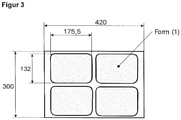
- depths of up to approx. 70 mm can be achieved when using laminates made of polyester and polyamide, for example (format, see figure 3 ).
- the food product is then placed in the meal tray, mostly by hand.
- the cover film - also referred to as the upper film - is fed over another roll meal tray and firmly sealed on its rim using temperature and pressure. This process step usually takes place again under vacuum, in which the entire package is located. This is followed by packaging into individual packs, combined with further individual operations such as printing or labeling the packaging.
- EP 1 471 098 A1 and DE 103 18 102 A1 disclose coextruded, peelable, transparent and biaxially oriented polyester films having a base layer (B) and at least one top layer (A) applied to this base layer (B).
- Certain products are pre-cooked; this happens, for example, in a water bath at 85 °C for a residence time of up to 6 hours.
- the packs are frozen - pre-cooked or not - and then sold.
- the pack is thawed and cooked in the oven at temperatures of up to 220 °C for a certain period of time.
- the cooking time depends essentially on the size of the pack (corresponds to the mass of the food in the pack) and is around 30 minutes to two hours.
- the package is closed and placed in the preheated oven (cook-in), where it opens automatically in the sealed seam (so-called self-venting), ideally after a dwell time of 5 to 10 minutes.
- the transparent menu tray made of thermoformable polyester is heat-sealed to the upper film - also made of polyester - at sealing temperatures between 120 and 220 °C.
- the process is economical if the sealing time can be limited to 3 seconds or less.
- There are various options for sealing the bottom and top film. In the present case Both the lower and the upper film are made of polyester polymers ( monopet or single-material packaging), with the upper film being the sealable and peelable variant.
- the pack according to the invention produced from both films exhibits the desired self-venting during cooking. Self-venting is achieved when the sealing properties of the top web are appropriately matched to the bottom web.
- the haze of the pack should be ⁇ 20% and the clarity of the pack > 70%.
- the packaging should appeal to the viewer visually. For this purpose, high gloss values of the packing are sought.
- the packaging is required to have a high puncture resistance so that it can withstand transport and storage in the department store without being damaged.
- thermoformable film laminate comprising a thermoformable film layer (a), a structural film layer (b), a heat sealable layer (c) and optionally a barrier layer (d).
- the structural film layer (b) adjoins the first surface of the thermoformable film layer (a), and the heat-sealable layer (c) is located on the opposite, second surface directed towards the inside of the pack.
- the thermoformable film layer (a) has a polymer composition comprising at least 80% by weight of polyethylene terephthalate.
- the structural film layer (b) can comprise a number of polymers, preferably it contains a polyamide.
- the heat-sealable layer (c) can also comprise a number of different polymers, preferably it contains an amorphous polyester.
- the laminate is suitable for the application mentioned at the outset, but its thermoformability and puncture resistance are in need of improvement, but above all it is in need of improvement in its optical properties, such as haze, clarity and gloss.
- a recyclable packaging made of polyester is described - consisting of a menu tray made of thermoformable film and a lid film.
- the application contains two embodiments: In embodiment 1 [07], the menu tray is formed from an oriented polyethylene terephthalate film and a polyester copolymer heat-sealing lacquer applied thereto by coating.
- the lid film is formed from an oriented polyethylene terephthalate film and a polyester copolymer heat seal lacquer applied thereto by coating.
- the menu tray is a monofilm - formed from amorphous polyethylene terephthalate or oriented polyethylene terephthalate or crystalline polyethylene terephthalate or recycled polyethylene terephthalate.
- the application gives examples of commercially available films that can be used for the menu tray or for the lid film. However, the application does not contain any information about formulations or processes for producing the films mentioned.
- % by weight always refers to the mass of the respective layer or the respective system in connection with which the information is given, unless otherwise stated.
- the terms "pack” and “packaging” are used synonymously and denote a combination (a kit) of lower film (A) and upper film (B). These two films can be made available to a user who can use them to seal food, for example.
- the package according to the present invention comprises a thermoformable sub-film (A) formed by a transparent biaxially oriented monolayer polyester film (A) or by a transparent biaxially oriented multilayer coextruded polyester film eg (A'A"A′′′). .
- the lower film (A) comprises at least 85% by weight of a thermoplastic copolyester.
- a copolyester whose dicarboxylic acid components can be traced back to 85 to 94 mol % units derived from terephthalic acid and 6 to 15 mol % units derived from isophthalic acid.
- It is preferably a film which is made up of a copolyester whose dicarboxylic acid components are 86 to 93 mol % units derived from terephthalic acid and 7 to 14 mol % units derived from isophthalic acid.
- ethylene glycol is preferably suitable as the diol in the thermoplastic copolyester.
- the lower film (A) can be made up of other polymers/polymer fractions and/or other substances, with the other polymers/polymer fractions originating from other aromatic and/or aliphatic dicarboxylic acids or diols.
- mixtures or blends of the homo- and/or copolymers mentioned can also be used for the thermoplastic polyester of the lower film (A).
- Suitable other aromatic dicarboxylic acids are preferably terephthalic acid, 2,5-furandicarboxylic acid (FDCA), biphenyl-4,4'-dicarboxylic acid, naphthalenedicarboxylic acids (e.g.
- naphthalene-1,4- or 1,6-dicarboxylic acid or naphthalene-2,6-dicarboxylic acid) biphenyl-x,x'-dicarboxylic acids (particularly biphenyl-4,4'-dicarboxylic acid), diphenylacetylene-x,x'-dicarboxylic acids (particularly diphenylacetylene-4,4'-dicarboxylic acid) or stilbene-x,x'-dicarboxylic acids.
- cycloaliphatic dicarboxylic acids mention should be made of cyclohexanedicarboxylic acids (particularly cyclohexane-1,4-dicarboxylic acid).
- the (C 3 -C 19 ) alkanedioic acids are particularly suitable, it being possible for the alkene portion to be straight-chain or branched.
- Suitable aliphatic diols are, for example, diethylene glycol, triethylene glycol, aliphatic glycols of the general formula HO-(CH 2 ) n -OH, where n represents an integer from 3 to 6 (especially propane-1,3-diol, butane-1,4-diol, pentane-1,5-diol and hexane-1,6-diol) or branched aliphatic glycols with up to 6 Carbon atoms, cycloaliphatic diols, optionally containing heteroatoms, with one or more rings.
- n represents an integer from 3 to 6 (especially propane-1,3-diol, butane-1,4-diol, pentane-1,5-diol and hexane-1,6-diol) or branched aliphatic glycols with up to 6 Carbon atoms, cycloaliphatic diols, optionally containing hetero
- cyclohexanediols particularly cyclohexane-1,4-diol.
- Suitable other aromatic diols correspond, for example, to the formula HO-C 6 H 4 -XC 6 H 4 -OH, where X is -CH 2 -, -C(CH 3 ) 2 -, -C(CF 3 ) 2 -, -O -, -S- or -SO 2 -.
- the desired good mechanical properties, but in particular the desired good thermoformability of the biaxially oriented polyester film, are obtained through the choice of the proportions according to the invention which are attributable to units derived from terephthalic acid and isophthalic acid. If the proportion of the dicarboxylic acid components attributable to units derived from isophthalic acid is less than 6% by weight, the desired good thermoformability of the film cannot be obtained. On the other hand, if this proportion is more than 15% by weight, the process of producing the lower film (A) by the process described below is no longer reliable.
- Films that consist of such high proportions of components that can be traced back to units derived from isophthalic acid have a very strong tendency during the manufacturing process to stick to themselves or to corresponding machine parts, e.g. rollers in longitudinal stretching or rollers in the machine outlet after transverse stretching .
- the polyesters can be produced by the transesterification process.
- the starting materials are dicarboxylic acid esters and diols, which are reacted with the usual transesterification catalysts, such as zinc, calcium, lithium and manganese salts.
- the intermediate products are polycondensed in the presence of commonly used polycondensation catalysts, such as antimony trioxide, titanium oxide and germanium compounds.
- the preparation can just as well be carried out by the direct esterification process in the presence of polycondensation catalysts. This starts directly from the dicarboxylic acids and the diols.
- the intermediates are polycondensed in the presence of titanium dioxide or germanium compounds, or if the direct esterification processes are carried out in the presence of polycondensation catalysts such as titanium dioxide or germanium compounds.
- the biaxially oriented polyester film is then antimony-free.
- the aim is a biaxially oriented polyester film which does not contain antimony and can therefore be used in packaging applications where the film is in direct contact with food.
- E MD is the film's modulus as measured in the machine direction
- E TD is the film's modulus as measured in the cross machine direction.
- the film according to the present invention is characterized by the sum of the strengths ( ⁇ 5 value) in the longitudinal direction (MD) and in the transverse direction (TD) in the range from 170 to 220 MPa.
- This property is essentially achieved in turn by adhering to the production process according to the invention described below in connection with the polyesters according to the invention described above. If the sum of the strengths is less than 170 MPa, the film no longer has the desired mechanical properties and is therefore unsuitable for the application. For example, the film can then no longer be properly transported in the thermoforming machine because the total strength is too low; the film warps, which is undesirable. In the other case, where the sum of the strengths is greater than 220 MPa, the foil can no longer be deep-drawn according to the task.
- the film according to the present invention is characterized by a density of less than 1395 kg/m 3 . This property is essentially achieved in turn by adhering to the manufacturing process according to the invention described below Connection achieved with the polyesters of the invention described above. If the density of the film is greater than 1395 kg/m 3 , the film is surprisingly too crystalline to be able to be thermoformed in accordance with the task at hand.
- the SV value of the lower film (A) is in the range from 680 to 1000, preferably in the range from 710 to 950, particularly preferably in the range from 740 to 900.
- the SV values of the respective polymer melts (base and cover layers) should differ by no more than 100, preferably no more than 75, but in particular no more than 50 units.
- the SV value of the film is less than 680, the required good thermoformability of the film of approx. 70 mm thermoforming (format, see figure 3 ) cannot be reached. On the other hand, if the SV value is greater than 1000, the polyester is too viscous and cannot be extruded economically, for example.
- the haze of the film is no longer within the range according to the invention.
- Customary antiblocking agents are inorganic and/or organic particles, such as calcium carbonate, amorphous silica, talc, magnesium carbonate, barium carbonate, calcium sulfate, barium sulfate, lithium phosphate, calcium phosphate, magnesium phosphate, aluminum oxide, calcium, barium, zinc or manganese salts of the Lower film (A) used derived dicarboxylic acids, titanium dioxide, kaolin or crosslinked polystyrene or crosslinked polymer particles based on acrylic acid derivatives.
- Lower film (A) used derived dicarboxylic acids such as calcium carbonate, amorphous silica, talc, magnesium carbonate, barium carbonate, calcium sulfate, barium sulfate, lithium phosphate, calcium phosphate, magnesium phosphate, aluminum oxide, calcium, barium, zinc or manganese salts of the Lower film (A) used derived dicarboxylic acids, titanium dioxide, kaolin or crosslinked polystyren
- the particles can be added to the lower film (A) in the concentrations that are advantageous in each case, e.g. as a glycolic dispersion during production of the polyester, i.e. during its polycondensation or as a masterbatch during the extrusion of the film.
- Particles preferred according to the invention are synthetically produced, amorphous SiO 2 particles in colloidal form.
- the particles are excellently integrated into the polymer matrix and only produce a few vacuoles. Vacuoles can arise, for example, when the film is biaxially oriented; they generally cause an increase in turbidity and are therefore to be avoided as far as possible for the present invention.
- the manufacturing process is for example in the EP 1 475 228 B1 revealed in detail.
- the package is sealed and placed in the oven and taken out of the oven after a certain cooking time.
- the cooking time essentially depends on the package size (mass of the contents) and is usually between 30 minutes and two (2) hours.
- thermoformable film Due to the process, the thermoformable film is subjected to little thermal stress over a large part of its surface. Only in the edge area of the pack and here in particular at the corners of the pack (sealed edge) is there a significantly increased thermal load on the film. While the remaining part of the thermoformed film experiences temperatures well below 160 °C due to the evaporating water the corner area of the package is exposed to the oven temperature for the entire cooking time.
- the film in the corner area is thermally stressed for more than 2 hours at a temperature of 220° C., with oxygen being able to penetrate into the polymer at this elevated temperature.
- the film preferably made of antimony-free polyester—preferably contains one or more free-radical scavengers.
- This/these radical scavengers are preferably based on phenolic antioxidants.
- the film containing one or more free-radical scavengers has a significantly increased temperature resistance, so that packaging made from it can remain in an oven at temperatures above 220° C. for more than one hour without becoming brittle.
- the film according to the present invention contains 500-3000 ppm of a radical scavenger, the content preferably being between 600-2500 ppm and particularly preferably between 700-2000 ppm.
- a radical scavenger the content preferably being between 600-2500 ppm and particularly preferably between 700-2000 ppm.
- Contents above 3000 ppm also tend to lead to the formation of gels and an undesirable yellow tinge in the film.
- Both a compound (preferred) and a mixture of different free-radical scavengers can be used as the free-radical scavenger.
- the radical scavenger(s) used are preferably selected from the group of phenolic antioxidants.
- Preferred radical scavengers are pentaerythritol tetrakis [3-(3,5-di-tert-butyl-4-hydroxyphenyl)-propionate] (CAS No. 6683-19-8) and 1,3,5-trimethyl-2,4, 6-tris(3,5-di-tert-butyl-4-hydroxybenzyl)benzene) (CAS No. 1709-70-2), available under the trade names Irganox 1010 and Irganox 1330 from BASF.
- the effectiveness of the radical scavenger can be tested directly on the packaging, e.g. after removing the packaging from the oven.
- the package is said to be good (i.e., acceptable for use) when the film of the present invention does not chip at any point.
- the lower film (A) can have a single-layer or multi-layer (i.e. at least two-layer) structure.
- a single-layer structure of the film has proven to be particularly advantageous.
- a two- or three-layer structure of the lower film (A) consisting of two layers A' and A" or three layers A'A"A' or A'A"A′′′ has also proven suitable.
- the amount of particles in the base layer A" of a three-layer film should be set lower than in the two layers A' (and A′′′), which preferably have the same structure or can also be different.
- the particle concentration in layer (A") should be selected so that it has a positive effect on the haze and gloss of the film.
- the particle concentration in layer (A") is between 0 and 0 .08% by weight, preferably between 0 and 0.05% by weight and in particular between 0 and 0.02% by weight.
- the particle diameter of the particles used is particularly preferred with a d 50 of greater than 1.5 ⁇ m.
- the thickness of the two layers A' can be the same or different. Their thicknesses are generally between 0.2 and 5 ⁇ m.
- the lower film (A) can also contain customary additives such as stabilizers (UV, hydrolysis) or other fillers (eg color pigments) in the concentrations recommended by the manufacturer. They are expediently added to the polymer or the polymer mixture before it is melted in the extruder.
- the total thickness of the polyester film (A) according to the invention can vary within certain limits. It is 50 to 300 ⁇ m, preferably 51 to 200 ⁇ m and particularly preferably 52 to 200 ⁇ m. If the thickness of the film (A) is less than 50 ⁇ m, the mechanical properties and barrier properties of the thermoformed film are insufficient. On the other hand, if the thickness of the film (A) is more than 300 ⁇ m, the thermoformability of the film deteriorates and, in addition, the production of the film uneconomical, both of which are undesirable.
- thermoformable lower film (A) The subject matter of the present invention is also a process for producing the thermoformable lower film (A). It includes the production of the lower film by extrusion (production of layer (A)) or coextrusion (e.g. production of layers (A'A"A′′′)), biaxial stretching of the lower film (A), and heat setting and winding of the stretched Lower film (A).
- the biaxial stretching of the film is carried out sequentially.
- stretching is preferably carried out first in the longitudinal direction and then in the transverse direction. Stretching in the longitudinal direction can be carried out, for example, with the aid of two rollers rotating at different speeds depending on the desired stretching ratio.
- a corresponding tenter frame is generally used for transverse stretching.
- the temperatures at which the biaxial stretching is carried out can vary within certain ranges; they depend essentially on the desired properties, in particular the desired thermoforming properties, of the film of the invention. Surprisingly, it was found that Achieving the desired thermoformability, the film should be stretched significantly less than is usual in the prior art.
- thermoformability of the lower film (A) stretching in the longitudinal direction is carried out under specific conditions.
- the temperature of the film during stretching is in the range from 70 to 100°C (the heating temperatures of the rolls are 60 to 110°C).
- the longitudinal stretching ratio is in the range from 2.0:1 to 4.0:1, preferably in the range from 2.1:1 to 3.8:1 and more preferably in the range from 2.2:1 to 3.6:1 accomplished. For example, if the film is stretched below 2.0:1, the caliper profile is poor; if the film is stretched above 4.0:1, the thermoformability is no longer adequate.
- the transverse stretching takes place in a corresponding tenter frame.
- the temperatures of the heating fields in the tenter frame are 70 to 120 °C (film temperature: 60 to 110 °C)
- the stretching in the transverse direction is carried out in a temperature range of the film from 90 °C (start of stretching) to 140 °C (end of stretching) accomplished.
- the transverse stretching ratio is in the range from 2.2:1 to 3.8:1, preferably from 2.4:1 to 3.7:1 and particularly preferably in the range from 2.6:1 to 3.6:1. For example, if the film is stretched below 2.2:1, the thickness profile is poor; if the film is stretched above 3.8:1, the thermoformability is no longer adequate.
- the film After biaxial orientation, the film is heat-set.
- the thermosetting must be carried out under certain conditions according to the invention.
- the time for heat setting is 5 to 25 s, preferably 6 to 22 s and particularly preferably 7 to 20 s.
- the temperature at which heat setting is carried out is, according to the invention, in the range from 175 to 220° C., preferably in the 178 to 215°C and more preferably in the range of 180 to 210°C.
- the film After heat setting, the film is cooled and wound up in the usual way.
- the process conditions mentioned above are observed. If the stated process conditions according to the invention are not observed during the longitudinal and transverse stretching and during the fixing of the lower film (A), the properties according to the invention of the film with regard to the mechanics of the film, However, in particular with regard to the desired thermoformability and puncture resistance, which is undesirable.
- At least one surface of the lower film (A) is coated inline or offline with a further layer (C) containing poly(acrylic) and/or poly(alkyl methacrylate) and /or poly (acryl-co-methacrylic acid alkyl ester) contains.
- acrylic and/or methacrylic copolyesters can be present, which bring about crosslinking of the polymers. In this case, preference is given to using N-methylolacrylamide to produce the copolymers. Other crosslinkers such as melamine can also be used.
- the coating is preferably applied inline.
- the coating (C) according to the present invention is described in detail in EPA 0 144 948, which is incorporated herein by reference.
- the preferred acrylate coating is applied to at least one side of the lower film (A) and essentially serves to improve winding, in particular to improve unwinding of the film after storage (at elevated temperatures).
- the coating recipe can contain known additives such.
- the lower film (A) is coated with the acrylic crosslinking layer (C) either inline, preferably between the first and second stretching steps, or offline after production of the biaxially oriented film.
- the layer (C) is preferably applied after the production of the lower film (A).
- the polyester film is coated with a functional coating in such a way that the coating on the finished polyester film has a thickness of preferably 5 to 100 nm, particularly preferably 10 to 90 and very particularly preferably 15 to 80 nm.
- Layer (C) is particularly preferably applied by means of the reverse gravure roll coating process, in which the coating can be applied extremely homogeneously in layer thicknesses of up to 200 nm.
- the coating is preferably applied as a solution, suspension or as a dispersion, particularly preferably as an aqueous solution, suspension or the dispersion.
- the substances mentioned are applied to one or both film surfaces as a dilute, aqueous solution or dispersion and the solvent is then evaporated. If the coating is applied inline before transverse stretching, the heat treatment during transverse stretching and subsequent heat setting is sufficient to volatilize the solvent and dry the coating.
- the lower film (A) according to the invention produced by the process according to the invention described above, has a number of properties, the most important of which are listed below.
- the lower film (A) according to the invention is characterized by very good mechanical properties (area modulus of elasticity, sum of strengths, puncture resistance), which, among other things, make it possible for the desired good thermoformability and the desired good puncture resistance to be achieved.
- the lower film (A) is characterized by brilliant optical properties.
- the haze of the lower film (A) is less than 2%, the clarity is greater than 85% and the gloss is more than 140.
- the puncture resistance F[N] of the film which is important for the application, is surprisingly so high that the thermoformed pack produced from it can be transported and stored without being damaged.
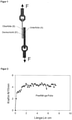
- the lower film (A) has a puncture resistance F in the definition range for the thickness, which correlates with the thickness d of the film according to the following formula f N i.e ⁇ m > 0.35
- the lower film (A) has a thermoformability of at least 70 mm (format, see figure 3 ), with a thermoforming ratio of at least 2.5.
- the portions of meat, poultry or fish customary on the market can be packed in the customary packaging design without any problems using trays which have such a thermoformability according to the invention.
- the lower film (A) has the required good barrier properties, in particular against oxygen, water vapor and various aromas.
- the highly transparent bottom film (A) is easy to wind and process. When the foils are wound, the individual foil layers do not stick to one another, not even at elevated temperatures, such as 50 or 60 °C.
- the film can be produced economically. This means, for example, that methods customary in industry can be used to produce the lower film.
- thermoformable polyester film according to the invention is outstandingly suitable for packaging foodstuffs and semi-luxury foods. It is particularly suitable for packaging food and beverages in thermoformed menu trays that have been produced using the above method.
- Table 1 summarizes, inter alia, the most important film properties according to the invention.
- the pack according to the present invention further contains a top film (B) which is formed by a transparent, biaxially oriented and coextruded, heat-sealable and peelable polyester film (B' B"; explanation see below) or (B' B" B′′′; explanation see below) is formed.
- the top layer (B') is predominantly, i.e. at least 60% by weight, made up of polyesters.
- the heat-sealable top layer (B') comprises at least one polyester and optionally an antiblocking agent.
- the polyester is made up of units derived from aromatic and aliphatic dicarboxylic acids.
- the units based on the aromatic dicarboxylic acids are contained in the polyester in an amount of 25 to 95 mol %, preferably 40 to 90 mol %, particularly preferably 50 to 88 mol %.
- the units based on the aliphatic dicarboxylic acids are contained in the polyester in an amount of 5 to 75 mol %, preferably 10 to 60 mol %, particularly preferably 12 to 50 mol %, the mol % figures always increasing 100% supplement.
- the corresponding diol units also always add up to 100 mol %.
- aromatic dicarboxylic acids which can be used according to the invention are terephthalic acid, isophthalic acid, phthalic acid and 2,6-naphthalenedicarboxylic acid.
- aliphatic dicarboxylic acids examples include succinic acid, glutaric acid, adipic acid, pimelic acid, suberic acid, azelaic acid and sebacic acid.
- Adipic acid and sebacic acid can preferably be used according to the invention, while succinic acid, glutaric acid, adipic acid, pimelic acid, suberic acid and azelaic acid can be used less preferably.
- Examples of the aliphatic diols that can be used according to the invention are ethylene glycol, 1,3-propanediol, 1,3-butanediol, 1,4-butanediol, 1,5-pentanediol, 2,2-dimethyl-1,3-propanediol, diethylene glycol, triethylene glycol, 1,4-cyclohexanedimethanol and neopentyl glycol.
- the cover layer material contains up to 15% by weight of a polymer which is incompatible with polyester (anti-PET polymer).
- anti-PET polymer a polymer which is incompatible with polyester
- the proportion of anti-PET polymer is 2 to 12% by weight, preferably 2 to 10% by weight and particularly preferably 2 to 8% by weight.
- the material of the top layer (B') consists of particles, additives, auxiliaries and/or other additives commonly used in polyester film technology.
- the polyester for the top layer (B') is preferably made from two physically miscible polyesters I and II and more preferably from three physically miscible polyesters I, II and III, which are fed to the extruder for this layer (B') as a mixture.
- the proportion of the polyester I in the outer layer (B'), which consists of one or more aromatic dicarboxylates and one or more aliphatic alkylenes, is 10 to 60% by weight. In the preferred embodiment, the proportion of the polyester I is 15 to 55% by weight and in the particularly preferred embodiment it is 20 to 50% by weight.
- the SV value of the raw material is greater than 600, preferably greater than 650 and particularly preferably greater than 700. If the SV value of the raw material is less than 600, the extrudability of the raw material becomes poorer, which is undesirable.
- the proportion of polyester II in the outer layer (B') is 20 to 70% by weight.
- the proportion of polyester II is 25 to 65% by weight and in the particularly preferred embodiment it is 30 to 60% by weight.
- the polyester II preferably consists of a copolymer of aliphatic and aromatic acid components, in which the aliphatic acid components are 20 to 90 mol %, preferably 30 to 70 mol % and particularly preferably 35 to 60 mol %, based on the total amount of acid in the polyester II.
- the 100 mol% missing dicarboxylate content comes from aromatic acids, in particular terephthalic acid and isophthalic acid, with preference being given to terephthalic acid and less preferably isophthalic acid, and on the glycolic side from aliphatic or cycloaliphatic or aromatic diols, such as with respect to the base layer will be described in detail.
- the presence of at least 10 mol % of aromatic dicarboxylic acid ensures that the polymer II can be processed without sticking, e.g. in the coextruder or in longitudinal stretching.
- the proportion of polyester II in the top layer (B') is less than 20% by weight, the sealing and peeling behavior of the film is severely impaired. As already described above, the sealing layer then no longer has the desired softness at the usual sealing temperatures, which is required for a good seal (even as a result of partial contamination). If, on the other hand, the proportion of polyester II in the outer layer (B') is more than 70% by weight, the production of the film using coextrusion technology becomes more difficult or is no longer guaranteed. The tendency of the film to stick to certain machine parts, especially metal rollers, is particularly high here.
- the SV value of the raw material is greater than 900, preferably greater than 950 and particularly preferably greater than 1000. If the SV value of the raw material is less than 900, the haze of the film increases, which is undesirable.
- the proportion of the polyester III which consists of one or more aromatic dicarboxylates and one or more aliphatic alkylenes, is 0 to 15% by weight in the top layer (B') and is optional. In the preferred Embodiment, the proportion of the polyester III is 3 to 12% by weight and in the particularly preferred embodiment it is 4 to 10% by weight.
- any remaining polymeric fractions present originate from other aromatic dicarboxylic acids and other aliphatic diols, as already listed above as the main suitable other aromatic dicarboxylic acids for the base layer (B").
- the polyester III contains a suitable antiblocking agent (see below) in a proportion of 5 to 25% by weight.
- polyester III is a masterbatch that is preferably produced using extrusion technology.
- the antiblocking agent is added to the polyester raw material during extrusion (preferably twin-screw extruder) in a significantly higher concentration than is subsequently present in the film.
- the SV value of the masterbatch is greater than 400, preferably greater than 425 and particularly preferably greater than 450.
- the glass transition temperature of polyester I is expediently more than 50.degree.
- the glass transition temperature of polyesters I and III is preferably more than 55.degree. C. and more preferably more than 60.degree. If the glass transition temperature of polyesters I and III is less than 50 °C, the film cannot be produced reliably. The tendency of the top layer (B') to stick, e.g. to rollers, is so great that frequent tearing of the foil must be expected.
- the glass transition temperature of polyester II is expediently less than 10.degree.
- the glass transition temperature is preferably less than 8°C and particularly preferably less than 6°C. If the glass transition temperature of polyester II is greater than 10° C., the sealing layer no longer has the desired softness at the usual sealing temperatures, which is required for sealing (also due to partial contamination).
- the heat-sealable and peelable top layer (B') contains a polymer that is incompatible with polyester (anti-PET polymer) in a specific concentration.
- the proportion of the anti-PET polymer is 0 to 15% by weight, based on the mass of the top layer (B').
- the proportion of the anti-PET polymer is 2 to 10% by weight and in the particularly preferred embodiment it is 2 to 8% by weight, also based on the mass of the outer layer (B').
- incompatible polymers examples include polymers based on ethylene (eg LLDPE, HDPE), propylene (PP), cycloolefins (CO), amides (PA) or styrene (PS).
- a copolymer is used as the polyester-incompatible polymer. Examples of these are copolymers based on ethylene (C2/C3, C2/C3/C4 copolymers), propylene (C2/C3, C2/C3/C4 copolymers), butylene (C2/C3, C2/C3/C4 copolymers).
- the polyester incompatible polymer is a cycloolefin copolymer (COC).
- COC cycloolefin copolymer
- cycloolefin copolymers preference is given in particular to those which contain polymerized units of polycyclic olefins having a basic norbornene structure, particularly preferably norbornene or tetracyclododecene.
- Particularly preferred are cycloolefin copolymers (COC) containing polymerized units of acyclic olefins, especially ethylene.
- COC cycloolefin copolymers
- norbornene/ethylene and tetracyclododecene/ethylene copolymers which contain 5 to 80% by weight of ethylene units, preferably 10 to 60% by weight of ethylene units (based on the mass of the copolymer).
- the COC's generally have glass transition temperatures between -20 and 400 °C. Those COCs which have a glass transition temperature of less than 120° C., preferably less than 100° C. and particularly preferably less than 80° C. are suitable for the invention.
- the glass transition temperature should preferably be above 50.degree. C., preferably above 55.degree. C., in particular above 60.degree.
- the viscosity number (decaline, 135° C., DIN 53 728) is expediently between 0.1 and 200 ml/g, preferably between 50 and 150 ml/g.
- Films that contain a COC with a glass transition temperature of less than 80° C. are distinguished from those that contain a COC with a glass transition temperature of greater than 80° C. by lower haze and improved sealability.
- EP-A-0 283 164 , EP-A-0 407 870 , EP-A-0 485 893 and EP-A-0 503 422 describe the preparation of cycloolefin copolymers (COC) with catalysts based on soluble metallocene complexes. Cycloolefin copolymers produced with catalysts based on soluble metallocene complexes are particularly preferably used. Such COC are commercially available; eg Topas® (Ticona, Frankfurt).
- the addition of the anti-PET polymer favors the sealing and the processing behavior, here in particular the winding of the film according to the invention. If the COC content in the preferred embodiment is less than 2% by weight, the polymer no longer has a positive influence on the sealing and the processing behavior of the menu tray. The meal tray tends to block. On the other hand, the proportion of polyester-incompatible polymer should not exceed 15% by weight, since otherwise the haze of the film becomes too high.
- the diameter d 50 of the particles must be in a range according to the invention. It has proven particularly advantageous to use particles with an average particle diameter d 50 of 1.5 to 5.0 ⁇ m, preferably 1.5 to 4.5 ⁇ m and particularly preferably 1.5 to 4.0 ⁇ m . When using particles with a diameter of less than 1.5 ⁇ m, there is no positive influence of the particles on the self-venting and the peeling behavior of the top layer (B′). After cooking, the film tends to tear or tear when it is pulled off the menu tray, which is undesirable. Particles with a diameter of more than 5.0 ⁇ m usually cause too much haze and too little gloss in the film, as well as filter problems.
- the heat-sealable and peelable top layer (B') contains particles in a concentration of more than 0.04 wt %, preferably more than 0.05% by weight and particularly preferably more than 0.06% by weight.
- the maximum concentration of the particles is 10.00% by weight, preferably 8.00% by weight and particularly preferably 6.00% by weight. If the top layer (B') contains particles in a concentration of less than 0.04% by weight, there is no longer a positive influence on self-venting. If the top layer (B') contains particles in a concentration of more than 10% by weight, the haze of the film becomes too great.
- the particle diameter d 50 in the heat-sealable and peelable top layer (B') is greater than the thickness of this layer. According to the invention, it has proven advantageous to maintain a particle diameter/layer thickness ratio of greater than 1.0, preferably greater than 1.1 and particularly preferably greater than 1.2. In these cases, the particles have a particularly positive influence on the self-venting and the peeling behavior of the film from the menu tray after cooking.
- Particles preferred according to the invention are synthetically produced, amorphous SiO 2 particles in colloidal form, which are excellently bound into the polymer matrix.
- SiO 2 particles reference is made to the prior art; the procedure is eg in the EP 1 475 228 B1 revealed in detail.
- Typical other particles that can be used in the top layer (B') are inorganic and/or organic particles, for example calcium carbonate, talc, magnesium carbonate, barium carbonate, calcium sulphate, barium sulphate, lithium phosphate, calcium phosphate, magnesium phosphate, aluminum oxide, LiF, calcium, Barium, zinc or manganese salts of the dicarboxylic acids used, titanium dioxide or kaolin.
- inorganic and/or organic particles for example calcium carbonate, talc, magnesium carbonate, barium carbonate, calcium sulphate, barium sulphate, lithium phosphate, calcium phosphate, magnesium phosphate, aluminum oxide, LiF, calcium, Barium, zinc or manganese salts of the dicarboxylic acids used, titanium dioxide or kaolin.
- the heat-sealable and peelable top layer (B') has a thickness of 1.5 to 5 ⁇ m. If the thickness of the outer layer (B') is less than 1.5 ⁇ m, the sealing of the upper film (B) to the lower film (A) is not sufficient. If the cover layer thickness is greater than 5 ⁇ m, the self-venting of the packing deteriorates, which is undesirable.
- the top layer (B') shows good sealing properties to itself (fin sealing, top layer (B') to top layer (B')), but in particular good sealing and peeling properties to the bottom film (A).
- the sealing seam strength of the top layer (B') against itself (fin seal) and against the lower film (A) is greater than 2 N/15 mm and is a maximum of 10 N/15mm. In all cases, a seal that can be peeled off from the lower film (A) is achieved, even in the case where the film is partially contaminated with meat juice or the like.
- aliphatic diols suitable for forming the polyester are, for example, diethylene glycol, triethylene glycol, aliphatic glycols of the general formula HO-(CH 2 ) n -OH, where n is an integer from 3 to 6 (in particular propane-1,3-diol, butane -1,4-diol, pentane-1,5-diol and hexane-1,6-diol) or branched aliphatic glycols with up to 6 carbon atoms.
- Suitable other aromatic diols correspond, for example, to the formula HO-C 6 H 4 -XC 6 H 4 -OH, where X is -CH 2 -, -C(CH 3 ) 2 -, -C(CF 3 ) 2 -, -O -, -S- or -SO 2 -.
- aromatic dicarboxylic acids are preferably benzenedicarboxylic acids, naphthalenedicarboxylic acids, for example naphthalene-1,4- or 1,6-dicarboxylic acid, biphenyl-x,x'-dicarboxylic acids, in particular biphenyl-4,4'-dicarboxylic acid, diphenylacetylene-x,x'-dicarboxylic acids , in particular diphenylacetylene-4,4'-dicarboxylic acid, or stilbene-x,x'-dicarboxylic acids.
- cycloaliphatic dicarboxylic acids mention should be made of cyclohexanedicarboxylic acids, in particular cyclohexane-1,4-dicarboxylic acid.
- aliphatic dicarboxylic acids the (C 3 to C 19 ) alkanedioic acids are particularly suitable, it being possible for the alkene portion to be straight-chain or branched.
- the polyesters for the base layer (B") can be produced, for example, by the transesterification process.
- the starting materials here are dicarboxylic acid esters and diols, which are reacted with the customary transesterification catalysts, such as zinc, calcium, lithium, magnesium and manganese salts.
- the intermediate products are then polycondensed in the presence of generally customary polycondensation catalysts, such as antimony trioxide or titanium, aluminum or germanium salts.
- the production can just as well be carried out by the direct esterification process in the presence of polycondensation catalysts.
- the starting point here is directly from the dicarboxylic acids and the diols the end.
- the intermediate products are polycondensed in the presence of titanium dioxide or germanium compounds, or if the direct esterification processes are carried out in the presence of polycondensation catalysts such as titanium dioxide or germanium compounds.
- the biaxially oriented polyester film is therefore antimony-free.
- the aim is a biaxially oriented polyester film which contains no antimony and can therefore be used in packaging applications in which the film is in direct contact with food.
- the base layer (B") can also contain conventional additives such as stabilizers (UV, hydrolysis), but in particular heat stabilizers (e.g. Irganox 1010) or other fillers (e.g. color pigments) in the concentrations recommended by the manufacturer. These additives are appropriately added to the polymer or Added to the polymer mixture before melting.
- stabilizers UV, hydrolysis
- heat stabilizers e.g. Irganox 1010
- other fillers e.g. color pigments
- the base layer (B) additionally contains regenerated material, which is added to the extrusion in the production of the film in an amount of up to 60% by weight, without the physical and in particular the optical properties of the film being significantly negatively affected.
- the top film is also exposed to increased thermal stress in the so-called cook-in process.
- the film Due to the process, the film is not thermally stressed over a large part of its surface. Only in the edge area of the pack and here in particular at the corners of the pack (sealed edge) is there a significantly increased thermal load on the film. While the remaining part of the thermoformed film experiences temperatures well below 160 °C due to the evaporating water, the corner area of the pack is exposed to the oven temperature (e.g. 220 °C) for the entire cooking time.
- the oven temperature e.g. 220 °C
- the film in the corner area is thermally stressed for more than 2 hours at a temperature of 220° C., with oxygen being able to penetrate into the polymer at this elevated temperature.
- the base layer (B") preferably also contains one or more free-radical scavengers if increased thermal stability is required.
- the free-radical scavenger(s) are preferably based on phenolic antioxidants.
- the film containing one or more free-radical scavengers has a significantly increased temperature resistance, so that packaging made from it can remain in an oven at temperatures above 220° C. for more than one hour without becoming brittle.
- the film according to the present invention contains 400-2000 ppm of a radical scavenger, the content preferably being between 500-2000 ppm and particularly preferably between 600-2000 ppm.
- a radical scavenger the content preferably being between 500-2000 ppm and particularly preferably between 600-2000 ppm.
- Contents above 2000 ppm also tend to lead to the formation of gels and an undesirable yellow tinge in the film.
- a compound (preferred) or a mixture of different free-radical scavengers can be used as the free-radical scavenger.
- the radical scavenger(s) used are preferably selected from the group of phenolic antioxidants.
- Preferred radical scavengers are pentaerythritol tetrakis [3-(3,5-di-tert-butyl-4-hydroxyphenyl)-propionate] (CAS No. 6683-19-8) and 1,3,5-trimethyl-2,4, 6-tris(3,5-di-tert-butyl-4-hydroxybenzyl)benzene) (CAS No. 1709-70-2), available under the trade names Irganox 1010 and Irganox 1330 from BASF.
- the effectiveness of the radical scavenger can be tested directly on the packaging, e.g. after removing the packaging from the oven.
- the heat-sealable and peelable upper film (B) according to the invention can have two or three layers. To achieve the aforementioned properties, in particular the very good optical properties required, a three-layer structure of the upper film (B) with the layers B′B′′B′′′ has proven to be favorable.
- the upper film (B) according to the invention then comprises the base layer B′′, which heat-sealable and peelable top layer B' on one side of the base layer B" and the top layer B′′′ on the other side of the base layer B".
- the thickness of the top layer B′′′ is generally between 0.5 and 3 ⁇ m and preferably consists of the same polyester that is also used for the base layer (B′′).
- the total thickness of the polyester film (B) according to the invention can vary within certain limits. It is 20 to 125 ⁇ m, preferably 25 to 100 ⁇ m and particularly preferably 30 to 75 ⁇ m. If the thickness of the film (B) is less than 20 ⁇ m, the mechanical properties and the barrier properties of the film are insufficient. On the other hand, if the thickness of the film (B) is larger than 125 ⁇ m, the sealability of the film deteriorates and, moreover, the production of the film becomes uneconomical, both of which are undesirable.
- the invention also relates to a process for producing the polyester film (B) according to the invention by the coextrusion process known from the literature.
- the procedure is such that the melts corresponding to the individual layers (B'B" and, if present, B′′′) of the upper film (B) are coextruded through a flat die, the film thus obtained being solidified on one or more rollers is peeled off, the film is then biaxially stretched, and the biaxially stretched film is heat-set.
- the biaxial stretching is carried out sequentially. Stretching is preferably first in the longitudinal direction (i.e. in the machine direction) and then in the transverse direction (i.e. perpendicular to the machine direction). Stretching in the longitudinal direction can be carried out with the aid of several rollers running at different speeds depending on the desired stretching ratio. A corresponding tenter frame is generally used for transverse stretching.
- the polymers or the polymer mixtures for the individual layers are compressed and liquefied in the respective extruders, with any additives provided as additives already being present in the polymer or in the polymer mixture.
- the melts are simultaneously pressed through a flat die (slot die) and the multilayer melt pressed out is drawn off on one or more take-off rollers, the melt cooling down and solidifying into a preliminary film.
- the temperature at which the stretching is carried out can vary over a relatively wide range and depends on the desired properties of the film.
- the longitudinal stretching is carried out at a temperature in the range from 80 to 130°C and the transverse stretching at a temperature in the range from 90 to 150°C.
- the longitudinal stretch ratio is generally in the range from 2.5:1 to 6:1, preferably from 3.0:1 to 5.5:1.
- the transverse stretch ratio is generally in the range from 3.0:1 to 5.0:1, preferably from 3.5:1 to 4.5:1.
- the film is held at a temperature of about 160 to 240° C. for a period of about 0.1 to 15 s.
- the film is then wound up in the usual way.
- the heat-sealable and peelable polyester film (B) of the invention produced by the process of the invention, has a number of properties, the most important of which are listed below.
- the haze of the heat-sealable and peelable polyester film (B) is less than 20.0%.
- the haze of the polyester film is preferably less than 16.0% and particularly preferably less than 12.0%.
- the clarity of the heat-sealable and peelable polyester film (B) is greater than 70%.
- the clarity of the polyester film is preferably more than 75% and particularly preferably more than 80%.
- the transparency of the heat-sealable and peelable polyester film (B) is greater than 88.
- the transparency is preferably greater than 89 and particularly preferably greater than 90.
- the gloss of the heat-sealable and peelable polyester film (B) is greater than 70, in the preferred embodiment greater than 75 and in the particularly preferred embodiment greater than 80.
- the top layer (B') shows good sealing properties to itself, but in particular good sealing and peeling properties to the lower film (A).
- the film adheres well to the materials mentioned.
- the seal seam strength of the top layer (B') against itself and against the lower film (A) is greater than 2 N/15 mm and is a maximum of 10 N/15 mm. In all cases, a seal that can be peeled off from the lower film (A) is achieved (at least when the film is peeled off after cooking).
- the polyester film (B) is characterized by very good winding properties.
- the polyester film (B) is outstandingly suitable for packaging food and beverages, in particular for packaging food and beverages in trays where heat-sealable and peelable polyester films are used to open the packaging.
- Table 2 summarizes, inter alia, the most important film properties according to the invention.
- Heat-sealable (also heat-sealable) is generally understood as meaning the property of a multilayer polyester film containing at least one base layer (B) and containing at least one heat-sealable top layer (B').
- the heat-sealable top layer (B') is sealed to a substrate made of thermoplastic material, eg menu trays, by applying heat (110 to 220° C.) and pressure (1 to 6 bar) in a specific time (0.1 to 4 seconds). made of polyester or APET, without the base layer (B) itself becoming plastic.
- the polymer of the top layer (B') generally has a significantly lower melting point than the polymer of the base layer (B").
- the Melting point of the heat-sealable top layer (B') is generally significantly less than 220° C.
- the main polymer for the sealable top layer (B') of the top film is almost 100% amorphous.
- Peelable is understood as meaning the property of a polyester film which contains at least one heat-sealable and peelable top layer (B') which, after heat-sealing on APET/RPET and CPET menu trays, can be pulled off the menu tray again in such a way that the film neither breaks nor tears.
- the composite of heat-sealable and peelable film and menu tray usually opens up in the seam between the heat-sealed layer and the menu tray surface when the film is pulled off the menu tray (cf. also Ahlhaus, OE: Packaging with plastics, Carl Hanser Verlag, p. 271, 1997, ISBN 3-446-17711 - 6 ).
- figure 1 is a tear-elongation behavior of the film according to figure 2 obtain.
- the force required to do so increases according to figure 2 up to a certain value (e.g. 5 N/15mm) and then remains approximately constant over the entire peeling path, but is subject to more or less large fluctuations (approx. +/- 20%).
- the modulus of elasticity is determined in accordance with DIN EN ISO 572-1 and -3 (test specimen type 2) on 100 mm ⁇ 15 mm film strips.
- the ⁇ 5 value is determined in accordance with DIN EN ISO 572-1 and -3 (test specimen type 2) on 100 mm ⁇ 15 mm film strips.
- the density of the film is determined according to ASTM-D 1505-68, Method C.
- polyester films are measured using a Hazegard Hazemeter XL-211 from BYK Gardner.
- the Hölz haze was determined according to ASTM-D 1003-61, Method A.
- Clarity is measured according to ASTM-D 1003 using Hazeguard, but now at the "clarity port" of the measuring device.
- Transparency is measured in accordance with ASTM-D 1003-61, method A. All of the measurements are carried out on the film directly after production.
- the gloss is determined according to DIN 67530.
- the reflector value is measured as an optical parameter for the surface of a foil. Based on the ASTM-D 523-78 and ISO 2813 standards, an irradiation angle of 20° is set. A light beam hits the flat test surface at the set angle of incidence and is reflected or scattered by it. The light rays incident on the photoelectronic receiver are displayed as a proportional electrical quantity.
- the measured value is dimensionless and must be specified with the angle of incidence.
- the standard viscosity in dilute solution SV was measured in an Ubbelohde viscometer at (25 ⁇ 0.05) °C, based on DIN 53 728 Part 3.
- Dichloroacetic acid (DCE) was used as a solvent.
- the concentration of the dissolved polymer was 1 g polymer/100 mL pure solvent.
- the polymer was dissolved at 60° C. for 1 hour. If the samples were not completely dissolved after this time, up to two further dissolution tests were carried out for 40 minutes each at 80° C. and the solutions were then centrifuged at a speed of 4100 rpm for 1 hour.
- the average diameter d 50 is determined using a Malvern Master Sizer 2000 on the particle to be used; by definition, this is the volume median dv 50 .
- the samples are placed in a cuvette with water and this is then placed in the measuring device.
- the dispersion is analyzed using a laser and the particle size distribution is determined from the signal by comparison with a calibration curve.
- the measuring process is automatic and also includes the mathematical determination of the d 50 value.
- the d 50 value is determined by definition from the (relative) cumulative curve of the particle size distribution: the point of intersection of the 50% ordinate value with the cumulative curve provides the desired d 50 value on the abscissa axis. This is the volume median d v50 .
- Measurements on the film produced using these particles show a d 50 value that is 15-25% lower than that of the particles used.
- the puncture resistance ( ⁇ puncture test) is measured according to EN 14477.
- the stress of hard, pointed or edged objects is an important factor. Knowing the puncture resistance is of interest if the films are used as packaging material, e.g. B. for food or for sharp-edged parts.
- this behavior is measured against a tip with a diameter of 0.8 mm. This test is also known as the Parken Pen Test / Parker Pen Test.
- the water vapor permeability (WVTR) was measured on films of different thicknesses at 23 °C and 85 % RH. F. measured according to ISO 15106-3.
- the oxygen barrier (OTR) was measured using an OXTRAN® 100 from Mocon Modern Controls (USA) in accordance with ISO 15105-2, Annex A, 23.0° C./50% RH. The OTR was also measured on films of different thicknesses.
- a biaxially oriented film (A) was produced from an ethylene terephthalate-ethylene isophthalate copolymer by the process according to the invention.
- the thickness of the foil was 96 ⁇ m.
- chips made from the copolymer were fed into the extruder for the production of the lower film.
- the copolymer was melted and homogenized in the extruder under the process conditions listed in the table below.
- the melt was shaped in a slot die and ejected through the die lip.
- the melted film was cooled and a transparent, single-layer film was produced by stepwise orientation in the longitudinal and transverse directions with subsequent fixing.
- the film was coated from an aqueous dispersion by means of a reverse engraving process between longitudinal and transverse stretching.
- the coating (C) which is acrylically crosslinked in the tenter frame contains a 4.5% by weight dispersion of a latex consisting of a copolymer of 60% by weight methyl methacrylate, 35% by weight ethyl acrylate and 5% by weight N-methylolacrylamide and a surfactant.
- the dry weight of the coating (based on the biaxially oriented film) was about 0.035 g/m 2 .
- the manufacturing conditions in the individual process steps were extrusion Temperatures for the melt (A) 270 °C Temperature of the take-off roller 20 °C longitudinal stretching heating temperature of the rollers 70-90 °C film stretching temperature 86 °C longitudinal stretch ratio 3.0 transverse stretching Temperature of the heating fields 118 °C film stretching temperature 135 °C transverse stretch ratio 3.4 fixation temperature of the film 185 °C length of time 9 s
- Table 3 shows the composition of the lower film (A) and further information on the film of the invention, in particular on the properties of the film of the invention.
- the above-mentioned raw materials were melted in one extruder per layer and extruded through a three-layer slot die with structure ABC onto a cooled draw-off roll.
- the amorphous preliminary film thus obtained was then stretched lengthwise.
- the film was then stretched transversely, fixed and rolled up (final thickness of the film 42 ⁇ m).
- the manufacturing conditions in the individual process steps were extrusion Temperatures for the melts (B'B"B′′′) 270 °C Temperature of the take-off roller 20 °C Longitudinal stretching (mirror stretching) heating temperature of the rollers 80-120 °C stretch temperature 115 °C longitudinal stretch ratio 4.0 transverse stretching Temperature of the heating fields 80-135 °C stretch temperature 135 °C transverse stretch ratio 4.2 fixation temperature 230 °C length of time 3 s
- Table 4 shows the composition of the film and further information on the film of the invention, in particular on the properties of the film of the invention.
- the lower film (A) and the upper film (B) were each clamped separately in a Multivac machine (R 245/SN:166619).
- the lower film (A) was thermoformed under the molding conditions (mold temperatures 210° C., heating time: 2-3 s, explosive molding/compressed air reservoir 2 bar, molding pressure 2 bar, molding: 2 s).
- the formats set for the shells to be produced are the figure 3 refer to.
- the deep draw of the lower film (A) was up to 75 mm and the deep draw ratio was up to 2.86.
- the mold was cooled and the thermoformed bottom sheet (A) was ejected from the mold.
- a portion of pork was placed in the cavity and the top film (B) placed on top of the bottom film (A).
- the top film (B) was placed on the bottom film (A) in such a way that the heat-sealable and peelable surface (B') of the top film (B) was in contact with the portion of meat and the bottom film (A).
- Heat sealing was performed on the same machine at a temperature of 160°C, 2 s at a pressure of 2 bar.
- the portion of meat weighed about 1000 g.
- the pack was placed in a conventional oven and cooked at 220°C for 60 minutes. The desired self-venting was observed after about 10 minutes.
- the top film (B) was pulled off the bottom film (A) of the packaging manually without tearing either film.
- the meat was cooked and turned crispy brown.
- Example 1 Compared to Example 1, only the production process for the lower film (A) was modified. The convergence in the fixation was now 1.75%, in example 1 it was 0%. The overall result was similar, the puncture resistance of the bottom film (A) was slightly increased.
Landscapes
- Engineering & Computer Science (AREA)
- Mechanical Engineering (AREA)
- Chemical & Material Sciences (AREA)
- Health & Medical Sciences (AREA)
- Chemical Kinetics & Catalysis (AREA)
- Medicinal Chemistry (AREA)
- Polymers & Plastics (AREA)
- Organic Chemistry (AREA)
- Manufacturing & Machinery (AREA)
- Food Science & Technology (AREA)
- Life Sciences & Earth Sciences (AREA)
- Materials Engineering (AREA)
- Ceramic Engineering (AREA)
- Evolutionary Biology (AREA)
- General Health & Medical Sciences (AREA)
- Marine Sciences & Fisheries (AREA)
- Toxicology (AREA)
- Zoology (AREA)
- Wrappers (AREA)
- Laminated Bodies (AREA)
- Package Specialized In Special Use (AREA)
- Containers Having Bodies Formed In One Piece (AREA)
Priority Applications (1)
| Application Number | Priority Date | Filing Date | Title |
|---|---|---|---|
| PL20150954T PL3680104T3 (pl) | 2019-01-14 | 2020-01-09 | Opakowanie poliestrowe zawierające termoformowalną folię spodnią oraz zgrzewalną i odrywalną folię wierzchnią, sposób jego wytwarzania i jego zastosowanie |
Applications Claiming Priority (1)
| Application Number | Priority Date | Filing Date | Title |
|---|---|---|---|
| DE102019200365.6A DE102019200365A1 (de) | 2019-01-14 | 2019-01-14 | Packung aus Polyester mit einer thermoformbaren Unterfolie und einer siegel- und peelbaren Oberfolie, Verfahren zu ihrer Herstellung und ihre Verwendung |
Publications (2)
| Publication Number | Publication Date |
|---|---|
| EP3680104A1 EP3680104A1 (de) | 2020-07-15 |
| EP3680104B1 true EP3680104B1 (de) | 2022-03-09 |
Family
ID=69156335
Family Applications (1)
| Application Number | Title | Priority Date | Filing Date |
|---|---|---|---|
| EP20150954.4A Active EP3680104B1 (de) | 2019-01-14 | 2020-01-09 | Packung aus polyester mit einer thermoformbaren unterfolie und einer siegel- und peelbaren oberfolie, verfahren zu ihrer herstellung und ihre verwendung |
Country Status (6)
| Country | Link |
|---|---|
| US (1) | US11136175B2 (enExample) |
| EP (1) | EP3680104B1 (enExample) |
| JP (1) | JP2020111390A (enExample) |
| KR (1) | KR20200089222A (enExample) |
| DE (1) | DE102019200365A1 (enExample) |
| PL (1) | PL3680104T3 (enExample) |
Families Citing this family (2)
| Publication number | Priority date | Publication date | Assignee | Title |
|---|---|---|---|---|
| JP7385822B2 (ja) * | 2019-09-26 | 2023-11-24 | 大日本印刷株式会社 | 包装材料及び包装材料を備える包装製品 |
| USD1086431S1 (en) * | 2023-04-06 | 2025-07-29 | Ji Gao | Air vent cover |
Family Cites Families (19)
| Publication number | Priority date | Publication date | Assignee | Title |
|---|---|---|---|---|
| JPS509319B1 (enExample) | 1969-08-04 | 1975-04-11 | ||
| US4571363A (en) | 1983-12-12 | 1986-02-18 | American Hoechst Corporation | Polyester film primed with crosslinked acrylic polymers |
| US5003019A (en) | 1987-03-02 | 1991-03-26 | Mitsui Petrochemical Industries, Ltd. | Cyclo-olefinic random copolymer, olefinic random copolymer, and process for producing cyclo-olefinic random copolymers |
| DE3922546A1 (de) | 1989-07-08 | 1991-01-17 | Hoechst Ag | Verfahren zur herstellung von cycloolefinpolymeren |
| TW227005B (enExample) | 1990-11-14 | 1994-07-21 | Hoechst Ag | |
| ATE223440T1 (de) | 1991-03-09 | 2002-09-15 | Basell Polyolefine Gmbh | Metallocen und katalysator |
| JP3131466B2 (ja) | 1991-07-02 | 2001-01-31 | ユニチカ株式会社 | 軽量化ポリエステルフィルム及びその製造方法 |
| DE19932384A1 (de) | 1999-07-14 | 2001-01-18 | Mitsubishi Polyester Film Gmbh | Weiße, biaxial orientierte Polyesterfolie mit Cycloolefincopolymer (COC), Verfahren zu ihrer Herstellung und ihre Verwendung |
| US7442427B2 (en) * | 2003-04-22 | 2008-10-28 | Mitsubishi Polyester Film Gmbh | Coextruded, hot-sealable and peelable polyester film, process for its production and its use |
| DE10318099A1 (de) * | 2003-04-22 | 2004-11-11 | Mitsubishi Polyester Film Gmbh | Coextrudierte, heißsiegelbare und peelfähige Polyesterfolie, Verfahren zu ihrer Herstellung und ihre Verwendung |
| DE10318097A1 (de) * | 2003-04-22 | 2004-11-11 | Mitsubishi Polyester Film Gmbh | Coextrudierte, heißsiegelbare und peelfähige Polyesterfolie, Verfahren zu ihrer Herstellung und ihre Verwendung |
| DE10318102A1 (de) * | 2003-04-22 | 2004-11-11 | Mitsubishi Polyester Film Gmbh | Coextrudierte, heißsiegelbare und peelfähige Polyesterfolie mit starker Peelbarkeit, Verfahren zu ihrer Herstellung und ihre Verwendung |
| US7569276B2 (en) | 2003-12-22 | 2009-08-04 | Dupont Teijin Films U.S. Limited Partnership | Thermoformable polyester-containing laminates |
| DE102004030980A1 (de) * | 2004-06-26 | 2006-01-19 | Mitsubishi Polyester Film Gmbh | Polyesterfolie enthaltend Poly(m-xylol-adipinamid) |
| GB0522766D0 (en) | 2005-11-08 | 2005-12-14 | Dupont Teijin Films Us Ltd | Polymeric film packaging |
| TWI464201B (zh) * | 2006-12-19 | 2014-12-11 | Mitsubishi Polyester Film Gmbh | 單一或多層穩定的聚酯膜 |
| DE102013210368A1 (de) | 2013-06-04 | 2014-12-04 | Mitsubishi Polyester Film Gmbh | Antimonfreie Polyesterfolien für die Verwendung im Lebensmittelkontakt bei hohen Temperaturen |
| WO2018004558A1 (en) | 2016-06-29 | 2018-01-04 | Bemis Company, Inc. | Manually openable recyclable package |
| EP3584079B1 (de) * | 2018-06-20 | 2022-02-23 | Mitsubishi Polyester Film GmbH | Thermoformbare, transparente packung aus polyester mit einer unter- und einer oberfolie, verfahren zu ihrer herstellung und ihre verwendung |
-
2019
- 2019-01-14 DE DE102019200365.6A patent/DE102019200365A1/de not_active Withdrawn
-
2020
- 2020-01-09 KR KR1020200002859A patent/KR20200089222A/ko not_active Ceased
- 2020-01-09 PL PL20150954T patent/PL3680104T3/pl unknown
- 2020-01-09 EP EP20150954.4A patent/EP3680104B1/de active Active
- 2020-01-13 US US16/740,939 patent/US11136175B2/en active Active
- 2020-01-14 JP JP2020003447A patent/JP2020111390A/ja not_active Ceased
Also Published As
| Publication number | Publication date |
|---|---|
| JP2020111390A (ja) | 2020-07-27 |
| US20200223607A1 (en) | 2020-07-16 |
| DE102019200365A1 (de) | 2020-07-16 |
| PL3680104T3 (pl) | 2022-07-04 |
| US11136175B2 (en) | 2021-10-05 |
| KR20200089222A (ko) | 2020-07-24 |
| EP3680104A1 (de) | 2020-07-15 |
Similar Documents
| Publication | Publication Date | Title |
|---|---|---|
| EP3623154B1 (de) | Heisssiegelbare polyesterfolie für die herstellung von menüschalen, verfahren zu ihrer herstellung und ihre verwendung | |
| EP1176004B1 (de) | Weisse, biaxial orientierte Polyesterfolie | |
| EP3584079B1 (de) | Thermoformbare, transparente packung aus polyester mit einer unter- und einer oberfolie, verfahren zu ihrer herstellung und ihre verwendung | |
| EP1176005B1 (de) | Mehrschichtige, transparente, biaxial orientierte Polyesterfolie | |
| EP1529797A1 (de) | Peelfähige Polyesterfolie mit selbsttätiger Entlüftung, Verfahren zu ihrer Herstellung und ihre Verwendung | |
| EP1529799A1 (de) | Verfahren zur Herstellung einer coextrudierten peelfähigen Polyesterfolie | |
| EP1475229A2 (de) | Coextrudierte, heisssiegelbare und peelfähige Polyesterfolie mit leichter Peelbarkeit, Verfahren zu ihrer Herstellung und ihre Verwendung | |
| EP3437853B1 (de) | Peelfähige polyesterfolie, verfahren zu ihrer herstellung und ihre verwendung | |
| EP1471098A1 (de) | Coextrudierte, heisssiegelbare und peelfähige Polyesterfolie, Verfahren zu ihrer Herstellung und ihre Verwendung | |
| EP1471096A1 (de) | Coextrudierte, heisssiegelbare und peelfähige Polyesterfolie mit starker Peelbarkeit, Verfahren zu ihrer Herstellung und ihre Verwendung | |
| EP1529800A1 (de) | Verfahren zur Herstellung einer heisssiegelbaren und peelfähigen Polyesterfolie | |
| EP2030782A1 (de) | Coextrudierte, heisssiegelbare und peelfaehige Polyesterfolie | |
| EP3680104A1 (de) | Packung aus polyester mit einer thermoformbaren unterfolie und einer siegel- und peelbaren oberfolie, verfahren zu ihrer herstellung und ihre verwendung | |
| EP2263868A2 (de) | Peelbare, transparente Polyesterfolie für unpolare Substrate mit Antifogbeschichtung | |
| EP1806226B1 (de) | Weisse, siegelfähige, biaxial orientierte Polyesterfolie | |
| EP2263871B1 (de) | Mehrschichtige, biaxial orientierte Polyesterfolie | |
| EP3584275B1 (de) | Transparente, thermoformbare, biaxial orientierte polyesterfolie, verfahren zu ihrer herstellung und ihre verwendung | |
| DE102018210041A1 (de) | Thermoformbare, transparente Packung aus Polyester mit einer Unter- und einer Oberfolie, Verfahren zu ihrer Herstellung und ihre Verwendung | |
| DE102018221222A1 (de) | Thermoformbare, transparente Packung aus Polyester mit einer Unter- und einer Oberfolie, Verfahren zu ihrer Herstellung und ihre Verwendung | |
| EP1176163A2 (de) | Transparente, biaxial orientierte Polyesterfolie | |
| EP2062726A1 (de) | Niedrigsiegelnde Polyesterfolie fuer polare Substrate | |
| DE102023100500A1 (de) | Polyesterverpackung bestehend aus thermoformbarer Unterfolie und peelfähiger Oberfolie, Verfahren zu ihrer Herstellung und ihre Verwendung | |
| DE102018210044A1 (de) | Transparente, thermoformbare, biaxial orientierte Polyesterfolie, Verfahren zu ihrer Herstellung und ihre Verwendung | |
| DE102018221226A1 (de) | Transparente, thermoformbare, biaxial orientierte Polyesterfolie, Verfahren zu ihrer Herstellung und ihre Verwendung | |
| DE102005058916A1 (de) | Weiße und zumindest einseitig matte, biaxial orientierte Polyesterfolie |
Legal Events
| Date | Code | Title | Description |
|---|---|---|---|
| PUAI | Public reference made under article 153(3) epc to a published international application that has entered the european phase |
Free format text: ORIGINAL CODE: 0009012 |
|
| STAA | Information on the status of an ep patent application or granted ep patent |
Free format text: STATUS: THE APPLICATION HAS BEEN PUBLISHED |
|
| AK | Designated contracting states |
Kind code of ref document: A1 Designated state(s): AL AT BE BG CH CY CZ DE DK EE ES FI FR GB GR HR HU IE IS IT LI LT LU LV MC MK MT NL NO PL PT RO RS SE SI SK SM TR |
|
| AX | Request for extension of the european patent |
Extension state: BA ME |
|
| STAA | Information on the status of an ep patent application or granted ep patent |
Free format text: STATUS: REQUEST FOR EXAMINATION WAS MADE |
|
| 17P | Request for examination filed |
Effective date: 20210115 |
|
| RBV | Designated contracting states (corrected) |
Designated state(s): AL AT BE BG CH CY CZ DE DK EE ES FI FR GB GR HR HU IE IS IT LI LT LU LV MC MK MT NL NO PL PT RO RS SE SI SK SM TR |
|
| GRAP | Despatch of communication of intention to grant a patent |
Free format text: ORIGINAL CODE: EPIDOSNIGR1 |
|
| STAA | Information on the status of an ep patent application or granted ep patent |
Free format text: STATUS: GRANT OF PATENT IS INTENDED |
|
| INTG | Intention to grant announced |
Effective date: 20210720 |
|
| GRAS | Grant fee paid |
Free format text: ORIGINAL CODE: EPIDOSNIGR3 |
|
| RBV | Designated contracting states (corrected) |
Designated state(s): CZ DE FR GB LU PL |
|
| GRAA | (expected) grant |
Free format text: ORIGINAL CODE: 0009210 |
|
| STAA | Information on the status of an ep patent application or granted ep patent |
Free format text: STATUS: THE PATENT HAS BEEN GRANTED |
|
| AK | Designated contracting states |
Kind code of ref document: B1 Designated state(s): CZ DE FR GB LU PL |
|
| REG | Reference to a national code |
Ref country code: DE Ref legal event code: R096 Ref document number: 502020000741 Country of ref document: DE |
|
| REG | Reference to a national code |
Ref country code: DE Ref legal event code: R097 Ref document number: 502020000741 Country of ref document: DE |
|
| PLBE | No opposition filed within time limit |
Free format text: ORIGINAL CODE: 0009261 |
|
| STAA | Information on the status of an ep patent application or granted ep patent |
Free format text: STATUS: NO OPPOSITION FILED WITHIN TIME LIMIT |
|
| 26N | No opposition filed |
Effective date: 20221212 |
|
| P01 | Opt-out of the competence of the unified patent court (upc) registered |
Effective date: 20230515 |
|
| PGFP | Annual fee paid to national office [announced via postgrant information from national office to epo] |
Ref country code: LU Payment date: 20240124 Year of fee payment: 5 |
|
| REG | Reference to a national code |
Ref country code: DE Ref legal event code: R082 Ref document number: 502020000741 Country of ref document: DE Representative=s name: DR. MUELLER PATENTANWAELTE, DE |
|
| PG25 | Lapsed in a contracting state [announced via postgrant information from national office to epo] |
Ref country code: LU Free format text: LAPSE BECAUSE OF NON-PAYMENT OF DUE FEES Effective date: 20250109 |
|
| PGFP | Annual fee paid to national office [announced via postgrant information from national office to epo] |
Ref country code: PL Payment date: 20251231 Year of fee payment: 7 |
|
| PGFP | Annual fee paid to national office [announced via postgrant information from national office to epo] |
Ref country code: GB Payment date: 20260123 Year of fee payment: 7 |
|
| PGFP | Annual fee paid to national office [announced via postgrant information from national office to epo] |
Ref country code: DE Payment date: 20260131 Year of fee payment: 7 |
|
| PGFP | Annual fee paid to national office [announced via postgrant information from national office to epo] |
Ref country code: FR Payment date: 20260123 Year of fee payment: 7 |
|
| PGFP | Annual fee paid to national office [announced via postgrant information from national office to epo] |
Ref country code: CZ Payment date: 20260105 Year of fee payment: 7 |