EP3675515A1 - Headphone - Google Patents
Headphone Download PDFInfo
- Publication number
- EP3675515A1 EP3675515A1 EP19217527.1A EP19217527A EP3675515A1 EP 3675515 A1 EP3675515 A1 EP 3675515A1 EP 19217527 A EP19217527 A EP 19217527A EP 3675515 A1 EP3675515 A1 EP 3675515A1
- Authority
- EP
- European Patent Office
- Prior art keywords
- space
- hole
- headphone
- groove
- passage
- Prior art date
- Legal status (The legal status is an assumption and is not a legal conclusion. Google has not performed a legal analysis and makes no representation as to the accuracy of the status listed.)
- Pending
Links
Images







Classifications
-
- H—ELECTRICITY
- H04—ELECTRIC COMMUNICATION TECHNIQUE
- H04R—LOUDSPEAKERS, MICROPHONES, GRAMOPHONE PICK-UPS OR LIKE ACOUSTIC ELECTROMECHANICAL TRANSDUCERS; ELECTRIC HEARING AIDS; PUBLIC ADDRESS SYSTEMS
- H04R1/00—Details of transducers, loudspeakers or microphones
- H04R1/10—Earpieces; Attachments therefor ; Earphones; Monophonic headphones
- H04R1/1008—Earpieces of the supra-aural or circum-aural type
-
- H—ELECTRICITY
- H04—ELECTRIC COMMUNICATION TECHNIQUE
- H04R—LOUDSPEAKERS, MICROPHONES, GRAMOPHONE PICK-UPS OR LIKE ACOUSTIC ELECTROMECHANICAL TRANSDUCERS; ELECTRIC HEARING AIDS; PUBLIC ADDRESS SYSTEMS
- H04R1/00—Details of transducers, loudspeakers or microphones
- H04R1/08—Mouthpieces; Microphones; Attachments therefor
-
- H—ELECTRICITY
- H04—ELECTRIC COMMUNICATION TECHNIQUE
- H04R—LOUDSPEAKERS, MICROPHONES, GRAMOPHONE PICK-UPS OR LIKE ACOUSTIC ELECTROMECHANICAL TRANSDUCERS; ELECTRIC HEARING AIDS; PUBLIC ADDRESS SYSTEMS
- H04R1/00—Details of transducers, loudspeakers or microphones
- H04R1/10—Earpieces; Attachments therefor ; Earphones; Monophonic headphones
-
- H—ELECTRICITY
- H04—ELECTRIC COMMUNICATION TECHNIQUE
- H04R—LOUDSPEAKERS, MICROPHONES, GRAMOPHONE PICK-UPS OR LIKE ACOUSTIC ELECTROMECHANICAL TRANSDUCERS; ELECTRIC HEARING AIDS; PUBLIC ADDRESS SYSTEMS
- H04R1/00—Details of transducers, loudspeakers or microphones
- H04R1/10—Earpieces; Attachments therefor ; Earphones; Monophonic headphones
- H04R1/1058—Manufacture or assembly
-
- H—ELECTRICITY
- H04—ELECTRIC COMMUNICATION TECHNIQUE
- H04R—LOUDSPEAKERS, MICROPHONES, GRAMOPHONE PICK-UPS OR LIKE ACOUSTIC ELECTROMECHANICAL TRANSDUCERS; ELECTRIC HEARING AIDS; PUBLIC ADDRESS SYSTEMS
- H04R1/00—Details of transducers, loudspeakers or microphones
- H04R1/10—Earpieces; Attachments therefor ; Earphones; Monophonic headphones
- H04R1/1058—Manufacture or assembly
- H04R1/1075—Mountings of transducers in earphones or headphones
-
- H—ELECTRICITY
- H04—ELECTRIC COMMUNICATION TECHNIQUE
- H04R—LOUDSPEAKERS, MICROPHONES, GRAMOPHONE PICK-UPS OR LIKE ACOUSTIC ELECTROMECHANICAL TRANSDUCERS; ELECTRIC HEARING AIDS; PUBLIC ADDRESS SYSTEMS
- H04R1/00—Details of transducers, loudspeakers or microphones
- H04R1/10—Earpieces; Attachments therefor ; Earphones; Monophonic headphones
- H04R1/1091—Details not provided for in groups H04R1/1008 - H04R1/1083
-
- H—ELECTRICITY
- H04—ELECTRIC COMMUNICATION TECHNIQUE
- H04R—LOUDSPEAKERS, MICROPHONES, GRAMOPHONE PICK-UPS OR LIKE ACOUSTIC ELECTROMECHANICAL TRANSDUCERS; ELECTRIC HEARING AIDS; PUBLIC ADDRESS SYSTEMS
- H04R2460/00—Details of hearing devices, i.e. of ear- or headphones covered by H04R1/10 or H04R5/033 but not provided for in any of their subgroups, or of hearing aids covered by H04R25/00 but not provided for in any of its subgroups
- H04R2460/11—Aspects relating to vents, e.g. shape, orientation, acoustic properties in ear tips of hearing devices to prevent occlusion
Definitions
- the present invention relates to a headphone.
- an over-ear type headphone (hereinafter referred to as "headphone") is used as an item for personal use to listen to music.
- a headphone includes a driver unit generating sound waves, a baffle plate holding the driver units, a housing accommodating the driver unit therein and defining a rear cavity, and an ear pad covering user's ears and defining a front cavity.
- the characteristics of the headphone is determined based on a structural form (such as the type and/or the size of the driver units, and the shape and/or the size of the housings) of each member forming the headphone, the size and/or sealability of each of the rear cavity and the front cavity.
- a structural form such as the type and/or the size of the driver units, and the shape and/or the size of the housings
- the sealability of the front cavity influences the characteristics in the low frequency range of the headphone. For example, low frequency sound has less directivity than those of medium-high frequency sound. Therefore, when the front cavity has low sealability, the low frequency sound is emitted from a gap to outside, and the level of the low frequency range decreases.
- vibration of a diaphragm of the driver unit is damped by air pressure in the front cavity.
- the diaphragm is vibrated at the low frequency range, the diaphragm is displaced while slowly moving the air. Specifically, the diaphragm pushes out more air to an air chamber as the frequency range becomes lower.
- back pressure the pressure (hereinafter referred to as "back pressure") of the air in the air chamber changes, and the diaphragm receives reaction force from the air in the air chamber.
- back pressure the pressure of the air in the air chamber changes, and the diaphragm receives reaction force from the air in the air chamber.
- a headphone adjusting the air pressure in a front cavity by causing the front cavity to communicate with an external space has been proposed (for example, see Published Japanese Translation of PCT Application No. 2017-513356 ).
- the headphone disclosed in Published Japanese Translation of PCT Application No. 2017-513356 includes a tube-shaped pressure equalizer port extending in the front cavity.
- the front cavity communicates with the external space through the pressure equalizer port.
- the pressure equalizer port is formed to have a predetermined length and an effective cross-sectional area in accordance with the desired characteristics of the headphone.
- the pressure equalizer port is inserted through a hole provided in a housing, and fixed with adhesive or the like. Therefore, the headphone has low productivity, and disposition of the pressure equalizer port is also limited (degree of freedom of arrangement is small).
- the pressure equalizer port is formed in accordance with the desired characteristics. Therefore, after the pressure equalizer port is fixed on the housing, fine adjustment of the characteristics of the headphone with the equalizer port is difficult.
- An object of the present invention is to provide a headphone in which air pressure in a front cavity can be released to an external space, and whose characteristics in low frequency range can be easily and finely adjusted.
- the headphone according to the present invention includes: a driver unit that generates sound waves based on an electrical signal; a baffle member that holds the driver unit; a passage forming member that is attached to the baffle member and forms a vent passage with the baffle member; an ear pad that is attached to the baffle member and forms a first space with the baffle member; and a cover member that is attached to the baffle member and forms a second space with the baffle member.
- the baffle member includes: a first surface that faces the first space; a second surface that faces the second space; and a first through hole that communicates with an internal space of the vent passage.
- the passage forming member includes a second through hole that communicates with the internal space of the vent passage. The second space communicates with an external space of the cover member. The first space communicates with the second space through the first through hole, the vent passage, and the second through hole.
- the air pressure in the front cavity can be released to the external space, and the characteristics in the low frequency range of the headphone can be easily and finely adjusted.
- FIG. 1 is a perspective view illustrating an embodiment of the headphone according to the present invention.
- a headphone 1 is worn on a head of a user of the headphone 1, and outputs sound waves in accordance with sound signals from a sound source (not illustrated), such as a portable music player, to the user's ears.
- the headphone 1 includes a left sound emission unit 10, a right sound emission unit 20, and a connection member 30.
- the left sound emission unit 10 and the right sound emission unit 20 constitute a pair of sound emission units.
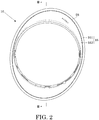
- FIG. 2 is a diagram of the left sound emission unit 10 of FIG. 1 viewed along an arrow A.
- the left sound emission unit 10 is worn on a part around the left ear of the user, and outputs sound waves in accordance with sound signals from the sound source.
- FIG. 3 is a cross-sectional view of the left sound emission unit 10 of FIG. 2 taken along line B-B.
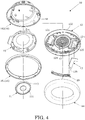
- FIG. 4 is an exploded perspective view of the left sound emission unit 10.
- FIG. 3 illustration of some lines is omitted, for the sake of convenience of explanation.
- the "front direction” means a direction (the right direction in FIG. 3 ) toward the head side of the user in the state in which the headphone 1 is worn on the head of the user.
- the “rear direction” means a direction (the left direction in FIG. 3 ) opposite to the front direction.
- the left sound emission unit 10 includes a driver unit 11, a baffle member 12, a passage forming member 13, an ear pad 14, a housing 15, a cover member 16, a first microphone 17, a second microphone 18, and a microphone cover 19.
- the driver unit 11 generates sound waves based on electrical signals from the sound source, and outputs the sound waves.
- the driver unit 11 is, for example, a dynamic-type driver unit.
- the driver unit 11 is held by the below-mentioned unit holding part 123.
- the driver unit 11 includes a diaphragm 111, a drive part 112, and a frame 113.
- the diaphragm 111 vibrates based on driving (vibration) of the drive part 112, and outputs sound waves.
- the drive part 112 is driven (vibrated) by electromagnetic induction based on the electrical signal, and vibrates the diaphragm 111.
- the drive part 112 includes a magnetic circuit 112a and a voice coil 112b.
- the voice coil 112b is disposed in a magnetic gap of the magnetic circuit 112a, and attached to a rear surface of the diaphragm 111.
- the frame 113 holds the diaphragm 111 and the drive part 112.
- the frame 113 has a shape of a hat.
- the diaphragm 111 is attached to a front surface of the frame 113.
- the drive part 112 is accommodated in the frame 113.
- the baffle member 12 holds the driver unit 11.
- the baffle member 12 is, for example, composed of a synthetic resin, such as acrylonitrile-butadiene-styrene (ABS) resin.
- ABS acrylonitrile-butadiene-styrene
- the baffle member 12 has an oval shape in front view.
- the baffle member 12 includes a plate-shaped part 121, a circumferential wall part 122, a unit holding part 123, a microphone holder part 124, a groove 125, and a through hole 12h.
- the plate-shaped part 121 defines a front cavity S1, a rear cavity S2, and an inner cover space S4, which are described later.
- the plate-shaped part 121 separates the front cavity S1, the rear cavity S2, and the inner cover space S4.
- the plate-shaped part 121 has an oval plate shape, and includes a front surface 121a and a rear surface 121b.
- the front surface 121a is the first surface in the present invention
- the rear surface 121b is the second surface in the present invention.
- the circumferential wall part 122 defines the below-mentioned front cavity S1.
- the circumferential wall part 122 extends in the front direction in an annular shape from an outer edge of the front surface 121a of the plate-shaped part 121.
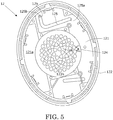
- FIG. 5 is a front view of the baffle member 12.
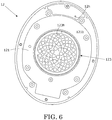
- FIG. 6 is a back view of the baffle member 12.
- the unit holding part 123 holds the driver unit 11 (see FIG. 4 ).
- the unit holding part 123 is disposed in the center of the rear surface 121b of the plate-shaped part 121.
- the unit holding part 123 includes a plurality of sound holes 123h through which sound waves from the driver unit 11 pass.
- the microphone holder part 124 holds the first microphone 17 (see FIG. 4 ).
- the microphone holder part 124 is disposed on the front surface 121a (in front of the unit holding part 123) of the plate-shaped part 121.
- the groove 125 forms a vent passage P (refer to FIG. 3 ) with the passage forming member 13 (refer to FIG. 4 ).
- the groove 125 is a long groove having a substantially L shape in front view and a rectangular shape in cross-sectional view.
- the groove 125 is disposed in the front surface 121a of the plate-shaped part 121.
- the groove 125 includes a first end 125a and a second end 125b as both longitudinal ends, each of which has a semicircular shape in front view.
- the second end 125b is "one end" of the groove in the present invention.
- the first end 125a is "another end” of the groove in the present invention.
- the depth of the groove 125 is constant from the first end 125a to the second end 125b.
- the width of the groove 125 is fixed from the first end 125a side to the second end 125b side, except both of the ends 125a and 125b.
- the vent passage P will be described later.
- the groove 125 can be disposed in a desired position in the front surface 121a of the baffle member 12, as long as the position is a position that the groove 125 can be covered with the passage forming member 13, as described later.
- Each of the length and the width of the groove 125 is settable as desired in accordance with the characteristics in the low frequency range of the headphone 1.
- both ends of the groove are not limited to a semicircular shape, but can be formed in any shape (such as a rectangular shape).
- the through hole 12h penetrates through the front surface 121a and the rear surface 121b of the plate-shaped part 121 and establishes communication between the below-mentioned internal space (hereinafter referred to as "inner passage space") S3 (refer to FIG. 3 ) of the vent passage P (see FIG. 3 ) and the inner cover space S4 (see FIG. 3 ).
- the through hole 12h has a space communicating with each of the inner passage space S3 and the inner cover space S4. In other words, the through hole 12h communicates with each of the inner passage space S3 and the inner cover space S4.
- the through hole 12h is the first through hole in the present invention.
- the through hole 12h is disposed at the second end 125b of the groove 125.
- the "disposed at the second end 125b" means that the through hole 12h is disposed, for example, in any position separated from the second end 125b by a space within a diameter of the through hole 12h.
- the through hole 12h is opened in a position facing a back surface (surface opposite to the sound collection surface) of the second microphone 18 (see FIG. 4 ), in the inner cover space S4.
- the through hole 12h can be disposed in a desired position of the baffle member 12, as long as the through hole 12h communicates with the inner cover space S4 (refer to FIG. 3 ).
- the through hole is disposed on the second end side in both ends of the groove.
- the through hole may be disposed in a position distant from the second end of the groove.
- the through hole may be formed in any shape (such as a circular shape and a rectangular shape).
- the passage forming member 13 forms the vent passage P with the groove 125 of the baffle member 12.
- the passage forming member 13 is, for example, composed of a synthetic resin, such as polyethylene terephthalate (PET) resin.
- PET polyethylene terephthalate
- the passage forming member 13 has a substantially L shape in front view.
- the passage forming member 13 has a shape of a flat plate having a front surface and a rear surface parallel to each other.
- the passage forming member 13 includes a through hole 13h.
- the passage forming member 13 is attached to the front surface 121a of the plate-shaped part 121 to cover the groove 125.
- the vent passage P is formed with the groove 125 and the passage forming member 13 between the baffle member 12 and the passage forming member 13.
- the passage forming member can be formed in any shape (such as a rectangular shape), as long as the shape is a shape covering the groove.
- the through hole 13h establishes communication between the below-mentioned front cavity S1 and the inner passage space S3. Specifically, the through hole 13h has a space communicating with each of the front cavity S1 and the inner passage space S3.
- the through hole 13h is the second through hole in the present invention that communicates with each of the front cavity S1 and the vent passage P.
- the through hole 13h is disposed in a position facing (opposed to) the first end 125a (the bottom surface of) (see FIG. 5 ) of the groove 125 in front view. In other words, the through hole 13h is disposed near the first end 125a side of the groove 125 rather than the through hole 12h.
- the "position facing the first end 125a" means a position facing, for example, a desired position separated from the first end 125a by a space within a diameter of the through hole 13h, in the bottom surface of the groove 125.
- the through hole is disposed in a position facing the first end side in both ends of the groove.
- the through hole may be disposed in a position distant from the first end of the groove.
- the through hole may be formed in any shape (such as a circular shape and a rectangular shape).
- the ear pad 14 defines the front cavity S1 with the baffle member 12.
- the ear pad 14 also functions as a buffer of the headphone 1 for the head of the user.
- the ear pad 14 has an oval ring shape.
- the ear pad 14 is attached to the circumferential wall part 122 of the baffle member 12.
- the front cavity S1 is a space surrounded by the head of the user, the baffle member 12, and the ear pad 14 when the headphone 1 is worn on the user.
- the front cavity S1 is the first space in the present invention.
- the front cavity S1 is disposed in front of the driver unit 11.
- the front surface 121a of the baffle member 12 faces the front cavity S1.
- the front cavity S1 communicates with the inner passage space S3 through the internal space of the through hole 13h of the passage forming member 13.
- the housing 15 accommodates the driver unit 11, and defines the rear cavity S2 with the driver unit 11 and the baffle member 12.
- the housing 15 is, for example, composed of a synthetic resin, such as ABS resin.
- the housing 15 has a shape of a cup.
- the housing 15 is attached to the rear surface 121b of the baffle member 12.
- the rear cavity S2 is a space surrounded by the driver unit 11, the baffle member 12, and the housing 15.
- the rear cavity S2 is the third space in the present invention.
- the rear cavity S2 functions as an acoustic impedance controlling sound pressure of sound waves that have reached the rear cavity S2.
- the rear cavity S2 is disposed in the rear of the driver unit 11.
- the rear surface 121b of the baffle member 12 faces the rear cavity S2.
- the cover member 16 protects the housing 15 and the second microphone 18.
- the cover member 16 is, for example, composed of a synthetic resin, such as ABS resin.
- the cover member 16 includes a first cover member 161 and a second cover member 162.
- the first cover member 161 has an oval ring shape.
- the first cover member 161 is attached to an outer edge of the rear surface 121b of the baffle member 12.
- the second cover member 162 has a shape of a cup. As illustrated in FIG. 2 , the second cover member 162 is disposed inside the first cover member 161 spaced from a gap S5 in rear view.
- the gap S5 is a space establishing communication between the space (hereinafter referred to as “inner cover space”) S4 inside the cover member 16 and a space (hereinafter referred to as “external space”) S6 outside the cover member 16. As illustrated in FIG. 2 , the gap S5 is disposed between the first cover member 161 and the second cover member 162 and over the entire circumference of the cover member 16. In other words, the cover member 16 includes the gap S5.
- the inner cover space S4 is a space surrounded by the baffle member 12, the housing 15, and the cover member 16.
- the inner cover space S4 is the second space in the present invention.
- the rear surface 121b of the baffle member 12 faces the inner cover space S4.
- the inner cover space S4 communicates with the inner passage space S3 through the internal space of the through hole 12h of the baffle member 12, and communicates with the external space S6 through the gap S5 of the cover member 16.
- the first microphone 17 collects sound waves in the front cavity S1.
- the first microphone 17 is held by the microphone holding part 124 of the baffle member 12.
- the second microphone 18 collects sound waves that have reached the cover member 16 from the external space S6.
- the second microphone 18 is accommodated in the second cover member 162.
- the headphone 1 is a hybrid-type noise-cancelling headphone that cancels noise based on the sound collection results of the two microphones 17 and 18.
- the microphone cover 19 protects the first microphone 17 from, for example, the user's fingers.
- the microphone cover 19 is attached to the front surface 121a of the baffler member 12 to cover the first microphone 17.
- the configuration of the right sound emission unit 20 is in common with the configuration of the left sound emission unit 10.
- the right sound emission unit 20 includes a driver unit, a baffle member 22, a passage forming member 23, an ear pad 24, a housing, a cover member 26, a first microphone, a second microphone, and a microphone cover 29.
- connection member 30 connects the left sound emission unit 10 with the right sound emission unit 20, and provides side pressure on the head of the user when the headphone 1 is worn on the user.
- the connection member 30 includes a left arm 31, a left slider 32, a right arm 33, a right slider 34, and a head band 35.
- the left arm 31 supports the left sound emission unit 10 in a state where the left sound emission unit 10 is swingable.
- the left slider 32 adjusts the position (length from the left sound emission unit 10 to the head band 35) of the left sound emission unit 10.
- the right arm 33 supports the right sound emission unit 20 in a state where the right sound emission unit 20 is swingable.
- the right slider 34 adjusts the position (length from the right sound emission unit 20 to the head band 35) of the right sound emission unit 20.
- the head band 35 applies force (side pressure) in a direction in which the left sound emission unit 10 and the right sound emission unit 20 approach each other.
- FIG. 7 is a front view of the baffle member 12 to which the passage forming member 13 is attached.
- FIG. 7 illustrates the vent passage P and the through hole 12h disposed on the back surface of the passage forming member 13 with two dot chain lines.
- the vent passage P is a substantially tube-shaped passage formed with the groove 125 and the passage forming member 13 when the groove 125 of the baffle member 12 is covered with the passage forming member 13.
- the shape of the vent passage P is in common with the shape of the groove 125.
- the vent passage P has a substantially L shape in front view.
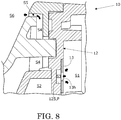
- FIG. 8 is a partial enlarged cross-sectional view of the left sound emission unit 10 taken along line C-C of FIG. 7 .
- FIG. 9 is a partial enlarged cross-sectional view of the left sound emission unit 10 taken along line D-D of FIG. 7 .
- FIG. 8 and FIG. 9 illustrates flow of the air from the below-described front cavity S1 with black arrows.
- the vent passage P is a rectangular passage in a cross-sectional view (cross section obtained by cutting the vent passage P along the transverse direction of the vent passage P) of the vent passage P.
- the diameter of the through hole 12h is smaller than the diameter of the through hole 13h.
- the cross-sectional area of the vent passage P is larger than each of the opening area of the through hole 12h and the opening area of the through hole 13h.
- the diameter of the through hole of the baffle member may be the same as the diameter of the through hole of the passage forming member, or larger than the diameter of the through hole of the passage forming member.
- the cross-sectional area of the vent passage may be the same as the opening areas of the two through holes.
- the inner passage space S3 communicates with the front cavity S1 through the internal space of the through hole 13h.
- the inner passage space S3 communicates with the inner cover space S4 through the internal space of the through hole 12h.
- the inner cover space S4 communicates with the external space S6 through the gap S5 of the cover member 16.
- the air in the front cavity S1 can flow (move) to the inner passage space S3 through the through hole 13h.
- the air in the inner passage space S3 can flow into the inner cover space S4 through the through hole 12h.
- the air in the inner cover space S4 can flow into the external space S6 through the gap S5.
- the vent passage P functions as a vent port releasing the air pressure in the front cavity S1 to the external space S6 (moves the air in the front cavity S1 to the external space S6). Therefore, the length and/or the cross-sectional area of the vent passage P influences the characteristics in the low frequency range of the headphone 1.
- the length of the vent passage P influences the resonance frequency of the headphone 1. Specifically, for example, when the cross-sectional area of the vent passage P is fixed, the resonance frequency of the headphone 1 decreases when the length of the vent passage P increases, and increases when the length of the vent passage P decreases. As a result, the cutoff frequency at the low frequency range of the headphone 1 decreases when the length of the vent passage P increases, and the cutoff frequency at the low frequency range of the headphone 1 increases when the length of the vent passage P decreases.
- the cross-sectional area of the vent passage P influences the volume of the air in the inner passage space S3 moved by the diaphragm 111 by each one amplitude.
- the volume decreases when the cross-sectional area of the vent passage P decreases, and the volume increases when the cross-sectional area of the vent passage P increases.
- the diaphragm 111 pushes out the air into the front cavity S1
- the air in the front cavity S1 moves to the inner passage space S3
- the air in the inner passage space S3 moves to the inner cover space S4
- the air in the inner cover space S4 moves to the external space S6.
- the length of the vent passage P is substantially shortened by changing the position of the through hole 13h of the passage forming member 13 to the second end 125b side of the groove 125.
- the characteristics in the low frequency range of the headphone 1 can be easily and finely adjusted by changing the position (disposition) of the through hole 13h.
- FIG. 10 is a partial enlarged view illustrating an example of the vent passage P in which position of the through hole 13h of the passage forming member 13 is changed.
- positions A1 and A2 illustrated with two dot chain lines illustrates positions where the through hole 13h is disposed.
- the substantial length of the vent passage P is a length from the position A1 to the second end 125b.
- the substantial length of the vent passage P is a length from the position A2 to the second end 125b. In this configuration, the substantial length of the vent passage P when the through hole 13h is disposed in the position A1 is longer than the substantial length of the vent passage P when the through hole 13h is disposed in the position A2.
- FIG. 11 is a frequency characteristic diagram of the headphone 1 in the cases where the through hole 13h of the passage forming member 13 is disposed in the position facing the first end 125a, the position A1, and the position A2 in FIG. 10 .
- FIG. 11 illustrates the characteristic in the case where the through hole 13h is disposed in a position facing the first end 125a with a dashed line.
- FIG. 11 illustrates the characteristic in the case where the through hole 13h is disposed in the position A1 with a broken line.
- FIG. 11 illustrates the characteristic in the case where the through hole 13h is disposed in the position A2 with a two dot chain line.
- FIG. 11 illustrates the characteristic in the state (hereinafter referred to as "hole communication state”) in which only the through hole 12h establishes communication between the front cavity S1 and the inner cover space S4 with a solid line.
- FIG. 11 illustrates the characteristic in the case (hereinafter referred to as "sealed state”) in which the front cavity S1 does not communicate with the inner cover space S4 with a bold solid line.
- the level of the low frequency range in the case where (illustrated with the dashed line in FIG. 11 ) when the through hole 13h is disposed in the position facing the first end 125a is close to the level of the low frequency range in the sealed state (illustrated with the bold solid line in FIG. 11 ). Specifically, when the through hole 13h is disposed in the position facing the first end 125a, decrease in level of the low frequency range is suppressed to the minimum.
- the cutoff frequency of the low frequency range of the headphone 1 increases as position of the through hole 13h becomes close to the second end 125b (as the substantial length of the vent passage P is shortened).
- the characteristics in the low frequency range of the headphone 1 can be easily and finely adjusted by only changing the position of the through hole 13h in the headphone 1 (for example, attaching the passage forming member 13 including the through hole 13h having a different position to the baffle member 12).
- the configuration of the right sound emission unit is in common with the configuration of the left sound emission unit. Therefore, also in the right sound emission unit, the front cavity communicates with the inner cover space through the through hole of the passage forming member, the vent passage, and the through hole of the baffle member.
- the inner cover space communicates with the external space through the gap of the cover member. Specifically, the air in the front cavity can flow into the inner passage space through the through hole of the passage forming member. The air in the inner passage space can flow into the inner cover space through the through hole of the baffle member. The air in the inner cover space can flow into the external space through the gap. Specifically, the air pressure in the front cavity can be released (transmitted) to the external space through the internal space of the through hole of the passage forming member, the inner passage space, the internal space of the through hole of the baffle member, the inner cover space, and the gap.
- the front cavity S1 communicates with the inner cover space S4 through the through hole 12h of the baffle member 12, the vent passage P, and the through hole 13h.
- the vent passage P is formed with the groove 125 of the baffle member 12 and the passage forming member 13.
- the vent passage P establishing communication between the front cavity S1 and the inner cover space S4 is formed only with the baffle member 12 and the passage forming member 13.
- the configuration of the vent passage P in the headphone 1 is simpler than the configuration of a conventional headphone (hereinafter referred to as "conventional headphone") in which a tube-shaped vent port is inserted through the housing. Accordingly, the productivity of the headphone 1 is high in comparison with that of the conventional headphone.
- the through hole 13h establishing communication between the front cavity S1 and the inner passage space S3 is disposed in the passage forming member 13.
- the through hole 12h establishing communication between the inner passage space S3 and the inner cover space S4 is disposed in the groove 125 of the baffle member 12. Therefore, the substantial length of the vent passage P can be easily changed by only changing position of the through hole 12h and/or the through hole 13h with respect to the groove 125. Specifically, the characteristics in the low frequency range of the headphone 1 can be easily and finely adjusted.
- the air pressure in the front cavity S1 can be released to the external space S6, and the characteristics in the low frequency range of the headphone 1 can be easily and finely adjusted, with a simple configuration in comparison with the conventional headphone.
- the vent passage P is formed with a simple configuration of covering the groove 125 of the baffle member 12 with the passage forming member 13.
- the groove 125 may be disposed in any of the front surface 121a of the baffle member 12, as long as the through hole 12h communicates with the inner passage space S3.
- each of the length and the width of the groove 125 is settable as desired according to the characteristics in the low frequency range of the headphone 1. In other words, the position and/or the shape of the vent passage P are settable as desired within the range in which the vent passage P can be formed with the baffle member 12 and the passage forming member 13.
- the air pressure in the front cavity S1 can be released to the external space S6, and the characteristics in the low frequency range of the headphone 1 can be easily and finely adjusted, with a simple configuration in comparison with the conventional headphone.
- the groove 125 is disposed in the front surface 121a of the baffle member 12. Therefore, the groove 125 can be disposed in a desired position in the front surface 121a of the baffle member 12, as long as the position is a position in which the groove 125 can be covered with the passage forming member 13.
- the degree of freedom of arrangement of the vent passage P is higher than that of the conventional headphone.
- the through hole 12h is disposed on the second end 125b side of the groove 125.
- the through hole 13h is disposed near a position facing the first end 125a side of the groove 125 rather than the through hole 12h. Therefore, the substantial length of the vent passage P can be easily changed by changing the position of the through hole 13h in the passage forming member 13. Specifically, the characteristics in the low frequency range of the headphone 1 can be easily and finely adjusted.
- the through hole 12h is disposed at the second end 125b of the groove 125.
- the through hole 13h is disposed in a position facing the first end 125a of the groove 125.
- the cover member 16 includes a gap S5 establishing communication between the inner cover space S4 and the external space S6.
- the air pressure in the front cavity S1 increases at the time when the headphone 1 is worn on the user or dropped, the air pressure in the front cavity S1 can be released to the external space S6 through the internal space of the through hole 13h, the inner passage space S3, the internal space of the through hole 12h, the inner cover space S4, and the gap S5.
- the gap S5 is disposed over the entire circumference of the cover member 16. Therefore, the inner cover space S4 can be regarded as a space substantially equal to the external space S6. Specifically, when the air pressure in the front cavity S1 is released to the inner cover space S4 through the internal space of the through hole 13h, the inner passage space S3, and the internal space of the through hole 12h, the air pressure can be regarded to have been released to the external space S6.
- the gap S5 is disposed between the first cover member 161 and the second cover member 162. Therefore, the gap S5 can be easily disposed over the entire circumference of the cover member 16.
- the headphone 1 includes the housing 15 defining the rear cavity S2 with the baffle member 12.
- the front cavity S1 communicates with the inner cover space S4, not the rear cavity S2, through the vent passage P. Therefore, the sound waves output from the driver unit 11 to the front cavity S1 do not interfere with sound waves output from the driver unit 11 to the rear cavity S2.
- the diameter of the through hole 12h is smaller than the diameter of the through hole 13h.
- the cross-sectional area of the vent passage P is larger than each of the opening area of the through hole 12h and the opening area of the through hole 13h. Accordingly, inside the vent passage P, flow of the air is controlled with the through hole 12h having the smallest cross-sectional area as the passage of the air.
- the change quantity of the characteristics in the low frequency range of the headphone 1 for the change quantities of the length and the width of the groove 125 is smaller than that in the case where the cross-sectional area of the vent passage is the same as each of the opening areas of the two through holes. Specifically, changing the length and/or the width of the groove 125 enables finer adjustment of the characteristics in the low frequency range of the headphone 1.
- the gap included in the cover member may be a through hole, as long as the gap establishes communication between the inner cover space and the external space.
- the gap is not necessarily disposed over the entire circumference of the cover member.
- first cover member and the second cover member may be integrally formed.
- the headphone may be a feedback-type noise-canceling headphone including only the first microphone, or may be a feedforward-type noise-canceling headphone including only the second microphone.
- the headphone may be a headphone without a noise-canceling function.
- the groove is not limited to an L shape, as long as the groove is a long groove having a length and a width enabling suppression of deterioration in characteristics in the low frequency range of the headphone to some extent.
- the groove may have a straight-line shape, a C shape, a U shape.
- the width of the groove may be configured to increase continuously or intermittently from the first end toward the second end.
- the diameter of the through hole of the baffle member may be configured to increase in accordance with the width of the second end of the groove.
- the shape of the groove in cross-sectional view is not limited to a rectangular shape.
- the shape of the groove in cross-sectional view may be a semicircular shape or a triangular shape.
- the baffle member may include a plurality of grooves forming a plurality of vent passages.
- the left sound emission unit may include a plurality of vent passages.
- the shortest vent passage or the vent passage having the largest cross-sectional area influences the characteristics in the low frequency range of the headphone.
- the passage forming member may be slidable with respect to the baffle member. In this case, the length of the vent passage can be easily changed by sliding the passage forming member.
- the groove 125 is disposed in the front surface 121a of the baffle member 12.
- the groove of the baffle member may be disposed in the rear surface of the baffle member.
- the passage forming member is attached to the rear surface of the baffle member to form the vent passage with the baffle member.
- FIG. 12 is a partial cross-sectional schematic diagram schematically illustrating a modification example of the headphone according to the present invention.
- FIG. 12 illustrates that a groove 125A is formed in a rear surface 121Ab of a baffle member 12A.
- FIG. 12 illustrates that a passage forming member 13A is attached to the rear surface 121Ab of the baffle member 12A to cover the groove 125A.
- the groove 125A and the passage forming member 13A form a vent passage PA.
- the front cavity S1 communicates with the inner cover space S4 through a through hole 12Ah of the baffle member 12A, the vent passage PA, and a through hole 13Ah of the passage forming member 13A.
- the air pressure in the front cavity S1 can be released to the inner cover space S4 (external space S6), and the characteristics in the low frequency range of the headphone can be easily and finely adjusted, with a simple configuration.
- the groove 125 is disposed in the front surface 121a of the baffle member 12.
- the groove of the baffle member may be disposed in each of the front surface and the rear surface of the baffle member.
- a passage forming member is attached to each of the front surface and the rear surface of the baffle member, and forms the vent passages with the baffle member.
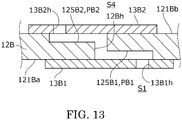
- FIG. 13 is a partial cross-sectional schematic diagram schematically illustrating another modification example of the headphone according to the present invention.
- FIG. 13 illustrates that a groove 125B1 is disposed in a front surface 121Ba of a baffle member 12B, and a groove 125B2 is disposed in a rear surface 121Bb of the baffle member 12B.
- FIG. 13 illustrates that a first passage forming member 13B1 is attached to the front surface 121Ba of the baffle member 12B to cover the groove 125B1, and a second passage forming member 13B2 is attached to the rear surface 121Bb of the baffle member 12B to cover the groove 125B2.
- the groove 125B1 and the first passage forming member 13B1 form a first vent passage PB1.
- the groove 125B2 and the second passage forming member 13B2 form a second vent passage PB2.
- the first vent passage PB1 communicates with the second vent passage PB2 through a through hole 12Bh of the baffle member 12B.
- a through hole 13B1h of the first passage forming member 13B1 communicates with the first vent passage PB1
- a through hole 13B2h of the second passage forming member 13B2 communicates with the second vent passage PB2.
- the front cavity S1 communicates with the inner cover space S4 through the through hole 13B1h, the first vent passage PB1, the through hole 12Bh, the second vent passage PB2, and the through hole 13B2h.
- the air pressure in the front cavity S1 can be released to the inner cover space S4 (external space S6), and the characteristics in the low frequency range of the headphone can be easily and finely adjusted, with a simple configuration.
- the vent passage P is formed with the groove 125 of the baffle member 12 and the passage forming member 13.
- the vent passage may be formed with a groove included in the passage forming member and the baffle member.
- the passage forming member may include a groove forming the vent passage. In this case, the through hole of the passage forming member is disposed in the groove.
- FIG. 14 is a partial cross-sectional schematic diagram schematically illustrating another modification example of the headphone according to the present invention.
- FIG. 14 illustrates that a passage forming member 13C includes a groove 131C.
- FIG. 14 illustrates that the passage forming member 13C is attached to a front surface 121Ca of a baffle member 12C such that the groove 131C faces a through hole 12Ch of the baffle member 12C.
- the groove 131C is covered with the baffle member 12C.
- the baffle member 12C and the groove 131C form a vent passage PC.
- the through hole 12Ch of the baffle member 12C communicates with the vent passage PC.
- a through hole 13Ch of the passage forming member 13C communicates with the vent passage PC.
- the front cavity S1 communicates with the inner cover space S4 through the through hole 13Ch, the vent passage PC, and the through hole 12Ch.
- the passage forming member 13C may be attached to a rear surface 121Cb of the baffle member 12C. Even in this case, in the headphone according to the present invention, the air pressure in the front cavity S1 can be released to the inner cover space S4 (external space S6), and the characteristics in the low frequency range of the headphone can be easily and finely adjusted, with a simple configuration.
- the vent passage P is formed with the groove 125 of the baffle member 12 and the passage forming member 13.
- the vent passage may be formed with a groove included in the baffle member and a groove included in the passage forming member.
- each of the baffle member and the passage forming member may include grooves forming a vent passage.
- FIG. 15 is a partial cross-sectional schematic diagram schematically illustrating another modification example of the headphone according to the present invention.
- FIG. 15 illustrates that a baffle member 12D includes a groove 125D, and a passage forming member 13D includes a groove 131D.
- FIG. 15 illustrates that the passage forming member 13D is attached to front surface 121Da of the baffle member 12D such that the groove 131D faces the groove 125D.
- the groove 125D and the groove 131D form a vent passage PD.
- a through hole 12Dh of the baffle member 12D communicates with the vent passage PD.
- a through hole 13Dh of the passage forming member 13D communicates with the vent passage PD.
- the front cavity S1 communicates with the inner cover space S4 through the through hole 13Dh, the vent passage PD, and the through hole 12Dh.
- the groove 125D may be disposed in a rear surface 121Db of the baffle member 12D, and the passage forming member 13D may be attached to the rear surface 121Db of the baffle member 12D.
- the air pressure in the front cavity S1 can be released to the inner cover space S4 (external space S6), and the characteristics in the low frequency range of the headphone can be easily and finely adjusted, with a simple configuration.
- the vent passage P is formed with the groove 125 of the baffle member 12 and the passage forming member 13.
- the vent passage may be formed with a slit included in the baffle member and two passage forming members.
- the baffle member may include a slit penetrating through the front surface and the rear surface.
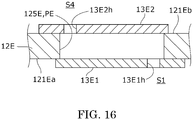
- FIG. 16 is a partial cross-sectional schematic diagram schematically illustrating another modification example of the headphone according to the present invention.
- FIG. 16 illustrates that a slit 125E penetrating through a front surface 121Ea and a rear surface 121Eb of a baffle member 12E is disposed in the baffle member 12E.
- FIG. 16 illustrates that a first passage forming member 13E1 is attached to the front surface 121Ea of the baffle member 12E to cover the slit 125E, and a second passage forming member 13E2 is attached to the rear surface 121Eb of the baffle member 12E to cover the slit 125E.
- the slit 125E, the first passage forming member 13E1, and the second passage forming member 13E2 form a vent passage PE.
- the front cavity S1 communicates with the inner cover space S4 through a through hole 13E1h of the first passage forming member 13E1, the vent passage PE, and a through hole 13E2h of the second passage forming member 13E2.
- the air pressure in the front cavity S1 to the inner cover space S4 (external space S6), and the characteristics in the low frequency range of the headphone can be easily and finely adjusted, with a simple configuration.
Landscapes
- Engineering & Computer Science (AREA)
- Physics & Mathematics (AREA)
- Acoustics & Sound (AREA)
- Signal Processing (AREA)
- Manufacturing & Machinery (AREA)
- Headphones And Earphones (AREA)
- Soundproofing, Sound Blocking, And Sound Damping (AREA)
Applications Claiming Priority (1)
| Application Number | Priority Date | Filing Date | Title |
|---|---|---|---|
| JP2018242607A JP7240710B2 (ja) | 2018-12-26 | 2018-12-26 | ヘッドホン |
Publications (1)
| Publication Number | Publication Date |
|---|---|
| EP3675515A1 true EP3675515A1 (en) | 2020-07-01 |
Family
ID=68965601
Family Applications (1)
| Application Number | Title | Priority Date | Filing Date |
|---|---|---|---|
| EP19217527.1A Pending EP3675515A1 (en) | 2018-12-26 | 2019-12-18 | Headphone |
Country Status (4)
| Country | Link |
|---|---|
| US (1) | US10959005B2 (enExample) |
| EP (1) | EP3675515A1 (enExample) |
| JP (1) | JP7240710B2 (enExample) |
| CN (1) | CN111385694B (enExample) |
Families Citing this family (51)
| Publication number | Priority date | Publication date | Assignee | Title |
|---|---|---|---|---|
| USD910594S1 (en) * | 2019-05-29 | 2021-02-16 | Shenzhen Ausounds Intelligent Co., Ltd. | Headphone |
| USD904341S1 (en) * | 2019-07-22 | 2020-12-08 | Shenzhen Thousandshores Technology Co., Ltd. | Wireless headphones |
| JP1662673S (enExample) * | 2019-08-21 | 2020-06-29 | ||
| USD941273S1 (en) * | 2019-08-27 | 2022-01-18 | Harman International Industries, Incorporated | Headphone |
| USD940099S1 (en) * | 2019-11-21 | 2022-01-04 | Mingxun Zheng | Audio headset |
| USD951908S1 (en) * | 2019-12-30 | 2022-05-17 | Shenzhen Jiayz Photo Industrial., Ltd | Wireless headphone |
| USD960874S1 (en) * | 2020-06-26 | 2022-08-16 | Focusrite Audio Engineering Limited | Microphone |
| JP7510112B2 (ja) * | 2020-08-07 | 2024-07-03 | ヤマハ株式会社 | ヘッドホン |
| USD961545S1 (en) * | 2020-08-28 | 2022-08-23 | Microsoft Corporation | Headset with rotating dial |
| USD960864S1 (en) * | 2020-08-28 | 2022-08-16 | Microsoft Corporation | Headset |
| USD960127S1 (en) * | 2020-08-28 | 2022-08-09 | Microsoft Corporation | Headset |
| USD972530S1 (en) * | 2020-08-28 | 2022-12-13 | Microsoft Corporation | Headset |
| US11184696B1 (en) | 2020-09-16 | 2021-11-23 | Apple Inc. | Wireless headphones with slot antenna |
| US11190878B1 (en) | 2020-09-16 | 2021-11-30 | Apple Inc. | Headphones with on-head detection |
| US11272279B1 (en) | 2020-09-16 | 2022-03-08 | Apple Inc. | Headphones with off-center pivoting earpiece |
| US11272280B1 (en) | 2020-09-16 | 2022-03-08 | Apple Inc. | Earpiece with cushion retention |
| US11109135B1 (en) * | 2020-09-16 | 2021-08-31 | Apple Inc. | Headphones with rotatable user input mechanism |
| US11457300B2 (en) | 2020-09-16 | 2022-09-27 | Apple Inc. | Support structure for earpiece cushion |
| EP3982643B1 (en) * | 2020-09-30 | 2025-03-19 | EPOS Group A/S | Headphone sealing cup |
| CN116584107A (zh) * | 2020-12-11 | 2023-08-11 | ams国际有限公司 | 启用噪声消除的耳机 |
| JP7462230B2 (ja) * | 2021-04-30 | 2024-04-05 | パナソニックIpマネジメント株式会社 | ヘッドセットおよびイヤーパッド |
| JP1740348S (ja) * | 2021-07-15 | 2023-03-29 | ヘッドホン | |
| USD1003273S1 (en) * | 2021-07-16 | 2023-10-31 | Primer Studios, Corporation | Headphone set |
| USD1003272S1 (en) * | 2021-07-16 | 2023-10-31 | Primer Studios, Corporation | Boom microphone |
| JP1711181S (ja) * | 2021-08-04 | 2022-03-30 | ヘッドホン | |
| USD980829S1 (en) * | 2021-08-06 | 2023-03-14 | Guangzhou Rantion Technology Co., Ltd. | Microphone |
| US20230059140A1 (en) * | 2021-08-20 | 2023-02-23 | Aac Acoustic Technologies (Shenzhen) Co., Ltd. | Microphone back panel and microphone |
| JP1707377S (ja) * | 2021-08-31 | 2022-02-14 | ヘッドホン | |
| USD986853S1 (en) * | 2021-09-02 | 2023-05-23 | Skullcandy, Inc. | Headphone |
| USD1007463S1 (en) * | 2021-09-02 | 2023-12-12 | Skullcandy, Inc. | Headphone |
| FR3128087A1 (fr) * | 2021-10-12 | 2023-04-14 | Focal Jmlab | Dispositif de fixation d’un haut-parleur dans une oreillette d’un casque audio et procede de fixation associe |
| EP4416934B1 (fr) * | 2021-10-12 | 2025-08-13 | FOCAL JMLab | Oreillette circum-auriculaire ou supra-auriculaire d'un casque audio et procede de montage associe |
| CN113993033B (zh) * | 2021-10-13 | 2024-02-06 | 维沃移动通信有限公司 | 电子设备、音频调节方法及装置 |
| USD1024005S1 (en) * | 2022-02-18 | 2024-04-23 | Bose Corporation | Set of headphones |
| JP1721895S (ja) | 2022-04-13 | 2022-08-08 | ヘッドホン | |
| JP1721896S (ja) * | 2022-04-13 | 2022-08-08 | ヘッドホン | |
| JP1725897S (ja) * | 2022-05-31 | 2022-09-28 | マイクロホン | |
| JP1725877S (ja) * | 2022-05-31 | 2022-09-28 | マイクロホン | |
| JP1723345S (ja) * | 2022-05-31 | 2022-08-26 | ポップガード | |
| USD1029795S1 (en) | 2022-09-16 | 2024-06-04 | Microsoft Corporation | Headset |
| USD1044770S1 (en) | 2022-09-16 | 2024-10-01 | Microsoft Corporation | Headset microphone with transparent portion |
| USD1039512S1 (en) | 2022-09-16 | 2024-08-20 | Microsoft Corporation | Headset |
| USD1051874S1 (en) * | 2022-10-07 | 2024-11-19 | Bose Corporation | Set of headphones |
| CN115802234A (zh) * | 2022-12-29 | 2023-03-14 | 江西联创电声有限公司 | 一种头戴式送受话器 |
| USD1061474S1 (en) * | 2023-05-12 | 2025-02-11 | Shenzhen Yiboyi Industrial Co., Ltd. | Headphones |
| USD1092451S1 (en) * | 2023-08-16 | 2025-09-09 | Harman International Industries, Incorporated | Microphone |
| JP1765412S (enExample) * | 2023-09-06 | 2024-03-12 | ||
| USD1080579S1 (en) * | 2023-09-08 | 2025-06-24 | Minami Acoustics Limited | Headphone |
| USD1095488S1 (en) * | 2023-09-22 | 2025-09-30 | Tozo Inc | Headphones |
| USD1090482S1 (en) * | 2024-01-04 | 2025-08-26 | Tymphany Hk Limited | Headphone module |
| CN118338180B (zh) * | 2024-04-30 | 2024-11-26 | 广州伟仕达电子科技有限公司 | 基于佩戴时长调节发声器与人耳的距离的游戏耳机 |
Citations (4)
| Publication number | Priority date | Publication date | Assignee | Title |
|---|---|---|---|---|
| US20090226023A1 (en) * | 2008-03-07 | 2009-09-10 | Kabushiki Kaisha Audio-Technica | Headphone |
| JP2011155331A (ja) * | 2010-01-26 | 2011-08-11 | Audio Technica Corp | ヘッドホンユニット |
| KR20110123935A (ko) * | 2010-05-10 | 2011-11-16 | 삼본정밀전자(주) | 저음 또는 특저음 재생을 위한 미로구조를 가지는 헤드폰 |
| EP3264791A1 (en) * | 2016-06-27 | 2018-01-03 | Onkyo Corporation | Earphone |
Family Cites Families (21)
| Publication number | Priority date | Publication date | Assignee | Title |
|---|---|---|---|---|
| JPS5388718A (en) * | 1976-12-15 | 1978-08-04 | Matsushita Electric Ind Co Ltd | Sealed head phone |
| JPH0450718Y2 (enExample) * | 1986-02-28 | 1992-11-30 | ||
| JPH02113490U (enExample) * | 1989-02-28 | 1990-09-11 | ||
| GB9225650D0 (en) * | 1992-12-04 | 1993-01-27 | Knowles Electronics Co | An electroacoustic transducer |
| US7916888B2 (en) * | 2006-06-30 | 2011-03-29 | Bose Corporation | In-ear headphones |
| JP5515204B2 (ja) | 2007-09-13 | 2014-06-11 | 株式会社Jvcケンウッド | ヘッドホン |
| JP5253072B2 (ja) * | 2008-10-01 | 2013-07-31 | 株式会社オーディオテクニカ | ヘッドホン |
| JP2012023637A (ja) | 2010-07-15 | 2012-02-02 | Audio Technica Corp | ノイズキャンセルヘッドホン |
| JP5707277B2 (ja) | 2011-08-17 | 2015-04-22 | 株式会社オーディオテクニカ | ヘッドホン |
| US8670586B1 (en) * | 2012-09-07 | 2014-03-11 | Bose Corporation | Combining and waterproofing headphone port exits |
| US10034086B2 (en) * | 2013-03-26 | 2018-07-24 | Bose Corporation | Headset porting |
| JP6115947B2 (ja) * | 2013-06-17 | 2017-04-19 | 株式会社オーディオテクニカ | ヘッドホン |
| WO2015142630A1 (en) | 2014-03-17 | 2015-09-24 | Bose Corporation | Headset porting |
| US9578412B2 (en) * | 2014-06-27 | 2017-02-21 | Apple Inc. | Mass loaded earbud with vent chamber |
| JP6409188B2 (ja) * | 2014-11-18 | 2018-10-24 | 株式会社オーディオテクニカ | 電気音響変換器および音響抵抗材 |
| JP6611512B2 (ja) | 2015-08-07 | 2019-11-27 | 株式会社オーディオテクニカ | ノイズキャンセルヘッドホン |
| JP6727852B2 (ja) * | 2016-03-01 | 2020-07-22 | 株式会社オーディオテクニカ | ヘッドホン |
| JP6845554B2 (ja) * | 2016-10-12 | 2021-03-17 | 株式会社オーディオテクニカ | ヘッドホン |
| CN109391866B (zh) * | 2017-08-08 | 2021-07-30 | Jvc 建伍株式会社 | 耳机中的通气路径形成结构以及耳机 |
| US10484772B2 (en) * | 2017-10-13 | 2019-11-19 | Bose Corporation | Hidden rear cavity vent |
| CN207783088U (zh) * | 2018-01-12 | 2018-08-28 | 歌尔科技有限公司 | 一种压耳式耳机 |
-
2018
- 2018-12-26 JP JP2018242607A patent/JP7240710B2/ja active Active
-
2019
- 2019-12-18 EP EP19217527.1A patent/EP3675515A1/en active Pending
- 2019-12-24 US US16/726,365 patent/US10959005B2/en active Active
- 2019-12-25 CN CN201911354679.3A patent/CN111385694B/zh active Active
Patent Citations (4)
| Publication number | Priority date | Publication date | Assignee | Title |
|---|---|---|---|---|
| US20090226023A1 (en) * | 2008-03-07 | 2009-09-10 | Kabushiki Kaisha Audio-Technica | Headphone |
| JP2011155331A (ja) * | 2010-01-26 | 2011-08-11 | Audio Technica Corp | ヘッドホンユニット |
| KR20110123935A (ko) * | 2010-05-10 | 2011-11-16 | 삼본정밀전자(주) | 저음 또는 특저음 재생을 위한 미로구조를 가지는 헤드폰 |
| EP3264791A1 (en) * | 2016-06-27 | 2018-01-03 | Onkyo Corporation | Earphone |
Also Published As
| Publication number | Publication date |
|---|---|
| JP7240710B2 (ja) | 2023-03-16 |
| CN111385694B (zh) | 2023-11-03 |
| US10959005B2 (en) | 2021-03-23 |
| US20200213703A1 (en) | 2020-07-02 |
| JP2020107947A (ja) | 2020-07-09 |
| CN111385694A (zh) | 2020-07-07 |
Similar Documents
| Publication | Publication Date | Title |
|---|---|---|
| US10959005B2 (en) | Headphone | |
| US11265645B2 (en) | Acoustic chambers damped with side-branch resonators, and related systems and methods | |
| EP2677767B1 (en) | An earphone having an acoustic tuning mechanism | |
| US8971561B2 (en) | Earphone having a controlled acoustic leak port | |
| JP2023522681A (ja) | 音響出力装置 | |
| EP4197198B1 (en) | Earpiece porting | |
| CN111052761A (zh) | 声音输出装置、耳机、助听器以及便携式终端装置 | |
| CN101106831A (zh) | 放在耳内的耳机 | |
| US11895459B2 (en) | Sound output device | |
| KR101310879B1 (ko) | 이어폰 | |
| US11317194B2 (en) | Speaker | |
| EP3652962B1 (en) | Audio device | |
| WO2012042672A1 (ja) | ノイズキャンセルヘッドホン | |
| US11664006B2 (en) | Sound output device | |
| US11582550B1 (en) | Port placement for in-ear wearable with active noise cancellation | |
| CN111970611A (zh) | 头戴式耳机 | |
| WO2025199742A1 (en) | Earphone | |
| EP4387267A1 (en) | Earphone | |
| EP4622292A1 (en) | Transducer holding module for earphones | |
| US20260060360A1 (en) | Speaker system for a helmet | |
| CN118138974A (zh) | 音频转换单元 | |
| CN118540634A (zh) | 音频转换单元 |
Legal Events
| Date | Code | Title | Description |
|---|---|---|---|
| PUAI | Public reference made under article 153(3) epc to a published international application that has entered the european phase |
Free format text: ORIGINAL CODE: 0009012 |
|
| STAA | Information on the status of an ep patent application or granted ep patent |
Free format text: STATUS: THE APPLICATION HAS BEEN PUBLISHED |
|
| AK | Designated contracting states |
Kind code of ref document: A1 Designated state(s): AL AT BE BG CH CY CZ DE DK EE ES FI FR GB GR HR HU IE IS IT LI LT LU LV MC MK MT NL NO PL PT RO RS SE SI SK SM TR |
|
| AX | Request for extension of the european patent |
Extension state: BA ME |
|
| STAA | Information on the status of an ep patent application or granted ep patent |
Free format text: STATUS: REQUEST FOR EXAMINATION WAS MADE |
|
| 17P | Request for examination filed |
Effective date: 20201230 |
|
| RBV | Designated contracting states (corrected) |
Designated state(s): AL AT BE BG CH CY CZ DE DK EE ES FI FR GB GR HR HU IE IS IT LI LT LU LV MC MK MT NL NO PL PT RO RS SE SI SK SM TR |
|
| STAA | Information on the status of an ep patent application or granted ep patent |
Free format text: STATUS: EXAMINATION IS IN PROGRESS |
|
| 17Q | First examination report despatched |
Effective date: 20220223 |
|
| RIC1 | Information provided on ipc code assigned before grant |
Ipc: H04R 1/10 20060101AFI20241105BHEP |
|
| GRAP | Despatch of communication of intention to grant a patent |
Free format text: ORIGINAL CODE: EPIDOSNIGR1 |
|
| STAA | Information on the status of an ep patent application or granted ep patent |
Free format text: STATUS: GRANT OF PATENT IS INTENDED |
|
| INTG | Intention to grant announced |
Effective date: 20260213 |
|
| RIN1 | Information on inventor provided before grant (corrected) |
Inventor name: YONEYAMA, DAISUKE |