EP3675415B1 - Verfahren zur steuerung der datennutzung und kryptografische vorrichtung - Google Patents
Verfahren zur steuerung der datennutzung und kryptografische vorrichtung Download PDFInfo
- Publication number
- EP3675415B1 EP3675415B1 EP20158813.4A EP20158813A EP3675415B1 EP 3675415 B1 EP3675415 B1 EP 3675415B1 EP 20158813 A EP20158813 A EP 20158813A EP 3675415 B1 EP3675415 B1 EP 3675415B1
- Authority
- EP
- European Patent Office
- Prior art keywords
- security context
- tenant
- key
- certificate
- information
- Prior art date
- Legal status (The legal status is an assumption and is not a legal conclusion. Google has not performed a legal analysis and makes no representation as to the accuracy of the status listed.)
- Active
Links
Images









Classifications
-
- H—ELECTRICITY
- H04—ELECTRIC COMMUNICATION TECHNIQUE
- H04L—TRANSMISSION OF DIGITAL INFORMATION, e.g. TELEGRAPHIC COMMUNICATION
- H04L9/00—Cryptographic mechanisms or cryptographic arrangements for secret or secure communications; Network security protocols
- H04L9/08—Key distribution or management, e.g. generation, sharing or updating, of cryptographic keys or passwords
- H04L9/088—Usage controlling of secret information, e.g. techniques for restricting cryptographic keys to pre-authorized uses, different access levels, validity of crypto-period, different key- or password length, or different strong and weak cryptographic algorithms
-
- H—ELECTRICITY
- H04—ELECTRIC COMMUNICATION TECHNIQUE
- H04L—TRANSMISSION OF DIGITAL INFORMATION, e.g. TELEGRAPHIC COMMUNICATION
- H04L9/00—Cryptographic mechanisms or cryptographic arrangements for secret or secure communications; Network security protocols
- H04L9/08—Key distribution or management, e.g. generation, sharing or updating, of cryptographic keys or passwords
- H04L9/0816—Key establishment, i.e. cryptographic processes or cryptographic protocols whereby a shared secret becomes available to two or more parties, for subsequent use
- H04L9/0819—Key transport or distribution, i.e. key establishment techniques where one party creates or otherwise obtains a secret value, and securely transfers it to the other(s)
- H04L9/083—Key transport or distribution, i.e. key establishment techniques where one party creates or otherwise obtains a secret value, and securely transfers it to the other(s) involving central third party, e.g. key distribution center [KDC] or trusted third party [TTP]
-
- G—PHYSICS
- G06—COMPUTING OR CALCULATING; COUNTING
- G06F—ELECTRIC DIGITAL DATA PROCESSING
- G06F21/00—Security arrangements for protecting computers, components thereof, programs or data against unauthorised activity
- G06F21/60—Protecting data
- G06F21/606—Protecting data by securing the transmission between two devices or processes
-
- G—PHYSICS
- G06—COMPUTING OR CALCULATING; COUNTING
- G06F—ELECTRIC DIGITAL DATA PROCESSING
- G06F21/00—Security arrangements for protecting computers, components thereof, programs or data against unauthorised activity
- G06F21/50—Monitoring users, programs or devices to maintain the integrity of platforms, e.g. of processors, firmware or operating systems
- G06F21/52—Monitoring users, programs or devices to maintain the integrity of platforms, e.g. of processors, firmware or operating systems during program execution, e.g. stack integrity ; Preventing unwanted data erasure; Buffer overflow
- G06F21/53—Monitoring users, programs or devices to maintain the integrity of platforms, e.g. of processors, firmware or operating systems during program execution, e.g. stack integrity ; Preventing unwanted data erasure; Buffer overflow by executing in a restricted environment, e.g. sandbox or secure virtual machine
-
- G—PHYSICS
- G06—COMPUTING OR CALCULATING; COUNTING
- G06F—ELECTRIC DIGITAL DATA PROCESSING
- G06F21/00—Security arrangements for protecting computers, components thereof, programs or data against unauthorised activity
- G06F21/60—Protecting data
- G06F21/62—Protecting access to data via a platform, e.g. using keys or access control rules
- G06F21/6209—Protecting access to data via a platform, e.g. using keys or access control rules to a single file or object, e.g. in a secure envelope, encrypted and accessed using a key, or with access control rules appended to the object itself
-
- H—ELECTRICITY
- H04—ELECTRIC COMMUNICATION TECHNIQUE
- H04L—TRANSMISSION OF DIGITAL INFORMATION, e.g. TELEGRAPHIC COMMUNICATION
- H04L9/00—Cryptographic mechanisms or cryptographic arrangements for secret or secure communications; Network security protocols
- H04L9/08—Key distribution or management, e.g. generation, sharing or updating, of cryptographic keys or passwords
- H04L9/0816—Key establishment, i.e. cryptographic processes or cryptographic protocols whereby a shared secret becomes available to two or more parties, for subsequent use
- H04L9/0819—Key transport or distribution, i.e. key establishment techniques where one party creates or otherwise obtains a secret value, and securely transfers it to the other(s)
- H04L9/0825—Key transport or distribution, i.e. key establishment techniques where one party creates or otherwise obtains a secret value, and securely transfers it to the other(s) using asymmetric-key encryption or public key infrastructure [PKI], e.g. key signature or public key certificates
-
- H—ELECTRICITY
- H04—ELECTRIC COMMUNICATION TECHNIQUE
- H04L—TRANSMISSION OF DIGITAL INFORMATION, e.g. TELEGRAPHIC COMMUNICATION
- H04L9/00—Cryptographic mechanisms or cryptographic arrangements for secret or secure communications; Network security protocols
- H04L9/08—Key distribution or management, e.g. generation, sharing or updating, of cryptographic keys or passwords
- H04L9/0894—Escrow, recovery or storing of secret information, e.g. secret key escrow or cryptographic key storage
- H04L9/0897—Escrow, recovery or storing of secret information, e.g. secret key escrow or cryptographic key storage involving additional devices, e.g. trusted platform module [TPM], smartcard or USB
-
- H—ELECTRICITY
- H04—ELECTRIC COMMUNICATION TECHNIQUE
- H04L—TRANSMISSION OF DIGITAL INFORMATION, e.g. TELEGRAPHIC COMMUNICATION
- H04L9/00—Cryptographic mechanisms or cryptographic arrangements for secret or secure communications; Network security protocols
- H04L9/32—Cryptographic mechanisms or cryptographic arrangements for secret or secure communications; Network security protocols including means for verifying the identity or authority of a user of the system or for message authentication, e.g. authorization, entity authentication, data integrity or data verification, non-repudiation, key authentication or verification of credentials
- H04L9/3234—Cryptographic mechanisms or cryptographic arrangements for secret or secure communications; Network security protocols including means for verifying the identity or authority of a user of the system or for message authentication, e.g. authorization, entity authentication, data integrity or data verification, non-repudiation, key authentication or verification of credentials involving additional secure or trusted devices, e.g. TPM, smartcard, USB or software token
-
- H—ELECTRICITY
- H04—ELECTRIC COMMUNICATION TECHNIQUE
- H04L—TRANSMISSION OF DIGITAL INFORMATION, e.g. TELEGRAPHIC COMMUNICATION
- H04L9/00—Cryptographic mechanisms or cryptographic arrangements for secret or secure communications; Network security protocols
- H04L9/32—Cryptographic mechanisms or cryptographic arrangements for secret or secure communications; Network security protocols including means for verifying the identity or authority of a user of the system or for message authentication, e.g. authorization, entity authentication, data integrity or data verification, non-repudiation, key authentication or verification of credentials
- H04L9/3263—Cryptographic mechanisms or cryptographic arrangements for secret or secure communications; Network security protocols including means for verifying the identity or authority of a user of the system or for message authentication, e.g. authorization, entity authentication, data integrity or data verification, non-repudiation, key authentication or verification of credentials involving certificates, e.g. public key certificate [PKC] or attribute certificate [AC]; Public key infrastructure [PKI] arrangements
-
- H—ELECTRICITY
- H04—ELECTRIC COMMUNICATION TECHNIQUE
- H04L—TRANSMISSION OF DIGITAL INFORMATION, e.g. TELEGRAPHIC COMMUNICATION
- H04L9/00—Cryptographic mechanisms or cryptographic arrangements for secret or secure communications; Network security protocols
- H04L9/32—Cryptographic mechanisms or cryptographic arrangements for secret or secure communications; Network security protocols including means for verifying the identity or authority of a user of the system or for message authentication, e.g. authorization, entity authentication, data integrity or data verification, non-repudiation, key authentication or verification of credentials
- H04L9/3263—Cryptographic mechanisms or cryptographic arrangements for secret or secure communications; Network security protocols including means for verifying the identity or authority of a user of the system or for message authentication, e.g. authorization, entity authentication, data integrity or data verification, non-repudiation, key authentication or verification of credentials involving certificates, e.g. public key certificate [PKC] or attribute certificate [AC]; Public key infrastructure [PKI] arrangements
- H04L9/3268—Cryptographic mechanisms or cryptographic arrangements for secret or secure communications; Network security protocols including means for verifying the identity or authority of a user of the system or for message authentication, e.g. authorization, entity authentication, data integrity or data verification, non-repudiation, key authentication or verification of credentials involving certificates, e.g. public key certificate [PKC] or attribute certificate [AC]; Public key infrastructure [PKI] arrangements using certificate validation, registration, distribution or revocation, e.g. certificate revocation list [CRL]
-
- H—ELECTRICITY
- H04—ELECTRIC COMMUNICATION TECHNIQUE
- H04L—TRANSMISSION OF DIGITAL INFORMATION, e.g. TELEGRAPHIC COMMUNICATION
- H04L9/00—Cryptographic mechanisms or cryptographic arrangements for secret or secure communications; Network security protocols
- H04L9/32—Cryptographic mechanisms or cryptographic arrangements for secret or secure communications; Network security protocols including means for verifying the identity or authority of a user of the system or for message authentication, e.g. authorization, entity authentication, data integrity or data verification, non-repudiation, key authentication or verification of credentials
- H04L9/3297—Cryptographic mechanisms or cryptographic arrangements for secret or secure communications; Network security protocols including means for verifying the identity or authority of a user of the system or for message authentication, e.g. authorization, entity authentication, data integrity or data verification, non-repudiation, key authentication or verification of credentials involving time stamps, e.g. generation of time stamps
Definitions
- the present invention relates to methods of data transfer, methods of controlling the use of data, and cryptographic devices.
- HSMs hardware security modules
- a conventional HSM hosted by a service provider uses a single-tenancy solution, i.e. deploying a dedicated appliance per tenant, to enable the secure cryptographic processing of data and storage of cryptographic keys on behalf of the tenant.
- the service provider manages the environmental settings of the cryptographic appliance, such as the IP address, whilst the tenant manages the cryptographic infrastructure remotely in a conventional manner.
- the service provider thus has to provide an appliance per tenant, whilst the tenant has to manage the maintenance and administration of the cryptographic appliance much as they would have previously.
- Such a system is inefficient and often results in underutilisation of cryptographic resources.
- Such a system is may be vulnerable.
- the service provider often has the "keys to the kingdom", that is, the ability to export the raw key material stored within the HSM.
- the permissions granted to the service provider can thus undermine the security of a hosted tenant key.
- US 2002/023208 discloses a method, software and apparatus that facilitates one or more third-party agents to securely access a customer's or other first party's private personal and financial data or other such confidential information from a second party.
- a security document or ticket is presented to the second party for verifying the customer's consent to grant such access to the third party.
- the second party only communicates such confidential information to the third party if the security document is found to be valid.
- the security document which can be at least partially encrypted, can also include a preselected expiration time, beyond which it is not valid.
- US 2008/307495 discloses a memory device with circuitry for improving accuracy of a time estimate used in digital rights management (DRM) license validation.
- a memory device receives a request to validate a DRM license stored on the memory device, wherein the DRM license is associated with a time stamp update policy (TUP) that specifies when a new time stamp is needed.
- TUP time stamp update policy
- the memory device determines if a new time stamp is needed based on the TUP associated with the DRM license. If a new time stamp is needed, the memory device receives the new time stamp and then attempts to validate the DRM license using a time estimate based on the new time stamp.
- the use credential is a use certificate.
- the first type of use may be one or more cryptographic operations.
- the information from which the expiry of the use credential can be determined comprises:
- the method further comprises establishing at the tenant system that a reference time source is trusted. In an embodiment, the method further comprises establishing at the service provider system that a reference time source is trusted. Establishing that a reference time source is trusted comprises validating that the reference time source is manufactured by a trusted manufacturer and that the state and configuration of the reference time source meets the security requirements.
- the method further comprises providing the public half of an identity cryptographic key pair of the time source to the first security context, together with information validating the origin of the identity cryptographic key pair.
- the method further comprises providing the public half of an identity cryptographic key pair of the time source to the second security context, together with information validating the origin of the identity cryptographic key pair.
- generating a use credential in a first security context comprises:
- the method comprises:
- the message may further comprise information relating to the current configuration of the reference time source.
- the information validating the origin of the message may be the signed message, signed with the private half of the identity cryptographic key pair of the time source.
- information relating to a start time is included in the use credential.
- the information from which the data corresponding to the use credential can be identified may be a hash of K tenant .
- the use credential is a use certificate and the method further comprises:
- the method further comprises:
- validating that the use credential has not expired at the second security context comprises:
- the information validating the origin of the message may be the signed message, signed with the private half of the identity cryptographic key pair of the time source.
- Validating that the use credential has not expired at the second security context may further comprise: comparing the time stamp to the expiry time.
- a carrier medium comprising computer readable code configured to cause a computer to perform any of the methods described.
- a method of data transfer from a tenant to a service provider comprising encrypting the data with a public key of a key pair generated by a secure device within the service provider system. The data thus cannot be accessed by the service provider during transmission.
- the data is generated with a corresponding access control list, which specifies that a valid certificate must be presented in order to grant a particular use of the data once stored.
- the tenant can thus retain control of the use of the data even though it has been transferred out of the tenant system.
- a method of controlling use of data securely stored in the service provider system comprising issuing a use credential having an expiry time to the party requesting use of the data.
- the use credential must be validated before use of the stored data is granted. This enables the tenant to grant use of the stored data for a limited time period.
- security context refers to one or more security appliances (for example HSMs), or partitions of a security appliance, which share at least one private key and are configured to safeguard and perform a set of cryptographic functions.
- security appliances for example HSMs
- partitions of a security appliance which share at least one private key and are configured to safeguard and perform a set of cryptographic functions.
- cryptographic key refers to a block of raw cryptographic material for use in cryptographic operations.
- An access control list corresponding to the key comprises information relating to a set of permissions describing the operations the key material may be used for, for example encryption, decryption or storage, and any credentials that must be provided to enable permissions.
- Also associated with the key may be information relating to the key type which comprises data identifying the type of key, including information identifying, for example, the algorithms the key can be used with and its length, e.g. the Advanced Encryption Standard (AES) algorithm with a key of length 256 bits, or the RSA algorithm with a key length of 2048 bits.
- AES Advanced Encryption Standard
- the term "verify” may be used to refer to a method of checking a cryptographic signature.
- the term “validate” may be used to refer to a method of checking that data is as expected, or to a method of checking both that a signature is correct and that the data is as expected.
- access control list refers to one or more permissions attached to an object.
- the permissions specify which operations are allowed on the object, and the conditions and/or credentials required for the operation to be granted.
- public keys may be stored within the first security context or the second security context, or on untrusted mediums outside of the first security context or the second security context if the public key is integrity protected, for example signed by the identity key of the first security context or the second security context. This means that if the public key is tampered with, it will be detected.
- information sent between the first security context and the second security context may be validated by use of a cryptographic certificate.
- the information may be signed by a private signing key belonging to the sender, and the signature sent together with the information to the receiver.
- the methods described in this specification may be computer implemented methods.
- the carrier medium can comprise any non-transient storage medium such as a floppy disk, a CD ROM, a magnetic device or a programmable memory device, or any transient medium such as any signal for example an electrical, optical or microwave signal.
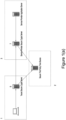
- Figure 1(a) is a schematic illustration of a tenant system 1 comprising a cryptographic device in accordance with an embodiment of the present invention and a service provider system 3 comprising a cryptographic device in accordance with another embodiment of the present invention.
- the service provider may be a cloud service provider for example.
- the service provider provides storage of data such as cryptographic keys and secure cryptographic processing of data to one or more tenants.
- the tenants may use the cryptographic infrastructure of the service provider system 3 for applications such as payments, security and regulation.
- the service provider system 3 comprises a service provider application server, configured to perform one or more applications such as these.
- the tenant system 1 provides a cryptographic key K tenant to the service provider system 3.
- the cryptographic key K tenant is securely stored at the service provider system 3 for use in such applications.
- the tenant system 1 comprises a first security context 5 and the service provider system 3 comprises a second security context 7.
- a security context may be a single security device, for example a hardware security module, HSM. Alternatively, it may be two or more security devices, or a partition of a security device.
- security context is used here to refer to the device, devices, or partition of a device which form a single security context, i.e. which share at least one private key and are configured to safeguard and perform a set of cryptographic functions.
- the first security context 5 is secured from the rest of the tenant system.
- the second security context 7 is secured from the rest of the service provider system.
- the tenant cryptographic key K tenant is provided to the second security context 7 in the service provider system 3.
- the tenant cryptographic key K tenant is then either stored within the second security context 7 or is encrypted with a key that cannot leave the second security context before being stored elsewhere in the service provider system 3.
- the tenant Before providing the cryptographic key K tenant to the second security context 7, the tenant can authenticate and validate the second security context 7 from a generation certificate provided by the second security context 7.
- the generation certificate may have been generated at the time of manufacture of the device or devices which are part of the second security context 7 for example.
- the tenant trusts the manufacturer but not the service provider.
- the generation certificate authenticates that the second security context 7 was manufactured by the trusted manufacturer, and thus can be trusted.
- the parameters and state of the second security context 7 can be validated, for example from information contained in the generation certificate, and in a further configuration certificate.
- a generation certificate comprises static information that is valid for the entire lifetime of the appliance.
- a configuration certificate comprises information about the current configuration of the device. Configuration information is valid only at the time of generation of the configuration certificate, and may change at a later stage.
- the first security context 5 thus establishes trust with the second security context, before key transfer operations begin.
- the tenant cryptographic key K tenant is encrypted with the public half of an asymmetric key pair generated at the second security context 7, before being transferred to the second security context 7.
- a first cryptographic certificate is issued with the asymmetric key pair generated at the second security context 7.
- the first cryptographic certificate validates that the asymmetric key pair was generated in the second security context 7, that the private half of the asymmetric key pair is ephemeral and that the private half of the asymmetric key pair cannot leave the second security context 7.
- This enables the tenant cryptographic key K tenant to be transferred to the service provider system 3 in a manner which is secure from attackers and from the service provider itself, i.e. from the rest of the service provider system 3 which is outside of the second security context 7, for example the application server.
- the tenant cryptographic key K tenant is then stored in the second security context 7.
- the tenant cryptographic key K tenant is stored elsewhere in the service provider system, for example in the application server, encrypted by a key which cannot leave the second security context 7.
- An access control list (ACL) corresponding to the tenant cryptographic key K tenant is also generated with the tenant cryptographic key K tenant in the first security context 5.
- the ACL is also transferred to the second security context 7 with the tenant cryptographic key K tenant .
- the ACL is stored with the tenant cryptographic key K tenant .
- the first security context 5 has established trust with the second security context 7, and thus knows that the second security context 7 will enforce the policies contained in the ACL.
- the ACL thus allows the tenant to retain control over the key, even once it has been transferred to the second security context 7.
- the ACL specifies that the tenant cryptographic key K tenant can only be stored inside the second security context 7.
- the ACL contains a restriction that the tenant cryptographic key K tenant can only be stored on the condition that it is encrypted for storage by a key which cannot leave the second security context 7. This ensures that the tenant cryptographic key K tenant is inaccessible to third parties and to the service provider.
- the ACL may specify that the tenant cryptographic key K tenant can only be stored in non-volatile memory being resistant to tamper by a third party.
- the ACL specifies that a valid use credential, for example a use certificate, must be presented in order to grant one or more types of use of the tenant cryptographic key K tenant .
- a valid use credential for example a use certificate
- the ACL may require presentation of a certificate signed by the private half of an asymmetric key owned by the tenant to grant performance of certain cryptographic operations using the tenant key K tenant . This ensures that the particular type of operations using the key cannot be used if not authorised by the tenant.
- the tenant cryptographic key K tenant is stored in the service provider system, the service provider, i.e. the rest of the service provider system 3 which is outside of the second security context 7, cannot access the key, and the key cannot be used without authorisation from the tenant.
- the access control list may specify that the use credential must comprise information from which the expiry of the use credential can be determined and must be unexpired in order to grant use of the cryptographic key, K tenant .
- the tenant is thus able to specify, in the use credential, an expiry period for its key, after which the key may not be used until further authorization is provided.
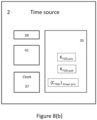
- the expiry time can be calculated with reference to a reference time source 2 that is trusted by both the first security context 5 and the second security context 7.
- the reference time source 2 may be hosted by the service provider, the tenant or a separate third-party.
- Figure 1(a) shows a schematic illustration of an embodiment in which the reference time source 2 is hosted by a third party.
- the method of data transfer from a tenant to a service provider comprises encrypting the data with a public key of a key pair generated by a secure device within the service provider system. The data thus cannot be accessed by the service provider during transmission.
- the encrypted data is cryptographically signed before transfer, to ensure authenticity and integrity of the data.
- the data is generated with a corresponding access control list, which specifies that a valid certificate must be presented in order to grant a particular use of the data once stored.
- the tenant can thus retain control of the use of the data even though it has been transferred out of the tenant system.
- a method of controlling use of data securely stored in the service provider system comprises issuing a use credential having an expiry time to the party requesting use of the data.
- the use credential must be validated before use of the stored data is granted. This enables the tenant to grant use of the stored data for a limited time period.
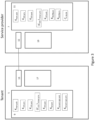
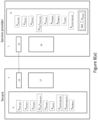
- Figure 1(b) shows a schematic illustration of a first security context 5 in accordance with an embodiment of the present invention and a second security context 7 in accordance with another embodiment of the present invention.
- the first security context 5 may be a single security appliance, for example a hardware security module, HSM. Alternatively, the first security context 5 may be two or more security appliances, or a partition of a security appliance. The first security context 5 could be a low-power, low performance, low cost HSM for example.
- the second security context 7 may be a single security appliance, for example a hardware security module. Alternatively, the second security context 7 may be two or more security appliances, or a partition of a security appliance. The second security context 7 may comprise a cluster of high-performance HSMs.
- the first security context 5 and the second security context 7 may thus each comprise one or more tamper resistant cryptographic appliances or a partition of a tamper resistant cryptographic appliance.
- the first security context 5 comprises a first device memory 9.
- the first device memory 9 is configured to store cryptographic information such as keys, key pairs and certificates.
- the first device memory 9 may include any form of non-volatile device memory such as flash, optical disks or magnetic hard drives for example.
- the first security context 5 also comprises volatile memory.
- the first device memory 9 may be physically secure and may be resistant to tamper by a third party, for example by the inclusion of physical security such as a membrane that covers the entire device, that cannot be removed without destroying the underlying physical hardware, thus making it un-usable.
- a unique asymmetric identity key K 1ID is stored in the first device memory 9, with a corresponding signed generation certificate ⁇ C 1ID ⁇ Kman priv .
- K 1ID is a signing key used to prove the origin of data and authenticity.
- the generation certificate C 1ID may describe the public parameters of the key, for example, the generation certificate C 1ID may include information relating to the type of the key, and its length.
- the generation certificate C 1ID comprises information which authenticates that the identity key K 1ID was generated in the first security context 5.
- the generation certificate C 1ID may comprise the hash of the public half of K 1ID and be signed by the private half of a manufacturer asymmetric key, K man priv .
- the generation certificate C 1ID may also include state information, for example, information relating to a unique identification of the device, information identifying the manufacturer, the hardware version used, the software type used, the serial number of the unit and the supported features/functionality of the model.
- the generation certificate C 1ID is signed by a manufacturer trusted by both the first security context 5 and the second security context 7.
- the generation certificate is cryptographically signed with the private half of a manufacturer asymmetric key, K man priv .
- the manufacturer may be a third party who manufactured the security appliance(s) which forms the first security context and the security appliance(s) which forms the second security context.
- the public half of the trusted manufacturer key K man pub is also stored in the first device memory 9, or may be stored outside of the first security context 5 in an integrity protected manner.
- the second security context 7 comprises a second device memory 11.
- the second device memory 11 is configured to store cryptographic information such as keys, key pairs and certificates.
- the second device memory 11 may include any form of non-volatile device memory such as flash, optical disks or magnetic hard drives for example.
- the second security context 5 also comprises volatile memory.
- the device memory may be physically secure and may be resistant to tamper by a third party, for example by the inclusion of physical security such as a membrane that covers the entire device, that cannot be removed without destroying the underlying physical hardware, thus making it un-usable.
- a unique asymmetric identity key K 2ID is stored in the second device memory 11, with a corresponding signed generation certificate ⁇ C 2ID ⁇ Kman priv .
- K 2ID is a signing key used to prove the origin of data and authenticity.
- the generation certificate C 2ID may describe the public parameters of the key, for example, the generation certificate C 2ID may include information relating to the type of the key, and its length.
- the generation certificate C 2ID comprises information which authenticates that the identity key K 2ID was generated in the second security context 7.
- the generation certificate C 2ID may include a hash of the public half of K 2ID , and be signed by the private half of a manufacturer asymmetric key, K man priv .
- the generation certificate C 2ID may also include state information, for example, information relating to a unique identification of the device, information identifying the manufacturer, the hardware version, the software type used, the serial number of the unit and the supported features/functionality of the model.
- the generation certificate C 2ID is signed by the trusted manufacturer.
- the generation certificate is cryptographically signed with the private half of a manufacturer asymmetric key, K man priv .
- the public half of the trusted manufacturer key K man pub is also stored in the second device memory 11, or may be stored outside of the second security context 7 in an integrity protected manner.
- cryptographic keys are stored in the device memory in a secure, tamper-proof format.
- the first security context 5 and second security context 7 can be verifiably identified using cryptographic certificates, the signed generation certificates ⁇ C 1ID ⁇ Kman priv and ⁇ C 2ID ⁇ Kman priv , which may be generated at the time of manufacture. Each is thus able to securely store their identity in a way that means they cannot be imitated. Identifying the first security context 5 and second security context 7 allows for the origin of the device or devices in each security context to be ascertained. Each device contains the unique asymmetric identity key K ID generated in the factory when it was manufactured, for example. Each component also contains the key-generation certificate for the K ID which is signed using an asymmetric key known only to the manufacturer. The public half of the manufacturer key can be used as the root of trust to authenticate genuine appliances.
- the parameters and state of the first security context and second security context can be validated in a non-repudiable manner, from information contained in the generation certificate, and through exchange of further, configuration, certificates.
- the first security context 5 and second security context 7 are each configured to generate a configuration certificate, C 1V and C 2V respectively, containing information about the current configuration of the devices set by the tenant and service provider.
- the configuration information cannot be included in the generation certificates, as these are generated at the time of manufacture, before the devices are distributed to the tenant and service provider and configured.
- the configuration certificates C 1V and C 2V respectively, are signed by the private half of the unique asymmetric identity key of the corresponding security context.
- the configuration certificate is signed by K IDpriv to verify authenticity, as K IDpriv is now trusted by the other security context.
- the data contained in the configuration certificate may pertain to the administrator deployment options such as security settings, software version, which trusted time source is used or whether the HSM believes there has been an attempt to tamper with it for example.
- the origin and state of a service define enough information by which other services can place their trust. This information is exchanged in the generation and configuration certificates.
- the second security context is trusted to enforce the rules specified in an ACL provided to the second security context and trusted to update its state certificates accurately.
- the second security context cannot enforce a rule to the specified level contained within the ACL then it will not perform an operation and will not advertise itself or the keys that it has created as supporting said rules.
- the identity keys of the first and second security context may be installed at manufacture, and the hash of these keys signed by a manufacturer key K man priv , and stored with the identity key, thus proving its provenance.
- a tenant By being able to cryptographically identify services from "trusted” sources, a tenant is able to exchange its cryptographic key with a hosted service over a communication channel with a high assurance that all data is protected and not recoverable by any third-party, including the hosting service provider.
- the tenant can transfer their key knowing that the key will be stored in the manner specified.
- the ACL sent with the key includes policies specifying how the key is to be stored and used.
- the second security context 7 will then enforce the policies.
- the tenant can trust that the second security context 7 will enforce the policies as it has established trust with the second security context 7. Establishing trust allows secure transfer and the ACL allows the second security context 7 to apply a policy once it is in possession of the key.
- the first security context 5 further comprises a transceiver 13.
- the transceiver 13 is configured to transmit and receive data packets.
- the data packets may be transmitted from and received at the first transceiver 13, for example via an Internet connection or a directly wired connection between the first security context 5 and the second security context 7.
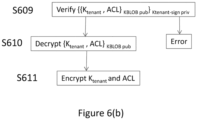
- This communication link may be untrusted, however the key transfer protocol described in relation to Figure 6(a) below provides protection of the key from attackers.
- the first security context 5 further comprises a first processor 17.
- the first processor 17 is configured to perform cryptographic operations, such as generation of cryptographic keys and asymmetric cryptographic key pairs, generation of certificates corresponding to a cryptographic key or asymmetric cryptographic key pair, generation of access control lists corresponding to a cryptographic key, generation of use certificates corresponding to a cryptographic key, encryption of an object with a cryptographic key which is stored in the first device memory 9, decryption of an encrypted object with a cryptographic key which is stored in the first device memory 9, cryptographically signing an object with a cryptographic key which is stored in the first device memory 9, verification of a cryptographic signature and validation of an object based on information stored in the first device memory 9.
- the first processor 17 may be physically secure.
- the first security context 5 comprises a main processor to perform non-cryptographic operations and the first processor 17 is a co-processor, i.e. a separate component from the main processor configured to perform only the cryptographic operations.
- the first processor 17 may be the main processor.
- the generation of cryptographic keys and asymmetric cryptographic key pairs may comprise generation of random numbers.
- the first security context 5 may further comprise a random entropy source, for use in random number generation.
- the second security context 7 further comprises a transceiver 15.
- the second transceiver 15 is configured to transmit and receive data packets.
- the data packets may be transmitted from and received at the second transceiver 15, for example via a wireless Internet connection or a directly wired connection between the first security context 5 and the second security context 7.
- the second security context 7 further comprises a second processor 19.
- the second processor 19 is configured to perform cryptographic operations, such as generation of cryptographic keys and asymmetric cryptographic key pairs, generation of certificates corresponding to a cryptographic key or asymmetric cryptographic key pair, generation of access control lists corresponding to a cryptographic key, generation of use certificates corresponding to a cryptographic key, encryption of an object with a cryptographic key which is stored in the second device memory 11, decryption of an encrypted object with a cryptographic key which is stored in the second device memory 11, cryptographically signing an object with a cryptographic key which is stored in the second device memory 11, verification of a cryptographic signature and validation of an object based on information stored in the second device memory 11.
- the second processor 19 may be physically secure.
- the first security context 5 comprises a main processor to perform non-cryptographic operations and the first processor 17 is a co-processor, i.e. a separate component from the main processor configured to perform only the cryptographic operations.
- the first processor 17 may be the main processor.
- the generation of cryptographic keys and asymmetric cryptographic key pairs may comprise generation of random numbers.
- the second security context 7 may further comprise a random entropy source, for use in random number generation.
- a HSM device such as may be used as part of the first security context 5 or second security context 7 may comprise a device memory, processor, transceiver and random entropy source as described above.
- the HSM may comprise both physical and non-physical security properties.
- Non-physical security properties include the use of encryption, i.e. the inclusion in the device of software or a physical component configured to perform encryption of stored data.
- Physical properties can include tamper switches triggered by physical access, and a tamper proof membrane surrounding the physical boundary of the device.
- the cryptographic asymmetric key pairs discussed in this application may be any asymmetric key pair type that supports signing and verification.
- each of the manufacturer key pair K man , the fist identity key identity key K 1ID , second identity key pair K 2ID , time source identity key pair K TSID and signing key pair K tenant-sign may be any one of an RSA, a DSA, or a ECDSA key pair for example, where RSA or DSA are the algorithm for signing and verification.
- a generation operation may be performed by the first processor 17, second processor 19 or third processor 41 to generate an output key pair which can be used by the RSA algorithm to sign data.
- a random entropy source may be used to generate random numbers, which in turn are used by the first processor 17, second processor 19 or third processor 41 to generate cryptographic keys and cryptographic key pairs.
- the cryptographic asymmetric key pairs in this application may be any asymmetric cryptographic key pair type that supports encryption and decryption.
- the first cryptographic key pair K BLOB may be an RSA key pair or a key pair that could be used in an Integrated Encryption Scheme (IES) algorithm.
- IES Integrated Encryption Scheme
- the transfer of cryptographic certificates and cryptographic keys between the first security context 5 and the second security context 7 described in the following may occur over a secure, authenticated channel between the first security context 5 and the second security context 7, which is provided and controlled by the service provider.
- the secure channel provided by the service provider may be provided using a load balancer or firewall appliance. Use of such infrastructure mitigates attacks such as denial of service.
- the channel is secure from third parties, it is open to attack by the service provider, and therefore is not trusted by the tenant for transfer of high value cryptographic keys.
- security is enforced by the tenant by the encryption of K tenant and subsequent signing of the encrypted data sent over the channel.
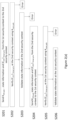
- Figure 2(a) is a flow chart showing a method of establishing trust between the first security context 5 and the second security context 7.
- the method of establishing trust is part of a method of cryptographic key transfer according to an embodiment of the present invention.
- the method of establishing trust may be performed before the cryptographic key K tenant is generated for example, or may be performed after the cryptographic key is generated but before any exchange of cryptographic keys between the first security context 5 and the second security context 7 for example.
- step S201 the public half of the identity key of the first security context, K 1ID pub , and the generation certificate ⁇ C 1ID ⁇ Kman priv , are sent from the first security context 5 to the second security context 7.
- the first transceiver 13 in the first security context 5 is configured to send the public half of the identity key of the first security context, K 1ID pub , and the generation certificate ⁇ C 1ID ⁇ Kman priv , to the second transceiver 15 in the second security context 7.
- Information relating to the state of the device(s) in the first security context 5 may be sent in the same message.
- the information relating to the state of the device(s) is also included in the generation certificate in this case, and can be used by the receiver to validate the state information contained in the message.
- the generation certificate is immutable, thus only contains information that is available at manufacture time.
- Information relating to the current configuration of the device for example, the IP address or tamper state, may be included in the configuration certificate.
- the configuration information may be sent at the same time as the generation certificate, or after the generation certificate.
- the generation certificate is generated and signed at the time of manufacture, whereas the configuration certificate is generated at the time of key transfer, and is signed by K 1ID-priv .
- the configuration certificate can be verified only after the generation certificate has been verified.
- step S202 the signature of the generation certificate ⁇ C 1ID ⁇ Kman priv is verified at the second security context 7.
- the second processor 19 in the second security context 7 is configured to verify the signature of the generation certificate ⁇ C 1ID ⁇ Kman priv .
- the generation certificate is verified using the public half of the trusted manufacturer key K man pub which is stored in the device memory 11.
- the second processor 19 is configured to perform a signature verification algorithm that, given the signed message ⁇ C 1ID ⁇ Kman priv and the public key K man pub either accepts or rejects the message's claim to authenticity.
- the authenticity of the public half of the identity key of the first security context, K 1ID pub is validated at the second security context 7.
- the second processor 19 in the second security context 7 is configured to validate the public half of the identity key of the first security context, K 1ID pub .
- the generation certificate C 1ID comprises a hash of the public half of the identity key of the first security context, K 1ID pub
- the authenticity is validated by calculating the hash the public half of the identity key of the first security context, K 1ID pub , and validating that it matches that contained in its generation certificate C 1ID .
- the generation certificate C 1ID comprises the hash of the public half of K 1ID and is signed by the private half of the manufacturer asymmetric key, K man priv
- Step S202 comprises: calculating the hash of the received data sent in the message, in this case the hash of K 1ID pub , inputting the received signature into the verification algorithm, which may be a cryptographic operation, together with the public half of the manufacturer key and verifying the output; comparing the calculated hash to that contained in the output of the verification algorithm to determine whether they are the same.
- the verification algorithm which may be a cryptographic operation
- step S203 if state information is included in the message, the second security context 7 validates that the state of the device(s) meets requirements. Alternatively, state information is not included in the generation certificate, and the second security context 7 does not validate the state of the first security context 5. The second security context 7 does not transfer any secure information to the first security context 5, thus it is not necessary for the state information of the first security context 5 to be validated.
- the public half of the identity key of the first security context, K 1ID pub is stored in the second device memory 11 of the second security context 7.
- the public half of the identity key of the first security context, K 1ID pub can be integrity protected by the second security context 7 and stored in untrusted storage outside of the second security context 7.
- the second security context 7 may sign the public half of the identity key of the first security context, K 1ID pub , and data indicating that this is a public key from a trusted source, using K 2ID priv for storage. Alternatively, it may encrypt them using another secret key.
- an untrusted device memory can be used, which often has a larger capacity than the device memory within the second security context 7, whilst trust in the key is maintained.
- step S204 the public half of the identity key of the second security context, K 2ID pub , and the generation certificate ⁇ C 2ID ⁇ Kman priv , are sent from the second security context 7 to the first security context 5.
- the second transceiver 15 in the second security context 7 is configured to send the public half of the identity key of the second security context, K 2ID pub , and the generation certificate ⁇ C 2ID ⁇ Kman priv , to the first transceiver 13 in the first security context 5.
- Information relating to the state of the device(s) in the second security context 7 may be sent in the same message.
- the information relating to the state of the device(s) will also be included in the generation certificate in this case, in order to validate the state information.
- the generation certificate is immutable, thus only contains information that is available at manufacture time.
- Information relating to the current configuration of the device for example, the IP address or tamper state, may be included in the configuration certificate.
- the configuration information may be sent at the same time as the generation certificate, or after the generation certificate, for example in step S604 as part of the first cryptographic certificate C BLOB .
- the generation certificate is generated and signed at the time of manufacture, whereas the configuration certificate is generated at the time of key transfer, and is signed by K 2ID-priv .
- the configuration certificate can be verified only after the generation certificate has been verified.
- step S205 the signature of the generation certificate ⁇ C 2ID ⁇ Kman priv is verified at the first security context 5.
- the first processor 17 in the first security context 5 is configured to verify the generation certificate ⁇ C 2ID ⁇ Kman priv .
- the signature is verified using the public half of the trusted manufacturer key K man pub stored in the device memory 9.
- the first processor 17 is configured to perform a signature verification algorithm that, given the signed message ⁇ C 2ID ⁇ Kman priv and the public key K man pub either accepts or rejects the message's claim to authenticity. This allows the first security context 5 to validate the manufacturer device in the second security context 7, by verifying the signature.
- the authenticity of the public half of the identity key of the second security context, K 2ID pub is validated at the first security context 5.
- the first processor 17 in the first security context 5 is configured to validate the public half of the identity key of the second security context, K 2ID pub .
- the generation certificate C 2ID comprises a hash of the public half of the identity key of the second security context, K 2ID pub
- the authenticity is validated by calculating the hash the public half of the identity key of the second security context, K 2ID pub , and validating that it matches that contained in its generation certificate C 2ID .
- step S206 if state information is included in the message, the first security context 5 validates that the state of the device(s) meets requirements.
- the public half of the identity key of the second security context, K 2ID pub is stored in the first device memory 9 of the first security context 5.
- the public half of the identity key of the second security context, K 2ID pub can be integrity protected by the first security context 5 and stored in untrusted storage outside of the first security context 5.
- the first security context 5 may sign the public half of the identity key of the second security context, K 2ID pub , and data indicating that this is a public key from a trusted source, using K 1ID priv for storage. Alternatively, it may encrypt them using another secret key.
- an untrusted device memory can be used, which often has a larger capacity than the device memory within the first security context 5, whilst trust in the key is maintained.
- Figure 2(b) is a flow chart showing a method of validating the configuration of the second security context 7 at the first security context 5, which is part of a method of cryptographic key transfer according to an embodiment of the present invention.
- the configuration of the second security context 7 can be validated.
- a similar method can also be used to validate the configuration of the first security context 5 at the second security context 7.
- the second security context 7 does not validate the configuration of the first security context 5.
- the second security context 7 does not transfer any secure information to the first security context 5, thus it is not necessary for the configuration of the first security context 5 to be validated.
- the Configuration information is generated by the second security context 7 in step S211.
- the configuration information may include information relating to the specific configuration applied by the administrator. This may include information relating to the cryptographic operations that are supported, the encryption keys that are used, and/or the version of software of the unit, for example.
- the configuration information may comprise information indicating that the first security context 5 has been configured to use the AES algorithm to encrypt tenant keys when not inside the second security context 7 for example.
- the configuration information may further comprise information relating to the administrator deployment options such as security settings, which trusted time source is used or whether the second security context 7 believes that there has been an attempt to tamper with the device.
- step S212 the configuration information is signed by the private half of the identity key of the second security context, K 2ID priv , producing a configuration certificate C 2V .
- the private half of the identity key of the second security context, K 2ID priv is stored in the second security context 7 and cannot be accessed by an administrator. Signing the configuration certificate C 2V with the private half of the identity key of the second security context, K 2ID priv means that the configuration information cannot be subverted.
- step S213 the configuration information and configuration certificate C 2V is sent from the second security context 7 to the first security context 5.
- This can be sent at the same time as K 2ID pub and ⁇ C 2ID ⁇ Kman priv , in step S204 for example.
- the configuration information may be included in the first cryptographic certificate described in relation to Figure 6(a) , and the configuration information sent at the same time as the first cryptographic certificate C BLOB .
- the second transceiver 15 in the second security context 7 is configured to send the configuration information and configuration certificate C 2V to the first transceiver 13 in the first security context 5.
- step S214 the signed configuration certificate C 2V is verified at the first security context 5.
- the first processor 17 in the first security context 5 is configured to verify the signed configuration certificate C 2V .
- the signed configuration certificate C 2V is verified using the public half of the second identity key K 2ID pub stored in the device memory 9, after being received and processed in steps S204 to S206.
- the first processor 17 is configured to perform a signature verification algorithm that, given the signed configuration certificate C 2V and the public key K 2ID pub either accepts or rejects the message's claim to authenticity. This allows the first security context 5 to prove that the configuration information has been generated by a known appliance.
- step S215 the first security context validates that the configuration information meets its requirements.
- the configuration information is requested and checked immediately before transfer of K tenant to the second security context 7. This ensures that up to date configuration information is validated.
- configuration information and a configuration certificate are also generated and sent by the first security context 5 in a similar manner.
- the configuration information may comprise information relating to the specific configuration applied by the administrator.
- the configuration information is signed by the private half of the identity key of the first security context 5 and sent to the second security context 7, which validates that the configuration of the first security context 5 meets its requirements.
- the tenant registers itself with the service provider. Registration proceeds in the form of mutual authentication of the two parties over an insecure medium.
- Mutual authentication of the first security context 5 and the second security context 7 is performed using the unique asymmetric identity keys.
- the public halves of the identity keys are exchanged, together with their matching generation certificates.
- Each security context validates the generation certificate of the other by checking that the certificate contains the hash of the public half of the identity key and that the certificate has genuinely been created by a trusted manufacturer.
- the generation certificate of the identity key may be referred to as a warrant.
- the first security context 5 and second security context 7 establish a secure, authenticated network communication with a verifiably trustworthy partner.
- the first security context 5 and the second security context 7 each cryptographically validates that the other was built by a trusted manufacturer.
- the step S205 of verifying the signed generation certificate ⁇ C 2ID ⁇ Kman priv at the first security context using K man pub verifies that the second security context 7 is of a known trustworthy origin.
- Figure 3 is a schematic illustration of the tenant system 1 and service provider system 3 after trust has been established, and after the relevant keys have been generated in each security context.
- the first device memory 9 in the first security context 5 also stores the public half of the identity key of the second security context K 2ID pub . Alternatively, this key may be stored outside of the first security context 5 in an integrity protected manner.
- the first device memory 9 also stores the tenant key K tenant , generated in step S601 described below, and the second key pair K tenant-sign , generated in step S401 described below.
- the second device memory 11 in the second security context 7 also stores the public half of the identity key of the first security context K 1ID pub . Alternatively, this key may be stored outside of the first security context 5 in an integrity protected manner.
- the second device memory 1 also stores the first cryptographic key pair and a first cryptographic certificate generated in step S602 described below.
- Figure 4(a) is a flow chart showing a method of transferring a signing key, K tenant-sign from the first security context 5 to the second security context 7, which is part of a method of cryptographic key transfer according to an embodiment of the present invention.
- the method of transferring the signing key K tenant-sign is performed before the cryptographic key K tenant is sent to the second security context 7.
- the method of transferring the signing key K tenant-sign may be performed after the cryptographic key K tenant is generated.
- step S401 the asymmetric cryptographic key pair K tenant-sign pub and K tenant-sign priv and corresponding certificate C tenant-sign are generated in the first security context 5.
- the asymmetric cryptographic key pair K tenant-sign pub and K tenant-sign priv are referred to as the second public key and the second private key and the corresponding certificate C tenant-sign is referred to as the second cryptographic certificate.
- the first processor 17 in the first security context 5 is configured to generate the asymmetric cryptographic key pair K tenant-sign pub and K tenant-sign priv and corresponding certificate C tenant-sign .
- the second cryptographic certificate, C tenant-sign may comprise the signed hash of the second public key K tenant-sign pub .
- step S402 the second cryptographic certificate, C tenant-sign is cryptographically signed with the private half of the identity key of the first security context, K 1ID priv .
- the first processor 17 is configured to cryptographically sign the second cryptographic certificate, C tenant-sign with the private half of the identity key of the first security context, K 1ID priv .
- the second cryptographic certificate C tenant-sign thus comprises information from which the origin of the second public key K tenant-sign pub can be validated.
- the information from which the origin of the second public key K tenant-sign pub can be validated comprises the signed hash of the second public key K tenant-sign pub .
- the second cryptographic certificate C tenant-sign comprises a hash of the second public key K tenant-sign pub and is signed with the private half of the identity key of the first security context, K 1ID priv , which allows the origin of the second public key K tenant-sign pub to be validated.
- step S403 the second public key K tenant-sign pub and the second cryptographic certificate ⁇ C tenant-sign ⁇ K1ID priv are sent to the second security context 7.
- the first transceiver 13 is configured to send the second public key K tenant-sign pub and the second cryptographic certificate ⁇ C tenant-sign ⁇ K1ID priv to the second security context 7.
- step S404 the second cryptographic certificate ⁇ C tenant-sign ⁇ K1ID priv is verified at the second security context 7.
- the second processor 19 in the second security context 7 is configured to verify the second certificate ⁇ C tenant-sign ⁇ K1ID priv .
- the second certificate is verified using the public half of the identity key of the first security context, K 1ID pub .
- the second processor 19 is configured to perform a signature verification algorithm that, given the signed message ⁇ C tenant-sign ⁇ K1ID priv and the public key K 1ID pub either accepts or rejects the message's claim to authenticity.
- the authenticity of the second public key K tenant-sign pub is then validated at the second security context 7.
- the second processor 19 in the second security context 7 is configured to validate the second public key K tenant-sign pub .
- the authenticity of the second public key K tenant-sign pub is validated by calculating the hash the second public key K tenant-signpub , and validating that it matches that contained in the second cryptographic certificate C tenant-sign .
- the second public key K tenant-sign pub is stored in the second device memory 11 of the second security context 7. Alternatively, it can be integrity protected by the second security context 7 and stored in untrusted storage outside of the second security context 7.
- the first security context 5 upon successful establishment of trust, the first security context 5 generates an asymmetric key, K tenant-sign , and forwards the public half including a certificate signed by the private half of K 1ID to the second security context 7.
- the second security context 7 validates the certificate and stores the public half of K tenant.sign in the second device memory 11 or elsewhere in a secure, tamper-proof format for later use.
- the first security context 5 in the tenant system generates an asymmetric key, K tenant-sign , and forwards the public half to the second security context for storage and later use.
- FIG 4(b) is a schematic illustration of a method of tenant registration, which is part of a method of cryptographic key transfer according to an embodiment of the present invention.
- the method comprises generating the tenant cryptographic key K tenant as described in relation to step S601 below, establishing trust as described in relation to Figure 2(a) above, and generating and exchanging the second public key as described in relation to Figure 4(a) above.
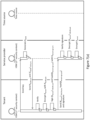
- Each vertical box in the diagram represents the enclosed entity, i.e. the first security context 5, second security context 7 and time source 3 over time, with time increasing in the downward direction.
- the blocks which arrows and loops originate from and terminate at indicate the duration of a particular process.
- the second security context 7 receives the public half of the identity key of the first security context K 1ID pub and corresponding generation certificate. This starts a process in the second security context 7.
- the next step of the process is to validate the certificate and then forward a response to the first security context 5, i.e. an error message if the certificate is not validated, or a message containing its own public identity key and certificate if the certificate is validated. This is the end of the particular process.
- Loops indicate actions that happen internally to a process, for example, validation, which does not require interaction with any other entity. Lines that cross between entities indicate communication between the entities.
- the cryptographic key K tenant is generated in the first security context 5.
- the second cryptographic key K tenant-sign is then generated in the first security context 5.
- the public half of the identity key K I1D pub and signed certificate ⁇ C 1ID ⁇ Kman priv are then sent from the first security context 5 to the second security context 7 and are validated at the second security context 7.
- the public half of the identity key K 2ID pub and signed certificate ⁇ C 2ID ⁇ Kman priv are then sent from the second security context 7 to the first security context 5 and are validated at the first security context 5.
- the second cryptographic key K tenant-sign pub and signed certificate ⁇ C tenant-sign ⁇ K1ID priv are sent to the second security context 7 where they are validated and stored.
- FIG 5 is a schematic illustration of the tenant system 1 and service provider system 3 after the second public key, K tenant-sign pub , has been exchanged during the data transfer process discussed in relation to Figure 6(a) below.
- K blob and C blob are transient, and once K tenant has been transferred, are deleted from the second security context 7.
- the second device memory 11 in the second security context 7 also stores the public half of the second key K tenant-sign pub .
- this key may be stored outside of the first security context 5 in an integrity protected manner.
- Figure 6(a) is a flow chart showing a method of transferring data from the first security context 5 to the second security context 7 in accordance with an embodiment of the present invention.
- the data is a cryptographic key, K tenant
- the first security context 5 connects to the second security context 7 via the secured, authenticated connection and initiates the key transfer, or import, process.
- step S601 the cryptographic key, K tenant , and a corresponding access control list, ACL, are generated in the first security context 5.
- the first processor 17 in the first security context 5 is configured to generate the cryptographic key, K tenant , and corresponding access control list.
- the first security context 5 thus generates a key, K tenant , which they will be lending to the service provider.
- K tenant is generated inside a secure appliance in the first security context 5 with an access control list (ACL).
- ACL access control list
- the ACL specifies that a valid use credential, for example a use certificate, must be presented in order to grant a first type of use of the key.
- the first type of use may be a cryptographic operation for example.
- the ACL describes how the key may be used, any restrictions on its use and what credentials must be supplied for each operation to be enabled.
- the cryptographic key, K tenant is not generated in the first security context 5, but is generated outside the first security context 5 and then provided to the first security context 5.
- K tenant instead of the cryptographic key, K tenant , some other kind of data is generated at or provided to the first security context 5.
- An access control list corresponding to the data is then generated, which specifies that a valid use credential must be presented in order to grant a first type of use of the data.
- the first type of use may be reading the contents of the data file for example.
- the ACL may comprise one or more permissions, or policies. Each permission may govern a particular use of the key. For example, a first permission governs how the key may be stored, a second permission governs how the key may be used for encryption, a third permission governs how the key may be used for decryption and so on.
- the ACL also comprises credential(s) associated with a particular permission.
- the credentials specify what must be provided to authorize a particular permission. Some permissions may not have an associated credential, for example the storage permission.
- the tenant has validated that the second security context 7 adheres to the requirements in the ACL before the key is transferred, as described in relation to Figures 2(a) and (b) .
- the tenant validates that the second security context 7 is manufactured by a trusted manufacturer.
- the tenant may also validate that the current configuration of the second security context 7 meets the security requirements of the tenant. By validating that the second security context 7 is trusted and meets the tenants requirements, the tenant can be sure that the second security context 7 will enforce the policies/permissions contained in the ACL.
- the access control list specifies that a valid use credential, for example a use certificate, must be presented in order to allow certain use(s) of the cryptographic key, K tenant .
- a valid use credential for example a use certificate
- K tenant ACL may require a valid certificate to be presented each time the key is used for encryption, for example.
- the permissions related to these uses thus have associated credentials, for example the use certificate.
- a tenant may specify that a valid use certificate is required in the permission that governs using a key for encryption for example.
- K tenant for encryption a valid use certificate would need to be presented to activate the permission.
- the permission may specify that the use certificate must comprise information from which the cryptographic key K tenant corresponding to the use certificate can be identified in order to grant the use corresponding to the permission.
- the ACL may comprise the hash of K tenant .
- the ACL may comprise a reference to the second security context 7.
- the reference to the second security context 7 may comprise the hash of the public half of the identity key K 2ID pub .
- the permission requires presentation of a certificate signed by the private half of an asymmetric key, K tenant-sign , owned by the tenant in order to grant the use associated with the permission.
- the permission specifies that a use certificate must be signed by the second private key K tenant-sign priv in order to grant the use of the cryptographic key, K tenant .
- the permission specifies that the use certificate must comprise information from which the expiry of the use certificate can be determined and must be unexpired in order to grant the use of the cryptographic key, K tenant associated with the permission.
- the tenant is thus able to specify, in the use certificate, an expiry time for its key, after which the key may not be used until further authorization is provided. This allows transfer of cryptographic material between tenant and service provider with assurances over when a key may be used. It ensures that the use of the key is only possible for a set amount of time as specified by the tenant.
- the ACL comprises a permission which specifies that the use certificate must comprise information from which the "start time" of a validity period of the use certificate can be determined, and the start time must have passed in order to grant use of the cryptographic key, K tenant associated with the permission.
- the tenant is thus able to specify a validity period for the key, outside of which the key may not be used until further authorization is provided. It ensures that the use of the key is only possible for a set time interval, as specified by the tenant
- the certificate credential may not be present. This means the permission governing storage is always active, or only active until the key is stored in a non-volatile medium, for example. This allows the second security context 7 to store the key without a certificate. For the case in which the permission governing storage is only active until the key is stored in a non-volatile medium, the permission is a temporary permission and deactivates after storage, i.e. it's stripped from the ACL.
- the permission may specify that the cryptographic key, K tenant can be stored outside the second security context 7 only when encrypted for storage by a key which cannot leave the second security context 7.
- the permission may specify that K tenant can only be encrypted with a key that cannot leave the second security context 7 and is not controllable by the administrator, i.e. the service provider.
- the permission may also include the key type(s) and mechanism(s) that can be used to encrypt the tenant key K tenant , for example, the tenant key K tenant can only be encrypted using AES-GCM encryption with an AES key of 256 bits.
- the permission may specify that the cryptographic key, K tenant can also be stored inside the second security context 7.
- the permission specifies that the cryptographic key K tenant and ACL are to be encrypted with an authenticated encryption algorithm.
- the permission specifies that information from which the origin of the cryptographic key K tenant can be identified is stored in the same data structure as the encrypted cryptographic key K tenant and access control list, and is authenticity protected.
- the permission may specify that the cryptographic key, K tenant can only be stored inside the second security context 7.
- the K tenant ACL contains a permission which specifies that the tenant key can only be stored inside the second security context 7 and/or outside the second security context 7 if encrypted for storage outside the second security context 7 by a key which is not obtainable by the service provider. As long as the second security context 7 enforces the policy specified in the ACL, the tenant key K tenant is not exposed to the hosting service provider system 3.
- the tenant has ensured that the second security context 7 will enforce the policy because it has received information validating that the manufacturer of the second security context 7 is a trusted manufacturer.
- Information identifying the manufacturer of the second security context is sent in the generation certificate.
- the generation certificate is signed with the manufacturer private key.
- the tenant has received information validating the product, software and hardware of the second security context 7. This information is sent in the generation certificate.
- the tenant trusts that the second security context 7 conforms to the information provided by the manufacturer. For example, if the generation certificate contains information specifying that the software and hardware is impervious to attack by the service provider, the tenant trusts this is the case, as the information is provided by the trusted manufacturer.
- the tenant can validate from the generation certificate that the service provider is using a second security context 7 having certain guarantees from the manufacturer.
- the manufacturer can provide information in the generation certificate which guarantees that an ACL will be enforced by the second security context 7. As the tenant trusts the manufacturer, this guarantee is also trusted. Thus the guarantee information that allows the tenant to ensure that the ACL will be enforced originates from the manufacturer.
- the configuration information sent in the configuration certificate informs the tenant whether someone has tried to tamper with the second security context 7 either physically or by attempting to hack it. Once the tenant confirms that the second security context 7 has not been tampered with, then the guarantees from the manufacturer are still applicable.
- the ACL allows transfer of cryptographic material between tenant and service provider, with no exposure of the raw cryptographic material to the service provider or to a security agency with jurisdiction over the service provider. For example, a tenant based in the UK would not want their cryptographic keys accessible by an American service provider for fear of the keys being turned over to an American security agency which does not have jurisdiction over a UK-based company.
- K tenant can only be stored inside the second security context 7 and/or outside the second security context 7 if encrypted for storage by a key which cannot leave the second security context 7 allows multiple tenants to use the same cryptographic infrastructure whilst ensuring that the raw key material is never exposed to the other tenants.
- Service providers and tenants are able to share cryptographic infrastructure in a secure way to improve efficiency.
- a permission or permissions contained in the ACL thus restrict how K tenant can be stored and are set so that K tenant is inaccessible by anyone including the service provider.
- the second security context 7 will disallow the first type of use of the key until such a time as an authorizing certificate is presented with the key.
- This means that the first type of use of the raw key material is not accessible by any third-party including the service provider.
- the tenant is thus able to maintain assurance that their cryptographic keys are not exposed to either the service provider or any other party.
- the tenant is able to control the use of its key once imported into the second security context via the access control list.
- the access control list may specify that particular information must be provided in the use certificate in order to allow particular uses of the tenant key K tenant .
- the tenant can restrict how the key is used by the service provider.
- the ACL may contain a permission that specifies that the tenant key can be used to encrypt data when a certificate signed with a certain private key is presented.
- the credential associated with the permission is the certificate signed with the certain private key.
- It may also include a permission that specifies decrypt is available when presented by a certificate signed by a different private key.
- Each permission may require a different credential, for example a certificate signed by a different private key.
- a permission may specify is contained in the certificate may include the time the certificate was issued, where the time stamp comprises a reference to a shared trusted clock and/or the identity (for example the hash of K IDpub ) of the appliance the certificate can be used with. Including the identity restricts which appliances within a context a key can be used.
- the established trust with the second security context and the provision of the ACL corresponding to the tenant key K tenant allows the tenant to cryptographically validate that a service provider adheres to a set of rules, i.e. those provided in the ACL, which guarantee the non-disclosure of raw cryptographic material and usage once a key has been transferred. It allows the tenant to securely and verifiably lease cryptographic keys to the service provider for use in a restricted manner, whilst supporting multi-tenancy.
- the ACL comprises policies which ensure that the service provider has no access to the raw key material of a tenant, the tenant has assurance that their key is only usable in situations under its control, and multiple tenants can share the same cryptographic infrastructure in a secure manner. It allows lease of the key K tenant whilst restricting the time period in which it may be used. It allows tenants to accurately control the use of their keys once they're hosted by a service provider.
- the tenant After K tenant is generated, the tenant then initiates a key-lending protocol with the service provider. For example, the first security context 5 may send a message to the second security context 7 which initiates step S602. The message may request K BLOB pub .
- a first cryptographic key pair which is suitable for use in an encryption scheme and a first cryptographic certificate C BLOB are generated in the second security context 7, the first cryptographic key pair comprising a first public key, K BLOB pub , and a first private key, K BLOB priv .
- the first cryptographic certificate comprises a hash of the first public key, K BLOB pub .
- a new first cryptographic key pair K BLOB and first cryptographic certificate C BLOB are generated for each data transfer, in other words, each first cryptographic key pair K BLOB and first cryptographic certificate C BLOB is only valid for a single use.
- the first cryptographic certificate C BLOB and the configuration certificate are a single certificate.
- the first cryptographic certificate is generated further comprising information relating to the current configuration of the second security context.
- the information relating to the current configuration of the second security context may be as described in relation to Figure 2(b) .
- step S603 the first cryptographic certificate C BLOB is cryptographically signed with the private half of the identity key of the second security context, K 2ID priv .
- the second processor 19 is configured to cryptographically sign the first cryptographic certificate C BLOB with the private half of the identity key of the second security context, K 2ID priv .
- the first cryptographic certificate C BLOB validates that K BLOB pub was generated in the second security context 7.
- the first cryptographic certificate comprises information from which the origin of the cryptographic key K BLOB pub can be validated.
- the information from which the origin of the cryptographic key K BLOB pub can be validated is the signed hash of the first public key, K BLOB pub .
- the first cryptographic certificate C BLOB comprises a hash of the first public key K BLOB pub and is signed with the private half of the identity key of the second security context, K 2ID priv , which allows the origin of the first public key, K BLOB pub to be validated.
- the first cryptographic certificate is signed by K 2ID priv in order to prove that the service provider generated the certificate. Including the hash also validates that the data, i.e. the first public key, K BLOB pub has not been tampered with during transit.
- the first cryptographic certificate comprises information which validates that K BLOB priv is ephemeral and that K BLOB priv cannot leave the second security context.
- Information indicating that K BLOB priv is ephemeral and that K BLOB priv cannot leave the second security context is sent with the first cryptographic key pair K BLOB to the first security context 5.
- the first cryptographic certificate comprises this information and is signed, thus validating the information contained in the message.
- step S604 the first public key, K BLOB pub , and the signed first cryptographic certificate ⁇ C BLOB ⁇ K2ID priv are sent to the first security context 5.
- Information relating to K BLOB pub may also be sent with the first cryptographic key pair K BLOB to the first security context 5 and be included in the first certificate.
- the second transceiver 15 is configured to send the first public key, K BLOB pub and the signed first cryptographic certificate ⁇ C BLOB ⁇ K2ID priv to the first security context 5. Configuration information and/or information about the key may be sent to the first security context 5 in the same message.
- the second security context 7 in response to the initiation message, generates an asymmetric key, K BLOB , and forwards the public half and a certificate signed by the private half of the identity key of the second security context, K 2ID priv to the first security context 5.
- K BLOB is an ephemeral asymmetric key, generated inside the second security context 7 with an accompanying key certificate, C BLOB .
- C BLOB allows the tenant to validate that the key was generated by an appliance inside the second security context 7, that the private half of K blob is ephemeral and can never leave the second security context 7.
- the service provider sends the public half of K BLOB and C BLOB to the first security context 5.
- step S605 the signed first cryptographic certificate ⁇ C BLOB ⁇ K2ID priv is verified at the first security context 5.
- the first processor 17 in the first security context 5 is configured to verify the signed first cryptographic certificate ⁇ C BLOB ⁇ K2ID priv .
- the signed first cryptographic certificate ⁇ C BLOB ⁇ K2ID priv is verified using the public half of the identity key of the second security context, K 2ID pub .
- the first processor 17 is configured to perform a signature verification algorithm that, given the signed message ⁇ C BLOB ⁇ K2ID priv and the public key K 2ID pub either accepts or rejects the message's claim to authenticity.
- the authenticity of the first public key, K BLOB pub is then validated at the first security context 5 from the first cryptographic certificate C BLOB .
- the first processor 17 in the first security context 5 is configured to validate the first public key, K BLOB pub .
- the authenticity of the first public key, K BLOB pub is validated by calculating the hash of the first public key, K BLOB pub , and validating that it matches that contained in the first cryptographic certificate C BLOB .
- Any other information sent with the first public key, K BLOB pub for example current configuration information and information relating to the first public key, K BLOB pub , is also validated from the certificate.
- the first public key, K BLOB pub is stored in the first device memory 9 of the first security context 5. Alternatively, it can be integrity protected by the first security context 5 and stored in untrusted storage outside of the first security context 5.
- the information relating to the current configuration of the second security context is also validated in step S605, as described in relation to Figure 2(b) . Any key information included in the message is also validated.
- the first security context may use the certificate to validate the parameters of K BLOB , authenticating the source and checking that it is well-formed and conforming to the security policies expected by the tenant.
- the security policy a tenant may require could include a key length, key type and/or key permission-credential pairs.
- Key permissions are used to describe the operations that a key may be used for. For example, permissions may specify that a key can be used to encrypt other keys or that it may be used for cryptographically signing data. Permissions must be activated by a matching credential before they can be used.
- a credential in this system takes the form of a verifiable cryptographic certificate.
- the first security context 5 validates C BLOB , that the private half of K BLOB is ephemeral, that the second security context 7 is manufactured by a trusted source, and that the state of the second security context 7 is suitable for lending a key to.
- Step S606 comprises encrypting the cryptographic key K tenant and the corresponding access control list with the first public key K BLOB pub in the first security context 5.
- the first processor 17 is configured to encrypt the cryptographic key K tenant and the corresponding access control list with the first public key K BLOB pub .
- the communication channel between the first security context 5 and the second security context 7 is provided and controlled by the service provider, it is not trusted by the tenant for transfer of high value cryptographic keys such as K tenant , as it could be open to attack by the service provider.
- K tenant is enforced by the tenant by encryption of K tenant with the first public key K BLOB pub .
- the first certificate C BLOB allows the tenant to validate that the private half of K blob can never leave the second security context 7, thus by encryption of K tenant with the first public key K BLOB pub , the tenant can ensure that K tenant is secure from the service provider, even though the service provider can attack the communication channel.
- the encryption of the tenant key in this way provides a secure channel which is rooted in the trust between the first security context 5 and the second security context 7. This allows a higher level secure authenticated channel that is not trusted by the first security context 5 and the second security context 7 to be used between the tenant and service provider site. This higher layer secure channel may be provided by the service provider using a load balancer or firewall appliance.
- the encryption of the tenant key allows the service provider to continue to use this infrastructure to mitigate attacks such as denial of service but still allows context to context security without having to trust external security services.
- K BLOB pub may be discarded by the tenant after encryption of K tenant .
- the information from which the origin of the cryptographic key K tenant can be validated is the signed encrypted tenant key and access control list ⁇ K tenant , ACL ⁇ KBLOB pub ⁇ K tenant-sign priv .
- step S607 the output blob from step S606 is cryptographically signed using the private half of K tenant-sign .
- the first processor 17 is configured to cryptographically sign the output blob from step S606 with the private half of K tenant-sign .
- step S608 the encrypted cryptographic key and corresponding access control list ⁇ K tenant , ACL ⁇ KBLOB pub , and information from which the origin of the cryptographic key K tenant can be validated is sent to the second security context 7.
- information from which the origin of the message can be identified is also sent, which may be the hash of the public half of K tenant-sign for example.
- the information from which the origin of the message can be identified comprises a hash of K tenant-sign pub
- the encrypted blob, hash of the signing key and signature are forwarded to the second security context 7.
- the signature is information from which the origin of the cryptographic key K tenant can be validated.
- the first transceiver 13 is configured to send the encrypted blob, signed output blob from step S607 and the hash of the public half of K tenant-sign to the second security context 7.
- K tenant Given an acceptable key K BLOB pub , that is a key K BLOB pub that the tenant defines as being of sufficient cryptographic strength, the key which is to be registered, K tenant , is encrypted with the public half of K blob at the first security context 5.
- K tenant includes permission-credential pairs, i.e. the ACL, which specify the acceptable operations for which the key material may be used and which may be activated by a certificate which must be signed by the private half of K tenant-sign .
- the encrypted blob is signed using the private half of K tenant-sign and the encrypted blob, signature and hash of the public half of K tenant-sign are forwarded to the second security context 7.
- K blobpriv is required to successfully decrypt the data sent from the first security context 5 to the second security context 7.
- K blobpriv is ephemeral and cannot be accessed or mutated by the service provider or a third party.
- Figure 6(b) is a flow chart showing further steps of a method of transferring a cryptographic key, K tenant from the first security context 5 to the second security context 7 in accordance with an embodiment of the present invention.
- step S609 the origin of the cryptographic key K tenant is validated at the second security context 7. In an embodiment, this is validated by first verifying the signature contained in the message sent from the first security context 5.
- the hash of the public half of K tenant-sign is used to identify the tenant from which the message originates, and thus identify the correct signing key required to verify the signature.
- the signature is then verified using the public half of K tenant-sign .
- the second processor 19 in the second security context 7 is configured to verify the signature.
- the signature is verified using the public half of K tenant-sign .
- the second processor 19 is configured to perform a signature verification algorithm that, given the signature and the public key K tenant-sign either accepts or rejects the message's claim to authenticity.
- step S610 If verified and validated, the method progresses to step S610. If not verified or validated, an error is returned to the first security context 5, for example a message is sent stating "AccessDenied”. At this point, the communication between the first security context 5 and the second security context 7 is terminated.
- Step S610 comprises decrypting the encrypted cryptographic key K tenant and corresponding access control list with the first private key K BLOB priv at the second security context 7.
- the second processor 19 is configured to decrypt the encrypted cryptographic key K tenant and corresponding access control list.
- the second processor 19 is configured to perform a decryption algorithm given the encrypted cryptographic key K tenant and corresponding access control list and the first private key K BLOB priv .
- Step S611 comprises re-encrypting the cryptographic key K tenant and the ACL with a third cryptographic key at the second security context 7. This step is performed so that the cryptographic key K tenant and the ACL may be stored outside of the second security context 7. In an alternative embodiment, this step is omitted and the cryptographic key K tenant , the ACL and information identifying the origin of the cryptographic key K tenant are stored unencrypted within the second security context 7.
- the ACL specifies the parameters of which type(s) of key can be used to encrypt K tenant , and which encryption mechanisms can be used.
- the ACL may comprise a permission, i.e. a policy, which states that K tenant can only be encrypted with a key that cannot leave the second security context 7 and is not controllable by the administrator, i.e. the service provider.
- the permission also includes the key type(s) and mechanism(s) that can be used to encrypt the tenant key K tenant , for example, the tenant key K tenant can only be encrypted using AES-GCM (Galois/Counter Mode) encryption with an AES key of 256 bits.
- AES-GCM Galois/Counter Mode
- the encryption mechanism may specify the need to ensure authenticity, integrity and confidentiality or some subset of those properties.
- the second security context 7 may either re-use an existing key that meets the ACL policy requirements, or create a new key.
- the cryptographic key K tenant and the ACL are encrypted in the second security context 7 using the mechanism specified, and a third cryptographic key which meets the specified requirements.
- the second processor is configured to encrypt the cryptographic key K tenant with a third cryptographic key.
- the cryptographic key, K tenant is encrypted for storage by a key which cannot leave the second security context 7.
- the cryptographic key K tenant and the ACL may be encrypted using an authenticated encryption algorithm.
- the cryptographic key K tenant and ACL are inputs to be encrypted in an authenticated encryption algorithm, for example an AES-GCM operation, whilst information from which the origin of the cryptographic key K tenant can be identified is input as an authenticated data parameter.
- the information from which the origin of the cryptographic key K tenant can be identified is the public half of K tenant-sign .
- a hash of K tenant is also stored with the cryptographic key K tenant , for example the hash of k tenant may be the name of the file in which the encrypted data is stored.
- the re-encrypted cryptographic key K tenant and corresponding access control list, and the authenticated information from which the origin of the cryptographic key K tenant can be identified, are transferred to a device memory outside of the second security context 7.
- the information from which the origin of the cryptographic key K tenant can be identified is thus stored in the same data structure as the encrypted cryptographic key K tenant and access control list, but not necessarily be encrypted. However, the information from which the origin of the cryptographic key K tenant can be identified is authenticity protected, such that it cannot be changed without notice.
- the second security context 7 verifies the payload signature using the public half of K tenant-sign .
- the hash contained in the received payload is used to identify the public half of the tenant's signing key.
- the received payload signature is verified using the identified signing key.
- K tenant is decrypted using the private half of K blob and re-encrypted under a non-recoverable key, as enforced by the K tenant ACL, and stored alongside the public half of K tenant-sign outside of the second security context 7 for later use.
- the key K tenant is stored unencrypted in protected non-volatile memory within the second security context 7. In both cases, the decrypted key is thus stored in a secure, tamper-proof manner.
- K tenant is stored by its permissions, or policies. Specifically, at generation time, the permissions granted restrict how K tenant can be stored and are set so that K tenant is inaccessible by anyone including the service provider, other than the second security context 7.
- each of the tenant keys can be encrypted for storage with the same key.
- each tenant key may be encrypted with a different key if there are different storage permissions between the ACLs corresponding to each tenant key for example.
- Figure 7(a) is a schematic illustration of a method of key enrolment, which is part of a method of cryptographic key transfer according to an embodiment of the present invention.
- the method comprises steps S602 to S611 described in relation to Figures 6(a) and (b) above.
- a key enrolment message is sent from the first security context 5 to the second security context 7.
- the first cryptographic key pair K BLOB is generated at the second security context 7.
- the second security context 7 sends the public half of the first cryptographic key pair K BLOB and the signed first cryptographic certificate ⁇ C BLOB ⁇ K2ID priv to the first security context 5, where they are validated.
- the cryptographic key K tenant is encrypted at the first security context 5 with K BLOB pub
- the encrypted key ⁇ K tenant ⁇ KBLOB pub and hash ⁇ K tenant-sign pub ⁇ are signed with K tenant-sign priv at the first security context 5.
- the signed message is sent to the second security context 7 where it is validated, and the encrypted key ⁇ K tenant ⁇ KBLOB pub is decrypted and re-encrypted in the second security context 7 with a non-recoverable key that is safe from the administrator.
- the encrypted tenant key can then be stored outside of the second security context 7.
- Figure 7(b) is a flow chart of a method of cryptographic key transfer according to an embodiment of the present invention.
- the tenant sets the ACL of the tenant key in the first security context 5.
- the first security context 5 requests the first public key K BLOB pub from the second security context 7.
- the first security context 5 sends a request message to the second security context 7 for example.
- the first security context 5 validates the received first public key K BLOB pub and first cryptographic certificate C BLOB . This corresponds to steps S605 described above. If the first public key K BLOB pub and first cryptographic certificate C BLOB are not validated, an error is returned. If they are validated, the first security context 5 encrypts the tenant key and associated ACL with the first public key K BLOB pub . This corresponds to step S606 described above.
- the first security context 5 then signs the encrypted key and associated ACL and a hash of K tenant-sign pub with K tenant-sign priv . This corresponds to the S607 described above.
- the first security context 5 then exchanges the encrypted blob, the hash of K tenant-sign pub and the signature with the second security context 7. This corresponds to step S608 above.
- Figure 8(a) is a schematic illustration of the tenant system 1 and service provider system 3 after the tenant key K tenant has been imported to the second security context 7.
- K blob and C blob are transient, and once K tenant has been transferred are deleted from the second security context 7 and the first security context 5.
- the first device memory 9 in the first security context 5 also stores the first public key K BLOBpub . Alternatively, this key may be stored outside of the first security context 5 in an integrity protected manner.
- the second device memory 11 in the second security context 7 also stores the tenant key K tenant and the corresponding ACL. Alternatively, the tenant key K tenant and ACL may be stored outside the second security context 7, encrypted with a third cryptographic key which cannot leave the second security context 7.
- Figure 8(b) is a schematic illustration of a tamper-proof, secure reference time source 2, which may be hosted by the service provider, the tenant or a separate third-party. If hosted by the service provider, the reference time source may be part of the second security context 7, or may be a different security context.
- the time source 2 comprises a third device memory 35.
- the third device memory 35 is configured to store cryptographic information such as keys, key pairs and certificates.
- the third device memory 35 may include any form of non-volatile device memory such as flash, optical disks or magnetic hard drives for example.
- the time source 2 also comprises volatile memory.
- the third device memory 35 stores a unique asymmetric identity key K TSID , with a corresponding signed generation certificate ⁇ C TSlD ⁇ Kman priv .
- K TSID is a signing key used to prove the origin of data and authenticity.
- the generation certificate C TSID may describe the public parameters of the key, for example information relating to the type of key, and its length.
- the generation certificate C TSID comprises information which authenticates that the identity key K TSID was generated in the time source 2.
- the generation certificate C TSID may comprise the signed hash of the public half of K TSID .
- the generation certificate C TSID may also include state information, for example, information relating to a unique identification of the device, information identifying the manufacturer, the device version, hardware version, the software type and the supported features of the model.
- the generation certificate C TSID is signed by a manufacturer trusted by both the first security context 5 and the second security context 7.
- the generation certificate is cryptographically signed with the private half of a manufacturer asymmetric key, K man priv .
- the manufacturer may be a third party who manufactured the security appliance(s) which forms the first security context, the security appliance(s) which forms the second security context and the time source 2.
- the time source 2 further comprises a third transceiver 39.
- the third transceiver 39 is configured to transmit and receive data packets.
- the data packets may be transmitted from and received at the transceiver 39 via a wireless Internet connection for example.
- the time source 2 further comprises a third processor 41.
- the third processor 41 is configured to perform cryptographic operations, such as generation of cryptographic keys and asymmetric cryptographic key pairs, generation of certificates corresponding to a cryptographic key or asymmetric cryptographic key pair, generation of access control lists corresponding to a cryptographic key, generation of use certificates corresponding to a cryptographic key, encryption of an object with a cryptographic key which is stored in the third device memory 35, decryption of an encrypted object with a cryptographic key which is stored in the third device memory 35, cryptographically signing an object with a cryptographic key which is stored in the third device memory 35, signature verification and validation of an object based on information stored in the third device memory 35.
- the time source 2 further comprises a clock 37.
- the clock 37 may be a monotonic clock, i.e. a counter that increases monotonically over time.
- the clock may represent time of day to a high degree of accuracy.
- the clock is accurate to 1 second or better.
- the clock may be based on a GPS signal which is accurate to the order of 40 nanoseconds.
- the time source 2 may be resistant to tamper, for example by the inclusion of physical security such as a membrane that covers the entire device, and that cannot be removed without destroying the underlying physical hardware, thus making it un-usable.
- the three services shown in Figure 8(a) and 8(b) comprising: 1) the first security context 5, for example a secure appliance, owned and operated by a tenant; 2) the second security context 7, for example one or more secure appliances owned and operated by the service provider; and 3) a trusted time source 2, which may be owned by the service provider, an external third-party or a tenant, are a set of cooperating services that can all verify that they were built by trusted third-parties with a set of known security properties and adhere to certain same rules. There is an assumption that a tenant trusts the aforementioned third-parties which built the cooperating services but does not trust the service provider who is hosting some of these services.
- a security context may be one or more security appliances that share a set of cryptographic primitives and form a cluster across which requests may be load-balanced.
- Each of the first security context 5, second security context 7 and reference time source 2 can be verifiably identified using a cryptographic certificate, which may be generated at the time of manufacture for example. Each is able to securely store their identity in a way that means they cannot be imitated. Identifying the first security context 5, second security context 7 or reference time source 2 allows for its origin to be ascertained.
- each of the first security context 5, second security context 7 and reference time source 2 can be validated in a non-repudiable manner.
- the origin and state of a service define enough information by which other services can place their trust.
- Each component contains a K ID generated in the factory when it was manufactured for example.
- Each component also contains the key certificate for the K ID which is signed using an asymmetric key known only to the manufacturer. The public half of the manufacturer key can be used as the root of trust to authenticate genuine appliances.
- the transfer of cryptographic certificates and cryptographic keys between the reference time source 2 and the second security context 7 described in the following may occur over a secure, authenticated channel between the reference time source 2 and the second security context 7, which is provided and controlled by the service provider. Note that although the channel may be secured from third parties, it is open to attack by the service provider, and is thus untrusted.
- Figure 9 is a flow chart showing a method of registering a time source 2 with the second security context 7. This can be performed at any point as part of the key transfer method according to an embodiment of the present invention, or as part of the method of controlling use of a cryptographic key according to an embodiment of the present invention.
- the method of registering a time source 2 may be performed when the administrator of the second security context 7 sets up the appliances in the second security context 7, i.e. when authenticity is performed. This is an infrequent process, and may only need to be performed once.
- the second security context 7 may then broadcast information relating to its trusted time sources to potential tenants.
- the tenants therefore know initially which time source(s) the service provider supports, and can make a decision as to whether these time sources are acceptable before enrolment of keys begins, for example by validating the authenticity, state and configuration of the time source(s) as described in relation to Figure 10 below.
- a reference time source 2 comprises a device memory 35 and a clock 37 as described in relation to Figure 8(b) above.
- step S901 the public half of the identity key of the time source, K TSID pub , and the generation certificate ⁇ C TSID ⁇ Kman priv , are sent from the reference time source 2 to the second security context 7 in response to a query message from the second security context 7.
- a transceiver 39 in the reference time source 2 is configured to send the public half of the identity key of the time source, K TSID pub , and the generation certificate ⁇ C TSID ⁇ Kman priv , to the second transceiver 15 in the second security context 7.
- Information relating to the state of the time source device 2 may be sent in the same message. The information relating to the state of the device will also be contained in the generation certificate in this case, in order to allow validation of the state information.
- step S902 the generation certificate ⁇ C TSID ⁇ Kman priv is verified at the second security context 7.
- the second processor 19 in the second security context 7 is configured to verify the generation certificate ⁇ C TSID ⁇ Kman priv .
- the generation certificate is verified using the public half of the trusted manufacturer key K man pub .
- the second processor 19 is configured to perform a signature verification algorithm that, given the signed message ⁇ C TSID ⁇ Kman priv and the public key K man pub either accepts or rejects the message's claim to authenticity.
- the authenticity of the public half of the identity key of the time source, K TSID pub is then validated at the second security context 7.
- the second processor 19 in the second security context 7 is configured to validate the public half of the identity key of the time source, K TSID pub .
- the generation certificate C TSID comprises a hash of the public half of the identity key of the time source, K TSID pub
- the authenticity of the public half of the identity key of the time source, K TSID pub is validated by calculating the hash of the public half of the identity key of the time source, K TSID pub , and validating that it matches that contained in its generation certificate C TSID .
- the second security context 7 may also validate any state information contained in the message meets requirements.
- K TSID pub the public half of the identity key of the time source
- the second security context 7 establishes trust with the reference time source 2.
- the second security context 7 thus establishes trust with the time source 2 by validating its origin, state and authenticity via a certificate chain.
- the second security context 7 requests configuration information from the time source 2 in step S904.
- the transceiver 15 in the second security context 7 sends a message requesting the information to the time source 2.
- step S905 in response to the request, the time source 2 generates configuration information which includes information relating to the configuration of the time source 2, which may include precision information about the clock and security settings, the cryptographic primitives that have been setup, the version of software that the time source is running and the state of the time source 2, including any anomalies detected.
- the third processor 41 in the time source 2 is configured to generate this message.
- step S906 the response message is signed by the private half of the identity key of the time source, K TSID priv .
- the third processor 41 in the time source 2 is configured to cryptographically sign the message with the private half of the identity key of the time source, K TSID priv .
- step S907 the signature and configuration information is sent to the second security context 7.
- the transceiver 39 in the time source 2 is configured to send the signed message to the second security context 7.
- step S908 the second security context 7 verifies the response signature using public half of the identity key of the time source, K TSID pub .
- the second processor 19 in the second security context 5 is configured to verify the signature.
- the signature is verified using the public half of the identity key of the time source, K TSID pub .
- the second processor 19 is configured to perform a signature verification algorithm that, given the signed message and the public key K TSID pub either accepts or rejects the message's claim to authenticity.
- step S909 a check as to whether the time source configuration is within acceptable tolerances is performed.
- the configuration information is checked to validate that it meets the requirements of the service provider.
- the configuration information can be checked again whenever a time stamp is requested by the second security context 7, by requesting configuration information again.
- the state and configuration of all appliances in the system i.e. the first security context 5, the second security context 7 and the reference time source 2 can be obtained from the state entry present in the appliance. After initialization, each appliance updates this field and generates a new configuration message to allow clients to cryptographically verify the new appliance settings.
- step S910 If the signature is verified successfully and the configuration of the time source 2 is within tolerances, the method progresses to step S910. If not, an error is returned to the time source 2, for example a message is sent stating "AccessDenied”. At this point, the communication between the time source 2 and the second security context 7 is terminated.
- a message is sent to the first security context 5 comprising information identifying the time source 2 and information indicating that the time source 2 is trusted by the second security context 7.
- the information identifying the time source 2 may comprise a unique identification number for example the hash of the public half of the identity key of the time source 2 or the IP address of the time source 2.
- the transceiver 15 in the second security context 7 is configured to send a message comprising information identifying the time source 2 and information indicating that the time source is trusted to the first security context 5.
- Information identifying the time source 2 and information indicating that the time source 2 is trusted is also stored in the device memory 11 of the second security context 7, or outside of the second security context 7 in an integrity protected manner.
- the second security context 7 adds the time source 2 to a list of trusted time source(s).
- the reference time source's unique identification may be added to the list.
- the list of trusted time source(s) is then broadcast by the second security context 7.
- the first security context 5 receives the list of trusted time source(s) from the second security context 7.
- the first security context 5 can query, and in the same way as the second security context 7, validate the authenticity, state and configuration of the time source(s).
- a flow chart illustrating this process is shown in Figure 10 . Again, this can be performed at any point as part of the key transfer method according to an embodiment of the present invention, or as part of the method of controlling use of a cryptographic key according to an embodiment of the present invention.
- the below steps may be performed, and then information regarding the time source 2 sent to the second security context 7, which then validates the time source 2.
- the transfer of cryptographic certificates and cryptographic keys between the reference time source 2 and the first security context 5 described in the following may occur over a secure, authenticated channel between the reference time source 2 and the first security context 5.
- the channel may be provided and controlled by the service provider or a proxy.
- the time source is provided by a third party time service provider
- the channel may be provided directly between the tenant and time service provider. This channel may be provided by the time service provider or a proxy. Note that although the channel is secure from third parties, it is open to attack by the time service provider.
- the transfer of cryptographic certificates and cryptographic keys between the reference time source 2 and the second security context 7 described in the following may occur over a secure, authenticated channel between the reference time source 2 and the second security context 7.
- step S1001 the public half of the identity key of the time source, K TSID pub , the generation certificate ⁇ C TSID ⁇ Kman priv , and a configuration certificate ⁇ C TSID ⁇ Kman priv are sent from the reference time source 2 to the first security context 5 in response to a query message from the first security context 5.
- a transceiver 39 in the reference time source 2 is configured to send the public half of the identity key of the time source, K TSID pub , and the generation certificate ⁇ C TSID ⁇ Kman priv , to the first transceiver 13 in the first security context 5.
- Information relating to the state of the time source device(s) may be sent in the same message. The information relating to the state of the device(s) will also be contained in the generation certificate in this case, in order to validate the state information.
- step S1002 the generation certificate ⁇ C TSID ⁇ Kman priv is verified at the first security context 5.
- the first processor 17 in the first security context 5 is configured to verify the generation certificate ⁇ C TSID ⁇ Kman priv .
- the generation certificate is verified using the public half of the trusted manufacturer key Kman pub .
- the first processor 17 is configured to perform a signature verification algorithm that, given the signed message ⁇ C TSID ⁇ Kman priv and the public key K man pub either accepts or rejects the message's claim to authenticity.
- the authenticity of the public half of the identity key of the time source, K TSID pub is then validated at the first security context 5.
- the first processor 17 in the first security context 5 is configured to validate the public half of the identity key of the time source, K TSID pub .
- the generation certificate C TSID comprises a hash of the public half of the identity key of the time source, K TSID pub
- the authenticity of the public half of the identity key of the time source, K TSID pub is validated by calculating the hash the public half of the identity key of the time source, K TSID pub , and validating that it matches that contained in its generation certificate C TSID .
- the first security context 5 may also validate that the state of the device(s) meets requirements, from any state information contained in the message.
- K TSID pub the public half of the identity key of the time source
- the first security context 5 establishes trust with the reference time source 2.
- the first security context 5 thus establishes trust with the time source 2 by making a secure connection to the time source, and validating its origin and authenticity via a certificate chain.
- the first security context 5 requests configuration and state information from the time source 2 in step S1004.
- the transceiver in the first security context 5 sends a message requesting information to the time source 2.
- step S1005 in response to the request, the time source 2 generates a message which includes the configuration of the time source 2, which may include precision information about the clock and security settings, the cryptographic primitives that have been setup, the version of software that the time source is running and the state of the time source, including any anomalies detected.
- the third processor 41 in the time source is configured to generate the configuration information.
- the message may be the same message sent to the second security context 7. Alternatively, a message containing different information may be generated and sent in a similar manner as described in relation to Figure 2(b) .
- the message may comprise information relating to the specific configuration applied to the reference time source.
- step S1006 the response message is signed by the private half of the identity key of the time source, K TSID priv .
- the third processor 41 in the time source is configured to cryptographically sign the message with the private half of the identity key of the time source, K TSID priv .
- step S1007 the message and signature is sent to the first security context 5.
- the transceiver 39 in the time source 2 is configured to send the signed message to the first security context 5.
- step S1008 the first security context 5 verifies the response signature using public half of the identity key of the time source, K TSID pub .
- the first processor 17 in the first security context 5 is configured to verify the signature.
- the signature is verified using the public half of the identity key of the time source, K TSID pub .
- the first processor 17 is configured to perform a signature verification algorithm that, given the signed message and the public key K TSID pub either accepts or rejects the message's claim to authenticity.
- step S1009 a check as to whether the time source configuration and the time source state are within acceptable tolerances is performed.
- the information is checked to validate that it meets the requirements of the tenant.
- the configuration information is requested and checked immediately before transfer of K tenant to the second security context 7. This ensures that up to date configuration information is validated.
- the signature is verified successfully and the configuration and state of the time source 2 are within tolerances, information identifying the time source 2 and information indicating that the time source 2 is trusted are stored in the device memory 9 of the first security context 5, or outside of the first security context 5 in an integrity protected manner. If not, an error is returned to the time source 2, for example a message is sent stating "AccessDenied”. At this point, the communication between the time source 2 and the first security context 5 is terminated.
- the configuration information can be checked again whenever a time stamp is requested by the first security context 7, by requesting configuration information again.
- FIG 11 is a flow chart showing a method of controlling use of a cryptographic key, K tenant according to an embodiment of the present invention.
- the cryptographic key, K tenant is securely stored in the service provider system together with an access control list specifying that a valid use credential, for example a use certificate, must be presented in order to allow a first type of use of the cryptographic key, K tenant .
- K tenant instead of the cryptographic key, K tenant , some other kind of data is securely stored in the service provider system, and the use of this data is controlled.
- An access control list is stored together with the data, which specifies that a valid use certificate must be presented in order to grant a first type of use of the data.
- the tenant At the point at which the tenant wishes to make its key available for use in the service provider's cryptographic infrastructure, the tenant generates a use certificate.
- Step S1101 comprises generating a use credential in the first security context 5.
- the use credential is a use certificate.
- the processor 17 in the first security context 5 is configured to generate the use certificate.
- the use certificate comprises information from which the cryptographic key K tenant corresponding to the use certificate can be identified and information from which the expiry of the use certificate can be determined.
- the information from which the cryptographic key K tenant corresponding to the use certificate can be identified comprises the hash of K tenant .
- the information from which the expiry of the use certificate can be determined comprises an expiry time, and information identifying a reference time source.
- the expiry time is calculated with reference to a reference time source 2 that is trusted by both the first security context 5 and the second security context 7.
- Trust in a reference time source is ascertained by the first security context 5 and the second security context 7 independently connecting to the reference time source and validating that the time source is trusted and that the time source is tamper-proof via the module state parameter of the certificate. This is described in relation to figures 9 and 10 above and may be performed prior to the method of key transfer, or after the method of key transfer and before the generation of a use certificate for example.
- the use certificate thus comprises information regarding a validity period with reference to a secure time source 2.
- Key Authorization thus begins with a tenant generating a credential certificate, or a "key-use" certificate that matches that defined in a permission of K tenant , the ACL.
- the use certificate fulfils the requirements which are defined in the access control list corresponding to K tenant .
- the credential certificate, or use certificate is signed with the private half of K tenant-sign .
- Figure 12 shows a method of generating a use certificate at the first security context 5, which is part of a method of controlling use of a cryptographic key, K tenant according to an embodiment of the present invention.
- a reference time source 2 is selected by the first security context 5.
- Information identifying one or more time sources and information indicating that the time source(s) are trusted may be stored in the device memory 9 of the first security context 5 or outside of the first security context in an integrity protected manner.
- One of the time sources is selected by the first security context 5.
- the time source 2 may be chosen from a list of trusted time sources broadcast by the second security context 7 and for which the first security context 5 has established trust. Thus both the second security context 7 and the first security context 5 have established trust with the one or more time sources on the list. Each of these time sources are valid time sources with the necessary configuration and state.
- the first security context selects a time source 2 from the list of one or more valid time sources.
- step S1202 the first security context 5 requests the current time stamp from the chosen time source 2.
- the first transceiver 13 in the first security context 5 sends a request message to the time source 2.
- step S1203 the time source 2 generates a message including the time stamp.
- the message may comprise information identifying the time source and the current time at the generation of the message, determined from the time source clock.
- the information identifying the time source may comprise the hash of the public identity key of the generating time source, K TSID pub .
- the message may further comprise the current configuration information, relating to any indication that the time source has been tampered with for example. This information can then be used by the client to check whether the time source is in an acceptable state before using the timestamp in the use certificate.
- step S1204 the message is signed with the private half of the identity key of the time source, K TSID priv .
- the third processor 41 in the time source is configured to cryptographically sign the message with the private half of the identity key of the time source, K TSID priv .
- step S1205 the message and signature is sent to the first security context 5.
- the transceiver 39 in the time source 2 is configured to send the signed message to the first security context 5.
- step S1206 the first security context 5 verifies the response signature using the public half of the identity key of the time source, K TSID pub .
- the first processor 17 in the first security context 5 is configured to verify the signature.
- the signature is verified using the public half of the identity key of the time source, K TSID pub .
- the first processor 17 is configured to perform a signature verification algorithm that, given the signed message and the public key K TSID pub either accepts or rejects the message's claim to authenticity. If the signature is verified successfully the method progresses to step S1207. If not, an error is returned to the time source 2, for example a message is sent stating "AccessDenied". At this point, the communication between the time source 2 and the second security context 7 is terminated.
- the first security context 5 validates that the configuration is acceptable. If the current configuration information is not acceptable to the tenant, then the use certificate generation is stopped.
- step S1207 the tenant calculates the expiry time for their key K tenant based on the aforementioned time stamp.
- the expiry time is calculated as the time stamp time plus an amount of time for which the tenant wishes the certificate to be active, for example the time stamp time plus one or more days.
- the expiry time is calculated as the time stamp time plus the communication delay from the reference time source 2 to the first security context 5 plus the communication delay from the first security context 5 to the second security context 7 plus the amount of time for which the tenant wishes the certificate to be active.
- the amount of time for which the tenant wishes the certificate to be active may be a few seconds or several days for example, depending on the application.
- a "start time” may also be included in the use certificate, such that the use certificate defines a validity period, within which the certificate is valid. This allows a tenant to pregenerate one or more certificates, in advance of use.
- step S1208 the expiry time, a reference to the time source, a reference to K tenant and a reference to the second security context 7 are included in a use certificate.
- a reference to a system component, such as the time source or the second security context 7 may be a unique ID that can be tied to it using a certificate, or could be the hash of the public half of its identity key K ID .
- the processor 17 in the first security context 5 is configured to generate a use certificate, comprising the expiry time calculated in step S1207, a reference to a time source, a reference to K tenant and a reference to the second security context 7.
- the reference to K tenant is the hash of K tenant .
- the reference to the time source 2 is the hash of the public half of its identity key K TSID-pub .
- the reference to the second security context 7 is the hash of the public half of its identity key K 2ID-pub .
- the use certificate is issued together with information from which the origin of the use certificate can be identified.
- the information from which the origin of the use certificate can be identified is a hash of K tenant-sign pub .
- step S1102 the use certificate is signed with the private half of the signing key K tenant-sign priv .
- the first processor 17 in the first security context 5 is configured to cryptographically sign the certificate with the private half of the signing key K tenant-sign priv .
- step S1103 the use certificate is sent to the application server of the service provider, together with the information from which the origin of the use certificate can be validated.
- the information from which the origin of the use certificate can be validated is the signature, i.e. the signed use certificate.
- the first transceiver 13 is configured to send the use certificate to the application server.
- Other entities which wish to use the tenant key may be sent a use certificate. These entities may communicate directly with the second security context 7 or via the application server.
- Information from which the origin of the use certificate can be identified may also be sent with the use certificate.
- the information from which the origin of the use certificate can be identified may be a hash of K tenant-sign pub .
- the information from which the origin of the use certificate can be identified is included in order to identify which signing key should be used to verify the signature.
- the first security context 5 thus sends the use certificate, the signature and the hash of K tenant-sign pub , to the service provider. Each use of the key by the service provider is then accompanied by the presentation of this information to the second security context 7.
- step S1104 the use certificate, signature and the information from which the origin of the use certificate can be identified, which may be the hash of K tenant-sign pub is presented to the second security context 7 by the application server.
- the use certificate is presented each time the application server wishes to use K tenant .
- the application server may send a request message, specifying the use of the tenant key that is required, together with the use certificate.
- the application server may send a message to the second security context 7 comprising a data file, a request that the second security context 7 encrypt the data file with the tenant key, a use certificate, the and the information from which the origin of the use certificate can be identified, which may be the hash of K tenant-sign pub .
- the second security context 7 may have access to a number of public keys, for example associated with different tenants.
- the keys may be stored at the second security context 7, or outside the second security context 7 in an authenticated manner.
- the second security context 7 identifies the correct signature verification key K tenant-sign pub , based on the information from which the origin of the use certificate can be identified, which may be the hash of K tenant-signpub .
- the signed use certificate is then verified at the second security context 7.
- the second processor 19 in the second security context 7 is configured to verify the signature.
- the signature is verified using the public half of the signing key K tenant-sign pub .
- the second processor 19 is configured to perform a signature verification algorithm that, given the signed use certificate and the public key K tenant-sign pub either accepts or rejects the message's claim to authenticity.
- the second security context 7 validates the use certificate with respect to the access control list stored in the second device memory 11. As part of this step, it is validated that the use certificate has not expired. It is also validated that the use certificate allows the operation that is requested, in other words that the use certificate matches the credential associated with the permission corresponding to the operation, or use, which is requested.
- the second processor 19 is configured to validate the use certificate. If the certificate is invalid, for example because of tamper indicated by the certificate signature, expiry or if the ACL does not allow the operation requested, then the second security context 7 may return an error message to the application server for example.
- the second security context 7 identifies the securely stored tenant key corresponding to the use certificate from the reference to K tenant in the use certificate.
- the second security context loads the securely stored tenant key and ACL.
- Loading the tenant key involves making it available to the processor in the second security context 7, i.e. sending the tenant key and ACL to the device memory 9, if not already present. This may involve loading the tenant key and ACL from a non-volatile memory device outside of the second security context 7, decrypting the key and making it available to the second processor for example.
- the second security context 7 validates the use certificate and that the expiry time has not elapsed with respect to the reference time source.
- the second security context 7 can use the use certificate to enable the matching permission by validating that all fields given are as expected.
- the second processor 19 is configured to confirm that the reference to K tenant and the reference to the second security context 7 match those in ACL corresponding to the key K tenant and stored in the second device memory 11.
- the reference to K tenant is the hash of K tenant .
- the reference to the second security context 7 is the hash of the public half of the identity key K 2ID pub .
- the second processor 19 is further configured to confirm that the validity period has not expired with respect to the referenced time source 2.
- the second security context 7 requests the current time stamp from the time source 2 corresponding to the reference in the use certificate.
- the second transceiver 15 in the second security context 7 is configured to send a request message to the time source 2.
- the time source 2 In response to the request message, the time source 2 generates a message including the current time stamp.
- the message is signed with the private half of the identity key of the time source, K TSID priv .
- the third processor 41 in the time source is configured to cryptographically sign the message with the private half of the identity key of the time source, K TSID priv .
- the signed message is then sent to the second security context 7.
- the transceiver 39 in the time source 2 is configured to send the signed message to the second security context 7.
- the message may also comprise the current configuration information of the time source.
- the second security context 7 then verifies the response signature using the public half of the identity key of the time source, K TSID pub .
- the second processor 19 in the second security context 7 is configured to verify the signature.
- the signature is verified using the public half of the identity key of the time source, K TSID pub .
- the second processor 19 is configured to perform a signature verification algorithm that, given the signed message and the public key K TSID pub either accepts or rejects the message's claim to authenticity.
- the current time stamp is compared to the expiry time contained in the use certificate to determine whether the use certificate has expired. If not, an error is returned to the application server, for example a message is sent stating "AccessDenied”. At this point, the communication between the first security context 5 and the second security context 7 is terminated.
- step S1106 If the current time stamp received from the time source 2 is prior to the expiry time contained in the use certificate, then the method progresses to step S1106. If not, an error is returned to the application server, for example a message is sent stating "CertificateExpired". The application server may then request the first security context 5 to provide a new certificate or simply terminate the operation.
- step S1106 the second security context 7 grants the use of the cryptographic key, K tenant , on the condition that the use certificate is valid and not expired. If the certificate is valid and the expiry time has not yet elapsed, the cryptographic operation is allowed to proceed. The second security context 7 can now use the tenant key within the validity period. The second security context 7 activates the necessary permissions within the ACL corresponding to the requested use and checks the ACL for an active permission that allows the request. The second security context 7 then performs the requested operation and returns the result to the application server.
- the second security context 7 encrypts the data file with the tenant key and returns the encrypted data file to the application server.
- the tenant can generate a new certificate to extend the expiry time of the key. Failure to regenerate a new certificate results in the key becoming unusable by the service provider.
- the second security context 7 notifies the first security context 5 before or at the point of expiry of the use certificate. A new use certificate can then be generated at the first security context with a later expiry time.
- the second security context 7 notifies the application server before or at the point of expiry of the use certificate.
- the application server requests a new use certificate from the first security context 5.
- the use certificate is read by the application server, which requests a new use certificate from the first security context 5 before or at the point of expiry.
- a further component which may be owned by the tenant or the service provider may monitor certificates and raise a request for certificates that are about to or have expired.
- the tenant system 1 effectively leases the cryptographic key K tenant to the service provider system 3 in a secure manner.
- the use of the key by the service provider is cryptographically restricted by an expiry time in reference to a trusted time source, as set by the owning tenant in the use certificate.
- the ACL specifies that the use of the cryptographic key K tenant is only granted when an unexpired use certificate is provided. Furthermore, the tenant can restrict how the key is used by the service provider.
- Figure 13 is a schematic illustration of a method of controlling use of a cryptographic key, K tenant according to an embodiment of the present invention.
- This method shown corresponds to the case where the tenant key is being used at the second security context 7, and the expiry period elapses.
- the second security context 7 or the application server may periodically compare the current time obtained from the reference time source 2 to the expiry time in the use certificate, and from this information determine whether the certificate has expired.
- the second security context 7 may determine that the certificate has expired only when a request using an expired certificate is made.
- the second security context 7 may notify the first security context 5, the application server or a further device that the key has timed out.
- the first security context 5 is configured to send a request message to the time source 2 in response to the notification, requesting the current time stamp as described in relation to step S1202 above.
- the time source 2 is configured to generate and send a message comprising the time information as described in relation to steps 1203 to 1205 above.
- the message is verified at the first security context 5 as described in relation to step S1206 above and a use certificate is generated as described in steps S1207 to S1208 and signed as described in step S1102 above.
- the use certificate is sent to the service provider as described in step S1103 above, and forwarded to the second security context 7 and verified at the second security context 7 as described in relation to step S1104.
- the stored tenant key corresponding to the use certificate is loaded and the current time stamp obtained from the time source 2 and validated as described in relation to S1105 above.
- Loading the tenant key involves making it available to the processor, i.e. sent to the device memory 9 if not already present. This may involve loading the tenant key from non-volatile memory device outside of the second security context 7, decrypting the key and making it available to the processor.
- the key is then activated as in step S1106 above.
- Figure 14 is a schematic illustration of a method of controlling use of a cryptographic key, K tenant according to an embodiment of the present invention.
- the first security context 5 obtains the generation certificate of the time source, status and time from a time source 2.
- the generation certificate and time stamp signature are then verified at the first security context 5. This is described in relation to Figure 10 and steps S1201 to S1206 above.
- the use certificate is generated as described in steps S1207 and S1208 above.
- the use certificate is then sent to the second security context 7, as described in relation to step S1103 above.
- the steps outlined above define a system that is secure against attack by third parties as well as a malicious service provider, as all key material is encrypted between the tenant and the second security context 7, the tenant key material is stored in a secure, tamper-resistant format, the tenant keys can only be used when authorized by a tenant in a way that is cryptographically enforced, and component spoofing is prevented by the presence of an identity key K ID and generation certificate signed by a manufacturer that is trusted by both the tenant and the service provider.
- the above described key transfer method and method of controlling the use of the key mean that the tenant can securely lease cryptographic keys to a service provider who is hosting a shared cryptographic infrastructure of known origin.
- the use of the tenant key remains under the control of the tenant in a cryptographically protected manner.
- the tenant As part of the key transfer method, the tenant generates a key inside a self-hosted, secure appliance, the first security context 5.
- Step S205 described in relation to Figure 2(a) above allows validation that the infrastructure is built using a trusted manufacture. If the signature of the generation certificate C 2ID is verified, then it is validated that the second security context is built by a trusted manufacturer.
- Step S215 described in relation to Figure 2(b) above allows validation that the infrastructure is configured in a way that is acceptable to the tenant and suitable for leasing a key to.
- tenant and service provider's cryptographic infrastructure use a trusted time source 2, which may be hosted by a third-party, to enforce key expiry times set by the tenant.
- the above described devices and methods enable a multi-tenanted, hosted cryptographic solution to be provided by a CSP.
- the system is designed to be secure against attacks by both third-parties and the CSP itself.
- a tenant remains in control of their key, providing usage authorizations, which are cryptographically enforced, for use inside a CSP-hosted system. It allows both multi-tenancy of HSMs and assurance for keys transferred into a service provider's cryptographic infrastructure. More than one tenant can use a single cryptographic appliance, however the security of a tenant's key is protected from both third parties and the service provider.
- the above described devices and methods allow a tenant to verifiably lease cryptographic keys to be used inside a service provider's cryptographic infrastructure in a way that is inaccessible to the service provider and third parties, whilst maintaining control over the use of the keys once inside a CSP security context.
- This enables the secure leasing of cryptographic keys between a tenant and a service provider, with the ability to restrict the use of a tenant key for use inside a service provider HSM for a set time period, and providing resistance to malicious or rogue administrator attacks. It allows leasing of keys to a CSP in a cryptographically enforced manner. It allows service providers to host multi-tenanted services that are robust to third-party attack whilst also being robust against a malicious CSP.
- Cryptographically enforcing that the use of a tenant key is controlled by a tenant ensures that the use of keys is now completely controlled by tenants, making the service secure against attacks and enabling the sharing of infrastructure with others.
- the above described devices and methods allow a CSP to provide their tenants use of their cryptographic infrastructure for applications such as payments, security and regulation.
- the second security context 7 is part of a service provider system, enabling the service provider, for example a CSP, to host cryptographic services via hardware security modules, HSMs, on behalf of their customers.
- a service provider for example a CSP
- HSMs hardware security modules
Landscapes
- Engineering & Computer Science (AREA)
- Computer Security & Cryptography (AREA)
- Signal Processing (AREA)
- Computer Networks & Wireless Communication (AREA)
- Theoretical Computer Science (AREA)
- Software Systems (AREA)
- Physics & Mathematics (AREA)
- General Engineering & Computer Science (AREA)
- General Physics & Mathematics (AREA)
- Computer Hardware Design (AREA)
- Health & Medical Sciences (AREA)
- General Health & Medical Sciences (AREA)
- Bioethics (AREA)
- Storage Device Security (AREA)
Claims (15)
- Verfahren zum Steuern einer Verwendung von Daten, wobei die Daten in einem Dienstanbietersystem (3) in einer Weise gespeichert werden, die für einen vertrauenswürdigen zweiten Sicherheitskontext (7) in dem Dienstanbietersystem (3) zugänglich, aber von dem Rest des Dienstanbietersystems abgesichert ist, wobei eine Zugriffssteuerungsliste, die angibt, dass ein gültiger Verwendungsnachweis vorgelegt werden muss, um eine erste Art von Verwendung der Daten zu gewähren, mit den Daten gespeichert wird, wobei die Daten einen kryptografischen Schlüssel Ktenant umfassen, und wobei die Zugriffssteuerungsliste angibt, dass der kryptografische Schlüssel Ktenant nur außerhalb des zweiten Sicherheitskontextes gespeichert werden kann, wenn er zur Speicherung durch einen Schlüssel verschlüsselt wird, der den zweiten Sicherheitskontext nicht verlassen kann, wobei das Verfahren Folgendes umfasst:
Erzeugen eines Verwendungsnachweises in einem ersten Sicherheitskontext (5), wobei der Verwendungsnachweis Folgendes umfasst:Informationen, anhand derer die dem Verwendungsnachweis entsprechenden Daten identifiziert werden können;Informationen, anhand derer der Ablauf des Verwendungsnachweises ermittelt werden kann,Ausstellen des Verwendungsnachweises und der Informationen, anhand derer die Herkunft des Verwendungsnachweises validiert werden kann,Validieren des Verwendungsnachweises in Bezug auf die Zugriffssteuerungsliste, und Validieren, dass der Verwendungsnachweis im zweiten Sicherheitskontext (7) nicht abgelaufen ist,Gewähren der ersten Art von Verwendung der Daten im zweiten Sicherheitskontext (7) unter der Bedingung, dass der Verwendungsnachweis gültig und nicht abgelaufen ist. - Verfahren nach Anspruch 1, wobei der erste Sicherheitskontext (5) eine oder mehrere Sicherheitsvorrichtungen und/oder eine oder mehrere Partitionen von Sicherheitsvorrichtungen umfasst, und der zweite Sicherheitskontext (7) eine oder mehrere Sicherheitsvorrichtungen und/oder eine oder mehrere Partitionen von Sicherheitsvorrichtungen umfasst.
- Verfahren nach Anspruch 1, wobei die Informationen, anhand derer der kryptografische Schlüssel Ktenant, der dem Verwendungsnachweis entspricht, identifiziert werden kann, ein Hash von Ktenant sind.
- Verfahren nach Anspruch 1 oder 3, wobei die erste Art von Verwendung ein oder mehrere kryptografische Vorgänge ist.
- Verfahren nach Anspruch 4, wobei der Verwendungsnachweis und die Informationen, anhand derer die Herkunft des Verwendungsnachweises validiert werden kann, an den Dienstanbieter ausgegeben werden, wobei das Verfahren ferner Folgendes umfasst:Bereitstellen des Verwendungsnachweises, der Informationen, anhand derer die Herkunft des Verwendungsnachweises validiert werden kann, und einer Anforderung, einen Vorgang mit dem Schlüssel Ktenant durchzuführen, wobei der Vorgang eine erste Art von Verwendung ist, an den zweiten Sicherheitskontext (7);Durchführen des Vorgangs im zweiten Sicherheitskontext (7) unter der Bedingung, dass der Verwendungsnachweis gültig und nicht abgelaufen ist.
- Verfahren nach einem der Ansprüche 1 bis 5, wobei der Verwendungsnachweis ein Verwendungszertifikat ist und ferner Folgendes umfassend:kryptografisches Signieren des Verwendungszertifikats mit einem privaten Schlüssel Ktenant-sign
priv im ersten Sicherheitskontext (5), wobei die Informationen, anhand derer die Herkunft des Verwendungszertifikats validiert werden kann, die Signatur sind und wobei der entsprechende öffentliche Schlüssel Ktenant-signpub integritätsgeschützt und für den zweiten Sicherheitskontext zugänglich ist (7);Überprüfen des Verwendungszertifikats unter Verwendung des öffentlichen Schlüssels Ktenant-signpub im zweiten Sicherheitskontext. - Verfahren nach einem der Ansprüche 1 bis 6, wobei die Informationen, anhand derer der Ablauf des Verwendungsnachweises ermittelt werden kann, Folgendes umfassen:eine Ablaufzeit;Informationen, die eine Referenzzeitquelle (2) identifizieren.
- Verfahren nach Anspruch 7, wobei das Validieren, dass der Verwendungsnachweis im zweiten Sicherheitskontext (7) nicht abgelaufen ist, Folgendes umfasst:Anfordern eines aktuellen Zeitstempels von der Referenzzeitquelle (2);Senden einer Nachricht, die den aktuellen Zeitstempel umfasst, von der Referenzzeitquelle (2) an den zweiten Sicherheitskontext (7) zusammen mit Informationen, anhand derer eine Herkunft der Nachricht validiert werden kann, undValidieren der Herkunft der Nachricht.
- Verfahren nach Anspruch 8, wobei das Validieren, dass der Verwendungsnachweis im zweiten Sicherheitskontext (7) nicht abgelaufen ist, ferner das Vergleichen des Zeitstempels mit der Ablaufzeit umfasst.
- Verfahren nach einem der Ansprüche 1 bis 9, wobei das Erzeugen eines Verwendungsnachweises in einem ersten Sicherheitskontext (5) Folgendes umfasst:Auswählen einer Referenzzeitquelle (2);Anfordern eines aktuellen Zeitstempels von der Referenzzeitquelle (2);Senden einer Nachricht, die den aktuellen Zeitstempel umfasst, von der Referenzzeitquelle an ein Mandantensystem (1) zusammen mit Informationen, anhand derer eine Herkunft der Nachricht validiert werden kann, wobei sich der erste Sicherheitskontext (5) in dem Mandantensystem (1) befindet;Validieren der Herkunft der Nachricht, undBerechnen einer Ablaufzeit auf Grundlage des aktuellen Zeitstempels.
- Verfahren nach einem der Ansprüche 8 bis 10, wobei die Nachricht ferner Informationen bezüglich der aktuellen Konfiguration der Referenzzeitquelle (2) umfasst.
- Verfahren nach einem der Ansprüche 8 bis 11, wobei das Verfahren ferner mindestens eines von a) und b) umfasst:a) Bereitstellen der öffentlichen Hälfte eines kryptografischen Identitätsschlüsselpaars der Zeitquelle an den ersten Sicherheitskontext, zusammen mit Informationen, die die Herkunft des kryptografischen Identitätsschlüsselpaars validieren;b) Bereitstellen der öffentlichen Hälfte eines kryptografischen Identitätsschlüsselpaars der Zeitquelle an den zweiten Sicherheitskontext, zusammen mit Informationen, die die Herkunft des kryptografischen Identitätsschlüsselpaars validieren.
- Verfahren nach Anspruch 12, wobei die Informationen, anhand derer die Herkunft der Nachricht validiert werden kann, eine signierte Nachricht sind, wobei die signierte Nachricht mit der privaten Hälfte des kryptografischen Identitätsschlüsselpaars der Zeitquelle signiert ist.
- Verfahren nach einem der Ansprüche 1 bis 13, wobei Informationen, die sich auf eine Startzeit beziehen, in dem Verwendungsnachweis eingeschlossen sind.
- Trägermedium, umfassend computerlesbaren Code, der dazu konfiguriert ist, einen Computer zu veranlassen, das Verfahren nach einem der Ansprüche 1 bis 14 durchzuführen.
Applications Claiming Priority (3)
| Application Number | Priority Date | Filing Date | Title |
|---|---|---|---|
| GB1602088.5A GB2547025A (en) | 2016-02-05 | 2016-02-05 | A method of data transfer, a method of controlling use of data and a cryptographic device |
| PCT/GB2017/050264 WO2017134445A2 (en) | 2016-02-05 | 2017-02-03 | A method of data transfer, a method of controlling use of data and a cryptographic device |
| EP17704057.3A EP3412001B1 (de) | 2016-02-05 | 2017-02-03 | Verfahren zur datenübertragung und kryptografische vorrichtungen |
Related Parent Applications (1)
| Application Number | Title | Priority Date | Filing Date |
|---|---|---|---|
| EP17704057.3A Division EP3412001B1 (de) | 2016-02-05 | 2017-02-03 | Verfahren zur datenübertragung und kryptografische vorrichtungen |
Publications (2)
| Publication Number | Publication Date |
|---|---|
| EP3675415A1 EP3675415A1 (de) | 2020-07-01 |
| EP3675415B1 true EP3675415B1 (de) | 2023-12-06 |
Family
ID=55641862
Family Applications (2)
| Application Number | Title | Priority Date | Filing Date |
|---|---|---|---|
| EP20158813.4A Active EP3675415B1 (de) | 2016-02-05 | 2017-02-03 | Verfahren zur steuerung der datennutzung und kryptografische vorrichtung |
| EP17704057.3A Active EP3412001B1 (de) | 2016-02-05 | 2017-02-03 | Verfahren zur datenübertragung und kryptografische vorrichtungen |
Family Applications After (1)
| Application Number | Title | Priority Date | Filing Date |
|---|---|---|---|
| EP17704057.3A Active EP3412001B1 (de) | 2016-02-05 | 2017-02-03 | Verfahren zur datenübertragung und kryptografische vorrichtungen |
Country Status (11)
| Country | Link |
|---|---|
| US (3) | US11101983B2 (de) |
| EP (2) | EP3675415B1 (de) |
| JP (1) | JP6731491B2 (de) |
| KR (2) | KR102471298B1 (de) |
| CN (3) | CN108604985B (de) |
| BR (1) | BR112018015254A2 (de) |
| CA (2) | CA3013687C (de) |
| ES (1) | ES2800295T3 (de) |
| GB (1) | GB2547025A (de) |
| PL (1) | PL3412001T3 (de) |
| WO (1) | WO2017134445A2 (de) |
Families Citing this family (24)
| Publication number | Priority date | Publication date | Assignee | Title |
|---|---|---|---|---|
| WO2018236420A1 (en) | 2017-06-20 | 2018-12-27 | Google Llc | Cloud hardware security modules for outsourcing cryptographic operations |
| US10938560B2 (en) * | 2017-06-21 | 2021-03-02 | Microsoft Technology Licensing, Llc | Authorization key escrow |
| US12256024B2 (en) | 2017-06-21 | 2025-03-18 | Microsoft Technology Licensing, Llc | Device provisioning |
| US10831935B2 (en) * | 2017-08-31 | 2020-11-10 | Pure Storage, Inc. | Encryption management with host-side data reduction |
| US11374760B2 (en) | 2017-09-13 | 2022-06-28 | Microsoft Technology Licensing, Llc | Cyber physical key |
| FR3073998B1 (fr) * | 2017-11-23 | 2019-11-01 | In Webo Technologies | Procede numerique de controle d'acces a un objet, une ressource ou service par un utilisateur |
| US12401518B2 (en) * | 2018-02-27 | 2025-08-26 | Anchor Labs, Inc. | Cryptoasset custodial system with different rules governing access to logically separated cryptoassets |
| EP3562089B1 (de) * | 2018-04-23 | 2024-10-30 | Siemens Aktiengesellschaft | Automatisiertes zertifikatsmanagement |
| US10305479B1 (en) * | 2018-06-12 | 2019-05-28 | Nxp B.V. | Fault attack protection against synchronized fault injections |
| US10869190B2 (en) * | 2018-07-13 | 2020-12-15 | Micron Technology, Inc. | Secure vehicular services communication |
| JP6952661B2 (ja) * | 2018-08-30 | 2021-10-20 | 株式会社東芝 | 情報処理装置、通信機器、情報処理システム、情報処理方法、および情報処理プログラム |
| US10965551B2 (en) * | 2018-11-21 | 2021-03-30 | Microsoft Technology Licensing, Llc | Secure count in cloud computing networks |
| EP3697019A1 (de) * | 2019-02-12 | 2020-08-19 | Siemens Aktiengesellschaft | Verfahren zur bereitstellung eines herkunftsortnachweises für ein digitales schlüsselpaar |
| US11356283B2 (en) * | 2019-05-08 | 2022-06-07 | Seagate Technology Llc | Data storage using an encryption key with a time expiration associated therewith |
| US11223615B2 (en) * | 2019-05-09 | 2022-01-11 | Sap Se | Provisioning initial keystore for multi-tenant, microservice architecture-based integration service in a cloud computing environment setup |
| KR102429325B1 (ko) * | 2022-05-02 | 2022-08-04 | 에스엠테크놀러지(주) | 병렬형 인증서 검증 시스템 및 그 동작 방법 |
| FR3139401B1 (fr) * | 2022-09-05 | 2024-09-20 | Commissariat Energie Atomique | Méthode de contrôle d’accès à authentification conditionnée |
| KR102863345B1 (ko) | 2023-02-01 | 2025-09-23 | 리벨리온 주식회사 | 컨피덴셜 컴퓨팅 방법 및 시스템 |
| US12223070B2 (en) | 2023-02-13 | 2025-02-11 | Equity Protect Inc. | Multicomputer processing to protect data from unauthorized modification |
| US12118114B2 (en) | 2023-02-13 | 2024-10-15 | Equity Protect Inc. | Multicomputer processing to protect data from unauthorized modification |
| US12463818B2 (en) * | 2023-05-02 | 2025-11-04 | Dell Products L.P. | Trusted MMIO access in multitenant virtualized architecture |
| US20240421982A1 (en) * | 2023-06-16 | 2024-12-19 | Salesforce, Inc. | Multi-tenant hardware-backed transport layer security key management |
| US20240422000A1 (en) * | 2023-06-16 | 2024-12-19 | Salesforce, Inc. | Hardware-backed password security for cloud systems |
| CN119203172B (zh) * | 2024-08-30 | 2026-03-31 | 湖南快乐阳光互动娱乐传媒有限公司 | 一种数据加解密方法及其相关装置 |
Family Cites Families (53)
| Publication number | Priority date | Publication date | Assignee | Title |
|---|---|---|---|---|
| US7743248B2 (en) | 1995-01-17 | 2010-06-22 | Eoriginal, Inc. | System and method for a remote access service enabling trust and interoperability when retrieving certificate status from multiple certification authority reporting components |
| EP0898397A2 (de) | 1997-08-22 | 1999-02-24 | Nokia Mobile Phones Ltd. | Verfahren zur gesicherten Übertragung in einem Telekommunikationssystem |
| DE19801241C2 (de) | 1998-01-12 | 1999-11-04 | Deutsche Telekom Ag | Verfahren zur Generierung asymmetrischer Kryptoschlüssel beim Anwender |
| WO2000067447A1 (en) | 1999-04-29 | 2000-11-09 | Michael Bleahen | Improvements in and relating to secure data transmission |
| CA2418740C (en) | 2000-08-08 | 2010-07-27 | Wachovia Corporation | Internet third-party authentication using electronic tickets |
| GB2366470B (en) * | 2000-08-25 | 2005-07-20 | Hewlett Packard Co | Improvements relating to document transmission techniques iv |
| US20030021417A1 (en) * | 2000-10-20 | 2003-01-30 | Ognjen Vasic | Hidden link dynamic key manager for use in computer systems with database structure for storage of encrypted data and method for storage and retrieval of encrypted data |
| KR20010008103A (ko) * | 2000-11-08 | 2001-02-05 | 안병엽 | 디피-헬만형 키 공유 확인이 가능한 인증된 키 합의프로토콜의 구현 방법 |
| US7017041B2 (en) * | 2000-12-19 | 2006-03-21 | Tricipher, Inc. | Secure communications network with user control of authenticated personal information provided to network entities |
| US20030177094A1 (en) | 2002-03-15 | 2003-09-18 | Needham Bradford H. | Authenticatable positioning data |
| CN1215386C (zh) | 2002-04-26 | 2005-08-17 | St微电子公司 | 根据量子软计算控制过程或处理数据的方法和硬件体系结构 |
| EP1547304B1 (de) | 2002-09-13 | 2007-11-14 | Telefonaktiebolaget LM Ericsson (publ) | Sicherer broadcast-/multicast-dienst |
| FR2846819B1 (fr) | 2002-11-06 | 2005-04-15 | France Telecom | Procede d'echange securise entre deux unites de communication, systeme de controle et serveur pour la mise en oeuvre du procede |
| US20050154889A1 (en) | 2004-01-08 | 2005-07-14 | International Business Machines Corporation | Method and system for a flexible lightweight public-key-based mechanism for the GSS protocol |
| US9032192B2 (en) * | 2004-10-28 | 2015-05-12 | Broadcom Corporation | Method and system for policy based authentication |
| US7475247B2 (en) * | 2004-12-16 | 2009-01-06 | International Business Machines Corporation | Method for using a portable computing device as a smart key device |
| US7725703B2 (en) | 2005-01-07 | 2010-05-25 | Microsoft Corporation | Systems and methods for securely booting a computer with a trusted processing module |
| JP2009515232A (ja) * | 2005-07-20 | 2009-04-09 | ベリマトリックス、インコーポレーテッド | ネットワークユーザ認証システム及び方法 |
| US8245292B2 (en) | 2005-11-16 | 2012-08-14 | Broadcom Corporation | Multi-factor authentication using a smartcard |
| US8615663B2 (en) | 2006-04-17 | 2013-12-24 | Broadcom Corporation | System and method for secure remote biometric authentication |
| US7971061B2 (en) | 2006-12-11 | 2011-06-28 | Pitney Bowes Inc. | E-mail system and method having certified opt-in capabilities |
| US20080307495A1 (en) | 2007-06-08 | 2008-12-11 | Michael Holtzman | Memory device with circuitry for improving accuracy of a time estimate used in digital rights management (DRM) license validation |
| US7913086B2 (en) | 2007-06-20 | 2011-03-22 | Nokia Corporation | Method for remote message attestation in a communication system |
| US8307414B2 (en) | 2007-09-07 | 2012-11-06 | Deutsche Telekom Ag | Method and system for distributed, localized authentication in the framework of 802.11 |
| US20090132813A1 (en) * | 2007-11-08 | 2009-05-21 | Suridx, Inc. | Apparatus and Methods for Providing Scalable, Dynamic, Individualized Credential Services Using Mobile Telephones |
| US20100023757A1 (en) | 2008-07-22 | 2010-01-28 | Winmagic Data Security | Methods and systems for sending secure electronic data |
| KR100989185B1 (ko) * | 2008-08-26 | 2010-10-20 | 충남대학교산학협력단 | Rsa기반 패스워드 인증을 통한 세션키 분배방법 |
| US9548859B2 (en) | 2008-12-03 | 2017-01-17 | Google Technology Holdings LLC | Ticket-based implementation of content leasing |
| US8621203B2 (en) * | 2009-06-22 | 2013-12-31 | Nokia Corporation | Method and apparatus for authenticating a mobile device |
| JP5068803B2 (ja) * | 2009-12-15 | 2012-11-07 | 日本電信電話株式会社 | サービス提供システムおよび方法 |
| BR112012024733A2 (pt) | 2010-03-29 | 2017-10-03 | Applied Design & Eng Ltd | Melhoramentos em ou com relação a aparelhagens com exibidor refrigerado |
| JP5404501B2 (ja) * | 2010-03-30 | 2014-02-05 | 日本電信電話株式会社 | 暗号化情報の有効期限延長システム、有効期限延長方法及びプログラム |
| EP2586169A1 (de) * | 2010-06-22 | 2013-05-01 | Telefonaktiebolaget LM Ericsson (publ) | Autorisierung zur bewahrung der privatsphäre in pervasiven umgebungen |
| US20120131333A1 (en) | 2010-11-23 | 2012-05-24 | General Instrument Corporation | Service key delivery in a conditional access system |
| CN102014133B (zh) * | 2010-11-26 | 2013-08-21 | 清华大学 | 在云存储环境下一种安全存储系统的实现方法 |
| US8843750B1 (en) | 2011-01-28 | 2014-09-23 | Symantec Corporation | Monitoring content transmitted through secured communication channels |
| WO2012126483A1 (en) | 2011-03-21 | 2012-09-27 | Sony Ericsson Mobile Communications Ab | Data protection using distributed security key |
| US8429409B1 (en) * | 2012-04-06 | 2013-04-23 | Google Inc. | Secure reset of personal and service provider information on mobile devices |
| FR2990696B1 (fr) * | 2012-05-16 | 2016-02-12 | Roquette Freres | Souche productrice de turanose et utilisations |
| US9209973B2 (en) * | 2012-11-20 | 2015-12-08 | Google Inc. | Delegate authorization in cloud-based storage system |
| US8938792B2 (en) | 2012-12-28 | 2015-01-20 | Intel Corporation | Device authentication using a physically unclonable functions based key generation system |
| US10210341B2 (en) * | 2013-02-12 | 2019-02-19 | Amazon Technologies, Inc. | Delayed data access |
| US9547771B2 (en) | 2013-02-12 | 2017-01-17 | Amazon Technologies, Inc. | Policy enforcement with associated data |
| US9716728B1 (en) * | 2013-05-07 | 2017-07-25 | Vormetric, Inc. | Instant data security in untrusted environments |
| EP2997692A1 (de) * | 2013-05-13 | 2016-03-23 | Telefonaktiebolaget LM Ericsson (publ) | Verfahren für plattformimplementierte sichere speicherung in infrastruktur-clouds |
| US9038095B2 (en) * | 2013-07-03 | 2015-05-19 | Sony Corporation | Methods, information providing system, and reception apparatus for distribution of at least one content version |
| CN103532981B (zh) * | 2013-10-31 | 2016-08-17 | 中国科学院信息工程研究所 | 一种面向多租户的身份托管鉴权云资源访问控制系统及控制方法 |
| CN104753881B (zh) * | 2013-12-30 | 2019-03-26 | 格尔软件股份有限公司 | 一种基于软件数字证书和时间戳的WebService安全认证访问控制方法 |
| CN104980928B (zh) * | 2014-04-03 | 2018-12-07 | 华为终端(东莞)有限公司 | 一种用于建立安全连接的方法、设备及系统 |
| CN106664206B (zh) * | 2014-06-18 | 2020-05-12 | 维萨国际服务协会 | 用于已认证的通信的高效方法 |
| CN105024824B (zh) * | 2014-11-05 | 2018-12-21 | 浙江码博士防伪科技有限公司 | 基于非对称加密算法的可信标签的生成与验证方法及系统 |
| CN107810617B (zh) * | 2015-06-30 | 2021-08-31 | 维萨国际服务协会 | 机密认证和供应 |
| CN105141593A (zh) * | 2015-08-10 | 2015-12-09 | 刘澄宇 | 一种私有云平台安全计算方法 |
-
2016
- 2016-02-05 GB GB1602088.5A patent/GB2547025A/en not_active Withdrawn
-
2017
- 2017-02-03 EP EP20158813.4A patent/EP3675415B1/de active Active
- 2017-02-03 ES ES17704057T patent/ES2800295T3/es active Active
- 2017-02-03 CA CA3013687A patent/CA3013687C/en active Active
- 2017-02-03 WO PCT/GB2017/050264 patent/WO2017134445A2/en not_active Ceased
- 2017-02-03 JP JP2018540867A patent/JP6731491B2/ja active Active
- 2017-02-03 EP EP17704057.3A patent/EP3412001B1/de active Active
- 2017-02-03 CN CN201780009864.1A patent/CN108604985B/zh active Active
- 2017-02-03 CA CA3123268A patent/CA3123268C/en active Active
- 2017-02-03 BR BR112018015254-4A patent/BR112018015254A2/pt not_active Application Discontinuation
- 2017-02-03 CN CN202111046724.6A patent/CN113691560B/zh active Active
- 2017-02-03 PL PL17704057T patent/PL3412001T3/pl unknown
- 2017-02-03 KR KR1020217033999A patent/KR102471298B1/ko active Active
- 2017-02-03 US US16/075,575 patent/US11101983B2/en active Active
- 2017-02-03 KR KR1020187025706A patent/KR102318637B1/ko active Active
- 2017-02-03 CN CN202111279697.7A patent/CN114238999A/zh active Pending
-
2021
- 2021-07-15 US US17/376,930 patent/US11849029B2/en active Active
-
2023
- 2023-11-08 US US18/504,378 patent/US12143476B2/en active Active
Also Published As
| Publication number | Publication date |
|---|---|
| WO2017134445A2 (en) | 2017-08-10 |
| US11849029B2 (en) | 2023-12-19 |
| BR112018015254A2 (pt) | 2018-12-18 |
| US20240073003A1 (en) | 2024-02-29 |
| JP6731491B2 (ja) | 2020-07-29 |
| KR20210130840A (ko) | 2021-11-01 |
| EP3412001A2 (de) | 2018-12-12 |
| US11101983B2 (en) | 2021-08-24 |
| KR20180111933A (ko) | 2018-10-11 |
| CA3013687A1 (en) | 2017-08-10 |
| KR102318637B1 (ko) | 2021-10-28 |
| CN114238999A (zh) | 2022-03-25 |
| EP3412001B1 (de) | 2020-03-25 |
| CN108604985A (zh) | 2018-09-28 |
| US20210344482A1 (en) | 2021-11-04 |
| CN108604985B (zh) | 2021-11-16 |
| CA3013687C (en) | 2021-08-24 |
| CN113691560A (zh) | 2021-11-23 |
| PL3412001T3 (pl) | 2021-01-25 |
| US20190052456A1 (en) | 2019-02-14 |
| CN113691560B (zh) | 2023-08-25 |
| GB2547025A (en) | 2017-08-09 |
| CA3123268A1 (en) | 2017-08-10 |
| CA3123268C (en) | 2023-10-24 |
| JP2019509667A (ja) | 2019-04-04 |
| KR102471298B1 (ko) | 2022-11-29 |
| US12143476B2 (en) | 2024-11-12 |
| GB201602088D0 (en) | 2016-03-23 |
| WO2017134445A3 (en) | 2017-09-14 |
| EP3675415A1 (de) | 2020-07-01 |
| ES2800295T3 (es) | 2020-12-29 |
Similar Documents
| Publication | Publication Date | Title |
|---|---|---|
| US12143476B2 (en) | Method of data transfer, a method of controlling use of data and cryptographic device | |
| US9332002B1 (en) | Authenticating and authorizing a user by way of a digital certificate | |
| EP2954448B1 (de) | Bereitstellung empfindlicher daten in durch drittanbieter-netzwerke gesteuerten vorrichtungen | |
| CN115277168B (zh) | 一种访问服务器的方法以及装置、系统 | |
| JP2006067602A (ja) | 権利管理を使用してロケーションプライバシを実施するシステムおよび方法 | |
| JP5992535B2 (ja) | 無線idプロビジョニングを実行するための装置及び方法 | |
| US20240012933A1 (en) | Integration of identity access management infrastructure with zero-knowledge services | |
| JP2024513521A (ja) | 組み込みデバイスの安全な信頼の起点登録及び識別管理 | |
| KR100984275B1 (ko) | 안전하지 않은 통신 채널에서 비인증서 공개키를 사용한 보안키 생성 방법 | |
| KR20090054774A (ko) | 분산 네트워크 환경에서의 통합 보안 관리 방법 | |
| KR100970552B1 (ko) | 비인증서 공개키를 사용하는 보안키 생성 방법 | |
| HK40030790B (en) | A method of controlling use of data and a cryptographic device | |
| HK40030790A (en) | A method of controlling use of data and a cryptographic device | |
| HK40071947A (en) | A method of data transfer, a method of controlling use of data and a cryptographic device | |
| Ko et al. | Viotsoc: Controlling access to dynamically virtualized iot services using service object capability | |
| HK40011317A (en) | A method of data transfer and cryptographic devices | |
| HK40011317B (en) | A method of data transfer and cryptographic devices | |
| CN114996770B (zh) | 基于宿管系统的身份识别方法 | |
| CN120050040A (zh) | 数据处理方法及相关装置 |
Legal Events
| Date | Code | Title | Description |
|---|---|---|---|
| PUAI | Public reference made under article 153(3) epc to a published international application that has entered the european phase |
Free format text: ORIGINAL CODE: 0009012 |
|
| STAA | Information on the status of an ep patent application or granted ep patent |
Free format text: STATUS: REQUEST FOR EXAMINATION WAS MADE |
|
| 17P | Request for examination filed |
Effective date: 20200221 |
|
| AC | Divisional application: reference to earlier application |
Ref document number: 3412001 Country of ref document: EP Kind code of ref document: P |
|
| AK | Designated contracting states |
Kind code of ref document: A1 Designated state(s): AL AT BE BG CH CY CZ DE DK EE ES FI FR GB GR HR HU IE IS IT LI LT LU LV MC MK MT NL NO PL PT RO RS SE SI SK SM TR |
|
| REG | Reference to a national code |
Ref country code: HK Ref legal event code: DE Ref document number: 40030790 Country of ref document: HK |
|
| STAA | Information on the status of an ep patent application or granted ep patent |
Free format text: STATUS: EXAMINATION IS IN PROGRESS |
|
| 17Q | First examination report despatched |
Effective date: 20220203 |
|
| GRAP | Despatch of communication of intention to grant a patent |
Free format text: ORIGINAL CODE: EPIDOSNIGR1 |
|
| STAA | Information on the status of an ep patent application or granted ep patent |
Free format text: STATUS: GRANT OF PATENT IS INTENDED |
|
| RIC1 | Information provided on ipc code assigned before grant |
Ipc: G06F 21/62 20130101ALI20230402BHEP Ipc: G06F 21/60 20130101ALI20230402BHEP Ipc: G06F 21/53 20130101ALI20230402BHEP Ipc: H04L 9/32 20060101ALI20230402BHEP Ipc: H04L 9/08 20060101AFI20230402BHEP |
|
| INTG | Intention to grant announced |
Effective date: 20230426 |
|
| P01 | Opt-out of the competence of the unified patent court (upc) registered |
Effective date: 20230505 |
|
| GRAJ | Information related to disapproval of communication of intention to grant by the applicant or resumption of examination proceedings by the epo deleted |
Free format text: ORIGINAL CODE: EPIDOSDIGR1 |
|
| STAA | Information on the status of an ep patent application or granted ep patent |
Free format text: STATUS: EXAMINATION IS IN PROGRESS |
|
| INTC | Intention to grant announced (deleted) | ||
| GRAP | Despatch of communication of intention to grant a patent |
Free format text: ORIGINAL CODE: EPIDOSNIGR1 |
|
| STAA | Information on the status of an ep patent application or granted ep patent |
Free format text: STATUS: GRANT OF PATENT IS INTENDED |
|
| GRAS | Grant fee paid |
Free format text: ORIGINAL CODE: EPIDOSNIGR3 |
|
| GRAA | (expected) grant |
Free format text: ORIGINAL CODE: 0009210 |
|
| STAA | Information on the status of an ep patent application or granted ep patent |
Free format text: STATUS: THE PATENT HAS BEEN GRANTED |
|
| INTG | Intention to grant announced |
Effective date: 20231017 |
|
| AC | Divisional application: reference to earlier application |
Ref document number: 3412001 Country of ref document: EP Kind code of ref document: P |
|
| AK | Designated contracting states |
Kind code of ref document: B1 Designated state(s): AL AT BE BG CH CY CZ DE DK EE ES FI FR GB GR HR HU IE IS IT LI LT LU LV MC MK MT NL NO PL PT RO RS SE SI SK SM TR |
|
| REG | Reference to a national code |
Ref country code: GB Ref legal event code: FG4D |
|
| REG | Reference to a national code |
Ref country code: CH Ref legal event code: EP |
|
| REG | Reference to a national code |
Ref country code: DE Ref legal event code: R096 Ref document number: 602017077385 Country of ref document: DE |
|
| REG | Reference to a national code |
Ref country code: IE Ref legal event code: FG4D |
|
| REG | Reference to a national code |
Ref country code: LT Ref legal event code: MG9D |
|
| PG25 | Lapsed in a contracting state [announced via postgrant information from national office to epo] |
Ref country code: GR Free format text: LAPSE BECAUSE OF FAILURE TO SUBMIT A TRANSLATION OF THE DESCRIPTION OR TO PAY THE FEE WITHIN THE PRESCRIBED TIME-LIMIT Effective date: 20240307 |
|
| REG | Reference to a national code |
Ref country code: NL Ref legal event code: MP Effective date: 20231206 |
|
| PG25 | Lapsed in a contracting state [announced via postgrant information from national office to epo] |
Ref country code: LT Free format text: LAPSE BECAUSE OF FAILURE TO SUBMIT A TRANSLATION OF THE DESCRIPTION OR TO PAY THE FEE WITHIN THE PRESCRIBED TIME-LIMIT Effective date: 20231206 |
|
| PG25 | Lapsed in a contracting state [announced via postgrant information from national office to epo] |
Ref country code: ES Free format text: LAPSE BECAUSE OF FAILURE TO SUBMIT A TRANSLATION OF THE DESCRIPTION OR TO PAY THE FEE WITHIN THE PRESCRIBED TIME-LIMIT Effective date: 20231206 |
|
| PG25 | Lapsed in a contracting state [announced via postgrant information from national office to epo] |
Ref country code: LT Free format text: LAPSE BECAUSE OF FAILURE TO SUBMIT A TRANSLATION OF THE DESCRIPTION OR TO PAY THE FEE WITHIN THE PRESCRIBED TIME-LIMIT Effective date: 20231206 Ref country code: GR Free format text: LAPSE BECAUSE OF FAILURE TO SUBMIT A TRANSLATION OF THE DESCRIPTION OR TO PAY THE FEE WITHIN THE PRESCRIBED TIME-LIMIT Effective date: 20240307 Ref country code: ES Free format text: LAPSE BECAUSE OF FAILURE TO SUBMIT A TRANSLATION OF THE DESCRIPTION OR TO PAY THE FEE WITHIN THE PRESCRIBED TIME-LIMIT Effective date: 20231206 Ref country code: BG Free format text: LAPSE BECAUSE OF FAILURE TO SUBMIT A TRANSLATION OF THE DESCRIPTION OR TO PAY THE FEE WITHIN THE PRESCRIBED TIME-LIMIT Effective date: 20240306 |
|
| REG | Reference to a national code |
Ref country code: AT Ref legal event code: MK05 Ref document number: 1639414 Country of ref document: AT Kind code of ref document: T Effective date: 20231206 |
|
| PG25 | Lapsed in a contracting state [announced via postgrant information from national office to epo] |
Ref country code: NL Free format text: LAPSE BECAUSE OF FAILURE TO SUBMIT A TRANSLATION OF THE DESCRIPTION OR TO PAY THE FEE WITHIN THE PRESCRIBED TIME-LIMIT Effective date: 20231206 |
|
| PG25 | Lapsed in a contracting state [announced via postgrant information from national office to epo] |
Ref country code: SE Free format text: LAPSE BECAUSE OF FAILURE TO SUBMIT A TRANSLATION OF THE DESCRIPTION OR TO PAY THE FEE WITHIN THE PRESCRIBED TIME-LIMIT Effective date: 20231206 Ref country code: RS Free format text: LAPSE BECAUSE OF FAILURE TO SUBMIT A TRANSLATION OF THE DESCRIPTION OR TO PAY THE FEE WITHIN THE PRESCRIBED TIME-LIMIT Effective date: 20231206 Ref country code: NO Free format text: LAPSE BECAUSE OF FAILURE TO SUBMIT A TRANSLATION OF THE DESCRIPTION OR TO PAY THE FEE WITHIN THE PRESCRIBED TIME-LIMIT Effective date: 20240306 Ref country code: NL Free format text: LAPSE BECAUSE OF FAILURE TO SUBMIT A TRANSLATION OF THE DESCRIPTION OR TO PAY THE FEE WITHIN THE PRESCRIBED TIME-LIMIT Effective date: 20231206 Ref country code: LV Free format text: LAPSE BECAUSE OF FAILURE TO SUBMIT A TRANSLATION OF THE DESCRIPTION OR TO PAY THE FEE WITHIN THE PRESCRIBED TIME-LIMIT Effective date: 20231206 Ref country code: HR Free format text: LAPSE BECAUSE OF FAILURE TO SUBMIT A TRANSLATION OF THE DESCRIPTION OR TO PAY THE FEE WITHIN THE PRESCRIBED TIME-LIMIT Effective date: 20231206 |
|
| REG | Reference to a national code |
Ref country code: GB Ref legal event code: 732E Free format text: REGISTERED BETWEEN 20240509 AND 20240515 |
|
| PG25 | Lapsed in a contracting state [announced via postgrant information from national office to epo] |
Ref country code: IS Free format text: LAPSE BECAUSE OF FAILURE TO SUBMIT A TRANSLATION OF THE DESCRIPTION OR TO PAY THE FEE WITHIN THE PRESCRIBED TIME-LIMIT Effective date: 20240406 |
|
| PG25 | Lapsed in a contracting state [announced via postgrant information from national office to epo] |
Ref country code: AT Free format text: LAPSE BECAUSE OF FAILURE TO SUBMIT A TRANSLATION OF THE DESCRIPTION OR TO PAY THE FEE WITHIN THE PRESCRIBED TIME-LIMIT Effective date: 20231206 Ref country code: CZ Free format text: LAPSE BECAUSE OF FAILURE TO SUBMIT A TRANSLATION OF THE DESCRIPTION OR TO PAY THE FEE WITHIN THE PRESCRIBED TIME-LIMIT Effective date: 20231206 |
|
| PG25 | Lapsed in a contracting state [announced via postgrant information from national office to epo] |
Ref country code: SK Free format text: LAPSE BECAUSE OF FAILURE TO SUBMIT A TRANSLATION OF THE DESCRIPTION OR TO PAY THE FEE WITHIN THE PRESCRIBED TIME-LIMIT Effective date: 20231206 |
|
| PG25 | Lapsed in a contracting state [announced via postgrant information from national office to epo] |
Ref country code: SM Free format text: LAPSE BECAUSE OF FAILURE TO SUBMIT A TRANSLATION OF THE DESCRIPTION OR TO PAY THE FEE WITHIN THE PRESCRIBED TIME-LIMIT Effective date: 20231206 Ref country code: SK Free format text: LAPSE BECAUSE OF FAILURE TO SUBMIT A TRANSLATION OF THE DESCRIPTION OR TO PAY THE FEE WITHIN THE PRESCRIBED TIME-LIMIT Effective date: 20231206 Ref country code: RO Free format text: LAPSE BECAUSE OF FAILURE TO SUBMIT A TRANSLATION OF THE DESCRIPTION OR TO PAY THE FEE WITHIN THE PRESCRIBED TIME-LIMIT Effective date: 20231206 Ref country code: IS Free format text: LAPSE BECAUSE OF FAILURE TO SUBMIT A TRANSLATION OF THE DESCRIPTION OR TO PAY THE FEE WITHIN THE PRESCRIBED TIME-LIMIT Effective date: 20240406 Ref country code: EE Free format text: LAPSE BECAUSE OF FAILURE TO SUBMIT A TRANSLATION OF THE DESCRIPTION OR TO PAY THE FEE WITHIN THE PRESCRIBED TIME-LIMIT Effective date: 20231206 Ref country code: CZ Free format text: LAPSE BECAUSE OF FAILURE TO SUBMIT A TRANSLATION OF THE DESCRIPTION OR TO PAY THE FEE WITHIN THE PRESCRIBED TIME-LIMIT Effective date: 20231206 Ref country code: AT Free format text: LAPSE BECAUSE OF FAILURE TO SUBMIT A TRANSLATION OF THE DESCRIPTION OR TO PAY THE FEE WITHIN THE PRESCRIBED TIME-LIMIT Effective date: 20231206 |
|
| PG25 | Lapsed in a contracting state [announced via postgrant information from national office to epo] |
Ref country code: PL Free format text: LAPSE BECAUSE OF FAILURE TO SUBMIT A TRANSLATION OF THE DESCRIPTION OR TO PAY THE FEE WITHIN THE PRESCRIBED TIME-LIMIT Effective date: 20231206 Ref country code: PT Free format text: LAPSE BECAUSE OF FAILURE TO SUBMIT A TRANSLATION OF THE DESCRIPTION OR TO PAY THE FEE WITHIN THE PRESCRIBED TIME-LIMIT Effective date: 20240408 |
|
| PG25 | Lapsed in a contracting state [announced via postgrant information from national office to epo] |
Ref country code: PT Free format text: LAPSE BECAUSE OF FAILURE TO SUBMIT A TRANSLATION OF THE DESCRIPTION OR TO PAY THE FEE WITHIN THE PRESCRIBED TIME-LIMIT Effective date: 20240408 Ref country code: PL Free format text: LAPSE BECAUSE OF FAILURE TO SUBMIT A TRANSLATION OF THE DESCRIPTION OR TO PAY THE FEE WITHIN THE PRESCRIBED TIME-LIMIT Effective date: 20231206 |
|
| REG | Reference to a national code |
Ref country code: DE Ref legal event code: R097 Ref document number: 602017077385 Country of ref document: DE |
|
| PG25 | Lapsed in a contracting state [announced via postgrant information from national office to epo] |
Ref country code: MC Free format text: LAPSE BECAUSE OF FAILURE TO SUBMIT A TRANSLATION OF THE DESCRIPTION OR TO PAY THE FEE WITHIN THE PRESCRIBED TIME-LIMIT Effective date: 20231206 |
|
| REG | Reference to a national code |
Ref country code: CH Ref legal event code: PL |
|
| PG25 | Lapsed in a contracting state [announced via postgrant information from national office to epo] |
Ref country code: DK Free format text: LAPSE BECAUSE OF FAILURE TO SUBMIT A TRANSLATION OF THE DESCRIPTION OR TO PAY THE FEE WITHIN THE PRESCRIBED TIME-LIMIT Effective date: 20231206 |
|
| PLBE | No opposition filed within time limit |
Free format text: ORIGINAL CODE: 0009261 |
|
| STAA | Information on the status of an ep patent application or granted ep patent |
Free format text: STATUS: NO OPPOSITION FILED WITHIN TIME LIMIT |
|
| PG25 | Lapsed in a contracting state [announced via postgrant information from national office to epo] |
Ref country code: LU Free format text: LAPSE BECAUSE OF NON-PAYMENT OF DUE FEES Effective date: 20240203 |
|
| PG25 | Lapsed in a contracting state [announced via postgrant information from national office to epo] |
Ref country code: CH Free format text: LAPSE BECAUSE OF NON-PAYMENT OF DUE FEES Effective date: 20240229 |
|
| PG25 | Lapsed in a contracting state [announced via postgrant information from national office to epo] |
Ref country code: SI Free format text: LAPSE BECAUSE OF FAILURE TO SUBMIT A TRANSLATION OF THE DESCRIPTION OR TO PAY THE FEE WITHIN THE PRESCRIBED TIME-LIMIT Effective date: 20231206 |
|
| PG25 | Lapsed in a contracting state [announced via postgrant information from national office to epo] |
Ref country code: SI Free format text: LAPSE BECAUSE OF FAILURE TO SUBMIT A TRANSLATION OF THE DESCRIPTION OR TO PAY THE FEE WITHIN THE PRESCRIBED TIME-LIMIT Effective date: 20231206 Ref country code: LU Free format text: LAPSE BECAUSE OF NON-PAYMENT OF DUE FEES Effective date: 20240203 Ref country code: DK Free format text: LAPSE BECAUSE OF FAILURE TO SUBMIT A TRANSLATION OF THE DESCRIPTION OR TO PAY THE FEE WITHIN THE PRESCRIBED TIME-LIMIT Effective date: 20231206 Ref country code: CH Free format text: LAPSE BECAUSE OF NON-PAYMENT OF DUE FEES Effective date: 20240229 |
|
| 26N | No opposition filed |
Effective date: 20240909 |
|
| REG | Reference to a national code |
Ref country code: BE Ref legal event code: MM Effective date: 20240229 |
|
| PG25 | Lapsed in a contracting state [announced via postgrant information from national office to epo] |
Ref country code: BE Free format text: LAPSE BECAUSE OF NON-PAYMENT OF DUE FEES Effective date: 20240229 |
|
| PG25 | Lapsed in a contracting state [announced via postgrant information from national office to epo] |
Ref country code: IE Free format text: LAPSE BECAUSE OF NON-PAYMENT OF DUE FEES Effective date: 20240203 |
|
| PG25 | Lapsed in a contracting state [announced via postgrant information from national office to epo] |
Ref country code: IE Free format text: LAPSE BECAUSE OF NON-PAYMENT OF DUE FEES Effective date: 20240203 Ref country code: BE Free format text: LAPSE BECAUSE OF NON-PAYMENT OF DUE FEES Effective date: 20240229 |
|
| PG25 | Lapsed in a contracting state [announced via postgrant information from national office to epo] |
Ref country code: CY Free format text: LAPSE BECAUSE OF FAILURE TO SUBMIT A TRANSLATION OF THE DESCRIPTION OR TO PAY THE FEE WITHIN THE PRESCRIBED TIME-LIMIT; INVALID AB INITIO Effective date: 20170203 |
|
| PG25 | Lapsed in a contracting state [announced via postgrant information from national office to epo] |
Ref country code: HU Free format text: LAPSE BECAUSE OF FAILURE TO SUBMIT A TRANSLATION OF THE DESCRIPTION OR TO PAY THE FEE WITHIN THE PRESCRIBED TIME-LIMIT; INVALID AB INITIO Effective date: 20170203 |
|
| PG25 | Lapsed in a contracting state [announced via postgrant information from national office to epo] |
Ref country code: FI Free format text: LAPSE BECAUSE OF FAILURE TO SUBMIT A TRANSLATION OF THE DESCRIPTION OR TO PAY THE FEE WITHIN THE PRESCRIBED TIME-LIMIT Effective date: 20231207 |
|
| PG25 | Lapsed in a contracting state [announced via postgrant information from national office to epo] |
Ref country code: TR Free format text: LAPSE BECAUSE OF FAILURE TO SUBMIT A TRANSLATION OF THE DESCRIPTION OR TO PAY THE FEE WITHIN THE PRESCRIBED TIME-LIMIT Effective date: 20231206 |
|
| PGFP | Annual fee paid to national office [announced via postgrant information from national office to epo] |
Ref country code: GB Payment date: 20251211 Year of fee payment: 10 |
|
| PGFP | Annual fee paid to national office [announced via postgrant information from national office to epo] |
Ref country code: FR Payment date: 20251208 Year of fee payment: 10 |
|
| PGFP | Annual fee paid to national office [announced via postgrant information from national office to epo] |
Ref country code: DE Payment date: 20251210 Year of fee payment: 10 |
|
| PGFP | Annual fee paid to national office [announced via postgrant information from national office to epo] |
Ref country code: IT Payment date: 20260122 Year of fee payment: 10 |