EP3672615B1 - Auf fbsa-basis basierende therapeutische und radiobildgebende konjugate, die gegen carboanhydrase-positive krebstypen gerichtet sind - Google Patents
Auf fbsa-basis basierende therapeutische und radiobildgebende konjugate, die gegen carboanhydrase-positive krebstypen gerichtet sind Download PDFInfo
- Publication number
- EP3672615B1 EP3672615B1 EP18849342.3A EP18849342A EP3672615B1 EP 3672615 B1 EP3672615 B1 EP 3672615B1 EP 18849342 A EP18849342 A EP 18849342A EP 3672615 B1 EP3672615 B1 EP 3672615B1
- Authority
- EP
- European Patent Office
- Prior art keywords
- conjugate
- alkyl
- group
- pharmaceutically acceptable
- acceptable salt
- Prior art date
- Legal status (The legal status is an assumption and is not a legal conclusion. Google has not performed a legal analysis and makes no representation as to the accuracy of the status listed.)
- Active
Links
Images







Classifications
-
- A—HUMAN NECESSITIES
- A61—MEDICAL OR VETERINARY SCIENCE; HYGIENE
- A61K—PREPARATIONS FOR MEDICAL, DENTAL OR TOILETRY PURPOSES
- A61K51/00—Preparations containing radioactive substances for use in therapy or testing in vivo
- A61K51/02—Preparations containing radioactive substances for use in therapy or testing in vivo characterised by the carrier, i.e. characterised by the agent or material covalently linked or complexing the radioactive nucleus
- A61K51/04—Organic compounds
- A61K51/0497—Organic compounds conjugates with a carrier being an organic compounds
-
- A—HUMAN NECESSITIES
- A61—MEDICAL OR VETERINARY SCIENCE; HYGIENE
- A61B—DIAGNOSIS; SURGERY; IDENTIFICATION
- A61B5/00—Measuring for diagnostic purposes; Identification of persons
- A61B5/0059—Measuring for diagnostic purposes; Identification of persons using light, e.g. diagnosis by transillumination, diascopy, fluorescence
- A61B5/0071—Measuring for diagnostic purposes; Identification of persons using light, e.g. diagnosis by transillumination, diascopy, fluorescence by measuring fluorescence emission
-
- A—HUMAN NECESSITIES
- A61—MEDICAL OR VETERINARY SCIENCE; HYGIENE
- A61B—DIAGNOSIS; SURGERY; IDENTIFICATION
- A61B90/00—Instruments, implements or accessories specially adapted for surgery or diagnosis and not covered by any of the groups A61B1/00 - A61B50/00, e.g. for luxation treatment or for protecting wound edges
- A61B90/39—Markers, e.g. radio-opaque or breast lesions markers
-
- A—HUMAN NECESSITIES
- A61—MEDICAL OR VETERINARY SCIENCE; HYGIENE
- A61K—PREPARATIONS FOR MEDICAL, DENTAL OR TOILETRY PURPOSES
- A61K31/00—Medicinal preparations containing organic active ingredients
- A61K31/33—Heterocyclic compounds
- A61K31/395—Heterocyclic compounds having nitrogen as a ring hetero atom, e.g. guanethidine or rifamycins
-
- A—HUMAN NECESSITIES
- A61—MEDICAL OR VETERINARY SCIENCE; HYGIENE
- A61K—PREPARATIONS FOR MEDICAL, DENTAL OR TOILETRY PURPOSES
- A61K31/00—Medicinal preparations containing organic active ingredients
- A61K31/33—Heterocyclic compounds
- A61K31/395—Heterocyclic compounds having nitrogen as a ring hetero atom, e.g. guanethidine or rifamycins
- A61K31/435—Heterocyclic compounds having nitrogen as a ring hetero atom, e.g. guanethidine or rifamycins having six-membered rings with one nitrogen as the only ring hetero atom
- A61K31/44—Non condensed pyridines; Hydrogenated derivatives thereof
- A61K31/445—Non condensed piperidines, e.g. piperocaine
- A61K31/4523—Non condensed piperidines, e.g. piperocaine containing further heterocyclic ring systems
- A61K31/454—Non condensed piperidines, e.g. piperocaine containing further heterocyclic ring systems containing a five-membered ring with nitrogen as a ring hetero atom, e.g. pimozide, domperidone
-
- A—HUMAN NECESSITIES
- A61—MEDICAL OR VETERINARY SCIENCE; HYGIENE
- A61K—PREPARATIONS FOR MEDICAL, DENTAL OR TOILETRY PURPOSES
- A61K31/00—Medicinal preparations containing organic active ingredients
- A61K31/33—Heterocyclic compounds
- A61K31/395—Heterocyclic compounds having nitrogen as a ring hetero atom, e.g. guanethidine or rifamycins
- A61K31/535—Heterocyclic compounds having nitrogen as a ring hetero atom, e.g. guanethidine or rifamycins having six-membered rings with at least one nitrogen and one oxygen as the ring hetero atoms, e.g. 1,2-oxazines
- A61K31/537—Heterocyclic compounds having nitrogen as a ring hetero atom, e.g. guanethidine or rifamycins having six-membered rings with at least one nitrogen and one oxygen as the ring hetero atoms, e.g. 1,2-oxazines spiro-condensed or forming part of bridged ring systems
-
- A—HUMAN NECESSITIES
- A61—MEDICAL OR VETERINARY SCIENCE; HYGIENE
- A61K—PREPARATIONS FOR MEDICAL, DENTAL OR TOILETRY PURPOSES
- A61K47/00—Medicinal preparations characterised by the non-active ingredients used, e.g. carriers or inert additives; Targeting or modifying agents chemically bound to the active ingredient
- A61K47/50—Medicinal preparations characterised by the non-active ingredients used, e.g. carriers or inert additives; Targeting or modifying agents chemically bound to the active ingredient the non-active ingredient being chemically bound to the active ingredient, e.g. polymer-drug conjugates
- A61K47/51—Medicinal preparations characterised by the non-active ingredients used, e.g. carriers or inert additives; Targeting or modifying agents chemically bound to the active ingredient the non-active ingredient being chemically bound to the active ingredient, e.g. polymer-drug conjugates the non-active ingredient being a modifying agent
- A61K47/54—Medicinal preparations characterised by the non-active ingredients used, e.g. carriers or inert additives; Targeting or modifying agents chemically bound to the active ingredient the non-active ingredient being chemically bound to the active ingredient, e.g. polymer-drug conjugates the non-active ingredient being a modifying agent the modifying agent being an organic compound
-
- A—HUMAN NECESSITIES
- A61—MEDICAL OR VETERINARY SCIENCE; HYGIENE
- A61K—PREPARATIONS FOR MEDICAL, DENTAL OR TOILETRY PURPOSES
- A61K47/00—Medicinal preparations characterised by the non-active ingredients used, e.g. carriers or inert additives; Targeting or modifying agents chemically bound to the active ingredient
- A61K47/50—Medicinal preparations characterised by the non-active ingredients used, e.g. carriers or inert additives; Targeting or modifying agents chemically bound to the active ingredient the non-active ingredient being chemically bound to the active ingredient, e.g. polymer-drug conjugates
- A61K47/51—Medicinal preparations characterised by the non-active ingredients used, e.g. carriers or inert additives; Targeting or modifying agents chemically bound to the active ingredient the non-active ingredient being chemically bound to the active ingredient, e.g. polymer-drug conjugates the non-active ingredient being a modifying agent
- A61K47/54—Medicinal preparations characterised by the non-active ingredients used, e.g. carriers or inert additives; Targeting or modifying agents chemically bound to the active ingredient the non-active ingredient being chemically bound to the active ingredient, e.g. polymer-drug conjugates the non-active ingredient being a modifying agent the modifying agent being an organic compound
- A61K47/542—Carboxylic acids, e.g. a fatty acid or an amino acid
-
- A—HUMAN NECESSITIES
- A61—MEDICAL OR VETERINARY SCIENCE; HYGIENE
- A61K—PREPARATIONS FOR MEDICAL, DENTAL OR TOILETRY PURPOSES
- A61K47/00—Medicinal preparations characterised by the non-active ingredients used, e.g. carriers or inert additives; Targeting or modifying agents chemically bound to the active ingredient
- A61K47/50—Medicinal preparations characterised by the non-active ingredients used, e.g. carriers or inert additives; Targeting or modifying agents chemically bound to the active ingredient the non-active ingredient being chemically bound to the active ingredient, e.g. polymer-drug conjugates
- A61K47/51—Medicinal preparations characterised by the non-active ingredients used, e.g. carriers or inert additives; Targeting or modifying agents chemically bound to the active ingredient the non-active ingredient being chemically bound to the active ingredient, e.g. polymer-drug conjugates the non-active ingredient being a modifying agent
- A61K47/54—Medicinal preparations characterised by the non-active ingredients used, e.g. carriers or inert additives; Targeting or modifying agents chemically bound to the active ingredient the non-active ingredient being chemically bound to the active ingredient, e.g. polymer-drug conjugates the non-active ingredient being a modifying agent the modifying agent being an organic compound
- A61K47/545—Heterocyclic compounds
-
- A—HUMAN NECESSITIES
- A61—MEDICAL OR VETERINARY SCIENCE; HYGIENE
- A61K—PREPARATIONS FOR MEDICAL, DENTAL OR TOILETRY PURPOSES
- A61K49/00—Preparations for testing in vivo
- A61K49/001—Preparation for luminescence or biological staining
- A61K49/0013—Luminescence
- A61K49/0017—Fluorescence in vivo
- A61K49/0019—Fluorescence in vivo characterised by the fluorescent group, e.g. oligomeric, polymeric or dendritic molecules
- A61K49/0021—Fluorescence in vivo characterised by the fluorescent group, e.g. oligomeric, polymeric or dendritic molecules the fluorescent group being a small organic molecule
- A61K49/0041—Xanthene dyes, used in vivo, e.g. administered to a mice, e.g. rhodamines, rose Bengal
- A61K49/0043—Fluorescein, used in vivo
-
- A—HUMAN NECESSITIES
- A61—MEDICAL OR VETERINARY SCIENCE; HYGIENE
- A61K—PREPARATIONS FOR MEDICAL, DENTAL OR TOILETRY PURPOSES
- A61K49/00—Preparations for testing in vivo
- A61K49/001—Preparation for luminescence or biological staining
- A61K49/0013—Luminescence
- A61K49/0017—Fluorescence in vivo
- A61K49/005—Fluorescence in vivo characterised by the carrier molecule carrying the fluorescent agent
- A61K49/0052—Small organic molecules
-
- A—HUMAN NECESSITIES
- A61—MEDICAL OR VETERINARY SCIENCE; HYGIENE
- A61K—PREPARATIONS FOR MEDICAL, DENTAL OR TOILETRY PURPOSES
- A61K51/00—Preparations containing radioactive substances for use in therapy or testing in vivo
- A61K51/02—Preparations containing radioactive substances for use in therapy or testing in vivo characterised by the carrier, i.e. characterised by the agent or material covalently linked or complexing the radioactive nucleus
- A61K51/04—Organic compounds
-
- A—HUMAN NECESSITIES
- A61—MEDICAL OR VETERINARY SCIENCE; HYGIENE
- A61K—PREPARATIONS FOR MEDICAL, DENTAL OR TOILETRY PURPOSES
- A61K51/00—Preparations containing radioactive substances for use in therapy or testing in vivo
- A61K51/02—Preparations containing radioactive substances for use in therapy or testing in vivo characterised by the carrier, i.e. characterised by the agent or material covalently linked or complexing the radioactive nucleus
- A61K51/04—Organic compounds
- A61K51/0402—Organic compounds carboxylic acid carriers, fatty acids
-
- A—HUMAN NECESSITIES
- A61—MEDICAL OR VETERINARY SCIENCE; HYGIENE
- A61P—SPECIFIC THERAPEUTIC ACTIVITY OF CHEMICAL COMPOUNDS OR MEDICINAL PREPARATIONS
- A61P35/00—Antineoplastic agents
-
- C—CHEMISTRY; METALLURGY
- C07—ORGANIC CHEMISTRY
- C07D—HETEROCYCLIC COMPOUNDS
- C07D255/00—Heterocyclic compounds containing rings having three nitrogen atoms as the only ring hetero atoms, not provided for by groups C07D249/00 - C07D253/00
- C07D255/02—Heterocyclic compounds containing rings having three nitrogen atoms as the only ring hetero atoms, not provided for by groups C07D249/00 - C07D253/00 not condensed with other rings
-
- C—CHEMISTRY; METALLURGY
- C07—ORGANIC CHEMISTRY
- C07D—HETEROCYCLIC COMPOUNDS
- C07D311/00—Heterocyclic compounds containing six-membered rings having one oxygen atom as the only hetero atom, condensed with other rings
- C07D311/02—Heterocyclic compounds containing six-membered rings having one oxygen atom as the only hetero atom, condensed with other rings ortho- or peri-condensed with carbocyclic rings or ring systems
- C07D311/78—Ring systems having three or more relevant rings
- C07D311/80—Dibenzopyrans; Hydrogenated dibenzopyrans
-
- C—CHEMISTRY; METALLURGY
- C07—ORGANIC CHEMISTRY
- C07D—HETEROCYCLIC COMPOUNDS
- C07D405/00—Heterocyclic compounds containing both one or more hetero rings having oxygen atoms as the only ring hetero atoms, and one or more rings having nitrogen as the only ring hetero atom
- C07D405/02—Heterocyclic compounds containing both one or more hetero rings having oxygen atoms as the only ring hetero atoms, and one or more rings having nitrogen as the only ring hetero atom containing two hetero rings
- C07D405/10—Heterocyclic compounds containing both one or more hetero rings having oxygen atoms as the only ring hetero atoms, and one or more rings having nitrogen as the only ring hetero atom containing two hetero rings linked by a carbon chain containing aromatic rings
-
- A—HUMAN NECESSITIES
- A61—MEDICAL OR VETERINARY SCIENCE; HYGIENE
- A61B—DIAGNOSIS; SURGERY; IDENTIFICATION
- A61B90/00—Instruments, implements or accessories specially adapted for surgery or diagnosis and not covered by any of the groups A61B1/00 - A61B50/00, e.g. for luxation treatment or for protecting wound edges
- A61B90/39—Markers, e.g. radio-opaque or breast lesions markers
- A61B2090/3904—Markers, e.g. radio-opaque or breast lesions markers specially adapted for marking specified tissue
-
- A—HUMAN NECESSITIES
- A61—MEDICAL OR VETERINARY SCIENCE; HYGIENE
- A61B—DIAGNOSIS; SURGERY; IDENTIFICATION
- A61B90/00—Instruments, implements or accessories specially adapted for surgery or diagnosis and not covered by any of the groups A61B1/00 - A61B50/00, e.g. for luxation treatment or for protecting wound edges
- A61B90/39—Markers, e.g. radio-opaque or breast lesions markers
- A61B2090/3933—Liquid markers
-
- A—HUMAN NECESSITIES
- A61—MEDICAL OR VETERINARY SCIENCE; HYGIENE
- A61B—DIAGNOSIS; SURGERY; IDENTIFICATION
- A61B90/00—Instruments, implements or accessories specially adapted for surgery or diagnosis and not covered by any of the groups A61B1/00 - A61B50/00, e.g. for luxation treatment or for protecting wound edges
- A61B90/39—Markers, e.g. radio-opaque or breast lesions markers
- A61B2090/3937—Visible markers
- A61B2090/3941—Photoluminescent markers
Definitions
- the present disclosure relates to a conjugate of the formula B-L-A, wherein B is a binding ligand of carbonic anhydrase IX; a composition comprising such a conjugate; such a conjugate for use in a method of imaging a population of cells; such a conjugate for use in a method of treating cancer; such a conjugate for use in a method of imaging a cancer; and a method of imaging a population of cells in vitro, comprising a. contacting the cells with a conjugate.
- the microenvironment can greatly affect the phenotype of cancer cells within a tumor.
- One such microenvironmental effect is hypoxia due to poorly formed vasculature present within tumors (See for example Noman MZ, Hasmim M, Mexcellent Y, Terry S, Kieda C, Janji B, Chouaib S. Hypoxia: a key player in anti-tumor immune response. A review in the Theme: Cellular Responses to Hypoxia. Am J Physiol Cell Physiol. 2015, 309(1):C569-C579 ). Studies have shown that 1% to 1.5% of all genes are regulated by hypoxia (Harris AL. Hypoxia - a key regulatory factor in tumour growth. Nat Rev Cancer. 2002. 2(1):38-47).
- hypoxic cancer cells can exhibit markedly different patterns of gene expression. These changes can lead to differences in sensitivity towards chemotherapeutics when in a hypoxic microenvironment which in turn can lead to increased aggressiveness and recurrence of the cancer (Yamada S, Utsunomiya T, Morine Y, Imura S, Ikemoto T, Arakawa Y, Kanamoto M, Iwahashi S, Saito Y, Takasu C, Ishikawa D, Shimada M. Expressions of hypoxia-inducible factor-1 and epithelial cell adhesion molecule are linked with aggressive local recurrence of hepatocellular).
- CA IX carbonic anhydrase IX
- HIF-1 hypoxia-inducible factor-1
- CAIX is among the most active CAs for the CO 2 hydration reaction, and contains four domains on the basis of sequence similarity: an N-terminal proteoglycan-like (PG) domain, a CA catalytic domain, a transmembrane segment (TM), and an intracytoplasmic (IC) portion.
- PG N-terminal proteoglycan-like
- TM transmembrane segment
- IC intracytoplasmic
- CA IX has been advocated as an excellent target for the specific delivery of imaging agents, both small molecule- and antibody-conjugates have been created to image hypoxic tumors.
- CA IX-specific ligands have been used to image moue xenograft models of colon, renal and cervical cancers.
- CA IX-specific antibodies have been used to image mouse xenograft models of clear cell renal, head & neck, colon and cervical cancers in addition to human patients with clear cell renal carcinomas.
- CA IX-targeted imaging agents While much effort has been made towards CA IX-targeted imaging agents, conversely, very little research has been conducted towards targeting therapeutics to CA IX expressing cancers.
- the few reports of CA IX-targeted therapies involve the use of anti-CA IX antibodies either directly labeled with a therapeutic radionuclide ( Muselaers CH, Oosterwijk E, Bos DL, Oyen WJ, Mulders PF, Boerman OC.
- a therapeutic radionuclide Muselaers CH, Oosterwijk E, Bos DL, Oyen WJ, Mulders PF, Boerman OC.
- Optimizaing lutetium 177-anti-carbonic anhydrase IX radioimmunotherapy in an intraperitoneal clear cell renal cell carcinoma xenograft model Mol Imaging. 2014.
- Juozapaitiene et al. investigate the effect of different promoters and the length of recombinant CA XIV protein construct for the production of CA XIV in large scale by using affinity purification ( Juozapaitiene V, Bartkute B, Michailoviene V, Zaksauskas A, Baranauskiene L, Satkune S, Matulis D. Purification, enzymatic activity and inhibitor discovery for recombinant human carbonic anhydrase XIV. J Biotechnol. 2016, 240:31-42 ). To our knowledge, the efficacy of a small molecule CA IX ligand directly conjugated to a highly potent anti-cancer drug has not been reported in an in vivo mouse xenograft model.
- the invention provides a conjugate of the formula B-L-A, wherein B is a binding ligand of carbonic anhydrase IX, L is a linker, and A is a therapeutic agent or an imaging agent.
- B is a binding ligand of carbonic anhydrase IX
- L is a linker
- A is a therapeutic agent or an imaging agent.
- the CA IX ligand is an aryl sulfonamide containing compound.
- the present invention provides a composition comprising a conjugate as described herein, or a pharmaceutically acceptable salt thereof, and optionally at least one pharmaceutically acceptable excipient.
- the present invention provides a conjugate as described herein for use in a method of imaging a population of cells in a subject.
- the method comprises administering to the subject an amount of the conjugate effective for imaging the cells.
- the present invention provides a conjugate as described herein for use in a method of treating cancer in a subject.
- the method comprises administering to the subject an amount of the conjugate effective for treating the cancer.
- the cancer is selected from the group consisting of lung, colorectal, gastric, pancreatic, breast, cervical, bladder, ovarian, brain, head & neck, oral and kidney cancer.
- the present disclosure provides a conjugate of the invention, or a pharmaceutically acceptable salt thereof, for use in a method of imaging a cancer in a patient.
- the method comprises, a. administering to the patient the conjugate, or a pharmaceutically acceptable salt thereof, to provide the conjugate bound to cells expressing a CA IX protein; and b. visualizing the conjugate bound to cells by irradiation with near-infrared wavelength light.
- the method comprises, a. administering to the subject a conjugate of the disclosure, or a pharmaceutically acceptable salt thereof, to provide the conjugate bound to cancer cells expressing a CA IX protein; b.
- the cancer is selected from the group consisting of lung, colorectal, gastric, pancreatic, breast, cervical, bladder, ovarian, brain, head & neck, oral and kidney cancer.
- the present invention provides a method of imaging a population of cells in vitro, comprising a. contacting the cells with a conjugate of the invention to provide labelled cells, and b. visualizing the labelled cells with a fluorescent light source or a suitable detector.
- the present disclosure provides a method of imaging a population of cells in vitro, comprising a. contacting the cells with a conjugate of the invention to provide labelled cells, b. irradiating the conjugate bound to the cells with near-infrared wavelength light, and c. detecting light emitted from the cells at an emission wavelength.
- the present disclosure provides a conjugate of the invention, or a pharmaceutically acceptable salt thereof, for use in a method of imaging a population of cells in a subject, comprising a. administering to the subject a conjugate of the invention, or a pharmaceutically acceptable salt thereof, to provide the conjugate bound to cells expressing a CA IX protein; b. detecting a radionuclide bound to the conjugate.
- alkyl includes a chain of carbon atoms, which is optionally branched and contains from 1 to 20 carbon atoms. It is to be further understood that in certain embodiments, alkyl may be advantageously of limited length, including C 1 -C 12 , C 1 -C 10 , C 1 -C 9 , C 1 -C 8 , C 1 -C 7 , C 1 -C 6 , and C 1 -C 4 , Illustratively, such particularly limited length alkyl groups, including C 1 -C 8 , C 1 -C 7 , C 1 -C 6 , and C 1 -C 4 , and the like may be referred to as "lower alkyl.” Illustrative alkyl groups include, but are not limited to, methyl, ethyl, n-propyl, isopropyl, n-butyl, isobutyl, sec-butyl, tert-butyl, pentyl,
- Alkyl may be substituted or unsubstituted.
- alkyl may be combined with other groups, such as those provided above, to form a functionalized alkyl.
- the combination of an "alkyl” group, as described herein, with a “carboxy” group may be referred to as a “carboxyalkyl” group.
- Other non-limiting examples include hydroxyalkyl, aminoalkyl, and the like.
- alkenyl groups including C 2 -C 8 , C 2 -C 7 , C 2 -C 6 , and C 2 -C 4 may be referred to as lower alkenyl.
- Alkenyl may be unsubstituted, or substituted as described for alkyl or as described in the various embodiments provided herein.
- Illustrative alkenyl groups include, but are not limited to, ethenyl, 1-propenyl, 2-propenyl, 1-, 2-, or 3-butenyl, and the like.
- alkynyl includes a chain of carbon atoms, which is optionally branched, and contains from 2 to 20 carbon atoms, and also includes at least one carbon-carbon triple bond (i.e. C ⁇ C). It will be understood that in certain embodiments alkynyl may each be advantageously of limited length, including C 2 -C 12 , C 2 -C 9 , C 2 -C 8 , C 2 -C 7 , C 2 -C 6 , and C 2 -C 4 .
- alkynyl groups including C 2 -C 8 , C 2 -C 7 , C 2 -C 6 , and C 2 -C 4 may be referred to as lower alkynyl.
- Alkenyl may be unsubstituted, or substituted as described for alkyl or as described in the various embodiments provided herein.
- Illustrative alkenyl groups include, but are not limited to, ethynyl, 1-propynyl, 2-propynyl, 1-, 2-, or 3-butynyl, and the like.
- aryl refers to an all-carbon monocyclic or fused-ring polycyclic groups of 6 to 12 carbon atoms having a completely conjugated pi-electron system. It will be understood that in certain embodiments, aryl may be advantageously of limited size such as C 6 -C 10 aryl. Illustrative aryl groups include, but are not limited to, phenyl, naphthalenyl and anthracenyl. The aryl group may be unsubstituted, or substituted as described for alkyl or as described in the various embodiments provided herein.
- cycloalkyl refers to a 3 to 15 member all-carbon monocyclic ring, an all-carbon 5-member/6-member or 6-member/6-member fused bicyclic ring, or a multicyclic fused ring (a "fused" ring system means that each ring in the system shares an adjacent pair of carbon atoms with each other ring in the system) group where one or more of the rings may contain one or more double bonds but the cycloalkyl does not contain a completely conjugated pi-electron system.
- cycloalkyl may be advantageously of limited size such as C 3 -C 13 , C 3 -C 6 , C 3 -C 6 and C 4 -C 6 .
- Cycloalkyl may be unsubstituted, or substituted as described for alkyl or as described in the various embodiments provided herein.
- Illustrative cycloalkyl groups include, but are not limited to, cyclopropyl, cyclobutyl, cyclopentyl, cyclopentenyl, cyclopentadienyl, cyclohexyl, cyclohexenyl, cycloheptyl, adamantyl, norbornyl, norbornenyl, 9H-fluoren-9-yl, and the like.
- heterocycloalkyl refers to a monocyclic or fused ring group having in the ring(s) from 3 to 12 ring atoms, in which at least one ring atom is a heteroatom, such as nitrogen, oxygen or sulfur, the remaining ring atoms being carbon atoms.
- Heterocycloalkyl may optionally contain 1, 2, 3 or 4 heteroatoms.
- heterocycloalkyl may be advantageously of limited size such as 3- to 7-membered heterocycloalkyl, 5- to 7-membered heterocycloalkyl, and the like.
- Heterocycloalkyl may be unsubstituted, or substituted as described for alkyl or as described in the various embodiments provided herein.
- heterocycloalkyl groups include, but are not limited to, oxiranyl, thianaryl, azetidinyl, oxetanyl, tetrahydrofuranyl, pyrrolidinyl, tetrahydropyranyl, piperidinyl, 1,4-dioxanyl, morpholinyl, 1,4-dithianyl, piperazinyl, oxepanyl, 3,4-dihydro-2H-pyranyl, 5,6-dihydro-2H-pyranyl, 2H-pyranyl, 1, 2, 3, 4-tetrahydropyridinyl, and the like.
- heteroaryl refers to a monocyclic or fused ring group of 5 to 12 ring atoms containing one, two, three or four ring heteroatoms selected from nitrogen, oxygen and sulfur, the remaining ring atoms being carbon atoms, and also having a completely conjugated pi-electron system. It will be understood that in certain embodiments, heteroaryl may be advantageously of limited size such as 3- to 9-membered heteroaryl, 3- to 7-membered heteroaryl, 5- to 7-membered heteroaryl, 5- to 9-membered heteroaryl, and the like. Heteroaryl may be unsubstituted, or substituted as described for alkyl or as described in the various embodiments provided herein.
- heteroaryl groups include, but are not limited to, pyrrolyl, furanyl, thiophenyl, imidazolyl, oxazolyl, thiazolyl, pyrazolyl, pyridinyl, pyrimidinyl, quinolinyl, isoquinolinyl, purinyl, tetrazolyl, triazinyl, pyrazinyl, tetrazinyl, quinazolinyl, quinoxalinyl, thienyl, isoxazolyl, isothiazolyl, oxadiazolyl, thiadiazolyl, triazolyl, benzimidazolyl, benzoxazolyl, benzthiazolyl, benzisoxazolyl, benzisothiazolyl, indolyl, and carbazoloyl, and the like.
- hydroxy or “hydroxyl” refers to an -OH group.
- alkoxy refers to both an -O-(alkyl) or an -O-(unsubstituted cycloalkyl) group. Representative examples include, but are not limited to, methoxy, ethoxy, propoxy, butoxy, cyclopropyloxy, cyclobutyloxy, cyclopentyloxy, cyclohexyloxy, and the like.
- aryloxy refers to an -O-aryl or an -O-heteroaryl group. Representative examples include, but are not limited to, phenoxy, pyridinyloxy, furanyloxy, thienyloxy, pyrimidinyloxy, pyrazinyloxy, and the like.
- mercapto refers to an -SH group.
- alkylthio refers to an -S-(alkyl) or an -S-(unsubstituted cycloalkyl) group. Representative examples include, but are not limited to, methylthio, ethylthio, propylthio, butylthio, cyclopropylthio, cyclobutylthio, cyclopentylthio, cyclohexylthio, and the like.
- arylthio refers to an -S-aryl or an -S-heteroaryl group. Representative examples include, but are not limited to, phenylthio, pyridinylthio, furanylthio, thienylthio, pyrimidinylthio, and the like.
- halo or halogen refers to fluorine, chlorine, bromine or iodine.
- trihalomethyl refers to a methyl group having three halo substituents, such as a trifluoromethyl group.
- cyano refers to a -CN group.
- sulfinyl refers to a -S(O)R" group, where R" is any R group as described in the various embodiments provided herein, or R" may be a hydroxyl group.
- sulfonyl refers to a -S(O) 2 R" group, where R" is any R group as described in the various embodiments provided herein, or R" may be a hydroxyl group.
- S-sulfonamido refers to a -S(O) 2 NR"R" group, where R" is any R group as described in the various embodiments provided herein.
- N-sulfonamido refers to a -NR"S(O) 2 R" group, where R" is any R group as described in the various embodiments provided herein.
- O-carbamyl refers to a -OC(O)NR"R" group, where R" is any R group as described in the various embodiments provided herein.
- N-carbamyl refers to an R"OC(O)NR"- group, where R" is any R group as described in the various embodiments provided herein.
- O-thiocarbamyl refers to a -OC(S)NR"R" group, where R" is any R group as described in the various embodiments provided herein.
- N-thiocarbamyl refers to a R"OC(S)NR"- group, where R" is any R group as described in the various embodiments provided herein.
- amino refers to an -NR"R" group, where R" is any R group as described in the various embodiments provided herein.
- C-amido refers to a -C(O)NR"R" group, where R" is any R group as described in the various embodiments provided herein.
- N-amido refers to a R"C(O)NR"- group, where R" is any R group as described in the various embodiments provided herein.
- nitro refers to a -NO 2 group.
- bond refers to a covalent bond
- heterocycle group optionally substituted with an alkyl group means that the alkyl may but need not be present, and the description includes situations where the heterocycle group is substituted with an alkyl group and situations where the heterocycle group is not substituted with the alkyl group.
- independently means that the subsequently described event or circumstance is to be read on its own relative to other similar events or circumstances.
- the use of "independently optionally” means that each instance of a hydrogen atom on the group may be substituted by another group, where the groups replacing each of the hydrogen atoms may be the same or different.
- the use of "independently” means that each of the groups can be selected from the set of possibilities separate from any other group, and the groups selected in the circumstance may be the same or different.
- amino acid means any molecule that includes an alphacarbon atom covalently bonded to an amino group and an acid group.
- the acid group may include a carboxyl group.
- Amino acid may include molecules having one of the formulas: wherein R' is a side group and ⁇ includes at least 3 carbon atoms.
- Amino acid includes stereoisomers such as the D-amino acid and L-amino acid forms.
- Illustrative amino acid groups include, but are not limited to, the twenty endogenous human amino acids and their derivatives, such as lysine (Lys), asparagine (Asn), threonine (Thr), serine (Ser), isoleucine (Ile), methionine (Met), proline (Pro), histidine (His), glutamine (Gln), arginine (Arg), glycine (Gly), aspartic acid (Asp), glutamic acid (Glu), alanine (Ala), valine (Val), phenylalanine (Phe), leucine (Leu), tyrosine (Tyr), cysteine (Cys), tryptophan (Trp), phosphoserine (PSER), sulfocysteine, arginosuccinic acid (ASA), hydroxyproline, phosphoethanolamine (PEA), sarcosine (SARC), taurine (TAU), carnosine (CARN), citrulline
- amino acids can be covalently attached to other portions of the conjugates described herein through their alpha-amino and carboxy functional groups (i.e. in a peptide bond configuration), or through their side chain functional groups (such as the side chain carboxy group in glutamic acid) and either their alpha-amino or carboxy functional groups. It will be understood that amino acids, when used in connection with the conjugates described herein, may exist as zwitterions in a conjugate in which they are incorporated.
- prodrug refers to a compound that can be administered to a subject in a pharmacologically inactive form which then can be converted to a pharmacologically active form through a normal metabolic process, such as hydrolysis of an oxazolidine. It will be understood that the metabolic processes through which a prodrug can be converted to an active drug include, but are not limited to, one or more spontaneous chemical reaction(s), enzymecatalyzed chemical reaction(s), and/or other metabolic chemical reaction(s), or a combination thereof. It will be appreciated that understood that a variety of metabolic processes are known in the art, and the metabolic processes through which the prodrugs described herein are converted to active drugs are non-limiting.
- a prodrug can be a precursor chemical compound of a drug that has a therapeutic effect on a subject.
- the term "therapeutically effective amount” refers to an amount of a drug or pharmaceutical agent that elicits the biological or medicinal response in a subject (i.e. a tissue system, animal or human) that is being sought by a researcher, veterinarian, medical doctor or other clinician, which includes, but is not limited to, alleviation of the symptoms of the disease or disorder being treated.
- the therapeutically effective amount is that amount of an active which may treat or alleviate the disease or symptoms of the disease at a reasonable benefit/risk ratio applicable to any medical treatment.
- the therapeutically effective amount is that amount of an inactive prodrug which when converted through normal metabolic processes to produce an amount of active drug capable of eliciting the biological or medicinal response in a subject that is being sought.
- the dose is advantageously selected with reference to any toxicity, or other undesirable side effect, that might occur during administration of one or more of the conjugates described herein.
- the co-therapies described herein may allow for the administration of lower doses of conjugates that show such toxicity, or other undesirable side effect, where those lower doses are below thresholds of toxicity or lower in the therapeutic window than would otherwise be administered in the absence of a cotherapy.
- administering includes all means of introducing the conjugates and compositions described herein to the host animal, including, but are not limited to, oral (po), intravenous (iv), intramuscular (im), subcutaneous (sc), transdermal, inhalation, buccal, ocular, sublingual, vaginal, rectal, and the like.
- the conjugates and compositions described herein may be administered in unit dosage forms and/or formulations containing conventional nontoxic pharmaceutically-acceptable carriers, adjuvants, and/or vehicles.
- composition refers to a mixture of one or more of the conjugates described herein, or pharmaceutically acceptable salts, solvates, hydrates thereof, with other chemical components, such as pharmaceutically acceptable excipients.
- the purpose of a pharmaceutical composition is to facilitate administration of a conjugate to a subject.
- Pharmaceutical compositions suitable for the delivery of conjugates described and methods for their preparation will be readily apparent to those skilled in the art. Such compositions and methods for their preparation may be found, for example, in 'Remington's Pharmaceutical Sciences', 19th Edition (Mack Publishing Company, 1995 ).
- the formulae include and represent not only all pharmaceutically acceptable salts of the conjugates, but also include any and all hydrates and/or solvates of the conjugate formulae. It is appreciated that certain functional groups, such as the hydroxy, amino, and like groups form complexes and/or coordination conjugates with water and/or various solvents, in the various physical forms of the conjugates. Accordingly, the above formulae are to be understood to include and represent those various hydrates and/or solvates. It is also to be understood that the non-hydrates and/or non-solvates of the conjugate formulae are described by such formula, as well as the hydrates and/or solvates of the conjugate formulae.
- CA IX ligands useful in connection with the present disclosure are not particularly limited by structure.
- Useful CA IX inhibitors can be any drug or compound that shows binding affinity for CA IX, such as a CA IX inhibitor, CA IX agonist, or CA IX antagonist.
- the CA IX ligand is an aryl sulfonamide containing compound.
- the CA IX ligand is of the formula wherein
- each R A is selected from the group consisting of halogen, -S(O) 2 NR 1 R 2 , and -NR 1 R 2 . In some embodiments, one R A is -S(O) 2 NR 1 R 2 . In some embodiments, one R A is -S(O) 2 NR 1 R 2 , wherein R 1 and R 2 are H. In some embodiments, one R A is -NR 1 R 2 . In some embodiments, one R A is -NR 1 R 2 , wherein R 1 is H, and R 2 is C 3 -C 9 cycloalkyl.
- one R A is -S(O) 2 NR 1 R 2 wherein R 1 and R 2 are H, and one R A is -NR 1 R 2 wherein R 1 is H, and R 2 is cyclooctyl.
- the CA IX ligand is of the formula wherein each R A , R B , R 1 and R 2 are as defined herein. In some embodiments, R 1 and R 2 are H.
- the CA IX ligand is of the formula wherein R B , R 1 and R 2 are as defined herein. In some embodiments, R 1 is H, and R 2 is cyclooctyl.
- R B is -S(O) 2 R 3 . In some embodiments, R B is -S(O) 2 R 3 , and one R A is -S(O) 2 NR 1 R 2 . In some embodiments, R B is -S(O) 2 R 3 , one R A is -S(O) 2 NR 1 R 2 , and one R A is -NR 1 R 2 . In some embodiments, R B is -S(O) 2 R 3 , one R A is -S(O) 2 NR 1 R 2 R 1 wherein R 1 and R 2 are H, and one R A is -NR 1 R 2 wherein R 1 is H, and R 2 is C 3 -C 9 cycloalkyl. In some embodiments, the CA IX ligand is of the formula wherein each R A , R 1 , R 2 and R 3 are as defined herein.
- the CA IX ligand is of the formula wherein R 1 , R 2 and R 3 are as defined herein. In some embodiments, the CA IX ligand is of the formula wherein R 3 is as defined herein.
- R 3 is independently C 1 -C 10 alkyl, C 2 -C 10 alkenyl or phenyl, each independently substituted with one substituent selected from the group consisting of -NR 5 -*, -NR 5 (CH 2 ) m2 N(R 6 )-*, -OC(O)-*, -OC(O)N(R 5 )-*, -C(O)-*, -C(O)O-*, and -C(O)N(R 5 )-*; and each remaining hydrogen atom in C 1 -C 10 alkyl, C 2 -C 10 alkenyl or phenyl is independently optionally substituted by C 1 -C 10 alkyl, C 2 -C 10 alkenyl, halogen, -OR 1 , -OC(O)R 1 , -OC(O)NR 1 R 2 , -OS(O)R 1 , -OS(O) 2 R 1 , -SR 1
- R 3 is C 1 -C 10 alkyl substituted with one substituent selected from the group consisting of -C(O)N(R 5 )-* and -C(O)-*, wherein R 5 is a s defined herein, and * represents a point of attachment to the rest of the conjugate.
- linkers useful in connection with the present disclosure are not particularly limited by structure.
- the linker can be any linker of from about 2 to about 100 atoms in length and composed of elements including C, N, O and S that covalently attaches a CA IX ligand to an agent.
- the linker can be any linker of from 10 to 75 atoms in length along the linker chain of atoms.
- the linker can be any linker of from 15 to 60 atoms in length along the linker chain of atoms.
- linker length in term of atom number in the chain can include any boundary numbers between and including 2 and 100, such as 5, 10, 15, 20, 25, 35, 45, 60, 75, 80, and 100.
- the linker can be any linker of from 5 ⁇ to about 100 ⁇ in length.
- the linker can be any linker of from 5 ⁇ to about 50 ⁇ in length.
- the linker can be any linker of from 5 ⁇ to about 40 ⁇ in length.
- the linker can be any linker of from 15 ⁇ to about 25 ⁇ in length. It will be appreciated that the ranges provided herein for linker length can include any boundary numbers between and including 5 and 100.
- the linker comprises a releasable linker
- the term "releasable linker” refers to a linker that includes at least one bond that can be broken under physiological conditions, such as a pH-labile, acid-labile, base-labile, oxidatively labile, metabolically labile, biochemically labile, or enzyme-labile bond. It is appreciated that such physiological conditions resulting in bond breaking do not necessarily include a biological or metabolic process, and instead may include a standard chemical reaction, such as a hydrolysis reaction, for example, at physiological pH, or as a result of compartmentalization into a cellular organelle such as an endosome having a lower pH than cytosolic pH.
- the releasable linker comprises a disulfide bond. In some embodiments, the linker comprises a disulfide linker portion. In some embodiments, the linker comprises a hydrazine linker portion. In some embodiments, the releasable linker comprises a portion having the formula
- the linker comprises a portion of the formula
- the linker comprises a portion of conjugate comprises a portion having the formula ,or wherein * represents a covalent bond to the rest of the conjugate.
- the agent used in connection with any of the conjugates described herein can be any molecule capable of modulating or otherwise modifying cell function, including pharmaceutically active compounds (e.g. a therapeutic agent), or any molecule capable of providing a measurable signal for imaging or visualized cells or tissues (e.g. an imaging agent).
- pharmaceutically active compounds e.g. a therapeutic agent
- imaging agent e.g. an imaging agent
- Suitable molecules useful as therapeutic agents include, but are not limited to peptides, oligopeptides, retro-inverso oligopeptides, proteins, protein analogs in which at least one non-peptide linkage replaces a peptide linkage, apoproteins, glycoproteins, enzymes, coenzymes, enzyme inhibitors, amino acids and their derivatives, receptors and other membrane proteins; antigens and antibodies thereto; haptens and antibodies thereto; hormones, lipids, phospholipids, liposomes; cytotoxic agent, such as microtubule inhibitors; antibiotics; analgesics; bronchodilators; beta-blockers; antimicrobial agents; antihypertensive agents; cardiovascular agents including antiarrhythmics, cardiac glycosides, antianginals and vasodilators; central nervous system agents including stimulants, psychotropics, antimanics, and depressants; antiviral agents; antihistamines; cancer drugs including chemotherapeutic agents; tranquilizers;
- the therapeutic agent can be a tubulysin.
- Natural tubulysins are generally linear tetrapeptides consisting of N -methyl pipecolic acid (Mep), isoleucine (Ile), an unnatural aminoacid called tubuvaline (Tuv), and either an unnatural aminoacid called tubutyrosine (Tut, an analog of tyrosine) or an unnatural aminoacid called tubuphenylalanine (Tup, an analog of phenylalanine).
- the therapeutic agent is a tetrapeptide of the formula
- the therapeutic agent is of the formula wherein R 1a , R 2a , R 3a , R 3a' , R 3a'' ,R 4a , R 5a , R 7a , R 8a , R 9a , R 10a , R 11a and R 12a are as described herein, and * represents a covalent bond to the rest of the conjugate.
- the therapeutic agent can be a naturally occurring tubulysin, or analog or derivative thereof, of the following general formula wherein R 9a and R 13a are as described herein, and * represents a covalent bond to the rest of the conjugate.
- the therapeutic agent is a maytansinoids, including maytansinol and maytansinol analogs.
- Maytansinoids are compounds that inhibit microtubule formation and are highly toxic to mammalian cells.
- suitable maytansinol analogues include those having a modified aromatic ring and those having modifications at other positions. Such maytansinoids are described in, for example, U.S.
- Examples of maytansinol analogs having a modified aromatic ring include, but are not limited to, C-19-dechloro ( U.S. Patent 4,256,746 ), C-20-hydroxy (or C-20-demethyl) +/-C-19-dechloro ( U.S. Patents 4,361,650 and 4,307,016 ), and C-20-demethoxy, C-20-acyloxy (-OCOR), +/-dechloro ( U.S. Patent 4,294,757 ).
- Examples of maytansinol analogs having modifications of positions other than an aromatic ring include, but are not limited to, C-9-SH ( U.S. Patent 4,424,219 ), C-14-alkoxymethyl (demethoxy/CH 2 OR) ( U.S. Patent 4,331,598 ), C-14-hydroxymethyl or acyloxymethyl (CH 2 OH or CH 2 OAc) ( U.S. Patent 4,450,254 ), C-15-hydroxy/acyloxy ( U.S. Patent 4,364,866 ), C-15-methoxy ( U.S. Patents 4,313,946 and 4,315,929 ), C-18-N-demethyl ( U.S. Patents 4,362,663 and 4,322,348 ), and 4,5-deoxy ( U.S. Patent 4,371,533 ).
- the conjugate comprises thiolcontaining maytansinoid DM1, also known as N 2' -deacetyl-N 2' -(3-mercapto-1-oxopropyl)-maytansine, as the cytotoxic agent.
- the structure of DM1 is represented by formula (I):
- the conjugate comprises thiolcontaining maytansinoid DM4, also known as N 2' -deacetyl-N 2' -(4-methyl-4-mercapto-1-oxopentyl)-maytansine, as the cytotoxic agent.
- the structure of DM4 is represented by formula (II):
- maytansines may be used in connection with the present disclosure, such as, thiol and disulfide-containing maytansinoids bearing a mono or di-alkyl substitution on the carbon atom bearing the sulfur atom.
- Particularly preferred is a maytansinoid having at the C-3 position (a) C-14 hydroxymethyl, C-15 hydroxy, or C-20 desmethyl functionality, and (b) an acylated amino acid side chain with an acyl group bearing a hindered sulfhydryl group, wherein the carbon atom of the acyl group bearing the thiol functionality has one or two substituents, said substituents being CH 3 , C 2 H 5 , linear or branched alkyl or alkenyl having from 1 to 10 carbon atoms, cyclic alkyl or alkenyl having from 3 to 10 carbon atoms, phenyl, substituted phenyl, or heterocyclic aromatic or heterocycloalkyl radical, and further wherein one of the substituents can be
- Suitable molecules useful as imaging agents include, but are not limited to, dyes, such as fluorescein dyes, rhodamine dyes, near IR dyes, and SPECT imaging agents, such as any radionuclei chelator known in the art.
- rhodamine dyes include, but are not limited to, 5-carboxytetramethylrhodamine (5-TAMRA), rhodamine B, rhodamine 6G, TRITC, Texas Red, rhodamine 123, sulforhodamine 101, and the like.
- rhodamine dyes include, but are not limited to, fluorescein, 5-amino-fluorescein, 6-amino-fluorescein, fluorescein isocyanate (FITC), fluorescein-5-maleimide, NHS-fluorescein, Oregon Green, Tokyo Green, Singapore Green, Philadelphia Green, and the like.
- FITC fluorescein isocyanate
- NHS-fluorescein Oregon Green, Tokyo Green, Singapore Green, Philadelphia Green
- radionuclei chelators include, but are not limited to those described in WO03/092742 .
- A is fluorescein dye of the formula wherein * represents a covalent bond to the rest of the conjugate.
- suitable imaging agents as described herein include, but are not limited to, PET or SPECT imaging agents, such as radio-imaging agents comprising at least one a radioactive isotope of a metal (a.k.a. a radionuclide) coordinated to a chelating group.
- a radioactive isotope of a metal a.k.a. a radionuclide
- suitable radionuclides include, but are not limited to 111 In, 99m Tc, 64 Cu, 67 Cu, 67 Ga, 68 Ga, and the like.
- Illustrative chelating groups useful in connection with the present disclosure including but not limited to, a radical of 1,4,7,10-tetraazacyclododecane-1,4,7,10-tetraacetic acid (DOTA), 1,4,7-triazacyclononane-1,4,7-triacetic acid (NOTA), 1,4,8,11-tetraazacyclotetradecane-1,4,8,11-tetraacetic acid (TETA), 2-(4,7,10-tris(carboxymethyl)-1,4,7,10-tetraazacyclododecan-1-yl)pentanedioic acid (DOTAGA), 2-(4,7-bis(carboxymethyl)-1,4,7-triazonan-1-yl)pentanedioic acid (NODAGA), diethylenetriaminepentaacetic acid (DTPA), 2,2',2"-(3,6,9-triaza-1-(2,6)-pyridinacyclodecaphane-3,6,9
- references in the description above or below to methods of treatment or imaging methods in a subject refer to the conjugates and composition of the present invention for use in a method for treatment of the human or animal body by therapy or for imaging.
- the methods described herein can be used for both human clinical medicine and veterinary applications as a "subject".
- a "subject” can be administered the conjugates described herein, and can be human ("patient") or, in the case of veterinary applications, can be a laboratory, agricultural, domestic, or wild animal.
- the subject can be a human patient, a laboratory animal such as a rodent (e.g., mice, rats, hamsters, etc.), a rabbit, a monkey, a chimpanzee, domestic animals such as dogs, cats, and rabbits, agricultural animals such as cows, horses, pigs, sheep, goats, and wild animals in captivity such as bears, pandas, lions, tigers, leopards, elephants, zebras, giraffes, gorillas, dolphins, and whales.
- a rodent e.g., mice, rats, hamsters, etc.
- a rabbit e.g., a monkey, a chimpanzee
- domestic animals such as dogs, cats, and rabbits
- agricultural animals such as cows, horses, pigs, sheep, goats
- wild animals in captivity such as bears, pandas, lions, tigers, leopards, elephants, zebras, giraffes, gorilla
- the cancers described herein can be a cancer cell population that is tumorigenic, including benign tumors and malignant tumors, or the cancer can be nontumorigenic.
- the cancer can arise spontaneously or by such processes as mutations present in the germline of the patient or somatic mutations, or the cancer can be chemically-, virally-, or radiation-induced.
- Cancers applicable to the invention described herein include, but are not limited to, a carcinoma, a sarcoma, a lymphoma, a melanoma, a mesothelioma, a nasopharyngeal carcinoma, a leukemia, an adenocarcinoma, and a myeloma.
- the cancers can be lung cancer, bone cancer, pancreatic cancer, skin cancer, cancer of the head, cancer of the neck, cutaneous melanoma, intraocular melanoma uterine cancer, ovarian cancer, endometrial cancer, leiomyosarcoma, rectal cancer, stomach cancer, colon cancer, breast cancer, triple negative breast cancer, carcinoma of the fallopian tubes, carcinoma of the endometrium, carcinoma of the cervix, carcinoma of the vagina, carcinoma of the vulva, Hodgkin's Disease, cancer of the esophagus, cancer of the small intestine, cancer of the endocrine system, cancer of the thyroid gland, cancer of the parathyroid gland, non-small cell lung cancer, small cell lung cancer, cancer of the adrenal gland, sarcoma of soft tissue, cancer of the urethra, cancer of the penis, prostate cancer, chronic leukemia, acute leukemia, lymphocytic lymphomas, pleural mesothelio
- the present disclosure relates to targeted NIR imaging, wherein a conjugate of the invention provides selective imaging of cells and tissues that express the CA IX protein.
- the in vitro or in vivo imaging method used in connection with a conjugate of the invention is not particularly limited, and may be any conventional in vitro or in vivo imaging method known in the art.
- imaging methods known in the art can be carried out using any instrumentation or assay kit known in the art, including, but not limited to fluorescent microscopy systems, such as the Nikon 90i, in vivo fluorescence imaging systems, such as the Caliper IVIS Lumina II Imaging station (often coupled to an a camera, such as the ISOON5160 Andor Nikon camera), and the like.
- in vitro imaging methods described herein can include a. contacting a population of cells with a conjugate of the disclosure to provide the conjugate bound to cells expressing a CA IX protein, and b. visualizing the conjugate bound to cells by irradiation with near-infrared wavelength light. It will be appreciated that visualizing the conjugate bound to cells by irradiation with near-infrared wavelength light can include irradiation at an excitation wavelength and detection at an emission wavelength.
- in vitro imaging methods described herein can include a. contacting a population of cells with a conjugate of the disclosure to provide the conjugate bound to cells expressing a CA IX protein, b. irradiating the conjugate bound to cells expressing a CA IX protein with near-infrared wavelength light, and c. detecting light emitted from the cancer cells at an emission wavelength.
- tissues such as cancerous tumors
- in vivo imaging methods described herein can include a. administering to the patient a conjugate of the disclosure; or a pharmaceutically acceptable salt thereof, to provide the conjugate bound to cells expressing a CA IX protein; and b. visualizing the conjugate bound to cells expressing a CA IX protein by irradiation with near-infrared wavelength light.
- visualizing the conjugate bound to cells by irradiation with near-infrared wavelength light can include irradiation at an excitation wavelength and detection at an emission wavelength.
- in vivo imaging methods described herein can include a.
- conjugate of the disclosure administering to the patient a conjugate of the disclosure; or a pharmaceutically acceptable salt thereof, to provide the conjugate bound to cells expressing a CA IX protein; b. irradiating the conjugate bound to cells expressing a CA IX protein with near-infrared wavelength light; and c. detecting light emitted from the cancer cells at an emission wavelength.
- visualizing the conjugate bound to cells by irradiation with near-infrared wavelength light can be carried out using any known NIR imaging techniques (diagnostic or otherwise) or instrumentation known in the art.
- the wavelength of light used in connection with the imaging methods described herein can be in the near-infrared wavelength region, such as in the range of about 600 nm to about 2500 nm. Such wavelength can be a range of wavelengths or a single wavelength.
- the excitation wavelength can be in the range of from about 600 nm to about 2500 nm.
- the excitation wavelength can be in the range of from about 600 nm to about 900 nm.
- the excitation wavelength can be in the range of from about 700 nm to about 750 nm.
- the excitation wavelength can be about 745 nm.
- the emission wavelength can be in the range of from about 600 nm to about 2500 nm. In some embodiments, the emission wavelength can be in the range of from about 750 nm to about 900 nm. In some embodiments, the emission wavelength can be in the range of from about 750 nm to about 790 nm. In some embodiments, the emission wavelength can be about 790 nm. In some embodiments, the emission wavelength can be the emission wavelength of ICG (also known as indocyanine green dye).
- ICG also known as indocyanine green dye
- pharmaceutically acceptable salts of the conjugates described herein are provided.
- Pharmaceutically acceptable salts of conjugates described herein include acid addition and base salts thereof.
- Suitable acid addition salts are formed from acids which form non-toxic salts.
- Illustrative examples include the acetate, aspartate, benzoate, besylate, bicarbonate/carbonate, bisulphate/sulphate, borate, camsylate, citrate, edisylate, esylate, formate, fumarate, gluceptate, gluconate, glucuronate, hexafluorophosphate, hibenzate, hydrochloride/chloride, hydrobromide/bromide, hydroiodide/iodide, isethionate, lactate, malate, maleate, malonate, mesylate, methylsulphate, naphthylate, 2-napsylate, nicotinate, nitrate, orotate, oxalate, palmitate, pamoate, phosphate/hydrogen phosphate/dihydrogen phosphate, saccharate, stearate, succinate, tartrate, tos
- Suitable base salts of the conjugates described herein are formed from bases which form non-toxic salts.
- Illustrative examples include the arginine, benzathine, calcium, choline, diethylamine, diolamine, glycine, lysine, magnesium, meglumine, olamine, potassium, sodium, tromethamine and zinc salts.
- Hemisalts of acids and bases may also be formed, for example, hemisulphate and hemicalcium salts.
- a wide range of permissible dosages are contemplated herein, including doses falling in the range from about 1 ⁇ g/kg to about 1 g/kg. In other embodiments, doses falling in the range from about 0.001 ⁇ mol/kg to about 1 ⁇ mol/kg can be used.
- the dosages may be single or divided, and may administered according to a wide variety of protocols, including q.d., b.i.d., t.i.d., or even every other day, biweekly (b.i.w.), once a week, four times per week, once a month, once a quarter, and the like. In each of these cases it is understood that the therapeutically effective amounts described herein correspond to the instance of administration, or alternatively to the total daily, weekly, month, or quarterly dose, as determined by the dosing protocol.
- conjugates described herein can be administered as single doses, or the doses can be divided and administered as a multiple-dose daily regimen.
- a staggered regimen for example, one to five days per week can be used as an alternative to daily treatment, and for the purpose of the methods described herein, such intermittent or staggered daily regimen is considered to be equivalent to every day treatment and is contemplated.
- the patient is treated with multiple injections of a conjugate described herein to treat the cancer.
- the patient is injected multiple times (preferably about 2 up to about 50 times) with a conjugate described herein, for example, at 12-72 hour intervals or at 48-72 hour intervals. Additional injections of a conjugate described herein can be administered to the patient at an interval of days or months after the initial injections(s) and the additional injections can prevent recurrence of the cancer.
- the conjugates described herein may be administered as a formulation in association with one or more pharmaceutically acceptable carriers.
- the carriers can be excipients.
- the choice of carrier will to a large extent depend on factors such as the particular mode of administration, the effect of the carrier on solubility and stability, and the nature of the dosage form.
- Pharmaceutical compositions suitable for the delivery of conjugates as described herein and methods for their preparation will be readily apparent to those skilled in the art. Such compositions and methods for their preparation may be found, for example, in Remington: The Science & Practice of Pharmacy, 21th Edition (Lippincott Williams & Wilkins, 2005 ).
- a pharmaceutically acceptable carrier includes any and all solvents, dispersion media, coatings, antibacterial and antifungal agents, isotonic and absorption delaying agents, and the like, and combinations thereof, that are physiologically compatible.
- the carrier is suitable for parenteral administration.
- Pharmaceutically acceptable carriers include sterile aqueous solutions or dispersions and sterile powders for the extemporaneous preparation of sterile injectable solutions or dispersions. Supplementary active compounds can also be incorporated into compositions of the invention.
- liquid formulations may include suspensions and solutions.
- Such formulations may comprise a carrier, for example, water, ethanol, polyethylene glycol, propylene glycol, methylcellulose or a suitable oil, and one or more emulsifying agents and/or suspending agents.
- Liquid formulations may also be prepared by the reconstitution of a solid.
- an aqueous suspension may contain the active materials in admixture with appropriate excipients.
- excipients are suspending agents, for example, sodium carboxymethylcellulose, methylcellulose, hydroxypropylmethylcellulose, sodium alginate, polyvinylpyrrolidone, gum tragacanth and gum acacia; dispersing or wetting agents which may be a naturally-occurring phosphatide, for example, lecithin; a condensation product of an alkylene oxide with a fatty acid, for example, polyoxyethylene stearate; a condensation product of ethylene oxide with a long chain aliphatic alcohol, for example, heptadecaethyleneoxycetanol; a condensation product of ethylene oxide with a partial ester derived from fatty acids and a hexitol such as polyoxyethylene sorbitol monooleate; or a condensation product of ethylene oxide with a partial ester derived from fatty acids and hexitol anhydrides, for example,
- dispersible powders and granules suitable for preparation of an aqueous suspension by the addition of water provide the active ingredient in admixture with a dispersing or wetting agent, suspending agent and one or more preservatives. Additional excipients, for example, coloring agents, may also be present.
- isotonic agents for example, sugars, polyalcohols such as mannitol, sorbitol, or sodium chloride can be included in the composition.
- Prolonged absorption of injectable compositions can be brought about by including in the composition an agent which delays absorption, for example, monostearate salts and gelatin.
- Illustrative formats for oral administration include tablets, capsules, elixirs, syrups, and the like.
- a conjugate as described herein may be administered directly into the blood stream, into muscle, or into an internal organ.
- suitable routes for such parenteral administration include intravenous, intraarterial, intraperitoneal, intrathecal, epidural, intracerebroventricular, intraurethral, intrasternal, intracranial, intratumoral, intramuscular and subcutaneous delivery.
- Suitable means for parenteral administration include needle (including microneedle) injectors, needle-free injectors and infusion techniques.
- parenteral formulations are typically aqueous solutions which may contain carriers or excipients such as salts, carbohydrates and buffering agents (preferably at a pH of from 3 to 9), but, for some applications, they may be more suitably formulated as a sterile non-aqueous solution or as a dried form to be used in conjunction with a suitable vehicle such as sterile, pyrogen-free water.
- a suitable vehicle such as sterile, pyrogen-free water.
- any of the liquid formulations described herein may be adapted for parenteral administration of the conjugates described herein.
- the preparation of parenteral formulations under sterile conditions for example, by lyophilization under sterile conditions, may readily be accomplished using standard pharmaceutical techniques well known to those skilled in the art.
- the solubility of a conjugate as described herein used in the preparation of a parenteral formulation may be increased by the use of appropriate formulation techniques, such as the incorporation of solubility-enhancing agents.
- formulations for parenteral administration may be formulated for immediate and/or modified release.
- active agents of the invention i.e., the conjugates described herein
- the active agents can be prepared with carriers that will protect the conjugate against rapid release, such as a controlled release formulation, including implants and microencapsulated delivery systems.
- Biodegradable, biocompatible polymers can be used, such as ethylene vinyl acetate, polyanhydrides, polyglycolic acid, collagen, polyorthoesters, polylactic acid and polylactic, polyglycolic copolymers (PGLA). Methods for the preparation of such formulations are generally known to those skilled in the art.
- the conjugates described herein or compositions comprising the conjugates may be continuously administered, where appropriate.
- kits are provided. If a combination of active conjugates as described herein is to be administered, two or more pharmaceutical compositions may be combined in the form of a kit suitable for sequential administration or co-administration of the compositions.
- a kit comprises two or more separate pharmaceutical compositions, at least one of which contains a conjugate described herein, and means for separately retaining the compositions, such as a container, divided bottle, or divided foil packet.
- compositions comprising one or more conjugates as described herein, in containers having labels that provide instructions for use of the conjugates as described herein for patient selection and/or treatment are provided.
- sterile injectable solutions can be prepared by incorporating the active agent in the required amount in an appropriate solvent with one or a combination of ingredients described above, as required, followed by filtered sterilization.
- dispersions are prepared by incorporating the conjugate into a sterile vehicle which contains a dispersion medium and any additional ingredients of those described above.
- the preferred methods of preparation are vacuum drying and freeze-drying which yields a powder of the active ingredient plus any additional desired ingredient from a previously sterile-filtered solution thereof, or the ingredients may be sterile-filtered together.
- the composition can be formulated as a solution, microemulsion, liposome, or other ordered structure suitable to high drug concentration.
- the carrier can be a solvent or dispersion medium containing, for example, water, ethanol, polyol (for example, glycerol, propylene glycol, and liquid polyethylene glycol, and the like), and suitable mixtures thereof.
- the proper fluidity can be maintained, for example, by the use of a coating such as lecithin, by the maintenance of the required particle size in the case of dispersion and by the use of surfactants.
- the conjugates described herein may contain one or more chiral centers, or may otherwise be capable of existing as multiple stereoisomers. Accordingly, it is to be understood that the present invention includes pure stereoisomers as well as mixtures of stereoisomers, such as enantiomers, diastereomers, and enantiomerically or diastereomerically enriched mixtures.
- the conjugates described herein may be capable of existing as geometric isomers. Accordingly, it is to be understood that the present invention includes pure geometric isomers or mixtures of geometric isomers.
- conjugates described herein may exist in unsolvated forms as well as solvated forms, including hydrated forms.
- the solvated forms are equivalent to unsolvated forms and are encompassed within the scope of the present invention.
- the conjugates described herein may exist in multiple crystalline or amorphous forms. In general, all physical forms are equivalent for the uses contemplated by the present invention and are intended to be within the scope of the present invention.
- compositions and/or dosage forms for administration of a conjugate described herein are prepared from a conjugate described herein with a purity of at least about 90%, or about 95%, or about 96%, or about 97%, or about 98%, or about 99%, or about 99.5%.
- compositions and or dosage forms for administration of a conjugate described herein are prepared from a conjugate described herein with a purity of at least 90%, or at least 95%, or at least 96%, or at least 97%, or at least 98%, or at least 99%, or at least 99.5%.
- the data suggests that a PEG 2 linker length, or a variant thereof, may contribute to an apparent binding affinity.
- Some of the data may also suggest a design of small molecule therapeutic conjugates based upon FBSA targeting, such as a tubulysin conjugate (Conjugate 12, (FBSA-PEG 2 - tubulysin B) and Conjugate 14, FBSA-tubulysin B conjugate with a hydrophilic linker).
- Pentafluorobenzenesulfonamide (950.4mg), triethylamine (1.400mL) and 3-mercaptopropanoic acid (368 ⁇ L) were added to a stirring methanol (40mL) solution. The reaction was then refluxed for 24 hours, then dried under vacuum. The resulting residue was then dissolved in a 2:1 mixture of acetic acid to water, respectively. This mixture was then heated to 70°C and 2mL portions of 30% hydrogen peroxide were added every two hours until the total volume of peroxide added reached 10mL. The reaction was then allowed to stir at 70°C for a total of 24 hours. Acetic acid was removed under vacuum and the resulting precipitate was filtered and washed with water. Yield: 0.5679g, LC-MS(M+H 2 O): 383.0
- Argon was bubbled for 2 h, and resin was washed three times with 3 mL of DMF and 3 times with 3 mL i-PrOH.
- the fmoc was removed with a piperidine solution (20% in DMF, 3 x 5 ml) and the resin was washed three times with 3 mL of DMF and 3 times with 3 mL i-PrOH.
- the fmoc was removed with a piperidine solution (20% in DMF, 3 x 5 ml) and the resin was washed three times with 3 mL of DMF and three times with 3 mL i-PrOH.
- a solution of Boc-DAP(Fmoc)-OH (54.6 mg, 0.128 mmoles), 1-[Bis(dimethylamino)methylene]-1H-1,2,3-triazolo[4,5-b]pyridinium 3-oxid hexafluorophosphate (60.8 mg, 0.16 mmoles) and N,N-diisopropylethylamine (0.056 ml, 0.32 mmoles) in DMF (3 mL) was added.
- Argon was bubbled for 2 hr, and resin was washed three times with 3 mL of DMF and three times with 3 mL i-PrOH.
- the fmoc was removed with a piperidine solution (20% in DMF, 3 x 5 ml) and the resin was washed three times with 3 mL of DMF and three times with 3 mL i-PrOH.
- Argon was bubbled for 2 hr, and resin was washed three times with 3 mL of DMF and three times with 3 mL i-PrOH.
- the fmoc was removed with a piperidine solution (20% in DMF, 3X 5 ml) and the resin was washed three times with 3 mL of DMF and 3 times with 3 mL i-PrOH.
- the tert-butyloxycarbonyl protecting group of Compound 8 (10 mg, 0.008 mmoles) was removed with a mixture of TFA/DCM (20%, 2 ml) for 30 minutes. The TFA/DCM mixture was removed under vacuum and the product brought forward without purification. To the vial containing the deprotected Compound 5, was added DMF (1 ml) and N,N-diisopropylethylamine (0.007 ml, 0.04 mmoles) and allowed to stir for five minutes before fluorescein-5-maleimide (3.8 mg, 0.0088 mmoles) was added and allowed to stir for an additional hour.
- Compound 10 was synthesized by the following solid phase methodology. H-Cys(Trt)-2-chlorotrityl resin (100 mg, 0.64 mmole/g) was swollen with 3 mL of dichloromethane (DCM) followed by 3 mL of dimethylformamide (DMF).
- DCM dichloromethane
- DMF dimethylformamide
- the fmoc was removed with a piperidine solution (20% in DMF, 3 x 5 ml) and the resin was washed three times with 3 mL of DMF and three times with 3 mL i-PrOH.
- a solution of Boc-DAP(Fmoc)-OH (54.6 mg, 0.128 mmoles), 1-[Bis(dimethylamino)methylene]-1H-1,2,3-triazolo[4,5-b]pyridinium 3-oxid hexafluorophosphate (60.8 mg, 0.16 mmoles) and N,N-diisopropylethylamine (0.056 ml, 0.32 mmoles) in DMF (3 mL) was added.
- Argon was bubbled for 2 h, and resin was washed three times with 3 mL of DMF and three times with 3 mL i-PrOH.
- the fmoc was removed with a piperidine solution (20% in DMF, 3 x 5 ml) and the resin was washed three times with 3 mL of DMF and 3 times with 3 mL i-PrOH.
- Compound 10 may be used as a precursor for Conjugate 12, or could also be used a chelator of 99m Tc and may be used for SPECT/CT imaging applications as Conjugate 10.
- Compound 13 was synthesized by the following solid phase methodology. H-Cys(Trt)-2-chlorotrityl resin (100 mg, 0.64 mmole/g) was swollen with 3 mL of dichloromethane (DCM) followed by 3 mL of dimethylformamide (DMF).
- DCM dichloromethane
- DMF dimethylformamide
- Compound 15 was synthesized by the following solid phase methodology. H-Cys(Trt)-2-chlorotrityl resin (100 mg, 0.64 mmole/g) was swollen with 3 mL of dichloromethane (DCM) followed by 3 mL of dimethylformamide (DMF).
- DCM dichloromethane
- DMF dimethylformamide
- N-(2-Aminoethyl)-3-(2-(2-(3-((2-(cyclooctylamino)-3,5,6-trifluoro-4-sulfamoylphenyl)sulfonyl)propanamido)ethoxy)ethoxy)propanamide was synthesized by the following solid phase methodology: After swelling the 1,2-diaminoethane trityl polystyrene resin (100 mg, 1.7 mmol/g) with DMF (3 mL) and DCM (3 mL), a solution of 1-(9H-fluoren-9-yl)-3-oxo-2,7,10-trioxa-4-azatridecan-13-oic acid (136 mg, 0.34 mmol), HATU (162 mg, 0.43 mmol) and DIPEA (0.09 mL, 0.51 mmol) in DMF (3 mL) was added.
- reaction mixture was bubbled with argon for 2 h, and resin was washed with DMF (3 x 3 mL) and DCM (3 x 3 mL).
- the Fmoc was removed with a piperidine solution (20% in DMF, 3 x 5 mL) and the resin was washed with DMF (3 x 3 mL) and DCM (3 x 3 mL).
- N-(2-Aminoethyl)-3-(2-(2-(3-((2-(cyclooctylamino)-3,5,6-trifluoro-4-sulfamoylphenyl)sulfonyl)propanamido)ethoxy)ethoxy) propanamide was cleaved from the resin using a TFA:TIPS:H 2 O:EDT cocktail (95:2.5:2.5:2.5) and concentrated under vacuum. The concentrated product was precipitated in diethyl ether and dried under vacuum.
- Radiolabeling was carried out using 64 CuCl 2 in 0.1 N HCl by mixing it with a 50-fold excess of Conjugate 17 in a sodium acetate buffer (pH 10.5) and incubating at room temperature for a minimum of 15 minutes prior to use.
- A549, HT29, and SKRC52 cells were cultured at 37 °C in a humidified, 5% CO 2 atmosphere using RPMI-1640 medium containing 10% heat-inactivated fetal bovine serum and 1% penicillin streptomycin.
- SKRC52 cells (10 5 ) were seeded into chambered coverglass plates and allowed to grow to confluence over 24 hours (hr).
- Spent medium was replaced with 0.5 mL of fresh medium containing 10% fetal bovine serum albumin and 25 nM concentration of the FITC conjugate, Conjugate 5, alone or the dye conjugate plus 100-fold excess CAIX inhibitor (Compound 3, 3-((2-(cyclooctylamino)-3,5,6-trifluoro-4-sulfamoylphenyl)sulfonyl)propanoic acid).
- HEK293 transfected with CAIX, SKRC52, HT29, or A549 cells (0.25 x 10 6 ) were placed into 1.5 ml centrifuge tubes with 0.3 mL of fresh DMEM medium containing increasing concentrations of CAIX FITC conjugates in the presence or absence of 100-fold excess CAIX inhibitor (Compound 3, 3-((2-(cyclooctylamino)-3,5,6-trifluoro-4-sulfamoylphenyl)sulfonyl)propanoic acid. After incubating for 1 h at 25 °C, cells were rinsed twice with 1 mL of medium.
- the cells were transferred into a 96-well plate and the mean florescence intensity (MFI) was read using flow cytometry (BD Accuri C6, BD Biosciences). Apparent K D was calculated by plotting MFI versus the concentration of the FITC conjugates using GraphPad Prism 4.
- MFI mean florescence intensity
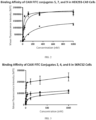
- GraphPad Prism 4 For hypoxia experiments, cells were incubated under an atmosphere containing 1% oxygen, 5% carbon dioxide, and 94% nitrogen for 24- 48 hours in a hypoxia chamber. Results of binding affinity for CAIX FITC are shown in Table 2. Table 2. Binding affinity of CAIX FITC conjugates in HEK293 transfected with CAIX or SKRC52.
- Linker Approximate Linker Length ( ⁇ ) Binding Affinity in SKRC52 (nM) Binding Affinity in HEK293-CAIX (nM) PEG 2 (Conjugate 5) 20 1.28 17.94 PEG 4 (Conjugate 7) 40 4.57 55.2 Ethylene diamine (ED, Conjugate 9) 5 40.89 215.7
- HT-29 cells were seeded on amine-coated 24-well plates and allowed to form monolayers.
- the spent medium in each well was replaced with fresh medium (0.5 mL) containing various concentrations of Conjugate 12. After incubating for 2 hr at 37°C, cells were rinsed three times with fresh medium and then incubated an additional 66 hr at 37 °C in fresh medium.
- Spent medium in each well was again replaced with fresh medium (0.5 mL) containing 3 H-thymidine (1 ⁇ Ci/ml) and the cells were incubated for an additional 4 hr. After washing the cells three times with medium, they were dissolved in 0.5 mL of 0.25 M NaOH.
- Thymidine incorporation was then determined by counting cell-associated radioactivity using a scintillation counter (PACKARD, PACKARD INSTRUMENT COMPANY).
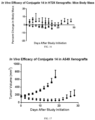
- the IC 50 value was derived from a plot of the percent of 3 H-thymidine incorporation versus log concentration using Graph Pad Prism 4 and TABLECURVE 2D software. Results are shown in Figure 8 , and show that the IC 50 for the conjugate was 5.045 nM.
- SKRC52, HT29, A549 cells ( ⁇ 0.25 x 10 6 ) were seeded in a 24-well plate and allowed to grow overnight.
- Fresh medium containing increasing concentrations of radiolabeled Conjugate 17, as prepared in Example 17, in the presence or absence of 100-fold excess FBSA competition compound was added. All concentrations were examined in duplicate or triplicate.
- cells were washed with PBS (3 x 0.5 mL).
- PBS 3 x 0.5 mL
- To each well was added 0.5 M NaOH. After 10 min, 0.45 mL of the NaOH was removed and the radioactivity was measured with a ⁇ -counter (Packard, Packard Instrument Company). The apparent binding affinity was calculated by plotting the bound radioactivity versus the concentration of the radiolabeled conjugate with GraphPad Prism 4.
- the competition controls (cells treated with increasing concentrations of radiolabeled Conjugate 17 with 100-fold excess of the competition ligand which was unlabeled FBSA-COOH) showed significantly less bound radioactivity. Without being bound by theory, it appears that the binding of radiolabeled 17 to the cells was a receptor-specific event.
- mice were purchased from Harlan Laboratories (ENVIGO), housed in a sterile environment on a standard 12 hour light-dark cycle and maintained on normal rodent chow. All animal procedures were approved by the PURDUE Animal Care and Use Committee in accordance with National Institutes of Health guidelines.
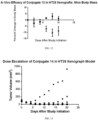
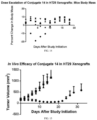
- HT-29 cells (4.25 ⁇ 10 6 ) were subcutaneously injected into the shoulders of 5-6 week old female nu/nu mice. Tumors were measured in two perpendicular directions thrice weekly with vernier calipers and their volumes were calculated as 0.5 x L x W 2 , where L is the longest axis (in millimeters), and W is the axis perpendicular to L (in millimeters). Dosing of Conjugate 12 was initiated when the subcutaneous tumors reached ⁇ 100-275 mm 3 in volume. Dosing solutions were prepared in saline and filtered through a 0.22 ⁇ m filter. Solutions were administered via tail vein injection or intraperitoneally.
- mice were anesthetized with isoflurane and images were acquired with a Kodak Imaging Station (In-Vivo FX, Eastman Kodak Company) in combination with CCD camera and Kodak molecular imaging software (version 4.0) with the kidneys shielded.
- mice After acquiring the whole-body imaging, the mice were sacrificed with CO 2 asphyxiation and, following necropsy, the tissues were placed into preweighed ⁇ -counter tubes. The radioactivity of the tissues and a fraction of the injected dose was measured in a ⁇ -counter (Packard, Packard Instrument Company). Count per minute (CPM) values were corrected for decay times, and the results were calculated as percent of the injected dose per gram (% ID/g) of wet tissue.
- CPM Counter Count per minute
- Table 3 Tumor-to-Tissue Ratios in a Time-Course Study of radiolabeled conjugate 17 in A549 Xengrafts Time (hr) Tumor:Stomach Tumor:Kidneys 1 0.1 0.3 3 0.1 0.2 6 1.3 1.8 9 4.0 3.6 12 1.8 2.3 15 4.5 2.8 18 6.3 2.2
- radiolabeled Conjugate 17 The full tissue biodistribution of radiolabeled Conjugate 17 is shown in FIG. 20 at 18 hours post injection. This experiment was performed at 18 hours primarily for logistical ease after verifying that the tissue uptake values between 6 and 18 hours do not drastically change. The high tumor uptake is still maintained at 18 hours and, most importantly, the competition mouse (mice co-injected with 250 ⁇ Ci of radiolabeled Conjugate 17 + 100-fold molar excess of the competition molecule) has a much lower radiation count at the tumor site than the non-competition mouse. Without being bound by theory, this indicates that radiolabeled Conjugate 17 binds specifically to the tumor cells in a receptor-mediated manner.
- FIG. 21 and FIG. 22 show the biodistribution data from these experiments using SKRC52 and HT29 xenografts at 18 hours after injection.
- the SKRC52 experiment was performed with a competition control that indicated the radioactivity at the tumor was receptor mediated.
- the HT29 xenografts were not tested with the competition control. Because the HT29 cells express many fewer CAIX receptors on the cell surface, the tumor to tissue background ratios are not very good at 18 hours.
- FIGS. 23A and 23B show the whole-body images of mice bearing with CAIX-positive xenografts using after injecting radiolabeled 17.
- it shows a competition experiment performed with mice bearing SKRC52 xenografts after injecting 250 ⁇ Ci of radiolabeled Conjugate 17 and acquiring the whole-body images of the anesthetized mice five hours after injections.
- the mouse injected with the targeted PET imaging conjugate shows bright uptake at the tumor site.
- mice shown on the left injected with 100-fold excess of the competition ligand (FBSA-COOH) in conjugation of the 250 ⁇ Ci of radiolabeled Conjugate 17 do not exhibit any tumor uptake at the threshold selected for this image.
- the tumors were removed from the mice and are shown in FIG. 23B , and again show higher tumor uptake in the targeted mouse versus the competition mice.
- radiolabeled Conjugate 17 was also shown in other tumor models using the methods described above, and acquiring the whole-body images. For example, as shown in FIG. 24 , the targeted mouse shows much higher tumor uptake than that of the competition mouse. This data was also demonstrated in mice bearing HT29 xenografts (data not shown).
Landscapes
- Health & Medical Sciences (AREA)
- Life Sciences & Earth Sciences (AREA)
- Chemical & Material Sciences (AREA)
- Veterinary Medicine (AREA)
- Public Health (AREA)
- General Health & Medical Sciences (AREA)
- Animal Behavior & Ethology (AREA)
- Epidemiology (AREA)
- Pharmacology & Pharmacy (AREA)
- Medicinal Chemistry (AREA)
- Engineering & Computer Science (AREA)
- Organic Chemistry (AREA)
- Biomedical Technology (AREA)
- Bioinformatics & Cheminformatics (AREA)
- Physics & Mathematics (AREA)
- Surgery (AREA)
- Nuclear Medicine, Radiotherapy & Molecular Imaging (AREA)
- Proteomics, Peptides & Aminoacids (AREA)
- Optics & Photonics (AREA)
- Pathology (AREA)
- Heart & Thoracic Surgery (AREA)
- Medical Informatics (AREA)
- Molecular Biology (AREA)
- General Chemical & Material Sciences (AREA)
- Chemical Kinetics & Catalysis (AREA)
- Biophysics (AREA)
- Oral & Maxillofacial Surgery (AREA)
- Peptides Or Proteins (AREA)
- Medicinal Preparation (AREA)
- Medicines Containing Antibodies Or Antigens For Use As Internal Diagnostic Agents (AREA)
- Pharmaceuticals Containing Other Organic And Inorganic Compounds (AREA)
- Medicines That Contain Protein Lipid Enzymes And Other Medicines (AREA)
- Investigating Or Analysing Biological Materials (AREA)
- Plural Heterocyclic Compounds (AREA)
Claims (15)
- Konjugat der Formel B-L-A oder ein pharmazeutisch annehmbares Salz davon, wobei B ein Bindungsligand der Carboanhydrase IX der Formel
 wobei L ein Linker mit einer Länge von 2 bis 100 Atomen ist und aus Elementen beinhaltend C, N, O und S besteht, der B kovalent an A bindet;A ist ein therapeutisches Mittel, ausgewählt aus Peptiden, Oligopeptiden, retroinversen Oligopeptiden, Proteinen, Proteinanaloga, in denen mindestens eine Nicht-Peptidbindung eine Peptidbindung ersetzt, Apoproteinen, Glykoproteinen, Enzymen, Coenzymen, Enzyminhibitoren, Aminosäuren und ihre Derivate, ausgewählt aus Lysin (Lys), Asparagin (Asn), Threonin (Thr), Serin (Ser), Isoleucin (Ile), Methionin (Met), Prolin (Pro), Histidin (His), Glutamin (Gln), Arginin (Arg), Glycin (Gly), Asparaginsäure (Asp), Glutaminsäure (Glu), Alanin (Ala), Valin (Val), Phenylalanin (Phe), Leucin (Leu), Tyrosin (Tyr), Cystein (Cys), Tryptophan (Trp), Phosphoserin (PSER), Sulfo-Cystein, Arginosuccinsäure (ASA), Hydroxyprolin, Phosphoethanolamin (PEA), Sarkosin (SARC), Taurin (TAU), Carnosin (CARN), Citrullin (CIT), Anserin (ANS), 1,3-Methyl-Histidin (ME-HIS), Alpha-Amino-Adipinsäure (AAA), Beta-Alanin (BALA), Ethanolamin (ETN), Gamma-Amino-Buttersäure (GABA), Beta-Amino-Isobuttersäure (BAIA), Alpha-Amino-Buttersäure (BABA), L-Allo-Cystathionin (Cystathionin-A; CYSTA-A), L-Cystathionin (Cystathionin-B; CYSTA-B), Cystin, Allo-Isoleucin (ALLO-ILE), DL-Hydroxylysin (Hydroxylysin (I)), DL-Allo-Hydroxylysin (Hydroxylysin (2)), Ornithin (ORN) und Homocystin (HCY), Rezeptoren und andere Membranproteine; Antigene und Antikörper dazu; Haptene und Antikörper dazu; Hormone, Lipide, Phospholipide, Liposomen; zytotoxische Mittel, wie Mikrotubuli-Inhibitoren; Antibiotika; Analgetika; Bronchodilatatoren; Betablocker; antimikrobielle Mittel; blutdrucksenkende Mittel; kardiovaskuläre Mittel, einschließlich Antiarrhythmika, Herzglykoside, Antianginosa undVasodilatatoren; Mittel des zentralen Nervensystems einschließlich Stimulanzien, Psychopharmaka, Antimanika und Depressiva; antivirale Mittel; Antihistaminika; Krebsmedikamente einschließlich Chemotherapeutika; Beruhigungsmittel; Antidepressiva; H-2-Antagonisten; Antikonvulsiva; Mittel gegen Übelkeit; Prostaglandine und Prostaglandinanaloga; Muskelrelaxantien; entzündungshemmende Substanzen; Stimulanzien; Dekongestiva; Antiemetika; Diuretika; Antispasmodika; Antiasthmatika; Anti-Parkinson-Mittel; Expektorantien; Hustenstiller; Mukolytika; und Mineral- und Nahrungszusätze, oder ein radioaktives Bildgebungsmittel, das ein radioaktives Isotop eines Metalls umfasst, das mit einer Chelatgruppe koordiniert ist; und* steht für einen Anknüpfungspunkt an den Rest des Konjugats.
 - Konjugat nach Anspruch 1 oder ein pharmazeutisch annehmbares Salz davon, wobei der Linker mindestens eine Gruppe umfasst, ausgewählt aus der Gruppe bestehend aus C(O)(C1-C12-Alkyl)C(O)-, -NH-C1-C12-Alkyl-NH-, -N(C1-C6-Alkyl)-C1-C12-Alkyl-N(C1-C6)-, -C(O)CH2CH2(OCH2CH2)qNH-, -C(O)CH2CH2(OCH2CH2)qN(C1-C6 Alkyl)-, -(CH2CH2O)qCH2CH2C(O)-, NH(CH2CH2O)qCH2CH2C(O)-, und -N(C1-C6 Alkyl)(CH2CH2O)qCH2CH2C(O)-; wobei q 2, 4, 6 oder 20 ist; und/odermindestens eine Aminosäure; und/odermindestens eine Aminosäure, ausgewählt aus der Gruppe bestehend aus 3-Aminoalanin, Asparaginsäure, Cystein und Arginin.
- Konjugat nach Anspruch 1 oder ein pharmazeutisch annehmbares Salz davon, wobei der Linker Folgendes umfassteine Disulfidbindung; und/odereine Hydrazinbindung; und/odereine Linkergruppe der Formel


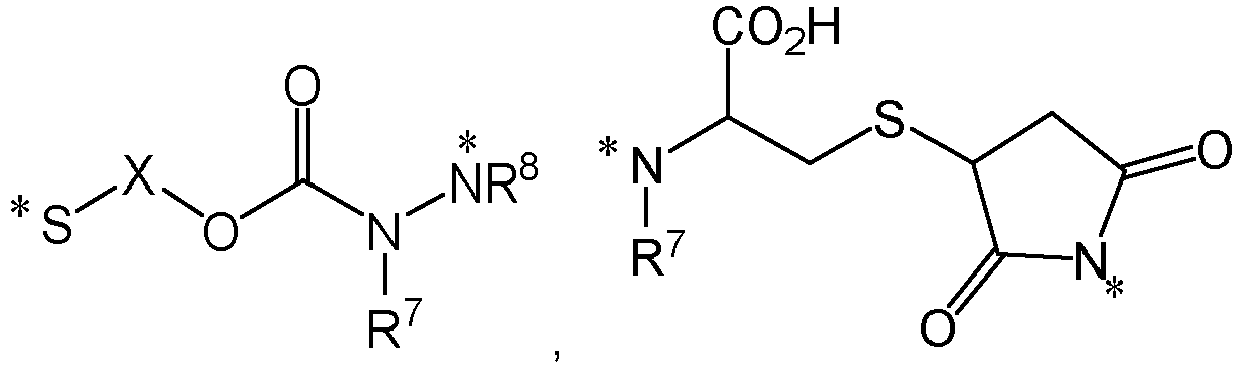
 jedes R7 und R8 unabhängig ausgewählt ist aus der Gruppe bestehend aus H, C1-C6-Alkyl, C2-C6-Alkenyl, C2-C6-Alkinyl und C3-C6-Cycloalkyl, wobei jedes Wasserstoffatom in C1-C6-Alkyl, C2-C6-Alkenyl, C2-C6-Alkinyl und C3-C6-Cycloalkyl unabhängig voneinander gegebenenfalls durch Halogen, C1-C6-Alkyl, C2-C6-Alkenyl, C2-C6-Alkinyl, C3-C6-Cycloalkyl, 3-bis 7-gliedriges Heterocycloalkyl, C6-C10-Aryl, 5- bis 7-gliedriges Heteroaryl, -OR9, OC(O)R9, -OC(O)NR9R10, -OS(O)R9, OS(O)2R9, -SR9, -S(O)R9, S(O)2R9, -S(O)NR9R10, -S(O)2NR9R10, -OS(O)NR9R10, OS(O)2NR9R10, -NR9R10, -NR9C(O)R10, NR9C(O)OR10, NR9C(O)NR11R12, NR9S(O)R10, -NR9S(O)2R10, -NR9S(O)NR11R12, NR9S(O)2NR11R12, C(O)R9, -C(O)OR9 oder -C(O)NR9R10 substituiert ist;jedes X unabhängig voneinander C1-C6-Alkyl oder C6-C10-Aryl-(C1-C6-Alkyl) ist, wobei jedes Wasserstoffatom in C1-C6-Alkyl und C6-C10-Aryl-(C1-C6-Alkyl) unabhängig voneinander gegebenenfalls durch Halogen, C1-C6-Alkyl, C2-C6-Alkenyl, C2-C6-Alkinyl, C3-C6-Cycloalkyl, 3-bis 7-gliedriges Heterocycloalkyl, C6-C10-Aryl, 5- bis 7-gliedriges Heteroaryl, -OR9, OC(O)R9, -OC(O)NR9R10, -OS(O)R9, OS(O)2R9, -SR9, -S(O)R9, S(O)2R9, -S(O)NR9R10, -S(O)2NR9R10, -OS(O)NR9R10, OS(O)2NR9R10, -NR9R10, -NR9C(O)R10, NR9C(O)OR10, NR9C(O)NR11R12, NR9S(O)R10, -NR9S(O)2R10, -NR9S(O)NR11R12, NR9S(O)2NR11R12, C(O)R9, -C(O)OR9 oder -C(O)NR9R10 substituiert ist;jedes R9, R10, R11 und R12 unabhängig voneinander ausgewählt ist aus der Gruppe bestehend aus H, C1-C7-Alkyl, C2-C7-Alkenyl, C2-C7-Alkinyl, C3-C6-Cycloalkyl, 3- bis 7-gliedrigem Heterocycloalkyl, C6-C10-Aryl und 5- bis 7-gliedrigem Heteroaryl; undjedes * eine kovalente Bindung an den Rest des Konjugats darstellt.
 - Konjugat nach Anspruch 1 oder ein pharmazeutisch annehmbares Salz davon, das die Formel


- Konjugat nach Anspruch 1 oder ein pharmazeutisch annehmbares Salz davon, umfassend eine Linkergruppe mit der Aminosäuresequenz 3-Amino-Alanin-Asp-Cys; oder Asp-Arg-Asp-3-Amino-Alanin-Asp-Cys.
- Konjugat nach Anspruch 2 oder ein pharmazeutisch annehmbares Salz davon, wobei q 2 oder 4 ist.
- Konjugat, ausgewählt aus der Gruppe bestehend aus

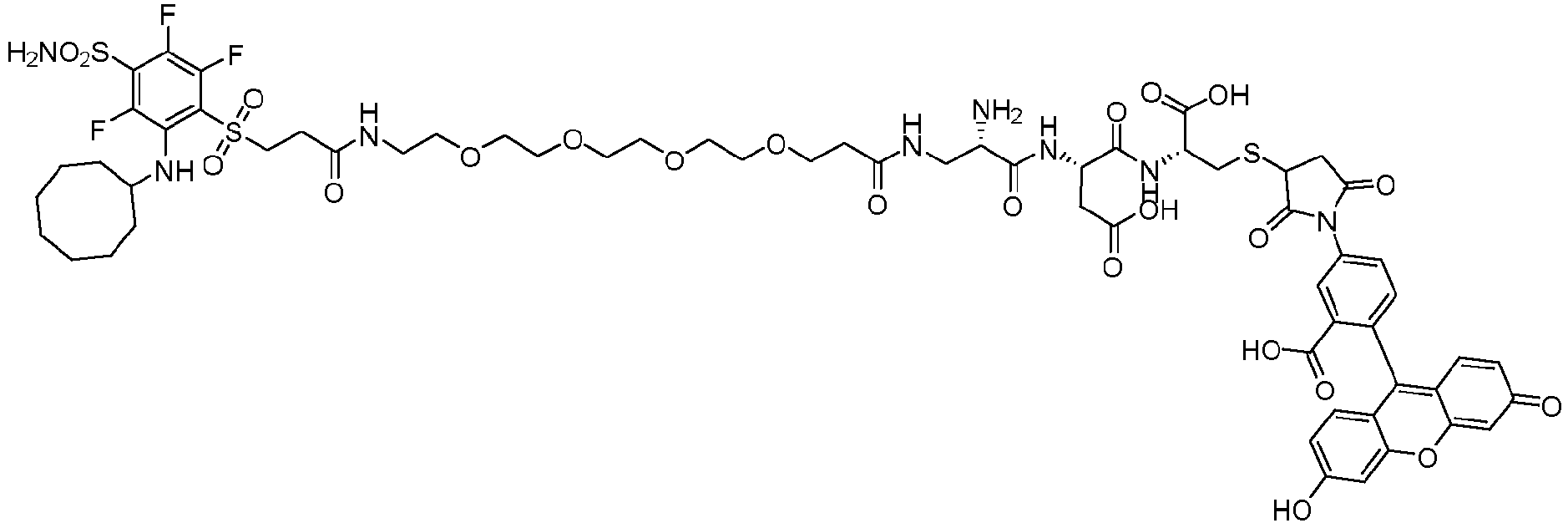

- Konjugat nach Anspruch 1 oder ein pharmazeutisch annehmbares Salz davon,
wobei die chelatbildende Gruppe vorzugsweise aus der Gruppe ausgewählt ist, die aus einem DOTA-Rest, einem NOTA-Rest, einem TETA-Rest, einem DOTAGA-Rest, einem NODAGA-Rest, einem DTPA-Rest, einem PCTA-Rest, einem NETA-Rest besteht; bevorzugter einem NODAGA-Rest; besonders bevorzugt die Formel
wobei das radioaktive Metall vorzugsweise aus der Gruppe ausgewählt ist, die aus 111In, 99mTc, 64Cu, 67Cu, 67Ga und 68Ga besteht, besonders bevorzugt 64Cu. - Konjugat nach Anspruch 1 oder ein pharmazeutisch annehmbares Salz davon, umfassend die Formel

- Konjugat nach Anspruch 1 oder ein pharmazeutisch annehmbares Salz davon, wobei A ein Tubulysin; oder Maytansin ist.
- Konjugat nach Anspruch 1, ausgewählt aus der Gruppe bestehend aus

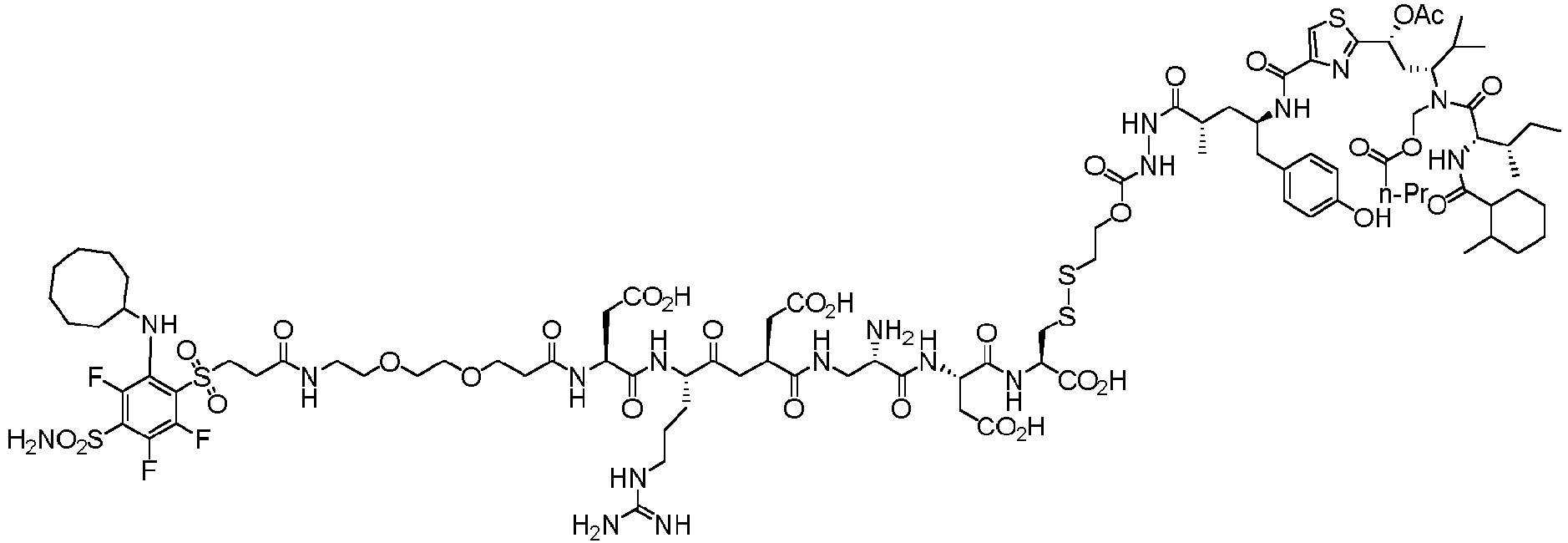

- Zusammensetzung, umfassend ein Konjugat nach einem der Ansprüche 1 bis 11 oder ein pharmazeutisch annehmbares Salz davon und gegebenenfalls mindestens einen pharmazeutisch akzeptablen Hilfsstoff.
- Konjugat nach einem der Ansprüche 1 bis 9 zur Verwendung in einem Verfahren zur Abbildung einer Zellpopulation in einem Subjekt.
- Konjugat nach einem der Ansprüche 1 bis 6, 10 oder 11 zur Verwendung in einem Verfahren zur Behandlung von Krebs in einem Subjekt.
- Verfahren zum Abbilden einer Zellpopulation in vitro, umfassenda. Inkontaktbringen der Zellen mit einem Konjugat nach einem der Ansprüche 1 bis 9, um markierte Zellen bereitzustellen, undb. Sichtbarmachen der markierten Zellen mit einer Fluoreszenzlichtquelle oder einem geeigneten Detektor.
Applications Claiming Priority (2)
| Application Number | Priority Date | Filing Date | Title |
|---|---|---|---|
| US201762548670P | 2017-08-22 | 2017-08-22 | |
| PCT/US2018/047297 WO2019040474A1 (en) | 2017-08-22 | 2018-08-21 | THERAPEUTIC AND RADIOIMAGING CONJUGATES BASED ON FBSA TARGETING POSITIVE CANCERS FOR CARBONIC ANHYDRASE |
Publications (3)
| Publication Number | Publication Date |
|---|---|
| EP3672615A1 EP3672615A1 (de) | 2020-07-01 |
| EP3672615A4 EP3672615A4 (de) | 2021-04-21 |
| EP3672615B1 true EP3672615B1 (de) | 2025-04-02 |
Family
ID=65439187
Family Applications (1)
| Application Number | Title | Priority Date | Filing Date |
|---|---|---|---|
| EP18849342.3A Active EP3672615B1 (de) | 2017-08-22 | 2018-08-21 | Auf fbsa-basis basierende therapeutische und radiobildgebende konjugate, die gegen carboanhydrase-positive krebstypen gerichtet sind |
Country Status (7)
| Country | Link |
|---|---|
| US (1) | US11524082B2 (de) |
| EP (1) | EP3672615B1 (de) |
| JP (2) | JP7334147B2 (de) |
| CN (2) | CN120571030A (de) |
| ES (1) | ES3025461T3 (de) |
| LT (1) | LT3672615T (de) |
| WO (1) | WO2019040474A1 (de) |
Families Citing this family (5)
| Publication number | Priority date | Publication date | Assignee | Title |
|---|---|---|---|---|
| CN111620918A (zh) * | 2020-06-19 | 2020-09-04 | 辽宁中医药大学 | 8-β-D-葡萄吡喃糖-4`,7-二羟基异黄酮FAM衍生物及其合成方法 |
| WO2022118277A1 (en) * | 2020-12-03 | 2022-06-09 | Vilnius University | Carbonic anhydrase inhibitors synthesized on interconnecting linker chains |
| CN113816883A (zh) * | 2021-09-26 | 2021-12-21 | 北京八亿时空液晶科技股份有限公司 | 一种液晶化合物及其制备方法与应用 |
| EP4612144A1 (de) * | 2022-11-02 | 2025-09-10 | Philochem AG | Carboanhydrase-ix-liganden für anwendungen mit gezielter freisetzung |
| WO2024191887A2 (en) * | 2023-03-10 | 2024-09-19 | Purdue Research Foundation | Bi-specific adapters and their use with universal car-t cells in the treatment of caix-expressing tumors |
Family Cites Families (23)
| Publication number | Priority date | Publication date | Assignee | Title |
|---|---|---|---|---|
| US4307016A (en) | 1978-03-24 | 1981-12-22 | Takeda Chemical Industries, Ltd. | Demethyl maytansinoids |
| US4256746A (en) | 1978-11-14 | 1981-03-17 | Takeda Chemical Industries | Dechloromaytansinoids, their pharmaceutical compositions and method of use |
| JPS55102583A (en) | 1979-01-31 | 1980-08-05 | Takeda Chem Ind Ltd | 20-acyloxy-20-demethylmaytansinoid compound |
| JPS55162791A (en) | 1979-06-05 | 1980-12-18 | Takeda Chem Ind Ltd | Antibiotic c-15003pnd and its preparation |
| JPS5645483A (en) | 1979-09-19 | 1981-04-25 | Takeda Chem Ind Ltd | C-15003phm and its preparation |
| EP0028683A1 (de) | 1979-09-21 | 1981-05-20 | Takeda Chemical Industries, Ltd. | Antibiotikum C-15003 PHO und seine Herstellung |
| JPS5645485A (en) | 1979-09-21 | 1981-04-25 | Takeda Chem Ind Ltd | Production of c-15003pnd |
| WO1982001188A1 (en) | 1980-10-08 | 1982-04-15 | Takeda Chemical Industries Ltd | 4,5-deoxymaytansinoide compounds and process for preparing same |
| US4450254A (en) | 1980-11-03 | 1984-05-22 | Standard Oil Company | Impact improvement of high nitrile resins |
| US4315929A (en) | 1981-01-27 | 1982-02-16 | The United States Of America As Represented By The Secretary Of Agriculture | Method of controlling the European corn borer with trewiasine |
| US4313946A (en) | 1981-01-27 | 1982-02-02 | The United States Of America As Represented By The Secretary Of Agriculture | Chemotherapeutically active maytansinoids from Trewia nudiflora |
| JPS57192389A (en) | 1981-05-20 | 1982-11-26 | Takeda Chem Ind Ltd | Novel maytansinoid |
| DE69231123T2 (de) | 1992-03-25 | 2001-02-15 | Immunogen Inc | Konjugaten von Zell-bindender Mittel und Derivaten von CC-1065 |
| US6333410B1 (en) | 2000-08-18 | 2001-12-25 | Immunogen, Inc. | Process for the preparation and purification of thiol-containing maytansinoids |
| WO2003092742A1 (en) | 2002-05-06 | 2003-11-13 | Endocyte, Inc. | Vitamin-targeted imaging agents |
| PL2187965T3 (pl) * | 2007-08-17 | 2020-05-18 | Purdue Research Foundation | Koniugaty wiążący psma ligand-łącznik i sposoby ich zastosowania |
| AU2012253502C1 (en) * | 2011-05-09 | 2017-12-14 | Visen Medical, Inc. | Carbonic anhydrase targeting agents and methods of using same |
| LT6064B (lt) | 2012-10-15 | 2014-08-25 | Vilniaus Universitetas | Fluorinti benzensulfonamidai kaip karboanhidrazės inhibitoriai |
| CA3051737C (en) | 2014-02-03 | 2022-05-10 | Nikolaus KRALL | Low molecular weight drug conjugates for binding to carbonic anhydrase ix |
| WO2017058370A1 (en) | 2015-09-30 | 2017-04-06 | Rutgers, The State University Of New Jersey | Carbonic anhydrase enzymes for regulating mast cell hematopoiesis and type 2 inflammation |
| MX2018011130A (es) * | 2016-03-16 | 2018-11-22 | On Target Laboratories Llc | Colorantes de nir dirigidos a ca-ix y sus usos. |
| KR102531494B1 (ko) * | 2016-05-13 | 2023-05-10 | 더 존스 홉킨스 유니버시티 | 탄산 탈수효소 ix를 표적으로 하는 핵 영상화 및 방사선치료 제제 및 이의 용도 |
| US11850262B2 (en) | 2017-02-28 | 2023-12-26 | Purdue Research Foundation | Compositions and methods for CAR T cell therapy |
-
2018
- 2018-08-21 EP EP18849342.3A patent/EP3672615B1/de active Active
- 2018-08-21 ES ES18849342T patent/ES3025461T3/es active Active
- 2018-08-21 JP JP2020511154A patent/JP7334147B2/ja active Active
- 2018-08-21 CN CN202510688822.1A patent/CN120571030A/zh active Pending
- 2018-08-21 WO PCT/US2018/047297 patent/WO2019040474A1/en not_active Ceased
- 2018-08-21 LT LTEPPCT/US2018/047297T patent/LT3672615T/lt unknown
- 2018-08-21 CN CN201880068812.6A patent/CN111225688B/zh active Active
- 2018-08-21 US US16/640,539 patent/US11524082B2/en active Active
-
2023
- 2023-04-20 JP JP2023069440A patent/JP2023099047A/ja not_active Withdrawn
Also Published As
| Publication number | Publication date |
|---|---|
| CN111225688A (zh) | 2020-06-02 |
| LT3672615T (lt) | 2025-06-25 |
| JP2020531509A (ja) | 2020-11-05 |
| WO2019040474A1 (en) | 2019-02-28 |
| US20200353108A1 (en) | 2020-11-12 |
| EP3672615A4 (de) | 2021-04-21 |
| JP2023099047A (ja) | 2023-07-11 |
| EP3672615A1 (de) | 2020-07-01 |
| CN120571030A (zh) | 2025-09-02 |
| CN111225688B (zh) | 2025-06-17 |
| US11524082B2 (en) | 2022-12-13 |
| ES3025461T3 (en) | 2025-06-09 |
| JP7334147B2 (ja) | 2023-08-28 |
Similar Documents
| Publication | Publication Date | Title |
|---|---|---|
| US11872291B2 (en) | Fibroblast activation protein (FAP)-targeted imaging and therapy | |
| EP3672615B1 (de) | Auf fbsa-basis basierende therapeutische und radiobildgebende konjugate, die gegen carboanhydrase-positive krebstypen gerichtet sind | |
| US11883498B2 (en) | Luteinizing hormone-releasing hormone receptor (LHRH-R) conjugates and uses thereof | |
| ES2755101T3 (es) | Nuevos compuestos y conjugados de criptoficina, su preparación y su uso terapéutico | |
| US20240316224A1 (en) | Carbonic anhydrase ix targeting agents and methods | |
| US10857234B2 (en) | Carbonic anhydrase IX inhibitor conjugates and uses thereof | |
| HK40031566A (en) | Fbsa-based therapeutic and radioimaging conjugates targeting carbonic anhydrase positive cancers | |
| HK40016572A (en) | Luteinizing hormone-releasing hormone receptor (lhrh-r) conjugates and uses thereof | |
| HK40016572B (en) | Luteinizing hormone-releasing hormone receptor (lhrh-r) conjugates and uses thereof | |
| HK40016594A (en) | Fibroblast activation protein (fap)-targeted imaging and therapy | |
| HK40016594B (en) | Fibroblast activation protein (fap)-targeted imaging and therapy |
Legal Events
| Date | Code | Title | Description |
|---|---|---|---|
| STAA | Information on the status of an ep patent application or granted ep patent |
Free format text: STATUS: THE INTERNATIONAL PUBLICATION HAS BEEN MADE |
|
| PUAI | Public reference made under article 153(3) epc to a published international application that has entered the european phase |
Free format text: ORIGINAL CODE: 0009012 |
|
| STAA | Information on the status of an ep patent application or granted ep patent |
Free format text: STATUS: REQUEST FOR EXAMINATION WAS MADE |
|
| 17P | Request for examination filed |
Effective date: 20200318 |
|
| AK | Designated contracting states |
Kind code of ref document: A1 Designated state(s): AL AT BE BG CH CY CZ DE DK EE ES FI FR GB GR HR HU IE IS IT LI LT LU LV MC MK MT NL NO PL PT RO RS SE SI SK SM TR |
|
| AX | Request for extension of the european patent |
Extension state: BA ME |
|
| RIN1 | Information on inventor provided before grant (corrected) |
Inventor name: KULARATNE, SUMITH A. Inventor name: GARDEEN, SPENCER Inventor name: MARKS, ISAAC Inventor name: LOW, PHILIP STEWART |
|
| DAV | Request for validation of the european patent (deleted) | ||
| DAX | Request for extension of the european patent (deleted) | ||
| REG | Reference to a national code |
Ref country code: HK Ref legal event code: DE Ref document number: 40032718 Country of ref document: HK |
|
| A4 | Supplementary search report drawn up and despatched |
Effective date: 20210323 |
|
| RIC1 | Information provided on ipc code assigned before grant |
Ipc: A61K 38/06 20060101AFI20210317BHEP Ipc: A61K 38/07 20060101ALI20210317BHEP Ipc: A61K 38/08 20190101ALI20210317BHEP Ipc: A61K 47/54 20170101ALI20210317BHEP Ipc: A61K 49/00 20060101ALI20210317BHEP Ipc: A61K 51/04 20060101ALI20210317BHEP Ipc: C07D 255/02 20060101ALI20210317BHEP Ipc: C07D 311/80 20060101ALI20210317BHEP Ipc: C07D 405/10 20060101ALI20210317BHEP Ipc: A61P 35/00 20060101ALI20210317BHEP |
|
| STAA | Information on the status of an ep patent application or granted ep patent |
Free format text: STATUS: EXAMINATION IS IN PROGRESS |
|
| 17Q | First examination report despatched |
Effective date: 20220419 |
|
| GRAP | Despatch of communication of intention to grant a patent |
Free format text: ORIGINAL CODE: EPIDOSNIGR1 |
|
| STAA | Information on the status of an ep patent application or granted ep patent |
Free format text: STATUS: GRANT OF PATENT IS INTENDED |
|
| INTG | Intention to grant announced |
Effective date: 20240605 |
|
| GRAJ | Information related to disapproval of communication of intention to grant by the applicant or resumption of examination proceedings by the epo deleted |
Free format text: ORIGINAL CODE: EPIDOSDIGR1 |
|
| STAA | Information on the status of an ep patent application or granted ep patent |
Free format text: STATUS: EXAMINATION IS IN PROGRESS |
|
| GRAP | Despatch of communication of intention to grant a patent |
Free format text: ORIGINAL CODE: EPIDOSNIGR1 |
|
| STAA | Information on the status of an ep patent application or granted ep patent |
Free format text: STATUS: GRANT OF PATENT IS INTENDED |
|
| INTC | Intention to grant announced (deleted) | ||
| INTG | Intention to grant announced |
Effective date: 20241022 |
|
| GRAS | Grant fee paid |
Free format text: ORIGINAL CODE: EPIDOSNIGR3 |
|
| RAP3 | Party data changed (applicant data changed or rights of an application transferred) |
Owner name: PURDUE RESEARCH FOUNDATION |
|
| GRAA | (expected) grant |
Free format text: ORIGINAL CODE: 0009210 |
|
| STAA | Information on the status of an ep patent application or granted ep patent |
Free format text: STATUS: THE PATENT HAS BEEN GRANTED |
|
| AK | Designated contracting states |
Kind code of ref document: B1 Designated state(s): AL AT BE BG CH CY CZ DE DK EE ES FI FR GB GR HR HU IE IS IT LI LT LU LV MC MK MT NL NO PL PT RO RS SE SI SK SM TR |
|
| P01 | Opt-out of the competence of the unified patent court (upc) registered |
Free format text: CASE NUMBER: APP_8569/2025 Effective date: 20250220 |
|
| REG | Reference to a national code |
Ref country code: GB Ref legal event code: FG4D |
|
| REG | Reference to a national code |
Ref country code: CH Ref legal event code: EP |
|
| REG | Reference to a national code |
Ref country code: IE Ref legal event code: FG4D Ref country code: NL Ref legal event code: FP |
|
| REG | Reference to a national code |
Ref country code: DE Ref legal event code: R096 Ref document number: 602018080786 Country of ref document: DE |
|
| REG | Reference to a national code |
Ref country code: ES Ref legal event code: FG2A Ref document number: 3025461 Country of ref document: ES Kind code of ref document: T3 Effective date: 20250609 |
|
| REG | Reference to a national code |
Ref country code: AT Ref legal event code: MK05 Ref document number: 1780645 Country of ref document: AT Kind code of ref document: T Effective date: 20250402 |
|
| PG25 | Lapsed in a contracting state [announced via postgrant information from national office to epo] |
Ref country code: FI Free format text: LAPSE BECAUSE OF FAILURE TO SUBMIT A TRANSLATION OF THE DESCRIPTION OR TO PAY THE FEE WITHIN THE PRESCRIBED TIME-LIMIT Effective date: 20250402 Ref country code: PT Free format text: LAPSE BECAUSE OF FAILURE TO SUBMIT A TRANSLATION OF THE DESCRIPTION OR TO PAY THE FEE WITHIN THE PRESCRIBED TIME-LIMIT Effective date: 20250804 |
|
| PGFP | Annual fee paid to national office [announced via postgrant information from national office to epo] |
Ref country code: ES Payment date: 20250901 Year of fee payment: 8 |
|
| PGFP | Annual fee paid to national office [announced via postgrant information from national office to epo] |
Ref country code: LT Payment date: 20250903 Year of fee payment: 8 Ref country code: DE Payment date: 20250929 Year of fee payment: 8 |
|
| PG25 | Lapsed in a contracting state [announced via postgrant information from national office to epo] |
Ref country code: GR Free format text: LAPSE BECAUSE OF FAILURE TO SUBMIT A TRANSLATION OF THE DESCRIPTION OR TO PAY THE FEE WITHIN THE PRESCRIBED TIME-LIMIT Effective date: 20250703 Ref country code: NO Free format text: LAPSE BECAUSE OF FAILURE TO SUBMIT A TRANSLATION OF THE DESCRIPTION OR TO PAY THE FEE WITHIN THE PRESCRIBED TIME-LIMIT Effective date: 20250702 |
|
| PG25 | Lapsed in a contracting state [announced via postgrant information from national office to epo] |
Ref country code: PL Free format text: LAPSE BECAUSE OF FAILURE TO SUBMIT A TRANSLATION OF THE DESCRIPTION OR TO PAY THE FEE WITHIN THE PRESCRIBED TIME-LIMIT Effective date: 20250402 |
|
| PGFP | Annual fee paid to national office [announced via postgrant information from national office to epo] |
Ref country code: NL Payment date: 20250926 Year of fee payment: 8 Ref country code: IT Payment date: 20250919 Year of fee payment: 8 |
|
| PG25 | Lapsed in a contracting state [announced via postgrant information from national office to epo] |
Ref country code: BG Free format text: LAPSE BECAUSE OF FAILURE TO SUBMIT A TRANSLATION OF THE DESCRIPTION OR TO PAY THE FEE WITHIN THE PRESCRIBED TIME-LIMIT Effective date: 20250402 |
|
| PGFP | Annual fee paid to national office [announced via postgrant information from national office to epo] |
Ref country code: GB Payment date: 20250929 Year of fee payment: 8 |
|
| PG25 | Lapsed in a contracting state [announced via postgrant information from national office to epo] |
Ref country code: HR Free format text: LAPSE BECAUSE OF FAILURE TO SUBMIT A TRANSLATION OF THE DESCRIPTION OR TO PAY THE FEE WITHIN THE PRESCRIBED TIME-LIMIT Effective date: 20250402 |
|
| PG25 | Lapsed in a contracting state [announced via postgrant information from national office to epo] |
Ref country code: AT Free format text: LAPSE BECAUSE OF FAILURE TO SUBMIT A TRANSLATION OF THE DESCRIPTION OR TO PAY THE FEE WITHIN THE PRESCRIBED TIME-LIMIT Effective date: 20250402 |
|
| PGFP | Annual fee paid to national office [announced via postgrant information from national office to epo] |
Ref country code: FR Payment date: 20250925 Year of fee payment: 8 |
|
| PGFP | Annual fee paid to national office [announced via postgrant information from national office to epo] |
Ref country code: CH Payment date: 20250929 Year of fee payment: 8 |
|
| PG25 | Lapsed in a contracting state [announced via postgrant information from national office to epo] |
Ref country code: RS Free format text: LAPSE BECAUSE OF FAILURE TO SUBMIT A TRANSLATION OF THE DESCRIPTION OR TO PAY THE FEE WITHIN THE PRESCRIBED TIME-LIMIT Effective date: 20250702 |
|
| PG25 | Lapsed in a contracting state [announced via postgrant information from national office to epo] |
Ref country code: IS Free format text: LAPSE BECAUSE OF FAILURE TO SUBMIT A TRANSLATION OF THE DESCRIPTION OR TO PAY THE FEE WITHIN THE PRESCRIBED TIME-LIMIT Effective date: 20250802 |
|
| PG25 | Lapsed in a contracting state [announced via postgrant information from national office to epo] |
Ref country code: LV Free format text: LAPSE BECAUSE OF FAILURE TO SUBMIT A TRANSLATION OF THE DESCRIPTION OR TO PAY THE FEE WITHIN THE PRESCRIBED TIME-LIMIT Effective date: 20250402 |