EP3671578B1 - Analyseverfahren einer ausführungssimulation eines quantenschaltkreises - Google Patents
Analyseverfahren einer ausführungssimulation eines quantenschaltkreises Download PDFInfo
- Publication number
- EP3671578B1 EP3671578B1 EP19218371.3A EP19218371A EP3671578B1 EP 3671578 B1 EP3671578 B1 EP 3671578B1 EP 19218371 A EP19218371 A EP 19218371A EP 3671578 B1 EP3671578 B1 EP 3671578B1
- Authority
- EP
- European Patent Office
- Prior art keywords
- quantum
- execution
- simulation
- post
- simulator
- Prior art date
- Legal status (The legal status is an assumption and is not a legal conclusion. Google has not performed a legal analysis and makes no representation as to the accuracy of the status listed.)
- Active
Links
Images


Classifications
-
- G—PHYSICS
- G06—COMPUTING OR CALCULATING; COUNTING
- G06N—COMPUTING ARRANGEMENTS BASED ON SPECIFIC COMPUTATIONAL MODELS
- G06N10/00—Quantum computing, i.e. information processing based on quantum-mechanical phenomena
- G06N10/20—Models of quantum computing, e.g. quantum circuits or universal quantum computers
-
- G—PHYSICS
- G06—COMPUTING OR CALCULATING; COUNTING
- G06F—ELECTRIC DIGITAL DATA PROCESSING
- G06F30/00—Computer-aided design [CAD]
- G06F30/30—Circuit design
- G06F30/32—Circuit design at the digital level
- G06F30/33—Design verification, e.g. functional simulation or model checking
- G06F30/3308—Design verification, e.g. functional simulation or model checking using simulation
-
- G—PHYSICS
- G06—COMPUTING OR CALCULATING; COUNTING
- G06F—ELECTRIC DIGITAL DATA PROCESSING
- G06F9/00—Arrangements for program control, e.g. control units
- G06F9/06—Arrangements for program control, e.g. control units using stored programs, i.e. using an internal store of processing equipment to receive or retain programs
- G06F9/44—Arrangements for executing specific programs
- G06F9/455—Emulation; Interpretation; Software simulation, e.g. virtualisation or emulation of application or operating system execution engines
-
- G—PHYSICS
- G06—COMPUTING OR CALCULATING; COUNTING
- G06N—COMPUTING ARRANGEMENTS BASED ON SPECIFIC COMPUTATIONAL MODELS
- G06N10/00—Quantum computing, i.e. information processing based on quantum-mechanical phenomena
- G06N10/80—Quantum programming, e.g. interfaces, languages or software-development kits for creating or handling programs capable of running on quantum computers; Platforms for simulating or accessing quantum computers, e.g. cloud-based quantum computing
Definitions
- the invention relates to the field of methods for analyzing simulations of the execution of a quantum circuit.
- KRISTEL MICHIELSEN ET AL "QCE: A Simulator for Quantum Computer Hardware”
- TURKISH JOURNAL OF PHYSICS, vol. 27, no. 5, September 1, 2003 (2003-09-01), pages 343-370 describes an emulator for quantum circuits.
- the invention at least partially overcomes the drawbacks of the prior art and improves the compromise mentioned above.
- the invention proposes a particular combination between on the one hand a post-selection and on the other hand a fixation filtering, both carried out on an execution simulation rather than on a real execution.
- the method therefore allows the quantum circuit execution analyst to focus on a part of the quantum circuit execution that interests him and on the type of execution of this part of the execution, increasing the possibilities of debugging the quantum circuit.
- the invention proposes a particular combination between a post-selection on the one hand and a quantum iteration on the other hand, both carried out on a simulation of execution rather than on a real execution.
- the invention allows the analyst of the execution of this quantum circuit to be able on the one hand to focus in a simple and efficient manner on the part of the execution of this quantum circuit which interests him, while on the other hand making it simpler or even transparent for him to extract the interesting data obtained, hence a precise focus on what interests him, with a simpler way of extracting precisely what interests him.
- the great simplification obtained by the use of a quantum iterator allows the user to carry out more numerous and more detailed post-selection operations, without making the time and difficulty of analysis prohibitive.
- the invention makes it possible to recover a vector of quantum states that has been previously filtered.
- the analysis of the filtered vector of quantum states can thus be done immediately after recovering this vector of quantum states, without requiring additional operations on this vector of quantum states.
- the post-selection step of one or more particular values of one or more qbits is carried out at the measurement output of said qbit(s).
- the post-selection step can advantageously be carried out after one of these measurements. This allows the simulation to be analyzed step by step.
- the step of post-selection of one or more particular values of one or more qbits is carried out following an operation by a quantum gate on said qbit(s).
- the step of post-selection can be performed at any time during execution. This therefore allows a complete and non-degraded analysis of the quantum states deemed interesting at any time during the simulation.
- the size of the buffer memory, at the application terminal level and at the simulator level is large enough so that the processing time of the content of this buffer memory by the application terminal is greater than the transfer time of the data communicated between the simulator and the application terminal.
- This significant memory gain is therefore not or almost not at the expense of the speed of data processing in the application terminal.
- the buffer size is between 1MB and 100MB, preferably between 3MB and 20MB.
- the memory range is thus optimized for the compromise between memory gain and preservation of processing speed.
- the analysis step is followed by a debugging step of the execution of the quantum circuit.
- a debugging step of the execution of the quantum circuit This therefore allows an interesting application of the analysis step, making it possible to improve the quality and efficiency of the quantum circuit analyzed.
- the method is integrated into an application programming interface (API) capable of accessing a server including a quantum circuit execution simulator and a communication module with an application terminal remote from the simulator.
- API application programming interface
- the number of qbits of the quantum circuit is between 2 and 1000, preferably between 10 and 50.
- the analysis method of the invention works even with large or even very large quantum circuits.
- the analysis method is implemented in python language.
- the python language is well suited for this type of quantum circuit operation analysis method.
- the invention and the variants thereof can make it possible, in general, to propose a method for analyzing a simulation of the execution of a quantum circuit allowing a complete and simplified analysis, in particular for debugging the execution of the quantum circuit, and in particular to offer a better compromise between, on the one hand, the simplification of the analysis of the execution of a quantum circuit and, on the other hand, the relevance of the analysis carried out.
- FIG. 1 On which an example of system 1 for implementing a method for analyzing the execution of a simulation of a quantum circuit is illustrated.
- System 1 includes in particular a simulator 2 of a quantum circuit. More precisely, simulator 2 makes it possible to simulate a quantum processor.
- the vector of quantum states includes 2 n quantum states, n being the number of qbits on which the simulation is performed.
- the vector of quantum states comprises for example between 2 2 and 2 1000 .
- the quantum circuit comprises between 2 and 1000 qbits.
- the vector of quantum states comprises for example between 2 10 and 2 50 .
- the quantum circuit comprises between 10 and 50 qbits.
- the simulator 2 comprises for example a memory 3.
- the memory 3 may in particular be capable of storing the vector of quantum states obtained.
- the memory 3 therefore comprises a significant storage capacity in order to be capable of storing a vector of quantum states comprising between 2 2 and 2 1000 , and preferably between 2 10 and 2 50 possible quantum states.
- Simulator 2 is for example stored on a server 4.
- the server 4 comprises for example a communication module 5, allowing communication with an application terminal 6 via a communication module 5b of the application terminal 6.
- the application terminal 6 is for example remote from the server 4.
- the application terminal 6 notably allows an analyst to access the quantum state vector in order to analyze it, without storing it.
- an iterator 7 can be implemented in the system 1.
- the iterator 7 allows an interaction between the application terminal 6 and the simulator 2.
- iterator 7 makes it possible to avoid the duplication of all the information, in other words the vector of quantum states obtained at the output of simulator 2, to the application terminal 6. In other words, iterator 7 makes it possible to recovery of the information at the output of the simulator 2, on the application terminal 6. The iterator 7 therefore allows an analyst to have access to the information at the output of the simulator 2 in a simple manner.
- iterator 7 loops over each quantum state of the quantum state vector obtained at the output of simulator 2, so that each quantum state can be retrieved on the application terminal.
- the iterator 7 may further comprise filters F1, F2 and F3 to be applied to the quantum state vector. These filters are more precisely described with reference to the figure 2 .
- the system 1 comprises a buffer memory 8a implemented in the simulator 2, and a buffer memory 8b implemented in the application terminal 6.
- the information obtained at the output of the simulator 2 is transmitted to the application terminal 6, by means of the iterator 7, via the buffer memories 8a, 8b.
- Iterator 7 is stored in simulator 2 and is in communication with buffer 8a.
- buffer memories 8a, 8b makes it possible to greatly reduce the memory size required to access the information obtained at the output of simulator 2.
- the size of the buffer memories 8a, 8b can be chosen so that the processing time of the content of the buffer memory 8b by the application terminal 6 is greater than the transfer time of the information obtained at the output of the simulator 2 from the simulator 2 to the application terminal 6.
- the size of the buffers 8a, 8b can be chosen between 1MB and 100MB, and preferably between 3MB and 20MB.
- the size of the buffer memories 8a, 8b is at least 10 times, and reference at least 100 times, less than the size of the memory 3 storing the information obtained at the output of the simulator 2.
- a vector of quantum states 2 n is obtained.
- the quantum state vector 2 n is stored in memory 3 of simulator 2.
- the memory 3 communicates with the iterator 7. More precisely, the memory 3 transmits sections of the quantum state vector 2 n to the iterator 7.
- the iterator 7 is configured to process these sections of the quantum state vector 2 n , in particular by means of the filters F1, F2 and F3.
- the iterator 7 is configured to send the sections of the quantum state vector to the buffer memory 8a of the simulator 2 which transmits them, via the communication interfaces 5a, 5b, to the application terminal 6.
- the buffer memory 8b of the application terminal 6 receives the sections of the quantum state vector, so that they can be analyzed by an analyst directly on the application terminal.
- the communication between the server 4 and the application terminal 6 is for example made by radio waves or even by the Internet network.
- the iterator 7 is stored in the buffer memory 8a of the simulator 2.
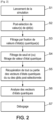
- FIG. 2 illustrates the main steps of a method for simulating the execution of a quantum circuit according to an exemplary embodiment.
- simulation step S1 the simulation of the quantum circuit is launched.
- the quantum state vector obtained is composed of a plurality of qbits having quantum states 0 and 1.
- the quantum states of the qbits in the quantum state vector are not known.
- Each quantum state of a qbit has a probability associated with it, with the sum of the probabilities equal to 1.
- a probability p' is associated with one of the two quantum states 0 or 1 for the first qbit
- a probability 1-p' is associated with the other of the two quantum states 0 or 1.
- a probability p" is associated with one of the two quantum states 0 or 1 of the nth qbit
- a probability 1-p" is associated with the other of the two quantum states 0 or 1 of the nth qbit.
- the probabilities p, p' and p" are generally different but can, in certain cases, be equal.
- the simulation therefore makes it possible to obtain an execution tree, illustrated in the figure 3 , on which the nodes represent each qbit of the vector of quantum states. Following intermediate measurements made on the qbits, two branches start from each node: each branch representing a quantum state of the measured qbit to which its probability is associated.
- Quantum operations include, for example, applying quantum gates to the qbits, which can change or not the value of the qbits.
- a post-selection of one or more particular values of one or more qbits at one or more steps of the simulation is performed.
- particular value is meant a particular quantum state.
- Post-selection can amount to choosing values of the quantum states from the quantum state vector.
- the post-selections of qbit values can be successive.
- the post-selections can also be repetitive. For example, it is possible to post-select the same value several times of a qbit. For example, it is possible to post-select different values for the same qbit multiple times. For example, it is possible to post-select different values of different qbits multiple times.
- post-selection is used, although multiple post-selections may be performed, as described above.
- Post-selection is performed in several steps of the simulation. For example, post-selection is performed at the output of the qbit measurement.
- Post-selection is performed following an operation by a quantum gate on the qbit.
- fixation filtering step S3 fixes the value of one or more quantum states of the quantum state vector(s) resulting from the post-selection(s) of qbits.
- Quantum state vector resulting from the post-selection(s) of qbits and “quantum state vector of the post-selected qbit(s)” are used interchangeably in the remainder of the description.
- the fixing filtering step S3 is for example carried out by the iterator 7, and in particular by applying the filter F1 illustrated in the figure 1 .
- the fixation filtering step S3 is for example located between the post-selection step S2 and the recovery step S5, described below.
- the fixing filtering step S3 notably includes the fixing of quantum state values of the quantum state vector resulting from the post-selection.
- the fixation filtering step notably allows the iterator 7 not to have to go through the entire vector of quantum states resulting from the post-selection of qbits when retrieving it on the application terminal 6.
- the fixation filtering step therefore also makes it possible to reduce the size of the information to be transmitted to the application terminal.
- the additional filtering step S4 is implemented by iterator 7.
- the additional filtering step S4 may comprise threshold filtering and/or value filtering of the quantum states of the quantum state vector resulting from the post-selection of qbits.
- Threshold filtering includes, in particular, defining a probability threshold for which quantum states associated with a probability below this threshold are not preserved.
- Threshold filtering is performed by applying the F2 filter shown in the figure 1 .
- Value filtering includes in particular the definition of a quantum state value for which the quantum states of the quantum state vector resulting from the post-selection of qbits having this value are not recovered.
- Value filtering is performed by applying the F3 filter shown in the figure 1 .
- This additional filtering step S4 makes it possible, on the one hand, to reduce the size of the information to be exchanged to the application terminal 6 by removing certain quantum states from the vector of quantum states resulting from the post-selection of qbits, and, on the other hand, to increase the completeness of the analysis by focusing only on the quantum states deemed interesting.
- Filtering types can be combined and/or superimposed for multiple quantum states of the quantum state vector.
- the fixing filtering steps S3 and additional filtering S4 may be followed by a renormalization step of the filtered quantum state vector during which the probability of each quantum state conserved in the filtered quantum state vector is modified so that the sum of the probabilities of each quantum state is equal to 1.
- a recovery step S5 by the iterator 7, of all or part of the quantum states of the quantum state vector(s) resulting from the post-selection of qbits and filtered is carried out.
- the recovery step S5 may also comprise the recovery, by the iterator 7, of all or part of the quantum states of the quantum state vector(s) resulting from the post-selection of qbits and resulting from the different types of filtering, described with reference to the fixation filtering steps S3 and additional filtering steps S4.
- the recovery step S5 may further comprise recovering each of the probabilities associated with each quantum state of the recovered quantum state vector, renormalized or not.
- the iterator 7 is able to identify a parameter representative of the probability of each quantum state of the vector of quantum states, between the post-selection step and the recovery step, for example before the fixation filtering step.
- the iterator 7 is for example able to read the vector of quantum states, and to associate a probability with each quantum state.
- the iterator is also able, from a complex model of the “stabilizer matrix” type, to recalculate the elements of the matrix to put them in the form of a readable vector of quantum states and to associate a probability with each quantum state of this vector of quantum states.
- the iterator 7 is configured to iterate over each of the quantum states of the quantum state vector obtained after step S4, and possibly over the probabilities associated with them, so that an analyst can access them from the application terminal 6 for an analysis step S6.
- the analysis step S6 comprises for example the comparison of the quantum states of the recovered quantum state vector with the quantum states of the quantum state vector expected following the post-selection steps S2 and the fixation filtering steps S3.
- the data from the analysis can be used for debugging the execution of the quantum circuit.
- the method is implemented on an application programming interface (or “API”), capable of accessing the server 4.
- API application programming interface
- threshold filtering involves defining a probability threshold for which quantum states associated with a probability above that threshold are not conserved.
- the value filtering includes in particular the definition of a quantum state value for which only the quantum states of the quantum state vector resulting from the post-selection of qbits having this value are recovered.
- the invention may find application in particular in the field of quantum computing and debugging the execution of quantum circuits.
Landscapes
- Engineering & Computer Science (AREA)
- Theoretical Computer Science (AREA)
- Physics & Mathematics (AREA)
- General Physics & Mathematics (AREA)
- Software Systems (AREA)
- General Engineering & Computer Science (AREA)
- Evolutionary Computation (AREA)
- Computer Hardware Design (AREA)
- Computational Mathematics (AREA)
- Artificial Intelligence (AREA)
- Condensed Matter Physics & Semiconductors (AREA)
- Data Mining & Analysis (AREA)
- Mathematical Analysis (AREA)
- Mathematical Optimization (AREA)
- Pure & Applied Mathematics (AREA)
- Computing Systems (AREA)
- Mathematical Physics (AREA)
- Geometry (AREA)
- Management, Administration, Business Operations System, And Electronic Commerce (AREA)
- Tests Of Electronic Circuits (AREA)
Claims (11)
- Verfahren zur Analyse einer Simulation der Ausführung einer Quantenschaltung, umfassend:- einen Schritt der Nachselektion (S2) eines oder mehrerer besonderer Werte eines oder mehrerer qbits in mehreren Schritten der Simulation, die am Ausgang einer Messung des oder der qbits nach einer Operation durch ein Quantengatter an dem oder den qbits durchgeführt wird, um einen oder mehrere Zweige der Ausführung in dem durch die Simulation erhaltenen Ausführungsbaum nachzuselektieren, wobei der Ausführungsbaum Knoten umfasst, die jedes qbit des Quantenzustandsvektors darstellen, wobei zwei Zweige von jedem Knoten ausgehen, wobei jeder Zweig einen Quantenzustand des gemessenen qbit darstellt,- einen Fixierungsfilterungsschritt (S3), der den Wert eines oder mehrerer Quantenzustände des Quantenzustandsvektors oder der Quantenzustandsvektoren fixiert, die aus der oder den qbit-Nachselektionen stammen,- einen Analyseschritt (S6) des Teils der Simulation, der der/den qbit-Nachselektion(en) und dem/den gefilterten Quantenzustandsvektor(en) entspricht,- zwischen dem Nachselektionsschritt (S2) und dem Analyseschritt (S6) einen Wertfilterungsschritt (S4), der einen Wert eines Quantenzustands auswählt, für den die entsprechenden Quantenzustände in dem Quantenzustandsvektor beibehalten werden,- einen Schritt der Kommunikation von Quantenzuständen eines oder mehrerer Quantenzustandsvektoren zwischen einerseits einem Simulator (2), in dem diese Quantenzustände gespeichert werden, und andererseits einem Anwendungsterminal (6), das vom Simulator (2) entfernt ist und in dem diese Quantenzustände analysiert werden sollen,- wobei diese Quantenzustände in mehreren Malen kommuniziert werden, zwischen einem Speicher (3) des Simulators (2) und einem Pufferspeicher (8a) des Simulators (2), dessen Größe strikt kleiner ist als die Größe des Speichers (3), der diese Quantenzustände im Simulator (2) speichert, und dann zwischen dem genannten Pufferspeicher (8a) des Simulators (2) und einem Pufferspeicher (8b) des genannten Anwendungsterminals (6), dessen Größe strikt kleiner ist als die Größe des Speichers (3).
- Verfahren zur Analyse einer Simulation der Ausführung einer Quantenschaltung nach dem vorhergehenden Anspruch, dadurch gekennzeichnet, dass es zwischen dem Nachselektionsschritt (S2) und dem Analyseschritt (S6) umfasst:- einen Abrufschritt (S5), durch einen Iterator (7), aller oder eines Teils der Quantenzustände des oder der Quantenzustandsvektoren, die aus der oder den qbit-Nachselektionen stammen.
- Verfahren zur Analyse einer Simulation der Ausführung einer Quantenschaltung nach dem vorhergehenden Anspruch, dadurch gekennzeichnet, dass es zwischen dem Nachselektionsschritt (S2) und dem Analyseschritt (S6) und nach dem Fixierungsfilterungsschritt (S3) Folgendes umfasst:- den Wiederherstellungsschritt (S5), durch einen Quanten-Iterator, aller oder eines Teils der Quantenzustände des Quantenzustandsvektors oder der Quantenzustandsvektoren, die aus der oder den Nachselektionen von qbits stammen.
- Verfahren zur Analyse einer Simulation der Ausführung einer Quantenschaltung nach einem der Ansprüche 2 oder 3, dadurch gekennzeichnet, dass es umfasst:- einen Schritt zur Identifizierung jedes Quantenzustands des oder der Quantenzustandsvektoren und eines Parameters, der eine Wahrscheinlichkeit darstellt, die jeweils mit den jeweiligen Quantenzuständen verbunden ist, der zwischen dem Nachselektionsschritt (S2) und dem Wiederherstellungsschritt (S5) liegt,- wobei der Abrufschritt (S5) ferner das Abrufen jedes Parameters umfasst, der repräsentativ für eine Wahrscheinlichkeit ist, die jeweils mit jedem Quantenzustand assoziiert ist.
- Verfahren zur Analyse einer Simulation der Ausführung einer Quantenschaltung nach einem der vorhergehenden Ansprüche, dadurch gekennzeichnet, dass:- die Größe des Pufferspeichers (8a, 8b) am Anwendungsterminal (6) und am Simulator (2) ausreichend groß ist, so dass die Zeit für die Verarbeitung des Inhalts dieses Pufferspeichers (8a, 8b) durch das Anwendungsterminal (6) größer ist als die Zeit für die Übertragung der zwischen dem Simulator (2) und dem Anwendungsterminal (6) kommunizierten Daten.
- Verfahren zur Analyse einer Simulation der Ausführung einer Quantenschaltung nach einem der vorhergehenden Ansprüche, dadurch gekennzeichnet, dass:- die Größe des Pufferspeichers (8a, 8b) zwischen 1 Mo und 100 Mo, bevorzugt zwischen 3 Mo und 20 Mo, beträgt.
- Verfahren zur Analyse einer Simulation der Ausführung einer Quantenschaltung nach einem der vorhergehenden Ansprüche, dadurch gekennzeichnet, dass:- auf den Analyseschritt (S6) ein Debugging-Schritt (S7) der Ausführung der Quantenschaltung folgt.
- Verfahren zur Analyse einer Simulation der Ausführung einer Quantenschaltung nach einem der vorhergehenden Ansprüche, dadurch gekennzeichnet, dass es zwischen dem Nachselektionsschritt (S2) und dem Analyseschritt (S6):- einen Schwellenwert-Filterschritt (S4), der einen Wahrscheinlichkeitsschwellenwert festlegt, unterhalb dessen die entsprechenden Quantenzustände aus dem Quantenzustandsvektor, zu dem sie gehören, entfernt werden.
- Verfahren zur Analyse einer Simulation der Ausführung einer Quantenschaltung nach einem der vorhergehenden Ansprüche, dadurch gekennzeichnet, dass es im Anschluss an den Fixierungsfilterungsschritt (S3) umfasst:- einen Schritt der Renormalisierung des Quantenzustandsvektors, so dass die Summe der Wahrscheinlichkeiten der in diesem Quantenzustandsvektor erhaltenen Quantenzustände noch 1 beträgt.
- Verfahren zur Analyse einer Simulation der Ausführung einer Quantenschaltung nach einem der vorhergehenden Ansprüche, dadurch gekennzeichnet, dass es:- in eine Anwendungsprogrammierschnittstelle (API) integriert ist, die dazu ausgebildet ist, auf einen Server (4) zuzugreifen, der einen Simulator (2) für die Ausführung der Quantenschaltung und ein Kommunikationsmodul (5) mit einem Anwendungsterminal (6) umfasst, das in Bezug auf den Simulator (2) versetzt ist.
- Verfahren zur Analyse einer Simulation der Ausführung einer Quantenschaltung nach einem der vorhergehenden Ansprüche, dadurch gekennzeichnet, dass:- die Anzahl der qbits der Quantenschaltung zwischen 2 und 1000 liegt.
Applications Claiming Priority (1)
| Application Number | Priority Date | Filing Date | Title |
|---|---|---|---|
| FR1873620A FR3090984B1 (fr) | 2018-12-20 | 2018-12-20 | Procédé d’analyse d’une simulation de l’exécution d’un circuit quantique |
Publications (2)
| Publication Number | Publication Date |
|---|---|
| EP3671578A1 EP3671578A1 (de) | 2020-06-24 |
| EP3671578B1 true EP3671578B1 (de) | 2025-02-19 |
Family
ID=66690550
Family Applications (1)
| Application Number | Title | Priority Date | Filing Date |
|---|---|---|---|
| EP19218371.3A Active EP3671578B1 (de) | 2018-12-20 | 2019-12-19 | Analyseverfahren einer ausführungssimulation eines quantenschaltkreises |
Country Status (3)
| Country | Link |
|---|---|
| US (1) | US11501045B2 (de) |
| EP (1) | EP3671578B1 (de) |
| FR (1) | FR3090984B1 (de) |
Families Citing this family (5)
| Publication number | Priority date | Publication date | Assignee | Title |
|---|---|---|---|---|
| WO2021195783A1 (en) * | 2020-04-03 | 2021-10-07 | The University Of British Columbia | Method of simulating a quantum computation, system for simulating a quantum computation, method for issuing a computational key, system for issuing a computational key |
| US11681845B2 (en) | 2021-01-28 | 2023-06-20 | International Business Machines Corporation | Quantum circuit valuation |
| CN116070704B (zh) * | 2021-10-29 | 2024-07-16 | 本源量子计算科技(合肥)股份有限公司 | 量子位测量装置、测量方法以及量子计算机 |
| US12455991B2 (en) * | 2021-12-08 | 2025-10-28 | International Business Machines Corporation | Circuit serialization for parameterized circuit simulation |
| KR20230155761A (ko) * | 2022-05-04 | 2023-11-13 | 한국전자기술연구원 | 상태 벡터를 효율적으로 계산하는 양자 회로 연산 방법 |
Family Cites Families (26)
| Publication number | Priority date | Publication date | Assignee | Title |
|---|---|---|---|---|
| WO2001067186A1 (en) * | 2000-03-09 | 2001-09-13 | Stmicroelectronics S.R.L. | Method and hardware architecture for controlling a process or for processing data based on quantum soft computing |
| US7113967B2 (en) * | 2001-05-29 | 2006-09-26 | Magiq Technologies, Inc | Efficient quantum computing operations |
| EP1672569A1 (de) * | 2004-12-20 | 2006-06-21 | STMicroelectronics S.r.l. | Verfahren zur Durchführung eines Quanten-Algorithmus zur Simulation eines genetischen Algorithmus |
| US20060224547A1 (en) * | 2005-03-24 | 2006-10-05 | Ulyanov Sergey V | Efficient simulation system of quantum algorithm gates on classical computer based on fast algorithm |
| CN101930395A (zh) * | 2009-06-18 | 2010-12-29 | 炬才微电子(深圳)有限公司 | 一种交叉调试系统、方法及调试器 |
| US9858531B1 (en) * | 2013-08-02 | 2018-01-02 | University Of Maryland | Fault tolerant scalable modular quantum computer architecture with an enhanced control of multi-mode couplings between trapped ion qubits |
| US9477796B2 (en) * | 2014-05-23 | 2016-10-25 | The Regents Of The University Of Michigan | Methods for general stabilizer-based quantum computing simulation |
| WO2016028363A2 (en) * | 2014-06-06 | 2016-02-25 | Massachusetts Institute Of Technology | Methods, systems, and apparatus for programmable quantum photonic processing |
| US10250271B2 (en) * | 2015-10-07 | 2019-04-02 | Kabushiki Kaisha Toshiba | Quantum computation apparatus and quantum computation method |
| WO2017078731A1 (en) * | 2015-11-06 | 2017-05-11 | Rigetti & Co., Inc. | Analyzing quantum information processing circuits |
| US20180046933A1 (en) * | 2016-08-11 | 2018-02-15 | Board Of Regents, The University Of Texas System | System and method for controlling a quantum computing emulation device |
| US10439735B2 (en) * | 2017-03-07 | 2019-10-08 | International Business Machines Corporation | Quantum communication link robust against photon loss |
| FR3064380B1 (fr) * | 2017-03-24 | 2019-04-19 | Bull S.A.S. | Procede de simulation, sur un ordinateur classique, d'un circuit quantique |
| US10990677B2 (en) * | 2017-06-05 | 2021-04-27 | Microsoft Technology Licensing, Llc | Adversarial quantum machine learning |
| US11170137B1 (en) * | 2017-11-15 | 2021-11-09 | Amazon Technologies, Inc. | Cloud-based simulation of quantum computing resources |
| WO2019113600A1 (en) * | 2017-12-08 | 2019-06-13 | Microsoft Technology Licensing, Llc | Debugging quantum programs |
| US11308248B2 (en) * | 2018-05-05 | 2022-04-19 | Intel Corporation | Apparatus and method for quantum computing performance simulation |
| CA3253349A1 (en) * | 2018-05-31 | 2025-03-18 | Oti Lumionics Inc. | METHODS AND SYSTEMS FOR SOLVING A PROBLEM ON A QUANTUM COMPUTER |
| US11586966B2 (en) * | 2018-09-27 | 2023-02-21 | International Business Machines Corporation | Development and analysis of quantum computing programs |
| CA3112351A1 (en) * | 2018-10-05 | 2020-07-09 | Zapata Computing, Inc. | Hybrid quantum-classical computer for variational coupled cluster method |
| WO2020146025A1 (en) * | 2018-10-12 | 2020-07-16 | California Institute Of Technology | Controlling alkaline earth atoms for quantum computing and metrology applications |
| EP3874422B1 (de) * | 2018-11-29 | 2025-01-01 | Google LLC | Magische zustandsfabrikkonstrukte zur herstellung von ccz- und t-zuständen |
| US11586792B2 (en) * | 2018-12-06 | 2023-02-21 | International Business Machines Corporation | Scheduling fusion for quantum computing simulation |
| FR3090983B1 (fr) * | 2018-12-20 | 2021-09-24 | Bull Sas | Procédé d’analyse d’une simulation de l’exécution d’un circuit quantique |
| EP3674994A1 (de) * | 2018-12-27 | 2020-07-01 | Bull SAS | Verfahren zum blockieren oder übergeben von über eine firewall gesendeten nachrichten basierend auf dem parsen von zeichenketten, die in nachrichten zwischen verschiedenen schlüsselwörtern enthalten sind |
| CA3180749A1 (en) * | 2020-06-02 | 2021-12-09 | Yudong CAO | Realizing controlled rotations by a function of input basis state of a quantum computer |
-
2018
- 2018-12-20 FR FR1873620A patent/FR3090984B1/fr active Active
-
2019
- 2019-12-19 EP EP19218371.3A patent/EP3671578B1/de active Active
- 2019-12-20 US US16/723,267 patent/US11501045B2/en active Active
Non-Patent Citations (1)
| Title |
|---|
| ANONYMOUS: "http://www.ethernut.de/nutwiki/index.php/Advanced_UART_Functions", 27 October 2016 (2016-10-27), pages 1 - 6, XP093084645, Retrieved from the Internet <URL:http://www.ethernut.de/nutwiki/index.php/Advanced_UART_Functions> [retrieved on 20230922] * |
Also Published As
| Publication number | Publication date |
|---|---|
| EP3671578A1 (de) | 2020-06-24 |
| US20200249968A1 (en) | 2020-08-06 |
| FR3090984B1 (fr) | 2021-04-30 |
| US11501045B2 (en) | 2022-11-15 |
| FR3090984A1 (fr) | 2020-06-26 |
Similar Documents
| Publication | Publication Date | Title |
|---|---|---|
| EP3671578B1 (de) | Analyseverfahren einer ausführungssimulation eines quantenschaltkreises | |
| EP3586221B1 (de) | Dateisystemverwaltungsverfahren, -ausrüstung und -system | |
| FR2924244A1 (fr) | Procede et dispositif d'encodage et de decodage d'information | |
| EP3671577B1 (de) | Analyseverfahren einer ausführungssimulation eines quantenschaltkreises | |
| EP3008635A1 (de) | Verfahren zur automatischen thematischen klassifikation einer digitalen textdatei | |
| FR3082962A1 (fr) | Determination automatique et auto-optimisee des parametres d'execution d'une application logicielle sur une plateforme de traitement de l'information | |
| CN109918296A (zh) | 软件自动化测试方法及装置 | |
| EP4535164A1 (de) | Verfahren und vorrichtung zur erzeugung einer korrekturempfehlung einer konfigurationsdatei einer rechnerumgebung | |
| WO1994015292A1 (fr) | Procede de gestion d'une memoire tampon, support d'enregistrement et systeme informatique l'incorporant | |
| FR2907567A1 (fr) | Procede et dispositif de generation de motifs de reference a partir d'un document ecrit en langage de balisage et procedes et dispositifs de codage et de decodage associes. | |
| EP3627758A1 (de) | Kompressionsmethode eines quantenzustandsvektors und speicherungsverfahren eines quantenzustandsvektors | |
| FR3025036B1 (fr) | Procede de traitement automatique d'un code source en vue de sa certification aeronautique; produit programme d'ordinateur associe | |
| EP0595719A1 (de) | Verfahren für die automatische Bestimmung von mit einer Booleschen Fuktion verbundenen wahrscheinlichkeiten | |
| FR2901037A1 (fr) | Procede et dispositif de generation de motifs structurels de reference aptes a representer des donnees hierarchisees | |
| EP4033361B1 (de) | Verfahren und vorrichtung zur bestimmung mindestens einer maschine, die an einer in einer komplexen it-infrastruktur entdeckten anomalie beteiligt ist | |
| EP3005107A1 (de) | Materialbeschleuniger für rote und schwarze bäume | |
| WO2008043392A1 (fr) | Procede pour traiter des informations | |
| EP4055485B1 (de) | Verfahren zum ausführen einer transaktion | |
| FR3061574A1 (fr) | Procede et dispositif d'extraction de donnees pertinentes dans l'execution d'un processus | |
| EP1085447A1 (de) | Verfahren und Vorrichtung zur Modellzerlegung und Benutzung davon zur Detektierung der Angriffe gegen die Informatiksysteme | |
| FR3087916A1 (fr) | Procede de traitement d'un code source, dispositif, systeme et programme correspondant | |
| FR2908538A1 (fr) | Reserves secondaires. | |
| WO2024141501A1 (fr) | Methode de reduction de dimension d'une representation numerique d'un fichier log informatique et methode d'analyse d'un tel fichier | |
| FR3041126A1 (fr) | Procede de fiabilisation automatique d'une base de donnees structurees | |
| FR3149111A1 (fr) | Procede pour tester un modele d’apprentissage machine a partir d’une analyse d’une valeur de contribution d’un descripteur a la prediction |
Legal Events
| Date | Code | Title | Description |
|---|---|---|---|
| PUAI | Public reference made under article 153(3) epc to a published international application that has entered the european phase |
Free format text: ORIGINAL CODE: 0009012 |
|
| STAA | Information on the status of an ep patent application or granted ep patent |
Free format text: STATUS: THE APPLICATION HAS BEEN PUBLISHED |
|
| AK | Designated contracting states |
Kind code of ref document: A1 Designated state(s): AL AT BE BG CH CY CZ DE DK EE ES FI FR GB GR HR HU IE IS IT LI LT LU LV MC MK MT NL NO PL PT RO RS SE SI SK SM TR |
|
| AX | Request for extension of the european patent |
Extension state: BA ME |
|
| STAA | Information on the status of an ep patent application or granted ep patent |
Free format text: STATUS: REQUEST FOR EXAMINATION WAS MADE |
|
| 17P | Request for examination filed |
Effective date: 20201215 |
|
| RBV | Designated contracting states (corrected) |
Designated state(s): AL AT BE BG CH CY CZ DE DK EE ES FI FR GB GR HR HU IE IS IT LI LT LU LV MC MK MT NL NO PL PT RO RS SE SI SK SM TR |
|
| STAA | Information on the status of an ep patent application or granted ep patent |
Free format text: STATUS: EXAMINATION IS IN PROGRESS |
|
| 17Q | First examination report despatched |
Effective date: 20211006 |
|
| P01 | Opt-out of the competence of the unified patent court (upc) registered |
Effective date: 20230330 |
|
| REG | Reference to a national code |
Ref country code: DE Ref legal event code: R079 Free format text: PREVIOUS MAIN CLASS: G06N0010000000 Ipc: G06N0010200000 Ref country code: DE Ref legal event code: R079 Ref document number: 602019066103 Country of ref document: DE Free format text: PREVIOUS MAIN CLASS: G06N0010000000 Ipc: G06N0010200000 |
|
| GRAP | Despatch of communication of intention to grant a patent |
Free format text: ORIGINAL CODE: EPIDOSNIGR1 |
|
| STAA | Information on the status of an ep patent application or granted ep patent |
Free format text: STATUS: GRANT OF PATENT IS INTENDED |
|
| RIC1 | Information provided on ipc code assigned before grant |
Ipc: G06N 10/80 20220101ALI20240906BHEP Ipc: G06N 10/20 20220101AFI20240906BHEP |
|
| INTG | Intention to grant announced |
Effective date: 20240918 |
|
| GRAS | Grant fee paid |
Free format text: ORIGINAL CODE: EPIDOSNIGR3 |
|
| GRAA | (expected) grant |
Free format text: ORIGINAL CODE: 0009210 |
|
| STAA | Information on the status of an ep patent application or granted ep patent |
Free format text: STATUS: THE PATENT HAS BEEN GRANTED |
|
| AK | Designated contracting states |
Kind code of ref document: B1 Designated state(s): AL AT BE BG CH CY CZ DE DK EE ES FI FR GB GR HR HU IE IS IT LI LT LU LV MC MK MT NL NO PL PT RO RS SE SI SK SM TR |
|
| REG | Reference to a national code |
Ref country code: GB Ref legal event code: FG4D Free format text: NOT ENGLISH |
|
| REG | Reference to a national code |
Ref country code: CH Ref legal event code: EP |
|
| REG | Reference to a national code |
Ref country code: IE Ref legal event code: FG4D Free format text: LANGUAGE OF EP DOCUMENT: FRENCH |
|
| REG | Reference to a national code |
Ref country code: DE Ref legal event code: R096 Ref document number: 602019066103 Country of ref document: DE |
|
| REG | Reference to a national code |
Ref country code: NL Ref legal event code: MP Effective date: 20250219 |
|
| PG25 | Lapsed in a contracting state [announced via postgrant information from national office to epo] |
Ref country code: RS Free format text: LAPSE BECAUSE OF FAILURE TO SUBMIT A TRANSLATION OF THE DESCRIPTION OR TO PAY THE FEE WITHIN THE PRESCRIBED TIME-LIMIT Effective date: 20250519 |
|
| PG25 | Lapsed in a contracting state [announced via postgrant information from national office to epo] |
Ref country code: FI Free format text: LAPSE BECAUSE OF FAILURE TO SUBMIT A TRANSLATION OF THE DESCRIPTION OR TO PAY THE FEE WITHIN THE PRESCRIBED TIME-LIMIT Effective date: 20250219 |
|
| PG25 | Lapsed in a contracting state [announced via postgrant information from national office to epo] |
Ref country code: PL Free format text: LAPSE BECAUSE OF FAILURE TO SUBMIT A TRANSLATION OF THE DESCRIPTION OR TO PAY THE FEE WITHIN THE PRESCRIBED TIME-LIMIT Effective date: 20250219 |
|
| PG25 | Lapsed in a contracting state [announced via postgrant information from national office to epo] |
Ref country code: ES Free format text: LAPSE BECAUSE OF FAILURE TO SUBMIT A TRANSLATION OF THE DESCRIPTION OR TO PAY THE FEE WITHIN THE PRESCRIBED TIME-LIMIT Effective date: 20250219 |
|
| REG | Reference to a national code |
Ref country code: LT Ref legal event code: MG9D |
|
| PG25 | Lapsed in a contracting state [announced via postgrant information from national office to epo] |
Ref country code: IS Free format text: LAPSE BECAUSE OF FAILURE TO SUBMIT A TRANSLATION OF THE DESCRIPTION OR TO PAY THE FEE WITHIN THE PRESCRIBED TIME-LIMIT Effective date: 20250619 Ref country code: NO Free format text: LAPSE BECAUSE OF FAILURE TO SUBMIT A TRANSLATION OF THE DESCRIPTION OR TO PAY THE FEE WITHIN THE PRESCRIBED TIME-LIMIT Effective date: 20250519 |
|
| PG25 | Lapsed in a contracting state [announced via postgrant information from national office to epo] |
Ref country code: NL Free format text: LAPSE BECAUSE OF FAILURE TO SUBMIT A TRANSLATION OF THE DESCRIPTION OR TO PAY THE FEE WITHIN THE PRESCRIBED TIME-LIMIT Effective date: 20250219 |
|
| PG25 | Lapsed in a contracting state [announced via postgrant information from national office to epo] |
Ref country code: HR Free format text: LAPSE BECAUSE OF FAILURE TO SUBMIT A TRANSLATION OF THE DESCRIPTION OR TO PAY THE FEE WITHIN THE PRESCRIBED TIME-LIMIT Effective date: 20250219 |
|
| PG25 | Lapsed in a contracting state [announced via postgrant information from national office to epo] |
Ref country code: LV Free format text: LAPSE BECAUSE OF FAILURE TO SUBMIT A TRANSLATION OF THE DESCRIPTION OR TO PAY THE FEE WITHIN THE PRESCRIBED TIME-LIMIT Effective date: 20250219 Ref country code: PT Free format text: LAPSE BECAUSE OF FAILURE TO SUBMIT A TRANSLATION OF THE DESCRIPTION OR TO PAY THE FEE WITHIN THE PRESCRIBED TIME-LIMIT Effective date: 20250620 |
|
| PG25 | Lapsed in a contracting state [announced via postgrant information from national office to epo] |
Ref country code: BG Free format text: LAPSE BECAUSE OF FAILURE TO SUBMIT A TRANSLATION OF THE DESCRIPTION OR TO PAY THE FEE WITHIN THE PRESCRIBED TIME-LIMIT Effective date: 20250219 Ref country code: GR Free format text: LAPSE BECAUSE OF FAILURE TO SUBMIT A TRANSLATION OF THE DESCRIPTION OR TO PAY THE FEE WITHIN THE PRESCRIBED TIME-LIMIT Effective date: 20250520 |
|
| REG | Reference to a national code |
Ref country code: AT Ref legal event code: MK05 Ref document number: 1769018 Country of ref document: AT Kind code of ref document: T Effective date: 20250219 |
|
| PG25 | Lapsed in a contracting state [announced via postgrant information from national office to epo] |
Ref country code: SE Free format text: LAPSE BECAUSE OF FAILURE TO SUBMIT A TRANSLATION OF THE DESCRIPTION OR TO PAY THE FEE WITHIN THE PRESCRIBED TIME-LIMIT Effective date: 20250219 |
|
| PG25 | Lapsed in a contracting state [announced via postgrant information from national office to epo] |
Ref country code: SM Free format text: LAPSE BECAUSE OF FAILURE TO SUBMIT A TRANSLATION OF THE DESCRIPTION OR TO PAY THE FEE WITHIN THE PRESCRIBED TIME-LIMIT Effective date: 20250219 |
|
| PG25 | Lapsed in a contracting state [announced via postgrant information from national office to epo] |
Ref country code: DK Free format text: LAPSE BECAUSE OF FAILURE TO SUBMIT A TRANSLATION OF THE DESCRIPTION OR TO PAY THE FEE WITHIN THE PRESCRIBED TIME-LIMIT Effective date: 20250219 |
|
| PG25 | Lapsed in a contracting state [announced via postgrant information from national office to epo] |
Ref country code: IT Free format text: LAPSE BECAUSE OF FAILURE TO SUBMIT A TRANSLATION OF THE DESCRIPTION OR TO PAY THE FEE WITHIN THE PRESCRIBED TIME-LIMIT Effective date: 20250219 |
|
| PG25 | Lapsed in a contracting state [announced via postgrant information from national office to epo] |
Ref country code: AT Free format text: LAPSE BECAUSE OF FAILURE TO SUBMIT A TRANSLATION OF THE DESCRIPTION OR TO PAY THE FEE WITHIN THE PRESCRIBED TIME-LIMIT Effective date: 20250219 |
|
| PG25 | Lapsed in a contracting state [announced via postgrant information from national office to epo] |
Ref country code: EE Free format text: LAPSE BECAUSE OF FAILURE TO SUBMIT A TRANSLATION OF THE DESCRIPTION OR TO PAY THE FEE WITHIN THE PRESCRIBED TIME-LIMIT Effective date: 20250219 Ref country code: CZ Free format text: LAPSE BECAUSE OF FAILURE TO SUBMIT A TRANSLATION OF THE DESCRIPTION OR TO PAY THE FEE WITHIN THE PRESCRIBED TIME-LIMIT Effective date: 20250219 |
|
| PG25 | Lapsed in a contracting state [announced via postgrant information from national office to epo] |
Ref country code: RO Free format text: LAPSE BECAUSE OF FAILURE TO SUBMIT A TRANSLATION OF THE DESCRIPTION OR TO PAY THE FEE WITHIN THE PRESCRIBED TIME-LIMIT Effective date: 20250219 |
|
| PG25 | Lapsed in a contracting state [announced via postgrant information from national office to epo] |
Ref country code: SK Free format text: LAPSE BECAUSE OF FAILURE TO SUBMIT A TRANSLATION OF THE DESCRIPTION OR TO PAY THE FEE WITHIN THE PRESCRIBED TIME-LIMIT Effective date: 20250219 |
|
| REG | Reference to a national code |
Ref country code: DE Ref legal event code: R097 Ref document number: 602019066103 Country of ref document: DE |
|
| PLBE | No opposition filed within time limit |
Free format text: ORIGINAL CODE: 0009261 |
|
| STAA | Information on the status of an ep patent application or granted ep patent |
Free format text: STATUS: NO OPPOSITION FILED WITHIN TIME LIMIT |
|
| PGFP | Annual fee paid to national office [announced via postgrant information from national office to epo] |
Ref country code: GB Payment date: 20251218 Year of fee payment: 7 |
|
| PGFP | Annual fee paid to national office [announced via postgrant information from national office to epo] |
Ref country code: FR Payment date: 20251218 Year of fee payment: 7 |
|
| 26N | No opposition filed |
Effective date: 20251120 |
|
| PGFP | Annual fee paid to national office [announced via postgrant information from national office to epo] |
Ref country code: DE Payment date: 20251222 Year of fee payment: 7 |