EP3662440B1 - Farbentmischung mit streuungskorrektur - Google Patents
Farbentmischung mit streuungskorrektur Download PDFInfo
- Publication number
- EP3662440B1 EP3662440B1 EP18752120.8A EP18752120A EP3662440B1 EP 3662440 B1 EP3662440 B1 EP 3662440B1 EP 18752120 A EP18752120 A EP 18752120A EP 3662440 B1 EP3662440 B1 EP 3662440B1
- Authority
- EP
- European Patent Office
- Prior art keywords
- stain
- color
- optical density
- candidate
- channel
- Prior art date
- Legal status (The legal status is an assumption and is not a legal conclusion. Google has not performed a legal analysis and makes no representation as to the accuracy of the status listed.)
- Active
Links
Images






Classifications
-
- G—PHYSICS
- G06—COMPUTING OR CALCULATING; COUNTING
- G06T—IMAGE DATA PROCESSING OR GENERATION, IN GENERAL
- G06T5/00—Image enhancement or restoration
- G06T5/73—Deblurring; Sharpening
-
- G—PHYSICS
- G06—COMPUTING OR CALCULATING; COUNTING
- G06T—IMAGE DATA PROCESSING OR GENERATION, IN GENERAL
- G06T7/00—Image analysis
- G06T7/0002—Inspection of images, e.g. flaw detection
- G06T7/0012—Biomedical image inspection
-
- G—PHYSICS
- G06—COMPUTING OR CALCULATING; COUNTING
- G06T—IMAGE DATA PROCESSING OR GENERATION, IN GENERAL
- G06T7/00—Image analysis
- G06T7/0002—Inspection of images, e.g. flaw detection
- G06T7/0012—Biomedical image inspection
- G06T7/0014—Biomedical image inspection using an image reference approach
-
- G—PHYSICS
- G06—COMPUTING OR CALCULATING; COUNTING
- G06T—IMAGE DATA PROCESSING OR GENERATION, IN GENERAL
- G06T7/00—Image analysis
- G06T7/10—Segmentation; Edge detection
- G06T7/11—Region-based segmentation
-
- G—PHYSICS
- G06—COMPUTING OR CALCULATING; COUNTING
- G06T—IMAGE DATA PROCESSING OR GENERATION, IN GENERAL
- G06T7/00—Image analysis
- G06T7/90—Determination of colour characteristics
-
- G—PHYSICS
- G06—COMPUTING OR CALCULATING; COUNTING
- G06V—IMAGE OR VIDEO RECOGNITION OR UNDERSTANDING
- G06V20/00—Scenes; Scene-specific elements
- G06V20/60—Type of objects
- G06V20/69—Microscopic objects, e.g. biological cells or cellular parts
- G06V20/698—Matching; Classification
-
- G—PHYSICS
- G06—COMPUTING OR CALCULATING; COUNTING
- G06T—IMAGE DATA PROCESSING OR GENERATION, IN GENERAL
- G06T2207/00—Indexing scheme for image analysis or image enhancement
- G06T2207/10—Image acquisition modality
- G06T2207/10024—Color image
-
- G—PHYSICS
- G06—COMPUTING OR CALCULATING; COUNTING
- G06T—IMAGE DATA PROCESSING OR GENERATION, IN GENERAL
- G06T2207/00—Indexing scheme for image analysis or image enhancement
- G06T2207/10—Image acquisition modality
- G06T2207/10056—Microscopic image
-
- G—PHYSICS
- G06—COMPUTING OR CALCULATING; COUNTING
- G06T—IMAGE DATA PROCESSING OR GENERATION, IN GENERAL
- G06T2207/00—Indexing scheme for image analysis or image enhancement
- G06T2207/20—Special algorithmic details
- G06T2207/20212—Image combination
-
- G—PHYSICS
- G06—COMPUTING OR CALCULATING; COUNTING
- G06T—IMAGE DATA PROCESSING OR GENERATION, IN GENERAL
- G06T2207/00—Indexing scheme for image analysis or image enhancement
- G06T2207/30—Subject of image; Context of image processing
- G06T2207/30004—Biomedical image processing
- G06T2207/30024—Cell structures in vitro; Tissue sections in vitro
Definitions
- biological specimens are stained with one or more fluorophores or chromogens, and subsequently scanned or photographed for analysis. Observing the signals generated from the scan enables a variety of processes, including diagnosis of disease, assessment of response to treatment, and development of new drugs to fight disease.
- An assay includes biological specimens such as tissue sections from human subjects that are treated with a stain containing a fluorophore or chromogen conjugated to an antibody which binds to protein, protein fragments, or other targets in the specimen. Upon scanning the assay, multiple channels of image data including color channels are derived, with each observed channel comprising a mixture of multiple signals.
- Multiplex immunohistochemistry (IHC) staining is a technique for the detection of multiple biomarkers within a single tissue section and has become popular due to its significant efficiencies and the rich diagnostic information it contains.
- a multiplex IHC slide has the potential advantage of simultaneously identifying multiple biomarkers in one tissue section as opposed to single biomarker labeling in multiple slides. Therefore, it is often used for the simultaneous assessment of multiple hallmarks of cancerous tissue.
- MCCANN MICHAEL T ET AL "Algorithm and benchmark dataset for stain separation in histology images", 2014 IEEE INTERNATIONAL CONFERENCE ON IMAGE PROCESSING (ICIP), (2014-10-27), pages 3953-3957 relates to deconvolution of biological images stained with two standard sains (H & E) with assumption of interaction between both stains.
- ASTOLA LAURA et. al. "Stain separation in digital bright field histopathology", 2016 SIXTH INTERNATIONAL CONFERENCE ON IMAGE PROCESSING THEORY, TOOLS AND APPLICATIONS (IPTA), (2016-12-12)
- pages 1-6 relates to demixing of images containing stains with automatic reference vector computation.
- color separation is used to determine a concentration of specific stains within an observed channel or channels of an assay. This may also be known as color de-convolution.
- the unmixing process extracts stain-specific channels to determine local concentrations of individual stains using color reference vectors, or reference spectra, that are well- known for standard types of tissue and stain combinations.
- Each pixel of a scanned image is represented by a vector of image values, or a color vector, and each stain corresponds to a color reference vector.
- the local concentration of the stain is represented by a scaling factor of a color reference vector.
- the color vector for a pixel that contains multiple co-located stains with different concentrations is a linear combination of the reference spectra of all the present stains.
- fluorescence imaging color channels directly provide the image vector and reference spectra.
- brightfield (transmission) imaging light intensities emitted by the stained tissue are transformed into an optical density space, with mixing of different stains being represented by a linear weighted combination of the contributing reference spectra.
- the present disclosure is directed to digital pathology systems and methods for unmixing acquired images of a biological sample.
- the systems and methods disclosed herein take into consideration the effects of light scattering and specifically how, at varying stain concentrations, light scattering changes the proportions of RGB channel signals in detected light.
- histochemical staining is used to enhance the visual contrast of cell and tissue samples and highlight specific antigens present within cells. This is commonly achieved by embedding absorbing dyes into the sample material. To highlight multiple specific cell and tissue structures within a sample, multiple stains with different spectral absorption characteristics are deployed (i.e. multiplexing). Unfortunately, some of the most commonly used dyes, such as 3,3'-diaminobenzidine (DAB), are broadly absorbing. This presents challenges when attempting to interpret the diagnostic information provided by the contrast of individual stains. Thus, reconstruction of the single stain contrast from a multiplexed sample is highly desired.
- DAB 3,3'-diaminobenzidine
- the Beer-Lambert equation assumes small stain concentrations and no interaction between the absorbing molecules.
- the absorption factors for each of the R, G, B, channels are the only factors to impact light extinction, which are independent of stain concentration.
- This assumption does not hold well for DAB due to its precipitate-forming reaction during sample processing.
- scattering also contributes to the light extinction process which causes a non-linear relation between the optical density value and the stain amount.
- DAB presents different chromatic properties at different concentrations.
- Applicants have developed a method of selecting an optimal color reference vector for a concentration-dependent stain for use in unmixing acquired multispectral image data, wherein the optimal color reference vector for the concentration-dependent stain is selected from a set of color reference vectors for the concentration-dependent stain, each color reference vector within the set of color reference vectors describing or characterizing the concentration-dependent stain at a different concentration level (e.g. 1X, 2X, 4X, 8X, etc.).
- Applicants have developed a method of automatically selecting a color system for unmixing that takes into account the effects of the concentration of the concentration-dependent stain within the biological sample to its contribution to each of the R, G, B channels in detected light.
- the systems and methods described herein allow for the selection of a color reference vector that best characterizes the concentration level of the concentration-dependent stain within the biological sample.
- Applicants have shown that unmixing with the presently described systems and methods provides for more accurate concentration-dependent stain intensities as compared with other unmixing methods that do not take into consideration the concentration of the stain in the biological sample.
- the first stain is a concentration-dependent stain (e.g. DAB) and the second stain is a concentration-independent stain (e.g. hematoxylin).
- each candidate color system comprises a prospective color reference vector of a concentration-dependent stain, and a color reference vector for a concentration-independent stain.
- the first stain is DAB.
- the first stain is DAB and the second stain is hematoxylin.
- the biological sample is stained with two stains. In some embodiments, the biological sample is stained with more than two stains, and the acquired image (or received image data) represents a portion of the entire biological sample or a portion of a larger image of the biological sample, the acquired image having only two stains.
- the reconstruction error is determined by calculating an absolute difference between (a) the derived total optical density value for a first of the channels in R, G, B color space, and (b) a reconstructed total optical density for the first channel (e.g. a blue channel) (see, for example, Equation (4) herein).
- the reconstructed total optical density for the first channel is calculated by summing (i) a product of a derived amount of the second stain present in the biological sample and an optical density value for the first channel for the second stain in one of the candidate color systems of the series of candidate color systems; and (ii) a product of a derived amount of the first stain present in the biological sample and an optical density value for the first channel for first stain in the same candidate color system (see, for example, Equation (3) herein).
- the derived amounts of the first stain and the second stain are computed by multiplying a vector of the derived total optical densities for the second and third channels in the R, B, G, color space (e.g.
- the candidate reconstruction matrix comprising (i) a first optical density vector having optical density values corresponding to the second and third channels of the first stain for the candidate color system; and (ii) a second optical density vector having optical density values corresponding to the second and third channels of the second stain for the candidate color system (see, for example, Equation (2) herein).
- the first stain is DAB.
- the second stain is any dye used in standard immunohistochemical practice.
- the second stain is any concentration-independent dye used in standard immunohistochemical practice.
- the second stain is selected from the group consisting of hematoxylin, eosin, fast red or methyl green.
- both the first and second stains are concentration-dependent stains, and the at least one second stain color reference vector is a set of prospective color reference vectors for the second concentration-dependent stain.
- the first of the channels in R, G, B, color space is a blue channel or a green channel.
- the biological sample is stained with more than two stains, and where the acquired image is a region of interest derived from a larger image, the region of interest comprising only the first and second stains. In some embodiments, the biological sample is stained with more than two stains, and where the acquired image is a portion of a larger image, the image portion comprising signals corresponding to only two colocalized stains, at least one of the two colocalized stains being a concentration-dependent stain.
- a method of unmixing an image of a biological specimen comprising: acquiring an image of the biological specimen stained with first and second stains, wherein both the first and second stains are concentration-dependent stains (e.g. DAB); deriving total optical density values for each channel in R, G, B color space from pixel intensity values in the acquired image; obtaining a plurality of prospective first stain color reference vectors from a spectral reference database, each of the plurality of prospective first stain color reference vectors characterizing the first stain at a different concentration; obtaining a plurality of prospective second stain color reference vectors from the spectral reference database, each of the plurality of prospective second stain color reference vectors characterizing the second stain at a different concentration; derive a series of candidate color systems from the first stain and second stain color reference vectors, each candidate color system comprising one of the prospective first stain color reference vectors from the plurality of prospective first stain color reference vectors and one of the prospective second stain color reference vector
- a method of unmixing an image of a biological specimen comprising: acquiring an image of the biological specimen stained with DAB and hematoxylin (HEM); deriving total optical density values for each channel in R, G, B color space from pixel intensity values in the acquired image; obtaining a plurality of prospective DAB color reference vectors, each of the plurality of prospective DAB color reference vectors characterizing DAB at a different concentration; obtaining a HEM color reference vector; deriving a series of candidate color systems from the DAB and HEM color reference vectors, each candidate color system comprising one of the prospective DAB color reference vectors from the plurality of prospective DAB color reference vectors and the HEM color reference vector; selecting an optimal color system from the series of candidate color system that best represents the true DAB concentration level in the biological sample, the optimal color system selected by (i) computing a reconstruction error for each candidate color space, and (ii) determining the candidate color space having a minimal reconstruction error;
- the imaging apparatus is a multi-spectral imaging apparatus.
- the first stain is DAB.
- the second stain is hematoxylin.
- the first stain is DAB and the second stain is hematoxylin.
- the reconstruction error is determined by calculating an absolute difference between (a) the derived total optical density value for a first of the channels in R, G, B color space, and (b) a reconstructed total optical density for the first channel.
- the reconstructed total optical density for the first channel is calculated by summing (i) a product of a derived amount of the second stain present in the biological sample and a first channel optical density value for the second stain in one of the candidate color systems of the series of candidate color systems; and (ii) a product of a derived amount of the first stain present in the biological sample and a first channel optical density value for first stain in the same candidate color system.
- the derived amounts of the first stain and the second stain are computed by multiplying a vector of the derived total optical densities for the second and third channels in the R, B, G, color space by an inverse of a candidate reconstruction matrix, the candidate reconstruction matrix comprising (i) a first optical density vector having optical density values corresponding to the second and third channels of the first stain for the candidate color system; and (ii) a second optical density vector having optical density values corresponding to the second and third channels of the second stain for the candidate color system.
- the obtaining of the set of prospective first stain color reference vectors comprises deriving a plurality of color reference vectors for the first stain by analyzing image data from a series of control slides, wherein each control slide has a different stain concentration.
- non-transitory computer-readable medium for storing computer-executable instructions that are executed by a processor according to claim 15.
- the reconstruction error is determined by calculating an absolute difference between (a) the derived total optical density value for a first of the channels in R, G, B color space (e.g. a blue channel), and (b) a reconstructed total optical density for the first channel (e.g. the blue channel).
- the reconstructed total optical density for the first channel is calculated by summing (i) a product of a derived amount of the second stain present in the biological sample and a first channel optical density value (e.g.
- the blue channel optical density value for the second stain in one of the candidate color systems of the series of candidate color systems; and (ii) a product of a derived amount of the first stain present in the biological sample and a first channel optical density value (e.g. the blue channel optical density value) for first stain in the same candidate color system.
- the derived amounts of the first stain and the second stain are computed by multiplying a vector of the derived total optical densities for the second and third channels in the R, B, G, color space by an inverse of a candidate reconstruction matrix, the candidate reconstruction matrix comprising (i) a first optical density vector having optical density values corresponding to the second and third channels of the first stain for the candidate color system; and (ii) a second optical density vector having optical density values corresponding to the second and third channels of the second stain for the candidate color system.
- a method involving steps a, b, and c means that the method includes at least steps a, b, and c.
- steps and processes may be outlined herein in a particular order, the skilled artisan will recognize that the ordering steps and processes may vary.
- the phrase "at least one,” in reference to a list of one or more elements, should be understood to mean at least one element selected from any one or more of the elements in the list of elements, but not necessarily including at least one of each and every element specifically listed within the list of elements and not excluding any combinations of elements in the list of elements.
- This definition also allows that elements may optionally be present other than the elements specifically identified within the list of elements to which the phrase "at least one" refers, whether related or unrelated to those elements specifically identified.
- At least one of A and B can refer, in one embodiment, to at least one, optionally including more than one, A, with no B present (and optionally including elements other than B); in another embodiment, to at least one, optionally including more than one, B, with no A present (and optionally including elements other than A); in yet another embodiment, to at least one, optionally including more than one, A, and at least one, optionally including more than one, B (and optionally including other elements); etc.
- biological sample or "tissue sample” refers to any sample including a biomolecule (such as a protein, a peptide, a nucleic acid, a lipid, a carbohydrate, or a combination thereof) that is obtained from any organism including viruses.
- a biomolecule such as a protein, a peptide, a nucleic acid, a lipid, a carbohydrate, or a combination thereof
- Other examples of organisms include mammals (such as humans; veterinary animals like cats, dogs, horses, cattle, and swine; and laboratory animals like mice, rats and primates), insects, annelids, arachnids, marsupials, reptiles, amphibians, bacteria, and fungi.
- Biological samples include tissue samples (such as tissue sections and needle biopsies of tissue), cell samples (such as cytological smears such as Pap smears or blood smears or samples of cells obtained by microdissection), or cell fractions, fragments or organelles (such as obtained by lysing cells and separating their components by centrifugation or otherwise).
- tissue samples such as tissue sections and needle biopsies of tissue
- cell samples such as cytological smears such as Pap smears or blood smears or samples of cells obtained by microdissection
- cell fractions, fragments or organelles such as obtained by lysing cells and separating their components by centrifugation or otherwise.
- biological samples include blood, serum, urine, semen, fecal matter, cerebrospinal fluid, interstitial fluid, mucous, tears, sweat, pus, biopsied tissue (for example, obtained by a surgical biopsy or a needle biopsy), nipple aspirates, cerumen, milk, vaginal fluid, saliva, swabs (such as buccal swabs), or any material containing biomolecules that is derived from a first biological sample.
- the term "biological sample” as used herein refers to a sample (such as a homogenized or liquefied sample) prepared from a tumor or a portion thereof obtained from a subject.
- biomarker refers to a biological molecule found in blood, other body fluids, or tissues that is a sign of a normal or abnormal process, or of a condition or disease (such as cancer).
- a biomarker may be used to determine how well the body responds to a treatment for a disease or condition or if the subject is predisposed to a disease or condition.
- a biomarker refers to a biological substance that is indicative of the presence of cancer in the body.
- a biomarker may be a molecule secreted by a tumor or a specific response of the body to the presence of cancer. Genetic, epigenetic, proteomic, glycomic, and imaging biomarkers can be used for cancer diagnosis, prognosis, and epidemiology.
- biomarkers can be assayed in non- invasively collected biofluids like blood or serum.
- Several gene and protein based biomarkers have already been used in patient care including but, not limited to, AFP (Liver Cancer), BCR- ABL (Chronic Myeloid Leukemia), BRCA1 / BRCA2 (Breast/Ovarian Cancer), BRAF V600E (Melanoma/Colorectal Cancer), CA-125 (Ovarian Cancer), CA19.9 (Pancreatic Cancer), CEA (Colorectal Cancer), EGFR (Non-small-cell lung carcinoma), HER-2 (Breast Cancer), KIT(Gastrointestinal stromal tumor), PSA (Prostate Specific Antigen), S100 (Melanoma), and many others. Biomarkers may be useful as diagnostics (to identify early stage cancers) and/or prognostics (to forecast how aggressive a cancer is and/or predict how a subject will respond to a particular treatment and/or how likely a cancer is
- color channel refers to a channel of an image sensor.
- the image sensor may have three color changes, such as red (R), green (G), and blue (B).
- field of view refers to an image portion that has a predetermined size and/or shape.
- image data encompasses raw image data acquired from the biological tissue sample, such as by means of an optical sensor or sensor array, or pre-processed image data.
- the image data may comprise a pixel matrix.
- a "multi-channel image” as understood herein encompasses a digital image obtained from a biological tissue sample in which different biological structures, such as nuclei and tissue structures, are simultaneously stained with specific fluorescent dyes, quantum dots, chromogens, etc., each of which fluoresces or are otherwise detectable in a different spectral band thus constituting one of the channels of the multi-channel image.
- RGB color space refers to any additive color space based on the red-green-blue (RGB) color model.
- RGB color space is defined by the three chromaticities of the red, green, and blue additive primaries, and can produce any chromaticity that is the triangle defined by those primary colors.
- the complete specification of an RGB color space also requires a white point chromaticity and a gamma correction curve.
- An "unmixed image'" as understood herein encompasses a grey-value or scalar image obtained for one channel of a multi-channel image. By unmixing a multi-channel image one unmixed image per channel is obtained.
- the present disclosure provides systems and methods for separating colors in an image by automatically selecting color reference vectors that take into consideration the effect of light scattering, and principally how the light scattering changes the proportions of RGB channel signals in detected light at varying stain concentrations.
- the present disclosure provides methods of optimizing the selection of color reference vectors by taking into consideration an amount of stain present in the biological sample, and this is especially important for stains that do not strictly follow the Beer-Lambert law, i.e. for stains where there is little or no a linear relationship between the concentration of the stain and its absorbance, or optical density.
- different stain concentrations result in different spectral shapes, and hence the selection of a best color reference vector for these stains may be concentration dependent.
- the methods disclosed herein are relevant for unmixing image data having signals corresponding to two stains, at least one of which is a concentration-dependent stain, e.g. DAB. By no means does this imply that biological samples may be stained with only two stains. Indeed, any biological sample being evaluated using the systems and methods described herein may be stained with more than two stains, e.g. three or more stains, or four or more stains.
- the systems and methods described herein are adapted to evaluate an entire image (for a biological sample stained with only two stains), a portion, field-of-view (FOV) or region of interest (ROI) of an image (e.g. a larger image) having only two stains, or any area within the image, FOV, or ROI having two colocalized stains.
- concentration dependent stain refers to a stain that does not strictly adhere to the Beer-Lambert law (which assumes small stain concentrations and no interaction between the absorbing molecules).
- concentration dependent stains as the concentration of the stain increases, the proportions of R, G, B, channel signals in the detected light change due to increased scattering (such as caused by precipitation of stain molecules).
- different optical density color reference vectors are utilized to best characterize the concentration-dependent nature of the stains, i.e.
- color reference vectors determined at varying stain concentrations should be considered when selecting a color reference vector such that the effects of stain concentration are accounted for in the contributions of each of the R, G, and B channel signals in detected light.
- color reference vectors for concentration-dependent stains are derived by analyzing standardized samples at varying stain concentrations and the derived amounts may be stored in a memory (201) or a database for retrieval.
- DAB 3,3'-Diaminobenzidine
- DAB stain is susceptible to the formation of precipitates, which causes light scattering, i.e. absorption in addition to scattering, and thus is a concentration-dependent stain.
- concentration-dependent stain is further illustrated in Example 1 herein.
- different color reference vectors should be considered when unmixing DAB.
- a plurality of different color reference vectors may be obtained for DAB, with each individual color reference vector of the plurality of different color reference vectors describing DAB at a particular concentration level (e.g. 1X, 2X, 4X, 8X, etc.).
- concentration level e.g. 1X, 2X, 4X, 8X, etc.
- the plurality different color reference vectors for the varying DAB concentration levels may be obtained according to methods known to those of ordinary skill in the art and further described in the Examples provided herein.
- concentration independent stains refers to those stains that adhere or substantially adhere to the Beer-Lambert law.
- concentration independent stains a single color reference vector may adequately describe each R, G, B color channel value.
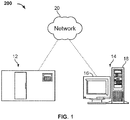
- the digital pathology system 200 may comprise an imaging apparatus 12 (e.g. an apparatus having means for scanning a specimen-bearing microscope slide) and a computer 14, whereby the imaging apparatus 12 and computer may be communicatively coupled together (e.g. directly, or indirectly over a network 20).
- the computer system 14 can include a desktop computer, a laptop computer, a tablet, or the like, digital electronic circuitry, firmware, hardware, memory 602, a computer storage medium, a computer program or set of instructions (e.g. where the program is stored within the memory or storage medium), a processor (including a programmed processor), and/or the like.
- the computer 1 may comprise a computer with a display device 16 and an enclosure 18.
- the computer system can store digital images in binary form (locally, such as in a memory, on a server, or another network connected device).
- the digital images can also be divided into a matrix of pixels.
- the pixels can include a digital value of one or more bits, defined by the bit depth.
- additional components e.g. specimen analyzers, microscopes, other imaging systems, automated slide preparation equipment, etc.
- the imaging apparatus 12 can include, without limitation, one or more image capture devices.
- Image capture devices can include, without limitation, a camera (e.g., an analog camera, a digital camera, etc.), optics (e.g., one or more lenses, sensor focus lens groups, microscope objectives, etc.), imaging sensors (e.g., a charge-coupled device (CCD), a complimentary metal-oxide semiconductor (CMOS) image sensor, or the like), photographic film, or the like.
- the image capture device can include a plurality of lenses that cooperate to prove on-the-fly focusing.
- An image sensor for example, a CCD sensor can capture a digital image of the specimen.
- the imaging apparatus 12 is a brightfield imaging system, a multispectral imaging (MSI) system or a fluorescent microscopy system.
- the digitized tissue data may be generated, for example, an image scanning systems, such as an iSCAN CORE by VENTANA MEDICAL SYSTEMS of Arlington, Ariz. or other suitable imaging equipment. Additional imaging devices and systems are described further herein.
- the digital color image acquired by the imaging apparatus 12 is conventionally composed of elementary color pixels. Each colored pixel is coded over three digital components, each comprising the same number of bits, each component corresponding to a primary color, generally red, green or blue, also denoted by the term "RGB" components.
- FIG. 2 provides an overview of the various modules utilized within the presently disclosed digital pathology system.
- the digital pathology system employs a computer device 204 or computer-implemented method having one or more processors 203 and at least one memory 201, the at least one memory 201 storing non-transitory computer-readable instructions for execution by the one or more processors to cause the one or more processors to execute instructions in one or more modules (e.g. modules 202, and 205 through 208).
- the instructions may be stored in a non-transitory computer-readable medium (201) or computer-usable medium.
- a non-transitory computer-readable media 201 may comprise all computer-readable media except for a transitory, propagating signal.
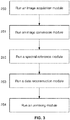
- the present disclosure provides a computer-implemented method of unmixing spectra data comprising the steps of (a) running an image acquisition module 202 to generate or receive a multi-channel image data, e.g. an acquired image, or a biological sample stained with at least two stains (step 250); (b) running an image conversion module 205 to convert image intensity data into optical density values for each channel in RGB color space (step 251); (c) running a spectra reference module 206 to derive or retrieve stored color reference vectors (reference spectra) for each stain in the biological sample (and, in the case of concentration-dependent stains, retrieve or derive a plurality of color reference vectors characterizing the stain at a plurality of varying concentrations) (step 252); (d) running a data reconstruction module 207 to determine the stain-specific color reference vectors that provide an optimal color space (e.g.
- step 253 step 253; and (e) running an unmixing module 208 to extract stain-specific contributions to each RGB channels in detected light using the determined stain-specific color reference vectors (step 254).
- any of the instructions, algorithms, and filters described for use within each module may be adapted or changed based on the types of images acquired and/or the type of specimens being studied.
- additional modules may be incorporated into the workflow. For example, an image processing module may be run to apply certain filters to the acquired images or to identify certain histological and/or morphological structures within the tissue samples.
- a region of interest selection module may be utilized to select a particular portion, such as a pre-determined portion or one containing a co-localization of two stains for analysis, of an image for analysis.
- a module may be run to determine a concentration of one or more stains within the sample.
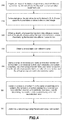
- the present disclosure provides as method of unmixing an image of a biological specimen stained with at least two stains comprising: (a) deriving total optical density values for each channel in R, G, B color space from pixel intensity values in an image or a portion of an image having a first stain and a second stain, wherein at least the first stain is a concentration-dependent stain (step 310); (b) obtaining a plurality of prospective first stain color reference vectors, each of the plurality of prospective first stain color reference vectors characterizing the first stain at a different concentration (step 320); (c) obtaining at least one second stain color reference vector (step 330); (d) deriving a series of candidate color systems from the first stain and second stain color reference vectors, each candidate color system comprising one of the prospective first stain color reference vectors from the plurality of prospective first stain color reference vectors and the at least one second stain color reference vector (step 340); (e) selecting an optimal color system from
- the digital pathology system runs an image acquisition module 202 to capture images or image data (steps 250 and 300) of a biological sample having one or more stains.
- the images received or acquired are RGB images or multispectral images.
- the images captured are stored in memory 201.
- the images or image data may be acquiring using the imaging apparatus 12, such as in real-time.
- the images are acquired from a microscope or other instrument capable of capturing image data of a specimen-bearing microscope slide, as noted herein.
- the images are acquired using a 2D scanner, such as one capable of scanning image tiles.
- the images may be images that have been previously acquired (e.g. scanned) and stored in a memory 201 (or, for that matter, retrieved from a server via network 20).
- the sample is stained through application of a stain containing one or more different markers or chromogenic stains.
- Chromogenic stains may comprise Hematoxylin, Eosin, Fast Red, or 3,3'-Diaminobenzidine (DAB).
- DAB 3,3'-Diaminobenzidine
- nay biological sample may also be stained with one or more fluorophores.
- a typical biological sample is processed in an automated staining/assay platform that applies a stain to the sample.
- the staining/assay platform There are a variety of commercial products on the market suitable for use as the staining/assay platform, one example being the Discovery TM product of Ventana Medical Systems, Inc. (Tucson, AZ).
- the camera platform may also include a bright field microscope, one example being the VENTANA iScan HT product of Ventana Medical Systems, Inc., or any microscope having one or more objective lenses and a digital imager, as well as a set of spectral filters. Other techniques for capturing images at different wavelengths may be used. Further camera platforms suitable for imaging stained biological specimens are known in the art and commercially available from companies such as Zeiss, Canon, Applied Spectral Imaging, and others, and such platforms are readily adaptable for use in the system, methods and apparatus of this subject disclosure.
- a region of interest identification module may be used to select a portion of the biological sample for which an image or for which image data should be acquired.
- FIG. 5 provides a flow chart illustrating the steps of region selection.
- the region selection module receives an identified region of interest or field of view.
- the region of interest is identified by a user of a system of the present disclosure, or another system communicatively coupled to a system of the present disclosure.
- the region selection module retrieves a location or identification of a region or interest from a storage/memory.
- the region selection module automatically generates a FOV or ROI, for example, via methods described in PCT/EP2015/062015 .
- the region of interest is automatically determined by the system based on some predetermined criteria or characteristics that are in or of the image (e.g. for a biological sample stained with more than two stains, identifying an area of the image that comprises just two stains).
- the region selection module outputs the ROI.
- the plurality of images, or regions of interest therein are provided to the image conversion module 205 such that intensity data within the acquired images are converted to optical density data (step 310).
- an image conversion module 205 Upon receiving image data, an image conversion module 205 is executed for converting image intensity data or pixel intensity data into an optical density (OD) data (steps 251 and 310).
- OD optical density
- a total optical density in the totality of detected light
- a total optical density for the blue channel, the red channel, and green channel in RGB color space is derived and provided to data reconstruction module 207.
- the conversion into optical density space utilizes the Beer-Lambert law, which is based on the principle that the optical density is proportional to a stain's concentration, as described in further detail below.
- the Beer-Lambert Law holds for every wavelength of incident light, with a different value of ⁇ for every wavelength.
- D j denotes the optical density in band j
- the total optical density information derived from the image conversion module 205 for each channel in RGB color space is then stored in a memory 201 and used by the data reconstruction module 207 in determining the optimal color system for unmixing the acquired image (step 350).
- the digital pathology system 200 comprises a spectral reference module 206 which stores color data, e.g. color data indicative of a color of the stains.
- the color data is descriptive of a single frequency or a characteristic spectral profile of the stain.
- the spectral reference module 206 stores color data for each of a plurality of stains.
- the plurality of stains may comprise at least 4, at least 10, at least 20 or at least 100 stains.
- the spectral reference module 206 selects color reference vectors for only the stains present in a portion of an image (e.g. where these exist two colocalized stains), a region of interest, or a field of view.
- the spectral reference module 206 may derive color data for a particular stain as described herein.
- the stored color data are color reference vectors specific to a particular stain.
- the color reference vectors correspond to the color or spectral data that defines a stain (e.g., for example according to its color or spectrum component contributions), such that a stain can be identified as present in an image according to whether a color (e.g., indicative of a stain) that appears in an image matches or deviates, within a pre-determined range, from the reference color vector or stain color vector values.
- the color reference vectors correspond to RGB values that define what is sometimes referred to as the true stain or the pure stain.
- the stain-specific optical density value for each channel can be determined by measuring RGB color channel value ( I R ,I G ,I B ) in slides stained with a single stain.
- a color reference vector for a hematoxylin stain may be [0.18 0.20 0.08].
- the spectral reference module 206 stores a plurality of color reference vectors for a single stain, where each individual color reference vector within the plurality of color reference vectors for the stain characterizes the stain at a different concentration.
- the spectra reference module 206 may comprise a set of DAB color reference vectors, each of the DAB color reference vectors within the set characterizing the RGB contributions of DAB at a different concentration.
- a first color reference vector for DAB at a first concentration e.g.
- 1X may be [x y x] (where each of x, y, and z represent optical density values of a stain in the RGB color space); while a second color reference vector for DAB at a second concentration (e.g. 2X) may be [x' y' z']; and a third color reference vector for DAB at a third concentration (e.g. 4X) may be [x" y" z"].
- a second color reference vector for DAB at a second concentration e.g. 2X
- a third color reference vector for DAB at a third concentration e.g. 4X
- between 1 and 100 color reference vectors are stored for a single stain.
- between 1 and 50 color reference vectors are stored for a single stain.
- between 1 and 25 color reference vectors are stored for a single stain.
- the spectra reference module may be used to derive a series of color reference vectors for a particular stain, based on image data derived from color calibration slides coated with varying concentrations of a stain. Methods of preparing such "color calibration slides" are described in Example 2 herein.
- a series of color reference vectors can be calculated by computing the average normalized OD R , OD G , OD B for pixels in each slide.
- the optical density ( OD ) for red, green and blue spectral bands are defined by ( OD R , OD G , OD B ) , which are the negative logarithms of the ratio of the RGB color channel value ( I R , I G , I B ) and the maximum channel values ( I 0 R , I 0 G , I 0 B ) .
- this definition is expressed as:
- each pure stain can be characterized jointly by the optical density for the light in the three (RGB) channels, which is represented by a vector (OD R , OD G , OD B ) in the optical density converted RBG color space.
- the color reference vectors derived from color calibration slides are stored in a memory 201, which may be output to data reconstruction 207 module.
- the relevant color reference vectors, or sets of color reference vectors for concentration-dependent stains are provided to the data reconstruction module 207.
- the data reconstruction module 207 utilizes the entirety of the color reference vectors supplied as input and, together with the total optical density data for each of the channels in RGB color space received from the image conversion module 205, determines an optimal color system for use in unmixing the acquired image data (step 350).
- the data reconstruction module takes into consideration the concentration-dependent nature of the stains and thus allows for increased resolution of concentration-dependent stain intensity after unmixing.
- optimal color system it is meant that a color system is selected in RGB color space that best approximates the proportions of the R, G, B channel signal in the detected light from each stain by taking into consideration the effects of the concentration of the stain in the sample (i.e. how concentration and/or precipitate formation effect light extinction due to absorptivity and/or light scattering).
- concentration of the stain in the sample i.e. how concentration and/or precipitate formation effect light extinction due to absorptivity and/or light scattering.
- the optimal color system will include a color reference vector for the concentration-dependent stain that best achieves linearity for the particular concentration of stain in the sample. It is believed that the selection of the optimal color system enables improved unmixing results as compared with methods that do not take the concentration of the stains into consideration, as evidenced in Examples 6 and 7 (see also FIG. 11 ).
- error values namely reconstruction error values
- the reconstruction error is computed for each candidate color system (i.e. for each unique pairing of color reference vectors characterizing the first and second stains), and the candidate system which yields the minimal reconstruction error is selected.
- the systems and methods described herein are suitable for use in selecting a color system when there are two concentration-dependent stains, and/or a significant number of color reference vectors describing a multitude of concentrations for a single stain. It is believed that by choosing a color system whose reconstruction error is minimalized, or approaches zero, it ensures that all channels in RGB color space are as close to linear as possible.
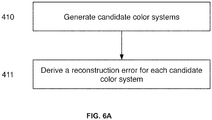
- a first step in determining an optimal color system is to generate a series of candidate color systems (step 410).
- Each candidate color system within the series of candidate color systems comprising a color reference vector characterizing a first stain and a color reference vector characterizing a second stain.
- each candidate color system is a matrix of two color reference vectors (and thus a matrix of optical density values), where color reference vector characterizes a different stain, and where each candidate color system is different.
- the spectral reference module 206 provides a set of prospective color reference vectors (e.g. 10 discrete color reference vectors), with each individual prospective color reference characterizing the concentration-dependent stain over a plurality of different concentrations (e.g. 1x, 2x, 4x ... Nx stain concentrations), each candidate color system would comprise one of the prospective color reference spectra for the concentration-dependent stain.
- each candidate color system would comprise one of the prospective color reference spectra for the concentration-dependent stain and the color reference spectra of the concentration-independent stain.
- each candidate color system would comprise (i) one of the prospective color reference spectra for the first concentration-dependent stain; and (ii) one of the prospective color reference spectra for the second concentration-dependent stain.
- all permutations of combinations of prospective color reference vectors for both the first and second concentration-dependent stains would need to be considered (i.e. a reconstruction error derived for each permutation or pairing).
- reconstruction error refers to the difference between the measured true data value and the mathematically derived data value following certain reconstruction theories.
- a y and A y represent the amount of stain for a first and a second stain, e.g. for hematoxylin and DAB.
- [A y A x ] is referred to as a vector of the amounts of stain.
- the vector [OD R _ tissue OD G _ tissue OD B _ tissue ] describes derived total optical densities for each channel within the RGB color space, i.e. values derived using the image conversion module 205.
- the matrix OD ⁇ R x OD ⁇ G x OD ⁇ B x OD ⁇ R y OD ⁇ G y OD ⁇ B y represents a candidate color system
- OD ⁇ R x OD ⁇ G x OD ⁇ B x and OD ⁇ R y OD ⁇ G y OD ⁇ G y refer to prospective color reference vectors for a first (x) and second stain (y).
- Each of OD ⁇ R x , OD ⁇ G x , and OD ⁇ B x and OD ⁇ R y OD ⁇ G y , and OD ⁇ G y are optical density values for first (x) and second (y) stains at each channel in RGB color space.
- OD ⁇ R x may represent an optical density value for a first stain in a first channel (e.g. a red channel) in RGB color space.
- OD ⁇ R x OD ⁇ G x OD ⁇ B x OD ⁇ R y OD ⁇ G y OD ⁇ B y may represents a first candidate color system, where and OD ⁇ R y OD ⁇ G y OD ⁇ G y is a first prospective color reference vector characterizing a concentration-dependent stain at a first concentration, and OD ⁇ R x OD ⁇ G x OD ⁇ B x refers to a color reference vectors for the same concentration-independent stain.
- OD ⁇ R x OD ⁇ G x OD ⁇ B x OD ⁇ R y ′ OD ⁇ G y ′ OD ⁇ B y ′ may represent a second candidate color system, where and OD ⁇ R y ′ OD ⁇ G y ′ OD ⁇ G y ′ is a second prospective color reference vector characterizing a concentration-dependent stain at a second concentration, and OD ⁇ R x OD ⁇ G x OD ⁇ B x refers to a color reference vectors for the same concentration-independent stain.
- equation (1) is an over determined equation.
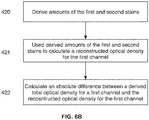
- the amounts of the first and second stains A 1 and A 2 can be determined (step 420 of FIG. 6B ) using information from only two channels. For example, by using the red and green channel signals in RGB color space and solving equation (2) the values for A 1 and A 2 may be derived.
- a y A x OD ⁇ R x OD ⁇ G x OD ⁇ R y OD ⁇ G y OD R _ tissue OD G _ tissue
- the matrix OD ⁇ R x OD ⁇ G x OD ⁇ R y OD ⁇ G y is referred to herein as a reconstruction matrix and comprises optical density values for two of the channels in RGB color space for each stain.
- the reconstruction matrix may comprise signals for the green and blue channels, the green and red channels, and the red and blue channels.
- a separate candidate reconstruction matrix is derived for each candidate color system.
- solving equation (2) for A y A x comprises multiplying a vector of the derived total optical densities for two of the channels (red and green channels in the example above) by an inverse of a candidate reconstruction matrices derived from a candidate color system, e.g. OD ⁇ R x OD ⁇ G x OD ⁇ R y OD ⁇ G y ⁇ 1 .
- a reconstructed total optical density is computed (step 421).
- the reconstructed total optical density is computed using the channel in the RGB color space not represented in the reconstruction matrix, namely the third channel not solved for in equation (3).
- the reconstructed total optical density is computed for the blue channel when red and green channel optical density values are provided in a reconstruction matrix, and the amounts of the first and second stains are derived using the red and green channels.
- O D B _ tissue ⁇ is the reconstructed total blue channel signal (from module 205)
- a y and A x are the derived amounts of the first and second stains
- OD ⁇ B y and OD ⁇ B x are the optical density values for the blue channel from the candidate color system for the first and second stains, respectively (i.e. from the candidate color system generated and used to provide the candidate reconstruction matrix).
- a reconstruction error is calculated (step 422) using the derived total optical density value for the blue channel (from module 205) and the reconstructed total blue channel optical density.
- the reconstruction error from step 422 may be stored in a memory 201.
- Steps 420, 421, and 422 are repeated for each candidate color system, i.e. a reconstruction error is computed for each candidate color system.
- the candidate color system having the lowest reconstruction error is selected as the optimal color system, i.e. the color system best representing each of the stains taking into consideration any concentration effects.
- the selection of the lowest reconstruction error may be accomplished by ranking each of the calculated reconstruction errors stored in a memory 201.
- the optimal color system approximates the true concentration-dependent stain concentration in the mixture of stains in the biological sample.
- the optimal color system is then output to the unmixing module 208 for use in unmixing the acquired image.
- the reconstruction error may be computed on the green or red channels according to the procedures noted above.
- An alternative method of determining reconstruction error which is not part of the claimed subject-matter, utilizes a normalized cross product as noted below.
- the cross product or vector product is a binary operation on two vectors in three-dimensional space. Given two linearly independent vectors a and b, the cross product, a ⁇ b, is a vector that is perpendicular to both a and b, and thus normal to the plane containing them. If two vectors have the same direction (or have the exact opposite direction from one another, i.e. are not linearly independent) or if either one has zero length, then their cross product is zero.
- the normalized cross product represents the vector which is perpendicular to the plane determined by the first and second stain color reference color vectors.
- a 1 A 2 A cross x y z a b c m n o OD R _ tissue OD G _ tissue OD B _ tissue where x, y, and z, and a, b, and c are optical density values for the R, G, and B channels, respectively.
- the magnitude of A_cross which is uniquely determined by the first and second stain color reference vector pair for a given tissue sample optical density vector, is an indication of how well the first and second stain color reference vectors can reconstruct the given tissue sample optical density vector.
- the magnitude of A_cross can be used as deconvolution error to select an optimal color system or best reference vector for a concentration-dependent stain.
- the direction of the optical density vectors for extremely weak stain and extremely strong stain can be very close to the direction corresponding to the gray hue. Specifically, extremely weak stain is close to white color; while extremely strong stain is close to black color. When such stains are present in the slide, purely relying on hue information (or optical density vector direction) may not be robust enough in finding the correct color reference vector that corresponds to the right intensity. Therefore, instead of using normalized reference color vector, a non-normalized reference vector may be used to take intensity information into consideration as well.
- HEM non-normalized reference vector for a first stain (DAB) and a second stain (hematoxylin); let
- DAB m ⁇ and DAB m + 1 ⁇ are determined to be the reference vectors that yield the minimal and the second minimal error, respectively.
- the calculated DAB ⁇ is used to perform deconvolution. This is equivalent to finding the optical density vector that is along the intersection of the plane determined by DAB ⁇ m and DAB m + 1 ⁇ and the plane determined by HEM ⁇ and [ OD R_tissue OD G_tissue OD B_tissue ]. In other words, the linear combination of HEM ⁇ and the calculated DAB ⁇ can perfectly reconstruct the tissue signal [ OD R_tissue OD G_tissue OD B_tissue ].
- DAB ⁇ is restricted to be linear combination of known reference vectors DAB ⁇ m and DAB m + 1 ⁇ . It is desired that DAB ⁇ m and DAB m + 1 ⁇ are sufficiently close so that their linear combination can represent physically meaningful hues for DAB stain.
- the multiplex images are unmixed (step _) with unmixing module 208 using linear unmixing.
- Linear unmixing is described, for example, in ' Zimmermann “Spectral Imaging and Linear Unmixing in Light Microscopy” Adv Biochem Engin/Biotechnol (2005) 95:245-265 ' and in in C. L. Lawson and R. J. Hanson, "Solving least squares Problems", PrenticeHall, 1974, Chapter 23, p. 161 ,'.
- the measured spectrum (S( ⁇ )) at any pixel is considered a linear mixture of stain spectral components and equals the sum of the proportions or weights (A) of each individual stain's color reference (R( ⁇ )) that is being expressed at the pixel
- S ⁇ A 1 ⁇ R 1 ⁇ + A 2 ⁇ R 2 ⁇ + A 3 ⁇ R 3 ⁇ .
- the columns of the M ⁇ N matrix R is the optimal color system as derived herein
- the N ⁇ 1 vector A is the unknown of the proportions of individual stains
- the M ⁇ 1 vector S is the measured multichannel spectral vector at a pixel.
- the signal in each pixel (S) is measured during acquisition of the multiplex image and the reference spectra, i.e. the optimal color system, is derived as described herein.
- the contributions of various stains (A i ) can be determined by calculating their contribution to each point in the measured spectrum.
- j represents the number of detection channels and i equals the number of stains.
- the linear equation solution often involves allowing a constrained unmixing to force the weights (A) to sum to unity.
- the computer system of the present disclosure may also be communicatively coupled to a specimen processing apparatus that can perform one or more preparation processes on the tissue specimen.
- the preparation process can include, without limitation, deparaffinizing a specimen, conditioning a specimen (e.g., cell conditioning), staining a specimen, performing antigen retrieval, performing immunohistochemistry staining (including labeling) or other reactions, and/or performing in situ hybridization (e.g., SISH, FISH, etc.) staining (including labeling) or other reactions, as well as other processes for preparing specimens for microscopy, microanalyses, mass spectrometric methods, or other analytical methods.
- the processing apparatus can apply fixatives to the specimen.
- Fixatives can include cross-linking agents (such as aldehydes, e.g., formaldehyde, paraformaldehyde, and glutaraldehyde, as well as non-aldehyde cross-linking agents), oxidizing agents (e.g., metallic ions and complexes, such as osmium tetroxide and chromic acid), protein-denaturing agents (e.g., acetic acid, methanol, and ethanol), fixatives of unknown mechanism (e.g., mercuric chloride, acetone, and picric acid), combination reagents (e.g., Carnoy's fixative, methacarn, Bouin's fluid, B5 fixative, Rossman's fluid, and Gendre's fluid), microwaves, and miscellaneous fixatives (e.g., excluded volume fixation and vapor fixation).
- cross-linking agents such as
- the sample can be deparaffinized using appropriate deparaffinizing fluid(s).
- any number of substances can be successively applied to the specimen.
- the substances can be for pretreatment (e.g., to reverse protein-crosslinking, expose nucleic acids, etc.), denaturation, hybridization, washing (e.g., stringency wash), detection (e.g., link a visual or marker molecule to a probe), amplifying (e.g., amplifying proteins, genes, etc.), counterstaining, coverslipping, or the like.
- the specimen processing apparatus can apply a wide range of substances to the specimen.
- the substances include, without limitation, stains, probes, reagents, rinses, and/or conditioners.
- the substances can be fluids (e.g., gases, liquids, or gas/liquid mixtures), or the like.
- the fluids can be solvents (e.g., polar solvents, non-polar solvents, etc.), solutions (e.g., aqueous solutions or other types of solutions), or the like.
- Reagents can include, without limitation, stains, wetting agents, antibodies (e.g., monoclonal antibodies, polyclonal antibodies, etc.), antigen recovering fluids (e.g., aqueous- or non-aqueous-based antigen retrieval solutions, antigen recovering buffers, etc.), or the like.
- Probes can be an isolated nucleic acid or an isolated synthetic oligonucleotide, attached to a detectable label or reporter molecule. Labels can include radioactive isotopes, enzyme substrates, co-factors, ligands, chemiluminescent or fluorescent agents, haptens, and enzymes.
- the specimen processing apparatus can be an automated apparatus, such as the BENCHMARK XT instrument and SYMPHONY instrument sold by Ventana Medical Systems, Inc. Ventana Medical Systems, Inc. is the assignee of a number of United States patents disclosing systems and methods for performing automated analyses, including U.S. Pat. Nos. 5,650,327 , 5,654,200 , 6,296,809 , 6,352,861 , 6,827,901 and 6,943,029 , and U.S. Published Patent Application Nos. 20030211630 and 20040052685 .
- specimens can be manually processed.
- the imaging apparatus is a brightfield imager slide scanner.
- One brightfield imager is the iScan Coreo brightfield scanner sold by Ventana Medical Systems, Inc.
- the imaging apparatus is a digital pathology device as disclosed in International Patent Application No.: PCT/US2010/002772 (Patent Publication No.: WO/2011/049608 ) entitled IMAGING SYSTEM AND TECHNIQUES or disclosed in U.S. Patent Application No. 61/533,114, filed on Sep. 9, 2011 , entitled IMAGING SYSTEMS, CASSETTES, AND METHODS OF USING THE SAME.
- the imaging system or apparatus may be a multispectral imaging (MSI) system or a fluorescent microscopy system.
- the imaging system used here is an MSI.
- MSI generally, equips the analysis of pathology specimens with computerized microscope-based imaging systems by providing access to spectral distribution of an image at a pixel level. While there exists a variety of multispectral imaging systems, an operational aspect that is common to all of these systems is a capability to form a multispectral image.
- a multispectral image is one that captures image data at specific wavelengths or at specific spectral bandwidths across the electromagnetic spectrum. These wavelengths may be singled out by optical filters or by the use of other instruments capable of selecting a pre-determined spectral component including electromagnetic radiation at wavelengths beyond the range of visible light range, such as, for example, infrared (IR).
- IR infrared
- An MSI system may include an optical imaging system, a portion of which contains a spectrally-selective system that is tunable to define a pre-determined number N of discrete optical bands.
- the optical system may be adapted to image a tissue sample, illuminated in transmission with a broadband light source onto an optical detector.
- the optical imaging system which in one embodiment may include a magnifying system such as, for example, a microscope, has a single optical axis generally spatially aligned with a single optical output of the optical system.
- the system forms a sequence of images of the tissue as the spectrally selective system is being adjusted or tuned (for example with a computer processor) such as to assure that images are acquired in different discrete spectral bands.
- the apparatus may additionally contain a display in which appears at least one visually perceivable image of the tissue from the sequence of acquired images.
- the spectrally-selective system may include an optically-dispersive element such as a diffractive grating, a collection of optical filters such as thin-film interference filters or any other system adapted to select, in response to either a user input or a command of the pre-programmed processor, a particular band-pass from the spectrum of light transmitted from the light source through the sample towards the detector.
- a spectrally selective system defines several optical outputs corresponding to N discrete spectral bands. This type of system intakes the transmitted light output from the optical system and spatially redirects at least a portion of this light output along N spatially different optical paths in such a way as to image the sample in an identified spectral band onto a detector system along an optical path corresponding to this identified spectral band.
- Embodiments of the subject matter and the operations described in this specification can be implemented in digital electronic circuitry, or in computer software, firmware, or hardware, including the structures disclosed in this specification and their structural equivalents, or in combinations of one or more of them.
- Embodiments of the subject matter described in this specification can be implemented as one or more computer programs, i.e., one or more modules of computer program instructions, encoded on computer storage medium for execution by, or to control the operation of, data processing apparatus. Any of the modules described herein may include logic that is executed by the processor(s).
- Logic refers to any information having the form of instruction signals and/or data that may be applied to affect the operation of a processor.
- Software is an example of logic.
- a computer storage medium can be, or can be included in, a computer-readable storage device, a computer-readable storage substrate, a random or serial access memory array or device, or a combination of one or more of them.
- a computer storage medium is not a propagated signal, a computer storage medium can be a source or destination of computer program instructions encoded in an artificially derived propagated signal.
- the computer storage medium can also be, or can be included in, one or more separate physical components or media (e.g., multiple CDs, disks, or other storage devices).
- the operations described in this specification can be implemented as operations performed by a data processing apparatus on data stored on one or more computer-readable storage devices or received from other sources.
- the term "programmed processor” encompasses all kinds of apparatus, devices, and machines for processing data, including by way of example a programmable microprocessor, a computer, a system on a chip, or multiple ones, or combinations, of the foregoing.
- the apparatus can include special purpose logic circuitry, e.g., an FPGA (field programmable gate array) or an ASIC (application-specific integrated circuit).
- the apparatus also can include, in addition to hardware, code that creates an execution environment for the computer program in question, e.g., code that constitutes processor firmware, a protocol stack, a database management system, an operating system, a cross-platform runtime environment, a virtual machine, or a combination of one or more of them.
- the apparatus and execution environment can realize various different computing model infrastructures, such as web services, distributed computing and grid computing infrastructures.
- a computer program (also known as a program, software, software application, script, or code) can be written in any form of programming language, including compiled or interpreted languages, declarative or procedural languages, and it can be deployed in any form, including as a stand-alone program or as a module, component, subroutine, object, or other unit suitable for use in a computing environment.
- a computer program may, but need not, correspond to a file in a file system.
- a program can be stored in a portion of a file that holds other programs or data (e.g., one or more scripts stored in a markup language document), in a single file dedicated to the program in question, or in multiple coordinated files (e.g., files that store one or more modules, subprograms, or portions of code).
- a computer program can be deployed to be executed on one computer or on multiple computers that are located at one site or distributed across multiple sites and interconnected by a communication network.
- the processes and logic flows described in this specification can be performed by one or more programmable processors executing one or more computer programs to perform actions by operating on input data and generating output.
- the processes and logic flows can also be performed by, and apparatus can also be implemented as, special purpose logic circuitry, e.g., an FPGA (field programmable gate array) or an ASIC (application-specific integrated circuit).
- processors suitable for the execution of a computer program include, by way of example, both general and special purpose microprocessors, and any one or more processors of any kind of digital computer.
- a processor will receive instructions and data from a read-only memory or a random-access memory or both.
- the essential elements of a computer are a processor for performing actions in accordance with instructions and one or more memory devices for storing instructions and data.
- a computer will also include, or be operatively coupled to receive data from or transfer data to, or both, one or more mass storage devices for storing data, e.g., magnetic, magneto-optical disks, or optical disks.
- mass storage devices for storing data, e.g., magnetic, magneto-optical disks, or optical disks.
- a computer need not have such devices.
- a computer can be embedded in another device, e.g., a mobile telephone, a personal digital assistant (PDA), a mobile audio or video player, a game console, a Global Positioning System (GPS) receiver, or a portable storage device (e.g., a universal serial bus (USB) flash drive), to name just a few.
- Devices suitable for storing computer program instructions and data include all forms of non-volatile memory, media and memory devices, including by way of example semiconductor memory devices, e.g., EPROM, EEPROM, and flash memory devices; magnetic disks, e.g., internal hard disks or removable disks; magneto-optical disks; and CD-ROM and DVD-ROM disks.
- the processor and the memory can be supplemented by, or incorporated in, special purpose logic circuitry.
- embodiments of the subject matter described in this specification can be implemented on a computer having a display device, e.g., an LCD (liquid crystal display), LED (light emitting diode) display, or OLED (organic light emitting diode) display, for displaying information to the user and a keyboard and a pointing device, e.g., a mouse or a trackball, by which the user can provide input to the computer.
- a display device e.g., an LCD (liquid crystal display), LED (light emitting diode) display, or OLED (organic light emitting diode) display
- a keyboard and a pointing device e.g., a mouse or a trackball
- a touch screen can be used to display information and receive input from a user.
- a computer can interact with a user by sending documents to and receiving documents from a device that is used by the user; for example, by sending web pages to a web browser on a user's client device in response to requests received from the web browser.
- Embodiments of the subject matter described in this specification can be implemented in a computing system that includes a back-end component, e.g., as a data server, or that includes a middleware component, e.g., an application server, or that includes a front-end component, e.g., a client computer having a graphical user interface or a Web browser through which a user can interact with an implementation of the subject matter described in this specification, or any combination of one or more such back-end, middleware, or front-end components.
- the components of the system can be interconnected by any form or medium of digital data communication, e.g., a communication network.
- Examples of communication networks include a local area network (“LAN”) and a wide area network (“WAN”), an inter-network (e.g., the Internet), and peer-to-peer networks (e.g., ad hoc peer-to-peer networks).
- LAN local area network
- WAN wide area network
- inter-network e.g., the Internet
- peer-to-peer networks e.g., ad hoc peer-to-peer networks.
- the network 20 of FIG. 1 can include one or more local area networks.
- the computing system can include any number of clients and servers.
- a client and server are generally remote from each other and typically interact through a communication network. The relationship of client and server arises by virtue of computer programs running on the respective computers and having a client-server relationship to each other.
- a server transmits data (e.g., an HTML page) to a client device (e.g., for purposes of displaying data to and receiving user input from a user interacting with the client device).
- client device e.g., for purposes of displaying data to and receiving user input from a user interacting with the client device.
- Data derived at the client device e.g., a result of the user interaction
- the Beer-Lambert equation assumes small stain concentrations and no interaction between the absorbing molecules.
- the absorption factor c R , c G and c B are the only factors to impact the light extinction, which are independent of stain concentration.
- this assumption does not hold well for DAB stain due to its precipitate-forming reaction during sample processing.
- Light scattering needs to be taken into consideration, which causes the light extinction (i.e., absorption + scattering) to be concentration-dependent.
- FIG. 7 illustrates the effect of stain concentration on extinction (see Peter H. and Tobias M., "Supplementary Information to A model based survey of color deconvolution in diagnostic bright field microscopy: Error Estimation and Spectral Consideration," Sci Rep. 2015; 5: 12096 ).
- the peak extinction (which is used as the normalization factor) accurses at about 475nm, which roughly correspond to the center of the blue spectral band.
- the red spectral band which covers the higher wavelengths, has the least extinction when compared to the peak.
- the extinction of green spectral band is in-between.
- the ratio to the peak extinction across different wavelengths is generally increased for wavelengths higher than about 475 nm. This means that the proportions of RGB channel signals in the detected light change due to increased scattering along with the stain concentration variations. Therefore, different OD vectors are needed to characterize DAB stain at different concentrations.
- DAB slides with controlled concentrations are generated.
- tissue sample will introduce significant intra-slide variations of DAB concentration
- a special slide preparation process has been developed to generate slide with uniform DAB concentration distribution. This helps to extract reliable reference color vector for a particular concentration level.
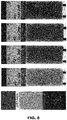
- FIG. 8 provides thumbnail images of the sample slides prepared using the disclosed method.
- the concentrations are (a) 1X, (b) 5X, (c) 15X, (d) 20X, (e) 25X, which are relative to OptiView on-slide concentrations of about 1.9 mM DAB.
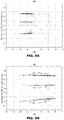
- FIGS. 93A - 9E show the results for the 5 slides as shown in FIG. 8 .
- OD R ⁇ OD G ⁇ OD B are observed for slide 1X, 5X, 15X, 20X, which is consistent with the DAB extinction plot as shown in FIG. 7 .
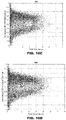
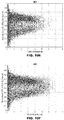
- the normalized OD R , OD G , OD B values generally remain constant in the low total OD value range, indicating that the Beer-Lambert's law holds reasonably well for low DAB concentrations. Decreasing of normalized OD B and increasing of normalized OD R and OD G are observed as the total OD value increases, especially when the total OD value is greater than 3. The trend is the most obvious for slide 25X, indicating strong scattering effects for high DAB concentrations.
- the reference color vector for each concentration level is generated by taking the average normalized OD vector for each slide (excluding the artifacts area).
- Vimentin positive control slides are intended for use as positive controls for immunohistochemical (IHC) staining using an anti-Vimentin antibody.
- IHC immunohistochemical staining using an anti-Vimentin antibody.
- Lung tissue (which is near the label) was used in our experiment.
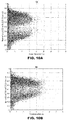
- Considering the large stain intensity variations in the slide instead of computing the average OD, we randomly selected 2000 pixels in each 1000x1000 FOV that covers the lung tissue in each slide, and plot the normalized OD R , OD G , OD B vs. the total OD value for each slide. The results are shown in FIGS. 10A - 10F .
- equation (10) is an over determined equation.
- O D B_tissue ⁇ A Hem ⁇ OD ⁇ B HEM + A DAB + A DAB ⁇ OD ⁇ B DAb
- O D B_tissue ⁇ is the reconstructed blue channel signal.
- red and green channel signal can also be used instead of using blue channel signal to compute the reconstruction error. From our experiments, using the green channel for error calculation actually yielded lower average error across the tested.
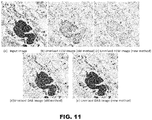
- FIG. 11 shows the visual comparison between the traditional method and the proposed method.
- the input image is a CEA (Carcinoembryonic Antigen) stained non-small cell lung cancer (NSCLC) tissue sample.
- CEA Carcinoembryonic Antigen
- NSCLC non-small cell lung cancer
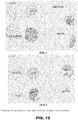
- FIG. 12 shows the thumbnail image of the two slides which hold the 12 tumor cell line samples, the name of each cell line is also indicated beside each cell line.
- FIG. 13 shows the average DAB intensity of each cell line vs. the logarithm of the gene copy number.
Landscapes
- Engineering & Computer Science (AREA)
- Physics & Mathematics (AREA)
- General Physics & Mathematics (AREA)
- Theoretical Computer Science (AREA)
- Computer Vision & Pattern Recognition (AREA)
- Health & Medical Sciences (AREA)
- General Health & Medical Sciences (AREA)
- Medical Informatics (AREA)
- Quality & Reliability (AREA)
- Radiology & Medical Imaging (AREA)
- Nuclear Medicine, Radiotherapy & Molecular Imaging (AREA)
- Multimedia (AREA)
- Molecular Biology (AREA)
- Biomedical Technology (AREA)
- Life Sciences & Earth Sciences (AREA)
- Investigating Or Analysing Materials By Optical Means (AREA)
- Investigating Or Analysing Biological Materials (AREA)
- Image Processing (AREA)
- Investigating, Analyzing Materials By Fluorescence Or Luminescence (AREA)
- Image Analysis (AREA)
Claims (15)
- Verfahren zum Entmischen eines Bilds einer biologischen Probe, die mit zumindest zwei Einfärbungen eingefärbt ist, das Folgendes umfasst:das Ableiten einer optischen Gesamtdichte für jeden Kanal im RGB-Farbraum aus Pixelintensitätswerten in einem Bild oder einem Teil des Bilds, das eine erste Einfärbung und eine zweite Einfärbung aufweist, wobei zumindest die erste Einfärbung eine konzentrationsabhängige Einfärbung (310) ist, wobei:die optische Gesamtdichte, die einem entsprechenden Kanal in dem RGB-Farbraum entspricht, einen Satz von Werten der optischen Dichte umfasst, der dem entsprechenden Kanal zugeordnet ist;die konzentrationsabhängige Einfärbung eine niederschlagsbildende Einfärbung umfasst, die einen lichtstreuenden Effekt auf dem Bild oder den Teil des Bilds verursacht;das Erhalten einer Vielzahl von möglichen Farbreferenzvektoren für die erste Einfärbung in dem in optische Dichte umgewandelten RGB-Farbraum, wobei jeder aus der Vielzahl von möglichen Farbreferenzvektoren für die erste Einfärbung die erste Einfärbung bei einer unterschiedlichen Konzentration charakterisiert (320);das Erhalten von zumindest einem Farbreferenzvektor für die zweite Einfärbung (330);das Ableiten einer Reihe von in Frage kommenden Farbsystemen von den Farbreferenzvektoren für die erste Einfärbung und für die zweite Einfärbung, wobei jedes in Frage kommende Farbsystem einen der möglichen Farbreferenzvektoren für die erste Einfärbung aus der Vielzahl von möglichen Farbreferenzvektoren für die erste Einfärbung und einen aus dem zumindest einen Farbreferenzvektor für die zweite Einfärbung umfasst (340);das Auswählen eines optimalen Farbsystems aus der Reihe von in Frage kommenden Farbsystemen, wobei das optimale Farbsystem durch Folgendes ausgewählt wird:(i) das Berechnen eines Rekonstruktionsfehlers für jedes in Frage kommende Farbsystem, wobei der Rekonstruktionsfehler eines in Frage kommenden Farbsystems zumindest teilweise auf Basis einer Differenz zwischen einer ersten aus der abgeleiteten Gesamtdichte und einer rekonstruierten optischen Gesamtdichte berechnet wird, und wobei die rekonstruierte optische Gesamtdichte auf Basis des möglichen Farbreferenzvektors für die erste Einfärbung, der dem in Frage kommenden Farbsystem entspricht, und einem aus dem zumindest einen Farbreferenzvektor für die zweite Einfärbung, der dem in Frage kommenden Farbsystem entspricht, und der zweiten und dritten aus der abgeleiteten optischen Gesamtdichte für jeden Kanal erzeugt wird, und(ii) das Bestimmen des in Frage kommenden Farbsystems mit einem minimalen Rekonstruktionsfehler aus der Reihe von in Frage kommenden Farbsystemen (350); unddas Entmischen des Bilds unter Verwendung des ausgewählten optimalen Farbsystems (360).
- Verfahren nach Anspruch 1, wobei der Rekonstruktionsfehler außerdem durch das Berechnen einer absoluten Differenz zwischen (a) einer abgeleiteten optischen Gesamtdichte für einen ersten Kanal, der einem der Kanäle in dem RGB-Farbraum entspricht, und (b) der rekonstruierten optischen Gesamtdichte für den ersten Kanal berechnet wird (422).
- Verfahren nach Anspruch 2, wobei die rekonstruierte optische Gesamtdichte für den ersten Kanal durch das Addieren (i) eines Produkts eines abgeleiteten Ausmaßes der zweiten Einfärbung, das in der biologischen Probe vorhanden ist, und des Werts der optischen Dichte des ersten Kanals des Referenzvektors für die zweite Einfärbung in einem der in Frage kommenden Farbsysteme aus der Reihe von in Frage kommenden Farbsystemen und (ii) eines Produkts eines abgeleiteten Ausmaßes der ersten Einfärbung, das in der biologischen Probe vorhanden ist, und des Werts der optischen Dichte des ersten Kanals des Referenzvektors für die erste Einfärbung in dem gleichen in Frage kommenden Farbsystem berechnet wird, wobei die abgeleiteten Ausmaße der ersten Einfärbung und der zweiten Einfärbung auf Basis eines Vektors der optischen Gesamtdichte des zweiten und dritten Kanals in dem RGB-Farbraum abgeleitet sind.
- Verfahren nach Anspruch 3, wobei die abgeleiteten Ausmaße der ersten Einfärbung und der zweiten Einfärbung durch das Multiplizieren des Vektors der optischen Gesamtdichte für den zweiten und dritten Kanal in dem RGB-Farbraum mit einer Inversen einer in Frage kommenden Rekonstruktionsmatrix berechnet werden, wobei die in Frage kommende Rekonstruktionsmatrix Folgendes umfasst: (i) einen ersten Vektor der optischen Dichte, der Werte der optischen Dichte aufweist, die dem zweiten und dritten Kanal des Referenzvektors für die erste Einfärbung für das in Frage kommende Farbsystem entsprechen; und (ii) einen zweiten Vektor der optischen Dichte, der Werte der optischen Dichte aufweist, die dem zweiten und dritten Kanal des Referenzvektors für die zweite Einfärbung für das in Frage kommende Farbsystem entsprechen.
- Verfahren nach einem der vorangegangenen Ansprüche, wobei die erste Einfärbung DAB ist.
- Verfahren nach einem der vorangegangenen Ansprüche, wobei die zweite Einfärbung aus der Gruppe ausgewählt ist, die aus Hämatoxylin, Eosin, Fast Red und Methylgrün besteht.
- Verfahren nach einem der vorangegangenen Ansprüche, wobei der erste Kanal ein Blaukanal oder ein Grünkanal ist.
- Verfahren nach einem der vorangegangenen Ansprüche, wobei die biologische Probe mit mehr als drei Einfärbungen eingefärbt ist und wobei das Bild ein Bereich von Interesse ist, der von einem größeren Bild abgeleitet ist, wobei der Bereich von Interesse nur die erste und zweite Einfärbung umfasst.
- Verfahren nach einem der vorangegangenen Ansprüche, wobei sowohl die erste als auch die zweite Einfärbung konzentrationsabhängige Einfärbungen sind und wobei der zumindest eine Farbreferenzvektor für die zweite Einfärbung eine Vielzahl von möglichen Farbreferenzvektoren für die zweite Einfärbung darstellt, wobei jeder aus der Vielzahl von möglichen Farbreferenzvektoren für die zweite Einfärbung die zweite Einfärbung in einer anderen Konzentration charakterisiert.
- System (200) zum Entmischen eines Bilds einer biologischen Probe, die mit zumindest zwei Einfärbungen eingefärbt ist, wobei das System (200) Folgendes umfasst: (i) einen oder mehrere Prozessoren (203) und (ii) einen oder mehrere Speicher (201), die mit dem einen oder den mehreren Prozessoren (203) gekoppelt sind, wobei der eine oder die mehreren Speicher (201) konfiguriert sind, um computerausführbare Befehle zu speichern, die bei der Ausführung durch den einen oder die mehreren Prozessoren (203) den einen oder die mehreren Prozessoren (203) dazu veranlassen, Vorgänge durchzuführen, die Folgendes umfasst:das Erfassen eines Bilds der biologischen Probe mit Signalen, die einer ersten Einfärbung und einer zweiten Einfärbung entsprechen, wobei zumindest die erste Einfärbung eine konzentrationsabhängige Einfärbung (300) ist, wobei die konzentrationsabhängige Einfärbung eine niederschlagsbildende Einfärbung umfasst, die einen lichtstreuenden Effekt auf dem erfassten Bild verursacht;das Ableiten einer optischen Gesamtdichte für jeden Kanal im RGB-Farbraum aus Pixelintensitätswerten in dem erfassten Bild (310), wobei die optische Gesamtdichte, die einem entsprechenden Kanal in dem RGB-Farbraum entspricht, einen Satz von Werten der optischen Dichte umfasst, der dem entsprechenden Kanal zugeordnet ist;das Erhalten eines Satzes von möglichen Farbreferenzvektoren für die erste Einfärbung in dem RGB-Farbraum der optischen Dichte aus einer Spektralreferenzdatenbank, wobei jeder Farbreferenzvektor innerhalb des Satzes von möglichen Farbreferenzvektoren für die erste Einfärbung die erste Einfärbung in einer anderen Einfärbungskonzentration charakterisiert (320);das Erhalten von zumindest einem Farbreferenzvektor für die zweite Einfärbung aus der Spektralreferenzdatenbank (330);das Ableiten einer Reihe von in Frage kommenden Farbsystemen von den Farbreferenzvektoren für die erste Einfärbung und für die zweite Einfärbung, wobei jedes in Frage kommende Farbsystem einen der möglichen Farbreferenzvektoren für die erste Einfärbung aus dem Satz von möglichen Farbreferenzvektoren für die erste Einfärbung und einen aus dem zumindest einen Farbreferenzvektor für die zweite Einfärbung umfasst (340);das Auswählen eines optimalen Farbsystems aus der Reihe von in Frage kommenden Farbsystemen, wobei das optimale Farbsystem durch Folgendes ausgewählt wird:(i) das Berechnen eines Rekonstruktionsfehlers für jedes in Frage kommende Farbsystem, wobei der Rekonstruktionsfehler eines in Frage kommenden Farbsystems zumindest teilweise auf Basis einer Differenz zwischen einer ersten aus der abgeleiteten optischen Gesamtdichte und einer rekonstruierten optischen Gesamtdichte berechnet wird, und wobei die rekonstruierte optische Gesamtdichte auf Basis des möglichen Farbreferenzvektors für die erste Einfärbung, der dem in Frage kommenden Farbsystem entspricht, und einem aus dem zumindest einen Farbreferenzvektor für die zweite Einfärbung, der dem in Frage kommenden Farbsystem entspricht, und der zweiten und dritten aus der abgeleiteten optischen Gesamtdichte für jeden Kanal erzeugt wird, und(ii) das Bestimmen eines in Frage kommenden Farbsystems mit einem minimalen Rekonstruktionsfehler aus der Reihe von in Frage kommenden Farbsystemen (350); unddas Entmischen der Signale in dem erfassten Bild unter Verwendung des ausgewählten optimalen Farbsystems (360).
- System nach Anspruch 10, wobei der Rekonstruktionsfehler außerdem durch das Berechnen einer absoluten Differenz zwischen (a) einer abgeleiteten optischen Gesamtdichte für einen ersten Kanal, der einem der Kanäle in dem RGB-Farbraum entspricht, und (b) der rekonstruierten optischen Gesamtdichte für den ersten Kanal berechnet wird (422).
- System nach Anspruch 11, wobei die rekonstruierte optische Gesamtdichte für den ersten Kanal durch das Addieren (i) eines Produkts eines abgeleiteten Ausmaßes der zweiten Einfärbung, das in der biologischen Probe vorhanden ist, und des Werts der optischen Dichte des ersten Kanals des Referenzvektors für die zweite Einfärbung in einem der in Frage kommenden Farbsysteme aus der Reihe von in Frage kommenden Farbsystemen und (ii) eines Produkts eines abgeleiteten Ausmaßes der ersten Einfärbung, das in der biologischen Probe vorhanden ist, und des Werts der optischen Dichte des ersten Kanals des Referenzvektors für die erste Einfärbung in dem gleichen in Frage kommenden Farbsystem berechnet wird, wobei die abgeleiteten Ausmaße der ersten Einfärbung und der zweiten Einfärbung auf Basis eines Vektors der optischen Gesamtdichte des zweiten und dritten Kanals in dem RGB-Farbraum abgeleitet sind.
- System nach Anspruch 12, wobei die abgeleiteten Ausmaße der ersten Einfärbung und der zweiten Einfärbung durch das Multiplizieren des Vektors der optischen Gesamtdichte für den zweiten und dritten Kanal in dem RGB-Farbraum mit einer Inversen einer in Frage kommenden Rekonstruktionsmatrix berechnet werden, wobei die in Frage kommende Rekonstruktionsmatrix Folgendes umfasst: (i) einen ersten Vektor der optischen Dichte, der Werte der optischen Dichte aufweist, die dem zweiten und dritten Kanal des Referenzvektors für die erste Einfärbung für das in Frage kommende Farbsystem entsprechen; und (ii) einen zweiten Vektor der optischen Dichte, der Werte der optischen Dichte aufweist, die dem zweiten und dritten Kanal des Referenzvektors für die zweite Einfärbung für das in Frage kommende Farbsystem entsprechen.
- System nach einem der Ansprüche 10 bis 13, wobei das Erhalten des Satzes von möglichen Farbreferenzvektoren für die erste Einfärbung das Ableiten einer Vielzahl von Farbreferenzvektoren für die erste Einfärbung durch das Analysieren von Bilddaten aus einer Reihe von Kontrollbildern umfasst, wobei jedes Kontrollbild eine andere Einfärbungskonzentration aufweist.
- Nicht transitorisches computerlesbares Medium (201), auf dem Befehle gespeichert sind, die bei der Ausführung durch einen oder mehrere Prozessoren (203) eines Bildgebungssystems (200) das Bildgebungssystem (200) dazu veranlassen, ein Verfahren nach einem der Ansprüche 1 bis 9 durchzuführen.
Applications Claiming Priority (2)
| Application Number | Priority Date | Filing Date | Title |
|---|---|---|---|
| US201762541619P | 2017-08-04 | 2017-08-04 | |
| PCT/EP2018/070956 WO2019025520A1 (en) | 2017-08-04 | 2018-08-02 | COLOR DEMIXING WITH DIFFUSION CORRECTION |
Publications (2)
| Publication Number | Publication Date |
|---|---|
| EP3662440A1 EP3662440A1 (de) | 2020-06-10 |
| EP3662440B1 true EP3662440B1 (de) | 2021-12-29 |
Family
ID=63143124
Family Applications (1)
| Application Number | Title | Priority Date | Filing Date |
|---|---|---|---|
| EP18752120.8A Active EP3662440B1 (de) | 2017-08-04 | 2018-08-02 | Farbentmischung mit streuungskorrektur |
Country Status (5)
| Country | Link |
|---|---|
| US (1) | US11107248B2 (de) |
| EP (1) | EP3662440B1 (de) |
| JP (2) | JP7216707B2 (de) |
| CN (1) | CN111602172B (de) |
| WO (1) | WO2019025520A1 (de) |
Families Citing this family (5)
| Publication number | Priority date | Publication date | Assignee | Title |
|---|---|---|---|---|
| EP3717005A1 (de) | 2017-12-01 | 2020-10-07 | GlaxoSmithKline Biologicals S.A. | Saponinextraktion |
| JP2021504424A (ja) * | 2017-12-01 | 2021-02-15 | グラクソスミスクライン バイオロジカルズ ソシエテ アノニム | サポニン精製 |
| BR112021024363A2 (pt) | 2019-06-05 | 2022-03-22 | Glaxosmithkline Biologicals Sa | Purificação de saponina |
| CN112686926B (zh) * | 2020-12-17 | 2022-05-31 | 深圳市普汇智联科技有限公司 | 一种复杂光影条件下的彩色球体运动检测方法及系统 |
| JP2025513878A (ja) * | 2022-04-13 | 2025-04-30 | サニーブルック リサーチ インスティチュート | 染色逆畳み込みを実行するためのシステム及び方法 |
Family Cites Families (18)
| Publication number | Priority date | Publication date | Assignee | Title |
|---|---|---|---|---|
| US5595707A (en) | 1990-03-02 | 1997-01-21 | Ventana Medical Systems, Inc. | Automated biological reaction apparatus |
| EP2284543A3 (de) | 1998-02-27 | 2015-05-27 | Ventana Medical Systems, Inc. | System und Verfahren zum Ansaugen und Ausgeben eines Reagenz |
| US6582962B1 (en) | 1998-02-27 | 2003-06-24 | Ventana Medical Systems, Inc. | Automated molecular pathology apparatus having independent slide heaters |
| US20030211630A1 (en) | 1998-02-27 | 2003-11-13 | Ventana Medical Systems, Inc. | Automated molecular pathology apparatus having independent slide heaters |
| EP1417632A1 (de) | 2001-05-29 | 2004-05-12 | Tissueinformatics, Inc. | Robuste rückstandserkennung und quantifizierung für histologische exemplare auf der basis eines physikalischen modells für die rückstandsabsorption |
| US7200252B2 (en) * | 2002-10-28 | 2007-04-03 | Ventana Medical Systems, Inc. | Color space transformations for use in identifying objects of interest in biological specimens |
| JP2012506556A (ja) * | 2008-10-23 | 2012-03-15 | コーニンクレッカ フィリップス エレクトロニクス エヌ ヴィ | 生体サンプル用のカラーマネージメント |
| JP2010169467A (ja) * | 2009-01-21 | 2010-08-05 | Olympus Corp | 画像処理装置、データセット生成装置、画像処理プログラムおよびデータセット生成プログラム |
| US8948488B2 (en) * | 2009-07-31 | 2015-02-03 | General Electric Company | Methods and systems for digitally enhancing an image of a stained material |
| JP5508792B2 (ja) * | 2009-09-01 | 2014-06-04 | オリンパス株式会社 | 画像処理方法、画像処理装置および画像処理プログラム |
| JP5627698B2 (ja) | 2009-10-19 | 2014-11-19 | ベンタナ メディカル システムズ, インコーポレイテッド | 撮像システムおよび技法 |
| WO2013071003A1 (en) * | 2011-11-10 | 2013-05-16 | Azar Jimmy C | Color decomposition in histology |
| WO2013113073A1 (en) * | 2012-02-02 | 2013-08-08 | Exodus R&D International Pte Ltd | Pump and/or compressor arrangement including mating, oscillatable vane members for the simultaneous admission and discharge of fluid |
| JP6110992B2 (ja) * | 2013-06-03 | 2017-04-05 | ベンタナ メディカル システムズ, インコーポレイテッド | 画像適応的な生理学的に妥当な色分離 |
| WO2015124777A1 (en) * | 2014-02-21 | 2015-08-27 | Ventana Medical Systems, Inc. | Medical image analysis for identifying biomarker-positive tumor cells |
| WO2016016306A1 (en) * | 2014-08-01 | 2016-02-04 | Ventana Medical Systems, Inc. | Systems and methods for color deconvolution |
| AU2016269085B2 (en) * | 2015-05-26 | 2019-12-19 | Ventana Medical Systems, Inc. | Method and system for assessing stain quality for in-situ hybridization and immunohistochemistry |
| WO2017049226A1 (en) * | 2015-09-16 | 2017-03-23 | Leica Biosystems Imaging, Inc. | Automated stain finding in pathology bright-field images |
-
2018
- 2018-08-02 EP EP18752120.8A patent/EP3662440B1/de active Active
- 2018-08-02 JP JP2020505305A patent/JP7216707B2/ja active Active
- 2018-08-02 CN CN201880050863.6A patent/CN111602172B/zh active Active
- 2018-08-02 WO PCT/EP2018/070956 patent/WO2019025520A1/en not_active Ceased
-
2020
- 2020-01-30 US US16/777,672 patent/US11107248B2/en active Active
-
2022
- 2022-12-01 JP JP2022192640A patent/JP2023022233A/ja active Pending
Also Published As
| Publication number | Publication date |
|---|---|
| EP3662440A1 (de) | 2020-06-10 |
| WO2019025520A1 (en) | 2019-02-07 |
| US20200279399A1 (en) | 2020-09-03 |
| CN111602172A (zh) | 2020-08-28 |
| JP2020529601A (ja) | 2020-10-08 |
| JP2023022233A (ja) | 2023-02-14 |
| US11107248B2 (en) | 2021-08-31 |
| CN111602172B (zh) | 2023-09-26 |
| JP7216707B2 (ja) | 2023-02-01 |
Similar Documents
| Publication | Publication Date | Title |
|---|---|---|
| US11990228B2 (en) | Automatic assay assessment and normalization for image processing | |
| US12367692B2 (en) | Systems for automated in situ hybridization analysis | |
| US11107248B2 (en) | Color unmixing with scatter correction | |
| US12320752B2 (en) | System level calibration | |
| US10755406B2 (en) | Systems and methods for co-expression analysis in immunoscore computation |
Legal Events
| Date | Code | Title | Description |
|---|---|---|---|
| STAA | Information on the status of an ep patent application or granted ep patent |
Free format text: STATUS: UNKNOWN |
|
| STAA | Information on the status of an ep patent application or granted ep patent |
Free format text: STATUS: THE INTERNATIONAL PUBLICATION HAS BEEN MADE |
|
| PUAI | Public reference made under article 153(3) epc to a published international application that has entered the european phase |
Free format text: ORIGINAL CODE: 0009012 |
|
| STAA | Information on the status of an ep patent application or granted ep patent |
Free format text: STATUS: REQUEST FOR EXAMINATION WAS MADE |
|
| 17P | Request for examination filed |
Effective date: 20200303 |
|
| AK | Designated contracting states |
Kind code of ref document: A1 Designated state(s): AL AT BE BG CH CY CZ DE DK EE ES FI FR GB GR HR HU IE IS IT LI LT LU LV MC MK MT NL NO PL PT RO RS SE SI SK SM TR |
|
| AX | Request for extension of the european patent |
Extension state: BA ME |
|
| DAV | Request for validation of the european patent (deleted) | ||
| DAX | Request for extension of the european patent (deleted) | ||
| GRAP | Despatch of communication of intention to grant a patent |
Free format text: ORIGINAL CODE: EPIDOSNIGR1 |
|
| STAA | Information on the status of an ep patent application or granted ep patent |
Free format text: STATUS: GRANT OF PATENT IS INTENDED |
|
| INTG | Intention to grant announced |
Effective date: 20210713 |
|
| GRAS | Grant fee paid |
Free format text: ORIGINAL CODE: EPIDOSNIGR3 |
|
| GRAA | (expected) grant |
Free format text: ORIGINAL CODE: 0009210 |
|
| STAA | Information on the status of an ep patent application or granted ep patent |
Free format text: STATUS: THE PATENT HAS BEEN GRANTED |
|
| AK | Designated contracting states |
Kind code of ref document: B1 Designated state(s): AL AT BE BG CH CY CZ DE DK EE ES FI FR GB GR HR HU IE IS IT LI LT LU LV MC MK MT NL NO PL PT RO RS SE SI SK SM TR |
|
| REG | Reference to a national code |
Ref country code: GB Ref legal event code: FG4D |
|
| REG | Reference to a national code |
Ref country code: CH Ref legal event code: EP |
|
| REG | Reference to a national code |
Ref country code: AT Ref legal event code: REF Ref document number: 1459252 Country of ref document: AT Kind code of ref document: T Effective date: 20220115 |
|
| REG | Reference to a national code |
Ref country code: IE Ref legal event code: FG4D |
|
| REG | Reference to a national code |
Ref country code: DE Ref legal event code: R096 Ref document number: 602018028832 Country of ref document: DE |
|
| REG | Reference to a national code |
Ref country code: LT Ref legal event code: MG9D |
|
| PG25 | Lapsed in a contracting state [announced via postgrant information from national office to epo] |
Ref country code: RS Free format text: LAPSE BECAUSE OF FAILURE TO SUBMIT A TRANSLATION OF THE DESCRIPTION OR TO PAY THE FEE WITHIN THE PRESCRIBED TIME-LIMIT Effective date: 20211229 Ref country code: LT Free format text: LAPSE BECAUSE OF FAILURE TO SUBMIT A TRANSLATION OF THE DESCRIPTION OR TO PAY THE FEE WITHIN THE PRESCRIBED TIME-LIMIT Effective date: 20211229 Ref country code: FI Free format text: LAPSE BECAUSE OF FAILURE TO SUBMIT A TRANSLATION OF THE DESCRIPTION OR TO PAY THE FEE WITHIN THE PRESCRIBED TIME-LIMIT Effective date: 20211229 Ref country code: BG Free format text: LAPSE BECAUSE OF FAILURE TO SUBMIT A TRANSLATION OF THE DESCRIPTION OR TO PAY THE FEE WITHIN THE PRESCRIBED TIME-LIMIT Effective date: 20220329 |
|
| REG | Reference to a national code |
Ref country code: NL Ref legal event code: MP Effective date: 20211229 |
|
| REG | Reference to a national code |
Ref country code: AT Ref legal event code: MK05 Ref document number: 1459252 Country of ref document: AT Kind code of ref document: T Effective date: 20211229 |
|
| PG25 | Lapsed in a contracting state [announced via postgrant information from national office to epo] |
Ref country code: SE Free format text: LAPSE BECAUSE OF FAILURE TO SUBMIT A TRANSLATION OF THE DESCRIPTION OR TO PAY THE FEE WITHIN THE PRESCRIBED TIME-LIMIT Effective date: 20211229 Ref country code: NO Free format text: LAPSE BECAUSE OF FAILURE TO SUBMIT A TRANSLATION OF THE DESCRIPTION OR TO PAY THE FEE WITHIN THE PRESCRIBED TIME-LIMIT Effective date: 20220329 Ref country code: LV Free format text: LAPSE BECAUSE OF FAILURE TO SUBMIT A TRANSLATION OF THE DESCRIPTION OR TO PAY THE FEE WITHIN THE PRESCRIBED TIME-LIMIT Effective date: 20211229 Ref country code: HR Free format text: LAPSE BECAUSE OF FAILURE TO SUBMIT A TRANSLATION OF THE DESCRIPTION OR TO PAY THE FEE WITHIN THE PRESCRIBED TIME-LIMIT Effective date: 20211229 Ref country code: GR Free format text: LAPSE BECAUSE OF FAILURE TO SUBMIT A TRANSLATION OF THE DESCRIPTION OR TO PAY THE FEE WITHIN THE PRESCRIBED TIME-LIMIT Effective date: 20220330 |
|
| PG25 | Lapsed in a contracting state [announced via postgrant information from national office to epo] |
Ref country code: NL Free format text: LAPSE BECAUSE OF FAILURE TO SUBMIT A TRANSLATION OF THE DESCRIPTION OR TO PAY THE FEE WITHIN THE PRESCRIBED TIME-LIMIT Effective date: 20211229 |
|
| PG25 | Lapsed in a contracting state [announced via postgrant information from national office to epo] |
Ref country code: SM Free format text: LAPSE BECAUSE OF FAILURE TO SUBMIT A TRANSLATION OF THE DESCRIPTION OR TO PAY THE FEE WITHIN THE PRESCRIBED TIME-LIMIT Effective date: 20211229 Ref country code: SK Free format text: LAPSE BECAUSE OF FAILURE TO SUBMIT A TRANSLATION OF THE DESCRIPTION OR TO PAY THE FEE WITHIN THE PRESCRIBED TIME-LIMIT Effective date: 20211229 Ref country code: RO Free format text: LAPSE BECAUSE OF FAILURE TO SUBMIT A TRANSLATION OF THE DESCRIPTION OR TO PAY THE FEE WITHIN THE PRESCRIBED TIME-LIMIT Effective date: 20211229 Ref country code: PT Free format text: LAPSE BECAUSE OF FAILURE TO SUBMIT A TRANSLATION OF THE DESCRIPTION OR TO PAY THE FEE WITHIN THE PRESCRIBED TIME-LIMIT Effective date: 20220429 Ref country code: ES Free format text: LAPSE BECAUSE OF FAILURE TO SUBMIT A TRANSLATION OF THE DESCRIPTION OR TO PAY THE FEE WITHIN THE PRESCRIBED TIME-LIMIT Effective date: 20211229 Ref country code: EE Free format text: LAPSE BECAUSE OF FAILURE TO SUBMIT A TRANSLATION OF THE DESCRIPTION OR TO PAY THE FEE WITHIN THE PRESCRIBED TIME-LIMIT Effective date: 20211229 Ref country code: CZ Free format text: LAPSE BECAUSE OF FAILURE TO SUBMIT A TRANSLATION OF THE DESCRIPTION OR TO PAY THE FEE WITHIN THE PRESCRIBED TIME-LIMIT Effective date: 20211229 |
|
| PG25 | Lapsed in a contracting state [announced via postgrant information from national office to epo] |
Ref country code: PL Free format text: LAPSE BECAUSE OF FAILURE TO SUBMIT A TRANSLATION OF THE DESCRIPTION OR TO PAY THE FEE WITHIN THE PRESCRIBED TIME-LIMIT Effective date: 20211229 Ref country code: AT Free format text: LAPSE BECAUSE OF FAILURE TO SUBMIT A TRANSLATION OF THE DESCRIPTION OR TO PAY THE FEE WITHIN THE PRESCRIBED TIME-LIMIT Effective date: 20211229 |
|
| PG25 | Lapsed in a contracting state [announced via postgrant information from national office to epo] |
Ref country code: IS Free format text: LAPSE BECAUSE OF FAILURE TO SUBMIT A TRANSLATION OF THE DESCRIPTION OR TO PAY THE FEE WITHIN THE PRESCRIBED TIME-LIMIT Effective date: 20220429 |
|
| REG | Reference to a national code |
Ref country code: DE Ref legal event code: R097 Ref document number: 602018028832 Country of ref document: DE |
|
| PG25 | Lapsed in a contracting state [announced via postgrant information from national office to epo] |
Ref country code: DK Free format text: LAPSE BECAUSE OF FAILURE TO SUBMIT A TRANSLATION OF THE DESCRIPTION OR TO PAY THE FEE WITHIN THE PRESCRIBED TIME-LIMIT Effective date: 20211229 Ref country code: AL Free format text: LAPSE BECAUSE OF FAILURE TO SUBMIT A TRANSLATION OF THE DESCRIPTION OR TO PAY THE FEE WITHIN THE PRESCRIBED TIME-LIMIT Effective date: 20211229 |
|
| PLBE | No opposition filed within time limit |
Free format text: ORIGINAL CODE: 0009261 |
|
| STAA | Information on the status of an ep patent application or granted ep patent |
Free format text: STATUS: NO OPPOSITION FILED WITHIN TIME LIMIT |
|
| 26N | No opposition filed |
Effective date: 20220930 |
|
| PG25 | Lapsed in a contracting state [announced via postgrant information from national office to epo] |
Ref country code: SI Free format text: LAPSE BECAUSE OF FAILURE TO SUBMIT A TRANSLATION OF THE DESCRIPTION OR TO PAY THE FEE WITHIN THE PRESCRIBED TIME-LIMIT Effective date: 20211229 |
|
| PG25 | Lapsed in a contracting state [announced via postgrant information from national office to epo] |
Ref country code: MC Free format text: LAPSE BECAUSE OF FAILURE TO SUBMIT A TRANSLATION OF THE DESCRIPTION OR TO PAY THE FEE WITHIN THE PRESCRIBED TIME-LIMIT Effective date: 20211229 |
|
| PG25 | Lapsed in a contracting state [announced via postgrant information from national office to epo] |
Ref country code: LU Free format text: LAPSE BECAUSE OF NON-PAYMENT OF DUE FEES Effective date: 20220802 |
|
| REG | Reference to a national code |
Ref country code: BE Ref legal event code: MM Effective date: 20220831 |
|
| PG25 | Lapsed in a contracting state [announced via postgrant information from national office to epo] |
Ref country code: IT Free format text: LAPSE BECAUSE OF FAILURE TO SUBMIT A TRANSLATION OF THE DESCRIPTION OR TO PAY THE FEE WITHIN THE PRESCRIBED TIME-LIMIT Effective date: 20211229 |
|
| PG25 | Lapsed in a contracting state [announced via postgrant information from national office to epo] |
Ref country code: IE Free format text: LAPSE BECAUSE OF NON-PAYMENT OF DUE FEES Effective date: 20220802 |
|
| PG25 | Lapsed in a contracting state [announced via postgrant information from national office to epo] |
Ref country code: BE Free format text: LAPSE BECAUSE OF NON-PAYMENT OF DUE FEES Effective date: 20220831 |
|
| PG25 | Lapsed in a contracting state [announced via postgrant information from national office to epo] |
Ref country code: MK Free format text: LAPSE BECAUSE OF FAILURE TO SUBMIT A TRANSLATION OF THE DESCRIPTION OR TO PAY THE FEE WITHIN THE PRESCRIBED TIME-LIMIT Effective date: 20211229 Ref country code: CY Free format text: LAPSE BECAUSE OF FAILURE TO SUBMIT A TRANSLATION OF THE DESCRIPTION OR TO PAY THE FEE WITHIN THE PRESCRIBED TIME-LIMIT Effective date: 20211229 |
|
| PG25 | Lapsed in a contracting state [announced via postgrant information from national office to epo] |
Ref country code: HU Free format text: LAPSE BECAUSE OF FAILURE TO SUBMIT A TRANSLATION OF THE DESCRIPTION OR TO PAY THE FEE WITHIN THE PRESCRIBED TIME-LIMIT; INVALID AB INITIO Effective date: 20180802 |
|
| PG25 | Lapsed in a contracting state [announced via postgrant information from national office to epo] |
Ref country code: TR Free format text: LAPSE BECAUSE OF FAILURE TO SUBMIT A TRANSLATION OF THE DESCRIPTION OR TO PAY THE FEE WITHIN THE PRESCRIBED TIME-LIMIT Effective date: 20211229 |
|
| PG25 | Lapsed in a contracting state [announced via postgrant information from national office to epo] |
Ref country code: MT Free format text: LAPSE BECAUSE OF FAILURE TO SUBMIT A TRANSLATION OF THE DESCRIPTION OR TO PAY THE FEE WITHIN THE PRESCRIBED TIME-LIMIT Effective date: 20211229 |
|
| PGFP | Annual fee paid to national office [announced via postgrant information from national office to epo] |
Ref country code: DE Payment date: 20250724 Year of fee payment: 8 |
|
| PGFP | Annual fee paid to national office [announced via postgrant information from national office to epo] |
Ref country code: GB Payment date: 20250724 Year of fee payment: 8 |
|
| PGFP | Annual fee paid to national office [announced via postgrant information from national office to epo] |
Ref country code: FR Payment date: 20250725 Year of fee payment: 8 |
|
| PGFP | Annual fee paid to national office [announced via postgrant information from national office to epo] |
Ref country code: CH Payment date: 20250901 Year of fee payment: 8 |