EP3660170B1 - Verfahren und system basierend auf einer blutprobe, ob eine schwangerschaft bei einer frau vorliegt - Google Patents
Verfahren und system basierend auf einer blutprobe, ob eine schwangerschaft bei einer frau vorliegt Download PDFInfo
- Publication number
- EP3660170B1 EP3660170B1 EP19206636.3A EP19206636A EP3660170B1 EP 3660170 B1 EP3660170 B1 EP 3660170B1 EP 19206636 A EP19206636 A EP 19206636A EP 3660170 B1 EP3660170 B1 EP 3660170B1
- Authority
- EP
- European Patent Office
- Prior art keywords
- fraction
- pregnant
- estimating
- homozygous
- female
- Prior art date
- Legal status (The legal status is an assumption and is not a legal conclusion. Google has not performed a legal analysis and makes no representation as to the accuracy of the status listed.)
- Not-in-force
Links
- 238000000034 method Methods 0.000 title claims description 55
- 210000004369 blood Anatomy 0.000 title claims description 7
- 239000008280 blood Substances 0.000 title claims description 7
- 108700028369 Alleles Proteins 0.000 claims description 127
- 230000002068 genetic effect Effects 0.000 claims description 72
- 108020004414 DNA Proteins 0.000 claims description 42
- 239000003550 marker Substances 0.000 claims description 33
- 230000008774 maternal effect Effects 0.000 claims description 32
- 238000005259 measurement Methods 0.000 claims description 18
- 210000000349 chromosome Anatomy 0.000 claims description 16
- 210000001766 X chromosome Anatomy 0.000 claims description 11
- 210000002593 Y chromosome Anatomy 0.000 claims description 10
- 238000003752 polymerase chain reaction Methods 0.000 claims description 10
- 230000003321 amplification Effects 0.000 claims description 6
- 238000003199 nucleic acid amplification method Methods 0.000 claims description 6
- 210000002966 serum Anatomy 0.000 claims description 6
- 238000004590 computer program Methods 0.000 claims description 5
- 150000007523 nucleic acids Chemical group 0.000 claims description 5
- 108091028043 Nucleic acid sequence Proteins 0.000 claims description 4
- 238000013500 data storage Methods 0.000 claims description 4
- 238000007834 ligase chain reaction Methods 0.000 claims description 3
- 210000001175 cerebrospinal fluid Anatomy 0.000 claims 1
- 239000012530 fluid Substances 0.000 claims 1
- 238000000338 in vitro Methods 0.000 claims 1
- 210000002381 plasma Anatomy 0.000 claims 1
- 210000003296 saliva Anatomy 0.000 claims 1
- 210000002700 urine Anatomy 0.000 claims 1
- 239000000523 sample Substances 0.000 description 41
- 108091093088 Amplicon Proteins 0.000 description 16
- 230000006870 function Effects 0.000 description 7
- 230000035935 pregnancy Effects 0.000 description 7
- 238000012163 sequencing technique Methods 0.000 description 7
- 238000012360 testing method Methods 0.000 description 6
- 208000036878 aneuploidy Diseases 0.000 description 5
- 238000001514 detection method Methods 0.000 description 5
- 231100001075 aneuploidy Toxicity 0.000 description 4
- 230000002759 chromosomal effect Effects 0.000 description 3
- 239000002773 nucleotide Substances 0.000 description 3
- 230000001419 dependent effect Effects 0.000 description 2
- 230000015654 memory Effects 0.000 description 2
- 230000008775 paternal effect Effects 0.000 description 2
- 230000010076 replication Effects 0.000 description 2
- 208000011359 Chromosome disease Diseases 0.000 description 1
- 208000037280 Trisomy Diseases 0.000 description 1
- 238000004458 analytical method Methods 0.000 description 1
- 230000003322 aneuploid effect Effects 0.000 description 1
- 238000013459 approach Methods 0.000 description 1
- 239000012472 biological sample Substances 0.000 description 1
- 238000004364 calculation method Methods 0.000 description 1
- 210000004027 cell Anatomy 0.000 description 1
- 238000005119 centrifugation Methods 0.000 description 1
- 208000024971 chromosomal disease Diseases 0.000 description 1
- 238000012217 deletion Methods 0.000 description 1
- 230000037430 deletion Effects 0.000 description 1
- 238000002474 experimental method Methods 0.000 description 1
- 238000003780 insertion Methods 0.000 description 1
- 230000037431 insertion Effects 0.000 description 1
- 238000012886 linear function Methods 0.000 description 1
- 238000007403 mPCR Methods 0.000 description 1
- 239000000463 material Substances 0.000 description 1
- 239000011159 matrix material Substances 0.000 description 1
- 108020004707 nucleic acids Proteins 0.000 description 1
- 102000039446 nucleic acids Human genes 0.000 description 1
- 125000003729 nucleotide group Chemical group 0.000 description 1
- 238000003793 prenatal diagnosis Methods 0.000 description 1
- 210000003765 sex chromosome Anatomy 0.000 description 1
- 238000010561 standard procedure Methods 0.000 description 1
- 238000007619 statistical method Methods 0.000 description 1
- 230000008685 targeting Effects 0.000 description 1
Images



Classifications
-
- C—CHEMISTRY; METALLURGY
- C12—BIOCHEMISTRY; BEER; SPIRITS; WINE; VINEGAR; MICROBIOLOGY; ENZYMOLOGY; MUTATION OR GENETIC ENGINEERING
- C12Q—MEASURING OR TESTING PROCESSES INVOLVING ENZYMES, NUCLEIC ACIDS OR MICROORGANISMS; COMPOSITIONS OR TEST PAPERS THEREFOR; PROCESSES OF PREPARING SUCH COMPOSITIONS; CONDITION-RESPONSIVE CONTROL IN MICROBIOLOGICAL OR ENZYMOLOGICAL PROCESSES
- C12Q1/00—Measuring or testing processes involving enzymes, nucleic acids or microorganisms; Compositions therefor; Processes of preparing such compositions
- C12Q1/68—Measuring or testing processes involving enzymes, nucleic acids or microorganisms; Compositions therefor; Processes of preparing such compositions involving nucleic acids
- C12Q1/6876—Nucleic acid products used in the analysis of nucleic acids, e.g. primers or probes
- C12Q1/6881—Nucleic acid products used in the analysis of nucleic acids, e.g. primers or probes for tissue or cell typing, e.g. human leukocyte antigen [HLA] probes
-
- C—CHEMISTRY; METALLURGY
- C12—BIOCHEMISTRY; BEER; SPIRITS; WINE; VINEGAR; MICROBIOLOGY; ENZYMOLOGY; MUTATION OR GENETIC ENGINEERING
- C12Q—MEASURING OR TESTING PROCESSES INVOLVING ENZYMES, NUCLEIC ACIDS OR MICROORGANISMS; COMPOSITIONS OR TEST PAPERS THEREFOR; PROCESSES OF PREPARING SUCH COMPOSITIONS; CONDITION-RESPONSIVE CONTROL IN MICROBIOLOGICAL OR ENZYMOLOGICAL PROCESSES
- C12Q1/00—Measuring or testing processes involving enzymes, nucleic acids or microorganisms; Compositions therefor; Processes of preparing such compositions
- C12Q1/68—Measuring or testing processes involving enzymes, nucleic acids or microorganisms; Compositions therefor; Processes of preparing such compositions involving nucleic acids
- C12Q1/6813—Hybridisation assays
- C12Q1/6827—Hybridisation assays for detection of mutation or polymorphism
-
- G—PHYSICS
- G01—MEASURING; TESTING
- G01N—INVESTIGATING OR ANALYSING MATERIALS BY DETERMINING THEIR CHEMICAL OR PHYSICAL PROPERTIES
- G01N33/00—Investigating or analysing materials by specific methods not covered by groups G01N1/00 - G01N31/00
- G01N33/48—Biological material, e.g. blood, urine; Haemocytometers
- G01N33/483—Physical analysis of biological material
- G01N33/487—Physical analysis of biological material of liquid biological material
- G01N33/49—Blood
-
- G—PHYSICS
- G01—MEASURING; TESTING
- G01N—INVESTIGATING OR ANALYSING MATERIALS BY DETERMINING THEIR CHEMICAL OR PHYSICAL PROPERTIES
- G01N33/00—Investigating or analysing materials by specific methods not covered by groups G01N1/00 - G01N31/00
- G01N33/48—Biological material, e.g. blood, urine; Haemocytometers
- G01N33/50—Chemical analysis of biological material, e.g. blood, urine; Testing involving biospecific ligand binding methods; Immunological testing
- G01N33/68—Chemical analysis of biological material, e.g. blood, urine; Testing involving biospecific ligand binding methods; Immunological testing involving proteins, peptides or amino acids
- G01N33/689—Chemical analysis of biological material, e.g. blood, urine; Testing involving biospecific ligand binding methods; Immunological testing involving proteins, peptides or amino acids related to pregnancy or the gonads
-
- G—PHYSICS
- G16—INFORMATION AND COMMUNICATION TECHNOLOGY [ICT] SPECIALLY ADAPTED FOR SPECIFIC APPLICATION FIELDS
- G16B—BIOINFORMATICS, i.e. INFORMATION AND COMMUNICATION TECHNOLOGY [ICT] SPECIALLY ADAPTED FOR GENETIC OR PROTEIN-RELATED DATA PROCESSING IN COMPUTATIONAL MOLECULAR BIOLOGY
- G16B20/00—ICT specially adapted for functional genomics or proteomics, e.g. genotype-phenotype associations
-
- G—PHYSICS
- G16—INFORMATION AND COMMUNICATION TECHNOLOGY [ICT] SPECIALLY ADAPTED FOR SPECIFIC APPLICATION FIELDS
- G16B—BIOINFORMATICS, i.e. INFORMATION AND COMMUNICATION TECHNOLOGY [ICT] SPECIALLY ADAPTED FOR GENETIC OR PROTEIN-RELATED DATA PROCESSING IN COMPUTATIONAL MOLECULAR BIOLOGY
- G16B20/00—ICT specially adapted for functional genomics or proteomics, e.g. genotype-phenotype associations
- G16B20/20—Allele or variant detection, e.g. single nucleotide polymorphism [SNP] detection
-
- G—PHYSICS
- G16—INFORMATION AND COMMUNICATION TECHNOLOGY [ICT] SPECIALLY ADAPTED FOR SPECIFIC APPLICATION FIELDS
- G16H—HEALTHCARE INFORMATICS, i.e. INFORMATION AND COMMUNICATION TECHNOLOGY [ICT] SPECIALLY ADAPTED FOR THE HANDLING OR PROCESSING OF MEDICAL OR HEALTHCARE DATA
- G16H10/00—ICT specially adapted for the handling or processing of patient-related medical or healthcare data
- G16H10/40—ICT specially adapted for the handling or processing of patient-related medical or healthcare data for data related to laboratory analysis, e.g. patient specimen analysis
-
- G—PHYSICS
- G16—INFORMATION AND COMMUNICATION TECHNOLOGY [ICT] SPECIALLY ADAPTED FOR SPECIFIC APPLICATION FIELDS
- G16H—HEALTHCARE INFORMATICS, i.e. INFORMATION AND COMMUNICATION TECHNOLOGY [ICT] SPECIALLY ADAPTED FOR THE HANDLING OR PROCESSING OF MEDICAL OR HEALTHCARE DATA
- G16H50/00—ICT specially adapted for medical diagnosis, medical simulation or medical data mining; ICT specially adapted for detecting, monitoring or modelling epidemics or pandemics
- G16H50/20—ICT specially adapted for medical diagnosis, medical simulation or medical data mining; ICT specially adapted for detecting, monitoring or modelling epidemics or pandemics for computer-aided diagnosis, e.g. based on medical expert systems
-
- C—CHEMISTRY; METALLURGY
- C12—BIOCHEMISTRY; BEER; SPIRITS; WINE; VINEGAR; MICROBIOLOGY; ENZYMOLOGY; MUTATION OR GENETIC ENGINEERING
- C12Q—MEASURING OR TESTING PROCESSES INVOLVING ENZYMES, NUCLEIC ACIDS OR MICROORGANISMS; COMPOSITIONS OR TEST PAPERS THEREFOR; PROCESSES OF PREPARING SUCH COMPOSITIONS; CONDITION-RESPONSIVE CONTROL IN MICROBIOLOGICAL OR ENZYMOLOGICAL PROCESSES
- C12Q2535/00—Reactions characterised by the assay type for determining the identity of a nucleotide base or a sequence of oligonucleotides
- C12Q2535/122—Massive parallel sequencing
-
- C—CHEMISTRY; METALLURGY
- C12—BIOCHEMISTRY; BEER; SPIRITS; WINE; VINEGAR; MICROBIOLOGY; ENZYMOLOGY; MUTATION OR GENETIC ENGINEERING
- C12Q—MEASURING OR TESTING PROCESSES INVOLVING ENZYMES, NUCLEIC ACIDS OR MICROORGANISMS; COMPOSITIONS OR TEST PAPERS THEREFOR; PROCESSES OF PREPARING SUCH COMPOSITIONS; CONDITION-RESPONSIVE CONTROL IN MICROBIOLOGICAL OR ENZYMOLOGICAL PROCESSES
- C12Q2537/00—Reactions characterised by the reaction format or use of a specific feature
- C12Q2537/10—Reactions characterised by the reaction format or use of a specific feature the purpose or use of
- C12Q2537/165—Mathematical modelling, e.g. logarithm, ratio
-
- C—CHEMISTRY; METALLURGY
- C12—BIOCHEMISTRY; BEER; SPIRITS; WINE; VINEGAR; MICROBIOLOGY; ENZYMOLOGY; MUTATION OR GENETIC ENGINEERING
- C12Q—MEASURING OR TESTING PROCESSES INVOLVING ENZYMES, NUCLEIC ACIDS OR MICROORGANISMS; COMPOSITIONS OR TEST PAPERS THEREFOR; PROCESSES OF PREPARING SUCH COMPOSITIONS; CONDITION-RESPONSIVE CONTROL IN MICROBIOLOGICAL OR ENZYMOLOGICAL PROCESSES
- C12Q2600/00—Oligonucleotides characterized by their use
- C12Q2600/156—Polymorphic or mutational markers
-
- C—CHEMISTRY; METALLURGY
- C12—BIOCHEMISTRY; BEER; SPIRITS; WINE; VINEGAR; MICROBIOLOGY; ENZYMOLOGY; MUTATION OR GENETIC ENGINEERING
- C12Q—MEASURING OR TESTING PROCESSES INVOLVING ENZYMES, NUCLEIC ACIDS OR MICROORGANISMS; COMPOSITIONS OR TEST PAPERS THEREFOR; PROCESSES OF PREPARING SUCH COMPOSITIONS; CONDITION-RESPONSIVE CONTROL IN MICROBIOLOGICAL OR ENZYMOLOGICAL PROCESSES
- C12Q2600/00—Oligonucleotides characterized by their use
- C12Q2600/172—Haplotypes
Definitions
- the field of the invention relates to estimating whether or not a female is pregnant based on a blood sample.
- Particular embodiments of the inventions relate to methods, systems, computer programs and computer program products for estimating whether or not a female is pregnant.
- WO 2013/057568 in the name of the Applicant discloses prenatal detection methods using non-invasive techniques. In particular, it relates to prenatal diagnosis of a foetal chromosomal aneuploidy by detecting foetal and maternal nucleic acids in a maternal biological sample. More particularly, WO 2013/057568 applies multiplex PCR to amplify selected fractions of the respective chromosomes of maternal and foetal chromosomes. Respective amounts of suspected aneuploid chromosomal regions and chromosomes are determined from massive sequencing analysis followed by a statistical analysis to detect a particular aneuploidy.
- the object of embodiments of the invention is to provide a method, system and computer program for estimating whether or not a female is pregnant based on a blood sample.
- a method for estimating whether a female is pregnant comprises measuring allele presences (D) for a plurality of genetic markers of at least one chromosome, different from the X and Y chromosome, in a sample of cell-free DNA from a potentially pregnant female.
- Each allele presence represents the presence at a genetic marker of at least one of: a reference allele of maternal or foetal origin, and an alternative allele of maternal or foetal origin.
- the method further comprises, based on said measured allele presences, determining a homozygous fraction (F ho ) thereof which is associated with purely homozygous genetic markers; and estimating whether the female is pregnant based on said fraction.
- F ho a homozygous fraction
- the term "purely homozygous genetic marker” refers to a genetic marker which is both homozygous in the DNA of maternal origin and in the DNA of foetal origin.
- the term "purely homozygous genetic marker” refers simply to a homozygous genetic marker which is homozygous in the DNA of the female.
- Embodiments of the invention are based inter alia on the inventive insight that the homozygous fraction is expected to be larger for samples of non-pregnant women than for samples of pregnant women. The reason is that the presence of foetal DNA will move a portion away from the purely homozygous state, because of the presence of foetal DNA based on the father's DNA. This fraction may be determined without actual detection of paternal allele presences.
- a 'genetic marker' is a position on the genome that is known to take several possible states over individuals in a population.
- the determining of the homozygous fraction comprises: based on said measured allele presences for the plurality of genetic markers, calculating a corresponding number of allele frequencies for said plurality; and determining as the homozygous fraction the fraction of said measured allele presences for which the allele frequency is 0 or 1 within a predetermined error margin.
- This predetermined error margin may relate to the intrinsic error rate of a sequencing device and may be determined empirically.
- the error rate of a sequencing device is an industry standard, and will be well known for a specific manufacturer or instrument, but in a specific embodiment the predetermined error margin is ⁇ 0.02. Particularly it may be ⁇ 0.015, ⁇ 0.01 or ⁇ 0.005.
- the allele presences are plotted as read counts in function of the allele frequency, and the homozygous fraction corresponds with the read counts of the variant data points concentrated around allele frequency 0 and around allele frequency 1.
- the estimating comprises: estimating that the female is pregnant if the homozygous fraction is below a first predetermined value; and estimating that the female is not pregnant if the homozygous fraction is above a second predetermined value.
- the first and second predetermined value may be the same.
- the second predetermined value may be larger than the first predetermined value.
- the first threshold and the second threshold is a constant value, optionally the same constant value, which may have been determined empirically.
- the predetermined values for determining if an individual is may be classified as pregnant are between 0.50-0.75, particularly between 0.55-0.70, more particularly between 0.60-0.68. However, it is understood that other methods and other embodiments may require different threshold values.
- a person of skill in the art will be able to determine suitable predetermined values for the homozygous fraction for the specific population to be tested, for example from a small test set of individuals whose pregnancy status is known (e.g. using a data set from 5-15 pregnant females and 5-15 non pregnant females, specifically using 10 pregnant and 10 non-pregnant females).
- the method further comprises, based on said measured allele presences, determining a heterozygous fraction (F he ) thereof which is associated with genetic markers that are heterozygous in the female's DNA.
- the estimating may then comprise estimating whether the female is pregnant based on the homozygous fraction and said heterozygous fraction.
- the method comprises calculating a threshold value as a function of the heterozygous fraction.
- the estimating may then comprise estimating that the female is pregnant if the homozygous fraction is below the calculated threshold value; and estimating that the female is not pregnant if the homozygous fraction is above the calculated threshold value. In that way, the accuracy of the method may be further improved because it may compensate for different levels of overall homozygosity in the female's DNA.
- the determining of a homozygous fraction (F ho ) which is associated with purely homozygous genetic markers comprises, based on said measured allele presences for the plurality of genetic markers, calculating a corresponding number of allele frequencies for said plurality of genetic markers; and determining read counts in function of the allele frequency for said plurality of genetic markers; selecting a portion of the read counts, preferably a portion in which the read counts with the highest and/or the lowest value(s) are removed; and determining a homozygous fraction (F ho ) of said selected portion, which is associated with purely homozygous genetic markers.
- the accuracy is improved since higher read counts have a more accurate allele frequency because there are more measurement data; and by removing the read counts with the highest value(s), it is avoided that these very high read counts have a disproportionate influence on the fraction determination.
- the thresholds for removing such "outlier" values taking into consideration the mean and standard deviation of the read count values.
- the lower threshold for discarding the lowest read count values may be selected based on the specific error rate of the method or sequencing device used.
- the lowest 10% of the read count values are removed, more particularly the lowest 5%, lowest 3%, lowest 1% or lowest 0.5% of the read count values are removed.
- the highest 10% of the read count values are removed, more particularly the highest 5%, highest 3%, highest 1% or highest 0.5% of the read count values are removed.
- the measuring and determining steps are performed for a batch comprising a plurality of samples of the female; wherein for each sample of the batch, the homozygous fraction is calculated; and the estimating is further based on said homozygous fraction of each sample.
- a system for estimating whether a female is pregnant comprises a measurement device, a determining module, and an estimating module.
- the measurement device is configured for measuring allele presences for a plurality of genetic markers of at least one chromosome, different from the X and Y chromosome, in a sample of cell-free DNA from a potentially pregnant female; each allele presence representing the presence at a genetic marker of at least one of: a reference allele of maternal or foetal origin, and an alternative allele of maternal or foetal origin.
- This may be any commercially available measurement device suitable for performing such measurements.
- the determining module is configured for determining, based on said measured allele presences, a homozygous fraction thereof which is associated with purely homozygous genetic markers.
- the estimating module is configured for estimating whether the female is pregnant based on said fraction.
- the determining module and the estimating module are implemented as software.
- the determining module is configured for calculating a corresponding number of allele frequencies for said plurality of genetic markers based on said measured allele presences; and for determining as the homozygous fraction the fraction of said measured allele presences for which the allele frequency is 0 or 1 within a predetermined error margin.
- the error rate of a sequencing device is an industry standard, and will be well known for a specific manufacturer or instrument, but in a specific embodiment the predetermined error margin is ⁇ 0.02. Particularly it may be ⁇ 0.015, ⁇ 0.01 or ⁇ 0.005.
- the estimating module is configured for estimating that the female is pregnant if the homozygous fraction is below a first predetermined value; and estimating that the female is not pregnant if the homozygous fraction is above a second predetermined value, wherein the first and second predetermined value may be the same, or wherein the second predetermined value may be larger than the first predetermined value.
- the predetermined values for determining if an individual is may be classified as pregnant are between 0.50-0.75, particularly between 0.55-0.70, more particularly between 0.60-0.68. However, it is understood that other methods and other embodiments may require different threshold values.
- a person of skill in the art will be able to determine suitable predetermined values for the homozygous fraction for the specific population to be tested, for example from a small test set of individuals whose pregnancy status is known (e.g. using a data set from 5-15 pregnant females and 5-15 non pregnant females, specifically using 10 pregnant and 10 non-pregnant females).
- the determining module is further configured for, based on said measured allele presences, determining a heterozygous fraction (F he ) thereof which is associated with heterozygous genetic markers.
- the estimating module may then be further configured for estimating whether the female is pregnant based on the homozygous fraction and said heterozygous fraction.
- the determining module is further configured for calculating a threshold value as a function of the heterozygous fraction.
- the estimating module may then be further configured for estimating that the female is pregnant if the homozygous fraction is below the calculated threshold value; and estimating that the female is not pregnant if the homozygous fraction is above the calculated threshold value.
- the heterozygous fraction is determined as a linear function with a negative slope and a positive intercept. Exemplary methods for determining the heterozygous fraction are described further in the examples, and in Figure 4 . A person of skill in the art is able to use the teaching herein to determine the threshold in function of the heterozygous fraction, using the methods as described or alternatives which are within their common general knowledge.
- the measurement device and determining module are configured to perform the measuring and determining for a batch comprising a plurality of samples, wherein for each sample of the batch, the homozygous fraction is calculated.
- the estimating module may then be configured for estimating whether the female is pregnant based on said homozygous fraction of each sample.
- the estimating module is configured for estimating the pregnancy status of the female in a manner as described in any of the exemplary embodiments of the method.
- the measurement device is configured to measure allele presences using at least one of the following: polymerase chain reaction (PCR), ligase chain reaction, nucleic acid sequence based amplification (NASBA), and branched DNA methods; and preferably PCR.
- PCR polymerase chain reaction
- NASBA nucleic acid sequence based amplification
- branched DNA methods preferably PCR.
- the measuring of allele presences may comprise measuring of SNP allele presences and/or measuring allele presences for short insertions and/or deletions.
- a computer program comprising computer-executable instructions to perform, when the program is run on a computer, one or more steps, and in particular the estimating step of embodiments of the method disclosed above.
- a computer device or other hardware device programmed to perform one or more steps, and in particular the estimating step of any one of the embodiments of the method disclosed above.
- a data storage device encoding a program in machine-readable and machine-executable form to perform one or more steps of any one of the embodiments of the method disclosed above.
- the reference to computer-executable instructions/form has to be construed such that it comprises both directly executable machine code, code that must be compiled to be executed, and code that is interpreted instead of executed per se.
- a Non-Invasive Prenatal Test known in the prior art, cell free DNA (cfDNA) in a maternal serum or plasma sample of a pregnant female is sequenced in order to screen for the presence of chromosomal aneuploidies in the foetus, such as trisomy of chromosome 21.
- cfDNA cell free DNA
- a method to estimate the whether or not a female is pregnant is provided.
- a maternal serum or plasma sample is derived from the maternal blood. This may be a small amount of serum or plasma, e.g. 1 to 20 ml. Depending on the desired accuracy it may be preferred to use larger volumes.
- the preparation of the serum or plasma from the maternal blood sample may be carried out using standard techniques. Suitable techniques include centrifugation and/or matrix based techniques.
- a sequence-based enrichment method may be used on the maternal serum or plasma to specifically enrich for foetal nucleic acid sequences.
- Embodiments of the method of the invention may be carried out for a sample containing foetal DNA at a foetal fraction concentration of the total amount of DNA above a predetermined threshold.
- an amplification of the foetal DNA sequences in the sample is carried out. Any amplification method known to the skilled person may be used, such as a PCR method.
- SNP single-nucleotide polymorphism
- the Clarigo test consists in targeted sequencing of a number of regions on the human genome (in other words, targeting specific genetic markers), using known SNPs (single-nucleotide polymorphism) with high (e.g. greater than 1%, preferably greater than 10 %) population prevalence and two possible alleles (sc. a reference allele a.k.a.
- allele presences for a plurality (D R ) of genetic markers of at least one chromosome, different from the X and Y chromosome are measured in a sample of cell-free DNA from a female.
- Each allele presence represents the presence at a genetic marker of at least one of: a reference allele of maternal or foetal origin, and an alternative allele of maternal or foetal origin.
- a homozygous fraction (F ho ) thereof is determined.
- F ho homozygous fraction
- An advantageous way to represent the results of measuring allele presences for a genetic marker is to associate the following information to a variant data point for that genetic marker.
- a variant data point (being a data point associated with a number of variants, such as alleles) is used in this specification as a convenient representation for a genetic marker, and thus represents the result of measuring allele presences in a number of amplicons for genetic markers.
- An amplicon is a piece of DNA or RNA that is the (source and/or) product of amplification or replication events. In other words, an amplicon is a biophysical piece of replication material, designed to contain a known SNP position with high population prevalence. Each variant data point is thus associated with a known SNP with high population prevalence and with two possible alleles (sc.
- the allele presences can be measured for both the REF allele, for the ALT allele, and for both alleles, by measuring the numbers of reads containing the REF allele, the ALT allele and both the REF and the ALT alleles respectively. Based on the measured allele presences, a corresponding number of allele frequencies are calculated for the predetermined number of genetic markers.
- the variant data point can be in the possible states AA, AB, BB with, for each of these states, respective expected fraction ALT allele reads (Fi) 0, 0.5 and 1.
- the variant data point can be in the possible states listed in Table 1: Table 1 variant data point state Expected fraction ALT reads ( F i ) AAaa 0 AAab FF/2 ABaa 0.5 - FF/2 ⁇ (1 - FF) / 2 ABab 0.5 ABbb 0.5 + FF/2 (1 - FF) / 2 + FF BBab 1 - FF/2 BBbb 1
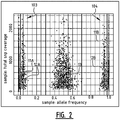
- the scatterplots illustrated in Figures 1 and 2 show data for a sample NP (non-pregnant female) and a sample P (pregnant female) for which allele presences for genetic markers for at least one chromosome, being different from the X-chromosome and the Y-chromosome, have been measured, wherein:
- variant data point 101 is shown on the left, and represents a genetic marker for which approximately 2300 reads were performed. All or nearly all reads for this genetic marker have measured the allele presence to indicate that REF alleles (i.e. A) are present, but not that ALT alleles are present (i.e. B). Therefore, variant data point 101 has been plotted on the left in Figure 1 , where the allele frequency is approximately 0, and likely represents a homozygous genetic marker AA.
- Variant data point 102 is shown on the right, and represents a genetic marker for which approximately 2300 reads were performed.
- variant data point 102 has been plotted on the right in Figure 1 , where the allele frequency is approximately 1, and likely represents a homozygous genetic marker BB.
- variant data point 103 represents a genetic marker for which approximately 2300 reads were performed.
- the measured allele presences allow one to calculate the allele frequency, which is relatively low, but non-zero. Therefore, variant data point 103 likely represents a genetic marker that is maternally homozygous for the reference allele pair but has a heterozygous allele pair of foetal origin (thus AAab), since the fraction of maternal DNA present in the sample for the genetic marker is (much) greater than the fraction of foetal DNA present in the sample for the genetic marker.
- Variant data point 104 is shown on the right, and represents a genetic marker for which approximately 2100 reads were performed.
- variant data point 104 likely represents a genetic marker that is maternally homozygous for the alternative allele pair but has a heterozygous allele pair of foetal origin (thus BBab).
- thus BBab a heterozygous allele pair of foetal origin
- 103 and 104 likely represent a marker that is homozygous in the maternal DNA and heterozygous in the foetal DNA is only made to assist the understanding of the figures.
- Exemplary embodiments of the invention do not rely on such an assessment, as genetic markers represented by 103 and 104 are only labelled as non-homozygous.
- variant data point 105 represents a genetic marker for which approximately 2300 reads were performed. The measured allele presences allow one to calculate the allele frequency, which is found to be approximately 0.5. Therefore, variant data point 105 likely represents a genetic marker that is heterozygous (thus AB).
- multiple variant data points may have the same (or very nearly the same) allele frequency, especially when they are part of the same group. This means that (very nearly) the same number of allele presences has been measured for them, relatively to the total number of reads.
- variant data points with a higher total read coverage generally have a more accurate allele frequency, simply since there are more measurement data. This property may be taken into account when determining a statistical reliability for a given variant data point. More in particular, in an exemplary embodiment, the accuracy of the method may be improved by restricting the set of amplicons based on the total coverage C Ti . This may include requiring a minimal total coverage and/or a maximum total coverage, removing a fraction of the total number of amplicons with the highest and/or the lowest total coverage. The reason is that amplicons with a higher total coverage have a more accurate allele frequency, because there are more measurement data. However, amplicons with a total coverage that is much higher than that of the average in the set have a disproportionate influence on the determination of the homozygous fraction.
- F ho D ho / D .
- the value F ho is expected to be larger for samples of non-pregnant women than for samples of pregnant women. The reason is that the presence of foetal DNA will move a fraction of amplicons away from the purely homozygous state, because of the presence of an SNP introduced by the father's DNA. This deviation is measured without actual detection of paternal SNPs.
- an empirical threshold value F T distinguishing between non-pregnant and pregnant condition, by optimizing the discrimination using reference data with a known pregnancy condition.
- the calculations above are repeated for samples with a given known pregnancy state to establish a threshold value F T .
- the estimating may then be performed as follows:
- sample NP is classified as non-pregnant and sample P is classified as pregnant.
- F ho for a sample is not only influenced by the pregnancy state, but also by the overall level of heterozygosity of the female's DNA, which in turn depends on the ethnicity of the individual. This can be corrected for using the following approach:
- the accuracy may be improved by making F T dependent on the overall level of heterozygosity of the female's DNA, estimated by F he .
- This relation F T (F he ) may be optimized using the reference data for pregnant and non-pregnant female samples.
- the pregnancy estimating may then be performed as follows:
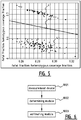
- the values of the heterozygous fraction F he may be used to estimate a threshold value F T (F he ), see line 50 in Figure 5 .
- Samples with a lower overall level of heterozygosity will tend to have a higher value F T (F he ) and vice versa.
- a threshold F T (F he ) may improve the reliability of the method.
- an empirical threshold F T (F he ) 0,86 - 0.75 ⁇ F he can be established. This threshold F T (F he ) is shown in Figure 5 , see line 50.
- Figure 6 illustrates an embodiment of a system of the invention for estimating whether or not a female is pregnant.
- the system comprises a measurement device 1001, a determining module 1002, and an estimating module 1003.
- the measurement device 1001 is configured for measuring allele presences (D) for a plurality of genetic markers of at least one chromosome, different from the X and Y chromosome, in a sample of cell-free DNA from a potentially pregnant female; each allele presence representing the presence at a genetic marker of at least one of: a reference allele of maternal or foetal origin, and an alternative allele of maternal or foetal origin.
- D allele presences
- the determining module 1002 is configured for determining, based on said measured allele presences, a homozygous fraction (F ho ) thereof which is associated with purely homozygous genetic markers.
- the estimating module 103 is configured for estimating whether or not the female is pregnant, based on said determined fraction. The estimating may be done according to any one of the above described exemplary embodiments.
- program storage devices e.g., digital data storage media, which are machine or computer readable and encode machine-executable or computer-executable programs of instructions, wherein said instructions perform some or all of the steps of said above-described methods.
- the program storage devices may be, e.g., digital memories, magnetic storage media such as a magnetic disks and magnetic tapes, hard drives, or optically readable digital data storage media.
- the embodiments are also intended to cover computers programmed to perform said steps of the above-described methods.
- module may be provided through the use of dedicated hardware as well as hardware capable of executing software in association with appropriate software.
- the functions may be provided by a single dedicated processor, by a single shared processor, or by a plurality of individual processors, some of which may be shared.
- explicit use of the term "module” should not be construed to refer exclusively to hardware capable of executing software, and may implicitly include, without limitation, digital signal processor (DSP) hardware, network processor, application specific integrated circuit (ASIC), field programmable gate array (FPGA), read only memory (ROM) for storing software, random access memory (RAM), and non volatile storage.
- DSP digital signal processor
- ASIC application specific integrated circuit
- FPGA field programmable gate array
- ROM read only memory
- RAM random access memory
- non volatile storage Other hardware, conventional and/or custom, may also be included.
Landscapes
- Health & Medical Sciences (AREA)
- Life Sciences & Earth Sciences (AREA)
- Engineering & Computer Science (AREA)
- Chemical & Material Sciences (AREA)
- Physics & Mathematics (AREA)
- Proteomics, Peptides & Aminoacids (AREA)
- General Health & Medical Sciences (AREA)
- Analytical Chemistry (AREA)
- Organic Chemistry (AREA)
- Molecular Biology (AREA)
- Bioinformatics & Cheminformatics (AREA)
- Biomedical Technology (AREA)
- Immunology (AREA)
- Biophysics (AREA)
- Biotechnology (AREA)
- Wood Science & Technology (AREA)
- Zoology (AREA)
- Genetics & Genomics (AREA)
- Biochemistry (AREA)
- Medical Informatics (AREA)
- Hematology (AREA)
- Microbiology (AREA)
- Pathology (AREA)
- Urology & Nephrology (AREA)
- General Engineering & Computer Science (AREA)
- Bioinformatics & Computational Biology (AREA)
- Evolutionary Biology (AREA)
- Theoretical Computer Science (AREA)
- Spectroscopy & Molecular Physics (AREA)
- Public Health (AREA)
- General Physics & Mathematics (AREA)
- Medicinal Chemistry (AREA)
- Cell Biology (AREA)
- Food Science & Technology (AREA)
- Epidemiology (AREA)
- Primary Health Care (AREA)
- Ecology (AREA)
- Gynecology & Obstetrics (AREA)
- Pregnancy & Childbirth (AREA)
- Reproductive Health (AREA)
Claims (15)
- Verfahren zum Abschätzen, ob eine Frau schwanger ist, wobei das Verfahren umfasst:- Messen von Allelvorkommen (D) für eine Mehrzahl von Genmarkern von mindestens einem Chromosom, das sich vom X- und Y-Chromosom unterscheidet, in einer Probe zellfreier DNA von einer potentiell schwangeren Frau; wobei jedes Allelvorkommen das Vorhandensein von einem Referenzallel mütterlichen oder fötalen Ursprungs und/ oder einem alternativen Allel mütterlichen oder fötalen Ursprungs an einem Genmarker darstellt;- auf der Grundlage der gemessenen Allelvorkommen, Bestimmen eines homozygoten Anteils (Fho) davon, der rein homozygoten genetischen Markern zugeordnet ist; und- Abschätzen, ob die Frau schwanger ist, auf der Grundlage dieses Anteils, wobei der homozygote Anteil bei Proben von nicht schwangeren Frauen größer ist als bei Proben von schwangeren Frauen.
- Verfahren nach Anspruch 1, bei dem das Bestimmen des homozygoten Anteils umfasst:- Berechnen, auf der Grundlage der gemessenen Allelvorkommen für die Mehrzahl der Genmarker, einer entsprechenden Anzahl von Allelhäufigkeiten für diese Mehrzahl;- Festlegen des Anteils der gemessenen Allelvorkommen, für die die Allelhäufigkeit innerhalb einer vorgegebenen Fehlerspanne 0 oder 1 ist, als den homozygoten Anteil.
- Verfahren nach Anspruch 1 oder 2, bei dem das Abschätzen umfasst:Abschätzen, dass die Frau schwanger ist, wenn der homozygote Anteil unter einem ersten vorgegebenen Wert liegt; undAbschätzen, dass die Frau nicht schwanger ist, wenn der homozygote Anteil über einem zweiten vorgegebenen Wert liegt, wobei der erste und der zweite vorgegebene Wert gleich sein können oder wobei der zweite vorgegebene Wert größer als der erste vorgegebene Wert sein kann.
- Verfahren nach einem der vorhergehenden Ansprüche, das ferner umfasst:- auf der Grundlage der gemessenen Allelvorkommen, Bestimmen eines heterozygoten Anteils (Fhe) davon, der heterozygoten genetischen Markern zugeordnet ist; und wobei das Abschätzen umfasst:- Abschätzen, dass die Frau schwanger ist, basierend auf dem homozygoten Anteil und dem heterozygoten Anteil.
- Verfahren nach Anspruch 4, das ferner umfasst:Berechnen eines Schwellenwerts als eine Funktion des heterozygoten Anteils;wobei das Abschätzen umfasst:Abschätzen, dass die Frau schwanger ist, wenn der homozygote Anteil unter dem berechneten Schwellenwert liegt; undAbschätzen, dass die Frau nicht schwanger ist, wenn der homozygote Anteil über dem berechneten Schwellenwert liegt.
- Verfahren nach Anspruch 3, bei dem der erste und zweite Schwellenwert ein konstanter Wert ist, der empirisch bestimmt wurde.
- Verfahren nach einem der vorhergehenden Ansprüche, bei dem:(i) das Bestimmen eines homozygoten Anteils (Fho), der den rein homozygoten genetischen Markern zugeordnet ist, umfasst:Berechnen, auf der Grundlage der gemessenen Allelvorkommen für die Mehrzahl von Genmarkern, einer entsprechenden Anzahl von Allelhäufigkeiten für die Mehrzahl von Genmarkern; und Bestimmen von Ablesewerten in Abhängigkeit von der Allelhäufigkeit für die Mehrzahl von Genmarkern;Auswählen eines Teils der Ablesewerte, vorzugsweise eines Teils, in dem die Ablesewerte mit den höchsten und/ oder den niedrigsten Werten entfernt sind; undBestimmen eines homozygoten Anteils (Fho) des ausgewählten Teils, der rein homozygoten genetischen Markern zugeordnet ist; und/ oder(ii) die Meß- und Bestimmungsschritte für eine Charge durchgeführt werden, die eine Mehrzahl von Proben der Frau umfasst; wobei für jede Probe der Charge der homozygote Anteil berechnet wird; und
bei dem das Abschätzen ferner auf dem homozygoten Anteil jeder Probe basiert; und/oder(iii) die Probe mütterliches Blut, Plasma, Urin, Liquor, Serum, Speichel oder transzervikale Spülflüssigkeit ist und/ oder(iv) der Messschritt mindestens eines der folgenden Verfahren umfasst: Polymerase-Kettenreaktion (PCR), Ligase-Kettenreaktion, Nukleinsäuresequenzbasierte Amplifikation (NASBA) und Verzweigte-DNA-Verfahren; und vorzugsweise PCR. - Verfahren nach einem der vorhergehenden Ansprüche, das ferner umfasst:(i) Vorbereiten der Probe in vitro; und/oder(ii) Mitteilen des Ergebnisses des Abschätzschritts an die Frau.
- System zum Abschätzen, ob eine Frau schwanger ist, wobei das System umfasst:- eine Messvorrichtung, die konfiguriert ist, um Allelpräsenzen (D) für eine Mehrzahl von Genmarkern von mindestens einem Chromosom, das sich vom X- und Y-Chromosom unterscheidet, in einer Probe zellfreier DNA von einer potentiell schwangeren Frau zu messen; wobei jedes Allelvorkommen das Vorhandensein von einem Referenzallel mütterlichen oder fötalen Ursprungs und/ oder einem alternativen Allel mütterlichen oder fötalen Ursprungs an einem Genmarker darstellt;- ein Bestimmungsmodul, das konfiguriert ist, um auf der Grundlage der gemessenen Allelvorkommen einen homozygoten Anteil (Fho) davon zu bestimmen, der rein homozygoten genetischen Markern zugeordnet ist;- ein Abschätzmodul, das konfiguriert ist, um auf der Grundlage dieses Anteils abzuschätzen, ob die Frau schwanger ist, wobei der homozygote Anteil bei Proben von nicht schwangeren Frauen größer ist als bei Proben von schwangeren Frauen.
- System nach Anspruch 9, bei dem das Bestimmungsmodul konfiguriert ist zum:- Berechnen einer entsprechenden Anzahl von Allelhäufigkeiten für die Mehrzahl von Genmarkern auf der Grundlage der gemessenen Allelvorkommen;- Festlegen des Anteils der gemessenen Allelvorkommen, für die die Allelfrequenz innerhalb einer vorgegebenen Fehlerspanne 0 oder 1 ist, als den homozygoten Anteil.
- System nach Anspruch 9 oder 10, bei dem:(i) das Abschätzungsmodul konfiguriert ist zum:Abschätzen, dass die Frau schwanger ist, wenn der homozygote Anteil unter einem ersten vorgegebenen Wert liegt; undAbschätzen, dass die Frau nicht schwanger ist, wenn der homozygote Anteil über einem zweiten vorgegebenen Wert liegt,wobei der erste und der zweite vorgegebene Wert derselbe sein können oderwobei der zweite vorgegebene Wert größer sein kann als der erste vorgegebene Wert; und/oder(ii) das Bestimmungsmodul ferner konfiguriert ist zum:Bestimmen, auf der Grundlage der gemessenen Allelvorkommen, eines heterozygoten Anteils (Fhe) davon, der heterozygoten Genmarkern zugeordnet ist; undwobei das Abschätzungsmodul ferner konfiguriert ist zum:- Abschätzen, ob die Frau schwanger ist, basierend auf dem homozygoten Anteil und dem heterozygoten Anteil.
- System nach Anspruch 11, bei dem das Bestimmungsmodul ferner konfiguriert ist zum:Berechnen eines Schwellenwerts als eine Funktion des heterozygoten Anteils;wobei das Abschätzungsmodul ferner konfiguriert ist zum:Abschätzen, dass die Frau schwanger ist, wenn der homozygote Anteil unter dem berechneten Schwellenwert liegt; undAbschätzen, dass die Frau nicht schwanger ist, wenn der homozygote Anteil über dem berechneten Schwellenwert liegt.
- System nach einem der Ansprüche 9-12, bei dem:(i) die Messvorrichtung und das Bestimmungsmodul konfiguriert sind, das Messen und Bestimmen für eine Charge durchzuführen, die eine Mehrzahl von Proben umfasst, wobei für jede Probe der Charge der homozygote Anteil berechnet wird; und
wobei das Abschätzungsmodul konfiguriert ist, um auf der Grundlage des homozygoten Anteils jeder Probe abzuschätzen, ob die Frau schwanger ist; und/ oder(ii) die Messvorrichtung konfiguriert ist, um Allelvorkommen unter Verwendung mindestens eines der folgenden Verfahren zu messen: Polymerase-Kettenreaktion (PCR), Ligase-Kettenreaktion, Nukleinsäuresequenz-basierte Amplifikation (NASBA) und Verzweigte-DNA-Verfahren, vorzugsweise PCR. - Computerprogramm, das computerausführbare Befehle umfasst, um, wenn das Programm auf einem Computer ausgeführt wird, mindestens den Schritt des Abschätzens aus dem Verfahren nach einem der Ansprüche 1-8 durchzuführen.
- Digitales Datenspeichermedium, das ein maschinenausführbares Programm mit Befehlen kodiert, um zumindest den Schritt des Abschätzens aus dem Verfahren nach einem der Ansprüche 1-8 durchzuführen.
Applications Claiming Priority (3)
| Application Number | Priority Date | Filing Date | Title |
|---|---|---|---|
| BE2015/5658A BE1022771B1 (nl) | 2015-10-14 | 2015-10-14 | Werkwijze en systeem om te bepalen of een vrouw zwanger is op basis van een bloedstaal |
| PCT/EP2016/066654 WO2017063769A1 (en) | 2015-10-14 | 2016-07-13 | Method and system for estimating whether a female is pregnant based on a blood sample |
| EP16738771.1A EP3362928B1 (de) | 2015-10-14 | 2016-07-13 | Verfahren und system auf basis einer blutprobe, ob eine schwangerschaft bei einer frau vorliegt |
Related Parent Applications (1)
| Application Number | Title | Priority Date | Filing Date |
|---|---|---|---|
| EP16738771.1A Division EP3362928B1 (de) | 2015-10-14 | 2016-07-13 | Verfahren und system auf basis einer blutprobe, ob eine schwangerschaft bei einer frau vorliegt |
Publications (2)
| Publication Number | Publication Date |
|---|---|
| EP3660170A1 EP3660170A1 (de) | 2020-06-03 |
| EP3660170B1 true EP3660170B1 (de) | 2021-12-01 |
Family
ID=55023809
Family Applications (2)
| Application Number | Title | Priority Date | Filing Date |
|---|---|---|---|
| EP19206636.3A Not-in-force EP3660170B1 (de) | 2015-10-14 | 2016-07-13 | Verfahren und system basierend auf einer blutprobe, ob eine schwangerschaft bei einer frau vorliegt |
| EP16738771.1A Active EP3362928B1 (de) | 2015-10-14 | 2016-07-13 | Verfahren und system auf basis einer blutprobe, ob eine schwangerschaft bei einer frau vorliegt |
Family Applications After (1)
| Application Number | Title | Priority Date | Filing Date |
|---|---|---|---|
| EP16738771.1A Active EP3362928B1 (de) | 2015-10-14 | 2016-07-13 | Verfahren und system auf basis einer blutprobe, ob eine schwangerschaft bei einer frau vorliegt |
Country Status (5)
| Country | Link |
|---|---|
| US (2) | US11053546B2 (de) |
| EP (2) | EP3660170B1 (de) |
| BE (1) | BE1022771B1 (de) |
| ES (1) | ES2761633T3 (de) |
| WO (1) | WO2017063769A1 (de) |
Families Citing this family (5)
| Publication number | Priority date | Publication date | Assignee | Title |
|---|---|---|---|---|
| EP3039477B1 (de) | 2013-08-26 | 2021-10-20 | S.D. Sight Diagnostics Ltd. | Digitale mikroskopiesysteme, verfahren und computerprogrammprodukte |
| WO2020051542A2 (en) * | 2018-09-07 | 2020-03-12 | Illumina, Inc. | A method to determine if a circulating fetal cell isolated from a pregnant mother is from either the current or a historical pregnancy |
| MX2022004703A (es) * | 2019-10-22 | 2022-05-11 | S D Sight Diagnostics Ltd | Contabilidad de errores en mediciones opticas. |
| EP4073492A1 (de) | 2019-12-12 | 2022-10-19 | S.D. Sight Diagnostics Ltd. | Analyse eines analyten in einem medium |
| BR112022011233A2 (pt) | 2019-12-12 | 2022-08-30 | S D Sight Diagnostics Ltd | Detecção de plaquetas em uma amostra sanguínea |
Family Cites Families (6)
| Publication number | Priority date | Publication date | Assignee | Title |
|---|---|---|---|---|
| CA2894337C (en) * | 2005-03-18 | 2018-08-28 | The Chinese University Of Hong Kong | Markers for prenatal diagnosis of trisomy 18 |
| IL201759A (en) * | 2007-05-01 | 2013-04-30 | Tel Hashomer Medical Res Infrastructure & Services Ltd | A method of detecting fetal cells in the mother's blood |
| EP3456844B1 (de) * | 2011-04-12 | 2020-06-10 | Verinata Health, Inc. | Auflösung von genomfraktionen anhand von polymorphismenzählungen |
| WO2013057568A1 (en) | 2011-10-18 | 2013-04-25 | Multiplicom Nv | Fetal chromosomal aneuploidy diagnosis |
| US20150004601A1 (en) * | 2013-06-28 | 2015-01-01 | Ariosa Diagnostics, Inc. | Massively parallel sequencing of random dna fragments for determination of fetal fraction |
| KR101519416B1 (ko) * | 2013-09-17 | 2015-05-12 | 의료법인 제일의료재단 | 태아 특이적 후성학적 메틸화 마커 검출용 조성물 및 검출방법 |
-
2015
- 2015-10-14 BE BE2015/5658A patent/BE1022771B1/nl not_active IP Right Cessation
-
2016
- 2016-07-13 WO PCT/EP2016/066654 patent/WO2017063769A1/en not_active Ceased
- 2016-07-13 ES ES16738771T patent/ES2761633T3/es active Active
- 2016-07-13 EP EP19206636.3A patent/EP3660170B1/de not_active Not-in-force
- 2016-07-13 US US15/737,105 patent/US11053546B2/en not_active Expired - Fee Related
- 2016-07-13 EP EP16738771.1A patent/EP3362928B1/de active Active
-
2021
- 2021-06-11 US US17/345,853 patent/US20210301343A1/en not_active Abandoned
Also Published As
| Publication number | Publication date |
|---|---|
| EP3362928A1 (de) | 2018-08-22 |
| US20180171404A1 (en) | 2018-06-21 |
| EP3660170A1 (de) | 2020-06-03 |
| EP3362928B1 (de) | 2019-11-27 |
| US20210301343A1 (en) | 2021-09-30 |
| WO2017063769A1 (en) | 2017-04-20 |
| US11053546B2 (en) | 2021-07-06 |
| BE1022771B1 (nl) | 2016-08-31 |
| ES2761633T3 (es) | 2020-05-20 |
Similar Documents
| Publication | Publication Date | Title |
|---|---|---|
| US20210301343A1 (en) | Method and system for estimating whether a female is pregnant based on a blood sample | |
| AU2019204917B2 (en) | Size-based analysis of fetal dna fraction in maternal plasma | |
| TWI767888B (zh) | 藉由母體血漿dna之淺深度測序以準確定量胎兒dna含量 | |
| Tsui et al. | Recent advances in the analysis of fetal nucleic acids in maternal plasma | |
| Brewer et al. | The value of parental testing by next-generation sequencing includes the detection of germline mosaicism | |
| KR20250111289A (ko) | 2종 이상의 검사를 실시할 수 있는 유전학적 분석 방법 | |
| US10106836B2 (en) | Determining fetal genomes for multiple fetus pregnancies | |
| Ellison et al. | Using targeted sequencing of Paralogous sequences for noninvasive detection of selected fetal aneuploidies | |
| EP3326094B1 (de) | Verfahren und system zur schätzung des geschlechts eines fetus einer schwangeren frau | |
| EP2977466B1 (de) | Nachweis chromosomaler aneuploidie | |
| BE1023274A9 (nl) | Schattingswerkwijze en -systeem voor het schatten van een foetale fractie | |
| CA3288338A1 (en) | Genetic analysis method capable of performing two or more types of tests | |
| Han et al. | Non‐invasive prenatal testing of monogenic fetal characteristics by maternal plasma DNA analysis | |
| HK40084570B (en) | Size-based analysis of fetal dna fraction in maternal plasma | |
| HK1200194B (en) | Size-based analysis of fetal dna fraction in maternal plasma |
Legal Events
| Date | Code | Title | Description |
|---|---|---|---|
| PUAI | Public reference made under article 153(3) epc to a published international application that has entered the european phase |
Free format text: ORIGINAL CODE: 0009012 |
|
| STAA | Information on the status of an ep patent application or granted ep patent |
Free format text: STATUS: THE APPLICATION HAS BEEN PUBLISHED |
|
| AC | Divisional application: reference to earlier application |
Ref document number: 3362928 Country of ref document: EP Kind code of ref document: P |
|
| AK | Designated contracting states |
Kind code of ref document: A1 Designated state(s): AL AT BE BG CH CY CZ DE DK EE ES FI FR GB GR HR HU IE IS IT LI LT LU LV MC MK MT NL NO PL PT RO RS SE SI SK SM TR |
|
| STAA | Information on the status of an ep patent application or granted ep patent |
Free format text: STATUS: REQUEST FOR EXAMINATION WAS MADE |
|
| 17P | Request for examination filed |
Effective date: 20201202 |
|
| RBV | Designated contracting states (corrected) |
Designated state(s): AL AT BE BG CH CY CZ DE DK EE ES FI FR GB GR HR HU IE IS IT LI LT LU LV MC MK MT NL NO PL PT RO RS SE SI SK SM TR |
|
| GRAP | Despatch of communication of intention to grant a patent |
Free format text: ORIGINAL CODE: EPIDOSNIGR1 |
|
| STAA | Information on the status of an ep patent application or granted ep patent |
Free format text: STATUS: GRANT OF PATENT IS INTENDED |
|
| INTG | Intention to grant announced |
Effective date: 20210630 |
|
| RAP1 | Party data changed (applicant data changed or rights of an application transferred) |
Owner name: AGILENT TECHNOLOGIES, INC. |
|
| GRAS | Grant fee paid |
Free format text: ORIGINAL CODE: EPIDOSNIGR3 |
|
| GRAA | (expected) grant |
Free format text: ORIGINAL CODE: 0009210 |
|
| STAA | Information on the status of an ep patent application or granted ep patent |
Free format text: STATUS: THE PATENT HAS BEEN GRANTED |
|
| AC | Divisional application: reference to earlier application |
Ref document number: 3362928 Country of ref document: EP Kind code of ref document: P |
|
| AK | Designated contracting states |
Kind code of ref document: B1 Designated state(s): AL AT BE BG CH CY CZ DE DK EE ES FI FR GB GR HR HU IE IS IT LI LT LU LV MC MK MT NL NO PL PT RO RS SE SI SK SM TR |
|
| REG | Reference to a national code |
Ref country code: GB Ref legal event code: FG4D |
|
| REG | Reference to a national code |
Ref country code: AT Ref legal event code: REF Ref document number: 1451806 Country of ref document: AT Kind code of ref document: T Effective date: 20211215 Ref country code: CH Ref legal event code: EP |
|
| REG | Reference to a national code |
Ref country code: IE Ref legal event code: FG4D |
|
| REG | Reference to a national code |
Ref country code: DE Ref legal event code: R096 Ref document number: 602016067046 Country of ref document: DE |
|
| REG | Reference to a national code |
Ref country code: LT Ref legal event code: MG9D |
|
| REG | Reference to a national code |
Ref country code: NL Ref legal event code: MP Effective date: 20211201 |
|
| REG | Reference to a national code |
Ref country code: AT Ref legal event code: MK05 Ref document number: 1451806 Country of ref document: AT Kind code of ref document: T Effective date: 20211201 |
|
| PG25 | Lapsed in a contracting state [announced via postgrant information from national office to epo] |
Ref country code: RS Free format text: LAPSE BECAUSE OF FAILURE TO SUBMIT A TRANSLATION OF THE DESCRIPTION OR TO PAY THE FEE WITHIN THE PRESCRIBED TIME-LIMIT Effective date: 20211201 Ref country code: LT Free format text: LAPSE BECAUSE OF FAILURE TO SUBMIT A TRANSLATION OF THE DESCRIPTION OR TO PAY THE FEE WITHIN THE PRESCRIBED TIME-LIMIT Effective date: 20211201 Ref country code: FI Free format text: LAPSE BECAUSE OF FAILURE TO SUBMIT A TRANSLATION OF THE DESCRIPTION OR TO PAY THE FEE WITHIN THE PRESCRIBED TIME-LIMIT Effective date: 20211201 Ref country code: BG Free format text: LAPSE BECAUSE OF FAILURE TO SUBMIT A TRANSLATION OF THE DESCRIPTION OR TO PAY THE FEE WITHIN THE PRESCRIBED TIME-LIMIT Effective date: 20220301 Ref country code: AT Free format text: LAPSE BECAUSE OF FAILURE TO SUBMIT A TRANSLATION OF THE DESCRIPTION OR TO PAY THE FEE WITHIN THE PRESCRIBED TIME-LIMIT Effective date: 20211201 |
|
| PG25 | Lapsed in a contracting state [announced via postgrant information from national office to epo] |
Ref country code: SE Free format text: LAPSE BECAUSE OF FAILURE TO SUBMIT A TRANSLATION OF THE DESCRIPTION OR TO PAY THE FEE WITHIN THE PRESCRIBED TIME-LIMIT Effective date: 20211201 Ref country code: PL Free format text: LAPSE BECAUSE OF FAILURE TO SUBMIT A TRANSLATION OF THE DESCRIPTION OR TO PAY THE FEE WITHIN THE PRESCRIBED TIME-LIMIT Effective date: 20211201 Ref country code: NO Free format text: LAPSE BECAUSE OF FAILURE TO SUBMIT A TRANSLATION OF THE DESCRIPTION OR TO PAY THE FEE WITHIN THE PRESCRIBED TIME-LIMIT Effective date: 20220301 Ref country code: LV Free format text: LAPSE BECAUSE OF FAILURE TO SUBMIT A TRANSLATION OF THE DESCRIPTION OR TO PAY THE FEE WITHIN THE PRESCRIBED TIME-LIMIT Effective date: 20211201 Ref country code: HR Free format text: LAPSE BECAUSE OF FAILURE TO SUBMIT A TRANSLATION OF THE DESCRIPTION OR TO PAY THE FEE WITHIN THE PRESCRIBED TIME-LIMIT Effective date: 20211201 Ref country code: GR Free format text: LAPSE BECAUSE OF FAILURE TO SUBMIT A TRANSLATION OF THE DESCRIPTION OR TO PAY THE FEE WITHIN THE PRESCRIBED TIME-LIMIT Effective date: 20220302 Ref country code: ES Free format text: LAPSE BECAUSE OF FAILURE TO SUBMIT A TRANSLATION OF THE DESCRIPTION OR TO PAY THE FEE WITHIN THE PRESCRIBED TIME-LIMIT Effective date: 20211201 |
|
| PG25 | Lapsed in a contracting state [announced via postgrant information from national office to epo] |
Ref country code: NL Free format text: LAPSE BECAUSE OF FAILURE TO SUBMIT A TRANSLATION OF THE DESCRIPTION OR TO PAY THE FEE WITHIN THE PRESCRIBED TIME-LIMIT Effective date: 20211201 |
|
| PG25 | Lapsed in a contracting state [announced via postgrant information from national office to epo] |
Ref country code: SM Free format text: LAPSE BECAUSE OF FAILURE TO SUBMIT A TRANSLATION OF THE DESCRIPTION OR TO PAY THE FEE WITHIN THE PRESCRIBED TIME-LIMIT Effective date: 20211201 Ref country code: SK Free format text: LAPSE BECAUSE OF FAILURE TO SUBMIT A TRANSLATION OF THE DESCRIPTION OR TO PAY THE FEE WITHIN THE PRESCRIBED TIME-LIMIT Effective date: 20211201 Ref country code: RO Free format text: LAPSE BECAUSE OF FAILURE TO SUBMIT A TRANSLATION OF THE DESCRIPTION OR TO PAY THE FEE WITHIN THE PRESCRIBED TIME-LIMIT Effective date: 20211201 Ref country code: PT Free format text: LAPSE BECAUSE OF FAILURE TO SUBMIT A TRANSLATION OF THE DESCRIPTION OR TO PAY THE FEE WITHIN THE PRESCRIBED TIME-LIMIT Effective date: 20220401 Ref country code: EE Free format text: LAPSE BECAUSE OF FAILURE TO SUBMIT A TRANSLATION OF THE DESCRIPTION OR TO PAY THE FEE WITHIN THE PRESCRIBED TIME-LIMIT Effective date: 20211201 Ref country code: CZ Free format text: LAPSE BECAUSE OF FAILURE TO SUBMIT A TRANSLATION OF THE DESCRIPTION OR TO PAY THE FEE WITHIN THE PRESCRIBED TIME-LIMIT Effective date: 20211201 |
|
| REG | Reference to a national code |
Ref country code: DE Ref legal event code: R097 Ref document number: 602016067046 Country of ref document: DE |
|
| PG25 | Lapsed in a contracting state [announced via postgrant information from national office to epo] |
Ref country code: IS Free format text: LAPSE BECAUSE OF FAILURE TO SUBMIT A TRANSLATION OF THE DESCRIPTION OR TO PAY THE FEE WITHIN THE PRESCRIBED TIME-LIMIT Effective date: 20220401 |
|
| PLBE | No opposition filed within time limit |
Free format text: ORIGINAL CODE: 0009261 |
|
| STAA | Information on the status of an ep patent application or granted ep patent |
Free format text: STATUS: NO OPPOSITION FILED WITHIN TIME LIMIT |
|
| PG25 | Lapsed in a contracting state [announced via postgrant information from national office to epo] |
Ref country code: DK Free format text: LAPSE BECAUSE OF FAILURE TO SUBMIT A TRANSLATION OF THE DESCRIPTION OR TO PAY THE FEE WITHIN THE PRESCRIBED TIME-LIMIT Effective date: 20211201 Ref country code: AL Free format text: LAPSE BECAUSE OF FAILURE TO SUBMIT A TRANSLATION OF THE DESCRIPTION OR TO PAY THE FEE WITHIN THE PRESCRIBED TIME-LIMIT Effective date: 20211201 |
|
| 26N | No opposition filed |
Effective date: 20220902 |
|
| PG25 | Lapsed in a contracting state [announced via postgrant information from national office to epo] |
Ref country code: SI Free format text: LAPSE BECAUSE OF FAILURE TO SUBMIT A TRANSLATION OF THE DESCRIPTION OR TO PAY THE FEE WITHIN THE PRESCRIBED TIME-LIMIT Effective date: 20211201 |
|
| PG25 | Lapsed in a contracting state [announced via postgrant information from national office to epo] |
Ref country code: MC Free format text: LAPSE BECAUSE OF FAILURE TO SUBMIT A TRANSLATION OF THE DESCRIPTION OR TO PAY THE FEE WITHIN THE PRESCRIBED TIME-LIMIT Effective date: 20211201 |
|
| REG | Reference to a national code |
Ref country code: CH Ref legal event code: PL |
|
| REG | Reference to a national code |
Ref country code: BE Ref legal event code: MM Effective date: 20220731 |
|
| PG25 | Lapsed in a contracting state [announced via postgrant information from national office to epo] |
Ref country code: LU Free format text: LAPSE BECAUSE OF NON-PAYMENT OF DUE FEES Effective date: 20220713 Ref country code: LI Free format text: LAPSE BECAUSE OF NON-PAYMENT OF DUE FEES Effective date: 20220731 Ref country code: CH Free format text: LAPSE BECAUSE OF NON-PAYMENT OF DUE FEES Effective date: 20220731 |
|
| PG25 | Lapsed in a contracting state [announced via postgrant information from national office to epo] |
Ref country code: IT Free format text: LAPSE BECAUSE OF FAILURE TO SUBMIT A TRANSLATION OF THE DESCRIPTION OR TO PAY THE FEE WITHIN THE PRESCRIBED TIME-LIMIT Effective date: 20211201 Ref country code: BE Free format text: LAPSE BECAUSE OF NON-PAYMENT OF DUE FEES Effective date: 20220731 |
|
| P01 | Opt-out of the competence of the unified patent court (upc) registered |
Effective date: 20230527 |
|
| PG25 | Lapsed in a contracting state [announced via postgrant information from national office to epo] |
Ref country code: IE Free format text: LAPSE BECAUSE OF NON-PAYMENT OF DUE FEES Effective date: 20220713 |
|
| PGFP | Annual fee paid to national office [announced via postgrant information from national office to epo] |
Ref country code: FR Payment date: 20230620 Year of fee payment: 8 |
|
| PGFP | Annual fee paid to national office [announced via postgrant information from national office to epo] |
Ref country code: GB Payment date: 20230601 Year of fee payment: 8 |
|
| PGFP | Annual fee paid to national office [announced via postgrant information from national office to epo] |
Ref country code: DE Payment date: 20230531 Year of fee payment: 8 |
|
| PG25 | Lapsed in a contracting state [announced via postgrant information from national office to epo] |
Ref country code: MK Free format text: LAPSE BECAUSE OF FAILURE TO SUBMIT A TRANSLATION OF THE DESCRIPTION OR TO PAY THE FEE WITHIN THE PRESCRIBED TIME-LIMIT Effective date: 20211201 Ref country code: CY Free format text: LAPSE BECAUSE OF FAILURE TO SUBMIT A TRANSLATION OF THE DESCRIPTION OR TO PAY THE FEE WITHIN THE PRESCRIBED TIME-LIMIT Effective date: 20211201 |
|
| PG25 | Lapsed in a contracting state [announced via postgrant information from national office to epo] |
Ref country code: HU Free format text: LAPSE BECAUSE OF FAILURE TO SUBMIT A TRANSLATION OF THE DESCRIPTION OR TO PAY THE FEE WITHIN THE PRESCRIBED TIME-LIMIT; INVALID AB INITIO Effective date: 20160713 |
|
| PG25 | Lapsed in a contracting state [announced via postgrant information from national office to epo] |
Ref country code: TR Free format text: LAPSE BECAUSE OF FAILURE TO SUBMIT A TRANSLATION OF THE DESCRIPTION OR TO PAY THE FEE WITHIN THE PRESCRIBED TIME-LIMIT Effective date: 20211201 |
|
| PG25 | Lapsed in a contracting state [announced via postgrant information from national office to epo] |
Ref country code: MT Free format text: LAPSE BECAUSE OF FAILURE TO SUBMIT A TRANSLATION OF THE DESCRIPTION OR TO PAY THE FEE WITHIN THE PRESCRIBED TIME-LIMIT Effective date: 20211201 |
|
| REG | Reference to a national code |
Ref country code: DE Ref legal event code: R119 Ref document number: 602016067046 Country of ref document: DE |
|
| GBPC | Gb: european patent ceased through non-payment of renewal fee |
Effective date: 20240713 |
|
| PG25 | Lapsed in a contracting state [announced via postgrant information from national office to epo] |
Ref country code: DE Free format text: LAPSE BECAUSE OF NON-PAYMENT OF DUE FEES Effective date: 20250201 |
|
| PG25 | Lapsed in a contracting state [announced via postgrant information from national office to epo] |
Ref country code: FR Free format text: LAPSE BECAUSE OF NON-PAYMENT OF DUE FEES Effective date: 20240731 |
|
| PG25 | Lapsed in a contracting state [announced via postgrant information from national office to epo] |
Ref country code: GB Free format text: LAPSE BECAUSE OF NON-PAYMENT OF DUE FEES Effective date: 20240713 |