EP3653674A1 - Process for manufacturing omniphobic cosmetic pigments - Google Patents
Process for manufacturing omniphobic cosmetic pigments Download PDFInfo
- Publication number
- EP3653674A1 EP3653674A1 EP18306498.9A EP18306498A EP3653674A1 EP 3653674 A1 EP3653674 A1 EP 3653674A1 EP 18306498 A EP18306498 A EP 18306498A EP 3653674 A1 EP3653674 A1 EP 3653674A1
- Authority
- EP
- European Patent Office
- Prior art keywords
- glucosamine
- poly
- cosmetic
- particles
- metal oxide
- Prior art date
- Legal status (The legal status is an assumption and is not a legal conclusion. Google has not performed a legal analysis and makes no representation as to the accuracy of the status listed.)
- Pending
Links
- 238000000034 method Methods 0.000 title claims abstract description 78
- 239000000049 pigment Substances 0.000 title claims abstract description 70
- 239000002537 cosmetic Substances 0.000 title claims abstract description 65
- 238000004519 manufacturing process Methods 0.000 title claims abstract description 9
- 239000002245 particle Substances 0.000 claims abstract description 108
- 150000004706 metal oxides Chemical class 0.000 claims abstract description 39
- 229910044991 metal oxide Inorganic materials 0.000 claims abstract description 38
- 239000000243 solution Substances 0.000 claims abstract description 20
- 239000007864 aqueous solution Substances 0.000 claims abstract description 9
- 230000002378 acidificating effect Effects 0.000 claims abstract description 7
- 238000001556 precipitation Methods 0.000 claims abstract description 6
- 238000001179 sorption measurement Methods 0.000 claims abstract description 6
- 229920001661 Chitosan Polymers 0.000 claims description 54
- 239000000843 powder Substances 0.000 claims description 34
- 239000000203 mixture Substances 0.000 claims description 31
- QTBSBXVTEAMEQO-UHFFFAOYSA-N Acetic acid Chemical compound CC(O)=O QTBSBXVTEAMEQO-UHFFFAOYSA-N 0.000 claims description 22
- UQSXHKLRYXJYBZ-UHFFFAOYSA-N Iron oxide Chemical compound [Fe]=O UQSXHKLRYXJYBZ-UHFFFAOYSA-N 0.000 claims description 19
- GWEVSGVZZGPLCZ-UHFFFAOYSA-N Titan oxide Chemical compound O=[Ti]=O GWEVSGVZZGPLCZ-UHFFFAOYSA-N 0.000 claims description 17
- OGIDPMRJRNCKJF-UHFFFAOYSA-N titanium oxide Inorganic materials [Ti]=O OGIDPMRJRNCKJF-UHFFFAOYSA-N 0.000 claims description 12
- -1 mica Chemical compound 0.000 claims description 11
- 230000006196 deacetylation Effects 0.000 claims description 8
- 238000003381 deacetylation reaction Methods 0.000 claims description 8
- SZVJSHCCFOBDDC-UHFFFAOYSA-N iron(II,III) oxide Inorganic materials O=[Fe]O[Fe]O[Fe]=O SZVJSHCCFOBDDC-UHFFFAOYSA-N 0.000 claims description 7
- XLOMVQKBTHCTTD-UHFFFAOYSA-N Zinc monoxide Chemical compound [Zn]=O XLOMVQKBTHCTTD-UHFFFAOYSA-N 0.000 claims description 6
- 239000005995 Aluminium silicate Substances 0.000 claims description 4
- 239000002253 acid Substances 0.000 claims description 4
- 235000012211 aluminium silicate Nutrition 0.000 claims description 4
- 239000006071 cream Substances 0.000 claims description 4
- JEIPFZHSYJVQDO-UHFFFAOYSA-N iron(III) oxide Inorganic materials O=[Fe]O[Fe]=O JEIPFZHSYJVQDO-UHFFFAOYSA-N 0.000 claims description 4
- WGLPBDUCMAPZCE-UHFFFAOYSA-N Trioxochromium Chemical compound O=[Cr](=O)=O WGLPBDUCMAPZCE-UHFFFAOYSA-N 0.000 claims description 3
- 239000000443 aerosol Substances 0.000 claims description 3
- 229910000423 chromium oxide Inorganic materials 0.000 claims description 3
- VQWFNAGFNGABOH-UHFFFAOYSA-K chromium(iii) hydroxide Chemical compound [OH-].[OH-].[OH-].[Cr+3] VQWFNAGFNGABOH-UHFFFAOYSA-K 0.000 claims description 3
- WTFXARWRTYJXII-UHFFFAOYSA-N iron(2+);iron(3+);oxygen(2-) Chemical compound [O-2].[O-2].[O-2].[O-2].[Fe+2].[Fe+3].[Fe+3] WTFXARWRTYJXII-UHFFFAOYSA-N 0.000 claims description 3
- 239000006210 lotion Substances 0.000 claims description 3
- HCWCAKKEBCNQJP-UHFFFAOYSA-N magnesium orthosilicate Chemical compound [Mg+2].[Mg+2].[O-][Si]([O-])([O-])[O-] HCWCAKKEBCNQJP-UHFFFAOYSA-N 0.000 claims description 3
- 235000013336 milk Nutrition 0.000 claims description 3
- 239000008267 milk Substances 0.000 claims description 3
- 210000004080 milk Anatomy 0.000 claims description 3
- 150000007524 organic acids Chemical class 0.000 claims description 3
- RVTZCBVAJQQJTK-UHFFFAOYSA-N oxygen(2-);zirconium(4+) Chemical compound [O-2].[O-2].[Zr+4] RVTZCBVAJQQJTK-UHFFFAOYSA-N 0.000 claims description 3
- 239000002453 shampoo Substances 0.000 claims description 3
- 239000011787 zinc oxide Substances 0.000 claims description 3
- 229910001928 zirconium oxide Inorganic materials 0.000 claims description 3
- PZZYQPZGQPZBDN-UHFFFAOYSA-N aluminium silicate Chemical compound O=[Al]O[Si](=O)O[Al]=O PZZYQPZGQPZBDN-UHFFFAOYSA-N 0.000 claims description 2
- 229910000323 aluminium silicate Inorganic materials 0.000 claims description 2
- IRERQBUNZFJFGC-UHFFFAOYSA-L azure blue Chemical compound [Na+].[Na+].[Na+].[Na+].[Na+].[Na+].[Na+].[Na+].[Al+3].[Al+3].[Al+3].[Al+3].[Al+3].[Al+3].[S-]S[S-].[O-][Si]([O-])([O-])[O-].[O-][Si]([O-])([O-])[O-].[O-][Si]([O-])([O-])[O-].[O-][Si]([O-])([O-])[O-].[O-][Si]([O-])([O-])[O-].[O-][Si]([O-])([O-])[O-] IRERQBUNZFJFGC-UHFFFAOYSA-L 0.000 claims description 2
- 230000003796 beauty Effects 0.000 claims description 2
- 239000000378 calcium silicate Substances 0.000 claims description 2
- 229910052918 calcium silicate Inorganic materials 0.000 claims description 2
- 235000012241 calcium silicate Nutrition 0.000 claims description 2
- OYACROKNLOSFPA-UHFFFAOYSA-N calcium;dioxido(oxo)silane Chemical compound [Ca+2].[O-][Si]([O-])=O OYACROKNLOSFPA-UHFFFAOYSA-N 0.000 claims description 2
- 239000004927 clay Substances 0.000 claims description 2
- 229910052570 clay Inorganic materials 0.000 claims description 2
- 239000000839 emulsion Substances 0.000 claims description 2
- 239000006260 foam Substances 0.000 claims description 2
- NLYAJNPCOHFWQQ-UHFFFAOYSA-N kaolin Chemical compound O.O.O=[Al]O[Si](=O)O[Si](=O)O[Al]=O NLYAJNPCOHFWQQ-UHFFFAOYSA-N 0.000 claims description 2
- 239000000391 magnesium silicate Substances 0.000 claims description 2
- 229910052919 magnesium silicate Inorganic materials 0.000 claims description 2
- 235000019792 magnesium silicate Nutrition 0.000 claims description 2
- 239000010445 mica Substances 0.000 claims description 2
- 229910052618 mica group Inorganic materials 0.000 claims description 2
- 238000010419 pet care Methods 0.000 claims description 2
- 210000002966 serum Anatomy 0.000 claims description 2
- 150000004760 silicates Chemical class 0.000 claims description 2
- 239000000344 soap Substances 0.000 claims description 2
- 239000000454 talc Substances 0.000 claims description 2
- 229910052623 talc Inorganic materials 0.000 claims description 2
- 235000012222 talc Nutrition 0.000 claims description 2
- 239000011258 core-shell material Substances 0.000 abstract description 2
- XLYOFNOQVPJJNP-UHFFFAOYSA-N water Substances O XLYOFNOQVPJJNP-UHFFFAOYSA-N 0.000 description 22
- 210000003491 skin Anatomy 0.000 description 21
- 230000002209 hydrophobic effect Effects 0.000 description 15
- 150000001875 compounds Chemical class 0.000 description 13
- KWYUFKZDYYNOTN-UHFFFAOYSA-M Potassium hydroxide Chemical compound [OH-].[K+] KWYUFKZDYYNOTN-UHFFFAOYSA-M 0.000 description 12
- 229950006780 n-acetylglucosamine Drugs 0.000 description 10
- 235000013980 iron oxide Nutrition 0.000 description 7
- 235000011054 acetic acid Nutrition 0.000 description 6
- 229960000583 acetic acid Drugs 0.000 description 6
- 238000002474 experimental method Methods 0.000 description 6
- 229940100554 isononyl isononanoate Drugs 0.000 description 5
- 150000004676 glycans Chemical class 0.000 description 4
- 239000000463 material Substances 0.000 description 4
- 239000012071 phase Substances 0.000 description 4
- 229920001282 polysaccharide Polymers 0.000 description 4
- 239000005017 polysaccharide Substances 0.000 description 4
- 239000012429 reaction media Substances 0.000 description 4
- 210000002374 sebum Anatomy 0.000 description 4
- 239000007787 solid Substances 0.000 description 4
- 239000000126 substance Substances 0.000 description 4
- 210000004243 sweat Anatomy 0.000 description 4
- 229920002101 Chitin Polymers 0.000 description 3
- QVGXLLKOCUKJST-UHFFFAOYSA-N atomic oxygen Chemical compound [O] QVGXLLKOCUKJST-UHFFFAOYSA-N 0.000 description 3
- 239000003921 oil Substances 0.000 description 3
- 239000001301 oxygen Substances 0.000 description 3
- 229910052760 oxygen Inorganic materials 0.000 description 3
- 239000007848 Bronsted acid Substances 0.000 description 2
- FERIUCNNQQJTOY-UHFFFAOYSA-N Butyric acid Chemical compound CCCC(O)=O FERIUCNNQQJTOY-UHFFFAOYSA-N 0.000 description 2
- XMSXQFUHVRWGNA-UHFFFAOYSA-N Decamethylcyclopentasiloxane Chemical compound C[Si]1(C)O[Si](C)(C)O[Si](C)(C)O[Si](C)(C)O[Si](C)(C)O1 XMSXQFUHVRWGNA-UHFFFAOYSA-N 0.000 description 2
- BDAGIHXWWSANSR-UHFFFAOYSA-N Formic acid Chemical compound OC=O BDAGIHXWWSANSR-UHFFFAOYSA-N 0.000 description 2
- 206010061218 Inflammation Diseases 0.000 description 2
- 239000002841 Lewis acid Substances 0.000 description 2
- 208000026935 allergic disease Diseases 0.000 description 2
- 210000004207 dermis Anatomy 0.000 description 2
- 238000001035 drying Methods 0.000 description 2
- 238000002296 dynamic light scattering Methods 0.000 description 2
- 230000000694 effects Effects 0.000 description 2
- 210000002615 epidermis Anatomy 0.000 description 2
- 239000003349 gelling agent Substances 0.000 description 2
- 238000010438 heat treatment Methods 0.000 description 2
- MNWFXJYAOYHMED-UHFFFAOYSA-N heptanoic acid Chemical compound CCCCCCC(O)=O MNWFXJYAOYHMED-UHFFFAOYSA-N 0.000 description 2
- 230000004054 inflammatory process Effects 0.000 description 2
- 230000007794 irritation Effects 0.000 description 2
- 150000007517 lewis acids Chemical class 0.000 description 2
- 239000006193 liquid solution Substances 0.000 description 2
- 239000002609 medium Substances 0.000 description 2
- SNGREZUHAYWORS-UHFFFAOYSA-N perfluorooctanoic acid Chemical compound OC(=O)C(F)(F)C(F)(F)C(F)(F)C(F)(F)C(F)(F)C(F)(F)C(F)(F)F SNGREZUHAYWORS-UHFFFAOYSA-N 0.000 description 2
- 229920005604 random copolymer Polymers 0.000 description 2
- 239000010936 titanium Substances 0.000 description 2
- GQUJEMVIKWQAEH-UHFFFAOYSA-N titanium(III) oxide Chemical compound O=[Ti]O[Ti]=O GQUJEMVIKWQAEH-UHFFFAOYSA-N 0.000 description 2
- 230000001988 toxicity Effects 0.000 description 2
- 231100000419 toxicity Toxicity 0.000 description 2
- NQPDZGIKBAWPEJ-UHFFFAOYSA-N valeric acid Chemical compound CCCCC(O)=O NQPDZGIKBAWPEJ-UHFFFAOYSA-N 0.000 description 2
- 238000005406 washing Methods 0.000 description 2
- WWZKQHOCKIZLMA-UHFFFAOYSA-N Caprylic acid Natural products CCCCCCCC(O)=O WWZKQHOCKIZLMA-UHFFFAOYSA-N 0.000 description 1
- 229920000742 Cotton Polymers 0.000 description 1
- 238000004566 IR spectroscopy Methods 0.000 description 1
- XEEYBQQBJWHFJM-UHFFFAOYSA-N Iron Chemical group [Fe] XEEYBQQBJWHFJM-UHFFFAOYSA-N 0.000 description 1
- 241000124008 Mammalia Species 0.000 description 1
- 206010028980 Neoplasm Diseases 0.000 description 1
- 239000004902 Softening Agent Substances 0.000 description 1
- RTAQQCXQSZGOHL-UHFFFAOYSA-N Titanium Chemical compound [Ti] RTAQQCXQSZGOHL-UHFFFAOYSA-N 0.000 description 1
- 230000021736 acetylation Effects 0.000 description 1
- 238000006640 acetylation reaction Methods 0.000 description 1
- 239000004480 active ingredient Substances 0.000 description 1
- 239000002156 adsorbate Substances 0.000 description 1
- 239000003463 adsorbent Substances 0.000 description 1
- 125000000129 anionic group Chemical group 0.000 description 1
- 239000012736 aqueous medium Substances 0.000 description 1
- GONOPSZTUGRENK-UHFFFAOYSA-N benzyl(trichloro)silane Chemical compound Cl[Si](Cl)(Cl)CC1=CC=CC=C1 GONOPSZTUGRENK-UHFFFAOYSA-N 0.000 description 1
- MSWZFWKMSRAUBD-QZABAPFNSA-N beta-D-glucosamine Chemical group N[C@H]1[C@H](O)O[C@H](CO)[C@@H](O)[C@@H]1O MSWZFWKMSRAUBD-QZABAPFNSA-N 0.000 description 1
- 230000015572 biosynthetic process Effects 0.000 description 1
- 201000011510 cancer Diseases 0.000 description 1
- 150000001732 carboxylic acid derivatives Chemical class 0.000 description 1
- 125000002091 cationic group Chemical group 0.000 description 1
- 238000005119 centrifugation Methods 0.000 description 1
- 239000002738 chelating agent Substances 0.000 description 1
- 239000003795 chemical substances by application Substances 0.000 description 1
- 238000007705 chemical test Methods 0.000 description 1
- 230000001112 coagulating effect Effects 0.000 description 1
- 239000011248 coating agent Substances 0.000 description 1
- 238000000576 coating method Methods 0.000 description 1
- 239000003086 colorant Substances 0.000 description 1
- 238000004040 coloring Methods 0.000 description 1
- 239000008367 deionised water Substances 0.000 description 1
- 229910021641 deionized water Inorganic materials 0.000 description 1
- 239000003599 detergent Substances 0.000 description 1
- 238000011161 development Methods 0.000 description 1
- 235000014113 dietary fatty acids Nutrition 0.000 description 1
- XBDQKXXYIPTUBI-UHFFFAOYSA-N dimethylselenoniopropionate Natural products CCC(O)=O XBDQKXXYIPTUBI-UHFFFAOYSA-N 0.000 description 1
- 238000004090 dissolution Methods 0.000 description 1
- 239000000975 dye Substances 0.000 description 1
- 239000003995 emulsifying agent Substances 0.000 description 1
- 239000000194 fatty acid Substances 0.000 description 1
- 229930195729 fatty acid Natural products 0.000 description 1
- 150000004665 fatty acids Chemical class 0.000 description 1
- 239000004088 foaming agent Substances 0.000 description 1
- 235000019253 formic acid Nutrition 0.000 description 1
- 239000003205 fragrance Substances 0.000 description 1
- 239000007789 gas Substances 0.000 description 1
- 239000001257 hydrogen Substances 0.000 description 1
- 229910052739 hydrogen Inorganic materials 0.000 description 1
- 238000002329 infrared spectrum Methods 0.000 description 1
- 229910052500 inorganic mineral Inorganic materials 0.000 description 1
- 239000001023 inorganic pigment Substances 0.000 description 1
- 150000002500 ions Chemical class 0.000 description 1
- VBMVTYDPPZVILR-UHFFFAOYSA-N iron(2+);oxygen(2-) Chemical class [O-2].[Fe+2] VBMVTYDPPZVILR-UHFFFAOYSA-N 0.000 description 1
- 239000007788 liquid Substances 0.000 description 1
- 230000005923 long-lasting effect Effects 0.000 description 1
- QSHDDOUJBYECFT-UHFFFAOYSA-N mercury Chemical compound [Hg] QSHDDOUJBYECFT-UHFFFAOYSA-N 0.000 description 1
- 229910052753 mercury Inorganic materials 0.000 description 1
- 229910052751 metal Inorganic materials 0.000 description 1
- 239000002184 metal Substances 0.000 description 1
- 239000011707 mineral Substances 0.000 description 1
- 230000004048 modification Effects 0.000 description 1
- 238000012986 modification Methods 0.000 description 1
- DUWWHGPELOTTOE-UHFFFAOYSA-N n-(5-chloro-2,4-dimethoxyphenyl)-3-oxobutanamide Chemical compound COC1=CC(OC)=C(NC(=O)CC(C)=O)C=C1Cl DUWWHGPELOTTOE-UHFFFAOYSA-N 0.000 description 1
- FUZZWVXGSFPDMH-UHFFFAOYSA-N n-hexanoic acid Natural products CCCCCC(O)=O FUZZWVXGSFPDMH-UHFFFAOYSA-N 0.000 description 1
- 210000000056 organ Anatomy 0.000 description 1
- 150000002894 organic compounds Chemical class 0.000 description 1
- 239000003960 organic solvent Substances 0.000 description 1
- 239000011236 particulate material Substances 0.000 description 1
- 238000006116 polymerization reaction Methods 0.000 description 1
- 239000003755 preservative agent Substances 0.000 description 1
- 235000019260 propionic acid Nutrition 0.000 description 1
- 239000006104 solid solution Substances 0.000 description 1
- 239000002904 solvent Substances 0.000 description 1
- 239000003381 stabilizer Substances 0.000 description 1
- 230000000475 sunscreen effect Effects 0.000 description 1
- 239000000516 sunscreening agent Substances 0.000 description 1
- 239000004094 surface-active agent Substances 0.000 description 1
- 238000003786 synthesis reaction Methods 0.000 description 1
- 238000012360 testing method Methods 0.000 description 1
- 238000002411 thermogravimetry Methods 0.000 description 1
- 229910052719 titanium Inorganic materials 0.000 description 1
- 239000004408 titanium dioxide Substances 0.000 description 1
- 238000011200 topical administration Methods 0.000 description 1
- 231100000331 toxic Toxicity 0.000 description 1
- 230000002588 toxic effect Effects 0.000 description 1
- 239000000341 volatile oil Substances 0.000 description 1
Images

Classifications
-
- A—HUMAN NECESSITIES
- A61—MEDICAL OR VETERINARY SCIENCE; HYGIENE
- A61K—PREPARATIONS FOR MEDICAL, DENTAL OR TOILETRY PURPOSES
- A61K8/00—Cosmetics or similar toiletry preparations
- A61K8/02—Cosmetics or similar toiletry preparations characterised by special physical form
- A61K8/0241—Containing particulates characterized by their shape and/or structure
- A61K8/0245—Specific shapes or structures not provided for by any of the groups of A61K8/0241
-
- A—HUMAN NECESSITIES
- A61—MEDICAL OR VETERINARY SCIENCE; HYGIENE
- A61Q—SPECIFIC USE OF COSMETICS OR SIMILAR TOILETRY PREPARATIONS
- A61Q19/00—Preparations for care of the skin
-
- A—HUMAN NECESSITIES
- A61—MEDICAL OR VETERINARY SCIENCE; HYGIENE
- A61K—PREPARATIONS FOR MEDICAL, DENTAL OR TOILETRY PURPOSES
- A61K8/00—Cosmetics or similar toiletry preparations
- A61K8/18—Cosmetics or similar toiletry preparations characterised by the composition
- A61K8/19—Cosmetics or similar toiletry preparations characterised by the composition containing inorganic ingredients
-
- A—HUMAN NECESSITIES
- A61—MEDICAL OR VETERINARY SCIENCE; HYGIENE
- A61K—PREPARATIONS FOR MEDICAL, DENTAL OR TOILETRY PURPOSES
- A61K8/00—Cosmetics or similar toiletry preparations
- A61K8/18—Cosmetics or similar toiletry preparations characterised by the composition
- A61K8/19—Cosmetics or similar toiletry preparations characterised by the composition containing inorganic ingredients
- A61K8/26—Aluminium; Compounds thereof
-
- A—HUMAN NECESSITIES
- A61—MEDICAL OR VETERINARY SCIENCE; HYGIENE
- A61K—PREPARATIONS FOR MEDICAL, DENTAL OR TOILETRY PURPOSES
- A61K8/00—Cosmetics or similar toiletry preparations
- A61K8/18—Cosmetics or similar toiletry preparations characterised by the composition
- A61K8/19—Cosmetics or similar toiletry preparations characterised by the composition containing inorganic ingredients
- A61K8/27—Zinc; Compounds thereof
-
- A—HUMAN NECESSITIES
- A61—MEDICAL OR VETERINARY SCIENCE; HYGIENE
- A61K—PREPARATIONS FOR MEDICAL, DENTAL OR TOILETRY PURPOSES
- A61K8/00—Cosmetics or similar toiletry preparations
- A61K8/18—Cosmetics or similar toiletry preparations characterised by the composition
- A61K8/19—Cosmetics or similar toiletry preparations characterised by the composition containing inorganic ingredients
- A61K8/29—Titanium; Compounds thereof
-
- A—HUMAN NECESSITIES
- A61—MEDICAL OR VETERINARY SCIENCE; HYGIENE
- A61K—PREPARATIONS FOR MEDICAL, DENTAL OR TOILETRY PURPOSES
- A61K8/00—Cosmetics or similar toiletry preparations
- A61K8/18—Cosmetics or similar toiletry preparations characterised by the composition
- A61K8/30—Cosmetics or similar toiletry preparations characterised by the composition containing organic compounds
- A61K8/33—Cosmetics or similar toiletry preparations characterised by the composition containing organic compounds containing oxygen
- A61K8/36—Carboxylic acids; Salts or anhydrides thereof
-
- A—HUMAN NECESSITIES
- A61—MEDICAL OR VETERINARY SCIENCE; HYGIENE
- A61K—PREPARATIONS FOR MEDICAL, DENTAL OR TOILETRY PURPOSES
- A61K8/00—Cosmetics or similar toiletry preparations
- A61K8/18—Cosmetics or similar toiletry preparations characterised by the composition
- A61K8/72—Cosmetics or similar toiletry preparations characterised by the composition containing organic macromolecular compounds
- A61K8/73—Polysaccharides
- A61K8/736—Chitin; Chitosan; Derivatives thereof
-
- A—HUMAN NECESSITIES
- A61—MEDICAL OR VETERINARY SCIENCE; HYGIENE
- A61Q—SPECIFIC USE OF COSMETICS OR SIMILAR TOILETRY PREPARATIONS
- A61Q1/00—Make-up preparations; Body powders; Preparations for removing make-up
- A61Q1/02—Preparations containing skin colorants, e.g. pigments
-
- C—CHEMISTRY; METALLURGY
- C09—DYES; PAINTS; POLISHES; NATURAL RESINS; ADHESIVES; COMPOSITIONS NOT OTHERWISE PROVIDED FOR; APPLICATIONS OF MATERIALS NOT OTHERWISE PROVIDED FOR
- C09B—ORGANIC DYES OR CLOSELY-RELATED COMPOUNDS FOR PRODUCING DYES, e.g. PIGMENTS; MORDANTS; LAKES
- C09B67/00—Influencing the physical, e.g. the dyeing or printing properties of dyestuffs without chemical reactions, e.g. by treating with solvents grinding or grinding assistants, coating of pigments or dyes; Process features in the making of dyestuff preparations; Dyestuff preparations of a special physical nature, e.g. tablets, films
- C09B67/0097—Dye preparations of special physical nature; Tablets, films, extrusion, microcapsules, sheets, pads, bags with dyes
-
- C—CHEMISTRY; METALLURGY
- C09—DYES; PAINTS; POLISHES; NATURAL RESINS; ADHESIVES; COMPOSITIONS NOT OTHERWISE PROVIDED FOR; APPLICATIONS OF MATERIALS NOT OTHERWISE PROVIDED FOR
- C09C—TREATMENT OF INORGANIC MATERIALS, OTHER THAN FIBROUS FILLERS, TO ENHANCE THEIR PIGMENTING OR FILLING PROPERTIES ; PREPARATION OF CARBON BLACK ; PREPARATION OF INORGANIC MATERIALS WHICH ARE NO SINGLE CHEMICAL COMPOUNDS AND WHICH ARE MAINLY USED AS PIGMENTS OR FILLERS
- C09C1/00—Treatment of specific inorganic materials other than fibrous fillers; Preparation of carbon black
- C09C1/04—Compounds of zinc
- C09C1/043—Zinc oxide
-
- C—CHEMISTRY; METALLURGY
- C09—DYES; PAINTS; POLISHES; NATURAL RESINS; ADHESIVES; COMPOSITIONS NOT OTHERWISE PROVIDED FOR; APPLICATIONS OF MATERIALS NOT OTHERWISE PROVIDED FOR
- C09C—TREATMENT OF INORGANIC MATERIALS, OTHER THAN FIBROUS FILLERS, TO ENHANCE THEIR PIGMENTING OR FILLING PROPERTIES ; PREPARATION OF CARBON BLACK ; PREPARATION OF INORGANIC MATERIALS WHICH ARE NO SINGLE CHEMICAL COMPOUNDS AND WHICH ARE MAINLY USED AS PIGMENTS OR FILLERS
- C09C1/00—Treatment of specific inorganic materials other than fibrous fillers; Preparation of carbon black
- C09C1/22—Compounds of iron
- C09C1/24—Oxides of iron
-
- C—CHEMISTRY; METALLURGY
- C09—DYES; PAINTS; POLISHES; NATURAL RESINS; ADHESIVES; COMPOSITIONS NOT OTHERWISE PROVIDED FOR; APPLICATIONS OF MATERIALS NOT OTHERWISE PROVIDED FOR
- C09C—TREATMENT OF INORGANIC MATERIALS, OTHER THAN FIBROUS FILLERS, TO ENHANCE THEIR PIGMENTING OR FILLING PROPERTIES ; PREPARATION OF CARBON BLACK ; PREPARATION OF INORGANIC MATERIALS WHICH ARE NO SINGLE CHEMICAL COMPOUNDS AND WHICH ARE MAINLY USED AS PIGMENTS OR FILLERS
- C09C1/00—Treatment of specific inorganic materials other than fibrous fillers; Preparation of carbon black
- C09C1/28—Compounds of silicon
- C09C1/32—Ultramarine
-
- C—CHEMISTRY; METALLURGY
- C09—DYES; PAINTS; POLISHES; NATURAL RESINS; ADHESIVES; COMPOSITIONS NOT OTHERWISE PROVIDED FOR; APPLICATIONS OF MATERIALS NOT OTHERWISE PROVIDED FOR
- C09C—TREATMENT OF INORGANIC MATERIALS, OTHER THAN FIBROUS FILLERS, TO ENHANCE THEIR PIGMENTING OR FILLING PROPERTIES ; PREPARATION OF CARBON BLACK ; PREPARATION OF INORGANIC MATERIALS WHICH ARE NO SINGLE CHEMICAL COMPOUNDS AND WHICH ARE MAINLY USED AS PIGMENTS OR FILLERS
- C09C1/00—Treatment of specific inorganic materials other than fibrous fillers; Preparation of carbon black
- C09C1/34—Compounds of chromium
- C09C1/346—Chromium oxides
-
- C—CHEMISTRY; METALLURGY
- C09—DYES; PAINTS; POLISHES; NATURAL RESINS; ADHESIVES; COMPOSITIONS NOT OTHERWISE PROVIDED FOR; APPLICATIONS OF MATERIALS NOT OTHERWISE PROVIDED FOR
- C09C—TREATMENT OF INORGANIC MATERIALS, OTHER THAN FIBROUS FILLERS, TO ENHANCE THEIR PIGMENTING OR FILLING PROPERTIES ; PREPARATION OF CARBON BLACK ; PREPARATION OF INORGANIC MATERIALS WHICH ARE NO SINGLE CHEMICAL COMPOUNDS AND WHICH ARE MAINLY USED AS PIGMENTS OR FILLERS
- C09C1/00—Treatment of specific inorganic materials other than fibrous fillers; Preparation of carbon black
- C09C1/36—Compounds of titanium
- C09C1/3607—Titanium dioxide
- C09C1/3676—Treatment with macro-molecular organic compounds
-
- C—CHEMISTRY; METALLURGY
- C09—DYES; PAINTS; POLISHES; NATURAL RESINS; ADHESIVES; COMPOSITIONS NOT OTHERWISE PROVIDED FOR; APPLICATIONS OF MATERIALS NOT OTHERWISE PROVIDED FOR
- C09C—TREATMENT OF INORGANIC MATERIALS, OTHER THAN FIBROUS FILLERS, TO ENHANCE THEIR PIGMENTING OR FILLING PROPERTIES ; PREPARATION OF CARBON BLACK ; PREPARATION OF INORGANIC MATERIALS WHICH ARE NO SINGLE CHEMICAL COMPOUNDS AND WHICH ARE MAINLY USED AS PIGMENTS OR FILLERS
- C09C1/00—Treatment of specific inorganic materials other than fibrous fillers; Preparation of carbon black
- C09C1/40—Compounds of aluminium
- C09C1/405—Compounds of aluminium containing combined silica, e.g. mica
-
- C—CHEMISTRY; METALLURGY
- C09—DYES; PAINTS; POLISHES; NATURAL RESINS; ADHESIVES; COMPOSITIONS NOT OTHERWISE PROVIDED FOR; APPLICATIONS OF MATERIALS NOT OTHERWISE PROVIDED FOR
- C09C—TREATMENT OF INORGANIC MATERIALS, OTHER THAN FIBROUS FILLERS, TO ENHANCE THEIR PIGMENTING OR FILLING PROPERTIES ; PREPARATION OF CARBON BLACK ; PREPARATION OF INORGANIC MATERIALS WHICH ARE NO SINGLE CHEMICAL COMPOUNDS AND WHICH ARE MAINLY USED AS PIGMENTS OR FILLERS
- C09C1/00—Treatment of specific inorganic materials other than fibrous fillers; Preparation of carbon black
- C09C1/40—Compounds of aluminium
- C09C1/407—Aluminium oxides or hydroxides
-
- C—CHEMISTRY; METALLURGY
- C09—DYES; PAINTS; POLISHES; NATURAL RESINS; ADHESIVES; COMPOSITIONS NOT OTHERWISE PROVIDED FOR; APPLICATIONS OF MATERIALS NOT OTHERWISE PROVIDED FOR
- C09C—TREATMENT OF INORGANIC MATERIALS, OTHER THAN FIBROUS FILLERS, TO ENHANCE THEIR PIGMENTING OR FILLING PROPERTIES ; PREPARATION OF CARBON BLACK ; PREPARATION OF INORGANIC MATERIALS WHICH ARE NO SINGLE CHEMICAL COMPOUNDS AND WHICH ARE MAINLY USED AS PIGMENTS OR FILLERS
- C09C1/00—Treatment of specific inorganic materials other than fibrous fillers; Preparation of carbon black
- C09C1/40—Compounds of aluminium
- C09C1/42—Clays
-
- C—CHEMISTRY; METALLURGY
- C09—DYES; PAINTS; POLISHES; NATURAL RESINS; ADHESIVES; COMPOSITIONS NOT OTHERWISE PROVIDED FOR; APPLICATIONS OF MATERIALS NOT OTHERWISE PROVIDED FOR
- C09C—TREATMENT OF INORGANIC MATERIALS, OTHER THAN FIBROUS FILLERS, TO ENHANCE THEIR PIGMENTING OR FILLING PROPERTIES ; PREPARATION OF CARBON BLACK ; PREPARATION OF INORGANIC MATERIALS WHICH ARE NO SINGLE CHEMICAL COMPOUNDS AND WHICH ARE MAINLY USED AS PIGMENTS OR FILLERS
- C09C3/00—Treatment in general of inorganic materials, other than fibrous fillers, to enhance their pigmenting or filling properties
- C09C3/10—Treatment with macromolecular organic compounds
-
- A—HUMAN NECESSITIES
- A61—MEDICAL OR VETERINARY SCIENCE; HYGIENE
- A61K—PREPARATIONS FOR MEDICAL, DENTAL OR TOILETRY PURPOSES
- A61K2800/00—Properties of cosmetic compositions or active ingredients thereof or formulation aids used therein and process related aspects
- A61K2800/20—Chemical, physico-chemical or functional or structural properties of the composition as a whole
- A61K2800/30—Characterized by the absence of a particular group of ingredients
- A61K2800/31—Anhydrous
-
- A—HUMAN NECESSITIES
- A61—MEDICAL OR VETERINARY SCIENCE; HYGIENE
- A61K—PREPARATIONS FOR MEDICAL, DENTAL OR TOILETRY PURPOSES
- A61K2800/00—Properties of cosmetic compositions or active ingredients thereof or formulation aids used therein and process related aspects
- A61K2800/40—Chemical, physico-chemical or functional or structural properties of particular ingredients
- A61K2800/41—Particular ingredients further characterized by their size
- A61K2800/412—Microsized, i.e. having sizes between 0.1 and 100 microns
-
- A—HUMAN NECESSITIES
- A61—MEDICAL OR VETERINARY SCIENCE; HYGIENE
- A61K—PREPARATIONS FOR MEDICAL, DENTAL OR TOILETRY PURPOSES
- A61K2800/00—Properties of cosmetic compositions or active ingredients thereof or formulation aids used therein and process related aspects
- A61K2800/40—Chemical, physico-chemical or functional or structural properties of particular ingredients
- A61K2800/42—Colour properties
- A61K2800/43—Pigments; Dyes
-
- A—HUMAN NECESSITIES
- A61—MEDICAL OR VETERINARY SCIENCE; HYGIENE
- A61K—PREPARATIONS FOR MEDICAL, DENTAL OR TOILETRY PURPOSES
- A61K2800/00—Properties of cosmetic compositions or active ingredients thereof or formulation aids used therein and process related aspects
- A61K2800/80—Process related aspects concerning the preparation of the cosmetic composition or the storage or application thereof
- A61K2800/805—Corresponding aspects not provided for by any of codes A61K2800/81 - A61K2800/95
-
- A—HUMAN NECESSITIES
- A61—MEDICAL OR VETERINARY SCIENCE; HYGIENE
- A61K—PREPARATIONS FOR MEDICAL, DENTAL OR TOILETRY PURPOSES
- A61K8/00—Cosmetics or similar toiletry preparations
- A61K8/02—Cosmetics or similar toiletry preparations characterised by special physical form
-
- C—CHEMISTRY; METALLURGY
- C01—INORGANIC CHEMISTRY
- C01P—INDEXING SCHEME RELATING TO STRUCTURAL AND PHYSICAL ASPECTS OF SOLID INORGANIC COMPOUNDS
- C01P2004/00—Particle morphology
- C01P2004/60—Particles characterised by their size
- C01P2004/61—Micrometer sized, i.e. from 1-100 micrometer
-
- C—CHEMISTRY; METALLURGY
- C01—INORGANIC CHEMISTRY
- C01P—INDEXING SCHEME RELATING TO STRUCTURAL AND PHYSICAL ASPECTS OF SOLID INORGANIC COMPOUNDS
- C01P2004/00—Particle morphology
- C01P2004/60—Particles characterised by their size
- C01P2004/62—Submicrometer sized, i.e. from 0.1-1 micrometer
Definitions
- the present invention relates to the cosmetic field.
- the present invention refers to omniphobic cosmetic pigments under the form of a core shell structure: the core comprises or consists of a metal oxide on which is adsorbed poly( ⁇ -(1 ⁇ 4)-D-glucosamine) chains; said chains being acetylated, partially or totally deacetylated.
- the present invention also relates to the process for manufacturing said omniphobic cosmetic pigments, and their uses.
- Inorganic cosmetic pigments are mainly metal oxides such as titanium dioxide (TiO 2 ), iron oxides (for example, Fe 3 O 4 ) or hydroxylated magnesium silicate.
- the consumer is looking for an optimal hold of the pigment on his skin.
- the skin is a complex organ that secretes both sebum (comparable to a fatty medium) and sweat (comparable to an aqueous medium).
- cosmetic pigments comprising a metal oxide core on which are adsorbed poly( ⁇ -(1 ⁇ 4)-D-glucosamine) chains, partially or totally N -acetylated, have omniphobic properties.
- the cosmetic pigments of the invention are manufactured thanks to a specific process that implies a precipitation step by abrupt modification of the pH of the reaction medium.
- the present invention relates to a process for manufacturing an omniphobic cosmetic pigment, said process comprising:
- the metal oxide particles are selected from titanium oxide, iron oxide, zinc oxide, zirconium oxide, yellow iron oxide, black iron oxide, red iron oxide, chromium oxide, chromium hydroxide, ultramarine, silicates such as mica, sericite, kaolin, talc, aluminium silicate, magnesium silicate, calcium silicate or clay; preferably are titanium oxide particles.
- the metal oxide particles have a size ranging from 100 nm to 100 ⁇ m; preferably ranging from 500 nm to 60 ⁇ m.
- the poly ( ⁇ -(1 ⁇ 4)-D-glucosamine) is partially N -deacetylated; preferably is chitosan. According to one embodiment, the poly( ⁇ -(1 ⁇ 4)-D-glucosamine) is either totally deacetylated or both deacetylated and acetylated; preferably is chitosan.
- the poly( ⁇ -(1 ⁇ 4)-D-glucosamine) has a viscosity measured at about 25°C, ranging from 10 cP to 2000 cP; preferably from 40 cP to 800 cP; more preferably from 50 cP to 350 cP.
- the poly( ⁇ -(1 ⁇ 4)-D-glucosamine) is partially deacetylated and has a deacetylation degree ranging from 70% to 99%; preferably from 75% to 95%; more preferably ranges from 75% to 85%.
- the poly ( ⁇ -(1 ⁇ 4)-D-glucosamine) has a mass average molar mass (Mw) ranging from 40 000 Da to 500 000 Da; preferably from 100 000 Da to 300 000 Da.
- the amount of the poly ( ⁇ -(1 ⁇ 4)-D-glucosamine) ranges from more than 0% to 20%; preferably from 1% to 15%; more preferably is about 3% or 10%, by weight to the total weight of said poly ( ⁇ -(1 ⁇ 4)-D-glucosamine) and metal oxide particles.
- the acidic aqueous solution comprises an acid; preferably an organic acid; more preferably acetic acid.
- the present invention relates to an omniphobic cosmetic pigment obtained by the process of the invention.
- the omniphobic cosmetic pigment comprises or consists of titanium oxide particles on which are adsorbed chitosan chains.
- the present invention relates to a cosmetic composition
- a cosmetic composition comprising the omniphobic cosmetic pigment of the invention and a cosmetically acceptable base.
- the cosmetically acceptable base is anhydrous.
- the composition is under the form of an aqueous gel, an oily gel, a paste, a cream, a lotion, a milk, a stick, a soap, a foam, a shampoo, a compact powder, a loose powder, a nail polish, a beauty mask, an aerosol, a film, a serum, an emulsion, or a patch.
- the present invention relates to a cosmetic skin improvement method comprising using the omniphobic cosmetic pigment or the cosmetic composition of the invention, in a subject in need thereof.
- the composition is administered to the skin of a subject in need thereof, once per day.
- the present invention relates to the use of the cosmetic composition of the invention, in make-up, skincare, sun care, haircare, nail polish, toiletries, baby care or pet care.
- This invention relates to a process for manufacturing cosmetic pigments. According to one embodiment, the invention relates to a process for manufacturing hydrophobic and/or oleophobic pigments. According to one embodiment, the invention relates to a process for manufacturing both hydrophobic and oleophobic pigments (i.e. omniphobic pigments).
- the process of the invention comprises a step for preparing an acidic aqueous solution comprising or consisting of metal oxide particles and a poly ( ⁇ -(1 ⁇ 4)-D-glucosamine), said poly ( ⁇ -(1 ⁇ 4)-D-glucosamine) being optionally partially or totally N -deacetylated (step (i)).
- the poly ( ⁇ -(1 ⁇ 4)-D-glucosamine) is partially or totally deacetylated from poly( ⁇ -(1 ⁇ 4)-N-acetyl glucosamine).
- the process of the invention further comprises a step of increasing the pH until about 12, of the solution obtained at step (i) (step (ii)).
- the step (ii) leads to the adsorption of said poly ( ⁇ -(1 ⁇ 4)-D-glucosamine on the metal oxide particles.
- the step (ii) leads to the precipitation of metal oxide particles coated, preferably by adsorption, with said poly ( ⁇ -(1 ⁇ 4)-D-glucosamine.
- the solution of step (i) comprises pure water. According to one embodiment, the solution of step (i) comprises deionized water.
- the solution of step (i) comprises an acid.
- the solution of step (i) comprises a Lewis acid.
- the solution of step (i) comprises a Bronsted acid.
- the solution of step (i) comprises an organic acid, preferably a carboxylic acid such as, but not limited to, methanoic acid, ethanoic acid (or acetic acid), propanoic acid, butanoic acid, pentanoic acid, hexanoic acid or heptanoic acid.
- the solution of step (i) has a pH lower than 7, preferably ranging from 0 to 6.
- the metal oxide particles are selected from titanium oxide, iron oxide, zinc oxide, zirconium oxide, yellow iron oxide, black iron oxide, red iron oxide, chromium oxide, and chromium hydroxide; preferably are titanium oxide particles.
- the metal oxide particles have a size ranging from 10 nm to 100 ⁇ m, preferably ranging from 20 nm to 100 ⁇ m, from 30 nm to 100 ⁇ m, from 40 nm to 100 ⁇ m, from 50 nm to 100 ⁇ m, from 60 nm to 100 ⁇ m, from 70 nm to 100 ⁇ m, from 80 nm to 100 ⁇ m, from 90 nm to 100 ⁇ m, from 100 nm to 100 ⁇ m, from 110 nm to 100 ⁇ m, from 120 nm to 100 ⁇ m, from 130 nm to 100 ⁇ m, from 140 nm to 100 ⁇ m, from 150 nm to 100 ⁇ m, from 160 nm to 100 ⁇ m, from 170 nm to 100 ⁇ m, from 180 nm to 100 ⁇ m, from 190 nm to 100 ⁇ m, from 200 nm to 100 ⁇ m, from 250 nm to 100 ⁇ m; from 300
- the metal oxide particles have a size ranging from 1 ⁇ m to 100 ⁇ m; preferably ranging from 20 ⁇ m to 60 ⁇ m; more preferably are about 40 ⁇ m.
- the metal oxide particles have a size ranging from 1 ⁇ m to 100 ⁇ m; preferably from 1 ⁇ m to 90 ⁇ m, from 1 ⁇ m to 80 ⁇ m, from 1 ⁇ m to 70 ⁇ m, from 1 ⁇ m to 60 ⁇ m, from 1 ⁇ m to 50 ⁇ m, from 1 ⁇ m to 40 ⁇ m, from 1 ⁇ m to 30 ⁇ m, from 1 ⁇ m to 20 ⁇ m, or from 1 ⁇ m to 10 ⁇ m.
- the metal oxide particles have a size ranging from 10 ⁇ m to 100 ⁇ m; preferably from 20 ⁇ m to 100 ⁇ m, from 30 ⁇ m to 100 ⁇ m, from 40 ⁇ m to 100 ⁇ m, from 50 ⁇ m to 100 ⁇ m, from 60 ⁇ m to 100 ⁇ m, from 70 ⁇ m to 100 ⁇ m, from 80 ⁇ m to 100 ⁇ m, or from 90 ⁇ m to 100 ⁇ m.
- the metal oxide particles have a size of about 5, 10, 15, 20, 25, 30, 35, 40, 45, 50, 55, 60, 65, 70, 75, 80, 85, 90, 95 or 100 ⁇ m.
- the poly ( ⁇ -(1 ⁇ 4)-D-glucosamine) is poly ( ⁇ -(1 ⁇ 4)-N-acetyl-D-glucosamine) N -acetylated.
- the poly ( ⁇ -(1 ⁇ 4)-D-glucosamine) partially N- deacetylated is a random copolymer of ⁇ -(1 ⁇ 4)- N -acetyl-D-glucosamine and of ⁇ -(1 ⁇ 4)-D-glucosamine (i.e. a poly[( ⁇ -(1 ⁇ 4)- N -acetyl-D-glucosamine)- co -( ⁇ -(1 ⁇ 4)-D-glucosamine)]).
- the poly ( ⁇ -(1 ⁇ 4)-D-glucosamine), partially N- deacetylated has a deacetylation degree ranging from more than 50% to 99%; preferably from 75% to 95%; more preferably ranges from 75% to 85%.
- the deacetylation degree ranges from more than 50% to 90%; preferably from more than 50% to 80%; from more than 50% to 70%; or rom more than 50% to 60%.
- the deacetylation degree ranges from 60% to 100%; preferably from 70% to 100%, from 80% to 100%, or from 90% to 100%.
- the deacetylation degree is about 55, 60, 65, 70, 75, 80, 85, 90, 95 or 100%.
- the poly ( ⁇ -(1 ⁇ 4)-D-glucosamine) has mass average molar mass (Mw) ranging from 10 000 Da to 500 000 Da; preferably from 30 000 Da to 300 000 Da; more preferably from 40 000 Da to 200 000 Da. According to one embodiment, the poly ( ⁇ -(1 ⁇ 4)-D-glucosamine) has mass average molar mass (Mw) ranging from 40 000 Da to 500 000 Da; preferably from 50 000 Da to 400 000 Da.
- the poly ( ⁇ -(1 ⁇ 4)-D-glucosamine) has mass average molar mass (Mw) ranging from 40 000 Da to 400 000 Da; preferably from 40 000 Da to 350 000 Da, from 40 000 Da to 300 000 Da, from 40 000 Da to 250 000 Da, from 40 000 Da to 200 000 Da, from 40 000 Da to 150 000 Da, from 40 000 Da to 100 000 Da, or from 40 000 Da to 50 000 Da.
- Mw mass average molar mass
- the poly ( ⁇ -(1 ⁇ 4)-D-glucosamine) has a mass average molar mass (Mw) ranging from 50 000 Da to 190 000 Da.
- the chitosan has a mass average molar mass (Mw) ranging from 50 000 Da to 190 000 Da (chitosan A).
- the poly ( ⁇ -(1 ⁇ 4)-D-glucosamine) has a mass average molar mass (Mw) ranging from 310 000 Da to 380 000 Da.
- the mass ratio of metal oxide particles to the poly ( ⁇ -(1 ⁇ 4)-D-glucosamine), optionally partially or totally deacetylated ranges from more than 0 to 20; preferably from 1 to 15; more preferably is about 10. According to one embodiment, the mass ratio of metal oxide particles to the poly ( ⁇ -(1 ⁇ 4)-D-glucosamine), optionally partially or totally deacetylated, is about 1, 2, 3, 4, 5, 6, 7, 8, 9, 10, 11, 12, 13, 14, 15, 16, 17, 18, 19 or 20.
- the amount of the poly ( ⁇ -(1 ⁇ 4)-D-glucosamine), optionally partially or totally deacetylated ranges from more than 0% to 20%; preferably from 1% to 15%; more preferably is about 3% or 10% by weight to the total weight of said poly ( ⁇ -(1 ⁇ 4)-D-glucosamine) and metal oxide particles.
- the amount of the poly ( ⁇ -(1 ⁇ 4)-D-glucosamine), optionally partially or totally deacetylated is about 1, 2, 3, 4, 5, 6, 7, 8, 9, 10, 11, 12, 13, 14, 15, 16, 17, 18, 19 or 20 wt.% to the total weight of said poly ( ⁇ -(1 ⁇ 4)-D-glucosamine) and metal oxide particles.
- the chitosan in the solution ranges from 1% to 10%, preferably is 3% or 10%, by weight to the total weight of chitosan and TiO 2 particles.
- the step (i) is carried out at a temperature ranging from 1°C to 40°C, preferably ranging from 10°C to 30°C; more preferably of about 20°C. According to one embodiment, the step (i) is carried out at a temperature of about 1, 2, 3, 4, 5, 6, 7, 8, 9, 10, 11, 12, 13, 14, 15, 16, 17, 18, 19, 20, 21, 22, 23, 24, 25, 26, 27, 28, 29, 30, 31, 32, 33, 34, 35, 36, 37, 38, 39 or 40°C.
- the step (ii) comprises or consists of increasing the pH of the solution obtained at step (i) as described above.
- the increasing of the pH of the solution obtained at step (i) as described above is increased until about 12, 13 or 14.
- the step (ii) does not comprise nor consist of increasing the pH of the solution obtained at step (i) for obtaining a pH lower than 12.
- the step (ii) is carried out at a temperature ranging from 1°C to 40°C, preferably ranging from 10°C to 30°C; more preferably of about 20°C. According to one embodiment, the step (ii) is carried out at a temperature of about 1, 2, 3, 4, 5, 6, 7, 8, 9, 10, 11, 12, 13, 14, 15, 16, 17, 18, 19, 20, 21, 22, 23, 24, 25, 26, 27, 28, 29, 30, 31, 32, 33, 34, 35, 36, 37, 38, 39 or 40°C.
- the step (ii) does not comprise heating. According to one embodiment, the step (ii) does not comprise heating at a temperature higher than 40°C, 50°C, 60°C, 70°C, 80°C, 90°C or 100°C.
- the process of the invention further comprises a washing step.
- washing is carried out with water.
- the process of the invention further comprises a drying step.
- drying is carried out at a temperature ranging from 20°C to 70°C; preferably from 30°C to 60°C; more preferably from 40°C to 55°C.
- the process of the invention provides metal oxide particles on which are adsorbed chains of poly ( ⁇ -(1 ⁇ 4)-D-glucosamine), optionally partially or totally deacetylated.
- the process of the invention provides pigment particles under the form of a powder.
- the process of the invention provides individualized pigment particles.
- the invention also relates to a cosmetic pigment.
- the cosmetic pigment is hydrophobic and/or oleophobic.
- the cosmetic pigment is both hydrophobic and oleophobic (i.e. the pigment is omniphobic).
- the cosmetic pigment comprises or consist of a metal oxide particle on which is adsorbed a poly ( ⁇ -(1 ⁇ 4)-D-glucosamine), optionally partially or totally deacetylated.
- the cosmetic pigment comprises or consist of a metal oxide particle on which is adsorbed a poly ( ⁇ -(1 ⁇ 4)-N-acetyl-D-glucosamine), optionally partially or totally deacetylated.
- the cosmetic pigment comprises or consist of metal oxide particle on which are adsorbed chains of poly ( ⁇ -(1 ⁇ 4)-D-glucosamine), optionally partially or totally deacetylated.
- the cosmetic pigment preferably omniphobic, is obtainable by the process of the invention as defined above.
- the invention also relates to a composition comprising the cosmetic pigment as defined above.
- the invention relates to a composition comprising the cosmetic pigment, preferably omniphobic, obtainable by the process of the invention as defined above.
- the composition is a cosmetic composition.
- the composition comprises a cosmetically acceptable base.
- the cosmetically acceptable base is under the form of a gel, a paste, a cream, a lotion, a milk, a stick, a shampoo, a powder, an aerosol, a film or a patch.
- the amount of the cosmetic pigment in the composition ranges from more than 0% to 90%, by weight to the total weight of the composition.
- compositions of the invention may be used in combination of at least one cosmetic agent selected from fatty acids, organic solvents, gelling agents, softening agents, surfactants, detergents, gelling agents, fragrances, emulsifying agents, opacifying agents, stabilizing agents, foaming agents, chelating agents, preservative agents, sunscreens, essential oils, dyes, mineral loads, or any compound used in cosmetics.
- at least one cosmetic agent selected from fatty acids, organic solvents, gelling agents, softening agents, surfactants, detergents, gelling agents, fragrances, emulsifying agents, opacifying agents, stabilizing agents, foaming agents, chelating agents, preservative agents, sunscreens, essential oils, dyes, mineral loads, or any compound used in cosmetics.
- compositions of the invention may be used in combination of at least one active ingredient.
- the invention also relates to a skin improvement method comprising using a cosmetic composition as defined above.
- the skin improvement method comprises applying on the skin of a subject in need thereof, the cosmetic composition as defined above in a sole application.
- the cosmetic composition of the invention is applied on the skin of a subject in need thereof, at least once a month, preferably, twice a month; more preferably, once a week; more preferably, the composition of the invention is applied only once a week.
- the cosmetic composition of the invention is applied on the skin of a subject in need thereof, at least once a day.
- the skin improvement method is for improving the complexion of a subject. According to one embodiment, the skin improvement method is for matifying the skin of a subject.
- the invention also relates to the use of the cosmetic pigment, preferably omniphobic, as defined above.
- the omniphobicity of the cosmetic pigment of the invention long lasts the hold of said pigment on the skin of a subject.
- the cosmetic pigment of the invention resists to sebum and/or sweat secreted by the skin of a subject.
- the cosmetic pigment of the invention has not affinity (for water and/or oil. According to one embodiment, the cosmetic pigment of the invention has not affinity for oil such as cyclopentasiloxane (note as D5) or ester isononyl isononanoate.
- the omniphobicity of the cosmetic pigment of the invention facilitates the deposit of the cosmetic pigment on the skin.
- the cosmetic pigment of the invention is not toxic for human and/or the Environment.
- Example 1 Process for manufacturing the omniphobic pigments of the invention
- step 1 an acidic aqueous solution of 100 mL comprising acetic acid, chitosan and dispersed TiO 2 particles, is prepared.
- the chitosan in the solution ranges from 1% to 10 %, preferably is 3% or 10%, by weight to the total weight of chitosan and TiO 2 particles.
- the solution is magnetically stirred until complete dissolution of chitosan A, B or C.
- an aqueous solution of potassium hydroxide (1M) is added to the solution previously prepared at step 1 under pH-metric control.
- the reaction medium has a pH of about 12
- the addition of KOH is stopped and the reaction medium is stirred during 72h.
- reaction medium is centrifuged and washed by centrifugation cycles with water.
- the pigment particles under the form of powder are removed and dried under vacuum at a temperature ranging from 45°C to 55°C under a pressure lower than 50 mm Hg.
- Tests are then performed for characterizing the chitosan adsorbed at the TiO 2 surface by thermogravimetry (ATG) and infra-red spectroscopy (ATR).
- ATG results compared to those from TiO 2 particles without chitosan, evidence that the process of the invention provides a layer of chitosan adsorbed onto the surface of TiO 2 particles.
Landscapes
- Health & Medical Sciences (AREA)
- Life Sciences & Earth Sciences (AREA)
- Chemical & Material Sciences (AREA)
- Animal Behavior & Ethology (AREA)
- Veterinary Medicine (AREA)
- Public Health (AREA)
- General Health & Medical Sciences (AREA)
- Birds (AREA)
- Epidemiology (AREA)
- Organic Chemistry (AREA)
- Inorganic Chemistry (AREA)
- Dermatology (AREA)
- Emergency Medicine (AREA)
- Physics & Mathematics (AREA)
- Geometry (AREA)
- Chemical Kinetics & Catalysis (AREA)
- Dispersion Chemistry (AREA)
- Cosmetics (AREA)
Abstract
Description
- The present invention relates to the cosmetic field. Especially, the present invention refers to omniphobic cosmetic pigments under the form of a core shell structure: the core comprises or consists of a metal oxide on which is adsorbed poly(β-(1→4)-D-glucosamine) chains; said chains being acetylated, partially or totally deacetylated. The present invention also relates to the process for manufacturing said omniphobic cosmetic pigments, and their uses.
- In cosmetics, the use of inorganic pigments is widespread because of the various properties they bring to the products.
- Inorganic cosmetic pigments are mainly metal oxides such as titanium dioxide (TiO2), iron oxides (for example, Fe3O4) or hydroxylated magnesium silicate.
- Whatever the pigment, the consumer is looking for an optimal hold of the pigment on his skin. However, the skin is a complex organ that secretes both sebum (comparable to a fatty medium) and sweat (comparable to an aqueous medium).
- Consequently, there is still a need for providing optimized cosmetic pigments for long lasting the hold of said pigments on the skin of the consumer. Especially, there is a need for providing omniphobic cosmetic pigments, that is to say a pigment suitable for human's skin that may both resist to sebum and sweat, meaning that the two latter liquids should not spread onto the pigments.
- Some attempts have been carried out by modifying the surface of metal oxide particles with fluorinated compounds such as perfluorooctanoic acid (PFOA). However, recent studies have highlighted an increased risk of cancer development due to fluorinated compounds, and a negative impact on the environment.
- Thus, there is an urgent need for providing omniphobic cosmetic pigments while avoiding fluorinated molecules as described above.
- Surprisingly, the Applicant has evidenced that cosmetic pigments comprising a metal oxide core on which are adsorbed poly(β-(1→4)-D-glucosamine) chains, partially or totally N-acetylated, have omniphobic properties. The cosmetic pigments of the invention are manufactured thanks to a specific process that implies a precipitation step by abrupt modification of the pH of the reaction medium.
- The present invention relates to a process for manufacturing an omniphobic cosmetic pigment, said process comprising:
- (i) Preparing an acidic aqueous solution comprising metal oxide particles and a poly(β-(1→4)-D-glucosamine), said poly(β-(1→4)-D-glucosamine) being acetylated, or partially or totally deacetylated; and
- (ii) Increasing the pH until about 12, of the solution obtained at step (i) in order to obtain the adsorption of said poly (β-(1→4)-D-glucosamine) on the metal oxide particles and the precipitation of the resulting metal oxide particles coated with said poly(β-(1→4)-D-glucosamine).
- According to one embodiment, the metal oxide particles are selected from titanium oxide, iron oxide, zinc oxide, zirconium oxide, yellow iron oxide, black iron oxide, red iron oxide, chromium oxide, chromium hydroxide, ultramarine, silicates such as mica, sericite, kaolin, talc, aluminium silicate, magnesium silicate, calcium silicate or clay; preferably are titanium oxide particles.
- According to one embodiment, the metal oxide particles have a size ranging from 100 nm to 100 µm; preferably ranging from 500 nm to 60 µm.
- According to one embodiment, the poly (β-(1→4)-D-glucosamine) is partially N-deacetylated; preferably is chitosan. According to one embodiment, the poly(β-(1→4)-D-glucosamine) is either totally deacetylated or both deacetylated and acetylated; preferably is chitosan.
- According to one embodiment, the poly(β-(1→4)-D-glucosamine) has a viscosity measured at about 25°C, ranging from 10 cP to 2000 cP; preferably from 40 cP to 800 cP; more preferably from 50 cP to 350 cP.
- According to one embodiment, the poly(β-(1→4)-D-glucosamine) is partially deacetylated and has a deacetylation degree ranging from 70% to 99%; preferably from 75% to 95%; more preferably ranges from 75% to 85%.
- According to one embodiment, the poly (β-(1→4)-D-glucosamine) has a mass average molar mass (Mw) ranging from 40 000 Da to 500 000 Da; preferably from 100 000 Da to 300 000 Da.
- According to one embodiment, the amount of the poly (β-(1→4)-D-glucosamine) ranges from more than 0% to 20%; preferably from 1% to 15%; more preferably is about 3% or 10%, by weight to the total weight of said poly (β-(1→4)-D-glucosamine) and metal oxide particles.
- According to one embodiment, the acidic aqueous solution comprises an acid; preferably an organic acid; more preferably acetic acid.
- The present invention relates to an omniphobic cosmetic pigment obtained by the process of the invention.
- According to one embodiment, the omniphobic cosmetic pigment comprises or consists of titanium oxide particles on which are adsorbed chitosan chains.
- The present invention relates to a cosmetic composition comprising the omniphobic cosmetic pigment of the invention and a cosmetically acceptable base.
- According to one embodiment, the cosmetically acceptable base is anhydrous.
- According to one embodiment, the composition is under the form of an aqueous gel, an oily gel, a paste, a cream, a lotion, a milk, a stick, a soap, a foam, a shampoo, a compact powder, a loose powder, a nail polish, a beauty mask, an aerosol, a film, a serum, an emulsion, or a patch.
- The present invention relates to a cosmetic skin improvement method comprising using the omniphobic cosmetic pigment or the cosmetic composition of the invention, in a subject in need thereof.
- According to one embodiment, the composition is administered to the skin of a subject in need thereof, once per day.
- The present invention relates to the use of the cosmetic composition of the invention, in make-up, skincare, sun care, haircare, nail polish, toiletries, baby care or pet care.
- In the present invention, the following terms have the following meanings:
- "About": preceding a figure means plus or less 10% of the value of said figure.
- "Acetic acid" or "ethanoic acid": refers to an organic compound of formula CH3-COOH.
- "Acid": refers to any compound able of releasing hydrogen ions (H+) (Bronsted acid) or able of forming a covalent bond with an electron pair (Lewis acid).
- "Adsorption": refers to a surface phenomenon by which atoms, ions or molecules (adsorbates) bind to a solid surface (adsorbent) from a gas phase, liquid or solid solution.
- "Anhydrous composition": refers to a composition which comprises less than 5% by weight of water, preferably less than 2% by weight of water, indeed even less than 0.5% of water, with respect to its total weight, and in particular a composition which is devoid of water.
- "Chitin": refers to a natural polysaccharide which is a poly (β-(1→4)-N-acetyl-D-glucosamine). Especially, "chitin" refers to a polysaccharide of formula:

- "Chitosan": refers to a polysaccharide which is a random copolymer of β-(1→4)-N-acetyl-D-glucosamine and of β-(1→4)-D-glucosamine (i.e. a poly[(β-(1→4)-N-acetyl-D-glucosamine)-co-(β-(1→4)-D-glucosamine)]). The term "chitosan" may also refers to a deacetylated poly (β-(1→4)-D-glucosamine).
- "Cosmetic": refers to the use in order to improve the esthetic appearance or increase comfort of the body of a subject. According to one embodiment, the term "cosmetic" includes solar care such as the use of solar creams.
- "Cosmetically acceptable base": relates to any compound for use in contact with the epidermis and/or the dermis, and which does not provoke any side effects such as toxicity, irritation, inflammation or allergic response. In the present invention, a cosmetically acceptable base includes base for topical administration. According to one embodiment, the expression "cosmetically acceptable base" refers to a carrier in which is dispersed the pigment, and that is for use in contact with the epidermis and/or the dermis, and which does not provoke any side effects such as toxicity, irritation, inflammation or allergic response.
- "Chitosan acetylation degree (DA)": refers to the percentage of N-acetylated units compared to the total number of units in the backbone of a chitosan.
- "Chitosan deacetylation degree (DD)": refers to the percentage of N-deacetylated units compared to the total number of units in the backbone of a chitosan.
- "Cosmetic skin improvement method": refers to any cosmetic method allowing to improve the esthetic appearance of the skin of a subject.
- "Iron oxide": refers to a chemical compound made of oxygen and iron atoms. According to one embodiment, "iron oxide" refers to compounds of formula: FeO, Fe3O4 or Fe2O3.
- "Metal oxide": refers to any chemical compounds made of metal and oxygen. According to one embodiment, the expression "metal oxide" refers to any compound having an anionic moiety which is an oxide and a metallic cationic moiety.
- "Omniphobic": refers to a chemical compound or material having the properties to both being hydrophobic and oleophobic. According to one embodiment, the term "omniphobic" refers to a compound or a material, able to be very little wetted by the sebum and sweat secreted by the skin of a subject.
- "Particle": refers to a compound under a spherical or spheroid form. According to one embodiment, the term "particle" in the invention refers to a spherical or spheroid pigment.
- "pH": refers in chemistry, to a scale for measuring the acidity of a solution. According to one embodiment, pH refers to a scale for measuring the acidity of an aqueous solution, preferably ranging from 0 to 14.
- "Pigment": refers to a chemical coloring substance insoluble in the medium which it colors, and under the form of fine dispersible and non-agglomerated particles.
- "Poly(β-(1-4)-D-glucosamine)": refers to a polysaccharide resulting from the polymerization of D-glucosamine units, in which two consecutive units are covalently linked together by a β,1-4,glycosidic bond. According to one embodiment, the term "poly(β-(1-4)-D-glucosamine)" includes poly(β(1-4)-N-acetyl-D-glucosamine) (also called "chitin") and partially or totally deacetylated poly(β(1-4)-N-acetyl-D-glucosamine) (also called "chitosan").
- "Precipitation": refers to the emergence of an insoluble solid obtained from a liquid solution.
- "Particle size": refers to the mean diameter of a particle. According to the invention, the particle size (or mean diameter of a particle) is measured by Dynamic Light Scattering (DLS), preferably with the Malvern Zetasizer®.
- "Subject": refers to a mammal, preferably a human, receiving the particles of the invention.
- "Titanium oxide": refers to a chemical compound made of oxygen (O) and titanium (Ti) atoms. According to one embodiment, the terms "titanium oxide" refer to titanium dioxide (TiO2), titanium (III) oxide (Ti2O3) or titanium (II) oxide (TiO), preferably refers to titanium dioxide (TiO2).
- "Viscosity": refers to the measure (expressed in centipoise (cP)) of a substance's resistance to speed under an applied force per unit surface. According to one embodiment, the viscosity is measured at a temperature of about 20°C or 25°C.
- This invention relates to a process for manufacturing cosmetic pigments. According to one embodiment, the invention relates to a process for manufacturing hydrophobic and/or oleophobic pigments. According to one embodiment, the invention relates to a process for manufacturing both hydrophobic and oleophobic pigments (i.e. omniphobic pigments).
- According to one embodiment, the process of the invention comprises a step for preparing an acidic aqueous solution comprising or consisting of metal oxide particles and a poly (β-(1→4)-D-glucosamine), said poly (β-(1→4)-D-glucosamine) being optionally partially or totally N-deacetylated (step (i)).
- According to one embodiment, the poly (β-(1→4)-D-glucosamine) is partially or totally deacetylated from poly(β-(1→4)-N-acetyl glucosamine).
- According to one embodiment, the process of the invention further comprises a step of increasing the pH until about 12, of the solution obtained at step (i) (step (ii)).
- According to one embodiment, the step (ii) leads to the adsorption of said poly (β-(1→4)-D-glucosamine on the metal oxide particles. According to one embodiment, the step (ii) leads to the precipitation of metal oxide particles coated, preferably by adsorption, with said poly (β-(1→4)-D-glucosamine.
- According to one embodiment, the solution of step (i) comprises pure water. According to one embodiment, the solution of step (i) comprises deionized water.
- According to one embodiment, the solution of step (i) comprises an acid. According to one embodiment, the solution of step (i) comprises a Lewis acid. According to one embodiment, the solution of step (i) comprises a Bronsted acid. According to one embodiment, the solution of step (i) comprises an organic acid, preferably a carboxylic acid such as, but not limited to, methanoic acid, ethanoic acid (or acetic acid), propanoic acid, butanoic acid, pentanoic acid, hexanoic acid or heptanoic acid.
- According to one embodiment, the solution of step (i) has a pH lower than 7, preferably ranging from 0 to 6.
- According to one embodiment, the metal oxide particles are selected from titanium oxide, iron oxide, zinc oxide, zirconium oxide, yellow iron oxide, black iron oxide, red iron oxide, chromium oxide, and chromium hydroxide; preferably are titanium oxide particles.
- According to one embodiment, the metal oxide particles have a size ranging from 10 nm to 100 µm, preferably ranging from 20 nm to 100 µm, from 30 nm to 100 µm, from 40 nm to 100 µm, from 50 nm to 100 µm, from 60 nm to 100 µm, from 70 nm to 100 µm, from 80 nm to 100 µm, from 90 nm to 100 µm, from 100 nm to 100 µm, from 110 nm to 100 µm, from 120 nm to 100 µm, from 130 nm to 100 µm, from 140 nm to 100 µm, from 150 nm to 100 µm, from 160 nm to 100 µm, from 170 nm to 100 µm, from 180 nm to 100 µm, from 190 nm to 100 µm, from 200 nm to 100 µm, from 250 nm to 100 µm; from 300 nm to 100 µm, from 350 nm to 100 µm, from 400 nm to 100 µm, from 450 nm to 100 µm, from 500 nm to 100 µm, from 550 nm to 100 µm, from 600 nm to 100 µm, from 650 nm to 100 µm, from 700 nm to 100 µm, from 750 nm to 100 µm, from 800 nm to 100 µm, from 850 nm to 100 µm, from 900 nm to 100 µm, from 950 nm to 100 µm, or from 1000 nm to 100 µm.
- According to one embodiment, the metal oxide particles have a size ranging from 1 µm to 100 µm; preferably ranging from 20 µm to 60 µm; more preferably are about 40 µm.
- According to one embodiment, the metal oxide particles have a size ranging from 1 µm to 100 µm; preferably from 1 µm to 90 µm, from 1 µm to 80 µm, from 1 µm to 70 µm, from 1 µm to 60 µm, from 1 µm to 50 µm, from 1 µm to 40 µm, from 1 µm to 30 µm, from 1 µm to 20 µm, or from 1 µm to 10 µm. According to one embodiment, the metal oxide particles have a size ranging from 10 µm to 100 µm; preferably from 20 µm to 100 µm, from 30 µm to 100 µm, from 40 µm to 100 µm, from 50 µm to 100 µm, from 60 µm to 100 µm, from 70 µm to 100 µm, from 80 µm to 100 µm, or from 90 µm to 100 µm. According to one embodiment, the metal oxide particles have a size of about 5, 10, 15, 20, 25, 30, 35, 40, 45, 50, 55, 60, 65, 70, 75, 80, 85, 90, 95 or 100 µm.
- According to one embodiment, the poly (β-(1→4)-D-glucosamine) is poly (β-(1→4)-N-acetyl-D-glucosamine) N-acetylated.
- According to one embodiment, the poly (β-(1→4)-D-glucosamine) partially N-deacetylated is a random copolymer of β-(1→4)-N-acetyl-D-glucosamine and of β-(1→4)-D-glucosamine (i.e. a poly[(β-(1→4)-N-acetyl-D-glucosamine)-co-(β-(1→4)-D-glucosamine)]).
- According to one embodiment, the poly (β-(1→4)-D-glucosamine), partially N-deacetylated, has a deacetylation degree ranging from more than 50% to 99%; preferably from 75% to 95%; more preferably ranges from 75% to 85%. According to one embodiment, the deacetylation degree ranges from more than 50% to 90%; preferably from more than 50% to 80%; from more than 50% to 70%; or rom more than 50% to 60%. According to one embodiment, the deacetylation degree ranges from 60% to 100%; preferably from 70% to 100%, from 80% to 100%, or from 90% to 100%. According to one embodiment, the deacetylation degree is about 55, 60, 65, 70, 75, 80, 85, 90, 95 or 100%.
- According to one embodiment, the poly (β-(1→4)-D-glucosamine) has mass average molar mass (Mw) ranging from 10 000 Da to 500 000 Da; preferably from 30 000 Da to 300 000 Da; more preferably from 40 000 Da to 200 000 Da. According to one embodiment, the poly (β-(1→4)-D-glucosamine) has mass average molar mass (Mw) ranging from 40 000 Da to 500 000 Da; preferably from 50 000 Da to 400 000 Da. According to one embodiment, the poly (β-(1→4)-D-glucosamine) has mass average molar mass (Mw) ranging from 40 000 Da to 400 000 Da; preferably from 40 000 Da to 350 000 Da, from 40 000 Da to 300 000 Da, from 40 000 Da to 250 000 Da, from 40 000 Da to 200 000 Da, from 40 000 Da to 150 000 Da, from 40 000 Da to 100 000 Da, or from 40 000 Da to 50 000 Da. According to one embodiment, the poly (β-(1→4)-D-glucosamine) has a mass average molar mass (Mw) ranging from 50 000 Da to 400 000 Da; preferably from 60 000 Da to 400 000 Da, from 70 000 Da to 400 000 Da, from 80 000 Da to 400 000 Da, from 90 000 Da to 400 000 Da, from 100 000 Da to 400 000 Da, from 110 000 Da to 400 000 Da, from 120 000 Da to 400 000 Da, from 130 000 Da to 400 000 Da, from 140 000 Da to 400 000 Da, from 150 000 Da to 400 000 Da, from 160 000 Da to 400 000 Da, from 170 000 Da to 400 000 Da, from 180 000 Da to 400 000 Da, from 190 000 Da to 400 000 Da, from 200 000 Da to 400 000 Da, from 210 000 Da to 400 000 Da, from 220 000 Da to 400 000 Da, from 230 000 Da to 400 000 Da, from 240 000 Da to 400 000 Da, from 250 000 Da to 400 000 Da, from 260 000 Da to 400 000 Da, from 270 000 Da to 400 000 Da, from 280 000 Da to 400 000 Da, from 290 000 Da to 400 000 Da, from 300 000 Da to 400 000 Da, from 310 000 Da to 400 000 Da, from 320 000 Da to 400 000 Da, from 330 000 Da to 400 000 Da, from 340 000 Da to 400 000 Da, from 350 000 Da to 400 000 Da, from 360 000 Da to 400 000 Da, from 370 000 Da to 400 000 Da, from 380 000 Da to 400 000 Da or 390 000 Da to 400 000 Da. According to one embodiment, the poly (β-(1→4)-D-glucosamine) has a mass average molar mass (Mw) ranging from 50 000 Da to 190 000 Da. According to one embodiment, the chitosan has a mass average molar mass (Mw) ranging from 50 000 Da to 190 000 Da (chitosan A). According to one embodiment, the poly (β-(1→4)-D-glucosamine) has a mass average molar mass (Mw) ranging from 310 000 Da to 380 000 Da.
- According to one embodiment, the mass ratio of metal oxide particles to the poly (β-(1→4)-D-glucosamine), optionally partially or totally deacetylated, ranges from more than 0 to 20; preferably from 1 to 15; more preferably is about 10. According to one embodiment, the mass ratio of metal oxide particles to the poly (β-(1→4)-D-glucosamine), optionally partially or totally deacetylated, is about 1, 2, 3, 4, 5, 6, 7, 8, 9, 10, 11, 12, 13, 14, 15, 16, 17, 18, 19 or 20.
- According to one embodiment, the amount of the poly (β-(1→4)-D-glucosamine), optionally partially or totally deacetylated, ranges from more than 0% to 20%; preferably from 1% to 15%; more preferably is about 3% or 10% by weight to the total weight of said poly (β-(1→4)-D-glucosamine) and metal oxide particles. According to one embodiment, the amount of the poly (β-(1→4)-D-glucosamine), optionally partially or totally deacetylated, is about 1, 2, 3, 4, 5, 6, 7, 8, 9, 10, 11, 12, 13, 14, 15, 16, 17, 18, 19 or 20 wt.% to the total weight of said poly (β-(1→4)-D-glucosamine) and metal oxide particles.
- According to one embodiment, the chitosan in the solution ranges from 1% to 10%, preferably is 3% or 10%, by weight to the total weight of chitosan and TiO2 particles.
- According to one embodiment, the step (i) is carried out at a temperature ranging from 1°C to 40°C, preferably ranging from 10°C to 30°C; more preferably of about 20°C. According to one embodiment, the step (i) is carried out at a temperature of about 1, 2, 3, 4, 5, 6, 7, 8, 9, 10, 11, 12, 13, 14, 15, 16, 17, 18, 19, 20, 21, 22, 23, 24, 25, 26, 27, 28, 29, 30, 31, 32, 33, 34, 35, 36, 37, 38, 39 or 40°C.
- According to one embodiment, the step (ii) comprises or consists of increasing the pH of the solution obtained at step (i) as described above.
- According to one embodiment, the increasing of the pH of the solution obtained at step (i) as described above, is increased until about 12, 13 or 14.
- According to one embodiment, the step (ii) does not comprise nor consist of increasing the pH of the solution obtained at step (i) for obtaining a pH lower than 12.
- According to one embodiment, the step (ii) is carried out at a temperature ranging from 1°C to 40°C, preferably ranging from 10°C to 30°C; more preferably of about 20°C. According to one embodiment, the step (ii) is carried out at a temperature of about 1, 2, 3, 4, 5, 6, 7, 8, 9, 10, 11, 12, 13, 14, 15, 16, 17, 18, 19, 20, 21, 22, 23, 24, 25, 26, 27, 28, 29, 30, 31, 32, 33, 34, 35, 36, 37, 38, 39 or 40°C.
- According to one embodiment, the step (ii) does not comprise heating. According to one embodiment, the step (ii) does not comprise heating at a temperature higher than 40°C, 50°C, 60°C, 70°C, 80°C, 90°C or 100°C.
- According to one embodiment, the process of the invention further comprises a washing step. According to one embodiment, washing is carried out with water.
- According to one embodiment, the process of the invention further comprises a drying step. According to one embodiment, drying is carried out at a temperature ranging from 20°C to 70°C; preferably from 30°C to 60°C; more preferably from 40°C to 55°C.
- According to one embodiment, the process of the invention provides metal oxide particles on which are adsorbed chains of poly (β-(1→4)-D-glucosamine), optionally partially or totally deacetylated. According to one embodiment, the process of the invention provides pigment particles under the form of a powder. According to one embodiment, the process of the invention provides individualized pigment particles.
- The invention also relates to a cosmetic pigment. According to one embodiment, the cosmetic pigment is hydrophobic and/or oleophobic. According to one embodiment, the cosmetic pigment is both hydrophobic and oleophobic (i.e. the pigment is omniphobic).
- According to one embodiment, the cosmetic pigment comprises or consist of a metal oxide particle on which is adsorbed a poly (β-(1→4)-D-glucosamine), optionally partially or totally deacetylated. According to one embodiment, the cosmetic pigment comprises or consist of a metal oxide particle on which is adsorbed a poly (β-(1→4)-N-acetyl-D-glucosamine), optionally partially or totally deacetylated. According to one embodiment, the cosmetic pigment comprises or consist of metal oxide particle on which are adsorbed chains of poly (β-(1→4)-D-glucosamine), optionally partially or totally deacetylated.
- According to one embodiment, the cosmetic pigment, preferably omniphobic, is obtainable by the process of the invention as defined above.
- The invention also relates to a composition comprising the cosmetic pigment as defined above. Especially, the invention relates to a composition comprising the cosmetic pigment, preferably omniphobic, obtainable by the process of the invention as defined above.
- According to one embodiment, the composition is a cosmetic composition. According to one embodiment, the composition comprises a cosmetically acceptable base. According to one embodiment, the cosmetically acceptable base is under the form of a gel, a paste, a cream, a lotion, a milk, a stick, a shampoo, a powder, an aerosol, a film or a patch.
- According to one embodiment, the amount of the cosmetic pigment in the composition ranges from more than 0% to 90%, by weight to the total weight of the composition.
- According to the present invention, the compositions of the invention may be used in combination of at least one cosmetic agent selected from fatty acids, organic solvents, gelling agents, softening agents, surfactants, detergents, gelling agents, fragrances, emulsifying agents, opacifying agents, stabilizing agents, foaming agents, chelating agents, preservative agents, sunscreens, essential oils, dyes, mineral loads, or any compound used in cosmetics.
- According to the present invention, the compositions of the invention may be used in combination of at least one active ingredient.
- The invention also relates to a skin improvement method comprising using a cosmetic composition as defined above.
- According to one embodiment, the skin improvement method comprises applying on the skin of a subject in need thereof, the cosmetic composition as defined above in a sole application. According to one embodiment, the cosmetic composition of the invention is applied on the skin of a subject in need thereof, at least once a month, preferably, twice a month; more preferably, once a week; more preferably, the composition of the invention is applied only once a week. According to one embodiment, the cosmetic composition of the invention is applied on the skin of a subject in need thereof, at least once a day.
- According to one embodiment, the skin improvement method is for improving the complexion of a subject. According to one embodiment, the skin improvement method is for matifying the skin of a subject.
- The invention also relates to the use of the cosmetic pigment, preferably omniphobic, as defined above.
- According to one embodiment, the omniphobicity of the cosmetic pigment of the invention long lasts the hold of said pigment on the skin of a subject.
- According to one embodiment, the cosmetic pigment of the invention resists to sebum and/or sweat secreted by the skin of a subject.
- According to one embodiment, the cosmetic pigment of the invention has not affinity (for water and/or oil. According to one embodiment, the cosmetic pigment of the invention has not affinity for oil such as cyclopentasiloxane (note as D5) or ester isononyl isononanoate.
- According to one embodiment, the omniphobicity of the cosmetic pigment of the invention facilitates the deposit of the cosmetic pigment on the skin.
- According to one embodiment, the cosmetic pigment of the invention is not toxic for human and/or the Environment.
-
-
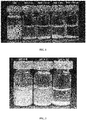
Figure 1 is a photograph showing from left to right, vials containing pure water and: uncoated TiO2 particles [TiO2]; TiO2 particles coated with chitosan A and washed once [TiO2+LV]; TiO2 particles coated with chitosan A and washed four times [TiO2+LV x4]; TiO2 particles coated with chitosan B and washed once [TiO2+MV] and TiO2 particles coated with chitosan B and washed four times [TiO2+MV x4]. -
Figure 2 is a photograph showing vials containing pure water and: TiO2 particles coated with chitosan obtained from a process having an alkalization at pH (from left to right) of 6, 7 or 12 (process of the invention). -
Figure 3 is a photograph showing from left to right, vials containing a mixture of pure water and ester isononyl isononanoate, and: uncoated TiO2 particles [TiO2]; TiO2 particles coated with chitosan A and washed once [TiO2+LV]; TiO2 particles coated with chitosan A and washed four times [TiO2+LV x4]; TiO2 particles coated with chitosan B and washed once [TiO2+MV] and TiO2 particles coated with chitosan B and washed four times [TiO2+MV x4]. - The present invention is further illustrated by the following examples.
-
- °C: Celsius degree
- cP: centipoise
- Da: dalton
- D5: decamethylcyclopentasiloxane
- h: hour
- Hg: mercury
- KOH: potassium hydroxide
- M: mol per liter (mol/L)
- mL: millimeter
- TiO2: titanium dioxide
- µm: micrometer
- All solvents and chitosan(s) were purchased from chemical company Sigma Aldrich. TiO2 pigments with a mean diameter size of 40 µm were purchased from company Miyoshi France or from Sigma Aldrich. Three chitosans were studied and have the following characteristics:
Chitosan A Chitosan B Chitosan C Viscosity (cP) 20-300 200-800 800-2000 Deacetylation degree (%) 75-85 75-85 >75 Mass average molar mass, Mw) (Da) 50 000-190 000 >190 000-310 000 >310 000-375 000 - As a first step (step 1), an acidic aqueous solution of 100 mL comprising acetic acid, chitosan and dispersed TiO2 particles, is prepared. The chitosan in the solution ranges from 1% to 10 %, preferably is 3% or 10%, by weight to the total weight of chitosan and TiO2 particles. The solution is magnetically stirred until complete dissolution of chitosan A, B or C.
- Then, an aqueous solution of potassium hydroxide (1M) is added to the solution previously prepared at step 1 under pH-metric control. When the reaction medium has a pH of about 12, the addition of KOH is stopped and the reaction medium is stirred during 72h.
- Finally, the reaction medium is centrifuged and washed by centrifugation cycles with water. The pigment particles under the form of powder, are removed and dried under vacuum at a temperature ranging from 45°C to 55°C under a pressure lower than 50 mm Hg.
- Tests are then performed for characterizing the chitosan adsorbed at the TiO2 surface by thermogravimetry (ATG) and infra-red spectroscopy (ATR). The ATG results compared to those from TiO2 particles without chitosan, evidence that the process of the invention provides a layer of chitosan adsorbed onto the surface of TiO2 particles. Infra-red spectra on the powder obtained by the process as defined above, evidence characteristic peaks of chitosan at 1100 cm-1 and 3000 cm-1.
- The aim is to evidence that the pigment particles obtained by the process as defined in example 1 (i.e. a process comprising an alkalization step at pH =12), are hydrophobic compared to TiO2 particles without any treatment, and compared to a process in which the alkalization step is carried out at pH = 6, 7 or 10.
- For this purpose, several powders have been dispersed in a vial containing pure water:
- Sample 1: powder of TiO2 particles without any treatment ["TiO2"];
- Sample 2: powder of TiO2 particles on which are adsorbed chitosan A, said powder being washed once ["TiO2+LV"];
- Sample 3: powder of TiO2 particles on which are adsorbed chitosan A, said powder being washed four times ["TiO2+LV x4"];
- Sample 4: powder of TiO2 particles on which are adsorbed chitosan B, said powder being washed once ["TiO2+MV"];
- Sample 5: powder of TiO2 particles on which are adsorbed chitosan B, said powder being washed four times ["TiO2+MV x4"].
- The results presented in
Figure 1 , show that: - when TiO2 particles are not coated with chitosan, the particles are homogenously dispersed in water and show an hydrophilic character; and
- when TiO2 particles are coated with chitosan, whatever the chitosan A, B or C, the particles are coagulating because of their hydrophobicity and are sedimenting at the bottom of vials under the form of a white powder.
- Consequently, this experiment evidences that the process of the invention provides hydrophobic pigment particles contrary to uncoated TiO2 particles.
- The same experiment than paragraph 2.1. was carried out with particles obtained from a process having an alkalization step at
pH - The results presented in
Figure 2 , show that the particles of the invention are hydrophobic contrary to those obtained by a process in which the alkalization step is carried out at pH=6 or 7 where inFigure 2 it is clear that the particles are still dispersed in solution because of hydrophilicity. - The comparison in water between particles obtained from a process having an alkalization step at pH of 10 and an equal mass ratio of TiO2 and chitosan, and those obtained from the process of the invention (alkalization step at pH 12) has been also carried out.
- First, it was observed that the final products between the two processes are different: the process with a step at pH of 10 leads to a solid pink material, compact and difficult to grind whereas the product obtained by the process of the invention leads to a particulate material under the form of a white powder.
- The behavior of these products in water are also different:
- the product of the process having an alkalization step at pH of 10, keeps under the form of solid blocks; and
- the product of the process of the invention is under the form of hydrophobic individualized white particles (powder).
- Consequently, this experiment evidences that the process of the invention provides hydrophobic pigment particles contrary to a process having a step at pH of 10 at equimolar concentrations. Indeed, the product obtained from a process with a step at pH of 10, is not compatible with a cosmetic use as a pigment that requires the form of a powder, such as the present invention.
- The aim is to evidence that the pigment particles obtained by the process as defined in example 1 (i.e. a process comprising an alkalization step at pH =12), are oleophobic compared to TiO2 particles without any treatment, and compared to a process in which the alkalization step is carried out at pH = 6, 7 or 10.
- For this purpose, several powders have been dispersed in a vial containing a mixture of pure water and ester isononyl isononanoate:
- Sample 1: powder of TiO2 particles without any treatment ["TiO2"];
- Sample 2: powder of TiO2 particles on which are adsorbed chitosan A, said powder being washed once ["TiO2+LV"];
- Sample 3: powder of TiO2 particles on which are adsorbed chitosan A, said powder being washed four times ["TiO2+LV x4"];
- Sample 4: powder of TiO2 particles on which are adsorbed chitosan B, said powder being washed once ["TiO2+MV"];
- Sample 5: powder of TiO2 particles on which are adsorbed chitosan B, said powder being washed four times ["TiO2+MV x4"].
- The results presented in
Figure 3 , show that: - when TiO2 particles are not coated with chitosan, the particles are homogenously dispersed in water exclusively: only some of them are coating the walls of the upper oil phase (ester isononyl isononanoate); and
- when TiO2 particles are coated with chitosan, whatever the chitosan A, B or C, the particles are excluded from both phases of water and ester isononyl isononanoate, and settled down to the bottom of vials under the form of a white powder.
- Consequently, this experiment evidences that the process of the invention provides hydrophobic and oleophobic pigment particles contrary to uncoated TiO2 particles.
- The same experiment than paragraph 3.1. was carried out with particles obtained from a process having an alkalization step at
pH - As for water, contrary to those obtained by a process in which the alkalization step is carried out at pH=6 or 7, particles are not hydrophobic (presence in the water phase) contrary to the results of the invention where particles are shown to be both hydrophobic and oleophobic.
- The same experiment than paragraph 3.1. was carried out with particles obtained from a process having an alkalization step at pH 10 at equimass concentration of chitosan and TiO2, and compared to those obtained from the process of the invention (alkalization step at pH 12).
- As for water, the results show that the particles of the invention stay under a powder form and are both hydrophobic and oleophobic contrary to those obtained by a process in which the alkalization step is carried out at pH=10 for which the product appears either on blocks or under the form of cotton, impossible to transform into a pigment useful for cosmetic applications.
Claims (17)
- A process for manufacturing an omniphobic cosmetic pigment, said process comprising:(i) Preparing an acidic aqueous solution comprising metal oxide particles and a poly(β-(1→4)-D-glucosamine), said poly(β-(1→4)-D-glucosamine) being acetylated, or partially or totally deacetylated; and(ii) Increasing the pH until about 12, of the solution obtained at step (i) in order to obtain the adsorption of said poly (β-(1→4)-D-glucosamine) on the metal oxide particles and the precipitation of the resulting metal oxide particles coated with said poly(β-(1→4)-D-glucosamine).
- The process according to claim 1, wherein the metal oxide particles are selected from titanium oxide, iron oxide, zinc oxide, zirconium oxide, yellow iron oxide, black iron oxide, red iron oxide, chromium oxide, chromium hydroxide, ultramarine, silicates such as mica, sericite, kaolin, talc, aluminium silicate, magnesium silicate, calcium silicate or clay; preferably are titanium oxide particles.
- The process according to claim 1 or claim 2, wherein the metal oxide particles have a size ranging from 100 nm to 100 µm; preferably ranging from 500 nm to 60 µm.
- The process according to any one of claims 1 to 3, wherein the poly(β-(1→4)-D-glucosamine) is either totally deacetylated or both deacetylated and acetylated; preferably is chitosan.
- The process according to any one of claims 1 to 4, wherein the poly(β-(1→4)-D-glucosamine) has a viscosity measured at about 25°C, ranging from 10 cP to 2000 cP; preferably from 40 cP to 800 cP; more preferably from 50 cP to 350 cP.
- The process according to claim 4, wherein the poly(β-(1→4)-D-glucosamine) is partially deacetylated and has a deacetylation degree ranging from 70% to 99%; preferably from 75% to 95%; more preferably ranges from 75% to 85%.
- The process according to any one of claims 1 to 6, wherein the poly(β-(1→4)-D-glucosamine) has a mass average molar mass (Mw) ranging from 40 000 Da to 500 000 Da; preferably from 100 000 Da to 300 000 Da.
- The process according to any one of claims 1 to 7, wherein the amount of the poly (β-(1→4)-D-glucosamine) ranges from more than 0% to 20%; preferably from 1% to 15%; more preferably is about 3% or 10%, by weight to the total weight of said poly (β-(1→4)-D-glucosamine) and metal oxide particles.
- The process according to any one of claims 1 to 8, wherein the acidic aqueous solution comprises an acid; preferably an organic acid; more preferably acetic acid.
- An omniphobic cosmetic pigment obtained by the process according to any one of claims 1 to 9.
- The omniphobic cosmetic pigment of claim 10, comprising or consisting of titanium oxide particles on which are adsorbed chitosan chains.
- A cosmetic composition comprising the omniphobic cosmetic pigment according to claim 10 or claim 11 and a cosmetically acceptable base.
- The composition according to claim 12, wherein the cosmetically acceptable base is anhydrous.
- The composition according to claim 12 or claim 13, which is under the form of an aqueous gel, an oily gel, a paste, a cream, a lotion, a milk, a stick, a soap, a foam, a shampoo, a compact powder, a loose powder, a nail polish, a beauty mask, an aerosol, a film, a serum, an emulsion, or a patch.
- A cosmetic skin improvement method comprising using the omniphobic cosmetic pigment according to claim 10, or the cosmetic composition according to any one of claims 12 to 14 in a subject in need thereof.
- The skin improvement method according to claim 15, wherein the composition is administered to the skin of a subject in need thereof, once per day.
- Use of the cosmetic composition according to any one of claims 12 to 14, in make-up, skincare, sun care, haircare, nail polish, toiletries, baby care or pet care.
Priority Applications (6)
| Application Number | Priority Date | Filing Date | Title |
|---|---|---|---|
| EP18306498.9A EP3653674A1 (en) | 2018-11-15 | 2018-11-15 | Process for manufacturing omniphobic cosmetic pigments |
| JP2019206295A JP7628391B2 (en) | 2018-11-15 | 2019-11-14 | Method for producing omniphobic cosmetic pigments. |
| US16/684,802 US11040000B2 (en) | 2018-11-15 | 2019-11-15 | Process for manufacturing omniphobic cosmetic pigments |
| KR1020190146839A KR20200056949A (en) | 2018-11-15 | 2019-11-15 | Process for manufacturing omniphobic cosmetic pigments |
| CN201911119264.8A CN111184646A (en) | 2018-11-15 | 2019-11-15 | Method for manufacturing fully hydrophobic cosmetic pigments |
| JP2024186617A JP2025013933A (en) | 2018-11-15 | 2024-10-23 | Method for producing omniphobic cosmetic pigments. |
Applications Claiming Priority (1)
| Application Number | Priority Date | Filing Date | Title |
|---|---|---|---|
| EP18306498.9A EP3653674A1 (en) | 2018-11-15 | 2018-11-15 | Process for manufacturing omniphobic cosmetic pigments |
Publications (1)
| Publication Number | Publication Date |
|---|---|
| EP3653674A1 true EP3653674A1 (en) | 2020-05-20 |
Family
ID=64564767
Family Applications (1)
| Application Number | Title | Priority Date | Filing Date |
|---|---|---|---|
| EP18306498.9A Pending EP3653674A1 (en) | 2018-11-15 | 2018-11-15 | Process for manufacturing omniphobic cosmetic pigments |
Country Status (5)
| Country | Link |
|---|---|
| US (1) | US11040000B2 (en) |
| EP (1) | EP3653674A1 (en) |
| JP (2) | JP7628391B2 (en) |
| KR (1) | KR20200056949A (en) |
| CN (1) | CN111184646A (en) |
Families Citing this family (2)
| Publication number | Priority date | Publication date | Assignee | Title |
|---|---|---|---|---|
| USD1070067S1 (en) * | 2024-04-30 | 2025-04-08 | Wells Johnson Company | Canister |
| USD1069099S1 (en) * | 2024-04-30 | 2025-04-01 | Wells Johnson Company | Canister |
Citations (4)
| Publication number | Priority date | Publication date | Assignee | Title |
|---|---|---|---|---|
| JPS62223108A (en) * | 1986-03-25 | 1987-10-01 | Daito Kasei Kogyo Kk | Cosmetic pigment coated with chitosan and production thereof |
| WO1998022540A1 (en) * | 1996-11-21 | 1998-05-28 | Merck S.A. | Mineral pigment microparticles covered with a chitin layer |
| WO2010128204A1 (en) * | 2009-05-04 | 2010-11-11 | Licentia Oy | Novel inorgano-bioorganic nanocomposite materials, their preparation and use |
| WO2014081322A1 (en) * | 2012-11-21 | 2014-05-30 | Uniwersytet Jagiellonski | Superparamagnetic iron oxide nanoparticles with ultra-thin polymer layers, the method of their preparation and application |
Family Cites Families (3)
| Publication number | Priority date | Publication date | Assignee | Title |
|---|---|---|---|---|
| JPH0399006A (en) * | 1989-09-11 | 1991-04-24 | Ajinomoto Co Inc | Solid cosmetic |
| CN102489264A (en) * | 2011-12-21 | 2012-06-13 | 湖南师范大学 | Chitosan magnetic nano particle as well as preparation method and application thereof |
| CN104311888B (en) * | 2014-08-29 | 2016-10-05 | 河南联合利民生物科技有限公司 | Red copper oxide/Chitosan Composites, sensitive membrane, biosensor, preparation method and application |
-
2018
- 2018-11-15 EP EP18306498.9A patent/EP3653674A1/en active Pending
-
2019
- 2019-11-14 JP JP2019206295A patent/JP7628391B2/en active Active
- 2019-11-15 KR KR1020190146839A patent/KR20200056949A/en not_active Withdrawn
- 2019-11-15 US US16/684,802 patent/US11040000B2/en active Active
- 2019-11-15 CN CN201911119264.8A patent/CN111184646A/en active Pending
-
2024
- 2024-10-23 JP JP2024186617A patent/JP2025013933A/en active Pending
Patent Citations (4)
| Publication number | Priority date | Publication date | Assignee | Title |
|---|---|---|---|---|
| JPS62223108A (en) * | 1986-03-25 | 1987-10-01 | Daito Kasei Kogyo Kk | Cosmetic pigment coated with chitosan and production thereof |
| WO1998022540A1 (en) * | 1996-11-21 | 1998-05-28 | Merck S.A. | Mineral pigment microparticles covered with a chitin layer |
| WO2010128204A1 (en) * | 2009-05-04 | 2010-11-11 | Licentia Oy | Novel inorgano-bioorganic nanocomposite materials, their preparation and use |
| WO2014081322A1 (en) * | 2012-11-21 | 2014-05-30 | Uniwersytet Jagiellonski | Superparamagnetic iron oxide nanoparticles with ultra-thin polymer layers, the method of their preparation and application |
Also Published As
| Publication number | Publication date |
|---|---|
| CN111184646A (en) | 2020-05-22 |
| JP7628391B2 (en) | 2025-02-10 |
| JP2025013933A (en) | 2025-01-28 |
| US11040000B2 (en) | 2021-06-22 |
| KR20200056949A (en) | 2020-05-25 |
| JP2020083883A (en) | 2020-06-04 |
| US20200155441A1 (en) | 2020-05-21 |
Similar Documents
| Publication | Publication Date | Title |
|---|---|---|
| JP6857359B2 (en) | New sugar derivative gelling agent | |
| JP3481450B2 (en) | Topical use monohydric alcohol-free composition containing dissolved ethylcellulose | |
| CN103561717B (en) | Method for producing cosmetics, method for producing gel for cosmetics, and method for reducing the amount of polymer thickener blended into cosmetic raw materials | |
| RU2580651C2 (en) | Skin care w/o emulsion composition | |
| AU2001262691B2 (en) | Cosmetic preparation | |
| JP2025013933A (en) | Method for producing omniphobic cosmetic pigments. | |
| JPWO2001093812A1 (en) | cosmetics | |
| KR100439299B1 (en) | Cosmetic Raw Materials Having Improved Properties And Processes For Preparing The Same | |
| JPWO2011055761A1 (en) | Oil-in-water emulsified cosmetic | |
| AU2004279313A1 (en) | Compositions comprising odor neutralizing metal oxide silicates | |
| CN110603223B (en) | Hollow Particles and Cosmetics | |
| CN102921033A (en) | Cosmetic and external skin preparation, and medical instrument | |
| JP3524501B2 (en) | Cosmetics | |
| WO2018218497A1 (en) | Composition of pickering emulsion comprising pearls in fatty phase | |
| JP2012121835A (en) | Lipophilically surface treated powder having excellent smooth feeling and detergency | |
| Virmani et al. | Consumer nanoproducts for cosmetics | |
| JP2000309506A (en) | Powder cosmetic | |
| JP3943275B2 (en) | UV protection cosmetics | |
| WO2008044385A1 (en) | Cosmetic preparation containing polyfunctional composite powder | |
| BR102014000604A2 (en) | aqueous compositions comprising polymeric particles and low clay contents | |
| EP4502109A1 (en) | Emulsified composition | |
| JP2003192561A (en) | Skin cosmetics | |
| Chuo et al. | Application of nanotechnology for development of cosmetics | |
| JP6963137B1 (en) | A method for producing a cosmetic composition containing a micelle complex formed by utilizing a natural moisturizing factor, and a cosmetic composition produced by the production method. | |
| JP2002145751A (en) | External preparation for skin containing ascorbic acids |
Legal Events
| Date | Code | Title | Description |
|---|---|---|---|
| PUAI | Public reference made under article 153(3) epc to a published international application that has entered the european phase |
Free format text: ORIGINAL CODE: 0009012 |
|
| STAA | Information on the status of an ep patent application or granted ep patent |
Free format text: STATUS: THE APPLICATION HAS BEEN PUBLISHED |
|
| AK | Designated contracting states |
Kind code of ref document: A1 Designated state(s): AL AT BE BG CH CY CZ DE DK EE ES FI FR GB GR HR HU IE IS IT LI LT LU LV MC MK MT NL NO PL PT RO RS SE SI SK SM TR |
|
| AX | Request for extension of the european patent |
Extension state: BA ME |
|
| STAA | Information on the status of an ep patent application or granted ep patent |
Free format text: STATUS: REQUEST FOR EXAMINATION WAS MADE |
|
| 17P | Request for examination filed |
Effective date: 20201120 |
|
| RBV | Designated contracting states (corrected) |
Designated state(s): AL AT BE BG CH CY CZ DE DK EE ES FI FR GB GR HR HU IE IS IT LI LT LU LV MC MK MT NL NO PL PT RO RS SE SI SK SM TR |
|
| RAP3 | Party data changed (applicant data changed or rights of an application transferred) |
Owner name: MIYOSHI EUROPE S.A.S. Owner name: CENTRE NATIONAL DE LA RECHERCHE SCIENTIFIQUE Owner name: COMMISSARIAT A L'ENERGIE ATOMIQUE ET AUX ENERGIESALTERNATIVES |