EP3652136B1 - Procede de deshydratation des alcools en olefines comprenant une etape de selectivation du catalyseur - Google Patents
Procede de deshydratation des alcools en olefines comprenant une etape de selectivation du catalyseur Download PDFInfo
- Publication number
- EP3652136B1 EP3652136B1 EP18735600.1A EP18735600A EP3652136B1 EP 3652136 B1 EP3652136 B1 EP 3652136B1 EP 18735600 A EP18735600 A EP 18735600A EP 3652136 B1 EP3652136 B1 EP 3652136B1
- Authority
- EP
- European Patent Office
- Prior art keywords
- process according
- zeolite
- catalyst
- stoppage
- selectivation
- Prior art date
- Legal status (The legal status is an assumption and is not a legal conclusion. Google has not performed a legal analysis and makes no representation as to the accuracy of the status listed.)
- Active
Links
Images
Classifications
-
- C—CHEMISTRY; METALLURGY
- C07—ORGANIC CHEMISTRY
- C07C—ACYCLIC OR CARBOCYCLIC COMPOUNDS
- C07C1/00—Preparation of hydrocarbons from one or more compounds, none of them being a hydrocarbon
- C07C1/20—Preparation of hydrocarbons from one or more compounds, none of them being a hydrocarbon starting from organic compounds containing only oxygen atoms as heteroatoms
- C07C1/24—Preparation of hydrocarbons from one or more compounds, none of them being a hydrocarbon starting from organic compounds containing only oxygen atoms as heteroatoms by elimination of water
-
- C—CHEMISTRY; METALLURGY
- C07—ORGANIC CHEMISTRY
- C07C—ACYCLIC OR CARBOCYCLIC COMPOUNDS
- C07C11/00—Aliphatic unsaturated hydrocarbons
- C07C11/02—Alkenes
- C07C11/08—Alkenes with four carbon atoms
- C07C11/09—Isobutene
Definitions
- the present invention relates to a process for the dehydration of alcohols into olefins.
- the process feed can be obtained by chemical processes or by fermentation processes.
- This method uses a shaped catalyst based on a zeolite comprising at least one series of channels, the opening of which is defined by a ring with 8 oxygen atoms (8MR) and comprises a step making it possible to improve the catalyst selectivity.
- alkenes obtained in particular isobutene, butene-1 and butenes-2, are of great interest in the field of petrochemical industry and organic synthesis.
- the document EP 2348 005 describes the dehydration of alcohols containing from 2 to 10 carbon atoms into the corresponding olefin on a zeolitic FER catalyst with an atomic ratio Si/Al of less than 100.
- the mass hourly space velocity (Weight Hourly Space Velocity according to the English name, or WHSV) with respect to alcohol is at least 4 h -1 and the temperature from 320 to 600°C.
- the document WO 2011/113834 describes the simultaneous dehydration and skeletal isomerization of isobutanol in the presence of crystalline, medium-channel-size (10MR) silicate catalysts, dealuminized or not, phosphorus-modified or not, of the group FER, MWW, EUO, MFS, ZSM- 48, MTT, MFI, MEL or TON having an Si/Al ratio greater than 10, silicoaluminophosphate molecular sieves of the AEL group, or silica-, zirconia-, titanium- or fluorine-alumina on zeolitic catalysts.
- 10MR medium-channel-size
- the PPH ratio of the mass flow rate of feed to the mass of catalyst, corresponding to the WHSV with respect to the alcohol is at least 1 h -1 and the temperature from 200 to 600°C.
- the maximum proportion reached of n-butenes in the butenes is 58.4% at 375°C at high PPH (12.6 h -1 ) on an FER zeolite in Si/Al 33 powder.
- No notion of performance stability as a function of time under load is mentioned in this document.
- the only other exemplified catalyst is gamma alumina.
- the catalytic performance decreases as a function of the duration of operation of the process due, mainly, to the formation of coke during the isomerizing dehydration reaction.
- the average reaction temperature is increased, inducing drops in selectivity.
- a regeneration step is necessary when either the maximum admissible reaction temperature is reached, or the iso-olefin selectivity exceeds a fixed value which no longer allows the profitability of the process.
- the regeneration step mainly corresponds to a step of combustion of the coke formed in air and at temperature described in numerous documents.
- the document EP 3040125 describes the regeneration of the catalyst by combustion of the coke formed on the surface.
- Benito et al. (Ind.Eng.Chem.Res., 1996, 35, 2177-2182 ) describe reaction-regeneration cycles, the regeneration being carried out by combustion.
- the process according to the invention aims to produce mainly linear olefins. Surprisingly, the process according to the invention makes it possible to significantly improve the selectivity for linear butenes in the olefinic effluent without modifying the catalytic activity, ie maintaining the conversion to alcohols.
- the process according to the invention comprises a reaction step a) supplied with a feed comprising at least one alcohol, said reaction step being carried out in the gas phase at a weighted average temperature of between 250 and 400° C., at a pressure of between 0, 2 MPa and 1 MPa and at a PPH of between 1 and 18 h -1 in the presence of a catalyst comprising a zeolite comprising at least one series of channels whose opening is defined by a ring with 8 oxygen atoms (8 MR) producing an olefinic effluent, said alcohol being primary monoalcohol of formula R-CH 2 -OH, in which R is a nonlinear alkyl radical of general formula C n H 2n+1 where n is an integer between 3 and 20.
- the feedstock treated in the process according to the invention is a feedstock comprising at least one alcohol, that is to say at least one primary monoalcohol of formula R—CH 2 —OH, in which R is a nonlinear alkyl radical of general formula C n H 2n+1 where n is an integer between 3 and 20, preferably between 3 and 10, preferably between 3 and 5.
- Said reaction step a) is a step in which the alcohol is dehydrated in olefin, the branched alcohols being advantageously dehydrated into linear olefins.
- the process according to the invention is advantageously an isomerizing dehydration process.
- the filler comprises from 40 to 100% by weight, preferably from 70 to 100% by weight, advantageously from 85 to 100% by weight of at least one alcohol, advantageously of at least one primary monoalcohol as defined above.
- Said filler may comprise one or more primary monoalcohols.
- Said primary monoalcohol is preferably isobutanol or 2-methyl-1-butanol, taken alone or as a mixture. Very preferably, said primary monoalcohol is isobutanol.
- Said charge can come from chemical or biochemical processes, for example fermentation.
- this filler can come from lignocellulosic biomass fermentation processes.
- Said filler may contain water, advantageously up to 60% by weight of water, preferentially up to 70% by weight, very advantageously up to 15% by weight. It can also include impurities of the mineral type (such as Na, Ca, P, Al, Si, K, SO 4 ) and of the organic type (such as methanol, ethanol, n-butanol, aldehydes, ketones, and the corresponding acids, for example furanic, acetic, isobutyric acid).
- the mineral type such as Na, Ca, P, Al, Si, K, SO 4
- organic type such as methanol, ethanol, n-butanol, aldehydes, ketones, and the corresponding acids, for example furanic, acetic, isobutyric acid.
- Said reaction step is carried out in the gas phase, at a weighted average temperature of between 250 and 400° C., preferably between 250 and 375° C., at a pressure of between 0.2 MPa and 1 MPa, at a PPH of between 1 and 6:00 p.m. -1 , in the presence of a catalyst comprising a zeolite comprising at least one series of channels whose opening is defined by a ring with 8 oxygen atoms (8 MR).
- a catalyst comprising a zeolite comprising at least one series of channels whose opening is defined by a ring with 8 oxygen atoms (8 MR).
- PPH Weight per Weight per Hour
- WHSV Weight Hourly Space Velocity
- TMP weighted average temperature
- the weighted average temperature is representative of the reaction temperature. Calories are supplied by any heating means known to those skilled in the art.
- the reaction takes place in one or more reactors, each reactor being operated under identical conditions.
- the TMP of each of the reactors is adjusted to a value between 250°C and 400°C, preferably between 250 and 375°C.
- the term “the reactor” denotes both the reactor of this stage when this comprises only one reactor, and each of the reactors of this stage, when this stage comprises more than one reactor.
- Said catalyst is arranged in one or more fixed beds, which can be operated in upward, downward or radial flow.
- the catalyst Before being brought into contact with the charge to be treated, the catalyst is activated by any means known to those skilled in the art, for example by heat treatment in air.
- the catalyst used in said reaction step a) comprises a zeolite having at least one series of channels, the opening of which is defined by a ring with 8 oxygen atoms (8MR) as defined in the classification" Atlas of Zeolite Structure Types", Ch. Baerlocher, LB Mc Cusker, DH Oison, 6th Edition, Elsevier, 2007 , Elsevier.
- 8MR oxygen atoms
- the zeolite can also advantageously contain at least one series of channels whose pore opening is defined by a ring containing 10 oxygen atoms (10 MR).
- Said zeolite is advantageously chosen from zeolites having 8 and 10MR channels such as zeolites of structural type FER and MFS, taken alone or as a mixture.
- the zeolite is more advantageously chosen from the group consisting of, for the FER type, ferrierite, FU-9, ISI-6, NU-23, ZSM-35 zeolites and for the MFS type, ZSM-57 zeolite, and their mixtures.
- Said zeolite is very advantageously of the FER type, and preferably ferrierite.
- said zeolite consists of ferrierite.
- said zeolite is a ferrierite with a Si/Al molar ratio of 8 to 70, preferably 10 to 70, preferably chosen between 10 and 50, preferably chosen between 20 and 50.
- Said catalyst also comprises a binder.
- the zeolite content in the catalyst is 55-90 wt%, preferably between 60 and 80 wt%.
- the binder is advantageously chosen from a silica binder, an AlPO 4 , a clay, a zirconia, a Ti oxide, SiC. Very preferably, it is a silicic binder.
- the content of binder in the catalyst is between 10 and 45% by weight, preferably between 20 and 40%.
- the catalyst may optionally contain impurities in small quantities not having technical effect on catalyst conversion/selectivity.
- Said catalyst can be shaped by all the techniques known to those skilled in the art, for example in the form of powder, beads, pellets, granules, or extrudates (hollow or non-hollow cylinders, multilobed cylinders with 2, 3, 4 or 5 lobes for example, twisted cylinders), rings, etc.
- the catalyst does not include metals. It is understood by this expression “no metals”, that there are no metals added during the preparation. It is also understood that there may be impurities in the binders and therefore in small quantities. Preferably, there is no aluminum or iron in the silica.
- the process according to the invention comprises a step b) of selecting the catalyst comprising, for a period of between 0.5 and 5 h, stopping the supply and maintaining the temperature and pressure of said step a ), said stage of selection being implemented when the selectivity for iso-olefins n of said stage a) is greater than 25%, or when the conversion to alcohols of said stage a) is less than 99%.
- selectivity for iso-olefins n is meant the mass ratio of iso-olefins comprising n carbon atoms to all of the olefins comprising n carbon atoms present in the olefinic effluent from stage a).
- the n-isoolefin selectivity gradually increases during step a) of the process according to the invention.
- the input and output compositions of the reaction step necessary for the calculation of the selectivities and conversions are determined by methods well known to those skilled in the art, for example by sampling and analysis, in particular by analysis by phase chromatography gas, the sampling being able to be carried out continuously or occasionally, at time intervals allowing the monitoring of the evolution of the selectivity values and/or of conversion, this interval being easily determined by a person skilled in the art (for example every minute, every 5 minutes, every 10 minutes, every half hour, every hour).
- step a) stopping the supply carried out jointly with maintaining the temperature and the pressure of said step a) for a period of between 0.5 and 5 hours, advantageously between 0.5 and 3 hours, very advantageously between 0.5 and 2 h made it possible to reduce the iso-olefin selectivity while maintaining at least the conversion of the alcohol into olefins once the feed was restarted at the end of the stoppage period and the conditions of step a) restored.
- the temperature and pressure can be maintained by any means known to those skilled in the art.
- the pressure can be maintained by reducing, or even stopping, the production of effluent from said reaction step, or else by adding an inert fluid, such as for example nitrogen.
- said selectivation step b) also comprises stopping the production of effluent from said reaction step a).
- step b) When said step b) is carried out for a period of less than 0.5 h, no effect is observed. On the other hand, a prolonged shutdown beyond 5 hours leads to the formation of undesirable products on the surface of the catalyst which are detrimental to the performance of the process.
- the method according to the invention comprises a step c) of resumption of the supply at the end of step b) with return to the conditions of step a).
- step b) of the method according to the invention At the end of the duration of stopping the supply in accordance with step b) of the method according to the invention, the supply is resumed in order to return to the conditions of step a) of said method.
- the process according to the invention therefore operates in accordance with the characteristics of step a) of the process according to the invention, the selectivity for isoolefin n having been reduced.
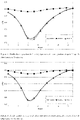
- the figures 1 and 2 show the axial temperature profiles in the reactor before reaction step a) (profile 1), during reaction step a) (profile 2) and after the selectivation step b) once the feeding of the load is resumed (profile 3).
- the dehydration step is carried out on a catalytic test unit comprising a fixed bed operating in “down flow” mode, that is to say in descending flow.
- the catalyst is loaded into a 316L stainless steel reactor to a height of 13 cm.
- the catalyst is then activated at 450° C. in 24 Nl/h of air for a plateau of two hours after a temperature rise of 50° C./h.
- the temperature is then lowered to the test temperature under 500 Nl/h of nitrogen in order to eliminate the air present in the system before injection of the alcohol charge.
- the charge is vaporized in a preheating furnace at 150-200° C. upstream of the reactor and then injected into the catalytic reactor.
- the operating conditions are as follows: weighted average temperature of 362° C., pph (weight of charge per weight of catalyst per gram) of 8.5 h ⁇ 1 .
- the total effluent passes through two separators, one operating at the reaction pressure and the other at low pressure, in order to recover on the one hand a gas effluent rich in olefins and a liquid phase rich in water.
- the analysis of the gaseous effluent is carried out on an in-line gas chromatograph equipped with two columns.
- the analysis of the liquid effluent is carried out on a device delocalized by gas phase chromatography.
- Example 1 (compliant): 70-minute procedure, sufficient duration
- the feed is stopped for 70 min, the other operating conditions being maintained.
- the iso-butene selectivity is reduced.
- a charge comprising 95% by weight of isobutanol and 5% by weight of water is fed to the reactor inlet with a pph of 8.5 h ⁇ 1 .
- the reaction step is carried out at a pressure of 0.9 MPa and a weighted average temperature (TMP) of 362°C.
- the iso-butene selectivity in the olefinic effluent reaches 23.9%.
- the supply of load is interrupted, as well as the withdrawal of olefinic effluent.
- Temperatures and pressure are maintained in the reaction step.
- the conversion to isobutanol is greater than 99.95%, identical to the conversion before stopping.
- the figure 1 shows the axial temperature profiles in the reactor before reaction step a) (profile 1), during reaction step a) (profile 2) and after the selectivation step b) once feed to the feed is resumed and stabilized the conditions according to step a) (profile 3) after stopping the feed for 70 min.
- the abscissa shows the total height of the reactor.
- the ordinate axis represents the temperature in the reactor.
- the feed is stopped for 25 min, the other operating conditions being maintained.
- the iso-butene selectivity is not modified.
- a charge comprising 95% by weight of isobutanol and 5% by weight of water is fed to the reactor inlet with a pph of 8.5 h ⁇ 1 .
- the reaction step is carried out at a pressure of 0.9 MPa and a TMP of 362°C.
- the selectivity for iso-butene in the olefinic effluent reaches 24.0%.
- the feedstock is interrupted, as well as the withdrawal of olefinic effluent. Temperatures and pressure are maintained in the reaction step.
- the conversion to isobutanol is greater than 99.95%, identical to the conversion before stopping.
- the figure 2 shows the axial temperature profiles in the reactor before reaction step a) (profile 1), during reaction step a) (profile 2) and after the selectivation step b) once feed to the feed is resumed and stabilized the conditions according to step a) (profile 3) after stopping the feed for 25 min.
- the abscissa shows the total height of the reactor.
- the ordinate axis represents the temperature in the reactor.
- the feed is stopped for 6 hours, the other operating conditions being maintained.
- a charge comprising 95% by weight of isobutanol and 5% by weight of water is fed to the reactor inlet with a pph of 8.5 h ⁇ 1 .
- the reaction step is carried out at a pressure of 0.9 MPa and a TMP of 366°C.
- the selectivity for iso-butene in the olefinic effluent reaches 23.8% and the conversion to isobutanol is greater than 99.94%.
- the feedstock is interrupted, as well as the withdrawal of olefinic effluent. Temperatures and pressure are maintained in the reaction step.
- the momentary stoppage of the load flow is carried out for 6 hours.
Landscapes
- Chemical & Material Sciences (AREA)
- Organic Chemistry (AREA)
- Organic Low-Molecular-Weight Compounds And Preparation Thereof (AREA)
- Catalysts (AREA)
Applications Claiming Priority (2)
| Application Number | Priority Date | Filing Date | Title |
|---|---|---|---|
| FR1756515A FR3068692B1 (fr) | 2017-07-10 | 2017-07-10 | Procede de deshydratation des alcools en olefines comprenant une etape de selectivation du catalyseur |
| PCT/EP2018/068613 WO2019011892A1 (fr) | 2017-07-10 | 2018-07-10 | Procede de deshydratation des alcools en olefines comprenant une etape de selectivation du catalyseur |
Publications (2)
| Publication Number | Publication Date |
|---|---|
| EP3652136A1 EP3652136A1 (fr) | 2020-05-20 |
| EP3652136B1 true EP3652136B1 (fr) | 2023-01-25 |
Family
ID=60020048
Family Applications (1)
| Application Number | Title | Priority Date | Filing Date |
|---|---|---|---|
| EP18735600.1A Active EP3652136B1 (fr) | 2017-07-10 | 2018-07-10 | Procede de deshydratation des alcools en olefines comprenant une etape de selectivation du catalyseur |
Country Status (8)
| Country | Link |
|---|---|
| US (1) | US11117844B2 (pl) |
| EP (1) | EP3652136B1 (pl) |
| CN (1) | CN111108081B (pl) |
| BR (1) | BR112020000329B1 (pl) |
| CA (1) | CA3069268A1 (pl) |
| FR (1) | FR3068692B1 (pl) |
| PL (1) | PL3652136T3 (pl) |
| WO (1) | WO2019011892A1 (pl) |
Family Cites Families (6)
| Publication number | Priority date | Publication date | Assignee | Title |
|---|---|---|---|---|
| US5059738A (en) * | 1990-03-07 | 1991-10-22 | Mobil Oil Corporation | Method for reactivating MTG process catalyst |
| US7227048B2 (en) * | 2001-12-31 | 2007-06-05 | Exxonmobil Chemical Patents Inc. | Converting oxygenates to olefins over a catalyst comprising acidic molecular sieve of controlled carbon atom to acid site ratio |
| EP2348005A1 (en) | 2010-01-22 | 2011-07-27 | Total Petrochemicals Research Feluy | Dehydration of alcohols on a crystalline silicate of fer structure |
| JP5784646B2 (ja) * | 2010-03-15 | 2015-09-24 | トタル リサーチ アンド テクノロジー フエリユイ | 酸触媒上でのイソブタノールの同時脱水・骨格異性化 |
| FR3026406B1 (fr) * | 2014-09-26 | 2016-12-09 | Ifp Energies Now | Procede de deshydratation isomerisante d'une charge alcool primaire substitue en position 2 par un groupement alkyl sur un catalyseur comprenant une zeolithe de type fer |
| EP3040125A1 (en) | 2014-12-30 | 2016-07-06 | Shell Internationale Research Maatschappij B.V. | A process for converting oxygenates to olefins |
-
2017
- 2017-07-10 FR FR1756515A patent/FR3068692B1/fr active Active
-
2018
- 2018-07-10 CA CA3069268A patent/CA3069268A1/fr active Pending
- 2018-07-10 CN CN201880046224.2A patent/CN111108081B/zh active Active
- 2018-07-10 PL PL18735600.1T patent/PL3652136T3/pl unknown
- 2018-07-10 BR BR112020000329-8A patent/BR112020000329B1/pt active IP Right Grant
- 2018-07-10 EP EP18735600.1A patent/EP3652136B1/fr active Active
- 2018-07-10 WO PCT/EP2018/068613 patent/WO2019011892A1/fr not_active Ceased
- 2018-07-10 US US16/629,620 patent/US11117844B2/en active Active
Also Published As
| Publication number | Publication date |
|---|---|
| PL3652136T3 (pl) | 2023-05-29 |
| CN111108081A (zh) | 2020-05-05 |
| CA3069268A1 (fr) | 2019-01-17 |
| BR112020000329B1 (pt) | 2023-02-23 |
| WO2019011892A1 (fr) | 2019-01-17 |
| FR3068692B1 (fr) | 2019-08-16 |
| US11117844B2 (en) | 2021-09-14 |
| US20210078918A1 (en) | 2021-03-18 |
| BR112020000329A2 (pt) | 2020-07-14 |
| EP3652136A1 (fr) | 2020-05-20 |
| FR3068692A1 (fr) | 2019-01-11 |
| CN111108081B (zh) | 2022-12-27 |
Similar Documents
| Publication | Publication Date | Title |
|---|---|---|
| FR2513629A1 (fr) | Procede de production d'hydrocarbures de haut point d'ebullition a partir d'olefines normalement gazeuses | |
| EP1862528A1 (fr) | Procédé de transformation de l'éthanol en base pour carburant diesel | |
| EP3197850B1 (fr) | Procede de deshydratation isomerisante d'une charge alcool primaire substitue en position 2 par un groupement alkyl sur un catalyseur comprenant une zeolithe de type fer | |
| CA2931704A1 (fr) | Procede de deshydratation d'un melange contenant de l'ethanol et de l'isopropanol | |
| EP0308302A1 (fr) | Procédé de production d'oligomères d'oléfines, utilisant un catalyseur à base de mordénite modifiée | |
| EP3652136B1 (fr) | Procede de deshydratation des alcools en olefines comprenant une etape de selectivation du catalyseur | |
| EP2831020B1 (fr) | Procédé de déshydratation et d'isomérisation d'alcools utilisant un solide de type aluminosilicate non zéolithique | |
| FR3084267A1 (fr) | Alumine a acidite et structure de porosite optimales | |
| EP3538502B1 (fr) | Procede de deshydratation isomerisante d'une charge alcool primaire non lineaire en presence d'injection d'eau et d'un catalyseur comprenant une zeolithe de type fer ou mfs | |
| EP3456702B1 (fr) | Procede de deshydratation des alcools en olefines comprenant le recyclage des alcools | |
| WO2019206591A1 (fr) | Procede de deshydratation isomerisante de monoalcool primaire non lineaire sur un catalyseur zeolithique quadrilobe de type fer | |
| WO2018087032A1 (fr) | Procédé de déshydratation isomérisante de monoalcools primaires non linéaires sur catalyseur zéolithique dopé d'alcalin | |
| WO2024042194A1 (fr) | Procédé de déshydratation d'une charge comprenant un alcool pour la production d'alcènes | |
| WO2018087031A1 (fr) | Procede de deshydratation isomerisante d'un alcool primaire non lineaire sur un catalyseur comprenant une zeolithe de type fer et un liant aluminique | |
| FR3144023A1 (fr) | Catalyseur a base d’une zeolithe et d’une structure alpo et presentant un volume macroporeux eleve | |
| FR3137311A1 (fr) | Procédé de traitement d’un catalyseur comprenant une zéolithe |
Legal Events
| Date | Code | Title | Description |
|---|---|---|---|
| STAA | Information on the status of an ep patent application or granted ep patent |
Free format text: STATUS: UNKNOWN |
|
| STAA | Information on the status of an ep patent application or granted ep patent |
Free format text: STATUS: THE INTERNATIONAL PUBLICATION HAS BEEN MADE |
|
| PUAI | Public reference made under article 153(3) epc to a published international application that has entered the european phase |
Free format text: ORIGINAL CODE: 0009012 |
|
| STAA | Information on the status of an ep patent application or granted ep patent |
Free format text: STATUS: REQUEST FOR EXAMINATION WAS MADE |
|
| 17P | Request for examination filed |
Effective date: 20200210 |
|
| AK | Designated contracting states |
Kind code of ref document: A1 Designated state(s): AL AT BE BG CH CY CZ DE DK EE ES FI FR GB GR HR HU IE IS IT LI LT LU LV MC MK MT NL NO PL PT RO RS SE SI SK SM TR |
|
| AX | Request for extension of the european patent |
Extension state: BA ME |
|
| DAV | Request for validation of the european patent (deleted) | ||
| DAX | Request for extension of the european patent (deleted) | ||
| STAA | Information on the status of an ep patent application or granted ep patent |
Free format text: STATUS: EXAMINATION IS IN PROGRESS |
|
| 17Q | First examination report despatched |
Effective date: 20210422 |
|
| GRAP | Despatch of communication of intention to grant a patent |
Free format text: ORIGINAL CODE: EPIDOSNIGR1 |
|
| STAA | Information on the status of an ep patent application or granted ep patent |
Free format text: STATUS: GRANT OF PATENT IS INTENDED |
|
| INTG | Intention to grant announced |
Effective date: 20220902 |
|
| GRAS | Grant fee paid |
Free format text: ORIGINAL CODE: EPIDOSNIGR3 |
|
| GRAA | (expected) grant |
Free format text: ORIGINAL CODE: 0009210 |
|
| STAA | Information on the status of an ep patent application or granted ep patent |
Free format text: STATUS: THE PATENT HAS BEEN GRANTED |
|
| AK | Designated contracting states |
Kind code of ref document: B1 Designated state(s): AL AT BE BG CH CY CZ DE DK EE ES FI FR GB GR HR HU IE IS IT LI LT LU LV MC MK MT NL NO PL PT RO RS SE SI SK SM TR |
|
| REG | Reference to a national code |
Ref country code: GB Ref legal event code: FG4D Free format text: NOT ENGLISH |
|
| REG | Reference to a national code |
Ref country code: CH Ref legal event code: EP |
|
| REG | Reference to a national code |
Ref country code: DE Ref legal event code: R096 Ref document number: 602018045721 Country of ref document: DE |
|
| REG | Reference to a national code |
Ref country code: AT Ref legal event code: REF Ref document number: 1545831 Country of ref document: AT Kind code of ref document: T Effective date: 20230215 Ref country code: IE Ref legal event code: FG4D Free format text: LANGUAGE OF EP DOCUMENT: FRENCH |
|
| REG | Reference to a national code |
Ref country code: NL Ref legal event code: FP |
|
| REG | Reference to a national code |
Ref country code: SK Ref legal event code: T3 Ref document number: E 41405 Country of ref document: SK |
|
| REG | Reference to a national code |
Ref country code: LT Ref legal event code: MG9D |
|
| REG | Reference to a national code |
Ref country code: AT Ref legal event code: MK05 Ref document number: 1545831 Country of ref document: AT Kind code of ref document: T Effective date: 20230125 |
|
| PG25 | Lapsed in a contracting state [announced via postgrant information from national office to epo] |
Ref country code: RS Free format text: LAPSE BECAUSE OF FAILURE TO SUBMIT A TRANSLATION OF THE DESCRIPTION OR TO PAY THE FEE WITHIN THE PRESCRIBED TIME-LIMIT Effective date: 20230125 Ref country code: PT Free format text: LAPSE BECAUSE OF FAILURE TO SUBMIT A TRANSLATION OF THE DESCRIPTION OR TO PAY THE FEE WITHIN THE PRESCRIBED TIME-LIMIT Effective date: 20230525 Ref country code: NO Free format text: LAPSE BECAUSE OF FAILURE TO SUBMIT A TRANSLATION OF THE DESCRIPTION OR TO PAY THE FEE WITHIN THE PRESCRIBED TIME-LIMIT Effective date: 20230425 Ref country code: LV Free format text: LAPSE BECAUSE OF FAILURE TO SUBMIT A TRANSLATION OF THE DESCRIPTION OR TO PAY THE FEE WITHIN THE PRESCRIBED TIME-LIMIT Effective date: 20230125 Ref country code: LT Free format text: LAPSE BECAUSE OF FAILURE TO SUBMIT A TRANSLATION OF THE DESCRIPTION OR TO PAY THE FEE WITHIN THE PRESCRIBED TIME-LIMIT Effective date: 20230125 Ref country code: HR Free format text: LAPSE BECAUSE OF FAILURE TO SUBMIT A TRANSLATION OF THE DESCRIPTION OR TO PAY THE FEE WITHIN THE PRESCRIBED TIME-LIMIT Effective date: 20230125 Ref country code: ES Free format text: LAPSE BECAUSE OF FAILURE TO SUBMIT A TRANSLATION OF THE DESCRIPTION OR TO PAY THE FEE WITHIN THE PRESCRIBED TIME-LIMIT Effective date: 20230125 Ref country code: AT Free format text: LAPSE BECAUSE OF FAILURE TO SUBMIT A TRANSLATION OF THE DESCRIPTION OR TO PAY THE FEE WITHIN THE PRESCRIBED TIME-LIMIT Effective date: 20230125 |
|
| PG25 | Lapsed in a contracting state [announced via postgrant information from national office to epo] |
Ref country code: SE Free format text: LAPSE BECAUSE OF FAILURE TO SUBMIT A TRANSLATION OF THE DESCRIPTION OR TO PAY THE FEE WITHIN THE PRESCRIBED TIME-LIMIT Effective date: 20230125 Ref country code: IS Free format text: LAPSE BECAUSE OF FAILURE TO SUBMIT A TRANSLATION OF THE DESCRIPTION OR TO PAY THE FEE WITHIN THE PRESCRIBED TIME-LIMIT Effective date: 20230525 Ref country code: GR Free format text: LAPSE BECAUSE OF FAILURE TO SUBMIT A TRANSLATION OF THE DESCRIPTION OR TO PAY THE FEE WITHIN THE PRESCRIBED TIME-LIMIT Effective date: 20230426 Ref country code: FI Free format text: LAPSE BECAUSE OF FAILURE TO SUBMIT A TRANSLATION OF THE DESCRIPTION OR TO PAY THE FEE WITHIN THE PRESCRIBED TIME-LIMIT Effective date: 20230125 |
|
| REG | Reference to a national code |
Ref country code: DE Ref legal event code: R097 Ref document number: 602018045721 Country of ref document: DE |
|
| PG25 | Lapsed in a contracting state [announced via postgrant information from national office to epo] |
Ref country code: SM Free format text: LAPSE BECAUSE OF FAILURE TO SUBMIT A TRANSLATION OF THE DESCRIPTION OR TO PAY THE FEE WITHIN THE PRESCRIBED TIME-LIMIT Effective date: 20230125 Ref country code: RO Free format text: LAPSE BECAUSE OF FAILURE TO SUBMIT A TRANSLATION OF THE DESCRIPTION OR TO PAY THE FEE WITHIN THE PRESCRIBED TIME-LIMIT Effective date: 20230125 Ref country code: EE Free format text: LAPSE BECAUSE OF FAILURE TO SUBMIT A TRANSLATION OF THE DESCRIPTION OR TO PAY THE FEE WITHIN THE PRESCRIBED TIME-LIMIT Effective date: 20230125 Ref country code: DK Free format text: LAPSE BECAUSE OF FAILURE TO SUBMIT A TRANSLATION OF THE DESCRIPTION OR TO PAY THE FEE WITHIN THE PRESCRIBED TIME-LIMIT Effective date: 20230125 Ref country code: CZ Free format text: LAPSE BECAUSE OF FAILURE TO SUBMIT A TRANSLATION OF THE DESCRIPTION OR TO PAY THE FEE WITHIN THE PRESCRIBED TIME-LIMIT Effective date: 20230125 |
|
| PLBE | No opposition filed within time limit |
Free format text: ORIGINAL CODE: 0009261 |
|
| STAA | Information on the status of an ep patent application or granted ep patent |
Free format text: STATUS: NO OPPOSITION FILED WITHIN TIME LIMIT |
|
| 26N | No opposition filed |
Effective date: 20231026 |
|
| PG25 | Lapsed in a contracting state [announced via postgrant information from national office to epo] |
Ref country code: SI Free format text: LAPSE BECAUSE OF FAILURE TO SUBMIT A TRANSLATION OF THE DESCRIPTION OR TO PAY THE FEE WITHIN THE PRESCRIBED TIME-LIMIT Effective date: 20230125 |
|
| PG25 | Lapsed in a contracting state [announced via postgrant information from national office to epo] |
Ref country code: MC Free format text: LAPSE BECAUSE OF FAILURE TO SUBMIT A TRANSLATION OF THE DESCRIPTION OR TO PAY THE FEE WITHIN THE PRESCRIBED TIME-LIMIT Effective date: 20230125 |
|
| PG25 | Lapsed in a contracting state [announced via postgrant information from national office to epo] |
Ref country code: MC Free format text: LAPSE BECAUSE OF FAILURE TO SUBMIT A TRANSLATION OF THE DESCRIPTION OR TO PAY THE FEE WITHIN THE PRESCRIBED TIME-LIMIT Effective date: 20230125 |
|
| REG | Reference to a national code |
Ref country code: CH Ref legal event code: PL |
|
| PG25 | Lapsed in a contracting state [announced via postgrant information from national office to epo] |
Ref country code: LU Free format text: LAPSE BECAUSE OF NON-PAYMENT OF DUE FEES Effective date: 20230710 |
|
| GBPC | Gb: european patent ceased through non-payment of renewal fee |
Effective date: 20230710 |
|
| PG25 | Lapsed in a contracting state [announced via postgrant information from national office to epo] |
Ref country code: LU Free format text: LAPSE BECAUSE OF NON-PAYMENT OF DUE FEES Effective date: 20230710 |
|
| REG | Reference to a national code |
Ref country code: IE Ref legal event code: MM4A |
|
| PG25 | Lapsed in a contracting state [announced via postgrant information from national office to epo] |
Ref country code: GB Free format text: LAPSE BECAUSE OF NON-PAYMENT OF DUE FEES Effective date: 20230710 Ref country code: CH Free format text: LAPSE BECAUSE OF NON-PAYMENT OF DUE FEES Effective date: 20230731 |
|
| P01 | Opt-out of the competence of the unified patent court (upc) registered |
Effective date: 20240323 |
|
| PG25 | Lapsed in a contracting state [announced via postgrant information from national office to epo] |
Ref country code: IT Free format text: LAPSE BECAUSE OF FAILURE TO SUBMIT A TRANSLATION OF THE DESCRIPTION OR TO PAY THE FEE WITHIN THE PRESCRIBED TIME-LIMIT Effective date: 20230125 |
|
| PG25 | Lapsed in a contracting state [announced via postgrant information from national office to epo] |
Ref country code: IE Free format text: LAPSE BECAUSE OF NON-PAYMENT OF DUE FEES Effective date: 20230710 |
|
| PG25 | Lapsed in a contracting state [announced via postgrant information from national office to epo] |
Ref country code: IE Free format text: LAPSE BECAUSE OF NON-PAYMENT OF DUE FEES Effective date: 20230710 |
|
| PG25 | Lapsed in a contracting state [announced via postgrant information from national office to epo] |
Ref country code: BG Free format text: LAPSE BECAUSE OF FAILURE TO SUBMIT A TRANSLATION OF THE DESCRIPTION OR TO PAY THE FEE WITHIN THE PRESCRIBED TIME-LIMIT Effective date: 20230125 |
|
| PG25 | Lapsed in a contracting state [announced via postgrant information from national office to epo] |
Ref country code: BG Free format text: LAPSE BECAUSE OF FAILURE TO SUBMIT A TRANSLATION OF THE DESCRIPTION OR TO PAY THE FEE WITHIN THE PRESCRIBED TIME-LIMIT Effective date: 20230125 |
|
| PG25 | Lapsed in a contracting state [announced via postgrant information from national office to epo] |
Ref country code: CY Free format text: LAPSE BECAUSE OF FAILURE TO SUBMIT A TRANSLATION OF THE DESCRIPTION OR TO PAY THE FEE WITHIN THE PRESCRIBED TIME-LIMIT; INVALID AB INITIO Effective date: 20180710 |
|
| PGFP | Annual fee paid to national office [announced via postgrant information from national office to epo] |
Ref country code: SK Payment date: 20250627 Year of fee payment: 8 |
|
| PG25 | Lapsed in a contracting state [announced via postgrant information from national office to epo] |
Ref country code: HU Free format text: LAPSE BECAUSE OF FAILURE TO SUBMIT A TRANSLATION OF THE DESCRIPTION OR TO PAY THE FEE WITHIN THE PRESCRIBED TIME-LIMIT; INVALID AB INITIO Effective date: 20180710 |
|
| PGFP | Annual fee paid to national office [announced via postgrant information from national office to epo] |
Ref country code: NL Payment date: 20250724 Year of fee payment: 8 |
|
| PGFP | Annual fee paid to national office [announced via postgrant information from national office to epo] |
Ref country code: DE Payment date: 20250728 Year of fee payment: 8 |
|
| PGFP | Annual fee paid to national office [announced via postgrant information from national office to epo] |
Ref country code: PL Payment date: 20250703 Year of fee payment: 8 |
|
| PGFP | Annual fee paid to national office [announced via postgrant information from national office to epo] |
Ref country code: BE Payment date: 20250724 Year of fee payment: 8 |
|
| PGFP | Annual fee paid to national office [announced via postgrant information from national office to epo] |
Ref country code: FR Payment date: 20250725 Year of fee payment: 8 |
|
| PG25 | Lapsed in a contracting state [announced via postgrant information from national office to epo] |
Ref country code: TR Free format text: LAPSE BECAUSE OF FAILURE TO SUBMIT A TRANSLATION OF THE DESCRIPTION OR TO PAY THE FEE WITHIN THE PRESCRIBED TIME-LIMIT Effective date: 20230125 |