EP3649899B1 - Procede de fabrication d'un matelas personnalisé - Google Patents
Procede de fabrication d'un matelas personnalisé Download PDFInfo
- Publication number
- EP3649899B1 EP3649899B1 EP19203245.6A EP19203245A EP3649899B1 EP 3649899 B1 EP3649899 B1 EP 3649899B1 EP 19203245 A EP19203245 A EP 19203245A EP 3649899 B1 EP3649899 B1 EP 3649899B1
- Authority
- EP
- European Patent Office
- Prior art keywords
- person
- mattress
- determined
- unit
- determining
- Prior art date
- Legal status (The legal status is an assumption and is not a legal conclusion. Google has not performed a legal analysis and makes no representation as to the accuracy of the status listed.)
- Active
Links
Images


Classifications
-
- A—HUMAN NECESSITIES
- A47—FURNITURE; DOMESTIC ARTICLES OR APPLIANCES; COFFEE MILLS; SPICE MILLS; SUCTION CLEANERS IN GENERAL
- A47C—CHAIRS; SOFAS; BEDS
- A47C31/00—Details or accessories for chairs, beds, or the like, not provided for in other groups of this subclass, e.g. upholstery fasteners, mattress protectors, stretching devices for mattress nets
- A47C31/12—Means, e.g. measuring means, for adapting chairs, beds or mattresses to the shape or weight of persons
- A47C31/123—Means, e.g. measuring means, for adapting chairs, beds or mattresses to the shape or weight of persons for beds or mattresses
-
- A—HUMAN NECESSITIES
- A47—FURNITURE; DOMESTIC ARTICLES OR APPLIANCES; COFFEE MILLS; SPICE MILLS; SUCTION CLEANERS IN GENERAL
- A47C—CHAIRS; SOFAS; BEDS
- A47C27/00—Spring, stuffed or fluid mattresses or cushions specially adapted for chairs, beds or sofas
- A47C27/14—Spring, stuffed or fluid mattresses or cushions specially adapted for chairs, beds or sofas with foamed material inlays
- A47C27/148—Spring, stuffed or fluid mattresses or cushions specially adapted for chairs, beds or sofas with foamed material inlays of different resilience
-
- B—PERFORMING OPERATIONS; TRANSPORTING
- B33—ADDITIVE MANUFACTURING TECHNOLOGY
- B33Y—ADDITIVE MANUFACTURING, i.e. MANUFACTURING OF THREE-DIMENSIONAL [3D] OBJECTS BY ADDITIVE DEPOSITION, ADDITIVE AGGLOMERATION OR ADDITIVE LAYERING, e.g. BY 3D PRINTING, STEREOLITHOGRAPHY OR SELECTIVE LASER SINTERING
- B33Y10/00—Processes of additive manufacturing
-
- B—PERFORMING OPERATIONS; TRANSPORTING
- B33—ADDITIVE MANUFACTURING TECHNOLOGY
- B33Y—ADDITIVE MANUFACTURING, i.e. MANUFACTURING OF THREE-DIMENSIONAL [3D] OBJECTS BY ADDITIVE DEPOSITION, ADDITIVE AGGLOMERATION OR ADDITIVE LAYERING, e.g. BY 3D PRINTING, STEREOLITHOGRAPHY OR SELECTIVE LASER SINTERING
- B33Y50/00—Data acquisition or data processing for additive manufacturing
Definitions
- the invention relates to a method for producing a person-specific mattress.
- the respective body support element can be individually and precisely adapted to the respective needs and requirements of the person who wishes to use the body support element.
- the individual adaptation of the body support element to the requirements of the respective person is generally achieved by specifying pressure data in the form of a three-dimensional support structure.
- This support structure is generally obtained from measurements, which are used to determine the requirement profile of the body support element tailored to the respective person.
- the spatially resolved load profile for the body support element can be determined.
- the pressure data is formed from three-dimensional geometric data with location-dependent target values for the elasticity of the body support element to be manufactured.
- Determining the spatially resolved exposure profile can be extremely complex.
- the person in question must be available on-site for sample measurements, which is very cumbersome.
- the WO 2012/160508 A1 It involves a body scanner that captures images of a person. A device is also provided for determining the person's weight. Based on the data obtained, the person's body parameters are determined. Depending on these body parameters, a customized mattress with zones of varying degrees of flexibility is manufactured.
- the mattress is composed of a number of modules with different firmnesses.
- the mattress is manufactured using a 3D printer.
- the manufacturing data is then used to specify print data for the 3D printer.
- a particularly high spatial resolution of the mattress's material stiffness can be obtained.
- a completely decentralized manufacturing system is realized in which manufacturing data can be accessed anywhere in the world via a cloud.
- FIGS 1 to 3 illustrate process steps of the method according to the invention for producing a person-specific mattress 1, as shown by way of example in Figure 4 or 5 is shown.
- Figure 1 schematically shows the outline 2 of a person holding a DIN A4 sheet of paper in front of them as a reference body 3, the dimensions of which are standardized and therefore known.
- the person photographs themselves in a mirror using the camera of a smartphone.
- An app for implementing the method according to the invention is installed on the smartphone.
- the image capture contains the image data of the person together with the reference body 3. Since the dimensions of the reference body 3 are known, By referencing the image data to the reference body, three body characteristics of the person and their dimensions can be determined. These body characteristics include the person's shoulder width, waist width, hip width, and/or height.
- FIG 2a Another example for determining body characteristics is illustrated.
- the smartphone itself is chosen as reference body 3.
- the reference body 3 is moved along a specific trajectory, in this case along the straight lines a, b, c. This movement is recorded by taking an image sequence in which the person photographs themselves with the smartphone in front of a mirror.
- a GPS unit determines the trajectory of the reference body 3 with spatial resolution so that it can be used to reference the image data, allowing the dimensions of the body characteristics to be determined from the image data.
- the body shape and especially the body weight of the person can be calculated.
- Figure 2b shows another example for determining body characteristics, in this case using an AR (augmented reality) unit.
- the AR unit is integrated into a smartphone as an app.
- Figure 2b This schematically shows the smartphone's screen area F. The person is visible on the smartphone.
- the AR unit can be used to specify endpoints B and C of a line segment to determine the person's dimensions.
- a smartphone can also incorporate a position sensor. If the person wears the smartphone on a chest strap overnight, for example, the position data continuously recorded during sleep can be used to determine the person's preferred sleeping position, i.e., the sleeping position they most frequently adopt.
- the determined body shape is positioned in a calculation model in a target position corresponding to the preferred sleeping position on a model 4 of the mattress 1 to be manufactured.
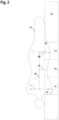
- Figure 3 shows the corresponding body contour 5 in a lateral position as the target position on the model 4 of the mattress 1.
- the person's spine serves as the reference axis A, which is intended to run along a horizontal straight line. Since the person's body characteristics and weight are known, a spatially resolved target field of penetration depths e 1 , e n of the model 4 can be calculated for the target position, for example by rounding empirically obtained data in a memory unit of the smartphone.
- the target material stiffnesses for the mattress 1 to be manufactured are determined from the target field of the penetration depths e 1 , e n .
- the location-dependent variation of the stiffness of the mattress 1 to be produced, corresponding to the target material stiffnesses, is obtained by selecting a number of materials and/or material structures from a set of material characteristics stored in a memory unit, depending on the location.
- Material structures can be homogeneous elements made of one material, elements made of different materials, or elements made of one material with hollow structures.
- This selection provides manufacturing data that can be used to manufacture mattress 1 using a manufacturing unit.
- the manufacturing data can be sent contactlessly, preferably via the Internet, from the smartphone to the manufacturing unit.
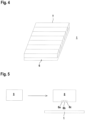
- Figure 4 shows an example of a mattress manufactured in this way 1.
- the mattress 1 consists of a base plate 6 and an arrangement of support units 7, which are attached to the upper side of the base plate 6 by means of fastening elements, thus forming a frameless upper structure.
- the support units 7 each extend across the entire width of the base plate 6 and are arranged close to one another in the longitudinal direction of the base plate 6, so that they form a full-surface, seamless upper structure.
- the mattress 1 is generally completed by a cover that is placed over the structure with the base plate 6 and the support units 7. This cover is in Figure 4 not shown.
- the base plate 6 consists of a homogeneous material, for example, a composite foam.
- the support elements 7 form modules with at least partially different material stiffnesses, which are manufactured according to the method according to the invention.
- Several support units 7 with different material stiffnesses can also be provided in order to increase the spatial resolution of the material stiffnesses.
- the components used to manufacture the mattress 1 include, on the one hand, elastic materials in the form of elastomeric materials, in particular plastics, and, on the other hand, binding agents.
- the elastomeric materials are present in powder form in the 3D printer 8.
- the binding agent is advantageously in liquid form.
Landscapes
- Chemical & Material Sciences (AREA)
- Engineering & Computer Science (AREA)
- Manufacturing & Machinery (AREA)
- Materials Engineering (AREA)
- Measurement Of The Respiration, Hearing Ability, Form, And Blood Characteristics Of Living Organisms (AREA)
Claims (14)
- Procédé de fabrication d'un matelas personnalisé (1), comprenant les étapes suivantes- Déterminer les caractéristiques physiques d'une personne- Déterminer la forme du corps de la personne en fonction de ses caractéristiques corporelles- Déterminer la position de sommeil préférée d'une personne à l'aide d'un capteur de position- Déterminer un champ nominal résolu dans l'espace des profondeurs d'indentation (e1, en) d'un modèle (4) pour le matelas (1) à fabriquer pour la forme du corps dans la position de sommeil préférée.- Déterminer la rigidité des matériaux cibles à partir des profondeurs d'indentation (e1, en) à l'aide d'un graphique force-déplacement- Générer des données de production par une sélection résolue dans l'espace de matériaux et/ou de structures de matériaux à partir d'un ensemble de paramètres de matériaux afin d'obtenir la rigidité cible des matériaux.
- Procédé selon la revendication 1, caractérisé par le fait que les caractéristiques des matériaux sont stockées dans une unité de mémoire.
- Procédé selon l'une des revendications 1 ou 2, caractérisé par le fait que la carte force-déplacement est déterminée au cours d'un processus d'apprentissage et est stockée dans une unité de mémoire.
- Procédé selon l'une des revendications 1 à 3, caractérisé par le fait que les caractéristiques du corps peuvent être introduites dans une unité informatique sous forme de paramètres au moyen d'une unité d'entrée.
- Procédé selon l'une des revendications 1 à 3, caractérisé par le fait que les caractéristiques corporelles sont dérivées d'une image de la personne, dans laquelle l'image contient en particulier un corps de référence (3) aux dimensions connues, les caractéristiques corporelles étant déterminées en référençant les données d'image de la personne aux dimensions du corps de référence (3).
- Procédé selon l'une des revendications 1 à 3, caractérisé par le fait que les caractéristiques du corps sont dérivées d'une séquence d'images de la personne, dans laquelle en particulier les images de la séquence contiennent un corps de référence (3) qui est déplacé le long d'une courbe de trajectoire, dans laquelle les valeurs de distance de référence sont obtenues par le suivi résolu dans l'espace de cette courbe de trajectoire, sur la base de laquelle les caractéristiques du corps sont déterminées.
- Procédé selon l'une des revendications 1 à 3, caractérisé par le fait que les caractéristiques du corps sont déterminées à l'aide d'une unité de réalité augmentée.
- Procédé selon l'une des revendications 1 à 7, caractérisé par le fait que toutes les unités nécessaires pour générer des données de production sont intégrées dans un smartphone.
- Procédé selon l'une des revendications 1 à 8, caractérisé par le fait que la position de sommeil préférée est déterminée lorsque la personne est allongée sur un matelas d'essai (10), le matelas d'essai (10) étant doté d'un capteur permettant de détecter les profondeurs de pénétration (e1, en) de la personne dans le matelas d'essai (10).
- Procédé selon la revendication 9, caractérisé par le fait que le dispositif de détection comprend un réseau de fils conducteurs (11) s'étendant sur la surface du matelas d'essai (10), les signaux de détection générés par les fils conducteurs (11) pouvant être lus par une unité RFID (12).
- Procédé selon l'une des revendications 1 à 10, caractérisé par le fait que les données de production sont transmises à un dispositif de production, de préférence sans contact.
- Procédé selon la revendication 11, caractérisé par le fait que les données de production sont transmises par Internet à un ordinateur en nuage (9) affecté au dispositif de production.
- Procédé selon l'une des revendications 1 à 12, caractérisé par le fait que le matelas (1) est composé de plusieurs modules de fermeté différente.
- Procédé selon l'une des revendications 1 à 12, caractérisé par le fait que le matelas (1) est produit au moyen d'une imprimante 3D (8).
Applications Claiming Priority (1)
| Application Number | Priority Date | Filing Date | Title |
|---|---|---|---|
| DE102018127734.2A DE102018127734A1 (de) | 2018-11-07 | 2018-11-07 | Verfahren zur Herstellung einer personenspezifischen Matratze |
Publications (3)
| Publication Number | Publication Date |
|---|---|
| EP3649899A1 EP3649899A1 (fr) | 2020-05-13 |
| EP3649899B1 true EP3649899B1 (fr) | 2025-07-02 |
| EP3649899C0 EP3649899C0 (fr) | 2025-07-02 |
Family
ID=68281032
Family Applications (1)
| Application Number | Title | Priority Date | Filing Date |
|---|---|---|---|
| EP19203245.6A Active EP3649899B1 (fr) | 2018-11-07 | 2019-10-15 | Procede de fabrication d'un matelas personnalisé |
Country Status (2)
| Country | Link |
|---|---|
| EP (1) | EP3649899B1 (fr) |
| DE (1) | DE102018127734A1 (fr) |
Families Citing this family (7)
| Publication number | Priority date | Publication date | Assignee | Title |
|---|---|---|---|---|
| AU2019378116A1 (en) * | 2018-11-16 | 2021-06-03 | Oy Sda Finland Ltd | Method of forming an orthopedic mattress and orthopedic mattress |
| CN112244567A (zh) * | 2020-11-05 | 2021-01-22 | 高春光 | 一种睡姿智能检测床垫、检测头套、检测系统及方法 |
| CN112493757A (zh) * | 2020-12-07 | 2021-03-16 | 禾丰(青岛)家纺有限公司 | 床垫的制备检测装置及床垫定制方法及床垫 |
| CN112472070B (zh) * | 2020-12-31 | 2025-06-27 | 宝鸡爱家家具有限责任公司 | 一种人体曲线测量仪及应用测量仪定制床垫的工艺 |
| DE102021111194A1 (de) | 2021-04-30 | 2022-11-03 | Faurecia Autositze Gmbh | Verfahren zur Herstellung eines auf eine bestimmte Person individualisierten Polsterelements |
| WO2023250006A1 (fr) * | 2022-06-21 | 2023-12-28 | Dreamwell, Ltd. | Sélection personnalisée d'oreiller et/ou de matelas |
| CN115230164B (zh) * | 2022-07-29 | 2025-08-22 | 深圳知足科技有限公司 | 一种基于三维扫描和3d打印的床垫制造方法 |
Family Cites Families (5)
| Publication number | Priority date | Publication date | Assignee | Title |
|---|---|---|---|---|
| PL2255293T3 (pl) * | 2008-02-14 | 2013-03-29 | Kingsdown Inc | Urządzenia i sposoby do ewaluacji osoby dla systemu sypialnianego |
| US8458042B1 (en) * | 2011-03-02 | 2013-06-04 | King Koil Licensing Company, Inc. | Methods for selecting a bedding mattress |
| ITPD20110163A1 (it) * | 2011-05-23 | 2012-11-24 | New Wind S R L | Materasso ad personam |
| DE102015100816B3 (de) * | 2015-01-21 | 2015-12-17 | Sven Oliver Maier | Verfahren zur Herstellung eines körperstützenden Elements |
| GB2558932B (en) * | 2017-01-20 | 2022-04-27 | Kayfoam Woolfson | An optimal mattress characteristics determining system |
-
2018
- 2018-11-07 DE DE102018127734.2A patent/DE102018127734A1/de not_active Withdrawn
-
2019
- 2019-10-15 EP EP19203245.6A patent/EP3649899B1/fr active Active
Also Published As
| Publication number | Publication date |
|---|---|
| DE102018127734A1 (de) | 2020-05-07 |
| EP3649899C0 (fr) | 2025-07-02 |
| EP3649899A1 (fr) | 2020-05-13 |
Similar Documents
| Publication | Publication Date | Title |
|---|---|---|
| EP3649899A1 (fr) | Procede de fabrication d'un matelas personnalisé | |
| DE69124490T2 (de) | Rückkoppelungssystem für eine lasttragende Fläche | |
| EP3047760B1 (fr) | Procede de fabrication d'un element de support corporel | |
| DE202019105992U1 (de) | Laufbandanordnung mit Neigungsverstellung | |
| EP2413743A1 (fr) | Procédé de production d'une coque support pour un siège | |
| WO2020048854A1 (fr) | Revêtement sans déformation de surfaces intérieures de véhicule | |
| DE202015103932U1 (de) | Ausgleich der Unebenheit einer Grundplatte beim 3D-Druck | |
| DE102013224142A1 (de) | Einlegesohle und Verfahren zu deren Herstellung | |
| DE102014112396A1 (de) | Verfahren zur Einzelpunktantastung eines Werkstücks und Koordinatenmessgerät | |
| WO2020038679A1 (fr) | Procédé de fabrication d'une pièce textile | |
| DE102007011603A1 (de) | Verfahren und Vorrichtung zum Bestimmen von Geometriedaten eines konischen Messobjekts | |
| DE4001100C2 (de) | Einrichtung zur ermittlung der koerperkonturen von personen | |
| DE102021130449A1 (de) | Auflageeinrichtung zur Auflage eines Körperteils eines Nutzers | |
| DE102017010483A1 (de) | Kraftfahrzeugsitz, Verfahren zur Herstellung eines Kraftfahrzeugsitzes | |
| EP3725187B1 (fr) | Matelas | |
| DE102008039235B4 (de) | Kopfstütze für einen Fahrzeugsitz | |
| DE69713531T2 (de) | Vorrichtung und Verfahren zum Entwurf orthopädischer Stühle | |
| EP3805146B1 (fr) | Dispositif et procédé d'enregistrement d'une pression d'appui d'une selle d'équitation, produit programme informatique | |
| DE3800080C2 (fr) | ||
| AT507546A4 (de) | Einrichtung zum vermessen der wirbelsäule | |
| AT523855B1 (de) | Liegesimulator | |
| DE102019203047A1 (de) | Fahrzeugsitz, Sitzanordnung, Kraftfahrzeug und Verfahren zum Betreiben eines Fahrzeugsitzes | |
| DE102018131000A1 (de) | Optisches Positionsbestimmungs- und Identifikationssystem | |
| DE102017124484A1 (de) | Sitz-Vorrichtung mit selbstregulierender Sitzpaneeleinstellung | |
| DE202017106342U1 (de) | Sitz-Vorrichtung mit selbstregulierender Sitzpaneeleinstellung |
Legal Events
| Date | Code | Title | Description |
|---|---|---|---|
| PUAI | Public reference made under article 153(3) epc to a published international application that has entered the european phase |
Free format text: ORIGINAL CODE: 0009012 |
|
| STAA | Information on the status of an ep patent application or granted ep patent |
Free format text: STATUS: REQUEST FOR EXAMINATION WAS MADE |
|
| 17P | Request for examination filed |
Effective date: 20200207 |
|
| AK | Designated contracting states |
Kind code of ref document: A1 Designated state(s): AL AT BE BG CH CY CZ DE DK EE ES FI FR GB GR HR HU IE IS IT LI LT LU LV MC MK MT NL NO PL PT RO RS SE SI SK SM TR |
|
| AX | Request for extension of the european patent |
Extension state: BA ME |
|
| STAA | Information on the status of an ep patent application or granted ep patent |
Free format text: STATUS: EXAMINATION IS IN PROGRESS |
|
| 17Q | First examination report despatched |
Effective date: 20230210 |
|
| GRAP | Despatch of communication of intention to grant a patent |
Free format text: ORIGINAL CODE: EPIDOSNIGR1 |
|
| STAA | Information on the status of an ep patent application or granted ep patent |
Free format text: STATUS: GRANT OF PATENT IS INTENDED |
|
| INTG | Intention to grant announced |
Effective date: 20250320 |
|
| GRAS | Grant fee paid |
Free format text: ORIGINAL CODE: EPIDOSNIGR3 |
|
| GRAA | (expected) grant |
Free format text: ORIGINAL CODE: 0009210 |
|
| STAA | Information on the status of an ep patent application or granted ep patent |
Free format text: STATUS: THE PATENT HAS BEEN GRANTED |
|
| AK | Designated contracting states |
Kind code of ref document: B1 Designated state(s): AL AT BE BG CH CY CZ DE DK EE ES FI FR GB GR HR HU IE IS IT LI LT LU LV MC MK MT NL NO PL PT RO RS SE SI SK SM TR |
|
| REG | Reference to a national code |
Ref country code: GB Ref legal event code: FG4D Free format text: NOT ENGLISH |
|
| REG | Reference to a national code |
Ref country code: CH Ref legal event code: EP |
|
| REG | Reference to a national code |
Ref country code: IE Ref legal event code: FG4D Free format text: LANGUAGE OF EP DOCUMENT: GERMAN |
|
| U01 | Request for unitary effect filed |
Effective date: 20250708 |
|
| U07 | Unitary effect registered |
Designated state(s): AT BE BG DE DK EE FI FR IT LT LU LV MT NL PT RO SE SI Effective date: 20250714 |
|
| U20 | Renewal fee for the european patent with unitary effect paid |
Year of fee payment: 7 Effective date: 20250805 |
|
| REG | Reference to a national code |
Ref country code: CH Ref legal event code: U11 Free format text: ST27 STATUS EVENT CODE: U-0-0-U10-U11 (AS PROVIDED BY THE NATIONAL OFFICE) Effective date: 20251101 |
|
| PG25 | Lapsed in a contracting state [announced via postgrant information from national office to epo] |
Ref country code: IS Free format text: LAPSE BECAUSE OF FAILURE TO SUBMIT A TRANSLATION OF THE DESCRIPTION OR TO PAY THE FEE WITHIN THE PRESCRIBED TIME-LIMIT Effective date: 20251102 |
|
| PG25 | Lapsed in a contracting state [announced via postgrant information from national office to epo] |
Ref country code: NO Free format text: LAPSE BECAUSE OF FAILURE TO SUBMIT A TRANSLATION OF THE DESCRIPTION OR TO PAY THE FEE WITHIN THE PRESCRIBED TIME-LIMIT Effective date: 20251002 |
|
| PG25 | Lapsed in a contracting state [announced via postgrant information from national office to epo] |
Ref country code: HR Free format text: LAPSE BECAUSE OF FAILURE TO SUBMIT A TRANSLATION OF THE DESCRIPTION OR TO PAY THE FEE WITHIN THE PRESCRIBED TIME-LIMIT Effective date: 20250702 |
|
| PG25 | Lapsed in a contracting state [announced via postgrant information from national office to epo] |
Ref country code: GR Free format text: LAPSE BECAUSE OF FAILURE TO SUBMIT A TRANSLATION OF THE DESCRIPTION OR TO PAY THE FEE WITHIN THE PRESCRIBED TIME-LIMIT Effective date: 20251003 |
|
| PGFP | Annual fee paid to national office [announced via postgrant information from national office to epo] |
Ref country code: CH Payment date: 20251101 Year of fee payment: 7 |
|
| PG25 | Lapsed in a contracting state [announced via postgrant information from national office to epo] |
Ref country code: CZ Free format text: LAPSE BECAUSE OF FAILURE TO SUBMIT A TRANSLATION OF THE DESCRIPTION OR TO PAY THE FEE WITHIN THE PRESCRIBED TIME-LIMIT Effective date: 20250702 |
|
| PG25 | Lapsed in a contracting state [announced via postgrant information from national office to epo] |
Ref country code: PL Free format text: LAPSE BECAUSE OF FAILURE TO SUBMIT A TRANSLATION OF THE DESCRIPTION OR TO PAY THE FEE WITHIN THE PRESCRIBED TIME-LIMIT Effective date: 20250702 |
|
| PG25 | Lapsed in a contracting state [announced via postgrant information from national office to epo] |
Ref country code: RS Free format text: LAPSE BECAUSE OF FAILURE TO SUBMIT A TRANSLATION OF THE DESCRIPTION OR TO PAY THE FEE WITHIN THE PRESCRIBED TIME-LIMIT Effective date: 20251002 |
|
| PG25 | Lapsed in a contracting state [announced via postgrant information from national office to epo] |
Ref country code: ES Free format text: LAPSE BECAUSE OF FAILURE TO SUBMIT A TRANSLATION OF THE DESCRIPTION OR TO PAY THE FEE WITHIN THE PRESCRIBED TIME-LIMIT Effective date: 20250702 |
|
| PG25 | Lapsed in a contracting state [announced via postgrant information from national office to epo] |
Ref country code: SM Free format text: LAPSE BECAUSE OF FAILURE TO SUBMIT A TRANSLATION OF THE DESCRIPTION OR TO PAY THE FEE WITHIN THE PRESCRIBED TIME-LIMIT Effective date: 20250702 |
|
| REG | Reference to a national code |
Ref country code: CH Ref legal event code: R17 Free format text: ST27 STATUS EVENT CODE: U-0-0-R10-R17 (AS PROVIDED BY THE NATIONAL OFFICE) Effective date: 20260410 |
|
| PG25 | Lapsed in a contracting state [announced via postgrant information from national office to epo] |
Ref country code: SK Free format text: LAPSE BECAUSE OF FAILURE TO SUBMIT A TRANSLATION OF THE DESCRIPTION OR TO PAY THE FEE WITHIN THE PRESCRIBED TIME-LIMIT Effective date: 20250702 |
|
| PLBE | No opposition filed within time limit |
Free format text: ORIGINAL CODE: 0009261 |
|
| STAA | Information on the status of an ep patent application or granted ep patent |
Free format text: STATUS: NO OPPOSITION FILED WITHIN TIME LIMIT |