EP3647271A1 - Method for preparing nickel oxide nanoparticle and nickel oxide nanoparticle prepared using same - Google Patents
Method for preparing nickel oxide nanoparticle and nickel oxide nanoparticle prepared using same Download PDFInfo
- Publication number
- EP3647271A1 EP3647271A1 EP18823232.6A EP18823232A EP3647271A1 EP 3647271 A1 EP3647271 A1 EP 3647271A1 EP 18823232 A EP18823232 A EP 18823232A EP 3647271 A1 EP3647271 A1 EP 3647271A1
- Authority
- EP
- European Patent Office
- Prior art keywords
- nickel oxide
- powder
- oxide nanoparticles
- koh
- present
- Prior art date
- Legal status (The legal status is an assumption and is not a legal conclusion. Google has not performed a legal analysis and makes no representation as to the accuracy of the status listed.)
- Granted
Links
Images




Classifications
-
- C—CHEMISTRY; METALLURGY
- C01—INORGANIC CHEMISTRY
- C01G—COMPOUNDS CONTAINING METALS NOT COVERED BY SUBCLASSES C01D OR C01F
- C01G53/00—Compounds of nickel
- C01G53/04—Oxides
-
- B—PERFORMING OPERATIONS; TRANSPORTING
- B22—CASTING; POWDER METALLURGY
- B22F—WORKING METALLIC POWDER; MANUFACTURE OF ARTICLES FROM METALLIC POWDER; MAKING METALLIC POWDER; APPARATUS OR DEVICES SPECIALLY ADAPTED FOR METALLIC POWDER
- B22F1/00—Metallic powder; Treatment of metallic powder, e.g. to facilitate working or to improve properties
- B22F1/07—Metallic powder characterised by particles having a nanoscale microstructure
-
- B—PERFORMING OPERATIONS; TRANSPORTING
- B22—CASTING; POWDER METALLURGY
- B22F—WORKING METALLIC POWDER; MANUFACTURE OF ARTICLES FROM METALLIC POWDER; MAKING METALLIC POWDER; APPARATUS OR DEVICES SPECIALLY ADAPTED FOR METALLIC POWDER
- B22F1/00—Metallic powder; Treatment of metallic powder, e.g. to facilitate working or to improve properties
- B22F1/14—Treatment of metallic powder
- B22F1/142—Thermal or thermo-mechanical treatment
-
- B—PERFORMING OPERATIONS; TRANSPORTING
- B22—CASTING; POWDER METALLURGY
- B22F—WORKING METALLIC POWDER; MANUFACTURE OF ARTICLES FROM METALLIC POWDER; MAKING METALLIC POWDER; APPARATUS OR DEVICES SPECIALLY ADAPTED FOR METALLIC POWDER
- B22F2302/00—Metal Compound, non-Metallic compound or non-metal composition of the powder or its coating
- B22F2302/25—Oxide
-
- B—PERFORMING OPERATIONS; TRANSPORTING
- B22—CASTING; POWDER METALLURGY
- B22F—WORKING METALLIC POWDER; MANUFACTURE OF ARTICLES FROM METALLIC POWDER; MAKING METALLIC POWDER; APPARATUS OR DEVICES SPECIALLY ADAPTED FOR METALLIC POWDER
- B22F2304/00—Physical aspects of the powder
- B22F2304/05—Submicron size particles
- B22F2304/056—Particle size above 100 nm up to 300 nm
-
- C—CHEMISTRY; METALLURGY
- C01—INORGANIC CHEMISTRY
- C01P—INDEXING SCHEME RELATING TO STRUCTURAL AND PHYSICAL ASPECTS OF SOLID INORGANIC COMPOUNDS
- C01P2002/00—Crystal-structural characteristics
- C01P2002/70—Crystal-structural characteristics defined by measured X-ray, neutron or electron diffraction data
- C01P2002/72—Crystal-structural characteristics defined by measured X-ray, neutron or electron diffraction data by d-values or two theta-values, e.g. as X-ray diagram
-
- C—CHEMISTRY; METALLURGY
- C01—INORGANIC CHEMISTRY
- C01P—INDEXING SCHEME RELATING TO STRUCTURAL AND PHYSICAL ASPECTS OF SOLID INORGANIC COMPOUNDS
- C01P2004/00—Particle morphology
- C01P2004/01—Particle morphology depicted by an image
- C01P2004/03—Particle morphology depicted by an image obtained by SEM
-
- C—CHEMISTRY; METALLURGY
- C01—INORGANIC CHEMISTRY
- C01P—INDEXING SCHEME RELATING TO STRUCTURAL AND PHYSICAL ASPECTS OF SOLID INORGANIC COMPOUNDS
- C01P2004/00—Particle morphology
- C01P2004/60—Particles characterised by their size
- C01P2004/61—Micrometer sized, i.e. from 1-100 micrometer
-
- C—CHEMISTRY; METALLURGY
- C01—INORGANIC CHEMISTRY
- C01P—INDEXING SCHEME RELATING TO STRUCTURAL AND PHYSICAL ASPECTS OF SOLID INORGANIC COMPOUNDS
- C01P2004/00—Particle morphology
- C01P2004/60—Particles characterised by their size
- C01P2004/64—Nanometer sized, i.e. from 1-100 nanometer
-
- C—CHEMISTRY; METALLURGY
- C01—INORGANIC CHEMISTRY
- C01P—INDEXING SCHEME RELATING TO STRUCTURAL AND PHYSICAL ASPECTS OF SOLID INORGANIC COMPOUNDS
- C01P2006/00—Physical properties of inorganic compounds
- C01P2006/12—Surface area
-
- C—CHEMISTRY; METALLURGY
- C01—INORGANIC CHEMISTRY
- C01P—INDEXING SCHEME RELATING TO STRUCTURAL AND PHYSICAL ASPECTS OF SOLID INORGANIC COMPOUNDS
- C01P2006/00—Physical properties of inorganic compounds
- C01P2006/80—Compositional purity
Definitions
- the present invention relates to a method for producing nickel oxide nanoparticles and nickel oxide nanoparticles produced by using the same.
- Nickel oxide has nickel vacancies, and due to the vacancies, nickel oxide has p-type semiconductor characteristics (band gap of 3.6 eV to 4.0 eV, conduction band energy of 1.8 eV). In order to apply these characteristics, people have various interests in nickel oxide, and nickel oxide may be used in various ways such as a p-type transparent conducting film, a gas sensor, an electrochromic film, a magnetic material, a dye sensitive photodiode, a biosensor, and a battery positive electrode material. Furthermore, since nickel oxide has a quantum effect, a surface effect, and a volume effect, the importance of nickel oxide nanoparticles has been increasing as compared to nickel oxide microparticles.
- a method of allowing a metallic nickel powder to react with oxygen at a temperature of 400°C or more, or a method of forming nickel oxide by thermally decomposing a nickel salt at a temperature of 500°C or more may be generally used.
- these methods there is a problem in that the particle diameter and particle diameter distribution of nickel oxide are increased due to the high heat treatment temperature, and there is a problem in that the process costs increase.
- there is a method of producing nickel oxide by using a sol-gel synthesis method in order to reduce high process costs but since the method uses toxic organic solvents, there is a problem with the management and treatment of organic solvents, and furthermore, there is an environmental pollution problem due to organic solvents.
- the present invention provides a method for producing nickel oxide nanoparticles and nickel oxide nanoparticles produced by using the same.
- An exemplary embodiment of the present invention provides a method for producing nickel oxide nanoparticles, the method including: preparing Ni(OH) 2 powder and KOH powder; forming a mixed powder by mixing the Ni(OH) 2 powder with the KOH powder; and heat-treating the mixed powder at a temperature of 90°C to 200°C.
- Another exemplary embodiment of the present invention provides nickel oxide nanoparticles produced by the production method.
- a method for producing nickel oxide nanoparticles according to an exemplary embodiment of the present invention has an advantage in that the production costs can be significantly reduced because nickel oxide nanoparticles can be produced by a simple method.
- the method for producing nickel oxide nanoparticles according to an exemplary embodiment of the present invention has advantages in that a high heat treatment temperature is not required and nickel oxide nanoparticles having a small particle diameter can be produced.
- An exemplary embodiment of the present invention provides a method for producing nickel oxide nanoparticles, the method including: preparing Ni(OH) 2 powder and KOH powder; forming a mixed powder by mixing the Ni(OH) 2 powder with the KOH powder; and heat-treating the mixed powder at a temperature of 90°C to 200°C.
- the heat-treating of the mixed powder may be performed at a temperature of 90°C to 180°C, 90°C to 160°C, 90°C to 150°C, 90°C to 140°C, 90°C to 130°C, 90°C to 120°C, 100°C to 200°C, 100°C to 180°C, 100°C to 160°C, 100°C to 150°C, 100°C to 140°C, 100°C to 130°C, or 100°C to 120°C.
- nickel oxide nanoparticles may be synthesized by performing a heat treatment at low temperature like the above-described range, there is an advantage in that the production processability of nickel oxide nanoparticles may be improved. Further, there is an advantage in that a diffusion phenomenon is suppressed by adjusting the heat treatment temperature to the above-described range, so that nickel oxide nanoparticles having smaller particle diameters may be synthesized.
- the Ni(OH) 2 powder and the KOH powder each are in the form of a solid-phase powder, and the method for producing nickel oxide nanoparticles uses a solid-phase synthesis method instead of a wet synthesis method.
- the mixed powder may be a mixture of the Ni(OH) 2 powder and the KOH powder.
- the method for producing nickel oxide nanoparticles according to an exemplary embodiment of the present invention uses a solid-phase synthesis method, and has an advantage in that a surfactant is not used at all during the production process.
- the wet synthesis method When the wet synthesis method is used, there is a problem in that a very large reactor needs to be used for mass-producing nickel oxide nanoparticles. In addition, since the wet synthesis method uses an acid or base reaction, there are problems in that it is difficult to control reaction heat generated during the mass-production process, and a lot of time is required to complete the reaction. Furthermore, the wet synthesis method has a problem in that the production costs are increased because it is difficult to maintain and repair the equipment, the process of recovering the synthesized particles is complicated, and a large amount of wastewater may be generated in this process.
- the method for producing nickel oxide nanoparticles according to an exemplary embodiment of the present invention has an advantage in that nickel oxide nanoparticles can be stably mass-produced within a short period of time by using a solid-phase synthesis method. Furthermore, since the method for producing nickel oxide nanoparticles may simplify synthesis conditions, there is an advantage in that nickel oxide nanoparticles can be stably produced.
- a molar ratio of the Ni(OH) 2 powder to the KOH powder in the mixed powder may be 1 : 1.6 to 1 : 3.
- the molar ratio of the Ni(OH) 2 powder to the KOH powder in the mixed powder may mean a ratio of the number of moles of the Ni(OH) 2 powder to the number of moles of the KOH powder.
- the molar ratio of the Ni(OH) 2 powder to the KOH powder in the mixed powder may be 1 : 1.6 to 1 : 2.5, 1 : 1.16 to 1 : 2, 1 : 1.8 to 1 : 3, 1 : 1.8 to 1 : 2.5, or 1 : 1.8 to 1 : 2.
- the produced nickel oxide nanoparticles may not include Ni(OH) 2 which is a residual hydroxide, and the like, and nickel oxide nanoparticles with high purity can be produced. Furthermore, it is possible to suppress the KOH residue from being present in an excessive amount in the prepared nickel oxide nanoparticles by adjusting the ratio of the KOH powder in the mixed powder to the above-described range, and accordingly, the process of removing the KOH residue may be simplified.
- a respective specific surface area of the Ni(OH) 2 powder and the KOH powder may be 0.01 m 2 /g to 200 m 2 /g.
- the specific surface area of the Ni(OH) 2 powder and the KOH powder may be each 0.01 m 2 /g to 150 m 2 /g, 0.01 m 2 /g to 120 m 2 /g, 0.01 m 2 /g to 100 m 2 /g, 0.01 m 2 /g to 80 m 2 /g, 0.01 m 2 /g to 60 m 2 /g, 0.01 m 2 /g to 40 m 2 /g, 0.1 m 2 /g to 150 m 2 /g, 0.5 m 2 /g to 150 m 2 /g, 1 m 2 /g to 150 m 2 /g, 2 m 2 /g to 150 m 2 /g, 5 m 2 /g to 150 m 2 /g
- the method for producing the nickel oxide nanoparticles is performed by a solid-phase synthesis method, and the smaller the particle sizes of the Ni(OH) 2 powder and the KOH powder are, the more advantageous the Ni(OH) 2 powder and the KOH powder are, and when the Ni(OH) 2 powder and the KOH powder have a specific surface area within the above range, it is possible to obtain uniform nickel oxide nanoparticles having a small particle size more effectively.
- the heat-treating of the mixed powder may be carried out under an atmosphere of normal humidity and normal pressure.
- the atmosphere of normal humidity and normal pressure is an atmosphere of humidity and atmospheric pressure, which is not artificially manipulated, and may be, for example, an atmosphere of a humidity of 45%RH to 85%RH and an atmospheric pressure of 860 mbar to 1,060 mbar.
- the nickel oxide nanoparticles may have an average particle diameter of 5 nm to 50 nm.
- the nickel oxide nanoparticles may have an average particle diameter of 5 nm to 50 nm, 5 nm to 40 nm, 5 nm to 30 nm, or 5 nm to 25 nm, 10 nm to 50 nm, 10 nm to 40 nm, 10 nm to 30 nm, 10 nm to 25 nm, or 15 nm to 25 nm.
- the method for producing nickel oxide nanoparticles according to an exemplary embodiment of the present invention has an advantage in that it is possible to produce nickel oxide nanoparticles having a very small particle diameter within the aforementioned range.
- an ink solution is produced and coated by using the particulate of the nickel oxide nanoparticles produced as described above, there is an advantage in that a thin film having very high density may be produced.
- the particle diameter of the nickel oxide nanoparticles may be measured by a scanning electron microscope (SEM) image or a particle size analyzer (Malvern, Japan). Specifically, the particle diameter of the nickel oxide nanoparticles may be a particle diameter in which a secondary particle size is measured by dynamic light scattering on a nano-colloidal solution using a particle size analyzer.
- the nickel oxide nanoparticles may have a specific surface area of 100 m 2 /g or more. Specifically, the nickel oxide nanoparticles may have a specific surface area of 110 m 2 /g or more, or 120 m 2 /g or more. Further, the nickel oxide nanoparticles may have a specific surface area of 200 m 2 /g or less, 180 m 2 /g or less, or 150 m 2 /g or less.
- the nickel oxide nanoparticles may have a specific surface area of 100 m 2 /g to 200 m 2 /g, 110 m 2 /g to 180 m 2 /g, 120 m 2 /g to 150 m 2 /g, 110 m 2 /g to 140 m 2 /g, or 150 m 2 /g to 190 m 2 /g.
- the specific surface area in the present invention was measured by using the BET method, and specifically, the specific surface area may be measured by adding 0.3 g to 0.5 g of a sample to a tube, pre-treating the sample at 100°C for 8 hours, and then using ASAP2020 (Micromeritics, USA) at room temperature. An average value may be obtained by measuring the same sample three times.
- a content of hydroxide in the nickel oxide nanoparticles may be less than 0.1 wt%. Specifically, according to an exemplary embodiment of the present invention, a content of hydroxide in the nickel oxide nanoparticles may be 0 wt%.
- the nickel oxide nanoparticles may include no hydroxide.
- the nickel oxide nanoparticles produced by the production method according to an exemplary embodiment of the present invention may include no residual hydroxide such as Ni(OH) 2 and KOH. That is, the production method according to an exemplary embodiment of the present invention has an advantage in that nickel oxide nanoparticles with higher purity may be produced.
- An exemplary embodiment of the present invention provides nickel oxide nanoparticles produced by the production method.
- the nickel oxide nanoparticles may be used for an electrochromic film, a material for a positive electrode of a secondary battery, and various catalysts or gas sensors.
- FIG. 1 illustrates an X-ray diffraction (XRD) measurement result of the nickel oxide nanoparticles produced in Example 1. According to FIG. 1 , it was confirmed that from the nickel oxide nanoparticles produced in Example 1, impurities other than nickel oxide were not detected.
- XRD X-ray diffraction
- Nickel oxide nanoparticles were obtained in the same manner as in Example 1, except that during the heat treatment, the temperature and the heat treatment time were adjusted to about 120°C and about 1 hour, respectively.
- FIG. 2 illustrates an X-ray diffraction (XRD) measurement result of the nickel oxide nanoparticles produced in Example 2. According to FIG. 2 , it was confirmed that from the nickel oxide nanoparticles produced in Example 2, impurities other than nickel oxide were not detected.
- XRD X-ray diffraction
- Nickel oxide nanoparticles were obtained in the same manner as in Example 1, except that during the heat treatment, the temperature and the heat treatment time were adjusted to about 110°C and about 1 hour, respectively, and the molar ratio of the Ni(OH) 2 powder : the KOH powder was adjusted to 1 : 1.8.
- FIG. 3 illustrates an X-ray diffraction (XRD) measurement result of the nickel oxide nanoparticles produced in Example 3. According to FIG. 3 , it was confirmed that from the nickel oxide nanoparticles produced in Example 3, impurities other than nickel oxide were not detected.
- XRD X-ray diffraction
- FIG. 4 illustrates a scanning electron microscope (SEM) image of the nickel oxide nanoparticles produced in Example 3. According to FIG. 4 , it was confirmed that the average particle diameter of the nickel oxide nanoparticles produced in Example 3 was about 20 nm.
- Solution A in which 29.1 g of Ni(NO 3 ) 2 ⁇ 6H 2 O was dissolved in 100 ml of water was prepared, Solution B in which 8 g of NaOH was dissolved in 100 ml of water was prepared, and then Solution A and Solution B were mixed.
- Ni(OH) 2 powder was obtained by recovering precipitating particles from the mixed solution by a centrifuge, and washing and drying the particles.
- Nickel oxide nanoparticles were obtained in the same manner as in Example 1, except that the Ni(OH) 2 powder produced as described above was used.
- FIG. 5 illustrates an X-ray diffraction (XRD) measurement result of the nickel oxide nanoparticles produced in Example 4. According to FIG. 5 , it was confirmed that from the nickel oxide nanoparticles produced in Example 4, impurities other than nickel oxide were not detected.
- XRD X-ray diffraction
- FIG. 6 illustrates an X-ray diffraction (XRD) measurement result of the nickel oxide nanoparticles produced in Comparative Example 1. According to FIG. 6 , it was confirmed that unlike Examples 1 to 4, impurities were included because hydroxide Ni(OH) 2 , in addition to nickel oxide, was detected from the nickel oxide nanoparticles produced in Comparative Example 1.
- XRD X-ray diffraction
- Nanoparticles synthesized in the same manner as in Example 1 were obtained, except that 8 g (0.2 mol) of NaOH was used instead of 11.2 g (0.2 mol) of KOH.
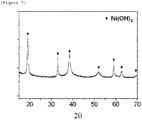
- FIG. 7 illustrates an X-ray diffraction (XRD) measurement result of the nanoparticles synthesized in Comparative Example 2. According to FIG. 7 , it was confirmed that when nanoparticles were synthesized by the method in Comparative Example 2, the reaction did not occur, and as a result, nickel oxide nanoparticles were not formed and Ni(OH)2 in the initial state remained as it is.
- XRD X-ray diffraction
- Nickel oxide nanoparticles were obtained in the same manner as in Example 1, except that during the heat treatment, the temperature and the heat treatment time were adjusted to about 110°C and about 1 hour, respectively, and the molar ratio of the Ni(OH) 2 powder : the KOH powder was adjusted to 1 : 1.5.
- FIG. 8 illustrates an X-ray diffraction (XRD) measurement result of the nickel oxide nanoparticles produced in Comparative Example 3. According to FIG. 8 , it was confirmed that unlike the Examples, impurities were included because hydroxide Ni(OH) 2 , in addition to nickel oxide, was detected from the nickel oxide nanoparticles produced in Comparative Example 3.
- XRD X-ray diffraction
- the method for producing nickel oxide nanoparticles according to an exemplary embodiment of the present invention can easily produce nickel oxide nanoparticles having high purity by adjusting the molar ratio of the Ni(OH) 2 powder to the KOH powder and adjusting the heat treatment temperature of the mixed powder.
Landscapes
- Chemical & Material Sciences (AREA)
- Organic Chemistry (AREA)
- Inorganic Chemistry (AREA)
- Physics & Mathematics (AREA)
- Thermal Sciences (AREA)
- Engineering & Computer Science (AREA)
- Crystallography & Structural Chemistry (AREA)
- Nanotechnology (AREA)
- Inorganic Compounds Of Heavy Metals (AREA)
Abstract
Description
- The present specification claims priority to and the benefit of Korean Patent Application No.
10-2017-0083651 - The present invention relates to a method for producing nickel oxide nanoparticles and nickel oxide nanoparticles produced by using the same.
- Nickel oxide has nickel vacancies, and due to the vacancies, nickel oxide has p-type semiconductor characteristics (band gap of 3.6 eV to 4.0 eV, conduction band energy of 1.8 eV). In order to apply these characteristics, people have various interests in nickel oxide, and nickel oxide may be used in various ways such as a p-type transparent conducting film, a gas sensor, an electrochromic film, a magnetic material, a dye sensitive photodiode, a biosensor, and a battery positive electrode material. Furthermore, since nickel oxide has a quantum effect, a surface effect, and a volume effect, the importance of nickel oxide nanoparticles has been increasing as compared to nickel oxide microparticles.
- In order to synthesize such nickel oxide, a method of allowing a metallic nickel powder to react with oxygen at a temperature of 400°C or more, or a method of forming nickel oxide by thermally decomposing a nickel salt at a temperature of 500°C or more may be generally used. However, when these methods are used, there is a problem in that the particle diameter and particle diameter distribution of nickel oxide are increased due to the high heat treatment temperature, and there is a problem in that the process costs increase. Further, there is a method of producing nickel oxide by using a sol-gel synthesis method in order to reduce high process costs, but since the method uses toxic organic solvents, there is a problem with the management and treatment of organic solvents, and furthermore, there is an environmental pollution problem due to organic solvents.
- Therefore, there is a need for studies on a production method capable of reducing the process costs, reducing the burden of environmental pollution, and regulating the particle diameter of nickel oxide.
-
- The present invention provides a method for producing nickel oxide nanoparticles and nickel oxide nanoparticles produced by using the same.
- However, a problem to be solved by the present invention is not limited to the aforementioned problem, and the other problems that are not mentioned may be clearly understood by a person skilled in the art from the following description.
- An exemplary embodiment of the present invention provides a method for producing nickel oxide nanoparticles, the method including: preparing Ni(OH)2 powder and KOH powder; forming a mixed powder by mixing the Ni(OH)2 powder with the KOH powder; and heat-treating the mixed powder at a temperature of 90°C to 200°C.
- Another exemplary embodiment of the present invention provides nickel oxide nanoparticles produced by the production method.
- A method for producing nickel oxide nanoparticles according to an exemplary embodiment of the present invention has an advantage in that the production costs can be significantly reduced because nickel oxide nanoparticles can be produced by a simple method.
- The method for producing nickel oxide nanoparticles according to an exemplary embodiment of the present invention has advantages in that a high heat treatment temperature is not required and nickel oxide nanoparticles having a small particle diameter can be produced.
-
-
FIG. 1 illustrates an X-ray diffraction (XRD) measurement result of nickel oxide nanoparticles produced in Example 1. -
FIG. 2 illustrates an X-ray diffraction (XRD) measurement result of nickel oxide nanoparticles produced in Example 2. -
FIG. 3 illustrates an X-ray diffraction (XRD) measurement result of nickel oxide nanoparticles produced in Example 3. -
FIG. 4 illustrates a scanning electron microscope (SEM) image of the nickel oxide nanoparticles produced in Example 3. -
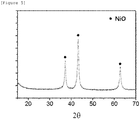
FIG. 5 illustrates an X-ray diffraction (XRD) measurement result of nickel oxide nanoparticles produced in Example 4. -
FIG. 6 illustrates an X-ray diffraction (XRD) measurement result of nickel oxide nanoparticles produced in Comparative Example 1. -
FIG. 7 illustrates an X-ray diffraction (XRD) measurement result of nanoparticles synthesized in Comparative Example 2. -
FIG. 8 illustrates an X-ray diffraction (XRD) measurement result of nickel oxide nanoparticles produced in Comparative Example 3. - Throughout the specification of the present application, terms, such as a "step ... " or a "step of ...", do not mean a "step for ...".
- When one part "includes" one constituent element throughout the present specification, unless otherwise specifically described, this does not mean that another constituent element is excluded, but means that another constituent element may be further included.
- Hereinafter, the present specification will be described in more detail.
- An exemplary embodiment of the present invention provides a method for producing nickel oxide nanoparticles, the method including: preparing Ni(OH)2 powder and KOH powder; forming a mixed powder by mixing the Ni(OH)2 powder with the KOH powder; and heat-treating the mixed powder at a temperature of 90°C to 200°C.
- According to an exemplary embodiment of the present invention, the heat-treating of the mixed powder may be performed at a temperature of 90°C to 180°C, 90°C to 160°C, 90°C to 150°C, 90°C to 140°C, 90°C to 130°C, 90°C to 120°C, 100°C to 200°C, 100°C to 180°C, 100°C to 160°C, 100°C to 150°C, 100°C to 140°C, 100°C to 130°C, or 100°C to 120°C.
- According to an exemplary embodiment of the present invention, since nickel oxide nanoparticles may be synthesized by performing a heat treatment at low temperature like the above-described range, there is an advantage in that the production processability of nickel oxide nanoparticles may be improved. Further, there is an advantage in that a diffusion phenomenon is suppressed by adjusting the heat treatment temperature to the above-described range, so that nickel oxide nanoparticles having smaller particle diameters may be synthesized.
- According to an exemplary embodiment of the present invention, the Ni(OH)2 powder and the KOH powder each are in the form of a solid-phase powder, and the method for producing nickel oxide nanoparticles uses a solid-phase synthesis method instead of a wet synthesis method. Further, the mixed powder may be a mixture of the Ni(OH)2 powder and the KOH powder.
- The method for producing nickel oxide nanoparticles according to an exemplary embodiment of the present invention uses a solid-phase synthesis method, and has an advantage in that a surfactant is not used at all during the production process.
- When the wet synthesis method is used, there is a problem in that a very large reactor needs to be used for mass-producing nickel oxide nanoparticles. In addition, since the wet synthesis method uses an acid or base reaction, there are problems in that it is difficult to control reaction heat generated during the mass-production process, and a lot of time is required to complete the reaction. Furthermore, the wet synthesis method has a problem in that the production costs are increased because it is difficult to maintain and repair the equipment, the process of recovering the synthesized particles is complicated, and a large amount of wastewater may be generated in this process.
- In contrast, the method for producing nickel oxide nanoparticles according to an exemplary embodiment of the present invention has an advantage in that nickel oxide nanoparticles can be stably mass-produced within a short period of time by using a solid-phase synthesis method. Furthermore, since the method for producing nickel oxide nanoparticles may simplify synthesis conditions, there is an advantage in that nickel oxide nanoparticles can be stably produced.
- According to an exemplary embodiment of the present invention, a molar ratio of the Ni(OH)2 powder to the KOH powder in the mixed powder may be 1 : 1.6 to 1 : 3. The molar ratio of the Ni(OH)2 powder to the KOH powder in the mixed powder may mean a ratio of the number of moles of the Ni(OH)2 powder to the number of moles of the KOH powder.
- Specifically, according to an exemplary embodiment of the present invention, the molar ratio of the Ni(OH)2 powder to the KOH powder in the mixed powder may be 1 : 1.6 to 1 : 2.5, 1 : 1.16 to 1 : 2, 1 : 1.8 to 1 : 3, 1 : 1.8 to 1 : 2.5, or 1 : 1.8 to 1 : 2.
- When the molar ratio of the Ni(OH)2 powder to the KOH powder in the mixed powder is within the above range, the produced nickel oxide nanoparticles may not include Ni(OH)2 which is a residual hydroxide, and the like, and nickel oxide nanoparticles with high purity can be produced. Furthermore, it is possible to suppress the KOH residue from being present in an excessive amount in the prepared nickel oxide nanoparticles by adjusting the ratio of the KOH powder in the mixed powder to the above-described range, and accordingly, the process of removing the KOH residue may be simplified.
- According to an exemplary embodiment of the present invention, a respective specific surface area of the Ni(OH)2 powder and the KOH powder may be 0.01 m2/g to 200 m2/g. Specifically, the specific surface area of the Ni(OH)2 powder and the KOH powder may be each 0.01 m2/g to 150 m2/g, 0.01 m2/g to 120 m2/g, 0.01 m2/g to 100 m2/g, 0.01 m2/g to 80 m2/g, 0.01 m2/g to 60 m2/g, 0.01 m2/g to 40 m2/g, 0.1 m2/g to 150 m2/g, 0.5 m2/g to 150 m2/g, 1 m2/g to 150 m2/g, 2 m2/g to 150 m2/g, 5 m2/g to 150 m2/g, or 10 m2/g to 150 m2/g.
- The method for producing the nickel oxide nanoparticles is performed by a solid-phase synthesis method, and the smaller the particle sizes of the Ni(OH)2 powder and the KOH powder are, the more advantageous the Ni(OH)2 powder and the KOH powder are, and when the Ni(OH)2 powder and the KOH powder have a specific surface area within the above range, it is possible to obtain uniform nickel oxide nanoparticles having a small particle size more effectively.
- According to an exemplary embodiment of the present invention, the heat-treating of the mixed powder may be carried out under an atmosphere of normal humidity and normal pressure. The atmosphere of normal humidity and normal pressure is an atmosphere of humidity and atmospheric pressure, which is not artificially manipulated, and may be, for example, an atmosphere of a humidity of 45%RH to 85%RH and an atmospheric pressure of 860 mbar to 1,060 mbar.
- According to an exemplary embodiment of the present specification, the nickel oxide nanoparticles may have an average particle diameter of 5 nm to 50 nm. Specifically, the nickel oxide nanoparticles may have an average particle diameter of 5 nm to 50 nm, 5 nm to 40 nm, 5 nm to 30 nm, or 5 nm to 25 nm, 10 nm to 50 nm, 10 nm to 40 nm, 10 nm to 30 nm, 10 nm to 25 nm, or 15 nm to 25 nm.
- The method for producing nickel oxide nanoparticles according to an exemplary embodiment of the present invention has an advantage in that it is possible to produce nickel oxide nanoparticles having a very small particle diameter within the aforementioned range. When an ink solution is produced and coated by using the particulate of the nickel oxide nanoparticles produced as described above, there is an advantage in that a thin film having very high density may be produced.
- The particle diameter of the nickel oxide nanoparticles may be measured by a scanning electron microscope (SEM) image or a particle size analyzer (Malvern, Japan). Specifically, the particle diameter of the nickel oxide nanoparticles may be a particle diameter in which a secondary particle size is measured by dynamic light scattering on a nano-colloidal solution using a particle size analyzer.
- According to an exemplary embodiment of the present specification, the nickel oxide nanoparticles may have a specific surface area of 100 m2/g or more. Specifically, the nickel oxide nanoparticles may have a specific surface area of 110 m2/g or more, or 120 m2/g or more. Further, the nickel oxide nanoparticles may have a specific surface area of 200 m2/g or less, 180 m2/g or less, or 150 m2/g or less. More specifically, the nickel oxide nanoparticles may have a specific surface area of 100 m2/g to 200 m2/g, 110 m2/g to 180 m2/g, 120 m2/g to 150 m2/g, 110 m2/g to 140 m2/g, or 150 m2/g to 190 m2/g.
- The specific surface area in the present invention was measured by using the BET method, and specifically, the specific surface area may be measured by adding 0.3 g to 0.5 g of a sample to a tube, pre-treating the sample at 100°C for 8 hours, and then using ASAP2020 (Micromeritics, USA) at room temperature. An average value may be obtained by measuring the same sample three times.
- According to an exemplary embodiment of the present invention, a content of hydroxide in the nickel oxide nanoparticles may be less than 0.1 wt%. Specifically, according to an exemplary embodiment of the present invention, a content of hydroxide in the nickel oxide nanoparticles may be 0 wt%. The nickel oxide nanoparticles may include no hydroxide. Specifically, the nickel oxide nanoparticles produced by the production method according to an exemplary embodiment of the present invention may include no residual hydroxide such as Ni(OH)2 and KOH. That is, the production method according to an exemplary embodiment of the present invention has an advantage in that nickel oxide nanoparticles with higher purity may be produced.
- An exemplary embodiment of the present invention provides nickel oxide nanoparticles produced by the production method.
- According to an exemplary embodiment of the present invention, the nickel oxide nanoparticles may be used for an electrochromic film, a material for a positive electrode of a secondary battery, and various catalysts or gas sensors.
- Hereinafter, the present invention will be described in detail with reference to Examples for specifically describing the present invention. However, the Examples according to the present invention may be modified in various forms, and it is not interpreted that the scope of the present invention is limited to the Examples to be described below. The Examples of the present specification are provided for more completely explaining the present invention to a person with ordinary skill in the art.
- 9.2 g (0.1 mol) of solid-phase Ni(OH)2 powder (manufacturer: Sigma-Aldrich) and 11.2 g (0.2 mol) of a solid-phase KOH powder (manufacturer: Sigma-Aldrich) were prepared, and mixed while being ground by a mortar. In this case, a molar ratio of the Ni(OH)2 powder : the KOH powder was 1 : 2.
- After the mixed powder mixed as described above was put into an alumina crucible, a heat treatment was carried out at about 100°C for about 15 hours, and after the heat treatment, a method of putting the solid content into distilled water and recovering the reactant by a centrifuge was performed repeatedly four times, and then nickel oxide nanoparticles were obtained by washing and drying the product.
-
FIG. 1 illustrates an X-ray diffraction (XRD) measurement result of the nickel oxide nanoparticles produced in Example 1. According toFIG. 1 , it was confirmed that from the nickel oxide nanoparticles produced in Example 1, impurities other than nickel oxide were not detected. - Nickel oxide nanoparticles were obtained in the same manner as in Example 1, except that during the heat treatment, the temperature and the heat treatment time were adjusted to about 120°C and about 1 hour, respectively.
-
FIG. 2 illustrates an X-ray diffraction (XRD) measurement result of the nickel oxide nanoparticles produced in Example 2. According toFIG. 2 , it was confirmed that from the nickel oxide nanoparticles produced in Example 2, impurities other than nickel oxide were not detected. - Nickel oxide nanoparticles were obtained in the same manner as in Example 1, except that during the heat treatment, the temperature and the heat treatment time were adjusted to about 110°C and about 1 hour, respectively, and the molar ratio of the Ni(OH)2 powder : the KOH powder was adjusted to 1 : 1.8.
-
FIG. 3 illustrates an X-ray diffraction (XRD) measurement result of the nickel oxide nanoparticles produced in Example 3. According toFIG. 3 , it was confirmed that from the nickel oxide nanoparticles produced in Example 3, impurities other than nickel oxide were not detected. -
FIG. 4 illustrates a scanning electron microscope (SEM) image of the nickel oxide nanoparticles produced in Example 3. According toFIG. 4 , it was confirmed that the average particle diameter of the nickel oxide nanoparticles produced in Example 3 was about 20 nm. - Solution A in which 29.1 g of Ni(NO3)2·6H2O was dissolved in 100 ml of water was prepared, Solution B in which 8 g of NaOH was dissolved in 100 ml of water was prepared, and then Solution A and Solution B were mixed. Ni(OH)2 powder was obtained by recovering precipitating particles from the mixed solution by a centrifuge, and washing and drying the particles.
- Nickel oxide nanoparticles were obtained in the same manner as in Example 1, except that the Ni(OH)2 powder produced as described above was used.
-
FIG. 5 illustrates an X-ray diffraction (XRD) measurement result of the nickel oxide nanoparticles produced in Example 4. According toFIG. 5 , it was confirmed that from the nickel oxide nanoparticles produced in Example 4, impurities other than nickel oxide were not detected. - Nickel oxide nanoparticles were obtained in the same manner as in Example 1, except that during the heat treatment, the temperature and the heat treatment time were adjusted to about 80°C and about 20 hours, respectively.
FIG. 6 illustrates an X-ray diffraction (XRD) measurement result of the nickel oxide nanoparticles produced in Comparative Example 1. According toFIG. 6 , it was confirmed that unlike Examples 1 to 4, impurities were included because hydroxide Ni(OH)2, in addition to nickel oxide, was detected from the nickel oxide nanoparticles produced in Comparative Example 1. - Nanoparticles synthesized in the same manner as in Example 1 were obtained, except that 8 g (0.2 mol) of NaOH was used instead of 11.2 g (0.2 mol) of KOH.
-
FIG. 7 illustrates an X-ray diffraction (XRD) measurement result of the nanoparticles synthesized in Comparative Example 2. According toFIG. 7 , it was confirmed that when nanoparticles were synthesized by the method in Comparative Example 2, the reaction did not occur, and as a result, nickel oxide nanoparticles were not formed and Ni(OH)2 in the initial state remained as it is. - Nickel oxide nanoparticles were obtained in the same manner as in Example 1, except that during the heat treatment, the temperature and the heat treatment time were adjusted to about 110°C and about 1 hour, respectively, and the molar ratio of the Ni(OH)2 powder : the KOH powder was adjusted to 1 : 1.5.
-
FIG. 8 illustrates an X-ray diffraction (XRD) measurement result of the nickel oxide nanoparticles produced in Comparative Example 3. According toFIG. 8 , it was confirmed that unlike the Examples, impurities were included because hydroxide Ni(OH)2, in addition to nickel oxide, was detected from the nickel oxide nanoparticles produced in Comparative Example 3. - Therefore, it can be seen that the method for producing nickel oxide nanoparticles according to an exemplary embodiment of the present invention can easily produce nickel oxide nanoparticles having high purity by adjusting the molar ratio of the Ni(OH)2 powder to the KOH powder and adjusting the heat treatment temperature of the mixed powder.
Claims (8)
- A method for producing nickel oxide nanoparticles, the method comprising:preparing Ni(OH)2 powder and KOH powder;forming a mixed powder by mixing the Ni(OH)2 powder with the KOH powder; andheat-treating the mixed powder at a temperature of 90°C to 200°C.
- The method of claim 1, wherein a molar ratio of the Ni(OH)2 powder to the KOH powder in the mixed powder is 1 : 1.6 to 1 : 3.
- The method of claim 1, wherein respective specific surface area of the Ni(OH)2 powder and the KOH powder is 0.01 m2/g to 200 m2/g.
- The method of claim 1, wherein the heat-treating of the mixed powder is carried out under an atmosphere of normal humidity and normal pressure.
- The method of claim 1, wherein the nickel oxide nanoparticles have an average particle diameter of 5 nm to 50 nm.
- The method of claim 1, wherein the nickel oxide nanoparticles have a specific surface area of 100 m2/g or more.
- The method of claim 1, wherein a content of hydroxide in the nickel oxide nanoparticles is less than 0.1 wt%.
- A nickel oxide nanoparticle produced by the method according to claim 1.
Applications Claiming Priority (2)
| Application Number | Priority Date | Filing Date | Title |
|---|---|---|---|
| KR1020170083651A KR102142947B1 (en) | 2017-06-30 | 2017-06-30 | METHOD FOR FABRICATING NiO NANO PARTICLES AND NiO NANO PARTICLES FABRICATED BY THE SAME |
| PCT/KR2018/007361 WO2019004755A1 (en) | 2017-06-30 | 2018-06-28 | Method for preparing nickel oxide nanoparticle and nickel oxide nanoparticle prepared using same |
Publications (3)
| Publication Number | Publication Date |
|---|---|
| EP3647271A1 true EP3647271A1 (en) | 2020-05-06 |
| EP3647271A4 EP3647271A4 (en) | 2020-07-08 |
| EP3647271B1 EP3647271B1 (en) | 2022-07-27 |
Family
ID=64742086
Family Applications (1)
| Application Number | Title | Priority Date | Filing Date |
|---|---|---|---|
| EP18823232.6A Active EP3647271B1 (en) | 2017-06-30 | 2018-06-28 | Method for preparing nickel oxide nanoparticle |
Country Status (6)
| Country | Link |
|---|---|
| US (1) | US11306005B2 (en) |
| EP (1) | EP3647271B1 (en) |
| JP (1) | JP6758685B2 (en) |
| KR (1) | KR102142947B1 (en) |
| CN (1) | CN110446687B (en) |
| WO (1) | WO2019004755A1 (en) |
Families Citing this family (2)
| Publication number | Priority date | Publication date | Assignee | Title |
|---|---|---|---|---|
| KR102558927B1 (en) * | 2019-05-07 | 2023-07-24 | 주식회사 엘지화학 | Nickel oxide particle and method for preparing the same |
| KR102617880B1 (en) * | 2019-05-17 | 2023-12-22 | 주식회사 엘지화학 | Manufacturing methode of tungsten-doped nickel(ii) oxide nanoparticles |
Family Cites Families (19)
| Publication number | Priority date | Publication date | Assignee | Title |
|---|---|---|---|---|
| US4612213A (en) * | 1982-08-25 | 1986-09-16 | The United States Of America As Represented By The Secretary Of The Navy | Nickel oxide battery cathode prepared by ozonation |
| JPH026340A (en) * | 1988-04-13 | 1990-01-10 | Kansai Shokubai Kagaku Kk | Production of nickel hydroxide |
| JPH10226521A (en) * | 1997-02-07 | 1998-08-25 | Toda Kogyo Corp | Nickel oxide particle and its production |
| JP4063151B2 (en) * | 2003-06-11 | 2008-03-19 | 住友金属鉱山株式会社 | Porous spherical nickel powder and method for producing the same |
| AU2007217870B2 (en) * | 2006-02-16 | 2011-07-21 | Brigham Young University | Preparation of uniform nanoparticles of ultra-high purity metal oxides, mixed metal oxides, metals, and metal alloys |
| PT3026092T (en) | 2009-05-08 | 2022-11-04 | Honeywell Int Inc | Heat transfer compositions and methods |
| CN101555042A (en) * | 2009-05-19 | 2009-10-14 | 李峰 | Method for preparing spinel type iron-containing oxide nano-materials by low heat solid state reaction |
| US8110173B2 (en) | 2009-09-05 | 2012-02-07 | Bahari Molla Mahaleh Yaser | Fabrication of NIO nanoparticles and chip-like nanoflakes by solvothermal technique |
| CN101786656B (en) * | 2010-03-26 | 2011-05-25 | 湘潭大学 | A kind of preparation method of barium titanate nanopowder |
| CN101792186A (en) * | 2010-03-31 | 2010-08-04 | 福州坤彩精化有限公司 | Method for preparing micaceous iron oxide by molten salt growth method |
| CN102249348B (en) * | 2011-05-26 | 2013-05-15 | 中国科学院青海盐湖研究所 | The preparation method of hexagonal flake tricobalt tetroxide |
| KR101379277B1 (en) * | 2011-07-15 | 2014-03-28 | 네이버비즈니스플랫폼 주식회사 | Reserve point management system and method for provding reserve point according to additional reserve point rate with regard to transaction between user and advertiser |
| JP5790292B2 (en) * | 2011-08-13 | 2015-10-07 | 住友金属鉱山株式会社 | Method for producing nickel oxide powder |
| KR20130122290A (en) | 2012-04-30 | 2013-11-07 | 국립대학법인 울산과학기술대학교 산학협력단 | Method for preparing metal oxide nanoparticles |
| KR101328154B1 (en) * | 2012-06-12 | 2013-11-13 | (주)엔나노텍 | The recycling method of the high purity valuable metal in the organic waste containing the valuable metal |
| CN102992411B (en) * | 2012-09-25 | 2014-12-03 | 安徽建筑大学 | Hollow silkworm cocoon-shaped porous nickel oxide nano material and preparation method thereof |
| KR101593748B1 (en) * | 2013-06-18 | 2016-02-12 | 주식회사 엘지화학 | Method for preparing nickel particle and nickel particle prepared by thereof |
| CN104843787A (en) * | 2015-04-23 | 2015-08-19 | 中国地质大学(武汉) | Preparation method of cubic lanthanum zirconate nanometer monocrystal |
| CN106186088A (en) * | 2016-07-11 | 2016-12-07 | 潮州三环(集团)股份有限公司 | A kind of nickel oxide powder body and preparation method thereof |
-
2017
- 2017-06-30 KR KR1020170083651A patent/KR102142947B1/en active Active
-
2018
- 2018-06-28 JP JP2019546363A patent/JP6758685B2/en active Active
- 2018-06-28 US US16/627,201 patent/US11306005B2/en active Active
- 2018-06-28 EP EP18823232.6A patent/EP3647271B1/en active Active
- 2018-06-28 WO PCT/KR2018/007361 patent/WO2019004755A1/en not_active Ceased
- 2018-06-28 CN CN201880020657.0A patent/CN110446687B/en active Active
Also Published As
| Publication number | Publication date |
|---|---|
| KR20190003138A (en) | 2019-01-09 |
| EP3647271A4 (en) | 2020-07-08 |
| JP2020508283A (en) | 2020-03-19 |
| EP3647271B1 (en) | 2022-07-27 |
| CN110446687A (en) | 2019-11-12 |
| CN110446687B (en) | 2022-04-05 |
| WO2019004755A1 (en) | 2019-01-03 |
| US11306005B2 (en) | 2022-04-19 |
| US20200222979A1 (en) | 2020-07-16 |
| JP6758685B2 (en) | 2020-09-23 |
| KR102142947B1 (en) | 2020-08-10 |
Similar Documents
| Publication | Publication Date | Title |
|---|---|---|
| Ramachandran et al. | Role of pH on synthesis and characterization of cerium oxide (CeO2) nano particles by modified co-precipitation method | |
| Feng et al. | Size-controlled growth of Co3O4 nanocubes | |
| Rahdar et al. | NiO nanoparticles: synthesis and characterization | |
| US9017576B2 (en) | Methods to synthesize NiPt bimetallic nanoparticles by a reversed-phase microemulsion, deposition of NiPt bimetallic nanoparticles on a support, and application of the supported catalyst for CO2 reforming of methane | |
| Wang et al. | Synthesis of porous peanut-like LiNi 0.5 Mn 1.5 O 4 cathode materials through an ethylene glycol-assisted hydrothermal method using urea as a precipitant | |
| JP6599249B2 (en) | Positive electrode active material precursor for lithium ion battery, positive electrode active material for lithium ion battery, method for producing positive electrode active material for lithium ion battery, positive electrode for lithium ion battery, and lithium ion battery | |
| CN109071266A (en) | Lithium nickelate class positive active material particle and preparation method thereof and non-aqueous electrolyte secondary battery | |
| CN103073072B (en) | A kind of manganese-cobalt composite oxide MnCo2O4 magnetic nanocrystal and preparation method thereof | |
| Yahaya et al. | Recent characterisation of sol-gel synthesised TiO2 nanoparticles | |
| CN103922390A (en) | Preparation method of porous zinc oxide monocrystal nanosheet used for photocatalysis | |
| Nugroho et al. | Continuous synthesis of Li4Ti5O12 nanoparticles in supercritical fluids and their electrochemical performance for anode in Li-ion batteries | |
| Wang et al. | Controllable synthesis of metastable γ-Bi2O3 architectures and optical properties | |
| Hector et al. | Chemical synthesis of β-Ga2O3 microrods on silicon and its dependence on the gallium nitrate concentration | |
| Nouroozi et al. | Synthesis and characterization of brush-like ZnO nanorods using albumen as biotemplate | |
| EP3647271B1 (en) | Method for preparing nickel oxide nanoparticle | |
| Fomekong et al. | Coprecipitation of nickel zinc malonate: A facile and reproducible synthesis route for Ni1− xZnxO nanoparticles and Ni1− xZnxO/ZnO nanocomposites via pyrolysis | |
| Haider et al. | Reverse micelle synthesis of perovskite oxide nanoparticles | |
| Wu et al. | Low-temperature combustion synthesis method to prepare Na+-doped ultrafine micron-sized γ-Ce2S3 bright red pigments | |
| Ihara et al. | Template-free solvothermal preparation of ZnO hollow microspheres covered with c planes | |
| CN107500321A (en) | A kind of preparation method of the lithium aluminium layered double hydroxide of nitrate anion intercalation | |
| CN109422293B (en) | Preparation method of micron-sized spherical cobaltosic oxide material | |
| Li et al. | Facile solution-based synthesis and optical properties of Co3O4 Nanoparticles at low-temperature | |
| KR102558927B1 (en) | Nickel oxide particle and method for preparing the same | |
| CN102120605A (en) | Novel normal-temperature environment-friendly synthesis method of nano zinc oxide | |
| Mollamahaleh et al. | Surfactant-free production of Ni-based nanostructures |
Legal Events
| Date | Code | Title | Description |
|---|---|---|---|
| STAA | Information on the status of an ep patent application or granted ep patent |
Free format text: STATUS: THE INTERNATIONAL PUBLICATION HAS BEEN MADE |
|
| PUAI | Public reference made under article 153(3) epc to a published international application that has entered the european phase |
Free format text: ORIGINAL CODE: 0009012 |
|
| STAA | Information on the status of an ep patent application or granted ep patent |
Free format text: STATUS: REQUEST FOR EXAMINATION WAS MADE |
|
| 17P | Request for examination filed |
Effective date: 20190820 |
|
| AK | Designated contracting states |
Kind code of ref document: A1 Designated state(s): AL AT BE BG CH CY CZ DE DK EE ES FI FR GB GR HR HU IE IS IT LI LT LU LV MC MK MT NL NO PL PT RO RS SE SI SK SM TR |
|
| AX | Request for extension of the european patent |
Extension state: BA ME |
|
| A4 | Supplementary search report drawn up and despatched |
Effective date: 20200609 |
|
| RIC1 | Information provided on ipc code assigned before grant |
Ipc: C01G 53/04 20060101AFI20200604BHEP |
|
| DAV | Request for validation of the european patent (deleted) | ||
| DAX | Request for extension of the european patent (deleted) | ||
| GRAP | Despatch of communication of intention to grant a patent |
Free format text: ORIGINAL CODE: EPIDOSNIGR1 |
|
| STAA | Information on the status of an ep patent application or granted ep patent |
Free format text: STATUS: GRANT OF PATENT IS INTENDED |
|
| GRAS | Grant fee paid |
Free format text: ORIGINAL CODE: EPIDOSNIGR3 |
|
| INTG | Intention to grant announced |
Effective date: 20220519 |
|
| GRAA | (expected) grant |
Free format text: ORIGINAL CODE: 0009210 |
|
| STAA | Information on the status of an ep patent application or granted ep patent |
Free format text: STATUS: THE PATENT HAS BEEN GRANTED |
|
| AK | Designated contracting states |
Kind code of ref document: B1 Designated state(s): AL AT BE BG CH CY CZ DE DK EE ES FI FR GB GR HR HU IE IS IT LI LT LU LV MC MK MT NL NO PL PT RO RS SE SI SK SM TR |
|
| REG | Reference to a national code |
Ref country code: CH Ref legal event code: EP |
|
| REG | Reference to a national code |
Ref country code: DE Ref legal event code: R096 Ref document number: 602018038547 Country of ref document: DE |
|
| REG | Reference to a national code |
Ref country code: AT Ref legal event code: REF Ref document number: 1506967 Country of ref document: AT Kind code of ref document: T Effective date: 20220815 |
|
| REG | Reference to a national code |
Ref country code: IE Ref legal event code: FG4D |
|
| REG | Reference to a national code |
Ref country code: LT Ref legal event code: MG9D |
|
| REG | Reference to a national code |
Ref country code: NL Ref legal event code: MP Effective date: 20220727 |
|
| PG25 | Lapsed in a contracting state [announced via postgrant information from national office to epo] |
Ref country code: SE Free format text: LAPSE BECAUSE OF FAILURE TO SUBMIT A TRANSLATION OF THE DESCRIPTION OR TO PAY THE FEE WITHIN THE PRESCRIBED TIME-LIMIT Effective date: 20220727 Ref country code: RS Free format text: LAPSE BECAUSE OF FAILURE TO SUBMIT A TRANSLATION OF THE DESCRIPTION OR TO PAY THE FEE WITHIN THE PRESCRIBED TIME-LIMIT Effective date: 20220727 Ref country code: PT Free format text: LAPSE BECAUSE OF FAILURE TO SUBMIT A TRANSLATION OF THE DESCRIPTION OR TO PAY THE FEE WITHIN THE PRESCRIBED TIME-LIMIT Effective date: 20221128 Ref country code: NO Free format text: LAPSE BECAUSE OF FAILURE TO SUBMIT A TRANSLATION OF THE DESCRIPTION OR TO PAY THE FEE WITHIN THE PRESCRIBED TIME-LIMIT Effective date: 20221027 Ref country code: NL Free format text: LAPSE BECAUSE OF FAILURE TO SUBMIT A TRANSLATION OF THE DESCRIPTION OR TO PAY THE FEE WITHIN THE PRESCRIBED TIME-LIMIT Effective date: 20220727 Ref country code: LV Free format text: LAPSE BECAUSE OF FAILURE TO SUBMIT A TRANSLATION OF THE DESCRIPTION OR TO PAY THE FEE WITHIN THE PRESCRIBED TIME-LIMIT Effective date: 20220727 Ref country code: LT Free format text: LAPSE BECAUSE OF FAILURE TO SUBMIT A TRANSLATION OF THE DESCRIPTION OR TO PAY THE FEE WITHIN THE PRESCRIBED TIME-LIMIT Effective date: 20220727 Ref country code: FI Free format text: LAPSE BECAUSE OF FAILURE TO SUBMIT A TRANSLATION OF THE DESCRIPTION OR TO PAY THE FEE WITHIN THE PRESCRIBED TIME-LIMIT Effective date: 20220727 Ref country code: ES Free format text: LAPSE BECAUSE OF FAILURE TO SUBMIT A TRANSLATION OF THE DESCRIPTION OR TO PAY THE FEE WITHIN THE PRESCRIBED TIME-LIMIT Effective date: 20220727 |
|
| REG | Reference to a national code |
Ref country code: AT Ref legal event code: MK05 Ref document number: 1506967 Country of ref document: AT Kind code of ref document: T Effective date: 20220727 |
|
| PG25 | Lapsed in a contracting state [announced via postgrant information from national office to epo] |
Ref country code: PL Free format text: LAPSE BECAUSE OF FAILURE TO SUBMIT A TRANSLATION OF THE DESCRIPTION OR TO PAY THE FEE WITHIN THE PRESCRIBED TIME-LIMIT Effective date: 20220727 Ref country code: IS Free format text: LAPSE BECAUSE OF FAILURE TO SUBMIT A TRANSLATION OF THE DESCRIPTION OR TO PAY THE FEE WITHIN THE PRESCRIBED TIME-LIMIT Effective date: 20221127 Ref country code: HR Free format text: LAPSE BECAUSE OF FAILURE TO SUBMIT A TRANSLATION OF THE DESCRIPTION OR TO PAY THE FEE WITHIN THE PRESCRIBED TIME-LIMIT Effective date: 20220727 Ref country code: GR Free format text: LAPSE BECAUSE OF FAILURE TO SUBMIT A TRANSLATION OF THE DESCRIPTION OR TO PAY THE FEE WITHIN THE PRESCRIBED TIME-LIMIT Effective date: 20221028 |
|
| PG25 | Lapsed in a contracting state [announced via postgrant information from national office to epo] |
Ref country code: SM Free format text: LAPSE BECAUSE OF FAILURE TO SUBMIT A TRANSLATION OF THE DESCRIPTION OR TO PAY THE FEE WITHIN THE PRESCRIBED TIME-LIMIT Effective date: 20220727 Ref country code: RO Free format text: LAPSE BECAUSE OF FAILURE TO SUBMIT A TRANSLATION OF THE DESCRIPTION OR TO PAY THE FEE WITHIN THE PRESCRIBED TIME-LIMIT Effective date: 20220727 Ref country code: DK Free format text: LAPSE BECAUSE OF FAILURE TO SUBMIT A TRANSLATION OF THE DESCRIPTION OR TO PAY THE FEE WITHIN THE PRESCRIBED TIME-LIMIT Effective date: 20220727 Ref country code: CZ Free format text: LAPSE BECAUSE OF FAILURE TO SUBMIT A TRANSLATION OF THE DESCRIPTION OR TO PAY THE FEE WITHIN THE PRESCRIBED TIME-LIMIT Effective date: 20220727 Ref country code: AT Free format text: LAPSE BECAUSE OF FAILURE TO SUBMIT A TRANSLATION OF THE DESCRIPTION OR TO PAY THE FEE WITHIN THE PRESCRIBED TIME-LIMIT Effective date: 20220727 |
|
| REG | Reference to a national code |
Ref country code: DE Ref legal event code: R097 Ref document number: 602018038547 Country of ref document: DE |
|
| PG25 | Lapsed in a contracting state [announced via postgrant information from national office to epo] |
Ref country code: SK Free format text: LAPSE BECAUSE OF FAILURE TO SUBMIT A TRANSLATION OF THE DESCRIPTION OR TO PAY THE FEE WITHIN THE PRESCRIBED TIME-LIMIT Effective date: 20220727 Ref country code: EE Free format text: LAPSE BECAUSE OF FAILURE TO SUBMIT A TRANSLATION OF THE DESCRIPTION OR TO PAY THE FEE WITHIN THE PRESCRIBED TIME-LIMIT Effective date: 20220727 |
|
| PLBE | No opposition filed within time limit |
Free format text: ORIGINAL CODE: 0009261 |
|
| STAA | Information on the status of an ep patent application or granted ep patent |
Free format text: STATUS: NO OPPOSITION FILED WITHIN TIME LIMIT |
|
| PG25 | Lapsed in a contracting state [announced via postgrant information from national office to epo] |
Ref country code: AL Free format text: LAPSE BECAUSE OF FAILURE TO SUBMIT A TRANSLATION OF THE DESCRIPTION OR TO PAY THE FEE WITHIN THE PRESCRIBED TIME-LIMIT Effective date: 20220727 |
|
| 26N | No opposition filed |
Effective date: 20230502 |
|
| PG25 | Lapsed in a contracting state [announced via postgrant information from national office to epo] |
Ref country code: SI Free format text: LAPSE BECAUSE OF FAILURE TO SUBMIT A TRANSLATION OF THE DESCRIPTION OR TO PAY THE FEE WITHIN THE PRESCRIBED TIME-LIMIT Effective date: 20220727 |
|
| PG25 | Lapsed in a contracting state [announced via postgrant information from national office to epo] |
Ref country code: MC Free format text: LAPSE BECAUSE OF FAILURE TO SUBMIT A TRANSLATION OF THE DESCRIPTION OR TO PAY THE FEE WITHIN THE PRESCRIBED TIME-LIMIT Effective date: 20220727 |
|
| PG25 | Lapsed in a contracting state [announced via postgrant information from national office to epo] |
Ref country code: MC Free format text: LAPSE BECAUSE OF FAILURE TO SUBMIT A TRANSLATION OF THE DESCRIPTION OR TO PAY THE FEE WITHIN THE PRESCRIBED TIME-LIMIT Effective date: 20220727 |
|
| REG | Reference to a national code |
Ref country code: CH Ref legal event code: PL |
|
| REG | Reference to a national code |
Ref country code: BE Ref legal event code: MM Effective date: 20230630 |
|
| GBPC | Gb: european patent ceased through non-payment of renewal fee |
Effective date: 20230628 |
|
| PG25 | Lapsed in a contracting state [announced via postgrant information from national office to epo] |
Ref country code: LU Free format text: LAPSE BECAUSE OF NON-PAYMENT OF DUE FEES Effective date: 20230628 |
|
| REG | Reference to a national code |
Ref country code: IE Ref legal event code: MM4A |
|
| PG25 | Lapsed in a contracting state [announced via postgrant information from national office to epo] |
Ref country code: LU Free format text: LAPSE BECAUSE OF NON-PAYMENT OF DUE FEES Effective date: 20230628 |
|
| PG25 | Lapsed in a contracting state [announced via postgrant information from national office to epo] |
Ref country code: IE Free format text: LAPSE BECAUSE OF NON-PAYMENT OF DUE FEES Effective date: 20230628 |
|
| PG25 | Lapsed in a contracting state [announced via postgrant information from national office to epo] |
Ref country code: IE Free format text: LAPSE BECAUSE OF NON-PAYMENT OF DUE FEES Effective date: 20230628 Ref country code: CH Free format text: LAPSE BECAUSE OF NON-PAYMENT OF DUE FEES Effective date: 20230630 Ref country code: GB Free format text: LAPSE BECAUSE OF NON-PAYMENT OF DUE FEES Effective date: 20230628 |
|
| PG25 | Lapsed in a contracting state [announced via postgrant information from national office to epo] |
Ref country code: IT Free format text: LAPSE BECAUSE OF FAILURE TO SUBMIT A TRANSLATION OF THE DESCRIPTION OR TO PAY THE FEE WITHIN THE PRESCRIBED TIME-LIMIT Effective date: 20220727 Ref country code: FR Free format text: LAPSE BECAUSE OF NON-PAYMENT OF DUE FEES Effective date: 20230630 Ref country code: BE Free format text: LAPSE BECAUSE OF NON-PAYMENT OF DUE FEES Effective date: 20230630 |
|
| PG25 | Lapsed in a contracting state [announced via postgrant information from national office to epo] |
Ref country code: BG Free format text: LAPSE BECAUSE OF FAILURE TO SUBMIT A TRANSLATION OF THE DESCRIPTION OR TO PAY THE FEE WITHIN THE PRESCRIBED TIME-LIMIT Effective date: 20220727 |
|
| PG25 | Lapsed in a contracting state [announced via postgrant information from national office to epo] |
Ref country code: BG Free format text: LAPSE BECAUSE OF FAILURE TO SUBMIT A TRANSLATION OF THE DESCRIPTION OR TO PAY THE FEE WITHIN THE PRESCRIBED TIME-LIMIT Effective date: 20220727 |
|
| PGFP | Annual fee paid to national office [announced via postgrant information from national office to epo] |
Ref country code: DE Payment date: 20250520 Year of fee payment: 8 |
|
| PG25 | Lapsed in a contracting state [announced via postgrant information from national office to epo] |
Ref country code: CY Free format text: LAPSE BECAUSE OF FAILURE TO SUBMIT A TRANSLATION OF THE DESCRIPTION OR TO PAY THE FEE WITHIN THE PRESCRIBED TIME-LIMIT; INVALID AB INITIO Effective date: 20180628 |
|
| PG25 | Lapsed in a contracting state [announced via postgrant information from national office to epo] |
Ref country code: HU Free format text: LAPSE BECAUSE OF FAILURE TO SUBMIT A TRANSLATION OF THE DESCRIPTION OR TO PAY THE FEE WITHIN THE PRESCRIBED TIME-LIMIT; INVALID AB INITIO Effective date: 20180628 |
|
| PG25 | Lapsed in a contracting state [announced via postgrant information from national office to epo] |
Ref country code: TR Free format text: LAPSE BECAUSE OF FAILURE TO SUBMIT A TRANSLATION OF THE DESCRIPTION OR TO PAY THE FEE WITHIN THE PRESCRIBED TIME-LIMIT Effective date: 20220727 |