EP3640407B1 - Non-tissé imprégné d'additifs - Google Patents
Non-tissé imprégné d'additifs Download PDFInfo
- Publication number
- EP3640407B1 EP3640407B1 EP18200952.2A EP18200952A EP3640407B1 EP 3640407 B1 EP3640407 B1 EP 3640407B1 EP 18200952 A EP18200952 A EP 18200952A EP 3640407 B1 EP3640407 B1 EP 3640407B1
- Authority
- EP
- European Patent Office
- Prior art keywords
- fabric
- impregnation
- textile reinforcement
- base material
- reinforcement
- Prior art date
- Legal status (The legal status is an assumption and is not a legal conclusion. Google has not performed a legal analysis and makes no representation as to the accuracy of the status listed.)
- Active
Links
Images
Classifications
-
- E—FIXED CONSTRUCTIONS
- E04—BUILDING
- E04G—SCAFFOLDING; FORMS; SHUTTERING; BUILDING IMPLEMENTS OR AIDS, OR THEIR USE; HANDLING BUILDING MATERIALS ON THE SITE; REPAIRING, BREAKING-UP OR OTHER WORK ON EXISTING BUILDINGS
- E04G23/00—Working measures on existing buildings
- E04G23/02—Repairing, e.g. filling cracks; Restoring; Altering; Enlarging
- E04G23/0218—Increasing or restoring the load-bearing capacity of building construction elements
-
- E—FIXED CONSTRUCTIONS
- E04—BUILDING
- E04C—STRUCTURAL ELEMENTS; BUILDING MATERIALS
- E04C5/00—Reinforcing elements, e.g. for concrete; Auxiliary elements therefor
- E04C5/07—Reinforcing elements of material other than metal, e.g. of glass, of plastics, or not exclusively made of metal
-
- D—TEXTILES; PAPER
- D06—TREATMENT OF TEXTILES OR THE LIKE; LAUNDERING; FLEXIBLE MATERIALS NOT OTHERWISE PROVIDED FOR
- D06M—TREATMENT, NOT PROVIDED FOR ELSEWHERE IN CLASS D06, OF FIBRES, THREADS, YARNS, FABRICS, FEATHERS OR FIBROUS GOODS MADE FROM SUCH MATERIALS
- D06M15/00—Treating fibres, threads, yarns, fabrics, or fibrous goods made from such materials, with macromolecular compounds; Such treatment combined with mechanical treatment
- D06M15/19—Treating fibres, threads, yarns, fabrics, or fibrous goods made from such materials, with macromolecular compounds; Such treatment combined with mechanical treatment with synthetic macromolecular compounds
- D06M15/21—Macromolecular compounds obtained by reactions only involving carbon-to-carbon unsaturated bonds
- D06M15/263—Macromolecular compounds obtained by reactions only involving carbon-to-carbon unsaturated bonds of unsaturated carboxylic acids; Salts or esters thereof
Definitions
- the invention relates to a method for producing a textile reinforcement from a scrim, wherein an impregnation is applied to a thread or a strand of the scrim or to the scrim. Furthermore, the invention relates to such a textile reinforcement.
- Structures made of reinforced concrete are an integral part of the infrastructure in almost every country in the world.
- many structures that are used for traffic are also made of reinforced concrete, e.g. parking garages, garages, highways, bridges, tunnels, etc. A large number of these structures are used for 50 to 100 years (and sometimes even longer).
- de-icing salts are particularly damaging to reinforced concrete structures.
- the de-icing salts usually contain chloride. When combined with water, solutions are created that trigger corrosion in the structures. In many buildings, substantial, cost-intensive repair work has to be carried out on the reinforcement after just 20-25 years.
- the contaminated covering concrete is usually removed, the reinforcing steel is cleaned and provided with new corrosion protection (e.g. based on polymer or cement).
- new corrosion protection e.g. based on polymer or cement.
- the repaired area often only lasts a few years (due to mechanical, thermal and/or hygric incompatibilities), so further repairs are required as soon as possible, especially if the covering concrete is subject to heavy loads. This causes high costs, represents a significant intervention in the structure and, last but not least, leads to restrictions in use during repairs.
- Cathodic corrosion protection wins as a largely non-destructive repair method is becoming increasingly important as an economical repair method for components at risk of or damaged by corrosion.
- Previously soaked textile reinforcements also have in common that laying around corners and edges, or at acute angles and narrow radii of curvature (e.g. transition from floor to column) is very difficult.
- the poor flexibility of the textile reinforcement or the creation of defects due to narrow radii of curvature means that the reinforcement and corrosion protection effects are not achieved as required.
- CA 2 192 567 C shows a method for producing textile reinforcement according to the preamble of claim 1.
- the invention is therefore based on the object of specifying a method for producing a textile reinforcement and a textile reinforcement which enables mechanical reinforcement for structures exposed to the weather and traffic and is easy to lay.
- the textile reinforcement can also include glass, for example. If cathodic corrosion protection is also possible as part of the mechanical reinforcement, the use of a carbon fabric or a fabric that is at least partially made of carbon fibers is recommended.
- scrim is understood to mean a flat structure which consists of several layers of essentially parallel stretched threads. The individual layers are placed on top of each other and fixed together at the intersection points. If the threads of different layers are aligned in two different directions, this is called a biaxial fabric. If several layers with multiple orientations are provided, this is called a multiaxial fabric. In the context of this application, the term scrim also means a grid which also has a corresponding structure.
- the thread of a scrim is understood to be a single stretched strand.
- This thread can consist of a number of carbon multifilaments, which together form a thread or strand.
- the impregnation comprises a base material to which an additive is added.
- the invention is based on the idea that the provision of sufficient mechanical reinforcement and, if necessary, sufficiently high conductivity for cathodic corrosion protection can be achieved by suitable selection of an impregnation medium. It has been shown that the fabric of the textile reinforcement can be particularly easily adapted to the specific requirements at the site of use if the impregnation and the base medium used for the impregnation are modified by adding additives to increase the electrical, mechanical and thermal properties. For example, it is possible to increase the electrical properties, in particular the conductivity, by adding carbon nanotubes, metal particles, salts (or ionic compounds) or graphite, while the thermal properties can be increased by adding metals, carbon and Graphite particles can be influenced. To improve the mechanical properties, especially the bond with the solid mortar, it is possible to add hard materials, for example in the form of silicon carbite, quartz and ceramics.
- the addition of additives can ensure that the strength of the mortar is particularly high in the area of the scrim, while it is comparatively low on the surface.
- This strength gradient, which slopes away from the scrim, enables particularly flexible use of the scrim.
- the base material is preferably made by radical polymerization a monomer and a starter synthesized. It is now possible to add the additive to the monomer and/or the starter before synthesis. This allows the impregnation to be modified before the base material is synthesized. Additionally or alternatively, it is also possible to add the additive to the already synthesized base material before, during the impregnation and/or after the impregnation in the form of sprinkling onto the impregnated fabric.
- the starter is applied to the fabric in a first process and then the monomer is applied so that the base material is synthesized directly on the fabric.
- a polymethyl methacrylate as a base material for the impregnation has proven to be particularly advantageous. Due to its low density, this base material can be inserted particularly well into the spaces between the fabric and also into the spaces between the fiber strands.
- the above-mentioned epoxy resins, styrene-butadiene rubbers and acrylates or polyurethanes are also conceivable.
- the surface of the soaked fabric is roughened and thus enlarged.
- additives in the form of particles are added to the coating medium, which cause such an increase in surface area.
- Granite, quartz powder, cement stone or conductive particles are used.
- the enlarged surface leads to a force-fitting and positive connection (reinforcement effect).
- the charge transfer can be optimized to improve cathodic corrosion protection.
- ionic compounds, concrete admixtures, mixtures of salts and microsilica (as a suspension or in solid form) or pozzolanic reactives can also be used. These can influence the hardening reaction kinetics, for example when using salts on the one hand, to increase the conductivity in the border area and, on the other hand, to increase the mortar strength in the fabric environment.
- a coating can also be applied to the already soaked fabric so that, like the particles, the surface area is enlarged or the additives are better integrated. This coating can then either represent the carrier medium for the particles or itself ensure a higher bond.
- additives to improve the electrical, thermal or mechanical properties are also added to this coating medium before, during or after application to the soaked fabric.
- the impregnation or coating can be applied in particular using an immersion bath process, an emulation process, a spray process or even brushed or rolled.
- the advantages achieved with the invention are, in particular, that by using an impregnation of the fabric that is tailored to the respective area of application and modified by an additive, in the case of a carbon fabric, in particular the carbon fibers, carbon threads or the entire carbon-containing fabric, the properties of the reinforcement the mortar in the immediate vicinity of the reinforcement can also be influenced.
- a carbon fabric in particular the carbon fibers, carbon threads or the entire carbon-containing fabric
- the properties of the reinforcement the mortar in the immediate vicinity of the reinforcement can also be influenced.
- curved structures exposed to the weather and traffic can be permanently protected from steel corrosion and at the same time mechanically reinforced.
- a particular advantage is that with suitable modification of the mechanical properties it can be achieved that the carbon fabric used here as a thin-layer textile concrete can provide sufficient load-bearing capacity or an increase in load-bearing capacity even without combination with cathodic corrosion protection.
- the removal of thin old coverings that are no longer necessary for load-bearing capacity can lead to a reduction in load, an increase in load capacity
- the main advantages of the coating medium used lie in the improvement of the electrical, chemical and mechanical properties of the entire system, in particular in the high mechanical resilience and load-bearing capacity of the materials used (e.g. in static and dynamic tensile, adhesive tensile and shear loads), long-term resistance to environmental influences, i.e. H. chemical inertness and temperature resistance in a temperature range from -20°C to 80°C.
- the load behavior can be improved in a larger temperature range.
- the advantages lie in the flexible processing and deformability (drapeability) while at the same time sufficient rigidity for laying the textile reinforcement. Connections across corners and edges can be made in a non-positive and electrically conductive manner. The rigidity also makes it easy to use when laying.
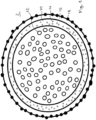
- a thread 2 of a scrim is shown in cross section.
- the thread 2 comprises a large number of individual carbon multifilaments 12, each of which have between several 1,000 and up to 100,000 individual filaments.
- the thread 2 is in the exemplary embodiment Fig. 1 provided with an impregnation 10, to which one or more additives 14 were added in the impregnation process in order to improve the electrical, mechanical or thermal properties.
- the thread 2 has been coated with a coating medium 16.
- sanding took place so that the coating 16 serves as a carrier medium for the particles 18. The sanding increases the surface area of the thread 2, which results in better bonding properties with the mortar.
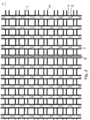
- the clutch 1 after Fig. 2 comprises a plurality of threads 2 or strands that are arranged in two levels.
- Each level includes a number of threads 2, which are spaced apart and essentially parallel to one another.
- Each of these threads 2 comprises a number of carbon multifilaments, which in the present exemplary embodiment were glued into an elongated strand. However, it is also conceivable that these carbon multifilaments are sewn into a strand or connected in another way.
- the threads 2 of two levels are essentially orthogonal to one another, which is why a lattice structure with square spaces is formed.
- the threads 2 are fixed at the crossing points 4 with a continuous sewing thread 6, but can also be glued or connected to one another in another way.
- the planes of the fabric 1 do not necessarily have to be arranged orthogonally to one another, but can also be arranged offset at a different angle depending on the intended use. It is also conceivable that more than two levels can be provided.
- a band-shaped primary anode 8 is sewn along the entire length of a thread 2, whereby the anode system can be supplied with current over the entire length, in contrast to contacting at a single point.
- the primary anode 8 is sewn into a thread 2 is sewn in and is therefore essentially completely surrounded by carbon multifilaments.
- an impregnation 10 and then a coating are applied to the scrim 1 in accordance with the above statements.
- a fabric 1 can be provided for an anode system which has optimal mechanical, electrical and thermal properties for the respective application and location.
Landscapes
- Engineering & Computer Science (AREA)
- Architecture (AREA)
- Chemical Kinetics & Catalysis (AREA)
- Chemical & Material Sciences (AREA)
- Structural Engineering (AREA)
- Civil Engineering (AREA)
- Textile Engineering (AREA)
- Electrochemistry (AREA)
- Mechanical Engineering (AREA)
- Prevention Of Electric Corrosion (AREA)
- Working Measures On Existing Buildindgs (AREA)
- Reinforcement Elements For Buildings (AREA)
- Chemical Or Physical Treatment Of Fibers (AREA)
Claims (6)
- Procédé de fabrication d'une armature textile à partir d'un non-tissé (1), sachant qu'une imprégnation (10) est appliquée à un fil (2) du non-tissé (1) ou au non-tissé (1), sachant que l'imprégnation (10) comprend un matériau de base, auquel est ajouté au moins un additif (14), caractérisé en ce qu'au moins un revêtement (16) avec des additifs sous la forme de particules (18) est ensuite appliqué pour augmenter la surface, sachant que les particules comprennent du granite, de la poudre de quartz, de la pâte de ciment après prise ou des particules conductrices.
- Procédé de fabrication d'une armature textile selon la revendication 1, caractérisé en ce que le matériau de base est synthétisé par polymérisation radicale à partir d'un monomère et d'un produit initial et sachant que l'additif (14) est ajouté au monomère, au produit initial et/ou au matériau de base synthétisé.
- Procédé de fabrication d'une armature textile selon la revendication 1 ou 2, caractérisé en ce qu'un polyméthylméthacrylate est utilisé en tant que matériau de base.
- Procédé de fabrication d'une armature textile selon la revendication 1, caractérisé en ce que l'additif est ajouté sous la forme de particules (18) avant, pendant ou après le revêtement du non-tissé.
- Procédé de fabrication d'une armature textile selon l'une quelconque des revendications 1 à 4, caractérisé en ce que l'imprégnation (10) est appliquée dans un procédé à bain de trempage, un procédé d'émulation ou un procédé d'injection.
- Armature textile fabriquée selon un procédé selon les revendications 1 à 5.
Priority Applications (2)
| Application Number | Priority Date | Filing Date | Title |
|---|---|---|---|
| EP18200952.2A EP3640407B1 (fr) | 2018-10-17 | 2018-10-17 | Non-tissé imprégné d'additifs |
| US16/655,611 US20200123796A1 (en) | 2018-10-17 | 2019-10-17 | Impregnated nest with additives |
Applications Claiming Priority (1)
| Application Number | Priority Date | Filing Date | Title |
|---|---|---|---|
| EP18200952.2A EP3640407B1 (fr) | 2018-10-17 | 2018-10-17 | Non-tissé imprégné d'additifs |
Publications (3)
| Publication Number | Publication Date |
|---|---|
| EP3640407A1 EP3640407A1 (fr) | 2020-04-22 |
| EP3640407B1 true EP3640407B1 (fr) | 2023-12-06 |
| EP3640407C0 EP3640407C0 (fr) | 2023-12-06 |
Family
ID=63878525
Family Applications (1)
| Application Number | Title | Priority Date | Filing Date |
|---|---|---|---|
| EP18200952.2A Active EP3640407B1 (fr) | 2018-10-17 | 2018-10-17 | Non-tissé imprégné d'additifs |
Country Status (2)
| Country | Link |
|---|---|
| US (1) | US20200123796A1 (fr) |
| EP (1) | EP3640407B1 (fr) |
Family Cites Families (3)
| Publication number | Priority date | Publication date | Assignee | Title |
|---|---|---|---|---|
| US5218810A (en) * | 1992-02-25 | 1993-06-15 | Hexcel Corporation | Fabric reinforced concrete columns |
| CA2192567C (fr) * | 1994-06-10 | 2006-04-25 | Frederick P. Isley, Jr. | Mur renforce par du tissu a haute resistance |
| RU177233U1 (ru) * | 2016-08-03 | 2018-02-14 | Общество с ограниченной ответственностью "Знаменский Композитный Завод" | Сетка армирующая полимерно-композитная преднапряженная с нанодобавками |
-
2018
- 2018-10-17 EP EP18200952.2A patent/EP3640407B1/fr active Active
-
2019
- 2019-10-17 US US16/655,611 patent/US20200123796A1/en not_active Abandoned
Also Published As
| Publication number | Publication date |
|---|---|
| EP3640407A1 (fr) | 2020-04-22 |
| US20200123796A1 (en) | 2020-04-23 |
| EP3640407C0 (fr) | 2023-12-06 |
Similar Documents
| Publication | Publication Date | Title |
|---|---|---|
| DE69720656T2 (de) | Verfahren zum verstärken eines asphaltierten betonkonstruktion | |
| DE60007818T2 (de) | Bauverstärkungselement und Verfahren zum Anwenden des Elementes zur Produktverstärkung | |
| DE69516632T2 (de) | Verfahren zum Verstärken von Betondecken | |
| EP3266951B1 (fr) | Élément constitutif composite comprenant des parties plates en béton préfabriqué | |
| AT11192U1 (de) | Verwendung eines als maschenware, insbesondere als gestricke oder gewirke, über ein einfaden- oder kettfadensystem hergestellten verbundstoffes | |
| DE4026943C1 (fr) | ||
| EP2182139B1 (fr) | Procédé d'application d'un renforcement ou d'un revêtement sur un élément de construction existant, ainsi qu'élément de construction doté d'une couche de renforcement ou de revêtement appliquée dessus | |
| DE102015203398A1 (de) | Verfahren zum Herstellen eines kathodischen Korrosionsschutzes zum Schutz von Bewehrungsstahl in einem Stahlbetonbauwerk | |
| EP0732464A1 (fr) | Procédé de fabrication de revêtements armés, notamment sur des surfaces en béton, et filet d'armature associé | |
| DE202008010803U1 (de) | Wärmedämmender Mauerstein | |
| EP3707303B1 (fr) | Produits fibreux dotés d'un revêtement constitué de dispersions aqueuses de polymère | |
| DE60204809T2 (de) | Zementmörtel, Struktur und Verfahren zur Verstärkung von Baukomponenten | |
| DE2930939C2 (de) | Verfahren zum mechanischen Verstärken von formbaren und/oder härtbaren Massen | |
| DE102015115297A1 (de) | Verfahren zur Verlegung eines Anodensystems für einen kathodischen Korrosionsschutz | |
| EP3640407A1 (fr) | Non-tissé imprégné d'additifs | |
| EP4553250A2 (fr) | Élément de liaison, procédé de fabrication d'un élément de liaison et kit d'installation associé | |
| DE4429785C1 (de) | Beschichtungssystem für zementgebundene Böden | |
| DE3607459C2 (fr) | ||
| EP1669511B1 (fr) | Elément léger de construction et son procédé de fabrication | |
| DE102018133399A1 (de) | Verfahren zur Abdichtung einer Gebäudewand oder -decke | |
| DE3032533A1 (de) | Glasseiden armierungsgitter | |
| EP0288459B1 (fr) | Procede pour la fabrication d'un panneau prefabrique, et panneau prefabrique etanche a la pluie | |
| DE102008064141A1 (de) | Asphaltierte Verkehrsfläche | |
| EP3640370A1 (fr) | Non-tissé à anode primaire | |
| DE102005004148A1 (de) | Leichtbauplatte |
Legal Events
| Date | Code | Title | Description |
|---|---|---|---|
| PUAI | Public reference made under article 153(3) epc to a published international application that has entered the european phase |
Free format text: ORIGINAL CODE: 0009012 |
|
| STAA | Information on the status of an ep patent application or granted ep patent |
Free format text: STATUS: THE APPLICATION HAS BEEN PUBLISHED |
|
| AK | Designated contracting states |
Kind code of ref document: A1 Designated state(s): AL AT BE BG CH CY CZ DE DK EE ES FI FR GB GR HR HU IE IS IT LI LT LU LV MC MK MT NL NO PL PT RO RS SE SI SK SM TR |
|
| AX | Request for extension of the european patent |
Extension state: BA ME |
|
| STAA | Information on the status of an ep patent application or granted ep patent |
Free format text: STATUS: REQUEST FOR EXAMINATION WAS MADE |
|
| 17P | Request for examination filed |
Effective date: 20201021 |
|
| RBV | Designated contracting states (corrected) |
Designated state(s): AL AT BE BG CH CY CZ DE DK EE ES FI FR GB GR HR HU IE IS IT LI LT LU LV MC MK MT NL NO PL PT RO RS SE SI SK SM TR |
|
| STAA | Information on the status of an ep patent application or granted ep patent |
Free format text: STATUS: EXAMINATION IS IN PROGRESS |
|
| 17Q | First examination report despatched |
Effective date: 20220525 |
|
| GRAP | Despatch of communication of intention to grant a patent |
Free format text: ORIGINAL CODE: EPIDOSNIGR1 |
|
| STAA | Information on the status of an ep patent application or granted ep patent |
Free format text: STATUS: GRANT OF PATENT IS INTENDED |
|
| INTG | Intention to grant announced |
Effective date: 20230523 |
|
| GRAS | Grant fee paid |
Free format text: ORIGINAL CODE: EPIDOSNIGR3 |
|
| GRAA | (expected) grant |
Free format text: ORIGINAL CODE: 0009210 |
|
| STAA | Information on the status of an ep patent application or granted ep patent |
Free format text: STATUS: THE PATENT HAS BEEN GRANTED |
|
| AK | Designated contracting states |
Kind code of ref document: B1 Designated state(s): AL AT BE BG CH CY CZ DE DK EE ES FI FR GB GR HR HU IE IS IT LI LT LU LV MC MK MT NL NO PL PT RO RS SE SI SK SM TR |
|
| REG | Reference to a national code |
Ref country code: GB Ref legal event code: FG4D Free format text: NOT ENGLISH |
|
| REG | Reference to a national code |
Ref country code: DE Ref legal event code: R096 Ref document number: 502018013742 Country of ref document: DE |
|
| REG | Reference to a national code |
Ref country code: CH Ref legal event code: EP |
|
| REG | Reference to a national code |
Ref country code: IE Ref legal event code: FG4D Free format text: LANGUAGE OF EP DOCUMENT: GERMAN |
|
| U01 | Request for unitary effect filed |
Effective date: 20240104 |
|
| U07 | Unitary effect registered |
Designated state(s): AT BE BG DE DK EE FI FR IT LT LU LV MT NL PT SE SI Effective date: 20240112 |
|
| PG25 | Lapsed in a contracting state [announced via postgrant information from national office to epo] |
Ref country code: GR Free format text: LAPSE BECAUSE OF FAILURE TO SUBMIT A TRANSLATION OF THE DESCRIPTION OR TO PAY THE FEE WITHIN THE PRESCRIBED TIME-LIMIT Effective date: 20240307 |
|
| PG25 | Lapsed in a contracting state [announced via postgrant information from national office to epo] |
Ref country code: ES Free format text: LAPSE BECAUSE OF FAILURE TO SUBMIT A TRANSLATION OF THE DESCRIPTION OR TO PAY THE FEE WITHIN THE PRESCRIBED TIME-LIMIT Effective date: 20231206 |
|
| PG25 | Lapsed in a contracting state [announced via postgrant information from national office to epo] |
Ref country code: GR Free format text: LAPSE BECAUSE OF FAILURE TO SUBMIT A TRANSLATION OF THE DESCRIPTION OR TO PAY THE FEE WITHIN THE PRESCRIBED TIME-LIMIT Effective date: 20240307 Ref country code: ES Free format text: LAPSE BECAUSE OF FAILURE TO SUBMIT A TRANSLATION OF THE DESCRIPTION OR TO PAY THE FEE WITHIN THE PRESCRIBED TIME-LIMIT Effective date: 20231206 |
|
| PG25 | Lapsed in a contracting state [announced via postgrant information from national office to epo] |
Ref country code: RS Free format text: LAPSE BECAUSE OF FAILURE TO SUBMIT A TRANSLATION OF THE DESCRIPTION OR TO PAY THE FEE WITHIN THE PRESCRIBED TIME-LIMIT Effective date: 20231206 Ref country code: NO Free format text: LAPSE BECAUSE OF FAILURE TO SUBMIT A TRANSLATION OF THE DESCRIPTION OR TO PAY THE FEE WITHIN THE PRESCRIBED TIME-LIMIT Effective date: 20240306 Ref country code: HR Free format text: LAPSE BECAUSE OF FAILURE TO SUBMIT A TRANSLATION OF THE DESCRIPTION OR TO PAY THE FEE WITHIN THE PRESCRIBED TIME-LIMIT Effective date: 20231206 |
|
| PG25 | Lapsed in a contracting state [announced via postgrant information from national office to epo] |
Ref country code: IS Free format text: LAPSE BECAUSE OF FAILURE TO SUBMIT A TRANSLATION OF THE DESCRIPTION OR TO PAY THE FEE WITHIN THE PRESCRIBED TIME-LIMIT Effective date: 20240406 |
|
| PG25 | Lapsed in a contracting state [announced via postgrant information from national office to epo] |
Ref country code: CZ Free format text: LAPSE BECAUSE OF FAILURE TO SUBMIT A TRANSLATION OF THE DESCRIPTION OR TO PAY THE FEE WITHIN THE PRESCRIBED TIME-LIMIT Effective date: 20231206 |
|
| PG25 | Lapsed in a contracting state [announced via postgrant information from national office to epo] |
Ref country code: SK Free format text: LAPSE BECAUSE OF FAILURE TO SUBMIT A TRANSLATION OF THE DESCRIPTION OR TO PAY THE FEE WITHIN THE PRESCRIBED TIME-LIMIT Effective date: 20231206 |
|
| PG25 | Lapsed in a contracting state [announced via postgrant information from national office to epo] |
Ref country code: SM Free format text: LAPSE BECAUSE OF FAILURE TO SUBMIT A TRANSLATION OF THE DESCRIPTION OR TO PAY THE FEE WITHIN THE PRESCRIBED TIME-LIMIT Effective date: 20231206 Ref country code: SK Free format text: LAPSE BECAUSE OF FAILURE TO SUBMIT A TRANSLATION OF THE DESCRIPTION OR TO PAY THE FEE WITHIN THE PRESCRIBED TIME-LIMIT Effective date: 20231206 Ref country code: RO Free format text: LAPSE BECAUSE OF FAILURE TO SUBMIT A TRANSLATION OF THE DESCRIPTION OR TO PAY THE FEE WITHIN THE PRESCRIBED TIME-LIMIT Effective date: 20231206 Ref country code: IS Free format text: LAPSE BECAUSE OF FAILURE TO SUBMIT A TRANSLATION OF THE DESCRIPTION OR TO PAY THE FEE WITHIN THE PRESCRIBED TIME-LIMIT Effective date: 20240406 Ref country code: CZ Free format text: LAPSE BECAUSE OF FAILURE TO SUBMIT A TRANSLATION OF THE DESCRIPTION OR TO PAY THE FEE WITHIN THE PRESCRIBED TIME-LIMIT Effective date: 20231206 |
|
| PG25 | Lapsed in a contracting state [announced via postgrant information from national office to epo] |
Ref country code: PL Free format text: LAPSE BECAUSE OF FAILURE TO SUBMIT A TRANSLATION OF THE DESCRIPTION OR TO PAY THE FEE WITHIN THE PRESCRIBED TIME-LIMIT Effective date: 20231206 |
|
| PG25 | Lapsed in a contracting state [announced via postgrant information from national office to epo] |
Ref country code: PL Free format text: LAPSE BECAUSE OF FAILURE TO SUBMIT A TRANSLATION OF THE DESCRIPTION OR TO PAY THE FEE WITHIN THE PRESCRIBED TIME-LIMIT Effective date: 20231206 |
|
| REG | Reference to a national code |
Ref country code: DE Ref legal event code: R097 Ref document number: 502018013742 Country of ref document: DE |
|
| PLBE | No opposition filed within time limit |
Free format text: ORIGINAL CODE: 0009261 |
|
| STAA | Information on the status of an ep patent application or granted ep patent |
Free format text: STATUS: NO OPPOSITION FILED WITHIN TIME LIMIT |
|
| 26N | No opposition filed |
Effective date: 20240909 |
|
| U20 | Renewal fee for the european patent with unitary effect paid |
Year of fee payment: 7 Effective date: 20241031 |
|
| REG | Reference to a national code |
Ref country code: CH Ref legal event code: PL |
|
| GBPC | Gb: european patent ceased through non-payment of renewal fee |
Effective date: 20241017 |
|
| PG25 | Lapsed in a contracting state [announced via postgrant information from national office to epo] |
Ref country code: MC Free format text: LAPSE BECAUSE OF FAILURE TO SUBMIT A TRANSLATION OF THE DESCRIPTION OR TO PAY THE FEE WITHIN THE PRESCRIBED TIME-LIMIT Effective date: 20231206 |
|
| PG25 | Lapsed in a contracting state [announced via postgrant information from national office to epo] |
Ref country code: GB Free format text: LAPSE BECAUSE OF NON-PAYMENT OF DUE FEES Effective date: 20241017 |
|
| PG25 | Lapsed in a contracting state [announced via postgrant information from national office to epo] |
Ref country code: CH Free format text: LAPSE BECAUSE OF NON-PAYMENT OF DUE FEES Effective date: 20241031 |
|
| PG25 | Lapsed in a contracting state [announced via postgrant information from national office to epo] |
Ref country code: IE Free format text: LAPSE BECAUSE OF NON-PAYMENT OF DUE FEES Effective date: 20241017 |
|
| U20 | Renewal fee for the european patent with unitary effect paid |
Year of fee payment: 8 Effective date: 20251031 |
|
| U1K | Transfer of rights of the unitary patent after the registration of the unitary effect |
Owner name: KOCH CARBON CONSULTING GMBH; DE |
|
| PG25 | Lapsed in a contracting state [announced via postgrant information from national office to epo] |
Ref country code: CY Free format text: LAPSE BECAUSE OF FAILURE TO SUBMIT A TRANSLATION OF THE DESCRIPTION OR TO PAY THE FEE WITHIN THE PRESCRIBED TIME-LIMIT; INVALID AB INITIO Effective date: 20181017 |
|
| PG25 | Lapsed in a contracting state [announced via postgrant information from national office to epo] |
Ref country code: HU Free format text: LAPSE BECAUSE OF FAILURE TO SUBMIT A TRANSLATION OF THE DESCRIPTION OR TO PAY THE FEE WITHIN THE PRESCRIBED TIME-LIMIT; INVALID AB INITIO Effective date: 20181017 |
|
| PG25 | Lapsed in a contracting state [announced via postgrant information from national office to epo] |
Ref country code: TR Free format text: LAPSE BECAUSE OF FAILURE TO SUBMIT A TRANSLATION OF THE DESCRIPTION OR TO PAY THE FEE WITHIN THE PRESCRIBED TIME-LIMIT Effective date: 20231206 |