EP3640208A1 - Molecular sieve scm-14, synthesis method therefor and use thereof - Google Patents
Molecular sieve scm-14, synthesis method therefor and use thereof Download PDFInfo
- Publication number
- EP3640208A1 EP3640208A1 EP17913991.0A EP17913991A EP3640208A1 EP 3640208 A1 EP3640208 A1 EP 3640208A1 EP 17913991 A EP17913991 A EP 17913991A EP 3640208 A1 EP3640208 A1 EP 3640208A1
- Authority
- EP
- European Patent Office
- Prior art keywords
- molecular sieve
- source
- germanium
- scm
- formula
- Prior art date
- Legal status (The legal status is an assumption and is not a legal conclusion. Google has not performed a legal analysis and makes no representation as to the accuracy of the status listed.)
- Granted
Links
- 0 **1(CCCC1)c1cc*(*)cc1 Chemical compound **1(CCCC1)c1cc*(*)cc1 0.000 description 1
Images
Classifications
-
- B—PERFORMING OPERATIONS; TRANSPORTING
- B01—PHYSICAL OR CHEMICAL PROCESSES OR APPARATUS IN GENERAL
- B01J—CHEMICAL OR PHYSICAL PROCESSES, e.g. CATALYSIS OR COLLOID CHEMISTRY; THEIR RELEVANT APPARATUS
- B01J29/00—Catalysts comprising molecular sieves
- B01J29/04—Catalysts comprising molecular sieves having base-exchange properties, e.g. crystalline zeolites
- B01J29/047—Germanosilicates; Aluminogermanosilicates
-
- C—CHEMISTRY; METALLURGY
- C01—INORGANIC CHEMISTRY
- C01B—NON-METALLIC ELEMENTS; COMPOUNDS THEREOF; METALLOIDS OR COMPOUNDS THEREOF NOT COVERED BY SUBCLASS C01C
- C01B37/00—Compounds having molecular sieve properties but not having base-exchange properties
- C01B37/005—Silicates, i.e. so-called metallosilicalites or metallozeosilites
-
- B—PERFORMING OPERATIONS; TRANSPORTING
- B01—PHYSICAL OR CHEMICAL PROCESSES OR APPARATUS IN GENERAL
- B01J—CHEMICAL OR PHYSICAL PROCESSES, e.g. CATALYSIS OR COLLOID CHEMISTRY; THEIR RELEVANT APPARATUS
- B01J20/00—Solid sorbent compositions or filter aid compositions; Sorbents for chromatography; Processes for preparing, regenerating or reactivating thereof
- B01J20/02—Solid sorbent compositions or filter aid compositions; Sorbents for chromatography; Processes for preparing, regenerating or reactivating thereof comprising inorganic material
- B01J20/10—Solid sorbent compositions or filter aid compositions; Sorbents for chromatography; Processes for preparing, regenerating or reactivating thereof comprising inorganic material comprising silica or silicate
-
- B—PERFORMING OPERATIONS; TRANSPORTING
- B01—PHYSICAL OR CHEMICAL PROCESSES OR APPARATUS IN GENERAL
- B01J—CHEMICAL OR PHYSICAL PROCESSES, e.g. CATALYSIS OR COLLOID CHEMISTRY; THEIR RELEVANT APPARATUS
- B01J20/00—Solid sorbent compositions or filter aid compositions; Sorbents for chromatography; Processes for preparing, regenerating or reactivating thereof
- B01J20/02—Solid sorbent compositions or filter aid compositions; Sorbents for chromatography; Processes for preparing, regenerating or reactivating thereof comprising inorganic material
- B01J20/10—Solid sorbent compositions or filter aid compositions; Sorbents for chromatography; Processes for preparing, regenerating or reactivating thereof comprising inorganic material comprising silica or silicate
- B01J20/16—Alumino-silicates
- B01J20/18—Synthetic zeolitic molecular sieves
-
- B—PERFORMING OPERATIONS; TRANSPORTING
- B01—PHYSICAL OR CHEMICAL PROCESSES OR APPARATUS IN GENERAL
- B01J—CHEMICAL OR PHYSICAL PROCESSES, e.g. CATALYSIS OR COLLOID CHEMISTRY; THEIR RELEVANT APPARATUS
- B01J29/00—Catalysts comprising molecular sieves
- B01J29/04—Catalysts comprising molecular sieves having base-exchange properties, e.g. crystalline zeolites
- B01J29/06—Crystalline aluminosilicate zeolites; Isomorphous compounds thereof
-
- B—PERFORMING OPERATIONS; TRANSPORTING
- B01—PHYSICAL OR CHEMICAL PROCESSES OR APPARATUS IN GENERAL
- B01J—CHEMICAL OR PHYSICAL PROCESSES, e.g. CATALYSIS OR COLLOID CHEMISTRY; THEIR RELEVANT APPARATUS
- B01J29/00—Catalysts comprising molecular sieves
- B01J29/04—Catalysts comprising molecular sieves having base-exchange properties, e.g. crystalline zeolites
- B01J29/06—Crystalline aluminosilicate zeolites; Isomorphous compounds thereof
- B01J29/061—Crystalline aluminosilicate zeolites; Isomorphous compounds thereof containing metallic elements added to the zeolite
-
- B—PERFORMING OPERATIONS; TRANSPORTING
- B01—PHYSICAL OR CHEMICAL PROCESSES OR APPARATUS IN GENERAL
- B01J—CHEMICAL OR PHYSICAL PROCESSES, e.g. CATALYSIS OR COLLOID CHEMISTRY; THEIR RELEVANT APPARATUS
- B01J29/00—Catalysts comprising molecular sieves
- B01J29/04—Catalysts comprising molecular sieves having base-exchange properties, e.g. crystalline zeolites
- B01J29/06—Crystalline aluminosilicate zeolites; Isomorphous compounds thereof
- B01J29/70—Crystalline aluminosilicate zeolites; Isomorphous compounds thereof of types characterised by their specific structure not provided for in groups B01J29/08 - B01J29/65
-
- B—PERFORMING OPERATIONS; TRANSPORTING
- B01—PHYSICAL OR CHEMICAL PROCESSES OR APPARATUS IN GENERAL
- B01J—CHEMICAL OR PHYSICAL PROCESSES, e.g. CATALYSIS OR COLLOID CHEMISTRY; THEIR RELEVANT APPARATUS
- B01J29/00—Catalysts comprising molecular sieves
- B01J29/86—Borosilicates; Aluminoborosilicates
-
- B—PERFORMING OPERATIONS; TRANSPORTING
- B01—PHYSICAL OR CHEMICAL PROCESSES OR APPARATUS IN GENERAL
- B01J—CHEMICAL OR PHYSICAL PROCESSES, e.g. CATALYSIS OR COLLOID CHEMISTRY; THEIR RELEVANT APPARATUS
- B01J29/00—Catalysts comprising molecular sieves
- B01J29/89—Silicates, aluminosilicates or borosilicates of titanium, zirconium or hafnium
-
- B—PERFORMING OPERATIONS; TRANSPORTING
- B01—PHYSICAL OR CHEMICAL PROCESSES OR APPARATUS IN GENERAL
- B01J—CHEMICAL OR PHYSICAL PROCESSES, e.g. CATALYSIS OR COLLOID CHEMISTRY; THEIR RELEVANT APPARATUS
- B01J35/00—Catalysts, in general, characterised by their form or physical properties
- B01J35/60—Catalysts, in general, characterised by their form or physical properties characterised by their surface properties or porosity
- B01J35/61—Surface area
- B01J35/615—100-500 m2/g
-
- B—PERFORMING OPERATIONS; TRANSPORTING
- B01—PHYSICAL OR CHEMICAL PROCESSES OR APPARATUS IN GENERAL
- B01J—CHEMICAL OR PHYSICAL PROCESSES, e.g. CATALYSIS OR COLLOID CHEMISTRY; THEIR RELEVANT APPARATUS
- B01J35/00—Catalysts, in general, characterised by their form or physical properties
- B01J35/60—Catalysts, in general, characterised by their form or physical properties characterised by their surface properties or porosity
- B01J35/63—Pore volume
- B01J35/633—Pore volume less than 0.5 ml/g
-
- B—PERFORMING OPERATIONS; TRANSPORTING
- B01—PHYSICAL OR CHEMICAL PROCESSES OR APPARATUS IN GENERAL
- B01J—CHEMICAL OR PHYSICAL PROCESSES, e.g. CATALYSIS OR COLLOID CHEMISTRY; THEIR RELEVANT APPARATUS
- B01J37/00—Processes, in general, for preparing catalysts; Processes, in general, for activation of catalysts
- B01J37/0009—Use of binding agents; Moulding; Pressing; Powdering; Granulating; Addition of materials ameliorating the mechanical properties of the product catalyst
- B01J37/0018—Addition of a binding agent or of material, later completely removed among others as result of heat treatment, leaching or washing,(e.g. forming of pores; protective layer, desintegrating by heat)
-
- B—PERFORMING OPERATIONS; TRANSPORTING
- B01—PHYSICAL OR CHEMICAL PROCESSES OR APPARATUS IN GENERAL
- B01J—CHEMICAL OR PHYSICAL PROCESSES, e.g. CATALYSIS OR COLLOID CHEMISTRY; THEIR RELEVANT APPARATUS
- B01J37/00—Processes, in general, for preparing catalysts; Processes, in general, for activation of catalysts
- B01J37/02—Impregnation, coating or precipitation
- B01J37/03—Precipitation; Co-precipitation
- B01J37/031—Precipitation
-
- B—PERFORMING OPERATIONS; TRANSPORTING
- B01—PHYSICAL OR CHEMICAL PROCESSES OR APPARATUS IN GENERAL
- B01J—CHEMICAL OR PHYSICAL PROCESSES, e.g. CATALYSIS OR COLLOID CHEMISTRY; THEIR RELEVANT APPARATUS
- B01J37/00—Processes, in general, for preparing catalysts; Processes, in general, for activation of catalysts
- B01J37/04—Mixing
-
- B—PERFORMING OPERATIONS; TRANSPORTING
- B01—PHYSICAL OR CHEMICAL PROCESSES OR APPARATUS IN GENERAL
- B01J—CHEMICAL OR PHYSICAL PROCESSES, e.g. CATALYSIS OR COLLOID CHEMISTRY; THEIR RELEVANT APPARATUS
- B01J37/00—Processes, in general, for preparing catalysts; Processes, in general, for activation of catalysts
- B01J37/08—Heat treatment
-
- C—CHEMISTRY; METALLURGY
- C01—INORGANIC CHEMISTRY
- C01B—NON-METALLIC ELEMENTS; COMPOUNDS THEREOF; METALLOIDS OR COMPOUNDS THEREOF NOT COVERED BY SUBCLASS C01C
- C01B37/00—Compounds having molecular sieve properties but not having base-exchange properties
- C01B37/007—Borosilicates
-
- C—CHEMISTRY; METALLURGY
- C01—INORGANIC CHEMISTRY
- C01B—NON-METALLIC ELEMENTS; COMPOUNDS THEREOF; METALLOIDS OR COMPOUNDS THEREOF NOT COVERED BY SUBCLASS C01C
- C01B39/00—Compounds having molecular sieve and base-exchange properties, e.g. crystalline zeolites; Their preparation; After-treatment, e.g. ion-exchange or dealumination
- C01B39/02—Crystalline aluminosilicate zeolites; Isomorphous compounds thereof; Direct preparation thereof; Preparation thereof starting from a reaction mixture containing a crystalline zeolite of another type, or from preformed reactants; After-treatment thereof
- C01B39/06—Preparation of isomorphous zeolites characterised by measures to replace the aluminium or silicon atoms in the lattice framework by atoms of other elements, i.e. by direct or secondary synthesis
-
- C—CHEMISTRY; METALLURGY
- C01—INORGANIC CHEMISTRY
- C01B—NON-METALLIC ELEMENTS; COMPOUNDS THEREOF; METALLOIDS OR COMPOUNDS THEREOF NOT COVERED BY SUBCLASS C01C
- C01B39/00—Compounds having molecular sieve and base-exchange properties, e.g. crystalline zeolites; Their preparation; After-treatment, e.g. ion-exchange or dealumination
- C01B39/02—Crystalline aluminosilicate zeolites; Isomorphous compounds thereof; Direct preparation thereof; Preparation thereof starting from a reaction mixture containing a crystalline zeolite of another type, or from preformed reactants; After-treatment thereof
- C01B39/06—Preparation of isomorphous zeolites characterised by measures to replace the aluminium or silicon atoms in the lattice framework by atoms of other elements, i.e. by direct or secondary synthesis
- C01B39/065—Galloaluminosilicates; Group IVB- metalloaluminosilicates; Ferroaluminosilicates
-
- C—CHEMISTRY; METALLURGY
- C01—INORGANIC CHEMISTRY
- C01B—NON-METALLIC ELEMENTS; COMPOUNDS THEREOF; METALLOIDS OR COMPOUNDS THEREOF NOT COVERED BY SUBCLASS C01C
- C01B39/00—Compounds having molecular sieve and base-exchange properties, e.g. crystalline zeolites; Their preparation; After-treatment, e.g. ion-exchange or dealumination
- C01B39/02—Crystalline aluminosilicate zeolites; Isomorphous compounds thereof; Direct preparation thereof; Preparation thereof starting from a reaction mixture containing a crystalline zeolite of another type, or from preformed reactants; After-treatment thereof
- C01B39/06—Preparation of isomorphous zeolites characterised by measures to replace the aluminium or silicon atoms in the lattice framework by atoms of other elements, i.e. by direct or secondary synthesis
- C01B39/08—Preparation of isomorphous zeolites characterised by measures to replace the aluminium or silicon atoms in the lattice framework by atoms of other elements, i.e. by direct or secondary synthesis the aluminium atoms being wholly replaced
-
- C—CHEMISTRY; METALLURGY
- C01—INORGANIC CHEMISTRY
- C01B—NON-METALLIC ELEMENTS; COMPOUNDS THEREOF; METALLOIDS OR COMPOUNDS THEREOF NOT COVERED BY SUBCLASS C01C
- C01B39/00—Compounds having molecular sieve and base-exchange properties, e.g. crystalline zeolites; Their preparation; After-treatment, e.g. ion-exchange or dealumination
- C01B39/02—Crystalline aluminosilicate zeolites; Isomorphous compounds thereof; Direct preparation thereof; Preparation thereof starting from a reaction mixture containing a crystalline zeolite of another type, or from preformed reactants; After-treatment thereof
- C01B39/06—Preparation of isomorphous zeolites characterised by measures to replace the aluminium or silicon atoms in the lattice framework by atoms of other elements, i.e. by direct or secondary synthesis
- C01B39/12—Preparation of isomorphous zeolites characterised by measures to replace the aluminium or silicon atoms in the lattice framework by atoms of other elements, i.e. by direct or secondary synthesis the replacing atoms being at least boron atoms
-
- C—CHEMISTRY; METALLURGY
- C01—INORGANIC CHEMISTRY
- C01B—NON-METALLIC ELEMENTS; COMPOUNDS THEREOF; METALLOIDS OR COMPOUNDS THEREOF NOT COVERED BY SUBCLASS C01C
- C01B39/00—Compounds having molecular sieve and base-exchange properties, e.g. crystalline zeolites; Their preparation; After-treatment, e.g. ion-exchange or dealumination
- C01B39/02—Crystalline aluminosilicate zeolites; Isomorphous compounds thereof; Direct preparation thereof; Preparation thereof starting from a reaction mixture containing a crystalline zeolite of another type, or from preformed reactants; After-treatment thereof
- C01B39/46—Other types characterised by their X-ray diffraction pattern and their defined composition
-
- C—CHEMISTRY; METALLURGY
- C01—INORGANIC CHEMISTRY
- C01B—NON-METALLIC ELEMENTS; COMPOUNDS THEREOF; METALLOIDS OR COMPOUNDS THEREOF NOT COVERED BY SUBCLASS C01C
- C01B39/00—Compounds having molecular sieve and base-exchange properties, e.g. crystalline zeolites; Their preparation; After-treatment, e.g. ion-exchange or dealumination
- C01B39/02—Crystalline aluminosilicate zeolites; Isomorphous compounds thereof; Direct preparation thereof; Preparation thereof starting from a reaction mixture containing a crystalline zeolite of another type, or from preformed reactants; After-treatment thereof
- C01B39/46—Other types characterised by their X-ray diffraction pattern and their defined composition
- C01B39/48—Other types characterised by their X-ray diffraction pattern and their defined composition using at least one organic template directing agent
-
- C—CHEMISTRY; METALLURGY
- C07—ORGANIC CHEMISTRY
- C07C—ACYCLIC OR CARBOCYCLIC COMPOUNDS
- C07C4/00—Preparation of hydrocarbons from hydrocarbons containing a larger number of carbon atoms
- C07C4/08—Preparation of hydrocarbons from hydrocarbons containing a larger number of carbon atoms by splitting-off an aliphatic or cycloaliphatic part from the molecule
- C07C4/12—Preparation of hydrocarbons from hydrocarbons containing a larger number of carbon atoms by splitting-off an aliphatic or cycloaliphatic part from the molecule from hydrocarbons containing a six-membered aromatic ring, e.g. propyltoluene to vinyltoluene
- C07C4/14—Preparation of hydrocarbons from hydrocarbons containing a larger number of carbon atoms by splitting-off an aliphatic or cycloaliphatic part from the molecule from hydrocarbons containing a six-membered aromatic ring, e.g. propyltoluene to vinyltoluene splitting taking place at an aromatic-aliphatic bond
- C07C4/18—Catalytic processes
-
- C—CHEMISTRY; METALLURGY
- C01—INORGANIC CHEMISTRY
- C01P—INDEXING SCHEME RELATING TO STRUCTURAL AND PHYSICAL ASPECTS OF SOLID INORGANIC COMPOUNDS
- C01P2002/00—Crystal-structural characteristics
- C01P2002/70—Crystal-structural characteristics defined by measured X-ray, neutron or electron diffraction data
- C01P2002/72—Crystal-structural characteristics defined by measured X-ray, neutron or electron diffraction data by d-values or two theta-values, e.g. as X-ray diagram
-
- C—CHEMISTRY; METALLURGY
- C01—INORGANIC CHEMISTRY
- C01P—INDEXING SCHEME RELATING TO STRUCTURAL AND PHYSICAL ASPECTS OF SOLID INORGANIC COMPOUNDS
- C01P2002/00—Crystal-structural characteristics
- C01P2002/70—Crystal-structural characteristics defined by measured X-ray, neutron or electron diffraction data
- C01P2002/74—Crystal-structural characteristics defined by measured X-ray, neutron or electron diffraction data by peak-intensities or a ratio thereof only
-
- C—CHEMISTRY; METALLURGY
- C01—INORGANIC CHEMISTRY
- C01P—INDEXING SCHEME RELATING TO STRUCTURAL AND PHYSICAL ASPECTS OF SOLID INORGANIC COMPOUNDS
- C01P2002/00—Crystal-structural characteristics
- C01P2002/70—Crystal-structural characteristics defined by measured X-ray, neutron or electron diffraction data
- C01P2002/77—Crystal-structural characteristics defined by measured X-ray, neutron or electron diffraction data by unit-cell parameters, atom positions or structure diagrams
-
- C—CHEMISTRY; METALLURGY
- C01—INORGANIC CHEMISTRY
- C01P—INDEXING SCHEME RELATING TO STRUCTURAL AND PHYSICAL ASPECTS OF SOLID INORGANIC COMPOUNDS
- C01P2002/00—Crystal-structural characteristics
- C01P2002/80—Crystal-structural characteristics defined by measured data other than those specified in group C01P2002/70
- C01P2002/85—Crystal-structural characteristics defined by measured data other than those specified in group C01P2002/70 by XPS, EDX or EDAX data
-
- C—CHEMISTRY; METALLURGY
- C01—INORGANIC CHEMISTRY
- C01P—INDEXING SCHEME RELATING TO STRUCTURAL AND PHYSICAL ASPECTS OF SOLID INORGANIC COMPOUNDS
- C01P2006/00—Physical properties of inorganic compounds
- C01P2006/12—Surface area
-
- C—CHEMISTRY; METALLURGY
- C01—INORGANIC CHEMISTRY
- C01P—INDEXING SCHEME RELATING TO STRUCTURAL AND PHYSICAL ASPECTS OF SOLID INORGANIC COMPOUNDS
- C01P2006/00—Physical properties of inorganic compounds
- C01P2006/14—Pore volume
-
- C—CHEMISTRY; METALLURGY
- C07—ORGANIC CHEMISTRY
- C07C—ACYCLIC OR CARBOCYCLIC COMPOUNDS
- C07C2529/00—Catalysts comprising molecular sieves
- C07C2529/04—Catalysts comprising molecular sieves having base-exchange properties, e.g. crystalline zeolites, pillared clays
Definitions
- the invention relates to a molecular sieve SCM-14, a preparation process and use thereof.
- porous inorganic materials are widely used as catalysts and catalyst supports.
- a porous material has a relatively high specific surface and an open channel structure, and is therefore a good catalytic material or catalyst support.
- the porous material may generally comprise: amorphous porous materials, crystalline molecular sieves, modified layered materials, and the like. The subtle differences in the structures of these materials are indicatives of significant differences in their catalytic and adsorption properties, as well as differences in the various observable properties used to characterize them, such as the morphology, specific surface area, porosity and variability of these dimensions.
- the basic skeleton structure of crystalline microporous zeolite is based on a rigid three-dimensional TO 4 (SiO 4 , AlO 4 , etc.) unit structure; in which structure, TO 4 shares oxygen atoms in a tetrahedral structure, and the charge balance of the skeleton tetrahedron, such as AlO 4 , is maintained through the presence of surface cations such as Na + and H + . It can be seen that the properties of the zeolite can be altered by cation exchange. At the same time, there exists abundant pores with uniform opening in the structure of a zeolite.
- zeolite not only has good catalytic activity, excellent shape-selection, but also has good selectivity by modification ( US 6162416 , US 4954325 , and US 5362697 ) in various organic reactions.
- the specific structure of a molecular sieve is determined by an X-ray diffraction pattern (XRD), and the X-ray diffraction pattern (XRD) is measured by an X-ray powder diffractometer using a Cu-K ⁇ ray source with a nickel filter.
- XRD X-ray diffraction pattern
- Different zeolite molecular sieves have different XRD patterns.
- Known molecular sieves such as zeolite A ( US 2882243 ), zeolite Y ( US 3130007 ), PSH-3 molecular sieve ( US 4439409 ), ZSM-11 molecular sieve ( US 3709979 ), ZSM-12 molecular sieve ( US 3832449 ), ZSM-23 molecular sieve ( US 4076842 ), ZSM-35 molecular sieve ( US 4016245 ), MCM-22 molecular sieve ( US 4954325 ), etc. each have XRD spectra of their respective characteristics.
- zeolites with same characteristic XRD spectrum but different types of skeleton atoms will be considered as different molecular sieves.
- TS-1 molecular sieve ( US 4410501 ) and ZSM-5 molecular sieve ( US 3702886 ) have the same characteristic XRD patterns, but have different skeleton elements.
- the TS-1 molecular sieve comprises skeleton elements of Si and Ti, exhibiting a catalytic oxidation ability
- the ZSM-5 molecular sieve comprises skeleton elements of Si and Al, exhibiting an acidic catalytic ability.
- molecular sieves with the same characteristic XRD spectrum and the same types of skeleton elements but with different relative amounts of the skeleton elements will be identified as different molecular sieves as well.
- X zeolite ( US 2882244 ) and Y zeolite ( US 3130007 ) share the same characterizing XRD spectrum and the same types of skeleton elements (Si and Al), but with different relative amounts of Si and Al.
- Si and Al skeleton elements
- Si and Al skeleton elements
- the inventors have made deep study on the basis of the prior art and found a novel molecular sieve SCM-14, and further identified beneficial properties thereof.
- the present invention relates to a molecular sieve SCM-14, characterized in that the molecular sieve has an X-ray diffraction pattern as substantially shown in the table below.
- 2 ⁇ (°) (a) d-distance ( ⁇ ) Relative intensity (I/I 0 X 100) 6.632 13.344 + -0.603 s-vs 8.384 10.551 +/-0.377 s-vs 15.587 5.682 + -0.109 w-m 20.661 4.296 +/-0.062 w 21.692 4.094 +/-0.056 w-vs 25.693 3.465 +/-0.040 w-m (a) ⁇ 0.3°.
- the present invention also provides a process for the preparation of the molecular sieve SCM-14.
- the SCM-14 molecular sieve involved has a skeleton structure which has never been obtained before in the art.
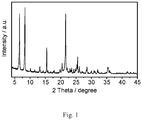
- Figure 1 is an X-ray diffraction pattern (XRD) of the molecular sieve (in the calcined form) obtained in Example 1.
- the term "specific surface area” refers to the total area of a unit weight of sample, including the internal surface area and the external surface area.
- Non-porous samples have only external surface areas, such as silicate cement, some clay mineral particles, etc.; while porous samples have both external and internal surface areas, such as asbestos fibers, diatomaceous earth and molecular sieves.
- the surface area of pores having pore diameters less than 2 nm in a porous sample is the internal surface area, the surface area after deducting the internal surface area from the total surface area is referred to as the external surface area, and the external surface area per unit weight of a sample is the external specific surface area.
- pore volume refers to the volume of pores per unit weight of porous material.
- total pore volume refers to the volume of all pores (generally only the pores having a pore diameter of less than 50 nm) per unit weight of molecular sieve.
- micropore volume refers to the volume of all micropores (generally the pores having a pore diameter of less than 2 nm) per unit weight of molecular sieve.
- w, m, s, and vs represent the intensities of the diffraction peaks, wherein w represents weak, m represents medium, s represents strong, and vs represents very strong, which are known to those skilled in the art.
- w is less than 20; m is 20-40; s is 40-70; and vs is greater than 70.
- XRD X-ray diffraction
- the so-called prepared state, prepared form or prepared molecular sieve refers to the state of the molecular sieve after the completion of the preparation.
- the prepared state a specific example may be the state directly presented after completion of the preparation (generally called as a precursor of molecular sieve).
- the molecular sieve may contain water and/or may contain organic substances (in particular organic template).
- the term “calcined”, “calcined form” or “calcined molecular sieve” refers to the state of the molecular sieve after calcination.
- the state after calcination for example, may be a state obtained by further removing organic substances (particularly, organic templating agents) and water, etc. that may be present in the pores of the prepared molecular sieve by calcination.
- the conditions of the calcination include, in particular: calcinating at 550 °C for 6 hours in an air atmosphere.
- the invention relates to molecular sieve SCM-14.
- the molecular sieve particularly in its prepared form or calcined form, has an X-ray diffraction pattern substantially as shown in Table A-1 or Table A-2 below.
- Table A-1 2 ⁇ (°)
- (b) Relative intensity (I/I 0 X 100) 6.632 13.317 s-vs 8.384 10.537 s-vs 15.587 5.680 w-m 20.661 4.295 w 21.692 4.094 w-vs 25.693 3.464 w-m (a) ⁇ 0.3°
- (b) is a function of 2 ⁇ .
- the X-ray diffraction pattern may further comprise X-ray diffraction peaks substantially as shown in Table B-1 or Table B-2 below.
- Table B-1 2 ⁇ (°)
- ⁇ d-distance
- (b) is a function of 2 ⁇ .
- the molecular sieve SCM-14 has a schematic chemical composition I as shown with the formula "SiO 2 ⁇ 1/nGeO 2 ". It is known that molecular sieves sometimes contain a certain amount of moisture, particularly immediately after preparation, but it is not considered necessary to specify the amount of the moisture in the present invention because the presence or absence of this moisture does not substantially affect the XRD spectrum of the molecular sieve. In view of this, the schematic chemical composition represents in fact the anhydrous chemical composition of the molecular sieve. Moreover, it is apparent that the schematic chemical composition I represents the framework chemical composition of the SCM-14 molecular sieve.
- the molar ratio of silicon to germanium, n satisfies n ⁇ 30, preferably 0.5 ⁇ n ⁇ 20, more preferably 1 ⁇ n ⁇ 10, more preferably 1 ⁇ n ⁇ 5.
- the molecular sieve may further generally contain organic species (particularly organic template) and water, etc. in composition, such as those filling the pores thereof, immediately after preparation.
- the molecular sieve SCM-14 may also have a schematic chemical composition II shown with the formula "kF ⁇ mQ ⁇ SiO 2 ⁇ 1/nGeO 2 ⁇ pH 2 O".
- the molecular sieve having the schematic chemical composition I can be obtained by calcining the molecular sieve having the schematic chemical composition II (sometimes called as a molecular sieve precursor) to remove any organic template, water, and the like present in the pores thereof.
- the calcination may be carried out in any manner conventionally known in the art.
- the calcination temperature is generally from 300 °C to 750 °C, preferably from 400 °C to 600 °C, and the calcination duration is generally from 1 hour to 10 hours, preferably from 3 hours to 6 hours.
- the calcination is generally carried out in an oxygen-containing atmosphere, such as in air or oxygen atmosphere.
- the schematic chemical composition I is sometimes also referred to as a post-firing schematic chemical composition
- the schematic chemical composition II is sometimes also referred to as a prepared form schematic chemical composition.
- the molar ratio of silicon to germanium, n satisfies n ⁇ 30, preferably 0.5 ⁇ n ⁇ 20, more preferably 1 ⁇ n ⁇ 10, more preferably 1 ⁇ n ⁇ 5.
- F is fluorine, and 0.005 ⁇ k ⁇ 0.8, preferably 0.01 ⁇ k ⁇ 0.6, more preferably 0.01 ⁇ k ⁇ 0.4, more preferably 0.02 ⁇ k ⁇ 0.2.
- Q is an organic Template agent, 0.005 ⁇ m ⁇ 1.0, preferably 0.01 ⁇ m ⁇ 0.6, more preferably 0.02 ⁇ m ⁇ 0.3, or more preferably 0.04 ⁇ m ⁇ 0.1.
- the organic Template agent is selected from 4-pyrrolidinylpyridine, or a quaternary ammonium form represented by formula (A-1), formula (A-2), or formula (A-3), preferably 4-pyrrolidinylpyridine.
- These organic Template agents may be used alone or as a combination in a desired ratio.
- R 1 and R 2 are each independently H or C 1-8 alkyl, preferably C 1-4 alkyl, more preferably C 1-2 alkyl, and X - are each independently a halogen ion (such as Cl - , Br - , and I - ) and a hydroxide ion (OH - ), preferably hydroxide ion (OH - ).
- 0.005 ⁇ p ⁇ 0.5 preferably 0.01 ⁇ p ⁇ 0.4, more preferably 0.01 ⁇ p ⁇ 0.3, more preferably 0.02 ⁇ p ⁇ 0.2.
- germanium on the framework may be partially replaced by a trivalent or tetravalent element other than silicon and germanium, with a replacement ratio not exceeding 10%.
- the parameter "replacement ratio" is dimensionless.
- the element other than silicon and germanium is at least one selected from the group consisting of boron, aluminum, tin, zirconium and titanium, preferably at least one selected from the group consisting of boron and titanium.
- the replacement ratio 2X 2 O 3 /(2X 2 O 3 +GeO 2 ) ⁇ 100%, wherein X is a trivalent element.
- the replacement ratio YO 2 /(YO 2 +GeO 2 ) ⁇ 100%, wherein Y is a tetravalent element.
- the moles of the corresponding oxide are used.
- the molecular sieve SCM-14 has a specific surface area (according to BET method) of 100-500 m 2 /g, preferably 130-300 m 2 /g.
- the molecular sieve SCM-14 has a micropore volume (according to t-plot method) of 0.04 to 0.2 cm 3 /g, preferably 0.05 to 0.16 cm 3 /g.
- the molecular sieve SCM-14 can be prepared by the following processes.
- the present invention also relates to a process of preparing a molecular sieve SCM-14, comprising the step of: crystallizing a mixture (hereinafter called as mixture) comprising or formed from a silicon source, a germanium source, a fluorine source, an organic template and water, to obtain said molecular sieve.
- mixture a mixture comprising or formed from a silicon source, a germanium source, a fluorine source, an organic template and water
- the organic template in the process of preparing the molecular sieve, is selected from 4-pyrrolidinyl pyridine, or a quaternary ammonium form represented by formula (A-1), formula (A-2) or formula (A-3), preferably 4-pyrrolidinyl pyridine.
- the organic Template agents may be used alone or as a combination in a desired ratio.
- R 1 and R 2 are each independently H or C 1-8 alkyl, preferably C 1-4 alkyl, more preferably C 1-2 alkyl, and X - are each independently a halogen ion (such as Cl - , Br - , and I - ) and a hydroxide ion (OH - ), preferably hydroxide ion (OH - ).
- the crystallization step may be performed in any manner conventionally known in the art, such as a method of mixing the silicon source, the germanium source, the fluorine source, the organic template and water in a given ratio, and hydrothermally crystallizing the obtained mixture under the crystallization conditions. Stirring may be applied as required.
- any silicon source conventionally used in the art for this purpose may be used as the silicon source.
- silicon sources include silicic acid, silica gel, silica sol, tetraalkyl orthosilicate, and water glass. These silicon sources may be used alone or as a combination in a desired ratio.
- any germanium source conventionally used in the art for this purpose may be used as the germanium source, including but not limited to germanium oxide, germanium nitrate, and tetraalkoxy germanium.
- any fluorine source conventionally used for this purpose in the art may be used as the fluorine source, and examples thereof include fluoride or an aqueous solution thereof, particularly hydrofluoric acid and the like.
- the molar ratio of the silicon source (calculated as SiO 2 ), the germanium source (calculated as GeO 2 ), the fluorine source (calculated as F), the organic template and water is generally from 1 :(1/30- ⁇ ): (0.1-1.0): (0.1-1.0): (5-50); preferably 1:(0.05-2):(0.1-0.8):(0.1-0.8):(10-40); more preferably 1:(0.1-1):(0.2-0.6):(0.2-0.6):(15-30); or more preferably 1:(0.2-1):(0.3-0.5):(0.3-0.5):(15-20).
- the crystallization conditions include: firstly, crystallizing at 91-130 °C for 8 hours to 3 days, and then crystallizing at 140-210 °C for 1-15 days; preferably, crystallizing firstly at 100-130 °C for 12 hours to 2 days, and then crystallizing at 150-190 °C for 2 to 10 days; more preferably, crystallizing firstly at 100-120 °C for 12 to 36 hours and then crystallizing at 160-180 °C for 2 to 7 days.
- an ageing step before crystallization is included, and the ageing conditions include: an ageing temperature of 50-90 °C, and an ageing duration of 30 minutes to 2 days.
- a source of the trivalent or tetravalent elements other than silicon and germanium preferably a source of oxide of the trivalent or tetravalent elements other than silicon and germanium, is added to the mixture.
- the source of oxide at least one selected from the group consisting of a boron oxide source, an aluminum oxide source, a tin oxide source, a zirconium oxide source, and a titanium oxide source is preferable.
- the aluminum oxide source include at least one selected from the group consisting of aluminum hydroxide, sodium aluminate, aluminum salt, kaolin and montmorillonite.
- the boron oxide source include at least one selected from the group consisting of boron oxide, borax, sodium metaborate, and boric acid.
- Specific examples of the tin oxide source include at least one selected from the group consisting of tin tetrachloride, stannous chloride, alkyl tin, alkoxy tin, and organic stannates.
- zirconia source include at least one selected from the group consisting of zirconium salts (e.g., zirconium nitrate or zirconium sulfate), alkyl zirconium, alkoxy zirconium, and organic zirconates.
- zirconium salts e.g., zirconium nitrate or zirconium sulfate
- alkyl zirconium alkoxy zirconium
- organic zirconates include one or more selected from tetraalkyl titanates (e.g., tetramethyl titanate, tetraethyl titanate, tetrapropyl titanate, tetra-n-butyl titanate), TiCl 4 , hexafluorotitanic acid, Ti(SO 4 ) 2 , and hydrolysis products thereof.
- the molar ratio of the oxide source (calculated as the corresponding oxide) to the germanium source (calculated as GeO 2 ) when used is generally (0.01-0.1): 1, preferably (0.02-0.08): 1.
- the molecular sieve in the process of preparing the molecular sieve, after the crystallization is completed, the molecular sieve can be separated as a product from the obtained reaction mixture by any separation methods conventionally known, thereby obtaining the molecular sieve SCM-14, which is also called as prepared form of molecular sieve SCM-14.
- the separation method includes, for example, a method of filtering, washing and drying the obtained reaction mixture.
- the filtering, washing and drying may be performed by any method conventionally known in the art.
- the reaction mixture obtained may be simply filtered by suction.
- the washing include washing with deionized water.
- the drying temperature is, for example, 40 to 250 °C, preferably 60 to 150 °C, and the drying duration is, for example, 8 to 30 hours, preferably 10 to 20 hours.
- the drying may be carried out under normal pressure or under reduced pressure.
- the molecular sieve obtained by crystallization may be calcined, as needed, to remove the organic template and if any, the water, etc., and thus to obtain the calcined molecular sieve, which is also called as calcined form of molecular sieve SCM-14.
- the calcination may be carried out in any manner conventionally known in the art, for example, the calcination temperature is generally 300 to 800 °C, preferably 400 to 650 °C, and the calcination duration is generally 1 to 10 hours, preferably 3 to 6 hours.
- the calcination is generally carried out in an oxygen-containing atmosphere, such as air or oxygen atmosphere.
- the molecular sieve SCM-14 may be in any physical form, such as a powder, granule, or molded article (e.g., a bar, clover, etc.). These physical forms can be obtained in any manner conventionally known in the art and are not particularly limited.
- the molecular sieve SCM-14 may be used in combination with other materials, thereby obtaining a molecular sieve composition.
- the other materials include active materials and inactive materials.
- the active material include synthetic zeolite and natural zeolite, and examples of the inactive material (generally called as a binder) include clay, carclazyte, and alumina. These other materials may be used alone or as a combination in any ratio.
- the amounts of the other materials can refer to those conventionally used in the art, without particular limitation.
- the molecular sieve SCM-14 or the molecular sieve composition may be used as an adsorbent, for example to separate at least one component from a mixture of a plurality of components in the gas or liquid phase.
- at least one component may be partially or substantially completely separated from the mixture of the plurality of components by contacting the mixture with said molecular sieve SCM-14 or said molecular sieve composition, so as to selectively adsorb such a component.
- the molecular sieve SCM-14 or the molecular sieve composition may also be used as a catalyst (or as a catalytically active component thereof) either directly or after having been subjected to necessary treatments or conversions (such as ion exchange, etc.) conventionally performed in the art for molecular sieves.
- a reactant such as a hydrocarbon
- the mixture was loaded into a stainless steel reactor for aging in a 80 °C water bath for 4 hr, then crystallizing at 100 °C for 2 days under stirring, and further crystallizing at 170 °C for 5 days. After crystallization, the solution was filtered, washed and dried at 150 °C for 8 hours to obtain a molecular sieve precursor with a schematic chemical composition of 0.21F ⁇ 0.06Q ⁇ SiO 2 ⁇ 1/3.7GeO 2 ⁇ 0.02H 2 O. The precursor was calcined in air at 550 °C for 6 hours to obtain the molecular sieve.
- the XRD spectrum data of the product molecular sieve (in a calcined form) was shown in Table 1, and the XRD spectrum was shown in figure 1 .
- the obtained product molecular sieve had a specific surface area of 193 m 2 /g, and a micropore volume of 0.07 cm 3 /g.
- Example 1 was repeated, except that the reaction mixture was prepared in the following ratios (molar ratio):
- the mixture was loaded into a stainless steel reactor for aging in a 80 °C water bath for 1 hr, crystallizing at 110 °C for 1 day under stirring, and further crystallizing at 165 °C for 4 days.
- the XRD spectrum data of the product (in a calcined form) was shown in Table 2, and the XRD spectrum was similar to that of FIG. 1 .
- the obtained product molecular sieve had a specific surface area of 190 m 2 /g, and a micropore volume of 0.07 cm 3 /g.
- Example 1 was repeated, except that the reaction mixture was prepared in the following ratios (molar ratio):
- the mixture was loaded into a stainless steel reactor for crystallizing for 1 day at 110 °C under stirring, and then crystallizing for 7 days at 170 °C under stirring.
- the XRD spectrum data of the product (in a calcined form) was shown in Table 3, and the XRD spectrum was similar to that of FIG. 1 .
- the obtained product molecular sieve had a specific surface area of 210 m 2 /g, and a micropore volume of 0.08 cm 3 /g.
- Example 1 was repeated, except that the reaction mixture was prepared in the following ratios (molar ratio):
- the mixture was loaded into a stainless steel reactor for crystallizing for 1 day at 110 °C under stirring, and then crystallizing for 7 days at 150 °C under stirring.
- the XRD spectrum data of the product (in a calcined form) was shown in Table 4, and the XRD spectrum was similar to that of FIG. 1 .
- the obtained product molecular sieve had a specific surface area of 227 m 2 /g, and a micropore volume of 0.09 cm 3 /g.
- Example 1 was repeated, except that the reaction mixture was prepared in the following ratios (molar ratio):
- the mixture was loaded into a stainless steel reactor for crystallizing for 1 day at 110 °C under stirring, and then crystallizing for 8 days at 150 °C under stirring.
- the XRD spectrum data of the product (in a calcined form) was shown in Table 5, and the XRD spectrum was similar to that of FIG. 1 .
- the obtained product molecular sieve had a specific surface area of 236 m 2 /g, and a micropore volume of 0.09 cm 3 /g.
- Example 1 was repeated, except that tetraethyl silicate was used as a silicon source. After being mixed uniformly, the mixture was placed in a water bath at 80 °C for 3 hours, and then the mixture was placed in a stainless steel reactor and crystallized at 110 °C for 1 day under stirring, and further crystallized at 170 °C for 4 days.
- the XRD spectrum data of the product (in a calcined form) was shown in Table 6, and the XRD spectrum was similar to that of FIG. 1 .
- the obtained product molecular sieve had a specific surface area of 201 m 2 /g, and a micropore volume of 0.08 cm 3 /g.
- Example 1 was repeated, except that boric acid was added into the system as a boron source to replace a part of the germanium source, with a replacement ratio of 1%.
- the XRD spectrum data of the product (in a calcined form) was shown in Table 7, and the XRD spectrum was similar to that of FIG. 1 .
- the obtained product molecular sieve had a specific surface area of 221 m 2 /g, and a micropore volume of 0.08 cm 3 /g.
- ICP inductively coupled plasma atomic emission spectroscopy
- Example 1 was repeated, except that n-tetrabutyl titanate was added into the system as a titanium source to replace a part of the germanium source, with a replacement ratio of 2%.
- the XRD spectrum data of the product (in a calcined form) was shown in Table 8, and the XRD spectrum was similar to that of FIG. 1 .
- the obtained product molecular sieve had a specific surface area of 218 m 2 /g, and a micropore volume of 0.08 cm 3 /g.
- ICP inductively coupled plasma atomic emission spectroscopy
- the solid sample was centrifuged and wahsed after the reaction, and was dried in an oven at 100 °C overnight to obtain a powder.
- 3 g of the powder sample prepared in example 9 was mixed with 2 g of alumina and 0.3 g of sesbania powder, kneaded with 5 wt% of nitric acid, extruded into a rod of ⁇ 1.6 ⁇ 2 mm, and then dried at 110 °C and calcined at 550 °C for 6 hours in an air atmosphere, to prepare a desired molecular sieve composition.
- the molecular sieve composition could be used as an adsorbent or a catalyst.
- the molecular sieve composition prepared in the example 10 was crushed and sieved. 20 mg of particles having a particle size of 20-40 meshes was loaded into a pulse fixed bed reactor, activated for 1h in a nitrogen atmosphere at 300 °C, and cooled to the reaction temperature of 250 °C. A pulse sample injection mode was adopted to inject 0.4 microliter of cumene into the reactor instantly at one time. The cumene was subjected to a cracking reaction through a molecular sieve composition bed layer. The mixture after the reaction was directly fed into a gas chromatography for analysis. The conversion rate of the cumene was 96.4%, and main products were propylene and benzene.
Landscapes
- Chemical & Material Sciences (AREA)
- Organic Chemistry (AREA)
- Life Sciences & Earth Sciences (AREA)
- General Life Sciences & Earth Sciences (AREA)
- Geology (AREA)
- Chemical Kinetics & Catalysis (AREA)
- Engineering & Computer Science (AREA)
- Materials Engineering (AREA)
- Inorganic Chemistry (AREA)
- Analytical Chemistry (AREA)
- Crystallography & Structural Chemistry (AREA)
- General Chemical & Material Sciences (AREA)
- Oil, Petroleum & Natural Gas (AREA)
- Physics & Mathematics (AREA)
- Thermal Sciences (AREA)
- Silicates, Zeolites, And Molecular Sieves (AREA)
- Catalysts (AREA)
- Solid-Sorbent Or Filter-Aiding Compositions (AREA)
- Organic Low-Molecular-Weight Compounds And Preparation Thereof (AREA)
- Low-Molecular Organic Synthesis Reactions Using Catalysts (AREA)
Abstract
Description
- The invention relates to a molecular sieve SCM-14, a preparation process and use thereof.
- In industry, porous inorganic materials are widely used as catalysts and catalyst supports. A porous material has a relatively high specific surface and an open channel structure, and is therefore a good catalytic material or catalyst support. The porous material may generally comprise: amorphous porous materials, crystalline molecular sieves, modified layered materials, and the like. The subtle differences in the structures of these materials are indicatives of significant differences in their catalytic and adsorption properties, as well as differences in the various observable properties used to characterize them, such as the morphology, specific surface area, porosity and variability of these dimensions.
- The basic skeleton structure of crystalline microporous zeolite is based on a rigid three-dimensional TO4 (SiO4, AlO4, etc.) unit structure; in which structure, TO4 shares oxygen atoms in a tetrahedral structure, and the charge balance of the skeleton tetrahedron, such as AlO4, is maintained through the presence of surface cations such as Na+ and H+. It can be seen that the properties of the zeolite can be altered by cation exchange. At the same time, there exists abundant pores with uniform opening in the structure of a zeolite. These pores are interlaced to form a three-dimensional network structure, and the skeleton can still be stably retained after the removal of the occluded water or organic species (
US 4439409 ). Based on the above structure, zeolite not only has good catalytic activity, excellent shape-selection, but also has good selectivity by modification (US 6162416 ,US 4954325 , andUS 5362697 ) in various organic reactions. - The specific structure of a molecular sieve is determined by an X-ray diffraction pattern (XRD), and the X-ray diffraction pattern (XRD) is measured by an X-ray powder diffractometer using a Cu-Kα ray source with a nickel filter. Different zeolite molecular sieves have different XRD patterns. Known molecular sieves, such as zeolite A (
US 2882243 ), zeolite Y (US 3130007 ), PSH-3 molecular sieve (US 4439409 ), ZSM-11 molecular sieve (US 3709979 ), ZSM-12 molecular sieve (US 3832449 ), ZSM-23 molecular sieve (US 4076842 ), ZSM-35 molecular sieve (US 4016245 ), MCM-22 molecular sieve (US 4954325 ), etc. each have XRD spectra of their respective characteristics. - At the same time, zeolites with same characteristic XRD spectrum but different types of skeleton atoms will be considered as different molecular sieves. For example, TS-1 molecular sieve (
US 4410501 ) and ZSM-5 molecular sieve (US 3702886 ) have the same characteristic XRD patterns, but have different skeleton elements. Specifically, the TS-1 molecular sieve comprises skeleton elements of Si and Ti, exhibiting a catalytic oxidation ability, while the ZSM-5 molecular sieve comprises skeleton elements of Si and Al, exhibiting an acidic catalytic ability. - In addition, molecular sieves with the same characteristic XRD spectrum and the same types of skeleton elements but with different relative amounts of the skeleton elements, will be identified as different molecular sieves as well. For example, X zeolite (
US 2882244 ) and Y zeolite (US 3130007 ), share the same characterizing XRD spectrum and the same types of skeleton elements (Si and Al), but with different relative amounts of Si and Al. Specifically, X zeolite has a Si/Al molar ratio of less than 1.5, while Y zeolite has a Si/Al molar ratio of higher than 1.5.spectrum - The inventors have made deep study on the basis of the prior art and found a novel molecular sieve SCM-14, and further identified beneficial properties thereof.
- Specifically, the present invention relates to a molecular sieve SCM-14, characterized in that the molecular sieve has an X-ray diffraction pattern as substantially shown in the table below.
2 θ (°)(a) d-distance (Å) Relative intensity (I/I0X 100) 6.632 13.344 + -0.603 s-vs 8.384 10.551 +/-0.377 s-vs 15.587 5.682 + -0.109 w-m 20.661 4.296 +/-0.062 w 21.692 4.094 +/-0.056 w-vs 25.693 3.465 +/-0.040 w-m (a) = ±0.3°. - The present invention also provides a process for the preparation of the molecular sieve SCM-14.
- According to the present invention, the SCM-14 molecular sieve involved has a skeleton structure which has never been obtained before in the art.
-
Figure 1 is an X-ray diffraction pattern (XRD) of the molecular sieve (in the calcined form) obtained in Example 1. - The embodiments of the present invention will be illustrated in detail below, while it should be understood that the protection scopes of the present invention are no restricted thereto; instead, the protection scopes are defined by the claims attached.
- All publications, patent applications, patents and other references mentioned in this specification are hereby incorporated by reference. Unless otherwise defined, the scientific and technical terms used in the specification have the meanings conventionally known by those skilled in the art. For conflicting meanings of the terms, they shall be understood by the definitions of the present specification.
- When the present specification mentions a material, substance, method, step, device, or component, etc. with the derivative words "known to those skilled in the art", "prior art" or the like, the term derived is intended to cover those conventionally used in the field of the present application, but also cover those that are not currently known, whilst will become known in the art to be useful for the similar purposes.
- In the context of this specification, the term "specific surface area" refers to the total area of a unit weight of sample, including the internal surface area and the external surface area. Non-porous samples have only external surface areas, such as silicate cement, some clay mineral particles, etc.; while porous samples have both external and internal surface areas, such as asbestos fibers, diatomaceous earth and molecular sieves. The surface area of pores having pore diameters less than 2 nm in a porous sample is the internal surface area, the surface area after deducting the internal surface area from the total surface area is referred to as the external surface area, and the external surface area per unit weight of a sample is the external specific surface area.
- In the context of this specification, the term "pore volume" refers to the volume of pores per unit weight of porous material. The term "total pore volume" refers to the volume of all pores (generally only the pores having a pore diameter of less than 50 nm) per unit weight of molecular sieve. The term "micropore volume" refers to the volume of all micropores (generally the pores having a pore diameter of less than 2 nm) per unit weight of molecular sieve.
- In the context of the present specification, in the XRD data of a molecular sieve, w, m, s, and vs represent the intensities of the diffraction peaks, wherein w represents weak, m represents medium, s represents strong, and vs represents very strong, which are known to those skilled in the art. In general, w is less than 20; m is 20-40; s is 40-70; and vs is greater than 70.
- In the context of the present specification, the structure of a molecular sieve is determined by X-ray diffraction (XRD), wherein the X-ray diffraction pattern (XRD) of the molecular sieve is collected using an X-ray powder diffractometer equipped with a Cu-Kα ray source, with Kα1 wavelength λ = 1.5405980 angstroms (Å) and a nickel filter.
- In the context of the present specification, the so-called prepared state, prepared form or prepared molecular sieve refers to the state of the molecular sieve after the completion of the preparation. As the prepared state, a specific example may be the state directly presented after completion of the preparation (generally called as a precursor of molecular sieve). Thus, in the prepared state, the molecular sieve may contain water and/or may contain organic substances (in particular organic template).
- In the context of this specification, the term "calcined", "calcined form" or "calcined molecular sieve" refers to the state of the molecular sieve after calcination. As the state after calcination, for example, may be a state obtained by further removing organic substances (particularly, organic templating agents) and water, etc. that may be present in the pores of the prepared molecular sieve by calcination. Here, the conditions of the calcination include, in particular: calcinating at 550 °C for 6 hours in an air atmosphere.
- It should be particularly understood that two or more of the aspects (or embodiments) disclosed in the context of this specification can be combined with each other as desired, and that such combined embodiments (e.g., methods or systems) are incorporated herein and constitute a part of this original disclosure, while remaining within the scope of the present invention.
- Without otherwise specifically indicated, all percentages, parts, ratios, etc. mentioned in this specification are provided by weight, unless the basis by weight is not in accordance with the conventional knowledge of those skilled in the art.
- According to an aspect of the present invention, the invention relates to molecular sieve SCM-14. The molecular sieve, particularly in its prepared form or calcined form, has an X-ray diffraction pattern substantially as shown in Table A-1 or Table A-2 below.
TABLE A-1 2 θ (°)(a) d-distance (Å)(b) Relative intensity (I/I0X 100) 6.632 13.317 s-vs 8.384 10.537 s-vs 15.587 5.680 w-m 20.661 4.295 w 21.692 4.094 w-vs 25.693 3.464 w-m (a) = ±0.3°, (b) is a function of 2 θ. TABLE A-2 2 θ (°)(a) d-distance (Å) Relative intensity (I/I0X 100) 6.632 13.344 + -0.603 s-vs 8.384 10.551 +/-0.377 s-vs 15.587 5.682 + -0.109 w-m 20.661 4.296 +/-0.062 w 21.692 4.094 +/-0.056 w-vs 25.693 3.465 +/-0.040 w-m (a) = ±0.3°. - According to an aspect of the present invention, the X-ray diffraction pattern may further comprise X-ray diffraction peaks substantially as shown in Table B-1 or Table B-2 below.
TABLE B-1 2 θ (°)(a) d-distance (Å)(b) Relative intensity (I/I0X 100) 10.289 8.591 w 11.677 7.572 w 13.287 6.658 w 26.231 3.395 w (a) = ±0.3°, (b) is a function of 2 θ. TABLE B-2 2θ (°)(a) d-distance (Å)(b) Relative intensity (I/I0X 100) 10.289 8.598±0.250 w 11.677 7.577±0.194 w 13.287 6.661±0.150 w 26.231 3.395±0.038 w (a)=±0.3°. - According to an aspect of the present invention, the X-ray diffraction pattern optionally further comprises X-ray diffraction peaks substantially as shown in the following Table.
2θ (°)(a) d-distance (Å)(b) Relative intensity (I/I0X 100) 14.397 6.150±0.127 w 23.479 3.786±0.048 w 23.798 3.736±0.046 w 24.421 3.642±0.044 w (a) = ±0.3°. - According to an aspect of the present invention, the molecular sieve SCM-14 has a schematic chemical composition I as shown with the formula "SiO2·1/nGeO2". It is known that molecular sieves sometimes contain a certain amount of moisture, particularly immediately after preparation, but it is not considered necessary to specify the amount of the moisture in the present invention because the presence or absence of this moisture does not substantially affect the XRD spectrum of the molecular sieve. In view of this, the schematic chemical composition represents in fact the anhydrous chemical composition of the molecular sieve. Moreover, it is apparent that the schematic chemical composition I represents the framework chemical composition of the SCM-14 molecular sieve.
- According to an aspect of the present invention, in the schematic chemical composition I, the molar ratio of silicon to germanium, n, satisfies n≤30, preferably 0.5≤n≤20, more preferably 1≤n≤10, more preferably 1≤n≤5.
- According to an aspect of the present invention, the molecular sieve may further generally contain organic species (particularly organic template) and water, etc. in composition, such as those filling the pores thereof, immediately after preparation. Thus, the molecular sieve SCM-14 may also have a schematic chemical composition II shown with the formula "kF·mQ·SiO2·1/nGeO2·pH2O". Here, the molecular sieve having the schematic chemical composition I can be obtained by calcining the molecular sieve having the schematic chemical composition II (sometimes called as a molecular sieve precursor) to remove any organic template, water, and the like present in the pores thereof. In addition, the calcination may be carried out in any manner conventionally known in the art. For example, the calcination temperature is generally from 300 °C to 750 °C, preferably from 400 °C to 600 °C, and the calcination duration is generally from 1 hour to 10 hours, preferably from 3 hours to 6 hours. In addition, the calcination is generally carried out in an oxygen-containing atmosphere, such as in air or oxygen atmosphere. In this regard, the schematic chemical composition I is sometimes also referred to as a post-firing schematic chemical composition, and the schematic chemical composition II is sometimes also referred to as a prepared form schematic chemical composition.
- According to an aspect of the present invention, in the schematic chemical composition II, the molar ratio of silicon to germanium, n, satisfies n≤30, preferably 0.5≤n≤20, more preferably 1≤n≤10, more preferably 1≤n≤5.
- According to an aspect of the present invention, in the schematic chemical composition II, F is fluorine, and 0.005≤k≤0.8, preferably 0.01≤k≤0.6, more preferably 0.01≤k≤0.4, more preferably 0.02≤k≤0.2.
- According to an aspect of the present invention, in the schematic chemical composition II, Q is an organic Template agent, 0.005≤m≤1.0, preferably 0.01≤m≤0.6, more preferably 0.02≤m≤0.3, or more preferably 0.04≤m≤0.1. According to an aspect of the present invention, in the schematic chemical composition II, the organic Template agent is selected from 4-pyrrolidinylpyridine, or a quaternary ammonium form represented by formula (A-1), formula (A-2), or formula (A-3), preferably 4-pyrrolidinylpyridine. These organic Template agents may be used alone or as a combination in a desired ratio.


- In each formula, R1 and R2 are each independently H or C1-8 alkyl, preferably C1-4 alkyl, more preferably C1-2 alkyl, and X- are each independently a halogen ion (such as Cl-, Br-, and I-) and a hydroxide ion (OH-), preferably hydroxide ion (OH-).
- According to an aspect of the present invention, in the schematic chemical composition II, 0.005≤p≤0.5, preferably 0.01≤p≤0.4, more preferably 0.01≤p≤0.3, more preferably 0.02≤p≤0.2.
- According to an aspect of the present invention, in the molecular sieve SCM-14, germanium on the framework may be partially replaced by a trivalent or tetravalent element other than silicon and germanium, with a replacement ratio not exceeding 10%. Here, the parameter "replacement ratio" is dimensionless. The element other than silicon and germanium is at least one selected from the group consisting of boron, aluminum, tin, zirconium and titanium, preferably at least one selected from the group consisting of boron and titanium. When germanium is replaced by a trivalent element, such as boron or aluminum, the replacement ratio =2X2O3/(2X2O3+GeO2)×100%, wherein X is a trivalent element. When germanium is replaced by a tetravalent element, such as tin, zirconium, or titanium, the replacement ratio = YO2/(YO2+GeO2)×100%, wherein Y is a tetravalent element. In calculating the replacement ratio, the moles of the corresponding oxide are used.
- According to an aspect of the present invention, the molecular sieve SCM-14 has a specific surface area (according to BET method) of 100-500 m2/g, preferably 130-300 m2/g.
- According to an aspect of the present invention, the molecular sieve SCM-14 has a micropore volume (according to t-plot method) of 0.04 to 0.2 cm3/g, preferably 0.05 to 0.16 cm3/g.
- According to an aspect of the present invention, the molecular sieve SCM-14 can be prepared by the following processes. In view of this, the present invention also relates to a process of preparing a molecular sieve SCM-14, comprising the step of: crystallizing a mixture (hereinafter called as mixture) comprising or formed from a silicon source, a germanium source, a fluorine source, an organic template and water, to obtain said molecular sieve.
- According to an aspect of the present invention, in the process of preparing the molecular sieve, the organic template is selected from 4-pyrrolidinyl pyridine, or a quaternary ammonium form represented by formula (A-1), formula (A-2) or formula (A-3), preferably 4-pyrrolidinyl pyridine. The organic Template agents may be used alone or as a combination in a desired ratio.


- In each formula, R1 and R2 are each independently H or C1-8 alkyl, preferably C1-4 alkyl, more preferably C1-2 alkyl, and X- are each independently a halogen ion (such as Cl-, Br-, and I-) and a hydroxide ion (OH-), preferably hydroxide ion (OH-).
- According to an aspect of the present invention, in the process of preparing the molecular sieve, the crystallization step may be performed in any manner conventionally known in the art, such as a method of mixing the silicon source, the germanium source, the fluorine source, the organic template and water in a given ratio, and hydrothermally crystallizing the obtained mixture under the crystallization conditions. Stirring may be applied as required.
- According to an aspect of the present invention, in the process of preparing the molecular sieve, any silicon source conventionally used in the art for this purpose may be used as the silicon source. Examples thereof include silicic acid, silica gel, silica sol, tetraalkyl orthosilicate, and water glass. These silicon sources may be used alone or as a combination in a desired ratio.
- According to an aspect of the present invention, in the process of preparing the molecular sieve, any germanium source conventionally used in the art for this purpose may be used as the germanium source, including but not limited to germanium oxide, germanium nitrate, and tetraalkoxy germanium.
- According to an aspect of the present invention, in the process of preparing the molecular sieve, any fluorine source conventionally used for this purpose in the art may be used as the fluorine source, and examples thereof include fluoride or an aqueous solution thereof, particularly hydrofluoric acid and the like.
- According to an aspect of the present invention, in the process of preparing the molecular sieve, the molar ratio of the silicon source (calculated as SiO2), the germanium source (calculated as GeO2), the fluorine source (calculated as F), the organic template and water is generally from 1 :(1/30-∞): (0.1-1.0): (0.1-1.0): (5-50); preferably 1:(0.05-2):(0.1-0.8):(0.1-0.8):(10-40); more preferably 1:(0.1-1):(0.2-0.6):(0.2-0.6):(15-30); or more preferably 1:(0.2-1):(0.3-0.5):(0.3-0.5):(15-20).
- According to an aspect of the present invention, in the process of preparing the molecular sieve, the crystallization conditions include: firstly, crystallizing at 91-130 °C for 8 hours to 3 days, and then crystallizing at 140-210 °C for 1-15 days; preferably, crystallizing firstly at 100-130 °C for 12 hours to 2 days, and then crystallizing at 150-190 °C for 2 to 10 days; more preferably, crystallizing firstly at 100-120 °C for 12 to 36 hours and then crystallizing at 160-180 °C for 2 to 7 days.
- According to an aspect of the present invention, in the process of preparing the molecular sieve, an ageing step before crystallization is included, and the ageing conditions include: an ageing temperature of 50-90 °C, and an ageing duration of 30 minutes to 2 days.
- According to an aspect of the present invention, in the process of preparing the molecular sieve, when germanium atoms are replaced with trivalent or tetravalent elements other than silicon and germanium, a source of the trivalent or tetravalent elements other than silicon and germanium, preferably a source of oxide of the trivalent or tetravalent elements other than silicon and germanium, is added to the mixture. As the source of oxide, at least one selected from the group consisting of a boron oxide source, an aluminum oxide source, a tin oxide source, a zirconium oxide source, and a titanium oxide source is preferable. Specific examples of the aluminum oxide source include at least one selected from the group consisting of aluminum hydroxide, sodium aluminate, aluminum salt, kaolin and montmorillonite. Specific examples of the boron oxide source include at least one selected from the group consisting of boron oxide, borax, sodium metaborate, and boric acid. Specific examples of the tin oxide source include at least one selected from the group consisting of tin tetrachloride, stannous chloride, alkyl tin, alkoxy tin, and organic stannates. Specific examples of the zirconia source include at least one selected from the group consisting of zirconium salts (e.g., zirconium nitrate or zirconium sulfate), alkyl zirconium, alkoxy zirconium, and organic zirconates. Specific examples of the titanium oxide source include one or more selected from tetraalkyl titanates (e.g., tetramethyl titanate, tetraethyl titanate, tetrapropyl titanate, tetra-n-butyl titanate), TiCl4, hexafluorotitanic acid, Ti(SO4)2, and hydrolysis products thereof.
- According to an aspect of the present invention, in the process of preparing the molecular sieve, the molar ratio of the oxide source (calculated as the corresponding oxide) to the germanium source (calculated as GeO2) when used is generally (0.01-0.1): 1, preferably (0.02-0.08): 1.
- According to an aspect of the present invention, in the process of preparing the molecular sieve, after the crystallization is completed, the molecular sieve can be separated as a product from the obtained reaction mixture by any separation methods conventionally known, thereby obtaining the molecular sieve SCM-14, which is also called as prepared form of molecular sieve SCM-14. The separation method includes, for example, a method of filtering, washing and drying the obtained reaction mixture.
- According to an aspect of the present invention, in the process of preparing the molecular sieve, the filtering, washing and drying may be performed by any method conventionally known in the art. Specifically, for example, the reaction mixture obtained may be simply filtered by suction. Examples of the washing include washing with deionized water. The drying temperature is, for example, 40 to 250 °C, preferably 60 to 150 °C, and the drying duration is, for example, 8 to 30 hours, preferably 10 to 20 hours. The drying may be carried out under normal pressure or under reduced pressure.
- According to an aspect of the present invention, in the process of preparing the molecular sieve, the molecular sieve obtained by crystallization may be calcined, as needed, to remove the organic template and if any, the water, etc., and thus to obtain the calcined molecular sieve, which is also called as calcined form of molecular sieve SCM-14. The calcination may be carried out in any manner conventionally known in the art, for example, the calcination temperature is generally 300 to 800 °C, preferably 400 to 650 °C, and the calcination duration is generally 1 to 10 hours, preferably 3 to 6 hours. In addition, the calcination is generally carried out in an oxygen-containing atmosphere, such as air or oxygen atmosphere.
- According to an aspect of the present invention, the molecular sieve SCM-14 may be in any physical form, such as a powder, granule, or molded article (e.g., a bar, clover, etc.). These physical forms can be obtained in any manner conventionally known in the art and are not particularly limited.
- According to an aspect of the present invention, the molecular sieve SCM-14 may be used in combination with other materials, thereby obtaining a molecular sieve composition. Examples of the other materials include active materials and inactive materials. Examples of the active material include synthetic zeolite and natural zeolite, and examples of the inactive material (generally called as a binder) include clay, carclazyte, and alumina. These other materials may be used alone or as a combination in any ratio. The amounts of the other materials can refer to those conventionally used in the art, without particular limitation.
- According to an aspect of the present invention, the molecular sieve SCM-14 or the molecular sieve composition may be used as an adsorbent, for example to separate at least one component from a mixture of a plurality of components in the gas or liquid phase. Thus, at least one component may be partially or substantially completely separated from the mixture of the plurality of components by contacting the mixture with said molecular sieve SCM-14 or said molecular sieve composition, so as to selectively adsorb such a component.
- According to an aspect of the present invention, the molecular sieve SCM-14 or the molecular sieve composition may also be used as a catalyst (or as a catalytically active component thereof) either directly or after having been subjected to necessary treatments or conversions (such as ion exchange, etc.) conventionally performed in the art for molecular sieves. To this end, according to an aspect of the present invention, it is possible, for example, to subject a reactant (such as a hydrocarbon) to a given reaction in the presence of the catalyst, and thereby obtain a target product.
- The present invention will be described in further detail with reference to examples, whilst the present invention is not limited to these examples.
- 10.08 g of deionized water, 3.045 g of organic template agent of 4-pyrrolidinylpyridine (98 wt%), 1.674 g of germanium oxide (99 wt%), 1.0 g of hydrofluoric acid (40 wt%) and 6.0 g of silica sol (S1O240 wt%) were uniformly mixed to obtain a reaction mixture, wherein the material ratios (molar ratios) of the reaction mixture were as follows:
- SiO2/GeO2 = 2.5
- Template agent/SiO2 = 0.50
- F/SiO2 = 0.50
- H2O/SiO2 = 20.
- After being mixed uniformly, the mixture was loaded into a stainless steel reactor for aging in a 80 °C water bath for 4 hr, then crystallizing at 100 °C for 2 days under stirring, and further crystallizing at 170 °C for 5 days. After crystallization, the solution was filtered, washed and dried at 150 °C for 8 hours to obtain a molecular sieve precursor with a schematic chemical composition of 0.21F·0.06Q·SiO2·1/3.7GeO2·0.02H2O. The precursor was calcined in air at 550 °C for 6 hours to obtain the molecular sieve.
- The XRD spectrum data of the product molecular sieve (in a calcined form) was shown in Table 1, and the XRD spectrum was shown in
figure 1 . - The obtained product molecular sieve had a specific surface area of 193 m2/g, and a micropore volume of 0.07 cm3/g.
- The product molecular sieve was measured by inductively coupled plasma atomic emission spectroscopy (ICP) to have a SiO2/GeO2 = 3.7.
TABLE 1 2θ/° d/Å I/I0 × 100 6.553 13.4766 100 8.331 10.6048 72.6 10.148 8.7095 5.5 11.644 7.5934 2.2 13.203 6.7004 8.7 14.357 6.1642 2 15.526 5.7027 28.1 17.935 4.9417 3.2 19.827 4.4742 3.2 20.519 4.3247 9 21.759 4.081 54.3 23.141 3.8404 5.3 23.479 3.786 0.5 23.798 3.736 0.5 24.398 3.6453 4.6 25.681 3.466 16.5 26.218 3.3963 4.4 27.184 3.2776 2.5 28.8 3.0973 9.5 30.221 2.9549 1.7 31.164 2.8675 3.4 32.248 2.7736 3.8 35.624 2.5182 7.6 46.905 1.9354 2.4 - Example 1 was repeated, except that the reaction mixture was prepared in the following ratios (molar ratio):
- SiO2/GeO2 = 3
- Template agent/SiO2 = 0.30
- F/SiO2 = 0.30
- H2O/SiO2 = 18.
- After being mixed uniformly, the mixture was loaded into a stainless steel reactor for aging in a 80 °C water bath for 1 hr, crystallizing at 110 °C for 1 day under stirring, and further crystallizing at 165 °C for 4 days.
- The XRD spectrum data of the product (in a calcined form) was shown in Table 2, and the XRD spectrum was similar to that of
FIG. 1 . - The obtained product molecular sieve had a specific surface area of 190 m2/g, and a micropore volume of 0.07 cm3/g.
- The product molecular sieve was measured by inductively coupled plasma atomic emission spectroscopy (ICP) to have a SiO2/GeO2 = 3.5.
TABLE 2 2θ/° d/Å 1/10 × 100 6.553 13.4766 100 8.331 10.6048 72.6 10.148 8.7095 5.5 11.644 7.5934 2.2 13.203 6.7004 8.7 14.357 6.1642 2 15.526 5.7027 28.1 17.935 4.9417 3.2 19.939 4.4493 3.2 20.519 4.3247 9 21.759 4.081 54.3 23.141 3.8404 5.3 23.466 3.788 0.5 23.790 3.737 0.4 24.398 3.6453 4.6 25.03 3.5547 5.9 25.628 3.473 14.4 26.288 3.3874 3.3 27.184 3.2776 2.5 28.8 3.0973 9.5 31.164 2.8675 3.4 32.248 2.7736 3.8 35.624 2.5182 7.6 42.072 2.1459 1.7 46.905 1.9354 2.4 - Example 1 was repeated, except that the reaction mixture was prepared in the following ratios (molar ratio):
- SiO2/GeO2 = 4
- Template agent/SiO2 = 0.40
- F/SiO2 = 0.40
- H2O/SiO2 = 15.
- After being mixed uniformly, the mixture was loaded into a stainless steel reactor for crystallizing for 1 day at 110 °C under stirring, and then crystallizing for 7 days at 170 °C under stirring.
- The XRD spectrum data of the product (in a calcined form) was shown in Table 3, and the XRD spectrum was similar to that of
FIG. 1 . - The obtained product molecular sieve had a specific surface area of 210 m2/g, and a micropore volume of 0.08 cm3/g.
- The product molecular sieve was measured by inductively coupled plasma atomic emission spectroscopy (ICP) to have a SiO2/GeO2 = 4.2.
TABLE 3 2θ/° d/Å I/I0 × 100 6.576 13.4293 46.8 8.278 10.6724 100 9.956 8.8774 1.4 10.27 8.6066 4.8 11.639 7.5965 1 13.192 6.7058 6.5 13.465 6.5702 9.4 14.287 6.1943 1.3 15.549 5.6943 21.6 15.996 5.536 1.8 16.61 5.3327 0.5 17.848 4.9657 8.1 19.848 4.4696 7 20.636 4.3006 9.4 21.458 4.1376 86.5 22.272 3.9883 5.2 23.101 3.8469 5.2 23.417 3.7958 1.6 23.765 3.7409 6.4 24.355 3.6516 6.1 25.06 3.5504 17.8 25.633 3.4724 14.5 26.04 3.4191 7.3 27.027 3.2964 2 27.734 3.214 1.2 28.488 3.1305 4.2 28.779 3.0996 8.3 29.152 3.0608 0.9 29.791 2.9965 4.1 30.904 2.8911 1.2 31.178 2.8664 3.7 31.418 2.8449 2.9 31.999 2.7946 4.3 32.68 2.738 1.9 33.403 2.6803 1.1 34.547 2.5942 1.7 34.796 2.5761 2.4 35.328 2.5386 7.3 36.141 2.4833 2.6 37.503 2.3962 0.8 38.232 2.3521 1.2 39.461 2.2816 1.7 40.331 2.2344 1.5 41.371 2.1806 2.6 41.603 2.169 2.7 42.391 2.1305 1.4 43.005 2.1015 0.9 44.101 2.0518 1.9 44.608 2.0296 1.1 - Example 1 was repeated, except that the reaction mixture was prepared in the following ratios (molar ratio):
- SiO2/GeO2 = 2
- Template agent/SiO2 = 0.50
- F/SiO2 = 0.50
- H2O/SiO2 = 15.
- After being mixed uniformly, the mixture was loaded into a stainless steel reactor for crystallizing for 1 day at 110 °C under stirring, and then crystallizing for 7 days at 150 °C under stirring.
- The XRD spectrum data of the product (in a calcined form) was shown in Table 4, and the XRD spectrum was similar to that of
FIG. 1 . - The obtained product molecular sieve had a specific surface area of 227 m2/g, and a micropore volume of 0.09 cm3/g.
- The product molecular sieve was measured by inductively coupled plasma atomic emission spectroscopy (ICP) to have a SiO2/GeO2 = 2.7.
TABLE 4 2θ/° d/Å I/I0 × 100 6.651 13.278 100 8.273 10.6793 47.9 10.049 8.7952 8.7 10.378 8.5166 10.1 13.535 6.5364 9.2 14.398 6.147 0.4 15.67 5.6505 23.5 18.01 4.9213 9.2 20.008 4.4342 11.4 20.832 4.2605 10.2 21.662 4.0991 33.9 22.472 3.9532 6.5 23.477 3.786 0.5 23.789 3.737 0.4 24.006 3.7039 8.6 24.421 3.642 0.5 25.09 3.5462 8.1 25.628 3.473 14.4 26.218 3.3963 4.4 28.743 3.1033 6.3 29.039 3.0724 12.1 31.477 2.8398 3.7 35.624 2.5181 8.4 46.985 1.9323 4.2 - Example 1 was repeated, except that the reaction mixture was prepared in the following ratios (molar ratio):
- SiO2/GeO2 = 3
- Template agent/SiO2 = 0.35
- F/SiO2 = 0.35
- H2O/SiO2 = 15.
- After being mixed uniformly, the mixture was loaded into a stainless steel reactor for crystallizing for 1 day at 110 °C under stirring, and then crystallizing for 8 days at 150 °C under stirring.
- The XRD spectrum data of the product (in a calcined form) was shown in Table 5, and the XRD spectrum was similar to that of
FIG. 1 . - The obtained product molecular sieve had a specific surface area of 236 m2/g, and a micropore volume of 0.09 cm3/g.
- The product molecular sieve was measured by inductively coupled plasma atomic emission spectroscopy (ICP)to have a SiO2/GeO2= 3.6.
TABLE 5 2θ/° d/Å I/I0×100 6.553 13.4766 100 8.331 10.6048 72.6 10.148 8.7095 5.5 11.644 7.5934 2.2 13.203 6.7004 8.7 14.357 6.1642 2 15.526 5.7027 28.1 17.935 4.9417 3.2 19.827 4.4742 3.2 20.519 4.3247 9 21.759 4.081 54.3 23.141 3.8404 5.3 23.481 3.786 0.4 23.805 3.735 0.5 24.398 3.6453 4.6 25.681 3.466 16.5 26.218 3.3963 4.4 27.184 3.2776 2.5 28.8 3.0973 9.5 30.221 2.9549 1.7 31.164 2.8675 3.4 32.248 2.7736 3.8 35.624 2.5182 7.6 46.905 1.9354 2.4 - Example 1 was repeated, except that tetraethyl silicate was used as a silicon source. After being mixed uniformly, the mixture was placed in a water bath at 80 °C for 3 hours, and then the mixture was placed in a stainless steel reactor and crystallized at 110 °C for 1 day under stirring, and further crystallized at 170 °C for 4 days.
- The XRD spectrum data of the product (in a calcined form) was shown in Table 6, and the XRD spectrum was similar to that of
FIG. 1 . - The obtained product molecular sieve had a specific surface area of 201 m2/g, and a micropore volume of 0.08 cm3/g.
- The product molecular sieve was measured by inductively coupled plasma atomic emission spectroscopy (ICP)to have a SiO2/GeO2 = 3.5.
TABLE 6 2θ/° d/Å I/I0 × 100 6.56 13.4633 88.7 8.336 10.5982 100 10.17 8.6909 5.1 11.582 7.6338 3.7 13.166 6.7188 9.3 14.288 6.1936 2.8 15.449 5.7309 39.5 15.855 5.5849 3.5 16.736 5.2928 2.1 17.574 5.0424 2.2 17.864 4.9613 4 19.814 4.477 5.1 20.43 4.3435 12.6 21.599 4.1109 91.8 23.02 3.8604 6.3 23.318 3.8116 4.3 23.567 3.772 7.5 24.263 3.6653 5.7 24.82 3.5843 6.8 25.243 3.5251 12.8 25.516 3.488 25.3 26.056 3.4169 10.1 26.87 3.3153 2.7 27.3 3.264 1.5 27.858 3.2 1.2 28.323 3.1484 5.5 28.571 3.1216 10.4 29.054 3.0709 1.6 29.974 2.9787 4.1 30.837 2.8972 4.5 31.219 2.8626 3.4 32.024 2.7925 6.4 32.323 2.7674 2.6 32.726 2.7342 0.7 33.071 2.7064 0.8 33.376 2.6824 1.5 34.806 2.5754 1.3 - Example 1 was repeated, except that boric acid was added into the system as a boron source to replace a part of the germanium source, with a replacement ratio of 1%.
- The XRD spectrum data of the product (in a calcined form) was shown in Table 7, and the XRD spectrum was similar to that of
FIG. 1 . - The obtained product molecular sieve had a specific surface area of 221 m2/g, and a micropore volume of 0.08 cm3/g.
- The product molecular sieve was measured by inductively coupled plasma atomic emission spectroscopy (ICP) to have a SiO2/GeO2 = 3.7 and a SiO2/B2O3 = 475.2.
TABLE 7 2θ/° d/Å I/I0 × 100 6.576 13.4293 46.8 8.278 10.6724 100.0 9.956 8.8774 1.4 10.270 8.6066 4.8 11.639 7.5965 1.0 13.216 6.6936 6.9 13.465 6.5702 9.4 14.287 6.1943 1.3 15.549 5.6943 21.6 15.996 5.5360 1.8 16.643 5.3224 0.5 17.657 5.0189 4.1 17.848 4.9657 8.1 19.848 4.4696 7.0 20.636 4.3006 9.4 21.458 4.1376 86.5 22.272 3.9883 5.2 23.101 3.8469 5.2 23.417 3.7958 1.6 23.765 3.7409 6.4 24.355 3.6516 6.1 24.886 3.5749 9.5 25.060 3.5504 17.8 25.633 3.4724 14.5 26.040 3.4191 7.3 26.986 3.3013 2.4 27.734 3.2140 1.2 28.488 3.1305 4.2 28.779 3.0996 8.3 29.152 3.0608 0.9 29.791 2.9965 4.1 30.904 2.8911 1.2 31.178 2.8664 3.7 31.418 2.8449 2.9 31.999 2.7946 4.3 32.299 2.7694 1.7 32.680 2.7380 1.9 33.403 2.6803 1.1 34.547 2.5942 1.7 34.796 2.5761 2.4 35.295 2.5408 6.8 35.693 2.5134 6.4 - Example 1 was repeated, except that n-tetrabutyl titanate was added into the system as a titanium source to replace a part of the germanium source, with a replacement ratio of 2%.
- The XRD spectrum data of the product (in a calcined form) was shown in Table 8, and the XRD spectrum was similar to that of
FIG. 1 . - The obtained product molecular sieve had a specific surface area of 218 m2/g, and a micropore volume of 0.08 cm3/g.
- The product molecular sieve was measured by inductively coupled plasma atomic emission spectroscopy (ICP) to have a SiO2/GeO2 = 3.8 and a SiO2/TiO2 = 133.5.
TABLE 8 2θ/° d/Å I/I0 × 100 6.617 13.3473 32.5 8.333 10.6023 100 10.325 8.5605 2.9 11.724 7.5418 0.6 13.303 6.6502 6 13.561 6.5241 8.9 14.424 6.1357 0.9 15.652 5.6569 14.3 16.117 5.4946 1.1 17.978 4.9299 6.7 19.991 4.4378 4.5 20.762 4.2747 8.3 21.628 4.1055 74 23.266 3.82 3.5 23.918 3.7174 3.9 24.529 3.6262 3.6 25.258 3.5231 14 25.811 3.4489 8.4 26.225 3.3953 6.3 27.292 3.265 1.8 27.921 3.1928 0.9 28.691 3.1089 2.5 29.005 3.0759 5.2 30.013 2.9749 3.2 31.137 2.87 1 31.41 2.8456 2.4 31.666 2.8233 1.7 32.204 2.7773 3 32.894 2.7206 1.5 33.682 2.6588 0.6 35.065 2.557 1.9 35.753 2.5093 6.7 38.48 2.3375 0.7 39.796 2.2632 1.3 - The product molecular sieve obtained in example 1 and 0.7 wt% Al(NO)3 solution were loaded into a three-neck flask at a weight ratio of molecular sieve: Al(NO3)3 solution = 1:50. Reaction was conducted for 6 hours in an oil bath at 80 °C under stirring. The solid sample was centrifuged and wahsed after reaction, and was put into an oven at 100 °C for overnight drying. The dried sample was then reacted with an 0.01 mol/L of HCl solution at a weight ratio of molecular sieve: HCl solution = 1:50 at room temperature for 6 hours under stirring. The solid sample was centrifuged and wahsed after the reaction, and was dried in an oven at 100 °C overnight to obtain a powder. The product was measured by inductively coupled plasma atomic emission spectroscopy (ICP) to have a SiO2/GeO2 = 4.2 and a SiO2/Al2O3 = 102.3.
- 3 g of the powder sample prepared in example 9 was mixed with 2 g of alumina and 0.3 g of sesbania powder, kneaded with 5 wt% of nitric acid, extruded into a rod of ϕ 1.6∗2 mm, and then dried at 110 °C and calcined at 550 °C for 6 hours in an air atmosphere, to prepare a desired molecular sieve composition. The molecular sieve composition could be used as an adsorbent or a catalyst.
- The molecular sieve composition prepared in the example 10 was crushed and sieved. 20 mg of particles having a particle size of 20-40 meshes was loaded into a pulse fixed bed reactor, activated for 1h in a nitrogen atmosphere at 300 °C, and cooled to the reaction temperature of 250 °C. A pulse sample injection mode was adopted to inject 0.4 microliter of cumene into the reactor instantly at one time. The cumene was subjected to a cracking reaction through a molecular sieve composition bed layer. The mixture after the reaction was directly fed into a gas chromatography for analysis. The conversion rate of the cumene was 96.4%, and main products were propylene and benzene.
Claims (13)
- A molecular sieve SCM-14, characterized in that the molecular sieve, particularly in its prepared form or calcined form, has an X-ray diffraction pattern substantially as shown in Table A-1 or Table A-2 below,
TABLE A-1 2θ (°)(a) d-distance (Å)(b) Relative intensity (I/I0×100) 6.632 13.317 s-vs 8.384 10.537 s-vs 15.587 5.680 w-m 20.661 4.295 W 21.692 4.094 w-vs 25.693 3.464 w-m (a)=±0.3°, (b) is a function of 2 θ, TABLE A-2 2θ (°)(a) d-distance (Å) Relative intensity (I/I0 × 100) 6.632 13.344±0.603 s-vs 8.384 10.551±0.377 s-vs 15.587 5.682±0.109 w-m 20.661 4.296±0.062 W 21.692 4.094±0.056 w-vs 25.693 3.465±0.040 w-m (a) = ±0.3°. - The molecular sieve SCM-14 according to claim 1, characterized in that the X-ray diffraction pattern further comprises X-ray diffraction peaks substantially as shown in Table B-1 or Table B-2 below,
TABLE B-1 2θ (°)(a) d-distance (Å)(b) Relative intensity (I/I0 × 100) 10.289 8.591 W 11.677 7.572 W 13.287 6.658 W 26.231 3.395 W (a)=±0.3°, (b) is a function of 2 θ, TABLE B-2 said X-ray diffraction pattern optionally further comprising X-ray diffraction peaks substantially as shown in the table below,2θ (°)(a) d-distance (Å) Relative intensity (I/I0×100) 10.289 8.598±0.250 w 11.677 7.577±0.194 w 13.287 6.661±0.150 w 26.231 3.395±0.038 w (a)=±0.3°, 2θ (°)(a) d-distance (Å) Relative intensity (I/I0×100) 14.397 6.150±0.127 w 23.479 3.786±0.048 w 23.798 3.736±0.046 w 24.421 3.642±0.044 w (a) =± 0.3 °. - The molecular sieve SCM-14 according to claim 1, characterized in that the molecular sieve in the calcined form has a schematic chemical composition of formula "SiO2·1/nGeO2", wherein the molar ratio of silicon to germanium, n, satisfies n ≦ 30, preferably 0.5 ≦ n ≦ 20, more preferably 1 ≦ n ≦ 10, or more preferably 1 ≦ n ≦ 5.
- The molecular sieve SCM-14 according to claim 1, characterized in that the molecular sieve prepared form has a schematic chemical composition of the formula "kF·mQ·SiO21/nGeO2·pH2O", wherein, the molar ratio of silicon to germanium, n, satisfies n≤30, preferably 0.5≤ n≤20, more preferably 1≤n≤10, more preferably 1≤n≤5;
0.005≤k≤0.8, preferably 0.01≤k≤0.6, more preferably 0.01≤k≤0.4, more preferably 0.02≤k≤0.2;
Q is an organic template, and 0.005≤m≤1.0, preferably 0.01≤m≤0.6, more preferably 0.02≤m≤0.3, more preferably 0.04≤m≤0.1; wherein the organic template is selected from 4-pyrrolidinyl pyridine, or a quaternary ammonium form of formula (A-1), formula (A-2) or formula (A-3), preferably 4-pyrrolidinyl pyridine,
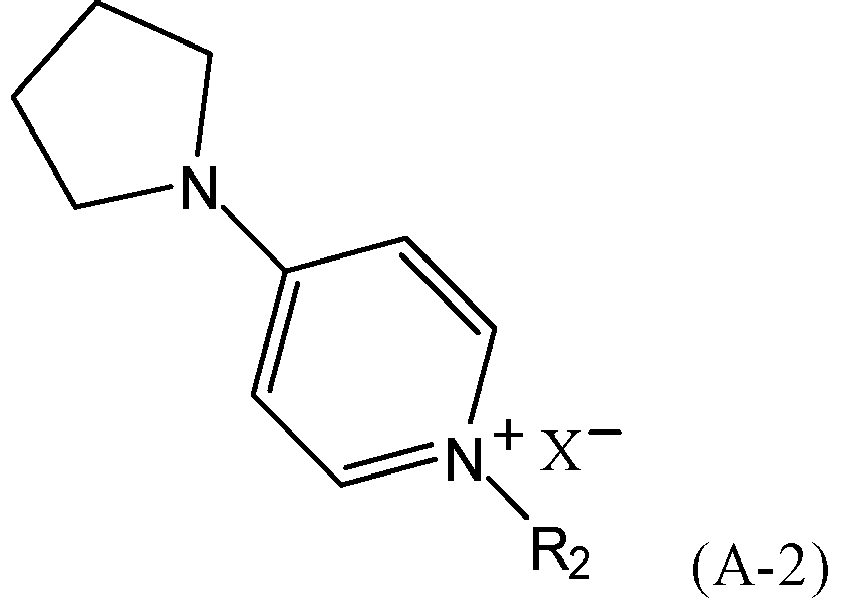

0.005≤p≤0.5, preferably 0.01≤p≤0.4, more preferably 0.01≤p≤0.3, more preferably 0.02≤p≤0.2. - The molecular sieve SCM-14 according to claim 1, characterized in that not more than 10% of the Ge atoms in the molecular sieve are replaced by atoms of at least one element other than silicon and germanium.
- The molecular sieve SCM-14 according to claim 5, characterized in that the element other than silicon and germanium is at least one selected from the group consisting of boron, aluminum, tin, zirconium and titanium, preferably at least one selected from the group consisting of boron and titanium.
- A process of preparing molecular sieve SCM-14, comprising a step of crystallizing a mixture containing or consisting of a silicon source, a germanium source, a fluorine source, an organic template and water to obtain the molecular sieve; and optionally, a step of calcining the obtained molecular sieve;
wherein the organic template is selected from 4-pyrrolidinyl pyridine, or quaternary ammonium forms shown in formula (A-1), formula (A-2) or formula (A-3), preferably 4-pyrrolidinyl pyridine,


- The process of preparing molecular sieve SCM-14 according to claim 7, characterized in that the silicon source is at least one selected from the group consisting of silicic acid, silica gel, silica sol, tetraalkyl orthosilicate and water glass; the germanium source is at least one selected from the group consisting of germanium oxide, germanium nitrate and tetraalkoxygermanium;
the molar ratio of the silicon source (calculated as SiO2), the germanium source (calculated as GeO2), the fluorine source (calculated as F), the organic template agent and water is 1 :(1/30 to ∞): (0.1 to 1.0): (0.1 to 1.0): (5 to 50); preferably 1:(0.05-2):(0.1-0.8):(0.1-0.8):(10-40); more preferably 1:(0.1-1):(0.2-0.6):(0.2-0.6):(15-30); or more preferably 1:(0.2-1):(0.3-0.5):(0.3-0.5):(15-20). - The process of preparing molecular sieve SCM-14 according to claim 7, characterized in that the crystallization conditions comprise: firstly, crystallizing at 91-130 °C for 8 hours to 3 days, and then crystallizing at 140-210 °C for 1-15 days; preferably, firstly crystallizing at 100-130 °C for 12 hours to 2 days, and then crystallizing at 150-190 °C for 2 to 10 days; more preferably, firstly crystallizing at 100-120 °C for 12 to 36 hours and then crystallizing at 160-180 °C for 2 to 7 days.
- The process of preparing molecular sieve SCM-14 according to claim 7, characterized in that the process comprises an aging step prior to crystallization; and the aging conditions include: an ageing temperature of 50-90 °C, and an ageing duration of 30 minutes to 2 days.
- The process of preparing molecular sieve SCM-14 according to claim 7, characterized in that the mixture further comprises a source of an element other than silicon and germanium, preferably at least one selected from the group consisting of boron, aluminum, tin, zirconium and titanium; more preferably at least one oxide source selected from the group consisting of a boron oxide source, an alumina source, a tin oxide source, a zirconium oxide source and a titanium oxide source; and the molar ratio of the oxide source (calculated as the corresponding oxide) to the germanium source (calculated as GeO2) is (0.01-0.1):1, preferably (0.02-0.08): 1.
- A molecular sieve composition, comprising the molecular sieve SCM-14 according to any one of claims 1 to 6 or the molecular sieve SCM-14 prepared according to the process of preparing the molecular sieve SCM-14 according to any one of claims 7 to 11, and a binder.
- Use of the molecular sieve SCM-14 according to any one of claims 1 to 6, the molecular sieve SCM-14 prepared according to the process of preparing the molecular sieve SCM-14 according to any one of claims 7 to 11, or the molecular sieve composition according to claim 12, as an adsorbent or catalyst.
Applications Claiming Priority (2)
| Application Number | Priority Date | Filing Date | Title |
|---|---|---|---|
| CN201710440330 | 2017-06-13 | ||
| PCT/CN2017/108461 WO2018227849A1 (en) | 2017-06-13 | 2017-10-31 | Molecular sieve scm-14, synthesis method therefor and use thereof |
Publications (3)
| Publication Number | Publication Date |
|---|---|
| EP3640208A1 true EP3640208A1 (en) | 2020-04-22 |
| EP3640208A4 EP3640208A4 (en) | 2021-03-03 |
| EP3640208B1 EP3640208B1 (en) | 2022-01-19 |
Family
ID=64660543
Family Applications (1)
| Application Number | Title | Priority Date | Filing Date |
|---|---|---|---|
| EP17913991.0A Active EP3640208B1 (en) | 2017-06-13 | 2017-10-31 | Molecular sieve scm-14, synthesis method therefor and use thereof |
Country Status (10)
| Country | Link |
|---|---|
| US (1) | US11097256B2 (en) |
| EP (1) | EP3640208B1 (en) |
| JP (1) | JP7045401B2 (en) |
| KR (1) | KR102359047B1 (en) |
| CN (1) | CN109081360B (en) |
| DK (1) | DK3640208T3 (en) |
| ES (1) | ES2910830T3 (en) |
| PT (1) | PT3640208T (en) |
| SG (1) | SG11201912126PA (en) |
| WO (1) | WO2018227849A1 (en) |
Cited By (2)
| Publication number | Priority date | Publication date | Assignee | Title |
|---|---|---|---|---|
| EP3640207A4 (en) * | 2017-06-13 | 2021-03-03 | China Petroleum & Chemical Corporation | SCM-15 MOLECULAR SIEVE, ITS SYNTHESIS PROCESS AND ASSOCIATED USE |
| RU2843208C2 (en) * | 2021-09-28 | 2025-07-08 | Чайна Петролеум Энд Кемикал Корпорейшн | Separator for lithium-sulphur battery, method for manufacturing same and lithium-sulphur battery containing same |
Families Citing this family (18)
| Publication number | Priority date | Publication date | Assignee | Title |
|---|---|---|---|---|
| CN111099612B (en) * | 2018-10-25 | 2021-11-30 | 中国石油化工股份有限公司 | Molecular sieve SCM-23, its synthesis method and use |
| CN112206807B (en) * | 2019-07-09 | 2023-06-06 | 中国石油化工股份有限公司 | SCM-25 molecular sieve based on silicon and germanium, preparation method and application thereof |
| CN112520755B (en) * | 2019-09-19 | 2022-07-12 | 中国石油化工股份有限公司 | SCM-28 molecular sieve, and preparation method and application thereof |
| CN112573535B (en) * | 2019-09-29 | 2022-07-12 | 中国石油化工股份有限公司 | SCM-32 molecular sieve and preparation method and application thereof |
| CN112707883B (en) * | 2019-10-25 | 2022-07-08 | 中国石油化工股份有限公司 | Preparation method of epsilon-caprolactone |
| CN113831271B (en) * | 2020-06-24 | 2023-10-31 | 中国石油化工股份有限公司 | Method for preparing caprolactam by catalyzing cyclohexanone oxime gas phase rearrangement |
| CN114180597B (en) * | 2020-09-14 | 2023-06-06 | 中国石油化工股份有限公司 | SCM-34 molecular sieve and preparation method and application thereof |
| CN115231584B (en) * | 2021-04-22 | 2023-10-31 | 中国石油化工股份有限公司 | AFI molecular sieve and preparation method and application thereof |
| JP7728335B2 (en) | 2020-09-14 | 2025-08-22 | 中国石油化工股▲ふん▼有限公司 | SCM-34 molecular sieve, its preparation method and use |
| CN114426293B (en) * | 2020-09-27 | 2023-09-29 | 中国石油化工股份有限公司 | SCM-35 molecular sieve, preparation method and application thereof |
| BR112023024230A2 (en) * | 2021-05-21 | 2024-01-30 | China Petroleum & Chem Corp | METHOD FOR PREPARING P-XYLENE THROUGH BIOMASS CONVERSION |
| CN115385771B (en) * | 2021-05-21 | 2024-05-28 | 中国石油化工股份有限公司 | Preparation method of paraxylene |
| CN115368200B (en) * | 2021-05-21 | 2024-03-26 | 中国石油化工股份有限公司 | Method for preparing paraxylene by biomass conversion |
| CN115882163B (en) * | 2021-09-28 | 2026-06-30 | 中国石油化工股份有限公司 | Molecular sieve modified diaphragm and preparation method and application thereof |
| JP7873721B2 (en) * | 2021-10-20 | 2026-06-12 | 中国石油化工股▲ふん▼有限公司 | SCM-38 Molecular Sieve, Method of Preparation Thereof, and Use |
| CN119461407B (en) * | 2023-08-09 | 2025-10-31 | 中国石油化工股份有限公司 | SCM-41 molecular sieve and preparation method and application thereof |
| KR20260083439A (en) | 2023-10-19 | 2026-06-05 | 차이나 페트로리움 앤드 케미컬 코포레이션 | Silicon-germanium zeolite-based non-precious metal catalyst, method of preparation thereof, and application |
| CN119859129A (en) * | 2023-10-19 | 2025-04-22 | 中国石油化工股份有限公司 | Method for preparing 2, 5-dimethylfuran by biomass conversion |
Family Cites Families (30)
| Publication number | Priority date | Publication date | Assignee | Title |
|---|---|---|---|---|
| US2882243A (en) | 1953-12-24 | 1959-04-14 | Union Carbide Corp | Molecular sieve adsorbents |
| US2882244A (en) | 1953-12-24 | 1959-04-14 | Union Carbide Corp | Molecular sieve adsorbents |
| US3130007A (en) | 1961-05-12 | 1964-04-21 | Union Carbide Corp | Crystalline zeolite y |
| US3702886A (en) | 1969-10-10 | 1972-11-14 | Mobil Oil Corp | Crystalline zeolite zsm-5 and method of preparing the same |
| US3709979A (en) | 1970-04-23 | 1973-01-09 | Mobil Oil Corp | Crystalline zeolite zsm-11 |
| US3832449A (en) | 1971-03-18 | 1974-08-27 | Mobil Oil Corp | Crystalline zeolite zsm{14 12 |
| US4016245A (en) | 1973-09-04 | 1977-04-05 | Mobil Oil Corporation | Crystalline zeolite and method of preparing same |
| CA1064890A (en) | 1975-06-10 | 1979-10-23 | Mae K. Rubin | Crystalline zeolite, synthesis and use thereof |
| IT1127311B (en) | 1979-12-21 | 1986-05-21 | Anic Spa | SYNTHETIC, CRYSTALLINE, POROUS MATERIAL CONSTITUTED BY SILICON AND TITANIUM OXIDES, METHOD FOR ITS PREPARATION AND ITS USES |
| DE3117135A1 (en) | 1981-04-30 | 1982-11-18 | Bayer Ag, 5090 Leverkusen | CRYSTALLINE ALUMOSILICATE, METHOD FOR THE PRODUCTION THEREOF AND THE USE THEREOF FOR CATALYTICALLY CONVERTING METHANOL AND / OR DIMETHYL ETHER IN HYDROCARBONS |
| US4954325A (en) | 1986-07-29 | 1990-09-04 | Mobil Oil Corp. | Composition of synthetic porous crystalline material, its synthesis and use |
| US5362697A (en) | 1993-04-26 | 1994-11-08 | Mobil Oil Corp. | Synthetic layered MCM-56, its synthesis and use |
| US6162416A (en) | 1996-07-12 | 2000-12-19 | Uop Llc | Zeolite beta and its use in aromatic alkylation |
| JP2006313664A (en) | 2005-05-06 | 2006-11-16 | Nissan Motor Co Ltd | Fuel cell vehicle |
| JP5397798B2 (en) * | 2005-11-19 | 2014-01-22 | 独立行政法人産業技術総合研究所 | Novel high-silica nanoporous material using layered silicate as a precursor, its design method and production method |
| WO2008035374A2 (en) * | 2006-07-21 | 2008-03-27 | Bharat Petroleum Corporation Limited | Microporous crystalline silicoalumino/(metallo) aluminophosphate molecular sieve and method of synthesis thereof |
| US20090196812A1 (en) * | 2008-01-31 | 2009-08-06 | Basf Catalysts Llc | Catalysts, Systems and Methods Utilizing Non-Zeolitic Metal-Containing Molecular Sieves Having the CHA Crystal Structure |
| FR2940266B1 (en) * | 2008-12-18 | 2010-12-31 | Inst Francais Du Petrole | IM-20 CRYSTALLIZED SOLID AND PROCESS FOR PREPARING THE SAME |
| WO2013126140A1 (en) | 2012-02-21 | 2013-08-29 | Exxonmobil Chemical Patents Inc. | Molecular sieve material, its synthesis and use |
| CN104445263B (en) * | 2013-09-24 | 2016-02-10 | 中国石油化工股份有限公司 | SCM-3 molecular sieve and preparation method thereof |
| CN104445247B (en) * | 2013-09-24 | 2016-06-08 | 中国石油化工股份有限公司 | SCM-4 molecular sieve and preparation method thereof |
| CN104445246B (en) | 2013-09-24 | 2017-01-04 | 中国石油化工股份有限公司 | SCM-5 molecular sieve and preparation method thereof |
| CN105217651B (en) * | 2014-07-03 | 2017-07-14 | 中国石油化工股份有限公司 | Si-Al molecular sieve SCM 6, its preparation method and use |
| CN105460953B (en) * | 2014-09-09 | 2017-08-11 | 中国石油化工股份有限公司 | Molecular sieves of SCM 8 and preparation method thereof |
| RU2686907C1 (en) | 2015-06-01 | 2019-05-06 | Кэлифорниа Инститьют Оф Текнолоджи | Crystalline germanosilicate materials of new topology cit-13 and methods for production thereof |
| BR102016026128B1 (en) | 2015-11-09 | 2022-10-04 | Shanghai Research Institute Of Petrochemical Technology, Sinopec | SCM-11 MOLECULAR SIEVES, PROCESS FOR THE PRODUCTION OF THE SAME, THEIR USES AND COMPOSITION OF THE MOLECULAR SIEVE |
| BR102016026121B1 (en) * | 2015-11-09 | 2021-09-14 | China Petroleum & Chemical Corporation | SCM-10 MOLECULAR SIEVE, PROCESS FOR ITS PRODUCTION, COMPOSITION AND USE |
| ES2650083B1 (en) * | 2016-06-16 | 2018-10-29 | Consejo Superior De Investigaciones Científicas (Csic) | ITQ-62 MATERIAL, ITS PROCESSING PROCEDURE AND ITS USE |
| WO2018227850A1 (en) | 2017-06-13 | 2018-12-20 | 中国石油化工股份有限公司 | Molecular sieve scm-15, synthesis method therefor and use thereof |
| CN111099612B (en) | 2018-10-25 | 2021-11-30 | 中国石油化工股份有限公司 | Molecular sieve SCM-23, its synthesis method and use |
-
2017
- 2017-10-31 US US16/622,806 patent/US11097256B2/en active Active
- 2017-10-31 EP EP17913991.0A patent/EP3640208B1/en active Active
- 2017-10-31 CN CN201711060307.0A patent/CN109081360B/en active Active
- 2017-10-31 PT PT179139910T patent/PT3640208T/en unknown
- 2017-10-31 DK DK17913991.0T patent/DK3640208T3/en active
- 2017-10-31 ES ES17913991T patent/ES2910830T3/en active Active
- 2017-10-31 KR KR1020207001008A patent/KR102359047B1/en active Active
- 2017-10-31 WO PCT/CN2017/108461 patent/WO2018227849A1/en not_active Ceased
- 2017-10-31 SG SG11201912126PA patent/SG11201912126PA/en unknown
- 2017-10-31 JP JP2019568317A patent/JP7045401B2/en active Active
Cited By (2)
| Publication number | Priority date | Publication date | Assignee | Title |
|---|---|---|---|---|
| EP3640207A4 (en) * | 2017-06-13 | 2021-03-03 | China Petroleum & Chemical Corporation | SCM-15 MOLECULAR SIEVE, ITS SYNTHESIS PROCESS AND ASSOCIATED USE |
| RU2843208C2 (en) * | 2021-09-28 | 2025-07-08 | Чайна Петролеум Энд Кемикал Корпорейшн | Separator for lithium-sulphur battery, method for manufacturing same and lithium-sulphur battery containing same |
Also Published As
| Publication number | Publication date |
|---|---|
| KR20200017482A (en) | 2020-02-18 |
| SG11201912126PA (en) | 2020-01-30 |
| JP2020523272A (en) | 2020-08-06 |
| CN109081360A (en) | 2018-12-25 |
| ES2910830T3 (en) | 2022-05-13 |
| DK3640208T3 (en) | 2022-04-11 |
| EP3640208A4 (en) | 2021-03-03 |
| KR102359047B1 (en) | 2022-02-08 |
| EP3640208B1 (en) | 2022-01-19 |
| PT3640208T (en) | 2022-04-11 |
| US11097256B2 (en) | 2021-08-24 |
| WO2018227849A1 (en) | 2018-12-20 |
| US20200188892A1 (en) | 2020-06-18 |
| BR112019026294A2 (en) | 2020-06-30 |
| JP7045401B2 (en) | 2022-03-31 |
| CN109081360B (en) | 2020-10-27 |
Similar Documents
| Publication | Publication Date | Title |
|---|---|---|
| EP3640208B1 (en) | Molecular sieve scm-14, synthesis method therefor and use thereof | |
| US10974967B2 (en) | Molecular sieve SCM-15, synthesis method therefor and use thereof | |
| KR102159632B1 (en) | Scm-11 molecular sieve, a process for producing same and use thereof | |
| CA2092938C (en) | Zeolitic catalyst of mfi type, its preparation and use | |
| EP3165281B1 (en) | A process for producing a molecular sieve having the sfe structure, a molecular sieve having the sfe structure and use thereof | |
| CN111099612B (en) | Molecular sieve SCM-23, its synthesis method and use | |
| KR102632794B1 (en) | Molecular sieve SSZ-113, its synthesis and uses | |
| KR20160058930A (en) | Molecular sieve, manufacturing method therefor, and uses thereof | |
| RU2622300C2 (en) | Zeolite materials, and manufacturing methods using alcenyiltriammonium compounds | |
| CN115504484B (en) | SCM-37 molecular sieve, its manufacturing method and use | |
| CN115959681A (en) | SCM-36 molecular sieves, methods of making, and uses thereof | |
| JP3697737B2 (en) | Synthetic zeolite material | |
| CN111099625B (en) | Molecular sieve SCM-24, its synthesis method and use | |
| CN112573535B (en) | SCM-32 molecular sieve and preparation method and application thereof | |
| CN111099613B (en) | Molecular sieves, methods of synthesis, and uses thereof | |
| JP7812918B2 (en) | Silicon-aluminum molecular sieve SCM-36, its production method and uses | |
| US5370858A (en) | Process for the synthesis of zeolites having an aluminosilicate framework belonging to the faujasite structural family, products obtained and their use in adsorption and catalysis | |
| BR112019026294B1 (en) | SCM-14 MOLECULAR SIEVE, PREPARATION PROCESS, ITS USE AND COMPOSITION OF MOLECULAR SIEVE |
Legal Events
| Date | Code | Title | Description |
|---|---|---|---|
| STAA | Information on the status of an ep patent application or granted ep patent |
Free format text: STATUS: THE INTERNATIONAL PUBLICATION HAS BEEN MADE |
|
| PUAI | Public reference made under article 153(3) epc to a published international application that has entered the european phase |
Free format text: ORIGINAL CODE: 0009012 |
|
| STAA | Information on the status of an ep patent application or granted ep patent |
Free format text: STATUS: REQUEST FOR EXAMINATION WAS MADE |
|
| 17P | Request for examination filed |
Effective date: 20200109 |
|
| AK | Designated contracting states |
Kind code of ref document: A1 Designated state(s): AL AT BE BG CH CY CZ DE DK EE ES FI FR GB GR HR HU IE IS IT LI LT LU LV MC MK MT NL NO PL PT RO RS SE SI SK SM TR |
|
| AX | Request for extension of the european patent |
Extension state: BA ME |
|
| DAV | Request for validation of the european patent (deleted) | ||
| DAX | Request for extension of the european patent (deleted) | ||
| A4 | Supplementary search report drawn up and despatched |
Effective date: 20210201 |
|
| RIC1 | Information provided on ipc code assigned before grant |
Ipc: C01B 39/12 20060101ALI20210126BHEP Ipc: B01J 20/10 20060101ALI20210126BHEP Ipc: C01B 39/06 20060101ALI20210126BHEP Ipc: C01B 39/08 20060101ALI20210126BHEP Ipc: C01B 37/00 20060101ALI20210126BHEP Ipc: C01B 39/48 20060101AFI20210126BHEP Ipc: B01J 29/06 20060101ALI20210126BHEP Ipc: C01B 39/46 20060101ALI20210126BHEP Ipc: B01J 20/18 20060101ALI20210126BHEP |
|
| GRAP | Despatch of communication of intention to grant a patent |
Free format text: ORIGINAL CODE: EPIDOSNIGR1 |
|
| STAA | Information on the status of an ep patent application or granted ep patent |
Free format text: STATUS: GRANT OF PATENT IS INTENDED |
|
| GRAS | Grant fee paid |
Free format text: ORIGINAL CODE: EPIDOSNIGR3 |
|
| INTG | Intention to grant announced |
Effective date: 20211116 |
|
| GRAA | (expected) grant |
Free format text: ORIGINAL CODE: 0009210 |
|
| STAA | Information on the status of an ep patent application or granted ep patent |
Free format text: STATUS: THE PATENT HAS BEEN GRANTED |
|
| AK | Designated contracting states |
Kind code of ref document: B1 Designated state(s): AL AT BE BG CH CY CZ DE DK EE ES FI FR GB GR HR HU IE IS IT LI LT LU LV MC MK MT NL NO PL PT RO RS SE SI SK SM TR |
|
| REG | Reference to a national code |
Ref country code: GB Ref legal event code: FG4D |
|
| REG | Reference to a national code |
Ref country code: CH Ref legal event code: EP |
|
| REG | Reference to a national code |
Ref country code: DE Ref legal event code: R096 Ref document number: 602017052629 Country of ref document: DE |
|
| REG | Reference to a national code |
Ref country code: AT Ref legal event code: REF Ref document number: 1463699 Country of ref document: AT Kind code of ref document: T Effective date: 20220215 |
|
| REG | Reference to a national code |
Ref country code: IE Ref legal event code: FG4D |
|
| REG | Reference to a national code |
Ref country code: PT Ref legal event code: SC4A Ref document number: 3640208 Country of ref document: PT Date of ref document: 20220411 Kind code of ref document: T Free format text: AVAILABILITY OF NATIONAL TRANSLATION Effective date: 20220405 Ref country code: DK Ref legal event code: T3 Effective date: 20220405 |
|
| REG | Reference to a national code |
Ref country code: NL Ref legal event code: FP |
|
| REG | Reference to a national code |
Ref country code: LT Ref legal event code: MG9D |
|
| REG | Reference to a national code |
Ref country code: ES Ref legal event code: FG2A Ref document number: 2910830 Country of ref document: ES Kind code of ref document: T3 Effective date: 20220513 |
|
| PG25 | Lapsed in a contracting state [announced via postgrant information from national office to epo] |
Ref country code: SE Free format text: LAPSE BECAUSE OF FAILURE TO SUBMIT A TRANSLATION OF THE DESCRIPTION OR TO PAY THE FEE WITHIN THE PRESCRIBED TIME-LIMIT Effective date: 20220119 Ref country code: RS Free format text: LAPSE BECAUSE OF FAILURE TO SUBMIT A TRANSLATION OF THE DESCRIPTION OR TO PAY THE FEE WITHIN THE PRESCRIBED TIME-LIMIT Effective date: 20220119 Ref country code: NO Free format text: LAPSE BECAUSE OF FAILURE TO SUBMIT A TRANSLATION OF THE DESCRIPTION OR TO PAY THE FEE WITHIN THE PRESCRIBED TIME-LIMIT Effective date: 20220419 Ref country code: LT Free format text: LAPSE BECAUSE OF FAILURE TO SUBMIT A TRANSLATION OF THE DESCRIPTION OR TO PAY THE FEE WITHIN THE PRESCRIBED TIME-LIMIT Effective date: 20220119 Ref country code: HR Free format text: LAPSE BECAUSE OF FAILURE TO SUBMIT A TRANSLATION OF THE DESCRIPTION OR TO PAY THE FEE WITHIN THE PRESCRIBED TIME-LIMIT Effective date: 20220119 Ref country code: BG Free format text: LAPSE BECAUSE OF FAILURE TO SUBMIT A TRANSLATION OF THE DESCRIPTION OR TO PAY THE FEE WITHIN THE PRESCRIBED TIME-LIMIT Effective date: 20220419 |
|
| PG25 | Lapsed in a contracting state [announced via postgrant information from national office to epo] |
Ref country code: PL Free format text: LAPSE BECAUSE OF FAILURE TO SUBMIT A TRANSLATION OF THE DESCRIPTION OR TO PAY THE FEE WITHIN THE PRESCRIBED TIME-LIMIT Effective date: 20220119 Ref country code: LV Free format text: LAPSE BECAUSE OF FAILURE TO SUBMIT A TRANSLATION OF THE DESCRIPTION OR TO PAY THE FEE WITHIN THE PRESCRIBED TIME-LIMIT Effective date: 20220119 Ref country code: GR Free format text: LAPSE BECAUSE OF FAILURE TO SUBMIT A TRANSLATION OF THE DESCRIPTION OR TO PAY THE FEE WITHIN THE PRESCRIBED TIME-LIMIT Effective date: 20220420 Ref country code: FI Free format text: LAPSE BECAUSE OF FAILURE TO SUBMIT A TRANSLATION OF THE DESCRIPTION OR TO PAY THE FEE WITHIN THE PRESCRIBED TIME-LIMIT Effective date: 20220119 |
|
| PG25 | Lapsed in a contracting state [announced via postgrant information from national office to epo] |
Ref country code: IS Free format text: LAPSE BECAUSE OF FAILURE TO SUBMIT A TRANSLATION OF THE DESCRIPTION OR TO PAY THE FEE WITHIN THE PRESCRIBED TIME-LIMIT Effective date: 20220519 |
|
| REG | Reference to a national code |
Ref country code: DE Ref legal event code: R097 Ref document number: 602017052629 Country of ref document: DE |
|
| PG25 | Lapsed in a contracting state [announced via postgrant information from national office to epo] |
Ref country code: SM Free format text: LAPSE BECAUSE OF FAILURE TO SUBMIT A TRANSLATION OF THE DESCRIPTION OR TO PAY THE FEE WITHIN THE PRESCRIBED TIME-LIMIT Effective date: 20220119 Ref country code: SK Free format text: LAPSE BECAUSE OF FAILURE TO SUBMIT A TRANSLATION OF THE DESCRIPTION OR TO PAY THE FEE WITHIN THE PRESCRIBED TIME-LIMIT Effective date: 20220119 Ref country code: RO Free format text: LAPSE BECAUSE OF FAILURE TO SUBMIT A TRANSLATION OF THE DESCRIPTION OR TO PAY THE FEE WITHIN THE PRESCRIBED TIME-LIMIT Effective date: 20220119 Ref country code: EE Free format text: LAPSE BECAUSE OF FAILURE TO SUBMIT A TRANSLATION OF THE DESCRIPTION OR TO PAY THE FEE WITHIN THE PRESCRIBED TIME-LIMIT Effective date: 20220119 Ref country code: CZ Free format text: LAPSE BECAUSE OF FAILURE TO SUBMIT A TRANSLATION OF THE DESCRIPTION OR TO PAY THE FEE WITHIN THE PRESCRIBED TIME-LIMIT Effective date: 20220119 |
|
| PLBE | No opposition filed within time limit |
Free format text: ORIGINAL CODE: 0009261 |
|
| STAA | Information on the status of an ep patent application or granted ep patent |
Free format text: STATUS: NO OPPOSITION FILED WITHIN TIME LIMIT |
|
| PG25 | Lapsed in a contracting state [announced via postgrant information from national office to epo] |
Ref country code: AL Free format text: LAPSE BECAUSE OF FAILURE TO SUBMIT A TRANSLATION OF THE DESCRIPTION OR TO PAY THE FEE WITHIN THE PRESCRIBED TIME-LIMIT Effective date: 20220119 |
|
| 26N | No opposition filed |
Effective date: 20221020 |
|
| PG25 | Lapsed in a contracting state [announced via postgrant information from national office to epo] |
Ref country code: SI Free format text: LAPSE BECAUSE OF FAILURE TO SUBMIT A TRANSLATION OF THE DESCRIPTION OR TO PAY THE FEE WITHIN THE PRESCRIBED TIME-LIMIT Effective date: 20220119 |
|
| PG25 | Lapsed in a contracting state [announced via postgrant information from national office to epo] |
Ref country code: MC Free format text: LAPSE BECAUSE OF FAILURE TO SUBMIT A TRANSLATION OF THE DESCRIPTION OR TO PAY THE FEE WITHIN THE PRESCRIBED TIME-LIMIT Effective date: 20220119 |
|
| REG | Reference to a national code |
Ref country code: CH Ref legal event code: PL |
|
| P01 | Opt-out of the competence of the unified patent court (upc) registered |
Effective date: 20230502 |
|
| PG25 | Lapsed in a contracting state [announced via postgrant information from national office to epo] |
Ref country code: LU Free format text: LAPSE BECAUSE OF NON-PAYMENT OF DUE FEES Effective date: 20221031 |
|
| REG | Reference to a national code |
Ref country code: AT Ref legal event code: UEP Ref document number: 1463699 Country of ref document: AT Kind code of ref document: T Effective date: 20220119 |
|
| PG25 | Lapsed in a contracting state [announced via postgrant information from national office to epo] |
Ref country code: LI Free format text: LAPSE BECAUSE OF NON-PAYMENT OF DUE FEES Effective date: 20221031 Ref country code: CH Free format text: LAPSE BECAUSE OF NON-PAYMENT OF DUE FEES Effective date: 20221031 |
|
| PG25 | Lapsed in a contracting state [announced via postgrant information from national office to epo] |
Ref country code: IE Free format text: LAPSE BECAUSE OF NON-PAYMENT OF DUE FEES Effective date: 20221031 |
|
| PG25 | Lapsed in a contracting state [announced via postgrant information from national office to epo] |
Ref country code: HU Free format text: LAPSE BECAUSE OF FAILURE TO SUBMIT A TRANSLATION OF THE DESCRIPTION OR TO PAY THE FEE WITHIN THE PRESCRIBED TIME-LIMIT; INVALID AB INITIO Effective date: 20171031 |
|
| PG25 | Lapsed in a contracting state [announced via postgrant information from national office to epo] |
Ref country code: CY Free format text: LAPSE BECAUSE OF FAILURE TO SUBMIT A TRANSLATION OF THE DESCRIPTION OR TO PAY THE FEE WITHIN THE PRESCRIBED TIME-LIMIT Effective date: 20220119 |
|
| PG25 | Lapsed in a contracting state [announced via postgrant information from national office to epo] |
Ref country code: MK Free format text: LAPSE BECAUSE OF FAILURE TO SUBMIT A TRANSLATION OF THE DESCRIPTION OR TO PAY THE FEE WITHIN THE PRESCRIBED TIME-LIMIT Effective date: 20220119 |
|
| PG25 | Lapsed in a contracting state [announced via postgrant information from national office to epo] |
Ref country code: TR Free format text: LAPSE BECAUSE OF FAILURE TO SUBMIT A TRANSLATION OF THE DESCRIPTION OR TO PAY THE FEE WITHIN THE PRESCRIBED TIME-LIMIT Effective date: 20220119 |
|
| PG25 | Lapsed in a contracting state [announced via postgrant information from national office to epo] |
Ref country code: MT Free format text: LAPSE BECAUSE OF FAILURE TO SUBMIT A TRANSLATION OF THE DESCRIPTION OR TO PAY THE FEE WITHIN THE PRESCRIBED TIME-LIMIT Effective date: 20220119 |
|
| PGFP | Annual fee paid to national office [announced via postgrant information from national office to epo] |
Ref country code: IT Payment date: 20250922 Year of fee payment: 9 Ref country code: NL Payment date: 20250912 Year of fee payment: 9 |
|
| PGFP | Annual fee paid to national office [announced via postgrant information from national office to epo] |
Ref country code: BE Payment date: 20250917 Year of fee payment: 9 Ref country code: GB Payment date: 20250911 Year of fee payment: 9 |
|
| PGFP | Annual fee paid to national office [announced via postgrant information from national office to epo] |
Ref country code: FR Payment date: 20250908 Year of fee payment: 9 |
|
| PGFP | Annual fee paid to national office [announced via postgrant information from national office to epo] |
Ref country code: PT Payment date: 20251028 Year of fee payment: 9 |
|
| PGFP | Annual fee paid to national office [announced via postgrant information from national office to epo] |
Ref country code: DE Payment date: 20250902 Year of fee payment: 9 |
|
| PGFP | Annual fee paid to national office [announced via postgrant information from national office to epo] |
Ref country code: AT Payment date: 20250925 Year of fee payment: 9 |
|
| PGFP | Annual fee paid to national office [announced via postgrant information from national office to epo] |
Ref country code: DK Payment date: 20251014 Year of fee payment: 9 |
|
| PGFP | Annual fee paid to national office [announced via postgrant information from national office to epo] |
Ref country code: ES Payment date: 20251105 Year of fee payment: 9 |