EP3634873B1 - Schwimmender schwimmbeckenreiniger mit verriegelungsvorrichtung - Google Patents
Schwimmender schwimmbeckenreiniger mit verriegelungsvorrichtung Download PDFInfo
- Publication number
- EP3634873B1 EP3634873B1 EP18797779.8A EP18797779A EP3634873B1 EP 3634873 B1 EP3634873 B1 EP 3634873B1 EP 18797779 A EP18797779 A EP 18797779A EP 3634873 B1 EP3634873 B1 EP 3634873B1
- Authority
- EP
- European Patent Office
- Prior art keywords
- end cap
- container
- chemical
- tab
- dispenser
- Prior art date
- Legal status (The legal status is an assumption and is not a legal conclusion. Google has not performed a legal analysis and makes no representation as to the accuracy of the status listed.)
- Active
Links
Images




Classifications
-
- C—CHEMISTRY; METALLURGY
- C02—TREATMENT OF WATER, WASTE WATER, SEWAGE, OR SLUDGE
- C02F—TREATMENT OF WATER, WASTE WATER, SEWAGE, OR SLUDGE
- C02F1/00—Treatment of water, waste water, or sewage
- C02F1/68—Treatment of water, waste water, or sewage by addition of specified substances, e.g. trace elements, for ameliorating potable water
- C02F1/685—Devices for dosing the additives
- C02F1/688—Devices in which the water progressively dissolves a solid compound
-
- B—PERFORMING OPERATIONS; TRANSPORTING
- B01—PHYSICAL OR CHEMICAL PROCESSES OR APPARATUS IN GENERAL
- B01F—MIXING, e.g. DISSOLVING, EMULSIFYING OR DISPERSING
- B01F21/00—Dissolving
- B01F21/20—Dissolving using flow mixing
- B01F21/22—Dissolving using flow mixing using additional holders in conduits, containers or pools for keeping the solid material in place, e.g. supports or receptacles
-
- B—PERFORMING OPERATIONS; TRANSPORTING
- B01—PHYSICAL OR CHEMICAL PROCESSES OR APPARATUS IN GENERAL
- B01F—MIXING, e.g. DISSOLVING, EMULSIFYING OR DISPERSING
- B01F33/00—Other mixers; Mixing plants; Combinations of mixers
- B01F33/50—Movable or transportable mixing devices or plants
- B01F33/503—Floating mixing devices
-
- C—CHEMISTRY; METALLURGY
- C02—TREATMENT OF WATER, WASTE WATER, SEWAGE, OR SLUDGE
- C02F—TREATMENT OF WATER, WASTE WATER, SEWAGE, OR SLUDGE
- C02F1/00—Treatment of water, waste water, or sewage
- C02F1/50—Treatment of water, waste water, or sewage by addition or application of a germicide or by oligodynamic treatment
-
- E—FIXED CONSTRUCTIONS
- E04—BUILDING
- E04H—BUILDINGS OR LIKE STRUCTURES FOR PARTICULAR PURPOSES; SWIMMING OR SPLASH BATHS OR POOLS; MASTS; FENCING; TENTS OR CANOPIES, IN GENERAL
- E04H4/00—Swimming or splash baths or pools
- E04H4/12—Devices or arrangements for circulating water, i.e. devices for removal of polluted water, cleaning baths or for water treatment
- E04H4/1281—Devices for distributing chemical products in the water of swimming pools
-
- B—PERFORMING OPERATIONS; TRANSPORTING
- B01—PHYSICAL OR CHEMICAL PROCESSES OR APPARATUS IN GENERAL
- B01D—SEPARATION
- B01D11/00—Solvent extraction
- B01D11/02—Solvent extraction of solids
-
- B—PERFORMING OPERATIONS; TRANSPORTING
- B01—PHYSICAL OR CHEMICAL PROCESSES OR APPARATUS IN GENERAL
- B01F—MIXING, e.g. DISSOLVING, EMULSIFYING OR DISPERSING
- B01F2101/00—Mixing characterised by the nature of the mixed materials or by the application field
- B01F2101/305—Treatment of water, waste water or sewage
-
- C—CHEMISTRY; METALLURGY
- C02—TREATMENT OF WATER, WASTE WATER, SEWAGE, OR SLUDGE
- C02F—TREATMENT OF WATER, WASTE WATER, SEWAGE, OR SLUDGE
- C02F2103/00—Nature of the water, waste water, sewage or sludge to be treated
- C02F2103/42—Nature of the water, waste water, sewage or sludge to be treated from bathing facilities, e.g. swimming pools
-
- C—CHEMISTRY; METALLURGY
- C02—TREATMENT OF WATER, WASTE WATER, SEWAGE, OR SLUDGE
- C02F—TREATMENT OF WATER, WASTE WATER, SEWAGE, OR SLUDGE
- C02F2303/00—Specific treatment goals
- C02F2303/04—Disinfection
Definitions
- swimming pool water, fountain water, and the like are susceptible to infestation by various microorganisms, such as algae.
- various microorganisms such as algae.
- swimming pool water can provide a hospitable forum for the growth of bacteria, algae and other undesirable and potentially unhealthy organisms. Consequently, pool water, and spas are typically treated with chemicals designed to kill and control the above organisms. The chemicals can be applied to the pool water on a periodic or a continuous basis.
- Such treatment is typically undertaken via the introduction of a halogen, such as chlorine, into the pool water at levels effective to kill or control the unwanted organisms.
- a halogen such as chlorine
- the halogen source may be in liquid form or may be in a solid form.
- the solid form can be designed to quickly or slowly dissolve in the pool water.
- Solid sources of chlorine for instance, include calcium hypochlorite and the like.
- the floating chemical dispenser can include an upper end float attached to a container.
- a solid chemical can be placed in the container and the container can include at least one opening that allows water to enter the container and dissolve the chemical for release into the pool water.
- the floating dispenser when empty, has a center of gravity that is not symmetrical with the container. Consequently, as the chemical within the container is dissolved and becomes exhausted, the floating dispenser tips over and floats horizontally in the water indicating to a user that the floating dispenser is empty and needs to be replaced.
- U.S. Patent No. 7,704,467 One embodiment of a floating chemical dispenser is disclosed in U.S. Patent No. 7,704,467 .
- the floating dispenser contains chemical tablets composed of compressed calcium hypochlorite, an algicide, and an agglomerating agent, such as zinc sulfate and sodium Further relevant documents are US 2013/092634 A1 and US 2004/175311 A1 .
- Floating chemical dispensers typically include a closing mechanism that closes the opening in the container to prevent inadvertent release of the chemical contained in the dispenser.
- the closing mechanism can be susceptible to opening during packing, shipping and handling of the dispenser. Consequently, in the past, a shrink wrap film or tape was placed over the closing mechanism to keep the dispenser in a closed position until the dispenser was placed in use. Shrink wrap film or tape as described above, however, cannot be reused, and, once removed from the dispensing container, leaves the closure mechanism unprotected.
- the present disclosure is directed to a floating chemical dispenser for containing and dispensing chemicals into a body of water, such as into pool water or water contained in a spa.
- the floating chemical dispenser can also be used in all different types of water systems, such as public fountains and the like.
- the floating chemical dispenser includes a locking device that prevents the dispenser from inadvertent spills or opening of the container prior to use.
- the locking device can include child resistant characteristics and properties.
- the present invention is directed to a floating chemical dispenser for containing and dispensing chemicals to treat a body of water.
- the dispenser includes a float positioned at an upper end of the dispenser.
- the floating chemical dispenser further includes a container having a top and a bottom.
- the top of the container is adjacent to the float.
- the top of the container can be attached to the float or, alternatively, a collar can be used to attach the float to the container.
- the container defines an interior compartment configured to hold a chemical.
- the chemical for instance, may comprise a solid chemical.
- the solid chemical may comprise a halogen source, such as a chlorine source that releases chlorine when dissolved.
- the chemical contained in the container may comprise trichloro-s-triazinetrione.
- the container can include an open top for receiving the chemical and a closed bottom.
- the container also defines at least one aperture positioned to receive water from the outside environment for combining with a chemical and dispensing the chemical into the body of water.
- the floating chemical dispenser further includes an end cap attached to the bottom of the container.
- the end cap can be held on the container by a retaining device.
- the retaining device can be designed to prevent the end cap from being released from the container.
- the retaining device comprises a retaining ring on the container and a locking element on the end cap.
- the locking element can reside within the retaining ring on the container.
- the end cap defines at least one orifice and is rotatable in relation to the retainer.
- the end cap is rotatable between a closed position and a chemical dispensing position. When in the chemical dispensing position, the at least one orifice is aligned with the aperture on the container.
- the end cap can include two orifices, three orifices, or more. Each orifice can have a different surface area. In this manner, a particular orifice can be aligned with the aperture for controlling the amount of chemical that is released from the dispenser.
- the floating chemical dispenser further includes a locking device that prevents the end cap from rotating when enabled.
- the end cap includes two opposing tab portions that, when pressed simultaneously, disables the locking device and allows the end cap to rotate.
- the locking device may comprise at least one locking tab located on the end cap. Pressing both of the tab portions simultaneously causes the locking tabs to move from a locked position to an unlocked position so that the end cap can rotate.
- each locking tab can reside in a recess located on a container which prevents the cap from rotating. Pressing both tab portions simultaneously, however, moves the locking tabs out of the recesses and disables the locking device.
- the locking tabs and the recesses can be located at any suitable location on the end cap and on the container. In one embodiment, for example, the recesses are located on a side wall of the container.
- the locking device includes a tab portion that engages the container and prevents the end cap from rotating. In this embodiment, lifting the tab portion causes the tab portion to disengage the container and disable the locking device.
- the locking device includes at least one removable tab that engages the container and prevents the end cap from rotating.
- the tab may be located on the end cap and may have a perimeter defined by perforations that lets the tab be removed from the container for disabling the locking device.
- the locking tab on the end cap can include a pull tab. Pulling the tab disengages the locking device and allows the end cap to rotate.
- the locking device comprises a pin on the container that resides in a slot located on the end cap.
- the slot can include a first vertical portion, a horizontal portion, and a second vertical portion. Moving the end cap so that the pin travels over the slot causes the end cap to rotate and disables a locking device.
- the floating chemical dispenser of the present disclosure can also include various other features.
- the end cap includes a rib member and the container defines a plurality of rib receiving channels. The rib receiving channels are located along a path of travel of the rib member when the cap is rotated. Each rib receiving channel can be positioned so as to align with a position on the end cap.
- one of the rib receiving channels can align with the rib member at a closed position of the end cap.
- Another rib receiving channel can align with the rib member when the end cap is rotated to a chemical dispensing position.
- the rib member and rib receiving channels not only allow the user to determine how much to rotate the end cap but also temporarily holds the end cap at a desired position.
- the rib receiving channels can be located on the bottom surface of the container and the rib member can be located on an adjoining surface of the end cap.
- the bottom surface of the container can also include an abutment that prevents the end cap from rotating in one direction. In this manner, the end cap only rotates in a direction toward the chemical dispensing position.
- the present invention is directed to a floating chemical dispenser.
- the floating chemical dispenser includes a float and a container for a chemical. When a chemical is loaded into the container and the dispenser is dropped into a body of water, the floating chemical dispenser floats upright and slowly releases the chemical contained within the container.
- the container includes an aperture that allows water to enter the container and dissolve the chemical.
- the container further includes an end cap that rotates on the container between a closed position that blocks the aperture and a chemical dispensing position in which an orifice on the end cap aligns with the aperture on the container to allow water to enter the container.
- the end cap and the container further include a locking device that prevents the end cap from rotating. The locking device can be used to prevent against inadvertent chemical spills or release.
- the locking device on the end cap can also be designed to be child resistant.
- the locking device can be designed for repeated use.
- the locking device includes a locking tab or element located on the container or on the end cap.
- the end cap can include two opposing tab portions that, when pressed simultaneously, release the locking element or tab and allow the end cap to be rotated.
- the floating chemical dispenser 10 includes a float 12 attached to a container 14.
- the container 14 is for holding a chemical.
- Attached to the container is an end cap 16.
- the end cap rotates between a closed position that prevents the chemical from be dispensed and one or more chemical dispensing positions that allow water from the environment to enter the container and dissolve the chemical.
- the floating chemical dispenser 10 includes a float 12 and an end cap 16.
- the floating chemical dispenser 10 includes a retaining collar 18. The retaining collar 18 connects the float 12 to the container 14.
- the retaining collar 18 is shown in more detail. As illustrated, the retaining collar 18 includes a first plurality of threads 20 that are intended to engage the float 12. On the opposite side, the retaining collar further includes a second set of threads 22 that attach to and engage the container 14. As shown in Fig. 3 , the retaining collar 18 can further include a plurality of vent openings 24. The vent openings 24 can allow gases within the container 14 to be released and water to flow back into the body.
- the container 14 of the floating chemical dispenser 10 includes an interior compartment that is designed to hold a chemical.
- the chemical may comprise a solid that dissolves and releases a sanitizing agent capable of killing or controlling unwanted organisms such as bacteria, algae and the like in a body of water.
- the chemical may comprise a halogen source, such as a chlorine source.
- Solid sources of chlorine include calcium hypochlorite, dichloroisocyanuric acid, trichloroisocyanuric acid and the like.
- the chlorine source comprises trichloro-s-triazinetrione.
- the halogen source may be present alone or in conjunction with other components within the solid composition.
- the halogen source may be combined with various other compatible chemicals for different purposes and benefits.
- the solid chemical may also contain other biocides or algicides, agglomerating agents and the like.
- the solid may contain zinc sulfate, zinc oxide, and/or sodium aluminate.
- the solid chemical composition can be present in the container in any suitable form.
- the solid chemical may be in the form of pellets, granules or the like.
- the container 14 includes disks made from the solid chemical composition.
- the container may include loose chemicals or chemicals held with an inner package or with a shrink film.
- the inner package shall secure the chemical contents, but allow water to flow freely to allow the chemicals to dissolve.
- the inner package can be mesh, water soluble film, shrink sleeve film with holes, etc.
- the container 14 can have any length in order to accommodate one disk or a plurality of disks.
- the container 14 may be designed to hold three disks stacked together within the interior compartment.
- the container 14 and the end cap 16 are shown in greater detail.
- the container 14 can include an open top 28 and a closed bottom 30.
- the container can also define an aperture 26.
- the aperture 26 allows water from the surrounding environment to enter the interior compartment of the container 14 and dissolve the chemical composition held within the container. As the chemical composition dissolves, a chemical is released into the surrounding water for controlling algae, bacteria, and other microorganisms.
- the floating chemical dispenser 10 can be placed in a body of water, such as in pool water, and can float and dispense chemical continuously.
- the size of the aperture 26 can be controlled in order to control the amount of chemical that is dispensed.
- the floating chemical dispenser 10 is designed to indicate to a user when the chemical composition has fully dissolved and has been exhausted.
- the chemical dispenser 10 is designed to float upright when containing a chemical composition.
- the floating chemical dispenser 10 has a center of gravity slightly off center that causes the dispenser to tip over and float in a more horizontal position.
- Various different methods and techniques can be implemented in order to give the floating chemical dispenser 10 a center of gravity that is slightly off center (from a central axis that extends from the top to the bottom of the dispenser). For instance, in U.S. Patent No.
- a disk can be placed in the container 14 and positioned off center which can cause the floating chemical dispenser 10 to tip over if empty and placed in a body of water.
- extra weight can be placed off center in the container 14, in the float 12, in the end cap 16, or in the retaining collar 18.
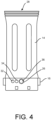
- the end cap 16 is rotatable in relation to the container 14. As shown particularly in Fig. 4 , for instance, the end cap includes at least one dispensing orifice. In Fig. 4 , for instance, the end cap defines three orifices 32, 34 and 36. The surface area or diameter of each orifice varies. For instance, orifice 32 has a smaller surface area than orifice 34, which has a smaller surface area than orifice 36. Orifice 36, for instance, can generally have the same diameter or surface area as the aperture 26.
- Each orifice can generally have a diameter of from about 2mm to about 25 mm.
- each orifice can have a diameter of greater than about 3 mm, such as greater than about 4 mm, such as greater than about 5 mm, such as greater than about 6 mm, such as greater than about 7 mm, such as greater than about 8 mm.
- the diameter of each orifice can generally be less than about 20 mm, such as less than about 15 mm, such as less than about 13 mm, such as less than about 12 mm, such as less than about 11 mm, such as less than about 10 mm.
- the end cap 16 includes a closed position in which the orifice 26 is completely blocked. In the closed position, the chemical composition contained within the floating chemical dispenser 10 remains protected and is not released from the container. Rotating the end cap 16 so that one of the orifices 32, 34 or 36 aligns with the aperture 26, however, places the floating chemical dispenser 10 into a chemical dispensing position where water can enter the container 14 for releasing the chemical composition.
- the orifices 32, 34 and 36 have different sizes for controlling the amount of chemical that is released. Having different orifices as shown in Fig. 4 allows for the floating chemical dispenser 10 to be adjustable. For instance, a particular orifice size may be selected based upon the size of the body of water or the pool size.
- a larger orifice may be selected.
- the different orifices can also be used to treat the pool in different ways.
- the large orifice 36 may be aligned with the aperture 26 in order to shock the pool and release large amounts of chemical very quickly.
- the smaller orifice 32 on the other hand, can be selected for a continuous release of the chemical and to maintain the pool within the proper chemical balance.
- Orifice 34 on the other hand, can be selected in order to make slight adjustments in order to, for instance, prevent the growth of algae.
- the floating chemical dispenser 10 in accordance with the present disclosure further includes a locking device that prevents the end cap 16 from rotating when the locking device is enabled.
- the locking device of the present disclosure can be engaged and disengaged repeatedly. In this manner, the end cap 16 can be locked in to a closed position even after the floating chemical dispenser 10 has been removed from the packaging in which it is shipped and sold.
- the locking device can be engaged after the floating chemical dispenser 10 has been partially used. For instance, in some situations, a user may want to remove the floating chemical dispenser from a pool for short periods of time or in order to store the dispenser during the off season or during a pool party.
- the locking device of the present disclosure can also be designed to be child resistant to prevent a child from inadvertently rotating the end cap 16.
- Figs. 4 through 8 illustrate one embodiment of a locking device in accordance with present disclosure.
- the end cap 16 includes a pair of opposing tab portions 40.
- the tab portions can be positioned 180° apart along the end cap 16. In other embodiments, the tab portions 30 can be spaced from about 90° to about 180° apart.
- Each tab portion 40 includes a locking tab 42 as particularly shown in Figs. 8 , 9 and 10 .
- the locking tab 42 engages the container 14 and prevents the end cap 16 from rotating.
- the container 14 can define a recess 44 as shown in Figs. 6 , 9 and 10 . When the locking tab 42 is contained within the recess 44, the locking tab 42 prevents the end cap 16 from rotating.
- a user can simultaneously press the tab portions 40 and twist the end cap 16. For instance, as particularly shown in Fig. 10 , when the tab portion 40 is pressed inwardly, the locking tab 42 pivots out of the recess 44 and allows the end cap 16 to rotate.
- the locking device on the floating chemical dispenser 10 can be child resistant.
- having two tab portions 40 located on opposing sides of the container prevents a person with small hands from pressing in both tab portions simultaneously.
- the floating chemical dispenser 10 can include a retaining device.
- the container 14 can define a retaining ring 46.
- the end cap 16 defines a corresponding locking element 48 that resides within the retaining ring 46.
- the locking element 48 rotates within the retaining ring 46. In this manner, the retaining ring and the locking element maintain the end cap 16 in alignment on the container 14 and prevent the end cap from being removed from the container.
- the container 14 defines recesses 44 and the retaining ring 46, while the end cap defines locking tabs 42 and locking elements 48. It should be understood, however, that these structures can be reversed. For instance, the recesses and the retaining ring can be located on the end cap, while the locking tabs and the locking element can be located on the container 14.
- the container 14 can also include an abutment 50.
- the abutment 50 can be designed to prevent the end cap 16 from rotating in a particular direction.
- the abutment 50 can be positioned to allow the end cap 15 to rotate in a direction so that the orifices 32, 34 and 36 become aligned with the aperture 26 and prevent the end cap 16 from rotating in an opposite direction.
- the floating chemical dispenser 10 can include a system that allows the user to know the closed position and the different chemical dispensing positions have been obtained when the end cap 16 is rotated.
- the end cap 16 is shown in relation to a bottom surface 52 of the container 14.
- Fig. 11 illustrates the surface of the end cap 16 that resides adjacent to the bottom surface 52 as shown in Fig. 12 .
- the end cap 16 defines a rib member 53 that projects from the surface of the end cap 16.
- the bottom surface 52 of the container 14 defines rib receiving channels 54, 56, 58 and 60.
- the rib receiving channels are located on a path of travel of the rib member when the end cap 16 is rotated.
- Each rib receiving channel 54, 56, 58 and 60 corresponds to a different position of the end cap 16 on the container 14.
- rib receiving channel 54 corresponds to the closed position of the floating chemical dispenser 10.
- Rib receiving channel 56 corresponds to a first chemical dispensing position
- rib receiving channel 58 corresponds to a second chemical dispensing position
- rib receiving channel 60 corresponds to a third chemical dispensing position of the floating chemical dispenser.
- the large orifice 36 becomes aligned with the aperture 26 on the container 14.
- the bottom surface 52 of the container 14 can also include abutments 60.
- the abutments 60 are designed to engage the rib member 53 and prevent the end cap 16 from rotating in a direction opposite to the rib receiving channels 54.
- the end cap 16 includes a single tab portion 70.
- the tab portion 70 includes a locking tab that engages the bottom of the container 14 and prevents the end cap 16 from rotating.
- the tab portion 70 can include a locking tab that resides in a recess within the container 14.
- the tab portion 70 is raised. While the tab portion 70 is raised, the end cap 16 can be rotated to any desired position.
- the tab portion 70 engages the bottom of the container 14.
- the locking tabs 42 engaged the side of the container 14.
- Fig. 15 illustrates another embodiment of a locking device in accordance with the present disclosure.
- the end cap 16 includes one or more removable locking tabs 72.
- the locking tab 72 can reside within a channel or recess 74 defined by the container 14 which prevents the end cap 16 from rotating.
- the locking tab 72 is removable. For instance, the locking tab 72 can be torn away from the end cap 16 which allows the end cap 16 to rotate.
- the end cap 16 includes one or more pull tabs 80.
- the pull tabs 80 include a locking tab that engages the container and prevents the end cap 16 from rotating. In order to disable the locking device, the pull tabs 80 are pulled away from the body of the container, which allows the end cap 16 to rotate.
- Fig. 17 illustrates yet another embodiment of a locking device in accordance with the present disclosure.
- the container 14 defines a pin 82 that resides within a slot 84 defined by the end cap 16.
- the slot 84 has a non-linear travel path.
- the slot includes a first vertical section followed by a first horizontal section followed by a second vertical section followed by a second horizontal section.
- the end cap is twisted and manipulated so that the pin 82 follows the slot 84.
- the end cap 16 in order to rotate the end cap 16 to the different chemical dispensing positions, the end cap is pulled downwardly and/or pushed upwardly while being rotated in order for the pin to follow the travel path of the slot 84.
- the travel path of the slot 84 can include various stopping points where horizontal portions intersect with vertical portions. These stopping points can correspond to different positions on the floating chemical dispenser 10. Each stopping point, for instance, may define a closed position or a chemical dispensing position.
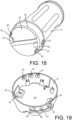
- FIG. 18 and 19 still another embodiment of a locking device in accordance with the present disclosure is shown. Like reference numerals have been used to indicate similar elements.
- the locking device illustrated in Figs. 18 and 19 is somewhat similar to the locking device illustrated in Figs. 4 through 10 .
- the end cap 16 engages the bottom 30 of the container 14 instead of the side of the container.
- the end cap 16 includes opposing tab portions 40 similar to the embodiment illustrated in Figs 4 through 10 . Located on each tab portion 40 is a locking tab 42. Locking tab 42 is located on the bottom surface of the end cap 16 facing the container 14.
- the container 14 includes a pair of opposing locking tab channels 90.
- the locking tab channels 90 are for receiving the corresponding pair of locking tabs 42 when the end cap 16 is in the locked position.
- the bottom 30 of the container 14 further defines a pair of opposing tab engaging members 92.
- the tab engaging members 92 prevent the locking tabs 42 from rotating when the end cap 16 is twisted.
- each of the tab portions 40 can be pressed inwardly simultaneously. When the tab portions 40 are pushed inwardly, the locking tabs 42 move radially within each locking tab channel 90 until locking tab 42 clears each corresponding tab engaging member 92. Consequently, pressing the tab portions 40 simultaneously allows the end cap 16 to rotate so that one of the orifices 32, 34, and 36 can align with the one or more apertures 26 on the container 14.
- the bottom 30 of the container 14 can further include two opposing abutments 60.
- the abutments 60 engage the locking tabs 42 and prevent the end cap 16 from rotating in one direction.
- the abutments 60 prevent the end cap from rotating counterclockwise.
- the abutments 60 have a greater length than the tab engaging members 92. In this manner, the end cap 16 is prevented from rotating in one direction even when the tab portions 40 are pressed inwardly.
- the end cap 16 includes two different sets of orifices.
- the container 14 can include two different apertures 26 for engaging the orifices 32, 34 and 36.
- the end cap 16 can include a shield member 94 that protects the orifices 32, 34 and 36 from being contacted with a person's hand. The shield member 94, for instance, can prevent any lose chemical from contact with the user when the end cap 16 is rotated.
- the locking device illustrated in Figs. 18 and 19 may offer various advantages and benefits. For instance, by placing the locking tabs on the bottom surface of the end cap, the top of the end cap 16 can remain a solid structure for improved structural integrity.
Landscapes
- Engineering & Computer Science (AREA)
- Chemical & Material Sciences (AREA)
- Water Supply & Treatment (AREA)
- Organic Chemistry (AREA)
- Environmental & Geological Engineering (AREA)
- Hydrology & Water Resources (AREA)
- Life Sciences & Earth Sciences (AREA)
- Architecture (AREA)
- Chemical Kinetics & Catalysis (AREA)
- Health & Medical Sciences (AREA)
- Medicinal Chemistry (AREA)
- Civil Engineering (AREA)
- Structural Engineering (AREA)
- Closures For Containers (AREA)
- Containers And Packaging Bodies Having A Special Means To Remove Contents (AREA)
Claims (15)
- Ein schwimmender Chemikalienspender (10) zur Aufnahme und Abgabe von Chemikalien zur Behandlung eines Gewässers, wobei der Spender umfasst;einen Schwimmer (12), der an einem oberen Ende des Spenders angeordnet ist;einen Behälter (14) mit einer Oberseite und einer Unterseite, wobei die Oberseite des Behälters (14) an den Schwimmer (12) angrenzt und optional mit diesem durch einen Haltekragen (18) verbunden ist, wobei der Behälter (14) in einem Innenabteil, das zur Aufnahme einer Chemikalie konfiguriert ist, mindestens eine Öffnung (26) besitzt, die so positioniert ist, dass sie Wasser aus der äußeren Umgebung aufnimmt, um es mit einer Chemikalie zu verbinden und die Chemikalie in einen Wasserkörper abzugeben;eine Endkappe (16), die am Boden (30) des Behälters (14) angebracht ist, wobei die Endkappe durch eine Haltevorrichtung auf dem Behälter (14) gehalten wird, wobei die Endkappe (16) mindestens eine Öffnung (32, 34, 36) besitzt und in Bezug auf den Behälter (14) drehbar ist, wobei die Endkappe (16) zwischen einer geschlossenen Position und einer Chemikalienabgabeposition drehbar ist, wobei in der Chemikalienabgabeposition die mindestens eine Öffnung (32, 34, 36) mit der Öffnung am Behälter ausgerichtet ist;eine Sperrvorrichtung, die verhindert, dass sich die Endkappe dreht, wenn sie aktiviert ist; und,zusätzliches Gewicht, das außermittig im Behälter (14), im Schwimmer (12), in der Endkappe (16) oder, falls vorhanden, im Haltekragen (18) angebracht ist,wobei das zusätzliche Gewicht dem Spender (10) einen solchen Schwerpunkt verleiht, dass der Chemikalienspender (10) aufrecht schwimmt, wenn er die Chemikalie zur Behandlung des Gewässers enthält, und dass er umkippt und in einer horizontalen Position schwimmt, wenn die Chemikalie vollständig aufgelöst oder verbraucht worden ist.
- Schwimmender Chemikalienspender (10) nach Anspruch 1, wobei die Endkappe (16) zwei gegenüberliegende Laschenabschnitte (40) aufweist und wobei das gleichzeitige Drücken beider Laschenabschnitte (40) die Verriegelungsvorrichtung deaktiviert und die Drehung der Endkappe (16) ermöglicht.
- Schwimmender Chemikalienspender (10) nach Anspruch 2, wobei die Verriegelungsvorrichtung eine Verriegelungslasche (42) umfasst, die an der Endkappe (16) angeordnet ist, und wobei das gleichzeitige Drücken beider Laschenabschnitte (40) bewirkt, dass sich die Verriegelungslasche (42) von einer verriegelten Position in eine entriegelte Position bewegt, so dass die Endkappe (16) gedreht werden kann.
- Schwimmender Chemikalienspender (10) nach Anspruch 3, wobei die Verriegelungslasche (42) in einer Aussparung (44) liegt, die sich am Behälter befindet und die Drehung der Endkappe (16) verhindert, und wobei das gleichzeitige Drücken beider Laschenabschnitte (40) die Verriegelungslasche (42) aus der Aussparung (44) herausbewegt und die Verriegelungsvorrichtung deaktiviert.
- Schwimmender Chemikalienspender (10) nach Anspruch 3, wobei die Verriegelungsvorrichtung zwei Verriegelungslaschen (42) umfasst, wobei jede Verriegelungslasche (42) an einem der entsprechenden Laschenabschnitte (40) angeordnet ist und wobei das Drücken die gleichzeitige Bewegung beider Laschenabschnitte (40) bewirkt, dass sich die Verriegelungslaschen (42) von einer verriegelten Position in eine entriegelte Position bewegen, so dass die Endkappe (16) gedreht werden kann.
- Schwimmender Chemikalienspender (10) nach Anspruch 5, wobei jede Verriegelungslasche (42) an einer dem Behälter (14) zugewandten Unterseite der Endkappe (16) angeordnet ist, wobei jede Verriegelungslasche (42) so konfiguriert ist, dass sie in eine Unterseite des Behälters (14) eingreift, wenn die Verriegelungsvorrichtung aktiviert ist, um ein Drehen der Endkappe (16) zu verhindern.
- Schwimmender Chemikalienspender (10) nach Anspruch 6, wobei die Bodenfläche des Behälters ein Paar gegenüberliegender Lascheneingriffselemente (92) besitzt, die in die entsprechenden Verriegelungslaschen (42) an der Endkappe (16) eingreifen und verhindern, dass sich die Endkappe (16) dreht, und wobei das gleichzeitige Drücken beider Laschenabschnitte (40) bewirkt, dass sich die Verriegelungslaschen (42) aus dem Eingriff mit den Lascheneingriffselementen (92) bewegen.
- Schwimmender Chemikalienspender (10) nach Anspruch 1, wobei entweder:die Verriegelungsvorrichtung einen Laschenabschnitt (70) aufweist, der in den Behälter (14) eingreift und verhindert, dass sich die Endkappe (16) dreht, und wobei das Anheben des Laschenabschnitts (70) bewirkt, dass der Laschenabschnitt den Behälter (14) entriegelt und die Verriegelungsvorrichtung außer Kraft setzt;die Verriegelungsvorrichtung mindestens eine Entfernungslasche umfasst, wobei die Lasche in den Behälter eingreift, um die Endkappe (16) am Drehen zu hindern, und wobei das Entfernen der Lasche von der Endkappe (16) die Verriegelungsvorrichtung deaktiviert;die Verriegelungsvorrichtung eine Zuglasche (80) umfasst, die sich an der Endkappe befindet, und wobei das Ziehen der Zuglasche (80) die Verriegelungsvorrichtung deaktiviert;die Verriegelungsvorrichtung einen Stift (82) am Behälter umfasst, der in einer Nut (84) sitzt, die sich an der Endkappe (16) befindet, wobei die Nut einen ersten vertikalen Abschnitt, einen horizontalen Abschnitt und einen zweiten vertikalen Abschnitt umfasst, und wobei das Bewegen der Endkappe (16), so dass der Stift (82) über die Nut (84) läuft, bewirkt, dass sich die Endkappe (16) dreht und die Verriegelungsvorrichtung deaktiviert;die Haltevorrichtung einen Haltering (46) und ein Verriegelungselement umfasst, wobei der Haltering (46) an dem Behälter (14) und das Verriegelungselement an der Endkappe (16) angeordnet ist, wobei das Verriegelungselement in dem Haltering angeordnet ist;der Behälter außerdem einen Anschlag aufweist, der verhindert, dass sich die Endkappe (16) in eine Richtung dreht,
oder,der Behälter (14) ein offenes oberes Ende und ein geschlossenes unteres Ende umfasst. - Schwimmender Chemikalienspender (10) nach Anspruch 1, wobei die Endkappe (16) mindestens zwei Öffnungen (32, 34, 36) aufweist, wobei die Endkappe (16) eine erste Öffnung (36) aufweist, die eine größere Fläche als eine zweite Öffnung (34) hat, und wobei sich die Endkappe (16) zwischen einer geschlossenen Position einer ersten Chemikalienabgabeposition, in der die erste Öffnung (36) mit der Öffnung (26) am Behälter (14) fluchtet, und einer zweiten Chemikalienabgabeposition, in der die zweite Öffnung (34) mit der Öffnung (26) am Behälter (14) fluchtet, dreht.
- Schwimmender Chemikalienspender (10) nach Anspruch 9, wobei entweder:die Endkappe (16) eine dritte Öffnung (32) aufweist, wobei die zweite Öffnung (34) eine größere Fläche als die dritte Öffnung (32) aufweist und wobei die Endkappe (16) in eine dritte Chemikalienabgabeposition drehbar ist, in der die dritte Öffnung (32) mit der Öffnung (26) am Behälter (14) fluchtet, oder,die Endkappe (16) ferner ein Rippenelement (53) aufweist und wobei der Behälter (14) eine Vielzahl von Rippenaufnahmekanälen (54, 56, 58, 60) besitzt, wobei die Rippenaufnahmekanäle (54, 56, 58, 60) entlang eines Bewegungspfades des Rippenelements (53) angeordnet sind, wenn die Endkappe (16) gedreht wird, und wobei ein erster Rippenaufnahmekanal (56) mit der ersten Chemikalienabgabeposition ausgerichtet ist und ein zweiter Rippenaufnahmekanal (58) mit der zweiten Chemikalienabgabeposition ausgerichtet ist.
- Schwimmender Chemikalienspender (10) nach Anspruch 1, wobei die Endkappe (16) ein Rippenelement (53) aufweist und wobei der Behälter (14) eine Vielzahl von Rippenaufnahmekanälen (54, 56, 58, 60) besitzt, wobei die Rippenaufnahmekanäle (54, 56, 58, 60) entlang einer Bewegungsbahn des Rippenelements (53) angeordnet sind, wenn die Endkappe (16) gedreht wird, und wobei ein erster Rippenaufnahmekanal (54) mit dem Rippenelement (53) in der geschlossenen Position der Endkappe (16) fluchtet und wobei ein weiterer Aufnahmekanal (56, 58, 60) mit dem Rippenelement (53) fluchtet, wenn die Endkappe (16) in die Chemikalienabgabeposition gedreht wird.
- Schwimmende Chemikalienspender (10) nach Anspruch 11, wobei entweder:der Behälter außerdem einen Anschlag (50) besitzt, der das Rippenelement (53) daran hindert, sich in eine Richtung zu drehen, die der Chemikalienabgabeposition entgegengesetzt ist; oder,das Rippenelement (53) auf einer Bodenfläche (52) der Endkappe (16) angeordnet ist und wobei die Mehrzahl der Rippenaufnahmekanäle (54, 56, 58, 60) auf dem Boden des Behälters (14) angeordnet sind.
- Schwimmender Chemikalienspender (10) nach Anspruch 4, wobei die Aussparung (44) an einer Seitenwand des Behälters (14) angeordnet ist.
- Schwimmender Chemikalienspender (10) nach Anspruch 1, der ferner eine in dem Behälter enthaltene Desinfektionschemikalie umfasst.
- Schwimmender Chemikalienspender (10) nach Anspruch 14, wobei entweder:die Desinfektionschemikalie Trichlor-s-triazintrion; oderder Behälter (14) neben der Desinfektionschemikalie mindestens eine weitere Chemikalie enthält.
Applications Claiming Priority (2)
| Application Number | Priority Date | Filing Date | Title |
|---|---|---|---|
| US201762504593P | 2017-05-11 | 2017-05-11 | |
| PCT/US2018/031957 WO2018209019A1 (en) | 2017-05-11 | 2018-05-10 | Floating pool sanitizer with locking device |
Publications (3)
| Publication Number | Publication Date |
|---|---|
| EP3634873A1 EP3634873A1 (de) | 2020-04-15 |
| EP3634873A4 EP3634873A4 (de) | 2020-12-23 |
| EP3634873B1 true EP3634873B1 (de) | 2024-10-30 |
Family
ID=64097640
Family Applications (1)
| Application Number | Title | Priority Date | Filing Date |
|---|---|---|---|
| EP18797779.8A Active EP3634873B1 (de) | 2017-05-11 | 2018-05-10 | Schwimmender schwimmbeckenreiniger mit verriegelungsvorrichtung |
Country Status (7)
| Country | Link |
|---|---|
| US (1) | US10472264B2 (de) |
| EP (1) | EP3634873B1 (de) |
| CN (1) | CN110799427B (de) |
| BR (1) | BR112019023203A2 (de) |
| ES (1) | ES3002714T3 (de) |
| WO (1) | WO2018209019A1 (de) |
| ZA (1) | ZA201907108B (de) |
Families Citing this family (5)
| Publication number | Priority date | Publication date | Assignee | Title |
|---|---|---|---|---|
| USD897491S1 (en) * | 2018-11-29 | 2020-09-29 | David Robert James Moore | Chemical dispenser for swimming pools |
| CA3130811A1 (en) * | 2019-03-13 | 2020-09-17 | Ross David DETTORRE | Compound dispenser |
| KR102253346B1 (ko) * | 2020-09-10 | 2021-05-18 | 김범수 | 생수병 티백 수납구조 |
| EP4043671B1 (de) * | 2021-02-16 | 2025-09-10 | Sani-Marc Inc. | Behälter, kartusche, kit und verfahren zur langsamen freisetzung von algizid in schwimmbädern |
| US12384703B2 (en) * | 2025-01-27 | 2025-08-12 | Shen Zhen Lamho Photoelectricity & Technology Co., Ltd | Disinfection lamp with underwater light projection effect |
Citations (1)
| Publication number | Priority date | Publication date | Assignee | Title |
|---|---|---|---|---|
| US20060276338A1 (en) * | 2004-12-23 | 2006-12-07 | Hodgetts Peter K | Weekly floater pool sanitizer |
Family Cites Families (20)
| Publication number | Priority date | Publication date | Assignee | Title |
|---|---|---|---|---|
| US3311247A (en) * | 1965-10-01 | 1967-03-28 | Herbert W Rigor | Lockable container closure |
| US4511051A (en) * | 1984-05-21 | 1985-04-16 | Owens-Illinois, Inc. | Child-resistant package with tamper indicating device |
| US4828805A (en) * | 1987-10-05 | 1989-05-09 | Aquality, Inc. | Child resistant top for a swimming pool chemical dispenser |
| US4828803A (en) * | 1987-10-05 | 1989-05-09 | Aquality, Inc. | Swimming pool chemical dispenser and method of making same |
| US5082129A (en) * | 1990-12-17 | 1992-01-21 | Medcor, Inc. | Snap-lock for screw-cap container |
| EP0501278B1 (de) * | 1991-02-28 | 1998-09-30 | Texas Instruments Incorporated | Verfahren zur Herstellung einer Markierung |
| US5476116A (en) * | 1994-10-18 | 1995-12-19 | Rainbow Lifegard Products, Inc. | Floating adjustable pool chlorinator |
| US5865330A (en) | 1996-10-21 | 1999-02-02 | Van Blarcom Closures, Inc. | Child resistant cap |
| JP3667548B2 (ja) * | 1998-03-27 | 2005-07-06 | シャープ株式会社 | アクティブマトリクス型液晶表示パネル及びその検査方法 |
| US6855300B2 (en) * | 2003-03-06 | 2005-02-15 | Great American Duck Races, Inc. | Solute dispersion device |
| BRPI0513428B8 (pt) * | 2004-07-16 | 2021-07-27 | Alertis Medical As | dispositivo de detecção fisiológica para a medição de pco2 |
| US7922982B1 (en) * | 2006-03-27 | 2011-04-12 | Brennan Joseph J | Chemical dispensing systems |
| US20080116150A1 (en) * | 2006-11-16 | 2008-05-22 | Lloyd Jeffrey D | Algaecidal Buffer System For Swimming Pools and Related Structures |
| CN201148369Y (zh) * | 2008-01-04 | 2008-11-12 | 李敏 | 一种用于泳池消毒的药剂盒 |
| US20100196228A1 (en) * | 2009-02-02 | 2010-08-05 | Jeffrey Efird | Floating Pool Chlorinator |
| US8728406B2 (en) * | 2009-10-06 | 2014-05-20 | Hendrikus Johannes van der Meijden | Dispensers especially adapted for use in vessels such as swimming pools and spas |
| CN202152296U (zh) * | 2010-11-20 | 2012-02-29 | 唐雄波 | 氯浮筒 |
| CN201953102U (zh) * | 2010-12-25 | 2011-08-31 | 唐雄波 | 浮筒 |
| US8999259B2 (en) * | 2011-10-13 | 2015-04-07 | King Technology, Inc | Floating dispensers |
| CN203361701U (zh) * | 2013-07-01 | 2013-12-25 | 明达实业(厦门)有限公司 | 一种安装有配药器的池底清洁器 |
-
2018
- 2018-05-10 ES ES18797779T patent/ES3002714T3/es active Active
- 2018-05-10 WO PCT/US2018/031957 patent/WO2018209019A1/en not_active Ceased
- 2018-05-10 BR BR112019023203A patent/BR112019023203A2/pt not_active Application Discontinuation
- 2018-05-10 US US15/975,831 patent/US10472264B2/en active Active
- 2018-05-10 CN CN201880031132.7A patent/CN110799427B/zh active Active
- 2018-05-10 EP EP18797779.8A patent/EP3634873B1/de active Active
-
2019
- 2019-10-28 ZA ZA2019/07108A patent/ZA201907108B/en unknown
Patent Citations (1)
| Publication number | Priority date | Publication date | Assignee | Title |
|---|---|---|---|---|
| US20060276338A1 (en) * | 2004-12-23 | 2006-12-07 | Hodgetts Peter K | Weekly floater pool sanitizer |
Also Published As
| Publication number | Publication date |
|---|---|
| ES3002714T3 (en) | 2025-03-07 |
| ZA201907108B (en) | 2021-05-26 |
| CN110799427A (zh) | 2020-02-14 |
| WO2018209019A1 (en) | 2018-11-15 |
| BR112019023203A2 (pt) | 2020-05-19 |
| US20180327291A1 (en) | 2018-11-15 |
| EP3634873A4 (de) | 2020-12-23 |
| CN110799427B (zh) | 2020-07-28 |
| EP3634873A1 (de) | 2020-04-15 |
| US10472264B2 (en) | 2019-11-12 |
Similar Documents
| Publication | Publication Date | Title |
|---|---|---|
| EP3634873B1 (de) | Schwimmender schwimmbeckenreiniger mit verriegelungsvorrichtung | |
| US6527952B1 (en) | Nestable containers and improved water treatment materials | |
| CN102046537B (zh) | 杀微生物剂的受控释放 | |
| US6855300B2 (en) | Solute dispersion device | |
| US11408191B2 (en) | Dispensers | |
| US10029932B2 (en) | Dispensing systems | |
| US8636962B2 (en) | Stackable cartridges for bulk feeders | |
| US10173828B2 (en) | Indexable dispenser cartridges | |
| DE102007029587A1 (de) | Schutzbehälter für Behälter aus zerbrechlichem Material | |
| US7704467B2 (en) | Weekly floater pool sanitizer | |
| US20230101118A1 (en) | Chemical dispensers for prolonged water treatment | |
| AU2022202213A1 (en) | Water treatment | |
| JP7044065B2 (ja) | 固形水処理剤用容器及び容器セット並びに水処理方法 | |
| US20090304868A1 (en) | Controlled release cooling additive composition | |
| US20160002904A1 (en) | Apparatus and method for prolonged active agent delivery in aqueous systems | |
| ES2564395B1 (es) | Dispositivo evaporador de sustancias volátiles | |
| US7416672B2 (en) | Methods and apparatus for septic tank system chlorination | |
| BRMU8600815Y1 (pt) | Disposição construtiva aplicada em recipiente para embalagem de tabletes para desinfecção de piscinas e correlatos, utilizado como clorador flutuante | |
| KR200468746Y1 (ko) | 비상용 음용수 소독기 | |
| DE202019104927U1 (de) | Konfektionierte Anwendungsform für den Einsatz von Desinfektionswirkstoffen bei der Wasserdesinfektion | |
| CZ30367U1 (cs) | Plovák do bazénu |
Legal Events
| Date | Code | Title | Description |
|---|---|---|---|
| STAA | Information on the status of an ep patent application or granted ep patent |
Free format text: STATUS: THE INTERNATIONAL PUBLICATION HAS BEEN MADE |
|
| PUAI | Public reference made under article 153(3) epc to a published international application that has entered the european phase |
Free format text: ORIGINAL CODE: 0009012 |
|
| STAA | Information on the status of an ep patent application or granted ep patent |
Free format text: STATUS: REQUEST FOR EXAMINATION WAS MADE |
|
| 17P | Request for examination filed |
Effective date: 20191206 |
|
| AK | Designated contracting states |
Kind code of ref document: A1 Designated state(s): AL AT BE BG CH CY CZ DE DK EE ES FI FR GB GR HR HU IE IS IT LI LT LU LV MC MK MT NL NO PL PT RO RS SE SI SK SM TR |
|
| AX | Request for extension of the european patent |
Extension state: BA ME |
|
| RAP1 | Party data changed (applicant data changed or rights of an application transferred) |
Owner name: INNOVATIVE WATER CARE, LLC |
|
| RIN1 | Information on inventor provided before grant (corrected) |
Inventor name: SIMONSEN, FREDERICK |
|
| DAV | Request for validation of the european patent (deleted) | ||
| DAX | Request for extension of the european patent (deleted) | ||
| A4 | Supplementary search report drawn up and despatched |
Effective date: 20201123 |
|
| RIC1 | Information provided on ipc code assigned before grant |
Ipc: E04H 4/16 20060101ALI20201117BHEP Ipc: C02F 1/68 20060101ALI20201117BHEP Ipc: C02F 103/42 20060101ALN20201117BHEP Ipc: B65D 50/04 20060101ALI20201117BHEP Ipc: B65D 85/84 20060101ALI20201117BHEP Ipc: C02F 1/50 20060101ALI20201117BHEP Ipc: B65D 43/08 20060101ALI20201117BHEP Ipc: B65D 43/00 20060101AFI20201117BHEP Ipc: E04H 4/14 20060101ALI20201117BHEP Ipc: B65D 43/02 20060101ALI20201117BHEP |
|
| STAA | Information on the status of an ep patent application or granted ep patent |
Free format text: STATUS: EXAMINATION IS IN PROGRESS |
|
| 17Q | First examination report despatched |
Effective date: 20210928 |
|
| P01 | Opt-out of the competence of the unified patent court (upc) registered |
Effective date: 20230503 |
|
| GRAP | Despatch of communication of intention to grant a patent |
Free format text: ORIGINAL CODE: EPIDOSNIGR1 |
|
| STAA | Information on the status of an ep patent application or granted ep patent |
Free format text: STATUS: GRANT OF PATENT IS INTENDED |
|
| RIC1 | Information provided on ipc code assigned before grant |
Ipc: C02F 103/42 20060101ALN20240530BHEP Ipc: C02F 1/50 20060101ALI20240530BHEP Ipc: C02F 1/68 20060101ALI20240530BHEP Ipc: E04H 4/16 20060101ALI20240530BHEP Ipc: E04H 4/14 20060101ALI20240530BHEP Ipc: B65D 85/84 20060101ALI20240530BHEP Ipc: B65D 50/04 20060101ALI20240530BHEP Ipc: B65D 43/08 20060101ALI20240530BHEP Ipc: B65D 43/02 20060101ALI20240530BHEP Ipc: B65D 43/00 20060101AFI20240530BHEP |
|
| INTG | Intention to grant announced |
Effective date: 20240617 |
|
| GRAS | Grant fee paid |
Free format text: ORIGINAL CODE: EPIDOSNIGR3 |
|
| GRAA | (expected) grant |
Free format text: ORIGINAL CODE: 0009210 |
|
| STAA | Information on the status of an ep patent application or granted ep patent |
Free format text: STATUS: THE PATENT HAS BEEN GRANTED |
|
| AK | Designated contracting states |
Kind code of ref document: B1 Designated state(s): AL AT BE BG CH CY CZ DE DK EE ES FI FR GB GR HR HU IE IS IT LI LT LU LV MC MK MT NL NO PL PT RO RS SE SI SK SM TR |
|
| REG | Reference to a national code |
Ref country code: GB Ref legal event code: FG4D |
|
| REG | Reference to a national code |
Ref country code: CH Ref legal event code: EP |
|
| REG | Reference to a national code |
Ref country code: IE Ref legal event code: FG4D |
|
| REG | Reference to a national code |
Ref country code: DE Ref legal event code: R096 Ref document number: 602018076036 Country of ref document: DE |
|
| REG | Reference to a national code |
Ref country code: NL Ref legal event code: FP |
|
| REG | Reference to a national code |
Ref country code: LT Ref legal event code: MG9D |
|
| REG | Reference to a national code |
Ref country code: ES Ref legal event code: FG2A Ref document number: 3002714 Country of ref document: ES Kind code of ref document: T3 Effective date: 20250307 |
|
| REG | Reference to a national code |
Ref country code: GR Ref legal event code: EP Ref document number: 20250400193 Country of ref document: GR Effective date: 20250314 |
|
| PG25 | Lapsed in a contracting state [announced via postgrant information from national office to epo] |
Ref country code: PT Free format text: LAPSE BECAUSE OF FAILURE TO SUBMIT A TRANSLATION OF THE DESCRIPTION OR TO PAY THE FEE WITHIN THE PRESCRIBED TIME-LIMIT Effective date: 20250228 Ref country code: HR Free format text: LAPSE BECAUSE OF FAILURE TO SUBMIT A TRANSLATION OF THE DESCRIPTION OR TO PAY THE FEE WITHIN THE PRESCRIBED TIME-LIMIT Effective date: 20241030 Ref country code: IS Free format text: LAPSE BECAUSE OF FAILURE TO SUBMIT A TRANSLATION OF THE DESCRIPTION OR TO PAY THE FEE WITHIN THE PRESCRIBED TIME-LIMIT Effective date: 20250228 |
|
| PG25 | Lapsed in a contracting state [announced via postgrant information from national office to epo] |
Ref country code: FI Free format text: LAPSE BECAUSE OF FAILURE TO SUBMIT A TRANSLATION OF THE DESCRIPTION OR TO PAY THE FEE WITHIN THE PRESCRIBED TIME-LIMIT Effective date: 20241030 |
|
| REG | Reference to a national code |
Ref country code: AT Ref legal event code: MK05 Ref document number: 1736693 Country of ref document: AT Kind code of ref document: T Effective date: 20241030 |
|
| PG25 | Lapsed in a contracting state [announced via postgrant information from national office to epo] |
Ref country code: BG Free format text: LAPSE BECAUSE OF FAILURE TO SUBMIT A TRANSLATION OF THE DESCRIPTION OR TO PAY THE FEE WITHIN THE PRESCRIBED TIME-LIMIT Effective date: 20241030 |
|
| PG25 | Lapsed in a contracting state [announced via postgrant information from national office to epo] |
Ref country code: NO Free format text: LAPSE BECAUSE OF FAILURE TO SUBMIT A TRANSLATION OF THE DESCRIPTION OR TO PAY THE FEE WITHIN THE PRESCRIBED TIME-LIMIT Effective date: 20250130 |
|
| PG25 | Lapsed in a contracting state [announced via postgrant information from national office to epo] |
Ref country code: AT Free format text: LAPSE BECAUSE OF FAILURE TO SUBMIT A TRANSLATION OF THE DESCRIPTION OR TO PAY THE FEE WITHIN THE PRESCRIBED TIME-LIMIT Effective date: 20241030 Ref country code: LV Free format text: LAPSE BECAUSE OF FAILURE TO SUBMIT A TRANSLATION OF THE DESCRIPTION OR TO PAY THE FEE WITHIN THE PRESCRIBED TIME-LIMIT Effective date: 20241030 |
|
| PG25 | Lapsed in a contracting state [announced via postgrant information from national office to epo] |
Ref country code: PL Free format text: LAPSE BECAUSE OF FAILURE TO SUBMIT A TRANSLATION OF THE DESCRIPTION OR TO PAY THE FEE WITHIN THE PRESCRIBED TIME-LIMIT Effective date: 20241030 |
|
| PG25 | Lapsed in a contracting state [announced via postgrant information from national office to epo] |
Ref country code: RS Free format text: LAPSE BECAUSE OF FAILURE TO SUBMIT A TRANSLATION OF THE DESCRIPTION OR TO PAY THE FEE WITHIN THE PRESCRIBED TIME-LIMIT Effective date: 20250130 |
|
| PG25 | Lapsed in a contracting state [announced via postgrant information from national office to epo] |
Ref country code: SM Free format text: LAPSE BECAUSE OF FAILURE TO SUBMIT A TRANSLATION OF THE DESCRIPTION OR TO PAY THE FEE WITHIN THE PRESCRIBED TIME-LIMIT Effective date: 20241030 |
|
| PG25 | Lapsed in a contracting state [announced via postgrant information from national office to epo] |
Ref country code: DK Free format text: LAPSE BECAUSE OF FAILURE TO SUBMIT A TRANSLATION OF THE DESCRIPTION OR TO PAY THE FEE WITHIN THE PRESCRIBED TIME-LIMIT Effective date: 20241030 |
|
| PG25 | Lapsed in a contracting state [announced via postgrant information from national office to epo] |
Ref country code: EE Free format text: LAPSE BECAUSE OF FAILURE TO SUBMIT A TRANSLATION OF THE DESCRIPTION OR TO PAY THE FEE WITHIN THE PRESCRIBED TIME-LIMIT Effective date: 20241030 |
|
| PGFP | Annual fee paid to national office [announced via postgrant information from national office to epo] |
Ref country code: FR Payment date: 20250526 Year of fee payment: 8 |
|
| PG25 | Lapsed in a contracting state [announced via postgrant information from national office to epo] |
Ref country code: RO Free format text: LAPSE BECAUSE OF FAILURE TO SUBMIT A TRANSLATION OF THE DESCRIPTION OR TO PAY THE FEE WITHIN THE PRESCRIBED TIME-LIMIT Effective date: 20241030 |
|
| PG25 | Lapsed in a contracting state [announced via postgrant information from national office to epo] |
Ref country code: SK Free format text: LAPSE BECAUSE OF FAILURE TO SUBMIT A TRANSLATION OF THE DESCRIPTION OR TO PAY THE FEE WITHIN THE PRESCRIBED TIME-LIMIT Effective date: 20241030 |
|
| PG25 | Lapsed in a contracting state [announced via postgrant information from national office to epo] |
Ref country code: CZ Free format text: LAPSE BECAUSE OF FAILURE TO SUBMIT A TRANSLATION OF THE DESCRIPTION OR TO PAY THE FEE WITHIN THE PRESCRIBED TIME-LIMIT Effective date: 20241030 |
|
| REG | Reference to a national code |
Ref country code: DE Ref legal event code: R097 Ref document number: 602018076036 Country of ref document: DE |
|
| PLBE | No opposition filed within time limit |
Free format text: ORIGINAL CODE: 0009261 |
|
| STAA | Information on the status of an ep patent application or granted ep patent |
Free format text: STATUS: NO OPPOSITION FILED WITHIN TIME LIMIT |
|
| PG25 | Lapsed in a contracting state [announced via postgrant information from national office to epo] |
Ref country code: SE Free format text: LAPSE BECAUSE OF FAILURE TO SUBMIT A TRANSLATION OF THE DESCRIPTION OR TO PAY THE FEE WITHIN THE PRESCRIBED TIME-LIMIT Effective date: 20241030 |
|
| 26N | No opposition filed |
Effective date: 20250731 |
|
| REG | Reference to a national code |
Ref country code: DE Ref legal event code: R119 Ref document number: 602018076036 Country of ref document: DE |
|
| REG | Reference to a national code |
Ref country code: CH Ref legal event code: H13 Free format text: ST27 STATUS EVENT CODE: U-0-0-H10-H13 (AS PROVIDED BY THE NATIONAL OFFICE) Effective date: 20251223 |
|
| REG | Reference to a national code |
Ref country code: NL Ref legal event code: MM Effective date: 20250601 |
|
| PG25 | Lapsed in a contracting state [announced via postgrant information from national office to epo] |
Ref country code: LU Free format text: LAPSE BECAUSE OF NON-PAYMENT OF DUE FEES Effective date: 20250510 |
|
| PG25 | Lapsed in a contracting state [announced via postgrant information from national office to epo] |
Ref country code: GR Free format text: LAPSE BECAUSE OF NON-PAYMENT OF DUE FEES Effective date: 20251205 |
|
| PG25 | Lapsed in a contracting state [announced via postgrant information from national office to epo] |
Ref country code: CH Free format text: LAPSE BECAUSE OF NON-PAYMENT OF DUE FEES Effective date: 20250531 |
|
| GBPC | Gb: european patent ceased through non-payment of renewal fee |
Effective date: 20250510 |
|
| PG25 | Lapsed in a contracting state [announced via postgrant information from national office to epo] |
Ref country code: MC Free format text: LAPSE BECAUSE OF FAILURE TO SUBMIT A TRANSLATION OF THE DESCRIPTION OR TO PAY THE FEE WITHIN THE PRESCRIBED TIME-LIMIT Effective date: 20241030 |